JP2017187724A - Encryption device, encryption method, decryption device, and decryption method - Google Patents
Encryption device, encryption method, decryption device, and decryption method Download PDFInfo
- Publication number
- JP2017187724A JP2017187724A JP2016078386A JP2016078386A JP2017187724A JP 2017187724 A JP2017187724 A JP 2017187724A JP 2016078386 A JP2016078386 A JP 2016078386A JP 2016078386 A JP2016078386 A JP 2016078386A JP 2017187724 A JP2017187724 A JP 2017187724A
- Authority
- JP
- Japan
- Prior art keywords
- encryption
- input
- function
- round
- functions
- Prior art date
- Legal status (The legal status is an assumption and is not a legal conclusion. Google has not performed a legal analysis and makes no representation as to the accuracy of the status listed.)
- Granted
Links
Images














Classifications
-
- H—ELECTRICITY
- H04—ELECTRIC COMMUNICATION TECHNIQUE
- H04L—TRANSMISSION OF DIGITAL INFORMATION, e.g. TELEGRAPHIC COMMUNICATION
- H04L9/00—Cryptographic mechanisms or cryptographic arrangements for secret or secure communications; Network security protocols
- H04L9/002—Countermeasures against attacks on cryptographic mechanisms
-
- H—ELECTRICITY
- H04—ELECTRIC COMMUNICATION TECHNIQUE
- H04L—TRANSMISSION OF DIGITAL INFORMATION, e.g. TELEGRAPHIC COMMUNICATION
- H04L9/00—Cryptographic mechanisms or cryptographic arrangements for secret or secure communications; Network security protocols
- H04L9/06—Cryptographic mechanisms or cryptographic arrangements for secret or secure communications; Network security protocols the encryption apparatus using shift registers or memories for block-wise or stream coding, e.g. DES systems or RC4; Hash functions; Pseudorandom sequence generators
- H04L9/0618—Block ciphers, i.e. encrypting groups of characters of a plain text message using fixed encryption transformation
- H04L9/0625—Block ciphers, i.e. encrypting groups of characters of a plain text message using fixed encryption transformation with splitting of the data block into left and right halves, e.g. Feistel based algorithms, DES, FEAL, IDEA or KASUMI
-
- H—ELECTRICITY
- H04—ELECTRIC COMMUNICATION TECHNIQUE
- H04L—TRANSMISSION OF DIGITAL INFORMATION, e.g. TELEGRAPHIC COMMUNICATION
- H04L9/00—Cryptographic mechanisms or cryptographic arrangements for secret or secure communications; Network security protocols
- H04L9/06—Cryptographic mechanisms or cryptographic arrangements for secret or secure communications; Network security protocols the encryption apparatus using shift registers or memories for block-wise or stream coding, e.g. DES systems or RC4; Hash functions; Pseudorandom sequence generators
- H04L9/0618—Block ciphers, i.e. encrypting groups of characters of a plain text message using fixed encryption transformation
- H04L9/0631—Substitution permutation network [SPN], i.e. cipher composed of a number of stages or rounds each involving linear and nonlinear transformations, e.g. AES algorithms
-
- H—ELECTRICITY
- H04—ELECTRIC COMMUNICATION TECHNIQUE
- H04L—TRANSMISSION OF DIGITAL INFORMATION, e.g. TELEGRAPHIC COMMUNICATION
- H04L2209/00—Additional information or applications relating to cryptographic mechanisms or cryptographic arrangements for secret or secure communication H04L9/00
- H04L2209/16—Obfuscation or hiding, e.g. involving white box
-
- H—ELECTRICITY
- H04—ELECTRIC COMMUNICATION TECHNIQUE
- H04L—TRANSMISSION OF DIGITAL INFORMATION, e.g. TELEGRAPHIC COMMUNICATION
- H04L2209/00—Additional information or applications relating to cryptographic mechanisms or cryptographic arrangements for secret or secure communication H04L9/00
- H04L2209/60—Digital content management, e.g. content distribution
Landscapes
- Engineering & Computer Science (AREA)
- Computer Security & Cryptography (AREA)
- Computer Networks & Wireless Communication (AREA)
- Signal Processing (AREA)
- Storage Device Security (AREA)
- Physics & Mathematics (AREA)
- General Physics & Mathematics (AREA)
- Theoretical Computer Science (AREA)
Abstract
【課題】ホワイトボックスモデルの暗号化において、データの秘匿性を高める。【解決手段】本開示に係る暗号化装置は、入力値を順次に暗号化処理する複数のラウンド関数の少なくとも一部がテーブル化され、前記ラウンド関数の入出力値を外部から認識可能なホワイトボックスモデルにより暗号化するデータ暗号化部を備え、複数の前記ラウンド関数のそれぞれは、入出力値を外部から認識可能であり中間値は外部から認識できないブラックボックスモデルにおいて入力値を暗号化するテーブル化された暗号化関数を有する。【選択図】図10Data encryption is improved in white box model encryption. An encryption apparatus according to an embodiment of the present disclosure is a white box in which at least a part of a plurality of round functions for sequentially encrypting input values is tabulated, and input / output values of the round functions can be recognized from the outside. A data encryption unit that encrypts data according to a model, and each of the plurality of round functions is a table that encrypts input values in a black box model in which input / output values can be recognized from outside and intermediate values cannot be recognized from outside Encryption function. [Selection] Figure 10
Description
本開示は、暗号化装置、暗号化方法、復号化装置、及び復号化方法に関する。 The present disclosure relates to an encryption device, an encryption method, a decryption device, and a decryption method.
従来、例えば下記の非特許文献1,2には、既存のブロック暗号をホワイトボックスモデルにおいても安全であるように変換する方法が記載されている。非特許文献1,2に記載された方法は、既存のアルゴリズム(DES,AES)のホワイトボックス実装に関し、演算を大きなテーブル参照に変換し、秘密鍵をテーブルに埋め込むことで、内部演算が外部から見られても安全性を保障する技術に関する。
Conventionally, for example, the following Non-Patent
非特許文献1,2に記載された方法では、秘密鍵の値はテーブルの中に含まれるため、鍵付のテーブルが生成される。そして、各テーブルの安全性を上げるために、テーブルの前後には、秘密の非線形関数が加えられる。また、暗号化アルゴリズムEの前後には、エクスターナルエンコーディング(External Encoding)として、関数INと関数OUTが加えられる。
In the methods described in
また、下記の非特許文献3には、Decompositionが難しいと期待されている問題でtableを構成し、ホワイトボックスモデルにおいても安全なブロック暗号を構成する方法が記載されている。具体的に、非特許文献に記載された方法は、ホワイトボックス用のテーブルを秘密の非線形関数(S layer)と秘密の線形関数(A layer)を重ねて構成させる方法であり、具体的には、3層の秘密の線形関数(A
layer)と2層の秘密の非線形関数(S layer)から構成される。
Non-Patent
layer) and a secret non-linear function (S layer) of two layers.
しかし、非特許文献1,2に記載された方法では、安全性を上げるために、暗号化関数Eの入出力にエクスターナルエンコーディングとして新たな関数を付加する必要があり、エクスターナルエンコーディングを無くすと安全性が大幅に低下する問題がある。また、オリジナルの暗号化関数Eとは異なる関数になる。さらに、例えエクスターナルエンコーディングを付加したとしても、Practicalな攻撃方法が提案されている。
However, in the methods described in
より具体的には、非特許文献1,2に記載された技術はAES,DESに対するホワイトボックス技術であるが、エクスターナルエンコーディングを用いた場合,ホワイトボックスモデルでの暗号化は、異なる暗号アルゴリズムになってしまう。このため、純粋な意味でAESのホワイトボックス実装とは言えず、異なる暗号アルゴリズムを本質的には実装していることになる。更に、エンコーディングされた平文を元に戻す際に、同一デバイス内の他のセキュアドメインでエンコーディングされた平文から正規の平文に戻す作業が必要である。つまり、ホワイトボックス実装が必要な環境において、セキュアに演算できる領域が必要ということであり、ホワイトボックスモデルとは矛盾しており、アプリケーションが限定される問題がある。また、エクスターナルエンコーディングを用いない場合は、一番初めと最後のラウンドにエクスターナルエンコーディングを一部用いることができず、安全性が大きく低下する問題がある。例えエクスターナルエンコーディングを付加したとしても、Practicalな攻撃方法が提案されている。
More specifically, the technologies described in Non-Patent
また、非特許文献3に記載された方法では、定量的に安全性を評価できない問題があり、Practicalな攻撃方法が既に提案されている。繰り返し段数を増やすことで安全性を上げるアプローチも考えられるが、秘密の非線形関数(S layer)と秘密の線形関数(A layer)を重ねて関数を構成する方法に関しては研究の歴史が浅く、定量的に安全性を評価することは困難である。
Further, the method described in
そこで、ホワイトボックスモデルにおいて、秘密鍵の秘匿性を保障し、安全に暗号化演算をすることが望まれていた。 Therefore, in the white box model, it has been desired to ensure the confidentiality of the secret key and to perform the encryption operation safely.
本開示によれば、入力値を順次に暗号化処理する複数のラウンド関数の少なくとも一部がテーブル化され、前記ラウンド関数の入出力値を外部から認識可能なホワイトボックスモデルにより暗号化するデータ暗号化部を備え、複数の前記ラウンド関数のそれぞれは、入出力値を外部から認識可能であり中間値は外部から認識できないブラックボックスモデルにおいて入力値を暗号化するテーブル化された暗号化関数を有する、暗号化装置が提供される。 According to the present disclosure, at least a part of a plurality of round functions that sequentially encrypt input values is tabulated, and data encryption is performed by encrypting input / output values of the round functions using a white box model that can be recognized from the outside. Each of the plurality of round functions has a table-like encryption function that encrypts input values in a black box model in which input / output values can be recognized from the outside and intermediate values cannot be recognized from the outside. An encryption device is provided.
また、本開示によれば、入力値を順次に暗号化処理する複数のラウンド関数の少なくとも一部がテーブル化され、前記ラウンド関数の入出力値を外部から認識可能なホワイトボックスモデルにより暗号化することを備え、複数の前記ラウンド関数のそれぞれは、入出力値を外部から認識可能であり中間値は外部から認識できないブラックボックスモデルにおいてテーブル化された暗号化関数により入力値を暗号化する、暗号化方法が提供される。 According to the present disclosure, at least a part of a plurality of round functions for sequentially encrypting input values is tabulated, and input / output values of the round functions are encrypted by a white box model that can be recognized from the outside. Each of the plurality of round functions encrypts an input value with an encryption function tabulated in a black box model in which an input / output value can be recognized from the outside and an intermediate value cannot be recognized from the outside. A method is provided.
また、本開示によれば、入力値を順次に暗号化処理する複数のラウンド関数の少なくとも一部がテーブル化され、前記ラウンド関数の入出力値を外部から認識可能なホワイトボックスモデルにより暗号化する暗号化処理の逆演算により復号を行うデータ復号化部を備え、複数の前記ラウンド関数のそれぞれは、入出力値を外部から認識可能であり中間値は外部から認識できないブラックボックスモデルにおいてテーブル化された暗号化関数により入力値を暗号化する、復号化装置が提供される。 According to the present disclosure, at least a part of a plurality of round functions for sequentially encrypting input values is tabulated, and input / output values of the round functions are encrypted by a white box model that can be recognized from the outside. A data decryption unit that performs decryption by reverse operation of encryption processing is provided, and each of the plurality of round functions is tabulated in a black box model in which input / output values can be recognized from the outside and intermediate values cannot be recognized from the outside. There is provided a decryption device that encrypts an input value using an encryption function.
また、本開示によれば、入力値を順次に暗号化処理する複数のラウンド関数の少なくとも一部がテーブル化され、前記ラウンド関数の入出力値を外部から認識可能なホワイトボックスモデルにより暗号化する暗号化処理の逆演算により復号を行うことを備え、複数の前記ラウンド関数のそれぞれは、入出力値を外部から認識可能であり中間値は外部から認識できないブラックボックスモデルにおいてテーブル化された暗号化関数によりにより入力値を暗号化する、復号化方法が提供される。 According to the present disclosure, at least a part of a plurality of round functions for sequentially encrypting input values is tabulated, and input / output values of the round functions are encrypted by a white box model that can be recognized from the outside. The decryption is performed by performing an inverse operation of the encryption process, and each of the plurality of round functions is capable of recognizing the input / output value from the outside and the intermediate value cannot be recognized from the outside. A decryption method is provided in which the input value is encrypted by a function.
以上説明したように本開示によれば、ホワイトボックスモデルにおいて、鍵の秘匿性を実現でき,安全な暗号化演算により、データの秘匿性を高めることが可能となる。
なお、上記の効果は必ずしも限定的なものではなく、上記の効果とともに、または上記の効果に代えて、本明細書に示されたいずれかの効果、または本明細書から把握され得る他の効果が奏されてもよい。
As described above, according to the present disclosure, in the white box model, the confidentiality of the key can be realized, and the confidentiality of the data can be enhanced by a secure encryption operation.
Note that the above effects are not necessarily limited, and any of the effects shown in the present specification, or other effects that can be grasped from the present specification, together with or in place of the above effects. May be played.
以下に添付図面を参照しながら、本開示の好適な実施の形態について詳細に説明する。なお、本明細書及び図面において、実質的に同一の機能構成を有する構成要素については、同一の符号を付することにより重複説明を省略する。 Hereinafter, preferred embodiments of the present disclosure will be described in detail with reference to the accompanying drawings. In addition, in this specification and drawing, about the component which has the substantially same function structure, duplication description is abbreviate | omitted by attaching | subjecting the same code | symbol.
なお、説明は以下の順序で行うものとする。
1.前提となる技術
2.本実施形態の概要
3.具体的構成例
3.1.具体例(B)
3.2.具体例(C)
3.3.具体例(D)
3.4.具体例(E)
4.復号化のための構成例
5.既存技術との相違
5.1.既存技術1との違い
5.2.既存技術2との違い
6.本実施形態に係る暗号化による安全性について
7.本実施形態が適用されるアプリケーションの例
The description will be made in the following order.
1.
3.2. Specific example (C)
3.3. Specific example (D)
3.4. Specific example (E)
4). 4. Configuration example for decoding Difference from existing technology 5.1. Difference from existing
1.前提となる技術
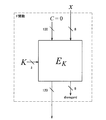
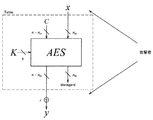
暗号化と復号化に同じ鍵を用いる共通鍵ブロック暗号の技術が知られている。図1は、共通鍵ブロック暗号を示す模式図であって、kビットの鍵長に対応したnビット共通鍵ブロック暗号アルゴリズムEを示している。暗号化の際には、平文P(nビット)からkビットの秘密鍵Kを用いて暗号関数Eにより暗号文C(nビット)が生成される。復号化の際には、暗号文C(nビット)からkビットの秘密鍵Kを用いて復号関数D(=E−1)により平文P(nビット)が生成される。このような共通鍵ブロック暗号では、例えば図1中に示すような通信路にデータが伝送される場合に、盗聴者(以下、攻撃者とも称する)に対して平文の秘匿性を実現できる。
1. Presupposed Technology Common key block cipher technology that uses the same key for encryption and decryption is known. FIG. 1 is a schematic diagram showing a common key block cipher, and shows an n-bit common key block cipher algorithm E corresponding to a key length of k bits. At the time of encryption, a ciphertext C (n bits) is generated from the plaintext P (n bits) by a cryptographic function E using a k-bit secret key K. At the time of decryption, plaintext P (n bits) is generated by the decryption function D (= E −1 ) using the k-bit secret key K from the ciphertext C (n bits). With such a common key block cipher, for example, when data is transmitted on a communication path as shown in FIG. 1, plain text confidentiality can be realized for an eavesdropper (hereinafter also referred to as an attacker).
平文Pと暗号文Cのビット長をブロックサイズと称し、ここではnで表す。nは任意の整数値を取りうるが、通常、ブロック暗号アルゴリズムごとに予め1つに決められている。ブロック長がnのブロック暗号のことをnビットブロック暗号と称する場合がある。秘密鍵Kのビット長をkで表し、鍵のビット長kは任意の整数値を取りうる。共通鍵ブロック暗号アルゴリズムは、1つまたは複数の鍵サイズに対応することになる。例えば、あるブロック暗号アルゴリズムAはブロックサイズn=128であり、k=128、またはk=192、またはk=256の鍵サイズに対応するという構成もあり得る。 The bit length of plaintext P and ciphertext C is referred to as a block size and is represented by n here. Although n can take an arbitrary integer value, it is usually determined in advance for each block cipher algorithm. A block cipher having a block length of n may be referred to as an n-bit block cipher. The bit length of the secret key K is represented by k, and the bit length k of the key can take an arbitrary integer value. The common key block cipher algorithm will correspond to one or more key sizes. For example, a certain block cipher algorithm A has a block size n = 128, and may correspond to a key size of k = 128, or k = 192, or k = 256.
暗号化アルゴリズムEに対応する復号アルゴリズムDは、暗号化アルゴリズムEの逆関数E−1と定義でき、入力として暗号文Cと鍵Kを受け取り、平文Pを出力する。 The decryption algorithm D corresponding to the encryption algorithm E can be defined as the inverse function E −1 of the encryption algorithm E, receives the ciphertext C and the key K as input, and outputs the plaintext P.
図2は、暗号化を行うブロック(暗号関数E)の内部構成を示す模式図である。暗号関数Eは、鍵スケジュール部100とデータ暗号化部200とから構成される。鍵スケジュール部100は、秘密鍵Kを入力とし、ある定められたステップによりビット長を拡大してできた拡大鍵K’(ビット長k’)を出力する。データ暗号化部200は、平文Pを受け取り、鍵スケジュール部から拡大された拡大鍵K’を受け取ってデータの変換を行い、暗号文Cを出力する。データ暗号化部200は、拡大鍵K’から得られるラウンド関数を繰り返し処理することで、暗号化を行う。
FIG. 2 is a schematic diagram showing an internal configuration of a block (encryption function E) that performs encryption. The encryption function E includes a
データ暗号化部200は、処理単位であるラウンド関数に分割できるものとする。ラウンド関数は入力として2つのデータを受け取り、内部で処理を施したのち、1つのデータを出力する。入力データの一方は暗号化途中のnビットデータであり、あるラウンドにおけるラウンド関数の出力が次のラウンド関数の入力として供給される。入力データの他方は鍵スケジュール部100から出力された拡大鍵K’の一部のデータであり、この鍵データのことをラウンド鍵と称する。また、ラウンド関数の総数を総ラウンド数と称する。総ラウンド数は、暗号アルゴリズムごとに予め定められている値である。ここでは、総ラウンド数をRで表す。データ暗号化部200の入力側から1ラウンド目の入力データをX1とし、i番目のラウンド関数に入力されるデータをXi、ラウンド鍵をRKiとすると、データ暗号化部200の構成は図2のように示される。
It is assumed that the
ブロック暗号アルゴリズムに応じてラウンド関数はさまざまな形態を取り得る。ラウンド関数はその暗号アルゴリズムが採用する構造によって分類できる。代表的な構造として、ここではSPN構造、Feistel構造、拡張Feistel構造を例示する。 Depending on the block cipher algorithm, the round function can take various forms. Round functions can be classified according to the structure adopted by the cryptographic algorithm. As typical structures, SPN structures, Feistel structures, and extended Feistel structures are exemplified here.
図3は、Feistel構造を示す模式図である。また、図4は、SPN構造を示す模式図である。図3に示すFeistel構造の基本的な構成例では、各ラウンド関数において、nビットの入力データXiが上位n/2ビットと下位n/2ビットに分割され、各ラインのデータのサイズはn/2ビットとなる。ここで、F関数には上位n/2ビットが入力されて、n/2ビットが出力される。この出力は下位n/2ビットにそれぞれ排他的論理和される。その後、データの左右を入れ替えたものを出力データXi+1とする。F関数は非線形関数をもとに構成される。SPN構造とは異なり、F関数は置換である必要はない。一般的に、F関数は、ブロック暗号から生成されることはなく、計算の軽い非線形演算で生成されるが、本実施形態では、F関数をブロック暗号から生成する。 FIG. 3 is a schematic diagram showing the Feistel structure. FIG. 4 is a schematic diagram showing the SPN structure. In the basic configuration example of the Feistel structure shown in FIG. 3, in each round function, n-bit input data X i is divided into upper n / 2 bits and lower n / 2 bits, and the data size of each line is n / 2 bits. Here, the upper n / 2 bits are input to the F function, and n / 2 bits are output. This output is exclusively ORed with the lower n / 2 bits. Thereafter, the left and right data are replaced with each other as output data X i + 1 . The F function is configured based on a nonlinear function. Unlike the SPN structure, the F function need not be a permutation. In general, the F function is not generated from the block cipher, but is generated by a non-linear operation that is light in calculation. In the present embodiment, the F function is generated from the block cipher.
拡張Feistel構造(一般化Feistel構造)は、Feistel構造ではデータ分割数が2であったものを3以上に分割する形に拡張したものである。分割数をdとすると、分割数dによって様々な拡張Feistel構造を定義することができる。F関数の入出力のサイズが相対的に小さくなるため、小型実装に向いている。また、各ラウンド関数において、複数のF関数を持つことができる。 The extended Feistel structure (generalized Feistel structure) is an extension of the number of data divisions of 2 in the Feistel structure into 3 or more. If the number of divisions is d, various extended Feistel structures can be defined by the number of divisions d. Since the input / output size of the F function is relatively small, it is suitable for small packaging. Each round function can have a plurality of F functions.
後述する図17では、d=4であり、且つ1つのラウンド内に2つのF関数が並列に適用される場合の拡張Feistel構造の一例を示している。この例では、第1F関数と第2F関数の各々において、RK1iとRK2iを鍵入力とする。また、後述する図14では、d=8であり、且つ1つのラウンド内に1つのF関数が適用される場合の拡張Feistel構造の一例を示している。この例では、F関数への入力サイズがn/8ビットであり、F関数からの出力サイズが7n/8ビットであり、出力は7つのn/8ビットのデータに分割され、残りの7つの16ビットデータに排他的論理和される。なお、n=128 bitとする。 FIG. 17 described later shows an example of an extended Feistel structure in the case where d = 4 and two F functions are applied in parallel in one round. In this example, RK1 i and RK2 i are used as key inputs in each of the first F function and the second F function. FIG. 14 described later shows an example of an extended Feistel structure in the case where d = 8 and one F function is applied in one round. In this example, the input size to the F function is n / 8 bits, the output size from the F function is 7n / 8 bits, the output is divided into 7 n / 8 bit data, and the remaining 7 XORed with 16-bit data. Note that n = 128 bits.
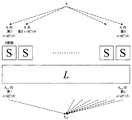
また、図4に示すSPN構造の基本的な構成例では、nビットの入力データの全てに対して、ラウンド鍵との排他的論理和演算、非線形変換、線形変換処理などが適用される。非線形変換部をS層(Substitution-layer)、線形変換部をP層(Permutation-layer)と称し、それぞれは置換(全単射関数)である。各ラウンド関数において、nビットの入力データXiがd通りのデータに分割され、各ラインのデータのサイズはn/d[bit]となる。ここで、非線形変換演算をS関数と定義し、各データ毎にn/d[bit]の入出力の非線形変換演算S層(Substitution-layer)が実行される。その後、線形変換P層(Permutation-layer)としてnビットの入出力線形変換Lが実行される。なお、線形変換演算をL関数と定義する。 In the basic configuration example of the SPN structure shown in FIG. 4, exclusive OR operation with a round key, non-linear conversion, linear conversion processing, and the like are applied to all n-bit input data. The non-linear transformation part is called an S layer (Substitution-layer) and the linear transformation part is called a P layer (Permutation-layer), and each is a substitution (bijective function). In each round function, n-bit input data Xi is divided into d data, and the data size of each line is n / d [bit]. Here, the nonlinear transformation operation is defined as an S function, and an n / d [bit] input / output nonlinear transformation operation S layer (Substitution-layer) is executed for each data. Thereafter, an n-bit input / output linear transformation L is executed as a linear transformation P layer (Permutation-layer). A linear transformation operation is defined as an L function.
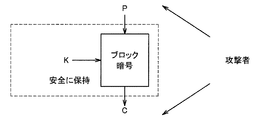
ブロック暗号の安全性モデルとして、ブラックボックスモデルとホワイトボックスモデルがある。図5は、共通鍵ブロック暗号によって構成されるブラックボックスモデルを示す模式図である。ブラックボックスモデルでは、秘密鍵を求めようとする攻撃者の能力が、ブロック暗号の入出力を認識して自由にコントロール可能であるが、攻撃者はブロック暗号の中間値は認識できない。つまり、ブラックボックスモデルは、攻撃者がブロック暗号アルゴリズムの入力、出力である平文P、暗号文Cにしかアクセスすることができない安全性モデルである。攻撃者による攻撃は、攻撃者が平文Pと暗号文Cのペアの値を知っているのみである既知平文暗号文攻撃と、これに加えて攻撃者が値自体を自由にコントロールできる選択平文暗号文攻撃に分けることができる。ブラックボックスモデルでは,暗号演算自体は安全に実行され、攻撃者が暗号の中間値を見たり、改ざんすることができないことを想定している。ハードウェアサポートなどを利用し、暗号演算の耐タンパ性が保障できている場合等が対応する。ブラックボックス用の暗号アルゴリズムの実装方法をブラックボックス実装と称する。このようなブラックボックスモデルでは、攻撃者に秘密鍵を知られないように安全に設計することが可能である。ブラックボックスモデルにおいては、ブロック暗号は、秘密鍵Kを求めることが計算量的に困難であり(鍵回復攻撃耐性)、ブロック暗号と擬似ランダム鍵付置換を識別するのが計算量的に困難である(識別攻撃耐性)ように設計される。ブラックボックスモデルで安全なブロック暗号は、例えば、AES,CLEFIA,PRESENT,Piccoloなどの暗号化技術により実現可能である。 There are black box model and white box model as security models of block ciphers. FIG. 5 is a schematic diagram showing a black box model configured by a common key block cipher. In the black box model, the attacker's ability to obtain a secret key can be freely controlled by recognizing the input / output of the block cipher, but the attacker cannot recognize the intermediate value of the block cipher. That is, the black box model is a security model in which an attacker can access only the plaintext P and the ciphertext C, which are the input and output of the block cipher algorithm. Attacks by attackers include known plaintext ciphertext attacks in which the attacker only knows the value of the pair of plaintext P and ciphertext C, and in addition to this, the selected plaintext cipher that allows the attacker to freely control the value itself It can be divided into sentence attacks. In the black box model, it is assumed that the cryptographic operation itself is executed safely and that the attacker cannot see or tamper with the intermediate value of the cipher. This is the case when the tamper resistance of cryptographic operations is guaranteed using hardware support. A method for implementing a black box encryption algorithm is referred to as black box implementation. In such a black box model, it is possible to design safely so that the attacker does not know the secret key. In the black box model, it is difficult for the block cipher to calculate the secret key K (key recovery attack resistance), and it is difficult to identify the block cipher and the pseudo random key replacement. Designed to be (identification attack resistance). A secure block cipher in the black box model can be realized by an encryption technique such as AES, CLEFIA, PRESENT, or Piccolo.
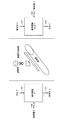
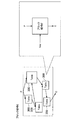
図6は、共通鍵ブロック暗号によって構成されるホワイトボックスモデルを示す模式図である。ホワイトボックスモデルは、ブラックボックスモデルよりも強い攻撃者を想定した安全性モデルであり、攻撃者がブロック暗号アルゴリズムの入力、出力である平文P、暗号文Cのみならず、演算の中間値にも自由にアクセスできる。ホワイトボックスモデルでは、攻撃者はブロック暗号の入力である平文P、暗号文Cを自由にコントロールでき、更に攻撃者が演算中の任意の中間値を見ることや、改ざんできることを想定している。ハードウェアのサポートがないオールソフトウェアなどの、実装上の制約により、耐タンパが保障できないケースに対応している。また、バッファオーバーフロー等の実装上の脆弱性やマルウェア等により中間値が漏れてしまう場合にも対応する。ホワイトボックス用の暗号アルゴリズムの実装方法をホワイトボックス実装と称する。ホワイトボックス実装によれば、ソフトウエアのみでブロック暗号を構成することも可能である。 FIG. 6 is a schematic diagram showing a white box model configured by a common key block cipher. The white box model is a security model that assumes a stronger attacker than the black box model. The attacker can use not only the plaintext P and ciphertext C as input and output of the block cipher algorithm, but also the intermediate value of the operation. Free access. In the white box model, it is assumed that the attacker can freely control the plaintext P and the ciphertext C, which are the input of the block cipher, and that the attacker can see and tamper with any intermediate value being calculated. Supports cases where tamper resistance cannot be guaranteed due to implementation restrictions, such as all software without hardware support. Moreover, it corresponds to the case where intermediate values are leaked due to implementation vulnerability such as buffer overflow or malware. A method for implementing an encryption algorithm for white box is referred to as white box implementation. According to the white box implementation, the block cipher can be configured only by software.
このように、ホワイトボックスモデルでは、攻撃者の能力が、ブロック暗号の入出力を認識して自由にコントロール可能であり、ブロック暗号の中間値を認識して自由にコントロール可能である。ホワイトボックスモデルにおいては、攻撃者が鍵Kを求めることは計算量的に困難であることが求められる。また、鍵Kを求める変わりにコード自体を直接用いて大きな鍵として用いる攻撃(code liftingと呼ばれる)に対しての耐性も求められる。ブロック暗号の中間値を攻撃者が認識可能なホワイトボックスモデルでは、このような攻撃に対して定量的な安全性をもつ必要がある。 Thus, in the white box model, the attacker's ability can be freely controlled by recognizing the input / output of the block cipher and can be freely controlled by recognizing the intermediate value of the block cipher. In the white box model, it is required that it is difficult for an attacker to obtain the key K in terms of calculation amount. Further, instead of obtaining the key K, resistance to an attack (called code lifting) that uses the code itself directly as a large key is also required. A white box model in which an attacker can recognize an intermediate value of a block cipher needs to have quantitative security against such an attack.
2.本実施形態の概要
本実施形態では、上述したホワイトボックスモデルにおいて、信頼できない実行環境において、安全に暗号復号を行う技術、秘密鍵を守る技術を提案する。信頼できない環境として、秘密鍵を安全に保管できない場合、暗号演算の中間値を攻撃者が認識できる場合が挙げられる。
2. Outline of the present embodiment In the present embodiment, a technique for safely performing encryption / decryption and a technique for protecting a secret key in an unreliable execution environment in the above-described white box model is proposed. As an unreliable environment, when the secret key cannot be stored safely, the attacker can recognize the intermediate value of the cryptographic operation.
図7は、本実施形態に係る暗号化技術の概要を示す模式図であって、基本となる構成例(A)に係る暗号化装置を示している。ブロック暗号Eを複数のテーブル300から構成し、各テーブルをブラックボックスモデルで安全なブロック暗号E’(内部ブロック暗号)として構成する。これにより、安全なブロック暗号Eを構成することができる。ホワイトボックス実装では、ブロック暗号E’からなる部品の一部、または全てをテーブル化して実装する。ブロック暗号E’のアルゴリズムはユーザが自由に選択可能とする。なお、暗号化装置は、CPUなどの中央演算処理装置と、これを機能させるためのプログラムから構成することができる。この場合に、そのプログラムは、暗号化装置が備えるメモリなどの記録媒体に格納されることができる。また、ブロック暗号を構成するテーブルは、暗号化装置が備える記録媒体に格納されることができる。 FIG. 7 is a schematic diagram showing an outline of the encryption technique according to the present embodiment, and shows an encryption apparatus according to a basic configuration example (A). The block cipher E is composed of a plurality of tables 300, and each table is configured as a secure block cipher E '(internal block cipher) with a black box model. As a result, a secure block cipher E can be configured. In the white box mounting, a part or all of the parts composed of the block cipher E ′ are mounted as a table. The algorithm of the block cipher E ′ can be freely selected by the user. The encryption device can be composed of a central processing unit such as a CPU and a program for causing it to function. In this case, the program can be stored in a recording medium such as a memory provided in the encryption apparatus. Further, the table constituting the block cipher can be stored in a recording medium included in the encryption device.
このように、本実施形態の基本となる構成例(A)では、ブラックボックスモデルで安全なブロック暗号E’を構成要素(部品)として、ホワイトボックスモデルで安全なブロック暗号Eを構成する。内部ブロック暗号E’のアルゴリズムは、ユーザが自由に選択でき、入力として受け取る。ホワイトボックス実装では、内部ブロック暗号E’ベースの関数を鍵に依存させ、一部もしくは全てがテーブルで実装される。つまり、鍵スケジュール部100から出力された拡大鍵K’により内部ブロック暗号E’を生成してテーブル化する。テーブル化することにより、その都度暗号化演算が行われる場合と比較して、鍵の秘匿性を大幅に高めることできる。
As described above, in the configuration example (A) that is the basis of the present embodiment, the secure block cipher E ′ is configured with the white box model using the secure block cipher E ′ with the black box model as a component (part). The algorithm of the internal block cipher E 'can be freely selected by the user and is received as input. In the white box implementation, the internal block cipher E′-based function is made dependent on the key, and a part or all of it is implemented as a table. That is, the internal block cipher E ′ is generated by the extended key K ′ output from the
また、構成例(A)の具体例(B)として、ブロック暗号EがFeistel構造からなり、一種類の入出力サイズのF関数から構成され、F関数は内部ブロック暗号E’をもとに生成される。ここでF関数は、内部ブロック暗号E’の入力の一部を固定、出力の一部を破棄することによってE’から変換される。ホワイトボックス実装では、F関数すべてがテーブルで実装される。 As a specific example (B) of the configuration example (A), the block cipher E has a Feistel structure and is composed of an F function of one kind of input / output size, and the F function is generated based on the internal block cipher E ′. Is done. Here, the F function is converted from E ′ by fixing a part of the input of the internal block cipher E ′ and discarding a part of the output. In the white box implementation, all F functions are implemented in a table.
また、構成例(A)の具体例(C)として、ブロック暗号EがSPN構造からなり、一種類の入出力サイズのS関数から構成され、S関数は内部ブロック暗号E’をもとに生成される。ここでS関数は、同じサイズの内部ブロック暗号から構成される。ホワイトボックス実装では、S関数すべてがテーブルで実装される。 As a specific example (C) of the configuration example (A), the block cipher E has an SPN structure and is composed of an S function of one kind of input / output size, and the S function is generated based on the internal block cipher E ′. Is done. Here, the S function is composed of internal block ciphers of the same size. In the white box implementation, all S functions are implemented in a table.
また、構成例(A)の具体例(D)として、ブロック暗号Eが拡張Feistel構造からなり、複数種類の入出力サイズのF関数から構成され、F関数は内部ブロック暗号E’をもとに生成される。ここで、F関数は、内部ブロック暗号の入力の一部を固定、出力の一部を破棄することによって生成される。ホワイトボックス実装では、一部若しくは全てがテーブル実装される。 As a specific example (D) of the configuration example (A), the block cipher E has an extended Feistel structure and is composed of F functions having a plurality of types of input / output sizes. The F function is based on the internal block cipher E ′. Generated. Here, the F function is generated by fixing a part of the input of the internal block cipher and discarding a part of the output. In the white box implementation, a part or all of the table is implemented.
また、構成例(A)の具体例(E)として、ブロック暗号EがSPN構造からなり、複数種類の入出力サイズのS関数から構成され、S関数は内部ブロック暗号E’をもとに生成する。ここで、S関数は、同じサイズの内部ブロック暗号から構成される。ホワイトボックス実装では、一部若しくは全てがテーブル実装される。 As a specific example (E) of the configuration example (A), the block cipher E has an SPN structure and is composed of S functions having a plurality of input / output sizes, and the S function is generated based on the internal block cipher E ′. To do. Here, the S function is composed of inner block ciphers of the same size. In the white box implementation, a part or all of the table is implemented.
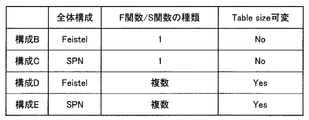
図8は、具体例(B)、具体例(C)、具体例(D)、具体例(E)のそれぞれについいて、全体構成、F関数/S関数の種類、テーブルサイズ可変の可否、を示す模式図である。 FIG. 8 shows the overall configuration, the type of F function / S function, and whether the table size can be changed for each of the specific example (B), specific example (C), specific example (D), and specific example (E). It is a schematic diagram shown.
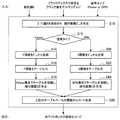
また、図9は、暗号タイプに応じた処理を示すフローチャートである。図9において、先ずステップS10では、内部ブロック暗号E’に鍵Kを依存させ、鍵付関数E’Kを生成する。次のステップS12では、暗号タイプを判定し、Feistel構造の場合はステップS14へ進む。ステップS14では、F関数をE’Kから生成する。次のステップS16では、F関数をテーブル化する。次のステップS18では、Feistel構成でテーブルを接続し、暗号関数Eを生成する。 FIG. 9 is a flowchart showing processing according to the encryption type. In FIG. 9, first, in step S10, the key K is made to depend on the internal block cipher E ′ to generate a keyed function E ′ K. In the next step S12, the encryption type is determined, and in the case of the Feistel structure, the process proceeds to step S14. In step S14, it generates the F function from E 'K. In the next step S16, the F function is tabulated. In the next step S18, the tables are connected in the Feistel configuration, and the cryptographic function E is generated.
また、ステップS12でSPN構造の場合はステップS20へ進み、S関数をE’Kから生成する。次のステップS22では、S関数をテーブル化する。次のステップS24では、SPN構成でテーブルを接続し、暗号関数Eを生成する。ステップS18,S24の後はステップS26へ進み、テーブルベースの関数からコード生成を行う。これにより、ホワイトボックス暗号化コードが生成される。 In the case of SPN structures in step S12 advances to step S20, and generates an S function from E 'K. In the next step S22, the S function is tabulated. In the next step S24, the tables are connected in the SPN configuration, and the cryptographic function E is generated. After steps S18 and S24, the process proceeds to step S26, where code generation is performed from a table-based function. Thereby, a white box encryption code is generated.
3.具体的構成例
以下では、具体例(B)、具体例(C)、具体例(D)、具体例(E)の構成例とその効果について詳細に説明する。ここで、内部ブロック暗号E’は、n’ビットブロック暗号であり、ブラックボックスモデルにおいて安全であるものとする。
3. Specific Configuration Example In the following, configuration examples of the specific example (B), specific example (C), specific example (D), and specific example (E) and their effects will be described in detail. Here, the internal block cipher E ′ is an n′-bit block cipher and is safe in the black box model.
3.1.具体例(B)
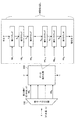
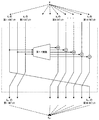
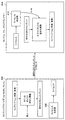
図10は、具体例(B)を示す模式図であって、一般化Feistel構造による構成例を示している。図10に示す例では、nビットの入力データXiがd通りのデータに分割され、各ラインのデータのサイズはn/dビットとなる。ここで、F関数はc×n/d bit入力、(d−c)×(n/d)(=n−(c×n/d))[bit]出力で、c通りのラインのデータが入力され、出力はd−c通りのn/d[bit]のデータに分割され、残りのd−c通りのラインにそれぞれ排他的論理和される。F関数は内部ブロック暗号E’をもとに構成される。ここでE’のブロックサイズn’が、n’>(d−c)×(n/d) かつ n’>c×(n/d)を満たすものとする(条件1)。図10に示すように、ブロック暗号E’へ入力されたビットの値は、排他論理和により得られたビットの値よりも下位ビットとして出力される。
3.1. Specific example (B)
FIG. 10 is a schematic diagram showing a specific example (B), and shows a configuration example of a generalized Feistel structure. In the example shown in FIG. 10, n-bit input data Xi is divided into d data, and the data size of each line is n / d bits. Here, the F function is c × n / d bit input, (d−c) × (n / d) (= n− (c × n / d)) [bit] output, and c lines of data are The input and output are divided into dc n / d [bit] data, and exclusive ORed with the remaining dc lines. The F function is configured based on the internal block cipher E ′. Here, it is assumed that the block size n ′ of E ′ satisfies n ′> (dc) × (n / d) and n ′> c × (n / d) (condition 1). As shown in FIG. 10, the value of the bit input to the block cipher E ′ is output as a lower bit than the value of the bit obtained by exclusive OR.
図11は、F関数の構成を示す模式図である。n’ビットの内部ブロック暗号E’から、c×n/d[bit]入力、(d−c)×(n/d)[bit]出力のF関数の構成方法は以下の通りである。先ず、図11に示すように、内部ブロック暗号E’の入力n’[bit]のうち、任意のn’−(c×n/d)[bit]を定数値(例えばall 0)に固定し、入力サイズをc×n/dにする。次に、出力の任意の(c×n/d)[bit]を破棄(disregard)することにより、出力サイズをn’−(c×n/d)にする。このような、内部ブロック暗号E’に対する一部の入力ビット固定、出力の一部破棄により、条件1を満たす任意の内部ブロック暗号E’からF関数を構成する。テーブル化により、F関数はn’ビットの入出力に対応するテーブルから構成される。例えば、8ビットの入出力の場合、入力値(0〜255)に対して出力値を対応付けしたテーブルが生成される。このテーブルに対し、一部の入力ビット固定、出力の一部破棄を行うことで、8ビット入力、120ビット出力などの入出力ビット数の調整を行うことができる。ここで、各ラウンドにおいてF関数を変更するため、n’−(c×n/d)ビットの出力にラウンド固有の定数を排他論理和(XOR)する。例えば、ラウンド固有の定数は、例えばラウンド数とし、ラウンド数をXORする。ラウンド数4の場合は4をXORすることになる。但し、この排他論理和はテーブル参照後に行われるため、この演算自体はテーブルには含めない。これにより、一通りのF関数テーブルで、ラウンド毎に異なるF関数を表現することができる。従って、各ラウンド関数のF関数自体は共通に構成することも可能であり、テーブルを格納するメモリ領域を大幅に削減することができる。
FIG. 11 is a schematic diagram showing the configuration of the F function. The configuration method of the F function of the c × n / d [bit] input and the (dc) × (n / d) [bit] output from the n′-bit internal block cipher E ′ is as follows. First, as shown in FIG. 11, arbitrary n ′ − (c × n / d) [bit] of the input n ′ [bit] of the internal block cipher E ′ is fixed to a constant value (for example, all 0). The input size is set to c × n / d. Next, the output size is set to n ′ − (c × n / d) by discarding any (c × n / d) [bit] of the output. By fixing a part of the input bits for the internal block cipher E ′ and discarding a part of the output, an F function is constructed from an arbitrary internal block cipher E ′ satisfying the
図12〜図15は、具体的な構成例を示す模式図である。図12はn=n’=128、c=1、d=16の場合の全体構成を示しており、図13は、図12の例のF関数の構成を示している。また、図14は、n=128、c=1、d=8の場合、図15はn=128、c=1、d=4の場合、図16はn=128、c=3、d=16の場合、をそれぞれ示している。 12 to 15 are schematic diagrams illustrating specific configuration examples. FIG. 12 shows the overall configuration when n = n ′ = 128, c = 1, and d = 16, and FIG. 13 shows the configuration of the F function in the example of FIG. 14 is n = 128, c = 1, d = 8, FIG. 15 is n = 128, c = 1, d = 4, FIG. 16 is n = 128, c = 3, d = The case of 16 is shown respectively.
図17は、1つのラウンド内に2つF関数がある例であって、n=128、d=4の例を示す模式図である。以上の全ての例において、F関数は、ホワイトボックス実装ではテーブル実装される。図12、図14、図15、図16の例において、テーブルサイズ(F関数のサイズ)は、それぞれ、約3.84[byte]、918[Kbyte]、51.5[Gbyte]、218[Mbyte]程度である。 FIG. 17 is a schematic diagram showing an example in which there are two F functions in one round, and n = 128 and d = 4. In all the above examples, the F function is implemented as a table in the white box implementation. In the examples of FIGS. 12, 14, 15, and 16, the table sizes (F function sizes) are about 3.84 [bytes], 918 [Kbytes], 51.5 [Gbytes], and 218 [Mbytes], respectively. ].
3.2.具体例(C)
図18は、具体例(C)を示す模式図であって、SPN構造による構成例を示している。図18に示す例では、nビットの入力データXiがd通りのデータに分割され、各ラインのデータのサイズはn/d[bit]である。ここで、各データ毎にn/d[bit]の入出力のS関数による演算(非線形変換演算S層(Substitution-layer))が実行される。その後、L関数による演算(線形変換P層(Permutation-layer))としてn−bit入出力線形変換が実行される。ここで、S関数とL関数(入出力線形変換L)は全単射関数であり、L関数はラウンド定数演算を含む。S関数は、内部ブロック暗号E’をもとに構成されるが、S関数は全単射関数である必要があり、図11のように内部ブロック暗号E’の入力ビット固定、出力の一部の破棄による変換では構成することができない。このため、n/d[bit]のブロック暗号を用いる必要がある。よって、内部ブロック暗号E’のブロックサイズn’の条件は、n’=n/dとなる(条件2)。
3.2. Specific example (C)
FIG. 18 is a schematic diagram showing a specific example (C), and shows a configuration example based on the SPN structure. In the example illustrated in FIG. 18, n-bit input data Xi is divided into d data, and the data size of each line is n / d [bit]. Here, for each data, an operation based on an input / output S function of n / d [bit] (nonlinear transformation operation S layer (Substitution-layer)) is executed. Thereafter, n-bit input / output linear transformation is executed as an operation based on the L function (linear transformation P layer (Permutation-layer)). Here, the S function and the L function (input / output linear transformation L) are bijective functions, and the L function includes a round constant calculation. The S function is configured based on the internal block cipher E ′. However, the S function needs to be a bijective function, and the input bit of the internal block cipher E ′ is fixed as shown in FIG. It cannot be configured by conversion by discarding. For this reason, it is necessary to use a block cipher of n / d [bit]. Therefore, the condition of the block size n ′ of the internal block cipher E ′ is n ′ = n / d (condition 2).
図19は、図18に示したS関数のそれぞれの構成を示す模式図である。図19に示すように、S関数を構成する内部ブロック暗号E’の入出力のサイズは、共にn/d[bit]である。従って、例えば、8ビットの入出力の場合、入力値(0〜255)に対して出力値を対応付けしたテーブルが生成され、このテーブルによりS関数の演算が行われる。線形変換演算を行うL関数は、例えば正方行列から構成される。S関数の入出力が8ビットの場合、S関数からの8ビットの出力がL関数に入力され、8ビットの値に対して8×8のマトリクスの正方行列を乗算することで、8ビットの値がL関数から出力される。このように、L関数は、S関数からの出力値を拡散する機能を有する。 FIG. 19 is a schematic diagram showing the configuration of each of the S functions shown in FIG. As shown in FIG. 19, the input / output sizes of the internal block cipher E ′ constituting the S function are both n / d [bit]. Therefore, for example, in the case of 8-bit input / output, a table in which an output value is associated with an input value (0 to 255) is generated, and an S function is calculated using this table. The L function that performs the linear transformation operation is composed of, for example, a square matrix. When the input / output of the S function is 8 bits, the 8-bit output from the S function is input to the L function, and the 8-bit value is multiplied by a square matrix of an 8 × 8 matrix to obtain an 8-bit output. The value is output from the L function. Thus, the L function has a function of diffusing the output value from the S function.
図20は、具体的な構成例を示す模式図であって、n=128、d=8の場合を示している。S関数は、ホワイトボックス実装ではテーブル実装される。図20のテーブルサイズは約256[byte]程度である。S関数の場合も、図11に示したF関数の場合と同様に、各S関数を変更するため、S関数の出力にラウンド固有の定数をXORすることができる。これにより、S関数自体を共通にすることができるため、テーブルを格納するメモリ領域を大幅に削減することができる。 FIG. 20 is a schematic diagram showing a specific configuration example, and shows a case where n = 128 and d = 8. The S function is implemented as a table in the white box implementation. The table size in FIG. 20 is about 256 [bytes]. In the case of the S function, as in the case of the F function shown in FIG. 11, since each S function is changed, a round-specific constant can be XORed to the output of the S function. Thereby, since the S function itself can be made common, the memory area for storing the table can be greatly reduced.
3.3.具体例(D)
図21は、具体例(D)を示す模式図であって、変形Feistel構造による構成例を示している。図21に示す例では、nビットの入力データがd通りのデータに分割され、各ラインのデータのサイズはn/dであり、サイズの異なる4種類のF関数から構成されている。初めのラウンドではn/d[bit]入力、(n−n/d)[bit]出力のF関数、2番目のラウンドでは2n/d[bit]入力、(n−2n/d)[bit]出力のF関数、3番目のラウンドでは3n/d[bit]入力、(n−3n/d)[bit]出力のF関数、4番目のラウンドでは4n/d[bit]入力、(n−4n/d)[bit]出力のF関数が用いられる。この4ラウンドを基本として、任意ラウンド繰り返す。図11で示した方法と同様に、任意のサイズのF関数は、内部ブロック暗号E’から生成され、出力にラウンド定数がXORされる。
3.3. Specific example (D)
FIG. 21 is a schematic diagram illustrating a specific example (D), and illustrates a configuration example using a modified Feistel structure. In the example shown in FIG. 21, n-bit input data is divided into d types of data, the data size of each line is n / d, and is composed of four types of F functions having different sizes. F function of n / d [bit] input, (n−n / d) [bit] output in the first round, 2n / d [bit] input, (n−2n / d) [bit] in the second round F function of output, 3n / d [bit] input in the third round, F function of (n-3n / d) [bit] output, 4n / d [bit] input in the fourth round, (n-4n / D) The F function of [bit] output is used. Based on these four rounds, any round is repeated. Similar to the method shown in FIG. 11, an F function having an arbitrary size is generated from the internal block cipher E ′, and a round constant is XORed to the output.
ホワイトボックス実装では、ユーザの求めるコード(テーブルサイズ)に応じて、これらのうちの一部若しくは全てがテーブルで実装される。n=128、d=16の場合は、それぞれのラウンドのF関数のテーブルサイズは、初めのラウンドでは約3.84[byte]、2番目のラウンドでは918[Kbyte]、3番目のラウンドでは218[Mbyte]、4番目のラウンドでは51.5[Gbyte]となる。ユーザの要求に応じて、どのF関数をテーブル実装するか選択することにより、全体のコードサイズを調整可能である。例えば、4番目のラウンド関数はテーブル化せずに関数演算をその都度行うようにすれば、全体のコードサイズを抑えることができる。 In the white box implementation, some or all of these are implemented in a table depending on the code (table size) required by the user. When n = 128 and d = 16, the F function table size of each round is about 3.84 [bytes] in the first round, 918 [Kbytes] in the second round, and 218 in the third round. [Mbyte] is 51.5 [Gbyte] in the fourth round. The entire code size can be adjusted by selecting which F function is mounted on the table according to the user's request. For example, if the fourth round function is not converted into a table and a function operation is performed each time, the entire code size can be suppressed.
3.4.具体例(E)
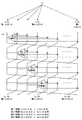
図22は、具体例(E)を示す模式図であって、変形SPN構造による構成例を示している。図22に示す例では、nビットの入力データがd通りのデータに分割され、各ラインのデータのサイズはn/dであり、サイズの異なる3種類のS関数から構成されている。各ラウンドのS層は、n/d[bit]の入出力、2n/d[bit]の入出力、4n/d[bit]の入出力、のS関数が用いられる。ホワイトボックス実装では、ユーザの求めるコード(テーブルサイズ)に応じて、これらの一部若しくは全てがテーブルで実装される。例えば。n=128、d=8で、8[bit]、16[bit]、32[bit]のデータが実装されている場合を考える。それぞれのテーブルサイズは、256[byte]、132[Kbyte]、17.2[Gbyte]となる。ユーザの要求に応じて、どのS関数をテーブル実装するか選択することにより、全体のコードサイズを調整可能である。
3.4. Specific example (E)
FIG. 22 is a schematic diagram illustrating a specific example (E), and illustrates a configuration example using a modified SPN structure. In the example shown in FIG. 22, n-bit input data is divided into d types of data, the data size of each line is n / d, and is composed of three types of S functions having different sizes. The S layer of each round uses S functions of n / d [bit] input / output, 2n / d [bit] input / output, and 4n / d [bit] input / output. In white box implementation, some or all of these are implemented in a table depending on the code (table size) required by the user. For example. Consider a case where n = 128, d = 8, and 8 [bit], 16 [bit], and 32 [bit] data are implemented. The respective table sizes are 256 [bytes], 132 [Kbytes], and 17.2 [Gbytes]. The entire code size can be adjusted by selecting which S function is mounted on the table according to the user's request.
本実施形態によれば、ホワイトボックスモデルにおいて、key extractionの安全性は内部ブロック暗号E’のブラックボックスモデルでの鍵回復問題の安全性に帰着する。これは、ホワイトボックス実装において、内部ブロック暗号E’がテーブル実装されていることによるもので、攻撃者はホワイトモデルにおいても、テーブルの入出力にしかアクセスできない。これは、内部ブロック暗号E’のブラックボックスモデルとマッチする。内部状態(内部ブロック暗号E’)に信頼性の高い暗号(例えばAES)を用ることで、ホワイトボックスモデルについても、内部ブロック暗号E’のブラックボックスモデルの鍵回復と同等の安全性を有することができる。 According to the present embodiment, in the white box model, the security of the key extraction results in the security of the key recovery problem in the black box model of the inner block cipher E ′. This is due to the fact that the internal block cipher E 'is implemented as a table in the white box implementation, and the attacker can access only the input / output of the table even in the white model. This matches the black box model of the inner block cipher E '. By using a highly reliable cipher (for example, AES) for the internal state (internal block cipher E ′), the white box model has the same security as the key recovery of the black box model of the internal block cipher E ′. be able to.
また、攻撃者は、鍵を知らない限りテーブルサイズを小さくすることはできない(Space-hardness)。内部ブロック暗号E’の鍵の情報を知らない限り、攻撃者はE’をテーブル演算以外で計算することはできない。このため、与えられたテーブルより小さいものに変換することはできない。これは、攻撃者がcode lifting攻撃する際に、大容量のデータが必要なことを意味している。データサイズに比例してコード抜き取りに必要な時間は増加するため、code lifting作業を非常に時間のかかる作業にしている。更に、もしコード全体自体をとったとしても、そのサイズを圧縮することができず、コード配布の際に大容量のデータを送付する必要があり、配布のリスクを低減することが可能である。 Also, the attacker cannot reduce the table size without knowing the key (Space-hardness). Unless the key information of the internal block cipher E ′ is known, the attacker cannot calculate E ′ by other than table calculation. For this reason, it cannot be converted into a smaller one than the given table. This means that a large amount of data is required when an attacker performs a code lifting attack. Since the time required for extracting the code increases in proportion to the data size, the code lifting operation is a very time-consuming operation. Further, even if the entire code itself is taken, the size cannot be compressed, and it is necessary to send a large amount of data at the time of code distribution, and the risk of distribution can be reduced.
また、external encodingについても、External Encodingなしで安全性を保障可能である。 Also, with regard to external encoding, safety can be guaranteed without external encoding.
更に、実装要求に応じた様々なサイズのテーブルを構成することが可能である。具体例(B)、具体例(C)によれば、分割数dの値を変更することにより、任意のテーブルサイズのアルゴリズムを構成することができる。また、具体例(D)、具体例(E)によれば、分割数dの値、又は使用するF関数、S関数のサイズを適切に複数選択することで、同じアルゴリズムで複数のテーブルサイズの実装が可能となる。 Furthermore, it is possible to configure tables of various sizes according to mounting requirements. According to the specific example (B) and the specific example (C), an algorithm having an arbitrary table size can be configured by changing the value of the division number d. Further, according to specific example (D) and specific example (E), it is possible to select a plurality of table sizes with the same algorithm by appropriately selecting the number of divisions d or the sizes of the F function and S function to be used. Implementation is possible.
また、ユーザは、内部ブロック暗号E’を自由に選択できる。内部ブロック暗号E’は、入出力サイズの条件(条件1、条件2)を満たす限り、自由に選択することが可能である。ブラックボックスで用いる場合、テーブル実装は不要で内部演算を直接演算できる。この場合、内部ブロック暗号E’を適切に選択することで、さまざまな実装ニーズに応えることが可能である。例えば、AESを内部ブロック暗号E’として使用し、AES−NIを用いることにより、ソフトウェアで非常に高速に実装でき、且つキャッシュタイミング攻撃に対しても安全に実装できる。また、ソフトウェアで軽量な暗号Piccolo,Prideを用いることにより、RAMサイズ等の実装制約が大きい環境でも実装可能である。
Further, the user can freely select the internal block cipher E ′. The internal block cipher E ′ can be freely selected as long as the input / output size conditions (
4.復号化のための構成例
上述したように、暗号化アルゴリズムEに対応する復号アルゴリズムDは、暗号化アルゴリズムEの逆関数E−1と定義でき、入力として暗号文Cと鍵Kを受け取り、平文Pを出力する。復号アルゴリズムDにおいても、ブラックボックス実装によりテーブルを構成することで、ブラックボックスモデルと同等の安全性を確保することが可能である。
4). Configuration Example for Decryption As described above, the decryption algorithm D corresponding to the encryption algorithm E can be defined as the inverse function E −1 of the encryption algorithm E, receives the ciphertext C and the key K as input, P is output. Also in the decoding algorithm D, it is possible to ensure the same safety as that of the black box model by configuring the table by mounting the black box.
5.既存技術との相違
以下では、本実施形態に係る技術と、前述した非特許文献1,2に記載された方法(既存技術1とする)、非特許文献3に記載された方法(既存技術3とする)との相違について説明する。
5. Difference from Existing Technology Hereinafter, the technology according to the present embodiment, the method described in
5.1.既存技術1との違い
既存技術1は、既存のAES,DES等のアルゴリズムの実装方法であり、ホワイトボックス用暗号技術ではなく、ホワイトボックスモデルに対して安全ではないことが既に示されている。従って、ホワイトボックスモデルにおける安全性を大幅に向上した本実施形態に係る技術とは相違する。
5.1. Difference from the existing
5.2.既存技術2との違い
既存技術2では、内部ブロック暗号E’を自由に選ぶことはできず、内部ブロック暗号E’は予め決められているASASA構造に限定される。本実施形態では、ブラックボックスモデルで安全なブロック暗号でも安全性を満たすことを示し、内部ブロック暗号E’は、入出力サイズの条件(条件1、条件2)を満たす限り、自由に選択することが可能である。
5.2. Difference from Existing
これにより、ブラックボックス実装において、実装環境や求められる安全性に応じて、内部ブロック暗号E’を自由に選択可能となる。例えば、AESを内部ブロック暗号E’として使い、AES−NIを用いることにより、ソフトウェアで非常に高速な実装を行うことができ、且つキャッシュタイミング攻撃に対しても安全に実装できる。また、ソフトウェアで軽量な暗号Piccolo,Prideを用いることにより、RAMサイズ等の実装制約が大きい環境でも実装可能である。また、ASASA構造はホワイトボックスモデルにおいては安全ではないが、本実施形態に係る方法では、ホワイトボックスモデルに対しても安全性を保障することが可能である。 Thereby, in the black box mounting, the internal block cipher E ′ can be freely selected according to the mounting environment and required security. For example, by using AES as the internal block cipher E ′ and using AES-NI, it is possible to implement a very high speed with software and to safely implement against a cache timing attack. In addition, by using lightweight encryption Piccolo and Pride with software, it can be mounted even in an environment where mounting restrictions such as a RAM size are large. Further, the ASASA structure is not safe in the white box model, but the method according to the present embodiment can ensure the safety for the white box model.
6.本実施形態に係る暗号化による効果について
図23は、本実施形態に係る暗号化による安全性を説明するための模式図であって、図11に示したFeistel構造によるF関数をAESにより構成した例を示している。上述したように、ホワイトボックスモデルでは、攻撃者はテーブルの入出力にアクセス可能である。内部ブロック暗号E’のブラックボックスモデルと同じテーブルから鍵を求める問題(ホワイトボックスモデル)は、AESの鍵回復攻撃(ブラックボックスモデル)と等しい。従って、本実施形態に係る暗号化によれば、AESの鍵回復攻撃(ブラックボックスモデル)と同等の安全性を確保することが可能である。ホワイトボックスモデルにおいて、安全性は内部ブロック暗号E’のブラックボックスモデルでの鍵回復問題の安全性に帰着する。攻撃者は、鍵を知らない限りテーブルサイズを小さくすることはできない(Space-hardness)。
6). FIG. 23 is a schematic diagram for explaining security by encryption according to the present embodiment, and the F function having the Feistel structure shown in FIG. 11 is configured by AES. An example is shown. As described above, in the white box model, the attacker can access the input and output of the table. The problem of obtaining keys from the same table as the black box model of the internal block cipher E ′ (white box model) is equivalent to the AES key recovery attack (black box model). Therefore, according to the encryption according to the present embodiment, it is possible to ensure the same security as the AES key recovery attack (black box model). In the white box model, security results in the security of the key recovery problem in the black box model of the inner block cipher E ′. An attacker cannot reduce the table size without knowing the key (Space-hardness).
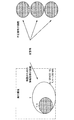
図24は、本実施形態に係る暗号化による安全性を説明するための模式図であって、攻撃者が攻撃する際に必要となるデータ量を示している。攻撃のためには、非常に多くのデータを入手しなければ秘密鍵Kを取得することはできない。具体的には、128 bit鍵と比較した場合、104.4〜1010.5倍のデータ量が必要である。また、攻撃者がデータを入手できたとしても、圧縮することができないので、不正に配布する際に大容量のデータであるため抑止力になる。 FIG. 24 is a schematic diagram for explaining security by encryption according to the present embodiment, and shows an amount of data required when an attacker attacks. For an attack, the secret key K cannot be obtained unless a very large amount of data is obtained. Specifically, when compared with a 128-bit key, a data amount of 10 4.4 to 10 10.5 times is required. Even if the attacker can obtain the data, it cannot be compressed, so it becomes a deterrent because it is a large amount of data when it is illegally distributed.
また、本実施形態によれば、実装要求に応じた様々なサイズのテーブルを構成することが可能である。具体例(B),(C)の構成では、分割数dの数を変更することにより、任意のテーブルサイズのアルゴリズムを構成することができる。また、具体例(D),(E)の構成では、分割数dの数や使われるF関数、S関数のサイズを適切に複数選択することで、同じアルゴリズムで複数のテーブルサイズの実装が可能である。更に、テーブルの内部演算をユーザが自由に選択可能であり、ブラックボックス実装において最適なものを選択することが可能である。 Furthermore, according to the present embodiment, it is possible to configure tables of various sizes according to mounting requirements. In the configurations of the specific examples (B) and (C), an algorithm having an arbitrary table size can be configured by changing the number of divisions d. In the configurations of specific examples (D) and (E), it is possible to implement a plurality of table sizes with the same algorithm by appropriately selecting the number of divisions d and the sizes of the F function and S function used. It is. Further, the user can freely select the internal calculation of the table, and it is possible to select an optimal one in the black box mounting.
7.本実施形態が適用されるアプリケーションの例
本実施形態に係る技術は、図1に示したような通信路におけるデータの秘匿性を実現する他、様々なアプリケーションに適用することができる。以下では、幾つかのアプリケーションの例を説明する。
7). Examples of applications to which the present embodiment is applied The technology according to the present embodiment can be applied to various applications in addition to realizing the confidentiality of data in the communication path as shown in FIG. In the following, some examples of applications will be described.
図25は、著作権保護技術(DRM:Digital Rights Management)への適用例を示す模式図である。図25に示すように、クラウド上のコンテンツサーバ400で暗号化を行い、コンテンツ(暗号文C)がコンテンツサーバ400からユーザデバイス410へ配信される。ユーザデバイス410は、パーソナルコンピュータ(PC)、スマートフォンなどの電子機器である。コンテンツ(暗号文C)はユーザデバイス410において復号される。
FIG. 25 is a schematic diagram showing an application example to copyright protection technology (DRM: Digital Rights Management). As shown in FIG. 25, encryption is performed by the
図26は、図25をより詳細に示す模式図である。コンテンツサーバ400は、ホワイトボックス暗号化関数により映画、音楽などのコンテンツを暗号化する。また、コンテンツサーバ400では、ライセンス生成器402によりライセンスを生成し、暗号化されたコンテンツと共にユーザデバイス410へ送る。ユーザデバイス410は、送られたライセンスをライセンス検証器412により検証し、ライセンスの検証に成功した場合は、ホワイトボックス復号関数により、暗号化されたコンテンツを復号する。
FIG. 26 is a schematic diagram showing FIG. 25 in more detail. The
図25及び図26に示したような著作権保護技術では、ユーザデバイス410でコンテンツを復号する必要がある。この場合、仮に鍵Kが露呈した場合、コンテンツの不正配布に繋がる。つまり、暗号化が安全でない環境では、ユーザデバイス410が信頼できない環境となる。本実施形態によれば、悪意のあるユーザがコンテンツの秘密鍵Kを取得することを、ホワイトボックス暗号化技術により確実に防止することが可能である。
In the copyright protection technology as shown in FIGS. 25 and 26, it is necessary to decrypt the content by the
図27は、NFCのエミュレーションを利用した支払システムへの適用例を示す模式図である。図27に示すように、このシステムでは、NFCの読取装置420にユーザデバイス430を近づけてエミュレーションを行う。ユーザデバイス430は、ホストCPU432、NFCコントローラ434、セキュアエレメント436を有する。
FIG. 27 is a schematic diagram showing an application example to a payment system using NFC emulation. As shown in FIG. 27, in this system, the
図28は、図27をより詳細に示す模式図である。クラウド上のサーバ440は、ユーザの証明用の情報(Credential information)と、支払情報(Payment information)を有する。ユーザデバイス430は、モバイル機器などの電子機器であり、サーバ440と暗号化通信を行い、証明用の情報をやり取りする。また、ユーザデバイス430は、読取装置420と暗号化通信を行い、証明用の情報をやり取りする。暗号化通信では、本実施形態に係るホワイトボックス暗号化により暗号化が行われる。このため、ユーザデバイス430は、ホワイトボックス暗号関数、復号関数を備えている。ホワイトボックス暗号化により暗号化を行うことで、支払いに関する証明のデータを守ることができ、ユーザデバイス430がセキュアエレメント436を備えていなくてもNFCのエミュレーションが可能となる。
FIG. 28 is a schematic diagram showing FIG. 27 in more detail. The
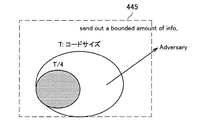
図29は、メモリリークに対しても安全な方式を示す模式図である。このシステムでは、ソフトウェアの脆弱性(buffer overflow, heart bleed)やマルウェアにより、メモリが攻撃者にリークした場合も、安全性を保障する。マルウェアやメモリリークの脆弱性のあるデバイス445において、ホワイトボックス暗号化方式が有するSpace hardnessの性質により、数キロバイト、数ギガバイト以上のデータが漏れない限り安全性は低下しない。図29の例において、コードサイズをTとすると、T/4以上のデータが漏れない限り安全性は低下しない。なお、Space hardnessとは、一定以上のサイズのメモリが漏れない限り暗号の安全性を保障できる技術である。この方法は、内部ネットワークから外部ネットワークからの通信量を制限している場合に特に有効である。
FIG. 29 is a schematic diagram showing a method that is safe against memory leaks. This system ensures security even if memory is leaked to an attacker due to software vulnerabilities (buffer overflow, heart bleed) or malware. In the
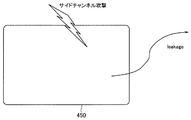
図30は、サイドチャンネル攻撃に対して安全な暗号化の例を示す模式図である。ホワイトボックス暗号化方式は、通常はソフトウェア用であるが、Reconfigurable Hardware (FPGA)で実装することにより、ハードウェアでサイドチャンネルに安全な暗号方式として使うことができる。例えば図30に示すICカード450など、ハードウェアでサイドチャンネル攻撃を受ける可能性のあるデバイスにおいて、特に有効である。
FIG. 30 is a schematic diagram illustrating an example of encryption that is secure against a side channel attack. The white box encryption method is usually for software, but can be used as a secure encryption method for the side channel by hardware by implementing it with Reconfigurable Hardware (FPGA). For example, this is particularly effective in a device such as an
以上、添付図面を参照しながら本開示の好適な実施形態について詳細に説明したが、本開示の技術的範囲はかかる例に限定されない。本開示の技術分野における通常の知識を有する者であれば、特許請求の範囲に記載された技術的思想の範疇内において、各種の変更例または修正例に想到し得ることは明らかであり、これらについても、当然に本開示の技術的範囲に属するものと了解される。 The preferred embodiments of the present disclosure have been described in detail above with reference to the accompanying drawings, but the technical scope of the present disclosure is not limited to such examples. It is obvious that a person having ordinary knowledge in the technical field of the present disclosure can come up with various changes or modifications within the scope of the technical idea described in the claims. Of course, it is understood that it belongs to the technical scope of the present disclosure.
また、本明細書に記載された効果は、あくまで説明的または例示的なものであって限定的ではない。つまり、本開示に係る技術は、上記の効果とともに、または上記の効果に代えて、本明細書の記載から当業者には明らかな他の効果を奏しうる。 Further, the effects described in the present specification are merely illustrative or exemplary and are not limited. That is, the technology according to the present disclosure can exhibit other effects that are apparent to those skilled in the art from the description of the present specification in addition to or instead of the above effects.
なお、以下のような構成も本開示の技術的範囲に属する。
(1) 入力値を順次に暗号化処理する複数のラウンド関数の少なくとも一部がテーブル化され、前記ラウンド関数の入出力値を外部から認識可能なホワイトボックスモデルにより暗号化するデータ暗号化部を備え、
複数の前記ラウンド関数のそれぞれは、入出力値を外部から認識可能であり中間値は外部から認識できないブラックボックスモデルにおいて入力値を暗号化するテーブル化された暗号化関数を有する、暗号化装置。
(2) 前記暗号化関数には、前記ラウンド関数へ入力されるビットのうちの一部が入力され、
前記暗号化関数は、前記暗号化関数へ入力可能なビットの一部を固定値とし、前記暗号化関数の出力値の一部を破棄することで、前記暗号化関数へ入力可能なビット数から前記暗号化関数へ入力されたビット数の差分に相当するビット数の出力値を出力する、前記(1)に記載の暗号化装置。
(3) 前記ラウンド関数は、前記ラウンド関数へ入力されるビットのうち前記暗号化関数に入力されなかったビットと、前記暗号化関数からの前記出力値のビットの排他論理和を演算する、前記(2)に記載の暗号化装置。
(4) 前記ラウンド関数は、前記暗号化関数へ入力されたビットの値と前記排他論理和により得られたビットの値を出力する、前記(3)に記載の暗号化装置。
(5) 前記ラウンド関数は、前記暗号化関数へ入力されたビットの値を前記排他論理和により得られたビットの値よりも下位ビットとして出力する、前記(4)に記載の暗号化装置。
(6) 前記ラウンド関数の出力と予め定められた所定値との排他論理和を演算し、得られた値を次のラウンド関数への入力又は前記データ暗号化部の出力とする、前記(2)〜(5)のいずれかに記載の暗号化装置。
(7) 1の前記ラウンド関数が複数の前記暗号化関数を有する、前記(1)に記載の暗号化装置。
(8) 複数の前記ラウンド関数において、後段のラウンド関数ほど前記暗号化関数に大きなビットの入力値が入力される、前記(2)〜(6)のいずれかに記載の暗号化装置。
(9) 1の前記ラウンド関数が複数の前記暗号化関数を有し、
前記ラウンド関数へ入力されるビットが分割されて複数の前記暗号化関数へ入力され、
複数の前記暗号化関数は非線形演算を行い、
前記ラウンド関数は、複数の前記暗号化関数による前記非線形演算の結果を線形変換演算して出力する、前記(1)に記載の暗号化装置。
(10) 複数の前記暗号化関数のそれぞれにおいて、入力されるビット数と出力されるビット数が同一である、前記(9)に記載の暗号化装置。
(11) 複数の前記暗号化関数のそれぞれに入力されるビット数が異なる、前記(9)又は(10)に記載の暗号化装置。
(12) 前記暗号化関数は、前記データ暗号化部に対応する秘密鍵から生成される拡張鍵によって暗号化を行う、前記(1)〜(11)のいずれかに記載の暗号化装置。
(13) 入力値を順次に暗号化処理する複数のラウンド関数の少なくとも一部がテーブル化され、前記ラウンド関数の入出力値を外部から認識可能なホワイトボックスモデルにより暗号化することを備え、
複数の前記ラウンド関数のそれぞれは、入出力値を外部から認識可能であり中間値は外部から認識できないブラックボックスモデルにおいてテーブル化された暗号化関数により入力値を暗号化する、暗号化方法。
(14) 入力値を順次に暗号化処理する複数のラウンド関数の少なくとも一部がテーブル化され、前記ラウンド関数の入出力値を外部から認識可能なホワイトボックスモデルにより暗号化する暗号化処理の逆演算により復号を行うデータ復号化部を備え、
複数の前記ラウンド関数のそれぞれは、入出力値を外部から認識可能であり中間値は外部から認識できないブラックボックスモデルにおいてテーブル化された暗号化関数により入力値を暗号化する、復号化装置。
(15) 入力値を順次に暗号化処理する複数のラウンド関数の少なくとも一部がテーブル化され、前記ラウンド関数の入出力値を外部から認識可能なホワイトボックスモデルにより暗号化する暗号化処理の逆演算により復号を行うことを備え、
複数の前記ラウンド関数のそれぞれは、入出力値を外部から認識可能であり中間値は外部から認識できないブラックボックスモデルにおいてテーブル化された暗号化関数によりにより入力値を暗号化する、復号化方法。
The following configurations also belong to the technical scope of the present disclosure.
(1) A data encryption unit that at least part of a plurality of round functions for sequentially encrypting input values is tabulated, and the input / output values of the round functions are encrypted by a white box model that can be recognized from the outside. Prepared,
Each of the plurality of round functions has a table-like encryption function for encrypting input values in a black box model in which input / output values can be recognized from outside and intermediate values cannot be recognized from outside.
(2) A part of bits input to the round function is input to the encryption function,
The encryption function sets a part of bits that can be input to the encryption function as a fixed value, and discards a part of the output value of the encryption function, thereby reducing the number of bits that can be input to the encryption function. The encryption apparatus according to (1), wherein an output value having a number of bits corresponding to a difference between the number of bits input to the encryption function is output.
(3) The round function calculates an exclusive OR of a bit not input to the encryption function and a bit of the output value from the encryption function among bits input to the round function. The encryption device according to (2).
(4) The encryption device according to (3), wherein the round function outputs a bit value input to the encryption function and a bit value obtained by the exclusive OR.
(5) The encryption device according to (4), wherein the round function outputs a bit value input to the encryption function as a lower bit than a bit value obtained by the exclusive OR.
(6) An exclusive OR of the output of the round function and a predetermined value is calculated, and the obtained value is used as an input to the next round function or an output of the data encryption unit (2 ) To (5).
(7) The encryption device according to (1), wherein the one round function includes a plurality of the encryption functions.
(8) The encryption device according to any one of (2) to (6), wherein, in the plurality of round functions, an input value of a larger bit is input to the encryption function as the round function at the later stage.
(9) The one round function has a plurality of the encryption functions,
The bits input to the round function are divided and input to a plurality of the encryption functions,
The plurality of encryption functions perform non-linear operations,
The encryption function according to (1), wherein the round function outputs a result of the non-linear operation by a plurality of the encryption functions by performing a linear transformation operation.
(10) The encryption device according to (9), wherein the number of input bits and the number of output bits are the same in each of the plurality of encryption functions.
(11) The encryption device according to (9) or (10), wherein the number of bits input to each of the plurality of encryption functions is different.
(12) The encryption apparatus according to any one of (1) to (11), wherein the encryption function performs encryption using an extended key generated from a secret key corresponding to the data encryption unit.
(13) At least a part of a plurality of round functions for sequentially encrypting input values is tabulated, and the input / output values of the round functions are encrypted by a white box model that can be recognized from outside.
Each of the plurality of round functions is an encryption method in which an input value is encrypted by an encryption function tabulated in a black box model in which an input / output value can be recognized from outside and an intermediate value cannot be recognized from outside.
(14) At least a part of a plurality of round functions for sequentially encrypting input values is tabulated, and the reverse of the encryption processing for encrypting the input / output values of the round functions by a white box model recognizable from the outside. A data decoding unit that performs decoding by calculation,
Each of the plurality of round functions is a decryption device that encrypts an input value with an encryption function tabulated in a black box model in which an input / output value can be recognized from outside and an intermediate value cannot be recognized from outside.
(15) At least part of a plurality of round functions for sequentially encrypting input values is tabulated, and the reverse of the encryption processing for encrypting the input / output values of the round functions by a white box model that can be recognized from the outside. Comprising performing decoding by operation,
Each of the plurality of round functions is a decryption method in which an input value is encrypted by an encryption function tabulated in a black box model in which an input / output value can be recognized from outside and an intermediate value cannot be recognized from outside.
100 データ暗号化部
300 テーブル
100
Claims (15)
複数の前記ラウンド関数のそれぞれは、入出力値を外部から認識可能であり中間値は外部から認識できないブラックボックスモデルにおいて入力値を暗号化するテーブル化された暗号化関数を有する、暗号化装置。 At least a part of a plurality of round functions that sequentially encrypt input values is tabulated, and includes a data encryption unit that encrypts input / output values of the round functions by a white box model that can be recognized from the outside,
Each of the plurality of round functions has a table-like encryption function for encrypting input values in a black box model in which input / output values can be recognized from outside and intermediate values cannot be recognized from outside.
前記暗号化関数は、前記暗号化関数へ入力可能なビットの一部を固定値とし、前記暗号化関数の出力値の一部を破棄することで、前記暗号化関数へ入力可能なビット数から前記暗号化関数へ入力されたビット数の差分に相当するビット数の出力値を出力する、請求項1に記載の暗号化装置。 A part of the bits input to the round function is input to the encryption function,
The encryption function sets a part of bits that can be input to the encryption function as a fixed value, and discards a part of the output value of the encryption function, thereby reducing the number of bits that can be input to the encryption function. The encryption apparatus according to claim 1, wherein an output value having a number of bits corresponding to a difference between the number of bits input to the encryption function is output.
前記ラウンド関数へ入力されるビットが分割されて複数の前記暗号化関数へ入力され、
複数の前記暗号化関数は非線形演算を行い、
前記ラウンド関数は、複数の前記暗号化関数による前記非線形演算の結果を線形変換演算して出力する、請求項1に記載の暗号化装置。 One round function has a plurality of the encryption functions;
The bits input to the round function are divided and input to a plurality of the encryption functions,
The plurality of encryption functions perform non-linear operations,
The encryption device according to claim 1, wherein the round function outputs a result of the non-linear operation by the plurality of encryption functions by performing a linear transformation operation.
複数の前記ラウンド関数のそれぞれは、入出力値を外部から認識可能であり中間値は外部から認識できないブラックボックスモデルにおいてテーブル化された暗号化関数により入力値を暗号化する、暗号化方法。 At least a part of a plurality of round functions for sequentially encrypting input values is tabulated, and the input / output values of the round functions are encrypted by a white box model that can be recognized from the outside,
Each of the plurality of round functions is an encryption method in which an input value is encrypted by an encryption function tabulated in a black box model in which an input / output value can be recognized from outside and an intermediate value cannot be recognized from outside.
複数の前記ラウンド関数のそれぞれは、入出力値を外部から認識可能であり中間値は外部から認識できないブラックボックスモデルにおいてテーブル化された暗号化関数により入力値を暗号化する、復号化装置。 At least a part of a plurality of round functions for sequentially encrypting input values is tabulated, and decrypted by the inverse operation of the encryption processing for encrypting the input / output values of the round functions by a white box model that can be recognized from the outside. A data decoding unit for performing
Each of the plurality of round functions is a decryption device that encrypts an input value with an encryption function tabulated in a black box model in which an input / output value can be recognized from outside and an intermediate value cannot be recognized from outside.
複数の前記ラウンド関数のそれぞれは、入出力値を外部から認識可能であり中間値は外部から認識できないブラックボックスモデルにおいてテーブル化された暗号化関数によりにより入力値を暗号化する、復号化方法。
At least a part of a plurality of round functions for sequentially encrypting input values is tabulated, and decrypted by the inverse operation of the encryption processing for encrypting the input / output values of the round functions by a white box model that can be recognized from the outside. Prepared to do
Each of the plurality of round functions is a decryption method in which an input value is encrypted by an encryption function tabulated in a black box model in which an input / output value can be recognized from outside and an intermediate value cannot be recognized from outside.
Priority Applications (2)
| Application Number | Priority Date | Filing Date | Title |
|---|---|---|---|
| JP2016078386A JP6877889B2 (en) | 2016-04-08 | 2016-04-08 | Cryptographic device, encryption method, decryption device, and decryption method |
| US15/255,693 US10277391B2 (en) | 2016-04-08 | 2016-09-02 | Encryption device, encryption method, decryption device, and decryption method |
Applications Claiming Priority (1)
| Application Number | Priority Date | Filing Date | Title |
|---|---|---|---|
| JP2016078386A JP6877889B2 (en) | 2016-04-08 | 2016-04-08 | Cryptographic device, encryption method, decryption device, and decryption method |
Publications (2)
| Publication Number | Publication Date |
|---|---|
| JP2017187724A true JP2017187724A (en) | 2017-10-12 |
| JP6877889B2 JP6877889B2 (en) | 2021-05-26 |
Family
ID=59998242
Family Applications (1)
| Application Number | Title | Priority Date | Filing Date |
|---|---|---|---|
| JP2016078386A Active JP6877889B2 (en) | 2016-04-08 | 2016-04-08 | Cryptographic device, encryption method, decryption device, and decryption method |
Country Status (2)
| Country | Link |
|---|---|
| US (1) | US10277391B2 (en) |
| JP (1) | JP6877889B2 (en) |
Cited By (2)
| Publication number | Priority date | Publication date | Assignee | Title |
|---|---|---|---|---|
| WO2019031025A1 (en) * | 2017-08-10 | 2019-02-14 | ソニー株式会社 | Encryption device, encryption method, decryption device, and decryption method |
| WO2019031026A1 (en) * | 2017-08-10 | 2019-02-14 | ソニー株式会社 | Encryption device, encryption method, decryption device, and decryption method |
Families Citing this family (7)
| Publication number | Priority date | Publication date | Assignee | Title |
|---|---|---|---|---|
| US10140612B1 (en) * | 2017-12-15 | 2018-11-27 | Clover Network, Inc. | POS system with white box encryption key sharing |
| CN108111622B (en) * | 2017-12-29 | 2021-10-29 | 北京梆梆安全科技有限公司 | Method, device and system for downloading white box library file |
| US11206130B2 (en) * | 2018-07-31 | 2021-12-21 | Nxp B.V. | Customizing cryptographic keys between multiple hosts |
| KR102169369B1 (en) * | 2019-10-31 | 2020-10-23 | 국민대학교산학협력단 | Countermeasure method of first-order side-channel attack on lightweight block cipher and apparatus using the same |
| US11811938B2 (en) * | 2019-12-20 | 2023-11-07 | Micro Focus Llc | Tokenization of arbitrary data types |
| CN113111317B (en) * | 2021-04-20 | 2022-10-04 | 西安电子科技大学 | Software tampering detection method based on white-box CLEFIA encryption method |
| CN115967483B (en) * | 2022-12-28 | 2025-04-11 | 北京电子科技学院 | A white-box block cipher encryption method and system using matrix transformation to construct a lookup table |
Citations (3)
| Publication number | Priority date | Publication date | Assignee | Title |
|---|---|---|---|---|
| JP2000066585A (en) * | 1998-08-20 | 2000-03-03 | Toshiba Corp | Encryption / decryption device, encryption / decryption method, and program storage medium therefor |
| JP2008058829A (en) * | 2006-09-01 | 2008-03-13 | Sony Corp | Cryptographic processing apparatus, cryptographic processing method, and computer program |
| JP2012520589A (en) * | 2009-03-10 | 2012-09-06 | イルデト・コーポレート・ビー・ヴイ | White-box cryptosystem using input-dependent encoding |
Family Cites Families (4)
| Publication number | Priority date | Publication date | Assignee | Title |
|---|---|---|---|---|
| JP3505482B2 (en) * | 2000-07-12 | 2004-03-08 | 株式会社東芝 | Encryption device, decryption device, extended key generation device, extended key generation method, and recording medium |
| JP4882598B2 (en) * | 2006-07-28 | 2012-02-22 | ソニー株式会社 | Cryptographic processing apparatus, cryptographic processing algorithm construction method, cryptographic processing method, and computer program |
| EP2362573A1 (en) * | 2010-02-19 | 2011-08-31 | Irdeto B.V. | Device and method for establishing secure trust key |
| US10015009B2 (en) * | 2015-11-25 | 2018-07-03 | Nxp B.V. | Protecting white-box feistel network implementation against fault attack |
-
2016
- 2016-04-08 JP JP2016078386A patent/JP6877889B2/en active Active
- 2016-09-02 US US15/255,693 patent/US10277391B2/en active Active
Patent Citations (3)
| Publication number | Priority date | Publication date | Assignee | Title |
|---|---|---|---|---|
| JP2000066585A (en) * | 1998-08-20 | 2000-03-03 | Toshiba Corp | Encryption / decryption device, encryption / decryption method, and program storage medium therefor |
| JP2008058829A (en) * | 2006-09-01 | 2008-03-13 | Sony Corp | Cryptographic processing apparatus, cryptographic processing method, and computer program |
| JP2012520589A (en) * | 2009-03-10 | 2012-09-06 | イルデト・コーポレート・ビー・ヴイ | White-box cryptosystem using input-dependent encoding |
Non-Patent Citations (2)
| Title |
|---|
| BIRYUKOV, ALEX ET AL: "Cryptographic Schemes Based on the ASASA Structure: Black-box White-box, and Public-key", CRYPTOLOGY EPRINT ARCHIVE, vol. Report 2014/474, Ver. 20141011:141154, JPN6020008096, October 2014 (2014-10-01), pages 1 - 21, ISSN: 0004226039 * |
| BOGDANOV, ANDREY AND ISOBE, TAKANORI: "White-box Cryptography Revisited: Space-Hard Ciphers", PROCEEDINGS OF THE 22ND ACM SIGSAC CONFERENCE ON COMPUTER AND COMMUNICATIONS SECURITY (CSS'15), JPN7020000591, October 2015 (2015-10-01), pages 1058 - 1069, ISSN: 0004226040 * |
Cited By (8)
| Publication number | Priority date | Publication date | Assignee | Title |
|---|---|---|---|---|
| WO2019031025A1 (en) * | 2017-08-10 | 2019-02-14 | ソニー株式会社 | Encryption device, encryption method, decryption device, and decryption method |
| WO2019031026A1 (en) * | 2017-08-10 | 2019-02-14 | ソニー株式会社 | Encryption device, encryption method, decryption device, and decryption method |
| JPWO2019031026A1 (en) * | 2017-08-10 | 2021-01-21 | ソニー株式会社 | Cryptographic device, encryption method, decryption device, and decryption method |
| JPWO2019031025A1 (en) * | 2017-08-10 | 2021-02-04 | ソニー株式会社 | Cryptographic device, encryption method, decryption device, and decryption method |
| US11269993B2 (en) | 2017-08-10 | 2022-03-08 | Sony Corporation | Encryption device, encryption method, decryption device, and decryption method |
| JP7078631B2 (en) | 2017-08-10 | 2022-05-31 | ソニーグループ株式会社 | Cryptographic device, encryption method, decryption device, and decryption method |
| JP7078630B2 (en) | 2017-08-10 | 2022-05-31 | ソニーグループ株式会社 | Cryptographic device, encryption method, decryption device, and decryption method |
| US11436946B2 (en) | 2017-08-10 | 2022-09-06 | Sony Corporation | Encryption device, encryption method, decryption device, and decryption method |
Also Published As
| Publication number | Publication date |
|---|---|
| JP6877889B2 (en) | 2021-05-26 |
| US20170294148A1 (en) | 2017-10-12 |
| US10277391B2 (en) | 2019-04-30 |
Similar Documents
| Publication | Publication Date | Title |
|---|---|---|
| JP6877889B2 (en) | Cryptographic device, encryption method, decryption device, and decryption method | |
| US8966279B2 (en) | Securing the implementation of a cryptographic process using key expansion | |
| JP7078631B2 (en) | Cryptographic device, encryption method, decryption device, and decryption method | |
| US9143317B2 (en) | Protecting against white box attacks using column rotation | |
| JP7078630B2 (en) | Cryptographic device, encryption method, decryption device, and decryption method | |
| JP2016523391A (en) | Method and apparatus for encrypting plaintext data | |
| CN113098675B (en) | Binary data encryption system and method based on polynomial complete homomorphism | |
| US9485226B2 (en) | Method for including an implicit integrity or authenticity check into a white-box implementation | |
| EP2922235B1 (en) | Security module for secure function execution on untrusted platform | |
| US8699702B2 (en) | Securing cryptographic process keys using internal structures | |
| US9363244B2 (en) | Realizing authorization via incorrect functional behavior of a white-box implementation | |
| Almoysheer et al. | Enhancing Cloud Data Security using Multilevel Encryption Techniques. | |
| EP2960891B1 (en) | Method for introducing dependence of white-box implementationon a set of strings | |
| US20150372989A1 (en) | Method for introducing dependence of white-box implementation on a set of strings | |
| CN118842584A (en) | Privacy computing method and system for improving data transmission safety | |
| Pandey et al. | Data security using various cryptography Techniques: A Recent Survey | |
| EP2940677A1 (en) | Method for including an implicit integrity or authenticity check into a white-box implementation | |
| Anbazhagan et al. | ENHANCED PRIVACY PRESERVING USING MULTILEVEL ENCRYPTION TECHNIQUE | |
| US20210160051A1 (en) | Method and devices for creating redundancy and encryption using mojette transform | |
| CN121548852A (en) | Authentication encryption device, authentication encryption method, and authentication encryption program | |
| CN117955636A (en) | A highly secure sensitive data access method and system |
Legal Events
| Date | Code | Title | Description |
|---|---|---|---|
| A80 | Written request to apply exceptions to lack of novelty of invention |
Free format text: JAPANESE INTERMEDIATE CODE: A80 Effective date: 20160506 |
|
| RD04 | Notification of resignation of power of attorney |
Free format text: JAPANESE INTERMEDIATE CODE: A7424 Effective date: 20190208 |
|
| RD04 | Notification of resignation of power of attorney |
Free format text: JAPANESE INTERMEDIATE CODE: A7424 Effective date: 20190214 |
|
| A621 | Written request for application examination |
Free format text: JAPANESE INTERMEDIATE CODE: A621 Effective date: 20190307 |
|
| RD02 | Notification of acceptance of power of attorney |
Free format text: JAPANESE INTERMEDIATE CODE: A7422 Effective date: 20190515 |
|
| RD04 | Notification of resignation of power of attorney |
Free format text: JAPANESE INTERMEDIATE CODE: A7424 Effective date: 20190522 |
|
| RD02 | Notification of acceptance of power of attorney |
Free format text: JAPANESE INTERMEDIATE CODE: A7422 Effective date: 20190708 |
|
| A521 | Request for written amendment filed |
Free format text: JAPANESE INTERMEDIATE CODE: A821 Effective date: 20190708 |
|
| A977 | Report on retrieval |
Free format text: JAPANESE INTERMEDIATE CODE: A971007 Effective date: 20200131 |
|
| A131 | Notification of reasons for refusal |
Free format text: JAPANESE INTERMEDIATE CODE: A131 Effective date: 20200310 |
|
| A521 | Request for written amendment filed |
Free format text: JAPANESE INTERMEDIATE CODE: A523 Effective date: 20200610 |
|
| A131 | Notification of reasons for refusal |
Free format text: JAPANESE INTERMEDIATE CODE: A131 Effective date: 20201201 |
|
| A521 | Request for written amendment filed |
Free format text: JAPANESE INTERMEDIATE CODE: A523 Effective date: 20210301 |
|
| TRDD | Decision of grant or rejection written | ||
| A01 | Written decision to grant a patent or to grant a registration (utility model) |
Free format text: JAPANESE INTERMEDIATE CODE: A01 Effective date: 20210406 |
|
| A61 | First payment of annual fees (during grant procedure) |
Free format text: JAPANESE INTERMEDIATE CODE: A61 Effective date: 20210428 |
|
| R150 | Certificate of patent or registration of utility model |
Ref document number: 6877889 Country of ref document: JP Free format text: JAPANESE INTERMEDIATE CODE: R150 |