JP2017190428A - Adhesive composition - Google Patents
Adhesive composition Download PDFInfo
- Publication number
- JP2017190428A JP2017190428A JP2016081977A JP2016081977A JP2017190428A JP 2017190428 A JP2017190428 A JP 2017190428A JP 2016081977 A JP2016081977 A JP 2016081977A JP 2016081977 A JP2016081977 A JP 2016081977A JP 2017190428 A JP2017190428 A JP 2017190428A
- Authority
- JP
- Japan
- Prior art keywords
- mass
- adhesive composition
- block copolymer
- less
- component
- Prior art date
- Legal status (The legal status is an assumption and is not a legal conclusion. Google has not performed a legal analysis and makes no representation as to the accuracy of the status listed.)
- Granted
Links
Landscapes
- Addition Polymer Or Copolymer, Post-Treatments, Or Chemical Modifications (AREA)
- Adhesives Or Adhesive Processes (AREA)
Abstract
【課題】結合力、引張り弾性率、成形性及び低臭気性に優れ、さらに、これらのバランスにも優れる粘接着剤組成物を提供する。【解決手段】少なくとも1つのビニル芳香族炭化水素を主体とする重合体ブロックと少なくとも1つの共役ジエン化合物を主体とする重合体ブロックとを含有し、かつ、下記(a)及び(b)を満たすブロック共重合体100質量部と、総量として1質量部以上170質量部未満の粘着付与剤及び軟化剤と、を含有し、下記(c)を満たす、粘接着剤組成物:(a)ガラス転移温度が−53℃以下である;(b)前記ブロック共重合体中の共役ジエン単量体単位の総含有量に対する水素添加率Hが0<H<80 mol%である;(c)180℃における溶融粘度が15Pa・s以上である。【選択図】なしAn object of the present invention is to provide a pressure-sensitive adhesive composition which is excellent in bonding strength, tensile modulus, moldability and low odor, and which is also excellent in balance among these properties. A polymer block containing at least one vinyl aromatic hydrocarbon-based polymer block and at least one conjugated diene compound-based polymer block, and satisfying the following (a) and (b): A pressure-sensitive adhesive composition containing 100 parts by mass of a block copolymer and a total amount of 1 part by mass or more and less than 170 parts by mass of a tackifier and a softening agent, and satisfying the following (c): (a) glass (b) the hydrogenation rate H relative to the total content of conjugated diene monomer units in the block copolymer is 0<H<80 mol%; (c) 180. The melt viscosity at °C is 15 Pa·s or more. [Selection figure] None
Description
本発明は、粘接着剤組成物に関する。 The present invention relates to an adhesive composition.
紙おむつには、弾性部材あるいは各部材を張り合わせるためのホットメルト粘接着剤の材料として、各所にビニル芳香族炭化水素単量体−共役ジエン単量体系ブロック共重合体(例えば、SBS:スチレン−ブタジエン−スチレン−ブロック共重合体など)が用いられている。近年、使い捨て紙おむつの世界的な普及を背景に、ホットメルト粘接着剤を各部材の接合剤及び弾性部材として機能させることで、より高性能で生産性にも優れた紙おむつの開発が進んでいる。 For paper diapers, vinyl aromatic hydrocarbon monomer-conjugated diene monomer block copolymers (for example, SBS: styrene) are used in various places as an elastic member or a material of a hot melt adhesive for laminating each member. -Butadiene-styrene-block copolymer, etc.). In recent years, with the widespread use of disposable diapers worldwide, the development of paper diapers with higher performance and superior productivity has progressed by making hot melt adhesives function as bonding agents and elastic members for each member. Yes.
例えば、特許文献1には、ビニル芳香族炭化水素単量体−共役ジエン単量体系ブロック共重合体を用いた弾性部材が開示されている。また、特許文献2には、トリブロック共重合体とジブロック共重合体よりなる粘接着剤組成物が開示されており、特許文献3では、特定の2官能性カップリング剤(特定のジハロゲン化合物)でカップリングさせて得られるブロック共重合体よりなる粘接着剤組成物が開示されている。さらに、特許文献4では、ビニル芳香族炭化水素単量体と共役ジエン単量体とのブロック共重合体を特定の割合で水添したブロック共重合体よりなる粘接着剤組成物が開示されている。さらにまた、特許文献5には加熱溶融させたビニル芳香族炭化水素単量体−共役ジエン単量体系ブロック共重合体を用いた多層体が開示されている。 For example, Patent Document 1 discloses an elastic member using a vinyl aromatic hydrocarbon monomer-conjugated diene monomer block copolymer. Patent Document 2 discloses an adhesive composition comprising a triblock copolymer and a diblock copolymer. Patent Document 3 discloses a specific bifunctional coupling agent (specific dihalogen). An adhesive composition comprising a block copolymer obtained by coupling with a compound) is disclosed. Further, Patent Document 4 discloses an adhesive composition comprising a block copolymer obtained by hydrogenating a block copolymer of a vinyl aromatic hydrocarbon monomer and a conjugated diene monomer at a specific ratio. ing. Furthermore, Patent Document 5 discloses a multilayer body using a vinyl aromatic hydrocarbon monomer-conjugated diene monomer block copolymer heated and melted.
しかしながら、上述した従来提案されている技術においても、結合力、引張り弾性率、成形性及び低臭気性の改良効果は、いまだ不十分であり、また、これらのバランスにおいてはさらに不十分である。 However, even in the above-described conventionally proposed techniques, the effect of improving the bonding strength, tensile elastic modulus, moldability and low odor is still insufficient, and the balance between these is still insufficient.
本発明は、上述した従来技術の問題点に鑑みなされたものであって、結合力、引張り弾性率、成形性及び低臭気性に優れ、さらに、これらのバランスにも優れる粘接着剤組成物を提供することを目的とする。 The present invention has been made in view of the above-mentioned problems of the prior art, and is excellent in bonding strength, tensile elastic modulus, moldability and low odor, and further in an excellent balance between these. The purpose is to provide.
本発明者らは、前記従来技術の問題点を解決するために鋭意研究を重ねた結果、特定構造のブロック共重合体に対して、粘着付与剤及び軟化剤の総量が所定の割合となるように含まれ、かつ、特定の溶融粘度を有する粘接着剤組成物により、上述した従来技術の課題を解決し得ることを見出し、本発明を完成させるに至った。 As a result of intensive studies to solve the problems of the prior art, the present inventors have determined that the total amount of the tackifier and the softener becomes a predetermined ratio with respect to the block copolymer having a specific structure. It was found that the above-mentioned problems of the prior art can be solved by the adhesive composition having a specific melt viscosity, and the present invention has been completed.
すなわち、本発明は以下のとおりである。
[1]
少なくとも1つのビニル芳香族炭化水素を主体とする重合体ブロックと少なくとも1つの共役ジエン化合物を主体とする重合体ブロックとを含有し、かつ、下記(a)及び(b)を満たすブロック共重合体100質量部と、
総量として1質量部以上170質量部未満の粘着付与剤及び軟化剤と、
を含有し、
下記(c)を満たす、粘接着剤組成物:
(a)ガラス転移温度が−53℃以下である;
(b)前記ブロック共重合体中の共役ジエン単量体単位の総含有量に対する水素添加率Hが0<H<80 mol%である;
(c)180℃における溶融粘度が15Pa・s以上である。
[2]
T(ODT)が150℃以上である、[1]に記載の粘接着剤組成物
[3]
T(ODT)が160℃以上である、[1]又は[2]に記載の粘接着剤組成物。
[4]
前記ブロック共重合体100質量部に対する前記粘着付与剤及び軟化剤の総量が1質量部以上130質量部未満である、[1]〜[3]のいずれかに記載の粘接着剤組成物。
[5]
前記ブロック共重合体が、30万を超える最大ピーク分子量を有するブロック共重合体を含有する、[1]〜[4]のいずれかに記載の粘接着剤組成物。
[6]
180℃における溶融粘度が100Pa・sを超える、[1]〜[5]のいずれかに記載の粘接着剤組成物。
[7]
前記ブロック共重合体のMFR(190℃、2.16kg)が0.001g/10min以上2g/10min未満である、[1]〜[6]のいずれかに記載の粘接着剤組成物。
That is, the present invention is as follows.
[1]
A block copolymer containing a polymer block mainly composed of at least one vinyl aromatic hydrocarbon and a polymer block mainly composed of at least one conjugated diene compound, and satisfying the following (a) and (b): 100 parts by mass;
A tackifier and a softener in a total amount of 1 part by weight or more and less than 170 parts by weight;
Containing
An adhesive composition satisfying the following (c):
(A) the glass transition temperature is −53 ° C. or lower;
(B) The hydrogenation rate H with respect to the total content of conjugated diene monomer units in the block copolymer is 0 <H <80 mol%;
(C) The melt viscosity at 180 ° C. is 15 Pa · s or more.
[2]
The adhesive composition [3] according to [1], wherein T (ODT) is 150 ° C. or higher.
The adhesive composition according to [1] or [2], wherein T (ODT) is 160 ° C. or higher.
[4]
The adhesive composition according to any one of [1] to [3], wherein the total amount of the tackifier and the softener with respect to 100 parts by mass of the block copolymer is 1 part by mass or more and less than 130 parts by mass.
[5]
The adhesive composition according to any one of [1] to [4], wherein the block copolymer contains a block copolymer having a maximum peak molecular weight exceeding 300,000.
[6]
The adhesive composition according to any one of [1] to [5], wherein the melt viscosity at 180 ° C exceeds 100 Pa · s.
[7]
The adhesive composition according to any one of [1] to [6], wherein MFR (190 ° C., 2.16 kg) of the block copolymer is 0.001 g / 10 min or more and less than 2 g / 10 min.
本発明によれば、結合力、引張り弾性率、成形性及び低臭気性に優れ、さらに、これらのバランスにも優れる粘接着剤組成物を提供することができる。 ADVANTAGE OF THE INVENTION According to this invention, the adhesive agent composition which is excellent in bond strength, a tensile elasticity modulus, a moldability, and low odor property, and is excellent also in these balance can be provided.
以下、本発明を実施するための形態(以下、「本実施形態」という。)について詳細に説明する。本発明は、以下の実施形態に限定されるものではなく、その要旨の範囲内で種々変形して実施することができる。 Hereinafter, a mode for carrying out the present invention (hereinafter referred to as “the present embodiment”) will be described in detail. The present invention is not limited to the following embodiments, and various modifications can be made within the scope of the invention.
なお、以下において、重合体を構成する構成単位のことを「〜単量体単位」といい、重合体の材料として記載する場合は「単位」を省略し、単に「〜単量体」と記載する。 In the following, the structural unit constituting the polymer is referred to as “˜monomer unit”, and when described as a polymer material, “unit” is omitted, and simply “˜monomer” is described. To do.
〔粘接着剤組成物〕
本実施形態の粘接着剤組成物は、少なくとも1つのビニル芳香族炭化水素を主体とする重合体ブロックと少なくとも1つの共役ジエン化合物を主体とする重合体ブロックとを含有し、かつ、下記(a)及び(b)を満たすブロック共重合体100質量部と、総量として1質量部以上170質量部未満の粘着付与剤及び軟化剤と、を含有し、下記(c)を満たす:
(a)ガラス転移温度が−53℃以下である;
(b)前記ブロック共重合体中の共役ジエン単量体単位の総含有量に対する水素添加率Hが0<H<80 mol%である;
(c)180℃における溶融粘度が15Pa・s以上である。
このような構成を有するため、本実施形態の粘接着剤組成物は、優れた結合力、引張り弾性率、成形性及び低臭気性を有し、さらに、これらのバランスにも優れる。
[Adhesive composition]
The adhesive composition of this embodiment contains a polymer block mainly composed of at least one vinyl aromatic hydrocarbon and a polymer block mainly composed of at least one conjugated diene compound, and the following ( It contains 100 parts by mass of a block copolymer satisfying a) and (b), and a tackifier and a softening agent in a total amount of 1 part by weight or more and less than 170 parts by weight, and satisfies the following (c):
(A) the glass transition temperature is −53 ° C. or lower;
(B) The hydrogenation rate H with respect to the total content of conjugated diene monomer units in the block copolymer is 0 <H <80 mol%;
(C) The melt viscosity at 180 ° C. is 15 Pa · s or more.
Since it has such a configuration, the adhesive composition of the present embodiment has excellent bonding strength, tensile elastic modulus, moldability and low odor, and also has an excellent balance.
〔ブロック共重合体〕
本実施形態におけるブロック共重合体は少なくとも1つのビニル芳香族炭化水素単量体単位を主体とする重合体ブロック(Ar)と、少なくとも1つの共役ジエン単量体単位を主体とする重合体ブロック(D)と、を含有する。
[Block copolymer]
The block copolymer in the present embodiment includes a polymer block (Ar) mainly composed of at least one vinyl aromatic hydrocarbon monomer unit, and a polymer block mainly composed of at least one conjugated diene monomer unit ( D).
ブロック共重合体の重量平均分子量は、好ましくは20,000以上であり、より好ましくは50,000以上であり、さらに好ましくは70,000以上である。また、ブロック共重合体の重量平均分子量は、好ましくは1,000,000以下であり、より好ましくは600,000以下であり、さらに好ましくは400,000以下である。ブロック共重合体の重量平均分子量が20,000以上であることにより、保持力や成形性、結合力、凝集力がより向上する傾向にある。また、ブロック共重合体の重量平均分子量が1,000,000以下であることにより、優れた生産性を有する粘接着剤組成物が得られる傾向にある。なお、ブロック共重合体の重量平均分子量は実施例に記載する方法により求めることができる。 The weight average molecular weight of the block copolymer is preferably 20,000 or more, more preferably 50,000 or more, and further preferably 70,000 or more. Further, the weight average molecular weight of the block copolymer is preferably 1,000,000 or less, more preferably 600,000 or less, and further preferably 400,000 or less. When the weight average molecular weight of the block copolymer is 20,000 or more, the holding power, moldability, bonding force, and cohesive force tend to be further improved. Moreover, it exists in the tendency for the adhesive composition which has the outstanding productivity to be obtained because the weight average molecular weight of a block copolymer is 1,000,000 or less. In addition, the weight average molecular weight of a block copolymer can be calculated | required by the method described in an Example.
ブロック共重合体の最大ピーク分子量は、好ましくは20,000以上であり、より好ましくは100,000以上であり、さらに好ましくは200,000以上であり、よりさらに好ましくは250,000以上であり、300,000を超えることが特に好ましい。また、ブロック共重合体の最大ピーク分子量は、好ましくは1,000,000以下であり、より好ましくは600,000以下であり、さらに好ましくは400,000以下である。ブロック共重合体の最大ピーク分子量が20,000以上であることにより、保持力や成形性、結合力、凝集力がより向上する傾向にある。特にピーク分子量が300,000を超えることにより成形性が優れる傾向にあるため、ブロック共重合体が、30万を超えるピーク分子量を有するブロック共重合体を含有することが特に好ましい。例えば、用いる重合開始剤の量を減らす、3官能以上のカップリング剤を用いる等により、ブロック共重合体が、30万を超えるピーク分子量を有するブロック共重合体を含有する傾向にある。また、ブロック共重合体の最大ピーク分子量が1,000,000以下であることにより、優れた生産性を有する粘接着剤組成物が得られる傾向にある。なお、ブロック共重合体の最大ピーク分子量は実施例に記載する方法により求めることができる。 The maximum peak molecular weight of the block copolymer is preferably 20,000 or more, more preferably 100,000 or more, still more preferably 200,000 or more, and even more preferably 250,000 or more, It is particularly preferred to exceed 300,000. Further, the maximum peak molecular weight of the block copolymer is preferably 1,000,000 or less, more preferably 600,000 or less, and further preferably 400,000 or less. When the maximum peak molecular weight of the block copolymer is 20,000 or more, the holding power, moldability, bonding force, and cohesive force tend to be further improved. In particular, since the moldability tends to be excellent when the peak molecular weight exceeds 300,000, it is particularly preferable that the block copolymer contains a block copolymer having a peak molecular weight exceeding 300,000. For example, a block copolymer tends to contain a block copolymer having a peak molecular weight exceeding 300,000 by using a trifunctional or higher functional coupling agent to reduce the amount of polymerization initiator used. Moreover, when the maximum peak molecular weight of the block copolymer is 1,000,000 or less, an adhesive composition having excellent productivity tends to be obtained. In addition, the maximum peak molecular weight of a block copolymer can be calculated | required by the method described in an Example.
本明細書において「ビニル芳香族炭化水素単量体単位を主体とする」とは、重合体ブロック中のビニル芳香族炭化水素単量体単位の含有量が、60質量%以上であり、好ましくは80質量%以上であり、より好ましくは95質量%以上であることを意味する。重合体ブロック中のビニル芳香族炭化水素単量体単位の含有量が、60%質量以上であることにより、保持力に優れる粘接着剤組成物が得られる。 In the present specification, “mainly composed of vinyl aromatic hydrocarbon monomer units” means that the content of vinyl aromatic hydrocarbon monomer units in the polymer block is 60% by mass or more, preferably It means 80% by mass or more, more preferably 95% by mass or more. When the content of the vinyl aromatic hydrocarbon monomer unit in the polymer block is 60% by mass or more, an adhesive composition excellent in holding power can be obtained.
また、本明細書において「共役ジエン単量体単位を主体とする」とは、重合体ブロック中の共役ジエン単量体単位の含有量が、60質量%以上であり、好ましくは80質量%以上であり、より好ましくは90質量%以上であり、さらに好ましくは95質量%以上であることを意味する。 Further, in the present specification, “mainly comprising a conjugated diene monomer unit” means that the content of the conjugated diene monomer unit in the polymer block is 60% by mass or more, preferably 80% by mass or more. More preferably, it means 90% by mass or more, and more preferably 95% by mass or more.
ブロック共重合体の構造としては、特に限定されないが、例えば、下記の式(i)〜(vi)が挙げられる。
(Ar−D)n ・・・(i)
D−(Ar−D)n ・・・(ii)
Ar−(D−Ar)n ・・・(iii)
Ar−(D−Ar)n−X ・・・(iv)
[(Ar−D)k]m−X ・・・(v)
[(Ar−D)k−Ar]m−X ・・・(vi)
Although it does not specifically limit as a structure of a block copolymer, For example, following formula (i)-(vi) is mentioned.
(Ar-D) n (i)
D- (Ar-D) n (ii)
Ar- (D-Ar) n (iii)
Ar- (D-Ar) n -X (iv)
[(Ar−D) k ] m −X (v)
[(Ar-D) k- Ar] m- X (vi)
上記式(i)〜(vi)中、Arはビニル芳香族炭化水素単量体単位を主体とする重合体ブロック(Ar)を表し、Dは共役ジエン単量体単位を主体とする重合体ブロック(D)を表し、Xは、カップリング剤の残基又は多官能有機リチウム等の重合開始剤の残基を表し、m、n及びkは、1以上の整数を表し、それぞれ1〜6の整数であることが好ましい。重合体ブロック(Ar)及び/又は重合体ブロック(D)が複数存在している場合には、各重合体ブロック(Ar)及び/又は各重合体ブロック(D)の重量平均分子量、組成、構造は同一であってもよいし、異なっていてもよいが、重合体ブロック(Ar)が複数存在している場合、保持力や耐熱性、生産性の観点から、複数存在する重合体ブロック(Ar)の重量平均分子量の差は小さい方が好ましい。また、各重合体ブロック(Ar)が含有するビニル芳香族炭化水素単量体単位の含有量を重合体ブロック(Ar)の数で除した値と、ブロック共重合体中に占めるビニル芳香族炭化水素単量体単位の含有量を重合体ブロック(Ar)の数で除した値の差が小さい方が好ましい。 In the above formulas (i) to (vi), Ar represents a polymer block (Ar) mainly composed of vinyl aromatic hydrocarbon monomer units, and D represents a polymer block mainly composed of conjugated diene monomer units. (D) represents, X represents a residue of a coupling agent or a residue of a polymerization initiator such as polyfunctional organolithium, m, n and k represent an integer of 1 or more, It is preferably an integer. When there are a plurality of polymer blocks (Ar) and / or polymer blocks (D), the weight average molecular weight, composition and structure of each polymer block (Ar) and / or each polymer block (D) May be the same or different, but when a plurality of polymer blocks (Ar) are present, a plurality of polymer blocks (Ar) are present from the viewpoint of holding power, heat resistance, and productivity. ) Is preferably as small as possible. Also, the value obtained by dividing the content of vinyl aromatic hydrocarbon monomer units contained in each polymer block (Ar) by the number of polymer blocks (Ar) and the vinyl aromatic carbonization occupied in the block copolymer It is preferable that the difference in the value obtained by dividing the content of the hydrogen monomer unit by the number of polymer blocks (Ar) is smaller.
複数存在する重合体ブロック(Ar)の重量平均分子量の差は、特に限定されないが、最も大きい重量平均分子量を有する重合体ブロック(Ar)に対する、他の重合体ブロック(Ar)の重量平均分子量の差が、最も大きい重量平均分子量を有する重合体ブロック(Ar)の重量平均分子量の35%以下であることが好ましく、25%以下がより好ましく、15%以下がさらに好ましく、5%以下がさらにより好ましい。また、特に限定されないが、0%以上であることが好ましい。 The difference in the weight average molecular weight of the plurality of polymer blocks (Ar) is not particularly limited, but the weight average molecular weight of the other polymer block (Ar) with respect to the polymer block (Ar) having the largest weight average molecular weight. The difference is preferably 35% or less of the weight average molecular weight of the polymer block (Ar) having the largest weight average molecular weight, more preferably 25% or less, further preferably 15% or less, and even more preferably 5% or less. preferable. Moreover, although not particularly limited, it is preferably 0% or more.
なお、重合体ブロック(Ar)の重量平均分子量は、実施例に記載の測定方法により求めることができる。 In addition, the weight average molecular weight of a polymer block (Ar) can be calculated | required by the measuring method as described in an Example.
各重合体ブロック(Ar)が含有するビニル芳香族炭化水素単量体単位の含有量を重合体ブロック(Ar)の数で除した値と、ブロック共重合体中に占めるビニル芳香族炭化水素単量体単位の含有量を重合体ブロック(Ar)の数で除した値の差は、特に限定されないが、ブロック共重合体中に占めるビニル芳香族炭化水素単量体単位の含有量を重合体ブロック(Ar)の数で除した値の7%以下が好ましく、5%以下がより好ましく、3%以下がさらに好ましく、1%以下がさらにより好ましい。また、特に限定されないが、0%以上であることが好ましい。 The value obtained by dividing the content of the vinyl aromatic hydrocarbon monomer unit contained in each polymer block (Ar) by the number of polymer blocks (Ar), and the vinyl aromatic hydrocarbon unit in the block copolymer. The difference in the value obtained by dividing the content of the monomer unit by the number of the polymer blocks (Ar) is not particularly limited, but the content of the vinyl aromatic hydrocarbon monomer unit in the block copolymer is the polymer. 7% or less of the value divided by the number of blocks (Ar) is preferable, 5% or less is more preferable, 3% or less is more preferable, and 1% or less is even more preferable. Moreover, although not particularly limited, it is preferably 0% or more.
なお、各重合体ブロック(Ar)が含有するビニル芳香族化合物単量体単位含有量は、重合体ブロック(Ar)及び重合体ブロック(D)の重合終了ごとに少量を抜き出し、実施例に記載の方法で、ビニル芳香族炭化水素単量体単位の含有量を測定し、最終的に得られたブロック共重合体の構造を考慮して計算することで、得られる。 In addition, the vinyl aromatic compound monomer unit content contained in each polymer block (Ar) is extracted in small amounts at the end of polymerization of the polymer block (Ar) and the polymer block (D), and is described in the examples. By measuring the content of the vinyl aromatic hydrocarbon monomer unit by the above method and calculating in consideration of the structure of the finally obtained block copolymer, it can be obtained.
本実施形態におけるブロック共重合体中のビニル芳香族炭化水素単量体単位の含有量は、好ましくは5質量%以上であり、より好ましくは8質量%以上であり、さらに好ましくは10質量%以上である。また、ブロック共重合体中のビニル芳香族炭化水素単量体単位の含有量は、好ましくは95質量%以下であり、より好ましくは90質量%以下であり、さらに好ましくは80質量%以下である。ビニル芳香族炭化水素単量体単位の含有量が上記範囲であることにより、優れた粘接着性能や弾性率を有し、またそのバランスにも優れた粘接着剤組成物が得られる傾向にある。特に、ビニル芳香族炭化水素単量体単位の含有量が5質量%以上であることにより、優れた保持力や弾性率、結合力、凝集力を有する粘接着剤組成物が得られる傾向にある。また、ビニル芳香族炭化水素単量体単位の含有量が95質量%以下であることにより、優れたタック、生産性を有する粘接着剤組成物が得られる傾向にある。粘着テープなどの用途に用いる場合、好ましくは10質量%以上、より好ましくは12質量%以上、好ましくは40質量%以下、より好ましくは30質量%以下である。粘着ラベル用途などの用途に用いる場合、好ましくは7質量%以上、好ましくは10質量%以上、好ましくは35質量%以下、より好ましくは25質量%以下である。衛材用途などの用途に用いる場合、好ましくは8質量%以上、より好ましくは10好ましくは70質量%以下、より好ましくは68質量%以下である。ビニル芳香族炭化水素単量体単位の含有量が上記範囲であることにより、優れた粘接着性能を有し、またそのバランスにも優れた粘接着剤組成物が得られる傾向にある。なお、ブロック共重合体中のビニル芳香族炭化水素単量体単位の含有量は、後述する実施例において記載する方法により測定することができる。 The content of the vinyl aromatic hydrocarbon monomer unit in the block copolymer in the present embodiment is preferably 5% by mass or more, more preferably 8% by mass or more, and further preferably 10% by mass or more. It is. Further, the content of the vinyl aromatic hydrocarbon monomer unit in the block copolymer is preferably 95% by mass or less, more preferably 90% by mass or less, and further preferably 80% by mass or less. . When the content of the vinyl aromatic hydrocarbon monomer unit is in the above range, an adhesive composition having excellent adhesive performance and elastic modulus and excellent in its balance tends to be obtained. It is in. In particular, when the content of the vinyl aromatic hydrocarbon monomer unit is 5% by mass or more, an adhesive composition having excellent holding power, elastic modulus, binding force, and cohesive force tends to be obtained. is there. Further, when the content of the vinyl aromatic hydrocarbon monomer unit is 95% by mass or less, an adhesive composition having excellent tack and productivity tends to be obtained. When used for applications such as an adhesive tape, it is preferably 10% by mass or more, more preferably 12% by mass or more, preferably 40% by mass or less, more preferably 30% by mass or less. When used for applications such as pressure-sensitive adhesive labels, the content is preferably 7% by mass or more, preferably 10% by mass or more, preferably 35% by mass or less, and more preferably 25% by mass or less. When used for applications such as hygiene, the content is preferably 8% by mass or more, more preferably 10% by mass or less, and more preferably 68% by mass or less. When the content of the vinyl aromatic hydrocarbon monomer unit is in the above range, an adhesive composition having excellent adhesive performance and excellent balance is likely to be obtained. In addition, content of the vinyl aromatic hydrocarbon monomer unit in a block copolymer can be measured by the method described in the Example mentioned later.
また、本実施形態におけるブロック共重合体中の水素添加前の共役ジエン単量体単位のビニル結合量は、好ましくは95mol%以下であり、好ましくは90mol%以下であり、より好ましくは85mol%以下である。また、水素添加前の共役ジエン単量体単位のビニル結合量は、好ましくは5mol%以上であり、より好ましくは18mol%以上であり、さらに好ましくは20mol%以上である。より具体的には、ブロック共重合体が有する水素添加前の共役ジエン単量体単位のビニル結合量は、好ましくは5mol%以上95mol%以下であり、より好ましくは18mol%以上90mol%以下であり、より好ましくは20mol%以上85mol%以下である。共役ジエン単量体単位のビニル結合量が上記範囲内であることにより、生産性及び粘接着特性、に優れた特性が得られる傾向にある。 Further, the vinyl bond amount of the conjugated diene monomer unit before hydrogenation in the block copolymer in the present embodiment is preferably 95 mol% or less, preferably 90 mol% or less, more preferably 85 mol% or less. It is. The vinyl bond amount of the conjugated diene monomer unit before hydrogenation is preferably 5 mol% or more, more preferably 18 mol% or more, and further preferably 20 mol% or more. More specifically, the vinyl bond amount of the conjugated diene monomer unit before hydrogenation of the block copolymer is preferably 5 mol% or more and 95 mol% or less, more preferably 18 mol% or more and 90 mol% or less. More preferably, it is 20 mol% or more and 85 mol% or less. When the vinyl bond amount of the conjugated diene monomer unit is within the above range, excellent properties in productivity and adhesive properties tend to be obtained.
ここで、ビニル結合量とは、水素添加前において、1,2−結合、3,4−結合及び1,4−結合の結合様式で組み込まれている共役ジエン単量体単位の総mol量に対する、1,2−結合及び3,4−結合で組み込まれている共役ジエン単量体単位の総mol量の割合である。なお、水素添加後において、水素未添加の1,2−結合、水素添加後の1,2−結合、水素未添加の3,4−結合、水素添加後の3,4−結合、水素未添加の1,4−結合及び水素添加後の1,4−結合の結合様式で組み込まれている共役ジエン単量体単位の総mol量に対する、水素未添加の1,2−結合、水素添加後の1,2−結合、水素未添加の3,4−結合及び水素添加後の3,4−結合で組み込まれている共役ジエン単量体単位の総mol量の割合は、水素添加前の共役ジエン単量体単位のビニル結合量と等しい。したがって、水素添加前の共役ジエン単量体単位のビニル結合量は、水素添加後のブロック共重合体を用いて核磁気共鳴スペクトル解析(NMR)により測定でき、具体的には後述する実施例に記載の方法により測定できる。 Here, the amount of vinyl bonds refers to the total amount of conjugated diene monomer units incorporated in the 1,2-bond, 3,4-bond, and 1,4-bond bond modes before hydrogenation. , The ratio of the total mol amount of conjugated diene monomer units incorporated by 1,2-bond and 3,4-bond. After hydrogenation, 1,2-bond without hydrogen addition, 1,2-bond after hydrogen addition, 3,4-bond without hydrogen addition, 3,4-bond after hydrogen addition, no hydrogen addition 1,4-bond and 1,2-bond after hydrogenation, and 1,2-bond after hydrogenation, with respect to the total molar amount of conjugated diene monomer units incorporated in the form of 1,4-bond after hydrogenation. The ratio of the total molar amount of conjugated diene monomer units incorporated by 1,2-bond, 3,4-bond without hydrogen addition and 3,4-bond after hydrogenation is the conjugated diene before hydrogenation. Equal to the vinyl bond amount of the monomer unit. Therefore, the amount of vinyl bonds in the conjugated diene monomer unit before hydrogenation can be measured by nuclear magnetic resonance spectrum analysis (NMR) using the block copolymer after hydrogenation. It can be measured by the method described.
なお、ビニル芳香族炭化水素単量体単位の含有量、重量平均分子量の値は水素添加前後でほぼ同じ値となるので水素添加後の値を採用する。 The content of the vinyl aromatic hydrocarbon monomer unit and the value of the weight average molecular weight are almost the same before and after hydrogenation, so the value after hydrogenation is adopted.
水素添加前の共役ジエン単量体単位は後述するように重合工程において極性化合物やランダム化剤を使用することで制御することができる。 The conjugated diene monomer unit before hydrogenation can be controlled by using a polar compound or a randomizing agent in the polymerization step as described later.
水素添加工程において、ビニル芳香族炭化水素単量体単位の共役結合が水素添加されてもよいが、保持力や接着力の観点から、全ビニル芳香族炭化水素単量体単位の共役結合の水素添加率は、30mol%以下が好ましく、10mol%以下が好ましく、3mol%以下がさらに好ましい。 In the hydrogenation step, the conjugated bond of the vinyl aromatic hydrocarbon monomer unit may be hydrogenated, but from the viewpoint of holding power and adhesive strength, the hydrogen of the conjugated bond of the all vinyl aromatic hydrocarbon monomer unit. The addition rate is preferably 30 mol% or less, preferably 10 mol% or less, and more preferably 3 mol% or less.
また、本実施形態におけるブロック共重合体中の共役ジエン単量体単位の総含有量に対する水素添加率Hは、0mol%を超え、好ましくは5mol%以上であり、より好ましくは15mol%以上であり、さらに好ましくは20mol%以上である。また、水素添加率Hは、80mol%未満であり、好ましくは75mol%以下であり、より好ましくは70mol%以下であり、さらに好ましくは65mol%以下である。水素添加率が0mol%を超えることにより、優れた保持力、タック、低臭気性、結合力、透明性を有する粘接着剤組成物が得られる。また、水素添加率が80mol%未満であることにより、優れたタック、溶融粘度特性、生産性、結合力、透明性に優れする粘接着剤組成物が得られる。なお、ブロック共重合体中の共役ジエン単量体単位の水素添加率は、実施例に記載の方法により測定することができる。 Further, the hydrogenation rate H with respect to the total content of the conjugated diene monomer units in the block copolymer in the present embodiment exceeds 0 mol%, preferably 5 mol% or more, more preferably 15 mol% or more. More preferably, it is 20 mol% or more. Moreover, the hydrogenation rate H is less than 80 mol%, preferably 75 mol% or less, more preferably 70 mol% or less, and further preferably 65 mol% or less. When the hydrogenation rate exceeds 0 mol%, an adhesive composition having excellent holding power, tack, low odor, bonding strength, and transparency can be obtained. Moreover, when the hydrogenation rate is less than 80 mol%, an adhesive composition having excellent tack, melt viscosity characteristics, productivity, bonding strength, and transparency can be obtained. In addition, the hydrogenation rate of the conjugated diene monomer unit in a block copolymer can be measured by the method as described in an Example.
また、本実施形態における重合体ブロック(Ar)において、25量体以上となっているビニル芳香族炭化水素単量体単位の含有量は、90質量%以上が好ましく、93質量%以上がより好ましく、95質量%以上がさらに好ましく、98質量%以上がさらにより好ましい。また、特に限定されないが100質量%以下が好ましい。重合体ブロック(Ar)において、25量体以上となっているビニル芳香族炭化水素単量体単位の含有量が上記範囲であることにより、優れた粘接着性能を有し、またそのバランスにも優れたブロック共重合体及び粘接着剤組成物が得られる傾向にある。特に、90質量%以上であることにより、優れた保持力、耐熱性を有するブロック共重合体が得られる傾向にある。また、100質量%以下であることにより、優れた生産性を有するブロック共重合体及び粘接着剤組成物が得られる傾向にある。なお、25量体以上になっているビニル芳香族炭化水素単量体単位の含有量は、実施例に記載の測定方法により求めたビニル芳香族炭化水素単量体単位からなる重合体ブロック成分の重量(但し、平均重合度が24以下のビニル芳香族重合体成分は除かれている)を用いて求めることができる。 In the polymer block (Ar) in the present embodiment, the content of the vinyl aromatic hydrocarbon monomer unit that is 25 mer or more is preferably 90% by mass or more, and more preferably 93% by mass or more. 95 mass% or more is more preferable, and 98 mass% or more is further more preferable. Moreover, although it does not specifically limit, 100 mass% or less is preferable. In the polymer block (Ar), the content of the vinyl aromatic hydrocarbon monomer unit that is 25 mer or more is in the above range, so that the adhesive block has excellent adhesive performance and the balance thereof. Also, an excellent block copolymer and adhesive composition tend to be obtained. In particular, when the content is 90% by mass or more, a block copolymer having excellent holding power and heat resistance tends to be obtained. Moreover, it exists in the tendency for the block copolymer and adhesive composition which have the outstanding productivity to be obtained by being 100 mass% or less. In addition, the content of the vinyl aromatic hydrocarbon monomer unit which is 25 mer or more is the content of the polymer block component composed of the vinyl aromatic hydrocarbon monomer unit determined by the measurement method described in the Examples. It can be determined using the weight (however, the vinyl aromatic polymer component having an average degree of polymerization of 24 or less is excluded).
また、本実施形態におけるブロック共重合体は、ガラス転移温度(Tg)が−53℃以下であり、−55℃以下であることが好ましく、−57℃以下であることがより好ましく、−60℃以下であることがさらに好ましい。また、上記Tgは−120℃以上であることが好ましく、−100℃以上であることがより好ましく、−90℃以上であることがさらに好ましく、−80℃以上であることがよりさらに好ましく、−70℃以上であることが特に好ましい。−53℃以下にTgを有することにより、優れた結合力を有する粘接着剤組成物が得られる。また、Tgが−120℃以上であることにより、優れた結合力を有する粘接着剤組成物が得られる。なお、Tgは、実施例に記載の方法により測定することができる。
なお、ブロック共重合体の−120℃以上−53℃以下のガラス転移温度は共役ジエン化合物を主体とする共重合体ブロックに由来するものと考えられる。
また、上記Tgは、例えば、ビニル結合量の制御、水素添加率の制御、共役ジエンモノマーの変更、共役ジエンモノマーの複数種の使用等により上記範囲に調整することができる。
Further, the block copolymer in the present embodiment has a glass transition temperature (Tg) of −53 ° C. or lower, preferably −55 ° C. or lower, more preferably −57 ° C. or lower, and −60 ° C. More preferably, it is as follows. The Tg is preferably −120 ° C. or higher, more preferably −100 ° C. or higher, still more preferably −90 ° C. or higher, even more preferably −80 ° C. or higher, − It is especially preferable that it is 70 degreeC or more. By having Tg at −53 ° C. or lower, an adhesive composition having excellent bonding strength can be obtained. Moreover, when Tg is -120 degreeC or more, the adhesive composition which has the outstanding bond strength is obtained. In addition, Tg can be measured by the method as described in an Example.
In addition, it is thought that the glass transition temperature of -120 degreeC or more and -53 degrees C or less of a block copolymer originates in the copolymer block which has a conjugated diene compound as a main component.
The Tg can be adjusted to the above range by, for example, controlling the vinyl bond amount, controlling the hydrogenation rate, changing the conjugated diene monomer, using a plurality of conjugated diene monomers.
また、本実施形態におけるブロック共重合体のMFR(190℃、2.16kg)は0.001g/10min以上であることが好ましく、0.1g/10min以上であることがより好ましく、0.5g/10min以上であることがさらに好ましい。また、100g/10min以下であることが好ましく、50g/10min以下であることがより好ましく、10g/10min以下であることがさらに好ましく、5g/10min以下であることがよりさらに好ましく、2g/10min未満であることが特に好ましい。ブロック共重合体のMFRが0.001g/10min以上であることにより優れた生産性を有する粘接着剤組成物が得られる傾向にあり、また、ブロック共重合体のMFRが100g/10min以下であることにより、成形性、凝集力、これらのバランスに優れる粘接着剤組成物が得られる傾向にある。特に0.001g/10min以上、2g/10min未満であることにより成形性が優れる傾向にあり好ましい。
また、上記MFRは、例えば、ビニル結合量の制御、水素添加率の制御、ビニル芳香族炭化水素単量体単位の含有量の制御、分子量の制御、ブロック共重合体がブロック共重合体(A)及びブロック共重合体(B)を含んでいる場合はその含有比率の制御等により上記範囲に調整することができる。
Further, the MFR (190 ° C., 2.16 kg) of the block copolymer in this embodiment is preferably 0.001 g / 10 min or more, more preferably 0.1 g / 10 min or more, and 0.5 g / More preferably, it is 10 minutes or more. Further, it is preferably 100 g / 10 min or less, more preferably 50 g / 10 min or less, further preferably 10 g / 10 min or less, still more preferably 5 g / 10 min or less, and less than 2 g / 10 min. It is particularly preferred that When the MFR of the block copolymer is 0.001 g / 10 min or more, an adhesive composition having excellent productivity tends to be obtained, and the MFR of the block copolymer is 100 g / 10 min or less. By existing, there exists a tendency for the adhesive composition which is excellent in a moldability, cohesive force, and these balance to be obtained. In particular, it is preferably 0.001 g / 10 min or more and less than 2 g / 10 min because the moldability tends to be excellent.
Further, the MFR includes, for example, control of vinyl bond amount, control of hydrogenation rate, control of content of vinyl aromatic hydrocarbon monomer unit, control of molecular weight, block copolymer is a block copolymer (A ) And the block copolymer (B), the content can be adjusted to the above range by controlling the content ratio.
本実施形態におけるブロック共重合体として、粘接着特性と溶融粘度特性、凝集力、成形性のバランス改善の観点から下記ブロック共重合体(A)(以下、「成分(A)」ともいう。)とブロック共重合体(B)(以下、「成分(B)」ともいう。)の2つの異なる構造を有するブロック共重合体を含有してもよい。ここで、成分(A)は、少なくとも1つの重合体ブロック(Ar)と少なくとも1つの重合体ブロック(D)を含有するブロック重合体であり、成分(B)は、少なくとも2つの重合体ブロック(Ar)と少なくとも1つの重合体ブロック(D)を含有するブロック重合体である。後述するように、成分(A)の重量平均分子量に対する成分(B)の重量平均分子量の比が、1.3以上10以下であれば、成分(B)として、分子量やブロック構造が異なる複数の成分を含んでも構わない。 The block copolymer in the present embodiment is also referred to as the following block copolymer (A) (hereinafter referred to as “component (A)”) from the viewpoint of improving the balance between adhesive properties, melt viscosity properties, cohesive strength, and moldability. ) And a block copolymer (B) (hereinafter also referred to as “component (B)”) may be included in the block copolymer having two different structures. Here, the component (A) is a block polymer containing at least one polymer block (Ar) and at least one polymer block (D), and the component (B) is composed of at least two polymer blocks ( A block polymer containing Ar) and at least one polymer block (D). As will be described later, when the ratio of the weight average molecular weight of the component (B) to the weight average molecular weight of the component (A) is 1.3 or more and 10 or less, the component (B) has a plurality of different molecular weights and block structures. Ingredients may be included.
成分(A)の含有量は、成分(A)及び成分(B)の総量100質量%に対して、好ましくは1質量%以上であり、より好ましくは5質量%以上であり、さらに好ましくは10質量%以上であり、よりさらに好ましくは35質量%以上である。また、成分(A)の含有量は、成分(A)及び成分(B)の総量100質量%に対して、好ましくは99質量%以下であり、より好ましくは95質量%以下であり、さらに好ましくは90質量%以下であり、よりさらに好ましくは80質量%以下であり、特に好ましくは75質量%以下である。 The content of the component (A) is preferably 1% by mass or more, more preferably 5% by mass or more, and further preferably 10% by mass with respect to 100% by mass of the total amount of the component (A) and the component (B). It is at least mass%, more preferably at least 35 mass%. Further, the content of the component (A) is preferably 99% by mass or less, more preferably 95% by mass or less, and still more preferably with respect to 100% by mass of the total amount of the component (A) and the component (B). Is 90% by mass or less, more preferably 80% by mass or less, and particularly preferably 75% by mass or less.
成分(B)の含有量は、成分(A)及び成分(B)の総量100質量%に対して、好ましくは1質量%以上であり、より好ましくは5質量%以上であり、さらに好ましくは10質量%以上であり、よりさらに好ましくは20質量%以上であり、特に好ましくは25質量%以上である。また、成分(A)の含有量は、成分(A)及び成分(B)の総量100質量%に対して、好ましくは99質量%以下であり、より好ましくは95質量%以下であり、さらに好ましくは90質量%以下であり、よりさらに好ましくは65質量%以下である。 The content of the component (B) is preferably 1% by mass or more, more preferably 5% by mass or more, and still more preferably 10% with respect to 100% by mass of the total amount of the component (A) and the component (B). It is at least mass%, more preferably at least 20 mass%, particularly preferably at least 25 mass%. Further, the content of the component (A) is preferably 99% by mass or less, more preferably 95% by mass or less, and still more preferably with respect to 100% by mass of the total amount of the component (A) and the component (B). Is 90% by mass or less, more preferably 65% by mass or less.
成分(A)及び成分(B)の含有量が上記範囲内であることにより、溶融粘度特性及び粘接着特性、凝集力、成形性に優れた、そのバランスも良い粘接着剤組成物が得られる傾向にある。なお、成分(A)及び成分(B)の含有量は、後述する製造方法の諸条件を調整することにより上記範囲内に制御することができる。また、成分(A)及び成分(B)の含有量は、後述する実施例において記載する方法により測定することができる。なお、成分(A)及び成分(B)の含有量の値は水素添加前後でほぼ同じ値となるが、水素添加後の値を採用する。 When the content of the component (A) and the component (B) is within the above range, an adhesive composition excellent in melt viscosity characteristics and adhesive properties, cohesive strength, and moldability and having a good balance is obtained. It tends to be obtained. In addition, content of a component (A) and a component (B) can be controlled within the said range by adjusting various conditions of the manufacturing method mentioned later. Moreover, content of a component (A) and a component (B) can be measured by the method described in the Example mentioned later. In addition, although the value of content of a component (A) and a component (B) becomes substantially the same value before and after hydrogenation, the value after hydrogenation is employ | adopted.
成分(A)及び成分(B)を含む場合の、成分(A)の重量平均分子量に対する成分(B)の重量平均分子量の比〔(成分(B)の重量平均分子量)/(成分(A)の重量平均分子量)〕は、好ましくは1.3以上10以下であり、より好ましくは1.5以上8.0以下であり、さらに好ましくは1.8以上5.0以下である。成分(A)の重量平均分子量に対する成分(B)の重量平均分子量の比が上記範囲内であることにより、溶融粘度特性、粘接着特性に優れ、またそのバランスも優れた粘接着剤組成物が得られる傾向にある。 The ratio of the weight average molecular weight of component (B) to the weight average molecular weight of component (A) in the case of including component (A) and component (B) [(weight average molecular weight of component (B)) / (component (A) Weight average molecular weight)] is preferably 1.3 or more and 10 or less, more preferably 1.5 or more and 8.0 or less, and further preferably 1.8 or more and 5.0 or less. The ratio of the weight average molecular weight of the component (B) to the weight average molecular weight of the component (A) is within the above range, so that the adhesive composition is excellent in melt viscosity characteristics and adhesive properties, and also has an excellent balance. There is a tendency to obtain things.
成分(A)及び成分(B)の含有量、重量平均分子量、及び重量平均分子量の比は、後述する製造方法の諸条件を調整することにより上記範囲内に制御することができる。また、成分(A)及び成分(B)の含有量、重量平均分子量、及び重量平均分子量の比は、後述する実施例において記載する方法により測定することができる。 The ratio of the content of the component (A) and the component (B), the weight average molecular weight, and the weight average molecular weight can be controlled within the above range by adjusting various conditions of the production method described later. Moreover, ratio of content of a component (A) and a component (B), a weight average molecular weight, and a weight average molecular weight can be measured by the method described in the Example mentioned later.
ブロック共重合体として、成分(A)、成分(B)を含む場合の、ビニル芳香族炭化水素単量体単位の含有量とは、成分ごとの値ではなく、ブロック共重合全体としての含有量、すなわち各成分の含有量の平均値である。 When the component (A) or component (B) is included as the block copolymer, the content of the vinyl aromatic hydrocarbon monomer unit is not the value for each component, but the content of the entire block copolymer That is, it is the average value of the content of each component.
ブロック共重合体として、成分(A)、成分(B)を含む場合の、水素添加前の共役ジエン単量体単位のビニル結合量とは、成分ごとの値ではなく、ブロック共重合体全体としてのビニル結合量、すなわち各成分のビニル結合量の平均値である。 As the block copolymer, when the component (A) and the component (B) are included, the vinyl bond amount of the conjugated diene monomer unit before hydrogenation is not the value for each component but the entire block copolymer. Of vinyl bonds, that is, the average value of vinyl bonds of each component.
また、ブロック共重合体中の共役ジエン単量体単位における不飽和二重結合の総水素添加率も、成分ごとの値ではなく、ブロック共重合体全体としてのビニル結合量、すなわち各成分のビニル結合量の平均値である。 In addition, the total hydrogenation rate of unsaturated double bonds in the conjugated diene monomer unit in the block copolymer is not a value for each component, but the amount of vinyl bonds as a whole block copolymer, that is, the vinyl of each component. It is the average value of the amount of binding.
以下、各成分についてより詳細に説明する。
(成分(A))
成分(A)は、少なくとも1つのビニル芳香族炭化水素単量体単位を主体とする重合体ブロック(Ar)と少なくとも1つの共役ジエン単量体単位を主体とする重合体ブロック(D)と、を含有することが好ましい。
Hereinafter, each component will be described in more detail.
(Ingredient (A))
Component (A) includes a polymer block (Ar) mainly composed of at least one vinyl aromatic hydrocarbon monomer unit and a polymer block (D) mainly composed of at least one conjugated diene monomer unit, It is preferable to contain.
成分(A)のブロック共重合体の重量平均分子量は、好ましくは20,000以上であり、より好ましくは40,000以上であり、さらに好ましくは60,000以上である。また、成分(A)のブロック共重合体の重量平均分子量は、好ましくは500,000以下であり、より好ましくは200,000以下であり、さらに好ましくは150,000以下であり、よりさらに好ましくは100,000以下である。成分(A)の重量平均分子量が20,000以上であることにより、保持力、生産性に優れ、また、成分(A)の重量平均分子量が500,000以下であることにより、優れた溶融粘度特性を有する粘接着剤組成物が得られる。なお、成分(A)の重量平均分子量は実施例に記載する方法により求めることができる。 The weight average molecular weight of the component (A) block copolymer is preferably 20,000 or more, more preferably 40,000 or more, and further preferably 60,000 or more. The weight average molecular weight of the component (A) block copolymer is preferably 500,000 or less, more preferably 200,000 or less, still more preferably 150,000 or less, and still more preferably. 100,000 or less. When the weight average molecular weight of the component (A) is 20,000 or more, the holding power and the productivity are excellent, and when the weight average molecular weight of the component (A) is 500,000 or less, an excellent melt viscosity is obtained. An adhesive composition having properties is obtained. In addition, the weight average molecular weight of a component (A) can be calculated | required by the method described in an Example.
成分(A)の構造としては、特に限定されないが、例えば、下記の式(i)〜(vi)が挙げられる。
(Ar−D)n ・・・(i)
D−(Ar−D)n ・・・(ii)
Ar−(D−Ar)n ・・・(iii)
Ar−(D−Ar)n−X ・・・(iv)
[(Ar−D)k]m−X ・・・(v)
[(Ar−D)k−Ar]m−X ・・・(vi)
(上記式(i)〜(vi)中、Arは重合体ブロック(Ar)を表し、Dは重合体ブロック(D)を表し、Xは、カップリング剤の残基又は多官能有機リチウム等の重合開始剤の残基を表し、m、n及びkは、1以上の整数を表し、それぞれ1〜6の整数であることが好ましく、複数存在する場合のArはビニル芳香族炭化水素単量体の種類が同じであっても異なってもよく、複数存在する場合のDは共役ジエン単量体の種類や分子量が同じであっても異なってもよいが、Arが複数存在している場合は、上述の態様が好ましく用いられる。)
Although it does not specifically limit as a structure of a component (A), For example, following formula (i)-(vi) is mentioned.
(Ar-D) n (i)
D- (Ar-D) n (ii)
Ar- (D-Ar) n (iii)
Ar- (D-Ar) n -X (iv)
[(Ar−D) k ] m −X (v)
[(Ar-D) k- Ar] m- X (vi)
(In the above formulas (i) to (vi), Ar represents a polymer block (Ar), D represents a polymer block (D), X represents a residue of a coupling agent or polyfunctional organic lithium, etc. Represents a residue of a polymerization initiator, m, n and k each represent an integer of 1 or more, each preferably an integer of 1 to 6, and Ar in the case where a plurality thereof is present, is a vinyl aromatic hydrocarbon monomer The types of D may be the same or different, and when there are a plurality of D, the types and molecular weights of the conjugated diene monomers may be the same or different, but when there are a plurality of Ar The above-described embodiment is preferably used.)
前記式(i)〜(vi)の中でも、ビニル芳香族炭化水素単量体単位を主体とする重合体ブロック(Ar)を1つ含有するブロック共重合体が好ましく、Ar−D、D−Ar−Dによって表されるブロック共重合体がより好ましい。成分(A)がこのような構造を有することにより、優れた溶融粘度特性、粘着力を有し、そのバランスにも優れた粘接着剤組成物が得られる傾向にある。 Among the formulas (i) to (vi), a block copolymer containing one polymer block (Ar) mainly composed of a vinyl aromatic hydrocarbon monomer unit is preferable. Ar-D, D-Ar A block copolymer represented by -D is more preferred. When component (A) has such a structure, it has a tendency to obtain an adhesive composition having excellent melt viscosity characteristics and adhesive strength and excellent balance.
(成分(B))
成分(B)は、少なくとも2つのビニル芳香族炭化水素単量体単位を主体とする重合体ブロック(Ar)と少なくとも1つの共役ジエン単量体単位を主体とする重合体ブロック(D)と、を含有することが好ましい。
(Ingredient (B))
Component (B) includes a polymer block (Ar) mainly composed of at least two vinyl aromatic hydrocarbon monomer units and a polymer block (D) mainly composed of at least one conjugated diene monomer unit, It is preferable to contain.
成分(B)のブロック共重合体の重量平均分子量は、好ましくは20,000以上であり、より好ましくは50,000以上であり、さらに好ましくは100,000以上である。また、成分(B)のブロック共重合体の重量平均分子量は、好ましくは1,000,000以下であり、より好ましくは600,000以下であり、さらに好ましくは400,000以下である。成分(B)の重量平均分子量が20,000以上であることにより、保持力や生産性がより向上する傾向にある。また、成分(B)の重量平均分子量が1,000,000以下であることにより、優れた溶融粘度特性を有する粘接着剤組成物が得られる傾向にある。なお、成分(B)の重量平均分子量は実施例に記載する方法により求めることができる。 The weight average molecular weight of the block copolymer of the component (B) is preferably 20,000 or more, more preferably 50,000 or more, and further preferably 100,000 or more. Moreover, the weight average molecular weight of the block copolymer of a component (B) becomes like this. Preferably it is 1,000,000 or less, More preferably, it is 600,000 or less, More preferably, it is 400,000 or less. When the weight average molecular weight of the component (B) is 20,000 or more, the holding power and productivity tend to be further improved. Moreover, it exists in the tendency for the adhesive composition which has the outstanding melt viscosity characteristic to be obtained because the weight average molecular weight of a component (B) is 1,000,000 or less. In addition, the weight average molecular weight of a component (B) can be calculated | required by the method described in an Example.
また、成分(B)の構造としては、特に限定されないが、例えば、下記の式(vii)
〜(xii)が挙げられる。
(Ar−D)e ・・・(vii)
D−(Ar−D)e ・・・(viii)
Ar−(D−Ar)g ・・・(ix)
[Ar−(D−Ar)g]f−X ・・・(x)
[D−(Ar−D)g]f−X ・・・(xi)
[(Ar−D)g]f−X ・・・(xii)
[(Ar−D)g−Ar]f−X ・・・(xiii)
(上記式(vii)〜(xiii)中、Arはビニル芳香族炭化水素単量体単位を主体と
する重合体ブロック(Ar)を表し、Dは共役ジエン単量体単位を主体とする重合体ブロック(D)を表し、Xは、カップリング剤の残基又は多官能有機リチウム等の重合開始剤の残基を表し、e及びfは2以上の整数、gは1以上の整数を表し、それぞれ6以下の正の整数であることが好ましく、複数存在する場合のArはビニル芳香族炭化水素単量体の種類が同じであっても異なってもよく、複数存在する場合のDは共役ジエン単量体の種類や分子量が同じであっても異なってもよいが、Arが複数存在している場合は、上述の態様が好ましく用いられる。)
Further, the structure of the component (B) is not particularly limited, but for example, the following formula (vii)
To (xii).
(Ar-D) e (vii)
D- (Ar-D) e (viii)
Ar- (D-Ar) g (ix)
[Ar- (D-Ar) g ] f- X (x)
[D- (Ar-D) g ] f -X (xi)
[(Ar-D) g ] f -X (xii)
[(Ar-D) g -Ar] f -X (xiii)
(In the above formulas (vii) to (xiii), Ar represents a polymer block (Ar) mainly composed of vinyl aromatic hydrocarbon monomer units, and D represents a polymer mainly composed of conjugated diene monomer units. Represents a block (D), X represents a residue of a coupling agent or a residue of a polymerization initiator such as polyfunctional organolithium, e and f represent an integer of 2 or more, g represents an integer of 1 or more, Each of them is preferably a positive integer of 6 or less, and Ar in the case of plural occurrences may be the same or different types of vinyl aromatic hydrocarbon monomers. The type and molecular weight of the monomer may be the same or different, but when a plurality of Ar are present, the above-described embodiment is preferably used.
前記式(vii)〜(xiii)の中でも、式(vii)、(ix)、(xi)、(xii)(e=2、g=1、f=2〜4)によって表されるブロック共重合体が好ましい。成分(B)がこのような構造を有することにより、粘接着性能のバランス及び生産性がより向上する傾向にある。 Among the formulas (vii) to (xiii), the block weight represented by the formulas (vii), (ix), (xi), (xii) (e = 2, g = 1, f = 2-4) Coalescence is preferred. When the component (B) has such a structure, the balance of the adhesiveness performance and the productivity tend to be further improved.
〔ブロック共重合体の製造方法〕
ブロック共重合体は、炭化水素溶媒中、有機リチウム化合物を重合開始剤として、少なくとも共役ジエン単量体とビニル芳香族炭化水素単量体を重合させて重合体を得る重合工程、得られた重合体の共役ジエン単量体単位中の二重結合を水素添加する水素添加工程、水素添加されたブロック共重合体を含む溶液の溶媒を脱溶剤する脱溶剤工程、を順次行い、製造することができる。ブロック共重合体の重量平均分子量は、例えば後述するカップリング剤の種類や添加量を制御することによって調整することができる。また、後述する重合開始剤の添加量と添加回数を制御して、複数回に分けて添加することによっても、重量平均分子量を調整することができる。
[Method for producing block copolymer]
The block copolymer is a polymerization step in which a polymer is obtained by polymerizing at least a conjugated diene monomer and a vinyl aromatic hydrocarbon monomer in a hydrocarbon solvent using an organolithium compound as a polymerization initiator. A hydrogenation step of hydrogenating the double bond in the conjugated diene monomer unit of the coalescence and a desolvation step of desolvating the solvent of the solution containing the hydrogenated block copolymer can be sequentially performed and produced. it can. The weight average molecular weight of the block copolymer can be adjusted, for example, by controlling the type and addition amount of a coupling agent described later. Also, the weight average molecular weight can be adjusted by controlling the addition amount and the number of additions of the polymerization initiator, which will be described later, and adding them in multiple portions.
ブロック共重合体として、成分(A)と成分(B)の2つの異なる構造を有するブロック共重合体を二つ含む場合、成分(A)と成分(B)は、別々に製造して、後から混合してもよいし、同時に製造してもよい。成分(A)と成分(B)を同時に製造する場合、成分(A)と成分(B)の重量平均分子量、重量平均分子量の比及び含有量は、例えば後述するカップリング剤の種類や添加量を制御することによって調整することができる。また、後述する重合開始剤の添加量と添加回数を制御して、複数回に分けて添加することによっても、成分(A)と成分(B)の重量平均分子量、重量平均分子量の比及び含有量を調整することができる。また、後述する失活剤の添加量を制御して一度失活工程を行い、さらに重合反応を続けることによっても、成分(A)と成分(B)の重量平均分子量、重量平均分子量の比及び含有量を調整することができる。 When two block copolymers having two different structures of component (A) and component (B) are included as the block copolymer, component (A) and component (B) are produced separately, and May be mixed, or may be produced simultaneously. When the component (A) and the component (B) are produced simultaneously, the weight average molecular weight, the ratio of the weight average molecular weight and the content of the component (A) and the component (B) are, for example, the types and addition amounts of coupling agents described later Can be adjusted by controlling. Moreover, the weight average molecular weight of a component (A) and a component (B), ratio of a weight average molecular weight, and content also contain by controlling the addition amount and addition frequency of a polymerization initiator which are mentioned later, and adding in multiple times. The amount can be adjusted. In addition, by controlling the addition amount of the deactivator described later, once performing the deactivation step, and further continuing the polymerization reaction, the weight average molecular weight of the component (A) and the component (B), the ratio of the weight average molecular weight and The content can be adjusted.
(重合工程)
重合工程は、炭化水素溶媒中、有機リチウム化合物を重合開始剤として、少なくとも共役ジエン単量体とビニル芳香族炭化水素単量体を含む単量体を重合させて重合体を得る工程である。
(Polymerization process)
The polymerization step is a step of obtaining a polymer by polymerizing a monomer containing at least a conjugated diene monomer and a vinyl aromatic hydrocarbon monomer in a hydrocarbon solvent using an organolithium compound as a polymerization initiator.
重合反応温度は、通常10〜150℃、好ましくは30〜130℃、より好ましくは40℃〜100℃である。重合圧力は、上記重合温度範囲で単量及び溶媒を液相に維持するに十分な圧力の範囲で行えばよく、特に限定されない。要する時間は条件によって異なるが、通常、48時間以内、好ましくは0.5〜10時間である。 The polymerization reaction temperature is usually 10 to 150 ° C, preferably 30 to 130 ° C, more preferably 40 ° C to 100 ° C. The polymerization pressure is not particularly limited as long as the polymerization pressure is within a range of a pressure sufficient to maintain the monomer and the solvent in the liquid phase within the above polymerization temperature range. The time required varies depending on conditions, but is usually within 48 hours, preferably 0.5 to 10 hours.
<炭化水素溶媒>
上述したように、重合工程においては、炭化水素溶媒を用いる。炭化水素溶媒としては、特に限定されないが、例えば、ブタン、ペンタン、ヘキサン、イソペンタン、ヘプタン、オクタン等の脂肪族炭化水素;シクロペンタン、メチルシクロペンタン、シクロヘキサン、メチルシクロヘキサン、エチルシクロヘキサン等の脂環式炭化水素;ベンゼン、トルエン、エチルベンゼン、キシレン等の芳香族炭化水素等が挙げられる。炭化水素溶媒は1種のみを単独で使用してもよく、2種以上を混合して使用してもよい。
<Hydrocarbon solvent>
As described above, a hydrocarbon solvent is used in the polymerization step. Although it does not specifically limit as hydrocarbon solvent, For example, Aliphatic hydrocarbons, such as butane, pentane, hexane, isopentane, heptane, octane; Cyclopentane, methylcyclopentane, cyclohexane, methylcyclohexane, ethylcyclohexane, etc. alicyclic Hydrocarbons: aromatic hydrocarbons such as benzene, toluene, ethylbenzene, xylene and the like. A hydrocarbon solvent may be used individually by 1 type, and 2 or more types may be mixed and used for it.
<重合開始剤>
重合工程においては、重合開始剤として、少なくとも有機リチウム化合物を用いる。有機リチウム化合物としては、特に限定されないが、例えば、分子中に一個以上のリチウム原子を結合した有機モノリチウム化合物、有機ジリチウム化合物、有機ポリリチウム化合物が挙げられる。より具体的には、エチルリチウム、n−プロピルリチウム、イソプロピルリチウム、n−ブチルリチウム、sec−ブチルリチウム、tert−ブチルリチウム、ヘキサメチレンジリチウム、ブタジエニルジリチウム、イソプレニルジリチウム等が挙げられる。重合開始剤は1種のみを単独で使用してもよく、2種以上を併用してもよい。
<Polymerization initiator>
In the polymerization step, at least an organolithium compound is used as a polymerization initiator. The organic lithium compound is not particularly limited, and examples thereof include an organic monolithium compound, an organic dilithium compound, and an organic polylithium compound in which one or more lithium atoms are bonded in the molecule. More specifically, ethyl lithium, n-propyl lithium, isopropyl lithium, n-butyl lithium, sec-butyl lithium, tert-butyl lithium, hexamethylene dilithium, butadienyl dilithium, isoprenyl dilithium and the like can be mentioned. It is done. A polymerization initiator may be used individually by 1 type, and may use 2 or more types together.
重合開始剤は複数回に分けて、反応液に添加してもよい。こうすることにより、重量平均分子量や構造が異なる複数種のブロック共重合体を含む組成物を一度に得ることができる。 The polymerization initiator may be added to the reaction solution in a plurality of times. By carrying out like this, the composition containing the multiple types of block copolymer from which a weight average molecular weight and a structure differ can be obtained at once.
<重合に用いる単量体>
重合体ブロック(D)を構成する共役ジエン単量体は、1対の共役二重結合を有するジオレフィンである。共役ジエン単量体としては、特に限定されないが、例えば、1,3−ブタジエン、2−メチル−1,3−ブタジエン(イソプレン)、2,3−ジメチル−1,3−ブタジエン、1,3−ペンタジエン、2−メチル−1,3−ペンタジエン、1,3−ヘキサジエン等が挙げられる。このなかでも、1,3−ブタジエン、イソプレンが好ましい。また、粘接着剤組成物の保持力改良の観点から、1,3−ブタジエンがより好ましい。共役ジエン単量体は1種単独で使用してもよいし、2種以上を併用してもよい。
<Monomer used for polymerization>
The conjugated diene monomer constituting the polymer block (D) is a diolefin having a pair of conjugated double bonds. The conjugated diene monomer is not particularly limited. For example, 1,3-butadiene, 2-methyl-1,3-butadiene (isoprene), 2,3-dimethyl-1,3-butadiene, 1,3- Examples include pentadiene, 2-methyl-1,3-pentadiene, and 1,3-hexadiene. Of these, 1,3-butadiene and isoprene are preferable. Moreover, 1,3-butadiene is more preferable from the viewpoint of improving the holding power of the adhesive composition. A conjugated diene monomer may be used individually by 1 type, and may use 2 or more types together.
重合体ブロック(Ar)を構成するビニル芳香族炭化水素単量体としては、特に限定されないが、例えば、スチレン、α−メチルスチレン、p−メチルスチレン、ジビニルベンゼン、1,1−ジフェニルエチレン、N,N−ジメチル−p−アミノエチルスチレン、N,N−ジエチル−p−アミノエチルスチレン等が挙げられる。このなかでも、経済性の点から、スチレンが好ましい。ビニル芳香族炭化水素単量体は1種単独で用いてもよいし、2種以上を併用してもよい。 The vinyl aromatic hydrocarbon monomer constituting the polymer block (Ar) is not particularly limited. For example, styrene, α-methylstyrene, p-methylstyrene, divinylbenzene, 1,1-diphenylethylene, N , N-dimethyl-p-aminoethylstyrene, N, N-diethyl-p-aminoethylstyrene, and the like. Of these, styrene is preferable from the viewpoint of economy. A vinyl aromatic hydrocarbon monomer may be used individually by 1 type, and may use 2 or more types together.
ブロック共重合体は、ビニル芳香族炭化水素単量体単位及び共役ジエン単量体単位以外の単量体単位を含んでもよく、重合工程においては、ビニル芳香族炭化水素単量体及び共役ジエン単量体の他、当該単量体と共重合可能な他の単量体を用いることができる。 The block copolymer may contain a monomer unit other than the vinyl aromatic hydrocarbon monomer unit and the conjugated diene monomer unit. In the polymerization step, the vinyl aromatic hydrocarbon monomer and the conjugated diene unit are included. In addition to the monomer, other monomers copolymerizable with the monomer can be used.
<極性化合物及びランダム化剤>
重合工程においては、重合速度の調整、重合した共役ジエン単量体単位のミクロ構造(シス、トランス、ビニルの比率)の制御、共役ジエン単量体とビニル芳香族炭化水素単量体との反応比率の調整等の目的で、所定の極性化合物やランダム化剤を使用することができる。
<Polar compound and randomizing agent>
In the polymerization process, adjustment of the polymerization rate, control of the microstructure (cis, trans, vinyl ratio) of the polymerized conjugated diene monomer unit, reaction between the conjugated diene monomer and the vinyl aromatic hydrocarbon monomer A predetermined polar compound or a randomizing agent can be used for the purpose of adjusting the ratio.
極性化合物やランダム化剤としては、特に限定されないが、例えば、テトラヒドロフラン、ジエチレングリコールジメチルエーテル、ジエチレングリコールジブチルエーテル等のエーテル類;トリエチルアミン、テトラメチルエチレンジアミン等のアミン類;チオエーテル類、ホスフィン類、ホスホルアミド類、アルキルベンゼンスルホン酸塩、カリウムやナトリウムのアルコキシド等が挙げられる。 Although it does not specifically limit as a polar compound or a randomizing agent, For example, Ethers, such as tetrahydrofuran, diethylene glycol dimethyl ether, diethylene glycol dibutyl ether; Amines, such as a triethylamine and tetramethylethylenediamine; Examples thereof include acid salts, alkoxides of potassium and sodium.
<カップリング剤>
重合工程においては、活性末端を有するビニル芳香族−共役ジエンブロック共重合体を含有する溶液に、その活性末端に対して官能基が1mol当量未満となる量で、前記式(iv)〜(vi)、(x)〜(xiii)においてXで表されるカップリング剤を添加し
てもよい。
<Coupling agent>
In the polymerization step, a solution containing a vinyl aromatic-conjugated diene block copolymer having an active end is added in an amount such that the functional group is less than 1 mol equivalent with respect to the active end, and the formulas (iv) to (vi) ), (X) to (xiii), a coupling agent represented by X may be added.
添加されるカップリング剤としては、特に限定されないが、2官能以上の任意のカップリング剤を用いることができる。2官能のカップリング剤としては、特に限定されないが、例えば、ジクロロシラン、モノメチルジクロロシラン、ジメチルジクロロシランなどの2官能性ハロゲン化シラン;ジフェニルジメトキシシラン、ジフェニルジエトキシシラン、ジメチルジメトキシシラン、ジメチルジエトキシシランなどの2官能性アルコキシシラン;ジクロロエタン、ジブロモエタン、メチレンクロライド、ジブロモメタンなどの2官能性ハロゲン化アルカン;ジクロロスズ、モノメチルジクロロスズ、ジメチルジクロロスズ、モノエチルジクロロスズ、ジエチルジクロロスズ、モノブチルジクロロスズ、ジブチルジクロロスズなどの2官能性ハロゲン化スズ;ジブロモベンゼン、安息香酸、CO、2―クロロプロペンなどが挙げられる。 The coupling agent to be added is not particularly limited, but any bifunctional or higher functional coupling agent can be used. Although it does not specifically limit as a bifunctional coupling agent, For example, Bifunctional halogenated silanes, such as dichlorosilane, monomethyldichlorosilane, dimethyldichlorosilane; Diphenyldimethoxysilane, diphenyldiethoxysilane, dimethyldimethoxysilane, dimethyldi Bifunctional alkoxysilanes such as ethoxysilane; Bifunctional halogenated alkanes such as dichloroethane, dibromoethane, methylene chloride, dibromomethane; dichlorotin, monomethyldichlorotin, dimethyldichlorotin, monoethyldichlorotin, diethyldichlorotin, monobutyl Bifunctional tin halides such as dichlorotin and dibutyldichlorotin; dibromobenzene, benzoic acid, CO, 2-chloropropene and the like.
3官能のカップリング剤としては、特に限定されないが、例えば、トリクロロエタン、トリクロロプロパンなどの3官能性ハロゲン化アルカン;メチルトリクロロシラン、エチルトリクロロシランなどの3官能性ハロゲン化シラン;メチルトリメトキシシラン、フェニルトリメトキシシラン、フェニルトリエトキシシランなどの3官能性アルコキシシラン;などが挙げられる。 The trifunctional coupling agent is not particularly limited, and examples thereof include trifunctional halogenated alkanes such as trichloroethane and trichloropropane; trifunctional halogenated silanes such as methyltrichlorosilane and ethyltrichlorosilane; methyltrimethoxysilane; And trifunctional alkoxysilanes such as phenyltrimethoxysilane and phenyltriethoxysilane.
4官能のカップリング剤としては、特に限定されないが、例えば、四塩化炭素、四臭化炭素、テトラクロロエタンなどの4官能性ハロゲン化アルカン;テトラクロロシラン、テトラブロモシランなどの4官能性ハロゲン化シラン;テトラメトキシシラン、テトラエトキシシランなどの4官能性アルコキシシラン;テトラクロロスズ、テトラブロモスズなどの4官能性ハロゲン化スズ;などが挙げられる。 The tetrafunctional coupling agent is not particularly limited, and examples thereof include tetrafunctional halogenated alkanes such as carbon tetrachloride, carbon tetrabromide, and tetrachloroethane; tetrafunctional halogenated silanes such as tetrachlorosilane and tetrabromosilane. Tetrafunctional silanes such as tetramethoxysilane and tetraethoxysilane; tetrafunctional tin halides such as tetrachlorotin and tetrabromotin;
5官能以上のカップリング剤としては、特に限定されないが、例えば、1,1,1,2,2−ペンタクロロエタン、パークロロエタン、ペンタクロロベンゼン、パークロロベンゼン、オクタブロモジフェニルエーテル、デカブロモジフェニルエーテルなどが挙げられる。その他、エポキシ化大豆油、2〜6官能のエポキシ基含有化合物、カルボン酸エステル、ジビニルベンゼンなどのポリビニル化合物を用いることもできる。カップリング剤は、1種を単独で用いてもよいし、2種以上を組み合わせて用いることもできる。 The pentafunctional or higher functional coupling agent is not particularly limited, and examples thereof include 1,1,1,2,2-pentachloroethane, perchloroethane, pentachlorobenzene, perchlorobenzene, octabromodiphenyl ether, decabromodiphenyl ether, and the like. . In addition, polyvinyl compounds such as epoxidized soybean oil, 2 to 6 functional epoxy group-containing compounds, carboxylic acid esters, and divinylbenzene can also be used. A coupling agent may be used individually by 1 type, and can also be used in combination of 2 or more type.
上記の中でも色調、プラントへの低悪影響性の観点から、非ハロゲン系カップリング剤であることが好ましい。また、生産性やプラントへの低悪影響性の観点から、エポキシ基含有化合物、アルコキシシランであることが好ましい。 Among these, a non-halogen coupling agent is preferable from the viewpoint of color tone and low adverse effect on the plant. From the viewpoint of productivity and low adverse effect on the plant, an epoxy group-containing compound and an alkoxysilane are preferable.
以上のように、活性末端を有する芳香族ビニル−共役ジエンブロック共重合体を含有する溶液に、その活性末端に対して官能基が1mol当量未満となる量で、カップリング剤を添加すると、活性末端を有する芳香族ビニル−共役ジエンブロック共重合体のうちの一部のブロック共重合体において、活性末端同士がカップリング剤の残基を介して結合され、る。そして、活性末端を有するビニル芳香族−共役ジエンブロック共重合体の残り一部は、未反応のまま溶液中に残ることとなる。これらのカップリング剤を用いた反応では、カップリング剤の種類や添加量を調製することなどにより、カップリング率を制御することができる。 As described above, when a coupling agent is added to a solution containing an aromatic vinyl-conjugated diene block copolymer having an active end in an amount such that the functional group is less than 1 mol equivalent to the active end, In some block copolymers among the aromatic vinyl-conjugated diene block copolymers having ends, active ends are bonded to each other through a residue of a coupling agent. Then, the remaining part of the vinyl aromatic-conjugated diene block copolymer having an active terminal remains in the solution unreacted. In the reaction using these coupling agents, the coupling rate can be controlled by adjusting the type and amount of the coupling agent.
本実施形態の重合体の製造方法における、重合工程で実施する重合方法としては、特に限定されるものではなく、公知の方法を適用でき、例えば、特公昭36−19286号公報、特公昭43−17979号公報、特公昭46−32415号公報、特公昭49−36957号公報、特公昭48−2423号公報、特公昭48−4106号公報、特公昭56−28925号公報、特開昭59−166518号公報、特開昭60−186577号公報等に記載された方法が挙げられる。 The polymerization method carried out in the polymerization step in the polymer production method of the present embodiment is not particularly limited, and known methods can be applied. For example, Japanese Patent Publication No. 36-19286, Japanese Patent Publication No. 43- 17979, JP-B 46-32415, JP-B 49-36957, JP-B 48-2423, JP-B 48-4106, JP-B 56-28925, JP-A 59-166518 And the methods described in JP-A-60-186577 and the like.
<失活剤>
重合工程においては、失活剤を添加してもよい。失活剤としては、特に限定されないが、水又はアルコールなどが知られている。このなかでも失活効率の観点から、アルコールが好ましい。失活剤は重合工程のどのタイミングで添加してもよい。添加する失活剤が活性末端の100mol%より少ない量であれば、失活剤の添加後に共役ジエン単量体及び/又はビニル芳香族炭化水素単量体をさらに続けて添加してもよい。こうすることにより失活していない活性末端と共役ジエン単量体及び/又はビニル芳香族炭化水素単量体との重合反応が継続し、異なる分子量の重合体を含む重合体溶液を得ることができる。
<Deactivator>
In the polymerization step, a quencher may be added. Although it does not specifically limit as a deactivator, Water or alcohol etc. are known. Among these, alcohol is preferable from the viewpoint of deactivation efficiency. The quenching agent may be added at any timing in the polymerization process. If the deactivator to be added is less than 100 mol% of the active terminal, the conjugated diene monomer and / or the vinyl aromatic hydrocarbon monomer may be further added after the deactivator is added. In this way, the polymerization reaction between the active terminal that has not been deactivated and the conjugated diene monomer and / or vinyl aromatic hydrocarbon monomer continues, and a polymer solution containing polymers of different molecular weights can be obtained. it can.
また、成分(A)と成分(B)の異なる構造を有するブロック共重合体を二つ有する場合、失活工程において成分(A)と成分(B)の含有量は、重合開始剤の添加量に対する失活剤の添加モル量を調整することによって制御することができる。失活剤の添加モル量が多いほど成分(A)の含有量が多くなり、失活剤の添加モル量が少ないほど成分(B)の含有量が少なくなる傾向にある。 Moreover, when it has two block copolymers which have a different structure of a component (A) and a component (B), content of a component (A) and a component (B) in a deactivation process is the addition amount of a polymerization initiator It can control by adjusting the addition molar amount of the deactivator with respect to. As the added molar amount of the deactivator increases, the content of the component (A) increases, and as the added molar amount of the deactivator decreases, the content of the component (B) tends to decrease.
さらに、失活剤の添加後に共役ジエン単量体及び/又はビニル芳香族炭化水素単量体を添加し、重合反応を続けることにより成分(A)と成分(B)の重量平均分子量、重量平均分子量の比を制御することができる。具体的には、失活剤の添加後に添加する共役ジエン単量体及び/又はビニル芳香族炭化水素単量体の量が多いほど、成分(B)の重量平均分子量が大きくなり、それに伴い重量平均分子量の比も大きくなる傾向にある。 Further, after adding the deactivator, a conjugated diene monomer and / or a vinyl aromatic hydrocarbon monomer is added, and the polymerization reaction is continued, whereby the weight average molecular weight and the weight average of the component (A) and the component (B). The molecular weight ratio can be controlled. Specifically, as the amount of the conjugated diene monomer and / or vinyl aromatic hydrocarbon monomer added after the deactivator is added, the weight average molecular weight of the component (B) increases, and the weight increases accordingly. The ratio of average molecular weight also tends to increase.
(水素添加工程)
水素添加工程は、重合工程で得られた重合体の少なくとも共役ジエン単量体中の二重結合を水素添加反応により水素添加物とする工程である。具体的には、不活性溶媒中で水素添加触媒の存在下に水素添加して水素添加されたブロック共重合体溶液を得ることができる。その際、ブロック共重合体の水素添加率は、反応温度、反応時間、水素供給量、触媒量などを調整することにより制御することができる。
(Hydrogenation process)
The hydrogenation step is a step of converting a double bond in at least the conjugated diene monomer of the polymer obtained in the polymerization step into a hydrogenated product by a hydrogenation reaction. Specifically, a hydrogenated block copolymer solution can be obtained by hydrogenation in the presence of a hydrogenation catalyst in an inert solvent. At that time, the hydrogenation rate of the block copolymer can be controlled by adjusting the reaction temperature, reaction time, hydrogen supply amount, catalyst amount and the like.
水素添加反応に使用される触媒としては、特に限定されないが、例えば、(1)Ni、Pt、Pd、Ru等の金属をカーボン、シリカ、アルミナ、ケイソウ土等の担体に担持させた担持型不均一系触媒と、(2)Ni、Co、Fe、Cr等の有機塩又はアセチルアセトン塩と有機Al等の還元剤とを用いるいわゆるチーグラー型触媒、又はRu、Rh等の有機金属化合物等のいわゆる有機錯触媒、或いはチタノセン化合物に還元剤として有機Li、有機Al、有機Mg等を用いる均一触媒が知られている。このなかでも、経済性、重合体の着色性あるいは接着力の観点から、チタノセン化合物に還元剤として有機Li、有機Al、有機Mg等を用いる均一触媒系が好ましい。 The catalyst used in the hydrogenation reaction is not particularly limited. For example, (1) a supported type in which a metal such as Ni, Pt, Pd, or Ru is supported on a support such as carbon, silica, alumina, or diatomaceous earth. So-called Ziegler type catalysts using homogeneous catalysts and (2) organic salts such as Ni, Co, Fe, Cr or acetylacetone salts and reducing agents such as organic Al, or so-called organics such as organometallic compounds such as Ru and Rh A homogeneous catalyst using a complex catalyst or a titanocene compound using organic Li, organic Al, organic Mg or the like as a reducing agent is known. Among these, a homogeneous catalyst system using organic Li, organic Al, organic Mg, or the like as a reducing agent for the titanocene compound is preferable from the viewpoint of economy, colorability of the polymer, or adhesive strength.
水素添加反応温度は、好ましくは0〜200℃であり、より好ましくは30〜150℃である。また、水素添加反応に使用される水素の圧力は、好ましくは0.1〜15MPaであり、より好ましくは0.2〜10MPaであり、さらに好ましくは0.3〜5MPaである。さらに、水素添加反応時間は、好ましくは3分〜10時間であり、より好ましくは10分〜5時間である。なお、水素添加反応は、バッチプロセス、連続プロセス、あるいはこれらの組み合わせのいずれであってもよい。 The hydrogenation reaction temperature is preferably 0 to 200 ° C, more preferably 30 to 150 ° C. Moreover, the pressure of hydrogen used for the hydrogenation reaction is preferably 0.1 to 15 MPa, more preferably 0.2 to 10 MPa, and further preferably 0.3 to 5 MPa. Furthermore, the hydrogenation reaction time is preferably 3 minutes to 10 hours, more preferably 10 minutes to 5 hours. The hydrogenation reaction may be a batch process, a continuous process, or a combination thereof.
水素添加方法としては、特に限定されないが、例えば、特公昭42−8704号公報、特公昭43−6636号公報、特公昭63−4841号公報、及び特公昭63−5401号公報に記載された方法が挙げられる。 The hydrogenation method is not particularly limited. For example, the methods described in JP-B-42-8704, JP-B-43-6636, JP-B-63-4841 and JP-B-63-5401 are described. Is mentioned.
水素添加反応は、特に限定するものではないが、高い水素添加活性の観点から、後述する重合体の活性末端を失活する工程後に行うことが好ましい。 The hydrogenation reaction is not particularly limited, but it is preferably performed after the step of deactivating the active terminal of the polymer described later from the viewpoint of high hydrogenation activity.
(脱溶剤工程)
脱溶剤工程は、重合体を含む溶液の炭化水素溶媒を脱溶剤する工程である。脱溶剤方法としては、特に限定されないが、例えばスチームストリッピング法や直接脱溶媒法により脱溶剤する方法が挙げられる。
(Desolvation process)
The solvent removal step is a step of removing the hydrocarbon solvent of the solution containing the polymer. The solvent removal method is not particularly limited, and examples thereof include a method of removing the solvent by a steam stripping method or a direct solvent removal method.
上記重合体の製造方法により得られる重合体中の残存溶媒量は、好ましくは2質量%以下であり、より好ましくは0.5質量%以下であり、さらにより好ましくは0.2質量%以下であり、よりさらにより好ましくは0.05質量%以下であり、特により好ましくは0.01質量%以下である。 The amount of residual solvent in the polymer obtained by the polymer production method is preferably 2% by mass or less, more preferably 0.5% by mass or less, and even more preferably 0.2% by mass or less. And even more preferably 0.05% by mass or less, and particularly preferably 0.01% by mass or less.
また、本実施形態におけるブロック共重合体の耐熱老化性やゲル化の抑制の観点から、酸化防止剤を添加することが好ましい。酸化防止剤としては、特に限定されないが、例えば、ラジカル補捉剤のフェノール系酸化防止剤、過酸化物分解剤のリン系酸化防止剤やイオウ系酸化防止剤が挙げられる。また、両性能を併せ持つ酸化防止剤を使用してもよい。これらは単独で用いてもよく、二種以上を併用してもよい。このなかでも、重合体の耐熱老化性やゲル化の抑制の観点から、少なくともフェノール系酸化防止剤を添加することが好ましい。 Moreover, it is preferable to add antioxidant from a viewpoint of the heat aging resistance of the block copolymer in this embodiment, or suppression of gelatinization. The antioxidant is not particularly limited, and examples thereof include a phenol-based antioxidant as a radical scavenger, a phosphorus-based antioxidant as a peroxide decomposer, and a sulfur-based antioxidant. Moreover, you may use the antioxidant which has both performances together. These may be used alone or in combination of two or more. Among these, it is preferable to add at least a phenolic antioxidant from the viewpoint of heat aging resistance of the polymer and suppression of gelation.
その他、重合体の着色防止や高い機械強度の観点から、重合体中の金属を除去する脱灰工程や、ポリマーのpHを調整する中和工程、例えば、酸の添加や炭酸ガスの添加を行ってもよい。 In addition, from the standpoint of preventing coloration of the polymer and high mechanical strength, a decalcification step for removing metals in the polymer and a neutralization step for adjusting the pH of the polymer, for example, addition of acid or addition of carbon dioxide gas May be.
上述のようにして製造できる本実施形態におけるブロック共重合体は、窒素、酸素、ケイ素、リン、硫黄、スズからなる群より選ばれる原子を含む極性基含有官能基がブロック共重合体に結合した、いわゆる変性重合体や、ブロック共重合体成分を無水マレイン酸等の変性剤で変性した変性ブロック共重合体を含んでもよい。このような変性共重合体は、上述の方法で得られるブロック共重合体に対し、公知の変性反応を行うことにより得られる。 The block copolymer in this embodiment that can be produced as described above has a polar group-containing functional group containing an atom selected from the group consisting of nitrogen, oxygen, silicon, phosphorus, sulfur, and tin bonded to the block copolymer. Further, a so-called modified polymer or a modified block copolymer obtained by modifying a block copolymer component with a modifying agent such as maleic anhydride may be included. Such a modified copolymer can be obtained by subjecting the block copolymer obtained by the above-described method to a known modification reaction.
これらの官能基を付与する方法としては、特に限定されないが、例えば、開始剤、単量体、カップリング剤あるいは停止剤に官能基を有する化合物を用いて、重合体に官能基を付加する方法が挙げられる。 A method for imparting these functional groups is not particularly limited. For example, a method of adding a functional group to a polymer using a compound having a functional group as an initiator, a monomer, a coupling agent, or a stopper. Is mentioned.
官能基を含む開始剤としては、特に限定されないが、例えば、N基を含有する開始剤が好ましく、ジオクチルアミノリチウム、ジ−2−エチルヘキシルアミノリチウム、エチルベンジルアミノリチウム、(3−(ジブチルアミノ)−プロピル)リチウム、ピペリジノリチウム等が挙げられる。 Although it does not specifically limit as an initiator containing a functional group, For example, the initiator containing N group is preferable, Dioctylamino lithium, di-2-ethylhexyl amino lithium, ethyl benzylamino lithium, (3- (dibutylamino) -Propyl) lithium, piperidino lithium and the like.
また、官能基を含む単量体としては、特に限定されないが、例えば、前述の重合に用いる単量体に、水酸基、酸無水物基、エポキシ基、アミノ基、アミド基、シラノール基、アルコキシシラン基を含む化合物が挙げられる。この中でもN基を含有する単量体が好ましく、N,N−ジメチルビニルベンジルアミン、N,N−ジエチルビニルベンジルアミン、N,N−ジプロピルビニルベンジルアミン、N,N−ジブチルビニルベンジルアミン、N,N−ジフェニルビニルベンジルアミン、2−ジメチルアミノエチルスチレン、2−ジエチルアミノエチルスチレン、2−ビス(トリメチルシリル)アミノエチルスチレン、1−(4−N,N−ジメチルアミノフェニル)−1−フェニルエチレン、N,N−ジメチル−2−(4−ビニルベンジロキシ)エチルアミン、4−(2−ピロリジノエチル)スチレン、4−(2−ピペリジノエチル)スチレン、4−(2−ヘキサメチレンイミノエチル)スチレン、4−(2−モルホリノエチル)スチレン、4−(2−チアジノエチル)スチレン、4−(2−N−メチルピペラジノエチル)スチレン、1−((4−ビニルフェノキシ)メチル)ピロリジン、1−(4−ビニルベンジロキシメチル)ピロリジン等が挙げられる。 The monomer containing a functional group is not particularly limited. For example, the monomer used for the above-described polymerization may be a hydroxyl group, an acid anhydride group, an epoxy group, an amino group, an amide group, a silanol group, or an alkoxysilane. And compounds containing groups. Among these, a monomer containing an N group is preferable, and N, N-dimethylvinylbenzylamine, N, N-diethylvinylbenzylamine, N, N-dipropylvinylbenzylamine, N, N-dibutylvinylbenzylamine, N, N-diphenylvinylbenzylamine, 2-dimethylaminoethylstyrene, 2-diethylaminoethylstyrene, 2-bis (trimethylsilyl) aminoethylstyrene, 1- (4-N, N-dimethylaminophenyl) -1-phenylethylene N, N-dimethyl-2- (4-vinylbenzyloxy) ethylamine, 4- (2-pyrrolidinoethyl) styrene, 4- (2-piperidinoethyl) styrene, 4- (2-hexamethyleneiminoethyl) styrene, 4- (2-morpholinoethyl) styrene, 4- (2-thiazinoethyl) ) Styrene, 4- (2-N-methyl-piperazino-ethyl) styrene, 1 - ((4-vinyl) methyl) pyrrolidine, 1- (4-vinyl benzyloxycarbonyl) pyrrolidine, and the like.
さらに、官能基を含むカップリング剤及び停止剤としては、特に限定されないが、例えば、前述のカップリング剤の内、水酸基、酸無水物基、エポキシ基、アミノ基、アミド基、シラノール基、アルコキシシラン基を含む化合物等が挙げられる。この中でもN基やO基を含有するカップリング剤が好ましく、テトラグリシジルメタキシレンジアミン、テトラグリシジル−1,3−ビスアミノメチルシクロヘキサン、テトラグリシジル−p−フェニレンジアミン、テトラグリシジルジアミノジフェニルメタン、ジグリシジルアニリン、γ−カプロラクトン、γ−グリシドキシエチルトリメトキシシラン、γ−グリシドキシプロピルトリメトキシシラン、γ−グリシドキシプロピルトリフェノキシシラン、γ−グリシドキシプロピルメチルジメトキシシラン、γ−グリシドキシプロピルジエチルエトキシシラン、1,3−ジメチル−2−イミダゾリジノン、1,3−ジエチル−2−イミダゾリジノン、N,N’−ジメチルプロピレンウレア、N−メチルピロリドン等が挙げられる。 Furthermore, the coupling agent and the terminating agent containing a functional group are not particularly limited. For example, among the coupling agents described above, a hydroxyl group, an acid anhydride group, an epoxy group, an amino group, an amide group, a silanol group, an alkoxy group. Examples thereof include compounds containing a silane group. Among these, a coupling agent containing an N group or an O group is preferable. Tetraglycidylmetaxylenediamine, tetraglycidyl-1,3-bisaminomethylcyclohexane, tetraglycidyl-p-phenylenediamine, tetraglycidyldiaminodiphenylmethane, diglycidylaniline Γ-caprolactone, γ-glycidoxyethyltrimethoxysilane, γ-glycidoxypropyltrimethoxysilane, γ-glycidoxypropyltriphenoxysilane, γ-glycidoxypropylmethyldimethoxysilane, γ-glycidoxy Examples thereof include propyldiethylethoxysilane, 1,3-dimethyl-2-imidazolidinone, 1,3-diethyl-2-imidazolidinone, N, N′-dimethylpropyleneurea, N-methylpyrrolidone and the like.
〔粘接着剤組成物〕
本実施形態の粘接着剤組成物は、後述するブロック共重合体100質量部と、後述する粘着付与剤と後述する軟化剤が総量として1〜170質量部と、必要に応じて後述するその他の成分とを含有する。このような本実施形態の粘接着剤組成物は、優れた結合力、引張り弾性率、成形性、低臭気性、透明性を有し、これらのバランスに優れる粘接着剤組成物となる。
[Adhesive composition]
The adhesive composition of the present embodiment is composed of 100 parts by mass of a block copolymer to be described later, 1 to 170 parts by mass as a total amount of a tackifier to be described later and a softener to be described later, and others described later as necessary. Containing. Such an adhesive composition of this embodiment has an excellent bonding strength, tensile elastic modulus, moldability, low odor, and transparency, and is an adhesive composition that is excellent in balance between these. .
なお、本実施形態の粘接着剤組成物は、成分(A)及び成分(B)以外の重合体を含有していてもよい。そのような重合体としては、特に限定されないが、例えば、ポリオレフィン;ポリオレフィン系共重合体;スチレン−ブタジエン系ブロック共重合体、スチレン−イソプレン系ブロック共重合体、水素添加スチレン−ブタジエン系ブロック共重合体、水素添加スチレン−イソプレン系ブロック共重合体、スチレン−ブタジエン−イソプレン系ブロック共重合体、水素化スチレン−ブタジエン−イソプレン系ブロック共重合体等の芳香族ビニル系エラストマー;その他ゴム等が挙げられる。この場合は、これらの重合体と本実施形態の成分(A)及び成分(B)の合計含有量100質量部に対して、後述する粘着付与剤と後述する軟化剤の総量:1〜170質量部を含むものとする。 In addition, the adhesive composition of this embodiment may contain polymers other than a component (A) and a component (B). Such a polymer is not particularly limited. For example, polyolefin; polyolefin copolymer; styrene-butadiene block copolymer, styrene-isoprene block copolymer, hydrogenated styrene-butadiene block copolymer. Polymers, aromatic vinyl elastomers such as hydrogenated styrene-isoprene block copolymers, styrene-butadiene-isoprene block copolymers, hydrogenated styrene-butadiene-isoprene block copolymers; and other rubbers . In this case, with respect to the total content of these polymers and the component (A) and component (B) of the present embodiment of 100 parts by mass, the total amount of the tackifier described later and the softener described later: 1-170 mass. Part.
なお、用途に応じて、ブロック共重合体組成物中の成分(A)及び(B)の重量平均分子量を選択し、粘着付与剤、及び軟化剤等の各成分の配合量を調整することが好ましい。 Depending on the application, the weight average molecular weight of components (A) and (B) in the block copolymer composition can be selected, and the blending amount of each component such as tackifier and softener can be adjusted. preferable.
(粘着付与剤)
粘着付与剤は、得られる粘接着剤組成物の用途、要求性能によって、多種多様に選択することができる。粘着付与剤としては、特に限定されないが、例えば、天然ロジン、変性ロジン、天然ロジンのグリセロールエステル、変性ロジンのグリセロールエステル、天然ロジンのペンタエリスリトールエステル、変性ロジンのペンタエリスリトールエステル、水素添加ロジン、水素添加ロジンのペンタエリスリトールエステルなどのロジン系化合物;天然テルペンのコポリマー、天然テルペンの3次元ポリマー、芳香族変性テルペン樹脂、芳香族変性テルペン樹脂の水素添加誘導体、テルペンフェノール樹脂、テルペンフェノール樹脂の水素添加誘導体、テルペン樹脂(モノテルペン、ジテルペン、トリテルペン、ポリペルテン等)、水素添加テルペン樹脂、などのテルペン系化合物;脂肪族石油炭化水素樹脂(C5系樹脂)、脂肪族石油炭化水素樹脂の水素添加誘導体、芳香族石油炭化水素樹脂(C9系樹脂)、芳香族石油炭化水素樹脂の水素添加誘導体、ジシクロペンタジエン系樹脂、ジシクロペンタジエン系樹脂の水素添加誘導体、C5/C9共重合系樹脂、C5/C9共重合系樹脂の水素添加誘導体、環状脂肪族石油炭化水素樹脂、環状脂肪族石油炭化水素樹脂の水素添加誘導体などの石油炭化水素系化合物を例示することができる。これらの粘着付与剤は、1種単独で、又は2種以上を組み合わせて使用することができる。
(Tackifier)
A wide variety of tackifiers can be selected depending on the intended use and required performance of the resulting adhesive composition. Examples of the tackifier include, but are not limited to, natural rosin, modified rosin, glycerol ester of natural rosin, glycerol ester of modified rosin, pentaerythritol ester of natural rosin, pentaerythritol ester of modified rosin, hydrogenated rosin, hydrogen Rosin compounds such as pentaerythritol ester of added rosin; natural terpene copolymer, three-dimensional polymer of natural terpene, aromatic modified terpene resin, hydrogenated derivative of aromatic modified terpene resin, terpene phenol resin, hydrogenation of terpene phenol resin Terpene compounds such as derivatives, terpene resins (monoterpenes, diterpenes, triterpenes, polypertenes, etc.), hydrogenated terpene resins, etc .; aliphatic petroleum hydrocarbon resins (C5 resins), aliphatic petroleum hydrocarbon trees Hydrogenated derivatives of the above, aromatic petroleum hydrocarbon resins (C9 resins), hydrogenated derivatives of aromatic petroleum hydrocarbon resins, dicyclopentadiene resins, hydrogenated derivatives of dicyclopentadiene resins, C5 / C9 copolymer systems Examples thereof include petroleum hydrocarbon compounds such as resins, hydrogenated derivatives of C5 / C9 copolymer resins, cycloaliphatic petroleum hydrocarbon resins, and hydrogenated derivatives of cycloaliphatic petroleum hydrocarbon resins. These tackifiers can be used alone or in combination of two or more.
粘着付与剤は、色調が無色〜淡黄色であって、臭気が実質的に無く熱安定性が良好な液状タイプの粘着付与樹脂も使用できる。 As the tackifier, a liquid type tackifying resin having a color tone of colorless to light yellow and substantially free from odor and having good thermal stability can be used.
(粘着付与剤の軟化点)
粘着付与剤は、製品によって異なる軟化点を有しており、得られる粘接着剤組成物の用途、要求性能によって、多種多様な選択することができる。粘着剤の軟化点は、一般的に販売会社によって開示されている。粘着付与剤の軟化点を変更することにより、得られる粘接着剤組成物のTg(ガラス転移温度)、タック、ピール、保持力などといった粘接着特性や、溶融粘度、引張り物性などを制御することができる。これらの粘着付与剤は、1種単独で、又は2種以上を組み合わせて使用することができる。
(Softening point of tackifier)
The tackifier has a different softening point depending on the product, and can be selected from a wide variety depending on the use and required performance of the resulting adhesive composition. The softening point of the adhesive is generally disclosed by a sales company. By changing the softening point of the tackifier, the adhesive properties such as Tg (glass transition temperature), tack, peel, and holding power, melt viscosity, and tensile properties of the resulting adhesive composition can be controlled. can do. These tackifiers can be used alone or in combination of two or more.
以下、用途・性能に応じた好ましい粘着付与剤についてより具体的に説明する。 Hereinafter, the preferable tackifier according to a use and performance is demonstrated more concretely.
(水素添加誘導体の粘着付与剤)
着色のし難さや臭気の低さの観点で、粘着付与樹脂は、水素添加誘導体が好ましい。水素添加誘導体としては、特に限定されないが、例えば、ロジン樹脂の水素添加誘導体、ロジンエステルの水素添加誘導体、芳香族変性テルペン樹脂の水素添加誘導体、テルペンフェノール樹脂の水素添加誘導体;脂肪族石油炭化水素樹脂(C5系樹脂)の水素添加誘導体、芳香族石油炭化水素樹脂(C9系樹脂)の水素添加誘導体、ジシクロペンタジエン系樹脂の水素添加誘導体、変性ジシクロペンタジエン系樹脂の水素添加誘導体、C5/C9共重合系樹脂の水素添加誘導体、環状脂肪族石油炭化水素樹脂の水素添加誘導体が挙げられる。このなかでも特に芳香族石油炭化水素樹脂(C9系樹脂)の水素添加誘導体、ジシクロペンタジエン系樹脂の水素添加誘導体等が好ましい。このような水素添加誘導体の市販品としては、特に限定されないが、荒川化学社製のアルコンP90、アルコンP100、アルコンP115、アルコンP125、アルコンP140(商品名)、アルコンM90、アルコンM100、アルコンM115、アルコンM135(商品名)、エステルガムH、エステルガムHP(商品名)、ハイペール(商品名)、イーストマンケミカル社製のリガライトR1010、リガライトR1090、リガライトR1100、リガライトS5100、リガライトR7100、リガライトC6100(商品名)、イーストタックC100W、イーストタックC100L、イーストタックC100R、イーストタックC115W、イーストタックC115R(商品名)、ステペライトE(商品名)、フォーラルAXE(商品名)、ステペライトエステル10E(商品名)、ヤスハラケミカル社製のクリアロンP(商品名)、クリアロンM(商品名)、クリアロンK(商品名)、YSポリスターUH(商品名)、エクソン社製のエスコレッツ5340、エスコレッツ5320、エスコレッツ5300、エスコレッツ5380、エスコレッツ5400、エスコレッツ227E、エスコレッツ5600、エスコレッツ5690(商品名)、日本ゼオン社製のクイントンA100、クイントンB170、クイントンM100、クイントンR100、クイントンS195、クイントンD100、クイントンU185、クイントンDX395、クイントン390N、クイントンN180、クイントンG100B、クイントンG115、クイントンE200SN、クイントンD200、クイントン1105、クイントン1325、クイントン1340(商品名)出光興産社製のアイマーブS100、アイマーブS110、アイマーブP100、アイマーブP125、アイマーブP140(商品名)、理化ファインテク社製のリカロジンF(商品名)等が挙げられる。これらの粘着付与剤は、1種単独で、又は2種以上を組み合わせて使用することができる。
(Tackifier for hydrogenated derivatives)
From the viewpoint of difficulty in coloring and low odor, the tackifying resin is preferably a hydrogenated derivative. The hydrogenated derivative is not particularly limited. For example, a hydrogenated derivative of rosin resin, a hydrogenated derivative of rosin ester, a hydrogenated derivative of aromatic modified terpene resin, a hydrogenated derivative of terpene phenol resin; an aliphatic petroleum hydrocarbon Hydrogenated derivatives of resins (C5 resins), hydrogenated derivatives of aromatic petroleum hydrocarbon resins (C9 resins), hydrogenated derivatives of dicyclopentadiene resins, hydrogenated derivatives of modified dicyclopentadiene resins, C5 / Examples thereof include hydrogenated derivatives of C9 copolymer resins and hydrogenated derivatives of cycloaliphatic petroleum hydrocarbon resins. Of these, hydrogenated derivatives of aromatic petroleum hydrocarbon resins (C9 resins), hydrogenated derivatives of dicyclopentadiene resins, and the like are particularly preferable. Although it does not specifically limit as a commercial item of such a hydrogenation derivative, Alcon P90, Alcon P100, Alcon P115, Alcon P125 (Arcon P140 (brand name)) made by Arakawa Chemical Co., Ltd. Alcon M90, Alcon M100, Alcon M115, Alcon M135 (trade name), Ester Gum H, Ester Gum HP (trade name), High Pale (trade name), Ligalite R1010, Ligalite R1100, Ligalite R5100, Ligalite S5100, Ligalite R7100, Ligalite C6100 (product) Name), East Tuck C100W, East Tuck C100L, East Tuck C100R, East Tuck C115W, East Tuck C115R (Product Name), Stepelite E (Product Name), Foral A E (trade name), Stepelite Ester 10E (trade name), Clearon P (trade name), Clearon M (trade name), Clearon K (trade name), YS Polystar UH (trade name), Exxon, manufactured by Yashara Chemical Co., Ltd. Escollets 5340, Escorets 5320, Escorets 5300, Escorets 5380, Escorets 5400, Escorets 227E, Escorets 5600, Escorets 5690 (trade name), Quinton A100, Quinton B170, Quinton M100, Quinton R100, Quinton S195, Quinton D100, Quinton U185, Quinton DX395, Quinton 390N, Quinton N180, Quinton G100B, Quinton G115, Quinton E200SN, Qui Ton D200, Quinton 1105, Quinton 1325, Quinton 1340 (trade name) Imabu S100, Imabu S110, Imabu P100, Imabu P125, Imabu P140 (trade name) manufactured by Idemitsu Kosan Co., Ltd. ) And the like. These tackifiers can be used alone or in combination of two or more.
(水素添加誘導体以外の粘着付与剤)
水素添加誘導体以外の粘着付与剤としては、特に限定されないが、例えば、天然ロジン、重合ロジン、変性ロジン、天然ロジンのグリセロールエステル、変性ロジンのグリセロールエステル、天然ロジンのペンタエリスリトールエステル、変性ロジンのペンタエリスリトールエステルなどいったようなロジンエステル;天然テルペンのコポリマー、天然テルペンの3次元ポリマー、芳香族変性テルペン樹脂、テルペンフェノール樹脂、テルペン樹脂;ピネン樹脂、脂肪族石油炭化水素樹脂(C5系樹脂)、芳香族石油炭化水素樹脂(C9系樹脂)、ジシクロペンタジエン系樹脂、C5/C9共重合系樹脂、環状脂肪族石油炭化水素樹脂が挙げられる。このなかでも、脂肪族石油炭化水素樹脂(C5系)、芳香族石油炭化水素樹脂(C9系樹脂)、C5/C9共重合系樹脂、環状脂肪族石油炭化水素樹脂、テルペン樹脂、天然及び変性ロジンエステル、並びに、それらの混合物が好ましい。市販品としては、荒川化学社製エステルガムAA−L、エステルガムA、エステルガムAAV、エステルガム、エステルガム105、エステルガムAT、ベンセルA、ベンセルAZ、ベンセルC、ベンセルD125、ベンセルD160(商品名)、スーパーエステル(商品名)、タマノル(商品名)、パインクリスタル(商品名)、アラダイム(商品名)、CrayValley社製のWingtack10、Wingtack95、Wingtack98、WingtackExtra、WingtackRWT−7850、WingtackPLUS、WingtackET、WingtackSTS、Wingtack86(商品名)、Norsolnene(製品名)、イーストマンケミカル社製のPiccotac8095、Piccotac1095、Piccotac1098、Piccotac1100(商品名)、エクソンモービルケミカル社製のエスコレッツ1102、エスコレッツ1202、エスコレッツ1204LS、エスコレッツ1304、エスコレッツ1310、エスコレッツ1315、エスコレッツ224、エスコレッツ2101、エスコレッツ213、エスコレッツ807(商品名)、アリゾナケミカル社製のSylvagum(商品名)及びSylvalite(商品名)、及びアッシュランド製のPiccolyte(商品名)、ヤスハラケミカル社製のYSレジンPX(商品名)、YSレジンPXN(商品名)、YSポリスターU(商品名)、YSポリスターT(商品名)、YSポリスターS(商品名)、YSポリスターG(商品名)、YSポリスターN(商品名)、YSポリスターK(商品名)、YSポリスターTH(商品名)、YSレジンTO(商品名)、YSレジンTR(商品名)、YSレジンSX(商品名)、丸善石油化学社製のマルカレッツM(商品名)等が挙げられる。これらの粘着付与剤は、1種単独で、又は2種以上を組み合わせて使用することができる。
(Tackifiers other than hydrogenated derivatives)
The tackifier other than the hydrogenated derivative is not particularly limited. For example, natural rosin, polymerized rosin, modified rosin, natural rosin glycerol ester, modified rosin glycerol ester, natural rosin pentaerythritol ester, modified rosin penta Rosin ester such as erythritol ester; natural terpene copolymer, natural terpene three-dimensional polymer, aromatic modified terpene resin, terpene phenol resin, terpene resin; pinene resin, aliphatic petroleum hydrocarbon resin (C5 resin), Aromatic petroleum hydrocarbon resins (C9 resins), dicyclopentadiene resins, C5 / C9 copolymer resins, and cyclic aliphatic petroleum hydrocarbon resins. Among these, aliphatic petroleum hydrocarbon resins (C5 series), aromatic petroleum hydrocarbon resins (C9 series resins), C5 / C9 copolymer resins, cyclic aliphatic petroleum hydrocarbon resins, terpene resins, natural and modified rosins. Esters, as well as mixtures thereof, are preferred. As a commercial item, Arakawa Chemical Co., Ltd. ester gum AA-L, ester gum A, ester gum AAV, ester gum, ester gum 105, ester gum AT, Bencel A, Bencel AZ, Bencel C, Bencel D125, Bencel D160 (product) Name), Superester (trade name), Tamanoru (trade name), Pine Crystal (trade name), Aradim (trade name), Wingtack 10, Wingtack 95, Wingtack 98, WingtackExtra, Wingtack RWT-7850, Wingtack PLUS, WingtackPLET, Wingtack PLUS, Wingtack PLUS, Wingtack Wingtack 86 (trade name), Norsolene (product name), Piccotac 8095 manufactured by Eastman Chemical Co., Pi cotac 1095, Piccotac 1098, Piccotac 1100 (trade name), Escollets 1102, Escorets 1202, Escorets 1204LS, Escorets 1304, Escorets 1310, Escorets 1315, Escorets 224, Escorets 2101, Escorets 213, Escorets 213, Escolets 807, manufactured by ExxonMobil Chemical Sylvagum (trade name) and Sylvalite (trade name) manufactured by Arizona Chemical Co., and Piccolyte (trade name) manufactured by Ashland, YS resin PX (trade name), YS resin PXN (trade name), YS polystar manufactured by Yasuhara Chemical Co., Ltd. U (Product Name), YS Polystar T (Product Name), YS Polystar S (Product Name), YS Polystar G (Product Name), Y Polystar N (trade name), YS Polystar K (trade name), YS Polystar TH (trade name), YS Resin TO (trade name), YS Resin TR (trade name), YS Resin SX (trade name), Maruzen Petrochemical Examples include Marcaretz M (trade name) manufactured by the company. These tackifiers can be used alone or in combination of two or more.
(脂肪族系粘着付与剤)
高い粘着性、高い保持力を有する粘接着剤組成物を得ること、及び経済性の観点からは、粘着付与剤として、脂肪族系粘着付与剤を用いることが好ましい。脂肪族系粘着付与剤としては、特に限定されないが、例えば、脂肪族石油炭化水素樹脂(C5系樹脂)、脂肪族石油炭化水素樹脂(C5系樹脂)の水素添加誘導体、C5/C9共重合系樹脂、C5/C9共重合系樹脂の水素添加誘導体、環状脂肪族石油炭化水素樹脂、環状脂肪族石油炭化水素樹脂の水素添加誘導体が挙げられる。なお、脂肪族系粘着付与剤とは、脂肪族炭化水素基の含有量が、好ましくは50質量%以上であり、より好ましくは70質量%以上であり、さらに好ましくは80質量%以上であり、よりさらに好ましくは88質量%以上であり、特に好ましくは95質量%以上である粘着付与剤をいう。脂肪族炭化水素基の含有量が上記範囲内であることにより、粘着性、保持力及び経済性がより向上する傾向にある。これらの粘着付与剤は、1種単独で、又は2種以上を組み合わせて使用することができる。
(Aliphatic tackifier)
From the viewpoint of obtaining an adhesive composition having high tackiness and high holding power, and from the viewpoint of economy, it is preferable to use an aliphatic tackifier as the tackifier. Examples of the aliphatic tackifier include, but are not limited to, aliphatic petroleum hydrocarbon resins (C5 resins), hydrogenated derivatives of aliphatic petroleum hydrocarbon resins (C5 resins), and C5 / C9 copolymer systems. And hydrogenated derivatives of C5 / C9 copolymer resins, cycloaliphatic petroleum hydrocarbon resins, and cycloaliphatic petroleum hydrocarbon resins. The aliphatic tackifier has an aliphatic hydrocarbon group content of preferably 50% by mass or more, more preferably 70% by mass or more, and further preferably 80% by mass or more. More preferably, the tackifier is 88% by mass or more, and particularly preferably 95% by mass or more. When the content of the aliphatic hydrocarbon group is within the above range, the tackiness, holding power and economy tend to be further improved. These tackifiers can be used alone or in combination of two or more.
脂肪族系粘着付与剤は、脂肪族基及び重合可能な不飽和基を有するモノマーを単独重合又は共重合させることにより製造することができる。脂肪族基及び重合可能な不飽和基を有するモノマーとしては、特に限定されないが、例えば、C5又はC6シクロペンチル又はシクロヘキシル基を含む天然及び合成のテルペンが挙げられる。また、共重合において用い得るその他のモノマーとしては、特に限定されないが、例えば、1,3−ブタジエン、シス−1,3−ペンタジエン、トランス−1,3−ペンタジエン、2−メチル−1,3−ブタジエン、2−メチル−2−ブテン、シクロペンタジエン、ジシクロペンタジエン、テルペン、テルペン−フェノール樹脂などが挙げられる。これらの粘着付与剤は、1種単独で、又は2種以上を組み合わせて使用することができる。 The aliphatic tackifier can be produced by homopolymerizing or copolymerizing a monomer having an aliphatic group and a polymerizable unsaturated group. The monomer having an aliphatic group and a polymerizable unsaturated group is not particularly limited, and examples thereof include natural and synthetic terpenes containing a C5 or C6 cyclopentyl or cyclohexyl group. Further, other monomers that can be used in the copolymerization are not particularly limited. For example, 1,3-butadiene, cis-1,3-pentadiene, trans-1,3-pentadiene, 2-methyl-1,3- Examples include butadiene, 2-methyl-2-butene, cyclopentadiene, dicyclopentadiene, terpenes, and terpene-phenol resins. These tackifiers can be used alone or in combination of two or more.
(芳香族系粘着付与剤)
高い接着力、高い凝集力、高い塗工性を有する粘接着剤組成物を得る、あるいは粘接着剤組成物の凝集力とタックのバランスの改善という観点からは、粘着付与剤として、芳香族系粘着付与剤を用いることが好ましい。芳香族系粘着付与剤としては、特に限定されないが、例えば、芳香族石油炭化水素樹脂(C9系樹脂)及びC5/C9共重合系樹脂が挙げられる。なお、芳香族系粘着付与剤とは、芳香族系炭化水素基の含有量が、好ましくは50質量%以上であり、より好ましくは70質量%以上であり、さらに好ましくは80質量%以上であり、よりさらに好ましくは88質量%以上であり、特に好ましくは95質量%以上である粘着付与剤をいう。芳香族系炭化水素基の含有量が上記範囲内であることにより、粘着力、塗工性がより向上する傾向にある。これらの粘着付与剤は、1種単独で、又は2種以上を組み合わせて使用することができる。
(Aromatic tackifier)
From the viewpoint of obtaining an adhesive composition having high adhesive strength, high cohesive strength, and high coatability, or improving the balance between cohesive strength and tack of the adhesive composition, It is preferable to use a group-based tackifier. The aromatic tackifier is not particularly limited, and examples thereof include aromatic petroleum hydrocarbon resins (C9 resins) and C5 / C9 copolymer resins. The aromatic tackifier has an aromatic hydrocarbon group content of preferably 50% by mass or more, more preferably 70% by mass or more, and further preferably 80% by mass or more. More preferably, the tackifier is 88% by mass or more, and particularly preferably 95% by mass or more. When the content of the aromatic hydrocarbon group is within the above range, the adhesive force and the coating property tend to be further improved. These tackifiers can be used alone or in combination of two or more.
芳香族系粘着付与剤は、芳香族基及び重合可能な不飽和基をそれぞれ有するモノマーを単独重合又は共重合させることにより製造することができる。芳香族基及び重合可能な不飽和基をそれぞれ有するモノマーとしては、特に限定されないが、例えば、スチレン、α−メチルスチレン、ビニルトルエン、メトキシスチレン、TERT−ブチルスチレン、クロロスチレン、インデンモノマー(メチルインデンを含む)が挙げられる。また、共重合において用い得るその他のモノマーとしては、特に限定されないが、例えば、1,3−ブタジエン、シス−1,3−ペンタジエン、トランス−1,3−ペンタジエン、2−メチル−1,3−ブタジエン、2−メチル−2−ブテン、シクロペンタジエン、ジシクロペンタジエン、テルペン、テルペン−フェノール樹脂などが挙げられる。市販品としては、特に限定されないが、例えば、イーストマンケミカル社製の、エンデックス155(商品名)、クリスタレックス1120、クリスタレックス3085、クリスタレックス3100、クリスタレックス5140、クリスタレックスF100(商品名)、プラストリン240、プラストリン290、ピコテックス100(商品名)、日塗化学のニットレジンクマロンG−90、V−120、V−120S(商品名)などが挙げられる。これらの粘着付与剤は、1種単独で、又は2種以上を組み合わせて使用することができる。 The aromatic tackifier can be produced by homopolymerizing or copolymerizing monomers each having an aromatic group and a polymerizable unsaturated group. The monomer having an aromatic group and a polymerizable unsaturated group is not particularly limited. For example, styrene, α-methylstyrene, vinyltoluene, methoxystyrene, TERT-butylstyrene, chlorostyrene, indene monomer (methylindene) Are included). Further, other monomers that can be used in the copolymerization are not particularly limited. For example, 1,3-butadiene, cis-1,3-pentadiene, trans-1,3-pentadiene, 2-methyl-1,3- Examples include butadiene, 2-methyl-2-butene, cyclopentadiene, dicyclopentadiene, terpenes, and terpene-phenol resins. Although it does not specifically limit as a commercial item, For example, the Endex 155 (brand name), Crystallex 1120, Crystallex 3085, Crystallex 3100, Crystallex 5140, Crystallex F100 (brand name) by Eastman Chemical Co., Ltd. Plastrin 240, Plastrin 290, Picotex 100 (trade name), Knit Resin Coumarone G-90, V-120, V-120S (trade name) manufactured by Nikkiso Chemical. These tackifiers can be used alone or in combination of two or more.
(ブロック共重合体のガラス相(例えば、重合体ブロック(Ar))及び/又は非ガラス相(例えば、重合体ブロック(D))のブロックに親和性のある粘着付与剤)
粘接着剤組成物として、接着性の高いもの、接着強度の経時変化やクリープ性能(値が小さい方が良好)の低いもの、溶融粘度の低いもの、耐熱性の高いもの、及び、それらのバランスが良好なものを得るという観点から、粘接着剤組成物中に含まれるブロック共重合体の非ガラス相のブロック(例えば、重合体ブロック(D)、通常は中間ブロック)に親和性のある粘着付与剤を20〜75質量%、且つブロック共重合体のガラス相のブロック(例えば、重合体ブロック(Ar)、通常は外側ブロック)に親和性のある粘着付与剤を0.1〜30質量%含有することがより好ましい。ここで、ブロック共重合体とは、成分(A)、(B)を含む概念である。
(Tackifier having affinity for block copolymer glass phase (eg, polymer block (Ar)) and / or non-glass phase (eg, polymer block (D)) block
As an adhesive composition, one having high adhesiveness, one having a low change in adhesive strength and creep performance (smaller value is better), one having low melt viscosity, one having high heat resistance, and those From the viewpoint of obtaining a good balance, it has an affinity for the non-glass phase block (for example, polymer block (D), usually an intermediate block) of the block copolymer contained in the adhesive composition. 20 to 75% by mass of a certain tackifier, and 0.1 to 30 tackifier having an affinity for a block of a glass phase of a block copolymer (for example, a polymer block (Ar), usually an outer block). It is more preferable to contain by mass. Here, the block copolymer is a concept including components (A) and (B).
ブロック共重合体の非ガラス相のブロック(例えば、重合体ブロック(D))に親和性のある粘着付与剤としては、特に限定されないが、例えば、ロジン系化合物、テルペン系化合物、脂肪族石油炭化水素樹脂(C5系樹脂)、脂肪族石油炭化水素樹脂の水素添加誘導体、C5/C9共重合系樹脂、C5/C9共重合系樹脂の水素添加誘導体、環状脂肪族石油炭化水素樹脂、環状脂肪族石油炭化水素樹脂の水素添加誘導体などが挙げられる。 The tackifier having affinity for the non-glass phase block of the block copolymer (for example, the polymer block (D)) is not particularly limited, but examples thereof include rosin compounds, terpene compounds, aliphatic petroleum carbonization. Hydrogenated resin (C5 resin), hydrogenated derivative of aliphatic petroleum hydrocarbon resin, C5 / C9 copolymerized resin, hydrogenated derivative of C5 / C9 copolymerized resin, cyclic aliphatic petroleum hydrocarbon resin, cycloaliphatic And hydrogenated derivatives of petroleum hydrocarbon resins.
ブロック共重合体の非ガラス相に親和性のある粘着付与剤の含有量は、粘接着剤組成物100質量%に対して、好ましくは20〜75質量%であり、より好ましくは25〜70質量%であり、さらに好ましくは30〜65質量%である。 The content of the tackifier having affinity for the non-glass phase of the block copolymer is preferably 20 to 75% by mass, more preferably 25 to 70% with respect to 100% by mass of the adhesive composition. It is mass%, More preferably, it is 30-65 mass%.
ブロック共重合体のガラス相のブロック(例えば、重合体ブロック(Ar))に親和性のある粘着付与剤としては、特に限定されないが、例えば、分子内に芳香環を有する樹脂が好ましい。このような樹脂としては、特に限定されないが、例えば、ビニルトルエン、スチレン、α−メチルスチレン、クマロン、又はインデンを構成単位として含有する単独重合体又は共重合体等の芳香族基含有樹脂が挙げられる。さらに、これらの中で、α−メチルスチレンを有するクリスタレックスやプラストリン、ピコテックス(イーストマンケミカル社製、商品名)などが好ましい。 Although it does not specifically limit as a tackifier which has affinity for the block (for example, polymer block (Ar)) of the glass phase of a block copolymer, For example, resin which has an aromatic ring in a molecule | numerator is preferable. Such a resin is not particularly limited, and examples thereof include aromatic group-containing resins such as a homopolymer or a copolymer containing vinyltoluene, styrene, α-methylstyrene, coumarone, or indene as a structural unit. It is done. Further, among these, crystallex, plastrin, picotex (trade name, manufactured by Eastman Chemical Co.) having α-methylstyrene is preferable.
ブロック共重合体のガラス相のブロックに親和性のある粘着付与剤の含有量は、粘接着剤組成物100質量%に対して、好ましくは0.5〜30質量%であり、より好ましくは1〜20質量%であり、さらに好ましくは2〜12質量%である。 The content of the tackifier having affinity for the block of the glass phase of the block copolymer is preferably 0.5 to 30% by mass, more preferably 100% by mass with respect to the adhesive composition 100% by mass. It is 1-20 mass%, More preferably, it is 2-12 mass%.
高い初期接着力、高い濡れ性、低い溶融粘度あるいは高い塗工性等を有する粘接着剤組成物を得るという観点から、粘着付与剤として、アロマ含有率が3〜12質量%である石油樹脂を用いることが好ましい。このような石油樹脂としては、特に限定されないが、例えば、脂肪族石油炭化水素樹脂(C5系樹脂)、脂肪族石油炭化水素樹脂(C5系樹脂)の水素添加誘導体、芳香族石油炭化水素樹脂(C9系樹脂)、芳香族石油炭化水素樹脂(C9系樹脂)の水素添加誘導体、ジシクロペンタジエン系樹脂、ジシクロペンタジエン系樹脂の水素添加誘導体、C5/C9共重合系樹脂、C5/C9共重合系樹脂の水素添加誘導体、環状脂肪族石油炭化水素樹脂、環状脂肪族石油炭化水素樹脂の水素添加誘導体が挙げられる。該石油樹脂のアロマ含有率は、好ましくは3〜12質量%であり、より好ましくは4〜10質量%である。このなかでも特に、水素添加の石油樹脂が好ましい。 From the viewpoint of obtaining an adhesive composition having high initial adhesive strength, high wettability, low melt viscosity or high coatability, a petroleum resin having an aroma content of 3 to 12% by mass as a tackifier Is preferably used. Such a petroleum resin is not particularly limited. For example, an aliphatic petroleum hydrocarbon resin (C5 resin), a hydrogenated derivative of an aliphatic petroleum hydrocarbon resin (C5 resin), an aromatic petroleum hydrocarbon resin ( C9 resin), hydrogenated derivatives of aromatic petroleum hydrocarbon resins (C9 resins), dicyclopentadiene resins, hydrogenated derivatives of dicyclopentadiene resins, C5 / C9 copolymer resins, C5 / C9 copolymers And hydrogenated derivatives of cyclic aliphatic petroleum hydrocarbon resins, cyclic aliphatic petroleum hydrocarbon resins, and cyclic aliphatic petroleum hydrocarbon resins. The aroma content of the petroleum resin is preferably 3 to 12% by mass, more preferably 4 to 10% by mass. Of these, hydrogenated petroleum resin is particularly preferable.
高い初期接着力、高い濡れ性、低い溶融粘度あるいは高い塗工性等を有する粘接着剤組成物を得るという観点から、粘着付与剤として、スチレンオリゴマーを用いることが好ましい。スチレンオリゴマーとしては、特に限定されないが、PiccolasticA5(商品名)やPiccolasticA75(イーストマンケミカル社製、商品名)などの芳香族石油炭化水素樹脂(C9系樹脂)が挙げられる。これらの粘着付与剤は、1種単独で、又は2種以上を組み合わせて使用することができる。 From the viewpoint of obtaining an adhesive composition having high initial adhesive strength, high wettability, low melt viscosity, high coating property, and the like, it is preferable to use a styrene oligomer as a tackifier. The styrene oligomer is not particularly limited, and examples thereof include aromatic petroleum hydrocarbon resins (C9-based resins) such as Piccolastic A5 (trade name) and Piccolastic A75 (trade name, manufactured by Eastman Chemical Co.). These tackifiers can be used alone or in combination of two or more.
スチレンオリゴマーの含有量は、粘接着剤組成物100質量%に対して、好ましくは35質量%以下であり、より好ましくは30質量%以下であり、さらに好ましくは25質量%以下である。 The content of the styrene oligomer is preferably 35% by mass or less, more preferably 30% by mass or less, and further preferably 25% by mass or less with respect to 100% by mass of the adhesive composition.
高い低臭気特性、高い耐候性、高い透明性、無色性、低い加熱変色性等を有する粘接着剤組成物を得るという観点から、粘着付与剤として、水素添加した樹脂(例えば、上記水素添加誘導体)を用いることが好ましい。 From the viewpoint of obtaining an adhesive composition having high low odor characteristics, high weather resistance, high transparency, colorlessness, low heat discoloration, etc., as a tackifier, a hydrogenated resin (for example, the above hydrogenated resin) Derivatives) are preferably used.
(軟化剤)
「軟化剤」とは、粘接着剤組成物の硬度を下げ、粘度を低下させる働きを有するものをいう。軟化剤としては、特に限定されないが、例えば、公知のパラフィン系プロセスオイル、ナフテン系プロセスオイル、アロマ系プロセスオイル、エキステンダーオイル及びこれらの混合オイル等の石油系オイル類;植物性油;可塑剤;合成液体オリゴマー;並びに、これらの混合物が挙げられる。これらのは、1種単独で、又は2種以上を組み合わせて使用することができる。
(Softener)
“Softening agent” refers to an agent that functions to lower the hardness of the adhesive composition and lower the viscosity. Although it does not specifically limit as a softening agent, For example, petroleum-type oils, such as well-known paraffin type process oil, naphthenic process oil, aroma type process oil, extender oil, and these mixed oils; Vegetable oil; Plasticizer Synthetic liquid oligomers; and mixtures thereof. These can be used individually by 1 type or in combination of 2 or more types.
以下、用途・性能に応じた好ましい軟化剤についてより具体的に説明する。 Hereinafter, the preferable softener according to a use and performance is demonstrated more concretely.
粘接着剤組成物の粘度低下、粘着性向上、低硬度化の観点から、オイル類を用いることができる。オイル類としては、特に限定されないが、例えば、公知のパラフィン系プロセスオイル、ナフテン系プロセスオイル、アロマ系プロセスオイル、エキステンダーオイル及びこれらの混合オイル等が挙げられる。低温特性、耐老化性、耐汚染性、色調の観点からパラフィン系プロセスオイルが好ましく、相溶性の観点からアロマ系プロセスオイルが好ましく、低温特性、耐老化性、耐汚染性、色調、相溶性のバランスの観点からナフテン系プロセスオイルが好ましい。 Oils can be used from the viewpoints of viscosity reduction, tackiness improvement, and low hardness of the adhesive composition. Although it does not specifically limit as oils, For example, well-known paraffin type process oil, naphthenic process oil, aroma type process oil, extender oil, and these mixed oil etc. are mentioned. Paraffinic process oils are preferred from the viewpoint of low temperature characteristics, aging resistance, stain resistance, and color tone, and aroma based process oils are preferred from the viewpoint of compatibility. Low temperature characteristics, aging resistance, stain resistance, color tone, compatibility A naphthenic process oil is preferable from the viewpoint of balance.
粘接着剤組成物を経皮吸収製剤として使用する場合、経皮吸収性と保存安定性の向上、粘接着剤組成物中への薬物溶解性を高める観点から、軟化剤として可塑剤を使用することができる。可塑剤としては、特に限定されないが、例えば、流動パラフィン;ミリスチン酸イソプロピル、ラウリン酸エチル、パルミチン酸イソプロピル等の炭素数12〜16の高級脂肪酸と炭素数1〜4の低級1価アルコールからなる脂肪酸エステル;炭素数8〜10の脂肪酸;エチレングリコール、ジエチレングリコール、トリエチレングリコール、ポリエチレングリコール、プロピレングリコール、ポリプロピレングリコール等のグリコール類;オリーブ油、ヒマシ油、スクアレン、ラノリン等の油脂類;酢酸エチル、エチルアルコール、ジメチルデシルスルホキシド、デシルメチルスルホキシド、ジメチルスルホキシド、ジメチルホルムアミド、ジメチルアセトアミド、ジメチルラウリルアミド、ドデシルピロリドン、イソソルビトール、オレイルアルコール、ラウリン酸等の有機溶剤;液状の界面活性剤;エトキシ化ステアリルアルコール、グリセリンエステル、ミリスチン酸イソトリデシル、N−メチルピロリドン、オレイン酸エチル、オレイン酸、アジピン酸ジイソプロピル、パルミチン酸オクチル、1,3−プロパンジオール、グリセリン等が挙げられる。これらの中から常温で液状の化合物が使用される。このなかでも、グリセリンエステルが好ましく、8〜10の脂肪酸とグリセリンとのエステルである中鎖脂肪酸トリグリセリドがより好ましい。中鎖脂肪酸トリグリセリドとしては、例えば、トリ(カプリル酸/カプリン酸)グリセリルが挙げられる。可塑剤は、1種単独で用いても、2種以上を併用してもよい。
また、可塑剤の含有量は、粘接着剤組成物100質量%に対して、好ましくは60質量%以下である。可塑剤の含有量が上記範囲内であることにより、特に経皮的薬物送達用途を包含する接着剤の皮膚適用に有用である。
When the adhesive composition is used as a transdermal absorption preparation, a plasticizer is used as a softening agent from the viewpoint of improving transdermal absorbability and storage stability and improving drug solubility in the adhesive composition. Can be used. Although it does not specifically limit as a plasticizer, For example, Liquid paraffin; Fatty acid which consists of C12-C16 higher fatty acid and C1-C4 lower monohydric alcohols, such as isopropyl myristate, ethyl laurate, and isopropyl palmitate Esters; fatty acids having 8 to 10 carbon atoms; glycols such as ethylene glycol, diethylene glycol, triethylene glycol, polyethylene glycol, propylene glycol, and polypropylene glycol; oils and fats such as olive oil, castor oil, squalene, and lanolin; ethyl acetate, ethyl alcohol Dimethyl decyl sulfoxide, decyl methyl sulfoxide, dimethyl sulfoxide, dimethyl formamide, dimethyl acetamide, dimethyl lauryl amide, dodecyl pyrrolidone, isosorbitol, olefin Organic solvents such as alcohol and lauric acid; liquid surfactants; ethoxylated stearyl alcohol, glycerin ester, isotridecyl myristate, N-methylpyrrolidone, ethyl oleate, oleic acid, diisopropyl adipate, octyl palmitate, 1, Examples include 3-propanediol and glycerin. Among these, a liquid compound is used at room temperature. Among these, glycerin ester is preferable, and medium-chain fatty acid triglyceride which is an ester of 8 to 10 fatty acids and glycerin is more preferable. Examples of the medium chain fatty acid triglyceride include tri (caprylic acid / capric acid) glyceryl. A plasticizer may be used individually by 1 type, or may use 2 or more types together.
Moreover, the content of the plasticizer is preferably 60% by mass or less with respect to 100% by mass of the adhesive composition. When the content of the plasticizer is within the above range, it is particularly useful for the skin application of an adhesive including transdermal drug delivery.
粘接着剤組成物及び粘着テープをテーピングテープなどの医療用粘着テープとして使用する場合、流動パラフィンとその他の可塑剤とを組み合わせて使用することが好ましい。 When using an adhesive composition and an adhesive tape as medical adhesive tapes, such as a taping tape, it is preferable to use it combining liquid paraffin and another plasticizer.
粘接着剤組成物及び粘着テープを医療用途に使用する場合、可塑剤の添加量は、粘接着剤組成物100質量%に対して、好ましくは3〜30質量%であり、より好ましくは3〜20質量%であり、さらに好ましくは3〜10質量%である。液状可塑剤の添加量が3質量%以上であることにより、経皮吸収性、保存安定性、及び粘接着剤組成物中への薬物溶解性がより向上する傾向にある。また、液状可塑剤の添加量が20質量%以下であることにより、粘接着剤組成物の凝集力がより向上する傾向にある。 When using an adhesive composition and an adhesive tape for a medical use, the addition amount of a plasticizer is preferably 3 to 30 mass%, more preferably 100 mass% with respect to the adhesive composition. It is 3-20 mass%, More preferably, it is 3-10 mass%. When the addition amount of the liquid plasticizer is 3% by mass or more, transdermal absorbability, storage stability, and drug solubility in the adhesive composition tend to be further improved. Moreover, it exists in the tendency for the cohesion force of an adhesive composition to improve more because the addition amount of a liquid plasticizer is 20 mass% or less.
粘接着剤組成物をより柔らかくしたい場合、ブリード性改善の観点から、合成液体オリゴマーを用いることができる。合成液体オリゴマーは液状ゴムとも呼ばれる場合があり、特に限定されないが、例えば、スチレンオリゴマー、ブタジエンオリゴマー、イソプレンオリゴマー、ブテンオリゴマー、イソブチレンオリゴマー等が挙げられる。 In order to make the adhesive composition softer, a synthetic liquid oligomer can be used from the viewpoint of improving the bleeding property. The synthetic liquid oligomer may be referred to as a liquid rubber and is not particularly limited, and examples thereof include a styrene oligomer, a butadiene oligomer, an isoprene oligomer, a butene oligomer, and an isobutylene oligomer.
軟化剤として天然由来成分を用いたい場合、植物性油が用いられる。植物性油としては特に限定されないが、ひまし油、トール油、パインタールなどが挙げられる。耐寒性の観点からひまし油が好ましい。
可塑剤としては特に限定されないが、DBPやDOPといった二塩基酸エステルなどが挙げられる。
When it is desired to use a naturally-derived component as a softening agent, vegetable oil is used. Although it does not specifically limit as vegetable oil, A castor oil, tall oil, a pine tar etc. are mentioned. Castor oil is preferred from the viewpoint of cold resistance.
Although it does not specifically limit as a plasticizer, Dibasic acid ester, such as DBP and DOP, etc. are mentioned.
このような軟化剤の市販品としては、特に限定されないが、例えば、出光興産社製のダイアナフレシアS32、ダイアナプロセスオイルPW−32、PW−90、PW−150、PS−430、ダイアナプロセスオイルNP−24、NR−26、NR−68、NS−90S、NS−100、NM−280、ダイアナプロセスオイルAC−12、AC−640、AH−16、AH−24、AH−58(商品名)、Kukdong Oil&Chem社製のWhite Oil Broom350(商品名)、DNオイルKP−68(商品名)、BPケミカルズ社製のEnerperM1930(商品名)、Crompton社製のKaydol(商品名)、エッソ社製のPrimol352(商品名)、PetroChina Company社製のKN4010(商品名)、神戸油化学製のシンタックN−40、N−60、N−70、N−75、N−80、シンタックPA−95、PA−100、PA−140、シンタックHA−10、HA−15、HA−30、HA−35(商品名)、ジャパンエナジー製のJOMOプロセスP200、P300、P500、750、JOMOプロセスR25、R50、R200、R1000、JOMOプロセスX50、X100E、X140(商品名)、日本サン石油製のサンパー110、115、120、130、150、2100、2280、サンセンオイル310、410、415、420、430、450、380、480、3125、4130、4240、JSOアロマ790、ニトプレン720L(商品名)、富士興産製フッコールプロセスP−100、P−200、P−300、P−400、P−500、フッコールニューフレックス1060W、1060E、1150W、1150E、1400W、1400E、2040E、2050N、フッコールアロマックス1、3、5、EXP1(商品名)、シェルジャパン社製のシェルフレックス371JY(商品名)、山文油化製のペトレックスプロセスオイルPN−3、PN−3M、PN−3N−H(商品名)、ペトレックスプロセスオイルLPO−R、LPO−V、PF−2(商品名)、コスモ石油ルブリカンツ製のコスモプロセス40、40A、40C、200A、100、1000(商品名)等が挙げられる。これらは、1種単独で、又は2種以上を組み合わせて使用することができる。 Although it does not specifically limit as a commercial item of such a softener, For example, Idemitsu Kosan Co., Ltd. Diana Fresia S32, Diana process oil PW-32, PW-90, PW-150, PS-430, Diana process oil NP -24, NR-26, NR-68, NS-90S, NS-100, NM-280, Diana Process Oil AC-12, AC-640, AH-16, AH-24, AH-58 (trade name), White Oil Bloom 350 (trade name) manufactured by Kukdong Oil & Chem, DN Oil KP-68 (trade name), Enperper M1930 (trade name) manufactured by BP Chemicals, Kaydol (trade name) manufactured by Crompton, Primol 352 manufactured by Esso Product name), PetroChina Company KN4010 (trade name) manufactured by Kobe Oil Chemical Co., Ltd., SYNTAC N-40, N-60, N-70, N-75, N-80, SYNTAC PA-95, PA-100, PA-140, SYNTAC HA-10 , HA-15, HA-30, HA-35 (product name), JOMO process P200, P300, P500, 750, JOMO process R25, R50, R200, R1000, JOMO process X50, X100E, X140 (product) manufactured by Japan Energy Name), Nippon San Oil Co., Ltd., Samper 110, 115, 120, 130, 150, 2100, 2280, Sansen Oil 310, 410, 415, 420, 430, 450, 380, 480, 3125, 4130, 4240, JSO Aroma 790 , Nitoprene 720L (trade name), Fujikop Co., Ltd. Processes P-100, P-200, P-300, P-400, P-500, Fukkor Newflex 1060W, 1060E, 1150W, 1150E, 1400W, 1400E, 2040E, 2050N, Fukkor Aromax 1, 3, 5 , EXP1 (trade name), Shelf Rex 371JY (trade name) manufactured by Shell Japan, Petrex Process Oil PN-3, PN-3M, PN-3N-H (trade name), Petlex Examples thereof include process oils LPO-R, LPO-V, PF-2 (trade name), and Cosmo Process 40, 40A, 40C, 200A, 100, 1000 (trade name) manufactured by Cosmo Oil Lubricants. These can be used individually by 1 type or in combination of 2 or more types.
(粘着付与剤及び軟化剤の含有量)
粘着付与剤及び軟化剤の含有量は、ブロック共重合体100質量部に対して、粘着付与剤及び軟化剤の総量として1質量部以上であり、好ましくは20質量部以上であり、より好ましくは30質量部以上であり、さらに好ましくは40質量部以上であり、よりさらに好ましくは55質量部以上である。また、粘着付与剤及び軟化剤の含有量は、ブロック共重合体100質量部に対して、粘着付与剤及び軟化剤の総量として170質量部未満であり、好ましくは150質量部以下であり、より好ましくは130質量部未満であり、さらに好ましくは100質量部以下であり、よりさらに好ましくは80質量部以下である。粘着付与剤の含有量が上記範囲内であることにより、粘接着特性、成形性、弾性率、凝集力、結合力がより向上する。
また、粘着付与剤及び軟化剤の含有量は、ブロック共重合体100質量部に対して、粘着付与剤と軟化剤の総量として1質量部以上170質量部未満であり、好ましくは1質量部以上130質量部未満であり、より好ましくは20質量部以上130質量部未満であり、更に好ましくは30質量部以上130質量部未満である。粘着付与剤の含有量が上記範囲内であることにより、粘接着特性、成形性、弾性率、凝集力、結合力がより向上する。
また、ブロック共重合体と粘着付与剤及び軟化剤の総量に対する粘着付与剤及び軟化剤の割合(((粘着付与剤の質量)+(軟化剤の質量))/((ブロック共重合体の質量)+(粘着付与剤の質量)+(軟化剤の質量)の値)は0.01以上であることが好ましく0.1以上であることがより好ましく、0.16以上であることがさらに好ましい。また、ブロック共重合体と粘着付与剤及び軟化剤の総量に対する粘着付与剤及び軟化剤の割合(((粘着付与剤の質量)+(軟化剤の質量))/((ブロック共重合体の質量)+(粘着付与剤の質量)+(軟化剤の質量)の値)の値は、0.6以下であることが好ましく、0.5以下であることがより好ましく、0.45以下であることがさらに好ましい。上記範囲であることにより、粘接着特性、成形性、弾性率、凝集力、結合力がより向上する傾向にある。
また、粘着付与剤と軟化剤の割合((軟化剤の質量)/(粘着付与剤の質量)の値)は0以上であることが好ましい。また、粘着付与剤と軟化剤の割合((軟化剤の質量)/(粘着付与剤の質量)の値)は、100以下であることが好ましく、20以下であることがより好ましく、1以下であることがさらに好ましく、0.5以下であることがよりさらに好ましく、0.25以下であることが一層好ましく、0.2以下であることがより一層好ましい。粘着剤と軟化剤の割合が上記範囲内であることにより、粘接着特性、成形性、弾性率、凝集力、結合力がより向上する傾向にある。
(Content of tackifier and softener)
The content of the tackifier and the softener is 1 part by mass or more, preferably 20 parts by mass or more, more preferably as the total amount of the tackifier and the softener with respect to 100 parts by mass of the block copolymer. It is 30 parts by mass or more, more preferably 40 parts by mass or more, and still more preferably 55 parts by mass or more. Further, the content of the tackifier and the softener is less than 170 parts by weight as the total amount of the tackifier and the softener with respect to 100 parts by weight of the block copolymer, and preferably 150 parts by weight or less. Preferably it is less than 130 mass parts, More preferably, it is 100 mass parts or less, More preferably, it is 80 mass parts or less. When the content of the tackifier is within the above range, the adhesive property, moldability, elastic modulus, cohesive force, and bonding force are further improved.
The content of the tackifier and the softener is 1 part by weight or more and less than 170 parts by weight, preferably 1 part by weight or more, as a total amount of the tackifier and the softener with respect to 100 parts by weight of the block copolymer. It is less than 130 parts by mass, more preferably 20 parts by mass or more and less than 130 parts by mass, and still more preferably 30 parts by mass or more and less than 130 parts by mass. When the content of the tackifier is within the above range, the adhesive property, moldability, elastic modulus, cohesive force, and bonding force are further improved.
Further, the ratio of the tackifier and the softener to the total amount of the block copolymer, the tackifier and the softener (((the mass of the tackifier) + (the mass of the softener)) / ((the mass of the block copolymer). ) + (Mass of tackifier) + (mass of softener)) is preferably 0.01 or more, more preferably 0.1 or more, and further preferably 0.16 or more. Further, the ratio of the tackifier and the softener to the total amount of the block copolymer, the tackifier and the softener (((the mass of the tackifier) + (the mass of the softener)) / ((the block copolymer The value of (mass) + (mass of tackifier) + (mass of softener) is preferably 0.6 or less, more preferably 0.5 or less, and 0.45 or less. More preferably, it is in the above range, so that it is adhesive. Gender, moldability, elasticity, cohesive strength, there is a tendency that bonding strength is further improved.
The ratio of the tackifier to the softener ((mass of softener) / (mass of tackifier)) is preferably 0 or more. The ratio of the tackifier to the softener ((mass of softener) / (mass of tackifier)) is preferably 100 or less, more preferably 20 or less, and 1 or less. More preferably, it is more preferably 0.5 or less, even more preferably 0.25 or less, and even more preferably 0.2 or less. When the ratio of the pressure-sensitive adhesive and the softening agent is within the above range, the adhesive property, moldability, elastic modulus, cohesive force, and bonding force tend to be further improved.
なお、本実施形態の粘接着剤組成物が、後述する成分(A)及び成分(B)以外の重合体を含む場合は、粘着付与剤及び軟化剤の含有量は粘接着剤組成物に含まれる重合体の合計100質量部に対して、粘着付与剤と軟化剤の総量として1質量部以上であり、好ましくは20質量部以上であり、より好ましくは30質量部以上であり、さらに好ましくは40質量部以上である。また、粘着付与剤及び軟化剤の含有量は、粘接着剤組成物に含まれる重合体の合計100質量部に対して、粘着付与剤と軟化剤の総量として170質量部未満であり、好ましくは150質量部以下であり、好ましくは130質量部未満であり、好ましくは100質量部以下である。粘着付与剤及び軟化剤の含有量が上記範囲内であることにより、粘接着特性がより向上する。ここで粘接着剤組成物に含まれる重合体とは、成分(A)、成分(B)と後述する芳香族ビニル系エラストマー、共役ジエン系合成ゴム、天然ゴムをいう。 In addition, when the adhesive composition of this embodiment contains polymers other than the component (A) and component (B) which are mentioned later, content of a tackifier and a softening agent is an adhesive composition. The total amount of tackifier and softener is 1 part by mass or more, preferably 20 parts by mass or more, more preferably 30 parts by mass or more, with respect to 100 parts by mass in total of the polymers contained in Preferably it is 40 mass parts or more. Further, the content of the tackifier and the softener is less than 170 parts by weight as the total amount of the tackifier and the softener with respect to the total of 100 parts by weight of the polymer contained in the adhesive composition. Is 150 parts by mass or less, preferably less than 130 parts by mass, and preferably 100 parts by mass or less. When the content of the tackifier and the softener is within the above range, the adhesive property is further improved. Here, the polymer contained in the adhesive composition refers to component (A), component (B) and aromatic vinyl-based elastomer, conjugated diene-based synthetic rubber, and natural rubber described later.
粘着付与剤の含有量は、粘接着剤組成物100質量部に対して、好ましくは1質量部以上であり、より好ましくは20質量部以上であり、さらに好ましくは30質量部以上であり、よりさらに好ましくは40質量部以上である。また、粘着付与剤の含有量は、粘接着剤組成物100質量部に対して、好ましくは170質量部未満であり、より好ましくは150質量部以下であり、さらに好ましくは130質量部未満であり、よりさらに100質量部以下である。また、粘着付与剤の含有量は、粘接着剤組成物100質量部に対して、好ましくは1〜170質量部であり、より好ましくは20〜130質量部であり、さらに好ましくは30〜130質量部である。粘着付与剤の含有量が上記範囲内であることにより、粘接着特性、成形性、弾性率、凝集力、結合力がより向上する傾向にある。 The content of the tackifier is preferably 1 part by mass or more, more preferably 20 parts by mass or more, further preferably 30 parts by mass or more, with respect to 100 parts by mass of the adhesive composition. More preferably, it is 40 parts by mass or more. Further, the content of the tackifier is preferably less than 170 parts by weight, more preferably 150 parts by weight or less, and further preferably less than 130 parts by weight with respect to 100 parts by weight of the adhesive composition. Yes, and further 100 parts by mass or less. Further, the content of the tackifier is preferably 1 to 170 parts by mass, more preferably 20 to 130 parts by mass, and further preferably 30 to 130 parts with respect to 100 parts by mass of the adhesive composition. Part by mass. When the content of the tackifier is within the above range, the adhesive property, moldability, elastic modulus, cohesive force, and bonding force tend to be further improved.
なお、本実施形態の粘接着剤組成物が、後述する成分(A)及び成分(B)以外の重合体を含む場合は、粘着付与剤の含有量は粘接着剤組成物に含まれる重合体の合計100質量部に対して、1質量部以上であり、好ましくは20質量部以上であり、より好ましくは30質量部以上であり、さらに好ましくは40質量部以上である。また、粘着付与剤の含有量は、粘接着剤組成物に含まれる重合体の合計100質量部に対して、170質量部未満であり、好ましくは150質量部以下であり、好ましくは130質量部未満であり、好ましくは100質量部以下である。粘着付与剤の含有量が上記範囲内であることにより、粘接着特性がより向上する。ここで粘接着剤組成物に含まれる重合体とは、成分(A)、成分(B)と後述する芳香族ビニル系エラストマー、共役ジエン系合成ゴム、天然ゴムをいう。 In addition, when the adhesive composition of this embodiment contains polymers other than the component (A) and component (B) which are mentioned later, content of a tackifier is contained in an adhesive composition. It is 1 mass part or more with respect to a total of 100 mass parts of a polymer, Preferably it is 20 mass parts or more, More preferably, it is 30 mass parts or more, More preferably, it is 40 mass parts or more. Moreover, content of a tackifier is less than 170 mass parts with respect to a total of 100 mass parts of the polymer contained in an adhesive composition, Preferably it is 150 mass parts or less, Preferably it is 130 masses. Part or less, preferably 100 parts by weight or less. When the content of the tackifier is within the above range, the adhesive property is further improved. Here, the polymer contained in the adhesive composition refers to component (A), component (B) and aromatic vinyl-based elastomer, conjugated diene-based synthetic rubber, and natural rubber described later.
また、軟化剤の含有量は、粘接着剤組成物100質量部に対して、0質量部以上であってもよく、好ましくは0〜170質量部であり、好ましくは0〜150質量部であり、より好ましくは0〜100質量部である。軟化剤の含有量が上記範囲内であることにより、粘接着特性がより向上する傾向にある。 Moreover, 0 mass part or more may be sufficient with respect to 100 mass parts of adhesive compositions, Preferably it is 0-170 mass parts, Preferably it is 0-150 mass parts. Yes, more preferably 0 to 100 parts by mass. When the content of the softening agent is within the above range, the adhesive property tends to be further improved.
また、軟化剤の含有量は、粘接着剤組成物に対して、35質量%以下であることが好ましく、30質量%以下であることがより好ましく、10質量%以下であることが更に好ましい。軟化剤の含有量が上記範囲内であることにより、粘接着特性がより向上する傾向にある。 Further, the content of the softening agent is preferably 35% by mass or less, more preferably 30% by mass or less, and still more preferably 10% by mass or less with respect to the adhesive composition. . When the content of the softening agent is within the above range, the adhesive property tends to be further improved.
なお、本実施形態の粘接着剤組成物が、後述する成分(A)及び成分(B)以外の重合体を含む場合は、軟化剤の含有量は、粘接着剤組成物に含まれる重合体の合計100質量部に対して、好ましくは0〜170質量部であり、より好ましくは0〜130質量部であり、さらに好ましくは0〜100質量部である。軟化剤の含有量が上記範囲内であることにより、粘接着特性がより向上する傾向にある。 In addition, when the adhesive composition of this embodiment contains polymers other than the component (A) and component (B) which are mentioned later, content of a softening agent is contained in an adhesive composition. Preferably it is 0-170 mass parts with respect to a total of 100 mass parts of a polymer, More preferably, it is 0-130 mass parts, More preferably, it is 0-100 mass parts. When the content of the softening agent is within the above range, the adhesive property tends to be further improved.
(その他の成分)
本実施形態の粘接着剤組成物は、必要に応じて、成分(A)及び成分(B)以外の重合体、ワックス、極性基含有重合体、安定剤、及び微粒子充填剤を含んでもよい。
(Other ingredients)
The adhesive composition of this embodiment may contain a polymer other than the component (A) and the component (B), a wax, a polar group-containing polymer, a stabilizer, and a fine particle filler as necessary. .
(成分(A)及び成分(B)以外の重合体)
成分(A)及び成分(B)以外の重合体としては、特に限定されないが、例えば、ポリオレフィン、ポリオレフィン系共重合体、芳香族ビニル系エラストマー、その他ゴム、アクリル系重合体が挙げられる。なお、本明細書において、「成分(A)及び成分(B)以外の」とは、成分(A)及び成分(B)のいずれにも該当しないことを意味する。
(Polymer other than component (A) and component (B))
Although it does not specifically limit as polymers other than a component (A) and a component (B), For example, polyolefin, a polyolefin-type copolymer, an aromatic vinyl-type elastomer, other rubber | gum, an acrylic polymer is mentioned. In the present specification, “other than the component (A) and the component (B)” means not corresponding to any of the component (A) and the component (B).
成分(A)及び成分(B)以外の重合体の含有量は特に限定されないが、成分(A)と成分(B)の合計が、成分(A)、成分(B)、並びに、成分(A)及び成分(B)以外の重合体の合計100質量部に対して、10質量部以上となるようにすることが好ましい。成分(A)と成分(B)の合計は、20質量部以上であってもよいし、30質量部以上であってもよいし、50質量部以上であってもよい、70質量部以上であってもよいし、80質量部以上であってもよいし、90質量部以上であってもよい。また、成分(A)及び成分(B)以外の重合体を含まなくてもよい。 The content of the polymer other than the component (A) and the component (B) is not particularly limited, but the sum of the component (A) and the component (B) is the sum of the component (A), the component (B), and the component (A ) And the polymer other than the component (B) is preferably 10 parts by mass or more with respect to 100 parts by mass in total. The total of component (A) and component (B) may be 20 parts by mass or more, 30 parts by mass or more, 50 parts by mass or more, 70 parts by mass or more. There may be 80 mass parts or more, and 90 mass parts or more may be sufficient. Moreover, it is not necessary to contain polymers other than a component (A) and a component (B).
ポリオレフィン、ポリオレフィン系共重合体としては、結晶性でもよく、非結晶性でもよく、それらが共存してもよく、特に限定されないが、例えば、エチレン、プロピレン、1−ブテン、1−ペンテン、1−ヘキセン、4−メチル−1−ペンテン、1−オクテン、1−デセン等の1種類あるいは2種類以上の単量体からなる重合体やアタクチックポリプロピレン、エチレン−エチルアクリレート共重合体等が挙げられる。ポリオレフィンの市販品としては、特に限定されないが、例えば、デグサ社製のVESTOPLAST 308、VESTOPLAST 408、VESTOPLAST 508、VESTOPLAST 520、VESTOPLAST 608、VESTOPLAST 703、VESTOPLAST 704、VESTOPLAST 708、VESTOPLAST 750、VESTOPLAST 751、VESTOPLAST 792、VESTOPLAST 828、VESTOPLAST 888、VESTOPLAST 891、VESTOPLAST EPNC702、VESTOPLAST EP807、VESTOPLAST 206、VESTOPLAST EP2403、VESTOPLAST 2412、(商品名)、クラリアントジャパン社製のLicocene PP1302、Licocene PP1502、Licocene PP1602、Licocene PP2602(商品名)等が挙げられる。これらは、1種単独で、又は2種以上を組み合わせて使用することができる。 The polyolefin and polyolefin-based copolymer may be crystalline or non-crystalline, and may coexist, and is not particularly limited. For example, ethylene, propylene, 1-butene, 1-pentene, 1- Examples thereof include polymers composed of one or more monomers such as hexene, 4-methyl-1-pentene, 1-octene and 1-decene, atactic polypropylene, and ethylene-ethyl acrylate copolymer. Although it does not specifically limit as a commercial item of polyolefin, For example, Degussa company made VESTOPLAST 308, VESTOPLAST 408, VESTOPLAST 508, VESTOPLAST 520, VESTOPLAST 608, VESTOPLAST 703, VESTOPVEST 704, VESTOPLAST 704, VESTOPLAST 704, VESTOPLAST 70 , VESTOPLAST 828, VESTOPLAST 888, VESTOPLAST 891, VESTOPLAST EPNC702, VESTOPLAST EP807, VESTOPLAST 206, VESTOPLAST EP2403, VESTOPLAST 2412, (product name), class Ant Japan Co., Ltd. of Licocene PP1302, Licocene PP1502, Licocene PP1602, Licocene PP2602 (trade name), and the like. These can be used individually by 1 type or in combination of 2 or more types.
芳香族ビニル系エラストマーとしては、特に限定されないが、例えば、スチレン−エチレン系ブロック共重合体、スチレン−ブタジエン系ブロック共重合体、スチレン−プロピレン系ブロック共重合体、スチレン−イソプレン系ブロック共重合体、スチレン−ブタジエン−イソプレン系ブロック共重合体、水素添加スチレン−ブタジエン系ブロック共重合体、水素添加スチレン−イソプレン系ブロック共重合体、水素添加スチレン−ブタジエン−イソプレン系ブロック共重合体等であって、成分(A)及び成分(B)以外の重合体が挙げられる。 Although it does not specifically limit as an aromatic vinyl type elastomer, For example, a styrene-ethylene type block copolymer, a styrene-butadiene type block copolymer, a styrene-propylene type block copolymer, a styrene-isoprene type block copolymer Styrene-butadiene-isoprene block copolymer, hydrogenated styrene-butadiene block copolymer, hydrogenated styrene-isoprene block copolymer, hydrogenated styrene-butadiene-isoprene block copolymer, etc. And polymers other than the component (A) and the component (B).
スチレン−イソプレン系ブロック共重合体の市販品としては、特に限定されないが、例えば、日本ゼオン社製のクインタック3421、クインタック3620、クインタック3433N、クインタック3520、クインタック3450、クインタック3270、クインタック3280、クインタック3390(商品名)、クレイトンポリマー社製のD1107P、D1111、D1112P、D1113P、D1114PX、D1117P、D1119P、D1124P、D1128PX、D1193P、D4433P(商品名)、TSRC社製のベクター4111A、ベクター4111N、ベクター4113A、ベクター4113N、ベクター4114A、ベクター4114N、ベクター4186A、ベクター4187A、ベクター4211A、ベクター4211N、ベクター4213A、ベクター4213N、ベクター4215A、ベクター4230、ベクター4293A、ベクター4411A(商品名)、スチレン−ブタジエン系ブロック共重合体の市販品としては、特に限定されないが、例えば、クレイトンポリマー社製のD1101、D1102、D1116、D1118、D1122、D1133、D1144、D1184、D4141、D4150、D4158(商品名)TSRC社製のベクター2336、ベクター2411、ベクター2411P、ベクター2518、ベクター2518A、ベクター2518LD、ベクター2518P、ベクター2518PC、ベクター、ベクター6241A、ベクター7400、ベクター8508、ベクター8508A、タイポール3201、タイポール3206、タイポール4202、タイポール4230、タイポール4270(商品名)、旭化成ケミカルズ社製のタフプレンA、タフプレン125、タフプレン126S、タフプレン315P、アサプレンT411、アサプレンT412、アサプレンT413、アサプレンT420、アサプレンT432、アサプレンT436、アサプレンT437、アサプレンT438、アサプレンT439(商品名)などが挙げられる。水素添加スチレン−イソプレン系ブロック共重合体の市販品としては、特に限定されないが、例えば、クレイトンポリマー社製のG1701、G1702、G1750X、G1765X、G1780X(商品名)、クラレ社製のセプトン1001、セプトン1020、セプトン2002、セプトン2004、セプトン2005、セプトン2006、セプトン2007、セプトン2063、セプトン2104(商品名)などが挙げられる。水素添加スチレン−ブタジエン系ブロック共重合体の市販品としては、特に限定されないが、例えば、クレイトンポリマー社製のG1643、G1645、G1650、G1651、G1652、G1654、G1657、G1726(商品名)、クラレ社製のセプトン8004、セプトン8006、セプトン8007、セプトン8076、セプトン8104(商品名)、TSRC社製のタイポール6150、タイポール6151、タイポール6152、タイポール6154、タイポール6159(商品名)、旭化成ケミカルズ社製のH1221,H1062、H1052、H1041、H1051、H1057、H1043、N504(商品名)などが挙げられる。水素添加スチレン−ブタジエン−イソプレン系ブロック共重合体の市販品としては、特に限定されないが、例えば、クラレ社製のセプトン4033、セプトン4044、セプトン4055、セプトン4077、セプトン4099(商品名)などが挙げられる。これらは、1種単独で、又は2種以上を組み合わせて使用することができる。 Although it does not specifically limit as a commercial item of a styrene-isoprene type block copolymer, For example, Nippon Queon Co., Ltd. Quintac 3421, Quintac 3620N, Quintac 3433N, Quintac 3520, Quintac 3450, Quintac 3270, QUINTAC 3280, QUINTAC 3390 (trade name), D1107P, D1111P, D1113P, D1113P, D1114PX, D1117P, D1119P, D1124P, D1128PX, D1193P, D4433P (trade name) manufactured by Kraton Polymer, vector 4111A manufactured by TSRC Vector 4111N, Vector 4113A, Vector 4113N, Vector 4114A, Vector 4114N, Vector 4186A, Vector 4187A, Vector 421 A commercial product of A, vector 4211N, vector 4213A, vector 4213N, vector 4215A, vector 4230, vector 4230A, vector 4411A (trade name), styrene-butadiene block copolymer is not particularly limited. D1101, D1102, D1116, D1118, D1122, D1133, D1144, D1184, D4141, D4150, D4158 (trade names) made by TSRC Vector 2336, Vector 2411, Vector 2411P, Vector 2518, Vector 2518A, Vector 2518LD, Vector 2518P, vector 2518PC, vector, vector 6241A, vector 7400, vector 8508, vector 8508A, typo 3201, tie pole 3206, tie pole 4202, tie pole 4230, tie pole 4270 (trade name), Tufplen A, Tufplen 125, Tufplen 126S, Tufplen 315P, Asaprene T411, Asaprene T412, Asaprene T413, Asaprene manufactured by Asahi Kasei Chemicals T420, Asaprene T432, Asaprene T436, Asaprene T437, Asaprene T438, Asaprene T439 (trade name) and the like. Although it does not specifically limit as a commercial item of a hydrogenated styrene-isoprene block copolymer, For example, G1701, G1702, G1750X, G1765X, G1780X (trade name) made by Kraton Polymer Co., Septon 1001 made by Kuraray, Septon 1020, septon 2002, septon 2004, septon 2005, septon 2006, septon 2007, septon 2063, septon 2104 (trade name), and the like. Although it does not specifically limit as a commercial item of a hydrogenated styrene-butadiene type block copolymer, For example, G1643, G1645, G1650, G1651, G1652, G1654, G1657, G1726 (brand name) by Kuraton polymer company, Kuraray Co., Ltd. Septon 8004, Septon 8006, Septon 8007, Septon 8076, Septon 8104 (trade name) manufactured by TSRC, Typole 6150, Typole 6151, Typole 6152, Typole 6154, Typole 6159 (trade name) manufactured by TSRC, Asahi Kasei Examples include H1221, H1062, H1052, H1041, H1051, H1057, H1043, N504 (trade name) manufactured by Chemicals. Although it does not specifically limit as a commercial item of a hydrogenated styrene-butadiene-isoprene type block copolymer, For example, Kuraray make Septon 4033, Septon 4044, Septon 4055, Septon 4077, Septon 4099 (brand name), etc. are mentioned. It is done. These can be used individually by 1 type or in combination of 2 or more types.
また、成分(A)及び成分(B)以外の芳香族ビニル系エラストマーの含有量は、成分(A)、成分(B)、並びに、成分(A)及び成分(B)以外のブロック共重合体の合計100質量部に対して、好ましくは5〜95質量部であり、より好ましくは10〜90質量部であり、さらに好ましくは15〜85質量部である。 In addition, the content of the aromatic vinyl-based elastomer other than the component (A) and the component (B) is the component (A), the component (B), and the block copolymer other than the component (A) and the component (B). The total amount is preferably 5 to 95 parts by mass, more preferably 10 to 90 parts by mass, and still more preferably 15 to 85 parts by mass.
その他ゴムとしては、特に限定されないが、例えば、天然ゴムやイソプレン−イソブチレンゴム、ポリイソプレンゴム、ポリブタジエンゴム、スチレン−ブタジエンゴム(SBR)、スチレン−イソプレンゴム(SIR)、スチレン−ブタジエン−イソプレンゴム(SBIR)、プロピレン−ブチレンゴム、エチレン−プロピレンゴム、クロロプレンゴム、アクリルゴム、ポリペンテナマーゴム、及びこれらの水素添加物のような合成ゴムが挙げられる。これらは、1種単独で、又は2種以上を組み合わせて使用することができる。このなかでも、架橋性や経済性の観点からは天然ゴムが好ましい。
天然ゴムを用いることにより、粘接着剤組成物の架橋性がより向上し、経済性にも優れる傾向にある。
Other rubbers are not particularly limited. For example, natural rubber, isoprene-isobutylene rubber, polyisoprene rubber, polybutadiene rubber, styrene-butadiene rubber (SBR), styrene-isoprene rubber (SIR), styrene-butadiene-isoprene rubber ( SBIR), propylene-butylene rubber, ethylene-propylene rubber, chloroprene rubber, acrylic rubber, polypentenamer rubber, and synthetic rubbers such as hydrogenated products thereof. These can be used individually by 1 type or in combination of 2 or more types. Among these, natural rubber is preferable from the viewpoint of crosslinkability and economy.
By using natural rubber, the crosslinkability of the adhesive composition is further improved, and the economy tends to be excellent.
天然ゴムを含有する場合、その含有量は、粘接着剤組成物100質量%に対して、好ましくは3〜90質量%であり、より好ましくは10〜80質量%であり、さらに好ましくは15〜75質量%である。天然ゴムの含有量が上記範囲内であることにより、粘接着剤組成物の架橋性、耐熱性、耐溶剤性、経済性がより向上する傾向にある。 When natural rubber is contained, the content thereof is preferably 3 to 90% by mass, more preferably 10 to 80% by mass, and still more preferably 15 to 100% by mass of the adhesive composition. -75 mass%. When the content of the natural rubber is within the above range, the crosslinkability, heat resistance, solvent resistance, and economy of the adhesive composition tend to be further improved.
以下、用途・性能に応じた好ましい成分(A)及び成分(B)以外の重合体についてより具体的に説明する。 Hereinafter, the polymer other than the preferred component (A) and component (B) according to the application and performance will be described more specifically.
(水素添加芳香族ビニル系エラストマー)
粘接着剤組成物を被着体に張り付け、それを剥がしたときの糊残りの低減や、粘接着剤組成物の接着強度の経時変化抑制あるいはクリープ性(値が小さい方が良好)、耐熱性及び耐候性等の観点からは、水素添加芳香族ビニル系エラストマーを用いることができる。水素添加芳香族ビニル系エラストマーとしては、特に限定されないが、例えば、S−EB−S(S:ポリスチレンブロック、EB:エチレン/ブチレン共重合体ブロック)等の構造を有する水素添加スチレン−ブタジエン系ブロック共重合体;S−EP−S(S:ポリスチレンブロック、EP:エチレン/プロピレン共重合体ブロック)等の構造を有する水素添加スチレン−イソプレン系ブロック共重合体;S−EEP−S(S:ポリスチレンブロック、EEP:エチレン/エチレン/プロピレン共重合体ブロック)等の構造を有する水素添加スチレン−ブタジエン−イソプレン系ブロック共重合体等が挙げられる。このなかでも、水素添加スチレン−ブタジエン系ブロック共重合体、水素添加スチレン−イソプレン系ブロック共重合体が好ましい。
(Hydrogenated aromatic vinyl elastomer)
Adhesive composition is stuck to the adherend and the adhesive residue is reduced when it is peeled off, or the adhesive strength of adhesive composition is suppressed over time or creep property (smaller value is better), From the viewpoints of heat resistance and weather resistance, a hydrogenated aromatic vinyl elastomer can be used. Although it does not specifically limit as hydrogenated aromatic vinyl type elastomer, For example, hydrogenated styrene-butadiene type block which has structures, such as S-EB-S (S: polystyrene block, EB: ethylene / butylene copolymer block) Copolymer; Hydrogenated styrene-isoprene block copolymer having a structure such as S-EP-S (S: polystyrene block, EP: ethylene / propylene copolymer block); S-EEP-S (S: polystyrene) Examples thereof include a hydrogenated styrene-butadiene-isoprene block copolymer having a structure such as a block and EEP: ethylene / ethylene / propylene copolymer block). Of these, hydrogenated styrene-butadiene block copolymers and hydrogenated styrene-isoprene block copolymers are preferred.
水素添加芳香族ビニル系エラストマーのスチレン含有量は、水素添加芳香族ビニル系エラストマー100質量%に対して、好ましくは10質量%〜45質量%であり、より好ましくは13質量%〜40質量%であり、さらに好ましくは15質量%〜35質量%である。 The styrene content of the hydrogenated aromatic vinyl elastomer is preferably 10% by mass to 45% by mass, more preferably 13% by mass to 40% by mass with respect to 100% by mass of the hydrogenated aromatic vinyl elastomer. More preferably, it is 15 mass%-35 mass%.
また、水素添加芳香族ビニル系エラストマーのポリスチレンブロックの含有量は、水素添加芳香族ビニル系エラストマー100質量%に対して、好ましくは30質量%以下であり、より好ましくは21質量%以下であり、さらに好ましくは15質量%以下である。ポリスチレンブロックの含有量が上記範囲内であることにより、柔軟性や相容性がより向上する傾向にある。 The polystyrene block content of the hydrogenated aromatic vinyl elastomer is preferably 30% by mass or less, more preferably 21% by mass or less, with respect to 100% by mass of the hydrogenated aromatic vinyl elastomer. More preferably, it is 15 mass% or less. When the content of the polystyrene block is within the above range, flexibility and compatibility tend to be further improved.
また、水素添加芳香族ビニル系エラストマー中のエチレン/ブチレン共重合体ブロック中のB(ブチレン)の含有量は、高い方が良く、水素添加芳香族ビニル系エラストマー100質量%に対して、好ましくは35mol%以上であり、より好ましくは45mol%以上であり、さらに好ましくは55mol%以上であり、特に好ましくは60mol%以上である。エチレン/ブチレン共重合体ブロック中のBの含有量が上記範囲内であることにより、柔軟性や相容性がより向上する傾向にある。水素添加芳香族ビニル系エラストマー中の共役ジエン化合物に基づく不飽和二重結合の水素添加率は、好ましくは90mol%超である。 Further, the content of B (butylene) in the ethylene / butylene copolymer block in the hydrogenated aromatic vinyl elastomer is preferably higher, and preferably 100% by mass with respect to 100% by mass of the hydrogenated aromatic vinyl elastomer. It is 35 mol% or more, more preferably 45 mol% or more, still more preferably 55 mol% or more, and particularly preferably 60 mol% or more. When the content of B in the ethylene / butylene copolymer block is within the above range, flexibility and compatibility tend to be further improved. The hydrogenation rate of the unsaturated double bond based on the conjugated diene compound in the hydrogenated aromatic vinyl elastomer is preferably more than 90 mol%.
(非水素添加芳香族ビニル系エラストマー)
粘接着剤組成物として、高い柔軟性、高い接着性を持たせ、ゲル化を抑制する観点、あるいは、高い経済性等の観点からは、非水素添加芳香族ビニル系エラストマーを用いてもよい。非水素添加芳香族ビニル系エラストマーとしては、特に限定されないが、例えば、スチレン−エチレン系ブロック共重合体;S−B−S、(S−B)nX(S:ポリスチレンブロック、B:ポリブタジエンブロック、X:カップリング剤の残基)などの構造を有するスチレン−ブタジエン系ブロック共重合体;スチレン−プロピレン系ブロック共重合体;S−I−S、(S−I)nX(S:ポリスチレンブロック、I:ポリイソプレンブロック、X:カップリング剤の残基)などの構造を有するスチレン−イソプレン系ブロック共重合体;(S−(I/B))nX、S−(I/B)−S(S:ポリスチレンブロック、I/B:イソプレン/ブタジエン共重合体ブロック(イソプレンとブタジエンは任意の割合で交互にならんでもよく、その割合は一定でなくてもよい)、X:カップリング剤の残基)などの構造を有するスチレン−ブタジエン−イソプレン系ブロック共重合体が挙げられる。この中でも、(S−I)nX、(S−B)nX、(S−(I/B))nXが好ましく、ラジアル構造を有することがより好ましい。これらは、1種単独で用いても、2種以上併用してもよい。
(Non-hydrogenated aromatic vinyl elastomer)
As the adhesive composition, a non-hydrogenated aromatic vinyl elastomer may be used from the viewpoint of imparting high flexibility and high adhesiveness and suppressing gelation, or high economic efficiency. . Although it does not specifically limit as a non-hydrogenated aromatic vinyl-type elastomer, For example, a styrene-ethylene-type block copolymer; SBS, (SB) nX (S: Polystyrene block, B: Polybutadiene block) , X: residue of coupling agent), etc .; styrene-butadiene block copolymer; styrene-propylene block copolymer; S-I-S, (S-I) n X (S: polystyrene) Styrene-isoprene block copolymer having a structure such as block, I: polyisoprene block, X: residue of coupling agent); (S- (I / B)) n X, S- (I / B) -S (S: polystyrene block, I / B: isoprene / butadiene copolymer block (isoprene and butadiene may be alternately mixed at an arbitrary ratio; Butadiene - - isoprene block copolymers of styrene having a structure such as residues of a coupling agent): may not be constant), X. Among this, (S-I) n X , (S-B) n X, (S- (I / B)) n X is preferably, and more preferably has a radial structure. These may be used alone or in combination of two or more.
非水素添加芳香族ビニル系エラストマーのスチレン含有量は、非水素添加芳香族ビニル系エラストマー100質量%に対して、好ましくは45質量%以下である。 The styrene content of the non-hydrogenated aromatic vinyl elastomer is preferably 45% by mass or less with respect to 100% by mass of the non-hydrogenated aromatic vinyl elastomer.
また、非水素添加芳香族ビニル系エラストマーのジブロック(例えば、S−BやS−I、S−B−X、S−I−X)の含有量は、非水素添加芳香族ビニル系エラストマー100質量%に対して、好ましくは10〜80質量%である。 In addition, the content of the non-hydrogenated aromatic vinyl elastomer diblock (for example, SB, SI, SBX, SIX) is determined based on the nonhydrogenated aromatic vinyl elastomer 100. Preferably it is 10-80 mass% with respect to the mass%.
(イソプレン系ブロック共重合体)
粘接着剤組成物として、優れたタックを持たせる観点又は経済性の観点からは、非水素添加イソプレン単量体単位を有するイソプレン系ブロック共重合体を用いてもよい。イソプレン系ブロック共重合体としては、特に限定されないが、例えば、(S−I)n、(S−I)n−S、(S−I)nX(S:ポリスチレンブロック、I:ポリイソプレンブロック、n:1以上の整数、好ましくは1〜6の整数、X:カップリング剤の残基)等の構造を有するスチレン−イソプレン系ブロック共重合体が好ましい。これらは、1種単独で用いても、2種以上併用してもよい。
(Isoprene block copolymer)
As the adhesive composition, an isoprene-based block copolymer having a non-hydrogenated isoprene monomer unit may be used from the viewpoint of imparting excellent tack or economical efficiency. The isoprene-based block copolymer is not particularly limited. For example, (SI) n, (SI) n-S, (SI) nX (S: polystyrene block, I: polyisoprene block, n: An integer of 1 or more, preferably an integer of 1 to 6, and a styrene-isoprene block copolymer having a structure such as X: a residue of a coupling agent) is preferable. These may be used alone or in combination of two or more.
イソプレン系ブロック共重合体のスチレン含有量は、イソプレン系ブロック共重合体100質量%に対して、好ましくは30質量%以下であり、より好ましくは25質量%以下であり、さらに好ましくは20質量%以下であり、よりさらに好ましくは18質量%以下である。 The styrene content of the isoprene-based block copolymer is preferably 30% by mass or less, more preferably 25% by mass or less, and still more preferably 20% by mass with respect to 100% by mass of the isoprene-based block copolymer. Or less, more preferably 18% by mass or less.
(共役ジエン系合成ゴム)
加工性、180℃以下における低い溶融粘度や良好なタックや粘着力、接着性、ダイカット性の観点からは、共役ジエン系合成ゴムを用いることができる。共役ジエン系合成ゴムとしては、特に限定されないが、例えば、イソプレン−イソブチレンゴム、ポリイソプレンゴム、ポリブタジエンゴム、スチレン−ブタジエンゴム(SBR)、スチレン−イソプレンゴム(SIR)、スチレン−ブタジエン−イソプレンゴム(SBIR)、プロピレン−ブチレンゴム及びこれらの水素添加物等が挙げられる。
(Conjugated diene synthetic rubber)
From the viewpoints of workability, low melt viscosity at 180 ° C. or lower, good tack and adhesion, adhesiveness, and die-cutting properties, a conjugated diene synthetic rubber can be used. Although it does not specifically limit as conjugated diene type synthetic rubber, For example, isoprene-isobutylene rubber, polyisoprene rubber, polybutadiene rubber, styrene-butadiene rubber (SBR), styrene-isoprene rubber (SIR), styrene-butadiene-isoprene rubber ( SBIR), propylene-butylene rubber and hydrogenated products thereof.
また、粘着テープ用粘接着剤組成物として、自背面粘着力や皮膚貼着力を向上させる観点からは、ポリブタジエンゴムやポリイソプレンゴムを用いてもよい。このなかでも、ポリイソプレンゴムがより好ましい。ポリブタジエンゴム及びポリイソプレンゴムの添加量は、粘接着剤組成物100質量%に対して、好ましくは3〜25質量%であり、より好ましくは5〜20質量%であり、さらに好ましくは5〜15質量%である。ポリブタジエンゴム及びポリイソプレンゴムの添加量が3質量%以上であることにより、自背面粘着力及び皮膚貼着力がより向上する傾向にある。また、ポリブタジエンゴム及びポリイソプレンゴムの添加量が25質量%以下であることにより、凝集力がより向上し、糊残りがより抑制される傾向にある。 In addition, as a pressure-sensitive adhesive composition for pressure-sensitive adhesive tapes, polybutadiene rubber or polyisoprene rubber may be used from the viewpoint of improving the self-back surface adhesive strength and skin adhesive strength. Among these, polyisoprene rubber is more preferable. The addition amount of the polybutadiene rubber and the polyisoprene rubber is preferably 3 to 25% by mass, more preferably 5 to 20% by mass, and further preferably 5 to 5% by mass with respect to 100% by mass of the adhesive composition. 15% by mass. When the addition amount of the polybutadiene rubber and the polyisoprene rubber is 3% by mass or more, the self-back adhesive force and the skin sticking force tend to be further improved. Moreover, when the addition amount of the polybutadiene rubber and the polyisoprene rubber is 25% by mass or less, the cohesive force is further improved, and the adhesive residue tends to be further suppressed.
共役ジエン系合成ゴムとしては、粘接着剤組成物の加工性、180℃以下における低い溶融粘度や良好なタックや粘着力、接着性の観点からは、共役ジエン系ジブロック共重合体を用いてもよい。共役ジエン系ジブロック共重合体としては、特に限定されないが、例えば、S−I、(S−I)X、S−B、(S−B)X等の構造を有する重合体、これらの水素添加物が挙げられる(ここで、S、I、X及びBは前述したとおりである。)。これらは、1種単独で用いても、2種以上併用してもよく、常温において液状であっても固体状であってもよい。 As the conjugated diene-based synthetic rubber, a conjugated diene-based diblock copolymer is used from the viewpoints of workability of the adhesive composition, low melt viscosity at 180 ° C. or less, good tack and adhesive strength, and adhesiveness. May be. Although it does not specifically limit as a conjugated diene type diblock copolymer, For example, the polymer which has structures, such as SI, (SI) X, SB, (SB) X, these hydrogen Additives may be mentioned (where S, I, X and B are as described above). These may be used alone or in combination of two or more, and may be liquid or solid at room temperature.
共役ジエン系合成ゴムの含有量は、粘接着剤組成物100質量%に対して、好ましくは3〜90質量%であり、より好ましくは10〜80質量%であり、さらに好ましくは15〜75質量%である。共役ジエン系合成ゴムの含有量が上記範囲内であることにより、粘接着剤組成物の耐オイルブリード性、低溶融粘度性、タック、粘着力、接着性、柔軟性がより向上する傾向にある。 The content of the conjugated diene synthetic rubber is preferably 3 to 90% by mass, more preferably 10 to 80% by mass, and still more preferably 15 to 75% with respect to 100% by mass of the adhesive composition. % By mass. When the content of the conjugated diene synthetic rubber is within the above range, the oil bleed resistance, low melt viscosity, tack, adhesive strength, adhesiveness, and flexibility of the adhesive composition tend to be further improved. is there.
(アイオノマー)
粘接着剤組成物として、高い低温塗工性、低いクリープ性能、高強度あるいは高伸度等が必要な場合には、重合体をアイオノマーの状態で使用してもよい。アイオノマーとしては、特に限定されないが、例えば、金属イオンにより中和されるか又は部分的に中和されるカルボキシレート、スルホネート又はホスホネートを含む単独重合体又は共重合体が好ましい。アイオノマーの含有量は、粘接着剤組成物の総量に対して、好ましくは5質量%以下である。
(Ionomer)
If the adhesive composition requires high low-temperature coating properties, low creep performance, high strength or high elongation, the polymer may be used in the ionomer state. Although it does not specifically limit as an ionomer, For example, the homopolymer or copolymer containing the carboxylate, sulfonate, or phosphonate neutralized by a metal ion or partially neutralized is preferable. The content of the ionomer is preferably 5% by mass or less with respect to the total amount of the adhesive composition.
(ポリオレフィン系樹脂)
粘接着剤組成物として、高温貯蔵安定性や高伸度を持たせる観点、あるいは粘接着剤組成物中の粘着付与樹脂量を低減する(組成物中の55質量%以下、さらに45質量%以下)観点、高流動性、流動性及び粘接着特性の改善の観点、経済性等の観点からは、ポリオレフィン系樹脂を用いることができる。ポリオレフィン系樹脂としては、特に限定されないが、例えば、α−オレフィンとオレフィンの共重合体、あるいはプロピレン単独重合体を用いることが好ましい。これらのポリマーの融点(条件:DSC測定、5℃/分)は、好ましくは110℃以下であり、より好ましくは100℃以下であり、さらに好ましくは60℃〜90℃である。これらのポリマーは樹脂であってもエラストマーであってもよい。ポリオレフィン系エラストマーの市販品としては、特に限定されないが、ダウ・ケミカル社製のAFFINITY及びAFFINITY GA(商品名)、エクソンモービル・ケミカル社製のVistamaxx(商品名)などが挙げられ、特に限定されないが、AFFINITY GA1875、GA1900、GA1000R、GA1950、EG8185、EG8200G、PL1280Gなどが好ましい。これらは、1種単独で、又は2種以上を組み合わせて使用することができる。
(Polyolefin resin)
From the viewpoint of giving high-temperature storage stability and high elongation as the adhesive composition, or reducing the amount of tackifying resin in the adhesive composition (55 mass% or less in the composition, further 45 mass) %) Or less), a viewpoint of improvement of high fluidity, fluidity, and adhesive properties, a viewpoint of economy, and the like, a polyolefin resin can be used. Although it does not specifically limit as polyolefin-type resin, For example, it is preferable to use the copolymer of an alpha olefin and an olefin, or a propylene homopolymer. The melting point (conditions: DSC measurement, 5 ° C./min) of these polymers is preferably 110 ° C. or less, more preferably 100 ° C. or less, and further preferably 60 ° C. to 90 ° C. These polymers may be resins or elastomers. Although it does not specifically limit as a commercial item of polyolefin-type elastomer, Dow Chemical company AFFINITY and AFFINITY GA (brand name), Exxon Mobil Chemical company Vistamaxx (brand name), etc. are mentioned, Although it does not specifically limit. AFFINITY GA1875, GA1900, GA1000R, GA1950, EG8185, EG8200G, PL1280G and the like are preferable. These can be used individually by 1 type or in combination of 2 or more types.
また、クリープ性能の観点から、ブロックを有するオレフィン系エラストマーがより好ましい。これらのポリマーの分子量分布は、好ましくは1〜4であり、より好ましくは1〜3である。また、加工性の観点から、2種以上の該ポリマーを併用することがより好ましい。具体的には、30,000〜60,000と、60,000〜90,000のポリマーを併用することが好ましく、少なくとも、3,5000〜5,5000と、60,000〜80,000のポリマーを併用することがより好ましい。 Moreover, the olefin-type elastomer which has a block from a viewpoint of creep performance is more preferable. The molecular weight distribution of these polymers is preferably 1 to 4, more preferably 1 to 3. Moreover, it is more preferable to use 2 or more types of this polymer together from a viewpoint of workability. Specifically, it is preferable to use 30,000 to 60,000 and 60,000 to 90,000 polymers in combination, and at least 3,5,000 to 5,5,000 and 60,000 to 80,000 polymers. It is more preferable to use together.
(液状成分)
ポリオレフィン系樹脂を用いた粘接着剤組成物中には、液状成分(オイル等)を含有することが好ましい。液状成分の含有量は、粘接着剤組成物100質量%に対して、好ましくは20質量%以上であり、より好ましくは25質量%以上である。また、伸度が必要な場合は、オレフィン系エラストマーを併用することが好ましく、−10℃以下にTgを有するオレフィン系エラストマーを併用することがより好ましい。
(Liquid component)
The adhesive composition using a polyolefin resin preferably contains a liquid component (oil or the like). Content of a liquid component becomes like this. Preferably it is 20 mass% or more with respect to 100 mass% of adhesive compositions, More preferably, it is 25 mass% or more. Moreover, when elongation is required, it is preferable to use an olefin elastomer together, and it is more preferable to use an olefin elastomer having Tg at -10 ° C or lower.
(ワックス)
粘接着剤組成物には、必要に応じて、ワックスを含有してもよい。ワックスの添加量は、粘接着剤組成物100質量%に対して、好ましくは20質量%以下であり、より好ましくは2〜10質量%であり、さらに好ましくは5〜10質量%である。ワックスの添加量が上記範囲内であることにより、溶融粘度、特に140℃以下での溶融粘度がより低下する傾向にある。
(wax)
The adhesive composition may contain a wax as necessary. The addition amount of the wax is preferably 20% by mass or less, more preferably 2 to 10% by mass, and further preferably 5 to 10% by mass with respect to 100% by mass of the adhesive composition. When the addition amount of the wax is within the above range, the melt viscosity, particularly the melt viscosity at 140 ° C. or lower tends to be further reduced.
ワックスとしては、特に限定されないが、例えば、パラフィンワックス、微晶質ワックス、並びにフィッシャー−トロプシュワックスが挙げられる。このようなワックスを用いることにより、溶融粘度、特に140℃以下での溶融粘度がより低下する傾向にある。 The wax is not particularly limited, and examples thereof include paraffin wax, microcrystalline wax, and Fischer-Tropsch wax. By using such a wax, the melt viscosity, particularly the melt viscosity at 140 ° C. or lower tends to be further reduced.
ワックスの融点は、好ましくは50℃以上であり、より好ましくは65℃以上であり、さらに好ましくは70℃以上であり、よりさらに好ましくは75℃以上である。また、ワックスの融点は、110℃以下が好ましい。ワックスの融点が上記範囲内であることにより、溶融粘度、特に140℃以下での溶融粘度がより低下する傾向にある。 The melting point of the wax is preferably 50 ° C. or higher, more preferably 65 ° C. or higher, further preferably 70 ° C. or higher, and still more preferably 75 ° C. or higher. The melting point of the wax is preferably 110 ° C. or less. When the melting point of the wax is within the above range, the melt viscosity, particularly the melt viscosity at 140 ° C. or lower tends to be further reduced.
なお、ワックスと併用する粘着付与剤の軟化点は、好ましくは70℃以上であり、より好ましくは80℃以上である。この場合において得られる粘接着剤組成物のG‘(測定条件:25℃、10rad/s)は、好ましくは1Mpa以下であり、結晶化温度は、好ましくは7℃以下である。 The softening point of the tackifier used in combination with the wax is preferably 70 ° C. or higher, more preferably 80 ° C. or higher. G ′ (measuring condition: 25 ° C., 10 rad / s) of the adhesive composition obtained in this case is preferably 1 Mpa or less, and the crystallization temperature is preferably 7 ° C. or less.
使用できるワックスとしては、市販品としては、日本精鑞社製の商品名「115」、商品名「120」、商品名「125」、商品名「130」、商品名「135」、商品名「140」、商品名「150」、商品名「155」、商品名「HNP−3」、商品名「HNP−5」、商品名「HNP−9」、商品名「HNP−10」、商品名「HNP−11」、商品名「HNP−12」、商品名「HNP−51」、商品名「SP−0145」、商品名「SP−0160」、商品名「SP−0165」、商品名「SP−1035」、商品名「SP−1040」、商品名「SP−3035」、商品名「SP−3040」、商品名「EMW−0001」、商品名「EMW−0003」、商品名「Hi−Mic−1045」、商品名「Hi−Mic−1070」、商品名「Hi−Mic−1080」、商品名「Hi−Mic−1090」、商品名「Hi−Mic−2045」、商品名「Hi−Mic−2065」、商品名「Hi−Mic−2095」、東ソー社製の「ウルトラセン 7A55A」、ハニーウェル社製の商品名「A−C540」、商品名「A−C540A」、商品名「A−C580」、商品名「A−C5120」、商品名「A−C400」、商品名「A−C400A」、商品名「A−C405(S)」、商品名「A−C405(M)」、商品名「A−C405(T)」、商品名「A−C645P」、商品名「A−C573A」、商品名「A−C573P」等を挙げることができる。 As waxes that can be used, commercially available product names “115”, product name “120”, product name “125”, product name “130”, product name “135”, product name “ 140, product name “150”, product name “155”, product name “HNP-3”, product name “HNP-5”, product name “HNP-9”, product name “HNP-10”, product name “ HNP-11 ", product name" HNP-12 ", product name" HNP-51 ", product name" SP-0145 ", product name" SP-0160 ", product name" SP-0165 ", product name" SP- " 1035 ", product name" SP-1040 ", product name" SP-3035 ", product name" SP-3040 ", product name" EMW-0001 ", product name" EMW-0003 ", product name" Hi-Mic- 1045 ", trade name" Hi-Mic-1070 " , Product name “Hi-Mic-1080”, product name “Hi-Mic-1090”, product name “Hi-Mic-2045”, product name “Hi-Mic-2065”, product name “Hi-Mic-2095” "Ultrasen 7A55A" manufactured by Tosoh Corporation, trade name "A-C540", trade name "A-C540A", trade name "A-C580", trade name "A-C5120", trade name, manufactured by Honeywell. “A-C400”, product name “A-C400A”, product name “A-C405 (S)”, product name “A-C405 (M)”, product name “A-C405 (T)”, product name “ A-C645P ”, trade name“ A-C573A ”, trade name“ A-C573P ”, and the like.
(極性基含有重合体)
粘接着剤組成物は、必要に応じて、窒素、酸素、ケイ素、リン、硫黄、スズなどからなる群より選ばれる原子を含む極性基含有重合体を含んでもよい。極性基含有重合体としては、特に限定されないが、例えば、ブロック共重合体に結合した、いわゆる変性重合体や、ブロック共重合体成分を無水マレイン酸等の変性剤で変性した変性ブロック共重合体、側鎖や末端をアミンやエポキシ、カルボン酸、カルボン酸無水物などで変性したオイル、などが挙げられる。極性基含有重合体を用いることにより、高吸水性高分子(SAP)、アクリル樹脂、塩化ビニル、ナイロンなどといった樹脂やその架橋物、及びガラス、金属、などといった高いSP値を有する被着体に対する粘接着特性がより向上する傾向にある。市販品としては、クラレ社製のHG252(商品名)、旭化成ケミカルズ社製のM1943、M1911、M1913、MP10、タフプレン912(商品名)、TSRC社製のタイポール7131(商品名)などが挙げられる。
(Polar group-containing polymer)
The adhesive composition may contain a polar group-containing polymer containing an atom selected from the group consisting of nitrogen, oxygen, silicon, phosphorus, sulfur, tin and the like, if necessary. The polar group-containing polymer is not particularly limited. For example, a so-called modified polymer bonded to a block copolymer, or a modified block copolymer obtained by modifying a block copolymer component with a modifying agent such as maleic anhydride. And oils whose side chains and terminals are modified with amines, epoxies, carboxylic acids, carboxylic acid anhydrides, and the like. By using a polar group-containing polymer, a highly water-absorbing polymer (SAP), a resin such as acrylic resin, vinyl chloride, nylon, or a crosslinked product thereof, and an adherend having a high SP value such as glass or metal There exists a tendency for an adhesive property to improve more. Examples of commercially available products include HG252 (trade name) manufactured by Kuraray Co., Ltd., M1943, M1911, M1913, MP10, Tuffprene 912 (trade name) manufactured by Asahi Kasei Chemicals, and Typol 7131 (trade name) manufactured by TSRC. .
(アクリル系重合体)
粘接着剤組成物は必要に応じて、アクリル系重合体を含んでいてもよい。アクリル系重合体とは特に限定されないが、アクリル酸アルキルエステル、メタクリル酸アルキルエステル(炭素数4〜12)と酢酸ビニル、短鎖アクリル酸アルキルエステル、メタクリル酸アルキルエステル(炭素数1〜4)と無水マレイン酸などを主成分とする重合体であり、これらの重合体にポリオール、ポリアミン、ポリイソシアネートなどを添加し、架橋することで性能を調整することができる。添加量は特に限定されないが、粘接着剤組成物100質量部に対して0.1質量部以上30質量部以下が好ましい。アクリル系重合体を添加することにより、被着体の選択性や透明性、耐光性などを改善することができる傾向にある。
(Acrylic polymer)
The adhesive composition may contain an acrylic polymer as necessary. Although it does not specifically limit with an acryl-type polymer, Acrylic acid alkyl ester, methacrylic acid alkyl ester (C4-C12), vinyl acetate, short-chain acrylic acid alkyl ester, methacrylic acid alkyl ester (C1-C4) The polymer is mainly composed of maleic anhydride and the like, and the performance can be adjusted by adding a polyol, polyamine, polyisocyanate or the like to the polymer and crosslinking. Although the addition amount is not particularly limited, 0.1 to 30 parts by mass is preferable with respect to 100 parts by mass of the adhesive composition. By adding an acrylic polymer, the selectivity, transparency, light resistance, etc. of the adherend tend to be improved.
(安定剤)
粘接着剤組成物は、必要に応じて、安定剤を含んでもよい。「安定剤」とは、ホットメルト接着剤の熱による分子量低下、ゲル化、着色、臭気の発生等を防止して、ホットメルト接着剤の安定性を向上するために配合されるものであり、特に限定されるものではない。
(Stabilizer)
The adhesive composition may contain a stabilizer as necessary. `` Stabilizer '' is formulated to improve the stability of the hot melt adhesive by preventing the molecular weight reduction, gelation, coloring, generation of odor, etc. due to heat of the hot melt adhesive, It is not particularly limited.
安定剤として、特に限定されないが、酸化防止剤及び光安定剤などを例示することができる。酸化防止剤及び光安定剤は、一般的に使い捨て製品に使用されるものであって、後述する目的とする使い捨て製品を得ることができるものであれば使用することができ、特に限定されるものではない。 Although it does not specifically limit as a stabilizer, Antioxidant, a light stabilizer, etc. can be illustrated. Antioxidants and light stabilizers are generally used for disposable products, and can be used as long as they can obtain a target disposable product to be described later, and are particularly limited. is not.
(酸化防止剤)
酸化防止剤は、例えば、ホットメルト接着剤の酸化劣化を防止するために使用することができる。酸化防止剤としては、特に限定されないが、例えば、2,6−ジ−t−ブチル−4−メチルフェノール、n−オクタデシル−3−(4’−ヒドロキシ−3’,5’−ジ−t−ブチルフェニル)プロピオネート、2,2’−メチレンビス(4−メチル−6−t−ブチルフェノール)、2,2’−メチレンビス(4−エチル−6−t−ブチルフェノール)、2,4−ビス〔(オクチルチオ)メチル〕−0−クレゾール、2−t−ブチル−6−(3−t−ブチル−2−ヒドロキシ−5−メチルべンジル)−4−メチルフェニルアクリレート、2,4−ジ−t−アミル−6−〔1−(3,5−ジ−t−アミル−2−ヒドロキシフェニル)エチル〕フェニルアクリレート、2−[1−(2−ヒドロキシ−3,5−ジ−tert−ペンチルフェニル)]アクリレート等のフェノール系酸化防止剤;ジラウリルチオジプロビオネート、ラウリルステアリルチオジプロピオネートペンタエリスリトールーテトラキス(β−ラウリルチオプロピオネート)等のイオウ系酸化防止剤;トリス(ノニルフェニル)ホスファイト、トリス(2,4−ジ−t−ブチルフェニル)ホスファイト等のリン系酸化防止剤等が挙げられる。これらは、1種単独で用いても、2種以上を併用してもよい。
(Antioxidant)
Antioxidants can be used, for example, to prevent oxidative degradation of hot melt adhesives. The antioxidant is not particularly limited, and examples thereof include 2,6-di-t-butyl-4-methylphenol, n-octadecyl-3- (4′-hydroxy-3 ′, 5′-di-t- Butylphenyl) propionate, 2,2′-methylenebis (4-methyl-6-tert-butylphenol), 2,2′-methylenebis (4-ethyl-6-tert-butylphenol), 2,4-bis [(octylthio) Methyl] -0-cresol, 2-t-butyl-6- (3-t-butyl-2-hydroxy-5-methylbenzyl) -4-methylphenyl acrylate, 2,4-di-t-amyl-6 -[1- (3,5-di-t-amyl-2-hydroxyphenyl) ethyl] phenyl acrylate, 2- [1- (2-hydroxy-3,5-di-tert-pentylphenyl)] acrylate Phenolic antioxidants such as dilauryl thiodipropionate, lauryl stearyl thiodipropionate pentaerythritol-tetrakis (β-lauryl thiopropionate) and other antioxidants; tris (nonylphenyl) phosphite And phosphorus-based antioxidants such as tris (2,4-di-t-butylphenyl) phosphite. These may be used alone or in combination of two or more.
酸化防止剤の市販品の具体例としては、特に限定されないが、住友化学工業(株)製のスミライザーGM(商品名)、スミライザーTPD(商品名)及びスミライザーTPS(商品名)、チバスペシャリティーケミカルズ社製のイルガノックス1076(商品名)、イルガノックス1010(商品名)、イルガノックスHP2225FF(商品名)、イルガフォス168(商品名)及びイルガノックス1520(商品名)、城北化学社製のJF77(商品名)を挙げることができる。 Although it does not specifically limit as a specific example of the commercial item of antioxidant, Sumitomo Chemical Co., Ltd. Sumilizer GM (brand name), Sumilizer TPD (brand name), Sumilizer TPS (brand name), Ciba Specialty Chemicals Irganox 1076 (trade name), Irganox 1010 (trade name), Irganox HP2225FF (trade name), Irgafos 168 (trade name) and Irganox 1520 (trade name), JF77 made by Johoku Chemical Co., Ltd. Name).
酸化防止剤の含有量は、粘接着剤組成物100質量部に対して、好ましくは10質量部以下であり、より好ましくは5質量部以下である。 The content of the antioxidant is preferably 10 parts by mass or less, more preferably 5 parts by mass or less, with respect to 100 parts by mass of the adhesive composition.
(光安定剤)
光安定剤は、例えば、ホットメルト接着剤の耐光性(UV照射後の低い粘接着特性変化)を改善するために使用することができる。光安定剤としては、特に限定されないが、例えば、2−(2’−ヒドロキシ−5’−メチルフェニル)ベンゾトリアゾール、2−(2’−ヒドロキシ−3’,5’−t−ブチルフェニル)ベンゾトリアゾール、2−(2’−ヒドロキシ−3’,5’−ジ−t−ブチルフェニル)−5−クロロベンゾトリアゾール等のベンゾトリアゾール系紫外線吸収剤;2−ヒドロキシ−4−メトキシベンゾフェノン等のベンゾフェノン系紫外線吸収剤;トリアジン系紫外線吸収剤;ヒンダードアミン系光安定剤;ラクトン系安定剤:HALS等を挙げることができる。これらは、1種単独で用いても、2種以上を併用してもよい。
(Light stabilizer)
The light stabilizer can be used, for example, to improve the light resistance (low adhesive property change after UV irradiation) of the hot melt adhesive. The light stabilizer is not particularly limited. For example, 2- (2′-hydroxy-5′-methylphenyl) benzotriazole, 2- (2′-hydroxy-3 ′, 5′-t-butylphenyl) benzo Benzotriazole ultraviolet absorbers such as triazole and 2- (2′-hydroxy-3 ′, 5′-di-t-butylphenyl) -5-chlorobenzotriazole; benzophenone series such as 2-hydroxy-4-methoxybenzophenone UV absorbers; triazine UV absorbers; hindered amine light stabilizers; lactone stabilizers: HALS and the like. These may be used alone or in combination of two or more.
光安定剤の市販品の具体例としては、特に限定されないが、BASF製のチヌビンP(商品名)、チヌビン770DF(商品名)、Cimassorb2020FDL(商品名)、ADEKA社製のアデカスタブLA−52(商品名)、アデカスタブLA−57(商品名)、アデカスタブLA−77Y(商品名)を挙げることができる。 Specific examples of commercially available light stabilizers are not particularly limited, but include Tinuvin P (trade name), Tinuvin 770DF (trade name), Cimasorb 2020FDL (trade name) manufactured by BASF, and Adeka Stub LA-52 (product) manufactured by ADEKA. Name), ADK STAB LA-57 (trade name), ADK STAB LA-77Y (trade name).
本実施形態の粘接着剤組成物中の光安定剤含有量としては、高い耐光性の点で0.03質量%以上が好ましく、0.05質量%以上がより好ましく、0.07質量%以上がさらに好ましい。
また、本実施形態の粘接着剤組成物中の耐光剤含有量としては、耐光剤のブリードの抑制や経済性の点で、1質量%以下が好ましく、0.5質量%以下がより好ましく、0.3質量%以下がさらに好ましい。
The light stabilizer content in the adhesive composition of the present embodiment is preferably 0.03% by mass or more, more preferably 0.05% by mass or more, and 0.07% by mass in terms of high light resistance. The above is more preferable.
In addition, the light fastness content in the adhesive composition of the present embodiment is preferably 1% by weight or less, more preferably 0.5% by weight or less, in terms of suppression of bleeding of the light fastness agent and economical efficiency. 0.3 mass% or less is more preferable.
より高い耐光性の点で、上記の耐光剤にさらに上記の酸化防止剤を併用することが好ましい。
酸化防止剤の中で、より高い耐光性の点で、上記耐光剤に加えて、少なくともリン系酸化防止剤を用いることが好ましい。
本実施形態の粘接着剤組成物中の酸化防止剤含有量としては、高い耐光性の点で、0.02質量%以上が好ましく、0.04質量%以上がより好ましく、0.06質量%以上がさらに好ましい。
また、本実施形態の粘接着剤組成物中の耐光剤含有量としては、酸化防止剤のブリードの抑制や経済性の点で、1.5質量%以下が好ましく、1.0質量%以下がより好ましい。
From the viewpoint of higher light resistance, it is preferable to use the above antioxidant together with the above light stabilizer.
Among antioxidants, it is preferable to use at least a phosphorus-based antioxidant in addition to the above-mentioned light-resistant agent in terms of higher light resistance.
As antioxidant content in the adhesive composition of this embodiment, 0.02 mass% or more is preferable at the point of high light resistance, 0.04 mass% or more is more preferable, 0.06 mass % Or more is more preferable.
In addition, the light resistance content in the adhesive composition of the present embodiment is preferably 1.5% by mass or less, preferably 1.0% by mass or less, in terms of suppression of bleeding of the antioxidant and economical efficiency. Is more preferable.
(微粒子充填剤)
粘接着剤組成物は、必要に応じて、微粒子充填剤を含んでいてもよい。微粒子充填剤としては、特に限定されないが、例えば、雲母、炭酸カルシウム、カオリン、タルク、酸化チタン、ケイソウ土、尿素系樹脂、スチレンビーズ、焼成クレー、澱粉、亜鉛華、活性亜鉛華形質炭酸マグネシウム、水酸化シリカゲル、珪藻土、硫酸バリウム等が挙げられる。これらの形状は、好ましくは球状であり、その寸法(球状の場合は直径)については特に限定されるものではない。
(Fine particle filler)
The adhesive composition may contain a fine particle filler as required. The fine particle filler is not particularly limited. For example, mica, calcium carbonate, kaolin, talc, titanium oxide, diatomaceous earth, urea resin, styrene beads, calcined clay, starch, zinc white, activated zinc white plasma magnesium carbonate, Examples thereof include silica gel hydroxide, diatomaceous earth, and barium sulfate. These shapes are preferably spherical, and the dimensions (diameter in the case of a spherical shape) are not particularly limited.
〔粘接着剤組成物の特性〕 [Characteristics of adhesive composition]
粘接着剤組成物のG’(測定条件:25℃、10rad/s)は、好ましくは20000以下であり、より好ましくは15000以下である。粘接着剤のG’が上記範囲内であることにより、粘接着剤組成物の糊残りがより減少する傾向にある。 G ′ (measurement condition: 25 ° C., 10 rad / s) of the adhesive composition is preferably 20000 or less, more preferably 15000 or less. When G ′ of the adhesive is within the above range, the adhesive residue of the adhesive composition tends to be further reduced.
本実施形態の粘接着剤組成物の180℃における溶融粘度は15Pa・s以上であり、好ましくは40Pa・s以上であり、より好ましくは60Pa・s以上であり、さらに好ましくは90Pa・s以上であり、よりさらに好ましくは100Pa・sを超え、一層好ましくは120Pa・s以上であり、より一層好ましくは150Pa・s以上であり、とりわけ好ましくは200Pa・s以上である。このような範囲であることにより、成形性、凝集力、結合力、これらのバランスにより優れた粘接着剤組成物が得られる傾向にある。
溶融粘度は後述する実施例記載の方法で測定することができる。また、溶融粘度は、例えば、ブロック共重合体のMFRの制御、粘着剤量の制御、軟化剤量の制御、粘着剤量と軟化剤量の比率の制御、ブロック共重合体と粘着剤量と軟化剤量の制御、粘着剤の種類の制御、軟化剤の種類の制御等により上記範囲に調整することができる。
The melt viscosity at 180 ° C. of the adhesive composition of this embodiment is 15 Pa · s or more, preferably 40 Pa · s or more, more preferably 60 Pa · s or more, and further preferably 90 Pa · s or more. More preferably, it exceeds 100 Pa · s, more preferably 120 Pa · s or more, even more preferably 150 Pa · s or more, and particularly preferably 200 Pa · s or more. By being in such a range, it exists in the tendency for the adhesive agent composition which was excellent with the moldability, cohesive force, bond strength, and these balance to be obtained.
The melt viscosity can be measured by the method described in the examples described later. The melt viscosity is, for example, control of MFR of the block copolymer, control of the amount of adhesive, control of the amount of softener, control of the ratio of the amount of adhesive and softener, block copolymer and amount of adhesive. The above range can be adjusted by controlling the amount of the softening agent, controlling the type of adhesive, controlling the type of softening agent, and the like.
本実施形態の粘接着剤組成物のT(ODT)は150℃以上であることが好ましく、160℃以上であることがより好ましく、170℃以上であることがさらに好ましく、180℃以上であることがよりさらに好ましく、190℃以上であることが一層好ましく、200℃以上であることがより一層好ましい。また、250℃以下であることが好ましく、240℃以下であることがより好ましく、230℃以下であることがさらに好ましい。T(ODT)が150℃以上であることにより、より優れた成形性を有する粘接着剤組成物が得られる傾向にあり、160℃以上であればかかる傾向がより顕著となる。また、T(ODT)が250℃以下であることにより生産性に優れた粘接着剤組成物が得られる傾向にある。
粘接着剤組成物のT(ODT)は、例えば、分子量、ビニル芳香族炭化水素単量体単位の含有量、水素添加率などといったブロック共重合体の構造を変更することにより上記範囲に制御することができ、また、ブロック共重合体が成分(A)と成分(B)からなる場合はその比率を変更することによっても上記範囲に制御することができ、さらに、粘着付与剤や軟化剤の添加量やその比率を変更することでも上記範囲に制御することができる。例えば、ビニル芳香族炭化水素単量体単位の含有量の多いブロック共重合体を用いること、粘着付与剤や軟化剤の添加量を減らすことによりT(ODT)が上がり、ビニル芳香族炭化水素単量体単位の含有量が少ないブロック共重合体を用いること、粘着付与剤や軟化剤の添加量を減らすことによりT(ODT)が下がる傾向にある。
粘接着剤組成物のT(ODT)は後述する実施例記載の方法で測定することができる。
T (ODT) of the adhesive composition of this embodiment is preferably 150 ° C. or higher, more preferably 160 ° C. or higher, further preferably 170 ° C. or higher, and 180 ° C. or higher. Is more preferably 190 ° C. or higher, and further preferably 200 ° C. or higher. Moreover, it is preferable that it is 250 degrees C or less, It is more preferable that it is 240 degrees C or less, It is further more preferable that it is 230 degrees C or less. When T (ODT) is 150 ° C. or higher, an adhesive composition having better moldability tends to be obtained, and when it is 160 ° C. or higher, such a tendency becomes more prominent. Moreover, it exists in the tendency for the adhesive composition excellent in productivity to be obtained by T (ODT) being 250 degrees C or less.
T (ODT) of the adhesive composition is controlled to the above range by changing the structure of the block copolymer such as molecular weight, vinyl aromatic hydrocarbon monomer unit content, hydrogenation rate, etc. When the block copolymer is composed of the component (A) and the component (B), it can be controlled within the above range by changing the ratio thereof. The above range can also be controlled by changing the amount of addition and the ratio thereof. For example, T (ODT) is increased by using a block copolymer with a high content of vinyl aromatic hydrocarbon monomer units, and by reducing the amount of tackifier and softener added. T (ODT) tends to be lowered by using a block copolymer having a small content of monomer units and by reducing the amount of tackifier or softener added.
T (ODT) of the adhesive composition can be measured by the method described in the examples described later.
〔粘接着剤組成物の製造方法〕
本実施形態の粘接着剤組成物は、公知の方法により、上述したブロック共重合体組成物と、粘着付与剤と、必要に応じてその他の成分と、を混合することにより製造することができる。混合方法としては、特に限定されないが、例えば、ブロック共重合体、粘着付与剤、軟化剤とを、混合機、エクストルーダー又はニーダー等で、加熱しながら混合する方法や、ブロック共重合体、粘着付与剤、軟化剤を有機溶媒に溶かし、混合器などで混合する方法などが挙げられる。
[Method for producing adhesive composition]
The adhesive composition of the present embodiment can be produced by mixing the above-described block copolymer composition, a tackifier, and other components as necessary, by a known method. it can. The mixing method is not particularly limited. For example, a block copolymer, a tackifier, and a softener are mixed while heating with a mixer, an extruder, a kneader, or the like. Examples include a method in which an imparting agent and a softening agent are dissolved in an organic solvent and mixed with a mixer.
加熱しながら混合する際の温度は、特に限定されないが、好ましくは最終的に130℃〜250℃であることが好ましい。混合する際の温度が130℃以上であることにより、ブロック共重合体組成物を十分に溶融でき、分散が良好となる傾向にある。また、混合する際の温度が250℃以下であることにより、架橋剤や粘着付与剤の低分子量成分の蒸発、粘接着特性の劣化の防止ができる傾向にある。
また、各成分を混合する際には、同時に機器に投入してもよいし、順番を決めて別々に機器に投入してもよいし、一定温度で混練してもよいし、昇温操作、降温操作、定温操作、あるいは必要に応じてそれらの温度操作を組み合わせた操作を行いながら混練してもよい。これらにより、作業の単純化や生産性の向上ができる、あるいはそれらをバランスよく調整することができる、といった効果を期待できる。
混合後の粘接着剤組成物は連続的に、塗布してもよいしフィルム状にしてもよいし、粘接着剤組成物単独で成形してもよい。単独で成形する際の粘接着剤組成物の形状は、特に限定されず、例えば、有機溶媒を用いて混練した場合は溶液状にすることができるし、加熱溶融して混練した場合は、球状ペレット状、変形ペレット状、ビスケット状、チップ状、短冊状、紐状、棒状、ピロー状などに成形することができる。
Although the temperature at the time of mixing, heating is not specifically limited, It is preferable that it is finally 130 to 250 degreeC preferably. When the mixing temperature is 130 ° C. or higher, the block copolymer composition can be sufficiently melted and the dispersion tends to be good. Moreover, when the temperature at the time of mixing is 250 degrees C or less, it exists in the tendency which can prevent evaporation of the low molecular weight component of a crosslinking agent or a tackifier, and deterioration of an adhesive property.
Further, when mixing each component, it may be put into the equipment at the same time, may be put into the equipment separately in a determined order, may be kneaded at a constant temperature, The kneading may be performed while performing a temperature lowering operation, a constant temperature operation, or a combination of these temperature operations as necessary. As a result, it is possible to expect effects such as simplification of work and improvement of productivity, or adjustment of them in a balanced manner.
The adhesive composition after mixing may be applied continuously or in the form of a film, or the adhesive composition may be molded alone. The shape of the adhesive composition at the time of molding alone is not particularly limited.For example, when kneaded using an organic solvent, it can be made into a solution, or when heated and melted and kneaded, It can be formed into a spherical pellet shape, deformed pellet shape, biscuit shape, chip shape, strip shape, string shape, rod shape, pillow shape, or the like.
粘接着剤組成物を塗布して使用する場合、その塗布方法は、目的とする製品を得ることができる限り、特に限定されるものではなく、例えば、粘接着剤組成物を溶媒に溶かし溶液塗工する方法や粘接着剤組成物を溶融させて塗工するホットメルト塗工法等で塗工する方法が挙げられる。このなかでも、環境汚染や塗工の容易性からホットメルト塗工法が好ましい。ホットメルト塗工法は、接触塗布及び非接触塗布に大別される。「接触塗布」とは、ホットメルト接着剤を塗布する際、噴出機を部材やフィルムに接触させる塗布方法をいう。また、「非接触塗布」とは、ホットメルト接着剤を塗布する際、噴出機を部材やフィルムに接触させない塗布方法をいう。接触塗布方法としては、特に限定されないが、例えば、スロットコーター塗工及びロールコーター塗工、ダイコート塗工、多孔状に塗工するポーラスコート、パターンコート、ナイフコーティング等が挙げられる。また、非接触塗布方法としては、特に限定されないが、例えば、間欠又は連続塗工で接着剤をエアーでらせん状に塗布できるスパイラル塗工、波状に塗布できるオメガ塗工やコントロールシーム塗工、面状に塗布できるスロットスプレー塗工やカーテンスプレー塗工、点状に塗工できるドット塗工、線状に塗工できるビード塗工、マルチビード塗工、ホットメルトを発泡させるフォーミングメルト塗工、糸状のものへの塗工、霧状に塗工するスプレー塗工などが挙げられる。 When the adhesive composition is applied and used, the application method is not particularly limited as long as the target product can be obtained. For example, the adhesive composition is dissolved in a solvent. Examples thereof include a solution coating method and a hot melt coating method in which the adhesive composition is melted and applied. Among these, the hot melt coating method is preferable in view of environmental pollution and ease of coating. Hot melt coating methods are roughly classified into contact coating and non-contact coating. “Contact application” refers to an application method in which an ejector is brought into contact with a member or a film when a hot melt adhesive is applied. In addition, “non-contact coating” refers to a coating method in which a jetting machine is not brought into contact with a member or a film when a hot melt adhesive is applied. Although it does not specifically limit as a contact coating method, For example, slot coater coating and roll coater coating, die-coat coating, the porous coat coated in a porous form, a pattern coat, knife coating, etc. are mentioned. In addition, the non-contact coating method is not particularly limited, for example, spiral coating that can be applied spirally with air by intermittent or continuous coating, omega coating or control seam coating that can be applied in a wave shape, surface Slot spray coating, curtain spray coating, dot coating, dot coating, bead coating, multi-bead coating, forming melt coating for foaming hot melt, thread form Application to the object, spray coating to apply in the form of a mist.
従来の熱安定性に乏しいホットメルト接着剤は、高温タンク内で容易に成分が相分離する。相分離は、タンクフィルター、輸送配管詰まりの原因ともなる。この点、本実施形態の粘接着剤組成物は、熱安定性が良好であり、130〜250℃の高温タンク内で均一に溶融され、相分離が抑制されたものとなる。
粘接着剤組成物をフィルム状に成形して使用する場合、その方法は、目的とする製品を得ることができる限り、特に限定されるものではなく、溶媒キャスティングしてもよいし、押し出し成形してもよい。生産性とコストの観点から、Tダイ法やインフレーション法などといった共押し出し成形法が好ましい。
Conventional hot melt adhesives with poor thermal stability easily phase separate components in a high temperature tank. Phase separation also causes clogging of tank filters and transportation piping. In this respect, the adhesive composition of the present embodiment has good thermal stability, is uniformly melted in a high-temperature tank at 130 to 250 ° C., and phase separation is suppressed.
When the adhesive composition is used in the form of a film, the method is not particularly limited as long as the desired product can be obtained, and solvent casting or extrusion molding is possible. May be. From the viewpoint of productivity and cost, a co-extrusion molding method such as a T-die method or an inflation method is preferable.
〈衛材用弾性部材の製造方法〉
粘接着剤組成物を衛生用品に使用する場合、基材として不織布あるいはポリエチレンフィルムを用い、これらの部材の間に粘接着剤組成物を挟んだ伸縮性積層体としてもよく、これらの部材の上に粘接着剤組成物層とエラストマー層とをこの順に積層した伸縮性積層体としてもよい。こうすることにより低臭気性、引張り弾性率、フィット感、生産性、これらのバランスに優れた衛材用弾性部材を得ることができる。
衛材用弾性部材の製造方法としては、特に限定されないが、生産性とコストの観点からTダイ法によるフィルム成形法が好ましい。
<Method for producing elastic member for hygiene>
When the adhesive composition is used for hygiene products, a nonwoven fabric or polyethylene film may be used as a base material, and an elastic laminate in which the adhesive composition is sandwiched between these members may be used. It is good also as an elastic laminated body which laminated | stacked the adhesive composition layer and the elastomer layer on this in this order. By carrying out like this, the elastic member for sanitary materials excellent in low odor property, tensile elasticity modulus, a feeling of fitting, productivity, and these can be obtained.
Although it does not specifically limit as a manufacturing method of the elastic member for sanitary materials, From the viewpoint of productivity and cost, the film forming method by a T-die method is preferable.
〈粘接着性テープ・ラベルの製造方法〉
本実施形態の粘接着剤組成物を粘接着性テープ・ラベルに適用する場合の製造方法としては、特に限定されず、ブロック共重合体、及び粘着付与樹脂、並びに必要に応じて他のブロック共重合体、及びオイルなどの各成分を、公知の混合機、ニーダー、1軸押出機、2軸押出機、バンバリーミキサー等などで、加熱しながら、所定の配合比で均一に混合する方法が挙げられる。
<Manufacturing method of adhesive tape / label>
As a manufacturing method in the case of applying the adhesive composition of this embodiment to an adhesive tape label, it is not specifically limited, A block copolymer, tackifying resin, and other as needed A method of uniformly mixing each component such as a block copolymer and oil with a predetermined blending ratio while heating with a known mixer, kneader, single screw extruder, twin screw extruder, Banbury mixer, etc. Is mentioned.
本実施形態の粘接着剤組成物は、基材に積層され用いられることが好ましい。基材の種類は特に限定されず、例えば、熱可塑性樹脂からなるフィルムや、紙、金属、織布、不織布等の非熱可塑性の基材を用いることもできる。
塗料の塗り替え作業時のマスキング材として用いる場合、薬液に腐食されることを抑制する観点から、基材としてアルミ箔等の金属箔を用いることが好ましい。
The adhesive composition of this embodiment is preferably used by being laminated on a substrate. The kind of base material is not specifically limited, For example, the film which consists of thermoplastic resins, and non-thermoplastic base materials, such as paper, a metal, a woven fabric, a nonwoven fabric, can also be used.
When used as a masking material during paint repainting work, it is preferable to use a metal foil such as an aluminum foil as a base material from the viewpoint of suppressing corrosion by a chemical solution.
基材の材料には剥離剤を添加あるいは塗布してもよい。剥離剤としては、長鎖アルキル系剥離剤、シリコン系剥離剤などが挙げられる。基材以外に、剥離層をさらに設けてもよい。 A release agent may be added to or applied to the base material. Examples of the release agent include a long-chain alkyl release agent and a silicon release agent. In addition to the substrate, a release layer may be further provided.
より高い耐候性(UV照射後の低い粘着力変化)が必要な場合には、紫外線透過率が低い基材や剥離層を用いることがより好ましく、紫外線透過率は1%以下がさらに好ましい。
また、UV照射による酸化劣化を抑制する観点から、酸素透過係数が低い基材や剥離層を用いることが好ましく、20℃、乾燥条件での酸素透過係数が10,000(cc・20μ/m2・day・atm)以下であることが好ましく、1,000(cc・20μ/m2・day・atm)以下であることがより好ましく500(cc・20μ/m2・day・atm)以下であることがさらに好ましい。
When higher weather resistance (low adhesive force change after UV irradiation) is required, it is more preferable to use a substrate or a release layer having a low ultraviolet transmittance, and the ultraviolet transmittance is more preferably 1% or less.
Further, from the viewpoint of suppressing oxidative degradation due to UV irradiation, it is preferable to use a substrate or a release layer having a low oxygen transmission coefficient, and an oxygen transmission coefficient of 10,000 (cc · 20 μ / m 2 at 20 ° C. under dry conditions). · Day · atm) or less, preferably 1,000 (cc · 20µ / m 2 · day · atm) or less, more preferably 500 (cc · 20µ / m 2 · day · atm) or less. More preferably.
〔用途〕
本実施形態の粘接着剤組成物は、特に限定されないが、衛材用等の各種用途の粘接着剤、弾性部材として好適に用いることができる。その他、ホットメルト接着剤の実際技術(2000年、普及版第1刷、株式会社シーエムシー)に載っている用途など、すなわち、固定用/包装用/事務用/医療用/電気絶縁用/塗装マスキング用などといった各種粘着テープ・ラベル類、金属箔テープ、耐摩耗性テープ、粘着剤転写テープ、反射シート、蓄光テープ、パネルテープ、ロードマークテープ、ラインテープ、パイプラップテープ、蒸着テープ、フォームテープ、両面テープ、感圧性薄板、防虫粘着シート、感圧性シート、表面保護シート・フィルム、プロダクトアッセンブリ、各種軽量プラスチック成型品固定用裏糊、ダンボール固定用裏糊、カーペット固定用裏糊、タイル固定用裏糊、建材用/包装用/製本用/木工用/製袋用/製缶用/繊維用/電気・電子用/自動車部品用/金属とシートとの張り合わせ用/食品包装用途の複合フィルムの張り合わせ用/イージーピールふた材用/製靴用の接着剤・粘接着剤、紙加工用、シーリング材、ポッティング剤、使い捨て製品等に利用できる。
[Use]
The adhesive composition of the present embodiment is not particularly limited, but can be suitably used as an adhesive or an elastic member for various uses such as sanitary materials. Other uses listed in the actual technology of hot melt adhesives (2000, first edition of popular edition, CMC Co., Ltd.), that is, fixing / packaging / office use / medical use / electrical insulation / painting Various adhesive tapes and labels for masking, metal foil tape, abrasion-resistant tape, adhesive transfer tape, reflective sheet, phosphorescent tape, panel tape, load mark tape, line tape, pipe wrap tape, vapor deposition tape, foam tape , Double-sided tape, pressure-sensitive thin plate, insect-proof adhesive sheet, pressure-sensitive sheet, surface protective sheet / film, product assembly, back paste for fixing various lightweight plastic molded products, back paste for fixing corrugated cardboard, back paste for fixing carpet, tile fixing Back paste, for building materials / for packaging / for bookbinding / for woodwork / for bag making / for canning / for textiles / for electrical and electronic use / automobile parts / Laminating metal and sheet / Laminating composite films for food packaging / Easy peel lid materials / Shoe-making adhesives and adhesives, paper processing, sealing materials, potting agents, disposable products, etc. Available to:
本実施形態の粘接着剤組成物は、紙加工、製本、使い捨て製品等にも利用可能である。このなかでも、使い捨て製品に好適である。使い捨て製品は、織布、不織布、ゴム、樹脂、紙類、ポリオレフィンフィルム、ポリエステルフィルム、PVCフィルム、アイオノマーフィルム、PVDCフィルム、PVAフィルム、PCフィルム、PSフィルム、PANフィルム、PENフィルム、セロファンフィルム、ナイロンフィルム、ポリイミドフィルム、EMAAフィルム、EVOHフィルムからなる群から選択される少なくとも一種の部材と粘接着剤組成物とが複層状になっていることが好ましい。粘接着剤組成物層の片面に上述の部材層が存在していてもよいし、両面に存在していてもよい。各層の厚みは特に限定されないが、0.1μm以上10mm以下であることが好ましい。尚、ポリオレフィンフィルムは、耐久性及びコスト等の理由からポリエチレンフィルムやポリプロピレンフィルムが好ましい。尚、紙類は耐久性及びコスト等の理由からクラフト紙や上質紙が好ましく、耐久性及び耐水性の観点からポリエチレンをラミネートしたクラフト紙が好ましい。 The adhesive composition of this embodiment can also be used for paper processing, bookbinding, disposable products, and the like. Among these, it is suitable for a disposable product. Disposable products are woven fabric, non-woven fabric, rubber, resin, paper, polyolefin film, polyester film, PVC film, ionomer film, PVDC film, PVA film, PC film, PS film, PAN film, PEN film, cellophane film, nylon It is preferable that at least one member selected from the group consisting of a film, a polyimide film, an EMAA film, and an EVOH film and the adhesive composition are in a multilayer form. The above-mentioned member layer may exist on one side of the adhesive composition layer, or may exist on both sides. The thickness of each layer is not particularly limited, but is preferably 0.1 μm or more and 10 mm or less. The polyolefin film is preferably a polyethylene film or a polypropylene film for reasons such as durability and cost. The paper is preferably kraft paper or high-quality paper for reasons such as durability and cost, and is preferably kraft paper laminated with polyethylene from the viewpoint of durability and water resistance.
衛生材料向け使い捨て製品としては、特に限定されないが、例えば、紙おむつ、生理用ナプキン、ペットシート、病院用ガウン、手術用白衣等が挙げられる。 Although it does not specifically limit as a disposable product for sanitary materials, For example, a paper diaper, a sanitary napkin, a pet sheet, a hospital gown, a lab coat, etc. are mentioned.
以下、具体的な実施例と比較例を挙げて本実施形態について詳細に説明するが、本実施形態は以下の実施例に限定されるものではない。なお、以下の実施例及び比較例において、重合体の特性や物性の測定は、下記の方法により行った。 Hereinafter, although a specific example and a comparative example are given and this embodiment is described in detail, this embodiment is not limited to the following examples. In the following examples and comparative examples, the properties and physical properties of the polymers were measured by the following methods.
〔(1):ブロック共重合体の特性〕
<(1−1)重量平均分子量>
ブロック共重合体の重量平均分子量は、後述の測定条件に基づき、市販の標準ポリスチレンの測定から求めた検量線(標準ポリスチレンのピーク分子量を使用して作成)を使用して求めた。ブロック共重合体として、成分(A)と成分(B)の2つの異なる構造を有するブロック共重合体を含む場合、分子量20,000以上の範囲で重量平均分子量の最も小さいピークを成分(A)、成分(A)より重量平均分子量の大きいピークすべてを成分(B)として、同様に求めた。水素添加したものについては、水素添加後ポリマーの分子量を測定した。なお、それぞれのピークはブロック共重合体の総ピーク面積に対して、後述のピーク分割によって算出される面積比が0.1以上を有するものであった。各重量平均分子量は、後述のシステム・ソフトにてGPC曲線各ピーク間変曲点でのベースラインまでの垂直分割により求めた。ここで、成分(A)、(B)のピーク間変曲点は、隣接するピーク間のもっとも垂直方向に低い最低点(谷ピーク)とした。又最低点が連続する場合、その中間点とした。前述の変曲点により、上述のシステム・ソフト内の波形分離機能を用いて、垂直分割を行い、分割後、各重量平均分子量及び面積比を算出した。
(測定条件)
GPC;ACQUITY APCシステム(日本ウォーターズ株式会社製)
システム(測定・解析)ソフト;Empower3
検出器;RI
屈折率単位フルスケール;500μRIU
出力フルスケール;2000mV
サンプリングレート;10ポイント数/sec
カラム;ACQUITY APC XT125(4.6mm×150mm);1本
ACQUITY APC XT200(4.6mm×150mm);1本
ACQUITY APC XT900(4.6mm×150mm);1本
ACQUITY APC XT450(4.6mm×150mm);1本
溶媒;THF
流量;1.0mL/分
濃度;0.1mg/mL
カラム温度;40℃
注入量;20μL
[(1): Characteristics of block copolymer]
<(1-1) Weight average molecular weight>
The weight average molecular weight of the block copolymer was determined using a calibration curve (created using the standard molecular weight of standard polystyrene) obtained from the measurement of commercially available standard polystyrene based on the measurement conditions described below. When a block copolymer having two different structures of component (A) and component (B) is included as the block copolymer, the peak having the smallest weight average molecular weight in the molecular weight range of 20,000 or more is represented by component (A). All the peaks having a weight average molecular weight higher than that of the component (A) were determined in the same manner as the component (B). For the hydrogenated product, the molecular weight of the polymer was measured after hydrogenation. Each peak had an area ratio calculated by peak splitting described later of 0.1 or more with respect to the total peak area of the block copolymer. Each weight average molecular weight was calculated | required by the vertical division | segmentation to the base line in the inflection point between each peak of GPC curve by the system software mentioned later. Here, the inflection point between peaks of the components (A) and (B) was the lowest point (valley peak) that was lowest in the vertical direction between adjacent peaks. When the lowest points are continuous, the intermediate point is set. Based on the above inflection points, vertical division was performed using the waveform separation function in the above system software, and after the division, each weight average molecular weight and area ratio were calculated.
(Measurement condition)
GPC: ACQUITY APC system (manufactured by Nippon Waters Co., Ltd.)
System (measurement / analysis) software; Empower3
Detector; RI
Refractive index unit full scale: 500 μRIU
Output full scale: 2000 mV
Sampling rate: 10 points / sec
Column; ACQUITY APC XT125 (4.6 mm × 150 mm); 1
ACQUITY APC XT200 (4.6 mm x 150 mm); 1
ACQUITY APC XT900 (4.6 mm x 150 mm); 1
ACQUITY APC XT450 (4.6 mm × 150 mm); 1 solvent; THF
Flow rate; 1.0 mL / min Concentration; 0.1 mg / mL
Column temperature: 40 ° C
Injection volume: 20 μL
<(1−2)最大ピーク分子量>
上記(1−1)に記載の方法でピークを分割した後、ピークトップ分子量が最も高いピークを最大ピークとし、最大ピークのピークトップ分子量を最大ピーク分子量とした。
<(1-2) Maximum peak molecular weight>
After dividing the peak by the method described in (1-1) above, the peak with the highest peak top molecular weight was defined as the maximum peak, and the peak top molecular weight of the maximum peak was defined as the maximum peak molecular weight.
<(1−3)成分(A)及び成分(B)の含有量>
ブロック共重合体として、成分(A)と成分(B)を有する場合、上記(1−1)で測定した溶出曲線の総ピーク面積に対する成分(A)のピーク面積の割合を成分(A)の含有量とした。また、上記(1−1)で測定した溶出曲線の総ピーク面積に対する成分(B)のピーク面積の割合を成分(B)の含有量とした。なお、面積比については、解析ソフトを用いて各ピーク間曲線の変曲点での垂直分割により求めた。
<Contents of (1-3) Component (A) and Component (B)>
When the component (A) and the component (B) are included as the block copolymer, the ratio of the peak area of the component (A) to the total peak area of the elution curve measured in the above (1-1) It was set as content. Moreover, the ratio of the peak area of the component (B) with respect to the total peak area of the elution curve measured by said (1-1) was made into content of the component (B). In addition, about area ratio, it calculated | required by the vertical division | segmentation in the inflexion point of each curve between peaks using analysis software.
<(1−4)ビニル芳香族炭化水素単量体単位(スチレン)の含有量>
一定量のブロック共重合体をクロロホルムに溶解し、紫外分光光度計(島津製作所製、UV−2450)を用いて、溶解液中のビニル芳香族化合物成分(スチレン)に起因する吸収波長(262nm)のピーク強度を測定した。得られたピーク強度から、検量線を用いてビニル芳香族炭化水素単量体単位(スチレン)の含有量を算出した。
<Content of (1-4) vinyl aromatic hydrocarbon monomer unit (styrene)>
A certain amount of block copolymer is dissolved in chloroform, and absorption wavelength (262 nm) due to the vinyl aromatic compound component (styrene) in the solution using an ultraviolet spectrophotometer (manufactured by Shimadzu Corporation, UV-2450) The peak intensity of was measured. From the obtained peak intensity, the content of the vinyl aromatic hydrocarbon monomer unit (styrene) was calculated using a calibration curve.
<(1−5)共役ジエン単量体単位中のビニル結合量及び共役ジエン単量体単位の水素添加率>
水添反応後の反応液に、大量のメタノールを添加することでブロック共重合体を沈殿させて回収した。次いで、ブロック共重合体をアセトンで抽出し、ブロック共重合体を真空乾燥した。これを、1H−NMR測定のサンプルとして用いて、水素添加率及びビニル結合量を測定した。1H−NMR測定の条件は以下のとおりとした。
(測定条件)
測定機器 :JNM−LA400(JEOL製)
溶媒 :重水素化クロロホルム
サンプル濃度 :50mg/mL
観測周波数 :400MHz
化学シフト基準:TMS(テトラメチルシラン)
パルスディレイ:2.904秒
スキャン回数 :64回
パルス幅 :45°
測定温度 :26℃
<(1-5) Vinyl bond amount in conjugated diene monomer unit and hydrogenation rate of conjugated diene monomer unit>
The block copolymer was precipitated and recovered by adding a large amount of methanol to the reaction solution after the hydrogenation reaction. Next, the block copolymer was extracted with acetone, and the block copolymer was vacuum-dried. This was used as a sample for 1H-NMR measurement, and the hydrogenation rate and the amount of vinyl bonds were measured. The conditions for 1H-NMR measurement were as follows.
(Measurement condition)
Measuring instrument: JNM-LA400 (manufactured by JEOL)
Solvent: Deuterated chloroform Sample concentration: 50 mg / mL
Observation frequency: 400 MHz
Chemical shift criteria: TMS (tetramethylsilane)
Pulse delay: 2.904 seconds Number of scans: 64 times Pulse width: 45 °
Measurement temperature: 26 ° C
<(1−6)ブロック共重合体のMFR>
ISO 1133に準拠し、温度190℃、荷重2.16kgの条件で、ブロック共重合体のMFRを測定した。
<(1-6) MFR of block copolymer>
Based on ISO 1133, the MFR of the block copolymer was measured under conditions of a temperature of 190 ° C. and a load of 2.16 kg.
<(1−7)ブロック共重合体の共役ジエン化合物を主体とする共重合体ブロックに由来するTg>
動的粘弾性スペクトルを下記の方法により測定し、50℃以下において損失係数tanδが最大値をとる温度をブロック共重合体の共役ジエン化合物を主体とする共重合体ブロックに由来するTg(ガラス転移温度)とした。
まず、水素添加ブロック共重合体組成物を厚さ2mmのシートに成形した後に幅10mm、長さ35mmのサイズにカットし、測定用試料とした。
装置ARES(ティーエイインスツルメントー株式会社製、商品名)のトーションタイプの治具を用いて、実効測定長さは25mm、ひずみ0.5%、周波数1Hz、測定範囲−100℃から100℃まで、昇温速度3℃/分の条件により測定した。
<(1-7) Tg derived from a copolymer block mainly composed of a conjugated diene compound of a block copolymer>
The dynamic viscoelastic spectrum was measured by the following method, and the temperature at which the loss coefficient tan δ reached the maximum value at 50 ° C. or lower was determined as Tg (glass transition) derived from the copolymer block mainly composed of the conjugated diene compound of the block copolymer. Temperature).
First, the hydrogenated block copolymer composition was formed into a sheet having a thickness of 2 mm, and then cut into a size having a width of 10 mm and a length of 35 mm, and used as a measurement sample.
Using a torsion type jig of the device ARES (trade name, manufactured by TI Instrument Co., Ltd.), the effective measurement length is 25 mm, the strain is 0.5%, the frequency is 1 Hz, and the measurement range is from −100 ° C. to 100 ° C. Until the temperature increase rate was 3 ° C./min.
〔(2):粘接着剤組成物の物性の測定〕
(粘接着剤組成物の作製)
表1に示したブロック共重合体100質量部と、表2に示した成分を、エクストルーダーで溶融混練し、粘接着剤組成物を得た。
[(2): Measurement of physical properties of adhesive composition]
(Preparation of adhesive composition)
100 parts by mass of the block copolymer shown in Table 1 and the components shown in Table 2 were melt-kneaded with an extruder to obtain an adhesive composition.
なお、粘接着剤組成物には、ブロック共重合体100質量部に対して、安定剤として2−t−ブチル−6−(3−t−ブチル−2−ヒドロキシ−5−メチルベンジル)−4−メチルフェニルアクリレートを3質量部配合した。 In the adhesive composition, 2-t-butyl-6- (3-t-butyl-2-hydroxy-5-methylbenzyl)-is used as a stabilizer with respect to 100 parts by mass of the block copolymer. 3 parts by mass of 4-methylphenyl acrylate was blended.
(粘接着剤組成物の評価)
<(2−1)粘接着剤組成物の溶融粘度>
粘接着剤組成物の溶融粘度は、温度180℃でブルックフィールド型粘度計(ブルックフィールド社製 DV−III)により測定した。
(Evaluation of adhesive composition)
<(2-1) Melt viscosity of adhesive composition>
The melt viscosity of the adhesive composition was measured with a Brookfield viscometer (DV-III manufactured by Brookfield) at a temperature of 180 ° C.
<(2−2)粘接着剤組成物のT(ODT)>
粘接着剤組成物のT(ODT)は、動的粘弾性測定装置ARES−G2(TAインスツルメント株式会社、商品名)を用いて次のように測定した。まず、下記条件となるようにプログラムをセットし、各温度において温度一定で、周波数を変えながら、Complex viscosityを測定した。周波数1(rad/s)におけるComplex viscosity(Pa・s)と周波数10(rad/s)におけるComplex viscosity(Pa・s)の差を計算し、各温度におけるその差をプロットして得られたグラフを用いて、その差が50以下である最も低い温度をT(ODT)とした。
(測定条件)
治具 :25 mmパラレルプレート
GAP :2 mm
温度 :120〜250 ℃(5K STEP)
周波数 :100〜1 rad/s
<(2-2) T (ODT) of adhesive composition>
T (ODT) of the adhesive composition was measured as follows using a dynamic viscoelasticity measuring device ARES-G2 (TA Instruments Co., Ltd., trade name). First, a program was set so as to satisfy the following conditions, and the Complex Viscosity was measured while changing the frequency at a constant temperature at each temperature. A graph obtained by calculating the difference between the Complex viscosity (Pa · s) at the frequency 1 (rad / s) and the Complex viscosity (Pa · s) at the frequency 10 (rad / s) and plotting the difference at each temperature. The lowest temperature at which the difference is 50 or less was defined as T (ODT).
(Measurement condition)
Jig: 25 mm parallel plate GAP: 2 mm
Temperature: 120-250 ° C. (5K STEP)
Frequency: 100-1 rad / s
<(2−3)粘接着剤組成物の引っ張り弾性率>
粘接着組成物の引っ張り弾性率は下記のようにして測定した。粘接着組成物を厚さ2mmのシートになるように加熱プレス、冷却プレスの順に行って成形した((加熱プレス)圧力1MPa,150℃,2分 ; (冷却プレス)圧力1MPa,水道水冷却,2分)。得られた粘接着組成物シートを40mm×12mmの幅で打ち抜き、標線間を20mmとなるように印をつけ、テンシロンを用いて500mm/minの速度で引張り試験を行った。得られた値に基づいて100%引張り物性を下記の基準により評価した。評価は良い順から〇、×とする。
0.15≦100%引張り弾性率(MPa) :〇
100%引張り弾性率(MPa)<0.15 :×
<Tension elastic modulus of (2-3) adhesive composition>
The tensile modulus of the adhesive composition was measured as follows. The adhesive composition was molded in the order of a heating press and a cooling press to form a sheet having a thickness of 2 mm ((heating press) pressure 1 MPa, 150 ° C., 2 minutes; (cooling press) pressure 1 MPa, tap water cooling , 2 minutes). The obtained adhesive composition sheet was punched out with a width of 40 mm × 12 mm, marked so that the distance between the marked lines was 20 mm, and a tensile test was performed at a speed of 500 mm / min using Tensilon. Based on the obtained values, 100% tensile physical properties were evaluated according to the following criteria. The evaluation is ◯ and × from the good order.
0.15 ≦ 100% Tensile modulus (MPa): ○ 100% Tensile modulus (MPa) <0.15: ×
(弾性部材の作製)
Tダイを備えたサーモフィッシャー20mm短軸押出し機を用いて150〜250℃で溶融した粘接着組成物を押し出し、フィルム(厚さ20μm)状に成形した。この際、不織布上に粘接着剤組成物の溶融物をコーティングしながらフィルム化し、更に不織布で粘接着剤組成物を挟み込むようにフィルム化した。得られた弾性部材を以下の評価で用いた。なお、弾性部材の評価には、23℃、50RH%の環境において一晩静置したものを用いた。
(Production of elastic member)
The adhesive composition melted at 150 to 250 ° C. was extruded using a Thermo Fischer 20 mm short axis extruder equipped with a T die, and formed into a film (thickness 20 μm). At this time, the non-woven fabric was formed into a film while coating the melt of the adhesive composition, and further formed into a film so that the non-woven fabric sandwiched the adhesive composition. The obtained elastic member was used in the following evaluation. For evaluation of the elastic member, one that was allowed to stand overnight in an environment of 23 ° C. and 50 RH% was used.
<(2−4)弾性部材の成形性>
弾性部材の成形性を評価した。弾性部材の成形が可能であった場合は〇とした。弾性部材の成型は可能であったが、Tダイスリットの端に成形不良物ができる/不織布から弾性部材が染み出すといったことがあった場合は△とした。弾性部材の成型時にフィルム化が不可能であった場合は×とした。
<(2-4) Formability of elastic member>
The moldability of the elastic member was evaluated. In the case where the elastic member could be molded, it was marked as “good”. Although it was possible to mold the elastic member, a case where a molding defect was formed at the end of the T-die slit / the elastic member oozed out of the nonwoven fabric was evaluated as Δ. When it was impossible to form a film at the time of molding the elastic member, it was marked as x.
<(2−5)弾性部材の結合力>
弾性部材を25mm幅に切りだし、弾性部材の片面をSUS板に固定した上で、もう一方の不織布を引きはがすように、180℃剥離試験を行った(引き剥がし速度300mm/min)。この時、不織布が破壊したものを〇とし、不織布と粘接着剤組成物の界面で剥がれたものを×とした。
<(2-5) Binding force of elastic member>
The elastic member was cut to a width of 25 mm, and one side of the elastic member was fixed to a SUS plate, and then a 180 ° C. peel test was performed so that the other nonwoven fabric was peeled off (peeling speed 300 mm / min). At this time, the case where the nonwoven fabric was broken was marked with ◯, and the one peeled off at the interface between the nonwoven fabric and the adhesive composition was marked with x.
<(2−6)弾性部材の臭気性>
得られた粘接着剤組成物20gを容量200mLのガラス瓶に入れ、密閉したのちに200℃、5min加熱した。官能評価により臭気性を評価し、悪臭がないものを○とし、悪臭があるものを×とした。
<(2-6) Odor of elastic member>
20 g of the resulting adhesive composition was placed in a 200 mL glass bottle and sealed, and then heated at 200 ° C. for 5 minutes. Odoriness was evaluated by sensory evaluation. A sample having no bad odor was evaluated as “◯”, and a sample having a bad odor was evaluated as “X”.
〔(3)水素添加触媒の調製〕
後述する実施例及び比較例において、ブロック共重合体を作製する際に用いる水素添加触媒を、下記の方法により調製した。攪拌装置を具備する反応容器を窒素置換しておき、これに、乾燥、精製したシクロヘキサンを1L仕込んだ。次に、ビス(η5−シクロペンタジエニル)チタニウムジクロリド100mmolを添加した。これを十分に攪拌しながら、トリメチルアルミニウム200mmolを含むn−ヘキサン溶液をさらに添加して、室温にて約3日間反応させた。これにより水素添加触媒を得た。
[(3) Preparation of hydrogenation catalyst]
In Examples and Comparative Examples to be described later, a hydrogenation catalyst used for preparing a block copolymer was prepared by the following method. A reaction vessel equipped with a stirrer was purged with nitrogen, and 1 L of dried and purified cyclohexane was charged therein. Next, 100 mmol of bis (η5-cyclopentadienyl) titanium dichloride was added. While sufficiently stirring this, an n-hexane solution containing 200 mmol of trimethylaluminum was further added and reacted at room temperature for about 3 days. Thereby, a hydrogenation catalyst was obtained.
〔(4)ブロック共重合体の調製〕
<製造例1>
攪拌機及びジャケット付きの内容量40Lのステンレス製オートクレーブを、洗浄、乾燥、窒素置換し、シクロヘキサン5960gを仕込み、ジャケットに温水を通水して内容物を70℃に設定した。N,N,N’,N’−テトラメチルエチレンジアミン(以下、TMEDAと称する)2.92g及びn−ブチルリチウムシクロヘキサン溶液(純分で4.56g)を添加し、スチレンを含むシクロヘキサン溶液(純分で454g)を連続的に添加した。スチレンの重合転化率は100%であった。引き続き、1,3−ブタジエンを含むシクロヘキサン溶液(純分で2570g)を連続的に添加して重合を継続した。ブタジエンの重合転化率は100%であった。その後に、カップリング剤3.40gを添加し、カップリング反応させた。カップリング剤としてはてテトラエトキシシランを用いた。カップリング剤添加後、メタノール1.10gを加えて失活させた。
[(4) Preparation of block copolymer]
<Production Example 1>
A 40 L stainless steel autoclave with a stirrer and a jacket was washed, dried and purged with nitrogen, charged with 5960 g of cyclohexane, and warm water was passed through the jacket to set the content at 70 ° C. 2.92 g of N, N, N ′, N′-tetramethylethylenediamine (hereinafter referred to as TMEDA) and an n-butyllithium cyclohexane solution (4.56 g in pure content) were added, and a cyclohexane solution containing styrene (pure content) 454 g) was added continuously. The polymerization conversion of styrene was 100%. Subsequently, a cyclohexane solution containing 1,3-butadiene (2570 g in pure content) was continuously added to continue the polymerization. The polymerization conversion of butadiene was 100%. Thereafter, 3.40 g of a coupling agent was added to cause a coupling reaction. Tetraethoxysilane was used as the coupling agent. After adding the coupling agent, 1.10 g of methanol was added to inactivate it.
さらに、得られたブロック共重合体組成物溶液に、上記のようにして調製した水素添加触媒を、ブロック共重合体100質量部当たり、Ti基準で100ppm添加し、水素添加反応を行った。得られた水素添加ブロック共重合体における共役ジエン化合物に基づく不飽和二重結合のトータル水素添加率は60mol%であった。 Furthermore, the hydrogenation catalyst prepared as described above was added to the obtained block copolymer composition solution at 100 ppm based on Ti per 100 parts by mass of the block copolymer, and a hydrogenation reaction was performed. The total hydrogenation rate of unsaturated double bonds based on the conjugated diene compound in the obtained hydrogenated block copolymer was 60 mol%.
得られたブロック共重合体溶液に、オクタデシル−3−(3,5−ジ−t−ブチル−4−ヒドロキシフェニル)プロピオネートを、上記ブロック共重合体組成物100質量部に対して0.3質量部添加し、充分混合した。その後溶媒を加熱除去し製造例1の組成物を得た。得られたブロック共重合体は、スチレンの含有量が15質量%であり、ブタジエン部のビニル結合量が30質量%であった。また、得られた水素添加ブロック共重合体の成分(A)の含有量は60質量%であり、重量平均分子量は90,000であり、成分(B)の含有量は40質量%であり、重量平均分子量は180,000、260,000、340,000であり、最大ピーク分子量は345,000であった。上述の方法でブロック共重合体のTg及びMFRを測定したところそれぞれ−63℃、1.1g/10minであった。これらの結果を表1に示す。 To the obtained block copolymer solution, octadecyl-3- (3,5-di-tert-butyl-4-hydroxyphenyl) propionate is added in an amount of 0.3 mass relative to 100 mass parts of the block copolymer composition. Part was added and mixed well. Thereafter, the solvent was removed by heating to obtain the composition of Production Example 1. The obtained block copolymer had a styrene content of 15% by mass and a vinyl bond content in the butadiene portion of 30% by mass. Further, the content of the component (A) in the obtained hydrogenated block copolymer is 60% by mass, the weight average molecular weight is 90,000, and the content of the component (B) is 40% by mass, The weight average molecular weight was 180,000, 260,000, 340,000, and the maximum peak molecular weight was 345,000. When Tg and MFR of the block copolymer were measured by the above-mentioned method, they were −63 ° C. and 1.1 g / 10 min, respectively. These results are shown in Table 1.
<製造例2>
TMEDA、n−ブチルリチウム、スチレン、1,3−ブタジエン、カップリング剤、及びメタノールの量をそれぞれ表1に示すように変更した以外は製造例1と同様にして、製造例2のブロック共重合体を得た。物性等の評価結果を表1に示す。
<Production Example 2>
The block weight of Production Example 2 was the same as Production Example 1 except that the amounts of TMEDA, n-butyllithium, styrene, 1,3-butadiene, coupling agent, and methanol were changed as shown in Table 1, respectively. Coalescence was obtained. Table 1 shows the evaluation results of physical properties and the like.
<製造例3>
カップリング剤をジメトキシジメチルシランに変更し、TMEDA、n−ブチルリチウム、スチレン、1,3−ブタジエン、カップリング剤、及びメタノールの量をそれぞれ表1に示すように変更した以外は製造例1と同様にして、製造例3のブロック共重合体を得た。物性等の評価結果を表1に示す。
<Production Example 3>
Production Example 1 except that the coupling agent was changed to dimethoxydimethylsilane, and the amounts of TMEDA, n-butyllithium, styrene, 1,3-butadiene, coupling agent, and methanol were changed as shown in Table 1, respectively. Similarly, the block copolymer of Production Example 3 was obtained. Table 1 shows the evaluation results of physical properties and the like.
<製造例4>
攪拌機及びジャケット付きの内容量40Lのステンレス製オートクレーブを、洗浄、乾燥、窒素置換し、シクロヘキサン5960gを仕込み、ジャケットに温水を通水して内容物を70℃に設定した。N,N,N’,N’−テトラメチルエチレンジアミン(以下、TMEDAと称する)2.85g及びn−ブチルリチウムシクロヘキサン溶液(純分で4.05g)を添加し、スチレンを含むシクロヘキサン溶液(純分で307g)を連続的に添加した。スチレンの重合転化率は100%であった。引き続き、1,3−ブタジエンを含むシクロヘキサン溶液(純分で2428g)を連続的に添加して重合を継続した。ブタジエンの重合転化率は100%であった。引き続き、スチレンを含むシクロヘキサン溶液(純分で307g)を連続的に添加した。その後に、メタノール1.56gを加えて失活させた。
<Production Example 4>
A 40 L stainless steel autoclave with a stirrer and a jacket was washed, dried and purged with nitrogen, charged with 5960 g of cyclohexane, and warm water was passed through the jacket to set the content at 70 ° C. 2.85 g of N, N, N ′, N′-tetramethylethylenediamine (hereinafter referred to as TMEDA) and n-butyllithium cyclohexane solution (4.05 g in pure content) were added, and a cyclohexane solution containing styrene (pure content) 307 g) was continuously added. The polymerization conversion of styrene was 100%. Subsequently, a cyclohexane solution containing 1,3-butadiene (2428 g in pure content) was continuously added to continue the polymerization. The polymerization conversion of butadiene was 100%. Subsequently, a cyclohexane solution containing styrene (307 g in pure content) was continuously added. Thereafter, 1.56 g of methanol was added for inactivation.
さらに、得られたブロック共重合体組成物溶液に、上記のようにして調製した水素添加触媒を、ブロック共重合体100質量部当たり、Ti基準で100ppm添加し、水素添加反応を行った。得られたブロック共重合体における共役ジエン化合物に基づく不飽和二重結合のトータル水素添加率は60mol%であった。物性等の評価結果を表1に示す。 Furthermore, the hydrogenation catalyst prepared as described above was added to the obtained block copolymer composition solution at 100 ppm based on Ti per 100 parts by mass of the block copolymer, and a hydrogenation reaction was performed. The total hydrogenation rate of unsaturated double bonds based on the conjugated diene compound in the obtained block copolymer was 60 mol%. Table 1 shows the evaluation results of physical properties and the like.
<製造例5>
水添率を40mol%に変更したこと以外は製造例1と同様にして製造例5のブロック共重合体を得た。物性等の評価結果を表1に示す。
<Production Example 5>
A block copolymer of Production Example 5 was obtained in the same manner as Production Example 1 except that the hydrogenation rate was changed to 40 mol%. Table 1 shows the evaluation results of physical properties and the like.
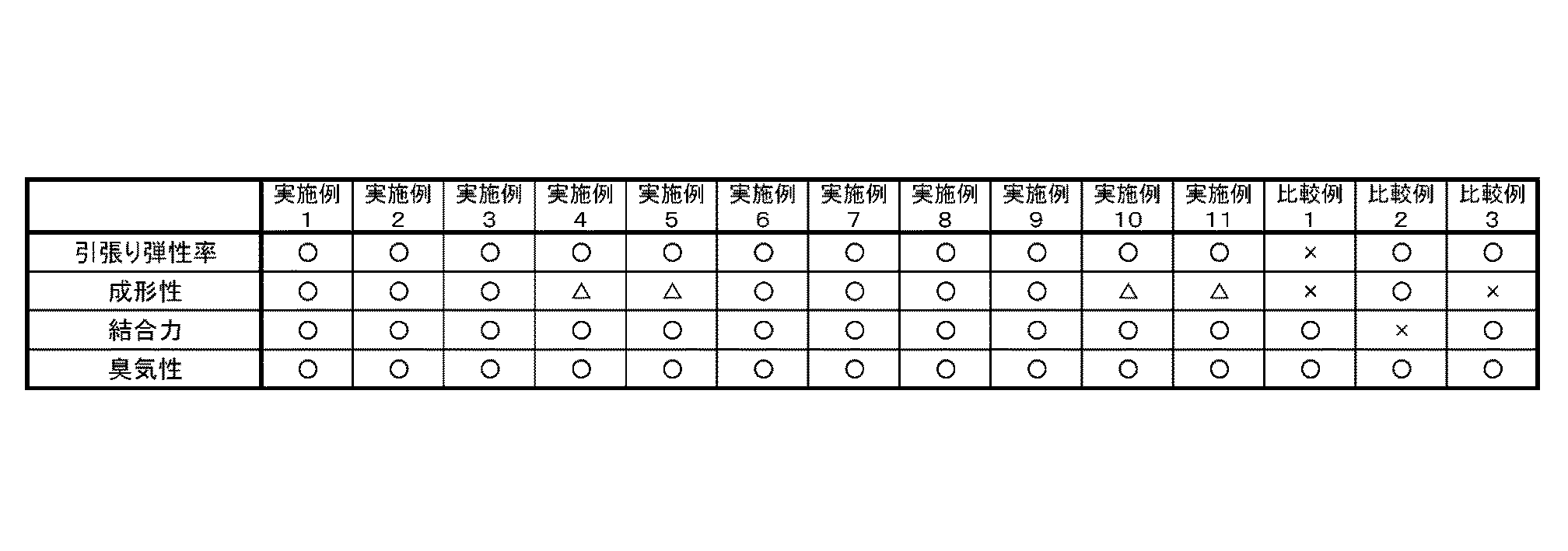
<実施例1>
製造例1のブロック共重合体を用い、表2に示した成分を用いて上述した粘接着剤組成物の作製方法により、粘接着剤組成物を得た。更に、上述した弾性部材の作製方法により弾性部材を得た。これらの粘接着剤組成物及び弾性部材を使って上述した物性の測定を行った。これらの結果を表3に示す。
<Example 1>
Using the block copolymer of Production Example 1, an adhesive composition was obtained by the method for producing an adhesive composition described above using the components shown in Table 2. Furthermore, an elastic member was obtained by the method for producing an elastic member described above. The physical properties described above were measured using these adhesive compositions and elastic members. These results are shown in Table 3.
<実施例2〜11、比較例1〜3>
製造例1のブロック共重合体、粘着付与剤、軟化剤に代えて、表2に示した成分を用いたこと以外は実施例1と同様の操作を行い、物性の測定を行った。これらの結果を表3に示す。
<Examples 2-11, Comparative Examples 1-3>
Physical properties were measured in the same manner as in Example 1 except that the components shown in Table 2 were used instead of the block copolymer, tackifier and softener in Production Example 1. These results are shown in Table 3.
(A)水素添加スチレン−ブタジエン系ブロック共重合体(水素添加率100%)
(A1)H1221(旭化成ケミカルズ社製)
(B)粘着付与剤
(B1)アルコンP100(荒川化学社製)
(B2)アイマーブP100(出光興産社製)
(B3)アイマーブS100(出光興産社製)
(B4)アルコンM100(荒川化学社製)
(B5)PX1150(ヤスハラケミカル社製)
(B6)クイントンR100(日本ゼオン社製)
(C)軟化剤
(C1)ダイアナプロセスオイルNS90S(出光興産社製)
(C2)ダイアナプロセスオイルPW90(出光興産社製)
(A) Hydrogenated styrene-butadiene block copolymer (hydrogenation rate 100%)
(A1) H1221 (Asahi Kasei Chemicals)
(B) Tackifier (B1) Alcon P100 (Arakawa Chemical Co., Ltd.)
(B2) Imabe P100 (made by Idemitsu Kosan Co., Ltd.)
(B3) Imabe S100 (made by Idemitsu Kosan Co., Ltd.)
(B4) Alcon M100 (Arakawa Chemical Co., Ltd.)
(B5) PX1150 (manufactured by Yasuhara Chemical)
(B6) Quinton R100 (Nippon Zeon Corporation)
(C) Softener (C1) Diana Process Oil NS90S (Idemitsu Kosan Co., Ltd.)
(C2) Diana Process Oil PW90 (made by Idemitsu Kosan Co., Ltd.)
Claims (7)
総量として1質量部以上170質量部未満の粘着付与剤及び軟化剤と、
を含有し、
下記(c)を満たす、粘接着剤組成物:
(a)ガラス転移温度が−53℃以下である;
(b)前記ブロック共重合体中の共役ジエン単量体単位の総含有量に対する水素添加率Hが0<H<80 mol%である;
(c)180℃における溶融粘度が15Pa・s以上である。 A block copolymer containing a polymer block mainly composed of at least one vinyl aromatic hydrocarbon and a polymer block mainly composed of at least one conjugated diene compound, and satisfying the following (a) and (b): 100 parts by mass;
A tackifier and a softener in a total amount of 1 part by weight or more and less than 170 parts by weight;
Containing
An adhesive composition satisfying the following (c):
(A) the glass transition temperature is −53 ° C. or lower;
(B) The hydrogenation rate H with respect to the total content of conjugated diene monomer units in the block copolymer is 0 <H <80 mol%;
(C) The melt viscosity at 180 ° C. is 15 Pa · s or more.
Priority Applications (1)
| Application Number | Priority Date | Filing Date | Title |
|---|---|---|---|
| JP2016081977A JP6704283B2 (en) | 2016-04-15 | 2016-04-15 | Adhesive composition |
Applications Claiming Priority (1)
| Application Number | Priority Date | Filing Date | Title |
|---|---|---|---|
| JP2016081977A JP6704283B2 (en) | 2016-04-15 | 2016-04-15 | Adhesive composition |
Publications (2)
| Publication Number | Publication Date |
|---|---|
| JP2017190428A true JP2017190428A (en) | 2017-10-19 |
| JP6704283B2 JP6704283B2 (en) | 2020-06-03 |
Family
ID=60084519
Family Applications (1)
| Application Number | Title | Priority Date | Filing Date |
|---|---|---|---|
| JP2016081977A Active JP6704283B2 (en) | 2016-04-15 | 2016-04-15 | Adhesive composition |
Country Status (1)
| Country | Link |
|---|---|
| JP (1) | JP6704283B2 (en) |
Cited By (9)
| Publication number | Priority date | Publication date | Assignee | Title |
|---|---|---|---|---|
| WO2019172434A1 (en) * | 2018-03-08 | 2019-09-12 | 出光興産株式会社 | Petroleum resin, hydrogenated petroleum resin, and production method for hydrogenated petroleum resin |
| WO2020110921A1 (en) * | 2018-11-28 | 2020-06-04 | 積水フーラー株式会社 | Hot melt composition |
| JP2020164845A (en) * | 2019-03-26 | 2020-10-08 | 積水化学工業株式会社 | Adhesive tape |
| US20210040308A1 (en) * | 2018-03-28 | 2021-02-11 | Zeon Corporation | Block copolymer composition for flexographic plate |
| JP2021095441A (en) * | 2019-12-13 | 2021-06-24 | 東洋インキScホールディングス株式会社 | Resin composition, adhesive resin composition and adhesive film |
| JP2022053541A (en) * | 2020-09-24 | 2022-04-05 | 積水化学工業株式会社 | Pressure-sensitive adhesive sheet for film or substrate with conductive pattern formed thereon |
| JP2022063038A (en) * | 2020-10-09 | 2022-04-21 | 旭化成株式会社 | Block copolymer composition and adhesive composition |
| WO2023234208A1 (en) * | 2022-05-31 | 2023-12-07 | 日東電工株式会社 | Adhesive sheet |
| JP2024001551A (en) * | 2022-06-22 | 2024-01-10 | 東京応化工業株式会社 | Transfer substrate, microstructure transfer method, and semiconductor element mounting method |
Citations (9)
| Publication number | Priority date | Publication date | Assignee | Title |
|---|---|---|---|---|
| JPH02153987A (en) * | 1988-12-05 | 1990-06-13 | Kuraray Co Ltd | Tacky adhesive composition |
| JPH03188114A (en) * | 1989-12-18 | 1991-08-16 | Kuraray Co Ltd | Hydrogenated block copolymer |
| JPH03223381A (en) * | 1990-01-30 | 1991-10-02 | Mitsui Petrochem Ind Ltd | Hot-melt self-adhesive composition |
| WO2009128397A1 (en) * | 2008-04-14 | 2009-10-22 | 旭化成ケミカルズ株式会社 | Adhesive composition |
| JP2012116963A (en) * | 2010-12-01 | 2012-06-21 | Yasuhara Chemical Co Ltd | Hot-melt type sealant composition |
| WO2013111883A1 (en) * | 2012-01-28 | 2013-08-01 | 荒川化学工業株式会社 | Adhesiveness-imparting agent, adhesiveness-imparting agent for medical or industrial applications, adhesive/cohesive agent for medical or industrial applications, adhesive/cohesive sheet for medial or industrial applications, and adhesive tape for medial or industrial applications |
| WO2014112411A1 (en) * | 2013-01-16 | 2014-07-24 | 旭化成ケミカルズ株式会社 | Method for producing polymer |
| JP2016089171A (en) * | 2014-10-30 | 2016-05-23 | 旭化成ケミカルズ株式会社 | Hydrogenated block copolymer composition and adhesive composition |
| JP2016172838A (en) * | 2015-03-17 | 2016-09-29 | 旭化成株式会社 | Adhesive composition and adhesive tape |
-
2016
- 2016-04-15 JP JP2016081977A patent/JP6704283B2/en active Active
Patent Citations (9)
| Publication number | Priority date | Publication date | Assignee | Title |
|---|---|---|---|---|
| JPH02153987A (en) * | 1988-12-05 | 1990-06-13 | Kuraray Co Ltd | Tacky adhesive composition |
| JPH03188114A (en) * | 1989-12-18 | 1991-08-16 | Kuraray Co Ltd | Hydrogenated block copolymer |
| JPH03223381A (en) * | 1990-01-30 | 1991-10-02 | Mitsui Petrochem Ind Ltd | Hot-melt self-adhesive composition |
| WO2009128397A1 (en) * | 2008-04-14 | 2009-10-22 | 旭化成ケミカルズ株式会社 | Adhesive composition |
| JP2012116963A (en) * | 2010-12-01 | 2012-06-21 | Yasuhara Chemical Co Ltd | Hot-melt type sealant composition |
| WO2013111883A1 (en) * | 2012-01-28 | 2013-08-01 | 荒川化学工業株式会社 | Adhesiveness-imparting agent, adhesiveness-imparting agent for medical or industrial applications, adhesive/cohesive agent for medical or industrial applications, adhesive/cohesive sheet for medial or industrial applications, and adhesive tape for medial or industrial applications |
| WO2014112411A1 (en) * | 2013-01-16 | 2014-07-24 | 旭化成ケミカルズ株式会社 | Method for producing polymer |
| JP2016089171A (en) * | 2014-10-30 | 2016-05-23 | 旭化成ケミカルズ株式会社 | Hydrogenated block copolymer composition and adhesive composition |
| JP2016172838A (en) * | 2015-03-17 | 2016-09-29 | 旭化成株式会社 | Adhesive composition and adhesive tape |
Cited By (17)
| Publication number | Priority date | Publication date | Assignee | Title |
|---|---|---|---|---|
| CN111788240B (en) * | 2018-03-08 | 2023-02-21 | 出光兴产株式会社 | Petroleum resin, hydrogenated petroleum resin, and method for producing hydrogenated petroleum resin |
| CN111788240A (en) * | 2018-03-08 | 2020-10-16 | 出光兴产株式会社 | Petroleum resin, hydrogenated petroleum resin, and method for producing hydrogenated petroleum resin |
| JPWO2019172434A1 (en) * | 2018-03-08 | 2021-03-11 | 出光興産株式会社 | Manufacturing method of petroleum resin, hydrogenated petroleum resin, and hydrogenated petroleum resin |
| WO2019172434A1 (en) * | 2018-03-08 | 2019-09-12 | 出光興産株式会社 | Petroleum resin, hydrogenated petroleum resin, and production method for hydrogenated petroleum resin |
| JP7333308B2 (en) | 2018-03-08 | 2023-08-24 | 出光興産株式会社 | Petroleum resin, hydrogenated petroleum resin, and method for producing hydrogenated petroleum resin |
| US12084537B2 (en) | 2018-03-08 | 2024-09-10 | Idemitsu Kosan Co., Ltd. | Petroleum resin, hydrogenated petroleum resin, and production method for hydrogenated petroleum resin |
| US20210040308A1 (en) * | 2018-03-28 | 2021-02-11 | Zeon Corporation | Block copolymer composition for flexographic plate |
| US12202965B2 (en) * | 2018-03-28 | 2025-01-21 | Zeon Corporation | Block copolymer composition for flexographic plate |
| WO2020110921A1 (en) * | 2018-11-28 | 2020-06-04 | 積水フーラー株式会社 | Hot melt composition |
| JP2020164845A (en) * | 2019-03-26 | 2020-10-08 | 積水化学工業株式会社 | Adhesive tape |
| JP7444670B2 (en) | 2019-03-26 | 2024-03-06 | 積水化学工業株式会社 | Adhesive tape |
| JP2021095441A (en) * | 2019-12-13 | 2021-06-24 | 東洋インキScホールディングス株式会社 | Resin composition, adhesive resin composition and adhesive film |
| JP2022053541A (en) * | 2020-09-24 | 2022-04-05 | 積水化学工業株式会社 | Pressure-sensitive adhesive sheet for film or substrate with conductive pattern formed thereon |
| JP2022063038A (en) * | 2020-10-09 | 2022-04-21 | 旭化成株式会社 | Block copolymer composition and adhesive composition |
| JP7641720B2 (en) | 2020-10-09 | 2025-03-07 | 旭化成株式会社 | Block copolymer composition and adhesive composition |
| WO2023234208A1 (en) * | 2022-05-31 | 2023-12-07 | 日東電工株式会社 | Adhesive sheet |
| JP2024001551A (en) * | 2022-06-22 | 2024-01-10 | 東京応化工業株式会社 | Transfer substrate, microstructure transfer method, and semiconductor element mounting method |
Also Published As
| Publication number | Publication date |
|---|---|
| JP6704283B2 (en) | 2020-06-03 |
Similar Documents
| Publication | Publication Date | Title |
|---|---|---|
| JP6272468B2 (en) | Hydrogenated block copolymer composition and adhesive composition | |
| JP6704283B2 (en) | Adhesive composition | |
| JP6311016B2 (en) | Block copolymer crumb and adhesive composition | |
| JP6126250B2 (en) | Block copolymer and adhesive composition | |
| JP6739158B2 (en) | Hydrogenated block copolymer composition and adhesive composition | |
| JP6297071B2 (en) | Block copolymer composition and adhesive composition | |
| JP6367648B2 (en) | Self-adhesive adhesive composition and self-adhesive adhesive tape using the same | |
| JP2019163453A (en) | Block copolymer composition and adhesive composition |
Legal Events
| Date | Code | Title | Description |
|---|---|---|---|
| A621 | Written request for application examination |
Free format text: JAPANESE INTERMEDIATE CODE: A621 Effective date: 20190122 |
|
| A977 | Report on retrieval |
Free format text: JAPANESE INTERMEDIATE CODE: A971007 Effective date: 20191121 |
|
| A131 | Notification of reasons for refusal |
Free format text: JAPANESE INTERMEDIATE CODE: A131 Effective date: 20191126 |
|
| A521 | Request for written amendment filed |
Free format text: JAPANESE INTERMEDIATE CODE: A523 Effective date: 20200122 |
|
| TRDD | Decision of grant or rejection written | ||
| A01 | Written decision to grant a patent or to grant a registration (utility model) |
Free format text: JAPANESE INTERMEDIATE CODE: A01 Effective date: 20200416 |
|
| A61 | First payment of annual fees (during grant procedure) |
Free format text: JAPANESE INTERMEDIATE CODE: A61 Effective date: 20200512 |
|
| R150 | Certificate of patent or registration of utility model |
Ref document number: 6704283 Country of ref document: JP Free format text: JAPANESE INTERMEDIATE CODE: R150 |