JP2017190531A - Anti-fraying treatment for glass fiber substrate - Google Patents
Anti-fraying treatment for glass fiber substrate Download PDFInfo
- Publication number
- JP2017190531A JP2017190531A JP2016078897A JP2016078897A JP2017190531A JP 2017190531 A JP2017190531 A JP 2017190531A JP 2016078897 A JP2016078897 A JP 2016078897A JP 2016078897 A JP2016078897 A JP 2016078897A JP 2017190531 A JP2017190531 A JP 2017190531A
- Authority
- JP
- Japan
- Prior art keywords
- glass fiber
- fraying
- heat
- glass
- treatment agent
- Prior art date
- Legal status (The legal status is an assumption and is not a legal conclusion. Google has not performed a legal analysis and makes no representation as to the accuracy of the status listed.)
- Granted
Links
Landscapes
- Treatments For Attaching Organic Compounds To Fibrous Goods (AREA)
- Surface Treatment Of Glass Fibres Or Filaments (AREA)
- Paints Or Removers (AREA)
Abstract
【課題】ガラス繊維製品のほつれを押さえ、有機溶剤を用いず、炭素と酸素と水素のみからなるため加熱脱油に際して安全で、且つ、加熱脱油後のガラス繊維製品の強度低下を防ぐことができるガラス繊維基材のほつれ防止処理剤を提供する。【解決手段】炭素、酸素及び水素のみから構成され、且つ、分子構造内にエステル結合を含まず、400℃以下の加熱処理で除去することができる低熱分解性ポリエーテル高分子を含有するようにした。【選択図】なしAn object of the present invention is to prevent fraying of glass fiber products, and without using an organic solvent, and is composed only of carbon, oxygen, and hydrogen, is safe during heat deoiling, and prevents a decrease in strength of glass fiber products after heat deoiling. An anti-fraying treatment agent for a glass fiber substrate is provided. A low thermal decomposable polyether polymer which is composed only of carbon, oxygen and hydrogen and does not contain an ester bond in the molecular structure and which can be removed by a heat treatment at 400 ° C. or lower. did. [Selection figure] None
Description
本発明は、ガラス繊維基材のほつれ防止処理剤に関する。 The present invention relates to a fraying prevention agent for a glass fiber substrate.
ガラスクロスは耐熱性に優れるため、断熱材や溶湯(液体金属)の不純物濾過、溶湯の整流などに使用されている。これらの用途に対して使用する場合、ガラスクロス表面の有機物はガス発生の原因となるため、使用時には加熱脱油されたクロスを使用することが望ましい。ところが、加熱脱油されたクロスは種々の形状へカットする際、ほつれてしまったり、毛羽が発生したりして扱いづらいといった問題点があった。特に、石英ガラス繊維の場合、柔軟性に乏しく顕著である。 Since glass cloth is excellent in heat resistance, it is used for impurity filtration of heat insulating materials and molten metal (liquid metal), rectification of molten metal, and the like. When used for these applications, organic substances on the surface of the glass cloth cause gas generation. Therefore, it is desirable to use a heat-deoiled cloth at the time of use. However, the heat-deoiled cloth has a problem that it is difficult to handle due to fraying or fluffing when it is cut into various shapes. In particular, in the case of quartz glass fiber, it is remarkable due to poor flexibility.
これを防ぐためにはガラスクロスの一部もしくは全体に対してほつれ防止処理剤で表面処理をした後、目的の形状にカットし、ほつれ防止処理剤を最後に焼き飛ばす方法が考えられる。例えば、ほつれ防止処理剤としては特許文献1に記載のエポキシ樹脂が挙げられるが、これは有機溶剤を使用するため環境に良くない。また、特許文献2に記載のポリエステル樹脂、特許文献3に記載のエポキシエステル系樹脂は、分子構造内にエステル結合を有するため、水と反応し一部がカルボン酸やアルコールに分解されやすく化学的に不安定である。また、特許文献4〜5に記載の水系ウレタン樹脂は分子構造内に窒素を含むため、燃焼時に窒化酸化物やシアン化物が発生する可能性があるため、積極的に燃焼させる用途には好ましくない。特許文献6に記載の活性エネルギー線硬化性樹脂、特許文献7に記載のポリエーテルイミド樹脂、特許文献8に記載のポリオレフィン樹脂、その他、一般的なナイロン6、酢酸ビニル、エチレン−ビニルアルコール、共重合ポリアミドなどのほつれ防止処理剤もあるが、これらは何れも完全に除去するために400℃を超える加熱が必要となり、特許文献9に記載されているように加熱脱油後にガラスクロスの強度が大きく低下してしまうといった問題点がある。特に石英ガラスクロスのようなガラスクロスでは顕著である。 In order to prevent this, a method may be considered in which a part or the whole of the glass cloth is subjected to a surface treatment with a fraying preventive agent, then cut into a desired shape, and finally the fraying preventive agent is burned off. For example, an epoxy resin described in Patent Document 1 may be used as a fraying prevention treatment agent, but this is not good for the environment because an organic solvent is used. Moreover, since the polyester resin described in Patent Document 2 and the epoxy ester resin described in Patent Document 3 have an ester bond in the molecular structure, they react with water and are partly decomposed into carboxylic acids or alcohols. Is unstable. In addition, since the water-based urethane resins described in Patent Documents 4 to 5 contain nitrogen in the molecular structure, there is a possibility that nitride oxide or cyanide may be generated at the time of combustion. . Active energy ray-curable resin described in Patent Document 6, polyether imide resin described in Patent Document 7, polyolefin resin described in Patent Document 8, other common nylon 6, vinyl acetate, ethylene-vinyl alcohol, co-polymer There are also anti-fraying treatment agents such as polymerized polyamide, but these all require heating above 400 ° C. in order to completely remove them, and as described in Patent Document 9, the strength of the glass cloth is reduced after heat deoiling. There is a problem that it is greatly reduced. This is particularly true for glass cloth such as quartz glass cloth.
本発明は、従来のガラス繊維製品のほつれ防止処理剤にみられる上記問題を解決するものである。即ち、ガラス繊維製品のほつれを押さえ、有機溶剤を用いず、炭素と酸素と水素のみからなるため加熱脱油に際して安全で、且つ、加熱脱油後のガラス繊維製品の強度低下を防ぐことができるガラス繊維基材のほつれ防止処理剤を提供することを目的とする。 This invention solves the said problem seen in the fraying prevention processing agent of the conventional glass fiber product. That is, it suppresses fraying of the glass fiber product, is made of only carbon, oxygen and hydrogen without using an organic solvent, and is safe at the time of heat deoiling and can prevent the strength reduction of the glass fiber product after the heat deoiling. It aims at providing the fraying prevention processing agent of a glass fiber base material.
本発明のガラス繊維基材のほつれ防止処理剤は、上記課題を解決するためになされたもので、炭素、酸素及び水素のみから構成され、且つ、分子構造内にエステル結合を含まず、400℃以下の加熱処理で除去することができる低熱分解性ポリエーテル高分子を含有することを特徴とする。 The fraying preventive treatment agent for glass fiber base material of the present invention is made to solve the above-mentioned problems, and is composed only of carbon, oxygen and hydrogen, and does not contain an ester bond in the molecular structure, and is 400 ° C. It contains a low thermal decomposable polyether polymer that can be removed by the following heat treatment.
前記低熱分解性ポリエーテル高分子が、ポリアルキレングリコール及びポリアルキレンオキシドからなる群から選択される1種以上であることが好ましい。 The low heat decomposable polyether polymer is preferably at least one selected from the group consisting of polyalkylene glycol and polyalkylene oxide.
本発明のガラス繊維製品は、本発明のほつれ防止処理剤が塗布されてなるガラス繊維製品である。 The glass fiber product of the present invention is a glass fiber product to which the fraying prevention agent of the present invention is applied.
本発明のガラス繊維製品の製造方法は、本発明のほつれ防止処理剤をガラス繊維基材に塗布する工程と、該ほつれ防止処理剤を塗布されたガラス繊維基材を所定の形状に切断する工程と、該切断されたガラス繊維基材を400℃以下で加熱処理し、前記低熱分解性ポリエーテル高分子を除去する工程と、を含むものである。 The method for producing a glass fiber product of the present invention includes a step of applying the fraying prevention treatment agent of the present invention to a glass fiber substrate, and a step of cutting the glass fiber substrate coated with the fraying prevention treatment agent into a predetermined shape. And a step of heat-treating the cut glass fiber substrate at 400 ° C. or less to remove the low-heat decomposable polyether polymer.
本発明によれば、ガラス繊維のほつれを押さえ、有機溶剤を用いず、炭素と酸素と水素のみからなるため加熱脱油に際して安全で、且つ、加熱脱油後もガラス繊維製品の強度低下を防ぐことができるほつれ防止処理剤を提供することができるという著大な効果を奏する。 According to the present invention, fraying of glass fibers is suppressed, organic solvents are not used, and only carbon, oxygen, and hydrogen are used, so that it is safe during heat deoiling and prevents strength reduction of glass fiber products even after heat deoiling. It is possible to provide a fraying prevention treatment agent that can be provided.
以下に本発明の実施の形態を説明するが、これらは例示的に示されるもので、本発明の技術思想から逸脱しない限り種々の変形が可能なことはいうまでもない。 Embodiments of the present invention will be described below, but these are exemplarily shown, and it goes without saying that various modifications are possible without departing from the technical idea of the present invention.
本発明のガラス繊維基材のほつれ防止処理剤は、炭素、酸素及び水素のみから構成され、且つ、分子構造内にエステル結合を含まない低熱分解性ポリエーテル高分子を含有することを特徴とする。該低熱分解性ポリエーテル高分子は、400℃以下の加熱処理で分解され、除去することができるポリエーテル高分子であり、分解される温度が100℃〜400℃であることが好ましく、100℃〜350℃であることがより好ましい。 The fraying prevention treatment agent for glass fiber base material of the present invention comprises a low-heat-decomposable polyether polymer composed only of carbon, oxygen and hydrogen, and does not contain an ester bond in the molecular structure. . The low-heat-decomposable polyether polymer is a polyether polymer that can be decomposed and removed by a heat treatment at 400 ° C. or lower, and the decomposition temperature is preferably 100 ° C. to 400 ° C., preferably 100 ° C. More preferably, it is -350 degreeC.
前記低熱分解性ポリエーテル高分子としては、ポリアルキレングリコールやポリアルキレンオキシドを用いることが好ましい。
上記ポリアルキレングリコールとしては、室温で固体の状態、具体的には凝固点が30℃以上であれば特に限定されないが、例えば、PEG#1000(日油(株)製)、PEG#1500(日油(株)製)、PEG#2000(日油(株)製)、PEG#4000(日油(株)製)、PEG#6000(日油(株)製)、PEG#11000(日油(株)製)、PEG#20000(日油(株)製)、プロノン(登録商標)#208(日油(株)製)、ユニルーブ(登録商標)70DP−600B(日油(株)製)、ユニルーブ(登録商標)70DP−950B(日油(株)製)、ポリアルキレングリコール誘導体であるユニオックス(登録商標)M−1000(日油(株)製)、ユニオックス(登録商標)M−2000(日油(株)製)、ユニオックス(登録商標)M−4000(日油(株)製)などが市販されている。これらポリアルキレングリコールは単独でも2種類以上混合しても用いることができる。
As the low heat decomposable polyether polymer, polyalkylene glycol or polyalkylene oxide is preferably used.
The polyalkylene glycol is not particularly limited as long as it is in a solid state at room temperature, specifically, the freezing point is 30 ° C. or higher. For example, PEG # 1000 (manufactured by NOF Corporation), PEG # 1500 (NOF PEG # 2000 (manufactured by NOF Corporation), PEG # 4000 (manufactured by NOF Corporation), PEG # 6000 (manufactured by NOF Corporation), PEG # 11000 (NOF Corporation) )), PEG # 20000 (manufactured by NOF Corporation), Pronon (registered trademark) # 208 (manufactured by NOF Corporation), Unilube (registered trademark) 70DP-600B (manufactured by NOF Corporation), Unilube (Registered trademark) 70DP-950B (manufactured by NOF Corporation), UNIOX (registered trademark) M-1000 (manufactured by NOF Corporation), which is a polyalkylene glycol derivative, UNIOX (registered trademark) M-2000 ( NOF Corporation) Such as UNIOX (registered trademark) M-4000 (manufactured by NOF Co., Ltd.) are commercially available. These polyalkylene glycols can be used alone or in combination of two or more.
上記ポリアルキレングリコールのほつれ防止処理剤への配合割合は特に限定されないが、ほつれ防止処理剤の総量100質量%に対して、0.05〜50質量%が好適であり、より好ましくは0.1〜20質量%、さらに好ましくは0.1〜10質量%である。配合割合が、50質量%を超えればほつれ防止処理剤の粘度が上がり、ガラス繊維基材に目曲がりなどが発生し、0.05質量%未満ではほつれ防止効果が低減するおそれがある。 The blending ratio of the polyalkylene glycol in the anti-fraying treatment agent is not particularly limited, but is preferably 0.05 to 50% by mass, more preferably 0.1% with respect to 100% by mass of the total anti-fraying treatment agent. -20% by mass, more preferably 0.1-10% by mass. If the blending ratio exceeds 50% by mass, the viscosity of the fraying preventive treatment agent will increase, and the glass fiber substrate will be bent, and if it is less than 0.05% by mass, the fraying prevention effect may be reduced.
上記ポリアルキレンオキシドとしては、室温で固体の状態、具体的には凝固点が30℃以上であれば特に限定されないが、例えば、PEO(登録商標)−1(住友精化(株)製)、PEO(登録商標)−2(住友精化(株)製)、PEO(登録商標)−3(住友精化(株)製)、PEO(登録商標)−4(住友精化(株)製)、PEO(登録商標)−8(住友精化(株)製)、PEO(登録商標)−15(住友精化(株)製)、PEO(登録商標)−18(住友精化(株)製)、PEO(登録商標)−27(住友精化(株)製)、PEO(登録商標)−29(住友精化(株)製)などが市販されている。これらポリアルキレンオキシドは単独でも2種類以上混合しても用いることができる。 The polyalkylene oxide is not particularly limited as long as it is in a solid state at room temperature, specifically, the freezing point is 30 ° C. or higher. For example, PEO (registered trademark) -1 (manufactured by Sumitomo Seika Co., Ltd.), PEO (Registered trademark) -2 (manufactured by Sumitomo Seika Co., Ltd.), PEO (registered trademark) -3 (manufactured by Sumitomo Seika Co., Ltd.), PEO (registered trademark) -4 (manufactured by Sumitomo Seika Co., Ltd.), PEO (registered trademark) -8 (manufactured by Sumitomo Seika Co., Ltd.), PEO (registered trademark) -15 (manufactured by Sumitomo Seika Co., Ltd.), PEO (registered trademark) -18 (manufactured by Sumitomo Seika Co., Ltd.) PEO (registered trademark) -27 (manufactured by Sumitomo Seika Co., Ltd.), PEO (registered trademark) -29 (manufactured by Sumitomo Seika Co., Ltd.) and the like are commercially available. These polyalkylene oxides can be used alone or in combination of two or more.
上記ポリアルキレンオキシドのほつれ防止処理剤への配合割合は特に限定されないが、ほつれ防止処理剤の総量100質量%に対して、0.05〜50質量%が好適であり、より好ましくは0.1〜20質量%、さらに好ましくは0.1〜10質量%である。配合割合が、50質量%を超えればほつれ防止処理剤の粘度が上がり、ガラス繊維基材に目曲がりなどが発生し、0.05質量%未満ではほつれ防止効果が低減するおそれがある。 The blending ratio of the polyalkylene oxide in the anti-fray treatment agent is not particularly limited, but is preferably 0.05 to 50% by mass, more preferably 0.1 to 100% by mass of the total fray prevention agent. -20% by mass, more preferably 0.1-10% by mass. If the blending ratio exceeds 50% by mass, the viscosity of the fraying preventive treatment agent will increase, and the glass fiber substrate will be bent, and if it is less than 0.05% by mass, the fraying prevention effect may be reduced.
上記ポリアルキレングリコール及びポリアルキレンオキシドは単独でも2種類以上混合しても用いることができる。 The above polyalkylene glycol and polyalkylene oxide can be used alone or in combination of two or more.
本発明のほつれ防止処理剤は、溶剤として水を用いることが好ましい。 The fraying prevention treatment agent of the present invention preferably uses water as a solvent.
本発明のほつれ防止処理剤は、本発明の効果を損なわない限り、上記したポリエーテル高分子以外の成分を添加することができる。その他の成分としては、例えば、400℃以下の加熱処理で除去できる界面活性剤などが挙げられる。 As long as the fray prevention treatment agent of the present invention does not impair the effects of the present invention, components other than the polyether polymer described above can be added. Examples of other components include surfactants that can be removed by heat treatment at 400 ° C. or lower.
ガラス繊維を構成するガラス材料としては特に限定されないが、Eガラス、Dガラス、石英ガラスなどが挙げられる。中でも石英ガラスは柔軟性に乏しく、加熱脱油後のガラス繊維基材においてほつれやすいため、特に効果的である。 Although it does not specifically limit as glass material which comprises glass fiber, E glass, D glass, quartz glass, etc. are mentioned. Among them, quartz glass is particularly effective because it is poor in flexibility and easily frayed on a glass fiber substrate after heat deoiling.
本発明のほつれ防止処理剤が塗布されるガラス繊維基材としては、製織後、加熱脱油したガラス基材が望ましいが、加熱脱油後にシランカップリング剤などの表面処理が施された表面処理ガラス基材で行っても良い。また、加熱脱油が不要なガラス繊維集束剤が塗布されたガラス繊維基材については、加熱脱油を行わないまま、そのガラス繊維基材表面に対してほつれ防止処理を行うことができる。 As the glass fiber substrate to which the fraying prevention treatment agent of the present invention is applied, a glass substrate that has been heat-deoiled after weaving is desirable, but a surface treatment that has been subjected to a surface treatment such as a silane coupling agent after heat-deoiling. You may carry out with a glass base material. Moreover, about the glass fiber base material with which the glass fiber sizing agent which does not require heat deoiling was apply | coated, a fraying prevention process can be performed with respect to the glass fiber base material surface, without performing heat deoiling.
本発明のほつれ防止処理剤は、ガラス繊維基材のカット時のほつれを防止するために使用する。本発明のほつれ防止処理剤であれば、400℃以下の加熱脱油で完全に除去することができるため、ほつれ防止処理剤を塗布し、所定の形にカットした後に400℃以下で加熱脱油することで、目的形状のガラス繊維基材を得ることができる。 The fraying preventive treatment agent of the present invention is used to prevent fraying during cutting of the glass fiber substrate. Since the fraying prevention treatment agent of the present invention can be completely removed by heating and deoiling at 400 ° C. or less, the fraying prevention treatment agent is applied, cut into a predetermined shape, and then heated and deoiled at 400 ° C. or less. By doing so, the glass fiber base material of the target shape can be obtained.
本発明のほつれ防止処理剤は、水等の溶剤に、炭素と酸素と水素のみから構成され、且つ、分子構造内にエステル結合を含まない400℃以下の加熱処理で除去することができる低熱分解性ポリエーテル高分子を所定量添加し、攪拌することで製造することができる。 The fraying preventive treatment agent of the present invention is composed of only carbon, oxygen, and hydrogen in a solvent such as water, and has low thermal decomposition that can be removed by heat treatment at 400 ° C. or less that does not contain an ester bond in the molecular structure. It can be produced by adding a predetermined amount of a conductive polyether polymer and stirring.
本発明のほつれ防止処理剤をガラス繊維基材に塗布する方法としては、例えば、浸漬法、スプレー法などが挙げられる。 Examples of the method for applying the fraying preventive treatment agent of the present invention to a glass fiber substrate include an immersion method and a spray method.
本発明のほつれ防止処理剤は、ガラス繊維基材に塗布後、室温でも乾燥させることができるが、加熱して乾燥させることが望ましい。 The fraying preventive treatment agent of the present invention can be dried at room temperature after being applied to a glass fiber substrate, but it is desirable to heat and dry.
該ほつれ防止処理剤を塗布されたガラス繊維基材を所定の形状に切断した後、該切断されたガラス繊維基材を400℃以下で加熱処理し、前記低熱分解性ポリエーテル高分子を除去し、加熱脱油することにより、本発明のガラス繊維製品を製造することができる。該加熱脱油の処理温度は400℃以下で且つほつれ防止処理剤中の低熱分解性ポリエーテル高分子が分解される温度以上であればよいが、100℃〜400℃が好ましく、150℃〜400℃がより好ましい。 After cutting the glass fiber substrate coated with the fraying preventive agent into a predetermined shape, the cut glass fiber substrate is heat-treated at 400 ° C. or lower to remove the low thermal decomposable polyether polymer. The glass fiber product of the present invention can be produced by heat deoiling. The heat deoiling treatment temperature may be 400 ° C. or lower and above the temperature at which the low thermal decomposable polyether polymer in the fraying prevention treatment agent is decomposed, but preferably 100 ° C. to 400 ° C., preferably 150 ° C. to 400 ° C. ° C is more preferred.
本発明のガラス繊維製品は、例えば、断熱材や溶湯(液体金属)の不純物濾過、溶湯の整流用ガラスクロス等の用途に好適である。 The glass fiber product of the present invention is suitable for applications such as heat insulation, impurity filtration of molten metal (liquid metal), and glass cloth for rectification of molten metal.
以下に実施例をあげて本発明をさらに具体的に説明するが、これらの実施例は例示的に示されるもので限定的に解釈されるべきでないことはいうまでもない。 The present invention will be described more specifically with reference to the following examples. However, it is needless to say that these examples are shown by way of illustration and should not be construed in a limited manner.
以下の実験例、比較例における測定および評価は以下の方法で行った。 Measurement and evaluation in the following experimental examples and comparative examples were performed by the following methods.
1.ガラスクロスのカット時ほつれ
ほつれ防止処理済みガラスクロスの一部をカットし、その断面を目視で確認した。
1. Fraying at the time of cutting the glass cloth A part of the glass cloth that had been treated to prevent fraying was cut, and the cross section was visually confirmed.
2.ほつれ防止処理剤消失温度
ほつれ防止処理済みガラスクロスの一部をカットし、(株)日立ハイテクサイエンス製TG−DTA7300を用いて脱油性の確認を行った。TG曲線の減少が止まり一定になる温度をほつれ防止処理剤消失温度とした。雰囲気は大気とし、昇温速度は10℃/分とした。
2. Fraying prevention treatment agent disappearing temperature A part of the fraying prevention treated glass cloth was cut, and deoiling property was confirmed using TG-DTA7300 manufactured by Hitachi High-Tech Science Co., Ltd. The temperature at which the decrease in the TG curve stopped and became constant was defined as the fraying prevention treatment agent disappearing temperature. The atmosphere was air, and the heating rate was 10 ° C./min.
3.ガラスクロスの引張強度
ほつれ防止処理済みガラスクロスをほつれ防止処理消失温度×2時間の条件で加熱処理した後に、JIS R 3420 2013 7.4.2に従い測定を行った。また、比較のため、ほつれ防止処理を施す前の未処理ガラスクロスについても同様の方法で測定を行った。
3. Tensile strength of glass cloth The glass cloth that had been subjected to the fraying prevention treatment was subjected to a heat treatment under the conditions of the disappearance temperature of the fraying prevention treatment × 2 hours, and then measured according to JIS R 3420 2013 7.4.2. For comparison, the same method was used to measure the untreated glass cloth before the fraying prevention treatment.
(実施例1)
ガラスビーカーに水950gを取り、これにポリアルキレングリコールとしてPEG#4000(日油(株)製)50gを加え、完全に溶解するまで攪拌し、ほつれ防止処理剤を得た。次に、ほつれ防止処理剤に未処理2116タイプ石英ガラスクロス(フィラメント本数:7μm×200本、経糸密度:65本/25mm、緯糸密度:62本/25mm)を10分間浸漬させ、石英ガラスクロスを引き上げた後に100℃×10分間の加熱条件で乾燥させた。各種評価は該ほつれ防止処理済み石英ガラスクロスを用いて行った。結果を表1に示す。
Example 1
950 g of water was taken in a glass beaker, and 50 g of PEG # 4000 (manufactured by NOF Corporation) was added thereto as a polyalkylene glycol and stirred until completely dissolved to obtain a fraying prevention treatment agent. Next, an untreated 2116 type quartz glass cloth (filament number: 7 μm × 200, warp density: 65 pieces / 25 mm, weft density: 62 pieces / 25 mm) is immersed in a fraying prevention treatment agent for 10 minutes, After pulling up, it was dried under heating conditions of 100 ° C. × 10 minutes. Various evaluations were performed using the flaw-prevented quartz glass cloth. The results are shown in Table 1.
(実施例2)
ガラスビーカーに水950gを取り、これにポリアルキレンオキシドとしてPEO(登録商標)−1(住友精化(株)製)50gを加え、完全に溶解するまで攪拌し、ほつれ防止処理剤を得た。それ以外は実施例1と同様の操作を行った。結果を表1に示す。
(Example 2)
950 g of water was taken in a glass beaker, and 50 g of PEO (registered trademark) -1 (manufactured by Sumitomo Seika Co., Ltd.) was added as a polyalkylene oxide to the glass beaker, followed by stirring until completely dissolved to obtain a fraying prevention treatment agent. Otherwise, the same operation as in Example 1 was performed. The results are shown in Table 1.
(実施例3)
ガラスビーカーに水990gを取り、これにポリアルキレングリコールとしてPEG#11000(日油(株)製)10gを加え、完全に溶解するまで攪拌し、ほつれ防止処理剤を得た。それ以外は実施例1と同様の操作を行った。結果を表1に示す。
(Example 3)
Into a glass beaker, 990 g of water was added, 10 g of PEG # 11000 (manufactured by NOF Corporation) was added as polyalkylene glycol, and the mixture was stirred until completely dissolved to obtain a fraying prevention treatment agent. Otherwise, the same operation as in Example 1 was performed. The results are shown in Table 1.
(実施例4)
ガラスビーカーに水999gを取り、これにポリアルキレングリコールとしてPEG#20000(日油(株)製)1gを加え、完全に溶解するまで攪拌し、ほつれ防止処理剤を得た。それ以外は実施例1と同様の操作を行った。結果を表1に示す。
Example 4
Into a glass beaker, 999 g of water was added, and 1 g of PEG # 20000 (manufactured by NOF Corporation) was added thereto as a polyalkylene glycol and stirred until completely dissolved to obtain a fraying prevention treatment agent. Otherwise, the same operation as in Example 1 was performed. The results are shown in Table 1.
(実施例5)
ガラスビーカーに水850gを取り、これにポリアルキレングリコールとしてPEG#1000(日油(株)製)150gを加え、完全に溶解するまで攪拌し、ほつれ防止処理剤を得た。それ以外は実施例1と同様の操作を行った。結果を表1に示す。
(Example 5)
Into a glass beaker, 850 g of water was added, 150 g of PEG # 1000 (manufactured by NOF Corporation) was added as polyalkylene glycol and stirred until completely dissolved to obtain a fraying prevention treatment agent. Otherwise, the same operation as in Example 1 was performed. The results are shown in Table 1.
(実施例6)
ガラスビーカーに水600gを取り、これにポリアルキレングリコールとしてPEG#1000(日油(株)製)400gを加え、完全に溶解するまで攪拌し、ほつれ防止処理剤を得た。それ以外は実施例1と同様の操作を行った。結果を表1に示す。
(Example 6)
600 g of water was taken in a glass beaker, 400 g of PEG # 1000 (manufactured by NOF Corporation) was added as polyalkylene glycol, and the mixture was stirred until completely dissolved to obtain a fraying prevention treatment agent. Otherwise, the same operation as in Example 1 was performed. The results are shown in Table 1.
(比較例1)
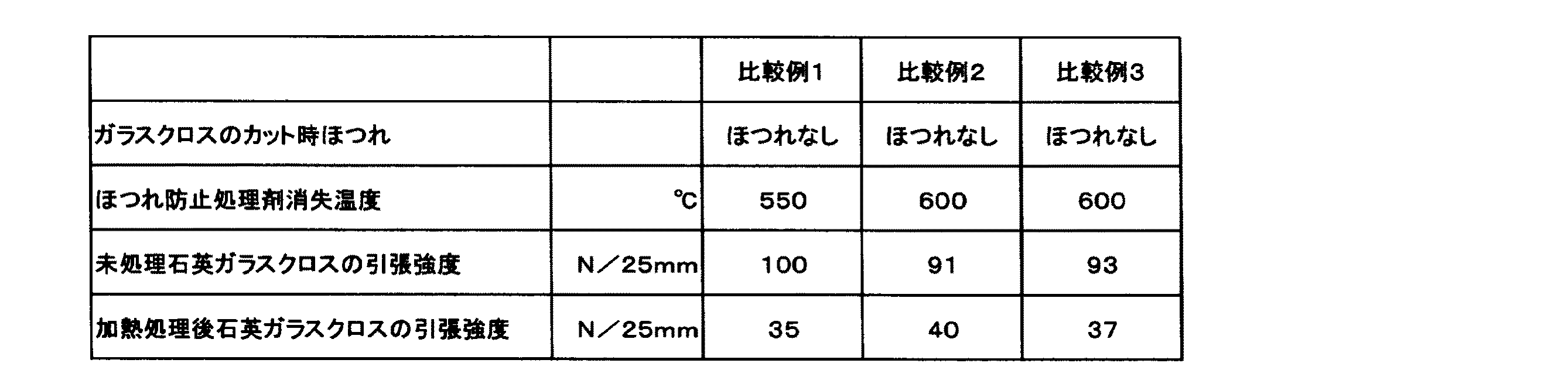
ガラスビーカーに水950gを取り、これに酢酸ビニルエマルションとしてビニブラン(登録商標)1002(日信化学工業(株)製)50gを加え、完全に溶解するまで攪拌し、ほつれ防止処理剤を得た。それ以外は実施例1と同様の操作を行った。結果を表2に示す。
(Comparative Example 1)
950 g of water was taken in a glass beaker, and 50 g of Viniblanc (registered trademark) 1002 (manufactured by Nissin Chemical Industry Co., Ltd.) was added as a vinyl acetate emulsion to the glass beaker and stirred until completely dissolved to obtain a fraying prevention treatment agent. Otherwise, the same operation as in Example 1 was performed. The results are shown in Table 2.
(比較例2)
ほつれ防止処理剤としてエポキシ樹脂jER(登録商標)828(三菱化学(株)製)を用いた以外は実施例1と同様の操作を行った。結果を表2に示す。
(Comparative Example 2)
The same operation as in Example 1 was performed except that an epoxy resin jER (registered trademark) 828 (manufactured by Mitsubishi Chemical Corporation) was used as a fraying prevention treatment agent. The results are shown in Table 2.
(比較例3)
特許文献7に記載の方法で、ガラスビーカーに塩化メチレン940gを取り、これにポリエーテルイミド樹脂としてウルテム(ULTEM)(登録商標)1000(SABICイノベーティブプラスチックス社製)60gを加え、完全に溶解するまで攪拌し、ほつれ防止処理剤を得た。それ以外は実施例1と同様の操作を行った。結果を表2に示す。
(Comparative Example 3)
In a method described in Patent Document 7, 940 g of methylene chloride is taken into a glass beaker, and 60 g of ULTEM (registered trademark) 1000 (manufactured by SABIC Innovative Plastics) is added thereto as a polyetherimide resin and completely dissolved. To obtain a fraying preventive. Otherwise, the same operation as in Example 1 was performed. The results are shown in Table 2.
表1に示した如く、実施例1〜6は炭素と酸素と水素のみから構成され、且つ、分子構造内にエステル結合を含まない400℃以下の加熱処理で除去することができる低熱分解性ポリエーテル高分子を含有することを特徴とするガラス繊維基材のほつれ防止処理剤を使用したため、ほつれが抑制され、且つ、低温で加熱脱油することができたために加熱処理後、石英ガラスクロスの引張強度低下が見られなかった。
一方、表2に示した如く、比較例1〜3は酢酸ビニル、エポキシ樹脂、ポリエーテルイミド樹脂を用いたため、ほつれ防止処理剤消失温度が上がり、加熱処理後石英ガラスクロスの引張強度低下が見られた。
As shown in Table 1, Examples 1 to 6 are composed of only carbon, oxygen, and hydrogen, and do not contain an ester bond in the molecular structure, and can be removed by a heat treatment at 400 ° C. or lower. Since the glass fiber base fraying prevention treatment agent characterized by containing an ether polymer was used, fraying was suppressed, and heat deoiling was possible at a low temperature. No decrease in tensile strength was observed.
On the other hand, as shown in Table 2, since Comparative Examples 1 to 3 used vinyl acetate, epoxy resin, and polyetherimide resin, the anti-fraying agent disappearing temperature increased, and the tensile strength of the quartz glass cloth decreased after heat treatment. It was.
Claims (4)
該ほつれ防止処理剤を塗布されたガラス繊維基材を所定の形状に切断する工程と、
該切断されたガラス繊維基材を400℃以下で加熱処理し、前記低熱分解性ポリエーテル高分子を除去する工程と、
を含む、ガラス繊維製品の製造方法。 Applying the fraying preventive agent according to claim 1 or 2 to a glass fiber substrate;
Cutting the glass fiber substrate coated with the fraying preventive agent into a predetermined shape;
Heat-treating the cut glass fiber substrate at 400 ° C. or less, and removing the low thermal decomposable polyether polymer;
A method for producing a glass fiber product.
Priority Applications (1)
| Application Number | Priority Date | Filing Date | Title |
|---|---|---|---|
| JP2016078897A JP6604893B2 (en) | 2016-04-11 | 2016-04-11 | Anti-fraying treatment for glass fiber substrate |
Applications Claiming Priority (1)
| Application Number | Priority Date | Filing Date | Title |
|---|---|---|---|
| JP2016078897A JP6604893B2 (en) | 2016-04-11 | 2016-04-11 | Anti-fraying treatment for glass fiber substrate |
Publications (2)
| Publication Number | Publication Date |
|---|---|
| JP2017190531A true JP2017190531A (en) | 2017-10-19 |
| JP6604893B2 JP6604893B2 (en) | 2019-11-13 |
Family
ID=60084633
Family Applications (1)
| Application Number | Title | Priority Date | Filing Date |
|---|---|---|---|
| JP2016078897A Active JP6604893B2 (en) | 2016-04-11 | 2016-04-11 | Anti-fraying treatment for glass fiber substrate |
Country Status (1)
| Country | Link |
|---|---|
| JP (1) | JP6604893B2 (en) |
Citations (5)
| Publication number | Priority date | Publication date | Assignee | Title |
|---|---|---|---|---|
| JPS5248235B2 (en) * | 1974-07-16 | 1977-12-08 | ||
| JPH05222676A (en) * | 1992-02-10 | 1993-08-31 | Nitto Boseki Co Ltd | Anti-fray adhesive for glass fiber fabric |
| JPH05239765A (en) * | 1992-02-24 | 1993-09-17 | Kanebo Ltd | Method for producing glass fabric for prepreg |
| JPH10287448A (en) * | 1997-04-14 | 1998-10-27 | Nitto Boseki Co Ltd | Sizing agent for glass fiber yarn |
| JP2004263349A (en) * | 2003-03-04 | 2004-09-24 | Unitika Ltd | Glass fiber substrate anti-fraying aqueous fixative and glass fiber substrate treated therewith |
-
2016
- 2016-04-11 JP JP2016078897A patent/JP6604893B2/en active Active
Patent Citations (5)
| Publication number | Priority date | Publication date | Assignee | Title |
|---|---|---|---|---|
| JPS5248235B2 (en) * | 1974-07-16 | 1977-12-08 | ||
| JPH05222676A (en) * | 1992-02-10 | 1993-08-31 | Nitto Boseki Co Ltd | Anti-fray adhesive for glass fiber fabric |
| JPH05239765A (en) * | 1992-02-24 | 1993-09-17 | Kanebo Ltd | Method for producing glass fabric for prepreg |
| JPH10287448A (en) * | 1997-04-14 | 1998-10-27 | Nitto Boseki Co Ltd | Sizing agent for glass fiber yarn |
| JP2004263349A (en) * | 2003-03-04 | 2004-09-24 | Unitika Ltd | Glass fiber substrate anti-fraying aqueous fixative and glass fiber substrate treated therewith |
Also Published As
| Publication number | Publication date |
|---|---|
| JP6604893B2 (en) | 2019-11-13 |
Similar Documents
| Publication | Publication Date | Title |
|---|---|---|
| JP2005179826A (en) | Sizing-coated carbon fiber and method for producing the same | |
| Zin et al. | The Effects of Alkali Treatment on the Mechanical and Chemical Properties of Banana Fibre and Adhesion to Epoxy Resin. | |
| KR102511930B1 (en) | A mixed aqueous dispersion of polyimide-fluororesin-polar crystal particulates and a method of producing the same | |
| KR20140006099A (en) | Oil solution for carbon fiber precursor acrylic fibers, oil solution composition for carbon fiber precursor acrylic fibers, oil solution processed liquid for carbon fiber precursor acrylic fibers, carbon fiber precursor acrylic fiber bundle, and method for producing carbon fiber bundle using carbon fiber precursor acrylic fiber bundle | |
| US10543569B2 (en) | Bonding material and bonding method using same | |
| JPS588188A (en) | Modified sized carbon fiber capable of being used in polyimide matrix | |
| TR201900790T4 (en) | Oil for carbon fiber precursor acrylic fiber, oil composition for carbon fiber precursor acrylic fiber, oil processing fluid for carbon fiber precursor acrylic fiber and carbon fiber precursor acrylic fiber bundle. | |
| JP6604893B2 (en) | Anti-fraying treatment for glass fiber substrate | |
| KR20210137426A (en) | Liquid composition, powder, and method for preparing powder | |
| KR20230010621A (en) | Method for producing a laminate having a layer containing a thermally meltable tetrafluoroethylene-based polymer | |
| JP6510299B2 (en) | Flame-resistant fiber bundle, carbon fiber precursor fiber bundle, and method for producing carbon fiber comprising the same | |
| JP2012251269A (en) | Oil agent for carbon fiber precursor acrylic fiber, oil agent composition for carbon fiber precursor acrylic fiber, and oil agent treatment liquid for carbon fiber precursor acrylic fiber | |
| WO2022009918A1 (en) | Sizing agent, sized fibers, prepreg, and dispersion | |
| JP2005256226A (en) | Sizing-coated carbon fiber and method for producing the same | |
| JP7626422B2 (en) | Polyimide-containing aqueous dispersions and methods for producing same | |
| JP7816170B2 (en) | Aqueous dispersion | |
| JP5741841B2 (en) | Carbon fiber precursor acrylic fiber bundle | |
| TWI905109B (en) | Thin films, methods for manufacturing thin films, metal laminations, and coated metal conductors | |
| CN116249742A (en) | Polybutylene terephthalate compositions and articles | |
| JP2010006882A (en) | Moisture-permeable resin composition, moisture-permeable film and moisture-permeable material | |
| JP6575251B2 (en) | Carbon fiber precursor acrylic fiber bundle | |
| JP4397260B2 (en) | Glass cloth treatment solution for printed circuit boards | |
| EP2781635A1 (en) | Aqueous dispersion used as needling aid for producing needle mineral fiber felts and use of an aqueous dispersion | |
| TWI895317B (en) | Dispersion, liquid composition, and method for producing the same | |
| KR102113382B1 (en) | Method for preparing carbon nanotube fiber assemblies having improved strength |
Legal Events
| Date | Code | Title | Description |
|---|---|---|---|
| A621 | Written request for application examination |
Free format text: JAPANESE INTERMEDIATE CODE: A621 Effective date: 20190118 |
|
| A871 | Explanation of circumstances concerning accelerated examination |
Free format text: JAPANESE INTERMEDIATE CODE: A871 Effective date: 20190125 |
|
| A975 | Report on accelerated examination |
Free format text: JAPANESE INTERMEDIATE CODE: A971005 Effective date: 20190416 |
|
| A977 | Report on retrieval |
Free format text: JAPANESE INTERMEDIATE CODE: A971007 Effective date: 20190417 |
|
| A131 | Notification of reasons for refusal |
Free format text: JAPANESE INTERMEDIATE CODE: A131 Effective date: 20190423 |
|
| A601 | Written request for extension of time |
Free format text: JAPANESE INTERMEDIATE CODE: A601 Effective date: 20190613 |
|
| A521 | Request for written amendment filed |
Free format text: JAPANESE INTERMEDIATE CODE: A523 Effective date: 20190820 |
|
| A521 | Request for written amendment filed |
Free format text: JAPANESE INTERMEDIATE CODE: A523 Effective date: 20190822 |
|
| TRDD | Decision of grant or rejection written | ||
| A01 | Written decision to grant a patent or to grant a registration (utility model) |
Free format text: JAPANESE INTERMEDIATE CODE: A01 Effective date: 20191011 |
|
| A61 | First payment of annual fees (during grant procedure) |
Free format text: JAPANESE INTERMEDIATE CODE: A61 Effective date: 20191015 |
|
| R150 | Certificate of patent or registration of utility model |
Ref document number: 6604893 Country of ref document: JP Free format text: JAPANESE INTERMEDIATE CODE: R150 |
|
| R250 | Receipt of annual fees |
Free format text: JAPANESE INTERMEDIATE CODE: R250 |
|
| S531 | Written request for registration of change of domicile |
Free format text: JAPANESE INTERMEDIATE CODE: R313531 |
|
| R350 | Written notification of registration of transfer |
Free format text: JAPANESE INTERMEDIATE CODE: R350 |
|
| R250 | Receipt of annual fees |
Free format text: JAPANESE INTERMEDIATE CODE: R250 |
|
| R250 | Receipt of annual fees |
Free format text: JAPANESE INTERMEDIATE CODE: R250 |
|
| R250 | Receipt of annual fees |
Free format text: JAPANESE INTERMEDIATE CODE: R250 |