JP2017193655A - Fluororesin particle dispersion, resin composition, metal-clad laminate, prepreg, and metal-clad laminate production method - Google Patents
Fluororesin particle dispersion, resin composition, metal-clad laminate, prepreg, and metal-clad laminate production method Download PDFInfo
- Publication number
- JP2017193655A JP2017193655A JP2016085286A JP2016085286A JP2017193655A JP 2017193655 A JP2017193655 A JP 2017193655A JP 2016085286 A JP2016085286 A JP 2016085286A JP 2016085286 A JP2016085286 A JP 2016085286A JP 2017193655 A JP2017193655 A JP 2017193655A
- Authority
- JP
- Japan
- Prior art keywords
- resin
- group
- atom
- resin composition
- dispersant
- Prior art date
- Legal status (The legal status is an assumption and is not a legal conclusion. Google has not performed a legal analysis and makes no representation as to the accuracy of the status listed.)
- Granted
Links
Landscapes
- Reinforced Plastic Materials (AREA)
- Laminated Bodies (AREA)
- Compositions Of Macromolecular Compounds (AREA)
Abstract
Description
本発明は、ポリテトラフルオロエチレン(以下、「PTFE」という。)等のフッ素樹脂の粒子が有機溶剤や水等の液中で安定して分散したフッ素樹脂粒子分散体に関する。また、本発明は、当該フッ素樹脂粒子分散体を含む樹脂組成物の硬化物において、さらに他の物質を積層し積層体を得る際であっても、その積層性が良好であり、特に金属張積層板のプリプレグに含浸させる樹脂組成物として好適に用いることができる樹脂組成物と金属張積層板に関する。 The present invention relates to a fluororesin particle dispersion in which fluororesin particles such as polytetrafluoroethylene (hereinafter referred to as “PTFE”) are stably dispersed in a liquid such as an organic solvent or water. In addition, the present invention provides a cured product of the resin composition containing the fluororesin particle dispersion, and even when other materials are laminated to obtain a laminate, the laminate property is good. The present invention relates to a resin composition and a metal-clad laminate that can be suitably used as a resin composition impregnated in a prepreg of a laminate.
従来、フッ素樹脂粒子、特にPTFE粒子を有機溶剤や水等の粘度の低い液中で安定に分散させることは、フッ素樹脂粒子の表面エネルギーの低さと比重の大きさから、非常に困難であった。この課題を解決するため、フッ素樹脂粒子の分散体を得る際には、フッ素系界面活性剤がフッ素樹脂粒子の分散剤として用いられてきた。具体的には、当該フッ素樹脂粒子分散剤として、例えば、炭素原子数1〜6のパーフルオロアルキル基又はパーフルオロアルキル基が酸素原子を介して連結されている炭素原子数の総数が1〜20のパーフルオロアルキル基を有するエチレン性不飽和単量体とポリオキシアルキレン鎖を有するエチレン不飽和単量体との共重合体が開示されている(例えば、特許文献1参照。)。 Conventionally, it has been very difficult to stably disperse fluororesin particles, particularly PTFE particles, in a low-viscosity liquid such as an organic solvent or water because of the low surface energy and specific gravity of the fluororesin particles. . In order to solve this problem, a fluorosurfactant has been used as a dispersant for fluororesin particles when obtaining a dispersion of fluororesin particles. Specifically, as the fluororesin particle dispersant, for example, the total number of carbon atoms in which perfluoroalkyl groups having 1 to 6 carbon atoms or perfluoroalkyl groups are linked via oxygen atoms is 1 to 20. A copolymer of an ethylenically unsaturated monomer having a perfluoroalkyl group and an ethylenically unsaturated monomer having a polyoxyalkylene chain is disclosed (for example, see Patent Document 1).
前記特許文献1で開示された分散剤は液中でのフッ素樹脂粒子の分散安定性には優れるものの、該フッ素樹脂粒子の分散体を配合してなる組成物を用いて得られる硬化物には、その表面に前記分散剤が偏析しやすく、その為、該硬化物に更に他の物質を積層しようとした場合には、フッ素原子が本来有する撥水撥油性に起因し、積層物における相間密着性が十分でないという問題が生じやすい。特に塗料用として当該組成物を使用した場合には、該塗膜に重ね塗りを行おうとしても、塗布ムラやハジキが生じやすく、塗膜間の密着性が十分でないという問題が生じる。 Although the dispersant disclosed in Patent Document 1 is excellent in dispersion stability of fluororesin particles in a liquid, a cured product obtained by using a composition formed by blending the dispersion of fluororesin particles In addition, the dispersant tends to segregate on the surface, and therefore, when another substance is to be laminated on the cured product, due to the water / oil repellency inherent in the fluorine atom, the interphase adhesion in the laminate It is easy to cause a problem that the property is not sufficient. In particular, when the composition is used for coatings, even if it is intended to overcoat the coating film, coating unevenness and repellency are likely to occur, resulting in insufficient adhesion between the coating films.
また、プリント配線板や半導体パッケージなどの電子部品の製造に用いられる銅張積層板等の金属張積層板は、熱硬化性を有する樹脂組成物を繊維基材に含浸したプリプレグと金属薄膜との積層体であり、当該樹脂組成物には、低誘電率を発現させたり、成形性と低膨張係数による熱的寸法安定性を付与させたりする目的で、フッ素樹脂微粒子を含有させることが知られている(例えば、特許文献2参照)。一般に、フッ素樹脂粒子は溶剤に均一分散させた分散体として樹脂組成物中に含有させるが、フッ素系の分散剤を使用すると、プリプレグ中、特にはその表面に当該分散剤が存在することに依り、金属張積層板とした際に金属箔とプリプレグの間、あるいは多層化する場合のプリプレグ間の密着性が不足し、層間ではがれやすいという問題を抱えている。 In addition, a metal-clad laminate such as a copper-clad laminate used for the manufacture of electronic components such as printed wiring boards and semiconductor packages is made up of a prepreg in which a fiber base material is impregnated with a thermosetting resin composition and a metal thin film. It is a laminate, and it is known that the resin composition contains fluororesin fine particles for the purpose of expressing a low dielectric constant or imparting thermal dimensional stability due to moldability and a low expansion coefficient. (For example, refer to Patent Document 2). In general, fluororesin particles are contained in a resin composition as a dispersion uniformly dispersed in a solvent. However, when a fluorine-based dispersant is used, it depends on the presence of the dispersant in the prepreg, particularly on the surface thereof. When the metal-clad laminate is used, there is a problem that the adhesion between the metal foil and the prepreg or between the prepregs in the case of multilayering is insufficient, and the layers are easily peeled off.
本発明が解決しようとする課題は、PTFE等のフッ素樹脂の粒子が有機溶剤や水等の液中で安定して分散し、塗り重ねした際に塗布ムラやハジキを生じにくい硬化物となる樹脂組成物が得られるフッ素樹脂粒子分散体とその樹脂組成物を提供することにある。また、本発明の課題は、層間密着性に優れる金属張積層板及びプリプレグを提供することにある。更に本発明の課題は、層間密着性に優れる金属張積層板の製造方法を提供するものである。 The problem to be solved by the present invention is that a resin that becomes a cured product in which particles of fluororesin such as PTFE are stably dispersed in a liquid such as an organic solvent or water, and coating unevenness and repellency are less likely to occur when applied repeatedly. It is in providing the fluororesin particle dispersion from which the composition is obtained, and its resin composition. Moreover, the subject of this invention is providing the metal-clad laminated board and prepreg which are excellent in interlayer adhesiveness. Furthermore, the subject of this invention is providing the manufacturing method of the metal-clad laminated board which is excellent in interlayer adhesiveness.
本発明者らは、上記課題を解決するため鋭意検討を行った結果、ブロック化されたカルボキシル基、具体的には、下記一般式で表されるフッ素原子を含有する構造を有する化合物はフッ素樹脂微粒子を水や有機溶剤等の分散媒に分散させる際の分散剤として使用できること、該分散剤と、分散媒とフッ素樹脂の粒子と、該分散剤以外の樹脂を含む組成物を用いて硬化物を形成できること、該硬化物を高温環境下、例えば、180〜300℃の環境下に放置することにより硬化物中の分散剤のブロック化されたカルボキシル基からフッ素原子を含有する構造が外れることに依り、密着性が良好な多層塗膜や、金属箔との積層体を得ることができる等を見出し、本発明を完成するに至った。 As a result of intensive studies to solve the above problems, the present inventors have found that a compound having a structure containing a blocked carboxyl group, specifically a fluorine atom represented by the following general formula, is a fluororesin Cured product that can be used as a dispersant for dispersing fine particles in a dispersion medium such as water or an organic solvent, a composition containing the dispersant, dispersion medium and fluororesin particles, and a resin other than the dispersant The structure containing fluorine atoms is removed from the blocked carboxyl groups of the dispersant in the cured product by leaving the cured product in a high temperature environment, for example, in an environment of 180 to 300 ° C. Therefore, the present inventors have found that a multilayer coating film having good adhesion and a laminate with a metal foil can be obtained, and the present invention has been completed.
即ち、本発明は、下記構造式(a1) That is, the present invention provides the following structural formula (a1)
で表される熱分解性基を有する分散剤(A)と、フッ素樹脂粒子(B)と、水または有機溶剤(C)とを含有することを特徴とするフッ素樹脂粒子分散体を提供するものである。
A fluororesin particle dispersion comprising a dispersant (A) having a thermally decomposable group represented by formula (I), fluororesin particles (B), and water or an organic solvent (C) is provided. It is.
また、本発明は、前記分散剤(A)と、フッ素樹脂粒子(B)と、水または有機溶剤(C)と、前記分散剤(A)以外の樹脂(D)とを含有することを特徴とする樹脂組成物とその硬化物を提供するものである。 Moreover, this invention contains the said dispersing agent (A), a fluororesin particle (B), water or an organic solvent (C), and resin (D) other than the said dispersing agent (A). A resin composition and a cured product thereof are provided.
更に、本発明は、前記樹脂組成物の含浸基材の硬化物と金属箔との積層体である金属張積層板を提供するものである。 Furthermore, this invention provides the metal-clad laminated board which is a laminated body of the hardened | cured material and metal foil of the said impregnation base material of the said resin composition.
更に、本発明は、繊維基材と、下記構造式(a1) Furthermore, the present invention provides a fiber substrate and the following structural formula (a1)
で表される熱分解性基を有する分散剤(A)またはカルボキシル基を有する樹脂と、フッ素樹脂粒子(B)と、ポリイミド樹脂、シアネート樹脂、エポキシ樹脂、マレイミド樹脂、フェノール樹脂、トリアジン環を有する樹脂又はベンゾオキサジン環を有する樹脂あるいはそれらの半硬化物とを含有するプリプレグを提供するものである。
And a resin having a thermally decomposable group (A) or a carboxyl group, fluorine resin particles (B), a polyimide resin, a cyanate resin, an epoxy resin, a maleimide resin, a phenol resin, and a triazine ring. A prepreg containing a resin or a resin having a benzoxazine ring or a semi-cured product thereof is provided.
更に、本発明は、繊維基材に、下記構造式(a1) Furthermore, the present invention provides a fiber substrate having the following structural formula (a1)
で表される熱分解性基を有する分散剤(A)またはカルボキシル基を有する樹脂と、フッ素樹脂粒子(B)と、ポリイミド樹脂、シアネート樹脂、エポキシ樹脂、マレイミド樹脂、フェノール樹脂、トリアジン環を有する樹脂又はベンゾオキサジン環を有する樹脂あるいはそれらの半硬化物が含浸してなるプリプレグを得たのち、金属箔を積層し、硬化させることを特徴とする金属張積層板の製造方法を提供するものである。
And a resin having a thermally decomposable group (A) or a carboxyl group, fluorine resin particles (B), a polyimide resin, a cyanate resin, an epoxy resin, a maleimide resin, a phenol resin, and a triazine ring. Provided is a method for producing a metal-clad laminate, comprising: obtaining a prepreg impregnated with a resin or a resin having a benzoxazine ring or a semi-cured product thereof; and laminating and curing a metal foil. is there.
本発明のフッ素樹脂粒子分散体を用いることにより、フッ素樹脂の粒子を種々の樹脂に対して均一に混合することができ、保存安定性が良好な樹脂組成物を得ることができる。更に、当該樹脂組成物を用いてなる硬化物は、他の物質との積層性に優れ、多層塗膜の下塗り〜中塗り用の塗料として好適に用いることができる。更にこの樹脂組成物を繊維基材に含浸して得られるプリプレグは、多層化した際のプリプレグ間の密着性や金属箔との密着性が良好であり、金属張積層板として好適に用いることができる。 By using the fluororesin particle dispersion of the present invention, fluororesin particles can be uniformly mixed with various resins, and a resin composition having good storage stability can be obtained. Furthermore, the cured product using the resin composition is excellent in laminateability with other substances, and can be suitably used as a coating for undercoating to intermediate coating of a multilayer coating film. Furthermore, the prepreg obtained by impregnating the fiber base material with this resin composition has good adhesion between the prepregs when multilayered and adhesion with the metal foil, and can be suitably used as a metal-clad laminate. it can.
本発明で用いる分散剤(A)は、下記構造式(a1) The dispersant (A) used in the present invention has the following structural formula (a1)
で表される熱分解性基を有することを特徴とする。
It has the thermal decomposable group represented by these.
前記構造式(a1)中のR1、R2及びR3はそれぞれ水素原子又は炭素原子数1〜18の有機基であり、樹脂中に複数の前記熱分解性基を有する場合、それらは同一のものからなるものであっても、異なる構造のものを複数種有するものであってもよい。 R 1 , R 2 and R 3 in the structural formula (a1) are each a hydrogen atom or an organic group having 1 to 18 carbon atoms, and when the resin has a plurality of the thermally decomposable groups, they are the same. Even if it consists of a thing, it may have multiple types of things of different structures.
前記構造式(a1)における炭素原子数1〜18の有機基としては、例えば、炭素−炭素二重結合を有していてもよい直鎖状あるいは分岐状の脂肪族炭化水素基、一部に脂環構造を含む脂環式炭化水素基、置換基を有していてもよい芳香環を有する炭化水素基、あるいはこれらの1種あるいは複数種がエーテル結合、エステル結合等にて連結されてなるものであってもよい。分散剤(A)の熱分解温度や当該分散剤(A)の製造が容易である観点から、炭素原子数が1〜9の有機基であることが好ましく、具体的には、メチル基、エチル基、プロピル基、イソプロピル基、ブチル基、ペンチル基、へキシル基、シクロへキシル基、ヘプチル基、オクチル基、ノニル基等のアルキル基、メトキシ基、エトキシ基、プロピルオキシ基、イソプロピルオキシ基、ブトキシ基等のアルコキシ基、フェニル基、トリル基、キシリル基、ナフチル基、アントリル基、及びこれらの芳香核上にアルキル基やアルコキシ基、ハロゲン原子等が置換した有機基を挙げることができる。特に原料の容易入手性の観点からは、水素原子、又は炭素原子数1〜6の炭化水素基であることが好ましく、水素原子であることが最も好ましい。 Examples of the organic group having 1 to 18 carbon atoms in the structural formula (a1) include a linear or branched aliphatic hydrocarbon group which may have a carbon-carbon double bond, An alicyclic hydrocarbon group containing an alicyclic structure, a hydrocarbon group having an aromatic ring which may have a substituent, or one or more of these are connected by an ether bond, an ester bond, or the like. It may be a thing. From the viewpoint of easy thermal decomposition temperature of the dispersant (A) and easy manufacture of the dispersant (A), the organic group is preferably an organic group having 1 to 9 carbon atoms, specifically, methyl group, ethyl Group, propyl group, isopropyl group, butyl group, pentyl group, hexyl group, cyclohexyl group, heptyl group, octyl group, nonyl group and other alkyl groups, methoxy group, ethoxy group, propyloxy group, isopropyloxy group, Examples thereof include alkoxy groups such as butoxy groups, phenyl groups, tolyl groups, xylyl groups, naphthyl groups, anthryl groups, and organic groups in which alkyl groups, alkoxy groups, halogen atoms, and the like are substituted on these aromatic nuclei. In particular, from the viewpoint of easy availability of raw materials, a hydrogen atom or a hydrocarbon group having 1 to 6 carbon atoms is preferable, and a hydrogen atom is most preferable.
前記構造式(a1)中のR4は、フッ素化アルキル基、またはフッ素化アルキル基が酸素原子を介して複数連結されたフルオロアルキレンエーテル鎖であり、分散安定性に優れる観点から、フッ素原子が直接結合した炭素原子の数が1〜6のフッ素化アルキル基、又はフッ素原子が直接結合した炭素原子の数が1〜4のフッ素化アルキル基が酸素原子を介して複数連結されたエーテル鎖であることが好ましい。当該エーテル鎖において、フッ素化アルキル基中の炭素原子数は同一のものが複数連結されるものであっても、異なるものが連結されるものであってもよく、異なるものである場合、所謂ブロック共重合形式であっても、ランダム共重合形式であってもよい。原料の入手容易性と分散剤(A)の製造容易性、及び分散安定性に優れる樹脂組成物が容易に得られる観点から、当該エーテル鎖の分子量としては、200〜5,000の範囲であることが好ましく、300〜2,000の範囲であることが最も好ましい。 R 4 in the structural formula (a1) is a fluorinated alkyl group or a fluoroalkylene ether chain in which a plurality of fluorinated alkyl groups are linked via an oxygen atom, and from the viewpoint of excellent dispersion stability, An ether chain in which a fluorinated alkyl group having 1 to 6 carbon atoms directly bonded or a fluorinated alkyl group having 1 to 4 carbon atoms directly bonded to a fluorine atom is connected via an oxygen atom; Preferably there is. In the ether chain, the same number of carbon atoms in the fluorinated alkyl group may be connected, or different ones may be connected. Either a copolymerization format or a random copolymerization format may be used. The molecular weight of the ether chain is in the range of 200 to 5,000 from the viewpoint of easily obtaining a raw material, ease of production of the dispersant (A), and a resin composition excellent in dispersion stability. It is preferable, and it is most preferable that it is the range of 300-2,000.
更に、前記構造式(a1)中のR4としては、フッ素化アルキル基であることがより好ましく、フッ素原子が直接結合した炭素原子の数が4〜6のフッ素化アルキル基が特に好ましく、フッ素原子が直接結合した炭素原子の数が6のフッ素化アルキル基が最も好ましい。 Furthermore, R 4 in the structural formula (a1) is more preferably a fluorinated alkyl group, particularly preferably a fluorinated alkyl group having 4 to 6 carbon atoms to which fluorine atoms are directly bonded, and fluorine. Most preferred are fluorinated alkyl groups having 6 carbon atoms to which atoms are directly bonded.
前記構造式(a1)としては、例えば、下記で表されるものが挙げられる。 As said structural formula (a1), what is represented by the following is mentioned, for example.
前記構造式(a1)は、当該構造を含む分散剤(A)を加熱することに依り、カルボニルオキシ基と炭素原子との間で分裂が起こり、フッ素原子を含有する部分が揮発しカルボキシル基となると考えられる。この結果、フッ素原子含有部分が除去され、本発明の組成物を硬化して得られる硬化物は、分散剤由来のフッ素原子がほぼ存在せず、硬化物上に他の化合物を塗布する等で積層しようとした場合にも、はじき等が発生せずに良好な積層物を得ることが可能となる。 In the structural formula (a1), when the dispersant (A) containing the structure is heated, splitting occurs between the carbonyloxy group and the carbon atom, and the portion containing the fluorine atom volatilizes and the carboxyl group and It is considered to be. As a result, the cured product obtained by removing the fluorine atom-containing portion and curing the composition of the present invention has almost no fluorine atoms derived from the dispersant, and other compounds are applied on the cured product. Even when the layers are to be laminated, it is possible to obtain a good laminate without causing repelling or the like.
本発明で用いる分散剤(A)中の前記構造式(a1)は、前述のようにPTFE等のフッ素樹脂粒子の分散性を発現するために必要である一方で、硬化物から分散剤由来のフッ素原子含有部分を効率良く除去できることも必要である。このような観点から、本発明で用いる分散剤(A)中の前記構造式(a1)で表される部分構造の含有割合は、分散剤(A)中のフッ素原子の含有率として規定することが可能であり、この含有率としては、1〜45質量%の範囲であることが好ましく、特に5〜40質量%の範囲であることが好ましく、10〜35質量%の範囲であることが最も好ましい。尚、フッ素原子の含有率は、燃焼後イオンクロマトグラムにて実測値として測定可能である。 The structural formula (a1) in the dispersant (A) used in the present invention is necessary for expressing the dispersibility of the fluororesin particles such as PTFE as described above. It is also necessary that the fluorine atom-containing portion can be removed efficiently. From such a viewpoint, the content ratio of the partial structure represented by the structural formula (a1) in the dispersant (A) used in the present invention is defined as the fluorine atom content in the dispersant (A). The content is preferably in the range of 1 to 45% by mass, particularly preferably in the range of 5 to 40% by mass, and most preferably in the range of 10 to 35% by mass. preferable. In addition, the content rate of a fluorine atom can be measured as an actual value in the ion chromatogram after combustion.
更に、本発明の分散体あるいはこれを用いる樹脂組成物における分散安定性、保存安定性の観点から、分散剤(A)に更にオキシアルキレン鎖を含むことが好ましく、分子量200〜2,500のオキシアルキレン鎖を含むことがより好ましく、特にポリエチレングリコール鎖、ポリプロピレングリコール鎖又はポリブチレングルコール鎖を含むことが好ましい。 Furthermore, from the viewpoint of dispersion stability and storage stability in the dispersion of the present invention or a resin composition using the same, it is preferable that the dispersant (A) further contains an oxyalkylene chain, and an oxyalkylene having a molecular weight of 200 to 2,500. More preferably, it contains an alkylene chain, and particularly preferably contains a polyethylene glycol chain, a polypropylene glycol chain or a polybutylene glycol chain.
前記分散剤(A)は、前述のように前記構造式(a1)で表される構造単位を有する樹脂であれば良く、その全体構造については特に限定されるものではないが、製造が容易である観点より、下記構造式(a2)又は(a3) The dispersant (A) may be a resin having the structural unit represented by the structural formula (a1) as described above, and the overall structure is not particularly limited, but is easy to manufacture. From a certain viewpoint, the following structural formula (a2) or (a3)
で表される構造単位を有する樹脂であることが好ましい。
It is preferable that it is resin which has a structural unit represented by these.
前記構造式(a2)、(a3)中におけるX1、X2で表される2価の連結基としては、例えば、以下の連結基を挙げることができる。 Examples of the divalent linking group represented by X 1 and X 2 in the structural formulas (a2) and (a3) include the following linking groups.
これらの中でも、原料の工業的な入手容易性の観点からX1、X2で表される2価の連結基としては式(X2−1)であることが好ましく、また直接結合であることが好ましい。更に式(a2)、(a3)中、R51は水素原子又はメチル基であることがより好ましい。 Among these, from the viewpoint of industrial availability of raw materials, the divalent linking group represented by X 1 and X 2 is preferably the formula (X 2 -1) and is a direct bond. Is preferred. Further, in the formulas (a2) and (a3), R 51 is more preferably a hydrogen atom or a methyl group.
前記分散剤(A)としては、例えば、カルボキシル基を有する樹脂において、当該カルボキシル基の一部ないし全部が前記構造式(a1)となっている化合物を挙げることができる。カルボキシル基の一部が前記構造式(a1)となるように設計した場合、当該化合物の酸価の測定や、1H又は13C−NMRによる測定によって、カルボキシ基と構造式(a1)の存在比を測定することが可能である。 Examples of the dispersant (A) include compounds in which a part or all of the carboxyl groups in the resin having a carboxyl group is the structural formula (a1). When a part of the carboxyl group is designed to be the structural formula (a1), the presence of the carboxy group and the structural formula (a1) can be determined by measuring the acid value of the compound or measuring by 1 H or 13 C-NMR. It is possible to measure the ratio.
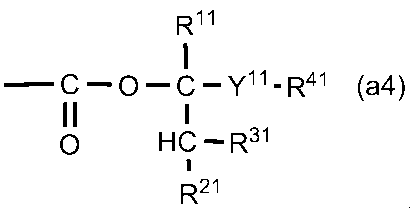
また前記のようにカルボキシル基を有する樹脂中の当該カルボキシル基において、本発明の効果を阻害しない範囲で、例えば下記構造式(a4)となっている構造部位を更に含んでいてもよい。 Further, as described above, the carboxyl group in the resin having a carboxyl group may further include, for example, a structural portion represented by the following structural formula (a4) within a range not inhibiting the effects of the present invention.
前記構造式(a4)中の炭素原子数1〜18の有機基としては、前述の構造式(a1)で挙げたものと同様であり、好ましい有機基としても同様である。これらの中でも特にR11、R21およびR31がそれぞれ水素原子で、R41が炭素原子数1〜18の有機基で、Y11が酸素原子または硫黄原子であるものが、カルボキシル基との極性の差が大きく、他の化合物を積層した時の積層しやすくなることから好ましく、特に下記構造式(a4−1) Examples of the organic group having 1 to 18 carbon atoms in the structural formula (a4) are the same as those described in the structural formula (a1), and the same applies to preferable organic groups. Among these, those in which R 11 , R 21 and R 31 are each a hydrogen atom, R 41 is an organic group having 1 to 18 carbon atoms, and Y 11 is an oxygen atom or a sulfur atom are polar with a carboxyl group This is preferable because it is easy to stack when other compounds are stacked, and particularly the following structural formula (a4-1)
本発明で用いる分散剤(A)の数平均分子量(Mn)は、フッ素樹脂の粒子の分散安定性と、後述する樹脂組成物中の他の成分との相溶性が良好なことから、1,000〜50,000の範囲が好ましく、1,500〜20,000の範囲がより好ましく、2,000〜8,000の範囲がさらに好ましい。また、重量平均分子量(Mw)は、同様に1,000〜100,000の範囲が好ましく、5,000〜70,000の範囲がより好ましい。 The number average molecular weight (Mn) of the dispersant (A) used in the present invention is 1 because the dispersion stability of the fluororesin particles and the compatibility with other components in the resin composition described later are good. The range of 000 to 50,000 is preferable, the range of 1,500 to 20,000 is more preferable, and the range of 2,000 to 8,000 is more preferable. Similarly, the weight average molecular weight (Mw) is preferably in the range of 1,000 to 100,000, more preferably in the range of 5,000 to 70,000.
本発明において、数平均分子量(Mn)及び重量平均分子量(Mw)は、ゲル浸透クロマトグラフィー(以下、「GPC」と略記する。)測定に基づきポリスチレン換算した値である。GPCの測定条件は以下の通り。 In the present invention, the number average molecular weight (Mn) and the weight average molecular weight (Mw) are values converted to polystyrene based on gel permeation chromatography (hereinafter abbreviated as “GPC”) measurement. GPC measurement conditions are as follows.
[GPC測定条件]
測定装置:東ソー株式会社製「HLC−8220 GPC」、
カラム:東ソー株式会社製ガードカラム「HHR−H」(6.0mmI.D.×4cm)+東ソー株式会社製「TSK−GEL GMHHR−N」(7.8mmI.D.×30cm)+東ソー株式会社製「TSK−GEL GMHHR−N」(7.8mmI.D.×30cm)+東ソー株式会社製「TSK−GEL GMHHR−N」(7.8mmI.D.×30cm)+東ソー株式会社製「TSK−GEL GMHHR−N」(7.8mmI.D.×30cm)
検出器:RI
データ処理:東ソー株式会社製「GPC−8020モデルIIデータ解析バージョン4.30」
測定条件:カラム温度 40℃
展開溶媒 テトラヒドロフラン(THF)
流速 1.0ml/分
試料:樹脂固形分換算で1.0質量%のテトラヒドロフラン溶液をマイクロフィルターでろ過したもの(5μl)。
標準試料:前記「GPC−8020モデルIIデータ解析バージョン4.30」の測定マニュアルに準拠して、分子量が既知の下記の単分散ポリスチレンを用いた。
[GPC measurement conditions]
Measuring device: “HLC-8220 GPC” manufactured by Tosoh Corporation
Column: Guard column “HHR-H” (6.0 mm ID × 4 cm) manufactured by Tosoh Corporation + “TSK-GEL GMHHR-N” (7.8 mm ID × 30 cm) + Tosoh Corporation manufactured by Tosoh Corporation “TSK-GEL GMHHR-N” (7.8 mm ID × 30 cm) manufactured by Tosoh Corporation “TSK-GEL GMHHR-N” (7.8 mm ID × 30 cm) + “TSK− manufactured by Tosoh Corporation” GEL GMHHR-N "(7.8 mm ID x 30 cm)
Detector: RI
Data processing: “GPC-8020 Model II data analysis version 4.30” manufactured by Tosoh Corporation
Measurement conditions: Column temperature 40 ° C
Developing solvent Tetrahydrofuran (THF)
Flow rate: 1.0 ml / min Sample: A 1.0% by mass tetrahydrofuran solution in terms of resin solid content filtered through a microfilter (5 μl).
Standard sample: The following monodisperse polystyrene having a known molecular weight was used in accordance with the measurement manual of “GPC-8020 Model II Data Analysis Version 4.30”.
(単分散ポリスチレン)
東ソー株式会社製「A−500」
東ソー株式会社製「A−1000」
東ソー株式会社製「A−2500」
東ソー株式会社製「A−5000」
東ソー株式会社製「F−1」
東ソー株式会社製「F−2」
東ソー株式会社製「F−4」
東ソー株式会社製「F−10」
東ソー株式会社製「F−20」
東ソー株式会社製「F−40」
東ソー株式会社製「F−80」
東ソー株式会社製「F−128」
東ソー株式会社製「F−288」
東ソー株式会社製「F−550」
(Monodispersed polystyrene)
“A-500” manufactured by Tosoh Corporation
"A-1000" manufactured by Tosoh Corporation
"A-2500" manufactured by Tosoh Corporation
"A-5000" manufactured by Tosoh Corporation
“F-1” manufactured by Tosoh Corporation
"F-2" manufactured by Tosoh Corporation
“F-4” manufactured by Tosoh Corporation
“F-10” manufactured by Tosoh Corporation
“F-20” manufactured by Tosoh Corporation
“F-40” manufactured by Tosoh Corporation
“F-80” manufactured by Tosoh Corporation
“F-128” manufactured by Tosoh Corporation
“F-288” manufactured by Tosoh Corporation
“F-550” manufactured by Tosoh Corporation
本発明での前記分散剤(A)は、加熱することに依って前述のように前記構造式(a1)中のカルボニルオキシ基の酸素原子と炭素原子との間の結合が切れ、前記構造式(a1)をカルボキシル基とすることができる。加熱処理条件によって、結合が切れて、フッ素原子含有部分が揮発するその割合を調製することは可能であるが、本発明の効果をより発現させるためには、本発明の効果をより発現させるためには、180〜300℃の雰囲気下で1〜60分放置することが好ましく、このような加熱処理によって、分散剤(A)中のフッ素原子含有率を0.5質量%以下とすることが可能である。 In the present invention, the dispersant (A) is heated to break the bond between the oxygen atom and the carbon atom of the carbonyloxy group in the structural formula (a1) as described above. (A1) can be a carboxyl group. Depending on the heat treatment conditions, it is possible to adjust the ratio at which the bond is broken and the fluorine atom-containing portion volatilizes. However, in order to achieve the effects of the present invention, the effects of the present invention are more manifested. Is preferably left in an atmosphere of 180 to 300 ° C. for 1 to 60 minutes. By such heat treatment, the fluorine atom content in the dispersant (A) may be 0.5 mass% or less. Is possible.
前述の加熱処理によって、本発明の分散剤(A)は、例えば、下記構造式(c1)又は(c2) By the above-described heat treatment, the dispersant (A) of the present invention is, for example, the following structural formula (c1) or (c2)
で表される基であり、R62、R63はそれぞれ前記構造式(a1)で表される基又はカルボキシル基である。〕
で表される構造単位を有する、カルボキシル基を有する樹脂(但し、カルボキシル基を有する樹脂中のフッ素原子含有率は0.5質量%以下である。)となる。
R 62 and R 63 are each a group represented by the structural formula (a1) or a carboxyl group. ]
A resin having a carboxyl group (however, the fluorine atom content in the resin having a carboxyl group is 0.5 mass% or less).
本発明で用いる分散剤(A)は、例えば、下記の方法により効率よく製造することができる。
製法1:カルボキシル基を有する重合性単量体(α)と、下記一般式(1)
The dispersant (A) used in the present invention can be efficiently produced, for example, by the following method.
Production method 1: Polymerizable monomer (α) having a carboxyl group and the following general formula (1)
で表されるビニルエーテル化合物と、を反応させてブロック化されたカルボキシル基を有する重合性単量体を得た後、該重合性単量体を重合させる方法。
A method of polymerizing the polymerizable monomer after obtaining a polymerizable monomer having a blocked carboxyl group by reacting with the vinyl ether compound represented by formula (1).
製法2:カルボキシル基を有する重合性単量体(α)を用いて得られる重合体と、前記一般式(1)で表されるビニルエーテル化合物とを反応させる方法。 Production method 2: A method of reacting a polymer obtained by using a polymerizable monomer (α) having a carboxyl group with the vinyl ether compound represented by the general formula (1).
前記製法1で得られる分散剤は、即ち、前記重合性単量体(α)と一般式(1)で表されるビニルエーテル化合物との反応物であるブロック化されたカルボキシル基を有する重合性単量体を構成要素とする分散剤である。また、前記製法2で得られる含フッ素分解性フッ素樹脂粒子分散剤は、即ち、前記重合性単量体(α)を原料とする重合体と、一般式(1)で表されるビニルエーテル化合物とを構成要素とする分散剤である。 The dispersant obtained by the production method 1 is a polymerizable monomer having a blocked carboxyl group that is a reaction product of the polymerizable monomer (α) and the vinyl ether compound represented by the general formula (1). It is a dispersant having a monomer as a constituent element. In addition, the fluorine-containing decomposable fluororesin particle dispersant obtained by the production method 2 includes a polymer using the polymerizable monomer (α) as a raw material, a vinyl ether compound represented by the general formula (1), and Is a dispersing agent.
前記カルボキシル基を有する重合性単量体(α)としては、例えば、(メタ)アクリル酸、イタコン酸、メサコン酸、マレイン酸、フマル酸、カルボキシエチル(メタ)アクリレート、カルボキシペンチル(メタ)アクリレート、2−(メタ)アクリロイロキシエチルヘキサヒドロフタル酸、2−(メタ)アクリロイロキシプロピルヘキサヒドロフタル酸、2−(メタ)アクリロイロキシエチルフタル酸、2−(メタ)アクリロイロキシエチルコハク酸、2−(メタ)アクリロイロキシエチルマレイン酸、カルボキシポリカプロラクトンモノ(メタ)アクリレート、2−(メタ)アクリロイロキシエチルテトラヒドロフタル酸等を好ましく例示できる。中でも、安価で取り扱いが容易であることから(メタ)アクリル酸が好ましい。 Examples of the polymerizable monomer (α) having a carboxyl group include (meth) acrylic acid, itaconic acid, mesaconic acid, maleic acid, fumaric acid, carboxyethyl (meth) acrylate, carboxypentyl (meth) acrylate, 2- (meth) acryloyloxyethyl hexahydrophthalic acid, 2- (meth) acryloyloxypropyl hexahydrophthalic acid, 2- (meth) acryloyloxyethyl phthalic acid, 2- (meth) acryloyloxyethyl succinate Preferred examples include acid, 2- (meth) acryloyloxyethylmaleic acid, carboxypolycaprolactone mono (meth) acrylate, 2- (meth) acryloyloxyethyltetrahydrophthalic acid, and the like. Among them, (meth) acrylic acid is preferable because it is inexpensive and easy to handle.
なお、本発明において、「(メタ)アクリレート」とは、メタクリレートとアクリレートの一方又は両方をいい、「(メタ)アクリロイル基」とは、メタクリロイル基とアクリロイル基の一方又は両方をいい、「(メタ)アクリル酸」とは、メタクリル酸とアクリル酸の一方又は両方をいう。 In the present invention, “(meth) acrylate” refers to one or both of methacrylate and acrylate, and “(meth) acryloyl group” refers to one or both of methacryloyl group and acryloyl group. “Acrylic acid” refers to one or both of methacrylic acid and acrylic acid.
前記一般式(1)で表されるビニルエーテル化合物としては、例えば、3,3,4,4,5,5,6,6,7,7,8,8,8−トリデカフルオロ−1−ビニルオキシオクタン、3,3,4,4,5,5,6,6,6−ノナフルオロ−1−ビニルオキシヘキサン等が挙げられる。中でも前記重合性単量体(α)との反応性が良好である観点より3,3,4,4,5,5,6,6,7,7,8,8,8−トリデカフルオロ−1−ビニルオキシオクタンが好ましい。 Examples of the vinyl ether compound represented by the general formula (1) include 3,3,4,4,5,5,6,6,7,7,8,8,8-tridecafluoro-1-vinyl. Examples include oxyoctane, 3,3,4,4,5,5,6,6,6-nonafluoro-1-vinyloxyhexane, and the like. Among these, 3,3,4,4,5,5,6,6,7,7,8,8,8-tridecafluoro- from the viewpoint of good reactivity with the polymerizable monomer (α). 1-vinyloxyoctane is preferred.
前記製造方法1において、ブロック化されたカルボキシル基を有する重合性単量体を得た後、該重合性単量体を重合させる際や、製造方法2においてカルボキシル基を有する重合性単量体(α)を用いて得られる重合体を得る際には、界面活性能等種々の機能の付与等を目的として本発明の効果を損なわない範囲で重合性単量体(α)以外の重合性単量体(γ)を併用して分散剤を得ることもできる。重合性単量体(γ)としては、例えば、アクリル酸エステル類、メタクリル酸エステル類、アクリルアミド類、メタクリルアミド類、アリル化合物、ビニルエーテル類、ビニルエステル類、イタコン酸ジアルキル類、フマル酸のジアルキルエステル類又はモノアルキルエステル類、オキシアルキレン鎖を有するラジカル重合性単量体が挙げられ、さらには、得られる分散体やこれを用いる樹脂組成物の保存安定性を特に向上させることが必要な場合であって、且つ熱処理後のフッ素原子含有率が多少高めであってもよい場合には、フッ素化アルキル基やポリ(パーフルオロアルキレンエーテル)鎖を有するラジカル重合性単量体を併用してもよい。 In the production method 1, after obtaining a polymerizable monomer having a blocked carboxyl group, when the polymerizable monomer is polymerized, or in the production method 2, a polymerizable monomer having a carboxyl group ( When obtaining a polymer obtained using α), a polymerizable monomer other than the polymerizable monomer (α) is used within the range not impairing the effects of the present invention for the purpose of imparting various functions such as surface activity. A dispersant can also be obtained by using the monomer (γ) together. Examples of the polymerizable monomer (γ) include acrylic acid esters, methacrylic acid esters, acrylamides, methacrylamides, allyl compounds, vinyl ethers, vinyl esters, dialkyl itaconates, and dialkyl esters of fumaric acid. Or a monoalkyl ester, a radically polymerizable monomer having an oxyalkylene chain, and further, when it is necessary to particularly improve the storage stability of the resulting dispersion or a resin composition using the same. In the case where the fluorine atom content after heat treatment may be somewhat higher, a radical polymerizable monomer having a fluorinated alkyl group or a poly (perfluoroalkylene ether) chain may be used in combination. .
前記アクリル酸エステル類としては、例えば、アクリル酸メチル、アクリル酸エチル、アクリル酸プロピル、クロルエチルアクリレート、2−ヒドロキシエチルアクリレート、トリメチロールプロパンモノアクリレート、ベンジルアクリレート、メトキシベンジルアクリレート、フルフリルアクリレート、テトラヒドロフルフリルアクリレート等が挙げられる。 Examples of the acrylic acid esters include methyl acrylate, ethyl acrylate, propyl acrylate, chloroethyl acrylate, 2-hydroxyethyl acrylate, trimethylolpropane monoacrylate, benzyl acrylate, methoxybenzyl acrylate, furfuryl acrylate, tetrahydro And furfuryl acrylate.
前記メタクリル酸エステル類としては、例えば、メタクリル酸メチル、メタクリル酸エチル、メタクリル酸プロピル、クロルエチルメタクリレート、2−ヒドロキシエチルメタクリレート、トリメチロールプロパンモノメタクリレート、ベンジルメタクリレート、メトキシベンジルメタクリレート、フルフリルメタクリレート、テトラヒドロフルフリルメタクリレート等が挙げられる。 Examples of the methacrylic acid esters include methyl methacrylate, ethyl methacrylate, propyl methacrylate, chloroethyl methacrylate, 2-hydroxyethyl methacrylate, trimethylolpropane monomethacrylate, benzyl methacrylate, methoxybenzyl methacrylate, furfuryl methacrylate, tetrahydro And furfuryl methacrylate.
前記アクリルアミド類としては、例えば、アクリルアミド、N−アルキルアクリルアミド(アルキル基としては炭素原子数1〜3のもの、例えば、メチル基、エチル基、プロピル基)、N,N−ジアルキルアクリルアミド(アルキル基としては炭素原子数1〜3のもの)、N−ヒドロキシエチル−N−メチルアクリルアミド、N−2−アセトアミドエチル−N−アセチルアクリルアミド等が挙げられる。 Examples of the acrylamides include acrylamide, N-alkylacrylamide (alkyl groups having 1 to 3 carbon atoms, such as methyl group, ethyl group, propyl group), N, N-dialkylacrylamide (as alkyl group). Are those having 1 to 3 carbon atoms), N-hydroxyethyl-N-methylacrylamide, N-2-acetamidoethyl-N-acetylacrylamide and the like.
前記メタクリルアミド類としては、例えば、メタクリルアミド、N−アルキルメタクリルアミド(アルキル基としては炭素原子数1〜3のもの、例えばメチル基、エチル基、プロピル基)、N,N−ジアルキルメタクリルアミド(アルキル基としては炭素原子数1〜3のもの)、N−ヒドロキシエチル−N−メチルメタクリルアミド、N−2−アセトアミドエチル−N−アセチルメタクリルアミド等が挙げられる。 Examples of the methacrylamides include methacrylamide, N-alkyl methacrylamide (alkyl groups having 1 to 3 carbon atoms, such as methyl, ethyl, propyl), N, N-dialkyl methacrylamide ( Examples of the alkyl group include those having 1 to 3 carbon atoms), N-hydroxyethyl-N-methylmethacrylamide, N-2-acetamidoethyl-N-acetylmethacrylamide and the like.
前記アリル化合物としては、例えば、アリルエステル類(例えば、酢酸アリル、カプロン酸アリル、カプリル酸アリル、ラウリン酸アリル、パルミチン酸アリル、ステアリン酸アリル、安息香酸アリル、アセト酢酸アリル、乳酸アリルなど)、アリルオキシエタノール等が挙げられる。 Examples of the allyl compound include allyl esters (for example, allyl acetate, allyl caproate, allyl caprylate, allyl laurate, allyl palmitate, allyl stearate, allyl benzoate, allyl acetoacetate, allyl lactate, etc.) Examples include allyloxyethanol.
前記ビニルエーテル類としては、例えば、ヘキシルビニルエーテル、オクチルビニルエーテル、デシルビニルエーテル、エチルヘキシルビニルエーテル、メトキシエチルビニルエーテル、エトキシエチルビニルエーテル、クロルエチルビニルエーテル、1−メチル−2,2−ジメチルプロピルビニルエーテル、2−エチルブチルビニルエーテル、ヒドロキシエチルビニルエーテル、ジエチレングリコールビニルエーテル、ジメチルアミノエチルビニルエーテル、ジエチルアミノエチルビニルエーテル、ブチルアミノエチルビニルエーテル、ベンジルビニルエーテル、テトラヒドロフルフリルビニルエーテル等、ビニルエステル類:ビニルビチレート、ビニルイソブチレート、ビニルトリメチルアセテート、ビニルジエチルアセテート、ビニルバレート、ビニルカプロエート、ビニルクロルアセテート、ビニルジクロルアセテート、ビニルメトキシアセテート、ビニルブトキシアセテート、ビニルラクテート、ビニル−β−フェニルブチレート、ビニルシクロヘキシルカルボキシレート等が挙げられる。 Examples of the vinyl ethers include hexyl vinyl ether, octyl vinyl ether, decyl vinyl ether, ethyl hexyl vinyl ether, methoxyethyl vinyl ether, ethoxyethyl vinyl ether, chloroethyl vinyl ether, 1-methyl-2,2-dimethylpropyl vinyl ether, 2-ethylbutyl vinyl ether, Hydroxyethyl vinyl ether, diethylene glycol vinyl ether, dimethylaminoethyl vinyl ether, diethylaminoethyl vinyl ether, butylaminoethyl vinyl ether, benzyl vinyl ether, tetrahydrofurfuryl vinyl ether, etc., vinyl esters: vinyl vinylate, vinyl isobutyrate, vinyl trimethyl acetate, vinyl diethyl acetate ,vinyl Rate, vinyl caproate, vinyl chloroacetate, vinyl di- chloroacetate, vinyl methoxyacetate, vinyl butoxyacetate, vinyl lactate, vinyl -β- phenyl butyrate, vinyl cyclohexyl carboxylate.
前記イタコン酸ジアルキル類としては、イタコン酸ジメチル、イタコン酸ジエチル、イタコン酸ジブチル等が挙げられる。フマル酸のジアルキルエステル類又はモノアルキルエステル類としては、ジブチルフマレート等、その他、クロトン酸、イタコン酸、アクリロニトリル、メタクリロニトリル、マレイロニトリル、スチレン等も挙げられる。 Examples of the dialkyl itaconates include dimethyl itaconate, diethyl itaconate, and dibutyl itaconate. Examples of the dialkyl ester or monoalkyl ester of fumaric acid include dibutyl fumarate and the like, crotonic acid, itaconic acid, acrylonitrile, methacrylonitrile, maleilonitrile, styrene, and the like.
前記オキシアルキレン鎖を有するラジカル重合性単量体としては、例えば、(ポリ)プロピレングリコールモノ(メタ)アクリレート、(ポリ)テトラメチレングリコール(メタ)アクリレート、(ポリ)(エチレングリコール・プロピレングリコール)モノ(メタ)アクリレート、(ポリ)エチレングリコール・(ポリ)プロピレングリコールモノ(メタ)アクリレート、(ポリ)(エチレングリコール・テトラメチレングリコール)モノ(メタ)アクリレート、(ポリ)エチレングリコール・(ポリ)テトラメチレングリコールモノ(メタ)アクリレート、(ポリ)(プロピレングリコール・テトラメチレングリコール)モノ(メタ)アクリレート、(ポリ)プロピレングリコール・ポリテトラメチレングリコールモノ(メタ)アクリレート、(ポリ)(プロピレングリコール・ブチレングリコール)モノ(メタ)アクリレート、(ポリ)プロピレングリコール・(ポリ)ブチレングリコールモノ(メタ)アクリレート、(ポリ)(エチレングリコール・ブチレングリコール)モノ(メタ)アクリレート、(ポリ)エチレングリコール・(ポリ)ブチレングリコールモノ(メタ)アクリレート、(ポリ)(テトラエチレングリコール・ブチレングリコール)モノ(メタ)アクリレート、(ポリ)テトラエチレングリコール・(ポリ)ブチレングリコールモノ(メタ)アクリレート、(ポリ)ブチレングリコールモノ(メタ)アクリレート、(ポリ)(エチレングリコール・トリメチレングリコール)モノ(メタ)アクリレート、(ポリ)エチレングリコール・(ポリ)トリメチレングリコールモノ(メタ)アクリレート、(ポリ)(プロピレングリコール・トリメチレングリコール)モノ(メタ)アクリレート、(ポリ)プロピレングリコール・(ポリ)トリメチレングリコールモノ(メタ)アクリレート、(ポリ)(トリメチレングリコール・テトラメチレングリコール)モノ(メタ)アクリレート、(ポリ)トリメチレングリコール・(ポリ)テトラメチレングリコールモノ(メタ)アクリレート、(ポリ)(ブチレングリコール・トリメチレングリコール)モノ(メタ)アクリレート、(ポリ)ブチレングリコール・(ポリ)トリメチレングリコールモノ(メタ)アクリレート等が挙げられる。 Examples of the radical polymerizable monomer having an oxyalkylene chain include (poly) propylene glycol mono (meth) acrylate, (poly) tetramethylene glycol (meth) acrylate, and (poly) (ethylene glycol / propylene glycol) mono. (Meth) acrylate, (poly) ethylene glycol / (poly) propylene glycol mono (meth) acrylate, (poly) (ethylene glycol / tetramethylene glycol) mono (meth) acrylate, (poly) ethylene glycol / (poly) tetramethylene Glycol mono (meth) acrylate, (poly) (propylene glycol / tetramethylene glycol) mono (meth) acrylate, (poly) propylene glycol / polytetramethylene glycol mono (meth) acrylate (Poly) (propylene glycol / butylene glycol) mono (meth) acrylate, (poly) propylene glycol / (poly) butylene glycol mono (meth) acrylate, (poly) (ethylene glycol / butylene glycol) mono (meth) acrylate , (Poly) ethylene glycol / (poly) butylene glycol mono (meth) acrylate, (poly) (tetraethylene glycol / butylene glycol) mono (meth) acrylate, (poly) tetraethylene glycol / (poly) butylene glycol mono (meta) ) Acrylate, (poly) butylene glycol mono (meth) acrylate, (poly) (ethylene glycol / trimethylene glycol) mono (meth) acrylate, (poly) ethylene glycol / (poly) trimethyl Glycol (mono) (poly) (propylene glycol / trimethylene glycol) mono (meth) acrylate, (poly) propylene glycol / (poly) trimethylene glycol mono (meth) acrylate, (poly) (trimethylene glycol)・ Tetramethylene glycol) mono (meth) acrylate, (poly) trimethylene glycol ・ (Poly) tetramethylene glycol mono (meth) acrylate, (poly) (butylene glycol ・ trimethylene glycol) mono (meth) acrylate, (poly) Examples include butylene glycol and (poly) trimethylene glycol mono (meth) acrylate.
なお、前記「ポリ(エチレングリコール・プロピレングリコール)」は、エチレングリコールとプロピレングリコールとのランダム共重合物を意味し、「ポリエチレングリコール・ポリプロピレングリコール」は、エチレングリコールとプロピレングリコールとのブロック共重合物を意味し、他のものも同様である。「(ポリ)プロピレングリコール」は、プロピレングリコールとポリプロピレングリコールのいずれかを意味し、他のものも同様である。オキシアルキレン鎖を有するラジカル重合性単量体におけるオキシアルキレン鎖の分子量としては、200〜2,500の範囲であるものが、組成物を構成する他の樹脂との相溶性に優れる観点から好ましいものである。特にポリエチレングリコール、ポリプロピレングリコール又はポリブチレングルコールを含有する重合性単量体を用いることが、分散安定性に優れる分散体が容易に得られる点から好ましい。 The “poly (ethylene glycol / propylene glycol)” means a random copolymer of ethylene glycol and propylene glycol, and “polyethylene glycol / polypropylene glycol” means a block copolymer of ethylene glycol and propylene glycol. The same is true for the others. “(Poly) propylene glycol” means either propylene glycol or polypropylene glycol, and the same applies to other ones. The molecular weight of the oxyalkylene chain in the radical polymerizable monomer having an oxyalkylene chain is preferably in the range of 200 to 2,500 from the viewpoint of excellent compatibility with other resins constituting the composition. It is. In particular, it is preferable to use a polymerizable monomer containing polyethylene glycol, polypropylene glycol, or polybutylene glycol because a dispersion having excellent dispersion stability can be easily obtained.
前記オキシアルキレン鎖を有するラジカル重合性単量体の市販品としては、例えば、新中村化学工業株式会社製の「NKエステルAMP−10G」、「NKエステルAMP−20G」、「NKエステルAMP−60G」、日油株式会社製の「ブレンマーPME−100」、「ブレンマーPME−200」、「ブレンマーPME−400」、「ブレンマーPME−4000」、「ブレンマーPP−1000」、「ブレンマーPP−500」、「ブレンマーPP−800」、「ブレンマー70PEP−350B」、「ブレンマー55PET−800」、「ブレンマー50POEP−800B」、「ブレンマー10PPB−500B」、「ブレンマーNKH−5050」、「ブレンマーAP−400」、サートマー社製の「SR604」等が挙げられる。 Examples of commercially available radical polymerizable monomers having an oxyalkylene chain include “NK Ester AMP-10G”, “NK Ester AMP-20G”, and “NK Ester AMP-60G” manufactured by Shin-Nakamura Chemical Co., Ltd. “Blemmer PME-100”, “Blemmer PME-200”, “Blemmer PME-400”, “Blemmer PME-4000”, “Blemmer PP-1000”, “Blemmer PP-500”, manufactured by NOF Corporation “Blemmer PP-800”, “Blemmer 70PEP-350B”, “Blemmer 55PET-800”, “Blemmer 50POEP-800B”, “Blemmer 10PPB-500B”, “Blemmer NKH-5050”, “Blemmer AP-400”, Sartomer "SR604" made by the company That.
前記フッ素化アルキル基やポリ(パーフルオロアルキレンエーテル)鎖を有するラジカル重合性単量体としては、例えば、下記一般式(γ1)で表されるものを例示することができる。 Examples of the radical polymerizable monomer having a fluorinated alkyl group or a poly (perfluoroalkylene ether) chain include those represented by the following general formula (γ1).
上記式(Rf−1)〜(Rf−4)中のnは、例えば1〜6の整数であり、好ましくは4〜6の整数である。上記式(Rf−5)中のmは、例えば1〜18の整数であり、nは0〜5の整数であり、かつm及びnの合計は1〜23である。好ましくは、mは1〜5の整数であり、nは0〜4の整数であり、かつm及びnの合計は4〜5である。上記式(Rf−6)中のmは例えば1〜6の整数であり、nは1〜3の整数であり、lは1〜20の整数であり、pは0〜5の整数であり、かつ、m、p及びnとlとの積の合計は2〜71である。好ましくは、mは1〜3の整数であり、nは1〜3の整数であり、lは1〜6の整数であり、pは0〜2の整数であり、かつ、m、p及びnとlとの積の合計は2〜23である。 N in the above formulas (Rf-1) to (Rf-4) is, for example, an integer of 1 to 6, and preferably an integer of 4 to 6. M in the formula (Rf-5) is, for example, an integer of 1 to 18, n is an integer of 0 to 5, and the sum of m and n is 1 to 23. Preferably, m is an integer of 1 to 5, n is an integer of 0 to 4, and the sum of m and n is 4 to 5. M in the above formula (Rf-6) is, for example, an integer of 1-6, n is an integer of 1-3, l is an integer of 1-20, p is an integer of 0-5, And the sum of the product of m, p and n and l is 2 to 71. Preferably, m is an integer of 1 to 3, n is an integer of 1 to 3, l is an integer of 1 to 6, p is an integer of 0 to 2, and m, p and n The sum of the products of l and l is 2-23.
前記フッ素化アルキル基やポリ(パーフルオロアルキレンエーテル)鎖を有するラジカル重合性単量体の具体的な例として、例えば下記の重合性単量体(γ1−1)〜(γ1−15)等を例示することができる。 Specific examples of the radical polymerizable monomer having a fluorinated alkyl group or a poly (perfluoroalkylene ether) chain include, for example, the following polymerizable monomers (γ1-1) to (γ1-15). It can be illustrated.
式(γ1−1)〜式(γ1−11)におけるnは、例えば、0〜5である。また、(γ1−12)〜(γ1−15)におけるnは、例えば、0〜20である。 N in the formulas (γ1-1) to (γ1-11) is, for example, 0 to 5. Moreover, n in (γ1-12) to (γ1-15) is, for example, 0-20.
ラジカル重合性単量体(γ)は、単独で用いることも2種以上併用することもできる。 The radical polymerizable monomer (γ) can be used alone or in combination of two or more.
また、本発明で用いる分散剤(A)を得る際には、前記一般式(1)で表される化合物以外のビニルエーテル化合物を、一般式(1)で表されるビニルエーテル化合物と本発明の効果を損なわない範囲で併用することもできる。この様なビニルエーテル化合物としては、例えば、メチルビニルエーテル、エチルビニルエーテル、イソプロピルビニルエーテル、n−プロピルビニルエーテル、n−ブチルビニルエーテル、イソブチルビニルエーテル、2−エチルヘキシルビニルエーテル、シクロヘキシルビニルエーテルなどの脂肪族ビニルエーテル化合物;これらに対応する脂肪族ビニルチオエーテル化合物;2,3−ジヒドロフラン、3,4−ジヒドロフラン、2,3−ジヒドロ−2H−ピラン、3,4−ジヒドロ−2H−ピラン、3,4−ジヒドロ−2−メトキシ−2H−ピラン、3,4−ジヒドロ−4,4−ジメチル−2H−ピラン−2−オン、3,4−ジヒドロ−2−エトキシ−2H−ピラン、3,4−ジヒドロ−2H−ピラン−2−カルボン酸ナトリウムなどの環状ビニルエーテル化合物;これらに対応する環状ビニルチオエーテル化合物等が挙げられる。 Moreover, when obtaining the dispersing agent (A) used by this invention, vinyl ether compounds other than the compound represented by the said General formula (1) are used for the vinyl ether compound represented by General formula (1), and the effect of this invention. It can also be used in a range not impairing the above. Examples of such vinyl ether compounds include aliphatic vinyl ether compounds such as methyl vinyl ether, ethyl vinyl ether, isopropyl vinyl ether, n-propyl vinyl ether, n-butyl vinyl ether, isobutyl vinyl ether, 2-ethylhexyl vinyl ether, and cyclohexyl vinyl ether; Aliphatic vinyl thioether compound; 2,3-dihydrofuran, 3,4-dihydrofuran, 2,3-dihydro-2H-pyran, 3,4-dihydro-2H-pyran, 3,4-dihydro-2-methoxy- 2H-pyran, 3,4-dihydro-4,4-dimethyl-2H-pyran-2-one, 3,4-dihydro-2-ethoxy-2H-pyran, 3,4-dihydro-2H-pyran-2- Cyclic vinyl such as sodium carboxylate Ether compounds, cyclic vinyl thioether compounds corresponding to these.
前記製法1では、カルボキシル基を有する重合性単量体(α)と前記一般式(1)で表されるビニルエーテル化合物とを反応させる。これによりブロック化されたカルボキシル基を有する重合性単量体が得られる。反応条件は、例えば、酸触媒の存在下、20〜100℃程度に加熱する条件を挙げることができる。そして、ブロック化されたカルボキシル基を有する重合性単量体を重合させる際には、後述する重合性単量体(α)を重合させる条件と同様の条件にて行うことができる。 In the said manufacturing method 1, the polymeric monomer ((alpha)) which has a carboxyl group, and the vinyl ether compound represented by the said General formula (1) are made to react. As a result, a polymerizable monomer having a blocked carboxyl group is obtained. Examples of the reaction conditions include conditions for heating to about 20 to 100 ° C. in the presence of an acid catalyst. And when polymerizing the polymerizable monomer which has the carboxyl group blocked, it can carry out on the conditions similar to the conditions which superpose | polymerize the polymerizable monomer ((alpha)) mentioned later.
前記製法2において、重合性単量体(α)を用いて重合体を得る方法としては、特に制限はないが、例えば、重合性単量体(α)及び必要に応じて併用されるその他のラジカル重合性単量体(γ)を有機溶剤中、ラジカル重合開始剤を使用して重合させる方法等が挙げられる。ここで用いる有機溶媒としては、ケトン類、エステル類、アミド類、スルホキシド類、エーテル類、炭化水素類が好ましく、具体的には、アセトン、メチルエチルケトン、メチルイソブチルケトン、シクロヘキサノン、酢酸エチル、酢酸ブチル、プロピレングリコールモノメチルエーテルアセテート、ジメチルホルムアミド、ジメチルアセトアミド、N−メチルピロリドン、ジメチルスルホキシド、ジエチルエーテル、ジイソプロピルエーテル、テトラヒドロフラン、ジオキサン、トルエン、キシレン等が挙げられる。これらは、沸点、相溶性、重合性を考慮して適宜選択される。ラジカル重合開始剤としては、例えば過酸化ベンゾイル等の過酸化物、アゾビスイソブチロニトリル等のアゾ化合物等が例示できる。さらに必要に応じてラウリルメルカプタン、2−メルカプトエタノ−ル、チオグリセロール、エチルチオグリコ−ル酸、オクチルチオグリコ−ル酸等の連鎖移動剤を使用することができる。 In the production method 2, the method for obtaining the polymer using the polymerizable monomer (α) is not particularly limited, but for example, the polymerizable monomer (α) and other components used in combination as necessary. Examples thereof include a method of polymerizing a radical polymerizable monomer (γ) in an organic solvent using a radical polymerization initiator. As the organic solvent used here, ketones, esters, amides, sulfoxides, ethers, hydrocarbons are preferable. Specifically, acetone, methyl ethyl ketone, methyl isobutyl ketone, cyclohexanone, ethyl acetate, butyl acetate, Examples include propylene glycol monomethyl ether acetate, dimethylformamide, dimethylacetamide, N-methylpyrrolidone, dimethyl sulfoxide, diethyl ether, diisopropyl ether, tetrahydrofuran, dioxane, toluene, xylene and the like. These are appropriately selected in consideration of boiling point, compatibility, and polymerizability. Examples of the radical polymerization initiator include peroxides such as benzoyl peroxide and azo compounds such as azobisisobutyronitrile. Furthermore, chain transfer agents such as lauryl mercaptan, 2-mercaptoethanol, thioglycerol, ethylthioglycolic acid, octylthioglycolic acid and the like can be used as necessary.
前記製法2において、前記重合体と、前記一般式(1)で表されるビニルエーテル化合物とは、例えば、酸触媒の存在下、20〜100℃程度に加熱することにより反応させることができる。この反応により重合体が有するカルボキシル基がブロック化し、前記構造式(a1)で表される構造を有する重合体が得られる。 In the said manufacturing method 2, the said polymer and the vinyl ether compound represented by the said General formula (1) can be made to react by heating to about 20-100 degreeC in presence of an acid catalyst, for example. By this reaction, the carboxyl group of the polymer is blocked, and a polymer having a structure represented by the structural formula (a1) is obtained.
本発明で用いるフッ素樹脂粒子(B)としては、例えば、四フッ化エチレン(以下、「TFE」という。)の重合体であるPTFE、TFEと共重合可能なフッ素原子を有する単量体との共重合体(以下、「変性PTFE」という。)等が挙げられる。 Examples of the fluororesin particles (B) used in the present invention include PTFE, which is a polymer of ethylene tetrafluoride (hereinafter referred to as “TFE”), and a monomer having a fluorine atom copolymerizable with TFE. And a copolymer (hereinafter referred to as “modified PTFE”).
前記TFEと共重合可能なフッ素原子を有する単量体としては、例えば、炭素原子数3以上、好ましくは炭素原子数3〜6のパーフルオロアルケン、炭素原子数1〜6のパーフルオロアルキルビニルエーテル等が挙げられる。パーフルオロアルケンとしては、例えば、クロロトリフルオロエチレン、ヘキサフルオロプロピレン(HFP)等が挙げられる。また、パーフルオロアルキルビニルエーテルとしては、例えば、パーフルオロメチルビニルエーテル(PMVE)、パーフルオロエチルビニルエーテル(PEVE)、パーフルオロプロピルビニルエーテル(PPVE)等が挙げられる。 Examples of the monomer having a fluorine atom copolymerizable with TFE include perfluoroalkene having 3 or more carbon atoms, preferably 3 to 6 carbon atoms, and perfluoroalkyl vinyl ether having 1 to 6 carbon atoms. Is mentioned. Examples of the perfluoroalkene include chlorotrifluoroethylene and hexafluoropropylene (HFP). Examples of the perfluoroalkyl vinyl ether include perfluoromethyl vinyl ether (PMVE), perfluoroethyl vinyl ether (PEVE), perfluoropropyl vinyl ether (PPVE), and the like.
前記TFEと共重合可能なフッ素原子を有する単量体の中でも、ヘキサフルオロプロピレン(HFP)、パーフルオロエチルビニルエーテル(PEVE)及びパーフルオロプロピルビニルエーテル(PPVE)が好ましく、ヘキサフルオロプロピレン(HFP)がより好ましい。また、フッ素樹脂粒子(B)の粒径としては、0.01μm〜5μmの範囲のものを用いることができる。 Among the monomers having fluorine atoms copolymerizable with TFE, hexafluoropropylene (HFP), perfluoroethyl vinyl ether (PEVE) and perfluoropropyl vinyl ether (PPVE) are preferable, and hexafluoropropylene (HFP) is more preferable. preferable. Moreover, as a particle size of a fluororesin particle (B), the thing of the range of 0.01 micrometer-5 micrometers can be used.
本発明のフッ素樹脂粒子分散体を調製する際の含分散剤(A)の使用量は、フッ素樹脂粒子(B)100質量部に対して、0.5〜40質量部が好ましく、1〜30質量部がより好ましく、3〜20質量部が特に好ましい。 The amount of the dispersant-containing agent (A) used in preparing the fluororesin particle dispersion of the present invention is preferably 0.5 to 40 parts by mass with respect to 100 parts by mass of the fluororesin particles (B), and 1 to 30 Mass parts are more preferable, and 3 to 20 parts by mass are particularly preferable.
本発明のフッ素樹脂粒子分散体は水または有機溶剤(C)を含有する。有機溶剤としては、例えば、エタノール、イソプロピルアルコール、n−ブタノール、iso−ブタノール、tert−ブタノール等のアルコール類;アセトン、メチルエチルケトン、メチルイソブチルケトン等のケトン類;酢酸メチル、酢酸エチル、酢酸ブチル等のエステル類;ジメチルホルムアミド、ジメチルスルホキシド等の極性溶剤;メチルセロソルブ、セロソルブ、ブチルセロソルブ、ブチルカルビトール等のエーテル類;1,1,1−トリクロルエタン、クロロホルム等のハロゲン系溶剤;テトラヒドロフラン、ジオキサン等のエーテル類;ベンゼン、トルエン、キシレン等の芳香族類;パーフルオロメタン、パーフルオロトリ−n−ブチルアミン等のフッ素化イナートリキッド類などが挙げられる。これらの有機溶剤は、単独で用いることも2種以上併用することもできる。 The fluororesin particle dispersion of the present invention contains water or an organic solvent (C). Examples of the organic solvent include alcohols such as ethanol, isopropyl alcohol, n-butanol, iso-butanol, and tert-butanol; ketones such as acetone, methyl ethyl ketone, and methyl isobutyl ketone; methyl acetate, ethyl acetate, butyl acetate, and the like. Esters; polar solvents such as dimethylformamide and dimethyl sulfoxide; ethers such as methyl cellosolve, cellosolve, butyl cellosolve and butyl carbitol; halogen solvents such as 1,1,1-trichloroethane and chloroform; ethers such as tetrahydrofuran and dioxane Aromatics such as benzene, toluene and xylene; and fluorinated inerts such as perfluoromethane and perfluorotri-n-butylamine. These organic solvents can be used alone or in combination of two or more.
本発明のフッ素樹脂粒子分散体は、例えば、分散剤(A)と、フッ素樹脂粒子(B)と、水または有機溶剤(C)とを混合後、分散撹拌機、ペイントシェイカー、ボールミル、ビーズミル、各種ミキサー等の装置を用いて、分散することにより製造することができる。 The fluororesin particle dispersion of the present invention comprises, for example, a dispersion stirrer, a paint shaker, a ball mill, a bead mill, after mixing the dispersant (A), the fluororesin particles (B), and water or an organic solvent (C). It can manufacture by disperse | distributing using apparatuses, such as various mixers.
また、本発明のフッ素樹脂粒子分散体の中でも有機溶剤を分散媒体としたフッ素樹脂粒子分散体は、フッ素樹脂粒子を水に分散したフッ素樹脂粒子分散水性組成物の市販品(例えば、3M社製「ダイニオンPFA6900N」等)に、有機溶剤に分散剤(A)を溶解したものを加えた後、水から有機溶剤に置換することによっても調製することができる。 Further, among the fluororesin particle dispersions of the present invention, a fluororesin particle dispersion using an organic solvent as a dispersion medium is a commercially available fluororesin particle dispersion aqueous composition in which fluororesin particles are dispersed in water (for example, manufactured by 3M Company). It can also be prepared by adding a solution obtained by dissolving the dispersant (A) in an organic solvent to “Dionion PFA6900N” or the like, and then substituting the organic solvent with water.
本発明のフッ素樹脂粒子分散体は、そのままフッ素樹脂塗料として用いることができるが、このフッ素樹脂粒子分散体に、例えば、着色剤、充填剤、老化防止剤、防腐剤、防軟剤、紫外線吸収剤、酸化防止剤、光安定剤、熱安定剤、帯電防止剤などを添加混合することもできる。 The fluororesin particle dispersion of the present invention can be used as it is as a fluororesin coating, but for example, a colorant, a filler, an anti-aging agent, an antiseptic, a softener, and an ultraviolet absorber An agent, an antioxidant, a light stabilizer, a heat stabilizer, an antistatic agent and the like can be added and mixed.
本発明のフッ素樹脂粒子分散体は、更に、フッ素樹脂粒子分散体に含まれる分散剤(A)以外の樹脂(D)を加えて樹脂組成物とすることもできる。このような樹脂組成物は、例えば、被塗布物の表面を被覆する塗料として用いることもできるし、繊維状の基材に含侵させる含浸用樹脂組成物としても用いることができる。前記含浸用樹脂組成物の具体的な用途としては、例えば、金属張積層板用途を例示することができる。金属張積層板は、樹脂組成物を含む硬化物と金属箔との積層物であり、該硬化物は繊維状の基材に本発明の樹脂組成物を含侵させた後、硬化させて得られる。 The fluororesin particle dispersion of the present invention can be made into a resin composition by further adding a resin (D) other than the dispersant (A) contained in the fluororesin particle dispersion. Such a resin composition can be used, for example, as a paint for coating the surface of an object to be coated, or as a resin composition for impregnation impregnated into a fibrous base material. As a specific use of the resin composition for impregnation, for example, a metal-clad laminate can be exemplified. The metal-clad laminate is a laminate of a cured product containing a resin composition and a metal foil, and the cured product is obtained by impregnating a fibrous base material with the resin composition of the present invention and then curing. It is done.
前記樹脂としては、例えば、熱可塑性樹脂や熱硬化性樹脂等を例示することができる。前記熱可塑性樹脂としては、例えば、ナイロン6、ナイロン66等のポリアミド樹脂;ポリエチレン、ポリプロピレン等のポリオレフィン樹脂;ポリエチレンテレフタレート、ポリブチレンテレフタレート等のポリエステル樹脂;ポリカーボネート樹脂、ポリフェニレンオキシド樹脂、ポリスルホン樹脂、ポリエーテルスルホン樹脂、ポリエーテルエーテルケトン樹脂、ポリエーテルイミド樹脂、ポリスチレン樹脂、ABS樹脂、ポリフェニレンサルファイド樹脂等が挙げられる。 As said resin, a thermoplastic resin, a thermosetting resin, etc. can be illustrated, for example. Examples of the thermoplastic resin include polyamide resins such as nylon 6 and nylon 66; polyolefin resins such as polyethylene and polypropylene; polyester resins such as polyethylene terephthalate and polybutylene terephthalate; polycarbonate resins, polyphenylene oxide resins, polysulfone resins, and polyethers. Examples include sulfone resins, polyether ether ketone resins, polyether imide resins, polystyrene resins, ABS resins, polyphenylene sulfide resins, and the like.
含浸用樹脂組成物とする場合には、熱硬化性樹脂を用いることが好ましく、当該熱硬化性樹脂のガラス転移温度が、好ましくは160℃以上350℃以下であり、さらに好ましくは180℃以上300℃以下である。このようなガラス転移温度を有する熱硬化性樹脂を用いることにより、積層板としたときの、鉛フリー半田リフロー耐熱性がさらに向上するという効果が得られる。 When the resin composition for impregnation is used, it is preferable to use a thermosetting resin, and the glass transition temperature of the thermosetting resin is preferably 160 ° C. or higher and 350 ° C. or lower, more preferably 180 ° C. or higher and 300 ° C. or lower. It is below ℃. By using a thermosetting resin having such a glass transition temperature, the effect of further improving the lead-free solder reflow heat resistance when a laminated board is obtained can be obtained.
具体的な熱硬化性樹脂として、例えばフェノールノボラック樹脂、クレゾールノボラック樹脂、ビスフェノールAノボラック樹脂などのノボラック型フェノール樹脂、未変性のレゾールフェノール樹脂、桐油、アマニ油、クルミ油などで変性した油変性レゾールフェノール樹脂などのレゾール型フェノール樹脂などのフェノール樹脂、ビスフェノールA型エポキシ樹脂、ビスフェノールF型エポキシ樹脂、ビスフェノールS型エポキシ樹脂、ビスフェノールE型エポキシ樹脂、ビスフェノールM型エポキシ樹脂、ビスフェノールP型エポキシ樹脂、ビスフェノールZ型エポキシ樹脂などのビスフェノール型エポキシ樹脂、フェノールノボラック型エポキシ樹脂、クレゾールノボラック型エポキシ樹脂などのノボラック型エポキシ樹脂、ビフェニル型エポキシ樹脂、ビフェニルアラルキル型エポキシ樹脂、アリールアルキレン型エポキシ樹脂、ナフタレン型エポキシ樹脂、アントラセン型エポキシ樹脂、フェノキシ型エポキシ樹脂、ジシクロペンタジエン型エポキシ樹脂、ノルボルネン型エポキシ樹脂、アダマンタン型エポキシ樹脂、フルオレン型エポキシ樹脂などのエポキシ樹脂、ユリア(尿素)樹脂、メラミン樹脂などのトリアジン環を有する樹脂、不飽和ポリエステル樹脂、ビスマレイミド樹脂、ポリウレタン樹脂、ジアリルフタレート樹脂、シリコーン樹脂、ベンゾオキサジン環を有する樹脂、シアネート樹脂、ポリイミド樹脂、ポリアミドイミド樹脂、ベンゾシクロブテン樹脂などが挙げられる。これらの中の1種類を単独で用いてもよいし、異なる重量平均分子量を有する2種類以上を併用してもよく、1種類または2種類以上と、それらのプレポリマーを併用してもよい。 Specific thermosetting resins include, for example, novolac type phenolic resins such as phenol novolak resin, cresol novolac resin, bisphenol A novolak resin, unmodified resole phenolic resin, oil modified resole modified with tung oil, linseed oil, walnut oil, etc. Phenol resin such as phenolic resin, bisphenol A type epoxy resin, bisphenol F type epoxy resin, bisphenol S type epoxy resin, bisphenol E type epoxy resin, bisphenol M type epoxy resin, bisphenol P type epoxy resin, bisphenol Bisphenol type epoxy resin such as Z type epoxy resin, novolak type epoxy resin such as phenol novolac type epoxy resin, cresol novolac type epoxy resin, biffe Type epoxy resin, biphenyl aralkyl type epoxy resin, aryl alkylene type epoxy resin, naphthalene type epoxy resin, anthracene type epoxy resin, phenoxy type epoxy resin, dicyclopentadiene type epoxy resin, norbornene type epoxy resin, adamantane type epoxy resin, fluorene Type epoxy resin, epoxy resin, urea (urea) resin, resin having triazine ring such as melamine resin, unsaturated polyester resin, bismaleimide resin, polyurethane resin, diallyl phthalate resin, silicone resin, resin having benzoxazine ring, Examples include cyanate resin, polyimide resin, polyamideimide resin, and benzocyclobutene resin. One of these may be used alone, two or more having different weight average molecular weights may be used in combination, and one or two or more thereof and a prepolymer thereof may be used in combination.
これらの中でも、特に耐熱性の観点より、ポリイミド樹脂、シアネート樹脂、エポキシ樹脂、マレイミド樹脂、トリアジン環を有する樹脂又はベンゾオキサジン環を有する樹脂を用いることが好ましい。 Among these, from the viewpoint of heat resistance, it is preferable to use a polyimide resin, a cyanate resin, an epoxy resin, a maleimide resin, a resin having a triazine ring, or a resin having a benzoxazine ring.
前記ポリイミド樹脂としては、例えば、下記一般式(2) Examples of the polyimide resin include the following general formula (2)
で表されるもの等が挙げられる。
The thing etc. which are represented by are mentioned.
前記ポリイミド樹脂は、例えば、ポリイソシアネート化合物と酸無水物とを反応させることにより得ることができる。 The polyimide resin can be obtained, for example, by reacting a polyisocyanate compound and an acid anhydride.
前記ポリイソシアネート化合物としては、例えば、芳香族ポリイソシアネート化合物、脂肪族ポリイソシアネート化合物等が使用可能である。 As said polyisocyanate compound, an aromatic polyisocyanate compound, an aliphatic polyisocyanate compound, etc. can be used, for example.
前記芳香族ポリイソシアネート化合物としては、例えば、p−フェニレンジイソシアネート、m−フェニレンジイソシアネート、p−キシレンジイソシアネート、m−キシレンジイソシアネート、2,4−トリレンジイソシアネート、2,6−トリレンジイソシアネート、4,4’−ジフェニルメタンジイソシアネート、3,3’−ジメチルジフェニル−4,4’−ジイソシアネート、3,3’−ジエチルジフェニル−4,4’−ジイソシアネート、m−キシレンジイソシアネート、p−キシレンジイソシアネート、1,3−ビス(α,α−ジメチルイソシアナートメチル)ベンゼン、テトラメチルキシリレンジイソシアネート、ジフェニレンエーテル−4,4’−ジイソシアネート、ナフタレンジイソシアネート等の芳香族ジイソシアネート化合物等が挙げられる。 Examples of the aromatic polyisocyanate compound include p-phenylene diisocyanate, m-phenylene diisocyanate, p-xylene diisocyanate, m-xylene diisocyanate, 2,4-tolylene diisocyanate, 2,6-tolylene diisocyanate, 4,4. '-Diphenylmethane diisocyanate, 3,3'-dimethyldiphenyl-4,4'-diisocyanate, 3,3'-diethyldiphenyl-4,4'-diisocyanate, m-xylene diisocyanate, p-xylene diisocyanate, 1,3-bis Aromatic diisocyanates such as (α, α-dimethylisocyanatomethyl) benzene, tetramethylxylylene diisocyanate, diphenylene ether-4,4′-diisocyanate, naphthalene diisocyanate Compounds and the like.
前記脂肪族ポリイソシアネート化合物としては、例えば、ヘキサメチレンジイソシアネート、リジンジイソシアネート、トリメチルヘキサメチレンメチレンジイソシアネート、イソホロンジイソシアネート、4,4’−ジシクロヘキシルメタンジイソシアネート、水素添加キシレンジイソシアネート、ノルボヌレンジイソシアネート等の脂肪族ジイソシアネート化合物等が挙げられる。 Examples of the aliphatic polyisocyanate compound include aliphatic diisocyanates such as hexamethylene diisocyanate, lysine diisocyanate, trimethylhexamethylenemethylene diisocyanate, isophorone diisocyanate, 4,4′-dicyclohexylmethane diisocyanate, hydrogenated xylene diisocyanate, and norbornylene diisocyanate. Compounds and the like.
ポリイソシアネート化合物としては、ポリイソシアネート化合物と各種ポリオール成分をイソシアネート基過剰で予め反応させたイソシアネートプレポリマーを使用、併用することも可能である。 As the polyisocyanate compound, an isocyanate prepolymer obtained by reacting a polyisocyanate compound and various polyol components in advance with an excess of isocyanate groups can be used and used in combination.
前記ポリイソシアネート化合物としては、また、イソシアヌレート体であるイソシアヌレート環を有するポリイソシアネート化合物を使用することもできる。 As the polyisocyanate compound, a polyisocyanate compound having an isocyanurate ring which is an isocyanurate body can also be used.
前記イソシアヌレート環を有するポリイソシアネート化合物は、例えば、1種または2種以上のジイソシアネート化合物を第4級アンモニウム塩等のイソシアヌレート化触媒の存在下あるいは非存在下において、イソシアヌレート化することにより得られるものであって、3量体、5量体、7量体等のイソシアヌレートの混合物からなるもの等が挙げられる。前記ポリイソシアネート化合物のイソシアヌレート体の具体例としては、イソホロンジイソシアネートのイソシアヌレート型ポリイソシアネート、ヘキサメチレンジイソシアネートのイソシアヌレート型ポリイソシアネート、水素添加キシレンジイソシアネートのイソシアヌレート型ポリイソシアネート、ノルボルナンジイソシアネートのイソシアヌレート型ポリイソシアネート等脂肪族系ポリイソシアネート類やジフェニルメタンジイソシアネートのイソシアヌレート型ポリイソシアネート、トリレンジイソシアネートのイソシアヌレート型ポリイソシアネート、キシレンジイソシアネートのイソシアヌレート型ポリイソシアネート、ナフタレンジイソシアネートのイソシアヌレート型ポリイソシアネート等が挙げられる。 The polyisocyanate compound having an isocyanurate ring can be obtained, for example, by converting one or more diisocyanate compounds into an isocyanurate in the presence or absence of an isocyanuration catalyst such as a quaternary ammonium salt. And those composed of a mixture of isocyanurates such as trimer, pentamer and heptamer. Specific examples of the isocyanurate form of the polyisocyanate compound include isophorone diisocyanate isocyanurate type polyisocyanate, hexamethylene diisocyanate isocyanurate type polyisocyanate, hydrogenated xylene diisocyanate isocyanurate type polyisocyanate, norbornane diisocyanate isocyanurate type. Aliphatic polyisocyanates such as polyisocyanate, isocyanurate type polyisocyanate of diphenylmethane diisocyanate, isocyanurate type polyisocyanate of tolylene diisocyanate, isocyanurate type polyisocyanate of xylene diisocyanate, isocyanurate type polyisocyanate of naphthalene diisocyanate, etc. .
前記酸無水物としては、例えば、1個の酸無水物基を有する酸無水物や2個の酸無水物基を有する酸無水物等が挙げられる。前記1個の酸無水物基を有する酸無水物としては、例えば、無水トリメリット酸、ナフタレン−1,2,4−トリカルボン酸無水物等の芳香族トリカルボン酸無水物等が挙げられる。 Examples of the acid anhydride include an acid anhydride having one acid anhydride group and an acid anhydride having two acid anhydride groups. Examples of the acid anhydride having one acid anhydride group include aromatic tricarboxylic acid anhydrides such as trimellitic anhydride and naphthalene-1,2,4-tricarboxylic acid anhydride.
前記2個の酸無水物基を有する酸無水物としては、例えば、ピロメリット酸二無水物、ベンゾフェノン−3,3′,4,4′−テトラカルボン酸二無水物、ジフェニルエーテル−3,3′,4,4′−テトラカルボン酸二無水物、ベンゼン−1,2,3,4−テトラカルボン酸二無水物、ビフェニル−3,3′,4,4′−テトラカルボン酸二無水物、ビフェニル−2,2′,3,3′−テトラカルボン酸二無水物、ナフタレン−2,3,6,7−テトラカルボン酸二無水物、ナフタレン−1,2,4,5−テトラカルボン酸二無水物、ナフタレン−1,4,5,8−テトラカルボン酸二無水物、デカヒドロナフタレン−1,4,5,8−テトラカルボン酸二無水物、4,8−ジメチル−1,2,3,5,6,7−ヘキサヒドロナフタレン−1,2,5,6−テトラカルボン酸二無水物、2,6−ジクロロナフタレン−1,4,5,8−テトラカルボン酸二無水物、2,7−ジクロロナフタレン−1,4,5,8−テトラカルボン酸二無水物、2,3,6,7−テトラクロロナフタレン−1,4,5,8−テトラカルボン酸二無水物、フェナントレン−1,3,9,10−テトラカルボン酸二無水物、ベリレン−3,4,9,10−テトラカルボン酸二無水物、ビス(2,3−ジカルボキシフェニル)メタン二無水物、ビス(3,4−ジカルボキシフェニル)メタン二無水物、1,1−ビス(2,3−ジカルボキシフェニル)エタン二無水物、1,1−ビス(3,4−ジカルボキシフェニル)エタン二無水物、2,2−ビス(2,3−ジカルボキシフェニル)プロパン二無水物、2,3−ビス(3,4−ジカルボキシフェニル)プロパン二無水物、ビス(3,4−ジカルボキシフェニル)スルホン二無水物、ビス(3,4−ジカルボキシフェニル)エーテル二無水物、 Examples of the acid anhydride having two acid anhydride groups include pyromellitic dianhydride, benzophenone-3,3 ', 4,4'-tetracarboxylic dianhydride, diphenyl ether-3,3'. , 4,4'-tetracarboxylic dianhydride, benzene-1,2,3,4-tetracarboxylic dianhydride, biphenyl-3,3 ', 4,4'-tetracarboxylic dianhydride, biphenyl -2,2 ', 3,3'-tetracarboxylic dianhydride, naphthalene-2,3,6,7-tetracarboxylic dianhydride, naphthalene-1,2,4,5-tetracarboxylic dianhydride , Naphthalene-1,4,5,8-tetracarboxylic dianhydride, decahydronaphthalene-1,4,5,8-tetracarboxylic dianhydride, 4,8-dimethyl-1,2,3 5,6,7-Hexahydronaphthalene- , 2,5,6-tetracarboxylic dianhydride, 2,6-dichloronaphthalene-1,4,5,8-tetracarboxylic dianhydride, 2,7-dichloronaphthalene-1,4,5,8 -Tetracarboxylic dianhydride, 2,3,6,7-tetrachloronaphthalene-1,4,5,8-tetracarboxylic dianhydride, phenanthrene-1,3,9,10-tetracarboxylic dianhydride , Berylene-3,4,9,10-tetracarboxylic dianhydride, bis (2,3-dicarboxyphenyl) methane dianhydride, bis (3,4-dicarboxyphenyl) methane dianhydride, 1 , 1-bis (2,3-dicarboxyphenyl) ethane dianhydride, 1,1-bis (3,4-dicarboxyphenyl) ethane dianhydride, 2,2-bis (2,3-dicarboxyphenyl) ) Propane dianhydride, 2 1,3-bis (3,4-carboxyphenyl) propane dianhydride, bis (3,4-carboxyphenyl) sulfone dianhydride, bis (3,4-carboxyphenyl) ether dianhydride,
エチレングリコールビスアンヒドロトリメリテート、プロピレングリコールビスアンヒドロトリメリテート、ブタンジオールビスアンヒドロトリメリテート、ヘキサメチレングリコールビスアンヒドロトリメリテート、ポリエチレングリコールビスアンヒドロトリメリテート、ポリプロピレンレングリコールビスアンヒドロトリメリテートやその他アルキレングリコールビスアンヒドロキシトリメリテートなどが挙げられる。 Ethylene glycol bisanhydro trimellitate, propylene glycol bis anhydro trimellitate, butanediol bis anhydro trimellitate, hexamethylene glycol bis anhydro trimellitate, polyethylene glycol bis anhydro trimellitate, polypropylene lenglycol bis Anhydro trimellitate and other alkylene glycol bis-an hydroxy trimellitate are listed.
無水物としては、これらの1種又は2種以上を用いることが可能である。また、芳香族テトラカルボン酸二酸無水物に芳香族トリカルボン酸無水物や芳香族テトラカルボン酸一酸無水物を混合して使用してもよい。 One or more of these can be used as the anhydride. Further, an aromatic tricarboxylic acid anhydride or an aromatic tetracarboxylic acid monoacid anhydride may be mixed with an aromatic tetracarboxylic acid dianhydride.
前記ポリイミド樹脂は例えば、反応容器にポリイソシアネート化合物と酸無水物とを仕込み、攪拌を行いながら昇温することで脱炭酸を生じながら反応を進行させることにより製造することができる。 The polyimide resin can be produced, for example, by charging a polyisocyanate compound and an acid anhydride in a reaction vessel and allowing the reaction to proceed while decarboxylation by raising the temperature while stirring.
前記製造の際の反応温度としては、50℃から250℃の範囲で行うことが可能であり、反応速度と副反応防止の面から70℃から180℃の温度で行うことが好ましい。 The reaction temperature during the production can be in the range of 50 ° C. to 250 ° C., and is preferably performed at a temperature of 70 ° C. to 180 ° C. in terms of reaction rate and prevention of side reactions.
反応は、イソシアネート基がほぼ全て反応するまで行った方が得られるポリイミド樹脂の安定性が良好となることから好ましい。また、若干残存するイソシアネート基に対して、アルコールや、フェノール化合物を添加し反応させても良い。 The reaction is preferable because the stability of the resulting polyimide resin is improved when the reaction is performed until almost all isocyanate groups have reacted. Moreover, you may make it react by adding alcohol and a phenol compound with respect to the isocyanate group which remains a little.
前記ポリイミド樹脂を製造する際は、有機溶剤を使用することと均一な反応を進行できるため好ましい。ここで有機溶剤は、系中にあらかじめ存在させてから化反応を行っても、途中で導入してもよい。また、この反応に際して適切な反応速度を維持するために系中の有機溶剤の割合は、反応系の80質量%以下であるが好ましく、10〜70質量%であることがより好ましい。かかる有機溶剤としては、原料成分としてイソシアネート基を含有する化合物を使用するため、水酸基やアミノ基等の活性プロトンを有しない非プロトン性極性有機溶剤が好ましい。 When manufacturing the said polyimide resin, since a uniform reaction can advance using an organic solvent, it is preferable. Here, the organic solvent may be preliminarily present in the system before the chemical reaction or may be introduced in the middle. In order to maintain an appropriate reaction rate during this reaction, the proportion of the organic solvent in the system is preferably 80% by mass or less of the reaction system, more preferably 10 to 70% by mass. As such an organic solvent, since a compound containing an isocyanate group is used as a raw material component, an aprotic polar organic solvent having no active proton such as a hydroxyl group or an amino group is preferable.
前記非プロトン性極性有機溶剤としては、例えば、ジメチルホルムアミド、ジメチルアセトアミド、N−メチル−2−ピロリドン、ジメチルスルフォキシド、スルホラン、γ−ブチロラクトンなどの極性有機溶媒を使用することができる。また、溶解可能であれば、その他エーテル系溶剤、エステル系溶剤、ケトン系溶剤、石油系溶剤等を使用しても良い。また、各種溶剤を混合して使用しても良い。 Examples of the aprotic polar organic solvent that can be used include polar organic solvents such as dimethylformamide, dimethylacetamide, N-methyl-2-pyrrolidone, dimethyl sulfoxide, sulfolane, and γ-butyrolactone. Further, as long as it is soluble, other ether solvents, ester solvents, ketone solvents, petroleum solvents and the like may be used. Various solvents may be mixed and used.
前記エーテル系溶剤としては、例えば、エチレングリコールジメチルエーテル、エチレングリコールジエチルエーテル、エチレングリコールジブチルエーテル等のエチレングリコールジアルキルエーテル類;ジエチレングリコールジメチルエーテル、ジエチレングリコールジエチルエーテル、ジエチレングリコールジブチルエーテル、トリエチレングリコールジメチルエーテル、トリエチレングリコールジエチルエーテル、トリエチレングリコールジブチルエーテル等のポリエチレングリコールジアルキルエーテル類;エチレングリコールモノメチルエーテルアセテート、エチレングリコールモノエチルエーテルアセテート、エチレングリコールモノブチルエーテルアセテート等のエチレングリコールモノアルキルエーテルアセテート類;ジエチレングリコールモノメチルエーテルアセテート、ジエチレングリコールモノエチルエーテルアセテート、ジエチレングリコールモノブチルエーテルアセテート、トリエチレングリコールモノメチルエーテルアセテート、トリエチレングリコールモノエチルエーテルアセテート、トリエチレングリコールモノブチルエーテルアセテート等のポリエチレングリコールモノアルキルエーテルアセテート類; Examples of the ether solvent include ethylene glycol dialkyl ethers such as ethylene glycol dimethyl ether, ethylene glycol diethyl ether, and ethylene glycol dibutyl ether; diethylene glycol dimethyl ether, diethylene glycol diethyl ether, diethylene glycol dibutyl ether, triethylene glycol dimethyl ether, and triethylene glycol diethyl. Polyethylene glycol dialkyl ethers such as ether and triethylene glycol dibutyl ether; Ethylene glycol monoalkyl ether acetates such as ethylene glycol monomethyl ether acetate, ethylene glycol monoethyl ether acetate and ethylene glycol monobutyl ether acetate; Chi glycol monomethyl ether acetate, diethylene glycol monoethyl ether acetate, diethylene glycol monobutyl ether acetate, triethylene glycol monomethyl ether acetate, triethylene glycol monoethyl ether acetate, polyethylene glycol monoalkyl ether acetates such as triethylene glycol monobutyl ether acetate;
プロピレングリコールジメチルエーテル、プロピレングリコールジエチルエーテル、プロピレングリコールジブチルエーテル等のプロピレングリコールジアルキルエーテル類;ジプロピレングリコールジメチルエーテル、ジプロピレングリコールジエチルエーテル、ジプロピレングリコールジブチルエーテル、トリプロピレングリコールジメチルエーテル、トリプロピレングリコールジエチルエーテル、トリプロピレングリコールジブチルエーテル等のポリプロピレングリコールジアルキルエーテル類;プロピレングリコールモノメチルエーテルアセテート、プロピレングリコールモノエチルエーテルアセテート、プロピレングリコールモノブチルエーテルアセテート等のプロピレングリコールモノアルキルエーテルアセテート類;ジプロピレングリコールモノメチルエーテルアセテート、ジプロピレングリコールモノエチルエーテルアセテート、ジプロピレングリコールモノブチルエーテルアセテート、トリプロピレングリコールモノメチルエーテルアセテート、トリプロピレングリコールモノエチルエーテルアセテート、トリプロピレングリコールモノブチルエーテルアセテート等のポリプロピレングリコールモノアルキルエーテルアセテート類;低分子のエチレン−プロピレン共重合体等の共重合ポリエーテルグリコールのジアルキルエーテル類;共重合ポリエーテルグリコールのモノアセテートモノアルキルエーテル類;共重合ポリエーテルグリコールのアルキルエステル類;共重合ポリエーテルグリコールのモノアルキルエステルモノアルキルエーテル類等が挙げられる。 Propylene glycol dialkyl ethers such as propylene glycol dimethyl ether, propylene glycol diethyl ether, propylene glycol dibutyl ether; dipropylene glycol dimethyl ether, dipropylene glycol diethyl ether, dipropylene glycol dibutyl ether, tripropylene glycol dimethyl ether, tripropylene glycol diethyl ether, tripropylene glycol Polypropylene glycol dialkyl ethers such as propylene glycol dibutyl ether; propylene glycol monoalkyl ether acetates such as propylene glycol monomethyl ether acetate, propylene glycol monoethyl ether acetate, propylene glycol monobutyl ether acetate; Polypropylene glycol monoalkyl ether acetate such as triglycol monomethyl ether acetate, dipropylene glycol monoethyl ether acetate, dipropylene glycol monobutyl ether acetate, tripropylene glycol monomethyl ether acetate, tripropylene glycol monoethyl ether acetate, tripropylene glycol monobutyl ether acetate Dialkyl ethers of copolymerized polyether glycols such as low molecular weight ethylene-propylene copolymers; monoacetate monoalkyl ethers of copolymerized polyether glycols; alkyl esters of copolymerized polyether glycols; copolymerized polyethers Examples include glycol monoalkyl ester monoalkyl ethers.
前記エステル系溶剤としては、例えば、酢酸エチル、酢酸ブチル等が挙げられる。ケトン系溶剤としては、アセトン、メチルエチルケトン、シクロヘキサノン等が挙げられる。また、石油系溶剤として、トルエン、キシレンやその他高沸点の芳香族溶剤等や、ヘキサン、シクロヘキサン等の脂肪族、脂環族溶剤を使用することも可能である。 Examples of the ester solvent include ethyl acetate and butyl acetate. Examples of the ketone solvent include acetone, methyl ethyl ketone, and cyclohexanone. Further, as the petroleum solvent, it is also possible to use toluene, xylene, other high-boiling aromatic solvents, and aliphatic and alicyclic solvents such as hexane and cyclohexane.
また、前記ポリイミド樹脂としては、ポリイミドの前駆体であるポリアミック酸から得られるものも使用できる。前記ポリアミック酸としては、例えば、下記一般式(3) Moreover, what is obtained from the polyamic acid which is a precursor of a polyimide can also be used as said polyimide resin. Examples of the polyamic acid include the following general formula (3)
で表されるものが挙げられる。ポリアミック酸を加熱することで、構造中のアミド基とカルボキシル基との反応が進行してイミド基が形成され、これにより上述したようなポリイミド樹脂が得られる。
The thing represented by is mentioned. By heating the polyamic acid, the reaction between the amide group and the carboxyl group in the structure proceeds to form an imide group, whereby the polyimide resin as described above is obtained.
前記ポリアミック酸は、例えば、ジアミン及び/又はジイソシアネートと、テトラカルボン酸又はその誘導体とを反応させることによって得ることができる。 The polyamic acid can be obtained, for example, by reacting diamine and / or diisocyanate with tetracarboxylic acid or a derivative thereof.
前記ジアミンとしては、例えば、p−フェニレンジアミン、m−フェニレンジアミン、4,4’−ジアミノジフェニルメタン、4,4’−ジアミノジフェニルエタン、4,4’−ジアミノジフェニルスルフィド、4,4’−ジアミノジフェニルスルホン、3,3’−ジメチル−4,4’−ジアミノビフェニル、4,4’−ジアミノベンズアニリド、4,4’−ジアミノジフェニルエーテル、1,5−ジアミノナフタレン、2,2’−ジメチル−4,4’−ジアミノビフェニル、5−アミノ−1−(4’−アミノフェニル)−1,3,3−トリメチルインダン、6−アミノ−1−(4’−アミノフェニル)−1,3,3−トリメチルインダン、3,4’−ジアミノジフェニルエーテル、3,3’−ジアミノベンゾフェノン、3,4’−ジアミノベンゾフェノン、4,4’−ジアミノベンゾフェノン、2,2−ビス[4−(4−アミノフェノキシ)フェニル]プロパン、2,2−ビス[4−(4−アミノフェノキシ)フェニル]ヘキサフルオロプロパン、2,2−ビス(4−アミノフェニル)ヘキサフルオロプロパン、ビス[4−(4−アミノフェノキシ)フェニル]スルホン、1,4−ビス(4−アミノフェノキシ)ベンゼン、4,4’−ビス(4−アミノフェノキシ)ビフェニル、1,3−ビス(4−アミノフェノキシ)ベンゼン、1,3−ビス(3−アミノフェノキシ)ベンゼン、9,9−ビス(4−アミノフェニル)−10−ヒドロアントラセン、2,7−ジアミノフルオレン、9,9−ジメチル−2,7−ジアミノフルオレン、9,9−ビス(4−アミノフェニル)フルオレン、ビス(4−アミノ−2−クロロフェニル)メタン、2,2’,5,5’−テトラクロロ−4,4’−ジアミノビフェニル、2,2’−ジクロロ−4,4’−ジアミノ−5,5’−ジメトキシビフェニル、3,3’−ジメトキシ−4,4’−ジアミノビフェニル、4,4’−(p−フェニレンジイソプロピリデン)ビスアニリン、4,4’−(m−フェニレンジイソプロピリデン)ビスアニリン、2,2’−ビス[4−(4−アミノ−2−トリフルオロメチルフェノキシ)フェニル]ヘキサフルオロプロパン、4,4’−ジアミノ−3,3’−ビス(トリフルオロメチル)ビフェニル、4,4’−ジアミノ−2,2’−ビス(トリフルオロメチル)ビフェニル、4,4’−ビス[(4−アミノ−2−トリフルオロメチル)フェノキシ]−オクタフルオロビフェニル、等の芳香族ジアミン; Examples of the diamine include p-phenylenediamine, m-phenylenediamine, 4,4′-diaminodiphenylmethane, 4,4′-diaminodiphenylethane, 4,4′-diaminodiphenyl sulfide, and 4,4′-diaminodiphenyl. Sulfone, 3,3′-dimethyl-4,4′-diaminobiphenyl, 4,4′-diaminobenzanilide, 4,4′-diaminodiphenyl ether, 1,5-diaminonaphthalene, 2,2′-dimethyl-4, 4′-diaminobiphenyl, 5-amino-1- (4′-aminophenyl) -1,3,3-trimethylindane, 6-amino-1- (4′-aminophenyl) -1,3,3-trimethyl Indane, 3,4'-diaminodiphenyl ether, 3,3'-diaminobenzophenone, 3,4'-diamino Nzophenone, 4,4′-diaminobenzophenone, 2,2-bis [4- (4-aminophenoxy) phenyl] propane, 2,2-bis [4- (4-aminophenoxy) phenyl] hexafluoropropane, 2, 2-bis (4-aminophenyl) hexafluoropropane, bis [4- (4-aminophenoxy) phenyl] sulfone, 1,4-bis (4-aminophenoxy) benzene, 4,4′-bis (4-amino) Phenoxy) biphenyl, 1,3-bis (4-aminophenoxy) benzene, 1,3-bis (3-aminophenoxy) benzene, 9,9-bis (4-aminophenyl) -10-hydroanthracene, 2,7 -Diaminofluorene, 9,9-dimethyl-2,7-diaminofluorene, 9,9-bis (4-aminophenyl) fluorene Bis (4-amino-2-chlorophenyl) methane, 2,2 ′, 5,5′-tetrachloro-4,4′-diaminobiphenyl, 2,2′-dichloro-4,4′-diamino-5, 5'-dimethoxybiphenyl, 3,3'-dimethoxy-4,4'-diaminobiphenyl, 4,4 '-(p-phenylenediisopropylidene) bisaniline, 4,4'-(m-phenylenediisopropylidene) bisaniline 2,2′-bis [4- (4-amino-2-trifluoromethylphenoxy) phenyl] hexafluoropropane, 4,4′-diamino-3,3′-bis (trifluoromethyl) biphenyl, 4, 4'-diamino-2,2'-bis (trifluoromethyl) biphenyl, 4,4'-bis [(4-amino-2-trifluoromethyl) phenoxy] -oct Aromatic diamines such as tafluorobiphenyl;
1,1−メタキシリレンジアミン、1,3−プロパンジアミン、テトラメチレンジアミン、ペンタメチレンジアミン、ヘキサメチレンジアミン、ヘプタメチレンジアミン、オクタメチレンジアミン、ノナメチレンジアミン、1,4−ジアミノシクロヘキサン、イソホロンジアミン、テトラヒドロジシクロペンタジエニレンジアミン、ヘキサヒドロ−4,7−メタノインダニレンジメチレンジアミン、トリシクロ[6.2.1.02,7]−ウンデシレンジメチレンジアミン、4,4’−メチレンビス(シクロヘキシルアミン)、1,3−ビス(アミノメチル)シクロヘキサン、1,4−ビス(アミノメチル)シクロヘキサン、等の脂肪族及び脂環式ジアミン等が挙げられる。 1,1-metaxylylenediamine, 1,3-propanediamine, tetramethylenediamine, pentamethylenediamine, hexamethylenediamine, heptamethylenediamine, octamethylenediamine, nonamethylenediamine, 1,4-diaminocyclohexane, isophoronediamine, Tetrahydrodicyclopentadienylenediamine, hexahydro-4,7-methanoindanylene methylenediamine, tricyclo [6.2.1.0 2,7 ] -undecylenediethylenediamine, 4,4′-methylenebis (cyclohexylamine) ), 1,3-bis (aminomethyl) cyclohexane, 1,4-bis (aminomethyl) cyclohexane, and other aliphatic and alicyclic diamines.
前記ジイソシアネートとしては、例えば、前記したジイソシアネート等を使用する事ができる。 As said diisocyanate, the above-mentioned diisocyanate etc. can be used, for example.
前記テトラカルボン酸又はその誘導体としては、例えば、2つのカルボキシル基を隣り合う位置に有している構造を2組含む構造を有するものを好ましく例示することができる。このようなテトラカルボン酸の具体例としては、例えば、ピロメリット酸、2,3,3’,4’−テトラカルボキシジフェニル、3,3’,4,4’−テトラカルボキシジフェニル、3,3’,4,4’−テトラカルボキシジフェニルエーテル、2,3,3’,4’−テトラカルボキシジフェニルエーテル、3,3’,4,4’−テトラカルボキシベンゾフェノン、2,3,3’,4’−テトラカルボキシベンゾフェノン、2,3,6,7−テトラカルボキシナフタレン、1,4,5,7−テトラカルボキシナフタレン、1,2,5,6−テトラカルボキシナフタレン、3,3’,4,4’−テトラカルボキシジフェニルメタン、2,2−ビス(3,4−ジカルボキシフェニル)プロパン、2,2−ビス(3,4−ジカルボキシフェニル)ヘキサフルオロプロパン、3,3’,4,4’−テトラカルボキシジフェニルスルホン、3,4,9,10−テトラカルボキシペリレン、2,2−ビス[4−(3,4−ジカルボキシフェノキシ)フェニル]プロパン、2,2−ビス[4−(3,4−ジカルボキシフェノキシ)フェニル]ヘキサフルオロプロパン、ブタンテトラカルボン酸、シクロペンタンテトラカルボン酸等が挙げられる。 As said tetracarboxylic acid or its derivative (s), what has a structure containing 2 sets of structures which have two carboxyl groups in the adjacent position can be illustrated preferably, for example. Specific examples of such tetracarboxylic acid include, for example, pyromellitic acid, 2,3,3 ′, 4′-tetracarboxydiphenyl, 3,3 ′, 4,4′-tetracarboxydiphenyl, 3,3 ′. , 4,4′-tetracarboxydiphenyl ether, 2,3,3 ′, 4′-tetracarboxydiphenyl ether, 3,3 ′, 4,4′-tetracarboxybenzophenone, 2,3,3 ′, 4′-tetracarboxy Benzophenone, 2,3,6,7-tetracarboxynaphthalene, 1,4,5,7-tetracarboxynaphthalene, 1,2,5,6-tetracarboxynaphthalene, 3,3 ′, 4,4′-tetracarboxy Diphenylmethane, 2,2-bis (3,4-dicarboxyphenyl) propane, 2,2-bis (3,4-dicarboxyphenyl) Safluoropropane, 3,3 ′, 4,4′-tetracarboxydiphenyl sulfone, 3,4,9,10-tetracarboxyperylene, 2,2-bis [4- (3,4-dicarboxyphenoxy) phenyl] Examples include propane, 2,2-bis [4- (3,4-dicarboxyphenoxy) phenyl] hexafluoropropane, butanetetracarboxylic acid, and cyclopentanetetracarboxylic acid.
また、テトラカルボン酸の誘導体としては、上述したテトラカルボン酸のエステル化物、酸無水物、塩化物等が挙げられる。 Examples of the tetracarboxylic acid derivatives include the esterified products, acid anhydrides, and chlorides of the above-described tetracarboxylic acids.
ポリアミック酸を合成するためのジアミン及び/又はジイソシアネートと、テトラカルボン酸又はその誘導体との反応においては、テトラカルボン酸又はその誘導体に対する、ジアミン及び/又はジイソシアネートのモル比を0.95〜1.05とすることが好ましい。この比率で反応を行うと、生成するポリアミック酸やこれから得られるポリイミド樹脂の分子量が十分に大きくなる。 In the reaction of diamine and / or diisocyanate for synthesizing polyamic acid with tetracarboxylic acid or its derivative, the molar ratio of diamine and / or diisocyanate to tetracarboxylic acid or its derivative is 0.95 to 1.05. It is preferable that When the reaction is carried out at this ratio, the molecular weight of the produced polyamic acid and the polyimide resin obtained therefrom is sufficiently increased.
ポリアミック酸の合成反応は、好ましくは有機溶媒中において、好ましくは−20〜150℃、より好ましくは0〜100℃の温度条件下で行われる。反応時間は好ましくは2〜24時間であり、より好ましくは2〜12時間である。ここで、有機溶媒としては、合成されるポリアミック酸を溶解できるものであれば特に制限はないが、N−メチル−2−ピロリドン、N,N−ジメチルアセトアミド、N,N−ジメチルホルムアミド、ジメチルスルホキシド、γ−ブチロラクトン、テトラメチル尿素、ヘキサメチルホスホルトリアミド等の非プロトン系極性溶媒;m−クレゾール、キシレノール、フェノール、ハロゲン化フェノール等のフェノール系溶媒が好ましい。有機溶媒の使用量は、テトラカルボン酸二無水物及びジアミン化合物の総量が、反応溶液の全量に対して0.1〜30質量%になるような量であることが好ましい。 The polyamic acid synthesis reaction is preferably performed in an organic solvent under a temperature condition of preferably -20 to 150 ° C, more preferably 0 to 100 ° C. The reaction time is preferably 2 to 24 hours, more preferably 2 to 12 hours. Here, the organic solvent is not particularly limited as long as it can dissolve the synthesized polyamic acid, but N-methyl-2-pyrrolidone, N, N-dimethylacetamide, N, N-dimethylformamide, dimethylsulfoxide. Aprotic polar solvents such as γ-butyrolactone, tetramethylurea and hexamethylphosphortriamide; and phenolic solvents such as m-cresol, xylenol, phenol and halogenated phenol are preferred. The amount of the organic solvent used is preferably such that the total amount of tetracarboxylic dianhydride and diamine compound is 0.1 to 30% by mass with respect to the total amount of the reaction solution.
また、溶解性に問題がない範囲で、その他の有機溶媒を併用しても良い。その他の有機溶媒としては、例えば、メチルアルコール、エチルアルコール、イソプロピルアルコール、シクロヘキサノール、エチレングリコール、プロピレングリコール、1,4−ブタンジオール、トリエチレングリコール、エチレングリコールモノメチルエーテル、乳酸エチル、乳酸ブチル、アセトン、メチルエチルケトン、メチルイソブチルケトン、シクロヘキサノン、酢酸メチル、酢酸エチル、酢酸ブチル、メチルメトキシプロピオネ−ト、エチルエトキシプロピオネ−ト、シュウ酸ジエチル、マロン酸ジエチル、ジエチルエーテル、エチレングリコールメチルエーテル、エチレングリコールエチルエーテル、エチレングリコール−n−プロピルエーテル、エチレングリコール−i−プロピルエーテル、エチレングリコール−n−ブチルエーテル、エチレングリコールジメチルエーテル、エチレングリコールエチルエーテルアセテート、ジエチレングリコールジメチルエーテル、ジエチレングリコールジエチルエーテル、ジエチレングリコールモノメチルエーテル、ジエチレングリコールモノエチルエーテル、ジエチレングリコールモノメチルエーテルアセテート、ジエチレングリコールモノエチルエーテルアセテート、テトラヒドロフラン、ジクロロメタン、1,2−ジクロロエタン、1,4−ジクロロブタン、トリクロロエタン、クロルベンゼン、o−ジクロルベンゼン、ヘキサン、ヘプタン、オクタン、ベンゼン、トルエン、キシレン、イソアミルプロピオネート、イソアミルイソブチレート、ジイソペンチルエーテルを挙げることができる。 Further, other organic solvents may be used in combination as long as there is no problem in solubility. Examples of other organic solvents include methyl alcohol, ethyl alcohol, isopropyl alcohol, cyclohexanol, ethylene glycol, propylene glycol, 1,4-butanediol, triethylene glycol, ethylene glycol monomethyl ether, ethyl lactate, butyl lactate, and acetone. , Methyl ethyl ketone, methyl isobutyl ketone, cyclohexanone, methyl acetate, ethyl acetate, butyl acetate, methyl methoxypropionate, ethyl ethoxypropionate, diethyl oxalate, diethyl malonate, diethyl ether, ethylene glycol methyl ether, ethylene glycol Ethyl ether, ethylene glycol-n-propyl ether, ethylene glycol-i-propyl ether, ethylene glycol-n-butyl Ether, ethylene glycol dimethyl ether, ethylene glycol ethyl ether acetate, diethylene glycol dimethyl ether, diethylene glycol diethyl ether, diethylene glycol monomethyl ether, diethylene glycol monoethyl ether, diethylene glycol monomethyl ether acetate, diethylene glycol monoethyl ether acetate, tetrahydrofuran, dichloromethane, 1,2-dichloroethane, 1 , 4-dichlorobutane, trichloroethane, chlorobenzene, o-dichlorobenzene, hexane, heptane, octane, benzene, toluene, xylene, isoamylpropionate, isoamylisobutyrate, diisopentyl ether.
その他の有機溶媒の使用割合は、前述の有機溶媒と他の有機溶媒との合計に対して、好ましくは80質量%以下であり、より好ましくは50質量%以下であり、更に40質量%以下であることが好ましい。 The use ratio of the other organic solvent is preferably 80% by mass or less, more preferably 50% by mass or less, and further 40% by mass or less with respect to the total of the above-mentioned organic solvent and the other organic solvent. Preferably there is.
以上のようにして、ポリアミック酸を溶解してなる反応溶液が得られる。この反応溶液はそのまま樹脂組成物の調製に供してもよく、反応溶液中に含まれるポリアミック酸を単離したうえで樹脂組成物の調製に供してもよく、又は単離したポリアミック酸を精製したうえで樹脂組成物の調製に供してもよい。ポリアミック酸の単離は、上記反応溶液を大量の貧溶媒中に注いで析出物を得、この析出物を減圧下乾燥する方法、あるいは、反応溶液をエバポレーターで減圧留去する方法により行うことができる。また、このポリアミック酸を再び有機溶媒に溶解し、次いで貧溶媒で析出させる方法、あるいは、エバポレーターで減圧留去する工程を1回又は数回行う方法により、ポリアミック酸を精製することができる。 As described above, a reaction solution obtained by dissolving polyamic acid is obtained. This reaction solution may be used as it is for the preparation of the resin composition, may be used for the preparation of the resin composition after isolating the polyamic acid contained in the reaction solution, or the isolated polyamic acid was purified. You may use for preparation of a resin composition. Polyamic acid can be isolated by pouring the reaction solution into a large amount of poor solvent to obtain a precipitate, and drying the precipitate under reduced pressure, or by distilling the reaction solution under reduced pressure using an evaporator. it can. The polyamic acid can be purified by a method of dissolving the polyamic acid again in an organic solvent and then precipitating with a poor solvent, or a method of performing the step of distilling off under reduced pressure with an evaporator once or several times.
ポリイミド樹脂は、上記のようにして得られたポリアミック酸を脱水閉環することにより合成することができる。このとき、アミック酸構造の全部を脱水閉環して完全にイミド化してもよく、あるいはアミック酸構造のうちの一部のみを脱水閉環してアミック酸構造とイミド構造とが併存する部分イミド化物としてもよい。ポリイミドのイミド化率は、好ましくは40%以上であり、より好ましくは80%以上である。ここで「イミド化率」とは、ポリイミドにおけるアミック酸構造の数とイミド環構造の数との合計に対するイミド環構造の数の割合を百分率で表した数値をいう。このとき、イミド環の一部がイソイミド環であってもよい。 The polyimide resin can be synthesized by dehydrating and ring-closing the polyamic acid obtained as described above. At this time, all of the amic acid structure may be dehydrated and closed to completely imidize, or only a part of the amic acid structure may be dehydrated and closed to form a partially imidized product in which the amic acid structure and the imide structure coexist. Also good. The imidation ratio of polyimide is preferably 40% or more, and more preferably 80% or more. Here, the “imidization ratio” refers to a numerical value representing the ratio of the number of imide ring structures to the total of the number of amic acid structures and the number of imide ring structures in polyimide as a percentage. At this time, a part of the imide ring may be an isoimide ring.
ポリアミック酸の脱水閉環反応は、(i)ポリアミック酸を加熱する方法、又は(ii)ポリアミック酸を有機溶媒に溶解し、この溶液中に脱水剤及び脱水閉環触媒を添加し必要に応じて加熱する方法により行うことができる。 The dehydration ring closure reaction of polyamic acid is (i) a method of heating polyamic acid, or (ii) dissolving polyamic acid in an organic solvent, adding a dehydrating agent and a dehydration ring closure catalyst to this solution, and heating as necessary. It can be done by a method.
上記(i)のポリアミック酸を加熱する方法における反応温度は、好ましくは50〜200℃であり、より好ましくは60〜170℃である。反応温度が50℃未満では脱水閉環反応が十分に進行せず、反応温度が200℃を超えると得られるポリイミドの分子量が低下することがある。ポリアミック酸を加熱する方法における反応時間は、好ましくは0.5〜48時間であり、より好ましくは2〜20時間である。 The reaction temperature in the method of heating the polyamic acid (i) is preferably 50 to 200 ° C, more preferably 60 to 170 ° C. When the reaction temperature is less than 50 ° C., the dehydration ring-closing reaction does not proceed sufficiently, and when the reaction temperature exceeds 200 ° C., the molecular weight of the resulting polyimide may decrease. The reaction time in the method of heating the polyamic acid is preferably 0.5 to 48 hours, more preferably 2 to 20 hours.
一方、上記(ii)のポリアミック酸の溶液中に脱水剤及び脱水閉環触媒を添加する方法において、脱水剤としては、例えば無水酢酸、無水プロピオン酸、無水トリフルオロ酢酸等の酸無水物を用いることができる。脱水剤の使用量は、ポリアミック酸構造単位の1モルに対して0.01〜20モルとするのが好ましい。また、脱水閉環触媒としては、例えばピリジン、コリジン、ルチジン、トリエチルアミン等の3級アミンを用いることができる。しかし、これらに限定されるものではない。脱水閉環触媒の使用量は、使用する脱水剤1モルに対して0.01〜10モルとするのが好ましい。脱水閉環反応に用いられる有機溶媒としては、ポリアミック酸の合成に用いられるものとして例示した有機溶媒を挙げることができる。脱水閉環反応の反応温度は好ましくは0〜180℃、より好ましくは10〜150℃であり、反応時間は好ましくは0.5〜20時間であり、より好ましくは1〜8時間である。 On the other hand, in the method (ii) of adding a dehydrating agent and a dehydrating ring-closing catalyst to the polyamic acid solution, as the dehydrating agent, for example, an acid anhydride such as acetic anhydride, propionic anhydride, or trifluoroacetic anhydride is used. Can do. The amount of the dehydrating agent used is preferably 0.01 to 20 mol with respect to 1 mol of the polyamic acid structural unit. Moreover, as a dehydration ring closure catalyst, tertiary amines, such as a pyridine, a collidine, a lutidine, a triethylamine, can be used, for example. However, it is not limited to these. The amount of the dehydration ring-closing catalyst used is preferably 0.01 to 10 mol with respect to 1 mol of the dehydrating agent used. Examples of the organic solvent used in the dehydration ring-closing reaction include the organic solvents exemplified as those used for the synthesis of polyamic acid. The reaction temperature of the dehydration ring closure reaction is preferably 0 to 180 ° C., more preferably 10 to 150 ° C., and the reaction time is preferably 0.5 to 20 hours, more preferably 1 to 8 hours.
上記方法(i)において得られるポリイミド樹脂は、これをそのまま樹脂組成物の調製に供してもよく、あるいは得られるポリイミドを精製したうえで樹脂組成物の調製に供してもよい。一方、上記方法(ii)においてはポリイミドを含有する反応溶液が得られる。この反応溶液は、これをそのまま樹脂組成物の調製に供してもよく、反応溶液から脱水剤及び脱水閉環触媒を除いたうえで樹脂組成物の調製に供してもよく、ポリイミドを単離したうえで樹脂組成物の調製に供してもよく、又は単離したポリイミドを精製したうえで樹脂組成物の調製に供してもよい。反応溶液から脱水剤及び脱水閉環触媒を除くには、例えば溶媒置換等の方法を適用することができる。ポリイミドの単離、精製は、ポリアミック酸の単離、精製方法として上記したのと同様の操作を行うことにより行うことができる。 The polyimide resin obtained in the above method (i) may be used for the preparation of the resin composition as it is, or may be used for the preparation of the resin composition after purifying the obtained polyimide. On the other hand, in the above method (ii), a reaction solution containing polyimide is obtained. This reaction solution may be used for the preparation of the resin composition as it is, or may be used for the preparation of the resin composition after removing the dehydrating agent and the dehydration ring-closing catalyst from the reaction solution, and after isolating the polyimide. It may be used for the preparation of the resin composition, or may be used for the preparation of the resin composition after purifying the isolated polyimide. In order to remove the dehydrating agent and the dehydration ring closure catalyst from the reaction solution, for example, a method such as solvent replacement can be applied. The isolation and purification of the polyimide can be performed by performing the same operation as described above as the isolation and purification method of the polyamic acid.
本発明の樹脂組成物において樹脂(D)としてポリイミド樹脂を用いるには、硬化剤としては、例えば、エポキシ樹脂を使用することができる。前記エポキシ樹脂としては、例えば、分子内に2個以上のエポキシ基を有しているエポキシ樹脂を例示することができる。このようなエポキシ樹脂としては、例えば、ビスフェノールA型エポキシ樹脂、ビスフェノールS型エポキシ樹脂、ビスフェノールF型エポキシ樹脂等のビスフェノール型エポキシ樹脂;フェノールノボラックエポキシ樹脂、クレゾールノボラック型エポキシ樹脂、ビスフェノール型ノボラック等のノボラック型エポキシ樹脂;ジシクロペンタジエンと各種フェノール類と反応させて得られる各種ジシクロペンタジエン変性フェノール樹脂のエポキシ化物;2,2′,6,6′−テトラメチルビフェノールのエポキシ化物等のビフェニル型エポキシ樹脂;ナフタレン骨格を有するエポキシ樹脂;フルオレン骨格を有するエポキシ樹脂等の芳香族系エポキシ樹脂やこれら芳香族系エポキシ樹脂の水素添加物;ネオペンチルグリコールジグリシジルエーテル、1,6−ヘキサンジオールジグリシジルエーテル等の脂肪族エポキシ樹脂;3,4−エポキシシクロヘキシルメチル−3,4−エポキシシクロヘキサンカルボキシレート、ビス−(3,4−エポキヒシクロヘキシル)アジペート等の脂環式エポキシ樹脂;トリグリシジルイソシアヌレート等のごときヘテロ環含有エポキシ樹脂等が挙げられる。 In order to use a polyimide resin as the resin (D) in the resin composition of the present invention, for example, an epoxy resin can be used as the curing agent. Examples of the epoxy resin include an epoxy resin having two or more epoxy groups in the molecule. Examples of such epoxy resins include bisphenol type epoxy resins such as bisphenol A type epoxy resins, bisphenol S type epoxy resins, and bisphenol F type epoxy resins; phenol novolac epoxy resins, cresol novolac type epoxy resins, bisphenol type novolacs, and the like. Novolac type epoxy resins; Epoxidized products of various dicyclopentadiene-modified phenolic resins obtained by reacting dicyclopentadiene with various phenols; Biphenyl type epoxy such as epoxidized products of 2,2 ', 6,6'-tetramethylbiphenol Resin; Epoxy resin having naphthalene skeleton; Aromatic epoxy resin such as epoxy resin having fluorene skeleton and hydrogenated products of these aromatic epoxy resins; Neopentyl glycol diglycid Aliphatic epoxy resins such as ether and 1,6-hexanediol diglycidyl ether; Fats such as 3,4-epoxycyclohexylmethyl-3,4-epoxycyclohexanecarboxylate and bis- (3,4-epoxycyclohexyl) adipate Cyclic epoxy resins; and heterocyclic ring-containing epoxy resins such as triglycidyl isocyanurate.
前記ポリイミド樹脂とエポキシ樹脂の配合量は、樹脂分の質量比として(ポリイミド樹脂)/(エポキシ樹脂)が1/100から50/1の割合で使用することができ、さらに好ましくは、1/10から20/1である。 The blending amount of the polyimide resin and the epoxy resin can be used in a ratio of (polyimide resin) / (epoxy resin) of 1/100 to 50/1 as a mass ratio of the resin component, more preferably 1/10. To 20/1.
前記ポリイミド樹脂はポリアミドイミドであってもよい。更に、イミド構造の一部が、イソイミドとなっているものを含んでいてもよい。 The polyimide resin may be a polyamideimide. Furthermore, a part of the imide structure may include an isoimide.
前記ポリイミド樹脂の重量平均分子量は溶剤溶解性が良好な樹脂組成物が得られ、且つ、種々の物性に優れる硬化物が得られることから800〜50,000が好ましく、1,000〜20,000がより好ましい。 The weight average molecular weight of the polyimide resin is preferably 800 to 50,000, preferably 1,000 to 20,000, because a resin composition having good solvent solubility is obtained and a cured product having various physical properties is obtained. Is more preferable.
また、前記樹脂(D)として、前述のエポキシ樹脂を主成分として用いることができる。エポキシ樹脂を主成分とする場合には、前記で挙げたエポキシ樹脂であってもよく、さらに、スチルベン型エポキシ樹脂、トリフェノールメタン型エポキシ樹脂、アルキル変性トリフェノールメタン型エポキシ樹脂、トリアジン核含有エポキシ樹脂、フェノールアラルキル型エポキシ樹脂、フェノールビフェニルアラルキル型エポキシ樹脂、ナフタレン変性フェノールノボラック型エポキシ樹脂等を用いることができる。これらのエポキシ樹脂は、1種又は2種以上を混合して用いてもよい。 Moreover, the above-mentioned epoxy resin can be used as a main component as said resin (D). When the main component is an epoxy resin, it may be the epoxy resin mentioned above, and further, a stilbene type epoxy resin, a triphenolmethane type epoxy resin, an alkyl-modified triphenolmethane type epoxy resin, a triazine nucleus-containing epoxy. Resin, phenol aralkyl type epoxy resin, phenol biphenyl aralkyl type epoxy resin, naphthalene-modified phenol novolac type epoxy resin and the like can be used. These epoxy resins may be used alone or in combination of two or more.
更に、前記樹脂(D)として、シアネート樹脂を用いることもできる。シアネート樹脂としては、芳香族シアネート樹脂が好ましく、具体的にはノボラック型シアネート樹脂(フェノールノボラック型、クレゾールノボラック型)、フェニルアラルキル型、ビフェニルアラルキル型、ナフタレンアラルキル型)、ビスフェノールA型シアネート樹脂、ビスフェノールE型シアネート樹脂、テトラメチルビスフェノールF型シアネート樹脂等のビスフェノール型シアネート樹脂等を挙げることができる。これらの中でもノボラック型シアネート樹脂が好ましい。シアネート樹脂は前記エポキシ樹脂と併用してもよい。 Furthermore, cyanate resin can also be used as the resin (D). As the cyanate resin, an aromatic cyanate resin is preferable, and specifically, a novolak type cyanate resin (phenol novolak type, cresol novolak type), phenyl aralkyl type, biphenyl aralkyl type, naphthalene aralkyl type), bisphenol A type cyanate resin, bisphenol Examples thereof include bisphenol type cyanate resins such as E type cyanate resin and tetramethylbisphenol F type cyanate resin. Among these, novolac type cyanate resin is preferable. Cyanate resin may be used in combination with the epoxy resin.
前記エポキシ樹脂、前記シアネート樹脂と併用できる樹脂として、例えば、ベンジルジメチルアミン(BDMA)、2,4,6−トリスジメチルアミノメチルフェノール(DMP−30)などの3級アミン化合物;2−メチルイミダゾール、2−エチル−4−メチルイミダゾール(EMI24)2−フェニル−4−メチルイミダゾール(2P4MZ)、2−フェニルイミダゾール(2PZ)、2−フェニル−4−メチル−5−ヒドロキシイミダゾール(2P4MHZ)などのイミダゾール化合物;BF3錯体などのルイス酸などの触媒型の硬化剤が挙げられる。 Examples of resins that can be used in combination with the epoxy resin and the cyanate resin include tertiary amine compounds such as benzyldimethylamine (BDMA) and 2,4,6-trisdimethylaminomethylphenol (DMP-30); 2-methylimidazole, Imidazole compounds such as 2-ethyl-4-methylimidazole (EMI24) 2-phenyl-4-methylimidazole (2P4MZ), 2-phenylimidazole (2PZ), 2-phenyl-4-methyl-5-hydroxyimidazole (2P4MHZ) A catalytic curing agent such as a Lewis acid such as a BF 3 complex;
更に、例えば、ジエチレントリアミン(DETA)、トリエチレンテトラミン(TETA)、メタキシレリレンジアミン(MXDA)などの脂肪族ポリアミン、ジアミノジフェニルメタン(DDM)、m−フェニレンジアミン(MPDA)、ジアミノジフェニルスルホン(DDS)などの芳香族ポリアミンのほか、ジシアンジアミド(DICY)、有機酸ジヒドララジドなどを含むポリアミン化合物;ヘキサヒドロ無水フタル酸(HHPA)、メチルテトラヒドロ無水フタル酸(MTHPA)などの脂環族酸無水物、無水トリメリット酸(TMA)、無水ピロメリット酸(PMDA)、ベンゾフェノンテトラカルボン酸(BTDA)などの芳香族酸無水物などを含む酸無水物;ノボラック型フェノール樹脂、フェノールポリマーなどのポリフェノール化合物;ポリサルファイド、チオエステル、チオエーテルなどのポリメルカプタン化合物;イソシアネートプレポリマー、ブロック化イソシアネートなどのイソシアネート化合物;カルボン酸含有ポリエステル樹脂などの有機酸類などの重付加型の硬化剤も用いることができる。 Furthermore, for example, aliphatic polyamines such as diethylenetriamine (DETA), triethylenetetramine (TETA), and metaxylylenediamine (MXDA), diaminodiphenylmethane (DDM), m-phenylenediamine (MPDA), diaminodiphenylsulfone (DDS) In addition to aromatic polyamines such as dicyandiamide (DICY), polyamine compounds containing organic acid dihydralazide, etc .; alicyclic acid anhydrides such as hexahydrophthalic anhydride (HHPA), methyltetrahydrophthalic anhydride (MTHPA), and trimellitic anhydride Acid anhydrides including aromatic acid anhydrides such as acid (TMA), pyromellitic anhydride (PMDA) and benzophenone tetracarboxylic acid (BTDA); polyphenols such as novolac-type phenolic resins and phenolic polymers Nord compounds; polysulfide, thioester, polymercaptan compounds such as thioethers; isocyanate prepolymer, isocyanate compounds such as blocked isocyanate; polyaddition type curing agent, such as organic acids such as carboxylic acid-containing polyester resin can be used.
さらに、例えば、ノボラック型フェノール樹脂、レゾール型フェノール樹脂等のフェノール樹脂系硬化剤;メチロール基含有尿素樹脂のような尿素樹脂;メチロール基含有メラミン樹脂のようなメラミン樹脂などの縮合型の硬化剤も用いてもよい。フェノール樹脂系硬化剤は、一分子内にフェノール性水酸基を2個以上有するモノマー、オリゴマー、ポリマー全般であり、その分子量、分子構造を特に限定するものではないが、例えば、フェノールノボラック樹脂、クレゾールノボラック樹脂、ナフトールノボラック樹脂等のノボラック型樹脂;トリフェノールメタン型フェノール樹脂等の多官能型フェノール樹脂;テルペン変性フェノール樹脂、ジシクロペンタジエン変性フェノール樹脂等の変性フェノール樹脂;フェニレン骨格及び/又はビフェニレン骨格を有するフェノールアラルキル樹脂、フェニレン及び/又はビフェニレン骨格を有するナフトールアラルキル樹脂等のアラルキル型樹脂;ビスフェノールA、ビスフェノールF等のビスフェノール化合物等が挙げられる。 Furthermore, for example, phenolic resin-based curing agents such as novolak-type phenolic resins and resol-type phenolic resins; urea resins such as methylol group-containing urea resins; and condensation-type curing agents such as melamine resins such as methylol group-containing melamine resins It may be used. The phenol resin-based curing agent is a monomer, oligomer, or polymer in general having two or more phenolic hydroxyl groups in one molecule, and its molecular weight and molecular structure are not particularly limited. For example, phenol novolak resin, cresol novolak Resin, novolak resin such as naphthol novolak resin; polyfunctional phenol resin such as triphenolmethane phenol resin; modified phenol resin such as terpene modified phenol resin and dicyclopentadiene modified phenol resin; phenylene skeleton and / or biphenylene skeleton Aralkyl type resins such as phenol aralkyl resins having phenylene and / or naphthol aralkyl resins having a biphenylene skeleton; and bisphenol compounds such as bisphenol A and bisphenol F.
また樹脂(D)として、マレイミド樹脂を主成分として、あるいは、前述のエポキシ樹脂、シアネート樹脂と併用して用いることができる。 As the resin (D), a maleimide resin can be used as a main component, or it can be used in combination with the aforementioned epoxy resin or cyanate resin.
前記マレイミド樹脂としては、例えば、4,4’−ジフェニルメタンビスマレイミド、フェニルメタンマレイミド、m−フェニレンビスマレイミド、ビスフェノールAジフェニルエーテルビスマレイミド、3,3’−ジメチル−5,5’−ジエチル−4,4’−ジフェニルメタンビスマレイミド、4−メチル−1,3−フェニレンビスマレイミド、1,6’−ビスマレイミド−(2,2,4−トリメチル)核酸のうち2個のマレイミド基を有する化合物を挙げることができ、単独でも2種以上を混合して用いてもよい。 Examples of the maleimide resin include 4,4′-diphenylmethane bismaleimide, phenylmethane maleimide, m-phenylene bismaleimide, bisphenol A diphenyl ether bismaleimide, 3,3′-dimethyl-5,5′-diethyl-4,4. Examples include compounds having two maleimide groups among '-diphenylmethane bismaleimide, 4-methyl-1,3-phenylenebismaleimide, and 1,6'-bismaleimide- (2,2,4-trimethyl) nucleic acid. They may be used alone or in admixture of two or more.
前記マレイミド系樹脂は、分子内に2個以上のマレイミド基を有する芳香族マレイミド樹脂であってもよく、前記マレイミド系樹脂は、分子内に2個以上のマレイミド基を有する芳香族マレイミド樹脂と芳香族ポリアミンとを重合させた重合付加物であってもよい。 The maleimide resin may be an aromatic maleimide resin having two or more maleimide groups in the molecule, and the maleimide resin may be an aromatic maleimide resin having two or more maleimide groups in the molecule and an aromatic maleimide resin. It may be a polymerization adduct obtained by polymerizing a group polyamine.
分子内に2個以上のマレイミド基を有する芳香族マレイミド樹脂と芳香族ポリアミンとを重合させた重合付加物を形成させる場合には、芳香族ポリアミンとして、例えば、m−フェニレンジアミン、p−フェニレンジアミン、4,4’−ジアミノジシクロヘキシルメタン、1,4−ジアミノシクロヘキサン、2,6−ジアミノピリジン、4,4’−ジアミノジフェニルメタン、2,2−ビス(4−アミノフェニル)プロパン、4,4’−ジアミノジフェニルエーテル、4,4’−ジアミノ−3−メチルジフェニルエーテル、4,4’−ジアミノジフェニルスルフィド、4,4’−ジアミノベンゾフェノン、4,4’−ジアミノジフェニルスルホン、ビス(4−アミノフェニル)フェニルアミン、m−キシレンジアミン、p−キシレンジアミン、1,3−ビス[4−アミノフェノキシ]ベンゼン、3−メチル−4,4’−ジアミノジフェニルメタン、3,3’−ジエチル−4,4’−ジアミノジフェニルメタン、3,3’−ジクロロ−4,4’−ジアミノジフェニルメタン、2,2’,5,5’−テトラクロロ−4,4’−ジアミノジフェニルメタン、2,2−ビス(3−メチル−4−アミノフェニル)プロパン、2,2−ビス(3−エチル−4−アミノフェニル)プロパン、2,2−ビス(2,3−ジクロロ−4−アミノフェニル)プロパン、ビス(2,3−ジメチル−4−アミノフェニル)フェニルエタン、エチレンジアミンおよびヘキサメチレンジアミン等を、樹脂組成物に添加して用いて樹脂層を形成することが好ましい。 When forming a polymerization adduct obtained by polymerizing an aromatic maleimide resin having two or more maleimide groups in the molecule and an aromatic polyamine, examples of the aromatic polyamine include m-phenylenediamine and p-phenylenediamine. 4,4′-diaminodicyclohexylmethane, 1,4-diaminocyclohexane, 2,6-diaminopyridine, 4,4′-diaminodiphenylmethane, 2,2-bis (4-aminophenyl) propane, 4,4′- Diaminodiphenyl ether, 4,4′-diamino-3-methyldiphenyl ether, 4,4′-diaminodiphenyl sulfide, 4,4′-diaminobenzophenone, 4,4′-diaminodiphenyl sulfone, bis (4-aminophenyl) phenylamine , M-xylenediamine, p-xylenediamine 1,3-bis [4-aminophenoxy] benzene, 3-methyl-4,4′-diaminodiphenylmethane, 3,3′-diethyl-4,4′-diaminodiphenylmethane, 3,3′-dichloro-4,4 '-Diaminodiphenylmethane, 2,2', 5,5'-tetrachloro-4,4'-diaminodiphenylmethane, 2,2-bis (3-methyl-4-aminophenyl) propane, 2,2-bis (3 -Ethyl-4-aminophenyl) propane, 2,2-bis (2,3-dichloro-4-aminophenyl) propane, bis (2,3-dimethyl-4-aminophenyl) phenylethane, ethylenediamine and hexamethylenediamine Etc. are preferably added to the resin composition to form a resin layer.
また、樹脂(D)として、トリアジン環を有する樹脂を、主成分として、あるいは、前記エポキシ樹脂、シアネート樹脂等と組み合わせて用いることもできる。トリアジン環を有する樹脂としては、例えば、ビニルジアミノトリアジン、トリアジン化合物とフェノール類、ホルムアルデヒド類を縮合させた化合物を主成分とするトリアジン変性フェノールノボラック樹脂、ビスマレイミドトリアジン樹脂等が挙げられる。 Further, as the resin (D), a resin having a triazine ring can be used as a main component or in combination with the epoxy resin, cyanate resin or the like. Examples of the resin having a triazine ring include vinyldiaminotriazine, triazine-modified phenol novolak resin, bismaleimide triazine resin, and the like mainly composed of a compound obtained by condensing a triazine compound and phenols and formaldehyde.
更にまた、樹脂(D)として、ベンゾオキサジン環を有する樹脂を主成分として、あるいは、前述のエポキシ樹脂、シアネート樹脂等と併用して用いることもできる。ベンゾオキサジン樹脂としては、ベンゾオキサジンモノマーのオキサジン環の開環重合によって得られるものが挙げられる。ベンゾオキサジンモノマーとしては特に限定されず、例えば、オキサジン環の窒素にフェニル基、メチル基、シクロヘキシル基等の官能基が結合したもの等であってもよい。 Furthermore, as the resin (D), a resin having a benzoxazine ring can be used as a main component, or in combination with the above-described epoxy resin, cyanate resin, or the like. Examples of the benzoxazine resin include those obtained by ring-opening polymerization of an oxazine ring of a benzoxazine monomer. The benzoxazine monomer is not particularly limited, and may be, for example, one in which a functional group such as a phenyl group, a methyl group, or a cyclohexyl group is bonded to nitrogen of the oxazine ring.
ベンゾオキサジン環を有する樹脂としては、分子中にジヒドロベンゾオキサジン環を有する化合物であることが好ましく、フェノール性水酸基を有する化合物、ホルマリンおよび1級アミンから合成することができる。 The resin having a benzoxazine ring is preferably a compound having a dihydrobenzoxazine ring in the molecule, and can be synthesized from a compound having a phenolic hydroxyl group, formalin and a primary amine.
より具体的には、例えば、フェノール性水酸基を有する化合物と1級アミンとの混合物を、70℃以上に加熱したホルマリンなどのアルデヒド中に添加して、70〜110℃、好ましくは90〜100℃で20〜120分反応させ、その後120℃以下の温度で減圧乾燥することにより、合成することができる。 More specifically, for example, a mixture of a compound having a phenolic hydroxyl group and a primary amine is added to an aldehyde such as formalin heated to 70 ° C. or higher, and 70 to 110 ° C., preferably 90 to 100 ° C. It can synthesize | combine by making it react for 20 to 120 minutes, and drying under reduced pressure at the temperature of 120 degrees C or less after that.
上記フェノール性水酸基を有する化合物としては、例えば、多官能フェノール、ビフェノール化合物、ビスフェノール化合物、トリスフェノール化合物、テトラフェノール化合物、フェノール樹脂などが挙げられる。より具体的に、多官能フェノールとしては、例えば、カテコール、ヒドロキノン、レゾルキノールなどが挙げられ、ビスフェノール化合物としては、例えば、ビスフェノールA、ビスフェノールF及びその位置異性体、ビスフェノールSなどが挙げられ、フェノール樹脂としては、例えば、レゾール樹脂、フェノールノボラック樹脂、フェノール変性キシレン樹脂、アルキルフェノール樹脂、メラミンフェノール樹脂、ベンゾグアナミンフェノール樹脂、フェノール変性ポリブタジエンなどが挙げられる。また、上記1級アミンとしては、具体的にメチルアミン、シクロヘキシルアミン、アニリン、置換アニリン等が挙げられる。 Examples of the compound having a phenolic hydroxyl group include polyfunctional phenols, biphenol compounds, bisphenol compounds, trisphenol compounds, tetraphenol compounds, and phenol resins. More specifically, examples of the polyfunctional phenol include catechol, hydroquinone, resorquinol, and the like, and examples of the bisphenol compound include bisphenol A, bisphenol F and its positional isomer, bisphenol S, and the like, and a phenol resin. Examples thereof include resole resin, phenol novolac resin, phenol-modified xylene resin, alkylphenol resin, melamine phenol resin, benzoguanamine phenol resin, and phenol-modified polybutadiene. Specific examples of the primary amine include methylamine, cyclohexylamine, aniline, and substituted aniline.
本発明の硬化物は、前述の樹脂組成物を用いて得られるものであり、好ましくは、加熱硬化によって得ることができる。加熱条件は、用いる樹脂に応じて適宜設定できるものであるが、本発明で用いる分散剤を加熱によって分解し、分散剤由来のフッ素原子を硬化物から除去する場合には、180〜300℃の温度で5分以上加熱、好ましくは、当該温度に設定した雰囲気下で放置することが好ましい。 The hardened | cured material of this invention is obtained using the above-mentioned resin composition, Preferably, it can obtain by heat-hardening. The heating conditions can be appropriately set depending on the resin to be used, but when the dispersant used in the present invention is decomposed by heating and the fluorine atom derived from the dispersant is removed from the cured product, the heating condition is 180 to 300 ° C. It is preferable to heat at a temperature for 5 minutes or more, preferably to stand in an atmosphere set to the temperature.
このような加熱条件下で硬化物を得ると、当該硬化物は、分散剤(A)の熱分解後の化合物であるカルボキシル基を有する樹脂と、フッ素樹脂粒子(B)と、前記樹脂組成物で用いた樹脂(D)の硬化物を含有するものとなる。このうちフッ素樹脂粒子(B)は硬化物中に均一に分散してなるため、特段硬化物表面に偏析するものではないことから、当該硬化物に他の物質を積層する場合であっても、はじき等が発生せず、良好な積層体を得ることができる。 When a cured product is obtained under such heating conditions, the cured product includes a resin having a carboxyl group, which is a compound after thermal decomposition of the dispersant (A), fluororesin particles (B), and the resin composition. It contains the cured product of the resin (D) used in 1. Among these, since the fluororesin particles (B) are uniformly dispersed in the cured product, they are not segregated on the surface of the specially cured product, so even when laminating other substances on the cured product, A good laminate can be obtained without occurrence of repelling or the like.
このような観点から、本発明の樹脂組成物は、金属張積層板に用いるプリプレグの含浸用樹脂組成物として好適に用いることができる。前記プリプレグは、フッ素樹脂粒子が均一に分散されていることで、成形性や熱時安定性に優れると共に、誘電特性にも優れたものとなる。 From such a viewpoint, the resin composition of the present invention can be suitably used as a resin composition for impregnation of a prepreg used for a metal-clad laminate. The prepreg is excellent in moldability and thermal stability as well as in dielectric properties because the fluororesin particles are uniformly dispersed.
金属張積層板に用いるプリプレグの含浸用樹脂組成物とする場合には、該組成物中に更に無機充填材を含んでいてもよい。これにより、金属張積層板を薄型化しても、より一層優れた機械的強度を付与することができる。さらに、金属張積層板の低熱膨張化をより一層向上させることができる。 When the resin composition for impregnation of the prepreg used in the metal-clad laminate is used, the composition may further contain an inorganic filler. Thereby, even if the metal-clad laminate is thinned, it is possible to impart even better mechanical strength. Furthermore, the low thermal expansion of the metal-clad laminate can be further improved.
充填材としては、例えばタルク、焼成クレー、未焼成クレー、マイカ、ガラスなどのケイ酸塩、酸化チタン、アルミナ、ベーマイト、シリカ、溶融シリカなどの酸化物、炭酸カルシウム、炭酸マグネシウム、ハイドロタルサイトなどの炭酸塩、水酸化アルミニウム、水酸化マグネシウム、水酸化カルシウムなどの水酸化物、硫酸バリウム、硫酸カルシウム、亜硫酸カルシウムなどの硫酸塩または亜硫酸塩、ホウ酸亜鉛、メタホウ酸バリウム、ホウ酸アルミニウム、ホウ酸カルシウム、ホウ酸ナトリウムなどのホウ酸塩、窒化アルミニウム、窒化ホウ素、窒化ケイ素、窒化炭素などの窒化物、チタン酸ストロンチウム、チタン酸バリウムなどのチタン酸塩などを挙げることができる。 Examples of the filler include silicates such as talc, calcined clay, unfired clay, mica and glass, oxides such as titanium oxide, alumina, boehmite, silica and fused silica, calcium carbonate, magnesium carbonate, hydrotalcite and the like. Carbonates, hydroxides such as aluminum hydroxide, magnesium hydroxide, calcium hydroxide, sulfates or sulfites such as barium sulfate, calcium sulfate, calcium sulfite, zinc borate, barium metaborate, aluminum borate, boron Examples thereof include borates such as calcium oxide and sodium borate, nitrides such as aluminum nitride, boron nitride, silicon nitride, and carbon nitride, and titanates such as strontium titanate and barium titanate.
充填材として、これらの中の1種類を単独で用いてもよく、2種類以上を併用してもよい。これらの中でも、とくにシリカが好ましく、溶融シリカ(とくに球状溶融シリカ)が低熱膨張性に優れる点で好ましい。溶融シリカの形状には破砕状および球状がある。繊維基材への含浸性を確保するためには、樹脂組成物の溶融粘度を下げるため球状シリカを使うなど、その目的にあわせた使用方法を採用することができる。 As the filler, one of these may be used alone, or two or more may be used in combination. Among these, silica is particularly preferable, and fused silica (especially spherical fused silica) is preferable in terms of excellent low thermal expansion. The fused silica has a crushed shape and a spherical shape. In order to ensure the impregnation property to the fiber base material, it is possible to adopt a usage method suitable for the purpose, such as using spherical silica to lower the melt viscosity of the resin composition.
また、ゴム成分も配合することができ、例えば、ゴム粒子を用いることができる。ゴム粒子の好ましい例としては、コアシェル型ゴム粒子、架橋アクリロニトリルブタジエンゴム粒子、架橋スチレンブタジエンゴム粒子、アクリルゴム粒子、シリコーン粒子などが挙げられる。 Moreover, a rubber component can also be mix | blended, for example, a rubber particle can be used. Preferable examples of the rubber particles include core-shell type rubber particles, crosslinked acrylonitrile butadiene rubber particles, crosslinked styrene butadiene rubber particles, acrylic rubber particles, and silicone particles.
コアシェル型ゴム粒子は、コア層とシェル層とを有するゴム粒子であり、例えば、外層のシェル層がガラス状ポリマーで構成され、内層のコア層がゴム状ポリマーで構成される2層構造、または外層のシェル層がガラス状ポリマーで構成され、中間層がゴム状ポリマーで構成され、コア層がガラス状ポリマーで構成される3層構造のものなどが挙げられる。ガラス状ポリマー層は、例えば、メタクリル酸メチルの重合物などで構成され、ゴム状ポリマー層は、例えば、ブチルアクリレート重合物(ブチルゴム)などで構成される。コアシェル型ゴム粒子の具体例としては、スタフィロイドAC3832、AC3816N(商品名、ガンツ化成社製)、メタブレンKW−4426(商品名、三菱レイヨン社製)が挙げられる。架橋アクリロニトリルブタジエンゴム(NBR)粒子の具体例としては、XER−91(平均粒子径0.5μm、JSR社製)などが挙げられる。 The core-shell type rubber particles are rubber particles having a core layer and a shell layer. For example, a two-layer structure in which an outer shell layer is formed of a glassy polymer and an inner core layer is formed of a rubbery polymer, or Examples include a three-layer structure in which the outer shell layer is made of a glassy polymer, the intermediate layer is made of a rubbery polymer, and the core layer is made of a glassy polymer. The glassy polymer layer is made of, for example, a polymer of methyl methacrylate, and the rubbery polymer layer is made of, for example, a butyl acrylate polymer (butyl rubber). Specific examples of the core-shell type rubber particles include Staphyloid AC3832, AC3816N (trade names, manufactured by Ganz Kasei Co., Ltd.), and Metabrene KW-4426 (trade names, manufactured by Mitsubishi Rayon Co., Ltd.). Specific examples of the crosslinked acrylonitrile butadiene rubber (NBR) particles include XER-91 (average particle size: 0.5 μm, manufactured by JSR).
架橋スチレンブタジエンゴム(SBR)粒子の具体例としては、XSK−500(平均粒子径0.5μm、JSR社製)などが挙げられる。アクリルゴム粒子の具体例としては、メタブレンW300A(平均粒子径0.1μm)、W450A(平均粒子径0.2μm)(三菱レイヨン社製)などが挙げられる。 Specific examples of the crosslinked styrene butadiene rubber (SBR) particles include XSK-500 (average particle size 0.5 μm, manufactured by JSR). Specific examples of the acrylic rubber particles include methabrene W300A (average particle size 0.1 μm), W450A (average particle size 0.2 μm) (manufactured by Mitsubishi Rayon Co., Ltd.), and the like.
シリコーン粒子は、オルガノポリシロキサンで形成されたゴム弾性微粒子であればとくに限定されず、例えば、シリコーンゴム(オルガノポリシロキサン架橋エラストマー)そのものからなる微粒子、および二次元架橋主体のシリコーンからなるコア部を三次元架橋型主体のシリコーンで被覆したコアシェル構造粒子などが挙げられる。シリコーンゴム微粒子としては、KMP−605、KMP−600、KMP−597、KMP−594(信越化学社製)、トレフィルE−500、トレフィルE−600(東レ・ダウコーニング社製)などの市販品を用いることができる。 The silicone particles are not particularly limited as long as they are rubber elastic fine particles formed of organopolysiloxane. For example, fine particles made of silicone rubber (organopolysiloxane crosslinked elastomer) itself and a core portion made of silicone mainly composed of two-dimensional crosslinks. Examples thereof include core-shell structure particles coated with silicone mainly composed of a three-dimensional crosslinking type. As silicone rubber fine particles, commercially available products such as KMP-605, KMP-600, KMP-597, KMP-594 (manufactured by Shin-Etsu Chemical Co., Ltd.), Trefil E-500, Trefil E-600 (manufactured by Toray Dow Corning), etc. Can be used.
このほか、必要に応じて、カップリング剤、有機充填材などの添加剤を適宜配合することができる。本実施形態で用いられる樹脂組成物は、上記成分を有機溶剤などにより溶解および/または分散させた液状形態で好適に用いることができる。 In addition, additives such as coupling agents and organic fillers can be appropriately blended as necessary. The resin composition used in the present embodiment can be suitably used in a liquid form in which the above components are dissolved and / or dispersed with an organic solvent or the like.
カップリング剤の使用により、熱硬化性樹脂と充填材との界面の濡れ性が向上し、繊維基材に対して樹脂組成物を均一に定着させることができる。したがって、カップリング剤を使用することは好ましく、耐熱性、とくに吸湿後の半田耐熱性を改良することができる。 By using the coupling agent, the wettability of the interface between the thermosetting resin and the filler is improved, and the resin composition can be uniformly fixed to the fiber base material. Therefore, it is preferable to use a coupling agent, and heat resistance, particularly solder heat resistance after moisture absorption can be improved.
カップリング剤としては、カップリング剤として通常用いられるものであれば使用できるが、具体的にはエポキシシランカップリング剤、カチオニックシランカップリング剤、アミノシランカップリング剤、チタネート系カップリング剤およびシリコーンオイル型カップリング剤の中から選ばれる1種以上のカップリング剤を使用することが好ましい。これにより、充填材の界面との濡れ性を高くすることができ、それによって耐熱性をより向上させることができる。 As the coupling agent, any of those usually used as a coupling agent can be used. Specifically, an epoxy silane coupling agent, a cationic silane coupling agent, an aminosilane coupling agent, a titanate coupling agent, and silicone. It is preferable to use one or more coupling agents selected from oil-type coupling agents. Thereby, the wettability with the interface of a filler can be made high, and thereby heat resistance can be improved more.
カップリング剤の添加量の下限は、充填材の比表面積に依存するのでとくに限定されないが、充填材100質量部に対して0.05質量部以上、とくに0.1質量部以上が好ましい。カップリング剤の含有量が上記下限値以上であると、充填材を十分に被覆することができ、耐熱性を向上させることができる。また、添加量の上限は、とくに限定されないが、3質量部以下が好ましく、とくに2質量部以下が好ましい。含有量が上記上限値以下であると、反応に影響を与えるのを抑制でき、曲げ強度などの低下を抑制することができる。 The lower limit of the addition amount of the coupling agent is not particularly limited because it depends on the specific surface area of the filler, but is preferably 0.05 parts by mass or more, particularly 0.1 parts by mass or more with respect to 100 parts by mass of the filler. A filler can fully be coat | covered as content of a coupling agent is more than the said lower limit, and heat resistance can be improved. The upper limit of the amount added is not particularly limited, but is preferably 3 parts by mass or less, and particularly preferably 2 parts by mass or less. When the content is not more than the above upper limit value, it is possible to suppress the influence on the reaction, and it is possible to suppress a decrease in bending strength and the like.
前記のように含浸させる場合に、樹脂組成物には、溶媒を含むことが好ましく、溶媒は、例えばアセトン、メチルエチルケトン、メチルイソブチルケトン、シクロヘキサノン、テトラヒドロフラン、ジメチルホルムアミド、ジメチルアセトアミド、ジメチルスルホキシド、エチレングリコール、セルソルブ系、カルビトール系など等が挙げられる。溶媒を含む樹脂組成物の固形分は、特に限定されないが、樹脂組成物の不揮発分が50質量%〜90質量%の範囲であると含浸性が良好となり好ましい。プリプレグは、このような樹脂組成物を含浸させ、所定温度、例えば80℃以上200℃以下等で乾燥させることにより得ることができる。この時の温度条件により、得られる半硬化物は前記分散剤(A)を含むものまたは、分散剤(A)の分解物であるカルボキシル基を有する樹脂を含むものとなる。 When impregnated as described above, the resin composition preferably contains a solvent, such as acetone, methyl ethyl ketone, methyl isobutyl ketone, cyclohexanone, tetrahydrofuran, dimethylformamide, dimethylacetamide, dimethyl sulfoxide, ethylene glycol, Examples thereof include a cell solve type and a carbitol type. The solid content of the resin composition containing the solvent is not particularly limited, but the non-volatile content of the resin composition is preferably in the range of 50% by mass to 90% by mass because the impregnation property is good. The prepreg can be obtained by impregnating such a resin composition and drying at a predetermined temperature, for example, 80 ° C. or more and 200 ° C. or less. Depending on the temperature conditions at this time, the obtained semi-cured product contains the dispersant (A) or a resin having a carboxyl group which is a decomposition product of the dispersant (A).
その他、前記の熱硬化性樹脂に加え、フェノキシ樹脂、ポリアミドイミド樹脂、ポリフェニレンオキサイド樹脂、ポリエーテルスルホン樹脂、ポリエステル樹脂、ポリエチレン樹脂、ポリスチレン樹脂などの熱可塑性樹脂、スチレン−ブタジエン共重合体、スチレン−イソプレン共重合体などのポリスチレン系熱可塑性エラストマー、ポリオレフィン系熱可塑性エラストマー、ポリアミド系エラストマー、ポリエステル系エラストマーなどの熱可塑性エラストマ−、ポリブタジエン、エポキシ変性ポリブタジエン、アクリル変性ポリブタジエン、メタクリル変性ポリブタジエンなどのジエン系エラストマーを併用してもよい。 In addition to the above thermosetting resins, thermoplastic resins such as phenoxy resin, polyamideimide resin, polyphenylene oxide resin, polyethersulfone resin, polyester resin, polyethylene resin, polystyrene resin, styrene-butadiene copolymer, styrene- Polystyrene thermoplastic elastomers such as isoprene copolymers, polyolefin thermoplastic elastomers, thermoplastic elastomers such as polyamide elastomers and polyester elastomers, diene elastomers such as polybutadiene, epoxy modified polybutadiene, acrylic modified polybutadiene and methacryl modified polybutadiene May be used in combination.
フェノキシ樹脂としては、例えば、ビスフェノール骨格を有するフェノキシ樹脂、ナフタレン骨格を有するフェノキシ樹脂、アントラセン骨格を有するフェノキシ樹脂、ビフェニル骨格を有するフェノキシ樹脂などが挙げられる。また、これらの骨格を複数種有した構造のフェノキシ樹脂を用いることもできる。 Examples of the phenoxy resin include a phenoxy resin having a bisphenol skeleton, a phenoxy resin having a naphthalene skeleton, a phenoxy resin having an anthracene skeleton, and a phenoxy resin having a biphenyl skeleton. A phenoxy resin having a structure having a plurality of these skeletons can also be used.
これらの中でも、フェノキシ樹脂には、ビフェニル骨格およびビスフェノールS骨格を有するフェノキシ樹脂を用いるのが好ましい。これにより、ビフェニル骨格が有する剛直性により、フェノキシ樹脂のガラス転移温度を高くすることができるとともに、ビスフェノールS骨格の存在により、フェノキシ樹脂と金属との密着性を向上させることができる。その結果、積層板の耐熱性の向上を図ることができるとともに、プリント配線基板を製造する際に、積層板に対する配線層の密着性を向上させることができる。また、フェノキシ樹脂には、ビスフェノールA骨格およびビスフェノールF骨格を有するフェノキシ樹脂を用いるのも好ましい。これにより、プリント配線基板の製造時に、配線層の積層板への密着性をさらに向上させることができる。 Among these, it is preferable to use a phenoxy resin having a biphenyl skeleton and a bisphenol S skeleton as the phenoxy resin. Thereby, the glass transition temperature of the phenoxy resin can be increased due to the rigidity of the biphenyl skeleton, and the adhesion between the phenoxy resin and the metal can be improved due to the presence of the bisphenol S skeleton. As a result, the heat resistance of the laminated board can be improved, and the adhesion of the wiring layer to the laminated board can be improved when a printed wiring board is manufactured. It is also preferable to use a phenoxy resin having a bisphenol A skeleton and a bisphenol F skeleton as the phenoxy resin. Thereby, the adhesiveness to the laminated board of a wiring layer can further be improved at the time of manufacture of a printed wiring board.
さらに、樹脂組成物には、必要に応じて、顔料、染料、消泡剤、レベリング剤、紫外線吸収剤、発泡剤、酸化防止剤、難燃剤、イオン捕捉剤などの上記成分以外の添加物を添加してもよい。 Further, the resin composition may contain additives other than the above components such as pigments, dyes, antifoaming agents, leveling agents, ultraviolet absorbers, foaming agents, antioxidants, flame retardants, and ion scavengers as necessary. It may be added.
顔料としては、カオリン、合成酸化鉄赤、カドミウム黄、ニッケルチタン黄、ストロンチウム黄、含水酸化クロム、酸化クロム、アルミ酸コバルト、合成ウルトラマリン青などの無機顔料、フタロシアニンなどの多環顔料、アゾ顔料などが挙げられる。 Examples of pigments include kaolin, synthetic iron oxide red, cadmium yellow, nickel titanium yellow, strontium yellow, hydrous chromium oxide, chromium oxide, cobalt aluminate, synthetic ultramarine blue and other inorganic pigments, phthalocyanine polycyclic pigments, azo pigments, etc. Etc.
染料としては、イソインドリノン、イソインドリン、キノフタロン、キサンテン、ジケトピロロピロール、ペリレン、ペリノン、アントラキノン、インジゴイド、オキサジン、キナクリドン、ベンツイミダゾロン、ビオランスロン、フタロシアニン、アゾメチンなどが挙げられる。 Examples of the dye include isoindolinone, isoindoline, quinophthalone, xanthene, diketopyrrolopyrrole, perylene, perinone, anthraquinone, indigoid, oxazine, quinacridone, benzimidazolone, violanthrone, phthalocyanine, azomethine and the like.
本発明の金属張積層板は、本発明の樹脂組成物の含浸基材の硬化物と金属箔との積層体であり、通常、繊維基材に本発明の樹脂組成物を含侵させた後、これを半硬化させてなるプリプレグを得て、これを単一、あるいは複数積層させた後、さらに金属箔を積層し、加熱加圧硬化させることで得ることができる。 The metal-clad laminate of the present invention is a laminate of a cured product of a substrate impregnated with the resin composition of the present invention and a metal foil, and usually after impregnating the resin composition of the present invention into a fiber substrate. It can be obtained by obtaining a prepreg obtained by semi-curing this, and laminating the single or plural prepregs, and further laminating a metal foil, followed by heating and pressure curing.
前記繊維基材としては、金属箔張積層板として適用されるものであれば特に制限無く適用することができ、織布や不織布等の繊維基材が用いられる。繊維基材としては、ガラスクロスなどのガラス繊維基材、ポリベンゾオキサゾール樹脂繊維、ポリアミド樹脂繊維、芳香族ポリアミド樹脂繊維、全芳香族ポリアミド樹脂繊維などのポリアミド系樹脂繊維基材、ポリエステル樹脂繊維、芳香族ポリエステル樹脂繊維、全芳香族ポリエステル樹脂繊維などのポリエステル系樹脂繊維基材、ポリイミド樹脂繊維、フッ素樹脂繊維などを主成分として構成される合成繊維基材、クラフト紙、コットンリンター紙、リンターとクラフトパルプの混抄紙などを主成分とする紙基材などの有機繊維基材などが挙げられる。これらの中でも、強度、吸水率の点からガラス繊維基材がとくに好ましい。また、ガラス繊維基材を用いることにより、絶縁層の熱膨張係数をさらに小さくすることができる。 The fiber substrate can be applied without particular limitation as long as it is applied as a metal foil-clad laminate, and a fiber substrate such as a woven fabric or a nonwoven fabric is used. Examples of the fiber base material include glass fiber base materials such as glass cloth, polybenzoxazole resin fibers, polyamide resin fibers, aromatic polyamide resin fibers, polyamide resin fiber base materials such as wholly aromatic polyamide resin fibers, polyester resin fibers, Synthetic fiber base materials composed mainly of polyester resin fiber base materials such as aromatic polyester resin fibers and wholly aromatic polyester resin fibers, polyimide resin fibers, fluororesin fibers, kraft paper, cotton linter paper, linter Examples thereof include organic fiber base materials such as paper base materials mainly containing kraft pulp mixed paper. Among these, a glass fiber substrate is particularly preferable from the viewpoint of strength and water absorption. Moreover, the thermal expansion coefficient of an insulating layer can be made still smaller by using a glass fiber base material.
ガラス繊維基材としては、坪量(1m2あたりの繊維基材の質量)が4g/m2以上150g/m2以下であることが好ましく、8g/m2以上110g/m2以下であることがとくに好ましい。上記ガラス繊維基材の中でも、とくに、線膨張係数が6ppm/℃以下のガラス繊維基材であることが好ましく、3.5ppm/℃以下のガラス繊維基材であることがより好ましい。このような線膨張係数を有するガラス繊維基材を用いることにより、金属張積層板の反りをさらに抑制することができる。 As the glass fiber base material, it is preferably, 8 g / m 2 or more 110g / m 2 or less basis weight (weight of the fiber base material per 1 m 2) is 150 g / m 2 or less 4g / m 2 or more Is particularly preferred. Among the glass fiber substrates, a glass fiber substrate having a linear expansion coefficient of 6 ppm / ° C. or less is particularly preferable, and a glass fiber substrate having 3.5 ppm / ° C. or less is more preferable. By using a glass fiber base material having such a linear expansion coefficient, warpage of the metal-clad laminate can be further suppressed.
繊維基材の厚みは、とくに限定されないが、好ましくは5μm以上150μm以下であり、より好ましくは10μm以上100μm以下であり、さらに好ましくは12μm以上60μm以下である。このような厚みを有する繊維基材を用いることにより、プリプレグ製造時のハンドリング性がさらに向上し、とくに反り低減効果が顕著である。 Although the thickness of a fiber base material is not specifically limited, Preferably it is 5 micrometers or more and 150 micrometers or less, More preferably, they are 10 micrometers or more and 100 micrometers or less, More preferably, they are 12 micrometers or more and 60 micrometers or less. By using the fiber base material having such a thickness, the handling property at the time of manufacturing the prepreg is further improved, and the warp reduction effect is particularly remarkable.
また、繊維基材の使用枚数は、一枚に限らず、薄い繊維基材を複数枚重ねて使用することも可能である。なお、繊維基材を複数枚重ねて使用する場合は、その合計の厚みが上記の範囲を満たせばよい。 Further, the number of fiber base materials used is not limited to one, and a plurality of thin fiber base materials can be used in a stacked manner. In addition, when using a plurality of fiber base materials in piles, the total thickness only needs to satisfy the above range.
前記積層体は、例えば、本発明の樹脂組成物を繊維状の基材に含浸して得ることができる。具体的には、例えば、まず、前記樹脂組成物中に繊維状の基材を浸漬するなどして、樹脂組成物を繊維質基材に含浸させる。含浸は浸漬(ディッピング)、塗布等によって行うことができる。含浸は必要に応じて複数回繰り返すことも可能である。またこの際に組成や濃度の異なる複数の溶液を用いて含浸を繰り返し、最終的に希望とする組成および樹脂量に調整することも可能である。 The laminate can be obtained, for example, by impregnating a fibrous base material with the resin composition of the present invention. Specifically, for example, first, a fibrous base material is impregnated into the fibrous base material by immersing a fibrous base material in the resin composition. Impregnation can be performed by dipping, coating, or the like. The impregnation can be repeated a plurality of times as necessary. In this case, it is also possible to repeat the impregnation using a plurality of solutions having different compositions and concentrations, and finally adjust the desired composition and resin amount.
前記樹脂組成物が含浸された繊維状の基材を、その後、所望の加熱条件(例えば、100〜180℃で3〜10分間)で加熱乾燥し、溶剤を除去するとともに樹脂成分を硬化させ硬化物を得る。このとき硬化物中の樹脂量は、硬化物全量に対して30〜80質量%であることが好ましい。 The fibrous base material impregnated with the resin composition is then heat-dried under desired heating conditions (for example, at 100 to 180 ° C. for 3 to 10 minutes) to remove the solvent and cure and cure the resin component. Get things. At this time, it is preferable that the resin amount in hardened | cured material is 30-80 mass% with respect to hardened | cured material whole quantity.
硬化物のガラス転移温度は、特に限定されないが、210℃以上が好ましく、230℃以上がより好ましい。また、弾性率の低下も抑えられ金ワイヤーのボンディング性、半導体チップのバンプ接続性も向上させることが出来る。ガラス転移温度は、例えば硬化物を熱機械分析装置(TMA)、動的粘弾性分析装置(DMA)、熱示差分析(DSC)を用いて測定することができる。なお、プリプレグを硬化する条件は、例えばプリプレグを190℃以上250℃以下で、30分以上120分以下加熱する場合を挙げることができる。このような条件で硬化させることに依り、分散剤(A)中にフッ素原子を含有する熱分解性基が除去され、プリプレグ中の分散剤(A)由来のフッ素原子が効果的に除去されることになり、プリプレグを積層させたり、金属箔と積層したりする際の密着性が良好となる。 Although the glass transition temperature of hardened | cured material is not specifically limited, 210 degreeC or more is preferable and 230 degreeC or more is more preferable. Further, the decrease in elastic modulus can be suppressed, and the bonding property of the gold wire and the bump connection property of the semiconductor chip can be improved. The glass transition temperature can be measured, for example, by using a thermomechanical analyzer (TMA), a dynamic viscoelasticity analyzer (DMA), or a thermal differential analysis (DSC) for the cured product. Examples of the conditions for curing the prepreg include a case where the prepreg is heated at 190 ° C. or more and 250 ° C. or less and for 30 minutes or more and 120 minutes or less. By curing under such conditions, the thermally decomposable group containing fluorine atoms in the dispersant (A) is removed, and the fluorine atoms derived from the dispersant (A) in the prepreg are effectively removed. That is, the adhesion when the prepreg is laminated or laminated with the metal foil is good.
上述のようにして得られた硬化物を用いて金属張積層板を作製する方法としては、前記硬化物(プリプレグ)を一枚または複数枚重ね、さらにその上下の両面または片面に金属箔を重ね、これを加熱加圧成形して積層一体化することによって、両面金属箔張りまたは片面金属箔張りの積層体を作製する方法が挙げられる。 As a method for producing a metal-clad laminate using the cured product obtained as described above, one or a plurality of the cured products (prepregs) are stacked, and a metal foil is stacked on both upper and lower surfaces or one surface thereof. A method for producing a laminated body of double-sided metal foil tension or single-sided metal foil tension by heating and press-molding and integrating the layers is mentioned.
前記金属箔の種類としては特に制限はなく、例えば、アルミニウム、銅、ステンレス、鉄、銀、パラジウム、ニッケル、クロム、モリブテン、タングステン、ジルコニウム、金、コバルト、チタン、タンタル、亜鉛、鉛、錫、シリコン、ビスマス、インジウム、及びこれらの合金からなる箔が挙げられる。これらの中では、銅箔を好ましく使用する事ができる。 The type of the metal foil is not particularly limited. For example, aluminum, copper, stainless steel, iron, silver, palladium, nickel, chromium, molybdenum, tungsten, zirconium, gold, cobalt, titanium, tantalum, zinc, lead, tin, Examples include foils made of silicon, bismuth, indium, and alloys thereof. In these, copper foil can be used preferably.
前記金属箔には、前記硬化物(プリプレグ)との接着力を向上させるために、本発明において用いられる金属箔に化学的又は物理的な表面処理を施してもよい。このような表面処理としては、例えば、サイディング、ニッケルめっき、銅−亜鉛合金めっき、アルミニウムアルコラート、アルミニウムキレート、シランカップリング剤を用いた表面処理が挙げられる。更にはプライマー樹脂を予め塗布した金属箔を用いてもよい。 The metal foil may be subjected to a chemical or physical surface treatment on the metal foil used in the present invention in order to improve the adhesive force with the cured product (prepreg). Examples of such surface treatment include siding, nickel plating, copper-zinc alloy plating, aluminum alcoholate, aluminum chelate, and surface treatment using a silane coupling agent. Furthermore, you may use the metal foil which apply | coated the primer resin previously.
前記加熱加圧成形する際の加熱加圧条件は、製造する積層板の厚みやプリプレグの樹脂組成物の種類等により適宜設定することができるが、例えば、温度を150〜250℃、圧力を5〜50kg/cm2、時間を30〜240分間とすることができる。 The heating and pressing conditions for the heating and pressing can be appropriately set depending on the thickness of the laminated board to be produced, the type of the resin composition of the prepreg, etc. For example, the temperature is 150 to 250 ° C. and the pressure is 5 ˜50 kg / cm 2 , and time can be 30 to 240 minutes.
以下、本発明の実施例を挙げ、比較例と比較しながら本発明を詳述する。例中、「部」、「%」は特に断りのない限り質量基準である。 Examples of the present invention will be described below, and the present invention will be described in detail while comparing with comparative examples. In the examples, “parts” and “%” are based on mass unless otherwise specified.
合成例1〔分散剤(A)の合成〕
撹拌装置、温度計、冷却管、滴下装置を備えたガラスフラスコに、アクリル酸26.8gと3,3,4,4,5,5,6,6,7,7,8,8,8−トリデカフルオロ−1−ビニルオキシオクタン30.0gとを仕込み、乾燥空気気流下、室温(20〜28℃)にて21時間攪拌した。次いで、メトキノン0.003gとジイソプロピルエーテル107.6gを加え、飽和炭酸ナトリウム水溶液161.4g、イオン交換水161.4gを加えて分液した。次いで、上層を取り出した後、イオン交換水161.4gを加えて分液した。更に、上層を取り出した後、脱溶剤し、前記一般式(1)で表されるブロック化されたカルボキシル基を有する重合性単量体を得た。
Synthesis Example 1 [Synthesis of Dispersant (A)]
Into a glass flask equipped with a stirrer, a thermometer, a condenser, and a dropping device, 26.8 g of acrylic acid and 3,3,4,4,5,5,6,6,7,7,8,8,8- Tridecafluoro-1-vinyloxyoctane (30.0 g) was charged, and the mixture was stirred at room temperature (20 to 28 ° C.) for 21 hours under a dry air stream. Next, 0.003 g of methoquinone and 107.6 g of diisopropyl ether were added, and 161.4 g of a saturated aqueous sodium carbonate solution and 161.4 g of ion-exchanged water were added to separate the layers. Next, after taking out the upper layer, 161.4 g of ion-exchanged water was added for liquid separation. Furthermore, after taking out the upper layer, the solvent was removed to obtain a polymerizable monomer having a blocked carboxyl group represented by the general formula (1).
撹拌装置、温度計、冷却管、滴下装置を備えたガラスフラスコに、溶媒としてプロピレングリコールモノメチルエーテルアセテート50gを仕込み、窒素気流下にて攪拌しながら80℃に昇温した。次いで、前記ブロック化されたカルボキシル基を有する重合性単量体17.5g、ポリプロピレングリコールモノメタクリレート32.5gをプロピレングリコールモノメチルエーテルアセテート(PGMEA)40.0gに溶解したモノマー溶液と、ラジカル重合開始剤として2,2’−アゾビス(イソ酪酸メチル)1.5gをプロピレングリコールモノメチルエーテルアセテート17gに溶解した重合開始剤溶液との2種類の滴下液をそれぞれ別々の滴下装置にセットし、フラスコ内を80℃に保ちながら同時に滴下を開始し、それぞれ3時間かけて滴下した。滴下終了後、80℃で10時間攪拌した後、更にプロピレングリコールモノメチルエーテルアセテートを加え、含フッ素熱分解性フッ素樹脂粒子分散剤(A1)を20質量%含有するプロピレングリコールモノメチルエーテルアセテート溶液を得た。得られた含フッ素熱分解性フッ素樹脂粒子分散剤(A1)の分子量をGPC(ポリスチレン換算分子量)で測定した結果、数平均分子量2,500、重量平均分子量9,000、最大分子量90,000であった。 A glass flask equipped with a stirrer, a thermometer, a condenser, and a dropping device was charged with 50 g of propylene glycol monomethyl ether acetate as a solvent, and the temperature was raised to 80 ° C. while stirring in a nitrogen stream. Next, a monomer solution obtained by dissolving 17.5 g of the polymerizable monomer having a blocked carboxyl group and 32.5 g of polypropylene glycol monomethacrylate in 40.0 g of propylene glycol monomethyl ether acetate (PGMEA), and a radical polymerization initiator Two kinds of dripping solutions with a polymerization initiator solution obtained by dissolving 1.5 g of 2,2′-azobis (methyl isobutyrate) in 17 g of propylene glycol monomethyl ether acetate are set in separate dripping apparatuses, and the inside of the flask is set to 80. While maintaining the temperature at 0 ° C., the dropwise addition was started at the same time, and each was dropped over 3 hours. After completion of the dropping, the mixture was stirred at 80 ° C. for 10 hours, and then propylene glycol monomethyl ether acetate was further added to obtain a propylene glycol monomethyl ether acetate solution containing 20% by mass of the fluorine-containing thermally decomposable fluororesin particle dispersant (A1). . As a result of measuring the molecular weight of the obtained fluorine-containing thermally decomposable fluororesin particle dispersant (A1) by GPC (polystyrene equivalent molecular weight), the number average molecular weight was 2,500, the weight average molecular weight was 9,000, and the maximum molecular weight was 90,000. there were.
合成例2(同上)
撹拌装置、温度計、冷却管、滴下装置を備えたガラスフラスコに、アクリル酸26.8gと3,3,4,4,5,5,6,6,7,7,8,8,8−トリデカフルオロ−1−ビニルオキシオクタン30.0gとを仕込み、乾燥空気気流下、室温(20〜28℃)にて21時間攪拌した。次いで、メトキノン0.003gとジイソプロピルエーテル107.6gを加え、飽和炭酸ナトリウム水溶液161.4g、イオン交換水161.4gを加えて分液した。次いで、上層を取り出した後、イオン交換水161.4gを加えて分液した。更に、上層を取り出した後、脱溶剤し、前記一般式(1)で表されるブロック化されたカルボキシル基を有する重合性単量体を得た。
Synthesis example 2 (same as above)
Into a glass flask equipped with a stirrer, a thermometer, a condenser, and a dropping device, 26.8 g of acrylic acid and 3,3,4,4,5,5,6,6,7,7,8,8,8- Tridecafluoro-1-vinyloxyoctane (30.0 g) was charged, and the mixture was stirred at room temperature (20 to 28 ° C.) for 21 hours under a dry air stream. Next, 0.003 g of methoquinone and 107.6 g of diisopropyl ether were added, and 161.4 g of a saturated aqueous sodium carbonate solution and 161.4 g of ion-exchanged water were added to separate the layers. Next, after taking out the upper layer, 161.4 g of ion-exchanged water was added for liquid separation. Furthermore, after taking out the upper layer, the solvent was removed to obtain a polymerizable monomer having a blocked carboxyl group represented by the general formula (1).
撹拌装置、温度計、冷却管、滴下装置を備えたガラスフラスコに、溶媒としてプロピレングリコールモノメチルエーテルアセテート75gを仕込み、窒素気流下にて攪拌しながら80℃に昇温した。次いで、前記ブロック化されたカルボキシル基を有する重合性単量体18.0g、ポリエチレングリコールモノメタクリレート32.0gをプロピレングリコールモノメチルエーテルアセテート(PGMEA)50.0gに溶解したモノマー溶液と、ラジカル重合開始剤として2,2’−アゾビス(イソ酪酸メチル)2.5gをプロピレングリコールモノメチルエーテルアセテート25gに溶解した重合開始剤溶液との2種類の滴下液をそれぞれ別々の滴下装置にセットし、フラスコ内を80℃に保ちながら同時に滴下を開始し、それぞれ3時間かけて滴下した。滴下終了後、80℃で10時間攪拌した後、更にプロピレングリコールモノメチルエーテルアセテートを加え、含フッ素熱分解性フッ素樹脂粒子分散剤(A2)を20質量%含有するプロピレングリコールモノメチルエーテルアセテート溶液を得た。得られた含フッ素熱分解性フッ素樹脂粒子分散剤(A2)の分子量をGPC(ポリスチレン換算分子量)で測定した結果、数平均分子量1,500、重量平均分子量10,000、最大分子量90,000であった。 A glass flask equipped with a stirrer, a thermometer, a condenser, and a dropping device was charged with 75 g of propylene glycol monomethyl ether acetate as a solvent, and the temperature was raised to 80 ° C. while stirring in a nitrogen stream. Next, a monomer solution prepared by dissolving 18.0 g of the polymerizable monomer having a blocked carboxyl group and 32.0 g of polyethylene glycol monomethacrylate in 50.0 g of propylene glycol monomethyl ether acetate (PGMEA), and a radical polymerization initiator Two types of dropping solutions of a polymerization initiator solution prepared by dissolving 2.5 g of 2,2′-azobis (methyl isobutyrate) in 25 g of propylene glycol monomethyl ether acetate were set in separate dropping devices, and the inside of the flask was set to 80. While maintaining the temperature at 0 ° C., the dropwise addition was started at the same time, and each was dropped over 3 hours. After completion of dropping, the mixture was stirred at 80 ° C. for 10 hours, and then propylene glycol monomethyl ether acetate was further added to obtain a propylene glycol monomethyl ether acetate solution containing 20% by mass of the fluorine-containing thermally decomposable fluororesin particle dispersant (A2). . As a result of measuring the molecular weight of the obtained fluorine-containing thermally decomposable fluororesin particle dispersant (A2) by GPC (polystyrene equivalent molecular weight), the number average molecular weight was 1,500, the weight average molecular weight was 10,000, and the maximum molecular weight was 90,000. there were.
合成例3(同上)
撹拌装置、温度計、冷却管、滴下装置を備えたガラスフラスコに、アクリル酸26.8gと3,3,4,4,5,5,6,6,7,7,8,8,8−トリデカフルオロ−1−ビニルオキシオクタン30.0gとを仕込み、乾燥空気気流下、室温(20〜28℃)にて21時間攪拌した。次いで、メトキノン0.003gとジイソプロピルエーテル107.6gを加え、飽和炭酸ナトリウム水溶液161.4g、イオン交換水161.4gを加えて分液した。次いで、上層を取り出した後、イオン交換水161.4gを加えて分液した。更に、上層を取り出した後、脱溶剤し、前記一般式(1)で表されるブロック化されたカルボキシル基を有する重合性単量体を得た。
Synthesis example 3 (same as above)
Into a glass flask equipped with a stirrer, a thermometer, a condenser, and a dropping device, 26.8 g of acrylic acid and 3,3,4,4,5,5,6,6,7,7,8,8,8- Tridecafluoro-1-vinyloxyoctane (30.0 g) was charged, and the mixture was stirred at room temperature (20 to 28 ° C.) for 21 hours under a dry air stream. Next, 0.003 g of methoquinone and 107.6 g of diisopropyl ether were added, and 161.4 g of a saturated aqueous sodium carbonate solution and 161.4 g of ion-exchanged water were added to separate the layers. Next, after taking out the upper layer, 161.4 g of ion-exchanged water was added for liquid separation. Furthermore, after taking out the upper layer, the solvent was removed to obtain a polymerizable monomer having a blocked carboxyl group represented by the general formula (1).
撹拌装置、温度計、冷却管、滴下装置を備えたガラスフラスコに、溶媒としてプロピレングリコールモノメチルエーテルアセテート50gを仕込み、窒素気流下にて攪拌しながら80℃に昇温した。次いで、前記ブロック化されたカルボキシル基を有する重合性単量体17.5g、プロピレングリコールポリブチレングリコールモノメタクリレート32.5gをプロピレングリコールモノメチルエーテルアセテート(PGMEA)40gに溶解したモノマー溶液と、ラジカル重合開始剤として2,2’−アゾビス(イソ酪酸メチル)0.5gをプロピレングリコールモノメチルエーテルアセテート17gに溶解した重合開始剤溶液との2種類の滴下液をそれぞれ別々の滴下装置にセットし、フラスコ内を80℃に保ちながら同時に滴下を開始し、モノマー溶液を3時間、開始剤溶液を4時間かけてそれぞれ滴下した。滴下終了後、80℃で10時間攪拌した後、更にプロピレングリコールモノメチルエーテルアセテートを加え、分散剤(A3)を20質量%含有するプロピレングリコールモノメチルエーテルアセテート溶液を得た。得られた含フッ素熱分解性フッ素樹脂粒子分散剤(A3)の分子量をGPC(ポリスチレン換算分子量)で測定した結果、数平均分子量2,900、重量平均分子量28,000、最大分子量300,000であった。また、分散剤(A1)中のフッ素原子含有率は燃焼後イオンクロマトで測定した結果、18%であった。 A glass flask equipped with a stirrer, a thermometer, a condenser, and a dropping device was charged with 50 g of propylene glycol monomethyl ether acetate as a solvent, and the temperature was raised to 80 ° C. while stirring in a nitrogen stream. Next, a monomer solution in which 17.5 g of the polymerizable monomer having a blocked carboxyl group and 32.5 g of propylene glycol polybutylene glycol monomethacrylate are dissolved in 40 g of propylene glycol monomethyl ether acetate (PGMEA), and radical polymerization start Two kinds of dripping solutions with a polymerization initiator solution prepared by dissolving 0.5 g of 2,2′-azobis (methyl isobutyrate) in 17 g of propylene glycol monomethyl ether acetate as an agent are set in separate dripping apparatuses, respectively, While maintaining the temperature at 80 ° C., dropping was started simultaneously, and the monomer solution was dropped for 3 hours and the initiator solution was dropped for 4 hours. After completion of dropping, the mixture was stirred at 80 ° C. for 10 hours, and then propylene glycol monomethyl ether acetate was further added to obtain a propylene glycol monomethyl ether acetate solution containing 20% by mass of the dispersant (A3). As a result of measuring the molecular weight of the obtained fluorine-containing thermally decomposable fluororesin particle dispersant (A3) by GPC (polystyrene equivalent molecular weight), the number average molecular weight was 2,900, the weight average molecular weight was 28,000, and the maximum molecular weight was 300,000. there were. Further, the fluorine atom content in the dispersant (A1) was 18% as a result of measurement by ion chromatography after combustion.
合成例4〔樹脂(D)の調製〕
攪拌装置、温度計およびコンデンサーを付けたフラスコに、1,3−ジメチル−2−イミダゾリジノン(DMI)540.3gと、トリレンジイソシアネート15.7gと、4,4´−ジイソシアネート−3,3´−ジメチル−1,1´−ビフェニル95.0gと、無水トリメリット酸76.8gと、ベンゾフェノン−3,3′,4,4′−テトラカルボン酸二無水物32.2gとを仕込み、攪拌を行いながら発熱に注意して2時間かけて140℃まで昇温した後、この温度で22時間反応させた。反応は炭酸ガスの発泡とともに進行し、系内は黄色の透明液体となった。25℃での粘度が9Pa・sの樹脂固形分28%で溶液酸価が10(mgKOH/g)のポリアミドイミド樹脂(D1)のDMI溶液を得た。ゲルパーミエーションクロマトグラフィーの測定の結果、重量平均分子量は10,000であった。
Synthesis Example 4 [Preparation of Resin (D)]
In a flask equipped with a stirrer, thermometer and condenser, 540.3 g of 1,3-dimethyl-2-imidazolidinone (DMI), 15.7 g of tolylene diisocyanate, 4,4′-diisocyanate-3,3 95.0 g of '-dimethyl-1,1'-biphenyl, 76.8 g of trimellitic anhydride, and 32.2 g of benzophenone-3,3', 4,4'-tetracarboxylic dianhydride are charged and stirred. The temperature was raised to 140 ° C. over 2 hours while paying attention to heat generation, and then reacted at this temperature for 22 hours. The reaction proceeded with the foaming of carbon dioxide, and the system became a yellow transparent liquid. A DMI solution of a polyamideimide resin (D1) having a resin solid content of 28% with a viscosity of 9 Pa · s at 25 ° C. and a solution acid value of 10 (mgKOH / g) was obtained. As a result of measurement by gel permeation chromatography, the weight average molecular weight was 10,000.
実施例1(フッ素樹脂粒子分散体)
ガラス製容器に、フッ素樹脂粒子〔ポリテトラフルオロエチレン(PTFE)の微粒子(平均一次粒子径0.3μm)、株式会社喜多村製「KTL−500F」)30部、分散剤(A1)を固形分換算で1.5部及びブチルセロソルブを加えて、100部とした。自転・公転真空ミキサー(株式会社シンキー製「ARE−250」)を用いて2000回転で2分間処理し、フッ素樹脂粒子分散体(1)を得た。
Example 1 (Fluorine resin particle dispersion)
In a glass container, 30 parts of fluororesin particles [polytetrafluoroethylene (PTFE) fine particles (average primary particle size 0.3 μm), “KTL-500F” manufactured by Kitamura Co., Ltd.], and dispersant (A1) in terms of solid content 1.5 parts and butyl cellosolve were added to make 100 parts. Using a rotating / revolving vacuum mixer (“ARE-250” manufactured by Shinky Co., Ltd.), it was treated at 2000 rpm for 2 minutes to obtain a fluororesin particle dispersion (1).
得られたフッ素樹脂粒子分散体(1)中のPTFEの微粒子の分散安定性を下記基準に従って評価した。評価はフッ素樹脂粒子分散体(1)を調製した後、室温で1時間静置後と、室温で1日静置後に行った。評価結果を第1表に示す。 The dispersion stability of the fine particles of PTFE in the obtained fluororesin particle dispersion (1) was evaluated according to the following criteria. The evaluation was carried out after preparing the fluororesin particle dispersion (1) and then allowing to stand at room temperature for 1 hour and after allowing to stand at room temperature for 1 day. The evaluation results are shown in Table 1.
4:PTFEの微粒子の沈殿が確認されない。
3:PTFEの微粒子のわずかな沈殿が確認されるが、振とうすると再分散可能。
2:PTFEの微粒子の沈降が確認されるが、振とうすると再分散可能。
1:PTFEの微粒子が沈降し、振とうしても再分散できない(ハードケーキ化)。
4: Precipitation of PTFE fine particles is not confirmed.
3: Slight precipitation of fine particles of PTFE is confirmed, but can be redispersed by shaking.
2: Sedimentation of PTFE fine particles is confirmed, but can be redispersed by shaking.
1: PTFE fine particles settle and cannot be redispersed even when shaken (hard cake formation).
実施例2(同上)
分散剤(A1)を用いるかわりに分散剤(A2)を用いた以外は実施例1と同様にしてフッ素樹脂粒子分散体(2)を得た。実施例1と同様の評価を行い、その結果を第1表に示す。
Example 2 (same as above)
A fluororesin particle dispersion (2) was obtained in the same manner as in Example 1 except that the dispersant (A2) was used instead of the dispersant (A1). The same evaluation as in Example 1 was performed, and the results are shown in Table 1.
実施例3(同上)
分散剤(A1)を用いるかわりに分散剤(A3)を用いた以外は実施例1と同様にしてフッ素樹脂粒子分散体(3)を得た。実施例1と同様の評価を行い、その結果を第1表に示す。
Example 3 (same as above)
A fluororesin particle dispersion (3) was obtained in the same manner as in Example 1 except that the dispersant (A3) was used instead of the dispersant (A1). The same evaluation as in Example 1 was performed, and the results are shown in Table 1.
比較例1(比較対照用フッ素樹脂粒子分散体)
分散剤(A1)を用いるかわりに非熱分解性のフッ素系化合物(DIC株式会社製のフッ素系界面活性剤 メガファックF−555)を用いた以外は実施例1と同様にして比較対照用フッ素樹脂粒子分散体(1’)を得た。実施例1と同様の評価を行い、その結果を第1表に示す。
Comparative Example 1 (Fluorine resin particle dispersion for comparison)
Fluorine for comparison and control in the same manner as in Example 1 except that a non-thermally decomposable fluorine compound (fluorine surfactant Megafac F-555 manufactured by DIC Corporation) was used instead of the dispersant (A1). A resin particle dispersion (1 ′) was obtained. The same evaluation as in Example 1 was performed, and the results are shown in Table 1.
比較例2(同上)
分散剤(A1)を用いるかわりに非熱分解性のフッ素系化合物(DIC株式会社製のフッ素系界面活性剤 メガファックF−558)を用いた以外は実施例1と同様にして比較対照用フッ素樹脂粒子分散体(2’)を得た。実施例1と同様の評価を行い、その結果を第1表に示す。
Comparative Example 2 (same as above)
Fluorine for comparison and control in the same manner as in Example 1 except that a non-thermally decomposable fluorine compound (fluorine surfactant Megafac F-558 manufactured by DIC Corporation) was used instead of the dispersant (A1). A resin particle dispersion (2 ′) was obtained. The same evaluation as in Example 1 was performed, and the results are shown in Table 1.
比較例3(同上)
分散剤(A1)を用いなかった以外は実施例1と同様にして比較対照用フッ素樹脂粒子分散体(3’)を得た。実施例1と同様の評価を行い、その結果を第1表に示す。
Comparative Example 3 (same as above)
A comparative fluororesin particle dispersion (3 ′) was obtained in the same manner as in Example 1 except that the dispersant (A1) was not used. The same evaluation as in Example 1 was performed, and the results are shown in Table 1.
実施例4(樹脂組成物)
ポリアミドイミド樹脂(D1)のDMI溶液100部、硬化剤としてビスフェノール型エポキシ樹脂〔DIC株式会社製EPICLON850−S、エポキシ当量184〕7.25部、触媒として1,2−ジメチルイミダゾールを固形分に対し0.1質量%を混合し、DMIを用いて35質量%に希釈した樹脂溶液を作成した。この溶液5.0部に対し、分散剤(A1)を1.2質量部、DMI4.3部を配合して、樹脂組成物(1)を調製した。得られた樹脂組成物(1)を用いて硬化膜を得て、その硬化膜の水、プロピレングリコールモノメチルエーテルアセテート(PGMEA)及びn−メチルピロリドン(NMP)の接触角(°)を測定した。評価結果を第2表に示す。
Example 4 (resin composition)
100 parts of DMI solution of polyamideimide resin (D1), 7.25 parts of bisphenol type epoxy resin [DICOLON 850-S manufactured by DIC Corporation, epoxy equivalent 184] as a curing agent, and 1,2-dimethylimidazole as a catalyst with respect to the solid content A resin solution was prepared by mixing 0.1% by mass and diluting to 35% by mass using DMI. To 5.0 parts of this solution, 1.2 parts by mass of dispersant (A1) and 4.3 parts of DMI were blended to prepare a resin composition (1). A cured film was obtained using the obtained resin composition (1), and contact angles (°) of water, propylene glycol monomethyl ether acetate (PGMEA) and n-methylpyrrolidone (NMP) of the cured film were measured. The evaluation results are shown in Table 2.
<硬化膜の作成方法>
樹脂組成物(1)を7cm×7cmのガラス板上に回転数1000rpmで10秒間スピンコーティングした後、100℃で30分乾燥した後、200℃で1時間の条件で加熱して硬化膜を形成した。
<Method for creating cured film>
The resin composition (1) is spin-coated on a 7 cm × 7 cm glass plate at 1000 rpm for 10 seconds, dried at 100 ° C. for 30 minutes, and then heated at 200 ° C. for 1 hour to form a cured film. did.
実施例5(同上)
分散剤(A1)を用いるかわりに分散剤(A2)を用いた以外は実施例4と同様にして樹脂組成物(2)を得た。実施例4と同様の評価を行い、その結果を第2表に示す。
Example 5 (same as above)
A resin composition (2) was obtained in the same manner as in Example 4 except that the dispersant (A2) was used instead of the dispersant (A1). The same evaluation as in Example 4 was performed, and the results are shown in Table 2.
実施例6(同上)
分散剤(A1)を用いるかわりに分散剤(A3)を用いた以外は実施例4と同様にして樹脂組成物(3)を得た。実施例4と同様の評価を行い、その結果を第2表に示す。
Example 6 (same as above)
A resin composition (3) was obtained in the same manner as in Example 4 except that the dispersant (A3) was used instead of the dispersant (A1). The same evaluation as in Example 4 was performed, and the results are shown in Table 2.
比較例4(比較対照用樹脂組成物)
分散剤(A1)を用いるかわりにDIC株式会社製のフッ素系界面活性剤 メガファックF−555を用いた以外は実施例4と同様にして比較対照樹脂組成物(1’)を得た。実施例4と同様の評価を行い、その結果を第2表に示す。
Comparative Example 4 (Comparative Control Resin Composition)
A comparative control resin composition (1 ′) was obtained in the same manner as in Example 4 except that Fluorosurfactant Megafac F-555 manufactured by DIC Corporation was used instead of the dispersant (A1). The same evaluation as in Example 4 was performed, and the results are shown in Table 2.
比較例5(同上)
分散剤(A1)を用いるかわりにDIC株式会社製のフッ素系界面活性剤 メガファックF−558を用いた以外は実施例4と同様にして比較対照用樹脂組成物(2’)を得た。実施例4と同様の評価を行い、その結果を第2表に示す。
Comparative Example 5 (same as above)
A comparative resin composition (2 ′) was obtained in the same manner as in Example 4 except that Fluorosurfactant Megafac F-558 manufactured by DIC Corporation was used instead of the dispersant (A1). The same evaluation as in Example 4 was performed, and the results are shown in Table 2.
比較例6(同上)
分散剤(A1)を用いなかった以外は実施例4と同様にして比較対照用樹脂組成物(3’)を得た。実施例4と同様の評価を行い、その結果を第2表に示す。
Comparative Example 6 (same as above)
A comparative control resin composition (3 ′) was obtained in the same manner as in Example 4 except that the dispersant (A1) was not used. The same evaluation as in Example 4 was performed, and the results are shown in Table 2.
実施例7(プリプレグ及び銅張積層板の作製)
実施例1で得られたフッ素樹脂粒子分散体(1)をフッ素樹脂粒子として20質量%、シリカ粒子(アドマテックス社製、SO25R、平均粒子径0.5μm)39.7質量%、エポキシ樹脂(日本化薬株式会社製、NC3000、ビフェニルアラルキル型エポキシ樹脂、エポキシ当量:276g/eq)11.2質量%、シアネート樹脂(LONZA社製、Primaset PT−30、フェノールノボラック型シアネート樹脂)20.0質量%、フェノール樹脂(明和化成株式会社製、MEH7851)8.8質量%、エポキシシランカップリング剤(日本ユニカー社製、A187)0.3質量%を、メチルエチルケトンに溶解・混合させ、高速撹拌装置を用い撹拌して、固形分基準で70質量%の樹脂組成物を得た。この樹脂組成物に嵩比重45g/cm2のガラス繊維を含浸して引き上げたのち、室温にて乾燥させたのち、180℃で10分間加熱することに依りプリプレグを得た。このプリプレグ4枚を更に積層し、その外側両面に厚さ3μmの銅箔を積層し、金型に挟持して圧力1MPa、温度220℃で2時間加熱加圧成形して銅張積層板を得た。この銅張積層板の引きはがし強さをJIS C6481に準拠して測定したところ、1.0kN/m以上となり、良好であることを確認した。
Example 7 (Preparation of prepreg and copper clad laminate)
20% by mass of the fluororesin particle dispersion (1) obtained in Example 1 as fluororesin particles, silica particles (manufactured by Admatechs, SO25R, average particle size 0.5 μm) 39.7% by mass, epoxy resin ( Nippon Kayaku Co., Ltd., NC3000, biphenyl aralkyl type epoxy resin, epoxy equivalent: 276 g / eq) 11.2% by mass, cyanate resin (LONZA, Primeset PT-30, phenol novolac type cyanate resin) 20.0 mass %, Phenol resin (Maywa Kasei Co., Ltd., MEH7851) 8.8% by mass, epoxy silane coupling agent (Nihon Unicar Co., Ltd., A187) 0.3% by mass is dissolved and mixed in methyl ethyl ketone. The resulting mixture was stirred to obtain a 70% by mass resin composition based on the solid content. The resin composition was impregnated with a glass fiber having a bulk specific gravity of 45 g / cm 2 , pulled up, dried at room temperature, and then heated at 180 ° C. for 10 minutes to obtain a prepreg. Four prepregs are further laminated, and a copper foil having a thickness of 3 μm is laminated on both outer sides of the prepreg, sandwiched between molds, and heated and pressed at a pressure of 1 MPa and a temperature of 220 ° C. for 2 hours to obtain a copper-clad laminate. It was. When the peel strength of this copper clad laminate was measured in accordance with JIS C6481, it was 1.0 kN / m or more, which was confirmed to be good.
実施例8〜9
実施例7において、分散体(1)の代わりに分散体(2)、分散体(3)を用いる以外は実施例7と同様にして銅張積層板を得た。これらの積層板における引きはがし強さを同様にして測定したところ、いずれも1.0kN/m以上であった。
Examples 8-9
In Example 7, a copper clad laminate was obtained in the same manner as in Example 7 except that the dispersion (2) and the dispersion (3) were used instead of the dispersion (1). When the peel strength in these laminates was measured in the same manner, all were 1.0 kN / m or more.
比較例7
実施例7において、分散体(1)の代わりに分散体(1’)を用いる以外は実施例7と同様にして銅張積層板を得た。これを用いて引きはがし強さを測定したところ、0.7kN/mであり、実施例よりも密着性に劣ることが確認できた。
Comparative Example 7
In Example 7, a copper clad laminate was obtained in the same manner as in Example 7 except that the dispersion (1 ′) was used instead of the dispersion (1). When peel strength was measured using this, it was 0.7 kN / m, and it was confirmed that the adhesion was inferior to that of Examples.
本発明のフッ素樹脂粒子分散体は、含有される分散剤の熱分解温度が180〜300℃であるため、通常350〜395℃で行なわれるフッ素樹脂の焼成工程でほぼ完全に熱分解し、残渣がほとんど残らず、焼成後の塗膜の着色を抑えることができる。また、当該分散体を樹脂組成物に含ませることにより、難燃性が要求される熱可塑性樹脂組成物において、難燃性向上効果を一層高めることが可能であり、OA機器、家電製品等のハウジング材料等の難燃性の要求される分野におけるその利用価値は絶大である。さらに、本発明の分散体は、フッ素樹脂粒子の分散安定性が良く、こすれ安定性の試験(ポンプで一定時間循環運転して凝集物発生量を調べる方法)での凝集物発生が少なく、攪拌に対する安定性も良好であるため、ライン中で樹脂組成物を製造する際にも問題が発生しにくい。従って、各種フッ素樹脂コーティング加工する用途、フッ素樹脂繊維を作製する用途、金属フィラーと混合して潤滑性軸受けに加工する用途など、多くの用途に用いられる。好適な具体例としては、ガラス繊維やアラミド繊維やカーボン繊維等の耐熱繊維を織った基材に分散体を含浸させ焼成し、搬送用耐熱ベルトや建築用膜構造シートやプリント基板用材料に加工する用途、ガラス繊維やアラミド繊維やカーボン繊維やその他各種合成繊維や天然繊維を織った布や編組した紐からなる基材に分散体を含浸させ乾燥させパッキンに加工する用途、分散体に顔料や耐熱樹脂を配合しアルミニウムのフライパンや電気釜等の厨房機器にコーティングし非粘着加工する用途、フッ素樹脂繊維に加工する用途、フッ素樹脂のフィブリル化を利用して発塵しやすい粉体と混練して発塵を防止する用途、電池製造において活性物質粉末とともに混練して結着させる用途、多孔質パッキンや多孔質金属に含浸する用途、分散体と鉛等の充填剤との共析物を得たのちに無給油軸受け等に加工する用途、プラスチックの燃焼時のたれ落ち防止のためにプラスチック粉末に添加する用途、分散体をアルミ板やステンレス板等の耐熱シート基材に塗布し焼成したのちにフッ素樹脂層を剥離して得られるフッ素樹脂極薄シート、その他従来フッ素樹脂分散体が利用されてきた多くの用途が挙げられる。 In the fluororesin particle dispersion of the present invention, since the thermal decomposition temperature of the contained dispersant is 180 to 300 ° C., the fluororesin particle dispersion is almost completely pyrolyzed in the fluororesin firing step usually performed at 350 to 395 ° C. The coloration of the coating film after firing can be suppressed. In addition, by including the dispersion in the resin composition, in the thermoplastic resin composition that requires flame retardancy, it is possible to further enhance the flame retardancy improvement effect, such as OA equipment, home appliances, etc. Its utility value in fields requiring flame retardancy such as housing materials is tremendous. Furthermore, the dispersion of the present invention has good dispersion stability of the fluororesin particles, and there is little agglomerate generation in the rubbing stability test (a method for examining the amount of agglomerate generated by circulating for a certain time with a pump). Since the stability of the resin composition is also good, problems are less likely to occur when a resin composition is produced in a line. Therefore, it can be used for many applications such as various fluororesin coating processes, applications for producing fluororesin fibers, and applications that are mixed with metal fillers and processed into lubricated bearings. As a preferred specific example, a base material woven with heat-resistant fibers such as glass fiber, aramid fiber, and carbon fiber is impregnated with the dispersion and fired, and processed into a heat-resistant belt for transportation, a membrane sheet for construction, and a printed circuit board material. Applications such as glass fibers, aramid fibers, carbon fibers, other synthetic fibers and natural fiber woven fabrics, braided strings impregnated with the dispersion, dried and processed into packings, Mixing heat-resistant resin and coating non-adhesive processing on kitchen equipment such as aluminum frying pans and electric kettles, processing to fluorinated resin fiber, kneading with powder that easily generates dust using fibrillation of fluororesin For preventing dust generation, for kneading and binding with active substance powder in battery manufacturing, for impregnating porous packing and porous metal, dispersion and lead After obtaining a eutectoid with a filler, it can be processed into an oil-free bearing, etc., added to plastic powder to prevent sagging when the plastic is burned, and the dispersion is made of aluminum plate or stainless steel plate. There are many uses in which a fluororesin ultra-thin sheet obtained by peeling a fluororesin layer after being applied to a heat-resistant sheet substrate and firing, and other conventional fluororesin dispersions.
Claims (14)
で表される熱分解性基を有する分散剤(A)と、フッ素樹脂粒子(B)と、水または有機溶剤(C)とを含有することを特徴とするフッ素樹脂粒子分散体。 The following structural formula (a1)
A fluororesin particle dispersion comprising a dispersant (A) having a thermally decomposable group represented by formula (I), fluororesin particles (B), and water or an organic solvent (C).
で表される構造単位を有するものである請求項1〜5の何れか1項記載のフッ素樹脂粒子分散体。 The dispersant (A) is represented by the following structural formula (a2) or (a3)
The fluororesin particle dispersion according to any one of claims 1 to 5, which has a structural unit represented by:
で表される熱分解性基を有する分散剤(A)と、フッ素樹脂粒子(B)と、水または有機溶剤(C)と、前記分散剤(A)以外の樹脂(D)とを含有することを特徴とする樹脂組成物。 The following structural formula (a1)
Containing a dispersant (A) having a thermally decomposable group represented by formula (I), fluororesin particles (B), water or an organic solvent (C), and a resin (D) other than the dispersant (A). The resin composition characterized by the above-mentioned.
で表される熱分解性基を有する分散剤(A)またはカルボキシル基を有する樹脂と、フッ素樹脂粒子(B)と、ポリイミド樹脂、シアネート樹脂、エポキシ樹脂、マレイミド樹脂、フェノール樹脂、トリアジン環を有する樹脂又はベンゾオキサジン環を有する樹脂あるいはそれらの半硬化物とを含有するプリプレグ。 Fiber base material and the following structural formula (a1)
And a resin having a thermally decomposable group (A) or a carboxyl group, fluorine resin particles (B), a polyimide resin, a cyanate resin, an epoxy resin, a maleimide resin, a phenol resin, and a triazine ring. A prepreg containing a resin or a resin having a benzoxazine ring or a semi-cured product thereof.
で表される熱分解性基を有する分散剤(A)またはカルボキシル基を有する樹脂と、フッ素樹脂粒子(B)と、ポリイミド樹脂、シアネート樹脂、エポキシ樹脂、マレイミド樹脂、フェノール樹脂、トリアジン環を有する樹脂又はベンゾオキサジン環を有する樹脂あるいはそれらの半硬化物が含浸してなるプリプレグを得たのち、金属箔を積層し、硬化させることを特徴とする金属張積層板の製造方法。 The following structural formula (a1) is applied to the fiber substrate.
And a resin having a thermally decomposable group (A) or a carboxyl group, fluorine resin particles (B), a polyimide resin, a cyanate resin, an epoxy resin, a maleimide resin, a phenol resin, and a triazine ring. A method for producing a metal-clad laminate, comprising: obtaining a prepreg obtained by impregnating a resin or a resin having a benzoxazine ring or a semi-cured product thereof; and laminating and curing a metal foil.
Priority Applications (1)
| Application Number | Priority Date | Filing Date | Title |
|---|---|---|---|
| JP2016085286A JP6674136B2 (en) | 2016-04-21 | 2016-04-21 | Fluororesin particle dispersion, resin composition, metal-clad laminate, prepreg, and method for producing metal-clad laminate |
Applications Claiming Priority (1)
| Application Number | Priority Date | Filing Date | Title |
|---|---|---|---|
| JP2016085286A JP6674136B2 (en) | 2016-04-21 | 2016-04-21 | Fluororesin particle dispersion, resin composition, metal-clad laminate, prepreg, and method for producing metal-clad laminate |
Publications (2)
| Publication Number | Publication Date |
|---|---|
| JP2017193655A true JP2017193655A (en) | 2017-10-26 |
| JP6674136B2 JP6674136B2 (en) | 2020-04-01 |
Family
ID=60155866
Family Applications (1)
| Application Number | Title | Priority Date | Filing Date |
|---|---|---|---|
| JP2016085286A Active JP6674136B2 (en) | 2016-04-21 | 2016-04-21 | Fluororesin particle dispersion, resin composition, metal-clad laminate, prepreg, and method for producing metal-clad laminate |
Country Status (1)
| Country | Link |
|---|---|
| JP (1) | JP6674136B2 (en) |
Cited By (9)
| Publication number | Priority date | Publication date | Assignee | Title |
|---|---|---|---|---|
| JP2019183118A (en) * | 2018-03-30 | 2019-10-24 | Agc株式会社 | Molded body, laminate, powder dispersion, and manufacturing method of powder dispersion |
| WO2020195236A1 (en) * | 2019-03-27 | 2020-10-01 | 三井金属鉱業株式会社 | Resin composition, copper foil with resin, dielectric layer, copper-clad laminate, capacitor element, and printed wiring board with built-in capacitor |
| JP2020180245A (en) * | 2019-04-26 | 2020-11-05 | Agc株式会社 | Powder dispersion liquid, manufacturing method of laminate, laminate and manufacturing method of printed circuit board |
| KR20210016322A (en) | 2018-05-30 | 2021-02-15 | 에이지씨 가부시키가이샤 | Manufacturing method of resin-attached metal foil, resin-attached metal foil, laminate and printed circuit board |
| KR20210018190A (en) | 2018-06-06 | 2021-02-17 | 에이지씨 가부시키가이샤 | Dispersion, method for manufacturing metal foil with resin, and method for manufacturing printed board |
| KR20210110621A (en) * | 2018-12-27 | 2021-09-08 | 에이지씨 가부시키가이샤 | Powder dispersions, laminates and printed boards |
| KR20210128376A (en) * | 2019-02-21 | 2021-10-26 | 에이지씨 가부시키가이샤 | Laminates and methods for manufacturing laminates |
| KR20220012870A (en) * | 2019-05-29 | 2022-02-04 | 에이지씨 가부시키가이샤 | liquid composition |
| WO2023238506A1 (en) * | 2022-06-10 | 2023-12-14 | Agc株式会社 | Method for producing dispersion liquid, dispersion liquid, and method for producing laminate |
Citations (3)
| Publication number | Priority date | Publication date | Assignee | Title |
|---|---|---|---|---|
| JPH08337771A (en) * | 1995-06-09 | 1996-12-24 | Daikin Ind Ltd | Anti-fouling agent, coating composition, surface treatment method and outdoor article |
| KR101344006B1 (en) * | 2012-07-11 | 2013-12-23 | 주식회사 엘지화학 | Flexible metal laminate |
| JP2016017172A (en) * | 2014-07-11 | 2016-02-01 | Dic株式会社 | Fluorine-containing pyrolytic resin, resist composition, composition for color filter protective film, resist film, and color filter protective film |
-
2016
- 2016-04-21 JP JP2016085286A patent/JP6674136B2/en active Active
Patent Citations (5)
| Publication number | Priority date | Publication date | Assignee | Title |
|---|---|---|---|---|
| JPH08337771A (en) * | 1995-06-09 | 1996-12-24 | Daikin Ind Ltd | Anti-fouling agent, coating composition, surface treatment method and outdoor article |
| KR101344006B1 (en) * | 2012-07-11 | 2013-12-23 | 주식회사 엘지화학 | Flexible metal laminate |
| US20140308478A1 (en) * | 2012-07-11 | 2014-10-16 | Lg Chem, Ltd. | Flexible metal laminate |
| JP2015519226A (en) * | 2012-07-11 | 2015-07-09 | エルジー・ケム・リミテッド | Soft metal laminate |
| JP2016017172A (en) * | 2014-07-11 | 2016-02-01 | Dic株式会社 | Fluorine-containing pyrolytic resin, resist composition, composition for color filter protective film, resist film, and color filter protective film |
Cited By (16)
| Publication number | Priority date | Publication date | Assignee | Title |
|---|---|---|---|---|
| JP2019183118A (en) * | 2018-03-30 | 2019-10-24 | Agc株式会社 | Molded body, laminate, powder dispersion, and manufacturing method of powder dispersion |
| KR20210016322A (en) | 2018-05-30 | 2021-02-15 | 에이지씨 가부시키가이샤 | Manufacturing method of resin-attached metal foil, resin-attached metal foil, laminate and printed circuit board |
| KR20210018190A (en) | 2018-06-06 | 2021-02-17 | 에이지씨 가부시키가이샤 | Dispersion, method for manufacturing metal foil with resin, and method for manufacturing printed board |
| KR102826202B1 (en) * | 2018-12-27 | 2025-06-27 | 에이지씨 가부시키가이샤 | Powder dispersions, laminates and printed circuit boards |
| KR20210110621A (en) * | 2018-12-27 | 2021-09-08 | 에이지씨 가부시키가이샤 | Powder dispersions, laminates and printed boards |
| KR102787276B1 (en) * | 2019-02-21 | 2025-03-26 | 에이지씨 가부시키가이샤 | Laminates and methods for making laminates |
| KR20210128376A (en) * | 2019-02-21 | 2021-10-26 | 에이지씨 가부시키가이샤 | Laminates and methods for manufacturing laminates |
| JP7412413B2 (en) | 2019-03-27 | 2024-01-12 | 三井金属鉱業株式会社 | Resin compositions, resin-coated copper foils, dielectric layers, copper-clad laminates, capacitor elements, and printed wiring boards with built-in capacitors |
| JPWO2020195236A1 (en) * | 2019-03-27 | 2020-10-01 | ||
| WO2020195236A1 (en) * | 2019-03-27 | 2020-10-01 | 三井金属鉱業株式会社 | Resin composition, copper foil with resin, dielectric layer, copper-clad laminate, capacitor element, and printed wiring board with built-in capacitor |
| US12351698B2 (en) | 2019-03-27 | 2025-07-08 | Mitsui Mining & Smelting Co., Ltd. | Resin composition, copper foil with resin, dielectric layer, copper-clad laminate, capacitor element, and printed wiring board with built-in capacitor |
| JP2020180245A (en) * | 2019-04-26 | 2020-11-05 | Agc株式会社 | Powder dispersion liquid, manufacturing method of laminate, laminate and manufacturing method of printed circuit board |
| JP7283208B2 (en) | 2019-04-26 | 2023-05-30 | Agc株式会社 | Powder dispersion, method for producing laminate, method for producing laminate and printed circuit board |
| KR20220012870A (en) * | 2019-05-29 | 2022-02-04 | 에이지씨 가부시키가이샤 | liquid composition |
| KR102897538B1 (en) * | 2019-05-29 | 2025-12-08 | 에이지씨 가부시키가이샤 | liquid composition |
| WO2023238506A1 (en) * | 2022-06-10 | 2023-12-14 | Agc株式会社 | Method for producing dispersion liquid, dispersion liquid, and method for producing laminate |
Also Published As
| Publication number | Publication date |
|---|---|
| JP6674136B2 (en) | 2020-04-01 |
Similar Documents
| Publication | Publication Date | Title |
|---|---|---|
| JP6674136B2 (en) | Fluororesin particle dispersion, resin composition, metal-clad laminate, prepreg, and method for producing metal-clad laminate | |
| JP7501583B2 (en) | Resin composition | |
| KR101773633B1 (en) | Matte finish polyimide films and methods relating thereto | |
| JP2024059887A (en) | Manufacturing method of metal-clad laminate | |
| KR102059703B1 (en) | Polyamic acid solution composition and polyimide | |
| CN103958602B (en) | Resin combination, resin combination sheet material, semiconductor devices and preparation method thereof | |
| JP7601587B2 (en) | Polyimide film and electronic device | |
| TW201527430A (en) | Resin composition for semiconductor, resin film for semiconductor, and semiconductor device using the same | |
| US9228118B2 (en) | Production method for polyamide acid particles, production method for polyimide particles, polyimide particles and bonding material for electronic component | |
| CN113174231B (en) | Polyimide resin composition, adhesive composition, and related articles thereof | |
| JP2022176199A (en) | Resin sheet, and resin composition | |
| TW202311382A (en) | Resin sheet | |
| CN116023894A (en) | resin composition | |
| JP2000044800A (en) | Polyimide-based composite, varnish, film, metal-clad laminate, and printed wiring board | |
| TW202233416A (en) | Polyimide resin composition, adhesive composition, film adhesive material, adhesive sheet, copper foil with resin, copper clad laminate, printed wiring board and polyimide film a polyimide resin layer with low dielectric constant, low dielectric loss tangent and excellent solder heat resistance | |
| TWI884928B (en) | Resin composition | |
| TWI789796B (en) | Polymer and application thereof | |
| JP3570579B2 (en) | Heat resistant adhesive | |
| CN111448245B (en) | Black polyimide film containing fluororesin and preparation method thereof | |
| JP2025080779A (en) | Multilayer film, polyimide film, and coverlay packages | |
| JP2025012182A (en) | Adhesive composition, cured product, adhesive sheet, resin-coated copper foil, copper-clad laminate, and printed wiring board | |
| CN120623776A (en) | Resin composition | |
| JPH0925470A (en) | Heat resistant adhesive | |
| CN117700990A (en) | Resin composition, adhesive, coating agent, cured product, adhesive sheet, resin-coated copper foil, copper-clad laminate, and printed wiring board | |
| JP2025093855A (en) | Metal foil resin sheet |
Legal Events
| Date | Code | Title | Description |
|---|---|---|---|
| RD01 | Notification of change of attorney |
Free format text: JAPANESE INTERMEDIATE CODE: A7421 Effective date: 20180220 |
|
| A621 | Written request for application examination |
Free format text: JAPANESE INTERMEDIATE CODE: A621 Effective date: 20190208 |
|
| RD04 | Notification of resignation of power of attorney |
Free format text: JAPANESE INTERMEDIATE CODE: A7424 Effective date: 20190620 |
|
| A977 | Report on retrieval |
Free format text: JAPANESE INTERMEDIATE CODE: A971007 Effective date: 20191129 |
|
| A131 | Notification of reasons for refusal |
Free format text: JAPANESE INTERMEDIATE CODE: A131 Effective date: 20191210 |
|
| A521 | Request for written amendment filed |
Free format text: JAPANESE INTERMEDIATE CODE: A523 Effective date: 20200120 |
|
| TRDD | Decision of grant or rejection written | ||
| A01 | Written decision to grant a patent or to grant a registration (utility model) |
Free format text: JAPANESE INTERMEDIATE CODE: A01 Effective date: 20200205 |
|
| A61 | First payment of annual fees (during grant procedure) |
Free format text: JAPANESE INTERMEDIATE CODE: A61 Effective date: 20200218 |
|
| R151 | Written notification of patent or utility model registration |
Ref document number: 6674136 Country of ref document: JP Free format text: JAPANESE INTERMEDIATE CODE: R151 |
|
| R250 | Receipt of annual fees |
Free format text: JAPANESE INTERMEDIATE CODE: R250 |
|
| R250 | Receipt of annual fees |
Free format text: JAPANESE INTERMEDIATE CODE: R250 |
|
| R250 | Receipt of annual fees |
Free format text: JAPANESE INTERMEDIATE CODE: R250 |
|
| R250 | Receipt of annual fees |
Free format text: JAPANESE INTERMEDIATE CODE: R250 |