JP2017502007A - Materials for electronic devices - Google Patents
Materials for electronic devices Download PDFInfo
- Publication number
- JP2017502007A JP2017502007A JP2016539144A JP2016539144A JP2017502007A JP 2017502007 A JP2017502007 A JP 2017502007A JP 2016539144 A JP2016539144 A JP 2016539144A JP 2016539144 A JP2016539144 A JP 2016539144A JP 2017502007 A JP2017502007 A JP 2017502007A
- Authority
- JP
- Japan
- Prior art keywords
- group
- atoms
- groups
- substituted
- aromatic ring
- Prior art date
- Legal status (The legal status is an assumption and is not a legal conclusion. Google has not performed a legal analysis and makes no representation as to the accuracy of the status listed.)
- Granted
Links
- 0 C(*1)c2ccccc2Cc2c1cccc2 Chemical compound C(*1)c2ccccc2Cc2c1cccc2 0.000 description 11
- DALBHIYZSZZWBS-UHFFFAOYSA-N Cc1cc2ccccc2c2ccccc12 Chemical compound Cc1cc2ccccc2c2ccccc12 DALBHIYZSZZWBS-UHFFFAOYSA-N 0.000 description 2
- KEIFWROAQVVDBN-UHFFFAOYSA-N C(C1)C=Cc2c1cccc2 Chemical compound C(C1)C=Cc2c1cccc2 KEIFWROAQVVDBN-UHFFFAOYSA-N 0.000 description 1
- VDBAPIOSVPRMMC-UHFFFAOYSA-N CC1=CC(C=CCC2)=C2C=CC1 Chemical compound CC1=CC(C=CCC2)=C2C=CC1 VDBAPIOSVPRMMC-UHFFFAOYSA-N 0.000 description 1
- KANLOADZXMMCQA-UHFFFAOYSA-N Cc(cc1)cc2c1c1ccccc1cc2 Chemical compound Cc(cc1)cc2c1c1ccccc1cc2 KANLOADZXMMCQA-UHFFFAOYSA-N 0.000 description 1
- FCIOQNFYDFQORA-UHFFFAOYSA-N Cc(cc1)ccc1-c(cc1)ccc1-[n]1c(cccc2)c2c2c1cccc2 Chemical compound Cc(cc1)ccc1-c(cc1)ccc1-[n]1c(cccc2)c2c2c1cccc2 FCIOQNFYDFQORA-UHFFFAOYSA-N 0.000 description 1
- ZXDNJTNIQXDRJX-UHFFFAOYSA-N Cc(cc1)ccc1-c(cc1)ccc1-c(cc1)ccc1-[n]1c(ccc(-c2ccccc2)c2)c2c2ccccc12 Chemical compound Cc(cc1)ccc1-c(cc1)ccc1-c(cc1)ccc1-[n]1c(ccc(-c2ccccc2)c2)c2c2ccccc12 ZXDNJTNIQXDRJX-UHFFFAOYSA-N 0.000 description 1
- TZMVAFVEEPGLMJ-UHFFFAOYSA-N Cc(cc1)ccc1-c(cc1)ccc1-c(cc1)ccc1-[n]1c2ccccc2c2ccccc12 Chemical compound Cc(cc1)ccc1-c(cc1)ccc1-c(cc1)ccc1-[n]1c2ccccc2c2ccccc12 TZMVAFVEEPGLMJ-UHFFFAOYSA-N 0.000 description 1
- GQMXKCYNCFQHKQ-UHFFFAOYSA-N Cc(cc1)ccc1-c1ccc2[o]c(cccc3)c3c2c1 Chemical compound Cc(cc1)ccc1-c1ccc2[o]c(cccc3)c3c2c1 GQMXKCYNCFQHKQ-UHFFFAOYSA-N 0.000 description 1
- WBCHJMVEKRKRAG-UHFFFAOYSA-N Cc(cc1)ccc1-c1cccc2c1c(cccc1)c1[o]2 Chemical compound Cc(cc1)ccc1-c1cccc2c1c(cccc1)c1[o]2 WBCHJMVEKRKRAG-UHFFFAOYSA-N 0.000 description 1
- RXVCOTYIGNBFIE-UHFFFAOYSA-N Cc(cc1)ccc1C1=CC2=CCCC=C2C=C1 Chemical compound Cc(cc1)ccc1C1=CC2=CCCC=C2C=C1 RXVCOTYIGNBFIE-UHFFFAOYSA-N 0.000 description 1
- QIMMUPPBPVKWKM-UHFFFAOYSA-N Cc1cc2ccccc2cc1 Chemical compound Cc1cc2ccccc2cc1 QIMMUPPBPVKWKM-UHFFFAOYSA-N 0.000 description 1
- QZISDCOTEYMTHI-UHFFFAOYSA-N Cc1cccc(-c2cc(-[n]3c(cccc4)c4c4c3cccc4)ccc2)c1 Chemical compound Cc1cccc(-c2cc(-[n]3c(cccc4)c4c4c3cccc4)ccc2)c1 QZISDCOTEYMTHI-UHFFFAOYSA-N 0.000 description 1
- QPUYECUOLPXSFR-UHFFFAOYSA-N Cc1cccc2ccccc12 Chemical compound Cc1cccc2ccccc12 QPUYECUOLPXSFR-UHFFFAOYSA-N 0.000 description 1
Classifications
-
- C—CHEMISTRY; METALLURGY
- C09—DYES; PAINTS; POLISHES; NATURAL RESINS; ADHESIVES; COMPOSITIONS NOT OTHERWISE PROVIDED FOR; APPLICATIONS OF MATERIALS NOT OTHERWISE PROVIDED FOR
- C09K—MATERIALS FOR MISCELLANEOUS APPLICATIONS, NOT PROVIDED FOR ELSEWHERE
- C09K11/00—Luminescent materials, e.g. electroluminescent or chemiluminescent
- C09K11/06—Luminescent materials, e.g. electroluminescent or chemiluminescent containing organic luminescent materials
-
- C—CHEMISTRY; METALLURGY
- C07—ORGANIC CHEMISTRY
- C07C—ACYCLIC OR CARBOCYCLIC COMPOUNDS
- C07C209/00—Preparation of compounds containing amino groups bound to a carbon skeleton
- C07C209/60—Preparation of compounds containing amino groups bound to a carbon skeleton by condensation or addition reactions, e.g. Mannich reaction, addition of ammonia or amines to alkenes or to alkynes or addition of compounds containing an active hydrogen atom to Schiff's bases, quinone imines, or aziranes
-
- C—CHEMISTRY; METALLURGY
- C07—ORGANIC CHEMISTRY
- C07C—ACYCLIC OR CARBOCYCLIC COMPOUNDS
- C07C211/00—Compounds containing amino groups bound to a carbon skeleton
- C07C211/43—Compounds containing amino groups bound to a carbon skeleton having amino groups bound to carbon atoms of six-membered aromatic rings of the carbon skeleton
- C07C211/57—Compounds containing amino groups bound to a carbon skeleton having amino groups bound to carbon atoms of six-membered aromatic rings of the carbon skeleton having amino groups bound to carbon atoms of six-membered aromatic rings being part of condensed ring systems of the carbon skeleton
- C07C211/61—Compounds containing amino groups bound to a carbon skeleton having amino groups bound to carbon atoms of six-membered aromatic rings of the carbon skeleton having amino groups bound to carbon atoms of six-membered aromatic rings being part of condensed ring systems of the carbon skeleton with at least one of the condensed ring systems formed by three or more rings
-
- C—CHEMISTRY; METALLURGY
- C07—ORGANIC CHEMISTRY
- C07D—HETEROCYCLIC COMPOUNDS
- C07D209/00—Heterocyclic compounds containing five-membered rings, condensed with other rings, with one nitrogen atom as the only ring hetero atom
- C07D209/56—Ring systems containing three or more rings
- C07D209/80—[b, c]- or [b, d]-condensed
-
- C—CHEMISTRY; METALLURGY
- C07—ORGANIC CHEMISTRY
- C07D—HETEROCYCLIC COMPOUNDS
- C07D209/00—Heterocyclic compounds containing five-membered rings, condensed with other rings, with one nitrogen atom as the only ring hetero atom
- C07D209/56—Ring systems containing three or more rings
- C07D209/80—[b, c]- or [b, d]-condensed
- C07D209/82—Carbazoles; Hydrogenated carbazoles
- C07D209/86—Carbazoles; Hydrogenated carbazoles with only hydrogen atoms, hydrocarbon or substituted hydrocarbon radicals, directly attached to carbon atoms of the ring system
-
- C—CHEMISTRY; METALLURGY
- C07—ORGANIC CHEMISTRY
- C07D—HETEROCYCLIC COMPOUNDS
- C07D219/00—Heterocyclic compounds containing acridine or hydrogenated acridine ring systems
- C07D219/02—Heterocyclic compounds containing acridine or hydrogenated acridine ring systems with only hydrogen, hydrocarbon or substituted hydrocarbon radicals, directly attached to carbon atoms of the ring system
-
- C—CHEMISTRY; METALLURGY
- C07—ORGANIC CHEMISTRY
- C07D—HETEROCYCLIC COMPOUNDS
- C07D307/00—Heterocyclic compounds containing five-membered rings having one oxygen atom as the only ring hetero atom
- C07D307/77—Heterocyclic compounds containing five-membered rings having one oxygen atom as the only ring hetero atom ortho- or peri-condensed with carbocyclic rings or ring systems
- C07D307/91—Dibenzofurans; Hydrogenated dibenzofurans
-
- C—CHEMISTRY; METALLURGY
- C07—ORGANIC CHEMISTRY
- C07D—HETEROCYCLIC COMPOUNDS
- C07D333/00—Heterocyclic compounds containing five-membered rings having one sulfur atom as the only ring hetero atom
- C07D333/50—Heterocyclic compounds containing five-membered rings having one sulfur atom as the only ring hetero atom condensed with carbocyclic rings or ring systems
- C07D333/76—Dibenzothiophenes
-
- C—CHEMISTRY; METALLURGY
- C09—DYES; PAINTS; POLISHES; NATURAL RESINS; ADHESIVES; COMPOSITIONS NOT OTHERWISE PROVIDED FOR; APPLICATIONS OF MATERIALS NOT OTHERWISE PROVIDED FOR
- C09K—MATERIALS FOR MISCELLANEOUS APPLICATIONS, NOT PROVIDED FOR ELSEWHERE
- C09K11/00—Luminescent materials, e.g. electroluminescent or chemiluminescent
- C09K11/02—Use of particular materials as binders, particle coatings or suspension media therefor
-
- H—ELECTRICITY
- H10—SEMICONDUCTOR DEVICES; ELECTRIC SOLID-STATE DEVICES NOT OTHERWISE PROVIDED FOR
- H10K—ORGANIC ELECTRIC SOLID-STATE DEVICES
- H10K50/00—Organic light-emitting devices
- H10K50/10—OLEDs or polymer light-emitting diodes [PLED]
- H10K50/14—Carrier transporting layers
- H10K50/15—Hole transporting layers
- H10K50/155—Hole transporting layers comprising dopants
-
- H—ELECTRICITY
- H10—SEMICONDUCTOR DEVICES; ELECTRIC SOLID-STATE DEVICES NOT OTHERWISE PROVIDED FOR
- H10K—ORGANIC ELECTRIC SOLID-STATE DEVICES
- H10K50/00—Organic light-emitting devices
- H10K50/10—OLEDs or polymer light-emitting diodes [PLED]
- H10K50/14—Carrier transporting layers
- H10K50/15—Hole transporting layers
- H10K50/156—Hole transporting layers comprising a multilayered structure
-
- H—ELECTRICITY
- H10—SEMICONDUCTOR DEVICES; ELECTRIC SOLID-STATE DEVICES NOT OTHERWISE PROVIDED FOR
- H10K—ORGANIC ELECTRIC SOLID-STATE DEVICES
- H10K85/00—Organic materials used in the body or electrodes of devices covered by this subclass
- H10K85/60—Organic compounds having low molecular weight
- H10K85/615—Polycyclic condensed aromatic hydrocarbons, e.g. anthracene
- H10K85/624—Polycyclic condensed aromatic hydrocarbons, e.g. anthracene containing six or more rings
-
- H—ELECTRICITY
- H10—SEMICONDUCTOR DEVICES; ELECTRIC SOLID-STATE DEVICES NOT OTHERWISE PROVIDED FOR
- H10K—ORGANIC ELECTRIC SOLID-STATE DEVICES
- H10K85/00—Organic materials used in the body or electrodes of devices covered by this subclass
- H10K85/60—Organic compounds having low molecular weight
- H10K85/631—Amine compounds having at least two aryl rest on at least one amine-nitrogen atom, e.g. triphenylamine
-
- H—ELECTRICITY
- H10—SEMICONDUCTOR DEVICES; ELECTRIC SOLID-STATE DEVICES NOT OTHERWISE PROVIDED FOR
- H10K—ORGANIC ELECTRIC SOLID-STATE DEVICES
- H10K85/00—Organic materials used in the body or electrodes of devices covered by this subclass
- H10K85/60—Organic compounds having low molecular weight
- H10K85/631—Amine compounds having at least two aryl rest on at least one amine-nitrogen atom, e.g. triphenylamine
- H10K85/633—Amine compounds having at least two aryl rest on at least one amine-nitrogen atom, e.g. triphenylamine comprising polycyclic condensed aromatic hydrocarbons as substituents on the nitrogen atom
-
- H—ELECTRICITY
- H10—SEMICONDUCTOR DEVICES; ELECTRIC SOLID-STATE DEVICES NOT OTHERWISE PROVIDED FOR
- H10K—ORGANIC ELECTRIC SOLID-STATE DEVICES
- H10K85/00—Organic materials used in the body or electrodes of devices covered by this subclass
- H10K85/60—Organic compounds having low molecular weight
- H10K85/631—Amine compounds having at least two aryl rest on at least one amine-nitrogen atom, e.g. triphenylamine
- H10K85/636—Amine compounds having at least two aryl rest on at least one amine-nitrogen atom, e.g. triphenylamine comprising heteroaromatic hydrocarbons as substituents on the nitrogen atom
-
- H—ELECTRICITY
- H10—SEMICONDUCTOR DEVICES; ELECTRIC SOLID-STATE DEVICES NOT OTHERWISE PROVIDED FOR
- H10K—ORGANIC ELECTRIC SOLID-STATE DEVICES
- H10K85/00—Organic materials used in the body or electrodes of devices covered by this subclass
- H10K85/60—Organic compounds having low molecular weight
- H10K85/649—Aromatic compounds comprising a hetero atom
- H10K85/657—Polycyclic condensed heteroaromatic hydrocarbons
- H10K85/6572—Polycyclic condensed heteroaromatic hydrocarbons comprising only nitrogen in the heteroaromatic polycondensed ring system, e.g. phenanthroline or carbazole
-
- H—ELECTRICITY
- H10—SEMICONDUCTOR DEVICES; ELECTRIC SOLID-STATE DEVICES NOT OTHERWISE PROVIDED FOR
- H10K—ORGANIC ELECTRIC SOLID-STATE DEVICES
- H10K85/00—Organic materials used in the body or electrodes of devices covered by this subclass
- H10K85/60—Organic compounds having low molecular weight
- H10K85/649—Aromatic compounds comprising a hetero atom
- H10K85/657—Polycyclic condensed heteroaromatic hydrocarbons
- H10K85/6574—Polycyclic condensed heteroaromatic hydrocarbons comprising only oxygen in the heteroaromatic polycondensed ring system, e.g. cumarine dyes
-
- H—ELECTRICITY
- H10—SEMICONDUCTOR DEVICES; ELECTRIC SOLID-STATE DEVICES NOT OTHERWISE PROVIDED FOR
- H10K—ORGANIC ELECTRIC SOLID-STATE DEVICES
- H10K85/00—Organic materials used in the body or electrodes of devices covered by this subclass
- H10K85/60—Organic compounds having low molecular weight
- H10K85/649—Aromatic compounds comprising a hetero atom
- H10K85/657—Polycyclic condensed heteroaromatic hydrocarbons
- H10K85/6576—Polycyclic condensed heteroaromatic hydrocarbons comprising only sulfur in the heteroaromatic polycondensed ring system, e.g. benzothiophene
-
- C—CHEMISTRY; METALLURGY
- C07—ORGANIC CHEMISTRY
- C07C—ACYCLIC OR CARBOCYCLIC COMPOUNDS
- C07C2603/00—Systems containing at least three condensed rings
- C07C2603/93—Spiro compounds
- C07C2603/95—Spiro compounds containing "not free" spiro atoms
- C07C2603/96—Spiro compounds containing "not free" spiro atoms containing at least one ring with less than six members
- C07C2603/97—Spiro compounds containing "not free" spiro atoms containing at least one ring with less than six members containing five-membered rings
-
- C—CHEMISTRY; METALLURGY
- C09—DYES; PAINTS; POLISHES; NATURAL RESINS; ADHESIVES; COMPOSITIONS NOT OTHERWISE PROVIDED FOR; APPLICATIONS OF MATERIALS NOT OTHERWISE PROVIDED FOR
- C09K—MATERIALS FOR MISCELLANEOUS APPLICATIONS, NOT PROVIDED FOR ELSEWHERE
- C09K2211/00—Chemical nature of organic luminescent or tenebrescent compounds
- C09K2211/10—Non-macromolecular compounds
- C09K2211/1003—Carbocyclic compounds
- C09K2211/1007—Non-condensed systems
-
- C—CHEMISTRY; METALLURGY
- C09—DYES; PAINTS; POLISHES; NATURAL RESINS; ADHESIVES; COMPOSITIONS NOT OTHERWISE PROVIDED FOR; APPLICATIONS OF MATERIALS NOT OTHERWISE PROVIDED FOR
- C09K—MATERIALS FOR MISCELLANEOUS APPLICATIONS, NOT PROVIDED FOR ELSEWHERE
- C09K2211/00—Chemical nature of organic luminescent or tenebrescent compounds
- C09K2211/10—Non-macromolecular compounds
- C09K2211/1003—Carbocyclic compounds
- C09K2211/1011—Condensed systems
-
- C—CHEMISTRY; METALLURGY
- C09—DYES; PAINTS; POLISHES; NATURAL RESINS; ADHESIVES; COMPOSITIONS NOT OTHERWISE PROVIDED FOR; APPLICATIONS OF MATERIALS NOT OTHERWISE PROVIDED FOR
- C09K—MATERIALS FOR MISCELLANEOUS APPLICATIONS, NOT PROVIDED FOR ELSEWHERE
- C09K2211/00—Chemical nature of organic luminescent or tenebrescent compounds
- C09K2211/10—Non-macromolecular compounds
- C09K2211/1003—Carbocyclic compounds
- C09K2211/1014—Carbocyclic compounds bridged by heteroatoms, e.g. N, P, Si or B
-
- C—CHEMISTRY; METALLURGY
- C09—DYES; PAINTS; POLISHES; NATURAL RESINS; ADHESIVES; COMPOSITIONS NOT OTHERWISE PROVIDED FOR; APPLICATIONS OF MATERIALS NOT OTHERWISE PROVIDED FOR
- C09K—MATERIALS FOR MISCELLANEOUS APPLICATIONS, NOT PROVIDED FOR ELSEWHERE
- C09K2211/00—Chemical nature of organic luminescent or tenebrescent compounds
- C09K2211/10—Non-macromolecular compounds
- C09K2211/1018—Heterocyclic compounds
- C09K2211/1025—Heterocyclic compounds characterised by ligands
- C09K2211/1029—Heterocyclic compounds characterised by ligands containing one nitrogen atom as the heteroatom
-
- C—CHEMISTRY; METALLURGY
- C09—DYES; PAINTS; POLISHES; NATURAL RESINS; ADHESIVES; COMPOSITIONS NOT OTHERWISE PROVIDED FOR; APPLICATIONS OF MATERIALS NOT OTHERWISE PROVIDED FOR
- C09K—MATERIALS FOR MISCELLANEOUS APPLICATIONS, NOT PROVIDED FOR ELSEWHERE
- C09K2211/00—Chemical nature of organic luminescent or tenebrescent compounds
- C09K2211/10—Non-macromolecular compounds
- C09K2211/1018—Heterocyclic compounds
- C09K2211/1025—Heterocyclic compounds characterised by ligands
- C09K2211/1088—Heterocyclic compounds characterised by ligands containing oxygen as the only heteroatom
-
- C—CHEMISTRY; METALLURGY
- C09—DYES; PAINTS; POLISHES; NATURAL RESINS; ADHESIVES; COMPOSITIONS NOT OTHERWISE PROVIDED FOR; APPLICATIONS OF MATERIALS NOT OTHERWISE PROVIDED FOR
- C09K—MATERIALS FOR MISCELLANEOUS APPLICATIONS, NOT PROVIDED FOR ELSEWHERE
- C09K2211/00—Chemical nature of organic luminescent or tenebrescent compounds
- C09K2211/10—Non-macromolecular compounds
- C09K2211/1018—Heterocyclic compounds
- C09K2211/1025—Heterocyclic compounds characterised by ligands
- C09K2211/1092—Heterocyclic compounds characterised by ligands containing sulfur as the only heteroatom
-
- H—ELECTRICITY
- H10—SEMICONDUCTOR DEVICES; ELECTRIC SOLID-STATE DEVICES NOT OTHERWISE PROVIDED FOR
- H10K—ORGANIC ELECTRIC SOLID-STATE DEVICES
- H10K2101/00—Properties of the organic materials covered by group H10K85/00
- H10K2101/10—Triplet emission
-
- H—ELECTRICITY
- H10—SEMICONDUCTOR DEVICES; ELECTRIC SOLID-STATE DEVICES NOT OTHERWISE PROVIDED FOR
- H10K—ORGANIC ELECTRIC SOLID-STATE DEVICES
- H10K50/00—Organic light-emitting devices
- H10K50/10—OLEDs or polymer light-emitting diodes [PLED]
- H10K50/11—OLEDs or polymer light-emitting diodes [PLED] characterised by the electroluminescent [EL] layers
-
- H—ELECTRICITY
- H10—SEMICONDUCTOR DEVICES; ELECTRIC SOLID-STATE DEVICES NOT OTHERWISE PROVIDED FOR
- H10K—ORGANIC ELECTRIC SOLID-STATE DEVICES
- H10K50/00—Organic light-emitting devices
- H10K50/10—OLEDs or polymer light-emitting diodes [PLED]
- H10K50/14—Carrier transporting layers
- H10K50/15—Hole transporting layers
-
- H—ELECTRICITY
- H10—SEMICONDUCTOR DEVICES; ELECTRIC SOLID-STATE DEVICES NOT OTHERWISE PROVIDED FOR
- H10K—ORGANIC ELECTRIC SOLID-STATE DEVICES
- H10K50/00—Organic light-emitting devices
- H10K50/10—OLEDs or polymer light-emitting diodes [PLED]
- H10K50/17—Carrier injection layers
-
- H—ELECTRICITY
- H10—SEMICONDUCTOR DEVICES; ELECTRIC SOLID-STATE DEVICES NOT OTHERWISE PROVIDED FOR
- H10K—ORGANIC ELECTRIC SOLID-STATE DEVICES
- H10K85/00—Organic materials used in the body or electrodes of devices covered by this subclass
- H10K85/60—Organic compounds having low molecular weight
- H10K85/615—Polycyclic condensed aromatic hydrocarbons, e.g. anthracene
- H10K85/626—Polycyclic condensed aromatic hydrocarbons, e.g. anthracene containing more than one polycyclic condensed aromatic rings, e.g. bis-anthracene
-
- Y—GENERAL TAGGING OF NEW TECHNOLOGICAL DEVELOPMENTS; GENERAL TAGGING OF CROSS-SECTIONAL TECHNOLOGIES SPANNING OVER SEVERAL SECTIONS OF THE IPC; TECHNICAL SUBJECTS COVERED BY FORMER USPC CROSS-REFERENCE ART COLLECTIONS [XRACs] AND DIGESTS
- Y02—TECHNOLOGIES OR APPLICATIONS FOR MITIGATION OR ADAPTATION AGAINST CLIMATE CHANGE
- Y02E—REDUCTION OF GREENHOUSE GAS [GHG] EMISSIONS, RELATED TO ENERGY GENERATION, TRANSMISSION OR DISTRIBUTION
- Y02E10/00—Energy generation through renewable energy sources
- Y02E10/50—Photovoltaic [PV] energy
- Y02E10/549—Organic PV cells
Landscapes
- Chemical & Material Sciences (AREA)
- Organic Chemistry (AREA)
- Engineering & Computer Science (AREA)
- Materials Engineering (AREA)
- Physics & Mathematics (AREA)
- Spectroscopy & Molecular Physics (AREA)
- Optics & Photonics (AREA)
- Chemical Kinetics & Catalysis (AREA)
- Electroluminescent Light Sources (AREA)
- Plural Heterocyclic Compounds (AREA)
- Furan Compounds (AREA)
- Indole Compounds (AREA)
- Organic Low-Molecular-Weight Compounds And Preparation Thereof (AREA)
- Low-Molecular Organic Synthesis Reactions Using Catalysts (AREA)
Abstract
本発明は、電子素子、特に、有機エレクトロルミッセンス素子での使用のために適する式(1)の化合物に関する。The present invention relates to compounds of formula (1) which are suitable for use in electronic devices, in particular organic electroluminescent devices.
Description
本発明は、電子素子、特に、有機エレクトロルミッセンス素子での使用のための材料とこれらの材料を含む電子素子に関する。 The present invention relates to electronic devices, in particular materials for use in organic electroluminescent devices and electronic devices comprising these materials.
電子素子での使用のための機能性化合物の開発は、現在集中的な研究主題である。ここで、その目的は、特に、たとえば、パワー効率、寿命または発光の色座標等の一以上の関連する点について、電子素子の改善された特性をもつ化合物を開発することである。 The development of functional compounds for use in electronic devices is currently an intensive research subject. Here, the aim is to develop a compound with improved properties of the electronic device, in particular with respect to one or more relevant points such as, for example, power efficiency, lifetime or color coordinates of light emission.
本発明にしたがって、用語電子素子は、とりわけ、有機集積回路(O-IC)、有機電界効果トランジスタ(O-FET)、有機薄膜トランジスタ(O-TFT)、有機発光トランジスタ(O-LET)、有機太陽電池(O-SC)、有機光学検査器、有機光受容器、有機電場消光素子(O-FQD)、有機発光電子化学電池(OLEC)、有機レーザーダイオード(O-laser)および有機エレクトロルミネッセンス素子(OLED)の意味で使用される。 In accordance with the present invention, the term electronic device includes, inter alia, an organic integrated circuit (O-IC), an organic field effect transistor (O-FET), an organic thin film transistor (O-TFT), an organic light emitting transistor (O-LET), an organic solar Batteries (O-SC), organic optical inspection devices, organic photoreceptors, organic electric field quenching devices (O-FQD), organic light emitting electrochemical cells (OLEC), organic laser diodes (O-lasers) and organic electroluminescence devices ( OLED).
特別な関心事は、OLEDと呼ばれる後者の電子素子での使用のための化合物の提供である。有機半導体が機能性材料として用いられるOLEDの一般的構造とその作用原理は、当業者に知られており、とりわけ、US 4539507、US 5151629、EP0676461およびWO1998/27136に記載されている。ここで、用いられる発光材料は、蛍光発光に代わり燐光発光を呈する有機金属錯体とますますなっている(M. A. Baldo et al., Appl. Phys. Lett. 1999, 75, 4-6))。 Of particular interest is the provision of compounds for use in the latter electronic device called OLEDs. The general structure of OLEDs in which organic semiconductors are used as functional materials and their operating principles are known to those skilled in the art and are described, inter alia, in US 4539507, US 5151629, EP0676461 and WO1998 / 27136. Here, the luminescent material used is increasingly an organometallic complex that exhibits phosphorescence instead of fluorescence (M. A. Baldo et al., Appl. Phys. Lett. 1999, 75, 4-6)).
先行技術にしたがうと、正孔輸送層または正孔注入層で使用される正孔輸送材料は、特に、少なくとも2個のトリアリールアミノ基か、または少なくとも1つのトリアリールアミノ基と少なくとも1つのカルバゾール基の何れかを含むトリアリールアミン誘導体である。これらの化合物は、ジアリールアミノ置換トリフェニルアミン(TAD)から、ジアリールアミノ置換ビフェニル誘導体(TAD型)から、またはこれら基本化合物の組み合わせから誘導されることが多い。さらに、たとえば、2もしくは4個のジアリールアミノ基により置換されたスピロビフルオレン誘導体が使用される(たとえば、EP 676461もしく US 7,714,145にしたがうもの)。これらの化合物の場合に、蛍光OLEDの場合と燐光OLEDの場合の両方で、特に、有機エレクトロルミッセンス素子での使用における効率、寿命と駆動電圧に関して、また、昇華に対する熱安定性に関して、改善のニーズが引き続き存在する。 According to the prior art, the hole transport material used in the hole transport layer or hole injection layer is in particular at least two triarylamino groups, or at least one triarylamino group and at least one carbazole. A triarylamine derivative containing any of the groups. These compounds are often derived from diarylamino substituted triphenylamine (TAD), from diarylamino substituted biphenyl derivatives (TAD type), or from combinations of these basic compounds. In addition, for example, spirobifluorene derivatives substituted by 2 or 4 diarylamino groups are used (eg according to EP 676461 or US 7,714,145). In the case of these compounds, both in the case of fluorescent OLEDs and in the case of phosphorescent OLEDs, in particular in terms of efficiency, lifetime and drive voltage in use in organic electroluminescent devices, and in terms of thermal stability against sublimation Needs continue to exist.
したがって、本発明の目的は、蛍光もしくは燐光発光OLED、特に、燐光発光OLEDにおいて、たとえば、正孔輸送もしくは励起子ブロック層における正孔輸送材料として、または発光層におけるマトリックス材料としての使用に適する化合物の提供である。 The object of the present invention is therefore a compound suitable for use in fluorescent or phosphorescent OLEDs, in particular phosphorescent OLEDs, for example as a hole transport material in a hole transport or exciton blocking layer or as a matrix material in a light emitting layer Is an offer.
驚くべきことに、以下により詳細に説明されるある種の化合物が、この目的を実現し、有機エレクトロルミッセンス素子において、特に、寿命、効率と駆動電圧に関して、顕著な改善をもたらすことが見出された。これは、特に、本発明の化合物の正孔輸送材料としてまたはマトリックス材料としての使用に関して、蛍光もしくは燐光発光エレクトロルミッセンス素子にあてはまる。材料は、一般的に高い熱安定性を有し、それゆえ、分解することなく、残留物のないように、昇華することができる。したがって、本発明は、これらの材料とこのタイプの化合物を含む電子素子に関する。 Surprisingly, certain compounds described in more detail below have found that this goal is achieved and provides significant improvements in organic electroluminescent devices, particularly in terms of lifetime, efficiency and drive voltage. It was issued. This applies in particular to fluorescent or phosphorescent electroluminescent devices, with regard to the use of the compounds according to the invention as hole transport materials or as matrix materials. The material generally has a high thermal stability and can therefore be sublimated without decomposition and without residue. The invention therefore relates to an electronic device comprising these materials and this type of compound.
WO 02/088274 A1の明細書は、特に、アントラセン単位上で置換されたジスピロ[フルオレン9,9'-アントラセン-10',9"-フルオレン]誘導体の合成を示す。 The specification of WO 02/088274 A1 shows in particular the synthesis of dispiro [fluorene 9,9'-anthracene-10 ', 9 "-fluorene] derivatives substituted on the anthracene unit.
明確さのために、ジスピロ[フルオレン9,9'-アントラセン-10',9"-フルオレン]骨格の番号付けを以下に示す。 For clarity, the numbering of the dispiro [fluorene 9,9'-anthracene-10 ', 9 "-fluorene] skeleton is shown below.
したがって、本発明は、式(1)の化合物に関し; The present invention therefore relates to a compound of formula (1);
式中、出現する記号と添え字には、以下が適用される:
Arsは、出現毎に同一であるか異なり、各場合に、1以上の基R7により置換されてよい6〜60個のC原子を有する芳香族もしくは複素環式芳香族環構造であり;ここで、Arsは、基Eにより、Ar1および/またはAr2に連結してよく;
Ar1、Ar2は、出現毎に同一であるか異なり、各場合に、1以上の基R7により置換されてよい6〜60個の芳香族環原子を有する芳香族もしくは複素環式芳香族環構造であり、ここで、Ar1とAr2は、互いに連結してよく、および/または基Eにより、Ar1は、Arsに連結してよく、および/またはAr2は、Arsに連結してよく;
Eは、出現毎に同一であるか異なり、C(R7)2、O、SおよびNR7より成る基から選ばれ;
R1、R2、R3、R4、R5、R6は、出現毎に同一であるか異なり、H、D、F、Cl、Br、I、CN、Si(R9)3、1〜40個のC原子を有する直鎖アルキル、アルコキシもしくはチオアルキル基、3〜40個のC原子を有する分岐あるいは環状アルキル、アルコキシもしくはチオアルキル基(夫々、1以上の基R9により置換されてよく、各場合に1以上の隣接しないCH2基は、Si(R9)2、C=NR9、P(=O)(R9)、SO、SO2、NR9、O、SもしくはCONR9で置き代えられてよく、ここで、1以上のH原子は、D、F、Cl、BrもしくはIで置き代えられてよい。)、または各場合に、1以上の基R9により置換されてよい6〜60個の芳香族環原子を有する芳香族もしくは複素環式芳香族環構造、または、1以上の基R9により置換されてよい5〜60個の芳香族環原子を有するアリールオキシもしくはヘテロアリールオキシ基、または、各場合に1以上の基R9により置換されてよい5〜60個の芳香族環原子を有するアラルキルもしくはヘテロアラルキル基より成る基から選ばれ;ここで、2個以上の隣接する置換基R1または2個以上の隣接する置換基R2、2個以上の隣接する置換基R3、2個以上の隣接する置換基R4または2個以上の隣接する置換基R5または2個以上の隣接する置換基R6は、1以上の基R9により置換されてよいモノあるいはポリ環式の脂肪族もしくは芳香族環構造を随意に形成してよく;
R7は、出現毎に同一であるか異なり、H、D、F、Cl、Br、I、CN、Si(R9)3、N(R9)2、1〜40個のC原子を有する直鎖アルキル、アルコキシもしくはチオアルキル基、3〜40個のC原子を有する分岐あるいは環状アルキル、アルコキシもしくはチオアルキル基(夫々、1以上の基R9により置換されてよく、各場合に1以上の隣接しないCH2基は、Si(R9)2、C=NR9、P(=O)(R9)、SO、SO2、NR9、O、SもしくはCONR9で置き代えられてよく、ここで、1以上のH原子は、D、F、Cl、BrもしくはIで置き代えられてよい。)、または各場合に、1以上の基R9により置換されてよい6〜60個の芳香族環原子を有する芳香族もしくは複素環式芳香族環構造、または、1以上の基R9により置換されてよい5〜60個の芳香族環原子を有するアリールオキシもしくはヘテロアリールオキシ基、または、各場合に1以上の基R4により置換されてよい5〜60個の芳香族環原子を有するアラルキルもしくはヘテロアラルキル基より成る基から選ばれ;ここで、2個以上の隣接する置換基R7は、1以上の基R9により置換されてよいモノあるいはポリ環式の脂肪族もしくは芳香族環構造を随意に形成してよく;
R8は、H、D、F、Cl、Br、I、CN、Si(R9)3、1〜40個のC原子を有する直鎖アルキル、アルコキシもしくはチオアルキル基、3〜40個のC原子を有する分岐あるいは環状アルキル、アルコキシもしくはチオアルキル基(夫々、1以上の基R9により置換されてよく、1以上の隣接しないCH2基は、Si(R9)2、C=NR9、P(=O)(R9)、SO、SO2、NR9、O、SもしくはCONR9で置き代えられてよく、ここで、1以上のH原子は、D、F、Cl、BrもしくはIで置き代えられてよい。)、または各場合に、1以上の基R9により置換されてよい6〜60個の芳香族環原子を有する芳香族もしくは複素環式芳香族環構造、または、1以上の基R9により置換されてよい5〜60個の芳香族環原子を有するアリールオキシもしくはヘテロアリールオキシ基、または、各場合に1以上の基R4により置換されてよい5〜60個の芳香族環原子を有するアラルキルもしくはヘテロアラルキル基より成る基から選ばれ;ここで、置換基R8と隣接する置換基R1は、1以上の基R9により置換されてよいモノあるいはポリ環式の脂肪族もしくは芳香族環構造を随意に形成してよく;
R9は、出現毎に同一であるか異なり、H、D、F、Cl、Br、I、Si(R10)3、1〜40個のC原子を有する直鎖アルキル、アルコキシもしくはチオアルキル基、3〜40個のC原子を有する分岐あるいは環状アルキル、アルコキシもしくはチオアルキル基(夫々、1以上の基R10により置換されてよく、1以上の隣接しないCH2基は、Si(R10)2、C=NR10、P(=O)(R10)、SO、SO2、NR10、O、SもしくはCONR10で置き代えられてよく、ここで、1以上のH原子は、D、F、Cl、BrもしくはIで置き代えられてよい。)、または各場合に、1以上の基R10により置換されてよい6〜60個の芳香族環原子を有する芳香族もしくは複素環式芳香族環構造、または、1以上の基R10により置換されてよい5〜60個の芳香族環原子を有するアリールオキシもしくはヘテロアリールオキシ基、または、各場合に1以上の基R10により置換されてよい5〜60個の芳香族もしくは複素環式芳香族環原子を有するアラルキルもしくはヘテロアラルキル基より成る基から選ばれ;ここで、2個以上の隣接する置換基R9は、1以上の基R10により置換されてよいモノあるいはポリ環式の脂肪族環構造を随意に形成してよく;
R10は、H、D、F、1〜20個のC原子を有する脂肪族炭化水素基、または6〜30個のC原子を有する芳香族環構造より成る基から選ばれ、1以上のH原子は、DもしくはFで置き代えられてよく;ここで、2個以上の隣接する置換基R10は、たがいにモノもしくはポリ環式の脂肪族環構造を形成してよく;
iは、出現毎に、0、1または2であり;
mは、0、1または2であり;
n、o、p、q、rは、出現毎に同一であるか異なり、0、1、2、3または4であり;
s、t、uは、出現毎に同一であるか異なり、0、1または2であり;
ここで、s+o≦4、p+t≦4およびr+u≦4であり;
およびさらに、u+t+s≦2である。
The following applies to symbols and subscripts that appear in the formula:
Ar s is the same or different at each occurrence, and in each case is an aromatic or heterocyclic aromatic ring structure having 6 to 60 C atoms that may be substituted by one or more groups R 7 ; Where Ar s may be linked to Ar 1 and / or Ar 2 by a group E;
Ar 1 and Ar 2 are the same or different at each occurrence, and in each case are aromatic or heterocyclic aromatics having 6 to 60 aromatic ring atoms that may be substituted by one or more groups R 7 A ring structure, wherein Ar 1 and Ar 2 may be linked to each other and / or by group E, Ar 1 may be linked to Ar s and / or Ar 2 to Ar s May be linked;
E is the same or different at each occurrence and is selected from the group consisting of C (R 7 ) 2 , O, S and NR 7 ;
R 1 , R 2 , R 3 , R 4 , R 5 , R 6 are the same or different at each occurrence, and H, D, F, Cl, Br, I, CN, Si (R 9 ) 3 , 1 A linear alkyl, alkoxy or thioalkyl group having ˜40 C atoms, a branched or cyclic alkyl, alkoxy or thioalkyl group having 3 to 40 C atoms, each of which may be substituted by one or more groups R 9 , In each case one or more non-adjacent CH 2 groups are Si (R 9 ) 2 , C═NR 9 , P (═O) (R 9 ), SO, SO 2 , NR 9 , O, S or CONR 9 In which one or more H atoms may be replaced by D, F, Cl, Br or I), or in each case may be substituted by one or more groups R 9. An aromatic having 6 to 60 aromatic ring atoms or Heterocyclic aromatic ring structure, or one or more may be substituted by a group R 9 5 to 60 amino aryloxy or heteroaryloxy group having an aromatic ring atom or one or more groups in each case R Selected from the group consisting of aralkyl or heteroaralkyl groups having 5 to 60 aromatic ring atoms which may be substituted by 9 ; wherein two or more adjacent substituents R 1 or two or more adjacent substitutions The group R 2 , two or more adjacent substituents R 3 , two or more adjacent substituents R 4 or two or more adjacent substituents R 5 or two or more adjacent substituents R 6 are 1 Optionally form a mono- or polycyclic aliphatic or aromatic ring structure which may be substituted by the group R 9 above;
R 7 is the same or different at each occurrence and has H, D, F, Cl, Br, I, CN, Si (R 9 ) 3 , N (R 9 ) 2 , 1 to 40 C atoms. Straight chain alkyl, alkoxy or thioalkyl groups, branched or cyclic alkyl, alkoxy or thioalkyl groups having 3 to 40 C atoms, each of which may be substituted by one or more groups R 9 , in each case one or more non-adjacent The CH 2 group may be replaced by Si (R 9 ) 2 , C═NR 9 , P (═O) (R 9 ), SO, SO 2 , NR 9 , O, S or CONR 9 where One or more H atoms may be replaced by D, F, Cl, Br or I), or in each case 6 to 60 aromatic rings which may be substituted by one or more groups R 9 Aromatic or heterocyclic aromatic ring structures with atoms Or, one or more aryloxy or heteroaryloxy group having 5 to 60 may be substituted aromatic ring atoms by a group R 9 or, may be substituted by one or more radicals R 4 in each case 5 Selected from the group consisting of aralkyl or heteroaralkyl groups having 60 aromatic ring atoms; wherein two or more adjacent substituents R 7 are mono or poly which may be substituted by one or more groups R 9 A cyclic aliphatic or aromatic ring structure may optionally be formed;
R 8 is H, D, F, Cl, Br, I, CN, Si (R 9 ) 3 , a linear alkyl, alkoxy or thioalkyl group having 1 to 40 C atoms, 3 to 40 C atoms A branched or cyclic alkyl, alkoxy or thioalkyl group having the formula (each of which may be substituted by one or more groups R 9 , and one or more non-adjacent CH 2 groups are Si (R 9 ) 2 , C = NR 9 , P ( = O) (R 9 ), SO, SO 2 , NR 9 , O, S or CONR 9 where one or more H atoms are replaced by D, F, Cl, Br or I. Or an aromatic or heteroaromatic ring structure having 6 to 60 aromatic ring atoms, which may be substituted by one or more groups R 9 in each case, or one or more the group R 9 may be substituted 5-60 Aromatic ring atoms aryloxy or heteroaryloxy group having or radicals consisting of aralkyl or heteroaralkyl group having 1 or more substituted by a radical R 4 which may 5-60 aromatic ring atoms in each case, the Wherein the substituent R 1 adjacent to the substituent R 8 optionally forms a mono- or polycyclic aliphatic or aromatic ring structure that may be substituted by one or more groups R 9 Often;
R 9 is the same or different at each occurrence, and H, D, F, Cl, Br, I, Si (R 10 ) 3 , a linear alkyl, alkoxy or thioalkyl group having 1 to 40 C atoms, A branched or cyclic alkyl, alkoxy or thioalkyl group having 3 to 40 C atoms, each of which may be substituted by one or more groups R 10 , wherein one or more non-adjacent CH 2 groups are Si (R 10 ) 2 , C = NR 10 , P (═O) (R 10 ), SO, SO 2 , NR 10 , O, S, or CONR 10 where one or more H atoms are D, F, Cl, Br or I may be replaced.), Or in each case an aromatic or heteroaromatic ring having 6 to 60 aromatic ring atoms which may be substituted by one or more groups R 10 Structure, or 1 or more Aromatic ring atoms aryloxy or heteroaryloxy group having or has been or 5 to 60 amino aromatic substituted by one or more radicals R 10 in each case, from 5 to 60 amino that may be substituted with a group R 10 of the Selected from the group consisting of an aralkyl or heteroaralkyl group having an aromatic or heteroaromatic ring atom; wherein two or more adjacent substituents R 9 are mono substituted with one or more groups R 10 Alternatively, a polycyclic aliphatic ring structure may optionally be formed;
R 10 is selected from H, D, F, an aliphatic hydrocarbon group having 1 to 20 C atoms, or a group consisting of an aromatic ring structure having 6 to 30 C atoms. The atoms may be replaced by D or F; wherein two or more adjacent substituents R 10 may form a mono- or polycyclic aliphatic ring structure accordingly;
i is 0, 1 or 2 at each occurrence;
m is 0, 1 or 2;
n, o, p, q, r are the same or different at each occurrence and are 0, 1, 2, 3 or 4;
s, t, u are the same or different at each occurrence and are 0, 1 or 2;
Where s + o ≦ 4, p + t ≦ 4 and r + u ≦ 4;
And furthermore u + t + s ≦ 2.
本発明の意味でのアリール基は、6〜60個の芳香族環原子を含み;本発明の意味でのヘテロアリール基は、5〜60個の芳香族環原子を含み、そのうちの少なくとも1個は、ヘテロ原子である。ヘテロ原子は、好ましくは、N、Oおよび/またはSから選ばれる。これが、基本的な定義である。他の選好が、たとえば、存在する芳香族環原子もしくはヘテロ原子の数に関して、本発明の説明において示されるならば、これらが適用される。 An aryl group in the sense of the present invention contains 6 to 60 aromatic ring atoms; a heteroaryl group in the sense of the present invention contains 5 to 60 aromatic ring atoms, at least one of which Is a heteroatom. The heteroatom is preferably selected from N, O and / or S. This is the basic definition. If other preferences are indicated in the description of the invention, for example with respect to the number of aromatic ring atoms or heteroatoms present, these apply.
ここで、アリール基は、単純な芳香族環すなわちベンゼン、または、縮合(環縮合)芳香族もしくは複素環式芳香族ポリ環、たとえば、ナフタレン、アントラセン、フェナントレン、キノリン、イソキノリンもしくはカバゾールの何れかの意味で使用される。本出願の意味での縮合(環縮合)芳香族ポリ環は、互いに縮合した2以上の単純芳香族もしくは複素環式芳香族環から成る。たとえば、ビフェニル、フルオレン等の単結合を介して互いに結合する芳香族環も、逆にアリールもしくはヘテロアリール基を指すのではなく、芳香族環構造を指す。 Here, the aryl group is either a simple aromatic ring, ie benzene, or a condensed (ring-fused) aromatic or heteroaromatic polycycle, such as naphthalene, anthracene, phenanthrene, quinoline, isoquinoline or cabazole. Used in meaning. A fused (ring fused) aromatic polycycle in the sense of the present application consists of two or more simple aromatic or heterocyclic aromatic rings fused together. For example, an aromatic ring bonded to each other via a single bond such as biphenyl or fluorene does not mean an aryl or heteroaryl group, but an aromatic ring structure.
本発明の意味でのヘテロアリール基は、芳香族環もしくはポリ環中に少なくとも1個のヘテロ原子を含み、ヘテロ原子は、好ましくは、N、OまたはSから選ばれる。ヘテロアリール基は、たとえば、単純な複素環式芳香族環、たとえば、ピリジン、ピリミジン、チオフェン等、または、縮合(環縮合)複素環式芳香族ポリ環、たとえば、カルバゾールもしくはキノリンである。 A heteroaryl group in the sense of the present invention contains at least one heteroatom in the aromatic or poly ring, which hetero atom is preferably selected from N, O or S. A heteroaryl group is, for example, a simple heteroaromatic ring, such as pyridine, pyrimidine, thiophene, or a fused (ring-fused) heteroaromatic polycycle, such as carbazole or quinoline.
本発明の定義にしたがうアリールオキシ基は、酸素原子を介して結合する、上記定義のとおりのアリール基の意味で使用される。同様の定義が、ヘテロアリールオキシ基にあてはまる。 An aryloxy group according to the definition of the invention is used in the sense of an aryl group as defined above attached through an oxygen atom. Similar definitions apply to heteroaryloxy groups.
本発明の意味での芳香族環構造は、環構造中に6〜60個のC原子を含む。本発明の意味での複素環式芳香族環構造は、5〜60個の芳香族環原子を含み、そのうちの少なくとも1個はヘテロ原子である。ヘテロ原子は、好ましくは、N、Oおよび/またはSから選ばれる。本発明の意味での芳香族もしくは複素環式芳香族環構造は、必ずしもアリールもしくはヘテロアリール基のみを含む構造ではなく、加えて、複数のアリールもしくはヘテロアリール基は、たとえば、sp3混成のC、SiもしくはO原子、sp2混成のC原子またはsp混成のC原子のような非芳香族単位(好ましくは、H以外の原子は、好ましくは、10%より少ない)により結合されていてもよい構造の意味で使用される。したがって、たとえば9,9’-スピロビフルオレン、9,9-ジアリールフルオレン、ジアリールエーテル、スチルベン等のような構造も、2個以上のアリールもしくはヘテロアリール基が、たとえば、直鎖あるいは環状アルキル、アルケニルもしくはアルキニル基により、もしくはシリル基により連結される構造であるから、本発明の意味での芳香族環構造と解されることを意図される。さらに、たとえば、ビフェニル、テルフェニルもしくはクアテルフェニル等の二個以上のアリールもしくはヘテロアリール基が、単結合を介して互いに結合する構造も、本発明の意味での芳香族もしくは複素環式芳香族環構造と解される。ここで、芳香族もしくは複素環式芳香族環構造は、定義によりアミノ基を含まない。したがって、トリアリールアミノ基は、芳香族もしくは複素環式芳香族環構造の定義には含まれない。 An aromatic ring structure in the sense of the present invention contains 6 to 60 C atoms in the ring structure. Heteroaromatic ring structures in the sense of the present invention contain 5 to 60 aromatic ring atoms, at least one of which is a heteroatom. The heteroatom is preferably selected from N, O and / or S. An aromatic or heteroaromatic ring structure in the sense of the present invention is not necessarily a structure comprising only an aryl or heteroaryl group, in addition, a plurality of aryl or heteroaryl groups may be, for example, sp 3 hybridized C , Si or O atoms, non-aromatic unit (preferably, atoms other than H is preferably less than 10%) such as C atoms C atoms or sp mixture of sp 2 hybrid by may be coupled Used in the meaning of structure. Thus, for example, structures such as 9,9′-spirobifluorene, 9,9-diarylfluorene, diaryl ether, stilbene, etc. also have two or more aryl or heteroaryl groups, for example, linear or cyclic alkyl, alkenyl Alternatively, it is a structure linked by an alkynyl group or a silyl group, and is therefore intended to be understood as an aromatic ring structure within the meaning of the present invention. Further, for example, a structure in which two or more aryl or heteroaryl groups such as biphenyl, terphenyl or quaterphenyl are bonded to each other via a single bond is also an aromatic or heterocyclic aromatic in the meaning of the present invention. It is understood as a ring structure. Here, the aromatic or heterocyclic aromatic ring structure does not contain an amino group by definition. Thus, triarylamino groups are not included in the definition of aromatic or heteroaromatic ring structures.
5〜60個の芳香族環原子を有する芳香族または複素環式芳香族環構造は、各場合に、上記定義され基により置換されていてもよく、任意の所望の位置で、芳香族または複素環式芳香族構造に連結していてもよいが、特に、ベンゼン、ナフタレン、アントラセン、ベンズアントラセン、フェナントレン、ベンズフェナントレン、ピレン、クリセン、ペリレン、フルオランテン、ナフタセン、ペンタセン、ベンゾピレン、ビフェニル、ビフェニレン、テルフェニル、テルフェニレン、クアテルフェニル、フルオレン、スピロビフルオレン、ジヒドロフェナントレン、ジヒドロピレン、テトラヒドロピレン、cis-もしくはtrans-インデノフルオレン、トルキセン、イソトルキセン、スピロトルキセン、スピロイソトルキセン、フラン、ベンゾフラン、イソベンゾフラン、ジベンゾフラン、チオフェン、ベンゾチオフェン、イソベンゾチオフェン、ジベンゾチオフェン、ピロール、インドール、イソインドール、カルバゾール、インドロカルバゾール、インデノカルバゾール、ピリジン、キノリン、イソキノリン、アクリジン、フェナントリジン、ベンゾ-5,6-キノリン、ベンゾ-6,7-キノリン、ベンゾ-7,8-キノリン、フェノチアジン、フェノキサジン、ピラゾール、インダゾール、イミダゾール、ベンズイミダゾール、ナフトイミダゾール、フェナンスリイミダゾール、ピリドイミダゾール、ピラジンイミダゾール、キノキサリンイミダゾール、オキサゾール、ベンズオキサゾール、ナフトオキサゾール、アントロオキサゾール、フェナンスロオキサゾール、イソオキサゾール、1,2-チアゾール、1,3-チアゾール、ベンゾチアゾール、ピリダジン、ベンゾピリダジン、ピリミジン、ベンゾピリミジン、キノキサリン、1,5-ジアザアントラセン、2,7-ジアザピレン、2,3-ジアザピレン、1,6-ジアザピレン、1,8-ジアザピレン、4,5-ジアザピレン、4,5,9,10-テトラアザペリレン、ピラジン、フェナジン、フェノキサジン、フェノチアジン、フルオルビン、ナフチリジン、アザカルバゾール、ベンゾカルボリン、フェナントロリン、1,2,3-トリアゾール、1,2,4-トリアゾール、ベンゾトリアゾール、1,2,3-オキサジアゾール、1,2,4-オキサジアゾール、1,2,5-オキサジアゾール、1,3,4-オキサジアゾール、1,2,3-チアジアゾール、1,2,4-チアジアゾール、1,2,5-チアジアゾール、1,3,4-チアジアゾール、1,3,5-トリアジン、1,2,4-トリアジン、1,2,3-トリアジン、テトラゾール、1,2,4,5-テトラジン、1,2,3,4-テトラジン、1,2,3,5-テトラジン、プリン、プテリジン、インドリジンおよびベンゾチアジアゾールまたはこれらの基の組み合わせから誘導される基の意味で使用される。 An aromatic or heterocyclic aromatic ring structure having 5 to 60 aromatic ring atoms may in each case be substituted by a group as defined above, at any desired position, aromatic or heterocyclic. It may be linked to a cyclic aromatic structure, but in particular benzene, naphthalene, anthracene, benzanthracene, phenanthrene, benzphenanthrene, pyrene, chrysene, perylene, fluoranthene, naphthacene, pentacene, benzopyrene, biphenyl, biphenylene, terphenyl , Terphenylene, quaterphenyl, fluorene, spirobifluorene, dihydrophenanthrene, dihydropyrene, tetrahydropyrene, cis- or trans-indenofluorene, truxene, isotruxene, spirotruxene, spiroisotruxene, furan, benzofuran, Isobenzofuran, dibenzofuran, thiophene, benzothiophene, isobenzothiophene, dibenzothiophene, pyrrole, indole, isoindole, carbazole, indolocarbazole, indenocarbazole, pyridine, quinoline, isoquinoline, acridine, phenanthridine, benzo-5, 6-quinoline, benzo-6,7-quinoline, benzo-7,8-quinoline, phenothiazine, phenoxazine, pyrazole, indazole, imidazole, benzimidazole, naphthimidazole, phenanthriimidazole, pyridoimidazole, pyrazineimidazole, quinoxaline Imidazole, oxazole, benzoxazole, naphthoxazole, anthrooxazole, phenanthroxazole, isoxazole, 1,2-thiazole, 1,3 -Thiazole, benzothiazole, pyridazine, benzopyridazine, pyrimidine, benzopyrimidine, quinoxaline, 1,5-diazaanthracene, 2,7-diazapyrene, 2,3-diazapyrene, 1,6-diazapyrene, 1,8-diazapyrene, 4,5-diazapyrene, 4,5,9,10-tetraazaperylene, pyrazine, phenazine, phenoxazine, phenothiazine, fluorvin, naphthyridine, azacarbazole, benzocarboline, phenanthroline, 1,2,3-triazole, 1,2 , 4-triazole, benzotriazole, 1,2,3-oxadiazole, 1,2,4-oxadiazole, 1,2,5-oxadiazole, 1,3,4-oxadiazole, 1, 2,3-thiadiazole, 1,2,4-thiadiazole, 1,2,5-thiadiazole, 1,3,4-thiadiazole, 1,3,5-triazine, 1,2,4-triazine, 1,2, 3-triazine, tetrazole, 1,2,4,5-the Rajin, 1,2,3,4-tetrazine, 1,2,3,5-tetrazine, purine, pteridine, is used to mean a group derived from a combination of the indolizine and benzothiadiazole or these groups.
本発明の目的のために、1〜40個のC原子を有する直鎖アルキル基または3〜40個のC原子を有する分岐あるいは環状アルキル基または2〜40個のC原子を有するアルケニルもしくはアルキニル基は、ここで、加えて、個々のH原子もしくはCH2基は、基の定義の元で上記言及した基により置換されていてよく、好ましくは、基メチル、エチル、n-プロピル、i-プロピル、n-ブチル、i-ブチル、s-ブチル、t-ブチル、2-メチルブチル、n-ペンチル、s-ペンチル、シクロペンチル、ネオペンチル、n-ヘキシル、シクロヘキシル、ネオヘキシル、n-ヘプチル、シクロヘプチル、n-オクチル、シクロオクチル、2-エチルヘキシル、トリフルオロメチル、ペンタフルオロエチル、2,2,2-トリフルオロエチル、エテニル、プロペニル、ブテニル、ペンテニル、シクロペンテニル、ヘキセニル、シクロヘキセニル、ヘプテニル、シクロヘプテニル、オクテニル、シクロオクテニル、エチニル、プロピニル、ブチニル、ペンチニル、ヘキシニルまたはオクチニル基の意味で使用される。1〜40個の炭素原子を有するアルコキシもしくはチオアルキル基は、好ましくは、メトキシ、トリフルオロメトキシ、エトキシ、n-プロポキシ、i-プロポキシ、n-ブトキシ、i-ブトキシ、s-ブトキシ、t-ブトキシ、n-ペントキシ、s-ペントキシ、2-メチルブトキシ、n-ヘキソキシ、シクロヘキシルオキシ、n-ヘプトキシ、シクロヘプチルオキシ、n-オクチルオキシ、シクロオクチルオキシ、2-エチルヘキシルオキシ、ペンタフルオロエトキシ、2,2,2-トリフルオロエトキシ、メチルチオ、エチルチオ、n-プロピルチオ、i-プロピルチオ、n-ブチルチオ、i-ブチルチオ、s-ブチルチオ、t-ブチルチオ、n-ペンチルチオ、s-ペンチルチオ、n-ヘキシルチオ、シクロヘキシルチオ、n-ヘプチチオル、シクロヘプチルチオ、n-オクチルチオ、シクロオクチルチオ、2-エチルヘキシルチオ、トリフルオロメチルチオ、ペンタフルオロエチルチオ、2,2,2-トリフルオロエチルチオ、エテニルチオ、プロペニルチオ、ブテニルチオル、ペンテニルチオ、シクロペンテニルチオ、ヘキセニルチオ、シクロヘキセニルチオ、ヘプテニルチオ、シクロヘプテニルチオ、オクテニルチオ、シクロオクテニルチオ、エチニルチオ、プロピニルチオ、ブチニルチオ、ペンチニルチオ、ヘキシニルチオ、ヘプチニルチオまたはオクチニルチオの意味で使用される。 For the purposes of the present invention, straight-chain alkyl groups having 1 to 40 C atoms or branched or cyclic alkyl groups having 3 to 40 C atoms or alkenyl or alkynyl groups having 2 to 40 C atoms Here, in addition, individual H atoms or CH 2 groups may be substituted by the groups mentioned above under the definition of the groups, preferably the groups methyl, ethyl, n-propyl, i-propyl , N-butyl, i-butyl, s-butyl, t-butyl, 2-methylbutyl, n-pentyl, s-pentyl, cyclopentyl, neopentyl, n-hexyl, cyclohexyl, neohexyl, n-heptyl, cycloheptyl, n- Octyl, cyclooctyl, 2-ethylhexyl, trifluoromethyl, pentafluoroethyl, 2,2,2-trifluoroethyl, ethenyl, propenyl, butenyl, penteni , Cyclopentenyl, cyclohexenyl, cyclohexenyl, heptenyl, cycloheptenyl, octenyl, cyclooctenyl, ethynyl, propynyl, butynyl, pentynyl, is used to mean a hexynyl or octynyl. Alkoxy or thioalkyl groups having 1 to 40 carbon atoms are preferably methoxy, trifluoromethoxy, ethoxy, n-propoxy, i-propoxy, n-butoxy, i-butoxy, s-butoxy, t-butoxy, n-pentoxy, s-pentoxy, 2-methylbutoxy, n-hexoxy, cyclohexyloxy, n-heptoxy, cycloheptyloxy, n-octyloxy, cyclooctyloxy, 2-ethylhexyloxy, pentafluoroethoxy, 2,2, 2-trifluoroethoxy, methylthio, ethylthio, n-propylthio, i-propylthio, n-butylthio, i-butylthio, s-butylthio, t-butylthio, n-pentylthio, s-pentylthio, n-hexylthio, cyclohexylthio, n -Heptylthiol, cycloheptylthio, n-octylthio, cyclooctylthio, 2-ethyl Ruhexylthio, trifluoromethylthio, pentafluoroethylthio, 2,2,2-trifluoroethylthio, ethenylthio, propenylthio, butenylthiol, pentenylthio, cyclopentenylthio, hexenylthio, cyclohexenylthio, heptenylthio, cycloheptenylthio , Octenylthio, cyclooctenylthio, ethynylthio, propynylthio, butynylthio, pentynylthio, hexynylthio, heptynylthio or octynylthio.
2以上の基が互いに環を形成してもよいという表現は、本説明の目的のために、とりわけ、2以上の基が互いに化学結合により連結する意味で使用される。これは、以下のスキームにより示される: The expression that two or more groups may form a ring with each other is used for the purposes of this description, in particular in the sense that two or more groups are linked together by chemical bonds. This is illustrated by the following scheme:
しかしながら、さらに、上記言及した表現は、2個の基の1つが水素である場合には、
第2の基は、水素原子が結合位置で結合して環を形成する。これは、以下のスキームにより示される:
In addition, however, the expression referred to above indicates that when one of the two groups is hydrogen,
In the second group, a hydrogen atom is bonded at a bonding position to form a ring. This is illustrated by the following scheme:
本発明の好ましい1態様では、s+t+uは、0または1である。そのとき、化合物は、1もしくは2個のジアリールアミノ基を含む。 In a preferred embodiment of the present invention, s + t + u is 0 or 1. The compound then contains 1 or 2 diarylamino groups.
本発明のさらに好ましい1態様では、m、n、o、p、q、rは、同一であるか異なり、0または1であり、好ましくは、m、o、p、rは、0であり、非常に特に好ましくは、m、o、p、rは、0であり、およびn、qは、0または1である。 In a further preferred embodiment of the invention, m, n, o, p, q, r are the same or different and are 0 or 1, preferably m, o, p, r are 0, Very particularly preferably, m, o, p, r are 0 and n, q are 0 or 1.
本発明のさらに好ましい1態様では、式(1)中の全ての添え字iは、出現毎に同一であり、すなわち、全ての添え字iは、たとえば、値0を有する。iが0である場合には、窒素原子は、基本構造に直接結合する。 In a further preferred embodiment of the invention, all subscripts i in formula (1) are the same for each occurrence, ie all subscripts i have the value 0, for example. When i is 0, the nitrogen atom is directly bonded to the basic structure.
本発明のさらに好ましい1態様では、少なくとも一つの基-(Ars)iNAr1Ar2は、合計で少なくとも18個の芳香族環原子、特に好ましくは、少なくとも18〜50個未満の芳香族環原子を含む。 In a further preferred embodiment of the invention, the at least one group — (Ar s ) i NAr 1 Ar 2 has a total of at least 18 aromatic ring atoms, particularly preferably at least 18 to less than 50 aromatic rings. Contains atoms.
好ましい1態様では、式(1)の化合物は、以下の式(2)〜(5)の一つの化合物であり: In a preferred embodiment, the compound of formula (1) is one compound of the following formulas (2) to (5):
式中、記号と添え字は、式(1)と同じ意味を有する。 In the formula, symbols and subscripts have the same meaning as in formula (1).
特に好ましい1態様では、式(1)の化合物は、以下の式(6)〜(28)の一つの化合物であり: In a particularly preferred embodiment, the compound of formula (1) is one compound of the following formulas (6) to (28):
式中、記号と添え字は、式(1)と同じ意味を有する。 In the formula, symbols and subscripts have the same meaning as in formula (1).
さらに特に好ましい1態様では、式(1)の化合物は、以下の式(6a)〜(28a)の一つの化合物であり: In a further particularly preferred embodiment, the compound of formula (1) is one compound of the following formulas (6a) to (28a):
式中、記号と添え字は、式(1)と同じ意味を有する。 In the formula, symbols and subscripts have the same meaning as in formula (1).
本発明の好ましい1態様では、基-NAr1Ar2または基-(Ars)iNAr1Ar2は、存在する場合には、1,3もしくは4に位置し、少なくとも一つのさらなる基-NAr1Ar2または基-(Ars)iNAr1Ar2は、1",2",5",7"もしくは8"の一つに位置する。2個の基は、特に好ましくは、4と5、4と4"、4と5"、4と2"、4と7"、3と4"、3と5"、3と2"、3と7”、1と4"、1と5"、1と2"、1と7"'に位置する。特に好ましいのは、丁度2個の基-NAr1Ar2または基-(Ars)iNAr1Ar2を含む化合物である。したがって、好ましいのは、式(6)、(7)、(8)、(9)、(10)、(11)、(13)、(14)、(15)、(19)、(20)、(21)、(25)、(26)、(27)および(28)の化合物であり、特に好ましいのは、式(6a)、(7a)、(8a)、(9a)、(10a)、(11a)、(13a)、(14a)、(15a)、(19a)、(20a)、(21a)、(25a)、(26a)、(27a)および(28a)の化合物である。 In a preferred embodiment of the present invention, the group —NAr 1 Ar 2 or the group — (Ar s ) i NAr 1 Ar 2 , if present, is located at 1,3 or 4 and at least one further group —NAr 1 Ar 2 or the group-(Ar s ) i NAr 1 Ar 2 is located in one of 1 ", 2", 5 ", 7" or 8 ". The two groups are particularly preferably 4 and 5, 4 and 4 ", 4 and 5", 4 and 2 ", 4 and 7", 3 and 4 ", 3 and 5", 3 and 2 ", 3 and 7", 1 and 4 ", 1 and 5 . ", 1 and 2", 1 and 7 'located' particularly preferred are just two groups -NAr 1 Ar 2 or a group -. a (Ar s) compounds containing i NAr 1 Ar 2 Therefore Preferably, formulas (6), (7), (8), (9), (10), (11), (13), (14), (15), (19), (20), (21), (25), (26), (27) and (28) Particularly preferred are the formulas (6a), (7a), (8a), (9a), (10a), (11a), (13a), (14a), (15a), (19a), (20a ), (21a), (25a), (26a), (27a) and (28a).
本発明の化合物は、2個以上の式(1)の置換アイソマーの混合物の形態であってもよい。置換アイソマーは、基本構造上で同じ基を有するが、基本構造上で異なる位置に配置される化合物の意味で使用される。これらは、好ましくは、少なくとも一つのフルオレン単位および/またはアントラセン単位上に、相互に鏡像置換パターンを有する置換アイソマーである。これは、たとえば、一方の化合物の1'位での置換基が、他方の化合物の8'位の置換に対応することを意味する。同じことが、また、2'/7'、3'/6'、4'/5'、5'/4'、6'/3'、2'/7'、1'/8'および/または1"/8"、2"/7"、3"/6"、4"/5"、5"/4"、6"/3"、7"/2"、8"/1"位置での各々の置換基にあてはまり、ここで、第1の数は、一方の化合物の置換基の位置を示し、第2の数は、他方の化合物の置換基の位置を示す。置換アイソマーの位置1、2、3、4、5、6、7および8での置換パターンは、好ましくは、同一である。 The compounds of the present invention may be in the form of a mixture of two or more substituted isomers of formula (1). Substituted isomers are used to refer to compounds that have the same group on the basic structure but are located at different positions on the basic structure. These are preferably substituted isomers having mirror image substitution patterns on at least one fluorene unit and / or anthracene unit. This means, for example, that the substituent at the 1 ′ position of one compound corresponds to the substitution at the 8 ′ position of the other compound. The same is also true for 2 '/ 7', 3 '/ 6', 4 '/ 5', 5 '/ 4', 6 '/ 3', 2 '/ 7', 1 '/ 8' and / or 1 "/ 8", 2 "/ 7", 3 "/ 6", 4 "/ 5", 5 "/ 4", 6 "/ 3", 7 "/ 2", 8 "/ 1" position This applies to each substituent, where the first number indicates the position of the substituent of one compound and the second number indicates the position of the substituent of the other compound. The substitution pattern at positions 1, 2, 3, 4, 5, 6, 7, and 8 of the substituted isomers is preferably the same.
したがって、たとえば、化合物(7)の合成の場合には、式(8)の対応する置換アイソマーを得ることができる。アイソマーが分離されない場合には、本発明の化合物は、式(7)と(8)の置換アイソマーの混合物の形態である。 Thus, for example, in the case of synthesis of compound (7), the corresponding substituted isomer of formula (8) can be obtained. If the isomers are not separated, the compounds of the invention are in the form of a mixture of substituted isomers of formulas (7) and (8).
立体中心が存在する場合には、化合物は、エナンチオマー混合物の形態でまたは純粋なエナンチオマーの形態で、またはジアステレオマーと純粋なジアステレオマーの混合物の形態であってもよい。化合物は、複数の本発明の化合物の混合物の形態で用いられることもできる。 If a stereocenter is present, the compound may be in the form of a mixture of enantiomers or in the form of a pure enantiomer, or in the form of a mixture of diastereomers and pure diastereomers. The compound can also be used in the form of a mixture of a plurality of compounds of the invention.
本発明のさらに好ましい1態様では、qとnは、夫々、0または1である。R3とR6は、存在するならば、特に好ましくは、2'、3'、6'および/または7'位に配置される。 In a further preferred embodiment of the present invention, q and n are each 0 or 1. R 3 and R 6 , if present, are particularly preferably located in the 2 ′, 3 ′, 6 ′ and / or 7 ′ positions.
本発明の好ましい1態様では、基Ar1とAr2は、出現毎に同一であるか異なり、式(Ar−1)〜(Ar−33)を有する基から選ばれ: In a preferred embodiment of the invention, the groups Ar 1 and Ar 2 are the same or different at each occurrence and are selected from the groups having the formulas (Ar-1) to (Ar-33):
式中、使用される記号は、上記で与えられる意味を有し、破線の結合(または末端単結合)は窒素への基の結合位置を示す。ここで、基は、遊離位置でR7により置換されてよいが、好ましくは、置換されない。 In the formula, the symbols used have the meanings given above, and the dashed bond (or terminal single bond) indicates the position of attachment of the group to the nitrogen. Here, the group may be substituted by R 7 in the free position, but is preferably not substituted.
本発明の特に好ましい1態様では、基Ar1とAr2は、出現毎に同一であるか異なり、式(Ar−1)〜(Ar−33)の構造を有する基から選ばれ、ここで、一般式は、以下の式(Ar−1a)〜(Ar−33a)の好ましい態様により置き代えられる(たとえば、Ar−2は、(Ar−2a)、(Ar−2b)、(Ar−2c)により置き代えられる。)。 In a particularly preferred embodiment of the invention, the groups Ar 1 and Ar 2 are the same or different at each occurrence and are selected from groups having the structure of formulas (Ar-1) to (Ar-33), wherein The general formula is replaced by a preferred embodiment of the following formulas (Ar-1a) to (Ar-33a) (for example, Ar-2 is (Ar-2a), (Ar-2b), (Ar-2c) Replaced by).
式中、使用される記号は、上記で与えられる意味を有し、破線の結合(または末端単結合)は窒素への基の結合位置を示す。ここで、基は、遊離位置でR7により置換されてよい。それらは、好ましくは、置換されない。 In the formula, the symbols used have the meanings given above, and the dashed bond (or terminal single bond) indicates the position of attachment of the group to the nitrogen. Here, the group may be substituted by R 7 in the free position. They are preferably not substituted.
本発明のさらに特に好ましい1態様では、基Ar1とAr2は、出現毎に同一であるか異なり、式(Ar−1a)〜(Ar−33a)の構造を有する基から選ばれる。 In a further particularly preferred embodiment of the invention, the groups Ar 1 and Ar 2 are the same or different at each occurrence and are selected from groups having the structure of formulas (Ar-1a) to (Ar-33a).
式(Ar−14a)の基の特に好ましい構造は、以下の式(Ar−14a1)により示される。式(Ar−14b)の基の特に好ましい構造は、以下の式(Ar−14b1)により示される。式(Ar−14c)の基の特に好ましい構造は、以下の式(Ar−14c1)により示される。式(Ar−14d)の基の特に好ましい構造は、以下の式(Ar−14d1)により示される。式(Ar−15a)の基の特に好ましい構造は、以下の式(Ar−15a1)により示される。式(Ar−15b)の基の特に好ましい構造は、以下の式(Ar−15b1)により示される。式(Ar−15c)の基の特に好ましい構造は、以下の式(Ar−15c1)により示される。式(Ar−15d)の基の特に好ましい構造は、以下の式(Ar−15d1)により示される。式(Ar−16a)の基の特に好ましい構造は、以下の式(Ar−16a1)により示される。式(Ar−16b)の基の特に好ましい構造は、以下の式(Ar−16b1)により示される。式(Ar−16c)の基の特に好ましい構造は、以下の式(Ar−16c1)により示される。式(Ar−16d)の基の特に好ましい構造は、以下の式(Ar−16d1)により示される。式(Ar−17a)の基の特に好ましい構造は、以下の式(Ar−17a1)、(Ar−17a2)および(Ar−17a3)により示される。式(Ar−17b)の基の特に好ましい構造は、以下の式(Ar−17b1)により示される。式(Ar−17c)の基の特に好ましい構造は、以下の式(Ar−17c1)および(Ar−17c2)により示される。式(Ar−17d)の基の特に好ましい構造は、以下の式(Ar−17d1)により示される。 A particularly preferred structure of the group of formula (Ar-14a) is shown by the following formula (Ar-14a1). A particularly preferred structure of the group of formula (Ar-14b) is shown by the following formula (Ar-14b1). A particularly preferred structure of the group of formula (Ar-14c) is shown by the following formula (Ar-14c1). A particularly preferred structure of the group of formula (Ar-14d) is shown by the following formula (Ar-14d1). A particularly preferred structure of the group of formula (Ar-15a) is shown by the following formula (Ar-15a1). A particularly preferred structure of the group of formula (Ar-15b) is shown by the following formula (Ar-15b1). A particularly preferred structure of the group of formula (Ar-15c) is shown by the following formula (Ar-15c1). A particularly preferred structure of the group of formula (Ar-15d) is shown by the following formula (Ar-15d1). A particularly preferred structure of the group of formula (Ar-16a) is shown by the following formula (Ar-16a1). A particularly preferred structure of the group of formula (Ar-16b) is shown by the following formula (Ar-16b1). A particularly preferred structure of the group of formula (Ar-16c) is shown by the following formula (Ar-16c1). A particularly preferred structure of the group of formula (Ar-16d) is shown by the following formula (Ar-16d1). Particularly preferred structures of the group of formula (Ar-17a) are shown by the following formulas (Ar-17a1), (Ar-17a2) and (Ar-17a3). A particularly preferred structure of the group of formula (Ar-17b) is shown by the following formula (Ar-17b1). Particularly preferred structures of the group of formula (Ar-17c) are shown by the following formulas (Ar-17c1) and (Ar-17c2). A particularly preferred structure of the group of formula (Ar-17d) is shown by the following formula (Ar-17d1).
式中、使用される記号は、上記で与えられる意味を有し、破線の結合(または末端単結合)は窒素への基の結合位置を示す。ここで、基は、遊離位置でR7により置換されてよい。それらは、好ましくは、置換されない。 In the formula, the symbols used have the meanings given above, and the dashed bond (or terminal single bond) indicates the position of attachment of the group to the nitrogen. Here, the group may be substituted by R 7 in the free position. They are preferably not substituted.
上記に示される式(Ar−1)〜(Ar−33)の2個の基Ar1とAr2は、所望により互いに組み合わせることができる。ここで、式(Ar−1)、(Ar−2)、(Ar−3)、(Ar−4)、(Ar−8)、(Ar−9)、(Ar−10)、(Ar−11)、(Ar−12)、(Ar−13)、(Ar−14)、(Ar−15)、(Ar−16)、(Ar−17)および(Ar−29)が特に好ましい。 The two groups Ar 1 and Ar 2 of the formulas (Ar-1) to (Ar-33) shown above can be combined with one another as desired. Here, the formulas (Ar-1), (Ar-2), (Ar-3), (Ar-4), (Ar-8), (Ar-9), (Ar-10), (Ar-11) ), (Ar-12), (Ar-13), (Ar-14), (Ar-15), (Ar-16), (Ar-17) and (Ar-29) are particularly preferred.
したがって、非常に特に好ましい基-NAr1Ar2は、Ar1とAr2の以下の組み合わせを有する基である。 Thus, a very particularly preferred group —NAr 1 Ar 2 is a group having the following combination of Ar 1 and Ar 2 .
非常に好ましい基-NAr1Ar2は、上記示される表からの組み合わせを有する基であり、式(Ar−1)、(Ar−2)、(Ar−3)、(Ar−4)、(Ar−8)、(Ar−9)、(Ar−10)、(Ar−11)、(Ar−12)、(Ar−13)、(Ar−14)、(Ar−15)、(Ar−16)、(Ar−17)および(Ar−29)に代えて、各々の式の好ましい式、たとえば、(Ar−2a)、(Ar−2b)または(Ar−2c)は、各場合に(Ar−2)に代えて用いられる。 The highly preferred group -NAr 1 Ar 2 is a group having a combination from the table shown above, and has the formulas (Ar-1), (Ar-2), (Ar-3), (Ar-4), ( Ar-8), (Ar-9), (Ar-10), (Ar-11), (Ar-12), (Ar-13), (Ar-14), (Ar-15), (Ar- 16) Instead of (Ar-17) and (Ar-29), preferred formulas for each formula, for example (Ar-2a), (Ar-2b) or (Ar-2c) are It is used instead of Ar-2).
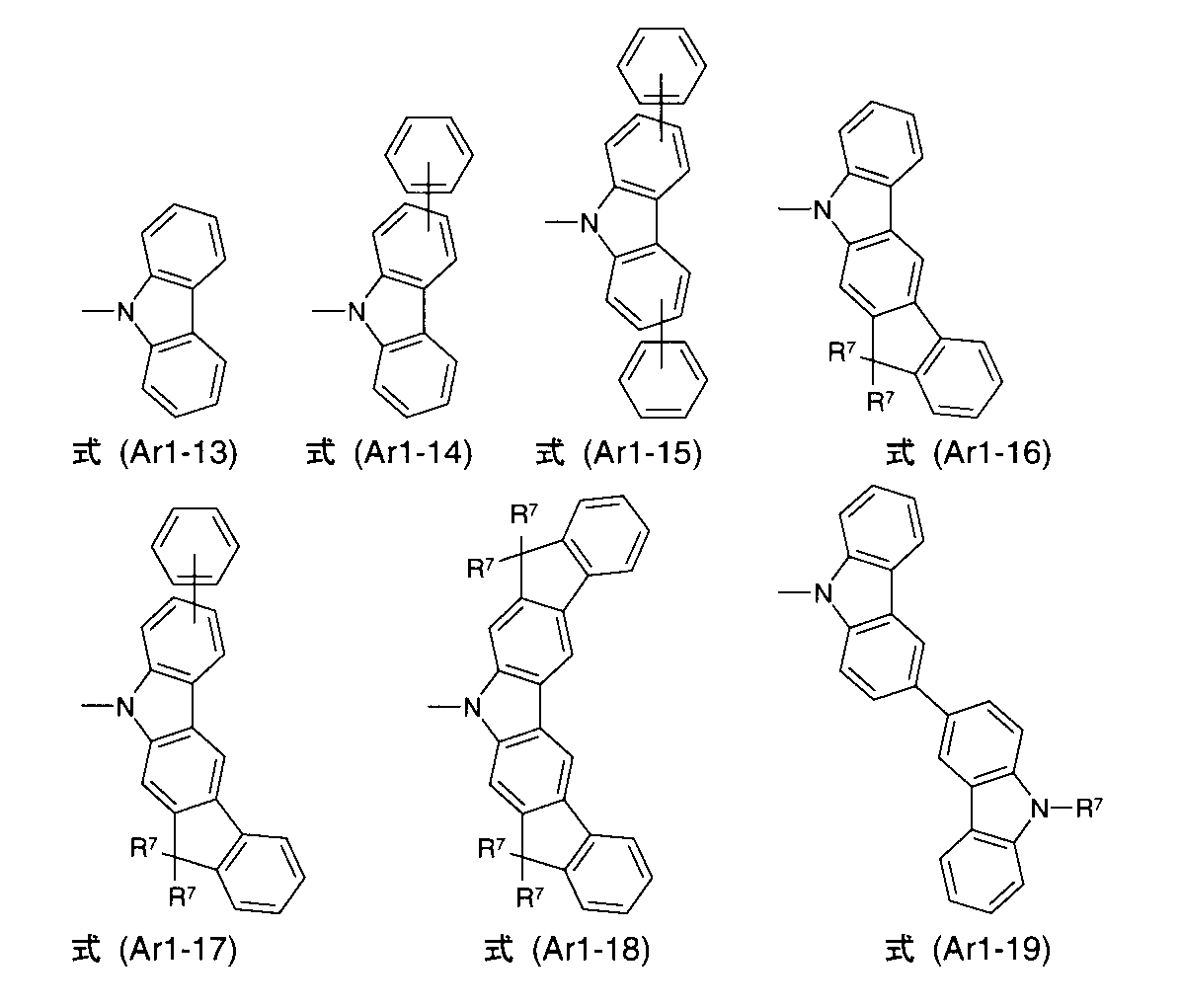
式(1)〜(28)または(6a)〜(28a)の化合物中の基Ar1とAr2が、基Eにより互いに結合する場合には、基-NAr1Ar2は、好ましくは、以下の式(Ar1−1)〜(Ar1−19)の一つの構造を有する。 When the groups Ar 1 and Ar 2 in the compounds of the formulas (1) to (28) or (6a) to (28a) are bonded to each other by the group E, the group —NAr 1 Ar 2 is preferably Having one structure of formulas (Ar1-1) to (Ar1-19).
式中、使用される記号は、上記で与えられる意味を有し、破線の結合(または末端単結合)は、基本構造もしくはArsへの結合位置を示す。ここで、基は、遊離位置でR7により置換されてよい。 Symbols in the formula, are used, have the meanings given above, dashed bond (or terminal single bond) indicates the point of attachment to the basic structure or Ar s. Here, the group may be substituted by R 7 in the free position.
本発明の特に好ましい1態様では、(Ar1−5)、(Ar1−6)、(Ar1−7)、(Ar1−8)、(Ar1−9)、(Ar1−10)、(Ar1−11)、(Ar1−12)、(Ar1−14)、(Ar1−15)および(Ar1−17)の化合物は、以下の式を有する化合物から選ばれ: In a particularly preferred embodiment of the present invention, (Ar1-5), (Ar1-6), (Ar1-7), (Ar1-8), (Ar1-9), (Ar1-10), (Ar1-11) , (Ar1-12), (Ar1-14), (Ar1-15) and (Ar1-17) are selected from compounds having the following formula:
式中、使用される記号は、上記で与えられる意味を有し、破線の結合(または末端単結合)は、基本構造もしくはArsへの結合位置を示す。ここで、基は、遊離位置でR7により置換されてよい。それらは、好ましくは、置換されない。 Symbols in the formula, are used, have the meanings given above, dashed bond (or terminal single bond) indicates the point of attachment to the basic structure or Ar s. Here, the group may be substituted by R 7 in the free position. They are preferably not substituted.
式(1)〜(28)または(6a)〜(28a)の化合物中の基Arsが、基EによりAr1に結合する場合には、基-Ars-NAr1Ar2は、好ましくは、以下の式(Ar2−1)〜(Ar2−9)の一つの構造を有し、破線の結合は基本構造もしくは次のArs単位への結合を示す。同様の状況が、Ar2への基Ars結合にあてはまる。 When the group Ar s in the compounds of the formulas (1) to (28) or (6a) to (28a) is bound to Ar 1 by the group E, the group —Ar s —NAr 1 Ar 2 is preferably has one structure of the following formula (Ar2-1) ~ (Ar2-9), the dashed bond represents a bond to the basic structure or the following Ar s units. A similar situation applies to the group Ar s bond to Ar 2 .
式中、使用される記号は、上記で与えられる意味を有する。ここで、基は、遊離位置でR7により置換されてよい。それらは、好ましくは、置換されていない。 In the formula, the symbols used have the meanings given above. Here, the group may be substituted by R 7 in the free position. They are preferably unsubstituted.
式(Ar2−9)の好ましい態様は、以下の式に示される。 A preferred embodiment of formula (Ar2-9) is shown in the following formula.
式中、使用される記号は、上記で与えられる意味を有する。ここで、基は、遊離位置でR7により置換されてよい。それらは、好ましくは、置換されていない。 In the formula, the symbols used have the meanings given above. Here, the group may be substituted by R 7 in the free position. They are preferably unsubstituted.
基Arsは、好ましくは、出現毎に同一であるか異なり、各場合に、1以上の基R9により置換されてよい6〜18個の環原子を有する芳香族もしくは複素環式芳香族環構造である。 The radical Ar s is preferably identical or different at each occurrence and in each case an aromatic or heteroaromatic ring having 6 to 18 ring atoms which may be substituted by one or more radicals R 9 Structure.
本発明のさらに特に好ましい1態様では、添え字iは、1または2であり、基Arsは、以下の式(Ar3−1)〜(Ar3−12)の一つの基であり、 In a further particularly preferred embodiment of the invention, the subscript i is 1 or 2, and the group Ar s is one of the following formulas (Ar3-1) to (Ar3-12):
式中、使用される記号は、上記で与えられる意味を有し、2個の破線の結合(または末端単結合)は隣接する基への結合を示す。ここで、基は、遊離位置でR7により置換されてよい。それらは、好ましくは、置換されない。 In the formula, the symbols used have the meaning given above, and two dashed bonds (or terminal single bonds) indicate a bond to an adjacent group. Here, the group may be substituted by R 7 in the free position. They are preferably not substituted.
式の好ましい態様は、以下の式(Ar3−1a)〜(Ar3−12a)により示され: Preferred embodiments of the formula are shown by the following formulas (Ar3-1a) to (Ar3-12a):
式中、使用される記号は、上記で与えられる意味を有し、2個の破線の結合(または末端単結合)は隣接する基への結合を示す。ここで、基は、遊離位置でR7により置換されてよい。それらは、好ましくは、置換されない。 In the formula, the symbols used have the meaning given above, and two dashed bonds (or terminal single bonds) indicate a bond to an adjacent group. Here, the group may be substituted by R 7 in the free position. They are preferably not substituted.
各基(Ars)iに対して、最大一つのArsは、式(Ar3−9)、(Ar3−12)、(Ar3−9a)、または(Ar3−12a)の基であることが好ましい。 For each group (Ar s ) i , at most one Ar s is preferably a group of the formula (Ar 3-9), (Ar 3-12), (Ar 3-9a), or (Ar 3-12a). .
R7が、N(R7)2である場合は、R7は、好ましくは、出現毎に同一であるか異なり、6〜60個の芳香族環原子を有する芳香族もしくは複素環式芳香族環構造である。R7は、そこで、特に好ましくは、R7に代えてR9により置換されてよい式(Ar1)〜(Ar33)の構造もしくはそれらの好ましい態様から選ばれる。 When R 7 is N (R 7 ) 2 , R 7 is preferably the same or different at each occurrence and is an aromatic or heterocyclic aromatic having 6 to 60 aromatic ring atoms. It is a ring structure. R 7 is therefore particularly preferably selected from the structures of formulas (Ar1) to (Ar33) which may be substituted by R 9 instead of R 7 or preferred embodiments thereof.
好ましい態様によれば、R7は、出現毎に同一であるか異なり、H、D、F、Cl、Br、I、CN、Si(R9)3、1〜40個のC原子を有する直鎖アルキル、アルコキシもしくはチオアルキル基、3〜40個のC原子を有する分岐あるいは環状アルキル、アルコキシもしくはチオアルキル基(夫々、1以上の基R9により置換されてよく、各場合に1以上の隣接しないCH2基は、Si(R9)2、C=NR9、P(=O)(R9)、SO、SO2、NR9、O、SもしくはCONR9で置き代えられてよく、ここで、1以上のH原子は、D、F、Cl、BrもしくはIで置き代えられてよい。)、または各場合に、1以上の基R9により置換されてよい6〜60個の芳香族環原子を有する芳香族もしくは複素環式芳香族環構造、または、1以上の基R9により置換されてよい5〜60個の芳香族環原子を有するアリールオキシもしくはヘテロアリールオキシ基、または、各場合に1以上の基R4により置換されてよい5〜60個の芳香族環原子を有するアラルキルもしくはヘテロアラルキル基より成る基から選ばれ;ここで、2個以上の隣接する置換基R7は、1以上の基R9により置換されてよいモノあるいはポリ環式の脂肪族もしくは芳香族環構造を随意に形成してよい。 According to a preferred embodiment, R 7 is the same or different at each occurrence and is H, D, F, Cl, Br, I, CN, Si (R 9 ) 3 , a straight chain having 1 to 40 C atoms. Chain alkyl, alkoxy or thioalkyl groups, branched or cyclic alkyl, alkoxy or thioalkyl groups having 3 to 40 C atoms, each of which may be substituted by one or more groups R 9 , in each case one or more non-adjacent CH The two groups may be replaced by Si (R 9 ) 2 , C═NR 9 , P (═O) (R 9 ), SO, SO 2 , NR 9 , O, S or CONR 9 where: One or more H atoms may be replaced by D, F, Cl, Br or I), or in each case 6 to 60 aromatic ring atoms which may be substituted by one or more groups R 9 Aromatic or heterocyclic aromatics having Structure, or one or more aryloxy or heteroaryloxy group having which may be substituted 5-60 aromatic ring atoms by a group R 9, or may be substituted by one or more radicals R 4 in each case Selected from the group consisting of aralkyl or heteroaralkyl groups having from 5 to 60 aromatic ring atoms; wherein two or more adjacent substituents R 7 are mono optionally substituted by one or more groups R 9 Alternatively, a polycyclic aliphatic or aromatic ring structure may optionally be formed.
R7の上記定義によれば、式(1)の化合物は、化合物中に明確に示されたものとは別のさらなるアリールアミノ基を含まない。 According to the above definition of R 7 , the compound of formula (1) does not contain any further arylamino groups apart from those explicitly indicated in the compound.
本発明の好ましい1態様では、式(1)〜(28)または(6a)〜(28a)の化合物中のR1、R2、R3、R4、R5、R6、R7、R8は、出現毎に同一であるか異なり、H、D、F、Si(R9)3、CN、1〜10個のC原子を有する直鎖アルキルもしくはアルコキシ基、3〜10個のC原子を有する分岐あるいは環状アルキルもしくはアルコキシ基(夫々、1以上の基R9により置換されてよく、各場合に1以上の隣接しないCH2基は、Oで置き代えられてよく、ここで、1以上のH原子は、DもしくはFで置き代えられてよい。)、または各場合に、1以上の基R9により置換されてよい6〜60個の芳香族環原子を有する芳香族環構造より成る基から選ばれ;ここで、2個以上の隣接する置換基R1〜R7またはR1とR8は、1以上の基R9により置換されてよいモノあるいはポリ環式の脂肪族環構造を形成してよい。 In a preferred embodiment of the present invention, R 1 , R 2 , R 3 , R 4 , R 5 , R 6 , R 7 , R in the compounds of formulas (1) to (28) or (6a) to (28a) 8 is the same or different at each occurrence, H, D, F, Si (R 9 ) 3 , CN, a linear alkyl or alkoxy group having 1 to 10 C atoms, 3 to 10 C atoms A branched or cyclic alkyl or alkoxy group having the formula (each of which may be substituted by one or more groups R 9 , in each case one or more non-adjacent CH 2 groups may be replaced by O, wherein one or more H may be replaced by D or F.), or in each case consists of an aromatic ring structure having 6 to 60 aromatic ring atoms which may be substituted by one or more groups R 9 selected from group; wherein two or more adjacent substituents R 1 ~ 7 or R 1 and R 8 may form one or more by a group R 9 may be substituted mono- or polycyclic aliphatic ring structure.
本発明の特に好ましい1態様では、式(1)〜(28)または(6a)〜(28a)の化合物中のR1、R2、R3、R4、R5、R6、R7、R8は、出現毎に同一であるか異なり、H、D、1〜10個のC原子を有する直鎖アルキル基、3〜10個のC原子を有する分岐あるいは環状アルキル基(夫々、1以上の基R9により置換されてよい。)、または各場合に、1以上の基R9により置換されてよい6〜60個のC原子を有する芳香族環構造より成る基から選ばれ;ここで、2個以上の隣接する置換基R1〜R7またはR1とR8は、1以上の基R9により置換されてよいモノあるいはポリ環式の脂肪族環構造を形成してよい。本発明の非常に特に好ましい1態様では、式(1)〜(28)または(6a)〜(28a)の化合物中のR1〜R6は、Hである。 In a particularly preferred embodiment of the present invention, R 1 , R 2 , R 3 , R 4 , R 5 , R 6 , R 7 in the compounds of formulas (1) to (28) or (6a) to (28a) R 8 is the same or different at each occurrence, and H, D, a linear alkyl group having 1 to 10 C atoms, a branched or cyclic alkyl group having 3 to 10 C atoms (each 1 or more . the group R 9 may be substituted), or in each case, selected from the group consisting of aromatic ring structure having one or more groups R 9 is substituted by which may be 6 to 60 C atoms; wherein Two or more adjacent substituents R 1 to R 7 or R 1 and R 8 may form a mono- or polycyclic aliphatic ring structure that may be substituted by one or more groups R 9 . In a very particularly preferred embodiment of the invention, R 1 to R 6 in the compounds of the formulas (1) to (28) or (6a) to (28a) are H.
本発明のさらに好ましい1態様では、Ar1もしくはAr2もしくはAr3に結合する基R7は、出現毎に同一であるか異なり、H、D、1〜10個のC原子を有する直鎖アルキル基、3〜10個のC原子を有する分岐あるいは環状アルキル基から選ばれる。 In a further preferred embodiment of the invention, the radical R 7 bound to Ar 1 or Ar 2 or Ar 3 is the same or different at each occurrence and is a straight-chain alkyl having H, D, 1-10 C atoms. The group is selected from branched or cyclic alkyl groups having 3 to 10 C atoms.
本発明のさらに好ましい1態様では、窒素に直接結合するAr1もしくはAr2のアリール基のオルト位で結合する少なくとも一つの基R7は、水素または重水素ではない。これは、特に、さらなるアリール基が、アリール基上のオルト位で既に結合していない場合、たとえば、式(Ar−2c)の場合にあてはまる。 In a further preferred embodiment of the present invention, at least one group R 7 bonded at the ortho position of the aryl group of Ar 1 or Ar 2 bonded directly to nitrogen is not hydrogen or deuterium. This is especially true when no further aryl group is already attached in the ortho position on the aryl group, for example in the case of the formula (Ar-2c).
さらに、フルオレンの9位での2個の置換基R7が、一緒になって、好ましくは、3〜8個のC原子を有する、特に好ましくは、5もしくは6個のC原子を有するシクロアルキル環を形成することが好ましい可能性がある。 Furthermore, the two substituents R 7 at the 9-position of the fluorene, together, preferably have 3 to 8 C atoms, particularly preferably 5 or 6 cycloalkyl. It may be preferred to form a ring.
さらに好ましい1態様では、式(Ar1−1)、(Ar1−5)、(Ar1−9)、(Ar1−16)、(Ar1−17)、(Ar1−5a)、(Ar1−5b)、(Ar1−9a)、(Ar1−9b)、(Ar1−17a)、(Ar1−17b)、(Ar2−1)、(Ar3−8)、(Ar3−8a)および(Ar3−8b)中の炭素ブリッジに結合するR7は、出現毎に同一であるか異なり、1〜10個のC原子を有する直鎖アルキル基、3〜10個のC原子を有する分岐あるいは環状アルキル基、上記定義されるとおり、1以上の基R9により置換されてよい6〜30個のC原子を有する芳香族環構造より成る基から選ばれる。ここで、2個の基R7は、上記所与のR7の定義に加え、脂肪族また芳香族であってよい環構造を互いに形成してもよい。スピロ構造が環形成により形成される。 In a more preferred embodiment, the formulas (Ar1-1), (Ar1-5), (Ar1-9), (Ar1-16), (Ar1-17), (Ar1-5a), (Ar1-5b), ( Carbon bridges in Ar1-9a), (Ar1-9b), (Ar1-17a), (Ar1-17b), (Ar2-1), (Ar3-8), (Ar3-8a) and (Ar3-8b) R 7 bonded to is the same or different at each occurrence, a linear alkyl group having 1 to 10 C atoms, a branched or cyclic alkyl group having 3 to 10 C atoms, as defined above Selected from the group consisting of an aromatic ring structure having 6 to 30 C atoms which may be substituted by one or more groups R 9 . Here, in addition to the above given definition of R 7 , the two groups R 7 may mutually form a ring structure that may be aliphatic or aromatic. Spiro structures are formed by ring formation.
さらに好ましい1態様では、式(Ar1−2)、(Ar1−6)、(Ar1−10)、(Ar1−19)、(Ar1−6a)、(Ar1−6b)、(Ar1−10a)、(Ar1−10b)、(Ar2−2)、(Ar3−9)および(Ar3−9a)中の窒素ブリッジに結合するR7は、1〜10個のC原子を有する直鎖アルキル基、3〜10個のC原子を有する分岐あるいは環状アルキル基、上記定義のとおりであり、1以上の基R9により置換されてよい6〜30個のC原子を有する芳香族環構造、特に、6〜24個のC原子を有する芳香族環構造より成る基から選ばれる。 In a more preferred embodiment, the formulas (Ar1-2), (Ar1-6), (Ar1-10), (Ar1-19), (Ar1-6a), (Ar1-6b), (Ar1-10a), ( R 7 bonded to the nitrogen bridge in Ar 1-10b), (Ar 2-2), (Ar 3-9) and (Ar 3-9a) is a linear alkyl group having 1 to 10 C atoms, 3 to 10 A branched or cyclic alkyl group having 1 C atom, as defined above, an aromatic ring structure having 6-30 C atoms, in particular 6-24, which may be substituted by one or more groups R 9 Selected from the group consisting of an aromatic ring structure having a C atom.
さらに好ましい1態様では、R3とR6は、芳香族もしくは複素環式芳香族環構造を含む場合には、式(Ar−1)〜(Ar−33)、特に、好ましくは、(Ar−1)〜(Ar−10)の基とこれらの基の好ましい態様から選ばれる。基R3とR6は、好ましくは、複素環式芳香族環構造を含まない。 In a further preferred embodiment, when R 3 and R 6 contain an aromatic or heteroaromatic ring structure, they are represented by formulas (Ar-1) to (Ar-33), particularly preferably (Ar— It is selected from the groups 1) to (Ar-10) and preferred embodiments of these groups. The groups R 3 and R 6 are preferably free of heterocyclic aromatic ring structures.
真空蒸発により加工される化合物に対しては、アルキル基は、4個を超えないC原子、特に好ましくは、1個を超えないC原子を有する。溶液から加工される化合物に対しては、10個までのC原子を有する直鎖、分岐あるいは環状アルキル基により置換された、またはオリゴアリーレン基、たとえば、オルト-、メタ-、パラ-もしくは分岐テルフェニルもしくはクアテルフェニル基で置換された化合物も適している。 For compounds processed by vacuum evaporation, the alkyl group has no more than 4 C atoms, particularly preferably no more than 1 C atom. For compounds processed from solution, substituted by linear, branched or cyclic alkyl groups having up to 10 C atoms, or oligoarylene groups such as ortho-, meta-, para- or branched tellurium Also suitable are compounds substituted with phenyl or quaterphenyl groups.
本発明の好ましい態様では、R9は、出現毎に同一であるか異なり、H、D、1〜10個のC原子を有する直鎖アルキル基、3〜10個のC原子を有する分岐あるいは環状アルキル基、または各場合に、1以上の基R10により置換されてよい6〜30個のC原子を有する式芳香族環構造より成る基から選ばれる。 In a preferred embodiment of the invention, R 9 is the same or different at each occurrence and is H, D, a straight chain alkyl group having 1 to 10 C atoms, a branched or cyclic group having 3 to 10 C atoms. It is selected from alkyl groups, or groups of the formula aromatic ring structure having 6 to 30 C atoms, which in each case can be substituted by one or more groups R 10 .
本発明の好ましい1態様では、R9は、出現毎に同一であるか異なり、H、D、1〜10個のC原子を有する直鎖アルキル基、3〜10個のC原子を有する分岐あるいは環状アルキル基、または各場合に、上記定義されるとおりであり、1以上の基R10により置換されてよい6〜30個のC原子を有する芳香族環構造より成る基から選ばれる。 In one preferred embodiment of the invention, R 9 is the same or different at each occurrence and is H, D, a linear alkyl group having 1 to 10 C atoms, a branch having 3 to 10 C atoms, or cyclic alkyl group, or in each case, is as is defined above, is selected from the group consisting of aromatic ring structure having one or more substituted by a group R 10 which may 6 to 30 C atoms.
本発明の特に好ましい1態様では、R9は、出現毎に同一であるか異なり、H、D、1〜5個のC原子を有する直鎖アルキル基、3〜5個のC原子を有する分岐あるいは環状アルキル基または上記定義されるとおりである16〜18個のC原子を有する芳香族環構造より成る基から選ばれる。 In a particularly preferred embodiment of the invention, R 9 is the same or different at each occurrence and is H, D, a linear alkyl group having 1 to 5 C atoms, a branch having 3 to 5 C atoms. Alternatively, it is selected from a cyclic alkyl group or a group consisting of an aromatic ring structure having 16 to 18 C atoms as defined above.
本発明のさらに好ましい1態様では、基R1〜R6は、12個を超える芳香族環原子を含む縮合アリールもしくはヘテロアリール基を含まない。 In a further preferred embodiment of the invention, the groups R 1 to R 6 do not comprise fused aryl or heteroaryl groups containing more than 12 aromatic ring atoms.
本発明のさらに好ましい1態様では、2個以上の隣接する基R1〜R6および隣接する基R1およびR8は、モノあるいはポリ環式の芳香族環構造を形成しない。 In a further preferred embodiment of the present invention, two or more adjacent groups R 1 to R 6 and adjacent groups R 1 and R 8 do not form a mono- or polycyclic aromatic ring structure.
好ましいのは、上記言及した好ましい態様が同時に生じる式(1)、(2)〜(28)および(6a)の化合物である。したがって、特に好ましいのは、以下である化合物である。 Preference is given to compounds of the formulas (1), (2) to (28) and (6a) in which the preferred embodiments mentioned above occur simultaneously. Therefore, particularly preferred are the following compounds:
Arsは、出現毎に同一であるか異なり、芳香族もしくは複素環式芳香族環構造であり、ここで、i=1または2に対して、Arsは、式(Ar3−1)〜(Ar3−12)の基および式(Ar3−1a)〜(Ar3−12a)の好ましい態様から選ばれ、ここで、Arsは、基Eにより、Ar1に連結してよく;
Ar1、Ar2は、出現毎に同一であるか異なり、式(Ar−1)〜(Ar−33)の基およびその好ましい態様から選ばれる芳香族もしくは複素環式芳香族環構造であるか;
またはN-Ar1Ar2は、式(Ar1−1)〜(Ar1−19)の一つの基およびその好ましい態様であるか;
またはArs-NAr1Ar2は、式(Ar2−1)〜(Ar2−9)の一つの基およびその好ましい態様であり;
Eは、出現毎に同一であるか異なり、C(R7)2、O、SおよびNR7から選ばれ;
R1、R2、R3、R4、R5、R6、R8は、出現毎に同一であるか異なり、H、D、F、Si(R9)3、CN、1〜10個のC原子を有する直鎖アルキルもしくはアルコキシ基、3〜10個のC原子を有する分岐あるいは環状アルキルもしくはアルコキシ基(夫々、1以上の基R9により置換されてよく、1以上の隣接しないCH2基は、Oで置き代えられてよく、ここで、1以上のH原子は、DもしくはFで置き代えられてよい。)、または各場合に、1以上の基R9により置換されてよい6〜60個の芳香族環原子を有する芳香族環構造より成る基から選ばれ;ここで、2個以上の隣接する置換基R1〜R6もしくはR1とR8は、1以上の基R9により置換されてよいモノあるいはポリ環式の脂肪族環構造を随意に形成してよく;
R7は、出現毎に同一であるか異なり、H、D、F、Si(R9)3、CN、1〜10個のC原子を有する直鎖アルキルもしくはアルコキシ基、3〜10個のC原子を有する分岐あるいは環状アルキルもしくはアルコキシ基(夫々、1以上の基R9により置換されてよく、1以上の隣接しないCH2基は、Oで置き代えられてよく、ここで、1以上のH原子は、DもしくはFで置き代えられてよい。)、または各場合に、1以上の基R9により置換されてよい6〜60個の芳香族環原子を有する芳香族環構造より成る基から選ばれ;ここで、2個以上の隣接する置換基R7は、1以上の基R9により置換されてよいモノあるいはポリ環式の脂肪族環構造を随意に形成してよいか;
または(Ar1−1)、(Ar1−5)、(Ar1−9)、(Ar1−16)、(Ar1−17)、(Ar1−5a)、(Ar1−5b)、(Ar1−9a)、(Ar1−9b)、(Ar1−17a)、(Ar1−17b)、(Ar2−1)、(Ar3−8)、(Ar3−8a)および(Ar3−8b)中の炭素ブリッジに結合するR7は、出現毎に同一であるか異なり、1〜10個のC原子を有する直鎖アルキル基、3〜10個のC原子を有する分岐あるいは環状アルキル基または、1以上の基R9により置換されてよい6〜30個のC原子を有する芳香族環構造より成る基から選ばれ;ここで、2個の基R7は、脂肪族もしくは芳香族であってよい環構造を互いに形成してもよいか;
または(Ar1−2)、(Ar1−6)、(Ar1−10)、(Ar1−19)、(Ar1−6a)、(Ar1−6b)、(Ar1−10a)、(Ar1−10b)、(Ar2−2)、(Ar3−9)および(Ar3−9a)中の窒素ブリッジに結合するR7は、出現毎に同一であるか異なり、1〜10個のC原子を有する直鎖アルキル基、3〜10個のC原子を有する分岐あるいは環状アルキル基または、1以上の基R9により置換されてよい6〜30個のC原子を有する芳香族環構造より成る基から選ばれ;
R9は、出現毎に同一であるか異なり、H、D、F、1〜10個のC原子を有する直鎖アルキル基、3〜10個のC原子を有する分岐あるいは環状アルキル基または6〜30個のC原子を有する芳香族環構造より成る基から選ばれ、夫々、1以上の基R10により置換されてよく、ここで、2個以上の隣接する置換基R9は、互いにモノあるいはポリ環式の脂肪族環構造を形成してよく;
R10は、H、D、F、1〜20個のC原子を有する脂肪族炭化水素基、または6〜30個のC原子を有する芳香族環構造より成る基から選ばれ、1以上のH原子は、DもしくはFで置き代えられてよく;ここで、2個以上の隣接する置換基R10は、モノもしくはポリ環式の脂肪族環構造をたがいに形成してよく;
iは、出現毎に、0,1または2であり;
mは、0または1、好ましくは、0であり;
o、p、rは、出現毎に同一であるか異なり、0、1または2、好ましくは、0であり;
n、qは、出現毎に同一であるか異なり、0、1または2、好ましくは、0または1であり;
s、t、uは、出現毎に同一であるか異なり、0または1であり;
ここで、u+t+s≦2である。
Ar s is the same or different at each occurrence and is an aromatic or heteroaromatic ring structure, where for i = 1 or 2, Ar s is represented by the formula (Ar3-1)-( Ar3-12) and a preferred embodiment of formulas (Ar3-1a) to (Ar3-12a), wherein Ar s may be linked to Ar 1 by group E;
Are Ar 1 and Ar 2 the same or different at each occurrence, and are each an aromatic or heterocyclic aromatic ring structure selected from the groups of formulas (Ar-1) to (Ar-33) and preferred embodiments thereof? ;
Or N—Ar 1 Ar 2 is one group of formulas (Ar1-1) to (Ar1-19) and preferred embodiments thereof;
Or Ar s -NAr 1 Ar 2 is one group of formulas (Ar2-1) to (Ar2-9) and preferred embodiments thereof;
E is the same or different at each occurrence and is selected from C (R 7 ) 2 , O, S and NR 7 ;
R 1 , R 2 , R 3 , R 4 , R 5 , R 6 , R 8 are the same or different at each occurrence, and H, D, F, Si (R 9 ) 3 , CN, 1 to 10 A linear alkyl or alkoxy group having 3 C atoms, a branched or cyclic alkyl or alkoxy group having 3 to 10 C atoms, each of which may be substituted by one or more groups R 9 and one or more non-adjacent CH 2 The group may be replaced by O, wherein one or more H atoms may be replaced by D or F.) or in each case may be substituted by one or more groups R 9 Selected from the group consisting of an aromatic ring structure having ˜60 aromatic ring atoms; wherein two or more adjacent substituents R 1 to R 6 or R 1 and R 8 are one or more groups R the aliphatic ring structure and which may be mono- or polycyclic substituted by 9 It may form the will;
R 7 is the same or different at each occurrence, and H, D, F, Si (R 9 ) 3 , CN, a linear alkyl or alkoxy group having 1 to 10 C atoms, 3 to 10 C Branched or cyclic alkyl or alkoxy groups having atoms (each substituted by one or more groups R 9 and one or more non-adjacent CH 2 groups may be replaced by O, where one or more H The atoms may be replaced by D or F.), or in each case from a group consisting of an aromatic ring structure having 6 to 60 aromatic ring atoms which may be substituted by one or more groups R 9 Where two or more adjacent substituents R 7 may optionally form a mono- or polycyclic aliphatic ring structure that may be substituted by one or more groups R 9 ;
Or (Ar1-1), (Ar1-5), (Ar1-9), (Ar1-16), (Ar1-17), (Ar1-5a), (Ar1-5b), (Ar1-9a), ( R 7 bonded to the carbon bridge in Ar 1-9b), (Ar 1-17a), (Ar 1-17b), (Ar 2-1), (Ar 3-8), (Ar 3-8a) and (Ar 3-8b) is A linear alkyl group having 1 to 10 C atoms or a branched or cyclic alkyl group having 1 to 10 C atoms, or substituted by one or more groups R 9 Selected from the group consisting of an aromatic ring structure having from 6 to 30 C atoms; here, the two groups R 7 may form a ring structure which may be aliphatic or aromatic together. Or;
Or (Ar1-2), (Ar1-6), (Ar1-10), (Ar1-19), (Ar1-6a), (Ar1-6b), (Ar1-10a), (Ar1-10b), ( R 7 bonded to the nitrogen bridge in Ar2-2), (Ar3-9) and (Ar3-9a) is the same or different at each occurrence, and is a linear alkyl group having 1 to 10 C atoms, Selected from branched or cyclic alkyl groups having 3 to 10 C atoms or groups consisting of aromatic ring structures having 6 to 30 C atoms which may be substituted by one or more groups R 9 ;
R 9 is the same or different at each occurrence, and H, D, F, a linear alkyl group having 1 to 10 C atoms, a branched or cyclic alkyl group having 3 to 10 C atoms, or 6 to Selected from the group consisting of an aromatic ring structure having 30 C atoms, each of which may be substituted by one or more groups R 10 , wherein two or more adjacent substituents R 9 are mono or May form a polycyclic aliphatic ring structure;
R 10 is selected from H, D, F, an aliphatic hydrocarbon group having 1 to 20 C atoms, or a group consisting of an aromatic ring structure having 6 to 30 C atoms. The atoms may be replaced by D or F; where two or more adjacent substituents R 10 may form a mono or poly cyclic aliphatic ring structure;
i is 0, 1 or 2 at each occurrence;
m is 0 or 1, preferably 0;
o, p, r are the same or different at each occurrence and are 0, 1 or 2, preferably 0;
n, q are the same or different at each occurrence and are 0, 1 or 2, preferably 0 or 1;
s, t, u are the same or different at each occurrence and are 0 or 1;
Here, u + t + s ≦ 2.
上記言及した化合物は、2個以上の置換アイソマーの混合物の形態であってもよい。 The above mentioned compounds may be in the form of a mixture of two or more substituted isomers.
本発明の1態様では、上記言及した選好は、所望のとおりに、互いに組み合わせることができる。 In one aspect of the invention, the above mentioned preferences can be combined with each other as desired.
式(1)の化合物の好ましい構造の例は、以下の表に示される。化合物は、基本構造(6a)、(7a)、(8a)、(10a)、(15a)および(21a)を基礎としている。結合セルは、基がEを介して互いに結合することを意味している。 Examples of preferred structures of the compound of formula (1) are shown in the table below. The compounds are based on the basic structures (6a), (7a), (8a), (10a), (15a) and (21a). A bonded cell means that the groups are bonded to each other via E.
ここで、式中のnとqは、値0または1をとり得る。式中のR3とR6は、好ましくは、式(Ar1)〜(Ar33)の基から、特に好ましくは、式(Ar1)〜(Ar10)の基から選ばれる。 Here, n and q in the formula can take the values 0 or 1. R 3 and R 6 in the formula are preferably selected from the groups of the formulas (Ar1) to (Ar33), particularly preferably from the groups of the formulas (Ar1) to (Ar10).
上記示された態様にしたがう好ましい化合物または電子素子で好ましくは、用いることのできる化合物の例は、以下の構造(1)〜(98)の化合物である。 Examples of compounds that can be preferably used in the preferred compounds or electronic devices according to the above-described embodiments are the compounds of the following structures (1) to (98).
本発明の化合物の合成は、先行技術から知られたプロセスと反応タイプ、たとえば、臭素化、ウルマンアリール化、フリーデルクラフツ反応、パラジウム触媒分子間C-Hアリール化、ブフバルトカップリングおよびスズキカップリングおよびグリニャール反応等により実行することができる。特に、化合物は、スキーム1に示されたとおりに、アミノ基の導入により対応するハロゲン置換基本構造から合成することができる。ここで、スキーム1a)に示されたとおりに、最初に置換基Ar1と共に1級アミンを導入し、さらなるカップリング反応で基Ar2を導入することも可能である。同様に、スキーム1b)に示されたとおりに、2級アミンAr1Ar2NHを一工程で直接導入することも可能である。基本構造上の適切な基Xは、たとえば、Cl、Br、I、トリフレートもしくはトシレート等の反応性脱離基である。適切なカップリング反応は、たとえば、ハートウイッグブフバルトカップリングもしくはウルマンカップリング反応である。これらのカップリング反応のために使用することのできる反応条件は、有機合成の当業者に知られている。 The synthesis of the compounds of the invention can be carried out by processes and reaction types known from the prior art, such as bromination, Ullmann arylation, Friedel-Crafts reaction, palladium-catalyzed intermolecular C—H arylation, Buchwald coupling and Suzuki cup. It can be carried out by ring and Grignard reactions and the like. In particular, the compounds can be synthesized from the corresponding halogen-substituted basic structure by introduction of an amino group as shown in Scheme 1. Here, as shown in Scheme 1a), it is also possible to first introduce the primary amine together with the substituent Ar 1 and then introduce the group Ar 2 in a further coupling reaction. Similarly, it is also possible to introduce the secondary amine Ar 1 Ar 2 NH directly in one step, as shown in scheme 1b). A suitable group X on the basic structure is, for example, a reactive leaving group such as Cl, Br, I, triflate or tosylate. Suitable coupling reactions are, for example, the Hartwig Buchwald coupling or the Ullmann coupling reaction. The reaction conditions that can be used for these coupling reactions are known to those skilled in the art of organic synthesis.
iが1または2である化合物に対して、基Ars-NAr1-Ar2が、同様に、金属触媒カップリング反応、たとえば、スズキカップリングまたはスチルカップリングにより導入することができる。 For compounds in which i is 1 or 2, the group Ar s -NAr 1 -Ar 2 can likewise be introduced by a metal-catalyzed coupling reaction, such as Suzuki coupling or still coupling.
したがって、本発明は、さらに、1-,3-もしくは4-位で脱離基により置換されたジスピロ[フルオレン-9,9'-アントラセン-10',9"-フルオレン]誘導体の、
a)反応性脱離基により置換されたさらなる芳香族基へのカップリングに伴われる1級アミンへの、または
b)2級アミンへの、または
c)トリアリールアミン誘導体への
カップリングによる、式(1)の化合物の製造方法に関する。
Thus, the present invention further provides for a dispiro [fluorene-9,9'-anthracene-10 ', 9 "-fluorene] derivative substituted with a leaving group at the 1-, 3- or 4-position,
a) coupling to a further aromatic group substituted by a reactive leaving group, to b) a primary amine, or b) to a secondary amine, or c) to a triarylamine derivative, The present invention relates to a method for producing a compound of formula (1).
ここで、反応性脱離基は、好ましくは、Cl、Br、I、トリフレートもしくはトシレートから選ばれ、またはスズキカップリングに対しては、ボロン酸もしくはボロン酸誘導体、特に、ボロン酸エステルから選ばれる。 Here, the reactive leaving group is preferably selected from Cl, Br, I, triflate or tosylate or, for Suzuki coupling, selected from boronic acids or boronic acid derivatives, in particular boronic esters. It is.
カップリング反応は、好ましくは、ハートウイッグブフバルトカップリングから、ウルマンカップリングから、またはスズキカップリングから選ばれる。 The coupling reaction is preferably selected from Hartwig Buchwald coupling, from Ullmann coupling or from Suzuki coupling.
ジスピロ[フルオレン-9,9'-アントラセン-10',9"-フルオレン]骨格は、好ましくは、古典的なスピロ合成に類似して構築される。 The dispiro [fluorene-9,9'-anthracene-10 ', 9 "-fluorene] skeleton is preferably constructed in analogy to classical spiro synthesis.
ここで、基本構造上の異なる置換パターンを、対応する置換ビフェニルに使用により得ることができる。 Here, different substitution patterns on the basic structure can be obtained by using corresponding substituted biphenyls.
一以上の置換基を有する基本構造の合成において、特に、多置換ビフェニルを使用する場合に、置換アイソマーを、スピロ炭素の形成の間に形成し得る。化合物が精製されない場合には、それらは、混合物の形態で用いることもできる。 In the synthesis of basic structures with one or more substituents, especially when using polysubstituted biphenyls, substituted isomers can be formed during spiro carbon formation. If the compounds are not purified, they can also be used in the form of a mixture.
上記に示された合成プロセスは、例示的特徴を有し、本発明の化合物のある種の態様の合成のために有利であるならば、有機合成分野の当業者により適切な方法で変形することができる。 The synthetic processes shown above have exemplary characteristics and, if advantageous for the synthesis of certain embodiments of the compounds of the invention, can be modified in a suitable manner by one skilled in the art of organic synthesis. Can do.
上記記載の本発明の化合物は、特に、臭素、沃素、塩素、ボロン酸もしくはボロン酸エステル等の反応性脱離基により置換された化合物は、対応するオリゴマー、デンドリマーまたはポリマーの調製のためのモノマーとして使用され得る。適切な反応性脱離基は、たとえば、臭素、沃素、塩素、ボロン酸、ボロン酸エステル、アミン、末端C-C二重結合もしくはC-C三重結合を含むアルケニルまたはアルキニル基、オキシラン、オキセタン、環付加、たとえば、1,3-双極子環付加を受ける基、たとえば、ジエンもしくはアジド等、カルボン酸誘導体、アルコールおよびシランである。 The compounds of the invention described above are in particular compounds substituted by reactive leaving groups such as bromine, iodine, chlorine, boronic acid or boronic esters, the corresponding oligomers, dendrimers or monomers for the preparation of polymers. Can be used as Suitable reactive leaving groups are, for example, bromine, iodine, chlorine, boronic acid, boronic esters, amines, alkenyl or alkynyl groups containing terminal C—C double bonds or C—C triple bonds, oxiranes, oxetanes, Groups undergoing cycloaddition, for example 1,3-dipolar cycloaddition, such as carboxylic acid derivatives, alcohols and silanes, such as dienes or azides.
したがって、本発明は、さらに、一以上の式(1)の化合物を含むオリゴマー、ポリマーまたはデンドリマーに関し、ここで、ポリマー、オリゴマーまたはデンドリマーへの結合(複数の結合)は、式(1)中で任意の所望の遊離位置に位置することができる。本発明の化合物の結合により、化合物は、オリゴマーもしくはポリマーの側鎖の部分または主鎖の部分である。 Accordingly, the present invention further relates to an oligomer, polymer or dendrimer comprising one or more compounds of formula (1), wherein the bond (s) to the polymer, oligomer or dendrimer is represented in formula (1) It can be located in any desired free position. Due to the coupling of the compounds of the invention, the compounds are part of the side chain or main chain of the oligomer or polymer.
本発明の意味でのオリゴマーは、少なくとも三個のモノマー単位から形成される化合物の意味で使用される。本発明の意味でのポリマーは、少なくとも10個のモノマー単位から形成される化合物の意味で使用される。 An oligomer in the sense of the present invention is used to mean a compound formed from at least three monomer units. A polymer in the sense of the present invention is used to mean a compound formed from at least 10 monomer units.
本発明のポリマー、オリゴマーまたはデンドリマーは、共役、部分共役もしくは非共役であってよい。本発明のオリゴマーまたはポリマーは、直鎖、分岐鎖もしくは樹状であってよい。 The polymer, oligomer or dendrimer of the present invention may be conjugated, partially conjugated or non-conjugated. The oligomer or polymer of the present invention may be linear, branched or dendritic.
直鎖状の結合された構造においては、式(1)の単位は、たがいに直接結合するか、または二価の基、たとえば、置換もしくは非置換アルキレン基により、ヘテロ原子により、または二価の芳香族もしくは複素環式芳香族基により、たがいに結合してよい。 In a linear bonded structure, the units of the formula (1) are bonded directly to each other or are divalent groups such as substituted or unsubstituted alkylene groups, heteroatoms, or divalent They may be linked to one another by aromatic or heteroaromatic groups.
分岐および樹状構造においては、5個以上の式(1)の単位は、三価もしくはより多価の基、たとえば、3価もしくはより多価の芳香族または複素環式芳香族基により結合してもよく、分岐もしくは樹状オリゴマーまたはポリマーを生じる。 In branched and dendritic structures, five or more units of formula (1) are linked by a trivalent or more polyvalent group, such as a trivalent or more polyvalent aromatic or heterocyclic aromatic group. May result in branched or dendritic oligomers or polymers.
本発明の化合物に対する上記記載したとおりの同じ選好が、オリゴマー、デンドリマーおよびポリマー中の式(1)の反復単位にあてはまる。 The same preferences as described above for the compounds of the invention apply to the repeating units of formula (1) in oligomers, dendrimers and polymers.
オリゴマーまたはポリマーの調製のために、本発明によるモノマーは、さらなるモノマーとホモ重合するか共重合する。適切で好ましいコモノマーは、フルオレン(たとえば、EP842208もしくはWO2000/22026にしたがうもの)、スピロビフルオレン(たとえば、EP707020、EP894107もしくはWO2006/061181にしたがうもの)、パラ-フェニレン(たとえば、WO1992/18552にしたがうもの)、カルバゾール(たとえば、WO2004/070772もしくはW02004/113468にしたがうもの)、チオフェン(たとえば、EP1028136にしたがうもの)、ジヒドロフェナントレン(たとえば、WO 2005/014689もしくはWO 2007/006383にしたがうもの)、cis-およびtrans-インデノフルオレン(たとえば、WO2004/041901もしくはWO2004/113412にしたがうもの)、ケトン(たとえば、WO2005/040302にしたがうもの)、フェナントレン(たとえば、WO2005/104264もしくはWO2007/017066にしたがうもの)または複数のこれらの単位から選ばれる。ポリマー、オリゴマーおよびデンドリマーは、さらなる単位、たとえば、ビニルトリアリールアミン(たとえば、WO2007/068325にしたがうもの)もしくは燐光金属錯体(たとえば、WO2006/03000にしたがうもの)等の発光(蛍光または燐光)単位および/または電荷輸送単位、特に、トリアリールアミン系のものを通常含む。 For the preparation of oligomers or polymers, the monomers according to the invention are homopolymerised or copolymerised with further monomers. Suitable and preferred comonomers are fluorene (for example according to EP842208 or WO2000 / 22026), spirobifluorene (for example according to EP707020, EP894107 or WO2006 / 061181), para-phenylene (for example according to WO1992 / 18552) ), Carbazole (eg according to WO2004 / 070772 or W02004 / 113468), thiophene (eg according to EP1028136), dihydrophenanthrene (eg according to WO 2005/014689 or WO 2007/006383), cis- and trans-indenofluorene (eg according to WO2004 / 041901 or WO2004 / 113412), ketone (eg according to WO2005 / 040302), phenanthrene (eg according to WO2005 / 104264 or WO2007 / 017066) or a plurality of Selected from these units. Polymers, oligomers and dendrimers are further units such as luminescent (fluorescent or phosphorescent) units such as vinyltriarylamines (eg according to WO2007 / 068325) or phosphorescent metal complexes (eg according to WO2006 / 03000) and Usually contains charge transport units, especially those of the triarylamine type.
本発明のポリマー、オリゴマーおよびデンドリマーは、有利な特性、特に、長い寿命、高い効率と良好な色座標を有する。 The polymers, oligomers and dendrimers of the present invention have advantageous properties, in particular long life, high efficiency and good color coordinates.
本発明のポリマーおよびオリゴマーは、一以上のタイプのモノマーの重合により一般的に調製され、少なくとも一つのモノマーは、ポリマー中に式(1)の反復単位を生じる。適切な重合反応は、当業者に知られ、文献に記載されている。C-CまたはC-N結合を生じる、特に、適切で、好ましい重合反応は、以下のとおりである:
(A)スズキ重合;
(B)ヤマモト重合;
(C)スチル重合および
(D)ハートウイッグ-ブッフバルト重合
重合をこれらの方法により実行することができる方法と次いでポリマーを反応媒体から分離し、精製することができる方法は、当業者に知られており、文献、たとえば、WO 2003/048225、WO 2004/037887およびWO 2004/037887に詳細に記載されている。
The polymers and oligomers of the present invention are generally prepared by polymerization of one or more types of monomers, where at least one monomer results in a repeating unit of formula (1) in the polymer. Suitable polymerization reactions are known to the person skilled in the art and are described in the literature. A particularly suitable and preferred polymerization reaction that produces a C—C or C—N bond is as follows:
(A) Suzuki polymerization;
(B) Yamamoto polymerization;
(C) Still polymerization and (D) Hartwig-Buchwald polymerization. Methods by which the polymerization can be carried out by these methods and then by which the polymer can be separated from the reaction medium and purified are known to those skilled in the art. And are described in detail in documents such as WO 2003/048225, WO 2004/037887 and WO 2004/037887.
したがって、本発明は、また、スズキ重合、ヤマモト重合、スチル重合またはハートウイッグ-ブッフバルト重合により本発明のポリマー、オリゴマーおよびデンドリマーを製造する方法に関する。本発明によるデンドリマーは、当業者に知られた方法または類似方法により製造され得る。適切な方法は、文献、たとえば、Frechet, Jean M. J.; Hawker, Craig J., "Hyperbranched polyphenylene and hyperbranched polyesters: new soluble, three-dimensional, reactive polymers"、 Reactive & Functional Polymers (1995), 26(1-3), 127-36; Janssen, H. M.; Meijer, E. W.、 "The synthesis and characterization of dendritic molecules", Materials Science and Technology (1999), 20 (Synthesis of Polymers), 403-458; Tomalia, Donald A., "Dendrimer molecules", Scientific American (1995), 272(5), 62-6、WO 2002/067343 A1およびWO 2005/026144 A1等に記載されている。 Accordingly, the present invention also relates to a process for producing the polymers, oligomers and dendrimers of the present invention by Suzuki polymerization, Yamamoto polymerization, still polymerization or Hartwig-Buchwald polymerization. The dendrimers according to the invention can be produced by methods known to the person skilled in the art or by analogous methods. Suitable methods are described in the literature, e.g., Frechet, Jean MJ; Hawker, Craig J., "Hyperbranched polyphenylene and hyperbranched polyesters: new soluble, three-dimensional, reactive polymers", Reactive & Functional Polymers (1995), 26 (1- 3), 127-36; Janssen, HM; Meijer, EW, "The synthesis and characterization of dendritic molecules", Materials Science and Technology (1999), 20 (Synthesis of Polymers), 403-458; Tomalia, Donald A., "Dendrimer molecules", Scientific American (1995), 272 (5), 62-6, WO 2002/067343 A1, WO 2005/026144 A1, and the like.
たとえば、スピンンコーティングによるまたは印刷法による液相からの本発明の化合物の加工のために、本発明の化合物の調合物が必要となる。これらの、調合物は、たとえば、溶液、分散液もしくはミニエマルジョンであり得る。この目的のためには、2以上の溶媒の混合物を使用することが好ましい可能性がある。適切で好ましい溶媒は、たとえば、トルエン、アニソール、o-,m-,もしくはp-キシレン、メチルベンゾエート、メシチレン、テトラリン、ベラトール、THF、メチル-THF、THP、クロロベンゼン、ジオキサン、フェノキシトルエン、特に、3-フェノキシトルエン、(-)-フェンコンヌ、1,2,3,5-テトラメチルベンゼン、1,2,4,5-テトラメチルベンゼン、1-メチルナフタレン、2-メチルベンゾチアゾール、2-フェノキシエタノール、2-ピロリジノン、3-メチルアニソール、4-メチルアニソール、3,4-ジメチルアニソール、3,5-ジメチルアニソール、アセトフェノン、α-テルピネオール、ベンゾチアゾール、ブチルベンゾエート、クメン、シクロヘキサノール、シクロヘキサノン、シクロヘキシルベンゼン、デカリン、ドデシルベンゼン、エチルベンゾエート、インダン、NMP、p-シメン、フェネトール、1,4-ジイソプロピルベンゼン、ジベンジルエーテル、ジエチレングリコールブチル-メチルエーテル、トリエチレングリコールブチルメチルエーテル、ジエチレングリコールジブチルエーテル、トリエチレングリコールジメチルエーテル、ジエチレングリコールモノブチルエ−テル、トリプロピレングリコールジメチルエ−テル、テトラエチレングリコールジメチルエ−テル、2-イソプロピルナフタレン、ペンチルベンゼン、ヘキシルベンゼン、ヘプチルベンゼン、オクチルベンゼン、1,1-ビス(3,4-ジメチルフェニル)エタンおよび任意のこれら溶媒の混合物より成る群から選ばれ得る。 For example, for the processing of compounds of the invention from a liquid phase by spinn coating or by printing methods, formulations of the compounds of the invention are required. These formulations can be, for example, solutions, dispersions or miniemulsions. For this purpose it may be preferred to use a mixture of two or more solvents. Suitable and preferred solvents are, for example, toluene, anisole, o-, m-, or p-xylene, methyl benzoate, mesitylene, tetralin, veratole, THF, methyl-THF, THP, chlorobenzene, dioxane, phenoxytoluene, in particular 3 -Phenoxytoluene, (-)-phenconne, 1,2,3,5-tetramethylbenzene, 1,2,4,5-tetramethylbenzene, 1-methylnaphthalene, 2-methylbenzothiazole, 2-phenoxyethanol, 2 -Pyrrolidinone, 3-methylanisole, 4-methylanisole, 3,4-dimethylanisole, 3,5-dimethylanisole, acetophenone, α-terpineol, benzothiazole, butylbenzoate, cumene, cyclohexanol, cyclohexanone, cyclohexylbenzene, decalin , Dodecylbenzene, ethyl benzoate Indane, NMP, p-cymene, phenetole, 1,4-diisopropylbenzene, dibenzyl ether, diethylene glycol butyl-methyl ether, triethylene glycol butyl methyl ether, diethylene glycol dibutyl ether, triethylene glycol dimethyl ether, diethylene glycol monobutyl ether, Tripropylene glycol dimethyl ether, tetraethylene glycol dimethyl ether, 2-isopropylnaphthalene, pentylbenzene, hexylbenzene, heptylbenzene, octylbenzene, 1,1-bis (3,4-dimethylphenyl) ethane and any It can be selected from the group consisting of mixtures of these solvents.
したがって、本発明は、少なくとも一つの式(1)の化合物、少なくとも一つの式(1)の化合物または少なくとも一つの式(1)の単位を含む少なくとも一つのポリマー、オリゴマーもしくはデンドリマーと少なくとも一つの溶媒、好ましくは、有機溶媒を含む調合物、特に、溶液、分散液もしくはミニエマルジョンに関する。このタイプの溶液を製造することができる方法は、当業者に知られており、たとえば、WO 2002/072714、WO 2003/019694とそこに引用された文献に記載されている。 Accordingly, the present invention provides at least one compound of formula (1), at least one compound of formula (1) or at least one polymer, oligomer or dendrimer comprising at least one unit of formula (1) and at least one solvent. Preferably relating to formulations comprising organic solvents, in particular solutions, dispersions or miniemulsions. The methods by which this type of solution can be made are known to those skilled in the art and are described, for example, in WO 2002/072714, WO 2003/019694 and the literature cited therein.
本発明の化合物は、電子素子での使用のために適している。ここで、電子素子は、少なくとも一つの有機化合物を含む少なくとも一つの層を含む素子である。しかしながら、素子は、無機材料または無機材料から完全に構築される層を含んでもよい。 The compounds of the present invention are suitable for use in electronic devices. Here, the electronic device is a device including at least one layer including at least one organic compound. However, the device may include an inorganic material or a layer constructed entirely from an inorganic material.
したがって、本発明は、さらに、電子素子における本発明の化合物の使用と一以上の本発明の化合物を含む電子素子自体に関する。ここで、電子素子は、好ましくは、有機集積回路(OIC)、有機電界効果トランジスタ(OFET)、有機薄膜トランジスタ(OTFT)、有機発光トランジスタ(OLET)、有機太陽電池(OSC)、有機光学検査器、有機光受容器、有機電場消光素子(OFQD)、発光電子化学電池(LEC)、有機レーザーダイオード(O-laser)および特に好ましくは、有機エレクトロルミッセンス素子(OLED)より成る群から選ばれる。特に好ましいのは、アノード、カソードと少なくとも一つの発光層を含む有機エレクトロルミネッセンス素子であって、ここで、発光層、正孔輸送層もしくは別の層であってよい少なくとも一つの有機層は、少なくとも一つの本発明の化合物を含む。 Accordingly, the present invention further relates to the use of the compounds of the invention in electronic devices and the electronic devices themselves comprising one or more compounds of the invention. Here, the electronic element is preferably an organic integrated circuit (OIC), an organic field effect transistor (OFET), an organic thin film transistor (OTFT), an organic light emitting transistor (OLET), an organic solar cell (OSC), an organic optical inspection device, It is selected from the group consisting of an organic photoreceptor, an organic field quencher (OFQD), a light emitting electrochemical cell (LEC), an organic laser diode (O-laser) and particularly preferably an organic electroluminescent element (OLED). Particularly preferred is an organic electroluminescent device comprising an anode, a cathode and at least one light emitting layer, wherein the at least one organic layer, which may be a light emitting layer, a hole transport layer or another layer, is at least Contains one compound of the invention.
有機エレクトロルミッセンス素子と発光電子化学電池は、種々の用途、たとえば、照明用途もしくは医療および/または美容用途の、たとえば、光治療における単色もしくは多色表示装置に用いることができる。 Organic electroluminescent elements and light-emitting electrochemical cells can be used in monochromatic or multicolor display devices in various applications, for example lighting applications or medical and / or cosmetic applications, for example in phototherapy.
カソード、アノードおよび発光層とは別に、有機エレクトロルミネセンス素子は、さらなる層を含んでもよい。これらは、たとえば、各場合に、1以上の正孔注入層、正孔輸送層、正孔ブロック層、電子輸送層、電子注入層、電子ブロック層、励起子ブロック層、中間層、電荷生成層(IDMC 2003, Taiwan; Session 21 OLED (5), T. Matsumoto, T. Nakada, J.Endo, K. Mori, N. Kawamura, A. Yokoi, J.Kido, Multiphoton Organic EL Device Having Charge Generation Layer)および/または有機あるいは無機p/n接合から選ばれる。しかしながら、これら層の夫々は、必ずしも存在する必要はなく、層の選択は使用される化合物と、特に、エレクトロルミッセンス素子が蛍光もしくは燐光であるかに常に依存することが指摘されねばならない。 Apart from the cathode, anode and light-emitting layer, the organic electroluminescent device may comprise further layers. These are, for example, in each case one or more hole injection layer, hole transport layer, hole block layer, electron transport layer, electron injection layer, electron block layer, exciton block layer, intermediate layer, charge generation layer (IDMC 2003, Taiwan; Session 21 OLED (5), T. Matsumoto, T. Nakada, J. Endo, K. Mori, N. Kawamura, A. Yokoi, J. Kido, Multiphoton Organic EL Device Having Charge Generation Layer) And / or selected from organic or inorganic p / n junctions. However, it must be pointed out that each of these layers does not necessarily have to be present and the choice of layer always depends on the compound used and in particular whether the electroluminescent device is fluorescent or phosphorescent.
有機エレクトロルミネセンス素子は、複数の発光層を含んでもよい。この場合に、これらの発光層は、特に好ましくは、380nm〜750nm間に全体で複数の最大発光波長を有し、全体として、白色発光が生じるものであり、換言すれば、蛍光もしくは燐光を発し、青色、黄色、オレンジ色もしくは赤色発光することができる種々の発光化合物を、発光層に使用することができる。特に好ましいものは、3層構造であり、すなわち、3個の発光層を有する構造であり、これらの層の少なくとも一つの層は、少なくとも一つの本発明の化合物を含み、その3層は青色、緑色およびオレンジ色もしくは赤色発光を呈する(基本構造については、たとえば、WO 2005/011013参照。)。本発明の化合物は、代替としておよび/または追加的に正孔輸送層中におよび/または中間層中に存在してもよい。白色発光の生成のために、色発光する複数のエミッター化合物に代えて、広波長範囲で発光する個々に使用されるエミッター化合物も適している可能性がある。ここで、全発光層が蛍光発光であること、または全発光層が燐光発光であること、または一以上の発光層が蛍光発光であり一以上の他の層が燐光発光であることも可能である。 The organic electroluminescent element may include a plurality of light emitting layers. In this case, these light emitting layers particularly preferably have a plurality of maximum light emission wavelengths as a whole between 380 nm and 750 nm, and produce white light emission as a whole, in other words, emit fluorescence or phosphorescence. Various light emitting compounds capable of emitting blue, yellow, orange or red light can be used in the light emitting layer. Particularly preferred is a three-layer structure, that is, a structure having three light-emitting layers, at least one of these layers comprising at least one compound of the invention, the three layers being blue, It emits green and orange or red light (for example, see WO 2005/011013 for the basic structure). The compounds according to the invention may alternatively and / or additionally be present in the hole transport layer and / or in the intermediate layer. For the generation of white light emission, instead of a plurality of emitter compounds that emit light, individually used emitter compounds that emit light in a wide wavelength range may also be suitable. Here, it is also possible that all the light emitting layers are fluorescent light emitting, all the light emitting layers are phosphorescent light emitting, or one or more light emitting layers are fluorescent light emitting and one or more other layers are phosphorescent light emitting. is there.
上記示された態様にしたがう本発明の化合物は、その正確な構造に応じて、種々の層で用いることができる。好ましいのは、正孔輸送もしくは正孔注入もしくは励起子ブロック層中で正孔輸送材料として、または蛍光もしくは燐光エミッター、特に、燐光エミッターのためのマトリックス材料として式(1)の化合物もしくはその好ましい態様を含む有機エレクトロルミッセンス素子である。上記示された好ましい態様は、有機電子素子における材料に使用にもあてはまる。 The compounds of the present invention according to the embodiments shown above can be used in various layers depending on their exact structure. Preference is given to compounds of the formula (1) or preferred embodiments thereof as hole transport materials in hole transport or hole injection or exciton blocking layers, or as matrix materials for fluorescent or phosphorescent emitters, in particular phosphorescent emitters. Is an organic electroluminescence element. The preferred embodiments indicated above also apply to the use in materials in organic electronic devices.
本発明の好ましい1態様では、一般式(1)の化合物もしくはその好ましい態様は、正孔輸送もしくは正孔注入層中で正孔輸送材料もしくは正孔注入材料として用いられる。ここで、発光層は、蛍光もしくは燐光であってよい。本発明の意味での正孔注入層は、アノードに直接隣接する層である。本発明の意味での正孔輸送層は、正孔注入層と発光層との間に位置する層である。正孔輸送層は、発光層に直接隣接してよい。式(1)の化合物もしくはその好ましい態様が、正孔輸送材料としてまたは正孔注入材料として使用されるならば、それらは、電子受容体化合物で、たとえば、F4-TCNQまたはEP1476881もしくはEP1596445に記載されるとおりの化合物でドープされるのが好ましい可能性がある。 In a preferred embodiment of the present invention, the compound of the general formula (1) or a preferred embodiment thereof is used as a hole transport material or a hole injection material in a hole transport or hole injection layer. Here, the light emitting layer may be fluorescent or phosphorescent. A hole injection layer in the sense of the present invention is a layer directly adjacent to the anode. The hole transport layer in the sense of the present invention is a layer located between the hole injection layer and the light emitting layer. The hole transport layer may be directly adjacent to the light emitting layer. If the compounds of formula (1) or preferred embodiments thereof are used as hole transport materials or as hole injection materials, they are electron acceptor compounds, for example as described in F 4 -TCNQ or EP1476881 or EP1596445 It may be preferable to dope with a compound as described.
本発明のさらに好ましい1態様では、式(1)の化合物もしくはその好ましい態様は、US2007/0092755に記載されたとおりのヘキサアザトリフェニレン誘導体と組み合わせて、正孔輸送材料として使用される。ここで、ヘキサアザトリフェニレン誘導体は、特に、好ましくは、別の層中で使用される。 In a further preferred embodiment of the invention, the compound of formula (1) or a preferred embodiment thereof is used as a hole transport material in combination with a hexaazatriphenylene derivative as described in US2007 / 0092755. Here, the hexaazatriphenylene derivative is particularly preferably used in a separate layer.
式(1)の化合物もしくはその好ましい態様が、正孔輸送層中で正孔輸送材料として使用されるならば、化合物は、正孔輸送層中で純粋材料として、すなわち100%の割合で使用されるか、一以上のさらなる化合物と組み合わせて正孔輸送層中で使用され得る。 If the compound of formula (1) or a preferred embodiment thereof is used as a hole transport material in the hole transport layer, the compound is used as a pure material in the hole transport layer, i.e. in a proportion of 100%. Or can be used in the hole transport layer in combination with one or more additional compounds.
本発明のさらに好ましい1態様では、式(1)の化合物もしくはその好ましい態様は、電子ブロック層中で用いられる。電子ブロック層は、アノード側で発光層に直接隣接する層の意味で使用される。 In a further preferred embodiment of the present invention, the compound of formula (1) or a preferred embodiment thereof is used in the electron blocking layer. The electron blocking layer is used to mean a layer directly adjacent to the light emitting layer on the anode side.
特に好ましいのは、式(1)の化合物もしくはその好ましい態様の正孔輸送層もしくは電子ブロック層中での使用である。 Particularly preferred is the use of the compound of formula (1) or a preferred embodiment thereof in a hole transport layer or an electron blocking layer.
本発明のさらに好ましい1態様では、式(1)の化合物もしくはその好ましい態様は、発光層中で、蛍光もしくは燐光化合物、特に、燐光化合物のためのマトリックス材料として使用される。ここで、有機エレクトロルミネッセンス素子は、一つの発光層を含んでもよく、もしくは複数の発光層を含んでもよく、ここで、少なくとも一つの発光層は、少なくとも一つの本発明による化合物をマトリックス材料として含む。 In a further preferred embodiment of the invention, the compound of formula (1) or a preferred embodiment thereof is used in the light-emitting layer as a matrix material for fluorescent or phosphorescent compounds, in particular phosphorescent compounds. Here, the organic electroluminescence device may include one light-emitting layer or a plurality of light-emitting layers, where at least one light-emitting layer includes at least one compound according to the present invention as a matrix material. .
式(1)の化合物もしくはその好ましい態様が、発光層中で、発光化合物のためのマトリックス材料として使用されるならば、好ましくは、一以上の燐光材料(三重項エミッター)と組み合わせて使用される。本発明の意味での燐光発光は、スピン多重度>1を有する励起状態から、特に、励起三重項状態からのルミネッセンスの意味で使われる。本出願の目的のために、遷移金属もしくはランタノイドをもつすべてのルミネッセンス錯体、特に、すべてのイリジウム、白金および銅錯体が、燐光化合物とみなされるべきである。 If the compound of formula (1) or a preferred embodiment thereof is used as a matrix material for the light emitting compound in the light emitting layer, it is preferably used in combination with one or more phosphorescent materials (triplet emitters). . Phosphorescence emission in the sense of the present invention is used in the sense of luminescence from an excited state with a spin multiplicity> 1, in particular from an excited triplet state. For the purposes of this application, all luminescent complexes with transition metals or lanthanoids, in particular all iridium, platinum and copper complexes, should be regarded as phosphorescent compounds.
式(1)の化合物もしくはその好ましい態様と発光化合物の混合物は、エミッターとマトリックス材料の全混合物を基礎として、式(1)の化合物もしくはその好ましい態様を、99.9〜1重量%、好ましくは、99〜10重量%、特に、好ましくは、97〜60重量%、特に、95〜80重量%含む。対応して、混合物は、エミッターとマトリックス材料の全混合物を基礎として、エミッターを0.1〜99重量%、好ましくは、1〜90重量%、特に、好ましくは、3〜40重量%、特に、5〜20重量%含む。上記に示された限界は、特に、層が溶液から適用される場合にあてはまる。層が、真空蒸発により適用される場合には、同じ数値が適用され、この場合に、パーセンテージは、各場合に体積%を示す。 The mixture of the compound of formula (1) or a preferred embodiment thereof and the luminescent compound is based on the total mixture of emitter and matrix material, the compound of formula (1) or a preferred embodiment thereof being 99.9 to 1% by weight, preferably 99 to 10% by weight, particularly preferably 97 to 60% by weight, in particular 95 to 80% by weight. Correspondingly, the mixture is based on the total mixture of emitter and matrix material, 0.1 to 99% by weight of emitter, preferably 1 to 90% by weight, particularly preferably 3 to 40% by weight, in particular 5 to 20% by weight. The limits indicated above apply in particular when the layer is applied from solution. If the layer is applied by vacuum evaporation, the same numerical value is applied, where the percentage indicates in each case volume%.
有機エレクトロルミネッセンス素子の発光層は、また、複数のマトリックス材料(混合マトリックス系)および/または複数のドーパントを含んでもよい。この場合にも、ドーパントは、一般的には、その割合が系中でより少ない成分であり、マトリックス材料は、系中でその割合がより多い成分である。しかしながら、個々の場合では、系中の単一のマトリックス材料の割合は、単一のドーパントの割合よりも少なくてよい。 The light emitting layer of the organic electroluminescent device may also contain a plurality of matrix materials (mixed matrix system) and / or a plurality of dopants. Again, the dopant is generally the lesser component in the system and the matrix material is the higher component in the system. However, in individual cases, the proportion of a single matrix material in the system may be less than the proportion of a single dopant.
本発明の好ましい1態様では、一般式(1)の化合物は、混合マトリックス系の成分として使用される。混合マトリックス系は、好ましくは、二または三種の異なるマトリックス材料、特に好ましくは、二種の異なるマトリックス材料を含む。ここで、二種の異なるマトリックス材料は、1:10〜1:1、好ましくは、1:4〜1:1の比で存在してよい。 In a preferred embodiment of the invention, the compound of general formula (1) is used as a component of a mixed matrix system. The mixed matrix system preferably comprises two or three different matrix materials, particularly preferably two different matrix materials. Here, the two different matrix materials may be present in a ratio of 1:10 to 1: 1, preferably 1: 4 to 1: 1.
混合マトリックス系は、一以上のドーパントを含んでよい。ドーパント化合物もしくは複数のドーパント化合物は、本発明にしたがって、エミッターのための上記示された割合を有する。 The mixed matrix system may include one or more dopants. The dopant compound or dopant compounds have the indicated proportions for the emitter according to the present invention.
混合マトリックス系は、好ましくは、燐光有機エレクトロルミッセンス素子に用いられる。 Mixed matrix systems are preferably used for phosphorescent organic electroluminescent devices.
本発明の化合物と組み合わせて用いることのできる、特に、適切なマトリックス材料は、たとえば、WO 04/013080、WO 04/093207、WO 06/005627もしくはWO 10/006680にしたがう芳香族ケトン、芳香族ホスフィンオキシドまたは芳香族スルホキシドもしくはスルホン、トリアリールアミン、カルバゾール誘導体、たとえば、CBP(N,N-ビスカルバゾリルビフェニル)または、WO 05/039246、US 2005/0069729、JP 2004/288381、EP 1205527もしくはWO 08/086851に開示されたカルバゾール誘導体、たとえば、WO 07/063754もしくはWO 08/056746にしたがうインドロカルバゾール誘導体、WO2010/136109もしくはWO2011/000455にしたがうインデノカルバゾール誘導体、たとえば、EP 1617710、EP 1617711、EP 1731584、JP 2005/347160にしたがうアザカルバゾール誘導体、たとえば、WO 07/137725にしたがうバイポーラーマトリックス材料、たとえば、WO 05/111172にしたがうシラン、たとえば、WO 06/117052にしたがうアザカルバゾールもしくはボロン酸エステル、たとえば、WO 10/15306、WO 07/063754もしくはWO 08/056746にしたがうトリアジン誘導体、たとえば、EP 652273もしくはWO 09/062578にしたがう亜鉛錯体、たとえば、WO 2010/054730にしたがうフルオレン誘導体、たとえば、US 2009/0136779、WO 2010/050778、WO 2011/042107もしくは未公開出願DE 10201005697.9にしたがう架橋カルバゾール誘導体。たとえば、WO 10/054729にしたがうジアザシロールもしくはテトラアザシロール誘導体、たとえば、WO 10/054730にしたがうジアザホスホール誘導体である。さらに、たとえば、WO 2010/108579に記載されたとおり、正孔輸送性も電荷輸送性も有さない電気的に中性なコホストを使用することも同様に可能である。 Particularly suitable matrix materials that can be used in combination with the compounds of the invention are, for example, aromatic ketones, aromatic phosphines according to WO 04/013080, WO 04/093207, WO 06/005627 or WO 10/006680. Oxides or aromatic sulfoxides or sulfones, triarylamines, carbazole derivatives such as CBP (N, N-biscarbazolylbiphenyl) or WO 05/039246, US 2005/0069729, JP 2004/288381, EP 1205527 or WO Carbazole derivatives disclosed in 08/086851, for example indolocarbazole derivatives according to WO 07/063754 or WO 08/056746, indenocarbazole derivatives according to WO2010 / 136109 or WO2011 / 000455, for example EP 1617710, EP 1617711, Azacarbazole derivatives according to EP 1731584, JP 2005/347160, eg bipolarmers according to WO 07/137725 Lix materials, for example silanes according to WO 05/111172, for example azacarbazole or boronic esters according to WO 06/117052, for example triazine derivatives according to WO 10/15306, WO 07/063754 or WO 08/056746, for example A zinc complex according to EP 652273 or WO 09/062578, for example a fluorene derivative according to WO 2010/054730, for example a bridged carbazole according to US 2009/0136779, WO 2010/050778, WO 2011/042107 or unpublished application DE 10201005697.9 Derivative. For example, diazacilol or tetraazacilol derivatives according to WO 10/054729, for example diazaphosphole derivatives according to WO 10/054730. Furthermore, for example, as described in WO 2010/108579, it is also possible to use an electrically neutral cohost having neither hole transporting property nor charge transporting property.
同様に、混合物中で2以上の燐光エミッターを使用することも可能である。この場合、より短い波長で発光するエミッターが、混合物中でコホストとして機能する。 Similarly, it is possible to use more than one phosphorescent emitter in the mixture. In this case, the emitter emitting at shorter wavelengths functions as a cohost in the mixture.
用語燐光ドーパントは、典型的には、発光が、スピン禁制遷移、たとえば、励起三重項状態またはより高いスピン量子数を有する状態、たとえば、五重項状態からの遷移により生じる化合物を包含する。 The term phosphorescent dopant typically includes compounds in which the emission occurs due to a spin-forbidden transition, such as a transition from an excited triplet state or a state having a higher spin quantum number, such as a quintet state.
適切な燐光発光ドーパントは、特に、適切な励起により、好ましくは、可視域で発光する化合物であり、加えて、20より大きい原子番号、好ましくは、38〜84の原子番号、特に、好ましくは、56〜80の原子番号を有する少なくとも一つの原子を含む。使用される燐光発光ドーパントは、好ましくは、銅、モリブデン、タングステン、レニウム、ルテニウム、オスミウム、ロジウム、イリジウム、パラジウム、白金、銀、金またはユウロピウムを含む化合物、特に、イリジウム、白金または銅を含む化合物である。 Suitable phosphorescent dopants are in particular compounds that emit light in the visible range, preferably by suitable excitation, in addition to atomic numbers greater than 20, preferably from 38 to 84, in particular preferably At least one atom having an atomic number of 56-80. The phosphorescent dopant used is preferably a compound containing copper, molybdenum, tungsten, rhenium, ruthenium, osmium, rhodium, iridium, palladium, platinum, silver, gold or europium, in particular a compound containing iridium, platinum or copper. It is.
本発明の意味で、すべてのルミネッセントイリジウム、白金または銅錯体が、燐光化合物とみなされる。 In the sense of the present invention, all luminescent iridium, platinum or copper complexes are considered phosphorescent compounds.
燐光ドーパントの例は、出願WO 2000/70655、WO 2001/41512、WO 2002/02714、WO 2002/15645、EP 1191613、EP 1191612、EP 1191614、WO 2005/033244、WO 2005/019373およびUS2005/0258742に見出すことができる。一般的には、燐光発光OLEDのために先行技術により使用され、有機エレクトロルミネッセンス素子分野の当業者に知られるようなすべての燐光発光錯体が、本発明の素子での使用に適切である。当業者は進歩性を行使することなく、OLED中で本発明の化合物と組み合わせてさらなる燐光錯体を用いることもできる。 Examples of phosphorescent dopants can be found in applications WO 2000/70655, WO 2001/41512, WO 2002/02714, WO 2002/15645, EP 1191613, EP 1191612, EP 1191614, WO 2005/033244, WO 2005/019373 and US2005 / 0258742. Can be found. In general, all phosphorescent complexes used by the prior art for phosphorescent OLEDs and known to those skilled in the art of organic electroluminescent devices are suitable for use in the devices of the present invention. One skilled in the art can also use additional phosphorescent complexes in combination with the compounds of the invention in OLEDs without exercising inventive step.
適切な燐光エミッター化合物の明確な例は、以下の表に示される燐光ドーパントである。 A clear example of a suitable phosphorescent emitter compound is the phosphorescent dopant shown in the table below.
本発明のさらなる1態様では、本発明の有機エレクトロルミネッセンス素子は、別の正孔注入層および/または正孔輸送層および/または正孔ブロック層および/または電子輸送層を含まない、換言すれば、たとえば、WO 2005/053051に記載されているとおり、発光層は、正孔注入層もしくはアノードに直接隣接し、および/または発光層は、電子輸送層もしくは電子注入層もしくはカソードに直接隣接する。さらに、WO 2009/030981に記載されているとおり、発光層中の金属錯体と同一または類似する金属錯体を、発光層に直接隣接して、正孔輸送もしくは正孔注入材料として使用することも可能である。 In a further embodiment of the present invention, the organic electroluminescent device of the present invention does not comprise a separate hole injection layer and / or hole transport layer and / or hole blocking layer and / or electron transport layer, in other words For example, as described in WO 2005/053051, the light emitting layer is directly adjacent to the hole injection layer or anode and / or the light emitting layer is directly adjacent to the electron transport layer or electron injection layer or cathode. Furthermore, as described in WO 2009/030981, a metal complex that is the same as or similar to the metal complex in the light emitting layer can be used as a hole transport or hole injection material directly adjacent to the light emitting layer. It is.
さらに、式(1)の化合物もしくはその好ましい態様を、正孔輸送層もしくは励起子ブロック層中で、および発光層中でマトリックスとして使用することも可能である。 Furthermore, it is also possible to use the compound of formula (1) or a preferred embodiment thereof as a matrix in the hole transport layer or exciton blocking layer and in the light emitting layer.
本発明の有機エレクトロルミッセンス素子のさらなる層では、先行技術にしたがって通常用いられる全ての材料を使用することが可能である。したがって、当業者は、進歩性を必要とすることなく、本発明の式(1)の化合物もしくはその好ましい態様と組み合わせて有機エレクトロルミッセンス素子のための公知の材料を用いることができるであろう。 In the further layers of the organic electroluminescent device according to the invention, it is possible to use all materials usually used according to the prior art. Accordingly, those skilled in the art can use known materials for organic electroluminescent devices in combination with the compound of formula (1) of the present invention or a preferred embodiment thereof without requiring inventive step. Let's go.
本発明のさらに好ましい1態様では、式(1)の化合物もしくはその好ましい態様は、中間層に用いられる。中間層は、複数の発光層を含む有機エレクトロルミッセンス素子、たとえば、各場合に一つの赤色発光層、一つの緑色発光層および一つの青色発光層を含む白色発光OLEDに、好ましくは、用いられる。中間層は、特に好ましくは、2個の発光層の間に配置される。本発明の好ましい態様にしたがって、本発明の化合物を含む中間層は、一つの赤色発光層、一つの緑色発光層および一つの青色発光層を含む白色発光OLEDの青色発光層と緑色発光層との間に配置される。ここで、特に好ましくは、青色発光層は蛍光発光層であり、緑色発光層は燐光発光層である。 In a further preferred embodiment of the present invention, the compound of formula (1) or a preferred embodiment thereof is used for the intermediate layer. The intermediate layer is preferably used for an organic electroluminescent device including a plurality of light emitting layers, for example, a white light emitting OLED including one red light emitting layer, one green light emitting layer and one blue light emitting layer in each case. It is done. The intermediate layer is particularly preferably arranged between the two light emitting layers. According to a preferred embodiment of the present invention, the intermediate layer comprising the compound of the present invention comprises a blue light emitting layer and a green light emitting layer of a white light emitting OLED comprising one red light emitting layer, one green light emitting layer and one blue light emitting layer. Arranged between. Particularly preferably, the blue light emitting layer is a fluorescent light emitting layer, and the green light emitting layer is a phosphorescent light emitting layer.
好ましい蛍光ドーパントは、アリールアミンのクラスから選ばれる。本発明の意味でのアリールアミンもしくは芳香族アミンは、窒素に直接結合した3個の置換あるいは非置換芳香族もしくは複素環式芳香族環構造を含む化合物の意味で使用される。これら芳香族もしくは複素環式芳香族環構造の少なくとも1個は、好ましくは、縮合環構造であり、より好ましくは、少なくとも14個の芳香族環原子を有する。これらの好ましい例は、芳香族アントラセンアミン、芳香族アントラセンジアミン、芳香族ピレンアミン、芳香族ピレンジアミン、芳香族クリセンアミンもしくは芳香族クリセンジアミンである。芳香族アントラセンアミンは、ジアリールアミノ基が、アントラセン基に直接、好ましくは、9-位で結合する化合物の意味で使用される。芳香族アントラセンジアミンは、2個のジアリールアミノ基が、アントラセン基に直接、好ましくは、9.10-位で結合する化合物の意味で使用される。芳香族ピレンアミン、ピレンジアミン、クリセンアミンおよびクリセンジアミンは、同様に定義され、ここで、ジアリールアミノ基は、ピレンに、好ましくは、1位もしくは1.6-位で結合する。さらに好ましい蛍光ドーパントは、たとえば、WO 2006/122630にしたがうインデノフルオレンアミンおよびインデノフルオレンジアミン、たとえば、WO 2008/006449にしたがうベンゾインデノフルオレンアミンおよびベンゾインデノフルオレンジアミンと、たとえば、WO 2007/140847にしたがうジベンゾインデノフルオレンアミンおよびジベンゾインデノフルオレンジアミンである。さらに好ましいのはWO 2010/ 012328に開示された縮合炭化水素である。 Preferred fluorescent dopants are selected from the class of arylamines. An arylamine or aromatic amine in the sense of the present invention is used to mean a compound containing three substituted or unsubstituted aromatic or heterocyclic aromatic ring structures bonded directly to the nitrogen. At least one of these aromatic or heteroaromatic ring structures is preferably a fused ring structure, and more preferably has at least 14 aromatic ring atoms. Preferred examples of these are aromatic anthracene amines, aromatic anthracene diamines, aromatic pyrene amines, aromatic pyrene diamines, aromatic chrysene amines or aromatic chrysene diamines. Aromatic anthracenamine is used to mean a compound in which a diarylamino group is bonded directly to an anthracene group, preferably in the 9-position. Aromatic anthracenediamine is used to mean a compound in which two diarylamino groups are bonded directly to an anthracene group, preferably at the 9.10-position. Aromatic pyreneamines, pyrenediamines, chrysenamines and chrysenediamines are defined similarly, where the diarylamino group is attached to pyrene, preferably at the 1-position or the 1.6-position. Further preferred fluorescent dopants are, for example, indenofluorenamine and indenofluorenamine according to WO 2006/122630, for example benzoindenofluorenamine and benzoindenofluorenamine according to WO 2008/006449, for example WO 2007 / Dibenzoindenofluorenamine and dibenzoindenofluorenamine according to 140847. Further preferred are the condensed hydrocarbons disclosed in WO 2010/012328.
適切な蛍光ドーパントは、さらに、JP 20061001973、WO 2004/047499、WO 2006/098080、WO 2007/065678、US 2005/0260442およびWO 2004/092111に開示されたこれら構造の誘導体である。 Suitable fluorescent dopants are further derivatives of these structures disclosed in JP 20061001973, WO 2004/047499, WO 2006/098080, WO 2007/065678, US 2005/0260442 and WO 2004/092111.
好ましくは、蛍光ドーパントのための適切なマトリックス材料は、種々の物質クラスからの材料である。好ましいマトリックス材料は、オリゴアリーレン(たとえば、EP 676461にしたがう2,2’,7,7’-テトラフェニルスピロビフルオレンもしくはジナフチルアントラセン)、特に、縮合芳香族基を含むオリゴアリーレン、オリゴアリーレンビニレン(たとえば、DPVBiもしくはEP 676461にしたがうスピロ-DPVBi)、ポリポダル金属錯体(たとえば、WO 2004/081017にしたがうもの)、正孔伝導化合物(たとえば、WO 2004/058911にしたがうもの)、電子伝導化合物、特に、ケトン、ホスフィンオキシド、スルホキシド等(たとえば、WO 2005/084081およびWO 2005/084082にしたがうもの)、アトロプ異性体(たとえば、WO 2006/048268にしたがうもの)、ボロン酸誘導体(たとえば、WO 2006/177052にしたがうもの)またはベンズアントラセン(たとえば、WO2008/145239にしたがうもの)のクラスから選択される。特に好ましいマトリックス材料は、ナフタレン、アントラセン、ベンゾアントラセンおよび/またはピレンを含むオリゴアリーレンもしくはこれら化合物のアトロプ異性体、オリゴアリーレンビニレン、ケトン、ホスフィンオキシドおよびスルホキシドのクラスから選択される。非常に特に好ましいマトリックス材料は、アントラセン、ベンゾアントラセン、ベンゾフェナントレンおよび/またはピレンを含むオリゴアリーレンもしくはこれら化合物のアトロプ異性体のクラスから選択される。本発明の意味でのオリゴアリーレンは、少なくとも三個のアリールもしくはアリーレン基が互いに結合した化合物の意味で使用されることを意図している。 Preferably, suitable matrix materials for fluorescent dopants are materials from various substance classes. Preferred matrix materials are oligoarylenes (eg 2,2 ′, 7,7′-tetraphenylspirobifluorene or dinaphthylanthracene according to EP 676461), in particular oligoarylenes containing condensed aromatic groups, oligoarylene vinylenes ( For example, DPVBi or spiro-DPVBi according to EP 676461), polypodal metal complexes (for example according to WO 2004/081017), hole conducting compounds (for example according to WO 2004/058911), electron conducting compounds, in particular Ketones, phosphine oxides, sulfoxides etc. (eg according to WO 2005/084081 and WO 2005/084082), atropisomers (eg according to WO 2006/048268), boronic acid derivatives (eg according to WO 2006/177052) Benz anthracene (eg according to WO2008 / 145239) Is selected from the class Particularly preferred matrix materials are selected from the classes of oligoarylenes including naphthalene, anthracene, benzoanthracene and / or pyrene or atropisomers of these compounds, oligoarylene vinylenes, ketones, phosphine oxides and sulfoxides. Very particularly preferred matrix materials are selected from the class of oligoarylenes comprising anthracene, benzoanthracene, benzophenanthrene and / or pyrene or atropisomers of these compounds. Oligoarylene in the sense of the present invention is intended to be used in the sense of a compound in which at least three aryl or arylene groups are bonded to one another.
本発明の有機エレクトロルミッセンス素子の正孔注入もしくは正孔輸送層または電子輸送層中で使用することができる適切な電荷輸送材料は、たとえば、Y. Shirota et al., Chem. Rev. 2007, 107(4), 953-1010に開示された化合物または先行技術にしたがってこれらの層に使用される他の材料である。 Suitable charge transport materials that can be used in the hole injection or hole transport layer or electron transport layer of the organic electroluminescent device of the present invention include, for example, Y. Shirota et al., Chem. Rev. 2007. 107 (4), 953-1010 or other materials used for these layers according to the prior art.
カソードは、好ましくは、低い仕事関数を有する金属、種々の金属から成る金属合金もしくは多層構造、たとえば、アルカリ土類金属、アルカリ金属、主族金属あるいはランタノイド(たとえば、Ca、Ba、Mg、Al、In、Mg、Yb、Sm等)を含む。また適切なのは、アルカリ金属もしくはアルカリ土類金属と銀を含む合金、たとえば、マグネシウムと銀とを含む合金である。多層構造の場合、たとえば、AgもしくはAlのような比較的高い仕事関数を有するさらなる金属を前記金属に加えて使用することもでき、たとえば、Ca/Ag、Ba/AgもしくはMg/Agのような金属の組み合わせが一般的に使用される。高い誘電定数を有する材料の薄い中間層を、金属カソードと有機半導体との間に挿入することも好ましい可能性がある。この目的のために適切なのは、たとえば、アルカリ金属フッ化物もしくはアルカリ土類金属フッ化物だけでなく対応する酸化物もしくは炭酸塩である(たとえば、LiF、Li2O、BaF2、MgO、NaF、CsF、Cs2CO3等)。さらに、リチウムキノリナート(LiQ)をこの目的のために使用することができる。この層の層厚は、好ましくは、0.5〜5nmである。 The cathode is preferably a metal having a low work function, a metal alloy or multilayer structure comprising various metals, such as alkaline earth metals, alkali metals, main group metals or lanthanoids (eg, Ca, Ba, Mg, Al, In, Mg, Yb, Sm, etc.). Also suitable are alloys containing alkali metals or alkaline earth metals and silver, for example alloys containing magnesium and silver. In the case of a multilayer structure, further metals having a relatively high work function, such as Ag or Al, can be used in addition to the metal, for example Ca / Ag, Ba / Ag or Mg / Ag. A combination of metals is generally used. It may also be preferable to insert a thin intermediate layer of material having a high dielectric constant between the metal cathode and the organic semiconductor. Suitable for this purpose are, for example, alkali metal or alkaline earth metal fluorides as well as the corresponding oxides or carbonates (for example LiF, Li 2 O, BaF 2 , MgO, NaF, CsF , Cs 2 CO 3 etc.). In addition, lithium quinolinate (LiQ) can be used for this purpose. The layer thickness of this layer is preferably 0.5 to 5 nm.
アノードは、好ましくは、高い仕事関数を有する材料を含む。好ましくは、アノードは、真空に対して4.5eVより高い仕事関数を有する。この目的のために適切なものは、一方で、たとえば、Ag、PtもしくはAuのような高い還元電位を有する金属である。他方で、金属/金属酸化物電極(たとえば、Al/Ni/NiOx、Al/PtOx)も好ましい可能性がある。いくつかの用途のためには、少なくとも一つの電極は、有機材料の照射(有機太陽電池)もしくは光のアウトカップリング(OLED、O−laser)を可能とするために、透明または部分的に透明でなければならない。ここで、好ましいアノード材料は、伝導性混合金属酸化物である。特に好ましいものは、インジウム錫酸化物(ITO)もしくはインジウム亜鉛酸化物(IZO)である。さらに好ましいものは、伝導性のドープされた有機材料、特に、伝導性のドープされたポリマーである。 The anode preferably comprises a material having a high work function. Preferably, the anode has a work function higher than 4.5 eV against vacuum. Suitable for this purpose are on the one hand metals with a high reduction potential, such as, for example, Ag, Pt or Au. On the other hand, metal / metal oxide electrodes (eg, Al / Ni / NiO x , Al / PtO x ) may also be preferred. For some applications, at least one electrode is transparent or partially transparent to allow irradiation of organic materials (organic solar cells) or light outcoupling (OLED, O-laser) Must. The preferred anode material here is a conductive mixed metal oxide. Particularly preferred is indium tin oxide (ITO) or indium zinc oxide (IZO). Further preferred are conductive doped organic materials, in particular conductive doped polymers.
素子は(用途に応じて)適切に構造化され、接点を供され、本発明の素子の寿命が水および/または空気の存在で短くなることから、最後に封止される。 The device is properly structured (depending on the application), provided with contacts, and finally sealed because the lifetime of the device of the present invention is shortened in the presence of water and / or air.
好ましい1態様では、本発明の有機エレクトロルミッセンス素子は、1以上の層が、昇華プロセスにより適用されることを特徴とし、材料は、10−5mbar未満、好ましくは、10−6mbar未満の初期圧力で、真空昇華ユニット中で気相堆積により適用される。しかしながら、初期圧力は、さらにより低くても、たとえば、10−7mbar未満で可能でもある。 In a preferred embodiment, the organic electroluminescent device according to the invention is characterized in that one or more layers are applied by a sublimation process and the material is less than 10 −5 mbar, preferably less than 10 −6 mbar. The initial pressure is applied by vapor deposition in a vacuum sublimation unit. However, the initial pressure can be even lower, for example below 10 −7 mbar.
同様に好ましい有機エレクトロルミネッセンス素子は、1以上の層が、OVPD(有機気相堆積)法もしくはキャリアガス昇華により適用されることを特徴とし、材料は、10−5mbar〜1barの圧力で適用される。この方法の特別な場合は、OVJP(有機気相ジェット印刷)法であり、材料はノズルにより直接適用され、そしてそれにより構造化される(たとえば、M. S. Arnold et al., Appl. Phys. Lett. 2008, 92, 053301)。 Likewise preferred organic electroluminescent devices are characterized in that one or more layers are applied by OVPD (Organic Vapor Deposition) method or carrier gas sublimation, the material is applied at a pressure of 10 −5 mbar to 1 bar. The A special case of this method is the OVJP (Organic Vapor Jet Printing) method, where the material is applied directly by a nozzle and structured accordingly (eg MS Arnold et al., Appl. Phys. Lett. 2008, 92, 053301).
さらに好ましい有機エレクトロルミネッセンス素子は、1以上の層が、溶液から、たとえば、スピンコーティングにより、もしくは、たとえばスクリーン印刷、フレキソ印刷、ノズル印刷あるいはオフセット印刷、より好ましくは、LITI(光誘起熱画像化、熱転写印刷)、あるいはインクジェット印刷のような任意の所望の印刷プロセスにより製造されることを特徴とする。この目的のためには、可溶性の式(1)の化合物が必要である。高い溶解性は、化合物の適切な置換により実現することができる。 Further preferred organic electroluminescent elements are those in which one or more layers are formed from solution, for example by spin coating or, for example, screen printing, flexographic printing, nozzle printing or offset printing, more preferably LITI (light induced thermal imaging, Manufactured by any desired printing process such as thermal transfer printing) or ink jet printing. For this purpose, a soluble compound of formula (1) is required. High solubility can be achieved by appropriate substitution of the compounds.
本発明による有機エレクトロルミネッセンス素子の製造のために、一以上の層を溶液からまた一以上の層を昇華法により適用することが、さらに好ましい。 For the production of the organic electroluminescent device according to the invention, it is further preferred to apply one or more layers from solution and one or more layers by sublimation.
また可能なのは、たとえば、一以上の層が溶液から適用され、一以上のさらなる層が気相堆積により適用される。したがって、たとえば、発光層を溶液から適用し、電子輸送層を気相堆積により適用することができる。これらのプロセスは一般的に当業者に知られており、進歩性を必要とすることなく、本発明の化合物を含む有機エレクトロルミッセンス素子に適用することができる。 It is also possible, for example, that one or more layers are applied from solution and one or more further layers are applied by vapor deposition. Thus, for example, the light emitting layer can be applied from solution and the electron transport layer can be applied by vapor deposition. These processes are generally known to those skilled in the art and can be applied to organic electroluminescent devices containing the compounds of the present invention without requiring inventive step.
本発明は、さらに、式(1)の化合物もしくは上記示されたその好ましい態様と少なくとも一つのさらなる化合物とを含む混合物に関する。さらなる化合物は、たとえば、本発明の化合物がマトリックス材料として使用されるならば、蛍光もしくは燐光ドーパントであり得る。そこで、混合物は、また、追加的なマトリックス材料としてさらなる材料を含んでよい。 The invention further relates to a mixture comprising a compound of formula (1) or a preferred embodiment thereof as indicated above and at least one further compound. The further compound can be, for example, a fluorescent or phosphorescent dopant if the compound of the invention is used as a matrix material. Thus, the mixture may also include additional materials as additional matrix materials.
本発明による化合物と本発明による有機エレクトロルミッセンス素子は、先行技術を凌駕する以下の驚くべき優位性により特徴付けられる。 The compounds according to the invention and the organic electroluminescent elements according to the invention are characterized by the following surprising advantages over the prior art.
1.本発明による化合物は、有機エレクトロルミッセンス素子において、正孔輸送層もしくは正孔注入層での使用のために非常に高度に適している。本発明の化合物がルミッセンスを消光しないことから、それらは、特に、また、燐光発光層に直接隣接する層での使用のためにも適している。 1. The compounds according to the invention are very highly suitable for use in hole transport layers or hole injection layers in organic electroluminescent devices. Since the compounds of the invention do not quench the luminescence, they are also particularly suitable for use in layers immediately adjacent to the phosphorescent emitting layer.
2.本発明による化合物は、蛍光もしくは燐光エミッターのためのマトリックス材料として用いられると、非常に高い効率と長い寿命をもたらす。これは、特に、化合物がさらなるマトリックス材料と共に燐光エミッターと一緒に用いられると、あてはまる。 2. The compounds according to the invention provide very high efficiency and long lifetime when used as matrix material for fluorescent or phosphorescent emitters. This is especially true when the compound is used with a phosphorescent emitter with additional matrix material.
3.本発明による化合物は、有機エレクトロルミッセンス素子に用いられると、高い効率と、低い駆動電圧での急峻な電流/電圧曲線をもたらす。 3. The compounds according to the invention, when used in organic electroluminescent devices, provide high efficiency and steep current / voltage curves at low drive voltages.
4.本発明による化合物は、高い温度安定性を有し、分解せず、残留物もなく昇華することができる。 4). The compounds according to the invention have high temperature stability, do not decompose and can sublime without residue.
5.本発明による化合物は高い酸化安定性を有し、特に、これらの化合物の取り扱いと溶液のための貯蔵寿命に正の効果を有する。 5. The compounds according to the invention have a high oxidative stability and in particular have a positive effect on the handling and storage life for these compounds.
これらの上記優位性は、その他の電子素子の特性を損なうことはない。 These superiorities do not impair the characteristics of other electronic elements.
本発明は、以下の例で詳細に説明されるが、それにより限定するつもりではない。説明は、当業者が、開示された全範囲で実施し、進歩性を要することなく、さらなる化合物を調製し、それらを電子素子で使用し、本発明のプロセスで使用することを可能とする。 The present invention is illustrated in detail in the following examples, but is not intended to be limited thereby. The description is carried out to the skilled person in the full range disclosed and allows further compounds to be prepared, used in electronic devices and used in the process of the present invention without requiring inventive step.
本発明を、以下の例によってより詳細に説明するが、それにより本発明が制限されるものではない。 The present invention is illustrated in more detail by the following examples without however the invention being restricted thereby.
例
以下の合成を、別段の指定がない限り、保護ガス雰囲気下で実施する。出発材料をALDRICHまたはABCRから購入することができる(酢酸パラジウム(II)、トリ-o-トリルホスフィン、無機物、溶媒)。
Example The following synthesis is carried out in a protective gas atmosphere unless otherwise specified. Starting materials can be purchased from ALDRICH or ABCR (palladium (II) acetate, tri-o-tolylphosphine, inorganics, solvents).
以下の表で、*により示される化合物は、置換アイソマーの混合物の形態であることもできる。これは使用する出発材料にもすでに適用することができる。 In the table below, the compound indicated by * can also be in the form of a mixture of substituted isomers. This can already be applied to the starting materials used.
さらに、化合物は、随意に、エナンチオマーまたはジアステレオマーの混合物の形態であることができる。 Furthermore, the compound can optionally be in the form of a mixture of enantiomers or diastereomers.
例0
化合物(0−1)の合成
Example 0
Synthesis of compound (0-1)
37.4g(120ミリモル)の2,2’-ジブロモビフェニルを、加熱により乾燥させたフラスコ中で300mlの無水THF中で溶解させる。反応混合物を−78℃まで冷却する。この温度で、n-ヘキサン(119ミリモル)中、75mlのn-BuLiの15%溶液をゆっくりと滴下する。バッチを−70℃でさらに1時間撹拌する。22.9gのアントラキノン(CAS No.:84-65-1)(110ミリモル)をその後、100mlのTHF中に溶解させ、−70℃で滴下する。添加が完了したとき、反応混合物をゆっくりと室温まで温め、NH4Clを用いてクエンチし、その後ロータリーエバポレーター中で蒸発させる。蒸発された溶液に対して500mlの酢酸を慎重に添加し、90mlの発煙HClをその後、添加する。バッチを75℃まで加熱し、この温度で4時間維持する。白色の固形物をこの時間中に沈殿させる。次いで、バッチを室温まで冷まし、沈殿した固形物を吸引濾過し、メタノールで濯ぐ。残留物を40℃で真空で乾燥させる。収率は44.4gである(105ミリモル)(理論値の87.5%)。 37.4 g (120 mmol) of 2,2′-dibromobiphenyl is dissolved in 300 ml of anhydrous THF in a flask dried by heating. Cool the reaction mixture to -78 ° C. At this temperature, 75 ml of a 15% solution of n-BuLi in n-hexane (119 mmol) is slowly added dropwise. The batch is stirred for an additional hour at -70 ° C. 22.9 g of anthraquinone (CAS No .: 84-65-1) (110 mmol) are then dissolved in 100 ml of THF and added dropwise at -70 ° C. When the addition is complete, the reaction mixture is slowly warmed to room temperature, quenched with NH 4 Cl and then evaporated in a rotary evaporator. Carefully add 500 ml acetic acid to the evaporated solution and then 90 ml fuming HCl. The batch is heated to 75 ° C. and maintained at this temperature for 4 hours. A white solid precipitates during this time. The batch is then cooled to room temperature and the precipitated solid is filtered off with suction and rinsed with methanol. The residue is dried in vacuo at 40 ° C. The yield is 44.4 g (105 mmol) (87.5% of theory).
以下の化合物(0−2)〜(0−3)を同じように調製する: The following compounds (0-2) to (0-3) are prepared in the same way:
例1
化合物(1−1)の合成
Example 1
Synthesis of compound (1-1)
37.4g(120ミリモル)の2,2’-ジブロモビフェニルを、加熱により乾燥させたフラスコ中で300mlの無水THF中で溶解させる。反応混合物を−78℃まで冷却する。この温度で、ヘキサン(119ミリモル)中、75mlのn-BuLiの15%溶液をゆっくりと滴下する。バッチを−70℃でさらに1時間撹拌する。37.8gのケトン誘導体(CAS No.:717881-21-5)(110ミリモル)をその後、100mlのTHF中に溶解させ、−70℃で滴下する。添加が完了したとき、反応混合物をゆっくりと室温まで温め、NH4Clを用いてクエンチし、その後ロータリーエバポレーター中で蒸発させる。蒸発された溶液に対して500mlの酢酸を慎重に添加し、90mlの発煙HClをその後、添加する。バッチを75℃まで加熱し、この温度で4時間維持する。白色の固形物をこの時間中に沈殿させる。次いで、バッチを室温まで冷まし、沈殿した固形物を吸引濾過し、メタノールで濯ぐ。残留物を40℃で真空において乾燥させる。収率は61.4gである(理論値の81%)。 37.4 g (120 mmol) of 2,2′-dibromobiphenyl is dissolved in 300 ml of anhydrous THF in a flask dried by heating. Cool the reaction mixture to -78 ° C. At this temperature, 75 ml of a 15% solution of n-BuLi in hexane (119 mmol) is slowly added dropwise. The batch is stirred for an additional hour at -70 ° C. 37.8 g of ketone derivative (CAS No .: 717881-21-5) (110 mmol) is then dissolved in 100 ml of THF and added dropwise at -70 ° C. When the addition is complete, the reaction mixture is slowly warmed to room temperature, quenched with NH 4 Cl and then evaporated in a rotary evaporator. Carefully add 500 ml acetic acid to the evaporated solution and then 90 ml fuming HCl. The batch is heated to 75 ° C. and maintained at this temperature for 4 hours. A white solid precipitates during this time. The batch is then cooled to room temperature and the precipitated solid is filtered off with suction and rinsed with methanol. The residue is dried at 40 ° C. in vacuo. The yield is 61.4 g (81% of theory).
以下の化合物(1−2)〜(1−10)を同じように調製する: The following compounds (1-2) to (1-10) are prepared in the same way:
例2
化合物(2−1)の合成
Example 2
Synthesis of compound (2-1)
12.9gのビフェニル-4-イル-(9,9-ジメチル-9H-フルオレン-2-イル)アミン(36ミリモル)と20gの臭素誘導体(1−1)(36ミリモル)とを、600mlのトルエン中に溶解させる。溶液を脱気し、N2で飽和させる。3.6ml(3.6ミリモル)の1Mのトリ-tert-ブチルホスフィン溶液と、0.4g(1.79ミリモル)の酢酸パラジウム(II)を次いで添加する。8.59gのナトリウムtert-ブトキシド(89.4ミリモル)をその後添加する。反応混合物を保護雰囲気下で7時間、沸騰加熱する。その後、混合物をトルエンと水との間で分画し、有機相を、水で三度洗浄し、Na2SO4で脱水させ、ロータリーエバポレーター中で蒸発させる。シリカゲルを通してトルエンと共に、粗生成物を濾過後、残された残留物をヘプタン/トルエンから再結晶化させ、最後に高真空で昇華させる。純度は99.9%である。収率は25gである(理論値の85%)。 12.9 g of biphenyl-4-yl- (9,9-dimethyl-9H-fluoren-2-yl) amine (36 mmol) and 20 g of the bromine derivative (1-1) (36 mmol) were added to 600 ml of toluene. Dissolve in. The solution was degassed, is saturated with N 2. 3.6 ml (3.6 mmol) of 1M tri-tert-butylphosphine solution and 0.4 g (1.79 mmol) of palladium (II) acetate are then added. 8.59 g of sodium tert-butoxide (89.4 mmol) are then added. The reaction mixture is heated to boiling under a protective atmosphere for 7 hours. The mixture is then partitioned between toluene and water, the organic phase is washed three times with water, dried over Na 2 SO 4 and evaporated in a rotary evaporator. After filtering the crude product with toluene through silica gel, the remaining residue is recrystallized from heptane / toluene and finally sublimed in a high vacuum. The purity is 99.9%. The yield is 25 g (85% of theory).
以下の化合物(2−2)〜(2−23)を同じように調製する: The following compounds (2-2) to (2-23) are prepared in the same way:
例3
化合物3−1の合成
Example 3
Synthesis of Compound 3-1
26.3g(47ミリモル)の化合物(1−1)と、15g(47ミリモル)の3,6-ジフェニル-9H-カルバゾールと、29.2gのRb2CO3とを250mlのp-キシレン中に懸濁させる。0.95g(4.2ミリモル)のPd(OAc)2と、12.6mlの1Mのトリ-tert-ブチルホスフィン溶液をこの懸濁液に添加する。反応混合物を還流下で24時間加熱する。冷却後、有機相を分離させ、150mlの水で三度洗浄し、その後、蒸発乾固させる。残留物を高温のトルエンで抽出し、トルエン/ヘプタンから三度再結晶化させ、最後に高真空で昇華させると、18.5g(25.6ミリモル)が得られ、理論値の54.5%に対応する。純度は99.9%である。 26.3 g (47 mmol) of compound (1-1), 15 g (47 mmol) of 3,6-diphenyl-9H-carbazole and 29.2 g of Rb 2 CO 3 in 250 ml of p-xylene. Suspend. 0.95 g (4.2 mmol) of Pd (OAc) 2 and 12.6 ml of 1M tri-tert-butylphosphine solution are added to this suspension. The reaction mixture is heated under reflux for 24 hours. After cooling, the organic phase is separated and washed three times with 150 ml of water and then evaporated to dryness. The residue was extracted with hot toluene, recrystallized three times from toluene / heptane and finally sublimed under high vacuum to give 18.5 g (25.6 mmol), 54.5% of theory. Corresponding to The purity is 99.9%.
以下の化合物(3−2)〜(3−5)を同じように調製する: The following compounds (3-2) to (3-5) are prepared in the same way:
例4
化合物4−1の合成
Example 4
Synthesis of Compound 4-1
16.8g(30ミリモル)の化合物(1−1)と、10g(30ミリモル)のカルバゾール-ボロン酸とを、300mlのジオキサンと、9.1gのフッ化セシウム(60ミリモル)との中に懸濁させる。2.2g(3ミリモル)のビス(トリシクロヘキシルホスフィン)パラジウムジクロリドをこの懸濁液へ添加し、反応混合物を還流下で18時間加熱する。冷却後、有機相を分離させ、シリカゲルを通して濾過し、80mlの水で三度洗浄し、その後、蒸発乾固させる。残留物を高温のトルエンで抽出し、トルエン/ヘプタンから三度再結晶化させ、最後に高真空で昇華させると、15.9gが得られ、理論値の66.4%に対応する。純度は99.9%である。 16.8 g (30 mmol) of compound (1-1) and 10 g (30 mmol) of carbazole-boronic acid are suspended in 300 ml of dioxane and 9.1 g of cesium fluoride (60 mmol). Make it cloudy. 2.2 g (3 mmol) of bis (tricyclohexylphosphine) palladium dichloride are added to this suspension and the reaction mixture is heated under reflux for 18 hours. After cooling, the organic phase is separated, filtered through silica gel, washed three times with 80 ml of water and then evaporated to dryness. The residue is extracted with hot toluene, recrystallized three times from toluene / heptane and finally sublimed under high vacuum, giving 15.9 g, corresponding to 66.4% of theory. The purity is 99.9%.
以下の化合物(4−2)〜(4−14)を同じように調製する: The following compounds (4-2) to (4-14) are prepared in the same way:
パートB:OLEDの製造
本発明によるOLEDと先行技術によるOLEDとが、WO 04/058911にしたがう一般的プロセスにより製造されるが、ここに記載される状況(層の厚さの変化、材料)に適合される。
Part B: Manufacture of OLEDs OLEDs according to the invention and OLEDs according to the prior art are manufactured according to the general process according to WO 04/058911, but in the situation described here (variation of layer thickness, material) Be adapted.
種々のOLEDについてのデータを、以下の本発明の例E1〜E9と参照例V1に提示する。使用する基板は、厚さ50nmの構造化されたITO(インジウムスズ酸化物)で被覆されたガラス板である。OLEDは基本的に、次の層構造を有する:基板/p-ドープされた正孔輸送層A’(HIL1)/正孔輸送層A(HTL)/p-ドープされた正孔輸送層B(HIL2)/正孔輸送層C(EBL)/発光層(EML)/電子輸送層(ETL)/電子注入層(EIL)および最後にカソード。カソードは、100nm厚のアルミニウム層により形成される。OLEDの製造に必要とされる材料を表1に示し、製造される種々の電子素子の構造を表2に示す。 Data for various OLEDs are presented in Examples E1-E9 and Reference Example V1 below of the present invention. The substrate used is a glass plate coated with structured ITO (Indium Tin Oxide) with a thickness of 50 nm. The OLED basically has the following layer structure: substrate / p-doped hole transport layer A ′ (HIL1) / hole transport layer A (HTL) / p-doped hole transport layer B ( HIL2) / hole transport layer C (EBL) / light emitting layer (EML) / electron transport layer (ETL) / electron injection layer (EIL) and finally the cathode. The cathode is formed by a 100 nm thick aluminum layer. Table 1 shows materials required for manufacturing the OLED, and Table 2 shows structures of various electronic devices to be manufactured.
すべての材料は、真空室において、熱気相堆積により適用される。ここで、発光層は、常に、少なくとも一種のマトリックス材料(ホスト材料)と、共蒸発により一定の体積割合で一種のまたは複数のマトリックス材料と予備混合される発光ドーパント(エミッター)とから成る。ここで、H1:SEB(5%)等の表現は、材料H1が95体積%の割合で層中に存在し、SEBが5体積%の割合で層中に存在することを意味する。同じように、電子輸送層または正孔注入層も二種の材料の混合物から成ることができる。ここで、H2:H3(60%):TEG(10%)等の表現は、材料H2が30体積%の割合で層中に存在し、H3が60体積%の割合で層中に存在し、TEGが10体積%の割合で層中に存在することを意味する。 All materials are applied by thermal vapor deposition in a vacuum chamber. Here, the light-emitting layer is always composed of at least one matrix material (host material) and a light-emitting dopant (emitter) premixed with one or more matrix materials at a certain volume ratio by co-evaporation. Here, the expression such as H1: SEB (5%) means that the material H1 is present in the layer at a ratio of 95% by volume, and SEB is present in the layer at a ratio of 5% by volume. Similarly, the electron transport layer or hole injection layer can also consist of a mixture of two materials. Here, expressions such as H2: H3 (60%): TEG (10%) are present in the layer at a rate of 30% by volume of material H2, and H3 is present in the layer at a rate of 60% by volume, It means that TEG is present in the layer at a rate of 10% by volume.
OLEDは、標準方法により特性決定される。この目的のために、エレクトロルミネセンススペクトル、ランベルト発光特性を仮定して、電流効率(cd/Aで測定)、パワー効率(Im/Wで測定)および電流/電圧/輝度特性線(IUL特性線)から計算した、輝度の関数としての外部量子効率(EQE、パーセントで測定)ならびに寿命が測定される。エレクトロルミネセンススペクトルは、輝度1000cd/m2で測定され、CIE1931xおよびy色座標はそこから計算される。用語EQE@2mAは、2mAの電流密度における外部量子効率を示している。用語LT80@50mA/cm2は、OLEDが一定電流で初期輝度の80%に低下するまでの寿命である。 OLEDs are characterized by standard methods. For this purpose, assuming an electroluminescence spectrum, Lambertian emission characteristics, current efficiency (measured in cd / A), power efficiency (measured in Im / W) and current / voltage / luminance characteristic line (IUL characteristic line). ), The external quantum efficiency (EQE, measured in percent) as a function of brightness as well as the lifetime is measured. The electroluminescence spectrum is measured at a luminance of 1000 cd / m 2 and CIE 1931x and y color coordinates are calculated therefrom. The term EQE @ 2 mA indicates the external quantum efficiency at a current density of 2 mA. The term LT80 @ 50 mA / cm 2 is the lifetime until the OLED is reduced to 80% of the initial brightness at a constant current.
例1
青色一重項発光のOLEDでは、本発明による試料E1(6.6%)、E2(7.6%)、E3(8.5%)、E4(7.5%)、E5(7.5%)、E6(7.3%)、E7(7.1%)は、参照試料V1(6.2%)と比べて、10mA/cm2において、より高い量子効率を示す。50mA/cm2における寿命LT80はさらに、本発明による試料E1(390時間)、E2(370時間)、E3(380時間)、E4(305時間)、E5(220時間)、E6(300時間)、E7(440時間)の場合、参照試料V1(135時間)の場合よりも、非常に良好である。
Example 1
For blue singlet emitting OLEDs, samples E1 (6.6%), E2 (7.6%), E3 (8.5%), E4 (7.5%), E5 (7.5%) according to the present invention. ), E6 (7.3%), E7 (7.1%) show higher quantum efficiency at 10 mA / cm 2 compared to the reference sample V1 (6.2%). The lifetime LT80 at 50 mA / cm 2 is further the samples E1 (390 hours), E2 (370 hours), E3 (380 hours), E4 (305 hours), E5 (220 hours), E6 (300 hours) according to the invention, The case of E7 (440 hours) is much better than that of the reference sample V1 (135 hours).
例2
緑色燐光参照試料V2が製造され、本発明による試料E8およびE9と比較した。参照試料V2は、19.8%の外部量子効率と、2mA/cm2の電流密度における135時間の寿命(LT80@20mA/cm2)を有する。比較により、本発明による試料E8(19.2%)とE9(19.3%)は、同等の量子効率と、310時間(E8)および270時間(E9)の非常に良好な寿命を有する。
Example 2
A green phosphorescent reference sample V2 was produced and compared to samples E8 and E9 according to the present invention. Reference sample V2 has an external quantum efficiency of 19.8%, 135 hours of life at a current density of 2 mA / cm 2 a (LT80 @ 20mA / cm 2) . By comparison, samples E8 (19.2%) and E9 (19.3%) according to the invention have comparable quantum efficiencies and very good lifetimes of 310 hours (E8) and 270 hours (E9).
Claims (13)
Arsは、出現毎に同一であるか異なり、各場合に、1以上の基R7により置換されてもよい6〜60個のC原子を有する芳香族もしくは複素環式芳香族環構造であり;ここで、Arsは、基Eにより、Ar1および/またはAr2に連結してよく;
Ar1、Ar2は、出現毎に同一であるか異なり、各場合に、1以上の基R7により置換されてもよい6〜60個の芳香族環原子を有する芳香族もしくは複素環式芳香族環構造であり、ここで、Ar1とAr2は、互いに連結してよく、および/または基Eにより、Ar1は、Arsに連結してよく、Ar2は、Arsに連結してよく;
Eは、出現毎に同一であるか異なり、C(R7)2、O、SおよびNR7より成る基から選ばれ;
R1、R2、R3、R4、R5、R6は、出現毎に同一であるか異なり、H、D、F、Cl、Br、I、CN、Si(R9)3、1〜40個のC原子を有する直鎖アルキル、アルコキシもしくはチオアルキル基、3〜40個のC原子を有する分岐あるいは環状アルキル、アルコキシもしくはチオアルキル基(夫々、1以上の基R9により置換されてよく、各場合に1以上の隣接しないCH2基は、Si(R9)2、C=NR9、P(=O)(R9)、SO、SO2、NR9、O、SもしくはCONR9で置き代えられてよく、ここで、1以上のH原子は、D、F、Cl、BrもしくはIで置き代えられてよい。)、または各場合に、1以上の基R9により置換されてよい6〜60個の芳香族環原子を有する芳香族もしくは複素環式芳香族環構造、または、1以上の基R9により置換されてよい5〜60個の芳香族環原子を有するアリールオキシもしくはヘテロアリールオキシ基、または、各場合に1以上の基R9により置換されてよい5〜60個の芳香族環原子を有するアラルキルもしくはヘテロアラルキル基より成る基から選ばれ;ここで、2個以上の隣接する置換基R1または2個以上の隣接する置換基R2、2個以上の隣接する置換基R3、2個以上の隣接する置換基R4または2個以上の隣接する置換基R5または2個以上の隣接する置換基R6は、1以上の基R9により置換されてよいモノあるいはポリ環式の脂肪族もしくは芳香族環構造を随意に形成してよく;
R7は、出現毎に同一であるか異なり、H、D、F、Cl、Br、I、CN、Si(R9)3、N(R9)2、1〜40個のC原子を有する直鎖アルキル、アルコキシもしくはチオアルキル基、3〜40個のC原子を有する分岐あるいは環状アルキル、アルコキシもしくはチオアルキル基(夫々、1以上の基R9により置換されてよく、各場合に1以上の隣接しないCH2基は、Si(R9)2、C=NR9、P(=O)(R9)、SO、SO2、NR9、O、SもしくはCONR9で置き代えられてよく、ここで、1以上のH原子は、D、F、Cl、BrもしくはIで置き代えられてよい。)、または各場合に、1以上の基R9により置換されてよい6〜60個の芳香族環原子を有する芳香族もしくは複素環式芳香族環構造、または、1以上の基R9により置換されてよい5〜60個の芳香族環原子を有するアリールオキシもしくはヘテロアリールオキシ基、または、各場合に1以上の基R4により置換されてよい5〜60個の芳香族環原子を有するアラルキルもしくはヘテロアラルキル基より成る基から選ばれ;ここで、2個以上の隣接する置換基R7は、1以上の基R9により置換されてよいモノあるいはポリ環式の脂肪族もしくは芳香族環構造を随意に形成してよく;
R8は、H、D、F、Cl、Br、I、CN、Si(R9)3、1〜40個のC原子を有する直鎖アルキル、アルコキシもしくはチオアルキル基、3〜40個のC原子を有する分岐あるいは環状アルキル、アルコキシもしくはチオアルキル基(夫々、1以上の基R9により置換されてよく、1以上の隣接しないCH2基は、Si(R9)2、C=NR9、P(=O)(R9)、SO、SO2、NR9、O、SもしくはCONR9で置き代えられてよく、ここで、1以上のH原子は、D、F、Cl、BrもしくはIで置き代えられてよい。)、または各場合に、1以上の基R9により置換されてよい6〜60個の芳香族環原子を有する芳香族もしくは複素環式芳香族環構造、または、1以上の基R9により置換されてよい5〜60個の芳香族環原子を有するアリールオキシもしくはヘテロアリールオキシ基、または、各場合に1以上の基R4により置換されてよい5〜60個の芳香族環原子を有するアラルキルもしくはヘテロアラルキル基より成る基から選ばれ;ここで、置換基R8と隣接する置換基R1は、1以上の基R9により置換されてよいモノあるいはポリ環式の脂肪族もしくは芳香族環構造を随意に形成してよく;
R9は、出現毎に同一であるか異なり、H、D、F、Cl、Br、I、Si(R10)3、1〜40個のC原子を有する直鎖アルキル、アルコキシもしくはチオアルキル基、3〜40個のC原子を有する分岐あるいは環状アルキル、アルコキシもしくはチオアルキル基(夫々、1以上の基R10により置換されてよく、1以上の隣接しないCH2基は、Si(R10)2、C=NR10、P(=O)(R10)、SO、SO2、NR10、O、SもしくはCONR10で置き代えられてよく、ここで、1以上のH原子は、D、F、Cl、BrもしくはIで置き代えられてよい。)、または各場合に、1以上の基R10により置換されてよい6〜60個の芳香族環原子を有する芳香族もしくは複素環式芳香族環構造、または、1以上の基R10により置換されてよい5〜60個の芳香族環原子を有するアリールオキシもしくはヘテロアリールオキシ基、または、各場合に1以上の基R10により置換されてよい5〜60個の芳香族もしくは複素環式芳香族環原子を有するアラルキルもしくはヘテロアラルキル基より成る基から選ばれ;ここで、2個以上の隣接する置換基R9は、1以上の基R10により置換されてよいモノあるいはポリ環式の脂肪族環構造を随意に形成してよく;
R10は、H、D、F、1〜20個のC原子を有する脂肪族炭化水素基、または6〜30個のC原子を有する芳香族環構造より成る基から選ばれ、1以上のH原子は、DもしくはFで置き代えられてよく;ここで、2個以上の隣接する置換基R10は、たがいにモノもしくはポリ環式の脂肪族環構造を形成してよく;
iは、出現毎に、0、1または2であり;
mは、0、1または2であり;
n、o、p、q、rは、出現毎に同一であるか異なり、0、1、2、3または4であり;
s、t、uは、出現毎に同一であるか異なり、0、1または2であり;
ここで、s+o≦4、p+t≦4およびr+u≦4であり;
およびさらに、u+t+s≦2である。 A compound of formula (1);
Ar s is the same or different at each occurrence and is an aromatic or heterocyclic aromatic ring structure having 6 to 60 C atoms that may be substituted by one or more groups R 7 in each case. Where Ar s may be linked to Ar 1 and / or Ar 2 by the group E;
Ar 1 and Ar 2 are the same or different at each occurrence, and in each case an aromatic or heterocyclic fragrance having 6 to 60 aromatic ring atoms that may be substituted by one or more groups R 7 Ar 1 and Ar 2 may be linked to each other and / or by group E, Ar 1 may be linked to Ar s and Ar 2 may be linked to Ar s. May be;
E is the same or different at each occurrence and is selected from the group consisting of C (R 7 ) 2 , O, S and NR 7 ;
R 1 , R 2 , R 3 , R 4 , R 5 , R 6 are the same or different at each occurrence, and H, D, F, Cl, Br, I, CN, Si (R 9 ) 3 , 1 A linear alkyl, alkoxy or thioalkyl group having ˜40 C atoms, a branched or cyclic alkyl, alkoxy or thioalkyl group having 3 to 40 C atoms, each of which may be substituted by one or more groups R 9 , In each case one or more non-adjacent CH 2 groups are Si (R 9 ) 2 , C═NR 9 , P (═O) (R 9 ), SO, SO 2 , NR 9 , O, S or CONR 9 In which one or more H atoms may be replaced by D, F, Cl, Br or I), or in each case may be substituted by one or more groups R 9. An aromatic having 6 to 60 aromatic ring atoms or Heterocyclic aromatic ring structure, or one or more may be substituted by a group R 9 5 to 60 amino aryloxy or heteroaryloxy group having an aromatic ring atom or one or more groups in each case R Selected from the group consisting of aralkyl or heteroaralkyl groups having 5 to 60 aromatic ring atoms which may be substituted by 9 ; wherein two or more adjacent substituents R 1 or two or more adjacent substitutions The group R 2 , two or more adjacent substituents R 3 , two or more adjacent substituents R 4 or two or more adjacent substituents R 5 or two or more adjacent substituents R 6 are 1 Optionally form a mono- or polycyclic aliphatic or aromatic ring structure which may be substituted by the group R 9 above;
R 7 is the same or different at each occurrence and has H, D, F, Cl, Br, I, CN, Si (R 9 ) 3 , N (R 9 ) 2 , 1 to 40 C atoms. Straight chain alkyl, alkoxy or thioalkyl groups, branched or cyclic alkyl, alkoxy or thioalkyl groups having 3 to 40 C atoms, each of which may be substituted by one or more groups R 9 , in each case one or more non-adjacent The CH 2 group may be replaced by Si (R 9 ) 2 , C═NR 9 , P (═O) (R 9 ), SO, SO 2 , NR 9 , O, S or CONR 9 where One or more H atoms may be replaced by D, F, Cl, Br or I), or in each case 6 to 60 aromatic rings which may be substituted by one or more groups R 9 Aromatic or heterocyclic aromatic ring structures with atoms Or, one or more aryloxy or heteroaryloxy group having 5 to 60 may be substituted aromatic ring atoms by a group R 9 or, may be substituted by one or more radicals R 4 in each case 5 Selected from the group consisting of aralkyl or heteroaralkyl groups having 60 aromatic ring atoms; wherein two or more adjacent substituents R 7 are mono or poly which may be substituted by one or more groups R 9 A cyclic aliphatic or aromatic ring structure may optionally be formed;
R 8 is H, D, F, Cl, Br, I, CN, Si (R 9 ) 3 , a linear alkyl, alkoxy or thioalkyl group having 1 to 40 C atoms, 3 to 40 C atoms A branched or cyclic alkyl, alkoxy or thioalkyl group having the formula (each of which may be substituted by one or more groups R 9 , and one or more non-adjacent CH 2 groups are Si (R 9 ) 2 , C = NR 9 , P ( = O) (R 9 ), SO, SO 2 , NR 9 , O, S or CONR 9 where one or more H atoms are replaced by D, F, Cl, Br or I. Or an aromatic or heteroaromatic ring structure having 6 to 60 aromatic ring atoms, which may be substituted by one or more groups R 9 in each case, or one or more the group R 9 may be substituted 5-60 Aromatic ring atoms aryloxy or heteroaryloxy group having or radicals consisting of aralkyl or heteroaralkyl group having 1 or more substituted by a radical R 4 which may 5-60 aromatic ring atoms in each case, the Wherein the substituent R 1 adjacent to the substituent R 8 optionally forms a mono- or polycyclic aliphatic or aromatic ring structure that may be substituted by one or more groups R 9 Often;
R 9 is the same or different at each occurrence, and H, D, F, Cl, Br, I, Si (R 10 ) 3 , a linear alkyl, alkoxy or thioalkyl group having 1 to 40 C atoms, A branched or cyclic alkyl, alkoxy or thioalkyl group having 3 to 40 C atoms, each of which may be substituted by one or more groups R 10 , wherein one or more non-adjacent CH 2 groups are Si (R 10 ) 2 , C = NR 10 , P (═O) (R 10 ), SO, SO 2 , NR 10 , O, S, or CONR 10 where one or more H atoms are D, F, Cl, Br or I may be replaced.), Or in each case an aromatic or heteroaromatic ring having 6 to 60 aromatic ring atoms which may be substituted by one or more groups R 10 Structure, or 1 or more Aromatic ring atoms aryloxy or heteroaryloxy group having or has been or 5 to 60 amino aromatic substituted by one or more radicals R 10 in each case, from 5 to 60 amino that may be substituted with a group R 10 of the Selected from the group consisting of an aralkyl or heteroaralkyl group having an aromatic or heteroaromatic ring atom; wherein two or more adjacent substituents R 9 are mono substituted with one or more groups R 10 Alternatively, a polycyclic aliphatic ring structure may optionally be formed;
R 10 is selected from H, D, F, an aliphatic hydrocarbon group having 1 to 20 C atoms, or a group consisting of an aromatic ring structure having 6 to 30 C atoms. The atoms may be replaced by D or F; wherein two or more adjacent substituents R 10 may form a mono- or polycyclic aliphatic ring structure accordingly;
i is 0, 1 or 2 at each occurrence;
m is 0, 1 or 2;
n, o, p, q, r are the same or different at each occurrence and are 0, 1, 2, 3 or 4;
s, t, u are the same or different at each occurrence and are 0, 1 or 2;
Where s + o ≦ 4, p + t ≦ 4 and r + u ≦ 4;
And furthermore u + t + s ≦ 2.
または基-Ars-N-Ar1Ar2は、以下の式(Ar2−1)〜(Ar2−9)の一つの構造を有することを特徴とする、請求項1〜3何れか1項記載の化合物:
Or the group -Ar s -N-Ar 1 Ar 2 has one structure of the following formulas (Ar2-1) to (Ar2-9): Compound:
Arsは、出現毎に同一であるか異なり、芳香族もしくは複素環式芳香族環構造であり、ここで、i=1または2に対して、Arsは、式(Ar3−1)〜(Ar3−12)の基から選ばれ、ここで、Arsは、基Eにより、Ar1に連結してよく;
Ar1、Ar2は、出現毎に同一であるか異なり、式(Ar−1)〜(Ar−33)の基から選ばれる芳香族もしくは複素環式芳香族環構造であるか;
またはN-Ar1Ar2は、式(Ar1−1)〜(Ar1−19)の一つの基であり;
またはArs-NAr1Ar2は、式(Ar2−1)〜(Ar2−9)の一つの基であり;
Eは、出現毎に同一であるか異なり、C(R7)2、O、SおよびNR7から選択され;
R1、R2、R3、R4、R5、R6、R8は、出現毎に同一であるか異なり、H、D、F、Si(R9)3、CN、1〜10個のC原子を有する直鎖アルキルもしくはアルコキシ基、3〜10個のC原子を有する分岐あるいは環状アルキルもしくはアルコキシ基(夫々、1以上の基R9により置換されてよく、1以上の隣接しないCH2基は、Oで置き代えられてよく、ここで、1以上のH原子は、DもしくはFで置き代えられてよい。)、または各場合に、1以上の基R9により置換されてよい6〜60個の芳香族環原子を有する芳香族環構造より成る基から選ばれ;ここで、2個以上の隣接する置換基R1〜R6もしくはR1とR8は、1以上の基R9により置換されてよいモノあるいはポリ環式の脂肪族環構造を随意に形成してよく;
R7は、出現毎に同一であるか異なり、H、D、F、Si(R9)3、CN、1〜10個のC原子を有する直鎖アルキルもしくはアルコキシ基、3〜10個のC原子を有する分岐あるいは環状アルキルもしくはアルコキシ基(夫々、1以上の基R9により置換されてよく、1以上の隣接しないCH2基は、Oで置き代えられてよく、ここで、1以上のH原子は、DもしくはFで置き代えられてよい。)、または各場合に、1以上の基R9により置換されてよい6〜60個の芳香族環原子を有する芳香族環構造より成る基から選ばれ;ここで、2個以上の隣接する置換基R7は、1以上の基R9により置換されてよいモノあるいはポリ環式の脂肪族環構造を随意に形成してよいか;
または(Ar1−1)、(Ar1−5)、(Ar1−9)、(Ar1−16)、(Ar1−17)、(Ar1−5a)、(Ar1−5b)、(Ar1−9a)、(Ar1−9b)、(Ar1−17a)、(Ar1−17b)、(Ar2−1)、(Ar3−8)、(Ar3−8a)および(Ar3−8b)中の炭素ブリッジに結合するR7は、出現毎に同一であるか異なり、1〜10個のC原子を有する直鎖アルキル基、3〜10個のC原子を有する分岐あるいは環状アルキル基または、1以上の基R9により置換されてよい6〜30個のC原子を有する芳香族環構造より成る基から選ばれ;ここで、2個の基R7は、脂肪族もしくは芳香族であってよい環構造を互いに形成してもよいか;
または(Ar1−2)、(Ar1−6)、(Ar1−10)、(Ar1−19)、(Ar1−6a)、(Ar1−6b)、(Ar1−10a)、(Ar1−10b)、(Ar2−2)、(Ar3−9)および(Ar3−9a)中の窒素ブリッジに結合するR7は、1〜10個のC原子を有する直鎖アルキル基、3〜10個のC原子を有する分岐あるいは環状アルキル基または、1以上の基R9により置換されてよい6〜30個のC原子を有する芳香族環構造より成る基から選ばれ;
R9は、出現毎に同一であるか異なり、H、D、F、1〜10個のC原子を有する直鎖アルキル基、3〜10個のC原子を有する分岐あるいは環状アルキル基または6〜30個のC原子を有する芳香族環構造より成る基から選ばれ;夫々、1以上の基R10により置換されてよく、ここで、2個以上の隣接する置換基R9は、互いにモノあるいはポリ環式の脂肪族環構造を形成してよく;
R10は、H、D、F、1〜20個のC原子を有する脂肪族炭化水素基、または6〜30個のC原子を有する芳香族環構造より成る基から選ばれ、1以上のH原子は、DもしくはFで置き代えられてよく;ここで、2個以上の隣接する置換基R10は、モノもしくはポリ環式の脂肪族環構造をたがいに形成してよく;
iは、出現毎に、0,1または2であり;
mは、0または1であり;
o、p、rは、出現毎に同一であるか異なり、0、1または2であり;
n、qは、出現毎に同一であるか異なり、0、1または2であり;
s、t、uは、出現毎に同一であるか異なり、0または1であり;
ここで、u+t+s≦2である。 The compound according to any one of claims 1 to 6, wherein:
Ar s is the same or different at each occurrence and is an aromatic or heteroaromatic ring structure, where for i = 1 or 2, Ar s is represented by the formula (Ar3-1)-( Ar3-12), wherein Ar s may be linked to Ar 1 by the group E;
Ar 1 and Ar 2 are the same or different at each occurrence and are aromatic or heterocyclic aromatic ring structures selected from groups of the formulas (Ar-1) to (Ar-33);
Or N—Ar 1 Ar 2 is one group of formulas (Ar1-1) to (Ar1-19);
Or Ar s -NAr 1 Ar 2 is one group of formulas (Ar2-1) to (Ar2-9);
E is the same or different at each occurrence and is selected from C (R 7 ) 2 , O, S and NR 7 ;
R 1 , R 2 , R 3 , R 4 , R 5 , R 6 , R 8 are the same or different at each occurrence, and H, D, F, Si (R 9 ) 3 , CN, 1 to 10 A linear alkyl or alkoxy group having 3 C atoms, a branched or cyclic alkyl or alkoxy group having 3 to 10 C atoms, each of which may be substituted by one or more groups R 9 and one or more non-adjacent CH 2 The group may be replaced by O, wherein one or more H atoms may be replaced by D or F.) or in each case may be substituted by one or more groups R 9 Selected from the group consisting of an aromatic ring structure having ˜60 aromatic ring atoms; wherein two or more adjacent substituents R 1 to R 6 or R 1 and R 8 are one or more groups R the aliphatic ring structure and which may be mono- or polycyclic substituted by 9 It may form the will;
R 7 is the same or different at each occurrence, and H, D, F, Si (R 9 ) 3 , CN, a linear alkyl or alkoxy group having 1 to 10 C atoms, 3 to 10 C Branched or cyclic alkyl or alkoxy groups having atoms (each substituted by one or more groups R 9 and one or more non-adjacent CH 2 groups may be replaced by O, where one or more H The atoms may be replaced by D or F.), or in each case from a group consisting of an aromatic ring structure having 6 to 60 aromatic ring atoms which may be substituted by one or more groups R 9 Where two or more adjacent substituents R 7 may optionally form a mono- or polycyclic aliphatic ring structure that may be substituted by one or more groups R 9 ;
Or (Ar1-1), (Ar1-5), (Ar1-9), (Ar1-16), (Ar1-17), (Ar1-5a), (Ar1-5b), (Ar1-9a), ( R 7 bonded to the carbon bridge in Ar 1-9b), (Ar 1-17a), (Ar 1-17b), (Ar 2-1), (Ar 3-8), (Ar 3-8a) and (Ar 3-8b) is A linear alkyl group having 1 to 10 C atoms or a branched or cyclic alkyl group having 1 to 10 C atoms, or substituted by one or more groups R 9 Selected from the group consisting of an aromatic ring structure having from 6 to 30 C atoms; here, the two groups R 7 may form a ring structure which may be aliphatic or aromatic together. Or;
Or (Ar1-2), (Ar1-6), (Ar1-10), (Ar1-19), (Ar1-6a), (Ar1-6b), (Ar1-10a), (Ar1-10b), ( R 7 bonded to the nitrogen bridge in Ar2-2), (Ar3-9) and (Ar3-9a) has a linear alkyl group having 1 to 10 C atoms and 3 to 10 C atoms Selected from branched or cyclic alkyl groups or groups consisting of aromatic ring structures with 6 to 30 C atoms which may be substituted by one or more groups R 9 ;
R 9 is the same or different at each occurrence, and H, D, F, a linear alkyl group having 1 to 10 C atoms, a branched or cyclic alkyl group having 3 to 10 C atoms, or 6 to Each selected from the group consisting of an aromatic ring structure having 30 C atoms; each of which may be substituted by one or more groups R 10 , wherein two or more adjacent substituents R 9 are mono or May form a polycyclic aliphatic ring structure;
R 10 is selected from H, D, F, an aliphatic hydrocarbon group having 1 to 20 C atoms, or a group consisting of an aromatic ring structure having 6 to 30 C atoms. The atoms may be replaced by D or F; where two or more adjacent substituents R 10 may form a mono or poly cyclic aliphatic ring structure;
i is 0, 1 or 2 at each occurrence;
m is 0 or 1;
o, p, r are the same or different at each occurrence and are 0, 1 or 2;
n, q are the same or different at each occurrence and are 0, 1 or 2;
s, t, u are the same or different at each occurrence and are 0 or 1;
Here, u + t + s ≦ 2.
a)反応性脱離基により置換されたさらなる芳香族基へのカップリングに伴われる1級アミンへの、または
b)2級アミンへの、または
c)トリアリールアミン誘導体への
カップリングによる、請求項1〜7何れか1項記載の化合物の製造方法。 Of a dispiro [fluorene-9,9'-anthracene-10 ', 9 "-fluorene] derivative substituted at the 1-, 3- or 4-position with a reactive leaving group,
a) coupling to a further aromatic group substituted by a reactive leaving group, to b) a primary amine, or b) to a secondary amine, or c) to a triarylamine derivative, The manufacturing method of the compound in any one of Claims 1-7.
Applications Claiming Priority (3)
| Application Number | Priority Date | Filing Date | Title |
|---|---|---|---|
| EP13005800.1 | 2013-12-12 | ||
| EP13005800 | 2013-12-12 | ||
| PCT/EP2014/003072 WO2015086108A1 (en) | 2013-12-12 | 2014-11-18 | Materials for electronic devices |
Publications (2)
| Publication Number | Publication Date |
|---|---|
| JP2017502007A true JP2017502007A (en) | 2017-01-19 |
| JP6644688B2 JP6644688B2 (en) | 2020-02-12 |
Family
ID=49841476
Family Applications (1)
| Application Number | Title | Priority Date | Filing Date |
|---|---|---|---|
| JP2016539144A Active JP6644688B2 (en) | 2013-12-12 | 2014-11-18 | Materials for electronic devices |
Country Status (7)
| Country | Link |
|---|---|
| US (1) | US10158083B2 (en) |
| EP (1) | EP3080229B1 (en) |
| JP (1) | JP6644688B2 (en) |
| KR (1) | KR101993129B1 (en) |
| CN (1) | CN105814170B (en) |
| TW (1) | TWI654280B (en) |
| WO (1) | WO2015086108A1 (en) |
Cited By (2)
| Publication number | Priority date | Publication date | Assignee | Title |
|---|---|---|---|---|
| JP2018512375A (en) * | 2015-02-16 | 2018-05-17 | エルジー・ケム・リミテッド | Double spiro-type compound and organic light-emitting device containing the same |
| JP2020510652A (en) * | 2017-05-22 | 2020-04-09 | エルジー・ケム・リミテッド | Novel compound and organic light emitting device using the same |
Families Citing this family (50)
| Publication number | Priority date | Publication date | Assignee | Title |
|---|---|---|---|---|
| KR101826427B1 (en) | 2015-06-05 | 2018-02-06 | 주식회사 엘지화학 | Organic compound having double spiro structure and organic electronic device comprising the same |
| WO2017007213A2 (en) * | 2015-07-07 | 2017-01-12 | 주식회사 엘지화학 | Double spiro compound and organic light-emitting element comprising same |
| TWI560171B (en) * | 2015-10-16 | 2016-12-01 | Tetrahedron Technology Corp | Organic electroluminescent devices and material thereof |
| KR102000171B1 (en) * | 2015-10-28 | 2019-07-16 | 주식회사 엘지화학 | Compound having spiro structure and organic light emitting device comprising the same |
| KR20180111905A (en) | 2016-02-05 | 2018-10-11 | 메르크 파텐트 게엠베하 | Materials for electronic devices |
| TWI764942B (en) | 2016-10-10 | 2022-05-21 | 德商麥克專利有限公司 | Electronic device |
| KR102633650B1 (en) * | 2016-10-27 | 2024-02-06 | 솔루스첨단소재 주식회사 | Organic compounds and organic electro luminescence device comprising the same |
| KR102683884B1 (en) | 2016-11-02 | 2024-07-11 | 메르크 파텐트 게엠베하 | Materials for electronic devices |
| TW201833118A (en) | 2016-11-22 | 2018-09-16 | 德商麥克專利有限公司 | Materials for electronic devices |
| CN110291064B (en) | 2017-02-02 | 2023-04-28 | 默克专利有限公司 | Material for electronic devices |
| CN110325524A (en) | 2017-03-02 | 2019-10-11 | 默克专利有限公司 | Material for organic electronic device |
| KR102585423B1 (en) | 2017-04-25 | 2023-10-05 | 메르크 파텐트 게엠베하 | Compounds for electronic devices |
| KR102080286B1 (en) * | 2017-05-22 | 2020-04-07 | 주식회사 엘지화학 | Novel compound and organic light emitting device comprising the same |
| CN110753685A (en) | 2017-06-23 | 2020-02-04 | 默克专利有限公司 | Materials for organic electroluminescent devices |
| CN110799484B (en) | 2017-06-28 | 2023-09-26 | 默克专利有限公司 | Materials used in electronic devices |
| WO2019020654A1 (en) | 2017-07-28 | 2019-01-31 | Merck Patent Gmbh | Spirobifluorene derivatives for use in electronic devices |
| KR102746068B1 (en) | 2017-09-08 | 2024-12-24 | 메르크 파텐트 게엠베하 | Materials for electronic devices |
| US11183646B2 (en) * | 2017-11-07 | 2021-11-23 | Universal Display Corporation | Organic electroluminescent materials and devices |
| EP3714022B1 (en) | 2017-11-23 | 2023-06-07 | Merck Patent GmbH | Materials for electronic devices |
| KR20250086795A (en) | 2017-12-15 | 2025-06-13 | 메르크 파텐트 게엠베하 | Substituted aromatic amines for use in organic electroluminescent devices |
| KR20200132912A (en) | 2018-03-16 | 2020-11-25 | 메르크 파텐트 게엠베하 | Materials for organic electroluminescent devices |
| KR102290023B1 (en) * | 2018-11-06 | 2021-08-13 | 주식회사 엘지화학 | Organic light emitting device |
| JP2023539463A (en) | 2020-08-17 | 2023-09-14 | アリゴス セラピューティクス インコーポレイテッド | Methods and compositions for targeting PD-L1 |
| EP4337202A4 (en) | 2021-06-18 | 2025-04-02 | Aligos Therapeutics, Inc. | Methods and compositions for targeting PD-L1 |
| WO2023052275A1 (en) | 2021-09-28 | 2023-04-06 | Merck Patent Gmbh | Materials for electronic devices |
| WO2023052313A1 (en) | 2021-09-28 | 2023-04-06 | Merck Patent Gmbh | Materials for electronic devices |
| KR20240075872A (en) | 2021-09-28 | 2024-05-29 | 메르크 파텐트 게엠베하 | Materials for Electronic Devices |
| KR20240075888A (en) | 2021-09-28 | 2024-05-29 | 메르크 파텐트 게엠베하 | Materials for Electronic Devices |
| WO2023094412A1 (en) | 2021-11-25 | 2023-06-01 | Merck Patent Gmbh | Materials for electronic devices |
| CN116283897A (en) * | 2021-12-17 | 2023-06-23 | 西安隆基乐叶光伏科技有限公司 | A kind of compound and the application of this compound in solar cell |
| KR20240128020A (en) | 2021-12-21 | 2024-08-23 | 메르크 파텐트 게엠베하 | Method for producing deuterated organic compounds |
| KR20240150795A (en) | 2022-02-14 | 2024-10-16 | 메르크 파텐트 게엠베하 | Materials for electronic devices |
| WO2023222559A1 (en) | 2022-05-18 | 2023-11-23 | Merck Patent Gmbh | Process for preparing deuterated organic compounds |
| WO2024013004A1 (en) | 2022-07-11 | 2024-01-18 | Merck Patent Gmbh | Materials for electronic devices |
| CN115960001B (en) * | 2022-10-24 | 2024-04-19 | 陕西莱特光电材料股份有限公司 | Organic compound, and electronic component and electronic device including the same |
| KR20250124370A (en) | 2022-12-19 | 2025-08-19 | 메르크 파텐트 게엠베하 | Materials for electronic devices |
| CN120379953A (en) | 2022-12-20 | 2025-07-25 | 默克专利有限公司 | Process for preparing deuterated aromatic compounds |
| EP4665715A1 (en) | 2023-02-17 | 2025-12-24 | Merck Patent GmbH | Materials for organic electroluminescent devices |
| KR20260015809A (en) | 2023-04-20 | 2026-02-03 | 메르크 파텐트 게엠베하 | Materials for electronic devices |
| WO2024240725A1 (en) | 2023-05-25 | 2024-11-28 | Merck Patent Gmbh | Tris[1,2,4]triazolo[1,5-a:1',5'-c:1'',5''-e][1,3,5]triazine derivatives for use in organic electroluminescent devices |
| EP4743463A1 (en) | 2023-07-12 | 2026-05-20 | Merck Patent Gmbh | MATERIALS FOR ELECTRONIC DEVICES |
| KR20260044229A (en) | 2023-07-27 | 2026-04-01 | 메르크 파텐트 게엠베하 | Materials for organic light-emitting devices and organic sensors |
| CN121753521A (en) | 2023-08-30 | 2026-03-27 | 默克专利有限公司 | Material for organic light emitting device |
| CN121753522A (en) | 2023-08-30 | 2026-03-27 | 默克专利有限公司 | Material for organic light emitting device |
| CN121773745A (en) | 2023-08-30 | 2026-03-31 | 默克专利有限公司 | Material for organic light emitting device |
| WO2025083015A1 (en) | 2023-10-19 | 2025-04-24 | Merck Patent Gmbh | Materials for organic electroluminescent devices |
| WO2025132547A1 (en) | 2023-12-21 | 2025-06-26 | Merck Patent Gmbh | Mechanochemical method for deuterating organic compounds |
| WO2025132551A1 (en) | 2023-12-22 | 2025-06-26 | Merck Patent Gmbh | Materials for electronic devices |
| WO2025196145A1 (en) | 2024-03-22 | 2025-09-25 | Merck Patent Gmbh | Materials for organic light emitting devices |
| WO2025210013A1 (en) | 2024-04-04 | 2025-10-09 | Merck Patent Gmbh | Compounds for electronic devices, in particular compounds for oleds |
Citations (5)
| Publication number | Priority date | Publication date | Assignee | Title |
|---|---|---|---|---|
| JP2004529937A (en) * | 2001-04-27 | 2004-09-30 | エルジー ケミカル エルティーディー. | Double spiro-type organic compound and electroluminescent device |
| JP2012507590A (en) * | 2008-10-30 | 2012-03-29 | グレイセル・ディスプレイ・インコーポレーテッド | Novel organic light emitting compound and organic light emitting device including the same |
| JP2012532902A (en) * | 2009-07-14 | 2012-12-20 | メルク パテント ゲーエムベーハー | Materials for organic electroluminescent devices |
| JP2013530513A (en) * | 2010-04-30 | 2013-07-25 | ローム・アンド・ハース・エレクトロニック・マテリアルズ・コリア・リミテッド | Novel organic electroluminescent compound and organic electroluminescent device using the same |
| WO2013120577A1 (en) * | 2012-02-14 | 2013-08-22 | Merck Patent Gmbh | Spirobifluorene compounds for organic electroluminescent devices |
Family Cites Families (92)
| Publication number | Priority date | Publication date | Assignee | Title |
|---|---|---|---|---|
| US4539507A (en) | 1983-03-25 | 1985-09-03 | Eastman Kodak Company | Organic electroluminescent devices having improved power conversion efficiencies |
| DE4111878A1 (en) | 1991-04-11 | 1992-10-15 | Wacker Chemie Gmbh | LADDER POLYMERS WITH CONJUGATED DOUBLE BINDINGS |
| US5151629A (en) | 1991-08-01 | 1992-09-29 | Eastman Kodak Company | Blue emitting internal junction organic electroluminescent device (I) |
| JPH07133483A (en) | 1993-11-09 | 1995-05-23 | Shinko Electric Ind Co Ltd | Organic light emitting material for EL device and EL device |
| EP0676461B1 (en) | 1994-04-07 | 2002-08-14 | Covion Organic Semiconductors GmbH | Spiro compounds and their application as electroluminescence materials |
| DE4436773A1 (en) | 1994-10-14 | 1996-04-18 | Hoechst Ag | Conjugated polymers with spirocenters and their use as electroluminescent materials |
| JP3865406B2 (en) | 1995-07-28 | 2007-01-10 | 住友化学株式会社 | 2,7-Aryl-9-substituted fluorene and 9-substituted fluorene oligomers and polymers |
| DE19614971A1 (en) | 1996-04-17 | 1997-10-23 | Hoechst Ag | Polymers with spiro atoms and their use as electroluminescent materials |
| DE19652261A1 (en) | 1996-12-16 | 1998-06-18 | Hoechst Ag | Aryl-substituted poly (p-arylenevinylenes), process for their preparation and their use in electroluminescent devices |
| DE19846766A1 (en) | 1998-10-10 | 2000-04-20 | Aventis Res & Tech Gmbh & Co | A conjugated fluorene-based polymer useful as an organic semiconductor, electroluminescence material, and for display elements |
| US6166172A (en) | 1999-02-10 | 2000-12-26 | Carnegie Mellon University | Method of forming poly-(3-substituted) thiophenes |
| KR100913568B1 (en) | 1999-05-13 | 2009-08-26 | 더 트러스티즈 오브 프린스턴 유니버시티 | Very high efficiency organic light emitting devices based on electrophosphorescence |
| WO2001041512A1 (en) | 1999-12-01 | 2001-06-07 | The Trustees Of Princeton University | Complexes of form l2mx as phosphorescent dopants for organic leds |
| TW532048B (en) | 2000-03-27 | 2003-05-11 | Idemitsu Kosan Co | Organic electroluminescence element |
| US20020121638A1 (en) | 2000-06-30 | 2002-09-05 | Vladimir Grushin | Electroluminescent iridium compounds with fluorinated phenylpyridines, phenylpyrimidines, and phenylquinolines and devices made with such compounds |
| CN101924190B (en) | 2000-08-11 | 2012-07-04 | 普林斯顿大学理事会 | Organometallic compounds and emission-shifting organic electrophosphorescence |
| JP4154138B2 (en) | 2000-09-26 | 2008-09-24 | キヤノン株式会社 | Light emitting element, display device and metal coordination compound |
| JP4154139B2 (en) | 2000-09-26 | 2008-09-24 | キヤノン株式会社 | Light emitting element |
| JP4154140B2 (en) | 2000-09-26 | 2008-09-24 | キヤノン株式会社 | Metal coordination compounds |
| GB0104177D0 (en) | 2001-02-20 | 2001-04-11 | Isis Innovation | Aryl-aryl dendrimers |
| EP1370619B1 (en) * | 2001-03-10 | 2006-06-21 | MERCK PATENT GmbH | Solutions and dispersions of organic semiconductors |
| KR100428642B1 (en) * | 2001-04-27 | 2004-04-27 | 주식회사 엘지화학 | Organic material having double spiro structure |
| CN1157461C (en) * | 2001-08-20 | 2004-07-14 | 清华大学 | Double spiro derivatives and their applications as electroluminescent materials |
| DE10141624A1 (en) | 2001-08-24 | 2003-03-06 | Covion Organic Semiconductors | Solutions of polymeric semiconductors |
| DE10159946A1 (en) | 2001-12-06 | 2003-06-18 | Covion Organic Semiconductors | Process for the production of aryl-aryl coupled compounds |
| DE10207859A1 (en) | 2002-02-20 | 2003-09-04 | Univ Dresden Tech | Doped organic semiconductor material and process for its production |
| ITRM20020411A1 (en) | 2002-08-01 | 2004-02-02 | Univ Roma La Sapienza | SPIROBIFLUORENE DERIVATIVES, THEIR PREPARATION AND USE. |
| DE10249723A1 (en) | 2002-10-25 | 2004-05-06 | Covion Organic Semiconductors Gmbh | Conjugated polymers containing arylamine units, their preparation and use |
| GB0226010D0 (en) | 2002-11-08 | 2002-12-18 | Cambridge Display Tech Ltd | Polymers for use in organic electroluminescent devices |
| JP4287198B2 (en) | 2002-11-18 | 2009-07-01 | 出光興産株式会社 | Organic electroluminescence device |
| KR101030158B1 (en) | 2002-12-23 | 2011-04-18 | 메르크 파텐트 게엠베하 | Organic electroluminescent parts |
| DE10304819A1 (en) | 2003-02-06 | 2004-08-19 | Covion Organic Semiconductors Gmbh | Carbazole-containing conjugated polymers and blends, their preparation and use |
| DE10310887A1 (en) | 2003-03-11 | 2004-09-30 | Covion Organic Semiconductors Gmbh | Matallkomplexe |
| JP4411851B2 (en) | 2003-03-19 | 2010-02-10 | コニカミノルタホールディングス株式会社 | Organic electroluminescence device |
| WO2004092111A1 (en) | 2003-04-10 | 2004-10-28 | Idemitsu Kosan Co., Ltd. | Aromatic amine derivative and organic electroluminescent element employing the same |
| US7345301B2 (en) | 2003-04-15 | 2008-03-18 | Merck Patent Gmbh | Mixtures of matrix materials and organic semiconductors capable of emission, use of the same and electronic components containing said mixtures |
| JP4635870B2 (en) | 2003-04-23 | 2011-02-23 | コニカミノルタホールディングス株式会社 | Organic electroluminescence element, lighting device and display device |
| EP1491568A1 (en) | 2003-06-23 | 2004-12-29 | Covion Organic Semiconductors GmbH | Semiconductive Polymers |
| DE10328627A1 (en) | 2003-06-26 | 2005-02-17 | Covion Organic Semiconductors Gmbh | New materials for electroluminescence |
| DE10333232A1 (en) | 2003-07-21 | 2007-10-11 | Merck Patent Gmbh | Organic electroluminescent element |
| DE10337346A1 (en) | 2003-08-12 | 2005-03-31 | Covion Organic Semiconductors Gmbh | Conjugated polymers containing dihydrophenanthrene units and their use |
| DE10338550A1 (en) | 2003-08-19 | 2005-03-31 | Basf Ag | Transition metal complexes with carbene ligands as emitters for organic light-emitting diodes (OLEDs) |
| DE112004001675T5 (en) | 2003-09-12 | 2006-07-06 | Sumitomo Chemical Co., Ltd. | Dendrimer compound and organic luminescent element using the same |
| DE10345572A1 (en) | 2003-09-29 | 2005-05-19 | Covion Organic Semiconductors Gmbh | metal complexes |
| US7795801B2 (en) | 2003-09-30 | 2010-09-14 | Konica Minolta Holdings, Inc. | Organic electroluminescent element, illuminator, display and compound |
| EP2366752B1 (en) | 2003-10-22 | 2016-07-20 | Merck Patent GmbH | New materials for electroluminescence and use of same |
| WO2005053051A1 (en) | 2003-11-25 | 2005-06-09 | Merck Patent Gmbh | Organic electroluminescent element |
| DE10357044A1 (en) | 2003-12-04 | 2005-07-14 | Novaled Gmbh | Process for doping organic semiconductors with quinonediimine derivatives |
| DE102004008304A1 (en) | 2004-02-20 | 2005-09-08 | Covion Organic Semiconductors Gmbh | Organic electronic devices |
| US7790890B2 (en) | 2004-03-31 | 2010-09-07 | Konica Minolta Holdings, Inc. | Organic electroluminescence element material, organic electroluminescence element, display device and illumination device |
| DE102004020298A1 (en) | 2004-04-26 | 2005-11-10 | Covion Organic Semiconductors Gmbh | Electroluminescent polymers and their use |
| DE102004023277A1 (en) | 2004-05-11 | 2005-12-01 | Covion Organic Semiconductors Gmbh | New material mixtures for electroluminescence |
| US7598388B2 (en) | 2004-05-18 | 2009-10-06 | The University Of Southern California | Carbene containing metal complexes as OLEDs |
| TWI327563B (en) | 2004-05-24 | 2010-07-21 | Au Optronics Corp | Anthracene compound and organic electroluminescent device including the anthracene compound |
| JP4862248B2 (en) | 2004-06-04 | 2012-01-25 | コニカミノルタホールディングス株式会社 | Organic electroluminescence element, lighting device and display device |
| DE102004032527A1 (en) | 2004-07-06 | 2006-02-02 | Covion Organic Semiconductors Gmbh | Electroluminescent polymers |
| ITRM20040352A1 (en) | 2004-07-15 | 2004-10-15 | Univ Roma La Sapienza | OLIGOMERIC DERIVATIVES OF SPIROBIFLUORENE, THEIR PREPARATION AND THEIR USE. |
| JP5134186B2 (en) | 2004-09-30 | 2013-01-30 | 三菱重工業株式会社 | Combined power generation system using solid oxide fuel cell |
| EP1655359A1 (en) | 2004-11-06 | 2006-05-10 | Covion Organic Semiconductors GmbH | Organic electroluminescent device |
| EP1669386A1 (en) | 2004-12-06 | 2006-06-14 | Covion Organic Semiconductors GmbH | Conjugated polymers, representation thereof, and use |
| JP4263700B2 (en) | 2005-03-15 | 2009-05-13 | 出光興産株式会社 | Aromatic amine derivative and organic electroluminescence device using the same |
| WO2006117052A1 (en) | 2005-05-03 | 2006-11-09 | Merck Patent Gmbh | Organic electroluminescent device and boric acid and borinic acid derivatives used therein |
| DE102005023437A1 (en) | 2005-05-20 | 2006-11-30 | Merck Patent Gmbh | Connections for organic electronic devices |
| BRPI0613785A2 (en) | 2005-07-08 | 2011-02-01 | Unilever Nv | starch-containing food product, process for preparing intact starch-containing plant cells and process for preparing starch-containing food product |
| DE102005037734B4 (en) | 2005-08-10 | 2018-02-08 | Merck Patent Gmbh | Electroluminescent polymers, their use and bifunctional monomeric compounds |
| US20070092755A1 (en) | 2005-10-26 | 2007-04-26 | Eastman Kodak Company | Organic element for low voltage electroluminescent devices |
| EP1956022B1 (en) | 2005-12-01 | 2012-07-25 | Nippon Steel Chemical Co., Ltd. | Compound for organic electroluminescent element and organic electroluminescent element |
| DE102005058557A1 (en) | 2005-12-08 | 2007-06-14 | Merck Patent Gmbh | Organic electroluminescent device |
| DE102005060473A1 (en) | 2005-12-17 | 2007-06-28 | Merck Patent Gmbh | Conjugated polymers, their preparation and use |
| US7714145B2 (en) | 2006-05-15 | 2010-05-11 | Ken-Tsung Wong | 2-2′-disubstituted 9,9′-spirobifluorene-base triaryldiamines and their application |
| DE102006025777A1 (en) | 2006-05-31 | 2007-12-06 | Merck Patent Gmbh | New materials for organic electroluminescent devices |
| DE102006025846A1 (en) | 2006-06-02 | 2007-12-06 | Merck Patent Gmbh | New materials for organic electroluminescent devices |
| DE102006031990A1 (en) | 2006-07-11 | 2008-01-17 | Merck Patent Gmbh | New materials for organic electroluminescent devices |
| EP2080762B1 (en) | 2006-11-09 | 2016-09-14 | Nippon Steel & Sumikin Chemical Co., Ltd. | Compound for organic electroluminescent device and organic electroluminescent device |
| JP2010515255A (en) | 2006-12-28 | 2010-05-06 | ユニバーサル ディスプレイ コーポレイション | Long-life phosphorescent organic light-emitting device (OLED) structure |
| DE102007002714A1 (en) | 2007-01-18 | 2008-07-31 | Merck Patent Gmbh | New materials for organic electroluminescent devices |
| DE102007024850A1 (en) | 2007-05-29 | 2008-12-04 | Merck Patent Gmbh | New materials for organic electroluminescent devices |
| DE102007053771A1 (en) | 2007-11-12 | 2009-05-14 | Merck Patent Gmbh | Organic electroluminescent devices |
| US7862908B2 (en) | 2007-11-26 | 2011-01-04 | National Tsing Hua University | Conjugated compounds containing hydroindoloacridine structural elements, and their use |
| DE102008033943A1 (en) | 2008-07-18 | 2010-01-21 | Merck Patent Gmbh | New materials for organic electroluminescent devices |
| DE102008035413A1 (en) | 2008-07-29 | 2010-02-04 | Merck Patent Gmbh | Connections for organic electronic devices |
| DE102008036982A1 (en) | 2008-08-08 | 2010-02-11 | Merck Patent Gmbh | Organic electroluminescent device |
| KR101506919B1 (en) | 2008-10-31 | 2015-03-30 | 롬엔드하스전자재료코리아유한회사 | Novel compounds for organic electronic material and organic electronic device using the same |
| JP5701766B2 (en) | 2008-11-11 | 2015-04-15 | メルク パテント ゲーエムベーハー | Organic electroluminescent device |
| DE102008056688A1 (en) | 2008-11-11 | 2010-05-12 | Merck Patent Gmbh | Materials for organic electroluminescent devices |
| DE102009014513A1 (en) | 2009-03-23 | 2010-09-30 | Merck Patent Gmbh | Organic electroluminescent device |
| DE102009023155A1 (en) | 2009-05-29 | 2010-12-02 | Merck Patent Gmbh | Materials for organic electroluminescent devices |
| DE102009031021A1 (en) | 2009-06-30 | 2011-01-05 | Merck Patent Gmbh | Materials for organic electroluminescent devices |
| DE102009048791A1 (en) | 2009-10-08 | 2011-04-14 | Merck Patent Gmbh | Materials for organic electroluminescent devices |
| DE102010005697A1 (en) | 2010-01-25 | 2011-07-28 | Merck Patent GmbH, 64293 | Connections for electronic devices |
| JP5721533B2 (en) * | 2011-05-18 | 2015-05-20 | キヤノン株式会社 | Dispirodibenzonaphthacene compound and organic light-emitting device using the same |
| KR101512544B1 (en) * | 2012-05-21 | 2015-04-15 | 주식회사 엘지화학 | New compound and organic light emitting device using the same |
-
2014
- 2014-11-18 KR KR1020167018395A patent/KR101993129B1/en active Active
- 2014-11-18 EP EP14818868.3A patent/EP3080229B1/en active Active
- 2014-11-18 US US15/103,075 patent/US10158083B2/en active Active
- 2014-11-18 WO PCT/EP2014/003072 patent/WO2015086108A1/en not_active Ceased
- 2014-11-18 JP JP2016539144A patent/JP6644688B2/en active Active
- 2014-11-18 CN CN201480067179.0A patent/CN105814170B/en active Active
- 2014-12-09 TW TW103142846A patent/TWI654280B/en not_active IP Right Cessation
Patent Citations (5)
| Publication number | Priority date | Publication date | Assignee | Title |
|---|---|---|---|---|
| JP2004529937A (en) * | 2001-04-27 | 2004-09-30 | エルジー ケミカル エルティーディー. | Double spiro-type organic compound and electroluminescent device |
| JP2012507590A (en) * | 2008-10-30 | 2012-03-29 | グレイセル・ディスプレイ・インコーポレーテッド | Novel organic light emitting compound and organic light emitting device including the same |
| JP2012532902A (en) * | 2009-07-14 | 2012-12-20 | メルク パテント ゲーエムベーハー | Materials for organic electroluminescent devices |
| JP2013530513A (en) * | 2010-04-30 | 2013-07-25 | ローム・アンド・ハース・エレクトロニック・マテリアルズ・コリア・リミテッド | Novel organic electroluminescent compound and organic electroluminescent device using the same |
| WO2013120577A1 (en) * | 2012-02-14 | 2013-08-22 | Merck Patent Gmbh | Spirobifluorene compounds for organic electroluminescent devices |
Cited By (3)
| Publication number | Priority date | Publication date | Assignee | Title |
|---|---|---|---|---|
| JP2018512375A (en) * | 2015-02-16 | 2018-05-17 | エルジー・ケム・リミテッド | Double spiro-type compound and organic light-emitting device containing the same |
| JP2020510652A (en) * | 2017-05-22 | 2020-04-09 | エルジー・ケム・リミテッド | Novel compound and organic light emitting device using the same |
| US11459290B2 (en) | 2017-05-22 | 2022-10-04 | Lg Chem, Ltd. | Compound and organic light emitting device using the same |
Also Published As
| Publication number | Publication date |
|---|---|
| US10158083B2 (en) | 2018-12-18 |
| CN105814170A (en) | 2016-07-27 |
| TWI654280B (en) | 2019-03-21 |
| US20160308129A1 (en) | 2016-10-20 |
| EP3080229A1 (en) | 2016-10-19 |
| TW201536893A (en) | 2015-10-01 |
| KR20160097298A (en) | 2016-08-17 |
| EP3080229B1 (en) | 2018-01-17 |
| WO2015086108A1 (en) | 2015-06-18 |
| CN105814170B (en) | 2019-11-05 |
| JP6644688B2 (en) | 2020-02-12 |
| KR101993129B1 (en) | 2019-06-26 |
Similar Documents
| Publication | Publication Date | Title |
|---|---|---|
| JP7439031B2 (en) | Compounds and organic electroluminescent devices | |
| JP6644688B2 (en) | Materials for electronic devices | |
| JP6585211B2 (en) | Materials for electronic devices | |
| KR102599157B1 (en) | Phenoxazine derivatives for organic electroluminescent devices | |
| KR102587272B1 (en) | Phenoxazine derivatives for organic electroluminescent devices | |
| JP6367229B2 (en) | Compounds for electronic devices | |
| JP6570834B2 (en) | Compounds for electronic devices | |
| CN106414404B (en) | Materials for organic electroluminescent devices | |
| KR102543777B1 (en) | Materials for organic electroluminescent devices | |
| JP6469673B2 (en) | Materials for electronic devices | |
| JP6407883B2 (en) | Materials for electronic devices | |
| JP2020073461A (en) | Compounds and organic electronic devices | |
| JP2020002141A (en) | Materials for electronic devices | |
| JP2019050373A (en) | 2-Diarylamino fluorene derivatives and organic electronic devices containing them | |
| KR20200128705A (en) | Materials for organic electroluminescent devices | |
| JP6495403B2 (en) | Compounds for organic electroluminescent devices | |
| JP2017513855A (en) | Materials for electronic devices | |
| JP6498688B2 (en) | Materials for organic electroluminescent devices | |
| JP2018507194A (en) | Materials for electronic devices | |
| JP2016506414A (en) | Materials for electronic devices | |
| JP2017508728A (en) | Materials for organic electroluminescent devices | |
| JP2024050572A (en) | Electronic Device Materials | |
| KR20250039425A (en) | Materials for electronic devices |
Legal Events
| Date | Code | Title | Description |
|---|---|---|---|
| A621 | Written request for application examination |
Free format text: JAPANESE INTERMEDIATE CODE: A621 Effective date: 20171116 |
|
| A131 | Notification of reasons for refusal |
Free format text: JAPANESE INTERMEDIATE CODE: A131 Effective date: 20180807 |
|
| A977 | Report on retrieval |
Free format text: JAPANESE INTERMEDIATE CODE: A971007 Effective date: 20180809 |
|
| A601 | Written request for extension of time |
Free format text: JAPANESE INTERMEDIATE CODE: A601 Effective date: 20181107 |
|
| A521 | Request for written amendment filed |
Free format text: JAPANESE INTERMEDIATE CODE: A523 Effective date: 20190107 |
|
| A131 | Notification of reasons for refusal |
Free format text: JAPANESE INTERMEDIATE CODE: A131 Effective date: 20190521 |
|
| A521 | Request for written amendment filed |
Free format text: JAPANESE INTERMEDIATE CODE: A523 Effective date: 20190819 |
|
| TRDD | Decision of grant or rejection written | ||
| A01 | Written decision to grant a patent or to grant a registration (utility model) |
Free format text: JAPANESE INTERMEDIATE CODE: A01 Effective date: 20191210 |
|
| A61 | First payment of annual fees (during grant procedure) |
Free format text: JAPANESE INTERMEDIATE CODE: A61 Effective date: 20200108 |
|
| R150 | Certificate of patent or registration of utility model |
Ref document number: 6644688 Country of ref document: JP Free format text: JAPANESE INTERMEDIATE CODE: R150 |
|
| R250 | Receipt of annual fees |
Free format text: JAPANESE INTERMEDIATE CODE: R250 |
|
| R250 | Receipt of annual fees |
Free format text: JAPANESE INTERMEDIATE CODE: R250 |
|
| R250 | Receipt of annual fees |
Free format text: JAPANESE INTERMEDIATE CODE: R250 |