JP2017516902A - Elastomer composition comprising polyolefin elastomer - Google Patents
Elastomer composition comprising polyolefin elastomer Download PDFInfo
- Publication number
- JP2017516902A JP2017516902A JP2016570313A JP2016570313A JP2017516902A JP 2017516902 A JP2017516902 A JP 2017516902A JP 2016570313 A JP2016570313 A JP 2016570313A JP 2016570313 A JP2016570313 A JP 2016570313A JP 2017516902 A JP2017516902 A JP 2017516902A
- Authority
- JP
- Japan
- Prior art keywords
- strain
- elastomer composition
- film
- elastomer
- elastic
- Prior art date
- Legal status (The legal status is an assumption and is not a legal conclusion. Google has not performed a legal analysis and makes no representation as to the accuracy of the status listed.)
- Pending
Links
Images





Classifications
-
- C—CHEMISTRY; METALLURGY
- C08—ORGANIC MACROMOLECULAR COMPOUNDS; THEIR PREPARATION OR CHEMICAL WORKING-UP; COMPOSITIONS BASED THEREON
- C08L—COMPOSITIONS OF MACROMOLECULAR COMPOUNDS
- C08L23/00—Compositions of homopolymers or copolymers of unsaturated aliphatic hydrocarbons having only one carbon-to-carbon double bond; Compositions of derivatives of such polymers
- C08L23/02—Compositions of homopolymers or copolymers of unsaturated aliphatic hydrocarbons having only one carbon-to-carbon double bond; Compositions of derivatives of such polymers not modified by chemical after-treatment
- C08L23/10—Homopolymers or copolymers of propene
- C08L23/14—Copolymers of propene
- C08L23/142—Copolymers of propene at least partially crystalline copolymers of propene with other olefins
-
- B—PERFORMING OPERATIONS; TRANSPORTING
- B32—LAYERED PRODUCTS
- B32B—LAYERED PRODUCTS, i.e. PRODUCTS BUILT-UP OF STRATA OF FLAT OR NON-FLAT, e.g. CELLULAR OR HONEYCOMB, FORM
- B32B27/00—Layered products comprising a layer of synthetic resin
- B32B27/18—Layered products comprising a layer of synthetic resin characterised by the use of special additives
- B32B27/20—Layered products comprising a layer of synthetic resin characterised by the use of special additives using fillers, pigments, thixotroping agents
-
- B—PERFORMING OPERATIONS; TRANSPORTING
- B32—LAYERED PRODUCTS
- B32B—LAYERED PRODUCTS, i.e. PRODUCTS BUILT-UP OF STRATA OF FLAT OR NON-FLAT, e.g. CELLULAR OR HONEYCOMB, FORM
- B32B27/00—Layered products comprising a layer of synthetic resin
- B32B27/32—Layered products comprising a layer of synthetic resin comprising polyolefins
-
- B—PERFORMING OPERATIONS; TRANSPORTING
- B32—LAYERED PRODUCTS
- B32B—LAYERED PRODUCTS, i.e. PRODUCTS BUILT-UP OF STRATA OF FLAT OR NON-FLAT, e.g. CELLULAR OR HONEYCOMB, FORM
- B32B27/00—Layered products comprising a layer of synthetic resin
- B32B27/32—Layered products comprising a layer of synthetic resin comprising polyolefins
- B32B27/327—Layered products comprising a layer of synthetic resin comprising polyolefins comprising polyolefins obtained by a metallocene or single-site catalyst
-
- C—CHEMISTRY; METALLURGY
- C08—ORGANIC MACROMOLECULAR COMPOUNDS; THEIR PREPARATION OR CHEMICAL WORKING-UP; COMPOSITIONS BASED THEREON
- C08J—WORKING-UP; GENERAL PROCESSES OF COMPOUNDING; AFTER-TREATMENT NOT COVERED BY SUBCLASSES C08B, C08C, C08F, C08G or C08H
- C08J5/00—Manufacture of articles or shaped materials containing macromolecular substances
- C08J5/18—Manufacture of films or sheets
-
- C—CHEMISTRY; METALLURGY
- C08—ORGANIC MACROMOLECULAR COMPOUNDS; THEIR PREPARATION OR CHEMICAL WORKING-UP; COMPOSITIONS BASED THEREON
- C08L—COMPOSITIONS OF MACROMOLECULAR COMPOUNDS
- C08L23/00—Compositions of homopolymers or copolymers of unsaturated aliphatic hydrocarbons having only one carbon-to-carbon double bond; Compositions of derivatives of such polymers
-
- C—CHEMISTRY; METALLURGY
- C08—ORGANIC MACROMOLECULAR COMPOUNDS; THEIR PREPARATION OR CHEMICAL WORKING-UP; COMPOSITIONS BASED THEREON
- C08L—COMPOSITIONS OF MACROMOLECULAR COMPOUNDS
- C08L23/00—Compositions of homopolymers or copolymers of unsaturated aliphatic hydrocarbons having only one carbon-to-carbon double bond; Compositions of derivatives of such polymers
- C08L23/02—Compositions of homopolymers or copolymers of unsaturated aliphatic hydrocarbons having only one carbon-to-carbon double bond; Compositions of derivatives of such polymers not modified by chemical after-treatment
- C08L23/10—Homopolymers or copolymers of propene
- C08L23/14—Copolymers of propene
-
- B—PERFORMING OPERATIONS; TRANSPORTING
- B32—LAYERED PRODUCTS
- B32B—LAYERED PRODUCTS, i.e. PRODUCTS BUILT-UP OF STRATA OF FLAT OR NON-FLAT, e.g. CELLULAR OR HONEYCOMB, FORM
- B32B2250/00—Layers arrangement
- B32B2250/24—All layers being polymeric
- B32B2250/242—All polymers belonging to those covered by group B32B27/32
-
- B—PERFORMING OPERATIONS; TRANSPORTING
- B32—LAYERED PRODUCTS
- B32B—LAYERED PRODUCTS, i.e. PRODUCTS BUILT-UP OF STRATA OF FLAT OR NON-FLAT, e.g. CELLULAR OR HONEYCOMB, FORM
- B32B2307/00—Properties of the layers or laminate
- B32B2307/70—Other properties
- B32B2307/724—Permeability to gases, adsorption
-
- C—CHEMISTRY; METALLURGY
- C08—ORGANIC MACROMOLECULAR COMPOUNDS; THEIR PREPARATION OR CHEMICAL WORKING-UP; COMPOSITIONS BASED THEREON
- C08J—WORKING-UP; GENERAL PROCESSES OF COMPOUNDING; AFTER-TREATMENT NOT COVERED BY SUBCLASSES C08B, C08C, C08F, C08G or C08H
- C08J2323/00—Characterised by the use of homopolymers or copolymers of unsaturated aliphatic hydrocarbons having only one carbon-to-carbon double bond; Derivatives of such polymers
-
- C—CHEMISTRY; METALLURGY
- C08—ORGANIC MACROMOLECULAR COMPOUNDS; THEIR PREPARATION OR CHEMICAL WORKING-UP; COMPOSITIONS BASED THEREON
- C08J—WORKING-UP; GENERAL PROCESSES OF COMPOUNDING; AFTER-TREATMENT NOT COVERED BY SUBCLASSES C08B, C08C, C08F, C08G or C08H
- C08J2323/00—Characterised by the use of homopolymers or copolymers of unsaturated aliphatic hydrocarbons having only one carbon-to-carbon double bond; Derivatives of such polymers
- C08J2323/02—Characterised by the use of homopolymers or copolymers of unsaturated aliphatic hydrocarbons having only one carbon-to-carbon double bond; Derivatives of such polymers not modified by chemical after treatment
- C08J2323/10—Homopolymers or copolymers of propene
- C08J2323/14—Copolymers of propene
-
- C—CHEMISTRY; METALLURGY
- C08—ORGANIC MACROMOLECULAR COMPOUNDS; THEIR PREPARATION OR CHEMICAL WORKING-UP; COMPOSITIONS BASED THEREON
- C08J—WORKING-UP; GENERAL PROCESSES OF COMPOUNDING; AFTER-TREATMENT NOT COVERED BY SUBCLASSES C08B, C08C, C08F, C08G or C08H
- C08J2423/00—Characterised by the use of homopolymers or copolymers of unsaturated aliphatic hydrocarbons having only one carbon-to-carbon double bond; Derivatives of such polymers
- C08J2423/02—Characterised by the use of homopolymers or copolymers of unsaturated aliphatic hydrocarbons having only one carbon-to-carbon double bond; Derivatives of such polymers not modified by chemical after treatment
- C08J2423/10—Homopolymers or copolymers of propene
- C08J2423/14—Copolymers of propene
-
- C—CHEMISTRY; METALLURGY
- C08—ORGANIC MACROMOLECULAR COMPOUNDS; THEIR PREPARATION OR CHEMICAL WORKING-UP; COMPOSITIONS BASED THEREON
- C08L—COMPOSITIONS OF MACROMOLECULAR COMPOUNDS
- C08L2203/00—Applications
- C08L2203/16—Applications used for films
-
- C—CHEMISTRY; METALLURGY
- C08—ORGANIC MACROMOLECULAR COMPOUNDS; THEIR PREPARATION OR CHEMICAL WORKING-UP; COMPOSITIONS BASED THEREON
- C08L—COMPOSITIONS OF MACROMOLECULAR COMPOUNDS
- C08L2205/00—Polymer mixtures characterised by other features
- C08L2205/02—Polymer mixtures characterised by other features containing two or more polymers of the same C08L -group
- C08L2205/025—Polymer mixtures characterised by other features containing two or more polymers of the same C08L -group containing two or more polymers of the same hierarchy C08L, and differing only in parameters such as density, comonomer content, molecular weight, structure
-
- C—CHEMISTRY; METALLURGY
- C08—ORGANIC MACROMOLECULAR COMPOUNDS; THEIR PREPARATION OR CHEMICAL WORKING-UP; COMPOSITIONS BASED THEREON
- C08L—COMPOSITIONS OF MACROMOLECULAR COMPOUNDS
- C08L2205/00—Polymer mixtures characterised by other features
- C08L2205/03—Polymer mixtures characterised by other features containing three or more polymers in a blend
-
- C—CHEMISTRY; METALLURGY
- C08—ORGANIC MACROMOLECULAR COMPOUNDS; THEIR PREPARATION OR CHEMICAL WORKING-UP; COMPOSITIONS BASED THEREON
- C08L—COMPOSITIONS OF MACROMOLECULAR COMPOUNDS
- C08L2205/00—Polymer mixtures characterised by other features
- C08L2205/03—Polymer mixtures characterised by other features containing three or more polymers in a blend
- C08L2205/035—Polymer mixtures characterised by other features containing three or more polymers in a blend containing four or more polymers in a blend
Landscapes
- Chemical & Material Sciences (AREA)
- Chemical Kinetics & Catalysis (AREA)
- Organic Chemistry (AREA)
- Health & Medical Sciences (AREA)
- Medicinal Chemistry (AREA)
- Polymers & Plastics (AREA)
- Engineering & Computer Science (AREA)
- Manufacturing & Machinery (AREA)
- Crystallography & Structural Chemistry (AREA)
- Materials Engineering (AREA)
- Manufacture Of Macromolecular Shaped Articles (AREA)
- Compositions Of Macromolecular Compounds (AREA)
- Absorbent Articles And Supports Therefor (AREA)
Abstract
開示されているのは、向上したヒステリシス特性を示すポリオレフィンエラストマー材料を含むエラストマー組成物であって、(1)本明細書で規定される熱分析法によれば、平均の積分エンタルピー和が17J/g以下であり、(2)本明細書で規定される熱分析法によれば、平均の積分エンタルピー比が0.6〜300であり、(3)本明細書で規定されるヒステリシス試験によれば、75%歪みにおける無荷重応力が0.8MPaを上回り、及び(4)本明細書で規定されるヒステリシス試験によれば、75%歪みにおける荷重応力/無荷重応力比が1〜2.6であるという特性を有する、エラストマー組成物である。Disclosed is an elastomer composition comprising a polyolefin elastomer material that exhibits improved hysteresis properties, and (1) according to the thermal analysis method defined herein, an average integral enthalpy sum of 17 J / (2) According to the thermal analysis method specified in this specification, the average integral enthalpy ratio is 0.6 to 300, and (3) According to the hysteresis test specified in this specification. For example, the no-load stress at 75% strain exceeds 0.8 MPa, and (4) according to the hysteresis test defined in this specification, the load stress / no-load stress ratio at 75% strain is 1 to 2.6. It is an elastomer composition having the characteristics of
Description
本発明は、向上したヒステリシス特性を示すポリオレフィンエラストマーを含むエラストマー組成物に関する。 The present invention relates to an elastomer composition comprising a polyolefin elastomer that exhibits improved hysteresis properties.
弾性材料、特に弾性フィルムは、幅広い用途において一般的に用いられている。例えば、吸収性物品には典型的に、1又は複数の構成部品として、フィルム材料(特に弾性フィルム材料)に基づいて、液体の動きを制御し、物品を着用者が着用したときに快適で順応するフィット感をもたらすものが含まれている。弾性材料を吸収性物品に導入する典型的な方法は、ウエストバンド、脚部弾性体、サイドパネル、弾性ベルト、伸縮性外側カバー、又は伸縮性耳のいずれかによるものである。ヒステリシス挙動(すなわち、引張試験における荷重−無荷重性能)は、どのように良好に製品が機能するかについての良好な目安であり、物品内で用いる弾性材料に関係することが多い。 Elastic materials, particularly elastic films, are commonly used in a wide range of applications. For example, absorbent articles are typically based on film material (especially elastic film material) as one or more components to control liquid movement and to be comfortable and conformable when the article is worn by the wearer Includes things that give you a fit. Typical methods for introducing elastic material into an absorbent article are by either waistbands, leg elastics, side panels, elastic belts, elastic outer covers, or elastic ears. Hysteresis behavior (ie, load-no-load performance in tensile tests) is a good measure of how well the product functions and is often related to the elastic material used in the article.
スチレンブロックコポリマー及び/又はポリウレタンから形成された従来の弾性フィルム材料では、好都合なヒステリシス性能が得られることがあるが、製品を製造するときのコスト及び/又は複雑さに望ましくない影響を与える場合もある。最近のメタロセン化学開発に伴い、新しい種類の弾性ポリオレフィン(例えば、限定することなく、プロピレンエチレンランダム共重合)が製品用途に対して入手可能となっており、例えば、米国特許出願公開第2005/0171285A号及びPCT特許公報第WO 2007/053603号に記載されているものである。これらの材料によってある程度のヒステリシス性能が得られるが、まだ材料の製造に著しいコストを加えることなく改善する余地がある。 Conventional elastic film materials formed from styrene block copolymers and / or polyurethanes may provide favorable hysteresis performance, but may have an undesirable effect on cost and / or complexity when manufacturing the product. is there. With recent metallocene chemical development, new types of elastic polyolefins (eg, without limitation, propylene ethylene random copolymerization) have become available for product applications, for example, US Patent Application Publication No. 2005 / 0171285A. And PCT Patent Publication No. WO 2007/053603. Although some hysteresis performance is obtained with these materials, there is still room for improvement without adding significant cost to the production of the materials.
前述した改善する機会に対する解決方法を提供するために、ポリオレフィンエラストマーを含むエラストマー組成物が開示される。組成物は、好適なヒステリシス特性並びに引張応力に対する許容できる堅固性材料を、材料を製造するために著しいコストが加わることなく示す。 In order to provide a solution to the aforementioned improvement opportunities, an elastomer composition comprising a polyolefin elastomer is disclosed. The composition exhibits suitable hysteresis properties as well as an acceptable tough material for tensile stress without adding significant cost to produce the material.
定義
「吸収性物品」とは、身体滲出液を吸収及び収容するデバイスを意味し、より具体的には、着用者の身体に接触して、又は近接して配置され、身体から排泄された様々な排出物を吸収及び収容するデバイスを意味する。典型的な吸収性物品としては、おむつ、トレーニングパンツ、プルオンパンツタイプおむつ(すなわち、予め形成された腰部開口部及び脚部開口部を有するおむつ、例えば米国特許第6,120,487号に例示されているもの)、再締結可能なおむつ又はパンツタイプおむつ、失禁ブリーフ及び下着、おむつホルダー及びライナー、女性用衛生衣類、例えばパンティライナー、吸収性インサートなどが挙げられる。
Definitions “Absorbent article” means a device that absorbs and contains body exudates, and more specifically, various devices that are placed in contact with or close to the wearer's body and excreted from the body. Means a device that absorbs and contains effluents. Typical absorbent articles include diapers, training pants, pull-on pants-type diapers (ie, diapers having preformed waist and leg openings, eg, as shown in US Pat. No. 6,120,487). Re-fastenable diapers or pants-type diapers, incontinence briefs and underwear, diaper holders and liners, feminine hygiene garments such as panty liners, absorbent inserts and the like.
「活性化」とは、塑性延伸性材料の機械的な変形であり、活性化の方向に材料が永続的に延伸することになる。塑性延伸性材料に結合された弾性材料を含むラミネートを活性化させると典型的に、塑性延伸性材料の永続的な変形が生じ、一方で、弾性材料はその当初の寸法に実質的に戻る。「活性化」及びその変形は、材料を活性化プロセスに供することを意味する。 “Activation” is a mechanical deformation of a plastically extensible material, and the material is permanently stretched in the direction of activation. Activating a laminate comprising an elastic material bonded to a plastic extensible material typically results in permanent deformation of the plastic extensible material while the elastic material substantially returns to its original dimensions. “Activation” and variations thereof mean subjecting the material to an activation process.
「アパーチャ」は、フィルム製造又はラミネート製造の間に意図的に加えられたフィルム内の開口部を意味し、所望の特性、例えば通気性を与えるように意図されている。 “Aperture” means an opening in a film intentionally added during film manufacture or laminate manufacture and is intended to provide desired properties, such as breathability.
「秤量」とは、材料の質量を材料の表面積で割って算出される材料のシート又はウェブの特性である。本明細書における坪量に対する単位はグラム/平方メートル(g/m2)である。 “Weighing” is a property of a sheet or web of material calculated by dividing the mass of the material by the surface area of the material. The unit for the basis weight in this specification is gram / square meter (g / m 2 ).
「通気性」は、フィルム又はラミネートの通気性値が、後述する通気性試験により5.0〜50m3/m2/分であることを意味する。 “Breathability” means that the breathability value of the film or laminate is 5.0 to 50 m 3 / m 2 / min by a breathability test described below.
「コポリマー」とは、2つ以上のモノマー種から得られるポリマーを意味し、このポリマー鎖は、各々、1つを超えるモノマー種による反復単位を含む。 "Copolymer" means a polymer obtained from two or more monomer species, each polymer chain comprising repeating units of more than one monomer species.
「結晶融解温度」は、例えば、示差走査熱量測定法によって決定する。これについては熱分析法において後述する。材料は1又は複数の融解吸熱ピークを有していても良い。 “Crystal melting temperature” is determined, for example, by differential scanning calorimetry. This will be described later in the thermal analysis method. The material may have one or more melting endothermic peaks.
「配置される」は、要素が別の要素に対して特定の場所に置かれることを意味する。 “Arranged” means that an element is placed in a particular location relative to another element.
「延伸性がある」は、ヒステリシス試験で後述するように、破裂又は破損することなく、例えば少なくとも130%の歪みまで伸張するか又は延伸する能力を意味する。 “Stretchable” means the ability to stretch or stretch, for example, to a strain of at least 130% without rupturing or breaking, as described below in the hysteresis test.
「弾性である」、「エラストマーである」、及び「弾性的に延伸性である」は、材料が、所定の荷重において破裂又は破損することなく少なくとも130%の歪みだけ伸張する能力を意味し、荷重が開放されると、弾性材料又は構成部品は少なくとも70%の回復を示す(すなわち、30%未満のセットである)。例えば、初期長が25.4mmの弾性材料は少なくとも58.4mmまで伸張することができ(130%伸縮性)、力が取り除かれると長さ30.5mmまで縮む(すなわち、セットは5.1mm又は20%である)。伸張(しばしば歪みと言われる)、パーセント歪み、工学歪み、延伸比、又は伸びは、回復及びセットとともに、それぞれ、後述するヒステリシス試験によって決定する。延伸性ではあるが「弾性」ではない材料が「塑性延伸性」材料であると考えられる。 “Elastic”, “Elastomer”, and “elastically extensible” mean the ability of a material to stretch by at least 130% strain without rupturing or breaking at a given load; When the load is released, the elastic material or component exhibits at least 70% recovery (ie, a set of less than 30%). For example, an elastic material with an initial length of 25.4 mm can stretch to at least 58.4 mm (130% stretch) and shrink to a length of 30.5 mm when the force is removed (ie, the set is 5.1 mm or 20%). Elongation (often referred to as strain), percent strain, engineering strain, stretch ratio, or elongation, as well as recovery and set, are each determined by the hysteresis test described below. A material that is extensible but not “elastic” is considered a “plastic extensible” material.
「フィルム」は、シート状材料であって、材料の長さ及び幅が材料の厚さをはるかに超えるもの(例えば、10倍、50倍、又は更には1000倍以上であるもの)を意味する。フィルムは、典型的には液体不透過性であるが、通気性であるように設計され得る。 “Film” means a sheet-like material that has a material length and width far exceeding the thickness of the material (eg, 10 times, 50 times, or even 1000 times or more). . The film is typically liquid impervious, but can be designed to be breathable.
「接合された」は、要素を他の要素に直接固着することにより、要素を別の要素に直接固定する構成、及び要素を中間部材に固着し、これが次に他の要素に固着されることにより、要素が別の要素に間接的に固定される構成を意味する。 “Jointed” means that the element is directly fixed to another element by directly fixing the element to the other element, and the element is fixed to the intermediate member, which is then fixed to the other element. Means that the element is indirectly fixed to another element.
「ラミネート」とは、当該技術分野で既知の任意の好適な方法(例えば、加熱されていない若しくは加熱された模様付きロールを用いる、接着剤結合、熱結合、超音波結合、又は高圧結合)によって、互いに結合された2つ以上の材料を意味する。 “Laminate” means by any suitable method known in the art (eg, adhesive bonding, thermal bonding, ultrasonic bonding, or high pressure bonding using an unheated or heated patterned roll). , Means two or more materials joined together.
「長手方向」は、吸収性物品が平坦な非収縮状態のときに該物品の腰部端縁部から対向する腰部端縁部まで実質的に垂直に進む方向、又は物品を2つに折り畳んだときに腰部端縁部から股部の底部まで実質的に垂直に進む方向を意味する。長手方向の45度以内の方向は「長手方向である」と考えられる。「横方向」は、物品の側縁から対向する側縁まで走る、長手方向に対して概して垂直の方向を指す。横方向の45度以内の方向は横方向であると考えられる。 "Longitudinal direction" refers to a direction that runs substantially vertically from the waist edge of the absorbent article to the opposite waist edge when the absorbent article is in a flat, uncontracted state, or when the article is folded in two Means a direction that proceeds substantially vertically from the waist edge to the bottom of the crotch. A direction within 45 degrees in the longitudinal direction is considered to be “longitudinal direction”. "Lateral" refers to a direction generally perpendicular to the longitudinal direction that runs from the side edge of the article to the opposite side edge. A direction within 45 degrees in the horizontal direction is considered to be a horizontal direction.
「機械方向」又は「MD」は、フィルムが押出成形されるときのフィルムの移動方向又は製造プロセス中のウェブの移動方向に対して平行な方向である。MDの45度以内の方向は機械方向であると考えられる。「機械横断方向」又は「CD」は、MDに実質的に垂直でフィルム又はウェブによって概ね画定される平面内の方向である。CDの45度以内の方向は横断方向であると考えられる。 “Machine direction” or “MD” is the direction parallel to the direction of film movement when the film is extruded or the direction of web movement during the manufacturing process. The direction within 45 degrees of MD is considered to be the machine direction. “Cross-machine direction” or “CD” is a direction in a plane substantially perpendicular to the MD and generally defined by the film or web. Directions within 45 degrees of CD are considered transverse directions.
「不織布」とは、連続的な(長い)フィラメント(繊維)及び/又は不連続な(短い)フィラメント(繊維)から、例えば、スパンボンディング、メルトブローン、エアレイイング、カーディング、共形成、水流交絡などのプロセスなどによって作製される多孔質な繊維状材料を意味する。不織布には、織られたフィラメントパターンも編まれたフィラメントパターンもない。不織布は透液性であっても良いし又は不透過性であっても良い。 “Nonwoven fabric” refers to continuous (long) filaments (fibres) and / or discontinuous (short) filaments (fibres) such as spunbonding, meltblown, airlaid, carding, co-formation, hydroentanglement, etc. It means a porous fibrous material produced by a process or the like. Nonwoven fabrics have neither woven filament patterns nor knitted filament patterns. The nonwoven fabric may be liquid permeable or impermeable.
「緩い」は、静止している要素、材料、又は構成部品の状態であって、重力以外に実質的に何の外力も要素に作用していない状態を意味する。 “Loose” means a state of a stationary element, material, or component that is substantially free of any external force other than gravity acting on the element.
「ウェブ」は、ロールに巻かれることが可能な材料を意味する。ウェブは、フィルム、不織布、ラミネート、有孔フィルム及び/又は有孔ラミネートなどであってよい。ウェブの面とは、その縁部とは対照的に、その2次元表面の1つを指す。 “Web” means a material that can be wound into a roll. The web may be a film, a nonwoven fabric, a laminate, a perforated film and / or a perforated laminate. The face of the web refers to one of its two-dimensional surfaces as opposed to its edges.
「X−Y平面」は、移動ウェブのMD及びCDによって、又は材料の片の長さ及び幅によって画定される平面を意味する。 “XY plane” means the plane defined by the MD and CD of the moving web or by the length and width of a piece of material.
エラストマー組成物
半結晶性又はメタロセンポリオレフィンは、使い捨て吸収性製品において広く用いられている。それらの性能は結晶化度の量に依存することが知られている。結晶化度は、立体規則性の減少とともに減少し、材料はより弾性挙動を示す。結晶化度を制御するための多くの方法が知られている。例えば立体不規則性を導入することによるもの又はコモノマーを導入することによるものである。いくつかのホモポリオレフィン及びランダムコポリマー、並びにこのようなランダムコポリマーのブレンド(商品名Vistamaxx(登録商標)(ExxonMobilから入手可能)及びVERSIFY(登録商標)(Dow Corningから入手可能)によって知られている)は、この原理に基づいて合成され、弾性特性を示す傾向がある。これらの材料によってある程度のヒステリシス性能が得られるが、まだ材料の製造に著しいコストを加えることなく改善する余地がある。
Elastomeric compositions Semicrystalline or metallocene polyolefins are widely used in disposable absorbent products. Their performance is known to depend on the amount of crystallinity. The degree of crystallinity decreases with decreasing stereoregularity and the material shows more elastic behavior. Many methods are known for controlling crystallinity. For example, by introducing steric irregularities or by introducing comonomers. Some homopolyolefins and random copolymers, and blends of such random copolymers (known by the trade names Vistamaxx® (available from ExxonMobil) and VERSIFY® (available from Dow Corning)) Are synthesized based on this principle and tend to exhibit elastic properties. Although some hysteresis performance is obtained with these materials, there is still room for improvement without adding significant cost to the production of the materials.
本発明のエラストマー組成物は、本明細書における定義により、弾性特性を有する1又は複数のポリオレフィンエラストマー材料を変更又はブレンドすることによって形成しても良い。本明細書で有用なポリオレフィンエラストマー材料としては、これらに限定されないが、ポリオレフィン、例えばポリエチレン及びポリプロピレンの任意のポリマー又はコポリマーが挙げられる。弾性材料の特に好適な例としてはエラストマーポリプロピレンが挙げられる。これらの材料において、プロピレンはポリマー主鎖の主要構成成分に相当し、その結果、残りの結晶化度は、ポリプロピレン結晶の特徴を有する。プロピレン系エラストマー分子ネットワークに埋め込まれた残存する結晶存在があると、物理的な架橋として機能して、弾性ネットワークの機械的特性を向上させる(例えば高い回復、低いセット、低い力緩和を実現する)高分子鎖アンカーリング能力が得られる場合がある。エラストマーポリプロピレンの好適な例としては、弾性ランダムポリ(プロピレン/オレフィン)コポリマー、立体不規則性を含むアイソタクチックポリプロピレン、アイソタクチック/アタクチックポリプロピレンブロックコポリマー、アイソタクチックポリプロピレン/ランダムポリ(プロピレン/オレフィン)コポリマーブロックコポリマー、ステレオブロックエラストマーポリプロピレン、シンジオタクチックポリプロピレンブロックポリ(エチレン−コ−プロピレン)ブロックシンジオタクチックポリプロピレントリブロックコポリマー、アイソタクチックポリプロピレンブロックレジオイレギュラーポリプロピレンブロックアイソタクチックポリプロピレントリブロックコポリマー、ポリエチレンランダム(エチレン/オレフィン)コポリマーブロックコポリマー、リアクターブレンドポリプロピレン、超低密度ポリプロピレン(又は、同様な意味合いで、極低密度ポリプロピレン)、メタロセンポリプロピレン、並びにそれらのブレンド又は組み合わせが挙げられる。好適なポリプロピレンポリマー、例えば、結晶性アイソタクチックブロック及びアモルファスアタクチックブロックが、例えば、米国特許第6,559,262号、同第6,518,378号、及び同第6,169,151号に記載されている。ポリマー鎖に沿って立体不規則性を伴う好適なアイソタクチックポリプロピレンが、米国特許第6,555,643号及びEP 1 256 594 A1に記述されている。好適な例としては、低レベルのコモノマー(例えば、エチレン又はより高いαオレフィン)が主鎖内に取り入れられたプロピレンを含むエラストマーランダムコポリマーが挙げられる。 The elastomeric composition of the present invention may be formed by modifying or blending one or more polyolefin elastomeric materials having elastic properties, as defined herein. Polyolefin elastomer materials useful herein include, but are not limited to, any polymer or copolymer of polyolefins such as polyethylene and polypropylene. A particularly suitable example of the elastic material is elastomeric polypropylene. In these materials, propylene represents the major component of the polymer backbone, so that the remaining crystallinity is characteristic of polypropylene crystals. The presence of residual crystals embedded in the propylene-based elastomer molecular network functions as a physical crosslink and improves the mechanical properties of the elastic network (eg, achieves high recovery, low set, low force relaxation) Polymer chain anchoring ability may be obtained. Suitable examples of the elastomeric polypropylene include elastic random poly (propylene / olefin) copolymer, isotactic polypropylene containing steric irregularity, isotactic / atactic polypropylene block copolymer, isotactic polypropylene / random poly (propylene / propylene) Olefin) copolymer block copolymer, stereo block elastomeric polypropylene, syndiotactic polypropylene block poly (ethylene-co-propylene) block syndiotactic polypropylene triblock copolymer, isotactic polypropylene block regioregular polypropylene block isotactic polypropylene triblock copolymer , Polyethylene random (ethylene / olefin) ) Copolymer block copolymer, a reactor blend polypropylene, a very low density polypropylene (or, equivalently, ultra low density polypropylene), a metallocene polypropylene, as well as blends or combinations thereof. Suitable polypropylene polymers, such as crystalline isotactic blocks and amorphous atactic blocks are described, for example, in US Pat. Nos. 6,559,262, 6,518,378, and 6,169,151. It is described in. Suitable isotactic polypropylene with steric irregularities along the polymer chain is described in US Pat. No. 6,555,643 and EP 1 256 594 A1. Suitable examples include elastomeric random copolymers comprising propylene with low levels of comonomers (eg, ethylene or higher alpha olefins) incorporated into the backbone.
本発明のエラストマー組成物は、少なくとも2種(2)のポリオレフィンエラストマー材料をブレンドすることによって形成しても良い。このような方法で本エラストマー組成物を調製するのに有用なポリオレフィンエラストマー材料としては、メタロセンポリプロピレン、及び結晶融点が少なくとも75℃又は少なくとも80℃(本明細書で規定される熱分析法によって規定される)であるものが挙げられる。このようなポリオレフィンエラストマー材料を市販材料から選択しても良い。例えば、限定することなく、Vistamaxx 6102(ExxonMobil,Houston,TXから入手可能)、ランダムプロピレンエチレンコポリマー;NOTIO PN−0040及びPN−2070(Mitsui Chemicals、東京、日本から入手可能)、弾性ポリオレフィン樹脂;L−MODU X901S(Mitsui Chemicals、東京、日本から入手可能):ポリプロピレンのステレオコポリマー;Versify 2400A、2400B、3401A及び3401B(Dow Chemical,Midland,MIから入手可能)、プロピレンエチレンランダムコポリマー。 The elastomer composition of the present invention may be formed by blending at least two (2) polyolefin elastomer materials. Polyolefin elastomeric materials useful for preparing the present elastomer composition in such a manner include metallocene polypropylene and a crystalline melting point of at least 75 ° C. or at least 80 ° C. (as defined by the thermal analysis methods defined herein). Are). Such a polyolefin elastomer material may be selected from commercially available materials. For example, without limitation, Vistamaxx 6102 (available from ExxonMobil, Houston, TX), random propylene ethylene copolymer; NOTIO PN-0040 and PN-2070 (available from Mitsui Chemicals, Tokyo, Japan), elastic polyolefin resin; L -MODU X901S (available from Mitsui Chemicals, Tokyo, Japan): Polypropylene stereocopolymer; Versify 2400A, 2400B, 3401A and 3401B (available from Dow Chemical, Midland, MI), propylene ethylene random copolymer.
本発明のエラストマー組成物には、組成物を特定の用途に適応させるための当該技術分野で広く用いられている1又は複数の添加剤が含まれていても良い。例えば、安定剤、酸化防止剤、及び静菌薬を用いて、エラストマー組成物の熱的、酸化的、及び生化学的分解を防止しても良い。概ね、添加剤又は添加剤は、エラストマー組成物の総重量の0.01%〜20%、0.01%〜10%、又は0.01%〜2%に相当していても良い。 The elastomer composition of the present invention may contain one or more additives widely used in the art for adapting the composition to a particular application. For example, stabilizers, antioxidants, and bacteriostatic agents may be used to prevent thermal, oxidative, and biochemical degradation of the elastomeric composition. Generally, the additive or additive may correspond to 0.01% to 20%, 0.01% to 10%, or 0.01% to 2% of the total weight of the elastomeric composition.
安定剤及び酸化防止剤の好適な例には、高分子量ヒンダードフェノール(すなわち、ヒドロキシル基に近接して立体的にかさ高いラジカルを有するフェノール化合物)、多官能フェノール(すなわち、イオウ及びリン含有基を有するフェノール化合物)、ホスフェート、例えばトリス−(p−ノニルフェニル)−ホスファイト、ヒンダードアミン、及びそれらの組み合わせが挙げられる。典型的なヒンダードフェノールには以下が含まれる。t−ブチルヒドロキシキノン;1,3,5−トリメチル−2,4,6−トリス(3−5−ジ−タート−ブチル−4−ヒドロキシベンジル)ベンゼン;ペンタエリスリトールテトラキス−3(3,5−ジ−タート−ブチル−4−ヒドロキシフェニル)プロピオネート;n−オクタデシル−3(3,5−ジタート−ブチル−4−ヒドロキシフェニル)プロピオネート;4,4’−メチレンビス(4−メチル−6−タートブチルフェノール);4,4’−チオビス(6−タート−ブチル−o−クレゾール);2,6−ジ−タート−ブチルフェノール;6−(4−ヒドロキシフェノキシ)−2,4−ビス(n−オクチルチオ)−1,3,5−トリアジン;2,4,6−トリス(4−ヒドロキシ−3,5−ジ−タート−ブチル−フェノキシ)−1,3,5−トリアジン;ジ−n−オクタデシル−3,5−ジ−タート−ブチル−4−ヒドロキシベンジルホスホネート;2−(n−オクチルチオ)エチル−3,5−ジ−タート−ブチル−4−ヒドロキシベンゾエート;及びソルビトールヘキサ−(3,3,5−ジ−タート−ブチル−4−ヒドロキシ−フェニル)プロピオネート。知的所有権下にある市販の安定剤及び/又は酸化防止剤が多くの商標名の下で入手可能である。例えば、種々のWingstay(登録商標)、Tinuvin(登録商標)、及びIrganox(登録商標)製品である。 Suitable examples of stabilizers and antioxidants include high molecular weight hindered phenols (ie, phenolic compounds having sterically bulky radicals in close proximity to hydroxyl groups), polyfunctional phenols (ie, sulfur and phosphorus containing groups). Phenolic compounds), phosphates such as tris- (p-nonylphenyl) -phosphite, hindered amines, and combinations thereof. Typical hindered phenols include: t-butylhydroxyquinone; 1,3,5-trimethyl-2,4,6-tris (3-5-di-tert-butyl-4-hydroxybenzyl) benzene; pentaerythritol tetrakis-3 (3,5-di -Tert-butyl-4-hydroxyphenyl) propionate; n-octadecyl-3 (3,5-ditert-butyl-4-hydroxyphenyl) propionate; 4,4'-methylenebis (4-methyl-6-tertbutylphenol); 4,4′-thiobis (6-tert-butyl-o-cresol); 2,6-di-tert-butylphenol; 6- (4-hydroxyphenoxy) -2,4-bis (n-octylthio) -1, 3,5-triazine; 2,4,6-tris (4-hydroxy-3,5-di-tert-butyl-phenoxy) -1,3 -Triazine; di-n-octadecyl-3,5-di-tert-butyl-4-hydroxybenzylphosphonate; 2- (n-octylthio) ethyl-3,5-di-tert-butyl-4-hydroxybenzoate; and Sorbitol hexa- (3,3,5-di-tert-butyl-4-hydroxy-phenyl) propionate. Commercially available stabilizers and / or antioxidants under intellectual property rights are available under many trade names. For example, various Wingstay®, Tinuvin®, and Irganox® products.
好適な静菌薬の例としては、ベンゾエート、フェノール、アルデヒド、ハロゲン含有化合物、窒素化合物、並びに金属含有化合物、例えば水銀剤、亜鉛化合物及びスズ化合物が挙げられる。代表的な抗菌剤は、Ciba Specialty Chemical Corporation(Tarrytown,NY)から商品名IRGASAN PAとして入手可能である2,4,4−トリクロロ−2’−ヒドロキシ−ジフェニル−エーテルである。 Examples of suitable bacteriostatic agents include benzoates, phenols, aldehydes, halogen-containing compounds, nitrogen compounds, and metal-containing compounds such as mercury agents, zinc compounds and tin compounds. A representative antibacterial agent is 2,4,4-trichloro-2'-hydroxy-diphenyl-ether available from Ciba Specialty Chemical Corporation (Tarrytown, NY) under the trade name IRGASAN PA.
様々な粘度調整剤、加工助剤、スリップ剤、又は粘着防止剤を、例えば処理特性又は表面特性を改善するための添加物として用いることができる。加工助剤には、加工油が含まれており、これらは、当該技術分野において周知であって、合成及び天然油、ナフテン系油、パラフィン系油、オレフィンオリゴマー及び低分子量ポリマー、植物油、動物油、及び水素添加変成物が含まれるそれらの誘導体が挙げられる。加工油にはまた、そのような油の組み合わせが組み込まれてもよい。特に好適な加工油は、鉱物油である。 Various viscosity modifiers, processing aids, slip agents, or anti-tacking agents can be used, for example, as additives to improve processing or surface properties. Processing aids include processing oils, which are well known in the art and are synthetic and natural oils, naphthenic oils, paraffinic oils, olefin oligomers and low molecular weight polymers, vegetable oils, animal oils, And their derivatives including hydrogenated modifications. Processing oils may also incorporate a combination of such oils. A particularly suitable processing oil is mineral oil.
種々の充填剤を、エラストマー組成物に対する添加剤として用いることができる。好適な充填剤の例としては、タルク、炭酸カルシウム、カーボンブラック、クレイ、及びマイカが挙げられる。充填剤を酸化防止剤と組み合わせて選択して、安定性に対する影響を最小限にしても良い。 Various fillers can be used as additives to the elastomeric composition. Examples of suitable fillers include talc, calcium carbonate, carbon black, clay, and mica. Fillers may be selected in combination with antioxidants to minimize the impact on stability.
広範囲の顔料を用いて、望ましい色彩をエラストマー組成物に与えることもできる。有機及び無機顔料、例えばアゾ、キナクリドン、カドミウム、及びクロム含有顔料を、エラストマー組成物とブレンドしても良い。 A wide range of pigments can be used to impart desirable colors to the elastomeric composition. Organic and inorganic pigments such as azo, quinacridone, cadmium, and chromium containing pigments may be blended with the elastomeric composition.
成核剤、例えばソルビトール系化合物、有機ホスフェートのナトリウム塩、安息香酸ナトリウムを、エラストマー組成物と組み合わせて用いても良い。それらは、エラストマー組成物の光学特性及び物理特性の向上に役立つ。 Nucleating agents such as sorbitol compounds, sodium salts of organic phosphates, sodium benzoate may be used in combination with the elastomer composition. They serve to improve the optical and physical properties of the elastomer composition.
相溶化剤をエラストマー組成物と組み合わせて用いることもできる。それらは構成部品間の界面接着の向上に役立つ。この結果、機械及び/又は光学特性がより良好になることが多い。 A compatibilizer can also be used in combination with the elastomer composition. They help improve interfacial adhesion between components. This often results in better mechanical and / or optical properties.
本発明のエラストマー組成物を押出成形プロセスで用いて、製品(例えば繊維又はフィルム形態)を製造しても良い。繊維をメルトブローン及び/又はスピンして不織布を形成しても良い。エラストマー組成物を鋳造又はブローイングして、シートを形成することができる。エラストマー組成物を他の樹脂と組み合わせて(ブレンドするか又は別個の層として)用いて、繊維又はシートを形成しても良い。本発明のエラストマー組成物を、業界において利用可能な技術を用いて、ブロー成形するか又は射出成形しても良い。 The elastomer composition of the present invention may be used in an extrusion process to produce a product (eg, fiber or film form). Fibers may be meltblown and / or spun to form a nonwoven fabric. The elastomeric composition can be cast or blown to form a sheet. The elastomeric composition may be used in combination with other resins (blended or as a separate layer) to form fibers or sheets. The elastomeric composition of the present invention may be blow molded or injection molded using techniques available in the industry.
本発明のエラストマー組成物は、当該技術分野における任意の好適な方法によって、例えば、熱可塑性溶融及び/又はエラストマーポリマーをスリットダイを通して押出成形した後に、押出成形されたシートを冷却することによって、形成しても良い。フィルム形態を作るための他の非限定的な例としては、鋳造、ブローイング、溶液流延、カレンダー掛け、及び水性又は非水性鋳造分散体からの形成が挙げられる。本発明のエラストマー組成物をフィルム形態で得るための1つの好適な方法は、ペレット形態で得られたポリオレフィンエラストマー又は他の材料を、高トルク共回転ツインスクリュー押出成形機によって混合及び押出成形すること(すなわち押出成形ブレンディング)である。本発明のエラストマー組成物は、坪量が約5〜約150g/m2、好ましくは約10〜約100g/m2のフィルムに形成しても良い。 The elastomeric composition of the present invention is formed by any suitable method in the art, for example, by extruding a thermoplastic melt and / or an elastomeric polymer through a slit die and then cooling the extruded sheet. You may do it. Other non-limiting examples for making film forms include casting, blowing, solution casting, calendering, and formation from aqueous or non-aqueous casting dispersions. One suitable method for obtaining the elastomer composition of the present invention in film form is to mix and extrude the polyolefin elastomer or other material obtained in pellet form with a high torque co-rotating twin screw extruder. (Ie extrusion blending). The elastomer composition of the present invention may be formed into a film having a basis weight of about 5 to about 150 g / m 2 , preferably about 10 to about 100 g / m 2 .
本発明のエラストマー組成物は好ましくは、本明細書で規定される熱分析法によって規定されるように、結晶融点が少なくとも75℃、又は少なくとも80℃である。理論に拘束されるものではないが、このような融点を有する本発明のエラストマー組成物によって、より良好なヒステリシスが得られ、更に、比較的高温の貯蔵条件においてより良好な安定性が得られる場合があることが考えられる。 The elastomeric composition of the present invention preferably has a crystalline melting point of at least 75 ° C, or at least 80 ° C, as defined by the thermal analysis methods defined herein. Without being bound by theory, when the elastomer composition of the present invention having such a melting point provides better hysteresis, and even better stability at relatively high temperature storage conditions It is thought that there is.
本明細書で規定されるヒステリシス試験によれば、本発明のエラストマー組成物は、75%歪みにおける無荷重応力として、0.80MPaを上回る値を示す。ヒステリシス試験によれば、本発明のエラストマー組成物は75%歪みにおける荷重応力/無荷重応力比として1.0〜2.6を示す。本発明の弾性フィルムは、歪ませた(製品上で使用される弾性要素に対して典型的に加えられる処理)後に低坪量において所望のヒステリシス特性を示す。理論に拘束されるものではないが、このような特性によって、例えば吸収性物品に必要な良好なフィットが得られると考えられる。 According to the hysteresis test specified in the present specification, the elastomer composition of the present invention exhibits a value exceeding 0.80 MPa as no-load stress at 75% strain. According to the hysteresis test, the elastomer composition of the present invention exhibits a load stress / no-load stress ratio at 75% strain of 1.0 to 2.6. The elastic film of the present invention exhibits the desired hysteresis properties at low basis weights after being distorted (a treatment typically applied to elastic elements used on products). Without being bound by theory, it is believed that such properties provide a good fit, for example, necessary for absorbent articles.
熱分析法によれば、本発明のエラストマー組成物は、領域を3つの温度ゾーン:ゾーンI(30〜80℃)、ゾーンII(80〜120℃)、及びゾーンIII(120〜170℃)に分割したときに、特徴的な結晶融解特性を示す。理論に拘束されるものではないが、ゾーンI及びIIIでは、結晶化度とヒステリシス性能との間に相関関係があると考えられる。本発明のエラストマー組成物は、ゾーンI及びIIIの平均の積分エンタルピー和として、17J/g以下、好ましくは約5〜17J/gを示す。更に、本発明のエラストマー組成物は、ゾーンIとゾーンIIIとの平均の積分エンタルピー比が、0.6〜300、好ましくは0.8〜300、又は更に好ましくは1.0〜300である。 According to thermal analysis, the elastomeric composition of the present invention is divided into three temperature zones: Zone I (30-80 ° C), Zone II (80-120 ° C), and Zone III (120-170 ° C). When divided, it exhibits characteristic crystal melting properties. Without being bound by theory, it is believed that in zones I and III there is a correlation between crystallinity and hysteresis performance. The elastomer composition of the present invention exhibits an average integrated enthalpy sum of zones I and III of 17 J / g or less, preferably about 5 to 17 J / g. Furthermore, the elastomer composition of the present invention has an average integral enthalpy ratio between zone I and zone III of 0.6 to 300, preferably 0.8 to 300, or more preferably 1.0 to 300.
初期引張試験により、本発明のエラストマー組成物は、破壊応力値として10MPaを上回る値、及び/又は破断時%歪みとして500%を上回る値を示す。このような高い破壊応力及び/又は破断時%歪みを有することによって、該組成物を含む弾性フィルムは、活性化に対して十分に丈夫であり、弾性材料を形成するための加工処理中に又はこのような弾性フィルムを用いて物品を組み立てる間に、適切な耐久性を示すものと考えられる。 By the initial tensile test, the elastomer composition of the present invention exhibits a value exceeding 10 MPa as a fracture stress value and / or a value exceeding 500% as a% strain at break. By having such a high breaking stress and / or% strain at break, an elastic film comprising the composition is sufficiently robust to activation and during processing to form an elastic material or While assembling an article using such an elastic film, it is considered to exhibit appropriate durability.
本発明の弾性フィルムは、単層フィルムとして望ましい性能を示し、他の材料とともに共押出成形されて多層フィルムを形成しても良い。1又は複数の層の多層フィルムは表面薄層とすることができる。これはブロッキングの防止に役立つ。表面薄層は好ましくは塑性延伸性材料で形成される。多層フィルム中の層を結合層として設けることができる。これによって、2つの非結合性の隣接層との良好な境界強度が得られる。本発明の弾性フィルムを更に孔あきにして、通気性を与えても良い。 The elastic film of the present invention exhibits desirable performance as a single layer film, and may be coextruded with other materials to form a multilayer film. The multilayer film of one or more layers can be a thin skin layer. This helps prevent blocking. The skin layer is preferably formed of a plastic extensible material. A layer in the multilayer film can be provided as a tie layer. This provides a good boundary strength between the two non-bonding adjacent layers. The elastic film of the present invention may be further perforated to give air permeability.
本発明の弾性フィルムとして坪量が約5〜約150g/m2のものを、他のプラスチックフィルム、不織布、及び/又は基材とともに積層しても良い。このようなラミネートは、吸収性物品、例えばおむつ、女性用パッド、ビブ、リネン、ペットシート、創傷包帯、病衣などのための弾性要素として有用である。ラミネートとともに形成するのに有用な要素としては、これらに限定されないが、ウエストバンド、脚部弾性体、サイドパネル、弾性ベルト、伸縮性外側カバー、又は伸縮性耳が挙げられる。 The elastic film of the present invention having a basis weight of about 5 to about 150 g / m 2 may be laminated together with other plastic films, nonwoven fabrics, and / or substrates. Such laminates are useful as elastic elements for absorbent articles, such as diapers, feminine pads, bibs, linens, pet sheets, wound dressings, hospital clothes, and the like. Elements useful for forming with a laminate include, but are not limited to, a waistband, leg elastics, side panels, elastic belts, a stretchable outer cover, or stretchable ears.
試験方法
1.坪量、初期引張試験、及びヒステリシス試験
1−1.試料調製
必要に応じて、エラストマー組成物を含む製品部分(例えば、伸縮性耳)を製品から切断する。エラストマー組成物が他の構成部品に結合されているか又は取り付けられている場合には、それを他の構成部品、例えば積層された不織布層から、「Quik−Freeze(登録商標)」タイプコールドスプレーを適用するなどの技術、又はエラストマー組成物の特性を永続的に変化させない他の好適な方法によって分離する。分離プロセス中にエラストマー組成物が伸張することを防止するように注意しなければならない。エラストマー組成物が独立している場合、それをそのまま用いて更なるサンプル調製に備える。サンプルは、坪量が5〜150g/m2のフィルムの形態である。サンプルの坪量がこのような範囲よりも大きい場合、サンプルをスライスして適切な坪量にする。
Test method Basis weight, initial tensile test, and hysteresis test 1-1. Sample Preparation If necessary, a product portion (eg, a stretchable ear) containing the elastomeric composition is cut from the product. If the elastomeric composition is bonded to or attached to other components, apply the “Quik-Freeze®” type cold spray from other components, such as laminated nonwoven layers. Separation by techniques such as applying, or other suitable methods that do not permanently change the properties of the elastomeric composition. Care must be taken to prevent the elastomeric composition from stretching during the separation process. If the elastomeric composition is independent, it is used as is for further sample preparation. The sample is in the form of a film having a basis weight of 5 to 150 g / m 2 . If the basis weight of the sample is greater than such a range, slice the sample to an appropriate basis weight.
弾性フィルムがその用途において伸張する方向が、材料の主な伸張方向であると考えられる。主な伸張方向は分かっていない独立しているフィルムの場合、フィルムの伸展性が最大となる方向が主な伸張方向であると仮定する。試料の2つの組(組A及び組B)を切断する。直線的試料の第1の組(組A)(主な伸張方向に少なくとも30mm長、及び垂直方向に25.4mm幅)を、製品部分の中心部分から切断する。同様に、直線的試料の第2の組(組B)(主な方向に25.4mm幅、及び垂直方向に30mm長)を、同一の製品部分の中心部分から切断する。フィルムの面積が30×25.4mm未満である物品は、この方法の範囲から外れていると考えられる。5つの試料を、それぞれの組に対して同一製品の同じ部分から切断する。それぞれのフィルム試料の坪量を測定する。弾性フィルム試料の坪量の差が、任意の組に対して最高及び最低の坪量サンプルの間で10%を超える場合、試料を、その組に対して、フィルムの異なる部分又は新たな製品から再び集める。それぞれの組を、後述する方法によって分析する。初期引張試験及びヒステリシス試験の場合、試料の寸法が長い方向が、試料の伸張方向であると考えられる。 The direction in which the elastic film stretches in its application is considered the primary stretch direction of the material. In the case of an independent film whose main stretching direction is not known, it is assumed that the direction in which the stretchability of the film is maximum is the main stretching direction. Cut two sets of samples (Set A and Set B). A first set of linear samples (Set A) (at least 30 mm long in the main extension direction and 25.4 mm width in the vertical direction) is cut from the central part of the product part. Similarly, a second set of linear samples (Set B) (25.4 mm wide in the main direction and 30 mm long in the vertical direction) is cut from the central part of the same product part. Articles with a film area of less than 30 × 25.4 mm are considered out of the scope of this method. Five samples are cut from the same part of the same product for each set. The basis weight of each film sample is measured. If the difference in basis weight of the elastic film sample exceeds 10% between the highest and lowest basis weight samples for any set, the sample can be taken from a different part of the film or a new product for that set Collect again. Each set is analyzed by the method described below. In the initial tensile test and the hysteresis test, the direction in which the dimension of the sample is long is considered to be the extension direction of the sample.
1−2.試料重量及び坪量
それぞれの試料の重量をデジタル秤を用いて±0.1ミリグラム以内で計る。試料長さ及び幅を、デジタルバーニアキャリパー又は同等物を用いて±0.1mm以内で測定する。すべての試験を22±2℃及び50±10%相対湿度で行なう。坪量を以下の等式を用いて計算する。
1-2. Sample Weight and Basis Weight Each sample is weighed within ± 0.1 milligram using a digital balance. The sample length and width are measured within ± 0.1 mm using a digital vernier caliper or equivalent. All tests are performed at 22 ± 2 ° C. and 50 ± 10% relative humidity. Basis weight is calculated using the following equation:

1−3.引張試験セットアップ
コンピュータによってインターフェースされた好適な引張試験機、例えばMTSモデルAlliance RT/1(TestWorks 4(登録商標)ソフトウェア又は同等物付き)を用いる。引張試験機を22℃±2℃及び50±10%相対湿度の恒温室に配置する。機器を製造業者の指示に従って較正する。データ取得レートを少なくとも50ヘルツに設定する。試験に使用されるグリップは試料よりも幅が広い。50.8mm幅のグリップを用いても良い。グリップは、空気駆動グリップであって、試験応力の方向に垂直な単一ラインに沿って把持力全体を集中させるようにデザインされ、1つの平坦面と半円が突き出る対向面とを有するグリップ(半径=6mm、例えば、MTS Systems Corp.から得られる部品番号:56−163−827)又は同等なグリップであり、試料の滑りを最小限にするようになっている。ロードセルを、測定した力が、用いたロードセルの容量の10%〜90%となるように選択する。把持力のライン間の最初の距離(ゲージ長)を25.4mmに設定する。機器上での荷重読み取り値を、固定具及びグリップの質量を考慮してゼロにする。
1-3. Tensile Test Setup A suitable tensile tester interfaced by a computer is used, for example MTS model Alliance RT / 1 (with TestWorks 4® software or equivalent). The tensile tester is placed in a constant temperature room at 22 ° C. ± 2 ° C. and 50 ± 10% relative humidity. Calibrate the instrument according to the manufacturer's instructions. Set the data acquisition rate to at least 50 Hertz. The grip used for the test is wider than the sample. A grip having a width of 50.8 mm may be used. The grip is an air driven grip designed to concentrate the entire gripping force along a single line perpendicular to the direction of the test stress and having one flat surface and an opposing surface from which a semicircle projects ( Radius = 6 mm, for example part number 56-163-827 obtained from MTS Systems Corp. or equivalent grip, to minimize sample slip. The load cell is selected so that the measured force is between 10% and 90% of the capacity of the load cell used. Set the initial distance (gauge length) between the gripping force lines to 25.4 mm. The load reading on the device is zeroed taking into account the mass of the fixture and grip.
試料をグリップ内に、ガタがなくて測定荷重が0.00N〜0.02Nとなるように装着する。試料をグリップの中心に、試料の伸張方向が引張応力の印加と平行となるように装着する。 The sample is mounted in the grip so that there is no play and the measurement load is 0.00N to 0.02N. The sample is mounted at the center of the grip so that the extension direction of the sample is parallel to the application of the tensile stress.
1−4.初期引張試験
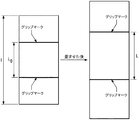
前述の引張試験セットアップで記述したように機器をセットアップして試料を装着する。引張試験を開始して、試料を254mm/分で伸ばすこと(データ取得レートは少なくとも50ヘルツである)を、試料が破断する(典型的には800〜1000%歪みとなる)まで行なう。%歪みを、グリップライン間の長さL及び最初のゲージ長L0(図1に例示する)から、以下の式を用いて計算する。
1-4. Initial tensile test Set up the instrument and load the specimen as described in the tensile test setup above. A tensile test is started and the sample is stretched at 254 mm / min (data acquisition rate is at least 50 Hertz) until the sample breaks (typically 800-1000% strain). The% strain is calculated from the length L between grip lines and the initial gauge length L 0 (illustrated in FIG. 1) using the following formula:
それぞれの組の5つの試料を測定して、130%歪みにおける力(N)、破断力(N)、130%歪みにおける応力(MPa)、破壊応力(引張り強さとも言われる、MPa)、及び破断時%歪みの算術平均を記録する。破断時%歪みをピーク力における%歪みとして規定する。データを組A及び組Bに対して生成する。 Five samples of each set were measured, the force at 130% strain (N), the breaking force (N), the stress at 130% strain (MPa), the fracture stress (also referred to as tensile strength, MPa), and Record the arithmetic mean of% strain at break. The% strain at break is defined as the% strain at peak force. Data is generated for set A and set B.
応力(MPa)を以下のように計算する:応力=[測定された力]/[試料断面積]。 The stress (MPa) is calculated as follows: stress = [measured force] / [sample cross section].
試料断面積を、試料重量W(g)、歪ませる前の試料長l(mm)、及び材料の密度ρρ(g/cm3)から計算する。試料断面積A0(mm2)は次式で与えられる:A0=[W×103]/[ρρ×l]。 The sample cross-sectional area is calculated from the sample weight W (g), the sample length l (mm) before being distorted, and the material density ρρ (g / cm 3 ). The sample cross-sectional area A 0 (mm 2 ) is given by the following formula: A 0 = [W × 10 3 ] / [ρρ × l].
密度0.862グラムcm3をすべての試料に対して用いる。 A density of 0.862 grams cm 3 is used for all samples.
1−5.ヒステリシス試験
前述の引張試験セットアップセクションで記述したように機器をセットアップして試料を装着する。データ取得レートを少なくとも50ヘルツに設定する。
1-5. Hysteresis test Set up the instrument and load the specimen as described in the tensile test setup section above. Set the data acquisition rate to at least 50 Hertz.
フィルム試料に対するヒステリシス試験方法には以下のステップが含まれる(すべての歪みは%歪みである)。
(1)試料を130%歪みまで、一定のクロスヘッド速度25.4cm/分で歪ませる。
(2)試料を130%歪みに30秒間保持する。
(3)0%歪みまで、一定のクロスヘッド速度25.4cm/分で進む。
(4)試料を1分間、0%歪みに保持する。
(5)試料を0.127Nの力まで引っ張り、保持時間を伴わずに0%歪みに戻す。
The hysteresis test method for film samples includes the following steps (all strains are% strain):
(1) Strain the sample to 130% strain at a constant crosshead speed of 25.4 cm / min.
(2) Hold the sample at 130% strain for 30 seconds.
(3) Proceed at a constant crosshead speed of 25.4 cm / min to 0% strain.
(4) Hold the sample at 0% strain for 1 minute.
(5) Pull the sample to a force of 0.127 N and return to 0% strain without holding time.
測定及び記録した力(ニュートン(N))は、ステップ(1)では75%歪みにおける荷重力であり、ステップ(3)では75%歪みにおける無荷重力である。またステップ(5)の0.127N力における試料長を記録して、後述するように材料中の%セットを計算するために用いる。
%セット=((0.127N力における長さ−当初のゲージ長)/(当初のゲージ長))×100。
The measured and recorded force (Newton (N)) is the loading force at 75% strain in step (1) and the no-load force at 75% strain in step (3). Also record the sample length at 0.127 N force in step (5) and use it to calculate the% set in the material as described below.
% Set = ((length at 0.127 N force−initial gauge length) / (initial gauge length)) × 100.
力を以下のように応力(MPa)に規格化する:応力=[所定の歪みにおいて測定した力(ニュートン)]/[断面積(mm2)]。 The force is normalized to stress (MPa) as follows: Stress = [force measured at a given strain (Newton)] / [cross-sectional area (mm 2 )].
試料断面積を、初期引張方法で前述したように計算する。 The sample cross-sectional area is calculated as described above for the initial tension method.
75%歪みにおける無荷重応力をMPaで報告し、75%歪みにおける荷重応力/無荷重応力の比を報告する。 The unloaded stress at 75% strain is reported in MPa and the ratio of loaded stress / unloaded stress at 75% strain is reported.
それぞれのフィルム組の5つの試料を測定して、組A及び組Bに対する記録したヒステリシスパラメータのそれぞれに対して算術平均を計算する。荷重応力/無荷重応力比が低い方の組を用いて、請求したすべてのパラメータ(例えば、破断時%歪み、破壊応力、及びヒステリシス無荷重応力)を決定する。 Five samples of each film set are measured and an arithmetic average is calculated for each of the recorded hysteresis parameters for set A and set B. The set with the lower load stress / no-load stress ratio is used to determine all the claimed parameters (eg,% strain at break, fracture stress, and hysteresis no-load stress).
2.熱分析法
ほぼ3ミリグラムのフィルムをDSC(示差走査熱量測定法)パンに封入する。試料の重量を±0.1mg以内で記録して、DSCランから集めた情報を用いて行なう任意の計算に用いる。
2. Thermal Analysis Approximately 3 milligrams of film is enclosed in a DSC (Differential Scanning Calorimetry) pan. The sample weight is recorded within ± 0.1 mg and used for any calculations performed using information collected from the DSC run.
試料の熱特性を、DSCによって、DSC Q2000 V23.10 Build 79(Perkin Elmer製)又は同等の機器を用いて測定する。試料の分析を、標準手順、例えばASTMD 3418−08に概説されるものを用いて行なう。この方法は、相変化が起きる(例えば、ガラス転移又は結晶融解の)温度範囲を決定することができる。手順を以下のように変更して2つの加熱サイクルを行なう。
1:−90.00℃で5分間、平衡させる。
2:20.00℃/分で200.00℃まで上げる。
3:5.00分間、等温にする。
4:20.00℃/分で−90.00℃まで下げる。
5:5.00分間、等温にする。
6:20.00℃/分で200.00℃まで上げる。
The thermal properties of the sample are measured by DSC using a DSC Q2000 V23.10 Build 79 (Perkin Elmer) or equivalent instrument. Sample analysis is performed using standard procedures, such as those outlined in ASTM D 3418-08. This method can determine the temperature range in which the phase change occurs (eg, glass transition or crystal melting). The procedure is changed as follows to perform two heating cycles.
1: Equilibrate at −90.00 ° C. for 5 minutes.
2: Increase to 200.00 ° C at 20.00 ° C / min.
3: Isothermal for 5.00 minutes.
4: Decrease to -90.00 ° C at 20.00 ° C / min.
5: Isothermal for 5.00 minutes.
6: Increase to 200.00 ° C at 20.00 ° C / min.
集めた熱流データを用いて材料の結晶化度を分析する。第1の熱曲線(前述のステップ2)データを用いて、融解熱の計算を、後述する方法を用いて行なう。 The collected heat flow data is used to analyze the crystallinity of the material. Using the first heat curve (step 2 described above) data, the heat of fusion is calculated using the method described below.
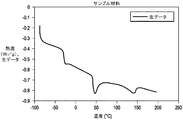
正確な熱流を決定するために、数学的ベースライン除去を3次の多項式ベースラインフィットを用いて行なう。最初に、DSCからの生データ、熱流(W/g)−温度(℃)をマイクロソフトエクセル形式で得る。データを次に、有用な温度範囲−10℃〜200℃まで縮小して、熱流(W/g)を温度の関数としてプロットする(図2a及び2bを参照)。 In order to determine the correct heat flow, mathematical baseline removal is performed using a third order polynomial baseline fit. First, raw data from DSC, heat flow (W / g) -temperature (° C.) is obtained in Microsoft Excel format. The data is then reduced to the useful temperature range of −10 ° C. to 200 ° C. and the heat flow (W / g) is plotted as a function of temperature (see FIGS. 2a and 2b).
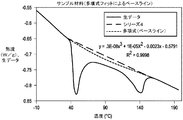
単一の3次の多項式曲線を、−10℃〜+35℃、及び165℃〜200℃のデータに、マイクロソフトエクセルトレンドラインツールを用いてフィットさせる(図2c及び2dを参照)。描いた多項式曲線を、補正のためのベースラインとして選択する。 A single cubic polynomial curve is fit to the data from −10 ° C. to + 35 ° C. and 165 ° C. to 200 ° C. using the Microsoft Excel Trendline tool (see FIGS. 2c and 2d). The drawn polynomial curve is selected as a baseline for correction.
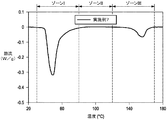
正確な融解熱(エンタルピー)データを得るために、−10℃〜200℃において熱流曲線から多項式ベースラインを引く。これは、それぞれのデータポイントにおいて適切な熱流ベースライン値を計算し、この値を、測定した当初の熱流値から引くことによって行なう。これによって熱流曲線がゼロ熱流束ラインの方にシフトする(図3aを参照)。ベースライン補正熱流データが生成されたら、プロットを3つのゾーンに分割する(図3bを参照):ゾーンI(30〜80℃)、ゾーンII(80〜120℃)、及びゾーンIII(120〜170℃)。 To obtain accurate heat of fusion (enthalpy) data, a polynomial baseline is subtracted from the heat flow curve at -10 ° C to 200 ° C. This is done by calculating the appropriate heat flow baseline value at each data point and subtracting this value from the measured initial heat flow value. This shifts the heat flow curve towards the zero heat flux line (see FIG. 3a). Once the baseline corrected heat flow data is generated, the plot is divided into three zones (see FIG. 3b): Zone I (30-80 ° C.), Zone II (80-120 ° C.), and Zone III (120-170). ° C).
補正された熱流曲線下の面積を時間について積分して、3つの温度ゾーンのそれぞれに対してエンタルピー(J/g)を決定する。ゾーンI及びIIIからの積分されたエンタルピー値の和と、ゾーンIの積分されたエンタルピー値−ゾーンIIIに対する値の比とを計算する。2つの試料を実行して、それぞれのゾーンに対する平均の積分エンタルピーを計算する。それぞれのゾーンについての平均値を用いて、平均の積分エンタルピー和及び平均の積分エンタルピー比を計算及び報告する。 The area under the corrected heat flow curve is integrated over time to determine the enthalpy (J / g) for each of the three temperature zones. Calculate the sum of the integrated enthalpy values from zones I and III and the integrated enthalpy value of zone I minus the ratio of values to zone III. Two samples are run to calculate the average integral enthalpy for each zone. The average value for each zone is used to calculate and report the average integral enthalpy sum and average integral enthalpy ratio.
結晶エンタルピーとともに、ポリマーの結晶融解温度を前述のDSC方法を用いて測定する。結晶融点は、DSC方法ASTM D3418−08の場合と同様に規定し、Tpmとして参照する。 Along with the crystal enthalpy, the crystal melting temperature of the polymer is measured using the DSC method described above. The crystalline melting point is defined in the same way as in the DSC method ASTM D3418-08 and is referred to as T pm
3.通気性試験
規定の圧力低下を受ける試料を通る通常の調整空気の流速を測定することで、基材(例えば、フィルム、ラミネート、又は物品の構成部品)の空気透過性を測定する。この試験は、ガス透過性が比較的高い材料(例えば不織布、有孔フィルムなど)に特に適している。ASTM D737を以下のように変更して用いた。
3. Breathability test The air permeability of a substrate (eg, film, laminate, or article component) is measured by measuring the flow rate of normal conditioned air through a sample subject to a specified pressure drop. This test is particularly suitable for materials with a relatively high gas permeability (eg nonwovens, perforated films, etc.). ASTM D737 was used with the following modifications.
TexTest FX 3300機器又は同等物を用いる。これは、Textest AG,Switzerland、又はAdvanced Testing Instruments ATI Spartanburg SC,米国から入手可能である。TEXTEST FX 3300空気透過性テスターマニュアルの操作説明の気密性試験及び機能及び較正チェックに関して記載されている手順を行う。異なる器具を使用する場合、製造業者の説明書により、気密性及び較正に関する同様の規定に従う。 Use a TextTest FX 3300 instrument or equivalent. This is available from Textest AG, Switzerland, or Advanced Testing Instruments ATI Spartanburg SC, USA. The procedure described for the airtightness test and function and calibration check in the operating instructions of the TEXTTEST FX 3300 Air Permeability Tester Manual is performed. When using different instruments, follow the manufacturer's instructions and follow the same rules for tightness and calibration.
試験圧力低下を125パスカルに設定して、5cm2面積の試験ヘッド(モデルFX3300−5)又は同等物を用いる。結果を有効数字3桁で記録する。5つの試料の平均値を計算して、通気性値(m3/m2/分)として報告する。 Set the test pressure drop to 125 Pascals and use a 5 cm 2 area test head (model FX3300-5) or equivalent. Record the result in 3 significant digits. The average value of 5 samples is calculated and reported as the breathability value (m 3 / m 2 / min).
ポリオレフィンエラストマー(記号:A〜G)、スチレンブロックコポリマー(記号:H)、及びエラストマー組成物(記号:実施例1〜10)(ポリオレフィンエラストマーA〜Gをブレンドすることによって形成する)に以下のように試験1〜4を施した。下表1に報告する。ポリオレフィンエラストマーA〜Gの組成物について以下に詳述する。実施例H以外のすべてのサンプルを坪量が40gsmのフィルムとして得た。 Polyolefin elastomer (symbol: AG), styrene block copolymer (symbol: H), and elastomer composition (symbol: Examples 1-10) (formed by blending polyolefin elastomers AG) as follows: Tests 1 to 4 were performed. Reported in Table 1 below. The composition of the polyolefin elastomers A to G will be described in detail below. All samples except Example H were obtained as films with a basis weight of 40 gsm.
試験1:本明細書で規定される熱分析法による平均の積分エンタルピー和(J/gm)、図4(a)〜4(h)に示す実施例1〜8に対するDSCチャート。 Test 1: Average integral enthalpy sum (J / gm) according to the thermal analysis method defined in this specification, DSC chart for Examples 1 to 8 shown in FIGS. 4 (a) to 4 (h).
試験2:本明細書で規定される熱分析法による平均の積分エンタルピー比。 Test 2: Average integral enthalpy ratio according to the thermal analysis method defined in this specification.
試験3:本明細書で規定されるヒステリシス試験による75%歪みにおける無荷重応力が0.8MPaを上回る。 Test 3: The no-load stress at 75% strain by the hysteresis test specified in this specification exceeds 0.8 MPa.
試験4:本明細書で規定されるヒステリシス試験による75%歪みにおける荷重応力/無荷重応力比が1〜2.6である。 Test 4: The load stress / no-load stress ratio at 75% strain according to the hysteresis test defined in this specification is 1 to 2.6.
A:Vistamaxx 6102(ExxonMobil,Houston,TXから入手可能):単一の鋭いガラス転移温度(Tg)として約−32℃及び全体的な結晶化度とし約6重量%を示す2つのランダムプロピレン−エチレンコポリマーのブレンド。結晶相は2つの融解ピークを約50℃及び約110℃に示す。 A: Vistamaxx 6102 (available from ExxonMobil, Houston, TX): two random propylene-ethylenes exhibiting a single sharp glass transition temperature (Tg) of about −32 ° C. and an overall crystallinity of about 6% by weight. A blend of copolymers. The crystalline phase exhibits two melting peaks at about 50 ° C. and about 110 ° C.
B:NOTIO PN−0040(Mitsui Chemicals、東京、日本から入手可能):弾性ポリオレフィン樹脂であって、ガラス転移温度が約−30℃で、2つの融解ピークを約45℃及び約157℃に示すもの。 B: NOTIO PN-0040 (available from Mitsui Chemicals, Tokyo, Japan): an elastic polyolefin resin with a glass transition temperature of about −30 ° C. and two melting peaks at about 45 ° C. and about 157 ° C. .
C:L−MODU X901S(MitsuiChemicals、東京、日本から入手可能):ポリプロピレンのステレオコポリマーであって、Tgが約−5℃で、結晶化度が約13重量%で、2つの融解ピークを約50℃及び約68℃に示すもの。 C: L-MODU X901S (available from Mitsui Chemicals, Tokyo, Japan): Polypropylene stereocopolymer with a Tg of about −5 ° C., a crystallinity of about 13% by weight and two melting peaks of about 50 Indicated at ℃ and about 68 ℃.
D:Versify 2400A(Dow Chemical,Midland,MIから入手可能):プロピレンエチレンランダムコポリマーであって、ガラス転移温度が約−40℃で、結晶相が2つの融解ピークを約50℃及び約140℃に有するもの。 D: Versify 2400A (available from Dow Chemical, Midland, MI): a propylene ethylene random copolymer with a glass transition temperature of about −40 ° C. and two crystalline peaks at about 50 ° C. and about 140 ° C. What you have.
E:Versify 2400B(Dow Chemical,Midland,MIから入手可能):プロピレンエチレンランダムコポリマーであって、ガラス転移温度が約−40℃で、結晶相が2つの融解ピークを約50℃及び約140℃に有するもの。 E: Versify 2400B (available from Dow Chemical, Midland, MI): a propylene ethylene random copolymer with a glass transition temperature of about −40 ° C. and two melting peaks at about 50 ° C. and about 140 ° C. What you have.
F:Versify 3401A(Dow Chemical,Midland,MIから入手可能):プロピレンエチレンランダムコポリマーであって、ガラス転移温度が約−40℃で、結晶相が2つの融解ピークを約50℃及び約95℃に有するもの。 F: Versify 3401A (available from Dow Chemical, Midland, MI): a propylene ethylene random copolymer with a glass transition temperature of about −40 ° C. and two melting peaks at about 50 ° C. and about 95 ° C. What you have.
G:Versify 3401B(Dow Chemical,Midland,MIから入手可能):プロピレンエチレンランダムコポリマーであって、ガラス転移温度が約−40℃で、結晶相が2つの融解ピークを約50℃及び約140℃に有するもの。 G: Versify 3401B (available from Dow Chemical, Midland, MI): propylene ethylene random copolymer with a glass transition temperature of about −40 ° C. and a crystalline phase with two melting peaks at about 50 ° C. and about 140 ° C. What you have.
H:水素化スチレンブロックコポリマーで形成されたスチレンコポリマーブレンドであって、フィルム坪量(gsm)が78.4のもの。この材料は、好都合なヒステリシス性能を有することが知られているが、付加コストがかかる。 H: A styrene copolymer blend formed with a hydrogenated styrene block copolymer having a film basis weight (gsm) of 78.4. This material is known to have favorable hysteresis performance, but at an additional cost.
押出成形機として、Berstorff(KraussMaffei Corporation,Florence,Ky.の一部門)によってZE25の名前で製造されるものを用いて、実施例A〜H及び1〜10のサンプルフィルムを形成する。この押出成形機は、25ミリメートルネジ径であり、長さと直径の比が32であり、その長さに沿って6つの加熱/冷却バレルゾーンを、冷却された供給ゾーンに加えて有する。ポリオレフィンエラストマーと任意の他の材料(必要に応じて)とのドライブレンドを転回させて比較的均一な混合物を実現し、ドライブレンドを押出成形機に振動性の重力フィーダーを介して供給する。第1の加熱/冷却ゾーン(バレルゾーン2)を十分高温に維持して、ポリオレフィンエラストマーの軟化を開始する。第1の加熱/冷却ゾーンは、材料を前方へ輸送するための搬送要素からなる。第2〜第4の加熱/冷却ゾーン(バレルゾーン3〜5)にはそれぞれ、高剪断順方向混練要素と順方向搬送要素とが備え付けられており、同時に、第4の加熱/冷却ゾーン(バレルゾーン5)には高剪断逆方向混練要素も備え付けられており、第5の加熱/冷却ゾーン(バレルゾーン6)には、分散要素と逆搬送シール要素とが備え付けられている。すべて、圧力、剪断、低及び高分子量の構成成分の混合の増加を促進するためである。第6で最後の加熱/冷却ゾーン(バレルゾーン7)には、順方向搬送要素が備え付けられている。この順方向搬送要素は、キャストフィルムダイの背後に十分な圧力を構築して、ダイを通した押出成形を促進することが意図されている。表1のサンプルフィルム1〜10の場合、設定温度プロファイル(バレルゾーン2〜7、移送管、ダイ)は約193℃、204℃、216℃、232℃、238℃、249℃であり、ネジは約50回転/分で回転する。ゾーン7の後の押出ダイ温度を249℃に設定する。サンプルフィルムHの場合、設定温度プロファイル(バレルゾーン2〜7、移送管、ダイ)は、約220℃、230℃、230℃、230℃、230℃、230℃、230℃、230℃であり、ネジは約50回転/分で回転する。25.4cm幅のコートハンガーキャストフィルムダイを用いて材料を薄膜に成形し、フィルム引き取りユニットを配置して押出物を受け取る。押出物は、両面にシリコーンコーティングされた剥離紙上に集められて厚紙ロール上に巻かれる。エアーナイフ(Curtain Transvector(登録商標)Air knife Model 921−12)(275kPa及び室温にて)をダイと引き取りロールとの間で用いて材料を冷却して、ウェブの取り扱い/巻き取りを助ける。フィルム坪量は、引き取りユニットの線速度を変えることによって調整する。ここでのデータを生成するために、材料の単層フィルムを254mmキャストフィルムダイから集めて、中央の127mmを用いる。フィルムを室温(22±2℃)で貯蔵して、3〜6週間、室温で平衡状態に達するまで結晶化させる。 Sample films of Examples A to H and 1 to 10 are formed using an extruder manufactured under the name ZE25 by Berstorff (a division of KraussMaffei Corporation, Florence, Ky.). The extruder has a 25 millimeter thread diameter, a length to diameter ratio of 32, and has six heating / cooling barrel zones along its length in addition to the cooled feed zone. The dry blend of polyolefin elastomer and any other materials (as required) is tumbled to achieve a relatively uniform mixture and the dry blend is fed to the extruder via an oscillating gravity feeder. The first heating / cooling zone (barrel zone 2) is maintained at a sufficiently high temperature to initiate softening of the polyolefin elastomer. The first heating / cooling zone consists of a transport element for transporting the material forward. Each of the second to fourth heating / cooling zones (barrel zones 3 to 5) is provided with a high shear forward kneading element and a forward conveying element, and at the same time, the fourth heating / cooling zone (barrel). Zone 5) is also equipped with a high shear reverse kneading element, and the fifth heating / cooling zone (barrel zone 6) is equipped with a dispersing element and a reverse conveying seal element. All to promote increased mixing of pressure, shear, low and high molecular weight components. The sixth and last heating / cooling zone (barrel zone 7) is equipped with a forward conveying element. This forward conveying element is intended to build sufficient pressure behind the cast film die to facilitate extrusion through the die. In the case of sample films 1 to 10 in Table 1, the set temperature profile (barrel zones 2 to 7, transfer pipe, die) is about 193 ° C, 204 ° C, 216 ° C, 232 ° C, 238 ° C, 249 ° C, and the screws are Rotates at about 50 rpm. The extrusion die temperature after zone 7 is set to 249 ° C. For sample film H, the set temperature profile (barrel zones 2-7, transfer tube, die) is about 220 ° C, 230 ° C, 230 ° C, 230 ° C, 230 ° C, 230 ° C, 230 ° C, 230 ° C, The screw rotates at about 50 revolutions / minute. The material is formed into a thin film using a 25.4 cm wide coat hanger cast film die and a film take-up unit is placed to receive the extrudate. The extrudate is collected on a silicone-coated release paper on both sides and wound on a cardboard roll. An air knife (Curtain Transvector® Air knife Model 921-12) (at 275 kPa and room temperature) is used between the die and take-up roll to cool the material and aid in web handling / winding. The film basis weight is adjusted by changing the linear velocity of the take-up unit. To generate the data here, a single layer film of material is collected from a 254 mm cast film die and the central 127 mm is used. The film is stored at room temperature (22 ± 2 ° C.) and crystallized for 3-6 weeks at room temperature until equilibrium is reached.
サンプルフィルム破壊応力及び破断時%歪みを、初期引張試験を用いて機械横断方向に測定する。それらを下表2に報告する。 Sample film breaking stress and% strain at break are measured in the cross machine direction using an initial tensile test. They are reported in Table 2 below.
予歪みを与えること及びエージングを以下のように行なう。押出成形されたフィルムに機械横断方向に予歪みを与えて、吸収性物品にとって有用な弾性部材の製造で用いる活性化プロセスをシミュレートする。フィルムに300%歪みまでの予歪みを、引張試験機を用いて0.166−1ひずみ速度で与えて、即座にゼロ歪に0.166s−1で戻す。最初のゲージ長−サンプルの幅の比を1に設定する。予歪みを受けたフィルムを次に、引張試験機から取り出して、平滑面上に平坦に置く。22±2℃で、3〜6週間、平衡状態に達するまでエージングする。フィルムを、前述したように熱分析法及びヒステリシス試験によって分析する。 Pre-distortion and aging are performed as follows. The extruded film is pre-strained in the cross machine direction to simulate the activation process used in the production of elastic members useful for absorbent articles. The film is pre - strained to 300% strain using a tensile tester at a 0.166 −1 strain rate and immediately returned to zero strain at 0.166 s −1 . The initial gauge length-sample width ratio is set to 1. The prestrained film is then removed from the tensile tester and placed flat on a smooth surface. Aging at 22 ± 2 ° C. for 3-6 weeks until equilibrium is reached. The film is analyzed by thermal analysis and hysteresis testing as described above.
実施例1〜2及び4〜7によって好適なヒステリシス特性が得られ、吸収性物品に対する伸縮性要素として用いたときに良好な性能をもたらすことが予想される。 Examples 1-2 and 4-7 provide suitable hysteresis properties and are expected to provide good performance when used as a stretch element for absorbent articles.
実施例1、2、及び4では、引張応力に対する好適な堅固性が得られており、吸収性物品に対する伸縮性要素として用いるための加工処理中に良好な性能が得られることが予想される。 In Examples 1, 2 and 4, suitable firmness against tensile stress is obtained, and good performance is expected during processing for use as a stretch element for absorbent articles.
本明細書に開示される寸法及び値は、記載される正確な数値に厳密に限られるとして理解されるべきではない。むしろ、特に断らない限り、それぞれのそのような寸法は、記載される値とその値の周辺の機能的に同等の範囲との両方を意味するものとする。例えば、「40mm」として開示される寸法は、「約40mm」を意味することを意図する。 The dimensions and values disclosed herein are not to be understood as being strictly limited to the exact numerical values recited. Rather, unless otherwise specified, each such dimension is intended to mean both the recited value and a functionally equivalent range surrounding that value. For example, a dimension disclosed as “40 mm” is intended to mean “about 40 mm”.
本明細書で引用されているあらゆる文献は、あらゆる相互参照特許又は関連特許を含め、明示的に除外されたり、別段に限定されたりしている場合を除き、その全体が参照により本明細書に組み込まれる。いかなる文献の引用も、本明細書中で開示又は特許請求される任意の発明に対する先行技術であるとはみなされず、あるいはそれを単独で又は他の任意の参考文献(単数又は複数)と組み合わせたときに、そのような発明全てを教示、示唆、又は開示するとはみなされない。更に、本文書における用語の任意の意味又は定義が、参照することによって組み込まれた文書内の同じ用語の意味又は定義と矛盾する範囲において、本文書におけるその用語に与えられた意味又は定義が適用されるものとする。 All references cited herein, including any cross-reference patents or related patents, are hereby incorporated by reference in their entirety, except where expressly excluded or otherwise limited. Incorporated. Citation of any document is not considered prior art to any invention disclosed or claimed herein, or it is combined alone or with any other reference (s) Sometimes it is not considered to teach, suggest or disclose all such inventions. In addition, to the extent that any meaning or definition of a term in this document contradicts the meaning or definition of the same term in a document incorporated by reference, the meaning or definition given to that term in this document applies. Shall be.
以上、本発明の特定の実施形態を図示、説明したが、本発明の趣旨及び範囲から逸脱することなく他の様々な変更及び改変を実施することが可能である点は当業者には自明であろう。したがって、本発明の範囲内に含まれるそのような全ての変更及び修正は、添付の特許請求の範囲にて網羅することが意図される。 While specific embodiments of the present invention have been illustrated and described above, it will be apparent to those skilled in the art that various other changes and modifications can be made without departing from the spirit and scope of the invention. I will. Accordingly, all such changes and modifications included within the scope of this invention are intended to be covered by the appended claims.
Claims (17)
(1)本明細書で規定される熱分析法によれば、平均の積分エンタルピー和が17J/g以下であり、好ましくは約5〜17J/gであり、
(2)本明細書で規定される熱分析法によれば、平均の積分エンタルピー比が0.6〜300、好ましくは0.8〜300、更に好ましくは1.0〜300であり、
(3)本明細書で規定されるヒステリシス試験によれば、75%歪みにおける無荷重応力が0.8MPaを上回り、及び
(4)本明細書で規定されるヒステリシス試験によれば、75%歪みにおける荷重応力/無荷重応力比が1〜2.6であるという特性を有する、エラストマー組成物。 An elastomer composition comprising a polyolefin elastomer material, comprising:
(1) According to the thermal analysis method defined in this specification, the average integral enthalpy sum is 17 J / g or less, preferably about 5 to 17 J / g,
(2) According to the thermal analysis method defined in this specification, the average integral enthalpy ratio is 0.6 to 300, preferably 0.8 to 300, more preferably 1.0 to 300,
(3) According to the hysteresis test specified in this specification, the no-load stress at 75% strain exceeds 0.8 MPa, and (4) according to the hysteresis test specified in this specification, 75% strain The elastomer composition which has the characteristic that the load stress / no-load stress ratio in 1-2.6.
(1)DSC測定によれば、平均の積分エンタルピー値が17J/g以下であり、好ましくは約5〜17J/gであり、30〜80℃及び120〜170℃の温度ゾーンの値が加えられており、
(2)DSC測定によれば、30〜80℃の温度ゾーンの値を120〜170℃の温度ゾーンの値と比較すると、平均の積分エンタルピー比が0.6〜300、好ましくは0.8〜300、更に好ましくは1.0〜300であり、
(3)75%歪みにおける無荷重応力が0.8MPaを上回っており、及び
(4)75%歪みにおける荷重応力/無荷重応力比が1〜2.6であるという特性を有する、エラストマー組成物。 An elastomer composition comprising a polyolefin elastomer material, after being subjected to a pre-strain of up to 300% strain and aged for 3 weeks,
(1) According to DSC measurement, the average integral enthalpy value is 17 J / g or less, preferably about 5 to 17 J / g, and values of temperature zones of 30 to 80 ° C. and 120 to 170 ° C. are added. And
(2) According to DSC measurement, when the value of the temperature zone of 30 to 80 ° C. is compared with the value of the temperature zone of 120 to 170 ° C., the average integral enthalpy ratio is 0.6 to 300, preferably 0.8 to 300, more preferably 1.0 to 300,
(3) An elastomer composition having the characteristics that the no-load stress at 75% strain exceeds 0.8 MPa, and (4) the load stress / no-load stress ratio at 75% strain is 1 to 2.6. .
Applications Claiming Priority (3)
| Application Number | Priority Date | Filing Date | Title |
|---|---|---|---|
| US201462008464P | 2014-06-05 | 2014-06-05 | |
| US62/008,464 | 2014-06-05 | ||
| PCT/US2015/030067 WO2015187304A1 (en) | 2014-06-05 | 2015-05-11 | Elastomer composition comprising polyolefin elastomers |
Publications (1)
| Publication Number | Publication Date |
|---|---|
| JP2017516902A true JP2017516902A (en) | 2017-06-22 |
Family
ID=53181373
Family Applications (1)
| Application Number | Title | Priority Date | Filing Date |
|---|---|---|---|
| JP2016570313A Pending JP2017516902A (en) | 2014-06-05 | 2015-05-11 | Elastomer composition comprising polyolefin elastomer |
Country Status (4)
| Country | Link |
|---|---|
| EP (1) | EP3152255B1 (en) |
| JP (1) | JP2017516902A (en) |
| CN (1) | CN106414591A (en) |
| WO (1) | WO2015187304A1 (en) |
Citations (4)
| Publication number | Priority date | Publication date | Assignee | Title |
|---|---|---|---|---|
| US20070269623A1 (en) * | 2006-04-26 | 2007-11-22 | Breck Alan K | Flex crack resistant low density polyethylene films |
| WO2012060311A1 (en) * | 2010-11-05 | 2012-05-10 | 株式会社カネカ | Laminated adhesive film for use in insert molding |
| US20120263960A1 (en) * | 2009-04-15 | 2012-10-18 | Kwangjin Song | Film Composition and Method of Making the Same |
| WO2013002976A1 (en) * | 2011-06-30 | 2013-01-03 | Dow Global Technologies Llc | Clear graphic cling films |
Family Cites Families (9)
| Publication number | Priority date | Publication date | Assignee | Title |
|---|---|---|---|---|
| US6120487A (en) | 1996-04-03 | 2000-09-19 | The Procter & Gamble Company | Disposable pull-on pant |
| WO1998057996A1 (en) | 1997-06-14 | 1998-12-23 | The Board Of Trustees Of The Leland Stanford, Jr. University | ETHYLENE ENHANCEMENT OF PROCESSES FOR SYNTHESIS OF HIGH MELTING THERMOPLASTIC ELASTOMERIC α-OLEFIN POLYMERS (PRE/EPE EFFECTS) |
| US6921794B2 (en) | 1997-08-12 | 2005-07-26 | Exxonmobil Chemical Patents Inc. | Blends made from propylene ethylene polymers |
| US6518378B2 (en) | 1998-01-09 | 2003-02-11 | The Board Of Trustees Of The Leland Stanford Junior University | High-melting polyolefin copolymer elastomers, catalysts and methods of synthesis |
| US6169151B1 (en) | 1998-01-09 | 2001-01-02 | The Board Of Trustees Of The Leland Stanford Junior University | High-melting polyolefin copolymer elastomers, catalysts and methods of synthesis |
| DE19816154A1 (en) | 1998-04-09 | 1999-10-21 | Bernhard Rieger | Linear isotactic polymers, processes for their production and their use and a catalyst combination |
| EP1256594A1 (en) | 2001-05-11 | 2002-11-13 | The Procter & Gamble Company | Synthetic material comprising a network polymer |
| US7893161B2 (en) | 2005-10-31 | 2011-02-22 | Dow Global Technologies Inc. | Propylene-based elastomeric composition |
| EP2242465B1 (en) * | 2008-01-24 | 2014-10-01 | Clopay Plastic Products Company, Inc. | Elastomeric materials |
-
2015
- 2015-05-11 EP EP15723109.3A patent/EP3152255B1/en active Active
- 2015-05-11 JP JP2016570313A patent/JP2017516902A/en active Pending
- 2015-05-11 WO PCT/US2015/030067 patent/WO2015187304A1/en not_active Ceased
- 2015-05-11 CN CN201580029807.0A patent/CN106414591A/en active Pending
Patent Citations (4)
| Publication number | Priority date | Publication date | Assignee | Title |
|---|---|---|---|---|
| US20070269623A1 (en) * | 2006-04-26 | 2007-11-22 | Breck Alan K | Flex crack resistant low density polyethylene films |
| US20120263960A1 (en) * | 2009-04-15 | 2012-10-18 | Kwangjin Song | Film Composition and Method of Making the Same |
| WO2012060311A1 (en) * | 2010-11-05 | 2012-05-10 | 株式会社カネカ | Laminated adhesive film for use in insert molding |
| WO2013002976A1 (en) * | 2011-06-30 | 2013-01-03 | Dow Global Technologies Llc | Clear graphic cling films |
Also Published As
| Publication number | Publication date |
|---|---|
| CN106414591A (en) | 2017-02-15 |
| WO2015187304A1 (en) | 2015-12-10 |
| EP3152255A1 (en) | 2017-04-12 |
| EP3152255B1 (en) | 2021-08-18 |
Similar Documents
| Publication | Publication Date | Title |
|---|---|---|
| US9834667B2 (en) | Elastomer composition comprising polyolefin elastomers | |
| JP7653471B2 (en) | Breathable microporous thermoplastic thin film | |
| JP5905568B2 (en) | Absorbent article with tear resistant film | |
| CN101951863B (en) | Extrusion bonded laminates for absorbent articles | |
| RU2492840C2 (en) | Extrusion glued laminates for absorbent products | |
| JP2015155547A (en) | Tear resistant film | |
| CN112804978A (en) | Absorbent articles having polymeric filler compositions substantially free of tackifiers | |
| CN107532048B (en) | stretch laminate | |
| JP6542379B2 (en) | Stretchable laminate | |
| US11690932B2 (en) | Elastomeric films having low tear propagation | |
| JPWO2020075870A1 (en) | Non-woven laminates, stretchable non-woven laminates, textile products, absorbent articles and sanitary masks | |
| US10118372B2 (en) | Laminate comprising polyolefin elastic film layer | |
| US10245347B2 (en) | Elastomer composition comprising polyolefin elastomers | |
| JP2017516902A (en) | Elastomer composition comprising polyolefin elastomer | |
| BR102022021621B1 (en) | Elastic Nonwoven Sheet, its Manufacturing Method and Use |
Legal Events
| Date | Code | Title | Description |
|---|---|---|---|
| A621 | Written request for application examination |
Free format text: JAPANESE INTERMEDIATE CODE: A621 Effective date: 20161130 |
|
| A977 | Report on retrieval |
Free format text: JAPANESE INTERMEDIATE CODE: A971007 Effective date: 20171016 |
|
| A131 | Notification of reasons for refusal |
Free format text: JAPANESE INTERMEDIATE CODE: A131 Effective date: 20171020 |
|
| A521 | Request for written amendment filed |
Free format text: JAPANESE INTERMEDIATE CODE: A523 Effective date: 20171213 |
|
| A02 | Decision of refusal |
Free format text: JAPANESE INTERMEDIATE CODE: A02 Effective date: 20180403 |
|
| A521 | Request for written amendment filed |
Free format text: JAPANESE INTERMEDIATE CODE: A523 Effective date: 20180724 |
|
| A911 | Transfer to examiner for re-examination before appeal (zenchi) |
Free format text: JAPANESE INTERMEDIATE CODE: A911 Effective date: 20180801 |
|
| A912 | Re-examination (zenchi) completed and case transferred to appeal board |
Free format text: JAPANESE INTERMEDIATE CODE: A912 Effective date: 20181012 |