JP2017529331A - Antigen-binding protein that binds to CXCR3 - Google Patents
Antigen-binding protein that binds to CXCR3 Download PDFInfo
- Publication number
- JP2017529331A JP2017529331A JP2017510556A JP2017510556A JP2017529331A JP 2017529331 A JP2017529331 A JP 2017529331A JP 2017510556 A JP2017510556 A JP 2017510556A JP 2017510556 A JP2017510556 A JP 2017510556A JP 2017529331 A JP2017529331 A JP 2017529331A
- Authority
- JP
- Japan
- Prior art keywords
- seq
- variable domain
- chain variable
- light chain
- referred
- Prior art date
- Legal status (The legal status is an assumption and is not a legal conclusion. Google has not performed a legal analysis and makes no representation as to the accuracy of the status listed.)
- Withdrawn
Links
Images

Classifications
-
- A—HUMAN NECESSITIES
- A61—MEDICAL OR VETERINARY SCIENCE; HYGIENE
- A61K—PREPARATIONS FOR MEDICAL, DENTAL OR TOILETRY PURPOSES
- A61K39/00—Medicinal preparations containing antigens or antibodies
- A61K39/395—Antibodies; Immunoglobulins; Immune serum, e.g. antilymphocytic serum
-
- A—HUMAN NECESSITIES
- A61—MEDICAL OR VETERINARY SCIENCE; HYGIENE
- A61P—SPECIFIC THERAPEUTIC ACTIVITY OF CHEMICAL COMPOUNDS OR MEDICINAL PREPARATIONS
- A61P1/00—Drugs for disorders of the alimentary tract or the digestive system
- A61P1/04—Drugs for disorders of the alimentary tract or the digestive system for ulcers, gastritis or reflux esophagitis, e.g. antacids, inhibitors of acid secretion, mucosal protectants
-
- A—HUMAN NECESSITIES
- A61—MEDICAL OR VETERINARY SCIENCE; HYGIENE
- A61P—SPECIFIC THERAPEUTIC ACTIVITY OF CHEMICAL COMPOUNDS OR MEDICINAL PREPARATIONS
- A61P1/00—Drugs for disorders of the alimentary tract or the digestive system
- A61P1/16—Drugs for disorders of the alimentary tract or the digestive system for liver or gallbladder disorders, e.g. hepatoprotective agents, cholagogues, litholytics
-
- A—HUMAN NECESSITIES
- A61—MEDICAL OR VETERINARY SCIENCE; HYGIENE
- A61P—SPECIFIC THERAPEUTIC ACTIVITY OF CHEMICAL COMPOUNDS OR MEDICINAL PREPARATIONS
- A61P11/00—Drugs for disorders of the respiratory system
-
- A—HUMAN NECESSITIES
- A61—MEDICAL OR VETERINARY SCIENCE; HYGIENE
- A61P—SPECIFIC THERAPEUTIC ACTIVITY OF CHEMICAL COMPOUNDS OR MEDICINAL PREPARATIONS
- A61P17/00—Drugs for dermatological disorders
- A61P17/06—Antipsoriatics
-
- A—HUMAN NECESSITIES
- A61—MEDICAL OR VETERINARY SCIENCE; HYGIENE
- A61P—SPECIFIC THERAPEUTIC ACTIVITY OF CHEMICAL COMPOUNDS OR MEDICINAL PREPARATIONS
- A61P19/00—Drugs for skeletal disorders
- A61P19/02—Drugs for skeletal disorders for joint disorders, e.g. arthritis, arthrosis
-
- A—HUMAN NECESSITIES
- A61—MEDICAL OR VETERINARY SCIENCE; HYGIENE
- A61P—SPECIFIC THERAPEUTIC ACTIVITY OF CHEMICAL COMPOUNDS OR MEDICINAL PREPARATIONS
- A61P25/00—Drugs for disorders of the nervous system
-
- A—HUMAN NECESSITIES
- A61—MEDICAL OR VETERINARY SCIENCE; HYGIENE
- A61P—SPECIFIC THERAPEUTIC ACTIVITY OF CHEMICAL COMPOUNDS OR MEDICINAL PREPARATIONS
- A61P29/00—Non-central analgesic, antipyretic or antiinflammatory agents, e.g. antirheumatic agents; Non-steroidal antiinflammatory drugs [NSAID]
-
- A—HUMAN NECESSITIES
- A61—MEDICAL OR VETERINARY SCIENCE; HYGIENE
- A61P—SPECIFIC THERAPEUTIC ACTIVITY OF CHEMICAL COMPOUNDS OR MEDICINAL PREPARATIONS
- A61P3/00—Drugs for disorders of the metabolism
- A61P3/08—Drugs for disorders of the metabolism for glucose homeostasis
- A61P3/10—Drugs for disorders of the metabolism for glucose homeostasis for hyperglycaemia, e.g. antidiabetics
-
- A—HUMAN NECESSITIES
- A61—MEDICAL OR VETERINARY SCIENCE; HYGIENE
- A61P—SPECIFIC THERAPEUTIC ACTIVITY OF CHEMICAL COMPOUNDS OR MEDICINAL PREPARATIONS
- A61P33/00—Antiparasitic agents
- A61P33/02—Antiprotozoals, e.g. for leishmaniasis, trichomoniasis, toxoplasmosis
- A61P33/06—Antimalarials
-
- A—HUMAN NECESSITIES
- A61—MEDICAL OR VETERINARY SCIENCE; HYGIENE
- A61P—SPECIFIC THERAPEUTIC ACTIVITY OF CHEMICAL COMPOUNDS OR MEDICINAL PREPARATIONS
- A61P35/00—Antineoplastic agents
-
- A—HUMAN NECESSITIES
- A61—MEDICAL OR VETERINARY SCIENCE; HYGIENE
- A61P—SPECIFIC THERAPEUTIC ACTIVITY OF CHEMICAL COMPOUNDS OR MEDICINAL PREPARATIONS
- A61P35/00—Antineoplastic agents
- A61P35/02—Antineoplastic agents specific for leukemia
-
- A—HUMAN NECESSITIES
- A61—MEDICAL OR VETERINARY SCIENCE; HYGIENE
- A61P—SPECIFIC THERAPEUTIC ACTIVITY OF CHEMICAL COMPOUNDS OR MEDICINAL PREPARATIONS
- A61P35/00—Antineoplastic agents
- A61P35/04—Antineoplastic agents specific for metastasis
-
- A—HUMAN NECESSITIES
- A61—MEDICAL OR VETERINARY SCIENCE; HYGIENE
- A61P—SPECIFIC THERAPEUTIC ACTIVITY OF CHEMICAL COMPOUNDS OR MEDICINAL PREPARATIONS
- A61P37/00—Drugs for immunological or allergic disorders
-
- A—HUMAN NECESSITIES
- A61—MEDICAL OR VETERINARY SCIENCE; HYGIENE
- A61P—SPECIFIC THERAPEUTIC ACTIVITY OF CHEMICAL COMPOUNDS OR MEDICINAL PREPARATIONS
- A61P37/00—Drugs for immunological or allergic disorders
- A61P37/02—Immunomodulators
- A61P37/06—Immunosuppressants, e.g. drugs for graft rejection
-
- A—HUMAN NECESSITIES
- A61—MEDICAL OR VETERINARY SCIENCE; HYGIENE
- A61P—SPECIFIC THERAPEUTIC ACTIVITY OF CHEMICAL COMPOUNDS OR MEDICINAL PREPARATIONS
- A61P9/00—Drugs for disorders of the cardiovascular system
- A61P9/10—Drugs for disorders of the cardiovascular system for treating ischaemic or atherosclerotic diseases, e.g. antianginal drugs, coronary vasodilators, drugs for myocardial infarction, retinopathy, cerebrovascula insufficiency, renal arteriosclerosis
-
- C—CHEMISTRY; METALLURGY
- C07—ORGANIC CHEMISTRY
- C07K—PEPTIDES
- C07K16/00—Immunoglobulins [IG], e.g. monoclonal or polyclonal antibodies
- C07K16/18—Immunoglobulins [IG], e.g. monoclonal or polyclonal antibodies against material from animals or humans
- C07K16/28—Immunoglobulins [IG], e.g. monoclonal or polyclonal antibodies against material from animals or humans against receptors, cell surface antigens or cell surface determinants
- C07K16/2803—Immunoglobulins [IG], e.g. monoclonal or polyclonal antibodies against material from animals or humans against receptors, cell surface antigens or cell surface determinants against the immunoglobulin superfamily
- C07K16/2809—Immunoglobulins [IG], e.g. monoclonal or polyclonal antibodies against material from animals or humans against receptors, cell surface antigens or cell surface determinants against the immunoglobulin superfamily against the T-cell receptor (TcR)-CD3 complex
-
- C—CHEMISTRY; METALLURGY
- C07—ORGANIC CHEMISTRY
- C07K—PEPTIDES
- C07K16/00—Immunoglobulins [IG], e.g. monoclonal or polyclonal antibodies
- C07K16/18—Immunoglobulins [IG], e.g. monoclonal or polyclonal antibodies against material from animals or humans
- C07K16/28—Immunoglobulins [IG], e.g. monoclonal or polyclonal antibodies against material from animals or humans against receptors, cell surface antigens or cell surface determinants
- C07K16/2866—Immunoglobulins [IG], e.g. monoclonal or polyclonal antibodies against material from animals or humans against receptors, cell surface antigens or cell surface determinants against receptors for cytokines, lymphokines, interferons
-
- A—HUMAN NECESSITIES
- A61—MEDICAL OR VETERINARY SCIENCE; HYGIENE
- A61K—PREPARATIONS FOR MEDICAL, DENTAL OR TOILETRY PURPOSES
- A61K39/00—Medicinal preparations containing antigens or antibodies
- A61K2039/505—Medicinal preparations containing antigens or antibodies comprising antibodies
-
- C—CHEMISTRY; METALLURGY
- C07—ORGANIC CHEMISTRY
- C07K—PEPTIDES
- C07K2317/00—Immunoglobulins specific features
- C07K2317/20—Immunoglobulins specific features characterized by taxonomic origin
- C07K2317/21—Immunoglobulins specific features characterized by taxonomic origin from primates, e.g. man
-
- C—CHEMISTRY; METALLURGY
- C07—ORGANIC CHEMISTRY
- C07K—PEPTIDES
- C07K2317/00—Immunoglobulins specific features
- C07K2317/50—Immunoglobulins specific features characterized by immunoglobulin fragments
- C07K2317/55—Fab or Fab'
-
- C—CHEMISTRY; METALLURGY
- C07—ORGANIC CHEMISTRY
- C07K—PEPTIDES
- C07K2317/00—Immunoglobulins specific features
- C07K2317/70—Immunoglobulins specific features characterized by effect upon binding to a cell or to an antigen
- C07K2317/76—Antagonist effect on antigen, e.g. neutralization or inhibition of binding
-
- C—CHEMISTRY; METALLURGY
- C07—ORGANIC CHEMISTRY
- C07K—PEPTIDES
- C07K2317/00—Immunoglobulins specific features
- C07K2317/90—Immunoglobulins specific features characterized by (pharmaco)kinetic aspects or by stability of the immunoglobulin
- C07K2317/92—Affinity (KD), association rate (Ka), dissociation rate (Kd) or EC50 value
Landscapes
- Health & Medical Sciences (AREA)
- Chemical & Material Sciences (AREA)
- Organic Chemistry (AREA)
- Medicinal Chemistry (AREA)
- Life Sciences & Earth Sciences (AREA)
- General Health & Medical Sciences (AREA)
- Veterinary Medicine (AREA)
- Immunology (AREA)
- Public Health (AREA)
- Pharmacology & Pharmacy (AREA)
- Animal Behavior & Ethology (AREA)
- Nuclear Medicine, Radiotherapy & Molecular Imaging (AREA)
- Chemical Kinetics & Catalysis (AREA)
- General Chemical & Material Sciences (AREA)
- Engineering & Computer Science (AREA)
- Bioinformatics & Cheminformatics (AREA)
- Molecular Biology (AREA)
- Proteomics, Peptides & Aminoacids (AREA)
- Genetics & Genomics (AREA)
- Biophysics (AREA)
- Biochemistry (AREA)
- Diabetes (AREA)
- Hematology (AREA)
- Oncology (AREA)
- Tropical Medicine & Parasitology (AREA)
- Rheumatology (AREA)
- Microbiology (AREA)
- Mycology (AREA)
- Epidemiology (AREA)
- Pulmonology (AREA)
- Gastroenterology & Hepatology (AREA)
- Vascular Medicine (AREA)
- Urology & Nephrology (AREA)
- Transplantation (AREA)
- Obesity (AREA)
- Endocrinology (AREA)
- Emergency Medicine (AREA)
- Cardiology (AREA)
- Orthopedic Medicine & Surgery (AREA)
- Dermatology (AREA)
Abstract
抗CXCR3抗体に関するまたはそれらに由来する組成物および方法を開示する。より具体的には、CXCR3に結合する完全ヒト抗体、このような抗体のCXCR3結合断片および誘導体、ならびにこれらの断片を含むCXCR3結合ポリペプチドを開示する。さらにまた、このような抗体、抗体断片および誘導体ならびにポリペプチドをコードする核酸、このようなポリヌクレオチドを含む細胞、このような抗体、抗体断片および誘導体ならびにポリペプチドを作製するための方法、ならびにこのような抗体、抗体断片および誘導体ならびにポリペプチドを使用するための方法が開示され、これには、種々の炎症性障害および種々のがんを含めたCXCR3関連障害または状態を有する対象を治療または診断する方法が含まれる。Disclosed are compositions and methods relating to or derived from anti-CXCR3 antibodies. More specifically, fully human antibodies that bind to CXCR3, CXCR3 binding fragments and derivatives of such antibodies, and CXCR3 binding polypeptides comprising these fragments are disclosed. Furthermore, nucleic acids encoding such antibodies, antibody fragments and derivatives and polypeptides, cells containing such polynucleotides, methods for producing such antibodies, antibody fragments and derivatives and polypeptides, and Methods for using such antibodies, antibody fragments and derivatives and polypeptides are disclosed, including treating or diagnosing a subject having a CXCR3-related disorder or condition, including various inflammatory disorders and various cancers How to do.
Description
本開示は、抗CXCR3抗体に関するまたはこれらに由来する組成物および方法を提供する。より具体的には、本開示は、CXCR3に結合するヒト抗体、このような抗体のCXCR3結合断片および誘導体、ならびにこのような断片を含むCXCR3結合ポリペプチドを提供する。さらにまた、本開示は、このような抗体、抗体断片および誘導体ならびにポリペプチドをコードする核酸、このようなポリヌクレオチドを含む細胞、このような抗体、抗体断片および誘導体ならびにポリペプチドを作製するための方法、ならびにこのような抗体、抗体断片および誘導体ならびにポリペプチドを使用するための方法を提供し、これには、種々の炎症性障害および種々のがんを含む、CXCR3関連障害または状態を有する対象を治療または診断する方法が含まれる。 The present disclosure provides compositions and methods relating to or derived from anti-CXCR3 antibodies. More specifically, this disclosure provides human antibodies that bind CXCR3, CXCR3 binding fragments and derivatives of such antibodies, and CXCR3 binding polypeptides comprising such fragments. Furthermore, the present disclosure provides for nucleic acids encoding such antibodies, antibody fragments and derivatives and polypeptides, cells containing such polynucleotides, for producing such antibodies, antibody fragments and derivatives and polypeptides. Methods and methods for using such antibodies, antibody fragments and derivatives and polypeptides, including subjects with CXCR3-related disorders or conditions, including various inflammatory disorders and various cancers A method of treating or diagnosing is included.
C−X−Cケモカイン受容体−3(CXCR3)は、活性化T細胞およびNK細胞などの特定の白血球上に発現される。CXCR3受容体は、インターフェロンガンマ誘導性の10kDタンパク質(IP−10)、ガンマインターフェロンによって誘導されるモノカイン(MIG;Mig)、インターフェロン誘導性のT細胞アルファ化学誘引物質(I−TAC)およびB細胞誘引性のケモカイン−1(BCA−1)などのリガンドを結合する。CXCR3のある種の形態はまた、血小板因子−4(PF−4、Lasagniら、J.Exp.Med.197:1537−1549頁、2003年)に結合する。いくつかのCXCR3リガンド(IP−10、MIGおよびI−TAC)の発現は、炎症の有力なメディエーターであるインターフェロンまたは腫瘍壊死因子(TNF)によって組織内で誘導される(Farber、J.M.J.Leukoc.Biol.61:246−257頁、2007年;Pialiら、Eur.J.Immunol.28:961−972頁、1998年;およびColeら、J.Exp.Med.187:2009−2021頁、1998年)。これらの知見から、炎症中に、CXCR3のリガンドの発現がアップレギュレートされ、炎症組織へのCXCR3+リンパ球の動員が生じると仮定されている。浸潤するCXCR3+リンパ球は、炎症の有害な病理学的作用に寄与し得る。したがって、CXCR3の活性を阻害することは、有益な抗炎症作用を有し得る。したがって、CXCR3機能を阻害する治療剤が必要とされる。 CX-C chemokine receptor-3 (CXCR3) is expressed on specific leukocytes such as activated T cells and NK cells. The CXCR3 receptor is an interferon gamma-induced 10 kD protein (IP-10), gamma interferon-induced monokine (MIG; Mig), interferon-induced T cell alpha chemoattractant (I-TAC) and B cell attraction Binds a ligand such as sex chemokine-1 (BCA-1). Certain forms of CXCR3 also bind to platelet factor-4 (PF-4, Lasagni et al., J. Exp. Med. 197: 1537-1549, 2003). Expression of several CXCR3 ligands (IP-10, MIG and I-TAC) is induced in tissues by interferon or tumor necrosis factor (TNF), which are potent mediators of inflammation (Farber, JMJ). Leukoc.Biol.61: 246-257, 2007; Piali et al., Eur.J. Immunol.28: 961-972, 1998; and Cole et al., J. Exp. Med.187: 2009-2021. 1998). These findings hypothesize that during inflammation, CXCR3 ligand expression is upregulated, resulting in the recruitment of CXCR3 + lymphocytes to the inflamed tissue. Infiltrating CXCR3 + lymphocytes can contribute to the deleterious pathological effects of inflammation. Thus, inhibiting the activity of CXCR3 may have a beneficial anti-inflammatory effect. Accordingly, there is a need for therapeutic agents that inhibit CXCR3 function.
ケモカインとそれらの受容体の間の相互作用は、白血球移動の制御において重要なステップである。ケモカインはまた、細胞関連サイトカイン応答の誘導および増強を含む、走化性に依存しない様々な作用を媒介する。 The interaction between chemokines and their receptors is an important step in the control of leukocyte migration. Chemokines also mediate a variety of effects that are independent of chemotaxis, including induction and enhancement of cell-associated cytokine responses.
ヒト細胞表面タンパク質CD183は、IP10(インターフェロン−γ誘導性の10kDaタンパク質)、Mig(インターフェロン−γによって誘導されるモノカイン)およびI−TAC(インターフェロン誘導性のT細胞α化学誘引物質)を含む3つのケモカインについて選択性を有するGタンパク質共役受容体である。これらの3つのケモカインは、1つのアミノ酸残基が4つの高度に保存されたCys残基の最初の2つを分離する「CXC」ケモカインの構造サブファミリーに属する。歴史的に、CD183は、発見された第3のCXCケモカイン受容体であり、したがって、CD183は、一般的に「CXCR3」と称されている。CXCR3へのケモカインの結合は、白血球トラフィック、最も重要なことにインテグリン活性化、細胞骨格変化および走化性移動に関与する細胞応答を誘導する。CXCR3は、エフェクター/メモリーT細胞上に、および/または多くのタイプの炎症組織に存在するT細胞(例えば、Tヘルパー1細胞もしくはTh1細胞およびCD8+Tcl細胞)に発現される。さらに、IP10、MigおよびI−TACは、通常、炎症性病変の局所細胞によって産生され、これは、CXCR3およびそのケモカインが白血球の炎症部位への動員に関与することを示唆している。したがって、CXCR3は、関節リウマチ、多発性硬化症、クローン病、炎症性腸疾患、慢性閉塞性肺炎、乾癬、1型糖尿病および移植拒絶反応などの多様な炎症性および免疫性疾患および障害の治療および診断に使用され得る抗体およびアンタゴニストの開発の標的である。CXCR3はB細胞リンパ腫のサブセット上に発現するため、CXCR3はまた、リンパ腫および白血病の治療および診断の標的であり得る。 Human cell surface protein CD183 has three components including IP10 (interferon-γ inducible 10 kDa protein), Mig (interferon-γ induced monokine) and I-TAC (interferon inducible T cell α chemoattractant). G protein-coupled receptor with selectivity for chemokines. These three chemokines belong to the structural subfamily of “CXC” chemokines where one amino acid residue separates the first two of the four highly conserved Cys residues. Historically, CD183 is the third CXC chemokine receptor discovered, and thus CD183 is commonly referred to as “CXCR3”. Chemokine binding to CXCR3 induces cellular responses involved in leukocyte traffic, most importantly integrin activation, cytoskeletal changes and chemotactic migration. CXCR3 is expressed on effector / memory T cells and / or on T cells (eg, T helper 1 cells or Th1 cells and CD8 + Tcl cells) present in many types of inflammatory tissue. Furthermore, IP10, Mig and I-TAC are normally produced by local cells of inflammatory lesions, suggesting that CXCR3 and its chemokines are involved in the recruitment of leukocytes to the site of inflammation. Thus, CXCR3 is used to treat various inflammatory and immune diseases and disorders such as rheumatoid arthritis, multiple sclerosis, Crohn's disease, inflammatory bowel disease, chronic obstructive pneumonia, psoriasis, type 1 diabetes and transplant rejection. It is a target for the development of antibodies and antagonists that can be used for diagnosis. Because CXCR3 is expressed on a subset of B cell lymphomas, CXCR3 may also be a target for the treatment and diagnosis of lymphomas and leukemias.
したがって、治療剤として使用することができる、改良された抗CXCR3抗体の必要性が当該技術分野において存在する。 Accordingly, there is a need in the art for improved anti-CXCR3 antibodies that can be used as therapeutic agents.
(発明の要旨)
本開示は、少なくとも10−6Mの結合親和性でCXCR3エピトープに結合するIgGクラスの完全ヒト抗体であって、配列番号1、配列番号3、配列番号5、配列番号7、配列番号9、配列番号11、配列番号13、配列番号15、配列番号17、配列番号19、配列番号21、配列番号23、配列番号25、配列番号27、配列番号29、配列番号31、配列番号33およびこれらの組み合わせからなる群から選択されるアミノ酸配列と少なくとも95%同一である重鎖可変ドメイン配列を有し、配列番号2、配列番号4、配列番号6、配列番号8、配列番号10、配列番号12、配列番号14、配列番号16、配列番号18、配列番号20、配列番号22、配列番号24、配列番号26、配列番号28、配列番号30、配列番号32、配列番号33、配列番号34、配列番号35、配列番号36、配列番号37およびこれらの組み合わせからなる群から選択されるアミノ酸配列と少なくとも95%同一である軽鎖可変ドメイン配列を有する完全ヒト抗体を提供する。好ましくは、完全ヒト抗体は、重鎖と軽鎖の両方を有し、ここで、抗体は、配列番号1/配列番号2(本明細書において32B12と称する。)、配列番号3/配列番号4(本明細書において32D12と称する。)、配列番号5/配列番号6(本明細書においてH1と称する。)、配列番号7/配列番号8(本明細書においてB7と称する。)、配列番号9/配列番号10(本明細書においてC12と称する。)、配列番号11/配列番号12(本明細書においてD12と称する。)、配列番号13/配列番号14(本明細書においてE1と称する。)、配列番号15/配列番号16(本明細書においてG12と称する。)、配列番号17/配列番号18(本明細書において3A3と称する。)、配列番号19/配列番号20(本明細書において3A5と称する。)、配列番号21/配列番号22(本明細書において3A11と称する。)、配列番号23/配列番号24(本明細書において3B12と称する。)、配列番号25/配列番号26(本明細書において3C11と称する。)、配列番号27/配列番号28(本明細書において4C3と称する。)、配列番号29/配列番号30(本明細書においてB12と称する。)、配列番号31/配列番号32(本明細書においてC4と称する。)、配列番号31/配列番号33(本明細書においてF7と称する。)、配列番号31/配列番号34(本明細書において2A3と称する。)、配列番号31/配列番号35(本明細書において3A7と称する。)、配列番号31/配列番号36(本明細書において3A8と称する。)、配列番号31/配列番号37(本明細書において4D5と称する。)およびこれらの組み合わせからなる群から選択される重鎖/軽鎖可変ドメイン配列を有する。
(Summary of the Invention)
The present disclosure provides IgG class fully human antibodies that bind to CXCR3 epitopes with a binding affinity of at least 10 −6 M, comprising SEQ ID NO: 1, SEQ ID NO: 3, SEQ ID NO: 5, SEQ ID NO: 7, SEQ ID NO: 9, SEQ ID NO: 11, SEQ ID NO: 13, SEQ ID NO: 15, SEQ ID NO: 17, SEQ ID NO: 19, SEQ ID NO: 21, SEQ ID NO: 23, SEQ ID NO: 25, SEQ ID NO: 27, SEQ ID NO: 29, SEQ ID NO: 31, SEQ ID NO: 33, and combinations thereof A heavy chain variable domain sequence that is at least 95% identical to an amino acid sequence selected from the group consisting of: SEQ ID NO: 2, SEQ ID NO: 4, SEQ ID NO: 6, SEQ ID NO: 8, SEQ ID NO: 10, SEQ ID NO: 12, sequence SEQ ID NO: 14, SEQ ID NO: 16, SEQ ID NO: 18, SEQ ID NO: 20, SEQ ID NO: 22, SEQ ID NO: 24, SEQ ID NO: 26, SEQ ID NO: 28, SEQ ID NO: 30, SEQ ID NO: 3 A fully human antibody having a light chain variable domain sequence that is at least 95% identical to an amino acid sequence selected from the group consisting of: SEQ ID NO: 33, SEQ ID NO: 34, SEQ ID NO: 35, SEQ ID NO: 36, SEQ ID NO: 37, and combinations thereof I will provide a. Preferably, a fully human antibody has both heavy and light chains, wherein the antibody is SEQ ID NO: 1 / SEQ ID NO: 2 (referred to herein as 32B12), SEQ ID NO: 3 / SEQ ID NO: 4. (Referred to herein as 32D12), SEQ ID NO: 5 / SEQ ID NO: 6 (referred to herein as H1), SEQ ID NO: 7 / SEQ ID NO: 8 (referred to herein as B7), SEQ ID NO: 9 / SEQ ID NO: 10 (referred to herein as C12), SEQ ID NO: 11 / SEQ ID NO: 12 (referred to herein as D12), SEQ ID NO: 13 / SEQ ID NO: 14 (referred to as E1 herein). SEQ ID NO: 15 / SEQ ID NO: 16 (referred to herein as G12), SEQ ID NO: 17 / SEQ ID NO: 18 (referred to herein as 3A3), SEQ ID NO: 19 / SEQ ID NO: 20 (referred to herein) And SEQ ID NO: 21 / SEQ ID NO: 22 (referred to herein as 3A11), SEQ ID NO: 23 / SEQ ID NO: 24 (referred to herein as 3B12), SEQ ID NO: 25 / SEQ ID NO: 26. (Referred to herein as 3C11), SEQ ID NO: 27 / SEQ ID NO: 28 (referred to herein as 4C3), SEQ ID NO: 29 / SEQ ID NO: 30 (referred to herein as B12), SEQ ID NO: 31 / SEQ ID NO: 32 (referred to herein as C4), SEQ ID NO: 31 / SEQ ID NO: 33 (referred to herein as F7), SEQ ID NO: 31 / SEQ ID NO: 34 (referred to herein as 2A3) SEQ ID NO: 31 / SEQ ID NO: 35 (referred to herein as 3A7), SEQ ID NO: 31 / SEQ ID NO: 36 (referred to herein as 3A8) (Referred to as 4D5 herein.) SEQ ID NO: 31 / SEQ ID NO: 37 and a heavy chain / light chain variable domain sequence selected from the group consisting of.
本開示は、重鎖由来の可変ドメイン領域と軽鎖由来の可変ドメイン領域を有する完全ヒト抗体Fab断片であって、重鎖可変ドメイン配列が、配列番号1、配列番号3、配列番号5、配列番号7、配列番号9、配列番号11、配列番号13、配列番号15、配列番号17、配列番号19、配列番号21、配列番号23、配列番号25、配列番号27、配列番号29、配列番号31、配列番号33およびこれらの組み合わせからなる群から選択されるアミノ酸配列と少なくとも95%同一であり、軽鎖可変ドメイン配列が、配列番号2、配列番号4、配列番号6、配列番号8、配列番号10、配列番号12、配列番号14、配列番号16、配列番号18、配列番号20、配列番号22、配列番号24、配列番号26、配列番号28、配列番号30、配列番号32、配列番号33、配列番号34、配列番号35、配列番号36、配列番号37およびこれらの組み合わせからなる群から選択されるアミノ酸配列と少なくとも95%同一である、完全ヒト抗体Fab断片を提供する。好ましくは、完全ヒト抗体Fab断片は、重鎖可変ドメイン領域と軽鎖可変ドメイン領域の両方を有し、ここで、抗体は、配列番号1/配列番号2、配列番号3/配列番号4、配列番号5/配列番号6、配列番号7/配列番号8、配列番号9/配列番号10、配列番号11/配列番号12、配列番号13/配列番号14、配列番号15/配列番号16、配列番号17/配列番号18、配列番号19/配列番号20、配列番号21/配列番号22、配列番号23/配列番号24、配列番号25/配列番号26、配列番号27/配列番号28、配列番号29/配列番号30、配列番号31/配列番号32、配列番号31/配列番号33、配列番号31/配列番号34、配列番号31/配列番号35、配列番号31/配列番号36、配列番号31/配列番号37およびこれらの組み合わせからなる群から選択される重鎖/軽鎖可変ドメイン配列を有する。 The present disclosure relates to a fully human antibody Fab fragment having a variable domain region derived from a heavy chain and a variable domain region derived from a light chain, wherein the heavy chain variable domain sequence is SEQ ID NO: 1, SEQ ID NO: 3, SEQ ID NO: 5, SEQ ID NO: 7, SEQ ID NO: 9, SEQ ID NO: 11, SEQ ID NO: 13, SEQ ID NO: 15, SEQ ID NO: 17, SEQ ID NO: 19, SEQ ID NO: 21, SEQ ID NO: 23, SEQ ID NO: 25, SEQ ID NO: 27, SEQ ID NO: 29, SEQ ID NO: 31 , SEQ ID NO: 33 and amino acid sequences selected from the group consisting of combinations thereof, at least 95% identical, and the light chain variable domain sequence is SEQ ID NO: 2, SEQ ID NO: 4, SEQ ID NO: 6, SEQ ID NO: 8, SEQ ID NO: 10, SEQ ID NO: 12, SEQ ID NO: 14, SEQ ID NO: 16, SEQ ID NO: 18, SEQ ID NO: 20, SEQ ID NO: 22, SEQ ID NO: 24, SEQ ID NO: 26, SEQ ID NO: 28, SEQ ID NO: 3 A fully human antibody Fab fragment that is at least 95% identical to an amino acid sequence selected from the group consisting of: SEQ ID NO: 32, SEQ ID NO: 33, SEQ ID NO: 34, SEQ ID NO: 35, SEQ ID NO: 36, SEQ ID NO: 37, and combinations thereof I will provide a. Preferably, a fully human antibody Fab fragment has both a heavy chain variable domain region and a light chain variable domain region, wherein the antibody comprises SEQ ID NO: 1 / SEQ ID NO: 2, SEQ ID NO: 3 / SEQ ID NO: 4, sequence SEQ ID NO: 5 / SEQ ID NO: 6, SEQ ID NO: 7 / SEQ ID NO: 8, SEQ ID NO: 9 / SEQ ID NO: 10, SEQ ID NO: 11 / SEQ ID NO: 12, SEQ ID NO: 13 / SEQ ID NO: 14, SEQ ID NO: 15 / SEQ ID NO: 16, SEQ ID NO: 17 / SEQ ID NO: 18, SEQ ID NO: 19 / SEQ ID NO: 20, SEQ ID NO: 21 / SEQ ID NO: 22, SEQ ID NO: 23 / SEQ ID NO: 24, SEQ ID NO: 25 / SEQ ID NO: 26, SEQ ID NO: 27 / SEQ ID NO: 28, SEQ ID NO: 29 / SEQ ID NO: 29 SEQ ID NO: 30, SEQ ID NO: 31 / SEQ ID NO: 32, SEQ ID NO: 31 / SEQ ID NO: 33, SEQ ID NO: 31 / SEQ ID NO: 34, SEQ ID NO: 31 / SEQ ID NO: 35, SEQ ID NO: 31 / SEQ ID NO: 36, SEQ ID NO: 31 / Having a heavy chain / light chain variable domain sequence selected from column 37 and combinations thereof.
本開示は、重鎖由来の可変ドメイン領域および軽鎖由来の可変ドメイン領域、ならびに重鎖可変ドメイン領域と軽鎖可変ドメイン領域を連結するペプチドリンカーを有する一本鎖ヒト抗体であって、重鎖可変ドメイン配列が、配列番号1、配列番号3、配列番号5、配列番号7、配列番号9、配列番号11、配列番号13、配列番号15、配列番号17、配列番号19、配列番号21、配列番号23、配列番号25、配列番号27、配列番号29、配列番号31、配列番号33およびこれらの組み合わせからなる群から選択されるアミノ酸配列と少なくとも95%同一であり、軽鎖可変ドメイン配列が、配列番号2、配列番号4、配列番号6、配列番号8、配列番号10、配列番号12、配列番号14、配列番号16、配列番号18、配列番号20、配列番号22、配列番号24、配列番号26、配列番号28、配列番号30、配列番号32、配列番号33、配列番号34、配列番号35、配列番号36、配列番号37およびこれらの組み合わせからなる群から選択されるアミノ酸配列と少なくとも95%同一である、一本鎖ヒト抗体を提供する。好ましくは、完全ヒト一本鎖抗体は、重鎖可変ドメイン領域と軽鎖可変ドメイン領域の両方を有し、ここで、一本鎖完全ヒト抗体は、配列番号1/配列番号2、配列番号3/配列番号4、配列番号5/配列番号6、配列番号7/配列番号8、配列番号9/配列番号10、配列番号11/配列番号12、配列番号13/配列番号14、配列番号15/配列番号16、配列番号17/配列番号18、配列番号19/配列番号20、配列番号21/配列番号22、配列番号23/配列番号24、配列番号25/配列番号26、配列番号27/配列番号28、配列番号29/配列番号30、配列番号31/配列番号32、配列番号31/配列番号33、配列番号31/配列番号34、配列番号31/配列番号35、配列番号31/配列番号36、配列番号31/配列番号37およびこれらの組み合わせからなる群から選択される重鎖/軽鎖可変ドメイン配列を有する。 The present disclosure relates to a single-chain human antibody having a variable domain region derived from a heavy chain and a variable domain region derived from a light chain, and a peptide linker linking the heavy chain variable domain region and the light chain variable domain region, wherein the heavy chain The variable domain sequences are SEQ ID NO: 1, SEQ ID NO: 3, SEQ ID NO: 5, SEQ ID NO: 7, SEQ ID NO: 9, SEQ ID NO: 11, SEQ ID NO: 13, SEQ ID NO: 15, SEQ ID NO: 17, SEQ ID NO: 19, SEQ ID NO: 21, SEQ ID NO: SEQ ID NO: 23, SEQ ID NO: 25, SEQ ID NO: 27, SEQ ID NO: 29, SEQ ID NO: 31, SEQ ID NO: 33, and amino acid sequences selected from the group consisting of combinations thereof and at least 95% identical, wherein the light chain variable domain sequence is Sequence number 2, Sequence number 4, Sequence number 6, Sequence number 8, Sequence number 10, Sequence number 12, Sequence number 14, Sequence number 16, Sequence number 18, Sequence number 20, SEQ ID NO: 22, SEQ ID NO: 24, SEQ ID NO: 26, SEQ ID NO: 28, SEQ ID NO: 30, SEQ ID NO: 32, SEQ ID NO: 33, SEQ ID NO: 34, SEQ ID NO: 35, SEQ ID NO: 36, SEQ ID NO: 37, and combinations thereof. A single chain human antibody is provided that is at least 95% identical to an amino acid sequence selected from the group consisting of: Preferably, a fully human single chain antibody has both a heavy chain variable domain region and a light chain variable domain region, wherein the single chain fully human antibody is SEQ ID NO: 1 / SEQ ID NO: 2, SEQ ID NO: 3 / SEQ ID NO: 4, SEQ ID NO: 5 / SEQ ID NO: 6, SEQ ID NO: 7 / SEQ ID NO: 8, SEQ ID NO: 9 / SEQ ID NO: 10, SEQ ID NO: 11 / SEQ ID NO: 12, SEQ ID NO: 13 / SEQ ID NO: 14, SEQ ID NO: 15 / SEQ ID NO: 15 SEQ ID NO: 16, SEQ ID NO: 17 / SEQ ID NO: 18, SEQ ID NO: 19 / SEQ ID NO: 20, SEQ ID NO: 21 / SEQ ID NO: 22, SEQ ID NO: 23 / SEQ ID NO: 24, SEQ ID NO: 25 / SEQ ID NO: 26, SEQ ID NO: 27 / SEQ ID NO: 28 SEQ ID NO: 29 / SEQ ID NO: 30, SEQ ID NO: 31 / SEQ ID NO: 32, SEQ ID NO: 31 / SEQ ID NO: 33, SEQ ID NO: 31 / SEQ ID NO: 34, SEQ ID NO: 31 / SEQ ID NO: 35, SEQ ID NO: 31 / SEQ ID NO: 36, Sequence Having a heavy chain / light chain variable domain sequence selected from the issue 31 / SEQ ID NO: 37 and combinations thereof.
本開示は、有効量の抗CXCR3ポリペプチドを投与することを含む、広範囲の哺乳動物のがんを治療するための方法をさらに提供し、ここで、抗CXCR3ポリペプチドは、少なくとも10−6Mの結合親和性でCXCR3エピトープに結合するIgGクラスの完全ヒト抗体、重鎖由来の可変ドメイン領域および軽鎖由来の可変ドメイン領域を有する完全ヒト抗体Fab断片、重鎖由来の可変ドメイン領域および軽鎖由来の可変ドメイン領域、および重鎖可変ドメイン領域と軽鎖可変ドメイン領域を連結するペプチドリンカーを有する一本鎖ヒト抗体、ならびにこれらの組み合わせからなる群から選択され、
完全ヒト抗体は、配列番号1、配列番号3、配列番号5、配列番号7、配列番号9、配列番号11、配列番号13、配列番号15、配列番号17、配列番号19、配列番号21、配列番号23、配列番号25、配列番号27、配列番号29、配列番号31、配列番号33およびこれらの組み合わせからなる群から選択されるアミノ酸配列と少なくとも95%同一である重鎖可変ドメイン配列を有し、配列番号2、配列番号4、配列番号6、配列番号8、配列番号10、配列番号12、配列番号14、配列番号16、配列番号18、配列番号20、配列番号22、配列番号24、配列番号26、配列番号28、配列番号30、配列番号32、配列番号33、配列番号34、配列番号35、配列番号36、配列番号37およびこれらの組み合わせからなる群から選択されるアミノ酸配列と少なくとも95%同一である軽鎖可変ドメイン配列を有し、
完全ヒト抗体Fab断片は、配列番号1、配列番号3、配列番号5、配列番号7、配列番号9、配列番号11、配列番号13、配列番号15、配列番号17、配列番号19、配列番号21、配列番号23、配列番号25、配列番号27、配列番号29、配列番号31、配列番号33およびこれらの組み合わせからなる群から選択されるアミノ酸配列と少なくとも95%同一である重鎖可変ドメイン配列を有し、配列番号2、配列番号4、配列番号6、配列番号8、配列番号10、配列番号12、配列番号14、配列番号16、配列番号18、配列番号20、配列番号22、配列番号24、配列番号26、配列番号28、配列番号30、配列番号32、配列番号33、配列番号34、配列番号35、配列番号36、配列番号37およびこれらの組み合わせからなる群から選択されるアミノ酸配列と少なくとも95%同一である軽鎖可変ドメイン配列を有し、
一本鎖ヒト抗体は、配列番号1、配列番号3、配列番号5、配列番号7、配列番号9、配列番号11、配列番号13、配列番号15、配列番号17、配列番号19、配列番号21、配列番号23、配列番号25、配列番号27、配列番号29、配列番号31、配列番号33およびこれらの組み合わせからなる群から選択されるアミノ酸配列と少なくとも95%同一である重鎖可変ドメイン配列を有し、配列番号2、配列番号4、配列番号6、配列番号8、配列番号10、配列番号12、配列番号14、配列番号16、配列番号18、配列番号20、配列番号22、配列番号24、配列番号26、配列番号28、配列番号30、配列番号32、配列番号33、配列番号34、配列番号35、配列番号36、配列番号37およびこれらの組み合わせからなる群から選択されるアミノ酸配列と少なくとも95%同一である軽鎖可変ドメイン配列を有する。
The disclosure further provides a method for treating a wide range of mammalian cancers, comprising administering an effective amount of an anti-CXCR3 polypeptide, wherein the anti-CXCR3 polypeptide is at least 10 −6 M. IgG class fully human antibody that binds to CXCR3 epitope with a binding affinity of, fully human antibody Fab fragment with variable domain region derived from heavy chain and variable domain region derived from light chain, variable domain region and light chain derived from heavy chain Selected from the group consisting of a variable domain region derived from, and a single chain human antibody having a peptide linker linking the heavy chain variable domain region and the light chain variable domain region, and combinations thereof,
Fully human antibodies are SEQ ID NO: 1, SEQ ID NO: 3, SEQ ID NO: 5, SEQ ID NO: 7, SEQ ID NO: 9, SEQ ID NO: 11, SEQ ID NO: 13, SEQ ID NO: 15, SEQ ID NO: 17, SEQ ID NO: 19, SEQ ID NO: 21, sequence Having a heavy chain variable domain sequence that is at least 95% identical to an amino acid sequence selected from the group consisting of SEQ ID NO: 23, SEQ ID NO: 25, SEQ ID NO: 27, SEQ ID NO: 29, SEQ ID NO: 31, SEQ ID NO: 33, and combinations thereof. , SEQ ID NO: 2, SEQ ID NO: 4, SEQ ID NO: 6, SEQ ID NO: 8, SEQ ID NO: 10, SEQ ID NO: 12, SEQ ID NO: 14, SEQ ID NO: 16, SEQ ID NO: 18, SEQ ID NO: 20, SEQ ID NO: 22, SEQ ID NO: 24, SEQ ID NO: 24 SEQ ID NO: 26, SEQ ID NO: 28, SEQ ID NO: 30, SEQ ID NO: 32, SEQ ID NO: 33, SEQ ID NO: 34, SEQ ID NO: 35, SEQ ID NO: 36, SEQ ID NO: 37, and combinations thereof Amino acid sequence selected from Ranaru group and has a light chain variable domain sequence that is at least 95% identical,
The fully human antibody Fab fragments are SEQ ID NO: 1, SEQ ID NO: 3, SEQ ID NO: 5, SEQ ID NO: 7, SEQ ID NO: 9, SEQ ID NO: 11, SEQ ID NO: 13, SEQ ID NO: 15, SEQ ID NO: 17, SEQ ID NO: 19, SEQ ID NO: 21. A heavy chain variable domain sequence that is at least 95% identical to an amino acid sequence selected from the group consisting of SEQ ID NO: 23, SEQ ID NO: 25, SEQ ID NO: 27, SEQ ID NO: 29, SEQ ID NO: 31, SEQ ID NO: 33 and combinations thereof. SEQ ID NO: 2, SEQ ID NO: 4, SEQ ID NO: 6, SEQ ID NO: 8, SEQ ID NO: 10, SEQ ID NO: 12, SEQ ID NO: 14, SEQ ID NO: 16, SEQ ID NO: 18, SEQ ID NO: 20, SEQ ID NO: 22, SEQ ID NO: 24 , SEQ ID NO: 26, SEQ ID NO: 28, SEQ ID NO: 30, SEQ ID NO: 32, SEQ ID NO: 33, SEQ ID NO: 34, SEQ ID NO: 35, SEQ ID NO: 36, SEQ ID NO: 37, and these Amino acid sequence selected from the group consisting of viewing alignment and comprise a light chain variable domain sequence that is at least 95% identical,
The single chain human antibodies are SEQ ID NO: 1, SEQ ID NO: 3, SEQ ID NO: 5, SEQ ID NO: 7, SEQ ID NO: 9, SEQ ID NO: 11, SEQ ID NO: 13, SEQ ID NO: 15, SEQ ID NO: 17, SEQ ID NO: 19, SEQ ID NO: 21. A heavy chain variable domain sequence that is at least 95% identical to an amino acid sequence selected from the group consisting of SEQ ID NO: 23, SEQ ID NO: 25, SEQ ID NO: 27, SEQ ID NO: 29, SEQ ID NO: 31, SEQ ID NO: 33 and combinations thereof. SEQ ID NO: 2, SEQ ID NO: 4, SEQ ID NO: 6, SEQ ID NO: 8, SEQ ID NO: 10, SEQ ID NO: 12, SEQ ID NO: 14, SEQ ID NO: 16, SEQ ID NO: 18, SEQ ID NO: 20, SEQ ID NO: 22, SEQ ID NO: 24 SEQ ID NO: 26, SEQ ID NO: 28, SEQ ID NO: 30, SEQ ID NO: 32, SEQ ID NO: 33, SEQ ID NO: 34, SEQ ID NO: 35, SEQ ID NO: 36, SEQ ID NO: 37, and combinations thereof Having a light chain variable domain sequence is at least 95% identical to the amino acid sequence selected from the group consisting of.
好ましくは、完全ヒト抗体は、重鎖と軽鎖の両方を有し、ここで、抗体は、配列番号1/配列番号2(本明細書において32B12と称する。)、配列番号3/配列番号4(本明細書において32D12と称する。)、配列番号5/配列番号6(本明細書においてH1と称する。)、配列番号7/配列番号8(本明細書においてB7と称する。)、配列番号9/配列番号10(本明細書においてC12と称する。)、配列番号11/配列番号12(本明細書においてD12と称する。)、配列番号13/配列番号14(本明細書においてE1と称する。)、配列番号15/配列番号16(本明細書においてG12と称する。)、配列番号17/配列番号18(本明細書において3A3と称する。)、配列番号19/配列番号20(本明細書において3A5と称する。)、配列番号21/配列番号22(本明細書において3A11と称する。)、配列番号23/配列番号24(本明細書において3B12と称する。)、配列番号25/配列番号26(本明細書において3C11と称する。)、配列番号27/配列番号28(本明細書において4C3と称する。)、配列番号29/配列番号30(本明細書においてB12と称する。)、配列番号31/配列番号32(本明細書においてC4と称する。)、配列番号31/配列番号33(本明細書においてF7と称する。)、配列番号31/配列番号34(本明細書において2A3と称する。)、配列番号31/配列番号35(本明細書において3A7と称する。)、配列番号31/配列番号36(本明細書において3A8と称する。)、配列番号31/配列番号37(本明細書において4D5と称する。)およびこれらの組み合わせからなる群から選択される重鎖/軽鎖可変ドメイン配列を有する。好ましくは、完全ヒト抗体Fab断片は、重鎖可変ドメイン領域と軽鎖可変ドメイン領域の両方を有し、ここで、抗体は、配列番号1/配列番号2(本明細書において32B12と称する。)、配列番号3/配列番号4(本明細書において32D12と称する。)、配列番号5/配列番号6(本明細書においてH1と称する。)、配列番号7/配列番号8(本明細書においてB7と称する。)、配列番号9/配列番号10(本明細書においてC12と称する。)、配列番号11/配列番号12(本明細書においてD12と称する。)、配列番号13/配列番号14(本明細書においてE1と称する。)、配列番号15/配列番号16(本明細書においてG12と称する。)、配列番号17/配列番号18(本明細書において3A3と称する。)、配列番号19/配列番号20(本明細書において3A5と称する。)、配列番号21/配列番号22(本明細書において3A11と称する。)、配列番号23/配列番号24(本明細書において3B12と称する。)、配列番号25/配列番号26(本明細書において3C11と称する。)、配列番号27/配列番号28(本明細書において4C3と称する。)、配列番号29/配列番号30(本明細書においてB12と称する。)、配列番号31/配列番号32(本明細書においてC4と称する。)、配列番号31/配列番号33(本明細書においてF7と称する。)、配列番号31/配列番号34(本明細書において2A3と称する。)、配列番号31/配列番号35(本明細書において3A7と称する。)、配列番号31/配列番号36(本明細書において3A8と称する。)、配列番号31/配列番号37(本明細書において4D5と称する。)およびこれらの組み合わせからなる群から選択される重鎖/軽鎖可変ドメイン配列を有する。好ましくは、完全ヒト一本鎖抗体は、重鎖可変ドメイン領域と軽鎖可変ドメイン領域の両方を有し、ここで、一本鎖完全ヒト抗体は、配列番号1/配列番号2、配列番号3/配列番号4、配列番号5/配列番号6、配列番号7/配列番号8、配列番号9/配列番号10、配列番号11/配列番号12、配列番号13/配列番号14、配列番号15/配列番号16、配列番号17/配列番号18、配列番号19/配列番号20、配列番号21/配列番号22、配列番号23/配列番号24、配列番号25/配列番号26、配列番号27/配列番号28、配列番号29/配列番号30、配列番号31/配列番号32、配列番号31/配列番号33、配列番号31/配列番号34、配列番号31/配列番号35、配列番号31/配列番号36、配列番号31/配列番号37およびこれらの組み合わせからなる群から選択される重鎖/軽鎖可変ドメイン配列を有する。 Preferably, a fully human antibody has both heavy and light chains, wherein the antibody is SEQ ID NO: 1 / SEQ ID NO: 2 (referred to herein as 32B12), SEQ ID NO: 3 / SEQ ID NO: 4. (Referred to herein as 32D12), SEQ ID NO: 5 / SEQ ID NO: 6 (referred to herein as H1), SEQ ID NO: 7 / SEQ ID NO: 8 (referred to herein as B7), SEQ ID NO: 9 / SEQ ID NO: 10 (referred to herein as C12), SEQ ID NO: 11 / SEQ ID NO: 12 (referred to herein as D12), SEQ ID NO: 13 / SEQ ID NO: 14 (referred to as E1 herein). SEQ ID NO: 15 / SEQ ID NO: 16 (referred to herein as G12), SEQ ID NO: 17 / SEQ ID NO: 18 (referred to herein as 3A3), SEQ ID NO: 19 / SEQ ID NO: 20 (referred to herein) And SEQ ID NO: 21 / SEQ ID NO: 22 (referred to herein as 3A11), SEQ ID NO: 23 / SEQ ID NO: 24 (referred to herein as 3B12), SEQ ID NO: 25 / SEQ ID NO: 26. (Referred to herein as 3C11), SEQ ID NO: 27 / SEQ ID NO: 28 (referred to herein as 4C3), SEQ ID NO: 29 / SEQ ID NO: 30 (referred to herein as B12), SEQ ID NO: 31 / SEQ ID NO: 32 (referred to herein as C4), SEQ ID NO: 31 / SEQ ID NO: 33 (referred to herein as F7), SEQ ID NO: 31 / SEQ ID NO: 34 (referred to herein as 2A3) SEQ ID NO: 31 / SEQ ID NO: 35 (referred to herein as 3A7), SEQ ID NO: 31 / SEQ ID NO: 36 (referred to herein as 3A8) (Referred to as 4D5 herein.) SEQ ID NO: 31 / SEQ ID NO: 37 and a heavy chain / light chain variable domain sequence selected from the group consisting of. Preferably, a fully human antibody Fab fragment has both heavy and light chain variable domain regions, wherein the antibody is SEQ ID NO: 1 / SEQ ID NO: 2 (referred to herein as 32B12). SEQ ID NO: 3 / SEQ ID NO: 4 (referred to herein as 32D12), SEQ ID NO: 5 / SEQ ID NO: 6 (referred to herein as H1), SEQ ID NO: 7 / SEQ ID NO: 8 (referred to herein as B7) SEQ ID NO: 9 / SEQ ID NO: 10 (referred to herein as C12), SEQ ID NO: 11 / SEQ ID NO: 12 (referred to herein as D12), SEQ ID NO: 13 / SEQ ID NO: 14 (present) In the specification referred to as E1), SEQ ID NO: 15 / SEQ ID NO: 16 (referred to herein as G12), SEQ ID NO: 17 / SEQ ID NO: 18 (referred to herein as 3A3). SEQ ID NO: 19 / SEQ ID NO: 20 (referred to herein as 3A5), SEQ ID NO: 21 / SEQ ID NO: 22 (referred to herein as 3A11), SEQ ID NO: 23 / SEQ ID NO: 24 (referred to herein as 3B12) SEQ ID NO: 25 / SEQ ID NO: 26 (referred to herein as 3C11), SEQ ID NO: 27 / SEQ ID NO: 28 (referred to herein as 4C3), SEQ ID NO: 29 / SEQ ID NO: 30 (present) In the specification referred to as B12), SEQ ID NO: 31 / SEQ ID NO: 32 (referred to herein as C4), SEQ ID NO: 31 / SEQ ID NO: 33 (referred to herein as F7), SEQ ID NO: 31 / SEQ ID NO: 31 No. 34 (referred to herein as 2A3), SEQ ID NO: 31 / SEQ ID NO: 35 (referred to herein as 3A7), SEQ ID NO: 31 / SEQ ID NO: 36 (referred to herein as 3A8), SEQ ID NO: 31 / SEQ ID NO: 37 (referred to herein as 4D5) and having a heavy / light chain variable domain sequence selected from the group consisting of these . Preferably, a fully human single chain antibody has both a heavy chain variable domain region and a light chain variable domain region, wherein the single chain fully human antibody is SEQ ID NO: 1 / SEQ ID NO: 2, SEQ ID NO: 3 / SEQ ID NO: 4, SEQ ID NO: 5 / SEQ ID NO: 6, SEQ ID NO: 7 / SEQ ID NO: 8, SEQ ID NO: 9 / SEQ ID NO: 10, SEQ ID NO: 11 / SEQ ID NO: 12, SEQ ID NO: 13 / SEQ ID NO: 14, SEQ ID NO: 15 / SEQ ID NO: 15 SEQ ID NO: 16, SEQ ID NO: 17 / SEQ ID NO: 18, SEQ ID NO: 19 / SEQ ID NO: 20, SEQ ID NO: 21 / SEQ ID NO: 22, SEQ ID NO: 23 / SEQ ID NO: 24, SEQ ID NO: 25 / SEQ ID NO: 26, SEQ ID NO: 27 / SEQ ID NO: 28 SEQ ID NO: 29 / SEQ ID NO: 30, SEQ ID NO: 31 / SEQ ID NO: 32, SEQ ID NO: 31 / SEQ ID NO: 33, SEQ ID NO: 31 / SEQ ID NO: 34, SEQ ID NO: 31 / SEQ ID NO: 35, SEQ ID NO: 31 / SEQ ID NO: 36, Sequence Having a heavy chain / light chain variable domain sequence selected from the issue 31 / SEQ ID NO: 37 and combinations thereof.
好ましくは、治療されるべき広範囲の哺乳動物のがんは、CXCR3陽性がんである。好ましくは、治療されるべき広範囲の哺乳動物のがんは、白血病、リンパ腫、がん腫、前立腺がん、非小細胞肺がん、乳がん、子宮内膜がん、卵巣がん、胃がん、頭頸部がん、メラノーマ、骨肉腫、腸および結腸がん、および様々な転移性がんからなる群から選択される。 Preferably, the broad range of mammalian cancers to be treated is CXCR3 positive cancer. Preferably, a wide range of mammalian cancers to be treated include leukemia, lymphoma, carcinoma, prostate cancer, non-small cell lung cancer, breast cancer, endometrial cancer, ovarian cancer, stomach cancer, head and neck. Selected from the group consisting of cancer, melanoma, osteosarcoma, intestinal and colon cancer, and various metastatic cancers.
さらに、本開示は、有効量の抗CXCR3ポリペプチドを投与することを含む、炎症性障害を治療するための方法を提供し、ここで、抗CXCR3ポリペプチドは、少なくとも10−6Mの結合親和性でCXCR3エピトープに結合するIgGクラスの完全ヒト抗体、重鎖由来の可変ドメイン領域および軽鎖由来の可変ドメイン領域を有する完全ヒト抗体Fab断片、重鎖由来の可変ドメイン領域および軽鎖由来の可変ドメイン領域、および重鎖可変ドメイン領域と軽鎖可変ドメイン領域を連結するペプチドリンカーを有する一本鎖ヒト抗体、ならびにこれらの組み合わせからなる群から選択され、
完全ヒト抗体は、配列番号1、配列番号3、配列番号5、配列番号7、配列番号9、配列番号11、配列番号13、配列番号15、配列番号17、配列番号19、配列番号21、配列番号23、配列番号25、配列番号27、配列番号29、配列番号31、配列番号33およびこれらの組み合わせからなる群から選択されるアミノ酸配列と少なくとも95%同一である重鎖可変ドメイン配列を有し、配列番号2、配列番号4、配列番号6、配列番号8、配列番号10、配列番号12、配列番号14、配列番号16、配列番号18、配列番号20、配列番号22、配列番号24、配列番号26、配列番号28、配列番号30、配列番号32、配列番号33、配列番号34、配列番号35、配列番号36、配列番号37およびこれらの組み合わせからなる群から選択されるアミノ酸配列と少なくとも95%同一である軽鎖可変ドメイン配列を有し、
完全ヒト抗体Fab断片は、配列番号1、配列番号3、配列番号5、配列番号7、配列番号9、配列番号11、配列番号13、配列番号15、配列番号17、配列番号19、配列番号21、配列番号23、配列番号25、配列番号27、配列番号29、配列番号31、配列番号33およびこれらの組み合わせからなる群から選択されるアミノ酸配列と少なくとも95%同一である重鎖可変ドメイン配列を有し、配列番号2、配列番号4、配列番号6、配列番号8、配列番号10、配列番号12、配列番号14、配列番号16、配列番号18、配列番号20、配列番号22、配列番号24、配列番号26、配列番号28、配列番号30、配列番号32、配列番号33、配列番号34、配列番号35、配列番号36、配列番号37およびこれらの組み合わせからなる群から選択されるアミノ酸配列と少なくとも95%同一である軽鎖可変ドメイン配列を有し、
一本鎖ヒト抗体は、配列番号1、配列番号3、配列番号5、配列番号7、配列番号9、配列番号11、配列番号13、配列番号15、配列番号17、配列番号19、配列番号21、配列番号23、配列番号25、配列番号27、配列番号29、配列番号31、配列番号33およびこれらの組み合わせからなる群から選択されるアミノ酸配列と少なくとも95%同一である重鎖可変ドメイン配列を有し、配列番号2、配列番号4、配列番号6、配列番号8、配列番号10、配列番号12、配列番号14、配列番号16、配列番号18、配列番号20、配列番号22、配列番号24、配列番号26、配列番号28、配列番号30、配列番号32、配列番号33、配列番号34、配列番号35、配列番号36、配列番号37およびこれらの組み合わせからなる群から選択されるアミノ酸配列と少なくとも95%同一である軽鎖可変ドメイン配列を有する。
Further, the disclosure provides a method for treating an inflammatory disorder comprising administering an effective amount of an anti-CXCR3 polypeptide, wherein the anti-CXCR3 polypeptide has a binding affinity of at least 10 −6 M. IgG class fully human antibody that binds to CXCR3 epitope with sex, fully human antibody Fab fragment with variable domain region derived from heavy chain and variable domain region derived from light chain, variable domain region derived from heavy chain and variable derived from light chain Selected from the group consisting of a domain region and a single chain human antibody having a peptide linker linking the heavy chain variable domain region and the light chain variable domain region, and combinations thereof;
Fully human antibodies are SEQ ID NO: 1, SEQ ID NO: 3, SEQ ID NO: 5, SEQ ID NO: 7, SEQ ID NO: 9, SEQ ID NO: 11, SEQ ID NO: 13, SEQ ID NO: 15, SEQ ID NO: 17, SEQ ID NO: 19, SEQ ID NO: 21, sequence Having a heavy chain variable domain sequence that is at least 95% identical to an amino acid sequence selected from the group consisting of SEQ ID NO: 23, SEQ ID NO: 25, SEQ ID NO: 27, SEQ ID NO: 29, SEQ ID NO: 31, SEQ ID NO: 33, and combinations thereof. , SEQ ID NO: 2, SEQ ID NO: 4, SEQ ID NO: 6, SEQ ID NO: 8, SEQ ID NO: 10, SEQ ID NO: 12, SEQ ID NO: 14, SEQ ID NO: 16, SEQ ID NO: 18, SEQ ID NO: 20, SEQ ID NO: 22, SEQ ID NO: 24, SEQ ID NO: 24 SEQ ID NO: 26, SEQ ID NO: 28, SEQ ID NO: 30, SEQ ID NO: 32, SEQ ID NO: 33, SEQ ID NO: 34, SEQ ID NO: 35, SEQ ID NO: 36, SEQ ID NO: 37, and combinations thereof Amino acid sequence selected from Ranaru group and has a light chain variable domain sequence that is at least 95% identical,
The fully human antibody Fab fragments are SEQ ID NO: 1, SEQ ID NO: 3, SEQ ID NO: 5, SEQ ID NO: 7, SEQ ID NO: 9, SEQ ID NO: 11, SEQ ID NO: 13, SEQ ID NO: 15, SEQ ID NO: 17, SEQ ID NO: 19, SEQ ID NO: 21. A heavy chain variable domain sequence that is at least 95% identical to an amino acid sequence selected from the group consisting of SEQ ID NO: 23, SEQ ID NO: 25, SEQ ID NO: 27, SEQ ID NO: 29, SEQ ID NO: 31, SEQ ID NO: 33 and combinations thereof. SEQ ID NO: 2, SEQ ID NO: 4, SEQ ID NO: 6, SEQ ID NO: 8, SEQ ID NO: 10, SEQ ID NO: 12, SEQ ID NO: 14, SEQ ID NO: 16, SEQ ID NO: 18, SEQ ID NO: 20, SEQ ID NO: 22, SEQ ID NO: 24 , SEQ ID NO: 26, SEQ ID NO: 28, SEQ ID NO: 30, SEQ ID NO: 32, SEQ ID NO: 33, SEQ ID NO: 34, SEQ ID NO: 35, SEQ ID NO: 36, SEQ ID NO: 37, and these Amino acid sequence selected from the group consisting of viewing alignment and comprise a light chain variable domain sequence that is at least 95% identical,
The single chain human antibodies are SEQ ID NO: 1, SEQ ID NO: 3, SEQ ID NO: 5, SEQ ID NO: 7, SEQ ID NO: 9, SEQ ID NO: 11, SEQ ID NO: 13, SEQ ID NO: 15, SEQ ID NO: 17, SEQ ID NO: 19, SEQ ID NO: 21. A heavy chain variable domain sequence that is at least 95% identical to an amino acid sequence selected from the group consisting of SEQ ID NO: 23, SEQ ID NO: 25, SEQ ID NO: 27, SEQ ID NO: 29, SEQ ID NO: 31, SEQ ID NO: 33 and combinations thereof. SEQ ID NO: 2, SEQ ID NO: 4, SEQ ID NO: 6, SEQ ID NO: 8, SEQ ID NO: 10, SEQ ID NO: 12, SEQ ID NO: 14, SEQ ID NO: 16, SEQ ID NO: 18, SEQ ID NO: 20, SEQ ID NO: 22, SEQ ID NO: 24 SEQ ID NO: 26, SEQ ID NO: 28, SEQ ID NO: 30, SEQ ID NO: 32, SEQ ID NO: 33, SEQ ID NO: 34, SEQ ID NO: 35, SEQ ID NO: 36, SEQ ID NO: 37, and combinations thereof Having a light chain variable domain sequence is at least 95% identical to the amino acid sequence selected from the group consisting of.
好ましくは、完全ヒト抗体は、重鎖と軽鎖の両方を有し、抗体は、配列番号1/配列番号2(本明細書において32B12と称する。)、配列番号3/配列番号4(本明細書において32D12と称する。)、配列番号5/配列番号6(本明細書においてH1と称する。)、配列番号7/配列番号8(本明細書においてB7と称する。)、配列番号9/配列番号10(本明細書においてC12と称する。)、配列番号11/配列番号12(本明細書においてD12と称する。)、配列番号13/配列番号14(本明細書においてE1と称する。)、配列番号15/配列番号16(本明細書においてG12と称する。)、配列番号17/配列番号18(本明細書において3A3と称する。)、配列番号19/配列番号20(本明細書において3A5と称する。)、配列番号21/配列番号22(本明細書において3A11と称する。)、配列番号23/配列番号24(本明細書において3B12と称する。)、配列番号25/配列番号26(本明細書において3C11と称する。)、配列番号27/配列番号28(本明細書において4C3と称する。)、配列番号29/配列番号30(本明細書においてB12と称する。)、配列番号31/配列番号32(本明細書においてC4と称する。)、配列番号31/配列番号33(本明細書においてF7と称する。)、配列番号31/配列番号34(本明細書において2A3と称する。)、配列番号31/配列番号35(本明細書において3A7と称する。)、配列番号31/配列番号36(本明細書において3A8と称する。)、配列番号31/配列番号37(本明細書において4D5と称する。)およびこれらの組み合わせからなる群から選択される重鎖/軽鎖可変ドメイン配列を有する。好ましくは、完全ヒト抗体Fab断片は、重鎖可変ドメイン領域と軽鎖可変ドメイン領域の両方を有し、抗体は、配列番号1/配列番号2(本明細書において32B12と称する。)、配列番号3/配列番号4(本明細書において32D12と称する。)、配列番号5/配列番号6(本明細書においてH1と称する。)、配列番号7/配列番号8(本明細書においてB7と称する。)、配列番号9/配列番号10(本明細書においてC12と称する。)、配列番号11/配列番号12(本明細書においてD12と称する。)、配列番号13/配列番号14(本明細書においてE1と称する。)、配列番号15/配列番号16(本明細書においてG12と称する。)、配列番号17/配列番号18(本明細書において3A3と称する。)、配列番号19/配列番号20(本明細書において3A5と称する。)、配列番号21/配列番号22(本明細書において3A11と称する。)、配列番号23/配列番号24(本明細書において3B12と称する。)、配列番号25/配列番号26(本明細書において3C11と称する。)、配列番号27/配列番号28(本明細書において4C3と称する。)、配列番号29/配列番号30(本明細書においてB12と称する。)、配列番号31/配列番号32(本明細書においてC4と称する。)、配列番号31/配列番号33(本明細書においてF7と称する。)、配列番号31/配列番号34(本明細書において2A3と称する。)、配列番号31/配列番号35(本明細書において3A7と称する。)、配列番号31/配列番号36(本明細書において3A8と称する。)、配列番号31/配列番号37(本明細書において4D5と称する。)およびこれらの組み合わせからなる群から選択される重鎖/軽鎖可変ドメイン配列を有する。好ましくは、完全ヒト一本鎖抗体は、重鎖可変ドメイン領域と軽鎖可変ドメイン領域の両方を有し、一本鎖完全ヒト抗体は、配列番号1/配列番号2、配列番号3/配列番号4、配列番号5/配列番号6、配列番号7/配列番号8、配列番号9/配列番号10、配列番号11/配列番号12、配列番号13/配列番号14、配列番号15/配列番号16、配列番号17/配列番号18、配列番号19/配列番号20、配列番号21/配列番号22、配列番号23/配列番号24、配列番号25/配列番号26、配列番号27/配列番号28、配列番号29/配列番号30、配列番号31/配列番号32、配列番号31/配列番号33、配列番号31/配列番号34、配列番号31/配列番号35、配列番号31/配列番号36、配列番号31/配列番号37およびこれらの組み合わせからなる群から選択される重鎖/軽鎖可変ドメイン配列を有する。 Preferably, a fully human antibody has both heavy and light chains, and the antibody is SEQ ID NO: 1 / SEQ ID NO: 2 (referred to herein as 32B12), SEQ ID NO: 3 / SEQ ID NO: 4 (herein). 32D12), SEQ ID NO: 5 / SEQ ID NO: 6 (referred to herein as H1), SEQ ID NO: 7 / SEQ ID NO: 8 (referred to herein as B7), SEQ ID NO: 9 / SEQ ID NO: 10 (referred to herein as C12), SEQ ID NO: 11 / SEQ ID NO: 12 (referred to herein as D12), SEQ ID NO: 13 / SEQ ID NO: 14 (referred to herein as E1), SEQ ID NO: 15 / SEQ ID NO: 16 (referred to herein as G12), SEQ ID NO: 17 / SEQ ID NO: 18 (referred to herein as 3A3), SEQ ID NO: 19 / SEQ ID NO: 20 (referred to herein as 3) 5), SEQ ID NO: 21 / SEQ ID NO: 22 (referred to herein as 3A11), SEQ ID NO: 23 / SEQ ID NO: 24 (referred to herein as 3B12), SEQ ID NO: 25 / SEQ ID NO: 26 (referred to as Referred to herein as 3C11), SEQ ID NO: 27 / SEQ ID NO: 28 (referred to herein as 4C3), SEQ ID NO: 29 / SEQ ID NO: 30 (referred to herein as B12), SEQ ID NO: 31 /. SEQ ID NO: 32 (referred to herein as C4), SEQ ID NO: 31 / SEQ ID NO: 33 (referred to herein as F7), SEQ ID NO: 31 / SEQ ID NO: 34 (referred to herein as 2A3), SEQ ID NO: 31 / SEQ ID NO: 35 (referred to herein as 3A7), SEQ ID NO: 31 / SEQ ID NO: 36 (referred to herein as 3A8), SEQ ID NO: 31 / (referred to as 4D5 herein.) SEQ ID NO: 37 and a heavy chain / light chain variable domain sequence selected from the group consisting of. Preferably, the fully human antibody Fab fragment has both a heavy chain variable domain region and a light chain variable domain region, and the antibody is SEQ ID NO: 1 / SEQ ID NO: 2 (referred to herein as 32B12), SEQ ID NO: 3 / SEQ ID NO: 4 (referred to herein as 32D12), SEQ ID NO: 5 / SEQ ID NO: 6 (referred to herein as H1), SEQ ID NO: 7 / SEQ ID NO: 8 (referred to herein as B7). ), SEQ ID NO: 9 / SEQ ID NO: 10 (referred to herein as C12), SEQ ID NO: 11 / SEQ ID NO: 12 (referred to herein as D12), SEQ ID NO: 13 / SEQ ID NO: 14 (referred to herein) E1), SEQ ID NO: 15 / SEQ ID NO: 16 (referred to herein as G12), SEQ ID NO: 17 / SEQ ID NO: 18 (referred to herein as 3A3), Sequence 19 / SEQ ID NO: 20 (referred to herein as 3A5), SEQ ID NO: 21 / SEQ ID NO: 22 (referred to herein as 3A11), SEQ ID NO: 23 / SEQ ID NO: 24 (referred to herein as 3B12) ), SEQ ID NO: 25 / SEQ ID NO: 26 (referred to herein as 3C11), SEQ ID NO: 27 / SEQ ID NO: 28 (referred to herein as 4C3), SEQ ID NO: 29 / SEQ ID NO: 30 (referred to herein). , SEQ ID NO: 31 / SEQ ID NO: 32 (referred to herein as C4), SEQ ID NO: 31 / SEQ ID NO: 33 (referred to herein as F7), SEQ ID NO: 31 / SEQ ID NO: 34. (Referred to herein as 2A3), SEQ ID NO: 31 / SEQ ID NO: 35 (referred to herein as 3A7), SEQ ID NO: 31 / SEQ ID NO: 36 ( In the specification referred to as 3A8.), Referred to as SEQ ID NO: 31 / SEQ ID NO: 37 (4D5 herein.) And a heavy chain / light chain variable domain sequence selected from the group consisting of. Preferably, a fully human single chain antibody has both a heavy chain variable domain region and a light chain variable domain region, and the single chain fully human antibody comprises SEQ ID NO: 1 / SEQ ID NO: 2, SEQ ID NO: 3 / SEQ ID NO: 4, SEQ ID NO: 5 / SEQ ID NO: 6, SEQ ID NO: 7 / SEQ ID NO: 8, SEQ ID NO: 9 / SEQ ID NO: 10, SEQ ID NO: 11 / SEQ ID NO: 12, SEQ ID NO: 13 / SEQ ID NO: 14, SEQ ID NO: 15 / SEQ ID NO: 16, SEQ ID NO: 17 / SEQ ID NO: 18, SEQ ID NO: 19 / SEQ ID NO: 20, SEQ ID NO: 21 / SEQ ID NO: 22, SEQ ID NO: 23 / SEQ ID NO: 24, SEQ ID NO: 25 / SEQ ID NO: 26, SEQ ID NO: 27 / SEQ ID NO: 28, SEQ ID NO: 29 / SEQ ID NO: 30, SEQ ID NO: 31 / SEQ ID NO: 32, SEQ ID NO: 31 / SEQ ID NO: 33, SEQ ID NO: 31 / SEQ ID NO: 34, SEQ ID NO: 31 / SEQ ID NO: 35, SEQ ID NO: 31 / SEQ ID NO: 36, SEQ ID NO: 31 SEQ ID NO: 37 and a heavy chain / light chain variable domain sequence selected from the group consisting of.
好ましくは、治療されるべき炎症性障害は、関節リウマチ、多発性硬化症、クローン病、グレーブス病、シェーグレン症候群、炎症性腸疾患、慢性閉塞性肺疾患、乾癬、1型糖尿病、移植拒絶、慢性C型肝炎、マラリアおよびアテローム性動脈硬化症からなる群から選択される。 Preferably, the inflammatory disorder to be treated is rheumatoid arthritis, multiple sclerosis, Crohn's disease, Graves' disease, Sjogren's syndrome, inflammatory bowel disease, chronic obstructive pulmonary disease, psoriasis, type 1 diabetes, transplant rejection, chronic Selected from the group consisting of hepatitis C, malaria and atherosclerosis.
本開示は、少なくとも10−6Mの結合親和性でCXCR3エピトープに結合するIgGクラスの完全ヒト抗体であって、配列番号1、配列番号3、配列番号5、配列番号7、配列番号9、配列番号11、配列番号13、配列番号15、配列番号17、配列番号19、配列番号21、配列番号23、配列番号25、配列番号27、配列番号29、配列番号31、配列番号33およびこれらの組み合わせからなる群から選択されるアミノ酸配列と少なくとも95%同一である重鎖可変ドメイン配列を有し、配列番号2、配列番号4、配列番号6、配列番号8、配列番号10、配列番号12、配列番号14、配列番号16、配列番号18、配列番号20、配列番号22、配列番号24、配列番号26、配列番号28、配列番号30、配列番号32、配列番号33、配列番号34、配列番号35、配列番号36、配列番号37およびこれらの組み合わせからなる群から選択されるアミノ酸配列と少なくとも95%同一である軽鎖可変ドメイン配列を有する完全ヒト抗体を提供する。好ましくは、完全ヒト抗体は、重鎖と軽鎖の両方を有し、ここで、抗体は、配列番号1/配列番号2(本明細書において32B12と称する。)、配列番号3/配列番号4(本明細書において32D12と称する。)、配列番号5/配列番号6(本明細書においてH1と称する。)、配列番号7/配列番号8(本明細書においてB7と称する。)、配列番号9/配列番号10(本明細書においてC12と称する。)、配列番号11/配列番号12(本明細書においてD12と称する。)、配列番号13/配列番号14(本明細書においてE1と称する。)、配列番号15/配列番号16(本明細書においてG12と称する。)、配列番号17/配列番号18(本明細書において3A3と称する。)、配列番号19/配列番号20(本明細書において3A5と称する。)、配列番号21/配列番号22(本明細書において3A11と称する。)、配列番号23/配列番号24(本明細書において3B12と称する。)、配列番号25/配列番号26(本明細書において3C11と称する。)、配列番号27/配列番号28(本明細書において4C3と称する。)、配列番号29/配列番号30(本明細書においてB12と称する。)、配列番号31/配列番号32(本明細書においてC4と称する。)、配列番号31/配列番号33(本明細書においてF7と称する。)、配列番号31/配列番号34(本明細書において2A3と称する。)、配列番号31/配列番号35(本明細書において3A7と称する。)、配列番号31/配列番号36(本明細書において3A8と称する。)、配列番号31/配列番号37(本明細書において4D5と称する。)およびこれらの組み合わせからなる群から選択される重鎖/軽鎖可変ドメイン配列を有する。 The present disclosure provides IgG class fully human antibodies that bind to CXCR3 epitopes with a binding affinity of at least 10 −6 M, comprising SEQ ID NO: 1, SEQ ID NO: 3, SEQ ID NO: 5, SEQ ID NO: 7, SEQ ID NO: 9, SEQ ID NO: 11, SEQ ID NO: 13, SEQ ID NO: 15, SEQ ID NO: 17, SEQ ID NO: 19, SEQ ID NO: 21, SEQ ID NO: 23, SEQ ID NO: 25, SEQ ID NO: 27, SEQ ID NO: 29, SEQ ID NO: 31, SEQ ID NO: 33, and combinations thereof A heavy chain variable domain sequence that is at least 95% identical to an amino acid sequence selected from the group consisting of: SEQ ID NO: 2, SEQ ID NO: 4, SEQ ID NO: 6, SEQ ID NO: 8, SEQ ID NO: 10, SEQ ID NO: 12, sequence SEQ ID NO: 14, SEQ ID NO: 16, SEQ ID NO: 18, SEQ ID NO: 20, SEQ ID NO: 22, SEQ ID NO: 24, SEQ ID NO: 26, SEQ ID NO: 28, SEQ ID NO: 30, SEQ ID NO: 3 A fully human antibody having a light chain variable domain sequence that is at least 95% identical to an amino acid sequence selected from the group consisting of: SEQ ID NO: 33, SEQ ID NO: 34, SEQ ID NO: 35, SEQ ID NO: 36, SEQ ID NO: 37, and combinations thereof I will provide a. Preferably, a fully human antibody has both heavy and light chains, wherein the antibody is SEQ ID NO: 1 / SEQ ID NO: 2 (referred to herein as 32B12), SEQ ID NO: 3 / SEQ ID NO: 4. (Referred to herein as 32D12), SEQ ID NO: 5 / SEQ ID NO: 6 (referred to herein as H1), SEQ ID NO: 7 / SEQ ID NO: 8 (referred to herein as B7), SEQ ID NO: 9 / SEQ ID NO: 10 (referred to herein as C12), SEQ ID NO: 11 / SEQ ID NO: 12 (referred to herein as D12), SEQ ID NO: 13 / SEQ ID NO: 14 (referred to as E1 herein). SEQ ID NO: 15 / SEQ ID NO: 16 (referred to herein as G12), SEQ ID NO: 17 / SEQ ID NO: 18 (referred to herein as 3A3), SEQ ID NO: 19 / SEQ ID NO: 20 (referred to herein) And SEQ ID NO: 21 / SEQ ID NO: 22 (referred to herein as 3A11), SEQ ID NO: 23 / SEQ ID NO: 24 (referred to herein as 3B12), SEQ ID NO: 25 / SEQ ID NO: 26. (Referred to herein as 3C11), SEQ ID NO: 27 / SEQ ID NO: 28 (referred to herein as 4C3), SEQ ID NO: 29 / SEQ ID NO: 30 (referred to herein as B12), SEQ ID NO: 31 / SEQ ID NO: 32 (referred to herein as C4), SEQ ID NO: 31 / SEQ ID NO: 33 (referred to herein as F7), SEQ ID NO: 31 / SEQ ID NO: 34 (referred to herein as 2A3) SEQ ID NO: 31 / SEQ ID NO: 35 (referred to herein as 3A7), SEQ ID NO: 31 / SEQ ID NO: 36 (referred to herein as 3A8) (Referred to as 4D5 herein.) SEQ ID NO: 31 / SEQ ID NO: 37 and a heavy chain / light chain variable domain sequence selected from the group consisting of.
本開示は、重鎖由来の可変ドメイン領域と軽鎖由来の可変ドメイン領域を有する完全ヒト抗体Fab断片であって、重鎖可変ドメイン配列が、配列番号1、配列番号3、配列番号5、配列番号7、配列番号9、配列番号11、配列番号13、配列番号15、配列番号17、配列番号19、配列番号21、配列番号23、配列番号25、配列番号27、配列番号29、配列番号31、配列番号33およびこれらの組み合わせからなる群から選択されるアミノ酸配列と少なくとも95%同一であり、軽鎖可変ドメイン配列が、配列番号2、配列番号4、配列番号6、配列番号8、配列番号10、配列番号12、配列番号14、配列番号16、配列番号18、配列番号20、配列番号22、配列番号24、配列番号26、配列番号28、配列番号30、配列番号32、配列番号33、配列番号34、配列番号35、配列番号36、配列番号37およびこれらの組み合わせからなる群から選択されるアミノ酸配列と少なくとも95%同一である、完全ヒト抗体Fab断片を提供する。好ましくは、完全ヒト抗体Fab断片は、重鎖可変ドメイン領域と軽鎖可変ドメイン領域の両方を有し、ここで、抗体は、配列番号1/配列番号2、配列番号3/配列番号4、配列番号5/配列番号6、配列番号7/配列番号8、配列番号9/配列番号10、配列番号11/配列番号12、配列番号13/配列番号14、配列番号15/配列番号16、配列番号17/配列番号18、配列番号19/配列番号20、配列番号21/配列番号22、配列番号23/配列番号24、配列番号25/配列番号26、配列番号27/配列番号28、配列番号29/配列番号30、配列番号31/配列番号32、配列番号31/配列番号33、配列番号31/配列番号34、配列番号31/配列番号35、配列番号31/配列番号36、配列番号31/配列番号37およびこれらの組み合わせからなる群から選択される重鎖/軽鎖可変ドメイン配列を有する。 The present disclosure relates to a fully human antibody Fab fragment having a variable domain region derived from a heavy chain and a variable domain region derived from a light chain, wherein the heavy chain variable domain sequence is SEQ ID NO: 1, SEQ ID NO: 3, SEQ ID NO: 5, SEQ ID NO: 7, SEQ ID NO: 9, SEQ ID NO: 11, SEQ ID NO: 13, SEQ ID NO: 15, SEQ ID NO: 17, SEQ ID NO: 19, SEQ ID NO: 21, SEQ ID NO: 23, SEQ ID NO: 25, SEQ ID NO: 27, SEQ ID NO: 29, SEQ ID NO: 31 , SEQ ID NO: 33 and amino acid sequences selected from the group consisting of combinations thereof, at least 95% identical, and the light chain variable domain sequence is SEQ ID NO: 2, SEQ ID NO: 4, SEQ ID NO: 6, SEQ ID NO: 8, SEQ ID NO: 10, SEQ ID NO: 12, SEQ ID NO: 14, SEQ ID NO: 16, SEQ ID NO: 18, SEQ ID NO: 20, SEQ ID NO: 22, SEQ ID NO: 24, SEQ ID NO: 26, SEQ ID NO: 28, SEQ ID NO: 3 A fully human antibody Fab fragment that is at least 95% identical to an amino acid sequence selected from the group consisting of: SEQ ID NO: 32, SEQ ID NO: 33, SEQ ID NO: 34, SEQ ID NO: 35, SEQ ID NO: 36, SEQ ID NO: 37, and combinations thereof I will provide a. Preferably, a fully human antibody Fab fragment has both a heavy chain variable domain region and a light chain variable domain region, wherein the antibody comprises SEQ ID NO: 1 / SEQ ID NO: 2, SEQ ID NO: 3 / SEQ ID NO: 4, sequence SEQ ID NO: 5 / SEQ ID NO: 6, SEQ ID NO: 7 / SEQ ID NO: 8, SEQ ID NO: 9 / SEQ ID NO: 10, SEQ ID NO: 11 / SEQ ID NO: 12, SEQ ID NO: 13 / SEQ ID NO: 14, SEQ ID NO: 15 / SEQ ID NO: 16, SEQ ID NO: 17 / SEQ ID NO: 18, SEQ ID NO: 19 / SEQ ID NO: 20, SEQ ID NO: 21 / SEQ ID NO: 22, SEQ ID NO: 23 / SEQ ID NO: 24, SEQ ID NO: 25 / SEQ ID NO: 26, SEQ ID NO: 27 / SEQ ID NO: 28, SEQ ID NO: 29 / SEQ ID NO: 29 SEQ ID NO: 30, SEQ ID NO: 31 / SEQ ID NO: 32, SEQ ID NO: 31 / SEQ ID NO: 33, SEQ ID NO: 31 / SEQ ID NO: 34, SEQ ID NO: 31 / SEQ ID NO: 35, SEQ ID NO: 31 / SEQ ID NO: 36, SEQ ID NO: 31 / Having a heavy chain / light chain variable domain sequence selected from column 37 and combinations thereof.
本開示は、重鎖由来の可変ドメイン領域および軽鎖由来の可変ドメイン領域、ならびに重鎖可変ドメイン領域と軽鎖可変ドメイン領域を連結するペプチドリンカーを有する一本鎖ヒト抗体であって、重鎖可変ドメイン配列が、配列番号1、配列番号3、配列番号5、配列番号7、配列番号9、配列番号11、配列番号13、配列番号15、配列番号17、配列番号19、配列番号21、配列番号23、配列番号25、配列番号27、配列番号29、配列番号31、配列番号33およびこれらの組み合わせからなる群から選択されるアミノ酸配列と少なくとも95%同一であり、軽鎖可変ドメイン配列が、配列番号2、配列番号4、配列番号6、配列番号8、配列番号10、配列番号12、配列番号14、配列番号16、配列番号18、配列番号20、配列番号22、配列番号24、配列番号26、配列番号28、配列番号30、配列番号32、配列番号33、配列番号34、配列番号35、配列番号36、配列番号37およびこれらの組み合わせからなる群から選択されるアミノ酸配列と少なくとも95%同一である、一本鎖ヒト抗体を提供する。好ましくは、完全ヒト一本鎖抗体は、重鎖可変ドメイン領域と軽鎖可変ドメイン領域の両方を有し、ここで、一本鎖完全ヒト抗体は、配列番号1/配列番号2、配列番号3/配列番号4、配列番号5/配列番号6、配列番号7/配列番号8、配列番号9/配列番号10、配列番号11/配列番号12、配列番号13/配列番号14、配列番号15/配列番号16、配列番号17/配列番号18、配列番号19/配列番号20、配列番号21/配列番号22、配列番号23/配列番号24、配列番号25/配列番号26、配列番号27/配列番号28、配列番号29/配列番号30、配列番号31/配列番号32、配列番号31/配列番号33、配列番号31/配列番号34、配列番号31/配列番号35、配列番号31/配列番号36、配列番号31/配列番号37およびこれらの組み合わせからなる群から選択される重鎖/軽鎖可変ドメイン配列を有する。 The present disclosure relates to a single-chain human antibody having a variable domain region derived from a heavy chain and a variable domain region derived from a light chain, and a peptide linker linking the heavy chain variable domain region and the light chain variable domain region, wherein the heavy chain The variable domain sequences are SEQ ID NO: 1, SEQ ID NO: 3, SEQ ID NO: 5, SEQ ID NO: 7, SEQ ID NO: 9, SEQ ID NO: 11, SEQ ID NO: 13, SEQ ID NO: 15, SEQ ID NO: 17, SEQ ID NO: 19, SEQ ID NO: 21, SEQ ID NO: SEQ ID NO: 23, SEQ ID NO: 25, SEQ ID NO: 27, SEQ ID NO: 29, SEQ ID NO: 31, SEQ ID NO: 33, and amino acid sequences selected from the group consisting of combinations thereof and at least 95% identical, wherein the light chain variable domain sequence is Sequence number 2, Sequence number 4, Sequence number 6, Sequence number 8, Sequence number 10, Sequence number 12, Sequence number 14, Sequence number 16, Sequence number 18, Sequence number 20, SEQ ID NO: 22, SEQ ID NO: 24, SEQ ID NO: 26, SEQ ID NO: 28, SEQ ID NO: 30, SEQ ID NO: 32, SEQ ID NO: 33, SEQ ID NO: 34, SEQ ID NO: 35, SEQ ID NO: 36, SEQ ID NO: 37, and combinations thereof. A single chain human antibody is provided that is at least 95% identical to an amino acid sequence selected from the group consisting of: Preferably, a fully human single chain antibody has both a heavy chain variable domain region and a light chain variable domain region, wherein the single chain fully human antibody is SEQ ID NO: 1 / SEQ ID NO: 2, SEQ ID NO: 3 / SEQ ID NO: 4, SEQ ID NO: 5 / SEQ ID NO: 6, SEQ ID NO: 7 / SEQ ID NO: 8, SEQ ID NO: 9 / SEQ ID NO: 10, SEQ ID NO: 11 / SEQ ID NO: 12, SEQ ID NO: 13 / SEQ ID NO: 14, SEQ ID NO: 15 / SEQ ID NO: 15 SEQ ID NO: 16, SEQ ID NO: 17 / SEQ ID NO: 18, SEQ ID NO: 19 / SEQ ID NO: 20, SEQ ID NO: 21 / SEQ ID NO: 22, SEQ ID NO: 23 / SEQ ID NO: 24, SEQ ID NO: 25 / SEQ ID NO: 26, SEQ ID NO: 27 / SEQ ID NO: 28 SEQ ID NO: 29 / SEQ ID NO: 30, SEQ ID NO: 31 / SEQ ID NO: 32, SEQ ID NO: 31 / SEQ ID NO: 33, SEQ ID NO: 31 / SEQ ID NO: 34, SEQ ID NO: 31 / SEQ ID NO: 35, SEQ ID NO: 31 / SEQ ID NO: 36, Sequence Having a heavy chain / light chain variable domain sequence selected from the issue 31 / SEQ ID NO: 37 and combinations thereof.
さらに、本開示は、有効量の抗CXCR3ポリペプチドを投与することを含む、広範囲の哺乳動物のがんを治療し、または炎症性疾患もしくは自己免疫疾患を治療するための方法を提供し、ここで、抗CXCR3ポリペプチドは、少なくとも10−6Mの結合親和性でCXCR3エピトープに結合するIgGクラスの完全ヒト抗体、重鎖由来の可変ドメイン領域および軽鎖由来の可変ドメイン領域を有する完全ヒト抗体Fab断片、重鎖由来の可変ドメイン領域および軽鎖由来の可変ドメイン領域、および重鎖可変ドメイン領域と軽鎖可変ドメイン領域を連結するペプチドリンカーを有する一本鎖ヒト抗体、ならびにこれらの組み合わせからなる群から選択され、
完全ヒト抗体は、配列番号1、配列番号3、配列番号5、配列番号7、配列番号9、配列番号11、配列番号13、配列番号15、配列番号17、配列番号19、配列番号21、配列番号23、配列番号25、配列番号27、配列番号29、配列番号31、配列番号33およびこれらの組み合わせからなる群から選択されるアミノ酸配列と少なくとも95%同一である重鎖可変ドメイン配列を有し、配列番号2、配列番号4、配列番号6、配列番号8、配列番号10、配列番号12、配列番号14、配列番号16、配列番号18、配列番号20、配列番号22、配列番号24、配列番号26、配列番号28、配列番号30、配列番号32、配列番号33、配列番号34、配列番号35、配列番号36、配列番号37およびこれらの組み合わせからなる群から選択されるアミノ酸配列と少なくとも95%同一である軽鎖可変ドメイン配列を有し、
完全ヒト抗体Fab断片は、配列番号1、配列番号3、配列番号5、配列番号7、配列番号9、配列番号11、配列番号13、配列番号15、配列番号17、配列番号19、配列番号21、配列番号23、配列番号25、配列番号27、配列番号29、配列番号31、配列番号33およびこれらの組み合わせからなる群から選択されるアミノ酸配列と少なくとも95%同一である重鎖可変ドメイン配列を有し、配列番号2、配列番号4、配列番号6、配列番号8、配列番号10、配列番号12、配列番号14、配列番号16、配列番号18、配列番号20、配列番号22、配列番号24、配列番号26、配列番号28、配列番号30、配列番号32、配列番号33、配列番号34、配列番号35、配列番号36、配列番号37およびこれらの組み合わせからなる群から選択されるアミノ酸配列と少なくとも95%同一である軽鎖可変ドメイン配列を有し、
一本鎖ヒト抗体は、配列番号1、配列番号3、配列番号5、配列番号7、配列番号9、配列番号11、配列番号13、配列番号15、配列番号17、配列番号19、配列番号21、配列番号23、配列番号25、配列番号27、配列番号29、配列番号31、配列番号33およびこれらの組み合わせからなる群から選択されるアミノ酸配列と少なくとも95%同一である重鎖可変ドメイン配列を有し、配列番号2、配列番号4、配列番号6、配列番号8、配列番号10、配列番号12、配列番号14、配列番号16、配列番号18、配列番号20、配列番号22、配列番号24、配列番号26、配列番号28、配列番号30、配列番号32、配列番号33、配列番号34、配列番号35、配列番号36、配列番号37およびこれらの組み合わせからなる群から選択されるアミノ酸配列と少なくとも95%同一である軽鎖可変ドメイン配列を有する。
Furthermore, the present disclosure provides a method for treating a wide range of mammalian cancers or treating inflammatory or autoimmune diseases comprising administering an effective amount of an anti-CXCR3 polypeptide, wherein The anti-CXCR3 polypeptide is a fully human antibody of the IgG class that binds to the CXCR3 epitope with a binding affinity of at least 10 −6 M, a fully human antibody having a heavy chain derived variable domain region and a light chain derived variable domain region A single-chain human antibody having a Fab fragment, a variable domain region derived from a heavy chain and a variable domain region derived from a light chain, and a peptide linker linking the heavy chain variable domain region and the light chain variable domain region, and combinations thereof Selected from the group,
Fully human antibodies are SEQ ID NO: 1, SEQ ID NO: 3, SEQ ID NO: 5, SEQ ID NO: 7, SEQ ID NO: 9, SEQ ID NO: 11, SEQ ID NO: 13, SEQ ID NO: 15, SEQ ID NO: 17, SEQ ID NO: 19, SEQ ID NO: 21, sequence Having a heavy chain variable domain sequence that is at least 95% identical to an amino acid sequence selected from the group consisting of SEQ ID NO: 23, SEQ ID NO: 25, SEQ ID NO: 27, SEQ ID NO: 29, SEQ ID NO: 31, SEQ ID NO: 33 and combinations thereof. , SEQ ID NO: 2, SEQ ID NO: 4, SEQ ID NO: 6, SEQ ID NO: 8, SEQ ID NO: 10, SEQ ID NO: 12, SEQ ID NO: 14, SEQ ID NO: 16, SEQ ID NO: 18, SEQ ID NO: 20, SEQ ID NO: 22, SEQ ID NO: 24, SEQ ID NO: 24 SEQ ID NO: 26, SEQ ID NO: 28, SEQ ID NO: 30, SEQ ID NO: 32, SEQ ID NO: 33, SEQ ID NO: 34, SEQ ID NO: 35, SEQ ID NO: 36, SEQ ID NO: 37, and combinations thereof Amino acid sequence selected from Ranaru group and has a light chain variable domain sequence that is at least 95% identical,
The fully human antibody Fab fragments are SEQ ID NO: 1, SEQ ID NO: 3, SEQ ID NO: 5, SEQ ID NO: 7, SEQ ID NO: 9, SEQ ID NO: 11, SEQ ID NO: 13, SEQ ID NO: 15, SEQ ID NO: 17, SEQ ID NO: 19, SEQ ID NO: 21. A heavy chain variable domain sequence that is at least 95% identical to an amino acid sequence selected from the group consisting of SEQ ID NO: 23, SEQ ID NO: 25, SEQ ID NO: 27, SEQ ID NO: 29, SEQ ID NO: 31, SEQ ID NO: 33 and combinations thereof. SEQ ID NO: 2, SEQ ID NO: 4, SEQ ID NO: 6, SEQ ID NO: 8, SEQ ID NO: 10, SEQ ID NO: 12, SEQ ID NO: 14, SEQ ID NO: 16, SEQ ID NO: 18, SEQ ID NO: 20, SEQ ID NO: 22, SEQ ID NO: 24 , SEQ ID NO: 26, SEQ ID NO: 28, SEQ ID NO: 30, SEQ ID NO: 32, SEQ ID NO: 33, SEQ ID NO: 34, SEQ ID NO: 35, SEQ ID NO: 36, SEQ ID NO: 37, and these Amino acid sequence selected from the group consisting of viewing alignment and comprise a light chain variable domain sequence that is at least 95% identical,
The single chain human antibodies are SEQ ID NO: 1, SEQ ID NO: 3, SEQ ID NO: 5, SEQ ID NO: 7, SEQ ID NO: 9, SEQ ID NO: 11, SEQ ID NO: 13, SEQ ID NO: 15, SEQ ID NO: 17, SEQ ID NO: 19, SEQ ID NO: 21. A heavy chain variable domain sequence that is at least 95% identical to an amino acid sequence selected from the group consisting of SEQ ID NO: 23, SEQ ID NO: 25, SEQ ID NO: 27, SEQ ID NO: 29, SEQ ID NO: 31, SEQ ID NO: 33 and combinations thereof. SEQ ID NO: 2, SEQ ID NO: 4, SEQ ID NO: 6, SEQ ID NO: 8, SEQ ID NO: 10, SEQ ID NO: 12, SEQ ID NO: 14, SEQ ID NO: 16, SEQ ID NO: 18, SEQ ID NO: 20, SEQ ID NO: 22, SEQ ID NO: 24 SEQ ID NO: 26, SEQ ID NO: 28, SEQ ID NO: 30, SEQ ID NO: 32, SEQ ID NO: 33, SEQ ID NO: 34, SEQ ID NO: 35, SEQ ID NO: 36, SEQ ID NO: 37, and combinations thereof Having a light chain variable domain sequence is at least 95% identical to the amino acid sequence selected from the group consisting of.
好ましくは、完全ヒト抗体は、重鎖と軽鎖の両方を有し、ここで、抗体は、配列番号1/配列番号2、配列番号3/配列番号4、配列番号5/配列番号6、配列番号7/配列番号8、配列番号9/配列番号10、配列番号11/配列番号12、配列番号13/配列番号14、配列番号15/配列番号16、配列番号17/配列番号18、配列番号19/配列番号20、配列番号21/配列番号22、配列番号23/配列番号24、配列番号25/配列番号26、配列番号27/配列番号28、配列番号29/配列番号30、配列番号31/配列番号32、配列番号31/配列番号33、配列番号31/配列番号34、配列番号31/配列番号35、配列番号31/配列番号36、配列番号31/配列番号37およびこれらの組み合わせからなる群から選択される重鎖/軽鎖可変ドメイン配列を有する。好ましくは、完全ヒト抗体Fab断片は、重鎖可変ドメイン領域と軽鎖可変ドメイン領域の両方を有し、ここで、抗体は、配列番号1/配列番号2、配列番号3/配列番号4、配列番号5/配列番号6、配列番号7/配列番号8、配列番号9/配列番号10、配列番号11/配列番号12、配列番号13/配列番号14、配列番号15/配列番号16、配列番号17/配列番号18、配列番号19/配列番号20、配列番号21/配列番号22、配列番号23/配列番号24、配列番号25/配列番号26、配列番号27/配列番号28、配列番号29/配列番号30、配列番号31/配列番号32、配列番号31/配列番号33、配列番号31/配列番号34、配列番号31/配列番号35、配列番号31/配列番号36、配列番号31/配列番号37およびこれらの組み合わせからなる群から選択される重鎖/軽鎖可変ドメイン配列を有する。好ましくは、完全ヒト一本鎖抗体は、重鎖可変ドメイン領域と軽鎖可変ドメイン領域の両方を有し、ここで、一本鎖完全ヒト抗体は、配列番号1/配列番号2、配列番号3/配列番号4、配列番号5/配列番号6、配列番号7/配列番号8、配列番号9/配列番号10、配列番号11/配列番号12、配列番号13/配列番号14、配列番号15/配列番号16、配列番号17/配列番号18、配列番号19/配列番号20、配列番号21/配列番号22、配列番号23/配列番号24、配列番号25/配列番号26、配列番号27/配列番号28、配列番号29/配列番号30、配列番号31/配列番号32、配列番号31/配列番号33、配列番号31/配列番号34、配列番号31/配列番号35、配列番号31/配列番号36、配列番号31/配列番号37およびこれらの組み合わせからなる群から選択される重鎖/軽鎖可変ドメイン配列を有する。 Preferably, fully human antibodies have both heavy and light chains, wherein the antibodies are SEQ ID NO: 1 / SEQ ID NO: 2, SEQ ID NO: 3 / SEQ ID NO: 4, SEQ ID NO: 5 / SEQ ID NO: 6, sequence SEQ ID NO: 7 / SEQ ID NO: 8, SEQ ID NO: 9 / SEQ ID NO: 10, SEQ ID NO: 11 / SEQ ID NO: 12, SEQ ID NO: 13 / SEQ ID NO: 14, SEQ ID NO: 15 / SEQ ID NO: 16, SEQ ID NO: 17 / SEQ ID NO: 18, SEQ ID NO: 19 / SEQ ID NO: 20, SEQ ID NO: 21 / SEQ ID NO: 22, SEQ ID NO: 23 / SEQ ID NO: 24, SEQ ID NO: 25 / SEQ ID NO: 26, SEQ ID NO: 27 / SEQ ID NO: 28, SEQ ID NO: 29 / SEQ ID NO: 30, SEQ ID NO: 31 / SEQ ID NO: 31 SEQ ID NO: 32, SEQ ID NO: 31 / SEQ ID NO: 33, SEQ ID NO: 31 / SEQ ID NO: 34, SEQ ID NO: 31 / SEQ ID NO: 35, SEQ ID NO: 31 / SEQ ID NO: 36, SEQ ID NO: 31 / SEQ ID NO: 37, and combinations thereof. Having a heavy chain / light chain variable domain sequence selected from the group. Preferably, a fully human antibody Fab fragment has both a heavy chain variable domain region and a light chain variable domain region, wherein the antibody comprises SEQ ID NO: 1 / SEQ ID NO: 2, SEQ ID NO: 3 / SEQ ID NO: 4, sequence SEQ ID NO: 5 / SEQ ID NO: 6, SEQ ID NO: 7 / SEQ ID NO: 8, SEQ ID NO: 9 / SEQ ID NO: 10, SEQ ID NO: 11 / SEQ ID NO: 12, SEQ ID NO: 13 / SEQ ID NO: 14, SEQ ID NO: 15 / SEQ ID NO: 16, SEQ ID NO: 17 / SEQ ID NO: 18, SEQ ID NO: 19 / SEQ ID NO: 20, SEQ ID NO: 21 / SEQ ID NO: 22, SEQ ID NO: 23 / SEQ ID NO: 24, SEQ ID NO: 25 / SEQ ID NO: 26, SEQ ID NO: 27 / SEQ ID NO: 28, SEQ ID NO: 29 / SEQ ID NO: 29 SEQ ID NO: 30, SEQ ID NO: 31 / SEQ ID NO: 32, SEQ ID NO: 31 / SEQ ID NO: 33, SEQ ID NO: 31 / SEQ ID NO: 34, SEQ ID NO: 31 / SEQ ID NO: 35, SEQ ID NO: 31 / SEQ ID NO: 36, SEQ ID NO: 31 / Having a heavy chain / light chain variable domain sequence selected from column 37 and combinations thereof. Preferably, a fully human single chain antibody has both a heavy chain variable domain region and a light chain variable domain region, wherein the single chain fully human antibody is SEQ ID NO: 1 / SEQ ID NO: 2, SEQ ID NO: 3 / SEQ ID NO: 4, SEQ ID NO: 5 / SEQ ID NO: 6, SEQ ID NO: 7 / SEQ ID NO: 8, SEQ ID NO: 9 / SEQ ID NO: 10, SEQ ID NO: 11 / SEQ ID NO: 12, SEQ ID NO: 13 / SEQ ID NO: 14, SEQ ID NO: 15 / SEQ ID NO: 15 SEQ ID NO: 16, SEQ ID NO: 17 / SEQ ID NO: 18, SEQ ID NO: 19 / SEQ ID NO: 20, SEQ ID NO: 21 / SEQ ID NO: 22, SEQ ID NO: 23 / SEQ ID NO: 24, SEQ ID NO: 25 / SEQ ID NO: 26, SEQ ID NO: 27 / SEQ ID NO: 28 SEQ ID NO: 29 / SEQ ID NO: 30, SEQ ID NO: 31 / SEQ ID NO: 32, SEQ ID NO: 31 / SEQ ID NO: 33, SEQ ID NO: 31 / SEQ ID NO: 34, SEQ ID NO: 31 / SEQ ID NO: 35, SEQ ID NO: 31 / SEQ ID NO: 36, Sequence Having a heavy chain / light chain variable domain sequence selected from the issue 31 / SEQ ID NO: 37 and combinations thereof.
好ましくは、治療されるべき広範囲の哺乳動物のがんは、CXCR3陽性がんである。好ましくは、治療されるべき広範囲の哺乳動物のがんは、白血病、リンパ腫、がん腫、前立腺がん、非小細胞肺がん、乳がん、子宮内膜がん、卵巣がん、胃がん、頭頸部がん、メラノーマ、骨肉腫、腸および結腸がん、および様々な転移性がんからなる群から選択される。好ましくは、治療されるべき炎症性障害は、関節リウマチ、多発性硬化症、クローン病、グレーブス病、シェーグレン症候群、炎症性腸疾患、慢性閉塞性肺疾患、乾癬、1型糖尿病、移植拒絶、慢性C型肝炎、マラリアおよびアテローム性動脈硬化症からなる群から選択される。 Preferably, the broad range of mammalian cancers to be treated is CXCR3 positive cancer. Preferably, a wide range of mammalian cancers to be treated include leukemia, lymphoma, carcinoma, prostate cancer, non-small cell lung cancer, breast cancer, endometrial cancer, ovarian cancer, stomach cancer, head and neck. Selected from the group consisting of cancer, melanoma, osteosarcoma, intestinal and colon cancer, and various metastatic cancers. Preferably, the inflammatory disorder to be treated is rheumatoid arthritis, multiple sclerosis, Crohn's disease, Graves' disease, Sjogren's syndrome, inflammatory bowel disease, chronic obstructive pulmonary disease, psoriasis, type 1 diabetes, transplant rejection, chronic Selected from the group consisting of hepatitis C, malaria and atherosclerosis.
「抗原結合タンパク質」は、抗原に結合する部分を含み、任意に、抗原結合部分が、抗原結合タンパク質の抗原への結合を促進する立体構造を取ることを可能にする骨格またはフレームワーク部分を含む、タンパク質である。抗原結合タンパク質の例としては、抗体、抗体断片(例えば、抗体の抗原結合部分)、抗体誘導体および抗体類似体が挙げられる。抗原結合タンパク質は、例えば、CDRまたはCDR誘導体が移植された代替のタンパク質骨格または人工骨格を含んでいてもよい。このような骨格には、限定されないが、例えば、抗原結合タンパク質の3次元構造を安定化させるために導入される突然変異を含む抗体由来の骨格、ならびに、例えば、生体適合性ポリマーを含む全合成骨格が含まれる。例えば、Korndorferら、2003年、Proteins:Structure,Function,and Bioinformatics,Volume 53,Issue 1:121−129頁;Roqueら、2004年、Biotechnol.Prog.20巻:639−654頁を参照されたい。さらに、ペプチド抗体模倣体(「PAM」)、ならびにフィブロネクチン成分を骨格として利用する抗体模倣体に基づく骨格を使用することができる。 An “antigen binding protein” includes a moiety that binds to an antigen, and optionally includes a backbone or framework moiety that allows the antigen binding moiety to assume a conformation that facilitates binding of the antigen binding protein to the antigen. , Protein. Examples of antigen binding proteins include antibodies, antibody fragments (eg, antigen binding portions of antibodies), antibody derivatives and antibody analogs. The antigen binding protein may comprise, for example, an alternative protein scaffold or artificial scaffold with grafted CDRs or CDR derivatives. Such scaffolds include, but are not limited to, antibody-derived scaffolds containing mutations introduced to stabilize, for example, the three-dimensional structure of an antigen binding protein, and total synthesis, including, for example, biocompatible polymers The skeleton is included. See, for example, Korndorfer et al., 2003, Proteins: Structure, Function, and Bioinformatics, Volume 53, Issue 1: 121-129; Roque et al., 2004, Biotechnol. Prog. 20: 639-654. In addition, peptide antibody mimics ("PAM"), as well as antibody mimic-based scaffolds that utilize fibronectin components as the scaffold, can be used.
抗原結合タンパク質は、例えば、天然に存在する免疫グロブリンの構造を有し得る。「免疫グロブリン」は、四量体分子である。天然に存在する免疫グロブリンにおいて、各四量体は、2つの同一ポリペプチド鎖対から構成され、各対は、1つの「軽」鎖(約25kDa)および1つの「重」鎖(約50から70kDa)を有する。各鎖のアミノ末端部分は、主として抗原認識を担う、約100から110個またはそれを超えるアミノ酸の可変領域を含む。各鎖のカルボキシ末端部分は、主としてエフェクター機能を担う、定常領域を定義する。ヒト軽鎖は、カッパまたはラムダ軽鎖として分類される。重鎖は、ミュー、デルタ、ガンマ、アルファまたはイプシロンとして分類され、それぞれ、抗体のアイソタイプをIgM、IgD、IgG、IgAおよびIgEと定義する。軽鎖および重鎖内で、可変領域および定常領域は、約12個以上のアミノ酸の「J」領域によって繋がれており、重鎖がさらに約10個以上のアミノ酸の「D」領域を含む。一般的には、Fundamental Immunology Ch.7(Paul,W.編集.、2nd ed.Raven Press,N.Y.(1989年))(全ての目的で参照により全体として組み込まれる。)を参照されたい。各軽鎖/重鎖対の可変領域は、インタクトな免疫グロブリンが2つの結合部位を有するように抗体結合部位を形成する。 An antigen binding protein can have, for example, the structure of a naturally occurring immunoglobulin. An “immunoglobulin” is a tetrameric molecule. In naturally occurring immunoglobulins, each tetramer is composed of two identical polypeptide chain pairs, each pair consisting of one “light” chain (about 25 kDa) and one “heavy” chain (about 50 to 70 kDa). The amino-terminal portion of each chain contains a variable region of about 100 to 110 or more amino acids that is primarily responsible for antigen recognition. The carboxy terminal portion of each chain defines a constant region primarily responsible for effector functions. Human light chains are classified as kappa or lambda light chains. Heavy chains are classified as mu, delta, gamma, alpha, or epsilon, and define the antibody's isotype as IgM, IgD, IgG, IgA, and IgE, respectively. Within the light and heavy chains, the variable and constant regions are connected by a “J” region of about 12 or more amino acids, and the heavy chain further includes a “D” region of about 10 or more amino acids. See generally Fundamental Immunology Ch. 7 (Paul, W. Edit. 2nd ed. Raven Press, NY (1989)) (incorporated by reference in its entirety for all purposes). The variable region of each light / heavy chain pair forms an antibody binding site such that an intact immunoglobulin has two binding sites.
天然に存在する免疫グロブリン鎖の可変領域は、相補性決定領域またはCDRとも呼ばれる、3つの超可変領域によって繋がれている、比較的保存されたフレームワーク領域(FR)の、同一の一般的構造を示す。N末端からC末端へ、軽鎖と重鎖の両方とも、FR1、CDR1、FR2、CDR2、FR3、CDR3およびFR4ドメインを含む。各ドメインへのアミノ酸の割り当ては、Kabatら、in Sequences of Proteins of Immunological Interest、5th Ed.、US Dept.of Health and Human Services、PHS、NIH、NIH Publication no.91−3242、1991年の定義に従って行われる。免疫グロブリン鎖のアミノ酸の他の付番方式としては、IMGT.RTM(international ImMunoGeneTics information system;Lefrancら、Dev.Comp.Immunol.29巻:185−203頁;2005年)、およびAHo(HoneggerおよびPluckthun,J.Mol.Biol.309(3):657−670頁;2001年)挙げられる。 The variable region of a naturally occurring immunoglobulin chain has the same general structure of a relatively conserved framework region (FR) connected by three hypervariable regions, also called complementarity determining regions or CDRs Indicates. From the N-terminus to the C-terminus, both the light and heavy chains contain the FR1, CDR1, FR2, CDR2, FR3, CDR3 and FR4 domains. The assignment of amino acids to each domain, Kabat et al., In Sequences of Proteins of Immunological Interest , 5 th Ed. , US Dept. of Health and Human Services, PHS, NIH, NIH Publication no. 91-3242, according to the definition of 1991. Other numbering schemes for immunoglobulin chain amino acids include IMGT. RTM (international ImmunGeneTics information system; Lefranc et al., Dev. Comp. Immunol. 29: 185-203; 2005), and AHo (Honegger and Pluckthun, J. Mol. Biol. 309 (3): 6-7): 65. ; 2001).
抗体は、種々の抗原特異性を有する免疫グロブリンを含む、血清または血漿のような供給源から得ることができる。このような抗体を親和性精製するとき、これらは、特定の抗原特異性が富化され得る。このような抗体の富化調製物は、通常、特定の抗原に対して特異的結合活性を有する約10%未満の抗体で作製される。これらの調製物を数回の親和性精製を行うことにより、抗原に対して特異的結合活性を有する抗体の割合を増加することができる。この方法で製造された抗体は、多くの場合、「単一特異的」抗体と呼ばれる。単一特異的抗体調製物は、特定の抗原に対する特異的結合活性を有する約10%、20%、30%、40%、50%、60%、70%、75%、80%、85%、90%、95%、97%、99%、または99.9%の抗体で構成され得る。 Antibodies can be obtained from sources such as serum or plasma, including immunoglobulins with various antigen specificities. When affinity purifying such antibodies, they can be enriched for specific antigen specificities. Such antibody-enriched preparations are usually made with less than about 10% antibody having specific binding activity for a particular antigen. By carrying out several affinity purifications of these preparations, it is possible to increase the proportion of antibodies having specific binding activity for the antigen. Antibodies produced in this way are often referred to as “monospecific” antibodies. Monospecific antibody preparations are about 10%, 20%, 30%, 40%, 50%, 60%, 70%, 75%, 80%, 85% with specific binding activity for a particular antigen, It can be composed of 90%, 95%, 97%, 99%, or 99.9% antibody.
「抗体」とは、他に特記されない限り、特異的結合について、インタクトな抗体と競合する、インタクトな免疫グロブリンまたはその抗原結合部分を意味する。抗原結合部分は、組換えDNA技術によって、またはインタクトな抗体の酵素的もしくは化学的開裂によって、製造され得る。抗原結合部分としては、とりわけ、Fab、Fab’、F(ab’)2、Fv、ドメイン抗体(dAb)、および相補性決定領域(CDR)断片、一本鎖抗体(scFv)、キメラ抗体、ダイアボディ、トリアボディ、テトラボディ、およびポリペプチドに特異的抗原結合を与えるのに十分な免疫グロブリンの少なくとも一部分を含有するポリペプチドが挙げられる。 By “antibody” is meant an intact immunoglobulin or antigen-binding portion thereof that competes with an intact antibody for specific binding, unless otherwise specified. Antigen-binding moieties can be produced by recombinant DNA techniques or by enzymatic or chemical cleavage of intact antibodies. Antigen binding moieties include, among others, Fab, Fab ′, F (ab ′) 2 , Fv, domain antibody (dAb), and complementarity determining region (CDR) fragment, single chain antibody (scFv), chimeric antibody, Bodies, triabodies, tetrabodies, and polypeptides containing at least a portion of an immunoglobulin sufficient to confer specific antigen binding to the polypeptide.
Fab断片は、VL、VH、CLおよびCH1ドメインを有する一価断片であり;F(ab’)2断片は、ヒンジ領域でジスルフィド架橋によって結合される2つのFab断片を有する二価断片であり;Fd断片は、VHおよびCH1ドメインを有し;Fv断片は、抗体の単一のアームのVLおよびVHドメインを有し;dAb断片は、VHドメイン、VLドメイン、またはVHもしくはVLドメインの抗原結合断片を有する(米国特許第6,846,634号、および第6,696,245号、ならびに米国特許出願第2002/02512号、第2004/0202995号、第2004/0038291号、第2004/0009507号、第2003/0039958号、ならびにWardら、Nature 341巻:544−546頁、1989年)。 The Fab fragment is a monovalent fragment with V L , V H , C L and C H1 domains; the F (ab ′) 2 fragment is a bivalent with two Fab fragments joined by a disulfide bridge at the hinge region. Fd fragment has V H and C H1 domains; Fv fragment has VL and V H domains of a single arm of the antibody; dAb fragment has V H domain, V L domain Or antigen-binding fragments of the V H or VL domain (US Pat. Nos. 6,846,634 and 6,696,245, and US patent applications 2002/02512, 2004/0202995, 2004/0038291, 2004/0009507, 2003/0039958, and Ward et al., Nature 341: 54. 4-546, 1989).
一本鎖抗体(scFv)は、VLおよびVH領域が、リンカー(例えば、アミノ酸残基の合成配列)を介して繋がれている、連続的なタンパク質鎖を形成する抗体であり、このリンカーは、タンパク質鎖がそれ自体折り畳まれて一価の抗原結合部位を形成するのに十分に長い(Birdら、1988年、Science 242巻:423−26頁およびHustonら、1988年、Proc.Natl.Acad.Sci.USA 85巻:5879−83頁)。ダイアボディは、2つのポリペプチド鎖を含む二価抗体であり、各ポリペプチド鎖は、同じ鎖の2つのドメイン同士を対合させるには短すぎ、故に、各ドメインを別のポリペプチド鎖の相補性ドメインと対合させるのを可能にするリンカーによって繋がれているVHおよびVLドメインを含む(Holligerら、Proc.Natl.Acad.Sci.USA 90巻:6444−48頁、1993年、およびPoljakら、Structure 2巻:1121−23頁、1994年)。ダイアボディの2つのポリペプチド鎖が同一のとき、それらの対合からもたらされるダイアボディは2つの同一の抗原結合部位を有することになる。異なる配列を有するポリペプチド鎖を使用して、2つの異なる抗原結合部位を有するダイアボディを作製することができる。同様に、トリアボディおよびテトラボディは、それぞれ3つおよび4つのポリペプチド鎖を含み、それぞれ、同じでありまたは異なっていてよい、3つおよび4つの抗原結合部位を形成する、抗体である。 A single chain antibody (scFv) is an antibody that forms a continuous protein chain in which the VL and VH regions are connected via a linker (for example, a synthetic sequence of amino acid residues). Are long enough that the protein chain folds itself to form a monovalent antigen binding site (Bird et al., 1988, Science 242: 423-26 and Huston et al., 1988, Proc. Natl. Acad. Sci. USA 85: 5879-83). A diabody is a bivalent antibody that contains two polypeptide chains, each polypeptide chain being too short to pair two domains of the same chain, and thus each domain of another polypeptide chain. Includes V H and V L domains joined by linkers that allow pairing with complementarity domains (Holliger et al., Proc. Natl. Acad. Sci. USA 90: 6444-48, 1993, And Poljak et al., Structure 2: 1121-23, 1994). When the two polypeptide chains of a diabody are identical, the diabody resulting from their pairing will have two identical antigen binding sites. Polypeptide chains having different sequences can be used to make diabodies with two different antigen binding sites. Similarly, triabodies and tetrabodies are antibodies that contain 3 and 4 polypeptide chains, respectively, to form 3 and 4 antigen binding sites, which can be the same or different, respectively.
所定の抗体の相補性決定領域(CDR)およびフレームワーク領域(FR)は、上記のKabatら;上記のLefrancらおよび/または上記のHoneggerおよびPluckthunに記載のシステムを使用して、同定することができる。1つ以上のCDRを、共有結合的または非共有結合的に分子に組み込み、抗原結合タンパク質を作製することができる。抗原結合タンパク質は、CDRをより大きなポリペプチド鎖の一部として組み込むことができ、CDRを別のポリペプチド鎖に共有結合させることができ、またはCDRを非共有結合的に組み込むことができる。CDRは、抗原結合タンパク質が、目的とされる特定の抗原に特異的に結合することを可能にする。 The complementarity determining region (CDR) and framework region (FR) of a given antibody can be identified using the systems described in Kabat et al., Above; Lefranc, et al. it can. One or more CDRs can be incorporated into a molecule either covalently or non-covalently to make an antigen binding protein. An antigen binding protein can incorporate a CDR as part of a larger polypeptide chain, a CDR can be covalently linked to another polypeptide chain, or a CDR can be incorporated non-covalently. CDRs allow antigen binding proteins to specifically bind to a specific antigen of interest.
抗原結合タンパク質は、1つ以上の結合部位を有し得る。1を超える結合部位があるとき、結合部位は、互いに同一であってもよくまたは異なってもよい。例えば、天然に存在するヒト免疫グロブリンは、典型的には、2つの同一な結合部位を有し、一方で、「二重特異性」または「二機能性」抗体は、2つの異なる結合部位を有する。 An antigen binding protein can have one or more binding sites. When there are more than one binding sites, the binding sites may be the same or different from each other. For example, naturally occurring human immunoglobulins typically have two identical binding sites, while “bispecific” or “bifunctional” antibodies have two different binding sites. Have.
用語「ヒト抗体」には、ヒト免疫グロブリン配列に由来する1つ以上の可変領域および定常領域を有する全ての抗体が含まれる。一実施形態において、可変ドメインおよび定常ドメインの全てが、ヒト免疫グロブリン配列に由来する(完全ヒト抗体)。これらの抗体は、種々の方法で調製することができ、その例は以下に記載され、ヒト重鎖および/もしくは軽鎖をコードする遺伝子に由来する抗体を発現するように遺伝子修飾された、マウスの目的とされる抗原での免疫付与によるものを含む。 The term “human antibody” includes all antibodies that have one or more variable and constant regions derived from human immunoglobulin sequences. In one embodiment, all of the variable and constant domains are derived from human immunoglobulin sequences (fully human antibodies). These antibodies can be prepared in a variety of ways, examples of which are described below and are genetically modified to express antibodies derived from genes encoding human heavy and / or light chains. Including immunization with an antigen of interest.
ヒト化抗体は、1つ以上のアミノ酸の置換、欠失および/または付加によって非ヒト種に由来する抗体の配列とは異なる配列を有し、そのため、ヒト化抗体は、ヒト対象に投与されるとき、非ヒト種抗体と比較して、免疫応答を誘発する可能性が低く、および/または重篤度がより低い免疫応答を誘導する。一実施形態において、非ヒト種抗体の重鎖および/または軽鎖のフレームワークドメインおよび定常ドメイン内のある種のアミノ酸を突然変異させてヒト化抗体を作製する。別の実施形態において、ヒト抗体に由来する定常ドメインを非ヒト種の可変ドメインに融合する。別の実施形態において、非ヒト抗体の1つ以上のCDR配列内の1つ以上のアミノ酸残基を、ヒト対象に投与したときに、非ヒト抗体の免疫原性の可能性を低減させるように変化させる。ここで、この変化させたアミノ酸残基は、抗体のその抗原への免疫特異的結合にとって重要ではなく、またはアミノ酸配列への変更は、ヒト化抗体の抗原への結合が非ヒト抗体の抗原への結合よりも著しく悪くならないように保存的変更である。ヒト化抗体の作製方法の例は、米国特許第6,054,297号、第5,886,152号および第5,877,293号に見出すことができる。 A humanized antibody has a sequence that differs from that of an antibody derived from a non-human species by one or more amino acid substitutions, deletions and / or additions, so that the humanized antibody is administered to a human subject. Sometimes, it induces an immune response that is less likely to elicit an immune response and / or is less severe compared to a non-human species antibody. In one embodiment, certain amino acids within the heavy chain and / or light chain framework and constant domains of non-human species antibodies are mutated to create humanized antibodies. In another embodiment, a constant domain from a human antibody is fused to a variable domain of a non-human species. In another embodiment, one or more amino acid residues in one or more CDR sequences of a non-human antibody are reduced to reduce the potential for immunogenicity of the non-human antibody when administered to a human subject. Change. Here, this altered amino acid residue is not important for immunospecific binding of the antibody to its antigen, or changes to the amino acid sequence indicate that the binding of the humanized antibody to the antigen of the non-human antibody It is a conservative change so as not to be significantly worse than the combination of. Examples of methods for making humanized antibodies can be found in US Pat. Nos. 6,054,297, 5,886,152 and 5,877,293.
用語「キメラ抗体」は、1つの抗体に由来する1つ以上の領域と、1つ以上の他の抗体に由来する1つ以上の領域を含有する抗体を意味する。一実施形態において、CDRの1つ以上は、ヒト抗CXCR3抗体に由来する。別の実施形態において、CDRの全ては、ヒト抗CXCR3抗体に由来する。別の実施形態において、1を超えるヒト抗CXCR3抗体に由来するCDRを混合し、マッチさせてキメラ抗体とする。例えば、キメラ抗体は、第1のヒト抗PAR−2抗体の軽鎖に由来するCDR1、第2のヒト抗CXCR3抗体の軽鎖に由来するCDR2およびCDR3、ならびに第3の抗CXCR3抗体に由来する重鎖に由来するCDRを含み得る。他の組み合わせも可能である。 The term “chimeric antibody” means an antibody that contains one or more regions derived from one antibody and one or more regions derived from one or more other antibodies. In one embodiment, one or more of the CDRs are derived from a human anti-CXCR3 antibody. In another embodiment, all of the CDRs are derived from a human anti-CXCR3 antibody. In another embodiment, CDRs from more than one human anti-CXCR3 antibody are mixed and matched to a chimeric antibody. For example, the chimeric antibody is derived from the CDR1 derived from the light chain of the first human anti-PAR-2 antibody, the CDR2 and CDR3 derived from the light chain of the second human anti-CXCR3 antibody, and the third anti-CXCR3 antibody. CDRs derived from heavy chains may be included. Other combinations are possible.
さらに、フレームワーク領域は、同じ抗CXCR3抗体の1つに由来し、ヒト抗体のような1つ以上の異なる抗体に由来し、またはヒト化抗体に由来し得る。キメラ抗体の1つの例において、重鎖および/または軽鎖の一部分は、特定の種に由来し、または特定の抗体クラスもしくはサブクラスに属する抗体と、同一であり、相同であり、またはそれに由来するが、一方で、その鎖の残りの部分は、別の種に由来し、または別の抗体クラスもしくはサブクラスに属する抗体と、同一であり、相同であり、またはそれに由来する。所望の生物学的活性(すなわち、CXCR3に特異的に結合する能力)を示す、このような抗体の断片もまた含まれる。 Furthermore, the framework region can be derived from one of the same anti-CXCR3 antibodies, from one or more different antibodies, such as a human antibody, or from a humanized antibody. In one example of a chimeric antibody, a portion of the heavy and / or light chain is the same, homologous, or derived from an antibody belonging to a particular species or belonging to a particular antibody class or subclass. However, on the other hand, the remaining part of the chain is identical, homologous to or derived from an antibody belonging to another species or belonging to another antibody class or subclass. Also included are fragments of such antibodies that exhibit the desired biological activity (ie, the ability to specifically bind to CXCR3).
「中和抗体」または「阻害性抗体」は、過剰量の抗CXCR3抗体が、実施例において、本明細書に記載されるアッセイなどのアッセイを用いて、少なくとも約20%活性化の量を減少させる場合に、CXCR3の活性化を阻害する抗体である。種々の実施形態において、抗原結合タンパク質は、CXCR3の活性化の量を、少なくとも30%、40%、50%、60%、70%、75%、80%、85%、90%、95%、97%、99%および99.9%減少させる。 A “neutralizing antibody” or “inhibitory antibody” is an excess of anti-CXCR3 antibody that, in the Examples, reduces the amount of activation by at least about 20% using assays such as those described herein. In this case, the antibody inhibits activation of CXCR3. In various embodiments, the antigen binding protein has an amount of CXCR3 activation of at least 30%, 40%, 50%, 60%, 70%, 75%, 80%, 85%, 90%, 95%, Decrease by 97%, 99% and 99.9%.
抗体の断片または類似体は、本明細書に記載の指示に従い、当該技術分野において公知の技術を用いて、当業者によって容易に調製することが可能である。断片または類似体の好ましいアミノ末端およびカルボキシ末端は、機能的ドメインの境界近くに存在する。構造的および機能的ドメインは、ヌクレオチドおよび/またはアミノ酸配列データを公のまたは特許の配列データベースと比較することにより同定が可能である。コンピューターによる比較方法が、公知の構造および/または機能をもつ他のタンパク質中に存在する配列モチーフまたは予想されるタンパク質コンフォメーションのドメインを同定するために用いることができる。公知の3次元構造へ折り畳まれているタンパク質配列を同定する方法が知られている。Bowieら、1991年、Science 253巻:164頁を参照されたい。 Antibody fragments or analogs can be readily prepared by one of ordinary skill in the art using techniques known in the art according to the instructions provided herein. The preferred amino terminus and carboxy terminus of the fragment or analog are near the boundaries of the functional domain. Structural and functional domains can be identified by comparing nucleotide and / or amino acid sequence data to public or patented sequence databases. Computer-based comparison methods can be used to identify sequence motifs or predicted protein conformation domains that are present in other proteins of known structure and / or function. Methods for identifying protein sequences that are folded into a known three-dimensional structure are known. See Bowie et al., 1991, Science 253: 164.
「CDR移植抗体」は、特定の種またはアイソタイプの抗体由来の1つ以上のCDR、および同一でありまたは異なる種またはアイソタイプの別の抗体のフレームワークを含む抗体である。 A “CDR grafted antibody” is an antibody comprising one or more CDRs from an antibody of a particular species or isotype and another antibody framework of the same or different species or isotype.
「多重特異的抗体」は、1つ以上の抗原上の1を超えるエピトープを認識する抗体である。抗体のこのタイプのサブクラスは、同一でありまたは異なる抗原上の2つの異なるエピトープを認識する「二重特異的抗体」である。 A “multispecific antibody” is an antibody that recognizes more than one epitope on one or more antigens. This type of subclass of antibodies are “bispecific antibodies” that recognize two different epitopes on the same or different antigens.
抗原結合タンパク質は、それが、1ナノモル以下の解離定数で抗原に結合するとき、抗原(例えば、ヒトCXCR3)に「特異的に結合する」。 An antigen binding protein “specifically binds” to an antigen (eg, human CXCR3) when it binds to the antigen with a dissociation constant of 1 nanomolar or less.
「抗原結合ドメイン」、「抗原結合領域」または「抗原結合部位」とは、抗原と相互作用し、抗原結合タンパク質の抗原に対する特異性および親和性に貢献するアミノ酸残基(または他の部分)を含む、抗原結合タンパク質の一部である。その抗原に特異的に結合する抗体に関して、これは、そのCDRドメインの少なくとも1つの少なくとも一部を含む。 An “antigen-binding domain”, “antigen-binding region” or “antigen-binding site” is an amino acid residue (or other part) that interacts with an antigen and contributes to the specificity and affinity of the antigen-binding protein for the antigen. Part of an antigen binding protein. For an antibody that specifically binds to its antigen, it comprises at least a portion of at least one of its CDR domains.
「エピトープ」は、抗原結合タンパク質によって(例えば、抗体によって)結合される分子の部分である。エピトープは、分子の接触していない部分(例えば、ポリペプチド中、ポリペプチドの一次配列にて互いに連続しないが、ポリペプチドの三次構造および四次構造に関しては、抗原結合タンパク質によって結合されるのに十分近いアミノ酸残基)を含んでいてもよい。 An “epitope” is the portion of a molecule that is bound by an antigen binding protein (eg, by an antibody). Epitopes are non-contiguous portions of a molecule (eg, in a polypeptide that are not contiguous with each other in the primary sequence of the polypeptide, but with respect to the tertiary and quaternary structure of the polypeptide, they are bound by antigen-binding proteins. (Close enough amino acid residues).
2つのポリヌクレオチドまたは2つのポリペプチド配列の「同一性パーセント」は、GAPコンピュータープログラム(GCG Wisconsin Package、version 10.3(Accelrys、San Diego、Calif.)の一部)を用いて、そのデフォルトパラメーターを用いて配列を比較することにより決定される。 The “percent identity” of two polynucleotides or two polypeptide sequences is calculated using the GAP computer program (GCG Wisconsin Package, version 10.3 (part of Accelrys, San Diego, Calif.)) Is used to compare the sequences.
用語「ポリヌクレオチド」、「オリゴヌクレオチド」および「核酸」は、本明細書中、互換的に使用され、DNA分子(例えば、cDNAまたはゲノムDNA)、RNA分子(例えば、mRNA)、ヌクレオチド類似体(例えば、ペプチド、核酸および天然に存在しないヌクレオチド類似体)を用いて作製されるDNAまたはRNAの類似体、およびそれらのハイブリッドを含む。核酸分子は、一本鎖または二本鎖であり得る。一実施形態において、本発明の核酸分子は、抗体、または断片、その誘導体、突然変異体もしくは変異体をコードする隣接するオープンリーディングフレームを含む。 The terms “polynucleotide”, “oligonucleotide” and “nucleic acid” are used interchangeably herein and refer to DNA molecules (eg, cDNA or genomic DNA), RNA molecules (eg, mRNA), nucleotide analogs ( For example, analogs of DNA or RNA made with peptides, nucleic acids and non-naturally occurring nucleotide analogs), and hybrids thereof. The nucleic acid molecule can be single-stranded or double-stranded. In one embodiment, the nucleic acid molecule of the invention comprises a contiguous open reading frame encoding an antibody, or fragment, derivative, mutant or variant thereof.
2つの一本鎖ポリヌクレオチドは、それらの配列が、1つのポリヌクレオチド中の各ヌクレオチドが、ギャップの導入がなく、およびそれぞれの配列の5’末端または3’末端に不対ヌクレオチドがなく、他のポリヌクレオチド中のその相補的ヌクレオチドと反対になるように、逆並行方向に整列され得るとき、互いの「相補体」である。ポリヌクレオチドは、2つのポリヌクレオチドが適度にストリンジェントな条件下で互いにハイブリダイズし得るとき、別のポリヌクレオチドに「相補的」である。したがって、ポリヌクレオチドは、その相補体ではない別のポリヌクレオチドに相補的であってよい。 Two single-stranded polynucleotides have their sequences such that each nucleotide in one polynucleotide has no gap introduced, and there are no unpaired nucleotides at the 5 'end or 3' end of each sequence, the other Are “complements” of each other when they can be aligned in an antiparallel orientation, as opposed to their complementary nucleotides in a polynucleotide. A polynucleotide is “complementary” to another polynucleotide when the two polynucleotides can hybridize to each other under reasonably stringent conditions. Thus, a polynucleotide may be complementary to another polynucleotide that is not its complement.
「ベクター」は、細胞にそれと結合された別の核酸を導入するために使用され得る核酸である。1つのタイプのベクターは、「プラスミド」であり、付加的核酸部分がそこに結合され得る、直線状または環状の二本鎖DNA分子を意味する。別のタイプのベクターは、ウイルスベクター(例えば、複製欠損レトロウイルス、アデノウイルスおよびアデノ関連ウイルス)であり、付加的DNA部分がウイルスゲノム中に導入され得る。ある種のベクターは、それらが導入される宿主細胞中で自律的に複製可能である(例えば、細菌の複製起点を含む細菌ベクターおよびエピソーム哺乳動物ベクター)。他のベクター(例えば、非エピソーム哺乳動物ベクター)は、宿主細胞への導入時に、宿主細胞のゲノムに組み込まれ、それにより、宿主ゲノムとともに複製される。「発現ベクター」は、目的のポリヌクレオチドを発現させ得るタイプのベクターである。 A “vector” is a nucleic acid that can be used to introduce another nucleic acid associated with it into a cell. One type of vector is a “plasmid”, meaning a linear or circular double-stranded DNA molecule to which additional nucleic acid moieties can be bound. Another type of vector is a viral vector (eg, replication defective retrovirus, adenovirus and adeno-associated virus), where additional DNA portions can be introduced into the viral genome. Certain vectors are capable of autonomous replication in a host cell into which they are introduced (eg, bacterial vectors containing a bacterial origin of replication and episomal mammalian vectors). Other vectors (eg, non-episomal mammalian vectors) are integrated into the genome of the host cell upon introduction into the host cell, and are thereby replicated along with the host genome. An “expression vector” is a type of vector that can express a polynucleotide of interest.
ヌクレオチド配列は、調節配列がヌクレオチド配列の発現(例えば、発現のレベル、時期または場所)に影響を与えるとき、調節配列に「作動可能に連結されている」。「調節配列」は、それが作動可能に連結されている核酸の発現(例えば、発現のレベル、時期または場所)に影響を与える核酸である。調節配列は、例えば、調節核酸に直接、または1つ以上の他の分子(例えば、調節配列および/または核酸に結合するポリペプチド)の作用を介して、その影響を及ぼし得る。調節配列の例としては、プロモーター、エンハンサーおよび他の発現制御エレメント(例えば、ポリアデニル化シグナル)が挙げられる。調節配列のさらなる例は、例えば、Goeddel、1990年、Gene Expression Technology:Methods in Enzymology 185,Academic Press,San Diego,Calif,およびBaronら、1995年、Nucleic Acids Res.23巻:3605−06頁に記載されている。 A nucleotide sequence is “operably linked” to a regulatory sequence when the regulatory sequence affects the expression (eg, level, timing or location of expression) of the nucleotide sequence. A “regulatory sequence” is a nucleic acid that affects the expression (eg, level, timing or location of expression) of a nucleic acid to which it is operably linked. A regulatory sequence can affect the regulatory nucleic acid, for example, directly or via the action of one or more other molecules (eg, a polypeptide that binds to the regulatory sequence and / or nucleic acid). Examples of regulatory sequences include promoters, enhancers and other expression control elements (eg, polyadenylation signals). Additional examples of regulatory sequences are described, for example, in Goeddel, 1990, Gene Expression Technology: Methods in Enzymology 185, Academic Press, San Diego, Calif, and Baron et al., 1995, Nucleic. 23: 3605-06.
「宿主細胞」は、核酸、例えば、本発明の核酸を発現するために使用され得る細胞である。宿主細胞は、原核生物、例えばE.コリ(E.coli)であり、または真核生物、例えば、単細胞真核生物(例えば、酵母または他の菌類)、植物細胞(例えば、タバコまたはトマト植物細胞)、動物細胞(例えば、ヒト細胞、サル細胞、ハムスター細胞、ラット細胞、マウス細胞、または昆虫細胞)またはハイブリドーマであり得る。宿主細胞の例としては、サル腎臓細胞のCOS−7株(ATCC CRL 1651)(Gluzmanら、1981年、Cell 23巻:175頁参照)、L細胞、C127細胞、3T3細胞(ATCC CCL 163)、チャイニーズハムスター卵巣(CHO)細胞またはVeggie CHOおよび血清不含有培地中で増殖させたその関係細胞株(Rasmussenら、1998年、Cytotechnology 28巻:31頁参照)のようなそれらの誘導株、またはDHFR中に欠損を有するCHO株DX−B11(Urlaubら、1980年、Proc.Natl.Acad.Sci.USA 77巻:4216−20頁参照)、HeLa細胞、BHK(ATCC CRL 10)細胞株、アフリカミドリザル腎臓細胞株CV1由来のCV1/EBNA細胞株(ATCC CCL 70)(McMahanら、1991年、EMBO J.10巻:2821頁参照)、293、293EBNAまたはMSR293のようなヒト胎児性腎臓細胞、ヒト上皮A431細胞、ヒトColo205細胞、他の形質転換した霊長動物細胞株、正常2倍体細胞、インビトロでの一次組織培養物に由来する細胞株、初代移植細胞、HL−60、U937、HaKまたはJurkat細胞が挙げられる。典型的に、宿主細胞は、ポリペプチドをコードする核酸を用いて形質転換またはトランスフェクトされ得て、次に、宿主細胞中で発現され得る培養細胞である。語句「組換え宿主細胞」は、発現されるべき核酸を用いて形質転換またはトランスフェクトされている宿主細胞を示すために用いられ得る。宿主細胞はまた、核酸を含むが、核酸と作動可能に連結されるように、調節配列が宿主細胞中に導入されない限り、所望のレベルでそれを発現しない細胞であり得る。宿主細胞なる用語は、特定の対象細胞のみを意味するのではなく、このような細胞の後代系統または可能性のある後代系統を意味することが理解される。ある種の修飾がその後代において、例えば突然変異または環境の影響により起こり得るため、このような後代系統は、実際に、親細胞と同一ではない場合があるが、それでも本明細書において用いられる用語の範囲内に包含される。 A “host cell” is a cell that can be used to express a nucleic acid, eg, a nucleic acid of the invention. Host cells are prokaryotic, eg, E. coli. E. coli, or a eukaryote such as a unicellular eukaryote (eg yeast or other fungus), a plant cell (eg tobacco or tomato plant cell), an animal cell (eg human cell, Monkey cells, hamster cells, rat cells, mouse cells, or insect cells) or hybridomas. Examples of host cells include monkey kidney cell COS-7 strain (ATCC CRL 1651) (see Gluzman et al., 1981, Cell 23, 175), L cells, C127 cells, 3T3 cells (ATCC CCL 163), Chinese hamster ovary (CHO) cells or Veggie CHO and their related cell lines grown in serum-free medium (see Rasmussen et al., 1998, Cytotechnology 28:31), or in DHFR CHO strain DX-B11 (Urlaub et al., 1980, Proc. Natl. Acad. Sci. USA 77: 4216-20), HeLa cells, BHK (ATCC CRL 10) cell line, African green monkey kidney Cell line C CV1 / EBNA cell line (ATCC CCL 70) from 1 (see McMahan et al., 1991, EMBO J. 10: 2821), human embryonic kidney cells such as 293, 293EBNA or MSR293, human epithelial A431 cells, Human Colo205 cells, other transformed primate cell lines, normal diploid cells, cell lines derived from primary tissue cultures in vitro, primary transplant cells, HL-60, U937, HaK or Jurkat cells . Typically, a host cell is a cultured cell that can be transformed or transfected with a nucleic acid encoding a polypeptide and then expressed in the host cell. The phrase “recombinant host cell” can be used to indicate a host cell that has been transformed or transfected with a nucleic acid to be expressed. A host cell can also be a cell that contains a nucleic acid but does not express it at the desired level unless a regulatory sequence is introduced into the host cell so that it is operably linked to the nucleic acid. It is understood that the term host cell does not mean only a particular subject cell, but a progeny or possible progeny of such a cell. Such progeny lines may not actually be identical to the parental cell because certain modifications may occur in their progeny, for example, due to mutations or environmental influences, although the terminology used herein Is included in the range.
好ましくは、治療されるべき哺乳動物のがんは、卵巣癌、結腸癌、乳癌または肝癌腫細胞株、骨髄腫、神経芽細胞由来CNS腫瘍、単球性白血病、B細胞由来白血病、T細胞由来白血病、B細胞由来リンパ腫、T細胞由来リンパ腫、肥満細胞由来腫瘍、およびこれらの組み合わせからなる群から選択される。 Preferably, the mammalian cancer to be treated is ovarian cancer, colon cancer, breast cancer or liver carcinoma cell line, myeloma, neuroblast derived CNS tumor, monocytic leukemia, B cell leukemia, T cell derived Selected from the group consisting of leukemia, B cell-derived lymphoma, T cell-derived lymphoma, mast cell-derived tumor, and combinations thereof.
本開示のポリペプチドは、当該技術分野において公知の任意の標準的な方法を用いて生成することができる。一例において、ポリペプチドは、ポリペプチドをコードする核酸配列(例えば、cDNA)を組換え発現ベクターに挿入し、発現を促進させる条件下でDNA配列を発現させることにより、組換えDNA法によって生成される。 The polypeptides of the present disclosure can be generated using any standard method known in the art. In one example, a polypeptide is produced by recombinant DNA methods by inserting a nucleic acid sequence (eg, cDNA) encoding the polypeptide into a recombinant expression vector and expressing the DNA sequence under conditions that promote expression. The
本明細書に開示される種々のポリペプチドのいずれかをコードする核酸を化学的に合成することができる。細胞における発現を向上させるようにコドン使用頻度を選択することができる。このようなコドン使用頻度は、選択される細胞型に依存する。特殊なコドン使用頻度パターンは、E.コリおよび他の細菌、ならびに哺乳動物細胞、植物細胞、酵母細胞および昆虫細胞用に開発されている。例えば、Mayfieldら、Proc.Natl.Acad.Sci.USA.2003年、100(2):438−42頁;Sinclairら、Protein Expr.Purif.2002年(1):96−105頁;Connell N D.Curr.Opin.Biotechnol.2001年、12(5):446−9頁;Makridesら、Microbiol.Rev.1996年、60(3):512−38頁;およびSharpら、Yeast.1991年、7(7):657−78頁を参照されたい。 Nucleic acids encoding any of the various polypeptides disclosed herein can be chemically synthesized. Codon usage can be selected to improve expression in cells. Such codon usage depends on the cell type selected. Special codon usage patterns are described in E.I. It has been developed for E. coli and other bacteria, as well as mammalian cells, plant cells, yeast cells and insect cells. See, for example, Mayfield et al., Proc. Natl. Acad. Sci. USA. 2003, 100 (2): 438-42; Sinclair et al., Protein Expr. Purif. 2002 (1): 96-105; Connell ND. Curr. Opin. Biotechnol. 2001, 12 (5): 446-9; Makrides et al., Microbiol. Rev. 1996, 60 (3): 512-38; and Sharp et al., Yeast. 1991, 7 (7): 657-78.
核酸操作のための一般的技術は、例えば、参照により本明細書に組み込まれる、Sambrookら、Molecular Cloning:A Laboratory Manual.Vols.1−3,Cold Spring Harbor Laboratory Press、2ed.、1989年、またはF.Ausubelら、Current Protocols in Molecular Biology (Green Publishing and Wiley−Interscience:New York、1987年)および定期的な更新版に記載されている。ポリペプチドをコードするDNAは、哺乳動物遺伝子、ウイルス遺伝子または昆虫遺伝子に由来する適切な転写または翻訳の調節エレメントに作動可能に連結される。このような調節エレメントには、転写プロモーター、転写を制御する任意のオペレーター配列、適切なmRNAリボソーム結合部位をコードする配列、ならびに転写および翻訳の終結を制御する配列が含まれる。宿主において複製する能力は、通常、複製起源により付与され、形質転換体の認識を容易にする選択遺伝子をさらに組み込む。 General techniques for nucleic acid manipulation are described, for example, in Sambrook et al., Molecular Cloning: A Laboratory Manual. Vols. 1-3, Cold Spring Harbor Laboratory Press, 2ed. 1989, or F.A. Ausubel et al., Current Protocols in Molecular Biology (Green Publishing and Wiley-Interscience: New York, 1987) and periodic updates. The DNA encoding the polypeptide is operably linked to appropriate transcriptional or translational regulatory elements derived from mammalian genes, viral genes or insect genes. Such regulatory elements include transcriptional promoters, any operator sequences that control transcription, sequences encoding appropriate mRNA ribosome binding sites, and sequences that control the termination of transcription and translation. The ability to replicate in the host is usually conferred by the origin of replication and further incorporates a selection gene that facilitates recognition of the transformant.
組換えDNAはまた、タンパク質を精製するために有用であり得る、任意のタイプのタンパク質タグ配列を含むことができる。タンパク質タグの例としては、限定されないが、ヒスチジンタグ、FLAGタグ、mycタグ、HAタグまたはGSTタグが挙げられる。細菌、真菌、酵母および哺乳動物細胞の宿主を用いた使用に適したクローニングベクターおよび発現ベクターは、Cloning Vectors:A Laboratory Manual(Elsevier、N.Y.、1985年)に見出すことができる。 The recombinant DNA can also include any type of protein tag sequence that can be useful for purifying the protein. Examples of protein tags include, but are not limited to, histidine tags, FLAG tags, myc tags, HA tags, or GST tags. Cloning and expression vectors suitable for use with bacterial, fungal, yeast and mammalian cell hosts can be found in Cloning Vectors: A Laboratory Manual (Elsevier, NY, 1985).
発現構築物は、宿主細胞に適した方法を用いて宿主細胞に導入される。核酸を宿主細胞に導入するための種々の方法は、当該技術分野において公知であり、限定されないが、エレクトロポレーション;塩化カルシウム、塩化ルビジウム、リン酸カルシウム、DEAE−デキストランまたは他の物質を用いるトランスフェクション;微粒子銃(microprojectile bombardment);リポフェクション;および感染(ベクターが感染性因子である。)が挙げられる。適切な宿主細胞には、原核生物、酵母、哺乳動物細胞または細菌細胞が含まれる。 The expression construct is introduced into the host cell using methods appropriate for the host cell. Various methods for introducing nucleic acids into host cells are known in the art and include, but are not limited to, electroporation; transfection using calcium chloride, rubidium chloride, calcium phosphate, DEAE-dextran or other materials; Microprojectile bombardment; lipofection; and infection (the vector is an infectious agent). Suitable host cells include prokaryotes, yeast, mammalian cells or bacterial cells.
適切な細菌には、グラム陰性生物またはグラム陽性生物、例えば、E.コリまたはバチラス属種(Bacillus spp.)が含まれる。好ましくはサッカロミセス・セレビシエ(S.cerevisiae)のようなサッカロミセス属種由来の酵母はまた、ポリペプチドの生成に使用され得る。また、種々の哺乳動物細胞または昆虫細胞の培養システムを用いて、組換えタンパク質を発現させることができる。昆虫細胞における異種タンパク質の生成のためのバキュロウイルス系は、LuckowおよびSummers(Bio/Technology、6:47、1988年)に概説される。適切な哺乳動物の宿主細胞株の例としては、内皮細胞、COS−7サル腎臓細胞、CV−1、L細胞、C127、3T3、チャイニーズハムスター卵巣(CHO)、ヒト胎児性腎臓細胞、HeLa、293、293TおよびBHK細胞株が含まれる。精製ポリペプチドは、適切な宿主/ベクター系を培養して、組換えタンパク質を発現させることにより調製される。多くの適用に関して、少量の本明細書に開示されるポリペプチドの多くが、好ましい発現方法としてE.コリにおいて発現される。次に、タンパク質を培養培地または細胞抽出物から精製する。 Suitable bacteria include gram negative or gram positive organisms such as E. coli. Coli or Bacillus spp. Are included. Preferably yeast from Saccharomyces species such as S. cerevisiae can also be used for the production of polypeptides. In addition, recombinant proteins can be expressed using various mammalian or insect cell culture systems. Baculovirus systems for production of heterologous proteins in insect cells are reviewed in Luckow and Summers (Bio / Technology, 6:47, 1988). Examples of suitable mammalian host cell lines include endothelial cells, COS-7 monkey kidney cells, CV-1, L cells, C127, 3T3, Chinese hamster ovary (CHO), human embryonic kidney cells, HeLa, 293 293T and BHK cell lines are included. The purified polypeptide is prepared by culturing a suitable host / vector system and expressing the recombinant protein. For many applications, a small amount of many of the polypeptides disclosed herein are the preferred expression method for E. coli. It is expressed in E. coli. The protein is then purified from the culture medium or cell extract.
本明細書に開示されるタンパク質はまた、細胞翻訳システムを用いて生成され得る。このような目的に関して、ポリペプチドをコードする核酸は、インビトロで転写され、mRNAを生成するために、および利用される特定の無細胞系(哺乳動物細胞または酵母のような真核生物の無細胞翻訳系または細菌のような原核生物の無細胞翻訳系)においてmRNAの無細胞翻訳を可能にするために修飾される必要がある。 The proteins disclosed herein can also be produced using cellular translation systems. For such purposes, the nucleic acid encoding the polypeptide is transcribed in vitro to produce mRNA, and the specific cell-free system utilized (cells of eukaryotes such as mammalian cells or yeast). In order to allow cell-free translation of mRNA in translation systems or prokaryotic cell-free translation systems such as bacteria).
また、CXCR3結合ポリペプチドは、化学合成(例えば、Solid Phase Peptide Synthesis、2nd ed.、1984年、The Pierce Chemical Co.、Rockford、IIIに記載される方法)により生成され得る。タンパク質への修飾はまた、化学合成により生成され得る。 CXCR3-binding polypeptides can also be produced by chemical synthesis (eg, the method described in Solid Phase Peptide Synthesis, 2nd ed., 1984, The Pierce Chemical Co., Rockford, III). Modifications to the protein can also be generated by chemical synthesis.
本開示のポリペプチドは、タンパク質化学の分野において一般的に公知であるタンパク質の単離/精製法により精製され得る。限定されない例としては、抽出、再結晶、塩析(例えば、硫酸アンモニウムまたは硫酸ナトリウムを用いる。)、遠心分離、透析、限外濾過、吸着クロマトグラフィー、イオン交換クロマトグラフィー、疎水性クロマトグラフィー、順相クロマトグラフィー、逆相クロマトグラフィー、ゲル濾過、ゲル浸透クロマトグラフィー、親和性クロマトグラフィー、電気泳動、向流分配またはこれらの任意の組み合わせが挙げられる。精製後、ポリペプチドは、異なる緩衝液に交換され、および/または、限定されないが、濾過および透析を含むが、当該技術分野において公知である種々の方法のいずれかにより富化され得る。 The polypeptides of the present disclosure can be purified by protein isolation / purification methods generally known in the field of protein chemistry. Non-limiting examples include extraction, recrystallization, salting out (eg, using ammonium sulfate or sodium sulfate), centrifugation, dialysis, ultrafiltration, adsorption chromatography, ion exchange chromatography, hydrophobic chromatography, normal phase. Chromatography, reverse phase chromatography, gel filtration, gel permeation chromatography, affinity chromatography, electrophoresis, countercurrent distribution or any combination thereof. After purification, the polypeptide can be exchanged into a different buffer and / or enriched by any of a variety of methods known in the art, including but not limited to filtration and dialysis.
精製されたポリペプチドは、好ましくは、少なくとも85%純度、より好ましくは少なくとも95%純度、最も好ましくは少なくとも98%純度である。純度の正確な数値に関わらず、ポリペプチドは、医薬品として使用するために十分に純粋である。 The purified polypeptide is preferably at least 85% pure, more preferably at least 95% pure, and most preferably at least 98% pure. Regardless of the exact figure of purity, the polypeptide is sufficiently pure for use as a pharmaceutical.
ポリペプチドの翻訳後修飾
ある種の実施形態において、本発明の結合ポリペプチドは、翻訳後修飾をさらに含み得る。タンパク質の翻訳後修飾の例としては、リン酸化、アセチル化、メチル化、ADP−リボシル化、ユビキチン化、グリコシル化、カルボニル化、SUMO化(sumoylation)、ビオチン化またはポリペプチド側鎖もしくは疎水性基の付加が挙げられる。結果として、修飾された可溶性ポリペプチドは、脂質、多糖または単糖、およびリン酸塩のような非アミノ酸エレメントを含み得る。グリコシル化の好ましい形態は、1つ以上のシアル酸部分をポリペプチドにコンジュゲートさせるシアリル化である。シアル酸部分は、溶解性および血清半減期を改善し、一方、タンパク質の免疫遺伝学的解析の可能性を減少させる。Rajuら、Biochemistry.2001年、31;40(30):8868−76頁を参照されたい。
Post-translational modifications of polypeptides In certain embodiments, the binding polypeptides of the invention may further comprise post-translational modifications. Examples of post-translational modifications of proteins include phosphorylation, acetylation, methylation, ADP-ribosylation, ubiquitination, glycosylation, carbonylation, sumoylation, biotinylation or polypeptide side chains or hydrophobic groups Is added. As a result, the modified soluble polypeptide can include non-amino acid elements such as lipids, polysaccharides or monosaccharides, and phosphates. A preferred form of glycosylation is sialylation in which one or more sialic acid moieties are conjugated to the polypeptide. The sialic acid moiety improves solubility and serum half-life, while reducing the possibility of immunogenetic analysis of the protein. Raju et al., Biochemistry. 2001, 31; 40 (30): 8868-76.
1つの具体的な実施形態において、目的の可溶性ポリペプチドの修飾形態は、目的の可溶性ポリペプチドに非タンパク質性ポリマーを結合したものを含む。1つの具体的な実施形態において、ポリマーは、ポリエチレングリコール(「PEG」)、ポリプロピレングリコールまたはポリオキシアルキレンであり、米国特許第4,640,835号;第4,496,689号;第4,301,144号;第4,670,417号;第4,791,192号または第4,179,337号に記載されているようなものである。修飾されたポリペプチドの例には、PEG化された抗体が含まれる。 In one specific embodiment, a modified form of the soluble polypeptide of interest includes a non-proteinaceous polymer attached to the soluble polypeptide of interest. In one specific embodiment, the polymer is polyethylene glycol (“PEG”), polypropylene glycol, or polyoxyalkylene, US Pat. Nos. 4,640,835; 4,496,689; 301,144; 4,670,417; 4,791,192 or 4,179,337. Examples of modified polypeptides include PEGylated antibodies.
PEGは、市販されているまたは当該技術分野において周知である方法(SandlerおよびKaro、Polymer Synthesis、Academic Press、New York、Vol.3、138−161頁)によるエチレングリコールの開環重合により調製することができる、水溶性ポリマーである。用語「PEG」は、PEGのサイズまたは末端での修飾にかかわらず、任意のポリエチレングリコール分子を包含するように広く用いられ、式:X−O(CH2CH2O)n−1CH2CH2OH(1)(式中、nは、20から2300であり、Xは、Hまたは末端修飾、例えばC1−4アルキルである。)によって表すことができる。一実施形態において、本発明のPEGは、一方の末端がヒドロキシまたはメトキシで終わる、すなわち、XがHまたはCH3である(「メトキシPEG」)。PEGは、結合反応に必要なさらなる化学基を含み得る;それは、分子の化学合成の結果生じる;または分子の一部の最適距離のためのスペーサーである。加えて、このようなPEGは、互いに結合した1つ以上のPEG側鎖で構成され得る。1を超えるPEG鎖を含むPEGは、多腕型(multiarmed)または分岐型PEGと呼ばれる。分岐型PEGは、例えば、グリセロール、ペンタエリスリトールおよびソルビトールなどの種々のポリオールに酸化ポリエチレンを付加することによって製造することができる。例えば、4アーム型PEGは、ペンタエリスリトールおよび酸化エチレンから製造され得る。分岐型PEGは、例えば、欧州特許出願公開第0473084A号および米国特許第5,932,462号に記載されている。PEGの一形態は、リシンの一級アミノ基を介して結合された2つのPEG側鎖(PEG2)を含む(Monfardiniら、Bioconjugate Chem.6巻(1995年)62−69頁)。
PEG is prepared by ring-opening polymerization of ethylene glycol by methods that are commercially available or well known in the art (Sandler and Karo, Polymer Synthesis, Academic Press, New York, Vol. 3, pages 138-161). It is a water-soluble polymer. The term “PEG” is used broadly to encompass any polyethylene glycol molecule, regardless of the size or terminal modification of PEG, and has the formula: X—O (CH 2 CH 2 O) n −1CH 2 CH 2 OH (1) where n is 20 to 2300 and X is H or a terminal modification such as C 1-4 alkyl. In one embodiment, the PEG of the invention ends in one end with hydroxy or methoxy, ie, X is H or CH 3 (“methoxy PEG”). PEG may contain additional chemical groups necessary for the conjugation reaction; it results from the chemical synthesis of the molecule; or a spacer for the optimum distance of a part of the molecule. In addition, such PEG can be composed of one or more PEG side chains attached to each other. PEG containing more than one PEG chain is referred to as multiarmed or branched PEG. Branched PEG can be produced, for example, by adding oxidized polyethylene to various polyols such as glycerol, pentaerythritol and sorbitol. For example, 4-arm PEG can be made from pentaerythritol and ethylene oxide. Branched PEGs are described, for example, in
PEGは周知であるが、これは、PEG化された10Fn3ポリペプチドがPEG化され、リガンド結合活性を保持することができるという最初の実証である。好ましい実施形態において、PEG化10Fn3ポリペプチドは、部位特異的PEG化によって、特に、PEGをN末端またはC末端のシステイン部位にコンジュゲートさせることによって生成される。したがって、本開示は、改良された薬物動態学的特性を有する標的結合10Fn3ポリペプチドを提供し、ポリペプチドは、10Fn3ドメインのループの少なくとも1つが標的結合に関与する、約80個から約150個のアミノ酸を有する10Fn3ドメイン;および10Fn3ポリペプチドが100nM未満のKDで標的に結合し、哺乳動物において30mL/時間/kg未満のクリアランス速度を有する、共有結合PEG部分を含む。PEG部分は、Cys残基への結合によるなどの部位特異的PEG化によって10Fn3ポリペプチドに結合されてもよく、この場合、Cys残基は、0Fn3ポリペプチドのN末端に、またはN末端と最もN末端のβ鎖もしくはβ様鎖との間に、または10Fn3ポリペプチドのC末端に、またはC末端と最もC末端のβ鎖もしくはβ様鎖との間に位置してもよい。Cys残基は、他の位置に、同様に、特に、標的結合に関与しないループのいずれかに位置付けられてもよい。PEG部分はまた、アミンへのコンジュゲーションによるものを含む、他の化学によって結合されてもよい。 Although PEG is well known, this is the first demonstration that a PEGylated 10F n3 polypeptide can be PEGylated and retain ligand binding activity. In preferred embodiments, PEGylated 10F n3 polypeptides are produced by site-specific PEGylation, in particular by conjugating PEG to the N-terminal or C-terminal cysteine site. Accordingly, the present disclosure provides a target binding 10F n3 polypeptide with improved pharmacokinetic properties, wherein the polypeptide has from about 80 to about, wherein at least one of the loops of the 10F n3 domain is involved in target binding. 10F n3 domain having 150 amino acids; and 10F n3 polypeptide binds to the target with a K D of less than 100 nM, with a clearance rate of less than 30 mL / time / kg in mammals, including covalent PEG moiety. The PEG moiety may be attached to the 10F n3 polypeptide by site-specific PEGylation, such as by attachment to a Cys residue, where the Cys residue is at the N-terminus of the 0F n3 polypeptide or at the N-terminus. And the most N-terminal β-chain or β-like chain, or the C-terminus of the 10F n3 polypeptide, or between the C-terminus and the most C-terminal β-chain or β-like chain. Cys residues may be located at other positions as well, particularly in any of the loops not involved in target binding. The PEG moiety may also be attached by other chemistries, including by conjugation to an amine.
ペプチドまたはタンパク質へのPEGコンジュゲーションは、一般的に、PEGの活性化、および活性化されたPEG−中間体の標的タンパク質/ペプチドへのまたはリンカーへの直接的なカップリングを伴い、後者は、その後、活性化され、標的タンパク質/ペプチドにカップリングされる(Abuchowskiら、J.Biol.Chem.、252、3571頁(1977年)およびJ.Biol.Chem.、252、3582頁(1977年)、ZalipskyらおよびHarrisら、Poly(ethylene glycol) Chemistry:Biotechnical and Biomedical Applications;(J.M.Harris編集)Plenum Press:New York、1992年;Chap.21 and 22)を参照されたい)。PEG分子を含む結合ポリペプチドはまた、コンジュゲートされたタンパク質として知られているが、結合されるPEG分子を欠損しているタンパク質はコンジュゲートされないものを指すことができることに留意されたい。 PEG conjugation to peptides or proteins generally involves activation of PEG and direct coupling of the activated PEG-intermediate to a target protein / peptide or to a linker, the latter being It is then activated and coupled to the target protein / peptide (Abuchowski et al., J. Biol. Chem., 252, 3571 (1977) and J. Biol. Chem., 252, 3582 (1977). , Zalipsky et al. And Harris et al., Poly (ethylene glycol) Chemistry: Biotechnical and Biomedical Applications; (Edited by J.M. Harris) Plenum Press: New York, 992 years; Chap.21 and 22) see). Note that a binding polypeptide comprising a PEG molecule is also known as a conjugated protein, but a protein lacking a PEG molecule to which it is attached can refer to one that is not conjugated.
CXCR3結合ポリペプチドにコンジュゲートするために、例えば、約1,000ダルトン(Da)から100,000Da(nは20から2300)である、様々な分子量形態のPEGを選択することができる。PEG中の反復単位「n」の数は、ダルトンに記載された分子量に近似される。活性化されたリンカー上のPEGの合わせた分子量は、医薬用途に適していることが好ましい。したがって、一実施形態において、PEG分子の分子量は、100,000Daを超えない。例えば、各々のPEG分子が12,000Da(各nは約270である)の同一分子量を有する3つのPEG分子がリンカーに結合される場合、リンカー上のPEGの全分子量は約36,000Da(合計nは約820である)である。リンカーに結合したPEGの分子量はまた、異なっていてもよく、例えば、リンカー上の3つの分子のうち、2つのPEG分子は各々5,000Da(各nは約110である)であり、1つのPEG分子は12,000Da(nは約270である)であってもよい。 Various molecular weight forms of PEG can be selected for conjugation to a CXCR3 binding polypeptide, for example, about 1,000 Daltons (Da) to 100,000 Da (n is 20 to 2300). The number of repeating units “n” in the PEG approximates the molecular weight described in Dalton. The combined molecular weight of PEG on the activated linker is preferably suitable for pharmaceutical use. Thus, in one embodiment, the molecular weight of the PEG molecule does not exceed 100,000 Da. For example, if three PEG molecules each having the same molecular weight of 12,000 Da (each n is about 270) are attached to the linker, the total molecular weight of PEG on the linker is about 36,000 Da (total n is about 820). The molecular weight of the PEG attached to the linker may also be different, for example, of the three molecules on the linker, two PEG molecules are each 5,000 Da (each n is about 110) The PEG molecule may be 12,000 Da (n is about 270).
本開示の特定の実施形態において、CXCR3結合ポリペプチドは、式:−CO−(CH2)X−(OCH2CH2)m−ORの1つのポリ(エチレングリコール)基に共有結合され、ポリ(エチレングリコール)基の−CO(すなわち、カルボニル)は、結合ポリペプチドのアミノ基の1つとアミド結合を形成し;Rは、低級アルキルであり;xは2または3であり;mは、約450から約950であり;nおよびmは、コンジュゲートから結合ポリペプチドを差し引いた分子量が約10から40kDaとなるように選択される。一実施形態において、リジンの結合ポリペプチドの6−アミノ基は、利用可能な(遊離)アミノ基である。 In certain embodiments of the present disclosure, the CXCR3-binding polypeptide is covalently linked to one poly (ethylene glycol) group of the formula: —CO— (CH 2 ) X — (OCH 2 CH 2 ) m —OR, The —CO (ie, carbonyl) of the (ethylene glycol) group forms an amide bond with one of the amino groups of the binding polypeptide; R is lower alkyl; x is 2 or 3; 450 and about 950; n and m are selected such that the molecular weight of the conjugate minus the binding polypeptide is about 10 to 40 kDa. In one embodiment, the 6-amino group of the lysine binding polypeptide is an available (free) amino group.
上記コンジュゲートは、式(II):P−NHCO−(CH2)x−(OCH2CH2)m−OR(II)によってより具体的に示すことができ、ここで、Pは、本明細書に記載される結合ポリペプチドの基であり(すなわち、式(II)において示されるカルボニルとアミド結合を形成するアミノ基および複数のアミノ基を含まない);ここで、Rは、低級アルキルであり;xは2または3であり;mは、約450から約950であり、コンジュゲートから結合ポリペプチドを差し引いた分子量が約10から約40kDaとなるように選択される。本明細書で使用する時、「m」の所与の範囲は方向性の意味を有する。「m」の範囲は、いずれの場合においても、正確に、PEG基の分子量によって決定される。 The conjugate can be more specifically represented by the formula (II): P—NHCO— (CH 2 ) x — (OCH 2 CH 2 ) m —OR (II), where P is as defined herein. A group of binding polypeptides described in the document (ie, not including an amino group and a plurality of amino groups that form an amide bond with the carbonyl shown in formula (II)); wherein R is lower alkyl Yes; x is 2 or 3; m is about 450 to about 950, and is selected such that the molecular weight of the conjugate minus the binding polypeptide is about 10 to about 40 kDa. As used herein, a given range of “m” has a directional meaning. The range of “m” is in each case determined exactly by the molecular weight of the PEG group.
当業者は、例えば、ペグ化された結合ポリペプチドをどのように治療的に使用するか、所要の投薬量、血中維持時間、タンパク質分解抵抗性、免疫原性、および他の考慮事項に基づき、PEGの適切な分子量を選択できる。タンパク質の特性を増強するためのPEGおよびその使用についての考察については、Katre、Advanced Drug Delivery Reviews 10:91−114頁(1993年)を参照されたい。 Those skilled in the art will be able to determine, for example, how to use a PEGylated binding polypeptide therapeutically, the required dosage, blood maintenance time, proteolytic resistance, immunogenicity, and other considerations. The appropriate molecular weight of PEG can be selected. For a discussion of PEG and its use to enhance protein properties, see Katre, Advanced Drug Delivery Reviews 10: 91-114 (1993).
一実施形態において、PEG分子を活性化して、リジンなどの結合ポリペプチド上のアミノ基と反応させ得る(Benchamら、Anal.Biochem.、131、25(1983年);Veroneseら、Appl.Biochem.、11、141(1985年);Zalipskyら、Polymeric Drugs and Drug Delivery Systems、adrs 9−110 ACS Symposium Series 469(1999年);Zalipskyら、Europ.Polym.J.、19、1177−1183頁(1983年);Delgadoら、Biotechnology and Applied Biochemistry、 12、119−128(1990年))。 In one embodiment, a PEG molecule can be activated to react with an amino group on a binding polypeptide such as lysine (Bencham et al., Anal. Biochem., 131, 25 (1983); Veronese et al., Appl. Biochem. 11, 141 (1985); Zalipsky et al., Polymeric Drugs and Drug Delivery Systems, adrs 9-110 ACS Symposium Series 469 (1999); Zalipsky et al. Delgado et al., Biotechnology and Applied Biochemistry, 12, 119-128 (1990)).
1つの具体的な実施形態において、PEGの炭酸エステルを使用して、PEG結合ポリペプチドコンジュゲートを形成する。N,N’−ジスクシンイミジルカーボネート(DSC)をPEGとの反応に使用して、活性な混合されたPEG−スクシンイミジルカーボネートを形成し、その後、これをリンカーの求核性基または結合ポリペプチドのアミノ基と反応させ得る(米国特許第5,281,698号および同第5,932,462号を参照されたい)。同様のタイプの反応において、1,1’−(ジベンゾトリアゾリル)カーボネートおよびジ−(2−ピリジル)カーボネートをPEGと反応させて、それぞれPEG−ベンゾトリアゾリルおよびPEG−ピリジル混合カーボネートを形成し得る(米国特許第5,382,657号)。 In one specific embodiment, a carbonate ester of PEG is used to form a PEG-conjugated polypeptide conjugate. N, N′-Disuccinimidyl carbonate (DSC) is used in the reaction with PEG to form active mixed PEG-succinimidyl carbonate, which is then nucleophilic group of the linker or It can be reacted with an amino group of a binding polypeptide (see US Pat. Nos. 5,281,698 and 5,932,462). In a similar type of reaction, 1,1 ′-(dibenzotriazolyl) carbonate and di- (2-pyridyl) carbonate are reacted with PEG to form PEG-benzotriazolyl and PEG-pyridyl mixed carbonate, respectively. (US Pat. No. 5,382,657).
10Fn3ポリペプチドのペグ化は、最先端の方法により、例えば、結合ポリペプチドと求電子的に活性なPEGの反応により実施され得る(供給業者:Shearwater Corp.、USA、www.shearwatercorp.com)。本発明の好ましいPEG試薬は、例えば、N−ヒドロキシスクシンイミジルプロピオネート類(PEG−SPA)、ブタノエート(PEG−SBA)、PEG−スクシンイミジルプロピオネートまたは分枝N−ヒドロキシスクシンイミド、例えば、mPEG2−NHSである(Monfardiniら、Bioconjugate Chem.6(1995年)62−69頁)。このような方法を使用して、結合ポリペプチドリジンのf−アミノ基または結合ポリペプチドのN末端アミノ基をペグ化し得る。 PEGylation of 10F n3 polypeptide can be performed by state-of-the-art methods, for example, by reaction of the binding polypeptide with electrophilic active PEG (supplier: Shearwater Corp., USA, www.shearwatercorp.com). . Preferred PEG reagents of the present invention include, for example, N-hydroxysuccinimidylpropionates (PEG-SPA), butanoate (PEG-SBA), PEG-succinimidylpropionate or branched N-hydroxysuccinimide For example, mPEG2-NHS (Monfardini et al., Bioconjugate Chem. 6 (1995) 62-69). Such methods can be used to pegylate the f-amino group of the binding polypeptide lysine or the N-terminal amino group of the binding polypeptide.
別の実施形態において、PEG分子を結合ポリペプチド上のスルフヒドリル基と結合させ得る(Sartoreら、Appl.Biochem.Biotechnol.、27、45(1991年);Morpurgoら、Biocon.Chem.、7、363−368(1996年);Goodsonら、Bio/Technology(1990年)8、343;米国特許第5,766,897号)。米国特許第6,610,281号および同第5,766,897号は、スルフヒドリル基と結合し得る、反応性PEG種の例を記載する。 In another embodiment, a PEG molecule can be attached to a sulfhydryl group on a binding polypeptide (Sartore et al., Appl. Biochem. Biotechnol., 27, 45 (1991); Morpurgo et al., Biocon. Chem., 7, 363). -368 (1996); Goodson et al., Bio / Technology (1990) 8, 343; US Pat. No. 5,766,897). US Pat. Nos. 6,610,281 and 5,766,897 describe examples of reactive PEG species that can be coupled to sulfhydryl groups.
PEG分子が結合ポリペプチド上のシステイン残基とコンジュゲートするいくつかの実施形態において、システイン残基は、結合ポリペプチドに元々あり、一方、他の実施形態において、1つ以上のシステイン残基は、結合ポリペプチドに遺伝子操作される。突然変異を結合ポリペプチドのコード配列に導入し、システイン残基を作製し得る。これは、例えば、1つ以上のアミノ酸残基のシステインへの突然変異により達成され得る。システイン残基に突然変異させるのに好ましいアミノ酸は、セリン、スレオニン、アラニンおよび他の親水性残基を含む。好ましくは、システインに突然変異させる残基は、表面露出した残基である。一次配列またはタンパク質に基づき残基の表面可触性を予測するアルゴリズムは当該技術分野において周知である。あるいは、結合ポリペプチドがそれに基づいて設計および展開されたフレームワークの結晶構造が解かれているなら、表面残基は、結合ポリペプチドのアミノ酸配列の比較により予測でき(Himanenら、Nature(2001年)20−27;414(6866):933−8参照)、したがって、表面露出残基が同定される。一実施形態において、システイン残基は、N末端および/もしくはC末端でまたはその付近で、またはループ領域で結合ポリペプチドに導入される。 In some embodiments where the PEG molecule is conjugated to a cysteine residue on the binding polypeptide, the cysteine residue is native to the binding polypeptide, while in other embodiments, one or more cysteine residues are , Genetically engineered into a binding polypeptide. Mutations can be introduced into the coding sequence of the binding polypeptide to create a cysteine residue. This can be accomplished, for example, by mutation of one or more amino acid residues to cysteine. Preferred amino acids for mutating to cysteine residues include serine, threonine, alanine and other hydrophilic residues. Preferably, the residue to be mutated to cysteine is a surface exposed residue. Algorithms for predicting surface accessibility of residues based on primary sequence or protein are well known in the art. Alternatively, the surface residues can be predicted by comparison of the amino acid sequences of the binding polypeptides (Himanen et al., Nature (2001)) if the crystal structure of the framework on which the binding polypeptide is designed and developed is solved. ) 20-27; 414 (6866): 933-8), and thus surface exposed residues are identified. In one embodiment, cysteine residues are introduced into the binding polypeptide at or near the N-terminus and / or C-terminus, or at the loop region.
いくつかの実施形態において、ペグ化された結合ポリペプチドは、N末端アミノ酸のアルファアミノ基に共有結合により結合したPEG分子を含む。部位特異的なN末端還元的アミノ化は、Pepinskyら、(2001年)JPET、297、1059および米国特許第5,824,784号に記載されている。他の利用可能な求核性アミノ基を利用するタンパク質の還元的アミノ化のためのPEG−アルデヒドの使用は、米国特許第4,002,531号、Wiederら(1979年)J.Biol.Chem.254、12579およびChamowら(1994年)Bioconjugate Chem.5、133に記載されている。 In some embodiments, the PEGylated binding polypeptide comprises a PEG molecule covalently linked to the alpha amino group of the N-terminal amino acid. Site-specific N-terminal reductive amination is described in Pepinsky et al. (2001) JPET, 297, 1059 and US Pat. No. 5,824,784. The use of PEG-aldehydes for reductive amination of proteins utilizing other available nucleophilic amino groups is described in US Pat. No. 4,002,531, Wieder et al. (1979) J. MoI. Biol. Chem. 254, 12579 and Chamow et al. (1994) Bioconjugate Chem. 5, 133.
別の実施形態において、ペグ化された結合ポリペプチドは、リンカーに共有結合により結合した1つ以上のPEG分子を含み、該リンカーは、次に、結合ポリペプチドのN末端でアミノ酸残基のアルファアミノ基に結合する。このようなアプローチは、米国特許公開第2002/0044921号およびWO094/01451号に開示されている。 In another embodiment, the PEGylated binding polypeptide comprises one or more PEG molecules covalently linked to a linker, which is then linked to the amino acid residue alpha at the N-terminus of the binding polypeptide. Binds to the amino group. Such an approach is disclosed in US Patent Publication Nos. 2002/0044921 and WO094 / 01451.
一実施形態において、結合ポリペプチドは、C末端でペグ化される。具体的な実施形態において、タンパク質は、C末端アジド−メチオニンの導入、続くシュタウディンガー反応を介するメチル−PEG−トリアリールホスフィン化合物のコンジュゲーションによりC末端でペグ化される。このC末端コンジュゲーション法はCazalisら、Bioconjug.Chem.2004年;15(5):1005−1009に記載されている。 In one embodiment, the binding polypeptide is PEGylated at the C-terminus. In a specific embodiment, the protein is PEGylated at the C-terminus by introduction of a C-terminal azido-methionine followed by conjugation of a methyl-PEG-triarylphosphine compound via a Staudinger reaction. This C-terminal conjugation method is described in Cazalis et al., Bioconjug. Chem. 2004; 15 (5): 1005-1009.
結合ポリペプチドのモノペグ化はまた、WO94/01451号に記載されている一般的方法に従って生成され得る。WO94/01451号は、修飾末端アミノ酸アルファ炭素反応基を有する組換えポリペプチドを製造するための方法を記載している。本方法のステップは、組換えポリペプチドの形成、ならびにN末端アルファ−アミンおよびC末端アルファ−カルボキシルの1つ以上の生物学的に付加された保護基による保護を伴う。次に、ポリペプチドを化学保護剤と反応させて、反応性側鎖基を選択的に保護し、それにより側鎖基を修飾から守る。続いて、ポリペプチドを生物学的保護基に特異的な開裂剤で開裂して、非保護末端アミノ酸アルファ炭素反応基を形成する。非保護末端アミノ酸アルファ炭素反応基を化学修飾剤で修飾する。次に、側鎖保護末端修飾単鎖配列一コピーポリペプチドを側鎖基において脱保護して、末端修飾された組換え単一コピーポリペプチドを形成する。本方法におけるステップの数および順番は、ポリペプチドのN末端および/またはC末端アミノ酸での選択的修飾を達成するために多様であり得る。 Monopegylated binding polypeptides can also be generated according to the general methods described in WO 94/01451. WO 94/01451 describes a method for producing a recombinant polypeptide having a modified terminal amino acid alpha carbon reactive group. The steps of the method involve the formation of a recombinant polypeptide and protection with one or more biologically added protecting groups at the N-terminal alpha-amine and C-terminal alpha-carboxyl. The polypeptide is then reacted with a chemical protecting agent to selectively protect reactive side chain groups, thereby protecting the side chain groups from modification. Subsequently, the polypeptide is cleaved with a cleaving agent specific for the biological protecting group to form an unprotected terminal amino acid alpha carbon reactive group. The unprotected terminal amino acid alpha carbon reactive group is modified with a chemical modifier. The side chain protected end-modified single chain sequence single copy polypeptide is then deprotected at the side chain group to form a terminal modified recombinant single copy polypeptide. The number and order of steps in the method can be varied to achieve selective modification at the N-terminal and / or C-terminal amino acids of the polypeptide.
コンジュゲーション反応における結合ポリペプチド対活性化PEGの比は約1:0.5から1:50、約1:1から1:30、または約1:5から1:15であり得る。種々の水性緩衝液を本方法で使用して、結合ポリペプチドへのPEGの共有結合的付加を触媒することができる。一実施形態において、使用される緩衝液のpHは約7.0から9.0である。別の実施形態において、pHは、わずかに塩基性範囲にあり、例えば、約7.5から8.5である。中性pH範囲に近いpKaを有する緩衝液、例えば、リン酸緩衝液を使用し得る。 The ratio of bound polypeptide to activated PEG in the conjugation reaction can be about 1: 0.5 to 1:50, about 1: 1 to 1:30, or about 1: 5 to 1:15. A variety of aqueous buffers can be used in the present methods to catalyze the covalent addition of PEG to the binding polypeptide. In one embodiment, the buffer used has a pH of about 7.0 to 9.0. In another embodiment, the pH is in the slightly basic range, for example from about 7.5 to 8.5. A buffer having a pKa close to the neutral pH range, such as a phosphate buffer, may be used.
分子ふるい(例えば、ゲル濾過)およびイオン交換クロマトグラフィーなどの当該技術分野において公知である慣用の分離および精製技術を使用して、ペグ化された結合ポリペプチドを精製することができる。生成物をSDS−PAGEを用いて、分離してもよい。分離され得る生成物は、モノ−、ジ−、トリ−、ポリ−および非ペグ化された結合ポリペプチド、ならびに遊離PEGを含む。モノ−PEGコンジュゲートのパーセンテージは、組成物中のモノ−PEGのパーセンテージを上げるために溶出ピーク周辺の広い画分をプールすることにより制御することができる。約90%のモノ−PEGコンジュゲートが収率および活性の良好なバランスを表す。コンジュゲートの、例えば、少なくとも92%または少なくとも96%がモノ−PEG種である組成物が望ましい場合がある。本発明の一実施形態において、モノ−PEGコンジュゲートのパーセンテージは、90%から96%である。 The PEGylated binding polypeptide can be purified using conventional separation and purification techniques known in the art such as molecular sieves (eg gel filtration) and ion exchange chromatography. Products may be separated using SDS-PAGE. Products that can be separated include mono-, di-, tri-, poly- and non-pegylated conjugated polypeptides, and free PEG. The percentage of mono-PEG conjugate can be controlled by pooling a wide fraction around the elution peak to increase the percentage of mono-PEG in the composition. About 90% of the mono-PEG conjugate represents a good balance of yield and activity. Compositions where, for example, at least 92% or at least 96% of the conjugates are mono-PEG species may be desirable. In one embodiment of the invention, the percentage of mono-PEG conjugate is 90% to 96%.
一実施形態において、本発明のペグ化された結合ポリペプチドは、1つ、2つまたはそれを超えるPEG部分を含む。一実施形態において、PEG部分は、タンパク質の表面上にある、および/または標的リガンドと接触する表面から離れた、アミノ酸残基に結合する。一実施形態において、PEG結合ポリペプチドにおけるPEGの複合または総分子量は、約3,000Daから60,000Da、場合により約10,000Daから36,000Daである。一実施形態において、ペグ化された結合ポリペプチドにおけるPEGは、実質的に直線状の直鎖PEGである。 In one embodiment, the PEGylated binding polypeptides of the invention comprise one, two or more PEG moieties. In one embodiment, the PEG moiety is attached to an amino acid residue that is on the surface of the protein and / or away from the surface that contacts the target ligand. In one embodiment, the PEG conjugate or total molecular weight in the PEG-binding polypeptide is from about 3,000 Da to 60,000 Da, optionally from about 10,000 Da to 36,000 Da. In one embodiment, the PEG in the PEGylated binding polypeptide is a substantially linear linear PEG.
本発明の一実施形態において、ペグ化された結合ポリペプチドにおけるPEGは、ヒドロキシルアミンアッセイ、例えば、450mMのヒドロキシルアミン(pH6.5)を使用して8から16時間、室温にてペグ化されたアミノ酸残基から加水分解されず、したがって、安定である。一実施形態において、組成物の80%超が、より好ましくは少なくとも90%、最も好ましくは少なくとも95%が、安定なモノ−PEG結合ポリペプチドである。 In one embodiment of the invention, the PEG in the PEGylated binding polypeptide was pegylated at room temperature for 8-16 hours using a hydroxylamine assay, eg, 450 mM hydroxylamine (pH 6.5). It is not hydrolyzed from amino acid residues and is therefore stable. In one embodiment, more than 80% of the composition is more preferably at least 90%, and most preferably at least 95% is a stable mono-PEG-conjugated polypeptide.
別の実施形態において、本発明のペグ化された結合ポリペプチドは、好ましくは、修飾されていないタンパク質に関連する生物学的活性の少なくとも25%、50%、60%、70%、80%、85%、90%、95%または100%を保持する。一実施形態において、生物学的活性は、KD、konまたはkoffによって評価されるように、CXCR3に結合するその能力を指す。1つの特定の実施形態において、ペグ化された結合ポリペプチドタンパク質は、ペグ化されていない結合ポリペプチドと比較して、CXCR3への結合の増加を示す。 In another embodiment, the PEGylated binding polypeptide of the invention preferably has at least 25%, 50%, 60%, 70%, 80% of the biological activity associated with the unmodified protein, Retain 85%, 90%, 95% or 100%. In one embodiment, biological activity refers to its ability to bind CXCR3 as assessed by KD, k on or k off . In one particular embodiment, the pegylated binding polypeptide protein exhibits increased binding to CXCR3 compared to a non-pegylated binding polypeptide.
PEG修飾ポリペプチドの血清クリアランス率は、非修飾結合ポリペプチドのクリアランス率と比べて、約10%、20%、30%、40%、50%、60%、70%、80%またはさらには90%減少し得る。PEG修飾ポリペプチドは、非修飾タンパク質の半減期と比べて増大された半減期(t1/2)を有し得る。PEG結合ポリペプチドの半減期は、非修飾結合ポリペプチドの半減期と比べて、少なくとも10%、20%、30%、40%、50%、60%、70%、80%、90%、100%、125%、150%、175%、200%、250%、300%、400%もしくは500%またはさらには1000%増大され得る。いくつかの実施形態において、タンパク質の半減期は、インビトロで、例えば、緩衝化生理食塩水または血清中で決定される。他の実施形態において、タンパク質の半減期は、インビボでの半減期であり、例えば、動物の血清または他の体液中のタンパク質の半減期である。 The serum clearance rate of PEG-modified polypeptides is about 10%, 20%, 30%, 40%, 50%, 60%, 70%, 80% or even 90% compared to the clearance rate of unmodified binding polypeptides. % Reduction. A PEG-modified polypeptide can have an increased half-life (t 1/2 ) compared to the half-life of the unmodified protein. The half-life of the PEG-conjugated polypeptide is at least 10%, 20%, 30%, 40%, 50%, 60%, 70%, 80%, 90%, 100 compared to the half-life of the unmodified binding polypeptide. %, 125%, 150%, 175%, 200%, 250%, 300%, 400% or 500% or even 1000%. In some embodiments, the half-life of the protein is determined in vitro, eg, in buffered saline or serum. In other embodiments, the half-life of the protein is the half-life in vivo, eg, the half-life of the protein in animal serum or other bodily fluids.
治療製剤および投与様式
本開示は、CXCR3生物学的活性の阻害に応答する状態を治療するまたは病前状態を予防するための方法を特徴とする。好ましい例は、炎症または細胞の過剰増殖を特徴とする状態である。投与のための技術および投与量は、特定の種類のポリペプチドおよび処置されるべき特定の病状によって変わるが、当業者により容易に決定することができる。一般的に、監督当局は、治療剤として使用されるタンパク質試薬が、許容される低レベルの発熱物質を有するように製剤化されることを要求する。したがって、治療製剤は、一般的に、それらが実質的に発熱物質を含まない、または少なくとも適切な監督当局(例えば、FDA)により決定される、許容されるレベル未満の発熱物質を含む点で、他の製剤と区別される。
Therapeutic Formulations and Modes of Administration The present disclosure features methods for treating a condition responsive to inhibition of CXCR3 biological activity or preventing a pre-morbid condition. Preferred examples are conditions characterized by inflammation or cellular hyperproliferation. The technique and dosage for administration will vary depending on the particular type of polypeptide and the particular condition being treated, but can be readily determined by one skilled in the art. In general, supervisory authorities require that protein reagents used as therapeutic agents be formulated to have an acceptable low level of pyrogen. Accordingly, therapeutic formulations generally include pyrogens that are substantially pyrogen-free or contain at least acceptable levels of pyrogens as determined by an appropriate supervisory authority (e.g., FDA), Distinguish from other formulations.
本開示の治療組成物は、医薬として許容される希釈剤、担体または賦形剤とともに、単一の投与量形態で投与され得る。投与は、非限定的な例として、非経腸(例えば、静脈内、皮下)、経口または局所であり得る。さらに、本発明のポリペプチドをコードする核酸を用いる任意の遺伝子治療技術、例えばネイキッドDNA送達、組換え遺伝子およびベクター、患者の細胞のエクスビボでの操作を含む細胞ベースの送達などを用いることができる。 The therapeutic compositions of the present disclosure can be administered in a single dosage form with a pharmaceutically acceptable diluent, carrier or excipient. Administration can be parenteral (eg, intravenous, subcutaneous), oral or topical as a non-limiting example. Furthermore, any gene therapy technique using a nucleic acid encoding a polypeptide of the present invention can be used, such as naked DNA delivery, recombinant genes and vectors, cell-based delivery including ex vivo manipulation of patient cells, and the like. .
組成物は、経口投与用の丸剤、錠剤、カプセル剤、液剤または持続放出錠;または静脈内、皮下もしくは非経腸投与用の液剤;局所投与用のゲル、ローション、軟膏、クリームもしくはポリマーまたは他の持続放出ビヒクルの形態であり得る。 The composition can be a pill, tablet, capsule, solution or sustained release tablet for oral administration; or a solution for intravenous, subcutaneous or parenteral administration; a gel, lotion, ointment, cream or polymer for topical administration or It can be in the form of other sustained release vehicles.
製剤の製造方法関する当該技術分野において周知の方法は、例えば、「Remington:The Science and Practice of Pharmacy」(20th ed.、編集、A.R.Gennaro A R.、2000年、Lippincott Williams & Wilkins、Philadelphia、Pa)に見出される。非経腸投与用製剤は、例えば、賦形剤、滅菌水、生理食塩水、ポリエチレングリコールのようなポリアルキレングリコール、植物由来のオイルまたは水素化ナフタレンを含むことができる。生体適合性の生分解可能なラクチドポリマー、ラクチド/グリコリドコポリマーまたはポリオキシエチレン−ポリオキシプロピレンコポリマーは、化合物の放出を制御するために使用することができる。ナノ粒子製剤(例えば、生分解可能なナノ粒子、固体脂質ナノ粒子、リポソーム)は、化合物の生体内分布を制御するために使用することができる。他の有用な可能性のある非経腸送達系には、エチレン−酢酸ビニルコポリマー粒子、浸透圧ポンプ、埋め込み式点滴システムおよびリポソームが含まれる。製剤中の化合物の濃度は、投与される薬物の投薬量、および投与経路を含む、多数の因子に応じて変化する。 Methods well known in the art for methods of manufacturing formulations are described, for example, in “Remington: The Science and Practice of Pharmacy” (20th ed., Edited by A. R. Gennaro A R., 2000, Lippincott Williams & Wilkins, Philadelphia, Pa). Formulations for parenteral administration can contain, for example, excipients, sterile water, saline, polyalkylene glycols such as polyethylene glycol, plant-derived oils or hydrogenated naphthalene. Biocompatible biodegradable lactide polymers, lactide / glycolide copolymers or polyoxyethylene-polyoxypropylene copolymers can be used to control the release of the compound. Nanoparticle formulations (eg, biodegradable nanoparticles, solid lipid nanoparticles, liposomes) can be used to control the biodistribution of compounds. Other potentially useful parenteral delivery systems include ethylene-vinyl acetate copolymer particles, osmotic pumps, implantable infusion systems and liposomes. The concentration of the compound in the formulation will vary depending on a number of factors, including the dosage of drug administered and the route of administration.
ポリペプチドは、任意に、製薬分野で通常使用される非毒性の酸付加塩または金属錯体のような医薬として許容される塩として投与されてもよい。酸付加塩の例としては、酢酸、乳酸、パモ酸、マレイン酸、クエン酸、リンゴ酸、アスコルビン酸、コハク酸、安息香酸、パルミチン酸、スベリン酸、サリチル酸、酒石酸、メタンスルホン酸、トルエンスルホン酸またはトリフルオロ酢酸のような有機酸;タンニン酸、カルボキシメチルセルロースのようなポリマー酸;および、塩酸、臭化水素酸、硫酸、リン酸のような無機酸が含まれる。金属錯体には、亜鉛、鉄などが含まれる。一例において、ポリペプチドは、熱安定性を増加させるために、酢酸ナトリウムの存在下で製剤化される。 The polypeptide may optionally be administered as a pharmaceutically acceptable salt such as a non-toxic acid addition salt or metal complex commonly used in the pharmaceutical arts. Examples of acid addition salts include acetic acid, lactic acid, pamoic acid, maleic acid, citric acid, malic acid, ascorbic acid, succinic acid, benzoic acid, palmitic acid, suberic acid, salicylic acid, tartaric acid, methanesulfonic acid, toluenesulfonic acid Or organic acids such as trifluoroacetic acid; polymeric acids such as tannic acid, carboxymethylcellulose; and inorganic acids such as hydrochloric acid, hydrobromic acid, sulfuric acid, phosphoric acid. Metal complexes include zinc, iron and the like. In one example, the polypeptide is formulated in the presence of sodium acetate to increase thermal stability.
経口使用のための製剤としては、非毒性の医薬として許容される賦形剤との混合物中に有効成分を含有する錠剤が含まれる。これらの賦形剤は、例えば、不活性希釈剤または充填剤(例えば、スクロースおよびソルビトール)、潤滑剤、流動促進剤および抗接着剤(例えば、ステアリン酸マグネシウム、ステアリン酸亜鉛、ステアリン酸、シリカ、硬化植物油またはタルク)であり得る。 Formulations for oral use include tablets containing the active ingredient in admixture with non-toxic pharmaceutically acceptable excipients. These excipients include, for example, inert diluents or fillers (eg, sucrose and sorbitol), lubricants, glidants and anti-adhesives (eg, magnesium stearate, zinc stearate, stearic acid, silica, Hardened vegetable oil or talc).
経口使用のための製剤はまた、チュアブル錠として、または硬質ゼラチンカプセルとして与えられてもよく、ここで、有効成分は、不活性固体希釈剤とともにまたは軟質ゼラチンカプセルとして混合され、有効成分は水または油媒体とともに混合される。 Formulations for oral use may also be given as chewable tablets or as hard gelatin capsules, where the active ingredient is mixed with an inert solid diluent or as a soft gelatin capsule and the active ingredient is water or Mixed with oil medium.
治療的に有効な投薬量とは、投与された場合に治療効果を生じる投薬量を意味する。正確な投薬量は、処置される障害に依存し、当業者により公知の技術を用いて確かめられ得る。一般的に、ポリペプチドは、1日あたり約0.01μg/kgから約50mg/kg、好ましくは1日あたり0.01mg/kgから約30mg/kg、最も好ましくは1日あたり0.1mg/kgから約20mg/kgで投与される。ポリペプチドは、毎日(例えば、1日1回、2回、3回または4回)、または好ましくは低頻度で(例えば、週に1回、2週間に1回、3週間に1回、月に一回または年に4回)投与され得る。さらに、当該技術分野において公知であるように、年齢ならびに体重、一般的な健康状態、性別、食事、投与時期、薬物相互作用および疾患の重症度による調整が必要であり、当業者により常套実験にて確認され得る。 A therapeutically effective dose refers to a dose that produces a therapeutic effect when administered. The exact dosage will depend on the disorder being treated and can be ascertained using techniques known to those skilled in the art. Generally, the polypeptide is from about 0.01 μg / kg to about 50 mg / kg per day, preferably 0.01 mg / kg to about 30 mg / kg per day, most preferably 0.1 mg / kg per day. To about 20 mg / kg. The polypeptide may be administered daily (eg, once, twice, three or four times a day) or preferably less frequently (eg, once a week, once every two weeks, once every three weeks, monthly Once or four times a year). Furthermore, as is known in the art, adjustments with age and weight, general health, sex, diet, time of administration, drug interactions and disease severity are necessary and will be routinely performed by those skilled in the art. Can be confirmed.
例示的使用
本明細書に記載されるCXCR3結合タンパク質およびそれらの関連する改変体は、多数の治療用途および診断用途において有用である。これらには、CXCR3への結合と競合するまたは結合をブロックすることによるCXCR3の生物学的活性の阻害、ならびに細胞毒性または造影性部分の細胞への送達、好ましくはCXCR3を発現する細胞への送達が含まれる。これらの分子のサイズが小さく、構造が安定している点は、薬物の製造、迅速なクリアランスが望まれる特定の用途のための身体からの迅速なクリアランス、または適切であるもしくはこのような特徴を有する分子を用いて改善される新規のデリバリーシステムとしての製剤化に関して特に有益であり得る。
Exemplary Uses The CXCR3 binding proteins and their related variants described herein are useful in a number of therapeutic and diagnostic applications. These include inhibition of biological activity of CXCR3 by competing with or blocking binding to CXCR3, and delivery of cytotoxic or imaging moieties to cells, preferably to cells expressing CXCR3. Is included. The small size and the stable structure of these molecules is due to the manufacture of drugs, rapid clearance from the body for specific applications where rapid clearance is desired, or appropriate or such characteristics. It can be particularly beneficial with regard to formulation as a novel delivery system that is improved using the molecules it has.
CXCR3生物学的活性の阻害剤としての有効性に基づいて、本開示のポリペプチドは、多数のがん状態、ならびに胸水および腹水などのがんに起因する合併症、結腸直腸がん、白血病、リンパ腫、頭頸部がん、小細胞肺がん、非小細胞肺がん(NSCLC)および膵臓がんに対して有効である。がんの非制限的な例には、膀胱がん、血液がん、骨がん、脳がん、乳がん、軟骨がん、結腸腎臓がん、肝臓がん、肺がん、リンパ節がん、神経組織がん、卵巣がん、膵臓がん、前立腺がん、骨格筋がん、皮膚がん、脊髄がん、脾臓がん、胃がん、精巣がん、胸腺がん、甲状腺がん、気管がん、泌尿生殖器管がん、尿管がん、尿道がん、子宮がん、または膣がんで挙げられる。 Based on its effectiveness as an inhibitor of CXCR3 biological activity, the polypeptides of the present disclosure can be used in many cancer states and complications resulting from cancers such as pleural and ascites, colorectal cancer, leukemia, Effective against lymphoma, head and neck cancer, small cell lung cancer, non-small cell lung cancer (NSCLC) and pancreatic cancer. Non-limiting examples of cancer include bladder cancer, blood cancer, bone cancer, brain cancer, breast cancer, cartilage cancer, colon kidney cancer, liver cancer, lung cancer, lymph node cancer, nerve Tissue cancer, ovarian cancer, pancreatic cancer, prostate cancer, skeletal muscle cancer, skin cancer, spinal cord cancer, spleen cancer, stomach cancer, testicular cancer, thymic cancer, thyroid cancer, tracheal cancer Urogenital cancer, ureteral cancer, urethral cancer, uterine cancer, or vaginal cancer.
CXCR3結合ポリペプチドは、単独で投与することができ、または化学療法、放射線療法、免疫療法、外科的処置またはこれらの任意の組み合わせのような1つ以上のさらなる療法と組み合わせて投与することができる。上記の他の治療戦略のもとで、長期治療が同様に可能であり、アジュバント療法もまた可能である。好ましくは、乳がんにおいて、組み合わせる場合は、ハーセプチンまたは他のHer−2療法と併用される。 The CXCR3-binding polypeptide can be administered alone or in combination with one or more additional therapies such as chemotherapy, radiation therapy, immunotherapy, surgical treatment or any combination thereof. . Under the other treatment strategies described above, long-term treatment is possible as well, and adjuvant therapy is also possible. Preferably, in combination with Herceptin or other Her-2 therapy when combined in breast cancer.
このような方法のある種の実施形態において、1つ以上のポリペプチド治療剤は、共に(同時に)または異なる時点において(連続的に)投与され得る。さらに、ポリペプチド治療薬は、がんを治療するためのまたは血管新生を阻害するための別のタイプの化合物とともに投与することができる。 In certain embodiments of such methods, one or more polypeptide therapeutic agents can be administered together (simultaneously) or at different times (sequentially). In addition, the polypeptide therapeutic can be administered with another type of compound to treat cancer or inhibit angiogenesis.
特定の実施形態において、本発明の対象とする抗CXCR3抗体剤は、単独で使用し得る。あるいは、本薬剤は、増殖性障害(例えば、腫瘍)の治療または予防を目的とする他の従来の抗がん治療アプローチと組み合わせて使用されてもよい。例えば、このような方法は、予防的がん予防、手術後のがんの再発および転移の予防、ならびに他の従来のがん療法のアジュバントとして使用することができる。本開示は、従来のがん療法(例えば、化学療法、放射線療法、光線療法、免疫療法、および外科手術)の有効性が、本ポリペプチド治療剤の使用によって増強され得ることを認識する。 In certain embodiments, the anti-CXCR3 antibody agents that are the subject of the present invention may be used alone. Alternatively, the agent may be used in combination with other conventional anti-cancer therapeutic approaches aimed at treating or preventing proliferative disorders (eg, tumors). For example, such methods can be used as an adjuvant for prophylactic cancer prevention, prevention of cancer recurrence and metastasis after surgery, and other conventional cancer therapies. The present disclosure recognizes that the effectiveness of conventional cancer therapies (eg, chemotherapy, radiation therapy, phototherapy, immunotherapy, and surgery) can be enhanced through the use of the polypeptide therapeutic agents.
多様な従来の化合物は、抗新生物活性を有することが示されている。これらの化合物は、固形腫瘍を収縮させ、転移および更なる増殖を阻止し、または白血病もしくは骨髄の悪性腫瘍中の悪性細胞数を減少させるための化学療法における薬剤として使用されている。化学療法は、種々の悪性腫瘍の治療において効果的であったが、多くの抗新生物化合物は、望ましくない副作用を誘発する。2つ以上の異なる治療を組み合わせる場合、治療は相乗的に働く可能性があり、各々の治療の投薬量を減少させることができ、それにより、高い投薬量での各々の化合物によってもたらされる有害な副作用を減少させ得ることが示されている。難治性の悪性腫瘍は、2つ以上の異なる治療の組み合わせ療法に反応する場合がある。 A variety of conventional compounds have been shown to have antineoplastic activity. These compounds have been used as drugs in chemotherapy to shrink solid tumors, prevent metastasis and further growth, or reduce the number of malignant cells in leukemia or bone marrow malignancies. Although chemotherapy has been effective in treating various malignancies, many antineoplastic compounds induce undesirable side effects. When combining two or more different treatments, the treatments can work synergistically and can reduce the dosage of each treatment, thereby detrimental effects caused by each compound at high dosages. It has been shown that side effects can be reduced. Refractory malignancies may respond to a combination therapy of two or more different treatments.
本発明のポリペプチド治療剤が、別の従来の抗新生物剤と併用して、同時にまたは連続して投与される場合、このような治療剤は、抗新生物剤の治療効果を高める、またはこのような抗新生物剤に対する細胞耐性を克服することが見出される場合がある。これにより、抗新生物剤の投与量を減少させ、それにより、望ましくない副作用を低下させ、または耐性細胞における抗新生物剤の有効性を回復させることができる。 When the polypeptide therapeutic of the invention is administered simultaneously or sequentially in combination with another conventional anti-neoplastic agent, such therapeutic agent enhances the therapeutic effect of the anti-neoplastic agent, or It may be found to overcome cellular resistance to such antineoplastic agents. This can reduce the dosage of the anti-neoplastic agent, thereby reducing undesirable side effects or restoring the effectiveness of the anti-neoplastic agent in resistant cells.
組み合わせ抗腫瘍治療に使用され得る医薬化合物には、単に例示にすぎないが、以下が含まれる:アミノグルテチミド、アムサクリン、アナストロゾール、アスパラギナーゼ、bcg、ビカルタミド、ブレオマイシン、ブセレリン、ブスルファン、カンプトテシン、カペシタビン、カルボプラチン、カルムスチン、クロラムブシル、シスプラチン、クラドリビン、クロドロネート、コルヒチン、シクロホスファミド、シプロテロン、シタラビン、ダカルバジン、ダクチノマイシン、ダウノルビシン、ジエネストロール、ジエチルスチルベストロール、ドセタキセル、ドキソルビシン、エピルビシン、エストラジオール、エストラムスチン、エトポシド、エキセメスタン、フィルグラスチム、フルダラビン、フルドロコルチゾン、フルオロウラシル、フルオキシメステロン、フルタミド、ゲムシタビン、ゲニステイン、ゴセレリン、ヒドロキシウレア、イダルビシン、イホスファミド、イマチニブ、インターフェロン、イリノテカン、イロノテカン、レトロゾール、ロイコボリン、ロイプロリド、レバミゾール、ロムスチン、メクロレタミン(merchlorehtmine)、メドロキシプロゲステロン、メゲストロール、メルファラン、メルカプトプリン、メスナ、メトトレキサート、マイトマイシン、ミトタン、ミトキサントロン、ニルタミド、ノコダゾール、オクトレオチド、オキサリプラチン、パクリタキセル、パミドロネート、ペントスタチン、プリカマイシン、ポルフィマー、プロカルバジン、ラルチトレキセド、リツキシマブ、ストレプトゾシン、スラミン、タモキシフェン、テモゾロミド、テニポシド、テストステロン、チオグアニン、チオテパ、チタノセンジクロリド、トポテカン、トラスツズマブ、トレチノイン、ビンブラスチン、ビンクリスチン、ビンデシン、およびビノレルビン。 Pharmaceutical compounds that can be used in combination anti-tumor therapy include, but are merely exemplary: aminoglutethimide, amsacrine, anastrozole, asparaginase, bcg, bicalutamide, bleomycin, buserelin, busulfan, camptothecin, Capecitabine, carboplatin, carmustine, chlorambucil, cisplatin, cladribine, clodronate, colchicine, cyclophosphamide, cyproterone, cytarabine, dacarbazine, dactinomycin, daunorubicin, dienestrol, diethylstilbestrol, docetaxel, doxorubicin, diolubicin, epirubicin Estramustine, etoposide, exemestane, filgrastim, fludarabine, fludrocortisone, fluoroura , Fluoxymesterone, flutamide, gemcitabine, genistein, goserelin, hydroxyurea, idarubicin, ifosfamide, imatinib, interferon, irinotecan, ilonotecan, letrozole, leucovorin, leuprolide, levamisole, lomustine, mechlorgestron, meprogesterme Megestrol, melphalan, mercaptopurine, mesna, methotrexate, mitomycin, mitotane, mitoxantrone, nilutamide, nocodazole, octreotide, oxaliplatin, paclitaxel, pamidronate, pentostatin, prikamycin, porfimer, procarbazine, raltitrexed, rituximab, streptomab Zosin, Suramin, Tamo Shifen, temozolomide, teniposide, testosterone, thioguanine, thiotepa, titanocene dichloride, topotecan, trastuzumab, tretinoin, vinblastine, vincristine, vindesine, and vinorelbine.
ある種の化学療法的な抗腫瘍化合物は、それらの活性機序によって、例えば、以下のグループに分類することができる:代謝拮抗剤/抗がん剤、例えば、ピリミジン類似体(5−フルオロウラシル、フロキシウリジン、カペシタビン、ゲムシタビンおよびシタラビン)、およびプリン類似体、葉酸拮抗剤および関連する阻害剤(メルカプトプリン、チオグアニン、ペントスタチン、および2−クロロデオキシアデノシン(クラドリビン));天然の生成物を含む抗増殖剤/抗分裂剤、例えば、ビンカアルカロイド(ビンブラスチン、ビンクリスチン、およびビノレルビン)、タキサン(パクリタキセル、ドセタキセル)などの微細管分裂剤、ビンクリスチン、ビンブラスチン、ノコダゾール、エポチロンおよびナベルビン、エピジポドフィロトキシン(エトポシド、テニポシド)、DNA傷害剤(アクチノマイシン、アムサクリン、アントラサイクリン、ブレオマイシン、ブスルファン、カンプトテシン、カルボプラチン、クロランブシル、シスプラチン、シクロホスファミド、シトキサン、ダクチノマイシン、ダウノルビシン、ドキソルビシン、エピルビシン、ヘキサメチルメラミンオキサリプラチン、イホスファミド、メルファラン、メクロレタミン、マイトマイシン、ミトキサントロン、ニトロソウレア、プリカマイシン、プロカルバジン、タキソール、タキソテール、テニポシド、トリエチレンチオホスホラミド、およびエトポシド(VP16));抗生物質、例えば、ダクチノマイシン(アクチノマイシンD)、ダウノルビシン、ドキソルビシン(アドリアマイシン)、イダルビシン、アントラサイクリン、ミトキサントロン、ブレオマイシン、プリカマイシン(ミトラマイシン)、およびマイトマイシン;酵素(L−アスパラギンおよびそれら自身のアスパラギンを合成する能力を持たない誘導体細胞を全身に代謝させるL−アスパラギナーゼ);抗血小板剤;抗増殖性/抗分裂性アルキル化剤、例えば、ナイトロジェンマスタード(メクロレタミン、シクロホスファミドおよび類似体、メルファラン、クロランブシル)、エチレンイミンおよびメチルメラミン(ヘキサメチルメラミンおよびチオテパ)、アルキルスルホネート−ブスルファン、ニトロソウレア(カルムスチン(BCNU)および類似体、ストレプトゾシン)、トラゼン−ダカルバジン(DTIC);葉酸類似体(メトトレキサート)などの抗増殖性/抗分裂性代謝拮抗剤;プラチナ調整複合体(シスプラチン、カルボプラチン)、プロカルバジン、ヒドロキシウレア、ミトタン、アミノグルテチミド;ホルモン、ホルモン類似体(エストロゲン、タモキシフェン、ゴセレリン、ビカルタミド、ニルタミド)およびアロマターゼ阻害剤(レトロゾール、アナストロゾール);抗凝血剤(ヘパリン、合成ヘパリン塩および他のトロンビンの阻害剤);線維素溶解剤(例えば、組織プラスミノーゲン活性化剤、ストレプトキナーゼおよびウロキナーゼ)、アスピリン、ジピリダモール、チクロピジン、クロピドグレル、アブシキシマブ;移動抑制剤;分泌抑制剤(ブレベルジン);免疫抑制剤(シクロスポリン、タクロリマス(FK−506)、シロリマス(ラパマイシン)、アザチオプリン、マイコフェノレートモフェチール);抗血管形成化合物(TNP−470、ゲニステイン)および増殖因子阻害剤(例えば、VEGF阻害剤、線維芽細胞増殖因子(FGF)阻害剤);アンジオテンシン受容体遮断剤;窒素酸化物供与体;アンチセンスオリゴヌクレオチド;抗体(トラスツズマブ);細胞周期阻害剤および分化誘導物質(トレチノイン);mTOR阻害剤、トポイソメラーゼ阻害物質(ドキソルビシン(アドリアマイシン)、アムサクリン、カンプトセシン、ダウノルビシン、ダクチノマイシン、エニポシド、エピルビシン、エトポシド、イダルビシンおよびミトキサントロン、トポテカン、イリノテカン)、コルチコステロイド(コルチゾン、デキサメタゾン、ヒドロコルチゾン、メチルプレドニゾロン(methylpednisolon)、プレドニゾン、およびプレドニゾロン);増殖因子シグナル伝達キナーゼ阻害剤;ミトコンドリア性機能障害誘導剤およびカスパーゼ活性化剤;ならびにクロマチン分裂剤。 Certain chemotherapeutic anti-tumor compounds can be classified, for example, into the following groups by their mechanism of action: antimetabolites / anticancer agents, eg, pyrimidine analogs (5-fluorouracil, Furoxiuridine, capecitabine, gemcitabine and cytarabine), and purine analogs, folic acid antagonists and related inhibitors (mercaptopurine, thioguanine, pentostatin, and 2-chlorodeoxyadenosine (cladribine)); anti-proliferation including natural products Agents / anti-mitotic agents, eg microtubules such as vinca alkaloids (vinblastine, vincristine, and vinorelbine), taxanes (paclitaxel, docetaxel), vincristine, vinblastine, nocodazole, epothilone and navelbine, epidipodophyllo Xin (etoposide, teniposide), DNA damaging agents (actinomycin, amsacrine, anthracycline, bleomycin, busulfan, camptothecin, carboplatin, chlorambucil, cisplatin, cyclophosphamide, cytoxan, dactinomycin, daunorubicin, doxorubicin, epirubicin, hexamethyl Melamine oxaliplatin, ifosfamide, melphalan, mechlorethamine, mitomycin, mitoxantrone, nitrosourea, pricamycin, procarbazine, taxol, taxotere, teniposide, triethylenethiophosphoramide, and etoposide (VP16)); antibiotics such as dac Tinomycin (actinomycin D), daunorubicin, doxorubicin (adriamycin), Darubicin, anthracycline, mitoxantrone, bleomycin, primycin (mitromycin), and mitomycin; enzymes (L-asparaginase that metabolizes L-asparagine and derivative cells that do not have the ability to synthesize their own asparagine systemically); Antiplatelet agents; antiproliferative / anti-mitotic alkylating agents such as nitrogen mustard (mechloretamine, cyclophosphamide and analogues, melphalan, chlorambucil), ethyleneimine and methylmelamine (hexamethylmelamine and thiotepa), Alkyl sulfonate-busulfan, nitrosourea (carmustine (BCNU) and analogs, streptozocin), trazen-dacarbazine (DTIC); antifolates such as folic acid analog (methotrexate) Proliferative / anti-mitotic antimetabolites; platinum modulating complexes (cisplatin, carboplatin), procarbazine, hydroxyurea, mitotane, aminoglutethimide; hormones, hormone analogs (estrogens, tamoxifen, goserelin, bicalutamide, nilutamide) and aromatase Inhibitors (letrozole, anastrozole); anticoagulants (heparin, synthetic heparin salts and other thrombin inhibitors); fibrinolytic agents (eg tissue plasminogen activator, streptokinase and urokinase) , Aspirin, dipyridamole, ticlopidine, clopidogrel, abciximab; migration inhibitor; secretion inhibitor (brebeldine); immunosuppressant (cyclosporine, tacrolimus (FK-506), sirolimus (rapamycin), azathiop Anti-angiogenic compounds (TNP-470, genistein) and growth factor inhibitors (eg, VEGF inhibitors, fibroblast growth factor (FGF) inhibitors); angiotensin receptor blockers Nitrogen oxide donor; antisense oligonucleotide; antibody (trastuzumab); cell cycle inhibitor and differentiation inducer (tretinoin); mTOR inhibitor, topoisomerase inhibitor (doxorubicin (adriamycin), amsacrine, camptothecin, daunorubicin, dactino Mycin, eniposide, epirubicin, etoposide, idarubicin and mitoxantrone, topotecan, irinotecan), corticosteroids (cortisone, dexamethasone, hydrocortisone, methylprednisolone (meth) Lpednisolon), prednisone, and prednisolone); growth factor signal transduction kinase inhibitors; mitochondrial dysfunction inducers and caspase activators; and chromatin mitotic agent.
併用療法の性質に応じて、ポリペプチド治療薬の投与は、他の治療が投与されている間および/またはその後に継続されてもよい。ポリペプチド治療剤の投与は、単回投薬でまたは複数回投薬で行うことができる。いくつかの例において、ポリペプチド治療剤の投与は、従来の治療の少なくとも数日前に開始されるが、他の例において、投与は、従来の治療の投与の直前または投与時のいずれかで開始される。 Depending on the nature of the combination therapy, administration of the polypeptide therapeutic may be continued while and / or after other therapies are being administered. Administration of the polypeptide therapeutic agent can be performed in a single dose or in multiple doses. In some examples, administration of the polypeptide therapeutic agent begins at least a few days prior to conventional therapy, while in other examples, administration begins either immediately before or at the time of administration of conventional therapy. Is done.
診断用途の一例において、不適切な血管新生によって特徴付けられる状態を有すると疑われる患者由来の、血清または組織生検などの生物学的試料は、本開示の検出可能に標識されたポリペプチドと接触させて、CXCR3のレベルを検出する。次に、検出されたCXCR3のレベルは、標識されたポリペプチドとも接触させた正常な試料において検出されたCXCR3のレベルと比較する。CXCR3のレベルの少なくとも10%、20%、30%、40%、50%、60%、70%、80%、または90%の増加は、診断指標とみなすことができる。 In one example of a diagnostic application, a biological sample, such as a serum or tissue biopsy, from a patient suspected of having a condition characterized by inappropriate angiogenesis is detected with a detectably labeled polypeptide of the present disclosure. Contact and detect the level of CXCR3. The level of CXCR3 detected is then compared to the level of CXCR3 detected in a normal sample that has also been contacted with the labeled polypeptide. An increase of at least 10%, 20%, 30%, 40%, 50%, 60%, 70%, 80%, or 90% of the level of CXCR3 can be considered a diagnostic indicator.
特定の実施形態において、CXCR3結合ポリペプチドは、検出可能され得る標識(例えば、標識は放射性同位元素、蛍光化合物、酵素または酵素補因子であり得る)にさらに結合される。活性部分は、放射性薬剤であってもよく、例えば、鉄キレートなどの放射性重金属、ガドリニウムまたはマンガンの放射性キレート、酸素、窒素、鉄、炭素またはガリウムの陽電子放出体、43K、52Fe、57Co、67Cu、67Ga、68Ga、123I、125I、131T、132I、または99Tcが挙げられる。このような部分に結合された結合剤は、造影剤として使用されてもよく、ヒトなどの哺乳動物における診断使用に有効な量で投与され、次に、造影剤の局在および蓄積が検出される。造影剤の局在および蓄積は、ラジオシンチグラフィー、核磁気共鳴画像法、コンピュータ断層撮影法または陽電子放射断層撮影法によって検出することができる。CXCR3に対するCXCR3結合ポリペプチドを用いた免疫シンチグラフィーを用いて、がんおよび血管系を検出および/または診断することができる。例えば、99テクネチウム、111インジウム、または125ヨウ素で標識されたCXCR3マーカーに対する結合ポリペプチドのいずれも、このような画像化に効果的に使用され得る。当業者に明らかであるように、投与される放射性同位体の量は、放射性同位元素に依存する。当業者は、活性成分として使用される所定の放射性核種の比活性およびエネルギーに基づいて、投与される造影剤の量を容易に処方することができる。典型的には、造影剤の用量当たり0.1−100ミリキュリー、好ましくは1−10ミリキュリー、最も頻繁には2−5ミリキュリーが投与される。したがって、放射性部分にコンジュゲートされた標的化部分を含む造影剤として有用な本発明の組成物は、0.1−100ミリキュリー、いくつかの実施形態において、好ましくは1−10ミリキュリー、いくつかの実施形態において、好ましくは2−5ミリキュリー、いくつかの実施形態において、より好ましくは1−5ミリキュリーを含む。 In certain embodiments, the CXCR3 binding polypeptide is further conjugated to a label that can be detected (eg, the label can be a radioisotope, a fluorescent compound, an enzyme, or an enzyme cofactor). The active moiety may be a radiopharmaceutical, for example, a radioactive heavy metal such as an iron chelate, a radiochelate of gadolinium or manganese, a positron emitter of oxygen, nitrogen, iron, carbon or gallium, 43 K, 52 Fe, 57 Co 67 Cu, 67 Ga, 68 Ga, 123 I, 125 I, 131 T, 132 I, or 99 Tc. The binding agent bound to such a moiety may be used as a contrast agent and is administered in an amount effective for diagnostic use in mammals such as humans, and then the localization and accumulation of the contrast agent is detected. The The localization and accumulation of contrast agent can be detected by radioscintigraphy, nuclear magnetic resonance imaging, computed tomography or positron emission tomography. Immunoscintigraphy using CXCR3 binding polypeptides against CXCR3 can be used to detect and / or diagnose cancer and vasculature. For example, any of the binding polypeptides to the CXCR3 marker labeled with 99 technetium, 111 indium, or 125 iodine can be used effectively for such imaging. As will be apparent to those skilled in the art, the amount of radioisotope administered depends on the radioisotope. One skilled in the art can readily prescribe the amount of contrast agent to be administered based on the specific activity and energy of a given radionuclide used as the active ingredient. Typically, 0.1-100 millicuries per dose of contrast agent, preferably 1-10 millicuries, most often 2-5 millicuries are administered. Thus, a composition of the invention useful as a contrast agent comprising a targeting moiety conjugated to a radioactive moiety is 0.1-100 millicuries, in some embodiments, preferably 1-10 millicuries, several In some embodiments, preferably include 2-5 millicuries, and in some embodiments, more preferably include 1-5 millicuries.
CXCR3結合ポリペプチドはまた、CXCR3を発現する細胞または組織に更なる治療剤(限定されないが、薬物化合物、化学療法化合物、および放射線療法化合物を含む)を送達させるために使用することができる。一例において、CXCR3結合ポリペプチドは、CXCR3を発現する腫瘍細胞または組織への化学療法剤の標的化された送達のための化学療法剤に融合される。 CXCR3-binding polypeptides can also be used to deliver additional therapeutic agents, including but not limited to drug compounds, chemotherapeutic compounds, and radiation therapy compounds, to cells or tissues that express CXCR3. In one example, the CXCR3 binding polypeptide is fused to a chemotherapeutic agent for targeted delivery of the chemotherapeutic agent to a tumor cell or tissue that expresses CXCR3.
CXCR3結合ポリペプチドは、研究、診断および治療用途を含む様々な用途において有用である。例えば、それらは、受容体またはその一部を単離および/または精製し、受容体構造(例えば、立体構造)および機能を研究するために使用することができる。 CXCR3 binding polypeptides are useful in a variety of applications, including research, diagnostic and therapeutic applications. For example, they can be used to isolate and / or purify the receptor or a portion thereof and to study the receptor structure (eg, conformation) and function.
特定の態様において、種々の結合ポリペプチドを用いて、例えば、内皮細胞(例えば、静脈内皮細胞)上またはCXCR3遺伝子でトランスフェクトされた細胞上でのCXCR3発現を検出または測定することができる。したがって、それらはまた、診断または研究目的のために、細胞選別および画像化(例えば、フローサイトメトリーおよび蛍光活性化細胞選別)などの用途において有用性を有する。 In certain embodiments, various binding polypeptides can be used to detect or measure CXCR3 expression, for example, on endothelial cells (eg, venous endothelial cells) or on cells transfected with the CXCR3 gene. Thus, they also have utility in applications such as cell sorting and imaging (eg, flow cytometry and fluorescence activated cell sorting) for diagnostic or research purposes.
ある種の実施形態において、断片の結合ポリペプチドは、診断目的のために標識されていても標識されていなくてもよい。典型的には、診断アッセイは、結合ポリペプチドがCXCR3に結合することによって生ずる複合体の形成を検出することを伴う。結合ポリペプチドまたはその断片は、抗体と同様に、直接標識され得る。様々な標識が使用でき、限定されないが、放射性核種、蛍光剤、酵素、酵素の基質、酵素補助因子、酵素阻害剤およびリガンド(例えば、ビオチン、ハプテン)が挙げられる。多数の適切な免疫アッセイが当業者に公知である(例えば、米国特許第3,817,827号;第3,850,752号;第3,901,654号;および第4,098,876号を参照されたい。)。標識されない場合、結合ポリペプチドは、凝集アッセイ法などのアッセイにて使用できる。また、標識されていない結合ポリペプチドは、結合ポリペプチドまたは他の適切な試薬(例えば、標識されたプロテインA)と反応性のある標識抗体などの、結合ポリペプチドを検出するために使用できる別の(1つ以上の)適切な試薬と併用することもできる。 In certain embodiments, the fragment binding polypeptides may or may not be labeled for diagnostic purposes. Typically, a diagnostic assay involves detecting the formation of a complex that results from binding of a binding polypeptide to CXCR3. The binding polypeptide or fragment thereof can be directly labeled, similar to an antibody. A variety of labels can be used, including but not limited to radionuclides, fluorescent agents, enzymes, enzyme substrates, enzyme cofactors, enzyme inhibitors and ligands (eg, biotin, haptens). A number of suitable immunoassays are known to those skilled in the art (eg, US Pat. Nos. 3,817,827; 3,850,752; 3,901,654; and 4,098,876). Please refer to.) If unlabeled, the binding polypeptide can be used in assays such as agglutination assays. Also, unlabeled binding polypeptides can be used to detect binding polypeptides, such as labeled antibodies that are reactive with binding polypeptides or other suitable reagents (eg, labeled protein A). Can also be used in combination with (one or more) suitable reagents.
一実施形態において、本発明の結合ポリペプチドは、目的とするポリペプチドが酵素にコンジュゲートする酵素免疫アッセイに利用することができる。CXCR3タンパク質を含む生物学的サンプルが目的とする結合ポリペプチドと混合される場合、結合ポリペプチドとCXCR3タンパク質の間で結合が生じる。一実施形態において、CXCR3タンパク質を発現する細胞(例えば、内皮細胞)を含むサンプルが、目的とする抗体と混合され、結合ポリペプチドと結合ポリペプチドによって認識されるCXCR3タンパク質を有する細胞の間で結合が生じる。これらの結合細胞は、結合しなかった試薬から分離され、細胞に特異的に結合した結合ポリペプチド−酵素コンジュゲートの存在は、例えば、サンプルと、酵素が作用すると色または他の検出可能な変化を生じさせる酵素の基質とを接触させることにより決定される。別の実施形態において、目的とする結合ポリペプチドは、標識されていなくてもよく、目的とする結合ポリペプチドを認識する第2の標識ポリペプチド(例えば、抗体)を加えることができる。 In one embodiment, a binding polypeptide of the invention can be utilized in an enzyme immunoassay in which the polypeptide of interest is conjugated to an enzyme. When a biological sample containing a CXCR3 protein is mixed with a binding polypeptide of interest, binding occurs between the binding polypeptide and the CXCR3 protein. In one embodiment, a sample comprising cells that express CXCR3 protein (eg, endothelial cells) is mixed with the antibody of interest and binds between the binding polypeptide and cells having CXCR3 protein recognized by the binding polypeptide. Occurs. These bound cells are separated from unbound reagents, and the presence of bound polypeptide-enzyme conjugates that specifically bind to the cells can be determined, for example, by the sample and color or other detectable changes as the enzyme acts. By contacting with a substrate for the enzyme that produces In another embodiment, the binding polypeptide of interest may not be labeled, and a second labeled polypeptide (eg, an antibody) that recognizes the binding polypeptide of interest can be added.
ある種の態様において、生物学的サンプル中にCXCR3タンパク質が存在することを検出する際に使用するためのキットもまた製造することができる。このようなキットは、CXCR3タンパク質または該受容体の部分に結合するCXCR3結合ポリペプチド、ならびに結合ポリペプチドと受容体タンパク質またはその部分との間の複合体の存在を検出するのに適切な1つ以上の補助試薬を含む。本発明のポリペプチド組成物は、単独でまたは他のエピトープに特異的なさらなる抗体と組み合わせて、凍結乾燥形態で提供され得る。標識されていてもよくまたは標識されていなくてもよい結合ポリペプチドおよび/または抗体は、補助成分(例えば、Tris、リン酸塩および炭酸塩のような緩衝剤、安定化剤、賦形剤、殺生物剤および/または不活性タンパク質、例えば、ウシ血清アルブミン)と共にキットに含み得る。例えば、結合ポリペプチドおよび/または抗体は、補助成分との凍結乾燥された混合物として提供され、または、補助成分は、使用者が組み合わせるために別々に提供され得る。一般に、これらの補助材料は、活性な結合ポリペプチドまたは抗体の量を基準にして約5重量%未満で存在し、通常、ポリペプチドまたは抗体濃度を基準にして少なくとも約0.001重量%の総量で存在する。結合ポリペプチドに結合することができる二次抗体を使用する場合、このような抗体は、キット中、例えば、別個のバイアルまたは容器中に提供され得る。二次抗体は、存在する場合、典型的には標識され、上記の抗体製剤に類似した方法で製剤することができる。 In certain embodiments, kits for use in detecting the presence of CXCR3 protein in a biological sample can also be produced. Such a kit is suitable for detecting the presence of a CXCR3 binding polypeptide that binds to a CXCR3 protein or portion of the receptor, and a complex between the binding polypeptide and the receptor protein or portion thereof. The above auxiliary reagents are included. The polypeptide compositions of the invention can be provided in lyophilized form, either alone or in combination with additional antibodies specific for other epitopes. The binding polypeptide and / or antibody, which may or may not be labeled, can be prepared from auxiliary components (eg, buffers, stabilizers, excipients such as Tris, phosphate and carbonate, A biocide and / or inert protein, such as bovine serum albumin) may be included in the kit. For example, the binding polypeptide and / or antibody can be provided as a lyophilized mixture with the auxiliary components, or the auxiliary components can be provided separately for combination by the user. Generally, these adjunct materials are present in less than about 5% by weight, based on the amount of active binding polypeptide or antibody, and usually a total amount of at least about 0.001% by weight, based on polypeptide or antibody concentration. Exists. When using a secondary antibody that can bind to the binding polypeptide, such an antibody can be provided in a kit, eg, in a separate vial or container. Secondary antibodies, if present, are typically labeled and can be formulated in a manner similar to the antibody formulation described above.
同様に、本開示はまた、CXCR3の発現を検出および/または定量するための方法を提供し、ここで、細胞またはその画分(例えば、膜画分)を含む組成物は、結合するのに適した条件下で、CXCR3または受容体の一部に結合する結合ポリペプチドと接触させ、結合をモニターする。結合ポリペプチドの検出は、結合ポリペプチドとCXCR3またはその一部の間の複合体の形成を示し、受容体の存在を示す。ポリペプチドの細胞への結合は、実施例に記載されているものなどの標準的な方法によって決定することができる。この方法は、個体由来の細胞上のCXCR3の発現を検出するために使用することができる。場合により、内皮細胞の表面上のCXCR3の定量的発現は、例えば、フローサイトメトリーによって評価することができ、染色強度は、疾患の感受性、進行またはリスクと相関させることができる。 Similarly, the present disclosure also provides a method for detecting and / or quantifying CXCR3 expression, wherein a composition comprising a cell or fraction thereof (eg, a membrane fraction) is bound to bind. Under appropriate conditions, contact is made with a binding polypeptide that binds to CXCR3 or a portion of the receptor, and binding is monitored. Detection of the binding polypeptide indicates the formation of a complex between the binding polypeptide and CXCR3 or a portion thereof, indicating the presence of the receptor. Binding of the polypeptide to the cell can be determined by standard methods such as those described in the Examples. This method can be used to detect the expression of CXCR3 on cells from an individual. In some cases, quantitative expression of CXCR3 on the surface of endothelial cells can be assessed, for example, by flow cytometry, and staining intensity can be correlated with disease susceptibility, progression or risk.
本開示はまた、特定の疾患に対する哺乳動物の感受性を検出する方法を提供する。例示すると、本方法は、哺乳動物の細胞上に存在するCXCR3の量および/または哺乳動物におけるCXCR3陽性細胞の数に基づいて、進行する疾患に対する哺乳動物の感受性を検出するために使用され得る。 The present disclosure also provides a method of detecting a mammal's susceptibility to a particular disease. Illustratively, the method can be used to detect a mammal's susceptibility to a progressive disease based on the amount of CXCR3 present on the mammalian cell and / or the number of CXCR3-positive cells in the mammal.
ポリペプチド配列は、標準の一文字表記または三文字表記を用いて示される。特記しない限り、各ポリペプチド配列は、左にアミノ末端および右にカルボキシ末端を有する;各々の一本鎖核酸配列、および各々の二本鎖核酸配列の上の鎖は、左に5’末端および右に3’末端を有する。また、特定のポリペプチド配列は、それが参照配列とどの程度異なるかを説明するために記載され得る。 Polypeptide sequences are shown using standard one-letter or three-letter code. Unless otherwise noted, each polypeptide sequence has an amino terminus on the left and a carboxy terminus on the right; each single-stranded nucleic acid sequence, and the upper strand of each double-stranded nucleic acid sequence, has a 5 ′ end on the left and It has a 3 'end on the right. A particular polypeptide sequence can also be described to illustrate how different it is from a reference sequence.
以下の用語は、他に指示がない限り、以下の意味を有すると理解されるべきである。 The following terms should be understood to have the following meanings unless otherwise indicated.
用語「CXCR3阻害剤」および「CXCR3アンタゴニスト」は、互換的に使用される。各々は、CXCR3の少なくとも1つの機能を検出可能に阻害する分子である。逆に、「CXCR3アゴニスト」は、CXCR3の少なくとも1つの機能を検出可能に増加させる分子である。CXCR3阻害剤によって引き起こされる阻害は、アッセイを用いて検出可能である限り、完全である必要はない。CXCR3の機能の任意のアッセイを使用することができ、その例が本明細書に提供されている。CXCR3阻害剤によって阻害され得るまたはCXCR3アゴニストによって増加され得る、CXCR3の機能の例には、がん細胞増殖またはアポトーシス(プログラム細胞死)などが含まれる。CXCR3阻害剤およびCXCR3アゴニストのタイプの例としては、限定されないが、CXCR3結合ポリペプチド、例えば、抗原結合タンパク質(例えば、CXCR3阻害抗原結合タンパク質)、抗体、抗体断片および抗体誘導体が挙げられる。 The terms “CXCR3 inhibitor” and “CXCR3 antagonist” are used interchangeably. Each is a molecule that detectably inhibits at least one function of CXCR3. Conversely, a “CXCR3 agonist” is a molecule that detectably increases at least one function of CXCR3. The inhibition caused by the CXCR3 inhibitor need not be complete as long as it can be detected using the assay. Any assay of CXCR3 function can be used, examples of which are provided herein. Examples of CXCR3 functions that can be inhibited by CXCR3 inhibitors or increased by CXCR3 agonists include cancer cell proliferation or apoptosis (programmed cell death) and the like. Examples of types of CXCR3 inhibitors and CXCR3 agonists include, but are not limited to, CXCR3 binding polypeptides, such as antigen binding proteins (eg, CXCR3 inhibitory antigen binding proteins), antibodies, antibody fragments, and antibody derivatives.
用語「ペプチド」、「ポリペプチド」および「タンパク質」はそれぞれ、ペプチド結合により互いに繋がれている2つ以上のアミノ酸残基を含む分子を意味する。これらの用語は、例えば、タンパク質配列の天然および人工のタンパク質、タンパク質断片およびポリペプチド類似体(例えば、突然変異体、改変体および融合タンパク質)、ならびに翻訳後修飾、または他には共有結合もしくは非共有結合的に修飾されたタンパク質を包含する。ペプチド、ポリペプチドまたはタンパク質は、単量体または重合体であってもよい。 The terms “peptide”, “polypeptide” and “protein” each mean a molecule comprising two or more amino acid residues joined together by peptide bonds. These terms include, for example, natural and man-made proteins of protein sequences, protein fragments and polypeptide analogs (eg, mutants, variants and fusion proteins), and post-translational modifications, or otherwise covalently or non-covalently. Includes proteins that are covalently modified. The peptide, polypeptide or protein may be monomeric or polymeric.
ポリペプチド(例えば、抗体)の「改変体」は、1つ以上のアミノ酸残基が、別のポリペプチド配列に対して、アミノ酸配列に挿入、欠失および/または置換されている、アミノ酸配列を含む。開示される改変体には、例えば、融合タンパク質が含まれる。 A “variant” of a polypeptide (eg, an antibody) is an amino acid sequence in which one or more amino acid residues are inserted, deleted and / or substituted into the amino acid sequence relative to another polypeptide sequence. Including. Disclosed variants include, for example, fusion proteins.
ポリペプチドの「誘導体」は、例えば、別の化学部分(例えば、ポリエチレングリコールまたはアルブミン、例えばヒト血清アルブミン)へのコンジュゲーション、リン酸化およびグリコシル化によって、化学的に修飾されているポリペプチド(例えば、抗体)である。他に特記しない限り、用語「抗体」には、2つの完全長の重鎖および2つの完全長の軽鎖を含む抗体に加えて、それらの誘導体、改変体、断片および変異タンパク質が含まれ、以下に例が記載される。 A “derivative” of a polypeptide is a polypeptide that has been chemically modified (eg, by conjugation to another chemical moiety (eg, polyethylene glycol or albumin, eg, human serum albumin), phosphorylation, and glycosylation (eg, Antibody). Unless otherwise specified, the term “antibody” includes, in addition to antibodies comprising two full length heavy chains and two full length light chains, derivatives, variants, fragments and mutant proteins thereof, Examples are described below.
「抗原結合タンパク質」は、抗原に結合する部分を含むタンパク質であり、任意に、抗原結合部分が、抗原結合タンパク質の抗原への結合を促進する構造を取ることを可能にする、骨格またはフレームワーク部分を含むタンパク質である。抗原結合タンパク質の例としては、抗体、抗体断片(例えば、抗体の抗原結合部分)、抗体誘導体および抗体類似体が含まれる。抗原結合タンパク質は、例えば、CDRまたはCDR誘導体が移植された、代替のタンパク質骨格または人工骨格を含んでいてもよい。このような骨格には、限定されないが、例えば、抗原結合タンパク質の3次元構造を安定化させるために導入される、突然変異を含む抗体由来の骨格、ならびに、例えば、生体適合性ポリマーを含む全合成骨格が含まれる。例えば、Korndorferら、2003年、Proteins:Structure,Function,and Bioinformatics、Volume 53、Issue 1:121−129頁;Roqueら、2004年、Biotechnol.Prog.20巻:639−654頁を参照されたい。さらに、ペプチド抗体模倣体(「PAM」)、ならびにフィブロネクチン成分を骨格として利用する抗体模倣物に基づく骨格を、使用することができる。 An “antigen-binding protein” is a protein that includes a moiety that binds to an antigen, and optionally a scaffold or framework that allows the antigen-binding moiety to take a structure that facilitates binding of the antigen-binding protein to the antigen. A protein containing a portion. Examples of antigen binding proteins include antibodies, antibody fragments (eg, antigen binding portions of antibodies), antibody derivatives and antibody analogs. Antigen binding proteins may include alternative protein scaffolds or artificial scaffolds, for example, grafted with CDRs or CDR derivatives. Such scaffolds include, but are not limited to, antibody-derived scaffolds containing mutations introduced, for example, to stabilize the three-dimensional structure of an antigen binding protein, and all, including, for example, biocompatible polymers. A synthetic skeleton is included. See, for example, Korndorfer et al., 2003, Proteins: Structure, Function, and Bioinformatics, Volume 53, Issue 1: 121-129; Roque et al., 2004, Biotechnol. Prog. 20: 639-654. In addition, peptide antibody mimics ("PAM"), as well as scaffolds based on antibody mimics that utilize a fibronectin moiety as the scaffold, can be used.
抗原結合タンパク質は、例えば、天然に存在する免疫グロブリンの構造を有してもよい。「免疫グロブリン」は四量体分子である。天然に存在する免疫グロブリンにおいて、各々の四量体は、2つの同一なポリペプチド鎖対で構成され、それぞれの対が1つの「軽」鎖(約25kDa)と1つの「重」鎖(約50から70kDa)を有する。各鎖のアミノ末端部分は、抗原認識に最初に関与する約100から110個以上のアミノ酸の可変領域を含む。各鎖のカルボキシ末端部分は、エフェクター機能に最初に関与する定常領域を画定する。ヒトの軽鎖は、カッパまたはラムダ軽鎖として分類される。重鎖は、ミュー、デルタ、ガンマ、アルファまたはイプシロンとして分類され、抗体のアイソタイプをそれぞれIgM、IgD、IgG、IgAおよびIgEと定義する。好ましくは、本明細書に記載される抗CXCR3抗体は、重鎖VHおよび軽鎖VLのアミノ酸配列中の可変ドメイン領域配列により特徴付けられる。好ましい抗体は、カッパIgG抗体であるA6である。軽鎖および重鎖内において、可変領域および定常領域は、約12個以上のアミノ酸の「J」領域によって結合し、重鎖はまた約10個以上のアミノ酸の「D」領域も含む。一般的には、Fundamental Immunology Ch.7(Paul,W.、編集、2nd ed.Raven Press、N.Y.(1989年))を参照されたい。各々の軽鎖/重鎖の対の可変領域は、インタクトな免疫グロブリンが2つの結合部位を有するように抗体結合部位を形成する。 An antigen binding protein may have, for example, the structure of a naturally occurring immunoglobulin. An “immunoglobulin” is a tetrameric molecule. In naturally occurring immunoglobulins, each tetramer is composed of two identical pairs of polypeptide chains, each pair consisting of one “light” chain (about 25 kDa) and one “heavy” chain (about 50 to 70 kDa). The amino terminal portion of each chain contains a variable region of about 100 to 110 or more amino acids that is initially involved in antigen recognition. The carboxy-terminal portion of each chain defines a constant region that is initially responsible for effector function. Human light chains are classified as kappa or lambda light chains. Heavy chains are classified as mu, delta, gamma, alpha, or epsilon, and define the antibody's isotype as IgM, IgD, IgG, IgA, and IgE, respectively. Preferably, the anti-CXCR3 antibodies described herein are characterized by variable domain region sequences in the amino acid sequences of heavy chain V H and light chain VL . A preferred antibody is A6 which is a kappa IgG antibody. Within the light and heavy chains, the variable and constant regions are joined by a “J” region of about 12 or more amino acids, and the heavy chain also includes a “D” region of about 10 or more amino acids. See generally Fundamental Immunology Ch. 7 (Paul, W., edited, 2nd ed. Raven Press, NY (1989)). The variable regions of each light / heavy chain pair form the antibody binding site such that an intact immunoglobulin has two binding sites.
「多重特異的抗体」は、1つ以上の抗原上の1を超えるエピトープを認識する抗体である。このタイプの抗体のサブクラスは、同一でありまたは異なる抗原上の2つの異なるエピトープを認識する「二重特異的抗体」である。 A “multispecific antibody” is an antibody that recognizes more than one epitope on one or more antigens. A subclass of this type of antibody is a “bispecific antibody” that recognizes two different epitopes on the same or different antigens.
抗原結合タンパク質は、1ナノモル以下の解離定数で抗原に結合する場合、抗原(例えば、ヒトCXCR3)に特異的に結合する」。 An antigen binding protein specifically binds to an antigen (eg, human CXCR3) if it binds to the antigen with a dissociation constant of 1 nanomolar or less.
「抗原結合ドメイン」、「抗原結合領域」または「抗原結合部位」は、抗原と相互作用し、抗原に対する抗原結合タンパク質の特異性および親和性に貢献するアミノ酸残基(または他の部分)を含有する抗原結合タンパク質の部分である。その抗原に特異的に結合する抗体に関して、これは、そのCDRドメインの少なくとも1つの少なくとも一部を含む。 An “antigen-binding domain”, “antigen-binding region” or “antigen-binding site” contains amino acid residues (or other parts) that interact with an antigen and contribute to the specificity and affinity of the antigen-binding protein for the antigen Part of an antigen-binding protein. For an antibody that specifically binds to its antigen, it comprises at least a portion of at least one of its CDR domains.
「エピトープ」は、抗原結合タンパク質(例えば、抗体)によって結合される分子の部分である。エピトープは、分子の非連続な部分(例えば、ポリペプチド中、ポリペプチドの一次配列では連続していないが、ポリペプチド三次および四次構造において、抗原結合タンパク質によって互いに結合されるのに十分近い、アミノ酸残基)を含み得る。 An “epitope” is the portion of a molecule that is bound by an antigen binding protein (eg, an antibody). An epitope is a non-contiguous portion of a molecule (e.g., in a polypeptide that is not contiguous with the primary sequence of the polypeptide, but is close enough to be bound together by an antigen binding protein in the tertiary and quaternary structure of the polypeptide, Amino acid residues).
2つのポリヌクレオチドまたは2つのポリペプチド配列の「相同性パーセント」は、デフォルトパラメーターを用いるGAPコンピュータープログラム(GCG Wisconsin Package、バージョン10.3の一部 (Accelrys,San Diego,Calif.))を使用して配列を比較することにより決定される。 “Percent homology” between two polynucleotides or two polypeptide sequences uses the GAP computer program (GCG Wisconsin Package, part of version 10.3 (Accelrys, San Diego, Calif.)) Using default parameters. By comparing the sequences.
「宿主細胞」は、核酸を発現するために用いることができる細胞である。宿主細胞は、原核生物、例えば、E.コリであってもよく、または真核生物、例えば、単細胞真核生物(例えば、酵母または他の真菌)、植物細胞(例えば、タバコもしくはトマト植物細胞)、動物細胞(例えば、ヒト細胞、サル細胞、ハムスター細胞、ラット細胞、マウス細胞もしくは昆虫細胞)またはハイブリドーマであってもよい。宿主細胞の例としては、サル腎臓細胞のCOS−7株(ATCC CRL 1651)(Gluzmanら、1981年、Cell 23巻:175頁)、L細胞、C127細胞、3T3細胞(ATCC CCL 163)、チャイニーズハムスター卵巣(CHO)細胞またはVeggie CHOおよび血清不含有培地中で増殖させた関連細胞株(Rasmussenら、1998年、Cytotechnology 28巻:31頁)のようなそれらの誘導株、またはDHFRを欠損しているCHO株DX−B11(Urlaubら、1980年、Proc.Natl.Acad.Sci.USA 77巻:4216−20頁)、HeLa細胞、BHK(ATCC CRL 10)細胞株、アフリカミドリザル腎臓細胞株CV1由来のCV1/EBNA細胞株(ATCC CCL 70)(McMahanら、1991年、EMBO J.10巻:2821頁)、293、293 EBNAまたはMSR293のようなヒト胎児性腎臓細胞、ヒト上皮A431細胞、ヒトColo205細胞、他の形質転換された霊長動物細胞株、正常な二倍体細胞、インビトロでの一次組織培養物に由来する細胞株、初代移植細胞、HL−60、U937、HaKまたはJurkat細胞が挙げられる。典型的に、宿主細胞は、宿主細胞中で発現され得るポリペプチドをコードする核酸を用いて形質転換またはトランスフェクトされ得る培養細胞である。語句「組換え宿主細胞」は、発現されるべき核酸を用いて形質転換またはトランスフェクトされている宿主細胞を示すために用いることができる。宿主細胞はまた、核酸を含むが、核酸と作動可能に連結されるように、調節配列が宿主細胞内に導入されない限り、所望のレベルでそれを発現しない細胞であり得る。上記用語「宿主細胞」は、特定の対象細胞のみに言及するのではなく、このような細胞の後代系統または可能性のある後代系統にも言及することが理解される。ある種の修飾がその後代において、例えば、突然変異または環境の影響により起こり得るため、このような後代系統は、実際、親細胞と同一ではない場合があるが、本明細書で用いる用語の範囲内になおも含まれる。 A “host cell” is a cell that can be used to express a nucleic acid. Host cells are prokaryotic, eg, E. coli. Or eukaryotes, such as unicellular eukaryotes (eg, yeast or other fungi), plant cells (eg, tobacco or tomato plant cells), animal cells (eg, human cells, monkey cells) Hamster cells, rat cells, mouse cells or insect cells) or hybridomas. Examples of host cells include monkey kidney cell COS-7 strain (ATCC CRL 1651) (Gluzman et al., 1981, Cell 23: 175), L cells, C127 cells, 3T3 cells (ATCC CCL 163), Chinese Hamster ovary (CHO) cells or related cell lines grown in Veggie CHO and serum-free medium (Rasmussen et al., 1998, Cytotechnology 28:31), or deficient in DHFR CHO strain DX-B11 (Urlaub et al., 1980, Proc. Natl. Acad. Sci. USA 77: 4216-20), HeLa cells, BHK (ATCC CRL 10) cell line, African green monkey kidney cell line CV1 CV1 / BNA cell line (ATCC CCL 70) (McMahan et al., 1991, EMBO J. 10: 2821), 293, 293 Human embryonic kidney cells such as EBNA or MSR293, human epithelial A431 cells, human Colo205 cells, etc. Transformed primate cell lines, normal diploid cells, cell lines derived from primary tissue cultures in vitro, primary transplant cells, HL-60, U937, HaK or Jurkat cells. Typically, a host cell is a cultured cell that can be transformed or transfected with a nucleic acid encoding a polypeptide that can be expressed in the host cell. The phrase “recombinant host cell” can be used to indicate a host cell that has been transformed or transfected with a nucleic acid to be expressed. A host cell can also be a cell that contains a nucleic acid but does not express it at a desired level unless a regulatory sequence is introduced into the host cell so that it is operably linked to the nucleic acid. It is understood that the term “host cell” refers not only to a particular subject cell, but also to progeny or potential progeny of such cells. Such progeny lines may not actually be identical to the parental cell because certain modifications may occur in progeny, for example, due to mutations or environmental influences, but the terminology used herein Still included.
抗原結合タンパク質
抗原結合タンパク質(例えば、抗体、抗体断片、抗体誘導体、抗体突然変異タンパク質、および抗体改変体)は、CXCR3(好ましくはヒトCXCR3)に結合するポリペプチドである。抗原結合タンパク質には、CXCR3の生物学的活性を阻害する抗原結合タンパク質が含まれる。
Antigen-binding proteins Antigen-binding proteins (eg, antibodies, antibody fragments, antibody derivatives, antibody muteins, and antibody variants) are polypeptides that bind to CXCR3 (preferably human CXCR3). Antigen binding proteins include antigen binding proteins that inhibit the biological activity of CXCR3.
1つ以上の抗原結合タンパク質を含有するオリゴマーは、CXCR3アンタゴニストとして用いられてもよい。オリゴマーは、共有的に結合したもしくは非共有的に結合した、二量体、三量体またはそれ以上のオリゴマーの形態であってもよい。2つ以上の抗原結合タンパク質を含むオリゴマーは、用途が企図され、一例としては、ホモ二量体である。他のオリゴマーには、ヘテロ二量体、ホモ三量体、ヘテロ三量体、ホモ四量体、ヘテロ四量体などが含まれる。 Oligomers containing one or more antigen binding proteins may be used as CXCR3 antagonists. The oligomer may be in the form of a dimer, trimer or higher oligomer, covalently linked or non-covalently linked. Oligomers comprising two or more antigen binding proteins are contemplated for use, for example, homodimers. Other oligomers include heterodimers, homotrimers, heterotrimers, homotetramers, heterotetramers and the like.
一実施形態は、抗原結合タンパク質に融合されたペプチド部分間の共有的または非共有的相互作用を介して繋がれている複数の抗原結合タンパク質を含むオリゴマーを対象とする。このようなペプチドは、ペプチドリンカー(スペーサー)、またはオリゴマー化を促進する特性を有するペプチドであってもよい。ロイシンジッパー、および抗体に由来するある種のポリペプチドは、以下により詳細に記載される通り、それに結合された抗原結合タンパク質のオリゴマー化を促進し得るペプチドに含まれる。 One embodiment is directed to an oligomer comprising a plurality of antigen binding proteins that are linked through covalent or non-covalent interactions between peptide moieties fused to the antigen binding protein. Such peptides may be peptide linkers (spacers) or peptides having properties that promote oligomerization. Leucine zippers and certain polypeptides derived from antibodies are included in peptides that can promote oligomerization of the antigen binding protein bound thereto, as described in more detail below.
特定の実施形態において、オリゴマーは、2から4個の抗原結合タンパク質を含む。オリゴマーの抗原結合タンパク質は、上記の形態のうちの任意のもの、例えば、改変体または断片であってもよい。好ましくは、オリゴマーは、CXCR3結合活性を有する抗原結合タンパク質を含む。 In certain embodiments, the oligomer comprises 2 to 4 antigen binding proteins. The oligomeric antigen binding protein may be any of the above forms, eg, a variant or fragment. Preferably, the oligomer comprises an antigen binding protein having CXCR3 binding activity.
一実施形態において、オリゴマーは、免疫グロブリンに由来するポリペプチドを用いて調製される。抗体由来のポリペプチドの種々の部分(Fcドメインを含む。)に融合された、ある種の非相同性ポリペプチドを含む融合タンパク質の調製は、例えば、Ashkenaziら、1991年、Proc.Natl.Acad.Sci.USA 88巻:10535頁;Byrnら、1990年、Nature 344巻:677頁;およびHollenbaughら、1992年「Construction of Immunoglobulin Fusion Proteins」、in Current Protocols in Immunology、Suppl.4、10.19.1−10.19.11頁に記載されている。 In one embodiment, the oligomer is prepared using a polypeptide derived from an immunoglobulin. The preparation of fusion proteins comprising certain heterologous polypeptides fused to various portions of antibody-derived polypeptides (including Fc domains) is described, for example, in Ashkenazi et al., 1991, Proc. Natl. Acad. Sci. USA 88: 10535; Byrn et al. 1990, Nature 344: 677; 4, 10.19.1-10.19.11.
一実施形態は、抗CXCR3抗体のCXCR3結合断片を抗体のFc領域に融合させることによって作製された、2つの融合タンパク質を含む二量体を対象とする。二量体は、例えば、融合タンパク質をコードする遺伝子融合体を、適切な発現ベクターに挿入し、組換え発現ベクターを用いて形質転換した宿主細胞において遺伝子融合体を発現させ、発現した融合タンパク質を抗体分子に酷似するように構築することによって作製することができ、その後、鎖間ジスルフィド結合がFc部分間に形成されて、二量体が得られる。 One embodiment is directed to a dimer comprising two fusion proteins made by fusing a CXCR3 binding fragment of an anti-CXCR3 antibody to the Fc region of the antibody. The dimer is obtained by, for example, inserting a gene fusion encoding a fusion protein into an appropriate expression vector, expressing the gene fusion in a host cell transformed with the recombinant expression vector, and expressing the expressed fusion protein. It can be made by constructing to closely resemble an antibody molecule, after which an interchain disulfide bond is formed between the Fc moieties, resulting in a dimer.
用語「Fcポリペプチド」には、抗体のFc領域に由来するポリペプチドの天然および突然変異形態が含まれる。二量体化を促進するヒンジ領域を含有するこのようなポリペプチドの切断形態もまた含まれる。Fc部分を含む融合タンパク質(およびそこから形成されたオリゴマー)は、プロテインAまたはプロテインGカラム上の親和性クロマトグラフィーによる容易な精製という利点を提供する。 The term “Fc polypeptide” includes naturally occurring and mutated forms of polypeptides derived from the Fc region of an antibody. Also included are truncated forms of such polypeptides containing a hinge region that promotes dimerization. Fusion proteins containing Fc moieties (and oligomers formed therefrom) offer the advantage of easy purification by affinity chromatography on protein A or protein G columns.
オリゴマー抗原結合タンパク質を調製するための別の方法は、ロイシンジッパーの使用を伴う。ロイシンジッパードメインは、それらが見出されるタンパク質のオリゴマー化を促進するペプチドである。ロイシンジッパーは、元々は、いくつかのDNA結合タンパク質において同定されたものであり(Landschulzら、1988年、Science 240巻:1759頁)、それ以来、種々の異なるタンパク質で見出されている。公知のロイシンジッパーには、天然に存在するペプチドおよび二量体化または三量体化するこれらの誘導体がある。可溶性オリゴマータンパク質の生成に適したロイシンジッパードメインの例は、国際公開第WO94/10308号に記載され、肺サーファクタントタンパク質D(SPD)に由来するロイシンジッパーは、Hoppeら、1994年、FEBS Letters 344巻:191頁に記載されている。それに融合された非相同性タンパク質の安定な三量体化を可能にする、修飾されたロイシンジッパーの使用は、Fanslowら、1994年、Semin.Immunol.6巻:267−78頁に記載されている。1つのアプローチにおいて、ロイシンジッパーペプチドに融合された、抗CXCR3抗体断片または誘導体を含む組換え融合タンパク質は、適切な宿主細胞において発現され、形成される可溶性オリゴマー抗CXCR3抗体断片または誘導体が、培養上清から回収される。 Another method for preparing oligomeric antigen binding proteins involves the use of leucine zippers. Leucine zipper domains are peptides that promote oligomerization of the proteins in which they are found. Leucine zippers were originally identified in several DNA binding proteins (Landschulz et al., 1988, Science 240: 1759) and have since been found in a variety of different proteins. Known leucine zippers include naturally occurring peptides and their derivatives that dimerize or trimerize. Examples of leucine zipper domains suitable for the production of soluble oligomeric proteins are described in International Publication No. WO 94/10308, and leucine zippers derived from pulmonary surfactant protein D (SPD) are described in Hoppe et al., 1994, FEBS Letters 344. 191 pages. The use of modified leucine zippers that allow stable trimerization of heterologous proteins fused thereto is described by Fanslow et al., 1994, Semin. Immunol. 6: 267-78. In one approach, a recombinant fusion protein comprising an anti-CXCR3 antibody fragment or derivative fused to a leucine zipper peptide is expressed in a suitable host cell and the soluble oligomeric anti-CXCR3 antibody fragment or derivative formed is cultured in culture. Recovered from Qing.
本発明の抗原結合タンパク質の抗原結合断片は、従来技術により生成することができる。このような断片の例には、限定されないが、FabおよびF(ab’)2断片が含まれる。 Antigen-binding fragments of the antigen-binding proteins of the invention can be generated by conventional techniques. Examples of such fragments include, but are not limited to, Fab and F (ab ′) 2 fragments.
本開示は、CXCR3に結合するモノクローナル抗体を提供する。モノクローナル抗体は、当該技術分野において公知の任意の技術を用いて、例えば、免疫化スケジュール終了後のトランスジェニック動物から回収した脾臓細胞を不死化することにより生成することができる。脾臓細胞は、当該技術分野において公知の任意の技術を用いて、例えば、それらを骨髄腫細胞と融合させてハイブリドーマを生成することにより不死化することができる。ハイブリドーマ生成融合手法において使用するための骨髄腫細胞は、好ましくは非抗体産生であり、高融合効率であり、所望の融合細胞(ハイブリドーマ)だけの増殖を支持するある種の選択的培地中での増殖を不可能とさせる酵素欠乏を有する。マウス融合物において使用するための適切な細胞株の例としては、Sp−20、P3−X63/Ag8、P3−X63−Ag8.653、NS1/1.Ag 4 1、Sp210−Ag14、FO、NSO/U、MPC−11、MPC11−X45−GTG 1.7およびS194/5XX0 Bulが含まれ;ラット融合物において使用するための細胞株の例としては、R210.RCY3;Y3−Ag 1.2.3、IR983Fおよび48210が含まれる。細胞融合物に有用な他の細胞株は、U−266、GM1500−GRG2、LICR−LON−HMy2およびUC729−6である。 The present disclosure provides monoclonal antibodies that bind to CXCR3. Monoclonal antibodies can be generated using any technique known in the art, for example, by immortalizing spleen cells recovered from a transgenic animal after completion of the immunization schedule. Spleen cells can be immortalized using any technique known in the art, for example, by fusing them with myeloma cells to produce hybridomas. Myeloma cells for use in hybridoma-producing fusion procedures are preferably non-antibody-producing, have high fusion efficiency, and support the growth of only the desired fusion cells (hybridomas) in some selective media. Has an enzyme deficiency that makes growth impossible. Examples of suitable cell lines for use in mouse fusions include Sp-20, P3-X63 / Ag8, P3-X63-Ag8.653, NS1 / 1.1. Examples include cell lines for use in rat fusions: Ag 4 1, Sp210-Ag14, FO, NSO / U, MPC-11, MPC11-X45-GTG 1.7 and S194 / 5XX0 Bul. R210. RCY3; Y3-Ag 1.2.3, IR983F and 48210 are included. Other cell lines useful for cell fusion are U-266, GM1500-GRG2, LICR-LON-HMy2 and UC729-6.
CXCR3に対する抗原結合タンパク質は、例えば、インビトロまたはインビボのいずれかでCXCR3ポリペプチドの存在を検出するためのアッセイにおいて使用することができる。また、抗原結合タンパク質は、免疫親和性クロマトグラフィーによるCXCR3タンパク質の精製において使用されてもよい。遮断抗原結合タンパク質は、本明細書に開示される方法において使用され得る。CXCR3アンタゴニストとして機能するこのような抗原結合タンパク質は、限定されないが、種々のがんを含む任意のCXCR3誘導状態の治療に使用することができる。 Antigen binding proteins for CXCR3 can be used, for example, in assays to detect the presence of CXCR3 polypeptides either in vitro or in vivo. Antigen binding proteins may also be used in the purification of CXCR3 protein by immunoaffinity chromatography. Blocking antigen binding proteins can be used in the methods disclosed herein. Such antigen binding proteins that function as CXCR3 antagonists can be used to treat any CXCR3-induced condition including, but not limited to, various cancers.
抗原結合タンパク質は、CXCR3誘導による生物学的活性を阻害するために、インビトロ手法において使用され、またはインビボにおいて投与されてもよい。例を本明細書に記載するCXCR3のタンパク分解性活性化が(直接的または間接的)に原因となるまたはそれが増悪させる障害は、それゆえに治療され得る。一実施形態において、本発明は、CXCR3誘導による生物学的活性の減少に有効な量でCXCR3遮断抗原結合タンパク質を、それを必要とする哺乳動物にインビボで投与することを含む治療法を提供する。 Antigen binding proteins may be used in in vitro procedures or administered in vivo to inhibit CXCR3-induced biological activity. Disorders caused or exacerbated by proteolytic activation of CXCR3 as described herein (directly or indirectly) can therefore be treated. In one embodiment, the invention provides a method of treatment comprising in vivo administration of a CXCR3 blocking antigen binding protein to a mammal in need thereof in an amount effective to reduce biological activity through CXCR3 induction. .
抗原結合タンパク質は、CXCR3の生物学的活性を阻害する完全ヒトモノクローナル抗体を含む。 Antigen binding proteins include fully human monoclonal antibodies that inhibit the biological activity of CXCR3.
抗原結合タンパク質は、多数の従来技術のいずれかにより生成され得る。例えば、それらを天然に発現する細胞から精製することができ(例えば、抗体を、それを産生するハイブリドーマから精製することができる。)、または組換え発現系において、当該技術分野において公知の任意の技術を用いて生成することができる。例えば、Monoclonal Antibodies,Hybridomas:A New Dimension in Biological Analyses、Kennetら(編集)、Plenum Press、New York(1980年);およびAntibodies:A Laboratory Manual、HarlowおよびLand(編集)、Cold Spring Harbor Laboratory Press、Cold Spring Harbor、N.Y.(1988年)を参照されたい。 Antigen binding proteins can be produced by any of a number of conventional techniques. For example, they can be purified from cells that naturally express them (eg, antibodies can be purified from the hybridomas that produce them), or in recombinant expression systems, any known in the art. Can be generated using technology. For example, Monoclonal Antibodies, Hybridomas: A New Dimension in Biological Analyzes, Kennet et al. (Editor), Plenum Press, New York (1980); and Antibodies Cold Spring Harbor, N.A. Y. (1988).
当該技術分野において公知である任意の発現系を用いて、本発明の組換えポリペプチドを作製することができる。一般に、宿主細胞は、所望のポリペプチドをコードするDNAを含む組換え発現ベクターで形質転換される。用いることができる宿主細胞の中には、原核生物、酵母または高等真核細胞が含まれる。原核生物は、グラム陰性生物またはグラム陽性生物、例えば、E.コリまたはバチリ(bacilli)を含む。高等真核細胞は、昆虫細胞および哺乳動物起源の確立された細胞株を含む。適切な哺乳動物の宿主細胞株の例としては、サル腎細胞のCOS−7系統(ATCC CRL 1651)(Gluzmanら、1981年、Cell 23巻:175頁)、L細胞、293細胞、C127細胞、3T3細胞(ATCC CCL 163)、チャイニーズハムスター卵巣(CHO)細胞、HeLa細胞、BHK(ATCC CRL 10)細胞株およびMcMahanら、1991年、EMBO J.10巻:2821頁に記載されるアフリカミドリザル腎細胞株CV1由来のCV1/EBNA細胞株(ATCC CCL 70)が含まれる。細菌、真菌、酵母および哺乳動物細胞宿主とともに使用するのに適したクローニングベクターおよび発現ベクターは、Pouwelsら(Cloning Vectors:A Laboratory Manual、Elsevier、N.Y.、1985年)に記載されている。 Any expression system known in the art can be used to produce the recombinant polypeptides of the invention. In general, host cells are transformed with a recombinant expression vector containing DNA encoding the desired polypeptide. Among the host cells that can be used are prokaryotes, yeast or higher eukaryotic cells. Prokaryotes are gram negative or gram positive organisms such as E. coli. Contains coli or bacilli. Higher eukaryotic cells include insect cells and established cell lines of mammalian origin. Examples of suitable mammalian host cell lines include monkey kidney cell COS-7 line (ATCC CRL 1651) (Gluzman et al., 1981, Cell 23: 175), L cells, 293 cells, C127 cells, 3T3 cells (ATCC CCL 163), Chinese hamster ovary (CHO) cells, HeLa cells, BHK (ATCC CRL 10) cell line and McMahan et al., 1991, EMBO J. Biol. 10: 2821 page CV1 / EBNA cell line (ATCC CCL 70) derived from African green monkey kidney cell line CV1. Cloning and expression vectors suitable for use with bacterial, fungal, yeast and mammalian cell hosts are described in Pouwels et al. (Cloning Vectors: A Laboratory Manual, Elsevier, NY, 1985).
形質転換細胞は、ポリペプチドの発現を促進する条件下で培養され、ポリペプチドを慣用のタンパク質精製手法により回収することができる。このような精製手法の1つは、例えば、それに結合したCXCR3の全てまたは一部(例えば、細胞外ドメイン)を含むマトリックス上の親和性クロマトグラフィーの使用を含む。本明細書において使用が意図されるポリペプチドは、実質的に内在物質の汚染がない、実質的に均一な組換え哺乳動物の抗CXCR3抗体ポリペプチドを含む。 The transformed cells are cultured under conditions that promote the expression of the polypeptide, and the polypeptide can be recovered by conventional protein purification techniques. One such purification technique involves, for example, the use of affinity chromatography on a matrix that contains all or part of CXCR3 bound to it (eg, the extracellular domain). Polypeptides contemplated for use herein include substantially homogeneous recombinant mammalian anti-CXCR3 antibody polypeptides that are substantially free of endogenous substances.
抗原結合タンパク質は、多数の公知技術のいずれかにより生成され、所望の特性についてスクリーニングすることができる。これらの技術のいくつかは、対象とする抗原結合タンパク質(例えば、抗CXCR3抗体)のポリペプチド鎖(またはその一部)をコードする核酸を単離し、組換えDNA技術を介して核酸を操作することを伴う。核酸を、対象とする別の核酸と融合させ、または、例えば1つ以上のアミノ酸残基を付加、欠失または置換するように(例えば、突然変異誘発または他の従来技術により)改変してもよい。 Antigen binding proteins are produced by any of a number of known techniques and can be screened for desired properties. Some of these techniques isolate a nucleic acid encoding a polypeptide chain (or part thereof) of an antigen binding protein of interest (eg, an anti-CXCR3 antibody) and manipulate the nucleic acid via recombinant DNA technology With that. The nucleic acid may be fused to another nucleic acid of interest or modified (eg, by mutagenesis or other conventional techniques), for example, to add, delete, or replace one or more amino acid residues. Good.
一本鎖抗体は、一本のポリペプチド鎖を得るように、アミノ酸架橋(短いペプチドリンカー)を介して、重鎖および軽鎖可変ドメイン(Fv領域)断片の結合により形成することができる。このような一本鎖Fv(scFv)は、2つの可変ドメインポリペプチド(VLおよびVH)をコードするDNA間のペプチドリンカーをコードするDNAを融合することにより生成されている。得られたポリペプチドは、2つの可変ドメインの間の可動性リンカーの長さに応じて、折り畳まれて抗原結合モノマーを形成することができ、または多量体(例えば、二量体、三量体もしくは四量体)を形成することができる(Korttら、1997年、Prot.Eng.10巻:423頁;Korttら、2001年、Biomol.Eng.18巻:95−108頁)。異なるVLおよびVH含有ポリペプチドを合わせることにより、異なるエピトープに結合する多量体scFvを形成することができる(Kriangkumら、2001年、Biomol.Eng.18巻:31−40頁)。一本鎖抗体の生成のために開発された技術は、米国特許第4,946,778号;Bird、1988年、Science 242巻:423頁;Hustonら、1988年、Proc.Natl.Acad.Sci.USA 85巻:5879頁;Wardら、1989年、Nature 334巻:544頁、de Graafら、2002年、Methods Mol.Biol.178巻:379−87頁に記載のものを含む。 Single chain antibodies can be formed by joining heavy and light chain variable domain (Fv region) fragments via amino acid bridges (short peptide linkers) to obtain a single polypeptide chain. Such a single chain Fv (scFv) is generated by fusing DNA encoding a peptide linker between DNAs encoding two variable domain polypeptides (V L and V H ). The resulting polypeptide can be folded to form an antigen binding monomer, depending on the length of the flexible linker between the two variable domains, or a multimer (eg, dimer, trimer). Or tetramer) (Kortt et al., 1997, Prot. Eng. 10: 423; Kortt et al., 2001, Biomol. Eng. 18: 95-108). By combining different VL and VH containing polypeptides, multimeric scFvs that bind to different epitopes can be formed (Kriangum et al., 2001, Biomol. Eng. 18: 31-40). Techniques developed for the production of single chain antibodies are described in US Pat. No. 4,946,778; Bird, 1988, Science 242: 423; Huston et al., 1988, Proc. Natl. Acad. Sci. USA 85: 5879; Ward et al., 1989, Nature 334: 544, de Graaf et al., 2002, Methods Mol. Biol. 178: 379-87.
目的とする抗体から異なるサブクラスまたはアイソタイプの抗体を導く技術、すなわち、サブクラススイッチングが知られている。したがって、例えば、IgG抗体をIgM抗体から誘導することができ、その逆も可能である。このような技術は、所定の抗体(親抗体)の抗原結合特性を有するが、親抗体と異なる抗体アイソタイプまたはサブクラスと関連する生物学的特性も示す新しい抗体の生成を可能にする。組換えDNA技術を用いることができる。クローニングされた、特定の抗体ポリペプチドをコードするDNA、例えば、所望の抗体アイソタイプの定常ドメインをコードするDNAを、このような手法において用いることができる(Lanttoら、2002年、Methods Mol.Biol.178巻:303−16頁)。さらに、IgG4が望ましい場合、IgG4抗体を不均一にし得るH鎖内のジスルフィド結合を形成する傾向を軽減するために、ヒンジ領域(Bloomら、1997年、Protein Science 6巻:407頁)に点突然変異(CPSCP−>CPPCP)を導入することが望ましい場合もある。 Techniques for deriving antibodies of different subclasses or isotypes from the antibody of interest, ie subclass switching, are known. Thus, for example, an IgG antibody can be derived from an IgM antibody and vice versa. Such techniques allow the generation of new antibodies that have the antigen-binding properties of a given antibody (parent antibody) but also exhibit biological properties associated with a different antibody isotype or subclass than the parent antibody. Recombinant DNA technology can be used. Cloned DNA encoding a particular antibody polypeptide, such as DNA encoding the constant domain of the desired antibody isotype, can be used in such procedures (Lantto et al., 2002, Methods Mol. Biol. 178: 303-16). In addition, if IgG4 is desired, the hinge region (Bloom et al., 1997, Protein Science 6: 407) is pointed suddenly to reduce the tendency to form disulfide bonds within the heavy chain that can render IgG4 antibodies heterogeneous. It may be desirable to introduce a mutation (CPSCP-> CPPCP).
特定の実施形態において、本発明の抗原結合タンパク質は、CXCR3に対して少なくとも106の結合親和性(Ka)を有する。他の実施形態において、抗原結合タンパク質は、少なくとも107、少なくとも108、少なくとも109または少なくとも1010のKaを示す。別の実施形態において、抗原結合タンパク質は、本明細書の実施例に記載される抗体と実質的に同じKaを示す。 In certain embodiments, an antigen binding protein of the invention has a binding affinity (K a ) of at least 10 6 for CXCR3. In other embodiments, the antigen binding protein exhibits a K a of at least 10 7 , at least 10 8 , at least 10 9, or at least 10 10 . In another embodiment, the antigen binding protein shows substantially the same K a and antibodies described in the Examples herein.
別の実施形態おいて、本開示は、CXCR3からの低解離速度を有する抗原結合タンパク質を提供する。一実施形態において、抗原結合タンパク質は、1×10⁻⁴から10−1以下のKoffを有する。別の実施形態において、Koffは5×10⁻⁵から10−1以下である。別の実施形態において、Koffは、本明細書に記載される抗体と実質的に同じである。別の実施形態において、抗原結合タンパク質は、CXCR3に、本明細書に記載される抗体と実質的に同じKoffで結合する。 In another embodiment, the present disclosure provides an antigen binding protein that has a low dissociation rate from CXCR3. In one embodiment, the antigen binding protein has a K off of 1 × 10 −4 to 10 −1 or less. In another embodiment, the K off is 5 × 10 −5 to 10 −1 or lower. In another embodiment, the K off is substantially the same as the antibodies described herein. In another embodiment, the antigen binding protein binds to CXCR3 with substantially the same K off as the antibodies described herein.
別の態様において、本開示は、CXCR3の活性を阻害する抗原結合タンパク質を提供する。一実施形態において、抗原結合タンパク質は、1000nM以下のIC50を有する。別の実施形態において、IC50は100nM以下であり;別の実施形態において、IC50は10nM以下である。別の実施形態において、IC50は、本明細書の実施例に記載される抗体と実質的に同じである。別の実施形態において、抗原結合タンパク質は、本明細書に記載される抗体と実質的に同じIC50でCXCR3の活性を阻害する。 In another aspect, the present disclosure provides an antigen binding protein that inhibits the activity of CXCR3. In one embodiment, the antigen binding protein has an IC 50 of 1000 nM or less. In another embodiment, the IC 50 is 100 nM or less; in another embodiment, the IC 50 is 10 nM or less. In another embodiment, the IC 50 is substantially the same as the antibody described in the Examples herein. In another embodiment, the antigen binding protein inhibits the activity of CXCR3 with an IC 50 that is substantially the same as the antibodies described herein.
別の態様において、本開示は、細胞表面上に発現されるヒトCXCR3と結合し、このように結合したとき、細胞表面上のCXCR3の量を有意に減少させることなく、細胞におけるCXCR3シグナル伝達活性を阻害する、抗原結合タンパク質を提供する。細胞表面上および/または細胞内部のCXCR3の量を決定または推定するための任意の方法を用いることができる。他の実施形態において、抗原結合タンパク質のCXCR3発現細胞への結合は、細胞表面CXCR3の内在化を約75%、50%、40%、30%、20%、15%、10%、5%、1%または0.1%未満にさせる。 In another aspect, the present disclosure binds to human CXCR3 expressed on the cell surface and, when so bound, CXCR3 signaling activity in the cell without significantly reducing the amount of CXCR3 on the cell surface. An antigen binding protein is provided that inhibits. Any method for determining or estimating the amount of CXCR3 on and / or inside the cell can be used. In other embodiments, binding of the antigen binding protein to CXCR3-expressing cells results in about 75%, 50%, 40%, 30%, 20%, 15%, 10%, 5%, internalization of cell surface CXCR3. 1% or less than 0.1%.
別の態様において、本開示は、インビトロまたはインビボで(例えば、ヒト対象に投与する場合)少なくとも1日の半減期を有する抗原結合タンパク質を提供する。一実施形態において、抗原結合タンパク質は、少なくとも3日の半減期を有する。別の実施形態において、抗原結合タンパク質は、4日以上の半減期を有する。別の実施形態において、抗原結合タンパク質は、8日以上の半減期を有する。別の実施形態において、抗原結合タンパク質は、非誘導体化または非修飾の抗原結合タンパク質と比較して半減期が長くなるように、誘導体化または修飾される。別の実施形態において、抗原結合タンパク質は、本明細書において参照により組み込まれる国際公開第WO00/09560号に記載されるように、血清半減期を延長させる、1つ以上の点突然変異を含有する。 In another aspect, the disclosure provides an antigen binding protein having a half-life of at least 1 day in vitro or in vivo (eg, when administered to a human subject). In one embodiment, the antigen binding protein has a half-life of at least 3 days. In another embodiment, the antigen binding protein has a half-life of 4 days or longer. In another embodiment, the antigen binding protein has a half-life of 8 days or longer. In another embodiment, the antigen binding protein is derivatized or modified to have a longer half-life compared to a non-derivatized or unmodified antigen binding protein. In another embodiment, the antigen binding protein contains one or more point mutations that increase serum half-life, as described in WO 00/09560, which is incorporated herein by reference. .
本開示は、さらに、多重特異的抗原結合タンパク質、例えば、二重特異的抗原結合タンパク質、例えば、2つの異なる抗原結合部位または領域を介して、2つの異なるCXCR3のエピトープ、またはCXCR3のエピトープと別の分子のエピトープに結合する抗原結合タンパク質を提供する。さらに、本明細書に開示される二重特異的抗原結合タンパク質は、本明細書に記載される抗体のうちの1つのものに由来するCXCR3結合部位、および他の刊行物を参照することにより本明細書に記載されるものを含む、本明細書に記載される抗体のうちの別のものに由来のする第二のCXCR3結合領域を含むことができる。代わりに、二重特異的抗原結合タンパク質は、本明細書に記載される抗体のうちの1つのものに由来する抗原結合部位、および当該技術分野において公知である別のCXCR3抗体に由来する、または公知の方法もしくは本明細書に記載される方法により生成される抗体に由来する第二の抗原結合部位を含んでいてもよい。 The disclosure further relates to multispecific antigen binding proteins, eg, bispecific antigen binding proteins, eg, two different CXCR3 epitopes, or CXCR3 epitopes, via two different antigen binding sites or regions. An antigen-binding protein that binds to an epitope of the molecule is provided. Further, the bispecific antigen binding proteins disclosed herein can be obtained by referencing CXCR3 binding sites derived from one of the antibodies described herein, and other publications. A second CXCR3 binding region derived from another of the antibodies described herein, including those described herein, can be included. Alternatively, the bispecific antigen binding protein is derived from an antigen binding site derived from one of the antibodies described herein and another CXCR3 antibody known in the art, or A second antigen binding site derived from an antibody produced by a known method or a method described herein may be included.
二重特異的抗体を調製するための多数の方法が当該技術分野において知られている。このような方法は、Milsteinら、1983年、Nature 305巻:537頁に記載されるハイブリッド−ハイブリドーマ、および抗体断片の化学的カップリング(Brennanら、1985年、Science 229巻:81頁;Glennieら、1987年、J.Immunol.139巻:2367頁;米国特許第6,010,902号)の使用を含む。さらに、二重特異的抗体は、組換え手段により、例えば、ロイシンジッパー部分(すなわち、優勢にヘテロ二量体を形成するFosおよびJunタンパク質由来;Kostelnyら、1992年、J.Immunol.148巻:1547頁)または米国特許第5,582,996号に記載される他の鍵孔と鍵の相互作用的ドメイン構造の使用により生成され得る。さらに有用な技術は、米国特許第5,959,083号および第5,807,706号に記載されるものを含む。 Numerous methods for preparing bispecific antibodies are known in the art. Such a method is described by the chemical coupling of hybrid-hybridomas and antibody fragments as described in Milstein et al., 1983, Nature 305: 537 (Brennan et al., 1985, Science 229: 81; Glennie et al. 1987, J. Immunol. 139: 2367; US Pat. No. 6,010,902). In addition, bispecific antibodies can be obtained by recombinant means, for example, from leucine zipper moieties (ie, Fos and Jun proteins that predominantly form heterodimers; Koselny et al., 1992, J. Immunol. 148: 1547) or other keyhole and key interactive domain structures described in US Pat. No. 5,582,996. Further useful techniques include those described in US Pat. Nos. 5,959,083 and 5,807,706.
別の態様において、抗原結合タンパク質は、抗体の誘導体を含む。誘導体化された抗体は、特定の使用における半減期の増加のような所望の特性を抗体に与える任意の分子または物質を含み得る。誘導体化された抗体は、例えば、検出可能(または標識)部分(例えば、放射性、比色、抗原性または酵素分子、検出可能ビーズ(例えば、磁気または電極(例えば、金ビーズ)、または別の分子と結合する分子(例えば、ビオチンまたはストレプトアビジン)、治療的もしくは診断的な部分(例えば、放射性、細胞毒性または医薬として活性な部分)、または特定の使用(例えば、対象、例えばヒト対象への投与または他のインビボまたはインビトロ使用)のための抗体の適性を増加させる分子を含み得る。抗体を誘導体化させるために使用することができる分子の例としては、アルブミン(例えば、ヒト血清アルブミン)およびポリエチレングリコール(PEG)が挙げられる。抗体のアルブミン結合およびペグ化誘導体は、当該技術分野において周知の技術を用いて生成され得る。一実施形態において、抗体は、トランスサイレチン(TTR)またはTTR改変体にコンジュゲートされ、または他には結合させる。TTRまたはTTR改変体は、例えば、デキストラン、ポリ(n−ビニルピロリドン)、ポリエチレングリコール、プロプロピレングリコールホモポリマー、ポリプロピレンオキシド/エチレンオキシドコポリマー、ポリオキシエチル化されたポリオールおよびポリビニルアルコールからなる群より選択される化学物質で化学修飾され得る。 In another embodiment, the antigen binding protein comprises a derivative of an antibody. A derivatized antibody can include any molecule or substance that confer desired properties on the antibody, such as increased half-life in a particular use. A derivatized antibody can be, for example, a detectable (or labeled) moiety (eg, a radioactive, colorimetric, antigenic or enzymatic molecule, a detectable bead (eg, a magnetic or electrode (eg, a gold bead), or another molecule). Molecules that bind to (eg, biotin or streptavidin), therapeutic or diagnostic moieties (eg, radioactive, cytotoxic or pharmaceutically active moieties), or specific uses (eg, administration to a subject, eg, a human subject) Or other molecules that increase the suitability of the antibody for in vivo or in vitro use.Examples of molecules that can be used to derivatize the antibody include albumin (eg, human serum albumin) and polyethylene Glycol (PEG), an albumin binding and PEGylated derivative of an antibody In one embodiment, the antibody is conjugated to, or otherwise conjugated to, transthyretin (TTR) or a TTR variant, for example, the TTR or TTR variant may be, for example, It can be chemically modified with a chemical selected from the group consisting of dextran, poly (n-vinylpyrrolidone), polyethylene glycol, propylene glycol homopolymer, polypropylene oxide / ethylene oxide copolymer, polyoxyethylated polyol and polyvinyl alcohol.
95%相同性
本開示は、可変ドメイン領域のアミノ酸配列によって構造的に特徴付けられる多数の抗体を提供する。しかしながら、アミノ酸配列は、それらの特定の標的へのそれらの高度の結合を保持しながらいくらかの変化を受けることができる。より具体的には、可変ドメイン領域の多数のアミノ酸は保存的置換で変化させることができ、得られた抗体の結合特性が、野生型抗体配列の結合特性と相違しないことが予測できる。抗体可変ドメインには、抗原と直接的に相互作用せず、および抗原結合に影響を及ぼさず、抗体構造を決定するために重要ではない多数のアミノ酸がある。例えば、開示された抗体のいずれかにおける予測された非必須アミノ酸残基は、好ましくは、同じクラス由来の別のアミノ酸残基で置換される。抗原結合を排除しないアミノ酸保存的置換を同定するための方法は、当該技術分野において周知である(例えば、Brummellら、Biochem.32:1180−1187頁(1993年);Kobayashiら、Protein Eng.12(10):879−884頁(1999年);Burksら、Proc.Natl.Acad.Sci USA 94:412−417頁(1997年)を参照されたい)。Nearら、Mol.Immunol.30:369−377頁、1993年は、部位特異的突然変異誘発による結合にどのように影響を及ぼすかまたは影響を及ぼさないかを説明している。Nearらは、抗原結合を変化させる可能性が高いと考えた残基だけを突然変異させた。大部分は、結合親和性(Nearら、表3)および種々の形態のジゴキシンへの結合(Nearら、表2)への適度または負の効果を有した。
95% Homology The present disclosure provides a number of antibodies that are structurally characterized by the amino acid sequence of the variable domain region. However, amino acid sequences can undergo some changes while retaining their high degree of binding to their particular target. More specifically, many amino acids in the variable domain region can be changed by conservative substitution, and it can be predicted that the binding characteristics of the obtained antibody do not differ from the binding characteristics of the wild-type antibody sequence. There are a number of amino acids in an antibody variable domain that do not interact directly with an antigen and do not affect antigen binding and are not critical for determining antibody structure. For example, a predicted nonessential amino acid residue in any of the disclosed antibodies is preferably replaced with another amino acid residue from the same class. Methods for identifying amino acid conservative substitutions that do not eliminate antigen binding are well known in the art (eg, Brummell et al., Biochem. 32: 1180-1187 (1993); Kobayashi et al., Protein Eng. 12). (10): 879-884 (1999); see Burks et al., Proc. Natl. Acad. Sci USA 94: 412-417 (1997)). Near et al., Mol. Immunol. 30: 369-377, 1993 describes how it affects or does not affect binding by site-directed mutagenesis. Near et al. Mutated only those residues that they thought were likely to change antigen binding. Most had moderate or negative effects on binding affinity (Near et al., Table 3) and binding to various forms of digoxin (Near et al., Table 2).
適応症
一態様において、本開示は、対象を治療する方法を提供する。この方法は、例えば、対象に一般的に有益な影響を及ぼすことができ、例えば、対象の予想される寿命を延ばすことができる。あるいは、該方法は、例えば、疾患、障害、状態、または病気(「状態」)を治療、予防、治癒、緩和、または改善(「治療」)することができる。治療されるべき状態の中には、CXCR3の不適切な発現または活性によって特徴付けられる状態がある。このようないくつかの状態において、発現または活性レベルが高すぎであり、治療は本明細書に記載されるCXCR3アンタゴニストを投与することを含む。障害または状態はがん関連である。特に、これらのがんとしては、限定されないが、乳癌、肺癌、卵巣癌および結腸癌腫、ならびに種々の骨髄腫が挙げられる。
Indications In one aspect, the present disclosure provides a method of treating a subject. This method can have a generally beneficial effect on the subject, for example, and can increase the expected life of the subject, for example. Alternatively, the method can treat, prevent, cure, alleviate, or ameliorate ("treat"), for example, a disease, disorder, condition, or illness ("condition"). Among the conditions to be treated are conditions characterized by inappropriate expression or activity of CXCR3. In some such conditions, the level of expression or activity is too high, and treatment includes administering a CXCR3 antagonist described herein. The disorder or condition is cancer related. In particular, these cancers include, but are not limited to, breast cancer, lung cancer, ovarian cancer and colon carcinoma, and various myeloma.
この開示の抗原結合タンパク質で治療可能または予防可能な特定の医学的状態および疾患には、様々ながんが含まれる。 Specific medical conditions and diseases that can be treated or prevented with the antigen binding proteins of this disclosure include various cancers.
治療方法および抗原結合タンパク質の投与
本明細書において提供される特定の方法は、CXCR3結合抗原結合タンパク質を対象に投与することにより、特定の状態で役割を果たすCXCR3誘導性の生物学的応答を低下させることを含む。特定の実施形態において、本発明の方法は、内因性CXCR3をCXCR3結合抗原結合タンパク質と、例えば、対象への投与またはエクスビボ手法において、接触させることを含む。
Therapeutic Methods and Administration of Antigen Binding Proteins Certain methods provided herein reduce CXCR3-induced biological responses that play a role in a particular condition by administering a CXCR3-binding antigen binding protein to a subject. Including. In certain embodiments, the methods of the invention comprise contacting endogenous CXCR3 with a CXCR3 binding antigen binding protein, eg, administration to a subject or in an ex vivo approach.
用語「治療」は、障害の少なくとも1つの症状もしくは他の態様の緩和または予防、もしくは疾患重症度の低下などを包含する。抗原結合タンパク質は、実施可能な治療剤を構成するために、完全な治癒に影響を及ぼす必要はなく、疾患の症状または兆候を根絶させる必要はない。関連分野において認識されているように、治療剤として使用される薬物は、所与の疾患状態の重症度を低下させることができるが、有用な治療剤とみなされるべき疾患のあらゆる兆候を消失する必要はない。同様に、予防的に投与される治療は、実施可能な予防剤を構成するために、状態の発症を予防するのに完全に有効である必要はない。同様に、(例えば、症状の数もしくは重症度を減らすことによって、または別の治療の有効性を高めることによって、または別の有益な効果を生じさせることによって)疾患の影響を軽減させること、または対象において疾患が起こるもしくは悪化する可能性を低減させることが十分である。本発明の一実施形態は、特定の障害の重症度を反映する指標のベースラインを超えた、持続的な改善を誘導するのに十分な量および時間で患者にCXCR3アンタゴニストを投与することを含む方法に関する。 The term “treatment” includes alleviation or prevention of at least one symptom or other aspect of a disorder, or reduction in disease severity. Antigen binding proteins need not affect complete healing and do not need to eradicate the symptoms or signs of the disease in order to constitute a viable therapeutic agent. As recognized in the related art, drugs used as therapeutic agents can reduce the severity of a given disease state, but eliminate all signs of the disease to be considered a useful therapeutic agent There is no need. Similarly, treatments administered prophylactically need not be completely effective in preventing the onset of the condition in order to constitute a viable prophylactic agent. Similarly, reducing the impact of the disease (eg, by reducing the number or severity of symptoms, or by increasing the effectiveness of another treatment, or producing another beneficial effect), or It is sufficient to reduce the likelihood that a disease will occur or worsen in a subject. One embodiment of the invention involves administering a CXCR3 antagonist to a patient in an amount and for a time sufficient to induce sustained improvement beyond the baseline of an indicator that reflects the severity of a particular disorder Regarding the method.
関連する分野において理解されているように、本開示の抗体およびその断片を含む医薬組成物は、適応症に適切な方法で対象に投与される。医薬組成物は、限定されないが、非経口的、局所的または吸入によるなどの任意の適切な技術によって投与することができる。注入される場合、医薬組成物は、例えば、関節内、静脈内、筋肉内、病巣内、腹腔内または皮下経路を介して、ボーラス注射により、または連続注入により投与することができる。経皮送達およびインプラントからの徐放と同様に、例えば、疾患または傷害の部位での局所投与が考慮される。吸入による送達には、例えば、鼻または経口吸入、噴霧器の使用、エアロゾル形態の拮抗薬の吸入などが含まれる。他の選択肢としては、点眼薬;丸薬、シロップ、ロゼンジまたはチューインガムを含む経口製剤;ローション、ジェル、スプレー、および軟膏などの局所用製剤が挙げられる。 As understood in the relevant fields, pharmaceutical compositions comprising the antibodies and fragments thereof of the present disclosure are administered to a subject in a manner appropriate to the indication. The pharmaceutical composition can be administered by any suitable technique, including but not limited to parenteral, topical or by inhalation. When infused, the pharmaceutical composition can be administered by bolus injection or by continuous infusion, eg, via intra-articular, intravenous, intramuscular, intralesional, intraperitoneal or subcutaneous routes. Similar to transdermal delivery and sustained release from implants, for example, local administration at the site of disease or injury is contemplated. Delivery by inhalation includes, for example, nasal or oral inhalation, use of a nebulizer, inhalation of an aerosol form of the antagonist, and the like. Other options include eye drops; oral formulations including pills, syrups, lozenges or chewing gum; topical formulations such as lotions, gels, sprays, and ointments.
エクスビボ手法における抗原結合タンパク質の使用もまた意図される。例えば、患者の血液または他の体液は、エクスビボでCXCR3に結合する抗原結合タンパク質と接触させることができる。抗原結合タンパク質は、適切な不溶性マトリックスまたは固体支持材料に結合され得る。 The use of antigen binding proteins in an ex vivo approach is also contemplated. For example, a patient's blood or other body fluid can be contacted with an antigen binding protein that binds CXCR3 ex vivo. The antigen binding protein can be bound to a suitable insoluble matrix or solid support material.
有利には、抗原結合タンパク質は、生理学的に許容される担体、賦形剤または希釈剤などの1つ以上の追加成分を含む組成物の形態で投与される。任意に、組成物は、1つ以上の生理活性剤、例えば、非排他的な例が本明細書に提供される、第2の炎症抑制物質または免疫抑制物質、抗血管新生物質、鎮痛物質などをさらに含む。様々な特定の実施形態において、組成物は、CXCR3結合抗原結合タンパク質に加えて、1つ、2つ、3つ、4つ、5つまたは6つの生理活性物質を含む。 Advantageously, the antigen binding protein is administered in the form of a composition comprising one or more additional ingredients such as a physiologically acceptable carrier, excipient or diluent. Optionally, the composition comprises one or more bioactive agents, such as second anti-inflammatory or immunosuppressive agents, anti-angiogenic agents, analgesic agents, etc., as provided herein for non-exclusive examples. Further included. In various specific embodiments, the composition comprises one, two, three, four, five or six bioactive agents in addition to the CXCR3 binding antigen binding protein.
併用療法
別の態様において、本開示は、CXCR3阻害抗原結合タンパク質および1つ以上の他の治療薬を用いて対象を治療するための方法を提供する。一実施形態において、このような併用療法は、例えば、腫瘍中の複数の部位または分子標的を攻撃することによって、相乗効果または相加効果を達成する。本発明と関連して使用することができる併用療法の種類には、単一疾患関連経路の複数の節、標的細胞の複数の経路、および標的組織内の複数の細胞型を(必要に応じて)阻害または活性化することが含まれる。
Combination Therapy In another aspect, the present disclosure provides a method for treating a subject with a CXCR3 inhibitory antigen binding protein and one or more other therapeutic agents. In one embodiment, such combination therapy achieves a synergistic or additive effect, for example, by attacking multiple sites or molecular targets in the tumor. The types of combination therapies that can be used in connection with the present invention include multiple nodes of a single disease-related pathway, multiple pathways of target cells, and multiple cell types within the target tissue (optionally) ) Inhibiting or activating is included.
別の実施形態において、併用療法は、2つ、3つ、4つ、5つ、6つまたはそれを超える、本明細書に記載されるCXCR3アゴニストまたはアンタゴニストを対象に投与することを含む。別の実施形態において、この方法は、CXCR3媒介性シグナル伝達を(直接的または間接的に)ともに阻害または活性化する2つ以上の治療を対象に投与することを含む。このような方法の例には、2つ以上のCXCR3阻害抗原結合タンパク質の組み合わせ、CXCR3阻害抗原結合タンパク質と、抗がん特性を有する1つ以上の他の治療部分(例えば、細胞傷害剤および/または免疫調節物質)の組み合わせ、または抗原結合タンパク質を阻害するCXCR3と1つ以上の他の治療(例えば、外科手術または放射線)の組み合わせを用いることが含まれる。さらに、1つ以上の抗CXCR3抗体または抗体誘導体は、1つ以上の分子または他の治療と組み合わせて使用することができ、ここで、他の分子(単数もしくは複数)および/または治療(単数もしくは複数)は、CXCR3に直接結合せずおよびCXCR3に影響を及ぼさないが、この組み合わせは、治療される状態の治療または予防に有効である。一実施形態において、1つ以上の分子(単数もしくは複数)および/または治療(単数もしくは複数)は、治療中に1つ以上の他の分子(単数もしくは複数)または治療(単数もしくは複数)によって引き起こされる状態、例えば、吐き気、疲労、脱毛症、悪液質、不眠症などを治療または予防する。分子および/または他の治療の組み合わせが使用されるあらゆる場合において、個々の分子(単数もしくは複数)および/または治療(単数もしくは複数)は、例えば、同時に、連続して、または交互に、効果的である任意の順序で、任意の時間長で投与することができる。一実施形態において、治療方法は、第2の治療過程を開始する前に、1つの分子による治療または他の治療の第1の過程を完了することを含む。治療の第1の過程の終了と治療の第2の過程の開始の間の時間長は、治療の全過程が効果的である任意の時間長であり得、例えば、秒、分、時間、日、月、週またはさらには年が含まれる。 In another embodiment, the combination therapy comprises administering to the subject two, three, four, five, six or more CXCR3 agonists or antagonists described herein. In another embodiment, the method comprises administering to the subject two or more treatments that both inhibit or activate (directly or indirectly) CXCR3-mediated signaling. Examples of such methods include a combination of two or more CXCR3 inhibitory antigen binding proteins, a CXCR3 inhibitory antigen binding protein, and one or more other therapeutic moieties having anti-cancer properties (eg, cytotoxic agents and / or Or a combination of CXCR3 and one or more other treatments (eg, surgery or radiation) that inhibit antigen binding proteins. Furthermore, one or more anti-CXCR3 antibodies or antibody derivatives can be used in combination with one or more molecules or other therapies, where other molecule (s) and / or therapy (single or Are not directly bound to CXCR3 and do not affect CXCR3, but this combination is effective in the treatment or prevention of the condition being treated. In one embodiment, one or more molecule (s) and / or treatment (s) are caused by one or more other molecule (s) or treatment (s) during treatment. Conditions such as nausea, fatigue, alopecia, cachexia, insomnia, etc. are treated or prevented. In any case where a combination of molecules and / or other treatments is used, the individual molecule (s) and / or treatment (s) are effective, eg, simultaneously, sequentially or alternately. Can be administered in any order and for any length of time. In one embodiment, the method of treatment includes completing a first course of treatment with one molecule or another treatment before initiating a second course of treatment. The length of time between the end of the first course of treatment and the start of the second course of treatment can be any length of time during which the entire course of treatment is effective, eg, seconds, minutes, hours, days , Month, week or even year.
別の実施形態において、本方法は、本明細書に記載されている1つ以上のCXCR3アンタゴニスト、および1つ以上の他の治療(例えば、療法または緩和治療)を投与することを含む。方法が1を超える治療を対象に投与することを含む場合、投与の順序、タイミング、数、濃度および容量は、治療の医学的要件および限界によってのみ制限され、すなわち、2つの治療が、対象に、例えば同時に、連続して、交互に、または任意の他の処方計画に従って投与され得ることは理解すべきである。 In another embodiment, the method comprises administering one or more CXCR3 antagonists described herein, and one or more other treatments (eg, therapy or palliative treatment). If the method involves administering more than one treatment to a subject, the order, timing, number, concentration and volume of administration are limited only by the medical requirements and limitations of the treatment, i.e., two treatments are administered to the subject. It should be understood that it can be administered, eg, simultaneously, sequentially, alternately, or according to any other regimen.
[実施例1]
この実施例は、安定な細胞株上に発現したCXCR3への抗CXCR3抗体の特異的結合を決定するための細胞結合アッセイを示す。CHO−CXCR3細胞は、非酵素的細胞解離緩衝液−PBSベース(Life Technologies #13151−014)を用いて培養フラスコから取り出された。細胞を1×10⁶細胞/mlでFACS緩衝液(PBS中の2%ウシ胎仔血清)に再懸濁させ、50μl(0.5×105細胞)を96ウェルプレートのウェルに分注した。同時に、無関係なタンパク質を発現するCHO細胞を同様に処理した。2つの異なる最終濃度、多くの場合、5および10μg/mlを与える抗体のアリコートを細胞に添加し、1時間、4℃でインキュベートし、次に、FACS緩衝液で2回洗浄した。細胞は、FACS緩衝液で1:500に希釈された、50μlのヤギ抗ヒトIgG(γ鎖特異的)−PEコンジュゲートした二次抗体(Southern Biotech #2040−09)に再懸濁された。細胞をさらに30分間、4℃でインキュベートし、次に、FACS緩衝液で1回洗浄した。細胞を最終容量30μlのFACS緩衝液に再懸濁し、Intellicytフローサイトメーターを用いて分析した。FlowJoソフトウェアを用いて、FL−2Hチャネルにおける蛍光の中央値を測定した。各抗体のCHO−CXCR3細胞株への結合を、対照CHO細胞株への結合と比較した。CHO−CXCR3細胞に対する特異的結合を示した抗体のリストを表1に示す。
[Example 1]
This example shows a cell binding assay to determine the specific binding of an anti-CXCR3 antibody to CXCR3 expressed on a stable cell line. CHO-CXCR3 cells were removed from culture flasks using non-enzymatic cell dissociation buffer-PBS base (Life Technologies # 13151-014). Cells were resuspended at 1 × 10 6 cells / ml in FACS buffer (2% fetal calf serum in PBS) and 50 μl (0.5 × 10 5 cells) were dispensed into wells of a 96 well plate. At the same time, CHO cells expressing irrelevant proteins were treated similarly. Aliquots of antibody giving two different final concentrations, often 5 and 10 μg / ml, were added to the cells and incubated for 1 hour at 4 ° C., then washed twice with FACS buffer. The cells were resuspended in 50 μl goat anti-human IgG (γ chain specific) -PE conjugated secondary antibody (Southern Biotech # 2040-09) diluted 1: 500 in FACS buffer. The cells were incubated for an additional 30 minutes at 4 ° C. and then washed once with FACS buffer. Cells were resuspended in a final volume of 30 μl FACS buffer and analyzed using an Intelliyt flow cytometer. The median fluorescence in the FL-2H channel was measured using FlowJo software. The binding of each antibody to the CHO-CXCR3 cell line was compared to the binding to the control CHO cell line. A list of antibodies that showed specific binding to CHO-CXCR3 cells is shown in Table 1.
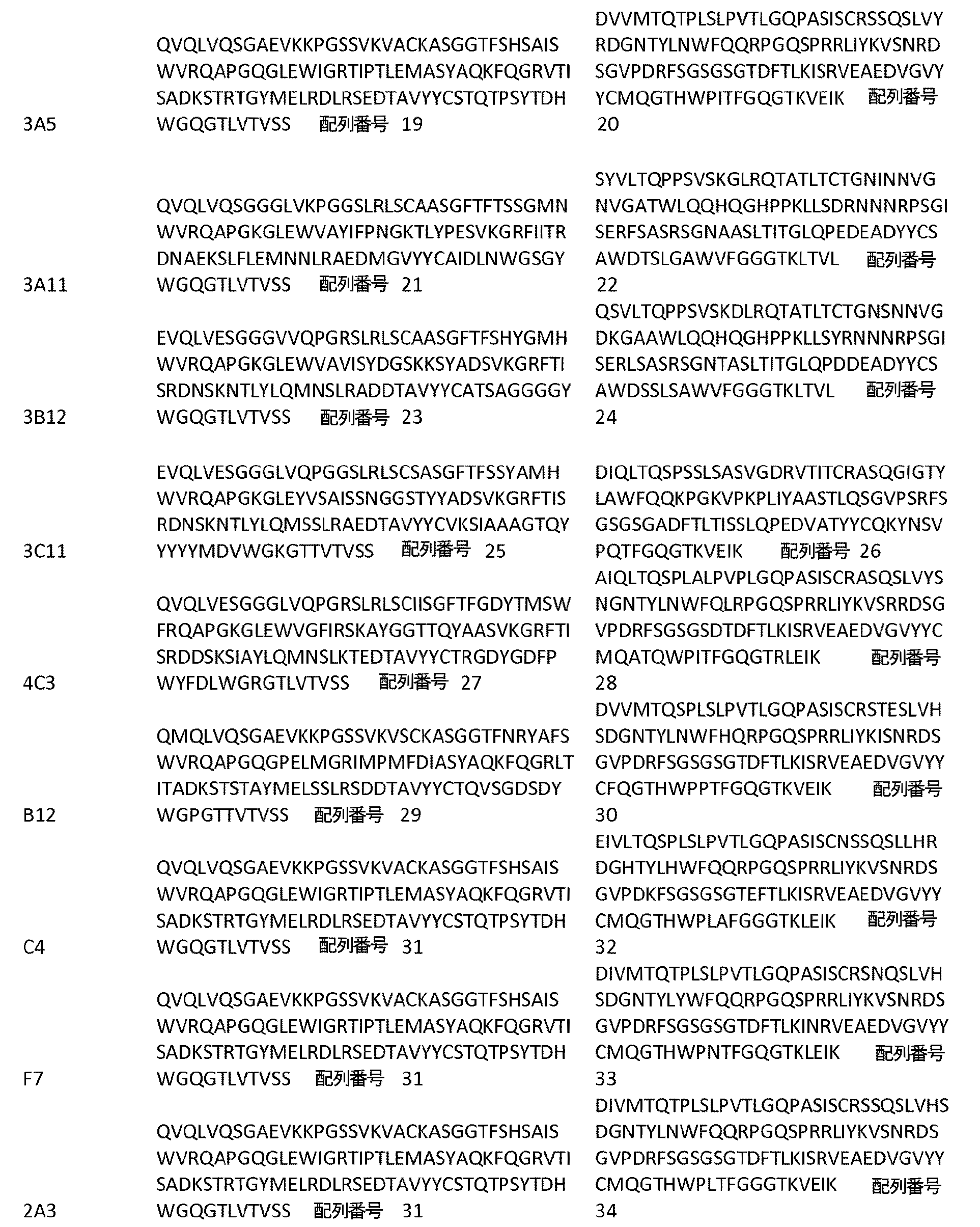
[実施例2」
この実施例は、ヒトCXCR3に結合する抗CXCR3抗体のEC50を決定するための細胞結合アッセイを示す。この実施例は、最大細胞結合および50%結合飽和が達せられる濃度(EC50)に関して、これらの抗体の結合特性を示す。この実施例において、CHO−CXCR3細胞は、非酵素的細胞解離緩衝液−PBSベース(Life Technologies #13151−014)を用いて培養フラスコから取り出された。細胞を1×10⁶細胞/mlでFACS緩衝液(PBS中の2%ウシ胎仔血清)に再懸濁させ、50μl(0.5×105細胞)を96ウェルプレートのウェルに分注した。播種された細胞をスピンダウンし、上清を捨てた。細胞は、連続希釈された濃度の抗体を含有する30μlのFACS緩衝液中に三連で再懸濁された。プレートを1時間、4℃でインキュベートし、次に、FACS緩衝液で2回洗浄した。細胞は、FACS緩衝液で1:500に希釈された、50μlのヤギ抗ヒトIgG(γ鎖特異的)−PEコンジュゲートした二次抗体(Southern Biotech #2040−09)に再懸濁された。細胞をさらに30分間、4℃でインキュベートし、次に、FACS緩衝液で1回洗浄した。細胞を最終容量30μlのFACS緩衝液に再懸濁し、Intellicytフローサイトメーターを用いて分析した。FL−2Hチャネルにおける蛍光の中央値は、FlowJoソフトウェアを用いて測定され、EC50値は、GraphPadプリズムにデータをプロットし、可変スロープ非線形回帰を用いて分析することにより決定された。結果を表2に示す。
Example 2
This example shows a cell binding assay to determine the EC 50 of an anti-CXCR3 antibody that binds to human CXCR3. This example shows the binding properties of these antibodies with respect to the concentration (EC 50 ) at which maximum cell binding and 50% binding saturation is achieved. In this example, CHO-CXCR3 cells were removed from culture flasks using non-enzymatic cell dissociation buffer-PBS base (Life Technologies # 13151-014). Cells were resuspended at 1 × 10 6 cells / ml in FACS buffer (2% fetal calf serum in PBS) and 50 μl (0.5 × 10 5 cells) were dispensed into wells of a 96 well plate. The seeded cells were spun down and the supernatant was discarded. Cells were resuspended in triplicate in 30 μl FACS buffer containing serially diluted concentrations of antibody. Plates were incubated for 1 hour at 4 ° C. and then washed twice with FACS buffer. The cells were resuspended in 50 μl goat anti-human IgG (γ chain specific) -PE conjugated secondary antibody (Southern Biotech # 2040-09) diluted 1: 500 in FACS buffer. The cells were incubated for an additional 30 minutes at 4 ° C. and then washed once with FACS buffer. Cells were resuspended in a final volume of 30 μl FACS buffer and analyzed using an Intelliyt flow cytometer. The median fluorescence in the FL-2H channel was measured using FlowJo software and EC 50 values were determined by plotting the data on a GraphPad prism and analyzing using variable slope nonlinear regression. The results are shown in Table 2.
[実施例3]
この実施例は、マウスCXCR3に結合する抗CXCR3抗体のEC50を決定するための細胞結合アッセイを示す。この実施例は、最大細胞結合および50%結合飽和が達せられる濃度(EC50)に関して、これらの抗体の結合特性を示す。この実施例において、マウスB16−F10細胞(ATCC、#CRL−6475)は、非酵素的細胞解離緩衝液−PBSベース(Life Technologies #13151−014)を用いて培養フラスコから取り出された。細胞を回収し、洗浄し、1×10⁶細胞/mlでFACS緩衝液(PBS中の2%ウシ胎仔血清)に再懸濁させ、50μl(0.5×105細胞)を96ウェルプレートのウェルに分注した。播種された細胞をスピンダウンし、上清を捨てた。細胞は、連続希釈された濃度の抗体を含有する30μlのFACS緩衝液中に三連で再懸濁された。プレートを1時間、4℃でインキュベートし、次に、FACS緩衝液で2回洗浄した。細胞は、FACS緩衝液で1:500に希釈された、50μlのヤギ抗ヒトIgG(γ鎖特異的)−PEコンジュゲートした二次抗体(Southern Biotech #2040−09)に再懸濁された。細胞をさらに30分間、4℃でインキュベートし、次に、FACS緩衝液で1回洗浄した。細胞を最終容量30μlのFACS緩衝液に再懸濁し、Intellicytフローサイトメーターを用いて分析した。FL−2Hチャネルにおける蛍光の中央値は、FlowJoソフトウェアを用いて測定され、EC50値は、GraphPadプリズムにデータをプロットし、可変スロープ非線形回帰を用いて分析することにより決定された。結果を表3に示す。
[Example 3]
This example shows a cell binding assay to determine the EC 50 of an anti-CXCR3 antibody that binds to mouse CXCR3. This example shows the binding properties of these antibodies with respect to the concentration (EC 50 ) at which maximum cell binding and 50% binding saturation is achieved. In this example, mouse B16-F10 cells (ATCC, # CRL-6475) were removed from culture flasks using non-enzymatic cell dissociation buffer-PBS base (Life Technologies # 13151-014). Cells were harvested, washed and resuspended in FACS buffer (2% fetal calf serum in PBS) at 1 × 10 6 cells / ml and 50 μl (0.5 × 10 5 cells) was transferred to a 96-well plate. Dispense into wells. The seeded cells were spun down and the supernatant was discarded. Cells were resuspended in triplicate in 30 μl FACS buffer containing serially diluted concentrations of antibody. Plates were incubated for 1 hour at 4 ° C. and then washed twice with FACS buffer. The cells were resuspended in 50 μl goat anti-human IgG (γ chain specific) -PE conjugated secondary antibody (Southern Biotech # 2040-09) diluted 1: 500 in FACS buffer. The cells were incubated for an additional 30 minutes at 4 ° C. and then washed once with FACS buffer. Cells were resuspended in a final volume of 30 μl FACS buffer and analyzed using an Intelliyt flow cytometer. The median fluorescence in the FL-2H channel was measured using FlowJo software and EC 50 values were determined by plotting the data on a GraphPad prism and analyzing using variable slope nonlinear regression. The results are shown in Table 3.
[実施例4]
この実施例において、CHO−CXCR3細胞は、非酵素的細胞解離緩衝液−PBSベース(Life Technologies #13151−014)を用いて培養フラスコから取り出された。細胞を1×10⁶細胞/mlで、アジ化ナトリウムを含むFACS緩衝液(PBS中の2%ウシ胎仔血清)に再懸濁させ、800μlを各抗体についてチューブに分注した。抗体を最終濃度が5μg/mlになるように添加し、室温で1時間インキュベートした。試料を氷上に置き、様々な時点での105μlのアリコートを96ウェルプレート中の190μlのFACS緩衝液に添加し、3分間遠心分離した。上清を捨て、細胞を105μlのFACS緩衝液に再懸濁し、150μlのFACS緩衝液を含有する別の96ウェルプレートに二連で分注し(50μl)、室温でインキュベートした。すべての時間点を回収した後、プレートを3分間遠心分離し、上清を捨て、細胞は、FACS緩衝液中で1:500に希釈された、50μlのヤギ抗ヒトIgG(γ鎖特異的)−PEコンジュゲートした二次抗体(Southern Biotech #2040−09)に再懸濁された。細胞を30分間、4℃でインキュベートし、次に、FACS緩衝液で1回洗浄した。細胞を最終容量30μlのFACS緩衝液に再懸濁し、Intellicytフローサイトメーターを用いて分析した。経時的なクローン32B12の結合を図1に示す。
[Example 4]
In this example, CHO-CXCR3 cells were removed from culture flasks using non-enzymatic cell dissociation buffer-PBS base (Life Technologies # 13151-014). Cells were resuspended at 1 × 10 6 cells / ml in FACS buffer containing sodium azide (2% fetal calf serum in PBS) and 800 μl was dispensed into tubes for each antibody. Antibody was added to a final concentration of 5 μg / ml and incubated for 1 hour at room temperature. Samples were placed on ice and 105 μl aliquots at various time points were added to 190 μl FACS buffer in 96 well plates and centrifuged for 3 minutes. The supernatant was discarded and the cells were resuspended in 105 μl FACS buffer, aliquoted in another 96 well plate containing 150 μl FACS buffer (50 μl) and incubated at room temperature. After all time points have been collected, the plate is centrifuged for 3 minutes, the supernatant discarded and the cells are diluted 1: 500 in FACS buffer, 50 μl goat anti-human IgG (γ chain specific). -Resuspended in PE-conjugated secondary antibody (Southern Biotech # 2040-09). Cells were incubated for 30 minutes at 4 ° C. and then washed once with FACS buffer. Cells were resuspended in a final volume of 30 μl FACS buffer and analyzed using an Intelliyt flow cytometer. The binding of clone 32B12 over time is shown in FIG.
[実施例5]
この実施例は、抗体CXCR3抗体を用いたカルシウムアッセイを示す。CHO−CXCR3細胞(ヒトCXCR3遺伝子でトランスフェクトされたCHO細胞)をカルシウムアッセイに使用した。0.1×10⁵細胞は、384ウェルプレート(#781091、Greiner)のウェルあたり20μlの増殖培地に播種され、20時間インキュベートされた。増殖培地は、F−12K(#21127、Life Technologies)+10%FBSである。5μlの連続希釈された抗体を20μlの細胞に添加し、20分間、室温でインキュベートした。次に、0.5mMプロベネシド(Sigma#P8761−25G)を含む、25μlのカルシウム4アッセイキット試薬(R8142、Molecular Devices)は、抗体とともにプレインキュベートされた25μlの細胞に添加された。37℃、5%CO2で1時間インキュベートし、続いて、15分間、室温でインキュベートした後、FlexStation3上での検出中に、12.5μlの5×投薬量のリガンドをチャレンジアゴニストとしてプレートの各ウェルに添加した。アッセイに用いられた各リガンドの最終濃度は、200nMのCXCL9(#300−26、PeproTech)、164nMのCXCL10(#300−12、PeproTech)および60nMのCXCL11(#300−46、PeproTech)であった。表に示された各抗体のIC50値は、Prism5を使用して算出された。各々に対応するリガンドとの各抗体のIC50を表4に示す。各IC50値は平均(n=2)を表す。対照抗体は、R&Dのもの(カタログ番号MAB 160、R&D)である。
[Example 5]
This example shows a calcium assay using antibody CXCR3 antibody. CHO-CXCR3 cells (CHO cells transfected with the human CXCR3 gene) were used for the calcium assay. 0.1 × 10 5 cells were seeded in 20 μl of growth medium per well of a 384 well plate (# 781091, Greiner) and incubated for 20 hours. The growth medium is F-12K (# 2127, Life Technologies) + 10% FBS. 5 μl of serially diluted antibody was added to 20 μl of cells and incubated for 20 minutes at room temperature. Next, 25 μl of calcium 4 assay kit reagent (R8142, Molecular Devices) containing 0.5 mM probenecid (Sigma # P8761-25G) was added to 25 μl of cells preincubated with the antibody. After incubating for 1 hour at 37 ° C., 5% CO 2 , followed by 15 minutes at room temperature, during detection on FlexStation 3, 12.5 μl of 5 × dose of ligand as a challenge agonist for each of the plates Added to wells. The final concentration of each ligand used in the assay was 200 nM CXCL9 (# 300-26, PeproTech), 164 nM CXCL10 (# 300-12, PeproTech) and 60 nM CXCL11 (# 300-46, PeproTech). . IC 50 values for each antibody shown in the table were calculated using Prism 5 . Table 4 shows the IC 50 of each antibody with the corresponding ligand. Each IC 50 value represents the average (n = 2). Control antibodies are those of R & D (Cat. No. MAB 160, R & D).
[実施例6]
この実施例は、活性化されたヒトT細胞を用いた走化性アッセイを記載する。抗CD3(1ng/ml)により2日間活性化された初代ヒトT細胞を調製のために用いた。化学走性アッセイは、5μmのポリカーボネート膜で隔てられた2つの区画を有する96ウェル走化性チャンバー(ChemoTX;NeuroProbe、Gaithersburg、MD)を用いて設定された。走化性のために使用されるアッセイ緩衝液は、RPMI+0.5%BSAであった。連続希釈された濃度の抗体は、活性化されたT細胞(25μlのアッセイ緩衝液中の0.1×106細胞)とともに室温で20分間プレインキュベートされた。リガンドであるCXCL9(30nM)、CXCL1O(12.5nM)およびCXCL11(0.3nM))をそれぞれ下部チャンバー内のプレートのウェルにロードし、一方、抗体とともにプレインキュベートされた細胞を膜の上部にロードした。37℃、5%CO2で2時間インキュベートした後、下部チャンバー内に移動した細胞は、不透明白色96ウェルプレートに移され、CellTiter GLO(カタログ番号G7571、Promega)とともに10分間、室温でインキュベートされた。各ウェルの細胞から発生した発光シグナルを蛍光プレートリーダー(FlexStation3、Molecular Devices)によって検出した。表に示された各mAbのIC50値は、Prism5によって算出された。対応するリガンドに対する各mAbのIC50を表5に示す。各IC50値は平均(n=2)を表す。対照抗体は、R&Dのもの(カタログ番号MAB 160、R&D)である。
[Example 6]
This example describes a chemotaxis assay using activated human T cells. Primary human T cells activated with anti-CD3 (1 ng / ml) for 2 days were used for the preparation. The chemotaxis assay was set up using a 96-well chemotaxis chamber (ChemoTX; NeuroProbe, Gaithersburg, MD) with two compartments separated by a 5 μm polycarbonate membrane. The assay buffer used for chemotaxis was RPMI + 0.5% BSA. Serially diluted concentrations of antibody were preincubated with activated T cells (0.1 × 10 6 cells in 25 μl assay buffer) for 20 minutes at room temperature. The ligands CXCL9 (30 nM), CXCL1O (12.5 nM) and CXCL11 (0.3 nM)) were loaded into the wells of the plate in the lower chamber, respectively, while cells preincubated with antibodies were loaded onto the top of the membrane did. After incubating for 2 hours at 37 ° C., 5% CO 2 , cells that migrated into the lower chamber were transferred to an opaque white 96-well plate and incubated with CellTiter GLO (Catalog Number G7571, Promega) for 10 minutes at room temperature. . Luminescent signals generated from the cells in each well were detected by a fluorescent plate reader (FlexStation 3, Molecular Devices). The IC 50 value for each mAb shown in the table was calculated by Prism 5 . The IC 50 of each mAb for the corresponding ligand is shown in Table 5. Each IC 50 value represents the average (n = 2). Control antibodies are those of R & D (Cat. No. MAB 160, R & D).
Claims (18)
完全ヒト抗体が、配列番号1、配列番号3、配列番号5、配列番号7、配列番号9、配列番号11、配列番号13、配列番号15、配列番号17、配列番号19、配列番号21、配列番号23、配列番号25、配列番号27、配列番号29、配列番号31、配列番号33およびこれらの組み合わせからなる群から選択されるアミノ酸配列と少なくとも95%同一である重鎖可変ドメイン配列を有し、配列番号2、配列番号4、配列番号6、配列番号8、配列番号10、配列番号12、配列番号14、配列番号16、配列番号18、配列番号20、配列番号22、配列番号24、配列番号26、配列番号28、配列番号30、配列番号32、配列番号33、配列番号34、配列番号35、配列番号36、配列番号37およびこれらの組み合わせからなる群から選択されるアミノ酸配列と少なくとも95%同一である軽鎖可変ドメイン配列を有し、
完全ヒト抗体Fab断片が、配列番号1、配列番号3、配列番号5、配列番号7、配列番号9、配列番号11、配列番号13、配列番号15、配列番号17、配列番号19、配列番号21、配列番号23、配列番号25、配列番号27、配列番号29、配列番号31、配列番号33およびこれらの組み合わせからなる群から選択されるアミノ酸配列と少なくとも95%同一である重鎖可変ドメイン配列を有し、配列番号2、配列番号4、配列番号6、配列番号8、配列番号10、配列番号12、配列番号14、配列番号16、配列番号18、配列番号20、配列番号22、配列番号24、配列番号26、配列番号28、配列番号30、配列番号32、配列番号33、配列番号34、配列番号35、配列番号36、配列番号37およびこれらの組み合わせからなる群から選択されるアミノ酸配列と少なくとも95%同一である軽鎖可変ドメイン配列を有し、
一本鎖ヒト抗体が、配列番号1、配列番号3、配列番号5、配列番号7、配列番号9、配列番号11、配列番号13、配列番号15、配列番号17、配列番号19、配列番号21、配列番号23、配列番号25、配列番号27、配列番号29、配列番号31、配列番号33およびこれらの組み合わせからなる群から選択されるアミノ酸配列と少なくとも95%同一である重鎖可変ドメイン配列を有し、配列番号2、配列番号4、配列番号6、配列番号8、配列番号10、配列番号12、配列番号14、配列番号16、配列番号18、配列番号20、配列番号22、配列番号24、配列番号26、配列番号28、配列番号30、配列番号32、配列番号33、配列番号34、配列番号35、配列番号36、配列番号37およびこれらの組み合わせからなる群から選択されるアミノ酸配列と少なくとも95%同一である軽鎖可変ドメイン配列を有する方法。 A method for treating a wide range of mammalian cancers or treating inflammatory or autoimmune diseases comprising administering an effective amount of an anti-CXCR3 polypeptide, wherein the anti-CXCR3 polypeptide comprises at least IgG class fully human antibody that binds to CXCR3 epitope with 10 −6 M binding affinity, fully human antibody Fab fragment having variable domain region derived from heavy chain and variable domain derived from light chain, variable domain derived from heavy chain Selected from the group consisting of a variable domain region derived from a region and a light chain, and a single-chain human antibody having a peptide linker linking a heavy chain variable domain region and a light chain variable domain region, and combinations thereof,
The fully human antibody is SEQ ID NO: 1, SEQ ID NO: 3, SEQ ID NO: 5, SEQ ID NO: 7, SEQ ID NO: 9, SEQ ID NO: 11, SEQ ID NO: 13, SEQ ID NO: 15, SEQ ID NO: 17, SEQ ID NO: 19, SEQ ID NO: 21, sequence. Having a heavy chain variable domain sequence that is at least 95% identical to an amino acid sequence selected from the group consisting of SEQ ID NO: 23, SEQ ID NO: 25, SEQ ID NO: 27, SEQ ID NO: 29, SEQ ID NO: 31, SEQ ID NO: 33, and combinations thereof. , SEQ ID NO: 2, SEQ ID NO: 4, SEQ ID NO: 6, SEQ ID NO: 8, SEQ ID NO: 10, SEQ ID NO: 12, SEQ ID NO: 14, SEQ ID NO: 16, SEQ ID NO: 18, SEQ ID NO: 20, SEQ ID NO: 22, SEQ ID NO: 24, SEQ ID NO: 24 SEQ ID NO: 26, SEQ ID NO: 28, SEQ ID NO: 30, SEQ ID NO: 32, SEQ ID NO: 33, SEQ ID NO: 34, SEQ ID NO: 35, SEQ ID NO: 36, SEQ ID NO: 37, and combinations thereof Amino acid sequence selected from Ranaru group and has a light chain variable domain sequence that is at least 95% identical,
The fully human antibody Fab fragment is SEQ ID NO: 1, SEQ ID NO: 3, SEQ ID NO: 5, SEQ ID NO: 7, SEQ ID NO: 9, SEQ ID NO: 11, SEQ ID NO: 13, SEQ ID NO: 15, SEQ ID NO: 17, SEQ ID NO: 19, SEQ ID NO: 21. A heavy chain variable domain sequence that is at least 95% identical to an amino acid sequence selected from the group consisting of SEQ ID NO: 23, SEQ ID NO: 25, SEQ ID NO: 27, SEQ ID NO: 29, SEQ ID NO: 31, SEQ ID NO: 33 and combinations thereof. SEQ ID NO: 2, SEQ ID NO: 4, SEQ ID NO: 6, SEQ ID NO: 8, SEQ ID NO: 10, SEQ ID NO: 12, SEQ ID NO: 14, SEQ ID NO: 16, SEQ ID NO: 18, SEQ ID NO: 20, SEQ ID NO: 22, SEQ ID NO: 24 , SEQ ID NO: 26, SEQ ID NO: 28, SEQ ID NO: 30, SEQ ID NO: 32, SEQ ID NO: 33, SEQ ID NO: 34, SEQ ID NO: 35, SEQ ID NO: 36, SEQ ID NO: 37, and these Amino acid sequence selected from the group consisting of viewing alignment and comprise a light chain variable domain sequence that is at least 95% identical,
Single chain human antibodies are SEQ ID NO: 1, SEQ ID NO: 3, SEQ ID NO: 5, SEQ ID NO: 7, SEQ ID NO: 9, SEQ ID NO: 11, SEQ ID NO: 13, SEQ ID NO: 15, SEQ ID NO: 17, SEQ ID NO: 19, SEQ ID NO: 21. A heavy chain variable domain sequence that is at least 95% identical to an amino acid sequence selected from the group consisting of SEQ ID NO: 23, SEQ ID NO: 25, SEQ ID NO: 27, SEQ ID NO: 29, SEQ ID NO: 31, SEQ ID NO: 33 and combinations thereof. SEQ ID NO: 2, SEQ ID NO: 4, SEQ ID NO: 6, SEQ ID NO: 8, SEQ ID NO: 10, SEQ ID NO: 12, SEQ ID NO: 14, SEQ ID NO: 16, SEQ ID NO: 18, SEQ ID NO: 20, SEQ ID NO: 22, SEQ ID NO: 24 SEQ ID NO: 26, SEQ ID NO: 28, SEQ ID NO: 30, SEQ ID NO: 32, SEQ ID NO: 33, SEQ ID NO: 34, SEQ ID NO: 35, SEQ ID NO: 36, SEQ ID NO: 37, and combinations thereof Method having the light chain variable domain sequence is at least 95% identical to the amino acid sequence selected from the group consisting of.
完全ヒト抗体が、配列番号1、配列番号3、配列番号5、配列番号7、配列番号9、配列番号11、配列番号13、配列番号15、配列番号17、配列番号19、配列番号21、配列番号23、配列番号25、配列番号27、配列番号29、配列番号31、配列番号33およびこれらの組み合わせからなる群から選択されるアミノ酸配列と少なくとも95%同一である重鎖可変ドメイン配列を有し、配列番号2、配列番号4、配列番号6、配列番号8、配列番号10、配列番号12、配列番号14、配列番号16、配列番号18、配列番号20、配列番号22、配列番号24、配列番号26、配列番号28、配列番号30、配列番号32、配列番号33、配列番号34、配列番号35、配列番号36、配列番号37およびこれらの組み合わせからなる群から選択されるアミノ酸配列と少なくとも95%同一である軽鎖可変ドメイン配列を有し、
完全ヒト抗体Fab断片が、配列番号1、配列番号3、配列番号5、配列番号7、配列番号9、配列番号11、配列番号13、配列番号15、配列番号17、配列番号19、配列番号21、配列番号23、配列番号25、配列番号27、配列番号29、配列番号31、配列番号33およびこれらの組み合わせからなる群から選択されるアミノ酸配列と少なくとも95%同一である重鎖可変ドメイン配列を有し、配列番号2、配列番号4、配列番号6、配列番号8、配列番号10、配列番号12、配列番号14、配列番号16、配列番号18、配列番号20、配列番号22、配列番号24、配列番号26、配列番号28、配列番号30、配列番号32、配列番号33、配列番号34、配列番号35、配列番号36、配列番号37およびこれらの組み合わせからなる群から選択されるアミノ酸配列と少なくとも95%同一である軽鎖可変ドメイン配列を有し、
一本鎖ヒト抗体が、配列番号1、配列番号3、配列番号5、配列番号7、配列番号9、配列番号11、配列番号13、配列番号15、配列番号17、配列番号19、配列番号21、配列番号23、配列番号25、配列番号27、配列番号29、配列番号31、配列番号33およびこれらの組み合わせからなる群から選択されるアミノ酸配列と少なくとも95%同一である重鎖可変ドメイン配列を有し、配列番号2、配列番号4、配列番号6、配列番号8、配列番号10、配列番号12、配列番号14、配列番号16、配列番号18、配列番号20、配列番号22、配列番号24、配列番号26、配列番号28、配列番号30、配列番号32、配列番号33、配列番号34、配列番号35、配列番号36、配列番号37およびこれらの組み合わせからなる群から選択されるアミノ酸配列と少なくとも95%同一である軽鎖可変ドメイン配列を有する方法。 A method for treating an inflammatory disorder comprising administering an effective amount of an anti-CXCR3 polypeptide, wherein the anti-CXCR3 polypeptide binds to a CXCR3 epitope with a binding affinity of at least 10 −6 M. Fully human antibody, fully human antibody Fab fragment having variable domain region derived from heavy chain and variable domain region derived from light chain, variable domain region derived from heavy chain and variable domain region derived from light chain, and heavy chain variable domain region A single-chain human antibody having a peptide linker linking the light chain variable domain region, and combinations thereof,
The fully human antibody is SEQ ID NO: 1, SEQ ID NO: 3, SEQ ID NO: 5, SEQ ID NO: 7, SEQ ID NO: 9, SEQ ID NO: 11, SEQ ID NO: 13, SEQ ID NO: 15, SEQ ID NO: 17, SEQ ID NO: 19, SEQ ID NO: 21, sequence. Having a heavy chain variable domain sequence that is at least 95% identical to an amino acid sequence selected from the group consisting of SEQ ID NO: 23, SEQ ID NO: 25, SEQ ID NO: 27, SEQ ID NO: 29, SEQ ID NO: 31, SEQ ID NO: 33, and combinations thereof. , SEQ ID NO: 2, SEQ ID NO: 4, SEQ ID NO: 6, SEQ ID NO: 8, SEQ ID NO: 10, SEQ ID NO: 12, SEQ ID NO: 14, SEQ ID NO: 16, SEQ ID NO: 18, SEQ ID NO: 20, SEQ ID NO: 22, SEQ ID NO: 24, SEQ ID NO: 24 SEQ ID NO: 26, SEQ ID NO: 28, SEQ ID NO: 30, SEQ ID NO: 32, SEQ ID NO: 33, SEQ ID NO: 34, SEQ ID NO: 35, SEQ ID NO: 36, SEQ ID NO: 37, and combinations thereof Amino acid sequence selected from Ranaru group and has a light chain variable domain sequence that is at least 95% identical,
The fully human antibody Fab fragment is SEQ ID NO: 1, SEQ ID NO: 3, SEQ ID NO: 5, SEQ ID NO: 7, SEQ ID NO: 9, SEQ ID NO: 11, SEQ ID NO: 13, SEQ ID NO: 15, SEQ ID NO: 17, SEQ ID NO: 19, SEQ ID NO: 21. A heavy chain variable domain sequence that is at least 95% identical to an amino acid sequence selected from the group consisting of SEQ ID NO: 23, SEQ ID NO: 25, SEQ ID NO: 27, SEQ ID NO: 29, SEQ ID NO: 31, SEQ ID NO: 33 and combinations thereof. SEQ ID NO: 2, SEQ ID NO: 4, SEQ ID NO: 6, SEQ ID NO: 8, SEQ ID NO: 10, SEQ ID NO: 12, SEQ ID NO: 14, SEQ ID NO: 16, SEQ ID NO: 18, SEQ ID NO: 20, SEQ ID NO: 22, SEQ ID NO: 24 , SEQ ID NO: 26, SEQ ID NO: 28, SEQ ID NO: 30, SEQ ID NO: 32, SEQ ID NO: 33, SEQ ID NO: 34, SEQ ID NO: 35, SEQ ID NO: 36, SEQ ID NO: 37, and these Amino acid sequence selected from the group consisting of viewing alignment and comprise a light chain variable domain sequence that is at least 95% identical,
Single chain human antibodies are SEQ ID NO: 1, SEQ ID NO: 3, SEQ ID NO: 5, SEQ ID NO: 7, SEQ ID NO: 9, SEQ ID NO: 11, SEQ ID NO: 13, SEQ ID NO: 15, SEQ ID NO: 17, SEQ ID NO: 19, SEQ ID NO: 21. A heavy chain variable domain sequence that is at least 95% identical to an amino acid sequence selected from the group consisting of SEQ ID NO: 23, SEQ ID NO: 25, SEQ ID NO: 27, SEQ ID NO: 29, SEQ ID NO: 31, SEQ ID NO: 33 and combinations thereof. SEQ ID NO: 2, SEQ ID NO: 4, SEQ ID NO: 6, SEQ ID NO: 8, SEQ ID NO: 10, SEQ ID NO: 12, SEQ ID NO: 14, SEQ ID NO: 16, SEQ ID NO: 18, SEQ ID NO: 20, SEQ ID NO: 22, SEQ ID NO: 24 SEQ ID NO: 26, SEQ ID NO: 28, SEQ ID NO: 30, SEQ ID NO: 32, SEQ ID NO: 33, SEQ ID NO: 34, SEQ ID NO: 35, SEQ ID NO: 36, SEQ ID NO: 37, and combinations thereof Method having the light chain variable domain sequence is at least 95% identical to the amino acid sequence selected from the group consisting of.
Applications Claiming Priority (3)
| Application Number | Priority Date | Filing Date | Title |
|---|---|---|---|
| US201462041020P | 2014-08-22 | 2014-08-22 | |
| US62/041,020 | 2014-08-22 | ||
| PCT/US2015/044348 WO2016028523A2 (en) | 2014-08-22 | 2015-08-07 | Antigen binding proteins that bind cxcr3 |
Publications (1)
| Publication Number | Publication Date |
|---|---|
| JP2017529331A true JP2017529331A (en) | 2017-10-05 |
Family
ID=55347733
Family Applications (1)
| Application Number | Title | Priority Date | Filing Date |
|---|---|---|---|
| JP2017510556A Withdrawn JP2017529331A (en) | 2014-08-22 | 2015-08-07 | Antigen-binding protein that binds to CXCR3 |
Country Status (16)
| Country | Link |
|---|---|
| US (3) | US9765145B2 (en) |
| EP (2) | EP3485910A2 (en) |
| JP (1) | JP2017529331A (en) |
| KR (1) | KR20170067729A (en) |
| CN (1) | CN107148282A (en) |
| AU (1) | AU2015305894A1 (en) |
| BR (1) | BR112017003487A2 (en) |
| CA (1) | CA2958673A1 (en) |
| EA (1) | EA201790437A1 (en) |
| IL (1) | IL250629A0 (en) |
| MA (2) | MA40526A (en) |
| MX (1) | MX2017002380A (en) |
| PH (1) | PH12017500332A1 (en) |
| SG (1) | SG11201701382PA (en) |
| WO (1) | WO2016028523A2 (en) |
| ZA (1) | ZA201701941B (en) |
Families Citing this family (6)
| Publication number | Priority date | Publication date | Assignee | Title |
|---|---|---|---|---|
| KR20190095943A (en) * | 2016-12-22 | 2019-08-16 | 사노피 | Humanized CXCR3 Antibody Having Depleting Activity and Method of Use thereof |
| TW201840585A (en) * | 2016-12-22 | 2018-11-16 | 法商賽諾菲公司 | Anti-human cxcr3 antibodies for treatment of vitiligo |
| US20240101673A1 (en) | 2021-02-03 | 2024-03-28 | Mozart Therapeutics, Inc. | Binding agents and methods of using the same |
| CN113684238A (en) * | 2021-08-09 | 2021-11-23 | 广州医科大学附属第一医院(广州呼吸中心) | Use of CXC chemokine receptor 3 as a cough drug target |
| WO2023076876A1 (en) | 2021-10-26 | 2023-05-04 | Mozart Therapeutics, Inc. | Modulation of immune responses to viral vectors |
| WO2025185738A1 (en) * | 2024-03-08 | 2025-09-12 | 演生潮(北京)生物科技有限公司 | Antigen binding protein targeting cxcr3 and use thereof |
Family Cites Families (39)
| Publication number | Priority date | Publication date | Assignee | Title |
|---|---|---|---|---|
| NL154598B (en) | 1970-11-10 | 1977-09-15 | Organon Nv | PROCEDURE FOR DETERMINING AND DETERMINING LOW MOLECULAR COMPOUNDS AND PROTEINS THAT CAN SPECIFICALLY BIND THESE COMPOUNDS AND TEST PACKAGING. |
| US3901654A (en) | 1971-06-21 | 1975-08-26 | Biological Developments | Receptor assays of biologically active compounds employing biologically specific receptors |
| US3817827A (en) | 1972-03-30 | 1974-06-18 | Scott Paper Co | Soft absorbent fibrous webs containing elastomeric bonding material and formed by creping and embossing |
| US4179337A (en) | 1973-07-20 | 1979-12-18 | Davis Frank F | Non-immunogenic polypeptides |
| US4002531A (en) | 1976-01-22 | 1977-01-11 | Pierce Chemical Company | Modifying enzymes with polyethylene glycol and product produced thereby |
| US4098876A (en) | 1976-10-26 | 1978-07-04 | Corning Glass Works | Reverse sandwich immunoassay |
| JPS6023084B2 (en) | 1979-07-11 | 1985-06-05 | 味の素株式会社 | blood substitute |
| US4640835A (en) | 1981-10-30 | 1987-02-03 | Nippon Chemiphar Company, Ltd. | Plasminogen activator derivatives |
| US4496689A (en) | 1983-12-27 | 1985-01-29 | Miles Laboratories, Inc. | Covalently attached complex of alpha-1-proteinase inhibitor with a water soluble polymer |
| DE3675588D1 (en) | 1985-06-19 | 1990-12-20 | Ajinomoto Kk | HAEMOGLOBIN TIED TO A POLY (ALKENYLENE OXIDE). |
| US4791192A (en) | 1986-06-26 | 1988-12-13 | Takeda Chemical Industries, Ltd. | Chemically modified protein with polyethyleneglycol |
| US4946778A (en) | 1987-09-21 | 1990-08-07 | Genex Corporation | Single polypeptide chain binding molecules |
| US6010902A (en) | 1988-04-04 | 2000-01-04 | Bristol-Meyers Squibb Company | Antibody heteroconjugates and bispecific antibodies for use in regulation of lymphocyte activity |
| US5766897A (en) | 1990-06-21 | 1998-06-16 | Incyte Pharmaceuticals, Inc. | Cysteine-pegylated proteins |
| GB9014932D0 (en) | 1990-07-05 | 1990-08-22 | Celltech Ltd | Recombinant dna product and method |
| JP3051145B2 (en) | 1990-08-28 | 2000-06-12 | 住友製薬株式会社 | Novel polyethylene glycol derivative modified peptide |
| US5582996A (en) | 1990-12-04 | 1996-12-10 | The Wistar Institute Of Anatomy & Biology | Bifunctional antibodies and method of preparing same |
| DE4118120A1 (en) | 1991-06-03 | 1992-12-10 | Behringwerke Ag | TETRAVALENT BISPECIFIC RECEPTORS, THEIR PRODUCTION AND USE |
| WO1994004679A1 (en) | 1991-06-14 | 1994-03-03 | Genentech, Inc. | Method for making humanized antibodies |
| US5281698A (en) | 1991-07-23 | 1994-01-25 | Cetus Oncology Corporation | Preparation of an activated polymer ester for protein conjugation |
| JPH05244982A (en) | 1991-12-06 | 1993-09-24 | Sumitomo Chem Co Ltd | Humanized b-b10 |
| AU673190B2 (en) | 1992-07-13 | 1996-10-31 | Bionebraska, Inc. | Method for modification of recombinant polypeptides |
| US5382657A (en) | 1992-08-26 | 1995-01-17 | Hoffmann-La Roche Inc. | Peg-interferon conjugates |
| ATE240394T1 (en) | 1992-10-23 | 2003-05-15 | Immunex Corp | METHODS FOR PRODUCING SOLUBLE OLIGOMERIC PROTEINS |
| US5446090A (en) | 1993-11-12 | 1995-08-29 | Shearwater Polymers, Inc. | Isolatable, water soluble, and hydrolytically stable active sulfones of poly(ethylene glycol) and related polymers for modification of surfaces and molecules |
| US5824784A (en) | 1994-10-12 | 1998-10-20 | Amgen Inc. | N-terminally chemically modified protein compositions and methods |
| US5932462A (en) | 1995-01-10 | 1999-08-03 | Shearwater Polymers, Inc. | Multiarmed, monofunctional, polymer for coupling to molecules and surfaces |
| US5731168A (en) | 1995-03-01 | 1998-03-24 | Genentech, Inc. | Method for making heteromultimeric polypeptides |
| GB9722131D0 (en) | 1997-10-20 | 1997-12-17 | Medical Res Council | Method |
| EP1105427A2 (en) | 1998-08-17 | 2001-06-13 | Abgenix, Inc. | Generation of modified molecules with increased serum half-lives |
| GB9928787D0 (en) | 1999-12-03 | 2000-02-02 | Medical Res Council | Direct screening method |
| US6938003B2 (en) | 2000-06-30 | 2005-08-30 | Mahesh Harpale | Method and apparatus for a credibility reporting system to augment an online exchange |
| US7052686B2 (en) | 2000-09-29 | 2006-05-30 | Schering Corporation | Pegylated interleukin-10 |
| GB0025144D0 (en) | 2000-10-13 | 2000-11-29 | Medical Res Council | Concatenated nucleic acid sequences |
| US20040202995A1 (en) | 2003-04-09 | 2004-10-14 | Domantis | Nucleic acids, proteins, and screening methods |
| WO2005030793A2 (en) * | 2003-09-24 | 2005-04-07 | Millennium Pharmaceuticals, Inc. | Antibodies which bind human cxcr3 |
| US8435522B2 (en) * | 2007-02-01 | 2013-05-07 | Teva Biopharmaceuticals Usa, Inc. | Humanized antibodies against CXCR3 |
| CN103382222B (en) * | 2009-03-20 | 2016-12-28 | 安姆根有限公司 | α-4-β-7 heterodimer specific antagonist antibody |
| SG10201700735PA (en) | 2012-01-20 | 2017-02-27 | Genzyme Corp | Anti-cxcr3 antibodies |
-
2015
- 2015-08-07 WO PCT/US2015/044348 patent/WO2016028523A2/en not_active Ceased
- 2015-08-07 MA MA040526A patent/MA40526A/en unknown
- 2015-08-07 CN CN201580056545.7A patent/CN107148282A/en not_active Withdrawn
- 2015-08-07 CA CA2958673A patent/CA2958673A1/en not_active Abandoned
- 2015-08-07 KR KR1020177007935A patent/KR20170067729A/en not_active Withdrawn
- 2015-08-07 EP EP18201628.7A patent/EP3485910A2/en not_active Withdrawn
- 2015-08-07 AU AU2015305894A patent/AU2015305894A1/en not_active Abandoned
- 2015-08-07 SG SG11201701382PA patent/SG11201701382PA/en unknown
- 2015-08-07 MX MX2017002380A patent/MX2017002380A/en unknown
- 2015-08-07 US US14/821,559 patent/US9765145B2/en not_active Expired - Fee Related
- 2015-08-07 BR BR112017003487A patent/BR112017003487A2/en not_active Application Discontinuation
- 2015-08-07 EA EA201790437A patent/EA201790437A1/en unknown
- 2015-08-07 MA MA045695A patent/MA45695A/en unknown
- 2015-08-07 EP EP15833176.9A patent/EP3183000A4/en not_active Withdrawn
- 2015-08-07 JP JP2017510556A patent/JP2017529331A/en not_active Withdrawn
-
2017
- 2017-02-15 IL IL250629A patent/IL250629A0/en unknown
- 2017-02-22 PH PH12017500332A patent/PH12017500332A1/en unknown
- 2017-03-20 ZA ZA2017/01941A patent/ZA201701941B/en unknown
- 2017-08-21 US US15/682,206 patent/US20190008955A1/en not_active Abandoned
-
2018
- 2018-10-09 US US16/155,278 patent/US10668148B2/en active Active
Also Published As
| Publication number | Publication date |
|---|---|
| MX2017002380A (en) | 2017-09-15 |
| EP3485910A2 (en) | 2019-05-22 |
| EP3183000A2 (en) | 2017-06-28 |
| SG11201701382PA (en) | 2017-03-30 |
| ZA201701941B (en) | 2018-05-30 |
| US20160053013A1 (en) | 2016-02-25 |
| MA40526A (en) | 2017-06-28 |
| CN107148282A (en) | 2017-09-08 |
| US10668148B2 (en) | 2020-06-02 |
| WO2016028523A3 (en) | 2016-08-04 |
| IL250629A0 (en) | 2017-04-30 |
| US20190060448A1 (en) | 2019-02-28 |
| EA201790437A1 (en) | 2017-08-31 |
| EP3183000A4 (en) | 2018-04-25 |
| KR20170067729A (en) | 2017-06-16 |
| US20190008955A1 (en) | 2019-01-10 |
| AU2015305894A1 (en) | 2017-04-06 |
| WO2016028523A8 (en) | 2016-09-15 |
| MA45695A (en) | 2019-05-22 |
| US9765145B2 (en) | 2017-09-19 |
| BR112017003487A2 (en) | 2017-11-28 |
| WO2016028523A2 (en) | 2016-02-25 |
| CA2958673A1 (en) | 2016-02-25 |
| PH12017500332A1 (en) | 2017-07-17 |
Similar Documents
| Publication | Publication Date | Title |
|---|---|---|
| JP7140867B2 (en) | Antigen-binding protein that binds to PD-L1 | |
| JP6648080B2 (en) | Antigen binding protein that binds to PD-L1 | |
| JP6563906B2 (en) | Antigen binding protein that binds to PD-1 | |
| US10668148B2 (en) | Fully human anti-C-X-C chemokine receptor 3 (CXCR3) antibodies and methods of use thereof | |
| JP2017525710A (en) | Antigen binding protein that binds to CXCR5 | |
| JP2015520172A (en) | Antigen binding protein that binds to DLL-4 | |
| JP6388576B2 (en) | Antigen binding protein that binds to IGF1R |
Legal Events
| Date | Code | Title | Description |
|---|---|---|---|
| A621 | Written request for application examination |
Free format text: JAPANESE INTERMEDIATE CODE: A621 Effective date: 20180806 |
|
| A761 | Written withdrawal of application |
Free format text: JAPANESE INTERMEDIATE CODE: A761 Effective date: 20190517 |
|
| A521 | Request for written amendment filed |
Free format text: JAPANESE INTERMEDIATE CODE: A821 Effective date: 20190517 |