JP2018024794A - Thermoplastic polymer composition and molded article - Google Patents
Thermoplastic polymer composition and molded article Download PDFInfo
- Publication number
- JP2018024794A JP2018024794A JP2016158416A JP2016158416A JP2018024794A JP 2018024794 A JP2018024794 A JP 2018024794A JP 2016158416 A JP2016158416 A JP 2016158416A JP 2016158416 A JP2016158416 A JP 2016158416A JP 2018024794 A JP2018024794 A JP 2018024794A
- Authority
- JP
- Japan
- Prior art keywords
- thermoplastic polymer
- polymer composition
- mass
- acrylic
- block copolymer
- Prior art date
- Legal status (The legal status is an assumption and is not a legal conclusion. Google has not performed a legal analysis and makes no representation as to the accuracy of the status listed.)
- Granted
Links
Landscapes
- Compositions Of Macromolecular Compounds (AREA)
- Graft Or Block Polymers (AREA)
Abstract
【課題】耐熱性、透明性、柔軟性に優れ、成形体の外観にも優れる熱可塑性重合体組成物を提供することである。また、上記熱可塑性重合体組成物からなる上記特性を有する成形体を提供すること。【解決手段】アクリル酸エステル単位を主体とする重合体ブロック(a1)の両末端にそれぞれメタクリル酸エステル単位を主体とする重合体ブロック(a2)が結合した構造を分子内に少なくとも一つ有し、重量平均分子量が10,000〜150,000であり、重合体ブロック(a2)の含有量が30質量%以上60質量%以下であるアクリル系ブロック共重合体(A)と耐熱透明樹脂(B)とを含み、アクリル系ブロック共重合体(A)と耐熱透明樹脂(B)との質量比[(A)/(B)]が85/15〜1/99である熱可塑性重合体組成物。【選択図】なしPROBLEM TO BE SOLVED: To provide a thermoplastic polymer composition excellent in heat resistance, transparency and flexibility, and also excellent in appearance of a molded product. Further, to provide a molded product having the above-mentioned characteristics, which is made of the above-mentioned thermoplastic polymer composition. SOLUTION: The molecule has at least one structure in which a polymer block (a2) mainly composed of a methacrylic acid ester unit is bonded to both ends of a polymer block (a1) mainly composed of an acrylic acid ester unit. The acrylic block copolymer (A) and the heat-resistant transparent resin (B) having a weight average molecular weight of 10,000 to 150,000 and a polymer block (a2) content of 30% by mass or more and 60% by mass or less. ), And the mass ratio [(A) / (B)] of the acrylic block copolymer (A) to the heat-resistant transparent resin (B) is 85/15 to 1/99. .. [Selection diagram] None
Description
本発明は、アクリル系ブロック共重合体と耐熱透明樹脂からなる熱可塑性重合体組成物及び成形体に関する。 The present invention relates to a thermoplastic polymer composition and a molded body comprising an acrylic block copolymer and a heat-resistant transparent resin.
アクリル系ブロック共重合体にメタクリル樹脂を混合した、透明性、柔軟性及び成形加工性に優れた樹脂組成物が提案されている。このようなアクリル系ブロック共重合体にメタクリル樹脂を混合した樹脂組成物は、例えば、自動車部材、雑貨部材をはじめとする様々な用途で使用されてきている。 There has been proposed a resin composition excellent in transparency, flexibility and molding processability, in which a methacrylic resin is mixed with an acrylic block copolymer. Resin compositions in which a methacrylic resin is mixed with such an acrylic block copolymer have been used in various applications including, for example, automobile members and miscellaneous goods members.
例えば、特許文献1では、アクリル系熱可塑性エラストマーにメタクリル樹脂を混合した、耐候性、柔軟性、および機械的強度のバランスに優れた樹脂組成物が検討されている。特許文献2では、アクリル樹脂に、複数種のアクリル系ブロック共重合体を混合した、広範囲の組成で透明性、成形加工性等に優れる樹脂組成物が検討されている。特許文献3では、メタクリル樹脂に、アクリル系ブロック共重合体を混合した、透明性、成形性及び機械物性に優れた樹脂組成物が検討されている。 For example, Patent Document 1 discusses a resin composition having a good balance of weather resistance, flexibility, and mechanical strength, in which a methacrylic resin is mixed with an acrylic thermoplastic elastomer. In Patent Document 2, a resin composition having a wide range of compositions and excellent transparency, molding processability, and the like, in which an acrylic resin is mixed with a plurality of types of acrylic block copolymers, is studied. In Patent Document 3, a resin composition excellent in transparency, moldability, and mechanical properties obtained by mixing an acrylic block copolymer with a methacrylic resin is studied.
なお、特許文献4では、メタクリル樹脂の優れた透明性を損なうことなく、メタクリル樹脂に所定量配合することで耐熱性を向上させ、且つ優れた外観の成形品を得ることを可能とするメタクリル樹脂耐熱性向上用の共重合体が検討されている。 In Patent Document 4, a methacrylic resin that can improve the heat resistance by blending a predetermined amount into the methacrylic resin and obtain a molded article having an excellent appearance without impairing the excellent transparency of the methacrylic resin. Copolymers for improving heat resistance are being studied.
しかしながら、特許文献1〜3のアクリル樹脂とアクリル系ブロック共重合体を混合した樹脂組成物には、耐熱性を改善する方法に関する具体的記載はない。
また、特許文献4のメタクリル樹脂耐熱性向上用の共重合体は、メタクリル樹脂への添加に限定されており、アクリル系ブロック共重合体への添加の記載はない。そのため弾性率が高い領域の成形体しか得られず、改良の余地があった。
However, the resin composition obtained by mixing the acrylic resin and the acrylic block copolymer described in Patent Documents 1 to 3 has no specific description regarding a method for improving heat resistance.
Moreover, the copolymer for heat resistance improvement of the methacryl resin of patent document 4 is limited to the addition to a methacryl resin, and there is no description of the addition to an acrylic block copolymer. Therefore, only a molded body having a high elastic modulus can be obtained, and there is room for improvement.
上記事情に鑑み、本発明が解決しようとする課題は、耐熱性、透明性、柔軟性に優れ、成形体の外観にも優れる熱可塑性重合体組成物を提供することである。また、上記熱可塑性重合体組成物からなる上記特性を有する成形体を提供することである。 In view of the above circumstances, the problem to be solved by the present invention is to provide a thermoplastic polymer composition which is excellent in heat resistance, transparency and flexibility and excellent in appearance of a molded product. Moreover, it is providing the molded object which has the said characteristic consisting of the said thermoplastic polymer composition.
本発明者らは、上記課題を解決するために鋭意研究をした結果、特定のアクリル系ブロック共重合体に耐熱透明樹脂を特定の割合で配合することで、上記課題を解決できることを見出し、本発明を完成するに至った。 As a result of diligent research to solve the above problems, the present inventors have found that the above problems can be solved by blending a specific acrylic block copolymer with a heat-resistant transparent resin in a specific ratio. The invention has been completed.
即ち本発明は、
[1]アクリル酸エステル単位を主体とする重合体ブロック(a1)の両末端にそれぞれメタクリル酸エステル単位を主体とする重合体ブロック(a2)が結合した構造を分子内に少なくとも一つ有し、重量平均分子量が10,000〜150,000であり、重合体ブロック(a2)の含有量が30質量%以上60質量%以下であるアクリル系ブロック共重合体(A)と耐熱透明樹脂(B)とを含み、アクリル系ブロック共重合体(A)と耐熱透明樹脂(B)との質量比[(A)/(B)]が85/15〜1/99である熱可塑性重合体組成物;
[2]アクリル系ブロック共重合体(A)の、重合体ブロック(a2)の含有量が40質量%以上55質量%以下である、[1]に記載の熱可塑性重合体組成物;
[3]アクリル系ブロック共重合体(A)の、重合体ブロック(a1)がアクリル酸アルキルエステル50〜90質量%とアクリル酸芳香族エステル50〜10質量%との共重合体ブロックである、[1]または[2]に記載の熱可塑性重合体組成物;
[4]アクリル酸芳香族エステルがアクリル酸ベンジルである、[3]に記載の熱可塑性重合組成物;
[5]アクリル系ブロック共重合体(A)と耐熱透明樹脂(B)との質量比[(A)/(B)]が80/20〜60/40である、[1]〜[4]のいずれかに記載の熱可塑性重合体組成物;
[6]耐熱透明樹脂(B)が、芳香族ビニル化合物単量体単位、(メタ)アクリル酸エステル単量体単位、不飽和ジカルボン酸無水物単量体単位からなる共重合体である、[1]〜[5]のいずれかに記載の熱可塑性重合体組成物;
[7]耐熱透明樹脂(B)が、50Nでのビカット軟化温度が120℃以上である、[1]〜[6]のいずれかに記載の熱可塑性重合体組成物;
[8][1]〜[7]のいずれかに記載の熱可塑性重合体組成物からなる成形体;
[9][8]に記載の成形体からなる自動車内装部材;
[10][8]に記載の成形体からなる電子機器用カバー;
に関する。
That is, the present invention
[1] It has at least one structure in the molecule in which a polymer block (a2) mainly composed of a methacrylic ester unit is bonded to both ends of the polymer block (a1) mainly composed of an acrylate ester unit, Acrylic block copolymer (A) having a weight average molecular weight of 10,000 to 150,000 and a polymer block (a2) content of 30% by mass or more and 60% by mass or less and a heat-resistant transparent resin (B) A thermoplastic polymer composition having a mass ratio [(A) / (B)] of the acrylic block copolymer (A) and the heat-resistant transparent resin (B) of 85/15 to 1/99;
[2] The thermoplastic polymer composition according to [1], wherein the content of the polymer block (a2) in the acrylic block copolymer (A) is from 40% by mass to 55% by mass;
[3] In the acrylic block copolymer (A), the polymer block (a1) is a copolymer block of 50 to 90% by mass of an acrylic acid alkyl ester and 50 to 10% by mass of an acrylic acid aromatic ester. [1] or the thermoplastic polymer composition according to [2];
[4] The thermoplastic polymerization composition according to [3], wherein the aromatic ester of acrylic acid is benzyl acrylate;
[5] The mass ratio [(A) / (B)] of the acrylic block copolymer (A) and the heat-resistant transparent resin (B) is 80/20 to 60/40, [1] to [4] The thermoplastic polymer composition according to any one of
[6] The heat-resistant transparent resin (B) is a copolymer comprising an aromatic vinyl compound monomer unit, a (meth) acrylic acid ester monomer unit, and an unsaturated dicarboxylic anhydride monomer unit. 1]-[5] thermoplastic polymer composition;
[7] The thermoplastic polymer composition according to any one of [1] to [6], wherein the heat-resistant transparent resin (B) has a Vicat softening temperature at 120 N of 120 ° C. or higher;
[8] A molded article comprising the thermoplastic polymer composition according to any one of [1] to [7];
[9] An automobile interior member comprising the molded article according to [8];
[10] A cover for electronic equipment comprising the molded article according to [8];
About.
本発明によれば、上記構成をとることにより、耐熱性、透明性、柔軟性に優れ、成形体の外観にも優れる熱可塑性重合体組成物及びそれからなる成形体を提供することができる。 According to this invention, by taking the said structure, it can provide the thermoplastic polymer composition which is excellent in heat resistance, transparency, a softness | flexibility, and is excellent also in the external appearance of a molded object, and a molded object consisting thereof.
以下、本発明を詳細に説明する。
本発明の熱可塑性重合体組成物は、アクリル酸エステル単位を主体とする重合体ブロック(a1)の両末端にそれぞれメタクリル酸エステル単位を主体とする重合体ブロック(a2)が結合した構造を分子内に少なくとも一つ有し、重量平均分子量が10,000〜150,000であり、重合体ブロック(a2)の含有量が30質量%以上60質量%以下であるアクリル系ブロック共重合体(A)と耐熱透明樹脂(B)とを含み、アクリル系ブロック共重合体(A)と耐熱透明樹脂(B)との質量比[(A)/(B)]が85/15〜1/99である熱可塑性重合体組成物である。
Hereinafter, the present invention will be described in detail.
The thermoplastic polymer composition of the present invention has a structure in which a polymer block (a2) mainly composed of a methacrylic ester unit is bonded to both ends of a polymer block (a1) mainly composed of an acrylate unit. An acrylic block copolymer having a weight average molecular weight of 10,000 to 150,000 and a polymer block (a2) content of 30% by mass to 60% by mass (A) ) And a heat-resistant transparent resin (B), and the mass ratio [(A) / (B)] of the acrylic block copolymer (A) and the heat-resistant transparent resin (B) is 85/15 to 1/99. A thermoplastic polymer composition.
本発明における第1の成分であるアクリル系ブロック共重合体(A)は、アクリル酸エステル単位を主体とする重合体ブロック(a1)の両末端にそれぞれメタクリル酸エステル単位を主体とする重合体ブロック(a2)が結合した構造、すなわち、(a2)−(a1)−(a2)の構造(構造中「−」は、化学結合を示す)を分子内に少なくとも1つ有するアクリル系ブロック共重合体である。 The acrylic block copolymer (A) which is the first component in the present invention is a polymer block mainly composed of methacrylate units at both ends of the polymer block (a1) mainly composed of acrylate units. Acrylic block copolymer having at least one structure in which (a2) is bonded, that is, a structure of (a2)-(a1)-(a2) (in the structure, “-” indicates a chemical bond). It is.
上記アクリル系ブロック共重合体(A)におけるアクリル酸エステル単位を主体とする重合体ブロック(a1)は、アクリル酸エステル単位の含有量が重合体ブロック(a1)中、通常60質量%以上であり、80質量%以上が好ましく、90質量%以上がより好ましく、重合体ブロック(a1)中100質量%であってもよい。重合体ブロック(a1)を形成させるためのアクリル酸エステルとしては、例えば、アクリル酸メチル、アクリル酸エチル、アクリル酸n−プロピル、アクリル酸イソプロピル、アクリル酸n−ブチル、アクリル酸イソブチル、アクリル酸sec−ブチル、アクリル酸tert−ブチル、アクリル酸アミル、アクリル酸イソアミル、アクリル酸n−ヘキシル、アクリル酸シクロヘキシル、アクリル酸2−エチルヘキシル、アクリル酸ペンタデシル、アクリル酸ドデシル、アクリル酸イソボルニル、アクリル酸フェニル、アクリル酸ベンジル、アクリル酸フェノキシエチル、アクリル酸2−ヒドロキシエチル、アクリル酸2−メトキシエチルなどを挙げることができる。これらのアクリル酸エステルの中でも、柔軟性を向上させる観点から、アクリル酸メチル、アクリル酸エチル、アクリル酸イソプロピル、アクリル酸n−ブチル、アクリル酸2−エチルヘキシル、アクリル酸ドデシル、アクリル酸フェノキシエチル、アクリル酸2−メトキシエチルなどのアクリル酸アルキルエステルが好ましく、アクリル酸n−ブチル、アクリル酸2−エチルヘキシルがより好ましい。重合体ブロック(a1)は、これらのアクリル酸エステルの1種から構成されていても、2種以上から構成されていてもよい。 The polymer block (a1) mainly composed of acrylate units in the acrylic block copolymer (A) has a content of acrylate units of usually 60% by mass or more in the polymer block (a1). 80% by mass or more, preferably 90% by mass or more, and may be 100% by mass in the polymer block (a1). Examples of the acrylic ester for forming the polymer block (a1) include methyl acrylate, ethyl acrylate, n-propyl acrylate, isopropyl acrylate, n-butyl acrylate, isobutyl acrylate, and sec sec acrylic acid. -Butyl, tert-butyl acrylate, amyl acrylate, isoamyl acrylate, n-hexyl acrylate, cyclohexyl acrylate, 2-ethylhexyl acrylate, pentadecyl acrylate, dodecyl acrylate, isobornyl acrylate, phenyl acrylate, acrylic Examples include benzyl acid, phenoxyethyl acrylate, 2-hydroxyethyl acrylate, 2-methoxyethyl acrylate, and the like. Among these acrylate esters, from the viewpoint of improving flexibility, methyl acrylate, ethyl acrylate, isopropyl acrylate, n-butyl acrylate, 2-ethylhexyl acrylate, dodecyl acrylate, phenoxyethyl acrylate, acrylic An acrylic acid alkyl ester such as 2-methoxyethyl acid is preferable, and n-butyl acrylate and 2-ethylhexyl acrylate are more preferable. The polymer block (a1) may be composed of one kind of these acrylate esters or may be composed of two or more kinds.
また、本発明の目的および効果の妨げにならない限りにおいて、重合体ブロック(a1)は、反応基を有するアクリル酸エステル単位、例えば、アクリル酸グリシジル、アクリル酸アリル;またはアクリル酸エステル単位以外の他の重合性単量体単位、例えば、下記メタクリル酸エステル、メタクリル酸、アクリル酸、芳香族ビニル化合物、アクリロニトリル、メタクリロニトリル、オレフィン;などのモノマーを共重合成分として含んでいてもよい。これら反応基を有するアクリル酸エステル単位または他の重合性単量体単位は本発明の効果を発現させる観点から少量であることが好ましく、好ましくは10質量%以下、より好ましくは2質量%以下である。 As long as the object and effect of the present invention are not hindered, the polymer block (a1) may be an acrylate unit having a reactive group, such as glycidyl acrylate, allyl acrylate; or other than acrylate units. A polymerizable monomer unit, for example, the following monomers such as methacrylic acid ester, methacrylic acid, acrylic acid, aromatic vinyl compound, acrylonitrile, methacrylonitrile, olefin; The amount of the acrylate ester unit or other polymerizable monomer unit having these reactive groups is preferably a small amount from the viewpoint of manifesting the effects of the present invention, preferably 10% by mass or less, more preferably 2% by mass or less. is there.
得られる熱可塑性重合体組成物の透明性を向上させる観点からは、アクリル酸エステル単位を主体とする重合体ブロック(a1)は、上記アクリル酸アルキルエステルと、アクリル酸芳香族エステルとの共重合体ブロックであることが好ましい。アクリル酸アルキルエステルと共重合するアクリル酸芳香族エステルとしては、アクリル酸ベンジル、アクリル酸フェニル、アクリル酸フェノキシエチル、アクリル酸フェノキシジエチレングリコール、アクリル酸フェノキシ-ポリエチレングリコール、アクリル酸2−ヒドロキシ−3−フェノキシプロピルなどが好ましく、アクリル酸ベンジルがより好ましい。 From the viewpoint of improving the transparency of the obtained thermoplastic polymer composition, the polymer block (a1) mainly composed of an acrylate unit is a copolymer of the above-mentioned alkyl acrylate and an aromatic acrylate. A coalescence block is preferred. Acrylic acid aromatic ester copolymerized with acrylic acid alkyl ester includes benzyl acrylate, phenyl acrylate, phenoxyethyl acrylate, phenoxydiethylene glycol acrylate, phenoxy-polyethylene glycol acrylate, 2-hydroxy-3-phenoxy acrylate Propyl and the like are preferable, and benzyl acrylate is more preferable.
上記アクリル酸エステル単位を主体とする重合体ブロック(a1)がアクリル酸アルキルエステルとアクリル酸芳香族エステルとの共重合体ブロックである場合、アクリル酸アルキルエステル50〜90質量%及びアクリル酸芳香族エステル50〜10質量%の共重合体ブロックであることが好ましく、アクリル酸アルキルエステル60〜80質量%及びアクリル酸芳香族エステル40〜20質量%の共重合体ブロックであることがより好ましい。 When the polymer block (a1) mainly composed of the acrylate unit is a copolymer block of an acrylate alkyl ester and an acrylate aromatic ester, 50 to 90% by mass of the acrylate alkyl ester and the acrylate aromatic It is preferably a copolymer block of 50 to 10% by mass of ester, more preferably a copolymer block of 60 to 80% by mass of acrylic acid alkyl ester and 40 to 20% by mass of acrylic acid aromatic ester.
上記アクリル系ブロック共重合体(A)における、メタクリル酸エステル単位を主体とする重合体ブロック(a2)は、メタクリル酸エステル単位の含有量が重合体ブロック(a2)中、通常60質量%以上であり、80質量%以上が好ましく、90質量%以上がより好ましく、重合体ブロック(a2)中100質量%であってもよい。重合体ブロック(a2)を形成させるためのメタクリル酸エステルとしては、例えば、メタクリル酸メチル、メタクリル酸エチル、メタクリル酸n−プロピル、メタクリル酸イソプロピル、メタクリル酸n−ブチル、メタクリル酸イソブチル、メタクリル酸sec−ブチル、メタクリル酸tert−ブチル、メタクリル酸アミル、メタクリル酸イソアミル、メタクリル酸n−ヘキシル、メタクリル酸シクロヘキシル、メタクリル酸2−エチルヘキシル、メタクリル酸ペンタデシル、メタクリル酸ドデシル、メタクリル酸イソボルニル、メタクリル酸フェニル、メタクリル酸ベンジル、メタクリル酸フェノキシエチル、メタクリル酸2−ヒドロキシエチル、メタクリル酸2−メトキシエチルなどを挙げることができる。これらのメタクリル酸エステルの中でも、透明性、耐熱性を向上させる観点から、メタクリル酸メチル、メタクリル酸エチル、メタクリル酸イソプロピル、メタクリル酸n−ブチル、メタクリル酸tert−ブチル、メタクリル酸シクロヘキシル、メタクリル酸イソボルニルなどのメタクリル酸アルキルエステルが好ましく、メタクリル酸メチルがより好ましい。重合体ブロック(a2)は、これらのメタクリル酸エステルの1種から構成されていても、2種以上から構成されていてもよい。 In the acrylic block copolymer (A), the polymer block (a2) mainly composed of methacrylic acid ester units has a methacrylic acid ester unit content of usually 60% by mass or more in the polymer block (a2). Yes, 80 mass% or more is preferable, 90 mass% or more is more preferable, and may be 100 mass% in the polymer block (a2). Examples of the methacrylic acid ester for forming the polymer block (a2) include methyl methacrylate, ethyl methacrylate, n-propyl methacrylate, isopropyl methacrylate, n-butyl methacrylate, isobutyl methacrylate, sec sec methacrylate. -Butyl, tert-butyl methacrylate, amyl methacrylate, isoamyl methacrylate, n-hexyl methacrylate, cyclohexyl methacrylate, 2-ethylhexyl methacrylate, pentadecyl methacrylate, dodecyl methacrylate, isobornyl methacrylate, phenyl methacrylate, methacryl Examples include benzyl acid, phenoxyethyl methacrylate, 2-hydroxyethyl methacrylate, 2-methoxyethyl methacrylate, and the like. Among these methacrylate esters, from the viewpoint of improving transparency and heat resistance, methyl methacrylate, ethyl methacrylate, isopropyl methacrylate, n-butyl methacrylate, tert-butyl methacrylate, cyclohexyl methacrylate, isobornyl methacrylate And alkyl methacrylates such as methyl methacrylate are more preferred. The polymer block (a2) may be composed of one of these methacrylic acid esters or may be composed of two or more.
また、本発明の目的および効果の妨げにならない限りにおいて、重合体ブロック(a2)は、反応基を有するメタクリル酸エステル単位、例えば、メタクリル酸グリシジル、メタクリル酸アリル、またはメタクリルエステル単位以外の他の重合性単量体単位、例えば、前記アクリル酸エステル、メタクリル酸、アクリル酸、芳香族ビニル化合物、アクリロニトリル、メタクリロニトリル、オレフィンなどのモノマーを共重合成分として少量、好ましくは10質量%以下、より好ましくは2質量%以下含んでいてもよい。 In addition, as long as the object and effect of the present invention are not hindered, the polymer block (a2) may be a methacrylic acid ester unit having a reactive group, for example, glycidyl methacrylate, allyl methacrylate, or other than methacrylic ester units. A small amount, preferably 10% by mass or less, of a polymerizable monomer unit, for example, a monomer such as the acrylic acid ester, methacrylic acid, acrylic acid, aromatic vinyl compound, acrylonitrile, methacrylonitrile, olefin, as a copolymerization component. Preferably it may contain 2 mass% or less.
上記アクリル系ブロック共重合体(A)の分子鎖形態は、特に限定されることなく、例えば、線状、分枝状、放射状などのいずれでもよいが、2個のメタクリル酸エステル単位を主体とする重合体ブロック(a2)と1個のアクリル酸エステル単位を主体とする重合体ブロック(a1)からなる(a2)−(a1)−(a2)構造を分子内に少なくとも1個有することが好ましく、その中でも(a2)−(a1)−(a2)で表されるトリブロック体がより好ましい。ここで、(a1)の両端の(a2)の分子量、組成などは同じであってもよいし、相互に異なっていてもよい。また、(a2)−(a1)で表されるジブロック体も好ましい。 The molecular chain form of the acrylic block copolymer (A) is not particularly limited, and may be any of linear, branched, radial, etc., but mainly comprises two methacrylate units. It is preferable to have at least one (a2)-(a1)-(a2) structure in the molecule comprising the polymer block (a2) to be formed and the polymer block (a1) mainly composed of one acrylate unit. Of these, triblock bodies represented by (a2)-(a1)-(a2) are more preferred. Here, the molecular weight and composition of (a2) at both ends of (a1) may be the same or different from each other. Moreover, the diblock body represented by (a2)-(a1) is also preferable.
本発明の目的および効果の妨げにならない限りにおいて、アクリル系ブロック共重合体(A)は、これらの重合体ブロック(a1)および(a2)とは別の重合体ブロックとして、アクリル酸エステル単量体およびメタクリル酸エステル単量体以外の単量体から誘導される重合体ブロック(c)を有してもよい。重合体ブロック(c)と上記アクリル酸エステル単位を主体とする重合体ブロック(a1)、メタクリル酸エステル単位を主体とする重合体ブロック(a2)との結合の形態は特には限定されないが、例えば、(a2)−((a1)−(a2))n−(c)や、(c)−(a2)−((a1)−(a2))n−(c)などの構造(nは1〜20の整数である)が挙げられる。 As long as the purpose and effect of the present invention are not hindered, the acrylic block copolymer (A) is used as a polymer block different from these polymer blocks (a1) and (a2). And a polymer block (c) derived from a monomer other than the monomer and the methacrylic acid ester monomer. The form of the bond between the polymer block (c) and the polymer block (a1) mainly composed of the acrylate unit and the polymer block (a2) mainly composed of the methacrylic ester unit is not particularly limited. , (A2)-((a1)-(a2)) n- (c) and (c)-(a2)-((a1)-(a2)) n- (c) (n is 1 It is an integer of ~ 20).
上記重合体ブロック(c)を構成する単量体としては、例えばエチレン、プロピレン、1−ブテン、イソブチレン、1−オクテンなどのオレフィン;1,3−ブタジエン、イソプレン、ミルセンなどの共役ジエン化合物;スチレン、α−メチルスチレン、p-メチルスチレン、m−メチルスチレンなどの芳香族ビニル化合物;酢酸ビニル、ビニルピリジン、アクリロニトリル、メタクリロニトリル、ビニルケトン、塩化ビニル、塩化ビニリデン、フッ化ビニリデン、アクリルアミド、メタクリルアミド、ε−カプロラクトン、バレロラクトンなどを挙げることができる。 Examples of the monomer constituting the polymer block (c) include olefins such as ethylene, propylene, 1-butene, isobutylene and 1-octene; conjugated diene compounds such as 1,3-butadiene, isoprene and myrcene; styrene , Α-methylstyrene, p-methylstyrene, m-methylstyrene and other aromatic vinyl compounds; vinyl acetate, vinylpyridine, acrylonitrile, methacrylonitrile, vinyl ketone, vinyl chloride, vinylidene chloride, vinylidene fluoride, acrylamide, methacrylamide , Ε-caprolactone, valerolactone, and the like.
本発明に用いるアクリル系ブロック共重合体(A)は、必要に応じて、分子鎖中または分子鎖末端に水酸基、カルボキシル基、酸無水物、アミノ基などの官能基を有していてもよい。 The acrylic block copolymer (A) used in the present invention may have a functional group such as a hydroxyl group, a carboxyl group, an acid anhydride, or an amino group in the molecular chain or at the molecular chain end as necessary. .
上記アクリル系ブロック共重合体(A)の重量平均分子量は、本発明の熱可塑性重合体組成物及びそれからなる成形体の耐熱性、透明性、柔軟性、成形体の外観の観点から10,000〜150,000である。上記観点から、30,000〜120,000であるのが好ましく、50,000〜100,000であるのがより好ましい。アクリル系ブロック共重合体(A)の重量平均分子量が10,000以上であると、溶融押出成形において十分な溶融張力を保持でき、良好な成形体が得られる。また、得られた成形体の破断強度などの力学物性に優れる。一方、150,000以下であると、溶融押出成形で得られる成形体の表面に微細なシボ調の凹凸や未溶融物(高分子量体)に起因するブツが発生しにくく、外観に優れる成形体が得られる傾向がある。 The weight average molecular weight of the acrylic block copolymer (A) is 10,000 from the viewpoints of the heat resistance, transparency, flexibility, and appearance of the molded product of the thermoplastic polymer composition of the present invention and the molded product comprising the same. ~ 150,000. From the above viewpoint, it is preferably 30,000 to 120,000, and more preferably 50,000 to 100,000. When the acrylic block copolymer (A) has a weight average molecular weight of 10,000 or more, sufficient melt tension can be maintained in melt extrusion molding, and a good molded body can be obtained. Further, the obtained molded article is excellent in mechanical properties such as breaking strength. On the other hand, if it is 150,000 or less, the surface of the molded body obtained by melt extrusion molding is less prone to fine grain-like irregularities and unevenness due to unmelted material (high molecular weight body), and is excellent in appearance. Tends to be obtained.
また、アクリル系ブロック共重合体(A)の数平均分子量(Mn)と重量平均分子量(Mw)の比(Mw/Mn)は、1.01以上1.50未満の範囲内にあるのがよく、1.01以上1.35以下の範囲内にあるのがより好ましい。このような範囲を取ることにより、本発明の熱可塑性重合体組成物からなる成形体におけるブツの発生原因となる未溶融物の含有量を極めて少量とすることができる。 The ratio (Mw / Mn) of the number average molecular weight (Mn) and the weight average molecular weight (Mw) of the acrylic block copolymer (A) is preferably in the range of 1.01 or more and less than 1.50. More preferably, it is in the range of 1.01 to 1.35. By taking such a range, it is possible to make the content of the unmelted material that is a cause of fluffing in the molded body made of the thermoplastic polymer composition of the present invention extremely small.
上記アクリル系ブロック共重合体(A)における重合体ブロック(a2)の含有量は、耐熱性、透明性、柔軟性、成形体の外観の観点から、30質量%以上60質量%以下であり、40質量%以上55質量%以下であることがより好ましい。アクリル系ブロック共重合体(A)における重合体ブロック(a2)の含有量が上記範囲より小さい場合には、本発明の熱可塑性重合体組成物およびそれからなる成形体の透明性が低下し、成形材料として適さなくなる傾向がある。アクリル系ブロック共重合体(A)における重合体ブロック(a2)の含有量が上記範囲より大きい場合には、本発明の熱可塑性重合体組成物およびそれからなる成形体の耐熱性は向上するが、柔軟性が劣る傾向がある。 The content of the polymer block (a2) in the acrylic block copolymer (A) is 30% by mass or more and 60% by mass or less from the viewpoint of heat resistance, transparency, flexibility, and appearance of the molded product. More preferably, it is 40 mass% or more and 55 mass% or less. When the content of the polymer block (a2) in the acrylic block copolymer (A) is smaller than the above range, the transparency of the thermoplastic polymer composition of the present invention and the molded product comprising the same is lowered, and molding There is a tendency to become unsuitable as a material. When the content of the polymer block (a2) in the acrylic block copolymer (A) is larger than the above range, the heat resistance of the thermoplastic polymer composition of the present invention and the molded product formed therefrom is improved. There is a tendency for flexibility to be inferior.
上記アクリル系ブロック共重合体(A)の屈折率は、1.485〜1.495であることが好ましい。屈折率が上記の範囲にあると、本発明の熱可塑性重合体組成物およびそれからなる成形体の透明性が向上する。また、メタクリル酸エステル単位を主体とする重合体ブロック(a2)とアクリル酸エステル単位を主体とする重合体ブロック(a1)の屈折率がそれぞれ1.485〜1.495の範囲であることがより好ましい。
The refractive index of the acrylic block copolymer (A) is preferably 1.485 to 1.495. When the refractive index is within the above range, the transparency of the thermoplastic polymer composition of the present invention and a molded article comprising the same is improved. Further, the refractive index of the polymer block (a2) mainly composed of methacrylic acid ester units and the polymer block (a1) mainly composed of acrylate ester units is preferably in the range of 1.485 to 1.495. preferable.
アクリル系ブロック共重合体(A)の製造方法としては、特に限定されず、公知の手法に準じた方法を採用することができる。例えば、各ブロックを構成するモノマーをリビング重合する方法が一般に使用される。このようなリビング重合の手法としては、例えば、有機アルカリ金属化合物を重合開始剤としアルカリ金属またはアルカリ土類金属塩などの鉱酸塩の存在下でアニオン重合する方法(特公平7−25859号公報参照)、有機アルカリ金属化合物を重合開始剤とし有機アルミニウム化合物の存在下でアニオン重合する方法(特開平11−335432号公報参照)、有機希土類金属錯体を重合開始剤として重合する方法(特開平6−93060号公報参照)、α−ハロゲン化エステル化合物を開始剤として銅化合物の存在下ラジカル重合する方法(マクロモレキュラケミカルフィジックス(Macromol. Chem. Phys.)201巻,1108〜1114頁(2000年)参照)などが挙げられる。また、多価ラジカル重合開始剤や多価ラジカル連鎖移動剤を用いて、各ブロックを構成するモノマーを重合させ、本発明のアクリル系ブロック共重合体(A)を含有する混合物として製造する方法なども挙げられる。これらの方法中、特に、アクリル系ブロック共重合体が高純度で得られ、また分子量や組成比の制御が容易であり、かつ経済的であることから、有機アルカリ金属化合物を重合開始剤とし有機アルミニウム化合物の存在下でアニオン重合する方法が推奨される。 It does not specifically limit as a manufacturing method of an acryl-type block copolymer (A), The method according to a well-known method is employable. For example, a method of living polymerizing monomers constituting each block is generally used. As a technique for such living polymerization, for example, a method of anionic polymerization using an organic alkali metal compound as a polymerization initiator in the presence of a mineral salt such as an alkali metal or alkaline earth metal salt (Japanese Patent Publication No. 7-25859) A method of anionic polymerization using an organic alkali metal compound as a polymerization initiator in the presence of an organic aluminum compound (see JP-A-11-335432), and a method of polymerizing using an organic rare earth metal complex as a polymerization initiator (JP-A-6-6). -93060 publication), a method of radical polymerization in the presence of a copper compound using an α-halogenated ester compound as an initiator (Macromol. Chem. Phys.) 201, 1108-1114 (2000) ))). Moreover, the method of polymerizing the monomer which comprises each block using a polyvalent radical polymerization initiator and a polyvalent radical chain transfer agent, and manufacturing as a mixture containing the acryl-type block copolymer (A) of this invention, etc. Also mentioned. Among these methods, an acrylic block copolymer is obtained with high purity, and the molecular weight and composition ratio can be easily controlled and economical. A method of anionic polymerization in the presence of an aluminum compound is recommended.
上記アクリル酸エステル単位を主体とする重合体ブロック(a1)を製造する際に用いるアクリル酸エステルは、予め2種以上を混合した混合モノマーとしてもよく、アクリル酸アルキルエステル及びアクリル酸芳香族エステルの混合モノマーとすることが好ましい。この場合、アクリル酸アルキルエステル50〜90質量%とアクリル酸芳香族エステル50〜10質量%の混合モノマーであることが好ましく、アクリル酸アルキルエステル60〜80質量%とアクリル酸芳香族エステル40〜20質量%の混合モノマーであることがより好ましい。 The acrylic acid ester used when producing the polymer block (a1) mainly composed of the acrylic acid ester unit may be a mixed monomer in which two or more kinds are mixed in advance, such as an acrylic acid alkyl ester and an acrylic acid aromatic ester. It is preferable to use a mixed monomer. In this case, it is preferable that it is a mixed monomer of 50-90 mass% of acrylic acid alkyl ester and 50-10 mass% of acrylic acid aromatic ester, 60-80 mass% of acrylic acid alkyl ester, and 40-20 mass% of acrylic acid aromatic ester. More preferably, it is a mixed monomer of mass%.
本発明に用いられる耐熱透明樹脂(B)は、芳香族ビニル化合物単量体単位、(メタ)アクリル酸エステル単量体単位及び不飽和ジカルボン酸無水物単量体単位からなる共重合体であるものが好ましい。 The heat resistant transparent resin (B) used in the present invention is a copolymer comprising an aromatic vinyl compound monomer unit, a (meth) acrylic acid ester monomer unit, and an unsaturated dicarboxylic anhydride monomer unit. Those are preferred.
芳香族ビニル化合物単量体単位としては、例えばスチレン、o−メチルスチレン、m−メチルスチレン、p−メチルスチレン、2,4−ジメチルスチレン、エチルスチレン、p−tert−ブチルスチレン、α−メチルスチレン、α−メチル−p−メチルスチレンなどの各スチレン系単量体に由来する単位が挙げられる。これらの中でも好ましくはスチレン単位である。これら芳香族ビニル化合物単量体単位は1種類でもよく、2種類以上の併用であってもよい。 Examples of the aromatic vinyl compound monomer unit include styrene, o-methylstyrene, m-methylstyrene, p-methylstyrene, 2,4-dimethylstyrene, ethylstyrene, p-tert-butylstyrene, α-methylstyrene. And units derived from styrene monomers such as α-methyl-p-methylstyrene. Of these, styrene units are preferred. One kind of these aromatic vinyl compound monomer units may be used, or two or more kinds thereof may be used in combination.
(メタ)アクリル酸エステル単量体単位としては、例えばメチルメタクリレート、エチルメタクリレート、n−ブチルメタクリレート、2−エチルヘキシルメタクリレート、ジシクロペンタニルメタクリレート、イソボルニルメタクリレートなどの各メタクリル酸エステル単量体、およびメチルアクリレート、エチルアクリレート、n−ブチルアクリレート、2−メチルヘキシルアクリレート、2−エチルヘキシルアクリレート、デシルアクリレートなどの各アクリル酸エステル単量体に由来する単位が挙げられる。これらの中でも好ましくはメチルメタクリレート単位である。これら(メタ)アクリル酸エステル単量体単位は、1種類でもよく、2種類以上の併用であってもよい。 Examples of the (meth) acrylic acid ester monomer unit include, for example, methyl methacrylate monomers such as methyl methacrylate, ethyl methacrylate, n-butyl methacrylate, 2-ethylhexyl methacrylate, dicyclopentanyl methacrylate, and isobornyl methacrylate. And units derived from each acrylate monomer such as methyl acrylate, ethyl acrylate, n-butyl acrylate, 2-methylhexyl acrylate, 2-ethylhexyl acrylate, decyl acrylate, and the like. Among these, a methyl methacrylate unit is preferable. These (meth) acrylic acid ester monomer units may be one kind or a combination of two or more kinds.
不飽和ジカルボン酸無水物単量体単位としては、例えばマレイン酸無水物、イタコン酸無水物、シトラコン酸無水物、アコニット酸無水物などの各無水物単量体に由来する単位が挙げられる。これらの中でも好ましくはマレイン酸無水物単位である。不飽和ジカルボン酸無水物単量体単位は、1種でもよく、2種類以上の併用であってもよい。 Examples of the unsaturated dicarboxylic acid anhydride monomer unit include units derived from respective anhydride monomers such as maleic acid anhydride, itaconic acid anhydride, citraconic acid anhydride, and aconitic acid anhydride. Among these, maleic anhydride units are preferable. The unsaturated dicarboxylic acid anhydride monomer unit may be one type or a combination of two or more types.
耐熱透明樹脂(B)における上記各成分の含有量は特に限定されないが、それぞれ芳香族ビニル化合物単量体単位45〜85質量%、(メタ)アクリル酸エステル単量体単位5〜45%質量%、不飽和ジカルボン酸無水物単量体単位10〜20質量%を含有するものが、本発明の熱可塑性重合体組成物及びそれからなる成形体の耐熱性向上の観点から好ましい。 Although content of each said component in heat-resistant transparent resin (B) is not specifically limited, Aromatic vinyl compound monomer unit 45-85 mass%, (meth) acrylic acid ester monomer unit 5-45% mass%, respectively Those containing 10 to 20% by mass of unsaturated dicarboxylic acid anhydride monomer units are preferred from the viewpoint of improving the heat resistance of the thermoplastic polymer composition of the present invention and a molded article comprising the same.
耐熱透明樹脂(B)は、ASTM D1003に基づき測定した2mm厚みの全光線透過率が88%以上であるものが好ましく、より好ましくは89%以上であり、さらに好ましくは90%以上である。2mm厚みの全光線透過率が88%以上であれば、本発明の熱可塑性重合体組成物及びそれからなる成形体の透明性が良好になる。 The heat-resistant transparent resin (B) preferably has a 2 mm-thick total light transmittance measured based on ASTM D1003 of 88% or more, more preferably 89% or more, and still more preferably 90% or more. If the total light transmittance with a thickness of 2 mm is 88% or more, the thermoplastic polymer composition of the present invention and the molded article made thereof will have good transparency.
耐熱透明樹脂(B)は、重量平均分子量(Mw)が10万〜20万であることが好ましく、本発明の熱可塑性重合体組成物及びそれからなる成形体の耐熱性、透明性、柔軟性、成形体の外観の観点から、重量平均分子量(Mw)は12万〜18万がより好ましい。 The heat-resistant transparent resin (B) preferably has a weight average molecular weight (Mw) of 100,000 to 200,000, and the thermoplastic polymer composition of the present invention and a molded product comprising the same, heat resistance, transparency, flexibility, From the viewpoint of the appearance of the molded body, the weight average molecular weight (Mw) is more preferably 120,000 to 180,000.
耐熱透明樹脂(B)のビカット軟化温度に特段の制限はないが、本発明の熱可塑性重合体組成物及びそれからなる成形体の耐熱性を向上させる観点からは、50Nでのビカット軟化温度が120℃以上であることが好ましく、130℃以上であることがより好ましい。ビカット軟化温度の上限は特に制限されないが、ビカット軟化温度の数値が大きすぎると耐熱透明樹脂(B)は黄味が強くなる傾向があるため、本発明の熱可塑性重合体組成物及びそれからなる成形体の光学性能が低下する場合がある。また、ビカット軟化温度の数値が小さすぎると、本発明の熱可塑性重合体組成物及びそれからなる成形体の耐熱性向上効果が十分に得られない場合がある。そのため、50Nでのビカット軟化温度の範囲は120℃以上150℃以下であることがより好ましく、130℃以上150℃以下であることが更に好ましい。 The Vicat softening temperature of the heat-resistant transparent resin (B) is not particularly limited. However, from the viewpoint of improving the heat resistance of the thermoplastic polymer composition of the present invention and a molded article comprising the thermoplastic polymer composition, the Vicat softening temperature at 50 N is 120. It is preferable that it is higher than 130 ° C, and more preferable that it is higher than 130 ° C. The upper limit of the Vicat softening temperature is not particularly limited, but if the Vicat softening temperature is too large, the heat-resistant transparent resin (B) tends to have a strong yellow tint. Therefore, the thermoplastic polymer composition of the present invention and a molding comprising the same The optical performance of the body may be reduced. Moreover, when the numerical value of Vicat softening temperature is too small, the heat resistance improvement effect of the thermoplastic polymer composition of this invention and a molded object consisting thereof may not be sufficiently obtained. Therefore, the Vicat softening temperature range at 50 N is more preferably 120 ° C. or more and 150 ° C. or less, and further preferably 130 ° C. or more and 150 ° C. or less.
耐熱透明樹脂(B)は市販品を用いてもよい。かかる市販されている耐熱透明樹脂としては、例えば「レジスファイR100」(ビカット軟化温度:126℃(50N))、「レジスファイR200」(ビカット軟化温度:132℃(50N))[いずれも商品名、デンカ株式会社製]などが挙げられる。 A commercially available product may be used as the heat-resistant transparent resin (B). Examples of such commercially available heat-resistant transparent resins include “Regisphi R100” (Vicat softening temperature: 126 ° C. (50 N)), “Regisfi R200” (Vicat softening temperature: 132 ° C. (50 N)) [both trade names, Denka Etc.].
本発明の熱可塑性重合体組成物におけるアクリル系ブロック共重合体(A)と耐熱透明樹脂(B)との質量比[(A)/(B)]は、耐熱性、透明性、柔軟性、成形体の外観に優れる観点から85/15〜1/99であり、85/15〜55/45がより好ましく、80/20〜60/40がより更に好ましい。 The mass ratio [(A) / (B)] of the acrylic block copolymer (A) and the heat-resistant transparent resin (B) in the thermoplastic polymer composition of the present invention is the heat resistance, transparency, flexibility, From the viewpoint of excellent appearance of the molded product, the ratio is 85/15 to 1/99, more preferably 85/15 to 55/45, and still more preferably 80/20 to 60/40.
本発明の熱可塑性重合体組成物は、本発明の効果を損なわない範囲であれば、上記したアクリル系ブロック共重合体(A)および耐熱透明樹脂(B)の他に、必要に応じて他の重合体などを含有していてもよい。他の重合体としては、例えば、ポリエチレン、ポリプロピレン、ポリブテン−1、ポリ−4−メチルペンテン−1、ポリノルボルネン等のオレフィン系樹脂;エチレン系アイオノマー;ポリスチレン、スチレン−無水マレイン酸共重合体、ハイインパクトポリスチレン、AS樹脂、ABS樹脂、AES樹脂、AAS樹脂、ACS樹脂、MBS樹脂等のスチレン系樹脂;ポリメタクリル酸メチル等のアクリル樹脂;メチルメタクリレート−スチレン共重合体;ポリエチレンテレフタレート、ポリブチレンテレフタレート、ポリ乳酸等のポリエステル樹脂;ナイロン6、ナイロン66、ポリアミドエラストマー等のポリアミド樹脂;エステル系ポリウレタンエラストマー、エーテル系ポリウレタンエラストマー、無黄変エステル系ポリウレタンエラストマー、無黄変カーボネート系ポリウレタンエラストマー等のポリウレタン樹脂;ポリカーボネート、ポリ塩化ビニル、ポリ塩化ビニリデン、ポリビニルアルコール、エチレン−ビニルアルコール共重合体、ポリアセタール、ポリフッ化ビニリデン、変性ポリフェニレンエーテル、ポリフェニレンスルフィド、シリコーンゴム変性樹脂等が挙げられる。これらの中でも、本発明の熱可塑性重合体組成物に含まれるアクリル系ブロック共重合体(A)との相溶性の観点から、アクリル樹脂、AS樹脂、ポリフッ化ビニリデンが好ましい。 As long as the thermoplastic polymer composition of the present invention is within the range not impairing the effects of the present invention, in addition to the acrylic block copolymer (A) and the heat-resistant transparent resin (B), other may be used as necessary. The polymer may be contained. Other polymers include, for example, olefin resins such as polyethylene, polypropylene, polybutene-1, poly-4-methylpentene-1, polynorbornene; ethylene ionomers; polystyrene, styrene-maleic anhydride copolymers, high Impact polystyrene, AS resin, ABS resin, AES resin, AAS resin, ACS resin, MBS resin and other styrene resins; polymethyl methacrylate and other acrylic resins; methyl methacrylate-styrene copolymers; polyethylene terephthalate, polybutylene terephthalate, Polyester resins such as polylactic acid; polyamide resins such as nylon 6, nylon 66 and polyamide elastomer; ester polyurethane elastomers, ether polyurethane elastomers, non-yellowing ester polyurethane resins Polyurethane resins such as steamers and non-yellowing carbonate polyurethane elastomers; polycarbonate, polyvinyl chloride, polyvinylidene chloride, polyvinyl alcohol, ethylene-vinyl alcohol copolymer, polyacetal, polyvinylidene fluoride, modified polyphenylene ether, polyphenylene sulfide, silicone rubber Examples thereof include modified resins. Among these, acrylic resin, AS resin, and polyvinylidene fluoride are preferable from the viewpoint of compatibility with the acrylic block copolymer (A) contained in the thermoplastic polymer composition of the present invention.
さらに、本発明の熱可塑性重合体組成物は、本発明の効果を損なわない範囲内で、公知の各種添加剤(例えば、ゴム、滑剤、酸化防止剤、光安定剤、着色剤、帯電防止剤、難燃剤など)、フィラー(例えば、ガラス繊維等の繊維補強剤、無機充填剤など)等を含有してもよい。添加剤として含有させうるゴムの例としては、アクリル系ゴム;シリコーン系ゴム;SEPS、SEBS、SIS等のスチレン系熱可塑性エラストマー;IR、EPR、EPDM等のオレフィン系ゴム等が挙げられ、これらを1種以上使用することができる。他の添加剤やフィラーの例としては、成形加工時の流動性を向上させるためのパラフィン系オイル、ナフテン系オイルなどの鉱物油軟化剤;耐熱性、耐候性等の向上または増量などを目的とする炭酸カルシウム、タルク、カーボンブラック、酸化チタン、シリカ、クレー、硫酸バリウム、炭酸マグネシウムなどの無機充填剤;補強のためのガラス繊維、カーボン繊維などの無機繊維または有機繊維;熱安定剤;酸化防止剤;光安定剤;粘着剤;粘着付与剤;可塑剤;帯電防止剤;発泡剤;着色剤;染色剤などを挙げることができる。これらの添加剤の中でも、耐熱性、耐候性をさらに良好なものとするために、熱安定剤、酸化防止剤などを添加することが実用上好ましい。 Furthermore, the thermoplastic polymer composition of the present invention may be prepared by adding various known additives (for example, rubber, lubricant, antioxidant, light stabilizer, colorant, antistatic agent within the range not impairing the effects of the present invention. , Flame retardant, etc.), filler (for example, fiber reinforcing agent such as glass fiber, inorganic filler, etc.) and the like. Examples of rubbers that can be included as additives include acrylic rubbers; silicone rubbers; styrene thermoplastic elastomers such as SEPS, SEBS, and SIS; and olefin rubbers such as IR, EPR, and EPDM. One or more can be used. Examples of other additives and fillers include mineral oil softeners such as paraffinic oils and naphthenic oils for improving fluidity during molding; the purpose is to improve heat resistance, weather resistance, etc. Inorganic fillers such as calcium carbonate, talc, carbon black, titanium oxide, silica, clay, barium sulfate, magnesium carbonate; inorganic fiber or organic fiber such as glass fiber and carbon fiber for reinforcement; heat stabilizer; Light stabilizers; adhesives; tackifiers; plasticizers; antistatic agents; foaming agents; colorants; Among these additives, in order to further improve heat resistance and weather resistance, it is practically preferable to add a heat stabilizer, an antioxidant and the like.
本発明の熱可塑性重合体組成物を調製する方法は特に制限されないが、該熱可塑性重合体組成物を構成する各成分の分散性を高めるため、溶融混練して混合する方法が推奨される。該調製方法としては、例えば、アクリル系ブロック共重合体(A)および耐熱透明樹脂(B)を溶融混練する方法が挙げられるが、必要に応じてこれらと上記した他の重合体および添加剤とを同時に混合してもよいし、アクリル系ブロック共重合体(A)を、上記した他の重合体および添加剤とともに混合後、耐熱透明樹脂(B)と混合してもよい。混合操作は、例えば、ニーダールーダー、押出機、ミキシングロール、バンバリーミキサーなどの既知の混合または混練装置を使用して行なうことができる。特に、アクリル系ブロック共重合体(A)と耐熱透明樹脂(B)の混練性、相溶性を向上させる観点から、二軸押出機を使用することが好ましい。混合・混練時の温度は、使用するアクリル系ブロック共重合体(A)、耐熱透明樹脂(B)の溶融温度などに応じて適宜調節するのがよく、通常110℃〜300℃の範囲内の温度で混合するとよい。このようにして、本発明の熱可塑性重合体組成物を、ペレット、粉末などの任意の形態で得ることができる。ペレット、粉末などの形態の熱可塑性重合体組成物は、成形材料として使用するのに好適である。 The method for preparing the thermoplastic polymer composition of the present invention is not particularly limited, but in order to improve the dispersibility of each component constituting the thermoplastic polymer composition, a method of melt kneading and mixing is recommended. Examples of the preparation method include a method of melt-kneading the acrylic block copolymer (A) and the heat-resistant transparent resin (B). If necessary, these and other polymers and additives described above may be used. May be mixed at the same time, or the acrylic block copolymer (A) may be mixed with the heat-resistant transparent resin (B) after being mixed with the other polymer and additives described above. The mixing operation can be performed using a known mixing or kneading apparatus such as a kneader ruder, an extruder, a mixing roll, or a Banbury mixer. In particular, it is preferable to use a twin screw extruder from the viewpoint of improving the kneadability and compatibility between the acrylic block copolymer (A) and the heat-resistant transparent resin (B). The temperature at the time of mixing and kneading is suitably adjusted according to the melting temperature of the acrylic block copolymer (A) and the heat-resistant transparent resin (B) to be used, and is usually in the range of 110 ° C to 300 ° C. Mix at temperature. In this way, the thermoplastic polymer composition of the present invention can be obtained in any form such as pellets and powders. The thermoplastic polymer composition in the form of pellets, powders and the like is suitable for use as a molding material.
本発明の熱可塑性重合体組成物は、熱可塑性重合体に対して一般に用いられている成形加工方法や成形加工装置を用いて成形加工することができ、本発明の熱可塑性重合体組成物からなる成形体を得ることができる。例えば、押出成形、射出成形、圧縮成形、ブロー成形、カレンダー成形、真空成形などの加熱溶融を経る成形加工法、溶液キャスト方法などにより成形体が製造できる。特に、本発明の熱可塑性重合体組成物は溶融流動性に優れるため射出成形に好適であり、それによって型物、パイプ、シート、フィルム、繊維状物、該熱可塑性重合体組成物からなる層を含む積層体等の任意の形状の成形体を得ることができる。 The thermoplastic polymer composition of the present invention can be molded using a molding process method and a molding process apparatus generally used for thermoplastic polymers. From the thermoplastic polymer composition of the present invention, Can be obtained. For example, a molded body can be produced by a molding method such as extrusion molding, injection molding, compression molding, blow molding, calender molding, vacuum molding, and the like, a molding method that undergoes heat melting, a solution casting method, and the like. In particular, the thermoplastic polymer composition of the present invention is suitable for injection molding because of its excellent melt fluidity, whereby a mold, a pipe, a sheet, a film, a fibrous material, and a layer composed of the thermoplastic polymer composition. It is possible to obtain a molded body having an arbitrary shape such as a laminate including
本発明の熱可塑性重合体組成物及びそれからなる成形体の用途は特に限定されないが、耐熱性、透明性、柔軟性に優れ、且つ成形体の外観が優れる点から光学分野、食品分野、医療分野、民生分野、自動車分野、電気・電子分野、建築分野などの多岐の用途で利用することができる。例えば、自動車内装部材として、カーオーディオパネルやインストルメントパネル、ダッシュボードなどに使用することで、耐熱性に優れるため車内温度が上昇しても成形体が変形し難くなり、また、透明性を活かしこれまでに無かったデザインや意匠性の付与が可能である。また、電子機器用カバーとして、耐熱性に優れるため、例えばスマートフォン端末等の発熱に伴うスマートフォンカバーの変形抑制が可能であり、また、透明性、柔軟性に優れるためデザインや意匠性の付与が可能であり、脱着も容易である。他の用途としては、各種カバー、各種端子板、プリント配線板、スピーカー、顕微鏡、双眼鏡、カメラ、時計、VTR、プロジェクションTV等のファインダー、フィルター、プリズム、フレネルレンズ、各種光ディスク(VD、CD、DVD、MD、LD等)基板保護フィルム、光スイッチ、光コネクター、液晶ディスプレイ、液晶ディスプレイ用導光フィルム・シート、フラットパネルディスプレイ、フラットパネルディスプレイ用導光フィルム・シート、プラズマディスプレイ、プラズマディスプレイ用導光フィルム・シート、位相差フィルム・シート、偏光フィルム・シート、偏光板保護フィルム・シート、波長板、光拡散フィルム・シート、プリズムフィルム・シート、反射フィルム・シート、反射防止フィルム・シート、視野角拡大フィルム・シート、防眩フィルム・シート、輝度向上フィルム・シート、液晶やエレクトロルミネッセンス用途の表示素子基板、タッチパネル、タッチパネル用導光フィルム・シート、各種前面板と各種モジュール間のスペーサーなどに好適に適用可能である。さらには携帯電話、デジタル情報端末、ポケットベル、ナビゲーション、車載用液晶ディスプレイ、液晶モニター、調光パネル、OA機器用ディスプレイ、AV機器用ディスプレイ等の各種液晶表示素子やエレクトロルミネッセンス表示素子あるいはタッチパネルなどにも用いることができる。また、耐熱性、柔軟性などに優れている点から、例えば建築用内・外装用部材、カーテンウォール、屋根用部材、屋根材、窓用部材、雨どい、エクステリア類、壁材、床材、造作材、道路建設用部材、再帰反射フィルム・シート、農業用フィルム・シート、照明カバー、看板、透光性遮音壁などにも使用することができる。 The use of the thermoplastic polymer composition of the present invention and a molded article comprising the thermoplastic polymer composition is not particularly limited, but is excellent in heat resistance, transparency, flexibility, and the appearance of the molded article is excellent in the optical field, food field, and medical field. It can be used for various applications such as consumer, automobile, electrical / electronic and architectural fields. For example, by using it as an automobile interior member for car audio panels, instrument panels, dashboards, etc., it has excellent heat resistance, so that the molded body will not be easily deformed even if the interior temperature rises, and the transparency is utilized. It is possible to impart design and design properties that have never existed before. In addition, as a cover for electronic equipment, it has excellent heat resistance, so it is possible to suppress deformation of the smartphone cover due to heat generation of, for example, smartphone terminals, etc., and because it is excellent in transparency and flexibility, design and design can be imparted It is easy to detach. Other applications include various covers, various terminal boards, printed wiring boards, speakers, microscopes, binoculars, cameras, watches, VTRs, projection TVs, etc., filters, prisms, Fresnel lenses, various optical disks (VD, CD, DVD) , MD, LD, etc.) Substrate protective film, optical switch, optical connector, liquid crystal display, light guide film / sheet for liquid crystal display, flat panel display, light guide film / sheet for flat panel display, plasma display, light guide for plasma display Film / sheet, retardation film / sheet, polarizing film / sheet, polarizing plate protective film / sheet, wave plate, light diffusion film / sheet, prism film / sheet, reflective film / sheet, anti-reflection film / sheet, viewing angle Suitable for large films and sheets, antiglare films and sheets, brightness enhancement films and sheets, display element substrates for liquid crystal and electroluminescence applications, touch panels, light guide films and sheets for touch panels, spacers between various front plates and modules Applicable. Furthermore, for various liquid crystal display elements such as mobile phones, digital information terminals, pagers, navigation, in-vehicle liquid crystal displays, liquid crystal monitors, light control panels, OA equipment displays, AV equipment displays, electroluminescence display elements, touch panels, etc. Can also be used. Also, from the point of excellent heat resistance, flexibility, etc., for example, architectural interior / exterior materials, curtain walls, roof materials, roof materials, window materials, gutters, exteriors, wall materials, floor materials, It can also be used for construction materials, road construction members, retroreflective films and sheets, agricultural films and sheets, lighting covers, signboards, and translucent sound insulation walls.
以下に、実施例により本発明を具体的に説明するが、本発明はそれらにより何ら限定されない。なお、実施例および比較例中の各種物性は以下の方法により測定または評価した。 EXAMPLES The present invention will be specifically described below with reference to examples, but the present invention is not limited thereto. Various physical properties in Examples and Comparative Examples were measured or evaluated by the following methods.
(1)重量平均分子量(Mw)
アクリル系ブロック共重合体(A)、および耐熱透明樹脂(B)の重量平均分子量(Mw)はゲル・パーミエイション・クロマトグラフィー(以下GPCと略記する)によりポリスチレン換算分子量で求めた。
・装置:東ソー株式会社製GPC装置「HLC−8020」
・分離カラム:東ソー株式会社製の「TSKgel GMHXL」、「G4000HXL」および「G5000HXL」を直列に連結
・溶離剤:テトラヒドロフラン
・溶離剤流量:1.0ml/分
・カラム温度:40℃
・検出方法:示差屈折率(RI)
(1) Weight average molecular weight (Mw)
The weight average molecular weight (Mw) of the acrylic block copolymer (A) and the heat-resistant transparent resin (B) was determined by gel permeation chromatography (hereinafter abbreviated as GPC) in terms of polystyrene equivalent molecular weight.
-Equipment: GPC equipment "HLC-8020" manufactured by Tosoh Corporation
Separation column: “TSKgel GMHXL”, “G4000HXL” and “G5000HXL” manufactured by Tosoh Corporation are connected in series. Eluent: Tetrahydrofuran Eluent flow rate: 1.0 ml / min Column temperature: 40 ° C.
・ Detection method: Differential refractive index (RI)
(2)各重合体ブロックの構成割合
アクリル系ブロック共重合体(A)における各重合体ブロックの構成割合および各重合体ブロックの組成比は、1H−NMR(1H−核磁気共鳴)測定によって求めた。
・装置:日本電子株式会社製 核磁気共鳴装置「JNM−LA400」
・重溶媒:重水素化クロロホルム
(2) Composition ratio of each polymer block The composition ratio of each polymer block and the composition ratio of each polymer block in the acrylic block copolymer (A) were measured by 1 H-NMR ( 1 H-nuclear magnetic resonance) measurement. Sought by.
・ Equipment: JEOL Ltd. nuclear magnetic resonance apparatus “JNM-LA400”
・ Deuterated solvent: Deuterated chloroform
(3)透明性
以下の実施例または比較例で得られた熱可塑性重合体組成物を用いて、射出成形機(住友重機械工業株式会社製「SE18DU」)により、下記のシリンダー温度および金型温度で、50mm×50mm、厚さ3mmの成形体を作製し、直読へイズメーター(日本電色製)により、ISO 14782に準拠してヘイズ値を、ISO 13468−1に準拠して全光線透過率を測定した。
・シリンダー温度:230℃
・金型温度:50℃
(3) Transparency Using the thermoplastic polymer compositions obtained in the following examples or comparative examples, the following cylinder temperature and mold were produced by an injection molding machine (“SE18DU” manufactured by Sumitomo Heavy Industries, Ltd.). A molded body of 50 mm × 50 mm and a thickness of 3 mm was produced at a temperature, and a direct reading haze meter (manufactured by Nippon Denshoku Co., Ltd.) was used. The rate was measured.
・ Cylinder temperature: 230 ℃
・ Mold temperature: 50 ℃
(4)ビカット軟化温度
以下の実施例または比較例で得られた熱可塑性重合体組成物を用いて、射出成形機(日精樹脂工業株式会社製「UH1000−80」)により、下記のシリンダー温度および金型温度で、50mm×50mm、厚さ3mmの成形体を作製し、ISO 306に準拠し、50法(荷重50N、昇温速度50℃/時間)で測定した。なお、測定機は東洋精機製作所社製HDT.VSPT.TESTER S−3M試験装置を使用した。
・シリンダー温度:230℃
・金型温度:50℃
(4) Vicat softening temperature Using the thermoplastic polymer compositions obtained in the following examples or comparative examples, the following cylinder temperature and the following temperature were measured by an injection molding machine ("UH1000-80" manufactured by Nissei Plastic Industry Co., Ltd.). A molded body having a size of 50 mm × 50 mm and a thickness of 3 mm was prepared at a mold temperature, and measured by 50 methods (load 50 N, temperature increase rate 50 ° C./hour) in accordance with ISO 306. The measuring machine is HDT. VSPT. A TESTER S-3M test apparatus was used.
・ Cylinder temperature: 230 ℃
・ Mold temperature: 50 ℃
(5)柔軟性(曲げ弾性率)
以下の実施例または比較例で得られた熱可塑性重合体組成物を用いて、射出成形機(日精樹脂工業株式会社製「UH1000−80」)により、下記のシリンダー温度および金型温度で、80mm×10mm、厚さ4mmの成形体を作製し、ISO 178に準拠し、曲げ弾性率を測定した。
・シリンダー温度:230℃
・金型温度:50℃
(5) Flexibility (flexural modulus)
Using the thermoplastic polymer compositions obtained in the following examples or comparative examples, 80 mm at the following cylinder temperature and mold temperature by an injection molding machine (“UH1000-80” manufactured by Nissei Plastic Industry Co., Ltd.) A molded body having a size of 10 mm and a thickness of 4 mm was produced, and the flexural modulus was measured in accordance with ISO 178.
・ Cylinder temperature: 230 ℃
・ Mold temperature: 50 ℃
(6)成形体の外観
以下の実施例または比較例で得られた熱可塑性重合体組成物のペレットを用いて、射出成形機(日精樹脂工業株式会社製「UH1000−80」)により、下記のシリンダー温度および金型温度で、スマートフォンカバー形状(I−phone4s形状、厚さ1mm)の成形体を作製し、金型からの脱却時の割れと得られた成形体の外観を目視により評価し、これを成形体の外観の指標とした。
A:金型からの脱却時に割れが無く、且つ透明である。
B:金型からの脱却時に割れが無いが、白濁があり透明ではない。
C:金型からの脱却時に割れがあるが、透明である。
・シリンダー温度:230℃
・金型温度:50℃
(6) Appearance of molded body Using pellets of the thermoplastic polymer composition obtained in the following examples or comparative examples, an injection molding machine (“UH1000-80” manufactured by Nissei Plastic Industry Co., Ltd.) At a cylinder temperature and a mold temperature, a smartphone cover-shaped (I-phone 4s shape, thickness 1 mm) molded body was produced, and the appearance of the molded body cracked and the resulting molded body was evaluated by visual inspection. This was used as an index of the appearance of the molded body.
A: There is no crack at the time of withdrawal from the mold, and it is transparent.
B: There is no crack at the time of withdrawal from the mold, but it is cloudy and not transparent.
C: There is a crack at the time of departure from the mold, but it is transparent.
・ Cylinder temperature: 230 ℃
・ Mold temperature: 50 ℃
以下に示す合成例においては、化合物は常法により乾燥精製し、窒素にて脱気したものを使用した。また、化合物の移送および供給は窒素雰囲気下で行なった。 In the synthesis examples shown below, the compound was dried and purified by a conventional method and degassed with nitrogen. The compound was transferred and supplied in a nitrogen atmosphere.
[合成例1][有機アルミニウム化合物:イソブチルビス(2,6−ジ−t−ブチル−4−メチルフェノキシ)アルミニウムの調製]
ナトリウムで乾燥後、アルゴン雰囲気下に蒸留して得た乾燥トルエン25mlと、2,6−ジ−t−ブチル−4−メチルフェノール11gを、内部雰囲気をアルゴンで置換した内容積200mlのフラスコ内に添加し、室温で攪拌しながら溶解した。得られた溶液にトリイソブチルアルミニウム6.8mlを添加し、80℃で約18時間攪拌することによって、対応する有機アルミニウム化合物[イソブチルビス(2,6−ジ−t−ブチル−4−メチルフェノキシ)アルミニウム]を0.6mol/lの濃度で含有するトルエン溶液を調製した。
Synthesis Example 1 [Preparation of Organoaluminum Compound: Isobutylbis (2,6-di-t-butyl-4-methylphenoxy) aluminum]
After drying with sodium, 25 ml of dry toluene obtained by distillation under an argon atmosphere and 11 g of 2,6-di-t-butyl-4-methylphenol were placed in a 200 ml flask whose internal atmosphere was replaced with argon. Added and dissolved with stirring at room temperature. To the obtained solution, 6.8 ml of triisobutylaluminum was added and stirred at 80 ° C. for about 18 hours, whereby the corresponding organoaluminum compound [isobutylbis (2,6-di-t-butyl-4-methylphenoxy)] was obtained. A toluene solution containing [aluminum] at a concentration of 0.6 mol / l was prepared.
[合成例2][アクリル系ブロック共重合体(A1)の合成]
合成例1で得たイソブチルビス(2,6−ジ−tert−ブチル−4−メチルフェノキシ)アルミニウムの存在下、sec−ブチルリチウムを重合開始剤として用い、トルエン中で各ブロックに相当するモノマー(メタクリル酸メチル、アクリル酸n−ブチル、メタクリル酸メチル)を逐次添加してリビングアニオン重合し、用いたアルミニウム分、リチウム分を除去後、脱揮二軸押出機によりアクリル系ブロック共重合体(A1)を得た。
得られたアクリル系ブロック共重合体(A1)の構造は、メタクリル酸メチル重合体ブロック(PMMA)−アクリル酸n−ブチル重合体ブロック(PnBA)−メタクリル酸メチル重合体ブロック(PMMA)のトリブロック共重合体であり、PMMA含量50質量%、重量平均分子量62,000、分子量分布(重量平均分子量/数平均分子量)1.12であった。
[Synthesis Example 2] [Synthesis of acrylic block copolymer (A1)]
In the presence of isobutyl bis (2,6-di-tert-butyl-4-methylphenoxy) aluminum obtained in Synthesis Example 1, sec-butyl lithium was used as a polymerization initiator, and monomers corresponding to each block in toluene ( Sequentially adding methyl methacrylate, n-butyl acrylate, methyl methacrylate) and living anion polymerization, removing aluminum and lithium used, and then removing acrylic block copolymer (A1) with a devolatilizing twin screw extruder )
The structure of the obtained acrylic block copolymer (A1) is a triblock of methyl methacrylate polymer block (PMMA) -n-butyl acrylate polymer block (PnBA) -methyl methacrylate polymer block (PMMA). The copolymer was a PMMA content of 50 mass%, a weight average molecular weight of 62,000, and a molecular weight distribution (weight average molecular weight / number average molecular weight) of 1.12.
[合成例3][アクリル系ブロック共重合体(A2)の合成]
用いるモノマーを変えたこと以外は合成例2と同様にしてリビングアニオン重合を行い、以下のアクリル系ブロック共重合体を得た。
得られたアクリル系ブロック共重合体の構造は、メタクリル酸メチル重合体ブロック(PMMA)−アクリル酸n−ブチル/アクリル酸ベンジル共重合体ブロック(P(nBA/BzA))−メタクリル酸メチル重合体ブロック(PMMA)のトリブロック共重合体であり、PMMA含量50.5質量%、重量平均分子量62,600、分子量分布(重量平均分子量/数平均分子量)1.11であった。
[Synthesis Example 3] [Synthesis of acrylic block copolymer (A2)]
Living anionic polymerization was performed in the same manner as in Synthesis Example 2 except that the monomer used was changed, and the following acrylic block copolymer was obtained.
The structure of the resulting acrylic block copolymer was methyl methacrylate polymer block (PMMA) -n-butyl acrylate / benzyl acrylate copolymer block (P (nBA / BzA))-methyl methacrylate polymer. It was a block (PMMA) triblock copolymer having a PMMA content of 50.5 mass%, a weight average molecular weight of 62,600, and a molecular weight distribution (weight average molecular weight / number average molecular weight) of 1.11.
[合成例4][アクリル系ブロック共重合体(A3)の合成]
用いるモノマーの比率を変えたこと以外は合成例2と同様にしてリビングアニオン重合を行い、以下のアクリル系ブロック共重合体を得た。
得られたアクリル系ブロック共重合体の構造は、PMMA−PnBA−PMMAのトリブロック共重合体であり、PMMA含量29質量%、重量平均分子量120,000、分子量分布(重量平均分子量/数平均分子量)1.15であった。
[Synthesis Example 4] [Synthesis of acrylic block copolymer (A3)]
Living anionic polymerization was performed in the same manner as in Synthesis Example 2 except that the ratio of the monomers used was changed, and the following acrylic block copolymer was obtained.
The structure of the obtained acrylic block copolymer is a triblock copolymer of PMMA-PnBA-PMMA, PMMA content 29 mass%, weight average molecular weight 120,000, molecular weight distribution (weight average molecular weight / number average molecular weight). ) 1.15.
[合成例5][アクリル系ブロック共重合体(A4)の合成]
用いるモノマーの比率を変えたこと以外は合成例2と同様にしてリビングアニオン重合を行い、以下のアクリル系ブロック共重合体を得た。
得られたアクリル系ブロック共重合体の構造は、PMMA−PnBA−PMMAのトリブロック共重合体であり、PMMA含量63質量%、重量平均分子量70,000、分子量分布(重量平均分子量/数平均分子量)1.15であった。
[Synthesis Example 5] [Synthesis of acrylic block copolymer (A4)]
Living anionic polymerization was performed in the same manner as in Synthesis Example 2 except that the ratio of the monomers used was changed, and the following acrylic block copolymer was obtained.
The structure of the obtained acrylic block copolymer is a triblock copolymer of PMMA-PnBA-PMMA, PMMA content 63 mass%, weight average molecular weight 70,000, molecular weight distribution (weight average molecular weight / number average molecular weight). ) 1.15.
[実施例1〜9および比較例1〜5]
合成例2〜5で調製したアクリル系ブロック共重合体(A1)〜(A4)および下記に示す各樹脂を用いて、下記の表1および表2に示す配合割合で、二軸押出機により230℃で溶融混錬した後、押出し、切断することによって、熱可塑性重合体組成物のペレットを製造した。このペレットを用いて、上記(4)〜(7)に従って評価した。得られた結果を表1および表2に示す。
耐熱透明樹脂(B1):「レジスファイR100(デンカ株式会社製)」(スチレン/メタクリル酸メチル/マレイン酸無水物の共重合体、ビカット軟化温度:126℃(50N)、重量平均分子量(Mw):161000)
耐熱透明樹脂(B2):「レジスファイR200(デンカ株式会社製)」(スチレン/メタクリル酸メチル/マレイン酸無水物の共重合体、ビカット軟化温度:132℃(50N)、重量平均分子量(Mw):172000)
PMMA樹脂(C):パラペットGF(株式会社クラレ製)
[Examples 1 to 9 and Comparative Examples 1 to 5]
Using the acrylic block copolymers (A1) to (A4) prepared in Synthesis Examples 2 to 5 and the resins shown below, the blending ratios shown in Tables 1 and 2 below are used, and 230 After melt-kneading at 0 ° C., the pellets of the thermoplastic polymer composition were produced by extrusion and cutting. Using this pellet, the evaluation was performed according to the above (4) to (7). The obtained results are shown in Tables 1 and 2.
Heat-resistant transparent resin (B1): “Regisphi R100 (manufactured by Denka Corporation)” (styrene / methyl methacrylate / maleic anhydride copolymer, Vicat softening temperature: 126 ° C. (50 N), weight average molecular weight (Mw): 161000)
Heat-resistant transparent resin (B2): “Regisphi R200 (Denka Co., Ltd.)” (styrene / methyl methacrylate / maleic anhydride copolymer, Vicat softening temperature: 132 ° C. (50 N), weight average molecular weight (Mw): 172000)
PMMA resin (C): Parapet GF (manufactured by Kuraray Co., Ltd.)
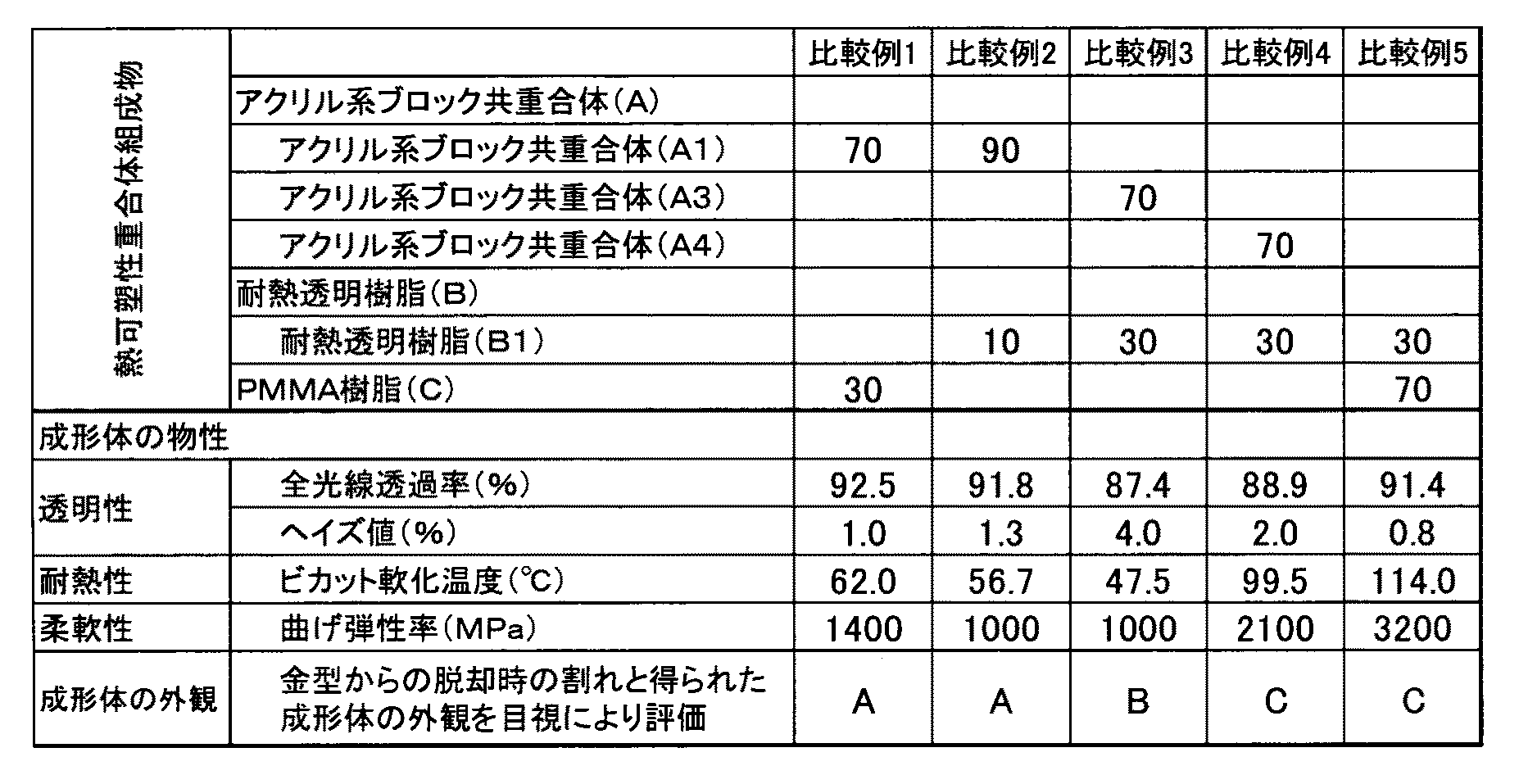
上記表1および2の結果から、本発明の実施例1〜9で得られた熱可塑性重合体組成物は、透明性が高く耐熱性に優れることが分かる。また、実施例1〜3、5〜9の熱可塑性重合体組成物は、さらに柔軟性及び成形体の外観にも優れることが分かる。実施例5では耐熱透明樹脂(B1)を(B2)に変えることで、同組成比の実施例2と比較して透明性を保持しながら耐熱性をより向上できた。また、実施例6〜7ではアクリル系ブロック共重合体(A2)を用いることで、同組成比の実施例2〜3と比較して耐熱性を保持しながら透明性をより向上できた。また、実施例8〜9では耐熱透明樹脂(B1)を(B2)に変えることで、同組成比の実施例6〜7と比較して耐熱性をより向上できた。
これに対して比較例1は、耐熱透明樹脂(B1)を含有していないため耐熱性が劣る。比較例2は、耐熱透明樹脂(B1)を配合しているが、少量であるために耐熱性が劣る。比較例3は、本発明の範囲外であるアクリル系ブロック共重合体(A3)を用いているため、透明性、耐熱性、成形体の外観に劣る。比較例4は、本発明の範囲外であるアクリル系ブロック共重合体(A4)を用いているため、柔軟性、成形体の外観に劣る。比較例5は、アクリル系ブロック共重合体を含有していないため、柔軟性が劣るため金型からの脱却が困難であり、成形体の外観に劣る。
From the results of Tables 1 and 2, it can be seen that the thermoplastic polymer compositions obtained in Examples 1 to 9 of the present invention have high transparency and excellent heat resistance. Moreover, it turns out that the thermoplastic polymer composition of Examples 1-3 and 5-9 is further excellent in the softness | flexibility and the external appearance of a molded object. In Example 5, by changing the heat-resistant transparent resin (B1) to (B2), the heat resistance could be further improved while maintaining transparency as compared with Example 2 having the same composition ratio. Moreover, in Examples 6-7, transparency was able to be improved more, maintaining heat resistance compared with Examples 2-3 of the same composition ratio by using an acryl-type block copolymer (A2). Moreover, in Examples 8-9, heat resistance was improved more by changing heat-resistant transparent resin (B1) to (B2) compared with Examples 6-7 of the same composition ratio.
On the other hand, since the comparative example 1 does not contain the heat resistant transparent resin (B1), the heat resistance is inferior. Although the comparative example 2 mix | blends the heat resistant transparent resin (B1), since it is a small amount, heat resistance is inferior. Since Comparative Example 3 uses the acrylic block copolymer (A3) that is outside the scope of the present invention, it is inferior in transparency, heat resistance, and appearance of the molded product. Since Comparative Example 4 uses the acrylic block copolymer (A4) that is outside the scope of the present invention, it is inferior in flexibility and appearance of the molded body. Since Comparative Example 5 does not contain an acrylic block copolymer, the flexibility is inferior, so that it is difficult to escape from the mold, and the appearance of the molded body is inferior.
本発明によれば、耐熱性、透明性、柔軟性に優れ、成形体の外観にも優れる熱可塑性重合体組成物及びそれからなる成形体を提供でき、光学分野、食品分野、医療分野、民生分野、自動車分野、電気・電子分野、建築分野などの多岐の用途で利用することができる。
According to the present invention, it is possible to provide a thermoplastic polymer composition excellent in heat resistance, transparency, flexibility and appearance of a molded article and a molded article comprising the same, and in the optical field, food field, medical field, consumer field. It can be used for various applications such as automobile field, electric / electronic field, and architectural field.
Claims (10)
The cover for electronic devices which consists of a molded object of Claim 8.
Priority Applications (1)
| Application Number | Priority Date | Filing Date | Title |
|---|---|---|---|
| JP2016158416A JP6796969B2 (en) | 2016-08-12 | 2016-08-12 | Thermoplastic polymer composition and molded article |
Applications Claiming Priority (1)
| Application Number | Priority Date | Filing Date | Title |
|---|---|---|---|
| JP2016158416A JP6796969B2 (en) | 2016-08-12 | 2016-08-12 | Thermoplastic polymer composition and molded article |
Publications (2)
| Publication Number | Publication Date |
|---|---|
| JP2018024794A true JP2018024794A (en) | 2018-02-15 |
| JP6796969B2 JP6796969B2 (en) | 2020-12-09 |
Family
ID=61193618
Family Applications (1)
| Application Number | Title | Priority Date | Filing Date |
|---|---|---|---|
| JP2016158416A Active JP6796969B2 (en) | 2016-08-12 | 2016-08-12 | Thermoplastic polymer composition and molded article |
Country Status (1)
| Country | Link |
|---|---|
| JP (1) | JP6796969B2 (en) |
Cited By (1)
| Publication number | Priority date | Publication date | Assignee | Title |
|---|---|---|---|---|
| CN117343217A (en) * | 2022-06-29 | 2024-01-05 | 中国科学院青岛生物能源与过程研究所 | Modified aluminum and its preparation, high mechanical performance acrylate thermoplastic elastomer and its preparation method and application |
Citations (3)
| Publication number | Priority date | Publication date | Assignee | Title |
|---|---|---|---|---|
| JP2008106259A (en) * | 2006-09-27 | 2008-05-08 | Kaneka Corp | Resin composition |
| WO2015182750A1 (en) * | 2014-05-30 | 2015-12-03 | 株式会社クラレ | Methacrylic resin composition |
| WO2016080124A1 (en) * | 2014-11-19 | 2016-05-26 | 株式会社クラレ | Acrylic film |
-
2016
- 2016-08-12 JP JP2016158416A patent/JP6796969B2/en active Active
Patent Citations (3)
| Publication number | Priority date | Publication date | Assignee | Title |
|---|---|---|---|---|
| JP2008106259A (en) * | 2006-09-27 | 2008-05-08 | Kaneka Corp | Resin composition |
| WO2015182750A1 (en) * | 2014-05-30 | 2015-12-03 | 株式会社クラレ | Methacrylic resin composition |
| WO2016080124A1 (en) * | 2014-11-19 | 2016-05-26 | 株式会社クラレ | Acrylic film |
Cited By (1)
| Publication number | Priority date | Publication date | Assignee | Title |
|---|---|---|---|---|
| CN117343217A (en) * | 2022-06-29 | 2024-01-05 | 中国科学院青岛生物能源与过程研究所 | Modified aluminum and its preparation, high mechanical performance acrylate thermoplastic elastomer and its preparation method and application |
Also Published As
| Publication number | Publication date |
|---|---|
| JP6796969B2 (en) | 2020-12-09 |
Similar Documents
| Publication | Publication Date | Title |
|---|---|---|
| JP5649974B2 (en) | Thermoplastic polymer composition and sheet-like molded article comprising the same | |
| JP6173384B2 (en) | Methacrylic resin composition, resin modifier and molded article | |
| KR102646462B1 (en) | Acrylic block copolymer, resin composition and molded body comprising same, and optical member | |
| US10935697B2 (en) | Resin composition including acrylic block copolymer and light diffusing agent | |
| JP6757588B2 (en) | A method for producing a molded product containing an acrylic block copolymer and a powdery additive. | |
| JP6796969B2 (en) | Thermoplastic polymer composition and molded article | |
| WO2018143211A1 (en) | Molded body and method for producing same |
Legal Events
| Date | Code | Title | Description |
|---|---|---|---|
| A621 | Written request for application examination |
Free format text: JAPANESE INTERMEDIATE CODE: A621 Effective date: 20190423 |
|
| A977 | Report on retrieval |
Free format text: JAPANESE INTERMEDIATE CODE: A971007 Effective date: 20200304 |
|
| A131 | Notification of reasons for refusal |
Free format text: JAPANESE INTERMEDIATE CODE: A131 Effective date: 20200310 |
|
| A521 | Request for written amendment filed |
Free format text: JAPANESE INTERMEDIATE CODE: A523 Effective date: 20200511 |
|
| A131 | Notification of reasons for refusal |
Free format text: JAPANESE INTERMEDIATE CODE: A131 Effective date: 20200609 |
|
| TRDD | Decision of grant or rejection written | ||
| A01 | Written decision to grant a patent or to grant a registration (utility model) |
Free format text: JAPANESE INTERMEDIATE CODE: A01 Effective date: 20201110 |
|
| A61 | First payment of annual fees (during grant procedure) |
Free format text: JAPANESE INTERMEDIATE CODE: A61 Effective date: 20201117 |
|
| R150 | Certificate of patent or registration of utility model |
Ref document number: 6796969 Country of ref document: JP Free format text: JAPANESE INTERMEDIATE CODE: R150 |
|
| S111 | Request for change of ownership or part of ownership |
Free format text: JAPANESE INTERMEDIATE CODE: R313113 |
|
| R350 | Written notification of registration of transfer |
Free format text: JAPANESE INTERMEDIATE CODE: R350 |