JP2018024885A - Copolymer composition and method for producing the same - Google Patents
Copolymer composition and method for producing the same Download PDFInfo
- Publication number
- JP2018024885A JP2018024885A JP2017182479A JP2017182479A JP2018024885A JP 2018024885 A JP2018024885 A JP 2018024885A JP 2017182479 A JP2017182479 A JP 2017182479A JP 2017182479 A JP2017182479 A JP 2017182479A JP 2018024885 A JP2018024885 A JP 2018024885A
- Authority
- JP
- Japan
- Prior art keywords
- copolymer
- conjugated diene
- diene comonomer
- ethylene
- comonomer
- Prior art date
- Legal status (The legal status is an assumption and is not a legal conclusion. Google has not performed a legal analysis and makes no representation as to the accuracy of the status listed.)
- Pending
Links
Classifications
-
- C—CHEMISTRY; METALLURGY
- C08—ORGANIC MACROMOLECULAR COMPOUNDS; THEIR PREPARATION OR CHEMICAL WORKING-UP; COMPOSITIONS BASED THEREON
- C08F—MACROMOLECULAR COMPOUNDS OBTAINED BY REACTIONS ONLY INVOLVING CARBON-TO-CARBON UNSATURATED BONDS
- C08F210/00—Copolymers of unsaturated aliphatic hydrocarbons having only one carbon-to-carbon double bond
- C08F210/02—Ethene
-
- H—ELECTRICITY
- H01—ELECTRIC ELEMENTS
- H01B—CABLES; CONDUCTORS; INSULATORS; SELECTION OF MATERIALS FOR THEIR CONDUCTIVE, INSULATING OR DIELECTRIC PROPERTIES
- H01B3/00—Insulators or insulating bodies characterised by the insulating materials; Selection of materials for their insulating or dielectric properties
- H01B3/18—Insulators or insulating bodies characterised by the insulating materials; Selection of materials for their insulating or dielectric properties mainly consisting of organic substances
- H01B3/30—Insulators or insulating bodies characterised by the insulating materials; Selection of materials for their insulating or dielectric properties mainly consisting of organic substances plastics; resins; waxes
- H01B3/44—Insulators or insulating bodies characterised by the insulating materials; Selection of materials for their insulating or dielectric properties mainly consisting of organic substances plastics; resins; waxes vinyl resins; acrylic resins
- H01B3/446—Insulators or insulating bodies characterised by the insulating materials; Selection of materials for their insulating or dielectric properties mainly consisting of organic substances plastics; resins; waxes vinyl resins; acrylic resins from vinylacetals
-
- C—CHEMISTRY; METALLURGY
- C08—ORGANIC MACROMOLECULAR COMPOUNDS; THEIR PREPARATION OR CHEMICAL WORKING-UP; COMPOSITIONS BASED THEREON
- C08F—MACROMOLECULAR COMPOUNDS OBTAINED BY REACTIONS ONLY INVOLVING CARBON-TO-CARBON UNSATURATED BONDS
- C08F210/00—Copolymers of unsaturated aliphatic hydrocarbons having only one carbon-to-carbon double bond
- C08F210/16—Copolymers of ethene with alpha-alkenes, e.g. EP rubbers
- C08F210/18—Copolymers of ethene with alpha-alkenes, e.g. EP rubbers with non-conjugated dienes, e.g. EPT rubbers
-
- C—CHEMISTRY; METALLURGY
- C08—ORGANIC MACROMOLECULAR COMPOUNDS; THEIR PREPARATION OR CHEMICAL WORKING-UP; COMPOSITIONS BASED THEREON
- C08F—MACROMOLECULAR COMPOUNDS OBTAINED BY REACTIONS ONLY INVOLVING CARBON-TO-CARBON UNSATURATED BONDS
- C08F218/00—Copolymers of compounds having one or more unsaturated aliphatic radicals, each having only one carbon-to-carbon double bond, and at least one being terminated by an acyloxy radical of a saturated carboxylic acid, of carbonic acid or of a haloformic acid
- C08F218/14—Esters of polycarboxylic acids
- C08F218/16—Esters of polycarboxylic acids with alcohols containing three or more carbon atoms
-
- C—CHEMISTRY; METALLURGY
- C08—ORGANIC MACROMOLECULAR COMPOUNDS; THEIR PREPARATION OR CHEMICAL WORKING-UP; COMPOSITIONS BASED THEREON
- C08F—MACROMOLECULAR COMPOUNDS OBTAINED BY REACTIONS ONLY INVOLVING CARBON-TO-CARBON UNSATURATED BONDS
- C08F222/00—Copolymers of compounds having one or more unsaturated aliphatic radicals, each having only one carbon-to-carbon double bond, and at least one being terminated by a carboxyl radical and containing at least one other carboxyl radical in the molecule; Salts, anhydrides, esters, amides, imides, or nitriles thereof
- C08F222/10—Esters
- C08F222/26—Esters of unsaturated alcohols
-
- C—CHEMISTRY; METALLURGY
- C08—ORGANIC MACROMOLECULAR COMPOUNDS; THEIR PREPARATION OR CHEMICAL WORKING-UP; COMPOSITIONS BASED THEREON
- C08F—MACROMOLECULAR COMPOUNDS OBTAINED BY REACTIONS ONLY INVOLVING CARBON-TO-CARBON UNSATURATED BONDS
- C08F236/00—Copolymers of compounds having one or more unsaturated aliphatic radicals, at least one having two or more carbon-to-carbon double bonds
- C08F236/02—Copolymers of compounds having one or more unsaturated aliphatic radicals, at least one having two or more carbon-to-carbon double bonds the radical having only two carbon-to-carbon double bonds
- C08F236/20—Copolymers of compounds having one or more unsaturated aliphatic radicals, at least one having two or more carbon-to-carbon double bonds the radical having only two carbon-to-carbon double bonds unconjugated
-
- H—ELECTRICITY
- H01—ELECTRIC ELEMENTS
- H01B—CABLES; CONDUCTORS; INSULATORS; SELECTION OF MATERIALS FOR THEIR CONDUCTIVE, INSULATING OR DIELECTRIC PROPERTIES
- H01B3/00—Insulators or insulating bodies characterised by the insulating materials; Selection of materials for their insulating or dielectric properties
- H01B3/18—Insulators or insulating bodies characterised by the insulating materials; Selection of materials for their insulating or dielectric properties mainly consisting of organic substances
- H01B3/30—Insulators or insulating bodies characterised by the insulating materials; Selection of materials for their insulating or dielectric properties mainly consisting of organic substances plastics; resins; waxes
- H01B3/44—Insulators or insulating bodies characterised by the insulating materials; Selection of materials for their insulating or dielectric properties mainly consisting of organic substances plastics; resins; waxes vinyl resins; acrylic resins
- H01B3/441—Insulators or insulating bodies characterised by the insulating materials; Selection of materials for their insulating or dielectric properties mainly consisting of organic substances plastics; resins; waxes vinyl resins; acrylic resins from alkenes
Landscapes
- Chemical & Material Sciences (AREA)
- Polymers & Plastics (AREA)
- Health & Medical Sciences (AREA)
- Chemical Kinetics & Catalysis (AREA)
- Medicinal Chemistry (AREA)
- Organic Chemistry (AREA)
- Spectroscopy & Molecular Physics (AREA)
- Physics & Mathematics (AREA)
- Addition Polymer Or Copolymer, Post-Treatments, Or Chemical Modifications (AREA)
- Organic Insulating Materials (AREA)
- Insulated Conductors (AREA)
- Compositions Of Macromolecular Compounds (AREA)
- Polymerisation Methods In General (AREA)
Abstract
【課題】電力ケーブル用途に利用されるポリエチレンの架橋効率および架橋の程度には、なお改良が望まれる。【解決手段】エチレンモノマー残基と非共役ジエンコモノマーの残基とを有する共重合体樹脂。前記非共役ジエンコモノマーは、下記式で代表されるジアルケニルフタレートであり、共重合体への非共役ジエンコモノマーの組み込みにより、架橋のためのさらなる不安定な不飽和部位を得ることができ、前記共重合体およびそれらの架橋変形物は様々な製品において、例えば、電力ケーブル用の絶縁材などとして用いることができる。【選択図】なしImprovements are still desired in the crosslinking efficiency and degree of crosslinking of polyethylene used in power cable applications. A copolymer resin having an ethylene monomer residue and a non-conjugated diene comonomer residue. The non-conjugated diene comonomer is a dialkenyl phthalate represented by the following formula, and by incorporating the non-conjugated diene comonomer into the copolymer, a further unstable unsaturated site for crosslinking can be obtained. Copolymers and their cross-linked variants can be used in various products, for example as insulating materials for power cables. [Selection figure] None
Description
関連出願の相互参照
本願は、2011年12月21日に出願された米国特許仮出願第61/578,590
号の恩典を請求するものである。
CROSS REFERENCE TO RELATED APPLICATIONS This application is a provisional application 61 / 578,590 filed December 21, 2011.
Claim the benefit of the issue.
本発明の様々な実施形態は、共重合体樹脂に関する。1つの態様において、本発明は、
架橋性共重合体に関する。本発明の他の態様は、電線・ケーブル用途のための絶縁材とし
ての使用に適する共重合体に関する。
Various embodiments of the present invention relate to copolymer resins. In one aspect, the present invention provides:
The present invention relates to a crosslinkable copolymer. Another aspect of the present invention relates to a copolymer suitable for use as an insulating material for wire and cable applications.
電力ケーブルの製造において一般的な高分子絶縁体は、アルファ−オレフィンポリマー
製であり得る。例えば、エチレン系ポリマー、典型的にはポリエチレンまたはエチレン−
プロピレンエラストマー(別名エチレン−プロピレンゴム(「EPR」)として公知)の
いずれかからのものが、高分子絶縁体の形成に利用され得る。前記ポリエチレンは、多数
の様々なポリエチレン、例えば、ホモ−もしくはコポリマー、高密度ポリエチレン(「H
DPE」)、高圧低密度ポリエチレン(「HP LDPE」)および線状低密度ポリエチ
レン(「LLDPE」)のうちのいずれか1つ以上であり得る。
A common polymer insulator in the manufacture of power cables can be made of alpha-olefin polymers. For example, an ethylene-based polymer, typically polyethylene or ethylene
Any of the propylene elastomers (also known as ethylene-propylene rubber ("EPR")) can be utilized in forming the polymeric insulator. The polyethylene may be a number of different polyethylenes, such as homo- or copolymers, high density polyethylene (“H
DPE "), high pressure low density polyethylene (" HP LDPE ") and linear low density polyethylene (" LLDPE ").
電力ケーブル用途に絶縁組成物の成分として利用されるポリエチレンは、通常は過酸化
物開始剤の作用により典型的に架橋される。架橋効率および架橋の程度は、少なくとも一
部は、ポリエチレン上の不安定な不飽和部位(すなわち、炭素−炭素二重結合)の量に依
存し得る。架橋性共重合体技術の改良が行われてきたが、なお改良が望まれる。
Polyethylene, which is utilized as a component of an insulating composition for power cable applications, is typically crosslinked by the action of a peroxide initiator. Cross-linking efficiency and degree of cross-linking may depend, at least in part, on the amount of unstable unsaturation sites (ie, carbon-carbon double bonds) on the polyethylene. Although improvements in crosslinkable copolymer technology have been made, improvements are still desired.
1つの実施形態は、共重合体であって、その中に、重合された:エチレンモノマー残基
と、次の式:
によって表される少なくとも1種の非共役ジエンコモノマーの残基とを有する共重合体
である。
One embodiment is a copolymer, polymerized therein: ethylene monomer residues and the following formula:
And a copolymer having at least one non-conjugated diene comonomer residue represented by:
もう1つの実施形態は、共重合体であって、その中に、重合された:エチレンモノマー
残基と、次の式:
である。
Another embodiment is a copolymer, polymerized therein: an ethylene monomer residue and the following formula:
さらにもう1つの実施形態は、共重合体の製造プロセスであり、該プロセスは、
反応ゾーンにおいて、エチレンと、次の式:
始剤の存在下、前記共重合体への前記エチレンの少なくとも一部分および前記非共役ジエ
ンコモノマーの少なくとも一部分の組み込みを果たすために十分な条件下で重合する工程
を含み、前記式中のR1およびR2は、末端炭素−炭素二重結合を各々が有する独立した
C2−C20アルケニル基であり、前記反応ゾーンは、前記重合の少なくとも25パーセ
ントの間、120から360℃の範囲の温度で維持される。
Yet another embodiment is a process for producing a copolymer, the process comprising:
In the reaction zone, ethylene and the following formula:
本発明の様々な実施形態は、共重合体であって、その中に重合されたエチレンモノマー
残基と非共役ジエンである少なくとも1種のコモノマーの残基とを有する共重合体に関す
る。かかる共重合体は、電線・ケーブル用の絶縁および外被用途をはじめとする(しかし
これらに限定されない)様々な商業用途に用いることができる。本明細書ではエチレン系
ポリマーを主として論ずるが、単独またはエチレンとの併用いずれかでの他の種類のアル
ファ−オレフィンモノマーに基づいて同様の結果および成果を達成できると予想される。
Various embodiments of the present invention relate to a copolymer having an ethylene monomer residue polymerized therein and a residue of at least one comonomer that is a non-conjugated diene. Such copolymers can be used in a variety of commercial applications including, but not limited to, wire and cable insulation and jacketing applications. Although ethylene polymers are primarily discussed herein, it is expected that similar results and outcomes can be achieved based on other types of alpha-olefin monomers, either alone or in combination with ethylene.
今述べたように、本明細書に記載する共重合体は、エチレンモノマー残基を含む。加え
て、これらの共重合体は、アルファ−オレフィンモノマーの1つ以上のコモノマー残基を
含むことができる。当該技術分野において公知のまたは今後発見される任意のアルファ−
オレフィンを、本明細書に記載する共重合体の調製の際に利用することができる。様々な
実施形態において、前記アルファ−オレフィンコモノマーは、任意のC3−C20アルフ
ァ−オレフィンモノマー、C3からC12アルファ−オレフィンモノマー、またはC3か
らC5アルファ−オレフィンモノマーであってよい。かかるアルファ−オレフィンモノマ
ーの具体的な例としては、プロピレン、1−ブテン、1−ペンテン、4−メチル−1−ペ
ンテン、1−ヘキセン、1−オクテン、1−デセン、1−ドデセン、1−テトラデセン、
1−ヘキサデセンおよび1−オクタデセンが挙げられるが、これらに限定されない。前記
アルファ−オレフィンはまた、シクロヘキサンまたはシクロペンタンなどの環式構造を含
有し、その結果、3−シクロヘキシル−1−プロペン(アリルシクロヘキサン)およびビ
ニルシクロヘキサンなどのアルファ−オレフィンになることがある。様々な実施形態にお
いて、前記アルファ−オレフィンコモノマーをプロピレン、1−ブテンおよびそれらの混
合物から成る群より選択することができる。
As just mentioned, the copolymers described herein contain ethylene monomer residues. In addition, these copolymers can include one or more comonomer residues of alpha-olefin monomers. Any alpha-known or later discovered in the art
Olefins can be utilized in preparing the copolymers described herein. In various embodiments, the alpha - olefin comonomer, any C 3 -C 20 alpha - may be olefin monomer - C 5 alpha-olefin monomer or C 3, - C 12 alpha-olefin monomer, C 3. Specific examples of such alpha-olefin monomers include propylene, 1-butene, 1-pentene, 4-methyl-1-pentene, 1-hexene, 1-octene, 1-decene, 1-dodecene, 1-tetradecene. ,
Examples include, but are not limited to, 1-hexadecene and 1-octadecene. The alpha-olefin may also contain a cyclic structure such as cyclohexane or cyclopentane, resulting in alpha-olefins such as 3-cyclohexyl-1-propene (allylcyclohexane) and vinylcyclohexane. In various embodiments, the alpha-olefin comonomer can be selected from the group consisting of propylene, 1-butene and mixtures thereof.
一定の実施形態において、エチレンモノマーは、前記共重合体の全アルファ−オレフィ
ン含有量の少なくとも50重量パーセント(「重量%」)を構成する。1つ以上の実施形
態において、エチレンは、前記共重合体の全アルファ−オレフィン含有量の少なくとも6
0重量%、少なくとも70重量%、少なくとも80重量%、少なくとも90重量%、少な
くとも95重量%、少なくとも99重量%、実質的にすべて、またはすべてを構成するこ
とができる。
In certain embodiments, the ethylene monomer comprises at least 50 weight percent (“wt%”) of the total alpha-olefin content of the copolymer. In one or more embodiments, ethylene is at least 6 of the total alpha-olefin content of the copolymer.
It can constitute 0%, at least 70%, at least 80%, at least 90%, at least 95%, at least 99%, substantially all, or all.
上で述べたように、前記共重合体は、非共役ジエンコモノマーをさらに含む。1つ以上
の実施形態において、前記非共役ジエンコモノマーの少なくとも一部分は、次の構造(I
):
を有する。本明細書において用いる場合、用語「アルケニル」基は、炭化水素から水素
原子を除去することによって形成される二価の基であって、少なくとも1つの炭素−炭素
二重結合を有する基を示す。様々な実施形態において、構造(I)によって表される非共
役ジエンコモノマーにおける使用に適するアルケニル基は、独立して、C2からC20ア
ルケニル基、C2からC12アルケニル基、またはC3からC6アルケニル基であり得る
。使用に適するアルケニル基は、直鎖であることもあり、または分岐していることもある
。様々な実施形態において、R1およびR2の各々は、直鎖アルケニル基である。1つ以
上の実施形態において、R1およびR2は、同じタイプのアルケニル基であることがある
。加えて、一定の実施形態では、少なくとも1つの不飽和箇所が、各アルケニル基R1お
よびR2の末端部に位置することがある。さらなる実施形態において、各アルケニル基R
1およびR2は、その末端部に位置する単一の不飽和箇所を含有することがある。構造(
I)での使用に適するアルケニル基についての説明に役立つ実例としては、ビニル基、ア
リル基、3−ブテニル基、4−ペンテニル基、5−ヘキセニル基、および7−オクテニル
基が挙げられる。一定の実施形態において、R1およびR2は、各々、構造(II)で示
されるようなアリル基である:
):
Have As used herein, the term “alkenyl” group refers to a divalent group formed by removing a hydrogen atom from a hydrocarbon that has at least one carbon-carbon double bond. In various embodiments, alkenyl groups suitable for use in the non-conjugated diene comonomer represented by structure (I) are independently C 2 to C 20 alkenyl groups, C 2 to C 12 alkenyl groups, or C 3 It may be C 6 alkenyl group. Suitable alkenyl groups for use may be straight chain or branched. In various embodiments, each of R 1 and R 2 is a straight chain alkenyl group. In one or more embodiments, R 1 and R 2 can be the same type of alkenyl group. In addition, in certain embodiments, at least one site of unsaturation may be located at the end of each alkenyl group R 1 and R 2 . In a further embodiment, each alkenyl group R
1 and R 2 may contain a single point of unsaturation located at its end. Construction(
Illustrative examples of alkenyl groups suitable for use in I) include vinyl, allyl, 3-butenyl, 4-pentenyl, 5-hexenyl, and 7-octenyl groups. In certain embodiments, R 1 and R 2 are each an allyl group as shown in structure (II):
上の構造(I)および(II)から分かるように、前記非共役ジエンコモノマーは、o
−フタレート、イソフタレート、テレフタレートのいずれか、またはそれらの2つ以上の
混合物であってよい。1つ以上の実施形態において、前記非共役ジエンコモノマーは、重
量ベースで主としてo−フタレート異性体を含む。本明細書において用いる場合、用語「
主として」は、50%より高い濃度を示すものとする。加えて、前記o−フタレートモノ
マーは、前記非共役ジエンコモノマーの少なくとも60重量%、少なくとも70重量%、
少なくとも80重量%、少なくとも90重量%、少なくとも95重量%、少なくとも99
重量%、実質的にすべて、またはすべてを構成することができ、この場合の各重量パーセ
ントは、全非共役ジエンモノマー重量に基づく。様々な実施形態において、前記非共役ジ
エンコモノマーは、ジアリル−o−フタレートである。
As can be seen from structures (I) and (II) above, the non-conjugated diene comonomer is o
-It may be any of phthalate, isophthalate, terephthalate, or a mixture of two or more thereof. In one or more embodiments, the non-conjugated diene comonomer comprises predominantly o-phthalate isomers on a weight basis. As used herein, the term “
“Mainly” shall indicate a concentration greater than 50%. In addition, the o-phthalate monomer is at least 60%, at least 70% by weight of the non-conjugated diene comonomer,
At least 80%, at least 90%, at least 95%, at least 99%
% By weight, substantially all or all, where each weight percent is based on the total non-conjugated diene monomer weight. In various embodiments, the non-conjugated diene comonomer is diallyl-o-phthalate.
1つ以上の実施形態において、前記非共役ジエンコモノマーの残基は、前記共重合体の
少なくとも0.001、少なくとも0.01、少なくとも0.02、または少なくとも0
.05モルパーセントを構成することができる。さらに、前記非共役ジエンコモノマーは
、前記共重合体の0.001から5モルパーセントの範囲、0.01から1モルパーセン
トの範囲、または0.05から0.5モルパーセントの範囲を構成することができる。前
記共重合体のモノマー残基含有量は、下の実施例2で説明するものなどの手順を用いてプ
ロトン核磁気共鳴(「1H NMR」)によって決定することができる。
In one or more embodiments, the residue of the non-conjugated diene comonomer is at least 0.001, at least 0.01, at least 0.02, or at least 0 of the copolymer.
. It can constitute 05 mole percent. Further, the non-conjugated diene comonomer constitutes in the range of 0.001 to 5 mole percent, 0.01 to 1 mole percent, or 0.05 to 0.5 mole percent of the copolymer. Can do. The monomer residue content of the copolymer can be determined by proton nuclear magnetic resonance (“ 1 H NMR”) using procedures such as those described in Example 2 below.
様々な実施形態において、前記エチレンモノマー残基は、前記共重合体の残部のすべて
または実質的にすべてを構成する。したがって、エチレンモノマー残基は、前記共重合体
の少なくとも95、少なくとも99または少なくとも99.5モルパーセントを構成する
ことができる。さらに、エチレンモノマー残基は、前記共重合体の95から99.999
モルパーセントの範囲、99から99.99モルパーセントの範囲、または99.5から
99.95モルパーセントの範囲を構成することができる。したがって、様々な実施形態
において、前記共重合体は、エチレンモノマー残基と、非共役ジエンコモノマーの残基か
ら成り得るまたは本質的に成り得る。しかし、下でより詳細に説明するように、前記共重
合体は、例えばプロピレンなどの連鎖移動剤の多少の残存量を含有することもある。
In various embodiments, the ethylene monomer residue comprises all or substantially all of the remainder of the copolymer. Thus, ethylene monomer residues can comprise at least 95, at least 99, or at least 99.5 mole percent of the copolymer. Further, the ethylene monomer residue is 95 to 99.999 of the copolymer.
A range of mole percent, a range of 99 to 99.99 mole percent, or a range of 99.5 to 99.95 mole percent can be constructed. Thus, in various embodiments, the copolymer can consist of or consist essentially of ethylene monomer residues and non-conjugated diene comonomer residues. However, as explained in more detail below, the copolymer may contain some residual amount of chain transfer agent such as propylene, for example.
代替実施形態において、前記エチレンモノマー残基および1つ以上のアルファ−オレフ
ィンコモノマー残基は、共同で、前記共重合体の少なくとも95、少なくとも99または
少なくとも99.5モルパーセントを構成することができる。さらに、その併せたエチレ
ンモノマー残基とアルファ−オレフィンコモノマー残基は、前記共重合体の95から99
.99モルパーセントの範囲、99から99.98モルパーセントの範囲、または99.
5から99.95モルパーセントの範囲を構成することができる。したがって、様々な実
施形態において、前記共重合体は、エチレンモノマー残基と、アルファ−オレフィンコモ
ノマー残基と、非共役ジエンコモノマーの残基とからなり得るまたは本質的に成り得る。
この実施形態での使用に適するアルファ−オレフィンコモノマーについての説明に役立つ
実例としては、プロピレンおよび1−ブテンが挙げられる。様々な実施形態において、前
記共重合体は、エチレンモノマー残基とプロピレンコモノマー残基の両方を含む。
In an alternative embodiment, the ethylene monomer residue and the one or more alpha-olefin comonomer residues can together constitute at least 95, at least 99, or at least 99.5 mole percent of the copolymer. Furthermore, the combined ethylene monomer residue and alpha-olefin comonomer residue may be 95 to 99 of the copolymer.
. In the range of 99 mole percent, in the range of 99 to 99.98 mole percent, or 99.
A range of 5 to 99.95 mole percent can be constructed. Thus, in various embodiments, the copolymer can consist of or consist essentially of ethylene monomer residues, alpha-olefin comonomer residues, and non-conjugated diene comonomer residues.
Illustrative examples of alpha-olefin comonomers suitable for use in this embodiment include propylene and 1-butene. In various embodiments, the copolymer includes both ethylene monomer residues and propylene comonomer residues.
共重合体を調製するための公知のまたは今後発見される任意のプロセスを利用して、上
記組成を有する共重合体を製造することができる。様々な実施形態において、前記共重合
体は、高圧低密度ポリエチレン(「HP LDPE」)を製造するための公知のプロセス
を用いて調製することができる。1つの従来の高圧法は、「Introduction
to Polymer Chemistry」、Stille著、Wiley and
Sons出版、New York、1962年、149から151頁に記載されている。
高圧法は、典型的には、管型反応器または撹拌式オートクレーブで行われるフリーラジカ
ルにより開始される重合である。
Any process known or later discovered for preparing copolymers can be used to produce copolymers having the above composition. In various embodiments, the copolymer can be prepared using known processes for producing high pressure low density polyethylene (“HP LDPE”). One conventional high-pressure method is “Introduction”.
to Polymer Chemistry "by Stille, Wiley and
Sons Publishing, New York, 1962, pages 149-151.
The high pressure process is a free radical initiated polymerization typically carried out in a tubular reactor or stirred autoclave.
構想されるプロセスは、単一または多数のオートクレーブ、直列でおよび逐次的順序で
運転される1基以上のオートクレーブと管型反応器の組み合わせ、または単一の管型反応
器を含む。これらのプロセスを、連続プロセスを用いて行ってもよい。加えて、前記モノ
マーおよびコモノマー(すなわち、非共役ジエンコモノマーおよび任意選択の他の種類の
コモノマー)成分を、最初のうちにもしくは最初に全部そのプロセスに供給してもよく、
または反応サイクルの間に(連続型プロセスについては)そのプロセスの幾つかの異なる
位置に供給してもよい。加えて、連鎖移動剤(「CTA」)を、モノマー/コモノマー添
加もしくは流の一部もしくはすべてに伴って含めてもよいし、またはモノマー/コモノマ
ー添加もしくは流の一部もしくはすべてに加えてもよい。モノマー/コモノマー供給流の
添加ばかりでなくCTAの添加に関するこの自由度は、プロセスのオペレータに本開示ポ
リマー製品の作製の自由度および利便性をもたらす。
The processes envisioned include single or multiple autoclaves, one or more autoclave and tubular reactor combinations operated in series and in sequential order, or a single tubular reactor. These processes may be performed using a continuous process. In addition, the monomer and comonomer (ie, non-conjugated diene comonomer and optional other types of comonomer) components may be fed into the process either initially or initially at all,
Or it may be fed to several different locations of the process (for continuous processes) during the reaction cycle. In addition, a chain transfer agent (“CTA”) may be included with some or all of the monomer / comonomer addition or stream, or may be added to some or all of the monomer / comonomer addition or stream. . This degree of freedom regarding the addition of CTA as well as the addition of monomer / comonomer feed stream provides the process operator with the freedom and convenience of making the disclosed polymer product.
管型反応器プロセスについてのフリーラジカルによって開始される低密度エチレン系重
合反応の非限定的説明を本開示に含める。前記反応器にエチレンおよび、上で説明したよ
うに、少なくとも1つの非共役ジエンコモノマー、ならびに他の任意選択のコモノマーを
供給することに加えて、他の成分、例えば反応開始剤、触媒およびCTA、を前記反応器
に供給して、前記共重合体が形成されるようなフリーラジカル反応を開始させるおよび支
援することができる。
A non-limiting description of the low density ethylene-based polymerization reaction initiated by the free radicals for the tubular reactor process is included in this disclosure. In addition to feeding the reactor with ethylene and at least one non-conjugated diene comonomer, as described above, and other optional comonomers, other components such as initiators, catalysts and CTA, Can be fed to the reactor to initiate and support a free radical reaction such that the copolymer is formed.
低密度ポリエチレン系ポリマーを形成するための管型反応器の使用方法は、当該技術分
野において公知である。このプロセスは、エチレンから一部は成るプロセス流体をフリー
ラジカル重合し、それによって高発熱性反応を生じさせる管重合反応である。この反応は
、高い動作圧下、乱流プロセス流体流中で行われる(それ故、低密度エチレン系ポリマー
は「高圧」ポリマーとも呼ばれる)。その管の一定の箇所で、管壁を通して、フリーラジ
カル重合中に生成された熱の一部分を除去することができる。管型反応器についての典型
的なワンパス転化率値は、約20〜40%の範囲である。管型反応器システムは、転化効
率を向上させるために少なくとも1つのモノマー再循環ループを備えていることもある。
Methods for using tubular reactors to form low density polyethylene-based polymers are known in the art. This process is a tube polymerization reaction that free radically polymerizes a process fluid consisting in part of ethylene, thereby producing a highly exothermic reaction. This reaction takes place in a turbulent process fluid stream under high operating pressure (hence low density ethylene-based polymers are also referred to as “high pressure” polymers). At certain points in the tube, a portion of the heat generated during free radical polymerization can be removed through the tube wall. Typical one-pass conversion values for tubular reactors range from about 20-40%. The tubular reactor system may be equipped with at least one monomer recycle loop to improve conversion efficiency.
撹拌式オートクレーブ反応器を利用するとき、圧力は、1,000から4,000絶対
バール(「bara」)(100から400絶対メガパスカル(「MPaa」))、また
は2,000から3,000bara(200から300MPaa)の範囲であり得、お
よび温度は、120から340摂氏度(「℃」)の範囲であり得る。管型反応器を利用す
るとき、圧力は、1,000から4,000bara(100から400MPaa)の範
囲であり得、および温度は、120から360℃の範囲であり得る。利用する方法にかか
わらず、一定の実施形態において、反応ゾーンは、その重合の少なくとも一部分の間は、
少なくとも200℃、少なくとも225℃、または少なくとも250℃の温度を有するこ
とができる。かかる実施形態において、前記反応ゾーン内の温度の上限は、360℃であ
り得る。加えて、様々な実施形態において、前記反応ゾーンは、前記重合の少なくとも2
5%、前記重合の少なくとも50%、前記重合の少なくとも75%に関して、または全重
合プロセスの間、かかる温度を有することができる。
When utilizing a stirred autoclave reactor, the pressure is from 1,000 to 4,000 absolute bar ("bara") (100 to 400 absolute megapascal ("MPa")), or 2,000 to 3,000 bara ( 200 to 300 MPaa) and the temperature can be in the range of 120 to 340 degrees Celsius (“° C.”). When utilizing a tubular reactor, the pressure can range from 1,000 to 4,000 bara (100 to 400 MPaa) and the temperature can range from 120 to 360 ° C. Regardless of the method utilized, in certain embodiments, the reaction zone is during at least a portion of its polymerization.
It can have a temperature of at least 200 ° C, at least 225 ° C, or at least 250 ° C. In such an embodiment, the upper limit of the temperature in the reaction zone may be 360 ° C. In addition, in various embodiments, the reaction zone comprises at least 2 of the polymerization.
Such temperatures can be 5%, for at least 50% of the polymerization, for at least 75% of the polymerization, or during the entire polymerization process.
様々な実施形態において、フリーラジカル開始剤を使用して前記共重合体を調製するこ
とができる。当該技術分野において公知のまたは今後発見される任意のフリーラジカル開
始剤を、本明細書に記載する方法によって用いることができる。適するフリーラジカル開
始剤としては、酸素系開始剤、例えば有機過酸化物(「PO」)が挙げられるが、これら
に限定されない。かかる開始剤についての説明に役立つ実例としては、t−ブチルペルオ
キシピバレート、ジ−t−ブチルペルオキシド、t−ブチルペルオキシアセテート、t−
ブチルペルオキシ−2−エチルヘキサノエート、t−ブチルペルオキシネオデカノエート
、およびこれらの2つ以上の混合物が挙げられる。これらの有機ペルオキシ開始剤を、前
記高圧供給物の重量に基づき0.0001重量%と0.01重量%の間の量で使用するこ
とができる。本開示共重合体を生じさせる結果となるフリーラジカル重合反応は、開始剤
または触媒が存在する各反応ゾーンにおいて起こる。この反応は、大量の熱を発生させる
発熱反応である。
In various embodiments, the copolymer can be prepared using a free radical initiator. Any free radical initiator known or later discovered in the art can be used by the methods described herein. Suitable free radical initiators include, but are not limited to, oxygen-based initiators such as organic peroxides (“PO”). Illustrative examples for such initiators include t-butyl peroxypivalate, di-t-butyl peroxide, t-butyl peroxyacetate, t-
Butyl peroxy-2-ethylhexanoate, t-butyl peroxyneodecanoate, and mixtures of two or more thereof. These organic peroxy initiators can be used in amounts between 0.0001% and 0.01% by weight based on the weight of the high pressure feed. The free radical polymerization reaction that results in the copolymer of the present disclosure occurs in each reaction zone where an initiator or catalyst is present. This reaction is an exothermic reaction that generates a large amount of heat.
上で述べたように、CTAを使用して前記共重合体を調製することができる。当該技術
分野において公知のまたは今後発見される任意のCTAを、本明細書に記載する方法によ
って用いることができる。高圧、低密度ポリエチレン生産の際に使用するための多くのC
TAが当該技術分野において公知である。エチレンおよびエチレン系ポリマーのフリーラ
ジカル重合におけるCTAの使用に関する情報を含む参考文献例としては、Ehrlic
h,P.およびMortimer,G.A.著、「Fundamentals of t
he Free−Radical Polymerization of Ethyle
ne」、Advanced Polymers、第7巻、386−448頁(1970年
);Mortimer,George A.著、「Chain Transfer in
Ethylene Polymerization−IV.Additional S
tudy at 1360 Atm and 130℃」、Journal of Po
lymer Science、Part A−1、第8巻、1513−23頁(1970
年);Mortimer,George A.著、「Chain Transfer i
n Ethylene Polymerization 5−VI.The Effec
t of Pressure」、Journal of Polymer Scienc
e、Part A−1、第8巻、1543−48頁(1970);Mortimer,G
eorge A.著、「Chain Transfer in Ethylene Po
lymerization−VII.Very Reactive and Deple
table Transfer Agents」、Journal of Polyme
r Science、Part A−1、第10巻、163−168頁(1972);英
国特許第997,408号明細書(Cave);米国特許第3,377,330号明細書
(Mortimer);米国特許出願公開第2004/0054097号明細書(Mae
hlingら);ならびに米国特許第6,596,241号、同第6,673,878号
および同第6,899,852号明細書(Donck)が挙げられる。
As mentioned above, the copolymer can be prepared using CTA. Any CTA known or later discovered in the art can be used by the methods described herein. Many C for use in high pressure, low density polyethylene production
TA is known in the art. Reference examples containing information on the use of CTA in free radical polymerization of ethylene and ethylene-based polymers include Ehrlic
h, P.I. And Mortimer, G .; A. Author, “Fundamentals of t
he Free-Radical Polymerization of Ethyl
ne ", Advanced Polymers, Vol. 7, 386-448 (1970); Mortimer, George A. et al. Author, “Chain Transfer in”
Ethylene Polymerization-IV. Additional S
study at 1360 Atm and 130 ° C ", Journal of Po
lymer Science, Part A-1, Vol. 8, pages 1513-23 (1970)
Mortimer, George A .; "Chain Transfer i"
n Ethylene Polymerization 5-VI. The Effec
t of Pressure ", Journal of Polymer Science
e, Part A-1, Vol. 8, pp. 1543-48 (1970); Mortimer, G
George A. Author, “Chain Transfer in Ethylene Po
lymerization-VII. Very Reactive and Deplete
table Transfer Agents ", Journal of Polymer
r Science, Part A-1, 10: 163-168 (1972); British Patent 997,408 (Cave); US Pat. No. 3,377,330 (Mortimer); US Patent Published Application No. 2004/0054097 (Mae)
hling et al.); and US Pat. Nos. 6,596,241, 6,673,878, and 6,899,852 (Donck).
水素原子供与後、CTAはラジカルを形成することができ、このラジカルは、モノマー
、オリゴマーまたはコモノマーと反応し、新たなポリマー鎖を開始させることができる。
結果として、原CTAが新たなまたは既存のポリマー鎖に組み込まれ、それによってその
原CTAと会合したポリマー鎖に新たな官能基が導入されることになる。前記CTAは、
通常は前記モノマー/コモノマー重合の結果ではない前記ポリマー鎖に新たな官能基を導
入することができる。
After donating hydrogen atoms, CTA can form radicals, which can react with monomers, oligomers or comonomers to initiate new polymer chains.
As a result, the original CTA is incorporated into a new or existing polymer chain, thereby introducing a new functional group into the polymer chain associated with the original CTA. The CTA is
New functional groups can be introduced into the polymer chain that are not normally the result of the monomer / comonomer polymerization.
様々な実施形態において、2つ以上の連鎖移動剤を使用することがある。加えて、1つ
以上の連鎖移動剤がアルファ−オレフィンであってもよい。他の実施形態では、単一の連
鎖移動剤を使用することがある。かかる実施形態において、前記単一の連鎖移動剤は、ア
ルファ−オレフィンであり得る。様々な実施形態において、前記連鎖移動剤は、プロピレ
ンを含む。前記連鎖移動剤は、一般に、エチレンモノマーと非共役ジエンコモノマーと存
在する場合には他のコモノマーとの総合重量に基づき0.05から0.5重量%または0
.1から0.2重量%の範囲の量で重合中に存在することができる。
In various embodiments, more than one chain transfer agent may be used. In addition, one or more chain transfer agents may be alpha-olefins. In other embodiments, a single chain transfer agent may be used. In such embodiments, the single chain transfer agent can be an alpha-olefin. In various embodiments, the chain transfer agent comprises propylene. The chain transfer agent is generally 0.05 to 0.5 wt% or 0 based on the combined weight of ethylene monomer and nonconjugated diene comonomer and other comonomers, if present.
. It can be present in the polymerization in an amount ranging from 1 to 0.2% by weight.
ポリオレフィン、および特にポリエチレンに典型的であるように、得られる共重合体は
、末端ビニル基(R−CH=CH2)、ビニリデンまたはペンタントビニル基(R−C(
=CH2)−R)、およびトランスビニリデン(R−CH2−CH=CH−CH2−R)
をはじめとする、様々なタイプの不飽和を有することができる。本開示の共重合体では、
上記非共役ジエンモノマーもまた該共重合体の不飽和の一因となり得る。ポリオレフィン
中の不飽和の濃度は、従来、1,000炭素原子あたりのビニルまたはビニリデン基(「
基/1,000C」)によって表される。様々な実施形態において、前記共重合体は、少
なくとも0.01、少なくとも0.05、または少なくとも0.1ビニル基/1,000
Cの、上記非共役ジエンコモノマーに起因し得るビニル含有量を有することができる。加
えて、前記共重合体は、0.01から2ビニル基/1,000Cの範囲、または0.05
から1ビニル基/1,000Cの範囲、または0.1から0.4ビニル基/1,000C
の範囲の、前記非共役ジエンコモノマーに起因し得るビニル含有量を有することができる
。また、前記共重合体は、少なくとも0.05、少なくとも0.1、または少なくとも0
.2ビニル基/1,000Cの、前記コモノマーに起因し得ない末端ビニル含有量を有す
ることができる。さらに、前記共重合体は、0.05から2ビニル基/1,000Cの範
囲、0.1から1ビニル基/1,000Cの範囲、または0.2から0.5ビニル基/1
,000Cの範囲の、前記コモノマーに起因し得ない末端ビニル含有量を有することがで
きる。前記共重合体のビニル含有量は、下に実施例2において提供する条件下でのプロト
ン核磁気共鳴(「1H NMR」)によって決定することができる。
As is typical for polyolefins, and especially polyethylene, the resulting copolymers are terminal vinyl groups (R—CH═CH 2 ), vinylidene or pentant vinyl groups (R—C (
= CH 2) -R), and trans vinylidene (R-CH 2 -CH = CH -CH 2 -R)
Can have various types of unsaturation. In the copolymer of the present disclosure,
The non-conjugated diene monomer can also contribute to the unsaturation of the copolymer. The concentration of unsaturation in polyolefins has traditionally been vinyl or vinylidene groups per 1,000 carbon atoms (“
Group / 1,000 C "). In various embodiments, the copolymer is at least 0.01, at least 0.05, or at least 0.1 vinyl groups / 1,000.
C can have a vinyl content that can be attributed to the non-conjugated diene comonomer. In addition, the copolymer has a range of 0.01 to 2 vinyl groups / 1,000 C, or 0.05
To 1 vinyl group / 1,000 C, or 0.1 to 0.4 vinyl group / 1,000 C.
The vinyl content can be attributed to the non-conjugated diene comonomer in the range of Also, the copolymer is at least 0.05, at least 0.1, or at least 0.
. It can have a terminal vinyl content of 2 vinyl groups / 1,000 C which cannot be attributed to the comonomer. Further, the copolymer may have a range of 0.05 to 2 vinyl groups / 1,000 C, 0.1 to 1 vinyl groups / 1,000 C, or 0.2 to 0.5 vinyl groups / 1.
It can have a terminal vinyl content in the range of 1,000,000 C that cannot be attributed to the comonomer. The vinyl content of the copolymer can be determined by proton nuclear magnetic resonance (“ 1 H NMR”) under the conditions provided below in Example 2.
前記共重合体は、ASTM D−1238(190℃/2.16kg)に従って判定し
て、1から50dg/分の範囲、または1から3dg/分の範囲のメルトインデックスを
有することができる。さらに、前記共重合体は、ASTM D−792に従って判定して
、0.90から0.94g/cm3の範囲、または0.91から0.93g/cm3の範
囲の密度を有することができる。また、前記共重合体は、ゲル透過クロマトグラフィーに
よって判定して、2から30の範囲、または3から10の範囲の多分散性指数(すなわち
、重量平均分子量/数平均分子量;「Mw/Mn」;または分子量分布(「MWD」))
を有することができる。
The copolymer can have a melt index in the range of 1 to 50 dg / min, or in the range of 1 to 3 dg / min, as determined according to ASTM D-1238 (190 ° C./2.16 kg). Further, the copolymer can have a density in the range of 0.90 to 0.94 g / cm 3 , or in the range of 0.91 to 0.93 g / cm 3 , as determined according to ASTM D-792. . The copolymer may also have a polydispersity index (ie, weight average molecular weight / number average molecular weight; “Mw / Mn”) in the range of 2 to 30, or 3 to 10, as determined by gel permeation chromatography. Or molecular weight distribution ("MWD"))
Can have.
上に記載したような共重合体は、様々な用途を有することができ、および製品の調製に
それを利用することができる。一定の実施形態では、前記共重合体を電線・ケーブルの調
製において、特に、導体を包囲するまたは少なくとも部分的に包囲する絶縁材として利用
することができる。一般的に言うと、ケーブル(例えば、電力ケーブル)に関する絶縁材
として使用するとき、前記共重合体は、架橋されることになり、その結果、少なくとも部
分的に架橋された共重合体になる。かかる架橋は、不飽和部位を含有するポリオレフィン
を架橋させるための任意の公知のまたは今後発見される方法によって行うことができる。
Copolymers as described above can have a variety of uses and can be utilized in the preparation of products. In certain embodiments, the copolymer can be utilized in the preparation of wires and cables, particularly as an insulating material that surrounds or at least partially surrounds a conductor. Generally speaking, when used as an insulation for cables (eg, power cables), the copolymer will be cross-linked, resulting in an at least partially cross-linked copolymer. Such crosslinking can be performed by any known or later discovered method for crosslinking polyolefins containing unsaturated sites.
様々な実施形態において、開始剤、例えば過酸化物開始剤を使用して、前記共重合体の
架橋を行うことができる。過酸化物開始剤の例としては、ジクミルペルオキシド;ビス(
アルファ−t−ブチル−ペルオキシイソプロピル)ベンゼン;イソプロピルクミルt−ブ
チルペルオキシド;t−ブチルクミルペルオキシド;ジ−t−ブチルペルオキシド;2,
5−ビス(t−ブチルペルオキシ)−2,5−ジメチルヘキサン;2,5−ビス(t−ブ
チルペルオキシ)−2,5−ジメチルヘキシン−3;1,1−ビス(t−ブチルペルオキ
シ)3,3,5−トリメチルシクロヘキサン;イソプロピルクミルクミルペルオキシド;
ジ(イソプロピルクミル)ペルオキシド;およびこれらの2つ以上の混合物が挙げられる
が、それらに限定されない。過酸化物開始剤を、典型的には、全組成物重量に基づき0.
1から3、さらに典型的には0.5から3、およびさらにいっそう典型的には1から2.
5重量%の量で使用する。様々な硬化助剤(ならびにブースタまたは遅延剤)を前記過酸
化物開始剤と併用することもでき、これらとしては、トリアリルイソシアヌレート;エト
キシ化ビスフェノールAジメチルアクリレート;アルファ−メチルスチレンダイマー;な
らびに米国特許第5,346,961号および同第4,018,852号明細書に記載さ
れている他の助剤が挙げられる。助剤を、少しでも使用する場合には、典型的に、全組成
物重量に基づき0より多い重量%(例えば、0.01重量%)から3重量%、さらに典型
的には0.1から0.5重量%、およびさらにいっそう典型的には0.2から0.4重量
%の量で使用する。
In various embodiments, the copolymer can be crosslinked using an initiator, such as a peroxide initiator. Examples of peroxide initiators include dicumyl peroxide; bis (
Alpha-t-butyl-peroxyisopropyl) benzene; isopropylcumyl t-butyl peroxide; t-butylcumyl peroxide; di-t-butyl peroxide;
5-bis (t-butylperoxy) -2,5-dimethylhexane; 2,5-bis (t-butylperoxy) -2,5-dimethylhexyne-3; 1,1-bis (t-butylperoxy) 3,3,5-trimethylcyclohexane; isopropyl cumyl mill peroxide;
Di (isopropylcumyl) peroxide; and mixtures of two or more thereof. Peroxide initiators are typically added in an amount of 0.00 based on the total composition weight.
1 to 3, more typically 0.5 to 3, and even more typically 1 to 2.
Used in an amount of 5% by weight. Various curing aids (and boosters or retarders) can also be used in combination with the peroxide initiators, such as triallyl isocyanurate; ethoxylated bisphenol A dimethyl acrylate; alpha-methylstyrene dimer; Other auxiliaries described in Patent Nos. 5,346,961 and 4,018,852 can be mentioned. If any auxiliaries are used, they are typically greater than 0% by weight (eg, 0.01% by weight) to 3% by weight, more typically from 0.1%, based on the total composition weight. Used in an amount of 0.5% by weight, and more typically 0.2 to 0.4% by weight.
加えて、調製中に酸化防止剤を利用することができる。例示的酸化防止剤としては、ヒ
ンダードフェノール、例えば、テトラキス[メチレン(3,5−ジ−t−ブチル−4−ヒ
ドロキシヒドロシンナメート)]メタン、ビス[(ベータ−(3,5−ジ−t−ブチル−
4−ヒドロキシベンジル)−メチルカルボキシエチル)]スルフィド、4,4’−チオビ
ス(2−t−ブチル−5−メチルフェノール)、2,2’−チオビス(4−メチル−6−
t−ブチルフェノール)、およびチオジエチレンビス(3,5−ジ−t−ブチル−4−ヒ
ドロキシヒドロシンナメート);ホスファイトおよびホスホナイト、例えば、トリス(2
,4−ジ−t−ブチルフェニル)ホスファイトおよびジ−t−ブチルフェニル−ホスホナ
イト;チオ化合物、例えば、ジラウリルチオジプロピオネート、ジミリスチルチオジプロ
ピオネート、およびジステアリルチオジプロピオネート;様々なシロキサン;ならびに様
々なアミン、例えば、重合2,2,4−トリメチル−1,2−ジヒドロキノリン、4,4
’−ビス(アルファ,アルファジメチルベンジル)ジフェニルアミン、およびアルキル化
ジフェニルアミンが挙げられる。酸化防止剤を全組成物重量に基づき0.1から5重量%
の量で使用することができる。電線・ケーブル組成物の形成の際、典型的には、酸化防止
剤を完成品の加工前に(すなわち、押出しおよび架橋の前に)系に添加する。液体酸化防
止剤については、それらの材料をペレットに噴霧することができる。固体酸化防止剤につ
いては、それらを樹脂と溶融混合することができる。
In addition, antioxidants can be utilized during the preparation. Exemplary antioxidants include hindered phenols such as tetrakis [methylene (3,5-di-tert-butyl-4-hydroxyhydrocinnamate)] methane, bis [(beta- (3,5-di- t-Butyl
4-hydroxybenzyl) -methylcarboxyethyl)] sulfide, 4,4′-thiobis (2-tert-butyl-5-methylphenol), 2,2′-thiobis (4-methyl-6-
t-butylphenol), and thiodiethylenebis (3,5-di-t-butyl-4-hydroxyhydrocinnamate); phosphites and phosphonites, such as tris (2
, 4-di-t-butylphenyl) phosphite and di-t-butylphenyl-phosphonite; thio compounds such as dilauryl thiodipropionate, dimyristyl thiodipropionate, and distearyl thiodipropionate; various Siloxanes; and various amines such as polymerized 2,2,4-trimethyl-1,2-dihydroquinoline, 4,4
'-Bis (alpha, alphadimethylbenzyl) diphenylamine, and alkylated diphenylamine. 0.1 to 5% by weight of antioxidant, based on total composition weight
Can be used in any amount. During the formation of the wire / cable composition, an antioxidant is typically added to the system prior to processing of the finished product (ie, prior to extrusion and crosslinking). For liquid antioxidants, these materials can be sprayed onto the pellets. For solid antioxidants, they can be melt mixed with the resin.
得られる架橋共重合体は、50パーセント以下、45パーセント以下、40パーセント
以下、35パーセント以下、30パーセント以下、25パーセント以下、または20パー
セント以下の高温クリープを有することができる。高温クリープは、150℃で標準法I
CEA T−28−562によって判定する。加えて前記架橋共重合体は、ASTM D
149によって判定して、少なくとも30または少なくとも35kV/mmの初期絶縁破
壊(交流破壊、「ACBD」とも呼ばれる)を有することができる。さらに、前記架橋共
重合体は、後続の実施例で提供する方法およびASTM D149によって判定して、少
なくとも20または少なくとも25kV/mmの湿潤老化ACBDを有することができる
。また、前記架橋共重合体は、初期ACBDと比較して少なくとも50、少なくとも55
、少なくとも60、少なくとも65、または少なくとも70パーセントの湿潤老化ACB
Dにおける残留ACBDを有することができる。
The resulting cross-linked copolymer can have a high temperature creep of 50 percent or less, 45 percent or less, 40 percent or less, 35 percent or less, 30 percent or less, 25 percent or less, or 20 percent or less. High temperature creep is standard method I at 150 ° C.
Determined by CEA T-28-562. In addition, the cross-linked copolymer is ASTM D
As determined by 149, it can have an initial breakdown (also referred to as AC breakdown, “ACBD”) of at least 30 or at least 35 kV / mm. Further, the crosslinked copolymer can have a wet aging ACBD of at least 20 or at least 25 kV / mm, as determined by the methods and ASTM D149 provided in subsequent examples. Also, the crosslinked copolymer is at least 50, at least 55 compared to the initial ACBD.
At least 60, at least 65, or at least 70 percent wet aging ACB
Can have a residual ACBD at D.
製品に用いるとき、前記架橋共重合体は、加工助剤、充填剤、カップリング剤、紫外線
吸収剤または安定剤、静電防止剤、成核剤、スリップ剤、可塑剤、潤滑剤、粘度調整剤、
粘着性付与剤、粘着防止剤、界面活性剤、エキステンダー油、酸スカベンジャーおよび金
属不活性化剤をはじめとする(しかしこれらに限定されない)、他の添加剤を含有するこ
とがある。充填剤以外の添加剤は、典型的に、全組成物重量に基づき0.01重量%以下
から10重量%以上にわたる量で使用する。充填材は、一般に、より大量に添加するが、
その量は、その組成物の重量に基づき0.01重量%以下のような少量から50重量%以
上にわたり得る。充填剤についての説明に役立つ実例としては、15ナノメートルより大
きい典型的算術平均粒径を有する、クレー、沈降シリカおよびシリケート、ヒュームドシ
リカ、炭酸カルシウム、粉砕鉱物およびカーボンブラックが挙げられる。
When used in products, the cross-linked copolymer is a processing aid, filler, coupling agent, UV absorber or stabilizer, antistatic agent, nucleating agent, slip agent, plasticizer, lubricant, viscosity adjustment. Agent,
It may contain other additives including (but not limited to) tackifiers, anti-tack agents, surfactants, extender oils, acid scavengers and metal deactivators. Additives other than fillers are typically used in amounts ranging from 0.01% to 10% by weight based on the total composition weight. The filler is generally added in larger quantities,
The amount can range from as little as 0.01% by weight to more than 50% by weight based on the weight of the composition. Illustrative examples for fillers include clays, precipitated silicas and silicates, fumed silica, calcium carbonate, ground minerals and carbon black with typical arithmetic average particle sizes greater than 15 nanometers.
ケーブル絶縁材の配合は、当業者に公知の標準的装置によって果たすことができる。配
合装置の例は、密閉式バッチミキサ、例えばBanbury(商標)またはBollin
g(商標)密閉式ミキサである。あるいは、連続一軸または二軸スクリューミキサ、例え
ば、Farrel(商標)連続ミキサ、Werner and Pfleiderer(
商標)二軸スクリューミキサ、またはBuss(商標)混練連続押出機を使用することが
できる。
The formulation of the cable insulation can be accomplished by standard equipment known to those skilled in the art. Examples of compounding equipment include closed batch mixers such as Banbury ™ or Bollin
g (TM) closed mixer. Alternatively, continuous single or twin screw mixers, such as Farrel ™ continuous mixers, Werner and Pfleiderer (
(Trademark) twin screw mixer, or Buss (TM) kneading continuous extruder can be used.
共重合体を含む絶縁層を含有するケーブルを様々なタイプ(例えば、一軸または二軸ス
クリュータイプ)の押出機で調製することができる。従来の押出機の説明は、米国特許第
4,857,600号明細書において見つけることができる。共押出しおよびそのための
押出機の例は、米国特許第5,575,965号明細書において見つけることができる。
典型的な押出機は、その上流端にホッパーをおよびその下流端にダイを有する。前記ホッ
パーがバレルに供給し、該バレルは、スクリューを有する。前記スクリューの端部と前記
ダイの間の下流端には、スクリーンパックおよびブレーカープレートがある。前記押出機
のスクリュー部分は、3つのセクション、供給セクション、圧縮セクションおよび計量セ
クションと、2つのゾーン、後方ヒートゾーンおよび前方ヒートゾーンに分けられ、これ
らのセクションおよびゾーンが上流から下流へと並んでいると考えられる。代替実施形態
では、軸に沿って上流から下流へと並んでいる多数の(2つより多くの)加熱ゾーンがあ
ることがある。押出機が1つより多くのバレルを有する場合、それらのバレルは直列に接
続されている。各バレルの長さ対直径比は、約15:1から約30:1の範囲内である。
高分子絶縁体を押出し後に架橋する電線被覆の場合、ケーブルは、直ちに押出ダイの下流
の被加熱硬化ゾーンに進むことが多い。前記被加熱硬化ゾーンを200から350℃の範
囲、または170から250℃の範囲の温度で維持することができる。前記被加熱ゾーン
を加圧流または誘導加熱された加圧窒素ガスによって加熱することができる。その後、そ
の硬化ゾーンを出次第、そのケーブルを冷却する。
Cables containing an insulating layer comprising a copolymer can be prepared in various types of extruders (eg, single or twin screw type). A description of a conventional extruder can be found in US Pat. No. 4,857,600. An example of coextrusion and an extruder therefor can be found in US Pat. No. 5,575,965.
A typical extruder has a hopper at its upstream end and a die at its downstream end. The hopper feeds a barrel, which has a screw. At the downstream end between the end of the screw and the die is a screen pack and breaker plate. The screw portion of the extruder is divided into three sections, a feed section, a compression section and a metering section, and two zones, a rear heat zone and a front heat zone, and these sections and zones are lined up from upstream to downstream. It is thought that there is. In an alternative embodiment, there may be multiple (more than two) heating zones aligned along the axis from upstream to downstream. If the extruder has more than one barrel, those barrels are connected in series. The length to diameter ratio of each barrel is in the range of about 15: 1 to about 30: 1.
In the case of a wire coating that crosslinks after extruding the polymer insulator, the cable often proceeds immediately to the heat-cured zone downstream of the extrusion die. The heat-cured zone can be maintained at a temperature in the range of 200 to 350 ° C or in the range of 170 to 250 ° C. The zone to be heated can be heated by a pressurized flow or a pressurized nitrogen gas that has been induction heated. The cable is then cooled as soon as it exits the curing zone.
本発明の一部の実施形態を以下の実施例によって例証する。 Some embodiments of the invention are illustrated by the following examples.
試験法
密度
ASTM D 1928に従って密度を判定する。試料を374°F(190℃)およ
び30,000psiで3分間、そしてその後、70°F(21℃)および30,000
psiで1分間プレスする。試料プレスから1時間以内にASTM D792、方法Bを
用いて密度測定を行う。
Test Method Density Determine the density according to ASTM D 1928. Samples were at 374 ° F. (190 ° C.) and 30,000 psi for 3 minutes and then 70 ° F. (21 ° C.) and 30,000
Press for 1 minute at psi. Density measurements are made using ASTM D792, Method B within one hour of sample pressing.
メルトインデックス
ASTM D 1238、条件190℃/2.16kgに従ってメルトインデックス、
すなわちI2を測定し、10分あたりの溶出グラム数で報告する。ASTM D 123
8、条件190℃/10kgに従ってI10を測定し、10分あたりの溶出グラム数で報
告する。
Melt index ASTM D 1238, melt index according to conditions 190 ° C / 2.16kg,
That measured I 2, reported in elution grams per 10 minutes. ASTM D 123
8. Measure I10 according to conditions 190 ° C / 10 kg and report in grams of elution per 10 minutes.
分子量分布
ゲル透過クロマトグラフィー(「GPC」)システムは、Polymer ChAR(
スペイン国バレンシア)からのIR4赤外検出器を装備したPolymer Char
GPC−IR High Temperature Chromatographから成
る。Polymer Charソフトウェアを使用してデータ収集および処理を行う。こ
のシステムは、オンライン溶剤脱気デバイスも装備している。
Molecular Weight Distribution Gel Permeation Chromatography (“GPC”) system is based on Polymer ChAR (
Polymer Char equipped with IR4 infrared detector from Valencia, Spain)
It consists of GPC-IR High Temperature Chromatography. Data collection and processing is performed using Polymer Char software. The system is also equipped with an online solvent degassing device.
適する高温GPCカラム、例えば、4本の30cm長Shodex HT803 13
マイクロンカラム、または13マイクロン混合孔径パッキングの4本の30cm Pol
ymer Labsカラム(Olexis LS、Polymer Labs)を使用す
ることができる。ここではOlexis LSカラムを使用した。試料カルーセル区画を
140℃で動作させ、カラム区画を150℃で動作させる。試料を50ミリリットルの溶
剤中0.1グラムのポリマーの濃度で調製する。クロマトグラフィー溶剤および試料調製
溶剤は、200ppmの2,6−ジ−tert−ブチル−4メチルフェノール(「BHT
」)を含有する1,2,4−トリクロロベンゼン(「TCB」)である。その溶剤を窒素
でスパージする。ポリマー試料を160℃で4時間撹拌する。注入体積は200マイクロ
リットルである。GPCを通る流量を1mL/分に設定する。
A suitable high temperature GPC column, eg, four 30 cm long Shodex HT803 13
Micron column or four 30cm Pols with 13 micron mixed pore size packing
ymer Labs columns (Olexis LS, Polymer Labs) can be used. Here, an Olexis LS column was used. The sample carousel compartment is operated at 140 ° C and the column compartment is operated at 150 ° C. Samples are prepared at a concentration of 0.1 grams of polymer in 50 milliliters of solvent. Chromatographic solvents and sample preparation solvents were 200 ppm 2,6-di-tert-butyl-4methylphenol ("BHT.
]) Containing 1,2,4-trichlorobenzene ("TCB"). The solvent is sparged with nitrogen. The polymer sample is stirred at 160 ° C. for 4 hours. The injection volume is 200 microliters. Set the flow rate through the GPC to 1 mL / min.
21の狭い分子量分布のポリスチレン標準物質を流すことによって前記GPCカラムセ
ットを較正する。前記標準物質の分子量(「MW」)は、580g/molから8,40
0,000g/molにわたり、それらの標準物質が6つの「カクテル」混合物に含有さ
れている。各標準混合物は、個々の分子量の間に少なくとも10の隔たりを有する。それ
らの標準混合物をPolymer Laboratoriesから購入する。前記ポリス
チレン標準物質を、1,000,000g/mol以上の分子量については50mLの溶
媒中0.025gで、および1,000,000g/mol未満の分子量については50
mLの溶媒中0.05gで調製する。前記ポリスチレン標準物質を80℃で、撹拌しなが
ら、30分間溶解する。狭分子量分布標準物質(narrow standards)混
合物を最初に流し、そして最高分子量成分から分子量が高い順に流して、分解を最小限に
する。方程式(1)(WilliamsおよびWard著、J.Polym.Sci.,
Polym.Letters、第6巻、621頁(1968年)に記載のとおり):
Mポリエチレン=A×(Mポリスチレン)B (式1)
(式中、Mは、(表示されているとおりの)ポリエチレンまたはポリスチレンの分子量
であり、およびBは、1.0である)
を用いて、ポリスチレン標準物質ピーク分子量をポリエチレン分子量に換算する。Aが
約0.38から約0.44の範囲内であり得、および下で論ずるような広分子量分布ポリ
エチレン標準物質(broad polyethylene standard)を使用
する較正時に決定されることは、通常の当業者には公知である。分子量値、例えば分子量
分布(MWDまたはMw/Mn)、および関連統計量を得るためのこのポリエチレン較正
法の使用をここでWilliamsおよびWardの変法として定義する。数平均分子量
、重量平均分子量、およびz平均分子量を次の方程式から計算する:
Over 0.0000 g / mol, these standards are contained in six “cocktail” mixtures. Each standard mixture has at least 10 separations between individual molecular weights. Those standard mixtures are purchased from Polymer Laboratories. The polystyrene standard is 0.025 g in a 50 mL solvent for molecular weights greater than 1,000,000 g / mol and 50 for molecular weights less than 1,000,000 g / mol.
Prepare with 0.05 g in mL solvent. The polystyrene standard is dissolved at 80 ° C. with stirring for 30 minutes. A narrow molecular weight distribution standard mixture is run first and then the highest molecular weight component to highest molecular weight to minimize degradation. Equation (1) (Williams and Ward, J. Polym. Sci.,
Polym. Letters, Vol. 6, page 621 (1968)):
M polyethylene = A × (M polystyrene) B (Formula 1)
(Where M is the molecular weight of polyethylene or polystyrene (as indicated) and B is 1.0)
Is used to convert the polystyrene standard substance peak molecular weight to polyethylene molecular weight. It will be appreciated by those of ordinary skill in the art that A can be in the range of about 0.38 to about 0.44 and is determined at the time of calibration using a broad molecular weight polyethylene standard as discussed below. Is known. The use of this polyethylene calibration method to obtain molecular weight values such as molecular weight distribution (MWD or Mw / Mn), and related statistics is now defined as a variant of Williams and Ward. The number average molecular weight, weight average molecular weight, and z average molecular weight are calculated from the following equations:
実施例1 樹脂調製
0.3リットル(「L」)単一ゾーンオートクレーブ、連続反応器(「リアクタ」)を
使用して、3つのポリエチレン系ポリマー樹脂試料を調製する。エチレンモノマー(CA
S#74−85−1;The Dow Chemical Companyから入手可能
)と連鎖移動剤としてのプロピレン(CAS#115−07−1:The Dow Ch
emical Companyから入手可能)のみを使用して、比較試料1を調製する。
エチレンモノマーと、CTAとしてのプロピレンと、ジアリル−o−フタレート(「DA
P」)(CAS#131−17−9;Sigma Aldrichから入手可能)とを使
用して、本発明の試料2および3を調製する。
Example 1 Resin Preparation Three polyethylene based polymer resin samples are prepared using a 0.3 liter (“L”) single zone autoclave, continuous reactor (“reactor”). Ethylene monomer (CA
S # 74-85-1; available from The Dow Chemical Company) and propylene as a chain transfer agent (CAS # 115-07-1: The Dow Ch
Comparative Sample 1 is prepared using only available from the electronic Company.
Ethylene monomer, propylene as CTA, and diallyl-o-phthalate ("DA
P ") (CAS # 131-17-9; available from Sigma Aldrich) is used to prepare Samples 2 and 3 of the present invention.
エチレン供給量をリアクタに12lb/時(5.44kg/時)で供給し、過酸化物混
合物およびヒーターブランケットによってリアクタ温度を245から255℃で維持する
。前記過酸化物混合物は、ISOPAR(商標)−E(CAS#64741−66−8;
ExxonMobil Chemical)中それぞれ1重量%および0.3重量%の濃
度でのジ−t−ブチルペルオキシド(CAS#110−05−4;Akzo Nobel
から入手可能)およびt−ブチル−ペルオキシアセテート(CAS#107−71−1;
Akzo Nobelから入手可能)から成る。ヒーターブランケット温度および過酸化
物混合物供給量を調整して、所望のリアクタ温度およびエチレン転化率両方を維持する。
計量した試料および入口エチレン供給量を比較することによって計算して、エチレン転化
率を10パーセントに維持する。
Ethylene feed is fed to the reactor at 12 lb / hr (5.44 kg / hr) and the reactor temperature is maintained at 245-255 ° C. by peroxide mixture and heater blanket. The peroxide mixture is ISOPAR ™ -E (CAS # 64741-66-8;
Di-t-butyl peroxide (CAS # 110-05-4; Akzo Nobel) at concentrations of 1 wt% and 0.3 wt% respectively in ExxonMobil Chemical)
And t-butyl-peroxyacetate (CAS # 107-71-1);
Available from Akzo Nobel). Adjust heater blanket temperature and peroxide mixture feed to maintain both desired reactor temperature and ethylene conversion.
The ethylene conversion is maintained at 10 percent, calculated by comparing the weighed sample and the inlet ethylene feed.
CTAを、リアクタに、メルトインデックスをほぼ2dg/分に制御するために十分な
量で供給する。本発明の試料2および3については、DAPを酢酸エチル(CAS#14
1−78−6;Sigma Aldrichから入手可能)に10重量%の濃度で混ぜ入
れた後、リアクタに供給する。下の表1に示すように、各試料についての供給量中で所望
のモルppmに達するために十分な速度でDAPを供給する。比較試料1については、D
AP溶液の代わりにISOPAR(商標)−Eを35g/時の速度で供給する。
CTA is fed to the reactor in an amount sufficient to control the melt index to approximately 2 dg / min. For samples 2 and 3 of the present invention, DAP was converted to ethyl acetate (CAS # 14
1-78-6; available from Sigma Aldrich) at a concentration of 10% by weight and fed to the reactor. As shown in Table 1 below, DAP is fed at a rate sufficient to reach the desired molar ppm in the feed for each sample. For Comparative Sample 1, D
In place of the AP solution, ISOPAR ™ -E is fed at a rate of 35 g / hr.
すべての実験についてリアクタ圧力を降下弁により2,000barゲージ(200,
000kPa)で維持する。リアクタを出て行く生成物は、周囲圧に降下される。生成物
を吐き出しながらガス抜きして、低圧セパレーター内の揮発物を除去する。生成物を取り
出し、換算計算のために計量し、分析する。それらの樹脂の製品特性を下の表1に示す。
表1中のメルトインデックス(「MI」)は、標準手順ASTM 1238に従って測定
する。上で述べたように、比較試料1は、DAPを利用せずに製造するが、試料2および
3は、DAPを使用して製造する。
For all experiments, the reactor pressure was reduced to 2,000 bar gauge (200,
000 kPa). Product exiting the reactor is dropped to ambient pressure. The product is vented while exhaling to remove volatiles in the low pressure separator. The product is removed, weighed and analyzed for conversion calculations. The product properties of these resins are shown in Table 1 below.
The melt index (“MI”) in Table 1 is measured according to standard procedure ASTM 1238. As mentioned above, comparative sample 1 is manufactured without using DAP, while samples 2 and 3 are manufactured using DAP.
実施例2 不飽和測定
LDPEには3種類の不飽和が認められる:
●末端ビニル:R−CH=CH2
●ビニリデン(またはペンダントビニル(「PV」)):R−C(=CH2)−R
●トランスビニリデン:R−CH2−CH=CH−CH2−R
NORELL 1001−7 10mm NMR管中の0.001Mアセチルアセトン
酸クロム(III)(「Cr(AcAc)3」)を有する3.25gの重量比50/50
テトラクロロエタン−d2に、実施例1において調製した〜130mgの試料を添加す
ることにより、1H NMR分析用の試料を調製する。酸化を防止するために、前記管に
挿入したピペットにより前記溶剤を窒素でおおよそ5分間バブリングすることによってそ
れらの試料をパージし、蓋をし、テフロンテープで封止し、その後、一晩、室温で浸漬し
て、試料溶解を助長する。調製前および後の保管中は試料を窒素パージボックス内に保持
して酸素への曝露を最小限にする。試料を115℃で加熱し、ボルテックスミキサで混合
して均質性を確保する。
Example 2 Unsaturation Measurement LDPE has three types of unsaturation:
● Terminal vinyl: R-CH = CH 2
● Vinylidene (or pendant vinyl (“PV”)): R—C (═CH 2 ) —R
Transvinylidene: R—CH 2 —CH═CH—CH 2 —R
NORELL 1001-7 3.25 g weight ratio 50/50 with 0.001 M chromium (III) acetylacetonate ("Cr (AcAc) 3") in a 10 mm NMR tube
A sample for 1 H NMR analysis is prepared by adding to 130 mg of the sample prepared in Example 1 to tetrachloroethane-d 2 . To prevent oxidation, purge the samples by bubbling the solvent with nitrogen for approximately 5 minutes with a pipette inserted into the tube, capped, sealed with Teflon tape, and then overnight at room temperature. Soak in the sample to promote sample dissolution. Samples are kept in a nitrogen purge box during storage before and after preparation to minimize exposure to oxygen. The sample is heated at 115 ° C. and mixed with a vortex mixer to ensure homogeneity.
Bruker Dual DUL高温CryoProbeを装備したBruker A
VANCE 400 MHz分光計および120℃の試料温度で1H NMRを行う。Z
Gパルス、16スキャン、SWH 10,000Hz、AQ 1.64秒、D1 14秒
でスペクトルを獲得する。
Bruker A equipped with a Bruker Dual DUL high temperature CryoProbe
1 H NMR is performed with a VANCE 400 MHz spectrometer and a sample temperature of 120 ° C. Z
A spectrum is acquired with G pulse, 16 scans, SWH 10,000 Hz, AQ 1.64 seconds, D 1 14 seconds.
そのデータから1,000炭素あたりのビニル含有量を計算する。試料中のDAPの総
量は、単結合(一方のDAPビニル基が反応してポリマーになっている)、二重結合(両
方のDAPビニル基が反応してポリマーになっている)および遊離または未結合(いずれ
のDAPビニル基もポリマーになっていない)DAP分子を含む。試料を酢酸エチルで洗
浄することにより、単結合および二重結合DAPの量を判定するための分析を行う。試料
の洗浄は、0.05グラムの試料と10グラムの酢酸エチルの混合、および24時間にわ
たる室温での振盪を含む。DAP濃度が上昇し続けないことを保証するために溶剤を周期
的に確認する。これは、遊離または未結合DAPが酢酸エチルに溶解されていることを示
す。
The vinyl content per 1,000 carbons is calculated from the data. The total amount of DAP in the sample consists of single bonds (one DAP vinyl group reacts into a polymer), double bonds (both DAP vinyl groups react into a polymer) and free or unbound Included DAP molecules (no DAP vinyl group is a polymer). An analysis to determine the amount of single and double bond DAP is performed by washing the sample with ethyl acetate. Sample washing involves mixing 0.05 grams of sample with 10 grams of ethyl acetate and shaking at room temperature for 24 hours. Check the solvent periodically to ensure that the DAP concentration does not continue to rise. This indicates that free or unbound DAP is dissolved in ethyl acetate.
較正したガスクロマトグラフィーにより酢酸エチル溶液中で遊離または未結合DAPを
測定する。酢酸エチル中で測定されるDAPを、ポリマー試料中の予め溶解されている遊
離または未結合DAPの100%であると仮定する。この仮定のもと、酢酸エチル中のD
APの濃度とポリマーおよび酢酸エチルの初期質量とから、ポリマー試料中の有機または
未結合DAPの濃度を計算する。
Free or unbound DAP is measured in ethyl acetate solution by calibrated gas chromatography. Assume that the DAP measured in ethyl acetate is 100% of the pre-dissolved free or unbound DAP in the polymer sample. Under this assumption, D in ethyl acetate
From the concentration of AP and the initial mass of polymer and ethyl acetate, the concentration of organic or unbound DAP in the polymer sample is calculated.
酢酸エチル中のDAPの濃度、NMRによって検出されるDAPの総量、およびNMR
によって検出されるDAPビニルの総量を使用して、物質収支を行う。その物質収支を下
に示す:
DAPν=NMRによって測定される1000炭素あたりのDAPビニルの総数
DAP=NMRによって測定される1000炭素あたりDAP分子の総数
DAP0=1000炭素あたりの未反応DAP分子の総数
DAPw=洗浄によって測定される未反応DAP分子の重量分率
DAP1=1000炭素あたりの1端が反応したDAP分子の総数
DAP2=1000炭素あたりの2端が反応したDAP分子の総数
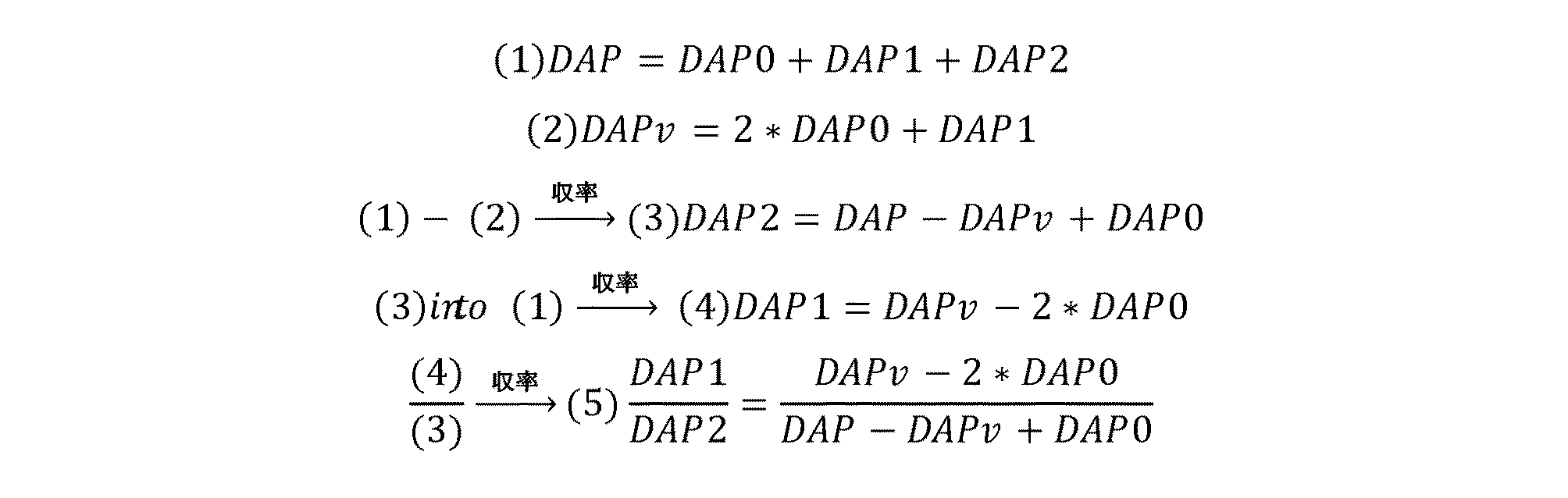
The mass balance is made using the total amount of DAP vinyl detected by. The material balance is shown below:
DAPν = total number of DAP vinyls per 1000 carbons measured by NMR DAP = total number of DAP molecules per 1000 carbons measured by NMR DAP0 = total number of unreacted DAP molecules per 1000 carbons DAPw = unreacted measured by washing DAP molecule weight fraction DAP1 = total number of DAP molecules reacted at one end per 1000 carbons DAP2 = total number of DAP molecules reacted at two ends per 1000 carbons
方程式(5)における比は、6.2であることが分かる。この比の値が反応操作に基づ
いて変わり得ること、およびそれが推定値に過ぎないことは理解される。しかし、上の解
析により、遊離DAPが存在するときに単結合および二重結合DAPの濃度を決定する手
段が得られ、およびNMRを用いて、試料中に存在するDAPの総量およびビニルDAP
の総量を決定する。
It can be seen that the ratio in equation (5) is 6.2. It will be appreciated that the value of this ratio can vary based on the reaction operation and that it is only an estimate. However, the above analysis provides a means to determine the concentration of single and double bond DAP when free DAP is present, and using NMR, the total amount of DAP present in the sample and vinyl DAP
Determine the total amount.
単結合DAPの二重結合DAPに対するモル比の値を推定することにより、「洗浄」段
階なしでのポリマー中の遊離、単結合および二重結合DAPの計算が可能になる。上の方
程式(1)および(2)に戻って、モル比を用いて単結合および二重結合DAPについて
解く。下記は、単結合DAP濃度を決定するための方程式である。
上記試料についての測定および計算値を下の表2に示す。 The measured and calculated values for the sample are shown in Table 2 below.
実施例3 架橋および性能特性
上で説明したように調製した樹脂試料を架橋させるために、ジクミルペルオキシド(P
ERKADOX(登録商標)BC−FF;AkzoNobelから入手可能)を試料樹脂
のペレットに浸み込ませ、それらの架橋材料に関して硬化評価を行う。ジクミルペルオキ
シドを先ず溶融させる。ペレット状の樹脂試料を大きいガラス瓶の中で、70℃で4時間
、予熱する;その後、溶融したジクミルペルオキシドを、そのジクミルペルオキシドと樹
脂試料の総合重量に基づき1.9重量%の濃度で、シリンジを使用して添加する。ペレッ
トの瓶にしっかりと蓋をし、30回転毎分(「rpm」)に設定したせっ器タンブラーに
載せる。2分の混転後、瓶を取り去り、手作業で振盪してその瓶の側面からペレットを離
す。その瓶を1分間、タンブラー上に戻し、その後、取り去り、すべての過酸化物が吸着
されたと視認される(すなわち、ペレットが湿潤しているように見えない、または白色残
留物を有する)まで(おおよそ6時間)、70℃オーブンに戻す。
Example 3 Crosslinking and Performance Properties To crosslink a resin sample prepared as described above, dicumyl peroxide (P
ERKADOX® BC-FF (available from AkzoNobel) is dipped into the pellets of the sample resin and a cure evaluation is performed on those cross-linked materials. Dicumyl peroxide is first melted. The pelleted resin sample is preheated in a large glass bottle at 70 ° C. for 4 hours; the molten dicumyl peroxide is then added at a concentration of 1.9% by weight based on the combined weight of the dicumyl peroxide and resin sample. Add using a syringe. Cap the pellet jar firmly and place it on a stirrer tumbler set at 30 revolutions per minute (“rpm”). After 2 minutes of tumbling, remove the bottle and shake manually to release the pellet from the side of the bottle. The bottle is returned to the tumbler for 1 minute and then removed until all peroxide is visible as adsorbed (ie, the pellet does not appear wet or has a white residue) Return to 70 ° C oven for approximately 6 hours).
マニュアルモードで動作するスチームプレス(WABASH、モデル番号G302H−
12−CLX)を使用して、それらの過酸化物処理樹脂の試料を圧縮成形する。試料に対
して行うべき試験の要件に応じて試料毎にプラック(8×8インチ)を調製する。前記プ
レスを115℃(±5℃)に予熱する。合計75グラムの材料を予備計量し、マイラーで
構成された金型装置とアルミニウムシートの間の75ミルステンレス鋼プラックの中央に
配置する。その後、その充填された金型を300psiの前記プレスに3分間入れる。3
分後、温度を185℃(±5℃)に、圧力を2,500psiゲージ(「psig」)に
急上昇させる。それらのプラックを185℃および2,500psigで15分間、架橋
させる。
Steam press operating in manual mode (WABASH, model number G302H-
12-CLX) are used to compression mold the peroxide-treated resin samples. Prepare plaques (8 x 8 inches) for each sample according to the requirements of the test to be performed on the sample. The press is preheated to 115 ° C. (± 5 ° C.). A total of 75 grams of material is pre-weighed and placed in the center of a 75 mil stainless steel plaque between a molder composed of Mylar and an aluminum sheet. The filled mold is then placed in the 300 psi press for 3 minutes. 3
After a minute, the temperature is rapidly increased to 185 ° C. (± 5 ° C.) and the pressure is increased to 2500 psi gauge (“psig”). The plaques are crosslinked at 185 ° C. and 2500 psig for 15 minutes.
架橋した試料の各々を架橋および絶縁破壊(交流破壊とも呼ばれる)(「ACBD」)
の程度について分析する。150℃で行う高温クリープ実験によって、これらの試料の架
橋の程度を測定する。高温クリープの判定は、標準法ICEA T−28−562に従っ
て行う。高温クリープ分析については、高温クリープ率が低いほど、大きい架橋度を示す
。
Cross-linking and dielectric breakdown (also called AC breakdown) of each cross-linked sample ("ACBD")
Analyze the degree of. The degree of crosslinking of these samples is measured by high temperature creep experiments conducted at 150 ° C. Determination of high temperature creep is performed according to standard method ICEA T-28-562. For high temperature creep analysis, the lower the high temperature creep rate, the greater the degree of crosslinking.
ASTM D149に従って、ACBDについて上で説明したように架橋試料の各々を
試験する。その後、「U」字管の半割体間に1mm厚の架橋材料スラブをクランプするこ
とにより試料を湿潤老化させる(前記管の各々の半割体には電解質溶液(0.01M N
aCl溶液)が満たされている)。その電解質溶液中でワイヤー電極を使用して6kV
1kHz電圧を試料の全域に印加する。U字管中での15日の老化後、試料の水分を拭き
取り、0.5kV/秒の電圧勾配を用いるASTM D149による60Hz ACBD
試験に付す。
Each of the cross-linked samples is tested as described above for ACBD according to ASTM D149. The sample is then wet-aged by clamping a 1 mm thick cross-linked material slab between the halves of the “U” tube (each half of the tube contains an electrolyte solution (0.01 M N).
aCl solution)). 6kV using wire electrode in the electrolyte solution
A 1 kHz voltage is applied across the sample. After 15 days of aging in a U-tube, the sample moisture is wiped off and 60 Hz ACBD according to ASTM D149 using a voltage gradient of 0.5 kV / sec
Attached to the test.
前記高温クリープ分析、初期ACBDおよび湿潤老化ACBDからの結果を下の表3に
提供する。
The results from the high temperature creep analysis, initial ACBD and wet aging ACBD are provided in Table 3 below.
はるかに低い高温クリープおよびはるかに向上した残留ACBD値から分かるように、
DAPを含有する試料が、DAPを含有しない試料より性能がはるかに優れていることが
表3から明白である。
As can be seen from the much lower high temperature creep and the much improved residual ACBD value,
It is clear from Table 3 that the sample containing DAP outperforms the sample that does not contain DAP.
定義
「電線」およびこれに類する用語は、導電性金属、例えば、銅もしくはアルミニウムの
単一の撚線、または光ファイバーの単一の撚線を意味する。
Definitions “Wire” and like terms mean a single strand of conductive metal, eg, copper or aluminum, or a single strand of optical fiber.
「ケーブル」、「電力ケーブル」およびこれらに類する用語は、外装、例えば、絶縁被
覆または外部保護ジャケットのうちの少なくとも1本の電線または光ファイバーを意味す
る。典型的に、ケーブルは、典型的には共通絶縁被覆および/または保護ジャケット内の
、互いに結合された2本以上の電線または光ファイバーである。外装内部の個々の電線ま
たはファイバーは裸であることもあり、被覆されていることもあり、または絶縁されてい
ることもある。結合ケーブルは、電線と光ファイバーの両方を含有することができる。前
記ケーブルを低、中および/または高圧用途用に設計することができる。典型的なケーブ
ル設計は、米国特許第5,246,783号、同第6,496,629号および同第6,
714,707号明細書において例証されている。
The terms “cable”, “power cable” and like terms mean a wire or optical fiber of at least one of an outer sheath, eg, an insulation coating or an outer protective jacket. Typically, a cable is two or more wires or optical fibers coupled together, typically in a common insulation coating and / or protective jacket. Individual wires or fibers inside the sheath may be bare, covered, or insulated. The coupling cable can contain both electrical wires and optical fibers. The cable can be designed for low, medium and / or high pressure applications. Typical cable designs are described in U.S. Pat. Nos. 5,246,783, 6,496,629 and 6,689.
Illustrated in US Pat. No. 714,707.
「ポリマー」およびこれに類する用語は、同じまたは異なるタイプのモノマーを反応さ
せる(すなわち、重合させる)ことによって調製された高分子化合物を意味する。「ポリ
マー」は、ホモポリマーおよび共重合体を含む。
“Polymer” and like terms mean a polymeric compound prepared by reacting (ie, polymerizing) the same or different types of monomers. “Polymer” includes homopolymers and copolymers.
「共重合体」は、少なくとも2種の異なるモノマーの重合によって調製されたポリマー
を意味する。この一般用語は、2種の異なるモノマーから調製されたポリマーを指すため
に通常は用いられるコポリマー、および2種より多くの異なるモノマーから調製されたポ
リマー、例えば、ターポリマー(3種の異なるモノマー)、テトラポリマー(4種の異な
るモノマー)などを含む。
“Copolymer” means a polymer prepared by the polymerization of at least two different monomers. This general term refers to copolymers that are commonly used to refer to polymers prepared from two different monomers, and polymers prepared from more than two different monomers, eg terpolymers (three different monomers). , Tetrapolymers (4 different monomers) and the like.
モノマーに言及するときの「残基」は、ポリマー分子中に、該ポリマー分子を製造する
ための別のモノマーまたはコモノマー分子との重合の結果として残存する、モノマー分子
の一部を意味する。
“Residue” when referring to a monomer means the portion of the monomer molecule that remains in the polymer molecule as a result of polymerization with another monomer or comonomer molecule to produce the polymer molecule.
数値範囲
数値範囲は、上方の値から下方の値までのすべての値であって、上方の値と下方の値を
含むすべての値を1単位刻みで含むが、但し、任意の下方の値と任意の高い方の値の間に
少なくとも2単位の隔たりがあることを条件とする。一例として、組成的、物理的または
他の特性、例えば、分子量、重量%老化などが、100から1,000である場合には、
その意図は、すべての個々の値、例えば100、101、102、および部分範囲、例え
ば100から144、155から170、197から200を明確に列挙することである
。
Numerical range The numerical range is all values from the upper value to the lower value, and includes all values including the upper value and the lower value in 1 unit increments, provided that any lower value and Provided that there is a separation of at least 2 units between any higher values. As an example, if the compositional, physical or other properties such as molecular weight, weight percent aging, etc. are from 100 to 1,000,
The intent is to explicitly list all individual values, eg 100, 101, 102, and subranges, eg 100 to 144, 155 to 170, 197 to 200.
Claims (10)
エチレンモノマー残基と、
次の式:
によって表される少なくとも1種の非共役ジエンコモノマーの残基と
を有する共重合体。 A copolymer in which it was polymerized:
An ethylene monomer residue;
The following formula:
A copolymer of at least one non-conjugated diene comonomer residue represented by:
エチレンモノマー残基と、
次の式:
を有する共重合体。 A copolymer in which it was polymerized:
An ethylene monomer residue;
The following formula:
に記載の共重合体。 The non-conjugated diene comonomer is diallyl-o-phthalate.
The copolymer described in 1.
起因し得るビニル含有量を有する、請求項1から3のいずれか一項に記載の共重合体。 Copolymer according to any one of claims 1 to 3, having a vinyl content that can result from residues of the non-conjugated diene comonomer of at least 0.01 per 1000 carbon atoms.
囲を構成し、前記非共役ジエンコモノマーの前記残基が、前記共重合体の0.001から
5モルパーセントの範囲を構成する、請求項1から4のいずれか一項に記載の共重合体。 The ethylene monomer residue comprises 95 to 99.99 mole percent of the copolymer, and the residue of the nonconjugated diene comonomer ranges from 0.001 to 5 mole percent of the copolymer. The copolymer as described in any one of Claim 1 to 4 which comprises these.
れている共重合体が、50パーセント以下の高温クリープを有する、請求項1から5のい
ずれか一項に記載の共重合体を含む製品。 6. The copolymer of any one of claims 1 to 5, wherein the copolymer is at least partially crosslinked and the at least partially crosslinked copolymer has a high temperature creep of 50 percent or less. Products containing copolymers of
重合体の少なくとも一部分が、前記絶縁材の少なくとも一部分を構成する、請求項6に記
載の製品。 The product of claim 6, wherein the product is a power cable including a conductor and an insulating material, wherein at least a portion of the at least partially crosslinked copolymer comprises at least a portion of the insulating material.
反応ゾーンにおいて、エチレンと、次の式:
始剤の存在下、前記共重合体への前記エチレンの少なくとも一部分および前記非共役ジエ
ンコモノマーの少なくとも一部分の組み込みを果たすために十分な条件下で重合する工程
を含み、
前記式中のR1およびR2が、末端炭素−炭素二重結合を各々が有する独立したC2−
C20アルケニル基であり、
前記反応ゾーンが、前記重合のうち少なくとも25パーセントの間、120から360
℃の範囲の温度で維持される、
プロセス。 A process for producing a copolymer comprising:
In the reaction zone, ethylene and the following formula:
R 1 and R 2 in the above formula are independent C 2 — each having a terminal carbon-carbon double bond.
It is a C 20 alkenyl group,
The reaction zone is between 120 and 360 for at least 25 percent of the polymerization.
Maintained at a temperature in the range of ℃,
process.
請求項8に記載のプロセス。 Further comprising at least partially cross-linking at least a portion of the copolymer.
The process of claim 8.
モノマーの残基に起因し得るビニル含有量を有し、前記非共役ジエンコモノマーが、ジア
リル−o−フタレートであり、前記重合が、プロピレンを含む連鎖移動剤の存在下で行わ
れる、請求項8に記載のプロセス。
The copolymer has a vinyl content that can be attributed to residues of the non-conjugated diene comonomer of at least 0.01 per 1000 carbon atoms, and the non-conjugated diene comonomer is diallyl-o-phthalate; The process according to claim 8, wherein the polymerization is carried out in the presence of a chain transfer agent comprising propylene.
Applications Claiming Priority (2)
| Application Number | Priority Date | Filing Date | Title |
|---|---|---|---|
| US201161578590P | 2011-12-21 | 2011-12-21 | |
| US61/578,590 | 2011-12-21 |
Related Parent Applications (1)
| Application Number | Title | Priority Date | Filing Date |
|---|---|---|---|
| JP2014549068A Division JP6449651B2 (en) | 2011-12-21 | 2012-11-21 | Copolymer composition and method for producing the same |
Publications (1)
| Publication Number | Publication Date |
|---|---|
| JP2018024885A true JP2018024885A (en) | 2018-02-15 |
Family
ID=47279144
Family Applications (2)
| Application Number | Title | Priority Date | Filing Date |
|---|---|---|---|
| JP2014549068A Active JP6449651B2 (en) | 2011-12-21 | 2012-11-21 | Copolymer composition and method for producing the same |
| JP2017182479A Pending JP2018024885A (en) | 2011-12-21 | 2017-09-22 | Copolymer composition and method for producing the same |
Family Applications Before (1)
| Application Number | Title | Priority Date | Filing Date |
|---|---|---|---|
| JP2014549068A Active JP6449651B2 (en) | 2011-12-21 | 2012-11-21 | Copolymer composition and method for producing the same |
Country Status (10)
| Country | Link |
|---|---|
| US (1) | US9208923B2 (en) |
| EP (1) | EP2794674B1 (en) |
| JP (2) | JP6449651B2 (en) |
| KR (2) | KR102184438B1 (en) |
| CN (1) | CN104114586B (en) |
| BR (1) | BR112014014467B1 (en) |
| CA (1) | CA2859011C (en) |
| MX (1) | MX346263B (en) |
| TW (1) | TWI588167B (en) |
| WO (1) | WO2013095862A1 (en) |
Families Citing this family (10)
| Publication number | Priority date | Publication date | Assignee | Title |
|---|---|---|---|---|
| US10287428B2 (en) | 2015-06-12 | 2019-05-14 | Kraton Polymers U.S. Llc | Heat activated gels for cable filling applications |
| US10703890B2 (en) * | 2015-06-29 | 2020-07-07 | Dow Global Technologies Llc | Compositions and methods for making crosslinked polyolefins with peroxide initiator |
| US10668796B2 (en) * | 2016-04-04 | 2020-06-02 | Cooper-Standard Automotive Inc. | Weatherstrip assembly and method of isolating dissimilar metals in the weatherstrip assembly |
| JP2018147844A (en) | 2017-03-09 | 2018-09-20 | Smk株式会社 | Electric connector mounting structure and electric connector module manufacturing method |
| US10800823B2 (en) | 2017-07-07 | 2020-10-13 | Immatics Biotechnologies Gmbh | Peptides and combination of peptides for use in immunotherapy against lung cancer, including NSCLC, SCLC and other cancers |
| WO2019105851A1 (en) * | 2017-11-28 | 2019-06-06 | Akzo Nobel Chemicals International B.V. | Process for modifying ldpe |
| US11555473B2 (en) | 2018-05-29 | 2023-01-17 | Kontak LLC | Dual bladder fuel tank |
| US11638331B2 (en) | 2018-05-29 | 2023-04-25 | Kontak LLC | Multi-frequency controllers for inductive heating and associated systems and methods |
| EP3902809A1 (en) * | 2018-12-28 | 2021-11-03 | Dow Global Technologies LLC | Curable compositions comprising unsaturated polyolefins |
| KR20220043153A (en) * | 2019-07-31 | 2022-04-05 | 다우 글로벌 테크놀로지스 엘엘씨 | Branched Ethylene-Based Polymer Composition |
Citations (7)
| Publication number | Priority date | Publication date | Assignee | Title |
|---|---|---|---|---|
| JPS4855926A (en) * | 1971-11-15 | 1973-08-06 | ||
| JPS4864185A (en) * | 1971-12-09 | 1973-09-05 | ||
| JPS49122587A (en) * | 1973-03-28 | 1974-11-22 | ||
| JPS5249029B1 (en) * | 1971-03-15 | 1977-12-14 | ||
| JPS57170913A (en) * | 1981-04-16 | 1982-10-21 | Mitsubishi Petrochem Co Ltd | Preparation of crosslinked polyethylene having excellent creep characteristics |
| JPS6297206A (en) * | 1985-10-21 | 1987-05-06 | 日本石油化学株式会社 | Power cable |
| JPH07500621A (en) * | 1991-10-22 | 1995-01-19 | ボレアリス、ホールディング、アクティーゼルスカブ | Unsaturated ethylene-nonconjugated diene copolymer and its production by radical polymerization |
Family Cites Families (23)
| Publication number | Priority date | Publication date | Assignee | Title |
|---|---|---|---|---|
| NL302781A (en) | 1963-01-04 | |||
| US3377330A (en) | 1964-12-31 | 1968-04-09 | Monsanto Co | Ethylene polymerization in the presence of a free-radical catalyst and as a chain-transfer agent a minor amount of phosphine |
| US3404080A (en) * | 1965-05-18 | 1968-10-01 | Union Carbide Corp | Cables and process for producing electrical insulation therefor |
| US4018852A (en) | 1974-11-27 | 1977-04-19 | Union Carbide Corporation | Composition with triallyl compounds and process for avoiding scorching of ethylene polymer composition |
| US4857600A (en) | 1988-05-23 | 1989-08-15 | Union Carbide Corporation | Process for grafting diacid anhydrides |
| US5246783A (en) | 1991-08-15 | 1993-09-21 | Exxon Chemical Patents Inc. | Electrical devices comprising polymeric insulating or semiconducting members |
| US5378539A (en) * | 1992-03-17 | 1995-01-03 | E. I. Du Pont De Nemours And Company | Cross-linked melt processible fire-retardant ethylene polymer compositions |
| SE501577C2 (en) * | 1992-12-07 | 1995-03-20 | Borealis Holding As | Unsaturated ethylene copolymer and process for preparation thereof |
| US5346961A (en) | 1993-04-07 | 1994-09-13 | Union Carbide Chemicals & Plastics Technology Corporation | Process for crosslinking |
| JP3257897B2 (en) * | 1994-04-27 | 2002-02-18 | 積水化学工業株式会社 | Expandable polyolefin resin composition and crosslinked polyolefin resin foam |
| US5575965A (en) | 1995-05-19 | 1996-11-19 | Union Carbide Chemicals & Plastics Technology Corporation | Process for extrusion |
| SE507045C2 (en) | 1996-05-31 | 1998-03-23 | Borealis As | Ethylene copolymer with increased degree of unsaturation and method of preparation thereof |
| ID28457A (en) * | 1998-09-16 | 2001-05-24 | Japan Polyolefins Co Ltd | RESIN MATERIALS FOR ELECTRICAL ISOLATION MATERIALS, ELECTRIC ISOLATION MATERIALS, AND ELECTRICAL WIRE AND SAME CABLE USE |
| US6496629B2 (en) | 1999-05-28 | 2002-12-17 | Tycom (Us) Inc. | Undersea telecommunications cable |
| DE10064752A1 (en) | 2000-12-22 | 2002-07-04 | Basell Polyolefine Gmbh | Odorless polyethylene homo- and copolymers with good mechanical properties |
| US6596241B2 (en) | 2001-12-19 | 2003-07-22 | Exxonmobil Chemical Patents Inc | Tubular polymerization reactors and polymers made therein |
| US6673878B2 (en) | 2001-12-19 | 2004-01-06 | Exxonmobil Chemical Patents Inc. | Tubular polymerization reactors and polymers made therein |
| US6714707B2 (en) | 2002-01-24 | 2004-03-30 | Alcatel | Optical cable housing an optical unit surrounded by a plurality of gel layers |
| CN1390865A (en) * | 2002-07-09 | 2003-01-15 | 上海氯碱化工股份有限公司 | Special resin for dulling polyvinyl chloride and its preparing process |
| CN100344659C (en) * | 2003-11-06 | 2007-10-24 | 浙江工业大学 | Preparation of water phase suspended swelling graft polypropylene |
| CN101463171B (en) * | 2009-01-06 | 2011-12-14 | 山东日科化学股份有限公司 | Polychloroethylene mixture with excellent shock resistance and processability |
| EA022397B1 (en) * | 2009-11-11 | 2015-12-30 | Бореалис Аг | A polymer composition and a power cable comprising the polymer composition and a process for producing the same |
| US20120021237A1 (en) * | 2010-07-20 | 2012-01-26 | Celanese International Corporation | Vinyl ester/ethylene-based binders for paper and paperboard coatings |
-
2012
- 2012-11-21 JP JP2014549068A patent/JP6449651B2/en active Active
- 2012-11-21 EP EP12795289.3A patent/EP2794674B1/en active Active
- 2012-11-21 KR KR1020147015645A patent/KR102184438B1/en active Active
- 2012-11-21 BR BR112014014467-2A patent/BR112014014467B1/en active IP Right Grant
- 2012-11-21 KR KR1020197016431A patent/KR20190068643A/en not_active Ceased
- 2012-11-21 CA CA2859011A patent/CA2859011C/en active Active
- 2012-11-21 CN CN201280069960.2A patent/CN104114586B/en active Active
- 2012-11-21 WO PCT/US2012/066191 patent/WO2013095862A1/en not_active Ceased
- 2012-11-21 MX MX2014007686A patent/MX346263B/en active IP Right Grant
- 2012-11-21 US US14/359,403 patent/US9208923B2/en active Active
- 2012-12-20 TW TW101148679A patent/TWI588167B/en active
-
2017
- 2017-09-22 JP JP2017182479A patent/JP2018024885A/en active Pending
Patent Citations (7)
| Publication number | Priority date | Publication date | Assignee | Title |
|---|---|---|---|---|
| JPS5249029B1 (en) * | 1971-03-15 | 1977-12-14 | ||
| JPS4855926A (en) * | 1971-11-15 | 1973-08-06 | ||
| JPS4864185A (en) * | 1971-12-09 | 1973-09-05 | ||
| JPS49122587A (en) * | 1973-03-28 | 1974-11-22 | ||
| JPS57170913A (en) * | 1981-04-16 | 1982-10-21 | Mitsubishi Petrochem Co Ltd | Preparation of crosslinked polyethylene having excellent creep characteristics |
| JPS6297206A (en) * | 1985-10-21 | 1987-05-06 | 日本石油化学株式会社 | Power cable |
| JPH07500621A (en) * | 1991-10-22 | 1995-01-19 | ボレアリス、ホールディング、アクティーゼルスカブ | Unsaturated ethylene-nonconjugated diene copolymer and its production by radical polymerization |
Also Published As
| Publication number | Publication date |
|---|---|
| JP2015509992A (en) | 2015-04-02 |
| CN104114586B (en) | 2016-09-14 |
| EP2794674B1 (en) | 2020-03-25 |
| US9208923B2 (en) | 2015-12-08 |
| CA2859011A1 (en) | 2013-06-27 |
| BR112014014467B1 (en) | 2021-11-30 |
| MX346263B (en) | 2017-03-13 |
| BR112014014467A2 (en) | 2017-06-13 |
| WO2013095862A1 (en) | 2013-06-27 |
| KR20140107239A (en) | 2014-09-04 |
| TWI588167B (en) | 2017-06-21 |
| KR20190068643A (en) | 2019-06-18 |
| US20140329961A1 (en) | 2014-11-06 |
| CN104114586A (en) | 2014-10-22 |
| KR102184438B1 (en) | 2020-11-30 |
| MX2014007686A (en) | 2014-07-30 |
| JP6449651B2 (en) | 2019-01-09 |
| TW201333051A (en) | 2013-08-16 |
| EP2794674A1 (en) | 2014-10-29 |
| CA2859011C (en) | 2020-01-28 |
Similar Documents
| Publication | Publication Date | Title |
|---|---|---|
| JP6449651B2 (en) | Copolymer composition and method for producing the same | |
| US11390699B2 (en) | Crosslinkable polymer composition and cable with advantageous electrical properties | |
| US9957405B2 (en) | Cross-linkable polymeric compositions, methods for making the same, and articles made therefrom | |
| EP2548208B1 (en) | Polymer composition for w&c application with advantageous electrical properties | |
| KR102617008B1 (en) | Process for producing crosslinked cable insulation using high melt strength ethylene-based polymers prepared in a tubular reactor and optionally modified with a branching agent. | |
| JP5996786B2 (en) | Ethylene polymer conductor coating made with polybutadiene co-crosslinking agent | |
| US10679769B2 (en) | Cable with improved electrical properties | |
| EP3548553B1 (en) | Peroxide-curable polyolefin composition | |
| KR102742576B1 (en) | Crosslinking compositions having antioxidants and methane formation and products | |
| US20190348191A1 (en) | Cable with advantageous electrical properties | |
| EP2379627B1 (en) | Polymer composition | |
| RU2816841C2 (en) | Compositions containing ldpe, polypropylene and functionalised polyolefins | |
| WO2025157309A1 (en) | Coated conductors including cross-linked polyolefin elastomer compositions | |
| JP2026509729A (en) | Polyethylene composition for insulating layer |
Legal Events
| Date | Code | Title | Description |
|---|---|---|---|
| A977 | Report on retrieval |
Free format text: JAPANESE INTERMEDIATE CODE: A971007 Effective date: 20180726 |
|
| A131 | Notification of reasons for refusal |
Free format text: JAPANESE INTERMEDIATE CODE: A131 Effective date: 20180731 |
|
| A601 | Written request for extension of time |
Free format text: JAPANESE INTERMEDIATE CODE: A601 Effective date: 20181029 |
|
| A601 | Written request for extension of time |
Free format text: JAPANESE INTERMEDIATE CODE: A601 Effective date: 20181225 |
|
| A02 | Decision of refusal |
Free format text: JAPANESE INTERMEDIATE CODE: A02 Effective date: 20190326 |