JP2018078024A - Method for recovering valuable materials from lithium ion secondary batteries - Google Patents
Method for recovering valuable materials from lithium ion secondary batteries Download PDFInfo
- Publication number
- JP2018078024A JP2018078024A JP2016219084A JP2016219084A JP2018078024A JP 2018078024 A JP2018078024 A JP 2018078024A JP 2016219084 A JP2016219084 A JP 2016219084A JP 2016219084 A JP2016219084 A JP 2016219084A JP 2018078024 A JP2018078024 A JP 2018078024A
- Authority
- JP
- Japan
- Prior art keywords
- current collector
- ion secondary
- lithium ion
- secondary battery
- electrode current
- Prior art date
- Legal status (The legal status is an assumption and is not a legal conclusion. Google has not performed a legal analysis and makes no representation as to the accuracy of the status listed.)
- Granted
Links
Classifications
-
- Y—GENERAL TAGGING OF NEW TECHNOLOGICAL DEVELOPMENTS; GENERAL TAGGING OF CROSS-SECTIONAL TECHNOLOGIES SPANNING OVER SEVERAL SECTIONS OF THE IPC; TECHNICAL SUBJECTS COVERED BY FORMER USPC CROSS-REFERENCE ART COLLECTIONS [XRACs] AND DIGESTS
- Y02—TECHNOLOGIES OR APPLICATIONS FOR MITIGATION OR ADAPTATION AGAINST CLIMATE CHANGE
- Y02W—CLIMATE CHANGE MITIGATION TECHNOLOGIES RELATED TO WASTEWATER TREATMENT OR WASTE MANAGEMENT
- Y02W30/00—Technologies for solid waste management
- Y02W30/50—Reuse, recycling or recovery technologies
- Y02W30/84—Recycling of batteries or fuel cells
Landscapes
- Secondary Cells (AREA)
Abstract
【課題】リチウムイオン二次電池から正極集電体および負極集電体の少なくともいずれかの金属の高品位産物を、高い回収率で回収でき、かつ工程が簡単なリチウムイオン二次電池からの有価物の回収方法の提供。【解決手段】正極集電体と、負極集電体とを含むリチウムイオン二次電池を、前記正極集電体および前記負極集電体のうち、低い融点の集電体の融点以上、かつ高い融点の前記集電体の融点未満の温度であり、かつ酸素濃度が11vol%以下の雰囲気下で焙焼する焙焼工程を少なくとも含むリチウムイオン二次電池からの有価物の回収方法である。【選択図】なし[PROBLEMS] To recover a high-quality product of at least one of a positive electrode current collector and a negative electrode current collector from a lithium ion secondary battery with a high recovery rate and a value from a lithium ion secondary battery with a simple process. Providing a collection method. A lithium ion secondary battery including a positive electrode current collector and a negative electrode current collector is a melting point higher than or equal to a low melting point current collector of the positive electrode current collector and the negative electrode current collector. This is a method for recovering valuable materials from a lithium ion secondary battery including at least a roasting step of roasting in an atmosphere having a melting point lower than the melting point of the current collector and an oxygen concentration of 11 vol% or less. [Selection figure] None
Description
本発明は、製造過程で発生した不良品や使用機器および電池の寿命などに伴い廃棄されるリチウムイオン二次電池の正極集電体および負極集電体などから有価物を回収可能な、リチウムイオン二次電池からの有価物の回収方法に関する。 The present invention provides a lithium ion capable of recovering valuable materials from a positive electrode current collector and a negative electrode current collector of a lithium ion secondary battery that is discarded along with defective products generated in the manufacturing process, equipment used, and battery life. The present invention relates to a method for recovering valuable materials from secondary batteries.
リチウムイオン二次電池は、従来の鉛蓄電池、ニッカド二次電池などに比較して軽量、高容量、高起電力の二次電池であり、パソコン、電気自動車、携帯機器などの二次電池として使用されている。例えば、前記リチウムイオン二次電池の正極には、コバルトやニッケルなどの有価物が、コバルト酸リチウム(LiCoO2)、三元系正極材(LiNixCoyMnzO2(x+y+z))などとして使用されている。 Lithium-ion secondary batteries are lighter, higher-capacity, and higher-electromotive force secondary batteries than conventional lead-acid batteries and nickel-cadmium secondary batteries, and are used as secondary batteries for personal computers, electric vehicles, portable devices, etc. Has been. For example, valuable materials such as cobalt and nickel are included in the positive electrode of the lithium ion secondary battery as lithium cobaltate (LiCoO 2 ), ternary positive electrode material (LiNi x Co y Mn z O 2 (x + y + z) ), and the like. It is used.
前記リチウムイオン二次電池は、今後も使用の拡大が予想されていることから、製造過程で発生した不良品や使用機器および電池の寿命などに伴い廃棄される前記リチウムイオン二次電池から有価物を回収することが、資源リサイクルの観点から望まれている。前記リチウムイオン二次電池から前記有価物を回収する際には、使用されている種々の金属を分離して回収することが、回収物の価値を高める点から重要である。近年、前記リチウムイオン二次電池の製造コストの低減を主目的とし、特に車載用の前記リチウムイオン二次電池において低コバルトおよびニッケル品位の正極材を有する前記リチウムイオン二次電池が開発され、相対的に集電体および外装容器を構成する金属の金属価値が前記リチウムイオン二次電池全体の価値に占める比率は増加している。前記集電体および前記外装容器構成物の中では、特に銅を用いている前記集電体の価値が高く、効率的な分離および回収技術の確立が重要性を増している。 Since the use of the lithium ion secondary battery is expected to continue in the future, defective products generated in the manufacturing process, used equipment, and valuable resources from the lithium ion secondary battery that is discarded with the life of the battery, etc. It is desired from the viewpoint of resource recycling to recover the waste. When recovering the valuable material from the lithium ion secondary battery, it is important to separate and recover various metals used from the viewpoint of increasing the value of the recovered material. In recent years, the lithium ion secondary battery having a positive electrode material of low cobalt and nickel quality in the lithium ion secondary battery for in-vehicle use has been developed mainly for the purpose of reducing the manufacturing cost of the lithium ion secondary battery, and the relative In particular, the ratio of the metal value of the metal constituting the current collector and the outer container to the total value of the lithium ion secondary battery is increasing. Among the current collector and the outer container composition, the current collector using copper is particularly valuable, and the establishment of an efficient separation and recovery technique is becoming increasingly important.
リチウムイオン二次電池からの有価物の回収方法として、例えば、前記リチウムイオン二次電池を焙焼し、得られた焙焼物を破砕した後、破砕物を篩別して、篩上側に主としてケースの破砕物を、篩下側に主として正極の破砕物および負極の破砕物を回収し、篩下に含まれる正極および負極の前記破砕物に衝撃力を与えて正極を正極集電体および正極活物質に、負極を負極集電体および負極活物質にそれぞれ分離し、結果物を篩別して、篩上側に主として前記正極集電体および前記負極集電体を含む金属製部材、篩下側に主として前記正極活物質および前記負極活物質を回収する方法が提案されている(例えば、特許文献1参照)。
また、リチウムイオン二次電池を300℃以上の温度で加熱し、次に破砕した後、得られた破砕物に対して8,000ガウス以上の高磁力選別を行い、常磁性体であるアルミニウムを磁着物として、反磁性体である銅を非磁着物として回収するが提案されている(例えば、特許文献2参照)。
さらに、本願出願人は、前記リチウムイオン二次電池を焙焼した後、焙焼物を打撃により破砕し、破砕物を篩分けして篩下に有価物を回収する方法を提案している(例えば、特許文献3参照)。
As a method for recovering valuable materials from a lithium ion secondary battery, for example, the lithium ion secondary battery is roasted, the obtained roasted material is crushed, the crushed material is sieved, and the case is mainly crushed on the upper side of the sieve. The crushed material of the positive electrode and the crushed material of the negative electrode are collected mainly on the lower side of the sieve, and an impact force is applied to the crushed material of the positive electrode and the negative electrode contained under the sieve to convert the positive electrode into a positive electrode current collector and a positive electrode active material. The negative electrode is separated into a negative electrode current collector and a negative electrode active material, the resulting product is sieved, and a metal member mainly including the positive electrode current collector and the negative electrode current collector on the upper side of the screen, and the positive electrode mainly on the lower side of the screen A method for recovering the active material and the negative electrode active material has been proposed (see, for example, Patent Document 1).
In addition, after heating the lithium ion secondary battery at a temperature of 300 ° C. or higher and then crushing, the obtained crushed material is subjected to high magnetic force selection of 8,000 gauss or more, and aluminum which is a paramagnetic substance is obtained. It has been proposed that copper, which is a diamagnetic material, be recovered as a non-magnetized material as a magnetized material (see, for example, Patent Document 2).
Further, the applicant of the present application has proposed a method of crushing the baked product by striking the lithium ion secondary battery and then crushing the crushed product and collecting valuables under the sieve (for example, And Patent Document 3).
しかしながら、前記特許文献1の方法では、前記正極集電体の融点および前記負極集電体の融点のいずれよりも低い温度で焙焼するため、篩分け工程によっては前記正極集電体と前記負極集電体を分離できない可能性があった。また、前記特許文献2の方法では、リチウムイオン二次電池からの銅の回収方法が提案されているが、外装容器の破砕・選別、銅-アルミ箔の分離に関わる工程数が多くなる上に、高磁力磁選機等の高価選別設備が必要である。また、回収銅濃縮物の品位も70%以上程度であり、回収物の品質は低い。また、前記特許文献3の方法では、篩分けにより前記負極集電体の金属と前記正極集電体の金属とをある程度分離することはできているが、前記負極集電体の前記金属および前記正極集電体の前記金属のいずれかの回収率および品位がともに十分ではなかった。 However, in the method of Patent Document 1, since the roasting is performed at a temperature lower than both the melting point of the positive electrode current collector and the melting point of the negative electrode current collector, the positive electrode current collector and the negative electrode are depending on the sieving step. There was a possibility that the current collector could not be separated. In the method of Patent Document 2, a method for recovering copper from a lithium ion secondary battery has been proposed. However, the number of steps involved in crushing / selecting the outer container and separation of the copper-aluminum foil is increased. Expensive sorting equipment such as a high magnetic separator is required. Further, the quality of the recovered copper concentrate is about 70% or more, and the quality of the recovered product is low. In the method of Patent Document 3, although the metal of the negative electrode current collector and the metal of the positive electrode current collector can be separated to some extent by sieving, the metal of the negative electrode current collector and the metal Both the recovery rate and quality of any of the metals in the positive electrode current collector were not sufficient.
本発明は、従来における前記諸問題を解決し、以下の目的を達成することを課題とする。即ち、本発明は、リチウムイオン二次電池の正極集電体および負極集電体の少なくともいずれかから高品位の有価物を、高い回収率で回収でき、かつ工程が簡単なリチウムイオン二次電池からの有価物の回収方法を提供することを目的とする。 An object of the present invention is to solve the above-described problems and achieve the following objects. That is, the present invention is a lithium ion secondary battery that can recover a high-quality valuable material from at least one of a positive electrode current collector and a negative electrode current collector of a lithium ion secondary battery at a high recovery rate and has a simple process. The purpose is to provide a method for recovering valuable materials from the market.
前記課題を解決するための手段としては、以下の通りである。即ち、
<1> 正極集電体と、負極集電体とを含むリチウムイオン二次電池を、前記正極集電体および前記負極集電体のうち、低い融点の集電体の融点以上、かつ高い融点の前記集電体の融点未満の温度であり、かつ酸素濃度が11vol%以下の雰囲気下で焙焼する焙焼工程を少なくとも含むことを特徴とするリチウムイオン二次電池からの有価物の回収方法である。
<2> 前記酸素濃度が0vol%以上5vol%以下の雰囲気下で焙焼を行う、前記<1>に記載のリチウムイオン二次電池からの有価物の回収方法である。
<3> 前記酸素濃度が0vol%である不活性ガス雰囲気下で焙焼を行う、前記<1>または<2>に記載のリチウムイオン二次電池からの有価物の回収方法である。
<4> 前記リチウムイオン二次電池の前記正極集電体と、前記負極集電体とを含む外装容器の融点が、前記高い融点の前記集電体よりも低い、前記<1>から<3>のいずれかに記載のリチウムイオン二次電池からの有価物の回収方法である。
<5> 前記焙焼工程の後に、破砕工程、および分離工程を順次行う、前記<1>から<4>のいずれかに記載のリチウムイオン二次電池からの有価物の回収方法である。
<6> 前記外装容器の材質がアルミニウムである、前記<4>に記載のリチウムイオン二次電池からの有価物の回収方法である。
Means for solving the problems are as follows. That is,
<1> A lithium ion secondary battery including a positive electrode current collector and a negative electrode current collector is a melting point higher than or equal to a low melting point current collector of the positive electrode current collector and the negative electrode current collector. A method for recovering valuable materials from a lithium ion secondary battery, comprising at least a roasting step of roasting in an atmosphere having an oxygen concentration of 11 vol% or less at a temperature lower than the melting point of the current collector It is.
<2> The method for recovering a valuable material from a lithium ion secondary battery according to <1>, wherein the oxygen concentration is roasted in an atmosphere of 0 vol% or more and 5 vol% or less.
<3> The method for recovering a valuable material from a lithium ion secondary battery according to <1> or <2>, wherein roasting is performed in an inert gas atmosphere in which the oxygen concentration is 0 vol%.
<4> The <1> to <3, wherein the outer container containing the positive electrode current collector and the negative electrode current collector of the lithium ion secondary battery has a melting point lower than that of the high melting point current collector. The method for recovering valuable materials from the lithium ion secondary battery according to any one of the above.
<5> The method for recovering a valuable material from a lithium ion secondary battery according to any one of <1> to <4>, wherein a crushing step and a separation step are sequentially performed after the roasting step.
<6> The method for recovering a valuable material from a lithium ion secondary battery according to <4>, wherein the outer container is made of aluminum.
本発明によると、従来における前記諸問題を解決することができ、リチウムイオン二次電池の正極集電体および負極集電体の少なくともいずれかから高品位の有価物を、高い回収率で回収でき、かつ工程が簡単なリチウムイオン二次電池からの有価物の回収方法を提供することができる。 According to the present invention, the conventional problems can be solved, and high-quality valuables can be recovered at a high recovery rate from at least one of a positive electrode current collector and a negative electrode current collector of a lithium ion secondary battery. In addition, it is possible to provide a method for recovering valuable materials from a lithium ion secondary battery that has a simple process.
(リチウムイオン二次電池からの有価物の回収方法)
本発明のリチウムイオン二次電池からの有価物の回収方法は、焙焼工程を少なくとも含み、焙焼時に溶融分離した金属の回収工程、破砕工程、および分離工程を含むことが好ましく、さらに必要に応じてその他の工程を含む。
(Recovery method of valuable materials from lithium ion secondary batteries)
The method for recovering valuable materials from the lithium ion secondary battery of the present invention preferably includes at least a roasting step, and preferably includes a recovery step, a crushing step, and a separation step of a metal melted and separated at the time of roasting. Other processes are included accordingly.
<焙焼工程>
前記焙焼工程は、正極集電体と、負極集電体とを含むリチウムイオン二次電池を、前記正極集電体および前記負極集電体のうち、低い融点の集電体の融点以上、かつ高い融点の前記集電体の融点未満の温度であり、かつ酸素濃度が11vol%以下の雰囲気下で焙焼する工程である。
前記集電体の融点は、前記集電体が合金や複合材料の場合には、熱重量測定−示差熱分析(TG−DTA)により融点を測定することができる。
<Roasting process>
In the roasting step, a lithium ion secondary battery including a positive electrode current collector and a negative electrode current collector is a melting point of a low melting current collector of the positive electrode current collector and the negative electrode current collector, In addition, it is a step of roasting in an atmosphere at a temperature lower than the melting point of the current collector having a high melting point and an oxygen concentration of 11 vol% or less.
When the current collector is an alloy or a composite material, the melting point of the current collector can be measured by thermogravimetry-differential thermal analysis (TG-DTA).
−リチウムイオン二次電池−
前記リチウムイオン二次電池としては、特に制限はなく、目的に応じて適宜選択することができ、例えば、リチウムイオン二次電池の製造過程で発生した不良品のリチウムイオン二次電池、使用機器の不良、使用機器の寿命などにより廃棄されるリチウムイオン二次電池、寿命により廃棄される使用済みのリチウムイオン二次電池などが挙げられる。
-Lithium ion secondary battery-
The lithium ion secondary battery is not particularly limited and may be appropriately selected depending on the purpose. For example, a defective lithium ion secondary battery generated in the process of manufacturing a lithium ion secondary battery, used equipment Examples thereof include a lithium ion secondary battery that is discarded due to a defect, a life of a device used, a used lithium ion secondary battery that is discarded due to a life.
前記リチウムイオン二次電池の形状、構造、大きさ、材質としては、特に制限はなく、目的に応じて適宜選択することができる。
前記リチウムイオン二次電池の形状としては、特に制限はなく、目的に応じて適宜選択することができ、例えば、ラミネート型、円筒型、ボタン型、コイン型、角型、平型などが挙げられる。
前記リチウムイオン二次電池としては、例えば、正極と、負極と、セパレーターと、電解質および有機溶剤を含有する電解液と、前記正極、前記負極、前記セパレーターおよび前記電解液を収容する電池ケースである外装容器とを備えたものなどが挙げられる。なお、リチウムイオン二次電池は、正極や負極などが脱落した状態であっても本回収方法が可能であることは言うまでもない。
前記外装容器の材質としては、アルミニウムが好ましい。
There is no restriction | limiting in particular as a shape, a structure, a magnitude | size, and a material of the said lithium ion secondary battery, According to the objective, it can select suitably.
There is no restriction | limiting in particular as a shape of the said lithium ion secondary battery, According to the objective, it can select suitably, For example, a laminate type, a cylindrical type, a button type, a coin type, a square type, a flat type etc. are mentioned. .
Examples of the lithium ion secondary battery include a positive electrode, a negative electrode, a separator, an electrolytic solution containing an electrolyte and an organic solvent, and a battery case containing the positive electrode, the negative electrode, the separator, and the electrolytic solution. The thing provided with the exterior container etc. are mentioned. In addition, it cannot be overemphasized that this collection | recovery method is possible even if a lithium ion secondary battery has the state in which the positive electrode, the negative electrode, etc. dropped out.
The material of the outer container is preferably aluminum.
−−正極−−
前記正極としては、正極集電体を有していれば特に制限はなく、目的に応じて適宜選択することができる。
前記正極の形状としては、特に制限はなく、目的に応じて適宜選択することができ、例えば、平板状、シート状などが挙げられる。
--- Positive electrode-
The positive electrode is not particularly limited as long as it has a positive electrode current collector, and can be appropriately selected according to the purpose.
There is no restriction | limiting in particular as a shape of the said positive electrode, According to the objective, it can select suitably, For example, flat form, a sheet form, etc. are mentioned.
−−−正極集電体−−−
前記正極集電体としては、その形状、構造、大きさ、材質などに、特に制限はなく、目的に応じて適宜選択することができる。
前記正極集電体の形状としては、例えば、箔状などが挙げられる。
前記正極集電体の材質としては、例えば、ステンレススチール、ニッケル、アルミニウム、銅、チタン、タンタルなどが挙げられる。これらの中でも、アルミニウムが好ましい。
--- Positive electrode current collector ---
The positive electrode current collector is not particularly limited in shape, structure, size, material, and the like, and can be appropriately selected according to the purpose.
Examples of the shape of the positive electrode current collector include a foil shape.
Examples of the material of the positive electrode current collector include stainless steel, nickel, aluminum, copper, titanium, and tantalum. Among these, aluminum is preferable.
前記正極集電体上に正極材を有することが好ましい。
前記正極材としては、特に制限はなく、目的に応じて適宜選択することができ、例えば、希少有価物を含有する正極活物質を少なくとも含み、必要により導電剤と、結着樹脂とを含む正極材などが挙げられる。
前記希少有価物としては、特に制限はなく、目的に応じて適宜選択することができるが、マンガン、コバルト、およびニッケルの少なくともいずれかであることが好ましい。
前記正極活物質としては、例えば、マンガン酸リチウム(LiMn2O4)、コバルト酸リチウム(LiCoO2)、コバルトニッケル酸リチウム(LiCo1/2Ni1/2O2)、LiNixCoyMnzO2などが挙げられる。
前記導電剤としては、特に制限はなく、目的に応じて適宜選択することができ、例えば、カーボンブラック、グラファイト、カーボンファイバー、金属炭化物などが挙げられる。
前記結着樹脂としては、特に制限はなく、目的に応じて適宜選択することができ、例えば、フッ化ビニリデン、四フッ化エチレン、アクリロニトリル、エチレンオキシド等の単独重合体または共重合体、スチレン−ブタジエンゴムなどが挙げられる。
It is preferable to have a positive electrode material on the positive electrode current collector.
The positive electrode material is not particularly limited and may be appropriately selected depending on the purpose. For example, the positive electrode material includes at least a positive electrode active material containing a rare valuable material, and optionally includes a conductive agent and a binder resin. Materials.
There is no restriction | limiting in particular as said rare valuables, Although it can select suitably according to the objective, It is preferable that they are at least any one of manganese, cobalt, and nickel.
Examples of the positive electrode active material include lithium manganate (LiMn 2 O 4 ), lithium cobaltate (LiCoO 2 ), lithium cobalt nickelate (LiCo 1/2 Ni 1/2 O 2 ), and LiNi x Co y Mn z. O 2 etc. are mentioned.
There is no restriction | limiting in particular as said electrically conductive agent, According to the objective, it can select suitably, For example, carbon black, a graphite, a carbon fiber, a metal carbide etc. are mentioned.
The binder resin is not particularly limited and may be appropriately selected depending on the intended purpose. For example, a homopolymer or copolymer such as vinylidene fluoride, tetrafluoroethylene, acrylonitrile, ethylene oxide, styrene-butadiene, etc. For example, rubber.
−−負極−−
前記負極としては、負極集電体を有していれば特に制限はなく、目的に応じて適宜選択することができる。
前記負極の形状としては、特に制限はなく、目的に応じて適宜選択することができ、例えば、平板状、シート状などが挙げられる。
-Negative electrode-
The negative electrode is not particularly limited as long as it has a negative electrode current collector, and can be appropriately selected according to the purpose.
There is no restriction | limiting in particular as a shape of the said negative electrode, According to the objective, it can select suitably, For example, flat form, a sheet form, etc. are mentioned.
−−−負極集電体−−−
前記負極集電体としては、その形状、構造、大きさ、材質などに、特に制限はなく、目的に応じて適宜選択することができる。
前記負極集電体の形状としては、例えば、箔状などが挙げられる。
前記負極集電体の材質としては、例えば、ステンレススチール、ニッケル、アルミニウム、銅、チタン、タンタルなどが挙げられる。これらの中でも、銅が好ましい。
---- Negative electrode current collector ---
There is no restriction | limiting in particular in the shape, a structure, a magnitude | size, a material, etc. as said negative electrode electrical power collector, According to the objective, it can select suitably.
Examples of the shape of the negative electrode current collector include a foil shape.
Examples of the material of the negative electrode current collector include stainless steel, nickel, aluminum, copper, titanium, and tantalum. Among these, copper is preferable.
前記負極集電体上に負極材を有することが好ましい。
前記負極材としては、特に制限はなく、目的に応じて適宜選択することができ、例えば、グラファイト、ハードカーボン等の炭素材料、チタネイトなどが挙げられる。
It is preferable to have a negative electrode material on the negative electrode current collector.
There is no restriction | limiting in particular as said negative electrode material, According to the objective, it can select suitably, For example, carbon materials, such as a graphite and a hard carbon, a titanate etc. are mentioned.
−焙焼−
前記焙焼は、前記正極集電体および前記負極集電体のうち、前記低い融点の前記集電体の融点以上、かつ前記高い融点の前記集電体の融点未満の温度であれば、特に制限はなく、目的に応じて適宜選択することができるが、670℃以上が好ましく、670℃以上1,080℃以下がより好ましく、700℃以上900℃以下が特に好ましい。前記焙焼温度が、670℃未満であると、前記低い融点の前記集電体の脆性化が十分に生じないことがあり、1,100℃を超えると、前記低い融点の前記集電体および前記高い融点の前記集電体のいずれもが脆性化し、破砕および分級による前記集電体の分離効率が低下する。
また、前記リチウムイオン二次電池の前記外装容器の融点は、前記高い融点の前記集電体よりも低いことが好ましい。この場合、前記リチウムイオン二次電池の前記外装容器が前記焙焼中に溶融するが、前記リチウムイオン二次電池の下に前記外装容器の溶融金属を回収する受け皿を配置することで、前記外装容器由来の金属と電極部を容易に分離することができる。
-Roasting-
The roasting is particularly performed if the temperature is equal to or higher than the melting point of the current collector having the low melting point and less than the melting point of the current collector having the high melting point among the positive electrode current collector and the negative electrode current collector. Although there is no restriction | limiting and it can select suitably according to the objective, 670 degreeC or more is preferable, 670 degreeC or more and 1,080 degrees C or less are more preferable, 700 degreeC or more and 900 degrees C or less are especially preferable. When the roasting temperature is less than 670 ° C., the current collector with the low melting point may not be sufficiently brittle, and when it exceeds 1,100 ° C., the current collector with the low melting point and Any of the high melting point current collectors becomes brittle, and the current collector separation efficiency is reduced by crushing and classification.
Moreover, it is preferable that melting | fusing point of the said exterior container of the said lithium ion secondary battery is lower than the said collector with the said high melting | fusing point. In this case, the outer container of the lithium ion secondary battery melts during the roasting, but the outer container is arranged by collecting a tray for recovering the molten metal of the outer container under the lithium ion secondary battery. The metal derived from the container and the electrode part can be easily separated.
前記焙焼温度で前記焙焼を行うことにより、例えば、前記正極集電体がアルミニウムであり、前記負極集電体が銅である前記積層体において、アルミニウム箔からなる前記正極集電体が溶融して脆性化し、後述する破砕工程において細粒化しやすくなる。一方、前記銅からなる前記負極集電体は、前記銅の融点未満の温度で焙焼されるため、溶融することがない。このため、前記破砕工程における破砕により、前記正極集電体は細かく破砕され、前記負極集電体は、破砕後も粗粒として存在し、後述する分離工程において、より効果的かつ高度に選別できるようになる。
前記焙焼温度とは、焙焼時の前記リチウムイオン二次電池の温度のことをいう。前記焙焼温度は、焙焼中の前記リチウムイオン二次電池に、カップル、サーミスタなどの温度計を差し込むことにより、測定することができる。
By performing the baking at the roasting temperature, for example, in the laminate in which the positive electrode current collector is aluminum and the negative electrode current collector is copper, the positive electrode current collector made of aluminum foil is melted. It becomes brittle and becomes easy to be finely divided in the crushing step described later. On the other hand, since the negative electrode current collector made of copper is roasted at a temperature lower than the melting point of the copper, it does not melt. For this reason, the positive electrode current collector is finely crushed by crushing in the crushing step, and the negative electrode current collector is present as coarse particles even after crushing, and can be more effectively and highly sorted in the separation step described later. It becomes like this.
The roasting temperature refers to the temperature of the lithium ion secondary battery during roasting. The roasting temperature can be measured by inserting a thermometer such as a couple or thermistor into the lithium ion secondary battery being roasted.
前記焙焼時間としては、特に制限はなく、目的に応じて適宜選択することができるが、1分間以上5時間以下が好ましく、1分間以上2時間以下がより好ましく、1分間以上1時間以下が特に好ましい。前記焙焼時間は前記低い融点の前記集電体が所望の温度まで到達する焙焼時間であればよく、保持時間は短くてもよい。前記焙焼時間が、前記特に好ましい範囲内であると、焙焼にかかるコストの点で有利である。 There is no restriction | limiting in particular as said roasting time, Although it can select suitably according to the objective, 1 minute or more and 5 hours or less are preferable, 1 minute or more and 2 hours or less are more preferable, and 1 minute or more and 1 hour or less are preferable. Particularly preferred. The roasting time may be a roasting time for the current collector having the low melting point to reach a desired temperature, and the holding time may be short. When the roasting time is within the particularly preferable range, it is advantageous in terms of cost for roasting.
前記焙焼の方法としては、特に制限はなく、目的に応じて適宜選択することができ、例えば、焙焼炉を用いる方法などが挙げられる。
前記焙焼炉としては、特に制限はなく、目的に応じて適宜選択することができ、例えば、ロータリーキルン、流動床炉、トンネル炉、マッフル等のバッチ式炉、キュポラ、ストーカー炉などが挙げられる。
The roasting method is not particularly limited and may be appropriately selected depending on the intended purpose. Examples thereof include a method using a roasting furnace.
There is no restriction | limiting in particular as said roasting furnace, According to the objective, it can select suitably, For example, batch type furnaces, such as a rotary kiln, a fluidized bed furnace, a tunnel furnace, a muffle, a cupola, a stalker furnace, etc. are mentioned.
前記焙焼に用いる雰囲気としては、酸素濃度を11vol%以下に調整した雰囲気を用いる。
前記酸素濃度は、0vol%以上11vol%以下が好ましく、0vol%以上5vol%以下がより好ましい。前記酸素濃度を11vol%以下に調整した雰囲気下で前記リチウムイオン二次電池を焙焼することにより、リチウムイオン二次電池中の有価金属の酸化を抑制できる。
前記酸素濃度の調整方法としては、特に制限はなく、目的に応じて適宜選択することができ、例えば、ガスバーナーや灯油バーナーを低空気比で燃焼させる方法や、窒素またはアルゴン等の不活性ガスと空気とを混合して用いる方法などが挙げられる。
また、窒素またはアルゴン等の不活性ガス雰囲気(酸素濃度0vol%)下で焙焼を行うことが、リチウムイオン二次電池中の有価金属の酸化を抑制する点から、より好ましい。
As an atmosphere used for the roasting, an atmosphere in which the oxygen concentration is adjusted to 11 vol% or less is used.
The oxygen concentration is preferably 0 vol% or more and 11 vol% or less, and more preferably 0 vol% or more and 5 vol% or less. By roasting the lithium ion secondary battery in an atmosphere in which the oxygen concentration is adjusted to 11 vol% or less, oxidation of valuable metals in the lithium ion secondary battery can be suppressed.
The method for adjusting the oxygen concentration is not particularly limited and can be appropriately selected according to the purpose. For example, a method of burning a gas burner or a kerosene burner at a low air ratio, or an inert gas such as nitrogen or argon And a method of using a mixture of air and air.
Moreover, it is more preferable to perform roasting in an inert gas atmosphere (oxygen concentration 0 vol%) such as nitrogen or argon from the viewpoint of suppressing oxidation of valuable metals in the lithium ion secondary battery.
<切断工程>
前記リチウムイオン二次電池の前記外装容器が前記焙焼中に溶融しない場合、前記焙焼工程の後には、正極集電体や負極集電体から高品位の有価物を、高効率で分離回収する観点から、切断工程を行うことが好ましい。
前記切断工程とは、前記外装容器内の集電体が露出するよう焙焼物を切断することを行う。言い換えれば、前記外装容器の筐体が切断されて、前記集電体が剥き出しになるような状態であればよく、前記集電体まで切断されても構わない。これより、その後の回収工程での有価物の回収効率が高まる。
前記切断としては、例えば、回転する刃や砥石を用いる方法、二軸破砕機(刃渡りの長い)等のせん断力を用いた破砕機による切断、刃や砥石が切断部を往復することによる切断、シャーリング等の刃を切断対象物に押し付けて切断する方法、酸素、アルゴン、水素、窒素、エアー等のガスを用いる切断、高速の液体を切断部に噴霧することによるジェット切断、プラズマを用いる切断などが挙げられる。
<Cutting process>
When the outer container of the lithium ion secondary battery does not melt during the roasting, after the roasting step, high-quality valuables are separated and recovered from the positive electrode current collector and the negative electrode current collector with high efficiency. It is preferable to perform a cutting process from a viewpoint to do.
In the cutting step, the roasted product is cut so that the current collector in the outer container is exposed. In other words, it suffices if the casing of the outer container is cut and the current collector is exposed, and even the current collector may be cut. Thus, the recovery efficiency of valuable materials in the subsequent recovery process is increased.
As the cutting, for example, a method using a rotating blade or a grindstone, a cutting by a crusher using a shearing force such as a biaxial crusher (long blade span), a cutting by a blade or a grindstone reciprocating a cutting part, A method of cutting by pressing a blade such as shearing against an object to be cut, cutting using a gas such as oxygen, argon, hydrogen, nitrogen, air, etc., jet cutting by spraying a high-speed liquid on the cutting part, cutting using plasma, etc. Is mentioned.
<破砕工程>
前記破砕工程としては、前記焙焼物を破砕して、破砕物を得る工程であれば、特に制限はなく、目的に応じて適宜選択することができる。前記焙焼物を衝撃により破砕して前記破砕物を得ることが好ましい。前記リチウムイオン二次電池の前記外装容器が前記焙焼中に溶融しない場合、前記焙焼物に前記衝撃を与える前に、切断機により前記焙焼物を切断する予備破砕しておくことがより好ましい。
<Crushing process>
The crushing step is not particularly limited as long as it is a step of crushing the roasted product to obtain a crushed product, and can be appropriately selected according to the purpose. The roasted product is preferably crushed by impact to obtain the crushed product. When the outer container of the lithium ion secondary battery does not melt during the roasting, it is more preferable to preliminarily crush the roasted product with a cutting machine before applying the impact to the roasted product.
−破砕−
前記破砕としては、特に制限はなく、目的に応じて適宜選択することができる。
前記衝撃により破砕を行う方法としては、回転する打撃板により投げつけ、衝突板に叩きつけて前記衝撃を与える方法や、回転する打撃子(ビーター)により前記焙焼物を叩く方法が挙げられ、例えば、ハンマークラッシャーなどにより行うことができる。また、セラミックなどのボールにより前記焙焼物を叩く方法が挙げられ、ボールミルなどにより行うことができる。また、圧縮による破砕を行う刃幅、刃渡りの短い二軸破砕機で破砕することにより行うことができる。
前記衝撃により、前記破砕物を得ることにより、前記低い融点の前記集電体の破砕を促進し、一方、形態が著しく変化していない前記高い融点の前記集電体が、箔状などの形態で存在する。そのため、前記破砕工程において、前記高い融点の前記集電体は、切断されるにとどまり、前記高い融点の前記集電体の細粒化は、前記低い融点の前記集電体と比較し進行しにくいため、後述する分離工程において前記低い融点の前記集電体と前記高い融点の前記集電体とが効率的に分離できる状態の前記破砕物を得ることができる。前記外装容器が前記焙焼により溶融しない場合、前記切断機により予め前記外装容器に亀裂を生じさせた後に前記衝撃による破砕をすることで、前記亀裂付近での優先的な破砕を促進し、結果として、前記外装容器の内部の負極活物質が前記外装容器から分離しやすくなる。
ここで、前記負極活物質とは、グラファイトなどの炭素材料のことをいう。
-Fracture-
There is no restriction | limiting in particular as said crushing, According to the objective, it can select suitably.
Examples of the method of crushing by impact include a method of throwing with a rotating striking plate and hitting it against a collision plate to give the impact, and a method of striking the roasted product with a rotating striking member (beater). It can be performed by a crusher or the like. Further, there is a method of hitting the roasted material with a ball of ceramic or the like, which can be performed by a ball mill or the like. Moreover, it can carry out by crushing with the biaxial crusher with the short blade width and the blade span which crush by compression.
By obtaining the crushed material by the impact, the crushing of the current collector having the low melting point is promoted, while the current collector having the high melting point whose shape is not significantly changed is in the form of a foil or the like. Exists. Therefore, in the crushing step, the high melting point current collector is only cut, and the high melting point current collector is finer than the low melting point current collector. Therefore, it is possible to obtain the crushed material in a state in which the current collector having the low melting point and the current collector having the high melting point can be efficiently separated in the separation step described later. When the outer container is not melted by the roasting, preferential crushing in the vicinity of the crack is promoted by crushing by the impact after causing the crack to the outer container in advance by the cutting machine. As a result, the negative electrode active material inside the outer container is easily separated from the outer container.
Here, the negative electrode active material refers to a carbon material such as graphite.
前記破砕時間としては、特に制限はなく、目的に応じて適宜選択することができるが、リチウムイオン二次電池1kgあたりの処理時間は1秒間以上30分間以下が好ましく、2秒間以上10分間以下がより好ましく、3秒間以上5分間以下が特に好ましい。前記破砕時間が、1秒間未満であると、破砕されないことがあり、30分間を超えると、過剰に破砕されてしまうことがある。 The crushing time is not particularly limited and may be appropriately selected depending on the purpose. The treatment time per kg of the lithium ion secondary battery is preferably 1 second to 30 minutes, and preferably 2 seconds to 10 minutes. More preferred is 3 seconds or more and 5 minutes or less. If the crushing time is less than 1 second, it may not be crushed, and if it exceeds 30 minutes, it may be crushed excessively.
<分離工程>
前記分離工程としては、前記破砕物を篩分けして篩上と篩下に選別して、それぞれにおいて回収物を得る工程であれば、特に制限はなく、目的に応じて適宜選択することができる。さらに、それぞれに篩分けられた分離物に対して、磁力選別をする工程を含むものがより好ましい。ここで、篩の篩上に分離されるもの、もしくは前記篩上物に磁選を実施する場合は磁選後の非磁着物を粗粒産物、篩下に分離されるものを微粒産物という。
<Separation process>
The separation step is not particularly limited as long as it is a step in which the crushed material is sieved and sorted on a sieve and under a sieve to obtain a recovered product in each, and can be appropriately selected according to the purpose. . Furthermore, it is more preferable to include a step of magnetic separation for each of the separated products. Here, what is separated on the sieve of the sieve, or when magnetic separation is performed on the sieved product, the non-magnetized product after the magnetic separation is called a coarse product, and what is separated under the sieve is called a fine product.
−篩分け−
前記篩分けとしては、特に制限はなく、目的に応じて適宜選択することができ、例えば、振動篩、多段式振動篩、サイクロン、JIS Z8801の標準篩などを用いて行うことができる。
前記篩の篩目の目開きとしては、特に制限はなく、目的に応じて適宜選択することができるが、篩目開きは、0.025mm以上10mm以下が好ましい。
前記篩目開きが10mmを超えた場合、前記高い融点の前記集電体由来の金属の前記微粒産物中への混入が増加し、前記低い融点の前記集電体および活物質との分離成績が低下する。一方、前記2段目の篩目開きが0.025mm未満の場合、前記低い融点の前記集電体由来の金属および活物質の前記中間産物中への混入が増加し、前記中間産物中の前記高い融点の前記集電体由来の金属の品位が低下する場合がある。
-Sieving-
There is no restriction | limiting in particular as said sieving, According to the objective, it can select suitably, For example, it can carry out using a vibration sieve, a multistage vibration sieve, a cyclone, the standard sieve of JISZ8801, etc.
There is no restriction | limiting in particular as a mesh opening of the said sieve, Although it can select suitably according to the objective, 0.025 mm or more and 10 mm or less are preferable.
When the sieve opening exceeds 10 mm, the metal from the current collector having a high melting point increases in the fine product, and the separation performance from the current collector and the active material having the low melting point is increased. descend. On the other hand, when the mesh opening of the second stage is less than 0.025 mm, the mixture of the low melting point metal from the current collector and the active material into the intermediate product increases, and the intermediate product in the intermediate product The quality of the metal derived from the current collector having a high melting point may be lowered.
前記篩分けにより、前記粗粒産物として不純物の少ない前記融点の高いほうの前記集電体の前記金属を回収することができる。 By the sieving, it is possible to recover the metal of the current collector having a higher melting point with less impurities as the coarse product.
なお、前記粗粒産物、および前記微粒産物を再度、前記篩分けしてもよい。この再度の前記篩分けにより、各産物の不純物品位をさらに低減することができる。
また、前記篩分け時に、篩上に解砕促進物、例えば、ステンレス球やアルミナボールをのせて篩うことにより、篩上に残留した少量の前記低い融点の前記集電体を解砕し微粒化させることで、前記粗粒産物中における前記高い融点の前記集電体の金属の品位をさらに向上させることができる。
The coarse product and the fine product may be sieved again. By this sieving again, the impurity quality of each product can be further reduced.
Further, at the time of sieving, a small amount of the current collector having a low melting point remaining on the sieve is pulverized by pulverizing a pulverization accelerator such as a stainless sphere or alumina ball on the sieve. As a result, the quality of the metal of the current collector having the high melting point in the coarse-grained product can be further improved.
<その他の工程>
前記その他の工程としては、特に制限はなく、目的に応じて適宜選択することができ、例えば、有価物の回収工程などが挙げられる。
<Other processes>
There is no restriction | limiting in particular as said other process, According to the objective, it can select suitably, For example, the collection process etc. of a valuable material are mentioned.
以下、本発明の実施例を説明するが、本発明は、これらの実施例に何ら限定されるものではない。 Examples of the present invention will be described below, but the present invention is not limited to these examples.
(実施例1)
リチウムイオン二次電池として材質がアルミニウム製(融点660℃)の前記外装容器を備えた使用済みのリチウムイオン二次電池を用いた。前記リチウムイオン二次電池は、前記正極集電体がアルミニウム(融点660℃)であり、前記負極集電体が銅(融点1,085℃)である。
Example 1
As the lithium ion secondary battery, a used lithium ion secondary battery provided with the outer casing made of aluminum (melting point: 660 ° C.) was used. In the lithium ion secondary battery, the positive electrode current collector is aluminum (melting point 660 ° C.), and the negative electrode current collector is copper (melting point 1,085 ° C.).
−焙焼工程−
マッフル炉(FJ−41、ヤマト科学株式会社製)に前記リチウムイオン二次電池を入れ、焙焼温度を750℃とし、昇温速度12.1℃/分、ガス通気量40L/minで750℃まで昇温した。温度が750℃に到達後、750℃で1.5時間焙焼し、焙焼物を得た。また、炉内雰囲気は窒素と空気を1:1で混合したガスを供給し、酸素濃度を10.5vol%とした。
リチウムイオン二次電池はステンレス製の網を敷いた溶融金属回収容器上に載せながら前記焙焼を行った。
-Roasting process-
The lithium ion secondary battery is put into a muffle furnace (FJ-41, manufactured by Yamato Scientific Co., Ltd.), the roasting temperature is set to 750 ° C., the heating rate is 12.1 ° C./min, and the gas flow rate is 40 L / min, and the temperature is 750 ° C. The temperature was raised to. After the temperature reached 750 ° C., it was baked at 750 ° C. for 1.5 hours to obtain a baked product. Moreover, the atmosphere in a furnace supplied the gas which mixed nitrogen and air 1: 1, and the oxygen concentration was 10.5 vol%.
The lithium ion secondary battery was roasted while being placed on a molten metal recovery container laid with a stainless steel net.
−焙焼時に溶融分離した金属の回収工程−
焙焼時に溶融分離し、前記溶融金属回収容器上に回収された前記外装容器由来の金属(アルミニウム)は、前記ステンレス網上に残存する焙焼物より手選別により分離回収した。
-Recovery process for metals melted and separated during roasting-
The metal (aluminum) derived from the outer container, which was melted and separated at the time of roasting and collected on the molten metal collection container, was separated and collected by manual selection from the roasted material remaining on the stainless steel net.
−破砕・分離工程−
前記焙焼工程により得られた前記焙焼物を前記外装容器由来のアルミニウムを手選別で回収後、ハンマークラッシャー(マキノ式スイングハンマークラッシャーHC−20−3.7、槇野産業株式会社製)を用い、50Hz(ハンマー周速38m/s)、出口部分の目開き5mmの条件で1回追加破砕した。次に、前記ハンマークラッシャーを用いた追加破砕工程により得られた前記破砕物に対し、目開き1.18mmの篩による篩分けを行った。この篩分けの篩上物については磁選を行い、鉄等の磁着物を除いて粗粒産物を得た。前記篩分けの篩下として微粒産物を得た。
-Crushing and separation process-
After recovering the roasted product obtained by the roasting step by hand sorting aluminum derived from the outer container, using a hammer crusher (Makino swing hammer crusher HC-20-3.7, manufactured by Hadano Sangyo Co., Ltd.) Additional crushing was performed once under the conditions of 50 Hz (hammer peripheral speed: 38 m / s) and an opening portion opening of 5 mm. Next, the crushed material obtained by the additional crushing step using the hammer crusher was sieved with a sieve having an opening of 1.18 mm. The sieved product was subjected to magnetic separation, and a coarse product was obtained by removing magnetic deposits such as iron. A fine product was obtained as a sieve under the sieving.
<評価>
粗粒産物および微粒産物をそれぞれ採取し、質量を測定した後、王水に加熱溶解させ、高周波誘導結合プラズマ発光分光分析装置(iCaP6300、サーモフィッシャーサイエンティフィック社製)により分析を行い、以下のようにして各種金属の粗粒産物中のCu品位(篩上)および回収率を求めた。なお、溶融分離した前記外装容器由来のアルミニウムは、前記回収率には含まない。
・粗粒産物中のCu品位(%)=粗粒産物溶解液中Cu濃度×粗粒産物溶解液量÷粗粒産物溶解試料量×100
・Cu回収率(%)=(粗粒産物中のCu品位×粗粒産物回収量)÷((粗粒産物中のCu品位×粗粒産物回収量)+(微粒産物中のCu品位×微粒産物回収量))
・Al回収率(%)=(粗粒産物中のAl品位×粗粒産物回収量)÷((粗粒産物中のAl品位×粗粒産物回収量)+(微粒産物中のAl品位×微粒産物回収量))
<Evaluation>
Each of the coarse product and fine product was collected, measured for mass, dissolved by heating in aqua regia, and analyzed with a high frequency inductively coupled plasma emission spectrometer (iCaP6300, manufactured by Thermo Fisher Scientific). Thus, the Cu quality (on the sieve) and the recovery rate in the coarse-grained products of various metals were determined. Note that the molten aluminum derived from the outer container is not included in the recovery rate.
・ Cu quality (%) in coarse product = Cu concentration in coarse product solution x amount of coarse product solution / amount of coarse product dissolved sample x 100
Cu recovery rate (%) = (Cu quality in coarse product x coarse product recovery) / ((Cu quality in coarse product x coarse product recovery) + (Cu quality in fine product x fine product) Product recovery amount))
・ Al recovery rate (%) = (Al grade in coarse product x coarse product recovery) / ((Al grade in coarse product x coarse product recovery) + (Al grade in fine product x fine product) Product recovery amount))
粗粒産物中のCu品位、Cu回収率およびAl回収率を表1に示した。 Table 1 shows the Cu quality, the Cu recovery rate, and the Al recovery rate in the coarse product.
(実施例2)
実施例1において、炉内に窒素ガスを供給し、酸素濃度を5vol%とした以外は、実施例1と同様にして、焙焼工程、破砕・分離工程を行い、選別後に質量の測定を行い、回収された各種金属の含有割合を求めた。粗粒産物中のCu品位、Cu回収率およびAl回収率を表1に示した。
(Example 2)
In Example 1, except that nitrogen gas was supplied into the furnace and the oxygen concentration was set to 5 vol%, the roasting process and the crushing / separating process were performed in the same manner as in Example 1, and the mass was measured after sorting. The content ratios of various metals recovered were determined. Table 1 shows the Cu quality, the Cu recovery rate, and the Al recovery rate in the coarse product.
(実施例3)
実施例1において、炉内に窒素ガスを供給し、酸素濃度を0vol%とした以外は、実施例1と同様にして、焙焼工程、破砕・分離工程を行い、選別後に質量の測定を行い、回収された各種金属の含有割合を求めた。粗粒産物中のCu品位、Cu回収率およびAl回収率を表1に示した。
(Example 3)
In Example 1, except that nitrogen gas was supplied into the furnace and the oxygen concentration was set to 0 vol%, the roasting process and the crushing / separating process were performed in the same manner as in Example 1, and the mass was measured after sorting. The content ratios of various metals recovered were determined. Table 1 shows the Cu quality, the Cu recovery rate, and the Al recovery rate in the coarse product.
(比較例1)
実施例1において、炉内に空気を供給し、酸素濃度を21vol%とした以外は、実施例1と同様にして、焙焼工程、および破砕・分離工程を行い、選別後に質量の測定を行い、回収された各種金属の含有割合を求めた。粗粒産物中のCu品位、Cu回収率およびAl回収率を表1に示した。
(Comparative Example 1)
In Example 1, the roasting step and the crushing / separating step are performed in the same manner as in Example 1 except that air is supplied into the furnace and the oxygen concentration is 21 vol%, and the mass is measured after sorting. The content ratios of various metals recovered were determined. Table 1 shows the Cu quality, the Cu recovery rate, and the Al recovery rate in the coarse product.
(比較例2)
実施例1において、炉内に空気を供給し、酸素濃度を16vol%とした以外は、実施例1と同様にして、焙焼工程、および破砕・分離工程を行い、選別後に質量の測定を行い、回収された各種金属の含有割合を求めた。粗粒産物中のCu品位、Cu回収率およびAl回収率を表1に示した。
(Comparative Example 2)
In Example 1, the roasting step and the crushing / separating step are performed in the same manner as in Example 1 except that air is supplied into the furnace and the oxygen concentration is 16 vol%, and the mass is measured after sorting. The content ratios of various metals recovered were determined. Table 1 shows the Cu quality, the Cu recovery rate, and the Al recovery rate in the coarse product.
(比較例3)
実施例1において、炉内に窒素を供給し、酸素濃度を0vol%とし、焙焼温度を500℃とし、焙焼後に未溶融の筐体(アルミニウム製)を、レバーシャー(P−3,TRUSCO株式会社製)を用いて切断し、手選別により分離回収した以外は、実施例1と同様にして、焙焼工程、および破砕・分離工程を行った。
(Comparative Example 3)
In Example 1, nitrogen is supplied into the furnace, the oxygen concentration is set to 0 vol%, the roasting temperature is set to 500 ° C., and an unmelted casing (made of aluminum) after roasting is applied to a lever shear (P-3, TRUSCO). A roasting step and a crushing / separating step were carried out in the same manner as in Example 1 except that the product was cut using a product manufactured by K.K.
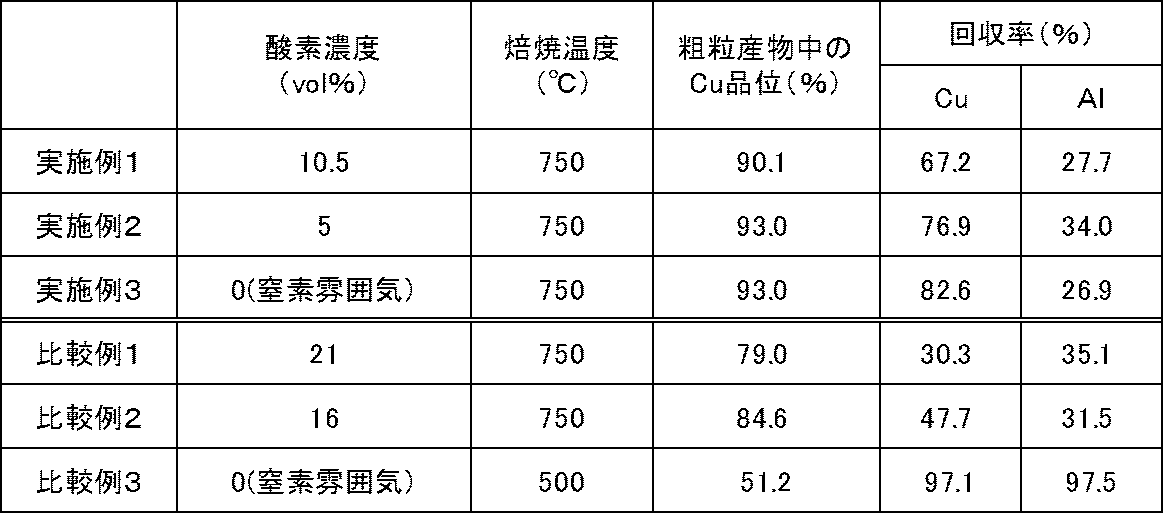
また、比較例3では、アルミニウム正極集電体が溶融・脆性化せず、破砕・篩分けによって細粒産物側に分離できなかった。
In Comparative Example 3, the aluminum positive electrode current collector did not melt or become brittle, and could not be separated to the fine product side by crushing and sieving.
本発明のリチウムイオン二次電池からの有価物の回収方法は、リチウムイオン二次電池から前記集電体や前記外装容器等の有価物を高い回収率で回収でき、かつ工程が簡単であることから、リチウムイオン二次電池からの有価物の回収に好適に用いることができる。
The method for recovering valuable materials from the lithium ion secondary battery according to the present invention is capable of recovering valuable materials such as the current collector and the outer container from the lithium ion secondary battery at a high recovery rate and has a simple process. Therefore, it can be suitably used for recovering valuable materials from lithium ion secondary batteries.
Claims (6)
Priority Applications (1)
| Application Number | Priority Date | Filing Date | Title |
|---|---|---|---|
| JP2016219084A JP6840512B2 (en) | 2016-11-09 | 2016-11-09 | How to recover valuables from lithium-ion secondary batteries |
Applications Claiming Priority (1)
| Application Number | Priority Date | Filing Date | Title |
|---|---|---|---|
| JP2016219084A JP6840512B2 (en) | 2016-11-09 | 2016-11-09 | How to recover valuables from lithium-ion secondary batteries |
Publications (2)
| Publication Number | Publication Date |
|---|---|
| JP2018078024A true JP2018078024A (en) | 2018-05-17 |
| JP6840512B2 JP6840512B2 (en) | 2021-03-10 |
Family
ID=62149176
Family Applications (1)
| Application Number | Title | Priority Date | Filing Date |
|---|---|---|---|
| JP2016219084A Active JP6840512B2 (en) | 2016-11-09 | 2016-11-09 | How to recover valuables from lithium-ion secondary batteries |
Country Status (1)
| Country | Link |
|---|---|
| JP (1) | JP6840512B2 (en) |
Cited By (14)
| Publication number | Priority date | Publication date | Assignee | Title |
|---|---|---|---|---|
| CN110416653A (en) * | 2019-07-26 | 2019-11-05 | 长沙佳纳锂业科技有限公司 | A kind of recovery method of separator, stripping off device and anode |
| CN110690519A (en) * | 2019-09-30 | 2020-01-14 | 中南大学 | A kind of lithium ion battery negative electrode material recycling method |
| JP2020061297A (en) * | 2018-10-11 | 2020-04-16 | Dowaエコシステム株式会社 | Method of recovering valuable material from lithium ion secondary battery |
| JP2021055159A (en) * | 2019-09-30 | 2021-04-08 | Dowaメタルマイン株式会社 | Method for leaching out manganese from lithium ion secondary battery and metal recovery method |
| EP3836288A1 (en) * | 2019-12-12 | 2021-06-16 | Dowa Eco-System Co., Ltd. | Method for recovering valuable material from lithium ion secondary battery |
| JP2021138996A (en) * | 2020-03-04 | 2021-09-16 | Dowaホールディングス株式会社 | Molten metal collection vessel and processing method of lithium ion secondary battery |
| JP2021163645A (en) * | 2020-03-31 | 2021-10-11 | Jx金属株式会社 | Heat treatment method for battery waste and lithium recovery method |
| CN114843651A (en) * | 2022-05-26 | 2022-08-02 | 夏莞梅 | A method and system for treating waste 18650 steel shell lithium ion battery |
| US11482737B2 (en) | 2020-01-03 | 2022-10-25 | Dowa Eco-System Co., Ltd. | Method for recovering valuable material from lithium ion secondary battery |
| CN115304059A (en) * | 2022-07-06 | 2022-11-08 | 中南大学 | Recycling treatment method for retired battery carbon slag |
| CN115353086A (en) * | 2022-10-15 | 2022-11-18 | 株洲冶炼集团股份有限公司 | Pyrogenic recovery method for efficiently pretreating waste lithium iron phosphate cathode material |
| EP4101550A4 (en) * | 2020-02-06 | 2024-03-20 | Dowa Eco-System Co., Ltd. | Separation method for valuable resources |
| US12107244B2 (en) | 2020-01-03 | 2024-10-01 | Dowa Eco-System Co., Ltd. | Method for recovering valuable material from lithium ion secondary battery |
| US12341167B2 (en) | 2019-08-13 | 2025-06-24 | Lg Energy Solution, Ltd. | Method for recycling electrode scraps, and method for manufacturing electrode by using same |
Families Citing this family (1)
| Publication number | Priority date | Publication date | Assignee | Title |
|---|---|---|---|---|
| EP4575017A1 (en) | 2023-12-22 | 2025-06-25 | Umicore | Smelting of pyrolyzed battery |
Citations (4)
| Publication number | Priority date | Publication date | Assignee | Title |
|---|---|---|---|---|
| JPH06322452A (en) * | 1993-05-12 | 1994-11-22 | Sumitomo Metal Mining Co Ltd | Method for classifying and recovering valuable metal from used secondary lithium battery |
| JPH1074539A (en) * | 1996-09-02 | 1998-03-17 | Nikko Kinzoku Kk | How to recover valuable resources from used lithium batteries |
| JP2012079630A (en) * | 2010-10-05 | 2012-04-19 | Dowa Eco-System Co Ltd | Recovery method of valuables from lithium ion secondary battery and recovered material having valuables |
| JP2015170480A (en) * | 2014-03-07 | 2015-09-28 | 松田産業株式会社 | Valuable material recovery method from lithium ion secondary battery |
-
2016
- 2016-11-09 JP JP2016219084A patent/JP6840512B2/en active Active
Patent Citations (4)
| Publication number | Priority date | Publication date | Assignee | Title |
|---|---|---|---|---|
| JPH06322452A (en) * | 1993-05-12 | 1994-11-22 | Sumitomo Metal Mining Co Ltd | Method for classifying and recovering valuable metal from used secondary lithium battery |
| JPH1074539A (en) * | 1996-09-02 | 1998-03-17 | Nikko Kinzoku Kk | How to recover valuable resources from used lithium batteries |
| JP2012079630A (en) * | 2010-10-05 | 2012-04-19 | Dowa Eco-System Co Ltd | Recovery method of valuables from lithium ion secondary battery and recovered material having valuables |
| JP2015170480A (en) * | 2014-03-07 | 2015-09-28 | 松田産業株式会社 | Valuable material recovery method from lithium ion secondary battery |
Cited By (20)
| Publication number | Priority date | Publication date | Assignee | Title |
|---|---|---|---|---|
| JP2020061297A (en) * | 2018-10-11 | 2020-04-16 | Dowaエコシステム株式会社 | Method of recovering valuable material from lithium ion secondary battery |
| CN110416653A (en) * | 2019-07-26 | 2019-11-05 | 长沙佳纳锂业科技有限公司 | A kind of recovery method of separator, stripping off device and anode |
| CN110416653B (en) * | 2019-07-26 | 2021-08-24 | 广东佳纳能源科技有限公司 | Separation device, stripping device and recovery method of battery positive electrode |
| US12341167B2 (en) | 2019-08-13 | 2025-06-24 | Lg Energy Solution, Ltd. | Method for recycling electrode scraps, and method for manufacturing electrode by using same |
| CN110690519A (en) * | 2019-09-30 | 2020-01-14 | 中南大学 | A kind of lithium ion battery negative electrode material recycling method |
| JP2021055159A (en) * | 2019-09-30 | 2021-04-08 | Dowaメタルマイン株式会社 | Method for leaching out manganese from lithium ion secondary battery and metal recovery method |
| JP7341830B2 (en) | 2019-09-30 | 2023-09-11 | Dowaメタルマイン株式会社 | Manganese leaching method and metal recovery method from lithium ion secondary batteries |
| CN110690519B (en) * | 2019-09-30 | 2023-03-14 | 中南大学 | Method for recycling lithium ion battery negative electrode material |
| EP3836288A1 (en) * | 2019-12-12 | 2021-06-16 | Dowa Eco-System Co., Ltd. | Method for recovering valuable material from lithium ion secondary battery |
| US11482737B2 (en) | 2020-01-03 | 2022-10-25 | Dowa Eco-System Co., Ltd. | Method for recovering valuable material from lithium ion secondary battery |
| US12107244B2 (en) | 2020-01-03 | 2024-10-01 | Dowa Eco-System Co., Ltd. | Method for recovering valuable material from lithium ion secondary battery |
| EP4101550A4 (en) * | 2020-02-06 | 2024-03-20 | Dowa Eco-System Co., Ltd. | Separation method for valuable resources |
| US12303912B2 (en) | 2020-02-06 | 2025-05-20 | Dowa Eco-System Co., Ltd. | Separation method for valuable resources |
| JP2021138996A (en) * | 2020-03-04 | 2021-09-16 | Dowaホールディングス株式会社 | Molten metal collection vessel and processing method of lithium ion secondary battery |
| JP7402733B2 (en) | 2020-03-31 | 2023-12-21 | Jx金属株式会社 | Heat treatment method for battery waste and lithium recovery method |
| JP2021163645A (en) * | 2020-03-31 | 2021-10-11 | Jx金属株式会社 | Heat treatment method for battery waste and lithium recovery method |
| CN114843651A (en) * | 2022-05-26 | 2022-08-02 | 夏莞梅 | A method and system for treating waste 18650 steel shell lithium ion battery |
| CN115304059B (en) * | 2022-07-06 | 2023-11-21 | 中南大学 | Recycling treatment method for retired battery carbon residue |
| CN115304059A (en) * | 2022-07-06 | 2022-11-08 | 中南大学 | Recycling treatment method for retired battery carbon slag |
| CN115353086A (en) * | 2022-10-15 | 2022-11-18 | 株洲冶炼集团股份有限公司 | Pyrogenic recovery method for efficiently pretreating waste lithium iron phosphate cathode material |
Also Published As
| Publication number | Publication date |
|---|---|
| JP6840512B2 (en) | 2021-03-10 |
Similar Documents
| Publication | Publication Date | Title |
|---|---|---|
| JP6840512B2 (en) | How to recover valuables from lithium-ion secondary batteries | |
| JP6748274B2 (en) | How to recover valuables from lithium-ion secondary batteries | |
| JP6198027B1 (en) | How to recover valuable materials from used lithium ion batteries | |
| JP6692196B2 (en) | How to recover valuables from lithium-ion secondary batteries | |
| JP5651462B2 (en) | Method of recovering valuable material from lithium ion secondary battery and recovered material containing valuable material | |
| JP6676124B1 (en) | Method of recovering valuable resources from lithium ion secondary batteries | |
| JP2012079630A (en) | Recovery method of valuables from lithium ion secondary battery and recovered material having valuables | |
| US11482737B2 (en) | Method for recovering valuable material from lithium ion secondary battery | |
| JP2013080595A (en) | Method for recovering valuable from lithium ion secondary battery | |
| EP3836288B1 (en) | Method for recovering valuable material from lithium ion secondary battery | |
| JP6888130B1 (en) | Valuables sorting method | |
| KR20220148201A (en) | Valuable metal concentration method included in lithium ion secondary battery | |
| US20250357567A1 (en) | Method for recovering valuable materials from lithium ion secondary batteries | |
| EP3832781A1 (en) | Method for recovering valuable material from lithium ion secondary battery | |
| JP6100991B2 (en) | Method for recovering valuable material from positive electrode of lithium ion secondary battery | |
| JP7658664B2 (en) | How to sort valuable materials | |
| US12107244B2 (en) | Method for recovering valuable material from lithium ion secondary battery | |
| JP2025040692A (en) | Method for recovering valuable metals from waste lithium-ion batteries |
Legal Events
| Date | Code | Title | Description |
|---|---|---|---|
| RD04 | Notification of resignation of power of attorney |
Free format text: JAPANESE INTERMEDIATE CODE: A7424 Effective date: 20190220 |
|
| A621 | Written request for application examination |
Free format text: JAPANESE INTERMEDIATE CODE: A621 Effective date: 20190902 |
|
| A977 | Report on retrieval |
Free format text: JAPANESE INTERMEDIATE CODE: A971007 Effective date: 20200624 |
|
| A131 | Notification of reasons for refusal |
Free format text: JAPANESE INTERMEDIATE CODE: A131 Effective date: 20200707 |
|
| A521 | Request for written amendment filed |
Free format text: JAPANESE INTERMEDIATE CODE: A523 Effective date: 20200827 |
|
| TRDD | Decision of grant or rejection written | ||
| A01 | Written decision to grant a patent or to grant a registration (utility model) |
Free format text: JAPANESE INTERMEDIATE CODE: A01 Effective date: 20210119 |
|
| A61 | First payment of annual fees (during grant procedure) |
Free format text: JAPANESE INTERMEDIATE CODE: A61 Effective date: 20210217 |
|
| R150 | Certificate of patent or registration of utility model |
Ref document number: 6840512 Country of ref document: JP Free format text: JAPANESE INTERMEDIATE CODE: R150 |
|
| R250 | Receipt of annual fees |
Free format text: JAPANESE INTERMEDIATE CODE: R250 |
|
| R250 | Receipt of annual fees |
Free format text: JAPANESE INTERMEDIATE CODE: R250 |
|
| R250 | Receipt of annual fees |
Free format text: JAPANESE INTERMEDIATE CODE: R250 |