JP2018192588A - Surface modification method, ultrasonic transmission member and surface modification device - Google Patents
Surface modification method, ultrasonic transmission member and surface modification device Download PDFInfo
- Publication number
- JP2018192588A JP2018192588A JP2017100086A JP2017100086A JP2018192588A JP 2018192588 A JP2018192588 A JP 2018192588A JP 2017100086 A JP2017100086 A JP 2017100086A JP 2017100086 A JP2017100086 A JP 2017100086A JP 2018192588 A JP2018192588 A JP 2018192588A
- Authority
- JP
- Japan
- Prior art keywords
- acid
- transmission member
- liquid crystal
- ultrasonic
- crystal polymer
- Prior art date
- Legal status (The legal status is an assumption and is not a legal conclusion. Google has not performed a legal analysis and makes no representation as to the accuracy of the status listed.)
- Pending
Links
- 230000005540 biological transmission Effects 0.000 title claims abstract description 47
- 230000004048 modification Effects 0.000 title claims abstract description 32
- 238000012986 modification Methods 0.000 title claims abstract description 32
- 238000002715 modification method Methods 0.000 title claims abstract description 11
- 239000000463 material Substances 0.000 claims abstract description 71
- 229920000106 Liquid crystal polymer Polymers 0.000 claims abstract description 66
- 239000004977 Liquid-crystal polymers (LCPs) Substances 0.000 claims abstract description 65
- 239000007788 liquid Substances 0.000 claims abstract description 15
- 229910000831 Steel Inorganic materials 0.000 abstract description 15
- 239000010959 steel Substances 0.000 abstract description 15
- XLYOFNOQVPJJNP-UHFFFAOYSA-N water Substances O XLYOFNOQVPJJNP-UHFFFAOYSA-N 0.000 abstract description 11
- 238000005507 spraying Methods 0.000 abstract description 3
- 230000006835 compression Effects 0.000 abstract description 2
- 238000007906 compression Methods 0.000 abstract description 2
- FJKROLUGYXJWQN-UHFFFAOYSA-N 4-hydroxybenzoic acid Chemical compound OC(=O)C1=CC=C(O)C=C1 FJKROLUGYXJWQN-UHFFFAOYSA-N 0.000 description 50
- KKEYFWRCBNTPAC-UHFFFAOYSA-N Terephthalic acid Chemical compound OC(=O)C1=CC=C(C(O)=O)C=C1 KKEYFWRCBNTPAC-UHFFFAOYSA-N 0.000 description 46
- 238000000034 method Methods 0.000 description 30
- -1 Aromatic dicarboxylic acids Chemical class 0.000 description 26
- 229940090248 4-hydroxybenzoic acid Drugs 0.000 description 25
- 229920001577 copolymer Polymers 0.000 description 25
- 239000000178 monomer Substances 0.000 description 24
- QIGBRXMKCJKVMJ-UHFFFAOYSA-N Hydroquinone Chemical compound OC1=CC=C(O)C=C1 QIGBRXMKCJKVMJ-UHFFFAOYSA-N 0.000 description 17
- 239000000047 product Substances 0.000 description 15
- KAUQJMHLAFIZDU-UHFFFAOYSA-N 6-Hydroxy-2-naphthoic acid Chemical compound C1=C(O)C=CC2=CC(C(=O)O)=CC=C21 KAUQJMHLAFIZDU-UHFFFAOYSA-N 0.000 description 14
- 229920005989 resin Polymers 0.000 description 12
- 239000011347 resin Substances 0.000 description 12
- LYCAIKOWRPUZTN-UHFFFAOYSA-N Ethylene glycol Chemical compound OCCO LYCAIKOWRPUZTN-UHFFFAOYSA-N 0.000 description 11
- 230000000694 effects Effects 0.000 description 11
- 125000003118 aryl group Chemical group 0.000 description 10
- 239000013078 crystal Substances 0.000 description 10
- 238000002844 melting Methods 0.000 description 10
- 230000008018 melting Effects 0.000 description 10
- 238000006116 polymerization reaction Methods 0.000 description 10
- WFDIJRYMOXRFFG-UHFFFAOYSA-N Acetic anhydride Chemical compound CC(=O)OC(C)=O WFDIJRYMOXRFFG-UHFFFAOYSA-N 0.000 description 9
- 239000002253 acid Substances 0.000 description 9
- 230000015572 biosynthetic process Effects 0.000 description 8
- 238000006243 chemical reaction Methods 0.000 description 8
- 235000014113 dietary fatty acids Nutrition 0.000 description 8
- 239000000194 fatty acid Substances 0.000 description 8
- 229930195729 fatty acid Natural products 0.000 description 8
- QQVIHTHCMHWDBS-UHFFFAOYSA-N isophthalic acid Chemical compound OC(=O)C1=CC=CC(C(O)=O)=C1 QQVIHTHCMHWDBS-UHFFFAOYSA-N 0.000 description 8
- RXOHFPCZGPKIRD-UHFFFAOYSA-N naphthalene-2,6-dicarboxylic acid Chemical compound C1=C(C(O)=O)C=CC2=CC(C(=O)O)=CC=C21 RXOHFPCZGPKIRD-UHFFFAOYSA-N 0.000 description 8
- 241000790917 Dioxys <bee> Species 0.000 description 7
- 239000000654 additive Substances 0.000 description 7
- 125000000217 alkyl group Chemical group 0.000 description 7
- 229910052751 metal Inorganic materials 0.000 description 7
- 239000002184 metal Substances 0.000 description 7
- PLIKAWJENQZMHA-UHFFFAOYSA-N 4-aminophenol Chemical compound NC1=CC=C(O)C=C1 PLIKAWJENQZMHA-UHFFFAOYSA-N 0.000 description 6
- QTBSBXVTEAMEQO-UHFFFAOYSA-N Acetic acid Chemical compound CC(O)=O QTBSBXVTEAMEQO-UHFFFAOYSA-N 0.000 description 6
- 125000001931 aliphatic group Chemical group 0.000 description 6
- 125000003545 alkoxy group Chemical group 0.000 description 6
- VCCBEIPGXKNHFW-UHFFFAOYSA-N biphenyl-4,4'-diol Chemical group C1=CC(O)=CC=C1C1=CC=C(O)C=C1 VCCBEIPGXKNHFW-UHFFFAOYSA-N 0.000 description 6
- 150000002148 esters Chemical class 0.000 description 6
- 150000004665 fatty acids Chemical class 0.000 description 6
- 150000004820 halides Chemical class 0.000 description 6
- 239000011256 inorganic filler Substances 0.000 description 6
- 239000000155 melt Substances 0.000 description 6
- 239000012766 organic filler Substances 0.000 description 6
- 229920000642 polymer Polymers 0.000 description 6
- 238000003786 synthesis reaction Methods 0.000 description 6
- 239000000835 fiber Substances 0.000 description 5
- 150000002367 halogens Chemical group 0.000 description 5
- 239000000203 mixture Substances 0.000 description 5
- 239000008188 pellet Substances 0.000 description 5
- 239000003963 antioxidant agent Substances 0.000 description 4
- 239000003795 chemical substances by application Substances 0.000 description 4
- 239000002002 slurry Substances 0.000 description 4
- 239000005711 Benzoic acid Substances 0.000 description 3
- OFOBLEOULBTSOW-UHFFFAOYSA-N Malonic acid Chemical compound OC(=O)CC(O)=O OFOBLEOULBTSOW-UHFFFAOYSA-N 0.000 description 3
- MUBZPKHOEPUJKR-UHFFFAOYSA-N Oxalic acid Chemical compound OC(=O)C(O)=O MUBZPKHOEPUJKR-UHFFFAOYSA-N 0.000 description 3
- GWEVSGVZZGPLCZ-UHFFFAOYSA-N Titan oxide Chemical compound O=[Ti]=O GWEVSGVZZGPLCZ-UHFFFAOYSA-N 0.000 description 3
- 125000004432 carbon atom Chemical group C* 0.000 description 3
- 239000003054 catalyst Substances 0.000 description 3
- 239000000919 ceramic Substances 0.000 description 3
- 239000007822 coupling agent Substances 0.000 description 3
- 239000011521 glass Substances 0.000 description 3
- 229910052736 halogen Chemical group 0.000 description 3
- 125000002887 hydroxy group Chemical group [H]O* 0.000 description 3
- 230000001771 impaired effect Effects 0.000 description 3
- 239000004973 liquid crystal related substance Substances 0.000 description 3
- 238000004519 manufacturing process Methods 0.000 description 3
- 239000012756 surface treatment agent Substances 0.000 description 3
- 239000000454 talc Substances 0.000 description 3
- 229910052623 talc Inorganic materials 0.000 description 3
- XBNGYFFABRKICK-UHFFFAOYSA-N 2,3,4,5,6-pentafluorophenol Chemical compound OC1=C(F)C(F)=C(F)C(F)=C1F XBNGYFFABRKICK-UHFFFAOYSA-N 0.000 description 2
- IJFXRHURBJZNAO-UHFFFAOYSA-N 3-hydroxybenzoic acid Chemical compound OC(=O)C1=CC=CC(O)=C1 IJFXRHURBJZNAO-UHFFFAOYSA-N 0.000 description 2
- BCEQKAQCUWUNML-UHFFFAOYSA-N 4-hydroxybenzene-1,3-dicarboxylic acid Chemical compound OC(=O)C1=CC=C(O)C(C(O)=O)=C1 BCEQKAQCUWUNML-UHFFFAOYSA-N 0.000 description 2
- QNVNLUSHGRBCLO-UHFFFAOYSA-N 5-hydroxybenzene-1,3-dicarboxylic acid Chemical compound OC(=O)C1=CC(O)=CC(C(O)=O)=C1 QNVNLUSHGRBCLO-UHFFFAOYSA-N 0.000 description 2
- IJGRMHOSHXDMSA-UHFFFAOYSA-N Atomic nitrogen Chemical compound N#N IJGRMHOSHXDMSA-UHFFFAOYSA-N 0.000 description 2
- VTYYLEPIZMXCLO-UHFFFAOYSA-L Calcium carbonate Chemical compound [Ca+2].[O-]C([O-])=O VTYYLEPIZMXCLO-UHFFFAOYSA-L 0.000 description 2
- VZCYOOQTPOCHFL-OWOJBTEDSA-N Fumaric acid Chemical compound OC(=O)\C=C\C(O)=O VZCYOOQTPOCHFL-OWOJBTEDSA-N 0.000 description 2
- XEEYBQQBJWHFJM-UHFFFAOYSA-N Iron Chemical compound [Fe] XEEYBQQBJWHFJM-UHFFFAOYSA-N 0.000 description 2
- VYPSYNLAJGMNEJ-UHFFFAOYSA-N Silicium dioxide Chemical compound O=[Si]=O VYPSYNLAJGMNEJ-UHFFFAOYSA-N 0.000 description 2
- 230000000996 additive effect Effects 0.000 description 2
- WNLRTRBMVRJNCN-UHFFFAOYSA-N adipic acid Chemical compound OC(=O)CCCCC(O)=O WNLRTRBMVRJNCN-UHFFFAOYSA-N 0.000 description 2
- 229910052784 alkaline earth metal Inorganic materials 0.000 description 2
- PNEYBMLMFCGWSK-UHFFFAOYSA-N aluminium oxide Inorganic materials [O-2].[O-2].[O-2].[Al+3].[Al+3] PNEYBMLMFCGWSK-UHFFFAOYSA-N 0.000 description 2
- ADCOVFLJGNWWNZ-UHFFFAOYSA-N antimony trioxide Chemical compound O=[Sb]O[Sb]=O ADCOVFLJGNWWNZ-UHFFFAOYSA-N 0.000 description 2
- 239000012298 atmosphere Substances 0.000 description 2
- TZCXTZWJZNENPQ-UHFFFAOYSA-L barium sulfate Chemical compound [Ba+2].[O-]S([O-])(=O)=O TZCXTZWJZNENPQ-UHFFFAOYSA-L 0.000 description 2
- UORVGPXVDQYIDP-UHFFFAOYSA-N borane Chemical compound B UORVGPXVDQYIDP-UHFFFAOYSA-N 0.000 description 2
- WERYXYBDKMZEQL-UHFFFAOYSA-N butane-1,4-diol Chemical compound OCCCCO WERYXYBDKMZEQL-UHFFFAOYSA-N 0.000 description 2
- 230000000052 comparative effect Effects 0.000 description 2
- 229910001873 dinitrogen Inorganic materials 0.000 description 2
- 238000004821 distillation Methods 0.000 description 2
- 239000000945 filler Substances 0.000 description 2
- 239000003365 glass fiber Substances 0.000 description 2
- 238000002347 injection Methods 0.000 description 2
- 239000007924 injection Substances 0.000 description 2
- 238000001746 injection moulding Methods 0.000 description 2
- 238000004898 kneading Methods 0.000 description 2
- 239000000314 lubricant Substances 0.000 description 2
- 238000005259 measurement Methods 0.000 description 2
- 238000000465 moulding Methods 0.000 description 2
- BDJRBEYXGGNYIS-UHFFFAOYSA-N nonanedioic acid Chemical compound OC(=O)CCCCCCCC(O)=O BDJRBEYXGGNYIS-UHFFFAOYSA-N 0.000 description 2
- IZUPBVBPLAPZRR-UHFFFAOYSA-N pentachloro-phenol Natural products OC1=C(Cl)C(Cl)=C(Cl)C(Cl)=C1Cl IZUPBVBPLAPZRR-UHFFFAOYSA-N 0.000 description 2
- WLJVNTCWHIRURA-UHFFFAOYSA-N pimelic acid Chemical compound OC(=O)CCCCCC(O)=O WLJVNTCWHIRURA-UHFFFAOYSA-N 0.000 description 2
- 238000006068 polycondensation reaction Methods 0.000 description 2
- 229920013716 polyethylene resin Polymers 0.000 description 2
- 229920001296 polysiloxane Polymers 0.000 description 2
- SCVFZCLFOSHCOH-UHFFFAOYSA-M potassium acetate Chemical compound [K+].CC([O-])=O SCVFZCLFOSHCOH-UHFFFAOYSA-M 0.000 description 2
- 238000002407 reforming Methods 0.000 description 2
- 150000003839 salts Chemical class 0.000 description 2
- CXMXRPHRNRROMY-UHFFFAOYSA-N sebacic acid Chemical compound OC(=O)CCCCCCCCC(O)=O CXMXRPHRNRROMY-UHFFFAOYSA-N 0.000 description 2
- 238000005480 shot peening Methods 0.000 description 2
- 239000010935 stainless steel Substances 0.000 description 2
- 229910001220 stainless steel Inorganic materials 0.000 description 2
- TYFQFVWCELRYAO-UHFFFAOYSA-N suberic acid Chemical compound OC(=O)CCCCCCC(O)=O TYFQFVWCELRYAO-UHFFFAOYSA-N 0.000 description 2
- 238000006467 substitution reaction Methods 0.000 description 2
- 238000004381 surface treatment Methods 0.000 description 2
- BGHCVCJVXZWKCC-UHFFFAOYSA-N tetradecane Chemical compound CCCCCCCCCCCCCC BGHCVCJVXZWKCC-UHFFFAOYSA-N 0.000 description 2
- VZCYOOQTPOCHFL-UHFFFAOYSA-N trans-butenedioic acid Natural products OC(=O)C=CC(O)=O VZCYOOQTPOCHFL-UHFFFAOYSA-N 0.000 description 2
- WZCQRUWWHSTZEM-UHFFFAOYSA-N 1,3-phenylenediamine Chemical compound NC1=CC=CC(N)=C1 WZCQRUWWHSTZEM-UHFFFAOYSA-N 0.000 description 1
- PXGZQGDTEZPERC-UHFFFAOYSA-N 1,4-cyclohexanedicarboxylic acid Chemical compound OC(=O)C1CCC(C(O)=O)CC1 PXGZQGDTEZPERC-UHFFFAOYSA-N 0.000 description 1
- CBCKQZAAMUWICA-UHFFFAOYSA-N 1,4-phenylenediamine Chemical compound NC1=CC=C(N)C=C1 CBCKQZAAMUWICA-UHFFFAOYSA-N 0.000 description 1
- YFOOEYJGMMJJLS-UHFFFAOYSA-N 1,8-diaminonaphthalene Chemical compound C1=CC(N)=C2C(N)=CC=CC2=C1 YFOOEYJGMMJJLS-UHFFFAOYSA-N 0.000 description 1
- RTBFRGCFXZNCOE-UHFFFAOYSA-N 1-methylsulfonylpiperidin-4-one Chemical compound CS(=O)(=O)N1CCC(=O)CC1 RTBFRGCFXZNCOE-UHFFFAOYSA-N 0.000 description 1
- KJCVRFUGPWSIIH-UHFFFAOYSA-N 1-naphthol Chemical compound C1=CC=C2C(O)=CC=CC2=C1 KJCVRFUGPWSIIH-UHFFFAOYSA-N 0.000 description 1
- QFGCFKJIPBRJGM-UHFFFAOYSA-N 12-[(2-methylpropan-2-yl)oxy]-12-oxododecanoic acid Chemical compound CC(C)(C)OC(=O)CCCCCCCCCCC(O)=O QFGCFKJIPBRJGM-UHFFFAOYSA-N 0.000 description 1
- RNFJDJUURJAICM-UHFFFAOYSA-N 2,2,4,4,6,6-hexaphenoxy-1,3,5-triaza-2$l^{5},4$l^{5},6$l^{5}-triphosphacyclohexa-1,3,5-triene Chemical compound N=1P(OC=2C=CC=CC=2)(OC=2C=CC=CC=2)=NP(OC=2C=CC=CC=2)(OC=2C=CC=CC=2)=NP=1(OC=1C=CC=CC=1)OC1=CC=CC=C1 RNFJDJUURJAICM-UHFFFAOYSA-N 0.000 description 1
- LODHFNUFVRVKTH-ZHACJKMWSA-N 2-hydroxy-n'-[(e)-3-phenylprop-2-enoyl]benzohydrazide Chemical compound OC1=CC=CC=C1C(=O)NNC(=O)\C=C\C1=CC=CC=C1 LODHFNUFVRVKTH-ZHACJKMWSA-N 0.000 description 1
- UOBYKYZJUGYBDK-UHFFFAOYSA-N 2-naphthoic acid Chemical compound C1=CC=CC2=CC(C(=O)O)=CC=C21 UOBYKYZJUGYBDK-UHFFFAOYSA-N 0.000 description 1
- AJHPGXZOIAYYDW-UHFFFAOYSA-N 3-(2-cyanophenyl)-2-[(2-methylpropan-2-yl)oxycarbonylamino]propanoic acid Chemical compound CC(C)(C)OC(=O)NC(C(O)=O)CC1=CC=CC=C1C#N AJHPGXZOIAYYDW-UHFFFAOYSA-N 0.000 description 1
- VZQSBJKDSWXLKX-UHFFFAOYSA-N 3-(3-hydroxyphenyl)phenol Chemical group OC1=CC=CC(C=2C=C(O)C=CC=2)=C1 VZQSBJKDSWXLKX-UHFFFAOYSA-N 0.000 description 1
- BWBGEYQWIHXDKY-UHFFFAOYSA-N 3-(4-hydroxyphenyl)phenol Chemical group C1=CC(O)=CC=C1C1=CC=CC(O)=C1 BWBGEYQWIHXDKY-UHFFFAOYSA-N 0.000 description 1
- ALKYHXVLJMQRLQ-UHFFFAOYSA-N 3-Hydroxy-2-naphthoate Chemical compound C1=CC=C2C=C(O)C(C(=O)O)=CC2=C1 ALKYHXVLJMQRLQ-UHFFFAOYSA-N 0.000 description 1
- CWLKGDAVCFYWJK-UHFFFAOYSA-N 3-aminophenol Chemical compound NC1=CC=CC(O)=C1 CWLKGDAVCFYWJK-UHFFFAOYSA-N 0.000 description 1
- 229940018563 3-aminophenol Drugs 0.000 description 1
- TVBXXOVRWRDFMB-UHFFFAOYSA-N 3-hydroxynaphthalene-2,7-dicarboxylic acid Chemical compound C1=C(O)C(C(O)=O)=CC2=CC(C(=O)O)=CC=C21 TVBXXOVRWRDFMB-UHFFFAOYSA-N 0.000 description 1
- LQZZZAFQKXTFKH-UHFFFAOYSA-N 4'-aminobiphenyl-4-ol Chemical group C1=CC(N)=CC=C1C1=CC=C(O)C=C1 LQZZZAFQKXTFKH-UHFFFAOYSA-N 0.000 description 1
- NEQFBGHQPUXOFH-UHFFFAOYSA-N 4-(4-carboxyphenyl)benzoic acid Chemical group C1=CC(C(=O)O)=CC=C1C1=CC=C(C(O)=O)C=C1 NEQFBGHQPUXOFH-UHFFFAOYSA-N 0.000 description 1
- ALYNCZNDIQEVRV-PZFLKRBQSA-N 4-amino-3,5-ditritiobenzoic acid Chemical compound [3H]c1cc(cc([3H])c1N)C(O)=O ALYNCZNDIQEVRV-PZFLKRBQSA-N 0.000 description 1
- ABJQKDJOYSQVFX-UHFFFAOYSA-N 4-aminonaphthalen-1-ol Chemical compound C1=CC=C2C(N)=CC=C(O)C2=C1 ABJQKDJOYSQVFX-UHFFFAOYSA-N 0.000 description 1
- ZBIBQNVRTVLOHQ-UHFFFAOYSA-N 5-aminonaphthalen-1-ol Chemical compound C1=CC=C2C(N)=CC=CC2=C1O ZBIBQNVRTVLOHQ-UHFFFAOYSA-N 0.000 description 1
- NZTPZUIIYNYZKT-UHFFFAOYSA-N 6-aminonaphthalene-2-carboxylic acid Chemical compound C1=C(C(O)=O)C=CC2=CC(N)=CC=C21 NZTPZUIIYNYZKT-UHFFFAOYSA-N 0.000 description 1
- 208000010444 Acidosis Diseases 0.000 description 1
- 229910000838 Al alloy Inorganic materials 0.000 description 1
- 0 CC(CCC1)C*1C=N Chemical compound CC(CCC1)C*1C=N 0.000 description 1
- AJKWUSIQWCDRIE-UHFFFAOYSA-N CCC1CC(C)(CC)CC1 Chemical compound CCC1CC(C)(CC)CC1 AJKWUSIQWCDRIE-UHFFFAOYSA-N 0.000 description 1
- OKTJSMMVPCPJKN-UHFFFAOYSA-N Carbon Chemical compound [C] OKTJSMMVPCPJKN-UHFFFAOYSA-N 0.000 description 1
- 229920000049 Carbon (fiber) Polymers 0.000 description 1
- 229910000975 Carbon steel Inorganic materials 0.000 description 1
- 239000004593 Epoxy Substances 0.000 description 1
- YCKRFDGAMUMZLT-UHFFFAOYSA-N Fluorine atom Chemical compound [F] YCKRFDGAMUMZLT-UHFFFAOYSA-N 0.000 description 1
- 239000002841 Lewis acid Substances 0.000 description 1
- 229910000861 Mg alloy Inorganic materials 0.000 description 1
- ISWSIDIOOBJBQZ-UHFFFAOYSA-N Phenol Chemical compound OC1=CC=CC=C1 ISWSIDIOOBJBQZ-UHFFFAOYSA-N 0.000 description 1
- OAICVXFJPJFONN-UHFFFAOYSA-N Phosphorus Chemical compound [P] OAICVXFJPJFONN-UHFFFAOYSA-N 0.000 description 1
- 229930182556 Polyacetal Natural products 0.000 description 1
- 239000004952 Polyamide Substances 0.000 description 1
- 239000004962 Polyamide-imide Substances 0.000 description 1
- 239000004695 Polyether sulfone Substances 0.000 description 1
- 239000004697 Polyetherimide Substances 0.000 description 1
- YGSDEFSMJLZEOE-UHFFFAOYSA-N Salicylic acid Natural products OC(=O)C1=CC=CC=C1O YGSDEFSMJLZEOE-UHFFFAOYSA-N 0.000 description 1
- 239000006087 Silane Coupling Agent Substances 0.000 description 1
- VMHLLURERBWHNL-UHFFFAOYSA-M Sodium acetate Chemical compound [Na+].CC([O-])=O VMHLLURERBWHNL-UHFFFAOYSA-M 0.000 description 1
- KDYFGRWQOYBRFD-UHFFFAOYSA-N Succinic acid Natural products OC(=O)CCC(O)=O KDYFGRWQOYBRFD-UHFFFAOYSA-N 0.000 description 1
- NINIDFKCEFEMDL-UHFFFAOYSA-N Sulfur Chemical compound [S] NINIDFKCEFEMDL-UHFFFAOYSA-N 0.000 description 1
- 239000004974 Thermotropic liquid crystal Substances 0.000 description 1
- RTAQQCXQSZGOHL-UHFFFAOYSA-N Titanium Chemical compound [Ti] RTAQQCXQSZGOHL-UHFFFAOYSA-N 0.000 description 1
- 239000003377 acid catalyst Substances 0.000 description 1
- 230000007950 acidosis Effects 0.000 description 1
- 208000026545 acidosis disease Diseases 0.000 description 1
- 150000007513 acids Chemical class 0.000 description 1
- 230000009471 action Effects 0.000 description 1
- 125000002252 acyl group Chemical group 0.000 description 1
- 239000000853 adhesive Substances 0.000 description 1
- 230000001070 adhesive effect Effects 0.000 description 1
- 239000001361 adipic acid Substances 0.000 description 1
- 235000011037 adipic acid Nutrition 0.000 description 1
- 239000003513 alkali Substances 0.000 description 1
- OJMOMXZKOWKUTA-UHFFFAOYSA-N aluminum;borate Chemical compound [Al+3].[O-]B([O-])[O-] OJMOMXZKOWKUTA-UHFFFAOYSA-N 0.000 description 1
- JFCQEDHGNNZCLN-UHFFFAOYSA-N anhydrous glutaric acid Natural products OC(=O)CCCC(O)=O JFCQEDHGNNZCLN-UHFFFAOYSA-N 0.000 description 1
- 239000002216 antistatic agent Substances 0.000 description 1
- 239000007864 aqueous solution Substances 0.000 description 1
- 239000004760 aramid Substances 0.000 description 1
- 229920006231 aramid fiber Polymers 0.000 description 1
- 150000004984 aromatic diamines Chemical class 0.000 description 1
- 239000011324 bead Substances 0.000 description 1
- WPYMKLBDIGXBTP-UHFFFAOYSA-N benzoic acid Chemical compound OC(=O)C1=CC=CC=C1 WPYMKLBDIGXBTP-UHFFFAOYSA-N 0.000 description 1
- 239000002981 blocking agent Substances 0.000 description 1
- 238000007664 blowing Methods 0.000 description 1
- 229910000085 borane Inorganic materials 0.000 description 1
- KDYFGRWQOYBRFD-NUQCWPJISA-N butanedioic acid Chemical compound O[14C](=O)CC[14C](O)=O KDYFGRWQOYBRFD-NUQCWPJISA-N 0.000 description 1
- 239000006227 byproduct Substances 0.000 description 1
- 229910000019 calcium carbonate Inorganic materials 0.000 description 1
- 125000003917 carbamoyl group Chemical group [H]N([H])C(*)=O 0.000 description 1
- 239000006229 carbon black Substances 0.000 description 1
- 239000004917 carbon fiber Substances 0.000 description 1
- 239000010962 carbon steel Substances 0.000 description 1
- BVKZGUZCCUSVTD-UHFFFAOYSA-N carbonic acid Chemical group OC(O)=O BVKZGUZCCUSVTD-UHFFFAOYSA-N 0.000 description 1
- 150000001732 carboxylic acid derivatives Chemical class 0.000 description 1
- 229910010293 ceramic material Inorganic materials 0.000 description 1
- 239000004927 clay Substances 0.000 description 1
- 229910052570 clay Inorganic materials 0.000 description 1
- 239000003086 colorant Substances 0.000 description 1
- 238000009833 condensation Methods 0.000 description 1
- 230000005494 condensation Effects 0.000 description 1
- 238000007796 conventional method Methods 0.000 description 1
- JGFBRKRYDCGYKD-UHFFFAOYSA-N dibutyl(oxo)tin Chemical compound CCCC[Sn](=O)CCCC JGFBRKRYDCGYKD-UHFFFAOYSA-N 0.000 description 1
- NJLLQSBAHIKGKF-UHFFFAOYSA-N dipotassium dioxido(oxo)titanium Chemical compound [K+].[K+].[O-][Ti]([O-])=O NJLLQSBAHIKGKF-UHFFFAOYSA-N 0.000 description 1
- 238000009826 distribution Methods 0.000 description 1
- 239000010459 dolomite Substances 0.000 description 1
- 229910000514 dolomite Inorganic materials 0.000 description 1
- 239000000975 dye Substances 0.000 description 1
- 238000005516 engineering process Methods 0.000 description 1
- RTZKZFJDLAIYFH-UHFFFAOYSA-N ether Substances CCOCC RTZKZFJDLAIYFH-UHFFFAOYSA-N 0.000 description 1
- 238000001125 extrusion Methods 0.000 description 1
- 238000011049 filling Methods 0.000 description 1
- 239000003063 flame retardant Substances 0.000 description 1
- 239000012530 fluid Substances 0.000 description 1
- 229910052731 fluorine Inorganic materials 0.000 description 1
- 239000011737 fluorine Substances 0.000 description 1
- NBVXSUQYWXRMNV-UHFFFAOYSA-N fluoromethane Chemical compound FC NBVXSUQYWXRMNV-UHFFFAOYSA-N 0.000 description 1
- 239000001530 fumaric acid Substances 0.000 description 1
- 239000010439 graphite Substances 0.000 description 1
- 229910002804 graphite Inorganic materials 0.000 description 1
- 239000012760 heat stabilizer Substances 0.000 description 1
- 238000010438 heat treatment Methods 0.000 description 1
- XXMIOPMDWAUFGU-UHFFFAOYSA-N hexane-1,6-diol Chemical compound OCCCCCCO XXMIOPMDWAUFGU-UHFFFAOYSA-N 0.000 description 1
- 238000000265 homogenisation Methods 0.000 description 1
- 229910052739 hydrogen Inorganic materials 0.000 description 1
- 239000001257 hydrogen Substances 0.000 description 1
- 230000006872 improvement Effects 0.000 description 1
- 238000007689 inspection Methods 0.000 description 1
- 229910052742 iron Inorganic materials 0.000 description 1
- 150000007517 lewis acids Chemical class 0.000 description 1
- VZCYOOQTPOCHFL-UPHRSURJSA-N maleic acid Chemical compound OC(=O)\C=C/C(O)=O VZCYOOQTPOCHFL-UPHRSURJSA-N 0.000 description 1
- 239000011976 maleic acid Substances 0.000 description 1
- 150000002739 metals Chemical class 0.000 description 1
- VNWKTOKETHGBQD-UHFFFAOYSA-N methane Chemical compound C VNWKTOKETHGBQD-UHFFFAOYSA-N 0.000 description 1
- 239000010445 mica Substances 0.000 description 1
- 229910052618 mica group Inorganic materials 0.000 description 1
- KYTZHLUVELPASH-UHFFFAOYSA-N naphthalene-1,2-dicarboxylic acid Chemical compound C1=CC=CC2=C(C(O)=O)C(C(=O)O)=CC=C21 KYTZHLUVELPASH-UHFFFAOYSA-N 0.000 description 1
- ABMFBCRYHDZLRD-UHFFFAOYSA-N naphthalene-1,4-dicarboxylic acid Chemical compound C1=CC=C2C(C(=O)O)=CC=C(C(O)=O)C2=C1 ABMFBCRYHDZLRD-UHFFFAOYSA-N 0.000 description 1
- PCILLCXFKWDRMK-UHFFFAOYSA-N naphthalene-1,4-diol Chemical compound C1=CC=C2C(O)=CC=C(O)C2=C1 PCILLCXFKWDRMK-UHFFFAOYSA-N 0.000 description 1
- KQSABULTKYLFEV-UHFFFAOYSA-N naphthalene-1,5-diamine Chemical compound C1=CC=C2C(N)=CC=CC2=C1N KQSABULTKYLFEV-UHFFFAOYSA-N 0.000 description 1
- VAWFFNJAPKXVPH-UHFFFAOYSA-N naphthalene-1,6-dicarboxylic acid Chemical compound OC(=O)C1=CC=CC2=CC(C(=O)O)=CC=C21 VAWFFNJAPKXVPH-UHFFFAOYSA-N 0.000 description 1
- FZZQNEVOYIYFPF-UHFFFAOYSA-N naphthalene-1,6-diol Chemical compound OC1=CC=CC2=CC(O)=CC=C21 FZZQNEVOYIYFPF-UHFFFAOYSA-N 0.000 description 1
- MNZMMCVIXORAQL-UHFFFAOYSA-N naphthalene-2,6-diol Chemical compound C1=C(O)C=CC2=CC(O)=CC=C21 MNZMMCVIXORAQL-UHFFFAOYSA-N 0.000 description 1
- WPUMVKJOWWJPRK-UHFFFAOYSA-N naphthalene-2,7-dicarboxylic acid Chemical compound C1=CC(C(O)=O)=CC2=CC(C(=O)O)=CC=C21 WPUMVKJOWWJPRK-UHFFFAOYSA-N 0.000 description 1
- DFQICHCWIIJABH-UHFFFAOYSA-N naphthalene-2,7-diol Chemical compound C1=CC(O)=CC2=CC(O)=CC=C21 DFQICHCWIIJABH-UHFFFAOYSA-N 0.000 description 1
- 230000003472 neutralizing effect Effects 0.000 description 1
- 239000012299 nitrogen atmosphere Substances 0.000 description 1
- 239000002667 nucleating agent Substances 0.000 description 1
- 239000003960 organic solvent Substances 0.000 description 1
- 235000006408 oxalic acid Nutrition 0.000 description 1
- 230000020477 pH reduction Effects 0.000 description 1
- 239000005011 phenolic resin Substances 0.000 description 1
- 229910052698 phosphorus Inorganic materials 0.000 description 1
- 239000011574 phosphorus Substances 0.000 description 1
- 230000000704 physical effect Effects 0.000 description 1
- 239000000049 pigment Substances 0.000 description 1
- 229920002492 poly(sulfone) Polymers 0.000 description 1
- 229920002647 polyamide Polymers 0.000 description 1
- 229920002312 polyamide-imide Polymers 0.000 description 1
- 229920001230 polyarylate Polymers 0.000 description 1
- 229920001707 polybutylene terephthalate Polymers 0.000 description 1
- 229920000728 polyester Polymers 0.000 description 1
- 239000004645 polyester resin Substances 0.000 description 1
- 229920001225 polyester resin Polymers 0.000 description 1
- 229920006149 polyester-amide block copolymer Polymers 0.000 description 1
- 229920006393 polyether sulfone Polymers 0.000 description 1
- 229920001601 polyetherimide Polymers 0.000 description 1
- 229920000139 polyethylene terephthalate Polymers 0.000 description 1
- 239000005020 polyethylene terephthalate Substances 0.000 description 1
- 229920001721 polyimide Polymers 0.000 description 1
- 239000009719 polyimide resin Substances 0.000 description 1
- 229920006324 polyoxymethylene Polymers 0.000 description 1
- 229920001955 polyphenylene ether Polymers 0.000 description 1
- 235000011056 potassium acetate Nutrition 0.000 description 1
- 239000000843 powder Substances 0.000 description 1
- 230000008569 process Effects 0.000 description 1
- 238000012545 processing Methods 0.000 description 1
- 239000000376 reactant Substances 0.000 description 1
- 230000009257 reactivity Effects 0.000 description 1
- 238000011084 recovery Methods 0.000 description 1
- GHMLBKRAJCXXBS-UHFFFAOYSA-N resorcinol Chemical compound OC1=CC=CC(O)=C1 GHMLBKRAJCXXBS-UHFFFAOYSA-N 0.000 description 1
- 229960001755 resorcinol Drugs 0.000 description 1
- 230000000717 retained effect Effects 0.000 description 1
- 230000000630 rising effect Effects 0.000 description 1
- 229960004889 salicylic acid Drugs 0.000 description 1
- 230000035939 shock Effects 0.000 description 1
- 239000000377 silicon dioxide Substances 0.000 description 1
- 239000001632 sodium acetate Substances 0.000 description 1
- 235000017281 sodium acetate Nutrition 0.000 description 1
- 239000012265 solid product Substances 0.000 description 1
- 235000010356 sorbitol Nutrition 0.000 description 1
- 229910052717 sulfur Inorganic materials 0.000 description 1
- 239000011593 sulfur Substances 0.000 description 1
- 239000004094 surface-active agent Substances 0.000 description 1
- 229920005992 thermoplastic resin Polymers 0.000 description 1
- 229920001187 thermosetting polymer Polymers 0.000 description 1
- 125000003396 thiol group Chemical class [H]S* 0.000 description 1
- 150000003606 tin compounds Chemical class 0.000 description 1
- 239000010936 titanium Substances 0.000 description 1
- 229910052719 titanium Inorganic materials 0.000 description 1
- 150000003609 titanium compounds Chemical class 0.000 description 1
- 239000004408 titanium dioxide Substances 0.000 description 1
- OGIDPMRJRNCKJF-UHFFFAOYSA-N titanium oxide Inorganic materials [Ti]=O OGIDPMRJRNCKJF-UHFFFAOYSA-N 0.000 description 1
- 239000003039 volatile agent Substances 0.000 description 1
- 239000010456 wollastonite Substances 0.000 description 1
- 229910052882 wollastonite Inorganic materials 0.000 description 1
Images


Classifications
-
- Y—GENERAL TAGGING OF NEW TECHNOLOGICAL DEVELOPMENTS; GENERAL TAGGING OF CROSS-SECTIONAL TECHNOLOGIES SPANNING OVER SEVERAL SECTIONS OF THE IPC; TECHNICAL SUBJECTS COVERED BY FORMER USPC CROSS-REFERENCE ART COLLECTIONS [XRACs] AND DIGESTS
- Y02—TECHNOLOGIES OR APPLICATIONS FOR MITIGATION OR ADAPTATION AGAINST CLIMATE CHANGE
- Y02P—CLIMATE CHANGE MITIGATION TECHNOLOGIES IN THE PRODUCTION OR PROCESSING OF GOODS
- Y02P10/00—Technologies related to metal processing
- Y02P10/20—Recycling
Landscapes
- Compositions Of Macromolecular Compounds (AREA)
Abstract
Description
本発明は、被改質材の表面を改質する方法ならびにその方法に使用する超音波伝達部材および表面改質装置に関する。 The present invention relates to a method for modifying the surface of a material to be modified, and an ultrasonic transmission member and a surface modifying apparatus used in the method.
従来、金属等の材料表面に圧縮残留応力を形成し、材料表面の応力を緩和する表面改質手法として、鋼球や硬質物体を被改質材の表面に打ち付けるショットピーニングが知られている。このショットピーニングは、直径数ミリの鋼球等を圧縮空気により被改質材表面に吹き付け、鋼球等が被改質材の表面に衝突するときに発生する衝撃力によって被改質材の表面に圧縮応力が形成される。しかし、鋼球等を打ち付ける方法は、鋼球等のピーニング材料および圧縮空気の吹き付け工程が必要であり、また、被改質材の表面形状が複雑な場合、圧縮応力形成効果が不均一になると共に、鋼球等が被改質材の凹部などに滞留してその回収が困難になるという問題があった。 Conventionally, shot peening in which a steel ball or a hard object is hit against the surface of a material to be reformed is known as a surface modification technique that forms a compressive residual stress on the surface of a material such as metal and relaxes the stress on the surface of the material. In this shot peening, a steel ball having a diameter of several millimeters is blown onto the surface of the material to be reformed by compressed air, and the surface of the material to be reformed is generated by an impact force generated when the steel ball collides with the surface of the material to be reformed. Compressive stress is formed on the surface. However, the method of hitting a steel ball or the like requires a peening material such as a steel ball and a step of blowing compressed air, and if the surface shape of the material to be reformed is complicated, the compression stress forming effect becomes non-uniform. At the same time, there has been a problem that steel balls or the like are retained in the recesses of the material to be reformed and recovery thereof becomes difficult.
鋼球等のピーニング材料を使用しない方法として、水中でノズルから高圧水を噴射し、キャビテーションを伴う水中水噴流を加工対象面に衝突させて加工対象面の応力改善を行うウォータージェットピーニングによる表面改質方法も知られている(特許文献1)。しかし、この方法も、高圧水を噴射するための設備が必要となり、加工対象面が複雑な形状の場合、キャビテーションの発生がばらつき、やはり圧縮応力形成効果が不均一になるという問題があった。 As a method that does not use peening materials such as steel balls, surface modification by water jet peening is performed in which high-pressure water is jetted from a nozzle in the water, and the underwater water jet with cavitation collides with the surface to be processed to improve the stress on the surface to be processed A quality method is also known (Patent Document 1). However, this method also requires a facility for injecting high-pressure water. When the surface to be processed has a complicated shape, cavitation occurs and the compressive stress formation effect is not uniform.
鋼球等のピーニング材料や特別な装置が不要な方法として、被改質材の表面に液体を介在させて振動体を配置し、振動体を高周波振動させることによって発生するキャビテーション作用により被改質材にピーニング効果を付与する方法が提案されている(特許文献2)。 As a method that does not require peening materials such as steel balls or special equipment, the object to be reformed is caused by the cavitation action that occurs when a vibrating body is placed on the surface of the material to be reformed with a liquid interposed and the vibrating body is vibrated at high frequency. A method for imparting a peening effect to a material has been proposed (Patent Document 2).
この方法は、液体にキャビテーション気泡を発生させ、その気泡の発生・崩壊による衝撃波を利用してピーニングを行うことで被改質材の表面に圧縮残留応力を形成するものであり、鋼球等のピーニング材や圧縮空気の吹付け、高圧水の噴射などの工程が不要となるという効果を有する。 In this method, cavitation bubbles are generated in the liquid, and compressive residual stress is formed on the surface of the material to be modified by peening using shock waves generated and collapsed. There is an effect that a process such as spraying of a peening material, compressed air, and injection of high-pressure water becomes unnecessary.
高周波振動は超音波帯域、すなわち超音波を付与することにより行われるが、キャビテーション気泡の発生による圧縮残留応力の形成は長時間を要するとともに、均一な表面改質を行うことが困難であった。特に、被改質材の表面形状が複雑な場合や微小サイズの被改質材の場合、その傾向が顕著であり、さらなる改良が求められていた。 High-frequency vibration is performed by applying an ultrasonic band, that is, an ultrasonic wave. However, formation of compressive residual stress due to generation of cavitation bubbles requires a long time and it is difficult to perform uniform surface modification. In particular, in the case where the surface shape of the material to be modified is complicated or in the case of the material to be modified having a small size, the tendency is remarkable, and further improvement has been demanded.
本発明の目的は、鋼球等のピーニング材や圧縮空気の吹付け、高圧水の噴射などの工程を必要とせず、簡易な手段によって被改質材の表面に均一かつ高密度に圧縮残留応力を形成することができる表面改質方法を提供することにある。 The object of the present invention is to eliminate the need for steps such as peening materials such as steel balls, spraying of compressed air, and high pressure water injection, and compressive residual stress uniformly and densely on the surface of the material to be reformed by simple means. It is an object of the present invention to provide a surface modification method capable of forming a surface.
また、本発明の目的は、操作性に優れ、低コストで被改質材の表面に均一かつ高密度に圧縮残留応力を形成することができる超音波伝達部材および表面改質装置を提供することにある。 Another object of the present invention is to provide an ultrasonic transmission member and a surface modification device that are excellent in operability and can form a compressive residual stress uniformly and densely on the surface of a material to be modified at low cost. It is in.
本発明者らは、超音波を付与することにより圧縮残留応力を形成し、被改質材の表面を改質する方法について鋭意検討した結果、液体中で、液晶ポリマーから構成される超音波伝達部材を介して超音波を付与することによって、被改質材の表面改質効果が著しく向上することを見出し、本発明を完成するに至った。 As a result of intensive studies on a method for forming a compressive residual stress by applying ultrasonic waves and modifying the surface of a material to be modified, the present inventors have conducted ultrasonic transmission composed of a liquid crystal polymer in a liquid. It has been found that the surface modification effect of the material to be modified is significantly improved by applying ultrasonic waves through the member, and the present invention has been completed.
すなわち本発明は、液体中で、被改質材の表面に超音波伝達部材を介して超音波を付与し、被改質材表面に圧縮残留応力を形成する表面改質方法を提供する。 That is, the present invention provides a surface modification method in which ultrasonic waves are applied to a surface of a material to be modified via an ultrasonic transmission member in a liquid to form a compressive residual stress on the surface of the material to be modified.
本発明はまた、被改質材の表面に超音波を伝達し、被改質材表面に圧縮残留応力を形成することによって表面を改質する超音波伝達部材であって、液晶ポリマーから構成される超音波伝達部材を提供する。 The present invention is also an ultrasonic transmission member that modifies the surface by transmitting ultrasonic waves to the surface of the material to be modified and forming a compressive residual stress on the surface of the material to be modified, and is composed of a liquid crystal polymer. An ultrasonic transmission member is provided.
本発明はまた、超音波振動子から発生する超音波を被改質材の表面に伝達する超音波伝達部材を有する超音波発生手段と、液体中で被改質材を収容する容器とを備えた表面改質装置であって、超音波伝達部材が液晶ポリマーから構成される表面改質装置を提供する。 The present invention also includes an ultrasonic wave generation means having an ultrasonic wave transmission member for transmitting ultrasonic waves generated from an ultrasonic vibrator to the surface of the material to be modified, and a container for containing the material to be modified in a liquid. A surface modification device in which an ultrasonic transmission member is made of a liquid crystal polymer is provided.
本発明の表面改質方法および表面改質装置は、液晶ポリマーから構成される超音波伝達部材を使用することよって、被改質材の表面に高密度かつ均一に圧縮残留応力を形成し、被改質材の表面を効率よく改質することができる。特に、被改質材の表面形状が複雑な場合や微小サイズの被改質材であっても効率よく改質することができる。 The surface modification method and the surface modification apparatus of the present invention use an ultrasonic transmission member composed of a liquid crystal polymer to form a compressive residual stress on the surface of the material to be reformed with high density and uniformity. The surface of the modifying material can be efficiently modified. In particular, even when the surface shape of the material to be reformed is complicated or even a material to be reformed having a small size can be efficiently modified.
本発明の表面改質方法では、液体に浸漬した被改質材の表面に対して、液晶ポリマーから構成される超音波伝達部材を介して超音波が付与される。 In the surface modification method of the present invention, ultrasonic waves are applied to the surface of the material to be modified immersed in a liquid via an ultrasonic transmission member made of a liquid crystal polymer.
液晶ポリマーで構成された超音波伝達部材を介することによって、超音波は、非定常かつ均一な音圧となって液体中に高密度かつ均一なキャビテーション気泡を生じさせるので、圧縮残留応力を形成する表面改質効果が向上すると推定される。 By passing through an ultrasonic transmission member composed of a liquid crystal polymer, the ultrasonic waves become unsteady and uniform sound pressure, resulting in high density and uniform cavitation bubbles in the liquid, thus forming compressive residual stress. It is estimated that the surface modification effect is improved.
以下に本発明の表面改質方法に用いる表面改質装置の例を挙げるが、表面改質装置の構成がこれらに限定されることを意図するものではない。 Although the example of the surface modification apparatus used for the surface modification method of this invention is given to the following, it does not intend that the structure of a surface modification apparatus is limited to these.
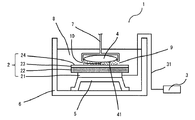
本発明の表面改質装置の第1の実施態様を図1に示す。表面改質装置1は、被改質材4の被処理面41に対向する位置に配置される超音波発生手段2を備えている。
A first embodiment of the surface modification apparatus of the present invention is shown in FIG. The
超音波発生手段2は、超音波振動子21、超音波伝達部材22およびキャビテーション発生部23を有し、超音波電源装置3から電線31を通じて供給される電流によって超音波を発生させる構成となっている。
The
超音波振動子21は、例えば、超磁歪材料や圧電型セラミック材料を用いたものが好適に使用される。
As the
超音波伝達部材22は、液晶ポリマーで構成され、超音波振動子21で発生した超音波を伝達する部材である。超音波伝達部材22は、接着あるいはねじ止めなどの固定手段により超音波振動子21に接合される。超音波伝達部材の形状や寸法は、被改質材および超音波振動子に応じて適宜設定することができる。超音波伝達部材の厚みは、例えば0.1〜20mmであってよい。
The
キャビテーション発生部23は、金属、セラミックあるいは液晶ポリマーを含む樹脂材料などで構成される。キャビテーション発生部23はキャビテーション発生面24を有し、接着あるいはねじ止めなどの固定手段により超音波伝達部材22に接合される。キャビテーション発生部23が液晶ポリマーから構成される場合には、キャビテーション発生部23は超音波伝達部材22と一体成形されてもよい。
The cavitation generating
キャビテーション発生部23の形状は、特に限定されないが、例えば、平板などとすることができ、より複雑な超音波を発生させることができる観点から、格子状などの溝やリブなどの凹凸状の表面構造を有していてもよいし、あるいはメッシュ状としてもよい。超音波発生手段2を被改質材4に対して処理中に移動可能にする場合にはホーン状やバー状であってもよい。
The shape of the
超音波振動子21で発生した超音波は、超音波振動子21と接合された超音波伝達部材22を介してキャビテーション発生部23に伝達され、キャビテーション発生面24と被処理面41との間隙10に存在する液体8中にキャビテーション気泡9を発生させる。
The ultrasonic wave generated by the
キャビテーション発生面24と被処理面41との最短距離である間隙10は、十分な表面改質効果を得るという点から100μm〜10mmが好ましく、500μm〜5mmがより好ましい。
The
超音波発生手段2は、支持手段5によって、キャビテーション発生面24が被処理面41に対向するように被改質材4に対して下部に近接配置される。
The ultrasonic wave generation means 2 is disposed close to the lower portion of the material to be modified 4 by the support means 5 so that the
支持手段5は、一方を超音波発生手段2に接合し、他方を例えば容器6の内壁に接合して、超音波発生手段2を支持する。
The
支持手段5は、超音波発生手段2を移動しながら被改質材4に対して超音波を付与できるように構成してもよい。
The
容器6は、少なくともキャビテーション発生面24と被処理面41とが浸漬するように液体8を保持する。容器6は、間隙10を液体8で満たすことができればよく、例えば、槽状などとすることができる。
The
キャビテーション発生面24と被処理面41との間を満たす液体8としては、水、水溶液、油や有機溶剤などを使用することができる。
As the
被改質材4は、被改質材支持手段7によって、被処理面41をキャビテーション発生面24に対向する位置に支持される。
The to-
本発明に係る被改質材4の材質としては、特に限定されないが、例えば、金属、セラミックスや樹脂などが挙げられる。これらの中でも金属が好ましい。金属としては、例えば、鉄、炭素鋼、ステンレス鋼、アルミニウム合金、マグネシウム合金などが挙げられる。
Although it does not specifically limit as a material of the to-be-reformed
本発明に係る超音波の周波数は、低周波数から高周波数のいずれの領域のものであってよいが、表面改質がより効果的である点から20kHz〜5MHzが好ましく、30kHz〜4MHzがより好ましく、50kHz〜3MHzがさらに好ましい。 The frequency of the ultrasonic wave according to the present invention may be in any region from a low frequency to a high frequency, but is preferably 20 kHz to 5 MHz, more preferably 30 kHz to 4 MHz from the viewpoint that surface modification is more effective. 50 kHz to 3 MHz is more preferable.
超音波電源装置3における超音波の周波数は、超音波の非定常性および均一性を増大させて表面改質の均質化効果を一層向上させるという点から、例えば、1〜10秒などを周期として1MHz〜5MHzなどの間で連続的あるいは断続的に変化させてもよい。
The frequency of the ultrasonic wave in the ultrasonic
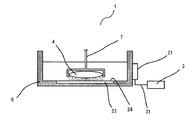
本発明の表面改質装置の第2の実施態様を図2に示す。 A second embodiment of the surface modification apparatus of the present invention is shown in FIG.
第2の実施態様では、超音波発生手段2は、支持手段5によって、キャビテーション発生面24が被処理面41に対向するように、容器6の底部に配置された被改質材4の上部に近接配置される。
In the second embodiment, the ultrasonic wave generating means 2 is placed on the upper part of the material to be reformed 4 arranged at the bottom of the
第2の実施態様においては、被改質材は容器6の底部に配置されるため被改質材支持手段は設けなくてもよい。
In the second embodiment, since the material to be reformed is disposed at the bottom of the
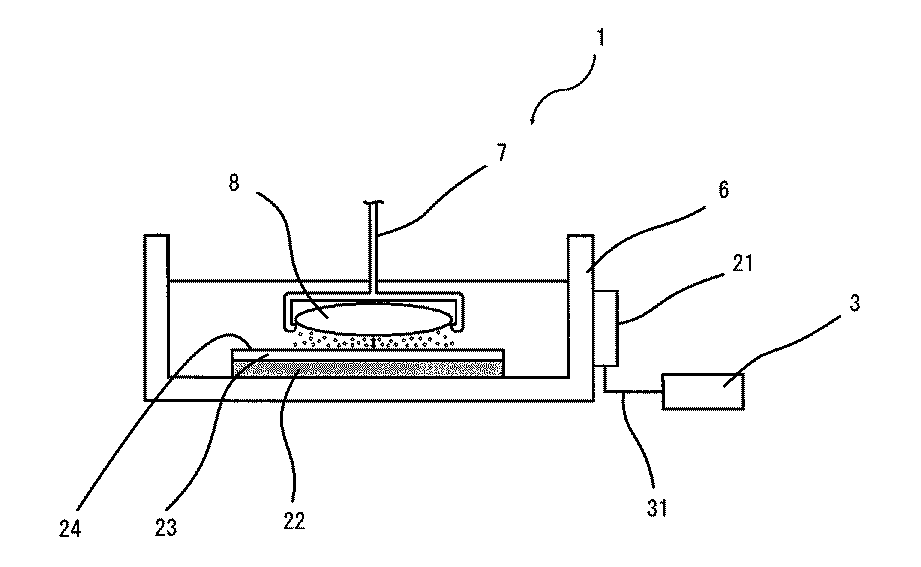
本発明の表面改質装置の第3の実施態様を図3に示す。 A third embodiment of the surface modification apparatus of the present invention is shown in FIG.
第3の実施態様では、容器6が液晶ポリマーで構成されて、被改質材4と対向する部位にキャビテーション発生部23が設けられる。
In the third embodiment, the
超音波振動子21は容器6の外側に接合されるが、キャビテーション発生を妨げなければ容器6の内側に接合されてもよい。
The
第3の実施態様においては、容器6の少なくとも一部分が液晶ポリマーから構成されることにより、その液晶ポリマーから構成された部分が超音波伝達部材として働き、容器6の液晶ポリマーから構成される部分と接触するキャビテーション発生部23の表面および/または容器6の内壁面がキャビテーション発生面24となる。第3の実施態様においては、超音波発生手段を支持する支持手段は不要となる。第3の実施態様においても、キャビテーション発生部23が液晶ポリマーから構成される場合は、容器6の液晶ポリマーから構成される部分と一体成形されてもよい。
In the third embodiment, since at least a part of the
被改質材4は、被処理面41が容器6の内壁面に対向するように容器6の底部に対して近接配置される。
The material to be reformed 4 is disposed close to the bottom of the
本発明の表面改質装置の第4の実施態様を図4に示す。 A fourth embodiment of the surface modification apparatus of the present invention is shown in FIG.
第4の実施態様では、超音波振動子21と超音波伝達部材22とが間接的に接続される。
In the fourth embodiment, the
すなわち、超音波振動子21で発生した超音波は、容器6および超音波伝達部材22を介してキャビテーション発生部24に伝達され、キャビテーション発生面と被改質面との間でキャビテーション気泡を発生させる。
That is, the ultrasonic wave generated by the
超音波振動子21は容器6の外側に接合されるのが好ましいが、内側に接合してもよい。
The
第4の実施態様においては、超音波伝達部材22が容器6に載置または接合して構成されるので、超音波発生手段を支持する支持手段が不要となる。
In the fourth embodiment, since the
第1乃至第4の実施態様において、被改質材4の上方または下方にキャビテーションを発生させる場合について説明したが、いずれの態様においても上方または下方に加えて、またはそれらに代えて被改質材4の側方にキャビテーション気泡を発生させてもよい。さらに第1乃至第4の実施態様を組み合わせた態様、すなわち被改質材の上方および下方にキャビテーションを発生させる態様であってよく、さらにその組み合わせた態様において被改質材4の側方にキャビテーション気泡を発生させてもよい。
In the first to fourth embodiments, the case where cavitation is generated above or below the material to be reformed 4 has been described, but in any mode, in addition to or in place of the above, the material to be reformed Cavitation bubbles may be generated on the side of the
本発明に使用する液晶ポリマーとは、当業者にサーモトロピック液晶ポリマーと呼ばれる、異方性溶融相を形成する液晶ポリエステル樹脂または液晶ポリエステルアミド樹脂である。 The liquid crystal polymer used in the present invention is a liquid crystal polyester resin or liquid crystal polyester amide resin that forms an anisotropic molten phase, which is called a thermotropic liquid crystal polymer by those skilled in the art.
液晶ポリマーの異方性溶融相の性質は直交偏向子を利用した通常の偏向検査法、すなわち、ホットステージにのせた試料を窒素雰囲気下で観察することにより確認できる。 The property of the anisotropic molten phase of the liquid crystal polymer can be confirmed by a normal deflection inspection method using an orthogonal deflector, that is, by observing a sample placed on a hot stage in a nitrogen atmosphere.
本発明に使用する液晶ポリマーは、分子鎖中に脂肪族基を有する半芳香族液晶ポリマー、または分子鎖が全て芳香族基より構成される全芳香族液晶ポリマーのいずれであってもよい。 The liquid crystal polymer used in the present invention may be either a semi-aromatic liquid crystal polymer having an aliphatic group in the molecular chain, or a wholly aromatic liquid crystal polymer in which the molecular chain is entirely composed of aromatic groups.
本発明に使用する液晶ポリマーを構成する繰返し単位としては、芳香族オキシカルボニル繰返し単位、芳香族ジカルボニル繰返し単位、芳香族ジオキシ繰返し単位、芳香族アミノオキシ繰返し単位、芳香族ジアミノ繰返し単位、芳香族アミノカルボニル繰返し単位、芳香族オキシジカルボニル繰返し単位、脂肪族ジオキシ繰返し単位、および脂肪族ジカルボニル繰返し単位などが挙げられる。 As the repeating unit constituting the liquid crystal polymer used in the present invention, aromatic oxycarbonyl repeating unit, aromatic dicarbonyl repeating unit, aromatic dioxy repeating unit, aromatic aminooxy repeating unit, aromatic diamino repeating unit, aromatic Examples thereof include aminocarbonyl repeating units, aromatic oxydicarbonyl repeating units, aliphatic dioxy repeating units, and aliphatic dicarbonyl repeating units.
芳香族オキシカルボニル繰返し単位を与える単量体の具体例としては、例えば、4−ヒドロキシ安息香酸、3−ヒドロキシ安息香酸、2−ヒドロキシ安息香酸、6−ヒドロキシ−2−ナフトエ酸、5−ヒドロキシ−2−ナフトエ酸、3−ヒドロキシ−2−ナフトエ酸、4’−ヒドロキシフェニル−4−安息香酸、3’−ヒドロキシフェニル−4−安息香酸、4’−ヒドロキシフェニル−3−安息香酸などの芳香族ヒドロキシカルボン酸およびそれらのアルキル、アルコキシまたはハロゲン置換体、ならびにこれらのアシル化物、エステル誘導体、酸ハロゲン化物などのエステル形成性誘導体が挙げられる。これらの中では4−ヒドロキシ安息香酸および6−ヒドロキシ−2−ナフトエ酸が得られる液晶ポリマーの特性や結晶融解温度を調整しやすいという点から好ましい。 Specific examples of the monomer that gives an aromatic oxycarbonyl repeating unit include, for example, 4-hydroxybenzoic acid, 3-hydroxybenzoic acid, 2-hydroxybenzoic acid, 6-hydroxy-2-naphthoic acid, 5-hydroxy- Aromatics such as 2-naphthoic acid, 3-hydroxy-2-naphthoic acid, 4′-hydroxyphenyl-4-benzoic acid, 3′-hydroxyphenyl-4-benzoic acid, 4′-hydroxyphenyl-3-benzoic acid Examples thereof include hydroxycarboxylic acids and alkyl, alkoxy or halogen substituted products thereof, and ester-forming derivatives thereof such as acylated products, ester derivatives and acid halides thereof. Among these, 4-hydroxybenzoic acid and 6-hydroxy-2-naphthoic acid are preferable from the viewpoint of easy adjustment of the characteristics and crystal melting temperature of the liquid crystal polymer obtained.
芳香族ジカルボニル繰返し単位を与える単量体の具体例としては、例えば、テレフタル酸、イソフタル酸、2,6−ナフタレンジカルボン酸、1,6−ナフタレンジカルボン酸、2,7−ナフタレンジカルボン酸、1,4−ナフタレンジカルボン酸、4,4’−ジカルボキシビフェニルなどの芳香族ジカルボン酸およびそれらのアルキル、アルコキシまたはハロゲン置換体、ならびにこれらのエステル誘導体、酸ハロゲン化物などのエステル形成性誘導体が挙げられる。これらの中ではテレフタル酸、イソフタル酸および2,6−ナフタレンジカルボン酸が得られる液晶ポリマーの機械物性、耐熱性、結晶融解温度、成形加工性を適度なレベルに調整しやすいことから好ましい。 Specific examples of the monomer that gives an aromatic dicarbonyl repeating unit include, for example, terephthalic acid, isophthalic acid, 2,6-naphthalenedicarboxylic acid, 1,6-naphthalenedicarboxylic acid, 2,7-naphthalenedicarboxylic acid, 1 Aromatic dicarboxylic acids such as 1,4-naphthalenedicarboxylic acid and 4,4′-dicarboxybiphenyl and their alkyl, alkoxy or halogen substituents, and ester-forming derivatives such as ester derivatives and acid halides thereof. . Among these, terephthalic acid, isophthalic acid, and 2,6-naphthalenedicarboxylic acid are preferable because the mechanical properties, heat resistance, crystal melting temperature, and molding processability of the liquid crystal polymer from which terephthalic acid, 2,6-naphthalenedicarboxylic acid are obtained can be easily adjusted to appropriate levels.
芳香族ジオキシ繰返し単位を与える単量体の具体例としては、例えば、ハイドロキノン、レゾルシン、2,6−ジヒドロキシナフタレン、2,7−ジヒドロキシナフタレン、1,6−ジヒドロキシナフタレン、1,4−ジヒドロキシナフタレン、4,4’−ジヒドロキシビフェニル、3,3’−ジヒドロキシビフェニル、3,4’−ジヒドロキシビフェニル、4,4’−ジヒドロキシビフェニルエーテルなどの芳香族ジオールおよびそれらのアルキル、アルコキシまたはハロゲン置換体、ならびにこれらのアシル化物などのエステル形成性誘導体が挙げられる。これらの中ではハイドロキノンおよび4,4’−ジヒドロキシビフェニルが重合時の反応性や、得られる液晶ポリマーの機械物性、耐熱性、結晶融解温度、成形加工性を適度なレベルに調整しやすいことから好ましい。 Specific examples of the monomer that provides an aromatic dioxy repeating unit include, for example, hydroquinone, resorcin, 2,6-dihydroxynaphthalene, 2,7-dihydroxynaphthalene, 1,6-dihydroxynaphthalene, 1,4-dihydroxynaphthalene, Aromatic diols such as 4,4′-dihydroxybiphenyl, 3,3′-dihydroxybiphenyl, 3,4′-dihydroxybiphenyl, 4,4′-dihydroxybiphenyl ether and their alkyl, alkoxy or halogen substituents, and these And ester-forming derivatives such as acylated products. Among these, hydroquinone and 4,4′-dihydroxybiphenyl are preferable because they are easy to adjust the reactivity during polymerization and the mechanical properties, heat resistance, crystal melting temperature, and moldability of the obtained liquid crystal polymer to appropriate levels. .
芳香族アミノオキシ繰返し単位を与える単量体の具体例としては、例えば、4−アミノフェノール、3−アミノフェノール、4−アミノ−1−ナフトール、5−アミノ−1−ナフトール、8−アミノ−2−ナフトール、4−アミノ−4’−ヒドロキシビフェニルなどの芳香族ヒドロキシアミンおよびそれらのアルキル、アルコキシまたはハロゲン置換体、ならびにこれらのアシル化物などのエステル形成性誘導体が挙げられる。 Specific examples of the monomer that gives an aromatic aminooxy repeating unit include, for example, 4-aminophenol, 3-aminophenol, 4-amino-1-naphthol, 5-amino-1-naphthol, and 8-amino-2. -Aromatic hydroxyamines such as naphthol, 4-amino-4'-hydroxybiphenyl and their alkyl, alkoxy or halogen substitutions, and ester-forming derivatives such as their acylates.
芳香族ジアミノ繰返し単位を与える単量体の具体例としては、例えば、1,4−ジアミノベンゼン、1,3−ジアミノベンゼン、1,5−ジアミノナフタレン、1,8−ジアミノナフタレンなどの芳香族ジアミンおよびそれらのアルキル、アルコキシまたはハロゲン置換体、ならびにこれらのアシル化物などのアミド形成性誘導体が挙げられる。 Specific examples of the monomer that gives an aromatic diamino repeating unit include aromatic diamines such as 1,4-diaminobenzene, 1,3-diaminobenzene, 1,5-diaminonaphthalene, 1,8-diaminonaphthalene, and the like. And alkyl, alkoxy or halogen substitution products thereof, and amide-forming derivatives thereof such as acylated products thereof.
芳香族アミノカルボニル繰返し単位を与える単量体の具体例としては、例えば、4−アミノ安息香酸、3−アミノ安息香酸、6−アミノ−2−ナフトエ酸などの芳香族アミノカルボン酸およびそれらのアルキル、アルコキシまたはハロゲン置換体、ならびにこれらのアシル化物、エステル誘導体、酸ハロゲン化物などのエステル形成性誘導体が挙げられる。 Specific examples of the monomer that gives an aromatic aminocarbonyl repeating unit include aromatic aminocarboxylic acids such as 4-aminobenzoic acid, 3-aminobenzoic acid, and 6-amino-2-naphthoic acid, and alkyls thereof. , Alkoxy- or halogen-substituted products, and ester-forming derivatives thereof such as acylated products, ester derivatives, and acid halides.
芳香族オキシジカルボニル繰返し単位を与える単量体の具体例としては、例えば、3−ヒドロキシ−2,7−ナフタレンジカルボン酸、4−ヒドロキシイソフタル酸、および5−ヒドロキシイソフタル酸などのヒドロキシ芳香族ジカルボン酸およびそれらのアルキル、アルコキシまたはハロゲン置換体、ならびにこれらのアシル化物、エステル誘導体、酸ハロゲン化物などのエステル形成性誘導体が挙げられる。 Specific examples of monomers that give aromatic oxydicarbonyl repeat units include hydroxy aromatic dicarboxylic acids such as 3-hydroxy-2,7-naphthalenedicarboxylic acid, 4-hydroxyisophthalic acid, and 5-hydroxyisophthalic acid. Examples include acids and their alkyl, alkoxy or halogen-substituted products, and ester-forming derivatives thereof such as acylated products, ester derivatives and acid halides thereof.
脂肪族ジヒドロキシ繰返し単位を与える単量体の具体例としては、例えば、エチレングリコール、1,4−ブタンジオール、1,6−ヘキサンジオールなどの脂肪族ジオール、ならびにこれらのアシル化物が挙げられる。また、ポリエチレンテレフタレートや、ポリブチレンテレフタレートなどの脂肪族ジオキシ繰返し単位を含有するポリマーを、前記の芳香族ヒドロキシカルボン酸、芳香族ジカルボン酸、芳香族ジオールおよびこれらのアシル化物、エステル誘導体、酸ハロゲン化物などと反応させることによっても、脂肪族ジオキシ繰返し単位を含む液晶ポリマーを得ることができる。 Specific examples of the monomer that gives an aliphatic dihydroxy repeating unit include aliphatic diols such as ethylene glycol, 1,4-butanediol, 1,6-hexanediol, and acylated products thereof. In addition, polymers containing aliphatic dioxy repeating units such as polyethylene terephthalate and polybutylene terephthalate are converted into the above-mentioned aromatic hydroxycarboxylic acids, aromatic dicarboxylic acids, aromatic diols and their acylated products, ester derivatives, acid halides. A liquid crystal polymer containing an aliphatic dioxy repeating unit can also be obtained by reacting with the above.
脂肪族ジカルボニル繰返し単位を与える単量体の具体例としては、例えばシュウ酸、マロン酸、コハク酸、グルタル酸、アジピン酸、ピメリン酸、スベリン酸、アゼライン酸、セバシン酸、ドデカン二酸、テトラデカン二酸、フマル酸、マレイン酸およびヘキサヒドロテレフタル酸などの脂肪族ジカルボン酸、ならびにこれらのエステル誘導体、酸ハロゲン化物などのエステル形成性誘導体が挙げられる。 Specific examples of the monomer that gives the aliphatic dicarbonyl repeating unit include, for example, oxalic acid, malonic acid, succinic acid, glutaric acid, adipic acid, pimelic acid, suberic acid, azelaic acid, sebacic acid, dodecanedioic acid, and tetradecane. Examples thereof include aliphatic dicarboxylic acids such as diacid, fumaric acid, maleic acid and hexahydroterephthalic acid, and ester-forming derivatives thereof such as ester derivatives and acid halides thereof.
本発明に使用する液晶ポリマーは本発明の目的を損なわない範囲で、チオエステル結合を含むものであってもよい。このような結合を与える単量体としては、メルカプト芳香族カルボン酸、および芳香族ジチオールおよびヒドロキシ芳香族チオールなどが挙げられる。これらの単量体の使用量は、芳香族オキシカルボニル繰返し単位、芳香族ジカルボニル繰返し単位、芳香族ジオキシ繰返し単位、芳香族アミノオキシ繰返し単位、芳香族ジアミノ繰返し単位、芳香族アミノカルボニル繰り返し単位、芳香族オキシジカルボニル繰返し単位、脂肪族ジオキシ繰返し単位、および脂肪族ジカルボニル繰返し単位を与える単量体の合計量を含む全体に対して10モル%以下であるのが好ましい。 The liquid crystal polymer used in the present invention may contain a thioester bond as long as the object of the present invention is not impaired. Examples of the monomer that gives such a bond include mercapto aromatic carboxylic acid, aromatic dithiol, and hydroxy aromatic thiol. The amount of these monomers used is aromatic oxycarbonyl repeating unit, aromatic dicarbonyl repeating unit, aromatic dioxy repeating unit, aromatic aminooxy repeating unit, aromatic diamino repeating unit, aromatic aminocarbonyl repeating unit, It is preferably 10 mol% or less based on the total amount including the total amount of monomers that give the aromatic oxydicarbonyl repeating unit, aliphatic dioxy repeating unit, and aliphatic dicarbonyl repeating unit.
これらの繰り返し単位を組み合わせたポリマーは、モノマーの構成や組成比、ポリマー中での各繰り返し単位のシークエンス分布によっては、異方性溶融相を形成するものとしないものが存在するが、本発明に使用する液晶ポリマーは異方性溶融相を形成するものに限られる。 Depending on the composition and composition ratio of the monomers and the sequence distribution of each repeating unit in the polymer, polymers that combine these repeating units may or may not form an anisotropic molten phase. The liquid crystal polymer used is limited to those forming an anisotropic melt phase.
本発明に使用する液晶ポリマーの具体的な例として、下記の単量体の組合せから与えられる繰返し単位で構成される共重合体を挙げることができる。
1)4−ヒドロキシ安息香酸/6−ヒドロキシ−2−ナフトエ酸共重合体
2)4−ヒドロキシ安息香酸/テレフタル酸/4,4’−ジヒドロキシビフェニル共重合体
3)4−ヒドロキシ安息香酸/テレフタル酸/イソフタル酸/4,4’−ジヒドロキシビフェニル共重合体
4)4−ヒドロキシ安息香酸/テレフタル酸/イソフタル酸/4,4’−ジヒドロキシビフェニル/ハイドロキノン共重合体
5)4−ヒドロキシ安息香酸/テレフタル酸/ハイドロキノン共重合体
6)6−ヒドロキシ−2−ナフトエ酸/テレフタル酸/ハイドロキノン共重合体
7)4−ヒドロキシ安息香酸/6−ヒドロキシ−2−ナフトエ酸/テレフタル酸/4,4’−ジヒドロキシビフェニル共重合体
8)6−ヒドロキシ−2−ナフトエ酸/テレフタル酸/4,4’−ジヒドロキシビフェニル共重合体
9)4−ヒドロキシ安息香酸/6−ヒドロキシ−2−ナフトエ酸/テレフタル酸/ハイドロキノン共重合体
10)4−ヒドロキシ安息香酸/6−ヒドロキシ−2−ナフトエ酸/テレフタル酸/ハイドロキノン/4,4’−ジヒドロキシビフェニル共重合体
11)4−ヒドロキシ安息香酸/2,6−ナフタレンジカルボン酸/4,4’−ジヒドロキシビフェニル共重合体
12)4−ヒドロキシ安息香酸/テレフタル酸/2,6−ナフタレンジカルボン酸/ハイドロキノン共重合体
13)4−ヒドロキシ安息香酸/2,6−ナフタレンジカルボン酸/ハイドロキノン共重合体
14)4−ヒドロキシ安息香酸/6−ヒドロキシ−2−ナフトエ酸/2,6−ナフタレンジカルボン酸/ハイドロキノン共重合体
15)4−ヒドロキシ安息香酸/テレフタル酸/2,6−ナフタレンジカルボン酸/ハイドロキノン/4,4’−ジヒドロキシビフェニル共重合体
16)4−ヒドロキシ安息香酸/テレフタル酸/4−アミノフェノール共重合体
17)6−ヒドロキシ−2−ナフトエ酸/テレフタル酸/4−アミノフェノール共重合体
18)4−ヒドロキシ安息香酸/6−ヒドロキシ−2−ナフトエ酸/テレフタル酸/4−アミノフェノール共重合体
19)4−ヒドロキシ安息香酸/テレフタル酸/4,4’−ジヒドロキシビフェニル/4−アミノフェノール共重合体
20)4−ヒドロキシ安息香酸/テレフタル酸/エチレングリコール共重合体
21)4−ヒドロキシ安息香酸/テレフタル酸/4,4’−ジヒドロキシビフェニル/エチレングリコール共重合体
22)4−ヒドロキシ安息香酸/6−ヒドロキシ−2−ナフトエ酸/テレフタル酸/エチレングリコール共重合体
23)4−ヒドロキシ安息香酸/6−ヒドロキシ−2−ナフトエ酸/テレフタル酸/4,4’−ジヒドロキシビフェニル/エチレングリコール共重合体
24)4−ヒドロキシ安息香酸/テレフタル酸/2,6−ナフタレンジカルボン酸/4,4’−ジヒドロキシビフェニル共重合体。
Specific examples of the liquid crystal polymer used in the present invention include a copolymer composed of repeating units given by the following combination of monomers.
1) 4-hydroxybenzoic acid / 6-hydroxy-2-naphthoic acid copolymer 2) 4-hydroxybenzoic acid / terephthalic acid / 4,4′-dihydroxybiphenyl copolymer 3) 4-hydroxybenzoic acid / terephthalic acid / Isophthalic acid / 4,4′-dihydroxybiphenyl copolymer 4) 4-hydroxybenzoic acid / terephthalic acid / isophthalic acid / 4,4′-dihydroxybiphenyl / hydroquinone copolymer 5) 4-hydroxybenzoic acid / terephthalic acid / Hydroquinone copolymer 6) 6-hydroxy-2-naphthoic acid / terephthalic acid / hydroquinone copolymer 7) 4-hydroxybenzoic acid / 6-hydroxy-2-naphthoic acid / terephthalic acid / 4,4′-dihydroxybiphenyl Copolymer 8) 6-Hydroxy-2-naphthoic acid / terephthalic acid / 4,4'-dihydride Xibiphenyl copolymer 9) 4-hydroxybenzoic acid / 6-hydroxy-2-naphthoic acid / terephthalic acid / hydroquinone copolymer 10) 4-hydroxybenzoic acid / 6-hydroxy-2-naphthoic acid / terephthalic acid / hydroquinone / 4,4'-dihydroxybiphenyl copolymer 11) 4-hydroxybenzoic acid / 2,6-naphthalenedicarboxylic acid / 4,4'-dihydroxybiphenyl copolymer 12) 4-hydroxybenzoic acid / terephthalic acid / 2 6-Naphthalenedicarboxylic acid / hydroquinone copolymer 13) 4-hydroxybenzoic acid / 2,6-naphthalenedicarboxylic acid / hydroquinone copolymer 14) 4-hydroxybenzoic acid / 6-hydroxy-2-naphthoic acid / 2,6 -Naphthalenedicarboxylic acid / hydroquinone copolymer 15) 4-hydroxy Benzoic acid / terephthalic acid / 2,6-naphthalenedicarboxylic acid / hydroquinone / 4,4′-dihydroxybiphenyl copolymer 16) 4-hydroxybenzoic acid / terephthalic acid / 4-aminophenol copolymer 17) 6-hydroxy- 2-naphthoic acid / terephthalic acid / 4-aminophenol copolymer 18) 4-hydroxybenzoic acid / 6-hydroxy-2-naphthoic acid / terephthalic acid / 4-aminophenol copolymer 19) 4-hydroxybenzoic acid / Terephthalic acid / 4,4′-dihydroxybiphenyl / 4-aminophenol copolymer 20) 4-hydroxybenzoic acid / terephthalic acid / ethylene glycol copolymer 21) 4-hydroxybenzoic acid / terephthalic acid / 4,4′- Dihydroxybiphenyl / ethylene glycol copolymer 22) 4-hydroxy Benzoic acid / 6-hydroxy-2-naphthoic acid / terephthalic acid / ethylene glycol copolymer 23) 4-hydroxybenzoic acid / 6-hydroxy-2-naphthoic acid / terephthalic acid / 4,4′-dihydroxybiphenyl / ethylene Glycol copolymer 24) 4-hydroxybenzoic acid / terephthalic acid / 2,6-naphthalenedicarboxylic acid / 4,4′-dihydroxybiphenyl copolymer.
これらの中でも、1)、9)、10)および14)のモノマー構成単位からなる液晶ポリマーが好ましい。 Among these, liquid crystal polymers composed of the monomer structural units of 1), 9), 10) and 14) are preferable.
本発明に使用する液晶ポリマーは、2種以上の液晶ポリマーをブレンドしたものであってもよい。 The liquid crystal polymer used in the present invention may be a blend of two or more liquid crystal polymers.
本発明に使用する液晶ポリマーの溶融粘度(キャピラリーレオメーターで測定、測定温度は結晶融解温度+10℃〜結晶融解温度+40℃、1000s−1)は、本発明に係る超音波伝達部材の機械強度を担保する点から、5〜1000Pa・sが好ましく、10〜300Pa・sがより好ましく、15〜200Pa・sがさらに好ましい。 The melt viscosity of the liquid crystal polymer used in the present invention (measured with a capillary rheometer, the measurement temperature is crystal melting temperature + 10 ° C. to crystal melting temperature + 40 ° C., 1000 s-1) is the mechanical strength of the ultrasonic transmission member according to the present invention. From the point to ensure, 5-1000 Pa.s is preferable, 10-300 Pa.s is more preferable, 15-200 Pa.s is further more preferable.
なお、本明細書および特許請求の範囲において、「結晶融解温度」とは、示差走査熱量計(Differential scanning calorimeter、以下DSCと略す)によって、昇温速度20℃/minで測定した際の結晶融解ピーク温度から求めたものである。より具体的には、液晶ポリマーの試料を、室温から20℃/分の昇温条件で測定した際に観測される吸熱ピーク温度(Tm1)の観測後、Tm1より20〜50℃高い温度で10分間保持し、次いで、20℃/分の降温条件で室温まで試料を冷却した後に、再度20℃/分の昇温条件で測定した際の吸熱ピークを観測し、そのピークトップを示す温度を液晶ポリマーの結晶融解温度とする。測定用機器としては、例えば、セイコーインスツルメンツ株式会社製Exstar6000等を使用することができる。 In the present specification and claims, “crystal melting temperature” refers to crystal melting measured by a differential scanning calorimeter (hereinafter abbreviated as DSC) at a heating rate of 20 ° C./min. It is obtained from the peak temperature. More specifically, after observing an endothermic peak temperature (Tm1) observed when a liquid crystal polymer sample is measured from room temperature under a temperature rising condition of 20 ° C./min, the temperature is 10 to 50 ° C. higher than Tm1. Hold for a minute, then cool the sample to room temperature under a temperature drop condition of 20 ° C./min, then observe the endothermic peak when measured again under a temperature rise condition of 20 ° C./min, and the temperature showing the peak top is the liquid crystal The crystal melting temperature of the polymer. As the measuring device, for example, Exstar 6000 manufactured by Seiko Instruments Inc. can be used.
本発明に使用する液晶ポリマーは、ペンタフルオロフェノール中で対数粘度を測定することが可能である。本発明に使用する液晶ポリマーは、ペンタフルオロフェノール(濃度0.1g/dl)中、温度60℃で測定した場合の対数粘度が0.3dl/g以上であるものが好ましく、0.5〜10dl/gであるものがより好ましく、1〜8dl/gであるものがさらに好ましい。 The liquid crystal polymer used in the present invention can measure logarithmic viscosity in pentafluorophenol. The liquid crystal polymer used in the present invention preferably has a logarithmic viscosity of 0.3 dl / g or more when measured at a temperature of 60 ° C. in pentafluorophenol (concentration: 0.1 g / dl). / G is more preferable, and 1 to 8 dl / g is more preferable.
本発明に使用する液晶ポリマーの製造方法には特に限定はなく、前記の単量体成分によるエステル結合またはアミド結合を形成させる公知の重縮合法、例えば溶融アシドリシス法、スラリー重合法などを用いることができる。 The production method of the liquid crystal polymer used in the present invention is not particularly limited, and a known polycondensation method for forming an ester bond or an amide bond with the above monomer components, for example, a melt acidosis method, a slurry polymerization method, or the like is used. Can do.
溶融アシドリシス法とは、本発明において用いる液晶ポリマーを製造するのに適した方法であり、この方法は、最初に単量体を加熱して反応物質の溶融液を形成し、反応を継続することにより溶融ポリマーを得るものである。なお、縮合の最終段階で副生する揮発物(例えば酢酸、水など)の除去を容易にするために真空を適用してもよい。 The melt acidolysis method is a method suitable for producing the liquid crystal polymer used in the present invention, and this method is a method in which a monomer is first heated to form a melt of a reactant and the reaction is continued. Thus, a molten polymer is obtained. A vacuum may be applied to facilitate removal of volatiles (for example, acetic acid, water, etc.) by-produced in the final stage of the condensation.
スラリー重合法とは、熱交換流体の存在下で反応させる方法であって、固体生成物は熱交換媒質中に懸濁した状態で得られる。 The slurry polymerization method is a method of reacting in the presence of a heat exchange fluid, and the solid product is obtained in a state suspended in a heat exchange medium.
溶融アシドリシス法およびスラリー重合法のいずれの場合においても、液晶ポリマーを製造する際に使用する重合性単量体成分は、常温において、ヒドロキシル基をアシル化した変性形態、すなわち低級アシル化物として反応に供することもできる。低級アシル基は炭素原子数2〜5のものが好ましく、炭素原子数2または3のものがより好ましい。特に好ましくは前記単量体成分のアセチル化物を反応に用いる方法が挙げられる。 In both the melt acidification method and the slurry polymerization method, the polymerizable monomer component used for producing the liquid crystal polymer is reacted at room temperature as a modified form in which the hydroxyl group is acylated, that is, a lower acylated product. Can also be provided. The lower acyl group preferably has 2 to 5 carbon atoms, more preferably 2 or 3 carbon atoms. Particularly preferred is a method using an acetylated product of the monomer component in the reaction.
単量体の低級アシル化物は、別途アシル化して予め合成したものを用いてもよいし、液晶ポリマーの製造時にモノマーに無水酢酸等のアシル化剤を加えて反応系内で生成せしめることもできる。 The lower acylated product of the monomer may be separately acylated and synthesized in advance, or may be produced in the reaction system by adding an acylating agent such as acetic anhydride to the monomer during the production of the liquid crystal polymer. .
溶融アシドリシス法またはスラリー重合法のいずれの場合においても反応時、必要に応じて触媒を用いてもよい。 In either case of the melt acidolysis method or the slurry polymerization method, a catalyst may be used as needed during the reaction.
触媒の具体例としては、例えば、有機スズ化合物(ジブチルスズオキシドなどのジアルキルスズオキシド、ジアリールスズオキシドなど)、有機チタン化合物(二酸化チタン、三酸化アンチモン、アルコキシチタンシリケート、チタンアルコキシドなど)、カルボン酸のアルカリおよびアルカリ土類金属塩(酢酸カリウム、酢酸ナトリウムなど)、ルイス酸(BF3など)、ハロゲン化水素(HClなど)の気体状酸触媒などが挙げられる。 Specific examples of the catalyst include, for example, organic tin compounds (dialkyltin oxide such as dibutyltin oxide, diaryltin oxide), organic titanium compounds (titanium dioxide, antimony trioxide, alkoxy titanium silicate, titanium alkoxide, etc.), carboxylic acid Examples thereof include gaseous acid catalysts such as alkali and alkaline earth metal salts (such as potassium acetate and sodium acetate), Lewis acids (such as BF 3 ), and hydrogen halides (such as HCl).
触媒の使用量は、モノマー重量に対し10〜1000ppmが好ましく、20〜200ppmがより好ましい。 10-1000 ppm is preferable with respect to a monomer weight, and, as for the usage-amount of a catalyst, 20-200 ppm is more preferable.
このような重縮合反応によって得られた液晶ポリマーは、溶融状態で重合反応槽より抜き出された後に、ペレット状、フレーク状、または粉末状に加工され、成形加工に供される。 The liquid crystal polymer obtained by such a polycondensation reaction is extracted from the polymerization reaction tank in a molten state, and then processed into pellets, flakes, or powders for use in molding.
本発明に使用する液晶ポリマーは、超音波伝達部材の機械強度を一層向上させる観点から、任意の成分として、さらに無機および/または有機充填材を含有してもよい。 The liquid crystal polymer used in the present invention may further contain an inorganic and / or organic filler as an optional component from the viewpoint of further improving the mechanical strength of the ultrasonic transmission member.
本発明に使用する液晶ポリマーが含有してもよい無機および/または有機充填材の具体例としては、例えば、ガラス繊維、シリカアルミナ繊維、アルミナ繊維、炭素繊維、チタン酸カリウム繊維、ホウ酸アルミニウム繊維、アラミド繊維、ポリアリレート繊維、タルク、マイカ、グラファイト、ウォラストナイト、ドロマイト、クレー、ガラスフレーク、ガラスビーズ、ガラスバルーン、炭酸カルシウム、硫酸バリウム、酸化チタンなどが挙げられ、これらは単独で使用してもよく、または2種以上を併用してもよい。 Specific examples of the inorganic and / or organic filler that may be contained in the liquid crystal polymer used in the present invention include, for example, glass fiber, silica alumina fiber, alumina fiber, carbon fiber, potassium titanate fiber, and aluminum borate fiber. , Aramid fibers, polyarylate fibers, talc, mica, graphite, wollastonite, dolomite, clay, glass flakes, glass beads, glass balloons, calcium carbonate, barium sulfate, titanium oxide, etc. Or two or more of them may be used in combination.
これらの中では、タルクおよびガラス繊維が、物性とコストのバランスが優れている点で好ましい。 In these, a talc and glass fiber are preferable at the point with the outstanding balance of a physical property and cost.
また、無機および/または有機充填材は、表面処理をされたものであってもよい。表面処理の方法としては、例えば、充填材表面に表面処理剤を吸着させる方法、液晶ポリマーと充填材を混練する際に表面処理剤を添加する方法などが挙げられる。 Further, the inorganic and / or organic filler may be subjected to a surface treatment. Examples of the surface treatment method include a method of adsorbing a surface treatment agent on the surface of the filler, a method of adding a surface treatment agent when kneading the liquid crystal polymer and the filler, and the like.
表面処理剤としては反応性カップリング剤(シラン系カップリング剤、チタネート系カップリング剤、ボラン系カップリング剤など)、潤滑剤(高級脂肪酸、高級脂肪酸エステル、高級脂肪酸金属塩、フルオロカーボン系界面活性剤など)が挙げられる。 Surface treatment agents include reactive coupling agents (silane coupling agents, titanate coupling agents, borane coupling agents, etc.), lubricants (higher fatty acids, higher fatty acid esters, higher fatty acid metal salts, fluorocarbon surface activity) Agent).
無機および/または有機充填材の含有量は、液晶ポリマー100重量部に対して、1〜150重量部であることが好ましく、10〜100重量部であることがより好ましい。 The content of the inorganic and / or organic filler is preferably 1 to 150 parts by weight and more preferably 10 to 100 parts by weight with respect to 100 parts by weight of the liquid crystal polymer.
無機および/または有機充填材の含有量が1重量部未満であると超音波伝達部材の強度について添加による向上効果が得られにくくなる傾向があり、150重量部を超えると超音波伝達部材の強度が低下する傾向がある。 If the content of the inorganic and / or organic filler is less than 1 part by weight, the strength of the ultrasonic transmission member tends to be difficult to improve, and if it exceeds 150 parts by weight, the strength of the ultrasonic transmission member Tends to decrease.
本発明に使用する液晶ポリマーには、本発明の目的を損なわない範囲で、さらに他の添加剤が添加されてもよい。 Other additives may be further added to the liquid crystal polymer used in the present invention as long as the object of the present invention is not impaired.
他の添加剤の具体例としては、例えば、滑剤(高級脂肪酸、高級脂肪酸エステル、高級脂肪酸アミド、高級脂肪酸金属塩(ここで高級脂肪酸とは、炭素原子数10〜25のものをいう)など)、離型改良剤(ポリシロキサン、フッ素樹脂など)、着色剤(染料、顔料、カーボンブラックなど)、難燃剤、帯電防止剤、界面活性剤、造核剤(タルク、有機リン酸塩、ソルビトール類など)、アンチブロッキング剤、酸化防止剤(リン系酸化防止剤、フェノール系酸化防止剤、硫黄系酸化防止剤など)、耐候剤、熱安定剤、中和剤などが挙げられる。これらの添加剤は、単独で使用してもよく、または2種以上を併用してもよい。 Specific examples of other additives include, for example, lubricants (higher fatty acids, higher fatty acid esters, higher fatty acid amides, higher fatty acid metal salts (herein higher fatty acids are those having 10 to 25 carbon atoms), etc.) , Mold release improver (polysiloxane, fluorine resin, etc.), colorant (dye, pigment, carbon black, etc.), flame retardant, antistatic agent, surfactant, nucleating agent (talc, organophosphate, sorbitols) Etc.), anti-blocking agents, antioxidants (phosphorus-based antioxidants, phenol-based antioxidants, sulfur-based antioxidants, etc.), weathering agents, heat stabilizers, neutralizing agents and the like. These additives may be used alone or in combination of two or more.
添加してもよい他の添加剤の合計量は、液晶ポリマー100重量部に対して、0.01〜5重量部が好ましく、0.1〜3重量部がより好ましい。 0.01-5 weight part is preferable with respect to 100 weight part of liquid crystal polymers, and, as for the total amount of the other additive which may be added, 0.1-3 weight part is more preferable.
他の添加剤の合計量が0.01重量部未満であると、添加剤の機能が実現しにくくなる傾向があり、5重量部を超えると、液晶ポリマーまたは液晶ポリマー組成物の成形加工時の熱安定性が悪くなる傾向がある。 When the total amount of the other additives is less than 0.01 parts by weight, the function of the additive tends to be difficult to be realized. When the total amount exceeds 5 parts by weight, the liquid crystal polymer or the liquid crystal polymer composition is molded. Thermal stability tends to be poor.
本発明に使用する液晶ポリマーには、本発明の目的を損なわない範囲で、さらに他の樹脂成分が添加されてもよい。 Other resin components may be further added to the liquid crystal polymer used in the present invention as long as the object of the present invention is not impaired.
他の樹脂成分の具体例としては、例えば、ポリアミド、ポリエステル、ポリアセタール、ポリフェニレンエーテル、およびその変性物、ならびにポリスルホン、ポリエーテルスルホン、ポリエーテルイミド、ポリアミドイミドなどの熱可塑性樹脂や、フェノール樹脂、エポキシ樹脂、ポリイミド樹脂などの熱硬化性樹脂などが挙げられる。これらの樹脂成分は単独で使用してもよく、または2種以上を併用してもよい。 Specific examples of other resin components include, for example, polyamide, polyester, polyacetal, polyphenylene ether, and modified products thereof, and thermoplastic resins such as polysulfone, polyethersulfone, polyetherimide, and polyamideimide, phenol resin, and epoxy. Examples thereof include thermosetting resins such as resins and polyimide resins. These resin components may be used alone or in combination of two or more.
他の樹脂成分を含有する場合、該樹脂成分の含有量は、液晶ポリマー100重量部に対して0.1〜100重量部が好ましく、0.1〜80重量部がより好ましい。 When the other resin component is contained, the content of the resin component is preferably 0.1 to 100 parts by weight, more preferably 0.1 to 80 parts by weight with respect to 100 parts by weight of the liquid crystal polymer.
本発明に使用する液晶ポリマーは、液晶ポリマー、ならびに、相溶化剤、無機および/または有機充填材、他の添加剤または他の樹脂成分を混合し、バンバリーミキサー、ニーダー、一軸もしくは二軸押出機などを用いて、液晶ポリマーの結晶融解温度近傍から結晶融解温度+50℃の温度条件で溶融混練して得ることができ、射出成形や押出成形などの従来の方法により超音波伝達部材に成形できる。 The liquid crystal polymer used in the present invention is a mixture of a liquid crystal polymer and a compatibilizer, inorganic and / or organic filler, other additives or other resin components, and a Banbury mixer, kneader, single-screw or twin-screw extruder. Can be obtained by melt-kneading from the vicinity of the crystal melting temperature of the liquid crystal polymer under a temperature condition of crystal melting temperature + 50 ° C., and can be formed into an ultrasonic transmission member by a conventional method such as injection molding or extrusion molding.
本発明の液晶ポリマーで構成された超音波伝達部材を使用した改質方法は、例えば、自動車用部材、建築部材、精密機械、産業用機械などに係る部品の表面改質に適用することができる。 The modification method using the ultrasonic transmission member composed of the liquid crystal polymer of the present invention can be applied to, for example, surface modification of parts related to automobile members, building members, precision machines, industrial machines, and the like. .
以下、実施例により本発明を詳述するが、本発明はこれに限定されるものではない。 Hereinafter, although an example explains the present invention in detail, the present invention is not limited to this.
<合成例1>(液晶ポリマー1の合成)
トルクメーター付き攪拌装置および留出管を備えた反応容器に、4−ヒドロキシ安息香酸 655.3g(73モル%)および6−ヒドロキシ−2−ナフトエ酸 330.3g(27モル%)を仕込み、さらに全モノマーの水酸基量(モル)に対して1.02倍モルの無水酢酸を仕込み、次の条件で脱酢酸重合を行った。
<Synthesis Example 1> (Synthesis of Liquid Crystal Polymer 1)
A reaction vessel equipped with a stirrer with a torque meter and a distillation tube was charged with 655.3 g (73 mol%) of 4-hydroxybenzoic acid and 330.3 g (27 mol%) of 6-hydroxy-2-naphthoic acid, and 1.02 moles of acetic anhydride was charged with respect to the amount (moles) of hydroxyl groups of all monomers, and deacetic acid polymerization was performed under the following conditions.
窒素ガス雰囲気下に室温から170℃まで1時間かけて昇温し、同温にて30分間保持した。次いで、3時間かけて330℃まで昇温し、さらに330℃で10分反応させた後、1.5時間かけて10mmHgにまで減圧した。所定のトルクを示した時点で重合反応を終了し、反応容器から内容物を取り出し、粉砕機により液晶ポリマーのペレットを得た。 The temperature was raised from room temperature to 170 ° C. over 1 hour under a nitrogen gas atmosphere, and the same temperature was maintained for 30 minutes. Next, the temperature was raised to 330 ° C. over 3 hours and further reacted at 330 ° C. for 10 minutes, and then the pressure was reduced to 10 mmHg over 1.5 hours. When the predetermined torque was exhibited, the polymerization reaction was terminated, the contents were taken out from the reaction vessel, and liquid crystal polymer pellets were obtained with a pulverizer.
<合成例2>(液晶ポリマー2の合成)
トルクメーター付き攪拌装置および留出管を備えた反応容器に、4−ヒドロキシ安息香酸 628.4g(70モル%)、6−ヒドロキシ−2−ナフトエ酸 24.5g(2モル%)、2,6−ナフタレンジカルボン酸 196.7g(14モル%)およびハイドロキノン 100.2g(14モル%)を仕込み、さらに全単量体の水酸基量(モル)に対して1.05倍モルの無水酢酸を仕込み、次の条件で脱酢酸重合を行った。
<Synthesis Example 2> (Synthesis of Liquid Crystal Polymer 2)
In a reaction vessel equipped with a stirrer with a torque meter and a distillation tube, 628.4 g (70 mol%) of 4-hydroxybenzoic acid, 24.5 g (2 mol%) of 6-hydroxy-2-naphthoic acid, 2,6 -196.7 g (14 mol%) of naphthalenedicarboxylic acid and 100.2 g (14 mol%) of hydroquinone were charged, and 1.05 times mol of acetic anhydride was added to the amount of hydroxyl groups (mol) of all monomers, Deacetic acid polymerization was performed under the following conditions.
窒素ガス雰囲気下に室温から170℃まで1時間かけて昇温し、170℃で30分保持した。次いで、副生する酢酸を留出させつつ350℃まで7時間かけて昇温した後、1.5時間かけて5mmHgにまで減圧した。所定のトルクを示した時点で重合反応を終了し、反応容器から内容物を取り出し、粉砕機により全芳香族液晶ポリマーのペレットを得た。 The temperature was raised from room temperature to 170 ° C. over 1 hour in a nitrogen gas atmosphere, and maintained at 170 ° C. for 30 minutes. Next, the temperature was raised to 350 ° C. over 7 hours while distilling off the acetic acid produced as a by-product, and then the pressure was reduced to 5 mmHg over 1.5 hours. When the predetermined torque was exhibited, the polymerization reaction was terminated, the contents were taken out from the reaction vessel, and a wholly aromatic liquid crystal polymer pellet was obtained by a pulverizer.
<超音波伝達部材の作製>
合成例1および2で得た液晶ポリマーペレットについて、射出成形機を用いて平板サンプル(80mm×80mm×1mmt)をそれぞれ作製した。
<Production of ultrasonic transmission member>
With respect to the liquid crystal polymer pellets obtained in Synthesis Examples 1 and 2, flat plate samples (80 mm × 80 mm × 1 mmt) were prepared using an injection molding machine.
また、ポリエチレン樹脂(株式会社プライムポリマー製 2100J)についても、同様に平板サンプルを作製した。 Moreover, the flat plate sample was similarly produced about polyethylene resin (2100J by Prime Polymer Co., Ltd.).
金属製超音波伝達部材としては、鋼板(SPCC相当品、50mm×50mm×1mmt)を用いた。 As the metallic ultrasonic transmission member, a steel plate (SPCC equivalent, 50 mm × 50 mm × 1 mmt) was used.
実施例1
超音波伝達部材のサンプルである合成例1で得た液晶ポリマーペレットから作製した平板の下面に超音波振動子(セラミック発信子、2mmφ×1mmt)をシリコーン系接着剤で接着し、超音波電源装置(DAGATORONIC CORPORATION製、DAGATRON8202)を接続し、オシロスコープ(Pico Technology Limited社製)を使用して周波数を調整した。
Example 1
An ultrasonic power supply device by adhering an ultrasonic transducer (ceramic oscillator, 2 mmφ × 1 mmt) to the lower surface of a flat plate made from the liquid crystal polymer pellet obtained in Synthesis Example 1 which is a sample of an ultrasonic transmission member, with a silicone-based adhesive (DAGATRONIC CORPORATION, DAGATRON 8202) was connected, and the frequency was adjusted using an oscilloscope (Pico Technology Limited).
水槽中において、被改質材として鋼板(SPCC相当品、50mm×50mm×1mmt)を超音波伝達部材の上面に1mm間隔をあけて配置し、被処理面を含む被改質材の全部が常温の水に浸漬するようにして、100kHzで15分間超音波を付与した。 In the water tank, a steel plate (SPCC equivalent, 50 mm x 50 mm x 1 mmt) is placed as a material to be reformed at an interval of 1 mm on the top surface of the ultrasonic transmission member, and all of the material to be reformed including the surface to be treated is at room temperature. Then, ultrasonic waves were applied for 15 minutes at 100 kHz.
被改質材の被処理面について、残留応力測定装置μ−x360n(パルステック工業社製)を用いて、X線応力測定(日本材料学会、鉄鋼編)に準じて、8か所について測定し、平均の応力値および標準偏差を算出した。 The surface to be treated of the material to be modified is measured at 8 locations using a residual stress measuring device μ-x360n (manufactured by Pulstec Industrial Co., Ltd.) according to X-ray stress measurement (Japan Society of Materials Science, Steel). The average stress value and standard deviation were calculated.
無処理の被改質材の値と比較して、応力値が小さいほど有効に改質されたことを示し、標準偏差が小さいほど均一に改質されたことを示す。 Compared to the value of the untreated material to be reformed, the smaller the stress value, the more effectively it was modified, and the smaller the standard deviation, the more uniformly reformed.
実施例2および比較例1〜2
超音波伝達部材を表1に示すように変更した以外は実施例1と同様にして超音波を付与し、残留応力値(平均値)および標準偏差を算出した。結果を表1に示す。
Example 2 and Comparative Examples 1-2
An ultrasonic wave was applied in the same manner as in Example 1 except that the ultrasonic transmission member was changed as shown in Table 1, and a residual stress value (average value) and a standard deviation were calculated. The results are shown in Table 1.
また、参考例として、超音波を付与する前の被改質材の表面について、実施例1と同様に測定し算出した残留応力値(平均値)および標準偏差を表1に示す。 As a reference example, Table 1 shows the residual stress values (average values) and standard deviations measured and calculated in the same manner as in Example 1 for the surface of the material to be modified before applying ultrasonic waves.
液晶ポリマーを超音波伝達部材として使用した場合(実施例1、2)は、無処理の鋼板(参考例)と比較して残留応力値が−25MPaおよび−22MPaと残留応力が小さく、標準偏差が38MPaおよび42MPaとなり、均一かつ有効な改質効果が得られたことを示すものであった。 When the liquid crystal polymer is used as an ultrasonic transmission member (Examples 1 and 2), the residual stress values are −25 MPa and −22 MPa, which are smaller than the untreated steel plate (reference example), and the standard deviation is small. 38 MPa and 42 MPa, indicating that a uniform and effective reforming effect was obtained.
これに対して、ステンレス鋼(SUS304)およびポリエチレン樹脂(比較例1、2)では、無処理の鋼板(参考例)と比較して標準偏差が大きくなり、改質効果に劣るものであった。 In contrast, stainless steel (SUS304) and polyethylene resin (Comparative Examples 1 and 2) had a larger standard deviation than the untreated steel sheet (Reference Example), and were inferior in the reforming effect.
1 表面改質装置
2 超音波発生手段
21 超音波振動子
22 超音波伝達部材
23 キャビテーション発生部
24 キャビテーション発生面
3 超音波電源装置
31 電線
4 被改質材
41 被処理面
5 支持手段
6 容器
7 被改質材支持手段
8 液体
9 キャビテーション気泡
10 間隙
DESCRIPTION OF
Claims (3)
超音波伝達部材が液晶ポリマーから構成される表面改質方法。 In a liquid, a surface modification method that applies ultrasonic waves to the surface of a material to be modified through an ultrasonic transmission member to form a compressive residual stress on the surface of the material to be modified,
A surface modification method in which an ultrasonic transmission member is composed of a liquid crystal polymer.
Priority Applications (1)
| Application Number | Priority Date | Filing Date | Title |
|---|---|---|---|
| JP2017100086A JP2018192588A (en) | 2017-05-19 | 2017-05-19 | Surface modification method, ultrasonic transmission member and surface modification device |
Applications Claiming Priority (1)
| Application Number | Priority Date | Filing Date | Title |
|---|---|---|---|
| JP2017100086A JP2018192588A (en) | 2017-05-19 | 2017-05-19 | Surface modification method, ultrasonic transmission member and surface modification device |
Publications (1)
| Publication Number | Publication Date |
|---|---|
| JP2018192588A true JP2018192588A (en) | 2018-12-06 |
Family
ID=64568715
Family Applications (1)
| Application Number | Title | Priority Date | Filing Date |
|---|---|---|---|
| JP2017100086A Pending JP2018192588A (en) | 2017-05-19 | 2017-05-19 | Surface modification method, ultrasonic transmission member and surface modification device |
Country Status (1)
| Country | Link |
|---|---|
| JP (1) | JP2018192588A (en) |
Cited By (1)
| Publication number | Priority date | Publication date | Assignee | Title |
|---|---|---|---|---|
| CN116497207A (en) * | 2023-04-15 | 2023-07-28 | 康硕(山西)低应力制造系统技术研究院有限公司 | An ultrasonic liquid coupling stress control device |
Citations (3)
| Publication number | Priority date | Publication date | Assignee | Title |
|---|---|---|---|---|
| JPH04373400A (en) * | 1991-06-24 | 1992-12-25 | Mitsubishi Electric Corp | Production of speaker diaphragm |
| JPH11249796A (en) * | 1998-03-05 | 1999-09-17 | Canon Inc | Input pen |
| JP2006102871A (en) * | 2004-10-05 | 2006-04-20 | Toshiba Plant Systems & Services Corp | Residual stress portion reducing method and residual stress portion reducing device |
-
2017
- 2017-05-19 JP JP2017100086A patent/JP2018192588A/en active Pending
Patent Citations (3)
| Publication number | Priority date | Publication date | Assignee | Title |
|---|---|---|---|---|
| JPH04373400A (en) * | 1991-06-24 | 1992-12-25 | Mitsubishi Electric Corp | Production of speaker diaphragm |
| JPH11249796A (en) * | 1998-03-05 | 1999-09-17 | Canon Inc | Input pen |
| JP2006102871A (en) * | 2004-10-05 | 2006-04-20 | Toshiba Plant Systems & Services Corp | Residual stress portion reducing method and residual stress portion reducing device |
Cited By (1)
| Publication number | Priority date | Publication date | Assignee | Title |
|---|---|---|---|---|
| CN116497207A (en) * | 2023-04-15 | 2023-07-28 | 康硕(山西)低应力制造系统技术研究院有限公司 | An ultrasonic liquid coupling stress control device |
Similar Documents
| Publication | Publication Date | Title |
|---|---|---|
| KR101171815B1 (en) | Wholly aromatic liquid-crystalline polyester and method for preparing the same | |
| JP5280281B2 (en) | Liquid crystal polymer composition and molded article comprising the same | |
| JP2015183159A (en) | liquid crystal polyester blend | |
| CN107236265B (en) | Liquid crystal polymer composition | |
| JP2020193261A (en) | Liquid crystal polymer composition | |
| JPWO2020070904A1 (en) | Liquid crystal polyester resin | |
| JP7441721B2 (en) | liquid crystal polymer | |
| US7238769B2 (en) | Method for joining liquid-crystalline polyester resin composition parts and jointed article made of liquid-crystalline polyester resin composition | |
| JP6851900B2 (en) | Surface modification method, ultrasonic transmission member and surface modification device | |
| JP2018192588A (en) | Surface modification method, ultrasonic transmission member and surface modification device | |
| CN112341609A (en) | Liquid crystalline polyester resin | |
| JP5110787B2 (en) | Liquid crystal polymer blend and composition comprising the same | |
| JP2021183678A (en) | Liquid crystal polymer | |
| JP7292157B2 (en) | Blow-molded article and its manufacturing method | |
| JP7174640B2 (en) | liquid crystal polymer | |
| JP2022115387A (en) | liquid crystal polymer composition | |
| JP7561049B2 (en) | Liquid crystal polymer composition | |
| JP7578507B2 (en) | Liquid crystal polyester amide resin | |
| JP7461168B2 (en) | Liquid crystal polymer composition | |
| JP2015040248A (en) | Liquid crystal polymer composition | |
| JP6679283B2 (en) | Cleaning member and ultrasonic cleaning machine including the cleaning member | |
| JP7761799B1 (en) | Liquid crystal polymer composition | |
| JP7761798B1 (en) | Liquid crystal polymer composition | |
| JP7761796B1 (en) | Liquid crystal polymer composition | |
| JP7761797B1 (en) | Liquid crystal polymer composition |
Legal Events
| Date | Code | Title | Description |
|---|---|---|---|
| RD04 | Notification of resignation of power of attorney |
Free format text: JAPANESE INTERMEDIATE CODE: A7424 Effective date: 20170817 |
|
| A621 | Written request for application examination |
Free format text: JAPANESE INTERMEDIATE CODE: A621 Effective date: 20200116 |
|
| A977 | Report on retrieval |
Free format text: JAPANESE INTERMEDIATE CODE: A971007 Effective date: 20200916 |
|
| A131 | Notification of reasons for refusal |
Free format text: JAPANESE INTERMEDIATE CODE: A131 Effective date: 20200923 |
|
| A02 | Decision of refusal |
Free format text: JAPANESE INTERMEDIATE CODE: A02 Effective date: 20210126 |