JP2019014875A - Nylon production method by alkaline polymerization and molded nylon - Google Patents
Nylon production method by alkaline polymerization and molded nylon Download PDFInfo
- Publication number
- JP2019014875A JP2019014875A JP2018102479A JP2018102479A JP2019014875A JP 2019014875 A JP2019014875 A JP 2019014875A JP 2018102479 A JP2018102479 A JP 2018102479A JP 2018102479 A JP2018102479 A JP 2018102479A JP 2019014875 A JP2019014875 A JP 2019014875A
- Authority
- JP
- Japan
- Prior art keywords
- nylon
- lactam
- polymerization
- tricarbamide
- alkaline
- Prior art date
- Legal status (The legal status is an assumption and is not a legal conclusion. Google has not performed a legal analysis and makes no representation as to the accuracy of the status listed.)
- Pending
Links
- 0 *[N+](*(CCCCC1)[N+]1[O-])[O-] Chemical compound *[N+](*(CCCCC1)[N+]1[O-])[O-] 0.000 description 2
Landscapes
- Polyamides (AREA)
- Polyurethanes Or Polyureas (AREA)
Abstract
【課題】 アルカリ重合法によるナイロンの製造方法と、アルカリ重合法によるナイロン本来の優れた機械的強度を有し、柔軟性が改良されて、機械加工が容易な成形ナイロンの提供。【解決手段】 本発明のナイロン製造方法は、少なくともω−ラクラム、アルカリ性ラクタム重合触媒及びトリカルバミドラクタム化合物からなる混合物を、撹拌後、加熱された型に注入し、型内で重合固化させることにより、ナイロンを製造する方法である。本発明の成形ナイロンは、少なくともω−ラクタムが、アルカリ性ラクタム重合触媒及びトリカルバミドラクタム化合物により重合固化された成形ナイロンである。【選択図】 なしPROBLEM TO BE SOLVED: To provide a method for producing nylon by an alkaline polymerization method and to provide a molded nylon which has excellent mechanical strength inherent to nylon by an alkaline polymerization method, has improved flexibility, and is easy to machine. According to the method for producing nylon of the present invention, a mixture consisting of at least ω-lacram, an alkaline lactam polymerization catalyst and a tricarbamide lactam compound is stirred and then injected into a heated mold to polymerize and solidify in the mold. , A method of manufacturing nylon. The molded nylon of the present invention is a molded nylon in which at least ω-lactam is polymerized and solidified by an alkaline lactam polymerization catalyst and a tricarbamide lactam compound. [Selection diagram] None
Description
本発明はω−ラクタムのアルカリ重合法によるナイロン製造方法と、機械加工性、耐酸性及び柔軟性の改良された成形ナイロンに関する。 The present invention relates to a method for producing nylon by an alkali polymerization method of ω-lactam and a molded nylon having improved machinability, acid resistance and flexibility.
ω−ラクタムをアルカリ性ラクタム重合触媒と開始剤との作用で重合させてナイロンを製造する方法は、ω−ラクタムのアルカリ重合法として知られている。この重合法で得られるナイロンは、製造法の異なる射出成形用ナイロンに比べ、引張強度、曲げ強度等の機械的強度や熱的性質等が優れているため、金属代替材料の一つとして、自動車部品、機械部品等の工業用材料として広く使用されている。 A method for producing nylon by polymerizing ω-lactam by the action of an alkaline lactam polymerization catalyst and an initiator is known as an alkali polymerization method for ω-lactam. Nylon obtained by this polymerization method has superior mechanical strength and thermal properties such as tensile strength and bending strength compared to nylon for injection molding, which has a different production method. Widely used as industrial materials such as parts and machine parts.
ω−ラクタムのアルカリ重合法で得られるナイロン(以下、「アルカリ重合法ナイロン」と記す)は、一般的に、金属製の型に原料混合物を注入し、丸棒、板材、パイプ等の素材の形状で製造されている。その為、現在使用されているアルカリ重合法ナイロン製の各種自動車部品や機械部品等の多くは、アルカリ重合法で製造された丸棒、板材、パイプ等の素材(ナイロン素材)を機械加工して、製造されている。
アルカリ重合法ナイロンは機械的強度に優れているが、硬くて脆く、引張伸びや衝撃強度等の柔軟性が高くないため、旋盤やその他加工機器により、アルカリ重合法ナイロン素材を機械加工する際、加工時に製品に欠けが生じたり、製品表面が荒れたりすることがあり、機械加工の難しい材料として知られている。その為、前記ナイロン素材の機械加工は、高度の技術が必要とされている。
Nylon obtained by the alkali polymerization method of ω-lactam (hereinafter referred to as “alkaline polymerization nylon”) is generally made by injecting a raw material mixture into a metal mold, and using a material such as a round bar, a plate material, or a pipe. Manufactured in shape. For this reason, many of the various automotive parts and machine parts made of alkali polymerization nylon that are currently used are machined from materials (nylon materials) such as round bars, plates, and pipes manufactured by the alkali polymerization method. Manufactured.
Alkaline polymerized nylon is excellent in mechanical strength, but it is hard and brittle, and it is not high in flexibility such as tensile elongation and impact strength.When machining alkali polymerized nylon material with a lathe or other processing equipment, It is known as a material that is difficult to machine, because the product may be chipped during processing or the surface of the product may be rough. Therefore, advanced technology is required for machining the nylon material.
従来、アルカリ重合法ナイロンの機械加工性改良に関する提案は見当たらない。アルカリ重合法ナイロンの脆さ、柔軟性を改良する方法に関しては多くの提案がある。例えば、特開平2−286718号公報には、開始剤としてイソシアネート基がラクタムでブロックされたポリイソシアネートを、柔軟化剤としてポリオキシアルキレンポリアミンを使用し、柔軟性の改良されたアルカリ重合法ナイロンの製造方法が提案されている。このナイロンは柔軟性や脆さが改良されているため、高度の加工技術がなくても、欠けや表面荒れ等の少ない機械加工部品の製造は容易である。しかし、この方法は、分子中に柔軟成分を有するため、アルカリ重合法ナイロンの機械的強度を低下させ、アルカリ重合法ナイロン本来の特長が失われるという問題があった。又、エラストマー化剤のポリオキシアルキレンポリアミンは、アルカリ性ラクタム重合触媒及び開始剤のいずれとも反応することがあるため、アルカリ性ラクタム重合触媒と開始剤との比率が変わることがあり、好ましくない。 Conventionally, there is no proposal regarding improvement of machinability of alkali polymerization nylon. There have been many proposals regarding methods for improving the brittleness and flexibility of the alkali-polymerized nylon. For example, in JP-A-2-286718, a polyisocyanate in which an isocyanate group is blocked with lactam is used as an initiator, and a polyoxyalkylene polyamine is used as a softening agent. Manufacturing methods have been proposed. Since this nylon has improved flexibility and brittleness, it is easy to produce a machined part with less chipping or surface roughness even without advanced processing technology. However, since this method has a flexible component in the molecule, there is a problem that the mechanical strength of the alkali polymerization nylon is lowered and the original characteristics of the alkali polymerization nylon are lost. Further, since the polyoxyalkylene polyamine as an elastomerizing agent may react with both the alkaline lactam polymerization catalyst and the initiator, the ratio between the alkaline lactam polymerization catalyst and the initiator may change, which is not preferable.
本発明は、前記の問題を解決すること、即ち、アルカリ重合法ナイロンの本来の優れた機械的強度を有し、脆さ、柔軟性が改良され、機械加工の容易なアルカリ重合法によるナイロン製造方法と、成形ナイロンの提供を課題とする。 The present invention solves the above problems, that is, the production of nylon by the alkali polymerization method, which has the original excellent mechanical strength of alkali polymerization nylon, has improved brittleness and flexibility, and is easy to machine. It is an object to provide a method and molded nylon.
本発明者らはω−ラクタムのアルカリ重合法を鋭意検討した結果、開始剤として、分子内に3個のカルバミドラクタム構造を有する化合物(以下、「トリカルバミドラクタム化合物」と記す。)を使用することにより得られるアルカリ重合法ナイロンは、特許文献1におけるような柔軟化剤を使用しなくても、脆さ、柔軟性が改良され、アルカリ重合法ナイロン本来の機械的強度を殆ど低下させることなく、高度の技術がなくても、汎用の旋盤等加工機器により欠けや表面荒れ等の不具合のない機械加工部品を製造できることを見出し、本発明に到達した。なお、カルバミドラクタム構造とは、イソシアネート類のイソシアネート基とω-ラクタムとが反応して生成する化学構造をいう。 As a result of intensive studies on the alkali polymerization method of ω-lactam, the present inventors use a compound having three carbamide lactam structures in the molecule (hereinafter referred to as “tricarbamide lactam compound”) as an initiator. The alkali-polymerized nylon obtained by this method has improved brittleness and flexibility without using a softening agent as in Patent Document 1, and hardly reduces the original mechanical strength of the alkali-polymerized nylon. Thus, the present inventors have found that a machined part free from defects such as chipping and surface roughness can be produced by a general-purpose lathe or the like without using a high level of technology. The carbamide lactam structure refers to a chemical structure formed by a reaction between an isocyanate group of isocyanates and ω-lactam.
[アルカリ重合法によるナイロン製造方法]
本発明のアルカリ重合法によるナイロン製造方法(以下、単に「本発明のナイロン製造方法」と言うこともある。)は、少なくともω−ラクタムと、アルカリ性ラクタム重合触媒及びトリカルバミドラクタム化合物とが配合された混合物を撹拌後、加熱された型内に注入し、その型内で重合固化させてナイロンを得る方法である。この場合の混合物は、アルカリ性ラクタム重合触媒1モルに対して、トリカルバミドラクタム化合物0.05〜1.0モルの配合比が適する。
[Nylon production method by alkali polymerization]
The method for producing nylon by the alkaline polymerization method of the present invention (hereinafter sometimes simply referred to as “the nylon production method of the present invention”) comprises at least an ω-lactam, an alkaline lactam polymerization catalyst, and a tricarbamide lactam compound. After stirring, the mixture is poured into a heated mold and polymerized and solidified in the mold to obtain nylon. In this case, the mixture ratio of 0.05 to 1.0 mol of the tricarbamide lactam compound is suitable for 1 mol of the alkaline lactam polymerization catalyst.
[成形ナイロン]
本発明の成形ナイロンは、少なくともω−ラクタムと、アルカリ性ラクタム重合触媒及びトリカルバミドラクタム化合物とが配合されて撹拌された混合物が、加熱された型内で重合固化して成形された成形ナイロンである。この場合、配合比がアルカリ性ラクタム重合触媒1モルに対して、トリカルバミドラクタム化合物0.05〜1.0モルである混合物が、加熱された型内で重合固化されて成形された成形ナイロンであることが望ましい。
[Molded nylon]
The molded nylon of the present invention is a molded nylon in which at least a ω-lactam, an alkaline lactam polymerization catalyst and a tricarbamide lactam compound are blended and stirred, and the mixture is polymerized and solidified in a heated mold. . In this case, a mixture of 0.05 to 1.0 mol of the tricarbamide lactam compound with respect to 1 mol of the alkaline lactam polymerization catalyst is a molded nylon formed by polymerization and solidification in a heated mold. It is desirable.
従来、ナイロンは耐酸性に劣ることが知られている。例えば、ナイロンを高濃度の塩酸、硫酸や蟻酸等の酸類に浸漬すると、短時間で溶解する。本発明のナイロン製造方法により得られる成形ナイロンは、塩酸、硫酸や蟻酸等の酸類に浸漬した場合、従来のナイロンに比べ、形状を保持しており、耐酸性の改良されたナイロンである。このことは、本発明のナイロン製造方法により得られた成形ナイロンが架橋構造を有していることを示唆する。このことが、本発明の成形ナイロンが耐酸性だけでなく、脆さや衝撃性が改善され、機械加工時の欠けや製品表面の荒れの発生等の不具合解消に関係していると考えられる。本発明の成形ナイロンは明確な融点を有することから、熱可塑性ポリマーであり、架橋構造は、ある程度の耐酸性に寄与する部分的な架橋と考えられる。又、得られる成形ナイロンは乳白色である。なお、ジイソシアネートの2個のイソシアネート基とω-ラクタムとの反応で得られる2個のカルバミドラクタム構造を有するジカルバミドラクタム化合物では上記の耐酸性は得られない。 Conventionally, it is known that nylon is inferior in acid resistance. For example, when nylon is immersed in high-concentration hydrochloric acid, sulfuric acid, formic acid or other acids, it dissolves in a short time. The molded nylon obtained by the method for producing nylon according to the present invention is a nylon having improved shape and acid resistance when immersed in acids such as hydrochloric acid, sulfuric acid and formic acid, as compared with conventional nylon. This suggests that the molded nylon obtained by the nylon production method of the present invention has a crosslinked structure. This is considered that the molded nylon of the present invention is improved not only in acid resistance but also in brittleness and impact resistance, and is related to elimination of defects such as chipping during machining and surface roughness of the product. Since the molded nylon of the present invention has a clear melting point, it is a thermoplastic polymer, and the crosslinked structure is considered to be partial crosslinking that contributes to a certain degree of acid resistance. The resulting molded nylon is milky white. In addition, the above acid resistance cannot be obtained with a dicarbamide lactam compound having two carbamide lactam structures obtained by reaction of two isocyanate groups of diisocyanate with ω-lactam.
本発明のアルカリ重合法によるナイロン製造方法は次のような効果がある。
(1)開始剤としてトリカルバミドラクタム化合物を使用するのでナイロンの重合反応速度が安定し、成形条件をコントロールし易くなり、成形し易くなる。
(2)重合反応速度が安定し、成型品の品質が向上する。
(3)トリカルバミドラクタムは、通常、開始剤として使用されるイソシアネート類に比べて毒性が低いので、製造時の作業環境が改善される。
The method for producing nylon by the alkali polymerization method of the present invention has the following effects.
(1) Since a tricarbamide lactam compound is used as an initiator, the polymerization reaction rate of nylon is stabilized, the molding conditions are easily controlled, and molding is facilitated.
(2) The polymerization reaction rate is stabilized and the quality of the molded product is improved.
(3) Since tricarbamide lactam is usually less toxic than isocyanates used as initiators, the working environment during production is improved.
本発明の成形ナイロンは次のような効果がある。
(1)柔軟化剤の使用を必須としないため、ナイロン本来の機械的強度が低下せず、脆さや衝撃特性が改善されており、高度な加工技術がなくても、汎用の旋盤等加工機器により、欠けや製品表面の荒れといった不具合のない、良好な機械加工製品を得ることができる。
(2)塩酸、硫酸や蟻酸等の酸類に浸漬した場合、従来のナイロンに比べ、形状を保持しており、耐酸性が改良されている。従来、耐酸性に難点があることから使用が制限されていた用途、分野での利用が期待できる。
The molded nylon of the present invention has the following effects.
(1) Since the use of a softening agent is not essential, the original mechanical strength of nylon is not reduced, brittleness and impact characteristics are improved, and general-purpose lathes and other processing equipment is available without advanced processing technology. Thus, it is possible to obtain a good machined product free from defects such as chipping and rough product surface.
(2) When immersed in acids such as hydrochloric acid, sulfuric acid and formic acid, it retains its shape and improves acid resistance compared to conventional nylon. Conventionally, it can be expected to be used in applications and fields where its use has been limited due to the difficulty in acid resistance.
(ナイロン製造方法の実施形態)
本発明のナイロン製造方法は、少なくとも、ω−ラクタム、アルカリ性ラクタム重合触媒及び開始剤のトリカルバミドラクタム化合物を含む混合物を攪拌後、所定温度に加熱された型に注入し、型内で重合固化させて成形ナイロンを製造する方法である。
(Nylon production method embodiment)
The nylon production method of the present invention comprises a mixture containing at least ω-lactam, an alkaline lactam polymerization catalyst and an initiator tricarbamide lactam compound, and then poured into a mold heated to a predetermined temperature, and polymerized and solidified in the mold. This is a method for producing molded nylon.
[ω-ラクタム]
本発明で使用されるω−ラクタムの具体例として、γ−ブチロラクタム、δ−バレロラクタム、ε−カプロラクタム、ω−カプリルラクタム、ω−ウンデカノラクタム、ω−ラウロラクタム等が挙げられる。これらのω−ラクタムは単独で使用しても良く、2種類以上を併用しても良い。好ましいω−ラクタムはε−カプロラクタム単独、あるいはε−カプロラクタムとω−ラウロラクタムとの混合物である。ω−ラクタムは、予め、減圧等の脱水処理により、含有水分量が0.2重量%以下、好ましくは、0.1重量%以下として使用される。ω−ラクタムのアルカリ重合法では、水が重合反応に悪影響を及ぼすため、ω−ラクタム等の原料中の水分だけでなく、重合作業環境の湿度も所定値以下に管理されることが好ましい。
[Ω-lactam]
Specific examples of ω-lactam used in the present invention include γ-butyrolactam, δ-valerolactam, ε-caprolactam, ω-capryllactam, ω-undecanolactam, ω-laurolactam and the like. These ω-lactams may be used alone or in combination of two or more. A preferred ω-lactam is ε-caprolactam alone or a mixture of ε-caprolactam and ω-laurolactam. The ω-lactam is used in advance with a water content of 0.2% by weight or less, preferably 0.1% by weight or less, by a dehydration treatment such as decompression. In the alkaline polymerization method of ω-lactam, since water adversely affects the polymerization reaction, it is preferable to manage not only the moisture in the raw material such as ω-lactam but also the humidity of the polymerization work environment below a predetermined value.
[アルカリ性ラクタム重合触媒]
本発明で使用されるアルカリ性ラクタム重合触媒としては、ω−ラクタムのアルカリ重合法において使用される公知の触媒化合物を用いることができる。具体例としては、アルカリ金属、アルカリ土類金属やこれらの水素化物、酸化物、アルキル化物、アルコキシド、グリニャール試薬、更に、前記の触媒化合物とω−ラクタムとの反応生成物、例えば、ω−ラクタムのナトリウム塩、ω−ラクタムのカリウム塩等が挙げられる。好ましいアルカリ性ラクタム重合触媒はε−カプロラクタムのナトリウム塩(Naカプロラクタメート)、ε−カプロラクタムのカリウム塩である。アルカリ性ラクタム重合触媒の使用量はω−ラクタム1モルに対して、0.2〜5モル%、好ましくは0.4〜2.5モル%である。アルカリ性ラクタム重合触媒が、前記下限0.2モル%より少ないと重合反応速度が遅くなり、また、前記上限5モル%より多いと、ω−ラクタムとアルカリ性ラクタム重合触媒との混合液中に低分子量物が生成することがあり、生成した低分子量物は、重合反応を不安定にすることがある、重合物の状態や特性に悪影響を及ぼすことがあるため、好ましくない。
[Alkaline lactam polymerization catalyst]
As the alkaline lactam polymerization catalyst used in the present invention, a known catalyst compound used in the alkaline polymerization method of ω-lactam can be used. Specific examples include alkali metals, alkaline earth metals and their hydrides, oxides, alkylates, alkoxides, Grignard reagents, and reaction products of the above catalyst compounds with ω-lactams, such as ω-lactams. Sodium salt, and potassium salt of ω-lactam. Preferred alkaline lactam polymerization catalysts are ε-caprolactam sodium salt (Na caprolactamate) and ε-caprolactam potassium salt. The usage-amount of an alkaline lactam polymerization catalyst is 0.2-5 mol% with respect to 1 mol of omega-lactam, Preferably it is 0.4-2.5 mol%. When the amount of the alkaline lactam polymerization catalyst is less than the lower limit of 0.2 mol%, the polymerization reaction rate is slowed. The resulting low molecular weight product is undesirable because it may adversely affect the state and properties of the polymer, which may destabilize the polymerization reaction.
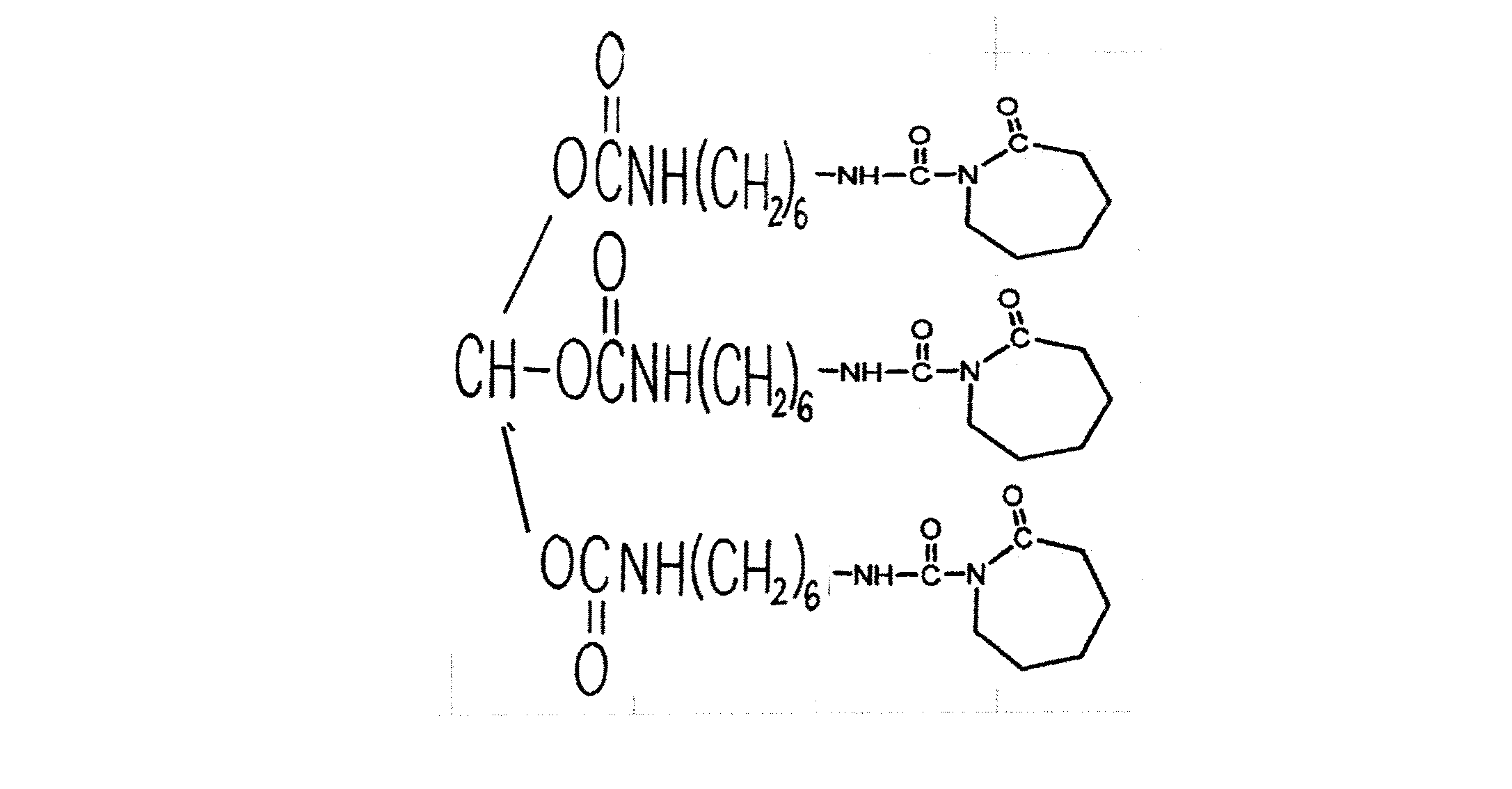
開始剤として使用されるトリカルバミドラクタム化合物は、分子内に3個のカルバミドラクタム構造を有する化合物である。トリカルバミドラクタム化合物は、分子内に3個のイソシアネート基を有するイソシアネート(以下、「トリイソシアネート」と言う)とω−ラクタムとの反応により合成される。トリイソシアネートの全てのイソシアネート基がω−ラクタムと反応していることが好ましい。一般に、ω−ラクタムのアルカリ重合法では、開始剤として、イソシアネート類が使用されるが、イソシアネート類は、健康障害のある化合物として知られており、使用の際、作業環境に種々の注意、制約が必要となる化合物である。イソシアネート類のイソシアネート基をω−ラクタムと反応させて、カルバミドラクタム構造とすることにより、イソシアネート類の健康障害は大幅に低減される。また、カルバミドラクタム化合物の開始剤効果は、ω−ラクタムと反応させる前のイソシアネート類と同等以上であった。アルカリ重合法ナイロンの製造に際し、予め管理された環境で合成されたトリカルバミドラクタム化合物を使用することにより、イソシアネート類使用に比べ、アルカリ重合法ナイロン製造時の作業環境は大幅に改善される。 The tricarbamide lactam compound used as an initiator is a compound having three carbamide lactam structures in the molecule. The tricarbamide lactam compound is synthesized by a reaction between an isocyanate having three isocyanate groups in the molecule (hereinafter referred to as “triisocyanate”) and ω-lactam. It is preferred that all isocyanate groups of the triisocyanate are reacted with ω-lactam. In general, in the alkali polymerization method of ω-lactam, isocyanates are used as initiators. However, isocyanates are known as compounds having health problems, and various precautions and restrictions are imposed on the working environment during use. Is a required compound. By reacting the isocyanate group of the isocyanate with ω-lactam to form a carbamide lactam structure, the health problems of the isocyanate are greatly reduced. Moreover, the initiator effect of the carbamide lactam compound was equal to or higher than that of the isocyanates before being reacted with ω-lactam. By using a tricarbamide lactam compound synthesized in a pre-controlled environment in the production of the alkali polymerization nylon, the working environment during the production of the alkali polymerization nylon is greatly improved as compared with the use of isocyanates.
トリカルバミドラクタム化合物は、例えば、旭化成株式会社より登録商標デュラネートとして販売されているヘキサメチレンジイソシアネート3量体とω−ラクタムとの反応により合成できる。具体例として、例えば、化学式1で示されるヘキサメチレンジイソシアネート3量体ビウレット(旭化成株式会社登録商標デュラネートビウレット)とε−カプロラクタムとの反応物、例えば、化学式2で示されるヘキサメチレンジイソシアネート3量体イソシアヌレート(旭化成株式会社登録商標デュラネートイソシアヌレート)とε−カプロラクタムとの反応物、例えば、化学式3で示されるヘキサメチレンジイソシアネート3量体アダクト(旭化成株式会社登録商標デュラネートアダクト)とε−カプロラクタムとの反応物等がある。これらのトリカルバミドラクタム化合物は開始剤として1種類以上が使用される。前記トリカルバミドラクタム化合物の中では化学式2で示されるヘキサメチレンジイソシアネート3量体イソシアヌレート(旭化成株式会社登録商標デュラネートイソシアヌレート)とε−カプロラクタムとの反応物(トリカルバミドカプロラクタムイソシアヌレート)が好ましく使用される。 The tricarbamide lactam compound can be synthesized, for example, by reaction of hexamethylene diisocyanate trimer sold as a registered trademark duranate from Asahi Kasei Corporation with ω-lactam. As a specific example, for example, a reaction product of hexamethylene diisocyanate trimer biuret (Asahi Kasei Corporation registered trademark duranate biuret) represented by chemical formula 1 and ε-caprolactam, for example, hexamethylene diisocyanate trimer represented by chemical formula 2 Reaction product of isocyanurate (registered trademark duranate isocyanurate) and ε-caprolactam such as hexamethylene diisocyanate trimer adduct (Asahi Kasei registered trademark duranate adduct) represented by Chemical Formula 3 and ε-caprolactam There is a reaction product. One or more kinds of these tricarbamide lactam compounds are used as initiators. Among the above tricarbamide lactam compounds, a reaction product of hexamethylene diisocyanate trimer isocyanurate represented by Chemical Formula 2 (Asahi Kasei Corporation registered trademark duranate isocyanurate) and ε-caprolactam (tricarbamide caprolactam isocyanurate) is preferably used. Is done.
トリカルバミドラクタム化合物の使用量は、アルカリ性ラクタム重合触媒1モルに対して、0.05〜1モル、好ましくは、0.1〜0.8モル、より好ましくは0.1〜0.5モルである。トリカルバミドラクタム化合物の使用量が上記上限1モルより多い場合、機械加工性が悪くなる。架橋が進みすぎるためと考えられる。又、トリカルバミドラクタム化合物の使用量が上記下限0.05モルより少ない場合、酸類浸漬で比較的短時間で溶解することがあり、又、重合速度が遅くなり、アルカリ重合法ナイロンの製造時間が長くなる。 The amount of the tricarbamide lactam compound used is 0.05 to 1 mol, preferably 0.1 to 0.8 mol, more preferably 0.1 to 0.5 mol, relative to 1 mol of the alkaline lactam polymerization catalyst. is there. When the amount of the tricarbamide lactam compound is more than 1 mol above, the machinability is deteriorated. This is considered to be because the crosslinking proceeds too much. In addition, when the amount of the tricarbamide lactam compound is less than the lower limit of 0.05 mol, it may dissolve in a relatively short time by acid immersion, the polymerization rate becomes slow, and the production time of the alkali polymerization nylon is reduced. become longer.
本発明では、開始剤として、トリカルバミドラクタム化合物と少量のイソシアネート類を混合して使用することができる。使用できるイソシアネート類の具体例としては、ヘキサメチレンジイソシアネート、イソホロンジイソシアネート、キシリレンジイソシアネートや前記イソシアネートとω-ラクタムとの反応物、例えば、ヘキサメチレン−1,6−ビスカルバミドカプロラクタム及び前記のヘキサメチレンジイソシアネート3量体等が挙げられる。これらイソシアネート類の使用量は開始剤全体の20重量%以下である。なお、脂肪族や脂環式イソシアネートを使用した場合、得られる成形ナイロンは乳白色となる。芳香族イソシアネートは黄色〜茶色に着色する。 In the present invention, a tricarbamide lactam compound and a small amount of isocyanate can be mixed and used as an initiator. Specific examples of the isocyanates that can be used include hexamethylene diisocyanate, isophorone diisocyanate, xylylene diisocyanate and a reaction product of the isocyanate with ω-lactam, such as hexamethylene-1,6-biscarbamide caprolactam and the hexamethylene diisocyanate. A trimer etc. are mentioned. The amount of these isocyanates to be used is 20% by weight or less of the whole initiator. When aliphatic or alicyclic isocyanate is used, the resulting molded nylon is milky white. The aromatic isocyanate is colored yellow to brown.
[ω−ラクタムのアルカリ重合]
本発明におけるω−ラクタムのアルカリ重合は公知の方法により実施できる。以下、ω−ラクタムは、ε−カプロラクタムを、開始剤のトリカルバミドラクタム化合物は、ヘキサメチレンジイソシアネート3量体イソシアヌレート(旭化成株式会社登録商標デュラネートイソシアヌレート)とε−カプロラクタムとの反応物を使用した例で説明する。ε−カプロラクタムは重合に先立ち、脱水され、好ましくは、水分含量0.1重量%以下にされる。ε−カプロラクタムの脱水は、脱水できれば、脱水方法に制約はない。通常、ε−カプロラクタムを溶融後、所定時間減圧することで行われる。ε−カプロラクタム中の水分含量はカールフィシャー水分計等により測定される。
[Alkali polymerization of ω-lactam]
The alkaline polymerization of ω-lactam in the present invention can be carried out by a known method. Hereinafter, ω-lactam uses ε-caprolactam, and the initiator tricarbamide lactam compound uses a reaction product of hexamethylene diisocyanate trimer isocyanurate (registered trademark Duranate isocyanurate) and ε-caprolactam. An example will be described. Prior to polymerization, ε-caprolactam is dehydrated and preferably has a water content of 0.1% by weight or less. As long as dehydration of ε-caprolactam can be dehydrated, there is no restriction on the dehydration method. Usually, after melt | dissolving (epsilon) -caprolactam, it depressurizes for a predetermined time. The water content in ε-caprolactam is measured by a Karl Fischer moisture meter or the like.
アルカリ性ラクタム重合触媒は溶融したε−カプロラクタム中に上述のアルカリ性ラクタム重合触媒を所定量添加、混合することで準備される。アルカリ性ラクタム重合触媒をε−カプロラクタムに混合した際、副生物を生成することがある。その場合、副生物は、適宜、除去される。例えば、アルカリ性ラクタム重合触媒として、アルカリ金属を使用した場合、発生する水素を除去する。アルカリ金属アルコラートを使用した場合、発生するアルコールを除去する等である。アルカリ性ラクタム重合触媒が混合されたε−カプロラクタムは、80〜140℃、好ましくは、85〜125℃の温度範囲で保持される。保持温度が前記下限80℃より低い場合、重合反応速度が遅くなり好ましくない。前記上限140℃より高い場合、低分子量物が生成することがあり、低分子量物は重合反応に悪影響を及ぼすので、好ましくない。 The alkaline lactam polymerization catalyst is prepared by adding and mixing a predetermined amount of the above-mentioned alkaline lactam polymerization catalyst into molten ε-caprolactam. When an alkaline lactam polymerization catalyst is mixed with ε-caprolactam, a by-product may be generated. In that case, the by-product is appropriately removed. For example, when an alkali metal is used as the alkaline lactam polymerization catalyst, generated hydrogen is removed. When an alkali metal alcoholate is used, the generated alcohol is removed. The ε-caprolactam mixed with the alkaline lactam polymerization catalyst is maintained at a temperature of 80 to 140 ° C., preferably 85 to 125 ° C. When the holding temperature is lower than the lower limit of 80 ° C., the polymerization reaction rate is slow, which is not preferable. When the upper limit is higher than 140 ° C., a low molecular weight product may be formed, which is not preferable because the low molecular weight product adversely affects the polymerization reaction.
開始剤のトリカルバミドラクタム化合物は、ヘキサメチレンジイソシアネート3量体イソシアヌレート(旭化成株式会社登録商標デュラネートイソシアヌレート)とε−カプロラクタムとの反応物を、下記の方法で、予め、合成される。水分含量0.1重量%以下に脱水したε−カプロラクタムを85〜130℃、好ましくは、95〜120℃に温度調節、窒素ガス雰囲気下、撹拌しながら、ε−カプロラクタムに所定量のヘキサメチレンジイソシアネート3量体イソシアヌレートを加え、所定時間、撹拌することで得られる。合成したトリカルバミドラクタム化合物は1H−NMR分析で確認できる。 The initiator tricarbamide lactam compound is synthesized in advance by the following method, a reaction product of hexamethylene diisocyanate trimer isocyanurate (registered trademark Duranate isocyanurate, Asahi Kasei Corporation) and ε-caprolactam. A predetermined amount of hexamethylene diisocyanate was added to ε-caprolactam while the temperature was adjusted to 85 to 130 ° C., preferably 95 to 120 ° C., and stirred in a nitrogen gas atmosphere while dehydrating ε-caprolactam to a water content of 0.1% by weight or less. Trimer isocyanurate is added and obtained by stirring for a predetermined time. The synthesized tricarbamide lactam compound can be confirmed by 1 H-NMR analysis.
ヘキサメチレンジイソシアネート3量体イソシアヌレートとε−カプロラクタムとは当量で反応させることも可能であるが、通常、ヘキサメチレンジイソシアネート3量体イソシアヌレート1モルに対して、ε−カプロラクタム8モル以上、好ましくは、15モル以上のε−カプロラクタム過剰の条件で合成される。 Hexamethylene diisocyanate trimer isocyanurate and ε-caprolactam can be reacted in an equivalent amount. Usually, ε-caprolactam is 8 mol or more, preferably 1 mol of hexamethylene diisocyanate trimer isocyanurate. And s-caprolactam in excess of 15 moles.
アルカリ重合法ナイロンの製造に際し、開始剤のトリカルバミドラクタム化合物は、所定量を上記の所定量のアルカリ性ラクタム重合触媒が混合されたε−カプロラクタム溶融液中に直接添加、混合撹拌しても良いし、また、トリカルバミドラクタム化合物とε−カプロラクタムとの混合液(B成分)とアルカリ性ラクタム重合触媒が混合されたε−カプロラクタム混合液(A成分)とを混合しても良い。この場合、使用されるε−カプロラクタムの量に応じて、アルカリ性ラクタム重合触媒及びトリカルバミドラクタム化合物の使用量は適宜調整される。又、開始剤は、必要に応じて、トリカルバミドラクタム化合物とイソシアネート類を混合して使用することもできる。 In the production of the alkali polymerization nylon, the initiator tricarbamide lactam compound may be directly added to the ε-caprolactam melt mixed with the above-mentioned predetermined amount of the alkaline lactam polymerization catalyst, and may be mixed and stirred. Further, a mixed liquid (component B) of a tricarbamide lactam compound and ε-caprolactam may be mixed with an ε-caprolactam mixed solution (component A) in which an alkaline lactam polymerization catalyst is mixed. In this case, the usage amounts of the alkaline lactam polymerization catalyst and the tricarbamide lactam compound are appropriately adjusted according to the amount of ε-caprolactam used. Moreover, a tricarbamide lactam compound and isocyanates can also be mixed and used for an initiator as needed.
[型内への注入]
ε−カプロラクタム、アルカリ性ラクタム重合触媒、トリカルバミドラクタム化合物を含む混合物は、撹拌後、直ちに、所定温度に加熱された型内に注入され、型内で重合反応が進み、成形ナイロンが得られる。このように、原料のε−カプロラクタム、アルカリ性ラクタム重合触媒、トリカルバミドラクタム化合物を含む混合物を、直接、型に注入して、型内でナイロン成形品を得る方法はω-ラクタムのアルカリ重合法の特徴である。ω-ラクタムのアルカリ重合法では、水分の存在は重合反応に悪影響を及ぼすため、原料の調整、混合、型への注入等の全ての操作は、水分の影響を少なくする窒素ガス等の雰囲気下で行われることが好ましい。
[Injection into mold]
A mixture containing ε-caprolactam, an alkaline lactam polymerization catalyst, and a tricarbamide lactam compound is immediately poured into a mold heated to a predetermined temperature after stirring, and a polymerization reaction proceeds in the mold to obtain molded nylon. As described above, the method of injecting a mixture containing raw material ε-caprolactam, alkaline lactam polymerization catalyst, and tricarbamide lactam compound directly into a mold to obtain a nylon molded product in the mold is a method of alkali polymerization of ω-lactam. It is a feature. In the alkaline polymerization method of ω-lactam, the presence of moisture adversely affects the polymerization reaction, so all operations such as raw material adjustment, mixing, and injection into the mold are performed under an atmosphere of nitrogen gas or the like that reduces the influence of moisture. Is preferably carried out.
[型]
本発明のナイロン製造方法に使用される型は鉄、ステンレス、アルミニウム系材料等の金属製型やシリコーン樹脂、エポキシ樹脂等の樹脂製型が使用できる。樹脂製型は大量生産には不向きであるが、型の制作日数が短く、短納期で、多品種少量生産に適している。本発明のナイロン製造方法では、シリコーン樹脂製型が好ましく使用される。
[Type]
As the mold used in the nylon production method of the present invention, a metal mold such as iron, stainless steel, and aluminum-based material, and a resin mold such as silicone resin and epoxy resin can be used. Resin molds are unsuitable for mass production, but the mold production days are short, quick delivery and suitable for high-mix low-volume production. In the nylon production method of the present invention, a silicone resin mold is preferably used.
シリコーン樹脂製型としては、例えば、本件出願人が先に開発したシリコーン樹脂製成形型(特許第5747138号)を用いることができる。具体的には、シリコーン樹脂に八チタン酸カリウム繊維又は六チタン酸カリウム繊維がシリコーン樹脂に対して15〜45重量%程度、混練された混練樹脂製の成形型を用いることができる。チタン酸カリウム繊維としては、例えば、大塚化学株式会社のティスモを使用することができる。 As the silicone resin mold, for example, a silicone resin mold (Japanese Patent No. 5747138) previously developed by the present applicant can be used. Specifically, a kneaded resin molding die in which potassium octatitanate fiber or potassium hexatitanate fiber is kneaded in the silicone resin by about 15 to 45% by weight with respect to the silicone resin can be used. As the potassium titanate fiber, for example, Tismo of Otsuka Chemical Co., Ltd. can be used.
ε−カプロラクタム、アルカリ性ラクタム重合触媒、トリカルバミドラクタム化合物を含む混合物を型に注入する際、型は120〜200℃、好ましくは、130〜180℃の温度に加熱される。型温度が前記下限120℃より低いと、十分に重合反応が進まず、好ましくない。また、前記上限200℃より型温度が高いと得られるナイロンの重合反応時に、重合中のナイロンの一部が溶融することがあり、アルカリ重合法ナイロンの特性の低下に繋がることがある。アルカリ性ラクタム重合触媒とトリカルバミドラクタム化合物の使用量や型温度によるが、本発明のアルカリ重合法ナイロンは、ε−カプロラクタム、アルカリ性ラクタム重合触媒およびトリカルバミドラクタム化合物を含む混合物を型に注入してから5〜60分後、通常は、30分後にナイロン成形品を型から取出すことができる。 When the mixture containing ε-caprolactam, alkaline lactam polymerization catalyst, and tricarbamide lactam compound is injected into the mold, the mold is heated to a temperature of 120 to 200 ° C, preferably 130 to 180 ° C. When the mold temperature is lower than the lower limit of 120 ° C., the polymerization reaction does not proceed sufficiently, which is not preferable. Further, when the mold temperature is higher than the upper limit of 200 ° C., a part of the nylon being polymerized may be melted during the polymerization reaction of the nylon obtained, which may lead to deterioration of the characteristics of the alkali polymerization nylon. Depending on the usage amount and mold temperature of the alkaline lactam polymerization catalyst and the tricarbamide lactam compound, the alkali polymerization nylon of the present invention is prepared by injecting a mixture containing ε-caprolactam, the alkaline lactam polymerization catalyst and the tricarbamide lactam compound into the mold. After 5 to 60 minutes, usually the nylon molded product can be removed from the mold after 30 minutes.
[可塑剤、柔軟剤、染料、着色剤、酸化防止剤]
本発明のナイロン製造方法では、重合反応を阻害しない可塑剤、柔軟剤、染料、着色剤、酸化防止剤等を使用して、ε−カプロラクタムのアルカリ重合を実施することもできる。好ましい可塑剤としては、N−アルキルピロリドン、ジアルキルイミダゾリジノン等が挙げられる。柔軟剤としては、ポリオキシアルキレンジオール、ポリオキシアルキレンジアミン等が挙げられる。その使用量はε−カプロラクタムに対して2〜30重量%である。
[Plasticizers, softeners, dyes, colorants, antioxidants]
In the nylon production method of the present invention, ε-caprolactam can be subjected to alkaline polymerization using a plasticizer, a softener, a dye, a colorant, an antioxidant, or the like that does not inhibit the polymerization reaction. Preferable plasticizers include N-alkylpyrrolidone and dialkylimidazolidinone. Examples of the softener include polyoxyalkylene diol and polyoxyalkylene diamine. The amount used is 2 to 30% by weight with respect to ε-caprolactam.
[充填剤、繊維、シート材]
本発明のナイロン製造方法では、重合反応を阻害しない充填剤、繊維、シート材を混合することもできる。充填剤の具体例としては、炭酸カルシウム、ワラストナイト、カオリン、黒鉛、石膏、長石、雲母、カーボンブラック、二硫化モリブデン、ガラスパウダー等が挙げられる。繊維の具体例としては、ミルドグラス、ガラス繊維、繊維状マグネシウム化合物、チタン酸カリウム繊維、グラファイト繊維、ボロン繊維、炭素繊維、スチール繊維等が挙げられる。これらの充填剤や繊維の使用量は、ε−カプロラクタムに対して2〜40重量%である。
シート材としては、ガラス繊維長クロス、炭素繊維クロス等がある。
[Fillers, fibers, sheet materials]
In the nylon production method of the present invention, fillers, fibers, and sheet materials that do not inhibit the polymerization reaction can also be mixed. Specific examples of the filler include calcium carbonate, wollastonite, kaolin, graphite, gypsum, feldspar, mica, carbon black, molybdenum disulfide, and glass powder. Specific examples of the fiber include milled glass, glass fiber, fibrous magnesium compound, potassium titanate fiber, graphite fiber, boron fiber, carbon fiber, and steel fiber. The amount of these fillers and fibers used is 2 to 40% by weight with respect to ε-caprolactam.
Examples of the sheet material include a long glass fiber cloth and a carbon fiber cloth.
以下、本発明のナイロンの製造方法を、実施例、比較例を用いて説明する。
実施例、比較例で説明する引張強さ、引張破断伸びはASTM D−638、曲げ強さ、曲げ弾性率はASTM D−790に準じて測定した。衝撃強さは、シャルピー衝撃試験機を使用し、長さ80mm、幅10mm、厚さ6.5mmでノッチ付きの試験片により測定した。機械加工性は円柱形状のナイロン成形品を使用し、旋盤の回転数、バイト形状、バイト角度等を変えて、評価した。また、耐酸性は、得たナイロン成形品を旋盤で削り、削ったものを乾燥後、その0.2gを蟻酸(濃度約90%)20ccに浸漬、静置して、24時間後、目視観察した。
Hereinafter, the manufacturing method of the nylon of this invention is demonstrated using an Example and a comparative example.
The tensile strength and tensile elongation at break described in Examples and Comparative Examples were measured according to ASTM D-638, and the bending strength and flexural modulus were measured according to ASTM D-790. The impact strength was measured using a notched test piece having a length of 80 mm, a width of 10 mm, and a thickness of 6.5 mm using a Charpy impact tester. Machinability was evaluated by using a cylindrical nylon molded product and changing the number of lathe revolutions, the bite shape, the bite angle, and the like. In addition, the acid resistance is obtained by shaving the obtained nylon molded product with a lathe, drying the shaved product, immersing 0.2 g of it in 20 cc of formic acid (concentration of about 90%), allowing to stand, and visually observing after 24 hours. did.
[実施例1]
脱水して水分含量0.1重量%以下とした溶融ε−カプロラクタム500gをフラスコに入れ、110℃の温度に調節した。このフラスコにナトリウムメチラート粉末4.75g(純度100%換算)を添加した後、ε−カプロラクタムが還流するまで減圧、副生するメタノールを除去して、ε−カプロラクタムとアルカリ性ラクタム重合触媒のNaカプロラクタメートとの混合液(以下、「A成分」と言う)を作製した後、窒素ガス雰囲気下において、100℃に温調保持して、A成分を準備した。別のフラスコに水分含量0.1重量%以下とした溶融ε−カプロラクタム500gを入れ、100℃の温度に調節した。このフラスコにヘキサメチレンジイソシアネート3量体イソシアヌレート21.0gを加え、約1時間、混合撹拌して、ε−カプロラクタムとトリカルバミドラクタム化合物(トリカルバミドカプロラクタムイソシアヌレート)の混合液(以下、「B成分」と言う)を作製した後、窒素ガス雰囲気下において、100℃で撹拌、温調保持して、B成分を準備した。100℃に加熱した500ccの容器に、準備したA成分100g、B成分100gを入れ、窒素ガス雰囲気下において素早く混合撹拌し、混合液を、直ちに、150℃に加熱されたシリコーン樹脂製の試験片作成用型に注入して、重合固化させた。10分後に型を開き、乳白色の試験片(成形ナイロン)を取出した。また、100℃に加熱した1000ccの容器に、準備したA成分300g、B成分300gを入れ、窒素ガス雰囲気下において、素早く混合撹拌後、混合液を直ちに、150℃に加熱されたシリコーン樹脂製の径100mm、高さ約70mmの円柱形状の型に注入し、重合固化させた。15分後に型から円柱形状のナイロン成形品(成形ナイロン)を取出した。引張試験、曲げ試験、衝撃試験、耐酸性及び機械加工性の評価結果を表1に示した。
[Example 1]
500 g of molten ε-caprolactam which was dehydrated to a water content of 0.1% by weight or less was placed in a flask and adjusted to a temperature of 110 ° C. After adding 4.75 g of sodium methylate powder (100% purity conversion) to this flask, the methanol was reduced under reduced pressure until ε-caprolactam was refluxed, and ε-caprolactam and the alkaline lactam polymerization catalyst Na catalyst were removed. After preparing a liquid mixture with prolactamate (hereinafter referred to as “component A”), the temperature was maintained at 100 ° C. in a nitrogen gas atmosphere to prepare component A. In another flask, 500 g of molten ε-caprolactam having a water content of 0.1% by weight or less was placed and adjusted to a temperature of 100 ° C. To this flask, 21.0 g of hexamethylene diisocyanate trimer isocyanurate was added, and mixed and stirred for about 1 hour, and a mixed solution of ε-caprolactam and a tricarbamide lactam compound (tricarbamide caprolactam isocyanurate) (hereinafter referred to as “component B”). ")" Was prepared, and the mixture was stirred and maintained at 100 ° C in a nitrogen gas atmosphere to prepare component B. In a 500 cc container heated to 100 ° C., 100 g of the prepared A component and 100 g of B component are placed, and quickly mixed and stirred in a nitrogen gas atmosphere. The test mixture made of silicone resin immediately heated to 150 ° C. It was poured into a mold for preparation and solidified by polymerization. After 10 minutes, the mold was opened, and a milky white test piece (molded nylon) was taken out. Also, 300 g of the prepared A component and 300 g of the B component were put in a 1000 cc container heated to 100 ° C., and after quickly mixing and stirring in a nitrogen gas atmosphere, the mixture was immediately made of silicone resin heated to 150 ° C. The mixture was poured into a cylindrical mold having a diameter of 100 mm and a height of about 70 mm to be solidified by polymerization. After 15 minutes, a cylindrical nylon molded product (molded nylon) was taken out of the mold. Table 1 shows the evaluation results of the tensile test, bending test, impact test, acid resistance and machinability.
[実施例2]
実施例1と同様に実施して、A成分を準備した。B成分は実施例1のヘキサメチレンジイソシアネート3量体イソシアヌレートの使用量21.0gを15.8gに代えた他は実施例1と同様に実施して、B成分を準備した。準備したA成分、B成分を使用し、実施例1と同様に実施して、試験片及び円柱形状のナイロン成形品を得た。引張試験、曲げ試験、衝撃試験、耐酸性及び機械加工性の評価結果を表1に示した。
[Example 2]
It implemented similarly to Example 1 and prepared A component. Component B was prepared in the same manner as in Example 1 except that 21.0 g of the hexamethylene diisocyanate trimer isocyanurate used in Example 1 was replaced with 15.8 g to prepare Component B. Using the prepared A component and B component, the same procedure as in Example 1 was performed to obtain a test piece and a cylindrical nylon molded product. Table 1 shows the evaluation results of the tensile test, bending test, impact test, acid resistance and machinability.
[実施例3]
実施例1と同様に実施して、A成分を準備した。B成分は実施例1のヘキサメチレンジイソシアネート3量体イソシアヌレートの使用量21.0gを12.5gに代えた他は実施例1と同様に実施して、ε−カプロラクタムとトリカルバミドラクタム化合物の混合液を作製し、この混合液に、ジカルバミドラクタム化合物(ヘキサメチレン−1,6−ビスカルバミドカプロラクタム(Bruggemann社製、「BRUGGOLEN」(登録商標)C20P))を1.3g加えた後、混合撹拌下において、100℃にて温調保持して、B成分を準備した。準備したA成分、B成分を使用し、実施例1と同様に実施して、試験片及び円柱形状のナイロン成形品を得た。引張試験、衝撃試験、耐酸性及び機械加工性の評価結果を表1に示した。
[Example 3]
It implemented similarly to Example 1 and prepared A component. The component B was the same as in Example 1 except that 21.0 g of the hexamethylene diisocyanate trimer isocyanurate used in Example 1 was replaced with 12.5 g, and a mixture of ε-caprolactam and tricarbamide lactam compound was used. Then, 1.3 g of a dicarbamide lactam compound (hexamethylene-1,6-biscarbamide caprolactam (manufactured by Bruggemann, “BRUGGOLEN” (registered trademark) C20P)) was added to this mixed solution, and then mixed and stirred. Below, temperature control holding | maintenance was carried out at 100 degreeC, and B component was prepared. Using the prepared A component and B component, the same procedure as in Example 1 was performed to obtain a test piece and a cylindrical nylon molded product. Table 1 shows the evaluation results of the tensile test, impact test, acid resistance and machinability.
[比較例1]
実施例1と同様に実施してA成分を準備した。B成分は実施例1のヘキサメチレンジイソシアネート3量体イソシアヌレートの使用量21.0gを54.0gに代えた他は実施例1と同様に実施して、作製した後、窒素ガス雰囲気下において、100℃で撹拌、温調保持して、準備した。準備したA成分、B成分を使用し、100℃に加熱した1000ccの容器に、A成分300g、B成分300gを入れ、窒素ガス雰囲気下において、素早く混合撹拌後、混合液を直ちに、150℃に加熱されているシリコーン樹脂製の径100mm、高さ約70mmの円柱形状の型に注入し、重合固化させた。15分後に型から円柱形状のナイロン成形品(成形ナイロン)を取出した。耐酸性及び機械加工性の評価結果を表1に示した。
[Comparative Example 1]
It implemented like Example 1 and prepared A component. The component B was prepared in the same manner as in Example 1 except that 21.0 g of the hexamethylene diisocyanate trimer isocyanurate used in Example 1 was replaced with 54.0 g. Stirring was performed at 100 ° C. and the temperature was maintained to prepare. 300 g of A component and 300 g of B component are put into a 1000 cc container heated to 100 ° C. using the prepared A component and B component, and after quickly mixing and stirring in a nitrogen gas atmosphere, the mixture is immediately brought to 150 ° C. It was poured into a cylindrical mold having a diameter of 100 mm and a height of about 70 mm made of a heated silicone resin, and polymerized and solidified. After 15 minutes, a cylindrical nylon molded product (molded nylon) was taken out of the mold. The evaluation results of acid resistance and machinability are shown in Table 1.
[比較例2]
実施例1と同様に実施してA成分を作成し、100℃に温調保持した。脱水により水分含有量0.1重量%以下とした溶融ε−カプロラクタム500gにジカルバミドラクタム化合物(ヘキサメチレン−1,6−ビスカルバミドカプロラクタム(Bruggemann社製、「BRUGGOLEN」(登録商標)C20P))を12.2g加え、混合撹拌して、窒素ガス雰囲気下において、100℃に温調保持し、B成分を準備した。準備したA成分、B成分を使用し、実施例1と同様に実施して、試験片及び円柱形状のナイロン成形品を得た。引張試験、曲げ試験、衝撃試験、耐酸性及び機械加工性の評価結果を表1に示した。
[Comparative Example 2]
It implemented like Example 1, A component was created, and temperature control holding | maintenance was carried out at 100 degreeC. Dicarbamide lactam compound (hexamethylene-1,6-biscarbamide caprolactam (manufactured by Bruggemann, “BRUGGOLEN” (registered trademark) C20P)) was added to 500 g of molten ε-caprolactam whose water content was 0.1 wt% or less by dehydration. 12.2 g was added, mixed and stirred, and the temperature was maintained at 100 ° C. in a nitrogen gas atmosphere to prepare component B. Using the prepared A component and B component, the same procedure as in Example 1 was performed to obtain a test piece and a cylindrical nylon molded product. Table 1 shows the evaluation results of the tensile test, bending test, impact test, acid resistance and machinability.
(成形ナイロンの実施形態)
本発明の成形ナイロンは、前記実施形態のいずれかで製造されたナイロンであり、ω−ラクタムが、アルカリ性ラクタム重合触媒及びトリカルバミドラクタム化合物開始剤により型内で重合固化されたナイロンである。
(Embodiment of molded nylon)
The molded nylon of the present invention is the nylon produced in any of the above embodiments, and the ω-lactam is a nylon obtained by polymerization and solidification in a mold using an alkaline lactam polymerization catalyst and a tricarbamide lactam compound initiator.
本発明のナイロン製造方法で製造された成形ナイロンは優れた機械的強度を有し、柔軟性が改良され、機械加工性が良いため、各種形状の自動車部品や機械部品の分野で機械加工製品として利用される。また、耐酸性が改良されているため、従来のナイロンで利用できない分野での製品展開が期待される。 Molded nylon manufactured by the nylon manufacturing method of the present invention has excellent mechanical strength, improved flexibility, and good machinability, so that it can be used as a machined product in the field of various parts of automobile parts and machine parts. Used. In addition, because of improved acid resistance, product development is expected in fields where conventional nylon cannot be used.
Claims (7)
少なくともω−ラクタム、アルカリ性ラクタム重合触媒及びトリカルバミドラクタム化合物からなる混合物を攪拌後、加熱された型内に注入し、型内で重合固化させてナイロンを製造する、
ことを特徴とするアルカリ重合法によるナイロン製造方法。 In the manufacturing method of nylon,
A mixture of at least ω-lactam, an alkaline lactam polymerization catalyst and a tricarbamide lactam compound is stirred and then poured into a heated mold, and polymerized and solidified in the mold to produce nylon.
A method for producing nylon by an alkali polymerization method.
アルカリ性ラクタム重合触媒1モルに対して、トリカルバミドラクタム化合物0.05〜1.0モル、好ましくは0.1〜0.8モル、より好ましくは0.1〜0.5モルの混合比率である、
ことを特徴とするアルカリ重合法によるナイロン製造方法。 In the manufacturing method of nylon of Claim 1,
The mixing ratio of the tricarbamide lactam compound is 0.05 to 1.0 mol, preferably 0.1 to 0.8 mol, more preferably 0.1 to 0.5 mol, with respect to 1 mol of the alkaline lactam polymerization catalyst. ,
A method for producing nylon by an alkali polymerization method.
トリカルバミドラクタム化合物が、ヘキサメチレンジイソシアネート3量体ビウレットとε―カプロラクタムとの反応物、ヘキサメチレンジイソシアネート3量体イソシアヌレートとε―カプロラクタムとの反応物、ヘキサメチレンジイソシアネート3量体アダクトとε―カプロラクタムとの反応物から選ばれる1種類以上である、
ことを特徴とするアルカリ重合法によるナイロン製造方法。 In the nylon manufacturing method by the alkali polymerization method of Claim 1 or Claim 2,
The tricarbamide lactam compound is a reaction product of hexamethylene diisocyanate trimer biuret and ε-caprolactam, a reaction product of hexamethylene diisocyanate trimer isocyanurate and ε-caprolactam, hexamethylene diisocyanate trimer adduct and ε-caprolactam. One or more selected from the reactants with
A method for producing nylon by an alkali polymerization method.
トリカルバミドラクタム化合物が、ヘキサメチレンジイソシアネート3量体イソシアヌレートの3個のイソシアネート基が全てε―カプロラクタムと反応した化合物である、
ことを特徴とするアルカリ重合法によるナイロン製造方法。 In the nylon manufacturing method by the alkali polymerization method of any one of Claims 1-3,
The tricarbamide lactam compound is a compound in which all three isocyanate groups of hexamethylene diisocyanate trimer isocyanurate have reacted with ε-caprolactam.
A method for producing nylon by an alkali polymerization method.
使用される型がシリコーン樹脂製型である、
ことを特徴とするアルカリ重合法によるナイロン製造方法。 In the nylon manufacturing method by the alkali polymerization method of any one of Claims 1-4,
The mold used is a silicone resin mold,
A method for producing nylon by an alkali polymerization method.
少なくともω−ラクタム、アルカリ性ラクタム重合触媒及びトリカルバミドラクタム化合物からなる混合物が、加熱された型内で重合固化して成形された、
ことを特徴とする成形ナイロン。 In molded nylon,
A mixture comprising at least ω-lactam, an alkaline lactam polymerization catalyst and a tricarbamide lactam compound was formed by polymerization and solidification in a heated mold,
Molded nylon characterized by that.
少なくともω−ラクタムと、アルカリ性ラクタム重合触媒及びトリカルバミドラクタム化合物からなる混合物が攪拌されたものであり、混合比率がアルカリ性ラクタム重合触媒1モルに対して、トリカルバミドラクタム化合物0.05〜1.0モル、好ましくは0.1〜0.8モル、より好ましくは0.1〜0.5モルである混合物が、加熱された型内で重合固化して成形された、
ことを特徴とする成形ナイロン。 In molded nylon,
A mixture of at least ω-lactam, an alkaline lactam polymerization catalyst and a tricarbamide lactam compound is stirred, and the mixing ratio is 0.05 to 1.0 tricarbamide lactam compound with respect to 1 mol of the alkaline lactam polymerization catalyst. A mixture having a molarity, preferably 0.1 to 0.8 mol, more preferably 0.1 to 0.5 mol, was formed by polymerization and solidification in a heated mold,
Molded nylon characterized by that.
Applications Claiming Priority (2)
| Application Number | Priority Date | Filing Date | Title |
|---|---|---|---|
| JP2017130424 | 2017-07-03 | ||
| JP2017130424 | 2017-07-03 |
Publications (1)
| Publication Number | Publication Date |
|---|---|
| JP2019014875A true JP2019014875A (en) | 2019-01-31 |
Family
ID=61195658
Family Applications (3)
| Application Number | Title | Priority Date | Filing Date |
|---|---|---|---|
| JP2017150949A Active JP6277575B1 (en) | 2017-07-03 | 2017-08-03 | Nylon production method and molded nylon by alkali polymerization method |
| JP2017235190A Pending JP2019014869A (en) | 2017-07-03 | 2017-12-07 | Nylon production method based on alkali polymerization method, and molded nylon |
| JP2018102479A Pending JP2019014875A (en) | 2017-07-03 | 2018-05-29 | Nylon production method by alkaline polymerization and molded nylon |
Family Applications Before (2)
| Application Number | Title | Priority Date | Filing Date |
|---|---|---|---|
| JP2017150949A Active JP6277575B1 (en) | 2017-07-03 | 2017-08-03 | Nylon production method and molded nylon by alkali polymerization method |
| JP2017235190A Pending JP2019014869A (en) | 2017-07-03 | 2017-12-07 | Nylon production method based on alkali polymerization method, and molded nylon |
Country Status (1)
| Country | Link |
|---|---|
| JP (3) | JP6277575B1 (en) |
Cited By (1)
| Publication number | Priority date | Publication date | Assignee | Title |
|---|---|---|---|---|
| JP2021169592A (en) * | 2020-04-17 | 2021-10-28 | 株式会社二幸技研 | Initiator composition for alkali polymerization nylon, method for producing the same, and method for producing alkali polymerization nylon |
Citations (6)
| Publication number | Priority date | Publication date | Assignee | Title |
|---|---|---|---|---|
| JPH02286718A (en) * | 1989-03-31 | 1990-11-26 | Montedipe Spa | Manufacture of large molding made of modified polyamide |
| JPH05170896A (en) * | 1991-12-20 | 1993-07-09 | Unitika Ltd | Production of modified polyamide |
| EP0613918A1 (en) * | 1993-03-01 | 1994-09-07 | Dsm N.V. | Lactam polymerization in the presence of cyclic polyisocyanate trimers |
| JPH07238164A (en) * | 1994-03-01 | 1995-09-12 | Ube Ind Ltd | Manufacturing method of polyamide |
| WO2014141529A1 (en) * | 2013-03-13 | 2014-09-18 | 株式会社二幸技研 | Composite silicone and mold using same |
| JP2014218665A (en) * | 2013-05-07 | 2014-11-20 | ライン・ケミー・ライノー・ゲーエムベーハー | Novel compositions, preparation thereof and use thereof for production of cast polyamides |
Family Cites Families (2)
| Publication number | Priority date | Publication date | Assignee | Title |
|---|---|---|---|---|
| EP2447301A1 (en) * | 2010-10-29 | 2012-05-02 | Rhein Chemie Rheinau GmbH | Method for manufacturing poured polyamides |
| EP2870191B1 (en) * | 2012-07-06 | 2018-08-15 | LANXESS Deutschland GmbH | Catalysts for the production of cast polyamide, method for producing and using same |
-
2017
- 2017-08-03 JP JP2017150949A patent/JP6277575B1/en active Active
- 2017-12-07 JP JP2017235190A patent/JP2019014869A/en active Pending
-
2018
- 2018-05-29 JP JP2018102479A patent/JP2019014875A/en active Pending
Patent Citations (7)
| Publication number | Priority date | Publication date | Assignee | Title |
|---|---|---|---|---|
| JPH02286718A (en) * | 1989-03-31 | 1990-11-26 | Montedipe Spa | Manufacture of large molding made of modified polyamide |
| JPH05170896A (en) * | 1991-12-20 | 1993-07-09 | Unitika Ltd | Production of modified polyamide |
| EP0613918A1 (en) * | 1993-03-01 | 1994-09-07 | Dsm N.V. | Lactam polymerization in the presence of cyclic polyisocyanate trimers |
| JPH06322108A (en) * | 1993-03-01 | 1994-11-22 | Dsm Nv | Process for producing polyamide and article comprising the polyamide |
| JPH07238164A (en) * | 1994-03-01 | 1995-09-12 | Ube Ind Ltd | Manufacturing method of polyamide |
| WO2014141529A1 (en) * | 2013-03-13 | 2014-09-18 | 株式会社二幸技研 | Composite silicone and mold using same |
| JP2014218665A (en) * | 2013-05-07 | 2014-11-20 | ライン・ケミー・ライノー・ゲーエムベーハー | Novel compositions, preparation thereof and use thereof for production of cast polyamides |
Non-Patent Citations (1)
| Title |
|---|
| JOURNAL OF POLYMER SCIENCE, vol. 27(11), JPN6018028478, 1989, pages 3637 - 3649, ISSN: 0003943258 * |
Cited By (1)
| Publication number | Priority date | Publication date | Assignee | Title |
|---|---|---|---|---|
| JP2021169592A (en) * | 2020-04-17 | 2021-10-28 | 株式会社二幸技研 | Initiator composition for alkali polymerization nylon, method for producing the same, and method for producing alkali polymerization nylon |
Also Published As
| Publication number | Publication date |
|---|---|
| JP6277575B1 (en) | 2018-02-14 |
| JP2019014869A (en) | 2019-01-31 |
| JP2019014862A (en) | 2019-01-31 |
Similar Documents
| Publication | Publication Date | Title |
|---|---|---|
| EP2625215B1 (en) | Method for producing monomer compositions, and use thereof for producing a molded polyamide part | |
| EP2093246B1 (en) | Anionic polymerisation of lactams using special activators | |
| DE3717928C2 (en) | ||
| WO2007036929A2 (en) | Modified polyamides, uses thereof and process for their preparation | |
| DE102010040027C5 (en) | Process for the production of fiber-reinforced cast polyamide moldings | |
| US12441839B2 (en) | Method for producing high temperature-resistant polyamide, high temperature-resistant polyamide and use thereof | |
| RU2608997C2 (en) | Composition for anionic polymerisation of lactam | |
| KR20160083649A (en) | Method of manufacturing a polyamide with an anionic polymerization | |
| US4490520A (en) | Process for preparing impact-resistant polyamides | |
| EP0390189B1 (en) | Process for producing large-size formed articles of modified polyamide | |
| CN110128807A (en) | A kind of 6/ compound polyurethane material of novel nylon and preparation method thereof | |
| KR102142733B1 (en) | Catalysts for producing cast polyamide, method for the production of said catalysts and the use thereof | |
| JP6277575B1 (en) | Nylon production method and molded nylon by alkali polymerization method | |
| JP6664677B1 (en) | Initiator composition for alkali-polymerized nylon and method for producing the same | |
| DE68916977T2 (en) | Process for the preparation of modified polyamides and products obtained in this way. | |
| JPH07149891A (en) | Production of reinforced polyamide resin molded product | |
| KR20200065849A (en) | Polyamide Resin Composition for injection molding of thin product and molded product thererof | |
| JP7476719B2 (en) | Polyamide manufacturing method | |
| JP5946907B2 (en) | Novel compositions for the production of cast polyamide | |
| JP2021169592A (en) | Initiator composition for alkali polymerization nylon, method for producing the same, and method for producing alkali polymerization nylon | |
| JPS6337124A (en) | Molded amide based resin article | |
| JPH07238164A (en) | Manufacturing method of polyamide | |
| JPS633909A (en) | Manufacture of amide based resin molded form | |
| JPS60223822A (en) | Production of filled polyamide | |
| JPH0317155A (en) | Magnesium oxysulfate-containing polyamide and production thereof |
Legal Events
| Date | Code | Title | Description |
|---|---|---|---|
| A621 | Written request for application examination |
Free format text: JAPANESE INTERMEDIATE CODE: A621 Effective date: 20180529 |
|
| A871 | Explanation of circumstances concerning accelerated examination |
Free format text: JAPANESE INTERMEDIATE CODE: A871 Effective date: 20180529 |
|
| A975 | Report on accelerated examination |
Free format text: JAPANESE INTERMEDIATE CODE: A971005 Effective date: 20180719 |
|
| A131 | Notification of reasons for refusal |
Free format text: JAPANESE INTERMEDIATE CODE: A131 Effective date: 20180731 |
|
| A601 | Written request for extension of time |
Free format text: JAPANESE INTERMEDIATE CODE: A601 Effective date: 20180919 |
|
| A521 | Request for written amendment filed |
Free format text: JAPANESE INTERMEDIATE CODE: A523 Effective date: 20181022 |
|
| A131 | Notification of reasons for refusal |
Free format text: JAPANESE INTERMEDIATE CODE: A131 Effective date: 20190108 |
|
| A521 | Request for written amendment filed |
Free format text: JAPANESE INTERMEDIATE CODE: A523 Effective date: 20190307 |
|
| A131 | Notification of reasons for refusal |
Free format text: JAPANESE INTERMEDIATE CODE: A131 Effective date: 20190423 |
|
| A521 | Request for written amendment filed |
Free format text: JAPANESE INTERMEDIATE CODE: A523 Effective date: 20190605 |
|
| RD03 | Notification of appointment of power of attorney |
Free format text: JAPANESE INTERMEDIATE CODE: A7423 Effective date: 20190826 |
|
| A02 | Decision of refusal |
Free format text: JAPANESE INTERMEDIATE CODE: A02 Effective date: 20190827 |