JP2019123770A - Butene resin composition and molded body - Google Patents
Butene resin composition and molded body Download PDFInfo
- Publication number
- JP2019123770A JP2019123770A JP2018003486A JP2018003486A JP2019123770A JP 2019123770 A JP2019123770 A JP 2019123770A JP 2018003486 A JP2018003486 A JP 2018003486A JP 2018003486 A JP2018003486 A JP 2018003486A JP 2019123770 A JP2019123770 A JP 2019123770A
- Authority
- JP
- Japan
- Prior art keywords
- butene
- mass
- resin composition
- polybutene
- olefin copolymer
- Prior art date
- Legal status (The legal status is an assumption and is not a legal conclusion. Google has not performed a legal analysis and makes no representation as to the accuracy of the status listed.)
- Granted
Links
Images
Classifications
-
- Y—GENERAL TAGGING OF NEW TECHNOLOGICAL DEVELOPMENTS; GENERAL TAGGING OF CROSS-SECTIONAL TECHNOLOGIES SPANNING OVER SEVERAL SECTIONS OF THE IPC; TECHNICAL SUBJECTS COVERED BY FORMER USPC CROSS-REFERENCE ART COLLECTIONS [XRACs] AND DIGESTS
- Y02—TECHNOLOGIES OR APPLICATIONS FOR MITIGATION OR ADAPTATION AGAINST CLIMATE CHANGE
- Y02A—TECHNOLOGIES FOR ADAPTATION TO CLIMATE CHANGE
- Y02A30/00—Adapting or protecting infrastructure or their operation
Landscapes
- Rigid Pipes And Flexible Pipes (AREA)
- Compositions Of Macromolecular Compounds (AREA)
- Addition Polymer Or Copolymer, Post-Treatments, Or Chemical Modifications (AREA)
Abstract
【課題】II型結晶からI型結晶への結晶転移時間が短いブテン系共重合体を主成分とし、結晶化度の低下が抑制されることにより機械特性の低下のおそれの小さいブテン系樹脂組成物を提供すること。【解決手段】要件(A1)〜(A2)を満たすブテン・α−オレフィン共重合体(A)を70〜99.9質量部、および要件(B1)〜(B4)を満たすポリブテン−1(B)を0.1〜30質量部(両者の合計を100質量部とする)を含むブテン系樹脂組成物。(A1)1−ブテン単位が80.0〜99.9モル%、α−オレフィン単位が0.1〜20.0モル%、(A2)極限粘度[η]が0.5〜5.5dl/g、(B1)mmmm分率が94.0以上、(B2)rr分率が1.5%以下、(B3)極限粘度[η]が0.5〜5.5dl/g、(B4)分子量が10000以下の成分の割合が1.3質量%未満【選択図】図1PROBLEM TO BE SOLVED: To provide a butene-based resin composition containing a butene-based copolymer having a short crystal transition time from a type II crystal to a type I crystal as a main component and having a small possibility of deterioration of mechanical properties by suppressing a decrease in crystallinity. To provide things. SOLUTION: 70 to 99.9 parts by mass of a butene / α-olefin copolymer (A) satisfying the requirements (A1) to (A2), and polybutene-1 (B) satisfying the requirements (B1) to (B4). ) Is 0.1 to 30 parts by mass (the total of both is 100 parts by mass). (A1) 1-butene unit is 80.0 to 99.9 mol%, α-olefin unit is 0.1 to 20.0 mol%, and (A2) ultimate viscosity [η] is 0.5 to 5.5 dl /. g, (B1) mm mm fraction is 94.0 or more, (B2) rr fraction is 1.5% or less, (B3) ultimate viscosity [η] is 0.5 to 5.5 dl / g, (B4) molecular weight. The proportion of components with a viscosity of 10,000 or less is less than 1.3% by mass [Selection diagram] Fig. 1
Description
本発明は、ブテン・α−オレフィン共重合体を含むブテン系樹脂組成物、および前記組成物からなる成形体に関する。 The present invention relates to a butene-based resin composition containing a butene / α-olefin copolymer, and a molded article comprising the composition.
ブテン系重合体からなる、パイプ、パイプ継手およびタンクは、耐クリープ特性、耐環境応力亀裂性、柔軟性、強靱性、耐熱性、高温・低温特性および耐摩耗性に優れていることから、給水・給湯用、床下暖房用、温泉配管用、薬剤散布用および排水用等の各種部材として利用されている。 Pipes, pipe joints and tanks made of butene polymers are superior in creep resistance, environmental stress crack resistance, flexibility, toughness, heat resistance, high temperature and low temperature characteristics, and wear resistance, so water supply -It is used as various members for hot water supply, under floor heating, for hot spring piping, for chemical dispersion, for drainage, etc.
ブテン系重合体には主に2種の結晶型が存在し、ブテン系重合体を溶融状態から成形体に冷却・賦形した直後は準安定なII型結晶構造(正方晶系変態)をとり、約1週間かけてより安定なI型結晶構造(六方晶系変態)へと固相結晶転移することが知られている(非特許文献1)。 There are mainly two types of crystal forms in butene-based polymers, and the metastable II-type crystal structure (tetragonal system transformation) is obtained immediately after cooling and shaping the butene-based polymers from the molten state to a compact. It is known that the solid phase crystal transition to a more stable type I crystal structure (hexagonal system modification) takes about one week (Non-patent Document 1).
ブテン系重合体には、前記結晶転移により成形後の寸法および剛性の変化が起こり、また結晶転移時間が長いため、顧客での品質管理および在庫管理が煩雑になるという欠点がある。すなわち、ブテン系重合体を溶融成形する技術分野では、II型結晶からI型結晶への結晶転移時間が短い重合体が求められている。 The butene-based polymer has the disadvantages that the crystal transition causes changes in size and rigidity after molding, and the crystal transition time is long, which complicates quality control and inventory control at the customer site. That is, in the technical field of melt-molding butene polymers, polymers having a short crystal transition time from type II crystals to type I crystals are required.
この要求に対して、結晶転移時間を短縮させる目的で、ラジカル処理された結晶性オレフィン系重合体をブテン系重合体にブレンドする方法(特許文献1参照)、ブテン系重合体に添加剤を添加する方法(特許文献2、特許文献3参照)、コモノマーを導入する方法(特許文献4参照)が知られている。 To meet this requirement, a method of blending a radical-treated crystalline olefin polymer with a butene-based polymer (see Patent Document 1), and adding an additive to the butene-based polymer in order to shorten the crystal transition time Methods (see Patent Document 2 and Patent Document 3) and methods of introducing a comonomer (see Patent Document 4) are known.
一方、特許文献5には、アイソタクチック指数の高い2種のポリブテン系樹脂(とえば1−ブテン・プロピレン共重合体および1−ブテン単独重合体)を混合してなるポリブテン系樹脂が開示されている。また、特許文献6および7には、立体規則性の高い1−ブテン系重合体が開示されている。 On the other hand, Patent Document 5 discloses a polybutene-based resin obtained by mixing two polybutene-based resins having high isotactic index (for example, 1-butene / propylene copolymer and 1-butene homopolymer). ing. Patent Documents 6 and 7 disclose 1-butene polymers having high stereoregularity.
ブテン系重合体において、パイプ、パイプ継手およびタンク等への成形コストおよび結晶転移時間を短縮させる効果には、さらなる改善が求められている。上述のとおり結晶転移時間を短縮させるためにブテン系重合体にコモノマーを導入する方法がとられうるが、コモノマーを導入すると重合体の結晶化度が低下する。結晶化度の低下により機械特性の低下することが懸念される。コモノマーを導入することで結晶転移時間を短くしつつも結晶化度の低下が抑制され機械特性や長期物性等の低下がないことが望ましい。 In the butene-based polymer, further improvement is required for the effect of shortening the molding cost and the crystal transition time to pipes, pipe joints, tanks and the like. As described above, in order to shorten the crystal transition time, a method may be employed in which a comonomer is introduced into the butene polymer, but when the comonomer is introduced, the degree of crystallinity of the polymer is lowered. There is a concern that the mechanical properties may be reduced due to the reduction in the degree of crystallinity. It is desirable that the introduction of the comonomer suppresses the decrease in the degree of crystallinity while shortening the crystal transition time, and does not cause the decrease in mechanical properties or long-term physical properties.
本発明の目的は、II型結晶からI型結晶への結晶転移時間が短いブテン系共重合体を主成分とし、結晶化度の低下が抑制されることにより機械特性の低下のおそれの小さいブテン系樹脂組成物を提供することにある。 An object of the present invention is to use a butene-based copolymer having a short crystal transition time from type II crystal to type I crystal as a main component, and suppressing the decrease in the degree of crystallization, thereby reducing the possibility of lowering mechanical properties. It is providing a system resin composition.
本発明者らは上記課題を解決すべく鋭意検討を行った。その結果、ベースとなるブテン系共重合体に対して立体規則性の高い1−ブテン単独重合体を添加することで上記課題を解決できることを見出し、本発明を完成するに至った。 The present inventors diligently studied to solve the above problems. As a result, the inventors have found that the above problems can be solved by adding a 1-butene homopolymer having high stereoregularity to the base butene-based copolymer, and have completed the present invention.
本発明は、以下の[1]〜[3]に関する。
[1]
下記要件(A1)〜(A2)を満たすブテン・α−オレフィン共重合体(A)を70〜99.9質量部、および下記要件(B1)〜(B4)を満たすポリブテン−1(B)を0.1〜30質量部(ただし、ブテン・α−オレフィン共重合体(A)およびポリブテン−1(B)の合計を100質量部とする。)を含むブテン系樹脂組成物。
(A1):1−ブテン由来の構成単位の含有量が80.0〜99.9モル%であり、エチレンおよび炭素数3〜20の1−ブテン以外のα−オレフィンから選ばれる少なくとも1種のオレフィン由来の構成単位の総含有量(K)が0.1〜20.0モル%である。(ただし、1−ブテン由来の構成単位の含有量と前記総含有量(K)との合計を100モル%とする)
(A2):135℃のデカリン中で測定された極限粘度[η]が0.5〜5.5dl/gである。
(B1):13C−NMRにより測定されたアイソタクティックペンタッド分率が94.0%以上である。
(B2):13C−NMRにより測定されたシンジオタクティックトライアッド分率が1.5%以下である。
(B3):135℃のデカリン中で測定された極限粘度[η]が0.5〜5.5dl/gである。
(B4):ゲルパーミエーションクロマトグラフィー(GPC)で測定した、分子量が10,000以下の成分の割合が、1.3質量%未満である。
The present invention relates to the following [1] to [3].
[1]
70 to 99.9 parts by mass of a butene · α-olefin copolymer (A) satisfying the following requirements (A1) to (A2) and a polybutene-1 (B) satisfying the following requirements (B1) to (B4) A butene-based resin composition containing 0.1 to 30 parts by mass (however, the total of butene · α-olefin copolymer (A) and polybutene-1 (B) is 100 parts by mass).
(A1): at least one selected from ethylene and α-olefins other than 1-butene having a carbon number of 3 to 20, wherein the content of constituent units derived from 1-butene is 80.0 to 99.9 mol% The total content (K) of structural units derived from olefins is 0.1 to 20.0 mol%. (However, the sum of the content of the constituent unit derived from 1-butene and the total content (K) is 100 mol%)
(A2): The intrinsic viscosity [η] measured in decalin at 135 ° C. is 0.5 to 5.5 dl / g.
(B1): The isotactic pentad fraction measured by 13 C-NMR is 94.0% or more.
(B2): The syndiotactic triad fraction measured by 13 C-NMR is 1.5% or less.
(B3): The intrinsic viscosity [η] measured in decalin at 135 ° C. is 0.5 to 5.5 dl / g.
(B4): The proportion of components having a molecular weight of 10,000 or less measured by gel permeation chromatography (GPC) is less than 1.3% by mass.
[2]
前記[1]のブテン系樹脂組成物からなる成形体。
[3]
パイプまたはパイプ継手である前記[2]の成形体。
[2]
The molded object which consists of a butene type-resin composition of said [1].
[3]
The molded article of the above [2], which is a pipe or a pipe joint.
本発明のブテン系樹脂組成物は、II型結晶からI型結晶への結晶転移時間が短いブテン系共重合体を主成分としつつ、結晶化度の低下が抑制されていることにより機械特性の低下のおそれが小さい。 The butene-based resin composition of the present invention has a mechanical property by suppressing the decrease in the degree of crystallinity while having as a main component a butene-based copolymer having a short crystal transition time from type II crystal to type I crystal. The risk of decline is small.
本発明をさらに詳細に説明する。
[ブテン系樹脂組成物]
本発明に係るブテン系樹脂組成物は、後述する要件(A1)〜(A2)を満たすブテン・α−オレフィン共重合体(A)を70〜99.9質量部、および後述する要件(B1)〜(B4)を満たすポリブテン−1(B)を0.1〜30質量部(ただし、ブテン・α−オレフィン共重合体(A)およびポリブテン−1(B)の合計を100質量部とする)を含んでいる。
The invention will be described in more detail.
[Butene resin composition]
The butene-based resin composition according to the present invention comprises 70 to 99.9 parts by mass of a butene / α-olefin copolymer (A) satisfying the requirements (A1) to (A2) described later, and the requirements (B1) described later 0.1 to 30 parts by mass of polybutene-1 (B) satisfying (B4) (however, the total of butene · α-olefin copolymer (A) and polybutene-1 (B) is 100 parts by mass) Contains.
以下、1−ブテン単独重合体およびブテン系共重合体を、特に区別せずに「ブテン系重合体」と記載する場合もある。
〔(A)ブテン・α−オレフィン共重合体〕
ブテン・α−オレフィン共重合体(A)は、以下に説明する要件(A1)〜(A2)を充足し、好ましくは、以下に説明する要件(A3)〜(A4)からなる群から選ばれる少なくとも1つの要件をさらに充足し、より好ましくは以下に説明する要件(A3)および(A4)を充足する。
Hereinafter, the 1-butene homopolymer and the butene-based copolymer may be described as a "butene-based polymer" without particular distinction.
[(A) butene / α-olefin copolymer]
The butene / α-olefin copolymer (A) satisfies the requirements (A1) to (A2) described below, and preferably is selected from the group consisting of the requirements (A3) to (A4) described below At least one further requirement, more preferably the requirements (A3) and (A4) described below.
《要件(A1)》
要件(A1)は、1−ブテン由来の構成単位の含有量が80.0〜99.9モル%であり、エチレンおよび炭素数3〜20の1−ブテン以外のα−オレフィンから選ばれる少なくとも1種のオレフィン由来の構成単位の総含有量(K)が0.1〜20.0モル%である(ただし、1−ブテン由来の構成単位の含有量と前記総含有量(K)との合計を100モル%とする。)というものである。
<< Requirements (A1) >>
The requirement (A1) is that the content of the structural unit derived from 1-butene is 80.0 to 99.9 mol%, and at least one selected from ethylene and an α-olefin other than 1-butene having 3 to 20 carbon atoms The total content (K) of constituent units derived from certain olefins is 0.1 to 20.0 mol% (however, the sum of the content of constituent units derived from 1-butene and the total content (K) Is 100 mol%.).
本明細書において、「エチレン」および「炭素数3〜20の1−ブテン以外のα−オレフィン」を「コモノマー」とも記載する。総含有量(K)は、コモノマー由来の構成単位(コモノマー単位)の総含有量である。前記ブテン・α−オレフィン共重合体(A)がコモノマー由来の構成単位を含む場合、当該構成単位は1種のコモノマーに由来する構成単位であってもよく、2種以上のコモノマーに由来する構成単位であってもよい。 In the present specification, “ethylene” and “α-olefin other than 1-butene having 3 to 20 carbon atoms” are also described as “comonomers”. The total content (K) is the total content of constituent units (comonomer units) derived from comonomers. When the butene / α-olefin copolymer (A) contains a constituent unit derived from a comonomer, the constituent unit may be a constituent unit derived from one comonomer, and a composition derived from two or more comonomers It may be a unit.
前記ブテン・α−オレフィン共重合体(A)においては、1−ブテン由来の構成単位の含有量が85.0〜99.9モル%であり、前記総含有量(K)が0.1〜15.0モル%であることが好ましく、1−ブテン由来の構成単位の含有量が90.0〜99.9モル%であり、前記総含有量(K)が0.1〜10.0モル%であることがより好ましい。1−ブテン由来の構成単位の含有量が90.0〜96.5モル%であり、前記総含有量(K)が3.5〜10.0モル%であることがさらに好ましく、1−ブテン由来の構成単位の含有量が93.2〜96.1モル%であり、前記総含有量(K)が3.9〜6.8モル%であることがとりわけ好ましい。 In the butene / α-olefin copolymer (A), the content of constituent units derived from 1-butene is 85.0 to 99.9 mol%, and the total content (K) is 0.1 to 0.1 It is preferable that it is 15.0 mol%, content of the structural unit derived from 1-butene is 90.0-99.9 mol%, and said total content (K) is 0.1-10.0 mol More preferably, it is%. More preferably, the content of structural units derived from 1-butene is 90.0 to 96.5 mol%, and the total content (K) is 3.5 to 10.0 mol%, 1-butene It is particularly preferable that the content of constituent units derived from is 93.2 to 96.1 mol%, and the total content (K) is 3.9 to 6.8 mol%.
1−ブテン由来の構成単位の含有量および前記総含有量(K)が前記範囲であると、前記ブテン・α−オレフィン共重合体(A)の結晶転移時間が短く、ひいては本発明のブテン系樹脂組成物の結晶転移時間が短くなるという効果と、ブテン系樹脂組成物の機械特性とが、バランス良く優れる。 When the content of the structural unit derived from 1-butene and the total content (K) are in the above range, the crystal transition time of the butene · α-olefin copolymer (A) is short, and thus the butene system of the present invention The effect of shortening the crystal transition time of the resin composition and the mechanical properties of the butene-based resin composition are excellent in a well-balanced manner.
上述したコモノマー由来の構成単位の含有量は、後述する実施例で採用した条件下で13C−NMRにより測定した場合のものである。
前記ブテン・α−オレフィン共重合体(A)中の各構成単位の含有量は、例えば、重合反応中に添加するそれぞれのオレフィン(例:1−ブテン、エチレン、炭素数3〜20の1−ブテン以外のα−オレフィン)の量によって調整することができる。
The content of the constituent unit derived from the above-mentioned comonomer is as measured by 13 C-NMR under the conditions adopted in the examples described later.
The content of each structural unit in the butene / α-olefin copolymer (A) is, for example, each olefin added during the polymerization reaction (eg 1-butene, ethylene, 1-C1-C1- It can be adjusted by the amount of α-olefins other than butene.
炭素数3〜20の1−ブテン以外のα−オレフィンとしては、例えば、プロピレン、1−ペンテン、3−メチル−1−ブテン、1−ヘキセン、3−メチル−1−ペンテン、3−エチル−1−ペンテン、4,4−ジメチル−1−ペンテン、4−メチル−1−ヘキセン、4,4−ジメチル−1−ヘキセン、4−エチル−1−ヘキセン、3−エチル−1−ヘキセン、1−オクテン、1−デセン、1−ドデセン、1−テトラデセン、1−ヘキサデセン、1−オクタデセンおよび1−エイコセンが挙げられる。 Examples of the α-olefin other than 1-butene having 3 to 20 carbon atoms include propylene, 1-pentene, 3-methyl-1-butene, 1-hexene, 3-methyl-1-pentene, 3-ethyl-1 -Pentene, 4,4-dimethyl-1-pentene, 4-methyl-1-hexene, 4,4-dimethyl-1-hexene, 4-ethyl-1-hexene, 3-ethyl-1-hexene, 1-octene 1-decene, 1-dodecene, 1-tetradecene, 1-hexadecene, 1-octadecene and 1-eicosene.
これらの中でも、プロピレン、3−メチル−1−ブテン、1−ヘキセン、3−メチル−1−ペンテン、1−オクテン、1−デセン、1−ドデセン、1−テトラデセン、1−ヘキサデセンおよび1−オクタデセンが好ましい。 Among these, propylene, 3-methyl-1-butene, 1-hexene, 3-methyl-1-pentene, 1-octene, 1-decene, 1-dodecene, 1-tetradecene, 1-hexadecene and 1-octadecene preferable.
コモノマーの中でも、エチレン、炭素数3〜10のα−オレフィンがより好ましく、その中でもエチレン、プロピレンが好ましく、プロピレンが特に好ましい。プロピレンは、1−ブテンと結晶のらせん構造が類似していることにより、結晶転移時間の短縮が図れる。 Among the comonomers, ethylene and α-olefins having 3 to 10 carbon atoms are more preferable, and among them, ethylene and propylene are preferable, and propylene is particularly preferable. Propylene is capable of shortening the crystal transition time due to the similar helical structure of 1-butene and crystals.
コモノマーは1種単独で用いてもよく、2種以上を併用してもよい。
前記ブテン・α−オレフィン共重合体(A)は、本発明の効果が損なわれない限り、エチレンおよび炭素数3〜20のα−オレフィン以外の、他のモノマーに由来する構成単位を有してもよい。他のモノマーに由来する構成単位の含有量の上限値は、1−ブテン由来の構成単位の含有量と前記総含有量(K)との合計100質量%に対して、例えば5質量以下である。
The comonomers may be used alone or in combination of two or more.
The butene / α-olefin copolymer (A) has a structural unit derived from another monomer other than ethylene and an α-olefin having 3 to 20 carbon atoms unless the effect of the present invention is impaired It is also good. The upper limit value of the content of constituent units derived from other monomers is, for example, 5 mass or less with respect to the total 100 mass% of the content of constituent units derived from 1-butene and the total content (K). .
《要件(A2)》
要件(A2)は、135℃のデカリン中で測定された極限粘度[η]が0.5〜5.5dl/gであるというものである。
<< Requirements (A2) >>
Requirement (A2) is that the intrinsic viscosity [[] measured in decalin at 135 ° C. is 0.5 to 5.5 dl / g.
前記極限粘度[η]は、好ましくは0.7〜5.0dl/g、より好ましくは0.7〜4.5dl/g、さらに好ましくは0.7〜4.0dl/g、特に好ましくは0.7〜2.8dl/gである。 The intrinsic viscosity [η] is preferably 0.7 to 5.0 dl / g, more preferably 0.7 to 4.5 dl / g, still more preferably 0.7 to 4.0 dl / g, particularly preferably 0. 7 to 2.8 dl / g.
前記極限粘度[η]が前記下限値以上であると、本発明のブテン系樹脂組成物から得られる成形体の強度が優れる。前記極限粘度[η]が前記上限値以下であると、本発明のブテン系樹脂組成物の成形性が優れ、かつ結晶転移時間の短縮または柔軟性の点で有利である。 The intensity | strength of the molded object obtained from the butene type-resin composition of this invention as the said intrinsic viscosity [eta] is more than the said lower limit is excellent. When the intrinsic viscosity [η] is less than or equal to the upper limit value, the moldability of the butene-based resin composition of the present invention is excellent, and it is advantageous in terms of shortening of crystal transition time or flexibility.
前記極限粘度[η]は、ブテン・α−オレフィン共重合体(A)の製造の際の重合系の水素濃度および圧力等により調整でき、また、前記極限粘度[η]の異なるブテン・α−オレフィン共重合体(A)同士を混合して調整してもよい。 The intrinsic viscosity [η] can be adjusted by the hydrogen concentration and pressure of the polymerization system in the production of the butene · α-olefin copolymer (A), and butene · α− different in the intrinsic viscosity [粘度]. You may mix and adjust an olefin copolymer (A).
《要件(A3)》
要件(A3)は、後述する実施例で採用した条件下で13C−NMRにより測定されたアイソタクティックペンタッド分率(以下「mmmm分率」とも記載する。)が90.0%以上94.0%以下であるというものである。
<< Requirements (A3) >>
The requirement (A3) is 90.0% or more of the isotactic pentad fraction (hereinafter also referred to as “mm mm fraction”) measured by 13 C-NMR under the conditions adopted in the examples described later. .0% or less.
前記mmmm分率が前記下限値以上であると前記ブテン・α−オレフィン共重合体(A)の結晶化速度が速く、ひいては本発明のブテン系樹脂組成物の結晶化が促進される。前記mmmm分率は、ブテン・α−オレフィン共重合体(A)を重合する際の重合用触媒を適切に選択し、重合温度等の重合条件を設定することにより上記範囲内に調整することができる。 The crystallization rate of the butene · α-olefin copolymer (A) is fast when the mmmm fraction is not less than the lower limit value, and the crystallization of the butene-based resin composition of the present invention is promoted. The mm mm fraction may be adjusted within the above range by appropriately selecting a polymerization catalyst for polymerizing butene / α-olefin copolymer (A) and setting polymerization conditions such as polymerization temperature. it can.
《要件(A4)》
要件(A4)は、後述する実施例で採用した条件下で13C−NMRにより測定されたシンジオタクティックトライアッド分率(以下「rr分率」とも記載する。)が1.5%以上3.0%以下であるというものである。
<< Requirements (A4) >>
Requirement (A4) is a syndiotactic triad fraction (hereinafter also referred to as “rr fraction”) measured by 13 C-NMR under conditions adopted in Examples described later, 1.5% or more. It is said that it is 0% or less.
前記rrが前記上限値以下であると、前記ブテン・α−オレフィン共重合体(A)の結晶化速度が速く、ひいては本発明のブテン系樹脂組成物の結晶化が促進される。前記rrは、ブテン・α−オレフィン共重合体(A)を重合する際の重合用触媒を適切に選択し、重合温度等の重合条件を適切に設定することにより上記範囲内に調整できる。
前記rr分率は、ブテン・α−オレフィン共重合体(A)を重合する際の重合用触媒の選択、重合温度等の重合条件の調整などによって、調整することができる。
If the rr is less than the upper limit value, the crystallization rate of the butene / α-olefin copolymer (A) is fast, and thus the crystallization of the butene resin composition of the present invention is promoted. The rr can be adjusted within the above range by appropriately selecting the polymerization catalyst for polymerizing the butene · α-olefin copolymer (A) and appropriately setting the polymerization conditions such as the polymerization temperature.
The rr fraction can be adjusted by selection of a polymerization catalyst for polymerizing the butene · α-olefin copolymer (A), adjustment of polymerization conditions such as polymerization temperature, and the like.
(ブテン・α−オレフィン共重合体(A)の製造方法)
前記ブテン・α−オレフィン共重合体(A)は、従来公知の触媒、例えば、バナジウム系触媒、チタン系触媒、マグネシウム担持型チタン触媒、または国際公開第01/53369号、国際公開第01/27124号、もしくは特開平3−193796号公報中に記載のメタロセン触媒などを用いて、従来公知の重合法により製造することができる。
(Method for producing butene / α-olefin copolymer (A))
The butene / α-olefin copolymer (A) is a conventionally known catalyst such as a vanadium based catalyst, a titanium based catalyst, a magnesium supported titanium catalyst, or WO 01/53369, WO 01/27124. It can manufacture by the conventionally well-known polymerization method using the metallocene catalyst etc. which are described in No. or Unexamined-Japanese-Patent No. 3-193796.
〔(B)ポリブテン−1〕
本発明に係るブテン系樹脂組成物は、ポリブテン−1(1−ブテン単独重合体)(B)を含有する。ポリブテン−1(B)は、以下に説明する要件(B1)〜(B4)を充足する。
[(B) polybutene-1]
The butene-based resin composition according to the present invention contains polybutene-1 (1-butene homopolymer) (B). Polybutene-1 (B) satisfies the requirements (B1) to (B4) described below.
《要件(B1)》
要件(B1)は、後述する実施例で採用した条件下で13C−NMRにより測定されたアイソタクティックペンタッド分率(mmmm分率)が94.0%以上であるというものである。
<< Requirements (B1) >>
The requirement (B1) is that the isotactic pentad fraction (mmmm fraction) measured by 13 C-NMR under the conditions adopted in the examples described later is 94.0% or more.
前記mmmm分率は、好ましくは94.0〜99.5%、より好ましくは95.0〜99.5%、さらにより好ましくは95.0〜99.0%、特に好ましくは95.0%〜98.5%、とりわけ好ましくは95.0%〜98.0%である。 The mm mm fraction is preferably 94.0-99.5%, more preferably 95.0-99.5%, still more preferably 95.0-99.0%, particularly preferably 95.0%- It is 98.5%, particularly preferably 95.0% to 98.0%.
前記mmmm分率が前記下限値以上であると前記ポリブテン−1(B)の結晶化速度が速く、ひいては本発明のブテン系樹脂組成物の結晶化が促進される。
前記mmmm分率は、ポリブテン−1(B)を重合する際の重合用触媒を適切に選択し、重合温度等の重合条件を設定することにより上記範囲内に調整できる。
The crystallization speed of the polybutene-1 (B) is fast when the mm mm fraction is equal to or more than the lower limit value, and thus the crystallization of the butene-based resin composition of the present invention is promoted.
The mm mm fraction can be adjusted within the above range by appropriately selecting a polymerization catalyst for polymerizing polybutene-1 (B) and setting polymerization conditions such as a polymerization temperature.
《要件(B2)》
要件(B2)は、後述する実施例で採用した条件下で13C−NMRにより測定されたシンジオタクティックトライアッド分率(rr分率)が1.5%以下であるというものである。
<< Requirements (B2) >>
The requirement (B2) is that the syndiotactic triad fraction (rr fraction) measured by 13 C-NMR under the conditions adopted in the examples described later is 1.5% or less.
前記rr分率は、好ましくは1.3%以下、より好ましくは1.1%以下、さらにより好ましくは1.0%以下であり、特に好ましくは0.8%以下、さらに特に好ましくは0.5%以下、とりわけ好ましくは0.4%以下である。前記rr分率は低いほど好ましいが、その下限値は、たとえば0.01%であってもよい。 The rr fraction is preferably 1.3% or less, more preferably 1.1% or less, still more preferably 1.0% or less, particularly preferably 0.8% or less, still more preferably 0. It is at most 5%, particularly preferably at most 0.4%. The lower the rr fraction, the better, but the lower limit may be, for example, 0.01%.
前記rr分率が前記上限値以下であると、前記ポリブテン−1(B)の結晶化速度が速く、ひいては本発明のブテン系樹脂組成物の結晶化が促進される。
前記rr分率は、ポリブテン−1(B)を重合する際の重合用触媒を適切に選択し、重合温度等の重合条件を適切に設定することにより上記範囲内に調整できる。
When the rr fraction is less than or equal to the upper limit value, the crystallization rate of the polybutene-1 (B) is fast, and thus the crystallization of the butene resin composition of the present invention is promoted.
The rr fraction can be adjusted within the above range by appropriately selecting a polymerization catalyst for polymerizing polybutene-1 (B) and appropriately setting polymerization conditions such as polymerization temperature.
《要件(B3)》
要件(B3)は、135℃のデカリン中で測定された極限粘度[η]が0.5〜5.5dl/gであるというものである。
前記極限粘度[η]は、好ましくは0.7〜5.0dl/g、より好ましくは0.7〜4.5dl/g、さらに好ましくは0.7〜4.0dl/g、特に好ましくは0.7〜2.8dl/gである。
<< Requirements (B3) >>
Requirement (B3) is that the intrinsic viscosity [[] measured in decalin at 135 ° C. is 0.5 to 5.5 dl / g.
The intrinsic viscosity [η] is preferably 0.7 to 5.0 dl / g, more preferably 0.7 to 4.5 dl / g, still more preferably 0.7 to 4.0 dl / g, particularly preferably 0. 7 to 2.8 dl / g.
前記極限粘度[η]が前記下限値以上であると、本発明のブテン系樹脂組成物から得られる成形体の強度が優れる。前記極限粘度[η]が前記上限値以下であると、本発明のブテン系樹脂組成物の成形性が優れ、かつ結晶転移時間の短縮または柔軟性の点で有利である。 The intensity | strength of the molded object obtained from the butene type-resin composition of this invention as the said intrinsic viscosity [eta] is more than the said lower limit is excellent. When the intrinsic viscosity [η] is less than or equal to the upper limit value, the moldability of the butene-based resin composition of the present invention is excellent, and it is advantageous in terms of shortening of crystal transition time or flexibility.
前記極限粘度[η]は、ポリブテン−1(B)の製造の際の重合系の水素濃度および圧力等により調整でき、また、前記極限粘度[η]の異なるポリブテン−1同士を混合して調整してもよい。 The intrinsic viscosity [η] can be adjusted by the hydrogen concentration, pressure and the like of the polymerization system in the production of polybutene-1 (B), and the polybutene-1 having different intrinsic viscosity [η] is mixed and adjusted. You may
《要件(B4)》
要件(B4)は、ポリブテン−1(B)の、ゲルパーミエーションクロマトグラフィー(GPC;標準ポリスチレン換算)で測定した、分子量が10,000以下の成分の割合が、1.3質量%未満であるというものである。この割合は好ましくは0.9質量%以下である。下限値は、たとえば0.1質量%であってもよい。
<< Requirements (B4) >>
Requirement (B4) is that the proportion of components having a molecular weight of 10,000 or less, as measured by gel permeation chromatography (GPC; standard polystyrene equivalent), of polybutene-1 (B) is less than 1.3 mass% It is said that. This proportion is preferably 0.9% by mass or less. The lower limit may be, for example, 0.1% by mass.
分子量が10,000以下の成分の割合が上記範囲内であると、成形体にした際のクリープ強度を損なう恐れのある低分子量成分が少ないため、本発明に係るブテン系樹脂組成物から耐クリープ特性に優れた成形体が得られる。
分子量が10,000以下の成分の割合は、ポリブテン−1(B)を重合する際の重合用触媒を適切に選択することで上記範囲内に調整できる。
When the proportion of the component having a molecular weight of 10,000 or less is within the above range, there are few low molecular weight components that may impair the creep strength when formed into a molded product, so the butene-based resin composition according to the present invention is resistant to creep A molded article having excellent properties can be obtained.
The proportion of components having a molecular weight of 10,000 or less can be adjusted within the above range by appropriately selecting a polymerization catalyst for polymerizing polybutene-1 (B).
(ポリブテン−1(B)の製造方法)
前記ポリブテン−1(B)は、従来公知の方法、たとえば国際公開第2017/130895号の[0059]〜[0144]に開示された方法において、原料モノマーとして1−ブテンのみを使用することで製造することができる。
(Method for producing polybutene-1 (B))
The polybutene-1 (B) is produced by using only 1-butene as a raw material monomer in a conventionally known method, for example, the methods disclosed in [0059] to [0144] of WO 2017/130895 can do.
〔ブテン系樹脂組成物〕
本発明に係るブテン系樹脂組成物は、前記ブテン・α−オレフィン共重合体(A)を70〜99.9質量部、および前記ポリブテン−1(B)を0.1〜30質量部(ただし、ブテン・α−オレフィン共重合体(A)およびポリブテン−1(B)の合計を100質量部とする)を含んでいる。
[Butene resin composition]
The butene-based resin composition according to the present invention comprises 70 to 99.9 parts by mass of the butene / α-olefin copolymer (A) and 0.1 to 30 parts by mass of the polybutene-1 (B) (however, And the total of 100 parts by mass of butene / α-olefin copolymer (A) and polybutene-1 (B).
本発明に係るブテン系樹脂組成物は、好ましくは前記ブテン・α−オレフィン共重合体(A)を75〜99質量部および前記ポリブテン−1(B)を1〜25質量部含み、さらに好ましくは前記ブテン・α−オレフィン共重合体(A)を75〜95質量部および前記ポリブテン−1(B)を5〜25質量部含む(ただし、ブテン・α−オレフィン共重合体(A)およびポリブテン−1(B)の合計を100質量部とする)。 The butene-based resin composition according to the present invention preferably contains 75 to 99 parts by mass of the butene / α-olefin copolymer (A) and 1 to 25 parts by mass of the polybutene-1 (B), and more preferably 75 to 95 parts by mass of the butene / α-olefin copolymer (A) and 5 to 25 parts by mass of the polybutene-1 (B) (however, butene / α-olefin copolymer (A) and polybutene— The total of 1 (B) is 100 parts by mass).
本発明に係るブテン系樹脂組成物は、前記ポリブテン−1(B)を上記の割合で含むため、結晶転移時間が短く、かつ結晶化度が高い。
本発明のブテン系樹脂組成物の結晶化度を評価する手法として、例えばサンプル間の融解熱量ΔHを比較する方法がある。ΔHは示差走査型熱量測定(昇温速度:10℃/分)によって決定される。
Since the butene-based resin composition according to the present invention contains the polybutene-1 (B) in the above proportion, the crystal transition time is short and the degree of crystallinity is high.
As a method of evaluating the degree of crystallinity of the butene-based resin composition of the present invention, for example, there is a method of comparing heat of fusion ΔH between samples. ΔH is determined by differential scanning calorimetry (heating rate: 10 ° C./min).
ブテン系樹脂組成物の融解熱量ΔHは、以下の条件で測定する。ブテン系樹脂組成物について、示差走査型熱量計(DSC)を用いて、500℃/分の加熱速度で30℃から200℃に昇温し、200℃で5分間保持した後、更に10℃/分の冷却速度で30℃まで降温し、30℃で5分間保持した後、再度10℃/分の加熱速度で30℃から200℃に昇温する。ここで、2回目の昇温時に発現した融解ピークは、II型結晶に由来する融点TmIIとして知られる。このII型結晶の融解ピークに基づく融解熱量を、ブテン系樹脂組成物の融解熱量ΔHとして評価する。 The heat of fusion ΔH of the butene-based resin composition is measured under the following conditions. The temperature of the butene-based resin composition is raised from 30 ° C. to 200 ° C. at a heating rate of 500 ° C./min using a differential scanning calorimeter (DSC), and maintained at 200 ° C. for 5 minutes, and then further 10 ° C. / The temperature is lowered to 30 ° C. at a cooling rate of a minute and kept at 30 ° C. for 5 minutes, and then the temperature is raised again from 30 ° C. to 200 ° C. at a heating rate of 10 ° C./min. Here, the melting peak developed at the second temperature elevation is known as the melting point TmII derived from the type II crystal. The heat of fusion based on the melting peak of this type II crystal is evaluated as the heat of fusion ΔH of the butene-based resin composition.
本発明のブテン樹脂組成物の結晶化速度を評価する手法として、例えばサンプル半結晶化時間τ1/2を評価する方法がある。半結晶化時間τ1/2は示差走査型熱量測定によって決定される。 As a method of evaluating the crystallization rate of the butene resin composition of the present invention, for example, there is a method of evaluating a sample half-crystallization time τ 1/2 . The half-crystallization time τ 1/2 is determined by differential scanning calorimetry.
ブテン系樹脂組成物の半結晶化時間τ1/2は、以下の条件で測定する。ブテン系樹脂組成物について、示差走査型熱量計(DSC)を用いて、30℃から320℃/分の設定速度で200℃まで昇温し、10分間保持した後、所定の結晶化温度まで降温速度320℃/分の設定速度で降温し、等温下での結晶化ピークを測定する。測定した結晶化ピークから、結晶化が始まった時点から、結晶化が半分促進する時点(全体の結晶化ピーク面積に対して、面積が1/2になる時点)での時間をτ1/2として測定する。τ1/2が短いほど結晶化速度が速いといえる。 The half-crystallization time τ 1/2 of the butene-based resin composition is measured under the following conditions. The temperature of the butene-based resin composition is raised to 200 ° C. at a set speed of 30 ° C. to 320 ° C./min using a differential scanning calorimeter (DSC), held for 10 minutes, and then cooled to a predetermined crystallization temperature The temperature is lowered at a setting rate of 320 ° C./min, and the crystallization peak under isothermal measurement is measured. From the measured crystallization peak, the time at which crystallization is promoted by half from the time when crystallization starts (when the area is 1⁄2 with respect to the entire crystallization peak area) τ 1/2 Measure as. It can be said that the crystallization rate is faster as τ 1/2 is shorter.
本発明において、ブテン系樹脂組成物の融解熱量ΔHおよび融点TmIIは、ポリブテン−1(B)の割合を増やす以外に、ブテン・α−オレフィン共重合体(A)の1−ブテン由来の構成単位の含有量を増やしたり、適切なオレフィン系触媒を選択して、mmmm(%)を高め、またrr(%)を低くすることにより、大きくなる。 In the present invention, the heat of fusion ΔH and the melting point TmII of the butene-based resin composition are, besides increasing the proportion of polybutene-1 (B), structural units derived from 1-butene of butene · α-olefin copolymer (A) By increasing the mmmm (%) and lowering the rr (%) by selecting an appropriate olefin-based catalyst.
本発明のブテン系樹脂組成物は、ブテン・α−オレフィン共重合体(A)にmmmm(%)が高く、またrr(%)が低いポリブテン−1(B)をブレンドすることで、融解熱量ΔHについての加成性が成り立たず両者単味の融解熱量ΔHを結ぶ直線から導かれる値を上回る値の融解熱量ΔHを示す。すなわち、結晶化度が高い。 The butene-based resin composition of the present invention is a blend of butene / α-olefin copolymer (A) with polybutene-1 (B) having a high mm mm (%) and a low rr (%) to obtain a heat of fusion The additive heat with respect to ΔH does not hold, and the heat of fusion ΔH has a value exceeding the value derived from the straight line connecting the two heats of fusion ΔH. That is, the degree of crystallinity is high.
τ1/2の解析を行うと、mmmm(%)が高くかつrr(%)が低いポリブテン−1(B)は、τ1/2が短く、mmmm(%)が低くかつrr(%)が高いブテン単独重合体またはブテン系共重合体と比較して結晶化速度が速い。ブテン・α−オレフィン共重合体(A)に、mmmm(%)が高くかつrr(%)が低いポリブテン−1(B)をブレンドすると、ブテン・α−オレフィン共重合体(A)のτ1/2は短くなる。すなわち、結晶化速度が速まる。ポリブテン−1(B)がブテン・α−オレフィン共重合体(A)の結晶化を促進させ結晶化度の増大が起こると考えられる。 When the analysis of τ 1/2, mmmm (%) and high rr (%) low polybutene -1 (B) has a short τ 1/2, mmmm (%) is low and rr (%) is The crystallization rate is faster compared to high butene homopolymers or butene copolymers. Blending a butene · α-olefin copolymer (A) with a polybutene-1 (B) having a high mm mm (%) and a low rr (%): τ 1 of the butene · α-olefin copolymer (A) / 2 becomes shorter. That is, the crystallization rate is increased. It is believed that polybutene-1 (B) promotes the crystallization of butene / α-olefin copolymer (A) and causes an increase in the degree of crystallization.
(ブテン系樹脂組成物の任意成分等)
本発明のブテン系樹脂組成物は、上述したブテン・α−オレフィン共重合体(A)およびポリブテン−1(B)を含む。
(Optional component of butene resin composition, etc.)
The butene-based resin composition of the present invention comprises the butene / α-olefin copolymer (A) and polybutene-1 (B) described above.
本発明のブテン系樹脂組成物は、その用途に応じて、本発明の効果を阻害しない範囲で、他の重合体および樹脂用添加剤から選ばれる少なくとも1種を任意に含んでいてもよい。以下、ブテン・α−オレフィン共重合体(A)およびポリブテン−1(B)以外の重合体を「他の重合体(C)」ともいい、樹脂用添加剤を「添加剤(D)」ともいう。 The butene-based resin composition of the present invention may optionally contain at least one selected from other polymers and additives for resins, as long as the effects of the present invention are not inhibited depending on the use. Hereinafter, polymers other than butene · α-olefin copolymer (A) and polybutene-1 (B) are also referred to as “other polymers (C)”, and additives for resin as “additives (D)” Say.
なお、本発明のブテン系樹脂組成物は、その一部または全部が極性モノマーによりグラフト変性されたものであってもよい。グラフト変性の詳細については、《グラフト変性》の欄で後述する。 The butene-based resin composition of the present invention may be partially or entirely graft modified with a polar monomer. Details of graft modification will be described later in the section of "graft modification".
《ブテン・α−オレフィン共重合体(A)およびポリブテン−1(B)》
ブテン・α−オレフィン共重合体(A)およびポリブテン−1(B)の合計の含有量は、本発明のブテン系樹脂組成物の総質量に対して、0.1〜99.999質量%であることが好ましく、下限値は好ましくは20質量%であり、一実施態様として、ブテン・α−オレフィン共重合体(A)の含有量の下限値は、例えば40質量%、さらに好ましくは60質量%、特に好ましくは80質量%、最も好ましくは85質量%である。
«Butene • α-olefin copolymer (A) and polybutene-1 (B)»
The total content of the butene / α-olefin copolymer (A) and the polybutene-1 (B) is 0.1 to 99.999 mass% with respect to the total mass of the butene resin composition of the present invention The lower limit is preferably 20% by mass, and in one embodiment, the lower limit of the content of butene / α-olefin copolymer (A) is, for example, 40% by mass, more preferably 60% by mass. %, Particularly preferably 80% by mass, most preferably 85% by mass.
ブテン・α−オレフィン共重合体(A)の一部または全部は、上記要件を満たす限り、極性モノマーによりグラフト変性されたものであってもよい。グラフト変性の詳細については、《グラフト変性》の欄で後述する。 Part or all of the butene · α-olefin copolymer (A) may be graft-modified with a polar monomer as long as the above requirements are satisfied. Details of graft modification will be described later in the section of "graft modification".
《他の重合体(C)》
他の重合体(C)としては、熱可塑性樹脂を広く用いることができる。他の重合体(C)の含有量は、本発明のブテン系樹脂組成物の総質量に対して、0.001〜99.9質量%であることが好ましく、上限値は好ましくは80質量%であり、一実施態様として、他の重合体(C)の含有量の上限値は、より好ましくは60質量%、さらに好ましくは40質量%、特に好ましくは20質量%、最も好ましくは15質量%である。
<< Other polymer (C) >>
A thermoplastic resin can be widely used as another polymer (C). The content of the other polymer (C) is preferably 0.001 to 99.9% by mass, and the upper limit is preferably 80% by mass, based on the total mass of the butene-based resin composition of the present invention In one embodiment, the upper limit of the content of the other polymer (C) is more preferably 60% by mass, still more preferably 40% by mass, particularly preferably 20% by mass, and most preferably 15% by mass It is.
熱可塑性樹脂としては、特に制限されないが、
熱可塑性ポリオレフィン系樹脂:例えば、低密度、中密度、高密度ポリエチレン、高圧法低密度ポリエチレン等のポリエチレン、アイソタクティックポリプロピレン、シンジオタクティックポリプロピレン等のポリプロピレン、ポリブテン−1(B)以外のポリ1−ブテン、ポリ4−メチル−1−ペンテン、ポリ3−メチル−1−ペンテン、ポリ3−メチル−1−ブテン、エチレン・α−オレフィン共重合体、プロピレン・α−オレフィン共重合体、1−ブテン・α−オレフィン共重合体、4−メチル−1−ペンテン・α−オレフィン共重合体、環状オレフィン共重合体、塩素化ポリオレフィン、およびこれらのオレフィン系樹脂を変性した変性ポリオレフィン樹脂(上述した熱可塑性ポリオレフィン系樹脂のうち、例えばポリエチレン、ポリプロピレンは結晶核剤として用いることもでき、その場合の好ましい含有量はブテン系樹脂組成物の総質量に対して、0.001〜5質量%である。)、
熱可塑性ポリアミド系樹脂:例えば、脂肪族ポリアミド(ナイロン6、ナイロン11、ナイロン12、ナイロン66、ナイロン610、ナイロン612)、
熱可塑性ポリエステル系樹脂:例えば、ポリエチレンテレフタレート、ポリブチレンテレフタレート、ポリエステル系エラストマー、
熱可塑性ビニル芳香族系樹脂:例えば、ポリスチレン、ABS樹脂、AS樹脂、スチレン系エラストマー(スチレン・ブタジエン・スチレンブロックポリマー、スチレン・イソプレン・スチレンブロックポリマー、スチレン・イソブチレン・スチレンブロックポリマー、これらの水素添加物)、
熱可塑性ポリウレタン;塩化ビニル樹脂;塩化ビニリデン樹脂;アクリル樹脂;エチレン・酢酸ビニル共重合体等の酢酸ビニル共重合体;エチレン・メタクリル酸アクリレート共重合体;アイオノマー;エチレン・ビニルアルコール共重合体;ポリビニルアルコール;フッ素系樹脂;ポリカーボネート;ポリアセタール;ポリフェニレンオキシド;ポリフェニレンサルファイドポリイミド;ポリアリレート;ポリスルホン;ポリエーテルスルホン;ロジン系樹脂;テルペン系樹脂および石油樹脂;
共重合体ゴム:例えば、エチレン・α−オレフィン・ジエン共重合体、プロピレン・α−オレフィン・ジエン共重合体、1−ブテン・α−オレフィン・ジエン共重合体、ポリブタジエンゴム、ポリイソプレンゴム、ネオプレンゴム、ニトリルゴム、ブチルゴム、ポリイソブチレンゴム、天然ゴム、シリコーンゴム;
等が例示される。
The thermoplastic resin is not particularly limited, but
Thermoplastic polyolefin resin: For example, low density, medium density, high density polyethylene, polyethylene such as high pressure low density polyethylene, isotactic polypropylene, polypropylene such as syndiotactic polypropylene, polybutene-1 (B) other than poly 1 -Butene, poly 4-methyl-1-pentene, poly 3-methyl-1-pentene, poly 3-methyl-1-butene, ethylene / α-olefin copolymer, propylene / α-olefin copolymer, 1- Butene · α-olefin copolymer, 4-methyl-1-pentene · α-olefin copolymer, cyclic olefin copolymer, chlorinated polyolefin, and modified polyolefin resin obtained by modifying these olefin resins (heat mentioned above Among plasticizing polyolefin resins, for example, polyethylene, poly Propylene can be used as a crystal nucleating agent, preferable content of the case on the total weight of butene-based resin composition is 0.001 to 5 mass%.)
Thermoplastic polyamide-based resin: for example, aliphatic polyamide (nylon 6, nylon 11, nylon 12, nylon 66, nylon 610, nylon 612),
Thermoplastic polyester-based resin: for example, polyethylene terephthalate, polybutylene terephthalate, polyester-based elastomer,
Thermoplastic vinyl aromatic resin: for example, polystyrene, ABS resin, AS resin, styrenic elastomer (styrene-butadiene-styrene block polymer, styrene-isoprene-styrene block polymer, styrene-isobutylene-styrene block polymer, hydrogenated thereof object),
Thermoplastic polyurethane; vinyl chloride resin; vinylidene chloride resin; acrylic resin; vinyl acetate copolymer such as ethylene / vinyl acetate copolymer; ethylene / methacrylic acid acrylate copolymer; ionomer; ethylene / vinyl alcohol copolymer; polyvinyl Alcohol; fluorocarbon resin; polycarbonate; polyacetal; polyphenylene oxide; polyphenylene sulfide; polyarylate; polysulfone; polysulfone; polyether sulfone; rosin resin; terpene resin and petroleum resin;
Copolymer rubber: for example, ethylene / α-olefin / diene copolymer, propylene / α-olefin / diene copolymer, 1-butene / α-olefin / diene copolymer, polybutadiene rubber, polyisoprene rubber, neoprene Rubber, nitrile rubber, butyl rubber, polyisobutylene rubber, natural rubber, silicone rubber;
Etc. are illustrated.
熱可塑性樹脂の中でも、好ましくは、低密度、中密度、高密度ポリエチレン、高圧法低密度ポリエチレン、アイソタクティックポリプロピレン、シンジオタクティックポリプロピレン、ポリ4−メチル−1−ペンテン、ポリ3−メチル−1−ペンテン、ポリ3−メチル−1−ブテン、エチレン・α−オレフィン共重合体、プロピレン・α−オレフィン共重合体、1−ブテン・α−オレフィン共重合体、4−メチル−1−ペンテン・α−オレフィン共重合体、スチレン系エラストマー、酢酸ビニル共重合体、エチレン・メタクリル酸アクリレート共重合体、アイオノマー、フッ素系樹脂、ロジン系樹脂、テルペン系樹脂および石油樹脂であり、より好ましくは、耐熱性向上、低温耐性向上、柔軟性の点で、ポリエチレン、アイソタクティックポリプロピレン、シンジオタクティックポリプロピレン、エチレン・α−オレフィン共重合体、プロピレン・α−オレフィン共重合体、1−ブテン・α−オレフィン共重合体、4−メチル−1−ペンテン・α−オレフィン共重合体、酢酸ビニル共重合体、スチレン系エラストマー、ロジン系樹脂、テルペン系樹脂および石油樹脂である。 Among thermoplastic resins, preferably, low density, medium density, high density polyethylene, high pressure low density polyethylene, isotactic polypropylene, syndiotactic polypropylene, poly 4-methyl-1-pentene, poly 3-methyl-1 -Pentene, poly 3-methyl-1-butene, ethylene / α-olefin copolymer, propylene / α-olefin copolymer, 1-butene / α-olefin copolymer, 4-methyl-1-pentene / α -An olefin copolymer, a styrene elastomer, a vinyl acetate copolymer, an ethylene / methacrylic acid acrylate copolymer, an ionomer, a fluorine resin, a rosin resin, a terpene resin and a petroleum resin, more preferably heat resistance Polyethylene, isotactic poly in terms of improvement, low temperature resistance, and flexibility Lopylene, syndiotactic polypropylene, ethylene / α-olefin copolymer, propylene / α-olefin copolymer, 1-butene / α-olefin copolymer, 4-methyl-1-pentene / α-olefin copolymer Vinyl acetate copolymers, styrene elastomers, rosin resins, terpene resins and petroleum resins.
他の重合体(C)の一部または全部は、極性モノマーによりグラフト変性されたものであってもよい。グラフト変性の詳細については、《グラフト変性》の欄で後述する。
他の重合体(C)は1種単独で用いてもよく、2種以上を併用してもよい。
Some or all of the other polymers (C) may be graft-modified with polar monomers. Details of graft modification will be described later in the section of "graft modification".
The other polymers (C) may be used alone or in combination of two or more.
《添加剤(D)》
添加剤(D)としては、例えば、核剤、アンチブロッキング剤、顔料、染料、充填剤、滑剤、可塑剤、離型剤、酸化防止剤、難燃剤、紫外線吸収剤、抗菌剤、界面活性剤、帯電防止剤、耐候安定剤、耐熱安定剤、スリップ防止剤、発泡剤、結晶化助剤、防曇剤、老化防止剤、塩酸吸収剤、衝撃改良剤、架橋剤、共架橋剤、架橋助剤、粘着剤、軟化剤、加工助剤が挙げられる。
<< Additive (D) >>
As the additive (D), for example, a nucleating agent, an antiblocking agent, a pigment, a dye, a filler, a lubricant, a plasticizer, a releasing agent, an antioxidant, a flame retardant, an ultraviolet absorber, an antibacterial agent, a surfactant Anti-static agent, weathering stabilizer, heat-resistant stabilizer, anti-slip agent, foaming agent, crystallization agent, anti-fogging agent, anti-aging agent, hydrochloric acid absorbent, impact modifier, crosslinking agent, co-crosslinking agent, crosslinking assistant Agents, adhesives, softeners, processing aids.
添加剤(D)は1種単独で用いてもよく、2種以上を併用してもよい。
添加剤(D)の含有量は、本発明の目的を損なわない範囲内で用途に応じて、特に限定されないが、本発明のブテン系樹脂組成物の総質量に対して、配合される添加剤それぞれについて0.001〜30質量%であることが好ましい。
The additives (D) may be used alone or in combination of two or more.
The content of the additive (D) is not particularly limited according to the application within the range not impairing the object of the present invention, but the additive to be blended with respect to the total mass of the butene-based resin composition of the present invention It is preferable that it is 0.001-30 mass% about each.
核剤としては、ブテン系樹脂組成物の成形性をさらに改善させる、すなわち結晶化温度を高め結晶化速度を速めるために公知の核剤が使用可能である。具体的には、ジベンジリデンソルビトール系核剤、リン酸エステル塩系核剤、ロジン系核剤、安息香酸金属塩系核剤、フッ素化ポリエチレン、2,2−メチレンビス(4,6−ジ−t−ブチルフェニル)リン酸ナトリウム、ピメリン酸やその塩、2,6−ナフタレン酸ジカルボン酸ジシクロヘキシルアミド、エチレンビスステアリン酸アマイド等が挙げられる。 As the nucleating agent, known nucleating agents can be used to further improve the moldability of the butene-based resin composition, that is, to raise the crystallization temperature and accelerate the crystallization rate. Specifically, dibenzylidene sorbitol-based nucleating agent, phosphoric acid ester salt-based nucleating agent, rosin-based nucleating agent, metal benzoate salt-based nucleating agent, fluorinated polyethylene, 2,2-methylene bis (4,6-di-t -Butylphenyl) sodium phosphate, pimelic acid and salts thereof, 2,6-naphthalenedicarboxylic acid dicyclohexylamide, ethylenebisstearic acid amide and the like.
核剤の配合量は、特に限定されないが、ブテン・α−オレフィン共重合体(A)、ポリブテン−1(B)および他の重合体(C)の総含有量100質量部に対して、好ましくは0.001〜5質量部である。核剤は、重合中、重合後、あるいは成形加工時など適宜添加が可能である。 The blending amount of the nucleating agent is not particularly limited, but is preferably based on 100 parts by mass of the total content of butene / α-olefin copolymer (A), polybutene-1 (B) and other polymer (C). Is 0.001 to 5 parts by mass. The nucleating agent can be added as appropriate during polymerization, after polymerization, or during molding and processing.
アンチブロッキング剤としては、公知のアンチブロッキング剤が使用可能である。具体的には、微粉末シリカ、微粉末酸化アルミニウム、微粉末クレー、粉末状もしくは液状のシリコン樹脂、テトラフロロエチレン樹脂、微粉末架橋樹脂、例えば架橋されたアクリル、メタクリル樹脂粉末、アマイド系滑剤等が挙げられる。これらのうちでは、微粉末シリカおよび架橋されたアクリル、メタクリル樹脂粉末が好ましい。 As the antiblocking agent, known antiblocking agents can be used. Specifically, fine powder silica, fine powder aluminum oxide, fine powder clay, powder or liquid silicone resin, tetrafluoroethylene resin, fine powder cross-linked resin, such as cross-linked acrylic, methacrylic resin powder, amide lubricant and the like Can be mentioned. Among these, fine powder silica and crosslinked acrylic and methacrylic resin powder are preferable.
顔料としては、無機含量(酸化チタン、酸化鉄、酸化クロム、硫化カドミウム等)、有機顔料(アゾレーキ系、チオインジゴ系、フタロシアニン系、アントラキノン系)が挙げられる。染料としてはアゾ系、アントラキノン系、トリフェニルメタン系等が挙げられる。これら顔料および染料の添加量は、特に限定されないが、本発明のブテン系樹脂組成物の総質量に対して、合計で、通常5質量%以下、好ましくは0.1〜3質量%である。 Examples of the pigment include inorganic contents (titanium oxide, iron oxide, chromium oxide, cadmium sulfide and the like) and organic pigments (azo lake system, thioindigo system, phthalocyanine system, anthraquinone system). Examples of the dye include azo dyes, anthraquinone dyes and triphenylmethane dyes. Although the addition amount of these pigments and dyes is not particularly limited, the total amount thereof is usually 5% by mass or less, preferably 0.1 to 3% by mass, based on the total mass of the butene-based resin composition of the present invention.
充填剤としては、例えば、ガラス繊維、炭素繊維、シリカ繊維、金属(ステンレス、アルミニウム、チタン、銅等)繊維、カーボンブラック、シリカ、ガラスビーズ、珪酸塩(珪酸カルシウム、タルク、クレー等)、金属酸化物(酸化鉄、酸化チタン、アルミナ等)、金属の炭酸塩(硫酸カルシウム、硫酸バリウム)および各種金属(マグネシウム、珪素、アルミニウム、チタン、銅等)粉末、マイカ、ガラスフレークが挙げられる。 As the filler, for example, glass fiber, carbon fiber, silica fiber, metal (stainless steel, aluminum, titanium, copper etc.) fiber, carbon black, silica, glass beads, silicate (calcium silicate, talc, clay etc.), metal Oxide (iron oxide, titanium oxide, alumina etc.), metal carbonate (calcium sulfate, barium sulfate) and various metal (magnesium, silicon, aluminum, titanium, copper etc.) powder, mica, glass flakes can be mentioned.
滑剤としては、例えば、ワックス(カルナバロウワックス等)、高級脂肪酸(ステアリン酸等)、高級アルコール(ステアリルアルコール等)、高級脂肪酸アミド(ステアリン酸アミド等)が挙げられる。 Examples of the lubricant include waxes (carnauba wax etc.), higher fatty acids (stearic acid etc.), higher alcohols (stearyl alcohol etc.), higher fatty acid amides (stearic acid amide etc.).
可塑剤としては、例えば、芳香族カルボン酸エステル(フタル酸ジブチル等)、脂肪族カルボン酸エステル(メチルアセチルリシノレート等)、脂肪族ジアルボン酸エステル(アジピン酸−プロピレングリコール系ポリエステル等)、脂肪族トリカルボン酸エステル(クエン酸トリエチル等)、リン酸トリエステル(リン酸トリフェニル等)、エポキシ脂肪酸エステル(ステアリン酸エポキシブチル等)、石油樹脂が挙げられる。 As a plasticizer, for example, aromatic carboxylic acid ester (such as dibutyl phthalate), aliphatic carboxylic acid ester (such as methyl acetyl licinolate), aliphatic diarbonic acid ester (such as adipic acid-propylene glycol polyester), aliphatic Tricarboxylic acid esters (triethyl citrate etc.), phosphoric acid triesters (triphenyl phosphate etc.), epoxy fatty acid esters (epoxy butyl stearate etc.) and petroleum resins can be mentioned.
離型剤としては、例えば、高級脂肪酸の低級(C1〜4)アルコールエステル(ステアリン酸ブチル等)、脂肪酸(C4〜30)の多価アルコールエステル(硬化ヒマシ油等)、脂肪酸のグリコールエステル、流動パラフィンが挙げられる。 As a mold release agent, for example, lower (C1 to 4) alcohol esters of higher fatty acids (such as butyl stearate), polyhydric alcohol esters of fatty acids (C4 to 30) (such as hydrogenated castor oil), glycol esters of fatty acids, Paraffin is mentioned.
酸化防止剤としては、公知の酸化防止剤が使用可能である。具体的には、フェノール系(2,6−ジ−t−ブチル−4−メチルフェノール等)、多環フェノール系(2,2’−メチレンビス(4−メチル−6−t−ブチルフェノール等)、リン系(トリ(2,4−ジ−t−ブチルフェニル)フォスフェート、テトラキス(2,4−ジ−t−ブチルフェニル)−4,4−ビフェニレンジホスフォネート等)、イオウ系(チオジプロピオン酸ジラウリル等)、アミン系(N,N−ジイソプロピル−p−フェニレンジアミン等)、ラクトン系の酸化防止剤等が挙げられる。 As the antioxidant, known antioxidants can be used. Specifically, phenol-based (2,6-di-t-butyl-4-methylphenol etc.), polycyclic phenol-based (2,2'-methylenebis (4-methyl-6-t-butylphenol etc.), phosphorus Systems (tri (2,4-di-t-butylphenyl) phosphate, tetrakis (2,4-di-t-butylphenyl) -4,4-biphenylene diphosphonate etc.), sulfur systems (thiodipropion) Acid dilauryl etc.), amine type (N, N-diisopropyl-p-phenylenediamine etc), lactone type antioxidant etc. are mentioned.
難燃剤としては、例えば、有機系難燃剤(含窒素系、含硫黄系、含珪素系、含リン系等)、無機系難燃剤(三酸化アンチモン、水酸化マグネシウム、ホウ酸亜鉛、赤リン等)が挙げられる。 Examples of the flame retardant include organic flame retardants (nitrogen-containing, sulfur-containing, silicon-containing, phosphorus-containing etc.), inorganic flame retardants (antimony trioxide, magnesium hydroxide, zinc borate, red phosphorus etc.) Can be mentioned.
紫外線吸収剤としては、例えば、ベンゾトリアゾール系、ベンゾフェノン系、サリチル酸系、アクリレート系の紫外線吸収剤が挙げられる。
抗菌剤としては、例えば、4級アンモニウム塩、ピリジン系化合物、有機酸、有機酸エステル、ハロゲン化フェノール、有機ヨウ素が挙げられる。
Examples of the UV absorber include UV absorbers of benzotriazole type, benzophenone type, salicylic acid type and acrylate type.
Examples of the antibacterial agent include quaternary ammonium salts, pyridine compounds, organic acids, organic acid esters, halogenated phenols, and organic iodine.
界面活性剤としては、非イオン性、アニオン性、カチオン性または両性の界面活性剤を挙げることができる。非イオン性界面活性剤としては、例えば、高級アルコールエチレンオキシド付加物、脂肪酸エチレンオキシド付加物、高級アルキルアミンエチレンオキシド付加物、ポリプロピレングリコールエチレンオキシド付加物等のポリエチレングリコール型非イオン界面活性剤、ポリエチレンオキシド、グリセリンの脂肪酸エステル、ペンタエリスリトールの脂肪酸エステル、ソルビットもしくはソルビタンの脂肪酸エステル、多価アルコールのアルキルエーテル、アルカノールアミンの脂肪族アミド等の多価アルコール型非イオン性界面活性剤が挙げられる。アニオン性界面活性剤としては、例えば、高級脂肪酸のアルカリ金属塩等の硫酸エステル塩、アルキルベンゼンスルホン酸塩、アルキルスルホン酸塩、パラフィンスルホン酸塩等のスルホン酸塩、高級アルコールリン酸エステル塩等のリン酸エステル塩が挙げられる。カチオン性界面活性剤としては、例えば、アルキルトリメチルアンモニウム塩等の第4級アンモニウム塩が挙げられる。両性界面活性剤としては、例えば、高級アルキルアミノプロピオン酸塩等のアミノ酸型両面界面活性剤、高級アルキルジメチルベタイン、高級アルキル時ヒドロキシエチルベタイン等のベタイン型両性界面活性剤が挙げられる。 As surfactant, nonionic, anionic, cationic or amphoteric surfactant can be mentioned. Examples of the nonionic surfactant include polyethylene glycol type nonionic surfactants such as higher alcohol ethylene oxide adducts, fatty acid ethylene oxide adducts, higher alkylamine ethylene oxide adducts, polypropylene glycol ethylene oxide adducts, polyethylene oxide, glycerin. Polyhydric alcohol type nonionic surfactants such as fatty acid ester, fatty acid ester of pentaerythritol, fatty acid ester of sorbit or sorbitan, alkyl ether of polyhydric alcohol, aliphatic amide of alkanolamine and the like can be mentioned. Examples of anionic surfactants include sulfates such as alkali metal salts of higher fatty acids, alkyl benzene sulfonates, alkyl sulfonates, sulfonates such as paraffin sulfonates, and higher alcohol phosphates, etc. A phosphate ester salt is mentioned. The cationic surfactant includes, for example, quaternary ammonium salts such as alkyltrimethyl ammonium salts. Examples of the amphoteric surfactant include amino acid double-sided surfactants such as higher alkyl amino propionates, and betaine amphoteric surfactants such as higher alkyl dimethyl betaines and higher alkyl hydroxyethyl betaines.
帯電防止剤としては、例えば、上記の界面活性剤、脂肪酸エステル、高分子型帯電防止剤が挙げられる。脂肪酸エステルとしては、例えば、ステアリン酸やオレイン酸のエステルが挙げられ、高分子型帯電防止剤としては、例えば、ポリエーテルエステルアミドが挙げられる。 Examples of the antistatic agent include the above-mentioned surfactants, fatty acid esters, and polymeric antistatic agents. Examples of the fatty acid ester include esters of stearic acid and oleic acid, and examples of the polymeric antistatic agent include polyether ester amide.
耐熱安定剤としては、例えば、アミン系安定剤、フェノール系安定剤および硫黄系安定剤などの従来公知の安定剤が挙げられる。具体的には、フェニルブチルアミンおよびN,N'−ジ−2−ナフチル−p−フェニレンジアミンなどの芳香族2級アミン系安定剤;ジブチルヒドロキシトルエンおよびテトラキス[メチレン(3,5−ジ−t−ブチル−4−ヒドロキシ)ヒドロシンナメート]メタン、オクタデシル3−(3,5−ジ−t−ブチル−4−ヒドロキシフェニル)プロピオネートなどのフェノール系安定剤;ビス[2−メチル−4−(3−n−アルキルチオプロピオニルオキシ)−5−t−ブチルフェニル]スルフィドなどのチオエーテル系安定剤;ジブチルジチオカルバミン酸ニッケルなどのジチオカルバミン酸塩系安定剤;2−メルカプトベンゾイルイミダゾールおよび2−メルカプトベンゾイミダゾールの亜鉛塩;ジラウリルチオジプロピオネートおよびジステアリルチオジプロピオネートなどの硫黄系安定剤などが挙げられる。これらの安定剤は、1種単独で用いてもよいし、2種以上組み合わせて用いてもよい。 Examples of the heat resistant stabilizer include conventionally known stabilizers such as amine stabilizers, phenol stabilizers and sulfur stabilizers. Specifically, aromatic secondary amine stabilizers such as phenylbutylamine and N, N'-di-2-naphthyl-p-phenylenediamine; dibutyl hydroxytoluene and tetrakis [methylene (3,5-di-t-) Phenolic stabilizers such as butyl-4-hydroxy) hydrocinnamate] methane and octadecyl 3- (3,5-di-t-butyl-4-hydroxyphenyl) propionate; bis [2-methyl-4- (3-) Thioether-based stabilizers such as n-alkylthiopropionyloxy) -5-t-butylphenyl] sulfide; dithiocarbamate-based stabilizers such as nickel dibutyldithiocarbamate; zinc salts of 2-mercaptobenzoylimidazole and 2-mercaptobenzimidazole; Dilauryl thiodipropionate and di Sulfur stabilizers such as stearyl thiodipropionate and the like can be mentioned. These stabilizers may be used alone or in combination of two or more.
架橋剤としては、例えば、有機ペルオキシドが用いられる。
有機ペルオキシドとしては、例えば、ジクミル有機ペルオキシド、ジ−tert−ブチル有機ペルオキシド、2,5−ジメチル−2,5−ジ−(tert−ブチルペルオキシ)ヘキサン、2,5−ジメチル−2,5−ジ−(tert−ブチルペルオキシ)ヘキシン−3、1,3−ビス(tert−ブチルペルオキシイソプロピル)ベンゼン、1,1−ビス(tert−ブチルペルオキシ)−3,3,5−トリメチルシクロヘキサン、n−ブチル−4,4−ビス(tert−ブチルペルオキシ)バレレート、ベンゾイル有機ペルオキシド、p−クロロベンゾイルペルオキシド、2,4−ジクロロベンゾイル有機ペルオキシド、tert−ブチルペルオキシベンゾエート、tert−ブチルペルベンゾエート、tert−ブチルペルオキシイソプロピルカーボネート、ジアセチル有機ペルオキシド、ラウロイル有機ペルオキシド、tert−ブチルクミル有機ペルオキシドが挙げられる。
As a crosslinking agent, an organic peroxide is used, for example.
As the organic peroxide, for example, dicumyl organic peroxide, di-tert-butyl organic peroxide, 2,5-dimethyl-2,5-di- (tert-butylperoxy) hexane, 2,5-dimethyl-2,5-di -(Tert-butylperoxy) hexyne-3, 1,3-bis (tert-butylperoxyisopropyl) benzene, 1,1-bis (tert-butylperoxy) -3,3,5-trimethylcyclohexane, n-butyl- 4,4-Bis (tert-butylperoxy) valerate, benzoyl organic peroxide, p-chlorobenzoyl peroxide, 2,4-dichlorobenzoyl organic peroxide, tert-butyl peroxybenzoate, tert-butyl perbenzoate, tert-butyl peroxyisopropyl carbonate Ne And diacetyl organic peroxide, lauroyl organic peroxide, tert-butylcumyl organic peroxide.
有機ペルオキシドは、ブテン・α−オレフィン共重合体(A)、ポリブテン−1(B)および他の重合体(C)の総含有量100質量部に対して、好ましくは0.05〜10質量部の割合で用いられる。 The organic peroxide is preferably 0.05 to 10 parts by mass with respect to 100 parts by mass of the total content of butene / α-olefin copolymer (A), polybutene-1 (B) and other polymers (C). Used in proportions of
有機ペルオキシドによる架橋処理に際し、架橋助剤として、硫黄、p−キノンジオキシム、p,p'−ジベンゾイルキノンジオキシム、N−メチル−N−4−ジニトロソアニリン、ニトロソベンゼン、ジフェニルグアニジン、トリメチロールプロパン−N,N'−m−フェニレンジマレイミドのようなペルオキシ架橋助剤、あるいはジビニルベンゼン、トリアリルシアヌレート、エチレングリコールジメタクリレート、ジエチレングリコールジメタクリレート、ポリエチレングリコールジメタクリレート、トリメチロールプロパントリメタクリレート、アリルメタクリレートのような多官能性メタクリレートモノマー、ビニルブチラート、ビニルステアレートのような多官能性ビニルモノマーを配合することができる。 In the crosslinking treatment with an organic peroxide, sulfur, p-quinonedioxime, p, p'-dibenzoylquinone dioxime, N-methyl-N-4-dinitrosoaniline, nitrosobenzene, diphenyl guanidine, trio as a crosslinking assistant Peroxy cross-linking coagents such as methylolpropane-N, N'-m-phenylenedimaleimide or divinylbenzene, triallyl cyanurate, ethylene glycol dimethacrylate, diethylene glycol dimethacrylate, polyethylene glycol dimethacrylate, trimethylolpropane trimethacrylate, Multifunctional methacrylate monomers such as allyl methacrylate, and polyfunctional vinyl monomers such as vinyl butyrate and vinyl stearate can be blended.
上記化合物を用いることにより、均一かつ緩和な架橋反応が期待できる。特に、本発明においては、ジビニルベンゼンが好適に用いられる。ジビニルベンゼンは、取扱い易く、重合体との相溶性が良好であり、かつ、有機ペルオキシドを可溶化する作用を有し、有機ペルオキシドの分散剤として働く。このため、均質な架橋効果が得られ、流動性と物性とのバランスのとれた動的熱処理物が得られる。 By using the above-mentioned compound, a uniform and mild crosslinking reaction can be expected. In particular, divinylbenzene is suitably used in the present invention. Divinylbenzene is easy to handle, has good compatibility with polymers, and has the function of solubilizing organic peroxides, and acts as a dispersant for organic peroxides. For this reason, a homogeneous crosslinking effect is obtained, and a dynamic heat-treated product having well-balanced flowability and physical properties is obtained.
上記架橋助剤は、ブテン・α−オレフィン共重合体(A)、ポリブテン−1(B)および他の重合体(C)の総含有量100質量部に対して、好ましくは0.05〜10質量部の割合で用いられる。 The above-mentioned crosslinking assistant is preferably 0.05 to 10, based on 100 parts by mass of the total content of butene / α-olefin copolymer (A), polybutene-1 (B) and other polymer (C). Used in proportions by mass.
軟化剤としては、例えば、プロセスオイル、潤滑油、パラフィン、流動パラフィン、石油アスファルト、ワセリン等の鉱物油系軟化剤、コールタール、コールタールピッチ等のコールタール系軟化剤、ヒマシ油、ナタネ油、大豆油、ヤシ油等の脂肪油系軟化剤、トール油、密ロウ、カルナウバロウ、ラノリン等のロウ類、リシノール酸、パルミチン酸、ステアリン酸、ステアリン酸バリウム、ステアリン酸カルシウム等の脂肪酸又はその金属塩、ナフテン酸又はその金属石鹸、パイン油、ロジン又はその誘導体、テルペン樹脂、石油樹脂、クマロンインデン樹脂、アタクチックポリプロピレン等の合成高分子物質、ジオクチルフタレート、ジオクチルアジペート、ジオクチルセバケート等のエステル系可塑剤、ジイソドデシルカーボネート等の炭酸エステル系可塑剤、その他マイクロクリスタリンワックス、サブ(ファクチス)、液状ポリブタジエン、変性液状ポリブタジエン、液状チオコール、炭化水素系合成潤滑油などが挙げられる。これらのうちで、石油系軟化剤および炭化水素系合成潤滑油が好ましい。 Examples of softeners include process oil, lubricating oil, paraffin, liquid paraffin, petroleum asphalt, softener of mineral oil such as petroleum asphalt, petrolatum, coal tar softener such as coal tar, coal tar pitch, castor oil, rapeseed oil, Fatty oil-based softeners such as soybean oil and coconut oil, waxes such as tall oil, beeswax, carnauba wax, lanolin, fatty acids such as ricinoleic acid, palmitic acid, stearic acid, barium stearate, calcium stearate or metal salts thereof Synthetic polymers such as naphthenic acid or its metal soap, pine oil, rosin or its derivative, terpene resin, petroleum resin, coumarone indene resin, atactic polypropylene, etc. Ester-based plastic such as dioctyl phthalate, dioctyl adipate, dioctyl sebacate Agents, diisododecyl carbonate, etc. Carbonic ester plasticizers, other microcrystalline wax, sub (factice), liquid polybutadiene, modified liquid polybutadiene, liquid Thiokol, and a hydrocarbon-based synthetic lubricating oils. Among these, petroleum-based softeners and hydrocarbon-based synthetic lubricating oils are preferred.
軟化剤の量は、特に限定されないが、ブテン・α−オレフィン共重合体(A)、ポリブテン−1(B)および他の重合体(C)の総含有量100質量部に対して、1〜200質量部の量であることが好ましい。軟化剤は、ブテン系樹脂組成物を調製する際に加工を容易にするとともにカーボンブラック等の分散を助ける。 The amount of the softener is not particularly limited, but it is preferably 1 to 5 parts by weight based on 100 parts by weight of the total content of butene / α-olefin copolymer (A), polybutene-1 (B) and other polymer (C). An amount of 200 parts by weight is preferred. The softener facilitates processing when preparing the butene-based resin composition and also helps to disperse carbon black and the like.
《グラフト変性》
グラフト変性に用いられる極性モノマーとしては、例えば、水酸基含有エチレン性不飽和化合物、アミノ基含有エチレン性不飽和化合物、エポキシ基含有エチレン性不飽和化合物、芳香族ビニル化合物、不飽和カルボン酸またはその誘導体、ビニルエステル化合物、塩化ビニル、カルボジイミド化合物が挙げられる。特に、不飽和カルボン酸またはその誘導体が好ましい。不飽和カルボン酸またはその誘導体としては、カルボン酸基を1以上有する不飽和化合物、カルボン酸基を有する化合物とアルキルアルコールとのエステル、無水カルボン酸基を1以上有する不飽和化合物が挙げられる。不飽和基としては、例えば、ビニル基、ビニレン基、不飽和環状炭化水素基が挙げられる。
<< graft modification >>
As a polar monomer used for graft modification, for example, a hydroxyl group-containing ethylenic unsaturated compound, an amino group-containing ethylenic unsaturated compound, an epoxy group-containing ethylenic unsaturated compound, an aromatic vinyl compound, an unsaturated carboxylic acid or a derivative thereof And vinyl ester compounds, vinyl chloride and carbodiimide compounds. In particular, unsaturated carboxylic acids or derivatives thereof are preferred. Examples of unsaturated carboxylic acids or derivatives thereof include unsaturated compounds having one or more carboxylic acid groups, esters of compounds having carboxylic acid groups and alkyl alcohols, and unsaturated compounds having one or more carboxylic anhydride groups. As unsaturated group, a vinyl group, vinylene group, unsaturated cyclic hydrocarbon group is mentioned, for example.
極性モノマーとしては、具体的には、アクリル酸、マレイン酸、フマル酸、テトラヒドロフタル酸、イタコン酸、シトラコン酸、クロトン酸、イソクロトン酸、ナジック酸〔商標〕(エンドシス−ビシクロ[2.2.1]ヘプト−5−エン−2,3−ジカルボン酸)等の不飽和カルボン酸、および不飽和カルボン酸の誘導体として、例えば、酸ハライド、アミド、イミド、無水物、エステルが挙げられる。かかる誘導体の具体例としては、塩化マレニル、マレイミド、無水マレイン酸、無水シトラコン酸、マレイン酸モノメチル、マレイン酸ジメチル、グリシジルマレエートが挙げられる。 Specific examples of the polar monomer include acrylic acid, maleic acid, fumaric acid, tetrahydrophthalic acid, itaconic acid, citraconic acid, crotonic acid, isocrotonic acid, nadic acid [trademark] (endos-bicyclo [2.2.1. Examples of unsaturated carboxylic acids such as hept-5-ene-2,3-dicarboxylic acid) and derivatives of unsaturated carboxylic acids include acid halides, amides, imides, anhydrides and esters. Specific examples of such derivatives include malenyl chloride, maleimide, maleic anhydride, citraconic anhydride, monomethyl maleate, dimethyl maleate, and glycidyl maleate.
これらの不飽和カルボン酸および/またはその誘導体は、1種単独で用いてもよく、2種以上を併用してもよい。これらの中では、不飽和ジカルボン酸またはその酸無水物が好適であり、マレイン酸、ナジック酸またはこれらの酸無水物が特に好ましく用いられる。 These unsaturated carboxylic acids and / or their derivatives may be used alone or in combination of two or more. Among these, unsaturated dicarboxylic acids or their acid anhydrides are preferable, and maleic acid, nadic acid or their acid anhydrides are particularly preferably used.
変性は、被変性体に、極性モノマーをグラフト重合させることにより得られる。被変性体に、極性モノマーをグラフト重合させる際には、極性モノマーは、被変性体100質量部に対して、通常1〜100質量部、好ましくは5〜80質量部の量で使用される。このグラフト重合は、通常ラジカル開始剤の存在下にて行なわれる。 The modification is obtained by graft-polymerizing a polar monomer to a substance to be modified. When graft polymerizing a polar monomer to a substance to be modified, the polar monomer is used in an amount of usually 1 to 100 parts by mass, preferably 5 to 80 parts by mass with respect to 100 parts by mass of the substance to be modified. The graft polymerization is usually carried out in the presence of a radical initiator.
ラジカル開始剤としては、有機過酸化物およびアゾ化合物などを用いることができる。ラジカル開始剤は、被変性体および極性モノマーとそのまま混合して使用することもできるが、少量の有機溶媒に溶解してから使用することもできる。有機溶媒としては、ラジカル開始剤を溶解し得る有機溶媒であれば特に限定することなく用いることができる。 Organic peroxides and azo compounds can be used as radical initiators. The radical initiator can be used as it is mixed with the modified substance and the polar monomer as it is, or can be used after being dissolved in a small amount of an organic solvent. As the organic solvent, any organic solvent that can dissolve the radical initiator can be used without particular limitation.
被変性体に極性モノマーをグラフト重合させる際には、還元性物質を用いてもよい。還元性物質を用いると、極性モノマーのグラフト量を向上させることができる。
被変性体の極性モノマーによるグラフト変性は、従来公知の方法で行うことができ、例えば被変性体を有機溶媒に溶解し、次いで極性モノマーおよびラジカル開始剤などを溶液に加え、通常70〜200℃、好ましくは80〜190℃の温度で、通常0.5〜15時間、好ましくは1〜10時間反応させることにより行うことができる。
When graft-polymerizing a polar monomer to a to-be-modified body, you may use a reducing substance. Use of a reducing substance can improve the grafting amount of the polar monomer.
Graft modification of the modified product with a polar monomer can be carried out by a conventionally known method. For example, the modified product is dissolved in an organic solvent, and then a polar monomer and a radical initiator are added to the solution. The reaction can be carried out preferably at a temperature of 80 to 190 ° C. for usually 0.5 to 15 hours, preferably 1 to 10 hours.
押出機などを用いて、被変性体と極性モノマーとを反応させて、変性体を含むブテン系樹脂組成物を製造することもできる。この反応は、通常は被変性体の融点以上で行う。具体的には、熱可塑性樹脂を変性する場合には、例えば通常120〜300℃、好ましくは120℃〜250℃の温度で、通常0.5〜10分間行われることが望ましい。ブテン・α−オレフィン共重合体(A)を変性する場合には、例えば、通常160〜300℃、好ましくは180℃〜250℃の温度で、通常0.5〜10分間行われることが望ましい。 A butene-based resin composition containing a modified product can also be produced by reacting an object to be modified with a polar monomer using an extruder or the like. This reaction is usually carried out above the melting point of the substance to be modified. Specifically, when the thermoplastic resin is to be modified, for example, it is desirable to carry out at a temperature of usually 120 to 300 ° C., preferably 120 ° C. to 250 ° C., usually for 0.5 to 10 minutes. In the case of modifying the butene / α-olefin copolymer (A), for example, it is desirable to carry out at a temperature of usually 160 to 300 ° C., preferably 180 ° C. to 250 ° C., usually for 0.5 to 10 minutes.
このようにして得られる変性体の変性量(極性モノマーのグラフト量)は、変性体を100質量%とした場合に、通常0.1〜50質量%、好ましくは0.2〜30質量%、さらに好ましくは0.2〜10質量%である。 The amount of modification (the grafting amount of the polar monomer) of the modified product thus obtained is usually 0.1 to 50% by mass, preferably 0.2 to 30% by mass, based on 100% by mass of the modified product. More preferably, it is 0.2-10 mass%.
本発明では、上記変性体と、ブテン・α−オレフィン共重合体(A)のうち未変性体、および他の重合体(C)のうち未変性体から選ばれる未変性体の1種以上とを混練して、ブテン系樹脂組成物を得ることもできる。 In the present invention, the above-mentioned modified product, one or more of the unmodified products selected from the unmodified products of the butene / α-olefin copolymer (A) and the unmodified products of the other polymers (C) Can be kneaded to obtain a butene-based resin composition.
また、本発明のブテン系樹脂組成物に極性モノマーを含有させ、変性を行うこともできる。極性モノマーの含有量は、特に限定されないが、ブテン系樹脂組成物100質量%に対して、0.001〜50質量%が好ましく、より好ましくは0.001〜10質量%、さらに好ましくは0.001〜5質量%であり、最も好ましくは0.01〜3質量%である。極性モノマーの含有量は、目的に応じて、例えば、グラフト条件を適宜に選択することにより、容易に設計できる。 The butene-based resin composition of the present invention can also be modified by containing a polar monomer. The content of the polar monomer is not particularly limited, but is preferably 0.001 to 50% by mass, more preferably 0.001 to 10% by mass, and still more preferably 0.1 to 50% by mass with respect to 100% by mass of the butene resin composition. It is 001 to 5% by mass, and most preferably 0.01 to 3% by mass. The content of the polar monomer can be easily designed according to the purpose, for example, by appropriately selecting the grafting conditions.
また、シランカップリング剤を用いてグラフト変性することもできる。シランカップリング剤としては、例えば、ビニルトリメトキシシラン、ビニルトリエトキシシラン、ビニルトリス(2−メトキシエトキシ)シラン、ビニルトリクロルシラン、N−(2−アミノエチル)−3−アミノプロピルメチルジメトキシシラン、N−(2−アミノエチル)−3−アミノプロピルトリメトキシシラン、3−アミノプロピルトリエトキシシラン、N−2−(アミノエチル)−3−アミノプロピルトリエトキシシラン、3−アミノプロピルトリメトキシシラン、3−アミノプロピルトリエトキシシラン、N−フェニル−3−アミノプロピルトリメトキシシラン、3−グリシドキシプロピルトリメトキシシラン、3−グリシドキシプロピルトリエトキシシラン、3−グリシドキシプロピルメチルジメトキシシラン、3−グリシドキシプロピルメチルジエトキシシラン、2−(3,4−エポキシシクロヘキシル)エチルトリメトキシシラン、3−イソシアネートプロピルトリエトキシシラン、3−メタクリロキシプロピルトリメトキシシラン、3−メタクリロキシプロピルメチルジメトキシシラン、3−メタクリロキシプロピルメチルジエトキシシラン、3−メタクリロキシプロピルトリエトキシシラン、3−メルカプトプロピルトリメトキシシラン、3−ウレイドプロピルトリエトキシシラン、N−(1,3−ジメチルブチリデン)−3−(トリエトキシシリル)−1−プロパンアミン、N,N'−ビス(3−(トリメトキシシリル)プロピル)エチレンジアミン、ポリオキシエチレンプロピルトリアルコキシシラン、ポリエトキシジメチルシロキサン、p−スチリルトリメトキシシラン、3−アクリロキシプロピルトリメトキシシランが挙げられる。 In addition, graft modification can also be performed using a silane coupling agent. As a silane coupling agent, for example, vinyltrimethoxysilane, vinyltriethoxysilane, vinyltris (2-methoxyethoxy) silane, vinyltrichlorosilane, N- (2-aminoethyl) -3-aminopropylmethyldimethoxysilane, N -(2-aminoethyl) -3-aminopropyltrimethoxysilane, 3-aminopropyltriethoxysilane, N-2- (aminoethyl) -3-aminopropyltriethoxysilane, 3-aminopropyltrimethoxysilane, 3 -Aminopropyltriethoxysilane, N-phenyl-3-aminopropyltrimethoxysilane, 3-glycidoxypropyltrimethoxysilane, 3-glycidoxypropyltriethoxysilane, 3-glycidoxypropylmethyldimethoxysilane, 3 -Glyci Xypropylmethyldiethoxysilane, 2- (3,4-epoxycyclohexyl) ethyltrimethoxysilane, 3-isocyanatopropyltriethoxysilane, 3-methacryloxypropyltrimethoxysilane, 3-methacryloxypropylmethyldimethoxysilane, 3- Methacryloxypropylmethyldiethoxysilane, 3-methacryloxypropyltriethoxysilane, 3-mercaptopropyltrimethoxysilane, 3-ureidopropyltriethoxysilane, N- (1,3-dimethylbutylidene) -3- (triethoxy) Silyl) -1-propanamine, N, N'-bis (3- (trimethoxysilyl) propyl) ethylenediamine, polyoxyethylene propyltrialkoxysilane, polyethoxydimethyl siloxane, p-styryl Trimethoxysilane, 3-acryloxy propyl trimethoxy silane.
シランカップリング剤を用いて架橋する際は、乾式処理法でも、湿式(スラリー法)処理法でもよい。シランカップリング剤を用いたポリマーの水架橋は、均一な架橋状態が得られ、産業用電線、パイプ等の強度・耐久性が求められる用途に使用される。 When crosslinking using a silane coupling agent, a dry treatment method or a wet (slurry method) treatment method may be used. Water crosslinking of a polymer using a silane coupling agent is used in applications where strength and durability of an industrial wire, pipe and the like are required, as a uniform crosslinked state can be obtained.
変性体を用いると、他の樹脂との接着性、相溶性に優れ、また得られた成形体表面の濡れ性が改良される場合がある。また、変性体を用いることにより、他の材料との相溶性または接着性を付加することができる場合もある。 The use of a modified product may be excellent in adhesion and compatibility with other resins, and may improve the wettability of the surface of the obtained molded product. In addition, compatibility or adhesion with other materials may be able to be added by using a modified product.
また、極性モノマー(例:不飽和カルボン酸および/またはその誘導体)のグラフト量が上記範囲にあることにより、ブテン・α−オレフィン共重合体(A)のグラフト体および/または上述した熱可塑性樹脂のグラフト体を含む組成物は、極性基含有樹脂(例えば、ポリエステル、ポリビニルアルコール、エチレン・ビニルアルコール共重合体、ポリアミド、PMMA、ポリカーボネート等)に対して高い接着強度を示す。 Further, when the graft amount of the polar monomer (eg, unsaturated carboxylic acid and / or derivative thereof) is in the above range, a graft product of butene / α-olefin copolymer (A) and / or the above-mentioned thermoplastic resin The composition containing the graft body of the present invention exhibits high adhesive strength to polar group-containing resins (for example, polyester, polyvinyl alcohol, ethylene / vinyl alcohol copolymer, polyamide, PMMA, polycarbonate, etc.).
〔ブテン系樹脂組成物の製造方法〕
本発明のブテン系樹脂組成物の製造方法は特に限定されないが、例えば、前記ブテン・α−オレフィン共重合体(A)と、前記ポリブテン−1(B)と、必要に応じて任意成分とを上述の添加割合で混合したのち、溶融混練するか、または良溶媒中で溶解させ十分攪拌したのちに溶媒を乾燥させる方法があげられる。
[Method for producing butene-based resin composition]
Although the manufacturing method of the butene-based resin composition of the present invention is not particularly limited, for example, the butene · α-olefin copolymer (A), the polybutene-1 (B), and optional components as needed After mixing at the above-mentioned addition ratio, it may be melt-kneaded, or may be dissolved in a good solvent and sufficiently stirred, and then the solvent may be dried.
溶融混練の方法は、特に制限されず、一般的に市販されている押出機等の溶融混練装置を用いて行うことが可能である。例えば、溶融混練装置にて混練を行う部分の温度は、通常120〜250℃、好ましくは120〜230℃である。混練時間は、通常0.5〜30分間、特に好ましくは0.5〜5分間である。 The method of melt-kneading is not particularly limited, and can be carried out using a melt-kneading apparatus such as an extruder which is generally commercially available. For example, the temperature of the part which knead | mixes with a melt-kneading apparatus is 120-250 degreeC normally, Preferably it is 120-230 degreeC. The kneading time is usually 0.5 to 30 minutes, particularly preferably 0.5 to 5 minutes.
溶媒中での混合では、溶媒は特に制限されずブテン・α−オレフィン共重合体(A)およびポリブテン−1(B)を溶解することができれば可能である。例えば熱キシレン中で溶解させることができる。 When mixed in a solvent, the solvent is not particularly limited, and it is possible if it can dissolve butene · α-olefin copolymer (A) and polybutene-1 (B). For example, it can be dissolved in hot xylene.
[成形体]
本発明のブテン系樹脂組成物から形成された各種成形体は、従来公知のポリオレフィン用途に広く用いることができる。成形体は、例えば、押出成形、射出成形、インフレーション成形、ブロー成形、押出ブロー成形、射出ブロー成形、プレス成形、真空成形、パウダースラッシュ成形、カレンダー成形、発泡成形等の公知の熱成形方法により得られる。
[Molded body]
Various molded articles formed from the butene-based resin composition of the present invention can be widely used for conventionally known polyolefin applications. The molded body is obtained, for example, by a known thermoforming method such as extrusion molding, injection molding, inflation molding, blow molding, extrusion blow molding, injection blow molding, press molding, vacuum molding, powder slush molding, calendar molding, foam molding and the like. Be
成形体の厚さは特に制限はなく、用途により適宜決めることができるが、通常0.1〜20mm、好ましくは0.15〜10mmの範囲にある(ただし、延伸フィルムを除く)。この範囲であると剛性と均一加工性のバランスがよい。 The thickness of the molded product is not particularly limited and may be appropriately determined depending on the use, but it is usually in the range of 0.1 to 20 mm, preferably 0.15 to 10 mm (except for the stretched film). Within this range, the balance between rigidity and uniform processability is good.
押出成形体としては、その形状および製品の種類は特に限定されない。例えば、シート、延伸または未延伸フィルム、パイプ、ホース、電線被覆、チューブが挙げられ、特にシート(表皮材)、フィルム、チューブ、カテーテル、モノフィラメント、マルチフィラメント、不織布が挙げられる。 The shape of the extruded product and the type of the product are not particularly limited. For example, sheets, stretched or unstretched films, pipes, hoses, electric wire coatings, tubes may be mentioned, in particular sheets (skin materials), films, tubes, catheters, monofilaments, multifilaments, non-woven fabrics.
押出成形には、従来公知の押出装置および成形条件を採用することができ、例えば、単軸スクリュー押出機、混練押出機、ラム押出機、ギヤ押出機などを用いて、溶融した前記ブテン系樹脂組成物を特定のダイスなどから押出すことにより所望の形状に成形することができる。 For the extrusion molding, conventionally known extruders and molding conditions can be adopted. For example, the butene-based resin melted using a single screw extruder, a kneading extruder, a ram extruder, a gear extruder, etc. The composition can be formed into a desired shape by extruding from a specific die or the like.
延伸フィルムは、上記のような押出シートまたは押出未延伸フィルムを、例えばテンター法(縦横延伸、横縦延伸)、同時二軸延伸法、一軸延伸法等の公知の延伸方法により延伸して得ることができる。シートまたは未延伸フィルムを延伸する際の延伸倍率は、二軸延伸の場合には通常20〜70倍程度、また一軸延伸の場合には通常2〜10倍程度である。延伸によって、厚さ1〜500μm、好ましくは5〜200μm程度の延伸フィルムを得ることができる。 A stretched film is obtained by stretching the above-mentioned extruded sheet or extruded unstretched film by a known stretching method such as tenter method (longitudinal stretching, horizontal longitudinal stretching), simultaneous biaxial stretching method, uniaxial stretching method, etc. Can. The stretching ratio at the time of stretching a sheet or an unstretched film is usually about 20 to 70 times in the case of biaxial stretching, and usually about 2 to 10 times in the case of uniaxial stretching. By stretching, a stretched film having a thickness of about 1 to 500 μm, preferably about 5 to 200 μm can be obtained.
フィラメント成形体は、例えば、溶融した前記ブテン系樹脂組成物を、紡糸口金を通して押出すことにより製造することができる。このようにして得られたフィラメントを、さらに延伸してもよい。この延伸は、フィラメントの少なくとも一軸方向が分子配向する程度に行えばよく、通常5〜10倍程度の倍率で行うことが望ましい。フィラメントは、透明性、剛性、耐熱性、耐衝撃性および伸縮性に優れている。不織布は、具体的にはスパンボンド法、メルトブローン法を用いて製造することが出来る。 The filament molded body can be produced, for example, by extruding the molten butene-based resin composition through a spinneret. The filaments thus obtained may be further drawn. This stretching may be performed to such an extent that at least one uniaxial direction of the filament is molecularly oriented, and usually, it is desirable to be performed at a magnification of about 5 to 10 times. The filaments are excellent in transparency, rigidity, heat resistance, impact resistance and stretchability. The non-woven fabric can be specifically produced by using a spunbond method or a meltblown method.
射出成形体としては、従来公知の射出成形装置を用いて公知の条件を採用して、前記ブテン系樹脂組成物を種々の形状に射出成形して製造することができる。射出成形体は、帯電しにくく、透明性、剛性、耐熱性、耐衝撃性、表面光沢、耐薬品性および耐磨耗性などに優れており、パイプ継手、自動車内装用トリム材、自動車用外装材、家電製品のハウジング、容器などに幅広く用いることができる。 As the injection-molded product, the butene-based resin composition can be injection-molded into various shapes by using known injection molding equipment and adopting known conditions. Injection molded articles are hard to be charged and excellent in transparency, rigidity, heat resistance, impact resistance, surface gloss, chemical resistance and abrasion resistance, etc., pipe joints, trims for automobile interiors, exteriors for automobiles It can be widely used in materials, housings for household appliances, containers, etc.
フィルムとして、インフレーションフィルムを製造することもできる。インフレーションフィルムは、例えば、日用雑貨包装材、食品包材、食品容器、レトルト容器、保護フィルム、化粧フィルム・シート、シュリンクフィルム、輸液バッグ、熱融着フィルム、延伸フィルム、延伸用原料フィルム、医療容器等の材料として好適に使用できる。 Inflation films can also be produced as films. Inflation films are, for example, household sundries packaging materials, food packaging materials, food containers, retort containers, protective films, cosmetic films / sheets, shrink films, infusion bags, heat fusion films, stretched films, raw materials films for stretching, medical It can be suitably used as a material for containers and the like.
ここで、シュリンクフィルムは、本発明のブテン系樹脂組成物からなるフィルムを通常60〜100℃、好ましくは60〜80℃の温度範囲で一軸または二軸に延伸して得ることができる。延伸方法は、従来通常に行われているポリオレフィン樹脂フィルムの延伸方法(例:一軸延伸、二軸延伸)が挙げられ、例えば加熱ロールによる一軸延伸方法が挙げられ、また、二軸延伸方法については、チューブラー法による同時二軸延伸法や加熱ロール/テンターによる逐次二軸延伸法、あるいはテンターによる同時二軸延伸法が挙げられる。フィルムの延伸倍率は、通常は3倍以上、好ましくは3〜10倍、より好ましくは4〜8倍である。 Here, the shrink film can be obtained by uniaxially or biaxially stretching a film comprising the butene-based resin composition of the present invention in a temperature range of usually 60 to 100 ° C., preferably 60 to 80 ° C. As the stretching method, a stretching method of polyolefin resin film conventionally performed usually (example: uniaxial stretching, biaxial stretching) is mentioned, for example, a uniaxial stretching method by a heating roll is mentioned, and a biaxial stretching method is also mentioned. And a simultaneous biaxial stretching method by a tubular method, a sequential biaxial stretching method by a heating roll / tenter, and a simultaneous biaxial stretching method by a tenter. The draw ratio of the film is usually 3 times or more, preferably 3 to 10 times, more preferably 4 to 8 times.
また、シートおよびフィルムは、帯電しにくく、引張弾性率などの剛性、耐熱性、伸縮性、耐衝撃性、耐老化性、透明性、透視性、光沢およびヒートシール性に優れており、包装用フィルム、保護フィルムなどとして幅広く用いることができる。この場合、シートおよびフィルムは、積層体(積層シート、フィルム)であってもよい。 In addition, sheets and films are hard to be charged and are excellent in rigidity such as tensile modulus, heat resistance, stretchability, impact resistance, aging resistance, transparency, transparency, gloss and heat sealability, and are suitable for packaging. It can be widely used as a film, a protective film, etc. In this case, the sheet and the film may be a laminate (laminated sheet, film).
ここで、積層フィルムは、基材フィルムの少なくとも片面に、本発明のブテン系樹脂組成物を押出しラミネートする方法、基材フィルムと本発明のブテン系樹脂組成物からなるフィルムとをアンカーコート剤を用いてドライラミネーとする方法、あるいは基材フィルムの原料となる熱可塑性重合体と本発明のブテン系樹脂組成物とを多層ダイを用いて共押出しフィルムを得る方法等、種々公知の製造方法により製造することができる。本発明の積層フィルムでは、前記ブテン系樹脂組成物からなるフィルムの厚みは、通常5〜500μm、好ましくは10〜300μm、さらに好ましくは20〜200μmである。 Here, the laminated film is a method of extruding and laminating the butene-based resin composition of the present invention on at least one surface of a substrate film, an anchor coat agent comprising a substrate film and a film comprising the butene-based resin composition of the present invention Various known manufacturing methods, such as a method of using a dry lamination, or a method of obtaining a co-extrusion film using a multilayer die and a thermoplastic polymer as a raw material of a substrate film and the butene-based resin composition of the present invention It can be manufactured. In the laminated film of the present invention, the thickness of the film comprising the butene-based resin composition is usually 5 to 500 μm, preferably 10 to 300 μm, and more preferably 20 to 200 μm.
ブロー成形体としては、従来公知のブロー成形装置を用いて公知の条件を採用して、ブテン系樹脂組成物をブロー成形することにより製造することができる。この場合、ブロー成形体は、多層成形体であってもよい。 The blow-molded product can be produced by blow-molding a butene-based resin composition by employing known conditions using a conventionally known blow-molding apparatus. In this case, the blow molded body may be a multilayer molded body.
例えば押出ブロー成形では、前記ブテン系樹脂組成物を樹脂温度100℃〜300℃の溶融状態でダイより押出してチューブ状パリソンを形成し、次いでパリソンを所望形状の金型中に保持した後、空気を吹き込み、樹脂温度130℃〜300℃で金型に着装することにより中空成形体を製造することができる。延伸(ブロー)倍率は、横方向に1.5〜5倍程度であることが好ましい。 For example, in extrusion blow molding, the butene-based resin composition is extruded from a die in a molten state at a resin temperature of 100 ° C. to 300 ° C. to form a tubular parison, and then the parison is held in a mold of a desired shape The hollow molded body can be manufactured by blowing in and attaching to a metal mold at a resin temperature of 130.degree. C. to 300.degree. The stretching (blowing) ratio is preferably about 1.5 to 5 times in the lateral direction.
例えば射出ブロー成形では、前記ブテン系樹脂組成物を樹脂温度100℃〜300℃でパリソン金型に射出してパリソンを成形し、次いでパリソンを所望形状の金型中に保持した後空気を吹き込み、樹脂温度120℃〜300℃で金型に着装することにより中空成形体を製造することができる。延伸(ブロー)倍率は、縦方向に1.1〜1.8倍、横方向に1.3〜2.5倍であることが好ましい。 For example, in injection blow molding, the butene resin composition is injected into a parison mold at a resin temperature of 100 ° C. to 300 ° C. to form a parison, and then the parison is held in a mold of a desired shape and then air is blown thereinto A hollow molded body can be produced by attaching to a mold at a resin temperature of 120 ° C. to 300 ° C. The draw ratio (blow) is preferably 1.1 to 1.8 times in the longitudinal direction and 1.3 to 2.5 times in the transverse direction.
ブロー成形体は、透明性、剛性または柔軟性、耐熱性および耐衝撃性に優れるとともに防湿性にも優れている。ブロー成形体は、例えば、食品、調味料、化粧品、整髪剤、飲料水、清涼飲料水、炭酸飲料、アルコール類、漂白剤、洗剤、シャンプー、リンス、コンディショナー、柔軟剤、柔軟仕上げ剤、薬剤、接着剤、農薬、医療用、哺乳ビン、実験器具、灯油缶、発電機や芝刈り機・二輪車・自動車等のガソリンタンク等の容器、ボトル、カップに用いることができる。 The blow molded article is excellent in transparency, rigidity or flexibility, heat resistance and impact resistance, and also excellent in moisture resistance. Blow molded articles are, for example, foods, seasonings, cosmetics, hair setting agents, drinking water, soft drinks, carbonated drinks, alcohols, bleaches, detergents, shampoos, rinses, conditioners, softeners, softeners, drugs, It can be used for containers, bottles, cups, such as adhesives, pesticides, for medical use, baby bottles, laboratory tools, kerosene cans, generators, gasoline tanks for lawn mowers, motorcycles, automobiles, etc.
プレス成形では、例えば、前記ブテン系樹脂組成物の溶融混練物を、120〜250℃に設定したプレス機を用い、5〜20MPaで1〜15分間加圧する。必要に応じて、10〜20℃に設定したプレス機を用い、5〜20MPaで1〜15分間加圧冷却する。このようにして、プレスシートを得ることができる。プレスシートの厚みは、例えば0.1〜6.0mmである。 In press molding, for example, the melt-kneaded product of the butene-based resin composition is pressurized at 5 to 20 MPa for 1 to 15 minutes using a press set at 120 to 250 ° C. As needed, using a press set at 10 to 20 ° C., press-cool at 5 to 20 MPa for 1 to 15 minutes. Thus, a press sheet can be obtained. The thickness of the press sheet is, for example, 0.1 to 6.0 mm.
プレス成形体としては、モールドスタンピング成形体が挙げられ、例えば基材と表皮材とを同時にプレス成形して両者を複合一体化成形(モールドスタンピング成形)する際の基材として、前記ブテン系樹脂組成物を用いることができる。このようなモールドスタンピング成形体としては、具体的には、ドアトリム、リアーパッケージトリム、シートバックガーニッシュ、インストルメントパネルなどの自動車用内装材が挙げられる。プレス成形体は、帯電しにくく、剛性または柔軟性、耐熱性、透明性、耐衝撃性、耐老化性、表面光沢、耐薬品性、耐磨耗性などに優れている。 Examples of the press-formed product include a mold stamping-formed product, and for example, the butene-based resin composition as a substrate when the base material and the skin material are simultaneously press-formed and the two are integrally integrated (mold stamping formed). A thing can be used. Specific examples of such molded molded articles include automobile interior materials such as door trims, rear package trims, seat back garnishes, and instrument panels. The press-formed product is hard to be charged and is excellent in rigidity or flexibility, heat resistance, transparency, impact resistance, aging resistance, surface gloss, chemical resistance, abrasion resistance and the like.
真空成形を用いて成形体を用いて製造する場合は、例えば、予め、前記ブテン系樹脂組成物を公知の押出加工によりシートまたはフィルムを得た後に、真空成形する。シートまたはフィルムの厚みに特に制限はないが、例えば0.1〜3mmであることが好ましい。 When manufacturing using a compact | molding | casting using vacuum molding, for example, it vacuum-molds, after obtaining the sheet | seat or film by extrusion processing of the said butene type-resin composition by well-known. Although there is no restriction | limiting in particular in the thickness of a sheet | seat or a film, For example, it is preferable that it is 0.1-3 mm.
真空成形の方法については、特に制限はない。通常、シートまたはフィルム状の成形体を加熱軟化して型に密着させ、型に設けられた排気口から空気を排出させて、成形体を型に密着させ、その後これを冷却することにより、二次加工成形体を製造できる。 There is no particular limitation on the method of vacuum forming. Usually, the sheet or film-like molded product is heated and softened to be in close contact with the mold, and the air is discharged from the exhaust port provided in the mold to adhere the molded product to the mold and then cooled. It is possible to manufacture the next processed molded body.
真空成形時の成形体の表面温度は、通常120〜250℃の温度範囲であるが、好ましくは120〜220℃の温度範囲、より好ましくは120〜200℃の温度範囲である。表面温度が上記範囲にある場合には、ドローダウン性、付形性が良好となり、肉厚が均一となる。 The surface temperature of the molded product at the time of vacuum forming is usually a temperature range of 120 to 250 ° C., preferably a temperature range of 120 to 220 ° C., more preferably a temperature range of 120 to 200 ° C. When the surface temperature is in the above range, the draw down property and the formability become good, and the thickness becomes uniform.
真空成形体は、例えば、自動車内装材、自動車外装材、包装用ケース、保護用ケース、保護用シート、食品・飲料用等の容器、ボトル、カップ、情報端末用ケース、情報端末用保護カバー、表示材用フレーム・カバー、家具、家具用骨組みに好適に用いることができる。 Examples of the vacuum molded body include automobile interior materials, automobile exterior materials, packaging cases, protective cases, protective sheets, containers for food and beverages, bottles, cups, cases for information terminals, protective covers for information terminals, It can be suitably used for display material frame / cover, furniture, furniture frame.
本発明では、自動車のインストゥルメントパネル、ドアトリムなどの内装表皮材などの真空成形体も製造することができる。前記成形体は、帯電しにくく、柔軟性、耐熱性、耐衝撃性、耐老化性、表面光沢、耐薬品性、耐磨耗性などに優れている。 In the present invention, vacuum molded articles such as automobile interior panels such as instrument panels and door trims can also be manufactured. The molded product is hard to be charged and is excellent in flexibility, heat resistance, impact resistance, aging resistance, surface gloss, chemical resistance, abrasion resistance and the like.
本発明では、自動車部品、家電部品、玩具、雑貨などのパウダースラッシュ成形体も製造することができる。前記成形体は、帯電しにくく、柔軟性、耐熱性、耐衝撃性、耐老化性、表面光沢、耐薬品性、耐磨耗性などに優れている。 In the present invention, powder slush molded articles such as automobile parts, home appliance parts, toys and sundries can also be manufactured. The molded product is hard to be charged and is excellent in flexibility, heat resistance, impact resistance, aging resistance, surface gloss, chemical resistance, abrasion resistance and the like.
本発明の成形体としては、本発明のブテン系樹脂組成物からなる層を少なくとも1層有する多層成形体を挙げることもできる。多層成形体は、少なくともその1層が本発明のブテン系樹脂組成物から形成された層である成形体である。具体的には、多層フィルム、多層シート、多層容器、多層チューブ、多層パイプ、水系塗料の一構成成分として含まれる多層塗膜積層体などが挙げられる。 As a molded object of this invention, the multilayer molded object which has a layer which consists of a butene type-resin composition of this invention at least one layer can also be mentioned. A multilayer molded article is a molded article in which at least one layer is a layer formed from the butene-based resin composition of the present invention. Specifically, a multilayer film, a multilayer sheet, a multilayer container, a multilayer tube, a multilayer pipe, a multilayer coating laminate contained as one component of a water-based paint, and the like can be mentioned.
本発明のブテン系樹脂組成物は、例えば、容器または不織布の形成材料として好適である。容器としては、例えば、冷凍保存容器、レトルトパウチなどの食品容器、ボトル容器が挙げられる。また医療容器、輸液バッグなども例示できる。 The butene-based resin composition of the present invention is suitable, for example, as a container or non-woven fabric forming material. Examples of the container include frozen storage containers, food containers such as retort pouches, and bottle containers. Moreover, a medical container, an infusion bag, etc. can be illustrated.
本発明のブテン系樹脂組成物は、上述した特性を有することから、パイプ、パイプ継手、ブロータンク等のタンク、シート、未延伸または延伸フィルム、フィラメント、他の種々形状の成形体にして利用することができる。ブロータンクとしては、例えば、給水・給湯用タンクが挙げられる。これらの中でも、パイプおよびパイプ継手が好ましく、ガス輸送用等に用いる他、より好ましくは、給水・給湯用、床下暖房用、温水暖房用、温泉配管用、薬剤散布用、排水用、散水用、洗濯機用、食洗機用、トイレ用、浴室用、ソーラーシステム用、ミスト発生装置用、農耕用などの液体輸送パイプおよびその継手に用いられ、特に好ましくは給水・給湯用パイプおよび継手である。 Since the butene-based resin composition of the present invention has the above-mentioned properties, it is used as a pipe, a pipe joint, a tank such as a blow tank, a sheet, an unstretched or stretched film, a filament, and other shaped articles of various shapes. be able to. As a blow tank, the tank for water supply and hot-water supply is mentioned, for example. Among these, pipes and pipe joints are preferable, and they are used for gas transport etc., more preferably for water supply / hot water supply, underfloor heating, hot water heating, hot spring piping, for chemical spraying, for drainage, for watering, Used for liquid transport pipes for washing machines, dishwashers, toilets, bathrooms, solar systems, for mist generating devices, for farming, etc. and for joints thereof, particularly preferably pipes for water supply / hot water supply and joints .
以下、本発明を実施例に基づいてさらに詳細に説明するが、本発明はこれらの実施例に限定されない。
[遷移金属錯体の合成]
国際公開第2014/050817号の合成例4に従い、(8‐オクタメチルフルオレン-12'-イル-(2-(アダマンタン-1-イル)-8-メチル-3,3b,4,5,6,7,7a,8-オクタヒドロシクロペンタ[a]インデン))ジルコニウムジクロライドを合成した。この化合物を「触媒(a)」とも記載する。
Hereinafter, the present invention will be described in more detail based on examples, but the present invention is not limited to these examples.
[Synthesis of transition metal complex]
According to Synthesis Example 4 of WO 2014/050817, (8-octamethylfluoren-12′-yl- (2- (adamantan-1-yl) -8-methyl-3,3b, 4,5,6, 7,7a, 8-Octahydrocyclopenta [a] indene)) zirconium dichloride was synthesized. This compound is also referred to as "catalyst (a)".
〔比較例1〕1−ブテン/プロピレン共重合体
全圧を0.5MPaGとしたこと以外は特開2002−241553号公報の[製造例1]に記載のTi系触媒を用いた従来公知のブテン系重合体の重合方法により、評価用ポリマー(1−ブテン/プロピレン2元共重合体)を合成した。
Comparative Example 1 1-Butene / Propylene Copolymer A conventionally known butene using a Ti-based catalyst described in [Production Example 1] of JP-A-2002-241553 except that the total pressure is 0.5 MPaG. The evaluation polymer (1-butene / propylene binary copolymer) was synthesized by the polymerization method of the base polymer.
〔比較例2〕1−ブテン/プロピレン共重合体
全圧を0.6MPaGに変更したこと以外は比較例1と同様の操作を行い、評価用ポリマー(1−ブテン/プロピレン2元共重合体)を合成した。
Comparative Example 2 1-Butene / Propylene Copolymer The same operation as in Comparative Example 1 was carried out except that the total pressure was changed to 0.6 MPaG, and a polymer for evaluation (a 1-butene / propylene binary copolymer) Was synthesized.
〔製造例1〕1−ブテン単独重合体
充分に乾燥し窒素置換したシュレンク管に磁気攪拌子を入れ、メタロセン化合物として触媒(a)2.0μmolを入れ、修飾メチルアルミノキサンの懸濁液を触媒(a)に対して300当量分(n−ヘキサン溶媒、アルミニウム原子換算で0.60mmol)、攪拌しながら室温で加え、次いで触媒(a)が1μmol/mLとなる量のヘプタンを加えて、触媒液(a)を調製した。
Preparation Example 1 1-Butene Homopolymer A magnetic stirrer is placed in a fully dried Schlenk tube purged with nitrogen, and 2.0 μmol of catalyst (a) is placed as a metallocene compound, and a suspension of modified methylaluminoxane is used as a catalyst ( Add 300 equivalents of a (a n-hexane solvent, 0.60 mmol in terms of aluminum atom) with stirring at room temperature, then add heptane with an amount such that the catalyst (a) will be 1 μmol / mL. (A) was prepared.
充分に乾燥し窒素置換した内容積1,500mlのSUS製オートクレーブに、重合溶媒としてヘプタン500mLとトリイソブチルアルミニウムのヘキサン溶液(Al=0.5M、0.75mmol)1.5mLとを装入し、次いで850回転/分で撹拌しながら1−ブテン180gを加えた後に、重合温度60℃に昇温した。その温度で284NmLの水素を加えた後にオートクレーブ内圧が0.5MPaGになるまで窒素を加えた。 Charge 500 mL of heptane as a polymerization solvent and 1.5 mL of a solution of triisobutylaluminum in hexane (Al = 0.5 M, 0.75 mmol) into a sufficiently dried, nitrogen-substituted, autoclave made of SUS with an internal volume of 1,500 mL. Subsequently, 180 g of 1-butene was added while stirring at 850 rpm and the temperature was raised to a polymerization temperature of 60.degree. After 284 NmL of hydrogen was added at that temperature, nitrogen was added until the internal pressure of the autoclave reached 0.5 MPaG.
このオートクレーブに上記で調製した触媒液を装入して重合を開始し、重合停止まで全圧0.5MPaGを保ち、重合開始から20分後にメタノールを加えて重合を停止した。
冷却/脱圧したオートクレーブから取り出した重合液を、メタノール中に投入し、ポリマーを析出させて濾過回収した。その後回収したポリマーを80℃で12時間減圧乾燥して、評価用ポリマー(1−ブテン単独重合体)を得た。
The catalyst solution prepared above was charged into the autoclave to start polymerization, and the total pressure was maintained at 0.5 MPaG until the polymerization was stopped, and 20 minutes after the start of the polymerization, methanol was added to stop the polymerization.
The polymerization solution removed from the cooled / depressurized autoclave was introduced into methanol, and the polymer was precipitated and filtered and collected. Thereafter, the recovered polymer was dried under reduced pressure at 80 ° C. for 12 hours to obtain a polymer for evaluation (1-butene homopolymer).
〔製造例2〕1−ブテン単独重合体
充分に乾燥し窒素置換した内容積1,500mlのSUS製オートクレーブに、重合溶媒としてヘプタン500mLとトリイソブチルアルミニウムのヘキサン溶液(Al=0.5M、0.75mmol)1.5mLとを装入し、次いで850回転/分で撹拌しながら1−ブテン180gを加えた後に、重合温度60℃に昇温した。その温度で71.0NmLの水素を加えた後にオートクレーブ内圧が0.7MPaGになるまで窒素を加えた。
Preparation Example 1 1-Butene Homopolymer A sufficiently dried, nitrogen-substituted, SUS-made autoclave was used as an polymerization solvent, and 500 mL of heptane as a polymerization solvent and a hexane solution of triisobutylaluminum (Al = 0.5 M, 0. After charging 1.5 mmol of 75 mmol) and then adding 180 g of 1-butene while stirring at 850 rpm, the polymerization temperature was raised to 60.degree. After adding 71.0 NmL of hydrogen at that temperature, nitrogen was added until the internal pressure of the autoclave reached 0.7 MPaG.
このオートクレーブに製造例1で調製した触媒液(a)を装入して重合を開始し、重合開始から15分後にメタノールを加えて重合を停止した。
冷却/脱圧したオートクレーブから取り出した重合液を、メタノール中に投入し、ポリマーを析出させて濾過回収した。その後回収したポリマーを80℃で10時間減圧乾燥して、評価用ポリマー(1−ブテン単独重合体)を得た。
The catalyst solution (a) prepared in Preparation Example 1 was charged into the autoclave to initiate polymerization, and methanol was added 15 minutes after the initiation of the polymerization to terminate the polymerization.
The polymerization solution removed from the cooled / depressurized autoclave was introduced into methanol, and the polymer was precipitated and filtered and collected. Thereafter, the recovered polymer was dried under reduced pressure at 80 ° C. for 10 hours to obtain a polymer for evaluation (1-butene homopolymer).
〔製造例3〕1−ブテン単独重合体
プロピレンを用いなかったこと以外は比較例1と同様の操作を行い、評価用ポリマー(1−ブテン単独重合体)を合成した。
Production Example 3 1-Butene Homopolymer The same operation as in Comparative Example 1 was performed except that propylene was not used, to synthesize a polymer for evaluation (1-butene homopolymer).
〔比較例3〕ブテン重合体ブレンド
比較例1で得られた1−ブテン/プロピレン共重合体と製造例3で得られた1−ブテン単独重合体とを質量比で75対25となるように磁気攪拌子を入れたサンプル瓶に秤量した。p−キシレン溶液を加え、140℃に設定したホットスターラーに置き溶解させ攪拌した。1時時間後、未溶解物がないことを確認し溶液をガラスシャーレに展開し室温で一晩放置した。翌日溶媒が蒸発した後の固形物をさらに120℃、窒素雰囲気において24時間乾燥させ、樹脂組成物を得た。
Comparative Example 3 Butene Polymer Blend The mass ratio of the 1-butene / propylene copolymer obtained in Comparative Example 1 to the 1-butene homopolymer obtained in Production Example 3 is 75 to 25. The sample was weighed into a sample bottle containing a magnetic stirrer. The p-xylene solution was added, placed in a hot stirrer set at 140 ° C., and dissolved and stirred. After 1 hour, it was confirmed that there was no undissolved matter, and the solution was spread on a glass petri dish and left at room temperature overnight. Next day, the solid after evaporation of the solvent was further dried at 120 ° C. in a nitrogen atmosphere for 24 hours to obtain a resin composition.
〔実施例1〕ブテン系重合体ブレンド
原料である樹脂およびその割合を、比較例1で得られた1−ブテン/プロピレン共重合体を95質量%および製造例1で得られた1−ブテン単独重合体を5質量%に変更したこと以外は比較例3と同様の操作を行い、樹脂組成物を得た。
Example 1 Butene Polymer Blend A resin as a raw material and its ratio were determined using 95 mass% of the 1-butene / propylene copolymer obtained in Comparative Example 1 and 1-butene alone obtained in Preparation Example 1. The same operation as in Comparative Example 3 was performed except that the polymer was changed to 5% by mass, to obtain a resin composition.
〔実施例2〕ブテン系重合体ブレンド
原料である樹脂およびその割合を、比較例1で得られた1−ブテン/プロピレン共重合体を75質量%および製造例1で得られた1−ブテン単独重合体を25質量%に変更したこと以外は比較例3と同様の操作を行い、樹脂組成物を得た。
Example 2 Butene-Based Polymer Blend A resin as a raw material and its ratio were 75% by mass of the 1-butene / propylene copolymer obtained in Comparative Example 1 and 1-butene alone obtained in Production Example 1 The same operation as in Comparative Example 3 was performed except that the polymer was changed to 25% by mass, to obtain a resin composition.
〔実施例3〕ブテン系重合体ブレンド
原料である樹脂およびその割合を、比較例1で得られた1−ブテン/プロピレン共重合体を75質量%および製造例2で得られた1−ブテン単独重合体を25質量%に変更したこと以外は比較例3と同様の操作を行い、樹脂組成物を得た。
[Example 3] Butene polymer blend The resin as a raw material and the ratio thereof were determined by using 75% by mass of the 1-butene / propylene copolymer obtained in Comparative Example 1 and 1-butene alone obtained in Production Example 2 The same operation as in Comparative Example 3 was performed except that the polymer was changed to 25% by mass, to obtain a resin composition.
〔実施例4〕ブテン系重合体ブレンド
原料である樹脂およびその割合を、比較例2で得られた1−ブテン/プロピレン共重合体を75質量%および製造例1で得られた1−ブテン単独重合体を25質量%に変更したこと以外は比較例3と同様の操作を行い、樹脂組成物を得た。
[Example 4] Butene polymer blend The resin as a raw material and the ratio thereof were determined by using 75% by mass of the 1-butene / propylene copolymer obtained in Comparative Example 2 and 1-butene alone obtained in Production Example 1 The same operation as in Comparative Example 3 was performed except that the polymer was changed to 25% by mass, to obtain a resin composition.
[各種物性の測定条件]
実施例等で得られたポリマーないし樹脂組成物の各種物性を、下記方法により測定した。結果を表1に示す。
[Measurement conditions of various physical properties]
Various physical properties of the polymer or resin composition obtained in Examples and the like were measured by the following methods. The results are shown in Table 1.
〔コモノマー組成〕
ブテン・α−オレフィン共重合体中のプロピレン由来の構成単位(コモノマー単位)の含有量は、以下の装置および条件により、13C−NMRスペクトルより算出した。
Comonomer composition
The content of the constituent unit (comonomer unit) derived from propylene in the butene · α-olefin copolymer was calculated from the 13 C-NMR spectrum by the following apparatus and conditions.
ブルカー・バイオスピン製AVANCEIIIcryo−500型核磁気共鳴装置を用いて、溶媒はo−ジクロロベンゼン/ベンゼン−d6(4/1 v/v)混合溶媒、試料濃度は60mg/0.6mL、測定温度は120℃、観測核は13C(125MHz)、シーケンスはシングルパルスプロトンブロードバンドデカップリング、パルス幅は5.0μ秒(45°パルス)、繰返し時間は5.5秒、積算回数は128回、ブテン側鎖メチレンシグナル27.5ppmをケミカルシフトの基準値として測定した。主鎖メチレンシグナルの積分値を用い、下記式によってコモノマー単位の含有量を算出した。
コモノマー単位の含有量(モル%)=[P/(P+M)]×100
ここで、Pはコモノマー主鎖メチレンシグナルの全ピーク面積を示し、Mは1−ブテン主鎖メチレンシグナルの全ピーク面積を示す。
The solvent is o-dichlorobenzene / benzene-d 6 (4/1 v / v) mixed solvent, sample concentration is 60 mg / 0.6 mL, measurement temperature using an AVANCE III cryo-500 nuclear magnetic resonance device manufactured by Bruker Biospin 120 ° C, observation nucleus: 13 C (125 MHz), sequence: single pulse proton broadband decoupling, pulse width: 5.0 μs (45 ° pulse), repetition time: 5.5 seconds, integration number: 128 times, butene The side chain methylene signal 27.5 ppm was measured as a standard value of chemical shift. Using the integral value of the main chain methylene signal, the content of the comonomer unit was calculated by the following equation.
Content of comonomer unit (mol%) = [P / (P + M)] × 100
Here, P indicates the total peak area of the comonomer main chain methylene signal, and M indicates the total peak area of the 1-butene main chain methylene signal.
〔mmmm分率〕
mmmm分率(%)は、下記式で表される。
mmmm分率(%)=Smmmm/S×100
ここで、13C−NMRスペクトルにおいて、Smmmmは27.50ppmをピークトップとするmmmm由来のブテン側鎖メチレンシグナルのピーク面積を示し、Sは29.0ppmから25.0ppmの範囲に現れる、ブテン側鎖メチレンシグナルの全ピーク面積を示す。
[Mmmm fraction]
The mm mm fraction (%) is represented by the following equation.
mm mm fraction (%) = Smm mm / S × 100
Here, in the 13 C-NMR spectrum, S mm mm indicates the peak area of the mm butene side chain methylene signal derived from mm mm with 27.50 ppm as the peak top, S appears in the range of 29.0 ppm to 25.0 ppm, the butene side The total peak area of the chain methylene signal is shown.
〔rr分率〕
rr分率(%)は、下記式で表される。
rr分率(%)=Srr/S×100
ここで、13C−NMRスペクトルにおいて、Srrは26.6ppmから25.0ppmの範囲に現れるrr由来のブテン側鎖メチレンシグナルのピーク面積を示し、Sは29.0ppmから25.0ppmの範囲に現れる、ブテン側鎖メチレンシグナルの全ピーク面積を示す。
[Rr fraction]
The rr fraction (%) is represented by the following formula.
rr fraction (%) = Srr / S × 100
Here, in the 13 C-NMR spectrum, Srr indicates the peak area of the rr-derived butene side chain methylene signal appearing in the range of 26.6 ppm to 25.0 ppm, and S appears in the range of 29.0 ppm to 25.0 ppm , The total peak area of butene side chain methylene signal is shown.
〔極限粘度[η]〕
ブテン系重合体の極限粘度[η]は、デカリンを用いて、135℃で測定した。具体的には、前記重合で得られたブテン系重合体約20mgをデカリン15mlに溶解し、135℃のオイルバス中で比粘度ηspを測定した。このデカリン溶液にデカリンを5ml追加して希釈後、同様にして比粘度ηspを測定した。この希釈操作をさらに2回繰り返し、濃度(C)を0に外挿した時のηsp/Cの値を極限粘度として求めた(下式参照)。
[η]=lim(ηsp/C) (C→0)
[Intrinsic viscosity [η]]
The intrinsic viscosity [η] of the butene polymer was measured at 135 ° C. using decalin. Specifically, about 20 mg of a butene polymer obtained by the above polymerization was dissolved in 15 ml of decalin, and the specific viscosity η sp was measured in an oil bath at 135 ° C. After diluting 5 ml of decalin to this decalin solution and diluting, the specific viscosity sp sp was measured in the same manner. This dilution operation was further repeated twice, and the value of sp sp / C when the concentration (C) was extrapolated to 0 was determined as the limiting viscosity (see the following equation).
[Η] = lim (ηsp / C) (C → 0)
〔分子量10,000以下の割合〕
ブテン系重合体の分子量10,000以下の成分の割合は、ゲルパーミエーションクロマトグラフィー(GPC)により、カラムとして東ソー株式会社製TSKgelGMH6−HT×2本およびTSKgelGMH6−HTL×2本(カラムサイズはいずれも直径7.5mm、長さ300mm)を直列接続した、液体クロマトグラフ(Waters製Alliance/GPC2000型)を用いて、測定した。移動相媒体は、o−ジクロロベンゼンおよび酸化防止剤としてBHT(武田薬品)0.025質量%を用い、試料濃度は0.15%(V/W)、流速1.0ml/分、140℃で測定を行った。標準ポリスチレンは、分子量が500〜20,600,000については東ソー社製を用いた。得られたクロマトグラムはWaters製データ処理ソフトEmpower2を用いて、公知の方法によって、標準ポリスチレンサンプルを使用した検量線を用いて解析することで、分子量10,000以下の成分の割合を算出した。
[Percentage of molecular weight less than 10,000]
The ratio of components with a molecular weight of 10,000 or less of the butene polymer was determined by gel permeation chromatography (GPC) using two columns of TSK gel GMH 6-HT x 2 and TSK gel GM H 6 x HTL x 2 as columns (any column size) It measured using the liquid chromatograph (Alliance / GPC2000 type made from Waters) which connected the diameter 7.5 mm and length 300 mm in series. The mobile phase medium is o-dichlorobenzene and 0.025% by mass of BHT (Takeda Pharmaceutical) as an antioxidant, the sample concentration is 0.15% (V / W), the flow rate is 1.0 ml / min, at 140 ° C. It measured. The standard polystyrene used the Tosoh company about molecular weight 500-20,600,000. The obtained chromatogram was analyzed using a data processing software Empower 2 manufactured by Waters and a calibration curve using a standard polystyrene sample according to a known method to calculate the ratio of components having a molecular weight of 10,000 or less.
〔融解熱量ΔH〕
パーキンエルマ社製DSC測定装置(Diamond DSC)により、発熱・吸熱曲線を求め、昇温時の最大融解ピークの積算値から融解熱量ΔHを算出した。
[Heat of fusion ΔH]
The heat generation / endothermic curve was determined with a Perkin Elma DSC (Diamond DSC), and the heat of fusion ΔH was calculated from the integrated value of the maximum melting peak at the time of temperature rise.
測定は、以下の様にして行った。試料を約5mg切り出し、測定用アルミパンにつめ、500℃/分の加熱速度で30℃から200℃に昇温し、200℃で5分間保持した後、10℃/分の冷却速度で30℃まで降温し、30℃で5分間保持した後、再度10℃/分の加熱速度で30℃から200℃に昇温した。2回目の昇温時に発現した融解ピークの積算値よりΔHを算出した。 The measurement was performed as follows. About 5 mg of the sample is cut out, filled in an aluminum pan for measurement, heated from 30 ° C. to 200 ° C. at a heating rate of 500 ° C./min and held at 200 ° C. for 5 minutes, then 30 ° C. at a cooling rate of 10 ° C./min The temperature was lowered until it was kept at 30 ° C. for 5 minutes, and then the temperature was raised again from 30 ° C. to 200 ° C. at a heating rate of 10 ° C./min. (DELTA) H was computed from the integral value of the melting peak which appeared at the time of 2nd temperature rising.
〔半結晶化時間τ1/2〕
パーキンエルマ社製DSC測定装置(Diamond DSC)を用いて、半結晶化時間τ1/2を測定した。30℃から320℃/分の設定速度で200℃まで昇温し、10分間保持した後、85または80℃まで降温速度320℃/分の設定速度で降温し、等温下での結晶化ピークを測定した。測定した結晶化ピークから、結晶化が始まった時点から、結晶化が半分促進する時点(全体の結晶化ピーク面積に対して、面積が1/2になる時点)での時間をτ1/2とした。
[Semicrystallization time τ 1/2 ]
The half crystallization time τ 1/2 was measured using a Perkin Elma DSC (Diamond DSC). The temperature is raised to 200 ° C. at a setting rate of 30 ° C. to 320 ° C./min and held for 10 minutes, then the temperature is lowered to 85 or 80 ° C. at a setting rate of 320 ° C./min. It was measured. From the measured crystallization peak, the time at which crystallization is promoted by half from the time when crystallization starts (when the area is 1⁄2 with respect to the entire crystallization peak area) τ 1/2 And
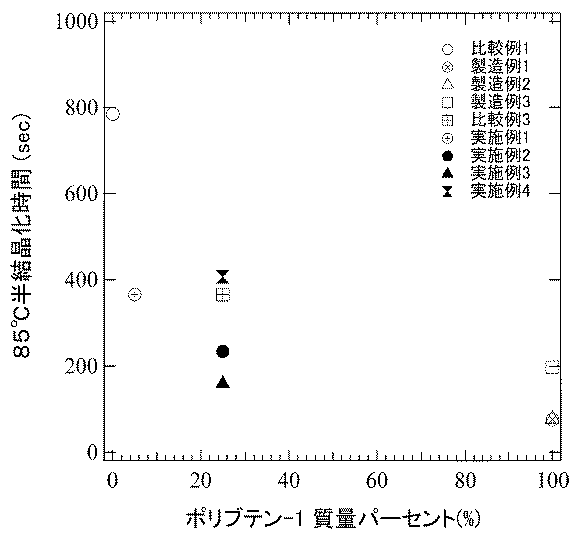
実施例と比較例との対比
図1は、実施例等において、ポリブテン−1の割合(質量パーセント)に対して融解熱量ΔHをプロットしたものである。図中点線はブレンド物を形成する単身のブテン・プロピレン共重合体およびポリブテン−1の融解熱量ΔH値を結んだものである。それぞれのブレンド物で点線よりも大きな融解熱量ΔHを示すことは、単純な加成性が成り立たないことを示す。したがって、ポリブテン−1の添加には結晶化促進効果があると言え、特に、実施例で示すようなmmmm分率の値が大きく、rr分率の小さなポリブテン−1添加した際の効果が顕著である。
Comparison of Examples and Comparative Examples FIG. 1 is a plot of the heat of fusion ΔH with respect to the proportion (mass percent) of polybutene-1 in Examples and the like. The dotted lines in the figure connect the heat of fusion ΔH values of the single butene-propylene copolymer and polybutene-1 forming a blend. The fact that each blend shows a heat of fusion ΔH larger than the dotted line indicates that simple additivity can not be realized. Therefore, it can be said that the addition of polybutene-1 has a crystallization promoting effect, and in particular, the effect of adding polybutene-1 having a large value of mmmm fraction and a small rr fraction as shown in the examples is remarkable. is there.
図2は、実施例等において、ポリブテン−1の割合(質量パーセント)に対して結晶化温度85℃における半結晶化時間をプロットしたものである。mmmm分率の値が大きく、rr分率の小さなポリブテン−1(製造例1および2)は製造例3と比較して半結晶化時間が短く、結晶化速度が速いといえる。ポリブテン−1と比較してブテン・プロピレン共重合体は結晶化速度が遅い。主成分たるブテン・プロピレン共重合体と比較してより結晶化速度の速いポリブテン−1をブレンドすることでブレンド物の半結晶化時間は短縮された。このように結晶化速度の速いポリブテン−1を混ぜることでそれらが核となりブレンド物の結晶化を促進することができた。 FIG. 2 is a graph in which the half-crystallization time at a crystallization temperature of 85 ° C. is plotted against the proportion (mass percent) of polybutene-1 in Examples and the like. It can be said that polybutene-1 having a large value of mm mm fraction and small rr fraction (Production Examples 1 and 2) has a short half-crystallization time and a high crystallization rate as compared to Production Example 3. The butene / propylene copolymer has a slower crystallization rate than polybutene-1. By blending polybutene-1 having a faster crystallization rate as compared with the main component butene-propylene copolymer, the half-crystallization time of the blend was shortened. Thus, by mixing polybutene-1 having a high crystallization rate, it was possible to nucleate them to promote crystallization of the blend.
Claims (3)
(A1):1−ブテン由来の構成単位の含有量が80.0〜99.9モル%であり、エチレンおよび炭素数3〜20の1−ブテン以外のα−オレフィンから選ばれる少なくとも1種のオレフィン由来の構成単位の総含有量(K)が0.1〜20.0モル%である。(ただし、1−ブテン由来の構成単位の含有量と前記総含有量(K)との合計を100モル%とする。)
(A2):135℃のデカリン中で測定された極限粘度[η]が0.5〜5.5dl/gである。
(B1):13C−NMRにより測定されたアイソタクティックペンタッド分率が94.0%以上である。
(B2):13C−NMRにより測定されたシンジオタクティックトライアッド分率が1.5%以下である。
(B3):135℃のデカリン中で測定された極限粘度[η]が0.5〜5.5dl/gである。
(B4):ゲルパーミエーションクロマトグラフィー(GPC)で測定した、分子量が10,000以下の成分の割合が、1.3質量%未満である。 70 to 99.9 parts by mass of a butene · α-olefin copolymer (A) satisfying the following requirements (A1) to (A2) and a polybutene-1 (B) satisfying the following requirements (B1) to (B4) The butene type-resin composition containing 0.1-30 mass parts (however, the sum total of a butene * alpha-olefin copolymer (A) and polybutene-1 (B) is made into 100 mass parts).
(A1): at least one selected from ethylene and α-olefins other than 1-butene having a carbon number of 3 to 20, wherein the content of constituent units derived from 1-butene is 80.0 to 99.9 mol% The total content (K) of structural units derived from olefins is 0.1 to 20.0 mol%. (However, the total of the content of the constituent unit derived from 1-butene and the total content (K) is 100 mol%.)
(A2): The intrinsic viscosity [η] measured in decalin at 135 ° C. is 0.5 to 5.5 dl / g.
(B1): The isotactic pentad fraction measured by 13 C-NMR is 94.0% or more.
(B2): The syndiotactic triad fraction measured by 13 C-NMR is 1.5% or less.
(B3): The intrinsic viscosity [η] measured in decalin at 135 ° C. is 0.5 to 5.5 dl / g.
(B4): The proportion of components having a molecular weight of 10,000 or less measured by gel permeation chromatography (GPC) is less than 1.3% by mass.
Priority Applications (1)
| Application Number | Priority Date | Filing Date | Title |
|---|---|---|---|
| JP2018003486A JP7044557B2 (en) | 2018-01-12 | 2018-01-12 | Butene-based resin composition and molded product |
Applications Claiming Priority (1)
| Application Number | Priority Date | Filing Date | Title |
|---|---|---|---|
| JP2018003486A JP7044557B2 (en) | 2018-01-12 | 2018-01-12 | Butene-based resin composition and molded product |
Publications (2)
| Publication Number | Publication Date |
|---|---|
| JP2019123770A true JP2019123770A (en) | 2019-07-25 |
| JP7044557B2 JP7044557B2 (en) | 2022-03-30 |
Family
ID=67397950
Family Applications (1)
| Application Number | Title | Priority Date | Filing Date |
|---|---|---|---|
| JP2018003486A Active JP7044557B2 (en) | 2018-01-12 | 2018-01-12 | Butene-based resin composition and molded product |
Country Status (1)
| Country | Link |
|---|---|
| JP (1) | JP7044557B2 (en) |
Cited By (2)
| Publication number | Priority date | Publication date | Assignee | Title |
|---|---|---|---|---|
| EP4312191A1 (en) | 2022-07-29 | 2024-01-31 | FUJI-FILM Corporation | Image processing device, glasses-type information display device, image processing method, and image processing program |
| EP4312205A1 (en) | 2022-07-29 | 2024-01-31 | FUJIFILM Corporation | Control device, glasses-type information display device, control method, and control program |
Citations (2)
| Publication number | Priority date | Publication date | Assignee | Title |
|---|---|---|---|---|
| WO2002002659A1 (en) * | 2000-07-03 | 2002-01-10 | Mitsui Chemicals, Inc. | Butene copolymer, resin composition comprising the copolymer and moldings of the composition, and solid titanium catalyst for producing the copolymer and method for preparing the catalyst |
| WO2017130895A1 (en) * | 2016-01-28 | 2017-08-03 | 三井化学株式会社 | Butene-based polymer, resin composition, and molded object |
-
2018
- 2018-01-12 JP JP2018003486A patent/JP7044557B2/en active Active
Patent Citations (2)
| Publication number | Priority date | Publication date | Assignee | Title |
|---|---|---|---|---|
| WO2002002659A1 (en) * | 2000-07-03 | 2002-01-10 | Mitsui Chemicals, Inc. | Butene copolymer, resin composition comprising the copolymer and moldings of the composition, and solid titanium catalyst for producing the copolymer and method for preparing the catalyst |
| WO2017130895A1 (en) * | 2016-01-28 | 2017-08-03 | 三井化学株式会社 | Butene-based polymer, resin composition, and molded object |
Cited By (2)
| Publication number | Priority date | Publication date | Assignee | Title |
|---|---|---|---|---|
| EP4312191A1 (en) | 2022-07-29 | 2024-01-31 | FUJI-FILM Corporation | Image processing device, glasses-type information display device, image processing method, and image processing program |
| EP4312205A1 (en) | 2022-07-29 | 2024-01-31 | FUJIFILM Corporation | Control device, glasses-type information display device, control method, and control program |
Also Published As
| Publication number | Publication date |
|---|---|
| JP7044557B2 (en) | 2022-03-30 |
Similar Documents
| Publication | Publication Date | Title |
|---|---|---|
| JP7118137B2 (en) | Method for producing 4-methyl-1-pentene polymer particles and 4-methyl-1-pentene resin | |
| KR19990013979A (en) | Unsaturated copolymer, method for producing the copolymer, and composition containing the copolymer | |
| JP2020180279A (en) | Butene-based polymer, resin composition and molding | |
| CN104945729A (en) | Thermoplastic elastomer composition | |
| JP6560342B2 (en) | Poly-1-butene resin composition and molded product obtained therefrom | |
| JP5020524B2 (en) | PROPYLENE POLYMER COMPOSITION, MOLDED COMPOSITION COMPRISING THE COMPOSITION, PELLET COMPRISING PROPYLENE POLYMER COMPOSITION, MODIFICATOR FOR THERMOPLASTIC POLYMER, METHOD FOR PRODUCING THERMOPLASTIC POLYMER COMPOSITION | |
| JP7549683B2 (en) | Propylene-based polymer compositions and their uses | |
| JP6514682B2 (en) | Graft-modified propylene / α-olefin copolymer and method for producing the same | |
| JP7044557B2 (en) | Butene-based resin composition and molded product | |
| JP2016147983A (en) | Butene-based polymer, resin composition and molded body | |
| CN103665727B (en) | Polypropylene-based resin composition and the mechanograph being made from it | |
| JP5631696B2 (en) | 4-Methyl-1-pentene (co) polymer and blow molded article obtained from the polymer | |
| JP2019178254A (en) | 1-butene copolymer, polymer composition containing 1-butene copolymer, and molded body consisting of 1-butene copolymer | |
| JP6890474B2 (en) | A propylene-based resin composition, a method for producing the same, and a molded product using the propylene-based resin composition. | |
| JP2018115280A (en) | Resin composition and molding | |
| JP2022143003A (en) | Propylene-based resin composition and use of the same | |
| JP2021121650A (en) | 4-Methyl-1-pentene resin composition and its use | |
| JP2009079110A (en) | Polypropylene resin composition and injection molded body thereof | |
| JP2007063395A (en) | Polypropylene resin composition and film or sheet comprising the composition |
Legal Events
| Date | Code | Title | Description |
|---|---|---|---|
| A621 | Written request for application examination |
Free format text: JAPANESE INTERMEDIATE CODE: A621 Effective date: 20201023 |
|
| A977 | Report on retrieval |
Free format text: JAPANESE INTERMEDIATE CODE: A971007 Effective date: 20210812 |
|
| A131 | Notification of reasons for refusal |
Free format text: JAPANESE INTERMEDIATE CODE: A131 Effective date: 20210817 |
|
| A521 | Request for written amendment filed |
Free format text: JAPANESE INTERMEDIATE CODE: A523 Effective date: 20211018 |
|
| TRDD | Decision of grant or rejection written | ||
| A01 | Written decision to grant a patent or to grant a registration (utility model) |
Free format text: JAPANESE INTERMEDIATE CODE: A01 Effective date: 20220301 |
|
| A61 | First payment of annual fees (during grant procedure) |
Free format text: JAPANESE INTERMEDIATE CODE: A61 Effective date: 20220317 |
|
| R150 | Certificate of patent or registration of utility model |
Ref document number: 7044557 Country of ref document: JP Free format text: JAPANESE INTERMEDIATE CODE: R150 |
|
| R250 | Receipt of annual fees |
Free format text: JAPANESE INTERMEDIATE CODE: R250 |
|
| R250 | Receipt of annual fees |
Free format text: JAPANESE INTERMEDIATE CODE: R250 |