JP2019123790A - Aqueous resin dispersion, aqueous coating material, and coated article - Google Patents
Aqueous resin dispersion, aqueous coating material, and coated article Download PDFInfo
- Publication number
- JP2019123790A JP2019123790A JP2018004630A JP2018004630A JP2019123790A JP 2019123790 A JP2019123790 A JP 2019123790A JP 2018004630 A JP2018004630 A JP 2018004630A JP 2018004630 A JP2018004630 A JP 2018004630A JP 2019123790 A JP2019123790 A JP 2019123790A
- Authority
- JP
- Japan
- Prior art keywords
- polymer
- aqueous
- acrylic polymer
- resin dispersion
- acrylic
- Prior art date
- Legal status (The legal status is an assumption and is not a legal conclusion. Google has not performed a legal analysis and makes no representation as to the accuracy of the status listed.)
- Granted
Links
Landscapes
- Paints Or Removers (AREA)
- Compositions Of Macromolecular Compounds (AREA)
- Graft Or Block Polymers (AREA)
Abstract
【課題】耐衝撃性に優れた塗膜が得られる水性塗料の材料として好適な、貯蔵安定性に優れる水性樹脂分散体、耐衝撃性に優れた塗膜が得られる水性塗料、及び耐衝撃性に優れた塗膜を有する塗装物の提供。
【解決手段】ウレタン重合体(I)及びアクリル重合体(II)を含む重合体粒子が水性媒体に分散した水性樹脂分散体であって、前記アクリル重合体(II)の水酸基価が25〜100mgKOH/gであり、酸価が0.5〜25mgKOH/gであり、かつガラス転移温度が−10℃以下である水性樹脂分散体を用いる。
【選択図】なしAn aqueous resin dispersion excellent in storage stability, suitable as a material of an aqueous paint from which a coating excellent in impact resistance can be obtained, an aqueous paint from which a coating excellent in impact resistance can be obtained, and impact resistance Providing a paint having an excellent coating film.
An aqueous resin dispersion in which polymer particles containing a urethane polymer (I) and an acrylic polymer (II) are dispersed in an aqueous medium, wherein the hydroxyl value of the acrylic polymer (II) is 25 to 100 mg KOH. An aqueous resin dispersion having an acid value of 0.5 to 25 mg KOH / g and a glass transition temperature of −10 ° C. or less is used.
【Selection chart】 None
Description
本発明は、水性樹脂分散体、該水性樹脂分散体を含む水性塗料、及び該水性塗料で塗装された塗装物に関する。 The present invention relates to an aqueous resin dispersion, an aqueous paint containing the aqueous resin dispersion, and a coated article coated with the aqueous paint.
従来、塗料分野においては、環境保全、安全衛生の面から、有機溶剤系の塗料から水性塗料への変換が図られている。
しかし、水性塗料は有機溶剤系の塗料に比べて貯蔵安定性や、塗膜外観、塗膜強度、耐候性、耐水性、耐溶剤性、耐汚染性等の塗膜性能に劣るという課題があり、これらの問題を解決した水性塗料の開発が行われている。特に近年では、これらの塗膜性能に加えて、優れた耐衝撃性を兼ね備えた塗膜を形成できる、より高度な水性塗料が求められている。
Heretofore, in the field of paints, from the viewpoint of environmental protection and safety and health, conversion of organic solvent-based paints to water-based paints has been attempted.
However, there is a problem that the aqueous coating is inferior to the organic solvent based coating in the storage stability, the coating appearance, the coating strength, the coating strength, the weather resistance, the water resistance, the solvent resistance, the staining resistance and the like. , Development of water-based paint that solves these problems has been carried out. In particular, in recent years, a more advanced water-based paint capable of forming a coating film having excellent impact resistance in addition to these coating film properties is required.
これら種々の課題を解決するための水性塗料の材料として、性質の異なる樹脂を含む複合樹脂の水分散体が提案されている。例えば、特許文献1〜3には、ウレタン重合体とアクリル重合体とを含む重合体粒子の水性樹脂分散体が開示されている。これらの水性樹脂分散体を含む水性塗料より形成された塗膜は、ウレタン重合体が有する柔軟性、強靭性、耐溶剤性、耐摩耗性及び低温乾燥性等の特性と、アクリル重合体が有する耐候性、耐加水分解性及び高光沢等の特性とを併せ持つ。 An aqueous dispersion of a composite resin containing a resin having different properties has been proposed as a material of an aqueous coating for solving these various problems. For example, Patent Documents 1 to 3 disclose aqueous resin dispersions of polymer particles containing a urethane polymer and an acrylic polymer. The coating film formed from the aqueous coating containing the aqueous resin dispersion has the characteristics of the urethane polymer, such as flexibility, toughness, solvent resistance, abrasion resistance, low-temperature drying property and the like, and the acrylic polymer. It has properties such as weather resistance, hydrolysis resistance and high gloss.
しかしながら、特許文献1、2に記載の水性樹脂分散体は、貯蔵安定性に劣っている。 また、特許文献1〜3に記載の水性樹脂分散体を含む水性塗料より形成された塗膜は、耐衝撃性が不十分である。
このように、特許文献1〜3に記載の水性樹脂分散体では、水性塗料の課題である貯蔵安定性と耐衝撃性の両方を解決するには至っていない。
However, the aqueous resin dispersions described in Patent Documents 1 and 2 are inferior in storage stability. Moreover, the coating film formed from the water-based paint containing the water-based resin dispersion described in Patent Documents 1 to 3 is insufficient in impact resistance.
Thus, the aqueous resin dispersions described in Patent Documents 1 to 3 have not been able to solve both the storage stability and the impact resistance, which are the problems of the aqueous coating.
本発明は、耐衝撃性に優れた塗膜が得られる水性塗料の材料として好適な、貯蔵安定性に優れる水性樹脂分散体、耐衝撃性に優れた塗膜が得られる水性塗料、及び耐衝撃性に優れた塗膜を有する塗装物を提供することを目的とする。 The present invention is an aqueous resin dispersion excellent in storage stability, suitable as a material of an aqueous paint from which a coating excellent in impact resistance can be obtained, an aqueous paint from which a coating excellent in impact resistance can be obtained, and impact resistant It aims at providing a coated article which has a coating film excellent in quality.
本発明は以下の態様を有する。
[1] ウレタン重合体(I)及びアクリル重合体(II)を含む重合体粒子が水性媒体に分散した水性樹脂分散体であって、前記アクリル重合体(II)の水酸基価が25〜100mgKOH/gであり、酸価が0.5〜25mgKOH/gであり、かつガラス転移温度が−10℃以下である、水性樹脂分散体。
[2] 下記工程(a)及び工程(b)を経て得られる、[1]に記載の水性樹脂分散体。
工程(a):水性媒体及び前記ウレタン重合体(I)の存在下で、アクリル系単量体成分(II−1)を重合し、前記ウレタン重合体(I)及びアクリル重合体(II−1)を含む重合体混合物(P)の分散液を得る工程。
工程(b):水性媒体及び前記重合体混合物(P)の存在下で、アクリル系単量体成分(II−2)を重合し、前記ウレタン重合体(I)、及び前記アクリル重合体(II−1)とアクリル重合体(II−2)とで構成された前記アクリル重合体(II)を含む重合体混合物(Q)の分散液を得る工程。
[3] 前記アクリル重合体(II)が、水酸基含有ラジカル重合性単量体(a1)由来の構成単位をさらに含む、[1]又は[2]に記載の水性樹脂分散体。
[4] [1]〜[3]のいずれか1つに記載の水性樹脂分散体を含む、水性塗料。
[5] 硬化剤をさらに含む、[4]に記載の水性塗料。
[6] 前記ウレタン重合体(I)及びアクリル重合体(II)以外の樹脂をさらに含む、[4]又は[5]に記載の水性塗料。
[7] [4]〜[6]のいずれか1つに記載の水性塗料より形成された塗膜を有する、塗装物。
The present invention has the following aspects.
[1] An aqueous resin dispersion in which polymer particles containing a urethane polymer (I) and an acrylic polymer (II) are dispersed in an aqueous medium, wherein the acrylic polymer (II) has a hydroxyl value of 25 to 100 mg KOH / An aqueous resin dispersion having an acid value of 0.5 to 25 mg KOH / g and a glass transition temperature of −10 ° C. or less.
[2] The aqueous resin dispersion as described in [1], obtained through the following step (a) and step (b).
Step (a): in the presence of an aqueous medium and the urethane polymer (I), the acrylic monomer component (II-1) is polymerized to form the urethane polymer (I) and the acrylic polymer (II-1) Obtaining a dispersion of the polymer mixture (P) containing
Step (b): The acrylic monomer component (II-2) is polymerized in the presence of an aqueous medium and the polymer mixture (P) to form the urethane polymer (I), and the acrylic polymer (II) 1) A step of obtaining a dispersion liquid of a polymer mixture (Q) containing the above-mentioned acrylic polymer (II) composed of-1 and an acrylic polymer (II-2).
[3] The aqueous resin dispersion according to [1] or [2], wherein the acrylic polymer (II) further contains a constituent unit derived from a hydroxyl group-containing radically polymerizable monomer (a1).
The water-based paint containing the water-based resin dispersion as described in any one of [4] [1]-[3].
[5] The aqueous paint according to [4], further comprising a curing agent.
[6] The aqueous paint according to [4] or [5], further comprising a resin other than the urethane polymer (I) and the acrylic polymer (II).
[7] A coated article having a coating film formed from the water-based paint according to any one of [4] to [6].
本発明によれば、耐衝撃性に優れた塗膜が得られる水性塗料の材料として好適な、貯蔵安定性に優れる水性樹脂分散体、耐衝撃性に優れた塗膜が得られる水性塗料、及び耐衝撃性に優れた塗膜を有する塗装物を提供できる。 According to the present invention, an aqueous resin dispersion excellent in storage stability suitable as a material of an aqueous paint from which a coating excellent in impact resistance can be obtained, an aqueous paint from which a coating excellent in impact resistance can be obtained, The coated article which has a coating film excellent in impact resistance can be provided.
以下、本発明を詳細に説明する。
なお、以下の明細書において、本発明の水性樹脂分散体を含む水性塗料より形成された塗膜を単に「塗膜」という。
また、「質量平均分子量」とは、ゲルパーミエーションクロマトグラフィー(GPC)を用いて、ポリスチレン換算によって算出した値を意味する。
「(メタ)アクリレート」は、アクリレート及びメタクリレートの総称である。
Hereinafter, the present invention will be described in detail.
In the following specification, a coating film formed of an aqueous paint containing the aqueous resin dispersion of the present invention is simply referred to as a "coating film".
Moreover, "mass average molecular weight" means the value calculated by polystyrene conversion using gel permeation chromatography (GPC).
"(Meth) acrylate" is a generic term for acrylate and methacrylate.
[水性樹脂分散体]
本発明の水性樹脂分散体(A)は、以下に示すウレタン重合体(I)及びアクリル重合体(II)を含む重合体粒子が水性媒体に分散した分散体である。水性樹脂分散体(A)が、ウレタン重合体(I)を含むことで塗膜の強靭性や成膜性が向上し、アクリル重合体(II)を含むことで塗膜の吸水性が低下する。その結果、耐衝撃性に優れた塗膜が得られる。該塗膜は、耐水性にも優れる傾向にある。
[Aqueous resin dispersion]
The aqueous resin dispersion (A) of the present invention is a dispersion in which polymer particles containing a urethane polymer (I) and an acrylic polymer (II) shown below are dispersed in an aqueous medium. When the aqueous resin dispersion (A) contains the urethane polymer (I), the toughness and the film forming property of the coating film are improved, and when the acrylic polymer (II) is contained, the water absorption of the coating film is reduced. . As a result, a coating film excellent in impact resistance is obtained. The coating film also tends to be excellent in water resistance.
ウレタン重合体(I)とアクリル重合体(II)の質量比は、これらの合計を100としたときに、ウレタン重合体(I)/アクリル重合体(II)=(10〜90)/(10〜90)であることが好ましく、(20〜80)/(20〜80)であることがより好ましく、(20〜60)/(40〜80)であることがさらに好ましく、(20〜50)/(50〜80)であることが特に好ましい。ウレタン重合体(I)とアクリル重合体(II)の質量比が上記範囲内であれば、塗膜の耐衝撃性と耐水性のバランスが良好となる。 The mass ratio of the urethane polymer (I) to the acrylic polymer (II) is, when the total of them is 100, urethane polymer (I) / acrylic polymer (II) = (10 to 90) / (10) -90) is preferable, (20-80) / (20-80) is more preferable, (20-60) / (40-80) is more preferable, and (20-50) It is particularly preferable that / (50 to 80). When the mass ratio of the urethane polymer (I) to the acrylic polymer (II) is within the above range, the balance between the impact resistance and the water resistance of the coating film becomes good.
水性樹脂分散体(A)に含まれる重合体粒子の平均粒子径は、10〜1000nmであることが好ましく、30〜500nmであることがより好ましく、50〜400nmであることがさらに好ましく、70〜300nmであることが特に好ましい。重合体粒子の平均粒子径が上記範囲内であれば、塗膜の成膜性が向上する。
なお、重合体粒子の平均粒子径は、光散乱光度計により計測したキュムラント平均粒子径(D50)を意味する。
The average particle diameter of the polymer particles contained in the aqueous resin dispersion (A) is preferably 10 to 1000 nm, more preferably 30 to 500 nm, and still more preferably 50 to 400 nm, Particular preference is given to 300 nm. If the average particle size of the polymer particles is within the above range, the film forming property of the coating film is improved.
The average particle size of the polymer particles means a cumulant average particle diameter measured by light scattering photometer (D 50).
水性樹脂分散体(A)の固形分濃度は、10〜80質量%であることが好ましく、20〜70質量%であることがより好ましい。水性樹脂分散体(A)の固形分濃度が上記範囲内であれば、水性塗料とする際の粘度調整や、最終固形分を調整しやすくなる。
水性媒体としては、例えば、水、または水を主体とするアルコール性溶媒が挙げられ、好ましくは水である。
It is preferable that it is 10-80 mass%, and, as for solid content concentration of aqueous resin dispersion (A), it is more preferable that it is 20-70 mass%. If the solid content concentration of the aqueous resin dispersion (A) is within the above range, it becomes easy to adjust the viscosity when making the aqueous coating and to adjust the final solid content.
The aqueous medium includes, for example, water or an alcoholic solvent mainly composed of water, preferably water.
<ウレタン重合体(I)>
ウレタン重合体(I)は、ポリオールとポリイソシアネートとを反応させて得られる樹脂である。すなわち、ウレタン重合体(I)は、ポリオールとポリイソシアネートとの反応生成物である。
<Urethane polymer (I)>
The urethane polymer (I) is a resin obtained by reacting a polyol and a polyisocyanate. That is, urethane polymer (I) is a reaction product of a polyol and a polyisocyanate.
ポリオールは、1分子中に少なくとも2つの水酸基を有する有機化合物であり、各種のポリオールを用いることができる。
このようなポリオールの具体例としては、エチレングリコール、プロピレングリコール、1,3−プロパンジオール、1,4−ブタンジオール、1,5−ペンタンジオール、3−メチル−1,5−ペンタンジオール、1,6−ヘキサンジオール、ネオペンチルグリコール、ジエチレングリコール、トリメチレングリコール、トリエチレングリコール、テトラエチレングリコール、ジプロピレングリコール、トリプロピレングリコール、ヘキサンジオール、シクロヘキサンジメタノール等の低分子量ポリオール;前記低分子量ポリオールの少なくとも一種と、エチレンオキサイド、プロピレンオキサイド、テトラヒドロフラン等とを付加重合させて得られるポリエーテルジオール;前記低分子量ポリオールの少なくとも1種と、アジピン酸、セバシン酸、イタコン酸、無水マレイン酸、テレフタル酸、イソフタル酸等のジカルボン酸とを重縮合して得られるポリエステルポリオール、ポリエチレングリコール、ポリプロピレングリコール、ポリカプロラクトンポリオール、ポリテトラメチレンエーテルポリオール、ポリカーボネートポリオール等のポリエーテルポリオール;その他、ポリブタジエンポリオール、水添ポリブタジエンポリオール、ポリアクリル酸エステルポリオールなどが挙げられる。
これらは1種のみを単独で使用してもよく、2種以上を併用してもよい。
The polyol is an organic compound having at least two hydroxyl groups in one molecule, and various polyols can be used.
Specific examples of such polyols include ethylene glycol, propylene glycol, 1,3-propanediol, 1,4-butanediol, 1,5-pentanediol, 3-methyl-1,5-pentanediol, 1, 6-Hexanediol, neopentyl glycol, diethylene glycol, trimethylene glycol, triethylene glycol, tetraethylene glycol, dipropylene glycol, tripropylene glycol, tripropylene glycol, hexanediol, cyclohexanedimethanol, and other low molecular weight polyols; at least one of the low molecular weight polyols And polyether diols obtained by addition polymerization of ethylene oxide, propylene oxide, tetrahydrofuran and the like; at least one of the low molecular weight polyols; adipic acid; Polyester polyol, polyethylene glycol, polypropylene glycol, polycaprolactone polyol, polytetramethylene ether polyol, polycarbonate polyol, etc. obtained by polycondensation of dicarboxylic acid such as synic acid, itaconic acid, maleic anhydride, terephthalic acid and isophthalic acid Other examples include polybutadiene polyol, hydrogenated polybutadiene polyol, polyacrylic acid ester polyol and the like.
One of these may be used alone, or two or more may be used in combination.
ポリイソシアネートは、1分子中に少なくとも2つのイソシアネート基を有する有機化合物であり、各種のポリイソシアネートを用いることができる。
このようなポリイソシアネートの具体例としては、エチレンジイソシアネート、テトラメチレンジイソシアネート、ヘキサメチレンジイソシアネート(HDI)、ドデカメチレンジイソシアネート、1,6,11−ウンデカントリイソシアネート、2,2,4−トリメチルヘキサメチレンジイソシアネート、リジンジイソシアネート、2,6−ジイソシアナトメチルカプロエート、ビス(2−イソシアナトエチル)フマレート、ビス(2−イソシアナトエチル)カーボネート、2−イソシアナトエチル−2,6−ジイソシアナトヘキサノエート等の脂肪族ポリイソシアネート;イソホロンジイソシアネート(IPDI)、4,4’−ジシクロヘキシルメタンジイソシアネート(水素添加MDI)、シクロヘキシレンジイソシアネート、メチルシクロヘキシレンジイソシアネート(水素添加TDI)、ビス(2−イソシアナトエチル)−4−シクロヘキセン−1,2−ジカルボキシレート、2,5−ノルボルナンジイソシアネート、2,6−ノルボルナンジイソシアネート等の脂環式ポリイソシアネート;1,3−フェニレンジイソシアネート、1,4−フェニレンジイソシアネート、2,4−トリレンジイソシアネート(TDI)、2,6−トリレンジイソシアネート、4,4’−ジフェニルメタンジイソシアネート(MDI)、2,4−ジフェニルメタンジイソシアネート、4,4’−ジイソシアナトビフェニル、3,3’−ジメチル−4,4’−ジイソシアナトビフェニル、3,3’−ジメチル−4,4’−ジイソシアナトジフェニルメタン、1,5−ナフチレンジイソシアネート、4,4’,4’’−トリフェニルメタントリイソシアネート、m−イソシアナトフェニルスルホニルイソシアネート、p−イソシアナトフェニルスルホニルイソシアネート等の芳香族ポリイソシアネートなどが挙げられる。これらの中でも、得られるウレタン重合体(I)の黄変を抑制できる観点から、黄変脂肪族ポリイソシアネート、脂環式ポリイソシアネートが好ましい。
これらは1種のみを単独で使用してもよく、2種以上を併用してもよい。
The polyisocyanate is an organic compound having at least two isocyanate groups in one molecule, and various polyisocyanates can be used.
Specific examples of such polyisocyanates include ethylene diisocyanate, tetramethylene diisocyanate, hexamethylene diisocyanate (HDI), dodecamethylene diisocyanate, 1,6,11-undecanetriisocyanate, 2,2,4-trimethylhexamethylene diisocyanate, Lysine diisocyanate, 2,6-diisocyanatomethyl caproate, bis (2-isocyanatoethyl) fumarate, bis (2-isocyanatoethyl) carbonate, 2-isocyanatoethyl-2, 6-diisocyanatohexanoate Aliphatic polyisocyanates such as: isophorone diisocyanate (IPDI), 4,4'-dicyclohexylmethane diisocyanate (hydrogenated MDI), cyclohexylene diisocyanate, methyl isocyanate Alicyclic polys such as chlorohexylene diisocyanate (hydrogenated TDI), bis (2-isocyanatoethyl) -4-cyclohexene-1,2-dicarboxylate, 2,5-norbornane diisocyanate, 2,6-norbornane diisocyanate, etc. Isocyanate; 1,3-phenylene diisocyanate, 1,4-phenylene diisocyanate, 2,4-tolylene diisocyanate (TDI), 2,6-tolylene diisocyanate, 4,4′-diphenylmethane diisocyanate (MDI), 2,4- Diphenylmethane diisocyanate, 4,4'-diisocyanatobiphenyl, 3,3'-dimethyl-4,4'-diisocyanatobiphenyl, 3,3'-dimethyl-4,4'-diisocyanatodiphenylmethane, 1,5 -Naphthylene diisocyanate, 4, ', 4''- triphenylmethane triisocyanate, m- isocyanatophenyl sulfonyl isocyanate, and aromatic polyisocyanates such as p- isocyanatophenyl sulfonyl isocyanate. Among these, yellowing aliphatic polyisocyanates and alicyclic polyisocyanates are preferable from the viewpoint of suppressing yellowing of the resulting urethane polymer (I).
One of these may be used alone, or two or more may be used in combination.
ウレタン重合体(I)の製造方法としては、例えば、ジオキサン等のエーテル中で、上述のポリオールとポリイソシアネートとを、ジブチル錫ジラウレート等の触媒を用いて反応させる方法が挙げられる。 As a manufacturing method of urethane polymer (I), the method of making the above-mentioned polyol and polyisocyanate react with catalysts, such as dibutyltin dilaurate, in ether, such as a dioxane, is mentioned, for example.
ウレタン重合体(I)の質量平均分子量は、塗膜の耐水性及び塗膜強度が向上する観点から、500以上であることが好ましく、1000以上であることがより好ましい。また、ウレタン重合体(I)の質量平均分子量は、50万以下であることが好ましく、10万以下であることがより好ましい。 The mass average molecular weight of the urethane polymer (I) is preferably 500 or more, and more preferably 1000 or more, from the viewpoint of improving the water resistance of the coating film and the coating film strength. The mass average molecular weight of the urethane polymer (I) is preferably 500,000 or less, more preferably 100,000 or less.
ウレタン重合体(I)は、水性樹脂分散体(A)を製造するに際して、水性媒体に分散した状態で用いることが好ましく、水に分散した状態で用いることがより好ましい。特に、カルボキシ基及びスルホン酸基の少なくとも一方を有するウレタン重合体(I)は、水への分散性が良好となることから好適である。その中でも特に、スルホン酸基を有するウレタン重合体(I)が好ましい。詳しくは後述するが、スルホン酸基を有するウレタン重合体(I)の水分散液の存在下でラジカル重合性単量体を重合してアクリル重合体(II)を製造すれば、重合安定性が向上する。 The urethane polymer (I) is preferably used in the state of being dispersed in an aqueous medium when producing the aqueous resin dispersion (A), and is more preferably used in the state of being dispersed in water. In particular, a urethane polymer (I) having at least one of a carboxy group and a sulfonic acid group is preferable because the dispersibility in water is improved. Among these, urethane polymer (I) having a sulfonic acid group is particularly preferable. Although it will be described in detail later, when the radically polymerizable monomer is polymerized in the presence of the aqueous dispersion of the urethane polymer (I) having a sulfonic acid group to produce an acrylic polymer (II), the polymerization stability is improves.
ウレタン重合体(I)の水分散液を用いる場合、該水分散液中のウレタン重合体(I)の平均粒子径は、塗膜の耐水性が向上する観点から、10nm以上であることが好ましく、30nm以上であることがより好ましい。また、ウレタン重合体(I)の平均粒子径は、1000nm以下であることが好ましく、500nm以下であることがより好ましい。 When using an aqueous dispersion of urethane polymer (I), the average particle diameter of the urethane polymer (I) in the aqueous dispersion is preferably 10 nm or more from the viewpoint of improving the water resistance of the coating film. And more preferably 30 nm or more. The average particle diameter of the urethane polymer (I) is preferably 1000 nm or less, more preferably 500 nm or less.
また、ウレタン重合体(I)の水分散液中のウレタン重合体(I)の含有量は、水性樹脂分散体(A)の固形分濃度が10〜80質量%であることが好ましいことから、10質量%以上であることが好ましく、25質量%以上であることがより好ましい。一方、水性樹脂分散体(A)を含む水性塗料が良好な塗装性を発現するという観点から、ウレタン重合体(I)の水分散液中のウレタン重合体(I)の含有量は、70質量%以下が好ましく、60質量%以下がより好ましい。 In addition, the content of the urethane polymer (I) in the aqueous dispersion of the urethane polymer (I) is preferably such that the solid content concentration of the aqueous resin dispersion (A) is 10 to 80 mass%, The content is preferably 10% by mass or more, and more preferably 25% by mass or more. On the other hand, the content of the urethane polymer (I) in the aqueous dispersion of the urethane polymer (I) is 70 mass from the viewpoint that the aqueous paint containing the aqueous resin dispersion (A) exhibits good paintability. % Or less is preferable and 60 mass% or less is more preferable.
ウレタン重合体(I)の水分散液としては、市販のウレタン水性重合体分散液をそのまま用いることができる。ウレタン水性重合体分散液は、別名「ウレタンディスパージョン」、略称「PUD」と呼ばれるものである。市販のPUDとしては、例えば、第一工業製薬株式会社製の商品名:スーパーフレックス110、スーパーフレックス150、スーパーフレックス210、スーパーフレックス300、スーパーフレックス420、スーパーフレックス460、スーパーフレックス470、スーパーフレックス500M、スーパーフレックス620、スーパーフレックス650、スーパーフレックス740、スーパーフレックス820、スーパーフレックス840、F−8082D;住化コベストロウレタン株式会社製の商品名:バイヒドロールUH2606、バイヒドロールUH650、バイヒドロールUHXP2648、バイヒドロールUHXP2650、インプラニールDLE、インプラニールDLC−F、インプラニールDLN、インプラニールDLN−W50、インプラニールDLP−R、インプラニールDLS、インプラニールDLU、インプラニールXP2611、インプラニールLP RSC 1380、インプラニールLP RSC 1537、インプラニールLP RSC 1554、インプラニールLP RSC 3040;DIC株式会社製の商品名:ハイドランHW−301、HW−310、HW−311、HW−312B、HW−333、HW−340、HW−350、HW−375、HW−920、HW−930、HW−940、HW−950、HW−970、AP−10、AP−20、ECOS3000;三洋化成工業株式会社製の商品名:ユーコートUWS−145、パーマリンUA−150、パーマリンUA−200、パーマリンUA−300、パーマリンUA−310、ユーコートUX−320、パーマリンUA−368、パーマリンUA−385、ユーコートUX−2510;日華化学株式会社製の商品名:ネオステッカー100C、エバファノールHA−107C、エバファノールHA−50C、エバファノールHA−170、エバファノールHA−560;株式会社ADEKA製の商品名:アデカボンタイターUHX−210、アデカボンタイターUHX−280などが挙げられる。 As the aqueous dispersion of urethane polymer (I), a commercially available urethane aqueous polymer dispersion can be used as it is. The urethane aqueous polymer dispersion is also called "urethane dispersion", abbreviated as "PUD". As commercially available PUDs, for example, trade names manufactured by Dai-ichi Kogyo Seiyaku Co., Ltd .: Superflex 110, Superflex 150, Superflex 210, Superflex 300, Superflex 420, Superflex 460, Superflex 470, Superflex 500M , Super flex 620, Super flex 650, Super flex 740, Super flex 820, F-8082D; trade name of Sumika Kobethurourethane Co., Ltd .: Product name: Bihydrol UH 2606, Bihydrol UH 650, Bihydrol UHXP 2648, Bihydrol UHXP 2650, Impla Neil DLE, IMPLANIL DLC-F, IMPLANIL DLN, IMPLANIL DL -W50, IMPLANIL DLP-R, IMPLANIL DLS, IMPLANYL DLU, IMPLANYL XP 2611, IMPLANIL LP RSC 1380, IMPLANYL LP RSC 1537, IMPLANIL LP RSC 1554, IMPLANIL LP RSC 3040; manufactured by DIC Corporation Brand name: Hydran HW-301, HW-310, HW-311, HW-312B, HW-333, HW-340, HW-350, HW-375, HW-920, HW-930, HW-940, HW- 950, HW-970, AP-10, AP-20, ECOS 3000; trade names made by Sanyo Chemical Industries, Ltd .: U-Coat UWS-145, Permarine UA-150, Permarine UA-200, Permarine UA-300, Permarine UA-3 0, U-Coat UX-320, Permarine UA-368, Permarine UA-385, U-Coat UX-2510; trade names made by Nikka Chemical Co., Ltd .: NeoSticker 100C, Evafanol HA-107C, Evafanol HA-50C, Evafanol HA-170 Evafanol HA-560; trade name of ADEKA Co., Ltd .: Adekabon Titer UHX-210, Adekabon Titer UHX-280, and the like.
<アクリル重合体(II)>
アクリル重合体(II)は、(メタ)アクリル系単量体由来の構成単位を含む重合体である。
アクリル重合体(II)は、(メタ)アクリル系単量体以外のラジカル重合性単量体由来の構成単位を含んでいてもよい。ラジカル重合性単量体は、ラジカル性重合性基を有する単量体である。ラジカル性重合性基とは、ラジカル重合可能な炭素−炭素不飽和二重結合、ラジカル重合可能な炭素−炭素不飽和三重結合、ラジカル開環重合可能な環などを含む基である。
<Acrylic polymer (II)>
Acrylic polymer (II) is a polymer containing a structural unit derived from a (meth) acrylic monomer.
The acrylic polymer (II) may contain a constituent unit derived from a radical polymerizable monomer other than the (meth) acrylic monomer. The radically polymerizable monomer is a monomer having a radically polymerizable group. The radically polymerizable group is a group containing a radically polymerizable carbon-carbon unsaturated double bond, a radically polymerizable carbon-carbon unsaturated triple bond, a radical ring-opening polymerizable ring and the like.
アクリル重合体(II)は、後述する水酸基含有ラジカル重合性単量体(a1)由来の構成単位を含むことが好ましい。アクリル重合体(II)が水酸基含有ラジカル重合性単量体(a1)由来の構成単位を含むことで、塗膜の耐衝撃性がより向上する。
また、アクリル重合体(II)は、後述する酸基含有ラジカル重合性単量体(a2)由来の構成単位をさらに含むことが好ましい。アクリル重合体(II)が酸基含有ラジカル重合性単量体(a2)由来の構成単位を含むことで、水性樹脂分散体(A)の貯蔵安定性がより向上すると共に、塗膜の耐衝撃性と耐水性のバランスが良好となる。
また、アクリル重合体(II)は、後述するその他のラジカル重合性単量体(a3)由来の構成単位をさらに含んでいてもよい。
The acrylic polymer (II) preferably contains a constituent unit derived from a hydroxyl group-containing radically polymerizable monomer (a1) described later. When the acrylic polymer (II) contains a structural unit derived from a hydroxyl group-containing radically polymerizable monomer (a1), the impact resistance of the coating film is further improved.
Moreover, it is preferable that acrylic polymer (II) further contains the structural unit derived from the acidic radical containing radically polymerizable monomer (a2) mentioned later. The storage stability of the aqueous resin dispersion (A) is further improved by the acrylic polymer (II) containing a constituent unit derived from the acid group-containing radically polymerizable monomer (a2), and the impact resistance of the coating film The balance between water resistance and water resistance is good.
In addition, the acrylic polymer (II) may further contain a constituent unit derived from another radically polymerizable monomer (a3) described later.
(物性)
アクリル重合体(II)の水酸基価は、25〜100mgKOH/gであり、40〜100mgKOH/gであることが好ましく、40〜80mgKOH/gであることがより好ましい。アクリル重合体(II)の水酸基価が、20mgKOH/g以上であれば塗膜の耐衝撃性が向上し、100mgKOH/g以下であれば水性樹脂分散体(A)の貯蔵安定性が向上する。
(Physical properties)
The hydroxyl value of the acrylic polymer (II) is 25 to 100 mg KOH / g, preferably 40 to 100 mg KOH / g, and more preferably 40 to 80 mg KOH / g. When the hydroxyl value of the acrylic polymer (II) is 20 mg KOH / g or more, the impact resistance of the coating film is improved, and when it is 100 mg KOH / g or less, the storage stability of the aqueous resin dispersion (A) is improved.
なお、アクリル重合体(II)の水酸基価は、アクリル重合体(II)溶液の固形分1g中の水酸基を無水酢酸でアセチル化し、アセチル化に伴って生成した酢酸を中和するのに要した水酸化カリウムのmg数を滴定にて測定して求められる値であり、具体的には下記式(ii)より求められる。
水酸基価(mgKOH/g)=(f1×M1/M2/Mw1×[KOH]×1000) ・・・(ii)
(式(ii)中、f1は水酸基含有ラジカル重合性単量体の水酸基の数であり、M1は水酸基含有ラジカル重合性単量体の質量(g)であり、M2はアクリル重合体(II)の質量(g)であり、Mw1は水酸基含有ラジカル重合性単量体の分子量(数平均分子量)であり、[KOH]は水酸化カリウムの分子量である。)
The hydroxyl value of the acrylic polymer (II) was required to acetylate the hydroxyl group in 1 g of solid content of the acrylic polymer (II) solution with acetic anhydride and to neutralize the acetic acid formed along with the acetylation. It is a value determined by measuring the number of mg of potassium hydroxide by titration, and more specifically, it is determined from the following formula (ii).
Hydroxyl value (mg KOH / g) = (f1 × M1 / M2 / Mw1 × [KOH] × 1000) (ii)
(In the formula (ii), f1 is the number of hydroxyl groups of the hydroxyl group-containing radically polymerizable monomer, M1 is the mass (g) of the hydroxyl group-containing radically polymerizable monomer, and M2 is the acrylic polymer (II) Mw1 is the molecular weight (number average molecular weight) of the hydroxyl group-containing radically polymerizable monomer, and [KOH] is the molecular weight of potassium hydroxide.)
アクリル重合体(II)の酸価は、0.5〜25mgKOH/gであり、1〜20mgKOH/gであることが好ましく、5〜20mgKOH/gであることがより好ましい。アクリル重合体(II)の酸価が上記範囲内であれば、水性樹脂分散体(A)の貯蔵安定性が向上する。特に、アクリル重合体(II)の酸価が0.5mgKOH/g以上であれば、塗膜の耐衝撃性が向上する。 The acid value of the acrylic polymer (II) is 0.5 to 25 mg KOH / g, preferably 1 to 20 mg KOH / g, and more preferably 5 to 20 mg KOH / g. If the acid value of the acrylic polymer (II) is within the above range, the storage stability of the aqueous resin dispersion (A) is improved. In particular, when the acid value of the acrylic polymer (II) is 0.5 mg KOH / g or more, the impact resistance of the coating film is improved.
なお、アクリル重合体(II)の酸価は、アクリル重合体(II)溶液の固形分1gを中和するのに要した水酸化カリウムのmg数を滴定にて測定して求められる値であり、具体的には下記式(iii)より求められる。
酸価(mgKOH/g)=(f2×M3/M2/Mw2×[KOH]×1000) ・・・(iii)
(式(iii)中、f2は酸基含有ラジカル重合性単量体の酸性基の数であり、M3は酸基含有ラジカル重合性単量体の質量(g)であり、M2はアクリル重合体(II)の質量(g)であり、Mw2は酸基含有ラジカル重合性単量体の分子量(数平均分子量)であり、[KOH]は水酸化カリウムの分子量である。ここで、酸性基とは、カルボキシ基、スルホン酸基、リン酸基のことである。)
The acid value of the acrylic polymer (II) is a value determined by measuring the number of mg of potassium hydroxide required to neutralize 1 g of the solid content of the acrylic polymer (II) solution by titration. Specifically, it is obtained from the following formula (iii).
Acid value (mg KOH / g) = (f2 × M3 / M2 / Mw2 × [KOH] × 1000) (iii)
(In the formula (iii), f2 is the number of acidic groups of the acid group-containing radically polymerizable monomer, M3 is the mass (g) of the acid group-containing radically polymerizable monomer, and M2 is an acrylic polymer It is mass (g) of (II), Mw 2 is a molecular weight (number average molecular weight) of an acid group containing radically polymerizable monomer, and [KOH] is a molecular weight of potassium hydroxide. Is a carboxy group, a sulfonic acid group or a phosphoric acid group.)
アクリル重合体(II)のガラス転移温度は、−10℃以下である。アクリル重合体(II)のガラス転移温度が−10℃以下であれば、塗膜の柔軟性及び成膜性が向上し、耐水性及び耐衝撃性が向上する。塗膜の耐衝撃性がより向上する観点から、アクリル重合体(II)のガラス転移温度は、−20℃以下であることが好ましい。また、塗膜の耐水性がより向上する観点から、アクリル重合体(II)のガラス転移温度は、−80℃以上であることが好ましく、−70℃以上であることがより好ましく、−60℃以上であることがさらに好ましい。 The glass transition temperature of the acrylic polymer (II) is −10 ° C. or less. When the glass transition temperature of the acrylic polymer (II) is −10 ° C. or less, the flexibility and the film forming property of the coating film are improved, and the water resistance and the impact resistance are improved. From the viewpoint of further improving the impact resistance of the coating, the glass transition temperature of the acrylic polymer (II) is preferably −20 ° C. or less. Moreover, from the viewpoint of further improving the water resistance of the coating film, the glass transition temperature of the acrylic polymer (II) is preferably -80 ° C or higher, more preferably -70 ° C or higher, -60 ° C It is more preferable that it is more than.
なお、アクリル重合体(II)のガラス転移温度は、下記式(i)で表されるFoxの計算式により求められる値をいう。
1/(273+Tg)=Σ(Wi/(273+Tgi)) ・・・(i)
(式(i)中、Wiは単量体iの質量分率を示し、Tgiは単量体iの単独重合体のTg(℃)を示す。ここで、各単量体の単独重合体のガラス転移温度は、ポリマーハンドブック第4版(POLYMER HANDBOOK Fourth Edition),John Wiley & Sons, Inc.(1999)に記載されている値を使用することができる。)
In addition, the glass transition temperature of acrylic polymer (II) says the value calculated | required by the calculation formula of Fox represented by following formula (i).
1 / (273 + Tg) = Σ (W i / (273 + Tg i)) ··· (i)
(In formula (i), W i represents the mass fraction of monomer i, and Tg i represents the Tg (° C.) of the homopolymer of monomer i. Here, the individual weight of each monomer The glass transition temperature of the combination can be the value described in Polymer Handbook 4th Edition (POLYMER HANDBOOK Fourth Edition), John Wiley & Sons, Inc. (1999).)
(水酸基含有ラジカル重合性単量体(a1))
水酸基ラジカル重合性単量体(a1)としては、例えば、2−ヒドロキシエチル(メタ)アクリレート、3−ヒドロキシプロピル(メタ)アクリレート、2−ヒドロキシプロピル(メタ)アクリレート、4−ヒドロキシブチル(メタ)アクリレート、2−ヒドロキシブチル(メタ)アクリレート、ポリプロピレングリコール(メタ)アクリレートなどが挙げられる。これらの中でも、水性樹脂分散体(A)の貯蔵安定性がより向上する観点から、2−ヒドロキシエチル(メタ)アクリレートが好ましい。
これらは1種のみを単独で使用してもよく、2種以上を併用してもよい。
(Hydroxyl group-containing radically polymerizable monomer (a1))
As a hydroxyl radical polymerizable monomer (a1), for example, 2-hydroxyethyl (meth) acrylate, 3-hydroxypropyl (meth) acrylate, 2-hydroxypropyl (meth) acrylate, 4-hydroxybutyl (meth) acrylate And 2-hydroxybutyl (meth) acrylate, polypropylene glycol (meth) acrylate and the like. Among these, 2-hydroxyethyl (meth) acrylate is preferable from the viewpoint of further improving the storage stability of the aqueous resin dispersion (A).
One of these may be used alone, or two or more may be used in combination.
(酸基含有ラジカル重合性単量体(a2))
酸基含有ラジカル重合性単量体(a2)としては、例えば、アクリル酸、メタクリル酸、イタコン酸、マレイン酸、クロトン酸、β−カルボキシエチルアクリレート等のカルボキシ基含有ラジカル重合性単量体;2−メタクロイロキシエチルアシッドフォスフェート等のリン酸基含有ラジカル重合性単量体;スチレンスルホン酸塩等のスルホン酸塩含有ラジカル重合性単量体などが挙げられる。これらの中でも、重合安定性及び水性樹脂分散体(A)の貯蔵安定性がより向上する観点から、カルボキシ基含有ラジカル重合性単量体が好ましく、その中でも特にアクリル酸、メタクリル酸が好ましい。
これらは1種のみを単独で使用してもよく、2種以上を併用してもよい。
(Acid group-containing radically polymerizable monomer (a2))
Examples of the acid group-containing radically polymerizable monomer (a2) include carboxyl group-containing radically polymerizable monomers such as acrylic acid, methacrylic acid, itaconic acid, maleic acid, crotonic acid and β-carboxyethyl acrylate; -Phosphate group-containing radically polymerizable monomers such as metachlorooxyethyl acid phosphate; Sulfonate-containing radically polymerizable monomers such as styrene sulfonates. Among these, from the viewpoint of further improving the polymerization stability and the storage stability of the aqueous resin dispersion (A), a carboxy group-containing radically polymerizable monomer is preferable, and among these, acrylic acid and methacrylic acid are particularly preferable.
One of these may be used alone, or two or more may be used in combination.
(その他のラジカル重合性単量体(a3))
その他のラジカル重合性単量体(a3)としては、本発明の効果を損なわない限り特に限定されないが、例えば、メチル(メタ)アクリレート、エチル(メタ)アクリレート、n−ブチル(メタ)アクリレート、i−ブチル(メタ)アクリレート、t−ブチル(メタ)アクリレート、ペンチル(メタ)アクリレート、ヘキシル(メタ)アクリレート、オクチル(メタ)アクリレート、2−エチルヘキシル(メタ)アクリレート、ノニル(メタ)アクリレート、トリデシル(メタ)アクリレート、ラウリル(メタ)アクリレート、ステアリル(メタ)アクリレート、イソステアリル(メタ)アクリレート等の炭素原子数1〜22のアルキル基を有するアルキル(メタ)アクリレート;エチレングリコールジ(メタ)アクリレート、プロピレングリコールジ(メタ)アクリレート、ブチレングリコールジ(メタ) アクリレート、トリメチロールプロパントリ(メタ) アクリレート等の多官能性(メタ) アクリレート;シクロヘキシル(メタ)アクリレート、メチルシクロヘキシル(メタ)アクリレート、t−ブチルシクロヘキシル(メタ)アクリレート等のシクロアルキル(メタ)アクリレート;γ−(メタ)アクリロイルオキシプロピルメチルジメトキシシラン、γ−(メタ)アクリロイルオキシプロピルトリメトキシシラン等の加水分解性シリル基含有ラジカル重合性単量体;メトキシポリエチレンオキシドモノ(メタ)アクリレート等のアルキル基末端型ポリアルキレンオキシド基含有ラジカル重合性単量体;グリシジル(メタ)アクリレート等のオキシラン基含有ラジカル重合性単量体;ダイアセトンアクリルアミド等のカルボニル基含有エチレン性不飽和単量体;1,2,2,6,6−ペンタメチル−4−ピペリジル(メタ)アクリレート、2,2,6,6−ペンタメチル−4−ピペリジル(メタ)アクリレート等の光安定化作用を有する(メタ)アクリレート;2−[2’−ヒドロキシ−5’−(メタ)アクリロイルオキシエチルフェニル]−2H−ベンゾトリアゾール等の紫外線吸収性成分を有する(メタ)アクリレート;2−アミノエチル(メタ)アクリレート等のアミノアルキル(メタ)アクリレート;(メタ)アクリルアミド等のアミド基含有ラジカル重合性単量体;ジ(メタ)アクリル酸亜鉛等の金属含有ラジカル重合性単量体;(メタ)アクリロニトリル、ベンジル(メタ)アクリレート、イソボルニル(メタ)アクリレート、メトキシエチル(メタ)アクリレート等のその他の(メタ)アクリル系単量体;スチレン、メチルスチレン等の芳香族ビニル系単量体;1,3−ブタジエン、イソプレン等の共役ジエン系単量体;酢酸ビニル、塩化ビニル、エチレン等のラジカル重合性単量体などが挙げられる。これらの中でも、塗膜の耐衝撃性がより向上する観点から、メチルアクリレート、エチルアクリレート、n−ブチルアクリレート、i−ブチルアクリレート、t−ブチルアクリレート、2−エチルヘキシルアクリレート等のアクリレートが好ましく、その中でも特にn−ブチルアクリレートが好ましい。また、水性樹脂分散体(A)の貯蔵安定性と塗膜の耐水性のバランスが良好となる観点から、メチルメタクリレート、エチルメタクリレート、n−ブチルメタクリレート、i−ブチルメタクリレート、t−ブチルメタクリレートなどのメタクリレートが好ましく、その中でも特にi−ブチルメタクリレートが好ましい。
これらは1種のみを単独で使用してもよく、2種以上を併用してもよい。
(Other radically polymerizable monomers (a3))
The other radical polymerizable monomer (a3) is not particularly limited as long as the effects of the present invention are not impaired, and examples thereof include methyl (meth) acrylate, ethyl (meth) acrylate, n-butyl (meth) acrylate, i -Butyl (meth) acrylate, t-butyl (meth) acrylate, pentyl (meth) acrylate, hexyl (meth) acrylate, octyl (meth) acrylate, 2-ethylhexyl (meth) acrylate, nonyl (meth) acrylate, tridecyl (meth) ) Alkyl (meth) acrylates having an alkyl group having 1 to 22 carbon atoms, such as acrylate, lauryl (meth) acrylate, stearyl (meth) acrylate, isostearyl (meth) acrylate; ethylene glycol di (meth) acrylate, propylene glycol Multifunctional (meth) acrylates such as Cole di (meth) acrylate, butylene glycol di (meth) acrylate and trimethylolpropane tri (meth) acrylate; cyclohexyl (meth) acrylate, methylcyclohexyl (meth) acrylate, t-butylcyclohexyl ( Cycloalkyl (meth) acrylates such as meta) acrylate; hydrolyzable silyl group-containing radically polymerizable monomers such as γ- (meth) acryloyloxypropylmethyldimethoxysilane, γ- (meth) acryloyloxypropyltrimethoxysilane; Alkyl group terminal-type polyalkylene oxide group-containing radical polymerizable monomer such as methoxy polyethylene oxide mono (meth) acrylate; oxirane group-containing radical polymerization such as glycidyl (meth) acrylate Monomer: carbonyl group-containing ethylenic unsaturated monomer such as diacetone acrylamide; 1,2,2,6,6-pentamethyl-4-piperidyl (meth) acrylate, 2,2,6,6-pentamethyl- (Meth) acrylates having a photostabilizing effect such as 4-piperidyl (meth) acrylate; UV-absorbing components such as 2- [2'-hydroxy-5 '-(meth) acryloyloxyethylphenyl] -2H-benzotriazole Aminoalkyl (meth) acrylates such as 2-aminoethyl (meth) acrylate; amide group-containing radically polymerizable monomers such as (meth) acrylamides; metals such as zinc di (meth) acrylate Containing radically polymerizable monomers; (meth) acrylonitrile, benzyl (meth) acrylate, isobornyl Other (meth) acrylic monomers such as (meth) acrylate and methoxyethyl (meth) acrylate; aromatic vinyl monomers such as styrene and methylstyrene; conjugated dienes such as 1,3-butadiene and isoprene Monomers: Radical polymerizable monomers such as vinyl acetate, vinyl chloride, ethylene and the like can be mentioned. Among these, from the viewpoint of further improving the impact resistance of the coating film, acrylates such as methyl acrylate, ethyl acrylate, n-butyl acrylate, i-butyl acrylate, t-butyl acrylate and 2-ethylhexyl acrylate are preferable. In particular, n-butyl acrylate is preferred. In addition, from the viewpoint of achieving a good balance between the storage stability of the aqueous resin dispersion (A) and the water resistance of the coating film, methyl methacrylate, ethyl methacrylate, n-butyl methacrylate, i-butyl methacrylate, t-butyl methacrylate, etc. Methacrylate is preferred, among which i-butyl methacrylate is particularly preferred.
One of these may be used alone, or two or more may be used in combination.
<水性樹脂分散体(A)の製造方法>
本発明の水性樹脂分散体(A)は、例えば、下記工程(a)及び工程(b)を経て得られるものであることが好ましい。
工程(a):水性媒体及びウレタン重合体(I)の存在下で、アクリル系単量体成分(II−1)を重合し、ウレタン重合体(I)及びアクリル重合体(II−1)を含む重合体混合物(P)の分散液を得る工程。
工程(b):水性媒体及び重合体混合物(P)の存在下で、アクリル系単量体成分(II−2)を重合し、ウレタン重合体(I)、及びアクリル重合体(II−1)とアクリル重合体(II−2)とで構成されたアクリル重合体(II)を含む重合体混合物(Q)の分散液を得る工程。
<Method of producing aqueous resin dispersion (A)>
The aqueous resin dispersion (A) of the present invention is preferably obtained, for example, through the following step (a) and step (b).
Step (a): The acrylic monomer component (II-1) is polymerized in the presence of an aqueous medium and a urethane polymer (I) to form a urethane polymer (I) and an acrylic polymer (II-1) Obtaining a dispersion of the polymer mixture (P) containing.
Step (b): The acrylic monomer component (II-2) is polymerized in the presence of the aqueous medium and the polymer mixture (P) to form a urethane polymer (I), and an acrylic polymer (II-1) A step of obtaining a dispersion of a polymer mixture (Q) containing an acrylic polymer (II) composed of an acrylic polymer (II-2) and an acrylic polymer (II-2).
上記工程(a)及び工程(b)を経て得られる水性樹脂分散体(A)は、ウレタン重合体(I)、及びアクリル重合体(II−1)とアクリル重合体(II−2)とで構成されたアクリル重合体(II)を含む重合体粒子(重合体混合物(Q))が水性媒体に分散した分散体である。
アクリル重合体(II)を構成するアクリル重合体(II−1)とアクリル重合体(II−2)の質量比は、これらの合計を100としたときに、アクリル重合体(II−1)/アクリル重合体(II−2)=(40〜95)/(5〜60)であることが好ましく、(50〜95)/(5〜50)であることがより好ましく、(60〜95)/(5〜40)であることがさらに好ましく、(70〜95)/(5〜30)であることが特に好ましい。アクリル重合体(II−1)とアクリル重合体(II−2)の質量比が上記範囲内であれば、水性樹脂分散体(A)の貯蔵安定性がより向上する。加えて、塗膜の耐衝撃性と耐水性のバランスが良好となる。
The aqueous resin dispersion (A) obtained through the above step (a) and step (b) is composed of a urethane polymer (I), an acrylic polymer (II-1) and an acrylic polymer (II-2). It is a dispersion in which polymer particles (polymer mixture (Q)) containing the constituted acrylic polymer (II) are dispersed in an aqueous medium.
The mass ratio of the acrylic polymer (II-1) to the acrylic polymer (II-2) constituting the acrylic polymer (II) is, when the total of these is 100, the acrylic polymer (II-1) / It is preferable that it is acrylic polymer (II-2) = (40-95) / (5-60), it is more preferable that it is (50-95) / (5-50), (60-95) / (5 to 40) is more preferable, and (70 to 95) / (5 to 30) is particularly preferable. If the mass ratio of the acrylic polymer (II-1) to the acrylic polymer (II-2) is within the above range, the storage stability of the aqueous resin dispersion (A) is further improved. In addition, the balance between the impact resistance and the water resistance of the coating film becomes good.
なお、上記方法により得られる水性樹脂分散体(A)においては、ウレタン重合体(I)の存在下にアクリル系単量体成分(II−1)がどのように重合しているか、特定することは困難である。例えば、アクリル系単量体成分(II−1)はウレタン重合体(I)に含侵した状態で重合するものと、ウレタン重合体(I)に含侵せずに重合するものとがある。すなわち、アクリル重合体(II−1)としては、ウレタン重合体(I)に含侵しているものと、ウレタン重合体(I)に含侵していないものとが存在する。さらに、ウレタン重合体(I)に含侵したアクリル重合体(II−1)と、含侵していないアクリル重合体(II−1)の分子量や構成単位の割合等を特定することも困難である。
また、重合体混合物(P)の存在下に、アクリル系単量体成分(II−2)がどのように重合しているか、特定することも困難である。例えば、アクリル重合体(II−2)としては、アクリル重合体(II−1)に結合したものと、アクリル重合体(II−1)に結合していないものとが存在する。さらに、アクリル重合体(II−1)に結合したアクリル重合体(II−2)と、結合していないアクリル重合体(II−2)の分子量や構成単位の割合等を特定することも困難である。
In the aqueous resin dispersion (A) obtained by the above method, it is specified how the acrylic monomer component (II-1) is polymerized in the presence of the urethane polymer (I). It is difficult. For example, the acrylic monomer component (II-1) may be one polymerized in the state of being impregnated with the urethane polymer (I) or one polymerized without being impregnated in the urethane polymer (I). That is, as the acrylic polymer (II-1), there are one which is impregnated in the urethane polymer (I) and one which is not impregnated in the urethane polymer (I). Furthermore, it is also difficult to specify the molecular weight and the ratio of the structural unit, etc. of the acrylic polymer (II-1) impregnated with the urethane polymer (I) and the acrylic polymer (II-1) not impregnated. .
Moreover, it is also difficult to specify how the acrylic monomer component (II-2) is polymerized in the presence of the polymer mixture (P). For example, as the acrylic polymer (II-2), those bonded to the acrylic polymer (II-1) and those not bonded to the acrylic polymer (II-1) exist. Furthermore, it is also difficult to specify the molecular weight and the ratio of the structural unit of the acrylic polymer (II-2) bonded to the acrylic polymer (II-1) and the acrylic polymer (II-2) not bonded. is there.
(工程(a))
工程(a)は、水性媒体及びウレタン重合体(I)の存在下で、アクリル系単量体成分(II−1)を重合し、ウレタン重合体(I)及びアクリル重合体(II−1)を含む重合体混合物(P)の分散液を得る工程である。
アクリル重合体(II−1)は、水性樹脂分散体(A)の貯蔵安定性、塗膜の耐衝撃性及び耐水性のバランスが良好となる観点から、水酸基含有ラジカル重合性単量体(a1)由来の構成単位を含むことが好ましい。
また、アクリル重合体(II−1)は、塗膜の耐衝撃性がより向上する観点から、メチルアクリレート、エチルアクリレート、n−ブチルアクリレート、i−ブチルアクリレート、t−ブチルアクリレート、2−エチルヘキシルアクリレート等のその他のラジカル重合性単量体(a3)由来の構成単位を含むことが好ましい。これらの中でも、少なくともn−ブチルアクリレート由来の構成単位を含むことがより好ましい。
すなわち、アクリル系単量体成分(II−1)は、水酸基含有ラジカル重合性単量体(a1)、及びメチルアクリレート、エチルアクリレート、n−ブチルアクリレート、i−ブチルアクリレート、t−ブチルアクリレート、2−エチルヘキシルアクリレート等のその他のラジカル重合性単量体(a3)を含むことが好ましく、ラジカル重合性単量体(a1)及びn−ブチルアクリレートを含むことがより好ましい。
(Step (a))
The step (a) polymerizes the acrylic monomer component (II-1) in the presence of the aqueous medium and the urethane polymer (I), and the urethane polymer (I) and the acrylic polymer (II-1) And a step of obtaining a dispersion of the polymer mixture (P) containing
The acrylic polymer (II-1) is a hydroxyl group-containing radically polymerizable monomer (a1) from the viewpoint that the storage stability of the aqueous resin dispersion (A) and the balance between the impact resistance and the water resistance of the coating film become good. It is preferable to include the structural unit derived from.
In addition, from the viewpoint of further improving the impact resistance of the coating, the acrylic polymer (II-1) is methyl acrylate, ethyl acrylate, n-butyl acrylate, i-butyl acrylate, t-butyl acrylate, 2-ethylhexyl acrylate It is preferable to include a constituent unit derived from another radically polymerizable monomer (a3) such as Among these, it is more preferable to include at least a structural unit derived from n-butyl acrylate.
That is, the acrylic monomer component (II-1) is a hydroxyl group-containing radically polymerizable monomer (a1), and methyl acrylate, ethyl acrylate, n-butyl acrylate, i-butyl acrylate, t-butyl acrylate, 2 It is preferable to contain other radically polymerizable monomers (a3), such as-ethylhexyl acrylate, and it is more preferable to contain a radically polymerizable monomer (a1) and n-butyl acrylate.
工程(a)において、アクリル系単量体成分(II−1)の重合は、通常、後述する重合開始剤を加えて行われる。その際、予めウレタン重合体(I)とアクリル系単量体成分(II−1)とを撹拌して、アクリル系単量体成分(II−1)をウレタン重合体(I)に含浸させておくことが好ましい。
この含浸工程は、本発明の効果を損なわない限り特に限定されるものではないが、ウレタン重合体(I)へのアクリル系単量体成分(II−1)の含浸性、及びウレタン重合体(I)の安定性が向上する観点から、25〜95℃の温度条件で、1分間〜24時間撹拌することが好ましい。また、25〜90℃で5分間〜10時間撹拌することがより好ましく、25〜80℃で10分間〜5時間撹拌することがさらに好ましく、25〜70℃で30分間〜3時間撹拌することが特に好ましい。
In step (a), polymerization of the acrylic monomer component (II-1) is usually carried out by adding a polymerization initiator described later. At that time, the urethane polymer (I) and the acrylic monomer component (II-1) are previously stirred to impregnate the acrylic polymer component (II-1) into the urethane polymer (I). Is preferable.
The impregnation step is not particularly limited as long as the effects of the present invention are not impaired, but the impregnation of the acrylic monomer component (II-1) into the urethane polymer (I), and the urethane polymer ( From the viewpoint of improving the stability of I), it is preferable to stir at a temperature condition of 25 to 95 ° C. for 1 minute to 24 hours. Moreover, it is more preferable to stir at 25 to 90 ° C. for 5 minutes to 10 hours, further preferable to stir at 25 to 80 ° C. for 10 minutes to 5 hours, and to stir at 25 to 70 ° C. for 30 minutes to 3 hours Particularly preferred.
上述のような含浸工程を実施することにより、まずアクリル系単量体成分(II−1)がウレタン重合体(I)内に含浸する。その後、重合が開始されることで、ウレタン重合体(I)の内部でアクリル系単量体成分(II−1)が重合し、ウレタン重合体(I)及びアクリル重合体(II−1)を含む重合体粒子(重合体混合物(P))が水性媒体に分散した分散液が得られる。 By carrying out the above-described impregnation step, first, the acrylic monomer component (II-1) is impregnated into the urethane polymer (I). Thereafter, when the polymerization is initiated, the acrylic monomer component (II-1) is polymerized inside the urethane polymer (I) to form a urethane polymer (I) and an acrylic polymer (II-1). The dispersion liquid which the polymer particle (polymer mixture (P)) containing was disperse | distributed to the aqueous medium is obtained.
重合開始剤を加える際のウレタン重合体(I)とアクリル系単量体成分(II−1)の温度は、例えば用いる重合開始剤の10時間半減期温度を考慮して決定すればよいが、通常は、10〜90℃であることが好ましく、20〜80℃であることがより好ましい。レドックス開始剤と組み合わせる場合は、上記範囲よりさらに低い温度で行ってもよい。 The temperature of the urethane polymer (I) and the acrylic monomer component (II-1) upon addition of the polymerization initiator may be determined, for example, in consideration of the 10-hour half-life temperature of the polymerization initiator used, In general, the temperature is preferably 10 to 90 ° C., and more preferably 20 to 80 ° C. When combined with the redox initiator, it may be carried out at a temperature lower than the above range.
工程(a)では、重合開始剤と後述する還元剤とを組み合わせて用いてもよい。また、アクリル重合体(II−1)の分子量を調整する目的で後述する分子量調整剤を用いてもよいし、後述する界面活性剤を用いてもよい。界面活性剤を用いれば、アクリル系単量体成分(II−1)の重合安定性が向上し、重合時の凝集物を低減できる。さらに、水性樹脂分散体(A)の貯蔵安定性がより向上する傾向にある。 In the step (a), a polymerization initiator and a reducing agent described later may be used in combination. Moreover, you may use the molecular weight modifier mentioned later in order to adjust the molecular weight of acrylic polymer (II-1), and may use surfactant mentioned later. If a surfactant is used, the polymerization stability of the acrylic monomer component (II-1) can be improved, and aggregates at the time of polymerization can be reduced. Furthermore, the storage stability of the aqueous resin dispersion (A) tends to be further improved.
アクリル重合体(II−1)のガラス転移温度は、0℃以下であることが好ましく、−10℃以下であることがより好ましく、−20℃以下であることがさら好ましい。また、アクリル重合体(II−1)のガラス転移温度は、−80℃以上であることが好ましく、−70℃以上であることがより好ましく、−60℃以上であることがさらに好ましい。アクリル重合体(II−1)のガラス転移温度が、0℃以下であれば塗膜の耐衝撃性がより向上し、−80℃以上であれば塗膜の耐水性が向上する。
なお、アクリル重合体(II−1)のガラス転移温度は、前記式(i)で表されるFoxの計算式により求められる。
The glass transition temperature of the acrylic polymer (II-1) is preferably 0 ° C. or less, more preferably −10 ° C. or less, and still more preferably −20 ° C. or less. Moreover, it is preferable that it is -80 degreeC or more, it is more preferable that it is -70 degreeC or more, and, as for the glass transition temperature of acrylic polymer (II-1), it is more preferable that it is -60 degreeC or more. When the glass transition temperature of the acrylic polymer (II-1) is 0 ° C. or less, the impact resistance of the coating film is further improved, and when it is -80 ° C. or more, the water resistance of the coating film is improved.
In addition, the glass transition temperature of acrylic polymer (II-1) is calculated | required by the calculation formula of Fox represented by said Formula (i).
アクリル重合体(II−1)の水酸基価は、30〜120mgKOH/gであることが好ましく、50〜100mgKOH/gであることがより好ましく、50〜80mgKOH/gであることがさらに好ましい。アクリル重合体(II−1)の水酸基価が上記範囲内であれば、水性樹脂分散体(A)の貯蔵安定性、塗膜の耐衝撃性及び耐水性のバランスが良好となる。
なお、アクリル重合体(II−1)の水酸基価は、前記式(ii)より求められる。
The hydroxyl value of the acrylic polymer (II-1) is preferably 30 to 120 mg KOH / g, more preferably 50 to 100 mg KOH / g, and still more preferably 50 to 80 mg KOH / g. If the hydroxyl value of the acrylic polymer (II-1) is in the above range, the storage stability of the aqueous resin dispersion (A), the impact resistance of the coating film, and the water resistance balance will be good.
In addition, the hydroxyl value of acrylic polymer (II-1) is calculated | required from said Formula (ii).
(工程(b))
工程(b)は、水性媒体及び重合体混合物(P)の存在下で、アクリル系単量体成分(II−2)を重合し、ウレタン重合体(I)、アクリル重合体(II−1)及びアクリル重合体(II−2)を含む重合体混合物(Q)の分散液を得る工程である。
アクリル重合体(II−2)は、水性樹脂分散体(A)の貯蔵安定性、塗膜の耐衝撃性及び耐水性のバランスが良好となる観点から、酸基含有ラジカル重合性単量体(a2)由来の構成単位を含むことが好ましい。
また、アクリル重合体(II−2)は、水性樹脂分散体(A)の貯蔵安定性と塗膜の耐水性のバランスが良好となる観点から、メチルメタクリレート、エチルメタクリレート、n−ブチルメタクリレート、i−ブチルメタクリレート、t−ブチルメタクリレート等のその他のラジカル重合性単量体(a3)由来の構成単位を含むことが好ましい。これらの中でも、少なくともi−ブチルメタクリレート由来の構成単位を含むことがより好ましい。
すなわち、アクリル系単量体成分(II−2)は、酸基含有ラジカル重合性単量体(a2)、及びメチルメタクリレート、エチルメタクリレート、n−ブチルメタクリレート、i−ブチルメタクリレート、t−ブチルメタクリレート等のその他のラジカル重合性単量体(a3)を含むことが好ましく、酸基含有ラジカル重合性単量体(a2)及びi−ブチルメタクリレートを含むことがより好ましい。
(Step (b))
The step (b) polymerizes the acrylic monomer component (II-2) in the presence of the aqueous medium and the polymer mixture (P) to form a urethane polymer (I), an acrylic polymer (II-1) And a step of obtaining a dispersion of the polymer mixture (Q) containing the acrylic polymer (II-2).
The acrylic polymer (II-2) is an acid group-containing radically polymerizable monomer (from the viewpoint that the storage stability of the aqueous resin dispersion (A) and the balance between the impact resistance and the water resistance of the coating film become good) It is preferable to include the structural unit derived from a2).
The acrylic polymer (II-2) is preferably methyl methacrylate, ethyl methacrylate, n-butyl methacrylate, or i, from the viewpoint of achieving a good balance between the storage stability of the aqueous resin dispersion (A) and the water resistance of the coating. It is preferable to include a structural unit derived from another radically polymerizable monomer (a3) such as -butyl methacrylate, t-butyl methacrylate and the like. Among these, it is more preferable to include at least a structural unit derived from i-butyl methacrylate.
That is, the acrylic monomer component (II-2) is an acid group-containing radically polymerizable monomer (a2), and methyl methacrylate, ethyl methacrylate, n-butyl methacrylate, i-butyl methacrylate, t-butyl methacrylate, etc. It is preferable to contain the other radically polymerizable monomer (a3), and it is more preferable to contain an acid group containing radically polymerizable monomer (a2) and i-butyl methacrylate.
工程(b)において、重合体混合物(P)の分散液にアクリル系単量体成分(II−2)を加える方法としては、本発明の効果を損なわない限り限定されず、例えば、アクリル系単量体成分(II−2)のみを連続的に滴下する手法、界面活性剤を含む水性媒体にアクリル系単量体成分(II−2)を乳化分散させたプレ乳化液を滴下する手法、アクリル系単量体成分(II−2)のみを一括で投入する手法などが挙げられる。これらの中でも、重合安定性が向上することから、界面活性剤を含む水性媒体にアクリル系単量体成分(II−2)を乳化分散させたプレ乳化液を滴下する手法が好ましい。 The method of adding the acrylic monomer component (II-2) to the dispersion of the polymer mixture (P) in the step (b) is not limited as long as the effects of the present invention are not impaired. Method of continuously dropping only the monomer component (II-2), method of dropping a pre-emulsion liquid obtained by emulsifying and dispersing the acrylic monomer component (II-2) in an aqueous medium containing a surfactant, acrylic The method etc. which inject | throws-in only system monomer component (II-2), etc. are mentioned. Among these, a method of dropping a pre-emulsion liquid obtained by emulsifying and dispersing an acrylic monomer component (II-2) in an aqueous medium containing a surfactant is preferable because polymerization stability is improved.
工程(b)において、アクリル系単量体成分(II−2)の重合は、通常、後述する重合開始剤を加えて行われる。
なお、工程(b)では、後述する還元剤、分子量調整剤等を用いてもよい。
In step (b), the polymerization of the acrylic monomer component (II-2) is usually carried out by adding a polymerization initiator described later.
In the step (b), a reducing agent, a molecular weight modifier, etc. described later may be used.
アクリル重合体(II−1)のガラス転移温度は、−20℃以上であることが好ましく、0℃以上であることがより好ましく、30℃以上であることがさらに好ましい。また、アクリル重合体(II−2)のガラス転移温度は、120℃以下であることが好ましく、100℃以下であることがより好ましく、80℃以下であることがさらに好ましい。アクリル重合体(II−2)のガラス転移温度が−20℃以上であれば、水性樹脂分散体(A)の貯蔵安定性、塗膜の耐衝撃性及び耐水性のバランスが良好となる。アクリル重合体(II−2)のガラス転移温度が120℃以下であれば、塗膜の耐衝撃性がより向上する。
なお、アクリル重合体(II−2)のガラス転移温度は、前記式(i)で表されるFoxの計算式により求められる。
The glass transition temperature of the acrylic polymer (II-1) is preferably -20 ° C or more, more preferably 0 ° C or more, and still more preferably 30 ° C or more. The glass transition temperature of the acrylic polymer (II-2) is preferably 120 ° C. or less, more preferably 100 ° C. or less, and still more preferably 80 ° C. or less. When the glass transition temperature of the acrylic polymer (II-2) is -20 ° C. or higher, the storage stability of the aqueous resin dispersion (A), the impact resistance of the coating film, and the water resistance balance become good. When the glass transition temperature of the acrylic polymer (II-2) is 120 ° C. or less, the impact resistance of the coating film is further improved.
In addition, the glass transition temperature of acrylic polymer (II-2) is calculated | required by the formula of Fox represented by said Formula (i).
アクリル重合体(II−2)の酸価は、0.5〜200mgKOH/gであることが好ましく、5〜150mgKOH/gであることがより好ましく、10〜150mgKOH/gであることがさらに好ましい。アクリル重合体(II−2)の酸価が上記範囲内であれば、水性樹脂分散体(A)の貯蔵安定性、塗膜の耐衝撃性及び耐水性のバランスが良好となる。
なお、アクリル重合体(II−1)の酸価は、前記式(iii)より求められる。
The acid value of the acrylic polymer (II-2) is preferably 0.5 to 200 mg KOH / g, more preferably 5 to 150 mg KOH / g, and still more preferably 10 to 150 mg KOH / g. If the acid value of the acrylic polymer (II-2) is in the above range, the storage stability of the aqueous resin dispersion (A), the impact resistance of the coating film, and the water resistance balance will be good.
In addition, the acid value of acrylic polymer (II-1) is calculated | required from said Formula (iii).
工程(b)で得られた重合体混合物(Q)の分散液をそのまま水性樹脂分散体(A)として用いてもよいが、分散液に後述する塩基性化合物を添加し、分散液のpHを中性領域から弱アルカリ性領域、具体的にはpH6.5〜11.0程度に調整することが好ましい。分散液のpHを調整することで、水性樹脂分散体(A)の貯蔵安定性がより向上する。 The dispersion of the polymer mixture (Q) obtained in the step (b) may be used as it is as the aqueous resin dispersion (A), but the pH of the dispersion is determined by adding a basic compound described later to the dispersion. It is preferable to adjust the neutral region to the weakly alkaline region, specifically, about pH 6.5 to 11.0. By adjusting the pH of the dispersion, the storage stability of the aqueous resin dispersion (A) is further improved.
(重合開始剤)
重合開始剤としては、一般的にラジカル重合に使用されるものが使用可能であり、例えば、過硫酸カリウム、過硫酸ナトリウム、過硫酸アンモニウム等の過硫酸塩;アゾビスイソブチロニトリル、2,2’−アゾビス(2−メチルブチロニトリル)、2,2’−アゾビス(2,4−ジメチルバレロニトリル)、2,2’−アゾビス(4−メトキシ−2,4−ジメチルバレロニトリル)、2−フェニルアゾ−4−メトキシ−2,4−ジメチルバレロニトリル等の油溶性アゾ化合物;2,2’−アゾビス{2−メチル−N−[1,1−ビス(ヒドロキシメチル)−2−ヒドロキシエチル]プロピオンアミド}、2,2’−アゾビス{2−メチル−N−[2−(1−ヒドロキシエチル)]プロピオンアミド}、2,2’−アゾビス{2−メチル−N−[2−(1−ヒドロキシブチル)]プロピオンアミド}、2,2’−アゾビス[2−(5−メチル−2−イミダゾリン−2−イル)プロパン]及びその塩、2,2’−アゾビス[2−(2−イミダゾリン−2−イル)プロパン]及びその塩、2,2’−アゾビス[2−(3,4,5,6−テトラヒドロピリミジン−2−イル)プロパン]及びその塩、2,2’−アゾビス(1−イミノ−1−ピロリジノ−2−メチルプロパン)及びその塩、2,2’−アゾビス{2−[1−(2−ヒドロキシエチル)−2−イミダゾリン−2−イル]プロパン}及びその塩、2,2’−アゾビス(2−メチルプロピオンアミジン)及びその塩、2,2’−アゾビス[N−(2−カルボキシエチル)−2−メチルプロピオンアミジン]及びその塩等の水溶性アゾ化合物;過酸化ベンゾイル、クメンハイドロパーオキサイド、t−ブチルハイドロパーオキサイド、t−ブチルパーオキシ−2−エチルヘキサノエート、t−ブチルパーオキシイソブチレート等の有機過酸化物などが挙げられる。
これらは1種のみを単独で使用してもよく、2種以上を併用してもよい。
(Polymerization initiator)
As the polymerization initiator, those generally used for radical polymerization can be used. For example, persulfates such as potassium persulfate, sodium persulfate and ammonium persulfate; azobisisobutyronitrile, 2, 2 '-Azobis (2-methylbutyronitrile), 2,2'-azobis (2,4-dimethylvaleronitrile), 2,2'-azobis (4-methoxy-2,4-dimethylvaleronitrile), 2- Oil-soluble azo compounds such as phenylazo-4-methoxy-2,4-dimethylvaleronitrile; 2,2'-azobis {2-methyl-N- [1,1-bis (hydroxymethyl) -2-hydroxyethyl] propion Amide}, 2,2′-azobis {2-methyl-N- [2- (1-hydroxyethyl)] propionamide}, 2,2′-azobis {2-methyl-N- [2- 1-hydroxybutyl)] propionamide}, 2,2′-azobis [2- (5-methyl-2-imidazolin-2-yl) propane] and salts thereof, 2,2′-azobis [2- (2-) Imidazolin-2-yl) propane] and its salt, 2,2′-azobis [2- (3,4,5,6-tetrahydropyrimidin-2-yl) propane] and its salt, 2,2′-azobis ( 1-Imino-1-pyrrolidino-2-methylpropane) and its salt, 2,2′-azobis {2- [1- (2-hydroxyethyl) -2-imidazolin-2-yl] propane} and its salt, Water-soluble azo compounds such as 2,2′-azobis (2-methylpropionamidine) and salts thereof, 2,2′-azobis [N- (2-carboxyethyl) -2-methylpropionamidine] and salts thereof; Oxidized bees Benzoyl, cumene hydroperoxide, t- butyl hydroperoxide, t- butyl peroxy-2-ethylhexanoate, t- butyl peroxy isobutyrate or the like organic peroxides and the like.
One of these may be used alone, or two or more may be used in combination.
工程(a)において用いる重合開始剤の量は、アクリル系単量体成分(II−1)100質量部に対して0.001〜10質量部であることが好ましい。このうち、重合の進行や反応の制御を考慮に入れると、0.005〜10質量部であることがより好ましい。また、最終的な塗膜の高分子量化により耐衝撃性と耐水性のバランスがより良好となる観点から0.005〜1質量部であることがさらに好ましい。また、重合体混合物(P)及び重合体混合物(Q)を製造する際の粗粒率を低減させるという観点から、0.005〜0.5質量部であることがさらに好ましく、0.005〜0.2質量部であることが特に好ましく、0.005〜0.09質量部であることが最も好ましい。
ここで、「粗粒率」とは、重合中に生成した重合体が合一などを起こし、平均粒子径が1μmを超える粗粒子になったものの割合を意味する。粗粒率は、例えば、粒子径分布の測定や、目開きが1μmのメッシュで分取した粗粒子の質量を測定することによって、計測することができる。
The amount of the polymerization initiator used in the step (a) is preferably 0.001 to 10 parts by mass with respect to 100 parts by mass of the acrylic monomer component (II-1). Among them, the amount is more preferably 0.005 to 10 parts by mass in consideration of the progress of the polymerization and the control of the reaction. Moreover, it is further more preferable that it is 0.005-1 mass part from a viewpoint which balance with impact resistance and water resistance becomes more favorable by high molecular weight formation of a final coating film. Moreover, it is more preferable that it is 0.005-0.5 mass part from a viewpoint of reducing the coarse particle ratio at the time of manufacturing a polymer mixture (P) and a polymer mixture (Q), and 0.005-0.5 mass part. The amount is particularly preferably 0.2 parts by mass, and most preferably 0.005 to 0.09 parts by mass.
Here, the “coarse particle rate” means the ratio of the polymer formed during polymerization causing coalescence and the like to become coarse particles having an average particle diameter of more than 1 μm. The coarse particle ratio can be measured, for example, by measuring the particle size distribution or measuring the mass of coarse particles separated by a mesh having an opening of 1 μm.
工程(b)において用いる重合開始剤の量は、アクリル系単量体成分(II−2)100質量部に対して0.01〜10質量部であることが好ましい。このうち、重合の進行や反応の制御を考慮に入れると、0.02〜5質量部であることがより好ましい。 The amount of the polymerization initiator used in the step (b) is preferably 0.01 to 10 parts by mass with respect to 100 parts by mass of the acrylic monomer component (II-2). Among them, the amount is more preferably 0.02 to 5 parts by mass in consideration of the progress of polymerization and control of the reaction.
(還元剤)
還元剤としては、例えば、10時間半減期温度が70℃以下である2,2’−アゾビス[2−(2−イミダゾリン−2−イル)プロパン]及びその塩等の水溶性アゾ化合物、重亜硫酸ナトリウム、硫酸第一鉄、アスコルビン酸塩、イソアスコルビン酸、ロンガリットなどが挙げられる。
これらは1種のみを単独で使用してもよく、2種以上を併用してもよい。
(Reductant)
As a reducing agent, for example, a water-soluble azo compound such as 2,2′-azobis [2- (2-imidazolin-2-yl) propane] having a half-life temperature of 70 ° C. or less and a salt thereof, bisulfite Sodium, ferrous sulfate, ascorbate, isoascorbic acid, Rongalite and the like can be mentioned.
One of these may be used alone, or two or more may be used in combination.
重合開始剤と還元剤との組合せとしては、重合の進行、また、塗膜の耐水性の点から、重合開始剤としてt−ブチルハイドロパーオキサイド等の有機過酸化物と、還元剤として硫酸第一鉄、イソアスコルビン酸塩との組み合わせが好ましい。 As a combination of a polymerization initiator and a reducing agent, an organic peroxide such as t-butyl hydroperoxide as a polymerization initiator and sulfuric acid as a reducing agent are used in view of the progress of polymerization and the water resistance of the coating film. A combination with monoiron, isoascorbic acid is preferred.
(分子量調整剤)
分子量調整剤としては、例えば、n−ドデシルメルカプタン、t−ドデシルメルカプタン、n−オクチルメルカプタン、n−テトラデシルメルカプタン、n−ヘキシルメルカプタン等のメルカプタン;四塩化炭素、臭化エチレン等のハロゲン化合物;α−メチルスチレンダイマー等の公知の連鎖移動剤などが挙げられる。
これらは1種のみを単独で使用してもよく、2種以上を併用してもよい。
(Molecular weight modifier)
Examples of molecular weight modifiers include mercaptans such as n-dodecyl mercaptan, t-dodecyl mercaptan, n-octyl mercaptan, n-tetradecyl mercaptan, n-hexyl mercaptan; halogen compounds such as carbon tetrachloride and ethylene bromide; -Known chain transfer agents such as methyl styrene dimer and the like can be mentioned.
One of these may be used alone, or two or more may be used in combination.
(界面活性剤)
界面活性剤としては、アニオン性界面活性剤、カチオン性界面活性剤、ノニオン性界面活性剤、両性界面活性剤などが挙げられる。
アニオン性界面活性剤としては、例えば、オレイン酸カリウム、ラウリル酸ナトリウム、ドデシルベンゼンスルホン酸ナトリウム、アルカンスルホン酸ナトリウム、アルキルナフタレンスルホン酸ナトリウム、ジアルキルスルホコハク酸ナトリウム、ポリオキシエチレンアルキルエーテル硫酸ナトリウム、ポリオキシエチレンアルキルアリルエーテル硫酸ナトリウム、ポリオキシエチレンアルキル燐酸エステル及びポリオキシエチレンアルキルアリル燐酸エステル等の非反応性界面活性剤;アルキルアリルスルホコハク酸塩(例えば三洋化成工業株式会社製の商品名:エレミノール(登録商標)JS−2、花王株式会社製の商品名:ラテムル(登録商標)S−180A、S−180等)、ポリオキシエチレンアルキルプロペニルフェニルエーテル硫酸エステルアンモニウム塩(例えば、第一工業製薬株式会社製の商品名:アクアロン(登録商標)HS−10、HS−5、BC−10、BC−5等)、α−スルホ−ω−(1−(ノニルフェノキシ)メチル−2−(2−プロペニルオキシ)エトキシ)−ポリ(オキシ−1,2−エタンジイル)アンモニウム塩(例えば、株式会社ADEKA製の商品名:アデカリアソープ(登録商標)SE−10、SE−1025A等)、ポリオキシエチレン−1−(アリルオキシメチル)アルキルエーテル硫酸エステルアンモニウム塩(例えば、第一工業製薬株式会社製の商品名:アクアロン(登録商標)KH−10等)、α−スルホ−ω−(1−(アルコキシ)メチル−2−(2−プロペニルオキシ)エトキシ)−ポリ(オキシ−1,2−エタンジイル)アンモニウム塩(例えば、株式会社ADEKA製の商品名:アデカリアソープ(登録商標)SR−10、SR−1025等)、ポリオキシアルキレンアルケニルエーテル硫酸アンモニウム塩(例えば、花王株式会社製の商品名:ラテムル(登録商標)PD−104等)等の反応性界面活性剤などが挙げられる。
(Surfactant)
As surfactant, anionic surfactant, cationic surfactant, nonionic surfactant, amphoteric surfactant etc. are mentioned.
As an anionic surfactant, for example, potassium oleate, sodium laurylate, sodium dodecylbenzene sulfonate, sodium alkanesulfonate, sodium alkylnaphthalene sulfonate, sodium dialkyl sulfosuccinate, sodium polyoxyethylene alkyl ether sulfate, polyoxy acid Non-reactive surfactants such as sodium ethylene alkyl allyl ether sulfate, polyoxyethylene alkyl phosphate and polyoxyethylene alkyl allyl phosphate; alkyl allyl sulfosuccinate (eg trade name of Sanyo Kasei Kogyo Co., Ltd .: Eleminol (registered trademark) Trademark JS-2, trade name made by Kao Corporation: Latemu (registered trademark) S-180A, S-180, etc.), polyoxyethylene alkyl propenyl phenyl ester Ammonium sulfate (for example, trade name: manufactured by Daiichi Kogyo Seiyaku Co., Ltd .: Aqualon (registered trademark) HS-10, HS-5, BC-10, BC-5, etc.), α-sulfo-ω- (1 -(Nonyl phenoxy) methyl-2-(2- propenyloxy) ethoxy)-poly (oxy- 1, 2- ethanediyl) ammonium salt (For example, the trade name made from ADEKA, Inc .: Adekaria Soap (registered trademark) SE- 10, SE-1025A and the like), polyoxyethylene-1- (allyloxymethyl) alkyl ether sulfate ester ammonium salt (for example, trade name by Dai-ichi Kogyo Seiyaku Co., Ltd .: Aqualon (registered trademark) KH-10, etc.), α-Sulfo-ω- (1- (alkoxy) methyl-2- (2-propenyloxy) ethoxy) -poly (oxy-1,2-ethanediyl) ) Ammonium salt (for example, trade name: Adekaria Soap (registered trademark) SR-10, SR-1025, etc. made by ADEKA Co., Ltd.), polyoxyalkylene alkenyl ether sulfate ammonium salt (eg, trade name: Kao Corp .: Latemul) And reactive surfactants such as (registered trademark) PD-104 etc.).
カチオン性界面活性剤としては、例えば、ステアリルアミン塩酸塩、ラウリルトリメチルアンモニウムクロライド、トリメチルオクタデシルアンモニウムクロライド等の非反応性界面活性剤などが挙げられる。
ノニオン性界面活性としては、例えば、ポリオキシエチレンアルキルエーテル、ポリオキシエチレンアルキルアリルエーテル、ポリオキシエチレンオキシプロピルブロックポリマー、ポリエチレングリコール脂肪酸エステル、ポリオキシエチレンソルビタン脂肪酸エステル等の非反応性界面活性剤;α−ヒドロ−ω−(1−アルコキシメチル−2−(2−プロペニルオキシ)エトキシ)−ポリ(オキシ−1,2−エタンジイル)(例えば、株式会社ADEKA製の商品名:アデカリアソープER−10、ER−20、ER−30、ER−40等)、ポリオキシエチレンアルキルプロペニルフェニルエーテル(例えば、第一工業製薬株式会社製の商品名:アクアロンRN−20、RN−30、RN−50等)、ポリオキシアルキルアルケニルエーテル(例えば、花王株式会社製の商品名:ラテムルPD−420、PD−430、PD−450等)等の反応性界面活性剤などが挙げられる。
これらの界面活性剤は、それぞれ1種のみを単独で使用してもよく、2種以上を併用してもよい。なお、重合安定性、水性樹脂分散体(A)の貯蔵安定性、及び塗膜の耐水性のバランスの観点からアニオン性界面活性剤を用いることが好ましく、その中でも特に反応性界面活性剤がより好ましい。
Examples of the cationic surfactant include non-reactive surfactants such as stearylamine hydrochloride, lauryltrimethylammonium chloride and trimethyloctadecylammonium chloride.
Nonionic surfactants such as polyoxyethylene alkyl ether, polyoxyethylene alkyl allyl ether, polyoxyethylene oxypropyl block polymer, polyethylene glycol fatty acid ester, polyoxyethylene sorbitan fatty acid ester, etc .; α-Hydro-ω- (1-alkoxymethyl-2- (2-propenyloxy) ethoxy) -poly (oxy-1,2-ethanediyl) (for example, trade name of Adeka Co., Ltd .: Adekaria soap ER-10 , ER-20, ER-30, ER-40, etc.), polyoxyethylene alkylpropenyl phenyl ether (eg, trade name: manufactured by Daiichi Kogyo Seiyaku Co., Ltd .: Aqualon RN-20, RN-30, RN-50, etc.) , Polyoxyalkyl alkenyl agent And reactive surfactants such as Ter (for example, trade name made by Kao Corp .: Latemle PD-420, PD-430, PD-450, etc.) and the like.
One of these surfactants may be used alone, or two or more thereof may be used in combination. In addition, it is preferable to use an anionic surfactant from the viewpoint of the polymerization stability, the storage stability of the aqueous resin dispersion (A), and the water resistance of the coating film, and among them, the reactive surfactant is particularly preferable. preferable.
界面活性剤の使用量は、アクリル重合体(II)100質量部に対して0.05〜5質量部であることが好ましく、0.1〜2質量部であることがより好ましく、0.2〜1質量部であることがさらに好ましい。 The amount of the surfactant used is preferably 0.05 to 5 parts by mass, more preferably 0.1 to 2 parts by mass, with respect to 100 parts by mass of the acrylic polymer (II), and 0.2 More preferably, it is 1 part by mass.
(塩基性化合)
塩基性化合物としては、例えば、アンモニア、トリエチルアミン、プロピルアミン、ジブチルアミン、アミルアミン、1−アミノオクタン、2−ジメチルアミノエタノール、エチルアミノエタノール、2−ジエチルアミノエタノール、1−アミノ−2−プロパノール、2−アミノ−1−プロパノール、2−アミノ−2−メチル−1−プロパノール、3−アミノ−1−プロパノール、1−ジメチルアミノ−2−プロパノール、3−ジメチルアミノ−1−プロパノール、2−プロピルアミノエタノール、エトキシプロピルアミン、アミノベンジルアルコール、モルホリン、水酸化ナトリウム、水酸化カリウムなどが挙げられる。これらの中でも、水性樹脂分散体(A)の安定性が向上する観点から、アミン系の化合物が好ましく、2−ジメチルアミノエタノールを用いることが好ましい。
これらは1種のみを単独で使用してもよく、2種以上を併用してもよい。
(Basic compound)
As the basic compound, for example, ammonia, triethylamine, propylamine, dibutylamine, amylamine, 1-aminooctane, 2-dimethylaminoethanol, ethylaminoethanol, 2-diethylaminoethanol, 1-amino-2-propanol, 2- Amino-1-propanol, 2-amino-2-methyl-1-propanol, 3-amino-1-propanol, 1-dimethylamino-2-propanol, 3-dimethylamino-1-propanol, 2-propylaminoethanol, Ethoxypropylamine, aminobenzyl alcohol, morpholine, sodium hydroxide, potassium hydroxide and the like can be mentioned. Among these, from the viewpoint of improving the stability of the aqueous resin dispersion (A), amine compounds are preferable, and 2-dimethylaminoethanol is preferably used.
One of these may be used alone, or two or more may be used in combination.
<作用効果>
以上説明した本発明の水性樹脂分散体(A)は、上述したウレタン重合体(I)及アクリル重合体(II)を含むので、貯蔵安定性に優れる。また、本発明の水性樹脂分散体(A)を用いれば、耐衝撃性に優れた塗膜が得られる。
本発明の水性樹脂分散体(A)は、耐衝撃性に優れた塗膜が得られる水性塗料の材料として好適である。
<Function effect>
The aqueous resin dispersion (A) of the present invention described above contains the above-described urethane polymer (I) and acrylic polymer (II), and thus is excellent in storage stability. Moreover, if the aqueous resin dispersion (A) of this invention is used, the coating film excellent in impact resistance will be obtained.
The aqueous resin dispersion (A) of the present invention is suitable as a material of an aqueous paint from which a coating film having excellent impact resistance can be obtained.
[水性塗料]
本発明の水性塗料は、上述した本発明の水性樹脂分散体(A)を含む。
水性塗料は、硬化剤(B)や、ウレタン重合体(I)及アクリル重合体(II)以外の樹脂(C)を含むことが好ましい。また、水性塗料は、本発明の効果を損なわない範囲内であれば、必要に応じて任意成分をさらに含んでいてもよい。
[Water-based paint]
The water-based paint of the present invention comprises the water-based resin dispersion (A) of the present invention described above.
The water-based paint preferably contains a curing agent (B) and a resin (C) other than the urethane polymer (I) and the acrylic polymer (II). In addition, the water-based paint may further contain optional components as needed as long as the effects of the present invention are not impaired.
水性樹脂分散体(A)と硬化剤(B)と樹脂(C)との質量比は、これらの合計を100としたときに、固形分換算で、水性樹脂分散体(A)/硬化剤(B)/樹脂(C)=(5〜60)/(5〜90)/(5〜80)であることが好ましく、(5〜30)/(30〜90)/(5〜50)であることがより好ましい。水性樹脂分散体(A)と硬化剤(B)と樹脂(C)との質量比が上記範囲内であれば、塗膜の耐衝撃性と耐水性のバランスが良好となる。 The mass ratio of the aqueous resin dispersion (A) to the curing agent (B) to the resin (C) is, based on the total of these, 100, the aqueous resin dispersion (A) / curing agent (in solid content conversion) B) / resin (C) = (5 to 60) / (5 to 90) / (5 to 80) is preferable, and (5 to 30) / (30 to 90) / (5 to 50) Is more preferred. If the mass ratio of the aqueous resin dispersion (A), the curing agent (B) and the resin (C) is within the above range, the balance between the impact resistance and the water resistance of the coating film becomes good.
<硬化剤(B)>
硬化剤(B)としては、例えば、アミノ樹脂、ポリイソシアネート化合物、ブロックポリイソシアネート化合物、ポリカルボジイミド化合物などが挙げられる。
アミノ樹脂は、アミノ基を含有する化合物にホルムアルデヒドを付加し縮合させた樹脂の総称であり、例えば、メラミン樹脂、尿素樹脂又はグアナミン樹脂などが挙げられる。
硬化剤(B)としては、塗膜物性のバランスに優れる観点から、メラミン樹脂、ポリイソシアネート化合物、ブロックポリイソシアネート化合物が好ましい。
これらは1種のみを単独で使用してもよく、2種以上を併用してもよい。
<Hardener (B)>
As a hardening | curing agent (B), an amino resin, a polyisocyanate compound, a block polyisocyanate compound, a polycarbodiimide compound etc. are mentioned, for example.
The amino resin is a generic term for a resin obtained by adding and condensing formaldehyde to a compound containing an amino group, and examples thereof include melamine resin, urea resin and guanamine resin.
As a curing agent (B), a melamine resin, a polyisocyanate compound, and a block polyisocyanate compound are preferable from a viewpoint which is excellent in the balance of a coating film physical property.
One of these may be used alone, or two or more may be used in combination.
メラミン樹脂としては、例えば、アルキルエーテル化したアルキルエーテル化メラミン樹脂が好ましく、メトキシ基及びブトキシ基の少なくとも一方で置換されたメラミン樹脂がより好ましい。具体的には、ダイセル・オルネクス株式会社製の商品名:サイメル202、サイメル204、サイメル211、サイメル232、サイメル235、サイメル236、サイメル238、サイメル251、サイメル254、サイメル266、サイメル267、サイメル285、サイメル325、サイメル327、サイメル350、サイメル370;三井化学株式会社製の商品名:ユーバン20N60、ユーバン20SE等の市販品が挙げられる。 As the melamine resin, for example, an alkyletherified alkyletherified melamine resin is preferable, and a melamine resin substituted with at least one of a methoxy group and a butoxy group is more preferable. Specifically, trade names of Daicel Ornex Co., Ltd .: Saimel 202, Saimel 204, Saimel 211, Saimel 232, Saimel 236, Saimel 238, Saimel 251, Saimel 251, Saimel 254, Saimel 266, Saimel 267, Saimel 285 Commercial products such as Saimel 325, Saimel 327, Saimel 350, Saimel 370; trade names manufactured by Mitsui Chemicals, Inc .: Uvan 20N60, Uvan 20SE and the like.
ポリイソシアネート化合物としては、例えば、ヘキサメチレンジイソシアネート(HMDI)、トリメチルヘキサメチレンジイソシアネート(TMDI)等の脂肪族ジイソシアネート類;イソホロンジイソシアネート(IPDI)等の脂環族ジイソシアネート類;キシリレンジイソシアネート(XDI)等の芳香族−脂肪族ジイソシアネート類;トリレンジイソシアネート(TDI)、4,4−ジフェニルメタンジイソシアネート(MDI)等の芳香族ジイソシアネート類;ダイマー酸ジイソシアネート(DDI)、水素化されたTDI(HTDI)、水素化されたXDI(H6XDI)、水素化されたMDI(H12MDI)等の水素添加ジイソシアネート類;これらジイソシアネート類のアダクト体及びヌレート体などが挙げられる。 Examples of polyisocyanate compounds include aliphatic diisocyanates such as hexamethylene diisocyanate (HMDI) and trimethylhexamethylene diisocyanate (TMDI); alicyclic diisocyanates such as isophorone diisocyanate (IPDI); and xylylene diisocyanate (XDI) Aromatic-aliphatic diisocyanates; aromatic diisocyanates such as tolylene diisocyanate (TDI), 4,4-diphenylmethane diisocyanate (MDI); dimer acid diisocyanate (DDI), hydrogenated TDI (HTDI), hydrogenated And hydrogenated diisocyanates such as XDI (H6XDI) and hydrogenated MDI (H12 MDI); adducts and nurates of these diisocyanates, and the like.
ブロックポリイソシアネート化合物としては、ポリイソシアネート化合物のイソシアネート基を、例えば、ブタノール等のアルコール類、メチルエチルケトオキシム等のオキシム類、ε−カプロラクタム類等のラクタム類、アセト酢酸ジエステル等のジケトン類、イミダゾール、2−エチルイミダゾール等のイミダゾール類、m−クレゾール等のフェノール類などによりブロックしたものが挙げられる。 Examples of blocked polyisocyanate compounds include isocyanate groups of polyisocyanate compounds such as alcohols such as butanol, oximes such as methyl ethyl ketoxime, lactams such as .epsilon.-caprolactam, diketones such as acetoacetic acid diester, imidazole, 2 Those blocked with imidazoles such as ethylimidazole and phenols such as m-cresol.
<樹脂(C)>
樹脂(C)は、ウレタン重合体(I)及アクリル重合体(II)以外の樹脂であり、例えば、アクリル系樹脂(ただし、アクリル重合体(II)を除く)、ポリエステル系樹脂、ポリウレタン系樹脂(ただし、ウレタン重合体(I)を除く)、アクリルシリコーン系樹脂、シリコーン系樹脂、フッ素系樹脂、エポキシ系樹脂、アルキド樹脂等の他の重合体分散液樹脂及び水溶性樹脂が挙げられる。これらの中でも、水酸基を含む樹脂が好ましく、水酸基を含むアクリル系樹脂又はポリエステル系樹脂がより好ましい。
これらは1種のみを単独で使用してもよく、2種以上を併用してもよい。
<Resin (C)>
Resin (C) is resin other than urethane polymer (I) and acrylic polymer (II), for example, acrylic resin (however, except acrylic polymer (II)), polyester resin, polyurethane resin (However, urethane polymer (I) is excluded), other polymer dispersion resin, such as acrylic silicone resin, silicone resin, fluorine resin, epoxy resin, alkyd resin, and water soluble resin can be mentioned. Among these, a resin containing a hydroxyl group is preferable, and an acrylic resin or a polyester resin containing a hydroxyl group is more preferable.
One of these may be used alone, or two or more may be used in combination.
樹脂(C)のガラス転移温度は、0℃以上であることが好ましく、20℃以上であることがより好ましい。樹脂(C)のガラス転移温度が上記下限値以上であれば、塗膜の耐衝撃性と耐水性のバランスが良好となる。
なお、樹脂(C)のガラス転移温度は、前記式(i)で表されるFoxの計算式により求められる。
The glass transition temperature of the resin (C) is preferably 0 ° C. or higher, and more preferably 20 ° C. or higher. When the glass transition temperature of the resin (C) is at least the above lower limit value, the balance between the impact resistance and the water resistance of the coating film becomes good.
In addition, the glass transition temperature of resin (C) is calculated | required by the calculation formula of Fox represented by said Formula (i).
<任意成分>
任意成分としては、顔料、樹脂ビーズ、消泡剤、顔料分散剤、レベリング剤、たれ防止剤、硬化触媒、艶消し剤、紫外線吸収剤、光安定化剤、酸化防止剤、耐熱性向上剤、スリップ剤、防腐剤、可塑剤、溶剤等の各種添加剤などが挙げられる。
<Optional component>
Optional components include pigments, resin beads, antifoaming agents, pigment dispersants, leveling agents, anti-sagging agents, curing catalysts, matting agents, ultraviolet light absorbers, light stabilizers, antioxidants, heat resistance improvers, Examples include various additives such as slip agents, preservatives, plasticizers, and solvents.
顔料としては、例えば、着色顔料、体質顔料、光輝性顔料などが挙げられ、それぞれ1種のみを単独で使用してもよく、2種以上を併用してもよい。
着色顔料としては、例えば、酸化チタン、酸化亜鉛、カーボンブラック、モリブデンレッド、プルシアンブルー、コバルトブルー、アゾ系顔料、フタロシアニン系顔料、キナクリドン系顔料、イソインドリン系顔料、スレン系顔料、ペリレン系顔料などが挙げられる。
体質顔料としては、例えば、クレー、カオリン、硫酸バリウム、炭酸バリウム、炭酸カルシウム、タルク、シリカ、アルミナホワイトなどが挙げられる。
光輝性顔料としては、例えば、アルミニウム、銅、亜鉛、真ちゅう、ニッケル、酸化アルミニウム、雲母、酸化チタンや酸化鉄で被覆された酸化アルミニウム、酸化チタンや酸化鉄で被覆された雲母、ガラスフレーク、ホログラム顔料などが挙げられる。
Examples of the pigment include a color pigment, an extender pigment, and a bright pigment, and each may be used alone or in combination of two or more.
Examples of color pigments include titanium oxide, zinc oxide, carbon black, molybdenum red, Prussian blue, cobalt blue, azo pigments, phthalocyanine pigments, quinacridone pigments, isoindoline pigments, graphene pigments, perylene pigments, etc. Can be mentioned.
Examples of the extender pigment include clay, kaolin, barium sulfate, barium carbonate, calcium carbonate, talc, silica, alumina white and the like.
As the luster pigment, for example, aluminum, copper, zinc, brass, nickel, aluminum oxide, mica, aluminum oxide coated with titanium oxide or iron oxide, mica coated with titanium oxide or iron oxide, glass flake, hologram Pigment etc. are mentioned.
溶剤としては、水性塗料に通常用いられているものを使用することができ、例えば、炭素原子数5〜14の直鎖状、分岐鎖状又は環状の脂肪族アルコール;芳香族基を含有するアルコール;一般式HO−(CH2CHR3O)p−R4(R4は炭素原子数1〜10の直鎖又は分岐鎖のアルキル基であり、R3は水素原子又はメチル基であり、pは5以下の整数である。)で表される(ポリ)エチレングリコール、又は(ポリ)プロピレングリコール等のモノエーテル;一般式R5COO−(CH2CHR7O)q−R6(R5、R6は炭素原子数1〜10の直鎖又は分岐鎖のアルキル基であり、R7は水素原子又はメチル基であり、qは5以下の整数である。)で表される(ポリ)エチレングリコールエーテルエステル、又は(ポリ)プロピレングリコールエーテルエステル;トルエン、キシレン等の芳香族系有機溶剤;2,2,4−トリメチル−1,3−ペンタンジオールのモノ又はジイソブチレート、3−メトキシブタノール、3−メトキシブタノールアセテート、3−メチル−3−メトキシブタノール、3−メチル−3−メトキシブタノールアセテート等が挙げられる。
これらの中でも、炭素原子数5〜14の直鎖状、分岐鎖状又は環状の脂肪族アルコールが好ましく、炭素数7〜14のアルコール系疎水性溶媒がより好ましく、1−オクタノール、2−オクタノール、2−エチル−1−ヘキサノール、エチレングリコールモノ2−エチルヘキシルエーテル、プロピレングリコールモノn−ブチルエーテル、ジプロピレングリコールモノn−ブチルエーテルからなる群より選ばれる少なくとも1種のアルコール系疎水性溶媒が特に好ましい。
これらは1種のみを単独で使用してもよく、2種以上を併用してもよい。
As the solvent, those generally used in water-based paints can be used. For example, linear, branched or cyclic aliphatic alcohols having 5 to 14 carbon atoms; alcohols containing aromatic groups General formula HO- (CH 2 CHR 3 O) p -R 4 (R 4 is a linear or branched alkyl group having 1 to 10 carbon atoms, R 3 is a hydrogen atom or a methyl group, p Is an integer of 5 or less) monoether such as (poly) ethylene glycol or (poly) propylene glycol; General formula R 5 COO- (CH 2 CHR 7 O) q -R 6 (R 5) And R 6 is a linear or branched alkyl group having 1 to 10 carbon atoms, R 7 is a hydrogen atom or a methyl group, and q is an integer of 5 or less.) (Poly) Ethylene glycol ether ester, or (Poly) propylene glycol ether esters; aromatic organic solvents such as toluene and xylene; mono or diisobutyrate of 2,2,4-trimethyl-1,3-pentanediol, 3-methoxybutanol, 3-methoxybutanol acetate And 3-methyl-3-methoxybutanol, 3-methyl-3-methoxybutanol acetate and the like.
Among these, linear, branched or cyclic aliphatic alcohols having 5 to 14 carbon atoms are preferable, alcohol-based hydrophobic solvents having 7 to 14 carbon atoms are more preferable, and 1-octanol, 2-octanol, Particularly preferred is at least one alcoholic hydrophobic solvent selected from the group consisting of 2-ethyl-1-hexanol, ethylene glycol mono-2-ethyl hexyl ether, propylene glycol mono n-butyl ether and dipropylene glycol mono n-butyl ether.
One of these may be used alone, or two or more may be used in combination.
<作用効果>
以上説明した本発明の水性塗料は、本発明の水性樹脂分散体(A)を含むので、耐衝撃性に優れた塗膜を形成できる。
<Function effect>
Since the water-based paint of the present invention described above contains the water-based resin dispersion (A) of the present invention, it can form a coating film excellent in impact resistance.
[塗装物]
本発明の塗装物は、上述した本発明の水性塗料より形成された塗膜を有する。
塗膜は、例えば基体の表面に本発明の水性塗料を塗布し、乾燥することで得られる。
[Painted material]
The coated article of the present invention has a coating film formed from the above-described aqueous paint of the present invention.
The coating film is obtained, for example, by applying the aqueous paint of the present invention to the surface of a substrate and drying it.
<基体>
基体としては特に制限されないが、例えば、鉄、アルミニウム等の金属基材;各種プラスチック等の有機基材;ガラスやセメントモルタル等の無機基板;天然皮革;合成皮革;繊維などが挙げられる。本発明の水性塗料は、特に、鉄、アルミニウム等の金属基材の塗装用として好適である。
<Substrate>
The substrate is not particularly limited, and examples thereof include metal substrates such as iron and aluminum; organic substrates such as various plastics; inorganic substrates such as glass and cement mortar; natural leather; synthetic leather; The water-based paint of the present invention is particularly suitable for coating metal substrates such as iron and aluminum.
<塗膜の形成方法>
本発明の水性塗料を基体の表面に塗布する方法としては、例えば、エアスプレー塗装、エアレススプレー塗装、回転霧化塗装、カーテンコート塗装、ローラーコート塗装、バーコート塗装、エアナイフコート塗装、刷毛塗り塗装、ディッピング塗装等の各種塗装法が挙げられる。
水性塗料の塗布量は、乾燥後の塗膜の厚さが0.1〜100μmとなる量が好ましい。
<Method of forming coating film>
As a method of applying the water-based paint of the present invention to the surface of a substrate, for example, air spray coating, airless spray coating, rotary atomization coating, curtain coating, roller coating, bar coating, air knife coating, brush coating And various coating methods such as dipping coating.
The application amount of the water-based paint is preferably such an amount that the thickness of the coating after drying is 0.1 to 100 μm.
基体の表面に塗布した水性塗料を乾燥することで塗膜が形成する。水性塗料の乾燥は、0℃〜40℃の常温付近で行ってもよく、それ以上の温度に加熱してもよい。成膜性が向上する観点から乾燥温度は40〜200℃が好ましい。
水性塗料を加熱乾燥によって成膜する場合は、「ワキ」等の塗膜欠陥の発生を防止する観点から、塗膜が実質的に硬化しない加熱条件でプレヒート、あるいはエアブロー等を行うことが好ましい。これらの中でも、より速く成膜できる観点から、プレヒートを行うことがより好ましい。プレヒートの温度は、40〜100℃であることが好ましく、50〜90℃であることがより好ましく、60〜80℃であることがさらに好ましい。また、プレヒートを行う時間は、30秒間〜15分間程度であることが好ましく、1〜10分間であることがより好ましく、2〜5分間であることがさらに好ましい。
A coating film is formed by drying the water-based paint applied to the surface of the substrate. Drying of the water-based paint may be performed near normal temperature of 0 ° C. to 40 ° C., or may be heated to a higher temperature. The drying temperature is preferably 40 to 200 ° C. from the viewpoint of improving the film forming property.
When the water-based paint is formed into a film by heat drying, it is preferable to perform preheating, air blowing, or the like under heating conditions such that the coating does not substantially cure, from the viewpoint of preventing the occurrence of coating defects such as "waist". Among these, preheating is more preferable from the viewpoint of faster film formation. The temperature of the preheating is preferably 40 to 100 ° C., more preferably 50 to 90 ° C., and still more preferably 60 to 80 ° C. The preheating time is preferably about 30 seconds to 15 minutes, more preferably 1 to 10 minutes, and still more preferably 2 to 5 minutes.
加熱乾燥は、既知の手段により水性塗料を加熱すればよい。加熱手段としては、例えば、熱風炉、電気炉、赤外線誘導加熱炉等の加熱炉を使用することができる。加熱温度は40〜200℃であることが好ましく、60〜180℃であることがより好ましく、80〜160℃であることがさらに好ましい。加熱時間は、本発明の効果を損なわない範囲内であれば特に制限されるものではないが、10〜60分間程度であることが好ましく、20〜40分間程度であることがより好ましい。 The heating and drying may be carried out by heating the aqueous paint by known means. As a heating means, for example, a heating furnace such as a hot air furnace, an electric furnace, an infrared induction heating furnace or the like can be used. The heating temperature is preferably 40 to 200 ° C., more preferably 60 to 180 ° C., and still more preferably 80 to 160 ° C. The heating time is not particularly limited as long as the effect of the present invention is not impaired, but it is preferably about 10 to 60 minutes, and more preferably about 20 to 40 minutes.
<作用効果>
以上説明した本発明の塗装物は、本発明の水性塗料より形成された塗膜を有するので、優れた耐衝撃性を有する。
<Function effect>
The coated article of the present invention described above has excellent impact resistance because it has a coating film formed of the water-based paint of the present invention.
本発明の塗装物の具体例としては、例えば、乗用車・トラック・オートバイ・バスの内外装、建材、建物内外装、窓枠、窓ガラス、構造部材、板材、機械装置や物品の外装、橋梁、ガードレール、テント、ビニールハウス、ブラインド、屋根材、住宅設備、鋼製家具、機能性繊維などが挙げられる。 Specific examples of the paint of the present invention include interior and exterior of passenger cars, trucks, motorcycles, buses, building materials, building interior and exterior, window frames, window glass, structural members, plate materials, machinery and articles exteriors, bridges, Guardrails, tents, greenhouses, blinds, roofing materials, housing equipment, steel furniture, functional fibers etc. may be mentioned.
以下、実施例及び比較例を示して本発明を詳細に説明するが、本発明はこれら実施例に限定されるものではない。
なお、本実施例における「部」は「質量部」を意味し、「%」は「質量%」を意味する。また、実施例及び比較例における各種測定及び評価は、以下に示す方法で行った。
EXAMPLES The present invention will be described in detail below by showing Examples and Comparative Examples, but the present invention is not limited to these Examples.
In addition, "part" in a present Example means "mass part", and "%" means "mass%." In addition, various measurements and evaluations in Examples and Comparative Examples were performed by the methods described below.
[測定・評価]
<平均粒子径の測定>
水性樹脂分散体(A)に含まれる重合体粒子の平均粒子径は、光散乱光度計(大塚電子株式会社製、商品名:濃厚系粒径アナライザーFPAR−1000)を用いて室温下(25℃)にて測定を行い、キュムラント解析により算出した。
[Measurement and evaluation]
<Measurement of average particle size>
The average particle diameter of the polymer particles contained in the aqueous resin dispersion (A) is at room temperature (25 ° C.) using a light scattering photometer (manufactured by Otsuka Electronics Co., Ltd., trade name: concentrated particle size analyzer FPAR-1000). The measurement was carried out in accordance with the formula (4) and calculated by cumulant analysis.
<貯蔵安定性の評価>
各例で得られた水性樹脂分散体(A)をガラス瓶に封入し、40℃の雰囲気下で1ヶ月間貯蔵した。貯蔵前後における水性樹脂分散体(A)の粘度を、B型粘度計を用い、測定温度25℃、ローター回転数60rpmの条件で測定し、下記式(iv)より粘度変化率を求め、以下の評価基準に従って貯蔵安定性を評価した。
粘度変化率=貯蔵後の粘度/貯蔵前の粘度×100 ・・・(iv)
<Evaluation of storage stability>
The aqueous resin dispersion (A) obtained in each example was sealed in a glass bottle and stored under an atmosphere of 40 ° C. for one month. The viscosity of the aqueous resin dispersion (A) before and after storage is measured using a B-type viscometer under the conditions of a measurement temperature of 25 ° C. and a rotor rotational speed of 60 rpm, and the viscosity change rate is determined from the following formula (iv) Storage stability was evaluated according to the evaluation criteria.
Viscosity change rate = viscosity after storage / viscosity before storage × 100 (iv)
<<評価基準>>
「○」:粘度変化率が50〜150%。
「△」:粘度変化率が30%以上、50%未満、又は150%超、200%以下。
「×」:粘度変化率が30%未満、又は200%超。
<< Evaluation Criteria >>
"(Circle)": viscosity change rate 50 to 150%.
"C": viscosity change rate is 30% or more, less than 50%, or more than 150%, 200% or less
"X": The viscosity change rate is less than 30%, or more than 200%.
<耐衝撃性の評価>
各例で得られた水性塗料を一点穴あきダル鋼板(電着及び中塗り塗装品、三木コーティング株式会社製)にバーコーター#48を用いて塗布し、150℃で20分間乾燥し、鋼板上に塗膜が形成された塗板を得た。得られた塗板を耐衝撃性の評価用塗板とした。
<Evaluation of impact resistance>
The water-based paint obtained in each example is applied to a single-point perforated dull steel plate (electrodeposited and medium-coated paint, manufactured by Miki Coating Co., Ltd.) using a bar coater # 48, and dried at 150 ° C. for 20 minutes. A coated plate having a coating film formed thereon was obtained. The obtained coated plate was used as a coated plate for evaluation of impact resistance.
評価用塗板を用いて、JIS K 5600−5−3(耐おもり落下性試験)に準拠し評価した。試験の種類はデュポン式を採用し、直径1/2インチの撃ち型と受け台を用い、1000gの重りを5〜50cmの間で5cmごとに高さを変えて、塗膜の上に落とした。それぞれ衝撃面における塗膜の割れ、剥がれの有無を確認し、割れ、剥がれが生じなかった重りの高さに基づき、以下の評価基準に従って耐衝撃性を評価した。
<<評価基準>>
「◎」:高さが45cm以上。
「○」:高さが35cm以上、45cm未満。
「△」:高さが25cm以上、35cm未満。
「×」:高さが25cm未満。
Using the coated plate for evaluation, it evaluated based on JISK5600-5-3 (weight resistance drop resistance test). The type of test adopted a Dupont type, using a 1/2 inch diameter shot type and a pedestal, a 1000 g weight was dropped on the coating film by changing the height every 5 cm between 5 and 50 cm . The presence or absence of cracking or peeling of the coating film on the impact surface was confirmed, and impact resistance was evaluated according to the following evaluation criteria based on the height of the weight at which cracking or peeling did not occur.
<< Evaluation Criteria >>
"◎": The height is 45 cm or more.
"(Circle)": height is 35 cm or more and less than 45 cm.
"C": height is 25 cm or more and less than 35 cm.
"X": height is less than 25 cm.
[樹脂(C)]
<製造例1:樹脂(C1)の調製>
攪拌機、還流冷却管、温度制御装置、及び滴下ポンプを備えたフラスコに、有機溶剤としてプロピレングリコールモノメチルエーテルアセテート(PMA)26.9部と、表1に示すラジカル重合性単量体混合物1を6.6部と、連載移動剤としてα−メチルスチレンダイマー0.73部とを仕込み、フラスコの内温を144℃に昇温した。
続いて、表1に示すラジカル重合性単量体混合物2を83.4部と、重合開始剤としてt−ブチルパーオキシイソプロピルモノカーボネート(日油株式会社製、商品名:パーブチルI)1.2部とを3時間かけて滴下した。滴下中は内温を144℃に維持した。
続いて、t−ブチルパーオキシイソプロピルモノカーボネート(日油株式会社製、商品名:パーブチルI)0.05部とプロピレングリコールモノメチルエーテルアセテート0.05部とからなる重合開始剤溶液0.1部を投入した。
続いて、表1に示すラジカル重合性単量体混合物3を10部と、重合開始剤としてt−ブチルパーオキシイソプロピルモノカーボネート(日油株式会社製、商品名:パーブチルI)0.2部とを1時間かけて滴下した。滴下中は内温を144℃に維持した。
続いて、t−ブチルパーオキシイソプロピルモノカーボネート(日油株式会社製、商品名:パーブチルI)0.05部とプロピレングリコールモノメチルエーテルアセテート0.05部とからなる重合開始剤溶液0.1部を投入した。
続いて、内温を120℃まで冷却し、ジメチルエタノールアミン1.98部を0.25時間かけて滴下した。次いで、内温を80℃まで冷却し、脱イオン水93部を0.5時間かけて滴下した。その後、室温(25℃)まで冷却し、樹脂(C1)を得た。樹脂(C1)の固形分は45%であった。
[Resin (C)]
Preparation Example 1: Preparation of Resin (C1)
In a flask equipped with a stirrer, a reflux condenser, a temperature controller, and a dropping pump, 66.9 parts of propylene glycol monomethyl ether acetate (PMA) as an organic solvent and 6 of radically polymerizable monomer mixture 1 shown in Table 1 6 parts and 0.73 parts of α-methylstyrene dimer as a serial transfer agent were charged, and the internal temperature of the flask was raised to 144 ° C.
Subsequently, 83.4 parts of radical polymerizable monomer mixture 2 shown in Table 1 and t-butylperoxyisopropyl monocarbonate (manufactured by NOF Corporation, trade name: Perbutyl I) 1.2 as a polymerization initiator Part was dripped over 3 hours. The internal temperature was maintained at 144 ° C. during dropping.
Subsequently, 0.1 part of a polymerization initiator solution consisting of 0.05 part of t-butylperoxyisopropyl monocarbonate (manufactured by NOF Corporation, trade name: Perbutyl I) and 0.05 part of propylene glycol monomethyl ether acetate It was thrown in.
Subsequently, 10 parts of radical polymerizable monomer mixture 3 shown in Table 1 and 0.2 parts of t-butylperoxyisopropyl monocarbonate (manufactured by NOF Corporation, trade name: Perbutyl I) as a polymerization initiator Was dripped over 1 hour. The internal temperature was maintained at 144 ° C. during dropping.
Subsequently, 0.1 part of a polymerization initiator solution consisting of 0.05 part of t-butylperoxyisopropyl monocarbonate (manufactured by NOF Corporation, trade name: Perbutyl I) and 0.05 part of propylene glycol monomethyl ether acetate It was thrown in.
Subsequently, the internal temperature was cooled to 120 ° C., and 1.98 parts of dimethylethanolamine was added dropwise over 0.25 hours. Then, the internal temperature was cooled to 80 ° C., and 93 parts of deionized water was dropped over 0.5 hours. Then, it cooled to room temperature (25 degreeC) and obtained resin (C1). The solid content of the resin (C1) was 45%.
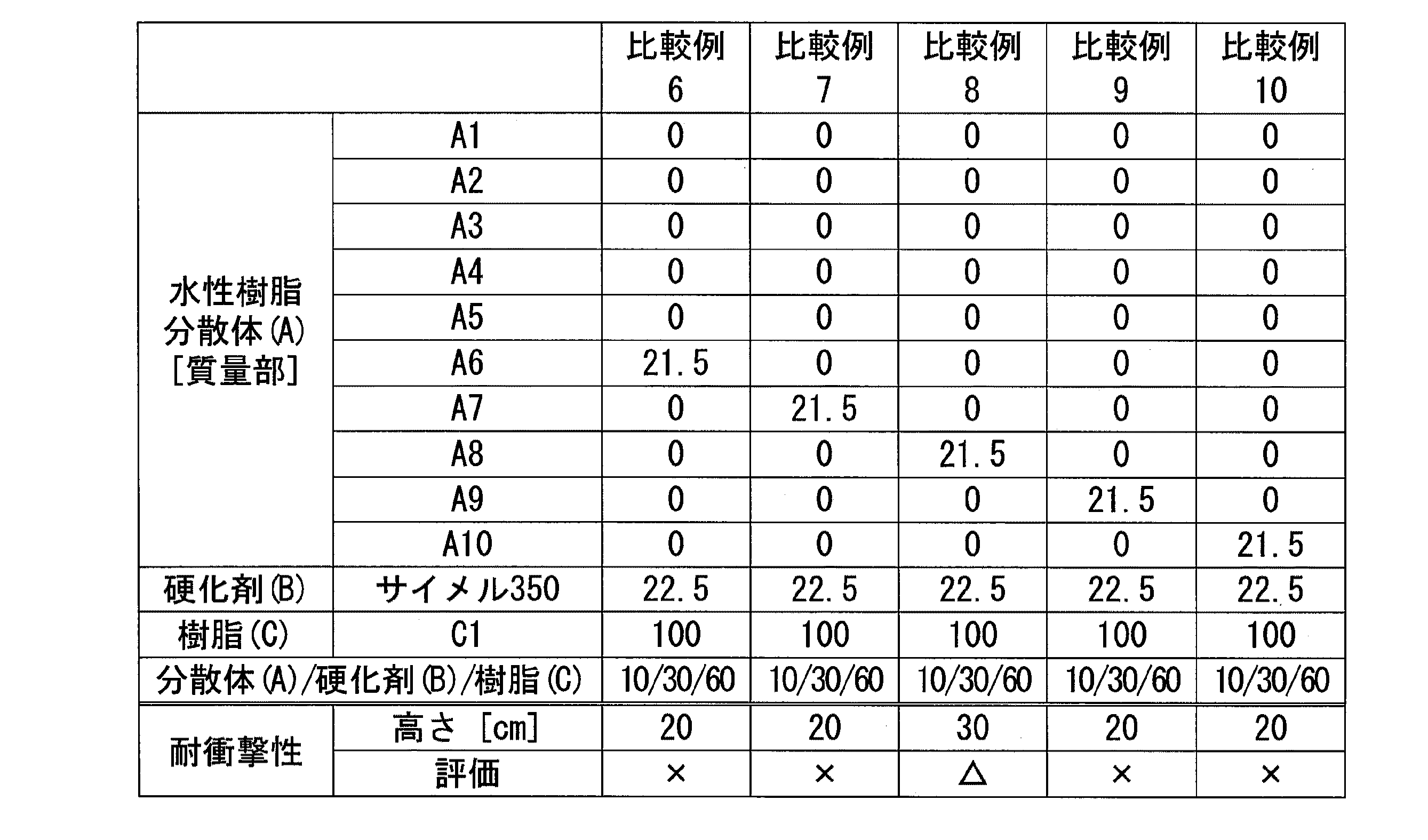
[実施例1]
<水性樹脂分散体(A1)の調製>
(工程(a))
攪拌機、還流冷却管、温度制御装置及び滴下ポンプを備えたフラスコに、ウレタン重合体(I)としてポリエーテル系ウレタン重合体(住化コベストロウレタン株式会社製、商品名:インプラニールDLE、固形分50%)85.72部(固形分42.86部)と、脱イオン水189部と、水酸基含有ラジカル重合性単量体(a1)として2−ヒドロキシエチルメタクリレート13.2部、及びその他のラジカル重合性単量体(a3)としてn−ブチルアクリレート72.52部からなるアクリル系単量体成分(II−1)を仕込み、フラスコを40℃に昇温した。その後、重合開始剤として、t−ブチルヒドロパーオキサイド水溶液(日油株式会社製、商品名:パーブチルH69、固形分69%)0.014部と、還元剤として硫酸第一鉄0.0002部と、エチレンジアミン四酢酸(EDTA)0.00027部と、イソアスコルビン酸ナトリウム一水和物0.016部と、脱イオン水1部とを添加した。引き続き、重合発熱によるピークトップ温度を確認後、フラスコの内温を75℃に昇温し、ウレタン重合体(I)及びアクリル重合体(II−1)を含む重合体粒子(重合体混合物(P))が水に分散した分散液を得た。
アクリル系単量体成分(II−1)の組成、アクリル重合体(II−1)のガラス転移温度、水酸基価及び酸価を表2に示す。なお、ガラス転移温度は前記式(i)より求め、水酸基価は前記式(ii)より求め、酸価は前記式(iii)より求めた。
Example 1
<Preparation of Aqueous Resin Dispersion (A1)>
(Step (a))
In a flask equipped with a stirrer, a reflux condenser, a temperature controller, and a dropping pump, a polyether urethane polymer (made by Sumika Kobetro Urethane Co., Ltd., trade name: Implany DLE, solid content) as urethane polymer (I) 50%) 85.72 parts (solid content 42.86 parts), 189 parts of deionized water, 13.2 parts of 2-hydroxyethyl methacrylate as a hydroxyl group-containing radically polymerizable monomer (a1), and other radicals An acrylic monomer component (II-1) consisting of 72.52 parts of n-butyl acrylate was charged as a polymerizable monomer (a3), and the flask was heated to 40 ° C. Thereafter, 0.014 part of t-butyl hydroperoxide aqueous solution (manufactured by NOF Corporation, trade name: Perbutyl H69, solid content 69%) as a polymerization initiator, and 0.0002 part of ferrous sulfate as a reducing agent Add 0.00027 parts of ethylenediaminetetraacetic acid (EDTA), 0.016 parts of sodium isoascorbate monohydrate, and 1 part of deionized water. Subsequently, after confirming the peak top temperature due to polymerization heat generation, the internal temperature of the flask is raised to 75 ° C., and polymer particles (polymer mixture (P) containing urethane polymer (I) and acrylic polymer (II-1) ) Obtained dispersion dispersed in water.
The composition of the acrylic monomer component (II-1), the glass transition temperature of the acrylic polymer (II-1), the hydroxyl value and the acid value are shown in Table 2. In addition, the glass transition temperature was calculated | required from said Formula (i), the hydroxyl value was calculated | required from said Formula (ii), and the acid value was calculated | required from said Formula (iii).
(工程(b))
次いで、工程(a)得られた重合体混合物(P)の分散液に、酸基含有ラジカル重合性単量体(a2)としてメタクリル酸0.3部、及びその他のラジカル重合性単量体(a3)としてi−ブチルメタクリレート13.98部からなるアクリル系単量体成分(II−2)と、アニオン界面活性剤(株式会社ADEKA製、商品名:アデカリアソープ(登録商標)SR−1025、固形分25%)1.4部(固形分0.35部)と、脱イオン水6.0部とを含むプレ乳化液、及び重合開始剤として過硫酸アンモニウム(株式会社ADEKA製、商品名:APS)0.05部と、脱イオン水14.0部とを含む重合開始剤水溶液を1時間かけて並列滴下した。プレ乳化液及び重合開始剤水溶液の滴下中はフラスコの内温を75℃に保持し、滴下が終了してから75℃で1.5時間保持した。その後、反応液を40℃まで冷却し、塩基性化合物として2−ジメチルアミノエタノール0.32部と、脱イオン水5.0部とを添加し、ウレタン重合体(I)、及びアクリル重合体(II−1)とアクリル重合体(II−2)とで構成されたアクリル重合体(II)を含む重合体粒子(重合体混合物(Q))が水に分散した分散液を得た。この分散液を水性樹脂分散体(A1)とした。水性樹脂分散体(A1)の固形分は35%であった。なお、アクリル重合体(II−1)とアクリル重合体(II−2)の質量比は、アクリル重合体(II−1)/アクリル重合体(II−2)=85.72/14.28であった。
アクリル系単量体成分(II−2)の組成、アクリル重合体(II−2)のガラス転移温度、水酸基価及び酸価を表2に示す。なお、ガラス転移温度は前記式(i)より求め、水酸基価は前記式(ii)より求め、酸価は前記式(iii)より求めた。
また、水性樹脂分散体(A1)に含まれる重合体粒子(重合体混合物(Q))の平均粒子径を測定した。結果を表2に示す。
さらに、水性樹脂分散体(A1)について、貯蔵安定性を評価した。結果を表2に示す。
(Step (b))
Next, 0.3 parts of methacrylic acid as an acid group-containing radically polymerizable monomer (a2) and other radically polymerizable monomers (a) in the dispersion of the polymer mixture (P) obtained in the step (a) a3) an acrylic monomer component (II-2) consisting of 13.98 parts of i-butyl methacrylate, and an anionic surfactant (made by ADEKA Co., Ltd., trade name: Adekaria Soap (registered trademark) SR-1025, Pre-emulsion containing 1.4 parts (solids content: 25%) (solids content: 0.35 parts) and 6.0 parts of deionized water, and ammonium persulfate (made by ADEKA Co., Ltd., trade name: APS as polymerization initiator) The polymerization initiator aqueous solution containing 0.05 part and 14.0 parts of deionized water was dropped in parallel over 1 hour. During the dropping of the pre-emulsion and the aqueous polymerization initiator solution, the internal temperature of the flask was kept at 75 ° C., and after the dropping was completed, the temperature was kept at 75 ° C. for 1.5 hours. Thereafter, the reaction solution is cooled to 40 ° C., 0.32 part of 2-dimethylaminoethanol as a basic compound and 5.0 parts of deionized water are added, urethane polymer (I), and acrylic polymer ( A dispersion liquid is obtained in which polymer particles (polymer mixture (Q)) containing an acrylic polymer (II) composed of II-1) and an acrylic polymer (II-2) are dispersed in water. This dispersion was used as an aqueous resin dispersion (A1). The solid content of the aqueous resin dispersion (A1) was 35%. The mass ratio of the acrylic polymer (II-1) to the acrylic polymer (II-2) is acrylic polymer (II-1) / acrylic polymer (II-2) = 85.72 / 14.28. there were.
The composition of the acrylic monomer component (II-2), the glass transition temperature of the acrylic polymer (II-2), the hydroxyl value and the acid value are shown in Table 2. In addition, the glass transition temperature was calculated | required from said Formula (i), the hydroxyl value was calculated | required from said Formula (ii), and the acid value was calculated | required from said Formula (iii).
Moreover, the average particle diameter of the polymer particle (polymer mixture (Q)) contained in aqueous resin dispersion (A1) was measured. The results are shown in Table 2.
Furthermore, the storage stability of the aqueous resin dispersion (A1) was evaluated. The results are shown in Table 2.
[実施例2〜5、比較例1〜5]
<水性樹脂分散体(A2)〜(A10)の調製>
アクリル系単量体成分(II−1)及びアクリル系単量体成分(II−2)の配合組成を表2、3に示すように変更した以外は、実施例1の水性樹脂分散体(A1)の調製と同様にして、水性樹脂分散体(A2)〜(A10)を調製した。各種測定結果及び評価結果を表2、3に示す。
なお、表2、3中の各成分の配合量は固形分量であり、ウレタン重合体(I)/アクリル重合体(II)で表される質量比は、固形分換算での質量比である。
[Examples 2 to 5, Comparative Examples 1 to 5]
<Preparation of Aqueous Resin Dispersions (A2) to (A10)>
An aqueous resin dispersion (A1) of Example 1 except that the composition of the acrylic monomer component (II-1) and the acrylic monomer component (II-2) was changed as shown in Tables 2 and 3. Aqueous resin dispersions (A2) to (A10) were prepared in the same manner as in the preparation of (1). Various measurement results and evaluation results are shown in Tables 2 and 3.
In addition, the compounding quantity of each component in Table 2, 3 is solid content, and mass ratio represented by urethane polymer (I) / acrylic polymer (II) is mass ratio in conversion of solid content.
表2、3中の略号は以下の通りである。
・DLE:ウレタン重合体(I)の水分散液(住化コベストロウレタン株式会社製、商品名:インプラニールDLE、固形分50%)
・HEMA:2−ヒドロキシエチルメタクリレート(転移温度(Tg):55℃)
・HEA:2−ヒドロキシエチルアクリレート(Tg:−20℃)
・BA:n−ブチルアクリレート(Tg:−45℃)
・MMA:メチルメタクリレート(Tg:105℃)
・MAA:メタクリル酸(Tg:185℃)
・iBMA:i−ブチルメタクリレート(Tg:48℃)
The abbreviations in Tables 2 and 3 are as follows.
-DLE: Water dispersion of urethane polymer (I) (manufactured by Sumika Kobe Soro Urethane Co., Ltd., trade name: Implanil DLE, solid content 50%)
HEMA: 2-hydroxyethyl methacrylate (transition temperature (Tg): 55 ° C.)
HEA: 2-hydroxyethyl acrylate (Tg: -20 ° C)
· BA: n-butyl acrylate (Tg: -45 ° C)
MMA: methyl methacrylate (Tg: 105 ° C.)
・ MAA: methacrylic acid (Tg: 185 ° C)
IBMA: i-butyl methacrylate (Tg: 48 ° C.)
表2の結果より、実施例1〜5で得られた水性樹脂分散体(A1)〜(A5)は、貯蔵安定性に優れていた。
一方、表3の結果より、水酸基価が100mgKOH/gより高いアクリル重合体(II)を含む水性樹脂分散体(A8)の場合(比較例3)、貯蔵安定性に劣っていた。
From the results of Table 2, the aqueous resin dispersions (A1) to (A5) obtained in Examples 1 to 5 were excellent in storage stability.
On the other hand, from the results of Table 3, in the case of the aqueous resin dispersion (A8) containing an acrylic polymer (II) having a hydroxyl value higher than 100 mg KOH / g (Comparative Example 3), the storage stability was inferior.
[実施例6]
水性樹脂分散体(A1)21.5部(固形分7.525部)と、硬化剤(B)としてメラミン樹脂(ダイセル・オルネクス株式会社製、商品名:サイメル350)22.5部と、樹脂(C1)100部(固形分45部)と、顔料分散溶液として二酸化チタン含有水性カラー(日本ピグメント株式会社製、商品名:WT−9004ホワイト)200部と、溶剤として2−エチル−1−ヘキサノール6部とを混合し、水性塗料を調製した。
得られた水性塗料を用いて評価用塗板を作製し、耐衝撃性を評価した。結果を表4に示す。
[Example 6]
21.5 parts (solid content: 7.525 parts) of an aqueous resin dispersion (A1), 22.5 parts of a melamine resin (made by Daicel Ornex Co., Ltd., trade name: Cymel 350) as a curing agent (B), and a resin (C1) 100 parts (solid content 45 parts), 200 parts of a titanium dioxide-containing aqueous color (made by Nippon Pigment Co., Ltd., trade name: WT-9004 white) as a pigment dispersion, and 2-ethyl-1-hexanol as a solvent An aqueous paint was prepared by mixing with 6 parts.
The paint board for evaluation was produced using the obtained water-based paint, and impact resistance was evaluated. The results are shown in Table 4.
[実施例7〜10、比較例6〜10]
水性樹脂分散体(A)の種類と配合量を表4、5に示すように変更した以外は、実施例6と同様にして水性塗料を調製し、得られた水性塗料を用いて評価用塗板を作製し、耐衝撃性を評価した。結果を表4、5に示す。
なお、表4、5中の分散体(A)/硬化剤(B)/樹脂(C)で表される質量比は、固形分換算での質量比である。
[Examples 7 to 10, Comparative Examples 6 to 10]
An aqueous paint was prepared in the same manner as in Example 6 except that the type and blending amount of the aqueous resin dispersion (A) were changed as shown in Tables 4 and 5, and the coated plate for evaluation was prepared using the obtained aqueous paint. Were evaluated for impact resistance. The results are shown in Tables 4 and 5.
In addition, mass ratio represented by dispersion (A) / hardening | curing agent (B) / resin (C) in Table 4, 5 is mass ratio in conversion of solid content.
表4の結果より、水性樹脂分散体(A1)〜(A5)のいずれかを含む実施例6〜10で得られた水性塗料は、耐衝撃性に優れた塗膜を形成できた。
一方、表5の結果より、水酸基価が25mgKOH/g未満であるアクリル重合体(II)を含む水性樹脂分散体(A6)、(A7)の場合、塗膜の耐衝撃性に劣っていた(比較例6、7)。
酸価が0.5mgKOH/g未満であるアクリル重合体(II)を含む水性樹脂分散体(A9)の場合、塗膜の耐衝撃性に劣っていた(比較例9)。
ガラス転移温度が−10℃より高いアクリル重合体(II)を含む水性樹脂分散体(A10)の場合、塗膜の耐衝撃性に劣っていた(比較例10)。
From the results of Table 4, the water-based paints obtained in Examples 6 to 10 containing any of the water-based resin dispersions (A1) to (A5) were able to form a coating film excellent in impact resistance.
On the other hand, from the results of Table 5, in the case of the aqueous resin dispersions (A6) and (A7) containing the acrylic polymer (II) having a hydroxyl value of less than 25 mg KOH / g, the impact resistance of the coating film was inferior ((6) Comparative Examples 6 and 7).
In the case of the aqueous resin dispersion (A9) containing the acrylic polymer (II) having an acid value of less than 0.5 mg KOH / g, the impact resistance of the coating film was inferior (Comparative Example 9).
In the case of the aqueous resin dispersion (A10) containing acrylic polymer (II) whose glass transition temperature is higher than -10 degreeC, the impact resistance of the coating film was inferior (comparative example 10).
本発明の水性樹脂分散体は、耐衝撃性に優れた塗膜が得られる水性塗料の材料として好適である。 The aqueous resin dispersion of the present invention is suitable as a material of an aqueous paint which can provide a coating film having excellent impact resistance.
Claims (7)
前記アクリル重合体(II)の水酸基価が25〜100mgKOH/gであり、酸価が0.5〜25mgKOH/gであり、かつガラス転移温度が−10℃以下である、水性樹脂分散体。 An aqueous resin dispersion in which polymer particles containing a urethane polymer (I) and an acrylic polymer (II) are dispersed in an aqueous medium,
The aqueous resin dispersion whose hydroxyl value of the said acrylic polymer (II) is 25-100 mgKOH / g, an acid value is 0.5-25 mgKOH / g, and whose glass transition temperature is -10 degrees C or less.
工程(a):水性媒体及び前記ウレタン重合体(I)の存在下で、アクリル系単量体成分(II−1)を重合し、前記ウレタン重合体(I)及びアクリル重合体(II−1)を含む重合体混合物(P)の分散液を得る工程。
工程(b):水性媒体及び前記重合体混合物(P)の存在下で、アクリル系単量体成分(II−2)を重合し、前記ウレタン重合体(I)、及び前記アクリル重合体(II−1)とアクリル重合体(II−2)とで構成された前記アクリル重合体(II)を含む重合体混合物(Q)の分散液を得る工程。 The aqueous resin dispersion of Claim 1 obtained through the following process (a) and process (b).
Step (a): in the presence of an aqueous medium and the urethane polymer (I), the acrylic monomer component (II-1) is polymerized to form the urethane polymer (I) and the acrylic polymer (II-1) Obtaining a dispersion of the polymer mixture (P) containing
Step (b): The acrylic monomer component (II-2) is polymerized in the presence of an aqueous medium and the polymer mixture (P) to form the urethane polymer (I), and the acrylic polymer (II) 1) A step of obtaining a dispersion liquid of a polymer mixture (Q) containing the above-mentioned acrylic polymer (II) composed of-1 and an acrylic polymer (II-2).
Priority Applications (1)
| Application Number | Priority Date | Filing Date | Title |
|---|---|---|---|
| JP2018004630A JP7114904B2 (en) | 2018-01-16 | 2018-01-16 | Aqueous resin dispersion-containing mixture, method for producing the same, and coated object |
Applications Claiming Priority (1)
| Application Number | Priority Date | Filing Date | Title |
|---|---|---|---|
| JP2018004630A JP7114904B2 (en) | 2018-01-16 | 2018-01-16 | Aqueous resin dispersion-containing mixture, method for producing the same, and coated object |
Publications (2)
| Publication Number | Publication Date |
|---|---|
| JP2019123790A true JP2019123790A (en) | 2019-07-25 |
| JP7114904B2 JP7114904B2 (en) | 2022-08-09 |
Family
ID=67398122
Family Applications (1)
| Application Number | Title | Priority Date | Filing Date |
|---|---|---|---|
| JP2018004630A Active JP7114904B2 (en) | 2018-01-16 | 2018-01-16 | Aqueous resin dispersion-containing mixture, method for producing the same, and coated object |
Country Status (1)
| Country | Link |
|---|---|
| JP (1) | JP7114904B2 (en) |
Cited By (3)
| Publication number | Priority date | Publication date | Assignee | Title |
|---|---|---|---|---|
| CN111320926A (en) * | 2020-03-26 | 2020-06-23 | 山东兴师网络科技有限公司 | Environment-friendly two-component water-based finishing varnish for automobile |
| CN112126333A (en) * | 2020-09-24 | 2020-12-25 | 广州亮涂科技有限公司 | Water-based quick-drying easy-to-construct automobile repair varnish and preparation method thereof |
| WO2022196396A1 (en) * | 2021-03-16 | 2022-09-22 | 三菱ケミカル株式会社 | Aqueous resin dispersion, method for producing same, and ink containing said dispersion |
Citations (4)
| Publication number | Priority date | Publication date | Assignee | Title |
|---|---|---|---|---|
| JPH09221506A (en) * | 1995-07-24 | 1997-08-26 | Basf Corp | Production of hydrophobically modified emulsion polymer, polymer obtained thereby, and water-base coating composition containing this polymer |
| JP2004358462A (en) * | 2003-05-13 | 2004-12-24 | Nippon Paint Co Ltd | Method of forming multilayer coating film |
| JP2013213151A (en) * | 2012-04-03 | 2013-10-17 | Kansai Paint Co Ltd | Aqueous paint composition and method for forming coating |
| JP2015086365A (en) * | 2013-09-24 | 2015-05-07 | 三洋化成工業株式会社 | Composite resin particle and composite resin particle aqueous dispersion |
-
2018
- 2018-01-16 JP JP2018004630A patent/JP7114904B2/en active Active
Patent Citations (4)
| Publication number | Priority date | Publication date | Assignee | Title |
|---|---|---|---|---|
| JPH09221506A (en) * | 1995-07-24 | 1997-08-26 | Basf Corp | Production of hydrophobically modified emulsion polymer, polymer obtained thereby, and water-base coating composition containing this polymer |
| JP2004358462A (en) * | 2003-05-13 | 2004-12-24 | Nippon Paint Co Ltd | Method of forming multilayer coating film |
| JP2013213151A (en) * | 2012-04-03 | 2013-10-17 | Kansai Paint Co Ltd | Aqueous paint composition and method for forming coating |
| JP2015086365A (en) * | 2013-09-24 | 2015-05-07 | 三洋化成工業株式会社 | Composite resin particle and composite resin particle aqueous dispersion |
Cited By (4)
| Publication number | Priority date | Publication date | Assignee | Title |
|---|---|---|---|---|
| CN111320926A (en) * | 2020-03-26 | 2020-06-23 | 山东兴师网络科技有限公司 | Environment-friendly two-component water-based finishing varnish for automobile |
| CN112126333A (en) * | 2020-09-24 | 2020-12-25 | 广州亮涂科技有限公司 | Water-based quick-drying easy-to-construct automobile repair varnish and preparation method thereof |
| CN112126333B (en) * | 2020-09-24 | 2022-02-08 | 广州亮涂科技有限公司 | Water-based quick-drying easy-to-construct automobile repair varnish and preparation method thereof |
| WO2022196396A1 (en) * | 2021-03-16 | 2022-09-22 | 三菱ケミカル株式会社 | Aqueous resin dispersion, method for producing same, and ink containing said dispersion |
Also Published As
| Publication number | Publication date |
|---|---|
| JP7114904B2 (en) | 2022-08-09 |
Similar Documents
| Publication | Publication Date | Title |
|---|---|---|
| CN105051078B (en) | Polymer particle, polymer dispersion, method for producing same, coating material and coated article obtained from polymer dispersion | |
| JP5116548B2 (en) | Method for producing pigment dispersing resin | |
| JP6700340B2 (en) | Aqueous coating composition and method for producing aqueous coating composition | |
| EP3623424A1 (en) | Thermosetting resin composition | |
| JP5408888B2 (en) | Water-dispersed resin, two-component thermosetting resin composition, and production method thereof | |
| WO2017115804A1 (en) | Aqueous coating material composition and coating film forming method | |
| EP3747553A1 (en) | Method for forming multilayer coating film and multilayer coating film | |
| JP7114904B2 (en) | Aqueous resin dispersion-containing mixture, method for producing the same, and coated object | |
| JP5979746B2 (en) | Multi-component water-based base coat coating composition | |
| EP4013831B1 (en) | Two-component polyurethane composition | |
| JP6068178B2 (en) | Method for producing polymer dispersion, method for producing aqueous coating material, and method for producing coated product | |
| JP4197130B2 (en) | Emulsion polymerization resin composition | |
| JP2014125602A (en) | Multi-component aqueous coloring base coat coating composition | |
| JP5476260B2 (en) | Resin composition, aqueous coating composition containing the resin composition, and multilayer coating film forming method | |
| JP7114903B2 (en) | Aqueous resin dispersion-containing mixture and coated material | |
| JPWO2018079315A1 (en) | ABA triblock polymer, viscosity modifier and aqueous coating composition | |
| EP4069791B1 (en) | Two-component polyurethane composition | |
| JP6481926B2 (en) | Method for producing polymer dispersion, coating material obtained from polymer dispersion and coated product | |
| JP2018009082A (en) | POLYMER PARTICLE, AQUEOUS COATING MATERIAL, PROCESS FOR PRODUCING THEM, AND COATED PRODUCT | |
| JP2016040360A (en) | Polymer particle, polymer dispersion liquid, aqueous coating material, and coated article | |
| JP2018009083A (en) | Method for producing aqueous coating material, aqueous coating material and painted product | |
| JP6469383B2 (en) | Polymer particles, polymer dispersions, coating materials and painted products | |
| KR20210061389A (en) | 2-component polyurethane composition | |
| JP2018009081A (en) | Method for producing aqueous coating material, aqueous coating material and painted product | |
| JP2018009080A (en) | Method for producing aqueous coating material, aqueous coating material, and coated article |
Legal Events
| Date | Code | Title | Description |
|---|---|---|---|
| A621 | Written request for application examination |
Free format text: JAPANESE INTERMEDIATE CODE: A621 Effective date: 20201029 |
|
| A977 | Report on retrieval |
Free format text: JAPANESE INTERMEDIATE CODE: A971007 Effective date: 20210616 |
|
| A131 | Notification of reasons for refusal |
Free format text: JAPANESE INTERMEDIATE CODE: A131 Effective date: 20210713 |
|
| A521 | Request for written amendment filed |
Free format text: JAPANESE INTERMEDIATE CODE: A523 Effective date: 20210825 |
|
| A02 | Decision of refusal |
Free format text: JAPANESE INTERMEDIATE CODE: A02 Effective date: 20220118 |
|
| A521 | Request for written amendment filed |
Free format text: JAPANESE INTERMEDIATE CODE: A523 Effective date: 20220414 |
|
| C60 | Trial request (containing other claim documents, opposition documents) |
Free format text: JAPANESE INTERMEDIATE CODE: C60 Effective date: 20220414 |
|
| A911 | Transfer to examiner for re-examination before appeal (zenchi) |
Free format text: JAPANESE INTERMEDIATE CODE: A911 Effective date: 20220422 |
|
| C21 | Notice of transfer of a case for reconsideration by examiners before appeal proceedings |
Free format text: JAPANESE INTERMEDIATE CODE: C21 Effective date: 20220426 |
|
| TRDD | Decision of grant or rejection written | ||
| A01 | Written decision to grant a patent or to grant a registration (utility model) |
Free format text: JAPANESE INTERMEDIATE CODE: A01 Effective date: 20220628 |
|
| A61 | First payment of annual fees (during grant procedure) |
Free format text: JAPANESE INTERMEDIATE CODE: A61 Effective date: 20220711 |
|
| R151 | Written notification of patent or utility model registration |
Ref document number: 7114904 Country of ref document: JP Free format text: JAPANESE INTERMEDIATE CODE: R151 |