JP2019178461A - Recycled pulp fiber, and manufacturing method of recycled pulp fiber - Google Patents
Recycled pulp fiber, and manufacturing method of recycled pulp fiber Download PDFInfo
- Publication number
- JP2019178461A JP2019178461A JP2018069434A JP2018069434A JP2019178461A JP 2019178461 A JP2019178461 A JP 2019178461A JP 2018069434 A JP2018069434 A JP 2018069434A JP 2018069434 A JP2018069434 A JP 2018069434A JP 2019178461 A JP2019178461 A JP 2019178461A
- Authority
- JP
- Japan
- Prior art keywords
- pulp fiber
- recycled pulp
- ozone
- superabsorbent polymer
- aqueous solution
- Prior art date
- Legal status (The legal status is an assumption and is not a legal conclusion. Google has not performed a legal analysis and makes no representation as to the accuracy of the status listed.)
- Granted
Links
Images



Classifications
-
- Y—GENERAL TAGGING OF NEW TECHNOLOGICAL DEVELOPMENTS; GENERAL TAGGING OF CROSS-SECTIONAL TECHNOLOGIES SPANNING OVER SEVERAL SECTIONS OF THE IPC; TECHNICAL SUBJECTS COVERED BY FORMER USPC CROSS-REFERENCE ART COLLECTIONS [XRACs] AND DIGESTS
- Y02—TECHNOLOGIES OR APPLICATIONS FOR MITIGATION OR ADAPTATION AGAINST CLIMATE CHANGE
- Y02W—CLIMATE CHANGE MITIGATION TECHNOLOGIES RELATED TO WASTEWATER TREATMENT OR WASTE MANAGEMENT
- Y02W30/00—Technologies for solid waste management
- Y02W30/50—Reuse, recycling or recovery technologies
- Y02W30/62—Plastics recycling; Rubber recycling
-
- Y—GENERAL TAGGING OF NEW TECHNOLOGICAL DEVELOPMENTS; GENERAL TAGGING OF CROSS-SECTIONAL TECHNOLOGIES SPANNING OVER SEVERAL SECTIONS OF THE IPC; TECHNICAL SUBJECTS COVERED BY FORMER USPC CROSS-REFERENCE ART COLLECTIONS [XRACs] AND DIGESTS
- Y02—TECHNOLOGIES OR APPLICATIONS FOR MITIGATION OR ADAPTATION AGAINST CLIMATE CHANGE
- Y02W—CLIMATE CHANGE MITIGATION TECHNOLOGIES RELATED TO WASTEWATER TREATMENT OR WASTE MANAGEMENT
- Y02W30/00—Technologies for solid waste management
- Y02W30/50—Reuse, recycling or recovery technologies
- Y02W30/64—Paper recycling
Landscapes
- Apparatus For Disinfection Or Sterilisation (AREA)
- Processing Of Solid Wastes (AREA)
- Separation, Recovery Or Treatment Of Waste Materials Containing Plastics (AREA)
- Paper (AREA)
Abstract
【課題】水中に溶出しうるタンパク質含有成分が少なく、水分と接触する用途に用いることができる、使用済の衛生用品に由来するリサイクルパルプ繊維を提供すること。
【解決手段】使用済の衛生用品に由来するリサイクルパルプ繊維であって、上記リサイクルパルプ繊維を5.0質量%の固形分濃度で分散させた水分散液が、タンパク質を、Modified Lowry法により測定された60μg/mL以下の濃度で含むリサイクルパルプ繊維。
【選択図】図2The present invention provides a recycled pulp fiber derived from a used sanitary product, which can be used in applications that come into contact with moisture and has few protein-containing components that can be eluted in water.
SOLUTION: Recycled pulp fibers derived from used sanitary goods, in which the above-mentioned recycled pulp fibers are dispersed at a solid content concentration of 5.0% by mass, the protein is measured by the Modified Lowry method. Recycled pulp fibers containing at a concentration of 60 μg / mL or less.
[Selection] Figure 2
Description
本開示は、使用済の衛生用品に由来するリサイクルパルプ繊維、及びパルプ繊維を含む、使用済の衛生用品からリサイクルパルプ繊維を製造する方法に関する。 The present disclosure relates to recycled pulp fibers derived from used sanitary goods, and methods for producing recycled pulp fibers from used sanitary goods, including pulp fibers.
使用済の衛生用品からリサイクルパルプ繊維を製造することが検討されている。
例えば、特許文献1には、セルロースパルプを含む衛生用品を再生処理して得られる再生繊維であって、高吸水性ポリマー(SAP)量が10%未満である再生繊維が記載されている。
The production of recycled pulp fiber from used sanitary goods is being considered.
For example,
特許文献2には、吸水してゲル状となっている吸水性樹脂を含有する汚れた衛生用品を粉砕し、この粉砕された衛生用品を消毒剤を含有する水中に分散させて、衛生用品に付着していた汚れの一部を前記衛生用品の粉砕物から分離することを特徴とする吸水してゲル状となっている吸水性樹脂を含有する汚れた衛生用品からのその素材の回収方法が記載されている。
使用済の衛生用品には、体液、食品残渣、細菌等が含まれているため、使用済の衛生用品から回収されたリサイクルパルプ繊維を、水分と接触する用途に用いる場合には、当該リサイクルパルプ繊維が、水分と接触した際に、体液、食品残渣、細菌等を水分中にできる限り放出させないことが好ましい。 Since used sanitary products contain body fluids, food residues, bacteria, etc., when recycled pulp fibers collected from used sanitary products are used for contact with moisture, the recycled pulp When the fibers come into contact with moisture, it is preferable that body fluids, food residues, bacteria, and the like are not released into the moisture as much as possible.
しかし、特許文献1に記載の再生繊維は、衛生用品から、リサイクルパルプ繊維を、他の構成資材を含まないように回収するものであり、体液等に由来するタンパク質含有成分の量を低減するものではない。また、特許文献2に記載の回収方法は、消毒剤を用いて衛生用品に付着する雑菌を消毒又は滅菌するものであり、体液等に由来するタンパク質含有成分の量を低減するものではない。
However, the regenerated fiber described in
従って、本開示は、水中に溶出しうるタンパク質含有成分が少なく、水分と接触する用途に用いることができる、使用済の衛生用品に由来するリサイクルパルプ繊維を提供することを目的とする。 Therefore, an object of the present disclosure is to provide a recycled pulp fiber derived from a used sanitary product, which can be used for an application that comes into contact with moisture and has few protein-containing components that can be eluted in water.
本開示者らは、使用済の衛生用品に由来するリサイクルパルプ繊維であって、上記リサイクルパルプ繊維を5.0質量%の固形分濃度で分散させた水分散液が、タンパク質を、Modified Lowry法により測定された60μg/mL以下の濃度で含むリサイクルパルプ繊維を見出した。 The present disclosure is a recycled pulp fiber derived from a used sanitary article, in which an aqueous dispersion in which the recycled pulp fiber is dispersed at a solid content concentration of 5.0% by mass is used to produce a protein in a modified lowry method. Recycled pulp fibers were found containing at a concentration of 60 μg / mL or less as measured by.
本開示の使用済の衛生用品に由来するリサイクルパルプ繊維は、水中に溶出しうるタンパク質含有成分が少なく、水分と接触する用途に用いることができる。 The recycled pulp fiber derived from the used sanitary article of the present disclosure has a small amount of protein-containing components that can be eluted in water, and can be used for applications that come into contact with moisture.
具体的には、本開示は以下の態様に関する。
[態様1]
使用済の衛生用品に由来するリサイクルパルプ繊維であって、
上記リサイクルパルプ繊維を5.0質量%の固形分濃度で分散させた水分散液が、タンパク質を、Modified Lowry法により測定された60μg/mL以下の濃度で含む、
上記リサイクルパルプ繊維。
Specifically, the present disclosure relates to the following aspects.
[Aspect 1]
Recycled pulp fiber derived from used sanitary goods,
An aqueous dispersion in which the recycled pulp fiber is dispersed at a solid content concentration of 5.0% by mass contains a protein at a concentration of 60 μg / mL or less as measured by the Modified Lowry method.
The above recycled pulp fiber.
使用済の衛生用品から回収された、リサイクルされた構成資材であるリサイクル資材は、利用の際に液体に接触した際に、使用済の衛生用品に由来する成分、例えば、体液(例えば、排泄物、分泌物)、食品残渣、細菌等が液体中に溶出しないことが好ましい。特に、細菌は、人体に及ぼす影響が大きいことから、リサイクルパルプ繊維は、使用済の衛生用品に由来する細菌を含まないことが好ましい。
これらの成分は、いずれも、タンパク質を含む共通点を有する(以下、体液、食品残渣、細菌等を「タンパク質含有成分」と称する場合がある)。
Recycled material, which is a recycled component material collected from used sanitary goods, is a component derived from used sanitary goods, such as bodily fluids (for example, excrement) when it comes into contact with liquids during use. , Secretions), food residues, bacteria, etc. are preferably not eluted in the liquid. In particular, since bacteria have a great influence on the human body, it is preferable that the recycled pulp fiber does not contain bacteria derived from used sanitary goods.
All of these components have common points including proteins (hereinafter, body fluids, food residues, bacteria, etc. may be referred to as “protein-containing components”).
一方、ヴァージンパルプ繊維は、その吸水性の高さから水分吸収用途に供される比率が高く、リサイクルパルプ繊維も、ヴァージンパルプ繊維と同様に、水分吸収用途に用いることができれば、リサイクルパルプ繊維の価値が高くなり、そしてパルプ繊維のリサイクルの市場が拡大することが期待される。
上記リサイクルパルプ繊維は、水中に溶出しうるタンパク質を所定量で含む、すなわち、使用済の衛生用品に由来するタンパク質含有成分のうち、水中に溶出しうるものを非常に少ない量で含むことから、水分と接触する用途、例えば、水分吸収用途に用いることができる。また、上記リサイクルパルプ繊維は、リサイクルパルプ繊維を用いるユーザーに安心感を与えることができる。
On the other hand, virgin pulp fibers have a high ratio of being used for moisture absorption because of their high water absorption, and recycled pulp fibers can be used for moisture absorption as well as virgin pulp fibers. The value is expected to increase and the pulp fiber recycling market is expected to expand.
The recycled pulp fiber contains a predetermined amount of protein that can be eluted in water, that is, a protein-containing component derived from a used sanitary article contains a very small amount of protein that can be eluted in water. It can be used for applications that come into contact with moisture, for example, moisture absorption applications. The recycled pulp fiber can give a sense of security to the user who uses the recycled pulp fiber.
[態様2]
混釈培養法により、セレウス菌及び枯草菌が検出されない、態様1に記載のリサイクルパルプ繊維。
[Aspect 2]
The recycled pulp fiber according to
バシラス(Bacillus)属菌、例えば、セレウス菌及び枯草菌は、土壌、水中、植物等に普遍的に存在する常在菌であり、芽胞を形成するために、耐久性が非常に高い菌である。芽胞は、熱、消毒薬等に対して耐久性が高く、一般的な消毒手法では除去しきれない場合があり、ごく稀ではあるが、菌血症、心内膜炎、呼吸器感染症、食中毒、眼感染症等を引き起こすことがある。
上記リサイクルパルプ繊維は、混釈培養法により、セレウス菌及び枯草菌が検出されないことから、菌血症、心内膜炎、呼吸器感染症、食中毒、眼感染症等を引き起こしにくく、使用者が、上記リサイクルパルプ繊維を安心して使用することができる。
Bacillus genus bacteria such as Bacillus cereus and Bacillus subtilis are resident bacteria that are ubiquitous in soil, water, plants, etc., and are highly durable because they form spores. . Spores are highly resistant to heat, disinfectants, etc., and may not be removed by general disinfection techniques, but rarely, bacteremia, endocarditis, respiratory infections, May cause food poisoning, eye infection, etc.
The above recycled pulp fiber is not likely to cause bacteremia, endocarditis, respiratory infections, food poisoning, eye infections, etc., since the Bacillus cereus and Bacillus subtilis are not detected by the pour culture method. The recycled pulp fiber can be used with confidence.
[態様3]
混釈培養法により、バシラス属菌が検出されない、態様1又は2に記載のリサイクルパルプ繊維。
[Aspect 3]
The recycled pulp fiber according to
上記リサイクルパルプ繊維は、混釈培養法により、Bacillus属菌が検出されないことから、菌血症、心内膜炎、呼吸器感染症、食中毒、眼感染症等を引き起こしにくく、使用者が、上記リサイクルパルプ繊維を安心して使用することができる。 The recycled pulp fiber is not likely to cause bacteremia, endocarditis, respiratory infection, food poisoning, eye infection, etc., because the Bacillus genus bacteria are not detected by the pour culture method. Recycled pulp fiber can be used with confidence.
[態様4]
混釈培養法により、細菌が検出されない、態様1〜3のいずれか一項に記載のリサイクルパルプ繊維。
[Aspect 4]
The recycled pulp fiber according to any one of
上記リサイクルパルプ繊維は、混釈培養法により、細菌、具体的には、一般生菌が検出されないので、上記リサイクルパルプ繊維を、動物が接触しうる水吸収用途に用いることができる。また、使用者が、上記リサイクルパルプ繊維を安心して使用することができる。 Bacteria, specifically, general viable bacteria are not detected in the recycled pulp fiber by the pour culture method. Therefore, the recycled pulp fiber can be used for water absorption applications where animals can come into contact. Moreover, the user can use the said recycled pulp fiber in comfort.
[態様5]
平板培養法により、細菌が検出されない、態様1〜4のいずれか一項に記載のリサイクルパルプ繊維。
[Aspect 5]
The recycled pulp fiber according to any one of
上記リサイクルパルプ繊維は、平板培養法により、細菌、具体的には、腸内細菌が検出されないことから、菌血症、心内膜炎、呼吸器感染症、食中毒、眼感染症等を引き起こしにくく、使用者が、上記リサイクルパルプ繊維を安心して使用することができる。 The recycled pulp fiber is not likely to cause bacteremia, endocarditis, respiratory infections, food poisoning, eye infections, etc., because bacteria, specifically enteric bacteria, are not detected by the plate culture method. The user can use the recycled pulp fiber with peace of mind.
[態様6]
標準白板に対して、0〜20のΔYIを有する、態様1〜5のいずれか一項に記載のリサイクルパルプ繊維。
[Aspect 6]
The recycled pulp fiber according to any one of
使用済の衛生用品に含まれるパルプ繊維は、排泄物(例えば、糞、尿等)を吸収し、茶系、黄色系の着色がなされている場合がある。従って、使用済の衛生用品のパルプ繊維を、リサイクルパルプ繊維として再利用するためには、排泄物に起因する着色を漂白する必要が有る。また、使用済の衛生用品に由来するリサイクルパルプ繊維に対して、使用者が心理的抵抗感を有することが多いため、使用者の心理的抵抗感を減少させる観点からも、リサイクルパルプ繊維が、高い白色度を有することが好ましい。
上記リサイクルパルプ繊維は、所定のΔYIを有する、すなわち、ヴァージンパルプと同等以上の白色度を有するため、使用者が、リサイクルパルプ繊維を用いた物品に対して心理的抵抗感を覚えにくい。
The pulp fiber contained in the used sanitary goods may absorb excrement (for example, feces, urine, etc.) and may be colored brown or yellow. Therefore, in order to reuse the pulp fiber of used sanitary goods as recycled pulp fiber, it is necessary to bleach the color caused by excrement. In addition, since the user often has a psychological resistance to the recycled pulp fiber derived from used sanitary goods, from the viewpoint of reducing the user's psychological resistance, the recycled pulp fiber, It is preferable to have high whiteness.
Since the recycled pulp fiber has a predetermined ΔYI, that is, has a whiteness equal to or higher than that of virgin pulp, the user hardly feels psychological resistance to the article using the recycled pulp fiber.
[態様7]
標準白板に対して、0〜20のΔWを有する、態様1〜6のいずれか一項に記載のリサイクルパルプ繊維。
[Aspect 7]
The recycled pulp fiber according to any one of
上記リサイクルパルプ繊維は、所定のΔWを有する、すなわち、ヴァージンパルプと同等以上の白色度を有するため、使用者が、リサイクルパルプ繊維を用いた物品に対して心理的抵抗感を覚えにくい。 Since the recycled pulp fiber has a predetermined ΔW, that is, has a whiteness equal to or higher than that of virgin pulp, the user hardly feels psychological resistance to the article using the recycled pulp fiber.
[態様8]
パルプ繊維を含む、使用済の衛生用品からリサイクルパルプ繊維を製造する方法であって、
上記パルプ繊維を含む水溶液を、エジェクタを備える処理槽であって、上記エジェクタが、駆動流体供給口と、上記処理槽に連接される混合流体吐出口と、それらの間の吸引流体供給口とを備えるものの上記駆動流体供給口に供給しつつ、オゾンを上記吸引流体供給口に供給する供給ステップと、
上記水溶液及び上記オゾンが上記エジェクタ内で混合されることにより形成された混合液を、上記混合流体吐出口から、上記処理槽内の処理液中に吐出して、上記パルプ繊維中のタンパク質含有成分を分解し、リサイクルパルプ繊維であって、上記リサイクルパルプ繊維を5.0質量%の固形分濃度で分散させた水分散液が、タンパク質を、Modified Lowry法により測定された60μg/mL以下の濃度で含むものを形成するリサイクルパルプ繊維形成ステップと、
を含む、上記方法。
[Aspect 8]
A method of producing recycled pulp fibers from used sanitary goods, including pulp fibers,
An aqueous solution containing the pulp fiber is a treatment tank equipped with an ejector, and the ejector includes a driving fluid supply port, a mixed fluid discharge port connected to the treatment tank, and a suction fluid supply port therebetween. A supply step of supplying ozone to the suction fluid supply port while supplying the drive fluid supply port of what is provided;
The mixed solution formed by mixing the aqueous solution and the ozone in the ejector is discharged from the mixed fluid discharge port into the treatment liquid in the treatment tank, and the protein-containing component in the pulp fiber Is a recycled pulp fiber, in which an aqueous dispersion in which the recycled pulp fiber is dispersed at a solid content concentration of 5.0% by mass has a protein concentration of 60 μg / mL or less measured by the Modified Lowry method. Recycled pulp fiber forming step to form what is contained in,
Including the above method.
上記製造方法は、使用済の衛生用品に由来するタンパク質含有成分のうち、水中に溶出しうるものを非常に少ない量で含むリサイクルパルプ繊維を製造することができる。また、上記方法は、水分と接触する用途、例えば、水分吸収用途に用いることができるリサイクルパルプ繊維を製造することができる。さらには、上記製造方法は、ユーザーに安心感を与えることができるリサイクルパルプ繊維を製造することができる。 The said manufacturing method can manufacture the recycled pulp fiber which contains in a very small quantity what can be eluted in water among the protein containing components derived from used sanitary goods. Moreover, the said method can manufacture the recycled pulp fiber which can be used for the use which contacts with a water | moisture content, for example, a moisture absorption use. Furthermore, the said manufacturing method can manufacture the recycled pulp fiber which can give a user a sense of security.
[態様9]
上記使用済の衛生用品が、高吸水性ポリマーをさらに含み、上記供給ステップにおいて、上記水溶液が、上記高吸水性ポリマーをさらに含み、上記リサイクルパルプ繊維形成ステップにおいて、上記高吸水性ポリマーをさらに分解する、態様8に記載の方法。
[Aspect 9]
The used sanitary article further includes a superabsorbent polymer. In the supplying step, the aqueous solution further includes the superabsorbent polymer. In the recycled pulp fiber forming step, the superabsorbent polymer is further decomposed. The method of embodiment 8, wherein
上記製造方法では、高吸水性ポリマーが低減され、そして使用済の衛生用品に由来するタンパク質含有成分のうち、水中に溶出しうるものを非常に少ない量で含むリサイクルパルプ繊維を製造することができる。 In the above production method, the superabsorbent polymer is reduced, and recycled pulp fibers containing a very small amount of protein-containing components derived from used sanitary products that can be eluted in water can be produced. .
[態様10]
上記供給ステップの前に、酸性水溶液を用いて、上記高吸水性ポリマーを不活化する不活化ステップを含む、態様9に記載の方法。
[Aspect 10]
The method according to aspect 9, comprising an inactivation step of inactivating the superabsorbent polymer using an acidic aqueous solution before the supplying step.
上記製造方法は、所定の不活化ステップを含むため、上記供給ステップ及びリサイクルパルプ繊維形成ステップにおいて、オゾンが失活しにくくなり、ひいては、上記製造方法が、高吸水性ポリマーが低減され、そして使用済の衛生用品に由来するタンパク質含有成分のうち、水中に溶出しうるものを非常に少ない量で含むリサイクルパルプ繊維を製造することができる。 Since the production method includes a predetermined inactivation step, ozone is hardly deactivated in the supply step and the recycled pulp fiber formation step, and thus the production method reduces the superabsorbent polymer and uses it. Among the protein-containing components derived from the finished sanitary goods, recycled pulp fibers containing a very small amount that can be eluted in water can be produced.
本開示の使用済の衛生用品に由来するリサイクルパルプ繊維(以下、「使用済の衛生用品に由来するリサイクルパルプ繊維」を、『リサイクルパルプ繊維』と称する場合がある)について、以下、詳細に説明する。 Recycled pulp fibers derived from the used sanitary products of the present disclosure (hereinafter, “recycled pulp fibers derived from used sanitary products” may be referred to as “recycled pulp fibers”) are described in detail below. To do.
本開示のリサイクルパルプ繊維は、Modified Lowry法により測定された60μg/mL以下のタンパク質を含む。そうすることにより、使用済の衛生用品に由来するタンパク質含有成分のうち、水中に溶出しうるものを非常に少ない量で含むことから、水分吸収用途のみならず、水と接触する用途に用いることができる。また、上記リサイクルパルプ繊維は、リサイクルパルプ繊維を用いるユーザーに安心感を付与することができる。
なお、本明細書では、「溶出」は、対象成分が、任意の形態、例えば、溶解、分散等により水溶液中に移動することを意味する。
The recycled pulp fiber of the present disclosure includes a protein of 60 μg / mL or less measured by the Modified Lowry method. By doing so, among the protein-containing components derived from used sanitary goods, it contains a very small amount that can be eluted in water, so it is used not only for moisture absorption but also for applications that come into contact with water Can do. In addition, the recycled pulp fiber can give a sense of security to the user who uses the recycled pulp fiber.
In the present specification, “elution” means that the target component moves into the aqueous solution in any form, for example, dissolution, dispersion or the like.
リサイクルパルプ繊維に含まれるタンパク質濃度は、以下の通り測定する。
(1)Thermo Fisher Scientific社製のModified Lowry Protein Assay Kit(以下、「ML Kit」と称する場合がある)を準備する。
The protein concentration contained in the recycled pulp fiber is measured as follows.
(1) Prepared Modified Lowy Protein Assay Kit (hereinafter sometimes referred to as “ML Kit”) manufactured by Thermo Fisher Scientific.
(2)1リットルのビーカーに、リサイクルパルプ繊維の固形分濃度が5.0質量%の水分散液500gを準備する。
上記リサイクルパルプ繊維が乾燥状態で存在する場合には、上記水分散液は、リサイクルパルプ繊維(固形分として25.0g)と、脱イオン水(総量が500.0gとなる量)とを混合することにより形成することができる。そして、上記リサイクルパルプ繊維が水溶液で存在する場合(例えば、リサイクルパルプ繊維の製造方法において、リサイクルパルプ繊維を水溶液として回収した場合)であって、リサイクルパルプ繊維の固形分濃度が5.0質量%以上であるときには、当該水溶液に、脱イオン水を添加すること等により、サイクルパルプ繊維の固形分濃度が5.0質量%の水分散液を準備することができる。
(2) In a 1 liter beaker, 500 g of an aqueous dispersion having a recycled pulp fiber solid content concentration of 5.0 mass% is prepared.
When the recycled pulp fiber is present in a dry state, the aqueous dispersion is mixed with recycled pulp fiber (25.0 g as a solid content) and deionized water (amount that gives a total amount of 500.0 g). Can be formed. And when the said recycled pulp fiber exists in aqueous solution (For example, in the manufacturing method of recycled pulp fiber, when recycled pulp fiber is collect | recovered as aqueous solution), Comprising: Solid content concentration of recycled pulp fiber is 5.0 mass% When it is above, an aqueous dispersion having a solid content concentration of the cycle pulp fiber of 5.0% by mass can be prepared by adding deionized water to the aqueous solution.
さらに、上記リサイクルパルプ繊維が水溶液で存在する場合であって、リサイクルパルプ繊維の固形分濃度が5.0質量%未満であるときには、濾過により、リサイクルパルプ繊維の固形分濃度を5.0質量%に調整する。
本明細書では、固形分(例えば、リサイクルパルプ繊維の固形分)、及び固形分濃度(例えば、水分散液中のリサイクルパルプ繊維の固形分濃度)は、その一部の分画を、105℃で16時間乾燥することにより測定する。なお、上記固形分及び固形分濃度を測定するために用いた試料そのもの(例えば、リサイクルパルプ繊維そのもの)は、熱履歴が加わっているため、タンパク質濃度の測定には用いない。
なお、上記固形分濃度は、水分散液が、リサイクルパルプ繊維以外の不純物を含むことを考慮して規定するものである。
Further, when the recycled pulp fiber is present in an aqueous solution and the solid content concentration of the recycled pulp fiber is less than 5.0% by mass, the solid content concentration of the recycled pulp fiber is 5.0% by mass by filtration. Adjust to.
In the present specification, the solid content (for example, the solid content of recycled pulp fiber) and the solid content concentration (for example, the solid content concentration of recycled pulp fiber in the aqueous dispersion) are obtained by dividing a fraction thereof at 105 ° C. Measured by drying for 16 hours. Note that the sample itself (for example, recycled pulp fiber itself) used for measuring the solid content and the solid content concentration is not used for the measurement of the protein concentration because the thermal history is added.
In addition, the said solid content density | concentration is prescribed | regulated considering that an aqueous dispersion contains impurities other than a recycled pulp fiber.
本明細書では、固形分及び固形分濃度は、試料(例えば、リサイクルパルプ繊維、水分散液):m0(g)を、上記条件で乾燥して得られた残渣:m1(g)から、次の式:
固形分(質量%),固形分濃度(質量%)=100×m1/m0
により測定することができる。
In this specification, solid content and solid content concentration are based on the residue (m 1 (g) obtained by drying a sample (for example, recycled pulp fiber, aqueous dispersion): m 0 (g) under the above-mentioned conditions. And the following formula:
Solid content (mass%), solid content concentration (mass%) = 100 × m 1 / m 0
Can be measured.
(3)上記水分散液を、オーバーヘッドスターラーを用いて300rpmの回転速度で、15分間撹拌する。
(4)久保田商事株式会社製のマイクロ冷却遠心機 Model 3740を準備する。オーバーヘッドスターラーを用いて撹拌した水分散液を、12,000rpm及び4℃の条件下で5分間遠心分離し、上澄みを採取する。
(3) The aqueous dispersion is stirred for 15 minutes at a rotational speed of 300 rpm using an overhead stirrer.
(4) A micro cooling centrifuge Model 3740 manufactured by Kubota Corporation is prepared. The aqueous dispersion stirred with an overhead stirrer is centrifuged for 5 minutes at 12,000 rpm and 4 ° C., and the supernatant is collected.
(5)上澄みに含まれるタンパク質濃度を、ML Kitを用いて測定する。タンパク質濃度は、ML Kitの「INSTRUCTIONS」の『Test Tube Procedure』に従って測定する。
上記上澄みが、ML Kitでタンパク質濃度を測定するための妨害物質を含む場合にが、ML Kitに記載の方法、例えば、透析(dialysis)、ゲル濾過(gel filtration)、サンプルの希釈、アセトン又はトリクロロ酢酸を用いたタンパク質の沈殿等により、妨害物質の影響を排除することができる。
なお、吸光度は、株式会社島津製作所製のUV−2450型紫外可視分光光度計を用いて測定する。
また、測定は、室温、好ましくは25℃で実施する。
(5) The protein concentration contained in the supernatant is measured using ML Kit. The protein concentration is measured according to “Test Tube Procedure” of “INSTRUTIONS” of ML Kit.
If the supernatant contains an interfering substance for measuring protein concentration with the ML Kit, the method described in the ML Kit, eg dialysis, gel filtration, sample dilution, acetone or trichloro The effect of interfering substances can be eliminated by precipitation of proteins using acetic acid.
The absorbance is measured using a UV-2450 type UV-visible spectrophotometer manufactured by Shimadzu Corporation.
The measurement is performed at room temperature, preferably 25 ° C.
本開示のリサイクルパルプ繊維は、混釈培養法により、好ましくはセレウス菌及び枯草菌、より好ましくはバシラス(Bacillus)属菌、そしてさらに好ましくは細菌が検出されない。
バシラス(Bacillus)属菌、例えば、セレウス菌及び枯草菌は、土壌、水中、植物等に普遍的に存在する常在菌であり、芽胞を形成するために、耐久性が非常に高い菌である。芽胞は、熱、消毒薬等に対して耐久性が高く、一般的な消毒手法では除去しきれない場合があり、ごく稀ではあるが、菌血症、心内膜炎、呼吸器感染症、食中毒、眼感染症等を引き起こすことがある。
The recycled pulp fiber of the present disclosure is preferably free from detection of Bacillus cereus and Bacillus subtilis, more preferably Bacillus spp., And even more preferably bacteria by the pour culture method.
Bacillus genus bacteria such as Bacillus cereus and Bacillus subtilis are resident bacteria that are ubiquitous in soil, water, plants, etc., and are highly durable because they form spores. . Spores are highly resistant to heat, disinfectants, etc., and may not be removed by general disinfection techniques, but rarely, bacteremia, endocarditis, respiratory infections, May cause food poisoning, eye infection, etc.
混釈培養法により検出されうる細菌としては、一般生菌、例えば、Bacillus cereus、枯草菌、黄色ブドウ球菌、緑濃菌、ぶどう糖非発酵桿菌、アエロモナス菌等が挙げられる。
混釈培養法により上記細菌が検出されないことにより、上記リサイクルパルプ繊維が、菌血症、心内膜炎、呼吸器感染症、食中毒、眼感染症等を引き起こしにくく、使用者が、上記リサイクルパルプ繊維を安心して使用することができる。
Examples of bacteria that can be detected by the pour culture method include general live bacteria such as Bacillus cereus, Bacillus subtilis, Staphylococcus aureus, green-concentrated bacteria, non-glucose-fermented bacilli, and Aeromonas bacteria.
Since the bacteria are not detected by the pour culture method, the recycled pulp fiber is less likely to cause bacteremia, endocarditis, respiratory infections, food poisoning, eye infections, etc. The fiber can be used with confidence.
本開示のリサイクルパルプ繊維は、平板培養法により、細菌、具体的には、腸内細菌が検出されないことが好ましい。そうすることにより、日和見感染するリスクが低減され、上記リサイクルパルプ繊維を安心して使用することができる。
上記腸内細菌としては、例えば、Escherichia Coli,Klebsiella oxytoca,Citrobacter freundii,Klebsiella spp.,Klebsiella pneumoniae,Enterobacter cloacae,Proteus mirabilis,Enterobacter spp.,Enterobacter aerogenes,Morganella morganii,Providencia rettgeri等が挙げられる。
It is preferable that the recycled pulp fiber of the present disclosure does not detect bacteria, specifically enteric bacteria, by a plate culture method. By doing so, the risk of opportunistic infection is reduced, and the recycled pulp fiber can be used with confidence.
Examples of the intestinal bacteria include Escherichia Coli, Klebsiella oxytoca, Citrobacter freundii, and Klebsiella spp. Klebsiella pneumoniae, Enterobacter cloacae, Proteus mirabilis, Enterobacter spp. , Enterobacter aerogenes, Morganella morganii, Providencia rettgeri and the like.
平板培養法及び混釈培養法を含む培養法は、以下の通り実施される。
(1)1リットルのビーカーに、リサイクルパルプ繊維の固形分濃度が5.0質量%の水分散液500gを準備する。
上記リサイクルパルプ繊維が乾燥状態で存在する場合には、上記水分散液は、リサイクルパルプ繊維(固形分として25.0g)と、脱イオン水(総量が500.0gとなる量)とを混合することにより形成することができる。そして、上記リサイクルパルプ繊維が水溶液で存在する場合(例えば、リサイクルパルプ繊維の製造方法において、リサイクルパルプ繊維を水溶液として回収した場合)であって、リサイクルパルプ繊維の固形分濃度が5.0質量%以上であるときには、当該水溶液に、脱イオン水を添加すること等により、サイクルパルプ繊維の固形分濃度が5.0質量%の水分散液を準備することができる。
The culture method including the plate culture method and the pour culture method is performed as follows.
(1) In a 1 liter beaker, 500 g of an aqueous dispersion having a recycled pulp fiber solid content concentration of 5.0% by mass is prepared.
When the recycled pulp fiber is present in a dry state, the aqueous dispersion is mixed with recycled pulp fiber (25.0 g as a solid content) and deionized water (amount that gives a total amount of 500.0 g). Can be formed. And when the said recycled pulp fiber exists in aqueous solution (For example, in the manufacturing method of recycled pulp fiber, when recycled pulp fiber is collect | recovered as aqueous solution), Comprising: Solid content concentration of recycled pulp fiber is 5.0 mass% When it is above, an aqueous dispersion having a solid content concentration of the cycle pulp fiber of 5.0% by mass can be prepared by adding deionized water to the aqueous solution.
さらに、上記リサイクルパルプ繊維が水溶液で存在する場合であって、リサイクルパルプ繊維の固形分濃度が5.0質量%未満であるときには、濾過により、リサイクルパルプ繊維の固形分濃度を5.0質量%に調整するか、又は上記水溶液そのものを、水分散液として用い、後述する段階希釈サンプルの接種量を増やす(例えば、リサイクルパルプ繊維の固形分濃度が2.5質量%である場合には、接種量を2倍にする)ことができる。 Further, when the recycled pulp fiber is present in an aqueous solution and the solid content concentration of the recycled pulp fiber is less than 5.0% by mass, the solid content concentration of the recycled pulp fiber is 5.0% by mass by filtration. Or use the aqueous solution itself as an aqueous dispersion to increase the inoculation amount of the serially diluted sample described below (for example, inoculation when the solid content concentration of recycled pulp fiber is 2.5% by mass) Double the amount).
(2)上記水分散液を、オーバーヘッドスターラーを用いて300rpmの回転速度で、15分間撹拌する。
(3)オーバーヘッドスターラーを用いて撹拌した水分散液50mLをフィルター付き滅菌袋(LMS社製、ホモジナイザー用フィルター付き滅菌袋)に入れ、5分間攪拌する。
(4)フィルター付き滅菌袋で濾過した濾過後の水分散液を、滅菌した試験管に分注し、10-9まで10倍段階希釈して、滅菌した試験管に分注し、段階希釈サンプルを準備する。
(2) The aqueous dispersion is stirred for 15 minutes at a rotational speed of 300 rpm using an overhead stirrer.
(3) Put 50 mL of the aqueous dispersion stirred using an overhead stirrer into a sterile bag with a filter (sterilized bag with a filter for homogenizer, manufactured by LMS) and stir for 5 minutes.
(4) The filtered aqueous dispersion filtered through a sterilized bag with a filter is dispensed into a sterilized test tube, diluted 10-fold to 10 -9 , and dispensed into a sterilized test tube. Prepare.
(5−1)腸内細菌数は、平板培養法により測定する。
具体的には、BTB乳糖加寒天培地(日本ベクトンディッキンソン製,251251)に、段階希釈サンプルのそれぞれを0.1mL接種し、コンラージ棒で段階希釈サンプルを塗布し、35℃で24時間培養を行う。
(5−2)一般生菌数は、混釈培養法により測定する。
具体的には、シャーレに、段階希釈サンプル1mLと、標準寒天培地(日本製薬製,一般生菌検査用396−00175SCD寒天培地「ダイゴ」,15〜20g)と入れて、35℃で48時間混釈培養する。
(5-1) The number of intestinal bacteria is measured by a plate culture method.
Specifically, 0.1 mL of each serially diluted sample is inoculated on a BTB lactose-added agar medium (Nippon Becton Dickinson, 251251), and the serially diluted sample is applied with a conage bar and cultured at 35 ° C. for 24 hours. .
(5-2) The number of general viable bacteria is measured by the pour culture method.
Specifically, 1 mL of a serially diluted sample and a standard agar medium (manufactured by Nippon Pharmaceutical Co., Ltd., 396-00175 SCD agar medium “Daigo”, 15 to 20 g) for examination of viable bacteria are placed in a petri dish and mixed at 35 ° C. for 48 hours. Incubate.
(6)腸内細菌数及び一般生菌数のそれぞれにおいて、培養後、発育したコロニー数をカウントする。
なお、10-9まで10倍段階希釈した全ての段階希釈サンプルにおいて、コロニー数がゼロである場合に、対象となる細菌が「検出されない」と判定する。
(7)培養後、腸内細菌又は一般生菌のコロニーが形成された場合には、細菌の種類を同定することができる。同定は、生化学的性状検査法により行うことができる。
(6) In each of the number of enteric bacteria and the number of general viable bacteria, the number of colonies that have grown after culture is counted.
In all serially diluted samples that have been serially diluted 10 times to 10 −9 , if the number of colonies is zero, it is determined that the target bacteria are “not detected”.
(7) When colonies of intestinal bacteria or general living bacteria are formed after culturing, the type of bacteria can be identified. The identification can be performed by a biochemical property inspection method.
本開示のリサイクルパルプ繊維は、標準白板に対して、好ましくは0〜20、より好ましくは0〜15、そしてさらに好ましくは0〜10のΔYIを有する。そうすることにより、使用者が、リサイクルパルプ繊維を用いた物品に対して心理的抵抗感を覚えにくい。
本開示のリサイクルパルプ繊維は、標準白板に対して、好ましくは0〜20、より好ましくは0〜15、そしてさらに好ましくは0〜10のΔWを有する。そうすることにより、使用者が、リサイクルパルプ繊維を用いた物品に対して心理的抵抗感を覚えにくい。
The recycled pulp fiber of the present disclosure preferably has a ΔYI of 0 to 20, more preferably 0 to 15 and even more preferably 0 to 10 with respect to a standard white board. By doing so, it is difficult for the user to feel psychological resistance to the article using the recycled pulp fiber.
The recycled pulp fiber of the present disclosure preferably has a ΔW of 0 to 20, more preferably 0 to 15 and even more preferably 0 to 10 with respect to a standard white board. By doing so, it is difficult for the user to feel psychological resistance to the article using the recycled pulp fiber.
リサイクルパルプ繊維のΔYI及びΔWは、以下の通り測定することができる。
(1)温度:20±5℃及び湿度:65±5%RHの恒温恒湿室に、120℃で60分乾燥させたリサイクルパルプ繊維を準備し、リサイクルパルプ繊維に、含水率50質量%となるように脱イオン水を添加して、湿潤したリサイクルパルプ繊維を形成し、湿潤したリサイクルパルプ繊維を、密閉した容器内で24時間静置する。
なお、含水率(質量%)は、120℃で60分乾燥させたリサイクルパルプ繊維に対する、脱イオン水の比率を意味する。
(2)温度:20±5℃及び湿度:65±5%RHの恒温恒湿室に、日本電色工業(株)製の測色色差計(ZE2000型―日本電色工業社製)を準備する。
ΔYI and ΔW of the recycled pulp fiber can be measured as follows.
(1) Prepared recycled pulp fiber dried at 120 ° C. for 60 minutes in a constant temperature and humidity chamber of temperature: 20 ± 5 ° C. and humidity: 65 ± 5% RH, and the recycled pulp fiber has a moisture content of 50% by mass. Deionized water is added to form a wet recycled pulp fiber, and the wet recycled pulp fiber is allowed to stand in a sealed container for 24 hours.
In addition, a moisture content (mass%) means the ratio of deionized water with respect to the recycled pulp fiber dried at 120 degreeC for 60 minutes.
(2) A colorimetric color difference meter (ZE2000 type—manufactured by Nippon Denshoku Industries Co., Ltd.) manufactured by Nippon Denshoku Industries Co., Ltd. is prepared in a constant temperature and humidity chamber of temperature: 20 ± 5 ° C. and humidity: 65 ± 5% RH. To do.
(3)湿潤したリサイクルパルプ繊維4.5gを色差計の試料台のガラス窓(直径40mm)に均一に敷き詰める。
(4)敷き詰めたリサイクルパルプ繊維の上に、色差計に付属の黒色プレート(サイズ:80mm×80mm,質量:280g)を載せ、リサイクルパルプ繊維に荷重をかける。
(5)色差計を、モード:反射,透過窓直径:30mmに選択し、リサイクルパルプ繊維のYI値と、W値とを測定し、標準白板のYI値との色差(絶対値)であるΔYI(=|[リサイクルパルプ繊維のYI値]−[標準白板のYI値]|)と、標準白板のW値との色差(絶対値)であるΔW(=|[リサイクルパルプ繊維のW値]−[標準白板のW値]|)とを算出する。
(6)異なるリサイクルパルプ繊維を用いて、計10回のΔYIと、計10回のΔWとを測定し、計10回のΔYIの平均値と、計10回のΔWの平均値とを採用する。
(3) 4.5 g of wet recycled pulp fiber is uniformly spread on a glass window (diameter 40 mm) of a sample table of the color difference meter.
(4) A black plate (size: 80 mm × 80 mm, mass: 280 g) attached to the color difference meter is placed on the spread recycled pulp fiber, and a load is applied to the recycled pulp fiber.
(5) The color difference meter is selected as mode: reflection, transmission window diameter: 30 mm, YI value and W value of recycled pulp fiber are measured, and ΔYI which is a color difference (absolute value) from the YI value of a standard white board (= | [YI value of recycled pulp fiber] − [YI value of standard white board] |) and ΔW (= | [W value of recycled pulp fiber] −) which is a color difference (absolute value) between the W value of the standard white board [W value of standard white board] |) is calculated.
(6) Using different recycled pulp fibers, measure a total of 10 times ΔYI and a total of 10 times ΔW, and adopt a total of 10 times of ΔYI and a total of 10 times of average value of ΔW. .
本開示では、衛生用品は、タンパク質含有成分を吸収するものであれば、特に制限されず、例えば、使い捨ておむつ、尿取りパッド、生理用ナプキン、生理用ショーツ、ベッドシート、ペットシート、食包シート等が挙げられる。 In the present disclosure, the sanitary article is not particularly limited as long as it absorbs a protein-containing component. For example, a disposable diaper, a urine pad, a sanitary napkin, a sanitary short, a bed sheet, a pet sheet, and a food sheet Etc.
本開示では、水分と接触する用途として、水分と接触するが、水分を吸収することを意図していない水分非吸収用途と、水分と接触し、水分を吸収することを意図している水分吸収用途ととが挙げられる。
上記水分非吸収用途としては、例えば、段ボール、紙(印刷用紙、包装用紙、書籍、雑誌等)等が挙げられる。
上記水分吸収用途としては、例えば、使い捨ておむつ、尿取りパッド、生理用ナプキン、生理用ショーツ、ベッドシート、ペットシート、食包シート、ウェットティッシュ等が挙げられる。
In the present disclosure, as a contact with moisture, a moisture non-absorption application that contacts moisture but does not intend to absorb moisture, and moisture absorption intended to contact and absorb moisture And usage.
Examples of the moisture non-absorbing application include cardboard, paper (printing paper, packaging paper, books, magazines, etc.) and the like.
Examples of the moisture absorbing application include disposable diapers, urine removing pads, sanitary napkins, sanitary shorts, bed sheets, pet sheets, food sheets, wet tissues, and the like.
本開示のリサイクルパルプ繊維は、タンパク質を所定の濃度を含む限り、その製造方法は、特に制限されるものではないが、例えば、以下の実施形態に従って製造することができる。 The recycled pulp fiber of the present disclosure is not particularly limited as long as the protein contains a predetermined concentration, but can be manufactured according to the following embodiment, for example.
[第1実施形態]
第1実施形態では、リサイクルのために使用済みの衛生用品を外部から回収又は取得し、回収等された使用済みの衛生用品からパルプ繊維及び高吸水性ポリマーの混合物を分離し、分離された混合物を、リサイクルパルプ繊維の製造に用いる。その際、使用済みの衛生用品が、複数個まとめられ、排泄物、細菌等が外部に漏れないように収集用の袋(以下「収集袋」ともいう。)に封入されて回収等される。各使用済みの衛生用品は、臭気、排泄物等が周囲に拡散しないように表面シートを内側にして丸められ又は折り畳まれている。
[First Embodiment]
In the first embodiment, used sanitary goods for recycling are collected or obtained from the outside, and the mixture of pulp fibers and superabsorbent polymer is separated from the collected used sanitary goods, and the separated mixture Is used for the production of recycled pulp fibers. At that time, a plurality of used sanitary products are collected and collected in a collection bag (hereinafter also referred to as “collection bag”) so that excrement, bacteria, etc. do not leak outside. Each used sanitary article is rolled or folded with the top sheet facing inward so that odors, excrement, etc. do not diffuse around.
使用済みの衛生用品から分離されたパルプ繊維及び高吸水性ポリマーの混合物からリサイクルパルプ繊維を製造する方法に使用されるシステム1について説明する。システム1は、使用済みの衛生用品からパルプ繊維を回収し、リサイクルパルプ繊維を製造するシステムである。図1は、第1実施形態に係るシステム1の一例を示すブロック図である。システム1は、オゾン処理装置19を備え、好ましくは破袋装置11と、破砕装置12と、第1分離装置13と、第1除塵装置14と、第2除塵装置15と、第3除塵装置16と、第2分離装置17と、第3分離装置18と、第4分離装置20とを備えている。
A
破袋装置11は、使用済みの衛生用品が封入された収集袋に、不活化水溶液中で穴を開ける。破袋装置11は、例えば、溶液槽と、攪拌機と、破砕刃とを備える。溶液槽は、不活化水溶液を貯留する。攪拌機は、溶液槽内に設けられ、不活化水溶液を撹拌して、旋回流を生じさせる。破砕刃は、溶液槽の下部に設けられ、旋回流により溶液槽内の不活化水溶液の下方へ引き込まれた収集袋に穴を開ける。ただし、不活化水溶液とは、高吸水性ポリマーを不活化する水溶液である。不活化により、高吸水性ポリマーの吸水性能は低下する。その結果、高吸水性ポリマーは、吸水性能で許容できる量まで水を放出する、すなわち脱水する。
The
破砕装置12は、酸性水溶液中の使用済みの衛生用品を収集袋ごと破砕する。破砕装置12は、例えば、破砕部と、ポンプとを含む。破砕部は、溶液槽と連接されており、溶液槽から酸性水溶液と共に送出された収集袋内の使用済みの衛生用品(混合液91)を、収集袋ごと酸性水溶液中で破砕する。破砕部としては、例えば、二軸破砕機(例示:二軸回転式破砕機、二軸差動式破砕機、二軸せん断式破砕機)が挙げられ、具体的にはスミカッター(住友重機械エンバイロメント株式会社製)が挙げられる。ポンプは、破砕部の下流側に連接されており、破砕部で得られる破砕物を酸性水溶液と共に破砕部から引き出し(混合液92)次工程へ送出する。破砕物は、パルプ繊維及び高吸水性ポリマー及びその他の資材(収集袋の素材、フィルム、不織布、弾性体等)を含む。
The crushing
第1分離装置13は、破砕装置12で得られた破砕物と酸性水溶液とを含む混合液92を撹拌し、排泄物等の汚れを破砕物から除去しつつ、混合液92からパルプ繊維、高吸水性ポリマー及び酸性水溶液を分離し(混合液93)、第1除塵装置14へ送出する。第1分離装置13としては、例えば、洗濯槽兼脱水槽及びそれを囲む水槽を備える洗濯機が挙げられ、具体的には横型洗濯機ECO−22B(株式会社稲本製作所製)が挙げられる。洗濯槽兼脱水槽(回転ドラム)が洗浄槽兼ふるい槽(分離槽)として用いられる。
The
第1除塵装置14は、第1分離装置13から送出されたパルプ繊維及び高吸水性ポリマーを含む酸性水溶液(混合液93)を、複数の開口を有するスクリーンにより、酸性水溶液中のパルプ繊維及び高吸水性ポリマー(混合液94)と他の資材(異物)とに分離する。酸性水溶液のpHは所定範囲内で維持されることが、高吸水性ポリマーの不活化(大きさ、比重の調整を含む)の点で好ましい。所定範囲とはpHの変動が±1.0以内の範囲であり、必要に応じて酸性の溶液等を付加して調整する。第1除塵装置14としては、例えば、スクリーン分離機が挙げられ、具体的にはパックパルパー(株式会社サトミ製作所製)が挙げられる。
The first
第2除塵装置15は、第1除塵装置14から送出されたパルプ繊維及び高吸水性ポリマーを含む酸性水溶液(混合液94)を、複数の開口を有するスクリーンにより、酸性水溶液中のパルプ繊維及び高吸水性ポリマー(混合液95)と他の資材(異物)とに分離する。酸性水溶液のpHは上記のように所定範囲内で維持されることが好ましい。第2除塵装置15としては、例えば、スクリーン分離機が挙げられ、具体的にはラモスクリーン(相川鉄工株式会社製)が挙げられる。
The second
第3除塵装置16は、第2除塵装置15から送出されたパルプ繊維及び高吸水性ポリマーを含む酸性水溶液(混合液95)を、遠心分離で、酸性水溶液中のパルプ繊維及び高吸水性ポリマー(混合液96)と他の資材(比重の大きい異物)とに分離する。酸性水溶液のpHは上記のように所定範囲内で維持されることが好ましい。第3除塵装置16としては、例えば、サイクロン分離機が挙げられ、具体的にはACT低濃度クリーナー(相川鉄工株式会社製)が挙げられる。相対的に比重の軽い酸性水溶液中のパルプ繊維及び高吸水性ポリマーが上昇し、比重の重い異物(金属等)が下降するように所定の流速でパルプ繊維及び高吸水性ポリマーを含む酸性水溶液(混合液95)を、第3除塵装置16の逆向き円錐筐体内に供給する。
The third
第2分離装置17は、第3除塵装置16から送出されたパルプ繊維及び高吸水性ポリマーを含む酸性水溶液(混合液96)を、複数の開口を有するスクリーンにより、酸性水溶液中のパルプ繊維(混合液97)と、酸性水溶液中の高吸水性ポリマーとに分離する。第2分離装置17としては、例えば、ドラムスクリーン分離機が挙げられ、具体的にはドラムスクリーン脱水機(東洋スクリーン株式会社製)が挙げられる。
The
第3分離装置18は、第2分離装置17から送出されたパルプ繊維、分離できず残った高吸水性ポリマー及び酸性水溶液(混合液97)を、複数の開口を有するスクリーンにより、パルプ繊維及び高吸水性ポリマーを含む固体(混合物98)と、高吸水性ポリマー及び酸性水溶液を含む液体とに分離しつつ、固体に圧力を印加して、固体中の高吸水性ポリマーを押し潰す。第3分離装置18としては、例えば、スクリュープレス脱水機が挙げられ、具体的にはスクリュープレス脱水機(川口精機株式会社製)が挙げられる。第3分離装置18は、ドラムスクリーン側面のスリットから高吸水性ポリマーと酸性水溶液を含む液体を送出しつつ、ドラムスクリーン先端の押圧が調整された蓋体の隙間からパルプ繊維と高吸水性ポリマーを含む固体を、高吸水性ポリマーを押し潰しつつ送出する。蓋体に印加される押圧の圧力は、例えば、0.01MPa以上且つ1MPa以下が挙げられる。
The
オゾン処理装置19は、第3分離装置18から送出された固体中の押し潰された高吸水性ポリマーを含むパルプ繊維(混合物98)を、オゾンで処理する。それにより、高吸水性ポリマーを酸化分解し、処理液中に溶解させて、パルプ繊維から除去して、高吸水性ポリマーを含まないリサイクルパルプ繊維を処理液と共に送出する(混合液99)。また、オゾン処理装置19は、リサイクルパルプ繊維(パルプ繊維)中のタンパク質含有成分を分解させ、リサイクルパルプ繊維(パルプ繊維)から水中に溶出しうるタンパク質含有成分を除去する。
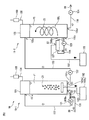
The
図2は、オゾン処理装置19の模式図である。オゾン処理装置19は、前処理装置19−1と処理装置19−2とを備える。前処理装置19−1は、混合物98のパルプ繊維から高吸水性ポリマーの少なくとも一部を除去する。それにより、混合物98の高吸水性ポリマーを含むパルプ繊維の粘度を低下させる。処理装置19−2は、前処理装置19−1で高吸水性ポリマーの少なくとも一部を除去し、粘度が低下した混合物98のパルプ繊維から高吸水性ポリマーをさらに除去する。
FIG. 2 is a schematic diagram of the
前処理装置19−1は、前処理槽101と、オゾン放散装置102と、ポンプ122(前処理液移送部)と、ポンプ121(前処理液循環部)と、オゾン分解装置103とを備えている。
The pretreatment device 19-1 includes a
前処理槽101は、前処理液P1を含む槽である。前処理液P1は、例えば、当初は水であり、前処理装置19−1の処理が進行するに連れて前処理用のオゾンZ1(後述)が溶け込む、又は、事前にオゾンZ1を溶け込ませてもよい。
オゾン放散装置102は、前処理槽101内の前処理液P1中に前処理用のオゾンZ1を放散するための装置であり、オゾン放散部102aとオゾン生成部102bとを含む。オゾン生成部102bは、高吸水性ポリマーを前処理液P1に溶解可能に分解する前処理用のオゾンZ1を生成する。
The
The
オゾン放散部102aは、前処理槽101内に設けられており、前処理液P1中にて、前処理槽101の底部から離れて前処理液P1中に存在する混合物98(高吸水性ポリマーを含むパルプ繊維)に向い、混合物98の下方から前処理用のオゾンZ1を放散する。オゾンZ1は、例えば、多数の細かい気泡状に放散される。それにより、混合物98の高吸水性ポリマーが酸化分解し、前処理液P1中に溶解する。すなわち、パルプ繊維の高吸水性ポリマーが低減されて、高吸水性ポリマーを含むパルプ繊維の粘度が低下する。
The
ポンプ122(前処理液移送部)は、前処理槽101の下部に設けられた送出口101cと、処理装置19−2の処理槽105(後述)の上部に設けられた供給口105aとを連接する配管135の途中に設けられる。ポンプ122は、前処理槽101において高吸水性ポリマーが低減された混合物98を含む前処理液P1の少なくとも一部を、前処理槽101の下部から抜き出して、処理槽105の上部から処理液P2へ移送する。
The pump 122 (pretreatment liquid transfer unit) connects the
ポンプ121(前処理液循環部)は、前処理槽101の下部に設けられた送出口101bと、前処理槽101の上部に設けられた供給口101aとを連接する配管132の途中に設けられる。ポンプ121は、混合物98を含む前処理液P1の少なくとも一部を、前処理槽101の下部から抜き出し、前処理槽101の上部から前処理液P1中に供給する。なお、ポンプ121は、混合物98と水とを混合した水溶液を、配管131、132を介して受け取り、配管132を介して供給口101aから前処理槽101へ供給する。配管131、132の液体の流通は、配管131のバルブV1及び配管132のバルブV2で制御される。
オゾン分解装置103は、前処理槽101の上部に蓄積したオゾンZ1を、配管134を介して受け取り、オゾンを分解し無害化して外部へ放出する。
The pump 121 (pretreatment liquid circulation unit) is provided in the middle of a
The
なお、前処理槽101内の前処理液P1は、当初は前処理液P1のみであり、処理が進むにつれ、当初の前処理液P1に、混合物98、前処理用のオゾンZ1等が混合されることになるが、第1実施形態では、それらを総称して前処理液P1と称する。
The pretreatment liquid P1 in the
処理装置19−2は、処理槽105と、オゾン供給装置(オゾン供給部)106と、エジェクタ107と、ポンプ123(水溶液供給部、処理液循環部)と、ポンプ124と、オゾン分解装置108とを備える。
The processing device 19-2 includes a
処理槽105は、処理液P2を含む槽であり、エジェクタ107から吐出される混合液98L(後述)が処理液P2に旋回流を生じさせ易くする観点から、円筒形が好ましい。処理液P2は、例えば、当初は水であり、処理装置19−2の処理が進行するに連れて処理用のオゾンZ2(後述)が溶け込み、前処理装置19−1の処理が進行するに連れて、混合物98(高吸水性ポリマーとパルプ繊維)を含む前処理液P1が含有される。又は、事前にオゾンZ2を溶け込ませてもよい。
The
オゾン供給装置106は、高吸水性ポリマーを処理液P2に溶解可能に分解するオゾンZ2を生成し、エジェクタ107に供給する。
ポンプ123(水溶液供給部、処理液循環部)は、高吸水性ポリマーとパルプ繊維の混合物98を含む水溶液をエジェクタ107に供給する。ポンプ123は、配管136の途中に設けられ、配管136は、処理槽105の下部の送出口105bと、処理槽105の下部であって送出口105bよりも上方の供給口105cとを連接している。供給口105c近傍の配管136は、エジェクタ107から吐出される混合液98Lが処理液P2に形成する旋回流を上昇させ易くする観点から、少し上向に傾いていることが好ましい。
The
The pump 123 (aqueous solution supply unit, treatment liquid circulation unit) supplies an aqueous solution containing a
エジェクタ107(アスピレータ)は、配管136の途中に設けられており、駆動流体供給口DIと、吸引流体供給口AIと、混合流体吐出口COとを有する。エジェクタ107は、駆動流体を駆動流体供給口DIから混合流体吐出口COへ流して、流路途中の狭窄部をベンチュリ効果で減圧状態にし、吸引流体を吸引流体供給口AIから狭窄部に引き込み、駆動流体と混合させ、混合流体として混合流体吐出口COから吐出する。
The ejector 107 (aspirator) is provided in the middle of the
ここでは、ポンプ123により処理槽105における高吸水性ポリマーとパルプ繊維(混合物)を含む処理液P2が、駆動流体供給口DIに供給され、混合流体吐出口COへ向かって流される。それに伴い、オゾン供給装置106からのオゾンZ2が吸引流体供給口AIからエジェクタ107内に吸引される。それにより、高吸水性ポリマーとパルプ繊維を含む処理液P2とオゾンZ2とが混合されて、混合液98Lとして混合流体吐出口COから処理槽105に吐出される。吐出された混合液は、高吸水性ポリマーがオゾンZ2により酸化分解され、除去されつつ、処理槽105内を旋回し、処理液P2を攪拌しながら、上方へ徐々に上昇する。
Here, the treatment liquid P2 containing the superabsorbent polymer and pulp fiber (mixture) in the
ポンプ124は、処理槽105の下部に設けられた送出口105dと、後段の機器(図示されず)とを連接する配管139の途中に設けられる。ポンプ124は、処理槽105において高吸水性ポリマーが除去された混合物98を含む処理液P2の少なくとも一部を、処理槽105の下部から抜き出して、後段の機器へ移送する。
オゾン分解装置108は、処理槽105の上部に蓄積したオゾンZ2を、配管138を介して受け取り、オゾンZ2を分解し無害化して外部へ放出する。
The
The
なお、処理槽105内の処理液P2は、当初は処理液P2のみであり、処理は進むにつて、当初の処理液P2に、混合物、オゾン等が混合されることになるが、第1実施形態では、それらを総称して処理液P2と称する。
The processing liquid P2 in the
オゾン処理装置19において、前処理装置19−1と処理装置19−2とを併用しているのは以下の理由による。処理効率という点では、エジェクタ107を備える処理装置19−2のみを用いる方がよい。しかし、オゾン処理装置19に供給される、混合物98を含んだ水溶液において、パルプ繊維に付着する高吸水性ポリマーの濃度が高いと、混合物98の粘度が高くなり、エジェクタ107が詰まることが考え得る。そこで、それに対処するために、第1実施形態では、まず、混合物98を含んだ水溶液を前処理装置19−1で処理することで、エジェクタ107が詰まらない程度に、混合物98の粘度を低下させる、すなわち、高吸水性ポリマーを低減させやすくなる。また、リサイクルパルプ繊維(パルプ繊維)中のタンパク質含有成分を分解させ、リサイクルパルプ繊維(パルプ繊維)から水中に溶出しうるタンパク質含有成分を除去しやすくなる。
In the
次いで、第4分離装置20は、オゾン処理装置19にて処理されたパルプ繊維を含む処理液(混合液99)を、複数の開口を有するスクリーンにより、処理液とパルプ繊維とに分離する。それにより、リサイクルパルプ繊維が回収される。
Next, the
次に、使用済みの衛生用品から分離されたパルプ繊維及び高吸水性ポリマーの混合物からリサイクルパルプ繊維を製造する方法について説明する。図3は、第1実施形態に係る方法の一例を示すフローチャートである。この方法は、オゾン処理工程S19を備え、好ましくは、穴開け工程S11と、破砕工程S12と、第1分離工程S13と、第1除塵工程S14と、第2除塵工程S15と、第3除塵工程S16と、第2分離工程S17と、第3分離工程S18と、第4分離工程S20とを備える。以下、説明する。 Next, a method for producing recycled pulp fiber from a mixture of pulp fiber and superabsorbent polymer separated from used sanitary goods will be described. FIG. 3 is a flowchart illustrating an example of a method according to the first embodiment. This method includes an ozone treatment step S19, and preferably a perforation step S11, a crushing step S12, a first separation step S13, a first dust removal step S14, a second dust removal step S15, and a third dust removal step. S16, 2nd isolation | separation process S17, 3rd isolation | separation process S18, and 4th isolation | separation process S20 are provided. This will be described below.
穴開け工程S11は、破袋装置11により実行される。使用済みの衛生用品を封入した収集袋が、不活化水溶液を溜めた溶液槽に投入され、収集袋における不活化水溶液に接する表面に穴が開けられる。不活化水溶液は、収集袋に穴が開けられると、収集袋内の使用済みの衛生用品の汚れ、細菌、臭気等が外部に放出されぬよう、収集袋の周りを囲んで封止する。穴から不活化水溶液が収集袋内に浸入すると、収集袋内の気体が収集袋Aの外部へ抜け、収集袋の比重が不活化水溶液より重くなり、収集袋が溶液槽の不活化水溶液内により深く沈降する。不活化水溶液は、収集袋内の使用済みの衛生用品内の高吸水性ポリマーを不活化する。
The hole making step S11 is executed by the
使用済みの衛生用品内の高吸水性ポリマーが不活化し、その吸水能力が低下することで、高吸水性ポリマーが脱水して、粒径が小さくなる。その結果、後続の各工程において、高吸水性ポリマーを含むパルプ繊維の取り扱いが簡易になり、処理効率が向上する。
上記不活化水溶液としては、酸性水溶液、多価金属イオンを含む水溶液等が挙げられる。
The superabsorbent polymer in the used sanitary goods is inactivated and its water absorption capacity is reduced, so that the superabsorbent polymer is dehydrated and the particle size is reduced. As a result, in each subsequent process, the handling of the pulp fiber containing the superabsorbent polymer is simplified, and the processing efficiency is improved.
Examples of the inactivated aqueous solution include an acidic aqueous solution and an aqueous solution containing a polyvalent metal ion.
不活化水溶液として酸性水溶液(例えば、無機酸又は有機酸を含む水溶液)を用いると、多価金属イオンを含む水溶液を用いる場合と比較して、リサイクルパルプ繊維の灰分を低くすることができ、そして高吸水性ポリマーの不活化の程度(粒径、比重等)をpHで調整しやすくなる。 When an acidic aqueous solution (for example, an aqueous solution containing an inorganic acid or an organic acid) is used as the inactivating aqueous solution, the ash content of recycled pulp fiber can be lowered as compared with the case of using an aqueous solution containing a polyvalent metal ion, and It becomes easy to adjust the degree of inactivation (particle size, specific gravity, etc.) of the superabsorbent polymer by pH.
上記酸性水溶液のpHは、1.0以上且つ4.0以下が好ましく、1.2以上且つ2.5以下がより好ましい。pHが高過ぎると、高吸水性ポリマーの吸水能力を十分に低下できず、殺菌能力が低下するおそれもある。pHが低過ぎると、設備の腐食のおそれがあり、排水処理で中和処理に多くのアルカリ薬品が必要となる。特に、パルプ繊維及び高吸水性ポリマーと、他の資材とに分離するためには、パルプ繊維の大きさ、比重等と、高吸水性ポリマーの大きさ、比重等とが比較的近い方が好ましい。従って、酸性水溶液のpHを1.0以上且つ4.0以下とすることで、不活化により高吸水性ポリマーをより小さくでき、それにより、パルプ繊維と高吸水性ポリマーとの大きさ、比重等を互いに比較的近くできる。 The pH of the acidic aqueous solution is preferably 1.0 or more and 4.0 or less, and more preferably 1.2 or more and 2.5 or less. If the pH is too high, the water-absorbing ability of the superabsorbent polymer cannot be sufficiently lowered, and the sterilizing ability may be lowered. If the pH is too low, the equipment may be corroded, and a lot of alkaline chemicals are required for the neutralization treatment in the wastewater treatment. In particular, in order to separate the pulp fiber and the superabsorbent polymer from other materials, it is preferable that the size and specific gravity of the pulp fiber are relatively close to the size and specific gravity of the superabsorbent polymer. . Therefore, by setting the pH of the acidic aqueous solution to 1.0 or more and 4.0 or less, the highly water-absorbing polymer can be made smaller by inactivation, and thereby the size, specific gravity, etc. of the pulp fiber and the highly water-absorbing polymer Can be relatively close to each other.
上記有機酸としては、例えば、クエン酸、酒石酸、グルコン酸、グリコール酸、リンゴ酸等が挙げられるが、クエン酸等のヒドロキシカーボネート系の有機酸が特に好ましい。クエン酸のキレート効果により、排泄物中の金属イオン等がトラップされ除去でき、かつクエン酸の洗浄効果で、高い汚れ除去効果が期待できる。上記無機酸としては、例えば、硫酸、塩酸、硝酸が挙げられるが、塩素を含まないこと、コスト等の観点から硫酸が好ましい。有機酸水溶液の有機酸濃度は、特に限定されないが、有機酸がクエン酸の場合は、0.5質量%以上且つ4質量%以下が好ましい。無機酸水溶液の無機酸濃度は、特に限定されないが、無機酸が硫酸の場合は、0.1質量%以上且つ0.5質量%以下が好ましい。
なお、本明細書において、pHは、温度20℃におけるpHを意味する。
Examples of the organic acid include citric acid, tartaric acid, gluconic acid, glycolic acid, malic acid and the like, and hydroxycarbonate organic acids such as citric acid are particularly preferable. Due to the chelating effect of citric acid, metal ions and the like in excreta can be trapped and removed, and the cleaning effect of citric acid can be expected to provide a high soil removal effect. Examples of the inorganic acid include sulfuric acid, hydrochloric acid, and nitric acid, but sulfuric acid is preferable from the viewpoint of not containing chlorine and cost. The organic acid concentration of the organic acid aqueous solution is not particularly limited, but when the organic acid is citric acid, it is preferably 0.5% by mass or more and 4% by mass or less. The inorganic acid concentration of the inorganic acid aqueous solution is not particularly limited, but when the inorganic acid is sulfuric acid, it is preferably 0.1% by mass or more and 0.5% by mass or less.
In addition, in this specification, pH means pH at the temperature of 20 degreeC.
上記多価金属塩としては、アルカリ土類金属イオン、遷移金属イオン等が挙げられる。
上記アルカリ土類金属イオンとしては、ベリリウム、マグネシウム、カルシウム、ストロンチウム及びバリウムのイオンが挙げられる。上記アルカリ土類金属イオンとしては、塩化カルシウム、硝酸カルシウム、水酸化カルシウム、酸化カルシウム、塩化マグネシウム、硝酸マグネシウム等が好ましく、そして塩化カルシウム水溶液がより好ましい。
Examples of the polyvalent metal salt include alkaline earth metal ions and transition metal ions.
Examples of the alkaline earth metal ions include beryllium, magnesium, calcium, strontium and barium ions. The alkaline earth metal ions are preferably calcium chloride, calcium nitrate, calcium hydroxide, calcium oxide, magnesium chloride, magnesium nitrate, and more preferably an aqueous calcium chloride solution.
上記遷移金属イオンとしては、高吸水性ポリマーに取り込まれるものである限り、特に制限されないが、鉄、コバルト、ニッケル、銅等のイオンが挙げられる。上記遷移金属イオンとしては、費用、入手容易性等の点から、無機酸塩又は有機酸塩が好ましい。上記無機酸塩としては、例えば、塩化鉄、硫酸鉄、燐酸鉄、硝酸鉄等の鉄塩、塩化コバルト、硫酸コバルト、燐酸コバルト、硝酸コバルト等のコバルト塩、塩化ニッケル、硫酸ニッケル等のニッケル塩、塩化銅、硫酸銅等の銅塩等が挙げられる。上記有機酸塩類としては、例えば、乳酸鉄、酢酸コバルト、ステアリン酸コバルト、酢酸ニッケル、酢酸銅等が挙げられる。 The transition metal ion is not particularly limited as long as it is incorporated into the superabsorbent polymer, and examples thereof include ions of iron, cobalt, nickel, copper and the like. The transition metal ion is preferably an inorganic acid salt or an organic acid salt from the viewpoints of cost, availability, and the like. Examples of the inorganic acid salt include iron salts such as iron chloride, iron sulfate, iron phosphate and iron nitrate, cobalt salts such as cobalt chloride, cobalt sulfate, cobalt phosphate and cobalt nitrate, nickel salts such as nickel chloride and nickel sulfate. And copper salts such as copper chloride and copper sulfate. Examples of the organic acid salts include iron lactate, cobalt acetate, cobalt stearate, nickel acetate, and copper acetate.
破砕工程S12、第1分離工程S13、第1除塵工程S14、第2除塵工程S15、第3除塵工程S16、第2分離工程S17、及び第3分離工程S18は、それぞれ、破砕装置12、第1分離装置13、第1除塵装置14、第2除塵装置15、第3除塵装置16、第2分離装置17、及び第3分離装置18により実施されるが、それらの工程は、装置の箇所で説明済であるため、ここでの説明を省略する。
The crushing step S12, the first separation step S13, the first dust removal step S14, the second dust removal step S15, the third dust removal step S16, the second separation step S17, and the third separation step S18 are respectively the crushing
オゾン処理工程S19は、オゾン処理装置19により実行される。第3分離装置18から送出された固体中のパルプ繊維及び押し潰された高吸水性ポリマー(混合物98)が、オゾンを含む水溶液で処理される。それにより、高吸水性ポリマーが酸化分解してパルプ繊維から除去される。その結果、混合物98のパルプ繊維に付着(例示:パルプ繊維の表面に残存)していた高吸水性ポリマーが、オゾンを含む水溶液(処理液)により酸化分解して、水溶液に可溶な低分子量の有機物に変化することで、パルプ繊維から除去される。また、オゾン処理により、パルプ繊維の表面又は内部に付着しているタンパク質含有成分が分解され、パルプ繊維(リサイクルパルプ繊維)から水中に溶出しうるタンパク質含有成分が除去される。
The ozone treatment step S19 is performed by the
図2に示すオゾン処理装置19は、オゾン処理工程S19として、前処理装置19−1にて、前処理供給工程S19−1a、前処理工程S19−1b及び前処理液移送工程S19−1cを行い、処理装置19−2にて、供給工程S19−2a及び処理工程S19−2bをさらに行う。
The
前処理供給工程S19−1aは、混合物98を、前処理槽101内の前処理液P1中に供給する。
前処理工程S19−1bは、前処理槽101内にて、前処理槽101の底部から離れて前処理液P1中に存在する混合物98に向って、混合物の下方から、オゾンZ1を、前処理槽101内のオゾン放散部102aにより放散して、混合物98の高吸水性ポリマーを低減する。
前処理液移送工程S19−1cは、前処理工程S19−1bにおいて高吸水性ポリマーが低減された混合物98を含む前処理液P1の少なくとも一部を、前処理槽101の下部から抜き出して、前処理槽101の上部から処理液P2へ移送する。
The pretreatment supply step S19-1a supplies the
In the pretreatment step S19-1b, the ozone Z1 is pretreated from below the mixture toward the
In the pretreatment liquid transfer step S19-1c, at least part of the pretreatment liquid P1 including the
具体的には次のとおりである。
前処理供給工程S19−1aにおいて、第3分離工程S18にて分離されたパルプ繊維(高吸水性ポリマーが残存)を含む混合物98は、水を追加されて水溶液となっている。その水溶液は、配管131、132を介して(V1開、V2閉)、ポンプ121で、前処理槽101の上部の供給口101aから前処理液P1中に供給される。
Specifically, it is as follows.
In the pretreatment supply step S19-1a, the
次いで、前処理工程S19−1bにおいて、前処理液P1は酸性水溶液(オゾンの失活抑制及び高吸水性ポリマーの不活化のため)であり、比重としては概ね1である。従って、パルプ繊維は、前処理液P1の上部から下部へ向かって沈降してゆく。一方、オゾン生成部102bで生成されたオゾンを含有するオゾンZ1は、配管133を介してオゾン放散部102aから前処理槽101に放散される。オゾンZ1は、前処理槽101の下部付近から前処理液P1内に細かい気泡の状態(例示:マイクロバブル又はナノバブル)で連続的に放散され、前処理液P1の下部から上部へ向かって上昇してゆく。
Next, in the pretreatment step S19-1b, the pretreatment liquid P1 is an acidic aqueous solution (for suppressing ozone deactivation and inactivating the superabsorbent polymer), and has a specific gravity of about 1. Accordingly, the pulp fibers settle from the upper part to the lower part of the pretreatment liquid P1. On the other hand, ozone Z1 containing ozone generated by the
次いで、前処理液P1内を、上部から下部へ向かって沈降するパルプ繊維と、下部から上部へ向かって上昇するオゾンZ1とが、対向して進みつつ衝突し合う。そして、オゾンZ1は、パルプ繊維の表面に、パルプ繊維を包み込むように付着する。そのとき、オゾンZ1中のオゾンが、パルプ繊維中の高吸水性ポリマーと反応し、高吸水性ポリマーを酸化分解して、前処理液P1に溶解させる。対向流なので、パルプ繊維に含まれる高吸水性ポリマーとオゾンZ1との接触確率を高めることができる。それによりパルプ繊維の高吸水性ポリマーが低減され、高吸水性ポリマーを含むパルプ繊維の粘度が低減される。よって、後段の処理工程S19−2bにおいて、エジェクタ107が高吸水性ポリマーを含むパルプ繊維により詰まることを防止できる。
Next, in the pretreatment liquid P1, pulp fibers that settle from the upper part to the lower part and ozone Z1 that rises from the lower part to the upper part collide while proceeding in opposition. The ozone Z1 adheres to the surface of the pulp fiber so as to wrap the pulp fiber. At that time, ozone in the ozone Z1 reacts with the superabsorbent polymer in the pulp fiber, oxidatively decomposes the superabsorbent polymer, and dissolves it in the pretreatment liquid P1. Since it is a counterflow, the contact probability of the superabsorbent polymer contained in the pulp fiber and the ozone Z1 can be increased. Thereby, the superabsorbent polymer of a pulp fiber is reduced and the viscosity of the pulp fiber containing a superabsorbent polymer is reduced. Therefore, in the subsequent processing step S19-2b, the
次いで、前処理液移送工程S19−1cにおいて、前処理工程S19−1bにおいて高吸水性ポリマーが低減された混合物98を含む前処理液P1の少なくとも一部が、前処理槽101の下部の送出口101cから配管135を介してポンプ122により引き出され、処理槽105の上部の供給口105aから処理液P2中へ供給される。なお、前処理槽101の上部に蓄積したオゾンを含有するオゾンZ1のオゾンはオゾン分解装置103で分解され無害化されて外部へ放出される。
Next, in the pretreatment liquid transfer step S19-1c, at least a part of the pretreatment liquid P1 including the
ただし、前処理供給工程S19−1aは、混合物を含む前処理液P1の少なくとも一部を、前処理槽101の下部から抜き出し、前処理槽101の上部から前処理液P1中に供給する工程を有してもよい。具体的には、混合物を含む前処理液P1の少なくとも一部が、前処理槽101の下部の送出口101bから配管131、132を介して(V1閉、V2開)ポンプ121により引き出され、前処理槽101の上部の供給口101aから前処理液P1中へ供給される。
However, the pretreatment supply step S19-1a is a step of extracting at least a part of the pretreatment liquid P1 containing the mixture from the lower part of the
供給工程S19−2aは、混合物98を含む水溶液をエジェクタ107の駆動流体供給口DIに供給しつつ、オゾンZ2をエジェクタ107の吸引流体供給口AIに供給する。
処理工程S19−2bは、水溶液とオゾンZ2とがエジェクタ107内で混合された混合液98Lを、処理槽105の下部に連接されたエジェクタ107の混合流体吐出口COから、処理槽105内の処理液P2中に吐出して、混合物98中の高吸水性ポリマーを低減する。
Supply process S19-2a supplies ozone Z2 to the suction fluid supply port AI of the
In the processing step S19-2b, the
具体的には次のとおりである。前処理液移送工程S19−1cにおいて、高吸水性ポリマーが低減された混合物98を含む前処理液P1の少なくとも一部が、処理槽105の処理液P2中へ供給され、混合物98が処理液P2に沈降しつつ、処理液P2に含有される。処理液P2は酸性水溶液(オゾンの失活抑制及び高吸水性ポリマーの不活化のため)であり、比重としては概ね1である。
Specifically, it is as follows. In the pretreatment liquid transfer step S19-1c, at least a part of the pretreatment liquid P1 including the
供給工程S19−2aでは、混合物98を含む処理液P2の少なくとも一部が、処理槽105の下部から引き出され、水溶液として駆動流体供給口DIに供給される。すなわち、混合物98を含む前処理液P1を含有した処理液P2の少なくとも一部が、配管136を介してポンプ123により処理槽105の下部の送出口105bから引き出され、水溶液としてエジェクタ107の駆動流体供給口DIに供給される。次いで、オゾン供給装置106で生成されたオゾンを含有するオゾンZ2が、配管137を介してエジェクタ107の吸引流体供給口AIに供給される。
In the supply step S19-2a, at least a part of the processing liquid P2 including the
続く処理工程S19−2bにおいて、エジェクタ107で混合物98を含む処理液P2とオゾンZ2とが混合されて生成された混合液98Lが混合流体吐出口COから処理槽105内の処理液P2に吐出される。このとき、混合物98を含む処理液P2とオゾンZ2とはエジェクタ107内の極めて狭い領域で混合されるので、パルプ繊維及び高吸水性ポリマーの混合物98とオゾンZ2とが極めて密接した混合液98Lを形成できる。
In the subsequent processing step S19-2b, the
また、混合液98Lが処理槽105内の処理液P2中に吐出されることで、処理液P2を撹拌することができる。オゾンZ2は、処理液P2に吐出されるとき、細かい気泡の状態(例示:マイクロバブル又はナノバブル)で連続的に吐出されるので、処理液P2内で極めて広く拡散することができる。これらによって、処理槽105中のパルプ繊維に含まれる高吸水性ポリマーと、オゾンZ2に含まれるオゾンとの接触確率を極めて高くできる。それにより、パルプ繊維から高吸水性ポリマーが除去される。また、それにより、パルプ繊維の表面又は内部に付着しているタンパク質含有成分が分解され、パルプ繊維(リサイクルパルプ繊維)から水中に溶出しうるタンパク質含有成分が除去される。
Further, the
その後、処理工程S19−2bにおいて高吸水性ポリマーが除去されたパルプ繊維を含む処理液P2の少なくとも一部が、処理槽105の下部の送出口105dから配管139を介してポンプ124により引き出され、混合液99として後段の機器へ移送される。なお、処理槽105の上部に蓄積したオゾンを含有するオゾンZ2のオゾンはオゾン分解装置108で分解され無害化されて外部へ放出される。
Thereafter, at least a part of the treatment liquid P2 containing the pulp fiber from which the superabsorbent polymer has been removed in the treatment step S19-2b is drawn out from the
前処理液P1、処理液P2にオゾンを含有するオゾンZ1、Z2を供給する場合、前処理液P1、処理液P2中のオゾン濃度は、例えば、1〜50質量ppmが挙げられる。オゾンZ1、Z2中のオゾン濃度は、例えば、40〜200g/m3が挙げられる。オゾンZ1、Z2中のパルプ繊維(高吸水性ポリマーを含む)の濃度は、例えば、0.1〜20質量%が挙げられる。パルプ繊維が前処理槽101、処理槽105内に存在する時間は、例えば、2分〜60分が挙げられる。オゾンZ1、Z2は、好ましくは、マイクロバブル又はナノバブルで前処理液P1、処理液P2中に供給される。マイクロバブルは気泡の直径が1〜1000μm程度、ナノバブルは気泡の直径が100〜1000nm程度である。
When supplying ozone Z1 and Z2 containing ozone to the pretreatment liquid P1 and the treatment liquid P2, the ozone concentration in the pretreatment liquid P1 and the treatment liquid P2 is, for example, 1 to 50 ppm by mass. As for the ozone concentration in ozone Z1 and Z2, 40-200 g / m < 3 > is mentioned, for example. As for the density | concentration of the pulp fiber (a super absorbent polymer is included) in ozone Z1 and Z2, 0.1-20 mass% is mentioned, for example. The time for which the pulp fibers are present in the
マイクロバブル又はナノバブルは微細な気泡であり、単位体積当たりの表面積が大きく、液中の上昇速度が遅いため、気泡がパルプ繊維に接触する確率を高められると共に、多くのパルプ繊維の表面に接触できる。それにより、パルプ繊維を微細な気泡で満遍なく包み込み、パルプ繊維とオゾンとの接触面積をより増加させることができる。また、気泡の浮力により、高吸水性ポリマーを含むパルプ繊維の沈降速度を低下させ、パルプ繊維とオゾンとの接触時間をより増加させることができる。よって、パルプ繊維に含まれる高吸水性ポリマーをより確実に酸化分解させて、パルプ繊維から除去させやすくなる。また、パルプ繊維の表面又は内部に付着しているタンパク質含有成分をより確実に分解させ、パルプ繊維(リサイクルパルプ繊維)から水中に溶出しうるタンパク質含有成分を除去させやすくなる。 Microbubbles or nanobubbles are fine bubbles, have a large surface area per unit volume, and a slow rising rate in the liquid, so that the probability of bubbles coming into contact with pulp fibers can be increased and the surface of many pulp fibers can be contacted. . As a result, the pulp fibers can be uniformly wrapped with fine bubbles, and the contact area between the pulp fibers and ozone can be further increased. Moreover, due to the buoyancy of the bubbles, the sedimentation rate of the pulp fiber containing the superabsorbent polymer can be reduced, and the contact time between the pulp fiber and ozone can be further increased. Therefore, the superabsorbent polymer contained in the pulp fiber can be more reliably oxidized and decomposed and easily removed from the pulp fiber. Moreover, the protein-containing component adhering to the surface or inside of the pulp fiber is more reliably decomposed, and the protein-containing component that can be eluted into the water from the pulp fiber (recycled pulp fiber) can be easily removed.
なお、処理液を酸性水溶液にすることで、オゾンの失活を抑制することができ、オゾンの効果(高吸水性ポリマーの酸化分解、タンパク質含有成分の除去、漂白、消臭)を高めることができる。加えて、高吸水性ポリマーを不活化できる他、破砕処理、除塵処理等で酸性水溶液を用いている場合には、各処理間に連続性があるので、各処理間で水溶液が相違することで何らかの不都合が生じるおそれがなく、安定的かつ確実に処理を行うことができる。また、酸による作業者、装置等への影響の低減の観点から、酸性水溶液のうちの有機酸が好ましく、中でも金属の除去の観点からクエン酸が好ましい。 In addition, the deactivation of ozone can be suppressed and the effect of ozone (oxidative decomposition of superabsorbent polymer, removal of protein-containing components, bleaching, deodorization) can be enhanced by using an acidic aqueous solution as the treatment solution. it can. In addition, in addition to being able to inactivate highly water-absorbing polymers, there is continuity between treatments when using an acidic aqueous solution in crushing treatment, dust removal treatment, etc. There is no fear of any inconvenience, and the process can be performed stably and reliably. Moreover, the organic acid of acidic aqueous solution is preferable from a viewpoint of reduction of the influence on an operator, an apparatus, etc. by an acid, and a citric acid is preferable especially from a viewpoint of removal of a metal.
第4分離工程S20は、第4分離装置20により実行され、オゾン処理装置19にて処理されたパルプ繊維を含む処理液、すなわち混合液99が、複数の開口を有するスクリーンを通過して、混合液99からパルプ繊維と処理液とが分離される。その結果、混合液99から処理液P2がスクリーンを通過して分離され、第4分離装置20から送出される。分離された処理液P2、すなわちオゾン処理液は、オゾン処理装置19に戻して再利用してもよい。オゾン処理液のコストを削減できる。一方、混合液99のうちのパルプ繊維がスクリーンを通過できず第4分離装置20に残存、又は別途送出される。
The fourth separation step S20 is executed by the
水溶液中のオゾンの濃度は、以下のように測定される。
(1)100mLメスシリンダーに、ヨウ化カリウム約0.15gと、10質量%のクエン酸溶液5mLと、オゾンが溶解しているサンプル85mLとを投入する。
(2)メスシリンダーの内容物を反応させた後、反応物を200mLの三角フラスコに移す。
(3)三角フラスコに、デンプン溶液を加え、紫色に着色させる。
(4)三角フラスコの内容物を撹拌しながら、0.01mol/Lチオ硫酸ナトリウムを用いて、三角フラスコの内容物が無色になるまで滴定し、滴定量:A(mL)を読み取る。
(5)水溶液中のオゾンの濃度(質量ppm)を、以下の式:
水溶液中のオゾンの濃度(質量ppm)
=A(mL)×0.24×0.85(mL)
により算出する。
The concentration of ozone in the aqueous solution is measured as follows.
(1) About 0.15 g of potassium iodide, 5 mL of a 10% by mass citric acid solution, and 85 mL of a sample in which ozone is dissolved are put into a 100 mL graduated cylinder.
(2) After reacting the contents of the graduated cylinder, the reaction product is transferred to a 200 mL Erlenmeyer flask.
(3) A starch solution is added to the Erlenmeyer flask and colored purple.
(4) While stirring the contents of the Erlenmeyer flask, titrate with 0.01 mol / L sodium thiosulfate until the contents of the Erlenmeyer flask become colorless, and read titration: A (mL).
(5) The concentration of ozone (mass ppm) in the aqueous solution is expressed by the following formula:
Concentration of ozone in aqueous solution (mass ppm)
= A (mL) x 0.24 x 0.85 (mL)
Calculated by
オゾンZ2は、処理液P2に吐出されるとき、細かい気泡の状態で連続的に吐出されるので、処理液P2内で極めて広く拡散することができる。それらにより、エジェクタ107から吐出される混合液98L中のパルプ繊維だけでなく、処理槽105内の処理液中のパルプ繊維の両方で、高吸水性ポリマー及びタンパク質含有成分と、オゾンZ2との反応を極めて効率的に進行できる。そして混合物98中の高吸水性ポリマー及びタンパク質含有成分を適切に酸化分解して、処理液P2中に溶解させて除去できると共に、パルプ繊維の処理のムラを抑制できる。それにより、リサイクルパルプ繊維の純度を高くすることができ、再利用し易いリサイクルパルプ繊維を製造できる。よって、パルプ繊維から高吸水性ポリマーを適切に除去できると共に、リサイクルパルプ繊維を効率よく製造することが可能となる。
Since the ozone Z2 is continuously discharged in the form of fine bubbles when discharged to the processing liquid P2, it can diffuse extremely widely in the processing liquid P2. Thereby, not only the pulp fibers in the
[第2実施形態]
第2実施形態では、オゾン処理工程S19a及びオゾン処理装置19aが、それぞれ、第1実施形態のオゾン処理工程S19及びオゾン処理装置19と相違する。以下、主に相違点について説明する。
[Second Embodiment]
In the second embodiment, the ozone treatment step S19a and the
図4は、オゾン処理装置19aの模式図である。オゾン処理装置19aは、前処理装置19a−1と処理装置19a−2とを備える。前処理装置19a−1及び処理装置19a−2の基本構成は、第1実施形態の前処理装置19−1及び処理装置19−2と同じである。ただし、配管135が途中の分岐点Q1で分岐し、分岐された分岐管135aが配管136と合流点Q2で合流して、エジェクタ107の駆動流体供給口DIに連接している点で、両者は相違している。それにより、オゾン処理装置19aは、前処理槽101の前処理液P1の供給先として、処理槽105及びエジェクタ107の少なくとも一方を選択し得る。例えば、オゾン処理装置19aは、配管135途中の分岐点Q1よりも下流側に位置するバルブV3と、分岐点Q1と合流点Q2との間の分岐管135a途中に位置するバルブV4と、配管136途中の合流点Q2の上流側に位置するバルブV5とをさらに備えている。そして、バルブV3、バルブV4及びバルブV5の各々の開閉により、前処理液P1の供給先、処理液P2の処理等を選択できる。
FIG. 4 is a schematic diagram of the
オゾン処理工程S19aにおいて、エジェクタ107の駆動流体供給口DIに前処理液P1及び処理液P2のうちの少なくとも一方が供給されることを条件として、バルブV3、V4、V5の各々の開閉は、例えば、以下の(A)〜(D)の場合が考え得る。(A)バルブV3、V4、V5をそれぞれ開、閉、開とする。(B)バルブV3、V4、V5をそれぞれ閉、開、閉とする。(C)バルブV3、V4、V5をそれぞれ閉、開、開とする。(D)バルブV3、V4、V5をそれぞれ開、開、開とする。
In the ozone treatment step S19a, on the condition that at least one of the pretreatment liquid P1 and the treatment liquid P2 is supplied to the drive fluid supply port DI of the
上記(A)の場合、前処理液移送工程S19a−1cにおいて、前処理槽101の前処理液P1(高吸水性ポリマーとパルプ繊維を含む混合物98を含有)が、配管135を介して処理槽105の供給口105aへ供給される。一方、供給工程S19a−2aにおいて、処理槽105の処理液P2(高吸水性ポリマーとパルプ繊維を含む混合物98を含有)が配管136を介してエジェクタ107の駆動流体供給口DIに供給される。この場合は、第1実施形態(図2)の場合と同一である。従って、第1実施形態と同様の効果を得ることができる。
In the case of (A) above, in the pretreatment liquid transfer step S19a-1c, the pretreatment liquid P1 (containing the
上記(B)の場合、前処理液移送工程S19a−1cにおいて、前処理槽101の前処理液P1が、配管135及び分岐管135aを介してエジェクタ107の駆動流体供給口DIに供給される。従って、前処理液移送工程S19a−1c=供給工程S19a−2aとなる。このとき、処理槽105の処理液P2はエジェクタ107に供給されない。この場合には、第1実施形態(図2)、すなわち(A)の場合と比較して、前処理槽101の前処理液P1が全て直接エジェクタ107の駆動流体供給口DIに供給される。従って、パルプ繊維が全てエジェクタ107を通過するので、パルプ繊維を全てエジェクタ107でオゾンZ2に接触させることができ、高吸水性ポリマーの除去の処理効率を向上できる。
In the case of (B) above, in the pretreatment liquid transfer step S19a-1c, the pretreatment liquid P1 in the
上記(C)の場合、前処理液移送工程S19a−1cにおいて、前処理槽101の前処理液P1が、配管135及び分岐管135aを介してエジェクタ107の駆動流体供給口DIに供給される。従って、前処理液移送工程S19a−1c=供給工程S19a−2aとなる。また、供給工程S19a−2aにおいて、処理槽105の処理液P2(高吸水性ポリマーとパルプ繊維を含む)が配管136を介してエジェクタ107の駆動流体供給口DIに供給される。この場合には、(B)の場合と比較して、処理槽105の処理液P2がエジェクタ107の駆動流体供給口DIにさらに供給される。従って、一度エジェクタ107を通過したパルプ繊維の少なくとも一部を、エジェクタ107にさらに通過させることができる。すなわち、パルプ繊維の少なくとも一部を、複数回、エジェクタ107でオゾンZ2に接触させることができ、高吸水性ポリマーの除去の処理効率をより向上できる。
In the case of (C) above, in the pretreatment liquid transfer step S19a-1c, the pretreatment liquid P1 in the
上記(D)の場合、前処理液移送工程S19a−1cにおいて、前処理槽101の前処理液P1は、配管135を介して処理槽105の供給口105aへ供給される。それと共に、供給工程S19a−2aにおいて、前処理槽101の前処理液P1が配管135、分岐管135aを介してエジェクタ107の駆動流体供給口DIに供給される。また、供給工程S19a−2aにおいて、処理槽105の処理液P2(高吸水性ポリマーとパルプ繊維を含む)は配管136を介してエジェクタ107の駆動流体供給口DIに供給される。この場合には、第1実施形態(図2)すなわち(A)の場合と比較して、前処理槽101の前処理液P1の一部が直接エジェクタ107の駆動流体供給口DIに供給される。従って、パルプ繊維の一部は確実にエジェクタ107を通過するので、パルプ繊維の一部をエジェクタ107でオゾンZ2に確実に接触させることができ、高吸水性ポリマーの除去の処理効率を向上できる。
In the case of (D) above, in the pretreatment liquid transfer step S19a-1c, the pretreatment liquid P1 in the
[第3実施形態]
第3実施形態では、オゾン処理工程S19b及びオゾン処理装置19bが、それぞれ、第1実施形態のオゾン処理工程S19及びオゾン処理装置19と相違する。以下、主に相違点について説明する。
[Third Embodiment]
In the third embodiment, the ozone treatment step S19b and the
図5は、オゾン処理装置19bの模式図である。オゾン処理装置19bは、前処理装置と(本)処理装置とが一体化している点で、第1実施形態のオゾン処理装置19と相違している。すなわち、前処理槽と処理槽とは、同一の槽101Rである。前処理液と処理液とは、同一の液P3である。エジェクタ107の混合流体吐出口COは、オゾン放散部102aよりも槽101Rの下方の部分に位置している。前処理工程S19−1bは、槽の上方で実施され、処理工程S19−2bは、槽の下方で実施される、それにより、オゾン処理装置19bは、前処理槽(又は処理槽)一つ分のスペース及び前処理槽と処理槽とを連接する配管135のスペースが不要であり、省スペースな装置である。
FIG. 5 is a schematic diagram of the
第3実施形態では、同一の槽にて前処理工程S19−1bと処理工程S19−2bとを行うことができ、前処理工程S19−1bを実施した混合物98を、処理工程S19−2bを実施するために他の槽に移送する必要が無いため、処理の効率を高めることができる。
In the third embodiment, the pretreatment step S19-1b and the treatment step S19-2b can be performed in the same tank, and the
以下、例を挙げて本開示を説明するが、本開示はこれらの例に限定されるものではない。
タンパク質測定手段として、ML法用のThermo Fisher Scientific社製のModified Lowry Protein Assay Kit(定量下限値:60μg/mL)と、Coomassie法用のCoomassie (Bradford) Protein Assay Kit(定量下限値:7μg/mL)と、Micro BCA法用のMicro BCA Protein Assay Kit(定量下限値:7μg/mL)とを準備した。
Hereinafter, although an example is given and this indication is explained, this indication is not limited to these examples.
As a protein measurement means, Modified Fisher Protein Assay Kit (lower limit of quantification: 60 μg / mL) manufactured by Thermo Fisher Scientific for ML method, and Coomassie (Bradford) assay limit of Coomassie method 7 ) And Micro BCA Protein Assay Kit for Micro BCA method (lower limit of quantification: 7 μg / mL).
[製造例1及び製造例2]
破砕装置として、スミカッター(住友重機械エンバイロメント株式会社製)を用いて、老人介護施設から回収された、計1400枚の使用済の使い捨ておむつ(約250kg)を破砕し、破砕物含有水溶液を形成した。なお、不活化水溶液として、約1tの0.16質量%水酸化カルシウム水溶液が用いられた。
破砕物含有水溶液を、第1分離装置としての横型洗濯機ECO−22B(株式会社稲本製作所製)に導入して、パルプ繊維及び高吸水性ポリマーと、それ以外の構成資材とを分離し、パルプ繊維及び高吸水性ポリマーを含む水溶液を形成した。次いで、パルプ繊維及び高吸水性ポリマーを含む水溶液を、第1除塵装置、第2除塵装置及び第3除塵装置に通したのち、撹拌槽に移動させた。
[Production Example 1 and Production Example 2]
As a crushing device, using a Sumi cutter (manufactured by Sumitomo Heavy Industries Environment Co., Ltd.), a total of 1400 used disposable diapers (about 250 kg) collected from an elderly care facility were crushed, Formed. In addition, about 1 t of 0.16 mass% calcium hydroxide aqueous solution was used as an inactivation aqueous solution.
The crushed material-containing aqueous solution is introduced into a horizontal washing machine ECO-22B (manufactured by Inamoto Seisakusho Co., Ltd.) as a first separator, and pulp fibers and superabsorbent polymer are separated from other constituent materials, and pulp An aqueous solution containing fibers and a superabsorbent polymer was formed. Next, an aqueous solution containing pulp fibers and a superabsorbent polymer was passed through the first dust removing device, the second dust removing device, and the third dust removing device, and then moved to the stirring tank.
撹拌層内のパルプ繊維及び高吸水性ポリマーを含む水溶液の一部を抜き取り、固形分濃度を5.0質量%に調整して、第1抜取サンプルを得た。
第1抜取サンプルを、マイクロ冷却遠心機(久保田商事株式会社製 Model 3740,回転数:12,000rpm,温度:4℃,時間:5分間)を用いて遠心分離し、サンプルNo.1(製造例1)を形成した。
A part of the aqueous solution containing the pulp fiber and the superabsorbent polymer in the stirring layer was extracted, and the solid content concentration was adjusted to 5.0% by mass to obtain a first sample.
The first sample was centrifuged using a micro-cooled centrifuge (Model 3740, Kubota Corporation, rotation speed: 12,000 rpm, temperature: 4 ° C., time: 5 minutes). 1 (Production Example 1) was formed.
上記撹拌槽に、パルプ繊維の固形分1質量部あたり1質量部のクエン酸が添加されるように、2質量%のクエン酸水溶液を添加し、撹拌槽の内容物を、オゾン処理装置に移動し、オゾン処理及びエジェクタ処理を行い、高吸水性ポリマーを分解させた。オゾン処理装置を経た内容物の一部を抜き取り、第2抜取サンプルを形成した。第2抜取サンプルの固形分濃度は、約2質量%であった。第2抜取サンプルを脱水して、その固形分濃度を約5質量%に調整した。 In order to add 1 part by weight of citric acid to 1 part by weight of the solid content of the pulp fiber, 2% by weight citric acid aqueous solution is added to the stirring tank, and the contents of the stirring tank are moved to the ozone treatment device. Then, ozone treatment and ejector treatment were performed to decompose the superabsorbent polymer. A part of the contents passed through the ozone treatment apparatus was extracted to form a second sample. The solid content concentration of the second sample was about 2% by mass. The second sample was dehydrated and its solid content concentration was adjusted to about 5% by mass.
オゾン処理装置を用いたオゾン処理工程では、前処理工程S19−1bにおけるオゾン濃度は、200g/m3であり、オゾン供給量は、100g/hであった。また、処理工程S19−2bでは、オゾン濃度は、200g/m3であり、オゾン供給量は、100g/hであった。
固形分濃度を約5質量%に調整した第2抜取サンプルを、マイクロ冷却遠心機(久保田商事株式会社製 Model 3740,回転数:12,000rpm,温度:4℃,時間:5分間)を用いて遠心分離し、サンプルNo.2(製造例2)を形成した。
In the ozone treatment process using the ozone treatment apparatus, the ozone concentration in the pretreatment process S19-1b was 200 g / m 3 , and the ozone supply amount was 100 g / h. In the treatment step S19-2b, the ozone concentration was 200 g / m 3 and the ozone supply amount was 100 g / h.
Using a micro-cooled centrifuge (Model 3740 manufactured by Kubota Corporation, rotation speed: 12,000 rpm, temperature: 4 ° C., time: 5 minutes), the second sampling sample whose solid content concentration was adjusted to about 5 mass% was used. Centrifuge and remove sample no. 2 (Production Example 2) was formed.
[製造例3]
ヴァージンパルプ繊維(Weyerhaeuser社製,NB416)を、2質量%のクエン酸水溶液に分散させ、5.0質量%の固形分濃度のヴァージンパルプ繊維分散水溶液を準備し、ヴァージンパルプ繊維分散水溶液を、製造例2と同一の条件で、オゾン処理及びエジェクタ処理を行った。処理後のヴァージンパルプ繊維分散水溶液の一部を抜き取り、第3抜取サンプルを形成した。第3抜取サンプルの固形分濃度を5.0質量%に調整した。
第3抜取サンプルを、マイクロ冷却遠心機(久保田商事株式会社製 Model 3740,回転数:12,000rpm,温度:4℃,時間:5分間)を用いて遠心分離し、サンプルNo.3を形成した。
[Production Example 3]
Virgin pulp fiber (manufactured by Weyerhaeuser, NB416) is dispersed in a 2% by mass citric acid aqueous solution to prepare a virgin pulp fiber dispersed aqueous solution having a solid content concentration of 5.0% by mass, and a virgin pulp fiber dispersed aqueous solution is produced. Under the same conditions as in Example 2, ozone treatment and ejector treatment were performed. A part of the treated virgin pulp fiber-dispersed aqueous solution was withdrawn to form a third withdrawn sample. The solid content concentration of the third sample was adjusted to 5.0% by mass.
The third sample was centrifuged using a micro-cooled centrifuge (Model 3740, Kubota Corporation, rotation speed: 12,000 rpm, temperature: 4 ° C., time: 5 minutes). 3 was formed.
[製造例4]
高吸水性ポリマー(住友精化株式会社製,アクアキープ)を、2質量%のクエン酸水溶液に分散させ、5.0質量%の固形分濃度の高吸水性ポリマー分散水溶液を準備し、高吸水性ポリマー分散水溶液を、製造例2と同一の条件で、オゾン処理及びエジェクタ処理を行った。処理後の高吸水性ポリマー分散水溶液の一部を抜き取り、第4抜取サンプルを形成した。第4抜取サンプルには、5質量%の高吸水性ポリマーに相当する、分解した高吸水性ポリマーが含まれていた。
第4抜取サンプルを、マイクロ冷却遠心機(久保田商事株式会社製 Model 3740,回転数:12,000rpm,温度:4℃,時間:5分間)を用いて遠心分離し、サンプルNo.4を形成した。
[Production Example 4]
Superabsorbent polymer (Sumitomo Seika Co., Ltd., Aqua Keep) is dispersed in a 2% by mass citric acid aqueous solution to prepare a superabsorbent polymer dispersed aqueous solution having a solid content concentration of 5.0% by mass. The aqueous polymer dispersion was subjected to ozone treatment and ejector treatment under the same conditions as in Production Example 2. A part of the superabsorbent polymer-dispersed aqueous solution after the treatment was extracted to form a fourth sample. The fourth sampling sample contained decomposed superabsorbent polymer corresponding to 5% by mass of superabsorbent polymer.
The fourth sample was centrifuged using a micro-cooled centrifuge (Model 3740, Kubota Corporation, rotation speed: 12,000 rpm, temperature: 4 ° C., time: 5 minutes). 4 was formed.
[製造例5及び製造例6]
サンプルNo.3及び4のそれぞれに、牛血清アルブミン(BSA)を、BSAの濃度が100μg/mL(ML法用)及び20μg/mL(Coomassie法及びMicro BCA法)となるように添加し、サンプルNo.5及び6を準備した。
[Production Example 5 and Production Example 6]
Sample No. To each of 3 and 4, bovine serum albumin (BSA) was added so that the concentration of BSA was 100 μg / mL (for ML method) and 20 μg / mL (Coomassie method and Micro BCA method). 5 and 6 were prepared.
[製造例7及び製造例8]
サンプルNo.2を限外濾過してられたろ液及び残渣のうち、ろ液を、サンプルNo.7とした。
また、上記残渣を、限外濾過フィルターを、上記ろ液と略同量の脱イオン水を用いて洗浄し、洗浄液を、マイクロ冷却遠心機(久保田商事株式会社製 Model 3740,回転数:12,000rpm,温度:4℃,時間:5分間)を用いて遠心分離し、サンプルNo.8を形成した。
[Production Example 7 and Production Example 8]
Sample No. Among the filtrate and the residue obtained by ultrafiltration of No. 2, the filtrate was sample No. It was set to 7.
The residue is washed with an ultrafiltration filter using approximately the same amount of deionized water as the filtrate, and the washing solution is washed with a micro-cooled centrifuge (Model 3740 manufactured by Kubota Corporation, rotation speed: 12). 000 rpm, temperature: 4 ° C., time: 5 minutes). 8 was formed.
[例1]
[検量線の作成]
Modified Lowry Protein Assay Kit、Coomassie (Bradford) Protein Assay Kit及びMicro BCA Protein Assay Kitに記載の方法に従って、検量線を作成した。
[Example 1]
[Create calibration curve]
Calibration curves were prepared according to the methods described in Modified Lowry Protein Assay Kit, Coomassie (Bradford) Protein Assay Kit, and Micro BCA Protein Assay Kit.
[タンパク質濃度の測定]
サンプルNo.1〜No.8のタンパク質濃度を、ML法、Coomassie法及びMicro BCA法にて測定した。結果を表1に示す。
具体的には、ML法では、サンプル0.2mLに、Lowry試薬を1.0mL添加し、10分間室温でインキュベートし、次いで、Folin−Ciocalteu試薬を100μL添加し、室温で30分間インキュベートすることにより試験溶液を準備した。当該試験溶液を、純水を対照として、光路長1cmの石英マイクロセルで、750nmにおける吸光度を測定し、検量線を用いてタンパク質濃度を算出した。
[Measurement of protein concentration]
Sample No. The protein concentrations of No. 1 to No. 8 were measured by the ML method, the Coomassie method, and the Micro BCA method. The results are shown in Table 1.
Specifically, in the ML method, by adding 1.0 mL of Lowry reagent to 0.2 mL of sample and incubating at room temperature for 10 minutes, then adding 100 μL of Folin-Ciocalteu reagent and incubating at room temperature for 30 minutes A test solution was prepared. Using the test solution as a control, the absorbance at 750 nm was measured with a quartz microcell having an optical path length of 1 cm using pure water as a control, and the protein concentration was calculated using a calibration curve.
Coomassie法では、サンプル1.0mLに、Coomassie試薬を1.0mL添加し、10分間室温でインキュベートすることにより試験溶液を準備した。当該試験溶液を、純水を対照として、光路長1cmの石英マイクロセルで、595nmにおける吸光度を測定し、検量線を用いてタンパク質濃度を算出した。 In the Coomassie method, a test solution was prepared by adding 1.0 mL of Coomassie reagent to 1.0 mL of a sample and incubating at room temperature for 10 minutes. Using the test solution as a control, the absorbance at 595 nm was measured with a quartz microcell having an optical path length of 1 cm using pure water as a control, and the protein concentration was calculated using a calibration curve.
Micro BCA法では、サンプル1.0mLに、BCA Working試薬を1.0mL添加し、60℃の水浴中で60分間インキュベートすることにより試験溶液を準備した。当該試験溶液を、純水を対照として、光路長1cmの石英マイクロセルで562nmにおける吸光度を測定し、検量線を用いてタンパク質濃度を算出した。
なお、いずれのタンパク質測定手段においても、吸光度は、株式会社島津製作所製のUV−2450型紫外可視分光光度計を用いて測定した。
In the Micro BCA method, 1.0 mL of a BCA Working reagent was added to 1.0 mL of a sample, and a test solution was prepared by incubating in a 60 ° C. water bath for 60 minutes. For the test solution, the absorbance at 562 nm was measured with a quartz microcell having an optical path length of 1 cm using pure water as a control, and the protein concentration was calculated using a calibration curve.
In any protein measuring means, the absorbance was measured using a UV-2450 type ultraviolet-visible spectrophotometer manufactured by Shimadzu Corporation.

[ML法]
ML法では、サンプルNo.3及びNo.4において、タンパク質濃度が検出限界以下であり、そしてサンプルNo.5及びNo.6において、タンパク質濃度が、添加したBSAの濃度と同程度の100μg/mLであった。また、ML方では、タンパク質が検出限界以下であるサンプルNo.2に由来する、サンプルNo.7及びサンプルNo.8において、タンパク質が検出されなかった。
従って、ML法は、使用済の衛生用品の任意のリサイクル資材から水中に溶出しうるタンパク質含有成分の全量を、一度に、簡易に測定することができることがわかる。
[ML method]
In the ML method, sample no. 3 and no. 4 the protein concentration is below the detection limit and sample no. 5 and no. In 6, the protein concentration was 100 μg / mL, similar to the concentration of added BSA. In addition, in the ML method, sample No. whose protein is below the detection limit. 2, sample no. 7 and sample no. In 8, no protein was detected.
Therefore, it can be seen that the ML method can easily measure the total amount of protein-containing components that can be eluted into water from any recycled material of used sanitary goods at a time.
[Coomassie法]
Coomassie法では、サンプルNo.3において、タンパク質濃度が検出限界以下であり、そしてサンプルNo.5において、タンパク質濃度が、添加したBSAの濃度と同程度の22μg/mLであった。しかし、サンプルNo.4において、タンパク質濃度が30μg/mLと測定され、そしてサンプルNo.6においてタンパク質濃度が、添加したBSAよりも高濃度で検出されたことから、サンプルNo.4及びサンプルNo.6には、タンパク質の定量を阻害する要因が有ると考えられる。また、Coomassie法では、サンプルNo.7からタンパク質が検出されない一方で、サンプルNo.8からタンパク質が検出された。
それらの結果より、Coomassie法では、分解した高吸水性ポリマーがタンパク質に類する応答(偽陽性)を示したものとと考えられる。
[Coomassie method]
In the Coomassie method, sample no. 3 the protein concentration is below the detection limit and sample no. In 5, the protein concentration was 22 μg / mL, similar to the concentration of added BSA. However, sample no. 4 the protein concentration was measured to be 30 μg / mL and sample no. 6 was detected at a higher concentration than the added BSA. 4 and sample no. 6 is considered to have a factor that inhibits protein quantification. In the Coomassie method, sample no. While no protein was detected from sample 7, sample no. 8 protein was detected.
From these results, it is considered that in the Coomassie method, the decomposed superabsorbent polymer exhibited a protein-like response (false positive).
また、Coomassie法では、サンプルNo.2において、30.0μg/mLのタンパク質濃度が検出されたが、サンプルNo.2においても、分解した高吸水性ポリマーがタンパク質に類する応答(偽陽性)を示したものと考えられる。 In the Coomassie method, sample no. 2, a protein concentration of 30.0 μg / mL was detected. Also in No. 2, it is considered that the decomposed superabsorbent polymer exhibited a protein-like response (false positive).
[Micro BCA法]
Micro BCA法では、サンプルNo.4において、タンパク質が検出限界以下であり、そしてサンプルNo.5及びNo.6において、タンパク質濃度が、添加したBSAの濃度と概ね同程度であった。しかし、タンパク質を含まないサンプルNo.2及びサンプルNo.3からタンパク質が検出された。また、Micro BCA法では、サンプルNo.7からタンパク質が検出される一方で、サンプルNo.8からタンパク質が検出されないことから、水溶性成分(キレート化剤として作用するクエン酸)が、偽陰性を示す阻害物質として、タンパク質の検出を阻害しているものと考えられる。
以上より、Micro BCA法では、クエン酸が、タンパク質の定量に影響を与えていることが示唆される。
[Micro BCA method]
In the Micro BCA method, sample no. 4 the protein is below the detection limit and sample no. 5 and no. In 6, the protein concentration was approximately the same as the concentration of added BSA. However, sample no. 2 and sample no. From 3 the protein was detected. In the Micro BCA method, sample no. While protein was detected from sample 7, sample no. Since no protein is detected from No. 8, it is considered that the water-soluble component (citric acid acting as a chelating agent) inhibits protein detection as an inhibitor that shows false negatives.
From the above, the Micro BCA method suggests that citric acid has an effect on protein quantification.
[例2]
除菌された撹拌容器に、老人介護施設から回収された、100枚の使用済み紙おむつ約15kgを投入し、次いで、上記撹拌容器に、パルプ繊維(3kg)の濃度が約5質量%となるように600kgの滅菌水を投入し、上記容器の内容物を10分間撹拌し、上記容器内の水溶液をサンプルNo.9とした。
[Example 2]
About 15 kg of 100 used paper diapers collected from an elderly care facility are put into a sterilized stirring container, and then the concentration of pulp fiber (3 kg) is about 5% by mass in the stirring container. 600 kg of sterilized water was added to the container, and the contents of the container were stirred for 10 minutes. It was set to 9.
サンプルNo.9及びサンプルNo.2の細菌数を、本明細書に記載される混釈培養法及び平板培養法で測定した。結果を表2に示す。また、主要な細菌の種類を、生化学的性状検査法により同定した。結果を、表2に示す。
なお、例2では、サンプルNo.2は、第2抜取サンプルを意味する。
なお、表2において、NDは、検出されないことを意味する。
Sample No. 9 and sample no. The number of bacteria of 2 was determined by the pour culture and plate culture methods described herein. The results are shown in Table 2. In addition, major bacterial species were identified by biochemical characterization. The results are shown in Table 2.
In Example 2, sample no. 2 means the second sampling sample.
In Table 2, ND means not detected.
生化学的性状検査法により確認したところ、サンプルNo.9に含まれる一般生菌の大部分は、セレウス菌(Bacillus cereus)であり、枯草菌も含まれていた。また、サンプルNo.1(第1抜取サンプル)に含まれる細菌数を、混釈培養法で測定したところ、1.39E+5の細菌数が検出された。また、生化学的性状検査法により同定したところ、サンプルNo.1(第1抜取サンプル)に、セレウス菌及び枯草菌が含まれていた。
サンプルNo.2(第2抜取サンプル)からは、セレウス菌も、枯草菌も検出されなかった。
When confirmed by the biochemical property inspection method, the sample No. Most of the general viable bacteria contained in No. 9 were Bacillus cereus, and Bacillus subtilis was also included. Sample No. When the number of bacteria contained in 1 (first sampling sample) was measured by the pour culture method, a number of bacteria of 1.39E + 5 was detected. In addition, when identified by biochemical property inspection method, sample No. 1 (first sampling sample) contained Bacillus cereus and Bacillus subtilis.
Sample No. From 2 (second sampling sample), neither Bacillus cereus nor Bacillus subtilis were detected.
[例3]
サンプルNo.1、サンプルNo.2、及びサンプルNo.3における(リサイクル)パルプ繊維のΔW及びΔYIを測定した。結果を表3に示す。
なお、例3では、サンプルNo.1及びサンプルNo.2は、それぞれ、第1抜取サンプル及び第2抜取サンプルを、固形分の測定と同条件で乾燥させた(リサイクル)パルプ繊維を意味し、サンプルNo.3は、ヴァージンパルプ繊維(Weyerhaeuser社製,NB416)そのものを意味する。
[Example 3]
Sample No. 1, sample no. 2 and sample no. ΔW and ΔYI of the (recycled) pulp fiber in No. 3 were measured. The results are shown in Table 3.
In Example 3, sample No. 1 and sample no. 2 means (recycled) pulp fibers obtained by drying the first sampling sample and the second sampling sample under the same conditions as the measurement of the solid content. 3 means the virgin pulp fiber (manufactured by Weyerhaeuser, NB416) itself.
19 オゾン処理装置
19−2a 供給工程
19−2b 処理工程
98 混合物
105 処理槽
107 エジェクタ
AI 吸引流体供給口
CO 混合流体吐出口
DI 駆動流体供給口
P2 処理液
Z2 オゾン
19 Ozone treatment apparatus 19-2a Supply process 19-
Claims (10)
前記リサイクルパルプ繊維を5.0質量%の固形分濃度で分散させた水分散液が、タンパク質を、Modified Lowry法により測定された60μg/mL以下の濃度で含む、
前記リサイクルパルプ繊維。 Recycled pulp fiber derived from used sanitary goods,
An aqueous dispersion in which the recycled pulp fiber is dispersed at a solid content concentration of 5.0% by mass contains protein at a concentration of 60 μg / mL or less measured by the Modified Lowry method.
The recycled pulp fiber.
前記パルプ繊維を含む水溶液を、エジェクタを備える処理槽であって、前記エジェクタが、駆動流体供給口と、前記処理槽に連接される混合流体吐出口と、それらの間の吸引流体供給口とを備えるものの前記駆動流体供給口に供給しつつ、オゾンを前記吸引流体供給口に供給する供給ステップと、
前記水溶液及び前記オゾンが前記エジェクタ内で混合されることにより形成された混合液を、前記混合流体吐出口から、前記処理槽内の処理液中に吐出して、前記パルプ繊維中のタンパク質含有成分を分解し、リサイクルパルプ繊維であって、前記リサイクルパルプ繊維を5.0質量%の固形分濃度で分散させた水分散液が、タンパク質を、Modified Lowry法により測定された60μg/mL以下の濃度で含むものを形成するリサイクルパルプ繊維形成ステップと、
を含む、前記方法。 A method of producing recycled pulp fibers from used sanitary goods, including pulp fibers,
The aqueous solution containing the pulp fiber is a treatment tank provided with an ejector, and the ejector includes a driving fluid supply port, a mixed fluid discharge port connected to the treatment tank, and a suction fluid supply port therebetween. A supply step of supplying ozone to the suction fluid supply port while supplying to the drive fluid supply port of what is provided;
The mixed solution formed by mixing the aqueous solution and the ozone in the ejector is discharged from the mixed fluid discharge port into the treatment liquid in the treatment tank, and the protein-containing component in the pulp fiber Is a recycled pulp fiber, in which an aqueous dispersion in which the recycled pulp fiber is dispersed at a solid content concentration of 5.0% by mass has a protein concentration of 60 μg / mL or less measured by the Modified Lowry method. Recycled pulp fiber forming step to form what is contained in,
Said method.
Priority Applications (5)
| Application Number | Priority Date | Filing Date | Title |
|---|---|---|---|
| JP2018069434A JP6861662B2 (en) | 2018-03-30 | 2018-03-30 | Recycled pulp fiber and manufacturing method of recycled pulp fiber |
| CN201880082745.3A CN111556967B (en) | 2017-12-20 | 2018-12-20 | Method for producing recycled pulp fibers |
| US16/771,736 US11802373B2 (en) | 2017-12-20 | 2018-12-20 | Method for evaluating degree of cleanliness of recycled material, method for manufacturing recycled material, and method for manufacturing recycled pulp fiber |
| EP18892955.8A EP3712611B1 (en) | 2017-12-20 | 2018-12-20 | Method for manufacturing recycled pulp fiber |
| PCT/JP2018/047121 WO2019124527A1 (en) | 2017-12-20 | 2018-12-20 | Method for evaluating degree of cleanliness of recycled material, method for manufacturing recycled material, recycled pulp fiber, and method for manufacturing recycled pulp fiber |
Applications Claiming Priority (1)
| Application Number | Priority Date | Filing Date | Title |
|---|---|---|---|
| JP2018069434A JP6861662B2 (en) | 2018-03-30 | 2018-03-30 | Recycled pulp fiber and manufacturing method of recycled pulp fiber |
Publications (2)
| Publication Number | Publication Date |
|---|---|
| JP2019178461A true JP2019178461A (en) | 2019-10-17 |
| JP6861662B2 JP6861662B2 (en) | 2021-04-21 |
Family
ID=68278045
Family Applications (1)
| Application Number | Title | Priority Date | Filing Date |
|---|---|---|---|
| JP2018069434A Active JP6861662B2 (en) | 2017-12-20 | 2018-03-30 | Recycled pulp fiber and manufacturing method of recycled pulp fiber |
Country Status (1)
| Country | Link |
|---|---|
| JP (1) | JP6861662B2 (en) |
Cited By (4)
| Publication number | Priority date | Publication date | Assignee | Title |
|---|---|---|---|---|
| CN115852732A (en) * | 2022-12-03 | 2023-03-28 | 河南逸祥卫生科技有限公司 | Regeneration treatment process for waste wet toilet paper |
| WO2023149573A1 (en) | 2022-02-04 | 2023-08-10 | 株式会社日本触媒 | Method for recycling water absorbent resin and method for producing water absorbent resin |
| WO2023149576A1 (en) | 2022-02-04 | 2023-08-10 | 株式会社日本触媒 | Method for producing water-absorbing resin containing recycled water-absorbing resin, and use thereof |
| EP4166714A4 (en) * | 2020-07-20 | 2024-03-27 | Unicharm Corporation | METHOD FOR PRODUCING CLEANED RECYCLED PULP FIBERS FROM USED SANITARY MATERIALS |
Families Citing this family (1)
| Publication number | Priority date | Publication date | Assignee | Title |
|---|---|---|---|---|
| JP7713763B2 (en) | 2017-06-28 | 2025-07-28 | ユニ・チャーム株式会社 | recycled pulp fiber |
Citations (2)
| Publication number | Priority date | Publication date | Assignee | Title |
|---|---|---|---|---|
| JP2016000881A (en) * | 2014-06-12 | 2016-01-07 | ユニ・チャーム株式会社 | Method for producing recycled pulp from used sanitary products |
| JP2017113736A (en) * | 2015-12-25 | 2017-06-29 | ユニ・チャーム株式会社 | Method for recovering pulp fiber from used sanitary article |
-
2018
- 2018-03-30 JP JP2018069434A patent/JP6861662B2/en active Active
Patent Citations (2)
| Publication number | Priority date | Publication date | Assignee | Title |
|---|---|---|---|---|
| JP2016000881A (en) * | 2014-06-12 | 2016-01-07 | ユニ・チャーム株式会社 | Method for producing recycled pulp from used sanitary products |
| JP2017113736A (en) * | 2015-12-25 | 2017-06-29 | ユニ・チャーム株式会社 | Method for recovering pulp fiber from used sanitary article |
Non-Patent Citations (3)
| Title |
|---|
| "特集3 地球環境に配慮したモノづくり", CSR 活動報告 2016, JPN6019005654, 9 May 2016 (2016-05-09), pages 21 - 24, ISSN: 0004293889 * |
| 今井茂夫ら: "使用済み紙おむつのリサイクルによるパルプ再利用の環境影響評価 おむつ資源化の環境評価", 環境浄化技術, vol. 15, no. 4, JPN6020022442, 1 July 2016 (2016-07-01), pages 85 - 89, ISSN: 0004293890 * |
| 足立左千子ら: "グリーン・コンバーティング 紙おむつto紙おむつの循環リサイクルへ 温室効果ガス3割減の新再資源化技術", コンバーテック, vol. 44, no. 2, JPN6020022443, 15 February 2016 (2016-02-15), pages 50 - 52, ISSN: 0004293891 * |
Cited By (5)
| Publication number | Priority date | Publication date | Assignee | Title |
|---|---|---|---|---|
| EP4166714A4 (en) * | 2020-07-20 | 2024-03-27 | Unicharm Corporation | METHOD FOR PRODUCING CLEANED RECYCLED PULP FIBERS FROM USED SANITARY MATERIALS |
| WO2023149573A1 (en) | 2022-02-04 | 2023-08-10 | 株式会社日本触媒 | Method for recycling water absorbent resin and method for producing water absorbent resin |
| WO2023149576A1 (en) | 2022-02-04 | 2023-08-10 | 株式会社日本触媒 | Method for producing water-absorbing resin containing recycled water-absorbing resin, and use thereof |
| CN115852732A (en) * | 2022-12-03 | 2023-03-28 | 河南逸祥卫生科技有限公司 | Regeneration treatment process for waste wet toilet paper |
| CN115852732B (en) * | 2022-12-03 | 2024-02-09 | 河南逸祥卫生科技有限公司 | Regeneration treatment process for waste wet toilet paper |
Also Published As
| Publication number | Publication date |
|---|---|
| JP6861662B2 (en) | 2021-04-21 |
Similar Documents
| Publication | Publication Date | Title |
|---|---|---|
| US11802373B2 (en) | Method for evaluating degree of cleanliness of recycled material, method for manufacturing recycled material, and method for manufacturing recycled pulp fiber | |
| JP6861662B2 (en) | Recycled pulp fiber and manufacturing method of recycled pulp fiber | |
| CN111263671B (en) | Method and system for recovering pulp fibers from used absorbent articles | |
| US10927496B2 (en) | Method for recovering pulp fibers from used absorbent article | |
| WO2016059964A1 (en) | Method for manufacturing recycled pulp from used sanitary article | |
| WO2021044690A1 (en) | Method for producing recycled superabsorbent polymer, method for producing superabsorbent polymer using recycled superabsorbent polymer, and recycled superabsorbent polymer | |
| CN115748282A (en) | Recycled pulp fibers, tissue paper, nonwoven fabrics, hygiene products, cardboard, paper | |
| AU2018360436A1 (en) | Method and system for recovering pulp fibers from used absorbent articles | |
| CN112969827A (en) | Method for producing pulp fiber for cellulose nanofiber | |
| EP3495551B1 (en) | Method for recovering pulp fibers from used absorbent articles | |
| JP2017128840A (en) | Recycled pulp, tissue, nonwovens and sanitary products | |
| JP2002292304A (en) | How to recover the material from dirt-laden sanitary goods | |
| JP7353327B2 (en) | Methods for evaluating the cleanliness of recycled materials and methods for producing recycled materials from used sanitary products | |
| US11773536B2 (en) | Method for producing pulp fibres for saccharification, and aqueous solution of pulp fibres for saccharification | |
| EP3862484B1 (en) | Method for producing recycled pulp fibers, recycled pulp fibers, and use for ozone | |
| CN115722520A (en) | Method and system for recovering pulp fibers from used absorbent articles | |
| TWI803711B (en) | Method for producing recycled pulp fiber, and use of aqueous solution containing ozone | |
| JP2025105097A (en) | Resin composition derived from used sanitary products containing excrement | |
| JP6599068B1 (en) | Method for producing recycled pulp fiber | |
| JP6818164B2 (en) | Manufacturing method of pulp fiber for saccharification | |
| JP6925315B2 (en) | Method for producing pulp fiber for medium, pulp fiber for medium, and use of pulp fiber for medium | |
| JP2026032404A (en) | Absorbent material derived from used absorbent articles and method for manufacturing the absorbent material derived from used absorbent articles |
Legal Events
| Date | Code | Title | Description |
|---|---|---|---|
| A621 | Written request for application examination |
Free format text: JAPANESE INTERMEDIATE CODE: A621 Effective date: 20190905 |
|
| A131 | Notification of reasons for refusal |
Free format text: JAPANESE INTERMEDIATE CODE: A131 Effective date: 20200630 |
|
| A601 | Written request for extension of time |
Free format text: JAPANESE INTERMEDIATE CODE: A601 Effective date: 20200831 |
|
| A521 | Request for written amendment filed |
Free format text: JAPANESE INTERMEDIATE CODE: A523 Effective date: 20201028 |
|
| TRDD | Decision of grant or rejection written | ||
| A01 | Written decision to grant a patent or to grant a registration (utility model) |
Free format text: JAPANESE INTERMEDIATE CODE: A01 Effective date: 20210302 |
|
| A61 | First payment of annual fees (during grant procedure) |
Free format text: JAPANESE INTERMEDIATE CODE: A61 Effective date: 20210330 |
|
| R150 | Certificate of patent or registration of utility model |
Ref document number: 6861662 Country of ref document: JP Free format text: JAPANESE INTERMEDIATE CODE: R150 |
|
| R250 | Receipt of annual fees |
Free format text: JAPANESE INTERMEDIATE CODE: R250 |
|
| R250 | Receipt of annual fees |
Free format text: JAPANESE INTERMEDIATE CODE: R250 |
|
| R250 | Receipt of annual fees |
Free format text: JAPANESE INTERMEDIATE CODE: R250 |