JP2021008564A - Resin composition for producing phenolic foam, phenolic foam and its production method - Google Patents
Resin composition for producing phenolic foam, phenolic foam and its production method Download PDFInfo
- Publication number
- JP2021008564A JP2021008564A JP2019122727A JP2019122727A JP2021008564A JP 2021008564 A JP2021008564 A JP 2021008564A JP 2019122727 A JP2019122727 A JP 2019122727A JP 2019122727 A JP2019122727 A JP 2019122727A JP 2021008564 A JP2021008564 A JP 2021008564A
- Authority
- JP
- Japan
- Prior art keywords
- phenol
- resin composition
- foam
- producing
- phenolic foam
- Prior art date
- Legal status (The legal status is an assumption and is not a legal conclusion. Google has not performed a legal analysis and makes no representation as to the accuracy of the status listed.)
- Granted
Links
Classifications
-
- C—CHEMISTRY; METALLURGY
- C08—ORGANIC MACROMOLECULAR COMPOUNDS; THEIR PREPARATION OR CHEMICAL WORKING-UP; COMPOSITIONS BASED THEREON
- C08J—WORKING-UP; GENERAL PROCESSES OF COMPOUNDING; AFTER-TREATMENT NOT COVERED BY SUBCLASSES C08B, C08C, C08F, C08G or C08H
- C08J9/00—Working-up of macromolecular substances to porous or cellular articles or materials; After-treatment thereof
- C08J9/0014—Use of organic additives
- C08J9/0033—Use of organic additives containing sulfur
-
- C—CHEMISTRY; METALLURGY
- C08—ORGANIC MACROMOLECULAR COMPOUNDS; THEIR PREPARATION OR CHEMICAL WORKING-UP; COMPOSITIONS BASED THEREON
- C08J—WORKING-UP; GENERAL PROCESSES OF COMPOUNDING; AFTER-TREATMENT NOT COVERED BY SUBCLASSES C08B, C08C, C08F, C08G or C08H
- C08J9/00—Working-up of macromolecular substances to porous or cellular articles or materials; After-treatment thereof
- C08J9/04—Working-up of macromolecular substances to porous or cellular articles or materials; After-treatment thereof using blowing gases generated by a previously added blowing agent
- C08J9/12—Working-up of macromolecular substances to porous or cellular articles or materials; After-treatment thereof using blowing gases generated by a previously added blowing agent by a physical blowing agent
- C08J9/14—Working-up of macromolecular substances to porous or cellular articles or materials; After-treatment thereof using blowing gases generated by a previously added blowing agent by a physical blowing agent organic
- C08J9/143—Halogen containing compounds
-
- C—CHEMISTRY; METALLURGY
- C08—ORGANIC MACROMOLECULAR COMPOUNDS; THEIR PREPARATION OR CHEMICAL WORKING-UP; COMPOSITIONS BASED THEREON
- C08J—WORKING-UP; GENERAL PROCESSES OF COMPOUNDING; AFTER-TREATMENT NOT COVERED BY SUBCLASSES C08B, C08C, C08F, C08G or C08H
- C08J9/00—Working-up of macromolecular substances to porous or cellular articles or materials; After-treatment thereof
- C08J9/0014—Use of organic additives
- C08J9/0023—Use of organic additives containing oxygen
-
- C—CHEMISTRY; METALLURGY
- C08—ORGANIC MACROMOLECULAR COMPOUNDS; THEIR PREPARATION OR CHEMICAL WORKING-UP; COMPOSITIONS BASED THEREON
- C08J—WORKING-UP; GENERAL PROCESSES OF COMPOUNDING; AFTER-TREATMENT NOT COVERED BY SUBCLASSES C08B, C08C, C08F, C08G or C08H
- C08J9/00—Working-up of macromolecular substances to porous or cellular articles or materials; After-treatment thereof
- C08J9/0014—Use of organic additives
- C08J9/0028—Use of organic additives containing nitrogen
-
- C—CHEMISTRY; METALLURGY
- C08—ORGANIC MACROMOLECULAR COMPOUNDS; THEIR PREPARATION OR CHEMICAL WORKING-UP; COMPOSITIONS BASED THEREON
- C08J—WORKING-UP; GENERAL PROCESSES OF COMPOUNDING; AFTER-TREATMENT NOT COVERED BY SUBCLASSES C08B, C08C, C08F, C08G or C08H
- C08J9/00—Working-up of macromolecular substances to porous or cellular articles or materials; After-treatment thereof
- C08J9/04—Working-up of macromolecular substances to porous or cellular articles or materials; After-treatment thereof using blowing gases generated by a previously added blowing agent
- C08J9/12—Working-up of macromolecular substances to porous or cellular articles or materials; After-treatment thereof using blowing gases generated by a previously added blowing agent by a physical blowing agent
- C08J9/14—Working-up of macromolecular substances to porous or cellular articles or materials; After-treatment thereof using blowing gases generated by a previously added blowing agent by a physical blowing agent organic
- C08J9/143—Halogen containing compounds
- C08J9/144—Halogen containing compounds containing carbon, halogen and hydrogen only
-
- C—CHEMISTRY; METALLURGY
- C08—ORGANIC MACROMOLECULAR COMPOUNDS; THEIR PREPARATION OR CHEMICAL WORKING-UP; COMPOSITIONS BASED THEREON
- C08K—Use of inorganic or non-macromolecular organic substances as compounding ingredients
- C08K5/00—Use of organic ingredients
- C08K5/16—Nitrogen-containing compounds
- C08K5/21—Urea; Derivatives thereof, e.g. biuret
-
- C—CHEMISTRY; METALLURGY
- C08—ORGANIC MACROMOLECULAR COMPOUNDS; THEIR PREPARATION OR CHEMICAL WORKING-UP; COMPOSITIONS BASED THEREON
- C08K—Use of inorganic or non-macromolecular organic substances as compounding ingredients
- C08K5/00—Use of organic ingredients
- C08K5/36—Sulfur-, selenium-, or tellurium-containing compounds
- C08K5/41—Compounds containing sulfur bound to oxygen
- C08K5/42—Sulfonic acids; Derivatives thereof
-
- C—CHEMISTRY; METALLURGY
- C08—ORGANIC MACROMOLECULAR COMPOUNDS; THEIR PREPARATION OR CHEMICAL WORKING-UP; COMPOSITIONS BASED THEREON
- C08L—COMPOSITIONS OF MACROMOLECULAR COMPOUNDS
- C08L61/00—Compositions of condensation polymers of aldehydes or ketones; Compositions of derivatives of such polymers
- C08L61/04—Condensation polymers of aldehydes or ketones with phenols only
- C08L61/06—Condensation polymers of aldehydes or ketones with phenols only of aldehydes with phenols
-
- C—CHEMISTRY; METALLURGY
- C08—ORGANIC MACROMOLECULAR COMPOUNDS; THEIR PREPARATION OR CHEMICAL WORKING-UP; COMPOSITIONS BASED THEREON
- C08J—WORKING-UP; GENERAL PROCESSES OF COMPOUNDING; AFTER-TREATMENT NOT COVERED BY SUBCLASSES C08B, C08C, C08F, C08G or C08H
- C08J2201/00—Foams characterised by the foaming process
- C08J2201/02—Foams characterised by the foaming process characterised by mechanical pre- or post-treatments
- C08J2201/026—Crosslinking before of after foaming
-
- C—CHEMISTRY; METALLURGY
- C08—ORGANIC MACROMOLECULAR COMPOUNDS; THEIR PREPARATION OR CHEMICAL WORKING-UP; COMPOSITIONS BASED THEREON
- C08J—WORKING-UP; GENERAL PROCESSES OF COMPOUNDING; AFTER-TREATMENT NOT COVERED BY SUBCLASSES C08B, C08C, C08F, C08G or C08H
- C08J2203/00—Foams characterized by the expanding agent
- C08J2203/14—Saturated hydrocarbons, e.g. butane; Unspecified hydrocarbons
- C08J2203/142—Halogenated saturated hydrocarbons, e.g. H3C-CF3
-
- C—CHEMISTRY; METALLURGY
- C08—ORGANIC MACROMOLECULAR COMPOUNDS; THEIR PREPARATION OR CHEMICAL WORKING-UP; COMPOSITIONS BASED THEREON
- C08J—WORKING-UP; GENERAL PROCESSES OF COMPOUNDING; AFTER-TREATMENT NOT COVERED BY SUBCLASSES C08B, C08C, C08F, C08G or C08H
- C08J2203/00—Foams characterized by the expanding agent
- C08J2203/16—Unsaturated hydrocarbons
- C08J2203/162—Halogenated unsaturated hydrocarbons, e.g. H2C=CF2
-
- C—CHEMISTRY; METALLURGY
- C08—ORGANIC MACROMOLECULAR COMPOUNDS; THEIR PREPARATION OR CHEMICAL WORKING-UP; COMPOSITIONS BASED THEREON
- C08J—WORKING-UP; GENERAL PROCESSES OF COMPOUNDING; AFTER-TREATMENT NOT COVERED BY SUBCLASSES C08B, C08C, C08F, C08G or C08H
- C08J2203/00—Foams characterized by the expanding agent
- C08J2203/18—Binary blends of expanding agents
- C08J2203/182—Binary blends of expanding agents of physical blowing agents, e.g. acetone and butane
-
- C—CHEMISTRY; METALLURGY
- C08—ORGANIC MACROMOLECULAR COMPOUNDS; THEIR PREPARATION OR CHEMICAL WORKING-UP; COMPOSITIONS BASED THEREON
- C08J—WORKING-UP; GENERAL PROCESSES OF COMPOUNDING; AFTER-TREATMENT NOT COVERED BY SUBCLASSES C08B, C08C, C08F, C08G or C08H
- C08J2205/00—Foams characterised by their properties
- C08J2205/04—Foams characterised by their properties characterised by the foam pores
- C08J2205/044—Micropores, i.e. average diameter being between 0,1 micrometer and 0,1 millimeter
-
- C—CHEMISTRY; METALLURGY
- C08—ORGANIC MACROMOLECULAR COMPOUNDS; THEIR PREPARATION OR CHEMICAL WORKING-UP; COMPOSITIONS BASED THEREON
- C08J—WORKING-UP; GENERAL PROCESSES OF COMPOUNDING; AFTER-TREATMENT NOT COVERED BY SUBCLASSES C08B, C08C, C08F, C08G or C08H
- C08J2205/00—Foams characterised by their properties
- C08J2205/04—Foams characterised by their properties characterised by the foam pores
- C08J2205/052—Closed cells, i.e. more than 50% of the pores are closed
-
- C—CHEMISTRY; METALLURGY
- C08—ORGANIC MACROMOLECULAR COMPOUNDS; THEIR PREPARATION OR CHEMICAL WORKING-UP; COMPOSITIONS BASED THEREON
- C08J—WORKING-UP; GENERAL PROCESSES OF COMPOUNDING; AFTER-TREATMENT NOT COVERED BY SUBCLASSES C08B, C08C, C08F, C08G or C08H
- C08J2361/00—Characterised by the use of condensation polymers of aldehydes or ketones; Derivatives of such polymers
- C08J2361/04—Condensation polymers of aldehydes or ketones with phenols only
- C08J2361/06—Condensation polymers of aldehydes or ketones with phenols only of aldehydes with phenols
-
- C—CHEMISTRY; METALLURGY
- C08—ORGANIC MACROMOLECULAR COMPOUNDS; THEIR PREPARATION OR CHEMICAL WORKING-UP; COMPOSITIONS BASED THEREON
- C08J—WORKING-UP; GENERAL PROCESSES OF COMPOUNDING; AFTER-TREATMENT NOT COVERED BY SUBCLASSES C08B, C08C, C08F, C08G or C08H
- C08J2361/00—Characterised by the use of condensation polymers of aldehydes or ketones; Derivatives of such polymers
- C08J2361/04—Condensation polymers of aldehydes or ketones with phenols only
- C08J2361/06—Condensation polymers of aldehydes or ketones with phenols only of aldehydes with phenols
- C08J2361/08—Condensation polymers of aldehydes or ketones with phenols only of aldehydes with phenols with monohydric phenols
- C08J2361/10—Phenol-formaldehyde condensates
-
- C—CHEMISTRY; METALLURGY
- C08—ORGANIC MACROMOLECULAR COMPOUNDS; THEIR PREPARATION OR CHEMICAL WORKING-UP; COMPOSITIONS BASED THEREON
- C08J—WORKING-UP; GENERAL PROCESSES OF COMPOUNDING; AFTER-TREATMENT NOT COVERED BY SUBCLASSES C08B, C08C, C08F, C08G or C08H
- C08J9/00—Working-up of macromolecular substances to porous or cellular articles or materials; After-treatment thereof
- C08J9/04—Working-up of macromolecular substances to porous or cellular articles or materials; After-treatment thereof using blowing gases generated by a previously added blowing agent
- C08J9/12—Working-up of macromolecular substances to porous or cellular articles or materials; After-treatment thereof using blowing gases generated by a previously added blowing agent by a physical blowing agent
- C08J9/14—Working-up of macromolecular substances to porous or cellular articles or materials; After-treatment thereof using blowing gases generated by a previously added blowing agent by a physical blowing agent organic
- C08J9/143—Halogen containing compounds
- C08J9/144—Halogen containing compounds containing carbon, halogen and hydrogen only
- C08J9/146—Halogen containing compounds containing carbon, halogen and hydrogen only only fluorine as halogen atoms
-
- C—CHEMISTRY; METALLURGY
- C08—ORGANIC MACROMOLECULAR COMPOUNDS; THEIR PREPARATION OR CHEMICAL WORKING-UP; COMPOSITIONS BASED THEREON
- C08K—Use of inorganic or non-macromolecular organic substances as compounding ingredients
- C08K5/00—Use of organic ingredients
- C08K5/0008—Organic ingredients according to more than one of the "one dot" groups of C08K5/01 - C08K5/59
- C08K5/0025—Crosslinking or vulcanising agents; including accelerators
Landscapes
- Chemical & Material Sciences (AREA)
- Health & Medical Sciences (AREA)
- Chemical Kinetics & Catalysis (AREA)
- Medicinal Chemistry (AREA)
- Polymers & Plastics (AREA)
- Organic Chemistry (AREA)
- Engineering & Computer Science (AREA)
- Materials Engineering (AREA)
- Emergency Medicine (AREA)
- Manufacture Of Porous Articles, And Recovery And Treatment Of Waste Products (AREA)
- Compositions Of Macromolecular Compounds (AREA)
- Phenolic Resins Or Amino Resins (AREA)
Abstract
【課題】製造直後から中長期的に亘って優れた断熱性能を発揮し、且つ、非常に優れた圧縮強さをも発揮するフェノールフォームが有利に得られるフェノールフォーム製造用樹脂組成物を提供すること。【解決手段】レゾール型フェノール樹脂及び酸硬化剤と共に、発泡剤として1−クロロ−2,3,3,3−テトラフルオロプロペンを必須の構成成分として、フェノールフォーム製造用樹脂組成物を調製する。【選択図】なしPROBLEM TO BE SOLVED: To provide a resin composition for producing a phenol foam, which can advantageously obtain a phenol foam exhibiting excellent heat insulating performance from immediately after production to medium to long term and also exhibiting extremely excellent compressive strength. matter. SOLUTION: A resin composition for producing a phenol foam is prepared by using 1-chloro-2,3,3,3-tetrafluoropropene as a foaming agent as an essential component together with a resol type phenol resin and an acid curing agent. [Selection diagram] None
Description
本発明は、フェノールフォーム製造用樹脂組成物に係り、特に、レゾール型フェノール樹脂と酸硬化剤とを必須の成分として用いて得られるフェノールフォームにおいて、断熱性能の長期安定性と機械的強度(圧縮強さ)とを、共に、より一層向上せしめることが出来る技術に関するものである。 The present invention relates to a resin composition for producing a phenol foam, and particularly in a phenol foam obtained by using a resol type phenol resin and an acid curing agent as essential components, long-term stability of heat insulating performance and mechanical strength (compressive strength). Strength) and both are related to technologies that can be further improved.
従来から、レゾール型フェノール樹脂と酸硬化剤とを組み合わせて発泡硬化せしめることにより、フェノール樹脂発泡体(フェノールフォーム)を製造するに際しては、フロン系の発泡剤が広く用いられていたが、オゾン層の破壊、地球温暖化係数が高い等の問題から、現在では、好ましい発泡剤として、塩素化脂肪族炭化水素系発泡剤、炭化水素系発泡剤、ハロゲン化アルキル等の採用が推奨されている。 Conventionally, a chlorofluorocarbon-based foaming agent has been widely used in producing a phenolic resin foam (phenol foam) by foaming and curing a resol-type phenol resin and an acid curing agent in combination. At present, it is recommended to use chlorinated aliphatic hydrocarbon-based foaming agents, hydrocarbon-based foaming agents, alkyl halides, etc. as preferable foaming agents because of problems such as destruction of the material and a high global warming coefficient.
例えば、特許文献1(特開2016−27175号公報)においては、1−クロロ−3,3,3−トリフルオロプロペン、1,3,3,3−テトラフルオロ−1−プロペン、2,3,3,3−テトラフルオロ−1−プロペン及び1,1,1,4,4,4−ヘキサフルオロ−2−ブテンからなる群より選ばれる少なくとも1種のオレフィンを含むものを発泡剤として含有するフェノール樹脂発泡体が、開示されている。同文献に明示されている1−クロロ−3,3,3−トリフルオロプロペン等は、何れも、オゾン破壊係数及び地球温暖化係数が低く、また難燃性を有していることが知られている。 For example, in Patent Document 1 (Japanese Unexamined Patent Publication No. 2016-27175), 1-chloro-3,3,3-trifluoropropene, 1,3,3,3-tetrafluoro-1-propene, 2,3. A phenol containing as a foaming agent containing at least one olefin selected from the group consisting of 3,3-tetrafluoro-1-propene and 1,1,1,4,4,4-hexafluoro-2-butene. Resin foams are disclosed. It is known that 1-chloro-3,3,3-trifluoropropene, etc. specified in the same document all have low ozone depletion potential and global warming potential, and have flame retardancy. ing.
しかしながら、特許文献1に明示されている1−クロロ−3,3,3−トリフルオロプロペン等のオレフィンを発泡剤として用いると、フェノール樹脂発泡体(フェノールフォーム)の成形時に、発泡途中の組成物中の上部と下部との間において、また中央部と端部との間において、発泡の程度に差異が生じ、最終的に得られる発泡体(フォーム)が十分な圧縮強さを発揮しない恐れがある。 However, when an olefin such as 1-chloro-3,3,3-trifluoropropene specified in Patent Document 1 is used as a foaming agent, a composition during foaming during molding of a phenol resin foam (phenol foam) is used. There is a difference in the degree of foaming between the upper part and the lower part of the inside, and between the central part and the end part, and there is a possibility that the finally obtained foam will not exhibit sufficient compressive strength. is there.
また、近年では、建築、土木、工業用品等の各分野で使用されるフェノール樹脂発泡体(フェノールフォーム)に対して、従来以上の断熱性能が求められているところ、発泡剤としても、フェノール樹脂発泡体(フェノールフォーム)における断熱性能の向上に寄与するものが求められている。 Further, in recent years, phenol resin foams (phenol foams) used in various fields such as construction, civil engineering, and industrial products have been required to have higher heat insulating performance than before, and phenol resins can also be used as foaming agents. There is a demand for a foam (phenol foam) that contributes to the improvement of heat insulating performance.
かかる状況の下、本発明者等は、オゾン破壊係数及び地球温暖化係数が低いハイドロクロロフルオロオレフィンを発泡剤として用いたフェノールフォーム製造用樹脂組成物について、鋭意検討したところ、発泡剤として1−クロロ−2,3,3,3−テトラフルオロプロペンを用いると、製造直後から中長期的に優れた断熱性能を発揮すると共に、優れた圧縮強さを有するフェノールフォームが得られることを見出し、本発明を完成するに至ったのである。 Under such circumstances, the present inventors diligently examined a resin composition for producing a phenol foam using a hydrochlorofluoroolefin having a low ozone depletion potential and a global warming potential as a foaming agent. We have found that the use of chloro-2,3,3,3-tetrafluoropropene can provide phenolic foam with excellent compressive strength as well as excellent heat insulating performance in the medium to long term immediately after production. The invention was completed.
従って、本発明の解決すべき課題とするところは、格別の断熱性能及び非常に優れた圧縮強さを発揮するフェノールフォームが有利に得られるフェノールフォーム製造用樹脂組成物を提供することにある。また、本発明の他の課題とするところは、格別の断熱性能及び非常に優れた圧縮強さを発揮するフェノールフォームを提供することにあり、更に別の課題とするところは、そのような優れたフェノールフォームを有利に製造することが出来る方法を提供することにある。 Therefore, an object to be solved by the present invention is to provide a resin composition for producing a phenolic foam, which can advantageously obtain a phenolic foam exhibiting exceptional heat insulating performance and extremely excellent compressive strength. Further, another subject of the present invention is to provide a phenolic foam exhibiting exceptional heat insulating performance and extremely excellent compressive strength, and another subject is such excellent. It is an object of the present invention to provide a method capable of advantageously producing a phenolic foam.
そして、本発明は、かかる課題を解決するために、レゾール型フェノール樹脂及び酸硬化剤と共に、発泡剤として、1−クロロ−2,3,3,3−テトラフルオロプロペンを含有するフェノールフォーム製造用樹脂組成物を、その要旨とするものである。 Then, in order to solve such a problem, the present invention is for producing a phenol foam containing 1-chloro-2,3,3,3-tetrafluoropropene as a foaming agent together with a resol type phenol resin and an acid curing agent. The resin composition is the gist thereof.
なお、本発明に従うフェノールフォーム製造用樹脂組成物においては、前記発泡剤が(Z)−1−クロロ−2,3,3,3−テトラフルオロプロペンであることを、好ましい第一の態様とする。 In the resin composition for producing a phenolic foam according to the present invention, it is a preferable first aspect that the foaming agent is (Z) -1-chloro-2,3,3,3-tetrafluoropropene. ..
また、本発明に従うフェノールフォーム製造用樹脂組成物においては、前記酸硬化剤がパラトルエンスルホン酸及び/又はキシレンスルホン酸であることを、好ましい第二の態様とする。 Further, in the resin composition for producing a phenol foam according to the present invention, it is a preferable second aspect that the acid curing agent is paratoluenesulfonic acid and / or xylenesulfonic acid.
さらに、本発明に従うフェノールフォーム製造用樹脂組成物においては、前記酸硬化剤としてパラトルエンスルホン酸及びキシレンスルホン酸を含有し、質量基準において、該パラトルエンスルホン酸の含有量が該キシレンスルホン酸の含有量より多いことを、好ましい第三の態様とする。 Further, in the resin composition for producing phenol foam according to the present invention, paratoluenesulfonic acid and xylenesulfonic acid are contained as the acid curing agent, and the content of the paratoluenesulfonic acid is based on the mass of the xylenesulfonic acid. A preferred third embodiment is that the content is higher than the content.
加えて、本発明に従うフェノールフォーム製造用樹脂組成物においては、ひまし油エチレンオキサイド付加物を更に含有することを、好ましい第四の態様とする。 In addition, in the resin composition for producing a phenolic foam according to the present invention, it is a preferable fourth aspect that the castor oil ethylene oxide adduct is further contained.
さらにまた、本発明に従うフェノールフォーム製造用樹脂組成物においては、尿素を更に含有することを好ましい第五の態様とする。 Furthermore, in the resin composition for producing a phenolic foam according to the present invention, it is a preferable fifth aspect that urea is further contained.
一方、本発明は、上記した各態様に係るフェノールフォーム製造用樹脂組成物のうちの何れか一つの発泡硬化物よりなるフェノールフォームをも、その要旨とするものである。 On the other hand, the gist of the present invention is also a phenolic foam made of a foamed cured product of any one of the resin compositions for producing phenolic foam according to each of the above-mentioned aspects.
なお、そのような本発明に係るフェノールフォームにおいては、独立気泡率が90%以上であることを好ましい第一の態様とする。 In such a phenolic foam according to the present invention, a closed cell ratio of 90% or more is a preferable first aspect.
また、本発明に係るフェノールフォームにおいては、圧縮強さが17.5N/cm2 以上であることを好ましい第二の態様とする。 Further, in the phenolic foam according to the present invention, it is a preferable second aspect that the compressive strength is 17.5 N / cm 2 or more.
さらに、本発明に係るフェノールフォームにおいては、初期熱伝導率が0.0170w/m・k以下であることを好ましい第三の態様とする。 Further, in the phenolic foam according to the present invention, a preferable third aspect is that the initial thermal conductivity is 0.0170 w / m · k or less.
他方、本発明は、上記した各態様に係るフェノールフォーム製造用樹脂組成物を、面材上で発泡及び硬化させる工程を含むフェノールフォームの製造方法をも、その要旨とするものである。 On the other hand, the gist of the present invention is also a method for producing a phenolic foam, which comprises a step of foaming and curing the resin composition for producing a phenolic foam according to each of the above-described aspects on a face material.
このように、本発明に従うフェノールフォーム製造用樹脂組成物にあっては、発泡剤として、1−クロロ−2,3,3,3−テトラフルオロプロペンが用いられているところから、環境負荷の低い、環境に優しいフェノールフォームが有利に形成され得ることとなると共に、得られるフェノールフォームが、製造直後から中長期的に優れた断熱性能を発揮し、更には優れた圧縮強さをも発揮することとなるのである。 As described above, in the resin composition for producing phenol foam according to the present invention, 1-chloro-2,3,3,3-tetrafluoropropene is used as the foaming agent, so that the environmental load is low. , Environmentally friendly phenolic foam can be formed advantageously, and the obtained phenolic foam exhibits excellent heat insulating performance in the medium to long term immediately after production, and also exhibits excellent compressive strength. It becomes.
ところで、本発明に従うフェノールフォーム製造用樹脂組成物において使用されるレゾール型フェノール樹脂は、有利には、フェノール類の1モルに対して、アルデヒド類を、1.0〜3.0モル程度の割合において、好ましくは1.5〜2.5モル程度の割合において用い、それらを、アルカリ性の反応触媒の存在下において、例えば50℃〜還流温度の範囲内の温度下において反応させた後、中和処理を実施し、次いで減圧下で、所定の特性値、例えば25℃での粘度が2000mPa・s以上であり、且つ含有水分量が3〜20%、好ましくは5〜18%となるように、脱水濃縮を行い、そして冷却し、しかる後に、必要に応じて、所定の添加物を従来と同様に加えて、製造されることが望ましい。 By the way, the resole-type phenol resin used in the resin composition for producing a phenol foam according to the present invention preferably contains aldehydes in a ratio of about 1.0 to 3.0 mol to 1 mol of phenols. In the above, preferably at a ratio of about 1.5 to 2.5 mol, they are reacted in the presence of an alkaline reaction catalyst, for example, at a temperature in the range of 50 ° C. to reflux temperature, and then neutralized. The treatment is then carried out under reduced pressure so that the viscosity at a predetermined characteristic value, for example, 25 ° C., is 2000 mPa · s or more, and the water content is 3 to 20%, preferably 5 to 18%. It is desirable to carry out dehydration concentration, and then cool, and then, if necessary, add the prescribed additives as in the conventional manner to produce the product.
勿論、このようなレゾール型フェノール樹脂の他、本発明においては、酸硬化剤によって硬化せしめられ得る、公知の各種のレゾール型フェノール樹脂も、適宜に採用され得るところであり、また適当な変性剤によって変性されたレゾール型フェノール樹脂をも、同様に用いることが出来る。 Of course, in addition to such a resol-type phenol resin, in the present invention, various known resol-type phenol resins that can be cured by an acid curing agent can be appropriately adopted, and can be appropriately adopted by an appropriate modifier. A modified resole-type phenol resin can be used in the same manner.
そして、このようにして得られるレゾール型フェノール樹脂が、25℃において、2000mPa・s以上、好ましくは2000〜100000mPa・s、より好ましくは3000〜80000mPa・s、更に好ましくは4000〜30000mPa・sの粘度を有していることにより、目的とする樹脂組成物の調製、中でも酸硬化剤及び発泡剤の分散、含有をより効果的に実現せしめ、更にはその分散状態の安定性を有利に高め得ることとなるのであり、以て、得られるフェノールフォームにおける断熱性能のより一層の向上を図り得ることとなるのである。なお、かかるレゾール型フェノール樹脂の粘度が2000mPa・s未満である場合や、100000mPa・sを超える場合には、樹脂組成物中における酸硬化剤や発泡剤等の分散性を良好なものとすることが困難となり、目的とするフェノールフォームが得られない恐れがある。 The resole-type phenol resin thus obtained has a viscosity of 2000 mPa · s or more, preferably 2000 to 100,000 mPa · s, more preferably 3000 to 80,000 mPa · s, and further preferably 4000 to 30000 mPa · s at 25 ° C. By having the above, the preparation of the target resin composition, particularly the dispersion and content of the acid curing agent and the foaming agent can be realized more effectively, and the stability of the dispersed state can be advantageously enhanced. Therefore, it is possible to further improve the heat insulating performance of the obtained phenol foam. When the viscosity of the resole-type phenol resin is less than 2000 mPa · s or exceeds 100,000 mPa · s, the dispersibility of the acid curing agent, foaming agent, etc. in the resin composition shall be good. There is a risk that the desired phenolic foam cannot be obtained.
なお、本発明で用いられるレゾール型フェノール樹脂の一方の原料となるフェノール類としては、フェノール、o‐クレゾール、m‐クレゾール、p‐クレゾール、p‐tert‐ブチルフェノール、m‐キシレノール、ビスフェノールF、ビスフェノールA等を挙げることが出来、また、このフェノール類と組み合わせて用いられる、他方の原料であるアルデヒド類としては、ホルムアルデヒド、パラホルムアルデヒド、トリオキサン、ポリオキシメチレン、グリオキザール等を挙げることが出来る。更に、反応触媒としては、水酸化カリウム、水酸化ナトリウム、水酸化バリウム、水酸化カルシウム、炭酸カリウム、アンモニア等を挙げることが出来る。勿論、これらフェノール類、アルデヒド類及び反応触媒は、何れも、上例のものに限定されるものでは決してなく、公知の各種のものが、適宜に用いられ得るものであり、また、それらは、それぞれ単独において、或いは2種以上を組み合わせて、用いられ得るものである。 The phenols used as one raw material of the resol-type phenol resin used in the present invention include phenol, o-cresol, m-cresol, p-cresol, p-tert-butylphenol, m-xylenol, bisphenol F, and bisphenol. Examples of aldehydes as the other raw material used in combination with the phenols include formaldehyde, paraformaldehyde, trioxane, polyoxymethylene, glioxal and the like. Further, examples of the reaction catalyst include potassium hydroxide, sodium hydroxide, barium hydroxide, calcium hydroxide, potassium carbonate, ammonia and the like. Of course, these phenols, aldehydes and reaction catalysts are not limited to those of the above examples, and various known ones can be appropriately used, and they can be used as appropriate. Each can be used alone or in combination of two or more.
また、本発明において用いられる酸硬化剤は、上述せる如きレゾール型フェノール樹脂の硬化反応を促進するための成分(硬化触媒)であって、従来から公知の酸硬化剤が、適宜に選択されて、用いられることとなる。そして、そのような酸硬化剤としては、例えばベンゼンスルホン酸、フェノールスルホン酸、クレゾールスルホン酸、トルエンスルホン酸、キシレンスルホン酸、ナフタレンスルホン酸等の芳香族スルホン酸;メタンスルホン酸、トリフルオロメタンスルホン酸等の脂肪族スルホン酸;硫酸、リン酸、ポリリン酸、ホウフッ化水素酸等の無機酸等が挙げられ、これらは、単独で用いられてもよく、また2種以上が組み合わされて用いられても、何等、差し支えない。なお、これら例示の酸硬化剤の中でも、フェノールスルホン酸、トルエンスルホン酸、キシレンスルホン酸、ナフタレンスルホン酸にあっては、フェノールフォームの製造に際して、適度な硬化速度を実現することが出来るために、レゾール型フェノール樹脂の硬化と発泡剤による発泡とのバランスがより一層良好となり、以て、望ましい発泡構造を実現することとなるところから、特に好適に用いられることとなるのである。中でも、本発明にあっては、パラトルエンスルホン酸とキシレンスルホン酸との併用が推奨され、それらの使用割合は、質量基準において、パラトルエンスルホン酸の使用量が、キシレンスルホン酸の使用量より多いことが望ましい。具体的には、質量比でパラトルエンスルホン酸:キシレンスルホン酸が51:49〜95:5の範囲内において、有利に採用されることとなる。 Further, the acid curing agent used in the present invention is a component (curing catalyst) for accelerating the curing reaction of the resole-type phenol resin as described above, and a conventionally known acid curing agent is appropriately selected. , Will be used. As such an acid curing agent, for example, aromatic sulfonic acids such as benzene sulfonic acid, phenol sulfonic acid, cresol sulfonic acid, toluene sulfonic acid, xylene sulfonic acid and naphthalene sulfonic acid; methane sulfonic acid and trifluoromethane sulfonic acid. And other aliphatic sulfonic acids; inorganic acids such as sulfuric acid, phosphoric acid, polyphosphoric acid, borohydrogenic acid and the like may be used alone, or two or more thereof may be used in combination. However, there is no problem. Among these exemplified acid curing agents, phenol sulfonic acid, toluene sulfonic acid, xylene sulfonic acid, and naphthalene sulfonic acid can realize an appropriate curing rate in the production of phenol foam. It is particularly preferably used because the balance between the curing of the resole-type phenol resin and the foaming by the foaming agent becomes even better, and thus a desirable foaming structure can be realized. Above all, in the present invention, the combined use of paratoluenesulfonic acid and xylenesulfonic acid is recommended, and the ratio of their use is such that the amount of paratoluenesulfonic acid used is higher than the amount of xylenesulfonic acid used. Many are desirable. Specifically, paratoluenesulfonic acid: xylenesulfonic acid is advantageously adopted in the range of 51:49 to 95: 5 in terms of mass ratio.
なお、そのような酸硬化剤の使用量としては、その種類や、前記レゾール型フェノール樹脂との混合時における温度条件等に応じて、適宜に設定されるものの、本発明においては、レゾール型フェノール樹脂の100質量部に対して、一般に1〜50質量部、好ましくは5〜30質量部、特に好ましくは7〜25質量部とすることが望ましい。その使用量が1質量部未満では、硬化が進行せず、逆に50質量部を超えるようになると、硬化速度が速くなり過ぎて、目的とするフェノールフォームが出来ない問題を惹起する。 Although the amount of such an acid curing agent used is appropriately set according to the type of the acid curing agent, the temperature condition at the time of mixing with the resol type phenol resin, and the like, in the present invention, the resol type phenol is used. It is generally desirable to use 1 to 50 parts by mass, preferably 5 to 30 parts by mass, and particularly preferably 7 to 25 parts by mass with respect to 100 parts by mass of the resin. If the amount used is less than 1 part by mass, curing does not proceed, and conversely, if it exceeds 50 parts by mass, the curing rate becomes too high, causing a problem that the desired phenol foam cannot be produced.
そして、本発明においては、上述の如きレゾール型フェノール樹脂及び酸硬化剤と共に、発泡剤として、1−クロロ−2,3,3,3−テトラフルオロプロペン(HCFO−1224yd)が用いられて、フェノールフォーム製造用樹脂組成物が構成されることとなる。 Then, in the present invention, 1-chloro-2,3,3,3-tetrafluoropropene (HCFO-1224yd) is used as a foaming agent together with the above-mentioned resole-type phenol resin and acid curing agent, and phenol is used. A resin composition for foam production will be formed.
本発明において発泡剤として用いられる1−クロロ−2,3,3,3−テトラフルオロプロペン(HCFO−1224yd)は、オゾン破壊係数及び地球温暖化係数が低いものであるところから、本発明に係るフェノールフォーム製造用樹脂組成物より得られるフェノールフォームは、環境負荷の低い、環境に優しいものとなるのである。また、本発明者等が知得したところによれば、得られるフェノールフォームは、製造直後から中長期的に優れた断熱性能を発揮すると共に、優れた圧縮強さをも発揮することとなるのである。 1-Chloro-2,3,3,3-tetrafluoropropene (HCFO-1224yd) used as a foaming agent in the present invention has a low ozone depletion potential and a global warming potential, and thus relates to the present invention. The phenolic foam obtained from the resin composition for producing a phenolic foam has a low environmental load and is environmentally friendly. Further, according to what the present inventors have learned, the obtained phenol foam exhibits excellent heat insulating performance in the medium to long term immediately after production, and also exhibits excellent compressive strength. is there.
ここで、1−クロロ−2,3,3,3−テトラフルオロプロペン(HCFO−1224yd)には、シス体(Z体)とトランス体(E体)が存在することが知られているところ、トランス体(E体)よりシス体(Z体)の方が安定であることから、本発明においては、1−クロロ−2,3,3,3−テトラフルオロプロペンのシス体(Z体)[(Z)−1−クロロ−2,3,3,3−テトラフルオロプロペン]が有利に用いられる。 Here, it is known that 1-chloro-2,3,3,3-tetrafluoropropene (HCFO-1224yd) has a cis form (Z form) and a trans form (E form). Since the cis form (Z form) is more stable than the trans form (E form), in the present invention, the cis form (Z form) of 1-chloro-2,3,3,3-tetrafluoropropene [ (Z) -1-chloro-2,3,3,3-tetrafluoropropene] is advantageously used.
また、本発明においては、本発明の目的を阻害しない限りにおいて、上述した1−クロロ−2,3,3,3−テトラフルオロプロペン以外の発泡剤を併用することも可能である。本発明において、1−クロロ−2,3,3,3−テトラフルオロプロペンと併用することが出来る発泡剤としては、例えば、地球温暖化係数の低い、塩素化脂肪族炭化水素、脂肪族炭化水素やハロゲン化アルケン等を挙げることが出来る。 Further, in the present invention, a foaming agent other than the above-mentioned 1-chloro-2,3,3,3-tetrafluoropropene can be used in combination as long as the object of the present invention is not impaired. In the present invention, examples of the effervescent agent that can be used in combination with 1-chloro-2,3,3,3-tetrafluoropropene include chlorinated aliphatic hydrocarbons and aliphatic hydrocarbons having a low global warming potential. And halogenated alkene and the like.
発泡剤としての塩素化脂肪族炭化水素は、一般に、炭素数が2〜5個程度の直鎖状、分岐鎖状の脂肪族炭化水素の塩素化物が好ましく用いられ、その塩素原子の結合数としては、一般に、1〜4個程度である。このような塩素化脂肪族炭化水素の具体例としては、ジクロロエタン、プロピルクロリド、イソプロピルクロリド、ブチルクロリド、イソブチルクロリド、ペンチルクロリド、イソペンチルクロリド等を挙げることが出来る。これらは、1種を単独で用いてもよく、2種以上を組み合わせてもよいが、それらの中でも、プロピルクロリドやイソプロピルクロリド等のクロロプロパン類が好ましく、特にイソプロピルクロリドが好適に用いられることとなる。 As the chlorinated aliphatic hydrocarbon as a foaming agent, generally, a chlorinated linear or branched aliphatic hydrocarbon having about 2 to 5 carbon atoms is preferably used, and the number of bonds of the chlorinated atom is the same. Is generally about 1 to 4. Specific examples of such chlorinated aliphatic hydrocarbons include dichloroethane, propyl chloride, isopropyl chloride, butyl chloride, isobutyl chloride, pentyl chloride, isopentyl chloride and the like. These may be used alone or in combination of two or more, but among them, chloropropanes such as propyl chloride and isopropyl chloride are preferable, and isopropyl chloride is particularly preferably used. ..
また、発泡剤としての脂肪族炭化水素には、従来から公知の、炭素数が3〜7個程度の炭化水素系発泡剤が、適宜に選択されて用いられ得るところであり、具体的には、プロパン、ブタン、ペンタン、イソペンタン、ヘキサン、イソヘキサン、ネオヘキサン、ヘプタン、イソヘプタン、シクロペンタン等を挙げることが出来、それらの中から、1種又は2種以上を組み合わせて用いられることとなる。 Further, as the aliphatic hydrocarbon as the foaming agent, a conventionally known hydrocarbon-based foaming agent having about 3 to 7 carbon atoms can be appropriately selected and used. Specifically, Propane, butane, pentane, isopentane, hexane, isohexane, neohexane, heptane, isoheptan, cyclopentane and the like can be mentioned, and one or more of them will be used in combination.
なお、本発明において、1−クロロ−2,3,3,3−テトラフルオロプロペンと共に、上記した塩素化脂肪族炭化水素及び脂肪族炭化水素を併用する場合、その混合比率としては、質量比において、脂肪族炭化水素:塩素化脂肪族炭化水素=25:75〜5:95の範囲内において、有利に採用されることとなる。なお、そのような2種類の発泡剤の組み合わせとしては、イソペンタンとイソプロピルクロリドとの組み合わせが推奨される。 In the present invention, when the above-mentioned chlorinated aliphatic hydrocarbon and aliphatic hydrocarbon are used in combination with 1-chloro-2,3,3,3-tetrafluoropropene, the mixing ratio is the mass ratio. , Aliphatic Hydrocarbons: Chlorinated Aliphatic Hydrocarbons = 25:75 to 5:95, which will be advantageously adopted. As a combination of such two types of foaming agents, a combination of isopentane and isopropyl chloride is recommended.
さらに、本発明において、1−クロロ−2,3,3,3−テトラフルオロプロペンと併用される発泡剤として、ハロゲン化アルケンを例示することが出来る。発泡剤としてハロゲン化アルケンを併用することにより、得られるフェノールフォームの特性、特に難燃性の向上を図ることが出来る。このような特性を有するハロゲン化アルケンは、ハロゲン化オレフィンやハロゲン化ハイドロオレフィンと称されるものをも含み、一般的に、ハロゲンとして塩素やフッ素を結合、含有せしめてなる、炭素数が2〜6個程度の不飽和炭化水素誘導体であって、例えば、3〜6個のフッ素置換基を有するプロペン、ブテン、ペンテン及びヘキセンであり、また、他の置換基、例えば塩素も置換、含有することの出来る、テトラフルオロプロペン、フルオロクロロプロペン、トリフルオロモノクロロプロペン、ペンタフルオロプロペン、フルオロクロロブテン、ヘキサフルオロブテンや、これらの2種以上の混合物を挙げることが出来る。 Further, in the present invention, an alkene halide can be exemplified as a foaming agent used in combination with 1-chloro-2,3,3,3-tetrafluoropropene. By using an alkene halide as a foaming agent, the characteristics of the obtained phenol foam, particularly flame retardancy, can be improved. Halogenated alkene having such characteristics also includes those called halogenated olefins and halogenated hydroolefins, and generally contains chlorine and fluorine as halogens and has 2 to 2 carbon atoms. About 6 unsaturated hydrocarbon derivatives, for example, propene, butene, pentene and hexene having 3 to 6 fluorine substituents, and also substituting and containing other substituents such as chlorine. Examples thereof include tetrafluoropropene, fluorochloropropene, trifluoromonochloropropene, pentafluoropropene, fluorochlorobutene, hexafluorobutene, and mixtures of two or more of these.
具体的には、かかるハロゲン化アルケン(ハロゲン化オレフィン)の1つであるハイドロフルオロオレフィン(HFO)としては、例えば、1,2,3,3,3−ペンタフルオロプロペン(HFO−1225ye)等のペンタフルオロプロペン、1,3,3,3−テトラフルオロプロペン(HFO−1234ze)、2,3,3,3−テトラフルオロプロペン(HFO−1234yf)、1,2,3,3−テトラフルオロプロペン(HFO−1234ye)等のテトラフルオロプロペン、3,3,3−トリフルオロプロペン(HFO−1243zf)等のトリフルオロプロペン、テトラフルオロブテン異性体(HFO−1354)類、ペンタフルオロブテン異性体(HFO−1345)類、1,1,1,4,4,4−ヘキサフルオロ−2−ブテン(HFO−1336mzz)等のヘキサフルオロブテン異性体(HFO−1336)類、ヘプタフルオロブテン異性体(HFO−1327)類、ヘプタフルオロペンテン異性体(HFO−1447)類、オクタフルオロペンテン異性体(HFO−1438)類、ノナフルオロペンテン異性体(HFO−1429)類等を挙げることが出来る。また、ハイドロクロロフルオロオレフィン(HCFO)としては、1−クロロ−3,3,3−トリフルオロプロペン(HCFO−1233zd)、2−クロロ−3,3,3−トリフルオロプロペン(HCFO−1233xf)、ジクロロトリフルオロプロペン(HCFO−1223)、1−クロロ−2,3,3−トリフルオロプロペン(HCFO−1233yd)、1−クロロ−1,3,3−トリフルオロプロペン(HCFO−1233zb)、2−クロロ−1,3,3−トリフルオロプロペン(HCFO−1233xe)、2−クロロ−2,2,3−トリフルオロプロペン(HCFO−1233xc)、3−クロロ−1,2,3−トリフルオロプロペン(HCFO−1233ye)、3−クロロ−1,1,2−トリフルオロプロペン(HCFO−1233yc)等を挙げることが出来る。 Specifically, examples of the hydrofluoroolefin (HFO), which is one of such halogenated alkens (halogenated olefins), include 1,2,3,3,3-pentafluoropropene (HFO-1225ye) and the like. Pentafluoropropene, 1,3,3,3-tetrafluoropropene (HFO-1234ze), 2,3,3,3-tetrafluoropropene (HFO-1234yf), 1,2,3,3-tetrafluoropropene ( Tetrafluoropropenes such as HFO-1234ye), trifluoropropenes such as 3,3,3-trifluoropropene (HFO-1243zf), tetrafluorobutene isomers (HFO-1354), pentafluorobutene isomers (HFO- 1345), hexafluorobutene isomers (HFO-1336) such as 1,1,1,4,4,5-hexafluoro-2-butene (HFO-1336mzz), heptafluorobutene isomers (HFO-1327) ), Heptafluoropentene isomers (HFO-1447), octafluoropentene isomers (HFO-1438), nonafluoropentene isomers (HFO-1429) and the like. Examples of the hydrochlorofluoroolefin (HCFO) include 1-chloro-3,3,3-trifluoropropene (HCFO-1233zd) and 2-chloro-3,3,3-trifluoropropene (HCFO-1233xf). Dichlorotrifluoropropene (HCFO-1223), 1-chloro-2,3,3-trifluoropropene (HCFO-1233yd), 1-chloro-1,3,3-trifluoropropene (HCFO-1233zb), 2- Chloro-1,3,3-trifluoropropene (HCFO-1233xe), 2-chloro-2,2,3-trifluoropropene (HCFO-1233xc), 3-chloro-1,2,3-trifluoropropene (HCFO-1233xc) HCFO-1233ye), 3-chloro-1,1,2-trifluoropropene (HCFO-1233yc) and the like.
さらに、本発明においては、1,1,1,3,3−ペンタフルオロブタン等のフッ素化炭化水素(代替フロン)、トリクロロモノフルオロメタン、トリクロロトリフルオロエタン等の塩素化フッ素化炭化水素、水、イソプロピルエーテル等のエーテル化合物、窒素、アルゴン、炭酸ガス等の気体、空気等を、発泡剤として使用することも可能である。 Further, in the present invention, fluorinated hydrocarbons such as 1,1,1,3,3-pentafluorobutane (alternative CFCs), chlorinated fluorinated hydrocarbons such as trichloromonofluoromethane and trichlorotrifluoroethane, and water. , Ether compounds such as isopropyl ether, gases such as nitrogen, argon and carbon dioxide, air and the like can also be used as the foaming agent.
ここで、本発明において、少なくとも1−クロロ−2,3,3,3−テトラフルオロプロペンを含む発泡剤の総使用量は、レゾール型フェノール樹脂の100質量部に対して、一般に1〜30質量部、好ましくは5〜25質量部の割合において用いられることとなる。また、1−クロロ−2,3,3,3−テトラフルオロプロペン(HCFO−1224yd)と他の発泡剤とを使用する場合、その使用比率としては、質量比において、HCFO−1224yd:他の発泡剤が1:0.1〜1:2、好ましくは1:0.1〜1:1、より好ましくは1:0.2〜1:0.7の範囲内において、有利に採用されることとなる。 Here, in the present invention, the total amount of the foaming agent containing at least 1-chloro-2,3,3,3-tetrafluoropropene is generally 1 to 30% by mass with respect to 100 parts by mass of the resol type phenol resin. It will be used in a proportion of parts, preferably 5 to 25 parts by mass. When 1-chloro-2,3,3,3-tetrafluoropropene (HCFO-1224yd) and another foaming agent are used, the ratio of use is as follows: HCFO-1224yd: other foaming in terms of mass ratio. The agent is advantageously adopted in the range of 1: 0.1 to 1: 2, preferably 1: 0.1 to 1: 1, more preferably 1: 0.2 to 1: 0.7. Become.
ところで、本発明に従うフェノールフォーム製造用樹脂組成物には、上述の如きレゾール型フェノール樹脂と、酸硬化剤と共に、発泡剤として1−クロロ−2,3,3,3−テトラフルオロプロペンが必須の成分として添加、配合せしめられるものであるが、その他、必要に応じて、従来から公知の整泡剤、尿素、赤リン粉末、無機フィラーや可塑剤等を含有せしめることも可能である。 By the way, in the resin composition for producing phenol foam according to the present invention, 1-chloro-2,3,3,3-tetrafluoropropene is indispensable as a foaming agent together with the above-mentioned resol type phenol resin and acid curing agent. It is added and blended as an ingredient, but it is also possible to add a conventionally known foaming agent, urea, red phosphorus powder, an inorganic filler, a plasticizer, or the like, if necessary.
そのような必要に応じて添加、含有せしめられる添加剤のうち、先ず、整泡剤は、樹脂組成物における混合成分の混合や乳化の補助、発生ガスの分散、フォームセル膜の安定化等を図るために配合せしめられるものである。そして、そのような整泡剤としては、特に限定されるものではなく、当該技術分野で従来から使用されてきた各種の整泡剤が、何れも選択使用されることとなるが、中でも、ポリシロキサン系化合物、ポリオキシエチレンソルビタン脂肪酸エステル、アルキルフェノールエチレンオキサイド付加物、ひまし油のエチレンオキサイド付加物(ひまし油エチレンオキサイド付加物)等の非イオン系界面活性剤が、特に好ましく用いられる。 Among the additives that are added and contained as needed, first, the defoaming agent is used for mixing mixed components in the resin composition, assisting emulsification, dispersing generated gas, stabilizing the foam cell membrane, and the like. It is compounded for the purpose of planning. The foam stabilizer is not particularly limited, and various foam stabilizers conventionally used in the technical field are selectively used. Among them, poly Nonionic surfactants such as siloxane compounds, polyoxyethylene sorbitan fatty acid esters, alkylphenol ethylene oxide adducts, and castor oil ethylene oxide adducts (brown oil ethylene oxide adducts) are particularly preferably used.
具体的に、本発明において有利に用いられるひまし油エチレンオキサイド付加物は、ひまし油の1モルに対してエチレンオキサイドが20モル超、40モル未満付加されているものである。このように、エチレンオキサイドの付加モル数が20モル超、40モル未満であることが好ましい理由は、エチレンオキサイドの付加モル数がかかる範囲内にあるときには、ひまし油の長鎖炭化水素基を主体とする疎水性基と、エチレンオキサイドによって形成されたポリオキシエチレン基を主体とする親水性基とが、分子内でバランス良く配置されて、良好な界面活性能が得られるからである。このような、良好な界面活性能を有するひまし油エチレンオキサイド付加物を用いることにより、フェノールフォームの気泡径が小さく保たれると共に、気泡壁に柔軟性が付与されて、気泡壁において亀裂の発生が有利に抑制される等の効果を享受することが出来る。なお、エチレンオキサイドの付加モル数は21〜38モルであることがより好ましい。 Specifically, the castor oil ethylene oxide adduct advantageously used in the present invention is one in which more than 20 mol and less than 40 mol of ethylene oxide are added to 1 mol of castor oil. As described above, the reason why the number of added moles of ethylene oxide is preferably more than 20 mol and less than 40 mol is that when the number of added moles of ethylene oxide is within such a range, the long-chain hydrocarbon group of castor oil is mainly used. This is because the hydrophobic group formed by the ethylene oxide and the hydrophilic group mainly composed of the polyoxyethylene group formed by the ethylene oxide are arranged in a well-balanced manner in the molecule, and good surface activity can be obtained. By using such a castor oil ethylene oxide adduct having a good surface activity, the bubble diameter of the phenol foam is kept small, flexibility is imparted to the bubble wall, and cracks are generated in the bubble wall. You can enjoy the effects such as being suppressed advantageously. The number of moles of ethylene oxide added is more preferably 21 to 38 moles.
なお、上記した整泡剤は、単独で用いられる他、その2種以上を組み合わせて、用いることも出来る。また、その使用量についても、特に制限は無いが、一般的には、レゾール型フェノール樹脂の100質量部に対して、0.5〜10質量部の範囲内において、用いられることとなる。 The above-mentioned antifoaming agent can be used alone or in combination of two or more thereof. The amount used is not particularly limited, but is generally used within the range of 0.5 to 10 parts by mass with respect to 100 parts by mass of the resol type phenol resin.
また、本発明に従うフェノールフォーム製造用樹脂組成物には、尿素が好適に添加、含有せしめられることとなる。このような尿素の含有によって、得られるフェノールフォームの初期熱伝導率を効果的に低下せしめることが出来、またフェノールフォームの臭気を低減させることが出来、更には強度、特に低脆性のフェノールフォームを得ることが出来ると共に、その中長期に亘る熱伝導率を低く維持することにも有利に寄与し、以て、優れた断熱性能を長期安定的に有するフェノールフォームを得ることが容易となるのである。 Further, urea is suitably added and contained in the resin composition for producing phenol foam according to the present invention. By containing such urea, the initial thermal conductivity of the obtained phenol foam can be effectively lowered, the odor of the phenol foam can be reduced, and the strength, particularly the low brittle phenol foam, can be obtained. In addition to being able to obtain it, it also contributes to maintaining a low thermal conductivity over the medium to long term, and thus it becomes easy to obtain a phenolic foam having excellent heat insulating performance for a long period of time. ..
さらに、本発明のフェノールフォーム製造用樹脂組成物には、それを用いて得られるフェノールフォームに優れた難燃性を付与しつつ、熱伝導率の上昇を抑制乃至は阻止し、更に、中長期間に亘って低い熱伝導率が確保され得るように、難燃剤としての赤リン粉末が有利に含有せしめられる。なお、本発明において用いられる赤リン粉末としては、公知のものが、何れも対象とされ、通常、市販品の中から適宜に選択して用いられることとなる。例えば、燐化学工業株式会社製の「NOVARED」,「NOVAEXCEL」、日本化学工業株式会社製の「HISHIGUARD」、クラリアント社製の「EXOLIT」等の名称にて販売されているものを挙げることが出来る。中でも、そのような赤リン粉末は、取扱い性乃至は作業性の向上と共に、樹脂組成物中への分散性を高め、その添加効果を有利に向上せしめる上において、その表面にコーティング層が形成されているものであることが望ましく、具体的には、水酸化アルミニウム、水酸化マグネシウム、水酸化亜鉛、水酸化チタン、酸化アルミニウム、酸化マグネシウム、酸化亜鉛、酸化チタン等の金属の酸化物や水酸化物からなる無機化合物、及び/又はフェノール樹脂、フラン樹脂、キシレン・ホルムアルデヒド樹脂等の熱硬化性樹脂による被覆層を粒子表面に形成してなる赤リン粉末が、有利に用いられることとなる。なお、かかる被覆層は、一般に、赤リンの100質量部に対して、1〜30質量部程度の割合において、形成されている。 Further, the resin composition for producing a phenolic foam of the present invention imparts excellent flame retardancy to the phenolic foam obtained by using the resin composition, and suppresses or prevents an increase in thermal conductivity, and further, medium-length. Red phosphorus powder as a flame retardant is advantageously contained so that low thermal conductivity can be ensured over a period of time. As the red phosphorus powder used in the present invention, any known one is targeted, and usually, it is appropriately selected from commercially available products and used. For example, those sold under the names of "NOVARED" and "NOVAEXCEL" manufactured by Rinkagaku Kogyo Co., Ltd., "HISHIGUARD" manufactured by Nippon Chemical Industrial Co., Ltd., and "EXOLIT" manufactured by Clariant can be mentioned. .. Above all, such red phosphorus powder has a coating layer formed on its surface in order to improve handleability or workability, enhance dispersibility in the resin composition, and advantageously improve the effect of addition thereof. Specifically, oxides of metals such as aluminum hydroxide, magnesium hydroxide, zinc hydroxide, titanium hydroxide, aluminum oxide, magnesium oxide, zinc oxide, and titanium oxide, and hydroxides are used. An inorganic compound made of a substance and / or a red phosphorus powder having a coating layer made of a heat-curable resin such as a phenol resin, a furan resin, a xylene / formaldehyde resin, etc. formed on the particle surface is advantageously used. The coating layer is generally formed at a ratio of about 1 to 30 parts by mass with respect to 100 parts by mass of red phosphorus.
なお、このような赤リン粉末の使用量としては、レゾール型フェノール樹脂の100質量部に対して、一般に0.5〜30質量部、好ましくは1〜25質量部、更に好ましくは2〜20質量部の範囲内において決定される。この赤リン粉末添加量が少なくなり過ぎると、フェノールフォームに対する難燃性の付与効果を充分に奏し難くなるからであり、また、その添加量が多くなり過ぎると、反って熱伝導率を悪化せしめたり、それが添加された組成物の粘度を上昇させ、撹拌不良等の問題を惹起するようなことに加えて、中長期における低い熱伝導率の維持が困難となる等の問題を惹起するようになる。 The amount of such red phosphorus powder used is generally 0.5 to 30 parts by mass, preferably 1 to 25 parts by mass, and more preferably 2 to 20 parts by mass with respect to 100 parts by mass of the resole-type phenol resin. Determined within the scope of the part. This is because if the amount of red phosphorus powder added is too small, it becomes difficult to sufficiently exert the effect of imparting flame retardancy to phenol foam, and if the amount of red phosphorus powder added is too large, the thermal conductivity is deteriorated. In addition to increasing the viscosity of the composition to which it is added and causing problems such as poor stirring, it also causes problems such as difficulty in maintaining low thermal conductivity in the medium to long term. become.
また、かかる赤リン粉末の平均粒径は、一般に1〜100μm程度、好ましくは5〜50μm程度である。この赤リン粉末の粒径が小さくなり過ぎると、その取扱いや樹脂組成物中への均一な分散が困難となる等の問題を惹起し、またその粒径が大きくなり過ぎても、樹脂組成物中における均一な分散効果を得ることが難しい等の問題を惹起する。 The average particle size of the red phosphorus powder is generally about 1 to 100 μm, preferably about 5 to 50 μm. If the particle size of the red phosphorus powder becomes too small, it causes problems such as difficulty in handling and uniform dispersion in the resin composition, and even if the particle size becomes too large, the resin composition It causes problems such as difficulty in obtaining a uniform dispersion effect inside.
その他、無機フィラーとしては、例えば、水酸化アルミニウム、水酸化マグネシウム、水酸化カルシウム、酸化マグネシウム、酸化アルミニウム、酸化亜鉛等の金属の水酸化物や酸化物、亜鉛等の金属粉末、炭酸カルシウム、炭酸マグネシウム、炭酸バリウム、炭酸亜鉛等の金属の炭酸塩を挙げることが出来る。なお、これらの無機フィラーは、単独で用いられる他、その内の2種以上を組み合わせて用いることも可能である。勿論、このような無機フィラーの使用により、難燃性や耐火性の向上が図られ得ることとなるが、その使用量は、本発明の目的を阻害しない使用量の範囲内において、適宜に決定されるものであることは、言うまでもないところである。 Other inorganic fillers include, for example, hydroxides and oxides of metals such as aluminum hydroxide, magnesium hydroxide, calcium hydroxide, magnesium oxide, aluminum oxide and zinc oxide, metal powders such as zinc, calcium carbonate and carbonic acid. Examples include metal carbonates such as magnesium, barium carbonate, and zinc carbonate. In addition to these inorganic fillers being used alone, it is also possible to use two or more of them in combination. Of course, the use of such an inorganic filler can improve flame retardancy and fire resistance, but the amount used is appropriately determined within the range of the amount used that does not impair the object of the present invention. It goes without saying that it is something that is done.
また、可塑剤は、フェノールフォームの気泡壁に柔軟性を付与し、断熱性能の経時的な劣化を抑制するために、有利に添加されるものである。この可塑剤としては、特に制限はなく、従来からフェノールフォームの製造に用いられている公知の可塑剤、例えば、リン酸トリフェニル、テレフタル酸ジメチル、イソフタル酸ジメチル等を用いることが出来、更にポリエステルポリオールの使用も有効である。特に、ポリエステルポリオールは、親水性且つ界面活性に優れるエステル結合及びヒドロキシル基を含む構造を有しているところから、親水性のフェノール樹脂液と相溶性がよく、フェノール樹脂と均一に混合することが出来る。また、このポリエステルポリオールを用いることにより、気泡の偏在を回避し、発泡体全体に気泡を均一に分布させ、品質的にも均質なフェノール樹脂発泡体(フェノールフォーム)が生成し易くなり、好ましい可塑剤ということが出来る。なお、このような可塑剤は、レゾール型フェノール樹脂の100質量部に対して、通常、0.1〜20質量部、好ましくは0.5〜15質量部、より好ましくは1〜12質量部の範囲において用いられ、これによって、得られるフェノールフォームの他の性能を損なうことなく、気泡壁に柔軟性を付与する効果が良好に発揮され、本発明の目的が、より一層良好に達成され得ることとなる。 Further, the plasticizer is advantageously added in order to impart flexibility to the bubble wall of the phenolic foam and suppress deterioration of the heat insulating performance over time. The plasticizer is not particularly limited, and known plasticizers conventionally used for producing phenol foam, for example, triphenyl phosphate, dimethyl terephthalate, dimethyl isophthalate and the like can be used, and polyester. The use of polyols is also effective. In particular, since the polyester polyol has a structure containing an ester bond and a hydroxyl group, which is hydrophilic and has excellent surface activity, it has good compatibility with the hydrophilic phenol resin solution and can be mixed uniformly with the phenol resin. You can. Further, by using this polyester polyol, uneven distribution of bubbles is avoided, bubbles are uniformly distributed throughout the foam, and a phenol resin foam (phenol foam) having a uniform quality can be easily produced, which is preferable plasticization. It can be called an agent. In addition, such a plasticizer is usually 0.1 to 20 parts by mass, preferably 0.5 to 15 parts by mass, and more preferably 1 to 12 parts by mass with respect to 100 parts by mass of the resole-type phenol resin. Used in the range, thereby satisfactorily exerting the effect of imparting flexibility to the cell wall without compromising the other performance of the resulting phenolic foam, and the object of the present invention can be achieved even better. It becomes.
ところで、上述の如き配合成分を含有する本発明に従うフェノールフォーム製造用樹脂組成物は、例えば、前述のレゾール型フェノール樹脂に、必要に応じて、前記の整泡剤や尿素、更には無機フィラーや可塑剤等を加えて混合し、そしてその得られた混合物に、発泡剤として1−クロロ−2,3,3,3−テトラフルオロプロペン(HCFO−1224yd)を添加した後、これを、酸硬化剤と共に、ミキサに供給して、撹拌することにより、調製することが可能である。 By the way, the resin composition for producing a phenol foam according to the present invention containing the above-mentioned compounding components is, for example, the above-mentioned resole-type phenol resin, if necessary, the above-mentioned foaming agent, urea, and further an inorganic filler. A plasticizer or the like is added and mixed, and 1-chloro-2,3,3,3-tetrafluoropropene (HCFO-1224yd) is added as a foaming agent to the obtained mixture, and then this is acid-cured. It can be prepared by feeding the mixer with the agent and stirring.
また、そのようにして調製されたフェノールフォーム製造用樹脂組成物を用いて、目的とするフェノールフォームを製造する方法としては、従来から公知の各種の手法が採用され得、例えば、(1)エンドレスコンベアベルト上に樹脂組成物を流出させて、発泡、硬化させる成形方法、(2)スポット的に充填して部分的に発泡、硬化させる方法、(3)モールド内に充填して加圧状態で発泡、硬化させる方法、(4)所定の大きな空間内に充填して、発泡、硬化させることにより、発泡体ブロックを形成する方法、(5)空洞中に圧入しながら充填発泡させる方法を挙げることが出来る。 Further, as a method for producing a desired phenolic foam using the resin composition for producing a phenolic foam prepared in this manner, various conventionally known methods can be adopted, for example, (1) endless. A molding method in which the resin composition is allowed to flow out onto a conveyor belt to be foamed and cured, (2) a method of spot filling and partial foaming and curing, and (3) a method of filling in a mold and being pressurized. Examples include a method of foaming and curing, (4) a method of forming a foam block by filling in a predetermined large space and foaming and curing, and (5) a method of filling and foaming while press-fitting into a cavity. Can be done.
そして、それら成形方法の中でも、上記(1)の成形方法によれば、前述の如きフェノールフォーム製造用樹脂組成物は、連続的に移動するキャリア上に吐出され、この吐出物が加熱ゾーンを経由して発泡せしめられると共に成形されて、所望のフェノールフォームが作製されるようにする方法が、採用される。具体的には、前記フェノールフォーム製造用樹脂組成物を、コンベアベルト上の面材の上に吐出した後、かかるコンベアベルト上の樹脂材料の上面に面材を載せて、硬化炉に移動せしめ、そして硬化炉の中では、上から他のコンベアベルトで押さえて、かかる樹脂材料を所定の厚さに調整して、60〜100℃程度、2〜15分間程度の条件下で発泡硬化せしめ、その後、硬化炉から取り出された発泡体を所定の長さに切断することにより、目的とする形状のフェノールフォームが作製されるのである。 Among those molding methods, according to the molding method of (1) above, the resin composition for producing phenol foam as described above is discharged onto a continuously moving carrier, and the discharged product passes through a heating zone. A method of foaming and molding to produce the desired phenolic foam is employed. Specifically, after the resin composition for producing phenol foam is discharged onto the face material on the conveyor belt, the face material is placed on the upper surface of the resin material on the conveyor belt and moved to the curing furnace. Then, in the curing furnace, the resin material is pressed from above with another conveyor belt to adjust the resin material to a predetermined thickness, and foam-cured under the conditions of about 60 to 100 ° C. for about 2 to 15 minutes, and then foam-cured. By cutting the foam taken out from the curing furnace to a predetermined length, a phenol foam having a desired shape is produced.
なお、ここで用いられる面材としては、特に制限されることはなく、一般的には天然繊維、ポリエステル繊維やポリエチレン繊維等の合成繊維、ガラス繊維等の無機繊維等の不織布、紙類、アルミニウム箔張不織布、金属板、金属箔等が用いられるものであるが、通常、ガラス繊維不織布、スパンボンド不織布、アルミニウム箔張不織布、金属板、金属箔、合板、構造用パネル、パーティクルボード、ハードボード、木質系セメント板、フレキシブル板、パーライト板、珪酸カルシウム板、炭酸マグネシウム板、パルプセメント板、シージングボード、ミディアムデンシティーファイバーボード、石膏ボード、ラスシート、火山性ガラス質複合板、天然石、煉瓦、タイル、ガラス成形体、軽量気泡コンクリート成形体、セメントモルタル成形体、ガラス繊維補強セメント成形体等の水硬化性セメント水和物をバインダー成分とする成形体が、好適に用いられることとなる。そして、この面材は、フェノールフォームの片面に設けてもよく、また両面に設けても、何等差支えない。また、両面に設けられる場合において、面材は同じものであってもよいし、異なるものであってもよい。更に、後から接着剤を用いて、面材を貼り合わせて形成されるものであっても、何等差支えない。 The face material used here is not particularly limited, and generally, natural fibers, synthetic fibers such as polyester fibers and polyethylene fibers, non-woven fabrics such as inorganic fibers such as glass fibers, papers, and aluminum are used. Foiled non-woven fabrics, metal plates, metal foils, etc. are used, but usually glass fiber non-woven fabrics, spunbonded non-woven fabrics, aluminum foil-clad non-woven fabrics, metal plates, metal foils, plywood, structural panels, particle boards, hard boards, etc. , Wood-based cement board, flexible board, pearlite board, calcium silicate board, magnesium carbonate board, pulp cement board, sheathing board, medium density fiber board, gypsum board, lath sheet, volcanic glass composite board, natural stone, brick, tile , A molded body containing a water-curable cement hydrate as a binder component, such as a glass molded body, a lightweight bubble concrete molded body, a cement mortar molded body, and a glass fiber reinforced cement molded body, is preferably used. Then, this face material may be provided on one side of the phenolic foam, or may be provided on both sides, and there is no problem. Further, when provided on both sides, the face materials may be the same or different. Further, even if it is formed by laminating face materials later using an adhesive, there is no problem.
かくの如くして得られるフェノールフォームにおいて、独立気泡率は、好ましくは90%以上、より好ましくは92%以上、特に好ましくは93%以上、100%以下である。独立気泡率が低すぎるフェノールフォームにおいては、気泡に内包された発泡剤が空気と置換しやすくなることから長時間経過後の熱伝導率が上昇したり、気泡膜が破れ易くなることから圧縮強さが低下する等の傾向がある。 In the phenolic foam thus obtained, the closed cell ratio is preferably 90% or more, more preferably 92% or more, and particularly preferably 93% or more and 100% or less. In phenolic foam, which has a too low closed cell ratio, the foaming agent contained in the bubbles easily replaces air, which increases the thermal conductivity after a long period of time, and the bubble film is easily broken, resulting in compressive strength. There is a tendency for the air to decrease.
また、本発明に従って得られるフェノールフォームにおいて、初期熱伝導率は、一般に0.0170W/m・K(20℃)以下、好ましくは0.0165W/m・K(20℃)以下であり、また、長期安定性を確認するための促進試験による熱伝導率は、一般に0.0180W/m・K(20℃)以下、好ましくは0.0170W/m・K(20℃)以下である。これにより、フェノールフォームは、製造直後から中長期的に優れた断熱性能を発揮するのである。 Further, in the phenol foam obtained according to the present invention, the initial thermal conductivity is generally 0.0170 W / m · K (20 ° C.) or less, preferably 0.0165 W / m · K (20 ° C.) or less, and also. The thermal conductivity by the accelerated test for confirming the long-term stability is generally 0.0180 W / m · K (20 ° C.) or less, preferably 0.0170 W / m · K (20 ° C.) or less. As a result, the phenolic foam exhibits excellent heat insulating performance in the medium to long term immediately after production.
さらに、本発明に従って得られるフェノールフォームにおいて、圧縮強さは、好ましくは17.5N/cm2 以上、より好ましくは18.0N/cm2 以上である。 Further, in the phenolic foam obtained according to the present invention, the compressive strength is preferably 17.5 N / cm 2 or more, more preferably 18.0 N / cm 2 or more.
加えて、本発明に従って得られるフェノールフォームにおいて、平均気泡径は、好ましくは50μm〜200μm、より好ましくは50μm〜150μm、さらに好ましくは60μm〜140μm、特に好ましくは70μm〜120μmである。平均気泡径が大きすぎると、気泡内のガスの対流及び気泡膜による熱の遮断が少なくなるため、初期の断熱性能が低下する傾向がある。その一方で、平均気泡径が小さすぎると、個々の気泡膜が薄くなるところから、圧縮強さが低下する傾向にある。 In addition, in the phenolic foam obtained according to the present invention, the average cell diameter is preferably 50 μm to 200 μm, more preferably 50 μm to 150 μm, still more preferably 60 μm to 140 μm, and particularly preferably 70 μm to 120 μm. If the average cell diameter is too large, the convection of gas in the bubbles and the heat insulation by the bubble film are reduced, so that the initial heat insulating performance tends to be deteriorated. On the other hand, if the average cell diameter is too small, the compressive strength tends to decrease because the individual cell film becomes thin.
また、本発明に従って得られるフェノールフォームにおいて、密度は、10kg/m3 〜150kg/m3 、好ましくは15kg/m3 〜100kg/m3 であり、より好ましくは15kg/m3 〜70kg/m3 であり、さらに好ましくは20kg/m3 〜50kg/m3 であり、最も好ましくは20kg/m3 〜40kg/m3 である。密度が10kg/m3 よりも低いフェノールフォームは、強度が低く、運搬又は施工時にフォーム(発泡体)が破損する恐れがある。また、密度が低いと、気泡膜が薄くなる傾向がある。気泡膜が薄いと、フォーム(発泡体)中の発泡剤が空気と置換し易くなったり、発泡時に気泡膜が破れ易くなることから、高い独立気泡構造を得ることが困難となり、長期の断熱性能が低下する傾向がある。その一方で、密度が150kg/m3 を超えると、フェノール樹脂を始めとする固形成分由来の固体の熱伝導が大きくなるために、フェノールフォームの断熱性能が低下する傾向がある。 Further, in the phenol foam obtained according to the present invention, the density is 10 kg / m 3 to 150 kg / m 3 , preferably 15 kg / m 3 to 100 kg / m 3 , and more preferably 15 kg / m 3 to 70 kg / m 3. , and still more preferably from 20kg / m 3 ~50kg / m 3 , most preferably from 20kg / m 3 ~40kg / m 3 . Phenolic foam with a density of less than 10 kg / m 3 has low strength, and the foam (foam) may be damaged during transportation or construction. Further, when the density is low, the bubble film tends to be thin. If the bubble membrane is thin, the foaming agent in the foam (foam) is likely to be replaced with air, and the bubble membrane is easily torn during foaming, which makes it difficult to obtain a high closed cell structure and has long-term heat insulating performance. Tends to decrease. On the other hand, when the density exceeds 150 kg / m 3 , the heat conduction of solids derived from solid components such as phenol resin increases, so that the heat insulating performance of phenol foam tends to deteriorate.
以下に、本発明の実施例を幾つか示し、本発明を更に具体的に明らかにすることとするが、そのような実施例の記載によって、何等の制約をも受けるものでないことは、言うまでもないところである。また、本発明には、以下の実施例の他にも、更には上記した具体的記述以外にも、本発明の趣旨を逸脱しない限りにおいて、当業者の知識に基づいて、種々なる変更、修正、改良等を加え得るものであることが、理解されるべきである。なお、以下に示す百分率(%)及び部は、特に断りのない限り、何れも、質量基準にて示されるものである。 Hereinafter, some examples of the present invention will be shown to clarify the present invention more specifically, but it goes without saying that the description of such examples does not impose any restrictions. By the way. Further, in addition to the following examples, various modifications and modifications to the present invention are made based on the knowledge of those skilled in the art, as long as the gist of the present invention is not deviated from the specific description described above. It should be understood that improvements can be made. Unless otherwise specified, the percentages (%) and parts shown below are all shown on a mass basis.
−実施例1−
還流器、温度計及び撹拌機を備えた三つ口反応フラスコ内に、フェノール1600部、47%ホルマリン2282部及び50%水酸化ナトリウム水溶液41.6部を仕込み、80℃の温度下において70分間反応させた。次いで、40℃に冷却した後、50%パラトルエンスルホン酸水溶液で中和せしめ、その後、減圧・加熱下において、水分率:10%まで脱水濃縮することにより、液状のレゾール型フェノール樹脂を得た。この得られたフェノール樹脂は、粘度:10000mPa・s/25℃、数平均分子量:380、遊離フェノール:4.0%の特性を有するものであった。
− Example 1-
In a three-necked reaction flask equipped with a refluxer, a thermometer and a stirrer, 1600 parts of phenol, 2282 parts of 47% formalin and 41.6 parts of a 50% sodium hydroxide aqueous solution were charged, and the temperature was 80 ° C. for 70 minutes. It was reacted. Then, after cooling to 40 ° C., it was neutralized with a 50% aqueous solution of paratoluenesulfonic acid, and then dehydrated and concentrated to a moisture content of 10% under reduced pressure and heating to obtain a liquid resol type phenol resin. .. The obtained phenol resin had the characteristics of viscosity: 10000 mPa · s / 25 ° C., number average molecular weight: 380, and free phenol: 4.0%.
次いで、その得られた液状のレゾール型フェノール樹脂の100部に、整泡剤として、ひまし油エチレンオキサイド付加物(付加モル数22)の3部を加えて、混合し、均一なフェノール樹脂混合物を得た。 Next, 3 parts of castor oil ethylene oxide adduct (additional number of moles 22) was added to 100 parts of the obtained liquid resol type phenol resin as a defoaming agent and mixed to obtain a uniform phenol resin mixture. It was.
更にその後、かかる得られたフェノール樹脂混合物の103部に対して、発泡剤として、(Z)−1−クロロ−2,3,3,3−テトラフルオロプロペン(HCFO−1224yd、AGC株式会社製)の17部と、酸硬化剤として、パラトルエンスルホン酸:キシレンスルホン酸=2:1(質量比)の混合物の15部とを、撹拌、混合せしめることにより、フェノールフォーム製造用樹脂組成物である発泡性フェノール樹脂成形材料を調製した。 After that, (Z) -1-chloro-2,3,3,3-tetrafluoropropene (HCFO-1224yd, manufactured by AGC Co., Ltd.) was used as a foaming agent for 103 parts of the obtained phenol resin mixture. 17 parts of the above and 15 parts of a mixture of paratoluene sulfonic acid: xylene sulfonic acid = 2: 1 (mass ratio) as an acid curing agent are stirred and mixed to obtain a resin composition for producing a phenol foam. A foaming phenol resin molding material was prepared.
そして、かくの如くして調製された発泡性フェノール樹脂成形材料を用い、それを、予め70〜75℃に加熱されてなる、縦300mm、横300mm、厚み50mmの型枠内に注入した後、かかる型枠を70〜75℃の乾燥機に収容して、10分間発泡硬化せしめ、更に70℃の温度で12時間、加熱炉内で加熱することにより、後硬化させて、フェノールフォーム(フェノール樹脂発泡体)を作製した。 Then, using the foamable phenol resin molding material prepared in this manner, it is injected into a mold having a length of 300 mm, a width of 300 mm, and a thickness of 50 mm, which is preheated to 70 to 75 ° C. Such a mold is housed in a dryer at 70 to 75 ° C., foam-cured for 10 minutes, and further cured at a temperature of 70 ° C. for 12 hours in a heating furnace to be post-cured, and then phenol foam (phenol resin). Foam) was prepared.
−実施例2−
実施例1において、酸硬化剤として、パラトルエンスルホン酸:キシレンスルホン酸=1:1(質量比)の混合物の15部を用いたこと以外は、実施例1と同様にして、フェノールフォームを作製した。
− Example 2-
Phenol foam was prepared in the same manner as in Example 1 except that 15 parts of a mixture of paratoluenesulfonic acid: xylenesulfonic acid = 1: 1 (mass ratio) was used as the acid curing agent in Example 1. did.
−実施例3−
実施例1において、酸硬化剤として、キシレンスルホン酸の15部を用いたこと以外は、実施例1と同様にして、フェノールフォームを作製した。
− Example 3-
A phenolic foam was prepared in the same manner as in Example 1 except that 15 parts of xylene sulfonic acid was used as the acid curing agent in Example 1.
−実施例4−
実施例1において、発泡剤(HCFO−1224yd)の添加量を15部としたこと以外は、実施例1と同様にして、フェノールフォームを作製した。
− Example 4-
A phenolic foam was prepared in the same manner as in Example 1 except that the amount of the foaming agent (HCFO-1224yd) added was 15 parts in Example 1.
−実施例5−
実施例1において、発泡剤として、HCFO−1224ydの14部と、1−クロロ−3,3,3−トリフルオロプロパン(HCFO−1233zd、Honeywell社製)の3部とを併用したこと以外は、実施例1と同様にして、フェノールフォームを作製した。
− Example 5-
In Example 1, except that 14 parts of HCFO-1224yd and 3 parts of 1-chloro-3,3,3-trifluoropropane (HCFO-1233zd, manufactured by Honeywell) were used in combination as a foaming agent. A phenolic foam was prepared in the same manner as in Example 1.
−実施例6−
実施例1において、発泡剤として、HCFO−1224ydの11部とHCFO−1233zdの6部とを併用したこと以外は、実施例1と同様にして、フェノールフォームを作製した。
− Example 6−
Phenol foam was prepared in the same manner as in Example 1 except that 11 parts of HCFO-1224yd and 6 parts of HCFO-1233zd were used in combination as a foaming agent in Example 1.
−実施例7−
実施例1において、発泡剤として、HCFO−1224ydの13部と、1,1,1,4,4,4−ヘキサフルオロ−2−ブテン(HFO−1336mzz、Chemours社製)の4部とを併用したこと以外は、実施例1と同様にして、フェノールフォームを作製した。
− Example 7−
In Example 1, 13 parts of HCFO-1224yd and 4 parts of 1,1,1,4,5,4-hexafluoro-2-butene (HFO-1336 mzz, manufactured by The Chemours Company) are used in combination as a foaming agent. Phenol foam was prepared in the same manner as in Example 1 except for the above.
−実施例8−
実施例1において、添加剤として尿素の5部を、フェノール樹脂混合物に添加したこと以外は、実施例1と同様にして、フェノールフォームを作製した。
− Example 8-
A phenol foam was prepared in the same manner as in Example 1 except that 5 parts of urea was added to the phenol resin mixture as an additive.
−比較例1−
実施例1において、発泡剤として、(Z)−1−クロロ−2,3,3,3−テトラフルオロプロペン(HCFO−1224yd)の17部に代えて、1−クロロ−3,3,3−トリフルオロプロペン(HCFO−1233zd)の15部を用いたこと以外は、実施例1と同様にして、フェノールフォームを作製した。
-Comparative example 1-
In Example 1, as the foaming agent, 1-chloro-3,3,3- instead of 17 parts of (Z) -1-chloro-2,3,3,3-tetrafluoropropene (HCFO-1224yd). Phenol foam was prepared in the same manner as in Example 1 except that 15 parts of trifluoropropene (HCFO-1233zd) was used.
−比較例2−
実施例1において、発泡剤として、(Z)−1−クロロ−2,3,3,3−テトラフルオロプロペン(HCFO−1224yd)の17部に代えて、1,1,1,4,4,4−ヘキサフルオロ−2−ブテン(HFO−1336mzz)の19部を用いたこと以外は、実施例1と同様にして、フェノールフォームを作製した。
-Comparative example 2-
In Example 1, as the foaming agent, 1,1,1,4,4, instead of 17 parts of (Z) -1-chloro-2,3,3,3-tetrafluoropropene (HCFO-1224yd). Phenol foam was prepared in the same manner as in Example 1 except that 19 parts of 4-hexafluoro-2-butene (HFO-1336 mzz) was used.
次いで、かくして得られた各種のフェノールフォーム(フェノール樹脂発泡体)を用いて、その密度、独立気泡率、平均気泡径、初期熱伝導率、熱伝導率の長期安定性、及び圧縮強さについて、それぞれ、以下の方法に従って測定乃至は評価し、それら得られた結果を、それぞれ、下記表1に示した。 Then, using the various phenol foams (phenol resin foams) thus obtained, the density, closed cell ratio, average cell diameter, initial thermal conductivity, long-term stability of thermal conductivity, and compressive strength were examined. Each was measured or evaluated according to the following method, and the results obtained were shown in Table 1 below.
(1)密度の測定
JIS−A−9511(2017)における「6.6密度」の記載に従って、各フェノールフォームの密度を測定した。
(1) Measurement of Density The density of each phenol foam was measured according to the description of "6.6 Density" in JIS-A-9511 (2017).
(2)独立気泡率の測定
ASTM−D2856によって、フェノールフォームサンプルの独立気泡率を測定した。
(2) Measurement of closed cell ratio The closed cell ratio of the phenol foam sample was measured by ASTM-D2856.
(3)平均気泡径
フェノールフォームサンプルにおける厚み方向のほぼ中央部より試験片を切り出し、かかる試験片における厚み方向の切断面を50倍拡大で撮影した。撮影した画像に、長さ:9cmの直線を4本、引いた。この際、ボイド(2mm2 以上の空隙)を避けるように直線を引いた。各直線が横切った気泡の数(JIS−K−6400(2004)に規定されるセル数の測定法に準拠して測定される気泡の数)を、直線毎に計数し、直線1本当たりの平均値を求めた。気泡の平均値で1800μmを除し、求められた値を平均気泡径(μm)とした。
(3) Average Bubble Diameter A test piece was cut out from a substantially central portion in the thickness direction of the phenol foam sample, and the cut surface in the thickness direction of the test piece was photographed at a magnification of 50 times. Four straight lines with a length of 9 cm were drawn on the captured image. At this time, a straight line was drawn so as to avoid voids (voids of 2 mm 2 or more). The number of bubbles crossed by each straight line (the number of bubbles measured according to the method for measuring the number of cells specified in JIS-K-6400 (2004)) is counted for each straight line, and per straight line. The average value was calculated. 1800 μm was divided by the average value of bubbles, and the obtained value was taken as the average cell diameter (μm).
(4)初期熱伝導率[20℃]の測定
縦200mm、横200mm、厚み50mmに切り出したフェノールフォームサンプルを用い、低温板10℃、高温板30℃に設定して、JIS−A−1412−2(1999)に規定の「熱流計法」に従い、熱伝導率測定装置:HC−074 304(英弘精機株式会社製)を使用して、測定した。なお、ここでは、フェノールフォームサンプルを、70℃の雰囲気下で4日間放置した後の熱伝導率を、初期熱伝導率[20℃]として、測定した。
(4) Measurement of initial thermal conductivity [20 ° C] Using a phenol foam sample cut into a length of 200 mm, a width of 200 mm, and a thickness of 50 mm, set the low temperature plate to 10 ° C and the high temperature plate to 30 ° C, and set it to JIS-A-1412-. Measurement was performed using a thermal conductivity measuring device: HC-074 304 (manufactured by Eiko Seiki Co., Ltd.) in accordance with the "heat flow metering method" specified in 2 (1999). Here, the thermal conductivity of the phenol foam sample after being left in an atmosphere of 70 ° C. for 4 days was measured as the initial thermal conductivity [20 ° C.].
(5)熱伝導率の長期安定性の評価
ISO 11561 Annex Bに準拠し、建築物において発生し得る最高温度を70℃として、フェノールフォームサンプルを、70℃の雰囲気下で、25週間放置した後の熱伝導率を測定する方法を、熱伝導率の長期安定性を確認するための促進試験として採用し、その得られた熱伝導率に基づいて長期安定性を評価した。下記表1においては、促進試験後のフェノールフォームの熱伝導率を「促進試験後の熱伝導率[20℃]」として示している。
(5) Evaluation of long-term stability of thermal conductivity In accordance with ISO 11561 Annex B, the maximum temperature that can occur in a building is 70 ° C, and the phenol foam sample is left in an atmosphere of 70 ° C for 25 weeks. The method of measuring the thermal conductivity of the above was adopted as an accelerated test for confirming the long-term stability of the thermal conductivity, and the long-term stability was evaluated based on the obtained thermal conductivity. In Table 1 below, the thermal conductivity of the phenol foam after the accelerated test is shown as "thermal conductivity after the accelerated test [20 ° C.]".
(6)圧縮強さの測定
JIS−A−9511(2017)における「6.9圧縮強さ」により、フェノールフォームサンプルの圧縮強さを測定した。
(6) Measurement of compressive strength The compressive strength of the phenol foam sample was measured by "6.9 compressive strength" in JIS-A-9511 (2017).
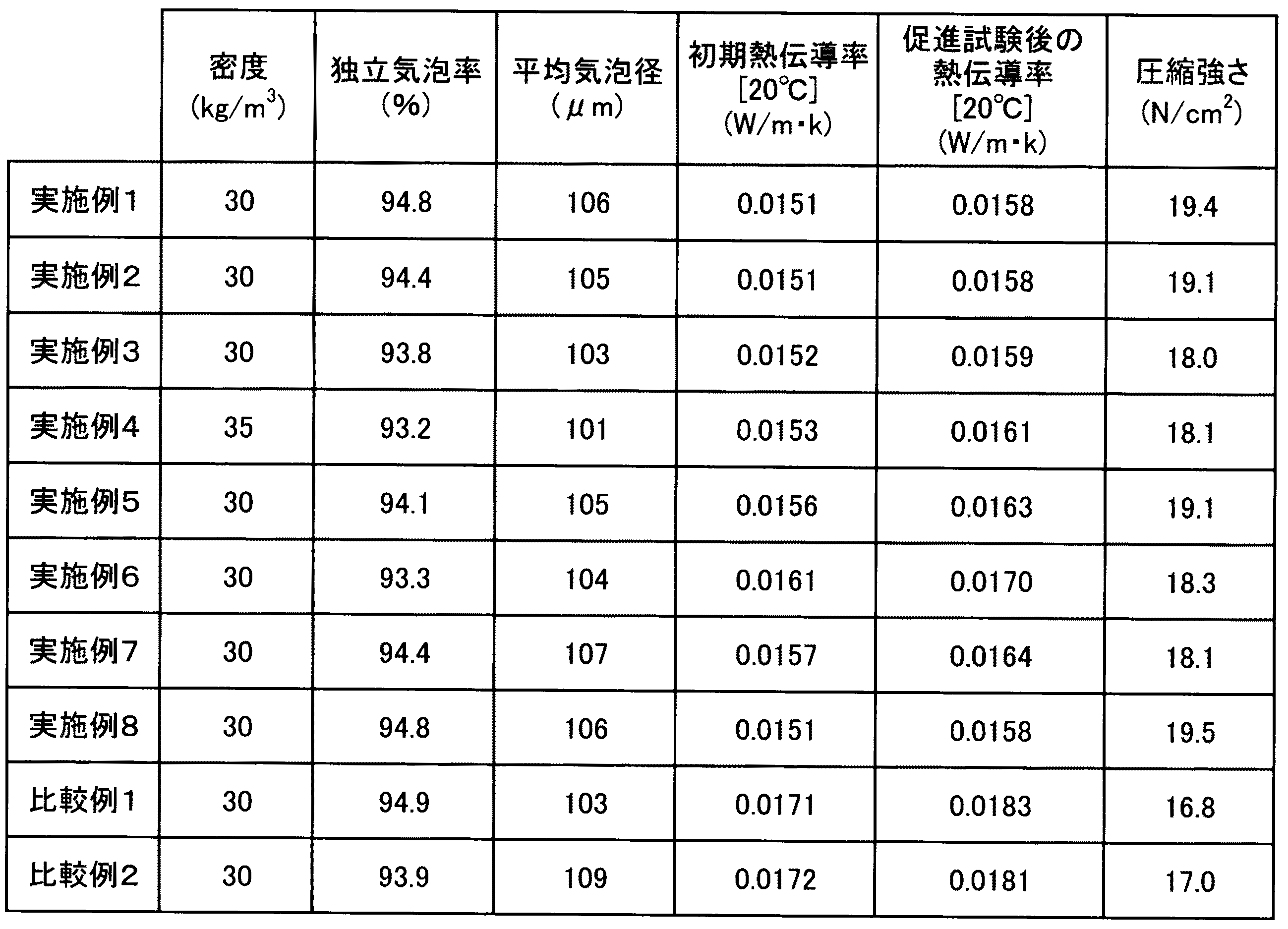
かかる表1の結果からも明らかなように、実施例1〜9に係る各フェノールフォームは、何れも、初期熱伝導率が0.0170W/m・k以下であり、加えて、長期安定性を確認するための促進試験で得られた熱伝導率が0.0180W/m・k以下のものであって、優れた初期熱伝導率と共に、中長期に亘る熱伝導率の変化も低く、優れた熱伝導率を維持し得るものであることが認められる。また、実施例1〜9に係る各フェノールフォームは、独立気泡率が90%以上であり、加えて圧縮強さは17.5N/cm2 以上であり、優れた圧縮強さを発揮するものであることが確認される。 As is clear from the results in Table 1, each of the phenolic foams according to Examples 1 to 9 has an initial thermal conductivity of 0.0170 W / m · k or less, and in addition, has long-term stability. The thermal conductivity obtained in the accelerated test for confirmation was 0.0180 W / m · k or less, and it was excellent because the change in thermal conductivity over the medium to long term was low as well as the excellent initial thermal conductivity. It is recognized that the thermal conductivity can be maintained. In addition, each of the phenolic foams according to Examples 1 to 9 has a closed cell ratio of 90% or more and a compressive strength of 17.5 N / cm 2 or more, and exhibits excellent compressive strength. It is confirmed that there is.
これに対して、特定の発泡剤(HCFO−1224yd)を全く使用していない比較例1、2に係る各フェノールフォームにあっては、実施例1〜9に係る各フェノールフォームと比較すると、初期熱伝導率及び促進試験後の熱伝導率の何れも高く、断熱性能に劣っていることが認められ、また、圧縮強さも17.0N/cm2 以下であることから、実施例1〜9に係る各フェノールフォームより劣っていることが認められるのである。 On the other hand, the phenolic foams according to Comparative Examples 1 and 2 in which no specific foaming agent (HCFO-1224yd) was used were initially compared with the phenolic foams according to Examples 1 to 9. Since both the thermal conductivity and the thermal conductivity after the accelerated test are high, it is recognized that the heat insulating performance is inferior, and the compressive strength is 17.0 N / cm 2 or less, it is described in Examples 1 to 9. It is recognized that it is inferior to each of the phenol foams.
Claims (11)
Priority Applications (5)
| Application Number | Priority Date | Filing Date | Title |
|---|---|---|---|
| JP2019122727A JP7141983B2 (en) | 2019-07-01 | 2019-07-01 | Resin composition for producing phenolic foam, phenolic foam and method for producing the same |
| CN202080048416.4A CN114072440B (en) | 2019-07-01 | 2020-05-12 | Resin composition for producing phenolic foam, phenolic foam and method for producing same |
| KR1020227000591A KR20220030998A (en) | 2019-07-01 | 2020-05-12 | Resin composition for manufacturing phenolic foam, phenolic foam, and method for manufacturing the same |
| PCT/JP2020/018942 WO2021002097A1 (en) | 2019-07-01 | 2020-05-12 | Resin composition for manufacturing phenolic foam, and phenolic foam and method for manufacturing same |
| EP20834940.7A EP3992220A4 (en) | 2019-07-01 | 2020-05-12 | Resin composition for manufacturing phenolic foam, and phenolic foam and method for manufacturing same |
Applications Claiming Priority (1)
| Application Number | Priority Date | Filing Date | Title |
|---|---|---|---|
| JP2019122727A JP7141983B2 (en) | 2019-07-01 | 2019-07-01 | Resin composition for producing phenolic foam, phenolic foam and method for producing the same |
Publications (2)
| Publication Number | Publication Date |
|---|---|
| JP2021008564A true JP2021008564A (en) | 2021-01-28 |
| JP7141983B2 JP7141983B2 (en) | 2022-09-26 |
Family
ID=74100251
Family Applications (1)
| Application Number | Title | Priority Date | Filing Date |
|---|---|---|---|
| JP2019122727A Active JP7141983B2 (en) | 2019-07-01 | 2019-07-01 | Resin composition for producing phenolic foam, phenolic foam and method for producing the same |
Country Status (5)
| Country | Link |
|---|---|
| EP (1) | EP3992220A4 (en) |
| JP (1) | JP7141983B2 (en) |
| KR (1) | KR20220030998A (en) |
| CN (1) | CN114072440B (en) |
| WO (1) | WO2021002097A1 (en) |
Cited By (1)
| Publication number | Priority date | Publication date | Assignee | Title |
|---|---|---|---|---|
| JP2023520639A (en) * | 2020-03-19 | 2023-05-18 | キングスパン・ホールディングス・(アイアールエル)・リミテッド | Phenolic foam and its manufacturing method |
Families Citing this family (7)
| Publication number | Priority date | Publication date | Assignee | Title |
|---|---|---|---|---|
| AU2021208850B2 (en) * | 2020-01-16 | 2023-10-05 | Asahi Kasei Construction Materials Corporation | Phenolic resin foam laminate board and composite board |
| EP4101633A4 (en) | 2020-02-06 | 2023-07-05 | Asahi Kasei Construction Materials Corporation | Phenol resin foam laminate |
| US12054596B2 (en) | 2020-11-30 | 2024-08-06 | Honeywell International Inc. | Azeotrope or azeotrope-like compositions of Z-1-chloro-2,3,3,3-tetrafluoropropene (HCFO-1224yd(Z)) |
| JP7849357B2 (en) * | 2021-05-31 | 2026-04-21 | 旭有機材株式会社 | Resin composition and foam for phenolic foam |
| KR20250094732A (en) * | 2021-08-12 | 2025-06-25 | 아사히 가세이 겐자이 가부시키가이샤 | Phenol resin foam |
| JP2023147837A (en) * | 2022-03-30 | 2023-10-13 | 旭有機材株式会社 | Foaming composition for polyurethane foam |
| GB2634291A (en) * | 2023-10-05 | 2025-04-09 | Kingspan Holdings Irl Ltd | Phenolic foam |
Citations (9)
| Publication number | Priority date | Publication date | Assignee | Title |
|---|---|---|---|---|
| JP2007161810A (en) * | 2005-12-12 | 2007-06-28 | Asahi Organic Chem Ind Co Ltd | Phenolic resin foam |
| CN103890665A (en) * | 2011-07-28 | 2014-06-25 | 卡迪亚创造工作室股份公司 | Oscillating mass pivoted on the outside of a timepiece movement, timepiece movement provided with such an oscillating mass and timepiece comprising such an oscillating mass |
| JP2014530939A (en) * | 2011-10-20 | 2014-11-20 | イー・アイ・デュポン・ドウ・ヌムール・アンド・カンパニーE.I.Du Pont De Nemours And Company | Azeotrope-like compositions of E-1-chloro-2,3,3,3-tetrafluoropropene and their use |
| WO2016152988A1 (en) * | 2015-03-24 | 2016-09-29 | 積水化学工業株式会社 | Phenolic resin foam and method for producing phenolic resin foam |
| JP2018095869A (en) * | 2016-12-10 | 2018-06-21 | 積水化学工業株式会社 | Phenol resin foam and method for producing the same |
| WO2019036049A1 (en) * | 2017-08-18 | 2019-02-21 | The Chemours Company, Fc, Llc | Compositions and uses of z-1-chloro-2,3,3,3-tetrafluoroprop-1-ene |
| WO2019065906A1 (en) * | 2017-09-28 | 2019-04-04 | Agc株式会社 | Propellant, propellant composition, and atomizer |
| WO2019088035A1 (en) * | 2017-11-01 | 2019-05-09 | Agc株式会社 | Method for producing hard synthetic resin foam |
| JP2019515112A (en) * | 2016-05-06 | 2019-06-06 | ザ ケマーズ カンパニー エフシー リミテッド ライアビリティ カンパニー | Z-HFO-1336mzz blowing agent for foaming thermoplastic polymers containing polystyrene |
Family Cites Families (6)
| Publication number | Priority date | Publication date | Assignee | Title |
|---|---|---|---|---|
| AU2012212084B2 (en) * | 2011-02-04 | 2016-03-10 | The Chemours Company Fc, Llc. | Azeotropic and azeotrope-like compositions involving certain haloolefins and uses thereof |
| JP2015105340A (en) * | 2013-11-29 | 2015-06-08 | 旭硝子株式会社 | Rigid foamed synthetic resin and method of producing the same |
| JP2015105342A (en) * | 2013-11-29 | 2015-06-08 | 旭硝子株式会社 | Rigid foamed synthetic resin and method of producing the same |
| CA2937031C (en) | 2014-01-24 | 2018-05-01 | Asahi Kasei Construction Materials Corporation | Phenol resin foam body and method for producing same |
| JP5805345B1 (en) * | 2015-06-04 | 2015-11-04 | 積水化学工業株式会社 | Phenolic resin foam |
| CA3077388C (en) * | 2017-10-10 | 2024-04-09 | The Chemours Company Fc, Llc | Process for the manufacture of thermoplastic foam containing hfo-1336mzz(z) and hfo-1336mzz(e) |
-
2019
- 2019-07-01 JP JP2019122727A patent/JP7141983B2/en active Active
-
2020
- 2020-05-12 WO PCT/JP2020/018942 patent/WO2021002097A1/en not_active Ceased
- 2020-05-12 CN CN202080048416.4A patent/CN114072440B/en active Active
- 2020-05-12 EP EP20834940.7A patent/EP3992220A4/en active Pending
- 2020-05-12 KR KR1020227000591A patent/KR20220030998A/en not_active Ceased
Patent Citations (9)
| Publication number | Priority date | Publication date | Assignee | Title |
|---|---|---|---|---|
| JP2007161810A (en) * | 2005-12-12 | 2007-06-28 | Asahi Organic Chem Ind Co Ltd | Phenolic resin foam |
| CN103890665A (en) * | 2011-07-28 | 2014-06-25 | 卡迪亚创造工作室股份公司 | Oscillating mass pivoted on the outside of a timepiece movement, timepiece movement provided with such an oscillating mass and timepiece comprising such an oscillating mass |
| JP2014530939A (en) * | 2011-10-20 | 2014-11-20 | イー・アイ・デュポン・ドウ・ヌムール・アンド・カンパニーE.I.Du Pont De Nemours And Company | Azeotrope-like compositions of E-1-chloro-2,3,3,3-tetrafluoropropene and their use |
| WO2016152988A1 (en) * | 2015-03-24 | 2016-09-29 | 積水化学工業株式会社 | Phenolic resin foam and method for producing phenolic resin foam |
| JP2019515112A (en) * | 2016-05-06 | 2019-06-06 | ザ ケマーズ カンパニー エフシー リミテッド ライアビリティ カンパニー | Z-HFO-1336mzz blowing agent for foaming thermoplastic polymers containing polystyrene |
| JP2018095869A (en) * | 2016-12-10 | 2018-06-21 | 積水化学工業株式会社 | Phenol resin foam and method for producing the same |
| WO2019036049A1 (en) * | 2017-08-18 | 2019-02-21 | The Chemours Company, Fc, Llc | Compositions and uses of z-1-chloro-2,3,3,3-tetrafluoroprop-1-ene |
| WO2019065906A1 (en) * | 2017-09-28 | 2019-04-04 | Agc株式会社 | Propellant, propellant composition, and atomizer |
| WO2019088035A1 (en) * | 2017-11-01 | 2019-05-09 | Agc株式会社 | Method for producing hard synthetic resin foam |
Cited By (2)
| Publication number | Priority date | Publication date | Assignee | Title |
|---|---|---|---|---|
| JP2023520639A (en) * | 2020-03-19 | 2023-05-18 | キングスパン・ホールディングス・(アイアールエル)・リミテッド | Phenolic foam and its manufacturing method |
| JP7837874B2 (en) | 2020-03-19 | 2026-03-31 | キングスパン・ホールディングス・(アイアールエル)・リミテッド | Phenolic foam and method for manufacturing the same |
Also Published As
| Publication number | Publication date |
|---|---|
| EP3992220A4 (en) | 2023-07-05 |
| CN114072440B (en) | 2024-03-05 |
| JP7141983B2 (en) | 2022-09-26 |
| WO2021002097A1 (en) | 2021-01-07 |
| KR20220030998A (en) | 2022-03-11 |
| CN114072440A (en) | 2022-02-18 |
| EP3992220A1 (en) | 2022-05-04 |
Similar Documents
| Publication | Publication Date | Title |
|---|---|---|
| JP7141983B2 (en) | Resin composition for producing phenolic foam, phenolic foam and method for producing the same | |
| JP7531398B2 (en) | Semi-nonflammable phenolic resin composition and semi-nonflammable material obtained therefrom | |
| KR102650256B1 (en) | Resin composition for phenolic foam production | |
| JP5036021B2 (en) | Phenolic resin foam | |
| JP4756683B2 (en) | Foamable resol-type phenolic resin molding material and phenolic resin foam | |
| JP7223201B1 (en) | Phenolic Foam Laminate | |
| JP7473476B2 (en) | Flame-retardant phenolic resin composition and flame-retardant material obtained therefrom | |
| JP5805345B1 (en) | Phenolic resin foam | |
| WO2023204283A1 (en) | Foamed phenolic-resin object and laminate thereof | |
| JP2007070505A (en) | Phenolic resin foam | |
| KR20240004685A (en) | phenolic resin foam | |
| JP2018095824A (en) | Phenol resin foam and method for producing the phenol resin foam |
Legal Events
| Date | Code | Title | Description |
|---|---|---|---|
| A621 | Written request for application examination |
Free format text: JAPANESE INTERMEDIATE CODE: A621 Effective date: 20220426 |
|
| TRDD | Decision of grant or rejection written | ||
| A01 | Written decision to grant a patent or to grant a registration (utility model) |
Free format text: JAPANESE INTERMEDIATE CODE: A01 Effective date: 20220830 |
|
| A61 | First payment of annual fees (during grant procedure) |
Free format text: JAPANESE INTERMEDIATE CODE: A61 Effective date: 20220912 |
|
| R150 | Certificate of patent or registration of utility model |
Ref document number: 7141983 Country of ref document: JP Free format text: JAPANESE INTERMEDIATE CODE: R150 |
|
| R250 | Receipt of annual fees |
Free format text: JAPANESE INTERMEDIATE CODE: R250 |