JP2021123744A - Sn-BASED PLATED STEEL SHEET - Google Patents
Sn-BASED PLATED STEEL SHEET Download PDFInfo
- Publication number
- JP2021123744A JP2021123744A JP2020017240A JP2020017240A JP2021123744A JP 2021123744 A JP2021123744 A JP 2021123744A JP 2020017240 A JP2020017240 A JP 2020017240A JP 2020017240 A JP2020017240 A JP 2020017240A JP 2021123744 A JP2021123744 A JP 2021123744A
- Authority
- JP
- Japan
- Prior art keywords
- steel sheet
- film layer
- less
- zirconium oxide
- plated steel
- Prior art date
- Legal status (The legal status is an assumption and is not a legal conclusion. Google has not performed a legal analysis and makes no representation as to the accuracy of the status listed.)
- Granted
Links
Images
Landscapes
- Other Surface Treatments For Metallic Materials (AREA)
Abstract
【課題】ジルコニウムを含有する化成処理皮膜を有していながらも、表面の色調が黄みを帯びておらず、また、経時で黄みを帯びにくいSn系めっき鋼板を提供すること。【解決手段】本発明に係るSn系めっき鋼板は、鋼板と、前記鋼板の少なくとも一方の面上に位置するSn系めっき層と、前記Sn系めっき層の上に位置する皮膜層と、を有し、前記Sn系めっき層は、Snを、金属Sn換算にて、1g/m2以上15g/m2以下含有し、前記皮膜層は、ジルコニウム酸化物を含有し、前記皮膜層の任意の断面での最大厚みが、10nm以上30nm以下であり、かつ、前記皮膜層の任意の断面での最大山部と最大谷部との間の長さが、5nm以上20nm以下である。【選択図】図1An object of the present invention is to provide a Sn-based plated steel sheet that has a chemical conversion coating containing zirconium, but whose surface color does not become yellowish and which does not become yellowish over time. [Solution] A Sn-based plated steel sheet according to the present invention includes a steel plate, an Sn-based plating layer located on at least one surface of the steel plate, and a coating layer located on the Sn-based plating layer. The Sn-based plating layer contains Sn from 1 g/m2 to 15 g/m2 in terms of metal Sn, and the film layer contains zirconium oxide, and the film layer contains Sn at any cross section of the film layer. The maximum thickness is 10 nm or more and 30 nm or less, and the length between the maximum peak and maximum trough in any cross section of the film layer is 5 nm or more and 20 nm or less. [Selection diagram] Figure 1
Description
本発明は、Sn系めっき鋼板に関する。 The present invention relates to Sn-based plated steel sheets.
錫(Sn)めっき鋼板は、「ブリキ」としてよく知られており、飲料缶や食缶などの缶用途その他に、広く用いられている。これは、Snが人体に安全であり、かつ、美麗な金属であることによる。このSn系めっき鋼板は、主に電気めっき法によって製造される。これは、比較的高価な金属であるSnの使用量を必要最小限の量に制御するには、溶融めっき法よりも電気めっき法が有利であることによる。Sn系めっき鋼板は、めっき後、又は、めっき後の加熱溶融処理により美麗な金属光沢が付与された後に、6価クロム酸塩の溶液を用いたクロメート処理(電解処理、浸漬処理など)によって、Sn系めっき層上にクロメート皮膜が施されることが多い。このクロメート皮膜の効果は、Sn系めっき層の表面の酸化を抑えることによる外観の黄変の防止、塗装されて使用される場合における錫酸化物の凝集破壊による塗膜密着性の劣化の防止、耐硫化黒変性の向上、などである。 Tin (Sn) plated steel sheets are well known as "tinplates" and are widely used for cans such as beverage cans and food cans. This is because Sn is a beautiful metal that is safe for the human body. This Sn-based plated steel sheet is mainly manufactured by an electroplating method. This is because the electroplating method is more advantageous than the hot-dip plating method in order to control the amount of Sn, which is a relatively expensive metal, to the minimum necessary amount. Sn-based plated steel sheets are subjected to chromate treatment (electrolytic treatment, dipping treatment, etc.) using a hexavalent chromium salt solution after plating or heat-melting treatment after plating to impart a beautiful metallic luster. A chromate film is often applied on the Sn-based plating layer. The effects of this chromate film are to prevent yellowing of the appearance by suppressing oxidation of the surface of the Sn-based plating layer, and to prevent deterioration of coating film adhesion due to cohesive failure of tin oxide when used after painting. Improvement of sulfide blackening resistance, etc.
一方、近年、環境及び安全に対する意識の高まりから、最終製品に6価クロムが含まれないのみならず、クロメート処理自体を行わないことが求められている。しかしながら、クロメート皮膜を有しないSn系めっき鋼板は、上述の如く、錫酸化物の成長により外観が黄変する。このため、クロメート皮膜に替わる皮膜処理が施されたSn系めっき鋼板が、いくつか提案されている。 On the other hand, in recent years, due to the growing awareness of the environment and safety, it is required that the final product does not contain hexavalent chromium and that the chromate treatment itself is not performed. However, as described above, the Sn-based plated steel sheet having no chromate film turns yellow in appearance due to the growth of tin oxide. Therefore, some Sn-based plated steel sheets that have been subjected to a film treatment instead of the chromate film have been proposed.
例えば、以下の特許文献1では、リン酸イオンとシランカップリング剤とを含有する溶液を用いた処理によって、PとSiを含む皮膜を形成させたSn系めっき鋼板が提案されている。 For example, Patent Document 1 below proposes a Sn-based plated steel sheet in which a film containing P and Si is formed by a treatment using a solution containing a phosphate ion and a silane coupling agent.
以下の特許文献2では、リン酸アルミニウムを含む溶液を用いた処理によって、Al及びPと、Ni、Co又はCuの少なくとも1種と、シランカップリング剤との反応物を含む皮膜を形成させたSn系めっき鋼板が提案されている。 In Patent Document 2 below, a film containing a reaction product of Al and P, at least one of Ni, Co or Cu, and a silane coupling agent was formed by a treatment using a solution containing aluminum phosphate. Sn-based galvanized steel sheets have been proposed.
以下の特許文献3では、Sn系めっき上にZnめっきをした後にZn単独めっき層が消失するまで加熱処理を施す、クロメート皮膜を有さないSn系めっき鋼板の製造方法が提案されている。 The following Patent Document 3 proposes a method for producing a Sn-based plated steel sheet having no chromate film, which is obtained by performing Zn plating on Sn-based plating and then heat-treating until the Zn single plating layer disappears.
以下の特許文献4及び特許文献5では、ジルコニウム、リン酸、フェノール樹脂等を含む化成処理皮膜を有する容器用鋼板が提案されている。 The following Patent Documents 4 and 5 propose steel sheets for containers having a chemical conversion treatment film containing zirconium, phosphoric acid, phenol resin and the like.
以下の特許文献6では、Sn系めっき層と、Sn系めっき層形成後に、リン酸塩水溶液中で、陰極電解処理、次いで陽極電解処理を施して形成された、錫酸化物とリン酸錫とを含む化成処理層を有するSn系めっき鋼板が提案されている。 In the following Patent Document 6, tin oxide and tin phosphate formed by subjecting a Sn-based plating layer and a Sn-based plating layer, followed by a cathode electrolysis treatment and then an anodic electrolysis treatment in a phosphate aqueous solution. A Sn-based plated steel sheet having a chemical conversion treatment layer containing the above has been proposed.
以下の特許文献7では、錫酸化物、並びに、Zr、Ti及びPを含有する被膜を有するSn系めっき鋼板が提案されている。なお、特許文献7では、被膜を形成するとき、陰極電解処理と陽極電解処理とを交互に行う交番電解を実施してもよいことが提案されている。 The following Patent Document 7 proposes a Sn-based galvanized steel sheet having a coating film containing tin oxide and Zr, Ti, and P. In addition, Patent Document 7 proposes that alternating electrolysis in which cathode electrolysis treatment and anodic electrolysis treatment are alternately performed when forming a coating film may be performed.
しかしながら、上記特許文献1〜特許文献7に開示されているSn系めっき鋼板においては、特許文献6や特許文献7で開示されているようなジルコニウムを含むSn系めっき鋼板の性能のバランスが良好であるが、表面の色調がクロメート皮膜ブリキに比べて黄みを帯びている、また、経時によって黄みが増す、という問題があった。 However, in the Sn-based plated steel sheets disclosed in Patent Documents 1 to 7, the performance balance of the Sn-based plated steel sheets containing zirconium as disclosed in Patent Documents 6 and 7 is good. However, there is a problem that the color tone of the surface is yellowish as compared with the chromate film tin plate, and the yellowness increases with time.
そこで、本発明は、上記問題に鑑みてなされたものであり、本発明の目的とするところは、ジルコニウムを含有する化成処理皮膜を有していながらも、表面の色調が黄みを帯びておらず、また、経時で黄みを帯びにくいSn系めっき鋼板を提供することにある。 Therefore, the present invention has been made in view of the above problems, and an object of the present invention is that the surface color tone is yellowish even though it has a chemical conversion treatment film containing zirconium. Another object of the present invention is to provide a Sn-based plated steel sheet that does not easily become yellowish over time.
上記課題を解決するために、本発明者らが鋭意検討した結果、Sn系めっき鋼板の表面に、ジルコニウム酸化物を含有する皮膜層を形成させ、更に、皮膜層の厚み及び皮膜層の表面凹凸を所定の範囲内に制御することで、表面の色調が黄みを帯びておらず、また、経時で黄みを帯びにくいだけでなく、より塗膜密着性に優れるSn系めっき鋼板を実現可能であることを見出した。
上記知見に基づき完成された本発明の要旨は、以下の通りである。
As a result of diligent studies by the present inventors in order to solve the above problems, a film layer containing a zirconium oxide is formed on the surface of the Sn-based plated steel sheet, and further, the thickness of the film layer and the surface unevenness of the film layer are formed. By controlling the above within a predetermined range, it is possible to realize a Sn-based galvanized steel sheet in which the surface color tone is not yellowish and not only is less likely to be yellowish over time, but also has better coating film adhesion. I found that.
The gist of the present invention completed based on the above findings is as follows.
(1)鋼板と、前記鋼板の少なくとも一方の面上に位置するSn系めっき層と、前記Sn系めっき層の上に位置する皮膜層と、を有し、前記Sn系めっき層は、Snを、金属Sn換算にて、1g/m2以上15g/m2以下含有し、前記皮膜層は、ジルコニウム酸化物を含有し、前記皮膜層の任意の断面での最大厚みが、10nm以上30nm以下であり、かつ、前記皮膜層の任意の断面での最大山部と最大谷部との間の長さが、5nm以上20nm以下である、Sn系めっき鋼板。
(2)前記皮膜層中のジルコニウム酸化物の含有量は、金属Zr換算にて、3mg/m2以上10mg/m2以下である、(1)に記載のSn系めっき鋼板。
(1) It has a steel plate, a Sn-based plating layer located on at least one surface of the steel plate, and a film layer located on the Sn-based plating layer, and the Sn-based plating layer contains Sn. , 1 g / m 2 or more and 15 g / m 2 or less in terms of metal Sn, the coating layer contains zirconium oxide, and the maximum thickness of the coating layer in an arbitrary cross section is 10 nm or more and 30 nm or less. A Sn-based plated steel sheet in which the length between the maximum peak portion and the maximum valley portion in an arbitrary cross section of the film layer is 5 nm or more and 20 nm or less.
(2) The Sn-based galvanized steel sheet according to (1), wherein the content of the zirconium oxide in the film layer is 3 mg / m 2 or more and 10 mg / m 2 or less in terms of metal Zr.
以上説明したように本発明によれば、従来のクロメート処理を行うことなく、表面が黄みを帯びておらず、かつ、耐黄変性に優れるSn系めっき鋼板を提供することが可能となる。 As described above, according to the present invention, it is possible to provide a Sn-based plated steel sheet having a surface that is not yellowish and has excellent yellowing resistance without performing conventional chromate treatment.
以下に添付図面を参照しながら、本発明の好適な実施の形態について詳細に説明する。 Hereinafter, preferred embodiments of the present invention will be described in detail with reference to the accompanying drawings.
以下に、本発明について詳細に説明する。
なお、本明細書において、「工程」との用語は、独立した工程だけではなく、他の工程と明確に区別できない場合であってもその工程の所期の目的が達成されるのであれば、本用語に含まれる。また、本明細書において、「鋼板」との用語は、Sn系めっき層及び皮膜層を形成する対象の母材鋼板(いわゆるめっき原板)を意味する。
Hereinafter, the present invention will be described in detail.
In addition, in this specification, the term "process" is not limited to an independent process, as long as the intended purpose of the process is achieved even if it cannot be clearly distinguished from other processes. Included in this term. Further, in the present specification, the term "steel plate" means a base steel plate (so-called plating original plate) to be formed with a Sn-based plating layer and a coating layer.
(Sn系めっき鋼板について)
以下で説明する本発明の実施形態は、食缶、飲料缶などの缶用途その他に広く用いられるSn系めっき鋼板と、かかるSn系めっき鋼板の製造方法に関するものである。より詳細には、従来のクロメート処理を行うことなく、耐黄変性、塗膜密着性、及び、耐硫化黒変性により一層優れるSn系めっき鋼板と、かかるSn系めっき鋼板の製造方法に関するものである。
(About Sn-based galvanized steel sheet)
An embodiment of the present invention described below relates to a Sn-based plated steel sheet widely used for cans such as food cans and beverage cans, and a method for producing such a Sn-based plated steel sheet. More specifically, the present invention relates to a Sn-based plated steel sheet that is more excellent in yellowing resistance, coating adhesion, and sulfide blackening resistance without performing conventional chromate treatment, and a method for producing such a Sn-based plated steel sheet. ..
具体的には、本実施形態に係るSn系めっき鋼板は、鋼板(母材鋼板)と、かかる鋼板の少なくとも一方の面上に位置するSn系めっき層と、Sn系めっき層の上に位置する皮膜層と、を有する。かかるSn系めっき層は、Snを金属Sn換算にて、片面当たり1g/m2以上15g/m2以下含有する。また、皮膜層は、ジルコニウム酸化物を含有し、皮膜層の任意の断面の最大厚みが、10nm以上30nm以下であり、かつ、皮膜層の任意の断面の最大山部と最大谷部の長さが、5nm以上20nm以下である。 Specifically, the Sn-based plated steel sheet according to the present embodiment is located on the steel sheet (base steel sheet), the Sn-based plating layer located on at least one surface of the steel sheet, and the Sn-based plating layer. It has a film layer. Such a Sn-based plating layer contains Sn in an amount of 1 g / m 2 or more and 15 g / m 2 or less per side in terms of metal Sn. Further, the film layer contains a zirconium oxide, the maximum thickness of an arbitrary cross section of the film layer is 10 nm or more and 30 nm or less, and the lengths of the maximum peak and the maximum valley of the arbitrary cross section of the film layer. However, it is 5 nm or more and 20 nm or less.
また、上記皮膜層中のジルコニウム酸化物の含有量は、金属Zr換算にて、片面当たり、例えば3mg/m2以上10mg/m2以下であることが好ましい。 Further, the content of the zirconium oxide in the film layer is preferably 3 mg / m 2 or more and 10 mg / m 2 or less per one side in terms of metal Zr.
<鋼板について>
本実施形態に係るSn系めっき鋼板の母材として用いられる鋼板は、特に規定されるものではなく、一般的な容器用のSn系めっき鋼板に用いられている鋼板であれば、任意のものを使用可能である。このような鋼板として、例えば、低炭素鋼、極低炭素鋼などが挙げられる。また、鋼板の製造方法及び材質も特に規定されるものではなく、例えば、鋳造から熱間圧延、酸洗、冷間圧延、焼鈍、調質圧延等の工程を経て製造された鋼板が挙げられる。
<About steel plate>
The steel sheet used as the base material of the Sn-based plated steel sheet according to the present embodiment is not particularly specified, and any steel sheet used for the general Sn-based plated steel sheet for containers can be used. It can be used. Examples of such a steel sheet include low carbon steel and ultra-low carbon steel. Further, the method and material for producing the steel sheet are not particularly specified, and examples thereof include steel sheets manufactured through processes such as casting, hot rolling, pickling, cold rolling, annealing, and temper rolling.
<Sn系めっき層>
上記のような鋼板の少なくとも片面には、Sn系めっき層が形成される。Sn系めっき層によって、鋼板の耐食性は向上する。なお、本明細書における「Sn系めっき層」とは、金属Sn単独のSn系めっき層だけではなく、金属Snと金属Feの合金や、金属Ni、また、金属Sn以外の微量元素及び不純物の少なくとも一方(例えば、FeやNi、Ca、Mg、Zn、Pb、Co等)を含有したSn系めっき層も含む。
<Sn-based plating layer>
A Sn-based plating layer is formed on at least one surface of the steel sheet as described above. The Sn-based plating layer improves the corrosion resistance of the steel sheet. The term "Sn-based plating layer" as used herein refers to not only the Sn-based plating layer of metal Sn alone, but also an alloy of metal Sn and metal Fe, metal Ni, and trace elements and impurities other than metal Sn. It also includes a Sn-based plating layer containing at least one (for example, Fe, Ni, Ca, Mg, Zn, Pb, Co, etc.).
Sn系めっき層は、金属Snを、金属Sn換算で、1g/m2以上15g/m2以下含有する。つまり、Sn系めっき層の片面当たりの付着量は、金属Sn量(つまり金属Sn換算量)で1g/m2以上15g/m2以下とする。Sn系めっき層の片面当たりの付着量が金属Sn量で1g/m2未満である場合には、耐食性に劣り、好ましくない。また、Sn系めっき層の片面当たりの付着量が金属Sn量で15g/m2を超える場合、金属Snによる耐食性の向上効果は十分であり、更なる増加は経済的な観点から好ましくない。また、片面当たりの付着量が金属Sn量で15g/m2を超える場合には、塗膜密着性も低下する傾向にある。Sn系めっき層の片面当たりの付着量は、好ましくは、金属Sn換算で、2.0g/m2以上13g/m2以下の範囲内である。 The Sn-based plating layer contains metal Sn in an amount of 1 g / m 2 or more and 15 g / m 2 or less in terms of metal Sn. That is, the amount of adhesion of the Sn-based plating layer per side is 1 g / m 2 or more and 15 g / m 2 or less in terms of the amount of metal Sn (that is, the amount converted to metal Sn). When the amount of the Sn-based plating layer adhered to one side is less than 1 g / m 2 in terms of the amount of metal Sn, the corrosion resistance is inferior, which is not preferable. Further, when the amount of adhesion of the Sn-based plating layer per side exceeds 15 g / m 2 in terms of the amount of metal Sn, the effect of improving the corrosion resistance by the metal Sn is sufficient, and further increase is not preferable from the economical point of view. Further, when the amount of adhesion per side exceeds 15 g / m 2 in terms of the amount of metal Sn, the adhesion to the coating film tends to decrease. The amount of adhesion of the Sn-based plating layer per side is preferably in the range of 2.0 g / m 2 or more and 13 g / m 2 or less in terms of metal Sn.
ここで、Sn系めっき層の金属Sn量(つまり、Sn系めっき層の片面当たりの付着量)は、例えば、JIS G 3303に記載された電解法、又は、蛍光X線法によって測定された値とする。 Here, the amount of metal Sn in the Sn-based plating layer (that is, the amount of adhesion of the Sn-based plating layer per side) is a value measured by, for example, the electrolytic method or the fluorescent X-ray method described in JIS G 3303. And.
また、例えば次の方法でも、Sn系めっき層中の金属Sn量を求めることが出来る。
まず、皮膜層が形成されていない試験片を準備する。その試験片を10%硝酸に浸漬して、Sn系めっき層を溶解し、得られた溶解液中のSnをICP発光分析法(例えば、アジレント・テクノロジー社製799ce、キャリアガスにArを使用。)で求める。そして、分析で得た強度信号と、濃度が既知の溶液から作成した検量線と、試験片のSn系めっき層の形成面積と、に基づいて、金属Sn量を求めることができる。
Further, for example, the amount of metal Sn in the Sn-based plating layer can also be obtained by the following method.
First, a test piece on which a film layer is not formed is prepared. The test piece was immersed in 10% nitric acid to dissolve the Sn-based plating layer, and Sn in the obtained solution was subjected to ICP emission spectrometry (for example, 799ce manufactured by Agilent Technologies, and Ar was used as the carrier gas. ). Then, the amount of metal Sn can be determined based on the intensity signal obtained by the analysis, the calibration curve prepared from the solution having a known concentration, and the formation area of the Sn-based plating layer of the test piece.
また、皮膜層が形成されている試験片の場合は、GDS(グロー放電発光分光法)を用いた検量線法にて、金属Sn量を求めることができ、その方法は例えば、次の通りである。金属Sn量が既知であるめっき試料(基準試料)を用い、GDSにより基準試料中における金属Snの強度信号及びスパッタ速度との関係をあらかじめ求め、検量線を作っておく。この検量線をもとに、金属Sn量が未知の試験片の強度信号及びスパッタ速度から、金属Snの量を求めることができる。 Further, in the case of a test piece on which a film layer is formed, the amount of metal Sn can be determined by a calibration curve method using GDS (glow discharge emission spectroscopy), and the method is, for example, as follows. be. Using a plating sample (reference sample) in which the amount of metal Sn is known, the relationship between the intensity signal of metal Sn and the sputter rate in the reference sample is obtained in advance by GDS, and a calibration curve is prepared. Based on this calibration curve, the amount of metal Sn can be obtained from the intensity signal and the sputtering rate of the test piece whose metal Sn amount is unknown.
この際、Sn系めっき層は、Snの強度信号が、Snの強度信号の最大値の1/2になる深さから、Feの強度信号が、Feの強度信号の最大値の1/2になる深さまでの部分と定義した。 At this time, in the Sn-based plating layer, the intensity signal of Sn is reduced to 1/2 of the maximum value of the intensity signal of Fe, and the intensity signal of Fe is reduced to 1/2 of the maximum value of the intensity signal of Fe. It was defined as the part up to the depth.
なお、金属Sn量の測定方法について、測定精度及び迅速性の観点からは、工業的には蛍光X線法による測定方法を用いることが好ましい。 From the viewpoint of measurement accuracy and speed, it is industrially preferable to use the method of measuring the amount of metal Sn by the fluorescent X-ray method.
Sn系めっきを鋼板表面に施す方法は、特に規定するものではないが、公知の電気めっき法が好ましい。電気めっき法としては、例えば、公知の硫酸浴、ホウフッ化浴、フェノールスルホン酸浴、メタンスルホン酸浴といった酸性浴、又は、アルカリ浴などを用いた電解法を利用することができる。なお、溶融したSnに鋼板を浸漬することでSn系めっきする溶融法を用いてもよい。 The method of applying Sn-based plating to the surface of the steel sheet is not particularly specified, but a known electroplating method is preferable. As the electroplating method, for example, an acidic bath such as a known sulfuric acid bath, borofluoride bath, phenol sulfonic acid bath, or methane sulfonic acid bath, or an electrolysis method using an alkaline bath or the like can be used. A melting method of Sn-based plating by immersing a steel sheet in the molten Sn may be used.
また、Sn系めっき後に、Sn系めっき層を有する鋼板をSnの融点である231.9℃以上に加熱する加熱溶融処理を施してもよい。この加熱溶融処理によって、Sn系めっき層の表面に光沢が出るとともに、Sn系めっき層と鋼板との間に、SnとFeとの合金層が形成され、耐食性が更に向上する。 Further, after the Sn-based plating, a heat-melting treatment may be performed in which the steel sheet having the Sn-based plating layer is heated to 231.9 ° C. or higher, which is the melting point of Sn. By this heat melting treatment, the surface of the Sn-based plating layer becomes glossy, and an alloy layer of Sn and Fe is formed between the Sn-based plating layer and the steel sheet, further improving the corrosion resistance.
<ジルコニウム酸化物を含有する皮膜層>
[皮膜層の任意の断面の厚み]
本実施形態に係るSn系めっき鋼板は、鋼板の表面に形成されたSn系めっき層の表面に、ジルコニウム酸化物を含有する皮膜層を有する。この皮膜層の任意の断面の厚みは、10nm以上30nm以下である必要がある。皮膜層の厚みが10nm未満である場合には、皮膜のバリア効果が不十分なため、耐食性に劣る。一方、皮膜層の厚みが30nmを超える場合には、皮膜に垂直な入射光が入った際に、その反射光中の青色成分が光の干渉により吸収されるため、皮膜は黄みを帯びて見えるようになる。
<Film layer containing zirconium oxide>
[Thickness of arbitrary cross section of film layer]
The Sn-based plated steel sheet according to the present embodiment has a film layer containing a zirconium oxide on the surface of the Sn-based plated layer formed on the surface of the steel sheet. The thickness of any cross section of this film layer needs to be 10 nm or more and 30 nm or less. When the thickness of the film layer is less than 10 nm, the barrier effect of the film is insufficient, and the corrosion resistance is inferior. On the other hand, when the thickness of the film layer exceeds 30 nm, when the incident light perpendicular to the film enters, the blue component in the reflected light is absorbed by the interference of the light, so that the film becomes yellowish. You will be able to see it.
従来、電解法によりジルコニウムイオンを含む水溶液中からジルコニウム酸化物をSn系めっき上に形成させる方法においては、ジルコニウム酸化物を含む皮膜層の厚みを30nm以下にすることは、不可能であった。その理由は、以下の通りである。 Conventionally, in the method of forming a zirconium oxide on a Sn-based plating from an aqueous solution containing zirconium ions by an electrolytic method, it has been impossible to reduce the thickness of the film layer containing the zirconium oxide to 30 nm or less. The reason is as follows.
すなわち、電解法により水溶液中からジルコニウム酸化物をSn系めっき上に形成させるメカニズムは、Sn系めっき上での水素発生反応に伴うSn系めっき近傍の水溶液のpH上昇によって、水溶液中で沈殿析出したジルコニウム酸化物が、Sn系めっき上に付着するというものである。ここで、水溶液中で沈殿析出したジルコニウム酸化物は粗大である。また、沈殿析出したジルコニウム酸化物がSn系めっき上に移動して、付着するまでに更に粗大化し、Sn系めっき上に付着した際には、30nmを超えてしまうためと考えられる。 That is, the mechanism for forming zirconium oxide from the aqueous solution on the Sn-based plating by the electrolytic method is that the pH of the aqueous solution near the Sn-based plating increases due to the hydrogen generation reaction on the Sn-based plating, and the precipitate precipitates in the aqueous solution. The zirconium oxide adheres to the Sn-based plating. Here, the zirconium oxide precipitated and precipitated in the aqueous solution is coarse. Further, it is considered that the precipitated zirconium oxide moves on the Sn-based plating and becomes coarser until it adheres, and when it adheres on the Sn-based plating, it exceeds 30 nm.
本実施形態に係る皮膜層として、厚みが30nm以下のものを製造可能な理由については、以下で改めて説明する。 The reason why a film layer having a thickness of 30 nm or less can be produced as the film layer according to the present embodiment will be described again below.
皮膜層の任意の断面の厚みは、本実施形態に係るSn系めっき鋼板の断面の観察によって測定される値とする。具体的には、本発明のSn系めっき鋼板の任意の部位を、FIB(Focused Ion Beam;収束イオンビーム)にて、TEM(Transmission Electron Microscope:透過型電子顕微鏡)観察用の試料を作製し、10万倍以上の倍率で10視野観察した際の平均厚みと定義する。 The thickness of an arbitrary cross section of the film layer is a value measured by observing the cross section of the Sn-based plated steel sheet according to the present embodiment. Specifically, a sample for TEM (Transmission Electron Microscope) observation was prepared for any part of the Sn-based plated steel plate of the present invention by FIB (Focused Ion Beam). It is defined as the average thickness when observing 10 fields at a magnification of 100,000 times or more.
[皮膜層の任意の断面の最大山部と最大谷部の長さ]
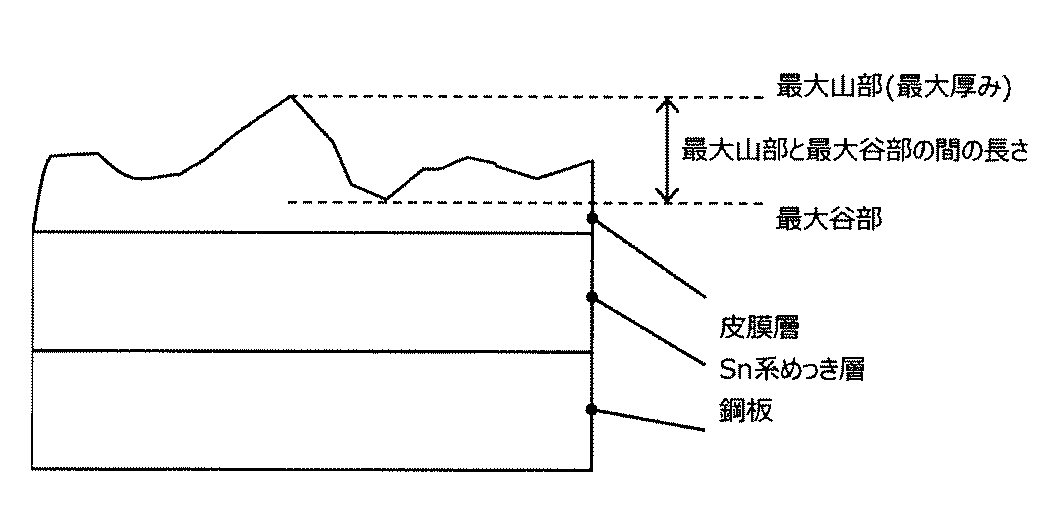
また、図1に模式的に示したように、皮膜層の任意の断面における最大山部と最大谷部との間の長さは、5nm以上20nm以下とする。これは、上記長さが5nm以上であれば、本実施形態に係るSn系めっき鋼板が塗装されて用いられる場合、塗膜との接触面積が十分であり、良好な塗膜密着性を有するようになるからであり、上記長さが20nm以下であれば、本実施形態に係るSn系めっき鋼板を未塗装で用いる場合に、色味が黄みを帯びることを防止できるからである。
[Length of maximum peak and maximum valley of any cross section of the film layer]
Further, as schematically shown in FIG. 1, the length between the maximum peak portion and the maximum valley portion in an arbitrary cross section of the film layer is 5 nm or more and 20 nm or less. This is because if the length is 5 nm or more, the contact area with the coating film is sufficient and good coating film adhesion is obtained when the Sn-based plated steel sheet according to the present embodiment is coated and used. This is because if the length is 20 nm or less, it is possible to prevent the color from becoming yellowish when the Sn-based plated steel sheet according to the present embodiment is used unpainted.
しかしながら、最大山部と最大谷部との間の長さが5nm未満である場合には、アンカー効果が不十分となり、塗装されて用いられる場合の塗膜密着性が劣る。一方、最大山部と最大谷部との間の長さが20nmを超える場合には、未塗装で用いられる場合に、その表面積が大きいために酸素拡散による皮膜内部への酸素量が多くなり、酸化錫の生成量が多くなって、その外観が黄みを帯び易くなる。 However, when the length between the maximum peak portion and the maximum valley portion is less than 5 nm, the anchor effect becomes insufficient, and the coating film adhesion when used after painting is inferior. On the other hand, when the length between the maximum peak and the maximum valley exceeds 20 nm, the amount of oxygen inside the film due to oxygen diffusion increases due to the large surface area when used unpainted. The amount of tin oxide produced increases, and the appearance tends to become yellowish.
なお、図1に模式的に示したような最大山部と最大谷部との間の長さは、好ましくは7nm以上15nm以下である。 The length between the maximum peak portion and the maximum valley portion as schematically shown in FIG. 1 is preferably 7 nm or more and 15 nm or less.
ここで、皮膜層の任意の断面における最大山部と最大谷部との間の長さは、先だって説明した皮膜層の厚みの求め方と同様に、TEMで任意の皮膜断面を観察した際の最大皮膜厚み部分と最も皮膜が薄い部分の間の長さと定義する。 Here, the length between the maximum peak portion and the maximum valley portion in an arbitrary cross section of the film layer is the same as the method for determining the thickness of the film layer described above, when the arbitrary film cross section is observed by TEM. It is defined as the length between the part with the maximum film thickness and the part with the thinnest film.
[皮膜層に含まれるジルコニウム酸化物の含有量(金属Zr換算)]
皮膜層に含まれるジルコニウム酸化物の含有量は、金属Zr換算にて、3mg/m2以上10mg/m2以下であることが好ましい。ジルコニウム酸化物の含有量が3mg/m2以上であれば、ジルコニウム酸化物によるバリア性が十分であり、アミノ酸を含む食品等に対する耐硫化黒変性が良好である。ジルコニウム酸化物の含有量が3mg/m2未満である場合には、ジルコニウム酸化物によるバリア性が不十分となり、耐硫化黒変性が劣る。一方、ジルコニウム酸化物の含有量が10mg/m2を超える場合には、ジルコニウム酸化物自体の凝集破壊により、塗膜密着性が低下する傾向にある。なお、皮膜層中におけるジルコニウム酸化物の含有量は、片面当たりのジルコニウム酸化物の含有量である。
[Content of zirconium oxide contained in the film layer (in terms of metal Zr)]
The content of the zirconium oxide contained in the film layer is preferably 3 mg / m 2 or more and 10 mg / m 2 or less in terms of metal Zr. When the content of the zirconium oxide is 3 mg / m 2 or more, the barrier property due to the zirconium oxide is sufficient, and the sulfurization-resistant black denaturation for foods containing amino acids is good. When the content of the zirconium oxide is less than 3 mg / m 2 , the barrier property due to the zirconium oxide becomes insufficient, and the sulfurization blackening resistance is inferior. On the other hand, when the content of the zirconium oxide exceeds 10 mg / m 2 , the adhesion to the coating film tends to decrease due to the cohesive failure of the zirconium oxide itself. The content of zirconium oxide in the film layer is the content of zirconium oxide per one side.
皮膜層に含まれるジルコニウム酸化物の含有量は、より好ましくは、5mg/m2以上8mg/m2以下である。 The content of the zirconium oxide contained in the film layer is more preferably 5 mg / m 2 or more and 8 mg / m 2 or less.
また、皮膜層中には、Fe、Ni、Cr、Ca、Na、Mg、Al、Si等のような、如何なる元素が含まれていても、何ら問題ない。 Further, there is no problem even if any element such as Fe, Ni, Cr, Ca, Na, Mg, Al, Si and the like is contained in the film layer.
皮膜層中におけるジルコニウム酸化物の含有量(金属Zr量)は、本実施形態に係るSn系めっき鋼板を、例えば、フッ酸と硫酸などの酸性溶液に浸漬して溶解し、得られた溶解液を高周波誘導結合プラズマ(Inductively Coupled Plasma:ICP)発光分析法などの化学分析によって測定された値とする。また、ジルコニウム酸化物の含有量(金属Zr量)を蛍光X線測定によって求めても構わない。 The content of zirconium oxide (metal Zr content) in the film layer is determined by immersing the Sn-based plated steel sheet according to the present embodiment in an acidic solution such as hydrofluoric acid and sulfuric acid to dissolve it. Is a value measured by chemical analysis such as high frequency inductively coupled plasma (ICP) luminescence analysis method. Further, the content of the zirconium oxide (the amount of metal Zr) may be determined by fluorescent X-ray measurement.
なお、金属Zr量の測定方法について、測定精度及び迅速性の観点からは、工業的には蛍光X線法による測定方法を用いることが好ましい。 As for the method for measuring the amount of metal Zr, it is industrially preferable to use the method for measuring the amount of metal Zr by the fluorescent X-ray method from the viewpoint of measurement accuracy and speed.
<皮膜層の形成方法について>
以下では、本実施形態に係るジルコニウム酸化物を含有する皮膜層の形成方法について、詳細に説明する。
本実施形態に係るジルコニウム酸化物を含有する皮膜層は、ジルコニウムイオンを含む水溶液中にSn系めっき鋼板を浸漬し、Sn系めっき系鋼板を陰極として陰極電解処理を行うことにより、Sn系めっき層の表面に形成することができる。陰極電解処理による、強制的な電荷移動及び鋼板界面での水素発生による表面清浄化とpH上昇による付着促進効果も相まって、ジルコニウム酸化物を含む皮膜層をSn系めっき鋼板上に得ることができる。
<About the method of forming the film layer>
Hereinafter, the method for forming the film layer containing the zirconium oxide according to the present embodiment will be described in detail.
The film layer containing zirconium oxide according to the present embodiment is obtained by immersing a Sn-based plated steel sheet in an aqueous solution containing zirconium ions and performing a cathode electrolysis treatment using the Sn-based plated steel sheet as a cathode to perform a cathode electrolytic treatment. Can be formed on the surface of. A film layer containing a zirconium oxide can be obtained on a Sn-based plated steel sheet, in combination with the forced charge transfer by the cathode electrolysis treatment, the surface cleaning by hydrogen generation at the steel sheet interface, and the adhesion promoting effect by increasing the pH.
しかしながら、単純な陰極電解処理のみでは、先だって言及したように、Sn系めっき上での水素発生反応に伴うSn系めっき近傍の水溶液のpH上昇によって、水溶液中で沈殿析出した粗大なジルコニウム酸化物又はジルコニウム水酸化物が、Sn系めっき上に移動して付着するまでに更に粗大化し、Sn系めっき上に付着した際には、皮膜層の厚みは30nmを超えてしまう。 However, with only simple cathode electrolysis treatment, as mentioned earlier, coarse zirconium oxide or coarse zirconium oxide precipitated in the aqueous solution due to the increase in pH of the aqueous solution near the Sn-based plating due to the hydrogen generation reaction on the Sn-based plating. The zirconium hydroxide further coarsens until it moves to and adheres to the Sn-based plating, and when it adheres to the Sn-based plating, the thickness of the film layer exceeds 30 nm.
このような粗大化現象を抑制するために、陰極電解処理に用いるジルコニウムイオンを含む水溶液(以下、「陰極電解処理液」と記載する。)中の不溶解成分濃度を、5ppm以上50ppm以下とする必要がある。ここでいう不溶解成分は、Sn、Fe、Ca、Mg、Pのうちの1種又は2種以上からなる化合物を含む物質である。この不溶解成分は、水溶液中で沈殿析出するジルコニウム酸化物の析出起点となり、また、粗大なジルコニウム酸化物又は水酸化物を形成する要因にもなる。不溶解成分濃度を50ppm以下とすることで、粗大なジルコニウム酸化物又は水酸化物の生成を抑制でき、最大厚みが30nm以下のジルコニウム酸化物を含む皮膜層を、Sn系めっき鋼板上に形成することが可能となる。 In order to suppress such a coarsening phenomenon, the concentration of insoluble components in the aqueous solution containing zirconium ions used for the cathode electrolysis treatment (hereinafter referred to as "cathode electrolysis treatment liquid") is set to 5 ppm or more and 50 ppm or less. There is a need. The insoluble component referred to here is a substance containing a compound consisting of one or more of Sn, Fe, Ca, Mg, and P. This insoluble component serves as a precipitation starting point of the zirconium oxide that precipitates and precipitates in the aqueous solution, and also becomes a factor for forming a coarse zirconium oxide or a hydroxide. By setting the concentration of the insoluble component to 50 ppm or less, the formation of coarse zirconium oxide or hydroxide can be suppressed, and a film layer containing the zirconium oxide having a maximum thickness of 30 nm or less is formed on the Sn-based galvanized steel sheet. It becomes possible.
一方、不溶解成分濃度が5ppm未満である場合には、ジルコニウム酸化物又は水酸化物の析出起点が少なく、ジルコニウム酸化物を含む皮膜層の形成効率が劣るだけでなく、析出起点が少なくなるために平滑な皮膜となり、最大山部と最大谷部との間の長さが5nm以上の皮膜が形成されない。 On the other hand, when the concentration of the insoluble component is less than 5 ppm, the starting point of precipitation of the zirconium oxide or hydroxide is small, and not only the formation efficiency of the film layer containing the zirconium oxide is poor, but also the starting point of precipitation is reduced. A smooth film is formed, and a film having a length of 5 nm or more between the maximum peak and the maximum valley is not formed.
陰極電解処理液における不溶解成分濃度は、好ましくは、10ppm以上30ppm以下である。なお、この不溶解成分濃度は、陰極電解処理液をフィルタリングすることで、所望の値に制御することが可能である。 The concentration of the insoluble component in the cathode electrolytic treatment liquid is preferably 10 ppm or more and 30 ppm or less. The concentration of the insoluble component can be controlled to a desired value by filtering the cathode electrolytic treatment liquid.
陰極電解処理液中のジルコニウムイオンの濃度は、生産設備、生産速度(能力)などに応じて適宜調整すればよい。例えば、ジルコニウムイオン濃度は、1000ppm以上4000ppm以下であることが好ましい。また、ジルコニウムイオンを含む溶液中には、フッ素イオン、リン酸イオン、アンモニウムイオン、硝酸イオン、硫酸イオン、塩化物イオンなどの他の成分が含まれていても何ら問題ない。陰極電解処理液中のジルコニウムイオンの供給源は、例えば、H2ZrF6のようなジルコニウム錯体を使用できる。上記のようなZr錯体中のZrは、陰極電極界面におけるpHの上昇によりZr4+となって陰極電解処理液中に存在する。このようなZrイオンは、陰極電解処理液中で更に反応し、ジルコニウム酸化物となる。また、陰極電解処理する際の陰極電解処理液の溶媒としては、例えば、蒸留水等の水を使用することができる。ただし、溶媒は、蒸留水等の水に規定されるものではなく、溶解する物質、形成方法等に応じて、適宜選択することが可能である。 The concentration of zirconium ions in the cathode electrolytic treatment liquid may be appropriately adjusted according to the production equipment, production speed (capacity), and the like. For example, the zirconium ion concentration is preferably 1000 ppm or more and 4000 ppm or less. Further, there is no problem even if the solution containing zirconium ion contains other components such as fluorine ion, phosphate ion, ammonium ion, nitrate ion, sulfate ion and chloride ion. The source of zirconium ions in the cathodic electrolytic treatment solution may be used, for example, zirconium complexes such as H 2 ZrF 6. Zr in the Zr complex as described above becomes Zr 4+ due to an increase in pH at the cathode electrode interface and exists in the cathode electrolysis solution. Such Zr ions further react in the cathodic electrolytic treatment liquid to become a zirconium oxide. Further, as the solvent of the cathode electrolysis treatment liquid at the time of the cathode electrolysis treatment, for example, water such as distilled water can be used. However, the solvent is not defined in water such as distilled water, and can be appropriately selected depending on the substance to be dissolved, the forming method, and the like.
また、陰極電解処理する際の陰極電解処理液の液温は、特に規定するものではないが、例えば、5℃以上50℃以下の範囲とすることが好ましい。50℃以下の液温で陰極電解を行うことにより、非常に細かい粒子により形成された、緻密で均一な皮膜層の組織の形成が可能となる。一方、液温が5℃未満である場合には、皮膜の形成効率に劣る可能性がある。また、液温が50℃を超える場合には、形成される皮膜が不均一となって、欠陥、割れ、マイクロクラック等が発生して緻密な皮膜形成が困難となり、腐食等の起点となる可能性があるため好ましくない。 The temperature of the cathode electrolytic treatment liquid during the cathode electrolysis treatment is not particularly specified, but is preferably in the range of, for example, 5 ° C. or higher and 50 ° C. or lower. By performing cathode electrolysis at a liquid temperature of 50 ° C. or lower, it is possible to form a dense and uniform film layer structure formed by very fine particles. On the other hand, when the liquid temperature is less than 5 ° C., the film forming efficiency may be inferior. Further, when the liquid temperature exceeds 50 ° C., the film to be formed becomes non-uniform, defects, cracks, microcracks, etc. occur, making it difficult to form a dense film, which may be a starting point for corrosion and the like. It is not preferable because of its nature.
また、陰極電解処理液のpHは、3.5以上4.5以下とすることが好ましい。pHが3.5未満である場合には、Zr皮膜の析出効率が劣る可能性があり、pHが4.5を超える場合には、液中でZr酸化物が沈殿して、粗大で粗いZr皮膜となりやすい。なお、陰極電解液のpHを調整したり電解効率を上げたりするために、陰極電解処理液中に、例えば硝酸、アンモニア水等を添加してもよい。 The pH of the cathode electrolytic treatment liquid is preferably 3.5 or more and 4.5 or less. If the pH is less than 3.5, the precipitation efficiency of the Zr film may be inferior, and if the pH exceeds 4.5, the Zr oxide precipitates in the liquid, resulting in coarse and coarse Zr. It tends to be a film. In order to adjust the pH of the cathode electrolytic solution and increase the electrolytic efficiency, for example, nitric acid, aqueous ammonia, or the like may be added to the cathode electrolytic solution.
また、陰極電解処理する際の電流密度は、1A/dm2以上10A/dm2以下にすることが好ましい。電流密度が1A/dm2未満である場合には、皮膜の形成効率の低下を招き、疎な皮膜となり耐黄変性及び耐硫化黒変性が低下する可能性がある。一方、電流密度が10A/dm2を超える場合には、Sn系めっき鋼板表面からの水素発生が盛んになり、鋼板表面近傍のpHが処理液の沖合まで高くなるために、処理液中でZr酸化物が生成し、生成したZr酸化物が鋼板表面に付着するまでに更に粗大化するために、粗い皮膜となる可能性がある。 Further, the current density during the cathode electrolysis treatment is preferably 1 A / dm 2 or more and 10 A / dm 2 or less. If the current density is less than 1 A / dm 2 , the film forming efficiency may be lowered, resulting in a sparse film, and yellowing resistance and sulfurization resistance blackening may be lowered. On the other hand, when the current density exceeds 10 A / dm 2 , hydrogen is actively generated from the surface of the Sn-based plated steel sheet, and the pH near the surface of the steel sheet rises to the offshore of the treatment liquid. Oxides are generated, and the produced Zr oxide becomes coarser before adhering to the surface of the steel sheet, so that a coarse film may be formed.
なお、上記の皮膜層の形成に際して、陰極電解処理の時間は、問うものではない。狙いとする皮膜層中のジルコニウム酸化物の含有量(金属Zr量)に対し、電流密度に応じて適宜、陰極電解処理の時間を調整すればよい。また、陰極電解処理する際の通電パターンとしては、連続通電であっても断続通電であっても何ら問題はない。 In forming the above-mentioned film layer, the time of the cathode electrolysis treatment does not matter. The time of the cathode electrolysis treatment may be appropriately adjusted according to the current density with respect to the content of the zirconium oxide (the amount of metal Zr) in the target film layer. Further, as the energization pattern at the time of the cathode electrolysis treatment, there is no problem whether it is continuous energization or intermittent energization.
また、ジルコニウム酸化物を有する皮膜層の最大山部と最大谷部との間の長さを、5nm以上20nm以下とするために、ジルコニウム酸化物を有する皮膜を形成後に、液温20℃以上50℃以下、pH2以下の水溶液に、1秒以上5秒以下浸漬する。これにより、先だって説明したような、最大山部と最大谷部との間の長さを実現できる。 Further, in order to make the length between the maximum peak portion and the maximum valley portion of the film layer having zirconium oxide 5 nm or more and 20 nm or less, after forming the film having zirconium oxide, the liquid temperature is 20 ° C. or more and 50 ° C. or more. Immerse in an aqueous solution having a temperature of 1 ° C. or lower and a pH of 2 or less for 1 second or more and 5 seconds or less. As a result, the length between the maximum peak and the maximum valley can be realized as described above.
pH2以下の水溶液に浸漬することで、凸状に付着したジルコニウム酸化物が優先溶解し、ジルコニウム酸化物を有する皮膜層の凹凸を制御することができる。一方、pHが2超では、ジルコニウム酸化物を溶解することができない。pH2以下の水溶液の温度が20℃未満又は浸漬時間が1秒未満では、ジルコニウム酸化物の溶解性に劣り、最大山部と最大谷部との間の長さを安定的に20nm以下にできない。一方、pH2以下の水溶液の温度が50℃超又は浸漬時間が5秒超では、ジルコニウム酸化物の溶解能力が過剰で、最大山部と最大谷部との間の長さが安定的に制御できず、5nm未満になりやすい。 By immersing in an aqueous solution having a pH of 2 or less, the zirconium oxide adhered in a convex shape is preferentially dissolved, and the unevenness of the film layer having the zirconium oxide can be controlled. On the other hand, if the pH is more than 2, the zirconium oxide cannot be dissolved. If the temperature of the aqueous solution having a pH of 2 or less is less than 20 ° C. or the immersion time is less than 1 second, the solubility of the zirconium oxide is inferior, and the length between the maximum peak and the maximum valley cannot be stably reduced to 20 nm or less. On the other hand, when the temperature of the aqueous solution having a pH of 2 or less is more than 50 ° C. or the immersion time is more than 5 seconds, the ability to dissolve the zirconium oxide is excessive, and the length between the maximum peak and the maximum valley can be stably controlled. However, it tends to be less than 5 nm.
以上、図1を参照しながら、本実施形態に係るSn系めっき鋼板について、詳細に説明した。 As described above, the Sn-based plated steel sheet according to the present embodiment has been described in detail with reference to FIG.
続いて、実施例及び比較例を示しながら、本発明に係るSn系めっき鋼板について、具体的に説明する。なお、以下に示す実施例は、あくまでも本発明のSn系めっき鋼板の一例にすぎず、本発明のSn系めっき鋼板が下記の例に限定されるものではない。 Subsequently, the Sn-based plated steel sheet according to the present invention will be specifically described with reference to Examples and Comparative Examples. The examples shown below are merely examples of the Sn-based plated steel sheet of the present invention, and the Sn-based plated steel sheet of the present invention is not limited to the following examples.
(実施例1)
<試験材の作製方法>
試験材の作製方法について説明する。なお、後述する各例の試験材は、この試験材の作製方法に準じて作製した。まず、板厚0.2mmの低炭素冷延鋼板に対し、前処理として、電解アルカリ脱脂、水洗、希硫酸浸漬酸洗、水洗した後、フェノールスルホン酸浴(フェロスタン浴)を用いて電気Sn系めっきを施し、更にその後、加熱溶融処理をした。これらの処理を経て、鋼板の両面にSn系めっき層を形成した。Sn系めっき層の付着量は、片面当たり約2.8g/m2を標準とした。Sn系めっき層の付着量は、通電時間を変えることで調整した。
(Example 1)
<Method of manufacturing test material>
A method for producing a test material will be described. The test materials of each example described later were produced according to the method for producing the test materials. First, a low-carbon cold-rolled steel sheet having a thickness of 0.2 mm is pretreated with electrolytic alkali degreasing, washing with water, pickling with dilute sulfuric acid, and then washing with water, and then using a phenol sulfonic acid bath (ferrostane bath) to make an electric Sn system. It was plated and then heat-melted. Through these treatments, Sn-based plating layers were formed on both sides of the steel sheet. The standard adhesion amount of the Sn-based plating layer was about 2.8 g / m 2 per side. The amount of adhesion of the Sn-based plating layer was adjusted by changing the energization time.
次に、Sn系めっき層を形成した鋼板を、フッ化ジルコニウムを含む水溶液(陰極電解液)中で陰極電解処理し、Sn系めっき層の表面にジルコニウム酸化物とマンガン酸化物とを含む皮膜層を形成した。陰極電解液の液温は35℃とし、かつ、陰極電解液のpHは3以上5以下となるように調整し、陰極電解処理の電流密度及び陰極電解処理時間を、狙いとする皮膜層中のジルコニウム酸化物の含有量(金属Zr量)に応じて適宜調整した。その後、所定のpHを有する水溶液を準備し、陰極電解処理後の浸漬処理を実施した。
陰極電解処理の条件及び陰極電解処理後の浸漬処理の条件を表1に示す。
Next, the steel sheet on which the Sn-based plating layer is formed is subjected to cathodic electrolysis treatment in an aqueous solution (cathode electrolytic solution) containing zirconium fluoride, and a film layer containing zirconium oxide and manganese oxide is formed on the surface of the Sn-based plating layer. Was formed. The temperature of the cathode electrolytic solution is adjusted to 35 ° C., and the pH of the cathode electrolytic solution is adjusted to 3 or more and 5 or less, and the current density of the cathode electrolytic treatment and the cathode electrolytic treatment time are set in the target film layer. It was appropriately adjusted according to the content of the zirconium oxide (the amount of metal Zr). Then, an aqueous solution having a predetermined pH was prepared, and a dipping treatment after the cathode electrolysis treatment was carried out.
Table 1 shows the conditions for the cathode electrolysis treatment and the conditions for the immersion treatment after the cathode electrolysis treatment.
以上のようにして作製したSn系めっき鋼板について、以下に示す種々の評価をした。 The Sn-based plated steel sheets produced as described above were evaluated in various ways as shown below.
[Sn系めっき層の片面当たりの付着量(Sn系めっき層の金属Sn量)]
Sn系めっき層の片面当たりの付着量(Sn系めっき層の金属Sn量)を、次の通り測定した。金属Snの含有量が既知である複数のSn系めっき層付き鋼板の試験片を準備した。次に、各試験片について、蛍光X線分析装置(リガク社製ZSX Primus)により、試験片のSn系めっき層の表面から、金属Snに由来する蛍光X線の強度を事前に測定した。そして、測定した蛍光X線の強度と金属Sn量との関係を示した検量線を準備した。その上で、測定対象となるSn系めっき鋼板について、皮膜層を除去し、Sn系めっき層を露出させた試験片を準備した。このSn系めっき層を露出させた表面を、蛍光X線装置により、金属Snに由来する蛍光X線の強度を測定した。得られた蛍光X線強度と予め準備した検量線とを利用することで、Sn系めっき層の片面当たりの付着量(つまり、金属Snの含有量)を算出した。
[Adhesion amount per side of Sn-based plating layer (metal Sn amount of Sn-based plating layer)]
The amount of adhesion of the Sn-based plating layer per side (the amount of metal Sn in the Sn-based plating layer) was measured as follows. A plurality of test pieces of a steel sheet with a Sn-based plating layer having a known metal Sn content were prepared. Next, for each test piece, the intensity of fluorescent X-rays derived from metal Sn was measured in advance from the surface of the Sn-based plating layer of the test piece by a fluorescent X-ray analyzer (ZSX Primus manufactured by Rigaku Co., Ltd.). Then, a calibration curve showing the relationship between the measured intensity of the fluorescent X-ray and the amount of metal Sn was prepared. Then, with respect to the Sn-based plated steel sheet to be measured, a test piece was prepared by removing the coating layer and exposing the Sn-based plated layer. The intensity of fluorescent X-rays derived from metal Sn was measured on the exposed surface of the Sn-based plating layer by a fluorescent X-ray apparatus. By using the obtained fluorescent X-ray intensity and the calibration curve prepared in advance, the amount of adhesion per side of the Sn-based plating layer (that is, the content of metal Sn) was calculated.
なお、蛍光X線の測定条件は、X線源Rh、管電圧50kV、管電流60mA、分光結晶LiF、測定径30mmとした。 The measurement conditions for the fluorescent X-ray were an X-ray source Rh, a tube voltage of 50 kV, a tube current of 60 mA, a spectroscopic crystal LiF, and a measurement diameter of 30 mm.
[皮膜層の厚み及び最大山部と最大谷部との間の長さの測定]
皮膜層の厚み、及び、最大山部と最大谷部との間の長さを確認するために、FIB(FEI社製Quata 3D FEG)にて、TEM観察用のサンプルを作製し、作製したサンプルを、TEM(日本電子製、電解放出型透過型電子顕微鏡JEM−2100F)にて、加速電圧200kV、10万倍で、任意の視野を10視野観察し、皮膜層の厚み(最大皮膜厚み)、及び、最大山部と最大谷部の間の長さを求めた。なお、サンプル作製時、表面を保護するために、カーボン蒸着を施した。
[Measurement of film layer thickness and length between maximum peak and maximum valley]
In order to confirm the thickness of the film layer and the length between the maximum peak and the maximum valley, a sample for TEM observation was prepared by FIB (Quata 3D FEG manufactured by FEI), and the prepared sample was prepared. With a TEM (JEOL Ltd., electrolytic emission type transmission electron microscope JEM-2100F), 10 arbitrary fields were observed at an acceleration voltage of 200 kV and 100,000 times, and the thickness of the film layer (maximum film thickness) was determined. And the length between the maximum peak and the maximum valley was calculated. When preparing the sample, carbon vapor deposition was performed to protect the surface.
[表面の色調(黄み)及び経時での黄変性]
表面の色調(黄み)は、市販の色差計であるスガ試験機製SC−GV5を用い、b*の値で判定した。b*の測定条件は、光源C、全反射、測定径30mmである。また、経時での黄変性は、Sn系めっき鋼板の試験材を、40℃、相対湿度80%に保持した恒温恒湿槽中に4週間載置する湿潤試験を行い、湿潤試験前後における色差b*値の変化量△b*を求めて、評価した。△b*が1以下であれば「A」とし、1超過2以下であれば「B」とし、2超過3以下であれば「C」とし、3を超過していれば「NG」とした。評価「A」、「B」、「C」を合格とした。
[Surface color tone (yellowing) and yellowing over time]
The surface color tone (yellowness) was determined by the value of b * using a commercially available color difference meter SC-GV5 manufactured by Suga Test Instruments. The measurement conditions for b * are a light source C, total reflection, and a measurement diameter of 30 mm. For yellowing over time, a wet test was conducted in which the test material of the Sn-based plated steel sheet was placed in a constant temperature and humidity chamber kept at 40 ° C. and a relative humidity of 80% for 4 weeks, and the color difference b before and after the wet test. * The amount of change in value Δb * was obtained and evaluated. If Δb * is 1 or less, it is evaluated as “A”, if it exceeds 1 and 2 or less, it is evaluated as “B”, if it exceeds 2 and 3 or less, it is evaluated as “C”, and if it exceeds 3, it is evaluated as “NG”. .. Evaluations "A", "B", and "C" were passed.
[塗膜密着性]
塗膜密着性は、以下のようにして評価した。
Sn系めっき鋼板の試験材を、[耐黄変性]に記載の方法で湿潤試験した後、表面に、市販の缶用エポキシ樹脂塗料を乾燥質量で7g/m2塗布し、200℃で10分焼き付け、24時間室温に置いた。その後、得られたSn系めっき鋼板に対し、鋼板表面に達する傷を碁盤目状に入れ(3mm間隔で縦横7本ずつの傷)、その部位のテープ剥離試験をすることで評価した。テープ貼り付け部位の塗膜が全て剥離していなければ「A」とし、碁盤目の傷部周囲で塗膜剥離が認められれば「B」とし、碁盤目の枡内に塗膜剥離が認められれば「NG」とした。評価「A」、「B」を合格とした。
[Coating film adhesion]
The coating film adhesion was evaluated as follows.
After a wet test of the test material of the Sn-based plated steel sheet by the method described in [Yellow Degeneration], a commercially available epoxy resin paint for cans is applied to the surface at a dry mass of 7 g / m 2 for 10 minutes at 200 ° C. It was baked and left at room temperature for 24 hours. Then, the obtained Sn-based plated steel sheet was evaluated by making scratches reaching the surface of the steel sheet in a grid pattern (7 scratches in each of the vertical and horizontal directions at 3 mm intervals) and performing a tape peeling test at that portion. If all the coating film on the taped part is not peeled off, it is rated as "A", and if peeling of the coating film is observed around the scratched part of the grid, it is rated as "B". For example, "NG" was used. Evaluations "A" and "B" were passed.
[耐硫化黒変性]
耐硫化黒変性は、以下のようにして評価した。
上記[塗膜密着性]に記載の方法で作製し、湿潤試験を実施したSn系めっき鋼板の試験材の表面に、市販の缶用エポキシ樹脂塗料を乾燥質量で7g/m2塗布した後、200℃で10分焼き付け、24時間室温に置いた。その後、得られたSn系めっき鋼板を所定のサイズに切断し、リン酸二水素ナトリウムを0.3%、リン酸水素ナトリウムを0.7%、L−システイン塩酸塩を0.6%からなる水溶液中に浸漬し、密封容器中で121℃・60分のレトルト処理を行い、試験後の外観から評価した。試験前後で外観の変化が全く認められなければ「A」とし、僅かに(10%以下)黒変が認められれば「B」とし、試験面の10%超過の領域に黒変が認められれば「NG」とした。評価「A」、「B」を合格とした。
[Sulfide-resistant black denaturation]
Sulfide blackening resistance was evaluated as follows.
After applying a commercially available epoxy resin paint for cans at a dry mass of 7 g / m 2 to the surface of the test material of the Sn-based plated steel sheet produced by the method described in the above [Coating film adhesion] and subjected to a wet test. It was baked at 200 ° C. for 10 minutes and left at room temperature for 24 hours. Then, the obtained Sn-based plated steel sheet is cut into a predetermined size, and the content is composed of 0.3% sodium dihydrogen phosphate, 0.7% sodium hydrogen phosphate, and 0.6% L-cysteine hydrochloride. It was immersed in an aqueous solution, retorted at 121 ° C. for 60 minutes in a sealed container, and evaluated from the appearance after the test. If no change in appearance is observed before and after the test, it is evaluated as "A", if a slight blackening (10% or less) is observed, it is evaluated as "B", and if a blackening is observed in the region exceeding 10% of the test surface. It was set as "NG". Evaluations "A" and "B" were passed.
[塗装後耐食性]
塗装後耐食性は、以下のようにして評価した。
上記[塗膜密着性]に記載の方法で作製し、湿潤試験を実施したSn系めっき鋼板の試験材の表面に、市販の缶用エポキシ樹脂塗料を乾燥質量で7g/m2塗布した後、200℃で10分焼き付け、24時間室温に置いた。その後、得られたSn系めっき鋼板を所定のサイズに切断し、市販のトマトジュースに60℃で7日間浸漬した後の錆の発生有無を、目視にて評価した。錆が全く認められなければ「A」とし、試験面全体の10%以下の面積率で錆が認められれば「B」とし、試験面全体の10%超えの面積率で錆が認められれば「NG」とした。評価「A」、「B」を合格とした。
[Corrosion resistance after painting]
Corrosion resistance after painting was evaluated as follows.
After applying a commercially available epoxy resin paint for cans at a dry mass of 7 g / m 2 to the surface of the test material of the Sn-based plated steel sheet produced by the method described in the above [Coating film adhesion] and subjected to a wet test. It was baked at 200 ° C. for 10 minutes and left at room temperature for 24 hours. Then, the obtained Sn-based plated steel sheet was cut into a predetermined size and immersed in commercially available tomato juice at 60 ° C. for 7 days, and then the presence or absence of rust was visually evaluated. If no rust is found, it is rated as "A", if rust is found at an area ratio of 10% or less of the entire test surface, it is rated as "B", and if rust is found at an area ratio of more than 10% of the entire test surface, it is marked as "A". NG ". Evaluations "A" and "B" were passed.
表2は、ジルコニウム酸化物を含有する皮膜層を表面に有するSn系めっき鋼板において、皮膜層の厚み、及び、最大山部と最大谷部との間の長さを変化させた場合の結果と、その製造条件とを示したものである。Sn系めっきは、上記のように、公知のフェロスタン浴から電解法によって作製し、Sn付着量が0.5g/m2以上20g/m2の範囲となるように、電解時の通電量を変化させた。なお、いずれの試験片においても、皮膜中に含まれるジルコニウムは、それぞれ本発明で規定するジルコニウム酸化物であることを、別途XPSで確認した。 Table 2 shows the results when the thickness of the film layer and the length between the maximum peak and the maximum valley are changed in the Sn-based plated steel sheet having a film layer containing a zirconium oxide on the surface. , And its manufacturing conditions. As described above, the Sn-based plating is prepared from a known ferrostan bath by an electrolytic method, and the amount of energization during electrolysis is changed so that the amount of Sn adhered is in the range of 0.5 g / m 2 or more and 20 g / m 2. I let you. In each of the test pieces, it was separately confirmed by XPS that the zirconium contained in the film was the zirconium oxide specified in the present invention.
上記表2から明らかなように、本発明の範囲内であるa1〜a26は、いずれの性能も良好であった。一方、本発明の比較例であるb1〜b17は、耐黄変性、塗膜密着性、耐硫化黒変性、塗装後耐食性の少なくともいずれかが劣ることがわかる。 As is clear from Table 2 above, all of a1 to a26, which are within the scope of the present invention, had good performance. On the other hand, it can be seen that b1 to b17, which are comparative examples of the present invention, are inferior in at least one of yellowing resistance, coating film adhesion, sulfurization blackening resistance, and corrosion resistance after coating.
(実施例2)
表3に記載の製法No.C1〜C4の条件にて、ジルコニウム酸化物を含有する皮膜層を表面に有するSn系めっき鋼板を作製し、上記実施例1と同様にして評価を行った。なお、皮膜層中のジルコニウム酸化物の含有量の測定方法は、以下の通りである。皮膜層中のジルコニウム酸化物の含有量を変化させながら行った評価結果を、以下の表4にまとめて示した。
(Example 2)
The manufacturing method Nos. Under the conditions of C1 to C4, Sn-based plated steel sheets having a film layer containing a zirconium oxide on the surface were produced and evaluated in the same manner as in Example 1 above. The method for measuring the content of zirconium oxide in the film layer is as follows. The evaluation results performed while changing the content of the zirconium oxide in the film layer are summarized in Table 4 below.
[皮膜層のジルコニウム酸化物の含有量(金属Zr量)]
皮膜層中のジルコニウム酸化物の含有量(金属Zr量)は、Sn系めっき層の片面当たりの付着量(Sn系めっき層の金属Sn量)の測定方法に準じて測定した。つまり、測定対象となるSn系めっき鋼板の試験片を準備し、試験片の皮膜層の表面を、蛍光X線分析装置(リガク社製ZSX Primus)により、金属Zrに由来する蛍光X線の強度を測定した。得られた蛍光X線強度と予め準備した金属Zrに関する検量線とを利用することで、皮膜層中のジルコニウム酸化物の含有量(金属Zr量)を算出した。
[Content of zirconium oxide in the film layer (metal Zr content)]
The content of zirconium oxide (metal Zr amount) in the film layer was measured according to the method for measuring the amount of adhesion per side of the Sn-based plating layer (metal Sn amount of the Sn-based plating layer). That is, a test piece of Sn-based plated steel plate to be measured is prepared, and the surface of the film layer of the test piece is subjected to a fluorescent X-ray analyzer (ZSX Primus manufactured by Rigaku Co., Ltd.) to obtain the intensity of fluorescent X-rays derived from metal Zr. Was measured. The content of zirconium oxide in the film layer (metal Zr amount) was calculated by using the obtained fluorescent X-ray intensity and the calibration curve for the metal Zr prepared in advance.
表4から明らかなように、皮膜層中のジルコニウム酸化物の含有量が好ましい範囲であるc2〜c5は、特に性能が良好であることが分かる。 As is clear from Table 4, it can be seen that the performance of c2 to c5, in which the content of the zirconium oxide in the film layer is in a preferable range, is particularly good.
以上、添付図面を参照しながら本発明の好適な実施形態について詳細に説明したが、本発明はかかる例に限定されない。本発明の属する技術の分野における通常の知識を有する者であれば、特許請求の範囲に記載された技術的思想の範疇内において、各種の変更例または修正例に想到し得ることは明らかであり、これらについても、当然に本発明の技術的範囲に属するものと了解される。
Although the preferred embodiments of the present invention have been described in detail with reference to the accompanying drawings, the present invention is not limited to such examples. It is clear that a person having ordinary knowledge in the field of technology to which the present invention belongs can come up with various modifications or modifications within the scope of the technical ideas described in the claims. , These are also naturally understood to belong to the technical scope of the present invention.
Claims (2)
前記鋼板の少なくとも一方の面上に位置するSn系めっき層と、
前記Sn系めっき層の上に位置する皮膜層と、
を有し、
前記Sn系めっき層は、Snを、金属Sn換算にて、1g/m2以上15g/m2以下含有し、
前記皮膜層は、ジルコニウム酸化物を含有し、
前記皮膜層の任意の断面での最大厚みが、10nm以上30nm以下であり、かつ、前記皮膜層の任意の断面での最大山部と最大谷部との間の長さが、5nm以上20nm以下である、Sn系めっき鋼板。 Steel plate and
A Sn-based plating layer located on at least one surface of the steel sheet,
A film layer located on the Sn-based plating layer and
Have,
The Sn-based plating layer contains Sn in an amount of 1 g / m 2 or more and 15 g / m 2 or less in terms of metal Sn.
The film layer contains a zirconium oxide and
The maximum thickness of the film layer in an arbitrary cross section is 10 nm or more and 30 nm or less, and the length between the maximum peak and the maximum valley in an arbitrary cross section of the film layer is 5 nm or more and 20 nm or less. Sn-based plated steel sheet.
The Sn-based galvanized steel sheet according to claim 1, wherein the content of the zirconium oxide in the film layer is 3 mg / m 2 or more and 10 mg / m 2 or less in terms of metal Zr.
Priority Applications (1)
| Application Number | Priority Date | Filing Date | Title |
|---|---|---|---|
| JP2020017240A JP7410386B2 (en) | 2020-02-04 | 2020-02-04 | Sn-based plated steel sheet |
Applications Claiming Priority (1)
| Application Number | Priority Date | Filing Date | Title |
|---|---|---|---|
| JP2020017240A JP7410386B2 (en) | 2020-02-04 | 2020-02-04 | Sn-based plated steel sheet |
Publications (2)
| Publication Number | Publication Date |
|---|---|
| JP2021123744A true JP2021123744A (en) | 2021-08-30 |
| JP7410386B2 JP7410386B2 (en) | 2024-01-10 |
Family
ID=77459952
Family Applications (1)
| Application Number | Title | Priority Date | Filing Date |
|---|---|---|---|
| JP2020017240A Active JP7410386B2 (en) | 2020-02-04 | 2020-02-04 | Sn-based plated steel sheet |
Country Status (1)
| Country | Link |
|---|---|
| JP (1) | JP7410386B2 (en) |
Citations (4)
| Publication number | Priority date | Publication date | Assignee | Title |
|---|---|---|---|---|
| WO2016088750A1 (en) * | 2014-12-01 | 2016-06-09 | 新日鐵住金株式会社 | Surface-treated steel sheet and method for manufacturing surface-treated steel sheet |
| WO2016207966A1 (en) * | 2015-06-23 | 2016-12-29 | 新日鐵住金株式会社 | Steel sheet for container, and method for producing steel sheet for container |
| WO2017204266A1 (en) * | 2016-05-24 | 2017-11-30 | 新日鐵住金株式会社 | Sn alloy-plated steel sheet |
| WO2018190412A1 (en) * | 2017-04-13 | 2018-10-18 | 新日鐵住金株式会社 | Sn-PLATED STEEL SHEET AND METHOD FOR MANUFACTURING Sn-PLATED STEEL SHEET |
-
2020
- 2020-02-04 JP JP2020017240A patent/JP7410386B2/en active Active
Patent Citations (4)
| Publication number | Priority date | Publication date | Assignee | Title |
|---|---|---|---|---|
| WO2016088750A1 (en) * | 2014-12-01 | 2016-06-09 | 新日鐵住金株式会社 | Surface-treated steel sheet and method for manufacturing surface-treated steel sheet |
| WO2016207966A1 (en) * | 2015-06-23 | 2016-12-29 | 新日鐵住金株式会社 | Steel sheet for container, and method for producing steel sheet for container |
| WO2017204266A1 (en) * | 2016-05-24 | 2017-11-30 | 新日鐵住金株式会社 | Sn alloy-plated steel sheet |
| WO2018190412A1 (en) * | 2017-04-13 | 2018-10-18 | 新日鐵住金株式会社 | Sn-PLATED STEEL SHEET AND METHOD FOR MANUFACTURING Sn-PLATED STEEL SHEET |
Also Published As
| Publication number | Publication date |
|---|---|
| JP7410386B2 (en) | 2024-01-10 |
Similar Documents
| Publication | Publication Date | Title |
|---|---|---|
| JP6870731B2 (en) | Manufacturing method of Sn-plated steel sheet and Sn-plated steel sheet | |
| JP6806151B2 (en) | Sn plated steel sheet | |
| JP2018135569A (en) | Sn-plated steel sheet and method for producing Sn-plated steel sheet | |
| JP6806152B2 (en) | Sn-based alloy plated steel sheet | |
| JP6642774B1 (en) | Sn-plated steel sheet and method for producing Sn-plated steel sheet | |
| JP7295486B2 (en) | Sn-based plated steel sheet | |
| JP7239020B2 (en) | Sn-based plated steel sheet | |
| JP7410386B2 (en) | Sn-based plated steel sheet | |
| JP2018135570A (en) | Sn BASED ALLOY PLATED STEEL SHEET AND METHOD FOR MANUFACTURING THE SAME | |
| JP6468059B2 (en) | Sn-plated steel sheet and method for producing Sn-plated steel sheet | |
| JP6003910B2 (en) | Steel plate for container and method for producing the same | |
| WO2023243717A1 (en) | Tin-plated steel sheet and can | |
| TW202124788A (en) | Sn-based plated steel sheet wherein the depth position A where the Mn element concentration is the largest is located on the surface side of the film layer relative to the depth position B where the Zr element concentration is the largest |
Legal Events
| Date | Code | Title | Description |
|---|---|---|---|
| A621 | Written request for application examination |
Free format text: JAPANESE INTERMEDIATE CODE: A621 Effective date: 20221006 |
|
| A977 | Report on retrieval |
Free format text: JAPANESE INTERMEDIATE CODE: A971007 Effective date: 20230831 |
|
| A131 | Notification of reasons for refusal |
Free format text: JAPANESE INTERMEDIATE CODE: A131 Effective date: 20230905 |
|
| A521 | Request for written amendment filed |
Free format text: JAPANESE INTERMEDIATE CODE: A523 Effective date: 20231102 |
|
| TRDD | Decision of grant or rejection written | ||
| A01 | Written decision to grant a patent or to grant a registration (utility model) |
Free format text: JAPANESE INTERMEDIATE CODE: A01 Effective date: 20231121 |
|
| A61 | First payment of annual fees (during grant procedure) |
Free format text: JAPANESE INTERMEDIATE CODE: A61 Effective date: 20231204 |
|
| R151 | Written notification of patent or utility model registration |
Ref document number: 7410386 Country of ref document: JP Free format text: JAPANESE INTERMEDIATE CODE: R151 |