JP2021161237A - Polymerizable composition for optical material, transparent resin and method for producing the same, and lens base material and method for producing the same - Google Patents
Polymerizable composition for optical material, transparent resin and method for producing the same, and lens base material and method for producing the same Download PDFInfo
- Publication number
- JP2021161237A JP2021161237A JP2020063989A JP2020063989A JP2021161237A JP 2021161237 A JP2021161237 A JP 2021161237A JP 2020063989 A JP2020063989 A JP 2020063989A JP 2020063989 A JP2020063989 A JP 2020063989A JP 2021161237 A JP2021161237 A JP 2021161237A
- Authority
- JP
- Japan
- Prior art keywords
- polymerizable composition
- optical material
- diisocyanate
- material according
- bis
- Prior art date
- Legal status (The legal status is an assumption and is not a legal conclusion. Google has not performed a legal analysis and makes no representation as to the accuracy of the status listed.)
- Pending
Links
Classifications
-
- C—CHEMISTRY; METALLURGY
- C08—ORGANIC MACROMOLECULAR COMPOUNDS; THEIR PREPARATION OR CHEMICAL WORKING-UP; COMPOSITIONS BASED THEREON
- C08F—MACROMOLECULAR COMPOUNDS OBTAINED BY REACTIONS ONLY INVOLVING CARBON-TO-CARBON UNSATURATED BONDS
- C08F283/00—Macromolecular compounds obtained by polymerising monomers on to polymers provided for in subclass C08G
- C08F283/006—Macromolecular compounds obtained by polymerising monomers on to polymers provided for in subclass C08G on to polymers provided for in C08G18/00
-
- C—CHEMISTRY; METALLURGY
- C08—ORGANIC MACROMOLECULAR COMPOUNDS; THEIR PREPARATION OR CHEMICAL WORKING-UP; COMPOSITIONS BASED THEREON
- C08G—MACROMOLECULAR COMPOUNDS OBTAINED OTHERWISE THAN BY REACTIONS ONLY INVOLVING UNSATURATED CARBON-TO-CARBON BONDS
- C08G18/00—Polymeric products of isocyanates or isothiocyanates
- C08G18/06—Polymeric products of isocyanates or isothiocyanates with compounds having active hydrogen
- C08G18/28—Polymeric products of isocyanates or isothiocyanates with compounds having active hydrogen characterised by the compounds used containing active hydrogen
- C08G18/30—Low-molecular-weight compounds
- C08G18/38—Low-molecular-weight compounds having heteroatoms other than oxygen
- C08G18/3855—Low-molecular-weight compounds having heteroatoms other than oxygen having sulfur
- C08G18/3876—Low-molecular-weight compounds having heteroatoms other than oxygen having sulfur containing mercapto groups
-
- C—CHEMISTRY; METALLURGY
- C08—ORGANIC MACROMOLECULAR COMPOUNDS; THEIR PREPARATION OR CHEMICAL WORKING-UP; COMPOSITIONS BASED THEREON
- C08L—COMPOSITIONS OF MACROMOLECULAR COMPOUNDS
- C08L75/00—Compositions of polyureas or polyurethanes; Compositions of derivatives of such polymers
- C08L75/04—Polyurethanes
-
- G—PHYSICS
- G02—OPTICS
- G02B—OPTICAL ELEMENTS, SYSTEMS OR APPARATUS
- G02B1/00—Optical elements characterised by the material of which they are made; Optical coatings for optical elements
- G02B1/04—Optical elements characterised by the material of which they are made; Optical coatings for optical elements made of organic materials, e.g. plastics
- G02B1/041—Lenses
-
- C—CHEMISTRY; METALLURGY
- C08—ORGANIC MACROMOLECULAR COMPOUNDS; THEIR PREPARATION OR CHEMICAL WORKING-UP; COMPOSITIONS BASED THEREON
- C08G—MACROMOLECULAR COMPOUNDS OBTAINED OTHERWISE THAN BY REACTIONS ONLY INVOLVING UNSATURATED CARBON-TO-CARBON BONDS
- C08G18/00—Polymeric products of isocyanates or isothiocyanates
- C08G18/06—Polymeric products of isocyanates or isothiocyanates with compounds having active hydrogen
- C08G18/70—Polymeric products of isocyanates or isothiocyanates with compounds having active hydrogen characterised by the isocyanates or isothiocyanates used
- C08G18/72—Polyisocyanates or polyisothiocyanates
- C08G18/74—Polyisocyanates or polyisothiocyanates cyclic
- C08G18/76—Polyisocyanates or polyisothiocyanates cyclic aromatic
- C08G18/7614—Polyisocyanates or polyisothiocyanates cyclic aromatic containing only one aromatic ring
- C08G18/7621—Polyisocyanates or polyisothiocyanates cyclic aromatic containing only one aromatic ring being toluene diisocyanate including isomer mixtures
-
- C—CHEMISTRY; METALLURGY
- C08—ORGANIC MACROMOLECULAR COMPOUNDS; THEIR PREPARATION OR CHEMICAL WORKING-UP; COMPOSITIONS BASED THEREON
- C08G—MACROMOLECULAR COMPOUNDS OBTAINED OTHERWISE THAN BY REACTIONS ONLY INVOLVING UNSATURATED CARBON-TO-CARBON BONDS
- C08G18/00—Polymeric products of isocyanates or isothiocyanates
- C08G18/06—Polymeric products of isocyanates or isothiocyanates with compounds having active hydrogen
- C08G18/70—Polymeric products of isocyanates or isothiocyanates with compounds having active hydrogen characterised by the isocyanates or isothiocyanates used
- C08G18/72—Polyisocyanates or polyisothiocyanates
- C08G18/74—Polyisocyanates or polyisothiocyanates cyclic
- C08G18/76—Polyisocyanates or polyisothiocyanates cyclic aromatic
- C08G18/7657—Polyisocyanates or polyisothiocyanates cyclic aromatic containing two or more aromatic rings
- C08G18/7664—Polyisocyanates or polyisothiocyanates cyclic aromatic containing two or more aromatic rings containing alkylene polyphenyl groups
- C08G18/7671—Polyisocyanates or polyisothiocyanates cyclic aromatic containing two or more aromatic rings containing alkylene polyphenyl groups containing only one alkylene bisphenyl group
Landscapes
- Chemical & Material Sciences (AREA)
- Health & Medical Sciences (AREA)
- Chemical Kinetics & Catalysis (AREA)
- Medicinal Chemistry (AREA)
- Polymers & Plastics (AREA)
- Organic Chemistry (AREA)
- Physics & Mathematics (AREA)
- General Physics & Mathematics (AREA)
- Optics & Photonics (AREA)
- Polyurethanes Or Polyureas (AREA)
Abstract
【課題】芳香族ポリイソシアネートを用いていながらも高屈折率で黄色度ΔYIが小さな硬化物を実現し得る光学材料用重合性組成物、これを用いた透明樹脂およびその製造方法、ならびに、レンズ基材およびその製造方法等を提供する。
【解決手段】芳香族ポリイソシアネート、およびメルカプト基を3個以上有するポリチオール30〜80質量%を少なくとも含有し、−SH/−NCO当量比が、1.10〜1.70である光学材料用重合性組成物。
【選択図】なしPROBLEM TO BE SOLVED: To provide a polymerizable composition for an optical material capable of realizing a cured product having a high refractive index and a small yellowness ΔYI while using an aromatic polyisocyanate, a transparent resin using the polymerizable composition, a method for producing the same, and a lens group. Materials and methods for producing the same are provided.
A polymerization for an optical material containing at least 30 to 80% by mass of an aromatic polyisocyanate and a polythiol having 3 or more mercapto groups and having a −SH / −NCO equivalent ratio of 1.10 to 1.70. Sex composition.
[Selection diagram] None
Description
本発明は、光学材料用重合性組成物、透明樹脂およびその製造方法、ならびに、レンズ基材およびその製造方法等に関する。 The present invention relates to a polymerizable composition for an optical material, a transparent resin and a method for producing the same, a lens base material and a method for producing the same, and the like.
従来、ポリイソシアネート化合物とポリチオール化合物とを反応させることにより高屈折率を有するプラスチックレンズが得られることが知られている。この種のプラスチック材料は、無機レンズに比べ軽量で割れ難いため、眼鏡レンズ、カメラレンズ等の光学素子に急速に普及してきている。 Conventionally, it is known that a plastic lens having a high refractive index can be obtained by reacting a polyisocyanate compound with a polythiol compound. Since this type of plastic material is lighter and harder to break than an inorganic lens, it is rapidly becoming widespread in optical elements such as spectacle lenses and camera lenses.
例えば、特許文献1には、脂肪族ポリイソシアネート化合物と、ペンタエリスリトールテトラキス−(チオグリコレート)およびトリメチロールプロパントリス−(チオグリコレート)等の脂肪族ポリチオール化合物とを混合して得られた組成物を加熱して、高屈折率を有するポリウレタン系プラスチックレンズを製造する方法が開示されている。 For example, Patent Document 1 describes a composition obtained by mixing an aliphatic polyisocyanate compound with an aliphatic polythiol compound such as pentaerythritol tetrakis- (thioglycolate) and trimethylolpropane tris- (thioglycolate). A method of heating an object to produce a polyurethane-based plastic lens having a high refractive index is disclosed.
また、特許文献2には、樹脂の架橋度を上げるために2官能のチオール基を有するポリチオール化合物とともにペンタエリスリトールテトラキス(チオグリコレート)およびペンタエリスリトールテトラキス(メルカプトプロピオネート)等の4官能のポリチオール化合物を用いる方法が開示されている(特許文献2参照)。 Further, Patent Document 2 describes a tetrafunctional polythiol such as pentaerythritol tetrakis (thioglycolate) and pentaerythritol tetrakis (mercaptopropionate) together with a polythiol compound having a bifunctional thiol group in order to increase the degree of cross-linking of the resin. A method using a compound is disclosed (see Patent Document 2).
より高い屈折率を有するプラスチックレンズを得るために、高屈折率モノマーとして芳香族ポリイソシアネートの使用が検討されたが、芳香族ポリイソシアネートは耐候性が低く、紫外線、酸素、水分等の影響で黄変を生じさせ易いという問題があり、得られる光学部材の品質保持の観点から、チオウレタン樹脂系の高屈折率プラスチックレンズに使用されてこなかった。 In order to obtain a plastic lens having a higher refractive index, the use of aromatic polyisocyanate as a high refractive index monomer was considered, but aromatic polyisocyanate has low weather resistance and is yellow due to the influence of ultraviolet rays, oxygen, moisture, etc. It has a problem that it is liable to cause deformation, and has not been used for a thiourethane resin-based high-refractive-index plastic lens from the viewpoint of maintaining the quality of the obtained optical member.
また近年、レンズ基材用途の光学材料用重合性組成物は、重合硬化して離型した後に、染色処理が施されることが多くなり、これに応じて、染色性に優れることが求められる。しかしながら、チオウレタン樹脂系の高屈折率プラスチックレンズの染色性は、十分に高められたものではなく、改善の余地があった。 Further, in recent years, a polymerizable composition for an optical material for a lens base material is often subjected to a dyeing treatment after being polymerized and cured and released from a mold, and accordingly, it is required to have excellent dyeability. .. However, the dyeability of the thiourethane resin-based high-refractive index plastic lens has not been sufficiently enhanced, and there is room for improvement.
本発明は、上記課題に鑑みてなされたものである。すなわち本発明は、芳香族ポリイソシアネートを用いていながらも高屈折率で黄色度ΔYIが小さな硬化物を実現し得る光学材料用重合性組成物、これを用いた透明樹脂およびその製造方法、ならびに、レンズ基材およびその製造方法等を提供することにある。 The present invention has been made in view of the above problems. That is, the present invention comprises a polymerizable composition for an optical material capable of realizing a cured product having a high refractive index and a small yellowness ΔYI while using an aromatic polyisocyanate, a transparent resin using the polymerizable composition, a method for producing the same, and a method for producing the same. It is an object of the present invention to provide a lens base material and a method for producing the same.
また、本発明の別の目的は、芳香族ポリイソシアネートを用いていながらも、高屈折率で黄色度ΔYIが小さく、さらには染色性等をも高められた硬化物を実現し得る光学材料用重合性組成物、これを用いた透明樹脂およびその製造方法、ならびに、レンズ基材およびその製造方法等を提供することにある。 Another object of the present invention is polymerization for optical materials, which can realize a cured product having a high refractive index, a small yellowness ΔYI, and improved dyeability, etc., even though an aromatic polyisocyanate is used. It is an object of the present invention to provide a sex composition, a transparent resin using the same, a method for producing the same, a lens base material, a method for producing the same, and the like.
本発明者らは、上記課題を解決するために鋭意検討した結果、芳香族ポリイソシアネートを含有し特定の樹脂組成を有する重合性組成物を見出し、この重合性組成物によれば、上記課題を解決し得ることを見出し、本発明を完成するに至った。 As a result of diligent studies to solve the above problems, the present inventors have found a polymerizable composition containing an aromatic polyisocyanate and having a specific resin composition, and according to this polymerizable composition, the above problems are solved. We have found that it can be solved and have completed the present invention.
〔1〕芳香族ポリイソシアネート、およびメルカプト基を3個以上有するポリチオール30〜80質量%を少なくとも含有し、−SH/−NCO当量比が、1.10〜1.70である光学材料用重合性組成物。 [1] Polymerizability for optical materials containing at least 30 to 80% by mass of aromatic polyisocyanate and polythiol having 3 or more mercapto groups and having a −SH / −NCO equivalent ratio of 1.10 to 1.70. Composition.
〔2〕前記芳香族ポリイソシアネートが、トリレンジイソシアネート、ジフェニルメタンジイソシアネート、フェニレンジイソシアネート、ナフタレンジイソシアネート、およびキシリレンジイソシアネートよりなる群から選択される1種以上を含む〔1〕に記載の光学材料用重合性組成物。 [2] The polymerizable polyisocyanate for an optical material according to [1], wherein the aromatic polyisocyanate contains at least one selected from the group consisting of tolylene diisocyanate, diphenylmethane diisocyanate, phenylenediocyanate, naphthalene diisocyanate, and xylylene diisocyanate. Composition.
〔3〕前記芳香族ポリイソシアネートが、フェニレンジイソシアネートを実質的に含有しない〔1〕または〔2〕に記載の光学材料用重合性組成物。 [3] The polymerizable composition for an optical material according to [1] or [2], wherein the aromatic polyisocyanate does not substantially contain phenylene diisocyanate.
〔4〕前記ポリチオールが、ペンタエリスリトールテトラキス(2−メルカプトアセテート)、ペンタエリスリトールテトラキス(3−メルカプトプロピオネート)、4−メルカプトメチル−3,6−ジチアオクタン−1,8−ジチオール、およびビス(メルカプトメチル)−3,6,9−トリチアウンデカン−1,11−ジチオールよりなる群から選択される1種以上を含む〔1〕〜〔3〕のいずれか一項に記載の光学材料用重合性組成物。 [4] The polythiols are pentaerythritol tetrakis (2-mercaptoacetate), pentaerythritol tetrakis (3-mercaptopropionate), 4-mercaptomethyl-3,6-dithiaoctane-1,8-dithiol, and bis (mercapto). The polymerizable property for an optical material according to any one of [1] to [3], which comprises at least one selected from the group consisting of methyl) -3,6,9-trithiaundecane-1,11-dithiol. Composition.
〔5〕前記SH/NCO比が、1.10〜1.60である〔1〕〜〔4〕のいずれか一項に記載の光学材料用重合性組成物。 [5] The polymerizable composition for an optical material according to any one of [1] to [4], wherein the SH / NCO ratio is 1.10 to 1.60.
〔6〕前記SH/NCO比が、1.15〜1.50である〔1〕〜〔5〕のいずれか一項に記載の光学材料用重合性組成物。 [6] The polymerizable composition for an optical material according to any one of [1] to [5], wherein the SH / NCO ratio is 1.15 to 1.50.
〔7〕脂肪族ポリイソシアネートをさらに含有する〔1〕〜〔6〕のいずれか一項に記載の光学材料用重合性組成物。 [7] The polymerizable composition for an optical material according to any one of [1] to [6], which further contains an aliphatic polyisocyanate.
〔8〕前記脂肪族ポリイソシアネートが、ジシクロヘキシルメタンジイソシアネート、ビス(イソシアナトメチル)シクロヘキサン、ヘキサメチレンジイソシアネート、2,2−ジメチルペンタンジイソシアネート、2,2,4−トリメチルヘキサンジイソシアネート、2,4,4−トリメチルヘキサメチレンジイソシアネート、ブテンジイソシアネート、1,3−ブタジエン−1,4−ジイソシアネート、1,5−ペンタメチレンジイソシアネート、3−イソシアナトメチルー3,5,5−トリメチルシクロヘキシルイソシアネート、1,6,11−ウンデカントリイソシアネート、1,3,6−ヘキサメチレントリイソシアネート、1,8−ジイソシアナト−4−イソシアナトメチルオクタン、ビス(イソシアナトエチル)カーボネート、ビス(イソシアナトエチル)エーテル、リジンジイソシアナトメチルエステル、およびリジントリイソシアネートよりなる群から選択される1種以上を含む〔7〕に記載の光学材料用重合性組成物。 [8] The aliphatic polyisocyanate is dicyclohexylmethanediisocyanate, bis (isocyanatomethyl) cyclohexane, hexamethylene diisocyanate, 2,2-dimethylpentanediisocyanate, 2,2,4-trimethylhexanediisocyanate, 2,4,4-. Trimethylhexamethylene diisocyanate, butenediisocyanate, 1,3-butadiene-1,4-diisocyanate, 1,5-pentamethylene diisocyanate, 3-isocyanatomethyl-3,5,5-trimethylcyclohexylisocyanate, 1,6,11-undecane Triisocyanate, 1,3,6-hexamethylene triisocyanate, 1,8-diisocyanato-4-isocyanatomethyloctane, bis (isocyanatoethyl) carbonate, bis (isocyanatoethyl) ether, lysine diisocyanatomethyl ester, The polymerizable composition for an optical material according to [7], which comprises one or more selected from the group consisting of and lysine triisocyanate.
〔9〕前記芳香族ポリイソシアネートおよび前記脂肪族ポリイソシアネートの含有割合が、1:9〜9:1である〔7〕又は〔8〕に記載の光学材料用重合性組成物。 [9] The polymerizable composition for an optical material according to [7] or [8], wherein the content ratio of the aromatic polyisocyanate and the aliphatic polyisocyanate is 1: 9 to 9: 1.
〔10〕エチレン性不飽和二重結合を2個以上有するポリエン化合物を実質的に含有しない〔1〕〜〔9〕のいずれか一項に記載の光学材料用重合性組成物。 [10] The polymerizable composition for an optical material according to any one of [1] to [9], which does not substantially contain a polyene compound having two or more ethylenically unsaturated double bonds.
〔11〕〔1〕〜〔10〕のいずれか一項に記載の光学材料用重合性組成物を重合する工程を含むことを特徴とする、透明樹脂の製造方法。 [11] A method for producing a transparent resin, which comprises a step of polymerizing the polymerizable composition for an optical material according to any one of [1] to [10].
〔12〕〔1〕〜〔10〕のいずれか一項に記載の光学材料用重合性組成物を重合させて得られる透明樹脂。 [12] A transparent resin obtained by polymerizing the polymerizable composition for an optical material according to any one of [1] to [10].
〔13〕〔1〕〜〔10〕のいずれか一項に記載の光学材料用重合性組成物を重合させて得られるレンズ基材。 [13] A lens base material obtained by polymerizing the polymerizable composition for an optical material according to any one of [1] to [10].
〔14〕1.59以上1.68以下の屈折率を有する、〔13〕に記載のレンズ基材。 [14] The lens substrate according to [13], which has a refractive index of 1.59 or more and 1.68 or less.
本開示の一態様によれば、芳香族ポリイソシアネートを含有し特定の樹脂組成を有する光学材料用重合性組成物を提供でき、これにより、芳香族ポリイソシアネートを用いていながらも高屈折率で黄色度ΔYIが小さな透明樹脂やレンズ基材およびこれらの製造方法等を提供することができる。また、本開示の一態様によれば、高屈折率で黄色度ΔYIが小さく、さらには染色性等をも高められた透明樹脂やレンズ基材およびこれらの製造方法等を提供することができる。 According to one aspect of the present disclosure, it is possible to provide a polymerizable composition for an optical material containing an aromatic polyisocyanate and having a specific resin composition, whereby a yellow color with a high refractive index is used even when an aromatic polyisocyanate is used. It is possible to provide a transparent resin having a small degree ΔYI, a lens base material, a method for producing these, and the like. Further, according to one aspect of the present disclosure, it is possible to provide a transparent resin or a lens base material having a high refractive index, a small yellowness ΔYI, and further improved dyeability, and a method for producing the same.
以下、必要に応じて図面を参照しつつ、本開示の実施形態(以下、「本実施形態」という。)について詳細に説明するが、本発明はこれに限定されるものではなく、その要旨を逸脱しない範囲で様々な変形が可能である。なお、本明細書において、例えば「1〜100」との数値範囲の表記は、その下限値「1」および上限値「100」の双方を包含するものとする。また、他の数値範囲の表記も同様である。 Hereinafter, embodiments of the present disclosure (hereinafter referred to as “the present embodiment”) will be described in detail with reference to the drawings as necessary, but the present invention is not limited thereto, and the gist thereof will be described. Various deformations are possible within the range that does not deviate. In this specification, for example, the notation of the numerical range of "1 to 100" includes both the lower limit value "1" and the upper limit value "100". The same applies to the notation of other numerical ranges.
[光学材料用重合性組成物]
本実施形態の光学材料用重合性組成物は、芳香族ポリイソシアネート、およびメルカプト基を3個以上有するポリチオールを含有する。本実施形態の光学材料用重合性組成物は、−SH/−NCO当量比でポリチオールを過剰に用いたものである。本実施形態では、−SH/−NCO当量比でポリチオールを過剰に用いることで、重合性組成物の硬化後の樹脂(チオウレタン系樹脂)中に未反応のチオール基を残存させ、これにより黄色度ΔYIを比較的に小さく維持するとともに、高屈折率モノマーである芳香族ポリイソシアネートを使用することで硬化後の樹脂に高屈折率を付与している。また、未反応のチオール基の残存は、得られる硬化物等の染色性の向上も期待される。なお、本発明および本明細書において、「チオウレタン系樹脂」とは、チオウレタン結合を有する樹脂を意味する。また、光学材料用重合性組成物の成分として使用可能な化合物の中には、二種以上の異性体を有するものがあるが、そのような化合物については、二種以上の異性体の混合物を使用してもよく、二種以上の異性体のうちの一種を単独で使用してもよい。
[Polymerizable composition for optical materials]
The polymerizable composition for an optical material of the present embodiment contains an aromatic polyisocyanate and a polythiol having three or more mercapto groups. The polymerizable composition for an optical material of the present embodiment uses an excess of polythiol at an −SH / −NCO equivalent ratio. In the present embodiment, by using an excess of polythiol in the −SH / −NCO equivalent ratio, unreacted thiol groups remain in the cured resin (thiourethane-based resin) of the polymerizable composition, which causes yellowing. The degree ΔYI is kept relatively small, and a high refractive index is imparted to the cured resin by using an aromatic polyisocyanate which is a high refractive index monomer. Further, the residual unreacted thiol group is expected to improve the dyeability of the obtained cured product or the like. In the present invention and the present specification, the "thiourethane-based resin" means a resin having a thiourethane bond. In addition, some compounds that can be used as components of the polymerizable composition for optical materials have two or more isomers, and for such compounds, a mixture of two or more isomers is used. It may be used, or one of two or more isomers may be used alone.
(芳香族ポリイソシアネート)
芳香族ポリイソシアネートは、1分子内に1以上の芳香環と2以上のイソシアネート基(−NCO)を有する多官能イソシアネートである。芳香族ポリイソシアネートは、透明樹脂やレンズ基材等の作製に使用可能なものであれば、公知のものを特に制限なく用いることができる。
(Aromatic polyisocyanate)
Aromatic polyisocyanates are polyfunctional isocyanates having one or more aromatic rings and two or more isocyanate groups (-NCO) in one molecule. As the aromatic polyisocyanate, known ones can be used without particular limitation as long as they can be used for producing a transparent resin, a lens base material, or the like.
芳香族ポリイソシアネートの具体例としては、1,2−ジイソシアナトベンゼン、1,3−ジイソシアナトベンゼン、1,4−ジイソシアナトベンゼン、2,4−ジイソシアナトトルエン、エチルフェニレンジイソシアネート、イソプロピルフェニレンジイソシアネート、ジメチルフェニレンジイソシアネート、ジエチルフェニレンジイソシアネート、ジイソプロピルフェニレンジイソシアネート、トリメチルベンゼントリイソシアネート、ベンゼントリイソシアネート、ビフェニルジイソシアネート、トルイジンジイソシアネート、4,4'−メチレンビス(フェニルイソシアネート)、4,4'−メチレンビス(2−メチルフェニルイソシアネート)、ビベンジルー4,4'−ジイソシアネート、ビス(イソシアナトフェニル)エチレン等の芳香族ポリイソシアネート; Specific examples of the aromatic polyisocyanate include 1,2-diisocyanatobenzene, 1,3-diisocyanatobenzene, 1,4-diisocyanatobenzene, 2,4-diisocyanatotoluene, ethylphenylenediisocyanate, and the like. Isopropylphenylenediisocyanate, dimethylphenylenediocyanate, diethylphenylenediocyanate, diisopropylphenylenediocyanate, trimethylbenzene triisocyanate, benzene triisocyanate, biphenyl diisocyanate, toluisin diisocyanate, 4,4'-methylenebis (phenylisocyanate), 4,4'-methylenebis (2) -Methylphenyl isocyanate), bibenzyl-4,4'-diisocyanate, aromatic polyisocyanates such as bis (isocyanatophenyl) ethylene;
キシリレンジイソシアネート、ビス(イソシアナトエチル)ベンゼン、ビス(イソシアナトプロピル)ベンゼン、α,α,α',α'−テトラメチルキシリレンジイソシアネート、ビス(イソシアナトブチル)ベンゼン、ビス(イソシアナトメチル)ナフタリン、ビス(イソシアナトメチルフェニル)エーテル等の芳香環化合物を有するポリイソシアネート; Xylylene diisocyanate, bis (isocyanatoethyl) benzene, bis (isocyanatopropyl) benzene, α, α, α', α'-tetramethylxylylene diisocyanate, bis (isocyanatobutyl) benzene, bis (isocyanatomethyl) Polyisocyanate having aromatic ring compounds such as naphthalin and bis (isocyanatomethylphenyl) ether;
2−イソシアナトフェニル−4−イソシアナトフェニルスルフィド、ビス(4−イソシアナトフェニル)スルフィド、ビス(4−イソシアナトメチルフェニル)スルフィド等の芳香族スルフィド系ポリイソシアネート; Aromatic sulfide-based polyisocyanates such as 2-isocyanatophenyl-4-isocyanatophenyl sulfide, bis (4-isocyanatophenyl) sulfide, and bis (4-isocyanatomethylphenyl) sulfide;
ビス(4−イソシアナトフェニル)ジスルフィド、ビス(2−メチル−5−イソシアナトフェニル)ジスルフィド、ビス(3−メチル−5−イソシアナトフェニル)ジスルフィド、ビス(3−メチル−6−イソシアナトフェニル)ジスルフィド、ビス(4−メチル−5−イソシアナトフェニル)ジスルフィド、ビス(3−メトキシ−4−イソシアナトフェニル)ジスルフィド、ビス(4−メトキシ−3−イソシアナトフェニル)ジスルフィド等の芳香族ジスルフィド系イソシアネート等が挙げられるが、これらに特に限定されない。これらは、1種を単独で、または2種以上を任意の組み合わせで使用することができる。 Bis (4-isocyanatophenyl) disulfide, bis (2-methyl-5-isocyanatophenyl) disulfide, bis (3-methyl-5-isocyanatophenyl) disulfide, bis (3-methyl-6-isocyanatophenyl) Aromatic disulfide-based isocyanates such as disulfide, bis (4-methyl-5-isocyanatophenyl) disulfide, bis (3-methoxy-4-isocyanatophenyl) disulfide, and bis (4-methoxy-3-isocyanatophenyl) disulfide Etc., but are not particularly limited to these. These can be used alone or in any combination of two or more.
芳香族ポリイソシアネートの中でも、得られる硬化物の耐熱性や透明性、さらには素材の入手容易性およびコスト等の観点から、好ましくはトリレンジイソシアネート(TDI)、ジフェニルメタンジイソシアネート(MDI)、フェニレンジイソシアネート(PDI)、ナフタレンジイソシアネート(NDI)、およびキシリレンジイソシアネート(XDI)であり、より好ましくはトリレンジイソシアネート(TDI)、ジフェニルメタンジイソシアネート(MDI)、であり、さらに好ましくはトリレンジイソシアネート(TDI)である。 Among aromatic polyisocyanates, tolylene diisocyanate (TDI), diphenylmethane diisocyanate (MDI), and phenylenediisocyanate (preferably from the viewpoints of heat resistance and transparency of the obtained cured product, availability of material, cost, and the like). PDI), naphthalenediocyanate (NDI), and xylylene diisocyanate (XDI), more preferably tolylene diisocyanate (TDI), diphenylmethane diisocyanate (MDI), and even more preferably tolylene diisocyanate (TDI).
ここで、トリレンジイソシアネート(TDI)に比べてジフェニルメタンジイソシアネート(MDI)は黄色度ΔYIの絶対値が大きくなる傾向にあることから、本実施形態の光学材料用重合性組成物は、一態様において、ジフェニルメタンジイソシアネート(MDI)を実質的に含有しないことが好ましい。ここで、「ジフェニルメタンジイソシアネート(MDI)を実質的に含有しない」とは、重合性組成物の総量に対する固形分換算で、ジフェニルメタンジイソシアネート(MDI)の含有割合が1質量%未満であることを意味し、より好ましくは0.1質量%未満、さらに好ましくは0.01質量%未満であり、特に好ましくは測定機器の検出限界以下(ND以下)であり、その下限値は言うまでもないが0.00質量%である。 Here, since the absolute value of the yellowness ΔYI of diphenylmethane diisocyanate (MDI) tends to be larger than that of tolylene diisocyanate (TDI), the polymerizable composition for an optical material of the present embodiment has, in one embodiment, a polymerizable composition for an optical material. It is preferable that it contains substantially no diphenylmethane diisocyanate (MDI). Here, "substantially free of diphenylmethane diisocyanate (MDI)" means that the content ratio of diphenylmethane diisocyanate (MDI) is less than 1% by mass in terms of solid content with respect to the total amount of the polymerizable composition. , More preferably less than 0.1% by mass, still more preferably less than 0.01% by mass, particularly preferably below the detection limit of the measuring instrument (ND or less), and needless to say the lower limit is 0.00% by mass. %.
なお、芳香族ポリイソシアネートとして、上述した例示化合物の、塩素置換体や臭素置換体等のハロゲン置換体、アルキル置換体、アルコキシ置換体、ニトロ置換体、多価アルコールとのプレポリマー型変性体、カルボジイミド変性体、ウレア変性体、ビュレット変性体、ダイマー化反応生成物、あるいはトリマー化反応生成物等も使用できる。これらの化合物は、1種を単独で、または2種以上を任意の組み合わせで使用することができる。 As the aromatic polyisocyanate, halogen-substituted products such as chlorine-substituted products and bromine-substituted products, alkyl-substituted products, alkoxy-substituted products, nitro-substituted products, and prepolymer-type modified products with polyhydric alcohols of the above-mentioned exemplified compounds. Carbodiimide modified products, urea modified products, bullet modified products, dimerization reaction products, trimmerization reaction products and the like can also be used. These compounds may be used alone or in any combination of two or more.
(メルカプト基を3個以上有するポリチオール)
メルカプト基を3個以上有するポリチオールは、1分子内に3以上のメルカプト基(‐SH)を有する多官能チオールである。メルカプト基を3個以上有するポリチオールは、透明樹脂やレンズ基材等の作製に使用可能なものであれば、公知のものを特に制限なく用いることができる。
(Polythiol having 3 or more mercapto groups)
A polythiol having 3 or more mercapto groups is a polyfunctional thiol having 3 or more mercapto groups (-SH) in one molecule. As the polythiol having three or more mercapto groups, any known polythiol can be used without particular limitation as long as it can be used for producing a transparent resin, a lens base material, or the like.
メルカプト基を3個以上有するポリチオールの具体例としては、1,2,3−プロパントリチオール、テトラキス(メルカプトメチル)メタン、2,3−ジメルカプトコハク酸(2−メルカプトエチルエステル)、2,3−ジメルカプト−1−プロパノール(2−メルカプトアセテート)、2,3−ジメルカプト−1−プロパノール(3−メルカプトアセテート)、2,2−ビス(メルカプトメチル)−1,3−プロパンジチオール、トリメチロールプロパントリス(2−メルカプトアセテート)、トリメチロールプロパントリス(3−メルカプトプロピオネート)、ペンタエリスリトールテトラキス(2−メルカプトアセテート)、ペンタエリスリトールテトラキス(3−メルカプトプロピオネート)、1,2−ビス(2−メルカプトエチルチオ)−3−メルカプトプロパン等の脂肪族ポリチオール; Specific examples of polythiols having three or more mercapto groups include 1,2,3-propanetrithiol, tetrakis (mercaptomethyl) methane, 2,3-dimercaptosuccinic acid (2-mercaptoethyl ester), and 2,3. − Dimercapto-1-propanol (2-mercaptoacetate), 2,3-dimercapto-1-propanol (3-mercaptoacetate), 2,2-bis (mercaptomethyl) -1,3-propanedithiol, trimethylpropanthris (2-Mercaptoacetate), trimethylolpropanetris (3-mercaptopropionate), pentaerythritol tetrakis (2-mercaptoacetate), pentaerythritol tetrakis (3-mercaptopropionate), 1,2-bis (2-) Mercaptoethylthio) -3-mercaptopropane and other aliphatic polythiols;
1,2,3−トリメルカプトベンゼン、1,2,4−トリメルカプトベンゼン、1,3,5−トリメルカプトベンゼン、1,2,3−トリス(メルカプトメチル)ベンゼン、1,2,4−トリス(メルカプトメチル)ベンゼン、1,3,5−トリス(メルカプトメチル)ベンゼン、1,2,3−トリス(メルカプトエチル)ベンゼン、1,2,4−トリス(メルカプトエチル)ベンゼン、1,3,5−トリス(メルカプトエチル)ベンゼン、1,2,3−トリス(メルカプトメトキシ)ベンゼン、1,2,4−トリス(メルカプトメトキシ)ベンゼン、1,3,5−トリス(メルカプトメトキシ)ベンゼン、1,2,3−トリス(メルカプトエトキシ)ベンゼン、1,2,4−トリス(メルカプトエトキシ)ベンゼン、1,3,5−トリス(メルカプトエトキシ)ベンゼン、1,2,3,4−テトラメルカプトベンゼン、1,2,3,5−テトラメルカプトベンゼン、1,2,4,5−テトラメルカプトベンゼン、1,2,3,4−テトラキス(メルカプトメチル)ベンゼン、1,2,3,5−テトラキス(メルカプトメチル)ベンゼン、1,2,4,5−テトラキス(メルカプトメチル)ベンゼン、1,2,3,4−テトラキス(メルカプトエチル)ベンゼン、1,2,3,5−テトラキス(メルカプトエチル)ベンゼン、1,2,4,5−テトラキス(メルカプトエチル)ベンゼン、1,2,3,4−テトラキス(メルカプトエチル)ベンゼン、1,2,3,5−テトラキス(メルカプトメトキシ)ベンゼン、1,2,4,5−テトラキス(メルカプトメトキシ)ベンゼン、1,2,3,4−テトラキス(メルカプトエトキシ)ベンゼン、1,2,3,5−テトラキス(メルカプトエトキシ)ベンゼン、1,2,4,5−テトラキス(メルカプトエトキシ)ベンゼン等の芳香族ポリチオール; 1,2,3-trimercaptobenzene, 1,2,4-trimercaptobenzene, 1,3,5-trimercaptobenzene, 1,2,3-tris (mercaptomethyl) benzene, 1,2,4-tris (Mercaptomethyl) benzene, 1,3,5-tris (mercaptomethyl) benzene, 1,2,3-tris (mercaptoethyl) benzene, 1,2,4-tris (mercaptoethyl) benzene, 1,3,5 -Tris (mercaptoethyl) benzene, 1,2,3-tris (mercaptomethoxy) benzene, 1,2,4-tris (mercaptomethoxy) benzene, 1,3,5-tris (mercaptomethoxy) benzene, 1,2 , 3-Tris (mercaptoethoxy) benzene, 1,2,4-tris (mercaptoethoxy) benzene, 1,3,5-tris (mercaptoethoxy) benzene, 1,2,3,4-tetramercaptobenzene, 1, 2,3,5-tetramercaptobenzene, 1,2,4,5-tetramercaptobenzene, 1,2,3,4-tetrakis (mercaptomethyl) benzene, 1,2,3,5-tetrakis (mercaptomethyl) Benzene, 1,2,4,5-tetrakis (mercaptomethyl) benzene, 1,2,3,4-tetrakis (mercaptoethyl) benzene, 1,2,3,5-tetrakis (mercaptoethyl) benzene, 1,2 , 4,5-tetrakis (mercaptoethyl) benzene, 1,2,3,4-tetrakis (mercaptoethyl) benzene, 1,2,3,5-tetrakis (mercaptomethoxy) benzene, 1,2,4,5- Tetrax (mercaptomethoxy) benzene, 1,2,3,4-tetrakis (mercaptoethoxy) benzene, 1,2,3,5-tetrakis (mercaptoethoxy) benzene, 1,2,4,5-tetrakis (mercaptoethoxy) Aromatic polythiol such as benzene;
1,2,3−トリス(メルカプトメチルチオ)ベンゼン、1,2,4−トリス(メルカプトメチルチオ)ベンゼン、1,3,5−トリス(メルカプトメチルチオ)ベンゼン、1,2,3−トリス(メルカプトエチルチオ)ベンゼン、1,2,4−トリス(メルカプトエチルチオ)ベンゼン、1,3,5−トリス(メルカプトエチルチオ)ベンゼン、1,2,3,4−テトラキス(メルカプトメチルチオ)ベンゼン、1,2,3,5−テトラキス(メルカプトメチルチオ)ベンゼン、1,2,4,5−テトラキス(メルカプトメチルチオ)ベンゼン、1,2,3,4−テトラキス(メルカプトエチルチオ)ベンゼン、1,2,3,5−テトラキス(メルカプトエチルチオ)ベンゼン、1,2,4,5−テトラキス(メルカプトエチルチオ)ベンゼン等、およびこれらの核アルキル化物等のチオール基(「メルカプト基」とも呼ばれる。)以外に硫黄原子を含有する芳香族ポリチオール; 1,2,3-tris (mercaptomethylthio) benzene, 1,2,4-tris (mercaptomethylthio) benzene, 1,3,5-tris (mercaptomethylthio) benzene, 1,2,3-tris (mercaptoethylthio) ) Benzene, 1,2,4-tris (mercaptoethylthio) benzene, 1,3,5-tris (mercaptoethylthio) benzene, 1,2,3,4-tetrakis (mercaptomethylthio) benzene, 1,2, 3,5-tetrakis (mercaptomethylthio) benzene, 1,2,4,5-tetrakis (mercaptomethylthio) benzene, 1,2,3,4-tetrakis (mercaptoethylthio) benzene, 1,2,3,5- Contains sulfur atoms in addition to thiol groups (also referred to as "mercapto groups") such as tetrakis (mercaptoethylthio) benzene, 1,2,4,5-tetrakis (mercaptoethylthio) benzene, and nuclear alkylated products thereof. Aromatic benzene;
1,2,3−トリス(メルカプトメチルチオ)プロパン、1,2,3−トリス(2−メルカプトエチルチオ)プロパン、1,2,3−トリス(3−メルカプトプロピルチオ)プロパン、テトラキス(メルカプトメチルチオメチル)メタン、テトラキス(2−メルカプトエチルチオメチル)メタン、テトラキス(3−メルカプトプロピルチオメチル)メタン、ビス(2,3−ジメルカプトプロピル)スルフィド等、およびこれらのチオグリコール酸およびメルカプトプロピオン酸のエステル、チオジグリコール酸ビス(2,3−ジメルカプトプロピルエステル)、チオジプロピオン酸ビス(2,3−ジメルカプトプロピルエステル)、ジチオジグリコール酸ビス(2,3−ジメルカプトプロピルエステル)、ジチオジプロピオン酸ビス(2,3−ジメルカプトプロピルエステル)、4−メルカプトメチル−3,6−ジチアオクタン−1,8−ジチオール、ビス(1,3−ジメルカプト−2−プロピル)スルフィド、ビス(メルカプトメチル)−3,6,9−トリチアウンデカン−1,11−ジチオール(「ビス(メルカプトメチル)−3,6,9−トリチア−1,11−ウンデカンジチオール」とも呼ばれる;4,7−ビス(メルカプトメチル)−3,6,9−トリチアウンデカン−1,11−ジチオール、4,8−ビス(メルカプトメチル)−3,6,9−トリチアウンデカン−1,11−ジチオール、および5,7−ビス(メルカプトメチル)−3,6,9−トリチアウンデカン−1,11−ジチオールよりなる群から選択される異性体の一種またはこれら異性体の二種もしくは三種の混合物)等のチオール基以外に硫黄原子を含有する脂肪族ポリチオール等が挙げられる。これらは、1種を単独で、または2種以上を任意の組み合わせで使用することができる。 1,2,3-tris (mercaptomethylthio) propane, 1,2,3-tris (2-mercaptoethylthio) propane, 1,2,3-tris (3-mercaptopropylthio) propane, tetrakis (mercaptomethylthiomethyl) ) Methan, tetrakis (2-mercaptoethylthiomethyl) methane, tetrakis (3-mercaptopropylthiomethyl) methane, bis (2,3-dimercaptopropyl) sulfide, etc., and esters of these thioglycolic acids and mercaptopropionic acids. , Thiodiglycolic acid bis (2,3-dimercaptopropyl ester), thiodipropionic acid bis (2,3-dimercaptopropyl ester), dithiodiglycolic acid bis (2,3-dimercaptopropyl ester), dithio Bispropionate (2,3-dimercaptopropyl ester), 4-mercaptomethyl-3,6-dithiaoctane-1,8-dithiol, bis (1,3-dimercapto-2-propyl) sulfide, bis (mercaptomethyl) )-3,6,9-Trithiaundecane-1,11-dithiol (also called "bis (mercaptomethyl) -3,6,9-trithia-1,11-undecanedithiol"; 4,7-bis (mercapto) Methyl) -3,6,9-trichiawndecane-1,11-dithiol, 4,8-bis (mercaptomethyl) -3,6,9-trichiawndecane-1,11-dithiol, and 5,7- In addition to thiol groups such as bis (mercaptomethyl) -3,6,9-trithiaundecane-1,11-dithiol selected from the group consisting of one isomer or a mixture of two or three of these isomers) Examples thereof include aliphatic polythiols containing a sulfur atom. These can be used alone or in any combination of two or more.
メルカプト基を3個以上有するポリチオールは、一態様では、脂肪族化合物であることができる。また、一態様では、上記ポリチオールは、エステル結合含有化合物であることができる。エステル結合を含有するポリチオールは、例えば、エステル結合を1分子あたり2つ以上含むことができ、例えば2〜5つ含むことができる。上記ポリチオールは、一態様では、エステル結合含有脂肪族化合物であることができる。メルカプト基を3個以上有するポリチオールの中でも、−SH/−NCO当量比を高める観点から、メルカプト基を1分子内に3個有するポリチオール、メルカプト基を1分子内に4個有するポリチオール、メルカプト基を1分子内に5個有するポリチオールが好ましい。また、メルカプト基を3個以上有するポリチオールは、具体的には、ペンタエリスリトールテトラキス(2−メルカプトアセテート)(PETMA)、ペンタエリスリトールテトラキス(3−メルカプトプロピオネート)(PETMP)、4−メルカプトメチル−3,6−ジチアオクタン−1,8−ジチオール、ビス(メルカプトメチル)−3,6,9−トリチアウンデカン−1,11−ジチオールが好ましく、ペンタエリスリトールテトラキス(2−メルカプトアセテート)(PETMA)、4−メルカプトメチル−3,6−ジチアオクタン−1,8−ジチオール、ビス(メルカプトメチル)−3,6,9−トリチアウンデカン−1,11−ジチオールがより好ましい。 Polythiols having three or more mercapto groups can, in one aspect, be aliphatic compounds. In one aspect, the polythiol can be an ester bond-containing compound. The polythiol containing an ester bond can contain, for example, two or more ester bonds per molecule, for example, 2 to 5 ester bonds. In one aspect, the polythiol can be an ester bond-containing aliphatic compound. Among polythiols having 3 or more mercapto groups, from the viewpoint of increasing the -SH / -NCO equivalent ratio, polythiols having 3 mercapto groups in 1 molecule, polythiols having 4 mercapto groups in 1 molecule, and mercapto groups are used. Polythiols having 5 in one molecule are preferable. Specific examples of polythiols having three or more mercapto groups include pentaerythritol tetrakis (2-mercaptoacetate) (PETMA), pentaerythritol tetrakis (3-mercaptopropionate) (PETMP), and 4-mercaptomethyl-. 3,6-Dithiaoctane-1,8-dithiol, bis (mercaptomethyl) -3,6,9-trithiaundecane-1,11-dithiol is preferable, and pentaerythritol tetrakis (2-mercaptoacetate) (PETMA), 4 -Mercaptomethyl-3,6-dithiaoctane-1,8-dithiol and bis (mercaptomethyl) -3,6,9-trithiaundecane-1,11-dithiol are more preferable.
(他のポリイソ(チオ)シアネート)
本実施形態の光学材料用重合性組成物は、ポリイソシアネート成分として上記の芳香族ポリイソシアネートのみを含むものであってもよいが、本発明の効果を損なわない範囲で、上述した芳香族ポリイソシアネート以外のポリイソ(チオ)シアネート(以降において、単に「他のポリイソ(チオ)シアネート」と称する場合がある。)をさらに含んでいてもよい。
(Other polyiso (thio) cyanates)
The polymerizable composition for an optical material of the present embodiment may contain only the above-mentioned aromatic polyisocyanate as a polyisocyanate component, but the above-mentioned aromatic polyisocyanate is used as long as the effect of the present invention is not impaired. Other polyiso (thio) cyanates (hereinafter, may be simply referred to as "other polyiso (thio) cyanates") may be further contained.
本発明および本明細書において、「ポリイソ(チオ)シアネート」とは、イソ(チオ)シアネート基を1分子あたり2つ以上有する化合物をいうものとする。「イソ(チオ)シアネート」とは、イソシアネートおよび/またはイソチオシアネートを意味する。イソシアネートはイソシアナートと呼ばれることもあり、イソチオシアネートはイソチオシアナートと呼ばれることもある。ポリイソ(チオ)シアネートおよびメルカプト基を3個以上有するポリチオールを含む光学材料用重合性組成物の硬化物は、ポリイソ(チオ)シアネートが有するイソ(チオ)シアネート基とポリチオールが有するチオール基との反応(チオウレタン化反応)により形成されるチオウレタン結合を有することができる。 In the present invention and the present specification, "polyiso (thio) cyanate" means a compound having two or more iso (thio) cyanate groups per molecule. "Isocyanate" means isocyanate and / or isothiocyanate. Isocyanates are sometimes called isocyanates, and isothiocyanates are sometimes called isothiocyanates. A cured product of a polymerizable composition for an optical material containing polyiso (thio) cyanate and a polythiol having three or more mercapto groups is a reaction between the iso (thio) cyanate group of polyiso (thio) cyanate and the thiol group of polythiol. It can have a thiourethane bond formed by (thiourethaneization reaction).
他のポリイソ(チオ)シアネートは、直鎖あるいは分岐鎖のまたは脂環式の脂肪族ポリイソ(チオ)シアネート、複素環式ポリイソ(チオ)シアネート等であることができる。他のポリイソ(チオ)シアネートが有するイソ(チオ)シアネート基の数は、1分子あたり2つ以上であり、好ましくは2〜4つであり、より好ましくは2つまたは3つである。 Other polyiso (thio) cyanates can be straight chain or branched chain or alicyclic aliphatic polyiso (thio) cyanates, heterocyclic polyiso (thio) cyanates and the like. The number of iso (thio) cyanate groups contained in other polyiso (thio) cyanates is 2 or more, preferably 2 to 4, and more preferably 2 or 3 per molecule.
他のポリイソ(チオ)シアネートの具体例としては、ヘキサメチレンジイソシアネート、1,5−ペンタンジイソシアネート、2,2−ジメチルペンタンジイソシアネート、2,2,4−トリメチルヘキサンジイソシアネート、ブテンジイソシアネート、1,3−ブタジエン−1,4−ジイソシアネート、2,4,4−トリメチルヘキサメチレンジイソシアネート、1,6,11−ウンデカントリイソシアネート、1,3,6−ヘキサメチレントリイソシアネート、1,8−ジイソシアナト−4−イソシアナトメチルオクタン、ビス(イソシアナトエチル)カーボネート、ビス(イソシアナトエチル)エーテル、リジンジイソシアナトメチルエステル、リジントリイソシアネート等の直鎖または分岐鎖の脂肪族ポリイソシアネート;1,2−ジイソチオシアナトエタン、1,6−ジイソチオシアナトヘキサン等の脂肪族ポリイソチオシアネート;ビス(4−イソシアナトシクロへキシル)メタン、1,3−ビス(イソシアナトメチル)シクロヘキサン、1,4−ビス(イソシアナトメチル)シクロヘキサン、ジイソシアナトシクロヘキサン、イソホロンジイソシアネート、ビス(イソシアナトメチル)シクロヘキサン、ジシクロヘキシルメタンジイソシアナート、2,5−ビス(イソシアナトメチル)−ビシクロ[2.2.1]ヘプタン、2,6−ビス(イソシアナトメチル)−ビシクロ[2.2.1]ヘプタン等の脂環式ポリイソシアネート等が挙げられるが、これらに特に限定されない。これらの他のポリイソ(チオ)シアネートは、1種を単独で、または2種以上を任意の組み合わせで使用することができる。 Specific examples of other polyiso (thio) cyanates include hexamethylene diisocyanate, 1,5-pentanediisocyanate, 2,2-dimethylpentanediisocyanate, 2,2,4-trimethylhexanediisocyanate, butenediisocyanate, and 1,3-butadiene. -1,4-Diisocyanate, 2,4,4-trimethylhexamethylene diisocyanate, 1,6,11-undecantryisocyanate, 1,3,6-hexamethylenetriisocyanate, 1,8-diisocyanato-4-isocyanatomethyl Linear or branched aliphatic polyisocyanates such as octane, bis (isocyanatoethyl) carbonate, bis (isocyanatoethyl) ether, lysine diisocyanatomethyl ester, lysine triisocyanate; 1,2-diisocyanatoethane , 1,6-Diisocyanatocyanate hexane and other aliphatic polyisocyanates; bis (4-isocyanatocyclohexyl) methane, 1,3-bis (isocyanatomethyl) cyclohexane, 1,4-bis (isocyanato) Methyl) cyclohexane, diisocyanatocyclohexane, isophorone diisocyanate, bis (isocyanatomethyl) cyclohexane, dicyclohexylmethane diisocyanate, 2,5-bis (isocyanatomethyl) -bicyclo [2.2.1] heptane, 2,6 Examples thereof include alicyclic polyisocyanates such as −bis (isocyanatomethyl) -bicyclo [2.2.1] heptane, but the present invention is not particularly limited thereto. These other polyiso (thio) cyanates can be used alone or in any combination of two or more.
また、他のポリイソ(チオ)シアネートとして、ビス(イソシアナトメチル)スルフィド、ビス(イソシアナトエチル)スルフィド、ビス(イソシアナトプロピル)スルフィド、ビス(イソシアナトヘキシル)スルフィド、ビス(イソシアナトメチル)スルホン、ビス(イソシアナトメチル)ジスルフィド、ビス(イソシアナトエチル)ジスルフィド、ビス(イソシアナトプロピル)ジスルフィド、ビス(イソシアナトメチルチオ)メタン、ビス(イソシアナトエチルチオ)メタン、ビス(イソシアナトメチルチオ)エタン、ビス(イソシアナトエチルチオ)エタン、1,5−ジイソシアナト−2−イソシアナトメチル−3−ペンタン、1,2,3−トリス(イソシアナトメチルチオ)プロパン、1,2,3−トリス(イソシアナトエチルチオ)プロパン、3,5−ジチア−1,2,6,7−ヘプタンテトライソシアネート、2,6−ジイソシアナトメチル−3,5−ジチア−1,7−ヘプタンジイソシネート、2,5−ジイソシアナトメチルチオフェン、4−イソシアナトエチルチオ−2,6−ジチア−1,8−オクタンジイソシアネート等の含硫脂肪族ポリイソシアネート;シクロヘキサンジイソチオシアネート等の脂環族ポリイソチオシアネート;チオビス(3−イソチオシアナトプロパン)、チオビス(2−イソチオシアナトエタン)、ジチオビス(2−イソチオシアナトエタン)等の含硫脂肪族イソ(チオ)シアネート;イソシアナトメチル−2−メチル−1,3−ジチオラン等の含硫脂環族ポリイソシアネート;2,5−ジイソチオシアナトチオフェン、2,5−ビス(イソシアナトメチル)−1,4−ジチアン、4,5−ジイソシアナト−1,3−ジチオラン、4,5−ビス(イソシアナトメチル)−1,3−ジチオラン、4,5−ビス(イソシアナトメチル)−2−メチル−1,3−ジチオラン等の含硫脂環族化合物;1−イソシアナト−6−イソチオシアナトヘキサン、1−イソシアナト−4−イソチオシアナトシクロヘキサン、1−イソシアナト−4−イソチオシアナトベンゼン、4−メチル−3−イソシアナト−1−イソチオシアナトベンゼン、2−イソシアナト−4,6−ジイソチオシアナト1,3,5−トリアジン、4−イソシアナトフェニル−4−イソチオシアナトフェニルスルフィド、2−イソシアナトエチル−2−イソチオシアナトエチルジスルフィド等のイソシアナト基とイソチオシアナト基を有する化合物等も用いることができる。これらの他のポリイソ(チオ)シアネートは、1種を単独で、または2種以上を任意の組み合わせで使用することができる。 In addition, as other polyisocyanates, bis (isocyanatomethyl) sulfide, bis (isocyanatoethyl) sulfide, bis (isocyanatopropyl) sulfide, bis (isocyanatohexyl) sulfide, bis (isocyanatomethyl) sulfone. , Bis (isocyanatomethyl) disulfide, bis (isocyanatoethyl) disulfide, bis (isocyanatopropyl) disulfide, bis (isocyanatomethylthio) methane, bis (isocyanatoethylthio) methane, bis (isocyanatomethylthio) ethane, Bis (isocyanatoethylthio) ethane, 1,5-diisocyanato-2-isocyanatomethyl-3-pentane, 1,2,3-tris (isocyanatomethylthio) propane, 1,2,3-tris (isocyanatoethyl) Thio) Propane, 3,5-dithia-1,2,6,7-heptanetetraisocyanate, 2,6-diisocyanatomethyl-3,5-dithia-1,7-heptanediisocyanate, 2,5- Sulfur-containing aliphatic polyisocyanates such as diisocyanatomethylthiophenate and 4-isocyanatoethylthio-2,6-dithia-1,8-octanediisocyanate; alicyclic polyisocyanates such as cyclohexanediisocyanate; thiobis (3) -Isocyanatomethyl-2-methyl-1,3-isocyanatomethyl-2-methyl-1,3-isocyanatomethyl-2-methyl-1,3-isocyanatomethyl-2-methyl-1,3-isocyanatomethyl-2-methyl-1,3-isocyanatomethyl-2-methyl-1,3-isocyanatomethyl-2-methyl-1,3-isocyanatomethyl-2-methyl-1,3-isocyanatomethyl-2-methyl-1,3-isocyanatomethyl-2-methyl-1,3-isocyanatomethyl-2-methyl-1,3-isocyanatomethyl-2-methyl-1,3-isocyanatomethyl-2-methyl-1,3- Sulfur-containing alicyclic polyisocyanates such as dithiolane; 2,5-diisocyanatothiophene, 2,5-bis (isocyanatomethyl) -1,4-ditian, 4,5-diisocyanato-1,3-dithiolane, Sulfur-containing alicyclic compounds such as 4,5-bis (isocyanatomethyl) -1,3-dithiolane, 4,5-bis (isocyanatomethyl) -2-methyl-1,3-dithiolane; 1-isocyanato- 6-Isocyanatohexane, 1-isocyanato-4-isocyanatocyclohexane, 1-isocyanato-4-isocyanatobenzene, 4-methyl-3-isocyanato-1-isocyanatobenzene, 2-isocyanato-4, Isocyanato groups such as 6-diisocyanato 1,3,5-triazine, 4-isocyanatophenyl-4-isocyanatophenyl sulfide, 2-isocyanatoethyl-2-isocyanatoethyl disulfide and isocyanato groups and isocyanates. Compounds having a nato group and the like can also be used. These other polyiso (thio) cyanates can be used alone or in any combination of two or more.
これらの他のポリイソ(チオ)シアネートの中でも、脂肪族ポリイソシアネートが好ましく、ジシクロヘキシルメタンジイソシアネート、ビス(イソシアナトメチル)シクロヘキサン、ヘキサメチレンジイソシアネート、2,2−ジメチルペンタンジイソシアネート、2,2,4−トリメチルヘキサンジイソシアネート、2,4,4−トリメチルヘキサメチレンジイソシアネート、ブテンジイソシアネート、1,3−ブタジエン−1,4−ジイソシアネート、1,5−ペンタメチレンジイソシアネート、3−イソシアナトメチルー3,5,5−トリメチルシクロヘキシルイソシアネート、1,6,11−ウンデカントリイソシアネート、1,3,6−ヘキサメチレントリイソシアネート、1,8−ジイソシアナト−4−イソシアナトメチルオクタン、ビス(イソシアナトエチル)カーボネート、ビス(イソシアナトエチル)エーテル、リジンジイソシアナトメチルエステル、リジントリイソシアネートが好ましく、ジシクロヘキシルメタンジイソシアネート、ビス(イソシアナトメチル)シクロヘキサン、ヘキサメチレンジイソシアネートがより好ましい。 Among these other polyiso (thio) cyanates, aliphatic polyisocyanate is preferable, dicyclohexylmethane diisocyanate, bis (isocyanatomethyl) cyclohexane, hexamethylene diisocyanate, 2,2-dimethylpentanediisocyanate, 2,2,4-trimethyl. Hexan diisocyanate, 2,4,4-trimethylhexamethylene diisocyanate, butene diisocyanate, 1,3-butadiene-1,4-diisocyanate, 1,5-pentamethylene diisocyanate, 3-isocyanatomethyl-3,5,5-trimethylcyclohexyl Isocyanate, 1,6,11-undecantryisocyanate, 1,3,6-hexamethylenetriisocyanate, 1,8-diisocyanato-4-isocyanatomethyloctane, bis (isocyanatoethyl) carbonate, bis (isocyanatoethyl) Ether, lysine diisocyanatomethyl ester, and lysine triisocyanate are preferable, and dicyclohexylmethane diisocyanate, bis (isocyanatomethyl) cyclohexane, and hexamethylene diisocyanate are more preferable.
なお、上述した他のポリイソ(チオ)シアネートとして、上述した例示化合物の、塩素置換体や臭素置換体等のハロゲン置換体、アルキル置換体、アルコキシ置換体、ニトロ置換体、多価アルコールとのプレポリマー型変性体、カルボジイミド変性体、ウレア変性体、ビュレット変性体、ダイマー化反応生成物、あるいはトリマー化反応生成物等も使用できる。これらの化合物は、1種を単独で、または2種以上を任意の組み合わせで使用することができる。 As the above-mentioned other polyiso (thio) cyanate, pre-preparation of the above-mentioned exemplary compounds with halogen-substituted products such as chlorine-substituted products and bromine-substituted products, alkyl-substituted products, alkoxy-substituted products, nitro-substituted products, and polyhydric alcohols. Polymer-type modified products, carbodiimide-modified products, urea-modified products, bullet-modified products, dimerization reaction products, trimmerization reaction products, and the like can also be used. These compounds may be used alone or in any combination of two or more.
芳香族ポリイソシアネートとメルカプト基を3個以上有するポリチオールとの組み合わせの好適例としては、
(1)トリレンジイソシアネートと、ペンタエリスリトールテトラキス(2−メルカプトアセテート)、ペンタエリスリトールテトラキス(3−メルカプトプロピオネート)、4−メルカプトメチル−3,6−ジチアオクタン−1,8−ジチオール、およびビス(メルカプトメチル)−3,6,9−トリチアウンデカン−1,11−ジチオールよりなる群から選択される1種以上との組み合わせ;
(2)ジフェニルメタンジイソシアネートと、ペンタエリスリトールテトラキス(2−メルカプトアセテート)、ペンタエリスリトールテトラキス(3−メルカプトプロピオネート)、4−メルカプトメチル−3,6−ジチアオクタン−1,8−ジチオール、およびビス(メルカプトメチル)−3,6,9−トリチアウンデカン−1,11−ジチオールよりなる群から選択される1種以上との組み合わせ;
(3)トリレンジイソシアネートと、脂肪族ポリイソシアネートの1種以上と、ペンタエリスリトールテトラキス(2−メルカプトアセテート)、ペンタエリスリトールテトラキス(3−メルカプトプロピオネート)、4−メルカプトメチル−3,6−ジチアオクタン−1,8−ジチオール、およびビス(メルカプトメチル)−3,6,9−トリチアウンデカン−1,11−ジチオールよりなる群から選択される1種以上との組み合わせ;
(4)ジフェニルメタンジイソシアネートと、脂肪族ポリイソシアネートの1種以上と、ペンタエリスリトールテトラキス(2−メルカプトアセテート)、ペンタエリスリトールテトラキス(3−メルカプトプロピオネート)、4−メルカプトメチル−3,6−ジチアオクタン−1,8−ジチオール、およびビス(メルカプトメチル)−3,6,9−トリチアウンデカン−1,11−ジチオールよりなる群から選択される1種以上との組み合わせ;
が挙げられる。
A preferable example of a combination of an aromatic polyisocyanate and a polythiol having three or more mercapto groups is
(1) Tolylene diisocyanate, pentaerythritol tetrakis (2-mercaptoacetate), pentaerythritol tetrakis (3-mercaptopropionate), 4-mercaptomethyl-3,6-dithiaoctane-1,8-dithiol, and bis ( Combination with one or more selected from the group consisting of mercaptomethyl) -3,6,9-trithiaundecane-1,11-dithiol;
(2) Diphenylmethane diisocyanate, pentaerythritol tetrakis (2-mercaptoacetate), pentaerythritol tetrakis (3-mercaptopropionate), 4-mercaptomethyl-3,6-dithiaoctane-1,8-dithiol, and bis (mercapto). Combination with one or more selected from the group consisting of methyl) -3,6,9-trithiaundecane-1,11-dithiol;
(3) Tolylene diisocyanate, one or more aliphatic polyisocyanates, pentaerythritol tetrakis (2-mercaptoacetate), pentaerythritol tetrakis (3-mercaptopropionate), 4-mercaptomethyl-3,6-dithiaoctane. Combination with one or more selected from the group consisting of -1,8-dithiol and bis (mercaptomethyl) -3,6,9-trithiaundecane-1,11-dithiol;
(4) Diphenylmethane diisocyanate, one or more aliphatic polyisocyanates, pentaerythritol tetrakis (2-mercaptoacetate), pentaerythritol tetrakis (3-mercaptopropionate), 4-mercaptomethyl-3,6-dithiaoctane- Combination with one or more selected from the group consisting of 1,8-dithiol and bis (mercaptomethyl) -3,6,9-trithiaundecane-1,11-dithiol;
Can be mentioned.
芳香族ポリイソシアネートの使用量は、所望性能に応じて適宜設定することができ、特に限定されないが、光学材料用重合性組成物の固形分の総量に対して、合計で1〜70質量%が好ましく、より好ましくは合計で3〜65質量%、さらに好ましくは合計で5〜60質量%である。なお、脂肪族ポリイソシアネート等のポリイソ(チオ)シアネートを併用しない場合、芳香族ポリイソシアネートの使用量は、光学材料用重合性組成物の固形分の総量に対して、合計で15〜70質量%が好ましく、より好ましくは合計で20〜65質量%、さらに好ましくは合計で30〜60質量%である。 The amount of the aromatic polyisocyanate used can be appropriately set according to the desired performance and is not particularly limited, but is 1 to 70% by mass in total with respect to the total amount of the solid content of the polymerizable composition for optical materials. It is preferable, more preferably a total of 3 to 65% by mass, and even more preferably a total of 5 to 60% by mass. When polyiso (thio) cyanate such as aliphatic polyisocyanate is not used in combination, the amount of aromatic polyisocyanate used is 15 to 70% by mass in total with respect to the total solid content of the polymerizable composition for optical materials. Is preferable, more preferably 20 to 65% by mass in total, and even more preferably 30 to 60% by mass in total.
また、脂肪族ポリイソシアネートの1種以上を併用する場合、芳香族ポリイソシアネートおよび脂肪族ポリイソシアネートの使用量は、所望性能に応じて適宜設定することができ、特に限定されないが、光学材料用重合性組成物の固形分の総量に対して、合計で15〜70質量%が好ましく、より好ましくは合計で20〜65質量%、さらに好ましくは合計で30〜60質量%である。このとき、芳香族ポリイソシアネートと脂肪族ポリイソシアネートとの使用割合は、特に限定されないが、1:9〜9:1が好ましく、より好ましくは2:8〜8:2、さらに好ましくは3:7〜7:3である。 When one or more kinds of aliphatic polyisocyanates are used in combination, the amounts of the aromatic polyisocyanate and the aliphatic polyisocyanate used can be appropriately set according to the desired performance, and are not particularly limited, but polymerization for optical materials. The total amount is preferably 15 to 70% by mass, more preferably 20 to 65% by mass, and further preferably 30 to 60% by mass with respect to the total solid content of the sex composition. At this time, the ratio of the aromatic polyisocyanate to the aliphatic polyisocyanate is not particularly limited, but is preferably 1: 9 to 9: 1, more preferably 2: 8 to 8: 2, and even more preferably 3: 7. ~ 7: 3.
一方、メルカプト基を3個以上有するポリチオールの使用量は、所望性能に応じて適宜設定することができ、特に限定されないが、光学材料用重合性組成物の固形分の総量に対して、合計で30〜80質量%が好ましく、より好ましくは合計で35〜75質量%、さらに好ましくは合計で40〜70質量%である。 On the other hand, the amount of the polythiol having three or more mercapto groups can be appropriately set according to the desired performance and is not particularly limited, but is not particularly limited, but is a total with respect to the total solid content of the polymerizable composition for optical materials. It is preferably 30 to 80% by mass, more preferably 35 to 75% by mass in total, and even more preferably 40 to 70% by mass in total.
ここで、本実施形態の光学材料用重合性組成物は、芳香族ポリイソシアネート、およびメルカプト基を3個以上有するポリチオール、さらには任意成分であるポリイソ(チオ)シアネート等に由来して、−SH基および−NCO基を含有する。このとき、本実施形態の光学材料用重合性組成物の−SH/−NCO当量比は、1.10〜1.70が好ましく、より好ましくは1.10〜1.60、さらに好ましくは1.15〜1.50、特に好ましくは1.15〜1.40である。−SH/−NCO当量比を上記好ましい数値範囲内に設定し、重合性組成物の硬化後の樹脂(チオウレタン系樹脂)中に未反応のチオール基を残存させることで、黄色度ΔYIを比較的に小さく維持でき、また、高屈折率モノマーである芳香族ポリイソシアネートを使用することで硬化後の樹脂に高屈折率を付与することができる。また、未反応のチオール基の残存により、染色性を向上させることができる。 Here, the polymerizable composition for an optical material of the present embodiment is derived from aromatic polyisocyanate, polythiol having three or more mercapto groups, polyiso (thio) cyanate which is an optional component, and the like, and -SH. Contains groups and -NCO groups. At this time, the −SH / −NCO equivalent ratio of the polymerizable composition for optical materials of the present embodiment is preferably 1.10 to 1.70, more preferably 1.10 to 1.60, and even more preferably 1. It is 15 to 1.50, particularly preferably 1.15 to 1.40. The yellowness ΔYI is compared by setting the −SH / −NCO equivalent ratio within the above preferable numerical range and leaving unreacted thiol groups in the cured resin (thiourethane-based resin) of the polymerizable composition. It can be kept small, and a high refractive index can be imparted to the cured resin by using an aromatic polyisocyanate which is a high refractive index monomer. Moreover, the stainability can be improved by the residual unreacted thiol group.
(その他の成分)
本実施形態の光学材料用重合性組成物は、必要に応じて、上述した必須成分である芳香族ポリイソシアネートおよびメルカプト基を3個以上有するポリチオール、さらには任意成分であるポリイソ(チオ)シアネートの他に、当業界で公知の各種添加剤を含んでいてもよい。添加剤としては、例えば、紫外線吸収剤、重合触媒、離型剤、抗酸化剤、着色防止剤、蛍光増白剤、ブルーイング剤、鎖延長剤、架橋剤、光安定剤、油溶染料、充填剤等が挙げられるが、これらに特に限定されない。上記添加剤を通常の方法により混合することで、所望の硬化性組成物を得ることができる。また、添加剤として、ホスフィン誘導体等の有機リン化合物を用いることもできる。添加剤の使用量は適宜設定することができる。
(Other ingredients)
The polymerizable composition for an optical material of the present embodiment contains, if necessary, the above-mentioned essential components, aromatic polyisocyanate, polythiol having three or more mercapto groups, and optionally polyiso (thio) cyanate. In addition, various additives known in the art may be contained. Examples of the additive include an ultraviolet absorber, a polymerization catalyst, a mold release agent, an antioxidant, a color inhibitor, a fluorescent whitening agent, a brewing agent, a chain extender, a cross-linking agent, a light stabilizer, and an oil-soluble dye. Examples thereof include fillers, but the present invention is not particularly limited thereto. A desired curable composition can be obtained by mixing the above additives by a usual method. Further, as an additive, an organic phosphorus compound such as a phosphine derivative can also be used. The amount of the additive used can be set as appropriate.
(紫外線吸収剤)
紫外線吸収剤は、好ましくは、クロロホルム溶液中において、345nm以上の極大吸収波長を有する。紫外線吸収剤としては、当業界で公知のものを用いることができ、その種類は特に限定されない。具体的には、2,4−ジヒドロキシベンゾフェノン、2−ヒドロキシ−4−メトキシベンゾフェノン、2−ヒドロキシ−4−メトキシベンゾフェノン−5−スルホニックアシッド、2−ヒドロキシ−4−n−オクトキシベンゾフェノン、2−ヒドロキシ−4−n−ドデシルオキシベンゾフェノン、2−ヒドロキシ−4−ベンジルオキシベンゾフェノンおよび2,2’−ジヒドロキシ−4−メトキシベンゾフェノン等のベンゾフェノン系化合物;2−(2−ヒドロキシ−5−メチルフェニル)−2H−ベンゾトリアゾール、2−(2−ヒドロキシ−3,5−ジ−tert−ブチルフェニル)−5−クロロ−2H−ベンゾトリアゾール、2−(2−ヒドロキシ−3−tert−ブチル−5−メチルフェニル)−5−クロロ−2H−ベンゾトリアゾール、2−(2−ヒドロキシ−3,5−ジ−tert−アミルフェニル)−2H−ベンゾトリアゾール、2−(2−ヒドロキシ−3,5−ジ−tert−ブチルフェニル)−2H−ベンゾトリアゾール、2−(2−ヒドロキシ−5−tert−ブチルフェニル)−2H−ベンゾトリアゾール、2−(2−ヒドロキシ−5−tert−オクチルフェニル)−2H−ベンゾトリアゾールおよび2−(2−ヒドロキシ−4−オクチルオキシフェニル)−2H−ベンゾトリアゾール等のベンゾトリアゾール系化合物;ジベンゾイルメタン、4−tert−ブチル−4’−メトキシベンゾイルメタン等が挙げられるが、これらに特に限定されない。紫外線吸収剤は、1種を単独で、または2種以上を任意の組み合わせで使用することができる。
(UV absorber)
The UV absorber preferably has a maximum absorption wavelength of 345 nm or more in a chloroform solution. As the ultraviolet absorber, those known in the art can be used, and the type thereof is not particularly limited. Specifically, 2,4-dihydroxybenzophenone, 2-hydroxy-4-methoxybenzophenone, 2-hydroxy-4-methoxybenzophenone-5-sulfonic acid, 2-hydroxy-4-n-octoxybenzophenone, 2- Benzopenone compounds such as hydroxy-4-n-dodecyloxybenzophenone, 2-hydroxy-4-benzyloxybenzophenone and 2,2'-dihydroxy-4-methoxybenzophenone; 2- (2-hydroxy-5-methylphenyl)- 2H-benzotriazole, 2- (2-hydroxy-3,5-di-tert-butylphenyl) -5-chloro-2H-benzotriazole, 2- (2-hydroxy-3-tert-butyl-5-methylphenyl) )-5-Chloro-2H-benzotriazole, 2- (2-hydroxy-3,5-di-tert-amylphenyl) -2H-benzotriazole, 2- (2-hydroxy-3,5-di-tert-) Butylphenyl) -2H-benzotriazole, 2- (2-hydroxy-5-tert-butylphenyl) -2H-benzotriazole, 2- (2-hydroxy-5-tert-octylphenyl) -2H-benzotriazole and 2 -(2-Hydroxy-4-octyloxyphenyl) -2H-benzotriazole and other benzotriazole compounds; dibenzoylmethane, 4-tert-butyl-4'-methoxybenzoylmethane and the like, but are particularly limited. Not done. As the ultraviolet absorber, one type may be used alone, or two or more types may be used in any combination.
紫外線吸収剤の添加量は、樹脂成分(すなわち、芳香族ポリイソシアネートおよびメルカプト基を3個以上有するポリチオール、さらには任意成分であるポリイソ(チオ)シアネート)の合計量100質量部に対して、好ましくは0.01質量部以上5質量部以下であり、より好ましくは0.05質量部以上3質量部以下であり、さらに好ましくは0.1質量部以上2質量部以下であり、特に好ましくは0.3質量部以上2質量部以下であり、よりさらに好ましくは0.5質量部以上2質量部以下であり、最も好ましくは0.8質量部以上2質量部以下である。なお、本発明および本明細書において、樹脂成分の質量とは、光学材料用重合性組成物が溶媒を含む場合には溶媒を除く質量をいうものとする。 The amount of the ultraviolet absorber added is preferably 100 parts by mass based on the total amount of the resin component (that is, the aromatic polyisocyanate, the polythiol having three or more mercapto groups, and the optional component polyiso (thio) cyanate). Is 0.01 part by mass or more and 5 parts by mass or less, more preferably 0.05 part by mass or more and 3 parts by mass or less, further preferably 0.1 part by mass or more and 2 parts by mass or less, and particularly preferably 0. .3 parts by mass or more and 2 parts by mass or less, more preferably 0.5 parts by mass or more and 2 parts by mass or less, and most preferably 0.8 parts by mass or more and 2 parts by mass or less. In the present invention and the present specification, the mass of the resin component means the mass excluding the solvent when the polymerizable composition for an optical material contains a solvent.
(重合触媒)
重合触媒は、メルカプト基を3個以上有するポリチオールと、芳香族ポリイソシアネートおよびさらには任意成分であるポリイソ(チオ)シアネートとのチオウレタン化反応を触媒する。チオウレタン化反応を触媒する重合触媒は、当業界で公知のものを用いることができ、その種類は特に限定されない。好ましくは有機スズ化合物である。具体的には、ジブチル錫ジクロライド、ジメチル錫ジクロライド、モノメチル錫トリクロライド、トリメチル錫クロライド、トリブチル錫クロライド、トリブチル錫フロライド、ジメチル錫ジブロマイド等のアルキル錫ハライド化合物;ジブチル錫ジアセテート、ジブチル錫ジラウレート等のアルキル錫化合物が挙げられるが、これらに特に限定されない。重合触媒は、1種を単独で、または2種以上を任意の組み合わせで使用することができる。これらの中でも、ジブチル錫ジクロライド、ジメチル錫ジクロライド、ジブチル錫ジアセテート、ジブチル錫ジラウレートが好ましい。
(Polymerization catalyst)
The polymerization catalyst catalyzes a thiourethanization reaction between a polythiol having three or more mercapto groups, an aromatic polyisocyanate, and further an optional component, polyiso (thio) cyanate. As the polymerization catalyst for catalyzing the thiourethanization reaction, those known in the art can be used, and the type thereof is not particularly limited. It is preferably an organotin compound. Specifically, alkyl tin halide compounds such as dibutyl tin dichloride, dimethyl tin dichloride, monomethyl tin trichloride, trimethyl tin chloride, tributyl tin chloride, tributyl tin floride, dimethyl tin dibromide; dibutyl tin diacetate, dibutyl tin dilaurate and the like. Alkyl tin compounds, but are not particularly limited thereto. As the polymerization catalyst, one kind may be used alone, or two or more kinds may be used in any combination. Among these, dibutyltin dichloride, dimethyltin dichloride, dibutyltin diacetate, and dibutyltin dilaurate are preferable.
重合触媒の添加量は、樹脂成分(すなわち、芳香族ポリイソシアネートおよびメルカプト基を3個以上有するポリチオール、さらには任意成分であるポリイソ(チオ)シアネート)の合計量100質量部に対して、好ましくは0.001質量部以上1質量部以下であり、より好ましくは0.005質量部以上0.5質量部以下であり、更に好ましくは0.005質量部以上0.1質量部以下である。 The amount of the polymerization catalyst added is preferably 100 parts by mass based on the total amount of the resin component (that is, the aromatic polyisocyanate, the polythiol having three or more mercapto groups, and the optional component polyiso (thio) cyanate). It is 0.001 part by mass or more and 1 part by mass or less, more preferably 0.005 part by mass or more and 0.5 part by mass or less, and further preferably 0.005 part by mass or more and 0.1 part by mass or less.
(離型剤)
離型剤は、成形型からの離形性を高めるものである。離型剤は、当業界で公知のものを用いることができ、その種類は特に限定されない。好ましくはリン酸エステル化合物である。具体的には、イソプロピルアシッドフォスフェート、ブチルアシッドフォスフェート、オクチルアシッドフォスフェート、ノニルアシッドフォスフェート、デシルアシッドフォスフェート、イソデシルアシッドフォスフェート、イソデシルアシッドフォスフェート、トリデシルアシッドフォスフェート、ステアリルアシッドフォスフェート、プロピルフェニルアシッドフォスフェート、ブチルフェニルアシッドフォスフェート、ブトキシエチルアシッドフォスフェート等が挙げられるが、これらに特に限定されない。リン酸エステル化合物は、リン酸モノエステル化合物、リン酸ジエステル化合物のいずれであってもよいが、リン酸モノエステル化合物、およびリン酸ジエステル化合物の混合物が好ましい。
(Release agent)
The mold release agent enhances the mold releasability from the molding mold. As the release agent, those known in the art can be used, and the type thereof is not particularly limited. It is preferably a phosphoric acid ester compound. Specifically, isopropyl acid phosphate, butyl acid phosphate, octyl acid phosphate, nonyl acid phosphate, decyl acid phosphate, isodecyl acid phosphate, isodecyl acid phosphate, tridecyl acid phosphate, stearyl acid. Examples thereof include, but are not limited to, phosphate, propylphenyl acid phosphate, butylphenyl acid phosphate, butoxyethyl acid phosphate and the like. The phosphoric acid ester compound may be either a phosphoric acid monoester compound or a phosphoric acid diester compound, but a mixture of the phosphoric acid monoester compound and the phosphoric acid diester compound is preferable.
離型剤の添加量は、樹脂成分(すなわち、芳香族ポリイソシアネートおよびメルカプト基を3個以上有するポリチオール、さらには任意成分であるポリイソ(チオ)シアネート)の合計量100質量部に対して、好ましくは0.01質量部以上1.00質量部以下であり、より好ましくは0.05質量部以上0.50質量部以下である。 The amount of the release agent added is preferably 100 parts by mass based on the total amount of the resin component (that is, the aromatic polyisocyanate, the polythiol having three or more mercapto groups, and the optional component polyiso (thio) cyanate). Is 0.01 part by mass or more and 1.00 part by mass or less, and more preferably 0.05 part by mass or more and 0.50 part by mass or less.
(エチレン性不飽和二重結合を2個以上有するポリエン化合物)
なお、本実施形態の光学材料用重合性組成物は、メルカプト基を3個以上有するポリチオールと重合し得る、1分子内にエチレン性不飽和二重結合を2個以上有するポリエン化合物(以降において、単に「ポリエン化合物」と称する場合がある。)を実質的に含有しないことが望ましい。このようなポリエン化合物が存在すると、ポリエン化合物が有する炭素−炭素二重結合とメルカプト基を3個以上有するポリチオールが有するチオール基との反応(以下、「チオール−エン反応」と称する場合がある。)により結合が生じ、上述した−SH/−NCO当量比のバランスが乱されるためである。ここで、「ポリエン化合物を実質的に含有しない」とは、重合性組成物の総量に対する固形分換算で、ポリエン化合物の含有割合が1質量%未満であることを意味し、より好ましくは0.1質量%未満、さらに好ましくは0.01質量%未満であり、特に好ましくは測定機器の検出限界以下(ND以下)であり、その下限値は言うまでもないが0.00質量%である。
(Polyene compound having two or more ethylenically unsaturated double bonds)
The polymerizable composition for an optical material of the present embodiment is a polyene compound having two or more ethylenically unsaturated double bonds in one molecule capable of polymerizing with a polythiol having three or more mercapto groups (hereinafter, the present invention). It is desirable that it does not substantially contain (sometimes referred to simply as a "polyene compound"). When such a polyene compound is present, the reaction between the carbon-carbon double bond of the polyene compound and the thiol group of a polythiol having three or more mercapto groups (hereinafter, may be referred to as "thiol-ene reaction"). ) Causes a bond, which disturbs the balance of the −SH / −NCO equivalent ratio described above. Here, "substantially free of the polyene compound" means that the content ratio of the polyene compound is less than 1% by mass in terms of solid content with respect to the total amount of the polymerizable composition, and more preferably 0. It is less than 1% by mass, more preferably less than 0.01% by mass, particularly preferably not more than the detection limit of the measuring instrument (ND or less), and the lower limit thereof is, needless to say, 0.00% by mass.
本発明および本明細書において、「ポリエン化合物」とは、エチレン性不飽和二重結合、すなわち炭素−炭素二重結合を1分子あたり2つ以上有する化合物をいうものとする。ここで、ポリエン化合物は、例えば、脂肪族化合物、脂環式化合物、芳香族化合物、複素環式化合物等であることができる。一態様では、ポリエン化合物は、環状構造含有化合物であることができる。環状構造含有化合物は、炭素環式化合物であってもよく、複素環式化合物であってもよく、また単環式化合物であってもよく、二環式以上の多環式化合物であってもよい。また、ポリエン化合物は、環状構造を複数含むものであってもよい。一態様では、ポリエン化合物は、複素脂環式化合物または複素芳香族化合物であることができ、具体的にはイソシアヌル環含有化合物またはシアヌル環含有化合物であることができる。ポリエン化合物が有するエチレン性不飽和二重結合の数は、1分子あたり2つ以上であればよく、3つ以上であることが好ましく、例えば3〜5つであることができる。ポリエン化合物のエチレン性不飽和二重結合としては、例えば(メタ)アクリル基、ビニル基、アリル基等が挙げられるが、これらに特に限定されない。ポリエン化合物に複数含まれるエチレン性不飽和二重結合の種類は、同一であってもよく、異なっていてもよい。 In the present invention and the present specification, the "polyene compound" refers to a compound having two or more ethylenically unsaturated double bonds, that is, carbon-carbon double bonds per molecule. Here, the polyene compound can be, for example, an aliphatic compound, an alicyclic compound, an aromatic compound, a heterocyclic compound or the like. In one aspect, the polyene compound can be a cyclic structure containing compound. The cyclic structure-containing compound may be a carbocyclic compound, a heterocyclic compound, a monocyclic compound, or a polycyclic compound having two or more rings. good. Moreover, the polyene compound may contain a plurality of cyclic structures. In one aspect, the polyene compound can be a heteroalicyclic compound or a heteroaromatic compound, specifically an isocyanul ring-containing compound or a cyanul ring-containing compound. The number of ethylenically unsaturated double bonds contained in the polyene compound may be 2 or more per molecule, preferably 3 or more, and can be, for example, 3 to 5. Examples of the ethylenically unsaturated double bond of the polyene compound include, but are not limited to, a (meth) acrylic group, a vinyl group, an allyl group and the like. The types of ethylenically unsaturated double bonds contained in a plurality of polyene compounds may be the same or different.
ポリエン化合物の具体例としては、ジビニルベンゼン、ジビニルトルエン等のビニル化合物、エチレングリコールジ(メタ)アクリレート、ジエチレングリコールジ(メタ)アクリレート、トリエチレングリコールジ(メタ)アクリレート、トリメチロールプロパントリ(メタ)アクリレート、トリメチロールプロパンジ(メタ)アクリレート、ペンタエリスリトールトリ(メタ)アクリレート、ペンタエリスリトールテトラ(メタ)アクリレート、テトラエチレングリコールジ(メタ)アクリレート、イソシアヌル酸エチレンオキシド変性トリ(メタ)アクリレート等の(メタ)アクリレート化合物、ジアリルフタレート、ジアリルマレエート、トリアリルシアヌレート、トリアリルイソシアヌレート、トリアリルトリメリテート、テトラアリロキシエタン等のアリル化合物等が挙げられるが、これらに特に限定されない。 Specific examples of the polyene compound include vinyl compounds such as divinylbenzene and divinyltoluene, ethylene glycol di (meth) acrylate, diethylene glycol di (meth) acrylate, triethylene glycol di (meth) acrylate, and trimethyl propantri (meth) acrylate. , Trimethylol propandi (meth) acrylate, pentaerythritol tri (meth) acrylate, pentaerythritol tetra (meth) acrylate, tetraethylene glycol di (meth) acrylate, isocyanurate ethylene oxide-modified tri (meth) acrylate and other (meth) acrylates. Examples thereof include allyl compounds such as compounds, diallyl phthalate, diallyl maleate, triallyl cyanurate, triallyl isocyanurate, triallyl trimellitate, and tetraallyloxyethane, but the present invention is not particularly limited thereto.
本実施形態の光学材料用重合性組成物は、メルカプト基を3個以上有するポリチオールと、芳香族ポリイソシアネートと、必要に応じて任意成分であるポリイソ(チオ)シアネート)や各種添加剤とを、同時にまたは任意の順序で順次、混合することにより調製することができる。光学材料用重合性組成物の調製方法は、特に限定されるものではなく、重合性組成物の調製方法として公知の方法を適宜採用することができる。また、本実施形態の光学材料用重合性組成物は、溶媒を添加せずに調製してもよく、任意の量の溶媒を添加して調製してもよい。溶媒としては、重合性組成物に使用可能な溶媒として公知の溶媒の一種以上を用いることができる。 The polymerizable composition for an optical material of the present embodiment contains polythiol having three or more mercapto groups, aromatic polyisocyanate, and optionally polyiso (thio) cyanate) and various additives. It can be prepared by mixing simultaneously or sequentially in any order. The method for preparing the polymerizable composition for an optical material is not particularly limited, and a known method can be appropriately adopted as a method for preparing the polymerizable composition. Further, the polymerizable composition for an optical material of the present embodiment may be prepared without adding a solvent, or may be prepared by adding an arbitrary amount of solvent. As the solvent, one or more known solvents can be used as the solvent that can be used in the polymerizable composition.
[透明樹脂]
本実施形態の透明樹脂は、上述した光学材料用重合性組成物を重合させることで得ることができる。本実施形態の透明樹脂は、上述したとおり、−SH/−NCO当量比でポリチオールが過剰に用いられているため、未反応のチオール基が残存しており、これにより黄色度ΔYIを比較的に小さく維持されているとともに、高屈折率モノマーである芳香族ポリイソシアネートを使用することで硬化後の樹脂に高屈折率を実現している。また、本実施形態の透明樹脂に未反応のチオール基が残存しているため、染色性等も向上されたものとなる。
[Transparent resin]
The transparent resin of the present embodiment can be obtained by polymerizing the above-mentioned polymerizable composition for optical materials. As described above, in the transparent resin of the present embodiment, since polythiol is excessively used in the −SH / −NCO equivalent ratio, unreacted thiol groups remain, whereby the yellowness ΔYI is relatively high. While being kept small, a high refractive index is realized in the cured resin by using an aromatic polyisocyanate which is a high refractive index monomer. Further, since the unreacted thiol group remains in the transparent resin of the present embodiment, the dyeability and the like are improved.
本実施形態の透明樹脂の製造方法は、特に限定されるものではなく、透明樹脂の製造方法として公知の方法を適宜採用することができる。一態様では、本実施形態の透明樹脂の製造方法は、上述した光学材料用重合性組成物を重合する工程を含む。 The method for producing the transparent resin of the present embodiment is not particularly limited, and a known method as a method for producing the transparent resin can be appropriately adopted. In one aspect, the method for producing a transparent resin of the present embodiment includes a step of polymerizing the above-mentioned polymerizable composition for an optical material.
重合工程後に得られる透明樹脂は、比較的に高屈折率でありながらも黄色度ΔYIが比較的に小さく、また、染色性等も向上されたものとなる。また、無機レンズに比べ軽量で割れ難く、良好な耐熱性、耐久性、耐衝撃性をさらに有したものが得られやすい。このため、本実施形態の透明樹脂は、各種光学部材として好適に用いることができる。光学部材としては、眼鏡レンズ、望遠鏡レンズ、双眼鏡レンズ、顕微鏡レンズ、内視鏡レンズ、各種カメラの撮像系レンズ等の各種レンズや光学素子等を挙げることができ、より好ましくは、眼鏡レンズが挙げられる。なお、本発明および本明細書における「レンズ」には、一層以上の層が任意に積層される「レンズ基材」が包含されるものとする。そして、本発明および本明細書における「光学材料用」とは、これらの光学部材を包含した意味である。 The transparent resin obtained after the polymerization step has a relatively high refractive index, a relatively small yellowness ΔYI, and improved dyeability and the like. In addition, it is lighter and harder to break than an inorganic lens, and it is easy to obtain a lens having good heat resistance, durability, and impact resistance. Therefore, the transparent resin of the present embodiment can be suitably used as various optical members. Examples of the optical member include various lenses such as a spectacle lens, a telescope lens, a binocular lens, a microscope lens, an endoscopic lens, an imaging system lens of various cameras, an optical element, and the like, and a spectacle lens is more preferable. Be done. The "lens" in the present invention and the present specification includes a "lens base material" in which one or more layers are arbitrarily laminated. The term "for optical materials" in the present invention and the present specification includes these optical members.
例えば、レンズ形状を有する硬化物(「レンズ基材」「プラスチックレンズ」とも呼ばれる。)を製造するためには、注型重合が好ましい。注型重合では、例えば、所定の間隔をもって対向する2つのモールドと、上記間隔を閉塞することにより形成されたキャビティを有する成形型のキャビティへ、上記のとおり調製された光学材料用重合性組成物を、必要に応じて脱泡した後に成形型側面に設けられた注入口から注入し、このキャビティ内で光学材料用重合性組成物を好ましくは加熱により重合(硬化反応)させて硬化物とすることで、キャビティの内部形状が転写された硬化物を得ることができる。成形型には、例えばガラスまたは金属製のモールド型が用いられる。成形型内で光学材料用重合性組成物を重合させるときの重合条件は、特に限定されるものではなく、使用する光学材料用重合性組成物の組成等に応じて適宜設定することができる。一例として、光学材料用重合性組成物をキャビティに注入した成形型を、好ましくは0℃以上150℃以下、より好ましくは10℃以上130℃以下、好ましくは3時間以上50時間以下、より好ましくは5時間以上25時間以下の条件下で加熱処理できるが、この条件に限定されるものではない。なお、本発明および本明細書において、注型重合に関する加熱温度等の温度とは、成形型が配置される雰囲気温度をいう。また、加熱中に、任意の昇温速度で昇温することができ、任意の降温速度で降温(冷却)することができる。重合(硬化反応)終了後、キャビティ内部の硬化物を成形型から離型する。光学材料用重合性組成物を重合させて作製した透明樹脂の成形型からの離型性を良好にするために、成形型の離型面に離型剤を塗布してもよいし、光学材料用重合性組成物に離型剤を添加してもよい。 For example, in order to produce a cured product having a lens shape (also referred to as "lens base material" or "plastic lens"), cast polymerization is preferable. In cast polymerization, for example, a polymerizable composition for an optical material prepared as described above into a cavity of a mold having two molds facing each other at a predetermined interval and a cavity formed by closing the interval. Is, if necessary, defoamed and then injected from an injection port provided on the side surface of the molding mold, and the polymerizable composition for an optical material is preferably polymerized (cured reaction) by heating in this cavity to obtain a cured product. This makes it possible to obtain a cured product to which the internal shape of the cavity has been transferred. As the molding mold, for example, a mold made of glass or metal is used. The polymerization conditions for polymerizing the polymerizable composition for optical materials in the molding mold are not particularly limited, and can be appropriately set according to the composition of the polymerizable composition for optical materials to be used. As an example, a mold obtained by injecting a polymerizable composition for an optical material into a cavity is preferably 0 ° C. or higher and 150 ° C. or lower, more preferably 10 ° C. or higher and 130 ° C. or lower, preferably 3 hours or longer and 50 hours or lower, more preferably. The heat treatment can be performed under the conditions of 5 hours or more and 25 hours or less, but the heat treatment is not limited to these conditions. In the present invention and the present specification, the temperature such as the heating temperature for casting polymerization means the atmospheric temperature at which the molding die is arranged. Further, during heating, the temperature can be raised at an arbitrary heating rate, and the temperature can be lowered (cooled) at an arbitrary lowering rate. After the polymerization (curing reaction) is completed, the cured product inside the cavity is released from the molding die. In order to improve the mold release property of the transparent resin produced by polymerizing the polymerizable composition for an optical material from the mold, a mold release agent may be applied to the mold release surface of the mold, or the optical material may be applied. A mold release agent may be added to the polymerizable composition for use.
成形型から離型された硬化物は、必要に応じて後処理を行った後、光学部材として用いることができ、例えば各種レンズ(例えばレンズ基材)として用いることができる。一例として、眼鏡レンズのレンズ基材として用いられる硬化物は、通常、離型後に、アニーリング、染色処理、丸め工程等の研削工程、研磨工程、耐衝撃性を向上させるためのプライマーコート層、表面硬度を上げるためのハードコート層等のコート層形成工程等の後工程に付され得る。さらに、反射防止層、撥水層等の各種機能性層を、レンズ基材上に形成することができる。これらの工程については、いずれも公知技術を適用することができる。例えば、染色処理においては、青色、赤色、緑色、黄色等のいかなる色で染色することができる。本実施形態の透明樹脂(例えばレンズ基材)は、視感透過率が高く、これらの色に染色した場合であっても優れた発色性を示す。こうして、レンズ基材が上記硬化物である眼鏡レンズを得ることができる。さらに、この眼鏡レンズをフレームに取り付けることにより、眼鏡を得ることができる。 The cured product released from the mold can be used as an optical member after being post-treated as necessary, and can be used, for example, as various lenses (for example, a lens base material). As an example, a cured product used as a lens base material for an spectacle lens usually has a primer coat layer and a surface for improving the grinding process such as annealing, dyeing treatment, and rounding process, polishing process, and impact resistance after mold release. It can be attached to a post-process such as a coating layer forming process such as a hard coating layer for increasing hardness. Further, various functional layers such as an antireflection layer and a water repellent layer can be formed on the lens base material. Known techniques can be applied to any of these steps. For example, in the dyeing process, any color such as blue, red, green, and yellow can be dyed. The transparent resin of the present embodiment (for example, a lens base material) has a high visual transmittance and exhibits excellent color development even when dyed in these colors. In this way, it is possible to obtain a spectacle lens whose lens base material is the cured product. Further, by attaching this spectacle lens to the frame, spectacles can be obtained.
本実施形態によれば、高屈折率モノマーとして芳香族ポリイソシアネートとメルカプト基を3個以上有するポリチオールと使用し、−SH/−NCO当量比でポリチオールを過剰に用いているため、高屈折率を有しながらも黄色度ΔYIが比較的に透明樹脂を得ることができる。 According to this embodiment, an aromatic polyisocyanate and a polythiol having three or more mercapto groups are used as the high refractive index monomer, and the polythiol is excessively used in the −SH / −NCO equivalent ratio, so that the high refractive index is obtained. A transparent resin having a relatively transparent yellowness ΔYI can be obtained.
以下、実施例および比較例を挙げて、本実施形態をさらに具体的に説明するが、本発明はこれらの実施例に何ら制限されるものではない。本発明は、本発明の要旨を逸脱せず、本発明の目的を達成する限りにおいて、種々の条件を採用し得るものである。なお、以下に記載の操作および評価は、特記しない限り、大気中室温下(20〜25℃程度)で行った。また、以下に記載の%、部は、特記しない限り質量基準である。 Hereinafter, the present embodiment will be described in more detail with reference to Examples and Comparative Examples, but the present invention is not limited to these Examples. In the present invention, various conditions can be adopted as long as the gist of the present invention is not deviated and the object of the present invention is achieved. Unless otherwise specified, the operations and evaluations described below were carried out at room temperature in the air (about 20 to 25 ° C.). In addition,% and parts described below are based on mass unless otherwise specified.
[測定方法及び評価基準]
実施例および比較例のプラスチックレンズにおける、屈折率、アッベ数、透明性、黄色度YI、黄色度ΔYI、および染色性の測定条件および評価基準は、以下のとおりである。
[Measurement method and evaluation criteria]
The measurement conditions and evaluation criteria for the refractive index, Abbe number, transparency, yellowness YI, yellowness ΔYI, and dyeability in the plastic lenses of Examples and Comparative Examples are as follows.
<屈折率およびアッベ数>
カルニュー光学工業(株)製精密屈折率計KPR−2000型を用いて20℃で、F’線488.0nm)、C’線(643.9nm)およびe線(546.1nm)の波長の光についてプラスチックレンズの屈折率を測定した。そして、下記の式からアッベ数を算出した。ここで、neはe線の波長の光で測定した屈折率であり、nF'はF'線の波長の光で測定した屈折率であり、nC'はC'線の光で測定した屈折率である。一態様では、屈折率は1.59以上1.68以下が好ましく、より好ましくは1.62以上1.68以下、さらに好ましくは1.65以上1.68以下である。
アッベ数νe=(ne−1)/(nF'−nC')
<Refractive index and Abbe number>
Light with wavelengths of F'line 488.0 nm), C'line (643.9 nm) and e-line (546.1 nm) at 20 ° C. using a precision refractive index meter KPR-2000 manufactured by Carnew Optical Industry Co., Ltd. The refractive index of the plastic lens was measured. Then, the Abbe number was calculated from the following formula. Here, n e is the refractive index measured with light having a wavelength of e-line, n F 'is F' is the refractive index measured with light having a wavelength of line, n C 'is C' measured by light ray Refractive index. In one aspect, the refractive index is preferably 1.59 or more and 1.68 or less, more preferably 1.62 or more and 1.68 or less, and further preferably 1.65 or more and 1.68 or less.
Abbe number ν e = (n e -1) / (n F '-n C')
<透明性>
得られたプラスチックレンズを暗所にて蛍光灯下で目視観察し、プラスチックレンズの透明性を以下の3段階で評価した。なお、評価結果がVGまたはGであるプラスチックレンズは、透明性に関して実用的には問題ない。一方、評価結果がBであるプラスチックレンズは実用的には不適当である。
VG(Very Good):曇りおよび不透明物質の析出がない
G (Good) :わずかに曇りおよび/または不透明物質の析出が観察される
B (Bad) :曇りの程度がひどいまたは不透明物質の析出が明らかに見られる
<Transparency>
The obtained plastic lens was visually observed in a dark place under a fluorescent lamp, and the transparency of the plastic lens was evaluated in the following three stages. A plastic lens whose evaluation result is VG or G has no practical problem in terms of transparency. On the other hand, a plastic lens having an evaluation result of B is practically unsuitable.
VG (Very Good): No fogging or precipitation of opaque substances
G (Good): Slight cloudiness and / or precipitation of opaque material is observed
B (Bad): Severe cloudiness or obvious precipitation of opaque material
<黄色度YIおよび黄色度ΔYI>
黄色度YI(Yellowness Index)は、JIS K 7373:2006に準拠し、測定装置として日立製分光光度計U−4100を使用して測定した。黄色度YIは、黄色みの強さを示す数値であり、YI値が大きいほど黄色みが強いことを意味する。ここで、黄色度YIの測定は、3日間の促進耐候性試験QUV(0.77mW/cm2,45℃と95%RH、45℃との切り替え4時間サイクル)の試験前後で行い、試験前後のプラスチックレンズのYI値の変化を黄色度ΔYIとして算出した。黄色度ΔYIが小さいほど、黄変が少ないということができる。一態様では、黄色度ΔYIが30.0以下であることは、眼鏡レンズとして好ましい。また、他の一態様では、黄色度ΔYIが2.0以下であることは、眼鏡レンズとして好ましい。なお、黄色度ΔYIの下限は、例えば0.5以上であることができるが、低いほど好ましいため、0.5未満であってもよい。
<Yellowness YI and Yellowness ΔYI>
The yellowness YI (Yellowness Index) was measured using a spectrophotometer U-4100 manufactured by Hitachi as a measuring device in accordance with JIS K 7373: 2006. The degree of yellowness YI is a numerical value indicating the intensity of yellowness, and the larger the YI value, the stronger the yellowness. The measurement of yellowness YI was performed before and after the test of the 3-day accelerated weathering test QUV (0.77mW / cm 2, 45 ℃ and 95% RH, 45 ° C. a switching 4 hours cycle), before and after the test The change in the YI value of the plastic lens of No. 1 was calculated as the yellowness ΔYI. It can be said that the smaller the degree of yellowness ΔYI, the less the yellowing. In one aspect, a yellowness ΔYI of 30.0 or less is preferable for the spectacle lens. In another aspect, it is preferable that the yellowness ΔYI is 2.0 or less as the spectacle lens. The lower limit of the yellowness ΔYI can be, for example, 0.5 or more, but the lower the lower limit, the more preferable, so it may be less than 0.5.
<ガラス転移温度Tg>
本発明および本明細書におけるガラス転移温度Tgは、JIS K7196−2012に準拠した熱機械分析(TMA)ペネトレーション法により測定されるガラス転移温度をいう。ガラス転移温度の測定は、得られたプラスチックレンズに対して、株式会社リガク製熱器械分析装置TMA8310を用いてペネトレーション法により行った。測定時の昇温速度は10K/分とし、ペネトレーション法用圧子として直径0.5mmの圧子を用いた。一態様では、例えば70℃以上または80℃以上のガラス転移温度を有することができる。ガラス転移温度が高いことは、耐熱性の観点から好ましい。
<Glass transition temperature Tg>
The glass transition temperature Tg in the present invention and the present specification refers to the glass transition temperature measured by the thermomechanical analysis (TMA) penetration method according to JIS K7196-2012. The glass transition temperature was measured by the penetration method on the obtained plastic lens using the thermal instrument analyzer TMA8310 manufactured by Rigaku Corporation. The temperature rising rate at the time of measurement was 10 K / min, and an indenter having a diameter of 0.5 mm was used as an indenter for the penetration method. In one aspect, it can have a glass transition temperature of, for example, 70 ° C. or higher or 80 ° C. or higher. A high glass transition temperature is preferable from the viewpoint of heat resistance.
<染色性>
得られたプラスチックレンズを、81℃の染色液中に浸漬して染色した。染色液としては、純水1000質量部を容器に取り、茶色系染料2.0質量部、ニッカサンソルト#7000を1.0質量部加えたものを用いた。そして、染色前後のプラスチックレンズの直入射透過分光特性を、朝日分光株式会社製眼鏡レンズカラー試験器MODEL−321Sを用いて、プラスチックレンズの物体側の表面側(凸面側)から物体側表面の光学中心に光を入射させて波長550nmの透過率を測定した。測定結果を用いて、染色前後のプラスチックレンズの透過率をそれぞれ求め、染色前後の透過率の差を算出し、以下の基準で評価した。
○ 染色前後の透過率(%)の差が15以上
× 染色前後の透過率(%)の差が15未満
<Stainability>
The obtained plastic lens was immersed in a dyeing solution at 81 ° C. for dyeing. As the dyeing solution, 1000 parts by mass of pure water was placed in a container, and 2.0 parts by mass of brown dye and 1.0 part by mass of Nikka Sun Salt # 7000 were added. Then, the direct incident transmittance spectral characteristics of the plastic lens before and after dyeing are measured from the surface side (convex surface side) of the plastic lens to the object side surface using the spectacle lens color tester MODEL-321S manufactured by Asahi Spectrometry Co., Ltd. Light was incident on the center and the transmittance at a wavelength of 550 nm was measured. Using the measurement results, the transmittance of the plastic lens before and after dyeing was determined, and the difference in transmittance before and after dyeing was calculated and evaluated according to the following criteria.
○ Difference in transmittance (%) before and after dyeing is 15 or more × Difference in transmittance (%) before and after dyeing is less than 15
(実施例1)
300mlナス型フラスコに、芳香族ポリイソシアネートとして、トリレンジイソシアナート(TDI)36.4g、有機リン化合物として、トリフェニルホスフィン(TPP)0.30g、UV吸収剤として、2−(2−ヒドロキシ−4−オクチルオキシフェニル)−2−H−ベンゾトリアゾール1.00g、内部離型剤として、ブトキシエチルアシッドホスフェート0.15gを添加して混合した。これらが完全に溶解した後、ポリチオールとして、ペンタエリスリトールテトラキス(2−メルカプトアセタート)(PETMA)23.5g、ビス(メルカプトメチル)−3,6,9−トリチアウンデカン−1,11−ジチオール40.1g、重合触媒として、ジメチル錫ジクロライド0.015gをさらに添加して混合した後、20℃窒素パージ下で30分撹拌を続けた。これらを完全に分散または溶解させて均一液とし、その後さらに0.13kPa(1.0Torr)に減圧し、そのまま20分減圧撹拌を行い、実施例1の光学材料用重合性組成物を調製した。イソシアネート基に対するチオール基の比率(−SH/−NCO当量比)は1.50である。
(Example 1)
In a 300 ml eggplant-shaped flask, 36.4 g of tolylene diisocyanate (TDI) as an aromatic polyisocyanate, 0.30 g of triphenylphosphine (TPP) as an organic phosphorus compound, and 2- (2-hydroxy-) as a UV absorber. 1.00 g of 4-octyloxyphenyl) -2-H-benzotriazole and 0.15 g of butoxyethyl acid phosphate as an internal release agent were added and mixed. After these are completely dissolved, as polythiol, 23.5 g of pentaerythritol tetrakis (2-mercaptoacetate) (PETMA), bis (mercaptomethyl) -3,6,9-trithiaundecane-1,11-dithiol 40 After adding 1 g and 0.015 g of dimethyltin dichloride as a polymerization catalyst and mixing, stirring was continued for 30 minutes under a nitrogen purge at 20 ° C. These were completely dispersed or dissolved to form a uniform liquid, then the pressure was further reduced to 0.13 kPa (1.0 Torr), and the mixture was stirred under reduced pressure for 20 minutes as it was to prepare a polymerizable composition for an optical material of Example 1. The ratio of thiol groups to isocyanate groups (-SH / -NCO equivalent ratio) is 1.50.
この実施例1の光学材料用重合性組成物を、1.0μmのポリテトラフルオロエチレンメンブランフィルターを通して、レンズ型に注入し、初期温度25℃から最終温度120℃の温度プログラムにて24時間注型重合を行い、無色透明で中心肉厚1.8mmの実施例1の透明樹脂(プラスチックレンズ)を作製した。得られた実施例1のプラスチックレンズを成形型から離型した後、各種測定及び評価を行った。結果を、表1に示す。 The polymerizable composition for an optical material of Example 1 is injected into a lens mold through a 1.0 μm polytetrafluoroethylene membrane filter, and cast for 24 hours by a temperature program from an initial temperature of 25 ° C. to a final temperature of 120 ° C. Polymerization was carried out to prepare a transparent resin (plastic lens) of Example 1 which was colorless and transparent and had a central wall thickness of 1.8 mm. After the obtained plastic lens of Example 1 was released from the molding die, various measurements and evaluations were performed. The results are shown in Table 1.
(実施例2、および比較例1)
各成分の配合割合を表1に記載のとおりに変更する以外は、実施例1と同様に行い、実施例2、および比較例1の光学材料用重合性組成物を調製し、実施例2、および比較例1のプラスチックレンズを作製した。また、各種測定及び評価を、実施例1と同様に行った。結果を、表1に示す。
(Example 2 and Comparative Example 1)
The same procedure as in Example 1 was carried out except that the blending ratio of each component was changed as shown in Table 1, and the polymerizable compositions for optical materials of Example 2 and Comparative Example 1 were prepared. And the plastic lens of Comparative Example 1 was produced. Moreover, various measurements and evaluations were carried out in the same manner as in Example 1. The results are shown in Table 1.
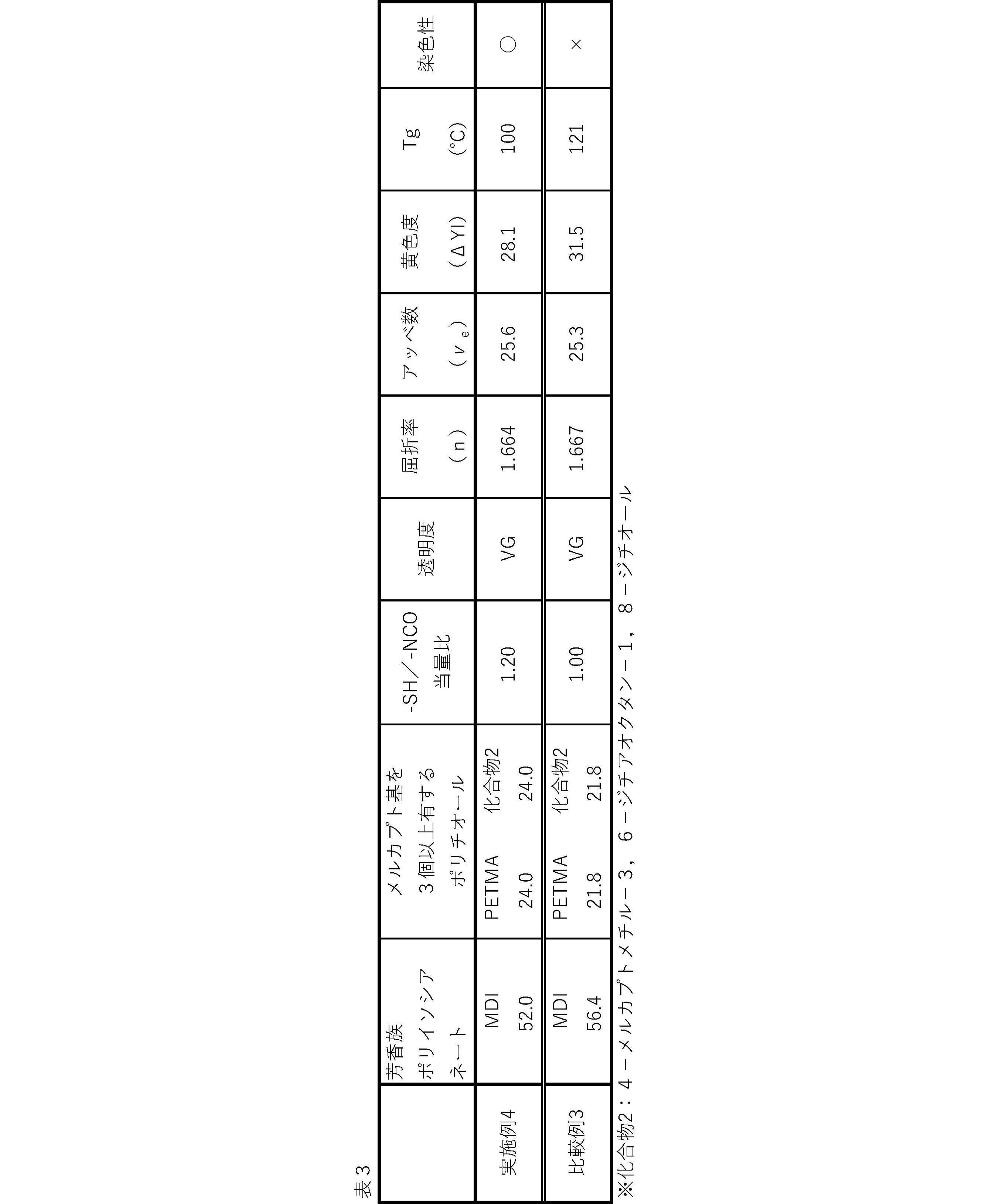
比較例1のプラスチックレンズとの対比から、実施例1および2のプラスチックレンズは、透明性やアッベ数等の光学特性と耐熱性が同程度に維持されており、しかも、高屈折率でありながら黄色度ΔYIが小さく、染色性にも優れることが確認された。 From the comparison with the plastic lens of Comparative Example 1, the plastic lenses of Examples 1 and 2 are maintained at the same level of optical characteristics such as transparency and Abbe number and heat resistance, and have a high refractive index. It was confirmed that the yellowness ΔYI was small and the dyeability was excellent.
(実施例3)
300mlナス型フラスコに、芳香族ポリイソシアネートとして、トリレンジイソシアナート(TDI)43.7g、有機リン化合物として、トリフェニルホスフィン(TPP)0.30g、UV吸収剤として、2−(2−ヒドロキシ−4−オクチルオキシフェニル)−2−H−ベンゾトリアゾール1.00g、内部離型剤として、ブトキシエチルアシッドホスフェート0.15gを添加して混合した。これらが完全に溶解した後、ポリチオールとして、ペンタエリスリトールテトラキス(2−メルカプトアセタート)(PETMA)20.3g、4−メルカプトメチル−3,6−ジチアオクタン−1,8−ジチオール36.0g、重合触媒として、ジメチル錫ジクロライド0.015gをさらに添加して混合した後、20℃窒素パージ下で30分撹拌を続けた。これらを完全に分散または溶解させて均一液とし、その後さらに0.13kPa(1.0Torr)に減圧し、そのまま20分減圧撹拌を行い、実施例2の光学材料用重合性組成物を調製した。イソシアネート基に対するチオール基の比率(−SH/−NCO当量比)は1.15である。
(Example 3)
In a 300 ml eggplant-shaped flask, 43.7 g of tolylene diisocyanate (TDI) as an aromatic polyisocyanate, 0.30 g of triphenylphosphine (TPP) as an organic phosphorus compound, and 2- (2-hydroxy-) as a UV absorber. 1.00 g of 4-octyloxyphenyl) -2-H-benzotriazole and 0.15 g of butoxyethyl acid phosphate as an internal release agent were added and mixed. After these are completely dissolved, as polythiol, 20.3 g of pentaerythritol tetrakis (2-mercaptoacetylate) (PETMA), 4-mercaptomethyl-3,6-dithiaoctane-1,8-dithiol 36.0 g, polymerization catalyst As a result, 0.015 g of dimethyltin dichloride was further added and mixed, and then stirring was continued for 30 minutes under a nitrogen purge at 20 ° C. These were completely dispersed or dissolved to form a uniform liquid, then the pressure was further reduced to 0.13 kPa (1.0 Torr), and the mixture was stirred under reduced pressure for 20 minutes as it was to prepare a polymerizable composition for an optical material of Example 2. The ratio of thiol groups to isocyanate groups (-SH / -NCO equivalent ratio) is 1.15.
この実施例3の光学材料用重合性組成物を、1.0μmのポリテトラフルオロエチレンメンブランフィルターを通して、レンズ型に注入し、初期温度25℃から最終温度120℃の温度プログラムにて24時間注型重合を行い、無色透明で中心肉厚1.8mmの実施例3の透明樹脂(プラスチックレンズ)を作製した。得られた実施例3のプラスチックレンズを成形型から離型した後、各種測定及び評価を行った。結果を、表2に示す。 The polymerizable composition for an optical material of Example 3 is injected into a lens mold through a 1.0 μm polytetrafluoroethylene membrane filter, and cast for 24 hours by a temperature program from an initial temperature of 25 ° C. to a final temperature of 120 ° C. Polymerization was carried out to prepare a transparent resin (plastic lens) of Example 3 which was colorless and transparent and had a central wall thickness of 1.8 mm. After the obtained plastic lens of Example 3 was released from the molding die, various measurements and evaluations were performed. The results are shown in Table 2.
(比較例2)
各成分の配合割合を表2に記載のとおりに変更する以外は、実施例3と同様に行い、比較例2の光学材料用重合性組成物を調製し、比較例2のプラスチックレンズを作製した。また、各種測定及び評価を、実施例3と同様に行った。結果を、表2に示す。
(Comparative Example 2)
The same procedure as in Example 3 was carried out except that the blending ratio of each component was changed as shown in Table 2, and a polymerizable composition for an optical material of Comparative Example 2 was prepared to prepare a plastic lens of Comparative Example 2. .. Moreover, various measurements and evaluations were carried out in the same manner as in Example 3. The results are shown in Table 2.
比較例2のプラスチックレンズとの対比から、実施例3のプラスチックレンズは、透明性やアッベ数等の光学特性と耐熱性が同程度に維持されており、しかも、高屈折率でありながら黄色度ΔYIが小さく、染色性にも優れることが確認された。 In comparison with the plastic lens of Comparative Example 2, the plastic lens of Example 3 maintains the same level of optical characteristics such as transparency and Abbe number and heat resistance, and has a high refractive index but yellowness. It was confirmed that ΔYI was small and the stainability was excellent.
(実施例4)
300mlナス型フラスコに、芳香族ポリイソシアネートとして、ジフェニルメタンジイソシアネート(MDI)52.0g、有機リン化合物として、トリフェニルホスフィン(TPP)0.30g、内部離型剤として、UV吸収剤として、2−(2−ヒドロキシ−4−オクチルオキシフェニル)−2−H−ベンゾトリアゾール1.00g、ブトキシエチルアシッドホスフェート0.15gを添加して混合した。これらが完全に溶解した後、ポリチオールとして、ぺンタエリスリトールテトラキス(2−メルカプトアセタート)(PETMA)24.0g、4−メルカプトメチル−3,6−ジチアオクタン−1,8−ジチオール24.0g、重合触媒として、ジメチル錫ジクロライド0.015gをさらに添加して混合した後、20℃窒素パージ下で30分撹拌を続けた。これらを完全に分散または溶解させて均一液とし、その後さらに0.13kPa(1.0Torr)に減圧し、そのまま20分減圧撹拌を行い、実施例4の光学材料用重合性組成物を調製した。イソシアネート基に対するチオール基の比率(−SH/−NCO当量比)は1.20である。
(Example 4)
In a 300 ml eggplant-shaped flask, 52.0 g of diphenylmethane diisocyanate (MDI) as an aromatic polyisocyanate, 0.30 g of triphenylphosphine (TPP) as an organic phosphorus compound, and 2- (as a UV absorber as an internal mold release agent). 2-Hydroxy-4-octyloxyphenyl) -2-H-benzotriazole (1.00 g) and butoxyethyl acid phosphate (0.15 g) were added and mixed. After these are completely dissolved, as polythiol, 24.0 g of Pentaerythritol tetrakis (2-mercaptoacetylate) (PETMA), 4-mercaptomethyl-3,6-dithiaoctane-1,8-dithiol 24.0 g, polymerized. After further adding 0.015 g of dimethyltin dichloride as a catalyst and mixing, stirring was continued for 30 minutes under a nitrogen purge at 20 ° C. These were completely dispersed or dissolved to form a uniform liquid, then the pressure was further reduced to 0.13 kPa (1.0 Torr), and the mixture was stirred under reduced pressure for 20 minutes as it was to prepare a polymerizable composition for an optical material of Example 4. The ratio of thiol groups to isocyanate groups (-SH / -NCO equivalent ratio) is 1.20.
この実施例4の光学材料用重合性組成物を、1.0μmのポリテトラフルオロエチレンメンブランフィルターを通して、レンズ型に注入し、初期温度25℃から最終温度120℃の温度プログラムにて24時間注型重合を行い、無色透明で中心肉厚1.8mmの実施例4の透明樹脂(プラスチックレンズ)を作製した。得られた実施例4のプラスチックレンズを成形型から離型した後、各種測定及び評価を行った。結果を、表3に示す。 The polymerizable composition for an optical material of Example 4 is injected into a lens mold through a 1.0 μm polytetrafluoroethylene membrane filter, and cast for 24 hours by a temperature program from an initial temperature of 25 ° C. to a final temperature of 120 ° C. Polymerization was carried out to prepare a transparent resin (plastic lens) of Example 4 which was colorless and transparent and had a central wall thickness of 1.8 mm. After the obtained plastic lens of Example 4 was released from the molding die, various measurements and evaluations were performed. The results are shown in Table 3.
(比較例3)
各成分の配合割合を表3に記載のとおりに変更する以外は、実施例4と同様に行い、比較例3の光学材料用重合性組成物を調製し、比較例3のプラスチックレンズを作製した。また、各種測定及び評価を、同様に行った。結果を、表3に示す。
(Comparative Example 3)
The same procedure as in Example 4 was carried out except that the blending ratio of each component was changed as shown in Table 3, and a polymerizable composition for an optical material of Comparative Example 3 was prepared to prepare a plastic lens of Comparative Example 3. .. Moreover, various measurements and evaluations were carried out in the same manner. The results are shown in Table 3.
比較例3のプラスチックレンズとの対比から、実施例4のプラスチックレンズは、透明性やアッベ数等の光学特性と耐熱性が同程度に維持されており、しかも、高屈折率でありながら黄色度ΔYIが小さく、染色性にも優れることが確認された。 In comparison with the plastic lens of Comparative Example 3, the plastic lens of Example 4 maintains the same level of optical characteristics such as transparency and Abbe number and heat resistance, and has a high refractive index but yellowness. It was confirmed that ΔYI was small and the stainability was excellent.
最後に、前述の各態様を総括する。
一態様によれば、芳香族ポリイソシアネート、およびメルカプト基を3個以上有するポリチオール30〜80質量%を少なくとも含有し、−SH/−NCO当量比が、1.10〜1.70である光学材料用重合性組成物が提供される。
Finally, each of the above aspects will be summarized.
According to one embodiment, an optical material containing at least 30 to 80% by mass of an aromatic polyisocyanate and a polythiol having 3 or more mercapto groups and having a −SH / −NCO equivalent ratio of 1.10 to 1.70. A polymerizable composition for use is provided.
上記光学材料用重合性組成物によれば、芳香族ポリイソシアネートを用いていながらも高屈折率で黄色度ΔYIが小さな透明樹脂やレンズ基材およびこれらの製造方法等を提供することができる。また、一態様によれば、高屈折率で黄色度ΔYIが小さく、さらには染色性等をも高められた透明樹脂やレンズ基材およびこれらの製造方法等を提供することができる。 According to the above-mentioned polymerizable composition for optical materials, it is possible to provide a transparent resin having a high refractive index and a small yellowness ΔYI, a lens base material, a method for producing these, and the like, even though an aromatic polyisocyanate is used. Further, according to one aspect, it is possible to provide a transparent resin or a lens base material having a high refractive index, a small yellowness ΔYI, and further improved dyeability, and a method for producing the same.
一態様では、上記芳香族ポリイソシアネートが、トリレンジイソシアネート、ジフェニルメタンジイソシアネート、フェニレンジイソシアネート、ナフタレンジイソシアネート、およびキシリレンジイソシアネートよりなる群から選択される1種以上であることができる。 In one aspect, the aromatic polyisocyanate can be one or more selected from the group consisting of tolylene diisocyanate, diphenylmethane diisocyanate, phenylene diisocyanate, naphthalene diisocyanate, and xylylene diisocyanate.
一態様では、上記芳香族ポリイソシアネートが、フェニレンジイソシアネートを実質的に含有しないことができる。 In one aspect, the aromatic polyisocyanate can be substantially free of phenylene diisocyanate.
一態様では、上記ポリチオールが、ペンタエリスリトールテトラキス(2−メルカプトアセテート)、ペンタエリスリトールテトラキス(3−メルカプトプロピオネート)、4−メルカプトメチル−3,6−ジチアオクタン−1,8−ジチオール、およびビス(メルカプトメチル)−3,6,9−トリチアウンデカン−1,11−ジチオールよりなる群から選択される1種以上であることができる。 In one aspect, the polythiol is pentaerythritol tetrakis (2-mercaptoacetate), pentaerythritol tetrakis (3-mercaptopropionate), 4-mercaptomethyl-3,6-dithiaoctane-1,8-dithiol, and bis ( It can be one or more selected from the group consisting of mercaptomethyl) -3,6,9-trithiaundecane-1,11-dithiol.
一態様では、上記SH/NCO比が、1.10〜1.60であることができる。
また、一態様では、上記SH/NCO比が、1.15〜1.50であることができる。
In one aspect, the SH / NCO ratio can be 1.10 to 1.60.
In one aspect, the SH / NCO ratio can be 1.15 to 1.50.
一態様では、上記光学材料用重合性組成物は、脂肪族ポリイソシアネートをさらに含有することができる。 In one aspect, the polymerizable composition for optical materials can further contain an aliphatic polyisocyanate.
一態様では、上記脂肪族ポリイソシアネートが、ジシクロヘキシルメタンジイソシアネート、ビス(イソシアナトメチル)シクロヘキサン、ヘキサメチレンジイソシアネート、2,2−ジメチルペンタンジイソシアネート、2,2,4−トリメチルヘキサンジイソシアネート、2,4,4−トリメチルヘキサメチレンジイソシアネート、ブテンジイソシアネート、1,3−ブタジエン−1,4−ジイソシアネート、1,5−ペンタメチレンジイソシアネート、3−イソシアナトメチルー3,5,5−トリメチルシクロヘキシルイソシアネート、1,6,11−ウンデカントリイソシアネート、1,3,6−ヘキサメチレントリイソシアネート、1,8−ジイソシアナト−4−イソシアナトメチルオクタン、ビス(イソシアナトエチル)カーボネート、ビス(イソシアナトエチル)エーテル、リジンジイソシアナトメチルエステル、およびリジントリイソシアネートよりなる群から選択される1種以上であることができる。 In one embodiment, the aliphatic polyisocyanate is dicyclohexylmethanediisocyanate, bis (isocyanatomethyl) cyclohexane, hexamethylene diisocyanate, 2,2-dimethylpentanediisocyanate, 2,2,4-trimethylhexanediisocyanate, 2,4,4. -Trimethylhexamethylene diisocyanate, butenediisocyanate, 1,3-butadiene-1,4-diisocyanate, 1,5-pentamethylene diisocyanate, 3-isocyanatomethyl-3,5,5-trimethylcyclohexylisocyanate, 1,6,11- Undecantry isocyanate, 1,3,6-hexamethylenetriisocyanate, 1,8-diisocyanato-4-isocyanatomethyloctane, bis (isocyanatoethyl) carbonate, bis (isocyanatoethyl) ether, lysine diisocyanatomethyl ester , And one or more selected from the group consisting of lysine triisocyanate.
一態様では、上記芳香族ポリイソシアネートおよび前記脂肪族ポリイソシアネートの含有割合が、1:9〜9:1であることができる。 In one aspect, the content ratio of the aromatic polyisocyanate and the aliphatic polyisocyanate can be 1: 9 to 9: 1.
一態様では、上記光学材料用重合性組成物は、エチレン性不飽和二重結合を2個以上有するポリエン化合物を実質的に含有しないことができる。 In one aspect, the polymerizable composition for optical materials can be substantially free of polyene compounds having two or more ethylenically unsaturated double bonds.
一態様では、上記光学材料用重合性組成物を重合する工程を含むことを特徴とする、透明樹脂の製造方法が提供される。 In one aspect, there is provided a method for producing a transparent resin, which comprises a step of polymerizing the polymerizable composition for an optical material.
一態様では、上記光学材料用重合性組成物を重合させて得られる透明樹脂が提供される。 In one aspect, a transparent resin obtained by polymerizing the above-mentioned polymerizable composition for an optical material is provided.
一態様では、上記光学材料用重合性組成物を重合させて得られるレンズ基材が提供される。 In one aspect, a lens base material obtained by polymerizing the above-mentioned polymerizable composition for an optical material is provided.
一態様では、上記レンズ基材は、1.59以上1.68以下の屈折率を有することができる。 In one aspect, the lens substrate can have a refractive index of 1.59 or more and 1.68 or less.
一態様では、上記光学部材ないしは光学材料は、レンズであることができる。 In one aspect, the optical member or optical material can be a lens.
一態様では、上記レンズは、眼鏡レンズないしはレンズ基材であることができる。 In one aspect, the lens can be a spectacle lens or a lens substrate.
今回開示された実施の形態はすべての点で例示であって制限的なものではないと考えられるべきである。本発明の範囲は上記した説明ではなくて請求の範囲によって示され、請求の範囲と均等の意味および範囲内でのすべての変更が含まれることが意図される。例えば、本明細書に記載の各種態様は、任意の組み合わせで2つ以上を組み合わせることができる。 It should be considered that the embodiments disclosed this time are exemplary in all respects and not restrictive. The scope of the present invention is shown by the claims rather than the above description, and it is intended to include all modifications within the meaning and scope equivalent to the claims. For example, the various aspects described herein can be combined in any combination of two or more.
本発明の一態様は、眼鏡レンズやレンズ基材等の各種光学部材の製造分野において有用である。 One aspect of the present invention is useful in the field of manufacturing various optical members such as spectacle lenses and lens substrates.
Claims (14)
−SH/−NCO当量比が、1.10〜1.70である
光学材料用重合性組成物。 It contains at least 30-80% by mass of aromatic polyisocyanate and polythiol having 3 or more mercapto groups.
A polymerizable composition for an optical material having a −SH / −NCO equivalent ratio of 1.10 to 1.70.
請求項1に記載の光学材料用重合性組成物。 The polymerizable composition for an optical material according to claim 1, wherein the aromatic polyisocyanate contains at least one selected from the group consisting of tolylene diisocyanate, diphenylmethane diisocyanate, phenylene diisocyanate, naphthalene diisocyanate, and xylylene diisocyanate.
請求項1または2に記載の光学材料用重合性組成物。 The polymerizable composition for an optical material according to claim 1 or 2, wherein the aromatic polyisocyanate does not substantially contain phenylene diisocyanate.
請求項1〜3のいずれか一項に記載の光学材料用重合性組成物。 The polythiols are pentaerythritol tetrakis (2-mercaptoacetate), pentaerythritol tetrakis (3-mercaptopropionate), 4-mercaptomethyl-3,6-dithiaoctane-1,8-dithiol, and bis (mercaptomethyl)-. The polymerizable composition for an optical material according to any one of claims 1 to 3, which comprises at least one selected from the group consisting of 3,6,9-trithiaundecane-1,11-dithiol.
請求項1〜4のいずれか一項に記載の光学材料用重合性組成物。 The polymerizable composition for an optical material according to any one of claims 1 to 4, wherein the SH / NCO ratio is 1.10 to 1.60.
請求項1〜5のいずれか一項に記載の光学材料用重合性組成物。 The polymerizable composition for an optical material according to any one of claims 1 to 5, wherein the SH / NCO ratio is 1.15 to 1.50.
請求項1〜6のいずれか一項に記載の光学材料用重合性組成物。 The polymerizable composition for an optical material according to any one of claims 1 to 6, further containing an aliphatic polyisocyanate.
請求項7に記載の光学材料用重合性組成物。 The aliphatic polyisocyanate is dicyclohexylmethane diisocyanate, bis (isocyanatomethyl) cyclohexane, hexamethylene diisocyanate, 2,2-dimethylpentane diisocyanate, 2,2,4-trimethylhexanediisocyanate, 2,4,4-trimethylhexamethylene. Diisocyanate, butenediisocyanate, 1,3-butadiene-1,4-diisocyanate, 1,5-pentamethylene diisocyanate, 3-isocyanatomethyl-3,5,5-trimethylcyclohexylisocyanate, 1,6,11-undecantryisocyanate, 1,3,6-Hexamethylenetriisocyanate, 1,8-diisocyanato-4-isocyanatomethyloctane, bis (isocyanatoethyl) carbonate, bis (isocyanatoethyl) ether, lysine diisocyanatomethyl ester, and lysine tri The polymerizable composition for an optical material according to claim 7, which comprises one or more selected from the group consisting of isocyanates.
請求項7又は8に記載の光学材料用重合性組成物。 The polymerizable composition for an optical material according to claim 7 or 8, wherein the content ratio of the aromatic polyisocyanate and the aliphatic polyisocyanate is 1: 9 to 9: 1.
請求項1〜9のいずれか一項に記載の光学材料用重合性組成物。 The polymerizable composition for an optical material according to any one of claims 1 to 9, which does not substantially contain a polyene compound having two or more ethylenically unsaturated double bonds.
透明樹脂。 A transparent resin obtained by polymerizing the polymerizable composition for an optical material according to any one of claims 1 to 10.
レンズ基材。 A lens base material obtained by polymerizing the polymerizable composition for an optical material according to any one of claims 1 to 10.
請求項13に記載のレンズ基材。 It has a refractive index of 1.59 or more and 1.68 or less.
The lens base material according to claim 13.
Priority Applications (4)
| Application Number | Priority Date | Filing Date | Title |
|---|---|---|---|
| JP2020063989A JP2021161237A (en) | 2020-03-31 | 2020-03-31 | Polymerizable composition for optical material, transparent resin and method for producing the same, and lens base material and method for producing the same |
| EP21164961.1A EP3889197A1 (en) | 2020-03-31 | 2021-03-25 | Polymerizable composition for optical materials, transparent resin and method for producing the same, and lens base material and method for producing the same |
| US17/217,686 US20210301061A1 (en) | 2020-03-31 | 2021-03-30 | Polymerizable composition for optical materials, transparent resin and method for producing the same, and lens base material and method for producing the same |
| CN202110346411.6A CN113461867A (en) | 2020-03-31 | 2021-03-31 | Polymerizable composition for optical material, transparent resin and method for producing same, and lens base material and method for producing same |
Applications Claiming Priority (1)
| Application Number | Priority Date | Filing Date | Title |
|---|---|---|---|
| JP2020063989A JP2021161237A (en) | 2020-03-31 | 2020-03-31 | Polymerizable composition for optical material, transparent resin and method for producing the same, and lens base material and method for producing the same |
Publications (1)
| Publication Number | Publication Date |
|---|---|
| JP2021161237A true JP2021161237A (en) | 2021-10-11 |
Family
ID=75252267
Family Applications (1)
| Application Number | Title | Priority Date | Filing Date |
|---|---|---|---|
| JP2020063989A Pending JP2021161237A (en) | 2020-03-31 | 2020-03-31 | Polymerizable composition for optical material, transparent resin and method for producing the same, and lens base material and method for producing the same |
Country Status (4)
| Country | Link |
|---|---|
| US (1) | US20210301061A1 (en) |
| EP (1) | EP3889197A1 (en) |
| JP (1) | JP2021161237A (en) |
| CN (1) | CN113461867A (en) |
Cited By (1)
| Publication number | Priority date | Publication date | Assignee | Title |
|---|---|---|---|---|
| WO2023054241A1 (en) | 2021-09-30 | 2023-04-06 | 日油株式会社 | Lipid nanoparticle used for delivering nucleic acid to brain tissue |
Family Cites Families (5)
| Publication number | Priority date | Publication date | Assignee | Title |
|---|---|---|---|---|
| JPS60199016A (en) | 1984-03-23 | 1985-10-08 | Mitsui Toatsu Chem Inc | Thiocarbomic acid s-alkyl ester resin for lens |
| JPS6346213A (en) | 1986-03-01 | 1988-02-27 | Mitsui Toatsu Chem Inc | Resin for high-refractive index plastic lens |
| JP3256415B2 (en) * | 1995-06-30 | 2002-02-12 | 三井化学株式会社 | Photopolymerized sulfur-containing urethane plastic lens |
| KR20120060254A (en) * | 2010-09-07 | 2012-06-12 | 주식회사 케이오씨솔루션 | Resin Composition of Superhigh Refractive Index Having Excellent Thermal Stable for Urethane Optical Lens and Optical Lens Using It |
| KR20170090393A (en) * | 2017-07-27 | 2017-08-07 | 주식회사 케이오씨솔루션 | Resin Composition of Superhigh Refractive Index Having Excellent Thermal Stable for Urethane Optical Lens and Optical Lens Using It |
-
2020
- 2020-03-31 JP JP2020063989A patent/JP2021161237A/en active Pending
-
2021
- 2021-03-25 EP EP21164961.1A patent/EP3889197A1/en not_active Withdrawn
- 2021-03-30 US US17/217,686 patent/US20210301061A1/en not_active Abandoned
- 2021-03-31 CN CN202110346411.6A patent/CN113461867A/en active Pending
Cited By (1)
| Publication number | Priority date | Publication date | Assignee | Title |
|---|---|---|---|---|
| WO2023054241A1 (en) | 2021-09-30 | 2023-04-06 | 日油株式会社 | Lipid nanoparticle used for delivering nucleic acid to brain tissue |
Also Published As
| Publication number | Publication date |
|---|---|
| US20210301061A1 (en) | 2021-09-30 |
| CN113461867A (en) | 2021-10-01 |
| EP3889197A1 (en) | 2021-10-06 |
Similar Documents
| Publication | Publication Date | Title |
|---|---|---|
| EP2921511B1 (en) | Polymerizable composition, optical material and manufacturing method for same | |
| EP3109268B1 (en) | Method for manufacturing optical material | |
| US10752726B2 (en) | Resin composition | |
| KR20140070509A (en) | A method of preparing polythiol compounds, and composition for optical material using it | |
| JP2021161214A (en) | A method for producing a polymerizable composition for an optical material, a method for producing a transparent resin, and a method for producing a lens base material. | |
| WO2020004534A1 (en) | Cured object for optical member and optical member | |
| JPWO2020004531A1 (en) | A polymerizable composition for an optical member, an optical member, and a method for manufacturing the optical member. | |
| US11021563B2 (en) | Method for producing resin for optical component, resin for optical component, spectacle lens, and spectacles | |
| JP2021161243A (en) | Polymerizable compositions for optical materials, transparent resins and methods for producing them, and lens substrates and methods for producing them. | |
| US12139573B2 (en) | Polymerizable composition for optical members, optical member and eyeglass lens | |
| US20210301060A1 (en) | Method for producing polymerizable composition for optical materials, method for producing transparent resin, and method for producing lens base material | |
| JP2021161237A (en) | Polymerizable composition for optical material, transparent resin and method for producing the same, and lens base material and method for producing the same | |
| JP2021167399A (en) | A method for producing a polymerizable composition for an optical material, a method for producing a transparent resin, and a method for producing a lens base material. | |
| JP2022156417A (en) | Polythiourethane-based polymerizable composition, transparent resin, and lens base material | |
| JP2021167398A (en) | A polymerizable composition for an optical material and a method for producing the same, a method for producing a transparent resin, and a method for producing a lens base material. | |
| JP2022156293A (en) | Method for producing polymerizable composition for optical material, transparent resin for optical material and method for producing the same, and lens base material and method for manufacturing the same | |
| US20220204685A1 (en) | Polymerizable composition for optical members, optical member, and colored optical member | |
| US20210206903A1 (en) | Polymerizable composition for optical members |