JP2022008084A - Molded bale of rubber composition, method for producing molded bale of rubber composition, crosslinking rubber composition, and tread for tire - Google Patents
Molded bale of rubber composition, method for producing molded bale of rubber composition, crosslinking rubber composition, and tread for tire Download PDFInfo
- Publication number
- JP2022008084A JP2022008084A JP2021081156A JP2021081156A JP2022008084A JP 2022008084 A JP2022008084 A JP 2022008084A JP 2021081156 A JP2021081156 A JP 2021081156A JP 2021081156 A JP2021081156 A JP 2021081156A JP 2022008084 A JP2022008084 A JP 2022008084A
- Authority
- JP
- Japan
- Prior art keywords
- rubber
- rubber composition
- polymer
- mass
- less
- Prior art date
- Legal status (The legal status is an assumption and is not a legal conclusion. Google has not performed a legal analysis and makes no representation as to the accuracy of the status listed.)
- Granted
Links
Landscapes
- Tires In General (AREA)
- Compositions Of Macromolecular Compounds (AREA)
- Addition Polymer Or Copolymer, Post-Treatments, Or Chemical Modifications (AREA)
Abstract
【課題】成形金型が汚染し難く、ゴム組成物が経時で粘度が上昇し難く、ベール成形体からゴム組成物が剥離し難く、ベール成形体に包装シートが密着し易いゴム組成物のベール成形体を得る。【解決手段】ヨウ素価が10~250であり、エチレン構造≧3質量%であり、かつ、ビニル芳香族単量体ブロック<10質量%であるゴム状重合体(A)と、チタン(C)とを含有し、3ppm≦チタン(C)の含有量≦120ppmであり、アルミニウム(B)の含有量が、2ppm未満であるゴム組成物のベール成形体。【選択図】なし[Problem] To obtain a bale molded product of a rubber composition which is less likely to contaminate a molding die, is less likely to increase in viscosity over time, is less likely to peel off from the bale molded product, and allows a packaging sheet to easily adhere to the bale molded product. [Solution] To obtain a bale molded product of a rubber composition which contains a rubber-like polymer (A) having an iodine value of 10 to 250, an ethylene structure ≧3 mass%, and a vinyl aromatic monomer block <10 mass%, and titanium (C), the titanium (C) content being 3 ppm≦120 ppm, and the aluminum (B) content being less than 2 ppm. [Selected drawing] None
Description
本発明は、ゴム組成物のベール成形体、ゴム組成物のベール成形体の製造方法、架橋用ゴム組成物、及びタイヤ用トレッドに関する。 The present invention relates to a veil-molded rubber composition, a method for producing a veil-molded rubber composition, a rubber composition for cross-linking, and a tread for a tire.
近年、タイヤトレッド、シート、フィルム、及びアスファルト改質用のゴム材料分野において、機械強度や圧縮永久歪みを高める目的で、エチレン構造を有し架橋可能な不飽和基を導入したゴム状重合体を含有させたゴム組成物が提案されている(例えば、特許文献1~3参照)。 In recent years, in the field of rubber materials for tire treads, sheets, films, and asphalt reformers, rubber-like polymers having an ethylene structure and having crosslinkable unsaturated groups have been introduced for the purpose of increasing mechanical strength and compression set. A rubber composition containing the mixture has been proposed (see, for example, Patent Documents 1 to 3).
しかしながら、従来提案されているエチレン構造を有し架橋可能な不飽和基を導入したゴム状重合体を含有するゴム組成物は、成形金型が汚染し易かったり、ゴム組成物が経時で粘度が上昇し易かったり、ベール成形体からゴム組成物が剥離し易かったりする傾向にあるという問題点を有している。また、本発明者は、エチレン構造を有するゴム状重合体を含むゴム組成物のベール成形体は、当該ベール成形体を包んでいる包装シートが運搬時に破れやすかったり、前記シートに包まれたベール成形体が運び難かったりする傾向にある、という問題点を有していることを見出した。これは、ゴム状重合体がエチレン構造を有する場合には、前記ゴム組成物のベール成形体に包装シートが密着し難いためであると考えられる。 However, in the rubber composition containing a rubber-like polymer having an ethylene structure and a crosslinkable unsaturated group, which has been conventionally proposed, the molding mold is easily contaminated and the rubber composition becomes viscous over time. It has a problem that it tends to rise easily and the rubber composition tends to be easily peeled off from the bale molded product. In addition, the present inventor has determined that a veil-molded rubber composition containing a rubber-like polymer having an ethylene structure is easily torn during transportation or the veil wrapped in the veil-molded product is easily torn during transportation. It has been found that the molded product has a problem that it tends to be difficult to carry. It is considered that this is because when the rubber-like polymer has an ethylene structure, it is difficult for the packaging sheet to adhere to the veil-molded body of the rubber composition.
そこで、本発明においては、成形金型が汚染し難く、ゴム組成物が経時で粘度が上昇し難く、ベール成形体からゴム組成物が剥離し難く、ベール成形体に包装シートが密着し易い、ゴム組成物のベール成形体を提供することを目的とする。 Therefore, in the present invention, the molding die is less likely to be contaminated, the viscosity of the rubber composition is less likely to increase over time, the rubber composition is less likely to peel off from the veil molded body, and the packaging sheet is likely to adhere to the veil molded body. It is an object of the present invention to provide a veil molded product of a rubber composition.
本発明者らは、上述した従来技術の課題を解決するために、鋭意研究検討した結果、特定構造のゴム状重合体を含有するゴム組成物において、チタン含有量、及びアルミニウム含有量を所定の範囲に特定することにより、成形金型が汚染し難く、ゴム組成物が経時で粘度が上昇し難く、ベール成形体からゴム組成物が剥離し難く、ベール成形体に包装シートが密着し易くなることを見出し、本発明を完成させるに至った。
すなわち本発明は以下の通りである。
As a result of diligent research and study in order to solve the above-mentioned problems of the prior art, the present inventors have determined the titanium content and the aluminum content in the rubber composition containing the rubber-like polymer having a specific structure. By specifying the range, the molding die is less likely to be contaminated, the rubber composition is less likely to increase in viscosity over time, the rubber composition is less likely to peel off from the veil molded body, and the packaging sheet is more likely to adhere to the bale molded body. We found that and came to complete the present invention.
That is, the present invention is as follows.
〔1〕
ヨウ素価が10~250であり、エチレン構造≧3質量%であり、かつ、ビニル芳香族単量体ブロック<10質量%であるゴム状重合体(A)と、
チタン(C)と、
を、含有し、
3ppm≦チタン(C)の含有量≦120ppmであり、
アルミニウム(B)の含有量が、2ppm未満であるゴム組成物のベール成形体。
〔2〕
前記ゴム状重合体(A)が、共役ジエン系重合体の水素添加物である、前記〔1〕に記載のベール成形体。
〔3〕
ゴム状重合体(A)は、ビニル芳香族単量体単位を、5質量%以上含有する、前記〔1〕又は〔2〕に記載のベール成形体。
〔4〕
ゴム状重合体(A)が、窒素原子を含有する、前記〔1〕乃至〔3〕のいずれか一に記載のベール成形体。
〔5〕
ゴム状重合体(A)のカラム吸着GPC法で測定される変性率が、40質量%以上である、前記〔1〕乃至〔4〕のいずれか一に記載のベール成形体。
〔6〕
ゴム用軟化剤(D)を30質量%以下、さらに含有する、前記〔1〕乃至〔5〕のいずれか一に記載のベール成形体。
〔7〕
水分を0.05質量%以上1.5質量%以下含有する、前記〔1〕乃至〔6〕のいずれか一に記載のベール成形体。
〔8〕
前記〔1〕乃至〔7〕のいずれか一に記載のゴム組成物のベール成形体の製造方法であって、
少なくとも共役ジエン単量体を溶液中で重合し、ゴム状重合体(A)を得る工程と、
得られたゴム状重合体(A)を含む溶液に、チタン(C)を添加してゴム組成物を得る工程と、
得られたゴム組成物を成形する工程と、
を、有する、ゴム組成物のベール成形体の製造方法。
〔9〕
チタン含有量1モルに対するアルミニウム含有量が0.05モル以下である水素添加触媒を用いて水素添加工程を行う、前記〔8〕に記載のベール成形体の製造方法。
〔10〕
前記溶液から、スチームストリッピングによって溶媒を除去する工程を有する、前記〔8〕又は〔9〕に記載のベール成形体の製造方法。
〔11〕
前記〔1〕乃至〔7〕のいずれか一に記載のベール成形体のゴム組成物と、
架橋剤と、
を、含有し、
前記架橋剤を、ゴム成分100質量部に対して、0.1質量部以上20質量部以下含有する、架橋用ゴム組成物。
〔12〕
前記〔1〕乃至〔7〕のいずれか一に記載のベール成形体のゴム組成物を含有する、タイヤ用トレッド。
[1]
A rubber-like polymer (A) having an iodine value of 10 to 250, an ethylene structure of ≥3% by mass, and a vinyl aromatic monomer block <10% by mass.
Titanium (C) and
, Containing,
3 ppm ≤ titanium (C) content ≤ 120 ppm,
A veil molded product of a rubber composition having an aluminum (B) content of less than 2 ppm.
[2]
The veil molded product according to the above [1], wherein the rubber-like polymer (A) is a hydrogenated additive of a conjugated diene-based polymer.
[3]
The veil molded product according to the above [1] or [2], wherein the rubber-like polymer (A) contains 5% by mass or more of vinyl aromatic monomer units.
[4]
The veil molded product according to any one of the above [1] to [3], wherein the rubber-like polymer (A) contains a nitrogen atom.
[5]
The veil molded product according to any one of [1] to [4] above, wherein the modification rate of the rubber-like polymer (A) measured by the column adsorption GPC method is 40% by mass or more.
[6]
The veil molded product according to any one of the above [1] to [5], further containing 30% by mass or less of the softening agent (D) for rubber.
[7]
The veil molded product according to any one of the above [1] to [6], which contains 0.05% by mass or more and 1.5% by mass or less of water.
[8]
The method for producing a veil-molded rubber composition according to any one of [1] to [7] above.
A step of polymerizing at least a conjugated diene monomer in a solution to obtain a rubbery polymer (A), and
A step of adding titanium (C) to the obtained solution containing the rubber-like polymer (A) to obtain a rubber composition, and
The process of molding the obtained rubber composition and
A method for producing a veil-molded rubber composition.
[9]
The method for producing a veil molded product according to the above [8], wherein the hydrogenation step is performed using a hydrogenation catalyst having an aluminum content of 0.05 mol or less with respect to 1 mol of titanium content.
[10]
The method for producing a veil molded product according to the above [8] or [9], which comprises a step of removing the solvent from the solution by steam stripping.
[11]
The rubber composition of the veil molded product according to any one of [1] to [7] above, and the rubber composition.
With a cross-linking agent,
, Containing,
A rubber composition for cross-linking containing the cross-linking agent in an amount of 0.1 part by mass or more and 20 parts by mass or less with respect to 100 parts by mass of the rubber component.
[12]
A tread for a tire containing the rubber composition of the veil molded product according to any one of the above [1] to [7].
本発明によれば、成形金型が汚染し難く、ゴム組成物が経時で粘度が上昇し難く、ベール成形体からゴム組成物が剥離し難く、ベール成形体に包装シートが密着し易いゴム組成物が得られる。 According to the present invention, the molding die is less likely to be contaminated, the viscosity of the rubber composition is less likely to increase over time, the rubber composition is less likely to peel off from the veil molded body, and the packaging sheet is more likely to adhere to the veil molded body. You get things.
以下、本発明を実施するための形態(以下、「本実施形態」という。)について詳細に説明する。
なお、以下の本実施形態は、本発明を説明するための例示であり、本発明は以下の実施形態に限定されるものではない。本発明は、その要旨の範囲内で適宜に変形して実施することができる。
Hereinafter, embodiments for carrying out the present invention (hereinafter referred to as “the present embodiment”) will be described in detail.
The following embodiments are examples for explaining the present invention, and the present invention is not limited to the following embodiments. The present invention can be appropriately modified and carried out within the scope of the gist thereof.
〔ゴム組成物のベール成形体〕
本実施形態のゴム組成物のベール成形体は、ヨウ素価が10~250であり、エチレン構造≧3質量%であり、かつ、ビニル芳香族単量体ブロック<10質量%であるゴム状重合体(A)と、チタン(C)とを含有し、3ppm≦チタン(C)の含有量≦120ppmであり、アルミニウム(B)の含有量が2ppm未満であるゴム組成物のベール成形体である。
[Veil molded product of rubber composition]
The veiled product of the rubber composition of the present embodiment is a rubber-like polymer having an iodine value of 10 to 250, an ethylene structure of ≧ 3% by mass, and a vinyl aromatic monomer block <10% by mass. A veil-molded rubber composition containing (A) and titanium (C), with a content of 3 ppm ≤ titanium (C) ≤ 120 ppm and a content of aluminum (B) of less than 2 ppm.
(ゴム状重合体(A))
本実施形態のベール成形体を構成するゴム組成物(以下、本実施形態のゴム組成物と記載する。)に含まれるゴム状重合体(A)は、ヨウ素価が10~250であり、エチレン構造≧3質量%であり、かつ、ビニル芳香族単量体ブロック<10質量%であるゴム状重合体である。
(Rubber-like polymer (A))
The rubber-like polymer (A) contained in the rubber composition constituting the veil molded product of the present embodiment (hereinafter, referred to as the rubber composition of the present embodiment) has an iodine value of 10 to 250 and is ethylene. It is a rubber-like polymer having a structure of ≧ 3% by mass and a vinyl aromatic monomer block <10% by mass.
<ヨウ素価>
本実施形態のゴム組成物を構成するゴム状重合体(A)のヨウ素価は10~250である。
ヨウ素価は、架橋のしやすさの観点、及び本実施形態のゴム組成物のベール成形体の包装シートの密着性の観点で、10以上である。15以上が好ましく、30以上がより好ましく、50以上がさらに好ましく、70以上がさらにより好ましい。
一方、ゴム状重合体(A)の耐候性や耐経年劣化性や、タイヤにした時の機械強度や耐摩耗性の観点で、250以下である。170以下が好ましく、140以下がより好ましく、110以下がさらに好ましく、80以下がさらにより好ましい。
ヨウ素価は、「JIS K 0070:1992」に記載の方法に準じて測定することができる。
ヨウ素価は、対象となる物質100gと反応するハロゲンの量をヨウ素のグラム数に換算して表す値であるため、ヨウ素価の単位は「g/100g」である。
共役ジエン単量体単位は二重結合を有しているため、後述するゴム状重合体(A)の製造方法において、例えば、共役ジエン単量体とビニル芳香族単量体とを共重合した場合は、共役ジエン単量体単位の含有量が低い方がゴム状重合体(A)のヨウ素価は低くなり、また、共役ジエン単量体単位を水素添加する場合は、水素添加率が高い方が、ヨウ素価は低くなる。
ゴム状重合体(A)のヨウ素価は、不飽和結合を有する共役ジエン単量体等の添加量、重合時間、重合温度等の重合条件、水素添加工程における水素添加量、水素添加時間等の条件を調整することにより、上記数値範囲に制御することができる。
<Iodine value>
The iodine value of the rubber-like polymer (A) constituting the rubber composition of the present embodiment is 10 to 250.
The iodine value is 10 or more from the viewpoint of ease of crosslinking and the adhesion of the packaging sheet of the veil molded product of the rubber composition of the present embodiment. 15 or more is preferable, 30 or more is more preferable, 50 or more is further preferable, and 70 or more is even more preferable.
On the other hand, it is 250 or less from the viewpoint of weather resistance and aging resistance of the rubber-like polymer (A), mechanical strength and wear resistance when made into a tire. 170 or less is preferable, 140 or less is more preferable, 110 or less is further preferable, and 80 or less is even more preferable.
The iodine value can be measured according to the method described in "JIS K 0070: 1992".
Since the iodine value is a value representing the amount of halogen that reacts with 100 g of the target substance in terms of the number of grams of iodine, the unit of iodine value is "g / 100 g".
Since the conjugated diene monomer unit has a double bond, for example, in the method for producing the rubbery polymer (A) described later, for example, the conjugated diene monomer and the vinyl aromatic monomer are copolymerized. In this case, the lower the content of the conjugated diene monomer unit, the lower the iodine value of the rubber-like polymer (A), and when the conjugated diene monomer unit is hydrogenated, the hydrogenation rate is high. The iodine value is lower.
The iodine value of the rubbery polymer (A) includes the amount of conjugated diene monomer having an unsaturated bond added, the polymerization time, the polymerization conditions such as the polymerization temperature, the amount of hydrogenation in the hydrogenation step, the hydrogenation time, etc. By adjusting the conditions, it can be controlled within the above numerical range.
<エチレン構造の含有量>
本実施形態のゴム組成物を構成するゴム状重合体(A)はエチレン構造が3質量%以上である。
エチレン構造が3質量%以上であるとタイヤ用のゴムとして必要な程度の破壊特性を示しやすい。エチレン構造は好ましくは5質量%以上であり、より好ましくは30質量%以上、さらに好ましくは40質量%以上である。
また、エチレン構造は好ましくは90質量%以下である。80質量%以下がより好ましく、70質量%以下がさらに好ましい。
エチレン構造が90質量%以下であることにより本実施形態のゴム組成物がゴム弾性に優れたものとなる。
ゴム状重合体(A)中のエチレン構造は、エチレン単量体を共重合体して得られるエチレン構造や、共役ジエン単量体を重合後に水素添加して得られるエチレン構造等の全てを含む。例えば、1,4-ブタジエン単位が水素添加した場合は、二つのエチレン構造が得られ、1,4-イソプレン単位が水素添加された場合は、一つのプロピレン構造と一つのエチレン構造が得られる。
ゴム状重合体(A)のエチレン構造の含有量は、後述する実施例に記載する方法により測定することができ、エチレンの添加量、共役ジエン単量体の添加量と水素添加率等を調整することにより、上記数値範囲に制御することができる。
<Content of ethylene structure>
The rubber-like polymer (A) constituting the rubber composition of the present embodiment has an ethylene structure of 3% by mass or more.
When the ethylene structure is 3% by mass or more, it is easy to exhibit the fracture characteristics required for rubber for tires. The ethylene structure is preferably 5% by mass or more, more preferably 30% by mass or more, and further preferably 40% by mass or more.
The ethylene structure is preferably 90% by mass or less. 80% by mass or less is more preferable, and 70% by mass or less is further preferable.
When the ethylene structure is 90% by mass or less, the rubber composition of the present embodiment has excellent rubber elasticity.
The ethylene structure in the rubber-like polymer (A) includes all of an ethylene structure obtained by copolymerizing an ethylene monomer, an ethylene structure obtained by hydrogenating a conjugated diene monomer after polymerization, and the like. .. For example, when 1,4-butadiene units are hydrogenated, two ethylene structures are obtained, and when 1,4-isoprene units are hydrogenated, one propylene structure and one ethylene structure are obtained.
The content of the ethylene structure of the rubber-like polymer (A) can be measured by the method described in Examples described later, and the amount of ethylene added, the amount of conjugated diene monomer added, the hydrogenation rate and the like are adjusted. By doing so, it is possible to control within the above numerical range.
<ビニル芳香族単量体ブロック含有量>
ゴム状重合体(A)は、ビニル芳香族単量体ブロック含有量が10質量%未満(ビニル芳香族単量体ブロック<10質量%)である。
ビニル芳香族単量体ブロックとは、ビニル芳香族単量体単位が8個以上連鎖しているブロックをいう。
ビニル芳香族単量体ブロック含有量が10質量%未満であると、本実施形態のゴム組成物が良好な耐剥離を示しやすく、ゴム組成物のベール成形体への成形性や、ベール成形体の計量時の切断性に優れる。ビニル芳香族単量体ブロックの含有量は、7質量%以下が好ましく、5質量%以下がより好ましく、3質量%以下がさらに好ましい。
ビニル芳香族単量体ブロックは、ゴム状重合体やゴム組成物の柔軟性の観点から、ビニル芳香族単量体単位が30以上連鎖しているブロックの数が、少ないか又はないものであることが好ましい。
ビニル芳香族単量体ブロックの含有量は、具体的には、ゴム状重合体(A)を構成する重合体がブタジエン-スチレン共重合体の場合、Kolthoffの方法(I.M.KOLTHOFF,et al.,J.Polym.Sci.1,429(1946)に記載の方法)により重合体を分解し、メタノールに不溶なポリスチレン量を分析することにより測定することができる。その他の方法として、国際公開第2014-133097号公報に記載されているように、NMRを用いてスチレン単位の連鎖を測定すること等の公知の方法で測定できる。
ゴム状重合体(A)のビニル芳香族単量体ブロック含有量は、ビニル芳香族単量体の添加方法や重合助剤の添加や重合温度等を調整することにより、上記数値範囲に制御することができる。
<Vinyl aromatic monomer block content>
The rubber-like polymer (A) has a vinyl aromatic monomer block content of less than 10% by mass (vinyl aromatic monomer block <10% by mass).
The vinyl aromatic monomer block means a block in which eight or more vinyl aromatic monomer units are chained.
When the content of the vinyl aromatic monomer block is less than 10% by mass, the rubber composition of the present embodiment tends to show good peel resistance, and the formability of the rubber composition into a veil-molded body and the veil-molded body are improved. Has excellent cutability during weighing. The content of the vinyl aromatic monomer block is preferably 7% by mass or less, more preferably 5% by mass or less, and further preferably 3% by mass or less.
The vinyl aromatic monomer block has a small number or no blocks in which 30 or more vinyl aromatic monomer units are chained from the viewpoint of flexibility of the rubber-like polymer or the rubber composition. Is preferable.
Specifically, when the polymer constituting the rubber-like polymer (A) is a butadiene-styrene copolymer, the content of the vinyl aromatic monomer block is determined by the method of Koltoff (IM KOLTHOFF, et.). It can be measured by decomposing the polymer by the method described in al., J. Polym. Sci. 1,429 (1946) and analyzing the amount of polystyrene insoluble in methanol. As another method, as described in International Publication No. 2014-13309, measurement can be performed by a known method such as measuring the chain of styrene units using NMR.
The vinyl aromatic monomer block content of the rubber-like polymer (A) is controlled within the above numerical range by adjusting the method of adding the vinyl aromatic monomer, the addition of the polymerization aid, the polymerization temperature, and the like. be able to.
<ゴム状重合体(A)に不飽和基を含有させる単量体単位>
ゴム状重合体(A)は、共役ジエン単量体単位やミルセン等の不飽和基を有する単量体単位を2質量%以上含有することが好ましい。経済性や製造性の観点で、共役ジエン単量体単位を含有することがより好ましい。
ゴム状重合体(A)の成分として含有する共役ジエン単量体単位やミルセンは二重結合を有しているため、架橋可能な不飽和基となる。
ゴム状重合体(A)中の共役ジエン単量体単位やミルセン等の不飽和基を有する単量体単位の含有量は、上述したヨウ素価と密接に関係している。
共役ジエン単量体単位やミルセン等の不飽和基を有する単量体単位の含有量が2質量%以上であると、架橋のしやすさ、及びゴム組成物のベール成形体の包装シートの密着性の観点で優れたものとなる。共役ジエン単量体単位の含有量は、より好ましくは3質量%以上、さらに好ましくは6質量%以上である。
また、共役ジエン単量体単位やミルセン等の不飽和基を有する単量体単位の含有量は、好ましくは50質量%以下、より好ましく30質量%以下、さらに好ましくは20質量%以下である。この場合、タイヤにした時の機械強度や耐摩耗性が優れる。
ゴム状重合体(A)の共役ジエン単量体単位やミルセン等の不飽和基を有する単量体単位の含有量は、後述する実施例に記載する方法により測定することができ、後述する水素添加率を調整することにより、上記数値範囲に制御することができる。
<Monomer unit in which an unsaturated group is contained in the rubber-like polymer (A)>
The rubber-like polymer (A) preferably contains 2% by mass or more of a conjugated diene monomer unit or a monomer unit having an unsaturated group such as myrcene. From the viewpoint of economy and manufacturability, it is more preferable to contain the conjugated diene monomer unit.
Since the conjugated diene monomer unit and myrcene contained as a component of the rubber-like polymer (A) have a double bond, they become crosslinkable unsaturated groups.
The content of the conjugated diene monomer unit or the monomer unit having an unsaturated group such as myrcene in the rubber-like polymer (A) is closely related to the iodine value described above.
When the content of the conjugated diene monomer unit or the monomer unit having an unsaturated group such as myrcene is 2% by mass or more, it is easy to crosslink and the rubber composition is adhered to the packaging sheet of the veil molded body. It will be excellent in terms of sex. The content of the conjugated diene monomer unit is more preferably 3% by mass or more, still more preferably 6% by mass or more.
The content of the conjugated diene monomer unit or the monomer unit having an unsaturated group such as myrcene is preferably 50% by mass or less, more preferably 30% by mass or less, still more preferably 20% by mass or less. In this case, the mechanical strength and wear resistance when made into a tire are excellent.
The content of the conjugated diene monomer unit of the rubber-like polymer (A) or the monomer unit having an unsaturated group such as myrcene can be measured by the method described in Examples described later, and hydrogen described later. By adjusting the addition rate, it can be controlled within the above numerical range.
(アルミニウム(B))
本実施形態のゴム組成物は、アルミニウム(B)の含有量が2ppm未満である。当該範囲であると、本実施形態のゴム組成物が経時で粘度が上昇することを抑制する効果を発揮する。
アルミニウム(B)の濃度を低く抑えることによって、本実施形態のゴム組成物が経時で粘度が上昇することを抑制できる理由は、ゴム組成物中にアルミニウム含有量が2ppm以上の含有量で含まれると、アルミニウムを含有する化合物が微粒子状に分散したものと、ゴム状重合体のヘテロ原子やカップリング剤の残基とが相互作用し、粘度が上昇すると考えられる。よって、アルミニウムの含有量が2ppm未満であることによりかかる粘度の上昇が抑制できる。
特に後述するゴム状重合体(A)の重量平均分子量が31万以上であったり、窒素原子を含有したり、さらに、その窒素原子が一級アミンになり易かったり、さらに、アルコキシシランを有するカップリング剤を含有する場合は、アルミニウム含有量が2ppm未満であることにより、経時で粘度が上昇することを抑制する効果が顕著である。
アルミニウム(B)の含有量は、アルミニウムを含む化合物として含有していても、それぞれの元素の量であるものとする。
ゴム状重合体(A)のアルミニウムの含有量は、後述する実施例に記載する方法により測定することができ、重合触媒や水素添加触媒の種類や添加量、脱灰、あるいは後述する溶剤の除去工程の条件を調整することにより、上記数値範囲に制御することができる。
(Aluminum (B))
The rubber composition of the present embodiment has an aluminum (B) content of less than 2 ppm. Within this range, the rubber composition of the present embodiment exerts an effect of suppressing an increase in viscosity with time.
The reason why the rubber composition of the present embodiment can be prevented from increasing in viscosity with time by suppressing the concentration of aluminum (B) to be low is that the rubber composition contains an aluminum content of 2 ppm or more. It is considered that the aluminum-containing compound is dispersed in the form of fine particles and the heteroatom of the rubber-like polymer and the residue of the coupling agent interact with each other to increase the viscosity. Therefore, when the content of aluminum is less than 2 ppm, such an increase in viscosity can be suppressed.
In particular, the rubber-like polymer (A) described later has a weight average molecular weight of 310,000 or more, contains a nitrogen atom, and the nitrogen atom easily becomes a primary amine, and further, a coupling having an alkoxysilane. When the agent is contained, the effect of suppressing the increase in viscosity with time is remarkable when the aluminum content is less than 2 ppm.
The content of aluminum (B) is the amount of each element even if it is contained as a compound containing aluminum.
The aluminum content of the rubber-like polymer (A) can be measured by the method described in Examples described later, and the type and amount of the polymerization catalyst and hydrogenation catalyst added, decalcification, or removal of the solvent described later. By adjusting the conditions of the process, it is possible to control within the above numerical range.
(チタン(C))
本実施形態のゴム組成物中のチタン(C)の含有量は、3ppm以上120ppm以下(3ppm≦チタン(C)の含有量≦120ppm)である。
ゴム組成物の成形時の成形金型の耐汚染性の観点で、3ppm以上であり、10ppm以上がより好ましく、15ppm以上がさらに好ましい。
一方、ベール成形体からのゴム組成物の剥離し難さや、ゴム組成物が経時で粘度が上昇した時のゲル成分によるメッシュの詰まり難さや、ベール成形体への包装シートの密着性の観点で、120ppm以下である。100ppm以下がより好ましく、50ppm以下がさらに好ましく、30ppm以下がさらにより好ましい。
チタン(C)の存在によって、成形金型の汚染が抑制できる理由は、ベビーパウダーの効果のように、金型との接触面に金属粒子が存在することで、重合体の金型への密着が緩和されると考えられる。
チタン(C)の含有量は、後述するチタンを含有する水素添加触媒添加量や、重合溶媒から溶媒除去する工程等を調整することにより、上記数値範囲に制御できる。
(Titanium (C))
The content of titanium (C) in the rubber composition of the present embodiment is 3 ppm or more and 120 ppm or less (3 ppm ≤ titanium (C) content ≤ 120 ppm).
From the viewpoint of stain resistance of the molding die at the time of molding the rubber composition, it is 3 ppm or more, more preferably 10 ppm or more, still more preferably 15 ppm or more.
On the other hand, from the viewpoints of difficulty in peeling the rubber composition from the bale molded product, difficulty in clogging the mesh due to the gel component when the viscosity of the rubber composition increases over time, and adhesion of the packaging sheet to the veil molded product. , 120 ppm or less. 100 ppm or less is more preferable, 50 ppm or less is further preferable, and 30 ppm or less is even more preferable.
The reason why the presence of titanium (C) can suppress the contamination of the molding mold is that the presence of metal particles on the contact surface with the mold, like the effect of baby powder, causes the polymer to adhere to the mold. Is thought to be alleviated.
The content of titanium (C) can be controlled within the above numerical range by adjusting the amount of the hydrogenation catalyst containing titanium, which will be described later, the step of removing the solvent from the polymerization solvent, and the like.
(ゴム状重合体(A)の好適な構造)
<水素添加重合体>
ゴム状重合体(A)は、少なくとも共役ジエン単量体単位やミルセン等の不飽和基を有する単量体単位を重合又は共重合したゴム状重合体中の二重結合の一部又は大部分を水素化(水素添加)した水素添加重合体であることが好ましい。
ゴム状重合体(A)中の不飽和基は、共役ジエン単量体単位やミルセン等の単量体に由来する不飽和基を含む。すなわち、ゴム状重合体(A)の製造工程において、少なくとも共役ジエン単量体単位やミルセン等の不飽和基を有する単量体単位を重合又は共重合した後に重合体中の二重結合の一部又は大部分を水素化(水素添加)する際、共役ジエン単量体単位のうち、所定のヨウ素価となるように水素添加せずに残した共役ジエン単量体単位が含まれるようにすることが好ましい。
(Preferable structure of rubber-like polymer (A))
<Hydrogenated polymer>
The rubber-like polymer (A) is a part or most of the double bonds in the rubber-like polymer obtained by polymerizing or copolymerizing at least a conjugated diene monomer unit or a monomer unit having an unsaturated group such as Milsen. It is preferable that the polymer is a hydrogenated polymer obtained by hydrogenating (hydrogenating) the above.
The unsaturated group in the rubbery polymer (A) contains an unsaturated group derived from a conjugated diene monomer unit or a monomer such as myrcene. That is, in the production process of the rubbery polymer (A), at least one of the double bonds in the polymer after polymerizing or copolymerizing at least a conjugated diene monomer unit or a monomer unit having an unsaturated group such as Milsen. When hydrogenating (hydrogenating) a part or most of the conjugated diene monomer unit, the conjugated diene monomer unit left without hydrogenation so as to have a predetermined iodine value is included. Is preferable.
<ゴム状重合体(A)を構成する単量体>
ゴム状重合体(A)は、共役ジエン単量体、及び必要に応じてその他の単量体により形成できる。
共役ジエン単量体としては、以下に限定されるものではないが、例えば、1,3-ブタジエン、イソプレン、2,3-ジメチル-1,3-ブタジエン、1,3-ペンタジエン、3-メチル-1,3-ペンタジエン、1,3-ヘキサジエン、及び1,3-ヘプタジエンが挙げられる。これらの中でも、工業的入手の容易さの観点から、1,3-ブタジエンやイソプレンが好ましく、1,3-ブタジエンがより好ましい。これらは1種単独で用いてもよいし、2種以上を併用してもよい。
必要に応じて用いる単量体は特に限定されないが、タイヤにした時の機械強度の観点で、ビニル芳香族単量体を共重合することが好ましい。ビニル芳香族単量体としては、以下に限定されるものではないが、例えば、スチレン、p-メチルスチレン、α-メチルスチレン、ビニルエチルベンゼン、ビニルキシレン、ビニルナフタレン、ジフェニルエチレン、ビニルベンジルジメチルアミン、(4-ビニルベンジル)ジメチルアミノエチルエーテル、N,N-ジメチルアミノエチルスチレン、N,N-ジメチルアミノメチルスチレン、3級アミノ基含有ジフェニルエチレン(例えば、1-(4-N,N-ジメチルアミノフェニル)-1-フェニルエチレン)等が挙げられる。これらの中でも、工業的入手の容易さの観点から、スチレンが好ましい。
これらは1種単独で用いてもよいし、2種以上を併用してもよい。
必要に応じて用いるその他の単量体としては、下記の単量体も用いることができる。
例えば、不飽和カルボン酸エステル、不飽和カルボン酸、α,β―不飽和ニトリル化合物、α-オレフィン(ブチレン、プロピレン、ブチレン、ペンテン、ヘキセン等)、エチレン、ミルセン、エチリデンノルボルネン、イソプロピリデンノルボルネン、シクロペンタジエン、ジビニルベンゼン等が挙げられる。
<Monomer constituting the rubber-like polymer (A)>
The rubbery polymer (A) can be formed of a conjugated diene monomer and, if necessary, other monomers.
The conjugated diene monomer is not limited to the following, but is, for example, 1,3-butadiene, isoprene, 2,3-dimethyl-1,3-butadiene, 1,3-pentadiene, 3-methyl-. Included are 1,3-pentadiene, 1,3-hexadiene, and 1,3-heptadiene. Among these, 1,3-butadiene and isoprene are preferable, and 1,3-butadiene is more preferable from the viewpoint of easy industrial availability. These may be used alone or in combination of two or more.
The monomer used as needed is not particularly limited, but it is preferable to copolymerize the vinyl aromatic monomer from the viewpoint of mechanical strength when the tire is made. The vinyl aromatic monomer is not limited to the following, and is, for example, styrene, p-methylstyrene, α-methylstyrene, vinylethylbenzene, vinylxylene, vinylnaphthalene, diphenylethylene, vinylbenzyldimethylamine, and the like. (4-Vinylbenzyl) dimethylaminoethyl ether, N, N-dimethylaminoethylstyrene, N, N-dimethylaminomethylstyrene, tertiary amino group-containing diphenylethylene (eg, 1- (4-N, N-dimethylamino) Styrene) -1-phenylethylene) and the like can be mentioned. Among these, styrene is preferable from the viewpoint of easy industrial availability.
These may be used alone or in combination of two or more.
The following monomers can also be used as other monomers used as needed.
For example, unsaturated carboxylic acid ester, unsaturated carboxylic acid, α, β-unsaturated nitrile compound, α-olefin (butylene, propylene, butylene, pentene, hexene, etc.), ethylene, milsen, etilidennorbornene, isopropyridennorbornene, cyclo. Examples thereof include pentadiene and divinylbenzene.
<ゴム状重合体(A)のビニル結合量>
ゴム状重合体(A)は、水素添加前の共役ジエン系重合体の共役ジエン単量体単位のビニル結合量が重要であり、共役ジエン単量体単位中のビニル結合量は、ゴム状重合体(A)の生産性やタイヤにした時の高いウェットスキッド抵抗性の観点で、10mol%以上が好ましく、20mol%以上がより好ましい。また、タイヤに用いた時の機械強度の観点で、75mol%以下が好ましく、60mol%以下がより好ましく、45mol%以下がさらに好ましく、30mol%以下がさらにより好ましい。
ビニル結合量は、後述する実施例に記載の方法により測定することができる。
ビニル結合量は、重合温度や重合に添加する極性化合物の添加量を調整することにより上記数値範囲に制御できる。
<Amount of vinyl bond of rubber-like polymer (A)>
For the rubber-like polymer (A), the vinyl bond amount of the conjugated diene monomer unit of the conjugated diene-based polymer before hydrogenation is important, and the vinyl bond amount in the conjugated diene monomer unit is the rubber-like weight. From the viewpoint of the productivity of the coalescence (A) and the high wet skid resistance when made into a tire, 10 mol% or more is preferable, and 20 mol% or more is more preferable. Further, from the viewpoint of mechanical strength when used in a tire, 75 mol% or less is preferable, 60 mol% or less is more preferable, 45 mol% or less is further preferable, and 30 mol% or less is even more preferable.
The vinyl bond amount can be measured by the method described in Examples described later.
The vinyl bond amount can be controlled within the above numerical range by adjusting the polymerization temperature and the amount of the polar compound added to the polymerization.
<ゴム状重合体(A)の重合及び水素添加工程>
ゴム状重合体(A)を製造する重合工程や水素添加工程は、各々、バッチ式あるいは連続式のどちらでもよい。
ゴム状重合体(A)中の、水素添加率、エチレン、共役ジエン単量体およびビニル芳香族単量体等の単量体の分子間や分子内の分布は、特に限定されず、均一でも、不均一でも、分布があってもよい。
<Polymerization and hydrogenation steps of the rubber-like polymer (A)>
The polymerization step and the hydrogenation step for producing the rubber-like polymer (A) may be either a batch type or a continuous type, respectively.
The intramolecular or intramolecular distribution of the hydrogenation rate, ethylene, conjugated diene monomer, vinyl aromatic monomer and other monomers in the rubbery polymer (A) is not particularly limited and may be uniform. , It may be non-uniform or may have a distribution.
<ビニル芳香族単量体単位の含有量>
ゴム状重合体(A)中のビニル芳香族単量体単位の含有量は、成形体の運搬時の耐変形性や、タイヤトレッドに用いた時の破壊強度やウェットスキッド抵抗性の観点で、5質量%以上が好ましく、10質量%以上がより好ましく、15質量%以上がさらに好ましく、20質量%以上がさらにより好ましい。
一方、ベール成形体の計量時の切断性や、タイヤトレッドに用いた時の省燃費性や耐摩耗性の観点で、45質量%以下が好ましく、30質量%以下がより好ましく、25質量%以下がさらに好ましい。
また、ランフラットタイヤ部材等の高モジュラスが要求される場合は30質量%以上が好ましい。
ゴム状重合体(A)のビニル芳香族単量体単位の含有量は、後述する実施例に記載する方法により測定でき、重合工程におけるビニル芳香族単量体の添加量を調整することにより、上記数値範囲に制御することができる。
<Contents of vinyl aromatic monomer unit>
The content of the vinyl aromatic monomer unit in the rubber-like polymer (A) is determined from the viewpoint of deformation resistance during transportation of the molded product, fracture strength when used for a tire tread, and wet skid resistance. 5% by mass or more is preferable, 10% by mass or more is more preferable, 15% by mass or more is further preferable, and 20% by mass or more is even more preferable.
On the other hand, 45% by mass or less is preferable, 30% by mass or less is more preferable, and 25% by mass or less is preferable from the viewpoint of cutability at the time of weighing the bale molded body, fuel efficiency and wear resistance when used for a tire tread. Is even more preferable.
Further, when high modulus such as a run-flat tire member is required, 30% by mass or more is preferable.
The content of the vinyl aromatic monomer unit of the rubber-like polymer (A) can be measured by the method described in Examples described later, and by adjusting the addition amount of the vinyl aromatic monomer in the polymerization step, It can be controlled within the above numerical range.
<窒素原子>
ゴム状重合体(A)は、ゴム組成物の成形体からのゴム組成物の耐剥離性や、タイヤにした時の省燃費性の観点で、窒素原子を含有することが好ましい。
窒素原子は、ゴム状重合体(A)の製造工程において、例えば、窒素原子を含有するカップリング剤を用いることにより、ゴム状重合体(A)に含有させることができる。
<Nitrogen atom>
The rubber-like polymer (A) preferably contains nitrogen atoms from the viewpoint of peeling resistance of the rubber composition from the molded product of the rubber composition and fuel efficiency when the rubber composition is used as a tire.
The nitrogen atom can be contained in the rubber-like polymer (A) in the production step of the rubber-like polymer (A), for example, by using a coupling agent containing a nitrogen atom.
<変性率>
ゴム状重合体(A)は、シリカを用いたタイヤに製造する時のシリカの分散性の観点で、ゴム状重合体(A)のカラム吸着GPC法で測定される変性率が、40質量%以上であることが好ましく、60質量%以上がより好ましく、70質量%以上がさらに好ましい。
本明細書中、「変性率」は、ゴム状重合体(A)の総量に対する窒素原子含有官能基を有する重合体の質量比率を表す。
ゴム状重合体(A)中への窒素原子の導入位置は、ゴム状重合体(A)の重合開始末端、分子鎖中(グラフト生成物を含む)、及び重合末端のいずれであってもよい。
<Denaturation rate>
The rubber-like polymer (A) has a modification rate of 40% by mass measured by the column adsorption GPC method of the rubber-like polymer (A) from the viewpoint of the dispersibility of silica when manufactured into a tire using silica. The above is preferable, 60% by mass or more is more preferable, and 70% by mass or more is further preferable.
In the present specification, the "modification rate" represents the mass ratio of the polymer having a nitrogen atom-containing functional group to the total amount of the rubber-like polymer (A).
The position of introducing the nitrogen atom into the rubber-like polymer (A) may be any of the polymerization initiation end, the molecular chain (including the graft product), and the polymerization end of the rubber-like polymer (A). ..
ゴム状重合体(A)は、重合生産性や高い変性率やタイヤにした時の耐摩耗性及び省燃費性の観点で、スズ原子又は窒素原子を含有するカップリング剤を用いて窒素又はスズ原子をゴム状重合体(A)に導入することが好ましい。窒素原子を含有するカップリング剤を用いて窒素原子をゴム状重合体(A)に導入することがより好ましい。 The rubber-like polymer (A) is made of nitrogen or tin by using a coupling agent containing a tin atom or a nitrogen atom from the viewpoints of polymerization productivity, high modification rate, wear resistance and fuel saving when made into a tire. It is preferable to introduce atoms into the rubbery polymer (A). It is more preferable to introduce the nitrogen atom into the rubber-like polymer (A) by using a coupling agent containing a nitrogen atom.
窒素原子を含有するカップリング剤としては、重合生産性や高い変性率の観点で、イソシアナート化合物、イソチオシアナート化合物、イソシアヌル酸誘導体、窒素基含有カルボニル化合物、窒素基含有ビニル化合物、窒素基含有エポキシ化合物、窒素基含有アルコキシシラン化合物等が好ましい。
これらの窒素原子を含有するカップリング剤としては、ゴム状重合体(A)の重合生産性や高い変性率やタイヤにした時の引張強度の観点で、窒素基含有アルコキシシラン化合物がより好ましい。
Coupling agents containing a nitrogen atom include an isocyanato compound, an isothiocyanate compound, an isocyanuric acid derivative, a nitrogen group-containing carbonyl compound, a nitrogen group-containing vinyl compound, and a nitrogen group from the viewpoint of polymerization productivity and high modification rate. Epoxy compounds, nitrogen group-containing alkoxysilane compounds and the like are preferable.
As the coupling agent containing these nitrogen atoms, a nitrogen group-containing alkoxysilane compound is more preferable from the viewpoint of the polymerization productivity of the rubber-like polymer (A), the high modification rate, and the tensile strength when the tire is made.
窒素基含有アルコキシシラン化合物としては、以下に限定されるものではないが、例えば、2,2-ジメトキシ-1-(3-トリメトキシシリルプロピル)-1-アザ-2-シラシクロペンタン、2,2-ジエトキシ-1-(3-トリエトキシシリルプロピル)-1-アザ-2-シラシクロペンタン、2,2-ジメトキシ-1-(4-トリメトキシシリルブチル)-1-アザ-2-シラシクロヘキサン、2,2-ジメトキシ-1-(5-トリメトキシシリルペンチル)-1-アザ-2-シラシクロヘプタン、2,2-ジメトキシ-1-(3-ジメトキシメチルシリルプロピル)-1-アザ-2-シラシクロペンタン、2,2-ジエトキシ-1-(3-ジエトキシエチルシリルプロピル)-1-アザ-2-シラシクロペンタン、2-メトキシ,2-メチル-1-(3-トリメトキシシリルプロピル)-1-アザ-2-シラシクロペンタン、2-エトキシ,2-エチル-1-(3-トリエトキシシリルプロピル)-1-アザ-2-シラシクロペンタン、2-メトキシ,2-メチル-1-(3-ジメトキシメチルシリルプロピル)-1-アザ-2-シラシクロペンタン、及び2-エトキシ,2-エチル-1-(3-ジエトキシエチルシリルプロピル)-1-アザ-2-シラシクロペンタン、トリス(3-トリメトキシシリルプロピル)アミン、トリス(3-メチルジメトキシシリルプロピル)アミン、トリス(3-トリエトキシシリルプロピル)アミン、トリス(3-メチルジエトキシシリルプロピル)アミン、トリス(トリメトキシシリルメチル)アミン、トリス(2-トリメトキシシリルエチル)アミン、及びトリス(4-トリメトキシシリルブチル)アミン、テトラキス[3-(2,2-ジメトキシ-1-アザ-2-シラシクロペンタン)プロピル]-1,3-プロパンジアミン、テトラキス(3-トリメトキシシリルプロピル)-1,3-プロパンジアミン、テトラキス(3-トリメトキシシリルプロピル)-1,3-ビスアミノメチルシクロヘキサン、及びN1-(3-(ビス(3-(トリメトキシシリル)プロピル)アミノ)プロピル)-N1-メチル-N3-(3-(メチル(3-(トリメトキシシリル)プロピル)アミノ)プロピル)-N3-(3-(トリメトキシシリル)プロピル)-1,3-プロパンジアミンが挙げられる。 The nitrogen group-containing alkoxysilane compound is not limited to the following, and is, for example, 2,2-dimethoxy-1- (3-trimethoxysilylpropyl) -1-aza-2-silacyclopentane, 2, 2-Diethoxy-1- (3-triethoxysilylpropyl) -1-aza-2-silacyclopentane, 2,2-dimethoxy-1- (4-trimethoxysilylbutyl) -1-aza-2-silacyclohexane , 2,2-Dimethoxy-1- (5-trimethoxysilylpentyl) -1-aza-2-silacycloheptane, 2,2-dimethoxy-1- (3-dimethoxymethylsilylpropyl) -1-aza-2 -Silacyclopentane, 2,2-diethoxy-1- (3-diethoxyethylsilylpropyl) -1-aza-2-silacyclopentane, 2-methoxy, 2-methyl-1- (3-trimethoxysilylpropyl) ) -1-aza-2-silacyclopentane, 2-ethoxy,2-ethyl-1- (3-triethoxysilylpropyl) -1-aza-2-silacyclopentane, 2-methoxy, 2-methyl-1 -(3-Dimethoxymethylsilylpropyl) -1-aza-2-silacyclopentane, and 2-ethoxy, 2-ethyl-1- (3-diethoxyethylsilylpropyl) -1-aza-2-silacyclopentane , Tris (3-trimethoxysilylpropyl) amine, Tris (3-methyldimethoxysilylpropyl) amine, Tris (3-triethoxysilylpropyl) amine, Tris (3-methyldiethoxysilylpropyl) amine, Tris (trimethoxy) Cyrilmethyl) amine, tris (2-trimethoxysilylethyl) amine, and tris (4-trimethoxysilylbutyl) amine, tetrakis [3- (2,2-dimethoxy-1-aza-2-silacyclopentane) propyl ] -1,3-Propyldiamine, Tetrax (3-trimethoxysilylpropyl) -1,3-Propyldiamine, Tetrax (3-trimethoxysilylpropyl) -1,3 - bisaminomethylcyclohexane, and N1-( 3- (Bis (3- (trimethoxysilyl) propyl) amino) propyl) -N 1 -methyl-N 3- (3- (methyl (3- (trimethoxysilyl) propyl) amino) propyl) -N 3- (3- (Trimethoxysilyl) propyl) -1,3-propanediamine can be mentioned.
(ゴム状重合体(A)、ゴム組成物の物性)
<ガラス転移温度>
ゴム状重合体(A)のガラス転移温度は、タイヤにした時の引張強度の観点から、-90℃以上が好ましく、-80℃以上がより好ましく、-75℃以上がさらに好ましい。
一方、タイヤ製造時のシートの耐切れ性やタイヤにした時の柔軟性の観点から、-15℃以下が好ましく、-30℃以下がより好ましく、-40℃以下がさらに好ましい。
ガラス転移温度については、ISO 22768:2006に従い、所定の温度範囲で昇温しながらDSC曲線を記録し、DSC微分曲線のピークトップ(Inflection point)をガラス転移温度とする。
(Rubber-like polymer (A), physical properties of rubber composition)
<Glass transition temperature>
The glass transition temperature of the rubber-like polymer (A) is preferably −90 ° C. or higher, more preferably −80 ° C. or higher, still more preferably −75 ° C. or higher, from the viewpoint of tensile strength when made into a tire.
On the other hand, from the viewpoint of the cutting resistance of the sheet at the time of manufacturing the tire and the flexibility at the time of making the tire, the temperature is preferably −15 ° C. or lower, more preferably −30 ° C. or lower, still more preferably −40 ° C. or lower.
Regarding the glass transition temperature, according to ISO 22768: 2006, the DSC curve is recorded while raising the temperature in a predetermined temperature range, and the peak top (Infection point) of the DSC differential curve is defined as the glass transition temperature.
<重量平均分子量>
ゴム状重合体(A)の重量平均分子量は、本実施形態のゴム組成物を用いた成形体の形状安定性や、ゴム組成物を用いた架橋体の引張強度や耐摩耗性や耐亀裂性の観点で、15万以上が好ましく、20万以上がより好ましく、31万以上がさらに好ましく、35万以上がさらにより好ましい。
一方、本実施形態のゴム組成物を架橋用ゴム組成物にした時の加工性の観点で、100万以下が好ましく、50万以下がより好ましく、40万以下がさらに好ましい。
ゴム状重合体(A)の分子量分布(=重量平均分子量/数平均分子量)は、ゴム組成物をタイヤに使用した時の省燃費性の観点で、2.0以下が好ましく、1.8以下がより好ましく、1.6以下がさらに好ましい。
一方、ゴム組成物を架橋用ゴム組成物にした時の加工性の観点で、1.05以上が好ましく、1.2以上がより好ましく、1.4以上がさらに好ましい。
重量平均分子量や分子量分布は、GC(ゲルパーミエーションクロマトグラフィー)によって測定されたポリスチレン換算の分子量から計算でき、後述する実施例に記載する方法により測定することができる。
<Weight average molecular weight>
The weight average molecular weight of the rubber-like polymer (A) is the shape stability of the molded product using the rubber composition of the present embodiment, and the tensile strength, wear resistance, and crack resistance of the crosslinked product using the rubber composition. From the viewpoint of the above, 150,000 or more is preferable, 200,000 or more is more preferable, 310,000 or more is further preferable, and 350,000 or more is even more preferable.
On the other hand, from the viewpoint of processability when the rubber composition of the present embodiment is made into a rubber composition for crosslinking, 1 million or less is preferable, 500,000 or less is more preferable, and 400,000 or less is further preferable.
The molecular weight distribution (= weight average molecular weight / number average molecular weight) of the rubber-like polymer (A) is preferably 2.0 or less, preferably 1.8 or less, from the viewpoint of fuel efficiency when the rubber composition is used for a tire. Is more preferable, and 1.6 or less is further preferable.
On the other hand, from the viewpoint of processability when the rubber composition is made into a cross-linking rubber composition, 1.05 or more is preferable, 1.2 or more is more preferable, and 1.4 or more is further preferable.
The weight average molecular weight and the molecular weight distribution can be calculated from the polystyrene-equivalent molecular weight measured by GC (gel permeation chromatography), and can be measured by the method described in Examples described later.
<ムーニー粘度>
ゴム状重合体(A)、本実施形態のゴム組成物のムーニー粘度は、ゴム状重合体(A)の分子量、分子量分布、分岐度、軟化剤の含有量等の情報を含んだ指標となる。
本実施形態のゴム組成物の100℃で測定されるムーニー粘度は、架橋用ゴム組成物をタイヤに用いた時の耐摩耗性、操縦安定性、破壊強度の観点で、40以上が好ましく、50以上がより好ましく、55以上がさらに好ましい。
一方、ゴム状重合体(A)や本実施形態のゴム組成物の生産性、充填剤等を配合した組成物としたときの加工性の観点で、170以下が好ましく、150以下がより好ましく、130以下がさらに好ましく。110以下がさらにより好ましい。
ムーニー粘度の測定方法は、ISO289に規定されている方法を適用できる。
<Moony viscosity>
The Mooney viscosity of the rubber-like polymer (A) and the rubber composition of the present embodiment is an index including information such as the molecular weight, the molecular weight distribution, the degree of branching, and the content of the softener of the rubber-like polymer (A). ..
The Mooney viscosity of the rubber composition of the present embodiment measured at 100 ° C. is preferably 40 or more, preferably 50 or more, from the viewpoint of wear resistance, steering stability, and breaking strength when the rubber composition for crosslinking is used for a tire. The above is more preferable, and 55 or more is further preferable.
On the other hand, 170 or less is preferable, and 150 or less is more preferable, from the viewpoint of productivity of the rubber-like polymer (A) and the rubber composition of the present embodiment, and processability when a composition containing a filler or the like is prepared. 130 or less is more preferable. 110 or less is even more preferable.
As the method for measuring Mooney viscosity, the method specified in ISO289 can be applied.
(ゴム用軟化剤(D))
本実施形態のゴム組成物は、必要に応じてゴム用軟化剤(D)を含有してもよい。ゴム用軟化剤(D)は30質量%以下であることが好ましい。
本実施形態のゴム組成物において、ゴム状重合体(A)の生産性、タイヤ製造時の無機充填剤等を配合したときの加工性を改善するために、ゴム用軟化剤(D)の添加量は、1~30質量%であることが好ましい。
ゴム状重合体(A)の分子量が高い場合、例えば重量平均分子量が100万を超える場合は、ゴム用軟化剤(D)の添加量を15~30質量%とすることが好ましく、一方充填剤を配合したゴム組成物とする場合は、配合の自由度を広げる観点から、ゴム用軟化剤(D)の添加量は、1~15質量%であることが好ましい。
本実施形態のゴム組成物中のゴム用軟化剤(D)の含有量は、タイヤにした時の経年劣化を抑制する観点、成形金型の耐汚染性の観点から、20質量%以下がより好ましく、10質量%以下がさらに好ましく、5質量%以下がさらにより好ましい。
(Rubber softener (D))
The rubber composition of the present embodiment may contain a rubber softening agent (D), if necessary. The rubber softening agent (D) is preferably 30% by mass or less.
In the rubber composition of the present embodiment, the softener for rubber (D) is added in order to improve the productivity of the rubber-like polymer (A) and the processability when an inorganic filler or the like is blended during tire production. The amount is preferably 1 to 30% by mass.
When the molecular weight of the rubber-like polymer (A) is high, for example, when the weight average molecular weight exceeds 1 million, the amount of the rubber softener (D) added is preferably 15 to 30% by mass, while the filler. In the case of a rubber composition containing the above, the amount of the softening agent for rubber (D) added is preferably 1 to 15% by mass from the viewpoint of increasing the degree of freedom of blending.
The content of the softening agent (D) for rubber in the rubber composition of the present embodiment is 20% by mass or less from the viewpoint of suppressing deterioration over time when the tire is made and from the viewpoint of stain resistance of the molding die. It is preferable, 10% by mass or less is more preferable, and 5% by mass or less is even more preferable.
ゴム用軟化剤(D)としては、特に限定されないが、例えば、伸展油、液状ゴム、樹脂等が挙げられる。
ゴム用軟化剤(D)としては、加工性や生産性や経済性の観点から、伸展油が好ましい。
ゴム用軟化剤(D)を本実施形態のゴム組成物に添加する方法としては、以下のものに限定されないが、ゴム用軟化剤を重合体溶液に加え、混合して、ゴム用軟化剤含有の重合体溶液としたものを脱溶媒する方法が好ましい。
The softening agent (D) for rubber is not particularly limited, and examples thereof include wrought oil, liquid rubber, and resin.
As the softening agent (D) for rubber, wrought oil is preferable from the viewpoint of processability, productivity and economy.
The method for adding the rubber softening agent (D) to the rubber composition of the present embodiment is not limited to the following, but the rubber softening agent is added to the polymer solution and mixed to contain the rubber softening agent. A method of desolving the polymer solution of the above is preferable.
好ましい伸展油としては、以下に限定されないが、例えば、アロマ油、ナフテン油、パラフィン油等が挙げられる。
これらの中でも、環境安全上の観点、並びにオイルブリード防止及びウェットグリップ特性の観点から、IP346法による多環芳香族(PCA)成分が3質量%以下であるアロマ代替油が好ましい。アロマ代替油としては、Kautschuk Gummi Kunststoffe 52(12)799(1999)に示されるTDAE(Treated Distillate Aromatic Extracts)、MES(Mild Extraction Solvate)等の他、RAE(Residual Aromatic Extracts)が挙げられる。
Preferred spreading oils include, but are not limited to, aroma oils, naphthenic oils, paraffin oils and the like.
Among these, from the viewpoint of environmental safety, prevention of oil bleeding, and wet grip characteristics, an aroma substitute oil having a polycyclic aromatic (PCA) component of 3% by mass or less according to the IP346 method is preferable. Examples of the aroma substitute oil include TDAE (Treated Distillate Aromatic Extracts) shown in Kautschuk Gummy Kunststoffe 52 (12) 799 (1999), MES (Mild Extraction Extract), and RA.
〔ゴム組成物のベール成形体の製造方法〕
本実施形態のゴム組成物のベール成形体の製造方法は、少なくとも共役ジエン単量体を溶液中で重合し、ゴム状重合体(A)を得る工程と、得られたゴム状重合体(A)を含む溶液に、チタン(C)を添加してゴム組成物を得る工程と、前記ゴム組成物を成形する工程を有する。
重合工程が、共役ジエンの重合工程及び/又は共役ジエンと芳香族ビニルの共重合工程であって、(共)重合体を含む溶液中で、チタン(C)を含む化合物が水素添加触媒として機能することで、ゴム状重合体(A)が生成することが好ましい態様の一つである。
[Method for manufacturing veil molded product of rubber composition]
The method for producing a veil-molded rubber composition of the present embodiment includes a step of polymerizing at least a conjugated diene monomer in a solution to obtain a rubber-like polymer (A) and a obtained rubber-like polymer (A). ) To a solution containing titanium (C) to obtain a rubber composition, and a step of molding the rubber composition.
The polymerization step is a polymerization step of a conjugated diene and / or a copolymerization step of a conjugated diene and an aromatic vinyl, and a compound containing titanium (C) functions as a hydrogenation catalyst in a solution containing a (co) polymer. By doing so, it is one of the preferable embodiments that the rubber-like polymer (A) is produced.
(ゴム状重合体(A)の重合方法、及び水素添加方法)
ゴム状重合体(A)は、ゴム状重合体(A)の製造コストや、タイヤに用いた時の省燃費性や柔軟性の観点で、少なくとも共役ジエン単量体を重合、又は当該共役ジエン単量体とその他の単量体を共重合することにより得る。
ゴム状重合体(A)中の二重結合の一部又は大部分を水素化(水素添加)することが好ましい。
ゴム状重合体(A)中の不飽和基としては、共役ジエン単量体単位のうち、所定のヨウ素価となるように水素添加せずに残した共役ジエン単量体単位が含まれることが好ましい。
(Polymerization method of rubber-like polymer (A) and hydrogenation method)
The rubber-like polymer (A) is obtained by polymerizing at least a conjugated diene monomer or the conjugated diene thereof from the viewpoint of the production cost of the rubber-like polymer (A), fuel saving when used in a tire, and flexibility. Obtained by copolymerizing a monomer with another monomer.
It is preferable to hydrogenate (hydrogenate) a part or most of the double bonds in the rubber-like polymer (A).
The unsaturated group in the rubbery polymer (A) may include a conjugated diene monomer unit left without hydrogenation so as to have a predetermined iodine value among the conjugated diene monomer units. preferable.
少なくとも共役ジエン単量体を重合又は共重合した後に水素添加する方法としては、例えば、国際公開第96/05250号公報、特開2000-053706号公報、国際公開第2003/085010号公報、国際公開第2019/151126号公報、国際公開第2019/151127号公報、国際公開第2002/002663号公報、国際公開第2015/006179号公報に記載されているように、種々の添加剤や条件のもとに、アニオン重合で共役ジエン単量体を重合、必要に応じてその他の単量体と共重合した後に水素添加する方法を適用することが好ましい。 As a method of polymerizing or copolymerizing at least a conjugated diene monomer and then hydrogenating, for example, International Publication No. 96/05250, JP-A-2000-053706, International Publication No. 2003/08010, International Publication No. 96/05250 As described in Japanese Patent Publication No. 2019/151126, International Publication No. 2019/151127, International Publication No. 2002/002663, and International Publication No. 2015/006179, under various additives and conditions. It is preferable to apply a method of polymerizing a conjugated diene monomer by anionic polymerization, copolymerizing with other monomers if necessary, and then hydrogenating.
(ゴム組成物中のチタン(C))
本実施形態のゴム組成物中のチタン(C)は、ゴム状重合体(A)を製造時の触媒残渣であることが好ましい。
かかる場合、触媒としてのチタン(C)は、好ましくは水素添加触媒成分である。
ゴム状重合体(A)の製造時に用いる水素添加触媒成分としては、本実施形態のゴム組成物中の金属量を、所定の量に調整し易い観点で、例えば、特開平1-275605号公報、特開平2-172537号公報、特開平4-96904号公報、特開平08-33846号公報、特開平08-41081号公報、国際公開第2014-046016号公報、国際公開第2014-046017号公報、国際公開第2014-065283号公報、国際公開第2017-090714号公報、国際公開第2017-090714号公報に記載されているTi化合物が好ましい。
水素添加触媒成分としては、Ti化合物と、Li化合物及び/又はMg化合物の混合物、あるいは反応物がより好ましい。水素添加速度の観点で、Ti化合物とLi化合物の混合物、あるいは反応物がさらに好ましい。
(Titanium (C) in rubber composition)
The titanium (C) in the rubber composition of the present embodiment is preferably a catalyst residue at the time of producing the rubber-like polymer (A).
In such a case, titanium (C) as a catalyst is preferably a hydrogenation catalyst component.
As the hydrogenation catalyst component used in the production of the rubber-like polymer (A), for example, Japanese Patent Application Laid-Open No. 1-275605 from the viewpoint that the amount of metal in the rubber composition of the present embodiment can be easily adjusted to a predetermined amount. , Japanese Patent Laid-Open No. 2-172537, Japanese Patent Application Laid-Open No. 4-96904, Japanese Patent Application Laid-Open No. 08-33846, Japanese Patent Application Laid-Open No. 08-41081, International Publication No. 2014-046016, International Publication No. 2014-04017 , International Publication No. 2014-065283, International Publication No. 2017-090714, and International Publication No. 2017-090714 are preferred.
As the hydrogenation catalyst component, a mixture of a Ti compound and a Li compound and / or an Mg compound, or a reaction product is more preferable. From the viewpoint of hydrogenation rate, a mixture of Ti compound and Li compound, or a reaction product is more preferable.
前記Ti化合物としては、下記式(1)のチタノセンが挙げられる。 Examples of the Ti compound include titanocene of the following formula (1).
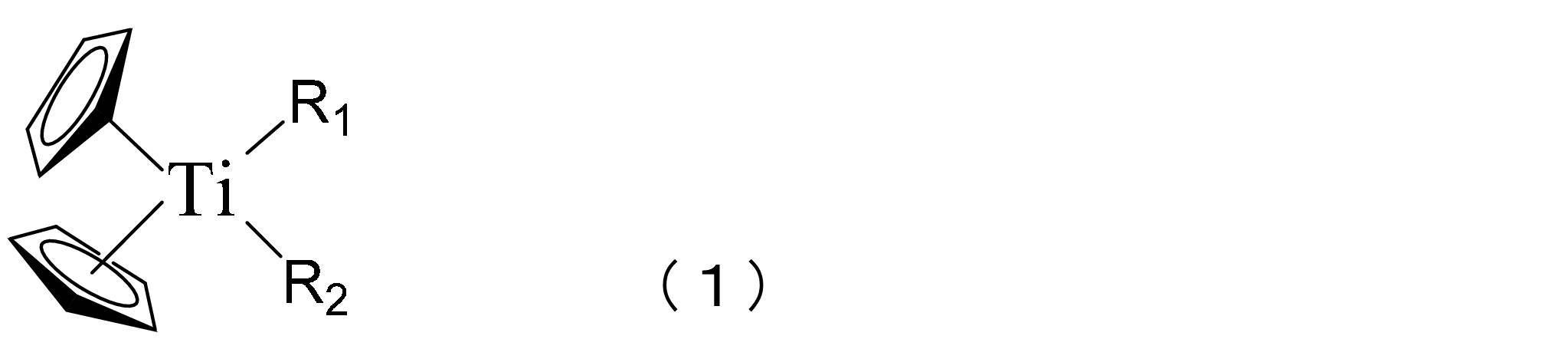
(前記式(1)中、R1、R2は、C1~C12の炭化水素基、アリーロキシ基、アルコキシル基、ハロゲン基、及び、カルボニル基からなる群より選択された基を表し、R1、R2は同一でも異なっていてもよい。) (In the above formula (1), R 1 and R 2 represent a group selected from the group consisting of a hydrocarbon group of C1 to C12, an aryloxy group, an alkoxyl group, a halogen group, and a carbonyl group, and R 1 ,. R 2 may be the same or different.)
前記Ti化合物としては、高い水素添加速度の観点から、以下に限定されるものではないが、例えば、ビス(η5-シクロペンタジエニル)チタニウムジ(p-トリル)、ビス(η5-シクロペンタジエニル)チタニウムジ(フェニル)、ビス(η5-シクロペンタジエニル)チタニウムジ(3,4-キシリル)、ビス(η5-シクロペンタジエニル)チタニウム(フルフリルオキシ)クロライド、ビス(η5-シクロペンタジエニル)チタニウムジクロライドが好ましいものとして挙げられる。
経済性の観点から、ビス(η5-シクロペンタジエニル)チタニウムジクロライドがより好ましい。
The Ti compound is not limited to the following from the viewpoint of high hydrogenation rate, but for example, bis (η5-cyclopentadienyl) titanium di (p-tolyl), bis (η5-cyclopentadi). Enyl) Titanium Di (Phenyl), Bis (η5-Cyclopentadienyl) Titanium Di (3,4-Kycyril), Bis (η5-Cyclopentadienyl) Titanium (Fluryloxy) Chloride, Bis (η5-Cyclopenta) Dienyl) Titanium dichloride is preferred.
From the economical point of view, bis (η5-cyclopentadienyl) titanium dichloride is more preferable.
前記Li化合物としては、以下に限定されるものではないが、例えば、メチルリチウム、エチルリチウム、n-プロピルリチウム、イソプロピルリチウム、n-ブチルリチウム、sec-ブチルリチウム、イソブチルリチウム、t-ブチルリチウム、n-ペンチルリチウム、n-ヘキシルリチウム、フェニルリチウム、シクロペンタジエニルリチウム、m-トリルリチウム、p-トリルリチウム、キシリルリチウム、ジメチルアミノリチウム、ジエチルアミノリチウム、メトキシリチウム、エトキシリチウム、n-プロポキシリチウム、イソプロポキシリチウム、n-ブトキシリチウム、sec-ブトキシリチウム、t-ブトキシリチウム、ペンチルオキシリチウム、ヘキシルオキシリチウム、ヘプチルオキシリチウム、オクチルオキシリチウム、フェノキシリチウム、4-メチルフェノキシリチウム、ベンジルオキシリチウム、及び4-メチルベンジルオキシリチウムが挙げられる。 The Li compound is not limited to the following, and for example, methyl lithium, ethyl lithium, n-propyl lithium, isopropyl lithium, n-butyl lithium, sec-butyl lithium, isobutyl lithium, t-butyl lithium, and the like. n-pentyllithium, n-hexyllithium, phenyllithium, cyclopentadienyllithium, m-tolyllithium, p-tolyllithium, xylyllithium, dimethylaminolithium, diethylaminolithium, methoxylithium, ethoxylithium, n-propoxylithium , Isopropoxylithium, n-butoxylithium, sec-butoxylithium, t-butoxylithium, pentyloxylithium, hexyloxylithium, heptyloxylithium, octyloxylithium, phenoxylithium, 4-methylphenoxylithium, benzyloxylithium, and Examples include 4-methylbenzyloxylithium.
Mg化合物としては、以下に限定されるものではないが、例えば、ジメチルマグネシウム、ジエチルマグネシウム、ジブチルマグネシウム、エチルブチルマグネシウム、メチルマグネシウムブロマイド、メチルマグネシウムクロライド、エチルマグネシウムブロマイド、エチルマグネシウムクロライド、フェニルマグネシウムブロマイド、フェニルマグネシウムクロライド、t-ブチルマグネシウムクロライド、及びt-ブチルマグネシウムブロマイドが挙げられる。 The Mg compound is not limited to, but is not limited to, for example, dimethylmagnesium, diethylmagnesium, dibutylmagnesium, ethylbutylmagnesium, methylmagnesium bromide, methylmagnesium chloride, ethylmagnesium bromide, ethylmagnesium chloride, phenylmagnesium bromide, and the like. Examples include phenylmagnesium chloride, t-butylmagnesium chloride, and t-butylmagnesium bromide.
(重合体製造工程時におけるチタン、アルミニウム量)
ゴム状重合体(A)の製造時に水素添加触媒成分として添加するチタン(C)の量は、水素添加前の重合体に対して、150ppm以下であることが好ましい。当該範囲であると、本実施形態のゴム組成物が含有するチタン(C)の含有量である3ppm以上200ppm以下の範囲に制御しやすくなる。
また、ゴム状重合体(A)の製造時に添加するアルミニウム(B)の量は、6ppm以下とすることが好ましい。当該範囲であると、本実施形態のゴム組成物が含有するアルミニウム(B)の含有量である2ppm未満に制御しやすくなる。実質、アルミニウムは添加しないことが、本実施形態のゴム組成物におけるアルミニウム(B)残渣を低減する観点でより好ましい。また、アルミニウムではなく、リチウムやマグネシウムを利用することで、アルミニウムの助触媒としての機能を補完することができる。
また、ムーニー粘度(ML粘度)上昇抑制、及び水素添加触媒の取扱い性・安全性の観点から、ゴム状重合体(A)の製造時に添加する水素添加触媒は、チタン(C)1モルに対し、アルミニウム(B)が0.05モル以下の含有量であることが好ましく、アルミニウム(B)が0.04モル以下の含有量であることがより好ましく、アルミニウム(B)が0.03モル以下の含有量であることがさらに好ましく、アルミニウム(B)を含まないことがさらにより好ましい。
(Amount of titanium and aluminum in the polymer manufacturing process)
The amount of titanium (C) added as a hydrogenation catalyst component during the production of the rubber-like polymer (A) is preferably 150 ppm or less with respect to the polymer before hydrogenation. Within this range, it becomes easy to control the content of titanium (C) contained in the rubber composition of the present embodiment in the range of 3 ppm or more and 200 ppm or less.
The amount of aluminum (B) added during the production of the rubber-like polymer (A) is preferably 6 ppm or less. Within this range, it becomes easy to control the content of aluminum (B) contained in the rubber composition of the present embodiment to less than 2 ppm. Substantially, it is more preferable not to add aluminum from the viewpoint of reducing the aluminum (B) residue in the rubber composition of the present embodiment. Further, by using lithium or magnesium instead of aluminum, the function of aluminum as a co-catalyst can be complemented.
Further, from the viewpoint of suppressing the increase in Mooney viscosity (ML viscosity) and handling and safety of the hydrogen addition catalyst, the hydrogenation catalyst added at the time of producing the rubbery polymer (A) is based on 1 mol of titanium (C). , Aluminum (B) preferably has a content of 0.05 mol or less, more preferably aluminum (B) has a content of 0.04 mol or less, and aluminum (B) has a content of 0.03 mol or less. It is even more preferable that the content is, and it is even more preferable that the content of aluminum (B) is not contained.
(ゴム組成物中のAl、Ti以外の金属量)
アルミニウム(B)やチタン(C)以外の金属として、本実施形態のゴム組成物中のリチウムの含有量は、本実施形態のゴム組成物の耐色変化性の観点から、60ppm以下が好ましく、50ppm以下がより好ましく、40ppm以下がさらに好ましく、30ppm以下がさらにより好ましい。一方、架橋した時の引張伸びの観点から、2ppm以上が好ましく、5ppm以上がより好ましく、10ppm以上がさらに好ましい。
(Amount of metal other than Al and Ti in the rubber composition)
As a metal other than aluminum (B) and titanium (C), the content of lithium in the rubber composition of the present embodiment is preferably 60 ppm or less from the viewpoint of color change resistance of the rubber composition of the present embodiment. 50 ppm or less is more preferable, 40 ppm or less is further preferable, and 30 ppm or less is even more preferable. On the other hand, from the viewpoint of tensile elongation at the time of cross-linking, 2 ppm or more is preferable, 5 ppm or more is more preferable, and 10 ppm or more is further preferable.
なお、上述したチタン(C)やリチウムの含有量は、化合物として含有していても、それぞれの元素の量である。 The content of titanium (C) and lithium described above is the amount of each element even if it is contained as a compound.
また、本実施形態のゴム組成物中のチタン(C)が、水素添加触媒成分や重合触媒成分の残渣であるとき、当該ゴム組成物中においてチタン(C)は微分散し、また、特定が難しい化合物や複合体になり、ゴム組成物の物性に与える影響が大きい可能性がある。よって、ゴム組成物の物性に影響を与えないようにし、かつ、特性が難しくならないようにし、さらには、ゴム組成物の金型への密着を緩和する観点から、本実施形態のゴム組成物においては、チタン(C)は、粒子状に分散していることが好ましい。 Further, when the titanium (C) in the rubber composition of the present embodiment is a residue of the hydrogenation catalyst component or the polymerization catalyst component, the titanium (C) is finely dispersed in the rubber composition and can be specified. It becomes a difficult compound or complex and may have a great influence on the physical properties of the rubber composition. Therefore, in the rubber composition of the present embodiment, from the viewpoint of not affecting the physical properties of the rubber composition, preventing the characteristics from becoming difficult, and further relaxing the adhesion of the rubber composition to the mold. It is preferable that titanium (C) is dispersed in the form of particles.
(添加剤の添加)
本実施形態のゴム組成物の製造の際には、ゴム状重合体(A)の重合工程の後に、本実施形態のゴム組成物中の金属量を所定の範囲に調整し易い観点から、失活剤、中和剤等を添加することが好ましい。
失活剤としては、以下のものに限定されないが、例えば、水;メタノール、エタノール、イソプロパノール等のアルコールが挙げられる。
中和剤としては、以下のものに限定されないが、例えば、ステアリン酸、オレイン酸、バーサチック酸(炭素数9~11個で、10個を中心とする、分岐の多いカルボン酸混合物)等のカルボン酸;無機酸の水溶液、炭酸ガスが挙げられる。
ゴム状重合体(A)の重合工程の後に、ゲル生成の防止や加工安定性の観点から、ゴム用安定剤を添加することが好ましい。
ゴム用安定剤としては、以下のものに限定されず、公知のものを用いることができるが、例えば、2,6-ジ-tert-ブチル-4-ヒドロキシトルエン(以下「BHT」とも記す。)、n-オクタデシル-3-(4’-ヒドロキシ-3’,5’-ジ-tert-ブチルフェノール)プロピネート、2-メチル-4,6-ビス[(オクチルチオ)メチル]フェノール等の酸化防止剤が好ましいものとして挙げられる。
(Addition of additives)
In the production of the rubber composition of the present embodiment, after the polymerization step of the rubber-like polymer (A), the amount of metal in the rubber composition of the present embodiment is easily adjusted to a predetermined range. It is preferable to add a working agent, a neutralizing agent and the like.
The deactivating agent is not limited to the following, and examples thereof include water; alcohols such as methanol, ethanol, and isopropanol.
The neutralizing agent is not limited to the following, but is, for example, a carboxylic acid such as stearic acid, oleic acid, and versatic acid (a carboxylic acid mixture having 9 to 11 carbon atoms and mainly 10 branches). Acid: An aqueous solution of an inorganic acid, carbonic acid gas, and the like.
After the polymerization step of the rubber-like polymer (A), it is preferable to add a rubber stabilizer from the viewpoint of preventing gel formation and processing stability.
The stabilizer for rubber is not limited to the following, and known ones can be used, and for example, 2,6-di-tert-butyl-4-hydroxytoluene (hereinafter, also referred to as “BHT”). , N-Octadecyl-3- (4'-hydroxy-3', 5'-di-tert-butylphenol) propinate, 2-methyl-4,6-bis [(octylthio) methyl] phenol and other antioxidants are preferred. It is mentioned as a thing.
本実施形態のゴム組成物中には、必要に応じて、さらに各種添加剤を加えることができる。かかる添加剤としては、下記に示す充填剤、又はタッキファイヤーとしての樹脂成分等をマスターバッチとして成形前の工程で加えることができる。その場合、添加剤は15質量%以下であることが好ましい。
本実施形態のゴム組成物は、ゴム組成物の取扱い性や機械強度や、タイヤに用いた時の省燃費性や耐摩耗性のバランスの向上を図る観点から、ゴム状重合体(A)+アルミニウム(B)+チタン(C)+ゴム用軟化剤(D)の含有量が、85質量%以上であることが好ましく、95質量%以上であることがより好ましく、97質量%以上であることがさらに好ましい。
Various additives can be further added to the rubber composition of the present embodiment, if necessary. As such an additive, the filler shown below, a resin component as a tack fire, or the like can be added as a master batch in the step before molding. In that case, the additive is preferably 15% by mass or less.
The rubber composition of the present embodiment is a rubber-like polymer (A) + from the viewpoint of improving the balance between the handleability and mechanical strength of the rubber composition, the fuel saving property when used in a tire, and the wear resistance. The content of aluminum (B) + titanium (C) + rubber softener (D) is preferably 85% by mass or more, more preferably 95% by mass or more, and 97% by mass or more. Is even more preferable.
本実施形態のゴム組成物を製造する際には、ゴム状重合体(A)を溶液中で重合する工程を行った後、重合体溶液から溶媒を除去する。
重合体溶液から溶媒を除去する方法としては、例えば、フラッシング、スチームストリッピング、脱水後の乾燥コンベア、脱揮押出機、ドラムドライヤー、及び脱揮ニーダー等を利用する方法が挙げられる。
熱履歴が小さく、ゴム組成物中の金属量を、所望の量に調整し易い観点から、少なくとも、スチームストリッピングを用いる方法が好ましい。特に、窒素原子を含有するカップリング剤を用いたゴム状重合体(A)は、金属量の調整が難しいため、スチームストリッピングを用いる方法は、金属量の調整の観点から有用である。
スチームストリッピングやその前後の処理方法としては、以下に限定されるものではないが、例えば、特開平10-168101号公報、特開平10-204136公報、国際公開第2013-146530号公報、特開2019-131810号公報等に記載されている方法が挙げられる。
When producing the rubber composition of the present embodiment, the solvent is removed from the polymer solution after the step of polymerizing the rubber-like polymer (A) in the solution.
Examples of the method for removing the solvent from the polymer solution include a method using flushing, steam stripping, a drying conveyor after dehydration, a devolatilization extruder, a drum dryer, a devolatilization kneader and the like.
From the viewpoint that the heat history is small and the amount of metal in the rubber composition can be easily adjusted to a desired amount, at least a method using steam stripping is preferable. In particular, since it is difficult to adjust the metal amount of the rubber-like polymer (A) using a coupling agent containing a nitrogen atom, the method using steam stripping is useful from the viewpoint of adjusting the metal amount.
The steam stripping and the processing method before and after the steam stripping are not limited to the following, and are, for example, JP-A-10-168101, JP-A-10-204136, International Publication No. 2013-146530, JP-A. Examples thereof include the methods described in JP-A-2019-131810.
本実施形態のゴム組成物の製造方法においては、押出乾燥工程を実施する前段階として、重合体溶液から溶剤をスチームストリッピングにより除去する脱溶媒工程、重合体のスラリーからストリッピング水と分離して、含水クラムを取り出すスクリーニング工程を実施することが好ましい。
また、スチームストリッピングの前段階として、溶液濃度を上げるために、フラッシング工程を設けてもよい。
押出乾燥工程を実施する前段階として、重合体溶液から溶剤をスチームストリッピングにより除去する脱溶媒工程を実施することにより、溶剤を含まず、水分を含んだ多孔質の粒状のクラムが熱水中に分散したスラリーが得られる。
重合体のスラリーからストリッピング水と分離して含水クラムを取り出すスクリーニング工程を実施することにより、水分を含んだ多孔質の粒状のクラムを得ることができる。
また、必要により、ロール、スクリュー圧縮絞り機等で脱水する絞り脱水工程を実施することが好ましい。これらの脱水工程により、押出乾燥工程の前段階で、含水率をより少なくした含水クラムを得ることができる。
In the method for producing a rubber composition of the present embodiment, as a step before carrying out the extrusion drying step, a desolvation step of removing the solvent from the polymer solution by steam stripping and separation from the stripping water from the polymer slurry are performed. Therefore, it is preferable to carry out a screening step for removing the hydrous crumb.
Further, as a preliminary step of steam stripping, a flushing step may be provided in order to increase the solution concentration.
By carrying out a desolvation step of removing the solvent from the polymer solution by steam stripping as a pre-step before carrying out the extrusion drying step, a porous granular crumb containing no solvent and containing water is formed in hot water. A slurry dispersed in is obtained.
By carrying out a screening step of separating from the stripping water from the slurry of the polymer and taking out the hydrous crumb, a porous granular crumb containing water can be obtained.
Further, if necessary, it is preferable to carry out a squeezing dehydration step of dehydrating with a roll, a screw compression squeezing machine or the like. By these dehydration steps, it is possible to obtain a water-containing crumb with a lower water content before the extrusion-drying step.
スチームストリッピングによって、本実施形態のゴム組成物中のチタン(C)の含有量を3ppm以上120ppm以下に制御する方法としては、重合後のゴム状重合体(A)の溶液と、熱水又はスチームとを接触させる条件として、溶液投入圧力を調整する方法、スチームの圧力や温度や量を調整する方法、スチームにポリオキシアルキレンアルキルエーテルフォスフェート等のリン酸エステル又はその塩等の分散剤や、ノニルフェノキシポリエチレングリコールリン酸エステル又はその塩等の界面活性剤を加える方法、混合する際に用いる回転翼の形状や回転速度を調整する方法等が有用な方法として挙げられる。 As a method of controlling the content of titanium (C) in the rubber composition of the present embodiment by steam stripping to 3 ppm or more and 120 ppm or less, a solution of the rubber-like polymer (A) after polymerization and hot water or As conditions for contact with steam, a method of adjusting the solution injection pressure, a method of adjusting the pressure, temperature and amount of steam, a dispersant such as a phosphate ester such as polyoxyalkylene alkyl ether phosphate or a salt thereof, and the like, , A method of adding a surfactant such as nonylphenoxy polyethylene glycol phosphate ester or a salt thereof, a method of adjusting the shape and rotation speed of the rotary blade used for mixing, and the like are useful methods.
本実施形態のゴム組成物の製造の際には、経済性や金属の除去性のため、重合体溶液に、失活剤としてアルコール化合物を含有させることが好ましく、さらに、スチームストリッピングに際して加えられる分散剤や界面活性剤を予め添加しておくことがより好ましい。 In the production of the rubber composition of the present embodiment, it is preferable to contain an alcohol compound as a deactivating agent in the polymer solution for economic efficiency and metal removal property, and further, it is added at the time of steam stripping. It is more preferable to add a dispersant or a surfactant in advance.
本実施形態のゴム組成物中のチタン(C)含有量を低減する場合の方法としては、例えば、ゴム状重合体(A)の重合後の重合体溶液に失活剤としてアルコール化合物をゴム状重合体(A)のモル数の0.5倍モル以上、好ましくは1.0倍モル以上を添加する方法、スチームストリッピング工程でスチーム/ポリマー溶液の体積比を0.1以上、好ましくは0.2以上とする方法、処理レートを下げる方法、重合体溶液中に重合体に対して界面活性剤を100ppm以上、好ましくは200ppmを添加する方法等が挙げられる。 As a method for reducing the titanium (C) content in the rubber composition of the present embodiment, for example, an alcohol compound is added as a deactivating agent to the polymer solution after the polymerization of the rubber-like polymer (A). A method of adding 0.5 times or more, preferably 1.0 times or more, of the number of moles of the polymer (A), the volume ratio of the steam / polymer solution is 0.1 or more, preferably 0 in the steam stripping step. Examples thereof include a method of setting the content to 2 or more, a method of lowering the treatment rate, and a method of adding 100 ppm or more, preferably 200 ppm of a surfactant to the polymer in the polymer solution.
スチームストリッピング工程における回転翼は、線速5m/s以上20m/s以下が好ましく、線速10m/s以上20m/s以下がより好ましい。 The rotary blade in the steam stripping step preferably has a linear speed of 5 m / s or more and 20 m / s or less, and more preferably a linear speed of 10 m / s or more and 20 m / s or less.
スチームストリッピング後は、国際公開第2013-146530号公報に記載のように、ゴム組成物を押出乾燥し、熱風乾燥する方法を実施することが好ましい。
これらにより、多孔質の粒状のクラムを得ることができる。
ゴム組成物中の金属や金属化合物の粒子径は、成形金型に対する汚染し難さ、ベール成形体からのゴム組成物の剥離耐性、及び架橋用ゴム組成物をシートにした時の平滑性のバランスの観点から、金属や金属化合物の粒子の体積総量100vol%のうち、60vol%以上が0.1~90μmであることが好ましく、80vol%以上が前記粒子径範囲であることがより好ましい。
ゴム組成物中の金属や金属化合物の粒子の粒子径は、金属又は金属化合物を含有するゴム組成物を不活性溶媒に溶解して得られる重合体溶液をレーザー回折式の粒度分布計で分析することにより測定できる。
クラムの粒径は、成形体からのゴム組成物の耐脱離性を得る観点や、乾燥時の耐飛散性の観点から、0.1mm以上が好ましく、0.5mm以上がより好ましい。
一方、クラム中の残存溶媒や水分の乾燥性や、ゴム組成物の成形後の成形体の耐膨張性の観点から、前記クラムの粒径は、30mm以下が好ましく、20mm以下がより好ましい。
クラムの粒径を調整する方法としては、溶剤を除去し乾燥する過程で調整する場合と、製造されたクラムを加工して調整する場合とがある。
溶剤を除去してクラムを乾燥する過程で調整する場合には、特に限定されないが、例えば、ゴム状重合体(A)の分子量や組成や構造を調整する方法、ゴム状重合体(A)の溶液に添加するゴム用軟化剤(D)の量を調整する方法、押出乾燥機のダイスの穴径を調整する方法、ゴム状重合体(A)の溶液を熱水に投入して脱溶剤する際の条件を調整する方法等が挙げられる。
製造されたクラムを加工して調整する場合は、特に限定されないが、例えば、クラムをふるい分けする方法、クラムをミキサーやグラニュレータで解砕、粉砕する方法を挙げられる。
After steam stripping, it is preferable to carry out a method of extrusion-drying the rubber composition and hot-air drying as described in International Publication No. 2013-146530.
These make it possible to obtain porous granular crumbs.
The particle size of the metal or metal compound in the rubber composition is such that it is difficult to contaminate the molding mold, the peel resistance of the rubber composition from the veil molded body, and the smoothness when the rubber composition for cross-linking is made into a sheet. From the viewpoint of balance, out of 100 vol% of the total volume of the particles of the metal or the metal compound, 60 vol% or more is preferably 0.1 to 90 μm, and 80 vol% or more is more preferably the particle size range.
The particle size of the particles of the metal or the metal compound in the rubber composition is analyzed by a laser diffraction type particle size distribution meter of a polymer solution obtained by dissolving the rubber composition containing the metal or the metal compound in an inert solvent. It can be measured by this.
The particle size of the crumb is preferably 0.1 mm or more, more preferably 0.5 mm or more, from the viewpoint of obtaining the desorption resistance of the rubber composition from the molded product and the scattering resistance at the time of drying.
On the other hand, the particle size of the crumb is preferably 30 mm or less, more preferably 20 mm or less, from the viewpoint of the drying property of the residual solvent and water in the crumb and the expansion resistance of the molded product after molding of the rubber composition.
As a method for adjusting the particle size of the crumb, there are a case where the grain size is adjusted in the process of removing the solvent and drying, and a case where the manufactured crumb is processed and adjusted.
The case of adjusting in the process of removing the solvent and drying the crumb is not particularly limited, but for example, a method for adjusting the molecular weight, composition and structure of the rubber-like polymer (A), the rubber-like polymer (A). A method of adjusting the amount of the rubber softening agent (D) added to the solution, a method of adjusting the hole diameter of the die of the extruder, and a method of adding the solution of the rubber-like polymer (A) to hot water to remove the solvent. Examples include a method of adjusting the conditions at the time.
When the produced crumb is processed and adjusted, the method is not particularly limited, and examples thereof include a method of sieving the crumb and a method of crushing and crushing the crumb with a mixer or a granulator.
本実施形態のゴム組成物のクラムの比表面積は、取り扱い性の観点から、好ましくは0.7~3.2m2/gであり、より好ましくは1.0~3.0m2/gである。
クラムの比表面積が0.7m2/g以上であると、成形される際に1個のクラムが成形体周囲のクラムと密着する面積も増えるため、クラムは成形体から剥がれにくくなる。クラムの比表面積が3.2m2/g以下であると、成形された際に、クラム粒子はより高密度に圧縮されクラム間の空隙も抑えられるため成形体の膨張を抑えることができる。
クラムの比表面積を前記範囲に調整する方法としては、特に限定されないが、例えば、クラムをふるい分けして、各ふるい分けしたクラムの組成を調整する方法が挙げられる。
The specific surface area of the crumb of the rubber composition of the present embodiment is preferably 0.7 to 3.2 m 2 / g, more preferably 1.0 to 3.0 m 2 / g, from the viewpoint of handleability. ..
When the specific surface area of the crumbs is 0.7 m 2 / g or more, the area in which one crumb is in close contact with the crumbs around the molded body during molding also increases, so that the crumbs are less likely to peel off from the molded body. When the specific surface area of the crumbs is 3.2 m 2 / g or less, the crumb particles are compressed at a higher density when molded, and the voids between the crumbs are suppressed, so that the expansion of the molded body can be suppressed.
The method for adjusting the specific surface area of the crumbs to the above range is not particularly limited, and examples thereof include a method of sifting the crumbs and adjusting the composition of each sifted crumb.
本実施形態のゴム組成物中の残存溶媒は、臭気やVOC削減の観点から、低い方が好ましい。5000ppm以下が好ましく、3000ppm以下がより好ましく、1500ppm以下がさらに好ましい。また、経済性のバランスの観点から、50ppmm以上が好ましく、150ppm以上がより好ましく、300ppm以上がさらに好ましい。 The residual solvent in the rubber composition of the present embodiment is preferably low from the viewpoint of reducing odor and VOC. It is preferably 5000 ppm or less, more preferably 3000 ppm or less, and even more preferably 1500 ppm or less. Further, from the viewpoint of economic balance, 50 ppmm or more is preferable, 150 ppm or more is more preferable, and 300 ppm or more is further preferable.
(ベール成形体のゴム組成物中の水分)
本実施形態のベール成形体のゴム組成物中の水分は、0.05質量%以上1.5質量%以下が好ましい。
ゴム組成物中の水分は、溶媒除去後の乾燥時のゲル抑制や、粉体の生成による収率低下抑制の観点から、0.05質量%以上が好ましく、0.1質量%以上がより好ましく、0.2質量%以上がさらに好ましい。一方、ゴム組成物の結露抑制の観点から、1.5質量%以下が好ましく、1.0質量%以下がより好ましく、0.8質量%以下がさらに好ましい。
本実施形態のベール成形体のゴム組成物中の水分の含有量は、上述したクラム形状や乾燥工程の条件を調整することにより、上記数値範囲に制御することができる。
(Moisture in the rubber composition of the veil molded product)
The water content in the rubber composition of the veil molded product of the present embodiment is preferably 0.05% by mass or more and 1.5% by mass or less.
The water content in the rubber composition is preferably 0.05% by mass or more, more preferably 0.1% by mass or more, from the viewpoint of suppressing gel during drying after removing the solvent and suppressing a decrease in yield due to powder formation. , 0.2% by mass or more is more preferable. On the other hand, from the viewpoint of suppressing dew condensation of the rubber composition, 1.5% by mass or less is preferable, 1.0% by mass or less is more preferable, and 0.8% by mass or less is further preferable.
The water content in the rubber composition of the veil molded product of the present embodiment can be controlled within the above numerical range by adjusting the above-mentioned crumb shape and the conditions of the drying step.
〔成形体〕
本実施形態のベール成形体は、上述した本実施形態のゴム組成物の成形体であり、取扱い性の観点から、ブロック状の成形体であることが好ましい。
本実施形態のベール成形体は、1,000cm3以上のブロック状(ベール)成形体がさらに好ましい。また、17.5kgから35kgの直方体型のベール成形体であることがさらにより好ましい。
[Molded product]
The veil molded product of the present embodiment is the molded product of the rubber composition of the present embodiment described above, and is preferably a block-shaped molded product from the viewpoint of handleability.
The bale molded product of the present embodiment is more preferably a block-shaped (bale) molded product having a size of 1,000 cm 3 or more. Further, it is even more preferable that the bale-molded body is a rectangular parallelepiped type having a weight of 17.5 kg to 35 kg.
本実施形態のベール成形体の成形方法としては、クラムを圧縮する方法や、シートを作製してシートを重ねて圧縮する方法があるが、成形方法としては、比表面積が0.7m2/g~3.2m2/gであるクラムを作製し、クラムを圧縮成形する方法が好ましい。成形性の観点から、成形前に、クラムをふるい分ける工程をさらに実施することが好ましい。
クラムを圧縮成形する際にクラム同士が密着するため、成形体の比表面積は、クラムの比表面積に比べて低くなる。圧縮成形時のクラムの密着性は、ゴム状重合体(A)の分子量や組成や構造、ゴム用軟化剤組成、圧縮時の温度、圧力によって調整することができる。例えば、クラムの密着性を上げてベールの比表面積を下げたい場合には、ゴム状重合体(A)の分子量を下げる、ゴム用軟化剤量を増やす、圧縮時の温度及び圧力を上げる条件が好ましい。
As a method for forming the bale molded product of the present embodiment, there are a method of compressing crumbs and a method of producing sheets and stacking and compressing the sheets. As a forming method, the specific surface area is 0.7 m 2 / g. A method of producing a crumb of about 3.2 m 2 / g and compression molding the crumb is preferable. From the viewpoint of moldability, it is preferable to further carry out a step of sieving the crumbs before molding.
Since the crumbs are in close contact with each other when the crumbs are compression-molded, the specific surface area of the molded product is lower than the specific surface area of the crumbs. The adhesion of the crumb during compression molding can be adjusted by the molecular weight, composition and structure of the rubber-like polymer (A), the composition of the softener for rubber, the temperature during compression, and the pressure. For example, if it is desired to increase the adhesion of the crumb and reduce the specific surface area of the bale, the conditions of lowering the molecular weight of the rubber-like polymer (A), increasing the amount of the softener for rubber, and raising the temperature and pressure during compression are required. preferable.
本実施形態のベール成形体の比表面積は、好ましくは0.005~0.05m2/gであり、より好ましくは、フィルム包装性の観点から0.01~0.04m2/gである。ベール成形体の比表面積が0.005m2/g以上であることによりベールの膨張が抑えられ、ベール成形体の比表面積が0.05m2/g以下であることによりベール成形体からのクラムの剥離が低減するため好ましい。
ベール成形体の比表面積はBET法により求めることができる。
通常、大きなサイズのベール成形体の比表面積は、位置によって異なる傾向にあるため、ベール成形体の中央部付近から採取することが好ましい。
The specific surface area of the bale molded product of the present embodiment is preferably 0.005 to 0.05 m 2 / g, and more preferably 0.01 to 0.04 m 2 / g from the viewpoint of film packaging. When the specific surface area of the bale molded body is 0.005 m 2 / g or more, the expansion of the bale is suppressed, and when the specific surface area of the bale molded body is 0.05 m 2 / g or less, the crumb from the bale molded body It is preferable because peeling is reduced.
The specific surface area of the bale molded product can be determined by the BET method.
Generally, the specific surface area of a large-sized bale-molded product tends to differ depending on the position, so it is preferable to collect the material from the vicinity of the central portion of the veil-molded product.
本実施形態のゴム組成物クラムは、ベール成形体に成形する前に、粒径別にふるい分けした後に、適切な量比で混合することが好ましい。
脱溶剤後のクラムをそのまま用いて成形されたベール成形体の比表面積が上記範囲の上限を超える場合は、ふるい分けされたクラムのうち、大粒径のクラム組成を増やして小粒径のクラム組成を減らすことが好ましく、下限に満たない場合は大粒径のクラム組成を減らして、小粒径のクラムを増やすことが好ましい。
It is preferable that the rubber composition crumb of the present embodiment is sieved according to the particle size before being molded into a veil molded product, and then mixed in an appropriate amount ratio.
If the specific surface area of the veil molded body formed by using the desolated crumb as it is exceeds the upper limit of the above range, the crumb composition having a large particle size is increased among the sifted crumbs to form a crumb composition having a small particle size. If the lower limit is not reached, it is preferable to reduce the crumb composition having a large particle size and increase the crumbs having a small particle size.
本実施形態のベール成形体の成形圧縮圧力は、好ましくは3~30MPaであり、より好ましくは10~20MPaである。成形時の圧縮圧力が30MPa以下であると装置をコンパクトに設計することができ、設置効率がよい。成形時の圧縮圧力が3MPa以上であると成形性が良好である。成形性がよい場合は、ベール成形体の表面が滑らかで、成形工程以降での重合体の剥離が無く、成形後の膨張が抑えられる傾向にある。 The molding compression pressure of the veil molded product of the present embodiment is preferably 3 to 30 MPa, more preferably 10 to 20 MPa. When the compression pressure at the time of molding is 30 MPa or less, the device can be designed compactly and the installation efficiency is good. When the compression pressure at the time of molding is 3 MPa or more, the moldability is good. When the moldability is good, the surface of the bale molded product is smooth, there is no peeling of the polymer after the molding process, and expansion after molding tends to be suppressed.
成形時のゴム組成物の温度は30~120℃が好ましく、より好ましくは残溶剤低減と熱劣化抑制の観点から50~100℃である。
成形時のゴム組成物の温度が30℃以上では、成形性が良好であり、一方で、温度が120℃以下では、ゴム組成物の熱劣化によるゲル生成が抑えられるため好ましい。
成形時の温度及び圧力は高い程、ベール成形体の比表面積は小さくなる。
成形時の保圧時間は、好ましくは3~30秒で、より好ましくは5~20秒である。圧縮時の保圧時間が30秒以下では生産効率がよく、5秒以上では成形性が良好である。
The temperature of the rubber composition at the time of molding is preferably 30 to 120 ° C, more preferably 50 to 100 ° C from the viewpoint of reducing residual solvent and suppressing thermal deterioration.
When the temperature of the rubber composition at the time of molding is 30 ° C. or higher, the moldability is good, while when the temperature is 120 ° C. or lower, gel formation due to thermal deterioration of the rubber composition is suppressed, which is preferable.
The higher the temperature and pressure during molding, the smaller the specific surface area of the bale molded product.
The holding time during molding is preferably 3 to 30 seconds, more preferably 5 to 20 seconds. When the holding time during compression is 30 seconds or less, the production efficiency is good, and when the holding time is 5 seconds or more, the moldability is good.
ベール成形体同士の密着を避けるために、本実施形態のベール成形体は、樹脂フィルム(包装シート)で包装することが好ましい。
フィルムの樹脂の種類は、例えば、ポリエチレン、エチレン共重合体樹脂、ポリスチレン、ハイインパクトポリスチレン、PETを用いることができる。
成形体の運搬時の取扱い性や、包装シートとベール成形体の間隙に結露が発生し難い観点から、ベール成形体に対する包装シートの密着性が良いことが好ましい。
本実施形態のベール成形体は、例えば、運送用の容器に収納される用途に用いる。成形後1日経過後のベール成形体の膨張率が5%未満であると、容器への収納性が良好であり、好ましい。
In order to avoid adhesion between the bale molded bodies, it is preferable to wrap the bale molded body of the present embodiment with a resin film (packaging sheet).
As the type of resin for the film, for example, polyethylene, ethylene copolymer resin, polystyrene, high impact polystyrene, or PET can be used.
From the viewpoint of handleability during transportation of the molded body and the fact that dew condensation is unlikely to occur in the gap between the packaging sheet and the bale molded body, it is preferable that the packaging sheet has good adhesion to the bale molded body.
The veil molded product of the present embodiment is used, for example, for storage in a container for transportation. When the expansion rate of the bale molded product one day after molding is less than 5%, the storability in the container is good, which is preferable.
〔架橋用ゴム組成物〕
本実施形態のベール成形体のゴム組成物は、高い機械強度等の観点から、架橋剤を添加し、架橋用ゴム組成物とし、架橋後に架橋体とし、種々の用途に用いられることが好ましい。
本実施形態の架橋用ゴム組成物は、上述した本実施形態のゴム組成物と、架橋剤を少なくとも含み、更に必要に応じて、その他のゴム成分、充填剤等を含むことができる。
その他のゴム成分としては、特に限定されるものではなく、目的に応じて適宜選択することができる。例えば、スチレン-ブタジエンゴム(乳化重合タイヤや溶液重合タイプ)、天然ゴム、ポリイソプレン、ブタジエンゴム、アクリロニトリル-ブタジエンゴム(NBR)、クロロプレンゴム、エチレン-プロピレンゴム(EPM)、エチレン-プロピレン-非共役ジエンゴム(EPDM)、ブチルゴム、多硫化ゴム、シリコーンゴム、フッ素ゴム、ウレタンゴム等が挙げられる。
これらは、1種単独で使用してもよく、2種以上を混合して用いてもよい。
[Rubber composition for cross-linking]
From the viewpoint of high mechanical strength and the like, the rubber composition of the veil-molded body of the present embodiment is preferably used for various purposes by adding a cross-linking agent to obtain a rubber composition for cross-linking, and after cross-linking, to form a cross-linked body.
The cross-linking rubber composition of the present embodiment contains at least the above-mentioned rubber composition of the present embodiment and a cross-linking agent, and may further contain other rubber components, fillers and the like, if necessary.
The other rubber components are not particularly limited and may be appropriately selected depending on the intended purpose. For example, styrene-butadiene rubber (emulsified polymer tire or solution polymerization type), natural rubber, polyisoprene, butadiene rubber, acrylonitrile-butadiene rubber (NBR), chloroprene rubber, ethylene-propylene rubber (EPM), ethylene-propylene-non-conjugated Examples thereof include ethylene rubber (EPDM), butyl rubber, polysulfide rubber, silicone rubber, fluororubber, urethane rubber and the like.
These may be used individually by 1 type, or may be used by mixing 2 or more types.
本実施形態の架橋用ゴム組成物中の、前記ゴム状重合体(A)とその他のゴム成分の合計量であるゴム総量に対するゴム状重合体(A)の含有量は、本発明の効果を発揮させる観点から、20質量%以上であることが好ましく、40質量%以上であることがより好ましく、60質量%以上であることがさらに好ましく、80質量%以上であることがさらにより好ましい。 The content of the rubber-like polymer (A) in the cross-linking rubber composition of the present embodiment with respect to the total amount of rubber, which is the total amount of the rubber-like polymer (A) and other rubber components, has the effect of the present invention. From the viewpoint of exerting, it is preferably 20% by mass or more, more preferably 40% by mass or more, further preferably 60% by mass or more, and further preferably 80% by mass or more.
また、本実施形態の架橋用ゴム組成物においては、補強性を向上させること等を目的として、必要に応じて、充填剤を添加することができる。
充填剤の配合量としては、特に制限はなく、目的に応じて適宜選択することができるが、ゴム状重合体(A)とその他のゴムの合計であるゴム成分100質量部に対し、10~100質量部が好ましく、20~80質量部がより好ましい。
充填剤の配合量が10質量部以上であることにより、充填剤を配合したことによる補強性向上の効果が得られ、また、100質量部以下であることにより、タイヤにした時の省燃費性の大幅な低下を回避しつつ、良好な作業性を保持することができる。
Further, in the cross-linking rubber composition of the present embodiment, a filler can be added as needed for the purpose of improving the reinforcing property.
The blending amount of the filler is not particularly limited and may be appropriately selected depending on the intended purpose, but is 10 to 10 to 100 parts by mass of the rubber component, which is the total of the rubber-like polymer (A) and other rubbers. 100 parts by mass is preferable, and 20 to 80 parts by mass is more preferable.
When the amount of the filler is 10 parts by mass or more, the effect of improving the reinforcing property by blending the filler can be obtained, and when it is 100 parts by mass or less, the fuel efficiency when the tire is used can be obtained. Good workability can be maintained while avoiding a significant decrease in fuel consumption.
充填剤としては、特に制限はなく、カーボンブラック、シリカ、水酸化アルミニウム、クレー、アルミナ、タルク、マイカ、カオリン、ガラスバルーン、ガラスビーズ、炭酸カルシウム、炭酸マグネシウム、水酸化マグネシウム、酸化マグネシウム、酸化チタン、チタン酸カリウム、硫酸バリウム等が挙げられるが、これらの中でも、カーボンブラックを用いることが好ましい。これらは、1種単独で使用してもよく、2種以上を併用してもよい。
カーボンブラックとしては、特に制限はなく、目的に応じて適宜選択することができ、例えば、FEF、GPF、SRF、HAF、N339、IISAF、ISAF、SAF等が挙げられる。これらは、1種のみを単独で使用してもよく、2種以上を併用してもよい。
また、前記カーボンブラックの窒素吸着比表面積(N2SA、JIS K6217-2:2001に準拠して測定する)としては、特に制限はなく、目的に応じて適宜選択することができる。
本実施形態の架橋用ゴム組成物を省燃費タイヤトレッド用組成物として用いる場合には、充填剤として、沈降性シリカが好適に用いられる。
The filler is not particularly limited, and is carbon black, silica, aluminum hydroxide, clay, alumina, talc, mica, kaolin, glass balloon, glass beads, calcium carbonate, magnesium carbonate, magnesium hydroxide, magnesium oxide, titanium oxide. , Potassium titanate, barium sulfate and the like, and among these, carbon black is preferably used. These may be used alone or in combination of two or more.
The carbon black is not particularly limited and may be appropriately selected depending on the intended purpose. Examples thereof include FEF, GPF, SRF, HAF, N339, IISAF, ISAF and SAF. These may be used alone or in combination of two or more.
The nitrogen adsorption specific surface area of the carbon black (measured according to N2SA, JIS K6217-2: 2001) is not particularly limited and may be appropriately selected depending on the intended purpose.
When the cross-linking rubber composition of the present embodiment is used as a fuel-efficient tire tread composition, sedimentable silica is preferably used as a filler.
本実施形態の架橋用ゴム組成物は、充填剤の分散性の改善や架橋体の引張物性強度の観点から、シランカップリング剤を含んでもよい。
シランカップリング剤は、ゴム成分と無機充填剤との相互作用を緊密にする機能を有しており、ゴム成分及びシリカ系無機充填剤のそれぞれに対する親和性又は結合性の基を有しており、硫黄結合部分とアルコキシシリル基又はシラノール基部分とを一分子中に有する化合物が好ましい。
このような化合物としては、以下に限定されないが、例えば、ビス-[3-(トリエトキシシリル)-プロピル]-テトラスルフィド、ビス-[3-(トリエトキシシリル)-プロピル]-ジスルフィド、ビス-[2-(トリエトキシシリル)-エチル]-テトラスルフィド、S-[3-(トリエトキシシリル)-プロピル]オクタンチオエート及びS-[3-(トリエトキシシリル)-プロピル]オクタンチオエートと[(トリエトキシシリル)-プロピル]チオールの縮合物、少なくとも1個のチオール(-SH)官能基(メルカプトシランと称する)及び/又は、少なくとも1個のマスクトチオール基を担持するシラン類が挙げられる。
本実施形態の架橋用ゴム組成物中のシランカップリング剤の含有量は、上述した充填剤100質量部に対して、0.1質量部以上30質量部以下が好ましく、0.5質量部以上20質量部以下がより好ましく、1.0質量部以上15質量部以下がさらに好ましい。シランカップリング剤の含有量が上記範囲であると、シランカップリング剤による上記添加効果を一層顕著なものにできる傾向にある。
The rubber composition for cross-linking of the present embodiment may contain a silane coupling agent from the viewpoint of improving the dispersibility of the filler and the tensile strength of the cross-linked body.
The silane coupling agent has a function of closely interacting with the rubber component and the inorganic filler, and has an affinity or binding group for each of the rubber component and the silica-based inorganic filler. , A compound having a sulfur-bonded moiety and an alkoxysilyl group or a silanol group moiety in one molecule is preferable.
Such compounds include, but are not limited to, bis- [3- (triethoxysilyl) -propyl] -tetrasulfide, bis- [3- (triethoxysilyl) -propyl] -disulfide, bis-. [2- (Triethoxysilyl) -ethyl] -tetrasulfide, S- [3- (triethoxysilyl) -propyl] octanethioate and S- [3- (triethoxysilyl) -propyl] octanethioate and [ Condensations of (triethoxysilyl) -propyl] thiols, silanes carrying at least one thiol (-SH) functional group (referred to as mercaptosilane) and / or at least one masked thiol group. ..
The content of the silane coupling agent in the cross-linking rubber composition of the present embodiment is preferably 0.1 part by mass or more and 30 parts by mass or less, and 0.5 part by mass or more, with respect to 100 parts by mass of the above-mentioned filler. 20 parts by mass or less is more preferable, and 1.0 part by mass or more and 15 parts by mass or less is further preferable. When the content of the silane coupling agent is in the above range, the effect of the addition by the silane coupling agent tends to be more remarkable.
本実施形態の架橋用ゴム組成物は、架橋剤を含有する。
前記架橋剤としては、特に制限はなく、目的に応じて適宜選択することができ、例えば、硫黄系架橋剤、有機過酸化物系架橋剤、無機架橋剤、ポリアミン架橋剤、樹脂架橋剤、硫黄化合物系架橋剤、オキシムーニトロソアミン系架橋剤等が挙げられ、これらを併用してもよい。
なお、タイヤ用ゴム組成物としては、これらの中でも硫黄系架橋剤(加硫剤)がより好ましい。特に硫黄がさらに好ましい。
The cross-linking rubber composition of the present embodiment contains a cross-linking agent.
The cross-linking agent is not particularly limited and may be appropriately selected depending on the intended purpose. For example, a sulfur-based cross-linking agent, an organic peroxide-based cross-linking agent, an inorganic cross-linking agent, a polyamine cross-linking agent, a resin cross-linking agent, and sulfur. Examples thereof include a compound-based cross-linking agent and an oxymunitrosoamine-based cross-linking agent, and these may be used in combination.
Of these, a sulfur-based cross-linking agent (vulcanizing agent) is more preferable as the rubber composition for tires. Sulfur is particularly preferred.
本実施形態の架橋用ゴム組成物中の架橋剤の含有量は、ゴム成分100質量部に対して、0.1質量部以上20質量部以下である。架橋剤の含有量は、高い引張強度や高い架橋速度の観点で、ゴム成分100質量部に対して、0.1質量部以上が好ましく、0.5質量部以上がより好ましく、1.5質量部以上がさらに好ましい。一方、架橋ムラの抑制や高い引張強度の観点で、20質量部以下が好ましく、5質量部以下がより好ましく、3質量部以下がさらに好ましい。
なお、ゴム成分とは、上述したゴム状重合体(A)、及びその他のゴム成分も含む。
The content of the cross-linking agent in the cross-linking rubber composition of the present embodiment is 0.1 part by mass or more and 20 parts by mass or less with respect to 100 parts by mass of the rubber component. The content of the cross-linking agent is preferably 0.1 part by mass or more, more preferably 0.5 parts by mass or more, and 1.5 parts by mass with respect to 100 parts by mass of the rubber component from the viewpoint of high tensile strength and high cross-linking speed. More than a portion is more preferable. On the other hand, from the viewpoint of suppressing cross-linking unevenness and high tensile strength, 20 parts by mass or less is preferable, 5 parts by mass or less is more preferable, and 3 parts by mass or less is further preferable.
The rubber component also includes the above-mentioned rubber-like polymer (A) and other rubber components.
本実施形態の架橋用ゴム組成物には、加硫剤に更に、加硫促進剤を併用することもできる。
前記加硫促進剤としては、例えば、グアニジン系、アルデヒドーアミン系、アルデヒドーアンモニア系、チアゾール系、スルフェンアミド系、チオ尿素系、チウラム系、ジチオカルバメート系、ザンテート系等の化合物が挙げられる。
In the rubber composition for crosslinking of the present embodiment, a vulcanization accelerator may be further used in combination with the vulcanization agent.
Examples of the vulcanization accelerator include guanidine-based, aldehyde-amine-based, aldehyde-ammonia-based, thiazole-based, sulfenamide-based, thiourea-based, thiuram-based, dithiocarbamate-based, and zantate-based compounds. ..
また、本実施形態の架橋用ゴム組成物には、上述した成分以外の、その他の軟化剤、充填剤、耐熱安定剤、帯電防止剤、耐候安定剤、老化防止剤、着色剤、滑剤等の各種添加剤を用いてもよい。
その他の軟化剤としては、公知の軟化剤を用いることができる。
その他の充填剤としては、例えば、炭酸カルシウム、炭酸マグネシウム、硫酸アルミニウム、硫酸バリウムが挙げられる。
耐熱安定剤、帯電防止剤、耐候安定剤、老化防止剤、着色剤、潤滑剤としては、それぞれ公知の材料を用いることができる。
Further, the cross-linking rubber composition of the present embodiment includes other softeners, fillers, heat-resistant stabilizers, antistatic agents, weather-resistant stabilizers, antiaging agents, colorants, lubricants, etc. other than the above-mentioned components. Various additives may be used.
As other softeners, known softeners can be used.
Other fillers include, for example, calcium carbonate, magnesium carbonate, aluminum sulphate, barium sulphate.
Known materials can be used as the heat-resistant stabilizer, antistatic agent, weather-resistant stabilizer, anti-aging agent, colorant, and lubricant.
(架橋用ゴム組成物の混練り方法)
本実施形態の架橋用ゴム組成物は、上述した本実施形態のゴム組成物、架橋剤、さらに必要に応じてシリカ系無機充填剤、カーボンブラックやその他の充填剤、シランカップリング剤、ゴム用軟化剤等の各種添加剤を混合することにより製造することができる。
混合する方法は、以下の方法に限定されないが、例えば、オープンロール、バンバリーミキサー、ニーダー、単軸スクリュー押出機、2軸スクリュー押出機、多軸スクリュー押出機等の一般的な混和機を用いた溶融混練方法、各成分を溶解混合後、溶剤を加熱除去する方法が挙げられる。
これらのうち、ロール、バンバリーミキサー、ニーダー、押出機を用いた溶融混練法が、生産性、良混練性の観点から好ましい。
また、ゴム成分とその他の充填剤、シランカップリング剤、及び添加剤とを一度に混練する方法、複数の回数に分けて混合する方法のいずれも適用可能である。
(Method of kneading rubber composition for cross-linking)
The rubber composition for cross-linking of the present embodiment is the rubber composition of the present embodiment described above, a cross-linking agent, and if necessary, a silica-based inorganic filler, carbon black or other filler, a silane coupling agent, and a rubber. It can be produced by mixing various additives such as softeners.
The mixing method is not limited to the following methods, and for example, a general mixer such as an open roll, a solvent mixer, a kneader, a single-screw screw extruder, a twin-screw screw extruder, or a multi-screw screw extruder is used. Examples thereof include a melt-kneading method and a method of dissolving and mixing each component and then heating and removing the solvent.
Of these, a melt-kneading method using a roll, a Banbury mixer, a kneader, or an extruder is preferable from the viewpoint of productivity and good kneading.
Further, any of a method of kneading the rubber component and other fillers, a silane coupling agent, and an additive at one time and a method of mixing them in a plurality of times can be applied.
〔ゴム組成物、及び成形体の用途〕
本実施形態のゴム組成物及び架橋用ゴム組成物は、例えば、タイヤ部材、自動車の内装及び外装品、防振ゴム、ベルト、履物、発泡体、各種工業用品用途等に利用できる。
これらの中でも、タイヤ部品に好適に用いられる。
タイヤ部材としては、例えば、省燃費タイヤ、オールシーズンタイヤ、高性能タイヤ、スノー用タイヤ、スタッドレスタイヤ等の各種タイヤ:トレッド、カーカス、サイドウォール、ビード部等のタイヤ各部位への利用が可能である。特に、タイヤ部材としては、加硫物としたときに耐摩耗性能、省燃費性、ウェットスキッド抵抗性及びスノー性能とのバランスに優れているため、省燃費タイヤや高性能タイヤ用、スノー用タイヤのタイヤトレッド用として好適に用いられる。
タイヤを製造する方法としては、慣用の方法を用いることができる。例えば、タイヤ成形用ドラム上に未加硫の架橋用ゴム組成物及びタイヤコードよりなる群から選択される少なくとも1つからなるカーカス層、ベルト層、トレッド層等の通常タイヤ製造に用いられる部材を順次貼り重ね、ドラムを抜き去ってグリーンタイヤとする。次いで、このグリーンタイヤを常法に従って加熱加硫することにより、所望のタイヤ(例えば、空気入りタイヤ)を製造することができる。
[Uses of rubber compositions and molded products]
The rubber composition and the rubber composition for cross-linking of the present embodiment can be used, for example, for tire members, interior and exterior parts of automobiles, anti-vibration rubber, belts, footwear, foams, various industrial products and the like.
Among these, it is preferably used for tire parts.
As tire members, for example, various tires such as fuel-saving tires, all-season tires, high-performance tires, snow tires, and studless tires: can be used for various tire parts such as treads, carcass, sidewalls, and bead parts. be. In particular, as a tire member, when it is made into a vulcanized material, it has an excellent balance between wear resistance, fuel efficiency, wet skid resistance and snow performance, so it is a fuel-efficient tire, a high-performance tire, and a snow tire. It is suitably used for tire treads.
As a method for manufacturing a tire, a conventional method can be used. For example, a member used for normal tire manufacturing such as a carcass layer, a belt layer, and a tread layer composed of at least one selected from the group consisting of an unvulcanized rubber composition for cross-linking and a tire cord on a tire forming drum. Stack them one after another and remove the drums to make green tires. Then, by heating and vulcanizing this green tire according to a conventional method, a desired tire (for example, a pneumatic tire) can be manufactured.
以下、具体的な実施例及び比較例を挙げて、本実施形態を更に詳しく説明するが、本実施形態は以下の実施例及び比較例により何ら限定されるものではない。
実施例及び比較例における各種の物性は下記に示す方法により測定した。
Hereinafter, the present embodiment will be described in more detail with reference to specific examples and comparative examples, but the present embodiment is not limited to the following examples and comparative examples.
Various physical properties in Examples and Comparative Examples were measured by the methods shown below.
〔ゴム状重合体(A)の物性〕
(水素添加前のゴム状重合体(A)の重量平均分子量(Mw))
ポリスチレン系ゲルを充填剤としたカラムを3本連結したGPC測定装置を使用して、クロマトグラムを測定し、標準ポリスチレンを使用した検量線に基づいて、水素添加前のゴム状重合体の重量平均分子量(Mw)を求めた。
溶離液は5mmol/Lのトリエチルアミン入りTHF(テトラヒドロフラン)を使用した。
カラムは、ガードカラム:東ソー社製の商品名「TSKguardcolumn SuperH-H」、カラム:東ソー社製の商品名「TSKgel SuperH5000」、「TSKgel SuperH6000」、「TSKgel SuperH7000」を使用した。
オーブン温度40℃、THF流量0.6mL/分の条件で、RI検出器(東ソー社製の商品名「HLC8020」)を用いた。測定用の試料10mgを20mLのTHFに溶解して測定溶液とし、測定溶液20μLをGPC測定装置に注入して測定した。
[Physical characteristics of rubber-like polymer (A)]
(Weight average molecular weight (Mw) of the rubber-like polymer (A) before hydrogenation)
Chromatograms were measured using a GPC measuring device in which three columns using polystyrene gel as a filler were connected, and the weight average of the rubbery polymer before hydrogenation was measured based on the calibration curve using standard polystyrene. The molecular weight (Mw) was determined.
The eluent used was THF (tetrahydrofuran) containing 5 mmol / L triethylamine.
As the column, a guard column: a product name "TSKguardcool SuperH-H" manufactured by Tosoh Corporation, and a column: a product name "TSKgel SuperH5000", "TSKgel SuperH6000", and "TSKgel SuperH7000" manufactured by Tosoh Corporation were used.
An RI detector (trade name "HLC8020" manufactured by Tosoh Corporation) was used under the conditions of an oven temperature of 40 ° C. and a THF flow rate of 0.6 mL / min. 10 mg of the sample for measurement was dissolved in 20 mL of THF to prepare a measurement solution, and 20 μL of the measurement solution was injected into a GPC measuring device for measurement.
(水素添加前のゴム状重合体(A)の重合体ムーニー粘度)
水素添加前のゴム状重合体を試料として、ムーニー粘度計(上島製作所社製の商品名「VR1132」)を用い、ISO 289に準拠し、L形ローターを用いてムーニー粘度を測定した。
測定温度は100℃とした。
まず、試料を1分間試験温度で予熱した後、ローターを2rpmで回転させ、4分後のトルクを測定してムーニー粘度(ML(1+4))とした。
(Polymer Mooney viscosity of rubber-like polymer (A) before hydrogenation)
Using a rubber-like polymer before hydrogenation as a sample, Mooney viscosity was measured using a Mooney viscometer (trade name "VR1132" manufactured by Ueshima Seisakusho Co., Ltd.) in accordance with ISO 289 and using an L-shaped rotor.
The measurement temperature was 100 ° C.
First, the sample was preheated at the test temperature for 1 minute, then the rotor was rotated at 2 rpm, and the torque after 4 minutes was measured to obtain Mooney viscosity (ML (1 + 4) ).
(ゴム状重合体(A)の変性率)
ゴム状重合体(A)の変性率をカラム吸着GPC法で以下のとおり測定した。窒素原子含有官能基で変性したゴム状重合体がカラムに吸着する特性を利用し、測定した。
ゴム状重合体及び低分子量内部標準ポリスチレンを含む試料溶液を、ポリスチレン系カラムで測定したクロマトグラムと、シリカ系カラムで測定したクロマトグラムと、の差分よりシリカ系カラムへの吸着量を測定し、変性率を求めた。
具体的には、以下に示すとおりである。
試料溶液の調製 :
ゴム状重合体10mg及び標準ポリスチレン5mgを20mLのTHFに溶解させて、試料溶液とした。
ポリスチレン系カラムを用いたGPC測定条件:
5mmol/Lのトリエチルアミン入りTHFを溶離液として用い、試料溶液20μLを装置に注入して測定した。カラムは、ガードカラム:東ソー社製の商品名「TSKguardcolumn SuperH-H」、カラム:東ソー社製の商品名「TSKgel SuperH5000」、「TSKgel SuperH6000」、「TSKgel SuperH7000」を使用した。カラムオーブン温度40℃、THF流量0.6mL/分の条件で、RI検出器(東ソー社製 HLC8020)を用いて測定しクロマトグラムを得た。
シリカ系カラムを用いたGPC測定条件:
東ソー社製の商品名「HLC-8320GPC」を使用して、THFを溶離液として用い、試料溶液50μLを装置に注入し、カラムオーブン温度40℃、THF流量0.5ml/分の条件で、RI検出器を用いてクロマトグラムを得た。カラムは、商品名「Zorbax PSM-1000S」、「PSM-300S」、「PSM-60S」を接続して使用し、その前段にガードカラムとして商品名「DIOL 4.6×12.5mm 5micron」を接続して使用した。
変性率の計算方法 :
ポリスチレン系カラムを用いたクロマトグラムのピーク面積の全体を100として、試料のピーク面積をP1、標準ポリスチレンのピーク面積をP2、シリカ系カラムを用いたクロマトグラムのピーク面積の全体を100として、試料のピーク面積をP3、標準ポリスチレンのピーク面積をP4として、下記式より変性率(%)を求めた。
変性率(%)=[1-(P2×P3)/(P1×P4)]×100
(ただし、P1+P2=P3+P4=100)
(Degradation rate of rubber-like polymer (A))
The modification rate of the rubber-like polymer (A) was measured by the column adsorption GPC method as follows. The measurement was carried out by utilizing the property that the rubber-like polymer modified with the nitrogen atom-containing functional group is adsorbed on the column.
The amount of adsorption of the sample solution containing the rubbery polymer and low molecular weight internal standard polystyrene to the silica-based column was measured from the difference between the chromatogram measured on the polystyrene-based column and the chromatogram measured on the silica-based column. The degeneration rate was determined.
Specifically, it is as shown below.
Preparation of sample solution:
10 mg of the rubbery polymer and 5 mg of standard polystyrene were dissolved in 20 mL of THF to prepare a sample solution.
GPC measurement conditions using polystyrene columns:
Using THF containing 5 mmol / L triethylamine as an eluent, 20 μL of the sample solution was injected into the device for measurement. As the column, a guard column: a product name "TSKguardcool SuperH-H" manufactured by Tosoh Corporation, and a column: a product name "TSKgel SuperH5000", "TSKgel SuperH6000", and "TSKgel SuperH7000" manufactured by Tosoh Corporation were used. A chromatogram was obtained by measurement using a RI detector (HLC8020 manufactured by Tosoh Corporation) under the conditions of a column oven temperature of 40 ° C. and a THF flow rate of 0.6 mL / min.
GPC measurement conditions using a silica-based column:
Using the trade name "HLC-8320GPC" manufactured by Tosoh Corporation, using THF as an eluent, injecting 50 μL of the sample solution into the device, RI at a column oven temperature of 40 ° C. and a THF flow rate of 0.5 ml / min. Chromatograms were obtained using the detector. The column is used by connecting the product names "Zorbax PSM-1000S", "PSM-300S", and "PSM-60S", and the product name "DIOL 4.6 x 12.5 mm 5 micron" is used as a guard column in front of the column. Used by connecting.
How to calculate the denaturation rate:
A sample with the total peak area of the chromatogram using a polystyrene-based column as 100, the peak area of the sample as P1, the peak area of standard polystyrene as P2, and the total peak area of the chromatogram using a silica-based column as 100. The modification rate (%) was calculated from the following formula, where the peak area of the standard polystyrene was P3 and the peak area of the standard polystyrene was P4.
Degeneration rate (%) = [1- (P2 × P3) / (P1 × P4)] × 100
(However, P1 + P2 = P3 + P4 = 100)
(水素添加前のゴム状重合体(A)の結合スチレン量)
試料として、水素添加前のゴム状重合体100mgを、クロロホルムで100mLにメスアップし、溶解して測定サンプルとした。スチレンのフェニル基による紫外線吸収波長(254nm付近)の吸収量により、試料である水素添加前のゴム状重合体100質量%に対しての結合スチレン量(質量%)を測定した
測定装置:島津製作所社製の分光光度計「UV-2450」を使用した。
(Amount of bound styrene of rubber-like polymer (A) before hydrogenation)
As a sample, 100 mg of the rubber-like polymer before hydrogenation was added up to 100 mL with chloroform and dissolved to prepare a measurement sample. Measuring device: Shimadzu Seisakusho measured the amount of bonded styrene (% by mass) with respect to 100% by mass of the rubber-like polymer before hydrogenation as a sample, based on the amount of ultraviolet absorption wavelength (around 254 nm) absorbed by the phenyl group of styrene. A spectrophotometer "UV-2450" manufactured by the same company was used.
(水素添加前のゴム状重合体(A)のブタジエン部分のミクロ構造(1,2-ビニル結合量))
試料として、水素添加前のゴム状重合体50mgを、10mLの二硫化炭素に溶解して測定サンプルとした。
溶液セルを用いて、赤外線スペクトルを600~1000cm-1の範囲で測定して、所定の波数における吸光度によりハンプトンの方法(R.R.Hampton,Analytical Chemistry 21,923(1949)に記載の方法)の計算式に従い、ブタジエン部分のミクロ構造、すなわち、1,2-ビニル結合量(mol%)を求めた。
測定装置:日本分光社製のフーリエ変換赤外分光光度計「FT-IR230」を使用した。
(Microstructure of butadiene portion of rubber-like polymer (A) before hydrogenation (1,2-vinyl bond amount))
As a sample, 50 mg of the rubber-like polymer before hydrogenation was dissolved in 10 mL of carbon disulfide to prepare a measurement sample.
Using a solution cell, the infrared spectrum is measured in the range of 600 to 1000 cm -1 and the absorbance at a given wave number is used by Hampton's method (method according to RR Hampton, Analytical Chemistry 21, 923 (1949)). The microstructure of the butadiene moiety, that is, the 1,2-vinyl bond amount (mol%) was determined according to the above formula.
Measuring device: A Fourier transform infrared spectrophotometer "FT-IR230" manufactured by JASCO Corporation was used.
(ゴム状重合体(A)のスチレンブロック量)
スチレン構造単位が8個以上連なった連鎖をスチレンブロックとし、次のように求めた。
重クロロホルムを溶媒として測定した400MHzの1H-NMRスペクトルから、以下の(a)の各化学シフト範囲の積分値割合を求め、ゴム状重合体中に含まれるスチレンブロックの含量を求めた。
(a)芳香族ビニル化合物連鎖8以上: 6.00≦S<6.68
(Amount of styrene block of rubber-like polymer (A))
A chain in which 8 or more styrene structural units were connected was defined as a styrene block, and was obtained as follows.
From the 1 H-NMR spectrum of 400 MHz measured using deuterated chloroform as a solvent, the integral value ratio of each chemical shift range in (a) below was determined, and the content of the styrene block contained in the rubber-like polymer was determined.
(A) Aromatic vinyl compound chain 8 or more: 6.00 ≦ S <6.68
(ゴム状重合体(A)のヨウ素価)
「JIS K 0070:1992」に記載の方法に準じてゴム状重合体(A)のヨウ素価を算出した。
(Iodine value of rubber-like polymer (A))
The iodine value of the rubbery polymer (A) was calculated according to the method described in "JIS K 0070: 1992".
(ゴム状重合体(A)の結合スチレン量(水添後)、エチレン構造、共役ジエン単量単位)
試料として、ゴム状重合体(A)を用いて、1H-NMR測定によって、結合スチレン量(水添後)、エチレン構造、共役ジエン単量単位量を測定した。1H-NMR測定の条件を以下に記す。
<測定条件>
測定機器 :JNM-LA400(JEOL製)
溶媒 :重水素化クロロホルム
測定サンプル :ゴム状重合体
サンプル濃度 :50mg/mL
観測周波数 :400MHz
化学シフト基準:TMS(テトラメチルシラン)
パルスディレイ:2.904秒
スキャン回数 :64回
パルス幅 :45°
測定温度 :26℃
(Amount of bound styrene of rubber-like polymer (A) (after hydrogenation), ethylene structure, conjugated diene unit)
Using the rubbery polymer (A) as a sample, the amount of bound styrene (after hydrogenation), the ethylene structure, and the unit amount of conjugated diene were measured by 1 H-NMR measurement. 1 The conditions for 1 H-NMR measurement are described below.
<Measurement conditions>
Measuring equipment: JNM-LA400 (manufactured by JEOL)
Solvent: Deuterated chloroform measurement sample: Rubber polymer sample concentration: 50 mg / mL
Observation frequency: 400MHz
Chemical shift criteria: TMS (tetramethylsilane)
Pulse delay: 2.904 seconds Number of scans: 64 times Pulse width: 45 °
Measurement temperature: 26 ° C
〔ゴム組成物の物性〕
(ゴム組成物の金属含有量(Al量、Ti量))
後述する実施例及び比較例で得られたゴム組成物を、誘導結合プラズマ(ICP,Inductivuty Coupled Plasa,株式会社島津製作所製、装置名:ICPS-7510)を用いた元素分析を通じて、ゴム組成物中のアルミニウム含有量(Al量、単位ppm)、チタン含有量(Ti量、単位ppm)、を測定した。
[Physical characteristics of rubber composition]
(Metal content of rubber composition (Al content, Ti content))
The rubber compositions obtained in Examples and Comparative Examples described later are subjected to elemental analysis using inductively coupled plasma (ICP, Inductively Coupled Plasma, manufactured by Shimadzu Corporation, device name: ICPS-7510) in the rubber composition. Aluminum content (Al content, unit ppm) and titanium content (Ti content, unit ppm) were measured.
(ゴム組成物の水分量)
ゴム組成物50gを、150℃に加熱した熱風乾燥機に入れ、3時間乾燥し、乾燥前後のゴム組成物の質量の差を測定することで、ゴム組成物の水分量を求めた。
(Moisture content of rubber composition)
50 g of the rubber composition was placed in a hot air dryer heated to 150 ° C., dried for 3 hours, and the difference in mass of the rubber composition before and after drying was measured to determine the water content of the rubber composition.
〔ゴム組成物の成形体の評価〕
(ゴム組成物溶液の脱溶剤方法)
<脱溶剤条件1>
スチームストリッピングを想定し、50Lの容器に90℃の温水20Lを入れ、ホモジナイザー(ホモミクサーMARKII(PRIMIX株式会社、商品名、0.2kW)を用いて回転数1000rpmで攪拌しながら重合体溶液を毎分200gの速さで30分間滴下し、滴下終了後も30分間、攪拌を継続することで脱溶剤を行った。温水中に生成したゴム組成物のクラムを乾燥させ、ゴム組成物のクラムを得た。
[Evaluation of molded product of rubber composition]
(Method of removing solvent from rubber composition solution)
<Solvent removal condition 1>
Assuming steam stripping, 20 L of hot water at 90 ° C is placed in a 50 L container, and the polymer solution is stirred with a homogenizer (homogenizer MARKII (PRIMIX Co., Ltd., trade name, 0.2 kW) at a rotation speed of 1000 rpm). The solvent was removed by dropping the solution at a rate of 200 g per minute for 30 minutes and continuing stirring for 30 minutes after the completion of the dropping. Obtained.
<脱溶剤条件2>
スチームストリッピングを想定し、50Lの容器に90℃の温水20Lを入れ、ホモジナイザー(ホモミクサーMARKII(PRIMIX株式会社、商品名、0.2kW)を用いて回転数12000rpmで攪拌しながら重合体溶液を毎分200gの速さで30分間滴下し、滴下終了後も30分間、攪拌を継続することで脱溶剤を行った。温水中に生成したゴム組成物のクラムを乾燥させ、ゴム組成物のクラムを得た。
<Solvent removal condition 2>
Assuming steam stripping, 20 L of hot water at 90 ° C is placed in a 50 L container, and the polymer solution is stirred with a homogenizer (homogenizer MARKII (PRIMIX Co., Ltd., trade name, 0.2 kW) at a rotation speed of 12000 rpm). The solvent was removed by dropping the solution at a rate of 200 g per minute for 30 minutes and continuing stirring for 30 minutes after the completion of the dropping. Obtained.
(ゴム組成物のベールの成形方法)
寸法が長辺210mm、短辺105mm、深さ200mmの直方型容器に、上記方法で調製されたクラムを60℃に加温した後に充填し、シリンダーで3.5MPaの圧力を10秒間かけて圧縮し、ゴム組成物のベールを得た。
(Forming method of veil of rubber composition)
A rectangular container with dimensions of 210 mm on the long side, 105 mm on the short side, and 200 mm in depth is filled with the crumb prepared by the above method after heating to 60 ° C., and a pressure of 3.5 MPa is compressed in a cylinder over 10 seconds. And a veil of rubber composition was obtained.
(評価:ゴム組成物の耐ムーニー粘度上昇)
下記条件でゴム組成物のムーニー粘度を測定した。
ムーニー粘度計(上島製作所社製の商品名「VR1132」)を用い、ISO 289に準拠し、L形ローターを用いてムーニー粘度を測定した。
測定温度は100℃とした。
まず、試料を1分間試験温度で予熱した後、ローターを2rpmで回転させ、4分後のトルクを測定してムーニー粘度(ML(1+4))とした。
ゴム組成物を得た後、4時間以内に測定したムーニー粘度と、1ヶ月間25℃、湿度30%で保管した後のムーニー粘度の差をΔMLとして評価した。
ΔMLが0以上4未満であれば◎、4以上8未満であれば〇、8以上15未満であれば△、15以上であれば×とした。
実用上15未満であることが必要であり、8未満であることが好ましい。
(Evaluation: Increased Mooney viscosity resistance of rubber composition)
The Mooney viscosity of the rubber composition was measured under the following conditions.
The Mooney viscosity was measured using an L-shaped rotor in accordance with ISO 289 using a Mooney viscometer (trade name "VR1132" manufactured by Ueshima Seisakusho Co., Ltd.).
The measurement temperature was 100 ° C.
First, the sample was preheated at the test temperature for 1 minute, then the rotor was rotated at 2 rpm, and the torque after 4 minutes was measured to obtain Mooney viscosity (ML (1 + 4) ).
The difference between the Mooney viscosity measured within 4 hours after obtaining the rubber composition and the Mooney viscosity after storage at 25 ° C. and 30% humidity for 1 month was evaluated as ΔML.
If ΔML is 0 or more and less than 4, it is evaluated as ⊚, if it is 4 or more and less than 8, it is evaluated as ◯, if it is 8 or more and less than 15, it is evaluated as Δ, and if it is 15 or more, it is evaluated as ×.
Practically, it is necessary to be less than 15, and preferably less than 8.
(評価:成形金型の耐汚染性)
前記条件によってベール成形体を10回成形した際に、前記直方型容器に、金属もしくはクラムが合計5g以上付着している回数を評価した。金属もしくはクラムが合計5g以上付着している回数が0回であれば◎、1~2回であれば○、3回~4回であれば△、5回以上であれば×とした。実用上4回以下である必要があり、2回以下であることが好ましい。
(Evaluation: Contamination resistance of molding dies)
When the bale molded product was molded 10 times under the above conditions, the number of times that a total of 5 g or more of metal or crumb was attached to the rectangular container was evaluated. If the total number of times that 5 g or more of metal or crumb is attached is 0 times, it is marked with ⊚, if it is 1 to 2 times, it is marked with ◯, if it is 3 to 4 times, it is marked with Δ, and if it is 5 times or more, it is marked with ×. Practically, it is necessary to be 4 times or less, and preferably 2 times or less.
(評価:ベール成形体からのゴム組成物の耐剥離性)
前記条件によって成形したベール成形体を用いて、ベール落下試験によりベール成形体から剥がれ落ちたクラムの量を求めた。
具体的には、ベール成形体を高さ100cmから垂直にコンクリート床面に落下させた時にベール成形体から剥がれ落ちたクラムの量を測定した。
この剥がれ落ちたクラムの量が少ないほど、実際の製造工程の成形工程以降で、ベール成形体から剥がれ落ちるクラムの量も少ないので好ましい。
この量がベール成形体全量の0.05質量%未満であると◎、0.05質量%以上0.1質量%未満であると〇、0.01質量%以上0.2質量%未満であると△、0.2質量%以上であれば×とした。
実用上0.2質量%未満である必要があり、0.1質量%未満であることが好ましい。
(Evaluation: Peeling resistance of rubber composition from veil molded product)
Using the bale-molded body molded under the above conditions, the amount of crumbs peeled off from the bale-molded body was determined by a bale drop test.
Specifically, the amount of crumbs peeled off from the bale molded body when the bale molded body was dropped vertically from a height of 100 cm onto the concrete floor surface was measured.
The smaller the amount of the crumbs that have peeled off, the smaller the amount of crumbs that have peeled off from the bale molded product after the molding step of the actual manufacturing process, which is preferable.
If this amount is less than 0.05% by mass of the total amount of the bale molded body, it is ⊚, if it is 0.05% by mass or more and less than 0.1% by mass, it is 〇, and if it is 0.01% by mass or more and less than 0.2% by mass. And Δ, if 0.2% by mass or more, it was evaluated as ×.
Practically, it needs to be less than 0.2% by mass, preferably less than 0.1% by mass.
(評価:ベール成形体の包装シートへの密着性)
鉄板上にポリエチレンフィルムを接着し、ポリエチレンフィルム上に前記ベール成形体を載せ、外気温25℃、湿度50%で5kgの荷重を掛けて72時間放置後、ポリエチレンフィルムとベール成形体の密着性を評価した。
具体的には、前記鉄板上のベール成形体を静置している状態から徐々に鉄板を傾けていき、最終的に鉄板と地面の角度が90度になるまで傾け、その状態で静置した。
地面と鉄板の角度が90度の状態で10秒以上ベール成形体が落下しない場合◎、地面と鉄板の角度が90度の状態で1秒以上10秒未満の間にベール成形体が落下した場合〇、地面と鉄板の角度が75度以上90度未満で落下した場合や、90度になってから1秒未満で落下した場合△、地面と鉄板の角度が0度以上75度未満で落下した場合×とした。
実用上地面と鉄板の角度が75度以上まではベール成形体が落下しないこと必要である。
(Evaluation: Adhesion of veil molded product to packaging sheet)
A polyethylene film is adhered on an iron plate, the bale molded body is placed on the polyethylene film, a load of 5 kg is applied at an outside temperature of 25 ° C. and a humidity of 50%, and the mixture is left for 72 hours to improve the adhesion between the polyethylene film and the bale molded body. evaluated.
Specifically, the iron plate was gradually tilted from the state where the bale molded body on the iron plate was left still, and finally tilted until the angle between the iron plate and the ground became 90 degrees, and then left in that state. ..
When the bale molded body does not fall for 10 seconds or more when the angle between the ground and the iron plate is 90 degrees ◎, when the bale molded body falls within 1 second or more and less than 10 seconds when the angle between the ground and the iron plate is 90 degrees 〇, If the angle between the ground and the iron plate falls between 75 degrees and less than 90 degrees, or if it falls within 1 second after reaching 90 degrees △, the angle between the ground and the iron plate falls between 0 degrees and less than 75 degrees. Case x.
Practically, it is necessary that the veil molded body does not fall until the angle between the ground and the iron plate is 75 degrees or more.
〔水素添加触媒、ゴム状重合体(A)、ゴム組成物の調製〕
(水素添加触媒の調製)
後述する実施例及び比較例において、ゴム状重合体を調製する際に用いる水素添加触媒を、下記の方法により調製した。
<製造例1>
窒素置換した反応容器に乾燥及び精製したシクロヘキサン2リットルを仕込み、そこにビス(η5-シクロペンタジエニル)チタニウムジ-(p-トリル)40ミリモルと分子量が約1,000の1,2-ポリブタジエン(1,2-ビニル結合量約85%)150グラムを溶解した。その後、n-ブチルリチウム60ミリモルを含むシクロヘキサン溶液を反応容器に添加して、室温で5分反応させ、直ちにn-ブタノール40ミリモルを添加して攪拌することで水素添加触媒(TC-1)を得た。得られた触媒は室温で保存した。
[Preparation of hydrogenation catalyst, rubbery polymer (A), rubber composition]
(Preparation of hydrogenation catalyst)
In Examples and Comparative Examples described later, a hydrogenation catalyst used for preparing a rubbery polymer was prepared by the following method.
<Manufacturing example 1>
2 liters of dried and purified cyclohexane were placed in a nitrogen-substituted reaction vessel, and 40 mmol of bis (η5-cyclopentadienyl) titanium di- (p-tolyl) and 1,2-polybutadiene having a molecular weight of about 1,000 were placed therein. (1,2-vinyl binding amount about 85%) 150 g was dissolved. Then, a cyclohexane solution containing 60 mmol of n-butyllithium is added to the reaction vessel, the reaction is carried out at room temperature for 5 minutes, and immediately 40 mmol of n-butanol is added and stirred to obtain a hydrogenation catalyst (TC-1). Obtained. The obtained catalyst was stored at room temperature.
<製造例2>
窒素置換した反応容器に乾燥及び精製したシクロヘキサン1リットルを仕込み、ビス(η5-シクロペンタジエニル)チタニウムジクロリド100ミリモルを添加し、十分に攪拌しながらトリメチルアルミニウム200ミリモルを含むn-ヘキサン溶液を添加して、室温にて約3日間反応させ水素添加触媒(TC-2)を得た。
<Manufacturing example 2>
1 liter of dried and purified cyclohexane is charged in a hydrogenated reaction vessel, 100 mmol of bis (η5-cyclopentadienyl) titanium dichloride is added, and an n-hexane solution containing 200 mmol of trimethylaluminum is added with sufficient stirring. Then, the reaction was carried out at room temperature for about 3 days to obtain a hydrogenation catalyst (TC-2).
(ゴム状重合体(A)の重合)
<(重合例1)水素添加前のゴム状重合体(S)>
内容積40Lで、撹持機及びジャケットを具備する温度制御が可能なオートクレーブを反応器として使用し、予め不純物を除去した、1,3-ブタジエンを2,160g、スチレンを300g、シクロヘキサンを21,000g、極性物質として、テトラヒドロフラン(THF)を30mmolと2,2-ビス(2-オキソラニル)プロパンを3.6mmol、反応器へ入れ、反応器内温を46℃に保持した。
重合開始剤として、n-ブチルリチウムを23.9mmolを前記反応器に供給した。
重合反応開始後、重合による発熱で反応器内の温度は上昇を始め、反応器中のモノマーコンバージョンが98%に達した後に、1,3-ブタジエンを540g添加し、反応させた。
最終的な反応器内の温度は、76℃に達した。この反応温度ピーク到達後から2分後に、反応器にN-ベンジリデン-3-(トリメトキシシリル)-1-プロパンアミン(化合物1)を9.0mmol添加し、20分間、カップリング反応を実施した。この重合体溶液に、反応停止剤としてメタノールを5.5mmolを添加しゴム状重合体溶液(SS)を得た。
水素添加前のゴム状重合体溶液を一部抜き出し、乾燥機で脱溶剤し、水素添加前のゴム状重合体(S)を得た。
分析した結果を表1に示す。
(Polymerization of rubber-like polymer (A))
<(Polymerization Example 1) Rubber-like polymer (S) before hydrogenation>
An autoclave with an internal volume of 40 L and a stirrer and a jacket and capable of temperature control was used as a reactor, and impurities were removed in advance. 1,3-butadiene was 2,160 g, styrene was 300 g, and cyclohexane was 21, 000 g, 30 mmol of tetrahydrofuran (THF) and 3.6 mmol of 2,2-bis (2-oxolanyl) propane as polar substances were placed in the reactor, and the temperature inside the reactor was maintained at 46 ° C.
As a polymerization initiator, 23.9 mmol of n-butyllithium was supplied to the reactor.
After the start of the polymerization reaction, the temperature inside the reactor began to rise due to the heat generated by the polymerization, and after the monomer conversion in the reactor reached 98%, 540 g of 1,3-butadiene was added and reacted.
The temperature in the final reactor reached 76 ° C. Two minutes after reaching this reaction temperature peak, 9.0 mmol of N-benzylidene-3- (trimethoxysilyl) -1-propaneamine (Compound 1) was added to the reactor, and the coupling reaction was carried out for 20 minutes. .. To this polymer solution, 5.5 mmol of methanol was added as a reaction terminator to obtain a rubbery polymer solution (SS).
A part of the rubber-like polymer solution before hydrogenation was withdrawn and the solvent was removed with a dryer to obtain a rubber-like polymer (S) before hydrogenation.
The results of the analysis are shown in Table 1.
<(重合例2)水素添加前のゴム状重合体(T)>
内容積40Lで、撹持機及びジャケットを具備する温度制御が可能なオートクレーブを反応器として使用し、予め不純物を除去した、1,3-ブタジエンを2,100g、スチレンを780g、シクロヘキサンを21,000g、極性物質として、テトラヒドロフラン(THF)を30mmolと2,2-ビス(2-オキソラニル)プロパンを15.4mmol、反応器へ入れ、反応器内温を42℃に保持した。
重合開始剤として、n-ブチルリチウムを21.1mmolを前記反応器に供給した。
重合反応開始後、重合による発熱で反応器内の温度は上昇を始め、反応器中のモノマーコンバージョンが98%に達した後に、1,3-ブタジエンを120g添加し、反応させた。
最終的な反応器内の温度は、78℃に達した。この反応温度ピーク到達後から2分後に、反応器にN-ベンジリデン-3-(トリメトキシシリル)-1-プロパンアミン(化合物1)を7.9mmol添加し、20分間、カップリング反応を実施した。この重合体溶液に、反応停止剤としてメタノールを4.8mmolを添加しゴム状重合体溶液(TS)を得た。
水素添加前のゴム状重合体溶液を一部抜き出し、乾燥機で脱溶剤し、水素添加前のゴム状重合体(T)を得た。
分析した結果を表1に示す。
<(Polymerization Example 2) Rubber-like polymer (T) before hydrogenation>
An autoclave with an internal volume of 40 L and a stirrer and a jacket and capable of temperature control was used as a reactor, and impurities were removed in advance. 1,3-butadiene was 2,100 g, styrene was 780 g, and cyclohexane was 21, 000 g, 30 mmol of tetrahydrofuran (THF) and 15.4 mmol of 2,2-bis (2-oxolanyl) propane as polar substances were placed in the reactor, and the temperature inside the reactor was maintained at 42 ° C.
As a polymerization initiator, 21.1 mmol of n-butyllithium was supplied to the reactor.
After the start of the polymerization reaction, the temperature inside the reactor began to rise due to the heat generated by the polymerization, and after the monomer conversion in the reactor reached 98%, 120 g of 1,3-butadiene was added and reacted.
The temperature in the final reactor reached 78 ° C. Two minutes after reaching this reaction temperature peak, 7.9 mmol of N-benzylidene-3- (trimethoxysilyl) -1-propaneamine (Compound 1) was added to the reactor, and the coupling reaction was carried out for 20 minutes. .. To this polymer solution, 4.8 mmol of methanol was added as a reaction terminator to obtain a rubbery polymer solution (TS).
A part of the rubber-like polymer solution before hydrogenation was withdrawn and the solvent was removed with a dryer to obtain a rubber-like polymer (T) before hydrogenation.
The results of the analysis are shown in Table 1.
<(重合例3)水素添加前のゴム状重合体(U)>
内容積40Lで、撹持機及びジャケットを具備する温度制御が可能なオートクレーブを反応器として使用し、予め不純物を除去した、スチレンを450g、シクロヘキサンを21,000g、極性物質として、テトラヒドロフラン(THF)を30mmolと2,2-ビス(2-オキソラニル)プロパンを6.2mmol、反応器へ入れ、反応器内温を44℃に保持した。
重合開始剤として、n-ブチルリチウムを24.4mmolを前記反応器に供給した。
重合反応開始後、重合による発熱で反応器内の温度は上昇を始め、反応器中のモノマーコンバージョンが98%に達した後に、1,3-ブタジエンを2,220g添加し、添加完了から1分後にスチレンを120g添加し、反応させた。
最終的な反応器内の温度は、78℃に達した。この反応温度ピーク到達後から2分後に、反応器にN-ベンジリデン-3-(トリメトキシシリル)-1-プロパンアミン(化合物1)を9.1mmol添加し、20分間、カップリング反応を実施した。この重合体溶液に、反応停止剤としてメタノールを5.6mmolを添加しゴム状重合体溶液(US)を得た。
水素添加前のゴム状重合体溶液(US)を一部抜き出し、乾燥機で脱溶剤し、水素添加前のゴム状重合体(U)を得た。
分析した結果を表1に示す。
<(Polymerization Example 3) Rubber-like polymer (U) before hydrogenation>
A temperature-controllable autoclave with an internal volume of 40 L and a stirrer and a jacket was used as a reactor, and impurities were removed in advance. 450 g of styrene, 21,000 g of cyclohexane, and tetrahydrofuran (THF) as a polar substance. 30 mmol and 2,2-bis (2-oxolanyl) propane were placed in a reactor at 6.2 mmol, and the temperature inside the reactor was maintained at 44 ° C.
As a polymerization initiator, 24.4 mmol of n-butyllithium was supplied to the reactor.
After the start of the polymerization reaction, the temperature inside the reactor began to rise due to the heat generated by the polymerization, and after the monomer conversion in the reactor reached 98%, 2,220 g of 1,3-butadiene was added, and 1 minute from the completion of the addition. Later, 120 g of styrene was added and reacted.
The temperature in the final reactor reached 78 ° C. Two minutes after reaching this reaction temperature peak, 9.1 mmol of N-benzylidene-3- (trimethoxysilyl) -1-propaneamine (Compound 1) was added to the reactor, and the coupling reaction was carried out for 20 minutes. .. To this polymer solution, 5.6 mmol of methanol was added as a reaction terminator to obtain a rubbery polymer solution (US).
A part of the rubber-like polymer solution (US) before hydrogenation was withdrawn and the solvent was removed with a dryer to obtain a rubber-like polymer (U) before hydrogenation.
The results of the analysis are shown in Table 1.
<(重合例4)水素添加前のゴム状重合体(V)>
内容積40Lで、撹持機及びジャケットを具備する温度制御が可能なオートクレーブを反応器として使用し、予め不純物を除去した、1,3-ブタジエンを3,000g、シクロヘキサンを21,000g、極性物質として、テトラヒドロフラン(THF)を30mmolと2,2-ビス(2-オキソラニル)プロパンを4.5mmol、反応器へ入れ、反応器内温を41℃に保持した。
重合開始剤として、n-ブチルリチウムを30.0mmolを前記反応器に供給した。
重合反応開始後、重合による発熱で反応器内の温度は上昇を始め、最終的な反応器内の温度は、80℃に達した。この反応温度ピーク到達後から2分後に、反応器にN-ベンジリデン-3-(トリメトキシシリル)-1-プロパンアミン(化合物1)を11.2mmol添加し、20分間、カップリング反応を実施した。この重合体溶液に、反応停止剤としてメタノールを6.9mmolを添加しゴム状重合体溶液(VS)を得た。
水素添加前のゴム状重合体溶液を一部抜き出し、乾燥機で脱溶剤し、水素添加前のゴム状重合体(V)を得た。
分析した結果を表1に示す。
<(Polymerization Example 4) Rubber-like polymer (V) before hydrogenation>
A temperature-controllable autoclave with an internal volume of 40 L and a stirrer and a jacket was used as a reactor, and impurities were removed in advance. 1,3-butadiene was 3,000 g, cyclohexane was 21,000 g, and a polar substance. As a result, 30 mmol of tetrahydrofuran (THF) and 4.5 mmol of 2,2-bis (2-oxolanyl) propane were placed in the reactor, and the temperature inside the reactor was maintained at 41 ° C.
As a polymerization initiator, 30.0 mmol of n-butyllithium was supplied to the reactor.
After the start of the polymerization reaction, the temperature inside the reactor began to rise due to the heat generated by the polymerization, and the final temperature inside the reactor reached 80 ° C. Two minutes after reaching this reaction temperature peak, 11.2 mmol of N-benzylidene-3- (trimethoxysilyl) -1-propaneamine (Compound 1) was added to the reactor, and the coupling reaction was carried out for 20 minutes. .. To this polymer solution, 6.9 mmol of methanol was added as a reaction terminator to obtain a rubbery polymer solution (VS).
A part of the rubber-like polymer solution before hydrogenation was withdrawn and the solvent was removed with a dryer to obtain a rubber-like polymer (V) before hydrogenation.
The results of the analysis are shown in Table 1.
<(重合例5)水素添加前のゴム状重合体(W)>
内容積40Lで、撹持機及びジャケットを具備する温度制御が可能なオートクレーブを反応器として使用し、予め不純物を除去した、1,3-ブタジエンを2,160g、スチレンを300g、シクロヘキサンを21,000g、極性物質として、テトラヒドロフラン(THF)を30mmolと2,2-ビス(2-オキソラニル)プロパンを1.4mmol、反応器へ入れ、反応器内温を48℃に保持した。
重合開始剤として、n-ブチルリチウムを12.2mmolを前記反応器に供給した。
重合反応開始後、重合による発熱で反応器内の温度は上昇を始め、反応器中のモノマーコンバージョンが98%に達した後に、1,3-ブタジエンを540g添加し、反応させた。
最終的な反応器内の温度は、73℃に達した。この反応温度ピーク到達後から2分後に、反応器にN-ベンジリデン-3-(トリメトキシシリル)-1-プロパンアミン(化合物1)を4.5mmol添加し、20分間、カップリング反応を実施した。この重合体溶液に、反応停止剤としてメタノールを3.0mmolを添加しゴム状重合体溶液(WS)を得た。
水素添加前のゴム状重合体溶液を一部抜き出し、乾燥機で脱溶剤し、水素添加前のゴム状重合体(W)を得た。
分析した結果を表1に示す。
<(Polymerization Example 5) Rubber-like polymer (W) before hydrogenation>
An autoclave with an internal volume of 40 L and a stirrer and a jacket and capable of temperature control was used as a reactor, and impurities were removed in advance. 1,3-butadiene was 2,160 g, styrene was 300 g, and cyclohexane was 21, 000 g, 30 mmol of tetrahydrofuran (THF) and 1.4 mmol of 2,2-bis (2-oxolanyl) propane as polar substances were placed in the reactor, and the temperature inside the reactor was maintained at 48 ° C.
12.2 mmol of n-butyllithium was supplied to the reactor as a polymerization initiator.
After the start of the polymerization reaction, the temperature inside the reactor began to rise due to the heat generated by the polymerization, and after the monomer conversion in the reactor reached 98%, 540 g of 1,3-butadiene was added and reacted.
The temperature in the final reactor reached 73 ° C. Two minutes after reaching this reaction temperature peak, 4.5 mmol of N-benzylidene-3- (trimethoxysilyl) -1-propaneamine (Compound 1) was added to the reactor, and a coupling reaction was carried out for 20 minutes. .. 3.0 mmol of methanol was added to this polymer solution as a reaction terminator to obtain a rubbery polymer solution (WS).
A part of the rubber-like polymer solution before hydrogenation was withdrawn and the solvent was removed with a dryer to obtain a rubber-like polymer (W) before hydrogenation.
The results of the analysis are shown in Table 1.
<(重合例6)水素添加前のゴム状重合体(X)>
内容積40Lで、撹持機及びジャケットを具備する温度制御が可能なオートクレーブを反応器として使用し、予め不純物を除去した、1,3-ブタジエンを2,160g、スチレンを300g、シクロヘキサンを21,000g、極性物質として、テトラヒドロフラン(THF)を30mmolと2,2-ビス(2-オキソラニル)プロパンを3.6mmol、反応器へ入れ、反応器内温を46℃に保持した。
重合開始剤として、n-ブチルリチウムを23.9mmolを前記反応器に供給した。
重合反応開始後、重合による発熱で反応器内の温度は上昇を始め、反応器中のモノマーコンバージョンが98%に達した後に、1,3-ブタジエンを540g添加し、反応させた。
最終的な反応器内の温度は、76℃に達した。この反応温度ピーク到達後から2分後に、反応器にトリメトキシメチルシラン(化合物2)を9.0mmol添加し、20分間、カップリング反応を実施した。この重合体溶液に、反応停止剤としてメタノールを5.5mmolを添加しゴム状重合体溶液(XS)を得た。
水素添加前のゴム状重合体溶液を一部抜き出し、乾燥機で脱溶剤し、水素添加前のゴム状重合体(X)を得た。
分析した結果を表1に示す。
<(Polymerization Example 6) Rubber-like polymer (X) before hydrogenation>
An autoclave with an internal volume of 40 L and a stirrer and a jacket and capable of temperature control was used as a reactor, and impurities were removed in advance. 1,3-butadiene was 2,160 g, styrene was 300 g, and cyclohexane was 21, 000 g, 30 mmol of tetrahydrofuran (THF) and 3.6 mmol of 2,2-bis (2-oxolanyl) propane as polar substances were placed in the reactor, and the temperature inside the reactor was maintained at 46 ° C.
As a polymerization initiator, 23.9 mmol of n-butyllithium was supplied to the reactor.
After the start of the polymerization reaction, the temperature inside the reactor began to rise due to the heat generated by the polymerization, and after the monomer conversion in the reactor reached 98%, 540 g of 1,3-butadiene was added and reacted.
The temperature in the final reactor reached 76 ° C. Two minutes after reaching this reaction temperature peak, 9.0 mmol of trimethoxymethylsilane (Compound 2) was added to the reactor, and a coupling reaction was carried out for 20 minutes. To this polymer solution, 5.5 mmol of methanol was added as a reaction terminator to obtain a rubbery polymer solution (XS).
A part of the rubber-like polymer solution before hydrogenation was withdrawn and the solvent was removed with a dryer to obtain a rubber-like polymer (X) before hydrogenation.
The results of the analysis are shown in Table 1.
(ゴム組成物の調製)
<(実施例1)ゴム組成物(SH-1)>
前記(重合例1)で得た水素添加前のゴム状重合体溶液(SS)に、前記(製造例1)で調製した水素添加触媒(TC-1)を、水素添加前のゴム状重合体100質量部当たり、チタン基準で70ppm添加し、水素圧0.8MPa、平均温度85℃で水素添加反応を50分間行い、ゴム状重合体(S-1)を得た。得られたゴム状重合体のヨウ素価は85であった。
得られたゴム状重合体の溶液に酸化防止剤としてn-オクタデシル-3-(3,5-ジ-t-ブチル-4-ヒドロオキシフェニル)-プロピオネートを12.6gと、4,6-ビス(オクチルチオメチル)-o-クレゾールを3.0g添加した後、ゴム組成物溶液6000g分を、前記<脱溶剤条件1>の方法で溶媒を除去し、乾燥機により乾燥処理を施し、ゴム組成物(SH-1)を得た。
分析した結果を表2に示す。
(Preparation of rubber composition)
<(Example 1) Rubber composition (SH-1)>
The hydrogenation catalyst (TC-1) prepared in the above (Production Example 1) was added to the rubber-like polymer solution (SS) obtained in the above (Polymerization Example 1) before hydrogenation, and the rubber-like polymer before hydrogenation was added. 70 ppm was added per 100 parts by mass based on titanium, and a hydrogenation reaction was carried out at a hydrogen pressure of 0.8 MPa and an average temperature of 85 ° C. for 50 minutes to obtain a rubbery polymer (S-1). The iodine value of the obtained rubber-like polymer was 85.
12.6 g of n-octadecyl-3- (3,5-di-t-butyl-4-hydrooxyphenyl) -propionate as an antioxidant in the obtained rubbery polymer solution and 4,6-bis. After adding 3.0 g of (octylthiomethyl) -o-cresol, the solvent was removed from 6000 g of the rubber composition solution by the method of the above <solvent removal condition 1>, and the rubber composition was dried by a dryer. A thing (SH-1) was obtained.
The results of the analysis are shown in Table 2.
<(実施例2)ゴム組成物(SH-2)>
前記(重合例1)で得た水素添加前のゴム状重合体溶液(SS)に、前記(製造例1)で調製した水素添加触媒(TC-1)を、水素添加前のゴム状重合体100質量部当たり、チタン基準で70ppm添加し、水素圧0.8MPa、平均温度85℃で水素添加反応を100分間行行い、ゴム状重合体(S-2)を得た。得られたゴム状重合体のヨウ素価は38であった。
得られたゴム状重合体の溶液に酸化防止剤としてn-オクタデシル-3-(3,5-ジ-t-ブチル-4-ヒドロオキシフェニル)-プロピオネートを12.6gと、4,6-ビス(オクチルチオメチル)-o-クレゾールを3.0g添加した後、ゴム組成物溶液6000g分を前記<脱溶剤条件1>の方法で溶媒を除去し、乾燥機により乾燥処理を施し、ゴム組成物(SH-2)を得た。
分析した結果を表2に示す。
<(Example 2) Rubber composition (SH-2)>
The hydrogenation catalyst (TC-1) prepared in the above (Production Example 1) was added to the rubber-like polymer solution (SS) obtained in the above (Polymerization Example 1) before hydrogenation, and the rubber-like polymer before hydrogenation was added. 70 ppm was added per 100 parts by mass based on titanium, and a hydrogenation reaction was carried out for 100 minutes at a hydrogen pressure of 0.8 MPa and an average temperature of 85 ° C. to obtain a rubbery polymer (S-2). The iodine value of the obtained rubber-like polymer was 38.
12.6 g of n-octadecyl-3- (3,5-di-t-butyl-4-hydrooxyphenyl) -propionate as an antioxidant in the obtained rubbery polymer solution and 4,6-bis. After adding 3.0 g of (octylthiomethyl) -o-cresol, the solvent was removed from 6000 g of the rubber composition solution by the method of the above <solvent removal condition 1>, and the rubber composition was dried by a dryer. (SH-2) was obtained.
The results of the analysis are shown in Table 2.
<(実施例3)ゴム組成物(SH-3)>
前記(重合例1)で得た水素添加前のゴム状重合体溶液(SS)に、前記(製造例1)で調製した水素添加触媒(TC-1)を、水素添加前のゴム状重合体100質量部当たり、チタン基準で110ppm添加し、水素圧0.8MPa、平均温度90℃で水素添加反応を50分間行い、ゴム状重合体(S-3)を得た。得られたゴム状重合体のヨウ素価は85であった。
得られたゴム状重合体の溶液に酸化防止剤としてn-オクタデシル-3-(3,5-ジ-t-ブチル-4-ヒドロオキシフェニル)-プロピオネートを12.6gと、4,6-ビス(オクチルチオメチル)-o-クレゾールを3.0g添加した後、ゴム組成物溶液6000g分を、前記<脱溶剤条件1>の方法で溶媒を除去し、乾燥機により乾燥処理を施し、ゴム組成物(SH-3)を得た。
分析した結果を表2に示す。
<(Example 3) Rubber composition (SH-3)>
The hydrogenation catalyst (TC-1) prepared in the above (Production Example 1) was added to the rubber-like polymer solution (SS) obtained in the above (Polymerization Example 1) before hydrogenation, and the rubber-like polymer before hydrogenation was added. 110 ppm was added per 100 parts by mass based on titanium, and a hydrogenation reaction was carried out at a hydrogen pressure of 0.8 MPa and an average temperature of 90 ° C. for 50 minutes to obtain a rubbery polymer (S-3). The iodine value of the obtained rubber-like polymer was 85.
12.6 g of n-octadecyl-3- (3,5-di-t-butyl-4-hydrooxyphenyl) -propionate as an antioxidant in the obtained rubbery polymer solution and 4,6-bis. After adding 3.0 g of (octylthiomethyl) -o-cresol, the solvent was removed from 6000 g of the rubber composition solution by the method of the above <solvent removal condition 1>, and the rubber composition was dried by a dryer. A thing (SH-3) was obtained.
The results of the analysis are shown in Table 2.
<(実施例4)ゴム組成物(SH-4)>
前記(重合例1)で得た水素添加前のゴム状重合体溶液(SS)に、前記(製造例1)で調製した水素添加触媒(TC-1)を、水素添加前のゴム状重合体100質量部当たり、チタン基準で60ppm添加し、水素圧0.8MPa、平均温度85℃で水素添加反応を60分間行い、ゴム状重合体(S-4)を得た。得られたゴム状重合体のヨウ素価は85であった。
得られたゴム状重合体の溶液に酸化防止剤としてn-オクタデシル-3-(3,5-ジ-t-ブチル-4-ヒドロオキシフェニル)-プロピオネートを12.6gと、4,6-ビス(オクチルチオメチル)-o-クレゾールを3.0g添加した後、ゴム組成物溶液6000g分を、前記<脱溶剤条件2>の方法で溶媒を除去し、乾燥機により乾燥処理を施し、ゴム組成物(SH-4)を得た。
分析した結果を表2に示す。
<(Example 4) Rubber composition (SH-4)>
The hydrogenation catalyst (TC-1) prepared in the above (Production Example 1) was added to the rubber-like polymer solution (SS) obtained in the above (Polymerization Example 1) before hydrogenation, and the rubber-like polymer before hydrogenation was added. 60 ppm was added per 100 parts by mass based on titanium, and a hydrogenation reaction was carried out at a hydrogen pressure of 0.8 MPa and an average temperature of 85 ° C. for 60 minutes to obtain a rubbery polymer (S-4). The iodine value of the obtained rubber-like polymer was 85.
12.6 g of n-octadecyl-3- (3,5-di-t-butyl-4-hydrooxyphenyl) -propionate as an antioxidant in the obtained rubbery polymer solution and 4,6-bis. After adding 3.0 g of (octylthiomethyl) -o-cresol, the solvent was removed from 6000 g of the rubber composition solution by the method of the above <solvent removal condition 2>, and the rubber composition was dried by a dryer. A product (SH-4) was obtained.
The results of the analysis are shown in Table 2.
<(実施例5)ゴム組成物(TH-1)>
前記(重合例2)で得た水素添加前のゴム状重合体溶液(TS)に、前記(製造例1)で調製した水素添加触媒(TC-1)を、水素添加前のゴム状重合体100質量部当たり、チタン基準で70ppm添加し、水素圧0.8MPa、平均温度85℃で水素添加反応を60分間行い、ゴム状重合体(T-1)を得た。得られたゴム状重合体のヨウ素価は70であった。
得られたゴム状重合体の溶液に酸化防止剤としてn-オクタデシル-3-(3,5-ジ-t-ブチル-4-ヒドロオキシフェニル)-プロピオネートを12.6gと、4,6-ビス(オクチルチオメチル)-o-クレゾールを3.0g添加した後、ゴム組成物溶液6000g分を、前記<脱溶剤条件1>の方法で溶媒を除去し、乾燥機により乾燥処理を施し、ゴム組成物(TH-1)を得た。
分析した結果を表2に示す。
<(Example 5) Rubber composition (TH-1)>
The hydrogenation catalyst (TC-1) prepared in (Production Example 1) above was added to the rubber-like polymer solution (TS) before hydrogenation obtained in (Polymerization Example 2), and the rubber-like polymer before hydrogenation was added. 70 ppm was added per 100 parts by mass based on titanium, and a hydrogenation reaction was carried out at a hydrogen pressure of 0.8 MPa and an average temperature of 85 ° C. for 60 minutes to obtain a rubbery polymer (T-1). The iodine value of the obtained rubber-like polymer was 70.
12.6 g of n-octadecyl-3- (3,5-di-t-butyl-4-hydrooxyphenyl) -propionate as an antioxidant in the obtained rubbery polymer solution and 4,6-bis. After adding 3.0 g of (octylthiomethyl) -o-cresol, the solvent was removed from 6000 g of the rubber composition solution by the method of the above <solvent removal condition 1>, and the rubber composition was dried by a dryer. A thing (TH-1) was obtained.
The results of the analysis are shown in Table 2.
<(実施例6)ゴム組成物(SH-5)>
前記(重合例1)で得た水素添加前のゴム状重合体溶液(SS)に、前記(製造例1)で調製した水素添加触媒(TC-1)を、水素添加前のゴム状重合体100質量部当たり、チタン基準で70ppm添加し、水素圧0.8MPa、平均温度85℃で水素添加反応を100分間行い、ゴム状重合体(S-5)を得た。得られたゴム状重合体のヨウ素価は38であった。
得られたゴム状重合体の溶液に酸化防止剤としてn-オクタデシル-3-(3,5-ジ-t-ブチル-4-ヒドロオキシフェニル)-プロピオネートを12.6gと、4,6-ビス(オクチルチオメチル)-o-クレゾールを3.0g添加し、同時にSRAEオイル(JX日鉱日石エネルギー社製 JOMOプロセスNC140)を150g添加し混合した後、ゴム組成物溶液6000g分を、前記<脱溶剤条件1>の方法で溶媒を除去し、乾燥機により乾燥処理を施し、ゴム組成物(SH-5)を得た。
分析した結果を表2に示す。
<(Example 6) Rubber composition (SH-5)>
The hydrogenation catalyst (TC-1) prepared in the above (Production Example 1) was added to the rubber-like polymer solution (SS) obtained in the above (Polymerization Example 1) before hydrogenation, and the rubber-like polymer before hydrogenation was added. 70 ppm was added per 100 parts by mass based on titanium, and a hydrogenation reaction was carried out at a hydrogen pressure of 0.8 MPa and an average temperature of 85 ° C. for 100 minutes to obtain a rubbery polymer (S-5). The iodine value of the obtained rubber-like polymer was 38.
12.6 g of n-octadecyl-3- (3,5-di-t-butyl-4-hydrooxyphenyl) -propionate as an antioxidant in the obtained rubbery polymer solution and 4,6-bis. After adding 3.0 g of (octylthiomethyl) -o-cresol, and at the same time adding 150 g of SRAE oil (JOMO process NC140 manufactured by JX Nikko Nisseki Energy Co., Ltd.) and mixing, 6000 g of the rubber composition solution was added as described above. The solvent was removed by the method of solvent condition 1> and dried by a dryer to obtain a rubber composition (SH-5).
The results of the analysis are shown in Table 2.
<(実施例7)ゴム組成物(SH-6)>
前記(重合例1)で得た水素添加前のゴム状重合体溶液(SS)に、前記(製造例1)で調製した水素添加触媒(TC-1)を、水素添加前のゴム状重合体100質量部当たり、チタン基準で70ppm添加し、水素圧0.8MPa、平均温度85℃で水素添加反応を50分間行い、ゴム状重合体(S-6)を得た。得られたゴム状重合体のヨウ素価は85であった。
得られたゴム状重合体の溶液に酸化防止剤としてn-オクタデシル-3-(3,5-ジ-t-ブチル-4-ヒドロオキシフェニル)-プロピオネートを12.6gと、4,6-ビス(オクチルチオメチル)-o-クレゾールを3.0g添加し、同時にステアリン酸を6g添加した後、ゴム組成物溶液6000g分を、前記<脱溶剤条件1>の方法で溶媒を除去し、乾燥機により乾燥処理を施し、ゴム組成物(SH-6)を得た。
分析した結果を表3に示す。
<(Example 7) Rubber composition (SH-6)>
The hydrogenation catalyst (TC-1) prepared in the above (Production Example 1) was added to the rubber-like polymer solution (SS) obtained in the above (Polymerization Example 1) before hydrogenation, and the rubber-like polymer before hydrogenation was added. 70 ppm was added per 100 parts by mass based on titanium, and a hydrogenation reaction was carried out at a hydrogen pressure of 0.8 MPa and an average temperature of 85 ° C. for 50 minutes to obtain a rubbery polymer (S-6). The iodine value of the obtained rubber-like polymer was 85.
12.6 g of n-octadecyl-3- (3,5-di-t-butyl-4-hydrooxyphenyl) -propionate as an antioxidant in the obtained rubbery polymer solution and 4,6-bis. After adding 3.0 g of (octylthiomethyl) -o-cresol and 6 g of stearic acid at the same time, the solvent of 6000 g of the rubber composition solution was removed by the method of <solvent removal condition 1>, and the dryer was used. The rubber composition (SH-6) was obtained.
The results of the analysis are shown in Table 3.
<(実施例8)ゴム組成物(SH-7)>
前記(重合例1)で得た水素添加前のゴム状重合体溶液(SS)に、前記(製造例1)で調製した水素添加触媒(TC-1)を、水素添加前のゴム状重合体100質量部当たり、チタン基準で70ppm添加し、水素圧0.8MPa、平均温度85℃で水素添加反応を50分間行い、ゴム状重合体(S-7)を得た。得られたゴム状重合体のヨウ素価は85であった。
得られたゴム状重合体の溶液に酸化防止剤としてn-オクタデシル-3-(3,5-ジ-t-ブチル-4-ヒドロオキシフェニル)-プロピオネートを12.6gと、4,6-ビス(オクチルチオメチル)-o-クレゾールを3.0g添加した後、ゴム組成物溶液6000g分を、前記<脱溶剤条件1>の方法で溶媒を除去し、乾燥機により乾燥処理を施したが、前記(実施例1)に比べ半分の時間で取り出し、ゴム組成物(SH-7)を得た。
分析した結果を表3に示す。
<(Example 8) Rubber composition (SH-7)>
The hydrogenation catalyst (TC-1) prepared in the above (Production Example 1) was added to the rubber-like polymer solution (SS) obtained in the above (Polymerization Example 1) before hydrogenation, and the rubber-like polymer before hydrogenation was added. 70 ppm was added per 100 parts by mass based on titanium, and a hydrogenation reaction was carried out at a hydrogen pressure of 0.8 MPa and an average temperature of 85 ° C. for 50 minutes to obtain a rubbery polymer (S-7). The iodine value of the obtained rubber-like polymer was 85.
12.6 g of n-octadecyl-3- (3,5-di-t-butyl-4-hydrooxyphenyl) -propionate as an antioxidant in the obtained rubbery polymer solution and 4,6-bis. After adding 3.0 g of (octylthiomethyl) -o-cresol, the solvent was removed from 6000 g of the rubber composition solution by the method of the above <solvent removal condition 1>, and the rubber composition was dried by a dryer. It was taken out in half the time as compared with the above (Example 1) to obtain a rubber composition (SH-7).
The results of the analysis are shown in Table 3.
<(実施例9)ゴム組成物(TH-2)>
前記(重合例2)で得た水素添加前のゴム状重合体溶液(TS)に、前記(製造例1)で調製した水素添加触媒(TC-1)を、水素添加前のゴム状重合体100質量部当たり、チタン基準で70ppm添加し、水素圧0.8MPa、平均温度85℃で水素添加反応を40分間行い、ゴム状重合体(T-2)を得た。得られたゴム状重合体のヨウ素価は129であった。
得られたゴム状重合体の溶液に酸化防止剤としてn-オクタデシル-3-(3,5-ジ-t-ブチル-4-ヒドロオキシフェニル)-プロピオネートを12.6gと、4,6-ビス(オクチルチオメチル)-o-クレゾールを3.0g添加した後、ゴム組成物溶液6000g分を、前記<脱溶剤条件1>の方法で溶媒を除去し、乾燥機により乾燥処理を施し、ゴム組成物(TH-2)を得た。
分析した結果を表3に示す。
<(Example 9) Rubber composition (TH-2)>
The hydrogenation catalyst (TC-1) prepared in (Production Example 1) above was added to the rubber-like polymer solution (TS) before hydrogenation obtained in (Polymerization Example 2), and the rubber-like polymer before hydrogenation was added. 70 ppm was added per 100 parts by mass based on titanium, and a hydrogenation reaction was carried out at a hydrogen pressure of 0.8 MPa and an average temperature of 85 ° C. for 40 minutes to obtain a rubbery polymer (T-2). The iodine value of the obtained rubber-like polymer was 129.
12.6 g of n-octadecyl-3- (3,5-di-t-butyl-4-hydrooxyphenyl) -propionate as an antioxidant in the obtained rubbery polymer solution and 4,6-bis. After adding 3.0 g of (octylthiomethyl) -o-cresol, the solvent was removed from 6000 g of the rubber composition solution by the method of the above <solvent removal condition 1>, and the rubber composition was dried by a dryer. A thing (TH-2) was obtained.
The results of the analysis are shown in Table 3.
<(実施例10)ゴム組成物(SH-8)>
前記(重合例1)で得た水素添加前のゴム状重合体溶液(SS)に、前記(製造例1)で調製した水素添加触媒(TC-1)を、水素添加前のゴム状重合体100質量部当たり、チタン基準で69ppm添加し、さらに前記(製造例2)で調製した水素添加触媒(TC-2)を、水素添加前のゴム状重合体100質量部当たり、チタン基準で1ppm(アルミニウム基準で2ppm)添加し、水素圧0.8MPa、平均温度85℃で水素添加反応を50分間行い、ゴム状重合体(S-8)を得た。得られたゴム状重合体のヨウ素価は85であった。
得られたゴム状重合体の溶液に酸化防止剤としてn-オクタデシル-3-(3,5-ジ-t-ブチル-4-ヒドロオキシフェニル)-プロピオネートを12.6gと、4,6-ビス(オクチルチオメチル)-o-クレゾールを3.0g添加した後、ゴム組成物溶液6000g分を、前記<脱溶剤条件2>の方法で溶媒を除去し、乾燥機により乾燥処理を施し、ゴム組成物(SH-8)を得た。
分析した結果を表3に示す。
<(Example 10) Rubber composition (SH-8)>
The hydrogenation catalyst (TC-1) prepared in the above (Production Example 1) was added to the rubbery polymer solution (SS) before hydrogenation obtained in the above (Polymerization Example 1), and the rubbery polymer before hydrogenation was added. 69 ppm based on titanium was added per 100 parts by mass, and the hydrogenation catalyst (TC-2) prepared in the above (Production Example 2) was added at 1 ppm (based on titanium) per 100 parts by mass of the rubbery polymer before hydrogen addition. 2 ppm) was added based on aluminum, and the hydrogenation reaction was carried out for 50 minutes at a hydrogen pressure of 0.8 MPa and an average temperature of 85 ° C. to obtain a rubbery polymer (S-8). The iodine value of the obtained rubber-like polymer was 85.
12.6 g of n-octadecyl-3- (3,5-di-t-butyl-4-hydrooxyphenyl) -propionate as an antioxidant in the obtained rubbery polymer solution and 4,6-bis. After adding 3.0 g of (octylthiomethyl) -o-cresol, the solvent was removed from 6000 g of the rubber composition solution by the method of the above <solvent removal condition 2>, and the rubber composition was dried by a dryer. A product (SH-8) was obtained.
The results of the analysis are shown in Table 3.
<(実施例11)ゴム組成物(WH-1)>
前記(重合例5)で得た水素添加前のゴム状重合体溶液(WS)に、前記(製造例1)で調製した水素添加触媒(TC-1)を、水素添加前のゴム状重合体100質量部当たり、チタン基準で70ppm添加し、水素圧0.8MPa、平均温度80℃で水素添加反応を70分間行い、ゴム状重合体(W-1)を得た。得られたゴム状重合体のヨウ素価は85であった。
得られたゴム状重合体の溶液に酸化防止剤としてn-オクタデシル-3-(3,5-ジ-t-ブチル-4-ヒドロオキシフェニル)-プロピオネートを12.6gと、4,6-ビス(オクチルチオメチル)-o-クレゾールを3.0g添加した後、同時にSRAEオイル(JX日鉱日石エネルギー社製 JOMOプロセスNC140)を1050g添加し混合した後、ゴム組成物溶液6000g分を、前記<脱溶剤条件1>の方法で溶媒を除去し、乾燥機により乾燥処理を施し、ゴム組成物(WH-1)を得た。
分析した結果を表3に示す。
<(Example 11) Rubber composition (WH-1)>
The hydrogenation catalyst (TC-1) prepared in (Production Example 1) above was added to the rubber-like polymer solution (WS) before hydrogenation obtained in (Polymerization Example 5), and the rubber-like polymer before hydrogenation was added. 70 ppm was added per 100 parts by mass based on titanium, and a hydrogenation reaction was carried out at a hydrogen pressure of 0.8 MPa and an average temperature of 80 ° C. for 70 minutes to obtain a rubbery polymer (W-1). The iodine value of the obtained rubber-like polymer was 85.
12.6 g of n-octadecyl-3- (3,5-di-t-butyl-4-hydrooxyphenyl) -propionate as an antioxidant in the obtained rubbery polymer solution and 4,6-bis. After adding 3.0 g of (octylthiomethyl) -o-cresol, and simultaneously adding 1050 g of SRAE oil (JOMO process NC140 manufactured by JX Nikko Nisseki Energy Co., Ltd.) and mixing, 6000 g of the rubber composition solution was added to the above <. The solvent was removed by the method of solvent removal condition 1>, and a drying treatment was performed with a dryer to obtain a rubber composition (WH-1).
The results of the analysis are shown in Table 3.
<(実施例12)ゴム組成物(XH-1)>
前記(重合例6)で得た水素添加前のゴム状重合体溶液(XS)に、前記(製造例1)で調製した水素添加触媒(TC-1)を、水素添加前のゴム状重合体100質量部当たり、チタン基準で70ppm添加し、水素圧0.8MPa、平均温度80℃で水素添加反応を70分間行い、ゴム状重合体(X-1)を得た。得られたゴム状重合体のヨウ素価は85であった。
得られたゴム状重合体の溶液に酸化防止剤としてn-オクタデシル-3-(3,5-ジ-t-ブチル-4-ヒドロオキシフェニル)-プロピオネートを12.6gと、4,6-ビス(オクチルチオメチル)-o-クレゾールを3.0g添加した後、ゴム組成物溶液6000g分を、前記<脱溶剤条件1>の方法で溶媒を除去し、乾燥機により乾燥処理を施し、ゴム組成物(XH-1)を得た。
分析した結果を表3に示す。
<(Example 12) Rubber composition (XH-1)>
The hydrogenation catalyst (TC-1) prepared in the above (Production Example 1) was added to the rubber-like polymer solution (XS) obtained in the above (Polymerization Example 6) before hydrogenation, and the rubber-like polymer before hydrogenation was added. 70 ppm was added per 100 parts by mass based on titanium, and a hydrogenation reaction was carried out at a hydrogen pressure of 0.8 MPa and an average temperature of 80 ° C. for 70 minutes to obtain a rubbery polymer (X-1). The iodine value of the obtained rubber-like polymer was 85.
12.6 g of n-octadecyl-3- (3,5-di-t-butyl-4-hydrooxyphenyl) -propionate as an antioxidant in the obtained rubbery polymer solution and 4,6-bis. After adding 3.0 g of (octylthiomethyl) -o-cresol, the solvent was removed from 6000 g of the rubber composition solution by the method of the above <solvent removal condition 1>, and the rubber composition was dried by a dryer. A product (XH-1) was obtained.
The results of the analysis are shown in Table 3.
<(比較例1)ゴム組成物(SH-9)>
前記(重合例1)で得た水素添加前のゴム状重合体溶液(SS)に、前記(製造例1)で調製した水素添加触媒(TC-1)を、水素添加前のゴム状重合体100質量部当たり、チタン基準で66ppm添加し、さらに前記(製造例2)で調製した水素添加触媒(TC-2)を、水素添加前のゴム状重合体100質量部当たり、チタン基準で4ppm(アルミニウム基準で8ppm)添加し、水素圧0.8MPa、平均温度85℃で水素添加反応を50分間行い、ゴム状重合体(S-9)を得た。得られたゴム状重合体のヨウ素価は85であった。
得られたゴム状重合体の溶液に酸化防止剤としてn-オクタデシル-3-(3,5-ジ-t-ブチル-4-ヒドロオキシフェニル)-プロピオネートを12.6gと、4,6-ビス(オクチルチオメチル)-o-クレゾールを3.0g添加した後、ゴム組成物溶液6000g分を、前記<脱溶剤条件1>の方法で溶媒を除去し、乾燥機により乾燥処理を施し、ゴム組成物(SH-9)を得た。
分析した結果を表4に示す。
<(Comparative Example 1) Rubber Composition (SH-9)>
The hydrogenation catalyst (TC-1) prepared in the above (Production Example 1) was added to the rubbery polymer solution (SS) before hydrogenation obtained in the above (Polymerization Example 1), and the rubbery polymer before hydrogenation was added. 66 ppm based on titanium was added per 100 parts by mass, and the hydrogenation catalyst (TC-2) prepared in the above (Production Example 2) was added at 4 ppm (based on titanium) per 100 parts by mass of the rubbery polymer before hydrogen addition. 8 ppm) was added based on aluminum, and the hydrogenation reaction was carried out for 50 minutes at a hydrogen pressure of 0.8 MPa and an average temperature of 85 ° C. to obtain a rubbery polymer (S-9). The iodine value of the obtained rubber-like polymer was 85.
12.6 g of n-octadecyl-3- (3,5-di-t-butyl-4-hydrooxyphenyl) -propionate as an antioxidant in the obtained rubbery polymer solution and 4,6-bis. After adding 3.0 g of (octylthiomethyl) -o-cresol, the solvent was removed from 6000 g of the rubber composition solution by the method of the above <solvent removal condition 1>, and the rubber composition was dried by a dryer. A thing (SH-9) was obtained.
The results of the analysis are shown in Table 4.
<(比較例2)ゴム組成物(SH-10)>
前記(重合例1)で得た水素添加前のゴム状重合体溶液(SS)に、前記(製造例1)で調製した水素添加触媒(TC-1)を、水素添加前のゴム状重合体100質量部当たり、チタン基準で150ppm添加し、水素圧0.8MPa、平均温度90℃で水素添加反応を40分間行い、ゴム状重合体(S-10)を得た。得られたゴム状重合体のヨウ素価は85であった。
得られたゴム状重合体の溶液に酸化防止剤としてn-オクタデシル-3-(3,5-ジ-t-ブチル-4-ヒドロオキシフェニル)-プロピオネートを12.6gと、4,6-ビス(オクチルチオメチル)-o-クレゾールを3.0g添加した後、ゴム組成物溶液6000g分を、前記<脱溶剤条件1>の方法で溶媒を除去し、乾燥機により乾燥処理を施し、ゴム組成物(SH-10)を得た。
分析した結果を表4に示す。
<(Comparative Example 2) Rubber Composition (SH-10)>
The hydrogenation catalyst (TC-1) prepared in the above (Production Example 1) was added to the rubber-like polymer solution (SS) obtained in the above (Polymerization Example 1) before hydrogenation, and the rubber-like polymer before hydrogenation was added. 150 ppm was added per 100 parts by mass based on titanium, and a hydrogenation reaction was carried out at a hydrogen pressure of 0.8 MPa and an average temperature of 90 ° C. for 40 minutes to obtain a rubbery polymer (S-10). The iodine value of the obtained rubber-like polymer was 85.
12.6 g of n-octadecyl-3- (3,5-di-t-butyl-4-hydrooxyphenyl) -propionate as an antioxidant in the obtained rubbery polymer solution and 4,6-bis. After adding 3.0 g of (octylthiomethyl) -o-cresol, the solvent was removed from 6000 g of the rubber composition solution by the method of the above <solvent removal condition 1>, and the rubber composition was dried by a dryer. A product (SH-10) was obtained.
The results of the analysis are shown in Table 4.
<(比較例3)ゴム組成物(TH-3)>
前記(重合例2)で得た水素添加前のゴム状重合体溶液(TS)に、前記(製造例1)で調製した水素添加触媒(TC-1)を、水素添加前のゴム状重合体100質量部当たり、チタン基準で70ppm添加し、水素圧0.8MPa、平均温度85℃で水素添加反応を40分間行い、ゴム状重合体(T-3)を得た。得られたゴム状重合体のヨウ素価は156であった。
得られたゴム状重合体の溶液に酸化防止剤としてn-オクタデシル-3-(3,5-ジ-t-ブチル-4-ヒドロオキシフェニル)-プロピオネートを12.6gと、4,6-ビス(オクチルチオメチル)-o-クレゾールを3.0g添加した後、ゴム組成物溶液6000g分を、前記<脱溶剤条件1>の方法で溶媒を除去し、乾燥機により乾燥処理を施し、ゴム組成物(TH-3)を得た。
分析した結果を表4に示す。
<(Comparative Example 3) Rubber Composition (TH-3)>
The hydrogenation catalyst (TC-1) prepared in (Production Example 1) above was added to the rubber-like polymer solution (TS) before hydrogenation obtained in (Polymerization Example 2), and the rubber-like polymer before hydrogenation was added. 70 ppm was added per 100 parts by mass based on titanium, and a hydrogenation reaction was carried out at a hydrogen pressure of 0.8 MPa and an average temperature of 85 ° C. for 40 minutes to obtain a rubbery polymer (T-3). The iodine value of the obtained rubber-like polymer was 156.
12.6 g of n-octadecyl-3- (3,5-di-t-butyl-4-hydrooxyphenyl) -propionate as an antioxidant in the obtained rubbery polymer solution and 4,6-bis. After adding 3.0 g of (octylthiomethyl) -o-cresol, the solvent was removed from 6000 g of the rubber composition solution by the method of the above <solvent removal condition 1>, and the rubber composition was dried by a dryer. A thing (TH-3) was obtained.
The results of the analysis are shown in Table 4.
<(比較例4)ゴム組成物(UH-1)>
前記(重合例3)で得た水素添加前のゴム状重合体溶液(US)に、前記(製造例1)で調製した水素添加触媒(TC-1)を、水素添加前のゴム状重合体100質量部当たり、チタン基準で70ppm添加し、水素圧0.8MPa、平均温度85℃で水素添加反応を60分間行い、ゴム状重合体(U-1)を得た。得られたゴム状重合体のヨウ素価は70であった。
得られたゴム状重合体の溶液に酸化防止剤としてn-オクタデシル-3-(3,5-ジ-t-ブチル-4-ヒドロオキシフェニル)-プロピオネートを12.6gと、4,6-ビス(オクチルチオメチル)-o-クレゾールを3.0g添加した後、ゴム組成物溶液6000g分を、前記<脱溶剤条件1>の方法で溶媒を除去し、乾燥機により乾燥処理を施し、ゴム組成物(UH-1)を得た。
分析した結果を表4に示す。
<(Comparative Example 4) Rubber Composition (UH-1)>
The hydrogenation catalyst (TC-1) prepared in the above (Production Example 1) was added to the rubbery polymer solution (US) before hydrogenation obtained in (Polymerization Example 3), and the rubbery polymer before hydrogenation was added. 70 ppm was added per 100 parts by mass based on titanium, and a hydrogenation reaction was carried out at a hydrogen pressure of 0.8 MPa and an average temperature of 85 ° C. for 60 minutes to obtain a rubbery polymer (U-1). The iodine value of the obtained rubber-like polymer was 70.
12.6 g of n-octadecyl-3- (3,5-di-t-butyl-4-hydrooxyphenyl) -propionate as an antioxidant in the obtained rubbery polymer solution and 4,6-bis. After adding 3.0 g of (octylthiomethyl) -o-cresol, the solvent was removed from 6000 g of the rubber composition solution by the method of the above <solvent removal condition 1>, and the rubber composition was dried by a dryer. A thing (UH-1) was obtained.
The results of the analysis are shown in Table 4.
<(比較例5)ゴム組成物(VH-1)>
前記(重合例4)で得た水素添加前のゴム状重合体溶液(VS)に、前記(製造例1)で調製した水素添加触媒(TC-1)を、水素添加前のゴム状重合体100質量部当たり、チタン基準で70ppm添加し、水素圧0.9MPa、平均温度85℃で水素添加反応を120分間行い、ゴム状重合体(V-1)を得た。得られたゴム状重合体のヨウ素価は9であった。
得られたゴム状重合体の溶液に酸化防止剤としてn-オクタデシル-3-(3,5-ジ-t-ブチル-4-ヒドロオキシフェニル)-プロピオネートを12.6gと、4,6-ビス(オクチルチオメチル)-o-クレゾールを3.0g添加した後、ゴム組成物溶液6000g分を、前記<脱溶剤条件1>の方法で溶媒を除去し、乾燥機により乾燥処理を施し、ゴム組成物(VH-1)を得た。
分析した結果を表4に示す。
<(Comparative Example 5) Rubber Composition (VH-1)>
The hydrogenation catalyst (TC-1) prepared in the above (Production Example 1) was added to the rubber-like polymer solution (VS) obtained in the above (Polymerization Example 4) before hydrogenation, and the rubber-like polymer before hydrogenation was added. 70 ppm was added per 100 parts by mass based on titanium, and a hydrogenation reaction was carried out at a hydrogen pressure of 0.9 MPa and an average temperature of 85 ° C. for 120 minutes to obtain a rubbery polymer (V-1). The iodine value of the obtained rubber-like polymer was 9.
12.6 g of n-octadecyl-3- (3,5-di-t-butyl-4-hydrooxyphenyl) -propionate as an antioxidant in the obtained rubbery polymer solution and 4,6-bis. After adding 3.0 g of (octylthiomethyl) -o-cresol, the solvent was removed from 6000 g of the rubber composition solution by the method of the above <solvent removal condition 1>, and the rubber composition was dried by a dryer. A product (VH-1) was obtained.
The results of the analysis are shown in Table 4.
<(比較例6)ゴム組成物(SH-11)>
前記(重合例1)で得た水素添加前のゴム状重合体溶液(SS)に、前記(製造例1)で調製した水素添加触媒(TC-1)を、水素添加前のゴム状重合体100質量部当たり、チタン基準で8ppm添加し、水素圧1.8MPa、平均温度75℃で水素添加反応を200分間行い、ゴム状重合体(S-11)を得た。得られたゴム状重合体のヨウ素価は85であった。
得られたゴム状重合体の溶液に酸化防止剤としてn-オクタデシル-3-(3,5-ジ-t-ブチル-4-ヒドロオキシフェニル)-プロピオネートを12.6gと、4,6-ビス(オクチルチオメチル)-o-クレゾールを3.0g添加した後、ゴム組成物溶液6000g分を、前記<脱溶剤条件2>の方法で溶媒を除去し、乾燥機により乾燥処理を施し、ゴム組成物(SH-11)を得た。
分析した結果を表4に示す。
<(Comparative Example 6) Rubber Composition (SH-11)>
The hydrogenation catalyst (TC-1) prepared in the above (Production Example 1) was added to the rubber-like polymer solution (SS) obtained in the above (Polymerization Example 1) before hydrogenation, and the rubber-like polymer before hydrogenation was added. 8 ppm was added per 100 parts by mass based on titanium, and a hydrogenation reaction was carried out at a hydrogen pressure of 1.8 MPa and an average temperature of 75 ° C. for 200 minutes to obtain a rubbery polymer (S-11). The iodine value of the obtained rubber-like polymer was 85.
12.6 g of n-octadecyl-3- (3,5-di-t-butyl-4-hydrooxyphenyl) -propionate as an antioxidant in the obtained rubbery polymer solution and 4,6-bis. After adding 3.0 g of (octylthiomethyl) -o-cresol, the solvent was removed from 6000 g of the rubber composition solution by the method of the above <solvent removal condition 2>, and the rubber composition was dried by a dryer. A thing (SH-11) was obtained.
The results of the analysis are shown in Table 4.
<(比較例7)ゴム組成物(SH-12)>
前記(重合例1)で得た水素添加前のゴム状重合体溶液(SS)に、前記(製造例2)で調製した水素添加触媒(TC-2)を、水素添加前のゴム状重合体100質量部当たり、チタン基準で100ppm添加し、水素圧0.8MPa、平均温度90℃で水素添加反応を30分間行い、ゴム状重合体(S-12)を得た。得られたゴム状重合体のヨウ素価は85であった。
得られたゴム状重合体の溶液に酸化防止剤としてn-オクタデシル-3-(3,5-ジ-t-ブチル-4-ヒドロオキシフェニル)-プロピオネートを12.6gと、4,6-ビス(オクチルチオメチル)-o-クレゾールを3.0g添加した。さらに、2倍モルのエタノールに溶解させた、N-ピリジンオキシドを添加し、金属残渣に対して、2倍モルのクエン酸を該重合溶液に対して2倍容積の水に溶解させた水溶液を添加し、噛み合わせ構造を有する回転分散機(日鋼工業製 キャビトロン1010)により60℃、7600rpmの条件で1秒(sec)混合して混合液を得た。この時のP/V値は25×104(kw/m3)、周速は28(m/s)であった。その後、得られた混合液を60℃に加温されたタンクに送り、5分滞留させて重合体溶液相と水相とを分離させた。水相を除去した後、重合体溶液を真空乾燥させ、ゴム組成物(SH-11)を得た。前記の脱溶剤方法を<脱溶剤条件3>として表4に記載する。
分析した結果を表4に示す。
<(Comparative Example 7) Rubber Composition (SH-12)>
The hydrogenation catalyst (TC-2) prepared in the above (Production Example 2) was added to the rubber-like polymer solution (SS) obtained in the above (Polymerization Example 1) before hydrogenation, and the rubber-like polymer before hydrogenation was added. 100 ppm was added per 100 parts by mass based on titanium, and a hydrogenation reaction was carried out at a hydrogen pressure of 0.8 MPa and an average temperature of 90 ° C. for 30 minutes to obtain a rubbery polymer (S-12). The iodine value of the obtained rubber-like polymer was 85.
12.6 g of n-octadecyl-3- (3,5-di-t-butyl-4-hydrooxyphenyl) -propionate as an antioxidant in the obtained rubbery polymer solution and 4,6-bis. 3.0 g of (octylthiomethyl) -o-cresol was added. Further, an aqueous solution prepared by adding N-pyridine oxide dissolved in 2 times mol of ethanol and dissolving 2 times mol citric acid in 2 times volume of water with respect to the polymerization solution with respect to the metal residue. The mixture was added and mixed with a rotary disperser having a meshing structure (Cavitron 1010 manufactured by Nikko Kogyo Co., Ltd.) at 60 ° C. and 7600 rpm for 1 second (sec) to obtain a mixed solution. At this time, the P / V value was 25 × 10 4 (kw / m 3 ), and the peripheral speed was 28 (m / s). Then, the obtained mixed solution was sent to a tank heated to 60 ° C. and allowed to stay for 5 minutes to separate the polymer solution phase and the aqueous phase. After removing the aqueous phase, the polymer solution was vacuum dried to obtain a rubber composition (SH-11). The above-mentioned solvent removal method is shown in Table 4 as <solvent removal condition 3>.
The results of the analysis are shown in Table 4.
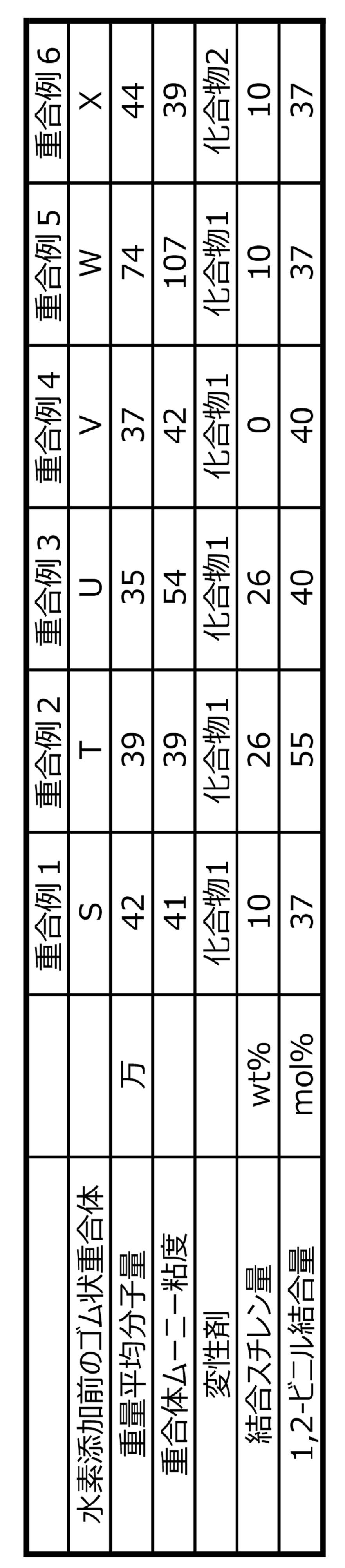
表1中、変性剤の化合物1、2を下記に示す。
化合物1:N-ベンジリデン-3-(トリメトキシシリル)-1-プロパンアミン
化合物2:トリメトキシメチルシラン
In Table 1, the modifier compounds 1 and 2 are shown below.
Compound 1: N-Benzylidene-3- (trimethoxysilyl) -1-propaneamine Compound 2: Trimethoxymethylsilane
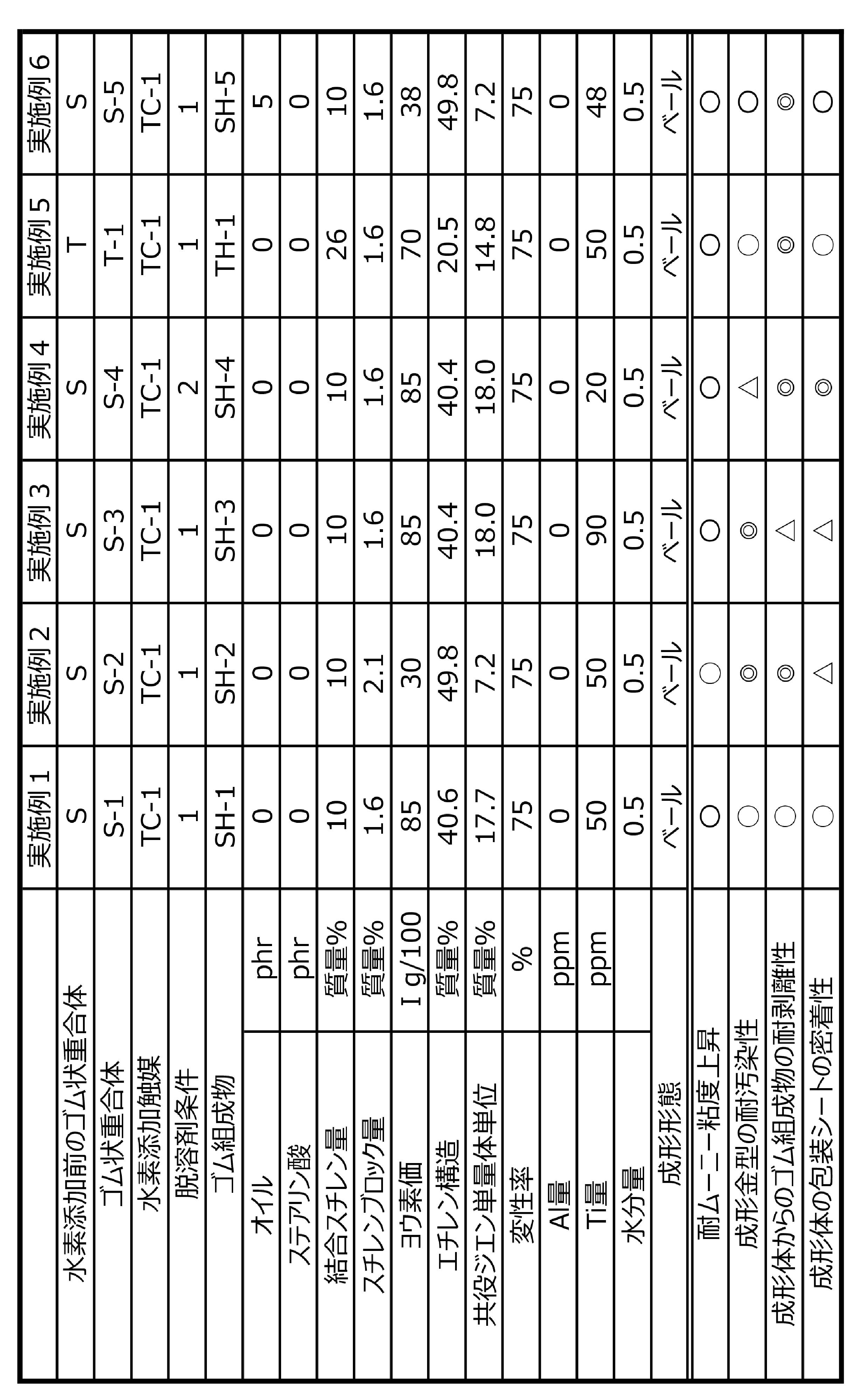
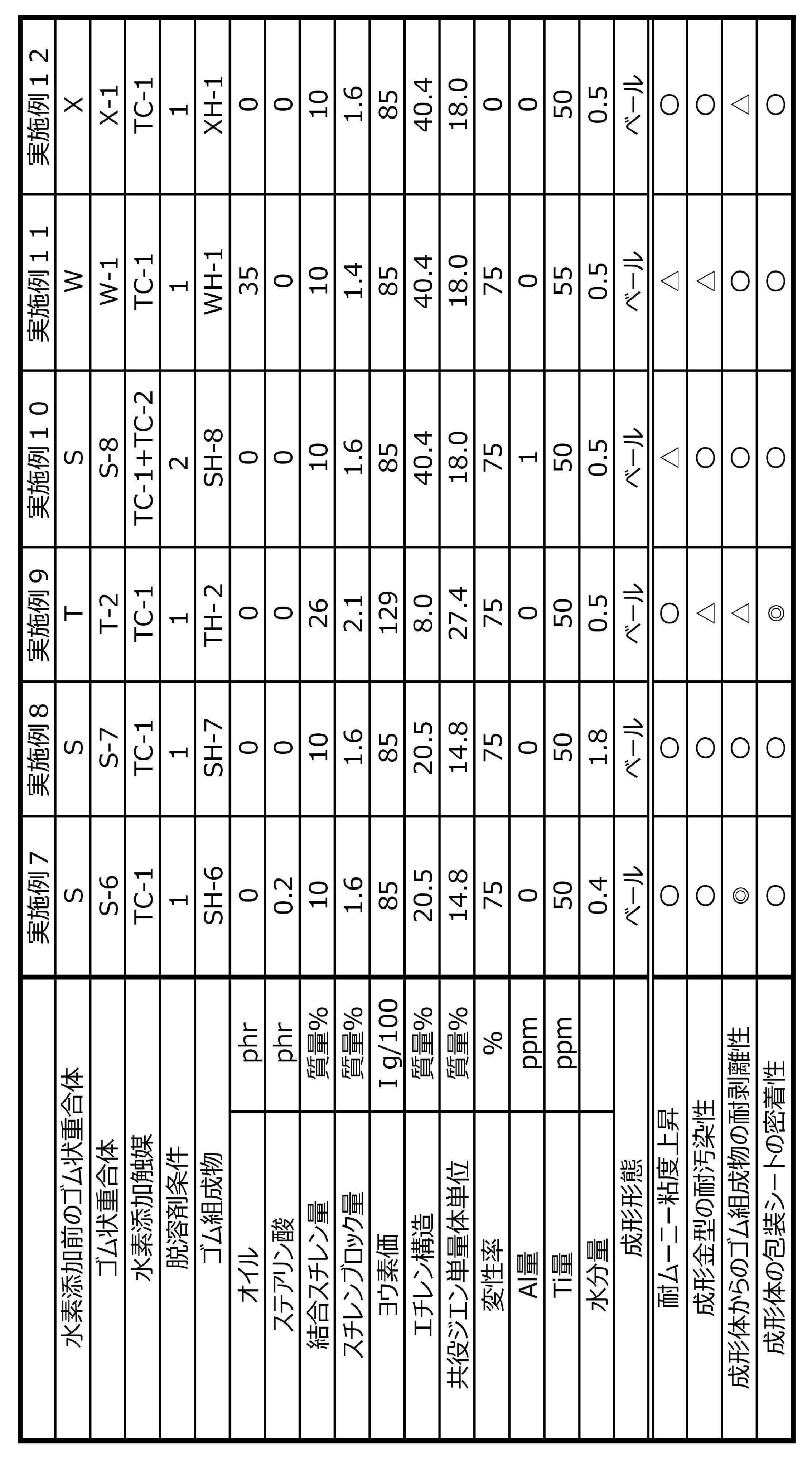
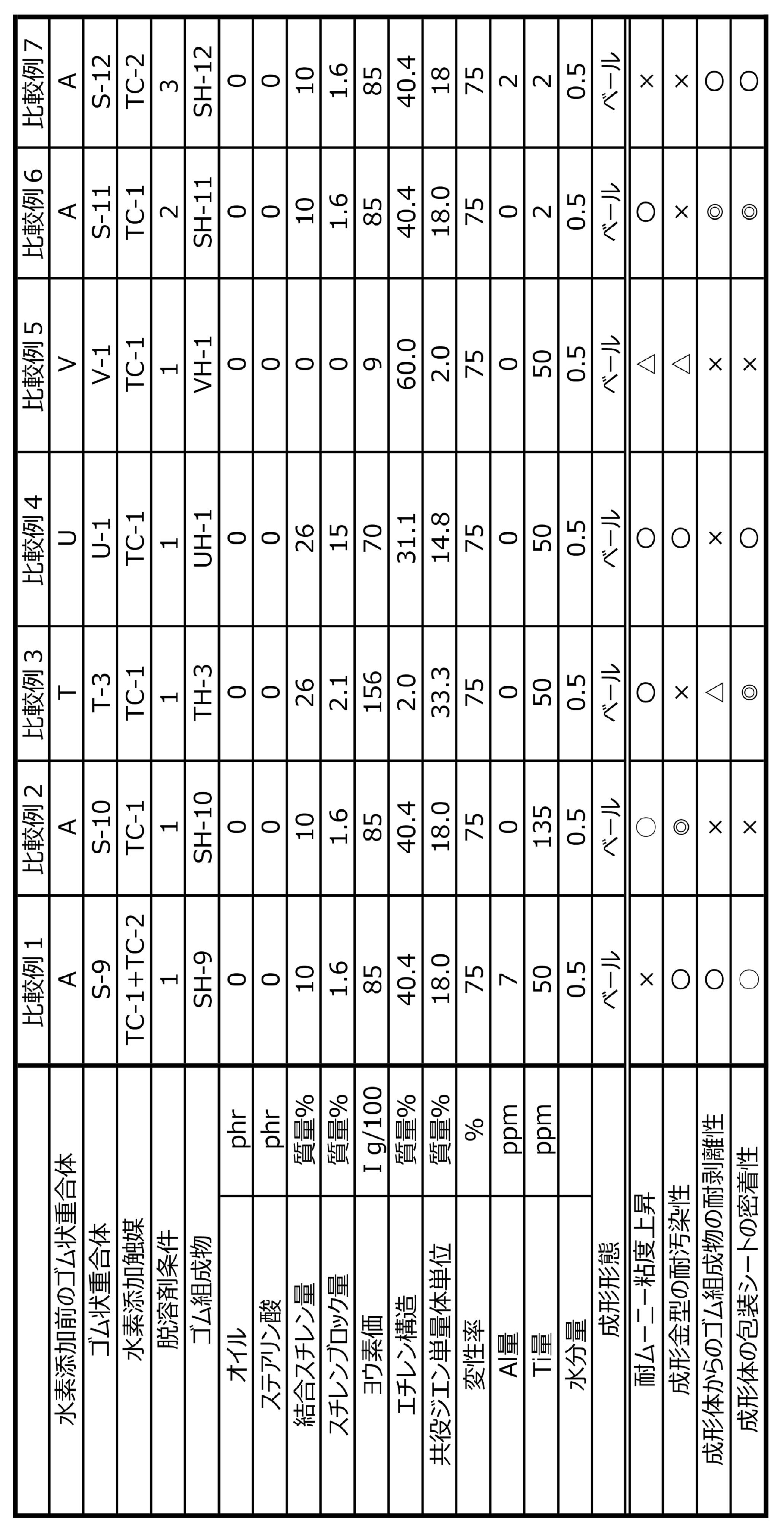
〔実施例13~15〕〔比較例8~11〕
〔架橋用ゴム組成物の調製、物性評価〕
表2~表4に示す、(実施例1~3)、(比較例1)、(比較例3~5)の(ゴム組成物:SH-1~SH-3、SH-9、TH-3、UH-1、VH-1)を、それぞれ原料ゴム成分として、以下に示す配合に従い、それぞれの原料ゴムを含有する架橋用ゴム組成物を得た。
[Examples 13 to 15] [Comparative Examples 8 to 11]
[Preparation of rubber composition for cross-linking, evaluation of physical properties]
(Rubber compositions: SH-1 to SH-3, SH-9, TH-3) of (Examples 1 to 3), (Comparative Examples 1), and (Comparative Examples 3 to 5) shown in Tables 2 to 4. , UH-1 and VH-1) as raw material rubber components, respectively, according to the formulation shown below, to obtain a cross-linking rubber composition containing each raw material rubber.
(ゴム成分)
・ゴム組成物(試料:SH-1~SH-3、SH-9、TH-3、UH-1、VH-1)
:80質量部(ゴム用軟化剤抜きの質量部)
・ハイシスポリブタジエン(宇部興産社製の商品名「UBEPOL BR150」)
:20質量部
(Rubber component)
-Rubber composition (samples: SH-1 to SH-3, SH-9, TH-3, UH-1, VH-1)
: 80 parts by mass (mass part without softener for rubber)
・ High cis polybutadiene (trade name "UBEPOL BR150" manufactured by Ube Industries, Ltd.)
: 20 parts by mass
(配合条件)
各配合剤の添加量は、ゴム用軟化剤を含まないゴム成分100質量部に対する質量部数で示した。
・シリカ1(エボニック デグサ社製の商品名「Ultrasil 7000GR」窒素吸着比表面積170m2/g):50.0質量部
・シリカ2(ローディア社製の商品名「Zeosil Premium 200MP」窒素吸着比表面積220m2/g):25.0質量部
・カーボンブラック(東海カーボン社製の商品名「シーストKH(N339)」):5.0質量部
・シランカップリング剤(エボニック デグサ社製の商品名「Si75」、ビス(トリエトキシシリルプロピル)ジスルフィド):6.0質量部
・SRAEオイル(JX日鉱日石エネルギー社製の商品名「プロセスNC140」):25.0質量部
・亜鉛華:2.5質量部
・ステアリン酸:1.0質量部
・老化防止剤(N-(1,3-ジメチルブチル)-N‘-フェニル-p-フェニレンジアミン):2.0質量部
・硫黄:2.2質量部
・加硫促進剤1(N-シクロヘキシル-2-ベンゾチアジルスルフィンアミド):1.7質量部
・加硫促進剤2(ジフェニルグアニジン):2.0質量部
・合計:222.4質量部
(Mixing conditions)
The amount of each compounding agent added is shown by the number of parts by mass with respect to 100 parts by mass of the rubber component containing no softening agent for rubber.
-Silica 1 (trade name "Ultrasil 7000GR" manufactured by Ebonic Degusa, nitrogen adsorption ratio surface area 170 m2 / g): 50.0 parts by mass-Silica 2 (trade name "Zeosil Premium 200MP" manufactured by Rhodia), nitrogen adsorption ratio surface area 220 m2 / g): 25.0 parts by mass ・ Carbon black (trade name “Seast KH (N339)” manufactured by Tokai Carbon Co., Ltd.): 5.0 parts by mass ・ Silane coupling agent (trade name “Si75” manufactured by Ebonic Degusa), Bis (triethoxysilylpropyl) disulfide): 6.0 parts by mass ・ SRAE oil (trade name “Process NC140” manufactured by JX Nikko Nisseki Energy Co., Ltd.): 25.0 parts by mass ・ Zinc flower: 2.5 parts by mass ・Stealic acid: 1.0 part by mass ・ Anti-aging agent (N- (1,3-dimethylbutyl) -N'-phenyl-p-phenylenediamine): 2.0 part by mass ・ Sulfur: 2.2 part by mass ・ Addition Sulfurization accelerator 1 (N-cyclohexyl-2-benzothiadylsulfinamide): 1.7 parts by mass ・ Sulfurization accelerator 2 (diphenylguanidine): 2.0 parts by mass ・ Total: 222.4 parts by mass
(混練り方法)
上記した材料を次の方法により混練してゴム組成物を得た。
温度制御装置を備える密閉混練機(内容量0.3L)を使用し、第一段の混練として、充填率65%、ローター回転数30~50rpmの条件で、原料ゴム(試料SH-1~SH-3、SH-9、TH-3、UH-1、VH-1)、充填剤(シリカ1、シリカ2、カーボンブラック)、シランカップリング剤、SRAEオイル、亜鉛華及びステアリン酸を混練した。
このとき、密閉混合機の温度を制御し、排出温度は155~160℃で各ゴム組成物(配合物)を得た。
次に、第二段の混練として、上記で得た配合物を室温まで冷却後、老化防止剤を加え、シリカの分散を向上させるため再度混練した。この場合も、混合機の温度制御により、配合物の排出温度を155~160℃に調整した。
冷却後、第三段の混練として、70℃に設定したオープンロールにて、硫黄、加硫促進剤1、2を加えて混練した。その後、成形し、160℃で20分間、加硫プレスにて加硫した。
加硫前のゴム組成物、及び加硫後のゴム組成物を評価した。具体的には、下記の方法により評価した。
その結果を表5に示す。
(Kneading method)
The above materials were kneaded by the following method to obtain a rubber composition.
Using a closed kneader equipped with a temperature control device (content capacity 0.3L), the raw rubber (samples SH-1 to SH) is used as the first stage kneading under the conditions of a filling rate of 65% and a rotor rotation speed of 30 to 50 rpm. -3, SH-9, TH-3, UH-1, VH-1), filler (silica 1, silica 2, carbon black), silane coupling agent, SRAE oil, zinc oxide and stearic acid were kneaded.
At this time, the temperature of the closed mixer was controlled, and the discharge temperature was 155 to 160 ° C. to obtain each rubber composition (blending).
Next, as the second stage kneading, the formulation obtained above was cooled to room temperature, an antiaging agent was added, and the mixture was kneaded again in order to improve the dispersion of silica. Also in this case, the discharge temperature of the compound was adjusted to 155 to 160 ° C. by controlling the temperature of the mixer.
After cooling, sulfur and vulcanization accelerators 1 and 2 were added and kneaded in an open roll set at 70 ° C. for kneading in the third stage. Then, it was molded and vulcanized in a vulcanization press at 160 ° C. for 20 minutes.
The rubber composition before vulcanization and the rubber composition after vulcanization were evaluated. Specifically, it was evaluated by the following method.
The results are shown in Table 5.
(評価1、2)耐ウェットスキッド性、省燃費性(粘弾性パラメータ)
レオメトリックス・サイエンティフィック社製の粘弾性試験機「ARES」を使用し、ねじりモードで粘弾性パラメータを測定した。
0℃において周波数10Hz、ひずみ1%で測定したtanδを耐ウェットスキッド性の指標とした。指数が大きいほど耐ウェットスキッド性が良好であることを示す。
50℃において周波数10Hz、ひずみ3%で測定したtanδを省燃費性の指標とした。指数が小さいほど省燃費性が良好であることを示す。
下記表5には、(比較例1)のゴム組成物(SH-9)を使用した配合物の物性を基準として、耐ウェットスキッド性及び省燃費性が下記の範囲で変化する場合の記号を記載した。
△:5%未満悪化から5%未満良化、〇:5%以上良化から15%未満良化、◎:15%以上良化から20%未満良化、×:5%以上悪化
(Evaluations 1 and 2) Wet skid resistance and fuel efficiency (viscoelastic parameters)
The viscoelasticity parameters were measured in the torsion mode using a viscoelasticity tester "ARES" manufactured by Leometrics Scientific.
Tan δ measured at 0 ° C. at a frequency of 10 Hz and a strain of 1% was used as an index of wet skid resistance. The larger the index, the better the wet skid resistance.
Tan δ measured at a frequency of 10 Hz and a strain of 3% at 50 ° C. was used as an index of fuel efficiency. The smaller the index, the better the fuel efficiency.
Table 5 below shows symbols when the wet skid resistance and fuel efficiency change within the following range based on the physical properties of the formulation using the rubber composition (SH-9) of (Comparative Example 1). Described.
Δ: From less than 5% deterioration to less than 5% improvement, 〇: 5% or more improvement to less than 15% improvement, ⊚: 15% or more improvement to less than 20% improvement, ×: 5% or more deterioration
(評価3)破壊特性
JIS K6251の引張試験法に準拠し、破断強度及び破断伸びを測定した。また、破断強度と破断伸びとの測定値の積を破壊特性とした。
下記表5には、(比較例1)のゴム組成物(SH-9)を使用した配合物の物性を基準として、破壊特性が下記の範囲で変化する場合の記号を記載した。
△:5%未満悪化~5%未満良化、〇:5%以上良化~15%未満良化、◎:15%以上良化~20%未満良化、×:5%以上悪化
(Evaluation 3) Fracture characteristics The breaking strength and breaking elongation were measured according to the tensile test method of JIS K6251. In addition, the product of the measured values of breaking strength and breaking elongation was taken as the breaking characteristic.
Table 5 below shows symbols when the fracture characteristics change within the following range based on the physical properties of the formulation using the rubber composition (SH-9) of (Comparative Example 1).
Δ: Less than 5% deterioration to less than 5% improvement, 〇: 5% or more improvement to less than 15% improvement, ⊚: 15% or more improvement to less than 20% improvement, ×: 5% or more deterioration

表2~表4に示す通り、実施例1~12は、比較例に比べ、ゴム組成物のベール成形体が経時的なムーニー変動が小さく、成形金型の耐汚染性、ベール成形体からのゴム組成物の耐剥離性、ベール成形体への包装シートの密着性に優れることを確認した。また、ムーニー粘度の上昇幅が小さいことで、経時で物性が変化しにくく、品質が安定することを確認した。また、成形金型が汚染し難いことでベール成形時に金型への付着物に起因する汚染が少なく、生産安定性に優れることを確認した。また、ベール成形体からゴム組成物の剥離し難いことで、ベール成形後に剥離するゴム組成物が少なく、ベール成形性に優れ、生産安定性に優れることを確認した。また、ベール成形体に包装シートが密着し易いことで、包装シートとベールの間隙が小さく結露が発生し難く、運搬時の取扱い性にも優れることを確認した。
さらには、表5に示す通り、実施例1~3のゴム組成物を用いた架橋用ゴム組成物は、比較例1のゴム組成物を用いた架橋用ゴム組成物に比べ、物性バランスが同等以上であり、比較例3~5のゴム組成物を用いた架橋用ゴム組成物は物性バランスに劣ることを確認した。
As shown in Tables 2 to 4, in Examples 1 to 12, the Mooney fluctuation of the bale molded product of the rubber composition with time was smaller than that of the comparative example, the stain resistance of the molding die, and the bale molded product. It was confirmed that the rubber composition was excellent in peeling resistance and adhesion of the packaging sheet to the bale molded product. It was also confirmed that the small increase in Mooney viscosity makes it difficult for the physical properties to change over time and the quality is stable. In addition, it was confirmed that the molding mold is less likely to be contaminated, so that there is less contamination due to deposits on the mold during bale molding, and the production stability is excellent. Further, it was confirmed that the rubber composition is difficult to peel off from the bale molded body, so that the rubber composition peeled off after bale molding is small, the bale moldability is excellent, and the production stability is excellent. It was also confirmed that the packaging sheet easily adheres to the bale molded product, so that the gap between the packaging sheet and the veil is small and dew condensation is unlikely to occur, and the handling during transportation is excellent.
Further, as shown in Table 5, the cross-linking rubber composition using the rubber compositions of Examples 1 to 3 has the same physical characteristic balance as the cross-linking rubber composition using the rubber composition of Comparative Example 1. From the above, it was confirmed that the rubber composition for crosslinking using the rubber compositions of Comparative Examples 3 to 5 was inferior in the physical property balance.
本発明のゴム組成物のベール成形体は、架橋用ゴム組成物の構成材料として好適であり、具体的には、タイヤ部材、自動車の内装及び外装品、防振ゴム、ベルト、履物、発泡体、各種工業用品用途等の分野において産業上の利用可能性がある。 The veil-molded body of the rubber composition of the present invention is suitable as a constituent material of the rubber composition for cross-linking, and specifically, tire members, automobile interior and exterior parts, anti-vibration rubber, belts, footwear, foams. , Has industrial applicability in fields such as various industrial supplies.
Claims (12)
チタン(C)と、
を、含有し、
3ppm≦チタン(C)の含有量≦120ppmであり、
アルミニウム(B)の含有量が、2ppm未満であるゴム組成物のベール成形体。 A rubber-like polymer (A) having an iodine value of 10 to 250, an ethylene structure of ≥3% by mass, and a vinyl aromatic monomer block <10% by mass.
Titanium (C) and
, Containing,
3 ppm ≤ titanium (C) content ≤ 120 ppm,
A veil molded product of a rubber composition having an aluminum (B) content of less than 2 ppm.
請求項1に記載のベール成形体。 The rubber-like polymer (A) is a hydrogenated additive of a conjugated diene-based polymer.
The veil molded product according to claim 1.
請求項1又は2に記載のベール成形体。 The rubber-like polymer (A) contains 5% by mass or more of vinyl aromatic monomer units.
The veil molded product according to claim 1 or 2.
請求項1乃至3のいずれか一項に記載のベール成形体。 The rubber-like polymer (A) contains a nitrogen atom.
The veil molded product according to any one of claims 1 to 3.
請求項1乃至4のいずれか一項に記載のベール成形体。 The modification rate of the rubber-like polymer (A) measured by the column adsorption GPC method is 40% by mass or more.
The veil molded product according to any one of claims 1 to 4.
請求項1乃至5のいずれか一項に記載のベール成形体。 Further contains 30% by mass or less of the softening agent (D) for rubber.
The veil molded product according to any one of claims 1 to 5.
請求項1乃至6のいずれか一項に記載のベール成形体。 Contains 0.05% by mass or more and 1.5% by mass or less of water.
The veil molded product according to any one of claims 1 to 6.
少なくとも共役ジエン単量体を溶液中で重合し、ゴム状重合体(A)を得る工程と、
得られたゴム状重合体(A)を含む溶液に、チタン(C)を添加してゴム組成物を得る工程と、
得られたゴム組成物を成形する工程と、
を、有する、ゴム組成物のベール成形体の製造方法。 The method for producing a veil-molded rubber composition according to any one of claims 1 to 7.
A step of polymerizing at least a conjugated diene monomer in a solution to obtain a rubbery polymer (A), and
A step of adding titanium (C) to the obtained solution containing the rubber-like polymer (A) to obtain a rubber composition, and
The process of molding the obtained rubber composition and
A method for producing a veil-molded rubber composition.
請求項8又は9に記載のベール成形体の製造方法。 The solution comprises a step of removing the solvent by steam stripping.
The method for producing a veil molded product according to claim 8 or 9.
架橋剤と、
を、含有し、
前記架橋剤を、ゴム成分100質量部に対して、0.1質量部以上20質量部以下含有する、
架橋用ゴム組成物。 The rubber composition of the veil molded product according to any one of claims 1 to 7.
With a cross-linking agent,
, Containing,
The cross-linking agent is contained in an amount of 0.1 part by mass or more and 20 parts by mass or less with respect to 100 parts by mass of the rubber component.
Rubber composition for cross-linking.
Priority Applications (2)
| Application Number | Priority Date | Filing Date | Title |
|---|---|---|---|
| CN202110699756.XA CN113845634B (en) | 2020-06-26 | 2021-06-23 | Rubber composition block molded body and method for producing the same, cross-linking rubber composition and tire tread |
| US17/356,872 US11905357B2 (en) | 2020-06-26 | 2021-06-24 | Molded bale of rubber composition, method for producing molded bale of rubber composition, crosslinking rubber composition, and tread for tire |
Applications Claiming Priority (2)
| Application Number | Priority Date | Filing Date | Title |
|---|---|---|---|
| JP2020110775 | 2020-06-26 | ||
| JP2020110775 | 2020-06-26 |
Publications (2)
| Publication Number | Publication Date |
|---|---|
| JP2022008084A true JP2022008084A (en) | 2022-01-13 |
| JP7720717B2 JP7720717B2 (en) | 2025-08-08 |
Family
ID=80110392
Family Applications (1)
| Application Number | Title | Priority Date | Filing Date |
|---|---|---|---|
| JP2021081156A Active JP7720717B2 (en) | 2020-06-26 | 2021-05-12 | Bale molded product of rubber composition, method for manufacturing bale molded product of rubber composition, rubber composition for crosslinking, and tire tread |
Country Status (1)
| Country | Link |
|---|---|
| JP (1) | JP7720717B2 (en) |
Citations (14)
| Publication number | Priority date | Publication date | Assignee | Title |
|---|---|---|---|---|
| JPS6069112A (en) * | 1983-09-27 | 1985-04-19 | Japan Synthetic Rubber Co Ltd | Purification of rubber-like polymer |
| JPH07238187A (en) * | 1994-02-28 | 1995-09-12 | Asahi Chem Ind Co Ltd | Rubber composition for tire tread |
| JPH08120119A (en) * | 1994-03-25 | 1996-05-14 | Asahi Chem Ind Co Ltd | Improved rubber composition for tire tread |
| JPH08245839A (en) * | 1995-03-08 | 1996-09-24 | Asahi Chem Ind Co Ltd | Selectively partially hydrogenated modified polymer composition |
| JPH08301928A (en) * | 1995-03-08 | 1996-11-19 | Asahi Chem Ind Co Ltd | Production of selectively and partially hydrogenated rubber containing bonded tin |
| JPH09291121A (en) * | 1996-04-26 | 1997-11-11 | Asahi Chem Ind Co Ltd | Butene/butadiene copolymer, its production, and vulcanized rubber |
| JPH10168101A (en) * | 1996-12-06 | 1998-06-23 | Jsr Corp | Method for recovering rubbery polymer |
| JP2000141366A (en) * | 1998-11-17 | 2000-05-23 | Sumitomo Chem Co Ltd | Manufacture of composition and its extruding apparatus |
| WO2003074574A1 (en) * | 2002-03-01 | 2003-09-12 | Asahi Kasei Chemicals Corporation | Modified hydrogenated copolymer |
| WO2004003027A1 (en) * | 2002-06-27 | 2004-01-08 | Asahi Kasei Chemicals Corporation | Hydrogenated copolymer and composition thereof |
| JP2006225477A (en) * | 2005-02-16 | 2006-08-31 | Asahi Kasei Chemicals Corp | Flame retardant resin composition |
| JP2007126520A (en) * | 2005-11-01 | 2007-05-24 | Asahi Kasei Chemicals Corp | Damping resin composition |
| JP2008208213A (en) * | 2007-02-26 | 2008-09-11 | Asahi Kasei Chemicals Corp | Hydrogenated copolymer for damping material and asphalt damping composition |
| JP2011252097A (en) * | 2010-06-02 | 2011-12-15 | Asahi Kasei Chemicals Corp | Damping flame-retardant resin composition |
-
2021
- 2021-05-12 JP JP2021081156A patent/JP7720717B2/en active Active
Patent Citations (14)
| Publication number | Priority date | Publication date | Assignee | Title |
|---|---|---|---|---|
| JPS6069112A (en) * | 1983-09-27 | 1985-04-19 | Japan Synthetic Rubber Co Ltd | Purification of rubber-like polymer |
| JPH07238187A (en) * | 1994-02-28 | 1995-09-12 | Asahi Chem Ind Co Ltd | Rubber composition for tire tread |
| JPH08120119A (en) * | 1994-03-25 | 1996-05-14 | Asahi Chem Ind Co Ltd | Improved rubber composition for tire tread |
| JPH08245839A (en) * | 1995-03-08 | 1996-09-24 | Asahi Chem Ind Co Ltd | Selectively partially hydrogenated modified polymer composition |
| JPH08301928A (en) * | 1995-03-08 | 1996-11-19 | Asahi Chem Ind Co Ltd | Production of selectively and partially hydrogenated rubber containing bonded tin |
| JPH09291121A (en) * | 1996-04-26 | 1997-11-11 | Asahi Chem Ind Co Ltd | Butene/butadiene copolymer, its production, and vulcanized rubber |
| JPH10168101A (en) * | 1996-12-06 | 1998-06-23 | Jsr Corp | Method for recovering rubbery polymer |
| JP2000141366A (en) * | 1998-11-17 | 2000-05-23 | Sumitomo Chem Co Ltd | Manufacture of composition and its extruding apparatus |
| WO2003074574A1 (en) * | 2002-03-01 | 2003-09-12 | Asahi Kasei Chemicals Corporation | Modified hydrogenated copolymer |
| WO2004003027A1 (en) * | 2002-06-27 | 2004-01-08 | Asahi Kasei Chemicals Corporation | Hydrogenated copolymer and composition thereof |
| JP2006225477A (en) * | 2005-02-16 | 2006-08-31 | Asahi Kasei Chemicals Corp | Flame retardant resin composition |
| JP2007126520A (en) * | 2005-11-01 | 2007-05-24 | Asahi Kasei Chemicals Corp | Damping resin composition |
| JP2008208213A (en) * | 2007-02-26 | 2008-09-11 | Asahi Kasei Chemicals Corp | Hydrogenated copolymer for damping material and asphalt damping composition |
| JP2011252097A (en) * | 2010-06-02 | 2011-12-15 | Asahi Kasei Chemicals Corp | Damping flame-retardant resin composition |
Also Published As
| Publication number | Publication date |
|---|---|
| JP7720717B2 (en) | 2025-08-08 |
Similar Documents
| Publication | Publication Date | Title |
|---|---|---|
| JP5964570B2 (en) | Method for producing modified conjugated diene polymer, modified conjugated diene polymer, modified conjugated diene polymer composition, and tire | |
| JP6516462B2 (en) | Method for producing modified conjugated diene polymer, modified conjugated diene polymer, and modified conjugated diene polymer composition | |
| JPWO2011040312A1 (en) | Method for producing modified conjugated diene polymer, modified conjugated diene polymer, and modified conjugated diene polymer composition | |
| JP7592744B2 (en) | Rubber composition and tire | |
| JP2013082794A (en) | Modified conjugated diene-based polymer composition | |
| JP7507255B2 (en) | Rubber composition for crosslinking, rubber composition for tires, molded body for tire sidewall, sheet, method for manufacturing tire sidewall, tire sidewall | |
| JP7526270B2 (en) | Packaged molded body, crosslinkable rubber composition, method for producing packaged molded body, method for producing crosslinkable rubber composition, and tire tread | |
| JP2022066144A (en) | Crosslinking rubber composition, method for producing crosslinked rubber, and tread for tire | |
| JP2015214621A (en) | Rubber composition and production method therefor | |
| CN120569418A (en) | Conjugated diene polymer and conjugated diene polymer composition | |
| JP7764141B2 (en) | Bale molded product of rubber composition, method for manufacturing bale molded product, rubber composition for crosslinking, and tire tread | |
| JP7652546B2 (en) | Rubber composition, crosslinkable rubber composition, method for producing molded product of rubber composition, and tire tread | |
| CN113845706B (en) | Rubber composition, method for producing rubber composition, rubber composition for crosslinking, molded body, and tread for tire | |
| JPH07238187A (en) | Rubber composition for tire tread | |
| JP7525666B2 (en) | Rubber-like polymer, method for producing rubber-like polymer, rubber composition, and tire tread | |
| JP7720717B2 (en) | Bale molded product of rubber composition, method for manufacturing bale molded product of rubber composition, rubber composition for crosslinking, and tire tread | |
| US11905357B2 (en) | Molded bale of rubber composition, method for producing molded bale of rubber composition, crosslinking rubber composition, and tread for tire | |
| JP7553581B2 (en) | Veil molding | |
| JP2022008066A (en) | Molded bale of rubber composition, method for producing molded bale, crosslinking rubber composition, and tread for tire | |
| CN113845707B (en) | Briquette molded article of rubber composition, method for producing briquette molded article, rubber composition for crosslinking, and tread for tire | |
| US11912858B2 (en) | Molded bale of rubber-like block copolymer, rubber composition, crosslinking rubber composition, and tread for tire | |
| JP2022067814A (en) | Rubber composition for cross-linking and tread for tire | |
| JP7780649B2 (en) | Conjugated diene polymer, rubber composition, and tire component | |
| JP2024180028A (en) | Anti-vibration rubber composition | |
| WO2025205189A1 (en) | Rubber composition and vulcanized rubber composition |
Legal Events
| Date | Code | Title | Description |
|---|---|---|---|
| A621 | Written request for application examination |
Free format text: JAPANESE INTERMEDIATE CODE: A621 Effective date: 20240126 |
|
| A977 | Report on retrieval |
Free format text: JAPANESE INTERMEDIATE CODE: A971007 Effective date: 20250128 |
|
| A131 | Notification of reasons for refusal |
Free format text: JAPANESE INTERMEDIATE CODE: A131 Effective date: 20250227 |
|
| A521 | Request for written amendment filed |
Free format text: JAPANESE INTERMEDIATE CODE: A523 Effective date: 20250421 |
|
| TRDD | Decision of grant or rejection written | ||
| A01 | Written decision to grant a patent or to grant a registration (utility model) |
Free format text: JAPANESE INTERMEDIATE CODE: A01 Effective date: 20250709 |
|
| A61 | First payment of annual fees (during grant procedure) |
Free format text: JAPANESE INTERMEDIATE CODE: A61 Effective date: 20250729 |
|
| R150 | Certificate of patent or registration of utility model |
Ref document number: 7720717 Country of ref document: JP Free format text: JAPANESE INTERMEDIATE CODE: R150 |