JP2022507293A - Organosiloxane nano / microspheres with adjustable hydrophobicity / hydrophilicity and their manufacturing methods - Google Patents
Organosiloxane nano / microspheres with adjustable hydrophobicity / hydrophilicity and their manufacturing methods Download PDFInfo
- Publication number
- JP2022507293A JP2022507293A JP2021525786A JP2021525786A JP2022507293A JP 2022507293 A JP2022507293 A JP 2022507293A JP 2021525786 A JP2021525786 A JP 2021525786A JP 2021525786 A JP2021525786 A JP 2021525786A JP 2022507293 A JP2022507293 A JP 2022507293A
- Authority
- JP
- Japan
- Prior art keywords
- payload
- microspheres
- active substance
- preferentially
- nano
- Prior art date
- Legal status (The legal status is an assumption and is not a legal conclusion. Google has not performed a legal analysis and makes no representation as to the accuracy of the status listed.)
- Granted
Links
Images











Classifications
-
- C—CHEMISTRY; METALLURGY
- C08—ORGANIC MACROMOLECULAR COMPOUNDS; THEIR PREPARATION OR CHEMICAL WORKING-UP; COMPOSITIONS BASED THEREON
- C08L—COMPOSITIONS OF MACROMOLECULAR COMPOUNDS
- C08L83/00—Compositions of macromolecular compounds obtained by reactions forming in the main chain of the macromolecule a linkage containing silicon with or without sulfur, nitrogen, oxygen or carbon only; Compositions of derivatives of such polymers
- C08L83/04—Polysiloxanes
-
- A—HUMAN NECESSITIES
- A61—MEDICAL OR VETERINARY SCIENCE; HYGIENE
- A61K—PREPARATIONS FOR MEDICAL, DENTAL OR TOILETRY PURPOSES
- A61K31/00—Medicinal preparations containing organic active ingredients
- A61K31/33—Heterocyclic compounds
- A61K31/395—Heterocyclic compounds having nitrogen as a ring hetero atom, e.g. guanethidine or rifamycins
- A61K31/495—Heterocyclic compounds having nitrogen as a ring hetero atom, e.g. guanethidine or rifamycins having six-membered rings with two or more nitrogen atoms as the only ring heteroatoms, e.g. piperazine or tetrazines
- A61K31/505—Pyrimidines; Hydrogenated pyrimidines, e.g. trimethoprim
- A61K31/513—Pyrimidines; Hydrogenated pyrimidines, e.g. trimethoprim having oxo groups directly attached to the heterocyclic ring, e.g. cytosine
-
- A—HUMAN NECESSITIES
- A61—MEDICAL OR VETERINARY SCIENCE; HYGIENE
- A61K—PREPARATIONS FOR MEDICAL, DENTAL OR TOILETRY PURPOSES
- A61K9/00—Medicinal preparations characterised by special physical form
- A61K9/14—Particulate form, e.g. powders, Processes for size reducing of pure drugs or the resulting products, Pure drug nanoparticles
- A61K9/16—Agglomerates; Granulates; Microbeadlets ; Microspheres; Pellets; Solid products obtained by spray drying, spray freeze drying, spray congealing,(multiple) emulsion solvent evaporation or extraction
- A61K9/1605—Excipients; Inactive ingredients
- A61K9/1629—Organic macromolecular compounds
- A61K9/1641—Organic macromolecular compounds obtained otherwise than by reactions only involving carbon-to-carbon unsaturated bonds, e.g. polyethylene glycol, poloxamers
-
- A—HUMAN NECESSITIES
- A61—MEDICAL OR VETERINARY SCIENCE; HYGIENE
- A61K—PREPARATIONS FOR MEDICAL, DENTAL OR TOILETRY PURPOSES
- A61K9/00—Medicinal preparations characterised by special physical form
- A61K9/14—Particulate form, e.g. powders, Processes for size reducing of pure drugs or the resulting products, Pure drug nanoparticles
- A61K9/16—Agglomerates; Granulates; Microbeadlets ; Microspheres; Pellets; Solid products obtained by spray drying, spray freeze drying, spray congealing,(multiple) emulsion solvent evaporation or extraction
- A61K9/1682—Processes
-
- A—HUMAN NECESSITIES
- A61—MEDICAL OR VETERINARY SCIENCE; HYGIENE
- A61K—PREPARATIONS FOR MEDICAL, DENTAL OR TOILETRY PURPOSES
- A61K9/00—Medicinal preparations characterised by special physical form
- A61K9/48—Preparations in capsules, e.g. of gelatin, of chocolate
- A61K9/50—Microcapsules having a gas, liquid or semi-solid filling; Solid microparticles or pellets surrounded by a distinct coating layer, e.g. coated microspheres, coated drug crystals
- A61K9/51—Nanocapsules; Nanoparticles
- A61K9/5107—Excipients; Inactive ingredients
- A61K9/513—Organic macromolecular compounds; Dendrimers
- A61K9/5146—Organic macromolecular compounds; Dendrimers obtained otherwise than by reactions only involving carbon-to-carbon unsaturated bonds, e.g. polyethylene glycol, polyamines, polyanhydrides
-
- B—PERFORMING OPERATIONS; TRANSPORTING
- B82—NANOTECHNOLOGY
- B82Y—SPECIFIC USES OR APPLICATIONS OF NANOSTRUCTURES; MEASUREMENT OR ANALYSIS OF NANOSTRUCTURES; MANUFACTURE OR TREATMENT OF NANOSTRUCTURES
- B82Y30/00—Nanotechnology for materials or surface science, e.g. nanocomposites
-
- B—PERFORMING OPERATIONS; TRANSPORTING
- B82—NANOTECHNOLOGY
- B82Y—SPECIFIC USES OR APPLICATIONS OF NANOSTRUCTURES; MEASUREMENT OR ANALYSIS OF NANOSTRUCTURES; MANUFACTURE OR TREATMENT OF NANOSTRUCTURES
- B82Y40/00—Manufacture or treatment of nanostructures
-
- B—PERFORMING OPERATIONS; TRANSPORTING
- B82—NANOTECHNOLOGY
- B82Y—SPECIFIC USES OR APPLICATIONS OF NANOSTRUCTURES; MEASUREMENT OR ANALYSIS OF NANOSTRUCTURES; MANUFACTURE OR TREATMENT OF NANOSTRUCTURES
- B82Y5/00—Nanobiotechnology or nanomedicine, e.g. protein engineering or drug delivery
-
- C—CHEMISTRY; METALLURGY
- C08—ORGANIC MACROMOLECULAR COMPOUNDS; THEIR PREPARATION OR CHEMICAL WORKING-UP; COMPOSITIONS BASED THEREON
- C08G—MACROMOLECULAR COMPOUNDS OBTAINED OTHERWISE THAN BY REACTIONS ONLY INVOLVING UNSATURATED CARBON-TO-CARBON BONDS
- C08G77/00—Macromolecular compounds obtained by reactions forming a linkage containing silicon with or without sulfur, nitrogen, oxygen or carbon in the main chain of the macromolecule
- C08G77/04—Polysiloxanes
Landscapes
- Health & Medical Sciences (AREA)
- Chemical & Material Sciences (AREA)
- Engineering & Computer Science (AREA)
- Bioinformatics & Cheminformatics (AREA)
- Medicinal Chemistry (AREA)
- General Health & Medical Sciences (AREA)
- Life Sciences & Earth Sciences (AREA)
- Pharmacology & Pharmacy (AREA)
- Animal Behavior & Ethology (AREA)
- Veterinary Medicine (AREA)
- Public Health (AREA)
- Epidemiology (AREA)
- Nanotechnology (AREA)
- Organic Chemistry (AREA)
- Physics & Mathematics (AREA)
- Polymers & Plastics (AREA)
- Chemical Kinetics & Catalysis (AREA)
- Crystallography & Structural Chemistry (AREA)
- Optics & Photonics (AREA)
- Biomedical Technology (AREA)
- Condensed Matter Physics & Semiconductors (AREA)
- General Physics & Mathematics (AREA)
- Medical Informatics (AREA)
- Composite Materials (AREA)
- Materials Engineering (AREA)
- Molecular Biology (AREA)
- Biophysics (AREA)
- General Engineering & Computer Science (AREA)
- Manufacturing & Machinery (AREA)
- Biotechnology (AREA)
- Silicon Compounds (AREA)
- Silicon Polymers (AREA)
- Medicinal Preparation (AREA)
- Cosmetics (AREA)
- Manufacturing Of Micro-Capsules (AREA)
Abstract
本開示は、活性物質/ペイロード有り又は無しの疎水性/親水性の調節可能なオルガノシロキサンナノ/マイクロスフェア、及びそれらを作製するための界面活性剤を含まないワンポット多用途プロセスに関する。オルガノシロキサンナノ/マイクロスフェアの疎水性/親水性を調整することによって、その放出を制御することができる。調整プロセスは、i0)加水分解媒体中で1種以上のシリカ前駆体を別々に加水分解する工程;i1)予備加水分解された前駆体を合わせる工程;又はi2)揮発性溶媒の一部又は全部を除去する工程;又はi3)親水性溶媒を含む分散相を調製して分散相を提供する工程;i4)連続相中で界面活性剤の非存在下で、工程i1)、i2)、又はi3)の分散相を乳化して、油中水型エマルジョンを提供する工程;i5)前記エマルジョンに縮合触媒を添加して前記ナノ/マイクロスフェアを提供する工程を含む。【選択図】 なしThe present disclosure relates to a hydrophobic / hydrophilic adjustable organosiloxane nano / microsphere with or without an active substance / payload, and a surfactant-free one-pot versatile process for making them. Its release can be controlled by adjusting the hydrophobicity / hydrophilicity of the organosiloxane nano / microspheres. The conditioning process is i0) separately hydrolyzing one or more silica precursors in a hydrolysis medium; i1) combining pre-hydrogenated precursors; or i2) part or all of the volatile solvent. Steps; or i3) Steps of preparing a dispersed phase containing a hydrophilic solvent to provide a dispersed phase; i4) Steps i1), i2), or i3 in the absence of a surfactant in a continuous phase. ) Is emulsified to provide a water-in-oil emulsion; i5) includes a step of adding a condensation catalyst to the emulsion to provide the nano / microsphere. [Selection diagram] None
Description
本開示は、活性物質/ペイロード有り又は無しの疎水性/親水性の調節可能なオルガノシロキサンナノ/マイクロスフェア、及びそれを製造するための方法に関する。その放出は、オルガノシロキサンナノ/マイクロスフェアの疎水性/親水性を調整することによって制御することができる。 The present disclosure relates to hydrophobic / hydrophilic adjustable organosiloxane nano / microspheres with or without active material / payload and methods for producing them. Its release can be controlled by adjusting the hydrophobicity / hydrophilicity of the organosiloxane nano / microspheres.
活性物質/ペイロードの隔離は、揮発性の低減、不快な臭いの遮蔽、不安定なペイロードの保護、活性物質の早期放出の防止、ペイロード解放のより良好な取り扱いとより良好な制御の達成などの、この技術のいくつかの付随する魅力的な特性のために、過去数十年間ますます多くの産業部門で、異なる目的(例えば、製薬、化粧品、食品、建設、農業、触媒作用)のために広く適応されてきた。 Active material / payload isolation includes reduced volatility, shielding of unpleasant odors, protection of unstable payloads, prevention of premature release of active materials, better handling and better control of payload release, etc. Due to some of the accompanying attractive properties of this technology, for different purposes (eg pharmaceuticals, cosmetics, food, construction, agriculture, catalysis) in more and more industrial sectors over the last few decades. Has been widely adapted.
オルガノシロキサン材料は、その固有の利点、例えば化学的不活性、機械的堅牢性、制御可能な形態、調整可能な多孔度、及び多様な機能のために、特に興味深い。さらに、オルガノシロキサン材料はGRAS(すなわち「一般に安全と認められる(Generally Recognized As Safe)」)と考えられている。 Organosiloxane materials are of particular interest because of their unique advantages, such as chemical inertness, mechanical robustness, controllable morphology, adjustable porosity, and diverse functions. In addition, organosiloxane materials are considered GRAS (ie, "Generally Recognized As Safe").
1つの態様において、以下の工程を含むオルガノシロキサンナノ/マイクロスフェアの製造方法が提供される:
i0)加水分解媒体中で1種以上のシリカ前駆体を別々に加水分解して、1種以上の予備加水分解シリカ前駆体を提供する工程;
i1)工程i0)の予備加水分解されたシリカ前駆体を合わせて、合わせた予備加水分解シリカ前駆体を含む分散相を提供する工程;又は
i2)前記合わせた予備加水分解シリカ前駆体から揮発性溶媒の一部又は全部を除去して、予備縮合されたシリカ前駆体を含む分散相を提供する工程;又は
i3)工程i1)で得られた合わせた予備加水分解シリカ前駆体を含む前記分散相に親水性溶媒を加えることにより、又は工程i2)で得られた予備縮合シリカ前駆体を含む前記分散相に親水性溶媒を加えることにより、前記親水性溶媒を含む分散相を調製する工程;
i4)連続相中で界面活性剤の非存在下で、工程i1)、i2)、又はi3)の分散相を乳化して、油中水型エマルジョンを提供する工程;
i5)縮合触媒を工程i4)のエマルジョンに添加して、前記オルガノシロキサンナノ/マイクロスフェアを提供する工程。
In one embodiment, a method for producing an organosiloxane nano / microsphere is provided that comprises the following steps:
i0) A step of separately hydrolyzing one or more silica precursors in a hydrolysis medium to provide one or more pre-hydrolyzed silica precursors;
i1) Step i0) Combine the pre-hydrogenated silica precursors to provide a dispersed phase containing the combined pre-hydrolyzed silica precursors; or i2) Volatile from the combined pre-hydrogenated silica precursors. A step of removing part or all of the solvent to provide a dispersed phase containing a pre-condensed silica precursor; or i3) the dispersed phase containing the combined pre-hydrolyzed silica precursor obtained in step i1). A step of preparing a dispersed phase containing the hydrophilic solvent by adding a hydrophilic solvent to the dispersed phase or by adding a hydrophilic solvent to the dispersed phase containing the precondensed silica precursor obtained in step i2);
i4) A step of emulsifying the dispersed phase of steps i1), i2), or i3) in the absence of a surfactant in a continuous phase to provide a water-in-oil emulsion;
i5) A step of adding a condensation catalyst to the emulsion of step i4) to provide the organosiloxane nano / microsphere.
さらなる態様において、非焼成、アモルファスであり、界面活性剤を含まない、サブミクロンからミクロンサイズの粒子であって、任意選択的に活性物質/ペイロードを含む粒子である、オルガノシロキサンからなるネットワークを含むオルガノシロキサン球形ナノ/マイクロスフェアが提供される。 In a further embodiment, it comprises a network of organosiloxanes, non-firing, amorphous, surfactant-free, submicron to micron sized particles, optionally containing active substance / payload. Organosiloxane spherical nano / microspheres are provided.
さらに別の態様において、前記活性物質/ペイロードを本明細書で定義されるナノ/マイクロスフェアに取り込むか、又は前記活性物質/ペイロードを本明細書で定義されるプロセスに取り込むことを含む、活性物質/ペイロードの放出を調節するための方法が提供される。 In yet another embodiment, the active material comprises incorporating the active material / payload into a nano / microsphere as defined herein, or incorporating the active material / payload into a process as defined herein. / A method for regulating the emission of the payload is provided.
図面に対応する例の図は、以下のように列記される:
詳細な説明
本開示は、多目的なプロセスに関する。このプロセスは、1)ワンポットプロセスと、2)その場の活性物質/ペイロード投与/隔離法有り又は無しで、固体又は液体状態のオルガノシロキサン球形材料全体に有効成分を分布させることと、3)有効成分と適合性のある、予備加水分解/予備縮合シリカ前駆体の調整可能な疎水性/親水性と、及び4)オルガノシロキサン球形材料の外面及び内面の疎水性及び親水性を調整することにより、活性物質/ペイロード放出パラメーターを制御することとを、提供する。
Detailed Description This disclosure relates to a versatile process. This process is 1) a one-pot process and 2) distribution of the active ingredient throughout the solid or liquid organosiloxane spherical material with or without in-situ active substance / payload administration / isolation and 3) effective. By adjusting the adjustable hydrophobicity / hydrophilicity of the pre-hydrolyzed / pre-condensed silica precursor, which is compatible with the ingredients, and 4) the hydrophobicity and hydrophilicity of the outer and inner surfaces of the organosiloxane spherical material. It provides to control the active material / payload release parameters.
本明細書のプロセスは界面活性剤なしで実施される。界面活性剤は、追加の洗浄工程の必要性と、オルガノシロキサンナノ/マイクロスフェア中に残っている潜在的な残留汚染のために、一連の欠点を示す。従って、界面活性剤の使用には追加のコスト/製造時間が必要である。 The process herein is carried out without a surfactant. Surfactants exhibit a series of drawbacks due to the need for additional cleaning steps and the potential residual contamination remaining in the organosiloxane nano / microspheres. Therefore, the use of surfactants requires additional cost / manufacturing time.
界面活性剤は、シロキサンネットワーク(Si-O-Siを形成する)結合に関与しない任意の薬剤であると理解される。本明細書で使用される特定のシリカ前駆体は両親媒性部分を有し得るが、しかしながら、これらはシロキサンネットワークの作成に参加するため、本明細書のプロセスから除外されない。 Surfactants are understood to be any agent that is not involved in the siloxane network (forming Si—O—Si) bond. The particular silica precursors used herein may have amphipathic moieties, however, they participate in the creation of siloxane networks and are not excluded from the process herein.
本プロセス及びオルガノシロキサンナノ/マイクロスフェアは、両親媒性シラン以外の界面活性剤を含まない。 The process and organosiloxane nano / microspheres do not contain surfactants other than amphipathic silanes.
本明細書のプロセスは、好ましくは高い剪断力又は分散力の下で実施される。 The processes herein are preferably carried out under high shear or dispersion forces.
本明細書で使用される「シリカ前駆体」は、式R4-xSi(L)x又は式(L)3Si-R'-Si(L)3の化合物を指し、ここで、
Rは、アルキル、アルケニル、アルキニル、脂環式、アリール、アルキルアリール基としてのモノシリル化残基であり、これは、ハロゲン原子、-OH、-SH、-N(Ra)2、-N+(Ra)3、-P(Ra)2により任意選択的に置換される;
Raは、アルキル、アルケニル、アルキニル、脂環式、アリール、及びアルキルアリールでもよい;
Lは、ハロゲン、又はアセトキシド-O-C(O)Ra、又はアルコキシドORa基である;
Xは、1~4の整数である;そして
R'は、アルキル、アルケニル、アルキニル、脂環式、アリール、アルキルアリール基としての二シリル化残基であり、これは、ハロゲン原子、-OH、-SH、-N(Ra)2、-N+(Ra)3、-P(Ra)2により任意選択的に置換される。
1つの実施態様において、シリカ前駆体R4-xSi(L)x又は(L)3Si-R'-Si(L)3は、例えばテトラアルコキシドシラン、モノアルキル-トリアルコキシシラン、又はジアルキルジアルコキシシラン、又はビス-トリアルコキシ架橋シランなどのシリコンアルコキシドである。さらなる態様において、シリカ前駆体は、シリコンアルコキシドの混合物、例えばテトラアルコキシシラン、及び/又はモノアルキル-トリアルコキシシラン、及び/又はジアルキル-ジアルコキシシラン、及び/又はビス-トリアルコキシ架橋シランである。
As used herein, "silica precursor" refers to a compound of formula R4 -x Si (L) x or formula (L) 3 Si-R'-Si (L) 3 .
R is an alkyl, alkenyl, alkynyl, alicyclic, aryl, monosilylated residue as an alkylaryl group, which is a halogen atom, -OH, -SH, -N (Ra) 2 , -N +. (R a ) 3 , -P (R a ) 2 optionally replaces;
Ra may be alkyl, alkenyl, alkynyl, alicyclic, aryl, and alkylaryl;
L is a halogen, or acetoxide-OC (O) R a , or alkoxide OR a group;
X is an integer from 1 to 4; and R'is an alkyl, alkenyl, alkynyl, alicyclic, aryl, disilylated residue as an alkylaryl group, which is a halogen atom, -OH,. It is optionally replaced by -SH, -N (R a ) 2 , -N + (R a ) 3 , and -P (R a ) 2 .
In one embodiment, the silica precursor R 4-x Si (L) x or (L) 3 Si-R'-Si (L) 3 may be, for example, a tetraalkoxide silane, a monoalkyl-trialkoxysilane, or a dialkyldi. It is a silicon alkoxide such as alkoxysilane or bis-trialkoxy crosslinked silane. In a further embodiment, the silica precursor is a mixture of silicon alkoxides, such as tetraalkoxysilane and / or monoalkyl-trialkoxysilane, and / or dialkyl-dialkoxysilane, and / or bis-trialkoxy crosslinked silane.
1つの実施態様において、モノアルキルトリアルコキシシランRSi(L)3は、1~18個の炭素原子の線状又は分岐基であるモノアルキルを含み、トリアルコキシはトリエトキシ又はトリメトキシ基である。 In one embodiment, the monoalkyltrialkoxysilane RSi (L) 3 comprises a monoalkyl which is a linear or branched group of 1-18 carbon atoms and the trialkoxy is a triethoxy or trimethoxy group.
1つの実施態様において、ジアルキルジアルコキシシランR2Si(L)2は、1~18個の炭素原子の線状又は分岐基であるジアルキルを含み、ジアルコキシはジエトキシ又はジメトキシ基である。 In one embodiment, the dialkyldialkoxysilane R 2 Si (L) 2 comprises a dialkyl that is a linear or branched group of 1-18 carbon atoms, and the dialkoxy is a diethoxy or dimethoxy group.
1つの実施態様において、トリアルキルモノアルコキシシランR3Si(L)は、1~18個の炭素原子の線状又は分岐基であるトリアルキルを含み、モノアルコキシはモノエトキシ又はモノメトキシ基である。 In one embodiment, the trialkyl monoalkoxysilane R3 Si (L) comprises a trialkyl which is a linear or branched group of 1-18 carbon atoms and the monoalkoxy is a monoethoxy or monomethoxy group. ..
1つの実施態様において、トリアルコキシ架橋シラン(L)3Si-R'-Si(L)3は、2~18個の炭素原子の架橋した線状アルキル又はアルケニル基を含み、トリアルコキシはトリエトキシ又はトリメトキシ基である。 In one embodiment, the trialkoxy crosslinked silane (L) 3 Si-R'-Si (L) 3 comprises a crosslinked linear alkyl or alkenyl group of 2-18 carbon atoms and the trialkoxy is triethoxy or It is a trimethoxy group.
本開示で使用される加水分解媒体は、シリカ前駆体の加水分解から生成されるシラノール官能基Si-OHの形成を促進するであろう。そのような媒体の例には、水性媒体、例えばエタノール又はTHFなどの水混和性有機溶媒と任意選択的に混合される水、及びHCl、H3PO4、H2SO4、HNO3などの無機酸が含まれる。好ましくは加水分解媒体の濃度は、約0.01mol/L~0.05mol/Lであり、優先的には無機酸はHClである。 The hydrolysis medium used in the present disclosure will facilitate the formation of the silanol functional group Si-OH produced from the hydrolysis of the silica precursor. Examples of such media include aqueous media, such as water optionally mixed with a water-miscible organic solvent such as ethanol or THF, and HCl, H 3 PO 4 , H 2 SO 4 , HNO 3 and the like. Contains inorganic acids. Preferably, the concentration of the hydrolysis medium is about 0.01 mol / L to 0.05 mol / L, with preferentially the inorganic acid being HCl.
縮合触媒は、重縮合を促進してシロキサンSi-O-Si結合を形成することが当技術分野で知られている任意の試薬を指し、これは懸濁液中で最終pH約9.0~11.5を達成する。縮合触媒は、限定されるものではないが、NH4OH、NaOH、KOH、LiOH、Ca(OH)2、NaF、KF、TBAF、TBAOH、TMAOH、トリエタノールアミン、トリエチルアミン、プリメン、L-リジン、アミノプロピルシランでもよい。 Condensation catalyst refers to any reagent known in the art to promote polycondensation to form a siloxane Si—O—Si bond, which has a final pH of from about 9.0 in suspension. Achieve 11.5. Condensation catalysts include, but are not limited to, NH 4 OH, NaOH, KOH, LiOH, Ca (OH) 2 , NaF, KF, TBAF, TBAOH, TMAOH, triethanolamine, triethylamine, prime, L-lysine, Aminopropyl silane may be used.
1つの実施態様において、縮合触媒は濃NH4OHである。1つの実施態様において、縮合触媒はNaOHである。 In one embodiment, the condensation catalyst is concentrated NH 4 OH. In one embodiment, the condensation catalyst is NaOH.
本明細書で使用される「分散相」は、活性物質/ペイロード有り又は無しの、予備加水分解された、又は/及び予備縮合されたシリカ前駆体の混合物を意味する。予備加水分解シリカ前駆体は、加水分解媒体中でR4-xSi(L)x又は(L)3Si-R'-Si(L)3のL基を加水分解することによって得られる。予備縮合シリカ前駆体は、加水分解媒体中に存在する揮発性溶媒を蒸発させることにより、予備加水分解シリカ前駆体の部分的縮合によって得られる。分散相はまた1種以上の親水性溶媒を含み得る。 As used herein, "dispersed phase" means a mixture of pre-hydrolyzed and / and pre-condensed silica precursors with or without active material / payload. The pre-hydrolyzed silica precursor is obtained by hydrolyzing the L group of R4 -x Si (L) x or (L) 3 Si-R'-Si (L) 3 in a hydrolysis medium. The pre-condensed silica precursor is obtained by partial condensation of the pre-condensed silica precursor by evaporating the volatile solvent present in the hydrolysis medium. The dispersed phase may also contain one or more hydrophilic solvents.
本明細書で使用される「連続相」は、分散相と比較して反対の極性を有するため、逆相エマルジョン(油中水)を生成することが当技術分野で知られている溶媒を意味する。 As used herein, "continuous phase" means a solvent known in the art to produce a reverse phase emulsion (water in oil) because it has the opposite polarity as compared to a dispersed phase. do.
連続相は、限定されるものではないが、例えばトルエン、キシレン、ベンゼン、ヘキサン、シクロヘキサン、ペンタン、ヘプタン、2-ブタノン、トリクロロエチレン、ジエチルエーテル、ジイソプロピルエーテル、酢酸エチル、1,2-ジクロロメタン、クロロホルム、四塩化炭素、酢酸ブチル、n-ブタノール、n-ペンタノールであり得る。1つの実施態様において、連続相は、優先的にはトルエン、キシレン、ヘキサン、又はシクロヘキサンである。 The continuous phase is, but is not limited to, for example, toluene, xylene, benzene, hexane, cyclohexane, pentane, heptane, 2-butanol, trichloroethylene, diethyl ether, diisopropyl ether, ethyl acetate, 1,2- dichloromethane, chloroform, etc. It can be carbon tetrachloride, butyl acetate, n-butanol, n-pentanol. In one embodiment, the continuous phase is preferentially toluene, xylene, hexane, or cyclohexane.
1つの実施態様において、連続相と、予備加水分解/予備縮合シリカ前駆体を含む分散相との体積比は、5対500、好ましくは10対100である。 In one embodiment, the volume ratio of the continuous phase to the dispersed phase containing the pre-hydrolyzed / pre-condensed silica precursor is 5: 500, preferably 10: 100.
本明細書で使用される「エマルジョンプロセス」は、通常は非混和性である2種以上の液体を混合して、連続相の体積における液滴の分散(分散相)をもたらすために使用される実験室機器又は産業機器の一部に関連するプロセスをさす。好ましくは、ローターステーターホモジナイザー及び音波破壊器である。 As used herein, the "emulsion process" is used to mix two or more liquids, which are normally immiscible, to result in the dispersion of droplets (dispersed phase) in the volume of a continuous phase. Refers to a process related to a part of laboratory equipment or industrial equipment. Preferred are rotor stator homogenizers and sonic destroyers.
1つの実施態様において、ローターステーターホモジナイザーがエマルジョンプロセスに使用される。通常、ホモジナイザーの速度は約4,000rpm~20,000rpmである。好ましくは、約12,000rpm又は20,000rpmである。 In one embodiment, a rotor stator homogenizer is used in the emulsion process. Usually, the speed of the homogenizer is about 4,000 rpm to 20,000 rpm. Preferably, it is about 12,000 rpm or 20,000 rpm.
1つの実施態様において、エマルジョンプロセスには音波破壊ホモジナイザーが使用される。一般的には、ホモジナイザー電動ポテンショメーターは約50%~100%であり、オン/オフサイクルは50%~100%の時間オンである。好ましくは、電力ポテンショメーターは約100%で、サイクル時間の100%でオンである。 In one embodiment, a sonic disruption homogenizer is used for the emulsion process. Generally, the homogenizer electric potentiometer is about 50% to 100% and the on / off cycle is 50% to 100% time on. Preferably, the power potentiometer is about 100% and is on at 100% of the cycle time.
マイクロスフェアのサイズは、乳化法によって変更することができる。ローターステーターホモジナイザーは、平均直径が一般に1~200μmのマイクロスフェアの形成を誘導する。音波破壊器は、平均直径が一般に0.05~10μmのナノスフェアの形成を誘導する。ナノ/マイクロスフェアのサイズは、他のパラメーター、例えば連続相と分散相の比率によって変更することができる。この比率が高いほど、ナノ/マイクロスフェアは小さくなる。ナノ/マイクロスフェアのサイズについては、ローターステーターホモジナイザーの速度又は音波破壊器の出力を考慮することが重要である。速度又は出力が高いほど、ナノ/マイクロスフェアは小さくなる。 The size of the microspheres can be changed by the emulsification method. The rotor stator homogenizer induces the formation of microspheres with an average diameter of generally 1-200 μm. Sonic breakers induce the formation of nanospheres with an average diameter of generally 0.05-10 μm. The size of the nano / microspheres can be varied by other parameters, such as the ratio of continuous phase to dispersed phase. The higher this ratio, the smaller the nano / microsphere. For the size of the nano / microspheres, it is important to consider the speed of the rotor stator homogenizer or the output of the sonic destroyer. The higher the velocity or power, the smaller the nano / microsphere.
本明細書で使用される「活性物質/ペイロード」は、ナノ/マイクロスフェアに捕捉される対象化合物を指す。活性物質/ペイロードは、好ましくは連続相に不溶性である。活性物質/ペイロードは、固体形態でも液体形態でもよい。これらは、分散相での可溶化、分散、又は乳化によって取り込むことができる。 As used herein, "active substance / payload" refers to a compound of interest that is captured by nano / microspheres. The active substance / payload is preferably insoluble in the continuous phase. The active substance / payload may be in solid or liquid form. These can be taken up by solubilization, dispersion, or emulsification in the dispersed phase.
1つの実施態様において、活性物質/ペイロードは、水性及び/又は極性溶媒に溶解することができる親水性分子である。 In one embodiment, the active substance / payload is a hydrophilic molecule that can be dissolved in aqueous and / or polar solvents.
1つの実施態様において、活性物質/ペイロードは、化粧品、薬用化粧品、及び医薬化合物である。 In one embodiment, the active substance / payload is a cosmetic, cosmeceutical, and pharmaceutical compound.
1つの実施態様において、ウラシルが活性物質/ペイロードとして使用される。1つの実施態様において、5-フルオロウラシルが活性物質/ペイロードとして使用される。1つの実施態様において、前記活性物質/ペイロードは、糖、又は誘導体、好ましくはマンノース(特にD-マンノース)及びグルコース(特にD-グルコース)などの単糖である。1つの実施態様において、活性物質はビタミン(例えばビタミンC)である。 In one embodiment, uracil is used as the active substance / payload. In one embodiment, 5-fluorouracil is used as the active agent / payload. In one embodiment, the active substance / payload is a sugar or derivative, preferably a monosaccharide such as mannose (particularly D-mannose) and glucose (particularly D-glucose). In one embodiment, the active substance is a vitamin (eg, Vitamin C).
本開示によれば、一般的なプロセスは、活性物質/ペイロードを含む場合も含まない場合もある。A)1つの実施態様において、活性物質/ペイロードはどのプロセス工程でも使用されない。B)さらなる実施態様において、少なくとも1つの活性物質/ペイロードが、少なくとも1つのプロセス工程で使用される。 According to the present disclosure, the general process may or may not include the active substance / payload. A) In one embodiment, the active substance / payload is not used in any process step. B) In a further embodiment, at least one active substance / payload is used in at least one process step.
(方法A)1つの実施態様において、活性物質/ペイロードを含まないシリカナノ/マイクロスフェアの製造方法は、A0)加水分解媒体中で1種以上のシリカ前駆体を別々に加水分解して、1種以上の予備加水分解シリカ前駆体を提供する工程;A1)工程A0)の予備加水分解されたシリカ前駆体を合わせて、合わせた予備加水分解シリカ前駆体を含む分散相を提供する工程;又はA2)前記合わせた予備加水分解シリカ前駆体から揮発性溶媒の一部又は全部を除去して、予備縮合シリカ前駆体を含む分散相を提供する工程;又はA3)前記親水性溶媒を、工程A1)で得られた合わせた予備加水分解シリカ前駆体を含む前記分散相に加えることにより、又は前記親水性溶媒を、工程A2)で得られた予備縮合シリカ前駆体を含む前記分散相に加えることにより、親水性溶媒を含む分散相を調製する工程;A4)界面活性剤の非存在下で、工程A1)、A2)、又はA3)の分散相を連続相で乳化して、油中水型エマルジョンを提供する工程;A5)工程A4)のエマルジョンに縮合触媒を加えて、前記オルガノシロキサンナノ/マイクロスフェアを提供する工程;A6)任意選択的に懸濁液をエージングする工程;A7)ナノ/マイクロスフェアを任意選択的に分離、洗浄、及び/又は乾燥する工程、を含む。 (Method A) In one embodiment, the method for producing silica nano / microspheres containing no active substance / payload is A0) one or more silica precursors separately hydrolyzed in a hydrolysis medium. Step of providing the above pre-hydrolyzed silica precursor; A1) Step of combining the pre-hydrogenated silica precursors of step A0) to provide a dispersed phase containing the combined pre-hydrolyzed silica precursor; or A2. ) A step of removing a part or all of the volatile solvent from the combined pre-hydrolyzed silica precursor to provide a dispersed phase containing the pre-condensed silica precursor; or A3) the hydrophilic solvent in step A1). By adding to the dispersed phase containing the combined pre-hydrolyzed silica precursor obtained in step A2), or by adding the hydrophilic solvent to the dispersed phase containing the pre-condensed silica precursor obtained in step A2). , A step of preparing a dispersed phase containing a hydrophilic solvent; A4) In the absence of a surfactant, the dispersed phase of steps A1), A2) or A3) is emulsified as a continuous phase to form a water-in-oil emulsion. A5) A step of adding a condensation catalyst to the emulsion of step A4) to provide the organosiloxane nano / microsphere; A6) A step of optionally aging the suspension; A7) Nano / micro Includes the steps of optionally separating, cleaning and / or drying the sphere.
1つの実施態様において、すべてのシリカ前駆体は、室温で少なくとも500rpmの攪拌速度で最低1時間攪拌しながら独立して加水分解され、1つの容器に合わされる(A0)。 In one embodiment, all silica precursors are independently hydrolyzed with stirring at room temperature at a stirring rate of at least 500 rpm for at least 1 hour and combined into one container (A0).
1つの実施態様において、すべての予備加水分解シリカ前駆体(A0)は1つの容器に合わされ、さらなる処理(例えば溶媒除去、予備縮合)なしで前記分散相として使用される(A1)。 In one embodiment, all pre-hydrolyzed silica precursors (A0) are combined into one container and used as the dispersed phase without further treatment (eg solvent removal, pre-condensation) (A1).
1つの実施態様において、加水分解媒体からの所望の量の揮発性溶媒は、i)室温~70℃でロータリーエバポレーターによる減圧下での蒸発、又はii)90~120℃の好ましい温度で、必要であれば、より低い温度及びより高い温度を適用して、蒸留することにより、除去することができる(A2)。 In one embodiment, the desired amount of volatile solvent from the hydrolysis medium is required i) evaporating at room temperature to 70 ° C. under reduced pressure with a rotary evaporator, or ii) at a preferred temperature of 90 to 120 ° C. If present, it can be removed by applying lower and higher temperatures and distilling (A2).
1つの実施態様において、水混和性溶媒、例えばジメチルスルホキシド(DMSO)が分散相に導入される(A3)。 In one embodiment, a water-miscible solvent, such as dimethyl sulfoxide (DMSO), is introduced into the dispersed phase (A3).
1つの実施態様において、連続相における分散相(A1又はA2又はA3)の乳化は、安定な微小液滴を生成するローターステーターホモジナイザーを用いて実現することができる。1つの実施態様において、連続相における分散相(A1又はA2又はA3)の乳化は、安定なナノ液滴を生成する音波破壊器を用いて行うことができる(A4)。 In one embodiment, emulsification of the dispersed phase (A1 or A2 or A3) in a continuous phase can be achieved using a rotor stator homogenizer that produces stable microdroplets. In one embodiment, emulsification of the dispersed phase (A1 or A2 or A3) in a continuous phase can be performed using a sonic destroyer that produces stable nanodroplets (A4).
1つの実施態様において、乳化中に、縮合触媒がエマルジョンに添加され、乳化プロセスが15~60秒間維持されて、ナノ/マイクロスフェア懸濁液が得られる。縮合触媒量を加えられ、懸濁液のpHが9.0~11.5に達する(A5)。 In one embodiment, during emulsification, a condensation catalyst is added to the emulsion and the emulsification process is maintained for 15-60 seconds to give a nano / microsphere suspension. The amount of the condensation catalyst is added, and the pH of the suspension reaches 9.0 to 11.5 (A5).
1つの実施態様において、工程(A5)の後に、遅延した外部外面官能化のために、予備加水分解有り又は無しでシリカ前駆体が任意選択的に添加される。 In one embodiment, after step (A5), silica precursors are optionally added with or without pre-hydrolysis due to delayed external exterior functionalization.
1つの実施態様において、ナノ/マイクロスフェア懸濁液は、安定した懸濁を維持し、凝集を回避するために、攪拌又は振とうしながら室温で12~24時間エージングされる(A6)。 In one embodiment, the nano / microsphere suspension is aged at room temperature for 12-24 hours with stirring or shaking to maintain a stable suspension and avoid agglomeration (A6).
1つの実施態様において、ナノ/マイクロスフェアは、マイクロスフェアについては濾過によって単離され、又はナノスフェアについては好ましくは5,000~100,000G、例えば15,000Gで10分間の遠心分離によって単離される。1つの実施態様において、ナノ/マイクロスフェアは、上清が中性(すなわちpH約7)に達するまで、有機溶媒と水で交互に洗浄される。最後に、得られた材料は、室温又は最大70℃で、大気圧又は減圧下で、例えば1日以上乾燥させることができる(A7)。 In one embodiment, the nano / microspheres are isolated by filtration for microspheres, or preferably by centrifugation at 5,000 to 100,000 G, for example 15,000 G, for 10 minutes. .. In one embodiment, the nano / microspheres are washed alternately with an organic solvent and water until the supernatant reaches neutral (ie pH about 7). Finally, the resulting material can be dried at room temperature or up to 70 ° C. under atmospheric pressure or reduced pressure, for example for one day or longer (A7).
(方法B)1つの実施態様において、活性物質/ペイロードを有するシリカナノ/マイクロスフェアの調製プロセスは、B0)加水分解媒体中で1種以上のシリカ前駆体を別々に加水分解して、1種以上の予備加水分解シリカ前駆体を提供する工程;B1)工程B0)の予備加水分解されたシリカ前駆体を合わせて、合わせた予備加水分解シリカ前駆体を含む分散相を提供する工程;又はB2)前記合わせた予備加水分解シリカ前駆体から揮発性溶媒の一部又は全部を除去して、予備縮合シリカ前駆体を含む分散相を提供する工程;又はB3)前記親水性溶媒を、工程B1)で得られた合わせた予備加水分解シリカ前駆体を含む前記分散相に加えることにより、又は前記親水性溶媒を、工程B2)で得られた予備縮合シリカ前駆体を含む前記分散相に加えることにより、親水性溶媒を含む分散相を調製する工程;B4)界面活性剤の非存在下で、工程B1)、B2)、又はB3)の分散相を連続相で乳化して、油中水型エマルジョンを提供する工程;B5)工程B4)のエマルジョンに縮合触媒を加えて、前記オルガノシロキサンナノ/マイクロスフェアを提供する工程;B6)任意選択的に懸濁液をエージングする工程;B7)ナノ/マイクロスフェアを任意選択的に分離、洗浄、及び/又は乾燥する工程、を含む。活性物質/ペイロードの溶解度に応じて、これらをプロセスの工程(B1)、(B2)、(B3)、(B4)、又は/及び(B5)で導入することができる。 (Method B) In one embodiment, the process of preparing a silica nano / microsphere with an active substance / payload is B0) one or more of the silica precursors separately hydrolyzed in a hydrolysis medium. B1) Step B0) to combine the pre-hydrolyzed silica precursors to provide a dispersed phase containing the combined pre-hydrolyzed silica precursors; or B2). A step of removing part or all of the volatile solvent from the combined pre-hydrolyzed silica precursor to provide a dispersed phase containing the pre-condensed silica precursor; or B3) the hydrophilic solvent in step B1). By adding to the dispersed phase containing the combined pre-hydrolyzed silica precursor obtained, or by adding the hydrophilic solvent to the dispersed phase containing the pre-condensed silica precursor obtained in step B2). Step of preparing a dispersed phase containing a hydrophilic solvent; B4) In the absence of a surfactant, the dispersed phase of steps B1), B2) or B3) is emulsified as a continuous phase to form a water-in-oil emulsion. Steps to provide; B5) Steps to add a condensation catalyst to the emulsion in step B4) to provide the organosiloxane nano / microspheres; B6) Steps to optionally age the suspension; B7) Nano / microspheres Includes the steps of optionally separating, washing and / or drying. Depending on the solubility of the active substance / payload, these can be introduced in steps (B1), (B2), (B3), (B4), or / and (B5) of the process.
1つの実施態様において、すべてのシリカ前駆体は、室温で少なくとも500rpmの攪拌速度で最低1時間攪拌することにより独立して加水分解され、1つの容器に合わされる。活性物質/ペイロードは、分散相で可溶化、分散、又は乳化することができる(B0)。 In one embodiment, all silica precursors are independently hydrolyzed by stirring at room temperature at a stirring rate of at least 500 rpm for at least 1 hour to combine into one container. The active substance / payload can be solubilized, dispersed or emulsified in the dispersed phase (B0).
1つの実施態様において、すべての予備加水分解シリカ前駆体(B0)は1つの容器に合わされ、さらなる処理(例えば溶媒除去、予備縮合)なしで前記分散相として使用される(B1)。 In one embodiment, all pre-hydrolyzed silica precursors (B0) are combined into one container and used as the dispersed phase without further treatment (eg solvent removal, pre-condensation) (B1).
1つの実施態様において、所望の量の揮発性溶媒は加水分解媒体から、i)室温~70℃でロータリーエバポレーターによる減圧下での蒸発、又はii)90~120℃の好ましい温度で、必要であれば、より低い温度及びより高い温度を適用して、蒸留することにより、除去することができる。活性物質/ペイロードは、結果として生じる分散相で可溶化、分散、又は乳化することができる(B2)。 In one embodiment, a desired amount of volatile solvent may be required from the hydrolysis medium, i) evaporation from room temperature to 70 ° C. under reduced pressure by a rotary evaporator, or ii) a preferred temperature of 90 to 120 ° C. For example, it can be removed by applying a lower temperature and a higher temperature and distilling. The active substance / payload can be solubilized, dispersed or emulsified in the resulting dispersed phase (B2).
1つの実施態様において、水混和性溶媒、例えばジメチルスルホキシドが分散相(B1又はB2)に導入される。活性物質/ペイロードは、結果として生じる分散相で可溶化、分散、又は乳化することができる(B3)。 In one embodiment, a water-miscible solvent, such as dimethyl sulfoxide, is introduced into the dispersed phase (B1 or B2). The active substance / payload can be solubilized, dispersed or emulsified in the resulting dispersed phase (B3).
1つの実施態様において、連続相に活性物質/ペイロードを任意選択的に含む分散相(B1又はB2又はB3)の乳化は、安定な微小液滴を生成するローターステーターホモジナイザーで実現することができる。1つの実施態様において、連続相に活性物質/ペイロードを任意選択的に含む分散相(B1又はB2又はB3)の乳化は、安定なナノ液滴を生成する音波破壊器を用いて行うことができる。1つの実施態様において、活性物質/ペイロードは、固体状態として連続相に分散することができる。別の実施態様において、水混和性溶媒に可溶化された活性物質/ペイロードをエマルジョンに加えることができる(B4)。 In one embodiment, emulsification of a dispersed phase (B1 or B2 or B3) that optionally contains an active substance / payload in a continuous phase can be achieved with a rotor stator homogenizer that produces stable microdroplets. In one embodiment, emulsification of a dispersed phase (B1 or B2 or B3) that optionally contains the active substance / payload in the continuous phase can be performed using a sonic destroyer that produces stable nanodroplets. .. In one embodiment, the active substance / payload can be dispersed in a continuous phase as a solid state. In another embodiment, the active substance / payload solubilized in a water-miscible solvent can be added to the emulsion (B4).
1つの実施態様において、活性物質/ペイロードは縮合触媒に可溶化することができる。乳化中に、縮合触媒はエマルジョンに添加され、乳化プロセスが15~60秒間維持されてナノ/マイクロスフェア懸濁液が得られる。縮合触媒量が添加されて、懸濁液のpHが9.0~11.5に達する(B5)。 In one embodiment, the active substance / payload can be solubilized in a condensation catalyst. During emulsification, the condensation catalyst is added to the emulsion and the emulsification process is maintained for 15-60 seconds to give a nano / microsphere suspension. The amount of condensation catalyst is added to bring the pH of the suspension to 9.0-11.5 (B5).
1つの実施態様において、工程(B5)の後に、遅延した外部外面官能化のために、予備加水分解有り又は無しでシリカ前駆体を任意選択的に添加する。 In one embodiment, after step (B5), silica precursors are optionally added with or without pre-hydrolysis for delayed external exterior functionalization.
1つの実施態様において、ナノ/マイクロスフェア懸濁液は、安定した懸濁を維持し、凝集を回避するために、攪拌又は振とうしながら室温で12~24時間エージングされる(B6)。 In one embodiment, the nano / microsphere suspension is aged at room temperature for 12-24 hours with stirring or shaking to maintain a stable suspension and avoid agglomeration (B6).
1つの実施態様において、ナノ/マイクロスフェアは、マイクロスフェアについては濾過によって単離され、又はナノスフェアについては好ましくは5,000~100,000G、例えば15,000Gで10分間の遠心分離によって単離される。ナノ/マイクロスフェアは、浸出を避けるために、活性物質/ペイロードに対して溶解度が最も低い溶媒を用いて洗浄される。最後に、得られた材料は、活性物質/ペイロードの特性に応じて、室温又は最大70℃で、大気圧又は減圧下で、例えば1日以上乾燥される(B7)。 In one embodiment, the nano / microspheres are isolated by filtration for microspheres, or preferably by centrifugation at 5,000 to 100,000 G, for example 15,000 G, for 10 minutes. .. Nano / microspheres are washed with a solvent that is least soluble in the active substance / payload to avoid leaching. Finally, the resulting material is dried at room temperature or up to 70 ° C. under atmospheric pressure or reduced pressure, for example for one day or longer, depending on the properties of the active substance / payload (B7).
ナノ/マイクロスフェアに捕捉された活性物質/ペイロードの量は、高速液体クロマトグラフィー(HPLC)、元素分析(EA)、熱重量分析(TGA)などの分析方法によって決定される。 The amount of active material / payload captured in the nano / microspheres is determined by analytical methods such as high performance liquid chromatography (HPLC), elemental analysis (EA), thermogravimetric analysis (TGA).
隔離収率は以下の式(式1)で定義される。実験的な活性物質量は、分析法によって定量化された活性物質に対応する。理論的な活性物質量は、最初に導入された量に対応する。隔離収率は70~100%である。

充填能力は以下の式(式2)で定義される。実験的な活性物質量は、分析法によって定量化された活性物質に対応する。合計質量は、水分量は除外した、得られたナノ/マイクロスフェアの質量に対応する。充填能力は活性物質/ペイロードに依存する。1つの実施態様において、充填能力は、0.1重量%~80重量%である。

すべての実施態様において、ナノ/マイクロスフェアの多孔質構造は組織化されていない。窒素の吸着/脱着等温線は、ナノ/マイクロスフェアの表面積を決定し、これは通常、最大1,000m2/gである。 In all embodiments, the nano / microsphere porous structure is not organized. The adsorption / desorption isotherm of nitrogen determines the surface area of the nano / microsphere, which is typically up to 1,000 m 2 / g.
ナノ/マイクロスフェアの外面の疎水性/親水性は、シリカ前駆体又はシリカ前駆体の混合物の混合の結果である。 The hydrophobicity / hydrophilicity of the outer surface of the nano / microspheres is the result of a mixture of silica precursors or mixtures of silica precursors.
1つの実施態様において、ナノ/マイクロスフェアの疎水性/親水性特性は、シリカ前駆体、例えばテトラメトキシシラン(TMOS)、テトラエトキシシラン(TEOS)、メチルトリエトキシシラン(C1-TES)、ブチルトリエトキシシラン(C4-TES)、オクチルトリエトキシシラン(C8-TES)、オクタデシルトリエトキシシラン(C18-TES)、ジメチルオクタデシル[3-(トリメトキシシリル)プロピル]塩化アンモニウム(DOAPS)、及び3-ジメチルアミノプロピルトリメトキシシラン(DMAM)の組成によって制御することができる。 In one embodiment, the hydrophobic / hydrophilic properties of the nano / microspheres include silica precursors such as tetramethoxysilane (TMS), tetraethoxysilane (TEOS), methyltriethoxysilane (C1-TES), butyltri. Ethoxysilane (C4-TES), octyltriethoxysilane (C8-TES), octadecyltriethoxysilane (C18-TES), dimethyloctadecyl [3- (trimethoxysilyl) propyl] ammonium chloride (DOAPS), and 3-dimethyl It can be controlled by the composition of aminopropyltrimethoxysilane (DMM).
1つの実施態様において、活性物質/ペイロード充填なしでTEOSのみがシリカ前駆体として使用される場合、対応するナノ/マイクロスフェアの接触角は0°~40°であり、これは完全に親水性の外面特性を示す。別の実施態様において、C4-TES及び/又はC8-TES及び/又はC18-TESが使用され、他のシリカ前駆体と混合されるか又は混合されない場合、得られるナノ/マイクロスフェアは80°~150°の範囲の接触角を示し、これは、親水性から疎水性までのこれらのマトリックスの調整可能な外面特性を確認する。 In one embodiment, when only TEOS is used as the silica precursor without active material / payload filling, the corresponding nano / microspheres have a contact angle of 0 ° -40 °, which is fully hydrophilic. Shows external surface characteristics. In another embodiment, when C4-TES and / or C8-TES and / or C18-TES are used and mixed or not mixed with other silica precursors, the resulting nano / microspheres are from 80 °. It exhibits a contact angle in the range of 150 °, which confirms the adjustable outer surface properties of these matrices, from hydrophilic to hydrophobic.
上記の観察を確認するために、X線光電子分光法(XPS)によって分析されるナノ/マイクロスフェアの外面組成を、ナノ/マイクロスフェア全体の元素組成と比較して、外面の疎水性/親水性バランスを確認する。 To confirm the above observations, the outer surface composition of the nano / microspheres analyzed by X-ray photoelectron spectroscopy (XPS) is compared to the elemental composition of the entire nano / microspheres to make the outer surface hydrophobic / hydrophilic. Check the balance.
1つの実施態様において、C18アルキル鎖を有する正に荷電したシリカ前駆体であるDOAPSが使用され、他のシリカ前駆体と混合される。典型的には+10~+55eVの正のゼータ電位が観察され、これは、ナノ/マイクロスフェアの外面に疎水性のC18アルキル鎖が存在するため、正に荷電したアンモニウム官能基にアクセスできることを証明している。 In one embodiment, DOAPS, a positively charged silica precursor with a C18 alkyl chain, is used and mixed with other silica precursors. A positive zeta potential, typically +10 to +55 eV, was observed, demonstrating access to positively charged ammonium functional groups due to the presence of hydrophobic C18 alkyl chains on the outer surface of the nano / microspheres. ing.
活性物質/ペイロードのないオルガノシロキサンナノ/マイクロスフェアの調製
1つの実施態様において、オルガノシロキサンナノ/マイクロスフェアは、方法Aに記載された方法に従って合成され、ここで:1)予備加水分解及び非予備縮合C18-TES及びTEOSシリカ前駆体は、好ましくは1%~75%/99%~25%、優先的には5%/95%のモル比で使用される;2)連続相は好ましくはトルエンである;及び3)縮合触媒は好ましくはNH4OHである。
Preparation of Organosiloxane Nano / Microspheres without Active Substance / Payload In one embodiment, organosiloxane nano / microspheres are synthesized according to the method described in Method A, where: 1) preliminary hydrolysis and non-preliminary. Condensed C18-TES and TEOS silica precursors are preferably used in molar ratios of 1% to 75% / 99% to 25%, preferably 5% / 95%; 2) Continuous phases are preferably toluene. And 3) the condensation catalyst is preferably NH 4 OH.
1つの実施態様において、オルガノシロキサンナノ/マイクロスフェアは、方法Aに記載された方法に従って合成され、ここで:1)予備加水分解及び非予備縮合C18-TES及びTEOSシリカ前駆体は、好ましくは1%~75%/99%~25%、優先的には5%/95%のモル比で使用される;2)連続相は好ましくはトルエンである;及び3)縮合触媒は好ましくはTEAである。 In one embodiment, organosiloxane nano / microspheres are synthesized according to the method described in Method A, where: 1) pre-hydrolyzed and non-pre-condensed C18-TES and TEOS silica precursors are preferably 1 It is used in a molar ratio of% to 75% / 99% to 25%, preferably 5% / 95%; 2) the continuous phase is preferably toluene; and 3) the condensation catalyst is preferably TEA. ..
1つの実施態様において、オルガノシロキサンナノ/マイクロスフェアは、方法Aに記載された方法に従って合成され、ここで:1)予備加水分解及び非予備縮合C18-TES及びTEOSシリカ前駆体は、好ましくは1%~75%/99%~25%、優先的には5%/95%のモル比で使用される;2)連続相は、好ましくは50%~100%キシレン及び50%~0%シクロヘキサン、優先的には100%キシレンで構成される;及び3)縮合触媒は好ましくはNH4OHである。 In one embodiment, organosiloxane nano / microspheres are synthesized according to the method described in Method A, where: 1) pre-hydrolyzed and non-pre-condensed C18-TES and TEOS silica precursors are preferably 1 %-75% / 99% -25%, preferentially used in molar ratios of 5% / 95%; 2) Continuous phases are preferably 50% -100% xylene and 50% -0% cyclohexane, It is preferentially composed of 100% xylene; and 3) the condensation catalyst is preferably NH 4 OH.
1つの実施態様において、オルガノシロキサンナノ/マイクロスフェアは、方法Aに記載された方法に従って合成され、ここで:1)予備加水分解及び非予備縮合C18-TES及びTEOSシリカ前駆体は、好ましくは1%~75%/99%~25%、優先的には5%/95%のモル比で使用される;2)連続相は、好ましくは50%~100%キシレン及び50%~0%シクロヘキサン、優先的には100%キシレンで構成される;及び3)縮合触媒は好ましくはTEAである。 In one embodiment, organosiloxane nano / microspheres are synthesized according to the method described in Method A, where: 1) pre-hydrolyzed and non-pre-condensed C18-TES and TEOS silica precursors are preferably 1 %-75% / 99% -25%, preferentially used in molar ratios of 5% / 95%; 2) Continuous phases are preferably 50% -100% xylene and 50% -0% cyclohexane, It is preferentially composed of 100% xylene; and 3) the condensation catalyst is preferably TEA.
1つの実施態様において、オルガノシロキサンナノ/マイクロスフェアは、方法Aに記載された方法に従って合成され、ここで:1)予備加水分解及び非予備縮合C18-TES及びTEOSシリカ前駆体は、好ましくは1%~75%/99%~25%、優先的には5%/95%のモル比で使用される;2)連続相は好ましくはヒマワリである;及び3)縮合触媒は好ましくはNH4OHである。 In one embodiment, organosiloxane nano / microspheres are synthesized according to the method described in Method A, where: 1) pre-hydrolyzed and non-pre-condensed C18-TES and TEOS silica precursors are preferably 1 %-75% / 99% -25%, preferentially used in molar ratios of 5% / 95%; 2) continuous phase is preferably sunflower; and 3) condensation catalyst is preferably NH 4 OH. Is.
1つの実施態様において、オルガノシロキサンナノ/マイクロスフェアは、方法Aに記載された方法に従って合成され、ここで:1)予備加水分解及び予備縮合C18-TES及びTEOSシリカ前駆体は、好ましくは1%~75%/99%~25%のモル比で使用される;2)連続相は好ましくはシクロヘキサンである;及び3)縮合触媒は好ましくはNH4OHである。 In one embodiment, organosiloxane nano / microspheres are synthesized according to the method described in Method A, where: 1) pre-hydrolysis and pre-condensation C18-TES and TEOS silica precursors are preferably 1%. It is used in a molar ratio of ~ 75% / 99% -25%; 2) the continuous phase is preferably cyclohexane; and 3) the condensation catalyst is preferably NH 4 OH.
1つの実施態様において、オルガノシロキサンナノ/マイクロスフェアは、方法Aに記載された方法に従って合成され、ここで:1)予備加水分解及び予備縮合C8-TES及びTEOSシリカ前駆体は、好ましくは1%~75%/99%~25%のモル比で使用される;2)連続相は好ましくはシクロヘキサンである;及び3)縮合触媒は好ましくはTEAである。 In one embodiment, organosiloxane nano / microspheres are synthesized according to the method described in Method A, where: 1) pre-hydrolysis and pre-condensation C8-TES and TEOS silica precursors are preferably 1%. It is used in a molar ratio of ~ 75% / 99% -25%; 2) the continuous phase is preferably cyclohexane; and 3) the condensation catalyst is preferably TEA.
1つの実施態様において、オルガノシロキサンナノ/マイクロスフェアは、方法Aに記載された方法に従って合成され、ここで:1)予備加水分解及び非予備縮合C8-TES及びTEOSシリカ前駆体は、好ましくは1%~75%/99%~25%、優先的には10%/90%のモル比で使用される;2)連続相は好ましくはトルエンである;及び3)縮合触媒は好ましくはNH4OHである。 In one embodiment, organosiloxane nano / microspheres are synthesized according to the method described in Method A, where: 1) pre-hydrolyzed and non-pre-condensed C8-TES and TEOS silica precursors are preferably 1 It is used in a molar ratio of% to 75% / 99% to 25%, preferably 10% / 90%; 2) the continuous phase is preferably toluene; and 3) the condensation catalyst is preferably NH 4 OH. Is.
1つの実施態様において、オルガノシロキサンナノ/マイクロスフェアは、方法Aに記載された方法に従って合成され、ここで:1)予備加水分解及び非予備縮合C8-TES及びTEOSシリカ前駆体は、好ましくは1%~75%/99%~25%、優先的には10%/90%のモル比で使用される;2)連続相は好ましくはトルエンである;及び3)縮合触媒は好ましくはTEAである。 In one embodiment, organosiloxane nano / microspheres are synthesized according to the method described in Method A, where: 1) pre-hydrolyzed and non-pre-condensed C8-TES and TEOS silica precursors are preferably 1 It is used in a molar ratio of% to 75% / 99% to 25%, preferably 10% / 90%; 2) the continuous phase is preferably toluene; and 3) the condensation catalyst is preferably TEA. ..
1つの実施態様において、オルガノシロキサンナノ/マイクロスフェアは、方法Aに記載された方法に従って合成され、ここで:1)予備加水分解及び非予備縮合C18-TES及びTEOSシリカ前駆体は、好ましくは1%~75%/99%~25%、優先的には10%/90%のモル比で使用される;2)連続相は、好ましくは50%~100%キシレン及び50%~0%シクロヘキサン、優先的には100%キシレンで構成される;及び3)縮合触媒は好ましくはNH4OHである。 In one embodiment, organosiloxane nano / microspheres are synthesized according to the method described in Method A, where: 1) pre-hydrolyzed and non-pre-condensed C18-TES and TEOS silica precursors are preferably 1 %-75% / 99% -25%, preferentially used in molar ratios of 10% / 90%; 2) Continuous phases are preferably 50% -100% xylene and 50% -0% cyclohexane, It is preferentially composed of 100% xylene; and 3) the condensation catalyst is preferably NH 4 OH.
1つの実施態様において、オルガノシロキサンナノ/マイクロスフェアは、方法Aに記載された方法に従って合成され、ここで:1)予備加水分解及び非予備縮合C8-TES及びTEOSシリカ前駆体は、好ましくは1%~75%/99%~25%、優先的には10%/90%のモル比で使用される;2)連続相は、好ましくは50%~100%キシレン及び50%~0%シクロヘキサン、優先的には100%キシレンで構成される;及び3)縮合触媒は好ましくはTEAである。 In one embodiment, organosiloxane nano / microspheres are synthesized according to the method described in Method A, where: 1) pre-hydrolyzed and non-pre-condensed C8-TES and TEOS silica precursors are preferably 1 %-75% / 99% -25%, preferentially used in molar ratios of 10% / 90%; 2) Continuous phases are preferably 50% -100% xylene and 50% -0% cyclohexane, It is preferentially composed of 100% xylene; and 3) the condensation catalyst is preferably TEA.
1つの実施態様において、オルガノシロキサンナノ/マイクロスフェアは、方法Aに記載された方法に従って合成され、ここで:1)予備加水分解及び非予備縮合C8-TES、C18-TES、及びTEOSシリカ前駆体は、1%~75%/1%~75%/99%~25%、好ましくは5%/5%/90%のモル比で使用される;2)連続相は好ましくはトルエンである;及び3)縮合触媒は好ましくはNH4OHである。 In one embodiment, organosiloxane nano / microspheres are synthesized according to the method described in Method A, where: 1) pre-hydrolyzed and non-pre-condensed C8-TES, C18-TES, and TEOS silica precursors. Is used in a molar ratio of 1% to 75% / 1% to 75% / 99% to 25%, preferably 5% / 5% / 90%; 2) the continuous phase is preferably toluene; 3) The condensation catalyst is preferably NH 4 OH.
1つの実施態様において、オルガノシロキサンナノ/マイクロスフェアは、方法Aに記載された方法に従って合成され、ここで:1)予備加水分解及び非予備縮合C8-TES、C18-TES、及びTEOSシリカ前駆体は、1%~75%/1%~75%/99%~25%、好ましくは5%/5%/90%のモル比で使用される;2)連続相は好ましくはトルエンである;及び3)縮合触媒は好ましくはTEAである。 In one embodiment, organosiloxane nano / microspheres are synthesized according to the method described in Method A, where: 1) pre-hydrolyzed and non-pre-condensed C8-TES, C18-TES, and TEOS silica precursors. Is used in a molar ratio of 1% to 75% / 1% to 75% / 99% to 25%, preferably 5% / 5% / 90%; 2) the continuous phase is preferably toluene; 3) The condensation catalyst is preferably TEA.
1つの実施態様において、オルガノシロキサンナノ/マイクロスフェアは、方法Aに記載された方法に従って合成され、ここで:1)予備加水分解及び非予備縮合C8-TES、C18-TES、及びTEOSシリカ前駆体は、1%~75%/1%~75%/99%~25%、好ましくは5%/5%/90%のモル比で使用される;2)連続相は、好ましくは50%~100%キシレン及び50%~0%シクロヘキサン、優先的には100%キシレンで構成される;及び3)縮合触媒は好ましくはNH4OHである。 In one embodiment, organosiloxane nano / microspheres are synthesized according to the method described in Method A, where: 1) pre-hydrolyzed and non-pre-condensed C8-TES, C18-TES, and TEOS silica precursors. Is used in a molar ratio of 1% to 75% / 1% to 75% / 99% to 25%, preferably 5% / 5% / 90%; 2) The continuous phase is preferably 50% to 100. It is composed of% xylene and 50% to 0% cyclohexane, preferentially 100% xylene; and 3) the condensation catalyst is preferably NH 4 OH.
1つの実施態様において、オルガノシロキサンナノ/マイクロスフェアは、方法Aに記載された方法に従って合成され、ここで:1)予備加水分解及び非予備縮合C8-TES、C18-TES、及びTEOSシリカ前駆体は、1%~75%/1%~75%/99%~25%、好ましくは5%/5%/90%のモル比で使用される;2)連続相は、好ましくは50%~100%キシレン及び50%~0%シクロヘキサン、優先的には100%キシレンで構成される;及び3)縮合触媒は好ましくはTEAである。 In one embodiment, organosiloxane nano / microspheres are synthesized according to the method described in Method A, where: 1) pre-hydrolyzed and non-pre-condensed C8-TES, C18-TES, and TEOS silica precursors. Is used in a molar ratio of 1% to 75% / 1% to 75% / 99% to 25%, preferably 5% / 5% / 90%; 2) The continuous phase is preferably 50% to 100. It is composed of% xylene and 50% to 0% cyclohexane, preferentially 100% xylene; and 3) the condensation catalyst is preferably TEA.
1つの実施態様において、オルガノシロキサンナノ/マイクロスフェアは、方法Aに記載された方法に従って合成され、ここで:1)予備加水分解及び非予備縮合C4-TES及びTEOSシリカ前駆体は、好ましくは1%~75%/99%~25%、優先的には10%~50%/90%~50%のモル比で使用される;2)連続相は好ましくはトルエンである;及び3)縮合触媒は好ましくはNH4OHである。 In one embodiment, organosiloxane nano / microspheres are synthesized according to the method described in Method A, where: 1) pre-hydrolyzed and non-pre-condensed C4-TES and TEOS silica precursors are preferably 1 It is used in a molar ratio of% to 75% / 99% to 25%, preferentially 10% to 50% / 90% to 50%; 2) the continuous phase is preferably toluene; and 3) a condensation catalyst. Is preferably NH 4 OH.
1つの実施態様において、オルガノシロキサンナノ/マイクロスフェアは、方法Aに記載された方法に従って合成され、ここで:1)予備加水分解及び非予備縮合C4-TES及びTEOSシリカ前駆体は、好ましくは1%~75%/99%~25%、優先的には10%~50%/90%~50%のモル比で使用される;2)連続相は好ましくはトルエンである;及び3)縮合触媒は好ましくはTEAである。 In one embodiment, organosiloxane nano / microspheres are synthesized according to the method described in Method A, where: 1) pre-hydrolyzed and non-pre-condensed C4-TES and TEOS silica precursors are preferably 1 It is used in a molar ratio of% to 75% / 99% to 25%, preferentially 10% to 50% / 90% to 50%; 2) the continuous phase is preferably toluene; and 3) a condensation catalyst. Is preferably TEA.
1つの実施態様において、オルガノシロキサンナノ/マイクロスフェアは、方法Aに記載された方法に従って合成され、ここで:1)予備加水分解及び非予備縮合C4-TES及びTEOSシリカ前駆体は、好ましくは1%~75%/99%~25%、優先的には10%~50%/90%~50%のモル比で使用される;2)連続相は、好ましくは50%~100%キシレン及び50%~0%シクロヘキサン、優先的には100%キシレンで構成される;及び3)縮合触媒は好ましくはNH4OHである。 In one embodiment, organosiloxane nano / microspheres are synthesized according to the method described in Method A, where: 1) pre-hydrolyzed and non-pre-condensed C4-TES and TEOS silica precursors are preferably 1 %-75% / 99% -25%, preferentially used in molar ratios of 10% -50% / 90% -50%; 2) Continuous phases are preferably 50% -100% xylene and 50. It is composed of% to 0% cyclohexane, preferentially 100% xylene; and 3) the condensation catalyst is preferably NH 4 OH.
1つの実施態様において、オルガノシロキサンナノ/マイクロスフェアは、方法Aに記載された方法に従って合成され、ここで:1)予備加水分解及び非予備縮合C4-TES及びTEOSシリカ前駆体は、好ましくは1%~75%/99%~25%、優先的には10%~50%/90%~50%のモル比で使用される;2)連続相は、好ましくは50%~100%キシレン及び50%~0%シクロヘキサン、優先的には100%キシレンで構成される;及び3)縮合触媒は好ましくはTEAである。 In one embodiment, organosiloxane nano / microspheres are synthesized according to the method described in Method A, where: 1) pre-hydrolyzed and non-pre-condensed C4-TES and TEOS silica precursors are preferably 1 %-75% / 99% -25%, preferentially used in molar ratios of 10% -50% / 90% -50%; 2) Continuous phases are preferably 50% -100% xylene and 50. It is composed of% to 0% cyclohexane, preferably 100% xylene; and 3) the condensation catalyst is preferably TEA.
1つの実施態様において、オルガノシロキサンナノ/マイクロスフェアは、方法Aに記載された方法に従って合成され、ここで:1)DOAPS(予備加水分解されているか又はされていない)及び予備加水分解TEOSシリカ前駆体は、予備縮合なしで、好ましくは1%~75%/99%~25%、優先的には1%~20%/99%~80%のモル比で使用される;2)連続相は好ましくはトルエンである;及び3)縮合触媒は好ましくはNH4OHである。得られるナノ/マイクロスフェアは、水溶液(水及びリン酸緩衝化生理食塩水)に懸濁されると、典型的には+10~+55eVの正のゼータ電位を特徴とする。 In one embodiment, the organosiloxane nano / microspheres are synthesized according to the method described in Method A, where: 1) DOAPS (pre-hydrolyzed or not) and pre-hydrolyzed TEOS silica precursor. The body is used without precondensation, preferably in a molar ratio of 1% to 75% / 99% to 25%, preferably 1% to 20% / 99% to 80%; 2) continuous phase It is preferably toluene; and 3) the condensation catalyst is preferably NH 4 OH. The resulting nano / microspheres are typically characterized by a positive zeta potential of +10 to +55 eV when suspended in aqueous solution (water and phosphate buffered saline).
1つの実施態様において、オルガノシロキサンナノ/マイクロスフェアは、方法Aに記載された方法に従って合成され、ここで:1)DOAPS(予備加水分解されているか又はされていない)及び予備加水分解TEOSシリカ前駆体は、予備縮合なしで、好ましくは1%~75%/99%~25%、優先的には1%~20%/99%~80%のモル比で使用される;2)連続相は好ましくはトルエンである;及び3)縮合触媒は好ましくはTEAである。得られるナノ/マイクロスフェアは、水溶液(水及びリン酸緩衝化生理食塩水)に懸濁されると、典型的には+10~+55eVの正のゼータ電位を特徴とする。 In one embodiment, the organosiloxane nano / microspheres are synthesized according to the method described in Method A, where: 1) DOAPS (pre-hydrolyzed or not) and pre-hydrolyzed TEOS silica precursor. The body is used without precondensation, preferably in a molar ratio of 1% to 75% / 99% to 25%, preferably 1% to 20% / 99% to 80%; 2) continuous phase It is preferably toluene; and 3) the condensation catalyst is preferably TEA. The resulting nano / microspheres are typically characterized by a positive zeta potential of +10 to +55 eV when suspended in aqueous solution (water and phosphate buffered saline).
1つの実施態様において、オルガノシロキサンナノ/マイクロスフェアは、方法Aに記載された方法に従って合成され、ここで:1)DOAPS(予備加水分解されているか又はされていない)及び予備加水分解TEOSシリカ前駆体は、予備縮合なしで、好ましくは1%~75%/99%~25%、優先的には1%~20%/99%~80%のモル比で使用される;2)連続相は、好ましくは50%~100%キシレン及び50%~0%シクロヘキサン、優先的には100%キシレンで構成される:及び3)縮合触媒は好ましくはNH4OHである。得られるナノ/マイクロスフェアは、水溶液(水及びリン酸緩衝化生理食塩水)に懸濁されると、典型的には+10~+55eVの正のゼータ電位を特徴とする。 In one embodiment, organosiloxane nano / microspheres are synthesized according to the method described in Method A, where: 1) DOAPS (pre-hydrolyzed or not) and pre-hydrolyzed TEOS silica precursors. The body is used without precondensation, preferably in a molar ratio of 1% to 75% / 99% to 25%, preferably 1% to 20% / 99% to 80%; 2) continuous phase , Preferably composed of 50% to 100% xylene and 50% to 0% cyclohexane, preferentially 100% xylene: and 3) The condensation catalyst is preferably NH 4 OH. The resulting nano / microspheres are typically characterized by a positive zeta potential of +10 to +55 eV when suspended in aqueous solution (water and phosphate buffered saline).
1つの実施態様において、オルガノシロキサンナノ/マイクロスフェアは、方法Aに記載された方法に従って合成され、ここで:1)DOAPS(予備加水分解されているか又はされていない)及び予備加水分解TEOSシリカ前駆体は、予備縮合なしで、好ましくは1%~75%/99%~25%、優先的には1%~20%/99%~80%のモル比で使用される;2)連続相は、好ましくは50%~100%キシレン及び50%~0%シクロヘキサン、優先的には100%キシレンで構成される:及び3)縮合触媒は好ましくはTEAである。得られるナノ/マイクロスフェアは、水溶液(水及びリン酸緩衝化生理食塩水)に懸濁されると、典型的には+10~+55eVの正のゼータ電位を特徴とする。 In one embodiment, organosiloxane nano / microspheres are synthesized according to the method described in Method A, where: 1) DOAPS (pre-hydrolyzed or not) and pre-hydrolyzed TEOS silica precursor. The body is used without precondensation, preferably in a molar ratio of 1% to 75% / 99% to 25%, preferably 1% to 20% / 99% to 80%; 2) continuous phase , Preferably composed of 50% to 100% xylene and 50% to 0% cyclohexane, preferentially 100% xylene: and 3) The condensation catalyst is preferably TEA. The resulting nano / microspheres are typically characterized by a positive zeta potential of +10 to +55 eV when suspended in aqueous solution (water and phosphate buffered saline).
1つの実施態様において、オルガノシロキサンナノ/マイクロスフェアは、方法Aに記載された方法に従って合成され、ここで:1)予備加水分解及び非予備縮合C18-TES、DOAPS、及びTEOSシリカ前駆体は、好ましくは1%~75%/1%~75%/99%~25%、優先的には5%/5%/90%のモル比で使用される;2)連続相は好ましくはトルエンである;及び3)縮合触媒は好ましくはNH4OHである。得られるナノ/マイクロスフェアは、水溶液(水及びリン酸緩衝化生理食塩水)に懸濁されると、典型的には+10~+55eVの正のゼータ電位を特徴とする。 In one embodiment, organosiloxane nano / microspheres are synthesized according to the method described in Method A, where: 1) Pre-hydrolyzed and non-pre-condensed C18-TES, DOAPS, and TEOS silica precursors. It is preferably used in a molar ratio of 1% to 75% / 1% to 75% / 99% to 25%, preferably 5% / 5% / 90%; 2) The continuous phase is preferably toluene. ; And 3) The condensation catalyst is preferably NH 4 OH. The resulting nano / microspheres are typically characterized by a positive zeta potential of +10 to +55 eV when suspended in aqueous solution (water and phosphate buffered saline).
1つの実施態様において、オルガノシロキサンナノ/マイクロスフェアは、方法Aに記載された方法に従って合成され、ここで:1)予備加水分解及び非予備縮合C18-TES、DOAPS、及びTEOSシリカ前駆体は、好ましくは0%~75%/0%~75%/99%~25%、優先的には5%/5%/90%のモル比で使用される;2)連続相は好ましくはトルエンである;及び3)縮合触媒は好ましくはTEAである。得られるナノ/マイクロスフェアは、水溶液(水及びリン酸緩衝化生理食塩水)に懸濁されると、典型的には+10~+55eVの正のゼータ電位を特徴とする。 In one embodiment, organosiloxane nano / microspheres are synthesized according to the method described in Method A, where: 1) Pre-hydrolyzed and non-pre-condensed C18-TES, DOAPS, and TEOS silica precursors. It is preferably used in a molar ratio of 0% to 75% / 0% to 75% / 99% to 25%, preferably 5% / 5% / 90%; 2) The continuous phase is preferably toluene. ; And 3) the condensation catalyst is preferably TEA. The resulting nano / microspheres are typically characterized by a positive zeta potential of +10 to +55 eV when suspended in aqueous solution (water and phosphate buffered saline).
1つの実施態様において、オルガノシロキサンナノ/マイクロスフェアは、方法Aに記載された方法に従って合成され、ここで:1)予備加水分解及び非予備縮合C18-TES、DOAPS、及びTEOSシリカ前駆体は、好ましくは0%~75%/0%~75%/99%~25%、優先的には5%/5%/90%のモル比で使用される;2)連続相は、好ましくは50%~100%キシレン及び50%~0%シクロヘキサン、優先的には100%キシレンで構成される;及び3)縮合触媒は好ましくはNH4OHである。得られるナノ/マイクロスフェアは、水溶液(水及びリン酸緩衝化生理食塩水)に懸濁されると、典型的には+10~+55eVの正のゼータ電位を特徴とする。 In one embodiment, organosiloxane nano / microspheres are synthesized according to the method described in Method A, where: 1) Pre-hydrolyzed and non-pre-condensed C18-TES, DOAPS, and TEOS silica precursors. It is preferably used in a molar ratio of 0% to 75% / 0% to 75% / 99% to 25%, preferably 5% / 5% / 90%; 2) The continuous phase is preferably 50%. It is composed of ~ 100% xylene and 50% ~ 0% cyclohexane, preferentially 100% xylene; and 3) the condensation catalyst is preferably NH 4 OH. The resulting nano / microspheres are typically characterized by a positive zeta potential of +10 to +55 eV when suspended in aqueous solution (water and phosphate buffered saline).
1つの実施態様において、オルガノシロキサンナノ/マイクロスフェアは、方法Aに記載された方法に従って合成され、ここで:1)予備加水分解及び非予備縮合C18-TES、DOAPS、及びTEOSシリカ前駆体は、好ましくは0%~75%/0%~75%/99%~25%、優先的には5%/5%/90%のモル比で使用される;2)連続相は、好ましくは50%~100%キシレン及び50%~0%シクロヘキサン、優先的には100%キシレンで構成される;及び3)縮合触媒は好ましくはTEAである。得られるナノ/マイクロスフェアは、水溶液(水及びリン酸緩衝化生理食塩水)に懸濁されると、典型的には+10~+55eVの正のゼータ電位を特徴とする。 In one embodiment, organosiloxane nano / microspheres are synthesized according to the method described in Method A, where: 1) Pre-hydrolyzed and non-pre-condensed C18-TES, DOAPS, and TEOS silica precursors. It is preferably used in a molar ratio of 0% to 75% / 0% to 75% / 99% to 25%, preferably 5% / 5% / 90%; 2) The continuous phase is preferably 50%. It is composed of ~ 100% xylene and 50% ~ 0% cyclohexane, preferentially 100% xylene; and 3) the condensation catalyst is preferably TEA. The resulting nano / microspheres are typically characterized by a positive zeta potential of +10 to +55 eV when suspended in aqueous solution (water and phosphate buffered saline).
1つの実施態様において、オルガノシロキサンナノ/マイクロスフェアは、方法Aに記載された方法に従って合成され、ここで:1)予備加水分解及び非予備縮合C8-TES、DOAPS、及びTEOSシリカ前駆体は、好ましくは0%~75%/0%~75%/99%~25%、優先的には5%/5%/90%のモル比で使用される;2)連続相は、好ましくはトルエンである;及び3)縮合触媒は好ましくはNH4OHである。得られるナノ/マイクロスフェアは、水溶液(水及びリン酸緩衝化生理食塩水)に懸濁されると、典型的には+10~+55eVの正のゼータ電位を特徴とする。 In one embodiment, organosiloxane nano / microspheres are synthesized according to the method described in Method A, where: 1) Pre-hydrolyzed and non-pre-condensed C8-TES, DOAPS, and TEOS silica precursors. It is preferably used in a molar ratio of 0% to 75% / 0% to 75% / 99% to 25%, preferably 5% / 5% / 90%; 2) The continuous phase is preferably toluene. There; and 3) the condensation catalyst is preferably NH 4 OH. The resulting nano / microspheres are typically characterized by a positive zeta potential of +10 to +55 eV when suspended in aqueous solution (water and phosphate buffered saline).
1つの実施態様において、オルガノシロキサンナノ/マイクロスフェアは、方法Aに記載された方法に従って合成され、ここで:1)予備加水分解及び非予備縮合C8-TES、DOAPS、及びTEOSシリカ前駆体は、好ましくは0%~75%/0%~75%/99%~25%、優先的には5%/5%/90%のモル比で使用される;2)連続相は、好ましくはトルエンである;及び3)縮合触媒は好ましくはトルエンである。得られるナノ/マイクロスフェアは、水溶液(水及びリン酸緩衝化生理食塩水)に懸濁されると、典型的には+10~+55eVの正のゼータ電位を特徴とする。 In one embodiment, organosiloxane nano / microspheres are synthesized according to the method described in Method A, where: 1) Pre-hydrolyzed and non-pre-condensed C8-TES, DOAPS, and TEOS silica precursors. It is preferably used in a molar ratio of 0% to 75% / 0% to 75% / 99% to 25%, preferably 5% / 5% / 90%; 2) The continuous phase is preferably toluene. There; and 3) the condensation catalyst is preferably toluene. The resulting nano / microspheres are typically characterized by a positive zeta potential of +10 to +55 eV when suspended in aqueous solution (water and phosphate buffered saline).
1つの実施態様において、オルガノシロキサンナノ/マイクロスフェアは、方法Aに記載された方法に従って合成され、ここで:1)予備加水分解及び非予備縮合C8-TES、DOAPS、及びTEOSシリカ前駆体は、好ましくは0%~75%/0%~75%/99%~25%、優先的には5%/5%/90%のモル比で使用される;2)連続相は、好ましくは50%~100%キシレン及び50%~0%シクロヘキサン、優先的には100%キシレンで構成される;3)縮合触媒は好ましくはNH4OHである。得られるナノ/マイクロスフェアは、水溶液(水及びリン酸緩衝化生理食塩水)に懸濁されると、典型的には+10~+55eVの正のゼータ電位を特徴とする。 In one embodiment, organosiloxane nano / microspheres are synthesized according to the method described in Method A, where: 1) Pre-hydrolyzed and non-pre-condensed C8-TES, DOAPS, and TEOS silica precursors. It is preferably used in a molar ratio of 0% to 75% / 0% to 75% / 99% to 25%, preferably 5% / 5% / 90%; 2) The continuous phase is preferably 50%. Composed of ~ 100% xylene and 50% ~ 0% cyclohexane, preferentially 100% xylene; 3) The condensation catalyst is preferably NH 4 OH. The resulting nano / microspheres are typically characterized by a positive zeta potential of +10 to +55 eV when suspended in aqueous solution (water and phosphate buffered saline).
1つの実施態様において、オルガノシロキサンナノ/マイクロスフェアは、方法Aに記載された方法に従って合成され、ここで:1)予備加水分解及び非予備縮合C8-TES、DOAPS、及びTEOSシリカ前駆体は、好ましくは0%~75%/0%~75%/99%~25%、優先的には5%/5%/90%のモル比で使用される;2)連続相は、好ましくは50%~100%キシレン及び50%~0%シクロヘキサン、優先的には100%キシレンで構成される;3)縮合触媒は好ましくはTEAである。得られるナノ/マイクロスフェアは、水溶液(水及びリン酸緩衝化生理食塩水)に懸濁されると、典型的には+10~+55eVの正のゼータ電位を特徴とする。 In one embodiment, organosiloxane nano / microspheres are synthesized according to the method described in Method A, where: 1) Pre-hydrolyzed and non-pre-condensed C8-TES, DOAPS, and TEOS silica precursors. It is preferably used in a molar ratio of 0% to 75% / 0% to 75% / 99% to 25%, preferably 5% / 5% / 90%; 2) The continuous phase is preferably 50%. Consists of ~ 100% xylene and 50% ~ 0% cyclohexane, preferentially 100% xylene; 3) The condensation catalyst is preferably TEA. The resulting nano / microspheres are typically characterized by a positive zeta potential of +10 to +55 eV when suspended in aqueous solution (water and phosphate buffered saline).
1つの実施態様において、オルガノシロキサンナノ/マイクロスフェアは、方法Aに記載された方法に従って合成され、ここで:1)予備加水分解及び予備縮合C1-TES、C8-TES、及びTEOSシリカ前駆体は、好ましくは10%~20%/2.5%~7.5%/90%~60%、優先的には22.5%/7.5%/70%のモル比で使用される;2)連続相は好ましくはシクロヘキサンである;及び3)縮合触媒は好ましくはNH4OHである。 In one embodiment, the organosiloxane nano / microspheres are synthesized according to the method described in Method A, where: 1) Pre-hydrolysis and pre-condensation C1-TES, C8-TES, and TEOS silica precursors. , Preferably used in a molar ratio of 10% to 20% / 2.5% to 7.5% / 90% to 60%, preferentially in a molar ratio of 22.5% / 7.5% / 70%; 2 ) The continuous phase is preferably cyclohexane; and 3) the condensation catalyst is preferably NH 4 OH.
1つの実施態様において、オルガノシロキサンナノ/マイクロスフェアは、方法Aに記載された方法に従って合成され、ここで:1)予備加水分解及び予備縮合C1-TES、C8-TES、及びTEOSシリカ前駆体は、好ましくは0%~75%/0%~75%/99%~25%、優先的には22.5%/7.5%/70%のモル比で使用される;2)連続相は好ましくはシクロヘキサンである;及び3)縮合触媒は好ましくはTEAである。 In one embodiment, organosiloxane nano / microspheres are synthesized according to the method described in Method A, where: 1) Pre-hydrolysis and pre-condensation C1-TES, C8-TES, and TEOS silica precursors , Preferably used in molar ratios of 0% to 75% / 0% to 75% / 99% to 25%, preferentially 22.5% / 7.5% / 70%; 2) Continuous phase Cyclohexane is preferred; and 3) the condensation catalyst is preferably TEA.
1つの実施態様において、オルガノシロキサンナノ/マイクロスフェアは、方法Aに記載された方法に従って合成され、ここで:1)予備加水分解及び予備縮合C1-TES、C8-TES、及びTEOSシリカ前駆体は、好ましくは10%~20%/2.5%~7.5%/90%~60%、優先的には22.5%/7.5%/70%のモル比で使用される;2)連続相は好ましくはシクロヘキサンである;3)縮合触媒は好ましくはNH4OHである;及び4)DOAPSシリカ前駆体が、ナノ/マイクロスフェアの懸濁液中に、0.5~5%、好ましくは2%の重量比(DOAPSの重量と予備縮合シリカ前駆体の重量の比)で添加される。得られるナノ/マイクロスフェアは、水溶液(水及びリン酸緩衝化生理食塩水)に懸濁されると、典型的には+10~+55eVの正のゼータ電位を特徴とする。 In one embodiment, organosiloxane nano / microspheres are synthesized according to the method described in Method A, where: 1) Pre-hydrolysis and pre-condensation C1-TES, C8-TES, and TEOS silica precursors , Preferably used in molar ratios of 10% to 20% / 2.5% to 7.5% / 90% to 60%, preferably 22.5% / 7.5% / 70%; 2 ) The continuous phase is preferably cyclohexane; 3) the condensation catalyst is preferably NH 4 OH; and 4) the DOAPS silica precursor is 0.5-5% in the nano / microsphere suspension. It is preferably added in a weight ratio of 2% (ratio of the weight of DOAPS to the weight of the precondensed silica precursor). The resulting nano / microspheres are typically characterized by a positive zeta potential of +10 to +55 eV when suspended in aqueous solution (water and phosphate buffered saline).
1つの実施態様において、オルガノシロキサンナノ/マイクロスフェアは、方法Aに記載された方法に従って合成され、ここで:1)予備加水分解及び予備縮合C1-TES、C8-TES、及びTEOSシリカ前駆体は、好ましくは0%~75%/0%~75%/99%~25%、優先的には22.5%/7.5%/70%のモル比で使用される;2)連続相は好ましくはトルエンである;3)縮合触媒は好ましくはTEAである;及び4)DOAPSシリカ前駆体が、ナノ/マイクロスフェアの懸濁液中に、0.5~5%、好ましくは2%の重量比(DOAPSの重量と予備縮合シリカ前駆体の重量の比)で添加される。得られるナノ/マイクロスフェアは、水溶液(水及びリン酸緩衝化生理食塩水)に懸濁されると、典型的には+10~+55eVの正のゼータ電位を特徴とする。 In one embodiment, organosiloxane nano / microspheres are synthesized according to the method described in Method A, where: 1) Pre-hydrolysis and pre-condensation C1-TES, C8-TES, and TEOS silica precursors , Preferably used in molar ratios of 0% to 75% / 0% to 75% / 99% to 25%, preferentially 22.5% / 7.5% / 70%; 2) Continuous phase Preferred is toluene; 3) the condensation catalyst is preferably TEA; and 4) the DOAPS silica precursor weighs 0.5-5%, preferably 2% in the nano / microsphere suspension. Addition by ratio (ratio of weight of DOAPS to weight of precondensed silica precursor). The resulting nano / microspheres are typically characterized by a positive zeta potential of +10 to +55 eV when suspended in aqueous solution (water and phosphate buffered saline).
1つの実施態様において、オルガノシロキサンナノ/マイクロスフェアは、方法Aに記載された方法に従って合成され、ここで:1)予備加水分解及び非予備縮合SH-TES及びTEOSシリカ前駆体は、好ましくは0%~100%/100%~0%のモル比で使用される;2)連続相は好ましくはトルエンである;及び3)縮合触媒は好ましくはNH4OHである。 In one embodiment, organosiloxane nano / microspheres are synthesized according to the method described in Method A, where: 1) pre-hydrolyzed and non-pre-condensed SH-TES and TEOS silica precursors are preferably 0. It is used in a molar ratio of% to 100% / 100% to 0%; 2) the continuous phase is preferably toluene; and 3) the condensation catalyst is preferably NH 4 OH.
1つの実施態様において、オルガノシロキサンナノ/マイクロスフェアは、方法Aに記載された方法に従って合成され、ここで:1)予備加水分解及び非予備縮合SH-TES及びTEOSシリカ前駆体は、好ましくは0%~100%/100%~0%のモル比で使用される;2)連続相は好ましくはトルエンである;及び3)縮合触媒は好ましくはTEAである。 In one embodiment, organosiloxane nano / microspheres are synthesized according to the method described in Method A, where: 1) pre-hydrolyzed and non-pre-condensed SH-TES and TEOS silica precursors are preferably 0. It is used in a molar ratio of% to 100% / 100% to 0%; 2) the continuous phase is preferably toluene; and 3) the condensation catalyst is preferably TEA.
1つの実施態様において、オルガノシロキサンナノ/マイクロスフェアは、方法Aに記載された方法に従って合成され、ここで:1)予備加水分解及び非予備縮合SH-TES及びTEOSシリカ前駆体は、好ましくは0%~100%/100%~0%のモル比で使用される;2)連続相は好ましくは、50%~100%キシレン及び50%~0%シクロヘキサン、優先的には100%キシレンで構成される;及び3)縮合触媒は好ましくはNH4OHである。 In one embodiment, organosiloxane nano / microspheres are synthesized according to the method described in Method A, where: 1) Pre-hydrolyzed and non-pre-condensed SH-TES and TEOS silica precursors are preferably 0. Used in a molar ratio of% to 100% / 100% to 0%; 2) The continuous phase is preferably composed of 50% to 100% xylene and 50% to 0% cyclohexane, preferentially 100% xylene. And 3) the condensation catalyst is preferably NH 4 OH.
1つの実施態様において、オルガノシロキサンナノ/マイクロスフェアは、方法Aに記載された方法に従って合成され、ここで:1)予備加水分解及び非予備縮合SH-TES及びTEOSシリカ前駆体は、好ましくは0%~100%/100%~0%のモル比で使用される;2)連続相は好ましくは、50%~100%キシレン及び50%~0%シクロヘキサン、優先的には100%キシレンで構成される;及び3)縮合触媒は好ましくはTEAである。 In one embodiment, organosiloxane nano / microspheres are synthesized according to the method described in Method A, where: 1) Pre-hydrolyzed and non-pre-condensed SH-TES and TEOS silica precursors are preferably 0. Used in a molar ratio of% to 100% / 100% to 0%; 2) The continuous phase is preferably composed of 50% to 100% xylene and 50% to 0% cyclohexane, preferentially 100% xylene. And 3) the condensation catalyst is preferably TEA.
活性物質/ペイロードを有するオルガノシロキサンナノ/マイクロスフェアの調製
1つの実施態様において、オルガノシロキサンナノ/マイクロスフェアは、方法Bに記載された方法に従って合成され、ここで:1)予備加水分解及び非予備縮合C18-TES及びTEOSシリカ前駆体は、好ましくは1%~75%/99%~25%、優先的には5%/95%のモル比で使用される;2)連続相は好ましくはトルエンである;3)縮合触媒は好ましくはNH4OHである;及び4)ここで、このナノ/マイクロスフェアは親水性活性物質/ペイロードを含む。この親水性活性物質/ペイロードは、以下によって導入することができる:a)予備加水分解シリカ前駆体への可溶化又は分散、親水性活性物質/ペイロードは、優先的には隔離収率が100%、充填能力が最大10%、優先的には5%の5-FUである;又はb)乳化プロセス前の連続相への分散。親水性活性物質/ペイロードは、優先的には隔離収率が100%、充填能力が最大50%、優先的には20%の5-FUである;又はc)縮合触媒への可溶化。親水性活性物質/ペイロードは、優先的には隔離収率が70~90%、充填能力が最大10%、優先的には5%の5-FUである。
Preparation of Organosiloxane Nano / Microspheres with Active Substances / Workload In one embodiment, organosiloxane nano / microspheres are synthesized according to the method described in Method B, where: 1) preliminary hydrolysis and non-preliminary. Condensed C18-TES and TEOS silica precursors are preferably used in molar ratios of 1% to 75% / 99% to 25%, preferably 5% / 95%; 2) Continuous phases are preferably toluene. 3) The condensation catalyst is preferably NH 4 OH; and 4) where this nano / microsphere comprises a hydrophilic active material / payload. This hydrophilic active substance / payload can be introduced by: a) Solubilization or dispersion in a pre-hydrolyzed silica precursor, the hydrophilic active substance / payload preferentially has a 100% isolation yield. , 5-FU with a filling capacity of up to 10%, preferentially 5%; or b) Dispersion into a continuous phase prior to the emulsification process. The hydrophilic active substance / payload is preferentially a 5-FU with 100% isolation yield, up to 50% filling capacity and preferentially 20%; or c) solubilization into a condensation catalyst. The hydrophilic active substance / payload is preferably 5-FU with a sequestration yield of 70-90%, a filling capacity of up to 10%, and a priority of 5%.
1つの実施態様において、オルガノシロキサンナノ/マイクロスフェアは、方法Bに記載された方法に従って合成され、ここで:1)予備加水分解及び非予備縮合C18-TES及びTEOSシリカ前駆体は、好ましくは1%~75%/99%~25%、優先的には5%/95%のモル比で使用される;2)連続相は好ましくはトルエンである;3)縮合触媒は好ましくはTEAである;及び4)ここで、このナノ/マイクロスフェアは親水性活性物質/ペイロードを含む。この親水性活性物質/ペイロードは、以下によって導入することができる:a)予備加水分解シリカ前駆体への可溶化又は分散、親水性活性物質/ペイロードは、優先的には隔離収率が100%、充填能力が最大10%、優先的には5%の5-FUである;又はb)乳化プロセス前の連続相への分散。親水性活性物質/ペイロードは、優先的には隔離収率が100%、充填能力が最大50%、優先的には20%の5-FUである In one embodiment, organosiloxane nano / microspheres are synthesized according to the method described in Method B, where: 1) Pre-hydrolyzed and non-pre-condensed C18-TES and TEOS silica precursors are preferably 1 It is used in a molar ratio of% to 75% / 99% to 25%, preferably 5% / 95%; 2) the continuous phase is preferably toluene; 3) the condensation catalyst is preferably TEA; And 4) where this nano / microsphere comprises a hydrophilic active material / payload. This hydrophilic active substance / payload can be introduced by: a) Solubilization or dispersion in a pre-hydrolyzed silica precursor, the hydrophilic active substance / payload preferentially has a 100% isolation yield. , 5-FU with a filling capacity of up to 10%, preferentially 5%; or b) Dispersion into a continuous phase prior to the emulsification process. Hydrophilic actives / payloads are preferentially 5-FU with 100% isolation yield, up to 50% filling capacity and 20% preferentially.
1つの実施態様において、オルガノシロキサンナノ/マイクロスフェアは、方法Bに記載された方法に従って合成され、ここで:1)予備加水分解及び非予備縮合C18-TES及びTEOSシリカ前駆体は、好ましくは1%~75%/99%~25%、優先的には5%/95%のモル比で使用される;2)連続相は、好ましくは50%~100%キシレン及び50%~0%シクロヘキサン、優先的には100%キシレンで構成される;3)縮合触媒は好ましくはNH4OHであり、及び4)ここで、このナノ/マイクロスフェアは親水性活性物質/ペイロードを含む。この親水性活性物質/ペイロードは、以下によって導入することができる:a)予備加水分解シリカ前駆体への可溶化又は分散、親水性活性物質/ペイロードは、優先的には隔離収率が100%、充填能力が最大10%、優先的には5%の5-FUである;又はb)親水性共溶媒の助けによる予備加水分解シリカ前駆体への可溶化、及び優先的には親水性共溶媒はDMSOである。親水性活性物質/ペイロードは、優先的には隔離収率が100%、充填能力が最大50%、優先的には20%の5-FUである;又はc)乳化プロセス前の連続相への分散。親水性活性物質/ペイロードは、優先的には隔離収率が100%、充填能力が最大50%、優先的には20%の5-FUである;又はd)親水性共溶媒、優先的にはDMSOへの可溶化、及びエマルジョンへの添加。親水性活性物質/ペイロードは、優先的には隔離収率が100%、充填能力が最大10%、優先的には5%の5-FUである;又はe)縮合触媒への可溶化。親水性活性物質/ペイロードは、優先的には隔離収率が70~90%、充填能力が最大10%、優先的には5%の5-FUである。 In one embodiment, organosiloxane nano / microspheres are synthesized according to the method described in Method B, where: 1) pre-hydrolyzed and non-pre-condensed C18-TES and TEOS silica precursors are preferably 1 %-75% / 99% -25%, preferentially used in molar ratios of 5% / 95%; 2) Continuous phases are preferably 50% -100% xylene and 50% -0% cyclohexane, It is preferentially composed of 100% xylene; 3) the condensation catalyst is preferably NH 4 OH, and 4) where this nano / microsphere comprises a hydrophilic active material / payload. This hydrophilic active substance / payload can be introduced by: a) Solubilization or dispersion in a prehydrolyzed silica precursor, the hydrophilic active substance / payload preferentially has a 100% isolation yield. , Up to 10% filling capacity, preferentially 5% 5-FU; or b) solubilization to prehydrolyzed silica precursors with the help of hydrophilic co-solvents, and preferentially hydrophilic co-solvents. The solvent is DMSO. The hydrophilic active material / payload is preferentially a 5-FU with 100% isolation yield, up to 50% filling capacity and preferentially 20%; or c) to a continuous phase prior to the emulsification process. Dispersion. The hydrophilic active substance / payload is preferentially 5-FU with 100% isolation yield, up to 50% filling capacity and preferentially 20%; or d) hydrophilic co-solvent, preferentially. Is solubilized in DMSO and added to emulsions. The hydrophilic active substance / payload is preferably a 5-FU with a sequestration yield of 100%, a filling capacity of up to 10%, and a preference of 5%; or e) solubilization into a condensation catalyst. The hydrophilic active substance / payload is preferably 5-FU with a sequestration yield of 70-90%, a filling capacity of up to 10%, and a priority of 5%.
1つの実施態様において、オルガノシロキサンナノ/マイクロスフェアは、方法Bに記載された方法に従って合成され、ここで:1)予備加水分解及び非予備縮合C18-TES及びTEOSシリカ前駆体は、好ましくは1%~75%/99%~25%、優先的には5%/95%のモル比で使用される;2)連続相は、好ましくは50%~100%キシレン及び50%~0%シクロヘキサン、優先的には100%キシレンで構成される;3)縮合触媒は好ましくはTEAであり、及び4)ここで、このナノ/マイクロスフェアは親水性活性物質/ペイロードを含む。この親水性活性物質/ペイロードは、以下によって導入することができる:a)予備加水分解シリカ前駆体への可溶化又は分散、親水性活性物質/ペイロードは、優先的には隔離収率が100%、充填能力が最大10%、優先的には5%の5-FUである;又はb)親水性共溶媒の助けによる予備加水分解シリカ前駆体への可溶化、及び優先的には親水性共溶媒はDMSOである。親水性活性物質/ペイロードは、優先的には隔離収率が100%、充填能力が最大50%、優先的には20%の5-FUである;又はc)乳化プロセス前の連続相への分散。親水性活性物質/ペイロードは、優先的には隔離収率が100%、充填能力が最大50%、優先的には20%の5-FUである;又はd)親水性共溶媒、優先的にはDMSOへの可溶化、及びエマルジョンへの添加。親水性活性物質/ペイロードは、優先的には隔離収率が100%、充填能力が最大10%、優先的には5%の5-FUである。 In one embodiment, organosiloxane nano / microspheres are synthesized according to the method described in Method B, where: 1) Pre-hydrolyzed and non-pre-condensed C18-TES and TEOS silica precursors are preferably 1 %-75% / 99% -25%, preferentially used in molar ratios of 5% / 95%; 2) Continuous phases are preferably 50% -100% xylene and 50% -0% cyclohexane, It is preferentially composed of 100% xylene; 3) the condensation catalyst is preferably TEA, and 4) where this nano / microsphere comprises a hydrophilic active material / payload. This hydrophilic active substance / payload can be introduced by: a) Solubilization or dispersion in a prehydrolyzed silica precursor, the hydrophilic active substance / payload preferentially has a 100% isolation yield. , Up to 10% filling capacity, preferentially 5% 5-FU; or b) solubilization to prehydrolyzed silica precursors with the help of hydrophilic co-solvents, and preferentially hydrophilic co-solvents. The solvent is DMSO. The hydrophilic active material / payload is preferentially a 5-FU with 100% isolation yield, up to 50% filling capacity and preferentially 20%; or c) to a continuous phase prior to the emulsification process. Dispersion. The hydrophilic active substance / payload is preferentially 5-FU with 100% isolation yield, up to 50% filling capacity and preferentially 20%; or d) hydrophilic co-solvent, preferentially. Is solubilized in DMSO and added to emulsions. The hydrophilic active substance / payload is preferably 5-FU with an isolation yield of 100%, a filling capacity of up to 10%, and a priority of 5%.
1つの実施態様において、オルガノシロキサンナノ/マイクロスフェアは、方法Bに記載された方法に従って合成され、ここで:1)予備加水分解及び非予備縮合C18-TES及びTEOSシリカ前駆体は、好ましくは1%~75%/99%~25%、優先的には5%/95%のモル比で使用される;2)連続相は、好ましくはヒマワリである;3)縮合触媒は好ましくはNH4OHであり、及び4)ここで、このナノ/マイクロスフェアは親水性活性物質/ペイロードを含む。この親水性活性物質/ペイロードは、以下によって導入することができる:a)予備加水分解シリカ前駆体への可溶化又は分散、親水性活性物質/ペイロードは、優先的には隔離収率が100%、充填能力が最大10%、優先的には5%の5-FUである;又はb)乳化プロセス前の連続相への分散。親水性活性物質/ペイロードは、優先的には隔離収率が100%、充填能力が最大50%、優先的には20%の5-FUである;又はc)縮合触媒への可溶化。親水性活性物質/ペイロードは、優先的には隔離収率が70~90%、充填能力が最大10%、優先的には5%の5-FUである。 In one embodiment, organosiloxane nano / microspheres are synthesized according to the method described in Method B, where: 1) Pre-hydrolyzed and non-pre-condensed C18-TES and TEOS silica precursors are preferably 1 It is used in a molar ratio of% to 75% / 99% to 25%, preferably 5% / 95%; 2) the continuous phase is preferably sunflower; 3) the condensation catalyst is preferably NH 4 OH. And 4) where this nano / microsphere comprises a hydrophilic active material / payload. This hydrophilic active substance / payload can be introduced by: a) Solubilization or dispersion in a pre-hydrolyzed silica precursor, the hydrophilic active substance / payload preferentially has a 100% isolation yield. , 5-FU with a filling capacity of up to 10%, preferentially 5%; or b) Dispersion into a continuous phase prior to the emulsification process. The hydrophilic active substance / payload is preferentially a 5-FU with 100% isolation yield, up to 50% filling capacity and preferentially 20%; or c) solubilization into a condensation catalyst. The hydrophilic active substance / payload is preferably 5-FU with a sequestration yield of 70-90%, a filling capacity of up to 10%, and a priority of 5%.
1つの実施態様において、オルガノシロキサンナノ/マイクロスフェアは、方法Bに記載された方法に従って合成され、ここで:1)予備加水分解及び予備縮合C18-TES及びTEOSシリカ前駆体は、好ましくは1%~75%/99%~25%のモル比で使用される;2)連続相は好ましくはシクロヘキサンである;3)縮合触媒は好ましくはNH4OHであり、及び4)ここで、このナノ/マイクロスフェアは親水性活性物質/ペイロードを含む。この親水性活性物質/ペイロードは、以下によって導入することができる:a)予備縮合分散相への可溶化又は分散、親水性活性物質/ペイロードは、優先的には隔離収率が100%、充填能力が最大10%、優先的には5%の5-FUである;又はb)親水性共溶媒の助けによる予備縮合分散相への可溶化、及び優先的には親水性共溶媒はDMSOである。親水性活性物質/ペイロードは、優先的には隔離収率が100%、充填能力が最大50%、優先的には20%の5-FUである;又はc)縮合触媒への可溶化。親水性活性物質/ペイロードは、優先的には隔離収率が70~90%、充填能力が最大10%、優先的には5%の5-FUである。 In one embodiment, organosiloxane nano / microspheres are synthesized according to the method described in Method B, where: 1) Pre-hydrolysis and pre-condensation C18-TES and TEOS silica precursors are preferably 1%. It is used in a molar ratio of ~ 75% / 99% -25%; 2) the continuous phase is preferably cyclohexane; 3) the condensation catalyst is preferably NH 4 OH, and 4) where this nano / Microspheres include hydrophilic active substances / payloads. This hydrophilic active material / payload can be introduced by: a) Solubilization or dispersion in a precondensed dispersed phase, the hydrophilic active material / payload is preferentially filled with 100% isolation yield. The capacity is up to 10%, preferentially 5% 5-FU; or b) solubilization into a pre-condensed dispersed phase with the help of a hydrophilic co-solvent, and preferentially the hydrophilic co-solvent in DMSO. be. The hydrophilic active substance / payload is preferentially a 5-FU with 100% isolation yield, up to 50% filling capacity and preferentially 20%; or c) solubilization into a condensation catalyst. The hydrophilic active substance / payload is preferably 5-FU with a sequestration yield of 70-90%, a filling capacity of up to 10%, and a priority of 5%.
1つの実施態様において、オルガノシロキサンナノ/マイクロスフェアは、方法Bに記載された方法に従って合成され、ここで:1)予備加水分解及び予備縮合C18-TES及びTEOSシリカ前駆体は、好ましくは1%~75%/99%~25%のモル比で使用される;2)連続相は好ましくはシクロヘキサンである;3)縮合触媒は好ましくはTEAであり、及び4)ここで、このナノ/マイクロスフェアは親水性活性物質/ペイロードを含む。この親水性活性物質/ペイロードは、以下によって導入することができる:a)予備縮合分散相への可溶化又は分散、親水性活性物質/ペイロードは、優先的には隔離収率が100%、充填能力が最大10%、優先的には5%の5-FUである;又はb)親水性共溶媒の助けによる予備縮合分散相への可溶化、及び優先的には親水性共溶媒はDMSOである。親水性活性物質/ペイロードは、優先的には隔離収率が100%、充填能力が最大50%、優先的には20%の5-FUである。 In one embodiment, organosiloxane nano / microspheres are synthesized according to the method described in Method B, where: 1) Pre-hydrolysis and pre-condensation C18-TES and TEOS silica precursors are preferably 1%. It is used in a molar ratio of ~ 75% / 99% -25%; 2) the continuous phase is preferably cyclohexane; 3) the condensation catalyst is preferably TEA, and 4) here this nano / microsphere. Includes hydrophilic active material / payload. This hydrophilic active material / payload can be introduced by: a) Solubilization or dispersion in a precondensed dispersed phase, the hydrophilic active material / payload is preferentially filled with 100% isolation yield. The capacity is up to 10%, preferentially 5% 5-FU; or b) solubilization into a pre-condensed dispersed phase with the help of a hydrophilic co-solvent, and preferentially the hydrophilic co-solvent in DMSO. be. The hydrophilic active substance / payload is preferably 5-FU with an isolation yield of 100%, a filling capacity of up to 50%, and a priority of 20%.
1つの実施態様において、オルガノシロキサンナノ/マイクロスフェアは、方法Bに記載された方法に従って合成され、ここで:1)予備加水分解及び非予備縮合C8-TES及びTEOSシリカ前駆体は、好ましくは1%~75%/99%~25%、優先的には10%/90%のモル比で使用される;2)連続相は好ましくはトルエンである;3)縮合触媒は好ましくはNH4OHであり、及び4)ここで、このナノ/マイクロスフェアは親水性活性物質/ペイロードを含む。この親水性活性物質/ペイロードは、以下によって導入することができる:a)予備加水分解シリカ前駆体への可溶化又は分散、親水性活性物質/ペイロードは、優先的には隔離収率が100%、充填能力が最大10%、優先的には5%の5-FUである;又はb)乳化プロセス前の連続相への分散。親水性活性物質/ペイロードは、優先的には隔離収率が100%、充填能力が最大50%、優先的には20%の5-FUである;又はc)縮合触媒への可溶化。親水性活性物質/ペイロードは、優先的には隔離収率が70~90%、充填能力が最大10%、優先的には5%の5-FUである In one embodiment, organosiloxane nano / microspheres are synthesized according to the method described in Method B, where: 1) Pre-hydrolyzed and non-pre-condensed C8-TES and TEOS silica precursors are preferably 1 It is used in a molar ratio of% to 75% / 99% to 25%, preferably 10% / 90%; 2) the continuous phase is preferably toluene; 3) the condensation catalyst is preferably NH 4 OH. Yes, and 4) where this nano / microsphere comprises a hydrophilic active material / payload. This hydrophilic active substance / payload can be introduced by: a) Solubilization or dispersion in a pre-hydrolyzed silica precursor, the hydrophilic active substance / payload preferentially has a 100% isolation yield. , 5-FU with a filling capacity of up to 10%, preferentially 5%; or b) Dispersion into a continuous phase prior to the emulsification process. The hydrophilic active substance / payload is preferentially a 5-FU with 100% isolation yield, up to 50% filling capacity and preferentially 20%; or c) solubilization into a condensation catalyst. Hydrophilic actives / payloads are preferentially 5-FU with an isolation yield of 70-90%, a filling capacity of up to 10% and a preferred 5%.
1つの実施態様において、オルガノシロキサンナノ/マイクロスフェアは、方法Bに記載された方法に従って合成され、ここで:1)予備加水分解及び非予備縮合C8-TES及びTEOSシリカ前駆体は、好ましくは1%~75%/99%~25%、優先的には10%/90%のモル比で使用される;2)連続相は好ましくはトルエンである;3)縮合触媒は好ましくはTEAであり、及び4)ここで、このナノ/マイクロスフェアは親水性活性物質/ペイロードを含む。この親水性活性物質/ペイロードは、以下によって導入することができる:a)予備加水分解シリカ前駆体への可溶化又は分散、親水性活性物質/ペイロードは、優先的には隔離収率が100%、充填能力が最大10%、優先的には5%の5-FUである;又はb)乳化プロセス前の連続相への分散。親水性活性物質/ペイロードは、優先的には隔離収率が100%、充填能力が最大50%、優先的には20%の5-FUである。 In one embodiment, organosiloxane nano / microspheres are synthesized according to the method described in Method B, where: 1) Pre-hydrolyzed and non-pre-condensed C8-TES and TEOS silica precursors are preferably 1 It is used in a molar ratio of% to 75% / 99% to 25%, preferably 10% / 90%; 2) the continuous phase is preferably toluene; 3) the condensation catalyst is preferably TEA. And 4) where this nano / microsphere comprises a hydrophilic active material / payload. This hydrophilic active substance / payload can be introduced by: a) Solubilization or dispersion in a pre-hydrolyzed silica precursor, the hydrophilic active substance / payload preferentially has a 100% isolation yield. , 5-FU with a filling capacity of up to 10%, preferentially 5%; or b) Dispersion into a continuous phase prior to the emulsification process. The hydrophilic active substance / payload is preferably 5-FU with an isolation yield of 100%, a filling capacity of up to 50%, and a priority of 20%.
1つの実施態様において、オルガノシロキサンナノ/マイクロスフェアは、方法Bに記載された方法に従って合成され、ここで:1)予備加水分解及び非予備縮合C8-TES及びTEOSシリカ前駆体は、好ましくは1%~75%/99%~25%、優先的には10%/90%のモル比で使用される;2)連続相は、好ましくは50%~100%キシレン及び50%~0%シクロヘキサン、優先的には100%キシレンで構成される;3)縮合触媒は好ましくはNH4OHであり、及び4)ここで、このナノ/マイクロスフェアは親水性活性物質/ペイロードを含む。この親水性活性物質/ペイロードは、以下によって導入することができる:a)予備加水分解シリカ前駆体への可溶化又は分散、親水性活性物質/ペイロードは、優先的には隔離収率が100%、充填能力が最大10%、優先的には5%の5-FUである;又はb)親水性共溶媒の助けによる予備加水分解シリカ前駆体への可溶化、及び優先的には親水性共溶媒はDMSOである。親水性活性物質/ペイロードは、優先的には隔離収率が100%、充填能力が最大50%、優先的には20%の5-FUである;又はc)乳化プロセス前の連続相への分散。親水性活性物質/ペイロードは、優先的には隔離収率が100%、充填能力が最大50%、優先的には20%の5-FUである;又はd)親水性共溶媒、優先的にはDMSOへの可溶化、及びエマルジョンへの添加。親水性活性物質/ペイロードは、優先的には隔離収率が100%、充填能力が最大10%、優先的には5%の5-FUである;又はe)縮合触媒への可溶化。親水性活性物質/ペイロードは、優先的には隔離収率が70~90%、充填能力が最大10%、優先的には5%の5-FUである。 In one embodiment, organosiloxane nano / microspheres are synthesized according to the method described in Method B, where: 1) pre-hydrolyzed and non-pre-condensed C8-TES and TEOS silica precursors are preferably 1 %-75% / 99% -25%, preferentially used in molar ratios of 10% / 90%; 2) Continuous phases are preferably 50% -100% xylene and 50% -0% cyclohexane, It is preferentially composed of 100% xylene; 3) the condensation catalyst is preferably NH 4 OH, and 4) where this nano / microsphere comprises a hydrophilic active material / payload. This hydrophilic active substance / payload can be introduced by: a) Solubilization or dispersion in a prehydrolyzed silica precursor, the hydrophilic active substance / payload preferentially has a 100% isolation yield. , Up to 10% filling capacity, preferentially 5% 5-FU; or b) solubilization to prehydrolyzed silica precursors with the help of hydrophilic co-solvents, and preferentially hydrophilic co-solvents. The solvent is DMSO. The hydrophilic active material / payload is preferentially a 5-FU with 100% isolation yield, up to 50% filling capacity and preferentially 20%; or c) to a continuous phase prior to the emulsification process. Dispersion. The hydrophilic active substance / payload is preferentially 5-FU with 100% isolation yield, up to 50% filling capacity and preferentially 20%; or d) hydrophilic co-solvent, preferentially. Is solubilized in DMSO and added to emulsions. The hydrophilic active substance / payload is preferably a 5-FU with a sequestration yield of 100%, a filling capacity of up to 10%, and a preference of 5%; or e) solubilization into a condensation catalyst. The hydrophilic active substance / payload is preferably 5-FU with a sequestration yield of 70-90%, a filling capacity of up to 10%, and a priority of 5%.
1つの実施態様において、オルガノシロキサンナノ/マイクロスフェアは、方法Bに記載された方法に従って合成され、ここで:1)予備加水分解及び非予備縮合C8-TES及びTEOSシリカ前駆体は、好ましくは1%~75%/99%~25%、優先的には10%/90%のモル比で使用される;2)連続相は、好ましくは50%~100%キシレン及び50%~0%シクロヘキサン、優先的には100%キシレンで構成される;3)縮合触媒は好ましくはTEAであり、及び4)ここで、このナノ/マイクロスフェアは親水性活性物質/ペイロードを含む。この親水性活性物質/ペイロードは、以下によって導入することができる:a)予備加水分解シリカ前駆体への可溶化又は分散、親水性活性物質/ペイロードは、優先的には隔離収率が100%、充填能力が最大10%、優先的には5%の5-FUである;又はb)親水性共溶媒の助けによる予備加水分解シリカ前駆体への可溶化、及び優先的には親水性共溶媒はDMSOである。親水性活性物質/ペイロードは、優先的には隔離収率が100%、充填能力が最大50%、優先的には20%の5-FUである;又はc)乳化プロセス前の連続相への分散。親水性活性物質/ペイロードは、優先的には隔離収率が100%、充填能力が最大50%、優先的には20%の5-FUである;又はd)親水性共溶媒、優先的にはDMSOへの可溶化、及びエマルジョンへの添加。親水性活性物質/ペイロードは、優先的には隔離収率が100%、充填能力が最大10%、優先的には5%の5-FUである。 In one embodiment, organosiloxane nano / microspheres are synthesized according to the method described in Method B, where: 1) pre-hydrolyzed and non-pre-condensed C8-TES and TEOS silica precursors are preferably 1 %-75% / 99% -25%, preferentially used in molar ratios of 10% / 90%; 2) Continuous phases are preferably 50% -100% xylene and 50% -0% cyclohexane, It is preferentially composed of 100% xylene; 3) the condensation catalyst is preferably TEA, and 4) where this nano / microsphere comprises a hydrophilic active material / payload. This hydrophilic active substance / payload can be introduced by: a) Solubilization or dispersion in a prehydrolyzed silica precursor, the hydrophilic active substance / payload preferentially has a 100% isolation yield. , Up to 10% filling capacity, preferentially 5% 5-FU; or b) solubilization to prehydrolyzed silica precursors with the help of hydrophilic co-solvents, and preferentially hydrophilic co-solvents. The solvent is DMSO. The hydrophilic active material / payload is preferentially a 5-FU with 100% isolation yield, up to 50% filling capacity and preferentially 20%; or c) to a continuous phase prior to the emulsification process. Dispersion. The hydrophilic active substance / payload is preferentially 5-FU with 100% isolation yield, up to 50% filling capacity and preferentially 20%; or d) hydrophilic co-solvent, preferentially. Is solubilized in DMSO and added to emulsions. The hydrophilic active substance / payload is preferably 5-FU with an isolation yield of 100%, a filling capacity of up to 10%, and a priority of 5%.
1つの実施態様において、オルガノシロキサンナノ/マイクロスフェアは、方法Bに記載された方法に従って合成され、ここで:1)予備加水分解及び非予備縮合C8-TES、C18-TES、及びTEOSシリカ前駆体は、1%~75%/1%~75%/99%~25%、好ましくは5%/5%/90%のモル比で使用される;2)連続相は好ましくはトルエンである;3)縮合触媒は好ましくはNH4OHであり、及び4)ここで、このナノ/マイクロスフェアは親水性活性物質/ペイロードを含む。この親水性活性物質/ペイロードは、以下によって導入することができる:a)予備加水分解シリカ前駆体への可溶化又は分散、親水性活性物質/ペイロードは、優先的には隔離収率が100%、充填能力が最大10%、優先的には5%の5-FUである;又はb)乳化プロセス前の連続相への分散。親水性活性物質/ペイロードは、優先的には隔離収率が100%、充填能力が最大50%、優先的には20%の5-FUである;又はc)縮合触媒への可溶化。親水性活性物質/ペイロードは、優先的には隔離収率が70~90%、充填能力が最大10%、優先的には5%の5-FUである。 In one embodiment, organosiloxane nano / microspheres are synthesized according to the method described in Method B, where: 1) pre-hydrolyzed and non-pre-condensed C8-TES, C18-TES, and TEOS silica precursors. Is used in a molar ratio of 1% to 75% / 1% to 75% / 99% to 25%, preferably 5% / 5% / 90%; 2) the continuous phase is preferably toluene; 3 ) The condensation catalyst is preferably NH 4 OH, and 4) where this nano / microsphere comprises a hydrophilic active material / payload. This hydrophilic active substance / payload can be introduced by: a) Solubilization or dispersion in a pre-hydrolyzed silica precursor, the hydrophilic active substance / payload preferentially has a 100% isolation yield. , 5-FU with a filling capacity of up to 10%, preferentially 5%; or b) Dispersion into a continuous phase prior to the emulsification process. The hydrophilic active substance / payload is preferentially a 5-FU with 100% isolation yield, up to 50% filling capacity and preferentially 20%; or c) solubilization into a condensation catalyst. The hydrophilic active substance / payload is preferably 5-FU with a sequestration yield of 70-90%, a filling capacity of up to 10%, and a priority of 5%.
1つの実施態様において、オルガノシロキサンナノ/マイクロスフェアは、方法Bに記載された方法に従って合成され、ここで:1)予備加水分解及び非予備縮合C8-TES、C18-TES、及びTEOSシリカ前駆体は、1%~75%/1%~75%/99%~25%、好ましくは5%/5%/90%のモル比で使用される;2)連続相は好ましくはトルエンである;3)縮合触媒は好ましくはTEAであり、及び4)ここで、このナノ/マイクロスフェアは親水性活性物質/ペイロードを含む。この親水性活性物質/ペイロードは、以下によって導入することができる:a)予備加水分解シリカ前駆体への可溶化又は分散、親水性活性物質/ペイロードは、優先的には隔離収率が100%、充填能力が最大10%、優先的には5%の5-FUである;b)乳化プロセス前の連続相への分散。親水性活性物質/ペイロードは、優先的には隔離収率が100%、充填能力が最大50%、優先的には20%の5-FUである。 In one embodiment, organosiloxane nano / microspheres are synthesized according to the method described in Method B, where: 1) pre-hydrolyzed and non-pre-condensed C8-TES, C18-TES, and TEOS silica precursors. Is used in a molar ratio of 1% to 75% / 1% to 75% / 99% to 25%, preferably 5% / 5% / 90%; 2) the continuous phase is preferably toluene; 3 ) The condensation catalyst is preferably TEA, and 4) where this nano / microsphere comprises a hydrophilic active material / payload. This hydrophilic active substance / payload can be introduced by: a) Solubilization or dispersion in a pre-hydrolyzed silica precursor, the hydrophilic active substance / payload preferentially has a 100% isolation yield. , 5-FU with a filling capacity of up to 10%, preferentially 5%; b) Dispersion into continuous phases prior to the emulsification process. The hydrophilic active substance / payload is preferably 5-FU with an isolation yield of 100%, a filling capacity of up to 50%, and a priority of 20%.
1つの実施態様において、オルガノシロキサンナノ/マイクロスフェアは、方法Bに記載された方法に従って合成され、ここで:1)予備加水分解及び非予備縮合C8-TES、C18-TES、及びTEOSシリカ前駆体は、1%~75%/1%~75%/99%~25%、優先的には5%/5%/90%のモル比で使用される;2)連続相は、好ましくは50%~100%キシレン及び50%~0%シクロヘキサン、優先的には100%キシレンで構成される;3)縮合触媒は好ましくはNH4OHであり、及び4)ここで、このナノ/マイクロスフェアは親水性活性物質/ペイロードを含む。この親水性活性物質/ペイロードは、以下によって導入することができる:a)予備加水分解シリカ前駆体への可溶化又は分散、親水性活性物質/ペイロードは、優先的には隔離収率が100%、充填能力が最大10%、優先的には5%の5-FUである;又はb)親水性共溶媒の助けによる予備加水分解シリカ前駆体への可溶化、及び優先的には親水性共溶媒はDMSOである。親水性活性物質/ペイロードは、優先的には隔離収率が100%、充填能力が最大50%、優先的には20%の5-FUである;又はc)乳化プロセス前の連続相への分散。親水性活性物質/ペイロードは、優先的には隔離収率が100%、充填能力が最大50%、優先的には20%の5-FUである;又はd)親水性共溶媒、優先的にはDMSOへの可溶化、及びエマルジョンへの添加。親水性活性物質/ペイロードは、優先的には隔離収率が100%、充填能力が最大10%、優先的には5%の5-FUである;又はe)縮合触媒への可溶化。親水性活性物質/ペイロードは、優先的には隔離収率が70~90%、充填能力が最大10%、優先的には5%の5-FUである。 In one embodiment, organosiloxane nano / microspheres are synthesized according to the method described in Method B, where: 1) pre-hydrolyzed and non-pre-condensed C8-TES, C18-TES, and TEOS silica precursors. Is used in a molar ratio of 1% to 75% / 1% to 75% / 99% to 25%, preferentially 5% / 5% / 90%; 2) The continuous phase is preferably 50%. Consists of ~ 100% xylene and 50% ~ 0% cyclohexane, preferentially 100% xylene; 3) the condensation catalyst is preferably NH 4 OH, and 4) where this nano / microsphere is hydrophilic. Includes active substance / payload. This hydrophilic active substance / payload can be introduced by: a) Solubilization or dispersion in a prehydrolyzed silica precursor, the hydrophilic active substance / payload preferentially has a 100% isolation yield. , Up to 10% filling capacity, preferentially 5% 5-FU; or b) solubilization to prehydrolyzed silica precursors with the help of hydrophilic co-solvents, and preferentially hydrophilic co-solvents. The solvent is DMSO. The hydrophilic active material / payload is preferentially a 5-FU with 100% isolation yield, up to 50% filling capacity and preferentially 20%; or c) to a continuous phase prior to the emulsification process. Dispersion. The hydrophilic active substance / payload is preferentially 5-FU with 100% isolation yield, up to 50% filling capacity and preferentially 20%; or d) hydrophilic co-solvent, preferentially. Is solubilized in DMSO and added to emulsions. The hydrophilic active substance / payload is preferably a 5-FU with a sequestration yield of 100%, a filling capacity of up to 10%, and a preference of 5%; or e) solubilization into a condensation catalyst. The hydrophilic active substance / payload is preferably 5-FU with a sequestration yield of 70-90%, a filling capacity of up to 10%, and a priority of 5%.
1つの実施態様において、オルガノシロキサンナノ/マイクロスフェアは、方法Bに記載された方法に従って合成され、ここで:1)予備加水分解及び非予備縮合C8-TES、C18-TES、及びTEOSシリカ前駆体は、1%~75%/1%~75%/99%~25%、優先的には5%/5%/90%のモル比で使用される;2)連続相は、好ましくは50%~100%キシレン及び50%~0%シクロヘキサン、優先的には100%キシレンで構成される;3)縮合触媒は好ましくはTEAであり、及び4)ここで、このナノ/マイクロスフェアは親水性活性物質/ペイロードを含む。この親水性活性物質/ペイロードは、以下によって導入することができる:a)予備加水分解シリカ前駆体への可溶化又は分散、親水性活性物質/ペイロードは、優先的には隔離収率が100%、充填能力が最大10%、優先的には5%の5-FUである;又はb)親水性共溶媒の助けによる予備加水分解シリカ前駆体への可溶化、及び優先的には親水性共溶媒はDMSOである。親水性活性物質/ペイロードは、優先的には隔離収率が100%、充填能力が最大50%、優先的には20%の5-FUである;又はc)乳化プロセス前の連続相への分散。親水性活性物質/ペイロードは、優先的には隔離収率が100%、充填能力が最大50%、優先的には20%の5-FUである;又はd)親水性共溶媒、優先的にはDMSOへの可溶化、及びエマルジョンへの添加。親水性活性物質/ペイロードは、優先的には隔離収率が100%、充填能力が最大10%、優先的には5%の5-FUである。 In one embodiment, organosiloxane nano / microspheres are synthesized according to the method described in Method B, where: 1) pre-hydrolyzed and non-pre-condensed C8-TES, C18-TES, and TEOS silica precursors. Is used in a molar ratio of 1% to 75% / 1% to 75% / 99% to 25%, preferentially 5% / 5% / 90%; 2) The continuous phase is preferably 50%. Consists of ~ 100% xylene and 50% ~ 0% cyclohexane, preferentially 100% xylene; 3) the condensation catalyst is preferably TEA, and 4) where this nano / microsphere is hydrophilically active. Includes substance / payload. This hydrophilic active substance / payload can be introduced by: a) Solubilization or dispersion in a prehydrolyzed silica precursor, the hydrophilic active substance / payload preferentially has a 100% isolation yield. , Up to 10% filling capacity, preferentially 5% 5-FU; or b) solubilization to prehydrolyzed silica precursors with the help of hydrophilic co-solvents, and preferentially hydrophilic co-solvents. The solvent is DMSO. The hydrophilic active material / payload is preferentially a 5-FU with 100% isolation yield, up to 50% filling capacity and preferentially 20%; or c) to a continuous phase prior to the emulsification process. Dispersion. The hydrophilic active substance / payload is preferentially 5-FU with 100% isolation yield, up to 50% filling capacity and preferentially 20%; or d) hydrophilic co-solvent, preferentially. Is solubilized in DMSO and added to emulsions. The hydrophilic active substance / payload is preferably 5-FU with an isolation yield of 100%, a filling capacity of up to 10%, and a priority of 5%.
1つの実施態様において、オルガノシロキサンナノ/マイクロスフェアは、方法Bに記載された方法に従って合成され、ここで:1)予備加水分解及び非予備縮合C4-TES及びTEOSシリカ前駆体は、好ましくは1%~75%/99%~25%、優先的には10%~50%/90%~50%のモル比で使用される;2)連続相は好ましくはトルエンである;3)縮合触媒は好ましくはNH4OHであり、及び4)ここで、このナノ/マイクロスフェアは親水性活性物質/ペイロードを含む。この親水性活性物質/ペイロードは、以下によって導入することができる:a)予備加水分解シリカ前駆体への可溶化又は分散、親水性活性物質/ペイロードは、優先的には隔離収率が100%、充填能力が最大10%、優先的には5%の5-FUである;又はb)乳化プロセス前の連続相への分散。親水性活性物質/ペイロードは、優先的には隔離収率が100%、充填能力が最大50%、優先的には20%の5-FUである;又はc)縮合触媒への可溶化。親水性活性物質/ペイロードは、優先的には隔離収率が70~90%、充填能力が最大10%、優先的には5%の5-FUである。 In one embodiment, organosiloxane nano / microspheres are synthesized according to the method described in Method B, where: 1) Pre-hydrolyzed and non-pre-condensed C4-TES and TEOS silica precursors are preferably 1 %-75% / 99% -25%, preferentially used in molar ratios of 10% -50% / 90% -50%; 2) continuous phase is preferably toluene; 3) condensation catalyst It is preferably NH 4 OH, and 4) where this nano / microsphere comprises a hydrophilic active material / payload. This hydrophilic active substance / payload can be introduced by: a) Solubilization or dispersion in a pre-hydrolyzed silica precursor, the hydrophilic active substance / payload preferentially has a 100% isolation yield. , 5-FU with a filling capacity of up to 10%, preferentially 5%; or b) Dispersion into a continuous phase prior to the emulsification process. The hydrophilic active substance / payload is preferentially a 5-FU with 100% isolation yield, up to 50% filling capacity and preferentially 20%; or c) solubilization into a condensation catalyst. The hydrophilic active substance / payload is preferably 5-FU with a sequestration yield of 70-90%, a filling capacity of up to 10%, and a priority of 5%.
1つの実施態様において、オルガノシロキサンナノ/マイクロスフェアは、方法Bに記載された方法に従って合成され、ここで:1)予備加水分解及び非予備縮合C4-TES及びTEOSシリカ前駆体は、好ましくは1%~75%/99%~25%、優先的には10%~50%/90%~50%のモル比で使用される;2)連続相は好ましくはトルエンである;3)縮合触媒は好ましくはTEAであり、及び4)ここで、このナノ/マイクロスフェアは親水性活性物質/ペイロードを含む。この親水性活性物質/ペイロードは、以下によって導入することができる:a)予備加水分解シリカ前駆体への可溶化又は分散、親水性活性物質/ペイロードは、優先的には隔離収率が100%、充填能力が最大10%、優先的には5%の5-FUである;b)乳化プロセス前の連続相への分散。親水性活性物質/ペイロードは、優先的には隔離収率が100%、充填能力が最大50%、優先的には20%の5-FUである。 In one embodiment, organosiloxane nano / microspheres are synthesized according to the method described in Method B, where: 1) Pre-hydrolyzed and non-pre-condensed C4-TES and TEOS silica precursors are preferably 1 %-75% / 99% -25%, preferentially used in molar ratios of 10% -50% / 90% -50%; 2) continuous phase is preferably toluene; 3) condensation catalyst It is preferably TEA, and 4) where this nano / microsphere comprises a hydrophilic active material / payload. This hydrophilic active substance / payload can be introduced by: a) Solubilization or dispersion in a pre-hydrolyzed silica precursor, the hydrophilic active substance / payload preferentially has a 100% isolation yield. , 5-FU with a filling capacity of up to 10%, preferentially 5%; b) Dispersion into continuous phases prior to the emulsification process. The hydrophilic active substance / payload is preferably 5-FU with an isolation yield of 100%, a filling capacity of up to 50%, and a priority of 20%.
1つの実施態様において、オルガノシロキサンナノ/マイクロスフェアは、方法Bに記載された方法に従って合成され、ここで:1)予備加水分解及び非予備縮合C4-TES及びTEOSシリカ前駆体は、好ましくは1%~75%/99%~25%、優先的には10%~50%/90%~50%のモル比で使用される;2)連続相は、好ましくは50%~100%キシレン及び50%~0%シクロヘキサン、優先的には100%キシレンで構成される;3)縮合触媒は好ましくはNH4OHであり、及び4)ここで、このナノ/マイクロスフェアは親水性活性物質/ペイロードを含む。この親水性活性物質/ペイロードは、以下によって導入することができる:a)予備加水分解シリカ前駆体への可溶化又は分散、親水性活性物質/ペイロードは、優先的には隔離収率が100%、充填能力が最大10%、優先的には5%の5-FUである;又はb)親水性共溶媒の助けによる予備加水分解シリカ前駆体への可溶化、及び優先的には親水性共溶媒はDMSOである。親水性活性物質/ペイロードは、優先的には隔離収率が100%、充填能力が最大50%、優先的には20%の5-FUである;又はc)乳化プロセス前の連続相への分散。親水性活性物質/ペイロードは、優先的には隔離収率が100%、充填能力が最大50%、優先的には20%の5-FUである;又はd)親水性共溶媒、優先的にはDMSOへの可溶化、及びエマルジョンへの添加。親水性活性物質/ペイロードは、優先的には隔離収率が100%、充填能力が最大10%、優先的には5%の5-FUである;又はe)縮合触媒への可溶化。親水性活性物質/ペイロードは、優先的には隔離収率が70~90%、充填能力が最大10%、優先的には5%の5-FUである。 In one embodiment, organosiloxane nano / microspheres are synthesized according to the method described in Method B, where: 1) pre-hydrolyzed and non-pre-condensed C4-TES and TEOS silica precursors are preferably 1 %-75% / 99% -25%, preferentially used in molar ratios of 10% -50% / 90% -50%; 2) Continuous phases are preferably 50% -100% xylene and 50. It is composed of% to 0% cyclohexane, preferably 100% xylene; 3) the condensation catalyst is preferably NH 4 OH, and 4) where this nano / microsphere is a hydrophilic active substance / payload. include. This hydrophilic active substance / payload can be introduced by: a) Solubilization or dispersion in a prehydrolyzed silica precursor, the hydrophilic active substance / payload preferentially has a 100% isolation yield. , Up to 10% filling capacity, preferentially 5% 5-FU; or b) solubilization to prehydrolyzed silica precursors with the help of hydrophilic co-solvents, and preferentially hydrophilic co-solvents. The solvent is DMSO. The hydrophilic active material / payload is preferentially a 5-FU with 100% isolation yield, up to 50% filling capacity and preferentially 20%; or c) to a continuous phase prior to the emulsification process. Dispersion. The hydrophilic active substance / payload is preferentially 5-FU with 100% isolation yield, up to 50% filling capacity and preferentially 20%; or d) hydrophilic co-solvent, preferentially. Is solubilized in DMSO and added to emulsions. The hydrophilic active substance / payload is preferably a 5-FU with a sequestration yield of 100%, a filling capacity of up to 10%, and a preference of 5%; or e) solubilization into a condensation catalyst. The hydrophilic active substance / payload is preferably 5-FU with a sequestration yield of 70-90%, a filling capacity of up to 10%, and a priority of 5%.
1つの実施態様において、オルガノシロキサンナノ/マイクロスフェアは、方法Bに記載された方法に従って合成され、ここで:1)予備加水分解及び非予備縮合C4-TES及びTEOSシリカ前駆体は、好ましくは1%~75%/99%~25%、優先的には10%~50%/90%~50%のモル比で使用される;2)連続相は、好ましくは50%~100%キシレン及び50%~0%シクロヘキサン、優先的には100%キシレンで構成される;3)縮合触媒は好ましくはTEAであり、及び4)ここで、このナノ/マイクロスフェアは親水性活性物質/ペイロードを含む。この親水性活性物質/ペイロードは、以下によって導入することができる:a)予備加水分解シリカ前駆体への可溶化又は分散、親水性活性物質/ペイロードは、優先的には隔離収率が100%、充填能力が最大10%、優先的には5%の5-FUである;又はb)親水性共溶媒の助けによる予備加水分解シリカ前駆体への可溶化、及び優先的には親水性共溶媒はDMSOである。親水性活性物質/ペイロードは、優先的には隔離収率が100%、充填能力が最大50%、優先的には20%の5-FUである;又はc)乳化プロセス前の連続相への分散。親水性活性物質/ペイロードは、優先的には隔離収率が100%、充填能力が最大50%、優先的には20%の5-FUである;又はd)親水性共溶媒、優先的にはDMSOへの可溶化、及びエマルジョンへの添加。親水性活性物質/ペイロードは、優先的には隔離収率が100%、充填能力が最大10%、優先的には5%の5-FUである。 In one embodiment, organosiloxane nano / microspheres are synthesized according to the method described in Method B, where: 1) Pre-hydrolyzed and non-pre-condensed C4-TES and TEOS silica precursors are preferably 1 %-75% / 99% -25%, preferentially used in molar ratios of 10% -50% / 90% -50%; 2) Continuous phases are preferably 50% -100% xylene and 50. It is composed of% to 0% cyclohexane, preferably 100% xylene; 3) the condensation catalyst is preferably TEA, and 4) where this nano / microsphere comprises a hydrophilic active material / payload. This hydrophilic active substance / payload can be introduced by: a) Solubilization or dispersion in a prehydrolyzed silica precursor, the hydrophilic active substance / payload preferentially has a 100% isolation yield. , Up to 10% filling capacity, preferentially 5% 5-FU; or b) solubilization to prehydrolyzed silica precursors with the help of hydrophilic co-solvents, and preferentially hydrophilic co-solvents. The solvent is DMSO. The hydrophilic active material / payload is preferentially a 5-FU with 100% isolation yield, up to 50% filling capacity and preferentially 20%; or c) to a continuous phase prior to the emulsification process. Dispersion. The hydrophilic active substance / payload is preferentially 5-FU with 100% isolation yield, up to 50% filling capacity and preferentially 20%; or d) hydrophilic co-solvent, preferentially. Is solubilized in DMSO and added to emulsions. The hydrophilic active substance / payload is preferably 5-FU with an isolation yield of 100%, a filling capacity of up to 10%, and a priority of 5%.
1つの実施態様において、オルガノシロキサンナノ/マイクロスフェアは、方法Bに記載された方法に従って合成され、ここで:1)DOAPS(予備加水分解されているか又はされていない)及び予備加水分解TEOSシリカ前駆体は、予備縮合なしで、好ましくは1%~75%/99%~25%、優先的には1%~20%/99%~80%のモル比で使用される;2)連続相は好ましくはトルエンである;及び3)縮合触媒は好ましくはNH4OHである。得られるナノ/マイクロスフェアは、水溶液(水及びリン酸緩衝化生理食塩水)に懸濁されると、典型的には+10~+55eVの正のゼータ電位を特徴とし、及び4)ここで、このナノ/マイクロスフェアは親水性活性物質/ペイロードを含む。この親水性活性物質/ペイロードは、以下によって導入することができる:a)予備加水分解シリカ前駆体への可溶化又は分散、親水性活性物質/ペイロードは、優先的には隔離収率が100%、充填能力が最大10%、優先的には5%の5-FUである;又はb)乳化プロセス前の連続相への分散。親水性活性物質/ペイロードは、優先的には隔離収率が100%、充填能力が最大50%、優先的には20%の5-FUである;又はc)縮合触媒への可溶化。親水性活性物質/ペイロードは、優先的には隔離収率が70~90%、充填能力が最大10%、優先的には5%の5-FUである。 In one embodiment, organosiloxane nano / microspheres are synthesized according to the method described in Method B, where: 1) DOAPS (pre-hydrolyzed or not) and pre-hydrolyzed TEOS silica precursors. The body is used without precondensation, preferably in a molar ratio of 1% to 75% / 99% to 25%, preferably 1% to 20% / 99% to 80%; 2) continuous phase It is preferably toluene; and 3) the condensation catalyst is preferably NH 4 OH. The resulting nano / microspheres, when suspended in aqueous solution (water and phosphate buffered saline), typically feature a positive zeta potential of +10 to +55 eV, and 4) where this nano / Microspheres contain hydrophilic active material / payload. This hydrophilic active substance / payload can be introduced by: a) Solubilization or dispersion in a pre-hydrolyzed silica precursor, the hydrophilic active substance / payload preferentially has a 100% isolation yield. , 5-FU with a filling capacity of up to 10%, preferentially 5%; or b) Dispersion into a continuous phase prior to the emulsification process. The hydrophilic active substance / payload is preferentially a 5-FU with 100% isolation yield, up to 50% filling capacity and preferentially 20%; or c) solubilization into a condensation catalyst. The hydrophilic active substance / payload is preferably 5-FU with a sequestration yield of 70-90%, a filling capacity of up to 10%, and a priority of 5%.
1つの実施態様において、オルガノシロキサンナノ/マイクロスフェアは、方法Bに記載された方法に従って合成され、ここで:1)DOAPS(予備加水分解されているか又はされていない)及び予備加水分解TEOSシリカ前駆体は、予備縮合なしで、好ましくは1%~75%/99%~25%、優先的には1%~20%/99%~80%のモル比で使用される;2)連続相は好ましくはトルエンである;及び3)縮合触媒は好ましくはTEAである。得られるナノ/マイクロスフェアは、水溶液(水及びリン酸緩衝化生理食塩水)に懸濁されると、典型的には+10~+55eVの正のゼータ電位を特徴とし、及び4)ここで、このナノ/マイクロスフェアは親水性活性物質/ペイロードを含む。この親水性活性物質/ペイロードは、以下によって導入することができる:a)予備加水分解シリカ前駆体への可溶化又は分散、親水性活性物質/ペイロードは、優先的には隔離収率が100%、充填能力が最大10%、優先的には5%の5-FUである;又はb)乳化プロセス前の連続相への分散。親水性活性物質/ペイロードは、優先的には隔離収率が100%、充填能力が最大50%、優先的には20%の5-FUである。 In one embodiment, organosiloxane nano / microspheres are synthesized according to the method described in Method B, where: 1) DOAPS (pre-hydrolyzed or not) and pre-hydrolyzed TEOS silica precursors. The body is used without precondensation, preferably in a molar ratio of 1% to 75% / 99% to 25%, preferably 1% to 20% / 99% to 80%; 2) continuous phase It is preferably toluene; and 3) the condensation catalyst is preferably TEA. The resulting nano / microspheres, when suspended in aqueous solution (water and phosphate buffered saline), typically feature a positive zeta potential of +10 to +55 eV, and 4) where this nano / Microspheres contain hydrophilic active material / payload. This hydrophilic active substance / payload can be introduced by: a) Solubilization or dispersion in a pre-hydrolyzed silica precursor, the hydrophilic active substance / payload preferentially has a 100% isolation yield. , 5-FU with a filling capacity of up to 10%, preferentially 5%; or b) Dispersion into a continuous phase prior to the emulsification process. The hydrophilic active substance / payload is preferably 5-FU with an isolation yield of 100%, a filling capacity of up to 50%, and a priority of 20%.
1つの実施態様において、オルガノシロキサンナノ/マイクロスフェアは、方法Bに記載された方法に従って合成され、ここで:1)DOAPS(予備加水分解されているか又はされていない)及び予備加水分解TEOSシリカ前駆体は、予備縮合なしで、好ましくは1%~75%/99%~25%、優先的には1%~20%/99%~80%のモル比で使用される;2)連続相は、好ましくは50%~100%キシレン及び50%~0%シクロヘキサン、優先的には100%キシレンで構成される;及び3)縮合触媒は好ましくはNH4OHである。得られるナノ/マイクロスフェアは、水溶液(水及びリン酸緩衝化生理食塩水)に懸濁されると、典型的には+10~+55eVの正のゼータ電位を特徴とし、及び4)ここで、このナノ/マイクロスフェアは親水性活性物質/ペイロードを含む。この親水性活性物質/ペイロードは、以下によって導入することができる:a)予備加水分解シリカ前駆体への可溶化又は分散、親水性活性物質/ペイロードは、優先的には隔離収率が100%、充填能力が最大10%、優先的には5%の5-FUである;又はb)親水性共溶媒の助けによる予備加水分解シリカ前駆体への可溶化、及び優先的には親水性共溶媒はDMSOである。親水性活性物質/ペイロードは、優先的には隔離収率が100%、充填能力が最大50%、優先的には20%の5-FUである;又はc)乳化プロセス前の連続相への分散。親水性活性物質/ペイロードは、優先的には隔離収率が100%、充填能力が最大50%、優先的には20%の5-FUである;又はd)親水性共溶媒、優先的にはDMSOへの可溶化、及びエマルジョンへの添加。親水性活性物質/ペイロードは、優先的には隔離収率が100%、充填能力が最大10%、優先的には5%の5-FUである;又はe)縮合触媒への可溶化。親水性活性物質/ペイロードは、優先的には隔離収率が70~90%、充填能力が最大10%、優先的には5%の5-FUである。 In one embodiment, organosiloxane nano / microspheres are synthesized according to the method described in Method B, where: 1) DOAPS (pre-hydrolyzed or not) and pre-hydrolyzed TEOS silica precursors. The body is used without precondensation, preferably in a molar ratio of 1% to 75% / 99% to 25%, preferably 1% to 20% / 99% to 80%; 2) continuous phase , Preferably composed of 50% to 100% xylene and 50% to 0% cyclohexane, preferentially 100% xylene; and 3) the condensation catalyst is preferably NH 4 OH. The resulting nano / microspheres, when suspended in aqueous solution (water and phosphate buffered saline), typically feature a positive zeta potential of +10 to +55 eV, and 4) where this nano / Microspheres contain hydrophilic active material / payload. This hydrophilic active substance / payload can be introduced by: a) Solubilization or dispersion in a prehydrolyzed silica precursor, the hydrophilic active substance / payload preferentially has a 100% isolation yield. , Up to 10% filling capacity, preferentially 5% 5-FU; or b) solubilization to prehydrolyzed silica precursors with the help of hydrophilic co-solvents, and preferentially hydrophilic co-solvents. The solvent is DMSO. The hydrophilic active material / payload is preferentially a 5-FU with 100% isolation yield, up to 50% filling capacity and preferentially 20%; or c) to a continuous phase prior to the emulsification process. Dispersion. The hydrophilic active substance / payload is preferentially 5-FU with 100% isolation yield, up to 50% filling capacity and preferentially 20%; or d) hydrophilic co-solvent, preferentially. Is solubilized in DMSO and added to emulsions. The hydrophilic active substance / payload is preferably a 5-FU with a sequestration yield of 100%, a filling capacity of up to 10%, and a preference of 5%; or e) solubilization into a condensation catalyst. The hydrophilic active substance / payload is preferably 5-FU with a sequestration yield of 70-90%, a filling capacity of up to 10%, and a priority of 5%.
1つの実施態様において、オルガノシロキサンナノ/マイクロスフェアは、方法Bに記載された方法に従って合成され、ここで:1)DOAPS(予備加水分解されているか又はされていない)及び予備加水分解TEOSシリカ前駆体は、予備縮合なしで、好ましくは1%~75%/99%~25%、優先的には1%~20%/99%~80%のモル比で使用される;2)連続相は、好ましくは50%~100%キシレン及び50%~0%シクロヘキサン、好ましくは100%キシレンで構成される;及び3)縮合触媒は好ましくはTEAである。得られるナノ/マイクロスフェアは、水溶液(水及びリン酸緩衝化生理食塩水)に懸濁されると、典型的には+10~+55eVの正のゼータ電位を特徴とし、及び4)ここで、このナノ/マイクロスフェアは親水性活性物質/ペイロードを含む。この親水性活性物質/ペイロードは、以下によって導入することができる:a)予備加水分解シリカ前駆体への可溶化又は分散、親水性活性物質/ペイロードは、優先的には隔離収率が100%、充填能力が最大10%、優先的には5%の5-FUである;又はb)親水性共溶媒の助けによる予備加水分解シリカ前駆体への可溶化、及び優先的には親水性共溶媒はDMSOである。親水性活性物質/ペイロードは、優先的には隔離収率が100%、充填能力が最大50%、優先的には20%の5-FUである;又はc)乳化プロセス前の連続相への分散。親水性活性物質/ペイロードは、優先的には隔離収率が100%、充填能力が最大50%、優先的には20%の5-FUである;又はd)親水性共溶媒、優先的にはDMSOへの可溶化、及びエマルジョンへの添加。親水性活性物質/ペイロードは、優先的には隔離収率が100%、充填能力が最大10%、優先的には5%の5-FUである。 In one embodiment, organosiloxane nano / microspheres are synthesized according to the method described in Method B, where: 1) DOAPS (pre-hydrolyzed or not) and pre-hydrolyzed TEOS silica precursors. The body is used without precondensation, preferably in a molar ratio of 1% to 75% / 99% to 25%, preferably 1% to 20% / 99% to 80%; 2) continuous phase , Preferably composed of 50% to 100% xylene and 50% to 0% cyclohexane, preferably 100% xylene; and 3) the condensation catalyst is preferably TEA. The resulting nano / microspheres, when suspended in aqueous solution (water and phosphate buffered saline), typically feature a positive zeta potential of +10 to +55 eV, and 4) where this nano / Microspheres contain hydrophilic active material / payload. This hydrophilic active substance / payload can be introduced by: a) Solubilization or dispersion in a prehydrolyzed silica precursor, the hydrophilic active substance / payload preferentially has a 100% isolation yield. , Up to 10% filling capacity, preferentially 5% 5-FU; or b) solubilization to prehydrolyzed silica precursors with the help of hydrophilic co-solvents, and preferentially hydrophilic co-solvents. The solvent is DMSO. The hydrophilic active material / payload is preferentially a 5-FU with 100% isolation yield, up to 50% filling capacity and preferentially 20%; or c) to a continuous phase prior to the emulsification process. Dispersion. The hydrophilic active substance / payload is preferentially 5-FU with 100% isolation yield, up to 50% filling capacity and preferentially 20%; or d) hydrophilic co-solvent, preferentially. Is solubilized in DMSO and added to emulsions. The hydrophilic active substance / payload is preferably 5-FU with an isolation yield of 100%, a filling capacity of up to 10%, and a priority of 5%.
1つの実施態様において、オルガノシロキサンナノ/マイクロスフェアは、方法Bに記載された方法に従って合成され、ここで:1)予備加水分解及び非予備縮合C18-TES、DOAPS、及びTEOSシリカ前駆体は、好ましくは1%~75%/1%~75%/99%~25%、優先的には5%/5%/90%のモル比で使用される;2)連続相は、好ましくはトルエンである;及び3)縮合触媒は好ましくはNH4OHである。得られるナノ/マイクロスフェアは、水溶液(水及びリン酸緩衝化生理食塩水)に懸濁されると、典型的には+10~+55eVの正のゼータ電位を特徴とし、及び4)ここで、このナノ/マイクロスフェアは親水性活性物質/ペイロードを含む。この親水性活性物質/ペイロードは、以下によって導入することができる:a)予備加水分解シリカ前駆体への可溶化又は分散、親水性活性物質/ペイロードは、優先的には隔離収率が100%、充填能力が最大10%、優先的には5%の5-FUである;又はb)乳化プロセス前の連続相への分散。親水性活性物質/ペイロードは、優先的には隔離収率が100%、充填能力が最大50%、優先的には20%の5-FUである;又はc)縮合触媒への可溶化。親水性活性物質/ペイロードは、優先的には隔離収率が70~90%、充填能力が最大10%、優先的には5%の5-FUである。 In one embodiment, organosiloxane nano / microspheres are synthesized according to the method described in Method B, where: 1) Pre-hydrolyzed and non-pre-condensed C18-TES, DOAPS, and TEOS silica precursors. It is preferably used in a molar ratio of 1% to 75% / 1% to 75% / 99% to 25%, preferably 5% / 5% / 90%; 2) The continuous phase is preferably toluene. There; and 3) the condensation catalyst is preferably NH 4 OH. The resulting nano / microspheres, when suspended in aqueous solution (water and phosphate buffered saline), typically feature a positive zeta potential of +10 to +55 eV, and 4) where this nano / Microspheres contain hydrophilic active material / payload. This hydrophilic active substance / payload can be introduced by: a) Solubilization or dispersion in a pre-hydrolyzed silica precursor, the hydrophilic active substance / payload preferentially has a 100% isolation yield. , 5-FU with a filling capacity of up to 10%, preferentially 5%; or b) Dispersion into a continuous phase prior to the emulsification process. The hydrophilic active substance / payload is preferentially a 5-FU with 100% isolation yield, up to 50% filling capacity and preferentially 20%; or c) solubilization into a condensation catalyst. The hydrophilic active substance / payload is preferably 5-FU with a sequestration yield of 70-90%, a filling capacity of up to 10%, and a priority of 5%.
1つの実施態様において、オルガノシロキサンナノ/マイクロスフェアは、方法Bに記載された方法に従って合成され、ここで:1)予備加水分解及び非予備縮合C18-TES、DOAPS、及びTEOSシリカ前駆体は、好ましくは0%~75%/0%~75%/99%~25%、優先的には5%/5%/90%のモル比で使用される;2)連続相は、好ましくはトルエンである;及び3)縮合触媒は好ましくはTEAである。得られるナノ/マイクロスフェアは、水溶液(水及びリン酸緩衝化生理食塩水)に懸濁されると、典型的には+10~+55eVの正のゼータ電位を特徴とし、及び4)ここで、このナノ/マイクロスフェアは親水性活性物質/ペイロードを含む。この親水性活性物質/ペイロードは、以下によって導入することができる:a)予備加水分解シリカ前駆体への可溶化又は分散、親水性活性物質/ペイロードは、優先的には隔離収率が100%、充填能力が最大10%、優先的には5%の5-FUである;又はb)乳化プロセス前の連続相への分散。親水性活性物質/ペイロードは、優先的には隔離収率が100%、充填能力が最大50%、優先的には20%の5-FUである。 In one embodiment, organosiloxane nano / microspheres are synthesized according to the method described in Method B, where: 1) Pre-hydrolyzed and non-pre-condensed C18-TES, DOAPS, and TEOS silica precursors. It is preferably used in a molar ratio of 0% to 75% / 0% to 75% / 99% to 25%, preferably 5% / 5% / 90%; 2) The continuous phase is preferably toluene. There; and 3) the condensation catalyst is preferably TEA. The resulting nano / microspheres, when suspended in aqueous solution (water and phosphate buffered saline), typically feature a positive zeta potential of +10 to +55 eV, and 4) where this nano / Microspheres contain hydrophilic active material / payload. This hydrophilic active substance / payload can be introduced by: a) Solubilization or dispersion in a pre-hydrolyzed silica precursor, the hydrophilic active substance / payload preferentially has a 100% isolation yield. , 5-FU with a filling capacity of up to 10%, preferentially 5%; or b) Dispersion into a continuous phase prior to the emulsification process. The hydrophilic active substance / payload is preferably 5-FU with an isolation yield of 100%, a filling capacity of up to 50%, and a priority of 20%.
1つの実施態様において、オルガノシロキサンナノ/マイクロスフェアは、方法Bに記載された方法に従って合成され、ここで:1)予備加水分解及び非予備縮合C18-TES、DOAPS、及びTEOSシリカ前駆体は、好ましくは0%~75%/0%~75%/99%~25%、優先的には5%/5%/90%のモル比で使用される;2)連続相は、好ましくは50%~100%キシレン及び50%~0%シクロヘキサン、好ましくは100%キシレンで構成される;及び3)縮合触媒は好ましくはNH4OHである。得られるナノ/マイクロスフェアは、水溶液(水及びリン酸緩衝化生理食塩水)に懸濁されると、典型的には+10~+55eVの正のゼータ電位を特徴とし、及び4)ここで、このナノ/マイクロスフェアは親水性活性物質/ペイロードを含む。この親水性活性物質/ペイロードは、以下によって導入することができる:a)予備加水分解シリカ前駆体への可溶化又は分散、親水性活性物質/ペイロードは、優先的には隔離収率が100%、充填能力が最大10%、優先的には5%の5-FUである;又はb)親水性共溶媒の助けによる予備加水分解シリカ前駆体への可溶化、及び優先的には親水性共溶媒はDMSOである。親水性活性物質/ペイロードは、優先的には隔離収率が100%、充填能力が最大50%、優先的には20%の5-FUである;又はc)乳化プロセス前の連続相への分散。親水性活性物質/ペイロードは、優先的には隔離収率が100%、充填能力が最大50%、優先的には20%の5-FUである;又はd)親水性共溶媒、優先的にはDMSOへの可溶化、及びエマルジョンへの添加。親水性活性物質/ペイロードは、優先的には隔離収率が100%、充填能力が最大10%、優先的には5%の5-FUである。又はe)縮合触媒への可溶化。親水性活性物質/ペイロードは、優先的には隔離収率が70~90%、充填能力が最大10%、優先的には5%の5-FUである。 In one embodiment, organosiloxane nano / microspheres are synthesized according to the method described in Method B, where: 1) Pre-hydrolyzed and non-pre-condensed C18-TES, DOAPS, and TEOS silica precursors. It is preferably used in a molar ratio of 0% to 75% / 0% to 75% / 99% to 25%, preferably 5% / 5% / 90%; 2) The continuous phase is preferably 50%. It is composed of ~ 100% xylene and 50% ~ 0% cyclohexane, preferably 100% xylene; and 3) the condensation catalyst is preferably NH 4 OH. The resulting nano / microspheres, when suspended in aqueous solution (water and phosphate buffered saline), typically feature a positive zeta potential of +10 to +55 eV, and 4) where this nano / Microspheres contain hydrophilic active material / payload. This hydrophilic active substance / payload can be introduced by: a) Solubilization or dispersion in a prehydrolyzed silica precursor, the hydrophilic active substance / payload preferentially has a 100% isolation yield. , Up to 10% filling capacity, preferentially 5% 5-FU; or b) solubilization to prehydrolyzed silica precursors with the help of hydrophilic co-solvents, and preferentially hydrophilic co-solvents. The solvent is DMSO. The hydrophilic active material / payload is preferentially a 5-FU with 100% isolation yield, up to 50% filling capacity and preferentially 20%; or c) to a continuous phase prior to the emulsification process. Dispersion. The hydrophilic active substance / payload is preferentially 5-FU with 100% isolation yield, up to 50% filling capacity and preferentially 20%; or d) hydrophilic co-solvent, preferentially. Is solubilized in DMSO and added to emulsions. The hydrophilic active substance / payload is preferably 5-FU with an isolation yield of 100%, a filling capacity of up to 10%, and a priority of 5%. Or e) Solubilization in a condensation catalyst. The hydrophilic active substance / payload is preferably 5-FU with a sequestration yield of 70-90%, a filling capacity of up to 10%, and a priority of 5%.
1つの実施態様において、オルガノシロキサンナノ/マイクロスフェアは、方法Bに記載された方法に従って合成され、ここで:1)予備加水分解及び非予備縮合C18-TES、DOAPS、及びTEOSシリカ前駆体は、好ましくは0%~75%/0%~75%/99%~25%、優先的には5%/5%/90%のモル比で使用される;2)連続相は、好ましくは50%~100%キシレン及び50%~0%シクロヘキサン、好ましくは100%キシレンで構成される;及び3)縮合触媒は好ましくはTEAである。得られるナノ/マイクロスフェアは、水溶液(水及びリン酸緩衝化生理食塩水)に懸濁されると、典型的には+10~+55eVの正のゼータ電位を特徴とし、及び4)ここで、このナノ/マイクロスフェアは親水性活性物質/ペイロードを含む。この親水性活性物質/ペイロードは、以下によって導入することができる:a)予備加水分解シリカ前駆体への可溶化又は分散、親水性活性物質/ペイロードは、優先的には隔離収率が100%、充填能力が最大10%、優先的には5%の5-FUである;又はb)親水性共溶媒の助けによる予備加水分解シリカ前駆体への可溶化、及び優先的には親水性共溶媒はDMSOである。親水性活性物質/ペイロードは、優先的には隔離収率が100%、充填能力が最大50%、優先的には20%の5-FUである;又はc)乳化プロセス前の連続相への分散。親水性活性物質/ペイロードは、優先的には隔離収率が100%、充填能力が最大50%、優先的には20%の5-FUである;又はd)親水性共溶媒、優先的にはDMSOへの可溶化、及びエマルジョンへの添加。親水性活性物質/ペイロードは、優先的には隔離収率が100%、充填能力が最大10%、優先的には5%の5-FUである。 In one embodiment, organosiloxane nano / microspheres are synthesized according to the method described in Method B, where: 1) Pre-hydrolyzed and non-pre-condensed C18-TES, DOAPS, and TEOS silica precursors. It is preferably used in a molar ratio of 0% to 75% / 0% to 75% / 99% to 25%, preferably 5% / 5% / 90%; 2) The continuous phase is preferably 50%. It is composed of ~ 100% xylene and 50% ~ 0% cyclohexane, preferably 100% xylene; and 3) the condensation catalyst is preferably TEA. The resulting nano / microspheres, when suspended in aqueous solution (water and phosphate buffered saline), typically feature a positive zeta potential of +10 to +55 eV, and 4) where this nano / Microspheres contain hydrophilic active material / payload. This hydrophilic active substance / payload can be introduced by: a) Solubilization or dispersion in a prehydrolyzed silica precursor, the hydrophilic active substance / payload preferentially has a 100% isolation yield. , Up to 10% filling capacity, preferentially 5% 5-FU; or b) solubilization to prehydrolyzed silica precursors with the help of hydrophilic co-solvents, and preferentially hydrophilic co-solvents. The solvent is DMSO. The hydrophilic active material / payload is preferentially a 5-FU with 100% isolation yield, up to 50% filling capacity and preferentially 20%; or c) to a continuous phase prior to the emulsification process. Dispersion. The hydrophilic active substance / payload is preferentially 5-FU with 100% isolation yield, up to 50% filling capacity and preferentially 20%; or d) hydrophilic co-solvent, preferentially. Is solubilized in DMSO and added to emulsions. The hydrophilic active substance / payload is preferably 5-FU with an isolation yield of 100%, a filling capacity of up to 10%, and a priority of 5%.
1つの実施態様において、オルガノシロキサンナノ/マイクロスフェアは、方法Bに記載された方法に従って合成され、ここで:1)予備加水分解及び非予備縮合C8-TES、DOAPS、及びTEOSシリカ前駆体は、好ましくは0%~75%/0%~75%/99%~25%、優先的には5%/5%/90%のモル比で使用される;2)連続相は、好ましくはトルエンである;及び3)縮合触媒は好ましくはNH4OHである。得られるナノ/マイクロスフェアは、水溶液(水及びリン酸緩衝化生理食塩水)に懸濁されると、典型的には+10~+55eVの正のゼータ電位を特徴とし、及び4)ここで、このナノ/マイクロスフェアは親水性活性物質/ペイロードを含む。この親水性活性物質/ペイロードは、以下によって導入することができる:a)予備加水分解シリカ前駆体への可溶化又は分散、親水性活性物質/ペイロードは、優先的には隔離収率が100%、充填能力が最大10%、優先的には5%の5-FUである;又はb)乳化プロセス前の連続相への分散。親水性活性物質/ペイロードは、優先的には隔離収率が100%、充填能力が最大50%、優先的には20%の5-FUである;又はc)縮合触媒への可溶化。親水性活性物質/ペイロードは、優先的には隔離収率が70~90%、充填能力が最大10%、優先的には5%の5-FUである。 In one embodiment, organosiloxane nano / microspheres are synthesized according to the method described in Method B, where: 1) Pre-hydrolyzed and non-pre-condensed C8-TES, DOAPS, and TEOS silica precursors. It is preferably used in a molar ratio of 0% to 75% / 0% to 75% / 99% to 25%, preferably 5% / 5% / 90%; 2) The continuous phase is preferably toluene. There; and 3) the condensation catalyst is preferably NH 4 OH. The resulting nano / microspheres, when suspended in aqueous solution (water and phosphate buffered saline), typically feature a positive zeta potential of +10 to +55 eV, and 4) where this nano / Microspheres contain hydrophilic active material / payload. This hydrophilic active substance / payload can be introduced by: a) Solubilization or dispersion in a pre-hydrolyzed silica precursor, the hydrophilic active substance / payload preferentially has a 100% isolation yield. , 5-FU with a filling capacity of up to 10%, preferentially 5%; or b) Dispersion into a continuous phase prior to the emulsification process. The hydrophilic active substance / payload is preferentially a 5-FU with 100% isolation yield, up to 50% filling capacity and preferentially 20%; or c) solubilization into a condensation catalyst. The hydrophilic active substance / payload is preferably 5-FU with a sequestration yield of 70-90%, a filling capacity of up to 10%, and a priority of 5%.
1つの実施態様において、オルガノシロキサンナノ/マイクロスフェアは、方法Bに記載された方法に従って合成され、ここで:1)予備加水分解及び非予備縮合C8-TES、DOAPS、及びTEOSシリカ前駆体は、好ましくは0%~75%/0%~75%/99%~25%、優先的には5%/5%/90%のモル比で使用される;2)連続相は、好ましくはトルエンである;及び3)縮合触媒は好ましくはTEAである。得られるナノ/マイクロスフェアは、水溶液(水及びリン酸緩衝化生理食塩水)に懸濁されると、典型的には+10~+55eVの正のゼータ電位を特徴とし、及び4)ここで、このナノ/マイクロスフェアは親水性活性物質/ペイロードを含む。この親水性活性物質/ペイロードは、以下によって導入することができる:a)予備加水分解シリカ前駆体への可溶化又は分散、親水性活性物質/ペイロードは、優先的には隔離収率が100%、充填能力が最大10%、優先的には5%の5-FUである;又はb)乳化プロセス前の連続相への分散。親水性活性物質/ペイロードは、優先的には隔離収率が100%、充填能力が最大50%、優先的には20%の5-FUである In one embodiment, organosiloxane nano / microspheres are synthesized according to the method described in Method B, where: 1) Pre-hydrolyzed and non-pre-condensed C8-TES, DOAPS, and TEOS silica precursors. It is preferably used in a molar ratio of 0% to 75% / 0% to 75% / 99% to 25%, preferably 5% / 5% / 90%; 2) The continuous phase is preferably toluene. There; and 3) the condensation catalyst is preferably TEA. The resulting nano / microspheres, when suspended in aqueous solution (water and phosphate buffered saline), typically feature a positive zeta potential of +10 to +55 eV, and 4) where this nano / Microspheres contain hydrophilic active material / payload. This hydrophilic active substance / payload can be introduced by: a) Solubilization or dispersion in a pre-hydrolyzed silica precursor, the hydrophilic active substance / payload preferentially has a 100% isolation yield. , 5-FU with a filling capacity of up to 10%, preferentially 5%; or b) Dispersion into a continuous phase prior to the emulsification process. Hydrophilic actives / payloads are preferentially 5-FU with 100% isolation yield, up to 50% filling capacity and 20% preferentially.
1つの実施態様において、オルガノシロキサンナノ/マイクロスフェアは、方法Bに記載された方法に従って合成され、ここで:1)予備加水分解及び非予備縮合C8-TES、DOPAS、及びTEOSシリカ前駆体は、好ましくは0%~75%/0%~75%/99%~25%、優先的には5%/5%/90%のモル比で使用される;2)連続相は、好ましくは50%~100%キシレン及び50%~0%シクロヘキサン、優先的には100%キシレンで構成される;及び3)縮合触媒は好ましくはNH4OHである。得られるナノ/マイクロスフェアは、水溶液(水及びリン酸緩衝化生理食塩水)に懸濁されると、典型的には+10~+55eVの正のゼータ電位を特徴とし、及び4)ここで、このナノ/マイクロスフェアは親水性活性物質/ペイロードを含む。この親水性活性物質/ペイロードは、以下によって導入することができる:a)予備加水分解シリカ前駆体への可溶化又は分散、親水性活性物質/ペイロードは、優先的には隔離収率が100%、充填能力が最大10%、優先的には5%の5-FUである;又はb)親水性共溶媒の助けによる予備加水分解シリカ前駆体への可溶化、及び優先的には親水性共溶媒はDMSOである。親水性活性物質/ペイロードは、優先的には隔離収率が100%、充填能力が最大50%、優先的には20%の5-FUである;又はc)乳化プロセス前の連続相への分散。親水性活性物質/ペイロードは、優先的には隔離収率が100%、充填能力が最大50%、優先的には20%の5-FUである;又はd)親水性共溶媒、優先的にはDMSOへの可溶化、及びエマルジョンへの添加。親水性活性物質/ペイロードは、優先的には隔離収率が100%、充填能力が最大10%、優先的には5%の5-FUである;又はe)縮合触媒への可溶化。親水性活性物質/ペイロードは、優先的には隔離収率が70~90%、充填能力が最大10%、優先的には5%の5-FUである。 In one embodiment, organosiloxane nano / microspheres are synthesized according to the method described in Method B, where: 1) Pre-hydrolyzed and non-pre-condensed C8-TES, DOPAS, and TEOS silica precursors. It is preferably used in a molar ratio of 0% to 75% / 0% to 75% / 99% to 25%, preferably 5% / 5% / 90%; 2) The continuous phase is preferably 50%. It is composed of ~ 100% xylene and 50% ~ 0% cyclohexane, preferentially 100% xylene; and 3) the condensation catalyst is preferably NH 4 OH. The resulting nano / microspheres, when suspended in aqueous solution (water and phosphate buffered saline), typically feature a positive zeta potential of +10 to +55 eV, and 4) where this nano / Microspheres contain hydrophilic active material / payload. This hydrophilic active substance / payload can be introduced by: a) Solubilization or dispersion in a prehydrolyzed silica precursor, the hydrophilic active substance / payload preferentially has a 100% isolation yield. , Up to 10% filling capacity, preferentially 5% 5-FU; or b) solubilization to prehydrolyzed silica precursors with the help of hydrophilic co-solvents, and preferentially hydrophilic co-solvents. The solvent is DMSO. The hydrophilic active material / payload is preferentially a 5-FU with 100% isolation yield, up to 50% filling capacity and preferentially 20%; or c) to a continuous phase prior to the emulsification process. Dispersion. The hydrophilic active substance / payload is preferentially 5-FU with 100% isolation yield, up to 50% filling capacity and preferentially 20%; or d) hydrophilic co-solvent, preferentially. Is solubilized in DMSO and added to emulsions. The hydrophilic active substance / payload is preferably a 5-FU with a sequestration yield of 100%, a filling capacity of up to 10%, and a preference of 5%; or e) solubilization into a condensation catalyst. The hydrophilic active substance / payload is preferably 5-FU with a sequestration yield of 70-90%, a filling capacity of up to 10%, and a priority of 5%.
1つの実施態様において、オルガノシロキサンナノ/マイクロスフェアは、方法Bに記載された方法に従って合成され、ここで:1)予備加水分解及び非予備縮合C8-TES、DOPAS、及びTEOSシリカ前駆体は、好ましくは0%~75%/0%~75%/99%~25%、優先的には5%/5%/90%のモル比で使用される;2)連続相は、好ましくは50%~100%キシレン及び50%~0%シクロヘキサン、優先的には100%キシレンで構成される;及び3)縮合触媒は好ましくはTEAである。得られるナノ/マイクロスフェアは、水溶液(水及びリン酸緩衝化生理食塩水)に懸濁されると、典型的には+10~+55eVの正のゼータ電位を特徴とし、及び4)ここで、このナノ/マイクロスフェアは親水性活性物質/ペイロードを含む。この親水性活性物質/ペイロードは、以下によって導入することができる:a)予備加水分解シリカ前駆体への可溶化又は分散、親水性活性物質/ペイロードは、優先的には隔離収率が100%、充填能力が最大10%、優先的には5%の5-FUである;又はb)親水性共溶媒の助けによる予備加水分解シリカ前駆体への可溶化、及び優先的には親水性共溶媒はDMSOである。親水性活性物質/ペイロードは、優先的には隔離収率が100%、充填能力が最大50%、優先的には20%の5-FUである;又はc)乳化プロセス前の連続相への分散。親水性活性物質/ペイロードは、優先的には隔離収率が100%、充填能力が最大50%、優先的には20%の5-FUである;又はd)親水性共溶媒、優先的にはDMSOへの可溶化、及びエマルジョンへの添加。親水性活性物質/ペイロードは、優先的には隔離収率が100%、充填能力が最大10%、優先的には5%の5-FUである。 In one embodiment, organosiloxane nano / microspheres are synthesized according to the method described in Method B, where: 1) Pre-hydrolyzed and non-pre-condensed C8-TES, DOPAS, and TEOS silica precursors. It is preferably used in a molar ratio of 0% to 75% / 0% to 75% / 99% to 25%, preferably 5% / 5% / 90%; 2) The continuous phase is preferably 50%. It is composed of ~ 100% xylene and 50% ~ 0% cyclohexane, preferentially 100% xylene; and 3) the condensation catalyst is preferably TEA. The resulting nano / microspheres, when suspended in aqueous solution (water and phosphate buffered saline), typically feature a positive zeta potential of +10 to +55 eV, and 4) where this nano / Microspheres contain hydrophilic active material / payload. This hydrophilic active substance / payload can be introduced by: a) Solubilization or dispersion in a prehydrolyzed silica precursor, the hydrophilic active substance / payload preferentially has a 100% isolation yield. , Up to 10% filling capacity, preferentially 5% 5-FU; or b) solubilization to prehydrolyzed silica precursors with the help of hydrophilic co-solvents, and preferentially hydrophilic co-solvents. The solvent is DMSO. The hydrophilic active material / payload is preferentially a 5-FU with 100% isolation yield, up to 50% filling capacity and preferentially 20%; or c) to a continuous phase prior to the emulsification process. Dispersion. The hydrophilic active substance / payload is preferentially 5-FU with 100% isolation yield, up to 50% filling capacity and preferentially 20%; or d) hydrophilic co-solvent, preferentially. Is solubilized in DMSO and added to emulsions. The hydrophilic active substance / payload is preferably 5-FU with an isolation yield of 100%, a filling capacity of up to 10%, and a priority of 5%.
1つの実施態様において、オルガノシロキサンナノ/マイクロスフェアは、方法Bに記載された方法に従って合成され、ここで:1)予備加水分解及び予備縮合C1-TES、C8-TES、及びTEOSシリカ前駆体は、好ましくは10%~20%/2.5%~7.5%/90%~60%、優先的には22.5%/7.5%/70%のモル比で使用される;2)連続相は好ましくはシクロヘキサンである;3)縮合触媒は好ましくはNH4OHであり、4)ここで、このナノ/マイクロスフェアは親水性活性物質/ペイロードを含む。この親水性活性物質/ペイロードは、以下によって導入することができる:a)予備縮合分散相への可溶化又は分散、親水性活性物質/ペイロードは、優先的には隔離収率が100%、充填能力が最大10%、優先的には5%の5-FUである;又はb)親水性共溶媒の助けによる予備縮合分散相への可溶化、及び優先的には親水性共溶媒はDMSOである。親水性活性物質/ペイロードは、優先的には隔離収率が100%、充填能力が最大50%、優先的には20%の5-FUである;又はc)縮合触媒への可溶化。親水性活性物質/ペイロードは、優先的には隔離収率が70~90%、充填能力が最大10%、優先的には5%の5-FUである。 In one embodiment, the organosiloxane nano / microspheres are synthesized according to the method described in Method B, where: 1) Pre-hydrolysis and pre-condensation C1-TES, C8-TES, and TEOS silica precursors. , Preferably used in a molar ratio of 10% to 20% / 2.5% to 7.5% / 90% to 60%, preferentially in a molar ratio of 22.5% / 7.5% / 70%; 2 ) The continuous phase is preferably cyclohexane; 3) the condensation catalyst is preferably NH 4 OH, 4) where this nano / microsphere comprises a hydrophilic active material / payload. This hydrophilic active material / payload can be introduced by: a) Solubilization or dispersion in a precondensed dispersed phase, the hydrophilic active material / payload is preferentially filled with 100% isolation yield. The capacity is up to 10%, preferentially 5% 5-FU; or b) solubilization into a pre-condensed dispersed phase with the help of a hydrophilic co-solvent, and preferentially the hydrophilic co-solvent in DMSO. be. The hydrophilic active substance / payload is preferentially a 5-FU with 100% isolation yield, up to 50% filling capacity and preferentially 20%; or c) solubilization into a condensation catalyst. The hydrophilic active substance / payload is preferably 5-FU with a sequestration yield of 70-90%, a filling capacity of up to 10%, and a priority of 5%.
1つの実施態様において、オルガノシロキサンナノ/マイクロスフェアは、方法Bに記載された方法に従って合成され、ここで:1)予備加水分解及び予備縮合C1-TES、C8-TES、及びTEOSシリカ前駆体は、好ましくは0%~75%/0%~75%/99%~25%、優先的には22.5%/7.5%/70%のモル比で使用される;2)連続相は好ましくはシクロヘキサンである;3)縮合触媒は好ましくはTEAであり、4)ここで、このナノ/マイクロスフェアは親水性活性物質/ペイロードを含む。この親水性活性物質/ペイロードは、以下によって導入することができる:a)予備縮合分散相への可溶化又は分散、親水性活性物質/ペイロードは、優先的には隔離収率が100%、充填能力が最大10%、優先的には5%の5-FUである;又はb)親水性共溶媒の助けによる予備縮合分散相への可溶化、及び優先的には親水性共溶媒はDMSOである。親水性活性物質/ペイロードは、優先的には隔離収率が100%、充填能力が最大50%、優先的には20%の5-FUである。 In one embodiment, the organosiloxane nano / microspheres are synthesized according to the method described in Method B, where: 1) Pre-hydrolysis and pre-condensation C1-TES, C8-TES, and TEOS silica precursors. , Preferably used in molar ratios of 0% to 75% / 0% to 75% / 99% to 25%, preferentially 22.5% / 7.5% / 70%; 2) Continuous phase It is preferably cyclohexane; 3) the condensation catalyst is preferably TEA, and 4) where the nano / microsphere comprises a hydrophilic active material / payload. This hydrophilic active material / payload can be introduced by: a) Solubilization or dispersion in a precondensed dispersed phase, the hydrophilic active material / payload is preferentially filled with 100% isolation yield. The capacity is up to 10%, preferentially 5% 5-FU; or b) solubilization into a pre-condensed dispersed phase with the help of a hydrophilic co-solvent, and preferentially the hydrophilic co-solvent in DMSO. be. The hydrophilic active substance / payload is preferably 5-FU with an isolation yield of 100%, a filling capacity of up to 50%, and a priority of 20%.
1つの実施態様において、オルガノシロキサンナノ/マイクロスフェアは、方法Bに記載された方法に従って合成され、ここで:1)予備加水分解及び予備縮合C1-TES、C8-TES、及びTEOSシリカ前駆体は、好ましくは10%~20%/2.5%~7.5%/90%~60%、優先的には22.5%/7.5%/70%のモル比で使用される;2)連続相は好ましくはシクロヘキサンである;3)縮合触媒は好ましくはNH4OHである;及び4)DOAPSシリカ前駆体は、ナノ/マイクロスフェアの懸濁液中に、0.5~5%、好ましくは2%の重量比(DOAPSの重量と予備縮合されたシリカ前駆体の重量の比)で添加される。得られるナノ/マイクロスフェアは、水溶液(水及びリン酸緩衝化生理食塩水)に懸濁されると、典型的には+10~+55eVの正のゼータ電位を特徴とする。4)ここで、このナノ/マイクロスフェアは、親水性活性物質/ペイロードを含む。この親水性活性物質/ペイロードは、以下によって導入することができる:a)予備縮合分散相への可溶化又は分散、親水性活性物質/ペイロードは、優先的には隔離収率が100%、充填能力が最大10%、優先的には5%の5-FUである;又はb)親水性共溶媒の助けによる予備縮合分散相への可溶化、及び優先的には親水性共溶媒はDMSOである。親水性活性物質/ペイロードは、優先的には隔離収率が100%、充填能力が最大50%、優先的には20%の5-FUである;又はc)縮合触媒への可溶化。親水性活性物質/ペイロードは、優先的には隔離収率が70~90%、充填能力が最大10%、優先的には5%の5-FUである。 In one embodiment, organosiloxane nano / microspheres are synthesized according to the method described in Method B, where: 1) Pre-hydrolysis and pre-condensation C1-TES, C8-TES, and TEOS silica precursors. , Preferably used in molar ratios of 10% to 20% / 2.5% to 7.5% / 90% to 60%, preferably 22.5% / 7.5% / 70%; 2 ) The continuous phase is preferably cyclohexane; 3) the condensation catalyst is preferably NH 4 OH; and 4) the DOAPS silica precursor is 0.5-5% in the nano / microsphere suspension. It is preferably added in a weight ratio of 2% (ratio of the weight of DOAPS to the weight of the pre-condensed silica precursor). The resulting nano / microspheres are typically characterized by a positive zeta potential of +10 to +55 eV when suspended in aqueous solution (water and phosphate buffered saline). 4) Here, this nano / microsphere comprises a hydrophilic active substance / payload. This hydrophilic active material / payload can be introduced by: a) Solubilization or dispersion in a precondensed dispersed phase, the hydrophilic active material / payload is preferentially filled with 100% isolation yield. The capacity is up to 10%, preferentially 5% 5-FU; or b) solubilization into a pre-condensed dispersed phase with the help of a hydrophilic co-solvent, and preferentially the hydrophilic co-solvent in DMSO. be. The hydrophilic active substance / payload is preferentially a 5-FU with 100% isolation yield, up to 50% filling capacity and preferentially 20%; or c) solubilization into a condensation catalyst. The hydrophilic active substance / payload is preferably 5-FU with a sequestration yield of 70-90%, a filling capacity of up to 10%, and a priority of 5%.
1つの実施態様において、オルガノシロキサンナノ/マイクロスフェアは、方法Bに記載された方法に従って合成され、ここで:1)予備加水分解及び予備縮合C1-TES、C8-TES、及びTEOSシリカ前駆体は、好ましくは0%~75%/0%~75/99%~25%、優先的には22.5%/7.5%/70%のモル比で使用される;2)連続相は好ましくはトルエンである;3)縮合触媒は好ましくはTEAである;及び4)DOAPSシリカ前駆体は、ナノ/マイクロスフェアの懸濁液中に、0.5~5%、好ましくは2%の重量比(DOAPSの重量と予備縮合されたシリカ前駆体の重量の比)で添加される。得られるナノ/マイクロスフェアは、水溶液(水及びリン酸緩衝化生理食塩水)に懸濁されると、典型的には+10~+55eVの正のゼータ電位を特徴とし、及び4)ここで、このナノ/マイクロスフェアは、親水性活性物質/ペイロードを含む。この親水性活性物質/ペイロードは、以下によって導入することができる:a)予備縮合分散相への可溶化又は分散、親水性活性物質/ペイロードは、優先的には隔離収率が100%、充填能力が最大10%、優先的には5%の5-FUである;又はb)親水性共溶媒の助けによる予備縮合分散相への可溶化、及び優先的には親水性共溶媒はDMSOである。親水性活性物質/ペイロードは、優先的には隔離収率が100%、充填能力が最大50%、優先的には20%の5-FUである。 In one embodiment, organosiloxane nano / microspheres are synthesized according to the method described in Method B, where: 1) Pre-hydrolysis and pre-condensation C1-TES, C8-TES, and TEOS silica precursors. , Preferably used in molar ratios of 0% to 75% / 0% to 75/99% to 25%, preferentially 22.5% / 7.5% / 70%; 2) Continuous phase is preferred. Is toluene; 3) the condensation catalyst is preferably TEA; and 4) the DOAPS silica precursor is in a nano / microsphere suspension in a weight ratio of 0.5-5%, preferably 2%. (The ratio of the weight of DOAPS to the weight of the pre-condensed silica precursor) is added. The resulting nano / microspheres, when suspended in aqueous solution (water and phosphate buffered saline), typically feature a positive zeta potential of +10 to +55 eV, and 4) where this nano / Microspheres include hydrophilic active material / payload. This hydrophilic active material / payload can be introduced by: a) Solubilization or dispersion in a precondensed dispersed phase, the hydrophilic active material / payload is preferentially filled with 100% isolation yield. The capacity is up to 10%, preferentially 5% 5-FU; or b) solubilization into a pre-condensed dispersed phase with the help of a hydrophilic co-solvent, and preferentially the hydrophilic co-solvent in DMSO. be. The hydrophilic active substance / payload is preferably 5-FU with an isolation yield of 100%, a filling capacity of up to 50%, and a priority of 20%.
1つの実施態様において、オルガノシロキサンナノ/マイクロスフェアは、方法Bに記載された方法に従って合成され、ここで:1)予備加水分解及び非予備縮合SH-TES及びTEOS前駆体は、好ましくは0%~100%/100%~0%のモル比で使用される;2)連続相は好ましくはトルエンである;3)縮合触媒は好ましくはNH4OHであり、及び4)ここで、このナノ/マイクロスフェアは、親水性活性物質/ペイロードを含む。この親水性活性物質/ペイロードは、以下によって導入することができる:a)予備加水分解シリカ前駆体への可溶化又は分散、親水性活性物質/ペイロードは、優先的には隔離収率が100%、充填能力が最大10%、優先的には5%の5-FUである;又はb)乳化プロセス前の連続相への分散。親水性活性物質/ペイロードは、優先的には隔離収率が100%、充填能力が最大50%、優先的には20%の5-FUである;又はc)縮合触媒への可溶化。親水性活性物質/ペイロードは、優先的には隔離収率が70~90%、充填能力が最大10%、優先的には5%の5-FUである。 In one embodiment, organosiloxane nano / microspheres are synthesized according to the method described in Method B, where: 1) pre-hydrolyzed and non-pre-condensed SH-TES and TEOS precursors are preferably 0%. Used in molar ratios of ~ 100% / 100% to 0%; 2) the continuous phase is preferably toluene; 3) the condensation catalyst is preferably NH 4 OH, and 4) where this nano / Microspheres include hydrophilic active substances / payloads. This hydrophilic active substance / payload can be introduced by: a) Solubilization or dispersion in a pre-hydrolyzed silica precursor, the hydrophilic active substance / payload preferentially has a 100% isolation yield. , 5-FU with a filling capacity of up to 10%, preferentially 5%; or b) Dispersion into a continuous phase prior to the emulsification process. The hydrophilic active substance / payload is preferably a 5-FU with a sequestration yield of 100%, a filling capacity of up to 50%, and a preference of 20%; or c) solubilization into a condensation catalyst. The hydrophilic active substance / payload is preferably 5-FU with an isolation yield of 70-90%, a filling capacity of up to 10%, and a priority of 5%.
1つの実施態様において、オルガノシロキサンナノ/マイクロスフェアは、方法Bに記載された方法に従って合成され、ここで:1)予備加水分解及び非予備縮合SH-TES及びTEOS前駆体は、好ましくは0%~100%/100%~0%のモル比で使用される;2)連続相は好ましくはトルエンである;3)縮合触媒は好ましくはTEAであり、及び4)ここで、このナノ/マイクロスフェアは、親水性活性物質/ペイロードを含む。この親水性活性物質/ペイロードは、以下によって導入することができる:a)予備加水分解シリカ前駆体への可溶化又は分散、親水性活性物質/ペイロードは、優先的には隔離収率が100%、充填能力が最大10%、優先的には5%の5-FUである;又はb)乳化プロセス前の連続相への分散。親水性活性物質/ペイロードは、優先的には隔離収率が100%、充填能力が最大50%、優先的には20%の5-FUである。 In one embodiment, organosiloxane nano / microspheres are synthesized according to the method described in Method B, where: 1) pre-hydrolyzed and non-pre-condensed SH-TES and TEOS precursors are preferably 0%. Used in molar ratios of ~ 100% / 100% to 0%; 2) the continuous phase is preferably toluene; 3) the condensation catalyst is preferably TEA, and 4) here this nano / microsphere. Includes hydrophilic active material / payload. This hydrophilic active substance / payload can be introduced by: a) Solubilization or dispersion in a pre-hydrolyzed silica precursor, the hydrophilic active substance / payload preferentially has a 100% isolation yield. , 5-FU with a filling capacity of up to 10%, preferentially 5%; or b) Dispersion into a continuous phase prior to the emulsification process. The hydrophilic active substance / payload is preferably 5-FU with an isolation yield of 100%, a filling capacity of up to 50%, and a priority of 20%.
1つの実施態様において、オルガノシロキサンナノ/マイクロスフェアは、方法Bに記載された方法に従って合成され、ここで:1)予備加水分解及び非予備縮合SH-TES及びTEOS前駆体は、好ましくは0%~100%/100%~0%のモル比で使用される;2)連続相は好ましくは50%~100%キシレン及び50%~0%シクロヘキサン、優先的には100%キシレンで構成される;3)縮合触媒は好ましくはNH4OHであり、及び4)ここで、このナノ/マイクロスフェアは、親水性活性物質/ペイロードを含む。この親水性活性物質/ペイロードは、以下によって導入することができる:a)予備加水分解シリカ前駆体への可溶化又は分散、親水性活性物質/ペイロードは、優先的には隔離収率が100%、充填能力が最大10%、優先的には5%の5-FUである;又はb)親水性共溶媒の助けによる予備加水分解シリカ前駆体への可溶化、及び優先的には親水性共溶媒はDMSOである。親水性活性物質/ペイロードは、優先的には隔離収率が100%、充填能力が最大50%、優先的には20%の5-FUである;又はc)乳化プロセス前の連続相への分散。親水性活性物質/ペイロードは、優先的には隔離収率が100%、充填能力が最大50%、優先的には20%の5-FUである;又はd)親水性共溶媒、優先的にはDMSOへの可溶化、及びエマルジョンへの添加。親水性活性物質/ペイロードは、優先的には隔離収率が100%、充填能力が最大10%、優先的には5%の5-FUである;又はe)縮合触媒への可溶化。親水性活性物質/ペイロードは、優先的には隔離収率が70~90%、充填能力が最大10%、優先的には5%の5-FUである。 In one embodiment, organosiloxane nano / microspheres are synthesized according to the method described in Method B, where: 1) pre-hydrolyzed and non-pre-condensed SH-TES and TEOS precursors are preferably 0%. Used in a molar ratio of ~ 100% / 100% to 0%; 2) The continuous phase is preferably composed of 50% to 100% xylene and 50% to 0% cyclohexane, preferentially 100% xylene; 3) The condensation catalyst is preferably NH 4 OH, and 4) where this nano / microsphere comprises a hydrophilic active material / payload. This hydrophilic active substance / payload can be introduced by: a) Solubilization or dispersion in a prehydrolyzed silica precursor, the hydrophilic active substance / payload preferentially has a 100% isolation yield. , Up to 10% filling capacity, preferentially 5% 5-FU; or b) solubilization to prehydrolyzed silica precursors with the help of hydrophilic co-solvents, and preferentially hydrophilic co-solvents. The solvent is DMSO. The hydrophilic active material / payload is preferentially a 5-FU with 100% isolation yield, up to 50% filling capacity and preferentially 20%; or c) to a continuous phase prior to the emulsification process. Dispersion. The hydrophilic active substance / payload is preferentially 5-FU with 100% isolation yield, up to 50% filling capacity and preferentially 20%; or d) hydrophilic co-solvent, preferentially. Is solubilized in DMSO and added to emulsions. The hydrophilic active substance / payload is preferably a 5-FU with a sequestration yield of 100%, a filling capacity of up to 10%, and a preference of 5%; or e) solubilization into a condensation catalyst. The hydrophilic active substance / payload is preferably 5-FU with a sequestration yield of 70-90%, a filling capacity of up to 10%, and a priority of 5%.
1つの実施態様において、オルガノシロキサンナノ/マイクロスフェアは、方法Bに記載された方法に従って合成され、ここで:1)予備加水分解及び非予備縮合SH-TES及びTEOS前駆体は、好ましくは0%~100%/100%~0%のモル比で使用される;2)連続相は好ましくは50%~100%キシレン及び50%~0%シクロヘキサン、優先的には100%キシレンで構成される;3)縮合触媒は好ましくはTEAであり、及び4)ここで、このナノ/マイクロスフェアは、親水性活性物質/ペイロードを含む。この親水性活性物質/ペイロードは、以下によって導入することができる:a)予備加水分解シリカ前駆体への可溶化又は分散、親水性活性物質/ペイロードは、優先的には隔離収率が100%、充填能力が最大10%、優先的には5%の5-FUである;又はb)親水性共溶媒の助けによる予備加水分解シリカ前駆体への可溶化、及び優先的には親水性共溶媒はDMSOである。親水性活性物質/ペイロードは、優先的には隔離収率が100%、充填能力が最大50%、優先的には20%の5-FUである;又はc)乳化プロセス前の連続相への分散。親水性活性物質/ペイロードは、優先的には隔離収率が100%、充填能力が最大50%、優先的には20%の5-FUである;又はd)親水性共溶媒、優先的にはDMSOへの可溶化、及びエマルジョンへの添加。親水性活性物質/ペイロードは、優先的には隔離収率が100%、充填能力が最大10%、優先的には5%の5-FUである。 In one embodiment, organosiloxane nano / microspheres are synthesized according to the method described in Method B, where: 1) pre-hydrolyzed and non-pre-condensed SH-TES and TEOS precursors are preferably 0%. Used in a molar ratio of ~ 100% / 100% to 0%; 2) The continuous phase is preferably composed of 50% to 100% xylene and 50% to 0% cyclohexane, preferentially 100% xylene; 3) The condensation catalyst is preferably TEA, and 4) where this nano / microsphere comprises a hydrophilic active material / payload. This hydrophilic active substance / payload can be introduced by: a) Solubilization or dispersion in a prehydrolyzed silica precursor, the hydrophilic active substance / payload preferentially has a 100% isolation yield. , Up to 10% filling capacity, preferentially 5% 5-FU; or b) solubilization to prehydrolyzed silica precursors with the help of hydrophilic co-solvents, and preferentially hydrophilic co-solvents. The solvent is DMSO. The hydrophilic active material / payload is preferentially a 5-FU with 100% isolation yield, up to 50% filling capacity and preferentially 20%; or c) to a continuous phase prior to the emulsification process. Dispersion. The hydrophilic active substance / payload is preferentially 5-FU with 100% isolation yield, up to 50% filling capacity and preferentially 20%; or d) hydrophilic co-solvent, preferentially. Is solubilized in DMSO and added to emulsions. The hydrophilic active substance / payload is preferably 5-FU with an isolation yield of 100%, a filling capacity of up to 10%, and a priority of 5%.
方法Aで得られたナノ/マイクロスフェアの例(すなわち活性物質/ペイロードが存在しない場合):
実施例1
トルエン中の、完全に加水分解され、予備縮合されていないC18-TES及びTEOSを有するマイクロスフェアの調製(方法A)
Examples of nano / microspheres obtained in Method A (ie, in the absence of active substance / payload):
Example 1
Preparation of microspheres with C18-TES and TEOS in toluene that are completely hydrolyzed and not pre-condensed (Method A).
実施例1~1:C18-TES/TEOSモル比=1%/99%のマイクロスフェア
典型的には、11.02g(57.7mmol)のTEOSを、6.18gの0.01N HClの酸性条件下で1時間撹拌しながら予備加水分解した。一方、2.45gのC18-TESの予備加水分解を、0.69gの0.05N HCl、4.99gのTHFの混合物中で、及び/又は別のバイアル中で0.5mLのEtOHなしで、1時間撹拌しながら実施した。次に、予備加水分解されたC18-TESシリカ前駆体を予備加水分解されたTEOSに加え、室温で15~30分間撹拌し、加水分解された1%/99%のC18-TES/TEOSシリカ前駆体を形成させた。この得られた分散相を、連続相としての200gのトルエンに、Ultra-Turraxホモジナイザー(S25N-18Gを組合わせたUltra-Turrax(登録商標)T25)で(7,000~15,000)rpmの高速で混合しながら添加した。混合物を5分間撹拌して、均一なエマルジョンを生成した。次に、1gの濃NH4OHを縮合触媒として加えた。1分後、Ultra-Turraxを停止し、懸濁液を少なくとも一晩穏やかに攪拌し続けた。その後、マイクロスフェアの懸濁液を濾過し、トルエン及びエタノールで洗浄し、最後に室温で3日間乾燥させた。得られた球体の形態的及びテクスチャー特徴は図1と表1に示される。
Examples 1-1: Microspheres with C18-TES / TEOS molar ratio = 1% / 99% Typically, 11.02 g (57.7 mmol) of TEOS is added to 6.18 g of 0.01N HCl in acidic conditions. Preliminary hydrolysis was carried out with stirring underneath for 1 hour. On the other hand, pre-hydrolysis of 2.45 g of C18-TES in a mixture of 0.69 g of 0.05N HCl and 4.99 g of THF and / or in another vial without 0.5 mL EtOH. The procedure was carried out with stirring for 1 hour. The pre-hydrolyzed C18-TES silica precursor was then added to the pre-hydrolyzed TEOS and stirred at room temperature for 15-30 minutes to hydrolyze 1% / 99% C18-TES / TEOS silica precursor. The body was formed. The obtained dispersed phase was mixed with 200 g of toluene as a continuous phase with an Ultra-Turrax homogenizer (Ultra-Turrax® T25 combined with S25N-18G) at (7,000 to 15,000) rpm. It was added while mixing at high speed. The mixture was stirred for 5 minutes to produce a homogeneous emulsion. Next, 1 g of concentrated NH 4 OH was added as a condensation catalyst. After 1 minute, Ultra-Turrax was stopped and the suspension continued to be gently stirred at least overnight. The suspension of microspheres was then filtered, washed with toluene and ethanol, and finally dried at room temperature for 3 days. The morphological and texture features of the resulting sphere are shown in FIGS. 1 and 1.
実施例1~2:C18-TES/TEOSのモル比=10%/90%のマイクロスフェア Examples 1-2 : Microspheres with a molar ratio of C18-TES / TEOS = 10% / 90%
x%のC18-TESとy%のTEOSとを含むシリカマイクロスフェアを、実施例1-1に記載されているものと同じ方法を使用して調製した。得られた球体の主な特徴を図1と表1に要約する。 Silica microspheres containing x% C18-TES and y% TEOS were prepared using the same method as described in Example 1-1. The main features of the obtained sphere are summarized in FIGS. 1 and 1.
実施例1~3:C18-TES/TEOSのモル比=75%/25%のマイクロスフェア Examples 1-3 : Microspheres with a molar ratio of C18-TES / TEOS = 75% / 25%
75%のC18-TESと25%のTEOSとを含むシリカマイクロスフェアを、実施例1-1に記載されているものと同じ方法を使用して調製した。得られたマイクロスフェアの主な特徴は図1と表1に報告される。

実施例2
他の連続相中の、完全に加水分解され、予備縮合されていないC18-TESとTEOS(モル比:7%/93%、方法A)とを有するマイクロスフェアの調製
Example 2
Preparation of microspheres with C18-TES and TEOS (molar ratio: 7% / 93%, Method A) that are completely hydrolyzed and not pre-condensed in the other continuous phase.
実施例2-1:75%キシレン/25%シクロヘキサン中 Example 2-1 : In 75% xylene / 25% cyclohexane
実施例1.1に記載されたものと同じ方法を使用して、7%のC18-TESと93%のTEOSを含むシリカマイクロスフェアを調製したが、ただし、ここで加水分解されたシランの混合物はキシレンとシクロヘキサンの混合物(それぞれ75%と25%)中に乳化された。マイクロスフェアの主な特徴を図2と表2に要約する。 The same method as described in Example 1.1 was used to prepare silica microspheres containing 7% C18-TES and 93% TEOS, provided that the mixture of hydrolyzed silanes was prepared here. Was emulsified in a mixture of xylene and cyclohexane (75% and 25%, respectively). The main features of the microspheres are summarized in Figure 2 and Table 2.
実施例2-2:ひまわり油中 Example 2-2 : In sunflower oil
実施例1.1に記載されたものと同じ方法を使用して、7%のC18-TESと93%のTEOSとを含むシリカマイクロスフェアを調製したが、ここで、加水分解されたシランの混合物はひまわり油に乳化された。マイクロスフェアの主な特徴を図2と表2に要約する。

実施例3
ヘキサン中の、完全に加水分解され、予備縮合されたC18-TESとTEOS(モル比:72%/28%、方法A)とを有するマイクロスフェアの調製
Example 3
Preparation of microspheres with fully hydrolyzed and pre-condensed C18-TES and TEOS (molar ratio: 72% / 28%, Method A) in hexanes.
典型的には、250mLの丸底フラスコに、最初に0.12gの0.01N塩酸及び0.55gのエタノールを投入し、続いて1.23g(5.9mmol)のTEOSを添加した。30mlのバイアル内で、0.96g(2.3mmol)のC18-TESを、それぞれ0.14gの0.05N HCl及び1.3gのTHFと混合した。これらの2つの混合物を約1.5時間撹拌し、続いて250mLの丸底フラスコに合わせた。加水分解プロセス中に添加及び生成されたエタノールを、減圧下、40℃で徐々に蒸発させて、粘度が約25cpの分散相を生成した。その後、3g(38.3mmol)のDMSOを加えた。油中水型(W/O)エマルジョンを生成するために、別の容器内の150mLのヘキサンをUltra-Turraxホモジナイザーを用いて18,000rpmで攪拌し、次に分散相を添加した。18,000rpmで5分間連続的に攪拌後、1.6ml(11.2mmol)のNH4OH(メタノール中7N)を、縮合触媒として攪拌しながらエマルジョンに滴下して導入した。混合を1分間続けた。得られた懸濁液を、シェーカー内で室温で200rpmの速度で一晩さらにエージングさせた。生成物を濾別し、室温で3日間乾燥させた。得られた球体の平均粒子サイズはd50=9μmで、d90/d10=9(図3-A)である。 Typically, a 250 mL round bottom flask was first charged with 0.12 g of 0.01N hydrochloric acid and 0.55 g of ethanol, followed by 1.23 g (5.9 mmol) of TEOS. In a 30 ml vial, 0.96 g (2.3 mmol) of C18-TES was mixed with 0.14 g of 0.05N HCl and 1.3 g of THF, respectively. The mixture of these two was stirred for about 1.5 hours and then combined into a 250 mL round bottom flask. The ethanol added and produced during the hydrolysis process was gradually evaporated at 40 ° C. under reduced pressure to produce a dispersed phase with a viscosity of about 25 cp. Then 3 g (38.3 mmol) of DMSO was added. To produce a water-in-oil (W / O) emulsion, 150 mL of hexane in another vessel was stirred with an Ultra-Turrax homogenizer at 18,000 rpm and then the dispersed phase was added. After continuous stirring at 18,000 rpm for 5 minutes, 1.6 ml (11.2 mmol) of NH4 OH ( 7N in methanol) was added dropwise to the emulsion with stirring as a condensation catalyst. Mixing was continued for 1 minute. The resulting suspension was further aged in a shaker at room temperature at a rate of 200 rpm overnight. The product was filtered off and dried at room temperature for 3 days. The average particle size of the obtained sphere is d50 = 9 μm, and d90 / d10 = 9 (FIG. 3-A).
実施例4
トルエン中の、完全に加水分解され、予備縮合されていないC8-TESとTEOS(モル比:10%/90%、方法A)とを有するマイクロスフェアの調製
Example 4
Preparation of microspheres with fully hydrolyzed, non-pre-condensed C8-TES and TEOS (molar ratio: 10% / 90%, Method A) in toluene.
10%のC8-TESと90%のTEOSとを含むシリカマイクロスフェアを、実施例1-1に記載されたものと同じ方法を使用して調製した。得られたマイクロスフェアの平均直径は23μm(d50)で、d90/d10=9であった(図3-B)。 Silica microspheres containing 10% C8-TES and 90% TEOS were prepared using the same method as described in Example 1-1. The average diameter of the obtained microspheres was 23 μm (d50), and d90 / d10 = 9 (FIG. 3-B).
実施例5
トルエン中の、完全に加水分解され、予備縮合されていないC4-TESとTEOS(モル比:10%/90%、方法A)とを有するマイクロスフェアの調製
Example 5
Preparation of microspheres with C4-TES and TEOS (molar ratio: 10% / 90%, Method A) that are completely hydrolyzed and not pre-condensed in toluene.
10%のC4-TESと90%のTEOSとを含むシリカマイクロスフェアを、実施例1-1に記載されたものと同じ方法を使用して調製した。得られたマイクロスフェアの平均直径はd50=70μmで、d90/d10=8である(図3-C)。 Silica microspheres containing 10% C4-TES and 90% TEOS were prepared using the same method as described in Example 1-1. The average diameter of the obtained microspheres is d50 = 70 μm and d90 / d10 = 8 (FIG. 3-C).
実施例6:トルエン中の、DOAPSと、完全に加水分解され、予備縮合されていないTEOS(モル比:10%/90%、方法A)とを有するマイクロスフェアの調製 Example 6: Preparation of microspheres with DOAPS in toluene and TEOS (molar ratio: 10% / 90%, method A) that is completely hydrolyzed and not precondensed.
実施例6.1:完全に加水分解され、予備縮合されていないDOAPSを使用する。実施例1-1に記載されたものと同じ方法を使用して、10%のDOAPSと90%のTEOSとを含むシリカマイクロスフェアを調製した。ある比率の約200nmのナノスフェア(d90/d10=18)の存在を含む平均粒子サイズが18μm(d50)のマイクロスフェアが得られた(図3-D)。水(pH=6)に懸濁すると、ゼータ電位値が+55mVで正に荷電したマイクロスフェアが生成された。これは、マイクロスフェアの外部外面にDOAPS分子が存在することを示している。 Example 6.1 : DOAPS that is completely hydrolyzed and not pre-condensed is used. Silica microspheres containing 10% DOAPS and 90% TEOS were prepared using the same method as described in Example 1-1. Microspheres with an average particle size of 18 μm (d50) including the presence of nanospheres (d90 / d10 = 18) at a ratio of about 200 nm were obtained (FIG. 3-D). Suspension in water (pH = 6) produced microspheres positively charged with a zeta potential of +55 mV. This indicates the presence of DOAPS molecules on the outer outer surface of the microspheres.
実施例6.2:加水分解されておらず予備縮合されていないDOAPSを使用する。実施例1-1に記載されたものと同じ方法を使用して、10%のDOAPSと90%のTEOSとを含むシリカマイクロスフェアを調製した。ある比率の約200nmのナノスフェア(d90/d10=18)の存在を含む平均粒子サイズが15μm(d50)のマイクロスフェアが得られた(図3-E)。水(pH=6)に懸濁すると、ゼータ電位値が-20mVの負に荷電したマイクロスフェアが生成された。これは、結果として得られた球体中にDOAPSが存在することを確認するCNSの結果(%C(CNSにより得られた)=28.5%対%C(理論値)=29%、及び%N(CNSにより得られた)=1.3%対%C(理論値)=1.5%)と、疎水性接触角の値(131°)とを考慮すると、DOAPSの受動電荷がマイクロスフェアの外部外面でアクセスできないことを示唆している。 Example 6.2 : DOAPS that has not been hydrolyzed and has not been pre-condensed is used. Silica microspheres containing 10% DOAPS and 90% TEOS were prepared using the same method as described in Example 1-1. Microspheres with an average particle size of 15 μm (d50) were obtained, including the presence of nanospheres (d90 / d10 = 18) at a ratio of about 200 nm (FIG. 3-E). Suspension in water (pH = 6) produced a negatively charged microsphere with a zeta potential of −20 mV. This is the result of CNS confirming the presence of DOAPS in the resulting sphere (% C (obtained by CNS) = 28.5% vs.% C (theoretical value) = 29%, and%. Considering N (obtained by CNS) = 1.3% vs.% C (theoretical value) = 1.5%) and the hydrophobic contact angle value (131 °), the passive charge of DOAPS is microspheres. It suggests that it is inaccessible on the outside of the.
実施例7
トルエン中の、完全に加水分解され、予備縮合されていないDMAM及びTEOS(モル比:10%/90%、方法A)を有するマイクロスフェアの調製
Example 7
Preparation of microspheres in toluene with DMM and TEOS (molar ratio: 10% / 90%, Method A) that are completely hydrolyzed and not precondensed.
10%のDMAMと90%のTEOSとを含むシリカマイクロスフェアを、実施例1-1に記載されたものと同じ方法を使用して調製した。得られたマイクロスフェアの平均粒子サイズは67μm(d50)で、d90/d10=45(図3-F)であった。 Silica microspheres containing 10% DMM and 90% TEOS were prepared using the same method as described in Example 1-1. The average particle size of the obtained microspheres was 67 μm (d50), and d90 / d10 = 45 (FIG. 3-F).
実施例8
トルエン中の、完全に加水分解され、予備縮合されていないSH-TES(メルカプトプロピルトリエトキシシラン)とTEOS(モル比:19%/81%、方法A)とを有するマイクロスフェアの調製
Example 8
Preparation of microspheres with SH-TES (mercaptopropyltriethoxysilane) and TEOS (molar ratio: 19% / 81%, method A) that are completely hydrolyzed and not precondensed in toluene.
19%のSH-TESと81%のTEOSとを含むシリカマイクロスフェアを、実施例1-1に記載されたものと同じ方法を使用して調製した。得られたマイクロスフェアの平均直径はd50=34μmで、d90/d10=29(図3-G)である。 Silica microspheres containing 19% SH-TES and 81% TEOS were prepared using the same method as described in Example 1-1. The average diameter of the obtained microspheres is d50 = 34 μm and d90 / d10 = 29 (FIG. 3-G).
実施例9
トルエン中の、完全に加水分解され、予備縮合されていない7-ブロモヘプチルトリメトキシシラン(BrC7-TES)とTEOS(モル比:50%/50%、方法A)とを有するマイクロスフェアの調製
Example 9
Preparation of microspheres with fully hydrolyzed, unpre-condensed 7-bromoheptyltrimethoxysilane (BrC 7 -TES) and TEOS (molar ratio: 50% / 50%, Method A) in toluene.
50%のBrC7-TESと50%のTEOSとを含むシリカマイクロスフェアを、実施例1-1に記載されたものと同じ方法を使用して調製した。得られたマイクロスフェアの平均粒子サイズは11μm(d50)で、d90/d10=5(図3-H)であった。 Silica microspheres containing 50% BrC 7 -TES and 50% TEOS were prepared using the same method as described in Example 1-1. The average particle size of the obtained microspheres was 11 μm (d50), and d90 / d10 = 5 (FIG. 3-H).
実施例10
ヘキサン中の、完全に加水分解され、予備縮合されたトリエトキシ(トリフルオロメチル)シラン(CF3-TES)とTEOS(モル比:60%/40%、方法A)とを有するマイクロスフェアの調製
Example 10
Preparation of microspheres with fully hydrolyzed and pre-condensed triethoxy (trifluoromethyl) silane (CF 3 -TES) and TEOS (molar ratio: 60% / 40%, Method A) in hexanes.
60%のCF3-TESと40%のTEOSとを含むシリカマイクロスフェアを、実施例3に記載されたものと同じ方法を使用して調製した。これにより、平均サイズが40μm(d50)で、d90/d10=4(図3-I)のマイクロスフェアが形成される。 Silica microspheres containing 60% CF 3 -TES and 40% TEOS were prepared using the same method as described in Example 3. As a result, a microsphere having an average size of 40 μm (d50) and d90 / d10 = 4 (FIG. 3-I) is formed.
実施例11
トルエン中の、完全に加水分解され、予備縮合されていないジPh-DES(2-(ジフェニルホスフィノ)エチルトリエトキシシラン)とTEOS(モル比:50%/50%、方法A)とを有するマイクロスフェアの調製
Example 11
It has diPh-DES (2- (diphenylphosphino) ethyltriethoxysilane) and TEOS (molar ratio: 50% / 50%, Method A) in toluene that are completely hydrolyzed and not pre-condensed. Preparation of microspheres
50%のジPh-DESと50%のTEOSとを含むシリカマイクロスフェアを、実施例1.1に記載されたものと同じ方法を使用して調製した。これにより、平均直径68μm(d50)で、d90/d10=2(図3-J)のマイクロスフェアが得られる。 Silica microspheres containing 50% diPh-DES and 50% TEOS were prepared using the same method as described in Example 1.1. As a result, a microsphere having an average diameter of 68 μm (d50) and d90 / d10 = 2 (FIG. 3-J) can be obtained.
実施例12
トルエン中の、完全に加水分解され、予備縮合されていないC1-TES(100%、方法A)を有するマイクロスフェアの調製
Example 12
Preparation of microspheres in toluene with C1-TES (100%, Method A) that is completely hydrolyzed and not pre-condensed.
100%のC1-TESを含むシリカマイクロスフェアを、実施例1-1に記載されたものと同じ方法を使用して調製した。得られたマイクロスフェアの平均直径はd50=3.5μmで、d90/d10=11(図3-K)であった。 Silica microspheres containing 100% C1-TES were prepared using the same method as described in Example 1-1. The average diameter of the obtained microspheres was d50 = 3.5 μm and d90 / d10 = 11 (FIG. 3-K).
実施例13
トルエン中の、完全に加水分解され、予備縮合されていない100%のBTES-エタン(100%、方法A)を有するマイクロスフェアの調製
Example 13
Preparation of microspheres with 100% BTES-ethane (100%, Method A) in toluene that are completely hydrolyzed and not pre-condensed.
100%のBTES-エタンを含むシリカマイクロスフェアを、実施例1-1に記載されたものと同じ方法を使用して調製した。得られたマイクロスフェアの平均直径は45μm(d50)で、d90/10=39(図3-L)であった。 Silica microspheres containing 100% BTES-ethane were prepared using the same method as described in Example 1-1. The average diameter of the obtained microspheres was 45 μm (d50), and d90 / 10 = 39 (FIG. 3-L).
実施例14
ヘキサン中の、完全に加水分解され、予備縮合された100%のBTES-エチレン(100%、方法A)を有するマイクロスフェアの調製
Example 14
Preparation of microspheres with 100% BTES-ethylene (100%, Method A) completely hydrolyzed and pre-condensed in hexanes.
100%のBTES-エチレンを含有するシリカマイクロスフェアを、実施例3に記載されたものと同じ方法を使用して調製した。得られたマイクロスフェアの平均サイズは37μm(d50)で、d90/d10=9(図3-M)であった。 Silica microspheres containing 100% BTES-ethylene were prepared using the same method as described in Example 3. The average size of the obtained microspheres was 37 μm (d50), and d90 / d10 = 9 (FIG. 3-M).
実施例15
トルエン中の、完全に加水分解され、予備縮合されていないTEOS(100%、方法A)を有するマイクロスフェアの調製
Example 15
Preparation of microspheres in toluene with TEOS (100%, Method A) that is completely hydrolyzed and not pre-condensed.
100%のTEOSを含むシリカマイクロスフェアを、実施例1-1に記載されたものと同じ方法を使用して調製した。得られたマイクロスフェアの平均直径は104μm(d50)で、d90/d10=111(図3-N)であった。 Silica microspheres containing 100% TEOS were prepared using the same method as described in Example 1-1. The average diameter of the obtained microspheres was 104 μm (d50), and d90 / d10 = 111 (FIG. 3-N).
実施例16
ヘキサン中の、完全に加水分解され、予備縮合されたTEOS(100%、方法A)を有するマイクロスフェアの調製
Example 16
Preparation of microspheres with fully hydrolyzed and pre-condensed TEOS (100%, Method A) in hexanes.
100%のTEOSを含むシリカマイクロスフェアを、実施例3に記載されたものと同じ方法を使用して調製した。得られたマイクロスフェアの平均粒子サイズは37μm(d50)で、d90/d10=3(図1-O)であった。 Silica microspheres containing 100% TEOS were prepared using the same method as described in Example 3. The average particle size of the obtained microspheres was 37 μm (d50), and d90 / d10 = 3 (FIG. 1-O).
実施例17
いくつかのオルモシル(≧2)の組合わせを有するマイクロスフェアの調製
Example 17
Preparation of microspheres with several ormosil (≧ 2) combinations
実施例17-1:トルエン中で、完全に加水分解され、予備縮合されていないC8-TES、C18-TES、及びTEOS(モル比5%/5%/90%、方法A)を使用する。 Example 17-1 : C8-TES, C18-TES, and TEOS (molar ratio 5% / 5% / 90%, method A) that are completely hydrolyzed and not pre-condensed in toluene are used.
5%のC8-TES、5%のC18-TES、及び90%のTEOSを含むシリカマイクロスフェアを、実施例1.1に記載されたものと同じ方法を使用して調製した。得られたマイクロスフェアの平均粒子サイズはd50=22μmで、d90/d10=6(図3-P)であった。 Silica microspheres containing 5% C8-TES, 5% C18-TES, and 90% TEOS were prepared using the same method as described in Example 1.1. The average particle size of the obtained microspheres was d50 = 22 μm and d90 / d10 = 6 (FIG. 3-P).
実施例17-2:ヘキサン中で、完全に加水分解され、予備縮合されたTMS(トリメチルシラン)、C8-TES、及びTEOS(モル比22.5%/7.5%/70%、方法A)を使用する。 Example 17-2 : TMS (trimethylsilane), C8-TES, and TEOS (molar ratio 22.5% / 7.5% / 70%, method A) completely hydrolyzed and precondensed in hexanes. ) Is used.
22.5%のTMS、7.5%のC8-TES、及び70%のTEOSを含むシリカマイクロスフェアを、実施例3に記載されたものと同じ方法を使用して調製した。得られたマイクロスフェアの平均粒子サイズはd50=18μmで、d90/d10=2(図3-Q)であった。 Silica microspheres containing 22.5% TMS, 7.5% C8-TES, and 70% TEOS were prepared using the same method as described in Example 3. The average particle size of the obtained microspheres was d50 = 18 μm and d90 / d10 = 2 (FIG. 3-Q).
実施例17-3:ヘキサン中で、完全に加水分解され、予備縮合されたC1-TES、DOAPS、及びTEOS(モル比22.5%/7.5%/70%、方法A)を使用する。 Example 17-3 : Completely hydrolyzed and pre-condensed C1-TES, DOAPS, and TEOS (molar ratio 22.5% / 7.5% / 70%, Method A) in hexanes are used. ..
22.5%のC1-TES、7.5%のDOAPS、及び70%のTEOSを含むシリカマイクロスフェアを、実施例3に記載されたものと同じ方法を使用して調製した。得られたマイクロスフェアの平均粒子サイズはd50=19μmで、d90/d10=3(図3-R)であった。 Silica microspheres containing 22.5% C1-TES, 7.5% DOAPS, and 70% TEOS were prepared using the same method as described in Example 3. The average particle size of the obtained microspheres was d50 = 19 μm and d90 / d10 = 3 (FIG. 3-R).
実施例17-4:ヘキサン中で、完全に加水分解され、予備縮合されたBTES-エチレン、C1-TES、及びC8-TES(モル比70%/22.5%/7.5%、方法A)を使用する。 Example 17-4 : Completely hydrolyzed and pre-condensed BTES-ethylene, C1-TES, and C8-TES in hexanes (molar ratio 70% / 22.5% / 7.5%, Method A). ) Is used.
22.5%のC1-TES、7.5%のDOAPS、及び70%のTEOSを含むシリカマイクロスフェアを、実施例3に記載されたものと同じ方法を使用して調製した。得られたマイクロスフェアの平均粒子サイズはd50=19μmで、d90/d10=3(図3-S)であった。 Silica microspheres containing 22.5% C1-TES, 7.5% DOAPS, and 70% TEOS were prepared using the same method as described in Example 3. The average particle size of the obtained microspheres was d50 = 19 μm and d90 / d10 = 3 (FIG. 3-S).
実施例18
ヘキサン中の、完全に加水分解され、予備縮合されたC1-TES、C8-TES、及びTEOS(モル比22.5%/7.5%/70%、方法A)を有する、有機塩基としてプリメンを使用するマイクロスフェアの調製
Example 18
Primer as an organic base with fully hydrolyzed and pre-condensed C1-TES, C8-TES, and TEOS (molar ratio 22.5% / 7.5% / 70%, Method A) in hexanes. Preparation of microspheres using
22.5%のC1-TES、7.5%のC8-TES、及び70%のTEOSを含むシリカマイクロスフェアを、実施例3に記載したものと同じ方法を使用して調製したが、ただし、縮合触媒としてNH4OHの代わりにプリメンを使用した。得られたマイクロスフェアの平均粒子サイズはd50=18μmで、d90/d10=2(図3-T)であった。 Silica microspheres containing 22.5% C1-TES, 7.5% C8-TES, and 70% TEOS were prepared using the same method as described in Example 3, but provided. Primen was used instead of NH 4 OH as the condensation catalyst. The average particle size of the obtained microspheres was d50 = 18 μm and d90 / d10 = 2 (FIG. 3-T).
実施例19
マイクロスフェアの物理化学的特性解析の例
Example 19
Example of physicochemical property analysis of microspheres
熱重量分析(TGA)は、180~500℃での有機基の熱分解を示し、これは、使用されたオルガノシランに対応する有機分子の存在を確認する。 Thermogravimetric analysis (TGA) shows the thermal decomposition of organic groups at 180-500 ° C., which confirms the presence of organic molecules corresponding to the organosilanes used.
XPSは、数ナノメートルの最大深さでのみ元素の存在を検出するため、Si(2s)、C(1s)、O(1s)、及びN(1s)ピークの分析は、ナノ/マイクロスフェアの外面上のオルガノシランの官能基の存在を確認する。これらのデータ(表3)は、アルキル鎖が長いほど、炭素原子百分率(%C)及び炭素対ケイ素比(C/Si)が高いことを示している。興味深いことに、DOAPSを使用すると、XPSは定量化可能量の窒素元素の出現を示す(表3、実施例6-1)。さらに、Cピークの高分解能分析により、実施例4に示されたマイクロスフェア(10%のC8-TESを有する)のC8アルキル官能基に関連するC-C及びC-H結合(285eVのバンド)の存在のみが確認された。 Since XPS detects the presence of elements only at maximum depths of a few nanometers, analysis of Si (2s), C (1s), O (1s), and N (1s) peaks is performed by nano / microspheres. Confirm the presence of functional groups of organosilanes on the outer surface. These data (Table 3) show that the longer the alkyl chain, the higher the carbon atom percentage (% C) and carbon to silicon ratio (C / Si). Interestingly, when DOAPS is used, XPS shows the appearance of quantifiable amounts of elemental nitrogen (Table 3, Example 6-1). In addition, high resolution analysis of the C peak revealed a CC and CH bond (285eV band) associated with the C8 alkyl functional group of the microspheres (having 10% C8-TES) shown in Example 4. Only the existence of was confirmed.
さらに、XPS(外面の分析、深さ5nm)によって得られたC/Si比を、元素分析(CNS及びXRF、全ナノ/マイクロスフェアの分析)によって得られたものと比較することによって、元素分析によって発見された有意に低いC/Si比は、使用されたオルガノシランのアルキル鎖が主にナノ/マイクロスフェアの外面にあることが確認している。

測定された接触角は、マイクロスフェアの外面の調整可能な疎水性/親水性特性を確認している。実際、1)マイクロスフェアの完全に親水性の外面は、40°未満の接触角(図4-A)を有する100%TEOS(例15)で得られ、2)完全に疎水性の外面は、接触角120~150°(図4-B)を有するC8-TESで得られ(実施例4)、及び3)バランスの取れた親水性/疎水性の外面は、接触角80~90°(図4-C)のC4-TES(実施例5)で得られた。 The measured contact angle confirms the adjustable hydrophobic / hydrophilic properties of the outer surface of the microspheres. In fact, 1) the fully hydrophilic outer surface of the microspheres is obtained with 100% TEOS (Example 15) having a contact angle of less than 40 ° (FIG. 4-A), and 2) the fully hydrophobic outer surface is. Obtained with C8 - TES having a contact angle of 120-150 ° (FIG. 4-B) (Example 4), and 3) a balanced hydrophilic / hydrophobic outer surface with a contact angle of 80-90 ° (FIG. 4-B). It was obtained in C4-TES (Example 5) of FIG. 4 -C).
方法Bで得られたナノ/マイクロスフェアの例(すなわち活性物質/ペイロードが存在する場合):
実施例20
分散相(B1)に活性物質/ペイロードを添加する方法による、マイクロスフェアを含む活性物質/ペイロードの調製;可溶化状態で捕捉された活性物質/ペイロード
Examples of nano / microspheres obtained in Method B (ie, in the presence of active substance / payload):
Example 20
Preparation of active material / payload containing microspheres by method of adding active material / payload to the dispersed phase (B1); active material / payload captured in solubilized state
実施例20-1:完全に加水分解され、予備縮合されていないC18-TES及びTEOS(モル比:5%/95%、方法B)を有するD-グルコース含有マイクロスフェアの調製 Example 20-1 : Preparation of D-glucose-containing microspheres having C18-TES and TEOS (molar ratio: 5% / 95%, Method B) that have been completely hydrolyzed and not pre-condensed.
D-グルコースが分散相(B1)に可溶化されたことを除いて、実施例1.1に記載された方法を使用して、33重量%D-グルコースの充填能力を有するマイクロスフェア(表4)を調製した。得られたマイクロスフェアは、50μmの平均粒子サイズを有する(図5-A)。活性物質(すなわちD-グルコース)の抽出後、得られたマイクロスフェアの多孔度データを表4に要約する。 Microspheres having a filling capacity of 33 wt% D-glucose using the method described in Example 1.1, except that D-glucose was solubilized in the dispersed phase (B1) (Table 4). ) Was prepared. The resulting microspheres have an average particle size of 50 μm (Fig. 5-A). After extraction of the active substance (ie, D-glucose), the porosity data of the obtained microspheres are summarized in Table 4.
実施例20-2:完全に加水分解され、予備縮合されていないC18-TES、C8-TES、及びTEOS(モル比:5%/5%/90%、方法B)を有するウラシル含有マイクロスフェアの調製 Example 20-2 : Uracil-containing microspheres having C18-TES, C8-TES, and TEOS (molar ratio: 5% / 5% / 90%, Method B) that are completely hydrolyzed and not pre-condensed. Preparation
実施例1.1に記載された方法を使用して、5重量%ウラシルの充填能力を有するマイクロスフェア(表4)を調製したが、ただし、ウラシルは水混和性溶媒としてDMSOに可溶化され、次にキシレンが連続相として使用される乳化工程の前に、分散相(B3)に添加された。得られたマイクロスフェアは、28μmの平均粒子サイズを有する(図5-B)。活性物質(すなわちウラシル)の抽出後、得られたマイクロスフェアの多孔度データを表4に要約する。 The method described in Example 1.1 was used to prepare microspheres with a filling capacity of 5 wt% uracil (Table 4), provided that uracil was solubilized in DMSO as a water-miscible solvent. Xylene was then added to the dispersed phase (B3) prior to the emulsification step in which xylene was used as the continuous phase. The resulting microspheres have an average particle size of 28 μm (Fig. 5-B). After extraction of the active substance (ie, uracil), the porosity data of the obtained microspheres are summarized in Table 4.
実施例20-3:完全に加水分解され、予備縮合されたC1-TES、C8-TES、及びTEOS(モル比:22.5%/7.5%/70%、方法B)を有するウラシル含有マイクロスフェアの調製 Example 20-3 : Uracil containing fully hydrolyzed and pre-condensed C1-TES, C8-TES, and TEOS (molar ratio: 22.5% / 7.5% / 70%, Method B). Preparation of microspheres
実施例3に記載された方法を使用して、9重量%ウラシルの充填能力を有するマイクロスフェア(表4)を調製したが、ただし、ウラシルは、予備縮合後かつ乳化工程(B2)の前に分散相に可溶化された;ここでシクロヘキサンが連続相として使用された。得られたマイクロスフェアは、9μm(d50)の平均粒子サイズを有する(図5-C)。活性物質(すなわちウラシル)の抽出後、得られたマイクロスフェアの多孔度データを表4に要約する。

実施例21
分散相に活性物質/ペイロードを添加する方法による活性物質/ペイロードを含むマイクロスフェアの調製;固体状態で捕捉された活性物質/ペイロード
Example 21
Preparation of Microspheres Containing Active Substances / Payloads by Adding Active Substances / Payloads to the Dispersed Phase; Active Substances / Payloads Captured in Solid State
実施例21-1:完全に加水分解され、予備縮合されていないC18-TES、C8-TES、及びTEOS(モル比:5%/5%/90%、方法B)を有する5-FU含有マイクロスフェアの調製 Example 21-1 : 5-FU-containing micro with fully hydrolyzed, uncondensed C18-TES, C8-TES, and TEOS (molar ratio: 5% / 5% / 90%, Method B). Preparation of sphere
実施例1.1に記載された方法を使用して、20重量%ウラシルの充填能力を有するマイクロスフェア(表5)を調製したが、ただし、5-FU粉末は分散相(B1)に懸濁され、次に乳化工程の前にDMSOを添加した(B3)。ここでキシレンを連続相として使用した。得られた球体は、21μmの平均粒子サイズを有する(図6-A)。活性物質(すなわちウラシル)の抽出後、得られたマイクロスフェアの多孔度データを表5に要約する。 The method described in Example 1.1 was used to prepare microspheres (Table 5) with a filling capacity of 20 wt% uracil, provided that the 5-FU powder was suspended in the dispersed phase (B1). Then DMSO was added prior to the emulsification step (B3). Here xylene was used as the continuous phase. The resulting sphere has an average particle size of 21 μm (FIG. 6-A). After extraction of the active substance (ie, uracil), the porosity data of the obtained microspheres are summarized in Table 5.
実施例21-2:完全に加水分解され、予備縮合されたC1-TES、C8-TES、及びTEOS(モル比:22.5%/7.5%/70%、方法B)を有するウラシル含有マイクロスフェアの調製 Example 21-2 : Uracil containing fully hydrolyzed and pre-condensed C1-TES, C8-TES, and TEOS (molar ratio: 22.5% / 7.5% / 70%, Method B). Preparation of microspheres
実施例3に記載された方法を使用して、20重量%ウラシルの充填能力を有するマイクロスフェア(表5)を調製したが、ただし、ウラシル粉末は乳化工程の前に分散相B2に懸濁された;ここでシクロヘキサンを連続相として使用した。得られたマイクロスフェアは、48μmの平均粒子サイズを有する(図6-B)。活性物質(すなわちウラシル)の抽出後、得られたマイクロスフェアの多孔度データを表5に要約する。 The method described in Example 3 was used to prepare microspheres with a filling capacity of 20 wt% uracil (Table 5), provided that the uracil powder was suspended in the dispersed phase B2 prior to the emulsification step. Here, cyclohexane was used as the continuous phase. The resulting microspheres have an average particle size of 48 μm (FIG. 6-B). After extraction of the active substance (ie, uracil), the porosity data of the obtained microspheres are summarized in Table 5.
実施例21-3:完全に加水分解され、予備縮合されたC1-TES、C8-TES、及びTEOS(モル比:22.5%/7.5%/70%、方法B)の、ならびに非加水分解及び非予備縮合TMAPSを有するウラシル含有マイクロスフェアの調製 Example 21-3 : Completely hydrolyzed and pre-condensed C1-TES, C8-TES, and TEOS (molar ratio: 22.5% / 7.5% / 70%, Method B), and non-. Preparation of uracil-containing microspheres with hydrolysis and non-precondensation TMAPS
実施例3に記載された方法を使用して、48重量%ウラシルの充填能力を有するマイクロスフェア(表5)を調製したが、ただし、1)ウラシル粉末は乳化工程の前に分散相(B2)に懸濁され、2)ここでシクロヘキサンが連続相として使用され、及び3)マイクロスフェアの懸濁液を一晩エージングした後、10mLの非加水分解及び非縮合TMAPS(メタノール中50%)を添加し、混合物をさらに一晩保持した。得られたマイクロスフェアの平均粒子サイズは40μmである(図6-C)。活性物質(すなわちウラシル)の抽出後、得られたマイクロスフェアの多孔度データを表5に要約する。水(pH=6)に懸濁すると、+50mVのゼータ電位値で正に荷電したマイクロスフェアが生成された。これは、TMAPS分子がマイクロスフェアの外部外面に局在していることを確認している。 The method described in Example 3 was used to prepare microspheres (Table 5) with a filling capacity of 48 wt% uracil, except that 1) the uracil powder was in the dispersed phase (B2) prior to the emulsification step. Suspended in 2) where cyclohexane is used as a continuous phase, and 3) after aging the suspension of microspheres overnight, 10 mL of non-hydrolyzed and non-condensed TMAPS (50% in methanol) is added. And the mixture was retained overnight. The average particle size of the obtained microspheres is 40 μm (Fig. 6-C). After extraction of the active substance (ie, uracil), the porosity data of the obtained microspheres are summarized in Table 5. Suspension in water (pH = 6) produced positively charged microspheres with a zeta potential value of +50 mV. This confirms that the TMAPS molecule is localized on the outer outer surface of the microsphere.
実施例21-4:完全に加水分解され、予備縮合されたC1-TES、C8-TES、及びTEOS(モル比:22.5%/7.5%/70%、方法B)の、ならびに非加水分解及び非予備縮合DOAPSを有するウラシル含有マイクロスフェアの調製 Example 21-4 : Completely hydrolyzed and pre-condensed C1-TES, C8-TES, and TEOS (molar ratio: 22.5% / 7.5% / 70%, Method B), and non-. Preparation of uracil-containing microspheres with hydrolysis and non-pre-condensation DOAPS
実施例3に記載された方法を使用して、46重量%ウラシルの充填能力を有するマイクロスフェア(表5)を調製したが、ただし、1)ウラシル粉末は乳化工程の前に分散相(B2)に懸濁され、2)ここでシクロヘキサンが連続相として使用され、3)マイクロスフェアの懸濁液を一晩エージングした後、11mLの非加水分解及び非縮合DOAPS(エタノール中60%)を添加し、混合物をさらに一晩保持した。得られたマイクロスフェアの平均粒子サイズは35μmである(図6-D)。活性物質(すなわちウラシル)の抽出後、得られたマイクロスフェアの多孔度データを表5に要約する。水(pH=6)に懸濁すると、+55mVのゼータ電位値で正に荷電したマイクロスフェアが生成された。これは、マイクロスフェアの外部外面にDOAPS分子が存在することを確認している。

実施例22
連続相に活性物質/ペイロードを添加する方法による活性物質/ペイロード投入マイクロスフェアの調製;固体状態で隔離された活性物質/ペイロード(B4)
Example 22
Preparation of active substance / payload input microspheres by method of adding active substance / payload to continuous phase; active substance / payload isolated in solid state (B4)
実施例22-1:完全に加水分解され、予備縮合されていないC18-TES、C8-TES、及びTEOS(モル比:5%/5%/90%、方法B)を有するウラシル投入マイクロスフェアの調製 Example 22-1 : Uracil input microspheres having C18-TES, C8-TES, and TEOS (molar ratio: 5% / 5% / 90%, Method B) that are completely hydrolyzed and not pre-condensed. Preparation
実施例1.1に記載された方法を使用して、20重量%ウラシルの充填能力を有するマイクロスフェア(表6)を調製した(B4)が、ただし、ウラシル粉末は連続相(すなわちトルエン)に懸濁された。得られたマイクロスフェアの平均サイズは23μmである(図7-A)。活性物質(すなわちウラシル)の抽出後、得られたマイクロスフェアの多孔度データを表6に要約する。 The method described in Example 1.1 was used to prepare microspheres (Table 6) with a filling capacity of 20 wt% uracil (B4), provided that the uracil powder was in a continuous phase (ie, toluene). Suspended. The average size of the obtained microspheres is 23 μm (Fig. 7-A). After extraction of the active substance (ie, uracil), the porosity data of the obtained microspheres are summarized in Table 6.
実施例22-2:完全に加水分解され、予備縮合されていないC18-TES及びTEOS(モル比:5%/95%、方法B)を有する5-FU投入マイクロスフェアの調製 Example 22-2 : Preparation of 5-FU input microspheres having C18-TES and TEOS (molar ratio: 5% / 95%, Method B) that have been completely hydrolyzed and not pre-condensed.
実施例1.1に記載された方法を使用して、13重量%5-FUの充填能力を有するマイクロスフェア(表6)を調製したが、ただし、5-FU粉末は連続相(すなわちトルエン)(B4)に懸濁された。得られたマイクロスフェアは14μmの平均サイズを有する(図7-B)。活性物質(すなわち5-FU)の抽出後、得られたマイクロスフェアの多孔度データを表6に要約する。 The method described in Example 1.1 was used to prepare microspheres with a filling capacity of 13 wt% 5-FU (Table 6), provided that the 5-FU powder was in continuous phase (ie, toluene). It was suspended in (B4). The resulting microspheres have an average size of 14 μm (FIG. 7-B). After extraction of the active substance (ie 5-FU), the porosity data of the obtained microspheres are summarized in Table 6.
実施例22-3:完全に加水分解され、予備縮合されていないDOAPS及びTEOS(モル比:5%/95%、方法B)を有する5-FU投入マイクロスフェアの調製 Example 22-3 : Preparation of 5-FU input microspheres having DOAPS and TEOS (molar ratio: 5% / 95%, Method B) that have been completely hydrolyzed and not precondensed.
実施例1.1に記載された方法を使用して、20重量%の5-FUを含むマイクロスフェア(表6)を調製したが、ただし、5-FU粉末は連続相(すなわちトルエン)(B4)に懸濁された。得られたマイクロスフェアは14μmの平均サイズを有する(図7-C)。活性物質(すなわち5-FU)の抽出後、得られたマイクロスフェアの多孔度データを表6に要約する。

実施例23
活性物質/ペイロードをエマルジョンに添加する方法による活性物質/ペイロード投入マイクロスフェアの調製;活性物質/ペイロードは水混和性溶媒に可溶化された状態で隔離される(B3)
Example 23
Preparation of active substance / payload input microspheres by adding the active substance / payload to the emulsion; the active substance / payload is isolated in a water-miscible solvent solubilized state (B3).
実施例23-1:完全に加水分解され、予備縮合されていないC18-TES、C8-TES、及びTEOS(モル比:5%/5%/90%、方法B)を有するウラシル投入マイクロスフェアの調製 Example 23-1 : Uracil input microspheres having C18-TES, C8-TES, and TEOS (molar ratio: 5% / 5% / 90%, Method B) that are completely hydrolyzed and not pre-condensed. Preparation
実施例1.1に記載された方法を使用して、5重量%ウラシルの充填能力を有するマイクロスフェア(表7)を調製したが、ただし、ウラシルは、乳化工程の後かつ縮合触媒の添加(B3)の前にDMSOに可溶化され、エマルジョンに添加された;ここでキシレンを連続相として使用した。得られたマイクロスフェアの平均粒子サイズは16μmである(図8-A)。活性物質(すなわちウラシル)の抽出後、得られたマイクロスフェアの多孔度データを表7に要約する。 The method described in Example 1.1 was used to prepare microspheres with a filling capacity of 5 wt% uracil (Table 7), provided that uracil was added after the emulsification step and with the addition of a condensation catalyst (table 7). Before B3) it was solubilized in DMSO and added to the emulsion; here xylene was used as a continuous phase. The average particle size of the obtained microspheres is 16 μm (FIG. 8-A). After extraction of the active substance (ie, uracil), the porosity data of the obtained microspheres are summarized in Table 7.
実施例23-2:完全に加水分解され、予備縮合されていないDOAPS及びTEOS(モル比:3%/97%、方法B)を有するウラシル投入マイクロスフェアの調製 Example 23-2 : Preparation of uracil-added microspheres with DOAPS and TEOS (molar ratio: 3% / 97%, Method B) that are completely hydrolyzed and not pre-condensed.
実施例1.1に記載された方法を使用して、5重量%ウラシルの充填能力を有するマイクロスフェア(表7)を調製したが、ただし、ウラシルは、乳化工程の後かつ縮合触媒の添加(B3)前にDMSOに可溶化され、エマルジョンに添加された;ここでキシレンを連続相として使用した。得られたマイクロスフェアの平均粒子サイズは7μmである(図8-B)。活性物質(すなわちウラシル)の抽出後、得られたマイクロスフェアの多孔度データを表7に要約する。

実施例24
活性物質/ペイロードをエマルジョンに添加する方法による活性物質/ペイロード投入マイクロスフェアの調製;活性物質/ペイロードは縮合触媒に可溶化された状態で隔離される(B5)
Example 24
Preparation of active substance / payload input microspheres by adding the active substance / payload to the emulsion; the active substance / payload is isolated in a solubilized state in the condensation catalyst (B5).
実施例24-1:完全に加水分解され、予備縮合されたC1-TES、C8-TES、及びTEOS(モル比:22.5%/7.5%/70%、方法B)を有するウラシル投入マイクロスフェアの調製 Example 24-1 : Uracil input with fully hydrolyzed and pre-condensed C1-TES, C8-TES, and TEOS (molar ratio: 22.5% / 7.5% / 70%, Method B). Preparation of microspheres
実施例3に記載された方法を使用して1重量%ウラシルの充填能力を有するマイクロスフェアを調製したが、ただし、ウラシルは、使用された縮合触媒(すなわちここでNaOHが使用された)に可溶化された(B5);ここでシクロヘキサンを連続相として使用した。得られたマイクロスフェアの平均粒子サイズは9μmである(図9-A)。 The method described in Example 3 was used to prepare microspheres with a filling capacity of 1 wt% uracil, provided that uracil was allowed in the condensation catalyst used (ie, NaOH was used here). Dissolved (B5); here cyclohexane was used as the continuous phase. The average particle size of the obtained microspheres is 9 μm (Fig. 9-A).
実施例24-2:完全に加水分解され、予備縮合されていないC4-TES及びTEOS(モル比:35%/65%、方法B)を有するウラシル投入マイクロスフェアの調製 Example 24-2 : Preparation of uracil-added microspheres having C4-TES and TEOS (molar ratio: 35% / 65%, Method B) that have been completely hydrolyzed and not pre-condensed.
実施例1.1に記載された方法を使用して、4重量%ウラシルの充填能力を有するマイクロスフェア(表8)を調製したが、ただし、ウラシルは縮合触媒溶液(すなわちここでNH4OHが添加された)に可溶化された(B5)。得られたマイクロスフェアの平均粒子サイズは34μmである(図9-B)。活性物質(すなわちウラシル)の抽出後、得られたマイクロスフェアの多孔度データを表8に要約する。 The method described in Example 1.1 was used to prepare microspheres (Table 8) with a filling capacity of 4 wt% uracil, provided that the uracil was a condensation catalyst solution (ie, NH 4 OH here. Was solubilized (B5). The average particle size of the obtained microspheres is 34 μm (Fig. 9-B). After extraction of the active substance (ie, uracil), the porosity data of the obtained microspheres are summarized in Table 8.
実施例24-3:完全に加水分解され、予備縮合されていないC8-TES及びTEOS(モル比:10%/90%、方法B)を有するウラシル投入マイクロスフェアの調製 Example 24-3 : Preparation of uracil input microspheres having C8-TES and TEOS (molar ratio: 10% / 90%, Method B) that have been completely hydrolyzed and not pre-condensed.
実施例1.1に記載された方法を使用して、4重量%ウラシルの充填能力を有するマイクロスフェア(表8)を調製したが、ただし、ウラシルは縮合触媒溶液(すなわちここでNH4OHが添加された)に可溶化された(B5)。得られたマイクロスフェアの平均粒子サイズは14μmである(図9-C)。活性物質(すなわちウラシル)の抽出後、得られたマイクロスフェアの多孔度データを表8に要約する。 The method described in Example 1.1 was used to prepare microspheres (Table 8) with a filling capacity of 4 wt% uracil, provided that the uracil was a condensation catalyst solution (ie, NH 4 OH here. Was solubilized (B5). The average particle size of the obtained microspheres is 14 μm (Fig. 9-C). After extraction of the active substance (ie, uracil), the porosity data of the obtained microspheres are summarized in Table 8.
実施例24-4:完全に加水分解され、予備縮合されていないC18-TES、C8-TES、及びTEOS(モル比:5%/5%/90%、方法B)を有するウラシル含有マイクロスフェアの調製 Example 24-4 : Uracil-containing microspheres having C18-TES, C8-TES, and TEOS (molar ratio: 5% / 5% / 90%, Method B) that are completely hydrolyzed and not pre-condensed. Preparation
実施例1.1に記載された方法を使用して、2重量%ウラシルの充填能力を有するマイクロスフェア(表8)を調製したが、ただし、ウラシルは縮合触媒溶液(すなわちここでNH4OHが添加された)に可溶化された(B5)。得られたマイクロスフェアの平均粒子サイズは21μmである(図9-D)。活性物質(すなわちウラシル)の抽出後、得られたマイクロスフェアの多孔度データを表8に要約する。 The method described in Example 1.1 was used to prepare microspheres (Table 8) with a filling capacity of 2 wt% uracil, provided that the uracil was a condensation catalytic solution (ie, where NH 4 OH was added. Was solubilized (B5). The average particle size of the obtained microspheres is 21 μm (Fig. 9-D). After extraction of the active substance (ie, uracil), the porosity data of the obtained microspheres are summarized in Table 8.
実施例24-5:完全に加水分解され、予備縮合されていないC18-TES、C8-TES、及びTEOS(モル比:10%/10%/90%、方法B)を有するウラシル含有マイクロスフェアの調製 Example 24-5 : Uracil-containing microspheres having C18-TES, C8-TES, and TEOS (molar ratio: 10% / 10% / 90%, Method B) that are completely hydrolyzed and not pre-condensed. Preparation
実施例1.1に記載された方法を使用して、2重量%ウラシルの充填能力を有するマイクロスフェア(表8)を調製したが、ただし、ウラシルは縮合触媒溶液(すなわちここでNH4OHが添加された)に可溶化された(B5)。得られたマイクロスフェアの平均粒子サイズは21μmである(図9-E)。活性物質(すなわちウラシル)の抽出後、得られたマイクロスフェアの多孔度データを表8に要約する。 The method described in Example 1.1 was used to prepare microspheres (Table 8) with a filling capacity of 2 wt% uracil, provided that the uracil was a condensation catalytic solution (ie, where NH 4 OH was added. Was solubilized (B5). The average particle size of the obtained microspheres is 21 μm (Fig. 9-E). After extraction of the active substance (ie, uracil), the porosity data of the obtained microspheres are summarized in Table 8.
実施例24-6:完全に加水分解され、予備縮合されていないDOAPS及びTEOS(モル比:3%/97%、方法B)を有するウラシル含有マイクロスフェアの調製 Example 24-6 : Preparation of uracil-containing microspheres with DOAPS and TEOS (molar ratio: 3% / 97%, Method B) that are completely hydrolyzed and not precondensed.
実施例1.1に記載された方法を使用して、2重量%ウラシルの充填能力を有するマイクロスフェア(表8)を調製したが、ただし、ウラシルは縮合触媒溶液(すなわちここでNH4OHが添加された)に可溶化された(B5)。得られたマイクロスフェアの平均粒子サイズは5μmである(図9-F)。活性物質(すなわちウラシル)の抽出後、得られたマイクロスフェアの多孔度データを表8に要約する。水(pH=6)に懸濁すると、+55mVのゼータ電位値で正に荷電したマイクロスフェアが生成された。これは、マイクロスフェアの外部外面にDOAPS分子が存在することを示している。 The method described in Example 1.1 was used to prepare microspheres (Table 8) with a filling capacity of 2 wt% uracil, provided that the uracil was a condensation catalytic solution (ie, where NH 4 OH was added. Was solubilized (B5). The average particle size of the obtained microspheres is 5 μm (Fig. 9-F). After extraction of the active substance (ie, uracil), the porosity data of the obtained microspheres are summarized in Table 8. Suspension in water (pH = 6) produced positively charged microspheres with a zeta potential value of +55 mV. This indicates the presence of DOAPS molecules on the outer outer surface of the microspheres.
実施例24-7:完全に加水分解され、予備縮合されていないDOAPS、C8-TES、及びTEOS(モル比:3%/5%/93%、方法B)を有するウラシル含有マイクロスフェアの調製 Example 24-7 : Preparation of uracil-containing microspheres having DOAPS, C8-TES, and TEOS (molar ratio: 3% / 5% / 93%, Method B) that are completely hydrolyzed and not pre-condensed.
実施例1.1に記載された方法を使用して、2重量%ウラシルの充填能力を有するマイクロスフェア(表8)を調製したが、ただし、ウラシルは縮合触媒溶液(すなわちここでNH4OHが添加された)に可溶化された(B5)。得られたマイクロスフェアの平均粒子サイズは12μmである(図9-G)。活性物質(すなわちウラシル)の抽出後、得られたマイクロスフェアの多孔度データを表8に要約する。水(pH=6)に懸濁すると、ゼータ電位値が+10mVで正に荷電したマイクロスフェアが生成された。これは、マイクロスフェアの外部外面にDOAPS分子が存在することを示している。 The method described in Example 1.1 was used to prepare microspheres (Table 8) with a filling capacity of 2 wt% uracil, provided that the uracil was a condensation catalytic solution (ie, where NH 4 OH was added. Was solubilized (B5). The average particle size of the obtained microspheres is 12 μm (Fig. 9-G). After extraction of the active substance (ie, uracil), the porosity data of the obtained microspheres are summarized in Table 8. Suspension in water (pH = 6) produced microspheres positively charged with a zeta potential of +10 mV. This indicates the presence of DOAPS molecules on the outer outer surface of the microspheres.
実施例24-8:完全に加水分解され、予備縮合されていないDOAPS、C18-TES、及びTEOS(モル比:3%/5%/93%、方法B)を有するウラシル含有マイクロスフェアの調製 Example 24-8 : Preparation of uracil-containing microspheres having DOAPS, C18-TES, and TEOS (molar ratio: 3% / 5% / 93%, Method B) that are completely hydrolyzed and not pre-condensed.
実施例1.1に記載された方法を使用して、2重量%ウラシルの充填能力を有するマイクロスフェア(表8)を調製したが、ただし、ウラシルは縮合触媒溶液(すなわちここでNH4OHが添加された)に可溶化された(B5)。得られたマイクロスフェアの平均粒子サイズは18μmである(図9-H)。活性物質(すなわちウラシル)の抽出後、得られたマイクロスフェアの多孔度データを表8に要約する。水(pH=6)に懸濁すると、ゼータ電位値が+29mVで正に荷電したマイクロスフェアが生成された。これは、マイクロスフェアの外部外面にDOAPS分子が存在することを示している。 The method described in Example 1.1 was used to prepare microspheres (Table 8) with a filling capacity of 2 wt% uracil, provided that the uracil was a condensation catalytic solution (ie, where NH 4 OH was added. Was solubilized (B5). The average particle size of the obtained microspheres is 18 μm (Fig. 9-H). After extraction of the active substance (ie, uracil), the porosity data of the obtained microspheres are summarized in Table 8. Suspension in water (pH = 6) produced microspheres positively charged with a zeta potential of +29 mV. This indicates the presence of DOAPS molecules on the outer outer surface of the microspheres.
実施例24-9:完全に加水分解され、予備縮合されていないC18-TES及びTEOS(モル比:5%/95%、方法B)を有する5-FU含有マイクロスフェアの調製 Example 24-9 : Preparation of 5-FU-containing microspheres having C18-TES and TEOS (molar ratio: 5% / 95%, Method B) that have been completely hydrolyzed and not pre-condensed.
実施例1.1に記載された方法を使用して、7重量%5-FUの充填能力を有するマイクロスフェア(表8)を調製したが、ただし、ウラシルは縮合触媒溶液(すなわちここで熱NH4OHが添加された)に可溶化された(B5)。得られたマイクロスフェアの平均粒子サイズは15μmである(図9-I)。活性物質(すなわち5-FU)の抽出後、得られたマイクロスフェアの多孔度データを表8に要約する。 The method described in Example 1.1 was used to prepare microspheres (Table 8) with a filling capacity of 7 wt% 5-FU, provided that the uracil was a condensation catalytic solution (ie, heat NH here). 4 OH was added) and solubilized (B5). The average particle size of the obtained microspheres is 15 μm (Fig. 9-I). After extraction of the active substance (ie 5-FU), the porosity data of the obtained microspheres are summarized in Table 8.
実施例24-10:完全に加水分解され、予備縮合されていない100%TEOSを有するウラシル含有マイクロスフェアの調製(方法B) Example 24-10 : Preparation of uracil-containing microspheres with 100% TEOS that has been completely hydrolyzed and not pre-condensed (Method B).
実施例1.1に記載された方法を使用して、5重量%ウラシルの充填能力を有するマイクロスフェア(表8)を調製したが、ただし、ウラシルは縮合触媒溶液(すなわちここで熱NH4OHが添加された)に可溶化された(B5)。得られたマイクロスフェアの平均粒子サイズは27μmである(図9-J)。活性物質(すなわちウラシル)の抽出後、得られたマイクロスフェアの多孔度データを表8に要約する。 The method described in Example 1.1 was used to prepare microspheres (Table 8) with a filling capacity of 5 wt% uracil, provided that the uracil was a condensation catalyst solution (ie, heat NH 4 OH here). Was added) and solubilized (B5). The average particle size of the obtained microspheres is 27 μm (Fig. 9-J). After extraction of the active substance (ie, uracil), the porosity data of the obtained microspheres are summarized in Table 8.
最初に活性物質/ペイロードを含むマイクロスフェアの多孔度データは、活性物質/ペイロードが存在しない対応するマイクロスフェアの多孔度データよりも常に高い。

実施例25
2つ以上の活性物質/ペイロード添加戦略の組合せによる活性物質/ペイロード投入マイクロスフェアの調製:例えば分散相と縮合触媒溶液の両方に可溶化状態の活性物質/ペイロードを添加する
Example 25
Preparation of active substance / payload input microspheres by combining two or more active substance / payload addition strategies: Add solubilized active substance / payload to both the dispersed phase and the condensation catalyst solution, for example.
完全に加水分解され、予備縮合されたC1-TES、C8-TES、及びTEOS(モル比:22.5%/7.5%/70%、方法B)を有するウラシル投入マイクロスフェアの調製。実施例3に記載された方法を使用して、10重量%ウラシルの充填能力を有するマイクロスフェアが調製したが、ただし、1)ウラシルは分散相(B2)に可溶化され、また2)ウラシルは、縮合触媒溶液(すなわちNH4OH)(B5)にも可溶化された;ここで、連続相としてシクロヘキサンを使用した。得られたマイクロスフェアのテクスチャー及び構造特性を図9-K及び表9に要約する。
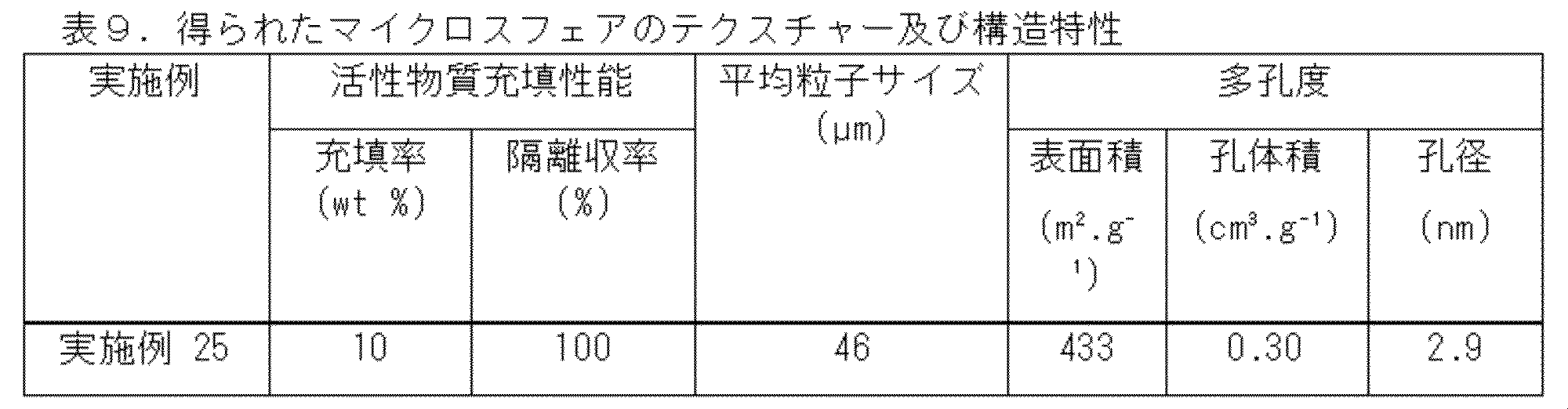
実施例26
得られたマイクロスフェアで達成された制御放出性能の例
Example 26
An example of controlled release performance achieved with the resulting microspheres
活性物質/ペイロード放出の制御は、図10に示されるように、マトリックス及び外面の疎水性/親水性の機能において達成することができる。 Control of active substance / payload release can be achieved in the hydrophobic / hydrophilic function of the matrix and outer surface, as shown in FIG.
ペイロード/活性物質と表面との相互作用は、動力学的放出に大きな影響を与える。球体の外部表面は、活性物質放出速度に大な影響を与える拡散バリアの役割を果たすことができる。バリアは、外層からの反発作用(この場合は親水性/疎水性反発)又は/及び立体的閉じ込め(この場合は長鎖オルガノシラン)の結果であり得る。マトリックス内の疎水性基が多いほど、放出は遅くなる。マトリックスの組成に応じて、1時間後、マイクロスフェアに存在する活性物質/ペイロードの初期量の5~80%が放出されたことが証明されている。さまざまな活性物質含量の充填について同様の結果が得られている。従って、マイクロスフェアマトリックス用のオルガノシランの選択は、活性物質/ペイロードの放出動態を調整するために非常に重要である。 The interaction of the payload / active substance with the surface has a great influence on the kinetic release. The outer surface of the sphere can act as a diffusion barrier that has a significant effect on the rate of release of active substances. The barrier can be the result of repulsion from the outer layer (in this case hydrophilic / hydrophobic repulsion) or / and steric confinement (in this case long-chain organosilanes). The more hydrophobic groups in the matrix, the slower the release. Depending on the composition of the matrix, it has been demonstrated that after 1 hour, 5-80% of the initial amount of active material / payload present in the microspheres was released. Similar results have been obtained for filling with different active substance contents. Therefore, the choice of organosilanes for the microsphere matrix is very important for regulating the release kinetics of the active substance / payload.
試料の特性評価
比表面積(BET)及び多孔度:シリカマイクロスフェアの表面積及び多孔度は、Micrometrics TriStar(商標)3000 V4.01及びMicrometrics TriStar(商標)3020 V3.02を用いて77Kで特性評価される。採取されたデータは、標準のBrunauer-Emmett-Teller(BET)を使用して表面積を取得し、孔径は等温線の吸着分岐を使用してBarrett-Joyner-Halenda(BJH)法により計算された孔径分布曲線の最大値から得られる。
Specimen characterization Specific Surface Area (BET) and Porosity: The surface area and porosity of silica microspheres are characterized at 77K using Micrometrics TriStar ™ 3000 V4.01 and Micrometrics TriStar ™ 3020 V3.02. To. The surface area of the collected data was obtained using a standard Brunauer-Emmett-Teller (BET), and the pore size was calculated by the Barrett-Joyner-Halenda (BJH) method using an isotherm adsorption branch. Obtained from the maximum value of the distribution curve.
粒子サイズ分布:粒子サイズ分布を測定するために、シリカナノ/マイクロスフェア(約50mg)を超音波浴中の約5mLのメタノールに5分間分散させて十分に分散した溶液を得て、次にこれを、Malvern Mastersizer 2000 (Hydro 2000S、モデルAWA2001) の超音波処理浴に、信号の妨害が約5~8%になるまで加える。 Particle size distribution: To measure the particle size distribution, silica nano / microspheres (about 50 mg) were dispersed in about 5 mL of methanol in an ultrasonic bath for 5 minutes to obtain a well-dispersed solution, which was then applied. , Add to the sonication bath of Malvern Mastersizer 2000 (Hydro 2000S, model AWA2001) until signal interference is about 5-8%.
シリカ球中の活性物質の定量:シリカ球に隔離された活性物質の充填は、約100mgの活性物質を含む一定量の隔離シリカ球を10mLの10%アンモニア水溶液に懸濁し、次にブランソン8800超音波浴で30分間超音波処理した後、IKA HS-501水平シェーカーを用いて200mot/分で2時間振盪して完全な放出を達成することにより、測定される。シリカ球を0.22μmフィルターで濾過すると、HPLC分析用の透明な溶液が得られる。 Quantification of active substance in silica spheres: Filling of the active substance isolated in silica spheres involves suspending a certain amount of isolated silica spheres containing about 100 mg of active substance in 10 mL of a 10% aqueous ammonia solution, followed by more than Branson 8800. Measured by sonicating in a sonic bath for 30 minutes and then shaking at 200 mot / min for 2 hours using an IKA HS-501 horizontal shaker to achieve complete release. Filtration of silica spheres with a 0.22 μm filter gives a clear solution for HPLC analysis.
上記で得られた溶液の活性物質の濃度を測定するために使用されるHPLCは、4成分系溶媒送達システム(G1311A)、真空脱気ユニット(G1322A)、UVフォトダイオードアレイ検出器(G1314A)、標準オートサンプラー(G1313A)、及びサーモスタットカラムコンパートメント(G1316A)を備えたAgilent 1100である。活性物質を検出するために、3×150mm内径、5μm、100ÅのSiliaChrom DtC18カラムが使用される。水を含む0.1%ギ酸を移動相MPAとして使用し、移動相MPBはアセトニトリルを含む0.1%ギ酸である。注入量は2μLである。開始時の移動相は95%MPAと5%MPBであり、4分で95%MPBで終了し、さらに2分間保持される。流速、カラム温度、及び検出器は、それぞれ0.5ml/分、23℃、及び260nmに設定される。ウラシル保持時間は1.88分で、5-FU保持時間は2.39分である。検量線は、Sigma Aldrichから購入される純粋な化合物を使用して作成される。 The HPLC used to measure the concentration of active material in the solution obtained above is a four-component solvent delivery system (G1311A), a vacuum degassing unit (G1322A), a UV photodiode array detector (G1314A), Agilent 1100 with standard autosampler (G1313A) and thermostat column compartment (G1316A). A 3 x 150 mm inner diameter, 5 μm, 100 Å Silia Chrom Dt C18 column is used to detect the active substance. 0.1% formic acid containing water is used as the mobile phase MPA, and the mobile phase MPB is 0.1% formic acid containing acetonitrile. The injection volume is 2 μL. The mobile phase at the start is 95% MPA and 5% MPB, ending at 95% MPB in 4 minutes and retained for an additional 2 minutes. The flow rate, column temperature, and detector are set to 0.5 ml / min, 23 ° C, and 260 nm, respectively. The uracil retention time is 1.88 minutes and the 5-FU retention time is 2.39 minutes. The calibration curve is made using pure compounds purchased from Sigma Aldrich.
走査型電子顕微鏡(SEM):マイクロスフェアのSEM画像は、コーティングなしの3.0kVのFEI Quanta-3D-FEG、又は金コーティングのある15kVのJEOL 840-Aで記録される。 Scanning Electron Microscope (SEM): Microsphere SEM images are recorded with an uncoated 3.0 kV FEI Quanta-3D-FEG or a gold coated 15 kV JEOL 840-A.
シリカ中の水分定量(カールフィッシャー):水の割合は、Mettler Toledoからの滴定装置Compact V20sを使用して推定される。 Moisture content in silica (Karl Fischer): The water ratio is estimated using the compact V20s titrator from Mettler Toledo.
ゼータ電位:ナノ/マイクロスフェアのゼータ電位を測定するために、懸濁液は、最初に10mgのナノ/マイクロスフェアを10mLの水に分散させ、続いて10分間超音波処理し、1分間ボルテックス混合することによって調製される。混合液をさらに10倍希釈し、Capillary Zeta Cellに入れて、Malvern, Zetasizer Nano ZSを用いてゼータ電位を測定する。 Zeta Potential: To measure the zeta potential of nano / microspheres, the suspension first disperses 10 mg of nano / microspheres in 10 mL of water, then sonicates for 10 minutes and vortexes for 1 minute. Prepared by The mixture is further diluted 10-fold, placed in a Capillary Zeta Cell, and the zeta potential is measured using a Malvern, Zetasizer Nano ZS.
接触角:数ミリグラムのナノ/マイクロスフェアをMicro-Tec D12両面非導電性接着剤の片面に沈着させ、これを顕微鏡のスライドガラスに固定する。試料層を可能な限り平滑化する。次に接触角はVCA 2500 XEシステムを用いて特性評価する。 Contact angle: A few milligrams of nano / microspheres are deposited on one side of the Micro-Tec D12 double-sided non-conductive adhesive, which is fixed to the glass slide of the microscope. Smooth the sample layer as much as possible. The contact angle is then characterized using the VCA 2500 XE system.
元素分析(CNS及びICP-ES):炭素、窒素、及び硫黄含有量は、Perkin Elmer 2400シリーズII CHNS/O分析器を用いて測定される。ケイ素含有量はICP-ESを用いて測定される。 Elemental analysis (CNS and ICP-ES): Carbon, nitrogen, and sulfur contents are measured using a Perkin Elmer 2400 Series II CHNS / O analyzer. Silicon content is measured using ICP-ES.
X線光電子分光法(XPS):外部表面の化学組成は、Axis-Ultra de Kratos (UK) を使用してX線光電子分光法によって、最大深さ5ナノメートルで調べた。メインXPSチャンバーは、<5.10-8Torrのベース圧力に維持した。250Wの単色アルミニウムX線源(Al kα=1486.6eV)を使用して、調査スペクトル(1400~0eV)及び電荷中和を伴う高分解能スペクトルを記録した。検出角度は表面の法線に対して45°に設定し、分析された領域は0.016cm2(開口部5)であった。 X-ray photoelectron spectroscopy (XPS): The chemical composition of the outer surface was investigated by X-ray photoelectron spectroscopy using Axis-Ultra de Kratos (UK) at a maximum depth of 5 nanometers. The main XPS chamber was maintained at a base pressure of < 5.10-8 Torr. A 250 W monochromatic aluminum X-ray source (Al kα = 1486.6 eV) was used to record the survey spectrum (1400-0 eV) and a high resolution spectrum with charge neutralization. The detection angle was set to 45 ° with respect to the surface normal and the analyzed area was 0.016 cm 2 (opening 5).
熱重量分析-示差走査熱量分析(TGA-DSC):測定は、Netzsch STA 449C 熱重量分析器を使用して、20mL/分の気流速度、10℃/分の加熱速度で、35~700℃で行った。 Thermogravimetric Analysis-Differential Scanning Calorimetry (TGA-DSC): Measurements are made using a Netzsch STA 449C thermogravimetric analyzer at an air flow rate of 20 mL / min and a heating rate of 10 ° C / min at 35-700 ° C. went.
Claims (18)
i0)加水分解媒体中で1種以上のシリカ前駆体を別々に加水分解して、1種以上の予備加水分解シリカ前駆体を提供する工程;
i1)工程i0)の予備加水分解シリカ前駆体を合わせて、合わせた予備加水分解シリカ前駆体を含む分散相を提供する工程;
i2)前記合わせた予備加水分解シリカ前駆体から揮発性溶媒の一部又は全部を除去して、予備縮合されたシリカ前駆体を含む分散相を提供する工程;
i3)工程i1)で得られた合わせた予備加水分解シリカ前駆体を含む前記分散相に親水性溶媒を加えることにより、又は工程i2)で得られた予備縮合シリカ前駆体を含む前記分散相に親水性溶媒を加えることにより、親水性溶媒を含む分散相を調製する工程;
i4)連続相中で界面活性剤の非存在下で、工程i1)、i2)、又はi3)の分散相を乳化して、油中水型エマルジョンを提供する工程;
i5)縮合触媒を工程i4)のエマルジョンに添加して、前記オルガノシロキサンナノ/マイクロスフェアを提供する工程。 Method for producing organosiloxane nano / microspheres including the following steps:
i0) A step of separately hydrolyzing one or more silica precursors in a hydrolysis medium to provide one or more pre-hydrolyzed silica precursors;
i1) Step i0) Combine the pre-hydrolyzed silica precursors to provide a dispersed phase containing the combined pre-hydrolyzed silica precursors;
i2) A step of removing a part or all of the volatile solvent from the combined pre-hydrolyzed silica precursor to provide a dispersed phase containing the pre-condensed silica precursor;
i3) By adding a hydrophilic solvent to the dispersed phase containing the combined pre-hydrolyzed silica precursor obtained in step i1), or to the dispersed phase containing the pre-condensed silica precursor obtained in step i2). A step of preparing a dispersed phase containing a hydrophilic solvent by adding a hydrophilic solvent;
i4) A step of emulsifying the dispersed phase of steps i1), i2), or i3) in the absence of a surfactant in a continuous phase to provide a water-in-oil emulsion;
i5) A step of adding a condensation catalyst to the emulsion of step i4) to provide the organosiloxane nano / microsphere.
Rは、アルキル、アルケニル、アルキニル、脂環式、アリール、アルキルアリール基としてのモノシリル化残基であり、これは、ハロゲン原子、グリシジルオキシ-、-OH、-SH、ポリエチレングリコール(PEG)、-N(Ra)2、-N+(Ra)3により任意選択的に置換され;
Lは、ハロゲン、又はアセトキシド-O-C(O)Ra、又はアルコキシドORa基であり;
R'は、アルキル、アルケニル、アルキニル、脂環式、アリール、アルキルアリール基としての二シリル化残基であり、これは、ハロゲン原子、-OH、-SH、-N(Ra)2、-N+(Ra)3により任意選択的に置換され;
Raは、水素、アルキル、アルケニル、アルキニル、脂環式、アリール、及びアルキルアリールであり得;そして
Xは、1~4の整数、又はXは1~3の整数である、上記方法。 The method according to claim 1, wherein the silica precursor has the formula R 4-x Si (L) x or the formula (L) 3 Si-R'-Si (L) 3 .
R is an alkyl, alkenyl, alkynyl, alicyclic, aryl, monosilylated residue as an alkylaryl group, which is a halogen atom, glycidyloxy-, -OH, -SH, polyethylene glycol (PEG),-. Optionally replaced by N (R a ) 2 , -N + (R a ) 3 ;
L is a halogen, or acetoxide-OC (O) R a , or alkoxide OR a group;
R'is an alkyl, alkenyl, alkynyl, alicyclic, aryl, disilylated residue as an alkylaryl group, which is a halogen atom, -OH, -SH, -N (Ra) 2 ,- Optionally replaced by N + ( Ra ) 3 ;
Ra can be hydrogen, alkyl, alkenyl, alkynyl, alicyclic, aryl, and alkylaryl; and X is an integer of 1 to 4, or X is an integer of 1 to 3, the above method.
N2物理吸着によって測定される細孔容積、細孔直径、及び比表面積によって評価されるように多孔性であり;
接触角測定によって評価される外部表面疎水性/親水性特性は、前記接触角が90°よりも小さい場合は親水性であり、又は前記接触角が90°よりも大きい場合は疎水性であり、又は前記接触角が85°~95°の場合は、バランスが取れている疎水性である、請求項14に記載のオルガノシロキサン球形ナノ/マイクロスフェア。 Submicron to micron size;
Porosity as assessed by pore volume, pore diameter, and specific surface area measured by N2 physical adsorption;
The external surface hydrophobic / hydrophilic property evaluated by the contact angle measurement is hydrophilic when the contact angle is less than 90 °, or hydrophobic when the contact angle is greater than 90 °. Alternatively, the organosiloxane spherical nano / microsphere according to claim 14, which is well-balanced and hydrophobic when the contact angle is 85 ° to 95 °.
Applications Claiming Priority (3)
| Application Number | Priority Date | Filing Date | Title |
|---|---|---|---|
| US201862760413P | 2018-11-13 | 2018-11-13 | |
| US62/760,413 | 2018-11-13 | ||
| PCT/CA2019/051605 WO2020097717A1 (en) | 2018-11-13 | 2019-11-12 | Hydrophobicity/hydrophilicity-tunable organosiloxane nano-/microspheres and process to make them |
Publications (2)
| Publication Number | Publication Date |
|---|---|
| JP2022507293A true JP2022507293A (en) | 2022-01-18 |
| JP7565268B2 JP7565268B2 (en) | 2024-10-10 |
Family
ID=70731034
Family Applications (1)
| Application Number | Title | Priority Date | Filing Date |
|---|---|---|---|
| JP2021525786A Active JP7565268B2 (en) | 2018-11-13 | 2019-11-12 | Organosiloxane nano/microspheres with adjustable hydrophobicity/hydrophilicity and method for producing same |
Country Status (8)
| Country | Link |
|---|---|
| US (1) | US20210283059A1 (en) |
| EP (1) | EP3880353A4 (en) |
| JP (1) | JP7565268B2 (en) |
| CN (1) | CN112969526B (en) |
| AU (1) | AU2019379434B2 (en) |
| CA (1) | CA3118736A1 (en) |
| IL (1) | IL283027B2 (en) |
| WO (1) | WO2020097717A1 (en) |
Families Citing this family (6)
| Publication number | Priority date | Publication date | Assignee | Title |
|---|---|---|---|---|
| US12201956B2 (en) | 2018-10-16 | 2025-01-21 | Pharma In Silica Laboratories Inc. | Tunable process for silica capsules/spheres preparation and their use |
| IL284870B2 (en) * | 2019-02-21 | 2025-06-01 | Silicycle Inc | Direct nanoemulsion process for the synthesis of submicron spheroidal organosyl oxanes/nanoparticles |
| CN112973650B (en) * | 2021-02-08 | 2022-02-08 | 厦门大学 | Nano-micro composite ball and preparation method and application thereof |
| CN115449255A (en) * | 2022-10-20 | 2022-12-09 | 浦诺菲新材料有限公司 | Modified silicon dioxide nano-particles and preparation method thereof, super-hydrophobic polyurethane coating liquid and super-hydrophobic automobile paint surface protective film |
| CN115944749A (en) * | 2023-01-16 | 2023-04-11 | 中国药科大学 | Hollow nano drug-loaded silicon sphere, its preparation method and application |
| CN117756557B (en) * | 2023-12-26 | 2025-09-16 | 清远市简一陶瓷有限公司 | Antifouling ceramic tile and preparation process thereof |
Citations (4)
| Publication number | Priority date | Publication date | Assignee | Title |
|---|---|---|---|---|
| JP2000225332A (en) * | 1998-10-29 | 2000-08-15 | Seiwa Kasei:Kk | Included microcapsules and method for producing the same |
| JP2001106612A (en) * | 1999-02-05 | 2001-04-17 | Seiwa Kasei:Kk | Cosmetics containing microcapsules already included |
| US20030124564A1 (en) * | 2001-06-29 | 2003-07-03 | Mathias Trau | Synthesis and use of organosilica particles |
| JP2009196829A (en) * | 2008-02-19 | 2009-09-03 | Furukawa Electric Co Ltd:The | Method for producing silica nanoparticles of core-shell structure, silica nanoparticles of core-shell structure and labeling reagent using the same |
Family Cites Families (6)
| Publication number | Priority date | Publication date | Assignee | Title |
|---|---|---|---|---|
| JP2001192452A (en) * | 2000-01-13 | 2001-07-17 | Ge Toshiba Silicones Co Ltd | Spherical silicone fine particles and method for producing the same |
| EP2335818A1 (en) * | 2009-07-09 | 2011-06-22 | Altachem Holdings NV | Leach-proof microcapsules, the method for preparation and use of leach-proof microcapsules |
| US20130040817A1 (en) * | 2010-04-20 | 2013-02-14 | Basf Se | Capsule comprising active ingredient |
| CN102604100B (en) * | 2012-01-19 | 2013-08-28 | 华南理工大学 | Preparation method of monodispersity micron-sized polysilicon microspheres |
| CN105344334B (en) * | 2015-11-06 | 2017-07-04 | 中国矿业大学 | A kind of preparation method of polyvinyl alcohol/silicon dioxide complex microsphere |
| CN107285325A (en) * | 2017-08-07 | 2017-10-24 | 山东师范大学 | A kind of preparation method of the monodisperse silica nanosphere of novel green |
-
2019
- 2019-11-12 JP JP2021525786A patent/JP7565268B2/en active Active
- 2019-11-12 WO PCT/CA2019/051605 patent/WO2020097717A1/en not_active Ceased
- 2019-11-12 CA CA3118736A patent/CA3118736A1/en active Pending
- 2019-11-12 IL IL283027A patent/IL283027B2/en unknown
- 2019-11-12 US US17/290,052 patent/US20210283059A1/en active Pending
- 2019-11-12 EP EP19885236.0A patent/EP3880353A4/en active Pending
- 2019-11-12 CN CN201980074077.4A patent/CN112969526B/en active Active
- 2019-11-12 AU AU2019379434A patent/AU2019379434B2/en active Active
Patent Citations (4)
| Publication number | Priority date | Publication date | Assignee | Title |
|---|---|---|---|---|
| JP2000225332A (en) * | 1998-10-29 | 2000-08-15 | Seiwa Kasei:Kk | Included microcapsules and method for producing the same |
| JP2001106612A (en) * | 1999-02-05 | 2001-04-17 | Seiwa Kasei:Kk | Cosmetics containing microcapsules already included |
| US20030124564A1 (en) * | 2001-06-29 | 2003-07-03 | Mathias Trau | Synthesis and use of organosilica particles |
| JP2009196829A (en) * | 2008-02-19 | 2009-09-03 | Furukawa Electric Co Ltd:The | Method for producing silica nanoparticles of core-shell structure, silica nanoparticles of core-shell structure and labeling reagent using the same |
Also Published As
| Publication number | Publication date |
|---|---|
| IL283027A (en) | 2021-06-30 |
| EP3880353A1 (en) | 2021-09-22 |
| CA3118736A1 (en) | 2020-05-22 |
| IL283027B1 (en) | 2024-10-01 |
| WO2020097717A1 (en) | 2020-05-22 |
| JP7565268B2 (en) | 2024-10-10 |
| CN112969526B (en) | 2024-07-26 |
| US20210283059A1 (en) | 2021-09-16 |
| AU2019379434A1 (en) | 2021-06-03 |
| IL283027B2 (en) | 2025-02-01 |
| EP3880353A4 (en) | 2021-12-29 |
| AU2019379434B2 (en) | 2025-11-13 |
| CN112969526A (en) | 2021-06-15 |
Similar Documents
| Publication | Publication Date | Title |
|---|---|---|
| JP7565268B2 (en) | Organosiloxane nano/microspheres with adjustable hydrophobicity/hydrophilicity and method for producing same | |
| AU2019360164B2 (en) | Tunable process for silica capsules/spheres preparation and their use | |
| CA2611606C (en) | Particles comprising a releasable dopant therein | |
| JP6585190B2 (en) | Hydrophobic airgel with low monofunctional unit occupancy | |
| CN107548379A (en) | Method for producing organically-modified aeroge | |
| JP7520024B2 (en) | Direct nanoemulsion method for the synthesis of spherical organosiloxane submicron/nanoparticles | |
| CN109963646A (en) | Customized sol-gel derived matrices for chemical immobilization | |
| WO2022013250A1 (en) | Process for synthesizing nanoscale and sub-micron-sized porous silica particles by soft chemistry | |
| AU2006257727B2 (en) | Particles comprising a releasable dopant therein | |
| Zhao | Silica/polymer composite materials: synthesis, characterization and applications | |
| HK1109866A (en) | Particles comprising a releasable dopant therein | |
| HK1109866B (en) | Particles comprising a releasable dopant therein |
Legal Events
| Date | Code | Title | Description |
|---|---|---|---|
| A621 | Written request for application examination |
Free format text: JAPANESE INTERMEDIATE CODE: A621 Effective date: 20221111 |
|
| A711 | Notification of change in applicant |
Free format text: JAPANESE INTERMEDIATE CODE: A711 Effective date: 20230324 |
|
| A977 | Report on retrieval |
Free format text: JAPANESE INTERMEDIATE CODE: A971007 Effective date: 20230913 |
|
| A131 | Notification of reasons for refusal |
Free format text: JAPANESE INTERMEDIATE CODE: A131 Effective date: 20230926 |
|
| A521 | Request for written amendment filed |
Free format text: JAPANESE INTERMEDIATE CODE: A523 Effective date: 20231226 |
|
| A02 | Decision of refusal |
Free format text: JAPANESE INTERMEDIATE CODE: A02 Effective date: 20240220 |
|
| A521 | Request for written amendment filed |
Free format text: JAPANESE INTERMEDIATE CODE: A523 Effective date: 20240618 |
|
| A521 | Request for written amendment filed |
Free format text: JAPANESE INTERMEDIATE CODE: A821 Effective date: 20240620 |
|
| A911 | Transfer to examiner for re-examination before appeal (zenchi) |
Free format text: JAPANESE INTERMEDIATE CODE: A911 Effective date: 20240711 |
|
| TRDD | Decision of grant or rejection written | ||
| A01 | Written decision to grant a patent or to grant a registration (utility model) |
Free format text: JAPANESE INTERMEDIATE CODE: A01 Effective date: 20240910 |
|
| A61 | First payment of annual fees (during grant procedure) |
Free format text: JAPANESE INTERMEDIATE CODE: A61 Effective date: 20240930 |
|
| R150 | Certificate of patent or registration of utility model |
Ref document number: 7565268 Country of ref document: JP Free format text: JAPANESE INTERMEDIATE CODE: R150 |