JP2023082425A - Treatment agent for carbon fiber precursor, composition containing treatment agent for carbon fiber precursor, and carbon fiber precursor - Google Patents
Treatment agent for carbon fiber precursor, composition containing treatment agent for carbon fiber precursor, and carbon fiber precursor Download PDFInfo
- Publication number
- JP2023082425A JP2023082425A JP2021196190A JP2021196190A JP2023082425A JP 2023082425 A JP2023082425 A JP 2023082425A JP 2021196190 A JP2021196190 A JP 2021196190A JP 2021196190 A JP2021196190 A JP 2021196190A JP 2023082425 A JP2023082425 A JP 2023082425A
- Authority
- JP
- Japan
- Prior art keywords
- carbon fiber
- fiber precursor
- carbon
- treatment agent
- alkylene oxide
- Prior art date
- Legal status (The legal status is an assumption and is not a legal conclusion. Google has not performed a legal analysis and makes no representation as to the accuracy of the status listed.)
- Granted
Links
Classifications
-
- D—TEXTILES; PAPER
- D06—TREATMENT OF TEXTILES OR THE LIKE; LAUNDERING; FLEXIBLE MATERIALS NOT OTHERWISE PROVIDED FOR
- D06M—TREATMENT, NOT PROVIDED FOR ELSEWHERE IN CLASS D06, OF FIBRES, THREADS, YARNS, FABRICS, FEATHERS OR FIBROUS GOODS MADE FROM SUCH MATERIALS
- D06M11/00—Treating fibres, threads, yarns, fabrics or fibrous goods made from such materials, with inorganic substances or complexes thereof; Such treatment combined with mechanical treatment, e.g. mercerising
- D06M11/73—Treating fibres, threads, yarns, fabrics or fibrous goods made from such materials, with inorganic substances or complexes thereof; Such treatment combined with mechanical treatment, e.g. mercerising with carbon or compounds thereof
- D06M11/74—Treating fibres, threads, yarns, fabrics or fibrous goods made from such materials, with inorganic substances or complexes thereof; Such treatment combined with mechanical treatment, e.g. mercerising with carbon or compounds thereof with carbon or graphite; with carbides; with graphitic acids or their salts
-
- D—TEXTILES; PAPER
- D06—TREATMENT OF TEXTILES OR THE LIKE; LAUNDERING; FLEXIBLE MATERIALS NOT OTHERWISE PROVIDED FOR
- D06M—TREATMENT, NOT PROVIDED FOR ELSEWHERE IN CLASS D06, OF FIBRES, THREADS, YARNS, FABRICS, FEATHERS OR FIBROUS GOODS MADE FROM SUCH MATERIALS
- D06M13/00—Treating fibres, threads, yarns, fabrics or fibrous goods made from such materials, with non-macromolecular organic compounds; Such treatment combined with mechanical treatment
- D06M13/10—Treating fibres, threads, yarns, fabrics or fibrous goods made from such materials, with non-macromolecular organic compounds; Such treatment combined with mechanical treatment with compounds containing oxygen
- D06M13/165—Ethers
-
- D—TEXTILES; PAPER
- D06—TREATMENT OF TEXTILES OR THE LIKE; LAUNDERING; FLEXIBLE MATERIALS NOT OTHERWISE PROVIDED FOR
- D06M—TREATMENT, NOT PROVIDED FOR ELSEWHERE IN CLASS D06, OF FIBRES, THREADS, YARNS, FABRICS, FEATHERS OR FIBROUS GOODS MADE FROM SUCH MATERIALS
- D06M15/00—Treating fibres, threads, yarns, fabrics, or fibrous goods made from such materials, with macromolecular compounds; Such treatment combined with mechanical treatment
- D06M15/19—Treating fibres, threads, yarns, fabrics, or fibrous goods made from such materials, with macromolecular compounds; Such treatment combined with mechanical treatment with synthetic macromolecular compounds
- D06M15/37—Macromolecular compounds obtained otherwise than by reactions only involving carbon-to-carbon unsaturated bonds
- D06M15/53—Polyethers
-
- D—TEXTILES; PAPER
- D06—TREATMENT OF TEXTILES OR THE LIKE; LAUNDERING; FLEXIBLE MATERIALS NOT OTHERWISE PROVIDED FOR
- D06M—TREATMENT, NOT PROVIDED FOR ELSEWHERE IN CLASS D06, OF FIBRES, THREADS, YARNS, FABRICS, FEATHERS OR FIBROUS GOODS MADE FROM SUCH MATERIALS
- D06M15/00—Treating fibres, threads, yarns, fabrics, or fibrous goods made from such materials, with macromolecular compounds; Such treatment combined with mechanical treatment
- D06M15/19—Treating fibres, threads, yarns, fabrics, or fibrous goods made from such materials, with macromolecular compounds; Such treatment combined with mechanical treatment with synthetic macromolecular compounds
- D06M15/37—Macromolecular compounds obtained otherwise than by reactions only involving carbon-to-carbon unsaturated bonds
- D06M15/643—Macromolecular compounds obtained otherwise than by reactions only involving carbon-to-carbon unsaturated bonds containing silicon in the main chain
-
- D—TEXTILES; PAPER
- D06—TREATMENT OF TEXTILES OR THE LIKE; LAUNDERING; FLEXIBLE MATERIALS NOT OTHERWISE PROVIDED FOR
- D06M—TREATMENT, NOT PROVIDED FOR ELSEWHERE IN CLASS D06, OF FIBRES, THREADS, YARNS, FABRICS, FEATHERS OR FIBROUS GOODS MADE FROM SUCH MATERIALS
- D06M15/00—Treating fibres, threads, yarns, fabrics, or fibrous goods made from such materials, with macromolecular compounds; Such treatment combined with mechanical treatment
- D06M15/19—Treating fibres, threads, yarns, fabrics, or fibrous goods made from such materials, with macromolecular compounds; Such treatment combined with mechanical treatment with synthetic macromolecular compounds
- D06M15/37—Macromolecular compounds obtained otherwise than by reactions only involving carbon-to-carbon unsaturated bonds
- D06M15/643—Macromolecular compounds obtained otherwise than by reactions only involving carbon-to-carbon unsaturated bonds containing silicon in the main chain
- D06M15/6436—Macromolecular compounds obtained otherwise than by reactions only involving carbon-to-carbon unsaturated bonds containing silicon in the main chain containing amino groups
-
- D—TEXTILES; PAPER
- D06—TREATMENT OF TEXTILES OR THE LIKE; LAUNDERING; FLEXIBLE MATERIALS NOT OTHERWISE PROVIDED FOR
- D06M—TREATMENT, NOT PROVIDED FOR ELSEWHERE IN CLASS D06, OF FIBRES, THREADS, YARNS, FABRICS, FEATHERS OR FIBROUS GOODS MADE FROM SUCH MATERIALS
- D06M2101/00—Chemical constitution of the fibres, threads, yarns, fabrics or fibrous goods made from such materials, to be treated
- D06M2101/16—Synthetic fibres, other than mineral fibres
- D06M2101/18—Synthetic fibres consisting of macromolecular compounds obtained by reactions only involving carbon-to-carbon unsaturated bonds
- D06M2101/26—Polymers or copolymers of unsaturated carboxylic acids or derivatives thereof
- D06M2101/28—Acrylonitrile; Methacrylonitrile
-
- D—TEXTILES; PAPER
- D06—TREATMENT OF TEXTILES OR THE LIKE; LAUNDERING; FLEXIBLE MATERIALS NOT OTHERWISE PROVIDED FOR
- D06M—TREATMENT, NOT PROVIDED FOR ELSEWHERE IN CLASS D06, OF FIBRES, THREADS, YARNS, FABRICS, FEATHERS OR FIBROUS GOODS MADE FROM SUCH MATERIALS
- D06M2200/00—Functionality of the treatment composition and/or properties imparted to the textile material
- D06M2200/40—Reduced friction resistance, lubricant properties; Sizing compositions
Landscapes
- Engineering & Computer Science (AREA)
- Textile Engineering (AREA)
- Chemical & Material Sciences (AREA)
- Chemical Kinetics & Catalysis (AREA)
- Treatments For Attaching Organic Compounds To Fibrous Goods (AREA)
- Chemical Or Physical Treatment Of Fibers (AREA)
- Inorganic Fibers (AREA)
Abstract
【課題】帯電防止性を向上させながら脱落防止性を向上できる炭素繊維前駆体用処理剤を提供する。
【解決手段】炭素繊維前駆体用処理剤は、界面活性剤及びカーボンナノ構造体を含有しており、炭素繊維前駆体用処理剤の不揮発分中における前記カーボンナノ構造体の含有量が、10ppm以上50000ppm未満である。
【選択図】なし
A treatment agent for carbon fiber precursors capable of improving anti-dropping properties while improving antistatic properties is provided.
The carbon fiber precursor treatment agent contains a surfactant and a carbon nanostructure, and the content of the carbon nanostructure in the non-volatile content of the carbon fiber precursor treatment agent is 10 ppm. more than or equal to less than 50000 ppm.
[Selection figure] None
Description
本発明は、界面活性剤及びカーボンナノ構造体を含有する炭素繊維前駆体用処理剤、炭素繊維前駆体用処理剤を含有する炭素繊維前駆体用処理剤含有組成物、及び炭素繊維前駆体用処理剤により得られた炭素繊維前駆体に関する。 The present invention provides a carbon fiber precursor treatment agent containing a surfactant and a carbon nanostructure, a carbon fiber precursor treatment agent-containing composition containing the carbon fiber precursor treatment agent, and a carbon fiber precursor treatment agent. The present invention relates to a carbon fiber precursor obtained with a treating agent.
炭素繊維は、例えばエポキシ樹脂等のマトリクス樹脂と組み合わせた炭素繊維複合材料として、建材、輸送機器、医療用機器等の各分野において広く利用されている。通常炭素繊維は、炭素繊維前駆体として例えばアクリル繊維を紡糸する紡糸工程、炭素繊維前駆体を焼成する焼成工程を経て製造される。炭素繊維前駆体には、炭素繊維の製造工程において生ずる繊維間の膠着又は融着を抑制するために、炭素繊維前駆体用処理剤が用いられることがある。 BACKGROUND ART Carbon fibers are widely used in various fields such as building materials, transportation equipment, and medical equipment as carbon fiber composite materials combined with matrix resins such as epoxy resins. Generally, carbon fibers are manufactured through a spinning step of spinning acrylic fiber as a carbon fiber precursor and a baking step of baking the carbon fiber precursor. Carbon fiber precursors are sometimes treated with a carbon fiber precursor treatment agent in order to suppress adhesion or fusion between fibers that occurs in the carbon fiber manufacturing process.
特許文献1には、炭素繊維前駆体用処理剤としての油剤組成物に係る発明が記載されている。油剤組成物は、導電性を有する炭素系微粒子、シリコーン、ノニオン系乳化剤を含有している。 Patent Document 1 describes an invention relating to an oil composition as a treatment agent for carbon fiber precursors. The oil composition contains conductive carbon-based fine particles, silicone, and a nonionic emulsifier.
ところが、特許文献1に記載されるような従来の炭素繊維前駆体用処理剤は、帯電防止性、集束性は良好である一方で、炭素繊維前駆体用処理剤に含有される炭素系微粒子が、炭素繊維前駆体から脱落し易いといった問題があった。炭素繊維前駆体から脱落した炭素系微粒子は、繊維を搬送するローラー表面に付着し、炭素繊維前駆体の断糸、毛羽等の品質低下を引き起こす。そのため、ローラー表面を頻繁に掃除しなければならず、炭素繊維前駆体の製造効率が低下してしまう原因となる。 However, while the conventional treating agent for carbon fiber precursors as described in Patent Document 1 has good antistatic properties and bundling properties, the carbon-based fine particles contained in the treating agent for carbon fiber precursors are , there is a problem that it easily falls off from the carbon fiber precursor. The carbon-based fine particles that have fallen off from the carbon fiber precursor adhere to the surface of the roller that conveys the fiber, causing quality deterioration such as fiber breakage and fluffing of the carbon fiber precursor. Therefore, the surface of the roller must be cleaned frequently, which causes a decrease in the production efficiency of the carbon fiber precursor.
帯電防止性を向上しながら脱落防止性を向上できる炭素繊維前駆体用処理剤が要望されている。 There is a demand for a treatment agent for carbon fiber precursors that can improve anti-dropping properties while improving antistatic properties.
上記の課題を解決するため、本発明の炭素繊維前駆体用処理剤は、界面活性剤及びカーボンナノ構造体を含有する炭素繊維前駆体用処理剤であって、前記炭素繊維前駆体用処理剤の不揮発分中における前記カーボンナノ構造体の含有量が、10ppm以上50000ppm未満である。 In order to solve the above problems, the carbon fiber precursor treatment agent of the present invention is a carbon fiber precursor treatment agent containing a surfactant and a carbon nanostructure, wherein the carbon fiber precursor treatment agent The content of the carbon nanostructure in the non-volatile content of is 10 ppm or more and less than 50000 ppm.
なお、本発明でのppmは質量ppmを意味する。
上記の構成において、前記カーボンナノ構造体が、カーボンナノチューブを含むものであってもよい。
In addition, ppm in this invention means mass ppm.
In the above configuration, the carbon nanostructure may contain carbon nanotubes.
上記の構成において、前記カーボンナノチューブが、単層カーボンナノチューブであってもよい。
上記の構成において、更に、シリコーンを含有してもよい。
In the above configuration, the carbon nanotubes may be single-walled carbon nanotubes.
Said structure WHEREIN: You may contain a silicone further.
上記の課題を解決するため、本発明の炭素繊維前駆体用処理剤含有組成物は、前記炭素繊維前駆体用処理剤と、溶媒とを含有する炭素繊維前駆体用処理剤含有組成物である。
上記の課題を解決するため、本発明の炭素繊維前駆体は、上記炭素繊維前駆体用処理剤が付着してなる炭素繊維前駆体である。
In order to solve the above problems, the carbon fiber precursor treating agent-containing composition of the present invention is a carbon fiber precursor treating agent-containing composition containing the carbon fiber precursor treating agent and a solvent. .
In order to solve the above problems, the carbon fiber precursor of the present invention is a carbon fiber precursor to which the above-described treatment agent for carbon fiber precursor is attached.
本発明によれば、帯電防止性を向上しながら脱落防止性を向上できる炭素繊維前駆体が得られる。 ADVANTAGE OF THE INVENTION According to this invention, the carbon fiber precursor which can improve anti-falling property while improving antistatic property is obtained.
(第1実施形態)
以下、本発明の炭素繊維前駆体用処理剤(以下、「処理剤」という。)を具体化した第1実施形態を説明する。処理剤は、カーボンナノ構造体、界面活性剤を含有する。さらに、必要に応じてシリコーンを含有する。
(First embodiment)
A first embodiment embodying the treatment agent for carbon fiber precursors of the present invention (hereinafter referred to as "treatment agent") will be described below. The treatment agent contains a carbon nanostructure and a surfactant. Furthermore, it contains silicone as needed.
<カーボンナノ構造体について>
カーボンナノ構造体としては、例えば、カーボンナノチューブ、カーボンナノファイバー、カーボンブラック等が挙げられる。
<About carbon nanostructures>
Carbon nanostructures include, for example, carbon nanotubes, carbon nanofibers, and carbon black.
一般的に、カーボンナノチューブは、繊維の中心に沿ってグラフェンシートを巻き付けた円筒状構造をしている。カーボンナノファイバーは、グラフェンシートが繊維長方向に対して斜めに積層した構造又は垂直に積層した構造を有しており、繊維表面にグラフェンシートのエッジ面が露出している。カーボンブラックは、平均一次粒子径が3~500nm程度の粒子状カーボンである。これらの中で、脱落防止性をより向上させる観点からカーボンナノチューブが好ましい。 Carbon nanotubes generally have a cylindrical structure with a graphene sheet wrapped around the center of the fiber. Carbon nanofibers have a structure in which graphene sheets are laminated obliquely or perpendicularly to the fiber length direction, and the edge surfaces of the graphene sheets are exposed on the fiber surface. Carbon black is particulate carbon having an average primary particle size of about 3 to 500 nm. Among these, carbon nanotubes are preferred from the viewpoint of further improving drop-off prevention properties.
カーボンナノチューブは、単層のシングルウォールカーボンナノチューブであっても、二層のダブルウォールカーボンナノチューブ等の多層のマルチウォールカーボンナノチューブであってもよい。これらの中で、帯電防止性をより向上させる観点からシングルウォールカーボンナノチューブが好ましい。 The carbon nanotubes may be single-walled single-walled carbon nanotubes or multi-walled multi-walled carbon nanotubes such as double-walled double-walled carbon nanotubes. Among these, single-wall carbon nanotubes are preferred from the viewpoint of further improving antistatic properties.
また、カーボンナノチューブは、カーボンナノシートの幾何学的構造の違いによってジグザグ型、アームチェア型、カイラル型が存在するが、これらのいずれであってもよい。また、例えばカルボキシル基修飾等の化学修飾されたカーボンナノチューブを適用してもよい。 Carbon nanotubes are classified into zigzag type, armchair type, and chiral type depending on the geometrical structure of the carbon nanosheet, and any of these types may be used. Alternatively, chemically modified carbon nanotubes such as carboxyl group modification may be applied.
カーボンナノ構造体の具体例としては、例えば、Nanocyl社製単層カーボンナノチューブ、OCSiAl社製単層カーボンナノチューブ(商品名TUBALL)、Nanocyl社製二層カーボンナノチューブ、Nanocyl社製多層カーボンナノチューブ、Nanocyl社製カルボキシル基修飾多層カーボンナノチューブ、ALMEDIO社製補強用カーボンナノファイバー、平均一次粒子径23nmのカーボンブラック等が挙げられる。これらのカーボンナノ構造体は、1種のカーボンナノ構造体を単独で使用してもよく、2種以上のカーボンナノ構造体を組み合わせて使用してもよい。 Specific examples of carbon nanostructures include single-walled carbon nanotubes manufactured by Nanocyl, single-walled carbon nanotubes manufactured by OCSiAl (trade name TUBALL), double-walled carbon nanotubes manufactured by Nanocyl, multi-walled carbon nanotubes manufactured by Nanocyl, and Nanocyl. carboxyl group-modified multi-walled carbon nanotubes manufactured by ALMEDIO, reinforcing carbon nanofibers manufactured by ALMEDIO, and carbon black having an average primary particle diameter of 23 nm. As for these carbon nanostructures, one type of carbon nanostructure may be used alone, or two or more types of carbon nanostructures may be used in combination.
<界面活性剤について>
界面活性剤は、脱落防止性及び紡糸平滑性を向上させる。また、処理剤中でのカーボンナノ構造体の分散安定性を向上させる。
<About surfactant>
Surfactants improve anti-shedding properties and spinning smoothness. It also improves the dispersion stability of the carbon nanostructures in the treating agent.
界面活性剤としては、例えばアニオン界面活性剤、カチオン界面活性剤、非イオン界面活性剤、両性界面活性剤が挙げられる。これらの界面活性剤は、1種の界面活性剤を単独で使用してもよく、2種以上の界面活性剤を組み合わせて使用してもよい。 Examples of surfactants include anionic surfactants, cationic surfactants, nonionic surfactants, and amphoteric surfactants. As for these surfactants, one surfactant may be used alone, or two or more surfactants may be used in combination.
非イオン界面活性剤としては、公知のものを適宜採用できる。非イオン界面活性剤の具体例としては、例えば(1)オクチルアルコールのアルキレンオキサイド付加物、イソオクチルアルコールのアルキレンオキサイド付加物、ノニルアルコールのアルキレンオキサイド付加物、イソノニルアルコールのアルキレンオキサイド付加物、デシルアルコールのアルキレンオキサイド付加物、イソデシルアルコールのアルキレンオキサイド付加物、ウンデシルアルコールのアルキレンオキサイド付加物、イソウンデシルアルコールのアルキレンオキサイド付加物、ドデシルアルコールのアルキレンオキサイド付加物、イソドデシルアルコールのアルキレンオキサイド付加物、二級ドデシルアルコールのアルキレンオキサイド付加物、二級イソドデシルアルコールのアルキレンオキサイド付加物、トリデシルアルコールのアルキレンオキサイド付加物、イソトリデシルアルコールのアルキレンオキサイド付加物、二級トリデシルアルコールのアルキレンオキサイド付加物、二級イソトリデシルアルコールのアルキレンオキサイド付加物、テトラデシルアルコールのアルキレンオキサイド付加物、イソテトラデシルアルコールのアルキレンオキサイド付加物、ペンタデシルアルコールのアルキレンオキサイド付加物、イソペンタデシルアルコールのアルキレンオキサイド付加物、ヘキサデシルアルコールのアルキレンオキサイド付加物、イソヘキサデシルアルコールのアルキレンオキサイド付加物、オクタデシルアルコールのアルキレンオキサイド付加物、イソオクタデシルアルコールのアルキレンオキサイド付加物、イコサノールのアルキレンオキサイド付加物、イソイコサノールのアルキレンオキサイド付加物等のアルコールにアルキレンオキサイドを付加した化合物、(2)オクチルアミンのアルキレンオキサイド付加物、イソオクチルアミンのアルキレンオキサイド付加物、ノニルアミンのアルキレンオキサイド付加物、イソノニルアミンのアルキレンオキサイド付加物、デシルアミンのアルキレンオキサイド付加物、イソデシルアミンのアルキレンオキサイド付加物、ウンデシルアミンのアルキレンオキサイド付加物、イソウンデシルアミンのアルキレンオキサイド付加物、ドデシルアミンのアルキレンオキサイド付加物、イソドデシルアミンのアルキレンオキサイド付加物、トリデシルアミンのアルキレンオキサイド付加物、イソトリデシルアミンのアルキレンオキサイド付加物、テトラデシルアミンのアルキレンオキサイド付加物、イソテトラデシルアミンのアルキレンオキサイド付加物、ペンタデシルアミンのアルキレンオキサイド付加物、イソペンタデシルアミンのアルキレンオキサイド付加物、ヘキサデシルアミンのアルキレンオキサイド付加物、ペンタデシルアミンのアルキレンオキサイド付加物、オクタデシルアミンのアルキレンオキサイド付加物、イソオクタデシルアミンのアルキレンオキサイド付加物、イコシルアミンのアルキレンオキサイド付加物、イソイコシルアミンのアルキレンオキサイド付加物等のアルキルアミンのアルキレンオキサイド付加物、(3)硬化ひまし油のアルキレンオキサイド付加物、硬化ひまし油のアルキレンオキサイド付加物のオレイン酸エステル、硬化ひまし油のアルキレンオキサイド付加物のステアリン酸エステル等の硬化ひまし油のアルキレンオキサイド付加物およびそのエステル化物、(4)ビスフェノールAのアルキレンオキサイド付加物、ビスフェノールAのアルキレンオキサイド付加物のエステル化物、ビスフェノールFのアルキレンオキサイド付加物、ビスフェノールFのアルキレンオキサイド付加物のエステル化物、エチレングリコールのアルキレンオキサイド付加物、エチレングリコールのアルキレンオキサイド付加物のエステル化物、プロピレングリコールのアルキレンオキサイド付加物、プロピレングリコールのアルキレンオキサイド付加物のエステル化物、1,4-ブタンジオールのアルキレンオキサイド付加物、1,4-ブタンジオールのアルキレンオキサイド付加物のエステル化物、1,6-ヘキサンジオールのアルキレンオキサイド付加物、1,6-ヘキサンジオールのアルキレンオキサイド付加物のエステル化物等のジオールのアルキレンオキサイド付加物及びそのエステル化物、(5)ポリオキシエチレンオクチルデカナート、ポリオキシエチレンラウリルエルカート、ポリオキシプロピレン1,6-ヘキサンジオールジオレアート、ビスポリオキシエチレンデシルアジパート、ビスポリオキシエチレンラウリルアジパート、ポリオキシプロピレンベンジルステアラート、ポリオキシエチレンとジメチルフタラートとラウリルアルコールの共重合物等のエーテルエステル化合物等が挙げられる。 As the nonionic surfactant, a known one can be used as appropriate. Specific examples of nonionic surfactants include (1) alkylene oxide adduct of octyl alcohol, alkylene oxide adduct of isooctyl alcohol, alkylene oxide adduct of nonyl alcohol, alkylene oxide adduct of isononyl alcohol, decyl Alcohol alkylene oxide adduct, isodecyl alcohol alkylene oxide adduct, undecyl alcohol alkylene oxide adduct, isoundecyl alcohol alkylene oxide adduct, dodecyl alcohol alkylene oxide adduct, isododecyl alcohol alkylene oxide adduct secondary dodecyl alcohol alkylene oxide adduct, secondary isododecyl alcohol alkylene oxide adduct, tridecyl alcohol alkylene oxide adduct, isotridecyl alcohol alkylene oxide adduct, secondary tridecyl alcohol alkylene oxide adducts, alkylene oxide adducts of secondary isotridecyl alcohol, alkylene oxide adducts of tetradecyl alcohol, alkylene oxide adducts of isotetradecyl alcohol, alkylene oxide adducts of pentadecyl alcohol, alkylene oxides of isopentadecyl alcohol adducts, hexadecyl alcohol alkylene oxide adducts, isohexadecyl alcohol alkylene oxide adducts, octadecyl alcohol alkylene oxide adducts, isooctadecyl alcohol alkylene oxide adducts, icosanol alkylene oxide adducts, isoicosanol alkylene oxide adducts Compounds obtained by adding alkylene oxide to alcohol such as adducts, (2) alkylene oxide adduct of octylamine, alkylene oxide adduct of isooctylamine, alkylene oxide adduct of nonylamine, alkylene oxide adduct of isononylamine, decylamine alkylene oxide adduct of isodecylamine, alkylene oxide adduct of undecylamine, alkylene oxide adduct of isoundecylamine, alkylene oxide adduct of dodecylamine, alkylene oxide adduct of isododecylamine , alkylene oxide adduct of tridecylamine, alkylene oxide adduct of isotridecylamine, alkylene oxide adduct of tetradecylamine, alkylene oxide adduct of isotetradecylamine, alkylene oxide adduct of pentadecylamine, isopenta alkylene oxide adduct of decylamine, alkylene oxide adduct of hexadecylamine, alkylene oxide adduct of pentadecylamine, alkylene oxide adduct of octadecylamine, alkylene oxide adduct of isooctadecylamine, alkylene oxide adduct of icosylamine, Alkylene oxide adducts of alkylamines such as alkylene oxide adducts of isoicosylamine, (3) alkylene oxide adducts of hydrogenated castor oil, oleic acid esters of alkylene oxide adducts of hydrogenated castor oil, alkylene oxide adducts of hydrogenated castor oil Alkylene oxide adducts of hydrogenated castor oil such as stearic acid esters and esters thereof, (4) alkylene oxide adducts of bisphenol A, esterified products of alkylene oxide adducts of bisphenol A, alkylene oxide adducts of bisphenol F, bisphenol F Esterified product of alkylene oxide adduct, alkylene oxide adduct of ethylene glycol, esterified product of alkylene oxide adduct of ethylene glycol, alkylene oxide adduct of propylene glycol, esterified product of alkylene oxide adduct of propylene glycol, 1,4- alkylene oxide adduct of butanediol, esterified alkylene oxide adduct of 1,4-butanediol, alkylene oxide adduct of 1,6-hexanediol, esterified alkylene oxide adduct of 1,6-hexanediol, etc. (5) polyoxyethylene octyl decanate, polyoxyethylene lauryl erucate, polyoxypropylene 1,6-hexanediol dioleate, bispolyoxyethylene decyl adipate, Examples thereof include ether ester compounds such as bispolyoxyethylene lauryl adipate, polyoxypropylene benzyl stearate, copolymers of polyoxyethylene, dimethylphthalate and lauryl alcohol.
アニオン界面活性剤としては、公知のものを適宜採用できる。アニオン界面活性剤の具体例としては、例えば(1)ラウリルリン酸エステル塩、セチルリン酸エステル塩、オクチルリン酸エステル塩、オレイルリン酸エステル塩、ステアリルリン酸エステル塩等の脂肪族アルコールのリン酸エステル塩、(2)ポリオキシエチレンラウリルエーテルリン酸エステル塩、ポリオキシエチレンオレイルエーテルリン酸エステル塩、ポリオキシエチレンステアリルエーテルリン酸エステル塩等の脂肪族アルコールにエチレンオキサイド及びプロピレンオキサイドから選ばれる少なくとも一種のアルキレンオキサイドを付加したもののリン酸エステル塩、(3)ラウリルスルホン酸塩、ミリスチルスルホン酸塩、セチルスルホン酸塩、オレイルスルホン酸塩、ステアリルスルホン酸塩、テトラデカンスルホン酸塩、ドデシルベンゼンスルホン酸塩、二級アルキルスルホン酸(C13~15)塩等の脂肪族スルホン酸塩又は芳香族スルホン酸塩、(4)ラウリル硫酸エステル塩、オレイル硫酸エステル塩、ステアリル硫酸エステル塩等の脂肪族アルコールの硫酸エステル塩、(5)ポリオキシエチレンラウリルエーテル硫酸エステル塩、ポリオキシアルキレン(ポリオキシエチレン、ポリオキシプロピレン)ラウリルエーテル硫酸エステル塩、ポリオキシエチレンオレイルエーテル硫酸エステル塩等の脂肪族アルコールにエチレンオキサイド及びプロピレンオキサイドから選ばれる少なくとも一種のアルキレンオキサイドを付加したものの硫酸エステル塩、(6)ひまし油脂肪酸硫酸エステル塩、ごま油脂肪酸硫酸エステル塩、トール油脂肪酸硫酸エステル塩、大豆油脂肪酸硫酸エステル塩、なたね油脂肪酸硫酸エステル塩、パーム油脂肪酸硫酸エステル塩、豚脂脂肪酸硫酸エステル塩、牛脂脂肪酸硫酸エステル塩、鯨油脂肪酸硫酸エステル塩等の脂肪酸の硫酸エステル塩、(7)ひまし油の硫酸エステル塩、ごま油の硫酸エステル塩、トール油の硫酸エステル塩、大豆油の硫酸エステル塩、菜種油の硫酸エステル塩、パーム油の硫酸エステル塩、豚脂の硫酸エステル塩、牛脂の硫酸エステル塩、鯨油の硫酸エステル塩等の油脂の硫酸エステル塩、(8)ラウリン酸塩、オレイン酸塩、ステアリン酸塩等の脂肪酸塩、(9)ジオクチルスルホコハク酸塩等の脂肪族アルコールのスルホコハク酸エステル塩等が挙げられる。アニオン界面活性剤の対イオンとしては、例えばカリウム塩、ナトリウム塩等のアルカリ金属塩、アンモニウム塩、トリエタノールアミン等のアルカノールアミン塩等が挙げられる。 Known anionic surfactants can be used as appropriate. Specific examples of anionic surfactants include (1) fatty alcohol phosphates such as lauryl phosphate, cetyl phosphate, octyl phosphate, oleyl phosphate, and stearyl phosphate. (2) at least one selected from ethylene oxide and propylene oxide for aliphatic alcohols such as polyoxyethylene lauryl ether phosphate, polyoxyethylene oleyl ether phosphate, and polyoxyethylene stearyl ether phosphate (3) laurylsulfonate, myristylsulfonate, cetylsulfonate, oleylsulfonate, stearylsulfonate, tetradecanesulfonate, dodecylbenzenesulfonate , aliphatic sulfonates or aromatic sulfonates such as secondary alkylsulfonic acid (C13-15) salts, (4) fatty alcohol sulfates such as lauryl sulfate, oleyl sulfate, and stearyl sulfate ester salts, (5) polyoxyethylene lauryl ether sulfate ester salts, polyoxyalkylene (polyoxyethylene, polyoxypropylene) lauryl ether sulfate ester salts, polyoxyethylene oleyl ether sulfate ester salts, and other aliphatic alcohols with ethylene oxide and (6) castor oil fatty acid sulfate, sesame oil fatty acid sulfate, tall oil fatty acid sulfate, soybean oil fatty acid sulfate, rapeseed oil fatty acid sulfate Fatty acid sulfates such as ester salts, palm oil fatty acid sulfates, lard fatty acid sulfates, beef tallow fatty acid sulfates, and whale oil fatty acid sulfates, (7) castor oil sulfates, sesame oil sulfates , tall oil sulfate, soybean oil sulfate, rapeseed oil sulfate, palm oil sulfate, lard sulfate, beef tallow sulfate, whale oil sulfate, etc. (8) fatty acid salts such as laurate, oleate and stearate; and (9) fatty alcohol sulfosuccinate salts such as dioctylsulfosuccinate. Examples of the counter ion of the anionic surfactant include alkali metal salts such as potassium salts and sodium salts, ammonium salts, alkanolamine salts such as triethanolamine, and the like.
カチオン界面活性剤としては、公知のものを適宜採用できる。カチオン界面活性剤の具体例としては、例えばラウリルトリメチルアンモニウムクロライド、セチルトリメチルアンモニウムクロライド、ステアリルトリメチルアンモニウムクロライド、ベヘニルトリメチルアンモニウムクロライド、ジデシルジメチルアンモニウムクロライド、1,2-ジメチルイミダゾール、トリエタノールアミン等が挙げられる。 Known cationic surfactants can be used as appropriate. Specific examples of cationic surfactants include lauryltrimethylammonium chloride, cetyltrimethylammonium chloride, stearyltrimethylammonium chloride, behenyltrimethylammonium chloride, didecyldimethylammonium chloride, 1,2-dimethylimidazole, and triethanolamine. be done.
両性界面活性剤としては、公知のものを適宜採用できる。両性界面活性剤の具体例としては、例えばベタイン型両性界面活性剤等が挙げられる。
<シリコーンについて>
本実施形態の処理剤は、さらにシリコーンを含有することができる。シリコーンを含有することにより、紡糸平滑性をより向上させる。
Known amphoteric surfactants can be appropriately employed. Specific examples of amphoteric surfactants include, for example, betaine type amphoteric surfactants.
<About silicone>
The processing agent of this embodiment can further contain silicone. By containing silicone, the spinning smoothness is further improved.
シリコーンとしては、特に制限はなく、例えばジメチルシリコーン、フェニル変性シリコーン、アミノ変性シリコーン、アミド変性シリコーン、ポリエーテル変性シリコーン、アミノポリエーテル変性シリコーン、アルキル変性シリコーン、アルキルアラルキル変性シリコーン、アルキルポリエーテル変性シリコーン、エステル変性シリコーン、エポキシ変性シリコーン、カルビノール変性シリコーン、メルカプト変性シリコーン等が挙げられる。シリコーンの粘度は、25℃において10mm2/s~100000mm2/sのものが好ましい。 The silicone is not particularly limited, and examples include dimethyl silicone, phenyl-modified silicone, amino-modified silicone, amide-modified silicone, polyether-modified silicone, aminopolyether-modified silicone, alkyl-modified silicone, alkylaralkyl-modified silicone, and alkylpolyether-modified silicone. , ester-modified silicone, epoxy-modified silicone, carbinol-modified silicone, mercapto-modified silicone and the like. The silicone preferably has a viscosity of 10 mm 2 /s to 100000 mm 2 /s at 25°C.
<カーボンナノ構造体の含有量について>
本実施形態の処理剤の不揮発分中に占める前記カーボンナノ構造体の含有量は、10ppm以上50000ppm未満であることが好ましい。かかる含有量が10ppm以上の場合、帯電防止性をより向上できる。また、かかる含有量が50000ppm未満の場合、脱落防止性をより向上できる。
<Regarding the content of the carbon nanostructure>
The content of the carbon nanostructures in the nonvolatile matter of the treatment agent of the present embodiment is preferably 10 ppm or more and less than 50000 ppm. When the content is 10 ppm or more, the antistatic property can be further improved. Also, when the content is less than 50000 ppm, the anti-dropping property can be further improved.
<溶媒>
本実施形態の処理剤は、必要により溶媒と混合し、炭素繊維前駆体用処理剤含有組成物(以下、「組成物」という)として構成してもよい。溶媒は、大気圧における沸点が105℃以下である溶媒である。溶媒としては、水、有機溶媒が挙げられる。有機溶媒の具体例としては、エタノール、プロパノール等の低級アルコール等、ヘキサン等の低極性溶媒が挙げられる。これらの溶媒は、一種類の溶媒を単独で使用してもよいし、又は二種以上の溶媒を適宜組み合わせて使用してもよい。これらの中で、各成分の分散性又は溶解性に優れる観点から水、低級アルコール等の極性溶媒が好ましく、ハンドリング性に優れる観点から水がより好ましい。組成物中において、処理剤及び溶媒の含有割合の合計を100質量部とすると、処理剤を10質量部以上50質量部以下で含有することが好ましい。
<Solvent>
The treating agent of the present embodiment may be mixed with a solvent, if necessary, to form a composition containing the treating agent for carbon fiber precursors (hereinafter referred to as "composition"). The solvent is a solvent having a boiling point of 105° C. or lower at atmospheric pressure. Examples of solvents include water and organic solvents. Specific examples of organic solvents include lower alcohols such as ethanol and propanol, and low-polar solvents such as hexane. These solvents may be used singly or in combination of two or more. Among these, polar solvents such as water and lower alcohols are preferred from the viewpoint of excellent dispersibility or solubility of each component, and water is more preferred from the viewpoint of excellent handling properties. Assuming that the total content of the treating agent and the solvent in the composition is 100 parts by mass, the treating agent is preferably contained in an amount of 10 parts by mass or more and 50 parts by mass or less.
(第2実施形態)
次に、本発明に係る炭素繊維前駆体を具体化した第2実施形態について説明する。本実施形態の炭素繊維前駆体は、第1実施形態の処理剤が付着している。
(Second embodiment)
Next, a second embodiment embodying the carbon fiber precursor according to the present invention will be described. The carbon fiber precursor of the present embodiment has the treatment agent of the first embodiment adhered thereto.
炭素繊維前駆体は、後述する炭素化処理工程を経ることにより炭素繊維となる合成繊維であることが好ましい。炭素繊維前駆体を構成する繊維原料としては、特に限定されないが、例えば(1)ポリエチレンテレフタラート、ポリプロピレンテレフタラート、ポリ乳酸エステル等のポリエステル系繊維、(2)ナイロン6、ナイロン66等のポリアミド系繊維、(3)ポリアクリル、モダアクリル等のポリアクリル系繊維、(4)ポリエチレン、ポリプロピレン等のポリオレフィン系繊維、(5)セルロース系繊維、(6)リグニン系繊維、(7)フェノール樹脂、(8)ピッチ等が挙げられる。さらに、ポリアクリル系繊維としては、少なくとも90モル%以上のアクリロニトリルと、10モル%以下の耐炎化促進成分とを共重合させて得られるポリアクリロニトリルを主成分とする繊維から構成されることが好ましい。耐炎化促進成分としては、例えばアクリロニトリルに対して共重合性を有するビニル基含有化合物が好適に使用できる。 The carbon fiber precursor is preferably a synthetic fiber that becomes a carbon fiber through a carbonization treatment step, which will be described later. The fiber raw material constituting the carbon fiber precursor is not particularly limited. fiber, (3) polyacrylic fiber such as polyacrylic and modacrylic, (4) polyolefin fiber such as polyethylene and polypropylene, (5) cellulose fiber, (6) lignin fiber, (7) phenolic resin, (8) ) pitch and the like. Furthermore, the polyacrylic fiber is preferably composed of a fiber mainly composed of polyacrylonitrile obtained by copolymerizing at least 90 mol % or more of acrylonitrile and 10 mol % or less of a flame resistance promoting component. . A vinyl group-containing compound that is copolymerizable with acrylonitrile, for example, can be suitably used as the flame resistance promoting component.
第1実施形態の処理剤を炭素繊維前駆体に付着させる割合に特に制限はないが、処理剤(溶媒を含まない)を炭素繊維前駆体に対し0.1質量%以上2質量%以下となるように付着させることが好ましく、0.3質量%以上1.2質量%以下となるように付着させることがより好ましい。 Although there is no particular limitation on the proportion of the treating agent of the first embodiment attached to the carbon fiber precursor, the treating agent (not including solvent) is 0.1% by mass or more and 2% by mass or less with respect to the carbon fiber precursor. It is preferable to adhere so that the content is 0.3% by mass or more and 1.2% by mass or less.
処理剤を炭素繊維前駆体に付着させる方法としては、例えば、第1実施形態の処理剤、又は組成物をさらに水等の溶媒で希釈した希釈液を用いて、公知の方法、例えば浸漬給油法、スプレー給油法、ローラー給油法、計量ポンプを用いたガイド給油法等によって付着させる方法を適用できる。 As a method for attaching the treatment agent to the carbon fiber precursor, for example, a known method, such as an immersion oiling method, is performed using a diluent obtained by further diluting the treatment agent or composition of the first embodiment with a solvent such as water. , a spray oiling method, a roller oiling method, a guide oiling method using a metering pump, or the like.
次に、本実施形態の炭素繊維前駆体を用いた炭素繊維の製造方法について説明する。
炭素繊維の製造方法は、下記の工程1~3を経ることが好ましい。
工程1:炭素繊維前駆体となる原料を紡糸するとともに、第1実施形態の処理剤を付着させる紡糸工程。
Next, a method for producing carbon fibers using the carbon fiber precursor of the present embodiment will be described.
The method for producing the carbon fiber preferably includes steps 1 to 3 below.
Step 1: A spinning step of spinning a raw material to be a carbon fiber precursor and attaching the treatment agent of the first embodiment.
工程2:前記工程1で得られた炭素繊維前駆体を好ましくは200℃以上300℃以下、より好ましくは230℃以上270℃以下の酸化性雰囲気中で耐炎化繊維に転換する耐炎化処理工程。 Step 2: A flameproofing treatment step of converting the carbon fiber precursor obtained in the step 1 into a flameproof fiber in an oxidizing atmosphere at a temperature of preferably 200°C or higher and 300°C or lower, more preferably 230°C or higher and 270°C or lower.
工程3:前記工程2で得られた耐炎化繊維をさらに好ましくは300℃以上2000℃以下、より好ましくは300℃以上1300℃以下の不活性雰囲気中で炭化させる炭素化処理工程。 Step 3: A carbonization step of carbonizing the flame-resistant fiber obtained in the step 2 in an inert atmosphere at a temperature of preferably 300°C to 2000°C, more preferably 300°C to 1300°C.
なお、上記工程2と工程3とによって焼成工程が構成されるものとする。
処理剤は、紡糸工程のどの段階で炭素繊維前駆体の原料繊維に付着させてもよいが、延伸工程前に一度付着させておくことが好ましい。さらに延伸工程後のどの段階で再度付着させてもよい。例えば、延伸工程直後に再度付着させてもよいし、巻取り段階で再度付着させてもよいし、耐炎化処理工程の直前に再度付着させてもよい。
It should be noted that the firing process is composed of the above-described steps 2 and 3.
The treatment agent may be attached to the raw material fibers of the carbon fiber precursor at any stage of the spinning process, but it is preferable to attach the treatment agent once before the drawing process. Further, it may be re-attached at any stage after the stretching process. For example, it may be re-attached immediately after the stretching process, may be re-attached during the winding stage, or may be re-attached immediately before the flameproofing treatment process.
耐炎化処理工程における酸化性雰囲気は、特に限定されず、例えば、空気雰囲気を採用することができる。
炭素化処理工程における不活性雰囲気は、特に限定されず、例えば、窒素雰囲気、アルゴン雰囲気、真空雰囲気等を採用することができる。
The oxidizing atmosphere in the flameproofing treatment step is not particularly limited, and for example, an air atmosphere can be adopted.
The inert atmosphere in the carbonization treatment step is not particularly limited, and for example, a nitrogen atmosphere, an argon atmosphere, a vacuum atmosphere, or the like can be adopted.
本実施形態の処理剤及び炭素繊維前駆体の作用及び効果について説明する。
(1)本実施形態では、処理剤が付着された炭素繊維前駆体からのカーボンナノ構造体の脱落防止性と、炭素繊維前駆体の帯電防止性とを向上できる。また、処理剤にシリコーンを含有させることにより、炭素繊維前駆体の紡糸平滑性をより向上できる。
The actions and effects of the treatment agent and the carbon fiber precursor of this embodiment will be described.
(1) In the present embodiment, it is possible to improve the anti-dropping property of the carbon nanostructure from the carbon fiber precursor to which the treatment agent is attached and the antistatic property of the carbon fiber precursor. In addition, by including silicone in the treating agent, the spinning smoothness of the carbon fiber precursor can be further improved.
なお、上記実施形態は以下のように変更してもよい。
・本実施形態の処理剤には、本発明の効果を阻害しない範囲内において、処理剤の品質保持のための安定化剤や制電剤として、つなぎ剤、酸化防止剤、紫外線吸収剤等の通常処理剤に用いられる成分をさらに配合してもよい。
Note that the above embodiment may be modified as follows.
The processing agent of the present embodiment contains a binder, an antioxidant, an ultraviolet absorber, etc. as a stabilizer and an antistatic agent for maintaining the quality of the processing agent within the range that does not impede the effects of the present invention. Ingredients commonly used in processing agents may also be added.
以下、本発明の構成及び効果をより具体的にするため、実施例を挙げる。本発明は、これらの実施例に限定されるというものではない。
試験区分1<処理剤の調製>
(実施例1)
カーボンナノ構造体(A)を水に懸濁した水分散物を調製した。カーボンナノ構造体(A)として、表1に示すジグザグ型単層カーボンナノチューブ(A-1)を使用した。また、界面活性剤(B)とシリコーン(C)と水とをよく撹拌して乳化物を調製した。界面活性剤(B)として、表2に示すドデシルアルコールにエチレンオキサイドを10モル付加した化合物(B-1)を使用した。シリコーン(C)として、表3に示すアミノ変性シリコーン(25℃における動粘度が80mm2/s、アミノ当量が4000g/mol)(C-1)を使用した。乳化物中の界面活性剤(B)とシリコーン(C)との含有割合は、表4に示されるように界面活性剤(B)の配合量が30質量部、シリコーン(C)の配合量が70質量部とした。前記水分散物と前記乳化物を混合してよく撹拌して、実施例1の成分(A)~(C)からなる処理剤と溶媒とを含む組成物を調製した。水分散物と乳化物との混合割合は、界面活性剤(B)の含有量とシリコーン(C)の含有量の合計を100質量部とした際、カーボンナノ構造体(A)1000ppmとなる割合とした。なお、処理剤の不揮発分に占めるカーボンナノ構造体(A)の含有量(=A/(A+B+C))(質量比)は、約999ppmとなる。
Examples are given below in order to make the configuration and effect of the present invention more specific. The invention is not intended to be limited to these examples.
Test category 1 <Preparation of treatment agent>
(Example 1)
An aqueous dispersion was prepared by suspending the carbon nanostructure (A) in water. A zigzag single-walled carbon nanotube (A-1) shown in Table 1 was used as the carbon nanostructure (A). Further, surfactant (B), silicone (C) and water were well stirred to prepare an emulsion. As the surfactant (B), the compound (B-1) obtained by adding 10 moles of ethylene oxide to dodecyl alcohol shown in Table 2 was used. As the silicone (C), the amino-modified silicone shown in Table 3 (kinematic viscosity at 25° C. of 80 mm 2 /s, amino equivalent of 4000 g/mol) (C-1) was used. The content ratio of the surfactant (B) and the silicone (C) in the emulsion is, as shown in Table 4, 30 parts by mass of the surfactant (B) and 30 parts by mass of the silicone (C). 70 parts by mass. The aqueous dispersion and the emulsion were mixed and thoroughly stirred to prepare a composition containing the processing agent consisting of components (A) to (C) of Example 1 and a solvent. The mixing ratio of the aqueous dispersion and the emulsion is such that the total content of the surfactant (B) and the silicone (C) is 100 parts by mass, and the carbon nanostructure (A) is 1000 ppm. and The content (=A/(A+B+C)) (mass ratio) of the carbon nanostructures (A) in the nonvolatile matter of the treatment agent is approximately 999 ppm.
なお、ここでの不揮発分は、処理剤を105℃で2時間処理して、揮発成性物質を十分除去した絶乾物の質量から求めている。
(実施例2~14、比較例1~5)
実施例2~14及び比較例1~5の各処理剤は、表1~表3に示す各成分を使用し、表4に示される割合で実施例1と同様の方法にて調製した。
The non-volatile content here is obtained from the mass of the absolute dry product obtained by treating the treating agent at 105° C. for 2 hours to sufficiently remove volatile substances.
(Examples 2 to 14, Comparative Examples 1 to 5)
Each processing agent of Examples 2 to 14 and Comparative Examples 1 to 5 was prepared in the same manner as in Example 1 using each component shown in Tables 1 to 3 in the ratio shown in Table 4.
各実施例及び各比較例の処理剤中におけるカーボンナノ構造体(A)の種類と処理剤の不揮発分に占める含有量、界面活性剤(B)の種類とシリコーン(C)に対する含有割合(質量部)、シリコーン(C)の種類と界面活性剤(B)に対する含有割合(質量部)は、表4の「カーボンナノ構造体(A)」欄、「界面活性剤(B)」欄、「シリコーン(C)」欄に示すとおりである。 The type of carbon nanostructure (A) in the treatment agent of each example and each comparative example and its content in the nonvolatile matter of the treatment agent, the type of surfactant (B) and the content ratio (mass) relative to silicone (C) part), the type of silicone (C) and the content ratio (parts by mass) with respect to the surfactant (B) are shown in Table 4, "Carbon nanostructure (A)" column, "Surfactant (B)" column, " Silicone (C)” column.


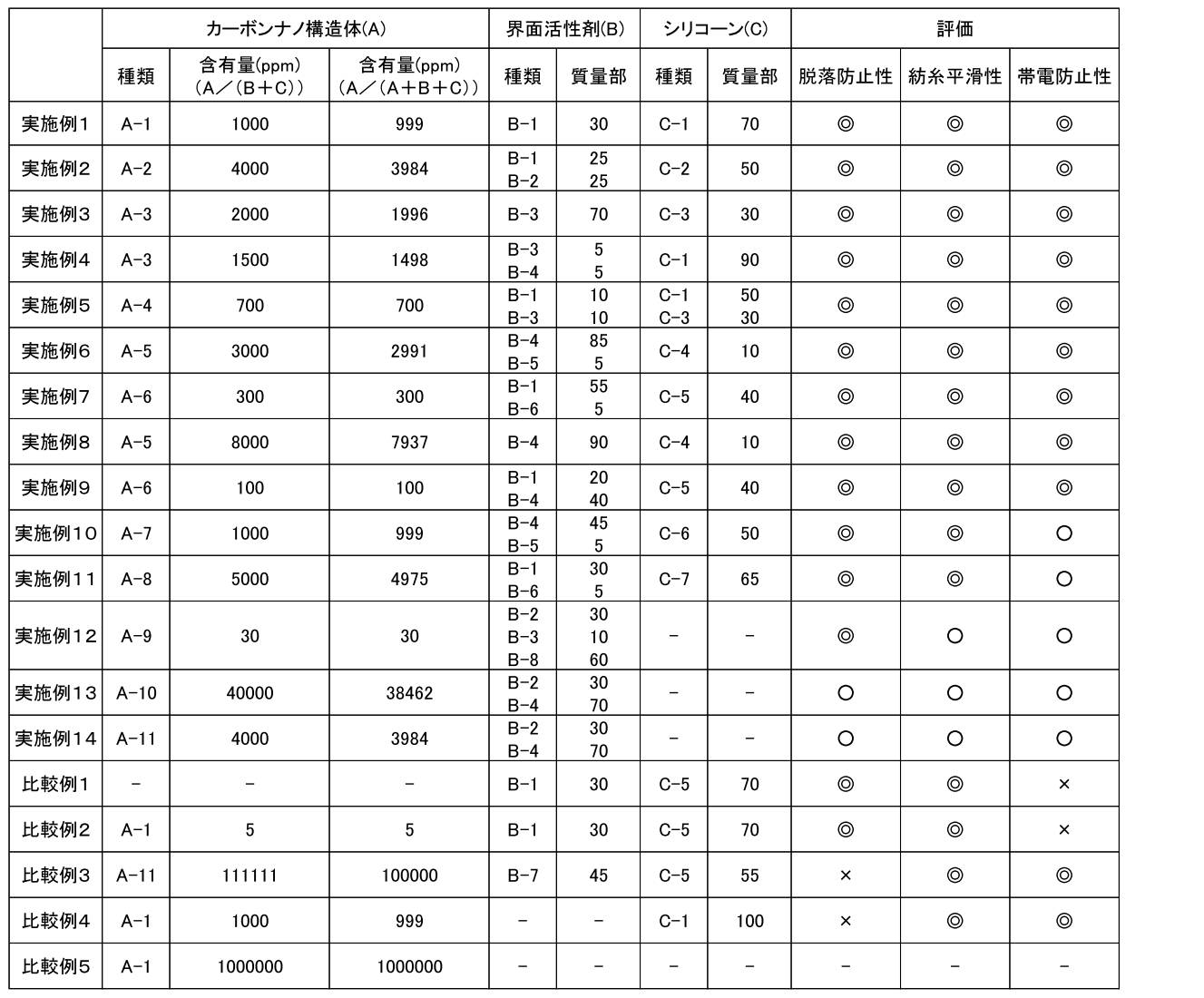
試験区分1で調製した処理剤を用いて、炭素繊維前駆体を製造した。
A carbon fiber precursor was produced using the treatment agent prepared in Test Section 1.
アクリロニトリル95質量%、アクリル酸メチル3.5質量%、メタクリル酸1.5質量%からなる極限粘度1.80の共重合体を、ジメチルアセトアミド(DMAC)に溶解してポリマー濃度が21.0質量%、60℃における粘度が500ポイズの紡糸原液を作成した。紡糸原液は、紡浴温度35℃に保たれたDMACの70質量%水溶液の凝固浴中に孔径(内径)0.075mm、ホール数12,000の紡糸口金よりドラフト比0.8で吐出した。 A copolymer composed of 95% by mass of acrylonitrile, 3.5% by mass of methyl acrylate, and 1.5% by mass of methacrylic acid and having an intrinsic viscosity of 1.80 was dissolved in dimethylacetamide (DMAC) to give a polymer concentration of 21.0% by mass. %, a spinning dope having a viscosity of 500 poise at 60°C was prepared. The spinning stock solution was discharged from a spinneret with a hole diameter (inner diameter) of 0.075 mm and a hole number of 12,000 at a draft ratio of 0.8 into a coagulation bath of 70 mass % aqueous solution of DMAC kept at a spinning bath temperature of 35°C.
凝固糸を水洗槽の中で脱溶媒と同時に5倍に延伸して水膨潤状態のアクリル繊維ストランド(炭素繊維前駆体)を作成した。このアクリル繊維ストランドに対して、固形分付着量が1質量%(溶媒を含まない)となるように、試験区分1で調製した組成物を給油した。組成物の給油は、組成物をさらにイオン交換水で希釈した処理剤の4%希釈液を用いた浸漬給油法により実施した。その後、アクリル繊維ストランドに対して、130℃の加熱ローラーで乾燥緻密化処理を行い、更に170℃の加熱ローラー間で1.7倍の延伸を施した後に巻き取り装置を用いて巻き取りワインダーに巻き取った。 The coagulated yarn was drawn 5 times in a washing tank while the solvent was removed, to prepare a water-swollen acrylic fiber strand (carbon fiber precursor). The composition prepared in test section 1 was applied to the acrylic fiber strands so that the solid content adhesion amount was 1% by mass (not including the solvent). Oiling of the composition was carried out by an immersion oiling method using a 4% dilution of the treatment agent obtained by further diluting the composition with deionized water. After that, the acrylic fiber strand is dried and densified with a heating roller at 130°C, further stretched by 1.7 times between heating rollers at 170°C, and then wound into a winding winder using a winding device. wound up.
試験区分3<評価>
(脱落防止性)
紡糸工程の乾燥緻密化処理に入る直前のローラー表面でのカーボンナノ構造体(A)の脱落物を目視で観察し、以下基準で評価した。結果を表4の脱落防止性欄に示す。
Test Category 3 <Evaluation>
(Falling prevention)
Dropped matter of the carbon nanostructure (A) on the roller surface immediately before starting the drying and densification treatment in the spinning process was visually observed and evaluated according to the following criteria. The results are shown in the drop-off prevention column of Table 4.
◎(良好):脱落物がほとんど見られなかった場合
○(可):脱落物が少量見られたが操業に影響ないレベルである場合
×(不良):脱落物が多く、頻繁に清掃が必要である場合
(帯電防止性)
紡糸工程の巻き取りワインダー直前の発生電気を、デジタル静電電位測定器KSD-1000(春日電機株式会社製)で測定し、以下の基準で評価した。結果を表4の帯電防止性欄に示す。
◎ (Good): Almost no fallen matter was found ○ (Acceptable): A small amount of fallen matter was found, but it was at a level that did not affect operation × (Poor): A lot of fallen matter required frequent cleaning When (antistatic property)
Electricity generated immediately before the take-up winder in the spinning process was measured with a digital electrostatic potential meter KSD-1000 (manufactured by Kasuga Denki Co., Ltd.) and evaluated according to the following criteria. The results are shown in the antistatic column of Table 4.
◎(良好):3kV未満
○(可):3kV以上5kV未満
×(不良):5kV以上
(紡糸平滑性)
紡糸工程の巻き取りワインダーでの単糸の断糸有無を以下の基準で評価した。結果を表4の紡糸平滑性欄に示す。
◎ (good): less than 3 kV ○ (acceptable): 3 kV or more and less than 5 kV × (poor): 5 kV or more (spinning smoothness)
The presence or absence of breakage of the single yarn in the take-up winder in the spinning process was evaluated according to the following criteria. The results are shown in the spinning smoothness column of Table 4.
◎(良好):24時間糸を紡糸した後の巻き取りワインダーを観察して、糸の断糸が見られなかった場合
○(可):24時間糸を紡糸した後の巻き取りワインダーを観察して、わずかに糸の断糸が見られたが操業に問題ないレベルであった場合
×(不良):紡糸開始直後から巻き取りワインダーでの断糸が見られ、操業に問題が生じた場合
表4の各比較例に対する各実施例の評価結果からも明らかなように、本発明の処理剤によると、炭素繊維前駆体の帯電防止性を向上させつつ、カーボンナノ構造体の炭素繊維前駆体からの脱落を防止できる。また、処理剤が付与された炭素繊維前駆体の紡糸平滑性を向上させることができる。なお、比較例5では、カーボンナノ構造体を炭素繊維前駆体に付与できないため、各評価を行っていない。
◎ (Good): When the winding winder was observed after the yarn was spun for 24 hours and no yarn breakage was observed ○ (Fair): The winding winder was observed after the yarn was spun for 24 hours When a slight breakage of the yarn was observed, but it was at a level that did not pose a problem for the operation × (Poor): When the yarn breakage was observed in the take-up winder immediately after the start of spinning, and a problem occurred in the operation Table 4, the treatment agent of the present invention improves the antistatic properties of the carbon fiber precursor, and the carbon nanostructure from the carbon fiber precursor. can be prevented from falling off. Moreover, the spinning smoothness of the carbon fiber precursor to which the treating agent is applied can be improved. In Comparative Example 5, each evaluation was not performed because the carbon nanostructure could not be applied to the carbon fiber precursor.
Claims (6)
前記炭素繊維前駆体用処理剤の不揮発分中における前記カーボンナノ構造体の含有量が、10ppm以上50000ppm未満であることを特徴とする炭素繊維前駆体用処理剤。 A carbon fiber precursor treatment agent containing a carbon nanostructure and a surfactant,
A treating agent for carbon fiber precursors, wherein the content of the carbon nanostructures in the nonvolatile matter of the treating agent for carbon fiber precursors is 10 ppm or more and less than 50000 ppm.
Priority Applications (5)
| Application Number | Priority Date | Filing Date | Title |
|---|---|---|---|
| JP2021196190A JP7018237B1 (en) | 2021-12-02 | 2021-12-02 | Carbon fiber precursor treatment agent, carbon fiber precursor treatment agent-containing composition, and carbon fiber precursor |
| CN202280078603.6A CN118715349A (en) | 2021-12-02 | 2022-11-22 | Carbon fiber precursor treating agent, composition containing the same, and carbon fiber precursor |
| PCT/JP2022/043100 WO2023100711A1 (en) | 2021-12-02 | 2022-11-22 | Treatment agent for carbon fiber precursor, composition containing treatment agent for carbon fiber precursor, and carbon fiber precursor |
| DE112022005207.4T DE112022005207T5 (en) | 2021-12-02 | 2022-11-22 | Treatment agent for carbon fiber precursors, compound containing treatment agent for carbon fiber precursors and carbon fiber precursors |
| US18/714,533 US12553176B2 (en) | 2021-12-02 | 2022-11-22 | Treatment agent for carbon fiber precursor, composition containing treatment agent for carbon fiber precursor, and carbon fiber precursor |
Applications Claiming Priority (1)
| Application Number | Priority Date | Filing Date | Title |
|---|---|---|---|
| JP2021196190A JP7018237B1 (en) | 2021-12-02 | 2021-12-02 | Carbon fiber precursor treatment agent, carbon fiber precursor treatment agent-containing composition, and carbon fiber precursor |
Publications (2)
| Publication Number | Publication Date |
|---|---|
| JP7018237B1 JP7018237B1 (en) | 2022-02-10 |
| JP2023082425A true JP2023082425A (en) | 2023-06-14 |
Family
ID=80856449
Family Applications (1)
| Application Number | Title | Priority Date | Filing Date |
|---|---|---|---|
| JP2021196190A Active JP7018237B1 (en) | 2021-12-02 | 2021-12-02 | Carbon fiber precursor treatment agent, carbon fiber precursor treatment agent-containing composition, and carbon fiber precursor |
Country Status (5)
| Country | Link |
|---|---|
| US (1) | US12553176B2 (en) |
| JP (1) | JP7018237B1 (en) |
| CN (1) | CN118715349A (en) |
| DE (1) | DE112022005207T5 (en) |
| WO (1) | WO2023100711A1 (en) |
Citations (7)
| Publication number | Priority date | Publication date | Assignee | Title |
|---|---|---|---|---|
| JPS55128020A (en) * | 1979-01-29 | 1980-10-03 | Union Carbide Corp | Treating of multi filament bundle of pitch fiber and finishing composition |
| JP2010007216A (en) * | 2008-06-30 | 2010-01-14 | Mitsubishi Rayon Co Ltd | Oil solution composition for carbon fiber precursor acrylic fiber, carbon fiber precursor acrylic fiber bundle, and method of production thereof |
| JP2012021238A (en) * | 2010-07-12 | 2012-02-02 | Mitsubishi Rayon Co Ltd | Method for producing carbon fiber bundle |
| CN104452270A (en) * | 2014-12-19 | 2015-03-25 | 四川创越炭材料有限公司 | Spinning finish for asphalt carbon fiber |
| JP2015537125A (en) * | 2012-10-22 | 2015-12-24 | アルケマ フランス | Carbon fiber production method, precursor material used by the method, and carbon fiber obtained |
| JP2016060969A (en) * | 2014-09-12 | 2016-04-25 | イビデン株式会社 | Inorganic fiber having carbon particles buried thereon, method for producing the same, assembly of inorganic fibers having carbon particles buried thereon, and exhaust purifying device |
| JP6923978B1 (en) * | 2020-12-21 | 2021-08-25 | 竹本油脂株式会社 | Sizing agents for inorganic fibers, inorganic fibers, their manufacturing methods, and composite materials |
Family Cites Families (9)
| Publication number | Priority date | Publication date | Assignee | Title |
|---|---|---|---|---|
| EP0014161B1 (en) * | 1979-01-29 | 1983-03-30 | Union Carbide Corporation | Method of treating a multifilament bundle of pitch fibers and a spin size composition therefor |
| US4276278A (en) | 1979-01-29 | 1981-06-30 | Union Carbide Corporation | Spin size and thermosetting aid for pitch fibers |
| US8951632B2 (en) * | 2007-01-03 | 2015-02-10 | Applied Nanostructured Solutions, Llc | CNT-infused carbon fiber materials and process therefor |
| JP2010261108A (en) * | 2007-08-31 | 2010-11-18 | Hokkaido Univ | Synthetic fiber, synthetic fiber yarn or fiber structure to which carbon nanotubes are attached, and method for producing them |
| JP5697258B2 (en) * | 2009-03-06 | 2015-04-08 | 東洋紡株式会社 | Method for producing precursor fiber for obtaining high strength and high modulus carbon fiber |
| KR101625739B1 (en) * | 2013-06-21 | 2016-06-13 | 코오롱인더스트리 주식회사 | Polyacrylonitrile Precursor for Carbon Fiber and Method for Preparing the Same |
| JP2020107216A (en) | 2018-12-28 | 2020-07-09 | キヤノン株式会社 | Information processor, control method thereof, and program |
| GB201907004D0 (en) | 2019-05-17 | 2019-07-03 | Univ Limerick | Improvements relating to carbon fibre processing |
| CN110380016A (en) * | 2019-06-04 | 2019-10-25 | 深圳烯湾科技有限公司 | Carbon nanotube aqueous slurry, carbon nanotube silicon carbon material and preparation method thereof |
-
2021
- 2021-12-02 JP JP2021196190A patent/JP7018237B1/en active Active
-
2022
- 2022-11-22 US US18/714,533 patent/US12553176B2/en active Active
- 2022-11-22 DE DE112022005207.4T patent/DE112022005207T5/en active Pending
- 2022-11-22 CN CN202280078603.6A patent/CN118715349A/en active Pending
- 2022-11-22 WO PCT/JP2022/043100 patent/WO2023100711A1/en not_active Ceased
Patent Citations (7)
| Publication number | Priority date | Publication date | Assignee | Title |
|---|---|---|---|---|
| JPS55128020A (en) * | 1979-01-29 | 1980-10-03 | Union Carbide Corp | Treating of multi filament bundle of pitch fiber and finishing composition |
| JP2010007216A (en) * | 2008-06-30 | 2010-01-14 | Mitsubishi Rayon Co Ltd | Oil solution composition for carbon fiber precursor acrylic fiber, carbon fiber precursor acrylic fiber bundle, and method of production thereof |
| JP2012021238A (en) * | 2010-07-12 | 2012-02-02 | Mitsubishi Rayon Co Ltd | Method for producing carbon fiber bundle |
| JP2015537125A (en) * | 2012-10-22 | 2015-12-24 | アルケマ フランス | Carbon fiber production method, precursor material used by the method, and carbon fiber obtained |
| JP2016060969A (en) * | 2014-09-12 | 2016-04-25 | イビデン株式会社 | Inorganic fiber having carbon particles buried thereon, method for producing the same, assembly of inorganic fibers having carbon particles buried thereon, and exhaust purifying device |
| CN104452270A (en) * | 2014-12-19 | 2015-03-25 | 四川创越炭材料有限公司 | Spinning finish for asphalt carbon fiber |
| JP6923978B1 (en) * | 2020-12-21 | 2021-08-25 | 竹本油脂株式会社 | Sizing agents for inorganic fibers, inorganic fibers, their manufacturing methods, and composite materials |
Also Published As
| Publication number | Publication date |
|---|---|
| US12553176B2 (en) | 2026-02-17 |
| CN118715349A (en) | 2024-09-27 |
| WO2023100711A1 (en) | 2023-06-08 |
| JP7018237B1 (en) | 2022-02-10 |
| US20240328071A1 (en) | 2024-10-03 |
| DE112022005207T5 (en) | 2024-08-08 |
Similar Documents
| Publication | Publication Date | Title |
|---|---|---|
| JP5834917B2 (en) | Method for producing carbon fiber prepreg, method for producing carbon fiber reinforced composite material | |
| TWI397626B (en) | Oil composition for carbon fiber precursor acrylic fiber, carbon fiber precursor acrylic fiber bundle and method for producing the same | |
| JP6577307B2 (en) | Oil agent for carbon fiber precursor acrylic fiber, oil agent composition for carbon fiber precursor acrylic fiber, and oil agent treatment liquid for carbon fiber precursor acrylic fiber | |
| DE60316988T2 (en) | METHOD FOR THE PRODUCTION AND METHOD FOR CONVERTING POLYOLEFIN FIBERS | |
| DE102020117303A1 (en) | Carbon fiber precursor treatment agent and carbon fiber precursor | |
| DE112022002444B4 (en) | Synthetic fiber treatments and synthetic fibers | |
| WO2012169551A1 (en) | Oil solution for carbon fiber precursor acrylic fibers, oil solution composition for carbon fiber precursor acrylic fibers, oil solution processed liquid for carbon fiber precursor acrylic fibers, carbon fiber precursor acrylic fiber bundle, and method for producing carbon fiber bundle using carbon fiber precursor acrylic fiber bundle | |
| CN107075789B (en) | Oil for carbon fiber precursor acrylic fiber, composition and treatment liquid thereof, carbon fiber precursor acrylic fiber bundle | |
| TWI718953B (en) | Treatment agent for carbon fiber precursor and carbon fiber precursor | |
| HUE029498T2 (en) | Carbon-fiber-precursor acrylic fiber bundle with oil composition adhering thereto, process for producing same, oil composition for carbon-fiber-precursor acrylic fiber, and oil composition dispersion for carbon-fiber-precursor acrylic fiber | |
| JP7511948B2 (en) | Treatment agent for carbon fiber precursor and carbon fiber precursor | |
| JP6923978B1 (en) | Sizing agents for inorganic fibers, inorganic fibers, their manufacturing methods, and composite materials | |
| JP5707690B2 (en) | Oil composition for carbon fiber precursor acrylic fiber, carbon fiber precursor acrylic fiber bundle and method for producing the same | |
| DE112022001762B4 (en) | Treatment agents for carbon fiber precursors, and carbon fiber precursors | |
| WO2023100711A1 (en) | Treatment agent for carbon fiber precursor, composition containing treatment agent for carbon fiber precursor, and carbon fiber precursor | |
| JP2013249572A (en) | Oil for carbon fiber precursor acrylic fiber, oil composition for carbon fiber precursor acrylic fiber, and oil-treating liquid for carbon fiber precursor acrylic fiber | |
| CN105862156B (en) | A kind of cellulose/hydroxyl multi-walled carbon nano-tube/Fe3O4Nano-particles reinforcement fiber and preparation method thereof | |
| KR20200077560A (en) | Carbon nanotube dispersion and method for manufacturing the same | |
| CN1662699A (en) | Collecting agent for glass fiber yarn and method for producing glass fiber yarn | |
| CN107201029A (en) | A kind of fishing net of high intensity | |
| JP5862198B2 (en) | Carbon fiber precursor acrylic fiber bundle | |
| JP5588229B2 (en) | Fiber treatment agent and method for producing synthetic fiber | |
| JP7800139B2 (en) | Sizing agent-coated carbon fiber bundle and method for producing the same | |
| JP5831129B2 (en) | Carbon fiber precursor acrylic fiber bundle | |
| JP7653139B2 (en) | Sizing agent for inorganic fibers, inorganic fibers, their manufacturing method, and composite materials |
Legal Events
| Date | Code | Title | Description |
|---|---|---|---|
| A621 | Written request for application examination |
Free format text: JAPANESE INTERMEDIATE CODE: A621 Effective date: 20211202 |
|
| A871 | Explanation of circumstances concerning accelerated examination |
Free format text: JAPANESE INTERMEDIATE CODE: A871 Effective date: 20211202 |
|
| TRDD | Decision of grant or rejection written | ||
| A01 | Written decision to grant a patent or to grant a registration (utility model) |
Free format text: JAPANESE INTERMEDIATE CODE: A01 Effective date: 20220118 |
|
| A61 | First payment of annual fees (during grant procedure) |
Free format text: JAPANESE INTERMEDIATE CODE: A61 Effective date: 20220124 |
|
| R150 | Certificate of patent or registration of utility model |
Ref document number: 7018237 Country of ref document: JP Free format text: JAPANESE INTERMEDIATE CODE: R150 |
|
| R250 | Receipt of annual fees |
Free format text: JAPANESE INTERMEDIATE CODE: R250 |
|
| R250 | Receipt of annual fees |
Free format text: JAPANESE INTERMEDIATE CODE: R250 |