JP2023123701A - Microorganisms and methods for bioproduction of ethylene glycol - Google Patents
Microorganisms and methods for bioproduction of ethylene glycol Download PDFInfo
- Publication number
- JP2023123701A JP2023123701A JP2023105168A JP2023105168A JP2023123701A JP 2023123701 A JP2023123701 A JP 2023123701A JP 2023105168 A JP2023105168 A JP 2023105168A JP 2023105168 A JP2023105168 A JP 2023105168A JP 2023123701 A JP2023123701 A JP 2023123701A
- Authority
- JP
- Japan
- Prior art keywords
- microorganism
- enzyme
- converting
- ethylene glycol
- acid
- Prior art date
- Legal status (The legal status is an assumption and is not a legal conclusion. Google has not performed a legal analysis and makes no representation as to the accuracy of the status listed.)
- Pending
Links
Images






Classifications
-
- C—CHEMISTRY; METALLURGY
- C12—BIOCHEMISTRY; BEER; SPIRITS; WINE; VINEGAR; MICROBIOLOGY; ENZYMOLOGY; MUTATION OR GENETIC ENGINEERING
- C12P—FERMENTATION OR ENZYME-USING PROCESSES TO SYNTHESISE A DESIRED CHEMICAL COMPOUND OR COMPOSITION OR TO SEPARATE OPTICAL ISOMERS FROM A RACEMIC MIXTURE
- C12P7/00—Preparation of oxygen-containing organic compounds
- C12P7/02—Preparation of oxygen-containing organic compounds containing a hydroxy group
- C12P7/04—Preparation of oxygen-containing organic compounds containing a hydroxy group acyclic
- C12P7/18—Preparation of oxygen-containing organic compounds containing a hydroxy group acyclic polyhydric
-
- C—CHEMISTRY; METALLURGY
- C12—BIOCHEMISTRY; BEER; SPIRITS; WINE; VINEGAR; MICROBIOLOGY; ENZYMOLOGY; MUTATION OR GENETIC ENGINEERING
- C12N—MICROORGANISMS OR ENZYMES; COMPOSITIONS THEREOF; PROPAGATING, PRESERVING, OR MAINTAINING MICROORGANISMS; MUTATION OR GENETIC ENGINEERING; CULTURE MEDIA
- C12N9/00—Enzymes; Proenzymes; Compositions thereof; Processes for preparing, activating, inhibiting, separating or purifying enzymes
- C12N9/0004—Oxidoreductases (1.)
- C12N9/0008—Oxidoreductases (1.) acting on the aldehyde or oxo group of donors (1.2)
-
- C—CHEMISTRY; METALLURGY
- C12—BIOCHEMISTRY; BEER; SPIRITS; WINE; VINEGAR; MICROBIOLOGY; ENZYMOLOGY; MUTATION OR GENETIC ENGINEERING
- C12N—MICROORGANISMS OR ENZYMES; COMPOSITIONS THEREOF; PROPAGATING, PRESERVING, OR MAINTAINING MICROORGANISMS; MUTATION OR GENETIC ENGINEERING; CULTURE MEDIA
- C12N1/00—Microorganisms; Compositions thereof; Processes of propagating, maintaining or preserving microorganisms or compositions thereof; Processes of preparing or isolating a composition containing a microorganism; Culture media therefor
- C12N1/20—Bacteria; Culture media therefor
-
- C—CHEMISTRY; METALLURGY
- C12—BIOCHEMISTRY; BEER; SPIRITS; WINE; VINEGAR; MICROBIOLOGY; ENZYMOLOGY; MUTATION OR GENETIC ENGINEERING
- C12N—MICROORGANISMS OR ENZYMES; COMPOSITIONS THEREOF; PROPAGATING, PRESERVING, OR MAINTAINING MICROORGANISMS; MUTATION OR GENETIC ENGINEERING; CULTURE MEDIA
- C12N15/00—Mutation or genetic engineering; DNA or RNA concerning genetic engineering, vectors, e.g. plasmids, or their isolation, preparation or purification; Use of hosts therefor
- C12N15/09—Recombinant DNA-technology
- C12N15/11—DNA or RNA fragments; Modified forms thereof; Non-coding nucleic acids having a biological activity
- C12N15/52—Genes encoding for enzymes or proenzymes
-
- C—CHEMISTRY; METALLURGY
- C12—BIOCHEMISTRY; BEER; SPIRITS; WINE; VINEGAR; MICROBIOLOGY; ENZYMOLOGY; MUTATION OR GENETIC ENGINEERING
- C12N—MICROORGANISMS OR ENZYMES; COMPOSITIONS THEREOF; PROPAGATING, PRESERVING, OR MAINTAINING MICROORGANISMS; MUTATION OR GENETIC ENGINEERING; CULTURE MEDIA
- C12N9/00—Enzymes; Proenzymes; Compositions thereof; Processes for preparing, activating, inhibiting, separating or purifying enzymes
- C12N9/0004—Oxidoreductases (1.)
- C12N9/0012—Oxidoreductases (1.) acting on nitrogen containing compounds as donors (1.4, 1.5, 1.6, 1.7)
- C12N9/0014—Oxidoreductases (1.) acting on nitrogen containing compounds as donors (1.4, 1.5, 1.6, 1.7) acting on the CH-NH2 group of donors (1.4)
-
- C—CHEMISTRY; METALLURGY
- C12—BIOCHEMISTRY; BEER; SPIRITS; WINE; VINEGAR; MICROBIOLOGY; ENZYMOLOGY; MUTATION OR GENETIC ENGINEERING
- C12N—MICROORGANISMS OR ENZYMES; COMPOSITIONS THEREOF; PROPAGATING, PRESERVING, OR MAINTAINING MICROORGANISMS; MUTATION OR GENETIC ENGINEERING; CULTURE MEDIA
- C12N9/00—Enzymes; Proenzymes; Compositions thereof; Processes for preparing, activating, inhibiting, separating or purifying enzymes
- C12N9/10—Transferases (2.)
- C12N9/1025—Acyltransferases (2.3)
-
- C—CHEMISTRY; METALLURGY
- C12—BIOCHEMISTRY; BEER; SPIRITS; WINE; VINEGAR; MICROBIOLOGY; ENZYMOLOGY; MUTATION OR GENETIC ENGINEERING
- C12N—MICROORGANISMS OR ENZYMES; COMPOSITIONS THEREOF; PROPAGATING, PRESERVING, OR MAINTAINING MICROORGANISMS; MUTATION OR GENETIC ENGINEERING; CULTURE MEDIA
- C12N9/00—Enzymes; Proenzymes; Compositions thereof; Processes for preparing, activating, inhibiting, separating or purifying enzymes
- C12N9/10—Transferases (2.)
- C12N9/1096—Transferases (2.) transferring nitrogenous groups (2.6)
-
- C—CHEMISTRY; METALLURGY
- C12—BIOCHEMISTRY; BEER; SPIRITS; WINE; VINEGAR; MICROBIOLOGY; ENZYMOLOGY; MUTATION OR GENETIC ENGINEERING
- C12N—MICROORGANISMS OR ENZYMES; COMPOSITIONS THEREOF; PROPAGATING, PRESERVING, OR MAINTAINING MICROORGANISMS; MUTATION OR GENETIC ENGINEERING; CULTURE MEDIA
- C12N9/00—Enzymes; Proenzymes; Compositions thereof; Processes for preparing, activating, inhibiting, separating or purifying enzymes
- C12N9/88—Lyases (4.)
-
- C—CHEMISTRY; METALLURGY
- C12—BIOCHEMISTRY; BEER; SPIRITS; WINE; VINEGAR; MICROBIOLOGY; ENZYMOLOGY; MUTATION OR GENETIC ENGINEERING
- C12P—FERMENTATION OR ENZYME-USING PROCESSES TO SYNTHESISE A DESIRED CHEMICAL COMPOUND OR COMPOSITION OR TO SEPARATE OPTICAL ISOMERS FROM A RACEMIC MIXTURE
- C12P7/00—Preparation of oxygen-containing organic compounds
- C12P7/02—Preparation of oxygen-containing organic compounds containing a hydroxy group
- C12P7/04—Preparation of oxygen-containing organic compounds containing a hydroxy group acyclic
- C12P7/06—Ethanol, i.e. non-beverage
-
- C—CHEMISTRY; METALLURGY
- C12—BIOCHEMISTRY; BEER; SPIRITS; WINE; VINEGAR; MICROBIOLOGY; ENZYMOLOGY; MUTATION OR GENETIC ENGINEERING
- C12P—FERMENTATION OR ENZYME-USING PROCESSES TO SYNTHESISE A DESIRED CHEMICAL COMPOUND OR COMPOSITION OR TO SEPARATE OPTICAL ISOMERS FROM A RACEMIC MIXTURE
- C12P7/00—Preparation of oxygen-containing organic compounds
- C12P7/40—Preparation of oxygen-containing organic compounds containing a carboxyl group including Peroxycarboxylic acids
- C12P7/42—Hydroxy-carboxylic acids
-
- C—CHEMISTRY; METALLURGY
- C12—BIOCHEMISTRY; BEER; SPIRITS; WINE; VINEGAR; MICROBIOLOGY; ENZYMOLOGY; MUTATION OR GENETIC ENGINEERING
- C12P—FERMENTATION OR ENZYME-USING PROCESSES TO SYNTHESISE A DESIRED CHEMICAL COMPOUND OR COMPOSITION OR TO SEPARATE OPTICAL ISOMERS FROM A RACEMIC MIXTURE
- C12P7/00—Preparation of oxygen-containing organic compounds
- C12P7/40—Preparation of oxygen-containing organic compounds containing a carboxyl group including Peroxycarboxylic acids
- C12P7/44—Polycarboxylic acids
- C12P7/46—Dicarboxylic acids having four or less carbon atoms, e.g. fumaric acid, maleic acid
-
- C—CHEMISTRY; METALLURGY
- C12—BIOCHEMISTRY; BEER; SPIRITS; WINE; VINEGAR; MICROBIOLOGY; ENZYMOLOGY; MUTATION OR GENETIC ENGINEERING
- C12Y—ENZYMES
- C12Y102/00—Oxidoreductases acting on the aldehyde or oxo group of donors (1.2)
- C12Y102/01—Oxidoreductases acting on the aldehyde or oxo group of donors (1.2) with NAD+ or NADP+ as acceptor (1.2.1)
- C12Y102/01003—Aldehyde dehydrogenase (NAD+) (1.2.1.3)
-
- C—CHEMISTRY; METALLURGY
- C12—BIOCHEMISTRY; BEER; SPIRITS; WINE; VINEGAR; MICROBIOLOGY; ENZYMOLOGY; MUTATION OR GENETIC ENGINEERING
- C12Y—ENZYMES
- C12Y102/00—Oxidoreductases acting on the aldehyde or oxo group of donors (1.2)
- C12Y102/01—Oxidoreductases acting on the aldehyde or oxo group of donors (1.2) with NAD+ or NADP+ as acceptor (1.2.1)
- C12Y102/01021—Glycolaldehyde dehydrogenase (1.2.1.21)
-
- C—CHEMISTRY; METALLURGY
- C12—BIOCHEMISTRY; BEER; SPIRITS; WINE; VINEGAR; MICROBIOLOGY; ENZYMOLOGY; MUTATION OR GENETIC ENGINEERING
- C12Y—ENZYMES
- C12Y203/00—Acyltransferases (2.3)
- C12Y203/03—Acyl groups converted into alkyl on transfer (2.3.3)
- C12Y203/03001—Citrate (Si)-synthase (2.3.3.1)
-
- C—CHEMISTRY; METALLURGY
- C12—BIOCHEMISTRY; BEER; SPIRITS; WINE; VINEGAR; MICROBIOLOGY; ENZYMOLOGY; MUTATION OR GENETIC ENGINEERING
- C12Y—ENZYMES
- C12Y206/00—Transferases transferring nitrogenous groups (2.6)
- C12Y206/01—Transaminases (2.6.1)
- C12Y206/01044—Alanine--glyoxylate transaminase (2.6.1.44)
-
- C—CHEMISTRY; METALLURGY
- C12—BIOCHEMISTRY; BEER; SPIRITS; WINE; VINEGAR; MICROBIOLOGY; ENZYMOLOGY; MUTATION OR GENETIC ENGINEERING
- C12Y—ENZYMES
- C12Y401/00—Carbon-carbon lyases (4.1)
- C12Y401/03—Oxo-acid-lyases (4.1.3)
- C12Y401/03001—Isocitrate lyase (4.1.3.1)
-
- C—CHEMISTRY; METALLURGY
- C12—BIOCHEMISTRY; BEER; SPIRITS; WINE; VINEGAR; MICROBIOLOGY; ENZYMOLOGY; MUTATION OR GENETIC ENGINEERING
- C12N—MICROORGANISMS OR ENZYMES; COMPOSITIONS THEREOF; PROPAGATING, PRESERVING, OR MAINTAINING MICROORGANISMS; MUTATION OR GENETIC ENGINEERING; CULTURE MEDIA
- C12N2800/00—Nucleic acids vectors
- C12N2800/22—Vectors comprising a coding region that has been codon optimised for expression in a respective host
-
- Y—GENERAL TAGGING OF NEW TECHNOLOGICAL DEVELOPMENTS; GENERAL TAGGING OF CROSS-SECTIONAL TECHNOLOGIES SPANNING OVER SEVERAL SECTIONS OF THE IPC; TECHNICAL SUBJECTS COVERED BY FORMER USPC CROSS-REFERENCE ART COLLECTIONS [XRACs] AND DIGESTS
- Y02—TECHNOLOGIES OR APPLICATIONS FOR MITIGATION OR ADAPTATION AGAINST CLIMATE CHANGE
- Y02E—REDUCTION OF GREENHOUSE GAS [GHG] EMISSIONS, RELATED TO ENERGY GENERATION, TRANSMISSION OR DISTRIBUTION
- Y02E50/00—Technologies for the production of fuel of non-fossil origin
- Y02E50/10—Biofuels, e.g. bio-diesel
-
- Y—GENERAL TAGGING OF NEW TECHNOLOGICAL DEVELOPMENTS; GENERAL TAGGING OF CROSS-SECTIONAL TECHNOLOGIES SPANNING OVER SEVERAL SECTIONS OF THE IPC; TECHNICAL SUBJECTS COVERED BY FORMER USPC CROSS-REFERENCE ART COLLECTIONS [XRACs] AND DIGESTS
- Y02—TECHNOLOGIES OR APPLICATIONS FOR MITIGATION OR ADAPTATION AGAINST CLIMATE CHANGE
- Y02E—REDUCTION OF GREENHOUSE GAS [GHG] EMISSIONS, RELATED TO ENERGY GENERATION, TRANSMISSION OR DISTRIBUTION
- Y02E50/00—Technologies for the production of fuel of non-fossil origin
- Y02E50/30—Fuel from waste, e.g. synthetic alcohol or diesel
Landscapes
- Chemical & Material Sciences (AREA)
- Life Sciences & Earth Sciences (AREA)
- Organic Chemistry (AREA)
- Health & Medical Sciences (AREA)
- Engineering & Computer Science (AREA)
- Zoology (AREA)
- Wood Science & Technology (AREA)
- Genetics & Genomics (AREA)
- Bioinformatics & Cheminformatics (AREA)
- General Engineering & Computer Science (AREA)
- Biochemistry (AREA)
- General Health & Medical Sciences (AREA)
- Biotechnology (AREA)
- Microbiology (AREA)
- Biomedical Technology (AREA)
- Molecular Biology (AREA)
- Medicinal Chemistry (AREA)
- Chemical Kinetics & Catalysis (AREA)
- General Chemical & Material Sciences (AREA)
- Physics & Mathematics (AREA)
- Biophysics (AREA)
- Plant Pathology (AREA)
- Tropical Medicine & Parasitology (AREA)
- Virology (AREA)
- Micro-Organisms Or Cultivation Processes Thereof (AREA)
- Preparation Of Compounds By Using Micro-Organisms (AREA)
Abstract
Description
背景
本発明は、遺伝子操作された微生物と、微生物発酵による、具体的には、ガス状基質の
微生物発酵によるにエチレングリコールおよびエチレングリコール前駆体の生産のための
方法とに関する。
BACKGROUND The present invention relates to genetically engineered microorganisms and methods for the production of ethylene glycol and ethylene glycol precursors by microbial fermentation, particularly by microbial fermentation of gaseous substrates.
モノエチレングリコール(MEG)としても知られるエチレングリコールの現在の市場
価値は330億ドルを超え、多種多様な産業、医療、消費者製品の重要な構成要素である
。エチレングリコールは現在、大量のエネルギーと水を必要とし、多くの望ましくない副
産物を生成し、石油化学原料に依存する化学触媒プロセスを使用して生産されている。持
続可能な材料の需要は、サトウキビ由来のエタノールからのエチレングリコールの触媒的
な生産など、いくつかの技術進歩をもたらしている。
Ethylene glycol, also known as monoethylene glycol (MEG), has a current market value of over $33 billion and is an important component of a wide variety of industrial, medical and consumer products. Ethylene glycol is currently produced using chemical catalytic processes that require large amounts of energy and water, produce many undesirable by-products, and rely on petrochemical feedstocks. The demand for sustainable materials has led to several technological advances, such as the catalytic production of ethylene glycol from sugar cane-derived ethanol.
エチレングリコール前駆体も商業的に価値がある。例えば、グリコール酸はスキンケア
、パーソナルケア、染色、日焼け、および洗浄剤として使用される。グリオキシル酸は、
バニリン、農薬、抗生物質、アラントイン、および錯化剤の中間体である。
Ethylene glycol precursors are also commercially valuable. For example, glycolic acid is used as a skin care, personal care, dye, tan, and cleanser. glyoxylic acid is
Intermediate of vanillin, pesticides, antibiotics, allantoin, and complexing agents.
しかしながら、エチレングリコールを生物学的に生産できる微生物は知られておらず、
エチレングリコールの生産への完全な生物学的経路は十分に確立されていない。糖からの
エチレングリコールへのいくつかの生物学的経路が文献に記載されている。例えば、Al
kim et al.,Microb Cell Fact,14:127,2015は
、E.coliでの(D)-キシロースからのエチレングリコールの生成を実証したが、
高収量を達成するには好気性条件が必要であることに着目した。同様に、Pereira
et al.,Metab Eng,34:80-87,2016では、E.coli
でのペントースからのエチレングリコール生成を達成した。S.cerevisiaeで
のペントースからのエチレングリコール生成に関するいくつかの研究も行われているが、
一貫性のない結果が示されている。例えば、Uranukul et al.,Meta
b Eng,51:20-31,2018を参照されたい。
However, no microorganisms capable of biologically producing ethylene glycol are known.
A complete biological pathway to the production of ethylene glycol is not well established. Several biological routes to ethylene glycol from sugars have been described in the literature. For example, Al
Kim et al. , Microb Cell Fact, 14:127, 2015, in E.M. demonstrated the production of ethylene glycol from (D)-xylose in E. coli,
We noted that aerobic conditions were necessary to achieve high yields. Similarly, Pereira
et al. , Metab Eng, 34:80-87, 2016; coli
achieved ethylene glycol production from pentoses at . S. Some studies on ethylene glycol production from pentoses in cerevisiae have also been performed,
Inconsistent results have been shown. For example, Uranukul et al. , Meta
b Eng, 51:20-31, 2018.
ガス発酵は、産業廃棄ガス、合成ガス、化学薬品や燃料に改質されたメタンなど、すぐ
に入手できる低コストのC1原料を幅広く使用するための経路を提供する。ガス発酵代謝
は糖発酵代謝とは大きく異なるので、上記の経路の使用は、これらの経路がエネルギーネ
ガティブプロセスである糖新生を介してガスから糖前駆体を生成する必要があるため、実
用的ではない。今日まで、ガス状基質からエチレングリコールを製造する方法は得られて
いない。
Gas fermentation provides a pathway for widespread use of readily available, low-cost C1 feedstocks such as industrial waste gases, syngas, and methane that has been reformed into chemicals and fuels. Since gas fermentative metabolism is very different from sugar fermentative metabolism, the use of the above pathways is impractical as these pathways require the generation of sugar precursors from gases via gluconeogenesis, an energy negative process. do not have. To date, no method is available for producing ethylene glycol from gaseous substrates.
Islam et al.,Metab Eng,41:173-181,2017は
、探索的演習で、ケモインフォマティクスツールを使用してM.thermoaceti
aで合成ガスからエチレングリコールを生成するための数百の仮説的な経路を予測した。
しかしながら、経路の多くは熱力学的または他の制約のために実行不可能であるため、当
業者でさえこれらの経路をガス発酵生物に組み込むことは不可能である。例えば、Isl
am et al.には、ほぼ2,000の酸素または酸素ラジカルに依存する反応が含
まれており、厳密な嫌気性システムでは実行できない。既知の反応を有するIslam
et al.による唯一確認された仮説の経路は、中間体として糖新生またはエタノール
を必要とする。したがって、ガス状基質から高収量のエチレングリコールおよびエチレン
グリコール前駆体を生成することができる、有効な、エネルギー的に好ましい組換え生成
システムが依然として必要とされている。
Islam et al. , Metab Eng, 41:173-181, 2017, in an exploratory exercise, using cheminformatics tools to thermoaceti
Hundreds of hypothetical pathways for producing ethylene glycol from syngas were predicted in a.
However, many of the pathways are infeasible due to thermodynamic or other constraints, and even those skilled in the art are unable to integrate these pathways into gas-fermenting organisms. For example, Isl
am et al. contains nearly 2,000 oxygen- or oxygen radical-dependent reactions, which cannot be performed in a strictly anaerobic system. Islam with known reactions
et al. The only confirmed hypothetical pathways by , require gluconeogenesis or ethanol as intermediates. Thus, there remains a need for efficient, energetically favorable recombinant production systems capable of producing high yields of ethylene glycol and ethylene glycol precursors from gaseous substrates.
本発明が従来技術に勝る特定の利点および進歩を提供するのは、上記の背景においてで
ある。
It is against this background that the present invention offers certain advantages and advancements over the prior art.
本明細書に開示される本発明は、特定の利点または機能に限定されないが、本発明は、
ガス状基質からエチレングリコールまたはエチレングリコールの前駆体を生成できる遺伝
子操作された微生物を提供する。
Although the invention disclosed herein is not limited to any particular advantage or feature, the invention
Genetically engineered microorganisms capable of producing ethylene glycol or ethylene glycol precursors from gaseous substrates are provided.
本明細書に開示される微生物のいくつかの態様において、微生物は、5,10-メチレ
ンテトラヒドロ葉酸、オキサロ酢酸、クエン酸、リンゴ酸、およびグリシンからなる群か
ら選択される1つ以上の中間体を介してエチレングリコールまたはエチレングリコールの
前駆体を生成する。
In some embodiments of the microorganisms disclosed herein, the microorganism is one or more intermediates selected from the group consisting of 5,10-methylenetetrahydrofolic acid, oxaloacetic acid, citric acid, malic acid, and glycine. to produce ethylene glycol or ethylene glycol precursors via
本明細書に開示される微生物のいくつかの態様では、微生物は、オキサロ酢酸をクエン
酸に変換できる異種酵素、グリシンをグリオキシル酸に変換できる異種酵素、イソクエン
酸をグリオキシル酸に変換できる異種酵素、およびグリコール酸をグリコアルデヒドに変
換できる異種酵素のうちの1つ以上を含む。
In some aspects of the microorganism disclosed herein, the microorganism comprises a heterologous enzyme capable of converting oxaloacetate to citrate, a heterologous enzyme capable of converting glycine to glyoxylate, a heterologous enzyme capable of converting isocitrate to glyoxylate, and one or more heterologous enzymes that can convert glycolic acid to glycoaldehyde.
本明細書に開示される微生物のいくつかの態様において、オキサロ酢酸をクエン酸に変
換できる前記異種酵素が、クエン酸[Si]-シンターゼ[2.3.3.1]、ATPク
エン酸シンターゼ[2.3.3.8]またはクエン酸(Re)-シンターゼ[2.3.3
.3]であり、グリシンをグリオキシル酸に変換できる前記異種酵素が、アラニン-グリ
オキシル酸トランスアミナーゼ[2.6.1.44]、セリン-グリオキシル酸トランス
アミナーゼ[2.6.1.45]、セリン-ピルビン酸トランスアミナーゼ[2.6.1
.51]、グリシン-オキサロ酢酸トランスアミナーゼ[2.6.1.35]、グリシン
トランスアミナーゼ[2.6.1.4]、グリシンデヒドロゲナーゼ[1.4.1.10
]、アラニンデヒドロゲナーゼ[1.4.1.1]、またはグリシンデヒドロゲナーゼ[
1.4.2.1]であり、イソクエン酸をグリオキシル酸に変換できる前記異種酵素が、
イソクエン酸リアーゼ[4.1.3.1]であり、かつ/またはグリコール酸をグリコア
ルデヒドに変換できる前記異種酵素が、グリコールアルデヒドデヒドロゲナーゼ[1.2
.1.21]、ラクトアルデヒドデヒドロゲナーゼ[1.2.1.22]、コハク酸セミ
アルデヒドデヒドロゲナーゼ[1.2.1.24]、2,5-ジオキソ吉草酸デヒドロゲ
ナーゼ[1.2.1.26]、アルデヒドデヒドロゲナーゼ[1.2.1.3/4/5]
、ベタイン-アルデヒドデヒドロゲナーゼ[1.2.1.8]、またはアルデヒドフェレ
ドキシンオキシドレダクターゼ[1.2.7.5]である。
In some embodiments of the microorganism disclosed herein, said heterologous enzyme capable of converting oxaloacetate to citrate is citrate [Si]-synthase [2.3.3.1], ATP citrate synthase [ 2.3.3.8] or citrate (Re)-synthase [2.3.3
. 3], and said heterologous enzymes capable of converting glycine to glyoxylate are alanine-glyoxylate transaminase [2.6.1.44], serine-glyoxylate transaminase [2.6.1.45], serine-pyruvine acid transaminase [2.6.1
. 51], glycine-oxaloacetate transaminase [2.6.1.35], glycine transaminase [2.6.1.4], glycine dehydrogenase [1.4.1.10
], alanine dehydrogenase [1.4.1.1], or glycine dehydrogenase [
1.4.2.1], wherein said heterologous enzyme capable of converting isocitrate to glyoxylate is
is isocitrate lyase [4.1.3.1] and/or said heterologous enzyme capable of converting glycolic acid to glycoaldehyde is glycolaldehyde dehydrogenase [1.2
. 1.21], lactaldehyde dehydrogenase [1.2.1.22], succinic semialdehyde dehydrogenase [1.2.1.24], 2,5-dioxovalerate dehydrogenase [1.2.1.26] , aldehyde dehydrogenase [1.2.1.3/4/5]
, betaine-aldehyde dehydrogenase [1.2.1.8], or aldehyde ferredoxin oxidoreductase [1.2.7.5].
本明細書に開示される微生物のいくつかの態様では、異種酵素は、Bacillus、
Clostridium、Escherichia、Gluconobacter、Hy
phomicrobium、Lysinibacillus、Paenibacillu
s、Pseudomonas、Sedimenticola、Sporosarcina
、Streptomyces、Thermithiobacillus、Thermot
oga、およびZeaからなる群から選択される属に由来する。
In some aspects of the microorganisms disclosed herein, the heterologous enzyme is Bacillus,
Clostridium, Escherichia, Gluconobacter, Hy
phomicrobium, Lysinibacillus, Paenibacillus
s, Pseudomonas, Sedimenticola, Sporosarcina
, Streptomyces, Thermithiobacillus, Thermot
oga, and Zea.
本明細書に開示される微生物のいくつかの態様では、異種酵素のうちの1つ以上は、微
生物における発現のためにコドン最適化されている。
In some aspects of the microorganisms disclosed herein, one or more of the heterologous enzymes are codon-optimized for expression in the microorganism.
本明細書に開示される微生物のいくつかの態様では、微生物は、アセチル-CoAをピ
ルビン酸に変換できる酵素、ピルビン酸をオキサロ酢酸に変換できる酵素、ピルビン酸を
リンゴ酸に変換できる酵素、ピルビン酸をホスフェノールピルビン酸に変換できる酵素、
オキサロ酢酸をシトリル-CoAに変換できる酵素、シトリル-CoAをクエン酸に変換
できる酵素、クエン酸をアコニット酸に、およびアコニット酸をイソクエン酸に変換でき
る酵素、ホスホエノールピルビン酸をオキサロ酢酸に変換きる酵素、ホスホエノールピル
ビン酸を2-ホスホ-D-グリセリン酸に変換できる酵素、2-ホスホ-D-グリセリン
酸を3-ホスホ-D-グリセリン酸に変換できる酵素、3-ホスホ-D-グリセリン酸を
3-ホスホノオキシピルビン酸に変換できる酵素、3-ホスホノオキシピルビン酸を3-
ホスホ-L-セリンに変換できる酵素、3-ホスホ-L-セリンをセリンに変換できる酵
素、セリンをグリシンに変換できる酵素、5,10-メチレンテトラヒドロ葉酸をグリシ
ンに変換できる酵素、セリンをヒドロキシピルビン酸に変換できる酵素、D-グリセリン
酸をヒドロキシピルビン酸に変換できる酵素、リンゴ酸をグリオキシル酸に変換できる酵
素、グリオキシル酸をグリコール酸に変換できる酵素、ヒドロキシピルビン酸をグリコア
ルデヒドに変換できる酵素、かつ/またはグリコアルデヒドをエチレングリコールに変換
できる酵素、のうちの1つ以上をさらに含む。
In some aspects of the microorganisms disclosed herein, the microorganism is an enzyme capable of converting acetyl-CoA to pyruvate, an enzyme capable of converting pyruvate to oxaloacetate, an enzyme capable of converting pyruvate to malate, pyruvate an enzyme capable of converting acid to phosphenolpyruvate,
An enzyme that can convert oxaloacetate to citryl-CoA, an enzyme that can convert citryl-CoA to citric acid, an enzyme that can convert citric acid to aconitic acid and aconitic acid to isocitrate, an enzyme that can convert phosphoenolpyruvate to oxaloacetate. Enzymes, enzymes capable of converting phosphoenolpyruvate to 2-phospho-D-glycerate, enzymes capable of converting 2-phospho-D-glycerate to 3-phospho-D-glycerate, 3-phospho-D-glycerate to 3-phosphonooxypyruvate, 3-phosphonooxypyruvate to 3-
enzymes that can convert phospho-L-serine to phospho-L-serine, enzymes that can convert 3-phospho-L-serine to serine, enzymes that can convert serine to glycine, enzymes that can convert 5,10-methylenetetrahydrofolate to glycine, serine to hydroxypyruvine enzymes that can convert D-glyceric acid to hydroxypyruvic acid, enzymes that can convert malic acid to glyoxylic acid, enzymes that can convert glyoxylic acid to glycolic acid, enzymes that can convert hydroxypyruvic acid to glycoaldehyde, and/or an enzyme capable of converting glycoaldehyde to ethylene glycol.
本明細書に開示される微生物のいくつかの態様では、微生物は、オキサロ酢酸をクエン
酸に変換できる異種酵素、グリシンをグリオキシル酸に変換できる異種酵素、および/ま
たはグリコール酸をグリコアルデヒドに変換できる異種酵素を過剰発現する。
In some aspects of the microorganisms disclosed herein, the microorganism is a heterologous enzyme that can convert oxaloacetate to citric acid, a heterologous enzyme that can convert glycine to glyoxylate, and/or a heterologous enzyme that can convert glycolic acid to glycoaldehyde. Overexpress a heterologous enzyme.
本明細書に開示される微生物のいくつかの態様において、微生物は、ピルビン酸をオキ
サロ酢酸に変換できる酵素、クエン酸をアコニット酸に、アコニット酸をイソクエン酸に
変換できる酵素、ホスホエノールピルビン酸をオキサロ酢酸に変換できる酵素、セリンを
グリシンに変換できる酵素、5,10-メチレンテトラヒドロ葉酸をグリシンに変換でき
る酵素、グリオキシル酸をグリコール酸に変換できる酵素および/またはグリコアルデヒ
ドをエチレングリコールに変換できる酵素、を過剰発現する。
In some embodiments of the microorganisms disclosed herein, the microorganism has an enzyme that can convert pyruvate to oxaloacetate, an enzyme that can convert citric acid to aconitate and aconitate to isocitrate, phosphoenolpyruvate. Enzymes that can convert oxaloacetate, enzymes that can convert serine to glycine, enzymes that can convert 5,10-methylenetetrahydrofolate to glycine, enzymes that can convert glyoxylic acid to glycolic acid, and/or enzymes that can convert glycoaldehyde to ethylene glycol. , to overexpress.
本明細書に開示される微生物のいくつかの態様では、微生物は、イソクエン酸デヒドロ
ゲナーゼ、グリセリン酸デヒドロゲナーゼ、グリコール酸デヒドロゲナーゼ、グリセリン
酸デヒドロゲナーゼ、グリコール酸デヒドロゲナーゼ、アルデヒドフェレドキシンオキシ
ドレダクターゼ、およびアルデヒドデヒドロゲナーゼからなる群から選択される1つ以上
の酵素の破壊的変異を含む。
In some aspects of the microorganisms disclosed herein, the microorganism is from the group consisting of isocitrate dehydrogenase, glycerate dehydrogenase, glycolate dehydrogenase, glycerate dehydrogenase, glycolate dehydrogenase, aldehyde ferredoxin oxidoreductase, and aldehyde dehydrogenase. Including disruptive mutations of one or more selected enzymes.
本明細書に開示される微生物のいくつかの態様では、微生物が、Acetobacte
rium、Alkalibaculum、Blautia、Butyribacteri
um、Clostridium、Eubacterium、Moorella、Oxob
acter、Sporomusa、およびThermoanaerobacterからな
る群から選択される属のメンバーである。
In some aspects of the microorganisms disclosed herein, the microorganism is Acetobacter
rium, Alkalibaculum, Blautia, Butyribacteri
um, Clostridium, Eubacterium, Moorella, Oxob
is a member of a genus selected from the group consisting of S.acter, Sporomusa, and Thermoanaerobacter.
本明細書に開示される微生物のいくつかの態様では、微生物が、Acetobacte
rium woodii、Alkalibaculum bacchii、Blauti
a producta、Butyribacterium methylotrophi
cum、Clostridium aceticum、Clostridium aut
oethanogenum、Clostridium carboxidivorans
、Clostridium coskatii、Clostridium drakei
、Clostridium formicoaceticum、Clostridium
ljungdahlii、Clostridium magnum、Clostrid
ium ragsdalei、Clostridium scatologenes、E
ubacterium limosum、Moorella thermautotro
phica、Moorella thermoacetica、Oxobacter p
fennigii、Sporomusa ovata、Sporomusa silva
cetica、Sporomusa sphaeroides、およびThermoan
aerobacter kiuviからなる群から選択される親微生物に由来する。
In some aspects of the microorganisms disclosed herein, the microorganism is Acetobacter
Rium woodii, Alkalibaculum bacchii, Blauti
a product, Butyribacterium methylotrophi
cum, Clostridium aceticum, Clostridium aut
oethanogenum, Clostridium carboxidivorans
, Clostridium coskatii, Clostridium drakei
, Clostridium formicoaceticum, Clostridium
ljungdahlii, Clostridium magnum, Clostrid
ium ragsdalei, Clostridium scatologenes, E.
Ubacterium limosum, Moorella thermautotro
Phica, Moorella thermoacetica, Oxobacter p
fennegii, Sporomus ovata, Sporomus silva
cetica, Sporomus sphaeroides, and Thermoan
derived from a parental microorganism selected from the group consisting of Aerobacter kiuvi.
本明細書に開示される微生物のいくつかの態様では、微生物が、Clostridiu
m autoethanogenum、Clostridium ljungdahli
i、およびClostridium ragsdaleiからなる群から選択される親細
菌に由来する。
In some aspects of the microorganisms disclosed herein, the microorganism is Clostridiu
m autoethanogenum, Clostridium ljungdahli
i, and Clostridium ragsdalei.
本明細書に開示されている微生物のいくつかの態様では、微生物は、天然または異種の
Wood-Ljungdahl経路を含む。
In some aspects of the microorganisms disclosed herein, the microorganism comprises a native or heterologous Wood-Ljungdahl pathway.
本明細書に開示される微生物のいくつかの態様では、微生物は、エチレングリコールの
前駆体としてグリオキシル酸またはグリコール酸を生成する。
In some aspects of the microorganisms disclosed herein, the microorganism produces glyoxylic acid or glycolic acid as a precursor of ethylene glycol.
本発明はさらに、本明細書に開示される微生物を栄養培地中および基質の存在下で培養
することを含み、それにより微生物はエチレングリコールまたはエチレングリコールの前
駆体を生成する、エチレングリコールまたはエチレングリコールの前駆体を生成する方法
を提供する。
The invention further comprises culturing the microorganism disclosed herein in a nutrient medium and in the presence of a substrate, whereby the microorganism produces ethylene glycol or a precursor of ethylene glycol, ethylene glycol or ethylene glycol. provides a method for producing a precursor of
本明細書に開示される方法のいくつかの態様では、基質は、CO、CO2およびH2の
うちの1つ以上を含む。
In some aspects of the methods disclosed herein, the substrate comprises one or more of CO, CO2 and H2 .
本明細書に開示される方法のいくつかの態様では、基質の少なくとも一部は、産業廃棄
ガス、産業オフガス、または合成ガスである。
In some aspects of the methods disclosed herein, at least a portion of the substrate is industrial waste gas, industrial off-gas, or syngas.
本明細書に開示される方法のいくつかの態様では、微生物は、エチレングリコールの前
駆体としてグリオキシル酸またはグリコール酸を生成する。
In some aspects of the methods disclosed herein, the microorganism produces glyoxylic acid or glycolic acid as a precursor of ethylene glycol.
本明細書に開示される方法のいくつかの態様では、方法は、栄養培地からエチレングリ
コールまたはエチレングリコール前駆体を分離することをさらに含む。
In some aspects of the methods disclosed herein, the method further comprises separating ethylene glycol or ethylene glycol precursors from the nutrient medium.
本明細書に開示される方法のいくつかの態様では、微生物は、エタノール、2,3-ブ
タンジオール、およびコハク酸のうちの1つ以上をさらに生成する。
In some aspects of the methods disclosed herein, the microorganism further produces one or more of ethanol, 2,3-butanediol, and succinic acid.
本発明はさらに、本明細書に記載されている方法によって生成されたエチレングリコー
ルを含む組成物を提供する。いくつかの態様では、組成物は、不凍液、防腐剤、脱水剤、
または掘削流体である。
The invention further provides compositions comprising ethylene glycol produced by the methods described herein. In some aspects, the composition comprises antifreeze, preservative, dehydrating agent,
Or drilling fluid.
本発明はさらに、本明細書に記載されている方法により生成されたエチレングリコール
を含むポリマーを提供する。いくつかの態様では、ポリマーはホモポリマーまたはコポリ
マーである。いくつかの態様では、ポリマーは、ポリエチレングリコールまたはポリエチ
レンテレフタレートである。
The invention further provides polymers comprising ethylene glycol produced by the methods described herein. In some embodiments, the polymer is a homopolymer or copolymer. In some aspects, the polymer is polyethylene glycol or polyethylene terephthalate.
本発明はさらに、本明細書に記載されるポリマーを含む組成物を提供する。一部の態様
では、組成物は、繊維、樹脂、フィルム、またはプラスチックである。
The invention further provides compositions comprising the polymers described herein. In some aspects, the composition is a fiber, resin, film, or plastic.
本発明のこれらおよび他の特徴および利点は、添付の特許請求の範囲とともに以下の詳
細な説明からより完全に理解されるであろう。特許請求の範囲の範囲が、その中の記述に
よって定義され、本明細書に記載された特徴および利点の具体的な議論によって定義され
ないことに留意されたい。
These and other features and advantages of the present invention will become more fully understood from the following detailed description together with the appended claims. Note that the scope of the claims is defined by the statements therein and not by the specific discussion of features and advantages described herein.
本発明の実施形態の以下の詳細な説明は、同様の構造が同様の参照番号で示されている
以下の図面と併せて読むと最もよく理解することができる。
The following detailed description of embodiments of the invention can best be understood when read in conjunction with the following drawings, in which like structures are indicated by like reference numerals.
本発明は、エチレングリコールの生物学的生産のための微生物を提供する。「微生物」
は、微小な生物、特に細菌、古細菌、ウイルス、または真菌である。好ましい実施形態で
は、本発明の微生物は細菌である。
The present invention provides microorganisms for the biological production of ethylene glycol. "Microorganism"
are microscopic organisms, especially bacteria, archaea, viruses, or fungi. In preferred embodiments, the microorganism of the invention is a bacterium.
微生物に関して使用される場合の「非自然発生型」という用語は、参照種の野生型株を
含む参照種の自然発生型の株には見られない少なくとも1つの遺伝子改変を微生物が有す
ることを意味するように意図される。非自然発生型の微生物は、典型的には、実験室また
は研究施設で開発される。本発明の微生物は、非自然発生型である。
The term "non-naturally occurring" when used in reference to a microorganism means that the microorganism has at least one genetic modification not found in naturally occurring strains of the reference species, including wild-type strains of the reference species. intended to Non-naturally occurring microorganisms are typically developed in a laboratory or research facility. The microorganisms of the invention are non-naturally occurring.
「遺伝子改変」、「遺伝子変化」、または「遺伝子操作」という用語は、広範には、人
間の手による微生物のゲノムまたは核酸の操作を指す。同様に、「遺伝子修飾された」、
「遺伝子改変された」、または「遺伝子操作された」という用語は、そのような遺伝子修
飾、遺伝子改変、または遺伝子操作を含む微生物を指す。これらの用語は、実験室で生成
された微生物と自然発生の微生物を区別するために使用され得る。遺伝子改変の方法は、
例えば、異種遺伝子発現、遺伝子またはプロモータの挿入または欠失、核酸変異、改変遺
伝子発現または不活性化、酵素操作、指向性進化、知識ベース設計、ランダム変異導入法
、遺伝子シャフリング、およびコドン最適化を含む。本発明の微生物は、遺伝子操作され
ている。
The terms "genetic modification,""geneticalteration," or "genetic manipulation" broadly refer to the manipulation of the genome or nucleic acid of a microorganism by the human hand. Similarly, "genetically modified",
The terms "genetically modified" or "genetically engineered" refer to microorganisms containing such genetic modifications, genetic alterations, or genetic manipulations. These terms can be used to distinguish between laboratory-produced microorganisms and naturally occurring microorganisms. The method of genetic modification is
For example, heterologous gene expression, gene or promoter insertions or deletions, nucleic acid mutations, altered gene expression or inactivation, enzymatic engineering, directed evolution, knowledge-based design, random mutagenesis, gene shuffling, and codon optimization. including. The microorganisms of the invention are genetically engineered.
「組換え」は、核酸、タンパク質、または微生物が、遺伝子改変、操作、または組換え
の生成物であることを示す。一般に、「組換え」という用語は、微生物の2つ以上の異な
る株または種など、複数の源から誘導される遺伝物質を含有するか、またはそれによって
コードされる核酸、タンパク質、または微生物を指す。本発明の微生物は一般に組換えで
ある。
"Recombinant" indicates that the nucleic acid, protein, or microorganism is the product of genetic modification, manipulation, or recombination. In general, the term "recombinant" refers to nucleic acids, proteins, or microorganisms that contain or are encoded by genetic material derived from multiple sources, such as two or more different strains or species of microorganisms. . The microorganisms of the invention are generally recombinant.
「野生型」は、変異体または変異形とは区別されるように天然に存在する、生物、株、
遺伝子、または特性の典型的な形態を指す。
"Wild-type" means an organism, strain, or strain that exists in nature, as distinguished from mutants or variants.
Refers to the typical form of a gene or trait.
「内在性」は、本発明の微生物が誘導される野生型または親微生物に存在または発現す
る核酸またはタンパク質を指す。例えば、内在性遺伝子は、本発明の微生物が誘導される
野生型または親微生物に天然に存在する遺伝子である。一実施形態では、内在性遺伝子の
発現は、外因性プロモータ等の外因性調節エレメントによって制御され得る。
"Endogenous" refers to nucleic acids or proteins present or expressed in the wild-type or parental microorganism from which the microorganism of the invention is derived. For example, an endogenous gene is a gene that is naturally present in the wild-type or parental microorganism from which the microorganism of the invention is derived. In one embodiment, expression of an endogenous gene can be controlled by exogenous regulatory elements, such as an exogenous promoter.
「外因性」は、本発明の微生物の外側から生じる核酸またはタンパク質を指す。例えば
、外因性遺伝子または酵素は、本発明の微生物に人工的または組換え的に作成され、導入
または発現され得る。外因性遺伝子または酵素は、異種微生物から単離され、本発明の微
生物に導入または発現され得る。外因性核酸は、本発明の微生物のゲノムに組み込まれる
ように、または本発明の微生物、例えばプラスミド中で染色体外の状態にとどまるように
適合され得る。
"Exogenous" refers to nucleic acids or proteins that originate from outside the microorganism of the invention. For example, an exogenous gene or enzyme can be artificially or recombinantly engineered, introduced or expressed in the microorganism of the invention. An exogenous gene or enzyme can be isolated from a heterologous microorganism and introduced or expressed into the microorganism of the invention. Exogenous nucleic acids can be adapted to integrate into the genome of the microorganism of the invention or to remain extrachromosomal in the microorganism, eg, plasmid, of the invention.
「異種」は、本発明の微生物が由来する野生型または親微生物に存在しない核酸または
タンパク質を指す。例えば、異種遺伝子または酵素は、異なる株または種に由来し、本発
明の微生物に導入または発現され得る。異種遺伝子または酵素は、それが異なる株または
種で発生する形態で本発明の微生物で導入または発現させることができる。あるいは、異
種遺伝子または酵素は、例えば、本発明の微生物における発現のためにコドン最適化する
ことによって、または酵素活性の方向を逆転させるため、または基質特異性を変更するた
めなど、機能を変更するように操作することによって、何らかの方法で修飾することがで
きる。
"Heterologous" refers to nucleic acids or proteins that are not present in the wild-type or parental microorganism from which the microorganism of the invention is derived. For example, a heterologous gene or enzyme can be derived from a different strain or species and introduced or expressed into the microorganism of the invention. A heterologous gene or enzyme can be introduced or expressed in a microorganism of the invention in a form in which it occurs in different strains or species. Alternatively, the heterologous gene or enzyme has altered function, e.g., by codon optimization for expression in the microorganism of the invention, or to reverse the direction of enzymatic activity, or to alter substrate specificity. can be modified in some way by manipulating
特に、本明細書に記載される微生物で発現される異種核酸またはタンパク質は、Bac
illus、Clostridium、Escherichia、Gluconobac
ter、Hyphomicrobium、Lysinibacillus、Paenib
acillus、Pseudomonas、Sedimenticola、Sporos
arcina、Streptomyces、Thermithiobacillus、T
hermotoga、Zea、Klebsiella、Mycobacterium、S
almonella、Mycobacteroides、Staphylococcus
、Burkholderia、Listeria、Acinetobacter、Shi
gella、Neisseria、Bordetella、Streptococcus
、Enterobacter、Vibrio、Legionella、Xanthomo
nas、Serratia、Cronobacter、Cupriavidus、Hel
icobacter、Yersinia、Cutibacterium、Francis
ella、Pectobacterium、Arcobacter、Lactobaci
llus、Shewanella、Erwinia、Sulfurospirillum
、Peptococcaceae、Thermococcus、Saccharomyc
es、Pyrococcus、Glycine、Homo、Ralstonia、Bre
vibacterium、Methylobacterium、Geobacillus
、bos、gallus、Anaerococcus、Xenopus、Amblyrh
ynchus、rattus、mus、sus、Rhodococcus、Rhizob
ium、Megasphaera、Mesorhizobium、Peptococcu
s、Agrobacterium、Campylobacter、Acetobacte
rium、Alkalibaculum、Blautia、Butyribacteri
um、Eubacterium、Moorella、Oxobacter、Sporom
usa、Thermoanaerobacter、Schizosaccharomyc
es、Paenibacillus、Fictibacillus、Lysinibac
illus、Ornithinibacillus、Halobacillus、Kur
thia、Lentibacillus、Anoxybacillus、Solibac
illus、Virgibacillus、Alicyclobacillus、Spo
rosarcina、Salimicrobium、Sporosarcina、Pla
nococcus、Corynebacterium、Thermaerobacter
、Sulfobacillus、またはSymbiobacterium属由来であって
よい。
In particular, the heterologous nucleic acid or protein expressed in the microorganisms described herein is Bac
illus, Clostridium, Escherichia, Gluconobac
ter, Hyphomicrobium, Lysinibacillus, Paenib
acillus, Pseudomonas, Sedimenticola, Sporos
arcina, Streptomyces, Thermithiobacillus, T
hermotoga, Zea, Klebsiella, Mycobacterium, S
almonella, Mycobacteroides, Staphylococcus
, Burkholderia, Listeria, Acinetobacter, Shi
gella, Neisseria, Bordetella, Streptococcus
, Enterobacter, Vibrio, Legionella, Xanthom
nas, Serratia, Cronobacter, Cupriavidus, Hel
icobacter, Yersinia, Cutibacterium, Francis
ella, Pectobacterium, Arcobacter, Lactobacillus
llus, Shewanella, Erwinia, Sulfurospirillum
, Peptococceae, Thermococcus, Saccharomyc
es, Pyrococcus, Glycine, Homo, Ralstonia, Bre
Vibacterium, Methylobacterium, Geobacillus
, bos, gallus, Anaerococcus, Xenopus, Amblyrh
ynchus, rattus, mus, sus, Rhodococcus, Rhizob
um, Megasphaera, Mesorhizobium, Peptococcus
s, Agrobacterium, Campylobacter, Acetobacter
rium, Alkalibaculum, Blautia, Butyribacteri
um, Eubacterium, Moorella, Oxobacter, Sporom
usa, Thermoana erobacter, Schizosaccharomyc
es, Paenibacillus, Fictibacillus, Lysinibac
illus, Ornithinibacillus, Halobacillus, Kur
thia, Lentibacillus, Anoxybacillus, Solibac
Illus, Virgibacillus, Alicyclobacillus, Spo
rosarcina, Salimicrobium, Sporosarcina, Pla
nococcus, Corynebacterium, Thermaerobacter
, Sulfobacillus, or Symbiobacterium.
「ポリヌクレオチド」、「ヌクレオチド」、「ヌクレオチド配列」、「核酸」、および
「オリゴヌクレオチド」という用語は、互換的に使用される。それらは、任意の長さのポ
リマー形態のヌクレオチド、デオキシリボヌクレオチドもしくはリボヌクレオチドのいず
れか、またはそれらの類似体を指す。ポリヌクレオチドは、任意の3次元構造を有し得て
、既知または未知の任意の機能を果たし得る。以下は、ポリヌクレオチドの非限定的な例
である:遺伝子または遺伝子断片のコード領域または非コード領域、連鎖解析から定義さ
れる遺伝子座(複数可)、エクソン、イントロン、メッセンジャーRNA(mRNA)、
トランスファーRNA、リボソームRNA、短干渉RNA(siRNA)、短ヘアピンR
NA(shRNA)、マイクロRNA(miRNA)、リボザイム、cDNA、組換えポ
リヌクレオチド、分枝鎖ポリヌクレオチド、プラスミド、ベクター、任意の配列の単離さ
れたDNA、任意の配列の単離されたRNA、核酸プローブ、およびプライマー。ポリヌ
クレオチドは、メチル化ヌクレオチドまたはヌクレオチド類似体などの1つ以上の修飾さ
れたヌクレオチドを含み得る。存在する場合、ヌクレオチド構造の修飾は、ポリマーの組
織化の前または後に付与され得る。ヌクレオチドの配列は、非ヌクレオチド構成要素によ
って割り込まれ得る。ポリヌクレオチドは、重合の後、例えば標識構成要素との接合によ
り、さらに修飾され得る。
The terms "polynucleotide", "nucleotide", "nucleotide sequence", "nucleic acid" and "oligonucleotide" are used interchangeably. They refer to a polymeric form of nucleotides of any length, either deoxyribonucleotides or ribonucleotides, or analogs thereof. Polynucleotides can have any three-dimensional structure and can perform any known or unknown function. The following are non-limiting examples of polynucleotides: coding or non-coding regions of a gene or gene fragment, locus(s) defined from linkage analysis, exons, introns, messenger RNA (mRNA),
transfer RNA, ribosomal RNA, short interfering RNA (siRNA), short hairpin R
NA (shRNA), microRNA (miRNA), ribozymes, cDNA, recombinant polynucleotides, branched polynucleotides, plasmids, vectors, isolated DNA of any sequence, isolated RNA of any sequence, Nucleic Acid Probes, and Primers. A polynucleotide may comprise one or more modified nucleotides, such as methylated nucleotides or nucleotide analogs. If present, nucleotide structural modifications can be imparted before or after assembly of the polymer. A sequence of nucleotides may be interrupted by non-nucleotide components. A polynucleotide may be further modified after polymerization, such as by conjugation with a labeling component.
本明細書で使用する場合、「発現」は、ポリヌクレオチドがDNA鋳型から(例えば、
mRNAまたは他のRNA転写物へ)転写される過程、および/または転写されたmRN
Aが、続いて、ペプチド、ポリペプチド、またはタンパク質へ翻訳される過程を指す。転
写物およびコードされたポリペプチドは、集合的に「遺伝子産物」と呼ばれ得る。
As used herein, "expression" refers to the expression of a polynucleotide from a DNA template (e.g.,
the process of being transcribed (to mRNA or other RNA transcripts) and/or the transcribed mRNA
Refers to the process by which A is subsequently translated into a peptide, polypeptide, or protein. Transcripts and encoded polypeptides may be collectively referred to as "gene products."
「ポリペプチド」、「ペプチド」、および「タンパク質」という用語は、任意の長さの
アミノ酸のポリマーを指すために本明細書で互換的に使用される。ポリマーは、直鎖であ
っても分枝鎖であってもよく、修飾アミノ酸を含んでいてもよく、非アミノ酸によって割
り込まれていてもよい。これらの用語は、例えば、ジスルフィド結合形成、グリコシル化
、脂質化、アセチル化、リン酸化、または標識構成要素との接合などの任意の他の操作に
より、修飾されたアミノ酸ポリマーも包含する。本明細書で使用される場合、「アミノ酸
」という用語は、グリシン、DまたはL光学異性体の両方、ならびにアミノ酸類似体およ
びペプチド模倣体を含む天然および/または非天然もしくは合成アミノ酸を含む。
The terms "polypeptide,""peptide," and "protein" are used interchangeably herein to refer to polymers of amino acids of any length. The polymer may be linear or branched, may contain modified amino acids, and may be interrupted by non-amino acids. The terms also encompass amino acid polymers that have been modified, for example, by disulfide bond formation, glycosylation, lipidation, acetylation, phosphorylation, or any other manipulation such as conjugation with a labeling component. As used herein, the term "amino acid" includes natural and/or unnatural or synthetic amino acids, including glycine, both the D or L optical isomers, and amino acid analogs and peptidomimetics.
「酵素活性」または単に「活性」は、広範には、酵素の活性、酵素の量、または反応に
触媒作用を及ぼすための酵素の可用性を含むがこれらに限定されない、酵素的活性を指す
。したがって、酵素活性を「増加させること」は、酵素の活性を増大させること、酵素の
量を増加させること、または反応に触媒作用を及ぼすための酵素の可用性を増加させるこ
とを含む。同様に、酵素活性を「減少させること」は、酵素の活性を減少させること、酵
素の量を減少させること、または反応に触媒作用を及ぼすための酵素の可用性を減少させ
ることを含む。
"Enzymatic activity" or simply "activity" refers broadly to enzymatic activity, including, but not limited to, the activity of an enzyme, the amount of an enzyme, or the availability of an enzyme to catalyze a reaction. Thus, "increasing" enzyme activity includes increasing the activity of an enzyme, increasing the amount of an enzyme, or increasing the availability of an enzyme to catalyze a reaction. Similarly, "reducing" enzyme activity includes reducing the activity of an enzyme, reducing the amount of an enzyme, or reducing the availability of an enzyme to catalyze a reaction.
「変異した」は、本発明の微生物が誘導される野生型または親微生物と比較して、本発
明の微生物において修飾されている核酸またはタンパク質を指す。一実施形態において、
変異は、酵素をコードする遺伝子中の欠失、挿入、または置換であってもよい。別の実施
形態では、変異は、酵素中の1つ以上のアミノ酸の欠失、挿入、または置換であってもよ
い。
"Mutated" refers to a nucleic acid or protein that has been modified in a microorganism of the invention as compared to the wild-type or parental microorganism from which the microorganism of the invention is derived. In one embodiment,
Mutations may be deletions, insertions or substitutions in the gene encoding the enzyme. In another embodiment, the mutation may be a deletion, insertion or substitution of one or more amino acids in the enzyme.
「親微生物」は、本発明の微生物を生成するために使用される微生物である。親微生物
は、天然に存在する微生物(即ち、野生型微生物)または以前に修飾されたことのある微
生物(即ち、変異体または組換え微生物)であり得る。本発明の微生物は、親微生物にお
いて発現または過剰発現されていなかった1つ以上の酵素を発現または過剰発現させるよ
うに修飾され得る。同様に、本発明の微生物は、親微生物が含有しなかった1つ以上の遺
伝子を含有するように修飾され得る。本発明の微生物は、また、親微生物において発現し
た1つ以上の酵素を発現しないか、またはより少ない量を発現するように修飾され得る。
A "parental microorganism" is a microorganism that is used to produce a microorganism of the invention. A parental microorganism can be a naturally occurring microorganism (ie a wild-type microorganism) or a microorganism that has been previously modified (ie a mutant or recombinant microorganism). A microorganism of the invention can be modified to express or overexpress one or more enzymes that were not expressed or overexpressed in the parental microorganism. Similarly, a microorganism of the invention can be modified to contain one or more genes that the parental microorganism did not contain. A microorganism of the invention can also be modified to not express, or to a lesser amount, one or more enzymes expressed in the parental microorganism.
本発明の微生物は、本質的に任意の親微生物に由来し得る。一実施形態では、本発明の
微生物は、Clostridium acetobutylicum、Clostrid
ium beijerinckii、Escherichia coli、およびSac
charomyces cerevisiaeからなる群から選択される親微生物に由来
し得る。他の実施形態では、微生物は、Acetobacterium woodii、
Alkalibaculum bacchii、Blautia product、Bu
tyribacterium methylotrophicum、Clostridi
um aceticum、Clostridium autoethanogenum、
Clostridium carboxidivorans、Clostridium
coskatii、Clostridium drakei、Clostridium
formicoaceticum、Clostridium ljungdahlii、
Clostridium magnum、Clostridium ragsdalei
、Clostridium scatologenes、Eubacterium li
mosum、Moorella thermautotrophica、Moorell
a thermoacetica、Oxobacter pfennigii、Spor
omusa ovata、Sporomusa silvacetica、Sporom
usa sphaeroides、およびThermoanaerobacter ki
uviからなる群から選択される親微生物に由来する。好ましい実施形態において、親細
菌は、Clostridium autoethanogenum、Clostridi
um ljungdahlii、またはClostridium ragsdaleiで
ある。好ましい実施形態において、親微生物は、2010年6月7日にドイツ、D-38
124 Braunschwieg、Inhoffenstraβ 7Bに位置するDe
utsche Sammlung von Mikroorganismen und
Zellkulturen GmbH(DSMZ)に、ブダペスト条約の条項下で201
0年6月7日に寄託され、受託番号DSM23693を付与されたClostridiu
m autoethanogenum LZ1561である。この株については、国際特
許出願第PCT/NZ2011/000144号に記載されており、WO2012/01
5317として公開されている。
The microorganisms of the invention can be derived from essentially any parental microorganism. In one embodiment, the microorganism of the invention is Clostridium acetobutylicum, Clostrid
um beijerinckii, Escherichia coli, and Sac
It may be derived from a parental microorganism selected from the group consisting of charomyces cerevisiae. In other embodiments, the microorganism is Acetobacterium woodii,
Alkalibaculum bacchii, Blautia product, Bu
Tyribacterium methylotrophicum, Clostridi
um aceticum, Clostridium autoethanogenum,
Clostridium carboxidivorans, Clostridium
coskatii, Clostridium drakei, Clostridium
formicoaceticum, Clostridium ljungdahlii,
Clostridium magnum, Clostridium ragsdalei
, Clostridium scatologenes, Eubacterium li
mosum, Moorella thermatotrophica, Moorell
a thermoacetica, Oxobacter pfennigii, Spor
omusa ovata, Sporomus silvacetica, Sporom
usa sphaeroides, and Thermoanaerobacter ki
derived from a parental microorganism selected from the group consisting of uvi; In a preferred embodiment, the parent bacterium is Clostridium autoethanogenum, Clostridi
um ljungdahlii, or Clostridium ragsdalei. In a preferred embodiment, the parental microorganism is a
124 Braunschwieg, De
utsche Sammlung von Mikroorganism und
to Zellkulturen GmbH (DSMZ) under the terms of the Budapest Treaty, 201
Clostridiu, deposited on Jun. 7, 00, and assigned accession number DSM23693.
m autoethanogenum LZ1561. This strain is described in International Patent Application No. PCT/NZ2011/000144 and WO2012/01.
Published as 5317.
「~由来する」という用語は、核酸、タンパク質、または微生物が異なる(例えば、親
または野生型)核酸、タンパク質、または微生物から修飾または適合されて、新しい核酸
、タンパク質、または微生物を生成することを示す。そのような修飾または適合は、典型
的には、核酸または遺伝子の挿入、欠失、変異、または置換を含む。一般に、本発明の微
生物は、親微生物に由来する。一実施形態では、本発明の親微生物は、クロストリジウム
オートエタノゲヌム(Clostridium autoethanogenum)、ク
ロストリジウムユングダーリー(Clostridium ljungdahlii)、
またはクロストリジウムラグスダレイ(Clostridium ragsdalei)
に由来する。好ましい実施形態において、本発明の微生物は、DSMZ受託番号DSM2
3693の下で寄託される、クロストリジウムオートエタノゲヌム(Clostridi
um autoethanogenum)LZ1561に由来する。
The term "derived from" means that a nucleic acid, protein, or microorganism has been modified or adapted from a different (e.g., parental or wild-type) nucleic acid, protein, or microorganism to produce a new nucleic acid, protein, or microorganism. show. Such modifications or adaptations typically involve nucleic acid or gene insertions, deletions, mutations or substitutions. Generally, the microorganisms of the invention are derived from a parental microorganism. In one embodiment, the parent microorganism of the invention is Clostridium autoethanogenum, Clostridium ljungdahlii,
or Clostridium ragsdalei
derived from In a preferred embodiment, the microorganism of the invention has the DSMZ Accession No. DSM2.
Clostridium autoethanogenum, deposited under 3693
um autoethanogenum) LZ1561.
本発明の微生物は、機能特徴に基づいてさらに分類され得る。例えば、本発明の微生物
は、C1固定微生物、嫌気性細菌、アセトゲン、エタノロゲン、カルボキシド栄養生物、
および/もしくはメタン資化性菌であり得るか、またはそれらから誘導され得る。
The microorganisms of the invention can be further classified based on functional characteristics. For example, the microorganisms of the present invention include C1-fixing microorganisms, anaerobic bacteria, acetogens, ethanologens, carboxydotrophs,
and/or may be, or be derived from, a methanotroph.

「Wood-Ljungdahl」は、例えば、Ragsdale,Biochim
Biophys Acta,1784:1873-1898,2008に記載されている
炭素固定のWood-Ljungdahl経路を指す。「Wood-Ljungdahl
微生物」は、予想通り、Wood-Ljungdahl経路を含む微生物を指す。多くの
場合、本発明の微生物は天然のWood-Ljungdahl経路を含有する。本明細書
では、Wood-Ljungdahl経路は、天然の未修飾のWood-Ljungda
hl経路であってもよく、またはCO、CO2、および/もしくはH2をアセチル-Co
Aに変換するように依然として機能する限り、ある程度の遺伝子修飾(例えば、過剰発現
、異種発現、遺伝子欠損など)を有するWood-Ljungdahl経路であってもよ
い。
"Wood-Ljungdahl" is found, for example, in Ragsdale, Biochim
It refers to the Wood-Ljungdahl pathway of carbon fixation described in Biophys Acta, 1784:1873-1898, 2008. "Wood-Ljungdahl
"Microorganisms", as expected, refers to microorganisms that contain the Wood-Ljungdahl pathway. In many cases, the microorganisms of the invention contain the native Wood-Ljungdahl pathway. As used herein, the Wood-Ljungdahl pathway refers to the native, unmodified Wood-Ljungdahl
hl pathway, or CO, CO 2 , and/or H 2 via acetyl-Co
It may be a Wood-Ljungdahl pathway with some degree of genetic modification (eg, overexpression, heterologous expression, gene deletion, etc.) as long as it still functions to convert to A.
「C1」は、1炭素分子、例えば、CO、CO2、CH4、またはCH3OHを指す。
「C1酸素化物」は、少なくとも1つの酸素原子も含む1炭素分子、例えば、CO、CO
2、またはCH3OHを指す。「C1炭素源」は、本発明の微生物のための部分的または
唯一の炭素源として機能する1炭素分子を指す。例えば、C1炭素源は、CO、CO2、
CH4、CH3OH、またはCH2O2のうちの1つ以上を含み得る。好ましくは、C1
炭素源は、COおよびCO2のうちの1つまたは両方を含む。「C1固定微生物」は、C
1炭素源から1つ以上の生成物を生成する能力を有する微生物である。多くの場合、本発
明の微生物はC1固定細菌である。好ましい実施形態では、本発明の微生物は、表1で同
定されるC1固定微生物に由来する。
"C1" refers to a one-carbon molecule such as CO, CO2 , CH4 , or CH3OH .
A "C1 oxygenate" is a one-carbon molecule that also contains at least one oxygen atom, e.g., CO, CO
2 , or CH 3 OH. A "C1 carbon source" refers to a one-carbon molecule that functions as a partial or sole carbon source for the microorganisms of the invention. For example, C1 carbon sources are CO, CO2 ,
It may include one or more of CH4 , CH3OH , or CH2O2 . preferably C1
Carbon sources include one or both of CO and CO2 . "C1-fixing microorganisms" are C
Microorganisms that have the ability to produce one or more products from one carbon source. In many cases, the microorganisms of the invention are C1-fixing bacteria. In preferred embodiments, the microorganisms of the invention are derived from the C1-fixing microorganisms identified in Table 1.
「嫌気性細菌」は、増殖のために酸素を必要としない微生物である。嫌気性細菌は、酸
素が特定の閾値を超えて存在する場合、負の反応を示し得るか、または死滅し得る。しか
し、一部の嫌気性菌は、「微小酸素(microoxic)状態」と呼ばれることもある
低レベルの酸素(例えば、0.000001~5%の酸素)に耐えることができる。多く
の場合、本発明の微生物は嫌気性菌である。好ましい実施形態では、本発明の微生物は、
表1で同定される嫌気性菌に由来する。
"Anaerobic bacteria" are microorganisms that do not require oxygen for growth. Anaerobic bacteria can react negatively or die when oxygen is present above a certain threshold. However, some anaerobes can tolerate low levels of oxygen (eg, 0.000001-5% oxygen), sometimes referred to as "microoxic conditions." In many cases, the microorganisms of the invention are anaerobes. In a preferred embodiment, the microorganism of the invention is
Derived from the anaerobes identified in Table 1.
「アセトゲン」は、エネルギー節約のため、およびアセテート等のアセチル-CoAお
よびアセチル-CoA由来生成物の合成のためのその主要機構としてWood-Ljun
gdahl経路を使用する、偏性嫌気性細菌である(Ragsdale,Biochim
Biophys Acta,1784:1873-1898,2008)。特に、アセ
トゲンは、Wood-Ljungdahl経路を、(1)CO2からのアセチル-CoA
の還元合成のための機構、(2)最終電子を受容する、エネルギー節約プロセス、(3)
細胞炭素の合成におけるCO2の固定(同化)のための機構として使用する(Drake
,Acetogenic Prokaryotes,In:The Prokaryot
es,3rd edition,p.354,New York,NY,2006)。天
然に存在する全てのアセトゲンは、C1固定、嫌気性、独立栄養性、および非メタン資化
性である。多くの場合、本発明の微生物はアセトゲンである。好ましい実施形態では、本
発明の微生物は、表1で同定されるアセトゲンに由来する。
"Acetogen" was named by Wood-Ljun as its primary mechanism for energy conservation and for the synthesis of acetyl-CoA and acetyl-CoA-derived products such as acetate.
It is an obligatory anaerobic bacterium that uses the gdahl pathway (Ragsdale, Biochim
Biophys Acta, 1784:1873-1898, 2008). In particular, acetogens catalyze the Wood-Ljungdahl pathway by (1) acetyl-CoA from CO2
(2) an energy-saving process that accepts the final electron, (3)
used as a mechanism for the fixation (assimilation) of CO2 in the synthesis of cellular carbon (Drake
, Acetogenic Prokaryotes, In: The Prokaryot
es, 3rd edition, p. 354, New York, NY, 2006). All naturally occurring acetogens are C1-fixing, anaerobic, autotrophic, and nonmethanotrophic. In many cases, the microorganisms of the invention are acetogens. In preferred embodiments, the microorganisms of the invention are derived from the acetogens identified in Table 1.
「エタノロゲン」は、エタノールを生成する、または生成することができる微生物である
。多くの場合、本発明の微生物はエタノロゲンである。好ましい実施形態では、本発明の
微生物は、表1で同定されるエタノロゲンに由来する。
An "ethanologen" is a microorganism that produces or is capable of producing ethanol. In many cases, the microorganisms of the invention are ethanologens. In preferred embodiments, the microorganisms of the invention are derived from the ethanologens identified in Table 1.
「独立栄養生物」は、有機炭素の不在下で増殖することができる微生物である。代わり
に、独立栄養生物は、COおよび/またはCO2などの無機炭素源を使用する。多くの場
合、本発明の微生物は独立栄養生物である。好ましい実施形態では、本発明の微生物は、
表1で同定される独立栄養生物に由来する。
An "autotroph" is a microorganism that can grow in the absence of organic carbon. Instead, autotrophs use inorganic carbon sources such as CO and/or CO2 . In many cases, the microorganisms of the invention are autotrophs. In a preferred embodiment, the microorganism of the invention is
Derived from the autotrophs identified in Table 1.
「カルボキシド栄養生物」は、炭素およびエネルギーの唯一の供給源としてCOを利用
することができる微生物である。多くの場合、本発明の微生物はカルボキシド栄養生物で
ある。好ましい実施形態では、本発明の微生物は、表1で同定されるカルボキシド栄養生
物に由来する。
"Carboxydotrophs" are microorganisms that can utilize CO as the sole source of carbon and energy. In many cases, the microorganisms of the invention are carboxydotrophs. In preferred embodiments, the microorganisms of the invention are derived from the carboxydotrophs identified in Table 1.
「メタン資化性菌」は、炭素とエネルギーの唯一の供給源としてメタンを利用することが
可能な微生物である。特定の実施形態では、本発明の微生物は、メタン資化性菌であるか
、またはメタン資化性菌から誘導される。他の実施形態では、本発明の微生物は、メタン
資化性菌ではないか、メタン資化性菌から誘導されない。
A "methanotroph" is a microorganism capable of utilizing methane as the sole source of carbon and energy. In certain embodiments, the microorganisms of the invention are or are derived from methanotrophs. In other embodiments, the microorganisms of the invention are not, or are not derived from, methanotrophs.
好ましい実施形態において、本発明の微生物は、Clostridium autoe
thanogenum種、Clostridium ljungdahlii種、および
Clostridium ragsdalei種を含むClostridiaのクラスタ
ーから得られる。これらの種は、Abrini,Arch Microbiol,161
:345-351,1994(Clostridium autoethanogenu
m)、Tanner,Int J System Bacteriol,43:232-
236,1993(Clostridium ljungdahlii)、およびHuh
nke,WO2008/028055(Clostridium ragsdalei)
によって初めて報告され、かつ特徴付けられた。
In a preferred embodiment, the microorganism of the invention is Clostridium autoe
It is obtained from the Clostridia cluster, which includes the species thanogenum, Clostridium ljungdahlii, and Clostridium ragsdalei. These species are described in Abrini, Arch Microbiol, 161
: 345-351, 1994 (Clostridium autoethanogen
m), Tanner, Int J System Bacteriol, 43:232-
236, 1993 (Clostridium ljungdahlii), and Huh
nke, WO2008/028055 (Clostridium ragsdalei)
was first reported and characterized by
これらの3つの種は、多くの類似点を有する。特に、これらの種は全て、C1固定、嫌
気性、アセトゲン系、エタノロゲン系、およびカルボキシド栄養性のClostridi
um属メンバーである。これらの種は、同様の遺伝子型および表現型ならびにエネルギー
節約および発酵代謝のモードを有する。さらに、これらの種は、99%を超えて同一であ
る16S rRNA DNAを有するクロストリジウムrRNAホモロジー群I内に群生
し、約22~30mol%の含有量でDNA G+Cを有し、グラム陽性であり、同様の
形態およびサイズを有し(0.5~0.7×3~5μmの対数増殖細胞)、中温性であり
(30~37℃で最適に増殖する)、約4~7.5の同様のpH範囲を有し(約5.5~
6の最適pH)、シトクロムを欠いており、Rnf複合体を介してエネルギーを節約する
。また、カルボン酸のそれらの対応するアルコールへの還元が、これらの種において示さ
れている(Perez,Biotechnol Bioeng,110:1066-10
77,2012)。重要なことに、これらの種はまた、全て、CO含有ガスで強い独立栄
養性増殖を示し、主要な発酵生成物としてエタノールおよびアセテート(または酢酸)を
生成し、特定の条件下で少量の2,3-ブタンジオールおよび乳酸を生成する。
These three species have many similarities. Notably, all of these species are C1-fixing, anaerobic, acetogenic, ethanologenic, and carboxydotrophic Clostridi.
It is a member of the um genus. These species have similar genotypes and phenotypes and modes of energy conservation and fermentative metabolism. In addition, these species cluster within Clostridium rRNA homology group I with 16S rRNA DNA that is greater than 99% identical, have DNA G+C with a content of about 22-30 mol%, are Gram-positive, with similar morphology and size (0.5-0.7×3-5 μm logarithmically growing cells), mesophilic (optimally growing at 30-37° C.), about 4-7.5 similar (about 5.5 to
6), lacks cytochromes, and conserves energy via the Rnf complex. Reduction of carboxylic acids to their corresponding alcohols has also been shown in these species (Perez, Biotechnol Bioeng, 110:1066-10
77, 2012). Importantly, these species all also exhibit strong autotrophic growth on CO-containing gases, producing ethanol and acetate (or acetic acid) as major fermentation products, with minor amounts of 2 , 3-butanediol and lactic acid.
しかしながら、これら3つの種は、いくつかの違いも有する。これらの種は、Clos
tridium autoethanogenumはウサギの腸から、Clostrid
ium ljungdahliiは養鶏場の廃棄物から、およびClostridium
ragsdaleiは淡水堆積物からというように、異なる供給源から単離された。こ
れらの種は、様々な糖(例えば、ラムノース、アラビノース)、酸(例えば、グルコン酸
、クエン酸)、アミノ酸(例えば、アルギニン、ヒスチジン)、および他の基質(例えば
、べタイン、ブタノール)の利用において異なる。さらに、これらの種は、特定のビタミ
ン(例えば、チアミン、ビオチン)に対する栄養要求性において異なる。これらの種は、
Wood-Ljungdahl経路遺伝子およびタンパク質の核酸およびアミノ酸配列に
おいて違いを有するが、これらの遺伝子およびタンパク質の一般的構成および数は、全て
の種において同じであることが分かっている(Kopke,Curr Opin Bio
technol,22:320-325,2011)。
However, these three species also have some differences. These seeds are Clos
tridium autoethanogenum from rabbit intestine, Clostrid
ium ljungdahlii from poultry farm waste and Clostridium
ragsdalei has been isolated from different sources, such as from freshwater sediments. These species utilize various sugars (eg, rhamnose, arabinose), acids (eg, gluconic acid, citric acid), amino acids (eg, arginine, histidine), and other substrates (eg, betaine, butanol). differ in Furthermore, these species differ in their auxotrophy to certain vitamins (eg thiamine, biotin). These seeds are
Although there are differences in the nucleic acid and amino acid sequences of the Wood-Ljungdahl pathway genes and proteins, the general organization and number of these genes and proteins have been found to be the same in all species (Kopke, Curr Opin Bio
technol, 22:320-325, 2011).
したがって、要約すると、Clostridium autoethanogenum
、Clostridium ljungdahlii、またはClostridium
ragsdaleiの特性の多くは、その種に特有なのではなく、むしろC1固定、嫌気
性、アセトゲン系、エタノロゲン系、およびカルボキシド栄養性のClostridiu
m属メンバーのこのクラスターの一般的な特性である。しかしながら、これらの種は、実
際は、全く異なるため、これらの種のうちの1つの遺伝子修飾または操作は、これらの種
のうちの別のものにおいては同一の効果を有しない場合がある。例えば、増殖、性能、ま
たは生成物生成における違いが観察され得る。
Therefore, in summary, Clostridium autoethanogenum
, Clostridium ljungdahlii, or Clostridium
Many of the properties of ragsdalei are not unique to the species, but rather C1-fixing, anaerobic, acetogenic, ethanologenic, and carboxydotrophic Clostridius.
This is a general characteristic of this cluster of m genus members. However, these species are in fact quite different, so genetic modification or manipulation in one of these species may not have the same effect in another of these species. For example, differences in growth, performance, or product production can be observed.
本発明の微生物は、Clostridium autoethanogenum、Cl
ostridium ljungdahlii、またはClostridium rag
sdaleiの分離株または変異体から得ることもできる。Clostridium a
utoethanogenumの単離物および突然変異体には、JA1-1(DSM10
061)(Abrini,Arch Microbiol,161:345-351,1
994)、LBS1560(DSM19630)(WO2009/064200)、およ
びLZ1561(DSM23693)(WO2012/015317)が含まれる。Cl
ostridium ljungdahliiの単離物および突然変異体には、ATCC
49587(Tanner,Int J Syst Bacteriol,43:232
-236,1993)、PETCT(DSM13528、ATCC 55383)、ER
I-2(ATCC55380)(US5,593,886)、C-01(ATCC559
88)(US6,368,819)、O-52(ATCC55989)(US6,368
,819)、およびOTA-1(Tirado-Acevedo,Production
of bioethanol from synthesis gas using
Clostridium ljungdahlii,PhD thesis,North
Carolina State University,2010)が含まれる。Cl
ostridium ragsdaleiの単離物および突然変異体には、PI 1(A
TCC BAA-622、ATCC PTA-7826)(WO2008/028055
)が含まれる。
The microorganism of the present invention is Clostridium autoethanogenum, Cl
Ostridium ljungdahlii, or Clostridium rag
sdalei isolates or mutants. Clostridium a
Autoethanogenum isolates and mutants include JA1-1 (DSM10
061) (Abrini, Arch Microbiol, 161:345-351, 1
994), LBS1560 (DSM19630) (WO2009/064200), and LZ1561 (DSM23693) (WO2012/015317). Cl
For isolates and mutants of ostridium ljungdahlii, the ATCC
49587 (Tanner, Int J Syst Bacteriol, 43:232
-236, 1993), PETCT (DSM13528, ATCC 55383), ER
I-2 (ATCC55380) (US5,593,886), C-01 (ATCC559
88) (US 6,368,819), O-52 (ATCC 55989) (US 6,368
, 819), and OTA-1 (Tirado-Acevedo, Production
of bioethanol from synthesis gas using
Clostridium ljungdahlii, PhD thesis, North
Carolina State University, 2010). Cl
Ostridium ragsdalei isolates and mutants contain PI 1 (A
TCC BAA-622, ATCC PTA-7826) (WO2008/028055
) is included.
しかしながら、上記のように、本発明の微生物はまた、本質的に任意の親微生物、例えば
、Clostridium acetobutylicum 、Clostridium
beijerinckii、Escherichia coli、およびSaccha
romyces cerevisiaeからなる群から選択される親微生物に由来し得る
。
However, as mentioned above, the microorganisms of the invention can also be essentially any parental microorganism, e.g. Clostridium acetobutylicum, Clostridium
beijerinckii, Escherichia coli, and Saccha
It may be derived from a parental microorganism selected from the group consisting of romyces cerevisiae.
本発明は、エチレングリコール、グリオキシル酸、およびグリコール酸を生成できる微
生物、ならびに本発明の微生物を基質の存在下で培養し、それによって微生物がエチレン
グリコールを生成することを含む、エチレングリコール、グリオキシル酸、およびグリコ
ール酸を生成する方法を提供する。
The present invention includes ethylene glycol, glyoxylic acid, and microorganisms capable of producing glycolic acid, and culturing the microorganisms of the present invention in the presence of a substrate, whereby the microorganism produces ethylene glycol. , and a method of producing glycolic acid.
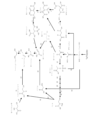
本発明の微生物はアセチル-CoA、例えば、Wood-Ljungdahl経路によ
って生成されるアセチル-CoAをピルビン酸に変換する(図1の反応1)酵素を含むこ
とができる。この酵素は、ピルビン酸シンターゼ(PFOR)[1.2.7.1]または
ATP:ピルビン酸、オルトリン酸ホスホトランスフェラーゼ[1.2.7.1]であり
得る。いくつかの実施形態では、アセチル-CoAをピルビン酸に変換する酵素は、内在
性酵素である。
A microorganism of the invention can contain an enzyme that converts acetyl-CoA, eg, acetyl-CoA produced by the Wood-Ljungdahl pathway, to pyruvate (
本発明の微生物は、ピルビン酸をオキサロ酢酸に変換する(図1の反応2)酵素を含む
ことができる。この酵素はピルビン酸:二酸化炭素リガーゼ[ADP形成][6.4.1
.1]であり得る。いくつかの実施形態では、ピルビン酸をオキサロ酢酸に変換する酵素
は、内在性酵素である。いくつかの実施形態では、ピルビン酸をオキサロ酢酸に変換する
酵素が過剰発現される。
A microorganism of the invention can contain an enzyme that converts pyruvate to oxaloacetate (
. 1]. In some embodiments, the enzyme that converts pyruvate to oxaloacetate is an endogenous enzyme. In some embodiments, an enzyme that converts pyruvate to oxaloacetate is overexpressed.
本発明の微生物は、オキサロ酢酸をシトリル-CoAに変換する(図1の反応3)酵素
を含むことができる。この酵素はシトリル-CoAリアーゼ[4.1.3.34]であり
得る。いくつかの実施形態では、オキサロ酢酸をシトリル-CoAに変換する酵素は、内
在性酵素である。
A microorganism of the invention can contain an enzyme that converts oxaloacetate to citryl-CoA (
本発明の微生物は、シトリル-CoAをクエン酸に変換する(図1の反応4)酵素を含
むことができる。この酵素は、クエン酸-CoAトランスフェラーゼ[2.8.3.10
]であり得る。いくつかの実施形態では、シトリル-CoAをクエン酸に変換する酵素は
、内在性酵素である。
A microorganism of the invention can contain an enzyme that converts citryl-CoA to citrate (reaction 4 in FIG. 1). This enzyme is a citrate-CoA transferase [2.8.3.10
]. In some embodiments, the enzyme that converts citryl-CoA to citrate is an endogenous enzyme.
本発明の微生物は、オキサロ酢酸をクエン酸に変換する(図1の反応5)酵素を含むこ
とができる。この酵素は、クエン酸[Si]-シンターゼ[2.3.3.1]、ATPク
エン酸シンターゼ[2.3.3.8]、またはクエン酸(Re)-シンターゼ[2.3.
3.3]であってよい。いくつかの実施形態では、オキサロ酢酸をクエン酸に変換する酵
素は、内在性酵素である。他の実施形態では、オキサロ酢酸をクエン酸に変換する酵素は
、異種酵素である。例えば、いくつかの実施形態では、本発明の微生物は、微生物が配列
番号2に示されるアミノ酸配列をコードする配列番号1に示されるヌクレオチド配列を含
むように、B.subtilis由来のクエン酸シンターゼ1 [EC 2.3.3.1
6]を含む。いくつかの実施形態では、本発明の微生物は、微生物が配列番号4に示され
るアミノ酸配列をコードする配列番号3に示されるヌクレオチド配列を含むように、C.
kluyveri由来のクエン酸(Re)-シンターゼを含む。いくつかの実施形態では
、本発明の微生物は、微生物が配列番号6に示されるアミノ酸配列をコードする配列番号
5に示されるヌクレオチド配列を含むように、Clostridium種属由来のクエン
酸(Si)-シンターゼを含む。いくつかの実施形態では、本発明の微生物は、微生物が
配列番号8に示されるアミノ酸配列をコードする配列番号7に示されるヌクレオチド配列
を含むように、B.subtilis由来のクエン酸シンターゼ2を含む。いくつかの実
施形態では、オキサロ酢酸をクエン酸に変換する酵素が過剰発現される。
A microorganism of the invention can contain an enzyme that converts oxaloacetate to citric acid (
3.3]. In some embodiments, the enzyme that converts oxaloacetate to citrate is an endogenous enzyme. In other embodiments, the enzyme that converts oxaloacetate to citrate is a heterologous enzyme. For example, in some embodiments, the microorganism of the invention is B. elegans, such that the microorganism comprises the nucleotide sequence set forth in SEQ ID NO:1 which encodes the amino acid sequence set forth in SEQ ID NO:2.
6]. In some embodiments, the microorganism of the invention is a C.
citrate (Re)-synthase from S. kluyveri. In some embodiments, the microorganism of the invention is a citrate (Si)- Contains synthase. In some embodiments, the microorganism of the invention is B. elegans, such that the microorganism comprises the nucleotide sequence set forth in SEQ ID NO:7 which encodes the amino acid sequence set forth in SEQ ID NO:8. It contains
本発明の微生物は、クエン酸をアコニット酸に、およびアコニット酸をイソクエン酸に
変換する(図1の反応6)酵素を含むことができる。この酵素は、アコニット酸ヒドラタ
ーゼ[4.2.1.3]であり得る。いくつかの実施形態では、クエン酸をアコニット酸
に、アコニット酸をイソクエン酸に変換する酵素は、内在性酵素である。いくつかの実施
形態では、クエン酸をアコニット酸に、およびアコニット酸をイソクエン酸に変換する酵
素が過剰発現される。
Microorganisms of the invention can contain enzymes that convert citric acid to aconitic acid and aconitic acid to isocitric acid (reaction 6 in FIG. 1). The enzyme may be aconitate hydratase [4.2.1.3]. In some embodiments, the enzyme that converts citrate to aconitate and aconitate to isocitrate is an endogenous enzyme. In some embodiments, enzymes that convert citrate to aconitate and aconitate to isocitrate are overexpressed.
本発明の微生物は、イソクエン酸をグリオキシル酸に変換する(図1の反応7)酵素を
含むことができる。この酵素はイソクエン酸リアーゼ[4.1.3.1]であり得る。い
くつかの実施形態では、本発明の微生物は、微生物が配列番号10に示されるアミノ酸配
列をコードする配列番号9に示されるヌクレオチド配列を含むように、Z.mays由来
のイソクエン酸リアーゼを含む。いくつかの実施形態では、本発明の微生物は、微生物が
配列番号12に示されるアミノ酸配列をコードする配列番号11に示されるヌクレオチド
配列を含むように、E.coli由来のイソクエン酸リアーゼを含む。いくつかの実施形
態では、
A microorganism of the invention can contain an enzyme that converts isocitrate to glyoxylate (reaction 7 in FIG. 1). This enzyme may be isocitrate lyase [4.1.3.1]. In some embodiments, the microorganism of the invention is Z. elegans, such that the microorganism comprises the nucleotide sequence set forth in SEQ ID NO:9 that encodes the amino acid sequence set forth in SEQ ID NO:10. contains isocitrate lyase from mays. In some embodiments, the microorganism of the invention is E. musculus, such that the microorganism comprises the nucleotide sequence set forth in SEQ ID NO:11 which encodes the amino acid sequence set forth in SEQ ID NO:12. Contains isocitrate lyase from E. coli. In some embodiments,
本発明の微生物は、グリオキシル酸をグリコール酸に変換する(図1の反応8)酵素を
含むことができる。この酵素は、グリセリン酸デヒドロゲナーゼ[1.1.1.29]、
グリオキシル酸レダクターゼ[1.1.1.26/79]、またはグリコール酸デヒドロ
ゲナーゼ[1.1.99.14]であリ得る。いくつかの実施形態では、グリオキシル酸
をグリコール酸に変換する酵素は、内在性酵素である。いくつかの実施形態では、グリオ
キシル酸をグリコール酸に変換する酵素が過剰発現される。
Microorganisms of the invention can contain an enzyme that converts glyoxylate to glycolate (reaction 8 in FIG. 1). This enzyme is glycerate dehydrogenase [1.1.1.29],
It may be glyoxylate reductase [1.1.1.26/79], or glycolate dehydrogenase [1.1.99.14]. In some embodiments, the enzyme that converts glyoxylate to glycolate is an endogenous enzyme. In some embodiments, an enzyme that converts glyoxylate to glycolate is overexpressed.
本発明の微生物は、グリコール酸をグリコアルデヒドに変換する(図1の反応9)酵素
を含むことができる。この酵素は、グリコールアルデヒドデヒドロゲナーゼ[1.2.1
.21]、ラクトアルデヒドデヒドロゲナーゼ[1.2.1.22]、コハク酸セミアル
デヒドデヒドロゲナーゼ[1.2.1.24]、2,5-ジオキソ吉草酸デヒドロゲナー
ゼ[1.2.1.26]、アルデヒドデヒドロゲナーゼ[1.2.1.3/4/5]、ベ
タイン-アルデヒドデヒドロゲナーゼ[1.2.1.8]、またはアルデヒドフェレドキ
シンオキシドレダクターゼ[1.2.7.5]であり得る。いくつかの実施形態では、グ
リコール酸をグリコアルデヒドに変換する酵素は、内在性酵素である。他の実施形態では
、グリコール酸をグリコアルデヒドに変換する酵素は、異種酵素である。例えば、いくつ
かの実施形態では、本発明の微生物は、微生物が配列番号50に示されるアミノ酸配列を
コードする配列番号49に示されるヌクレオチド配列を含むように、E.coli由来の
γ-アミノブチルアルデヒドデヒドロゲナーゼを含む。いくつかの実施形態において、本
発明の微生物は、微生物が配列番号52に示されるアミノ酸配列をコードする配列番号5
1に示されるヌクレオチド配列を含むように、E.coli由来のアルデヒドデヒドロゲ
ナーゼを含む。いくつかの実施形態では、本発明の微生物は、微生物が配列番号54に示
されるアミノ酸配列をコードする配列番号53に示されるヌクレオチド配列を含むように
、E.coli由来のNADP-依存コハク酸セミアルデヒドデヒドロゲナーゼIを含む
。いくつかの実施形態では、本発明の微生物は、微生物が配列番号56に示されるアミノ
酸配列をコードする配列番号55に示されるヌクレオチド配列を含むように、G.oxy
dans由来のラクトアルデヒドデヒドロゲナーゼ/グリコールアルデヒドデヒドロゲナ
ーゼを含む。いくつかの実施形態では、本発明の微生物は、微生物がそれぞれ、配列番号
58または配列番号60で示されるアミノ酸配列をコードする配列番号57または配列番
号59に示されるヌクレオチド配列を含むように、P.fluorescens由来のア
ルデヒドデヒドロゲナーゼAを含む。グリコール酸をグリコアルデヒドに変換する酵素の
追加の非限定的な例は、GenBank受入番号WP_003202098、WP_00
3182567、ACT39044、ACT39074、WP_041112005、お
よびACT40170に見出すことができる。いくつかの実施形態では、グリコール酸を
グリコアルデヒドに変換する酵素が過剰発現される。
A microorganism of the invention can contain an enzyme that converts glycolic acid to glycoaldehyde (reaction 9 in FIG. 1). This enzyme is known as glycolaldehyde dehydrogenase [1.2.1
. 21], lactaldehyde dehydrogenase [1.2.1.22], succinic semialdehyde dehydrogenase [1.2.1.24], 2,5-dioxovalerate dehydrogenase [1.2.1.26], aldehyde dehydrogenase [1.2.1.3/4/5], betaine-aldehyde dehydrogenase [1.2.1.8], or aldehyde ferredoxin oxidoreductase [1.2.7.5]. In some embodiments, the enzyme that converts glycolic acid to glycoaldehyde is an endogenous enzyme. In other embodiments, the enzyme that converts glycolic acid to glycoaldehyde is a heterologous enzyme. For example, in some embodiments, the microorganisms of the invention are E. elegans, such that the microorganism comprises the nucleotide sequence set forth in SEQ ID NO:49 which encodes the amino acid sequence set forth in SEQ ID NO:50. γ-aminobutyraldehyde dehydrogenase from E. coli. In some embodiments, the microorganism of the present invention is SEQ ID NO:5, wherein the microorganism encodes the amino acid sequence shown in SEQ ID NO:52.
E.1 to contain the nucleotide sequence shown in E.1. Contains aldehyde dehydrogenase from E. coli. In some embodiments, the microorganism of the invention is E. musculus, such that the microorganism comprises the nucleotide sequence set forth in SEQ ID NO:53 which encodes the amino acid sequence set forth in SEQ ID NO:54. contains NADP-dependent succinic semialdehyde dehydrogenase I from E. coli. In some embodiments, the microorganism of the invention is a G. oxy
lactaldehyde dehydrogenase/glycol aldehyde dehydrogenase from S. dans. In some embodiments, the microorganism of the present invention comprises a nucleotide sequence set forth in SEQ ID NO:57 or SEQ ID NO:59 that encodes an amino acid sequence set forth in SEQ ID NO:58 or SEQ ID NO:60, respectively. . Contains aldehyde dehydrogenase A from B. fluorescens. Additional non-limiting examples of enzymes that convert glycolic acid to glycoaldehyde are GenBank accession numbers WP_003202098, WP_00
3182567, ACT39044, ACT39074, WP_041112005, and ACT40170. In some embodiments, an enzyme that converts glycolic acid to glycoaldehyde is overexpressed.
本発明の微生物は、グリコアルデヒドをエチレングリコールに変換する(図1の反応1
0)酵素を含んでいてもよい。この酵素は、ラクトアルデヒドレダクターゼ[1.1.1
.77]、アルコールデヒドロゲナーゼ[1.1.1.1]、アルコールデヒドロゲナー
ゼ(NADP+)[1.1.1.2]、グリセロールデヒドロゲナーゼ[1.1.1.7
2]、グリセロール-3-リン酸デヒドロゲナーゼ[1.1.1.8]、またはアルデヒ
ドレダクターゼ[1.1.1.21]であり得る。いくつかの実施形態では、グリコアル
デヒドをエチレングリコールに変換する酵素は、内在性酵素である。いくつかの実施形態
では、グリコアルデヒドをエチレングリコールに変換する内在性酵素が過剰発現される。
他の実施形態では、グリコアルデヒドをエチレングリコールに変換する酵素は、異種酵素
である。いくつかの実施形態では、本発明の微生物は、微生物が配列番号62に示される
アミノ酸配列をコードする配列番号61に示されるヌクレオチド配列を含むように、C.
saccharoperbutylacetonicum由来のラクトアルデヒドレダク
ターゼを含む。いくつかの実施形態では、本発明の微生物は、微生物が配列番号64に示
されるアミノ酸配列をコードする配列番号63に示されるヌクレオチド配列を含むように
、C.ljungdahlii由来のラクトアルデヒドレダクターゼを含む。いくつかの
実施形態では、本発明の微生物は、微生物が配列番号66に示されるアミノ酸配列をコー
ドする配列番号65に示されるヌクレオチド配列を含むように、E.coli由来のラク
トアルデヒドレダクターゼを含む。いくつかの実施形態では、本発明の微生物は、微生物
が配列番号68に示されるアミノ酸配列をコードする配列番号67に示されるヌクレオチ
ド配列を含むように、C.beijerinckii由来のラクトアルデヒドレダクター
ゼを含む。いくつかの実施形態では、グリコアルデヒドをエチレングリコールに変換する
異種酵素が過剰発現される。
The microorganism of the invention converts glycoaldehyde to ethylene glycol (
0) may contain enzymes; This enzyme is lactaldehyde reductase [1.1.1
. 77], alcohol dehydrogenase [1.1.1.1], alcohol dehydrogenase (NADP+) [1.1.1.2], glycerol dehydrogenase [1.1.1.7
2], glycerol-3-phosphate dehydrogenase [1.1.1.8], or aldehyde reductase [1.1.1.21]. In some embodiments, the enzyme that converts glycoaldehyde to ethylene glycol is an endogenous enzyme. In some embodiments, endogenous enzymes that convert glycoaldehyde to ethylene glycol are overexpressed.
In other embodiments, the enzyme that converts glycoaldehyde to ethylene glycol is a heterologous enzyme. In some embodiments, the microorganism of the invention is a C.
Contains lactaldehyde reductase from saccharoperbutylacetonicum. In some embodiments, the microorganism of the invention is a C. ljungdahlii lactaldehyde reductase. In some embodiments, the microorganism of the invention is an E. elegans strain, such that the microorganism comprises the nucleotide sequence set forth in SEQ ID NO:65 which encodes the amino acid sequence set forth in SEQ ID NO:66. Contains lactaldehyde reductase from E. coli. In some embodiments, the microorganism of the invention is a C. beijerinckii lactaldehyde reductase. In some embodiments, a heterologous enzyme that converts glycoaldehyde to ethylene glycol is overexpressed.
本発明の微生物は、ピルビン酸をリンゴ酸に変換する(図1の反応11)を含むことが
できる。この酵素は、リンゴ酸デヒドロゲナーゼ[1.1.1.37]、リンゴ酸デヒド
ロゲナーゼ(オキサロ酢酸脱炭酸)[1.1.1.38]、リンゴ酸デヒドロゲナーゼ(
脱炭酸)[1.1.1.39]、リンゴ酸デヒドロゲナーゼ(オキサロ酢酸脱炭酸)(N
ADP+)[1.1.1.40]、リンゴ酸デヒドロゲナーゼ(NADP+)[1.1.
1.82]、D-リンゴ酸デヒドロゲナーゼ(脱炭酸)[1.1.1.83]、ジメチル
リンゴ酸デヒドロゲナーゼ[1.1.1.84]、3-イソプロピルリンゴ酸デヒドロゲ
ナーゼ[1.1.1.85]、リンゴ酸デヒドロゲナーゼ[NAD(P)+][1.1.
1.299]、またはリンゴ酸デヒドロゲナーゼ(キノン)[1.1.5.4]であり得
る。いくつかの実施形態では、ピルビン酸をリンゴ酸に変換する酵素は、内在性酵素であ
る。他の実施形態では、ピルビン酸をリンゴ酸に変換する酵素は、異種酵素である。例え
ば、いくつかの実施形態では、本発明の微生物は、微生物が配列番号24に示されるアミ
ノ酸配列をコードする配列番号23に示されるヌクレオチド配列を含むように、C.au
toethanogenum由来のリンゴ酸デヒドロゲナーゼを含む。いくつかの実施形
態において、本発明の微生物は、微生物が配列番号26に示されるアミノ酸配列をコード
する配列番号25に示されるヌクレオチド配列を含むように、C.autoethano
genum由来のNAD依存リンゴ酸酵素を含む。
Microorganisms of the invention can include converting pyruvate to malate (reaction 11 in FIG. 1). The enzymes are malate dehydrogenase [1.1.1.37], malate dehydrogenase (oxaloacetate decarboxylation) [1.1.1.38], malate dehydrogenase (
decarboxylation) [1.1.1.39], malate dehydrogenase (oxaloacetate decarboxylation) (N
ADP+) [1.1.1.40], malate dehydrogenase (NADP+) [1.1.
1.82], D-malate dehydrogenase (decarboxylation) [1.1.1.83], dimethylmalate dehydrogenase [1.1.1.84], 3-isopropylmalate dehydrogenase [1.1.1 .85], malate dehydrogenase [NAD(P)+] [1.1.
1.299], or malate dehydrogenase (quinone) [1.1.5.4]. In some embodiments, the enzyme that converts pyruvate to malate is an endogenous enzyme. In other embodiments, the enzyme that converts pyruvate to malate is a heterologous enzyme. For example, in some embodiments, a microorganism of the invention is a C. au
Contains malate dehydrogenase from toethanogenum. In some embodiments, the microorganism of the invention is a C. auto ethanol
Genum-derived NAD-dependent malic enzyme.
本発明の微生物は、リンゴ酸をグリオキシル酸に変換する(図1の反応12)酵素を含
むことができる。この酵素は、リンゴ酸シンターゼ[2.3.3.9]またはイソクエン
酸リアーゼ[4.1.3.1]であり得る。いくつかの実施形態では、リンゴ酸をグリオ
キシル酸に変換する酵素は、異種酵素である。例えば、いくつかの実施形態では、本発明
の微生物は、微生物がそれぞれ配列番号28または配列番号34に示されるアミノ酸をコ
ードする配列番号27または配列番号33に示されるヌクレオチド配列を含むように、S
porosarcina種属からのリンゴ酸シンターゼGを含む。いくつかの実施形態で
は、本発明の微生物は、微生物がそれぞれ配列番号30または配列番号36に示されるア
ミノ酸配列をコードする配列番号29または配列番号35に示されるヌクレオチド配列を
含むように、Bacillus種由来のリンゴ酸シンターゼGを含む。いくつかの実施形
態では、本発明の微生物は、微生物が配列番号32に示されるアミノ酸配列をコードする
配列番号31に示されるヌクレオチド配列を含むように、S.coelicolor由来
のリンゴ酸シンターゼを含む。いくつかの実施形態では、本発明の微生物は、微生物が配
列番号38に示されるアミノ酸配列をコードする配列番号37に示されるヌクレオチド配
列を含むように、B.infantis由来のリンゴ酸シンターゼGを含む。いくつかの
実施形態では、本発明の微生物は、微生物が配列番号40に示されるアミノ酸配列をコー
ドする配列番号39に示されるヌクレオチド配列を含むように、C.cochleari
um由来のリンゴ酸シンターゼを含む。いくつかの実施形態では、本発明の微生物は、微
生物が配列番号42に示されるアミノ酸配列をコードする配列番号41に示されるヌクレ
オチド配列を含むように、B.megateriumからのリンゴ酸シンターゼGを含む
。いくつかの実施形態では、本発明の微生物は、微生物が配列番号44に示されるアミノ
酸配列をコードする配列番号43に示されるヌクレオチド配列を含むように、Paeni
bacillus種由来のリンゴ酸シンターゼを含む。いくつかの実施形態において、本
発明の微生物は、微生物が配列番号46に示されるアミノ酸配列をコードする配列番号4
5に示されるヌクレオチド配列を含むように、Lysinibacillus種由来のリ
ンゴ酸シンターゼを含む。いくつかの実施形態では、本発明の微生物は、微生物が配列番
号48に示されるアミノ酸配列をコードする配列番号47に示されるヌクレオチド配列を
含むように、B.cereus由来のリンゴ酸シンターゼを含む。
Microorganisms of the invention can contain an enzyme that converts malate to glyoxylate (
It contains malate synthase G from the genus porosarcina. In some embodiments, the microorganism of the invention is a Bacillus sp., such that the microorganism comprises the nucleotide sequence set forth in SEQ ID NO:29 or SEQ ID NO:35, which encodes the amino acid sequence set forth in SEQ ID NO:30 or SEQ ID NO:36, respectively. contains malate synthase G from In some embodiments, the microorganism of the invention is S . It contains malate synthase from coelicolor. In some embodiments, the microorganism of the invention is B. elegans, such that the microorganism comprises the nucleotide sequence set forth in SEQ ID NO:37 which encodes the amino acid sequence set forth in SEQ ID NO:38. contains malate synthase G from B. infantis. In some embodiments, the microorganism of the invention is a C. cochleari
It contains malate synthase from um. In some embodiments, the microorganism of the invention is B. elegans, such that the microorganism comprises the nucleotide sequence set forth in SEQ ID NO:41 which encodes the amino acid sequence set forth in SEQ ID NO:42. Contains malate synthase G from megaterium. In some embodiments, the microorganism of the invention is a Paeni bacterium, such that the microorganism comprises the nucleotide sequence set forth in SEQ ID NO:43 which encodes the amino acid sequence set forth in SEQ ID NO:44.
It contains malate synthase from Bacillus sp. In some embodiments, the microorganism of the present invention is SEQ ID NO:4, wherein the microorganism encodes the amino acid sequence shown in SEQ ID NO:46.
5, including malate synthase from Lysinibacillus sp. In some embodiments, the microorganism of the invention is B. elegans, such that the microorganism comprises the nucleotide sequence set forth in SEQ ID NO:47 which encodes the amino acid sequence set forth in SEQ ID NO:48. cereus malate synthase.
本発明の微生物は、ピルビン酸をホスホエノールピルビン酸に変換する(図1の反応1
3)酵素を含むことができる。この酵素は、ピルビン酸キナーゼ[2.7.1.40]、
ピルビン酸リン酸ジキナーゼ[2.7.9.1]、またはピルビン酸水ジキナーゼ[2.
7.9.2]であり得る。いくつかの実施形態では、ピルビン酸をホスホエノールピルビ
ン酸に変換する酵素は、内在性酵素である。
The microorganism of the invention converts pyruvate to phosphoenolpyruvate (
3) it can contain enzymes; This enzyme is pyruvate kinase [2.7.1.40],
pyruvate phosphate dikinase [2.7.9.1], or pyruvate water dikinase [2.
7.9.2]. In some embodiments, the enzyme that converts pyruvate to phosphoenolpyruvate is an endogenous enzyme.
本発明の微生物は、ホスホエノールピルビン酸を2-ホスホ-D-グリセリン酸に変換
する(図1の反応14)酵素を含むことができる。この酵素は、ホスホピルビン酸ヒドラ
ターゼ[4.2.1.11]であり得る。いくつかの実施形態では、ホスホエノールピル
ビン酸を2-ホスホ-D-グリセリン酸に変換する酵素は、内在性酵素である。
A microorganism of the invention can contain an enzyme that converts phosphoenolpyruvate to 2-phospho-D-glycerate (
本発明の微生物は、2-ホスホ-D-グリセリン酸を3-ホスホ-D-グリセリン酸に
変換する(図1の反応15)酵素を含むことができる。この酵素は、ホスホグリセリン酸
ムターゼ[5.4.2.11/12]であり得る。いくつかの実施形態では、2-ホスホ
-D-グリセリン酸を3-ホスホ-D-グリセリン酸に変換する酵素は、内在性酵素であ
る。
The microorganism of the invention can contain an enzyme that converts 2-phospho-D-glycerate to 3-phospho-D-glycerate (
本発明の微生物は、3-ホスホ-D-グリセリン酸を3-ホスホノオキシピルビン酸に
変換する(図1の反応16)酵素を含むことができる。この酵素は、ホスホグリセリン酸
デヒドロゲナーゼ[1.1.1.95]であり得る。いくつかの実施形態では、3-ホス
ホ-D-グリセリン酸を3-ホスホノオキシピルビン酸に変換する酵素は、内在性酵素で
ある。
The microorganism of the invention can contain an enzyme that converts 3-phospho-D-glycerate to 3-phosphonooxypyruvate (reaction 16 in FIG. 1). The enzyme may be phosphoglycerate dehydrogenase [1.1.1.95]. In some embodiments, the enzyme that converts 3-phospho-D-glycerate to 3-phosphonooxypyruvate is an endogenous enzyme.
本発明の微生物は、3-ホスホノオキシピルビン酸を3-ホスホ-L-セリンに変換(
図1の反応17)する酵素を含むことができる。この酵素は、ホスホセリントランスアミ
ナーゼ[2.6.1.52]であり得る。いくつかの実施形態では、3-ホスホノオキシ
ピルビン酸を3-ホスホ-L-セリンに変換する酵素は、内在性酵素である。
The microorganism of the present invention converts 3-phosphonooxypyruvate to 3-phospho-L-serine (
An enzyme that performs reaction 17) of FIG. 1 can be included. This enzyme can be a phosphoserine transaminase [2.6.1.52]. In some embodiments, the enzyme that converts 3-phosphonooxypyruvate to 3-phospho-L-serine is an endogenous enzyme.
本発明の微生物は3-ホスホ-L-セリンをセリンに変換する(図1の反応18)酵素
を含むことができる。この酵素はホスホセリンホスファターゼ[3.1.3.3]であり
得る。いくつかの実施形態では、3-ホスホ-L-セリンをセリンに変換する酵素は、内
在性酵素である。
A microorganism of the invention can contain an enzyme that converts 3-phospho-L-serine to serine (
本発明の微生物はセリンをグリシンに変換する(図1の反応19)酵素を含むことがで
きる。この酵素はグリシンヒドロキシメチルトランスフェラーゼ[2.1.2.1]であ
り得る。いくつかの実施形態では、セリンをグリシンに変換する酵素は内在性酵素である
。いくつかの実施形態では、セリンをグリシンに変換する酵素が過剰発現される。
A microorganism of the invention can contain an enzyme that converts serine to glycine (reaction 19 in FIG. 1). This enzyme may be glycine hydroxymethyltransferase [2.1.2.1]. In some embodiments, the enzyme that converts serine to glycine is an endogenous enzyme. In some embodiments, an enzyme that converts serine to glycine is overexpressed.
本発明の微生物は、グリシンをグリオキシル酸に変換する酵素(図1の反応20)を含
むことができる。この酵素は、アラニン-グリオキシル酸アミノトランスフェラーゼ/ト
ランスアミナーゼ[2.6.1.44]、セリン-グリオキシル酸アミノトランスフェラ
ーゼ/トランスアミナーゼ[2.6.1.45]、セリン-ピルビン酸アミノトランスフ
ェラーゼ/トランスアミナーゼ[2.6.1.51]、グリシン-オキサロ酢酸アミノト
ランスフェラーゼ/トランスアミナーゼ[2.6.1.35]、グリシントランスアミナ
ーゼ[2.6.1.4]、グリシンデヒドロゲナーゼ[1.4.1.10]、アラニンデ
ヒドロゲナーゼ[1.4.1.1]、またはグリシンデヒドロゲナーゼ[1.4.2.1
]であり得る。いくつかの実施形態では、グリシンをグリオキシル酸に変換する酵素は、
内在性酵素である。他の実施形態では、グリシンをグリオキシル酸に変換する酵素は、異
種酵素である。例えば、いくつかの実施形態では、本発明の微生物は、微生物が配列番号
14に示されるアミノ酸配列をコードする配列番号13に示されるヌクレオチド配列を含
むように、H.methylovorum由来のセリン-グリオキシル酸アミノトランス
フェラーゼを含む。いくつかの実施形態では、本発明の微生物は、微生物が配列番号16
に示されるアミノ酸配列をコードする配列番号15に示されるヌクレオチド配列を含むよ
うに、S.thiotaurini由来のアラニン-グリオキシル酸アミノトランスフェ
ラーゼを含む。いくつかの実施形態では、本発明の微生物は、微生物が、配列番号18に
示されるアミノ酸配列をコードする配列番号17に示されるヌクレオチド配列を含むよう
に、T.Tepidarius由来のアラニン-グリオキシル酸アミノトランスフェラー
ゼを含む。いくつかの実施形態では、本発明の微生物は、微生物が、配列番号20に示さ
れるアミノ酸配列をコードする配列番号19に示されるヌクレオチド配列を含むように、
C.acidurici由来のクラスVアミノトランスフェラーゼを含む。いくつかの実
施形態では、本発明の微生物は、微生物が配列番号22に示されるアミノ酸配列をコード
する配列番号21に示されるヌクレオチド配列を含むように、T.maritima由来
のセリン-ピルビン酸アミノトランスフェラーゼを含む。いくつかの実施形態では、グリ
シンをグリオキシル酸に変換する酵素が過剰発現される。
A microorganism of the invention can contain an enzyme that converts glycine to glyoxylate (
]. In some embodiments, the enzyme that converts glycine to glyoxylate comprises
It is an endogenous enzyme. In other embodiments, the enzyme that converts glycine to glyoxylate is a heterologous enzyme. For example, in some embodiments, the microorganism of the invention is H. elegans, such that the microorganism comprises the nucleotide sequence set forth in SEQ ID NO:13 which encodes the amino acid sequence set forth in SEQ ID NO:14. contains serine-glyoxylate aminotransferase from Methylovorum. In some embodiments, the microorganism of the present invention is a microorganism having SEQ ID NO: 16
S . thiotaurini alanine-glyoxylate aminotransferase. In some embodiments, the microorganism of the invention is T. elegans, such that the microorganism comprises the nucleotide sequence set forth in SEQ ID NO:17 that encodes the amino acid sequence set forth in SEQ ID NO:18. Alanine-glyoxylate aminotransferase from Tepidaris. In some embodiments, the microorganism of the present invention comprises:
C. It contains a class V aminotransferase from S. acidurici. In some embodiments, the microorganism of the invention is T. elegans, such that the microorganism comprises the nucleotide sequence set forth in SEQ ID NO:21 which encodes the amino acid sequence set forth in SEQ ID NO:22. It contains serine-pyruvate aminotransferase from B. maritima. In some embodiments, an enzyme that converts glycine to glyoxylate is overexpressed.
本発明の微生物はセリンをヒドロキシピルビン酸に変換する(図1の反応21)酵素を
含むことができる。この酵素は、セリン-ピルビン酸トランスアミナーゼ[2.6.1.
51]、セリン-グリオキシル酸トランスアミナーゼ[2.6.1.45]、アラニンデ
ヒドロゲナーゼ[1.4.1.1]、L-アミノ酸デヒドロゲナーゼ[1.4.1.5]
、セリン2-デヒドロゲナーゼ[1.4.1.7]、アラニントランスアミナーゼ[2.
6.1.2]、グルタミン-ピルビン酸トランスアミナーゼ[2.6.1.15]、D-
アミノ酸トランスアミナーゼ[2.6.1.21]、アラニン-グリオキシル酸トランス
アミナーゼ[2.6.1.44]、またはセリン-ピルビン酸トランスアミナーゼ[2.
6.1.51]であり得る。いくつかの実施形態では、セリンをヒドロキシピルビン酸に
変換する酵素は、内在性酵素である。他の実施形態では、セリンをヒドロキシピルビン酸
に変換する酵素は、異種酵素である。セリンをヒドロキシピルビン酸に変換することがで
きる酵素の非限定的な例は、GenBank受入番号WP_009989311およびN
P_511062.1に見出すことができる。いくつかの実施形態では、セリンをヒドロ
キシピルビン酸に変換する酵素が過剰発現される。
A microorganism of the invention can contain an enzyme that converts serine to hydroxypyruvate (
51], serine-glyoxylate transaminase [2.6.1.45], alanine dehydrogenase [1.4.1.1], L-amino acid dehydrogenase [1.4.1.5]
, serine 2-dehydrogenase [1.4.1.7], alanine transaminase [2.
6.1.2], glutamine-pyruvate transaminase [2.6.1.15], D-
amino acid transaminase [2.6.1.21], alanine-glyoxylate transaminase [2.6.1.44], or serine-pyruvate transaminase [2.
6.1.51]. In some embodiments, the enzyme that converts serine to hydroxypyruvate is an endogenous enzyme. In other embodiments, the enzyme that converts serine to hydroxypyruvate is a heterologous enzyme. Non-limiting examples of enzymes that can convert serine to hydroxypyruvate are GenBank accession numbers WP_009989311 and N
P_511062.1. In some embodiments, an enzyme that converts serine to hydroxypyruvate is overexpressed.
本発明の微生物は、ヒドロキシピルビン酸をグリコアルデヒドに変換する(図1の反応
22)酵素を含むことができる。この酵素は、ヒドロキシピルビン酸デカルボキシラーゼ
[4.1.1.40]またはピルビン酸デカルボキシラーゼ[4.1.1.1]であり得
る。この酵素は、他のデカルボキシラーゼでもよい[4.1.1.-]。いくつかの実施
形態では、ヒドロキシピルビン酸をグリコアルデヒドに変換する酵素は、異種酵素である
。ヒドロキシピルビン酸をグリコアルデヒドに変換できる酵素の非限定的な例は、Gen
Bank受入番号CCG28866、SVF98953、PA0096、CAA5452
2、KRU13460、およびKLA26356に見出すことができる。
A microorganism of the invention can contain an enzyme that converts hydroxypyruvate to glycoaldehyde (reaction 22 in FIG. 1). The enzyme can be hydroxypyruvate decarboxylase [4.1.1.40] or pyruvate decarboxylase [4.1.1.1]. This enzyme may be another decarboxylase [4.1.1. -]. In some embodiments, the enzyme that converts hydroxypyruvate to glycoaldehyde is a heterologous enzyme. A non-limiting example of an enzyme capable of converting hydroxypyruvate to glycoaldehyde is Gen
Bank accession numbers CCG28866, SVF98953, PA0096, CAA5452
2, KRU13460, and KLA26356.
本発明の微生物はD-グリセリン酸をヒドロキシピルビン酸に変換する(図1の反応2
3)酵素を含むことができる。この酵素は、グリオキシル酸レダクターゼ[EC1.1.
1.26]、グリセリン酸デヒドロゲナーゼ[EC1.1.1.29]、またはヒドロキ
シピルビン酸レダクターゼ[EC1.1.1.81]であり得る。いくつかの実施形態で
は、D-グリセリン酸をヒドロキシピルビン酸に変換する酵素は、異種酵素である。D-
グリセリン酸をヒドロキシピルビン酸に変換できる酵素の非限定的な例は、GenBan
k受入番号SUK16841、RPK22618、KPA02240、AGW90762
、CAC11987、Q9CA90、およびQ9UBQ7に見出すことができる。
The microorganism of the invention converts D-glycerate to hydroxypyruvate (
3) it can contain enzymes; This enzyme is known as glyoxylate reductase [EC 1.1.
1.26], glycerate dehydrogenase [EC 1.1.1.29], or hydroxypyruvate reductase [EC 1.1.1.81]. In some embodiments, the enzyme that converts D-glycerate to hydroxypyruvate is a heterologous enzyme. D-
A non-limiting example of an enzyme capable of converting glycerate to hydroxypyruvate is GenBan
k Accession numbers SUK16841, RPK22618, KPA02240, AGW90762
, CAC11987, Q9CA90, and Q9UBQ7.
本発明の微生物は、5,10-メチレンテトラヒドロ葉酸をグリシンに変換する(図1
の反応24)複合体の酵素を含むことができる。5,10-メチレンテトラヒドロ葉酸は
、Wood-Ljungdahl経路の還元的分岐における補因子であり、アセチル-C
oAの生成における足場として機能する。この複合体は、グリシンデヒドロゲナーゼ[1
.4.4.2]、ジヒドロリポイルデヒドロゲナーゼ[1.8.1.4]、およびアミノ
メチルトランスフェラーゼ(グリシンシンターゼ)[2.1.2.10]を含むグリシン
開裂系であり得る。いくつかの実施形態では、5,10-メチレンテトラヒドロ葉酸をグ
リシンに変換する複合体の酵素は、内在性酵素である。いくつかの実施形態では、グリシ
ン開裂系の酵素が過剰発現される。
The microorganism of the invention converts 5,10-methylenetetrahydrofolic acid to glycine (Fig. 1
Reaction 24) of conjugated enzymes. 5,10-methylenetetrahydrofolate is a cofactor in the reductive branch of the Wood-Ljungdahl pathway and acetyl-C
Acts as a scaffold in the generation of oA. This complex is a glycine dehydrogenase [1
. 4.4.2], dihydrolipoyl dehydrogenase [1.8.1.4], and aminomethyltransferase (glycine synthase) [2.1.2.10]. In some embodiments, the complex enzyme that converts 5,10-methylenetetrahydrofolate to glycine is an endogenous enzyme. In some embodiments, enzymes of the glycine cleavage system are overexpressed.
本発明の微生物は、ホスホエノールピルビン酸をオキサロ酢酸に変換する(図1の反応
25)酵素を含むことができる。この酵素は、ホスホエノールピルビン酸カルボキシキナ
ーゼ(ATP)[4.1.1.49]または(GTP)[4.1.1.32]であり得る
。いくつかの実施形態では、ホスホエノールピルビン酸をオキサロ酢酸に変換する酵素は
、内在性酵素である。他の実施形態では、ホスホエノールピルビン酸をオキサロ酢酸に変
換する酵素は、異種酵素である。いくつかの実施形態では、ホスホエノールピルビン酸を
オキサロ酢酸に変換する酵素が過剰発現される。
A microorganism of the invention can contain an enzyme that converts phosphoenolpyruvate to oxaloacetate (
いくつかの実施形態では、アセチル-CoAをピルビン酸に変換する(図1の反応1)
酵素、ピルビン酸をオキサロ酢酸に変換する(図1の反応2)酵素、オキサロ酢酸をクエ
ン酸に変換する(図1の反応5)酵素、クエン酸をアコニット酸に、アコニット酸をイソ
クエン酸に変換する(図1の反応6)酵素、イソクエン酸をグリオキシル酸に変換する(
図1の反応7)酵素、グリオキシル酸をグリコール酸に変換する(図1の反応8)酵素、
グリコール酸をグリコアルデヒドに変換する(図1の反応9)酵素、およびグリコアルデ
ヒドをエチレングリコールに変換する(図1の反応10)酵素、を含む微生物は、エチレ
ングリコールを生成する。非限定的な例において、オキサロ酢酸をクエン酸に変換する酵
素は、B.subtilis由来のクエン酸シンターゼ(配列番号1~2)であり得る。
非限定的な例において、イソクエン酸をグリオキシル酸に変換する酵素は、E.coli
由来のイソクエン酸リアーゼ(配列番号11~12)であり得る。非限定的な例において
、グリコール酸をグリコアルデヒドに変換する酵素は、G.oxydans由来のグリコ
ールアルデヒドデヒドロゲナーゼ(配列番号55~56)またはP.fluoresce
ns由来のアルデヒドデヒドロゲナーゼ(配列番号57~58)であり得る。図1に示す
ように、反応2、5、6、8、9、および10を触媒する酵素の1つ以上が過剰発現され
得る。例えば、実施例1および図3Bを参照されたい。
In some embodiments, acetyl-CoA is converted to pyruvate (
Enzyme converts pyruvate to oxaloacetate (
Reaction 7 in FIG. 1) Enzyme, which converts glyoxylic acid to glycolic acid (Reaction 8 in FIG. 1) Enzyme,
Microorganisms containing enzymes that convert glycolic acid to glycoaldehyde (reaction 9 in FIG. 1) and enzymes that convert glycoaldehyde to ethylene glycol (
In a non-limiting example, the enzyme that converts isocitrate to glyoxylate is E. coli
isocitrate lyase (SEQ ID NOS: 11-12). In a non-limiting example, an enzyme that converts glycolic acid to glycoaldehyde is G. glycolaldehyde dehydrogenase from P. oxydans (SEQ ID NOS: 55-56) or P. fluorescence
ns-derived aldehyde dehydrogenase (SEQ ID NOs:57-58). As shown in Figure 1, one or more of the enzymes that catalyze
いくつかの実施形態では、アセチル-CoAをピルビン酸に変換する(図1の反応1)
酵素、ピルビン酸をホスホエノールピルビン酸に変換する(図1の反応13)酵素、ホス
ホエノールピルビン酸を2-ホスホ-D-グリセリン酸に変換する(図1の反応14)酵
素、2-ホスホ-D-グリセリン酸を3-ホスホ-D-グリセリン酸に変換する(図1の
反応15)酵素、3-ホスホ-D-グリセリン酸を3-ホスホノオキシピルビン酸に変換
する(図1の反応16)酵素、3-ホスホノオキシピルビン酸を3-ホスホ-L-セリン
に変換する(図1の反応17)酵素、3-ホスホ-L-セリンをセリンに変換する(図1
の反応18)酵素、セリンをグリシンに変換する(図1の反応19)酵素、グリシンをグ
リオキシル酸に変換する(図1の反応20)酵素、グリオキシル酸をグリコール酸に変換
する(図1の反応8)酵素、グリコール酸をグリコアルデヒドに変換する(図1の反応9
)酵素、およびグリコアルデヒドをエチレングリコールに変換する(図1の反応10)酵
素、を含む微生物はエチレングリコールを生成する。非限定的な例において、グリシンを
グリオキシル酸に変換する酵素は、S.thiotaurini由来のアラニン-グリオ
キシル酸アミノトランスフェラーゼ(配列番号15~16)またはC.aciduric
i由来のクラスVアミノトランスフェラーゼ(配列番号19~20)であり得る。非限定
的な例において、グリコール酸をグリコアルデヒドに変換する酵素は、G.oxydan
s由来のグリコールアルデヒドデヒドロゲナーゼ(配列番号55~56)またはP.fl
uorescens由来のアルデヒドデヒドロゲナーゼ(配列番号57~58)であり得
る。図1に示すように、ステップ19、20、8、9、および10の反応を触媒する酵素
の1つ以上が過剰発現され得る。例えば、実施例2~4および図4B、5B、および6B
を参照されたい。
In some embodiments, acetyl-CoA is converted to pyruvate (
Enzyme, converts pyruvate to phosphoenolpyruvate (reaction 13 in FIG. 1) Enzyme, converts phosphoenolpyruvate to 2-phospho-D-glycerate (
reaction 18) the enzyme converts serine to glycine (reaction 19 in FIG. 1) the enzyme converts glycine to glyoxylic acid (
) and an enzyme that converts glycoaldehyde to ethylene glycol (
Class V aminotransferases from i (SEQ ID NOS: 19-20). In a non-limiting example, an enzyme that converts glycolic acid to glycoaldehyde is G. oxydan
Glycolaldehyde dehydrogenase from P.s (SEQ ID NOs:55-56) or P. fl
uorescens aldehyde dehydrogenase (SEQ ID NOs:57-58). As shown in Figure 1, one or more of the enzymes that catalyze the reactions of
See
いくつかの実施形態では、アセチル-CoAをピルビン酸に変換する(図1の反応1)
酵素、ピルビン酸をオキサロ酢酸に変換する(図1の反応2)酵素、オキサロ酢酸をシト
リル-CoAに変換する(図1の反応3)酵素、シトリル-CoAをクエン酸に変換する
(図1の反応4)酵素、クエン酸をアコニット酸に、およびアコニット酸をイソクエン酸
に変換する(図1の反応6)酵素、イソクエン酸をグリオキシル酸に変換する(図1の反
応7)酵素、グリオキシル酸をグリコール酸に変換する(図1の反応8)酵素、グリコー
ル酸をグリコアルデヒドに変換する(図1の反応9)酵素、およびグリコアルデヒドをエ
チレングリコールに変換する(図1の反応10)酵素、を含む微生物は、エチレングリコ
ールを生成する。非限定的な例において、イソクエン酸をグリオキシル酸に変換する酵素
は、E.coli由来のイソクエン酸リアーゼ(配列番号11~12)であり得る。非限
定的な例において、イソクエン酸をグリオキシル酸に変換する酵素は、E.coli由来
のイソクエン酸リアーゼ(配列番号11~12)であり得る。非限定的な例において、グ
リコール酸をグリコアルデヒドに変換する酵素は、G.oxydans由来のグリコール
アルデヒドデヒドロゲナーゼ(配列番号55~56)またはP.fluorescens
由来のアルデヒドデヒドロゲナーゼ(配列番号57~58)であり得る。図1に示すよう
に、反応2、6、8、9、および10を触媒する酵素の1つ以上が過剰発現され得る。
In some embodiments, acetyl-CoA is converted to pyruvate (
The enzyme converts pyruvate to oxaloacetate (
aldehyde dehydrogenase (SEQ ID NOs: 57-58). As shown in Figure 1, one or more of the enzymes that catalyze
いくつかの実施形態では、アセチル-CoAをピルビン酸に変換する(図1の反応1)
酵素、ピルビン酸をリンゴ酸に変換する(図1の反応11)酵素、リンゴ酸をグリオキシ
ル酸に変換する(図1の反応12)酵素、グリオキシル酸をグリコール酸に変換する(図
1の反応8)酵素、グリコール酸をグリコアルデヒドに変換する(図1の反応9)酵素、
およびグリコアルデヒドをエチレングリコールに変換する(図1の反応10)酵素、を含
む微生物は、エチレングリコールを生成する。非限定的な例において、グリコール酸をグ
リコアルデヒドに変換する酵素は、G.oxydans由来のグリコールアルデヒドデヒ
ドロゲナーゼ(配列番号55~56)またはP.fluorescens由来のアルデヒ
ドデヒドロゲナーゼ(配列番号57~58)であり得る。図1に示すように、ステップ8
、9、および10の反応を触媒する酵素の1つ以上が過剰発現され得る。
In some embodiments, acetyl-CoA is converted to pyruvate (
Enzyme converts pyruvate to malate (reaction 11 in FIG. 1) Enzyme converts malate to glyoxylate (
and an enzyme that converts glycoaldehyde to ethylene glycol (
, 9, and 10 reactions can be overexpressed.
いくつかの実施形態では、5,10-メチレンテトラヒドロ葉酸をグリシンに変換する
(図1の反応24)酵素、グリシンをグリオキシル酸に変換する(図1の反応20)酵素
、グリオキシル酸をグリコール酸に変換する(図1の反応8)酵素、グリコール酸をグリ
コアルデヒドに変換する(図1の反応9)酵素、およびグリコアルデヒドをエチレングリ
コールに変換する(図1の反応10)酵素、の複合体を含む微生物は、エチレングリコー
ルを生成する。非限定的な例において、グリシンをグリオキシル酸に変換する酵素は、S
.thiotaurini由来のアラニン-グリオキシル酸アミノトランスフェラーゼ(
配列番号15~16)またはC.acidurici由来のクラスVアミノトランスフェ
ラーゼ(配列番号19~20)であり得る。非限定的な例において、グリコール酸をグリ
コアルデヒドに変換する酵素は、G.oxydans由来のグリコールアルデヒドデヒド
ロゲナーゼ(配列番号55~56)またはP.fluorescens由来のアルデヒド
デヒドロゲナーゼ(配列番号57~58)であり得る。ステップ8、9、10、20、お
よび24の反応を触媒する酵素の1つ以上が過剰発現され得る。
In some embodiments, an enzyme that converts 5,10-methylenetetrahydrofolate to glycine (reaction 24 in FIG. 1), an enzyme that converts glycine to glyoxylate (
. alanine-glyoxylate aminotransferase from thiotaurini (
SEQ ID NOS: 15-16) or C.I. acidurici (SEQ ID NOS: 19-20). In a non-limiting example, an enzyme that converts glycolic acid to glycoaldehyde is G. glycolaldehyde dehydrogenase from P. oxydans (SEQ ID NOS: 55-56) or P. fluorescens aldehyde dehydrogenase (SEQ ID NOs:57-58). One or more of the enzymes that catalyze the reactions of
いくつかの実施形態では、アセチル-CoAをピルビン酸に変換する(図1の反応1)
酵素、ピルビン酸をホスホエノールピルビン酸に変換する(図1の反応13)酵素、ホス
ホエノールピルビン酸をオキサロ酢酸に変換する(図1の反応25)酵素、オキサロ酢酸
をシトリル-CoAに変換する(図1の反応3)酵素、シトリル-CoAをクエン酸に変
換する(図1の反応4)酵素、クエン酸をアコニット酸に、およびアコニット酸をイソク
エン酸に変換する(図1の反応6)酵素、イソクエン酸をグリオキシル酸に変換する(図
1の反応7)酵素、グリオキシル酸をグリコール酸に変換する(図1の反応8)酵素、グ
リコール酸をグリコアルデヒドに変換する(図1の反応9)酵素、およびグリコアルデヒ
ドをエチレングリコールに変換する(図1の反応10)酵素、を含む微生物は、エチレン
グリコールを生成する。非限定的な例において、イソクエン酸をグリオキシル酸に変換す
る酵素は、E.coli由来のイソクエン酸リアーゼ(配列番号11~12)であり得る
。非限定的な例において、グリコール酸をグリコアルデヒドに変換する酵素は、G.ox
ydans由来のグリコールアルデヒドデヒドロゲナーゼ(配列番号55~56)または
P.fluorescens由来のアルデヒドデヒドロゲナーゼ(配列番号57~58)
であり得る。図1に示すように、反応2、6、8、9、10、および25を触媒する酵素
の1つ以上が過剰発現され得る。
In some embodiments, acetyl-CoA is converted to pyruvate (
Enzyme, converts pyruvate to phosphoenolpyruvate (reaction 13 in FIG. 1) Enzyme converts phosphoenolpyruvate to oxaloacetate (
Glycolaldehyde dehydrogenase from P. ydans (SEQ ID NOS:55-56) or P. Aldehyde dehydrogenase from fluorescens (SEQ ID NOs:57-58)
can be As shown in Figure 1, one or more of the enzymes that catalyze
いくつかの実施形態では、アセチル-CoAをピルビン酸に変換する(図1の反応1)
酵素、ピルビン酸をホスホエノールピルビン酸に変換する(図1の反応13)酵素、ホス
ホエノールピルビン酸をオキサロ酢酸に変換する(図1の反応25)酵素、オキサロ酢酸
をクエン酸に変換する(図1の反応5)酵素、クエン酸をアコニット酸に、アコニット酸
をイソクエン酸に変換する(図1の反応6)酵素、イソクエン酸をグリオキシル酸に変換
する(図1の反応7)酵素、グリオキシル酸をグリコール酸に変換する(図1の反応8)
酵素、グリコール酸をグリコアルデヒドに変換する(図1の反応9)酵素、およびグリコ
アルデヒドをエチレングリコールに変換する(図1の反応10)酵素、を含む微生物は、
エチレングリコールを生成する。非限定的な例において、オキサロ酢酸をクエン酸に変換
する酵素は、B.subtilis由来のクエン酸シンターゼ(配列番号1~2)であり
得る。非限定的な例において、イソクエン酸をグリオキシル酸に変換する酵素は、E.c
oli由来のイソクエン酸リアーゼ(配列番号11~12)であり得る。非限定的な例に
おいて、グリコール酸をグリコアルデヒドに変換する酵素は、G.oxydans由来の
グリコールアルデヒドデヒドロゲナーゼ(配列番号55~56)またはP.fluore
scens由来のアルデヒドデヒドロゲナーゼ(配列番号57~58)であり得る。図1
に示すように、反応5、6、8、9、10、および25を触媒する酵素の1つ以上が過剰
発現され得る。
In some embodiments, acetyl-CoA is converted to pyruvate (
The enzyme converts pyruvate to phosphoenolpyruvate (reaction 13 in FIG. 1). 1 Reaction 5) Enzyme converts citric acid to aconitic acid and aconitic acid to isocitric acid (Reaction 6 in FIG. 1) Enzyme converts isocitrate to glyoxylic acid (Reaction 7 in FIG. 1) Enzyme glyoxylic acid to glycolic acid (Reaction 8 in Figure 1)
A microorganism containing an enzyme, an enzyme that converts glycolic acid to glycoaldehyde (reaction 9 in FIG. 1), and an enzyme that converts glycoaldehyde to ethylene glycol (
Produces ethylene glycol. In a non-limiting example, the enzyme that converts oxaloacetate to citrate is B. citrate synthase (SEQ ID NOs: 1-2) from B. subtilis. In a non-limiting example, the enzyme that converts isocitrate to glyoxylate is E. c
oli derived isocitrate lyase (SEQ ID NOS: 11-12). In a non-limiting example, an enzyme that converts glycolic acid to glycoaldehyde is G. glycolaldehyde dehydrogenase from P. oxydans (SEQ ID NOS: 55-56) or P. fluores
aldehyde dehydrogenase (SEQ ID NOS: 57-58) from S. scens. Figure 1
As shown in, one or more of the enzymes that catalyze
いくつかの実施形態では、アセチル-CoAをピルビン酸に変換する(図1の反応1)
酵素、ピルビン酸をホスホエノールピルビン酸に変換する(図1の反応13)酵素、ホス
ホエノールピルビン酸を2-ホスホ-D-グリセリン酸に変換する(図1の反応14)酵
素、2-ホスホ-D-グリセリン酸を3-ホスホ-D-グリセリン酸に変換する酵素(図
1の反応15)、3-ホスホ-D-グリセリン酸を3-ホスホノオキシピルビン酸に変換
する(図1の反応16)酵素、3-ホスホノオキシピルビン酸を3-ホスホ-L-セリン
に変換する(図1の反応17)酵素、3-ホスホ-L-セリンをセリンに変換する(図1
の反応18)酵素、セリンをヒドロキシピルビン酸に変換する(図1の反応21)酵素、
ヒドロキシピルビン酸をグリコアルデヒドに変換する(図1の反応22)酵素、およびグ
リコアルデヒドをエチレングリコールに変換する(図1の反応10)酵素、を含む微生物
はエチレングリコールを生成する。グリコアルデヒドからエチレングリコールへの変換を
触媒する酵素は過剰発現可能である。
In some embodiments, acetyl-CoA is converted to pyruvate (
Enzyme, converts pyruvate to phosphoenolpyruvate (reaction 13 in FIG. 1) Enzyme, converts phosphoenolpyruvate to 2-phospho-D-glycerate (
reaction 18) an enzyme that converts serine to hydroxypyruvate (
Microorganisms that contain an enzyme that converts hydroxypyruvate to glycoaldehyde (reaction 22 in FIG. 1) and an enzyme that converts glycoaldehyde to ethylene glycol (
いくつかの実施形態では、D-グリセリン酸をヒドロキシピルビン酸に変換する(図1
の反応23)酵素、ヒドロキシピルビン酸をグリコアルデヒドに変換する(図1の反応2
2)酵素、およびグリコアルデヒドをエチレングリコールに変換する(図1の反応10)
酵素は、エチレングリコールを生成する。グリコアルデヒドからエチレングリコールへの
変換を触媒する酵素は過剰発現可能である。
In some embodiments, D-glycerate is converted to hydroxypyruvate (Figure 1
reaction 23), an enzyme that converts hydroxypyruvate to glycoaldehyde (
2) Enzymes and conversion of glycoaldehyde to ethylene glycol (
The enzyme produces ethylene glycol. Enzymes that catalyze the conversion of glycoaldehyde to ethylene glycol can be overexpressed.
本発明の酵素は、本発明の微生物における発現のために最適化されたコドンであり得る
。「コドン最適化」は、特定の株または種における核酸の最適化または改善された翻訳の
ための、遺伝子等の核酸の変異を指す。コドン最適化により、翻訳速度の高速化または翻
訳精度の向上がもたらされ得る。好ましい実施形態では、本発明の遺伝子は、本発明の微
生物における発現のために最適化されたコドンである。コドン最適化は基礎となる遺伝子
配列を指すが、コドン最適化はしばしば翻訳の改善をもたらし、したがって酵素発現の改
善をもたらす。したがって、本発明の酵素はまた、コドンが最適化されていると説明する
こともできる。
The enzyme of the invention may be codon optimized for expression in the microorganism of the invention. "Codon optimization" refers to mutation of a nucleic acid, such as a gene, for optimization or improved translation of the nucleic acid in a particular strain or species. Codon optimization can lead to faster translation rates or improved translation accuracy. In a preferred embodiment, the gene of the invention is codon optimized for expression in the microorganism of the invention. Codon optimization refers to the underlying gene sequence, but codon optimization often results in improved translation and thus improved enzyme expression. Thus, the enzymes of the invention can also be described as being codon optimized.
本発明の酵素のうちの1つ以上は、過剰発現され得る。「過剰発現した」とは、本発明
の微生物が由来する野生型または親微生物と比較して、本発明の微生物における核酸また
はタンパク質の発現の増加を指す。過剰発現は、遺伝子コピー数、遺伝子転写速度、遺伝
子翻訳速度、または酵素分解速度の変更を含む、当該技術分野において既知の任意の手段
によって達成することができる。上記のように、図1の反応2、5、6、8、9、10、
19、20、24、または25を触媒する1つ以上の酵素が過剰発現され得る。
One or more of the enzymes of the invention can be overexpressed. "Overexpressed" refers to increased expression of a nucleic acid or protein in a microorganism of the invention compared to the wild-type or parental microorganism from which the microorganism of the invention is derived. Overexpression can be achieved by any means known in the art, including altering gene copy number, gene transcription rate, gene translation rate, or enzymatic degradation rate. As above,
One or more enzymes that catalyze 19, 20, 24, or 25 can be overexpressed.
本発明の酵素は破壊的変異を含み得る。「破壊的変異」は、遺伝子または酵素の発現ま
たは活性を低下または排除する(すなわち、「破壊する」)変異を指す。破壊的変異は、
遺伝子または酵素を、部分的に不活性化し得るか、完全に不活性化し得るか、または欠失
し得る。破壊的変異は、ノックアウト(KO)変異であり得る。破壊的変異は、酵素によ
って生成される生成物の生合成を低減、防止、または阻害する任意の変異であり得る。破
壊的変異は、例えば、酵素をコードする遺伝子における変異、酵素をコードする遺伝子の
発現に関与する遺伝子調節エレメントにおける変異、酵素の活性を低下または阻害するタ
ンパク質を生成する核酸の導入、または酵素の発現を阻害する核酸(例えば、アンチセン
スRNA、siRNA、CRISPR)もしくはタンパク質の導入を含み得る。破壊的変
異は、当該技術分野で既知の任意の方法を使用して導入されてもよい。
Enzymes of the invention may contain disruptive mutations. A "disruptive mutation" refers to a mutation that reduces or eliminates (ie, "disrupts") the expression or activity of a gene or enzyme. A destructive mutation is
A gene or enzyme can be partially inactivated, completely inactivated, or deleted. A disruptive mutation can be a knockout (KO) mutation. A disruptive mutation can be any mutation that reduces, prevents, or inhibits the biosynthesis of a product produced by an enzyme. A disruptive mutation is, for example, a mutation in a gene encoding an enzyme, a mutation in a gene regulatory element involved in the expression of a gene encoding an enzyme, the introduction of a nucleic acid that produces a protein that reduces or inhibits the activity of the enzyme, or the Introduction of nucleic acids (eg, antisense RNA, siRNA, CRISPR) or proteins that inhibit expression can be included. Disruptive mutations may be introduced using any method known in the art.
いくつかの実施形態では、本発明の微生物は、イソクエン酸デヒドロゲナーゼ[1.1
.1.41]に破壊的変異を含む。イソクエン酸デヒドロゲナーゼはイソクエン酸を2-
オキソグルタル酸に変換する。イソクエン酸デヒドロゲナーゼの欠失などによるイソクエ
ン酸デヒドロゲナーゼの破壊により、イソクエン酸のレベルが増加する。
In some embodiments, the microorganism of the invention is isocitrate dehydrogenase [1.1
. 1.41] contains disruptive mutations. Isocitrate dehydrogenase converts isocitrate to 2-
Converts to oxoglutarate. Disruption of isocitrate dehydrogenase, such as by deletion of isocitrate dehydrogenase, results in increased levels of isocitrate.
いくつかの実施形態では、本発明の微生物は、グリセリン酸デヒドロゲナーゼ[1.1
.1.29]に破壊的変異を含む。グリセリン酸デヒドロゲナーゼはグリオキシル酸をグ
リコール酸に変換する。イソクエン酸デヒドロゲナーゼの欠失などによるグリセリン酸デ
ヒドロゲナーゼの破壊により、グリオキシル酸のレベルが増加する。
In some embodiments, the microorganism of the invention is a glycerate dehydrogenase [1.1
. 1.29] contains disruptive mutations. Glycerate dehydrogenase converts glyoxylate to glycolate. Disruption of glycerate dehydrogenase, such as by deletion of isocitrate dehydrogenase, increases glyoxylate levels.
いくつかの実施形態では、本発明の微生物は、グリコール酸デヒドロゲナーゼ [1.
1.99.14]に破壊的変異を含む。グリコール酸デヒドロゲナーゼはグリオキシル酸
をグリコール酸に変換する。グリコール酸デヒドロゲナーゼの欠失などによるグリコール
酸デヒドロゲナーゼの破壊により、グリオキシル酸のレベルが増加する。
In some embodiments, the microorganism of the present invention is a glycolate dehydrogenase [1.
1.99.14] contains disruptive mutations. Glycolate dehydrogenase converts glyoxylate to glycolate. Disruption of glycolate dehydrogenase, such as by deletion of glycolate dehydrogenase, increases glyoxylate levels.
いくつかの実施形態では、本発明の微生物は、アルデヒドフェレドキシンオキシドレダ
クターゼ[1.2.7.5]に破壊的変異を含む。アルデヒドフェレドキシンオキシドレ
ダクターゼは、グリコール酸をグリコアルデヒドに変換する。アルデヒドフェレドキシン
オキシドレダクターゼの欠失などによるアルデヒドフェレドキシンオキシドレダクターゼ
の破壊により、グリコール酸のレベルが増加する。
In some embodiments, the microorganism of the invention comprises a disruptive mutation in aldehyde ferredoxin oxidoreductase [1.2.7.5]. Aldehyde ferredoxin oxidoreductase converts glycolic acid to glycoaldehyde. Disruption of aldehyde ferredoxin oxidoreductase, such as by deletion of aldehyde ferredoxin oxidoreductase, results in increased levels of glycolate.
いくつかの実施形態では、本発明の微生物は、アルデヒドデヒドロゲナーゼ[1.2.
1.3/1.2.3.4/1.2.3.5]に破壊的変異を含む。アルデヒドデヒドロゲ
ナーゼはグリコール酸をグリコアルデヒドに変換する。アルデヒドデヒドロゲナーゼの欠
失などによるアルデヒドデヒドロゲナーゼの破壊により、グリコール酸のレベルが増加す
る。
In some embodiments, the microorganism of the invention is an aldehyde dehydrogenase [1.2.
1.3/1.2.3.4/1.2.3.5]. Aldehyde dehydrogenase converts glycolic acid to glycoaldehyde. Disruption of aldehyde dehydrogenase, such as by deletion of aldehyde dehydrogenase, results in increased levels of glycolate.
破壊的変異の導入は、本発明の微生物が誘導される親微生物と比較して、標的生成物を
生成しないかもしくは実質的に標的生成物を生成しないか、または低減された量の標的生
成物を生成する、本発明の微生物をもたらす。例えば、本発明の微生物は、標的生成物を
生成しないか、または親微生物よりも、少なくとも約1%、3%、5%、10%、20%
、30%、40%、50%、60%、70%、80%、90%、もしくは95%少ない標
的生成物を生成し得る。例えば、本発明の微生物は、約0.001、0.01、0.10
、0.30、0.50、または1.0g/L未満の標的生成物を生成することができる。
Introduction of the disruptive mutation produces no or substantially no target product, or a reduced amount of the target product compared to the parental microorganism from which the microorganism of the invention is derived. resulting in a microorganism of the invention that produces For example, the microorganisms of the invention do not produce the target product or are at least about 1%, 3%, 5%, 10%, 20% more than the parental microorganism.
, 30%, 40%, 50%, 60%, 70%, 80%, 90%, or 95% less target product. For example, the microorganisms of the present invention are about 0.001, 0.01, 0.10
, 0.30, 0.50, or less than 1.0 g/L of target product.
例示的な配列および酵素の供給源は、本明細書において提供されるが、本発明は、これ
らの配列と供給源に限定されるものではなく-それはまた、変異体を包含する。「変異体
」という用語は、核酸およびタンパク質の配列が、従来技術において開示されるかまたは
本明細書に例示される参照核酸およびタンパク質の配列等の、参照核酸およびタンパク質
の配列とは異なる、核酸およびタンパク質を含む。本発明は、参照核酸またはタンパク質
と実質的に同じ機能を実行する変異体核酸またはタンパク質を使用して実施され得る。例
えば、変異体タンパク質は、参照タンパク質と実質的に同じ機能を実行するか、または実
質的に同じ反応に触媒作用を及ぼし得る。変異体遺伝子は、参照遺伝子と同じ、または実
質的に同じタンパク質をコードし得る。変異体プロモータは、参照プロモータと実質的に
同じ、1つ以上の遺伝子の発現を促進するための能力を有し得る。
Exemplary sequences and enzyme sources are provided herein, but the invention is not limited to these sequences and sources—it also includes variants. The term "variant" refers to nucleic acids in which the nucleic acid and protein sequences differ from the reference nucleic acid and protein sequences, such as the reference nucleic acid and protein sequences disclosed in the prior art or exemplified herein. and protein. The invention can be practiced using variant nucleic acids or proteins that perform substantially the same function as the reference nucleic acid or protein. For example, a variant protein may perform substantially the same function or catalyze substantially the same reaction as the reference protein. A mutant gene may encode the same, or substantially the same protein as the reference gene. A mutant promoter may have substantially the same ability to drive expression of one or more genes as the reference promoter.
このような核酸またはタンパク質は、本明細書において「機能的に同等な変異体」と呼ば
れ得る。例として、核酸の機能的に同等な変異体には、対立遺伝子変異体、遺伝子の断片
、突然変異遺伝子、多型等が含まれ得る。他の微生物からの相同遺伝子も、機能的に同等
な変異体の例である。これらとしては、Clostridium acetobutyl
icum、Clostridium beijerinckii、またはClostri
dium ljungdahliiなどの種の相同遺伝子が挙げられ、それらの詳細は、
GenbankまたはNCBIなどのウェブサイトで公開されており入手可能である。機
能的に同等な変異形としてはまた、特定の微生物のコドン最適化の結果として配列が変化
している核酸が挙げられる。核酸の機能的に同等な変異体は、好ましくは、参照核酸と少
なくとも約70%、約80%、約85%、約90%、約95%、約98%、またはそれを
超える核酸配列同一性(相同性割合)を有する。タンパク質の機能的に同等な変異体は、
好ましくは、参照タンパク質と少なくとも約70%、約80%、約85%、約90%、約
95%、約98%、またはそれを超えるアミノ酸同一性(相同性割合)を有する。変異体
核酸またはタンパク質の機能的同等性は、当該技術分野で既知の任意の方法を使用して評
価され得る。
Such nucleic acids or proteins may be referred to herein as "functionally equivalent variants". By way of example, functionally equivalent variants of nucleic acids can include allelic variants, fragments of genes, mutant genes, polymorphisms and the like. Homologous genes from other microorganisms are also examples of functionally equivalent variants. These include Clostridium acetobutyl
icum, Clostridium beijerinckii, or Clostri
species homologous genes such as Dium ljungdahlii, details of which can be found in
They are publicly available on websites such as Genbank or NCBI. Functionally equivalent variants also include nucleic acids with altered sequences as a result of codon optimization for particular microorganisms. Functionally equivalent variants of a nucleic acid preferably have at least about 70%, about 80%, about 85%, about 90%, about 95%, about 98% or more nucleic acid sequence identity with the reference nucleic acid. (Percentage of homology). A functionally equivalent variant of a protein is
Preferably, it has at least about 70%, about 80%, about 85%, about 90%, about 95%, about 98% or more amino acid identity (percentage homology) with the reference protein. Functional equivalence of variant nucleic acids or proteins can be assessed using any method known in the art.
核酸は、当該技術分野で既知の任意の方法を使用して、本発明の微生物に送達され得る
。例えば、核酸は裸の核酸として送達されてもよく、リポソーム等の1つ以上の薬剤とと
もに配合されてもよい。核酸は、必要に応じて、DNA、RNA、cDNA、またはそれ
らの組み合わせであってもよい。ある特定の実施形態では、制限阻害剤を使用してもよい
。追加のベクターには、プラスミド、ウイルス、バクテリオファージ、コスミド、および
人工染色体が含まれ得る。好ましい実施形態では、核酸は、プラスミドを使用して本発明
の微生物に送達される。例として、形質転換(形質導入またはトランスフェクションを含
む)は、エレクトロポレーション、超音波処理、ポリエチレングリコール媒介形質転換、
化学的または自然の能力、プロトプラスト形質転換、プロファージ誘発、または接合によ
って達成され得る。活性制限酵素系を有するある特定の実施形態では、核酸を微生物に導
入する前に核酸をメチル化する必要があり得る。
Nucleic acids can be delivered to the microorganisms of the invention using any method known in the art. For example, nucleic acids may be delivered as naked nucleic acids or formulated with one or more agents such as liposomes. Nucleic acids may be DNA, RNA, cDNA, or a combination thereof, as appropriate. In certain embodiments, limiting inhibitors may be used. Additional vectors can include plasmids, viruses, bacteriophages, cosmids, and artificial chromosomes. In preferred embodiments, nucleic acids are delivered to the microorganisms of the invention using plasmids. By way of example, transformation (including transduction or transfection) includes electroporation, sonication, polyethylene glycol-mediated transformation,
It can be accomplished by chemical or natural capabilities, protoplast transformation, prophage induction, or conjugation. In certain embodiments with active restriction enzyme systems, it may be necessary to methylate the nucleic acid prior to introducing it into the microorganism.
さらに、特定の核酸の発現を増加または制御するために、プロモータ等の調節エレメン
トを含むように核酸を設計してもよい。プロモータは、構成的プロモータまたは誘導性プ
ロモータであり得る。理想的には、プロモータは、Wood-Ljungdahl経路プ
ロモータ、フェレドキシンプロモータ、ピルビン酸フェレドキシンオキシドレダクターゼ
プロモータ、Rnf複合オペロンプロモータ、ATPシンターゼオペロンプロモータ、ま
たはホスホトランスアセチラーゼ/アセテートキナーゼオペロンプロモータである。
Additionally, nucleic acids may be designed to contain regulatory elements, such as promoters, to increase or control the expression of a particular nucleic acid. A promoter can be a constitutive promoter or an inducible promoter. Ideally the promoter is a Wood-Ljungdahl pathway promoter, a ferredoxin promoter, a pyruvate ferredoxin oxidoreductase promoter, a Rnf composite operon promoter, an ATP synthase operon promoter, or a phosphotransacetylase/acetate kinase operon promoter.
「基質」は、本発明の微生物のための炭素源および/またはエネルギー源を指す。多く
の場合、基質は、ガス状であり、C1炭素源、例えば、CO、CO2、および/またはC
H4を含む。好ましくは、基質は、COまたはCO+CO2のC1炭素源を含む。基質は
、H2、N2、または電子等の他の非炭素成分をさらに含み得る。しかしながら、他の実
施形態では、基質は、糖、デンプン、繊維、リグニン、セルロース、またはヘミセルロー
スまたはそれらの組み合わせなどの炭水化物であってもよい。例えば、炭水化物は、フル
クトース、ガラクトース、グルコース、ラクトース、マルトース、スクロース、キシロー
ス、またはそれらのいくつかの組み合わせであり得る。一部の実施形態では、基質は(D
)-キシロースを含まない(Alkim,Microb Cell Fact,14:1
27,2015)。いくつかの実施形態では、基質はキシロースなどのペントースを含ま
ない(Pereira,Metab Eng,34:80-87,2016)。いくつか
の実施形態では、基質は、ガス状基質および炭水化物基質の両方を含み得る(混合栄養発
酵)。
"Substrate" refers to the carbon source and/or energy source for the microorganisms of the invention. Often the substrate is gaseous and includes a C1 carbon source such as CO, CO2 , and/or C
Including H4 . Preferably, the substrate comprises a C1 carbon source of CO or CO+ CO2 . The substrate may further contain other non-carbon components such as H2 , N2 , or electrons. However, in other embodiments, the substrate may be a carbohydrate such as sugar, starch, fiber, lignin, cellulose, or hemicellulose or combinations thereof. For example, carbohydrates can be fructose, galactose, glucose, lactose, maltose, sucrose, xylose, or some combination thereof. In some embodiments, the substrate is (D
)-xylose free (Alkim, Microb Cell Fact, 14:1
27, 2015). In some embodiments, the substrate is free of pentoses such as xylose (Pereira, Metab Eng, 34:80-87, 2016). In some embodiments, substrates may include both gaseous substrates and carbohydrate substrates (mixotrophic fermentation).
ガス状基質は、概して、約1、2、5、10、20、30、40、50、60、70、
80、90、または100mol%のCOなどの少なくともいくらかの量のCOを含む。
ガス状基質は、約20~80、30~70、または40~60mol%のCOなど、ある
範囲のCOを含み得る。好ましくは、ガス状基質は、約40~70mol%のCO(例え
ば、製鋼または高炉ガス)、約20~30mol%のCO(例えば、塩基性酸素転炉ガス
)、または約15~45mol%のCO(例えば、合成ガス)を含む。いくつかの実施形
態では、ガス状基質は、約1~10または1~20mol%のCOなどの比較的低量のC
Oを含み得る。本発明の微生物は、典型的には、ガス状基質中のCOの少なくとも一部分
を生成物に変換する。いくつかの実施形態では、ガス状基質は、COを含まないか、また
は実質的に含まない(1mol%未満)。
Gaseous substrates are generally about 1, 2, 5, 10, 20, 30, 40, 50, 60, 70,
At least some amount of CO, such as 80, 90, or 100 mol % CO.
Gaseous substrates may contain a range of CO, such as about 20-80, 30-70, or 40-60 mol % CO. Preferably, the gaseous substrate is about 40-70 mol% CO (e.g. steelmaking or blast furnace gas), about 20-30 mol% CO (e.g. basic oxygen converter gas), or about 15-45 mol% CO (e.g., syngas). In some embodiments, the gaseous substrate contains a relatively low amount of C, such as about 1-10 or 1-20 mol % CO.
O may be included. The microorganisms of the invention typically convert at least a portion of the CO in the gaseous substrate to products. In some embodiments, the gaseous substrate is free or substantially free of CO (less than 1 mol%).
ガス状基質は、いくらかの量のH2を含み得る。例えば、ガス状基質は、約1、2、5
、10、15、20、または30mol%のH2を含み得る。いくつかの実施形態では、
ガス状基質は、約60、70、80、または90mol%のH2など、比較的多量のH2
を含み得る。さらなる実施形態では、ガス状基質は、H2を含まないか、または実質的に
含まない(1mol%未満)。
A gaseous substrate may contain some amount of H2 . For example, gaseous substrates are about 1, 2, 5
, 10, 15, 20, or 30 mol % H2 . In some embodiments,
Gaseous substrates contain relatively large amounts of H2 , such as about 60, 70, 80, or 90 mol% H2 .
can include In a further embodiment, the gaseous substrate is free or substantially free (less than 1 mol%) of H2 .
ガス状基質は、いくらかの量のCO2を含み得る。例えば、ガス状基質は、約1~80
または1~30mol%のCO2を含み得る。いくつかの実施形態において、ガス状基質
は、約20、15、10、または5mol%未満のCO2を含み得る。別の実施形態にお
いて、ガス状基質は、CO2を含まないか、または実質的に含まない(1mol%未満)
。
Gaseous substrates may contain some amount of CO2 . For example, gaseous substrates are about 1-80
or may contain 1-30 mol % CO 2 . In some embodiments, the gaseous substrate may contain less than about 20, 15, 10, or 5 mol% CO2 . In another embodiment, the gaseous substrate is free or substantially free (less than 1 mol%) of CO2
.
ガス状基質は、代替形態で提供することもできる。例えば、ガス状基質は、液体に溶解
され得るか、または固体支持体上に吸着され得る。
Gaseous substrates can also be provided in alternative forms. For example, gaseous substrates can be dissolved in a liquid or adsorbed onto a solid support.
ガス状基質および/またはC1炭素源は、自動車の排出ガスまたはバイオマスガス化か
らなど、産業プロセスの副産物として、または何らかの他の源から得られる、廃ガスまた
はオフガスであってもよい。ある特定の実施形態では、産業過程は、製鋼所製造等の鉄金
属生成物製造、非鉄金属生成物製造、石油精製、石炭ガス化、電力生成、カーボンブラッ
ク生成、アンモニア生成、メタノール生成、およびコークス製造からなる群から選択され
る。これらの実施形態では、ガス状基質および/またはC1炭素源は、任意の従来の方法
を使用して、それが大気中に放出される前に産業プロセスから捕捉されてもよい。
The gaseous substrate and/or C1 carbon source may be a waste gas or off-gas obtained as a by-product of an industrial process, such as from automobile exhaust or biomass gasification, or from some other source. In certain embodiments, the industrial process includes ferrous metal product production such as steel mill production, non-ferrous metal product production, petroleum refining, coal gasification, power generation, carbon black production, ammonia production, methanol production, and coke production. is selected from the group consisting of manufacturing; In these embodiments, the gaseous substrate and/or C1 carbon source may be captured from the industrial process before it is released into the atmosphere using any conventional method.
ガス状基質および/またはC1炭素源は、石炭もしくは精錬残渣のガス化、バイオマス
もしくはリグノセルロース物質のガス化、または天然ガスの改質によって得られる合成ガ
スなどの、合成ガスであってもよい。別の実施形態では、合成ガスは、都市固形廃棄物ま
たは産業固形廃棄物のガス化から得られてもよい。
The gaseous substrate and/or C1 carbon source may be syngas, such as syngas obtained by gasification of coal or refinery residues, gasification of biomass or lignocellulosic material, or reforming of natural gas. In another embodiment, syngas may be obtained from the gasification of municipal solid waste or industrial solid waste.
ガス状基質の組成は、反応の効率および/または費用に著しい影響を及ぼし得る。例え
ば、酸素(O2)の存在は、嫌気性発酵過程の効率を低減し得る。基質の組成に応じて、
基質を処理、スクラブ、または濾過して、毒素、望ましくない成分、またはちり粒子等の
いかなる望ましくない不純物も除去すること、および/または所望の成分の濃度を増加さ
せることが望ましくあり得る。
The composition of the gaseous substrate can significantly affect the efficiency and/or cost of the reaction. For example, the presence of oxygen ( O2 ) can reduce the efficiency of anaerobic fermentation processes. Depending on the composition of the substrate,
It may be desirable to treat, scrub, or filter the substrate to remove any undesirable impurities such as toxins, undesirable components, or dust particles, and/or to increase the concentration of desired components.
特定の実施形態において、発酵は、糖、デンプン、繊維、リグニン、セルロース、また
はヘミセルロースなどの炭水化物基質の不在下で実施される。
In certain embodiments, fermentation is performed in the absence of carbohydrate substrates such as sugars, starches, fibers, lignin, cellulose, or hemicellulose.
いくつかの実施形態において、以下に示すように、COおよびH2からエチレングリコ
ール(MEG)への全体的なエネルギー論は、グルコースからエチレングリコールへのエ
ネルギー論よりも好ましく、COおよびH2の、より負のギブス自由エネルギー、ΔrG
´m値は、エチレングリコールへのより大きな推進力を示している。基質としてのグルコ
ースとCOの比較のための全体的な反応デルタGの計算を、生物学的システムにおける経
路または経路の個々のステップの全体的な実現可能性を評価するための標準的な方法であ
る、equilibrator(http://equilibrator.weizm
ann.ac.il/)を使用して実行した(Flamholz,E.Noor,A.B
ar-Even,R.Milo(2012)eQuilibrator-the bio
chemical thermodynamics calculator Nucle
ic Acids Res 40:D770-5;Noor,A.Bar-Even,A
.Flamholz,Y.Lubling,D.Davidi,R.Milo(2012
)An integrated open framework for thermo
dynamics of reactions that combines accu
racy and coverageBioinformatics 28:2037-
2044;Noor,H.S.Haraldsdottir,R.Milo,R.M.T
.Fleming(2013)Consistent Estimation of G
ibbs Energy Using Component Contribution
s PLoS Comput Biol 9(7):e1003098;Noor,A.
Bar-Even,A.Flamholz,E.Reznik,W.Liebermei
ster,R.Milo(2014)Pathway Thermodynamics
Highlights Kinetic Obstacles in Central
Metabolism PLoS Comput Biol 10(2):e10034
83)。計算は次のとおりである。
In some embodiments, as shown below, the overall energetics of CO and H2 to ethylene glycol (MEG) is more favorable than the energetics of glucose to ethylene glycol, and that of CO and H2 , more negative Gibbs free energy, ΔrG
The 'm value indicates a greater driving force for ethylene glycol. Calculation of the overall reaction delta G for the comparison of glucose and CO as substrates in a standard way to assess the overall feasibility of a pathway or individual steps of a pathway in a biological system. There is an equilibrator (http://equlibrator.weizm
ann. ac. il/) was performed using (Flamholz, E. Noor, AB
ar-Even, R.; Milo (2012) eQulibrator - the bio
chemical thermodynamics calculator Nucle
ic Acids Res 40: D770-5; Noor, A.; Bar-Even, A
. Flamholz, Y.; Lubling, D.; Davidi, R.; Milo (2012)
) An integrated open framework for thermo
dynamics of reactions that combine accu
race and coverageBioinformatics 28:2037-
2044; Noor, H.; S. Haraldsdottir, R.; Milo, R. M. T.
. Fleming (2013) Consistent Estimation of G
ibbs Energy Using Component Contribution
s PLoS Comput Biol 9(7): e1003098; Noor, A.;
Bar-Even, A.; Flamholz, E. Reznik, W.; Liebermei
ster, R. Milo (2014) Pathway Thermodynamics
Highlights Kinetic Obstacles in Central
Metabolism PLoS Comput Biol 10(2):e10034
83). The calculation is as follows.
グルコース(aq)+3NADH(aq)

6CO(aq)+3H2(aq)+6NADH(aq)

生理学的状態: Physiological state:
グルコース(aq)+3NADH(aq)

6CO(aq)+3H2(aq)+6NADH(aq)

エチレングリコール、グリオキシル酸、および/またはグリコール酸に加えて、本発明
の微生物は、1つ以上の副産物を生成するために培養されてもよい。例えば、本発明の微
生物は、エタノール(WO2007/117157)、アセテート(WO2007/11
7157)、ブタノール(WO2008/115080およびWO2012/05390
5)、ブチレート(WO2008/115080)、2,3-ブタンジオール(WO20
09/151342およびWO2016/094334)、ラクテート(WO2011/
112103)、ブテン(WO2012/024522)、ブタジエン(WO2012/
024522)、メチルエチルケトン(2-ブタノン)(WO2012/024522お
よびWO2013/185123)、エチレン(WO2012/026833)、アセト
ン(WO2012/115527)、イソプロパノール(WO2012/115527)
、脂質(WO2013/036147)、3-ヒドロキシプロピオネート(3-HP)(
WO2013/180581)、イソプレン(WO2013/180584)、脂肪酸(
WO2013/191567)、2-ブタノール(WO2013/185123)、1,
2-プロパンジオール(WO2014/036152)、1-プロパノール(WO201
4/0369152)、コリスメート由来生成物(WO2016/191625)、3-
ヒドロキシブチレート(WO2017/066498)、および1,3-ブタンジオール
(WO2017/0066498)を生成することができるか、または生成するように操
作することができる。いくつかの実施形態では、本発明の微生物は、エチレングリコール
に加えて、エタノール、2,3-ブタンジオール、および/またはコハク酸も生成する。
特定の実施形態において、微生物バイオマス自体が生成物と見なされ得る。
In addition to ethylene glycol, glyoxylic acid, and/or glycolic acid, the microorganisms of the invention may be cultured to produce one or more by-products. For example, the microorganisms of the present invention are ethanol (WO2007/117157), acetate (WO2007/11
7157), butanol (WO2008/115080 and WO2012/05390
5), butyrate (WO2008/115080), 2,3-butanediol (WO20
09/151342 and WO2016/094334), lactate (WO2011/
112103), butene (WO2012/024522), butadiene (WO2012/
024522), methyl ethyl ketone (2-butanone) (WO2012/024522 and WO2013/185123), ethylene (WO2012/026833), acetone (WO2012/115527), isopropanol (WO2012/115527)
, lipids (WO2013/036147), 3-hydroxypropionate (3-HP) (
WO2013/180581), isoprene (WO2013/180584), fatty acids (
WO2013/191567), 2-butanol (WO2013/185123), 1,
2-propanediol (WO2014/036152), 1-propanol (WO201
4/0369152), chorismate-derived products (WO2016/191625), 3-
Hydroxybutyrate (WO2017/066498), and 1,3-butanediol (WO2017/0066498) can be produced or manipulated to produce. In some embodiments, the microorganisms of the invention also produce ethanol, 2,3-butanediol, and/or succinic acid in addition to ethylene glycol.
In certain embodiments, microbial biomass itself may be considered a product.
「天然生成物」は、遺伝子組換えされていない微生物によって生成される生成物である
。例えば、エタノール、アセテート、および2,3-ブタンジオールは、クロストリジウ
ムオートエタノゲヌム(Clostridium autoethanogenum)、
クロストリジウムユングダーリー(Clostridium ljungdahlii)
、およびクロストリジウムラグスダレイ(Clostridium ragsdalei
)の天然生成物である。「非天然生成物」は、遺伝子組換えされた微生物によって生成さ
れるが、遺伝子組換えされた微生物が由来する遺伝子組換えされていない微生物によって
生成されない生成物である。エチレングリコールは、自然界に存在する微生物によって生
成されることは知られていないため、すべての微生物の非天然生成物である。
A "natural product" is a product produced by a non-genetically modified microorganism. For example, ethanol, acetate, and 2,3-butanediol are isolated from Clostridium autoethanogenum,
Clostridium ljungdahlii
, and Clostridium ragsdalei
) is a natural product of A "non-natural product" is a product produced by a genetically modified microorganism, but not by the non-genetically modified microorganism from which the genetically modified microorganism is derived. Ethylene glycol is a non-natural product of all microorganisms, as it is not known to be produced by naturally occurring microorganisms.
「選択性」は、微生物によって生成される全発酵生成物の生成に対する標的生成物の生
成の比率を指す。本発明の微生物は、特定の選択性で、または最小の選択性で生成物を生
成するように操作され得る。一実施形態では、標的生成物は、本発明の微生物によって生
成される全発酵生成物の少なくとも約5%、10%、15%、20%、30%、50%、
または75%を占める。一実施形態では、本発明の微生物によって生成される全発酵生成
物の少なくとも10%を占め、その結果エチレングリコールは、本発明の微生物が少なく
とも10%のエチレングリコールに対する選択性を有する。一実施形態では、本発明の微
生物によって生成される全発酵生成物の少なくとも30%を占め、その結果エチレングリ
コールは、本発明の微生物が少なくとも30%のエチレングリコールに対する選択性を有
する。
"Selectivity" refers to the ratio of target product production to total fermentation product production produced by a microorganism. The microorganisms of the invention can be engineered to produce products with specific selectivity or with minimal selectivity. In one embodiment, the target product is at least about 5%, 10%, 15%, 20%, 30%, 50%,
or 75%. In one embodiment, ethylene glycol accounts for at least 10% of the total fermentation products produced by the microorganisms of the invention, such that the microorganisms of the invention have a selectivity for ethylene glycol of at least 10%. In one embodiment, ethylene glycol accounts for at least 30% of the total fermentation products produced by the microorganisms of the invention, such that the microorganisms of the invention have a selectivity for ethylene glycol of at least 30%.
典型的には、培養は、バイオリアクタ中で実行される。「バイオリアクタ」という用語
は、連続撹拌槽反応器(CSTR)、固定化細胞反応器(ICR)、トリクルベッド反応
器(TBR)、気泡塔、ガスリフト発酵槽、静的ミキサ、またはガス-液体接触に好適な
他の容器もしくは他のデバイス等の1つ以上の容器、塔、または配管からなる培養/発酵
デバイスを含む。いくつかの実施形態では、バイオリアクタは、第1の増殖反応器および
第2の培養/発酵反応器を含み得る。基質は、これらの反応器のうちの1つまたは両方に
提供され得る。本明細書で使用する場合、「培養」および「発酵」という用語は、同じ意
味で使用される。これらの用語は、培養/発酵過程の増殖期および生成物生合成期の両方
を包含する。
Typically, culturing is carried out in bioreactors. The term "bioreactor" refers to continuous stirred tank reactors (CSTR), immobilized cell reactors (ICR), trickle bed reactors (TBR), bubble columns, gas lift fermenters, static mixers, or gas-liquid contact reactors. culture/fermentation devices consisting of one or more vessels, columns, or piping, such as other vessels or other devices suitable for In some embodiments, a bioreactor can include a first growth reactor and a second culture/fermentation reactor. A substrate may be provided to one or both of these reactors. As used herein, the terms "cultivation" and "fermentation" are used interchangeably. These terms encompass both the growth phase and the product biosynthesis phase of the culture/fermentation process.
培養物は概して、微生物の増殖を可能にするのに十分な栄養素、ビタミン、および/ま
たは無機物を含有する水性培地中で維持される。好ましくは、水性培地は、最小嫌気性微
生物増殖培地などの嫌気性微生物培地である。好適な培地は、当該技術分野において周知
である。
Cultures are generally maintained in an aqueous medium containing sufficient nutrients, vitamins, and/or minerals to allow the growth of the microorganisms. Preferably, the aqueous medium is an anaerobic microbial medium, such as a minimal anaerobic microbial growth medium. Suitable media are well known in the art.
培養/発酵は、望ましくは、エチレングリコールの生成のために適切な条件下で実施さ
れるべきである。必要に応じて、培養/発酵は、嫌気性条件下で実施される。考慮する反
応条件は、圧力(または分圧)、温度、ガス流量、液体流量、培地pH、培地酸化還元電
位、撹拌速度(連続撹拌槽反応器を使用する場合)、接種レベル、液相中のガスが制限さ
れないことを確実にするための最大ガス基質濃度、および生成物阻害を回避するための最
大生成物濃度を含む。特に、基質の導入速度は、液相中のガスの濃度が制限的にならない
ことを確実にするように制御されてもよい。
Cultivation/fermentation should desirably be carried out under suitable conditions for the production of ethylene glycol. If desired, cultivation/fermentation is performed under anaerobic conditions. Reaction conditions to consider are pressure (or partial pressure), temperature, gas flow rate, liquid flow rate, medium pH, medium redox potential, agitation rate (if using a continuously stirred tank reactor), inoculum level, Include a maximum gas substrate concentration to ensure gas is not limited and a maximum product concentration to avoid product inhibition. In particular, the rate of substrate introduction may be controlled to ensure that the concentration of gas in the liquid phase is not limiting.
上昇した圧力でバイオリアクタを操作することにより、気相から液相へのガス物質移動
の速度を速めることができる。したがって、概して、大気圧よりも高い圧力で培養/発酵
を実施することが好ましい。また、所与のガス変換速度が部分的に基質保持時間の関数で
あり、かつ保持時間がバイオリアクタの必要な容積を示すため、加圧システムの使用は、
必要なバイオリアクタの容積、およびその結果として培養/発酵装置の資本コストを大幅
に削減することができる。これはさらに、バイオリアクタ中の液体体積を入力ガス流量で
除算したものとして定義される保持時間が、バイオリアクタが大気圧よりも上昇した圧力
に維持されるときに減少され得ることを意味する。最適反応条件は、使用される特定の微
生物に部分的に依存する。しかしながら、一般的には、大気圧より高い圧力で発酵を行う
ことが好ましい。また、所与のガス変換速度が部分的に基質保持時間の関数であり、かつ
所望の保持時間を達成することがバイオリアクタの必要な体積をさらに示すため、加圧シ
ステムの使用は、必要なバイオリアクタの体積、およびその結果として発酵装置の資本コ
ストを大幅に低減することができる。
By operating the bioreactor at elevated pressure, the rate of gas mass transfer from the gas phase to the liquid phase can be increased. Therefore, it is generally preferred to carry out the cultivation/fermentation at pressures above atmospheric pressure. Also, because the given gas conversion rate is partly a function of the substrate retention time, and the retention time dictates the required volume of the bioreactor, the use of pressurized systems
The required bioreactor volume and, consequently, the capital cost of the culture/fermentation equipment can be significantly reduced. This further means that the retention time, defined as the liquid volume in the bioreactor divided by the input gas flow rate, can be reduced when the bioreactor is maintained at a pressure elevated above atmospheric pressure. Optimal reaction conditions will depend, in part, on the particular microorganism used. However, it is generally preferred to carry out the fermentation at pressures above atmospheric pressure. Also, because a given gas conversion rate is partly a function of the substrate retention time, and achieving the desired retention time further dictates the required volume of the bioreactor, the use of a pressurized system may be necessary. The volume of the bioreactor, and consequently the capital cost of the fermentor, can be significantly reduced.
特定の実施形態において、発酵は、光の不在下で、または光合成微生物のエネルギー要
求を満たすには不十分な量の光の存在下で行われる。特定の実施形態において、本発明の
微生物は、非光合成微生物である。
In certain embodiments, the fermentation is carried out in the absence of light or in the presence of insufficient amounts of light to meet the energy requirements of the photosynthetic microorganisms. In certain embodiments, the microorganisms of the invention are non-photosynthetic microorganisms.
本発明の方法は、発酵ブロスからエチレングリコールを分離することをさらに含み得る
。エチレングリコールは、例えば、蒸留、模擬移動床プロセス、膜処理、蒸発、パーベー
パレーション、ガスストリッピング、相分離、イオン交換、または、例えば液-液抽出を
含む抽出発酵を含む、当技術分野で既知の任意の方法または方法の組み合わせを使用して
、発酵ブロスから分離または精製することができる。一実施形態では、エチレングリコー
ルは、逆浸透および/またはパーベーパレーションを使用して発酵ブロスから濃縮するこ
とができる(US5,552,023)。蒸留により水を除去し、次いで、(高比率のエ
チレングリコールを含有する)底部を、蒸留または真空蒸留を使用して回収して、高純度
エチレングリコール流を生成することができる。あるいは、逆浸透および/またはパーベ
ーパレーションによる濃縮の有無にかかわらず、エチレングリコールは、アルデヒドとの
反応蒸留(Atul,Chem Eng Sci,59:2881-2890,2004
)または炭化水素を使用する共沸蒸留(US2,218,234)によってさらに精製で
きる。別のアプローチでは、エチレングリコールを水溶液から活性炭またはポリマー吸収
剤に補足させ(逆浸透および/またはパーベーパレーションありまたはなしで)、低沸点
有機溶媒を使用して回収できる(Chinn,Recovery of Glycols
,Sugars,and Related Multiple-OH Compound
s from Dilute-Aqueous Solution by Regene
rable Adsorption onto Activated Carbons,
University of California Berkeley,1999)。
次に、エチレングリコールを蒸留により有機溶媒から回収することができる。特定の実施
形態では、エチレングリコールは、発酵ブロスの一部分をバイオリアクタから連続除去し
、微生物細胞をブロスから分離し(濾過により簡便に)、かつエチレングリコールをブロ
スから回収することによって、発酵ブロスから回収される。アルコールや酸などの副産物
も、ブロスから分離または精製することができる。アルコールは、例えば、蒸留によって
回収され得る。酸は、例えば、活性炭上での吸着によって回収され得る。特定の実施形態
では、分離された微生物細胞をバイオリアクタに戻すことができる。標的生成物が取り出
された後に残っている無細胞透過液も、好ましくは、全体または部分的にバイオリアクタ
に戻される。追加の栄養素(ビタミンBなど)が、無細胞透過液に添加されて、培地を補
充した後に、バイオリアクタに戻され得る。
The method of the invention may further comprise separating ethylene glycol from the fermentation broth. Ethylene glycol is known in the art to include, for example, distillation, simulated moving bed processes, membrane processing, evaporation, pervaporation, gas stripping, phase separation, ion exchange, or extractive fermentation, including, for example, liquid-liquid extraction. It can be separated or purified from the fermentation broth using any known method or combination of methods. In one embodiment, ethylene glycol can be concentrated from the fermentation broth using reverse osmosis and/or pervaporation (US Pat. No. 5,552,023). Water is removed by distillation and the bottoms (containing a high percentage of ethylene glycol) can then be recovered using distillation or vacuum distillation to produce a high purity ethylene glycol stream. Alternatively, ethylene glycol, with or without concentration by reverse osmosis and/or pervaporation, can be prepared by reactive distillation with aldehydes (Atul, Chem Eng Sci, 59:2881-2890, 2004).
) or by azeotropic distillation using hydrocarbons (US Pat. No. 2,218,234). In another approach, ethylene glycol can be captured from aqueous solutions onto activated carbon or polymeric absorbents (with or without reverse osmosis and/or pervaporation) and recovered using low boiling organic solvents (Chinn, Recovery of Glycols
, Sugars, and Related Multiple-OH Compound
s from Dilute-Aqueous Solution by Regene
Rable Adsorption onto Activated Carbons,
University of California Berkeley, 1999).
Ethylene glycol can then be recovered from the organic solvent by distillation. In certain embodiments, ethylene glycol is removed from the fermentation broth by continuously removing a portion of the fermentation broth from the bioreactor, separating the microbial cells from the broth (conveniently by filtration), and recovering the ethylene glycol from the broth. be recovered. By-products such as alcohols and acids can also be separated or purified from the broth. Alcohol can be recovered, for example, by distillation. Acids can be recovered, for example, by adsorption on activated charcoal. In certain embodiments, the separated microbial cells can be returned to the bioreactor. The cell-free permeate remaining after the target product has been removed is also preferably wholly or partially returned to the bioreactor. Additional nutrients (such as B vitamins) can be added to the cell-free permeate to replenish the medium and then returned to the bioreactor.
水性媒体からのジオールの回収は、いくつかの方法で実証されている。疑似移動床(S
MB)技術は、エタノールと関連する含酸素化合物の水性混合物から2,3-ブタエンジ
オールを回収するために使用されている(米国特許第8,658.845号)。反応性分
離は、効果的なジオール回収のためにも実証されている。いくつかの実施形態では、エチ
レングリコールの回収は、ジオール含有流とアルデヒドとの反応、ジオールの分別および
再生、濃縮されたジオール流を回収するための最終分別によって行われる。例えば、米国
特許第7,951,980号を参照されたい。
Recovery of diols from aqueous media has been demonstrated in several ways. Simulated moving floor (S
MB) technology has been used to recover 2,3-butenediol from aqueous mixtures of ethanol and related oxygenates (US Pat. No. 8,658.845). Reactive separation has also been demonstrated for effective diol recovery. In some embodiments, ethylene glycol recovery is performed by reacting a diol-containing stream with an aldehyde, diol fractionation and regeneration, and a final fractionation to recover a concentrated diol stream. See, for example, US Pat. No. 7,951,980.
本発明は、微生物によって、および本明細書に記載の方法に従って生成されたエチレン
グリコールを含む組成物を提供する。例えば、エチレングリコールを含む組成物は、不凍
液、防腐剤、脱水剤、または掘削流体であり得る。
The present invention provides compositions comprising ethylene glycol produced by microorganisms and according to the methods described herein. For example, compositions containing ethylene glycol can be antifreezes, preservatives, dehydrators, or drilling fluids.
本発明はまた、微生物によって、および本明細書に記載される方法に従って生成された
エチレングリコールを含むポリマーを提供する。このようなポリマーは、例えば、ポリエ
チレングリコールなどのホモポリマーまたはポリエチレンテレフタレートなどのコポリマ
ーであり得る。これらのポリマーの合成方法は、当技術分野でよく知られている。例えば
、Herzberger et al.,Chem Rev.,116(4):2170
-2243(2016)およびXiao et al.,Ind Eng Chem R
es.54(22):5862-5869(2015)を参照されたい。
The invention also provides polymers comprising ethylene glycol produced by microorganisms and according to the methods described herein. Such polymers can be, for example, homopolymers such as polyethylene glycol or copolymers such as polyethylene terephthalate. Methods of synthesizing these polymers are well known in the art. For example, Herzberger et al. , Chem Rev. , 116(4):2170
-2243 (2016) and Xiao et al. , Ind Eng Chem R
es. 54(22):5862-5869 (2015).
本発明はさらに、微生物によって、および本明細書に記載される方法に従って生成され
るエチレングリコールを含むポリマーを含む組成物を提供する。例えば、組成物は、繊維
、樹脂、フィルム、またはプラスチックであり得る。
The invention further provides compositions comprising polymers comprising ethylene glycol produced by microorganisms and according to the methods described herein. For example, the composition can be a fiber, resin, film, or plastic.
以下の実施例は、本発明をさらに例示するが、当然のことながら、いかなる方法によっ
てもその範囲を制限すると解釈されるべきではない。
The following examples further illustrate the invention, but should, of course, not be construed to limit its scope in any way.
実施例1:C.autoethanogenumにおけるCOおよび/またはCO2と
H2からのエチレングリコールの生成のための、B.subtilisクエン酸シンター
ゼ、E.coliイソクエン酸リアーゼ、およびG.oxydansグリコールアルデヒ
ドデヒドロゲナーゼを含む異種発現ベクターの構築
Example 1: C.I. for the production of ethylene glycol from CO and/or CO2 and H2 in an autoethanogenum, B. subtilis citrate synthase, E. coli isocitrate lyase, and G. Construction of heterologous expression vectors containing oxydans glycolaldehyde dehydrogenase
B.subtilis由来のクエン酸シンターゼ(citZ;配列番号1~2)、E.
coli由来のイソクエン酸リアーゼ(icl;配列番号11~12)、およびG.ox
ydans由来のグリコールアルデヒドデヒドロゲナーゼ(aldA1;配列番号55~
56)をコードする遺伝子は、C.autoethanogenumでの発現のためにコ
ドンに適合され(codon-adapted)、合成された。適応遺伝子は、標準のB
saIゴールデンゲートクローニングキット(New England Biolabs
,Ipswich,MA)を使用して、発現シャトルベクターpIPL12にクローニン
グされた。pIPL12は、E.coliとC.autoethanogenumの両方
の複製起点を含み、複製して両方の種で維持できるようにし、また pIPL12は、ほ
とんどのClostridiaでも機能する。pIPL12はさらに、ポジティブ選択の
ためにエリスロマイシン/クラリスロマイシン耐性を付与する23S rRNA(アデニ
ン(2058)-N(6))-メチルトランスフェラーゼErm(B)、大腸菌からの接
合伝達のためのTraJ、異種遺伝子の発現のためのプロモータを含む。図2Aを参照さ
れたい。citZ、icl、およびaldA1をpIPL12にクローニングしたときに
作成された発現ベクターを、本明細書ではpMEG042と呼ぶ(図2B)。
B. citrate synthase (citZ; SEQ ID NOs: 1-2) from E. subtilis;
isocitrate lyase (icl; SEQ ID NOS: 11-12) from E. coli, and G. ox
Glycolaldehyde dehydrogenase from ydans (aldA1; SEQ ID NO: 55-
56), the gene encoding C. It was codon-adapted and synthesized for expression in the autoethanogenum. The adaptive gene is the standard B
saI Golden Gate Cloning Kit (New England Biolabs
, Ipswich, MA) into the expression shuttle vector pIPL12. pIPL12 is an E. coli and C. pIPL12 contains both origins of replication of autoethanogenum, allowing it to replicate and be maintained in both species, and also functions in most Clostridia. pIPL12 also contains 23S rRNA (adenine (2058)-N(6))-methyltransferase Erm(B) that confers erythromycin/clarithromycin resistance for positive selection, TraJ for conjugative transfer from E. coli, heterologous Contains promoters for gene expression. See FIG. 2A. The expression vector created when citZ, icl, and aldA1 were cloned into pIPL12 is referred to herein as pMEG042 (Figure 2B).
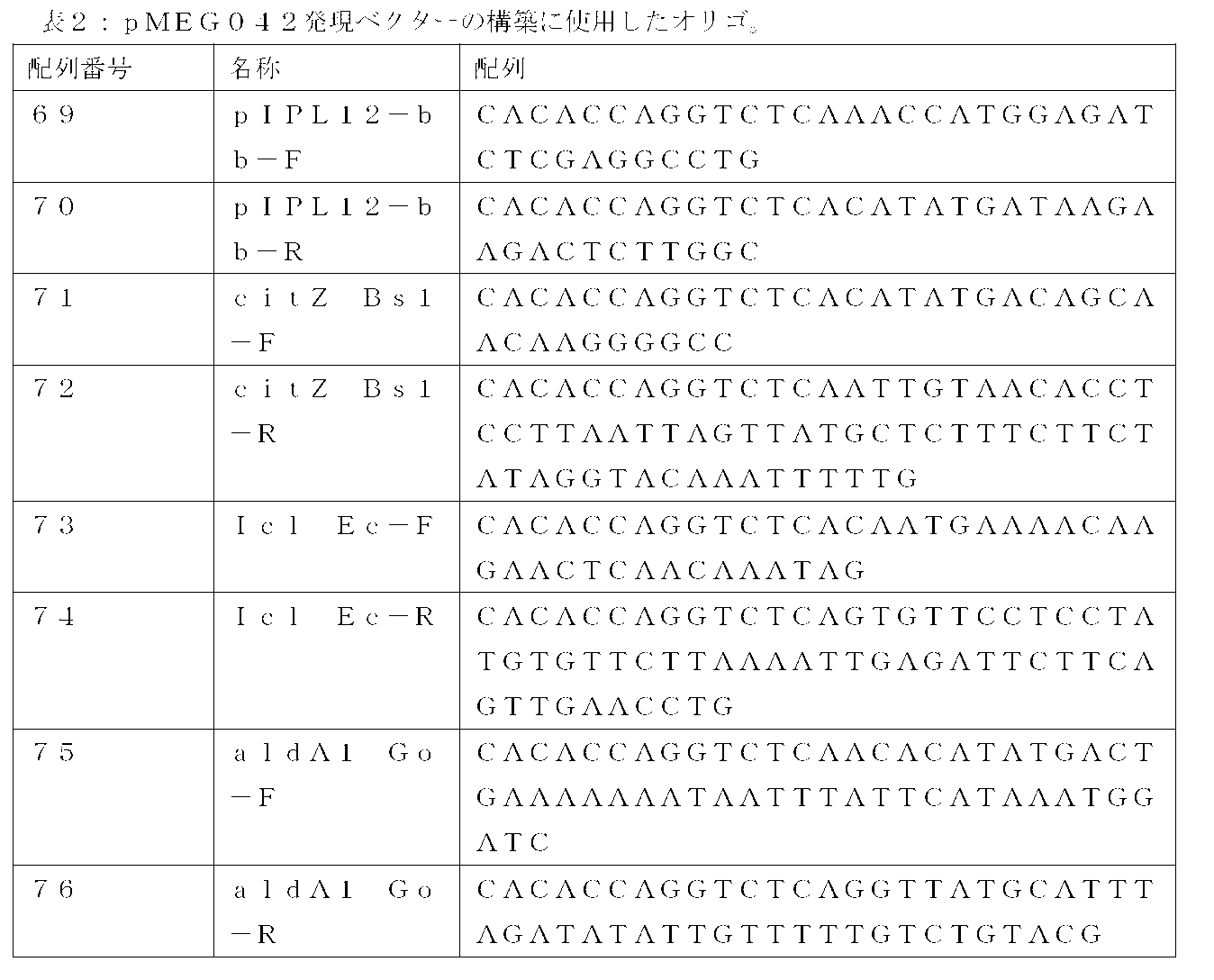
pMEG042構築物は、接合によりC.autoethanogenumに形質転換
された。発現ベクターは、標準的な熱ショック形質転換を使用して、接合体ドナー株であ
るE.coliHB101+R702(CA434)(Williams et al.
1990)(ドナー)に最初に導入された。ドナー細胞を37℃で1時間SOC培地で回
収した後、100μg/mLのスペクチノマイシンおよび500μg/mLのエリスロマ
イシンを含むLB培地プレートにプレーティングし、37℃で一晩インキュベートした。
翌日、100μg/mLのスペクチノマイシンと500μg/mLのエリスロマイシンを
含む5mLのLBアリコートにいくつかのドナーコロニーを接種し、37℃で約4時間、
または培養液が目に見えて密度が高くなるまで、まだ静止期に入っていない状態で培養し
た。1.5mLのドナー培養物を4000rpmおよび20~25℃で2分間の遠心分離
によって収集し、上清を廃棄した。ドナー細胞を500μLの滅菌PBS緩衝液に穏やか
に再懸濁し、4000rpmで2分間遠心分離し、PBS上清を廃棄した。
The pMEG042 construct was cloned into C. elegans by conjugation. autoethanogenum. The expression vector was transformed into the zygotic donor strain, E. coli, using standard heat shock transformation. coli HB101+R702 (CA434) (Williams et al.
1990) (donor). Donor cells were harvested in SOC medium for 1 hour at 37°C, then plated on LB medium plates containing 100 µg/mL spectinomycin and 500 µg/mL erythromycin and incubated overnight at 37°C.
The following day, 5 mL LB aliquots containing 100 μg/mL spectinomycin and 500 μg/mL erythromycin were inoculated with several donor colonies and incubated at 37° C. for approximately 4 hours.
Alternatively, cultures were cultured before stationary phase until the cultures were visibly dense. 1.5 mL of donor culture was harvested by centrifugation at 4000 rpm and 20-25° C. for 2 minutes and the supernatant was discarded. Donor cells were gently resuspended in 500 μL of sterile PBS buffer, centrifuged at 4000 rpm for 2 minutes and the PBS supernatant was discarded.
ペレットを嫌気性チャンバーに導入し、C.autoethanogenum培養(レ
シピエント)の指数関数期の後期に200μLで穏やかに再懸濁した。C.autoet
hanogenum DSM10061およびDSM23693(DSM10061の派
生物)は、DSMZ(The German Collection of Micro
organisms and Cell Cultures,Inhoffenstra
βe 7B,38124 Braunschweig,Germany)から取得した。
菌株は、標準的な嫌気性技術(Hungate 1969;Wolfe 1971)を使
用して、pH5.6でPETC培地(米国特許第9,738,875号を参照)中、37
℃で増殖させた。
B. introducing the pellet into the anaerobic chamber; Gently resuspend in 200 μL at the late exponential phase of the autoethanogenum culture (recipient). C. automatic
hanogenum DSM10061 and DSM23693 (derivatives of DSM10061) are available from DSMZ (The German Collection of Micro
Organisms and Cell Cultures, Inhoffenstra
βe 7B, 38124 Braunschweig, Germany).
Strains were grown in PETC medium (see US Pat. No. 9,738,875) at pH 5.6 using standard anaerobic techniques (Hungate 1969; Wolfe 1971).
was grown at °C.
接合混合物(ドナー細胞とレシピエント細胞の混合物)をPETC-MES+フルクト
ース寒天プレートにスポットし、放置して乾燥させた。スポットが、もはや目に見えて濡
れなくなったときに、プレートを、圧力ジャーに導入し、合成ガス(50%CO、10%
N2、30%CO2、10%H2)で25~30psiに加圧し、37℃で約24時間イ
ンキュベートした。次に、10μLの白金耳を使用して穏やかに掻き取ることにより、接
合混合物をプレートから取り出した。取り出した混合物を200~300μLのPETC
培地に懸濁した。接合混合物の100μLアリコートを、5μg/mLのクラリスロマイ
シンを補充したPETC培地寒天プレートにプレーティングし、プラスミドを担持する形
質転換体を選択した。
The conjugation mixture (mixture of donor and recipient cells) was spotted onto PETC-MES+fructose agar plates and left to dry. When the spot was no longer visibly wet, the plate was introduced into the pressure jar and syngas (50% CO, 10%
N 2 , 30% CO 2 , 10% H 2 ) was pressurized to 25-30 psi and incubated at 37° C. for approximately 24 hours. The mating mixture was then removed from the plate by gently scraping using a 10 μL platinum loop. The removed mixture was added to 200-300 μL of PETC
Suspended in medium. 100 μL aliquots of the conjugation mixture were plated on PETC medium agar plates supplemented with 5 μg/mL clarithromycin to select transformants carrying the plasmid.
pMEG042プラスミドを担持するC.autoethanogenumの3つの異
なるコロニーを5μg/mLのクラリスロマイシンを含む2mLのPETC-MES培地
に接種し、50%CO、10%N2、30%CO2、10%H2とともにおよび100r
pmのオービタル振とうを用いて3日間、37℃で独立栄養的に増殖させた。培養物を、
血清ボトル内で5μg/mLのクラリスロマイシンを含む10mLのPETC-MES培
地でOD600が0.05になるように希釈し、50%CO、10%N2、30%CO2
、10%H2および100rpmのオービタル振とうを用いて37℃で独立栄養的に最大
20日間増殖させ、毎日サンプリングしてバイオマスと代謝産物を測定した(図3Aおよ
び3B)。エチレングリコールの生成を、ガスクロマトグラフィー質量分析(GC-MS
)を使用して測定し、他の代謝産物を、下記のように高速液体クロマトグラフィー(HP
LC)を使用して測定した。
C. elegans carrying the pMEG042 plasmid. Three different colonies of C. autoethanogenum were inoculated into 2 mL of PETC-MES medium containing 5 μg/mL of clarithromycin with 50% CO, 10% N 2 , 30% CO 2 , 10% H 2 and 100 r.
Grow autotrophically at 37° C. for 3 days with pm orbital shaking. the culture,
Dilute to an OD 600 of 0.05 with 10 mL of PETC-MES medium containing 5 μg/mL clarithromycin in a serum bottle, 50% CO, 10% N 2 , 30% CO 2 .
, grown autotrophically at 37 °C with 10% H2 and orbital shaking at 100 rpm for up to 20 days and sampled daily to measure biomass and metabolites (Figs. 3A and 3B). The production of ethylene glycol was analyzed by gas chromatography-mass spectrometry (GC-MS).
), and other metabolites were analyzed by high performance liquid chromatography (HP
LC).
エチレングリコール濃度は、Agilent VF-WAXmsカラム(15m×0.
25μm×0.25μm)およびRSHオートサンプラーを装備したThermo Sc
ientific ISQ LT GCMSで測定した。200μLのブロスを200μ
Lのメタノールで希釈して試料を調製した。試料をボルテックスした後、14,000r
pmで3分間遠心分離し、200μLの上澄みをインサート付きガラスバイアルに移した
。1.0μLの注入、5対1のスプリット比、240℃の注入口温度を使用して、試料を
分析のためにオートサンプラーに移した。クロマトグラフィーは、80℃、0.5分保持
、10℃/分で150℃まで昇温、25℃/分で220℃まで昇温、3分最終保持のオー
ブンプログラムを使用して、実行した。カラムの流量は4.0mL/分で、0.5分間保
持した後、キャリアガスとしてヘリウムを使用して、100ml/分/分の速度で1.5
ml/分に低下させた。MSイオン源は、トランスファーラインを240℃に設定して2
60℃に維持した。定量は、33.0m/zを定量ピークとして、31.0+62.0m
/zを確認ピークとして使用して、線形外部標準キャリブレーションを使用して行った。
Ethylene glycol concentration was determined by Agilent VF-WAXms column (15m×0.
25 μm × 0.25 μm) and a Thermo Sc equipped with an RSH autosampler
Measured on an intelligent ISQ LT GCMS. 200 μL of broth to 200 μL
A sample was prepared by diluting with L of methanol. 14,000 r after vortexing the sample
It was centrifuged for 3 minutes at pm and 200 μL of supernatant was transferred to a glass vial with insert. Samples were transferred to the autosampler for analysis using a 1.0 μL injection, a 5 to 1 split ratio, and an inlet temperature of 240°C. Chromatography was performed using an oven program of 80° C., 0.5 min hold, 10° C./min to 150° C., 25° C./min to 220° C., 3 min final hold. The column flow rate was 4.0 mL/min, held for 0.5 min, then 1.5 at a rate of 100 ml/min/min using helium as the carrier gas.
ml/min. The MS ion source was set to 2 with the transfer line set at 240°C.
Maintained at 60°C. Quantitation is 31.0 + 62.0 m with 33.0 m / z as the quantitative peak
/z was used as the confirming peak and performed using a linear external standard calibration.
エタノール、アセテート、2,3-ブタンジオール、グリオキシル酸、およびグリコー
ル酸の濃度は、屈折率(RI)検出を備えたAgilent 1260 Infinit
y LCのHPLCにより35℃で測定した。試料は、80℃で5分間加熱した後、14
,000rpmで3分間遠心分離して調製し、上清を分析のためにガラスバイアルに移し
た。分離は、Phenomenex Rezex(商標)ROA-有機酸H+(8%)カ
ラム(300mm×7.8mm×8μm)への10μL注入で、0.7mL/分および3
5℃で、アイソクラティック条件下、5mM硫酸移動相を使用して行われた。
Concentrations of ethanol, acetate, 2,3-butanediol, glyoxylic acid, and glycolic acid were measured on an Agilent 1260 Infinit with refractive index (RI) detection.
Measured by HPLC of yLC at 35°C. The sample was heated at 80°C for 5 minutes and then dried for 14
,000 rpm for 3 minutes, and the supernatant was transferred to a glass vial for analysis. Separation was performed at 0.7 mL/min and 3
It was performed using a 5 mM sulfuric acid mobile phase under isocratic conditions at 5°C.
独立栄養増殖の約3日後、エチレングリコール前駆体のグリコール酸が観察され、10
日後、エチレングリコールの生成が観察された(図3B)。
After approximately 3 days of autotrophic growth, the ethylene glycol precursor glycolic acid was observed and 10
Days later, ethylene glycol production was observed (Fig. 3B).
実施例2:C.autoethanogenumにおけるCOおよび/またはCO2お
よびH2からのエチレングリコールの生成のためのS.thiotauriniアラニン
-グリオキシル酸アミノトランスフェラーゼおよびP.fluorescensアルデヒ
ドデヒドロゲナーゼを含む異種発現ベクターの構築。
Example 2: C.I. S. for the production of ethylene glycol from CO and/or CO2 and H2 in an autoethanogenum. thiotaurini alanine-glyoxylate aminotransferase and P. Construction of heterologous expression vectors containing fluorescens aldehyde dehydrogenase.
S.thiotaurini由来のアラニン-グリオキシル酸アミノトランスフェラー
ゼ(pucG;配列番号15~16)およびP.fluorescens Q8r1-9
6由来のアルデヒドデヒドロゲナーゼ(aldA1;配列番号57~58)をコードする
遺伝子は、C.autoethanogenumでの発現のためコドンに適合され、合成
された。コドンに適合した遺伝子をpIPL12(図2A)にクローニングし、得られた
発現ベクター、pMEG058を、実施例1に記載されているように、C.autoet
hanogenumに導入した。図2Cを参照されたい。
S. Alanine-glyoxylate aminotransferase (pucG; SEQ ID NOS: 15-16) from P. thiotaurini and P. fluorescens Q8r1-9
The gene encoding aldehyde dehydrogenase (aldA1; SEQ ID NOs:57-58) from C.6 The codons were adapted and synthesized for expression in the autoethanogenum. The codon-matched gene was cloned into pIPL12 (Fig. 2A) and the resulting expression vector, pMEG058, was transformed into C. automatic
hanogenum. See FIG. 2C.

実施例1に記載されるように、pMEG058プラスミドを担持するC.autoet
hanogenumの2つの異なるコロニーを、5μg/mLのクラリスロマイシンを含
む2mLのPETC-MES培地に接種し、独立栄養的に増殖させた。図4Aを参照され
たい。独立栄養増殖の約3日後、グリコール酸が観察され、8日後、エチレングリコール
の生成が観察された(図4B)。
As described in Example 1, a C. automatic
Two different colonies of C. hanogenum were inoculated into 2 mL PETC-MES medium containing 5 μg/mL clarithromycin and grown autotrophically. See FIG. 4A. Glycolic acid was observed after about 3 days of autotrophic growth, and ethylene glycol production was observed after 8 days (Fig. 4B).
実施例3:C.autoethanogenumにおけるCOおよび/またはCO2お
よびH2からのエチレングリコールの生成のための、S.thiotauriniアラニ
ン-グリオキシル酸アミノトランスフェラーゼおよびG.oxydansグリコールアル
デヒドデヒドロゲナーゼを含む異種発現ベクターの構築
Example 3: C.I. for the production of ethylene glycol from CO and/or CO2 and H2 in an autoethanogenum. thiotaurini alanine-glyoxylate aminotransferase and G. Construction of heterologous expression vectors containing oxydans glycolaldehyde dehydrogenase
S.thiotaurini由来のアラニン-グリオキシル酸アミノトランスフェラー
ゼ(pucG;配列番号15~16)およびG.oxydans由来のグリコールアルデ
ヒドデヒドロゲナーゼ(aldA1;配列番号55~56)をコードする遺伝子は、C.
autoethanogenumでの発現のためにコドンに適合され、合成された。コド
ンに適合した遺伝子をpIPL12(図2A)にクローニングし、得られた発現ベクター
、pMEG059を、実施例1に記載されているように、C.autoethanoge
numに導入した。図2Dを参照されたい。
S. Alanine-glyoxylate aminotransferase (pucG; SEQ ID NOS: 15-16) from G. thiotaurini and G. The gene encoding glycolaldehyde dehydrogenase (aldA1; SEQ ID NOs:55-56) from C. oxydans was
The codons were adapted and synthesized for expression in the autoethanogenum. The codon-matched gene was cloned into pIPL12 (FIG. 2A) and the resulting expression vector, pMEG059, was transformed into C. elegans as described in Example 1. auto ethanol
num. See Figure 2D.

実施例1に記載されるように、pMEG059プラスミドを担持するC.autoet
hanogenumの2つの異なるコロニーを、5μg/mLのクラリスロマイシンを含
む2mLのPETC-MES培地に接種し、独立栄養的に増殖させた。図5Aを参照され
たい。独立栄養増殖の約3日後、グリコール酸が観察され、10日後、エチレングリコー
ルの生成が観察された(図5B)。
As described in Example 1, a C. automatic
Two different colonies of C. hanogenum were inoculated into 2 mL PETC-MES medium containing 5 μg/mL clarithromycin and grown autotrophically. See FIG. 5A. Glycolic acid was observed after about 3 days of autotrophic growth, and ethylene glycol production was observed after 10 days (Fig. 5B).
実施例4:C.autoethanogenumにおけるCOおよび/またはCO2お
よびH2からのエチレングリコールの生成のためのアラニン-グリオキシル酸アミノトラ
ンスフェラーゼおよびアルデヒドデヒドロゲナーゼを含む異種発現ベクターの構築。
Example 4: C.I. Construction of heterologous expression vectors containing alanine-glyoxylate aminotransferase and aldehyde dehydrogenase for the production of ethylene glycol from CO and/or CO2 and H2 in autoethanogenum.
C.acidurici由来のクラスVアミノトランスフェラーゼ(SgA;配列番号
19、20)およびP.fluorescens Q8r1-96由来のアルデヒドデヒ
ドロゲナーゼ(aldA1;配列番号57~58)をコードする遺伝子は、C.auto
ethanogenumでの発現のためコドンに適合され、合成された。コドンに適合し
た遺伝子をpIPL12(図2A)にクローニングし、得られた発現ベクター、pMEG
061を、実施例1に記載されているように、C.autoethanogenumに導
入した。図2Eを参照されたい。
C. class V aminotransferase (SgA; SEQ ID NO: 19, 20) from P. acidurici and P. acidurici; The gene encoding the aldehyde dehydrogenase (aldA1; SEQ ID NOs:57-58) from C. fluorescens Q8r1-96 was derived from C. fluorescens Q8r1-96. auto
The codons were adapted and synthesized for expression in ethanologenum. The codon-matched gene was cloned into pIPL12 (Fig. 2A) and the resulting expression vector, pMEG
061 was added to C.I. introduced into the autoethanogenum. See FIG. 2E.

実施例1に記載されるように、pMEG061プラスミドを担持するC.autoet
hanogenumの3つの異なるコロニーを、5μg/mLのクラリスロマイシンを含
む2mLのPETC-MES培地に接種し、独立栄養的に増殖させた。図6Aを参照され
たい。独立栄養増殖の約3日後、グリコール酸が観察され、16日後、エチレングリコー
ルの生成が観察された(図6B)。
As described in Example 1, C. automatic
Three different colonies of C. hanogenum were inoculated into 2 mL PETC-MES medium containing 5 μg/mL clarithromycin and grown autotrophically. See FIG. 6A. Approximately 3 days after autotrophic growth, glycolic acid was observed, and after 16 days, ethylene glycol production was observed (Fig. 6B).
実施例5:エチレングリコールへのさまざまなルートの最大収量のモデリング
Marcellin,Green Chem,18:3020-3028,2016に
記載されているようなClostridium autoethanogenumのゲノ
ムスケールの代謝モデルを利用して、エチレングリコールへの異なるルートの最大収量を
予測した。異種代謝反応を野生型Clostridium autoethanogen
umモデル構造に追加して、非天然化合物生成経路の組み込みを示した。本明細書に記載
の実験作業に使用されるモデルは、Clostridium autoethanoge
numに基づくが、代謝の類似性を考慮すると、結果は、他のWood-Ljungda
hl微生物にも当てはまると期待することは当然であり得る。
Example 5 Modeling Maximum Yield of Various Routes to Ethylene Glycol Utilizing a genome-scale metabolic model of Clostridium autoethanogenum as described in Marcellin, Green Chem, 18:3020-3028, 2016, ethylene glycol predicted the maximum yield of different routes to Wild-type Clostridium autoethanogen
In addition to the um model structure, the incorporation of non-natural compound production pathways was shown. The model used for the experimental work described herein is Clostridium autoethanogen
num, but given metabolic similarities, the results are similar to those of other Wood-Ljungda
It may be reasonable to expect the same to apply to hl microorganisms.
エチレングリコールの生成は、cobrapyバージョン0.8.2(Ebrahim
.,COBRApy:COnstraints-Based Reconstructi
on and Analysis for Python,BMC Syst Biol
,7:74,2013)を使用し、ソルバーインターフェイスとしてoptlangバー
ジョン1.2.3(Jensen,Optlang:An Algebraic Mod
eling Language for Mathematical Optimiza
tion,”The Journal of Open Source Softwar
e,2,doi:10.21105/joss.00139,2017)を、最適化ソル
バーとしてGurobi Optimizerバージョン7.0.2を使用する、制約ベ
ースの計算モデリング技術フラックスバランス分析(FBA)および代謝調整の線形最小
化(LMOMA)を使用してシミュレートされた(Maia,Proceedings
of the Genetic and Evolutionary Computat
ion Conference Companion on-GECCO´17,New
York,New York,ACM Press,1661-1668,2017)
。
Ethylene glycol production is based on cobrapy version 0.8.2 (Ebrahim
. , COBRApy: Constraints-Based Reconstruction
on and Analysis for Python, BMC Syst Biol
, 7:74, 2013) and optlang version 1.2.3 (Jensen, Optlang: An Algebraic Mod
eling Language for Mathematical Optimizer
tion, "The Journal of Open Source Software
e, 2, doi: 10.21105/joss. 00139, 2017) were simulated using constraint-based computational modeling techniques Flux Balance Analysis (FBA) and Linear Minimization of Metabolic Adjustment (LMOMA) using Gurobi Optimizer version 7.0.2 as the optimization solver. (Maia, Proceedings
of the Genetic and Evolutionary Computation
ion Conference Companion on-GECCO'17, New
York, New York, ACM Press, 1661-1668, 2017)
.
モデル化により、実施例1~4で本明細書に記載された経路により、0.37molの
エチレングリコール/molCOの予測収量が明らかになった。これは、糖新生を必要と
し、予測される最高の収量が、約0.18molのエチレングリコール/mol COに
相当する、約0.44gのエチレングリコール/g COであることが見出された、Is
lam et al.Metab Eng,41:173-181,2017によって記
述された仮説的経路による予測収量の2倍以上である。
Modeling revealed a predicted yield of 0.37 mol ethylene glycol/mol CO via the routes described herein in Examples 1-4. This requires gluconeogenesis and the highest expected yield was found to be about 0.44 g ethylene glycol/g CO, corresponding to about 0.18 mol ethylene glycol/mol CO. Is
Lam et al. More than double the yield predicted by the hypothetical pathway described by Metab Eng, 41:173-181, 2017.
本明細書に列挙される公表文献、特許出願、および特許を含む全ての参考文献は、各参
考文献があたかも参照により組み込まれることが個々にかつ具体的に示され、かつその全
体が本明細書中に記載された場合と同じ程度まで、参照により本明細書に組み込まれる。
本明細書における任意の先行技術への言及は、その先行技術が任意の国における努力傾注
分野の共通の一般的知識の一部をなすという承認ではなく、かつそのように解釈されるべ
きではない。
All references, including publications, patent applications, and patents, cited herein are individually and specifically indicated that each reference is incorporated by reference as if, and is hereby incorporated by reference in its entirety. Incorporated herein by reference to the same extent as if written therein.
Reference herein to any prior art is not, and should not be construed as, an admission that such prior art forms part of the common general knowledge of the field of endeavor in any country. .
本発明の記載との関連で(特に、以下の特許請求の範囲との関連で)、用語「a」およ
び「an」および「the」ならびに同様の指示語の使用は、本明細書に別段の指示がな
い限り、または文脈によって明らかに相反することがない限り、単数および複数の両方を
包含すると解釈されるものとする。用語「含むこと(comprising)」、「有す
ること」、「含むこと(including)」、および「含有すること」は、特に断り
のない限り、非限定的な用語(すなわち、「~を含むがこれらに限定されないこと」を意
味する)と解釈されるものとする。「から本質的になる」という用語は、組成物、プロセ
ス、または方法の範囲を、特定の材料もしくは工程、または組成物、プロセス、もしくは
方法の基本的かつ新規の特性に実質的に影響しないものに限定する。選択詞の使用(例え
ば「または」)は、選択詞の一方、両方、またはこれらの任意の組み合わせを意味すると
理解されるべきである。本明細書で使用される場合、「約」という用語は、別段の指示が
ない限り、指示された範囲、値、または構造の±20%を意味する。
In the context of the description of the present invention, and particularly in the context of the claims that follow, the use of the terms "a" and "an" and "the" and similar denotations herein may be shall be construed to include both the singular and the plural unless otherwise indicated or the context clearly contradicts. The terms "comprising,""having,""including," and "containing," unless otherwise specified, are open-ended terms (i.e., "including but not limited to shall be construed as “not limited to”). The term "consisting essentially of" defines the scope of a composition, process, or method that does not materially affect a particular material or step or fundamental and novel properties of the composition, process, or method. limited to The use of alternatives (eg, "or") should be understood to mean one, both, or any combination thereof. As used herein, the term "about" means ±20% of the indicated range, value or structure, unless otherwise indicated.
本明細書の値の範囲の記述は、本明細書に別段の指示がない限り、範囲内に入る各個々
の値を個々に言及する省略法としての役割を果たすことを単に意図し、各個々の値は、あ
たかも本明細書に個々に列挙されたかのように、本明細書中に組み込まれる。例えば、任
意の濃度範囲、パーセント範囲、比率範囲、整数範囲、サイズ範囲、または厚さ範囲は、
別段の指示がない限り、列挙された範囲内の任意の整数の値、および適切な場合、その分
数(整数の10分の1、および100分の1など)を含むと理解されるべきである。
Recitation of ranges of values herein is merely intended to serve as a shorthand method of referring individually to each individual value falling within the range, unless indicated otherwise herein, and each individual The values of are incorporated herein as if individually recited herein. For example, any concentration range, percent range, ratio range, integer range, size range, or thickness range is
Unless otherwise indicated, it is to be understood to include any integer value within the recited range and, where appropriate, fractions thereof (such as integer tenths and hundredths). .
本明細書に記載される全ての方法は、本明細書に別段の指示がない限り、または文脈と
明らかに相反することがない限り、任意の好適な順序で実施され得る。本明細書に提供さ
れるありとあらゆる例または例示的な言葉(例えば、「など」)の使用は、本発明をより
よく解明することを単に意図し、別段の請求がない限り、本発明の範囲を制限しない。本
明細書におけるいかなる言葉も、本発明の実施に不可欠な任意の非請求要素を示すものと
解釈されるべきではない。
All methods described herein can be performed in any suitable order unless otherwise indicated herein or otherwise clearly contradicted by context. The use of any and all examples or exemplary language (e.g., "such as") provided herein is merely intended to better elucidate the invention and, unless otherwise claimed, limits the scope of the invention. No restrictions. No language in the specification should be construed as indicating any non-claimed element essential to the practice of the invention.
本発明の好ましい実施形態が本明細書に記載される。それらの好ましい実施形態の変化
形は、上記の説明を読むことによって当業者に明らかとなり得る。本発明者らは、当業者
が必要に応じてそのような変化形を採用することを予想し、本発明者らは、本発明が本明
細書に具体的に記載されるものとは別の方法で実施されることを意図する。したがって、
本発明は、適用法によって許可された通り、本明細書に添付される特許請求の範囲に記載
される主題の全ての修正物および均等物を含む。さらに、好ましい実施形態の全ての考え
られる変化形における上記の要素の任意の組み合わせは、本明細書で別段の指示がない限
り、または文脈と明らかに相反することがない限り、本発明によって包含される。
Preferred embodiments of the invention are described herein. Variations of those preferred embodiments may become apparent to those of ordinary skill in the art upon reading the foregoing description. The inventors anticipate that skilled artisans will employ such variations as appropriate, and the inventors believe that the invention may be practiced otherwise than as specifically described herein. It is intended to be implemented in a method. therefore,
This invention includes all modifications and equivalents of the subject matter recited in the claims appended hereto as permitted by applicable law. Moreover, any combination of the above-described elements in all possible variations of the preferred embodiments is encompassed by the invention unless otherwise indicated herein or otherwise clearly contradicted by context. be.
本発明の好ましい実施形態が本明細書に記載される。それらの好ましい実施形態の変化形は、上記の説明を読むことによって当業者に明らかとなり得る。本発明者らは、当業者が必要に応じてそのような変化形を採用することを予想し、本発明者らは、本発明が本明細書に具体的に記載されるものとは別の方法で実施されることを意図する。したがって、本発明は、適用法によって許可された通り、本明細書に添付される特許請求の範囲に記載される主題の全ての修正物および均等物を含む。さらに、好ましい実施形態の全ての考えられる変化形における上記の要素の任意の組み合わせは、本明細書で別段の指示がない限り、または文脈と明らかに相反することがない限り、本発明によって包含される。
本発明の様々な実施形態を以下に示す。
1.ガス状基質からエチレングリコールまたはエチレングリコールの前駆体を生成できる遺伝子操作された微生物。
2.前記微生物が、5,10-メチレンテトラヒドロ葉酸、オキサロ酢酸、クエン酸、リンゴ酸、およびグリシンからなる群から選択される1つ以上の中間体を介してエチレングリコールまたはエチレングリコールの前駆体を生成する、上記1に記載の微生物。
3.前記微生物が、
a.オキサロ酢酸をクエン酸に変換できる異種酵素、
b.グリシンをグリオキシル酸に変換できる異種酵素、
c.イソクエン酸をグリオキシル酸に変換できる異種酵素、および
d.グリコール酸をグリコアルデヒドに変換できる異種酵素、のうちの1つ以上を含む、上記1に記載の微生物。
4.a.オキサロ酢酸をクエン酸に変換できる前記異種酵素が、クエン酸[Si]-シンターゼ[2.3.3.1]、ATPクエン酸シンターゼ[2.3.3.8]またはクエン酸(Re)-シンターゼ[2.3.3.3]であり、
b.グリシンをグリオキシル酸に変換できる前記異種酵素が、アラニン-グリオキシル酸トランスアミナーゼ[2.6.1.44]、セリン-グリオキシル酸トランスアミナーゼ[2.6.1.45]、セリン-ピルビン酸トランスアミナーゼ[2.6.1.51]、グリシン-オキサロ酢酸トランスアミナーゼ[2.6.1.35]、グリシントランスアミナーゼ[2.6.1.4]、グリシンデヒドロゲナーゼ[1.4.1.10]、アラニンデヒドロゲナーゼ[1.4.1.1]、またはグリシンデヒドロゲナーゼ[1.4.2.1]であり、
c.イソクエン酸をグリオキシル酸に変換できる前記異種酵素が、イソクエン酸リアーゼ[4.1.3.1]であり、かつ/または
d.グリコール酸をグリコールアルデヒドに変換できる前記異種酵素が、グリコールアルデヒドデヒドロゲナーゼ[1.2.1.21]、ラクトアルデヒドデヒドロゲナーゼ[1.2.1.22]、コハク酸セミアルデヒドデヒドロゲナーゼ[1.2.1.24]、2,5-ジオキソ吉草酸デヒドロゲナーゼ[1.2.1.26]、アルデヒドデヒドロゲナーゼ[1.2.1.3/4/5]、ベタイン-アルデヒドデヒドロゲナーゼ[1.2.1.8]、またはアルデヒドフェレドキシンオキシドレダクターゼ[1.2.7.5]である、上記3に記載の微生物。
5.前記異種酵素のうちの1つ以上が、Bacillus、Clostridium、Escherichia、Gluconobacter、Hyphomicrobium、Lysinibacillus、Paenibacillus、Pseudomonas、Sedimenticola、Sporosarcina、Streptomyces、Thermithiobacillus、Thermotoga、およびZeaからなる群から選択される属に由来する、上記3に記載の微生物。
6.前記異種酵素のうちの1つ以上が、前記微生物における発現のためにコドン最適化されている、上記3に記載の微生物。
7.前記微生物は、アセチル-CoAをピルビン酸に変換できる酵素、ピルビン酸をオキサロ酢酸に変換できる酵素、ピルビン酸をリンゴ酸に変換できる酵素、ピルビン酸をホスフェノールピルビン酸に変換できる酵素、オキサロ酢酸をシトリル-CoAに変換できる酵素、シトリル-CoAをクエン酸に変換できる酵素、クエン酸をアコニット酸に、およびアコニット酸をイソクエン酸に変換できる酵素、ホスホエノールピルビン酸をオキサロ酢酸に変換できる酵素、ホスホエノールピルビン酸を2-ホスホ-D-グリセリン酸に変換できる酵素、2-ホスホ-D-グリセリン酸を3-ホスホ-D-グリセリン酸に変換できる酵素、3-ホスホ-D-グリセリン酸を3-ホスホノオキシピルビン酸に変換できる酵素、3-ホスホノオキシピルビン酸を3-ホスホ-L-セリンに変換できる酵素、3-ホスホ-L-セリンをセリンに変換できる酵素、セリンをグリシンに変換できる酵素、5,10-メチレンテトラヒドロ葉酸をグリシンに変換できる酵素、セリンをヒドロキシピルビン酸に変換できる酵素、D-グリセリン酸をヒドロキシピルビン酸に変換できる酵素、リンゴ酸をグリオキシル酸に変換できる酵素、グリオキシル酸をグリコール酸に変換できる酵素、ヒドロキシピルビン酸をグリコアルデヒドに変換できる酵素、およびグリコアルデヒドをエチレングリコールに変換できる酵素、のうちの1つ以上をさらに含む、上記3に記載の微生物。
8.前記微生物が、
a.前記オキサロ酢酸をクエン酸に変換できる異種酵素、
b.前記グリシンをグリオキシル酸に変換できる異種酵素および/または
c.前記グリコール酸をグリコアルデヒドに変換できる異種酵素、を過剰発現する、上記3に記載の微生物。
9.前記微生物が、
a.前記ピルビン酸をオキサロ酢酸に変換できる酵素、
b.前記クエン酸をアコニット酸に、およびアコニット酸をイソクエン酸に変換できる酵素、
c.前記ホスホエノールピルビン酸をオキサロ酢酸に変換できる酵素、
d.前記セリンをグリシンに変換できる酵素、
e.前記5,10-メチレンテトラヒドロ葉酸をグリシンに変換できる酵素、
f.前記グリオキシル酸をグリコール酸に変換できる酵素、および/または
g.前記グリコアルデヒドをエチレングリコールに変換できる酵素、を過剰発現する、上記7に記載の微生物。
10.前記微生物が、イソクエン酸デヒドロゲナーゼ、グリセリン酸デヒドロゲナーゼ、グリコール酸デヒドロゲナーゼ、グリセリン酸デヒドロゲナーゼ、グリコール酸デヒドロゲナーゼ、アルデヒドフェレドキシンオキシドレダクターゼ、およびアルデヒドデヒドロゲナーゼのうちの1つ以上に破壊的変異を含む、上記1に記載の微生物。
11.前記微生物が、Acetobacterium、Alkalibaculum、Blautia、Butyribacterium、Clostridium、Eubacterium、Moorella、Oxobacter、Sporomusa、およびThermoanaerobacterからなる群から選択される属のメンバーである、上記1に記載の微生物。
12.前記微生物が、Acetobacterium woodii、Alkalibaculum bacchii、Blautia producta、Butyribacterium methylotrophicum、Clostridium aceticum、Clostridium autoethanogenum、Clostridium carboxidivorans、Clostridium coskatii、Clostridium drakei、Clostridium formicoaceticum、Clostridium ljungdahlii、Clostridium magnum、Clostridium ragsdalei、Clostridium scatologenes、Eubacterium limosum、Moorella thermautotrophica、Moorella thermoacetica、Oxobacter pfennigii、Sporomusa ovata、Sporomusa silvacetica、Sporomusa sphaeroides、およびThermoanaerobacter kiuviからなる群から選択される親微生物に由来する、上記1に記載の微生物。
13.前記微生物が、Clostridium autoethanogenum、Clostridium ljungdahlii、およびClostridium ragsdaleiからなる群から選択される親細菌に由来する、上記12に記載の微生物。
14.前記微生物が、天然または異種のWood-Ljungdahl経路を含む、上記1に記載の微生物。
15.前記エチレングリコールの前駆体がグリオキシル酸またはグリコール酸である、上記1に記載の微生物。
16.前記ガス状基質の存在下、栄養培地中で上記1に記載の微生物を培養し、それによって前記微生物がエチレングリコールまたはエチレングリコールの前駆体を生成することを含む、エチレングリコールまたはエチレングリコールの前駆体の生成方法。
17.前記ガス状基質が、CO、CO
2
、およびH
2
のうちの1つ以上を含む、上記16に記載の方法。
18.前記エチレングリコールの前駆体がグリオキシル酸またはグリコール酸である、上記16に記載の方法。
19.前記栄養培地からエチレングリコールまたはエチレングリコールの前駆体を分離することをさらに含む、上記16に記載の方法。
20.前記微生物がエタノール、2,3-ブタンジオール、およびコハク酸うちの1つ以上をさらに生成する、上記16に記載の方法。
Preferred embodiments of the invention are described herein. Variations of those preferred embodiments may become apparent to those of ordinary skill in the art upon reading the foregoing description. The inventors anticipate that skilled artisans will employ such variations as appropriate, and the inventors believe that the invention may be practiced otherwise than as specifically described herein. It is intended to be implemented in a method. Accordingly, this invention includes all modifications and equivalents of the subject matter recited in the claims appended hereto as permitted by applicable law. Moreover, any combination of the above-described elements in all possible variations of the preferred embodiments is encompassed by the invention unless otherwise indicated herein or otherwise clearly contradicted by context. be.
Various embodiments of the invention are presented below.
1. Genetically engineered microorganisms capable of producing ethylene glycol or ethylene glycol precursors from gaseous substrates.
2. The microorganism produces ethylene glycol or a precursor of ethylene glycol via one or more intermediates selected from the group consisting of 5,10-methylenetetrahydrofolic acid, oxaloacetic acid, citric acid, malic acid, and glycine. , the microorganism according to 1 above.
3. the microorganism is
a. a heterologous enzyme capable of converting oxaloacetate to citrate,
b. a heterologous enzyme capable of converting glycine to glyoxylate,
c. a heterologous enzyme capable of converting isocitrate to glyoxylate, and
d. heterologous enzymes capable of converting glycolic acid to glycoaldehyde.
4. a. Said heterologous enzyme capable of converting oxaloacetate to citrate is citrate [Si]-synthase [2.3.3.1], ATP citrate synthase [2.3.3.8] or citrate (Re)- a synthase [2.3.3.3];
b. Said heterologous enzymes capable of converting glycine to glyoxylate are alanine-glyoxylate transaminase [2.6.1.44], serine-glyoxylate transaminase [2.6.1.45], serine-pyruvate transaminase [2. 6.1.51], glycine-oxaloacetate transaminase [2.6.1.35], glycine transaminase [2.6.1.4], glycine dehydrogenase [1.4.1.10], alanine dehydrogenase [1 .4.1.1], or glycine dehydrogenase [1.4.2.1],
c. said heterologous enzyme capable of converting isocitrate to glyoxylate is isocitrate lyase [4.1.3.1], and/or
d. Said heterologous enzymes capable of converting glycolic acid to glycolaldehyde are glycolaldehyde dehydrogenase [1.2.1.21], lactaldehyde dehydrogenase [1.2.1.22], succinate semialdehyde dehydrogenase [1.2.1 .24], 2,5-dioxovalerate dehydrogenase [1.2.1.26], aldehyde dehydrogenase [1.2.1.3/4/5], betaine-aldehyde dehydrogenase [1.2.1.8 ], or aldehyde ferredoxin oxidoreductase [1.2.7.5].
5. one or more of said heterologous enzymes are Bacillus, Clostridium, Escherichia, Gluconobacter, Hyphomicrobium, Lysinibacillus, Paenibacillus, Pseudomonas, Sedimenticola, Sporosarcina, Streptomyces, Th from a genus selected from the group consisting of ermithiobacillus, Thermotoga, and
6. 4. Microorganism according to
7. The microorganism contains an enzyme capable of converting acetyl-CoA to pyruvate, an enzyme capable of converting pyruvate to oxaloacetate, an enzyme capable of converting pyruvate to malic acid, an enzyme capable of converting pyruvate to phosphenolpyruvate, and oxaloacetate. enzymes that can convert citryl-CoA, enzymes that can convert citryl-CoA to citrate, enzymes that can convert citric acid to aconitate and aconitate to isocitrate, enzymes that can convert phosphoenolpyruvate to oxaloacetate, phospho an enzyme capable of converting enolpyruvate to 2-phospho-D-glycerate, an enzyme capable of converting 2-phospho-D-glycerate to 3-phospho-D-glycerate, 3-phospho-D-glycerate to 3- Enzymes that can convert phosphonooxypyruvate, enzymes that can convert 3-phosphonooxypyruvate to 3-phospho-L-serine, enzymes that can convert 3-phospho-L-serine to serine, enzymes that can convert serine to glycine enzymes, enzymes capable of converting 5,10-methylenetetrahydrofolate to glycine, enzymes capable of converting serine to hydroxypyruvate, enzymes capable of converting D-glycerate to hydroxypyruvate, enzymes capable of converting malate to glyoxylate, glyoxyl 4. The microorganism according to
8. the microorganism is
a. a heterologous enzyme capable of converting said oxaloacetic acid to citric acid;
b. a heterologous enzyme capable of converting said glycine to glyoxylate and/or
c. 4. The microorganism according to 3 above, which overexpresses a heterologous enzyme capable of converting said glycolic acid to glycoaldehyde.
9. the microorganism is
a. an enzyme capable of converting said pyruvate to oxaloacetate;
b. an enzyme capable of converting said citric acid to aconitic acid and aconitic acid to isocitrate;
c. an enzyme capable of converting said phosphoenolpyruvate to oxaloacetate;
d. an enzyme capable of converting said serine to glycine;
e. an enzyme capable of converting said 5,10-methylenetetrahydrofolate to glycine;
f. an enzyme capable of converting said glyoxylate to glycolate, and/or
g. 8. The microorganism according to 7 above, which overexpresses an enzyme capable of converting said glycoaldehyde to ethylene glycol.
10. 2. The microorganism of
11. 2. A method according to
12. The microorganism is Acetobacterium woodii, Alkalibaculum bacchii, Blautia producta, Butyribacterium methylotrophicum, Clostridium aceticum, Clostridium autoethanogenum, C Clostridium carboxidivorans, Clostridium coskatii, Clostridium drakei, Clostridium formmicoaceticum, Clostridium ljungdahlii, Clostridium magnum, Clostridium ragsda lei, Clostridium scatologenes, Eubacterium limosum, Moorella selected from the group consisting of thermautotrophica, Moorella thermoacetica, Oxobacter pfennigii, Sporomus ovata, Sporomus silvacetica, Sporomus sphaeroides, and
13. 13. The microorganism according to
14. 2. The microorganism of
15. 2. The microorganism according to 1 above, wherein the ethylene glycol precursor is glyoxylic acid or glycolic acid.
16. ethylene glycol or a precursor of ethylene glycol, comprising culturing the microorganism of
17. 17. The method of claim 16, wherein the gaseous substrate comprises one or more of CO, CO2 , and H2 .
18. 17. The method of claim 16, wherein the precursor of ethylene glycol is glyoxylic acid or glycolic acid.
19. 17. The method of claim 16, further comprising separating ethylene glycol or precursors of ethylene glycol from the nutrient medium.
20. 17. The method of claim 16, wherein said microorganism further produces one or more of ethanol, 2,3-butanediol, and succinic acid.
Claims (20)
伝子操作された微生物。 Genetically engineered microorganisms capable of producing ethylene glycol or ethylene glycol precursors from gaseous substrates.
ゴ酸、およびグリシンからなる群から選択される1つ以上の中間体を介してエチレングリ
コールまたはエチレングリコールの前駆体を生成する、請求項1に記載の微生物。 The microorganism produces ethylene glycol or a precursor of ethylene glycol via one or more intermediates selected from the group consisting of 5,10-methylenetetrahydrofolic acid, oxaloacetic acid, citric acid, malic acid, and glycine. , the microorganism of claim 1.
a.オキサロ酢酸をクエン酸に変換できる異種酵素、
b.グリシンをグリオキシル酸に変換できる異種酵素、
c.イソクエン酸をグリオキシル酸に変換できる異種酵素、および
d.グリコール酸をグリコアルデヒドに変換できる異種酵素、のうちの1つ以上を含む
、請求項1に記載の微生物。 the microorganism is
a. a heterologous enzyme capable of converting oxaloacetate to citrate,
b. a heterologous enzyme capable of converting glycine to glyoxylate,
c. a heterologous enzyme capable of converting isocitrate to glyoxylate, and d. heterologous enzymes capable of converting glycolic acid to glycoaldehyde.
ーゼ[2.3.3.1]、ATPクエン酸シンターゼ[2.3.3.8]またはクエン酸
(Re)-シンターゼ[2.3.3.3]であり、
b.グリシンをグリオキシル酸に変換できる前記異種酵素が、アラニン-グリオキシル
酸トランスアミナーゼ[2.6.1.44]、セリン-グリオキシル酸トランスアミナー
ゼ[2.6.1.45]、セリン-ピルビン酸トランスアミナーゼ[2.6.1.51]
、グリシン-オキサロ酢酸トランスアミナーゼ[2.6.1.35]、グリシントランス
アミナーゼ[2.6.1.4]、グリシンデヒドロゲナーゼ[1.4.1.10]、アラ
ニンデヒドロゲナーゼ[1.4.1.1]、またはグリシンデヒドロゲナーゼ[1.4.
2.1]であり、
c.イソクエン酸をグリオキシル酸に変換できる前記異種酵素が、イソクエン酸リアー
ゼ[4.1.3.1]であり、かつ/または
d.グリコール酸をグリコールアルデヒドに変換できる前記異種酵素が、グリコールア
ルデヒドデヒドロゲナーゼ[1.2.1.21]、ラクトアルデヒドデヒドロゲナーゼ[
1.2.1.22]、コハク酸セミアルデヒドデヒドロゲナーゼ[1.2.1.24]、
2,5-ジオキソ吉草酸デヒドロゲナーゼ[1.2.1.26]、アルデヒドデヒドロゲ
ナーゼ[1.2.1.3/4/5]、ベタイン-アルデヒドデヒドロゲナーゼ[1.2.
1.8]、またはアルデヒドフェレドキシンオキシドレダクターゼ[1.2.7.5]で
ある、請求項3に記載の微生物。 a. Said heterologous enzyme capable of converting oxaloacetate to citrate is citrate [Si]-synthase [2.3.3.1], ATP citrate synthase [2.3.3.8] or citrate (Re)- a synthase [2.3.3.3];
b. Said heterologous enzymes capable of converting glycine to glyoxylate are alanine-glyoxylate transaminase [2.6.1.44], serine-glyoxylate transaminase [2.6.1.45], serine-pyruvate transaminase [2. 6.1.51]
, glycine-oxaloacetate transaminase [2.6.1.35], glycine transaminase [2.6.1.4], glycine dehydrogenase [1.4.1.10], alanine dehydrogenase [1.4.1.1 ], or glycine dehydrogenase [1.4.
2.1],
c. said heterologous enzyme capable of converting isocitrate to glyoxylate is isocitrate lyase [4.1.3.1], and/or d. Said heterologous enzymes capable of converting glycolic acid to glycolaldehyde include glycolaldehyde dehydrogenase [1.2.1.21], lactaldehyde dehydrogenase [
1.2.1.22], succinic semialdehyde dehydrogenase [1.2.1.24],
2,5-dioxovalerate dehydrogenase [1.2.1.26], aldehyde dehydrogenase [1.2.1.3/4/5], betaine-aldehyde dehydrogenase [1.2.
1.8], or aldehyde ferredoxin oxidoreductase [1.2.7.5].
cherichia、Gluconobacter、Hyphomicrobium、L
ysinibacillus、Paenibacillus、Pseudomonas、
Sedimenticola、Sporosarcina、Streptomyces、
Thermithiobacillus、Thermotoga、およびZeaからなる
群から選択される属に由来する、請求項3に記載の微生物。 one or more of said heterologous enzymes are Bacillus, Clostridium, Es
cherichia, Gluconobacter, Hyphomicrobium, L
ysinibacillus, Paenibacillus, Pseudomonas,
Sedimenticola, Sporosarcina, Streptomyces,
4. The microorganism of claim 3, derived from a genus selected from the group consisting of Thermithiobacillus, Thermotoga, and Zea.
ている、請求項3に記載の微生物。 4. The microorganism of claim 3, wherein one or more of said heterologous enzymes are codon-optimized for expression in said microorganism.
ロ酢酸に変換できる酵素、ピルビン酸をリンゴ酸に変換できる酵素、ピルビン酸をホスフ
ェノールピルビン酸に変換できる酵素、オキサロ酢酸をシトリル-CoAに変換できる酵
素、シトリル-CoAをクエン酸に変換できる酵素、クエン酸をアコニット酸に、および
アコニット酸をイソクエン酸に変換できる酵素、ホスホエノールピルビン酸をオキサロ酢
酸に変換きる酵素、ホスホエノールピルビン酸を2-ホスホ-D-グリセリン酸に変換で
きる酵素、2-ホスホ-D-グリセリン酸を3-ホスホ-D-グリセリン酸に変換できる
酵素、3-ホスホ-D-グリセリン酸を3-ホスホノオキシピルビン酸に変換できる酵素
、3-ホスホノオキシピルビン酸を3-ホスホ-L-セリンに変換できる酵素、3-ホス
ホ-L-セリンをセリンに変換できる酵素、セリンをグリシンに変換できる酵素、5,1
0-メチレンテトラヒドロ葉酸をグリシンに変換できる酵素、セリンをヒドロキシピルビ
ン酸に変換できる酵素、D-グリセリン酸をヒドロキシピルビン酸に変換できる酵素、リ
ンゴ酸をグリオキシル酸に変換できる酵素、グリオキシル酸をグリコール酸に変換できる
酵素、ヒドロキシピルビン酸をグリコアルデヒドに変換できる酵素、およびグリコアルデ
ヒドをエチレングリコールに変換できる酵素、のうちの1つ以上をさらに含む、請求項3
に記載の微生物。 The microorganism contains an enzyme capable of converting acetyl-CoA to pyruvate, an enzyme capable of converting pyruvate to oxaloacetate, an enzyme capable of converting pyruvate to malic acid, an enzyme capable of converting pyruvate to phosphenolpyruvate, and oxaloacetate. enzymes that can convert citryl-CoA, enzymes that can convert citryl-CoA to citrate, enzymes that can convert citric acid to aconitic acid and aconitic acid to isocitrate, enzymes that can convert phosphoenolpyruvate to oxaloacetate, phospho an enzyme capable of converting enolpyruvate to 2-phospho-D-glycerate, an enzyme capable of converting 2-phospho-D-glycerate to 3-phospho-D-glycerate, 3-phospho-D-glycerate to 3- Enzymes that can convert phosphonooxypyruvate, enzymes that can convert 3-phosphonooxypyruvate to 3-phospho-L-serine, enzymes that can convert 3-phospho-L-serine to serine, enzymes that can convert serine to glycine enzyme, 5,1
Enzyme that can convert 0-methylenetetrahydrofolate to glycine, Enzyme that can convert serine to hydroxypyruvic acid, Enzyme that can convert D-glyceric acid to hydroxypyruvic acid, Enzyme that can convert malic acid to glyoxylic acid, Glyoxylic acid to glycolic acid , an enzyme capable of converting hydroxypyruvate to glycoaldehyde, and an enzyme capable of converting glycoaldehyde to ethylene glycol.
Microorganisms according to.
a.前記オキサロ酢酸をクエン酸に変換できる異種酵素、
b.前記グリシンをグリオキシル酸に変換できる異種酵素および/または
c.前記グリコール酸をグリコアルデヒドに変換できる異種酵素、を過剰発現する、請
求項3に記載の微生物。 the microorganism is
a. a heterologous enzyme capable of converting said oxaloacetic acid to citric acid;
b. a heterologous enzyme capable of converting said glycine to glyoxylate and/or c. 4. The microorganism of claim 3, which overexpresses a heterologous enzyme capable of converting said glycolic acid to glycoaldehyde.
a.前記ピルビン酸をオキサロ酢酸に変換できる酵素、
b.前記クエン酸をアコニット酸に、およびアコニット酸をイソクエン酸に変換できる
酵素、
c.前記ホスホエノールピルビン酸をオキサロ酢酸に変換できる酵素、
d.前記セリンをグリシンに変換できる酵素、
e.前記5,10-メチレンテトラヒドロ葉酸をグリシンに変換できる酵素、
f.前記グリオキシル酸をグリコール酸に変換できる酵素、および/または
g.前記グリコアルデヒドをエチレングリコールに変換できる酵素、を過剰発現する、
請求項7に記載の微生物。 the microorganism is
a. an enzyme capable of converting said pyruvate to oxaloacetate;
b. an enzyme capable of converting said citric acid to aconitic acid and aconitic acid to isocitrate;
c. an enzyme capable of converting said phosphoenolpyruvate to oxaloacetate;
d. an enzyme capable of converting said serine to glycine;
e. an enzyme capable of converting said 5,10-methylenetetrahydrofolate to glycine;
f. an enzyme capable of converting said glyoxylic acid to glycolic acid, and/or g. overexpressing an enzyme capable of converting said glycoaldehyde to ethylene glycol;
The microorganism according to claim 7.
コール酸デヒドロゲナーゼ、グリセリン酸デヒドロゲナーゼ、グリコール酸デヒドロゲナ
ーゼ、アルデヒドフェレドキシンオキシドレダクターゼ、およびアルデヒドデヒドロゲナ
ーゼのうちの1つ以上に破壊的変異を含む、請求項1に記載の微生物。 2. The microorganism of claim 1, wherein the microorganism comprises a disruptive mutation in one or more of isocitrate dehydrogenase, glycerate dehydrogenase, glycolate dehydrogenase, glycerate dehydrogenase, glycolate dehydrogenase, aldehyde ferredoxin oxidoreductase, and aldehyde dehydrogenase. microbes.
utia、Butyribacterium、Clostridium、Eubacte
rium、Moorella、Oxobacter、Sporomusa、およびThe
rmoanaerobacterからなる群から選択される属のメンバーである、請求項
1に記載の微生物。 The microorganism is Acetobacterium, Alkalibaculum, Bla
utia, Butyribacterium, Clostridium, Eubacter
rium, Moorella, Oxobacter, Sporomusa, and The
2. The microorganism of claim 1, which is a member of a genus selected from the group consisting of rmoanaerobacter.
lum bacchii、Blautia producta、Butyribacte
rium methylotrophicum、Clostridium acetic
um、Clostridium autoethanogenum、Clostridi
um carboxidivorans、Clostridium coskatii、
Clostridium drakei、Clostridium formicoac
eticum、Clostridium ljungdahlii、Clostridi
um magnum、Clostridium ragsdalei、Clostrid
ium scatologenes、Eubacterium limosum、Moo
rella thermautotrophica、Moorella thermoa
cetica、Oxobacter pfennigii、Sporomusa ova
ta、Sporomusa silvacetica、Sporomusa sphae
roides、およびThermoanaerobacter kiuviからなる群か
ら選択される親微生物に由来する、請求項1に記載の微生物。 The microorganism is Acetobacterium woodii, Alkalibacu
lum bacchii, Blautia product, Butyribacter
rium methylotrophicum, Clostridium aceticum
um, Clostridium autoethanogenum, Clostridi
um carboxidivorans, Clostridium coskatii,
Clostridium drakei, Clostridium formicoac
Eticum, Clostridium ljungdahlii, Clostridi
um magnum, Clostridium ragsdalei, Clostrid
um scatologenes, Eubacterium limosum, Moo
rella thermatotrophica, Moorella thermoa
cetica, Oxobacter pfennigii, Sporomusa ova
ta, Sporomus silvacetica, Sporomus sphae
roides, and Thermoanaerobacter kiuvi.
tridium ljungdahlii、およびClostridium ragsd
aleiからなる群から選択される親細菌に由来する、請求項12に記載の微生物。 The microorganism is Clostridium autoethanogenum, Clos
tridium ljungdahlii, and Clostridium ragsd
13. The microorganism of claim 12, derived from a parent bacterium selected from the group consisting of alei.
に記載の微生物。 Claim 1, wherein said microorganism comprises a native or heterologous Wood-Ljungdahl pathway.
Microorganisms according to.
1に記載の微生物。 2. The microorganism according to claim 1, wherein the precursor of ethylene glycol is glyoxylic acid or glycolic acid.
て前記微生物がエチレングリコールまたはエチレングリコールの前駆体を生成することを
含む、エチレングリコールまたはエチレングリコールの前駆体の生成方法。 2. Cultivating the microorganism of claim 1 in a nutrient medium in the presence of said gaseous substrate, whereby said microorganism produces ethylene glycol or a precursor of ethylene glycol. How the body is generated.
記載の方法。 17. The method of claim 16, wherein the gaseous substrate comprises one or more of CO, CO2 , and H2 .
16に記載の方法。 17. The method of claim 16, wherein the precursor of ethylene glycol is glyoxylic acid or glycolic acid.
とをさらに含む、請求項16に記載の方法。 17. The method of claim 16, further comprising separating ethylene glycol or precursors of ethylene glycol from the nutrient medium.
さらに生成する、請求項16に記載の方法。
17. The method of claim 16, wherein said microorganism further produces one or more of ethanol, 2,3-butanediol, and succinic acid.
Applications Claiming Priority (6)
| Application Number | Priority Date | Filing Date | Title |
|---|---|---|---|
| US201762607446P | 2017-12-19 | 2017-12-19 | |
| US62/607,446 | 2017-12-19 | ||
| US201862683454P | 2018-06-11 | 2018-06-11 | |
| US62/683,454 | 2018-06-11 | ||
| PCT/US2018/066619 WO2019126400A1 (en) | 2017-12-19 | 2018-12-19 | Microorganisms and methods for the biological production of ethylene glycol |
| JP2020532013A JP7304859B2 (en) | 2017-12-19 | 2018-12-19 | Microorganisms and methods for bioproduction of ethylene glycol |
Related Parent Applications (1)
| Application Number | Title | Priority Date | Filing Date |
|---|---|---|---|
| JP2020532013A Division JP7304859B2 (en) | 2017-12-19 | 2018-12-19 | Microorganisms and methods for bioproduction of ethylene glycol |
Publications (1)
| Publication Number | Publication Date |
|---|---|
| JP2023123701A true JP2023123701A (en) | 2023-09-05 |
Family
ID=66815024
Family Applications (2)
| Application Number | Title | Priority Date | Filing Date |
|---|---|---|---|
| JP2020532013A Active JP7304859B2 (en) | 2017-12-19 | 2018-12-19 | Microorganisms and methods for bioproduction of ethylene glycol |
| JP2023105168A Pending JP2023123701A (en) | 2017-12-19 | 2023-06-27 | Microorganisms and methods for bioproduction of ethylene glycol |
Family Applications Before (1)
| Application Number | Title | Priority Date | Filing Date |
|---|---|---|---|
| JP2020532013A Active JP7304859B2 (en) | 2017-12-19 | 2018-12-19 | Microorganisms and methods for bioproduction of ethylene glycol |
Country Status (11)
| Country | Link |
|---|---|
| US (2) | US11555209B2 (en) |
| EP (1) | EP3728614A4 (en) |
| JP (2) | JP7304859B2 (en) |
| KR (1) | KR102766204B1 (en) |
| CN (1) | CN111936631A (en) |
| AU (2) | AU2018393075B2 (en) |
| BR (1) | BR112020008718A2 (en) |
| CA (1) | CA3079761C (en) |
| MY (1) | MY196897A (en) |
| WO (1) | WO2019126400A1 (en) |
| ZA (1) | ZA202004080B (en) |
Families Citing this family (22)
| Publication number | Priority date | Publication date | Assignee | Title |
|---|---|---|---|---|
| US20130323820A1 (en) | 2012-06-01 | 2013-12-05 | Lanzatech New Zealand Limited | Recombinant microorganisms and uses therefor |
| US11555209B2 (en) * | 2017-12-19 | 2023-01-17 | Lanzatech, Inc. | Microorganisms and methods for the biological production of ethylene glycol |
| WO2021006995A1 (en) | 2019-07-11 | 2021-01-14 | Lanzatech, Inc. | Methods for optimizing gas utilization |
| JP2023518045A (en) * | 2020-03-18 | 2023-04-27 | ランザテク,インコーポレイテッド | Fermentative production of 2-phenylethanol from gas substrates |
| KR20220159450A (en) | 2020-04-29 | 2022-12-02 | 란자테크, 인크. | Fermentative production of β-keto adipate from gaseous substrates |
| US11760989B2 (en) | 2020-06-06 | 2023-09-19 | Lanzatech, Inc. | Microorganism with knock-in at acetolactate decarboxylase gene locus |
| IL299713A (en) * | 2020-07-09 | 2023-03-01 | Evonik Operations Gmbh | Method for the fermentative production of guanidinoacetic acid |
| CN115803442A (en) * | 2020-07-09 | 2023-03-14 | 赢创运营有限公司 | Method for preparing guanidinoacetic acid by fermentation |
| CN114574529B (en) * | 2020-12-01 | 2024-08-20 | 天津国家合成生物技术创新中心有限公司 | Method for generating target product from glycollic acid under action of enzyme |
| US11788092B2 (en) | 2021-02-08 | 2023-10-17 | Lanzatech, Inc. | Recombinant microorganisms and uses therefor |
| US12241105B2 (en) | 2021-07-20 | 2025-03-04 | Lanzatech, Inc. | Recombinant microorganisms and uses therefor |
| CN117693588A (en) * | 2021-08-06 | 2024-03-12 | 朗泽科技有限公司 | Microorganisms and methods for improving the biological production of ethylene glycol |
| TW202307202A (en) * | 2021-08-06 | 2023-02-16 | 美商朗澤科技有限公司 | Microorganisms and methods for improved biological production of ethylene glycol |
| US12091648B2 (en) | 2021-11-03 | 2024-09-17 | Lanzatech, Inc. | System and method for generating bubbles in a vessel |
| US12280331B2 (en) | 2022-04-29 | 2025-04-22 | Lanzatech, Inc. | Low residence time gas separator |
| US12077800B2 (en) | 2022-06-16 | 2024-09-03 | Lanzatech, Inc. | Liquid distributor system and process of liquid distribution |
| CN119403929A (en) | 2022-06-21 | 2025-02-07 | 朗泽科技有限公司 | Microorganisms and methods for continuous co-production of high-value specialty proteins and chemical products from C1 substrates |
| AU2023286621A1 (en) | 2022-06-21 | 2025-01-09 | Lanzatech, Inc. | Microorganisms and methods for the continuous co-production of tandem repeat proteins and chemical products from c1-substrates |
| US12129503B2 (en) | 2022-08-10 | 2024-10-29 | Lanzatech, Inc. | Carbon sequestration in soils with production of chemical products |
| US12359224B2 (en) | 2023-06-05 | 2025-07-15 | Lanzatech, Inc. | Integrated gas fermentation and carbon black processes |
| WO2024253882A1 (en) | 2023-06-05 | 2024-12-12 | Lanzatech, Inc. | Integrated gas fermentation |
| KR20260039702A (en) | 2023-07-17 | 2026-03-20 | 바스프 에스이 | New coolant composition |
Citations (3)
| Publication number | Priority date | Publication date | Assignee | Title |
|---|---|---|---|---|
| US20110312049A1 (en) * | 2010-04-13 | 2011-12-22 | Osterhout Robin E | Microorganisms and methods for the production of ethylene glycol |
| WO2014004625A1 (en) * | 2012-06-26 | 2014-01-03 | Genomatica, Inc. | Microorganisms for producing ethylene glycol using synthesis gas |
| US20150147794A1 (en) * | 2012-02-06 | 2015-05-28 | Myongji University Industry And Academia Cooperation Foundation | Ethane-1,2-diol producing microorganism and a method for producing ethane-1,2-diol from d-xylose using the same |
Family Cites Families (35)
| Publication number | Priority date | Publication date | Assignee | Title |
|---|---|---|---|---|
| US2218234A (en) | 1937-12-09 | 1940-10-15 | Eastman Kodak Co | Process for the recovery of ethylene glycol from aqueous solutions |
| US5593886A (en) | 1992-10-30 | 1997-01-14 | Gaddy; James L. | Clostridium stain which produces acetic acid from waste gases |
| US5552023A (en) | 1993-12-15 | 1996-09-03 | Alliedsignal Inc. | Recovery of spent deicing fluid |
| UA72220C2 (en) | 1998-09-08 | 2005-02-15 | Байоенджініерінг Рісорсиз, Інк. | Water-immiscible mixture solvent/cosolvent for extracting acetic acid, a method for producing acetic acid (variants), a method for anaerobic microbial fermentation for obtaining acetic acid (variants), modified solvent and a method for obtaining thereof |
| NZ546496A (en) | 2006-04-07 | 2008-09-26 | Lanzatech New Zealand Ltd | Gas treatment process |
| US7704723B2 (en) | 2006-08-31 | 2010-04-27 | The Board Of Regents For Oklahoma State University | Isolation and characterization of novel clostridial species |
| NZ553984A (en) | 2007-03-19 | 2009-07-31 | Lanzatech New Zealand Ltd | Alcohol production process |
| US20200048665A1 (en) | 2007-10-28 | 2020-02-13 | Lanzatech New Zealand Limited | Carbon capture in fermentation |
| JP5600296B2 (en) | 2007-11-13 | 2014-10-01 | ランザテク・ニュージーランド・リミテッド | Novel bacteria and use thereof |
| CA2712779C (en) * | 2008-01-22 | 2021-03-16 | Genomatica, Inc. | Methods and organisms for utilizing synthesis gas or other gaseous carbon sources and methanol |
| CN102317463B (en) | 2008-06-09 | 2014-12-03 | 蓝瑟科技纽西兰有限公司 | Production of butanediol by anaerobic microbial fermentation |
| DE102008044440B4 (en) | 2008-08-18 | 2011-03-03 | Lurgi Zimmer Gmbh | Process and apparatus for the recovery of ethylene glycol in polyethylene terephthalate production |
| US8039239B2 (en) * | 2008-12-16 | 2011-10-18 | Coskata, Inc. | Recombinant microorganisms having modified production of alcohols and acids |
| MY158212A (en) | 2009-01-26 | 2016-09-15 | Xyleco Inc | Processing biomass |
| US8445244B2 (en) * | 2010-02-23 | 2013-05-21 | Genomatica, Inc. | Methods for increasing product yields |
| WO2011112103A1 (en) | 2010-03-10 | 2011-09-15 | Lanzatech New Zealand Limited | Acid production by fermentation |
| CA2786903C (en) | 2010-07-28 | 2015-01-20 | Lanzatech New Zealand Limited | Novel bacteria and methods of use thereof for producing ethanol and acetate |
| US20120045807A1 (en) | 2010-08-19 | 2012-02-23 | Lanzatech New Zealand Limited | Process for producing chemicals using microbial fermentation of substrates comprising carbon monoxide |
| WO2012026833A1 (en) | 2010-08-26 | 2012-03-01 | Lanzatech New Zealand Limited | Process for producing ethanol and ethylene via fermentation |
| US20110236941A1 (en) | 2010-10-22 | 2011-09-29 | Lanzatech New Zealand Limited | Recombinant microorganism and methods of production thereof |
| US9410130B2 (en) | 2011-02-25 | 2016-08-09 | Lanzatech New Zealand Limited | Recombinant microorganisms and uses therefor |
| US9914947B2 (en) * | 2011-07-27 | 2018-03-13 | Alliance For Sustainable Energy, Llc | Biological production of organic compounds |
| EP2753700B1 (en) | 2011-09-08 | 2020-02-19 | Lanzatech New Zealand Limited | A fermentation process |
| US8658845B2 (en) | 2012-05-23 | 2014-02-25 | Orochem Technologies, Inc. | Process and adsorbent for separating ethanol and associated oxygenates from a biofermentation system |
| IN2014DN10168A (en) | 2012-05-30 | 2015-08-21 | Lanzatech New Zealand Ltd | |
| US20130323820A1 (en) | 2012-06-01 | 2013-12-05 | Lanzatech New Zealand Limited | Recombinant microorganisms and uses therefor |
| CN113186144A (en) * | 2012-06-08 | 2021-07-30 | 朗泽科技新西兰有限公司 | Recombinant microorganisms and uses thereof |
| US9347076B2 (en) | 2012-06-21 | 2016-05-24 | Lanzatech New Zealand Limited | Recombinant microorganisms that make biodiesel |
| IN2015DN01365A (en) | 2012-08-28 | 2015-07-03 | Lanzatech New Zealand Ltd | |
| DK3230459T3 (en) | 2014-12-08 | 2020-12-07 | Lanzatech New Zealand Ltd | Recombinant microorganisms with increased flow through a fermentation pathway |
| US10174303B2 (en) | 2015-05-27 | 2019-01-08 | Lanzatech New Zealand Limited | Genetically engineered microorganisms for the production of chorismate-derived products |
| US10294481B2 (en) * | 2015-10-02 | 2019-05-21 | Massachusetts Institute Of Technology | Microbial production of renewable glycolate |
| CA3151149C (en) | 2015-10-13 | 2024-03-26 | Lanzatech Nz, Inc. | Genetically engineered bacterium comprising energy-generating fermentation pathway |
| CN109312373B (en) * | 2016-03-09 | 2022-07-19 | 布拉斯肯有限公司 | Microorganisms and methods for co-production of ethylene glycol and three carbon compounds |
| US11555209B2 (en) * | 2017-12-19 | 2023-01-17 | Lanzatech, Inc. | Microorganisms and methods for the biological production of ethylene glycol |
-
2018
- 2018-12-19 US US16/226,603 patent/US11555209B2/en active Active
- 2018-12-19 AU AU2018393075A patent/AU2018393075B2/en active Active
- 2018-12-19 JP JP2020532013A patent/JP7304859B2/en active Active
- 2018-12-19 CN CN201880080546.9A patent/CN111936631A/en active Pending
- 2018-12-19 KR KR1020207020008A patent/KR102766204B1/en active Active
- 2018-12-19 BR BR112020008718-1A patent/BR112020008718A2/en unknown
- 2018-12-19 MY MYPI2020003030A patent/MY196897A/en unknown
- 2018-12-19 CA CA3079761A patent/CA3079761C/en active Active
- 2018-12-19 EP EP18891435.2A patent/EP3728614A4/en not_active Withdrawn
- 2018-12-19 WO PCT/US2018/066619 patent/WO2019126400A1/en not_active Ceased
-
2020
- 2020-07-03 ZA ZA2020/04080A patent/ZA202004080B/en unknown
-
2022
- 2022-09-14 US US17/932,204 patent/US20230084118A1/en not_active Abandoned
-
2023
- 2023-06-27 JP JP2023105168A patent/JP2023123701A/en active Pending
-
2024
- 2024-03-05 AU AU2024201435A patent/AU2024201435A1/en active Pending
Patent Citations (3)
| Publication number | Priority date | Publication date | Assignee | Title |
|---|---|---|---|---|
| US20110312049A1 (en) * | 2010-04-13 | 2011-12-22 | Osterhout Robin E | Microorganisms and methods for the production of ethylene glycol |
| US20150147794A1 (en) * | 2012-02-06 | 2015-05-28 | Myongji University Industry And Academia Cooperation Foundation | Ethane-1,2-diol producing microorganism and a method for producing ethane-1,2-diol from d-xylose using the same |
| WO2014004625A1 (en) * | 2012-06-26 | 2014-01-03 | Genomatica, Inc. | Microorganisms for producing ethylene glycol using synthesis gas |
Also Published As
| Publication number | Publication date |
|---|---|
| US11555209B2 (en) | 2023-01-17 |
| US20190185888A1 (en) | 2019-06-20 |
| CA3079761A1 (en) | 2019-06-27 |
| EP3728614A4 (en) | 2021-11-24 |
| BR112020008718A2 (en) | 2020-11-24 |
| AU2018393075B2 (en) | 2024-03-21 |
| JP2021506247A (en) | 2021-02-22 |
| AU2024201435A1 (en) | 2024-03-21 |
| MY196897A (en) | 2023-05-09 |
| WO2019126400A1 (en) | 2019-06-27 |
| ZA202004080B (en) | 2023-12-20 |
| CN111936631A (en) | 2020-11-13 |
| CA3079761C (en) | 2023-09-19 |
| EP3728614A1 (en) | 2020-10-28 |
| KR102766204B1 (en) | 2025-02-10 |
| KR20200091458A (en) | 2020-07-30 |
| US20230084118A1 (en) | 2023-03-16 |
| JP7304859B2 (en) | 2023-07-07 |
| AU2018393075A1 (en) | 2020-07-30 |
Similar Documents
| Publication | Publication Date | Title |
|---|---|---|
| JP7304859B2 (en) | Microorganisms and methods for bioproduction of ethylene glycol | |
| US12234492B2 (en) | Microorganism for fermentative production of 2-phenylethanol from gaseous substrates | |
| JP6199747B2 (en) | Recombinant microorganisms and their use | |
| US20090111154A1 (en) | Butanol production by recombinant microorganisms | |
| CN104395455A (en) | Recombinant microorganisms and methods of use thereof | |
| CN108431208A (en) | Supplementation of arginine to improve the efficiency of gas fermentative acetogens | |
| JP2023520257A (en) | Microorganisms with knock-ins at the acetolactate decarboxylase gene locus | |
| US10358661B2 (en) | Microorganism with modified hydrogenase activity | |
| CA2956204A1 (en) | Genetically engineered bacterium with altered carbon monoxide dehydrogenase (codh) activity | |
| US11952607B2 (en) | Microorganisms and methods for improved biological production of ethylene glycol | |
| CN117693588A (en) | Microorganisms and methods for improving the biological production of ethylene glycol | |
| EA042922B1 (en) | MICROORGANISMS AND METHODS FOR THE BIOLOGICAL PRODUCTION OF ETHYLENE GLYCOL | |
| JP2014161252A (en) | Recombinant cells |
Legal Events
| Date | Code | Title | Description |
|---|---|---|---|
| A521 | Request for written amendment filed |
Free format text: JAPANESE INTERMEDIATE CODE: A523 Effective date: 20230703 |
|
| A621 | Written request for application examination |
Free format text: JAPANESE INTERMEDIATE CODE: A621 Effective date: 20230703 |
|
| A131 | Notification of reasons for refusal |
Free format text: JAPANESE INTERMEDIATE CODE: A131 Effective date: 20240514 |
|
| A601 | Written request for extension of time |
Free format text: JAPANESE INTERMEDIATE CODE: A601 Effective date: 20240808 |
|
| A601 | Written request for extension of time |
Free format text: JAPANESE INTERMEDIATE CODE: A601 Effective date: 20241008 |
|
| A02 | Decision of refusal |
Free format text: JAPANESE INTERMEDIATE CODE: A02 Effective date: 20241203 |