JP2024176830A - Zinc removal method and method for producing low-zinc ironmaking dust - Google Patents
Zinc removal method and method for producing low-zinc ironmaking dust Download PDFInfo
- Publication number
- JP2024176830A JP2024176830A JP2023095651A JP2023095651A JP2024176830A JP 2024176830 A JP2024176830 A JP 2024176830A JP 2023095651 A JP2023095651 A JP 2023095651A JP 2023095651 A JP2023095651 A JP 2023095651A JP 2024176830 A JP2024176830 A JP 2024176830A
- Authority
- JP
- Japan
- Prior art keywords
- washing
- water
- solid
- zinc
- liquid
- Prior art date
- Legal status (The legal status is an assumption and is not a legal conclusion. Google has not performed a legal analysis and makes no representation as to the accuracy of the status listed.)
- Pending
Links
- 239000011701 zinc Substances 0.000 title claims abstract description 111
- 229910052725 zinc Inorganic materials 0.000 title claims abstract description 109
- HCHKCACWOHOZIP-UHFFFAOYSA-N Zinc Chemical compound [Zn] HCHKCACWOHOZIP-UHFFFAOYSA-N 0.000 title claims abstract description 89
- 239000000428 dust Substances 0.000 title claims abstract description 58
- 238000000034 method Methods 0.000 title claims abstract description 38
- 238000004519 manufacturing process Methods 0.000 title claims abstract description 11
- 238000005406 washing Methods 0.000 claims abstract description 159
- XLYOFNOQVPJJNP-UHFFFAOYSA-N water Substances O XLYOFNOQVPJJNP-UHFFFAOYSA-N 0.000 claims abstract description 146
- 239000007788 liquid Substances 0.000 claims abstract description 141
- 239000007787 solid Substances 0.000 claims abstract description 86
- 238000000926 separation method Methods 0.000 claims abstract description 61
- XEEYBQQBJWHFJM-UHFFFAOYSA-N Iron Chemical compound [Fe] XEEYBQQBJWHFJM-UHFFFAOYSA-N 0.000 claims abstract description 57
- 238000002386 leaching Methods 0.000 claims abstract description 38
- 238000001556 precipitation Methods 0.000 claims abstract description 35
- 239000000725 suspension Substances 0.000 claims abstract description 34
- 229910052742 iron Inorganic materials 0.000 claims abstract description 26
- 239000002253 acid Substances 0.000 claims abstract description 20
- 238000003756 stirring Methods 0.000 claims abstract description 19
- 239000003513 alkali Substances 0.000 claims abstract description 16
- 239000007791 liquid phase Substances 0.000 claims abstract description 15
- 239000007800 oxidant agent Substances 0.000 claims abstract description 15
- VEXZGXHMUGYJMC-UHFFFAOYSA-N Hydrochloric acid Chemical compound Cl VEXZGXHMUGYJMC-UHFFFAOYSA-N 0.000 claims description 21
- 229910000831 Steel Inorganic materials 0.000 claims description 14
- 239000010959 steel Substances 0.000 claims description 14
- 230000001376 precipitating effect Effects 0.000 claims description 3
- 238000009628 steelmaking Methods 0.000 abstract description 16
- MHAJPDPJQMAIIY-UHFFFAOYSA-N Hydrogen peroxide Chemical compound OO MHAJPDPJQMAIIY-UHFFFAOYSA-N 0.000 description 5
- 239000002244 precipitate Substances 0.000 description 5
- 150000003751 zinc Chemical class 0.000 description 5
- 238000012545 processing Methods 0.000 description 4
- HEMHJVSKTPXQMS-UHFFFAOYSA-M Sodium hydroxide Chemical compound [OH-].[Na+] HEMHJVSKTPXQMS-UHFFFAOYSA-M 0.000 description 3
- 239000008235 industrial water Substances 0.000 description 3
- 239000010802 sludge Substances 0.000 description 3
- 239000002002 slurry Substances 0.000 description 3
- 239000008399 tap water Substances 0.000 description 3
- 235000020679 tap water Nutrition 0.000 description 3
- 150000003752 zinc compounds Chemical class 0.000 description 3
- ODINCKMPIJJUCX-UHFFFAOYSA-N Calcium oxide Chemical compound [Ca]=O ODINCKMPIJJUCX-UHFFFAOYSA-N 0.000 description 2
- CDBYLPFSWZWCQE-UHFFFAOYSA-L Sodium Carbonate Chemical compound [Na+].[Na+].[O-]C([O-])=O CDBYLPFSWZWCQE-UHFFFAOYSA-L 0.000 description 2
- QAOWNCQODCNURD-UHFFFAOYSA-N Sulfuric acid Chemical compound OS(O)(=O)=O QAOWNCQODCNURD-UHFFFAOYSA-N 0.000 description 2
- AXCZMVOFGPJBDE-UHFFFAOYSA-L calcium dihydroxide Chemical compound [OH-].[OH-].[Ca+2] AXCZMVOFGPJBDE-UHFFFAOYSA-L 0.000 description 2
- 239000000920 calcium hydroxide Substances 0.000 description 2
- 235000011116 calcium hydroxide Nutrition 0.000 description 2
- 229910001861 calcium hydroxide Inorganic materials 0.000 description 2
- 230000007423 decrease Effects 0.000 description 2
- 238000006477 desulfuration reaction Methods 0.000 description 2
- 230000023556 desulfurization Effects 0.000 description 2
- 238000004090 dissolution Methods 0.000 description 2
- 239000000706 filtrate Substances 0.000 description 2
- 239000011521 glass Substances 0.000 description 2
- GSRMOLMSZKTISY-UHFFFAOYSA-N iron(2+);iron(3+) Chemical compound [Fe+2].[Fe+3] GSRMOLMSZKTISY-UHFFFAOYSA-N 0.000 description 2
- 238000002156 mixing Methods 0.000 description 2
- 239000000203 mixture Substances 0.000 description 2
- 239000002245 particle Substances 0.000 description 2
- 150000003839 salts Chemical class 0.000 description 2
- 238000005245 sintering Methods 0.000 description 2
- 239000002562 thickening agent Substances 0.000 description 2
- ZAMOUSCENKQFHK-UHFFFAOYSA-N Chlorine atom Chemical compound [Cl] ZAMOUSCENKQFHK-UHFFFAOYSA-N 0.000 description 1
- 235000019738 Limestone Nutrition 0.000 description 1
- GRYLNZFGIOXLOG-UHFFFAOYSA-N Nitric acid Chemical compound O[N+]([O-])=O GRYLNZFGIOXLOG-UHFFFAOYSA-N 0.000 description 1
- CBENFWSGALASAD-UHFFFAOYSA-N Ozone Chemical compound [O-][O+]=O CBENFWSGALASAD-UHFFFAOYSA-N 0.000 description 1
- 238000013019 agitation Methods 0.000 description 1
- QVGXLLKOCUKJST-UHFFFAOYSA-N atomic oxygen Chemical compound [O] QVGXLLKOCUKJST-UHFFFAOYSA-N 0.000 description 1
- 239000000292 calcium oxide Substances 0.000 description 1
- 235000012255 calcium oxide Nutrition 0.000 description 1
- 239000003153 chemical reaction reagent Substances 0.000 description 1
- 239000000460 chlorine Substances 0.000 description 1
- 229910052801 chlorine Inorganic materials 0.000 description 1
- 150000001805 chlorine compounds Chemical class 0.000 description 1
- 238000005097 cold rolling Methods 0.000 description 1
- 238000010586 diagram Methods 0.000 description 1
- 239000012153 distilled water Substances 0.000 description 1
- 230000000694 effects Effects 0.000 description 1
- 238000005516 engineering process Methods 0.000 description 1
- 238000011156 evaluation Methods 0.000 description 1
- 238000002474 experimental method Methods 0.000 description 1
- IXCSERBJSXMMFS-UHFFFAOYSA-N hydrogen chloride Substances Cl.Cl IXCSERBJSXMMFS-UHFFFAOYSA-N 0.000 description 1
- 229910000041 hydrogen chloride Inorganic materials 0.000 description 1
- QWPPOHNGKGFGJK-UHFFFAOYSA-N hypochlorous acid Chemical compound ClO QWPPOHNGKGFGJK-UHFFFAOYSA-N 0.000 description 1
- 238000007654 immersion Methods 0.000 description 1
- 235000014413 iron hydroxide Nutrition 0.000 description 1
- NCNCGGDMXMBVIA-UHFFFAOYSA-L iron(ii) hydroxide Chemical compound [OH-].[OH-].[Fe+2] NCNCGGDMXMBVIA-UHFFFAOYSA-L 0.000 description 1
- 239000006028 limestone Substances 0.000 description 1
- VTHJTEIRLNZDEV-UHFFFAOYSA-L magnesium dihydroxide Chemical compound [OH-].[OH-].[Mg+2] VTHJTEIRLNZDEV-UHFFFAOYSA-L 0.000 description 1
- 239000000347 magnesium hydroxide Substances 0.000 description 1
- 229910001862 magnesium hydroxide Inorganic materials 0.000 description 1
- 235000012254 magnesium hydroxide Nutrition 0.000 description 1
- 239000000463 material Substances 0.000 description 1
- 239000012528 membrane Substances 0.000 description 1
- 229910052751 metal Inorganic materials 0.000 description 1
- 239000002184 metal Substances 0.000 description 1
- 150000002739 metals Chemical class 0.000 description 1
- 229910017604 nitric acid Inorganic materials 0.000 description 1
- 230000033116 oxidation-reduction process Effects 0.000 description 1
- 239000001301 oxygen Substances 0.000 description 1
- 229910052760 oxygen Inorganic materials 0.000 description 1
- 239000011148 porous material Substances 0.000 description 1
- 239000002994 raw material Substances 0.000 description 1
- 238000011084 recovery Methods 0.000 description 1
- 238000004064 recycling Methods 0.000 description 1
- 238000011160 research Methods 0.000 description 1
- 229910000029 sodium carbonate Inorganic materials 0.000 description 1
- 235000017550 sodium carbonate Nutrition 0.000 description 1
- 235000011121 sodium hydroxide Nutrition 0.000 description 1
- 239000007858 starting material Substances 0.000 description 1
- 239000000126 substance Substances 0.000 description 1
- JBQYATWDVHIOAR-UHFFFAOYSA-N tellanylidenegermanium Chemical compound [Te]=[Ge] JBQYATWDVHIOAR-UHFFFAOYSA-N 0.000 description 1
- 238000004065 wastewater treatment Methods 0.000 description 1
- UGZADUVQMDAIAO-UHFFFAOYSA-L zinc hydroxide Chemical compound [OH-].[OH-].[Zn+2] UGZADUVQMDAIAO-UHFFFAOYSA-L 0.000 description 1
- 229940007718 zinc hydroxide Drugs 0.000 description 1
- 229910021511 zinc hydroxide Inorganic materials 0.000 description 1
Images

Classifications
-
- Y—GENERAL TAGGING OF NEW TECHNOLOGICAL DEVELOPMENTS; GENERAL TAGGING OF CROSS-SECTIONAL TECHNOLOGIES SPANNING OVER SEVERAL SECTIONS OF THE IPC; TECHNICAL SUBJECTS COVERED BY FORMER USPC CROSS-REFERENCE ART COLLECTIONS [XRACs] AND DIGESTS
- Y02—TECHNOLOGIES OR APPLICATIONS FOR MITIGATION OR ADAPTATION AGAINST CLIMATE CHANGE
- Y02P—CLIMATE CHANGE MITIGATION TECHNOLOGIES IN THE PRODUCTION OR PROCESSING OF GOODS
- Y02P10/00—Technologies related to metal processing
- Y02P10/20—Recycling
Landscapes
- Manufacture And Refinement Of Metals (AREA)
Abstract
Description
本開示は、亜鉛除去方法および低亜鉛製鉄ダストの製造方法に関する。 This disclosure relates to a method for removing zinc and a method for producing low-zinc ironmaking dust.
製鉄ダストは、鉄分を含んでいるため、製鉄プロセスにおいて鉄源として利用できる。例えば製鉄プロセスにおける最初の工程である焼結工程では、製鉄ダストの使用が望まれることがある。一方で、製鉄ダストには亜鉛が含まれていることが多い。しかしながら、高炉に装入できる亜鉛の量には上限があるため、許容量を超えて亜鉛を含む製鉄ダストは原料として使用できない。そのため、このような製鉄ダストは、外部処理することとなり、鉄源として利用できないだけでなく、さらに処理費用が必要となる。 Since steel dust contains iron, it can be used as an iron source in the steelmaking process. For example, the use of steel dust is sometimes desirable in the sintering process, which is the first step in the steelmaking process. However, steel dust often contains zinc. However, there is an upper limit to the amount of zinc that can be charged into a blast furnace, so steel dust that contains more zinc than the allowable amount cannot be used as a raw material. As a result, such steel dust must be processed externally, which not only means that it cannot be used as an iron source, but also requires additional processing costs.
今日では、製鉄ダストを再利用すべく、製鉄ダストに含まれる亜鉛を除去する技術が提案されている(特許文献1参照)。 Today, technology has been proposed to remove zinc from steel dust in order to reuse the dust (see Patent Document 1).
特許文献1には、出発原料に含まれる亜鉛(Zn)を浸出させ、さらに液相中に固体(Fe)を沈殿させて混合物を得たうえで、この混合物をろ過し、ろ過フィルタ上に残った固体に水をかけることで、固体粒子の間隙に残留したZnを含む金属類および塩化物の可溶化した塩を含むろ液を、洗い流して除去することが記載されている。 Patent Document 1 describes a method in which zinc (Zn) contained in the starting material is leached, and a solid (Fe) is precipitated in the liquid phase to obtain a mixture, which is then filtered. The solid remaining on the filter is then poured with water to wash away and remove the filtrate, which contains metals, including Zn, and solubilized salts of chlorides remaining in the gaps between the solid particles.
しかしながら、特許文献1に記載されている方法によっては、固体粒子中に混在しているZnの塩類を十分に溶解し、洗い流して除去できるとはいえない。 However, the method described in Patent Document 1 does not seem to be able to sufficiently dissolve the Zn salts present in the solid particles and wash them away to remove them.
本開示は、このような事情に基づいてなされたもので、製鉄ダストに含まれる亜鉛を確実に除去することができる亜鉛除去方法を提供することを目的とする。 This disclosure was made based on these circumstances, and aims to provide a zinc removal method that can reliably remove zinc contained in steelmaking dust.
本開示の一態様に係る亜鉛除去方法は、亜鉛を含む製鉄ダストが分散している懸濁液への酸の添加により、上記懸濁液の液相中に亜鉛を浸出させる浸出工程と、上記浸出工程で得られた第1処理液への酸化剤およびアルカリの添加により、上記第1処理液中に鉄を沈殿させる沈殿工程と、上記沈殿工程で得られた第2処理液を固液分離する第1固液分離工程と、上記第1固液分離工程で分離された固形分を水洗する水洗工程と、上記水洗工程で得られた第3処理液を固液分離する第2固液分離工程とを備え、上記水洗工程で、下記式1で表される水洗指数hが54以上となるように上記固形分を水洗する亜鉛除去方法。
h=4.26×L/S-13.4×N-0.782×t+53.3 ・・・1
ただし、上記式1において、L/Sは、質量基準での水洗水と固形分との液固比(水洗水/固形分)を意味し、Nは、水洗水の使用回数(ただし、新たな水洗水を使用するときの使用回数をN=1とし、水洗工程における使用後の水洗水を繰り返し使用する場合の使用回数をN≧2とする)を意味し、tは、攪拌時間[分]を意味する。
A zinc removal method according to one embodiment of the present disclosure includes a leaching step of adding an acid to a suspension in which zinc-containing steel dust is dispersed to leach zinc into a liquid phase of the suspension; a precipitation step of adding an oxidizing agent and an alkali to a first treatment liquid obtained in the leaching step to precipitate iron in the first treatment liquid; a first solid-liquid separation step of performing solid-liquid separation of a second treatment liquid obtained in the precipitation step; a water washing step of washing a solid fraction separated in the first solid-liquid separation step; and a second solid-liquid separation step of performing solid-liquid separation of a third treatment liquid obtained in the water washing step, wherein the solid fraction is washed in the water washing step so that a water washing index h represented by the following formula 1 is 54 or more.
h=4.26×L/S-13.4×N-0.782×t+53.3...1
In the above formula 1, L/S means the liquid-solid ratio of washing water to solids (washing water/solids) on a mass basis, N means the number of uses of washing water (wherein N=1 is the number of uses when fresh washing water is used, and N≧2 is the number of uses when washing water used in the washing step is repeatedly used), and t means the stirring time [min].
本開示の一態様に係る亜鉛除去方法は、製鉄ダストに含まれる亜鉛を確実に除去することができる。 The zinc removal method according to one aspect of the present disclosure can reliably remove zinc contained in steelmaking dust.
[本開示の実施形態の説明]
最初に本開示の実施態様を列記して説明する。
[Description of the embodiments of the present disclosure]
First, the embodiments of the present disclosure will be listed and described.
(1)本開示の一態様に係る亜鉛除去方法は、亜鉛を含む製鉄ダストが分散している懸濁液への酸の添加により、上記懸濁液の液相中に亜鉛を浸出させる浸出工程と、上記浸出工程で得られた第1処理液への酸化剤およびアルカリの添加により、上記第1処理液中に鉄を沈殿させる沈殿工程と、上記沈殿工程で得られた第2処理液を固液分離する第1固液分離工程と、上記第1固液分離工程で分離された固形分を水洗する水洗工程と、上記水洗工程で得られた第3処理液を固液分離する第2固液分離工程とを備え、上記水洗工程で、下記式1で表される水洗指数hが54以上となるように上記固形分を水洗する亜鉛除去方法。
h=4.26×L/S-13.4×N-0.782×t+53.3 ・・・1
ただし、上記式1において、L/Sは、質量基準での水洗水と固形分との液固比(水洗水/固形分)を意味し、Nは、水洗水の使用回数(ただし、新たな水洗水を使用するときの使用回数をN=1とし、水洗工程における使用後の水洗水を繰り返し使用する場合の使用回数をN≧2とする)を意味し、tは、攪拌時間[分]を意味する。
(1) A zinc removal method according to one aspect of the present disclosure includes a leaching step of adding an acid to a suspension in which zinc-containing steelmaking dust is dispersed to leach zinc into a liquid phase of the suspension; a precipitation step of adding an oxidizing agent and an alkali to a first treatment liquid obtained in the leaching step to precipitate iron in the first treatment liquid; a first solid-liquid separation step of performing solid-liquid separation of a second treatment liquid obtained in the precipitation step; a water washing step of washing a solid fraction separated in the first solid-liquid separation step; and a second solid-liquid separation step of performing solid-liquid separation of a third treatment liquid obtained in the water washing step, wherein the solid fraction is washed in the water washing step so that a water washing index h represented by the following formula 1 is 54 or more.
h=4.26×L/S-13.4×N-0.782×t+53.3...1
In the above formula 1, L/S means the liquid-solid ratio of washing water to solids (washing water/solids) on a mass basis, N means the number of uses of washing water (wherein N=1 is the number of uses when fresh washing water is used, and N≧2 is the number of uses when washing water used in the washing step is repeatedly used), and t means the stirring time [min].
当該亜鉛除去方法は、上記水洗工程で、上記水洗指数hが54以上となるように上記固形分を水洗するので、上記製鉄ダストに含まれる亜鉛を確実に除去することができる。 In this zinc removal method, the solids are washed in the water washing step so that the water washing index h is 54 or more, so that the zinc contained in the steel dust can be reliably removed.
(2)上記(1)において、上記酸が塩酸であるとよい。このように、上記酸が塩酸であることによって、上記製鉄ダストに含まれる亜鉛を十分に除去できることに加え、鉄分が高く、リサイクル時に脱硫負荷のない固形分を得ることができる。 (2) In the above (1), it is preferable that the acid is hydrochloric acid. In this way, by using hydrochloric acid as the acid, the zinc contained in the steel dust can be sufficiently removed, and solids with a high iron content can be obtained that do not impose a desulfurization load when recycled.
(3)上記(1)または(2)において、上記水洗工程で、上記固形分が浸漬されている上記水洗水を撹拌し、上記第2固液分離工程で分離された分離液を水洗水として繰り返し使用するとよい。このように、上記水洗工程で、上記固形分が浸漬されている上記水洗水を撹拌し、上記第2固液分離工程で分離された分離液を水洗水として繰り返し使用することによって、上記製鉄ダストに含まれる亜鉛をより効率的に除去することができる。 (3) In the above (1) or (2), the washing water in which the solids are soaked may be stirred in the washing process, and the separated liquid separated in the second solid-liquid separation process may be repeatedly used as washing water. In this way, by stirring the washing water in which the solids are soaked in the washing process, and repeatedly using the separated liquid separated in the second solid-liquid separation process as washing water, zinc contained in the ironworks dust can be removed more efficiently.
本開示の別の一態様に係る低亜鉛製鉄ダストの製造方法は、亜鉛を含む製鉄ダストが分散している懸濁液への酸の添加により、上記懸濁液の液相中に亜鉛を浸出させる浸出工程と、上記浸出工程で得られた第1処理液への酸化剤およびアルカリの添加により、上記第1処理液中に鉄を沈殿させる沈殿工程と、上記沈殿工程で得られた第2処理液を固液分離する第1固液分離工程と、上記第1固液分離工程で分離された固形分を水洗する水洗工程と、上記水洗工程で得られた第3処理液を固液分離する第2固液分離工程とを備え、上記水洗工程で、下記式1で表される水洗指数hが54以上となるように上記固形分を水洗する低亜鉛製鉄ダストの製造方法。
h=4.26×L/S-13.4×N-0.782×t+53.3 ・・・1
ただし、上記式1において、L/Sは、質量基準での水洗水と固形分との液固比(水洗水/固形分)を意味し、Nは、水洗水の使用回数(ただし、新たな水洗水を使用するときの使用回数をN=1とし、水洗工程における使用後の水洗水を繰り返し使用する場合の使用回数をN≧2とする)を意味し、tは、攪拌時間[分]を意味する。
A method for producing low-zinc ironworks dust according to another embodiment of the present disclosure includes a leaching step of adding an acid to a suspension in which zinc-containing ironworks dust is dispersed to leach zinc into a liquid phase of the suspension, a precipitation step of adding an oxidizing agent and an alkali to a first treatment liquid obtained in the leaching step to precipitate iron in the first treatment liquid, a first solid-liquid separation step of performing solid-liquid separation of a second treatment liquid obtained in the precipitation step, a water washing step of washing a solid component separated in the first solid-liquid separation step, and a second solid-liquid separation step of performing solid-liquid separation of a third treatment liquid obtained in the water washing step, wherein the solid component is washed in the water washing step so that a water washing index h represented by the following formula 1 is 54 or more.
h=4.26×L/S-13.4×N-0.782×t+53.3...1
In the above formula 1, L/S means the liquid-solid ratio of washing water to solids (washing water/solids) on a mass basis, N means the number of uses of washing water (wherein N=1 is the number of uses when fresh washing water is used, and N≧2 is the number of uses when washing water used in the washing step is repeatedly used), and t means the stirring time [min].
当該低亜鉛製鉄ダストの製造方法によると、亜鉛の含有量が低減された製鉄ダストを容易に製造することができる。 This method for producing low-zinc ironmaking dust makes it easy to produce ironmaking dust with a reduced zinc content.
なお、本開示において、「製鉄ダスト」とは、製鉄工程で発生するダストであって鉄を含むものを意味する。また、「ダスト」とは、スラッジおよびミルスケールを含む。 In this disclosure, "iron-making dust" refers to dust that is generated during the iron-making process and contains iron. "Dust" also includes sludge and mill scale.
[本開示の実施形態の詳細]
以下、適宜図面を参照しつつ、本開示の実施の形態を詳説する。なお、本明細書に記載されている数値については、記載された上限値と下限値との一方のみを採用すること、あるいは上限値と下限値とを任意に組み合わせることが可能である。本明細書では、組み合わせ可能な数値範囲が好適な範囲として全て記載されているものとする。
[Details of the embodiment of the present disclosure]
Hereinafter, the embodiments of the present disclosure will be described in detail with reference to the drawings as appropriate. Note that, for the numerical values described in this specification, only one of the upper limit value and the lower limit value described can be adopted, or the upper limit value and the lower limit value can be arbitrarily combined. In this specification, all of the numerical ranges that can be combined are described as suitable ranges.
<亜鉛除去方法および低亜鉛製鉄ダストの製造方法>
図1に示すように、当該亜鉛除去方法は、亜鉛を含む製鉄ダストが分散している懸濁液への酸の添加により、上記懸濁液の液相中に亜鉛を浸出させる浸出工程S1と、浸出工程S1で得られた第1処理液への酸化剤およびアルカリの添加により、上記第1処理液中に鉄を沈殿させる沈殿工程S2と、沈殿工程S2で得られた第2処理液を固液分離する第1固液分離工程S3と、第1固液分離工程S3で分離された固形分を水洗する水洗工程S4と、水洗工程S4で得られた第3処理液を固液分離する第2固液分離工程S5とを備える。
<Method for removing zinc and method for producing low-zinc ironmaking dust>
As shown in FIG. 1 , the zinc removal method includes a leaching step S1 in which an acid is added to a suspension in which zinc-containing steelmaking dust is dispersed to leach zinc into the liquid phase of the suspension, a precipitation step S2 in which an oxidizing agent and an alkali are added to the first treatment liquid obtained in the leaching step S1 to precipitate iron in the first treatment liquid, a first solid-liquid separation step S3 in which the second treatment liquid obtained in the precipitation step S2 is subjected to solid-liquid separation, a water washing step S4 in which the solid content separated in the first solid-liquid separation step S3 is washed with water, and a second solid-liquid separation step S5 in which the third treatment liquid obtained in the water washing step S4 is subjected to solid-liquid separation.
当該亜鉛除去方法は、水洗工程S4で、下記式1で表される水洗指数hが54以上となるように上記固形分を水洗する。
h=4.26×L/S-13.4×N-0.782×t+53.3 ・・・1
ただし、上記式1において、L/Sは、質量基準での水洗水と固形分との液固比(水洗水/固形分)を意味し、Nは、水洗水の使用回数(ただし、新たな水洗水を使用するときの使用回数をN=1とし、水洗工程S4における使用後の水洗水を繰り返し使用する場合の使用回数をN≧2とする)を意味し、tは、攪拌時間[分]を意味する。
In the zinc removal method, in the water washing step S4, the solid content is washed with water so that the water washing index h represented by the following formula 1 is 54 or more.
h=4.26×L/S-13.4×N-0.782×t+53.3...1
In the above formula 1, L/S means the liquid-solid ratio of washing water to solids (washing water/solids) on a mass basis, N means the number of times washing water has been used (wherein N=1 is the number of times fresh washing water is used, and N≧2 is the number of times washing water used in the washing step S4 is repeatedly used), and t means the stirring time [min].
本発明者は、製鉄プロセスにおける焼結工程で利用できるように、製鉄ダストに含まれる亜鉛を除去する方法について鋭意検討した。その結果、本発明者は、水洗工程S4における上記水洗指数hの制御によって亜鉛を低濃度まで容易に除去できるとの知見を得た。当該亜鉛除去方法は、水洗工程S4で、上記水洗指数hが54以上となるように上記固形分を水洗することによって、上記製鉄ダストに含まれる亜鉛を確実に除去することができる。 The inventors have conducted extensive research into methods for removing zinc from ironmaking dust so that it can be used in the sintering step of the ironmaking process. As a result, the inventors have discovered that zinc can be easily removed to a low concentration by controlling the water washing index h in the water washing step S4. This zinc removal method can reliably remove zinc from the ironmaking dust by washing the solids in the water washing step S4 so that the water washing index h is 54 or more.
当該亜鉛除去方法によって亜鉛が除去された後の製鉄ダストは、低亜鉛製鉄ダストとして再利用できる。すなわち、当該亜鉛除去方法は、低亜鉛製鉄ダストの製造方法として用いることが可能である。当該低亜鉛製鉄ダストの製造方法は、本開示の一態様である。当該低亜鉛製鉄ダストの製造方法によると、亜鉛の含有量が低減された製鉄ダストを容易に製造することができる。 The steelmaking dust from which the zinc has been removed by this zinc removal method can be reused as low-zinc steelmaking dust. In other words, this zinc removal method can be used as a method for producing low-zinc steelmaking dust. This method for producing low-zinc steelmaking dust is one aspect of the present disclosure. According to this method for producing low-zinc steelmaking dust, steelmaking dust with a reduced zinc content can be easily produced.
以下、当該亜鉛除去方法および低亜鉛製鉄ダストの製造方法における各工程について詳説する。 The zinc removal method and each step in the method for producing low-zinc ironmaking dust are explained in detail below.
(浸出工程S1)
浸出工程S1では、製鉄ダストに含まれている亜鉛を懸濁液の液相中に浸出させる。より詳しくは、浸出工程S1では、製鉄ダストに含まれている亜鉛化合物を上記懸濁液の液相中に溶解させる。浸出工程S1は、例えば常温環境下で行うことができる。また、浸出工程S1で使用する懸濁液は、例えば高炉のシックナーから回収されたものであってもよく、回収時において加温されていてもよい。例えば浸出工程S1における上記懸濁液の初期温度は、40℃以上60℃以下であってもよい。
(Leaching step S1)
In the leaching step S1, zinc contained in the iron dust is leached into the liquid phase of the suspension. More specifically, in the leaching step S1, zinc compounds contained in the iron dust are dissolved in the liquid phase of the suspension. The leaching step S1 can be carried out, for example, under a room temperature environment. The suspension used in the leaching step S1 may be, for example, recovered from a thickener of a blast furnace, and may be heated when recovered. For example, the initial temperature of the suspension in the leaching step S1 may be 40°C or higher and 60°C or lower.
上記製鉄ダストとしては、特に限定されるものではなく、例えば高炉ダスト、冷延スラッジ等が挙げられる。上記懸濁液としては、上記製鉄ダストが湿式集塵ダストである場合には、シックナーから回収されたスラリーが挙げられる。また、上記製鉄ダストが乾式集塵ダストである場合には、この乾式集塵ダストに工水等の水を添加したものが挙げられる。 The above-mentioned iron-making dust is not particularly limited, and examples thereof include blast furnace dust, cold rolling sludge, etc. As the above-mentioned suspension, if the above-mentioned iron-making dust is wet dust collection, an example thereof is a slurry recovered from a thickener. Furthermore, if the above-mentioned iron-making dust is dry dust collection, an example thereof is a suspension obtained by adding water such as industrial water to the dry dust collection.
上記懸濁液の質量基準での液固比(液体/固体)の下限としては、上記懸濁液を撹拌子で円滑に攪拌する観点から、3.5が好ましく、4.0がより好ましい。一方、上記液固比の上限は、処理槽の規模をなるべく小さく留め、設備投資費用を抑制する観点等から定めることができる。 The lower limit of the liquid-solid ratio (liquid/solid) of the suspension by mass is preferably 3.5, more preferably 4.0, from the viewpoint of smoothly stirring the suspension with a stirrer. On the other hand, the upper limit of the liquid-solid ratio can be determined from the viewpoint of keeping the size of the treatment tank as small as possible and suppressing capital investment costs.
上記懸濁液に添加する酸としては、亜鉛を浸出できるものであればよく、例えば塩酸、硫酸、硝酸等が挙げられる。中でも、比較的安価で、かつ後述の沈殿工程S2において第1処理液中に鉄を選択的に沈殿させることができるとともに、リサイクル時に脱硫負荷のない固形分を容易に得ることができる観点から、塩酸が好ましい。上記酸が塩酸であることによって、亜鉛の含有量が低減された製鉄ダスト(低亜鉛製鉄ダスト)を容易に製造することができる。 The acid to be added to the suspension may be any acid capable of leaching zinc, such as hydrochloric acid, sulfuric acid, and nitric acid. Among these, hydrochloric acid is preferred because it is relatively inexpensive, can selectively precipitate iron in the first treatment liquid in the precipitation step S2 described below, and can easily obtain solids without desulfurization load during recycling. By using hydrochloric acid as the acid, ironmaking dust with a reduced zinc content (low-zinc ironmaking dust) can be easily produced.
浸出工程S1では、上記懸濁液に上記酸を添加した後に、あるいは上記懸濁液に上記酸を添加しつつ、上記懸濁液を撹拌することが好ましい。この撹拌によって、上記懸濁液の液相中に亜鉛を容易かつ確実に浸出させることができる。 In the leaching step S1, it is preferable to stir the suspension after adding the acid to the suspension or while adding the acid to the suspension. This stirring allows zinc to be easily and reliably leached into the liquid phase of the suspension.
浸出工程S1における処理時間(撹拌時間)の下限としては、液相中に十分に亜鉛を浸出させる観点から、60分が好ましく、80分がより好ましく、100分がさらに好ましい。一方、上記処理時間の上限としては、亜鉛の浸出量の増大効果を維持しやすい観点や、浸出工程S1における処理量を十分に高める観点等から、例えば200分とすることができ、150分であってもよい。 The lower limit of the processing time (mixing time) in the leaching step S1 is preferably 60 minutes, more preferably 80 minutes, and even more preferably 100 minutes, from the viewpoint of sufficiently leaching zinc into the liquid phase. On the other hand, the upper limit of the processing time can be, for example, 200 minutes or may be 150 minutes, from the viewpoint of easily maintaining the effect of increasing the amount of zinc leached and from the viewpoint of sufficiently increasing the processing amount in the leaching step S1.
浸出工程S1では、上記酸の添加によって上記懸濁液のpHを制御する。上記酸の添加後における上記懸濁液のpHの下限としては、鉄の浸出を抑制しつつ、亜鉛を選択的に浸出させる観点や、上記酸の添加量の増加に基づく材料コスト、設備コスト等が高くなることを抑える観点等から、0.5が好ましく、0.8がより好ましい。すなわち、浸出工程S1では、上記懸濁液中には鉄も浸出され得るが、pHの制御によって亜鉛を選択的に浸出させることが容易となる。一方、上記pHの上限としては、亜鉛の浸出量が不十分となることを抑制する観点から、2.0が好ましく、1.5がより好ましい。 In the leaching step S1, the pH of the suspension is controlled by adding the acid. The lower limit of the pH of the suspension after the addition of the acid is preferably 0.5, more preferably 0.8, from the viewpoint of selectively leaching zinc while suppressing the leaching of iron, and from the viewpoint of suppressing increases in material costs, equipment costs, etc. due to an increase in the amount of the acid added. That is, in the leaching step S1, iron may also be leached into the suspension, but by controlling the pH, it becomes easy to selectively leach zinc. On the other hand, the upper limit of the pH is preferably 2.0, more preferably 1.5, from the viewpoint of suppressing an insufficient amount of zinc leaching.
(沈殿工程)
浸出工程S1において上記懸濁液の液相中に亜鉛が浸出された後の処理液は、第1処理液として沈殿工程S2に供される。沈殿工程S2は、浸出工程S1に連続して行うことができる。沈殿工程S2では、上記第1処理液中に鉄(より詳しくは、鉄の水酸化物)を沈殿させることで、鉄の回収率を高め、上記製鉄ダストの再利用効率を向上させる。沈殿工程S2は、例えば常温環境下で行うことができる。
(Precipitation process)
The treatment liquid after zinc is leached into the liquid phase of the suspension in the leaching step S1 is supplied to the precipitation step S2 as a first treatment liquid. The precipitation step S2 can be performed consecutively to the leaching step S1. In the precipitation step S2, iron (more specifically, iron hydroxide) is precipitated in the first treatment liquid, thereby increasing the iron recovery rate and improving the reuse efficiency of the iron dust. The precipitation step S2 can be performed, for example, in a room temperature environment.
沈殿工程S2で上記第1処理液に添加する上記酸化剤としては、例えば過酸化水素、次亜塩素酸、過マンガン酸、塩素、オゾン、酸素、空気等が挙げられる。また、沈殿工程S2で上記第1処理液に添加する上記アルカリとしては、例えば苛性ソ-ダ、生石灰、消石灰、石灰石、水酸化マグネシウム、炭酸ナトリウム等が挙げられる。 The oxidizing agent added to the first treatment liquid in the precipitation step S2 may be, for example, hydrogen peroxide, hypochlorous acid, permanganic acid, chlorine, ozone, oxygen, air, etc. Furthermore, the alkali added to the first treatment liquid in the precipitation step S2 may be, for example, caustic soda, quicklime, slaked lime, limestone, magnesium hydroxide, sodium carbonate, etc.
上記酸化剤は、上記第1処理液に含まれる鉄を酸化させる。より詳しくは、上記酸化剤は、上記第1処理液に含まれる2価鉄を3価鉄に酸化する。これにより、上記第1処理液の液相中に亜鉛を溶解させつつ、鉄を選択的に沈殿させることが容易となる。 The oxidizing agent oxidizes the iron contained in the first treatment liquid. More specifically, the oxidizing agent oxidizes the divalent iron contained in the first treatment liquid to trivalent iron. This makes it easier to selectively precipitate iron while dissolving zinc in the liquid phase of the first treatment liquid.
上記アルカリは、上記第1処理液のpHを制御する。より詳しくは、上記アルカリは、上記第1処理液の液相中に亜鉛が溶解した状態で、上記第1処理液中に鉄(3価鉄)を選択的に沈殿させるように上記第1処理液のpHを制御する。 The alkali controls the pH of the first treatment liquid. More specifically, the alkali controls the pH of the first treatment liquid so as to selectively precipitate iron (iron(III)) in the first treatment liquid while zinc is dissolved in the liquid phase of the first treatment liquid.
上記アルカリによって制御された上記第1処理液のpHの下限としては、上記第1処理液中に鉄(3価鉄)を十分に沈殿させる観点から、2.4が好ましく、2.7がより好ましい。一方、上記pHの上限としては、上記第1処理液中に亜鉛(例えば水酸化亜鉛)が沈殿することを抑制する観点から、4.5が好ましく、3.5がより好ましい。当該亜鉛除去方法は、例えば浸出工程S1における上記酸として塩酸を用い、沈殿工程S2において上記第1処理液のpHを上記範囲内に制御することで、上記第1処理液中に鉄を選択的に沈殿させることが容易となる。 The lower limit of the pH of the first treatment liquid controlled by the alkali is preferably 2.4, more preferably 2.7, from the viewpoint of sufficiently precipitating iron (iron(III)) in the first treatment liquid. On the other hand, the upper limit of the pH is preferably 4.5, more preferably 3.5, from the viewpoint of suppressing precipitation of zinc (e.g. zinc hydroxide) in the first treatment liquid. In the zinc removal method, for example, hydrochloric acid is used as the acid in the leaching step S1, and the pH of the first treatment liquid is controlled within the above range in the precipitation step S2, which makes it easy to selectively precipitate iron in the first treatment liquid.
沈殿工程S2では、上記第1処理液に上記酸化剤と上記アルカリとを一定量添加した後に、上記第1処理液を撹拌しつつ、上記酸化剤および上記アルカリの一方または両方をさらに添加してもよい。上記酸化剤は、例えばORP(Oxidation-Reduction Potential:酸化還元電位)が600mV以上となるように添加していってもよい。この構成によると、上記第1処理液に含まれる2価鉄を3価鉄に容易かつ確実に酸化させることができる。また、上記アルカリは、例えば上記第1処理液のpHが上記範囲内に制御されるように添加していってもよい。この構成によると、上記第1処理液中に鉄を選択的に沈殿させることができる。沈殿工程S2における処理時間(第1処理液の撹拌時間)としては、例えば20分以上60分以下とすることができる。 In the precipitation step S2, after adding a certain amount of the oxidizing agent and the alkali to the first treatment liquid, one or both of the oxidizing agent and the alkali may be further added while stirring the first treatment liquid. The oxidizing agent may be added, for example, so that the ORP (Oxidation-Reduction Potential) is 600 mV or more. With this configuration, the divalent iron contained in the first treatment liquid can be easily and reliably oxidized to trivalent iron. In addition, the alkali may be added, for example, so that the pH of the first treatment liquid is controlled within the above range. With this configuration, iron can be selectively precipitated in the first treatment liquid. The treatment time in the precipitation step S2 (stirring time of the first treatment liquid) can be, for example, 20 minutes or more and 60 minutes or less.
(第1固液分離工程)
沈殿工程S2において鉄の沈殿が終わった処理液は、第2処理液として第1固液分離工程S3に供される。第1固液分離工程S3は、沈殿工程S2に連続して行うことができる。
(First solid-liquid separation step)
The treated liquid from which iron has been precipitated in the precipitation step S2 is supplied as a second treated liquid to a first solid-liquid separation step S3. The first solid-liquid separation step S3 may be carried out consecutively to the precipitation step S2. can.
第1固液分離工程S3において第2処理液を固液分離する装置としては、例えば真空ろ過機、フィルタ-プレス、ベルトプレス、スクリュ-プレス、遠心脱水機等が挙げられる。 Examples of devices that separate the second treatment liquid into solid and liquid in the first solid-liquid separation step S3 include a vacuum filter, a filter press, a belt press, a screw press, a centrifugal dehydrator, etc.
(水洗工程)
水洗工程S4では、第1固液分離工程S3で分離された固形分に含まれる亜鉛化合物を溶解させ、上記固形分から除去する。また同時に、水洗工程S4では、上記固形分に付着したろ液に含まれる亜鉛を除去する。
(Water washing process)
In the water-washing step S4, the zinc compounds contained in the solid fraction separated in the first solid-liquid separation step S3 are dissolved and removed from the solid fraction. At the same time, in the water-washing step S4, the zinc contained in the filtrate and adhering to the solid fraction is removed.
上述のように、水洗工程S4では、下記式1で表される水洗指数hが54以上となるように上記固形分を水洗する。下記式1は、水洗工程S4において想定される操業因子を3つ抽出し、それらをパラメータとした実験によって求められたものである。上記水洗指数hの下限としては、60が好ましく、65がより好ましい。
h=4.26×L/S-13.4×N-0.782×t+53.3 ・・・1
ただし、上記式1において、L/Sは、質量基準での水洗水と固形分との液固比(水洗水/固形分)を意味し、Nは、水洗水の使用回数(ただし、新たな水洗水を使用するときの使用回数をN=1とし、水洗工程S4における使用後の水洗水を繰り返し使用する場合の使用回数をN≧2とする)を意味し、tは、攪拌時間[分]を意味する。
As described above, in the water-washing step S4, the solid content is washed with water so that the water-washing index h, represented by the following formula 1, is 54 or more. The following formula 1 was determined by extracting three operation factors assumed in the water-washing step S4 and conducting an experiment using these as parameters. The lower limit of the water-washing index h is preferably 60, and more preferably 65.
h=4.26×L/S-13.4×N-0.782×t+53.3...1
In the above formula 1, L/S means the liquid-solid ratio of washing water to solids (washing water/solids) on a mass basis, N means the number of times washing water has been used (wherein N=1 is the number of times fresh washing water is used, and N≧2 is the number of times washing water used in the washing step S4 is repeatedly used), and t means the stirring time [min].
水洗工程S4では、上記固形分を上記水洗水に浸漬させて水洗する。水洗工程S4における水洗回数は1回であってよい。上記水洗指数hにおいて、L/Sが大きくなると、水洗水中の亜鉛濃度が小さくなることで、亜鉛の溶解速度や溶解量が増加する。そのため、上記固形分から亜鉛を除去する観点から、L/Sは大きいことが好ましい。一方で、L/Sが大きすぎると、設備規模が過大となり、設備費用が嵩み実現困難となる。そのため、L/Sの上限としては、15が好ましく、10がより好ましい。すなわち、当該亜鉛除去方法は、設備費用等を抑えつつ、上記製鉄ダストに含まれる亜鉛を効率的かつ確実に除去するのに適している。 In the water washing step S4, the solids are immersed in the wash water to wash them. The number of washes in the water washing step S4 may be one. In the water washing index h, if the L/S is large, the zinc concentration in the wash water decreases, and the dissolution rate and amount of zinc increase. Therefore, from the viewpoint of removing zinc from the solids, it is preferable that the L/S is large. On the other hand, if the L/S is too large, the equipment scale becomes excessive, the equipment costs increase, and it becomes difficult to realize. Therefore, the upper limit of the L/S is preferably 15, and more preferably 10. In other words, the zinc removal method is suitable for efficiently and reliably removing zinc contained in the steel dust while suppressing equipment costs, etc.
水洗工程S4では、上記水洗水として、第2固液分離工程S5で分離された分離液を繰り返し使用することができる。この場合、上記式1におけるNは、繰り返し回数に応じてN≧2となる。上記水洗指数hにおいて、Nが大きくなると、水洗水中の亜鉛濃度が大きくなり、亜鉛の溶解速度や溶解量が低下する。そのため、上記固形分から亜鉛を除去する観点から、Nは小さいことが好ましい。 In the water washing step S4, the separated liquid separated in the second solid-liquid separation step S5 can be repeatedly used as the washing water. In this case, N in the above formula 1 becomes N≧2 depending on the number of repetitions. In the above water washing index h, as N increases, the zinc concentration in the washing water increases, and the dissolution rate and amount of zinc decrease. Therefore, from the viewpoint of removing zinc from the solid content, it is preferable that N is small.
上記水洗指数hにおいて、tが大きくなると、異種沈殿物が増加することがある。この観点から、水洗工程S4において、tは上記水洗水を適切に撹拌できる範囲内において小さいことが望まれる。上記水洗水を適切に撹拌する観点から、tは0超(t>0)とすることができ、その下限としては、0.5であってもよく、1であってもよい。 In the above water washing index h, as t increases, the amount of foreign precipitates may increase. From this perspective, in the water washing step S4, it is desirable that t is small within a range in which the washing water can be appropriately stirred. From the perspective of appropriately stirring the washing water, t can be greater than 0 (t>0), and the lower limit thereof may be 0.5 or 1.
水洗工程S4では、例えば上記固形分を水洗水に浸漬し、上記固形分が浸漬した上記水洗水を撹拌する。つまり、上記式1におけるL/Sは、上記固形分が水洗水に浸漬された状態における値であり、tは、上記固形分が水洗水に浸漬された状態で上記水洗水を攪拌する時間である。このようにすることで、上記固形分に含まれる亜鉛化合物を上記水洗水中に容易かつ確実に溶解させることができる。その結果、上記製鉄ダストに含まれる亜鉛をより容易かつ確実に除去することができる。 In the water washing step S4, for example, the solids are immersed in wash water, and the wash water in which the solids are immersed is stirred. That is, L/S in the above formula 1 is the value when the solids are immersed in the wash water, and t is the time for which the wash water is stirred with the solids immersed in the wash water. In this way, the zinc compounds contained in the solids can be easily and reliably dissolved in the wash water. As a result, the zinc contained in the steel dust can be more easily and reliably removed.
また、水洗工程S4では、上述のように第2固液分離工程S5で分離された分離液(水洗工程S4における使用後の水洗水)を繰り返し使用する。この構成によれば、上記分離液の総排出量を削減し、廃水処理コストや周辺環境への負荷を軽減することができる。当該亜鉛除去方法は、水洗工程S4において、水洗水の使用回数Nと撹拌時間tとを制御することで、第2固液分離工程S5で分離された分離液の有効利用を図りつつ、製鉄ダストに含まれる亜鉛をより効率的に除去することができる。 In addition, in the water washing step S4, the separated liquid (washing water used in the water washing step S4) separated in the second solid-liquid separation step S5 as described above is repeatedly used. This configuration reduces the total discharge amount of the separated liquid, and reduces wastewater treatment costs and the burden on the surrounding environment. In the water washing step S4, the zinc removal method controls the number of times N the wash water is used and the mixing time t, thereby making effective use of the separated liquid separated in the second solid-liquid separation step S5 and more efficiently removing zinc contained in the steel dust.
上記水洗水としては、例えば脱塩水、純水、蒸留水、水道水、工水等が挙げられる。当該亜鉛除去方法においては、例えば水道水または工水であっても、1回目(N=1)の水洗水として使用可能である。 Examples of the above-mentioned washing water include desalted water, pure water, distilled water, tap water, industrial water, etc. In the zinc removal method, tap water or industrial water can be used as the washing water for the first time (N=1).
水洗工程S4における脱亜鉛率の上限としては、50.0%が好ましく、55.0%がより好ましく、60.0%がさらに好ましく、65.0%が特に好ましい。当該亜鉛除去方法によると、水洗工程S4における脱亜鉛率を容易かつ確実に大きくすることができる。なお、「脱亜鉛率」とは、水洗工程S4に供される固形分における亜鉛濃度C1[質量%]と水洗工程S4後の固形分における亜鉛濃度C2[質量%]とを用い、下記式2によって求められる値を意味する。
脱亜鉛率R[%]=(C1-C2)/C1×100 ・・・2
The upper limit of the dezincing rate in the water washing step S4 is preferably 50.0%, more preferably 55.0%, even more preferably 60.0%, and particularly preferably 65.0%. According to the zinc removal method, the dezincing rate in the water washing step S4 can be easily and reliably increased. The "dezincing rate" means a value calculated by the following formula 2 using the zinc concentration C1 [mass%] in the solid content to be subjected to the water washing step S4 and the zinc concentration C2 [mass%] in the solid content after the water washing step S4.
Dezincification rate R [%] = (C1 - C2) / C1 x 100 ... 2
水洗工程S4後の固形分における亜鉛濃度の上限としては、0.35質量%が好ましく、0.32質量%がより好ましく、0.28質量%がさらに好ましい。当該亜鉛除去方法によると、水洗工程S4後の固形分における亜鉛濃度を容易かつ確実に小さくすることができる。 The upper limit of the zinc concentration in the solid content after the water washing step S4 is preferably 0.35 mass%, more preferably 0.32 mass%, and even more preferably 0.28 mass%. According to this zinc removal method, the zinc concentration in the solid content after the water washing step S4 can be easily and reliably reduced.
(第2固液分離工程)
水洗工程S4における水洗終了後の処理液は、第3処理液として第2固液分離工程S5に供される。すなわち、上記第3処理液は、水洗工程S4終了時において上記固形分が上記水洗水に浸漬された状態のものとすることができる。第2固液分離工程S5は、水洗工程S4に連続して行うことができる。第2固液分離工程S5によって分離された固形分は、亜鉛の含有量が低減された低亜鉛製鉄ダストとして構成される。また、第2固液分離工程S5で分離された分離液は水洗工程S4における水洗水(N≧2)として使用され得る。
(Second solid-liquid separation step)
The treated liquid after the completion of the washing in the washing step S4 is supplied to the second solid-liquid separation step S5 as a third treated liquid. The solid matter separated by the second solid-liquid separation step S5 may be in a state of being immersed in water. The second solid-liquid separation step S5 may be performed continuously after the water washing step S4. The resulting low-zinc iron-making dust has a reduced zinc content. The separated liquid in the second solid-liquid separation step S5 can be used as washing water (N≧2) in the water-washing step S4.
第2固液分離工程S5において第3処理液を固液分離する装置としては、例えば真空ろ過機、フィルタ-プレス、ベルトプレス、スクリュ-プレス、遠心脱水機等が挙げられる。 Examples of devices that separate the third treatment liquid into solid and liquid in the second solid-liquid separation step S5 include a vacuum filter, a filter press, a belt press, a screw press, a centrifugal dehydrator, etc.
[その他の実施形態]
上記実施形態は、本発明の構成を限定するものではない。したがって、上記実施形態は、本明細書の記載および技術常識に基づいて上記実施形態各部の構成要素の省略、置換または追加が可能であり、それらは全て本発明の範囲に属するものと解釈されるべきである。
[Other embodiments]
The above-mentioned embodiment does not limit the configuration of the present invention. Therefore, the above-mentioned embodiment may omit, replace or add components of each part of the above-mentioned embodiment based on the description in this specification and common technical knowledge, and it should be understood that all of these are within the scope of the present invention.
例えば当該亜鉛除去方法は、上記水洗工程で、浸漬および攪拌以外の水洗手順を用いることを除外することを意図しない。 For example, the zinc removal method is not intended to exclude the use of water washing procedures other than immersion and agitation in the water washing step.
以下、実施例に基づき本開示を詳述するが、この実施例の記載に基づいて本開示が限定的に解釈されるものではない。 The present disclosure will be described in detail below based on examples, but the present disclosure should not be interpreted in a restrictive manner based on the description of these examples.
(No.1からNo.27)
亜鉛を含む製鉄ダストについて、上述の浸出工程S1、沈殿工程S2、第1固液分離工程S3、水洗工程S4および第2固液分離工程S5をこの順で行うことで亜鉛を除去した。上記製鉄ダストとしては、亜鉛の含有量が1.73質量%である高炉ダストと亜鉛の含有量が7.27質量%である冷延スラッジとを90:10の質量割合で混合したものを用いた。
(No. 1 to No. 27)
The zinc was removed from the ironworks dust containing zinc by carrying out the above-mentioned leaching step S1, precipitation step S2, first solid-liquid separation step S3, water washing step S4, and second solid-liquid separation step S5 in this order. The ironworks dust used was a mixture of blast furnace dust containing 1.73% zinc by mass and cold-rolled sludge containing 7.27% zinc by mass in a mass ratio of 90:10.
〔浸出工程〕
500ccのガラス製のビーカーに、上述の製鉄ダストと水道水とを投入し、液固比(液体/固体)が4となるように調整した。さらに、得られた懸濁液に、塩酸(塩化水素の含有量が35質量%である塩酸特級試薬(株式会社松野園製薬所製の「080-010661-0」)を投入しつつ、この懸濁液を撹拌子で撹拌した。浸出工程S1では、懸濁液のpHを常時測定し、pHが1となるように上記塩酸を追加投入した。浸出工程S1における処理時間は120分とした。
[Leaching process]
The above-mentioned iron dust and tap water were put into a 500 cc glass beaker, and the liquid-solid ratio (liquid/solid) was adjusted to 4. Furthermore, hydrochloric acid (special grade hydrochloric acid reagent with a hydrogen chloride content of 35 mass% ("080-010661-0" manufactured by Matsunoen Pharmaceutical Co., Ltd.) was added to the obtained suspension, while stirring the suspension with a stirrer. In the leaching step S1, the pH of the suspension was constantly measured, and the above hydrochloric acid was additionally added so that the pH was 1. The treatment time in the leaching step S1 was 120 minutes.
〔沈殿工程〕
浸出工程S1で得られた第1処理液をビーカー内で撹拌しつつ、酸化剤(過酸化水素の含有量が30質量%である過酸化水素水特級試薬(富士フィルム和光純薬株式会社製の「081-04215」)を投入した。上記酸化剤は、沈殿工程S2の初期に一括投入した。
[Precipitation process]
The first treatment liquid obtained in the leaching step S1 was stirred in a beaker, and an oxidizing agent (special grade hydrogen peroxide solution containing 30% by mass of hydrogen peroxide ("081-04215" manufactured by Fujifilm Wako Pure Chemical Industries, Ltd.) was added. The oxidizing agent was added all at once at the beginning of the precipitation step S2.
また、沈殿工程S2では、上記第1処理液を撹拌しつつ、アルカリ(スラリー濃度が23質量%である消石灰スラリー)を投入した。上記アルカリは、沈殿工程S2の処理時間を30分とし、第1処理液のpHを常時測定しつつ、沈殿工程S2の開始から30分後に第1処理液のpHが3になるように追加投入した。 In the precipitation step S2, an alkali (a hydrated lime slurry with a slurry concentration of 23% by mass) was added while stirring the first treatment liquid. The treatment time for the precipitation step S2 was set to 30 minutes, and the alkali was added so that the pH of the first treatment liquid reached 30 minutes after the start of the precipitation step S2 while constantly measuring the pH of the first treatment liquid.
〔第1固液分離工程〕
第1固液分離工程S3では、沈殿工程S2の終了後の第2処理液を、メンブレンフィルター(直径90mmφ、孔径0.45μm)を有する真空ろ過機を用いて固液分離した。
[First solid-liquid separation step]
In the first solid-liquid separation step S3, the second treatment liquid after the completion of the precipitation step S2 was subjected to solid-liquid separation using a vacuum filter having a membrane filter (diameter 90 mmφ, pore size 0.45 μm).
〔水洗工程および第2固液分離工程〕
水洗工程S4では、第1固液分離工程S3で分離された固形分を水洗した。具体的には、水洗水として脱塩水を用い、水洗容器として100ccのガラス製のビーカーを用いて、表1の液固比(L/S)および攪拌時間tとなるように1回目の水洗(N=1)を実施した。また、この水洗後、得られた第3処理液に第2固液分離工程S5を実施した。この第2固液分離工程S5で得られた固形分を使用回数N=1の試料(低亜鉛製鉄ダスト)とするとともに、得られた分離液を、上記と同様の手順で実施した第1固液分離工程S3で分離された固形分の水洗水(N=2)として用いて水洗工程S4を実施した。さらにこの水洗工程S4における水洗後の第3処理液に第2固液分離工程S5を実施した。得られた固形分を使用回数N=2の試料とするとともに、得られた分離液を、上記と同様の手順で実施した第1固液分離工程S3で分離された固形分の水洗水(N=3)として用いて水洗工程S4を実施した。
[Water washing step and second solid-liquid separation step]
In the water washing step S4, the solid matter separated in the first solid-liquid separation step S3 was washed with water. Specifically, desalted water was used as the washing water, and a 100 cc glass beaker was used as the washing container, and the washing water was washed with the water shown in Table 1. The first water washing (N=1) was carried out so that the liquid-solid ratio (L/S) and the stirring time were t. After this water washing, the third treated liquid obtained was subjected to a second solid-liquid separation process. The solid fraction obtained in the second solid-liquid separation step S5 was used as a sample (low-zinc ironworks dust) with N=1 use, and the separated liquid was separated in the same manner as above. The washing step S4 was carried out using the water (N=2) for washing the solid matter separated in the first solid-liquid separation step S3. The liquid separation step S5 was carried out. The obtained solid matter was used as a sample with N=2 usage times, and the obtained separated liquid was washed with water (N = 3) was used to carry out the water washing step S4.
<水洗指数>
No.1からNo.27について、下記式1で表される水洗指数hを求めた。この結果を表1に示す。
h=4.26×L/S-13.4×N-0.782×t+53.3 ・・・1
ただし、上記式1において、L/Sは、質量基準での水洗水と固形分との液固比(水洗水/固形分)を意味し、Nは、水洗水の使用回数(ただし、新たな水洗水を使用するときの使用回数をN=1とし、水洗工程S4における使用後の水洗水を繰り返し使用する場合の使用回数をN≧2とする)を意味し、tは、攪拌時間[分]を意味する。
<Water washing index>
The water washing index h, represented by the following formula 1, was calculated for No. 1 to No. 27. The results are shown in Table 1.
h=4.26×L/S-13.4×N-0.782×t+53.3...1
In the above formula 1, L/S means the liquid-solid ratio of washing water to solids (washing water/solids) on a mass basis, N means the number of times washing water has been used (wherein N=1 is the number of times fresh washing water is used, and N≧2 is the number of times washing water used in the washing step S4 is repeatedly used), and t means the stirring time [min].
<脱亜鉛率>
No.1からNo.27について、下記式2で表される水洗工程S4における脱亜鉛率Rを求めた。この結果を表1に示す。
脱亜鉛率R[%]=(C1-C2)/C1×100 ・・・2
ただし、上記式2において、C1は、水洗工程S4に供される固形分における亜鉛濃度[質量%]を意味し、C2は、水洗工程S4後の固形分における亜鉛濃度[質量%]を意味する。
<Dezincification rate>
For No. 1 to No. 27, the dezincing rate R in the water washing step S4, which is represented by the following formula 2, was determined. The results are shown in Table 1.
Dezincification rate R [%] = (C1 - C2) / C1 x 100 ... 2
In the above formula 2, C1 means the zinc concentration [mass %] in the solid content to be subjected to the water-washing step S4, and C2 means the zinc concentration [mass %] in the solid content after the water-washing step S4.
<亜鉛濃度>
No.1からNo.27について、水洗工程S4に供された固形分における亜鉛濃度C1[質量%]、および水洗工程S4後の固形分における亜鉛濃度C2[質量%]を求めた。この結果を表1に示す。
<Zinc concentration>
For No. 1 to No. 27, the zinc concentration C1 [mass%] in the solid content subjected to the water washing step S4 and the zinc concentration C2 [mass%] in the solid content after the water washing step S4 were determined. The results are shown in Table 1.
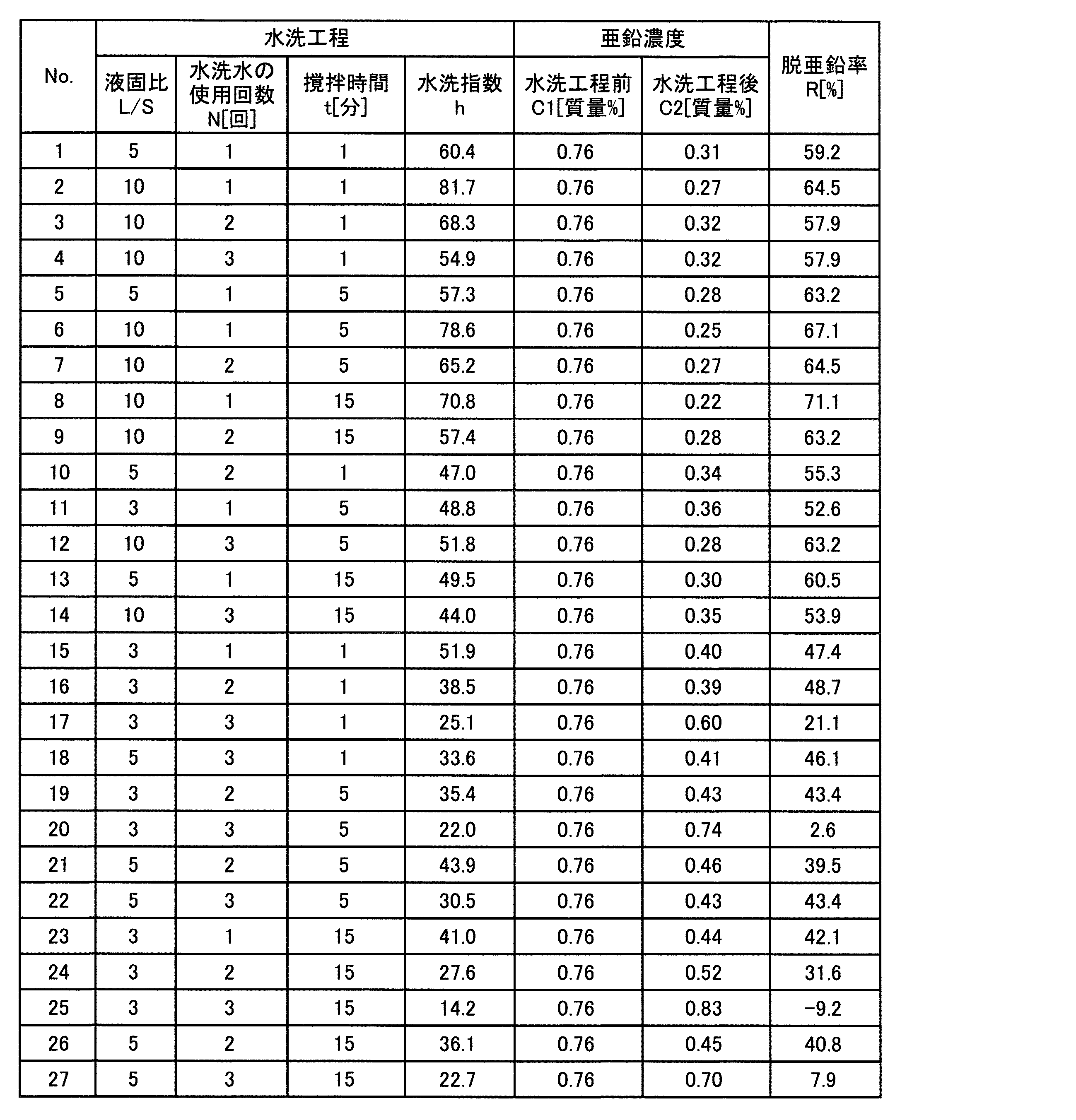
<評価結果>
表1に示すように、水洗工程S4における水洗指数hが54以上であるNo.1からNo.9は、脱亜鉛率を確実に高めることができている。
<Evaluation Results>
As shown in Table 1, in No. 1 to No. 9 in which the water washing index h in the water washing step S4 is 54 or more, the dezincing rate can be reliably increased.
以上説明したように、本開示の一態様に係る亜鉛除去方法は、製鉄ダストに含まれる亜鉛を確実に除去するのに適している。
As described above, the zinc removal method according to one embodiment of the present disclosure is suitable for reliably removing zinc contained in steelmaking dust.
Claims (4)
上記浸出工程で得られた第1処理液への酸化剤およびアルカリの添加により、上記第1処理液中に鉄を沈殿させる沈殿工程と、
上記沈殿工程で得られた第2処理液を固液分離する第1固液分離工程と、
上記第1固液分離工程で分離された固形分を水洗する水洗工程と、
上記水洗工程で得られた第3処理液を固液分離する第2固液分離工程と
を備え、
上記水洗工程で、下記式1で表される水洗指数hが54以上となるように上記固形分を水洗する亜鉛除去方法。
h=4.26×L/S-13.4×N-0.782×t+53.3 ・・・1
ただし、上記式1において、L/Sは、質量基準での水洗水と固形分との液固比(水洗水/固形分)を意味し、Nは、水洗水の使用回数(ただし、新たな水洗水を使用するときの使用回数をN=1とし、水洗工程における使用後の水洗水を繰り返し使用する場合の使用回数をN≧2とする)を意味し、tは、攪拌時間[分]を意味する。 a leaching step of adding an acid to a suspension in which zinc-containing steel dust is dispersed to leach zinc into the liquid phase of the suspension;
a precipitation step of precipitating iron in the first treatment liquid obtained in the leaching step by adding an oxidizing agent and an alkali to the first treatment liquid;
a first solid-liquid separation step of performing solid-liquid separation on the second treated liquid obtained in the precipitation step;
a water washing step of washing the solid matter separated in the first solid-liquid separation step;
a second solid-liquid separation step of performing solid-liquid separation on the third treated liquid obtained in the water washing step,
The zinc removal method comprises washing the solid content with water in such a manner that a water washing index h, represented by the following formula 1, is 54 or more in the water washing step.
h=4.26×L/S-13.4×N-0.782×t+53.3...1
In the above formula 1, L/S means the liquid-solid ratio of washing water to solids (washing water/solids) on a mass basis, N means the number of uses of washing water (wherein N=1 is the number of uses when fresh washing water is used, and N≧2 is the number of uses when washing water used in the washing step is repeatedly used), and t means the stirring time [min].
上記固形分が浸漬されている上記水洗水を撹拌し、
上記第2固液分離工程で分離された分離液を上記水洗水として繰り返し使用する請求項1または請求項2に記載の亜鉛除去方法。 In the above washing step,
agitating the wash water in which the solid matter is immersed;
3. The method for removing zinc according to claim 1, wherein the separated liquid from the second solid-liquid separation step is repeatedly used as the washing water.
上記浸出工程で得られた第1処理液への酸化剤およびアルカリの添加により、上記第1処理液中に鉄を沈殿させる沈殿工程と、
上記沈殿工程で得られた第2処理液を固液分離する第1固液分離工程と、
上記第1固液分離工程で分離された固形分を水洗する水洗工程と、
上記水洗工程で得られた第3処理液を固液分離する第2固液分離工程と
を備え、
上記水洗工程で、下記式1で表される水洗指数hが54以上となるように上記固形分を水洗する低亜鉛製鉄ダストの製造方法。
h=4.26×L/S-13.4×N-0.782×t+53.3 ・・・1
ただし、上記式1において、L/Sは、質量基準での水洗水と固形分との液固比(水洗水/固形分)を意味し、Nは、水洗水の使用回数(ただし、新たな水洗水を使用するときの使用回数をN=1とし、水洗工程における使用後の水洗水を繰り返し使用する場合の使用回数をN≧2とする)を意味し、tは、攪拌時間[分]を意味する。
a leaching step of adding an acid to a suspension in which zinc-containing steel dust is dispersed to leach zinc into the liquid phase of the suspension;
a precipitation step of precipitating iron in the first treatment liquid obtained in the leaching step by adding an oxidizing agent and an alkali to the first treatment liquid;
a first solid-liquid separation step of performing solid-liquid separation on the second treated liquid obtained in the precipitation step;
a water washing step of washing the solid matter separated in the first solid-liquid separation step;
a second solid-liquid separation step of performing solid-liquid separation on the third treated liquid obtained in the water washing step,
The method for producing low-zinc ironworks dust comprises washing the solids with water in such a manner that a water washing index h, represented by the following formula 1, is 54 or more in the water washing step.
h=4.26×L/S-13.4×N-0.782×t+53.3...1
In the above formula 1, L/S means the liquid-solid ratio of washing water to solids (washing water/solids) on a mass basis, N means the number of uses of washing water (wherein N=1 is the number of uses when fresh washing water is used, and N≧2 is the number of uses when washing water used in the washing step is repeatedly used), and t means the stirring time [min].
Priority Applications (1)
| Application Number | Priority Date | Filing Date | Title |
|---|---|---|---|
| JP2023095651A JP2024176830A (en) | 2023-06-09 | 2023-06-09 | Zinc removal method and method for producing low-zinc ironmaking dust |
Applications Claiming Priority (1)
| Application Number | Priority Date | Filing Date | Title |
|---|---|---|---|
| JP2023095651A JP2024176830A (en) | 2023-06-09 | 2023-06-09 | Zinc removal method and method for producing low-zinc ironmaking dust |
Publications (1)
| Publication Number | Publication Date |
|---|---|
| JP2024176830A true JP2024176830A (en) | 2024-12-19 |
Family
ID=93894645
Family Applications (1)
| Application Number | Title | Priority Date | Filing Date |
|---|---|---|---|
| JP2023095651A Pending JP2024176830A (en) | 2023-06-09 | 2023-06-09 | Zinc removal method and method for producing low-zinc ironmaking dust |
Country Status (1)
| Country | Link |
|---|---|
| JP (1) | JP2024176830A (en) |
-
2023
- 2023-06-09 JP JP2023095651A patent/JP2024176830A/en active Pending
Similar Documents
| Publication | Publication Date | Title |
|---|---|---|
| MXPA03005959A (en) | Production of zinc oxide from complex sulfide concentrates using chloride processing. | |
| JP2011206757A (en) | Method for wastewater treatment for wastewater containing aluminum, magnesium and manganese | |
| CA2677939C (en) | Method and system for removing manganese from waste liquors | |
| WO2015162902A1 (en) | Method and equipment for recovering valuable components from waste dry batteries | |
| KR20080016607A (en) | Process for dust and residue treatment in electric furnaces and other heating furnaces containing zinc oxide and ferrite | |
| CN105567976B (en) | A kind of vanadium extraction industrial acidic wastewater processing and the method for valuable metal synthetical recovery | |
| WO2014091904A1 (en) | Heavy-metal removal method and heavy-metal removal device | |
| JP3825537B2 (en) | Treatment method for wastewater containing As | |
| JP6743859B2 (en) | Zinc separation method, zinc material manufacturing method, and iron material manufacturing method | |
| JP4597169B2 (en) | Wastewater treatment method containing heavy metals | |
| TWI631220B (en) | PROCESS FOR REDUCING THE AMOUNTS OF ZINC (Zn) AND LEAD (Pb) IN MATERIALS CONTAINING IRON (Fe) | |
| JP2017137578A (en) | Method for separating zinc, method for producing zinc material, and method for producing iron material | |
| JP5339967B2 (en) | Method for removing chlorine from acidic liquid | |
| JP2024176830A (en) | Zinc removal method and method for producing low-zinc ironmaking dust | |
| RU2353679C2 (en) | Metals extraction from sulfide materials | |
| JP5751393B1 (en) | Heavy metal removal method and heavy metal removal apparatus | |
| JP6743858B2 (en) | Zinc separation method, zinc material manufacturing method, and iron material manufacturing method | |
| BE1011619A3 (en) | PROCESS FOR TREATING contaminated FERRUGINOUS SLIB. | |
| JP5063013B2 (en) | Recycling method of multi-component plating waste sludge | |
| JP7591834B2 (en) | How zinc is produced | |
| JP3549560B2 (en) | Method for recovering valuable metals and calcium fluoride from waste solution of pickling process | |
| JP2006083457A (en) | Treatment method for zinc leaching residue, etc. | |
| CN110668550B (en) | Gold concentrate non-cyanide beneficiation tailing liquid recycling treatment method | |
| CN104755640A (en) | Recovery of zinc from lead slag | |
| JP4735359B2 (en) | Treatment method of iron-containing waste liquid |