JP3552007B2 - Coated paper for web offset printing - Google Patents
Coated paper for web offset printing Download PDFInfo
- Publication number
- JP3552007B2 JP3552007B2 JP31996196A JP31996196A JP3552007B2 JP 3552007 B2 JP3552007 B2 JP 3552007B2 JP 31996196 A JP31996196 A JP 31996196A JP 31996196 A JP31996196 A JP 31996196A JP 3552007 B2 JP3552007 B2 JP 3552007B2
- Authority
- JP
- Japan
- Prior art keywords
- weight
- particle diameter
- coated paper
- paper
- pigment
- Prior art date
- Legal status (The legal status is an assumption and is not a legal conclusion. Google has not performed a legal analysis and makes no representation as to the accuracy of the status listed.)
- Expired - Fee Related
Links
Landscapes
- Paper (AREA)
Description
【0001】
【発明の属する技術分野】
本発明はオフセット輪転印刷用塗被紙に関し、特に表面強度、白紙光沢および耐ブリスタ適性に優れるオフセット輪転印刷用塗被紙に関する。
【0002】
【従来の技術】
近年、出版、公告、宣伝等の媒体としての紙、特に印刷物のビジュアル化やカラー化といった高級化が進んでいる。それに付随して印刷用塗被紙に対する需要が急速に増加しており、印刷用塗被紙の品質についてもより優れた白紙光沢、および印刷光沢などの要求が高まっている。
【0003】
さらに、オフセット輪転印刷用塗被紙の場合、特に高速印刷適性に対する改善要望、即ち、高速印刷において、高温乾燥時の火ぶくれ現象(ブリスタ)に対する抵抗力の改善が従来より強く望まれている。
ここに、ブリスタとは次のような現象として理解されている。即ち、オフセット輪転印刷用塗被紙は、オフセット輪転印刷の工程で熱乾燥される際に塗被紙中の水分が瞬時に水蒸気となり、紙層外に逸散しようとする。しかしながら、紙層内の水蒸気が紙層外に逸散しようとする際に、塗被層がそのバリアとして作用するために、水蒸気は逃げ場を失って、水蒸気圧の上昇を招き、ついには紙層を破壊してブリスタ(火ぶくれ現象)を発生させる。
【0004】
而して、上記の如き理由によって発生するブリスタを起こさせない抵抗力(以後、耐ブリスタ適性と称す)を得る方法としては、従来より原紙の内部強度を上げる方法や塗被層をポーラスにして、塗被紙の透気度を下げる方法等が知られている。
因みに、原紙の内部強度を上げる方法としては、例えば、抄紙段階あるいはサイズプレスにおいて各種加工澱粉、ポリアクリルアミド、ポリビニルアルコール等の紙力増強剤や接着剤を付加することが行われている。しかしながら、これらの紙力増強剤の多用は、抄紙機上でパルプ繊維が凝集体を作り易くなるため、均一な地合を得ることが困難となり、結果的に光沢や平滑性の優れた塗被紙を得ることができない。また、サイズプレスでの表面処理によって、塗被紙の透気度が高くなり、耐ブリスタ適性面からは望ましくなく、しばしば水塗り等が実施されることもあるが、その場合、表面の印刷紙力が低下し、トラブルが誘発され易いといった難点があった。
【0005】
そのために、塗被層を透気度の低いポーラスな構造とするためには、塗被層の構成成分の1つである顔料として、嵩密度の低い軽質炭酸カルシウムを多用したり、接着剤としてガラス転移温度(Tg)の高いラテックスを使用したり、あるいはゲル含有量の少ない共重合体ラテックスの使用等による改善が提案されているが、いずれも塗被層の表面強度を低下させるという問題がある。
【0006】
【発明が解決しようとする課題】
本発明はオフセット輪転印刷用塗被紙に関し、特に表面強度、光沢および耐ブリスタ適性に優れ、かつ良好なオフセット輪転印刷適性を備えた塗被紙を提供するものである。
従来、光沢塗被紙において、耐ブリスタ適性の改善と表面強度の改善については相反する対策、即ち、表面強度を高めようとすると、耐ブリスタ適性が低下し、他方耐ブリスタ適性を改善するような対策をとると、表面強度が低下するというように、両者を共に改善することは極めて難しいことであり、いずれか一方をある程度犠牲にして改善をするということが行われていた。本発明では、これらの矛盾を解決し、光沢塗被紙において、両者が共にバランス良く改善されたオフセット輪転印刷用塗被紙を提供するものである。
【0007】
【課題を解決するための手段】
本発明は、原紙上に顔料と接着剤を主成分とする塗被組成物を塗被、乾燥して塗被層を設けた後、白紙光沢が50%以上となるように平滑化仕上げされたオフセット輪転印刷用塗被紙において、塗被組成物中の顔料として、下記に示すような平均粒子径および粒度分布にあるカオリンを全顔料中に20〜55重量%含有せしめ、かつ平滑化処理後の塗被層表面を水銀圧入法によって測定した塗被紙の細孔分布曲線における0.01〜0.50μmの細孔範囲にあって、0.15〜0.35μmの間に細孔径の最大ピークが存在するように仕上げたことを特徴とするオフセット輪転印刷用塗被紙である。
【0008】
塗被組成物中のカオリンには、その平均粒子径が0.4μm以上、かつ微粒粒子から粒子径3.0μmまでの粒子の累積重量%が90%以上、さらに微粒粒子から累積した90重量%での粒子径を、微粒粒子から累積した50重量%での粒子径で除した値が5.0以下のカオリンを使用する。好ましい実施態様では、前記のカオリンを塗被層の全顔料に対し20〜55重量%含有させる。また塗被層には、天然系および/または合成系の接着剤を全顔料に対し固形分対比で5〜18重量%含有せしめる。
【0009】
【発明の実施の形態】
本発明では、水銀圧入法で測定される塗被層の細孔分布として、特定の分布を示すように設計することが極めて重要である。このような特定の細孔分布を得るためには、塗被層に含有される顔料として、下記される特定の粒子径、粒度分布を有するカオリンを用いることが特に有利である。
そして、そのような条件を満たすカオリンを配合することで、表面強度、光沢および耐ブリスタ適性がバランス良く改善され、印刷適性に優れたオフセット輪転(以後、単にオフ輪と称す)印刷用塗被紙が得られることを初めて見出したのである。
【0010】
ここに、水銀圧入法とは、水銀ポロシメトリーとも呼ばれ、耐火物41巻、6号297〜303頁/1989年に述べられているように多孔質体の細孔構造(細孔径や細孔容積)を測定するのに広く用いられている方法である。
その原理は、水銀は表面張力が大きく、圧力をかけないと多孔質体の細孔に水銀が進入できないことを利用している。
【0011】
即ち、水銀に加わる圧力とそのときに水銀が侵入できる細孔径は下記の一般式(I)で示される。
D = −4σcosθ/p (I)
〔(注): D=細孔径(μm)、σ=水銀の表面張力(N/m)、p=水銀に加えられた圧力(Pa)、θ=水銀と塗被紙の接触角( °) であり、水銀の表面張力を0.480(N/m)、接触角140°とする〕
【0012】
上記原理を利用して細孔分布曲線を求めるには、水銀に加える圧力pを徐々に変化させ、そのときに細孔に侵入した水銀の体積Vを測定して、水銀の圧力pと水銀の侵入量Vとの関係を描き、この関係曲線の微分係数(dV/dp)を求めて縦軸とし、(I)式にしたがって、圧力pを細孔径に換算したものを横軸にすることで求められる。上述の方法によって、塗被層の細孔分布を求めると、通常2つのピークを持つ細孔分布曲線(図)が得られる。
【0013】
即ち、細孔径0.50〜30μmの範囲に存在するピークと0.01〜0.50μmの範囲に存在するものがあり、相対的に細孔径の大きな前者は塗被紙の原紙に由来するピークであり、他方、細孔径の小さな後者(即ち、0.01〜0.50μm)に存在するピークは塗被層に由来するものとされている。
【0014】
本発明のオフ輪印刷用塗被紙は、塗被層に由来するとされる細孔径(0.01〜0.50μmの細孔径)範囲の中で、特に細孔径として0.15〜0.35μmの範囲内に最も存在割合の高い細孔(細孔分布曲線における細孔径の最大ピークで示される)が存在するような塗被層を設けることを特徴とするものである。
【0015】
本発明者等は、塗被層の細孔状態とオフ輪印刷の工程で発生し易いブリスタとの関連性について鋭意研究を重ねた。その結果、ブリスタの発生は塗被層の細孔径に大きく影響されており、最大ピークの細孔径が、0.15μm未満と0.15μm以上とで、耐ブリスタ適性が大きく異なっていることを見出した。
即ち、塗被層の細孔径の最大ピークが0.15μmを超える場合は、耐ブリスタ適性が良好となり、その値が大きい程耐ブリスタ適性は優れる。他方、その最大ピークが0.35μmを超えると、製品の光沢が低下するようになる。
以上より、本発明では塗被層表面を水銀圧入法で測定して得られる細孔分布曲線において、細孔径の最大ピークが0.15〜0.35μmの範囲にくるような塗被層に仕上げることが重要である。
【0016】
とりわけ、例えば塗被量が片面当たり15g/m2 以上で、原紙米坪が70g/m2 以上であるような重塗工、高米坪の塗被紙では細孔径の最大ピークが0.20〜0.35μmの範囲にくるような塗被層に仕上げることがより好ましい。なお、塗被層の細孔径は、塗被層を形成するための水性塗被組成物(以後、塗料と称す)の組成分である顔料や共重合体ラテックスの粒子径の選択、さらには塗料の塗工時の濃度や分散状態(流動性)等を調節することで操作することができる。しかしながら、細孔径を最も効果的、かつ大きく調整できるのは塗料中の顔料粒子径と共重合体ラテックスの粒子径であり、調整が他の手段よりも効率良く行えるといった利点がある。
【0017】
通常、光沢塗被紙を製造する場合には、光沢が発現し易いように塗被層の顔料として、粒子径の小さいものが使用される。具体的には、主要顔料として使用されているカオリンとしては平均粒子径が0.40μm未満のもの、あるいは炭酸カルシウムでは平均粒子径が0.75μm未満のものが主として使用される。このような粒子径の小さい顔料を用いると、得られる塗被紙の光沢は高くなり、従来から知られているように塗被紙の透気度も低く保つことができる。しかしながら、粒子径の小さい顔料を用いた場合、塗被層に発生する細孔は細孔径の小さいものが数多くでき、塗被層表面の細孔を水銀圧入法で測定すると、細孔分布曲線における細孔径の最大ピークは0.15μm未満となる。その結果、本発明が所望するような満足すべき耐ブリスタ適性の改善効果が得られない。さらに、そのように粒子径の小さい顔料を用いた場合、表面強度の低下といった難点が付随し易い。
【0018】
以上の如き結果から、本発明者等は耐ブリスタ適性だけでなく、白紙光沢および表面強度を高度にバランスさせるための好ましいカオリン特性について鋭意検討を重ねた。
その結果、平均粒子径が0.4μm以上、かつ微粒粒子から粒子径が3.0μmまでの粒子の累積重量%が90%以上であり、さらに微粒粒子から累積した90重量%での粒子径を、微粒粒子から累積した50重量%での粒子径(平均粒子径)で除した値が5.0以下であるカオリンを塗被層の全顔料に対し、20〜55重量%の範囲で使用することによって、本発明が所望とする作用効果が極めて効率良く発現されることを見出したのである。
【0019】
因みに、上記特定カオリンの平均粒子径が0.40μm未満の場合には、水銀圧入法で測定した塗被層の細孔径の最大ピーク(以後、単に細孔径のピークと称す)が0.15μm未満となり、耐ブリスタ適性の改善効果が得られ難く、かつ表面強度が低下する虞れがある。他方、カオリンの微粒粒子から3.0μmまでの粒子の累積重量%が90%未満のときには、塗被紙の白紙光沢の低下が懸念される。また、微粒粒子から累積した90重量%での粒子径を、微粒粒子から累積した50重量%での粒子径(平均粒子径)で除した値が5.0を越えると、塗被層の細孔径のピークが0.15μm未満となり、耐ブリスタ適性の改善が難しくなる虞れがある。
【0020】
また、上記特定カオリンの配合量が全顔料に対し20重量%未満の場合には、塗被層の細孔径の最大ピークを0.15〜0.35μmの範囲に維持することが難しく、かつ塗被紙の光沢度を50%以上にすることが難しくなる虞れがある。その結果、良好な耐ブリスタ適性と高光沢とのバランスが維持されなくなる。他方、55重量%を越えると、塗料の粘度が高くなり、ブレードコータ等での塗工適性が悪化する傾向にある。
【0021】
なお、好ましい実施態様としては、塗被層の接着剤として平均粒子径が0.15〜0.30μmのスチレン−ブタジエン系共重合体ラテックスを全顔料に対し、固形分対比で5〜15重量%配合させることで、耐ブリスタ適性と表面強度のバランスが一層効率良く発揮されるので、より好ましい。
即ち、耐ブリスタ適性を重視すると、ラテックスのゲル含有量を下げることが必要となり、結果として表面強度の低下が懸念される。しかしながら、共重合体ラテックスの平均粒子径を0.15μm以上とすることにより、塗被層の細孔径を大きくすることができ、ラテックスのゲル含有量を下げることなく、良好な耐ブリスタ適性を得ることができ、かつ表面強度も保持される。
因みに、ラテックスの平均粒子径が0.15μm未満になると、使用する顔料によっては塗被層の細孔径のピークが0.15μm未満となる虞れがあり、他方0.30μmを越えると、塗料の粘度が高くなりブレードコータ等での塗工適性の悪化が懸念される。
【0022】
ここで、スチレン−ブタジエン系共重合体ラテックスとは、単量体成分としてスチレンおよびブタジエンと共に、アクリル酸エステルやメタクリル酸エステル等、さらにアクリル酸、イタコン酸、クロトン酸等を反応させて得られる各種の変性スチレン−ブタジエン系共重合体組成物である。
なお、これら共重合体ラテックスの製造方法としては、一般的には乳化重合法によって製造されるが、特に限定されるものではない。なお、乳化重合法で製造される場合、公知の乳化剤、連鎖移動剤、重合開始剤、キレート化剤等の一般の乳化重合で使用される添加剤、助剤等が使用できる。そして、所要とする平均粒子径やゲル含有量を得る方法としては、乳化重合時の乳化条件や連鎖移動剤の種類や添加量を適宜調整することが行われる。
【0023】
さらに、より好ましい態様としては、上記特定のカオリンの外に平均粒子径が0.75μm以上で、かつ微粒粒子から粒子径3.0μmまでの粒子の累積重量%が80%以上の炭酸カルシウムを20〜40重量%の範囲で併用することにより、耐ブリスタ適性が一層改善されるので好ましい。
【0024】
なお、上記の特定される炭酸カルシウムの平均粒子径が0.75μm未満になると、併用する特定カオリンの種類によっては塗被層の細孔径のピークが0.15μm未満となる虞れがあり、他方微粒粒子から粒子径が3.0μmまでの粒子の累積重量%が80%未満の場合には、白紙光沢の低下が懸念される。
【0025】
上記した特定の粒子径分布を有するカオリンや炭酸カルシウムは、製紙業界では広く用いられているカオリンや重質炭酸カルシウムを適宜粉砕したり、あるいは分級や凝集させることによって得ることができる。また、軽質炭酸カルシウムについては、その製造に際し炭酸化の反応条件を適宜調整したり、さらには得られた製品を必要に応じて粉砕処理を付加することによって調整ができる。
【0026】
なお、上記した顔料の粒子径や累積重量%およびその粒子径の値等は、いずれもセディグラフ5000(沈降法による顔料の粒度分布測定装置/島津製作所)を用いて算出したものである。
【0027】
また、塗料中の顔料としては、上記の特定されるカオリンや炭酸カルシウム以外に一般塗被紙の製造分野で使用される、公知公用の顔料が本発明の効果を阻害しない範囲で併用される。例えば、具体例として上記特定の粒子径や、粒度分布から外れるカオリンや炭酸カルシウム、無定形シリカ、酸化亜鉛、酸化アルミニウム、水酸化アルミニウム、サチンホワイト、珪酸アルミニウム、珪酸マグネシウム、炭酸マグネシウム、プラスチックピグメント等の1種以上を適宜混合、使用することができる。
【0028】
顔料と共に、塗被層の主成分をなす接着剤については、前記特定のスチレン−ブタジエン系共重合体ラテックスの外に、通常の塗被紙の製造分野で使用される天然系あるいは合成系の接着剤が適宜使用される。それらの具体例として、例えば酸化澱粉やエステル化澱粉等の各種澱粉類、カゼイン、大豆蛋白、合成蛋白等の蛋白質類、カルボキシメチルセルロースやメチルセルロース等のセルロース誘導体、前記で特定されるもの以外のスチレン−ブタジエン共重合体ラテックス、メチルメタクリレート−ブタジエン共重合体の共役ジエン系重合体ラテックス、アクリル系重合体ラテックス、エチレン−酢酸ビニル共重合体等のビニル系重合体ラテックス、ポリビニルアルコール等、一般に塗被紙製造分野で用いられている従来公知の接着剤が単独、あるいは2種以上が併用して用いられる。なお、接着剤の配合量は特に限定されるものではないが、通常顔料に対し、固形分対比で5〜18重量%の範囲で調節される。
【0029】
さらに、塗被層を形成するための塗料には、上記顔料や接着剤の他に、例えば分散剤、増粘剤、消泡剤、着色剤、帯電防止剤、防腐剤等の各種助剤を適宜添加することもできる。
かくして調製された塗料は、原紙上に塗被されるが、その場合の原紙の製造方法や抄紙機については特に限定されるものではなく、通常の酸性抄紙や中性抄紙等が採用される。また、抄紙機も通常の長網抄紙機からツインフォーマ形式の抄紙機やヤンキータイプの抄紙機が適宜採用できる。そして、原紙としては通常米坪30〜300g/m2 の上質紙や中質紙が適宜使用される。
【0030】
また、原紙へ所要の塗料を塗工するに先だって、原紙上に澱粉等の天然接着剤やポリビニルアルコール等の合成接着剤を用いて表面サイズ処理を施したり、顔料と接着剤を主成分とした塗料をロールコータやブレードコータで予備塗工したりすることも可能である。さらには、塗工前の原紙をソフトキャレンダを使用して平滑化することも、塗工後に均一な塗被層を得る上で好ましいものである。
【0031】
上記の如き原紙に塗料を塗工、乾燥するに際し、使用される塗工装置としては特に限定されるものではないが、例えばブレードコータ、エアーナイフコータ、ロールコータ、リバースロールコータ、バーコータ、カーテンコータ、ダイスロットコータ、グラビアコータ、チャンプレックスコータ、サイズプレスコータ、ビルブレードコータ等、通常塗被紙の製造分野で使用される塗工装置がオンマシンまたはオフマシン仕様で原紙の少なくとも片面に1層塗りで塗工される。そして、とりわけ両面塗被紙に仕上げた場合に、本発明の作用効果が顕著に発揮される。勿論、片面に2層以上の複層塗工を行うことも可能であるが、その場合には、本発明で特定するような塗被紙表面(塗被層表面)の表面物性が発現されるように塗料配合や塗工条件の考慮が必要である。
【0032】
なお、塗被量は得られる塗被紙の白紙品質、印刷品質および塗工適性等を考慮すると、片面当たり5〜40g/m2 程度で調節される。
また、塗工後の塗料を乾燥する方法としては、従来から公知公用の熱風乾燥、ガスヒータ乾燥、高周波乾燥、電気ヒータ乾燥、赤外線ヒータ乾燥、レーザ乾燥、電子線乾燥等の各種加熱乾燥方式が適宜採用される。
【0033】
かくして得られた塗被紙は必要に応じて、オンあるいはオフ仕様のスーパーキャレンダやソフトキャレンダ等で適宜加圧仕上げを施すことも可能である。
【0034】
【実施例】
以下に、実施例を挙げて本発明を具体的に説明するが、勿論、本発明はそれらに限定されるものではない。なお、特に断らない限り、例中の部および%は、それぞれ重量部および重量%を示す。
【0035】
実施例1
(原紙の製造)
晒広葉樹クラフトパルプ90%と晒針葉樹クラフトパルプ10%からなるパルプをカナダ標準濾水度が500mlとなるように叩解し、叩解後のパルプスラリーに、填料としてタルクを紙灰分が9%になるように添加し、さらにパルプ100部に対し、内添サイズ剤としてロジンサイズ剤(商品名:サイズパインE/荒川化学社)0.7部および硫酸アルミニウム2部を添加して紙料を調成した。この紙料を用いて長網抄紙機で抄紙、乾燥し、次いで、2本ロールサイズプレス装置で、6%濃度の酸化澱粉(商品名:エースA/王子コーンスターチ社)水溶液を2g/m2 (いずれも、固形分として)塗布、乾燥し、米坪75g/m2 の原紙を得た。
【0036】
(塗料の調製)
顔料として平均粒子径が0.6μm、微粒粒子から粒子径3μmまでの累積重量%が98%、微粒粒子から累積した90重量%での粒子径を、微粒粒子から累積した50重量%での粒子径(平均粒子径)で除した値が2.4であるカオリン(商品名:アストラプラス/ECC社)40部と、平均粒子径が0.2μm、微粒粒子から累積した90重量%での粒子径を、微粒粒子から累積した50重量%での粒子径(平均粒子径)で除した値が2.9であるカオリン(商品名:カオファイン/シール社)を25部、さらに平均粒子径が0.6μm、微粒粒子から粒子径3μmまでの累積重量%が97%である湿式粉砕した重質炭酸カルシウム(商品名:FMT−90/ファイマテック社)35部からなる顔料分散液に、分散剤(商品名:アロンA−9/東亜合成社)を顔料100部に対し固形分で0.1部添加し、コーレス分散機で分散して顔料スラリーを調製した。
【0037】
このスラリーに、予め糊化した酸化澱粉(商品名:エースA)を顔料100部に対して3部、さらに平均粒子径が0.095μm、かつゲル含有量が45%のスチレン−ブタジエン系共重合体ラテックス(商品名:S−2567(A)−1/日本合成ゴム社)8部(いずれも、固形分として)をそれぞれ添加し、固形分濃度60%の塗被液を調製した。
【0038】
(塗被紙の製造)
前記の原紙上に上記の塗被液を、片面当たり乾燥重量で18g/m2 となるようにブレードコータで片面ずつ塗工、乾燥して、片面1度塗りの両面塗被紙を得た。なお、この塗被紙の水分は5.5%であった。
次いで、この塗被紙を180℃に加温した金属ロールとショアD硬度が91°の樹脂ロールよりなる加熱ソフトキャレンダを用いて、通紙速度800m/分、線圧250kg/cmの運転条件で片面が金属ロール、樹脂ロールにそれぞれ2回づつ接触するように合計4ニップの通紙処理を行い、印刷用塗被紙を得た。
【0039】
実施例2
実施例1の原紙の製造および塗被紙の製造において、原紙米坪を50g/m2 、塗料の塗被量を片面当たり乾燥重量で12g/m2 となるようにしたこと以外は、実施例1と同様にして印刷用塗被紙を得た。
【0040】
実施例3
実施例1の塗料の調製において、使用したスチレン−ブタジエン系共重合体ラテックスを、平均粒子径が0.20μm、ゲル含有量が89%のスチレン−ブタジエン系共重合体ラテックス(商品名:S−2563(C)−3/日本合成ゴム社) に代えたこと以外は、実施例1と同様にして印刷用塗被紙を得た。
【0041】
実施例4
実施例1の塗料の調製において、顔料として用いた重質炭酸カルシウム(商品名:FMT−90)を、平均粒子径が1.3μm、微粒粒子から粒子径3μmまでの累積重量%が85%である乾式粉砕した重質炭酸カルシウム(商品名:ソフトン2200/備北粉化工業社) に代えたこと以外は、実施例1と同様にして印刷用塗被紙を得た。
【0042】
実施例5
(原紙の調製)
晒広葉樹クラフトパルプ90%と晒針葉樹クラフトパルプ10%からなるパルプをカナダ標準濾水度が500mlとなるように叩解した。叩解後のパルプスラリーに、填料として軽質炭酸カルシウム(商品名:タマパールTP−121/奥多摩工業社)を紙灰分が5%になるように添加し、さらにパルプ100部に対して、硫酸アルミニウム0.5部、カチオン澱粉(商品名:アミロファクス2200/松谷化学工業製)0.4部、アルキルケテンダイマ(商品名:サイズパインK−287/荒川化学工業社)0.1部、アニオン性ポリアクリルアミド(商品名:アラフィクス−504/荒川化学工業社)0.02部(それぞれ、固形分として)を添加して紙料を調成した。
【0043】
この紙料を用いてギャップフォーマ型抄紙機で抄紙、乾燥した。次いで、メタリングサイズプレス装置で、8%濃度の酸化澱粉(商品名:エースA)水溶液を2g/m2 (固形分として)塗布、乾燥し、米坪50g/m2 の原紙を得た。
【0044】
(塗被紙の製造)
前記で得た原紙上に、実施例4と同様の塗料を、片面当たり乾燥重量で12g/m2 となるように塗工したこと以外は、実施例1と同様にして印刷用塗被紙を得た。
【0045】
実施例6
(塗料の調製)
実施例1の塗料の調製において、顔料(カオリン)として用いたアストラプラス40部とカオフィアン25部に代えて、平均粒子径が0.5μm、微粒粒子から粒子径3μmまでの累積重量%が97%、さらに微粒粒子から累積した90重量%での粒子径を、微粒粒子累積した50重量%での粒子径(平均粒子径)で除した値が3.8であるカオリン(商品名:Eclipse7700/エンゲルハード社)を50部とカオフィアン20部を用い、さらに重質炭酸カルシウム(商品名:FMT−90)を30部としたこと以外は実施例1と同様にした塗料を調製した。
【0046】
(塗被紙の製造)
上記の塗料を実施例5で用いた原紙上に、片面当たり乾燥後の塗被量が12g/m2 となるようにしたこと以外は実施例1と同様にして印刷用塗被紙を得た。
【0047】
実施例7
実施例6の塗料の調製において、顔料として用いた重質炭酸カルシウム(商品名:FMT−90)に代えて、平均粒子径が1.8μm、かつ微粒粒子から粒子径が3μmまでの累積重量%が93%である乾式粉砕した重質炭酸カルシウム(商品名:ソフトン2600/備北粉化工業社)を用いたこと以外は、実施例6と同様にして印刷用塗被紙を得た。
【0048】
実施例8
実施例6の塗料の調製において、接着剤として用いたスチレン−ブタジエン系共重合体ラテックスを、実施例3で用いたスチレン−ブタジエン系共重合体ラテックス(商品名:S−2563(C)−3)に代えたこと以外は、実施例6と同様にして印刷用塗被紙を得た。
【0049】
比較例1
実施例1の塗料の調製において、顔料(カオリン)として、アストラプラスを用いずに、カオファイン(商品名/シール社)を65部用いたこと以外は、実施例1と同様にして印刷用塗被紙を得た。
【0050】
比較例2
実施例5の印刷用塗被紙の製造において、使用する塗料として、比較例1で用いた塗料と同じ塗料を使用したこと以外は実施例5と同様にして印刷用塗被紙を得た。
【0051】
比較例3
実施例1の塗料の調製において、顔料(カオリン)として用いたアストラプラス(商品名/ECC社)40部の代わりに、平均粒子径が0.6μm、かつ微粒粒子から粒子径3μmまでの累積重量%が88%、さらに微粒粒子から累積した90重量%での粒子径を、微粒粒子から累積した50重量%での粒子径(平均粒子径)で除した値が5.8であるカオリン(商品名:Nuclay/エンゲルハード社)40部を用いたこと以外は、実施例1と同様にして印刷用塗被紙を得た。
【0052】
比較例4
(塗料の調製)
実施例4の塗料の調製において、顔料(カオリン)として用いたアストラプラス(商品名/ECC社)40部の代わりに、平均粒子径が2.3μm、かつ微粒粒子から粒子径3μmまでの累積重量%が60%、さらに微粒粒子から累積した90重量%での粒子径を、微粒粒子から累積した50重量%での粒子径(平均粒子径)で除した値が3.3であるカオリン(商品名:ND−2510/ECC社)40部を用いたこと以外は、実施例4と同様にして塗料を調製した。
【0053】
(塗被紙の製造)
上記の塗料を実施例5で用いた原紙上に、片面当たり乾燥後の塗被量が12g/m2 となるようにしたこと以外は、実施例1と同様にして印刷用塗被紙を得た。
【0054】
比較例5
実施例1の塗被紙の製造において、加熱ソフトキャレンダの通紙速度を400m/分に変更したこと以外は、実施例1と同様にして印刷用塗被紙を得た。
【0055】
かくして得られた印刷用塗被紙について、下記の如き条件で品質評価を行い、得られた結果を表1にまとめて示した。また、顔料の粒度分布(平均粒子径等)、共重合体ラテックスの平均粒子径およびゲル含有量の測定方法を下記に示す。
【0056】
〔測定および評価方法〕
「顔料の粒度分布」
沈降法(測定機:セディグラフ−5000/島津製作所)による。
【0057】
「共重合体ラテックスの平均粒子径」
レーザー回折法(測定機:SALD−2000/島津製作所)による。
【0058】
「共重合体ラテックスのゲル含有量」
苛性ソーダ水溶液を用いて、試料(共重合体ラテックス)のpHを8に調整し、ガラス板上で厚みが1mmとなるように試料を容器に入れ、一昼夜乾燥し、さらに一昼夜減圧乾燥した。かくして得られた共重合体ラテックスフィルムの約1gを精確に秤量し、400mlのトルエンに48時間浸漬、溶解後、重量既知の300メッシュの金網で濾過し、金網上のトルエン不溶分を乾燥、秤量して下記の式により、ゲル含有量を算出した。
〔ゲル含有量〕
(金網上の不溶分重量/トルエン処理前のラテックスフィルム重量)×100
【0059】
「光沢」
JIS−P8142による。
【0060】
「表面強度」
RI印刷機(明製作所社製)を使用し、タックバリュー13の試験インキ0.4mlを展色して評価する塗被紙の全てがピッキングが発生するまで繰り返し印刷し、そのときのピッキングの発生度合いを目視にて判定した。
○:ピッキングの発生が非常に軽微である。
△:ピッキングが中程度発生している。
×:ピッキングの発生が非常に多い。
【0061】
「耐ブリスタ適性」
RI印刷機(明製作所社製)を使用し、オフセット用インキ(Graf−G 墨/大日本インキ化学工業製)1mlを展色し、温度20℃、関係湿度65%の条件下で十分に調湿した塗被紙を両面印刷し、印刷後直ちに加温したシリコーンオイルに浸漬し、ブリスタ発生の有無を観察した。シリコーンオイルの温度は5度単位で上昇させ、最初にブリスタが発生し始めた温度を耐ブリスタ適性の指標とした。(この温度が高いほど、耐ブリスタ適性が良好)
【0062】
「塗被紙(塗被層面)の細孔分布」
PMI社製の水銀ポロシメータを用い、塗被紙約1gを精秤し、水銀の表面張力を0.480(N/m)、塗被紙との接触角を140°として求めた。
【0063】
【表1】
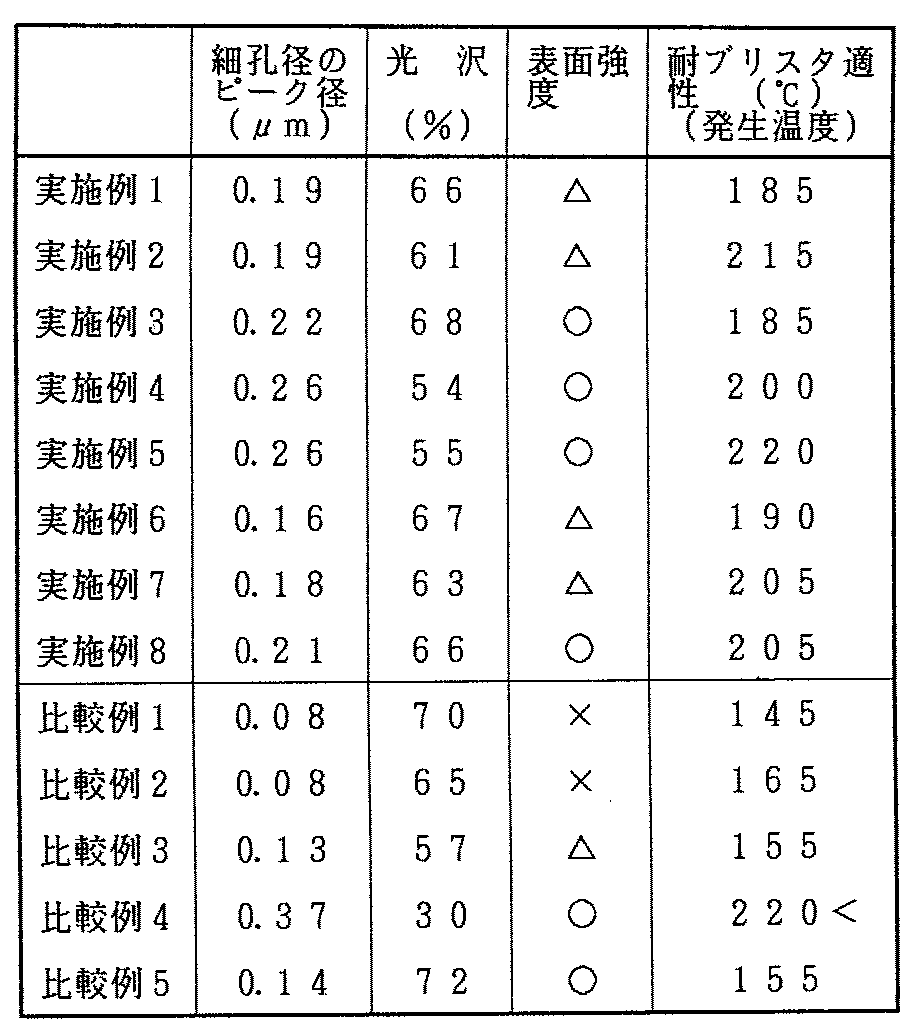
【発明の効果】
表1の結果より明らかなように、本発明に係る塗被紙は光沢、表面強度および耐ブリスタ適性に優れ、オフセット輪転印刷用塗被紙として好適な塗被紙であった。[0001]
TECHNICAL FIELD OF THE INVENTION
The present invention relates to a coated paper for web offset printing, and more particularly, to a coated paper for web offset printing that is excellent in surface strength, glossiness of white paper, and blister resistance.
[0002]
[Prior art]
2. Description of the Related Art In recent years, papers as media for publishing, public announcements, advertisements, and the like have been increasingly sophisticated such as visualization and colorization of printed matter. Accompanying this, the demand for coated paper for printing is rapidly increasing, and demands for higher quality of coated paper for printing, such as better white paper gloss and higher printing gloss, are also increasing.
[0003]
Further, in the case of coated webs for offset rotary printing, there is a strong demand for improvement especially in high-speed printing suitability, that is, in high-speed printing, improvement in resistance to blistering phenomenon (blister) during high-temperature drying. .
Here, the blister is understood as the following phenomenon. That is, when the coated paper for offset rotary printing is thermally dried in the step of offset rotary printing, the moisture in the coated paper instantly becomes water vapor and tends to escape to the outside of the paper layer. However, when the water vapor in the paper layer is going to escape to the outside of the paper layer, the water vapor loses an escape place because the coating layer acts as a barrier, causing an increase in the water vapor pressure, and finally the paper layer. To cause blisters (blistering).
[0004]
Thus, as a method of obtaining a resistance that does not cause blisters generated for the reasons described above (hereinafter, referred to as blister resistance), a method of increasing the internal strength of the base paper and a method of making the coating layer porous, A method of reducing the air permeability of coated paper is known.
Incidentally, as a method for increasing the internal strength of the base paper, for example, a paper strength enhancer such as various processed starch, polyacrylamide, polyvinyl alcohol or the like or an adhesive is added in a paper making stage or a size press. However, the frequent use of these paper strength enhancers makes it difficult to obtain a uniform formation because pulp fibers easily form agglomerates on a paper machine, and as a result, a coating having excellent gloss and smoothness is obtained. I can't get paper. In addition, the surface treatment with a size press increases the air permeability of the coated paper, which is not desirable from the viewpoint of blister resistance, and is often applied with water, etc. There was a drawback that the power was reduced and troubles were easily induced.
[0005]
Therefore, in order to make the coating layer have a porous structure with low air permeability, light calcium carbonate having a low bulk density is frequently used as a pigment which is one of the constituent components of the coating layer, or as an adhesive. Improvements have been proposed by using a latex having a high glass transition temperature (Tg) or using a copolymer latex having a low gel content. However, any of these methods has a problem that the surface strength of the coating layer is reduced. is there.
[0006]
[Problems to be solved by the invention]
The present invention relates to a coated paper for web offset printing, and more particularly to a coated paper excellent in surface strength, gloss and blister resistance and having good web offset printing suitability.
Conventionally, in glossy coated paper, the improvement of blister resistance and the improvement of surface strength are contradictory measures, that is, if the surface strength is to be increased, the blister resistance is reduced, while the blister resistance is improved. If measures are taken, it is extremely difficult to improve both, such as a decrease in surface strength, and improvement has been made at the expense of either one. The present invention solves these contradictions and provides a coated paper for offset rotary printing in which both are improved in a well-balanced manner in glossy coated paper.
[0007]
[Means for Solving the Problems]
In the present invention, a coating composition containing a pigment and an adhesive as a main component is coated on a base paper, dried and provided with a coating layer, and then smoothed so as to have a white paper gloss of 50% or more. In coated paper for offset rotary printing, as a pigment in the coating composition,In the average particle size and particle size distribution as shown belowKaolin in all pigments55% By weight and the surface of the coating layer after the smoothing treatment is in the pore range of 0.01 to 0.50 μm in the pore distribution curve of the coated paper measured by the mercury intrusion method. Maximum pore diameter peak exists between 0.35 μmFinished likeThis is a coated paper for offset rotary printing.
[0008]
Kaolin in coating compositionToThe average particle size is 0.4 μm or more, and the cumulative weight% of the particles from the fine particles to the particle size of 3.0 μm is 90% or more. Kaolin with a value divided by the cumulative particle size at 50% by weight of 5.0 or lessUse.In a preferred embodiment, the kaolin is20 to 55% by weight based on all pigments in coating layerLet it. In the coating layer,Contains natural and / or synthetic adhesives in an amount of 5 to 18% by weight, based on the solid content, based on all pigmentsLet me know.
[0009]
BEST MODE FOR CARRYING OUT THE INVENTION
In the present invention, it is extremely important to design the coating layer to show a specific distribution as the pore distribution measured by the mercury intrusion method. In order to obtain such a specific pore distribution, it is particularly advantageous to use kaolin having the following specific particle size and particle size distribution as the pigment contained in the coating layer.
By blending kaolin that satisfies such conditions, the surface strength, gloss and blister resistance suitability are improved in a well-balanced manner, and the coated paper for offset rotary printing (hereinafter simply referred to as off-wheel) printing with excellent printability. For the first time.
[0010]
Here, the mercury intrusion method is also called mercury porosimetry, and as described in Refractory 41, Vol. 6, pp. 297-303 / 1989, the pore structure (pore diameter and pore size) of a porous material is described. This is a widely used method for measuring volume.
The principle utilizes the fact that mercury has a large surface tension and cannot enter the pores of a porous body without applying pressure.
[0011]
That is, the pressure applied to mercury and the pore diameter at which mercury can enter at that time are represented by the following general formula (I).
D = −4σ cos θ / p (I)
[(Note): D = pore diameter (μm), σ = surface tension of mercury (N / m), p = pressure applied to mercury (Pa), θ = contact angle between mercury and coated paper (°) And the surface tension of mercury is 0.480 (N / m) and the contact angle is 140 °.]
[0012]
In order to obtain a pore distribution curve using the above principle, the pressure p applied to mercury is gradually changed, and the volume V of mercury that has penetrated the pores at that time is measured. The relationship with the amount of intrusion V is drawn, the differential coefficient (dV / dp) of this relationship curve is obtained and the vertical axis is obtained, and the value obtained by converting the pressure p into the pore diameter according to the formula (I) is the horizontal axis. Desired. When the pore distribution of the coating layer is obtained by the above-described method, a pore distribution curve (FIG.) Having two peaks is usually obtained.
[0013]
That is, there are a peak present in the range of 0.50 to 30 μm in the pore diameter and a peak present in the range of 0.01 to 0.50 μm, and the former having a relatively large pore diameter is the peak derived from the base paper of the coated paper. On the other hand, the peak existing in the latter having a small pore diameter (that is, 0.01 to 0.50 μm) is considered to be derived from the coating layer.
[0014]
The coated paper for web offset printing of the present invention has a pore diameter in the range of pore diameter (pore diameter of 0.01 to 0.50 μm) which is considered to be derived from the coating layer. , A coating layer in which pores having the highest abundance ratio (indicated by the maximum peak of the pore diameter in the pore distribution curve) is provided.
[0015]
The present inventors have conducted intensive studies on the relationship between the pore state of the coating layer and blisters that are likely to be generated in the step of web offset printing. As a result, it was found that blister generation was greatly affected by the pore diameter of the coating layer, and that the blister resistance was significantly different between the maximum peak pore diameter of less than 0.15 μm and 0.15 μm or more. Was.
That is, when the maximum peak of the pore diameter of the coating layer exceeds 0.15 μm, the blister resistance is good, and the larger the value, the better the blister resistance. On the other hand, if the maximum peak exceeds 0.35 μm, the gloss of the product will decrease.
As described above, in the present invention, the coating layer is finished so that the maximum peak of the pore diameter is in the range of 0.15 to 0.35 μm in the pore distribution curve obtained by measuring the surface of the coating layer by the mercury intrusion method. This is very important.
[0016]
In particular, for example, the coating amount is 15 g / m2With the above, the base paper rice tsubo is 70 g / m2It is more preferable to finish the coated layer with the maximum peak of the pore diameter in the range of 0.20 to 0.35 μm in the coated paper having the above-described heavy coating and high rice tsubo. The pore size of the coating layer is determined by selecting the particle size of the pigment or the copolymer latex which is a component of the aqueous coating composition (hereinafter referred to as a coating) for forming the coating layer, It can be operated by adjusting the concentration, dispersion state (fluidity) and the like at the time of coating. However, the most effective and large adjustment of the pore diameter is the pigment particle diameter in the coating material and the particle diameter of the copolymer latex, and there is an advantage that the adjustment can be performed more efficiently than other means.
[0017]
Usually, in the case of producing a glossy coated paper, a pigment having a small particle size is used as a pigment of the coated layer so that gloss is easily developed. Specifically, kaolin used as a main pigment has an average particle diameter of less than 0.40 μm, and calcium carbonate having an average particle diameter of less than 0.75 μm is mainly used. When such a pigment having a small particle diameter is used, the gloss of the coated paper obtained becomes high, and the air permeability of the coated paper can be kept low as conventionally known. However, when a pigment having a small particle size is used, many pores generated in the coating layer having a small pore diameter can be formed.When the pores on the surface of the coating layer are measured by a mercury intrusion method, the pore distribution curve The maximum peak of the pore diameter is less than 0.15 μm. As a result, a satisfactory effect of improving the resistance to blister resistance as desired by the present invention cannot be obtained. Further, when such a pigment having a small particle size is used, there is a tendency that a disadvantage such as a decrease in surface strength is easily accompanied.
[0018]
Based on the above results, the present inventors have intensively studied not only the suitability for blister resistance but also the preferable kaolin characteristics for highly balancing white paper gloss and surface strength.
As a result, the cumulative weight% of the particles having an average particle diameter of 0.4 μm or more and from the fine particles to the particle diameter of 3.0 μm is 90% or more, and the particle diameter at 90% by weight accumulated from the fine particles is further reduced. Kaolin having a value of 5.0 or less divided by the particle size (average particle size) at 50% by weight accumulated from the fine particles is used in the range of 20 to 55% by weight based on all the pigments in the coating layer. As a result, the present inventors have found that the effects and effects desired by the present invention are extremely efficiently exhibited.
[0019]
Incidentally, when the average particle size of the specific kaolin is less than 0.40 μm, the maximum peak of the pore size of the coating layer measured by the mercury intrusion method (hereinafter, simply referred to as the pore size peak) is less than 0.15 μm. It is difficult to obtain the effect of improving the blister resistance, and the surface strength may be reduced. On the other hand, when the cumulative weight percent of kaolin particles from fine particles to 3.0 μm is less than 90%, there is a concern that the glossiness of the coated paper is reduced. If the value obtained by dividing the particle diameter at 90% by weight accumulated from the fine particles by the particle diameter at 50% by weight (average particle diameter) accumulated from the fine particles exceeds 5.0, the fineness of the coating layer is reduced. The peak of the pore diameter is less than 0.15 μm, and it may be difficult to improve the blister resistance.
[0020]
If the amount of the specific kaolin is less than 20% by weight of the total pigment, it is difficult to maintain the maximum peak of the pore diameter of the coating layer in the range of 0.15 to 0.35 μm, and There is a possibility that it is difficult to make the glossiness of the paper to be 50% or more. As a result, good balance between blister resistance and high gloss cannot be maintained. On the other hand, if it exceeds 55% by weight, the viscosity of the coating material becomes high, and the coating suitability with a blade coater or the like tends to deteriorate.
[0021]
In a preferred embodiment, a styrene-butadiene copolymer latex having an average particle diameter of 0.15 to 0.30 μm is used as an adhesive for the coating layer in an amount of 5 to 15% by weight, based on the solid content, based on all pigments. Blending is more preferable because the balance between blister resistance and surface strength is more efficiently exhibited.
In other words, when importance is placed on the blister resistance, it is necessary to reduce the gel content of the latex, and as a result, there is a concern that the surface strength is reduced. However, by setting the average particle diameter of the copolymer latex to 0.15 μm or more, the pore diameter of the coating layer can be increased, and good blister resistance can be obtained without lowering the gel content of the latex. And surface strength is maintained.
Incidentally, when the average particle diameter of the latex is less than 0.15 μm, depending on the pigment used, the peak of the pore diameter of the coating layer may be less than 0.15 μm. The viscosity becomes high, and there is a concern that the coating suitability with a blade coater or the like may be deteriorated.
[0022]
Here, the styrene-butadiene copolymer latex refers to various types obtained by reacting acrylate and methacrylate together with styrene and butadiene as monomer components, and further reacting acrylic acid, itaconic acid, crotonic acid, and the like. Is a modified styrene-butadiene copolymer composition.
The method for producing these copolymer latexes is generally produced by an emulsion polymerization method, but is not particularly limited. When produced by an emulsion polymerization method, additives and auxiliaries used in general emulsion polymerization such as known emulsifiers, chain transfer agents, polymerization initiators and chelating agents can be used. As a method for obtaining the required average particle size and gel content, the emulsification conditions during the emulsion polymerization and the type and amount of the chain transfer agent are appropriately adjusted.
[0023]
Further, as a more preferred embodiment, in addition to the above-mentioned specific kaolin, calcium carbonate having an average particle diameter of 0.75 μm or more and a cumulative weight% of particles from fine particles to a particle diameter of 3.0 μm of 80% or more is added. It is preferable to use them together in the range of from 40 to 40% by weight because the blister resistance is further improved.
[0024]
When the average particle diameter of the above-specified calcium carbonate is less than 0.75 μm, the peak of the pore diameter of the coating layer may be less than 0.15 μm depending on the type of the specific kaolin used in combination. When the cumulative weight% of the fine particles to the particles having a particle diameter of up to 3.0 μm is less than 80%, there is a concern that the glossiness of the white paper is reduced.
[0025]
Kaolin and calcium carbonate having the above-mentioned specific particle size distribution can be obtained by appropriately pulverizing, classifying or agglomerating kaolin or heavy calcium carbonate widely used in the papermaking industry. Light calcium carbonate can be adjusted by appropriately adjusting the carbonation reaction conditions in the production thereof, or by adding a pulverizing treatment to the obtained product as necessary.
[0026]
The above-described pigment particle diameter, cumulative weight%, and the particle diameter values were all calculated using a Sedigraph 5000 (Pigment particle size distribution measuring apparatus by sedimentation method / Shimadzu Corporation).
[0027]
As the pigment in the coating material, in addition to the above-described kaolin and calcium carbonate, known and commonly used pigments used in the field of producing general coated papers are used in combination as long as the effects of the present invention are not impaired. For example, as specific examples, the above specific particle size, kaolin and calcium carbonate deviating from the particle size distribution, amorphous silica, zinc oxide, aluminum oxide, aluminum hydroxide, satin white, aluminum silicate, magnesium silicate, magnesium carbonate, plastic pigment, etc. One or more of these can be appropriately mixed and used.
[0028]
As for the adhesive which is a main component of the coating layer together with the pigment, in addition to the specific styrene-butadiene-based copolymer latex, a natural or synthetic adhesive used in a normal coated paper manufacturing field is used. Agents are used as appropriate. Specific examples thereof include, for example, various starches such as oxidized starch and esterified starch, proteins such as casein, soybean protein and synthetic protein, cellulose derivatives such as carboxymethylcellulose and methylcellulose, and styrene other than those specified above. Butadiene copolymer latex, methyl methacrylate-butadiene copolymer conjugated diene polymer latex, acrylic polymer latex, vinyl polymer latex such as ethylene-vinyl acetate copolymer, polyvinyl alcohol, etc., generally coated paper Conventionally known adhesives used in the production field are used alone or in combination of two or more. The amount of the adhesive is not particularly limited, but is usually adjusted in the range of 5 to 18% by weight based on the solid content with respect to the pigment.
[0029]
Further, in addition to the above-mentioned pigments and adhesives, various assistants such as dispersants, thickeners, defoamers, coloring agents, antistatic agents, and preservatives are added to the paint for forming the coating layer. It can also be added as appropriate.
The coating material thus prepared is coated on a base paper. In this case, the method for manufacturing the base paper and the paper machine are not particularly limited, and ordinary acidic papermaking, neutral papermaking and the like are employed. As the paper machine, a normal fourdrinier paper machine, a twin-former type paper machine or a Yankee type paper machine can be appropriately used. And the base paper is usually 30-300 g / m22High quality paper and medium quality paper are used as appropriate.
[0030]
Prior to coating the required paint on the base paper, the base paper is subjected to a surface sizing treatment using a natural adhesive such as starch or a synthetic adhesive such as polyvinyl alcohol, or a pigment and an adhesive as main components. The paint can be preliminarily applied by a roll coater or a blade coater. Furthermore, it is preferable to smooth the base paper before coating using a soft calender in order to obtain a uniform coating layer after coating.
[0031]
When coating and drying the base paper as described above, the coating device used is not particularly limited, but for example, a blade coater, an air knife coater, a roll coater, a reverse roll coater, a bar coater, a curtain coater Coating equipment usually used in the coated paper manufacturing field such as die slot coater, gravure coater, champlex coater, size press coater, bill blade coater, etc. It is coated with a coat. The effects of the present invention can be remarkably exhibited, particularly when finished to a double-side coated paper. Of course, it is also possible to apply two or more layers of coating on one side, but in that case, the surface physical properties of the coated paper surface (coated layer surface) as specified in the present invention are exhibited. Thus, it is necessary to consider the composition of the paint and the application conditions.
[0032]
The coating amount is 5 to 40 g / m2 per side in consideration of blank paper quality, printing quality, coating suitability, and the like of the obtained coated paper.2Adjusted by degree.
Further, as a method of drying the paint after coating, various heating drying methods such as conventionally known and used hot air drying, gas heater drying, high frequency drying, electric heater drying, infrared heater drying, laser drying, and electron beam drying are appropriately used. Adopted.
[0033]
The coated paper thus obtained can be appropriately press-finished with an on or off specification super calender or soft calender as required.
[0034]
【Example】
Hereinafter, the present invention will be described specifically with reference to Examples, but of course, the present invention is not limited thereto. Unless otherwise specified, parts and% in the examples indicate parts by weight and% by weight, respectively.
[0035]
Example 1
(Manufacture of base paper)
A pulp composed of 90% bleached hardwood kraft pulp and 10% bleached softwood kraft pulp is beaten to a Canadian standard freeness of 500 ml, and the beaten pulp slurry is filled with talc as a filler and 9% paper ash. The pulp was further prepared by adding 0.7 parts of a rosin sizing agent (trade name: Size Pine E / Arakawa Chemical Co., Ltd.) and 2 parts of aluminum sulfate to 100 parts of pulp as an internal sizing agent. . Using this stock, papermaking and drying are performed with a fourdrinier paper machine, and then a 2 g / m 2 aqueous solution of oxidized starch (trade name: Ace A / Oji Cornstarch Co., Ltd.) at a concentration of 6% is produced using a two-roll size press.2Coated and dried (all as solid content), 75 g / m22Base paper was obtained.
[0036]
(Preparation of paint)
Particles having an average particle diameter of 0.6 μm as a pigment, a cumulative weight% from fine particles to a particle diameter of 3 μm of 98%, a particle diameter of 90% by weight accumulated from fine particles, and a 50% by weight accumulated from fine particles 40 parts of kaolin (trade name: Astraplus / ECC) whose value divided by the diameter (average particle diameter) is 2.4, and particles having an average particle diameter of 0.2 μm and 90% by weight accumulated from fine particles. 25 parts of kaolin (trade name: Kao Fine / Seal Co.) whose value is 2.9 obtained by dividing the diameter by the particle diameter (average particle diameter) at 50% by weight accumulated from the fine particles, and the average particle diameter A dispersing agent is added to a pigment dispersion comprising 35 parts of wet-pulverized heavy calcium carbonate (trade name: FMT-90 / Fimatec Co., Ltd.) having a cumulative weight% of 0.6 μm, from fine particles to a particle diameter of 3 μm, of 97%. (Product name: Aron A-9 / Toa Gosei Co., Ltd.) was added in an amount of 0.1 part as a solid content to 100 parts of the pigment, and dispersed with a Coreless disperser to prepare a pigment slurry.
[0037]
To this slurry, 3 parts of oxidized starch (Ace A) pregelatinized per 100 parts of pigment, and a styrene-butadiene copolymer having an average particle diameter of 0.095 μm and a gel content of 45% were added. 8 parts of a coalesced latex (trade name: S-2567 (A) -1 / Nippon Synthetic Rubber Co., Ltd.) (8 parts each as solid content) was added to prepare a coating solution having a solid content concentration of 60%.
[0038]
(Manufacture of coated paper)
The above coating solution was coated on the base paper in a dry weight of 18 g / m2 per side.2Was coated one by one with a blade coater and dried to obtain a double-coated paper coated once on one surface. The water content of the coated paper was 5.5%.
Next, using a heated soft calender consisting of a metal roll heated to 180 ° C. on the coated paper and a resin roll having a Shore D hardness of 91 °, operating conditions of a paper passing speed of 800 m / min and a linear pressure of 250 kg / cm. , A paper passing process of a total of 4 nips was performed such that one side was in contact with the metal roll and the resin roll two times each to obtain a coated paper for printing.
[0039]
Example 2
In the production of the base paper and the production of the coated paper of Example 1, the base paper U.S.P.2, The coating weight of the paint was 12 g / m2A coated paper for printing was obtained in the same manner as in Example 1, except that the following conditions were satisfied.
[0040]
Example 3
In the preparation of the coating material of Example 1, the styrene-butadiene-based copolymer latex used was replaced with a styrene-butadiene-based copolymer latex having an average particle diameter of 0.20 µm and a gel content of 89% (trade name: S- Coating paper for printing was obtained in the same manner as in Example 1 except that the composition was changed to 2563 (C) -3 / Nippon Synthetic Rubber Co., Ltd.).
[0041]
Example 4
In the preparation of the coating material of Example 1, heavy calcium carbonate (trade name: FMT-90) used as a pigment was used, with an average particle diameter of 1.3 μm and a cumulative weight% from fine particles to a particle diameter of 3 μm of 85%. Coated paper for printing was obtained in the same manner as in Example 1 except that heavy calcium carbonate (trade name: Softon 2200 / Bibihoku Kagaku Kogyo Co., Ltd.) was used.
[0042]
Example 5
(Preparation of base paper)
Pulp comprising 90% bleached hardwood kraft pulp and 10% bleached softwood kraft pulp was beaten to a Canadian standard freeness of 500 ml. Light calcium carbonate (trade name: Tamapearl TP-121 / Okutama Kogyo Co., Ltd.) was added as a filler to the pulp slurry after the beating so that the paper ash content was 5%. 5 parts, cationic starch (trade name: Amylofax 2200 / Matsuya Chemical Industry Co., Ltd.) 0.4 part, alkyl ketene dimer (trade name: Size Pine K-287 / Arakawa Chemical Co., Ltd.) 0.1 part, anionic polyacrylamide (Trade name: Arafix-504 / Arakawa Chemical Industry Co., Ltd.) 0.02 parts (each as a solid content) was added to prepare a stock.
[0043]
Using this stock, papermaking and drying were performed with a gap former type paper machine. Then, an 8% aqueous solution of oxidized starch (trade name: Ace A) was applied at 2 g / m 2 with a metalling size press.2Coated (as solid content), dried, 50 g / m22Base paper was obtained.
[0044]
(Manufacture of coated paper)
On the base paper obtained above, the same paint as in Example 4 was applied at a dry weight of 12 g / m2 on one side.2A coated paper for printing was obtained in the same manner as in Example 1 except that the coating was performed so as to be as follows.
[0045]
Example 6
(Preparation of paint)
In the preparation of the paint of Example 1, instead of 40 parts of Astra Plus and 25 parts of Kaofian used as pigment (kaolin), the average weight of the particles was 0.5 μm, and the cumulative weight% from fine particles to 3 μm was 97%. Kaolin (trade name: Eclipse 7700 / Engel) obtained by dividing the particle size at 90% by weight accumulated from the fine particles by the particle size (average particle size) at 50% by weight of the accumulated fine particles is 3.8. (Hard Co., Ltd.) and 20 parts of Caofian, and a coating material was prepared in the same manner as in Example 1, except that 30 parts of heavy calcium carbonate (trade name: FMT-90) was used.
[0046]
(Manufacture of coated paper)
The coating amount after drying on one side of the base paper used in Example 5 was 12 g / m.2A coated paper for printing was obtained in the same manner as in Example 1 except that the following conditions were satisfied.
[0047]
Example 7
In the preparation of the coating material of Example 6, instead of heavy calcium carbonate (trade name: FMT-90) used as a pigment, the average weight of the particles was 1.8 μm, and the cumulative weight% from fine particles to particle diameter of 3 μm was used. Was obtained in the same manner as in Example 6 except that a dry-calculated heavy calcium carbonate (trade name: Softon 2600 / Bibihoku Powder Chemical Industry Co., Ltd.) having a content of 93% was used.
[0048]
Example 8
In the preparation of the paint of Example 6, the styrene-butadiene-based copolymer latex used as an adhesive was replaced with the styrene-butadiene-based copolymer latex (trade name: S-2563 (C) -3) used in Example 3. ) Was obtained in the same manner as in Example 6 except that the above-described method was used.
[0049]
Comparative Example 1
In the preparation of the coating material of Example 1, a coating material for printing was prepared in the same manner as in Example 1 except that 65 parts of Kaofine (trade name / Seal) was used as the pigment (kaolin) without using Astra Plus. A paper was obtained.
[0050]
Comparative Example 2
In the production of the coated paper for printing of Example 5, a coated paper for printing was obtained in the same manner as in Example 5, except that the same paint as that used in Comparative Example 1 was used as the paint to be used.
[0051]
Comparative Example 3
In the preparation of the coating material of Example 1, instead of 40 parts of Astraplus (trade name / ECC) used as a pigment (kaolin), the average particle diameter was 0.6 μm, and the cumulative weight from fine particles to particle diameter 3 μm. % Is 88%, and the value obtained by dividing the particle diameter at 90% by weight accumulated from fine particles by the particle diameter at 50% by weight (average particle diameter) accumulated from fine particles (5.8) is 5.8. (Name: Nulay / Engelhard Co.) A coated paper for printing was obtained in the same manner as in Example 1, except that 40 parts were used.
[0052]
Comparative Example 4
(Preparation of paint)
In the preparation of the paint of Example 4, instead of 40 parts of Astra Plus (trade name / ECC) used as a pigment (kaolin), the average weight was 2.3 μm and the cumulative weight from fine particles to particle diameter 3 μm. % Is 60%, and the value obtained by dividing the particle size at 90% by weight accumulated from the fine particles by the particle size at 50% by weight (average particle size) accumulated from the fine particles is 3.3. (Name: ND-2510 / ECC) A coating material was prepared in the same manner as in Example 4 except that 40 parts were used.
[0053]
(Manufacture of coated paper)
The coating amount after drying on one side of the base paper used in Example 5 was 12 g / m.2A coated paper for printing was obtained in the same manner as in Example 1, except that the following conditions were satisfied.
[0054]
Comparative Example 5
In the manufacture of the coated paper of Example 1, a coated paper for printing was obtained in the same manner as in Example 1 except that the paper passing speed of the heated soft calender was changed to 400 m / min.
[0055]
The quality of the coated printing paper thus obtained was evaluated under the following conditions, and the obtained results are shown in Table 1. The methods for measuring the particle size distribution (average particle size, etc.) of the pigment, the average particle size of the copolymer latex, and the gel content are shown below.
[0056]
[Measurement and evaluation methods]
`` Pigment particle size distribution ''
By the sedimentation method (measurement machine: Sedigraph-5000 / Shimadzu Corporation).
[0057]
"Average particle size of copolymer latex"
According to a laser diffraction method (measuring machine: SALD-2000 / Shimadzu Corporation).
[0058]
"Gel content of copolymer latex"
The pH of the sample (copolymer latex) was adjusted to 8 using an aqueous solution of caustic soda, the sample was placed in a container so as to have a thickness of 1 mm on a glass plate, dried all day and night, and further dried all day and night under reduced pressure. About 1 g of the copolymer latex film thus obtained was accurately weighed, immersed in 400 ml of toluene for 48 hours, dissolved, filtered through a 300-mesh wire net of known weight, and the toluene-insoluble matter on the wire net was dried and weighed. Then, the gel content was calculated by the following equation.
(Gel content)
(Weight of insoluble matter on wire mesh / weight of latex film before toluene treatment) × 100
[0059]
"Glossy"
According to JIS-P8142.
[0060]
"Surface strength"
Using an RI printing machine (manufactured by Meisho Seisakusho), 0.4 ml of the test ink of tack value 13 was spread and all coated paper to be evaluated were repeatedly printed until picking occurred, and picking occurred at that time. The degree was visually determined.
:: Picking is very slight.
Δ: Picking occurred moderately.
X: Picking occurs very often.
[0061]
"Blister resistance"
Using an RI printing machine (manufactured by Akira Seisakusho Co., Ltd.), apply 1 ml of offset ink (Graf-G black / Dainippon Ink and Chemicals) and sufficiently adjust the temperature at 20 ° C and the relative humidity of 65%. The wet coated paper was printed on both sides and immediately immersed in heated silicone oil after printing to observe the occurrence of blisters. The temperature of the silicone oil was increased in units of 5 degrees, and the temperature at which blisters first started to be formed was used as an index of blister resistance. (The higher this temperature, the better the blister resistance)
[0062]
"Pore distribution of coated paper (coated layer surface)"
Using a mercury porosimeter manufactured by PMI, about 1 g of the coated paper was precisely weighed, and the surface tension of mercury was 0.480 (N / m) and the contact angle with the coated paper was 140 °.
[0063]
[Table 1]
【The invention's effect】
As is clear from the results in Table 1, the coated paper according to the present invention was excellent in gloss, surface strength, and blister resistance, and was a coated paper suitable for offset rotary printing.
Claims (3)
(1): 平均粒子径が0.4μm以上、かつ微粒粒子から粒子径3.0μmまでの粒子の累積重量%が90%以上、さらに微粒粒子から累積した90重量%での粒子径を、微粒粒子から累積した50重量%での粒子径で除した値が5.0以下。
(2): 平均粒子径が0.75μm以上、かつ微粒粒子から粒子径3μmまでの粒子の累積重量%が80%以上。2. The offset rotary press according to claim 1, wherein 20 to 40% by weight of calcium carbonate satisfying the following condition (2) is contained in the total pigment in combination with kaolin satisfying the following condition (1) as a pigment for the coating layer. Coated paper for printing.
(1): The average particle diameter is 0.4 μm or more, and the cumulative weight% of the particles from the fine particles to the particle diameter of 3.0 μm is 90% or more. The value divided by the particle diameter at 50% by weight accumulated from the particles is 5.0 or less.
(2): The average particle size is 0.75 μm or more, and the cumulative weight% of particles from fine particles to a particle size of 3 μm is 80% or more.
Priority Applications (1)
| Application Number | Priority Date | Filing Date | Title |
|---|---|---|---|
| JP31996196A JP3552007B2 (en) | 1996-11-29 | 1996-11-29 | Coated paper for web offset printing |
Applications Claiming Priority (1)
| Application Number | Priority Date | Filing Date | Title |
|---|---|---|---|
| JP31996196A JP3552007B2 (en) | 1996-11-29 | 1996-11-29 | Coated paper for web offset printing |
Publications (2)
| Publication Number | Publication Date |
|---|---|
| JPH10168795A JPH10168795A (en) | 1998-06-23 |
| JP3552007B2 true JP3552007B2 (en) | 2004-08-11 |
Family
ID=18116189
Family Applications (1)
| Application Number | Title | Priority Date | Filing Date |
|---|---|---|---|
| JP31996196A Expired - Fee Related JP3552007B2 (en) | 1996-11-29 | 1996-11-29 | Coated paper for web offset printing |
Country Status (1)
| Country | Link |
|---|---|
| JP (1) | JP3552007B2 (en) |
Families Citing this family (3)
| Publication number | Priority date | Publication date | Assignee | Title |
|---|---|---|---|---|
| JP2003278096A (en) * | 2002-03-15 | 2003-10-02 | Oji Paper Co Ltd | Lightweight multicolor offset printing paper |
| CN103726403A (en) * | 2013-11-25 | 2014-04-16 | 龙游特美纸制品有限公司 | Production method of white tipping base paper for cigarettes |
| JP7544451B2 (en) * | 2019-10-15 | 2024-09-03 | 日本製紙株式会社 | Coated white paperboard |
-
1996
- 1996-11-29 JP JP31996196A patent/JP3552007B2/en not_active Expired - Fee Related
Also Published As
| Publication number | Publication date |
|---|---|
| JPH10168795A (en) | 1998-06-23 |
Similar Documents
| Publication | Publication Date | Title |
|---|---|---|
| JP5064616B2 (en) | Paper with improved print quality | |
| CN101370981B (en) | Paper containing preaggregated filler and process for producing the same | |
| JPH09291497A (en) | Roll printing paper suitable for cold curing and its production | |
| US20060241232A1 (en) | Coating and filler compositions comprising platy layered silicate pigments | |
| WO2017039015A1 (en) | Coated paper, coated base material, and method of evaluating property of ink drying | |
| JP3552007B2 (en) | Coated paper for web offset printing | |
| JP4747405B2 (en) | Coated paper for gravure printing | |
| JP2025062023A (en) | Coated paper for gravure printing used for packaging containers | |
| JP2002194698A (en) | Matte coated paper for offset printing | |
| JP4048623B2 (en) | Method for producing coated lightweight printing paper and coated lightweight printing paper | |
| JP4918746B2 (en) | Manufacturing method of coated paper for offset printing and coated paper | |
| AU2011235701A1 (en) | Processes for preparing coated printing paper | |
| JP2001254295A (en) | Coated paper for printing | |
| JP2887205B2 (en) | Coated paper for printing | |
| JP2004003057A (en) | Coated paper for printing | |
| JP4030259B2 (en) | Multilayer coated paper for offset printing | |
| TW202104723A (en) | Coated printing paper | |
| JPH06235194A (en) | Method of manufacturing coated paper for printing | |
| WO2018230682A1 (en) | Coated paper for use in printing | |
| JP7309672B2 (en) | Ink drying evaluation method and coated paper for printing | |
| JP2004143624A (en) | Bulky coated paper for printing | |
| JP4873973B2 (en) | Method for producing coated paper for gravure printing and coated paper | |
| JP2009035825A (en) | Coated paper for printing | |
| JP2003278096A (en) | Lightweight multicolor offset printing paper | |
| JP2008127711A (en) | Lightweight coated paper |
Legal Events
| Date | Code | Title | Description |
|---|---|---|---|
| A977 | Report on retrieval |
Free format text: JAPANESE INTERMEDIATE CODE: A971007 Effective date: 20031219 |
|
| A131 | Notification of reasons for refusal |
Free format text: JAPANESE INTERMEDIATE CODE: A131 Effective date: 20040106 |
|
| RD02 | Notification of acceptance of power of attorney |
Free format text: JAPANESE INTERMEDIATE CODE: A7422 Effective date: 20040130 |
|
| A521 | Written amendment |
Free format text: JAPANESE INTERMEDIATE CODE: A523 Effective date: 20040304 |
|
| A521 | Written amendment |
Free format text: JAPANESE INTERMEDIATE CODE: A821 Effective date: 20040304 |
|
| TRDD | Decision of grant or rejection written | ||
| A01 | Written decision to grant a patent or to grant a registration (utility model) |
Free format text: JAPANESE INTERMEDIATE CODE: A01 Effective date: 20040407 |
|
| A61 | First payment of annual fees (during grant procedure) |
Free format text: JAPANESE INTERMEDIATE CODE: A61 Effective date: 20040420 |
|
| R150 | Certificate of patent or registration of utility model |
Free format text: JAPANESE INTERMEDIATE CODE: R150 |
|
| FPAY | Renewal fee payment (event date is renewal date of database) |
Free format text: PAYMENT UNTIL: 20090514 Year of fee payment: 5 |
|
| FPAY | Renewal fee payment (event date is renewal date of database) |
Free format text: PAYMENT UNTIL: 20090514 Year of fee payment: 5 |
|
| FPAY | Renewal fee payment (event date is renewal date of database) |
Free format text: PAYMENT UNTIL: 20100514 Year of fee payment: 6 |
|
| FPAY | Renewal fee payment (event date is renewal date of database) |
Free format text: PAYMENT UNTIL: 20100514 Year of fee payment: 6 |
|
| FPAY | Renewal fee payment (event date is renewal date of database) |
Free format text: PAYMENT UNTIL: 20110514 Year of fee payment: 7 |
|
| FPAY | Renewal fee payment (event date is renewal date of database) |
Free format text: PAYMENT UNTIL: 20110514 Year of fee payment: 7 |
|
| FPAY | Renewal fee payment (event date is renewal date of database) |
Free format text: PAYMENT UNTIL: 20120514 Year of fee payment: 8 |
|
| FPAY | Renewal fee payment (event date is renewal date of database) |
Free format text: PAYMENT UNTIL: 20120514 Year of fee payment: 8 |
|
| FPAY | Renewal fee payment (event date is renewal date of database) |
Free format text: PAYMENT UNTIL: 20130514 Year of fee payment: 9 |
|
| FPAY | Renewal fee payment (event date is renewal date of database) |
Free format text: PAYMENT UNTIL: 20130514 Year of fee payment: 9 |
|
| FPAY | Renewal fee payment (event date is renewal date of database) |
Free format text: PAYMENT UNTIL: 20140514 Year of fee payment: 10 |
|
| LAPS | Cancellation because of no payment of annual fees |