JP3558082B2 - Nickel-cadmium secondary battery - Google Patents
Nickel-cadmium secondary battery Download PDFInfo
- Publication number
- JP3558082B2 JP3558082B2 JP2003113424A JP2003113424A JP3558082B2 JP 3558082 B2 JP3558082 B2 JP 3558082B2 JP 2003113424 A JP2003113424 A JP 2003113424A JP 2003113424 A JP2003113424 A JP 2003113424A JP 3558082 B2 JP3558082 B2 JP 3558082B2
- Authority
- JP
- Japan
- Prior art keywords
- nickel
- battery
- charging
- electrode plate
- cadmium
- Prior art date
- Legal status (The legal status is an assumption and is not a legal conclusion. Google has not performed a legal analysis and makes no representation as to the accuracy of the status listed.)
- Expired - Fee Related
Links
- OJIJEKBXJYRIBZ-UHFFFAOYSA-N cadmium nickel Chemical compound [Ni].[Cd] OJIJEKBXJYRIBZ-UHFFFAOYSA-N 0.000 title claims description 12
- PXHVJJICTQNCMI-UHFFFAOYSA-N Nickel Chemical compound [Ni] PXHVJJICTQNCMI-UHFFFAOYSA-N 0.000 claims description 58
- 239000008151 electrolyte solution Substances 0.000 claims description 24
- 239000011149 active material Substances 0.000 claims description 15
- 239000007864 aqueous solution Substances 0.000 claims description 10
- 239000004033 plastic Substances 0.000 claims description 10
- 229920003023 plastic Polymers 0.000 claims description 10
- 230000010287 polarization Effects 0.000 claims description 7
- GUTLYIVDDKVIGB-UHFFFAOYSA-N cobalt atom Chemical compound [Co] GUTLYIVDDKVIGB-UHFFFAOYSA-N 0.000 description 27
- 239000003792 electrolyte Substances 0.000 description 25
- 229910052759 nickel Inorganic materials 0.000 description 25
- 229910017052 cobalt Inorganic materials 0.000 description 24
- 239000010941 cobalt Substances 0.000 description 24
- 239000000758 substrate Substances 0.000 description 24
- 238000000034 method Methods 0.000 description 20
- BFDHFSHZJLFAMC-UHFFFAOYSA-L nickel(ii) hydroxide Chemical compound [OH-].[OH-].[Ni+2] BFDHFSHZJLFAMC-UHFFFAOYSA-L 0.000 description 15
- KWYUFKZDYYNOTN-UHFFFAOYSA-M Potassium hydroxide Chemical compound [OH-].[K+] KWYUFKZDYYNOTN-UHFFFAOYSA-M 0.000 description 13
- BDOSMKKIYDKNTQ-UHFFFAOYSA-N cadmium atom Chemical compound [Cd] BDOSMKKIYDKNTQ-UHFFFAOYSA-N 0.000 description 13
- 239000007789 gas Substances 0.000 description 13
- 238000010521 absorption reaction Methods 0.000 description 12
- 229910052793 cadmium Inorganic materials 0.000 description 12
- 229910006279 γ-NiOOH Inorganic materials 0.000 description 12
- 230000007423 decrease Effects 0.000 description 11
- UFHFLCQGNIYNRP-UHFFFAOYSA-N Hydrogen Chemical compound [H][H] UFHFLCQGNIYNRP-UHFFFAOYSA-N 0.000 description 10
- MYMOFIZGZYHOMD-UHFFFAOYSA-N Dioxygen Chemical compound O=O MYMOFIZGZYHOMD-UHFFFAOYSA-N 0.000 description 9
- HEMHJVSKTPXQMS-UHFFFAOYSA-M Sodium hydroxide Chemical compound [OH-].[Na+] HEMHJVSKTPXQMS-UHFFFAOYSA-M 0.000 description 9
- 229910001882 dioxygen Inorganic materials 0.000 description 9
- 229910052751 metal Inorganic materials 0.000 description 8
- 239000002184 metal Substances 0.000 description 8
- 239000001257 hydrogen Substances 0.000 description 7
- 229910052739 hydrogen Inorganic materials 0.000 description 7
- PLLZRTNVEXYBNA-UHFFFAOYSA-L cadmium hydroxide Chemical compound [OH-].[OH-].[Cd+2] PLLZRTNVEXYBNA-UHFFFAOYSA-L 0.000 description 6
- 238000006243 chemical reaction Methods 0.000 description 6
- 230000002159 abnormal effect Effects 0.000 description 5
- 238000010586 diagram Methods 0.000 description 5
- 230000020169 heat generation Effects 0.000 description 5
- 238000013508 migration Methods 0.000 description 5
- 230000005012 migration Effects 0.000 description 5
- XEEYBQQBJWHFJM-UHFFFAOYSA-N Iron Chemical compound [Fe] XEEYBQQBJWHFJM-UHFFFAOYSA-N 0.000 description 4
- 238000007599 discharging Methods 0.000 description 4
- 229910021503 Cobalt(II) hydroxide Inorganic materials 0.000 description 3
- LYCAIKOWRPUZTN-UHFFFAOYSA-N Ethylene glycol Chemical compound OCCO LYCAIKOWRPUZTN-UHFFFAOYSA-N 0.000 description 3
- ASKVAEGIVYSGNY-UHFFFAOYSA-L cobalt(ii) hydroxide Chemical compound [OH-].[OH-].[Co+2] ASKVAEGIVYSGNY-UHFFFAOYSA-L 0.000 description 3
- 230000003247 decreasing effect Effects 0.000 description 3
- 238000004090 dissolution Methods 0.000 description 3
- 230000000694 effects Effects 0.000 description 3
- 230000014759 maintenance of location Effects 0.000 description 3
- 239000000203 mixture Substances 0.000 description 3
- 239000004745 nonwoven fabric Substances 0.000 description 3
- 230000003647 oxidation Effects 0.000 description 3
- 238000007254 oxidation reaction Methods 0.000 description 3
- -1 polypropylene Polymers 0.000 description 3
- 239000000843 powder Substances 0.000 description 3
- 238000001556 precipitation Methods 0.000 description 3
- 239000000243 solution Substances 0.000 description 3
- 230000008961 swelling Effects 0.000 description 3
- XLYOFNOQVPJJNP-UHFFFAOYSA-N water Substances O XLYOFNOQVPJJNP-UHFFFAOYSA-N 0.000 description 3
- 239000004952 Polyamide Substances 0.000 description 2
- 239000004743 Polypropylene Substances 0.000 description 2
- OSOVKCSKTAIGGF-UHFFFAOYSA-N [Ni].OOO Chemical compound [Ni].OOO OSOVKCSKTAIGGF-UHFFFAOYSA-N 0.000 description 2
- WLZRMCYVCSSEQC-UHFFFAOYSA-N cadmium(2+) Chemical compound [Cd+2] WLZRMCYVCSSEQC-UHFFFAOYSA-N 0.000 description 2
- 210000004027 cell Anatomy 0.000 description 2
- 238000001514 detection method Methods 0.000 description 2
- 230000006866 deterioration Effects 0.000 description 2
- 238000003411 electrode reaction Methods 0.000 description 2
- 229940021013 electrolyte solution Drugs 0.000 description 2
- 150000002500 ions Chemical class 0.000 description 2
- 229910052742 iron Inorganic materials 0.000 description 2
- 229920000609 methyl cellulose Polymers 0.000 description 2
- 239000001923 methylcellulose Substances 0.000 description 2
- 235000010981 methylcellulose Nutrition 0.000 description 2
- 229910000483 nickel oxide hydroxide Inorganic materials 0.000 description 2
- 229920002647 polyamide Polymers 0.000 description 2
- 229920001155 polypropylene Polymers 0.000 description 2
- 239000002002 slurry Substances 0.000 description 2
- 239000006104 solid solution Substances 0.000 description 2
- 229910002640 NiOOH Inorganic materials 0.000 description 1
- 239000004372 Polyvinyl alcohol Substances 0.000 description 1
- 229910000831 Steel Inorganic materials 0.000 description 1
- QVGXLLKOCUKJST-UHFFFAOYSA-N atomic oxygen Chemical compound [O] QVGXLLKOCUKJST-UHFFFAOYSA-N 0.000 description 1
- 229910002056 binary alloy Inorganic materials 0.000 description 1
- 230000005540 biological transmission Effects 0.000 description 1
- 230000015572 biosynthetic process Effects 0.000 description 1
- 125000005587 carbonate group Chemical group 0.000 description 1
- UFMZWBIQTDUYBN-UHFFFAOYSA-N cobalt dinitrate Chemical compound [Co+2].[O-][N+]([O-])=O.[O-][N+]([O-])=O UFMZWBIQTDUYBN-UHFFFAOYSA-N 0.000 description 1
- 229910001981 cobalt nitrate Inorganic materials 0.000 description 1
- 210000001787 dendrite Anatomy 0.000 description 1
- 238000009792 diffusion process Methods 0.000 description 1
- 239000006185 dispersion Substances 0.000 description 1
- 238000001035 drying Methods 0.000 description 1
- 230000005518 electrochemistry Effects 0.000 description 1
- 239000000835 fiber Substances 0.000 description 1
- 238000004817 gas chromatography Methods 0.000 description 1
- 238000004519 manufacturing process Methods 0.000 description 1
- 239000000463 material Substances 0.000 description 1
- 238000002156 mixing Methods 0.000 description 1
- 239000007773 negative electrode material Substances 0.000 description 1
- XIKYYQJBTPYKSG-UHFFFAOYSA-N nickel Chemical compound [Ni].[Ni] XIKYYQJBTPYKSG-UHFFFAOYSA-N 0.000 description 1
- 229910000652 nickel hydride Inorganic materials 0.000 description 1
- 229910000480 nickel oxide Inorganic materials 0.000 description 1
- QELJHCBNGDEXLD-UHFFFAOYSA-N nickel zinc Chemical compound [Ni].[Zn] QELJHCBNGDEXLD-UHFFFAOYSA-N 0.000 description 1
- KBJMLQFLOWQJNF-UHFFFAOYSA-N nickel(ii) nitrate Chemical compound [Ni+2].[O-][N+]([O-])=O.[O-][N+]([O-])=O KBJMLQFLOWQJNF-UHFFFAOYSA-N 0.000 description 1
- 238000005457 optimization Methods 0.000 description 1
- GNRSAWUEBMWBQH-UHFFFAOYSA-N oxonickel Chemical compound [Ni]=O GNRSAWUEBMWBQH-UHFFFAOYSA-N 0.000 description 1
- 239000001301 oxygen Substances 0.000 description 1
- 229910052760 oxygen Inorganic materials 0.000 description 1
- 229920001343 polytetrafluoroethylene Polymers 0.000 description 1
- 239000004810 polytetrafluoroethylene Substances 0.000 description 1
- 229920002451 polyvinyl alcohol Polymers 0.000 description 1
- 239000011148 porous material Substances 0.000 description 1
- 230000002035 prolonged effect Effects 0.000 description 1
- 239000010959 steel Substances 0.000 description 1
- 238000005406 washing Methods 0.000 description 1
Images



Classifications
-
- Y—GENERAL TAGGING OF NEW TECHNOLOGICAL DEVELOPMENTS; GENERAL TAGGING OF CROSS-SECTIONAL TECHNOLOGIES SPANNING OVER SEVERAL SECTIONS OF THE IPC; TECHNICAL SUBJECTS COVERED BY FORMER USPC CROSS-REFERENCE ART COLLECTIONS [XRACs] AND DIGESTS
- Y02—TECHNOLOGIES OR APPLICATIONS FOR MITIGATION OR ADAPTATION AGAINST CLIMATE CHANGE
- Y02E—REDUCTION OF GREENHOUSE GAS [GHG] EMISSIONS, RELATED TO ENERGY GENERATION, TRANSMISSION OR DISTRIBUTION
- Y02E60/00—Enabling technologies; Technologies with a potential or indirect contribution to GHG emissions mitigation
- Y02E60/10—Energy storage using batteries
Landscapes
- Secondary Cells (AREA)
- Battery Electrode And Active Subsutance (AREA)
Description
【0001】
【発明の属する技術分野】
本発明は、1C以上の急速充電をおこなうために必要な電池構成を検討した結果、最適な正極板,負極板および電解液組成を見いだし、信頼性の高い超急速充電用ニッケル−カドミウム電池などのニッケル系二次電池を提供するものである。これによって、ポータブル機器等の簡便さが一層よくなり、用途の拡大が期待できる。
【0002】
【従来の技術】
近年、電子機器の発展によって新しい高性能の二次電池の出現が期待されている。現在、電子機器の電源としては、ニッケル・カドミウム電池、ニッケル・亜鉛電池、ニッケル・水素化物電池のニッケル系電池および鉛電池が使用されている。これらの二次電池は、高容量化とならんで急速充電性能の向上が求められている。そのうち、ニッケル系二次電池は、正極板として水酸化ニッケル電極が使用されている。この正極板の電極反応は H+ イオンの拡散であり、鉛電池の正極の電極反応のように溶解・析出機構でないことから、長寿命の高性能電極として使用されている。
【0003】
この電極を充電すると水酸化ニッケルはオキシ水酸化ニッケル(NiOOH) となる。このオキシ水酸化ニッケルはβ形とγ形があるが、充電時にγ−NiOOHが生成すると31% の体積膨張がおこり、さらにγ−NiOOHの放電生成物であるα−NiOOHになると59% の膨張となる。
【0004】
近年、電池の高エネルギ−密度化をはかるために、活物質を多く充填すると、電極の残留多孔度が小さくなり、活物質が膨張すると電極が厚くなり、セパレ−タの電解液が電極に移動して内部抵抗が増大するいわゆる“ドライアップ”現象が生じたり、電極が崩壊して短絡が発生することもある。さらに、充電時間の短縮が要求される用途、すなわち、急速充電をおこなう場合には、γ−NiOOHの生成がとくにおこりやすくなるために、その対策が必要になってきた。
【0005】
従来より、水酸化ニッケル活物質の利用率を向上させる目的で、活物質に水酸化コバルトを添加する方法( 例えば電気化学31,47(1936),特許公開公報50−132441)、また活物質をニッケル基板に充填したのちCo(OH)2 を形成させる方法( 例えば特許公報昭和57−005018)・Cd(OH)2 −Ni(OH)2 の二元系を形成させる方法( 例えば特許公報平2−39063,USP4603094(1984),特許公報昭56−36796) ・Ni(OH)2 −Co(OH)2 −Cd(OH)2 の三元系を形成させる方法(例えば特許公報平3−20860,USP395686(1976))等が提案されている。さらに、活物質の保持体である焼結ニッケル基板に金属コバルトを含有させる方法も提案されている(例えば特許公報昭54−1010)。しかしながらγ−NiOOHの生成の抑制の観点からは不充分であった。
【0006】
さらに、急速充電用密閉形電池を開発するためには、ガス吸収性能を向上させる必要があるが、1C以上のガス吸収性能を達成することは、原理的にも、また、ガス吸収による発熱による電池の劣化等によって極めて困難であった。さらに、急速充放電をおこなうと、温度上昇や過電圧の増大によって、水酸化カドミウムのマイグレーションやカドミウムのデンドライド成長による内部短絡によって、あるいはガス吸収反応による充電時の異常発熱がおこる。電池の内部短絡を抑制し、長寿命化をはかる手段として微孔性セパレータを使用する提案(例えば特許公開公報,平−1−264167)があるが、正極ニッケル基体や電解液濃度と関連づけて、さらに最適化をはかる必要がある。
【0007】
【発明が解決しようとする課題】
例えばニッケル・カドミウム電池は、高エネルギー密度化と急速充電性能の向上が求められている。しかしながら、高エネルギー密度電池や急速充電用電池に使用される水酸化ニッケル正極板は充放電サイクルが進むと膨潤して厚くなり、セパレ−タの電解液が電極に移動して内部抵抗が増大する、いわゆるドライアップ現象が生じて、電池寿命が短くなるという欠点があった。とくに、活物質保持体であるニッケル基体の多孔度が8O% 、とくに85% 以上のものを使用すると、基板の強度が弱いために、正極板の膨潤が大きくなるという課題がある。
【0008】
また、1C以上の急速充電をおこなうと、ガス吸収による急激な熱の発生によって、セパレ−タの材質が劣化して内部抵抗が増大したり、電解液のカドミウムの溶解度が高くなってカドミウムのマイグレーションによる内部短絡が発生しやすくなるという課題があった。さらに、この短絡の程度が微少である場合には、急速充電すなわち大きな電流を流すと、ジュール熱によって電池が高温になるという新たな課題が発生し、その対策が望まれている。
【0009】
【課題を解決するための手段】
本発明は、活物質に金属ニッケルを含まないプラスチックボンデッド電極の負極とモル濃度が7Mを越え14M以下のアルカリ水溶液の電解液とを備えた1C以上の急速充電をおこない、負極の分極に基づく電圧の変化を検出して充電を制御するニッケル−カドミウム系二次電池である。
【0010】
【発明の実施の形態】
水酸化ニッケル正極板の活物質が充電によってγ−NiOOHに変化するのを抑制して利用率を向上させるために、水酸化コバルトを活物質に添加して水酸化ニッケルと固溶体を形成させたり、あるいは水酸化カドミウムを添加して、同様に固溶体を形成させる手段は普遍的な技術として知られている。
【0011】
本発明は、高エネルギー密度電池や急速充電用電池に使用される水酸化ニッケル正極板は充放電サイクルが進むと膨潤して厚くなり、セパレータの電解液が電極に移動して内部抵抗が増大してドライアップ現象が生じ、電池寿命が短くなるという欠点の原因が、水酸化ニッケル活物質の充電生成物としてγ−NiOOHが生成することにあるという従来から公知の現象のほかに、活物質保持体として使用するニッケル多孔体が充放電によって酸化をうけて、水酸化ニッケルとなり、それがγ−NiOOHになるために、正極板が膨潤して厚くなり、それによってセパレータの電解液が極板に移動することが大きな原因であることを見いだしたことに基づくものである。
【0012】
そして、その対策として活物質保持体のニッケルにコバルトを含有させ、基板の酸化で生成する水酸化ニッケルがさらに酸化されてγ−NiOOHになることを抑制する手段を提供するものである。また、ニッケル多孔体が充放電によって酸化をうけて、水酸化ニッケルとなり、それがγ−NiOOHになるために必要な余分の水酸化カリウムをあらかじめ補償した電解液、すなわち高濃度の電解液を使用すれば、サイクル経過にともなう内部抵抗の増大を抑制できる。
【0013】
さらに、高濃度の電解液を使用すると、カドミウムの溶解度が増大して、超急速充電した場合におこる初期の異常な充電電圧の上昇による負極からの水素発生およびそれにともなって正極からの酸素ガスの発生を抑制できる。さらに加えて超急速充電用電池は、充電時に電流密度が集中するために、微少短絡が生じやすく、そのために、大きな電流が流れ電池が発熱するという新たな課題があるので、その対策を付与する必要がある。その対策として、微孔性フィルムセパレータとくに多孔度が30% 以上のものを採用するとガス吸収性能を阻害することなく、微少短絡の発生が抑制でき、電池の異常な発熱もおこらない。
【0014】
また、プラスチックボンデッド電極の負極を使用すると、焼結式カドミウム負極板を使用した場合に比較して充電時の終期電圧の変化が大きくおこるために、その電圧変化を検出して、酸素ガスが発生する過充電領域の電流を制限する充電方法すなわち定電圧法や小さな電流で充電する方法が適用できる。この方法を適用すると必要以上の過充電をしないので、急速充電にともなう上述した種々の問題を軽減できる。
【0015】
【実施例】
以下、本発明の好適な実施例を用いて説明する。
[実施例1]カーボニルニッケル粉末と2wt%の金属コバルト粉末とを混合したのち、0.1wt%のメチルセルローズ水溶液と混練してスラリーにする。このスラリーをニッケルメツキした0.1mm の穿孔板に塗布したのち、ヒーターで乾燥してから水素の還元雰囲気中950 ℃で焼結して多孔度が87% の焼結ニッケル基板を製作した。つぎに、この焼結式ニッケル基板に硝酸コバルト2mol% を含む5Mの硝酸ニッケル水溶液を80℃で含浸したのち、80 ℃の5 Mの水酸化ナトリウム水溶液に浸漬する。その後、湯洗・乾燥するという操作を8 回おこなった。その後、湯洗・乾燥して、理論容量が350 mAh、寸法が0.8×14×52(mm)の正極板を製作した。
【0016】
実施例1で金属コバルト粉末の含有率を0,1,3,5wt%と変えた正極板2 枚と従来から公知の理論容量が500 mAhで、寸法が0.7×15×52(mm)の焼結式カドミウム負極板3 枚を製作した。つぎに、この正極板を0.12mmのポリアミド不織布セパレータで包んだのち、ヒートシールした。つづいて、正極板と負極板とを交互に積み重ねて極板群とした。
【0017】
この極板群と電解液として5 〜14M の濃度の異なる水酸化カリウム水溶液2.5ml を用いて公称容量が650mAhのニッケルメッキした鉄電槽を使用した角形ニッケル・カドミウム電池を製作した。外形寸法は67×16.5×8(mm)であり、電池には0.5kg/cm2 で作動する安全弁を付けている。金属コバルトの含有率が0,1,3,5wt%の電池の符号をA,B,C,D する。
【0018】
これらの電池を25℃,5Cという大きな電流で電圧が1.65V に到るまで充電したのち、その検出電圧よりも低い設定電圧が1.50V の定電圧をおこない( 合計時間は15分間とした) 、その後0.5Cの電流で1.0 vまで放電するというサイクル試験をおこなった。サイクル経過にともなう放電容量の保持率の変化を図1に示す。同図より、ニッケル基板に含まれるコバルトの含有率が0wt%(A) のものは, 充放電サイクル数が400 回を越えると放電容量が低下するが、1wt%(B),3wt%(C) および5wt%(D) のものの容量は安定して良好であることがわかる。
【0019】
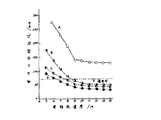
これらの電池の500 サイクル目の内部抵抗の値と使用した電解液濃度との関係を図2に示す。金属コバルトの含有率が1wt%(B),3wt%(C) および,5wt%(D)のものの内部抵抗の値は、コバルトの含有率が0wt%(A) のものよりも低いことがわかる。また、内部抵抗の値は電解液の濃度によって大きな影響をうけ、濃度が濃くなると低くなることがわかる。また、内部抵抗の値が急上昇すると電池の放電容量も減少するとともに、充電電圧が高くなり、放電電圧は低くなった。金属コバルトの含有率が0%の電池A を解体して、電池のエレメントを調査したところ、セパレータの電解液は枯渇しており、正極板は厚く膨れていた。電池の重量減少は、ほとんどなかったことから、金属コバルトの含有率が0%のものはニッケル基板が酸化をうけてγ−NiOOHの生成がおこっていることを意味するものと考えられる。このγ−NiOOHの示性式は K0.33 NiO2 ・0.67H2 O であり、電解液が正極に吸収されることを意味する。
【0020】
一方、金属コバルトを含有するニッケル基板を使用した電池を解体して調査したところ、金属コバルトの含有率が0%の電池A の場合に比較して、正極板の膨潤は少なく、セパレータは電解液で濡れていた。このことは、金属コバルトを含有するニッケル基板を使用した正極板は、そのニッケル基板のニッケルが酸化をうけて生成する水酸化ニッケルにコバルトが含まれるために、充電時にγ−NiOOHになりにくく、膨潤が少なくなるものと考えられる。
【0021】
一般に電極が膨潤すると、セパレータの電解液は電極に移動して、電池の内部抵抗の値が上昇する。この内部抵抗の値が上昇して70mΩを越えるようになると、放電容量が著しく低下することが経験的に判明している。内部抵抗の値を70mΩ以下に設定するためには、図2から、ニッケル基板の金属コバルトの含有率の値を1wt%(B) の場合は8.5M,3wt%(C) の場合には7.6M,5wt%(D)の場合には6.5M以上の電解液濃度が必要となることがわかる。すなわち、電解液としては、基板に含まれる金属コバルトの含有率によって必要なOH− イオン濃度が決められる。金属コバルトの含有率が3wt%以下の場合にはOH− イオン濃度が6.5 〜14M のアルカリ水溶液の電解液が好ましい。なお、電解液として水酸化カリウムと水酸化ナリウムトとの混合水溶液について検討したが、性能はほぼ使用するOH− イオン濃度の合計の濃度によって大きな影響を受けることがわかった。
【0022】
以上のように、金属コバルトを含有するニッケル基板を使用したし水酸化ニッケル正極板と濃い濃度の電解液を使用すると、10Cという極めて大きな電流で充電することができるが、この場合、一定電圧を検出したあと定電圧法やガス吸収が可能な条件で定電流法で充電することが必要である。一般的なニッケル・カドミウム電池の充電方法には、定電流で充電し、ガス吸収反応による温度上昇あるいは電圧降下を検出して充電を制御する方式(−ΔV方式)が採用されているが、この方法では、1Cを越える急速充電は困難であった。例えば、2C充電をおこなうと、その電流に相当するガス吸収性能は困難で、6 〜15kg/cm2 に設定されている安全弁から吸収されない酸素ガスが散逸して、電解液の減少となり、内部抵抗が増大して充電不能となつたり、放電容量が著しく低下する。また、ガス吸収による発熱が大きくセパレータの劣化による電解液の炭酸根の増大によっても性能が劣化することになる。
【0023】
このような電圧を検出して、充電を制御する方法には、特許公開公報,平−309265 やUSP,No5,077,151 等で提案があるような、鉛電池の場合のように負極の電位変化を検出して充電を制御する方式が望ましい。このような機能は、前述したような水素過電圧の小さい焼結式ニッケル基板を使用した負極板よりも、水素過電圧が大きいプラスチックボンデッド負極板を適用することが望ましい。この場合負極活物質中のリザーブにCd(OH)2 の量を少なくすると、この負極の分極に基づく電位変化は大きく現れる。
【0024】
つぎに、プラスチックボンデッド負極板を適用した場合の実施例について詳述する。水酸化カドミウム粉末100 部と金属カドミウム粉末20部と長さ1mm のポリプロピレンの短繊維0.1 部とを0.1wt%のポリビニルアルコ−ルを含むエチレングリコ−ルで混合してペ−スト状にする。このペ−ストを0.5μm のニッケルメッキした厚さ0.1mm の穿孔鋼板に塗着したのち、150 ℃で乾燥したのち、加圧して理論容量が500mAhで寸法が0.7×15×52(mm)のプラスチックボンデッドカドミウム負極板を製作した。つぎに、活物質保持体のニッケルに含有させる金属コバルト粉末の含有率を0,1wt%と変えた多孔度90% の発泡式ニッケル基体に水酸化コバルトを2wt%含む直径が5μm の球状の水酸化ニッケル粉末100 部と金属コバルト10部とを混合したのち、0.1wt%のメチルセルロ−ズ水溶液50mlを加えて、混合してペ−スト状にしたものを充填する。その後、100 ℃で熱風乾燥してから、ポリテトラフルオロエチレン粉末の40wt%のディスパ−ジョン溶液に浸漬してから同じ温度で再乾燥する。その後、5Mの水酸化ナトリウム水溶液中で、対極に平滑ニッケル板を使用し0.1C( 充放電反応が1 電子反応とした場合の理論容量を基準とした) で15時間充電後、0.2Cで0V(Hg/HgO)まで放電した。この極板をさらに、100 ℃で熱風乾燥してから、加圧プレスをおこない、理論容量が350 mAh、寸法が0.8×14×52( mm) の正極板を製作した。この正極板2 枚を0.12mmのポリアミド不織布セパレータで包んだのち、ヒ−トシ−ルした。つづいて、正極板と負極板とを交互に積み重ねて極板群とした。この極板群と電解液として5 〜14M の濃度の異なる水酸化カリウム水溶液2.5ml を用いて公称容量が650mAhのニッケルメッキした鉄電槽を使用した角形ニッケル・カドミウム電池を製作した。外形寸法は67×16.5×8(mm) であり、電池には0.5kg/cm2 で作動する安全弁を付けている。金属コバルトの含有率が0,1wt%の電池の符号をそれぞれE,F とする。
【0025】
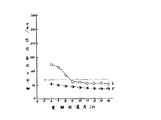
これらの電池を25℃,10 Cという極めて大きな電流で電圧が1.65V に到るまで充電したのち、今度は設定電圧を変えることなく1.65V の定電圧をおこない( 合計時間は10分間とした) 、その後0.5Cの電流で1.0 vまで放電するというサイクル試験をおこなった。これらの電池の300 サイクル目の内部抵抗の値と電解液濃度との関係を図3に示す。
【0026】
プラスチックボンデッドカドミウム負極板を使用した電池の場合も、金属コバルトの含有率が1wt%(F) のものの内部抵抗の値は、コバルトの含有率が0wt%(E)のものよりも低いことがわかる。また、内部抵抗の値は電解液の濃度によって大きな影響をうけ、濃度が濃くなると低くなることがわかる。とくに、プラスチックボンデッドカドミウム負極板を使用すると10Cという超急速充電でも、電解液の濃度が8.5M以上になると電池の内部抵抗の値を実用的な充放電サイクル数が300 回まで70mΩ以下に抑制することができる。このように、プラスチックボンデッドカドミウム負極板を使用すると良好なサイクル特性が得られるのは、前述したように、この負極板の水素過電圧が焼結式ニッケル基板よりも、はるかに大きいために定電圧領域で局部的な水素の発生が抑制され、電解液の枯渇の程度が小さいことに起因するものと考えらる。
【0027】
また、電解液の濃度が8.5M以上になると内部抵抗の増大が抑制されるのは、前述したニッケル基板のニッケルが酸化をうけて水酸化ニッケルが生成する際に、OH− イオンが消費されることに基づくもののほかに、高濃度の電解液を使用すると、カドミウムの溶解度が増大して、超急速充電した場合におこる初期の異常な充電電圧の上昇による負極からの水素発生およびそれにともなって正極からの酸素ガスの発生を抑制できる点がある。その一例として、電池E すなわち金属コバルトの含有率が0wt%の正極板で、電解液濃度を7Mおよび10M とした場合の電池それぞれG,H の5Cおよび10C 充電特性を図4に示す。
【0028】
通常使用される濃度の電解液を使用した電池G を5Cや10C 充電した場合には、充電初期から1.6V以上の電圧に達したのち、徐々に低下してから再び上昇するという現象が現れる。ガスクロマトグラフィーによって、電池内部のガス組成を分析したところ、充電初期には、小量の水素ガスと酸素ガスの発生が検出された。このような現象が認められる濃度8.5M以下であった。また、電解液量を3ml と多くしても、わずかな分極の減少が観察されるが、同様な現象が認められたので、液量を多くする手段では効果が少ない。一方、10M とした場合には、10C 充電した場合にも水素ガスや酸素ガスの発生は認められなかった。したがって、電解液の濃度が薄い場合には、電解液に溶解するカドミウムイオンが少なくなるために溶解・析出反応である負極板の充電反応が進行しにくくなり、負極の分極が大きくなると共に、正極の分極も同時に大きくなり、正極から酸素ガスが発生するものと考えられる。そして負極から水素ガスが発生すると負極上でのガス吸収能力が低下するために、発生した酸素ガスが弁を通して逸散し、電解液が減少するようになり、セパレータに含まれている電解液の枯渇がおこり内部抵抗が増大するものと考えられる。電解液の濃度が濃い場合には、電解液のカドミウムイオンの溶解度が高くなるために溶解・析出反応である負極板の充電反応が容易になり、負極の分極が小さくなるので、正極の分極も低下して、正極からの酸素ガスの発生も抑制されるものと考えられる。
【0029】
実施例では、ニッケル基体の多孔度が87% および90% と高い基体を使用したが、これらの傾向は多孔度80% とくに85% 以上の場合に顕著に現れることがわかった。
【0030】
電池の寿命モードとしては、電解液の枯渇による内部抵抗の増大と短絡の発生がある。短絡モードのうち、微少短絡が発生する場合において急速充電をした場合には、電流が大きいために、ジュール熱によって電池が高温になるという新たな課題が発生するために、微少短絡の発生を抑制することが必要である。とくに充電制御方式で定電圧法を適用した場合に、定電圧時に充電器の最大電流が流れることになる。
【0031】
このような、微少短絡を抑制するためには、セパレータに微孔性フィルムセパレータを使用すると著しい効果が生ずる。電池F と同様な構成の電池で、電解液に10M の水酸化カリウム水溶液2.5ml 、セパレータとして新たに多孔度が60% のポリプロピレン製の厚さ20μm の微孔性フィルムセパレータを不織布と併せて適用した電池J’、また、微孔性フィルムセパレータを適用しない電池J をそれぞれ10セル製作し、25℃,10 Cの電流で電圧が1.65V に到るまで充電したのち、さらに引き続いて1.65V の定電圧をおこない( 合計時間は10分間とした) 、その後0.5Cの電流で1.0 vまで放電するというサイクル試験をおこなった。
【0032】
500 サイクルを越えると、微孔性フィルムセパレータを備えない電池の3 セルに、定電圧領域で電流が一旦、減衰したのち増加するという現象が現れるとともに電池温度が上昇して100 ℃付近に達するようになった。電池を解体して、調査したところセパレータには電解液量が少なくなり、水酸化カドミウムのマイグレーションが生じて微少短絡が認められた。
【0033】
一方、また微孔性フィルムセパレータを備えた電池には、このような温度上昇はなく、1,000 サイクルに達しても異常な現象はおこらなかった。代表的な充電時の電圧、電流および温度変化を図5に示す。このように、微孔性フィルムセパレータを備えた電池に定電圧領域で異常な発熱が生じないのは、この微孔性フィルムセパレータによって水酸化カドミウムのマイグレーションによる微少短絡の発生が抑制されるとともに、正極から発生する酸素の透過が抑制されてガス吸収性能による異常な発熱が制限されることによるものと考えられる。
【0034】
この微孔性フィルムセパレータの機能としては、水酸化カドミウムのマイグレーションによる微少短絡の発生を抑制することが必要であり、その孔径は0.1 〜20μm 、多孔度は20〜90% であればよい。
【0035】
【発明の効果】
本発明は、活物質に金属ニッケルを含まないプラスチックボンデッド電極の負極とモル濃度が7Mを越え14M以下のアルカリ水溶液の電解液とを備えた1C以上の急速充電をおこない、負極の分極に基づく電圧の変化を検出して充電を制御するニッケル−カドミウム系二次電池に関するものであり、急速充電が可能なニッケル−カドミウム系二次電池とすることができる。
【0036】
とくに、プラスチックボンデッド電極の負極板・微孔性フィルムセパレ−タ等を使用することにより信頼性がより向上する。また、ニッケル基体の多孔度が85〜98% のものを使用した高エネルギー密度の正極板の長寿命化がはかれることから、高エネルギー密度の急速充電用電池とすることができる。
【図面の簡単な説明】
【図1】本発明による構成の密閉形ニッケル・カドミウム電池と従来の電池の充放電サイクル経過にともなう電池の容量保持率を比較した図。
【図2】コバルトの含有率の異なる基板を使用した正極板と濃度の異なる電解液を使用した電池の内部抵抗の変化を比較した図。
【図3】プラスチックボンデッドカドミウム負極板を使用した電池で、金属コバルトの含有する基板と含まない正極板を使用し、さらに濃度の異なる電解液を使用した電池の内部抵抗の変化を比較した図。
【図4】金属コバルトを含まない基板を使用した正極板で、電解液濃度が異なる電池の5Cおよび10C 充電特性を示した図。
【図5】微孔性フィルムセパレ−タを備えた電池と備えない電池の500 サイクルを越えた場合の代表的な充電時の電圧、電流および温度変化を示した図。[0001]
TECHNICAL FIELD OF THE INVENTION
As a result of studying the battery configuration necessary for performing rapid charging of 1 C or more, the present invention finds the optimal positive electrode plate, negative electrode plate, and electrolyte composition, and has a highly reliable nickel-cadmium battery for ultra-rapid charging. A nickel-based secondary battery is provided. As a result, the simplicity of a portable device or the like is further improved, and the expansion of applications can be expected.
[0002]
[Prior art]
In recent years, with the development of electronic devices, the appearance of new high-performance secondary batteries is expected. Currently, nickel-cadmium batteries, nickel-zinc batteries, nickel-based batteries such as nickel-hydride batteries, and lead batteries are used as power supplies for electronic devices. These secondary batteries are required to have an improved rapid charging performance as well as a higher capacity. Among them, the nickel secondary battery uses a nickel hydroxide electrode as a positive electrode plate. The electrode reaction of this positive electrode plate is diffusion of H + ions, and does not have a dissolution / precipitation mechanism unlike the electrode reaction of the positive electrode of a lead battery, and is therefore used as a long-life high-performance electrode.
[0003]
When this electrode is charged, the nickel hydroxide becomes nickel oxyhydroxide (NiOOH). This nickel oxyhydroxide has a β-form and a γ-form. When γ-NiOOH is generated during charging, volume expansion of 31% occurs, and when it becomes α-NiOOH which is a discharge product of γ-NiOOH, expansion of 59% occurs. It becomes.
[0004]
In recent years, in order to increase the energy density of the battery, when the active material is filled in a large amount, the residual porosity of the electrode decreases, and when the active material expands, the electrode becomes thick, and the electrolyte of the separator moves to the electrode. As a result, a so-called “dry-up” phenomenon in which the internal resistance increases may occur, or the electrodes may collapse to cause a short circuit. Furthermore, in applications where the charging time is required to be shortened, that is, in the case of performing rapid charging, since γ-NiOOH is particularly easily generated, measures have been required.
[0005]
BACKGROUND ART Conventionally, a method of adding cobalt hydroxide to an active material for the purpose of improving the utilization rate of a nickel hydroxide active material (for example, Electrochemistry 31, 47 (1936), Patent Publication 50-132441). A method of forming Co (OH) 2 after filling a nickel substrate (for example, Japanese Patent Application Laid-Open No. 57-005018) and a method of forming a binary system of Cd (OH) 2 —Ni (OH) 2 (for example, -39063, USP4603094 (1984), Patent Publication 56-36796)-A method of forming a ternary system of Ni (OH) 2- Co (OH) 2- Cd (OH) 2 (for example, Patent Publication 3-20860, US Pat. No. 3,956,686 (1976)) and the like have been proposed. Furthermore, a method has been proposed in which metallic nickel is contained in a sintered nickel substrate, which is a holder for an active material (for example, Japanese Patent Application Laid-Open No. 54-1010). However, it was insufficient from the viewpoint of suppressing the production of γ-NiOOH.
[0006]
Furthermore, in order to develop a sealed battery for quick charging, it is necessary to improve the gas absorption performance. However, achieving the gas absorption performance of 1 C or more depends on heat generation due to gas absorption in principle. It was extremely difficult due to deterioration of the battery. Furthermore, when rapid charge and discharge are performed, temperature rise and overvoltage increase, internal short circuit due to migration of cadmium hydroxide, cadmium dendrite growth, or abnormal heat generation during charging due to a gas absorption reaction occurs. There is a proposal to use a microporous separator as a means for suppressing the internal short circuit of the battery and extending the life (for example, Japanese Patent Laid-Open Publication No. Hei 1-264167). Further optimization is needed.
[0007]
[Problems to be solved by the invention]
For example, nickel-cadmium batteries are required to have higher energy density and improved rapid charging performance. However, the nickel hydroxide positive electrode plate used for high energy density batteries and quick charge batteries swells and becomes thicker as the charge / discharge cycle progresses, and the electrolyte of the separator moves to the electrodes to increase the internal resistance. There is a drawback that a so-called dry-up phenomenon occurs and battery life is shortened. In particular, when a nickel substrate serving as an active material holder has a porosity of 80% or more, particularly 85% or more, there is a problem that the swelling of the positive electrode plate becomes large because the strength of the substrate is weak.
[0008]
Also, when a rapid charge of 1 C or more is performed, the material of the separator is deteriorated due to rapid generation of heat due to gas absorption, the internal resistance is increased, and the solubility of cadmium in the electrolytic solution is increased, and cadmium migration occurs. There is a problem that an internal short circuit is likely to occur due to this. Further, when the degree of the short circuit is very small, a new problem arises in that when the battery is rapidly charged, that is, when a large current flows, the battery becomes hot due to Joule heat, and a countermeasure is desired.
[0009]
[Means for Solving the Problems]
The present invention, the negative electrode and the molar concentration is not such to put the 1C more rapid charging with an electrolytic solution of the following alkaline aqueous solution 14M beyond 7M, polarization of the negative electrode of plastic bonded electrode free of metallic nickel in the active material This is a nickel-cadmium secondary battery that controls charging by detecting a voltage change based on the voltage .
[0010]
BEST MODE FOR CARRYING OUT THE INVENTION
In order to suppress the change of the active material of the nickel hydroxide positive electrode plate to γ-NiOOH by charging and improve the utilization rate, cobalt hydroxide is added to the active material to form a solid solution with nickel hydroxide, Alternatively, means for adding cadmium hydroxide to form a solid solution in the same manner is known as a universal technique.
[0011]
According to the present invention, a nickel hydroxide positive electrode plate used for a high energy density battery or a battery for rapid charging swells and becomes thicker as the charge / discharge cycle proceeds, and the electrolyte of the separator moves to the electrode to increase the internal resistance. In addition to the conventionally known phenomenon that γ-NiOOH is generated as a charge product of the nickel hydroxide active material, the cause of the drawback that a dry-up phenomenon occurs and the battery life is shortened is the active material retention. The nickel porous body used as a body is oxidized by charging and discharging to become nickel hydroxide, which becomes γ-NiOOH, so that the positive electrode plate swells and becomes thicker, whereby the electrolytic solution of the separator flows to the electrode plate. It is based on the finding that movement is a major cause.
[0012]
In addition, as a countermeasure, the present invention provides a means for containing cobalt in nickel of the active material holding member to suppress nickel hydroxide generated by oxidation of the substrate from being further oxidized to γ-NiOOH. In addition, the nickel porous body is oxidized by charging and discharging to become nickel hydroxide, and an electrolytic solution in which excess potassium hydroxide necessary for converting it to γ-NiOOH in advance, that is, a high-concentration electrolytic solution is used. By doing so, it is possible to suppress an increase in internal resistance with the passage of cycles.
[0013]
Furthermore, the use of a high-concentration electrolytic solution increases the solubility of cadmium, and causes the generation of hydrogen from the negative electrode due to an abnormally high initial charging voltage that occurs in the case of ultra-rapid charging, and the accompanying release of oxygen gas from the positive electrode. Generation can be suppressed. In addition, the battery for ultra-rapid charging has a new problem that a minute short circuit is likely to occur because the current density is concentrated at the time of charging, so that a large current flows and the battery generates heat. There is a need. As a countermeasure, if a microporous film separator, particularly one having a porosity of 30% or more, is employed, generation of micro short circuit can be suppressed without impairing gas absorption performance, and abnormal heat generation of the battery does not occur.
[0014]
In addition, when a negative electrode of a plastic bonded electrode is used, a change in the final voltage at the time of charging occurs larger than when a sintered cadmium negative electrode plate is used. A charging method that limits the generated current in the overcharge region, that is, a constant voltage method or a method of charging with a small current can be applied. By applying this method, overcharging is not performed more than necessary, so that the above-mentioned various problems associated with rapid charging can be reduced.
[0015]
【Example】
Hereinafter, a description will be given using a preferred embodiment of the present invention.
[Example 1] Carbonyl nickel powder and 2 wt% of metallic cobalt powder are mixed, and then kneaded with a 0.1 wt% aqueous solution of methyl cellulose to form a slurry. The slurry was applied to a nickel-plated 0.1 mm perforated plate, dried with a heater, and sintered at 950 ° C. in a reducing atmosphere of hydrogen to produce a sintered nickel substrate having a porosity of 87%. Next, the sintered nickel substrate is impregnated with a 5 M aqueous solution of nickel nitrate containing 2 mol% of cobalt nitrate at 80 ° C., and then immersed in a 5 M aqueous solution of sodium hydroxide at 80 ° C. Thereafter, operations of washing with hot water and drying were performed eight times. Thereafter, the resultant was washed with hot water and dried to produce a positive electrode plate having a theoretical capacity of 350 mAh and dimensions of 0.8 × 14 × 52 (mm).
[0016]
Two positive electrode plates in which the content of the metal cobalt powder was changed to 0, 1, 3, 5 wt% in Example 1, a conventionally known theoretical capacity of 500 mAh, and dimensions of 0.7 × 15 × 52 (mm) , Three sintered cadmium negative electrode plates were manufactured. Next, this positive electrode plate was wrapped with a 0.12 mm polyamide nonwoven fabric separator, and then heat sealed. Subsequently, a positive electrode plate and a negative electrode plate were alternately stacked to form an electrode plate group.
[0017]
A prismatic nickel-cadmium battery using a nickel-plated iron battery case with a nominal capacity of 650 mAh was manufactured using the electrode group and 2.5 ml of an aqueous solution of potassium hydroxide having a different concentration of 5 to 14 M as an electrolytic solution. The external dimensions are 67 × 16.5 × 8 (mm), and the battery is provided with a safety valve that operates at 0.5 kg / cm 2 . The symbols A, B, C, and D are used for batteries having a metal cobalt content of 0, 1, 3, and 5 wt%.
[0018]
After charging these batteries with a large current of 25 ° C. and 5 C until the voltage reaches 1.65 V, a constant voltage of 1.50 V is set at a lower setting voltage than the detection voltage (total time was 15 minutes). Then, a cycle test was performed in which the battery was discharged to 1.0 V at a current of 0.5 C. FIG. 1 shows a change in the retention ratio of the discharge capacity with the passage of the cycle. According to the figure, when the content of cobalt contained in the nickel substrate is 0 wt% (A), the discharge capacity decreases when the number of charge / discharge cycles exceeds 400 times, but 1 wt% (B) and 3 wt% (C ) And 5 wt% (D) have stable and good capacities.
[0019]
FIG. 2 shows the relationship between the value of the internal resistance at the 500th cycle of these batteries and the concentration of the used electrolyte. It can be seen that the values of the internal resistance of the metal cobalt contents of 1 wt% (B), 3 wt% (C) and 5 wt% (D) are lower than those of the cobalt content of 0 wt% (A). . It can also be seen that the value of the internal resistance is greatly affected by the concentration of the electrolytic solution, and decreases as the concentration increases. Further, when the value of the internal resistance sharply increased, the discharge capacity of the battery decreased, and the charge voltage increased and the discharge voltage decreased. Batteries A having a metal cobalt content of 0% were disassembled, and the elements of the batteries were examined. As a result, the electrolyte in the separator was depleted, and the positive electrode plate was thick and swollen. Since the weight of the battery hardly decreased, it is considered that the case where the content of metallic cobalt was 0% means that the nickel substrate was oxidized and γ-NiOOH was generated. The characteristic formula of this γ-NiOOH is K 0.33 NiO 2 · 0.67H 2 O, which means that the electrolyte is absorbed by the positive electrode.
[0020]
On the other hand, when a battery using a nickel substrate containing metallic cobalt was disassembled and examined, the swelling of the positive electrode plate was smaller than that of battery A having a metallic cobalt content of 0%, and the separator was an electrolytic solution. Was wet. This means that a positive electrode plate using a nickel substrate containing metallic cobalt is less likely to become γ-NiOOH during charging because nickel hydroxide of the nickel substrate includes cobalt in nickel hydroxide generated by oxidation. It is considered that swelling is reduced.
[0021]
Generally, when the electrode swells, the electrolyte of the separator moves to the electrode, and the value of the internal resistance of the battery increases. It has been empirically found that when the value of the internal resistance is increased to exceed 70 mΩ, the discharge capacity is significantly reduced. In order to set the value of the internal resistance to 70 mΩ or less, FIG. 2 shows that the value of the content of metallic cobalt in the nickel substrate is 8.5 M in the case of 1 wt% (B) and in the case of 3 wt% (C). It can be seen that in the case of 7.6 M and 5 wt% (D), an electrolyte concentration of 6.5 M or more is required. That is, as the electrolyte, the required OH by the content of the metallic cobalt contained in the substrate - is determined ion concentration. When the content of metallic cobalt is 3% by weight or less, an electrolytic solution of an alkaline aqueous solution having an OH - ion concentration of 6.5 to 14M is preferable. In addition, although a mixed aqueous solution of potassium hydroxide and sodium hydroxide was examined as an electrolytic solution, it was found that the performance was largely affected by the total concentration of the OH - ions used.
[0022]
As described above, when a nickel substrate containing metallic cobalt is used and a nickel hydroxide positive electrode plate and a high concentration electrolytic solution are used, the battery can be charged with an extremely large current of 10C. After detection, it is necessary to charge by the constant voltage method or the constant current method under conditions that allow gas absorption. A general nickel-cadmium battery charging method employs a method of charging at a constant current and controlling charging by detecting a temperature rise or a voltage drop due to a gas absorption reaction (-ΔV method). With the method, rapid charging exceeding 1C was difficult. For example, when performing 2C charging, the gas absorption performance corresponding to the current is difficult, and the unabsorbed oxygen gas is dissipated from the safety valve set at 6 to 15 kg / cm 2 , and the electrolyte decreases, and the internal resistance decreases. And charging becomes impossible, and the discharge capacity is significantly reduced. In addition, heat generation due to gas absorption is large, and performance is also degraded by an increase in carbonate groups of the electrolyte due to deterioration of the separator.
[0023]
As a method of detecting such a voltage and controlling the charging, the potential of the negative electrode as in the case of a lead battery as proposed in Patent Publication, Hei-309265 and USP, No. 5,077,151 and the like is proposed. It is desirable to use a method in which charging is controlled by detecting a change. For such a function, it is desirable to apply a plastic bonded negative electrode plate having a larger hydrogen overvoltage than a negative electrode plate using a sintered nickel substrate having a small hydrogen overvoltage as described above. In this case, when the amount of Cd (OH) 2 is reduced in the reserve in the negative electrode active material, a large change in potential due to the polarization of the negative electrode appears.
[0024]
Next, an example in which a plastic bonded negative electrode plate is applied will be described in detail. 100 parts of cadmium hydroxide powder, 20 parts of metal cadmium powder, and 0.1 part of 1 mm long polypropylene short fiber were mixed with ethylene glycol containing 0.1% by weight of polyvinyl alcohol to form a paste. To The paste is applied to a 0.5 μm nickel-plated perforated steel sheet having a thickness of 0.1 mm, dried at 150 ° C., and then pressed to have a theoretical capacity of 500 mAh and a size of 0.7 × 15 × 52. (Mm) A plastic bonded cadmium negative electrode plate was manufactured. Next, a foamed nickel substrate having a porosity of 90% with the content of metallic cobalt powder to be contained in nickel of the active material holder being changed to 0.1 wt%, and spherical water having a diameter of 5 μm and containing 2 wt% of cobalt hydroxide was used. After mixing 100 parts of nickel oxide powder and 10 parts of metallic cobalt, 50 ml of a 0.1 wt% aqueous methylcellulose solution is added, and the mixture is filled into a paste. Thereafter, the resultant is dried with hot air at 100 ° C., immersed in a 40 wt% dispersion solution of polytetrafluoroethylene powder, and dried again at the same temperature. After that, in a 5M aqueous sodium hydroxide solution, using a smooth nickel plate as a counter electrode, the battery was charged at 0.1 C (based on the theoretical capacity when the charge / discharge reaction was a one-electron reaction) for 15 hours, and then charged at 0.2 C At 0 V (Hg / HgO). The electrode plate was further dried with hot air at 100 ° C., and then pressed under pressure to produce a positive electrode plate having a theoretical capacity of 350 mAh and dimensions of 0.8 × 14 × 52 (mm). The two positive plates were wrapped with a 0.12 mm polyamide nonwoven fabric separator, and then heat sealed. Subsequently, a positive electrode plate and a negative electrode plate were alternately stacked to form an electrode plate group. A prismatic nickel-cadmium battery using a nickel-plated iron battery case with a nominal capacity of 650 mAh was manufactured using the electrode group and 2.5 ml of an aqueous solution of potassium hydroxide having a different concentration of 5 to 14 M as an electrolytic solution. The external dimensions are 67 × 16.5 × 8 (mm), and the battery is provided with a safety valve that operates at 0.5 kg / cm 2 . The symbols of the batteries having a metal cobalt content of 0.1 wt% are E and F, respectively.
[0025]
After charging these batteries with an extremely large current of 25 ° C. and 10 C until the voltage reaches 1.65 V, a constant voltage of 1.65 V is applied without changing the set voltage (total time is 10 minutes). Then, a cycle test of discharging to 1.0 V at a current of 0.5 C was performed. FIG. 3 shows the relationship between the internal resistance value at the 300th cycle of these batteries and the electrolyte concentration.
[0026]
Also in the case of a battery using a plastic bonded cadmium negative electrode plate, the value of the internal resistance of the metal cobalt content of 1 wt% (F) is lower than that of the battery having the cobalt content of 0 wt% (E). Understand. It can also be seen that the value of the internal resistance is greatly affected by the concentration of the electrolytic solution, and decreases as the concentration increases. In particular, when a plastic-bonded cadmium negative electrode plate is used, the internal resistance value of the battery is reduced to 70 mΩ or less until the practical number of charge / discharge cycles is 300, even if the concentration of the electrolyte is 8.5 M or more, even at an ultra-rapid charge of 10 C. Can be suppressed. As described above, good cycle characteristics can be obtained when a plastic bonded cadmium negative electrode plate is used because, as described above, the hydrogen overvoltage of this negative electrode plate is much larger than that of a sintered nickel substrate, and thus a constant voltage is obtained. It is considered that the generation of hydrogen locally is suppressed in the region, and the degree of depletion of the electrolyte is small.
[0027]
Moreover, the increase in internal resistance is suppressed when the concentration of the electrolytic solution is more than 8.5M, when nickel nickel substrate as described above to produce nickel hydroxide undergo oxidation, OH - ions are consumed In addition to the above, the use of high-concentration electrolytes increases the solubility of cadmium, resulting in the formation of hydrogen from the negative electrode due to an abnormally high initial charging voltage that occurs during ultra-rapid charging, and consequently There is a point that generation of oxygen gas from the positive electrode can be suppressed. As an example, FIG. 4 shows 5C and 10C charging characteristics of batteries G, H 2 in the case of battery E, that is, a positive electrode plate having a metal cobalt content of 0 wt% and electrolyte concentrations of 7 M and 10 M, respectively.
[0028]
When a battery G 1 using an electrolyte having a commonly used concentration is charged at 5C or 10C, a phenomenon occurs in which the voltage reaches 1.6 V or more from the initial stage of charging, then gradually decreases and then increases again. . When the gas composition inside the battery was analyzed by gas chromatography, generation of small amounts of hydrogen gas and oxygen gas was detected in the initial stage of charging. The concentration at which such a phenomenon was observed was 8.5 M or less. Further, even when the amount of the electrolytic solution was increased to 3 ml, a slight decrease in polarization was observed, but the same phenomenon was observed. Therefore, the effect of reducing the amount of the electrolytic solution was small. On the other hand, in the case of 10M, no generation of hydrogen gas or oxygen gas was observed even after 10C charging. Therefore, when the concentration of the electrolyte is low, the amount of cadmium ions dissolved in the electrolyte decreases, so that the charging reaction of the negative electrode plate, which is a dissolution / precipitation reaction, hardly progresses. It is considered that the polarization also increases at the same time, and oxygen gas is generated from the positive electrode. Then, when hydrogen gas is generated from the negative electrode, the gas absorption capacity on the negative electrode is reduced, so the generated oxygen gas escapes through the valve, and the electrolyte decreases, and the electrolyte contained in the separator is reduced. It is considered that the exhaustion occurs and the internal resistance increases. When the concentration of the electrolytic solution is high, the solubility of cadmium ions in the electrolytic solution becomes high, so that the charging reaction of the negative electrode plate, which is a dissolution / precipitation reaction, becomes easy, and the polarization of the negative electrode becomes small. It is considered that the amount of oxygen gas decreases and generation of oxygen gas from the positive electrode is suppressed.
[0029]
In the examples, a nickel substrate having a high porosity of 87% and 90% was used. However, it was found that these tendencies were remarkably exhibited when the porosity was 80%, particularly 85% or more.
[0030]
Battery life modes include an increase in internal resistance due to depletion of the electrolyte and the occurrence of a short circuit. In the short-circuit mode, when charging is performed quickly when a micro short-circuit occurs, the current is large, and a new problem occurs in that the battery becomes high temperature due to Joule heat. It is necessary to. In particular, when the constant voltage method is applied in the charge control method, the maximum current of the charger flows at the constant voltage.
[0031]
Use of a microporous film separator as a separator has a remarkable effect to suppress such a minute short circuit. A battery having the same structure as the battery F, except that the electrolyte is 2.5 ml of a 10 M aqueous potassium hydroxide solution, and a new 20 μm-thick polypropylene microporous film separator having a porosity of 60% is combined with a nonwoven fabric as a separator. 10 cells each of the battery J 'to which the microporous film separator was not applied and the battery J' to which the microporous film separator was not applied were manufactured and charged at 25 ° C. and a current of 10 C until the voltage reached 1.65 V. A cycle test was performed in which a constant voltage of .65 V was applied (total time was 10 minutes), followed by discharging at a current of 0.5 C to 1.0 V.
[0032]
When the cycle exceeds 500 cycles, a phenomenon in which the current temporarily attenuates and then increases in a constant voltage region appears in three cells of the battery without the microporous film separator, and the battery temperature rises to reach about 100 ° C. Became. When the battery was disassembled and examined, a small amount of electrolyte solution was found in the separator, migration of cadmium hydroxide occurred, and a slight short circuit was observed.
[0033]
On the other hand, the battery provided with the microporous film separator did not have such a rise in temperature, and did not exhibit an abnormal phenomenon even after reaching 1,000 cycles. FIG. 5 shows typical changes in voltage, current, and temperature during charging. As described above, the battery provided with the microporous film separator does not generate abnormal heat in the constant voltage region because the microporous film separator suppresses the occurrence of micro short circuit due to migration of cadmium hydroxide, It is considered that transmission of oxygen generated from the positive electrode is suppressed and abnormal heat generation due to gas absorption performance is restricted.
[0034]
As a function of the microporous film separator, it is necessary to suppress the occurrence of a micro short circuit due to migration of cadmium hydroxide, and it is sufficient that the pore diameter is 0.1 to 20 μm and the porosity is 20 to 90%. .
[0035]
【The invention's effect】
The present invention, the negative electrode and the molar concentration is not such to put the 1C more rapid charging with an electrolytic solution of the following alkaline aqueous solution 14M beyond 7M, polarization of the negative electrode of plastic bonded electrode free of metallic nickel in the active material The present invention relates to a nickel-cadmium secondary battery that controls charging by detecting a change in voltage based on the voltage , and can be a nickel-cadmium secondary battery that can be rapidly charged.
[0036]
Particularly, the reliability is further improved by using a negative electrode plate of a plastic bonded electrode, a microporous film separator, or the like. Further, since the life of the positive electrode plate having a high energy density using a nickel substrate having a porosity of 85 to 98% is prolonged, a high energy density rapid charging battery can be obtained.
[Brief description of the drawings]
FIG. 1 is a diagram comparing a capacity retention ratio of a sealed nickel-cadmium battery having a configuration according to the present invention with a battery according to the progress of charge / discharge cycles of a conventional battery.
FIG. 2 is a diagram comparing a change in internal resistance between a positive electrode plate using substrates having different cobalt contents and a battery using electrolyte solutions having different concentrations.
FIG. 3 is a diagram comparing a change in internal resistance of a battery using a plastic-bonded cadmium negative electrode plate, using a substrate containing metallic cobalt and a positive electrode plate not containing metallic cobalt, and further using an electrolytic solution having a different concentration. .
FIG. 4 is a diagram showing 5C and 10C charging characteristics of batteries having different electrolyte concentrations on a positive electrode plate using a substrate containing no metallic cobalt.
FIG. 5 is a diagram showing typical voltage, current, and temperature changes during charging of a battery having a microporous film separator and a battery having no microporous film separator over 500 cycles.
Claims (1)
Priority Applications (1)
| Application Number | Priority Date | Filing Date | Title |
|---|---|---|---|
| JP2003113424A JP3558082B2 (en) | 2003-04-17 | 2003-04-17 | Nickel-cadmium secondary battery |
Applications Claiming Priority (1)
| Application Number | Priority Date | Filing Date | Title |
|---|---|---|---|
| JP2003113424A JP3558082B2 (en) | 2003-04-17 | 2003-04-17 | Nickel-cadmium secondary battery |
Related Parent Applications (1)
| Application Number | Title | Priority Date | Filing Date |
|---|---|---|---|
| JP35401192A Division JP3456217B2 (en) | 1992-12-14 | 1992-12-14 | Nickel-based secondary battery |
Publications (2)
| Publication Number | Publication Date |
|---|---|
| JP2004031331A JP2004031331A (en) | 2004-01-29 |
| JP3558082B2 true JP3558082B2 (en) | 2004-08-25 |
Family
ID=31185344
Family Applications (1)
| Application Number | Title | Priority Date | Filing Date |
|---|---|---|---|
| JP2003113424A Expired - Fee Related JP3558082B2 (en) | 2003-04-17 | 2003-04-17 | Nickel-cadmium secondary battery |
Country Status (1)
| Country | Link |
|---|---|
| JP (1) | JP3558082B2 (en) |
Cited By (1)
| Publication number | Priority date | Publication date | Assignee | Title |
|---|---|---|---|---|
| JP2007109501A (en) * | 2005-10-13 | 2007-04-26 | Furukawa Battery Co Ltd:The | Alkaline storage battery |
-
2003
- 2003-04-17 JP JP2003113424A patent/JP3558082B2/en not_active Expired - Fee Related
Cited By (1)
| Publication number | Priority date | Publication date | Assignee | Title |
|---|---|---|---|---|
| JP2007109501A (en) * | 2005-10-13 | 2007-04-26 | Furukawa Battery Co Ltd:The | Alkaline storage battery |
Also Published As
| Publication number | Publication date |
|---|---|
| JP2004031331A (en) | 2004-01-29 |
Similar Documents
| Publication | Publication Date | Title |
|---|---|---|
| JP2730121B2 (en) | Alkaline secondary battery and manufacturing method thereof | |
| JP3097347B2 (en) | Nickel-metal hydride battery | |
| US5131920A (en) | Method of manufacturing sealed rechargeable batteries | |
| JPH0677451B2 (en) | Manufacturing method of hydrogen storage electrode | |
| JP3558082B2 (en) | Nickel-cadmium secondary battery | |
| JP3456217B2 (en) | Nickel-based secondary battery | |
| CN108539187A (en) | Alkaline secondary cell | |
| JP2926732B2 (en) | Alkaline secondary battery | |
| JP2591988B2 (en) | Cadmium negative electrode plate and alkaline secondary battery using the negative electrode plate | |
| JP2926288B2 (en) | Nickel-cadmium battery | |
| JP2923946B2 (en) | Sealed alkaline secondary battery and method of manufacturing the same | |
| JP2577964B2 (en) | Cadmium negative electrode plate and alkaline secondary battery using the negative electrode plate | |
| JP2796674B2 (en) | Cadmium negative electrode plate and alkaline secondary battery using the negative electrode plate | |
| JP3225608B2 (en) | Nickel hydroxide positive electrode plate for alkaline battery and method for producing the same | |
| JP3458899B2 (en) | Nickel hydroxide positive plate for alkaline battery and alkaline battery thereof | |
| JP2553902B2 (en) | Alkaline secondary battery | |
| JP2591985B2 (en) | Cadmium negative electrode plate and alkaline secondary battery using the negative electrode plate | |
| JP2600307B2 (en) | Cadmium negative electrode plate and alkaline secondary battery using the negative electrode plate | |
| JP2797440B2 (en) | Alkaline secondary battery | |
| JP2591982B2 (en) | Cadmium negative electrode plate and alkaline secondary battery using the negative electrode plate | |
| JP3498727B2 (en) | Method for producing nickel hydroxide positive plate for alkaline battery, nickel hydroxide positive plate for alkaline battery, and alkaline battery | |
| JP2591987B2 (en) | Cadmium negative electrode plate and alkaline secondary battery using the negative electrode plate | |
| JP2564172B2 (en) | Cadmium negative electrode plate and alkaline secondary battery using the negative electrode plate | |
| JP2564176B2 (en) | Cadmium negative electrode plate for sealed alkaline secondary battery and sealed alkaline secondary battery using the negative electrode plate | |
| JP2600825B2 (en) | Cadmium negative electrode plate and alkaline secondary battery using the negative electrode plate |
Legal Events
| Date | Code | Title | Description |
|---|---|---|---|
| A131 | Notification of reasons for refusal |
Free format text: JAPANESE INTERMEDIATE CODE: A131 Effective date: 20040113 |
|
| A521 | Written amendment |
Free format text: JAPANESE INTERMEDIATE CODE: A523 Effective date: 20040312 |
|
| TRDD | Decision of grant or rejection written | ||
| A01 | Written decision to grant a patent or to grant a registration (utility model) |
Free format text: JAPANESE INTERMEDIATE CODE: A01 Effective date: 20040427 |
|
| A61 | First payment of annual fees (during grant procedure) |
Free format text: JAPANESE INTERMEDIATE CODE: A61 Effective date: 20040510 |
|
| S111 | Request for change of ownership or part of ownership |
Free format text: JAPANESE INTERMEDIATE CODE: R313111 |
|
| R350 | Written notification of registration of transfer |
Free format text: JAPANESE INTERMEDIATE CODE: R350 |
|
| LAPS | Cancellation because of no payment of annual fees |