JP3579110B2 - Mud water treatment method - Google Patents
Mud water treatment method Download PDFInfo
- Publication number
- JP3579110B2 JP3579110B2 JP08135195A JP8135195A JP3579110B2 JP 3579110 B2 JP3579110 B2 JP 3579110B2 JP 08135195 A JP08135195 A JP 08135195A JP 8135195 A JP8135195 A JP 8135195A JP 3579110 B2 JP3579110 B2 JP 3579110B2
- Authority
- JP
- Japan
- Prior art keywords
- mixer
- water
- muddy water
- cement
- ready
- Prior art date
- Legal status (The legal status is an assumption and is not a legal conclusion. Google has not performed a legal analysis and makes no representation as to the accuracy of the status listed.)
- Expired - Fee Related
Links
Images
Landscapes
- Separation Of Suspended Particles By Flocculating Agents (AREA)
- Treatment Of Sludge (AREA)
Description
【0001】
【産業上の利用分野】
この発明は、例えば建築工事等にて排出される泥水の処理方法に関し、詳しくは、この泥水を簡易かつ有効に利用する方法に関する。
【0002】
【従来の技術】
堀削工事現場あるいは建築工事現場においては、掘削孔の安定化のため多量の水若しくは地盤安定液を堀削孔内に投入しつつ堀削を行っている。したがって、掘削等の終了時には、水と土(粘土)とが混合された水分の高い泥水が堀削孔内に発生するため、これをポンプ等で排出する。
【0003】
【発明が解決しようとする課題】
しかしながら、この泥水は、pHが高く、粘土等の微粒子を含むものであるため、そのまま河川等に廃棄することはできず、産業廃棄物として処理される必要がある。
したがって、この泥水を産業廃棄物処理施設にまで運搬しなければないところ、大量の泥水の運搬には、多数のコンテナダンプ等の運搬手段を確保する必要があり、速やかに処理することが困難な場合が多い。
また、コンテナダンプ等による泥水の運搬の際には、泥水が周囲に飛散するという不都合や、泥水が高比重のため、過積載を避けるために大量に積載できないという不都合があった。
これに対して、現場に打設する生コンクリートを運搬するコンクリートミキサ(アジテータ車)は、通常、生コンクリートを排出後は、ミキサ内に生コンクリート残留物を少量残してはいるがほぼ空車の状態でコンクリートプラントへ戻っていくという現実があった。
【0004】
また、泥水は、水分と固形分とに分離した後に、廃棄処分をしなければならないため、多数の工程を経て処理する必要があった。すなわち、図2に示すように、産業廃棄物処理施設では、泥水に凝集剤を添加して、アジテーションを行い、上澄水を得るとともに、沈殿物をさらに脱水して水を得て、これらの水を合わせて、さらに中和処理を施して下水道に放流するのである。
【0005】
そこで、本発明の目的は、工事等において発生した泥水の処理方法に関し、泥水の凝集処理を効率的に行うことにある。
【0006】
【課題を解決するための手段】
本発明者は、上記した技術的課題を解決するべく、生コンクリートを運搬・排出後のコンクリートミキサに着目し、空のミキサ内に泥水を投入し、ミキサの回転により、泥水の凝集処理が可能であることを見いだし、本発明を完成した。
すなわち、請求項1に記載の発明は、土と水とが混合してなる泥水を、凝集化させ沈澱物と上澄水とに分離する処理方法であって、前記泥水をミキサ車のミキサ内に投入する工程と、このミキサ内において泥水を凝集化させる工程、とを備えたことを特徴とする泥水の処理方法である。
【0007】
また、請求項2に記載の発明は、前記凝集化は、前記ミキサ車のミキサ内において、セメント溶出液と泥水を混合することにより行うことを特徴とする請求項1に記載の泥水の処理方法である。
【0008】
また、請求項3に記載の発明は、前記セメント溶出液は、前記ミキサ車のミキサ内のセメント成分に水を添加してなることを特徴とする請求項2に記載の泥水の処理方法である。
また、請求項4に記載の発明は、前記上澄水をコンクリート用水として用いることを特徴とする請求項1又は2又は3のいずれかの記載の泥水の処理方法である。
【0009】
以下、本発明を詳細に説明する。
前記泥水とは、例えば工事等に伴って発生する土(粘土)と水とを主体とするものであり、具体的には、地盤安定液等を含む廃ベントナイト泥水、リバース工法等に伴う廃泥水等が含まれる。
なお、かかる工事には、建設工事、土木工事、堀削工事等が広く含まれる。
【0010】
本発明にいう凝集とは、前記泥水に含まれる粒子を集合させて遊離水を発生させることをいう。この凝集の結果、泥水は沈殿物(凝集体)と上澄水とに分離される。
本発明では、この凝集をミキサ内で行うことを特徴とする。ミキサは、生コンクリートを工事現場に運搬し排出た後は、空ミキサの状態でコンクリートプラントへ戻るのが通常である。しかし、このミキサは、回転させることにより、泥水の凝集反応を効率的に行うことのできる装置でもある。
したがって、このミキサを凝集反応装置として用いることができ、この結果、凝集反応装置の設備を省略化することができる。さらに、ミキサ車の運行時間を利用してミキサを回転させて、ミキサ内で凝集を行うこととすれば、凝集のための時間を特に設ける必要がなくなる。
【0011】
そして、同時に、ミキサ内には、運搬後排出した生コンクリートが内壁等に残存するのが通常であり、この場合、生コンクリート残留物は、セメント成分を含むためカルシウムイオンの供給源となり、泥水に凝集をおこさせる凝集剤として作用させることが可能である。
【0012】
ここに、生コンクリート残留物を、凝集剤として作用させるためには、このままの状態で泥水と混合してよいし、さらに効果的には、生コンクリート残留物に水を加えてセメント成分からカルシウムイオン等を溶出させて得たセメント溶出液と泥水を混合する。セメント溶出液は、具体的には、ミキサ内に一定量残留する生コンクリートに対して水を添加してミキサを回転させて混合することにより、あるいは、ミキサ外部で余剰の生コンクリートに水を添加して撹拌混合することにより得ることができる。なお、セメント溶出液は、セメントに水を添加してセメント中のカルシウムイオンが溶出したものであれば、その製法や状態を問うものではない。
【0013】
なお、泥水の凝集化には、一般的な凝集剤を添加することもできる。かかる凝集剤としては、例えば、消石灰等の無機系凝集剤や高分子凝集剤を用いることができる。
【0014】
このように、ミキサ内の生コンクリート残留物やそのセメント溶出液を凝集剤として用いて、ミキサを回転させることにより、凝集剤の添加の手間及びコストを省略化することが可能となり、全体的な処理工程を簡略化することができる。
ミキサにおける生コンクリート排出後の生コンクリート残留量は、例えば5000Lの容積のミキサにおいて50L程度(約1%)であり、この残留物に対して100L程度の水を投入することにより、充分カルシウムイオンの溶出したセメント溶出液をミキサ内で生成させることができる。
【0015】
凝集を起こさせるために必要なミキサの回転は、一般的なミキサの回転数で充分であり、通常はごく低回転数で凝集する。
ミキサ内で凝集された泥水は、処理施設において、ミキサから排出され、貯泥槽に投入され、静置されると、沈殿物と上澄水とに分離される。必要あれば、この状態でさらに凝集剤を添加して凝集を補助、あるいは促進することができる。
【0016】
凝集により得られた沈殿物は、フィルタプレスや遠心分離機等の脱水機等で、水分を除去したケーキとされ、一方、除去した水は、貯泥槽から分取した上澄水水混合される。
このケーキは、産業廃棄物として最終処分場に廃棄する。また、上澄液は、そのまま中和することなく、生コンクリート用水として使用できる。さらに、中和により下水道に放流が可能となる。
【0017】
ミキサで凝集させた後の沈殿物の脱水工程や上澄水の分取工程は、図1に示すように、コンクリートプラントの排水処理用施設を利用して行うことができる。したがって、コンクリートミキサの帰着地であるコンクリートプラントでかかる泥水処理を行うことは、コンクリートミキサがコンクリートプラントへ帰途途中の運行工程で、泥水の凝集を行うことにより、運行工程の無駄を排除し、かつ処理工程時間の短縮化を図るという利点がある。
さらに、コンクリートプラントでかかる工程を行うことにより、凝集処理により得た上澄水の再利用を効率的に行うことができるという利点がある。
【0018】
【発明の効果】
請求項1に記載の発明によれば、工事において発生する泥水を、空車のミキサあるいは、さらにミキサの運行時間を利用して効率的に処理することができる。
請求項2に記載の発明によれば、さらに、セメント溶出液を凝集剤として利用することにより、凝集剤のコストを低減することができる。
請求項3に記載の発明によれば、ミキサ内に残存するセメント成分に水を添加してセメント溶出液とすることにより、凝集剤のコスト及び添加の手間を省くことができる。
請求項4に記載の発明によれば、効率的に処理された泥水を、さらに、コンクリートの製造に有効利用することにより、コンクリート製造コストの低減及び環境への悪影響を低減することができる。
【0019】
【実施例】
以下、本発明を具現化した一実施例について説明する。
以下の実施例では、ミキサ車の容量を小スケール化して泥水の処理試験を行った。
【0020】
(実施例1〜5)
道路建設現場(名古屋高速四谷(その2)工区)にて採取した泥水サンプルにつき、以下の表に示す配合に従って各種実施例の試料を調製し、試験を行った。なお、各実施例は、泥水サンプル300ml に、高分子凝集剤であるMD−PLUS(商品名)(PHPA(Partialy Hidrized Polyacrylate) を主成分とする)を所定量(泥水に対する割合で0.03〜0.13vol %( 以下、単に%という。) 添加して、薬さじで撹拌混合し、さらに予め調製しておいたセメント溶出液 (セメントペースト(W/C 比=50%) 20 ml に水 40 ml を添加してカルシウムイオンを溶出させておいた上澄液)6ml(泥水サンプルに対して2 %) を添加して、薬さじで撹拌混合して試験した。
なお、セメント溶出液には、カルシウムイオンが飽和状態で含まれているものである( なお、カルシウムの水への飽和溶解度は常温で1650ppm 程度である) 。
【0021】
【表1】
( 実施例6〜9)また、他の現場(JR 名古屋駅ツインビル建設現場) で採取した泥水サンプルにつき、以下の表2に示す配合に基づいて各実施例の試料を調製して試験を行った。なお、リハイデー21は高分子凝集剤の商品名であり、FAST AIDはカルシウム塩凝集剤の商品名である。これらの実施例においては、表2に示すように、リハイデー21又はMD−PLUS 、次にFAST AIDの順で添加後、撹拌混合し、予め調製しておいたセメントペースト( W/C 比=50%) を加えて、さらに撹拌した。
【0023】
【表2】
【0024】
( 実施例1〜5について) MD−PLUS 及びセメント溶出液を添加して撹拌後、静置した泥水サンプルの状態を観察した結果を表1に併せて示す。この表から明らかなように、セメント溶出液のみを添加した実施例1においては、泥水中の粘土分は凝集するが、圧密されにくいため、スラッジボリュームが大きい。ただし、実施例1の場合であっても、泥水の凝集は観察されたので、セメント溶出液との混合撹拌の効果を確認できた。
一方、高分子凝集剤MD−PLUS を添加した実施例2〜5においては、遊離水量も多く、特に実施例4及び5では、大きなフロックが形成されたため、スラッジは圧密されやすく、脱水性に優れていた。
【0025】
また、MD−PLUS の添加量についてみると、0.03%、0.07%の添加量でも効果はあるが、0.1 %、0.13%の添加量で脱水及びフロック形成能向上の効果が顕著であり、0.1 %以上が効果的な添加量であることがわかった。なお、一般に、凝集剤の添加量と効果の関係には、ある閾値があり、これらの実施例においては、0.13%以上の添加量では、凝集状態の目立った改善は見られず、MD−PLUS の添加量としては0.1 〜0.13%は、ほぼ最適値であると考えられる。
【0026】
なお、実施例2〜5においては、先に少量添加するMD−PLUS 中のPHPAが泥水中の粘土の活性点に吸着され、粘土の微粒子間が架橋される。そして、続いて添加されるセメント溶出液中のカルシウムイオンとの反応によりPHPAが不溶性となって析出すると同時に、粘土とカルシウムイオンとのイオン交換反応により脱水性に優れたスラッジとなる。
【0027】
このように、実施例1〜5では、生コンクリート残留物から発生するカルシウムイオン以外の無機凝集剤を添加することなく、高分子凝集剤の添加のみで効果的に凝集化させることができた。
また、この結果から、ミキサ車のミキサ内の生コンクリート残留物を凝集剤として利用できることを明らかにすることができた。すなわち、セメント中に大量に含まれるカルシウムイオンを、生コンクリート排出後のミキサ内に予め水を添加することにより、水中へ溶出させ、泥水の凝集処理に必要なカルシウムイオンをミキサー内で生成させることができることがわかった。
また、カルシウムイオンの溶解度は低いので生コンクリート残留物には、イオン化していないカルシウムが豊富に残存している。したがって、ミキサ内の生コンクリート残留物の多少にかかわらず、ミキサ内に水を添加することにより、凝集剤としての作用を発揮させることができる。なお、通常ミキサ内の生コンクリート排出後の生コンクリート残留物は、ミキサ容積比にして約1%程度であり、例えば5000Lのミキサでは、約50Lの生コンクリートがミキサ内に残留し、100L程度の水を添加混合することにより、充分量のカルシウムイオンが溶出されてくる。
【0028】
( 実施例6〜9について)セメントペーストのみを添加した実施例6では、実施例1と同様に、泥水は凝集し遊離水は発生するが、スラッジボリュームが大きく圧密されにくい状態となっている。ただし、実施例6の場合であっても、泥水の凝集は観察されたので、セメント溶出液との混合撹拌の効果を確認できた。
一方、セメントペーストの他、各種凝集剤を加えた場合( 実施例7〜9)には、遊離水も多く発生し、また、形成されるフロックも大きく、脱水性に優れるスラッジを形成していた。
【0029】
この結果から、ミキサ内の生コンクリート残留物をそのままの状態で用いても、各種処理剤の添加により、ミキサ車内での泥水の凝集が可能であることを確認することができた。
また、特に、高分子凝集剤を組み合わせて用いれば、効果的に大きなフロックを形成することができ、スラッジの圧密等が行いやすい状態とすることができる。
【0030】
なお、これらの実施例は、いずれもコンクリートミキサ車のミキサでなく、ビーカー内等で行ったが、ミキサ車のミキサ内での実験に対応させることができる。ミキサ車において、ミキサの回転により、内容物の混合撹拌効果は確実であり、しかも凝集反応は速やかに生じるからである。
【0031】
また、ミキサ内における凝集反応をより促進させるため、ミキサから凝集した泥水を排出後にも、さらに、ミキサ外の反応槽で泥水の凝集反応を生じさせることもできる。
【図面の簡単な説明】
【図1】本発明における泥水の処理システムを示した図である。
【図2】従来における泥水の処理システムを示した図である。[0001]
[Industrial applications]
The present invention relates to a method for treating muddy water discharged in, for example, construction work, and more particularly, to a method for simply and effectively using the muddy water.
[0002]
[Prior art]
In excavation work sites or construction work sites, excavation is performed while a large amount of water or ground stabilizing liquid is injected into the excavation hole in order to stabilize the excavation hole. Therefore, at the end of excavation or the like, muddy water having a high water content in which water and soil (clay) are mixed is generated in the excavation hole, and is discharged by a pump or the like.
[0003]
[Problems to be solved by the invention]
However, since the muddy water has a high pH and contains fine particles such as clay, the muddy water cannot be directly discarded in a river or the like, and must be treated as industrial waste.
Therefore, this muddy water must be transported to an industrial waste treatment facility.However, for transporting a large amount of muddy water, it is necessary to secure a large number of transport means such as container dumps, and it is difficult to treat the muddy water promptly. Often.
Also, when muddy water is transported by a container dump or the like, there is a disadvantage that the muddy water is scattered around, or that the muddy water has a high specific gravity, so that a large amount of the muddy water cannot be loaded to avoid overloading.
In contrast, concrete mixers (agitator trucks) that transport ready-mixed concrete to be cast on the site usually leave a small amount of ready-mixed concrete in the mixer after discharging the ready-mixed concrete, but are almost empty. Then there was the reality of returning to the concrete plant.
[0004]
Further, muddy water must be disposed of after being separated into water and solids, so that it has to be treated through many steps. That is, as shown in FIG. 2, in an industrial waste treatment facility, an agitation is performed by adding a flocculant to muddy water to obtain supernatant water, and further, the sediment is further dehydrated to obtain water. , And then neutralized and discharged into the sewer.
[0005]
Therefore, an object of the present invention relates to a method for treating muddy water generated during construction or the like, and to efficiently perform a muddy water agglomeration treatment.
[0006]
[Means for Solving the Problems]
In order to solve the above technical problem, the present inventor pays attention to the concrete mixer after transporting and discharging the ready-mixed concrete, puts muddy water into an empty mixer, and enables the coagulation treatment of muddy water by rotating the mixer. Thus, the present invention has been completed.
That is, the invention according to claim 1 is a treatment method for coagulating muddy water obtained by mixing soil and water to separate into sediment and supernatant water, wherein the muddy water is mixed into a mixer of a mixer truck. A muddy water treatment method comprising a step of charging and a step of coagulating muddy water in the mixer.
[0007]
The invention according to claim 2 is characterized in that the agglomeration is performed by mixing a cement eluate and mud in a mixer of the mixer truck. It is.
[0008]
The invention according to claim 3 is the method for treating muddy water according to claim 2, wherein the cement eluate is obtained by adding water to a cement component in a mixer of the mixer truck. .
The invention according to claim 4 is the method for treating muddy water according to any one of claims 1, 2 and 3, wherein the supernatant water is used as water for concrete.
[0009]
Hereinafter, the present invention will be described in detail.
The muddy water is mainly composed of, for example, soil (clay) and water generated during construction and the like, and specifically, waste bentonite muddy water containing a ground stabilizing liquid and the like, waste muddy water generated by a reverse method, etc. Etc. are included.
Such works include construction work, civil engineering work, excavation work, and the like.
[0010]
Aggregation as referred to in the present invention means that particles contained in the muddy water are aggregated to generate free water. As a result of this aggregation, the muddy water is separated into a sediment (aggregate) and supernatant water.
The present invention is characterized in that this aggregation is performed in a mixer. After transporting and discharging the ready-mixed concrete to the construction site, the mixer normally returns to the concrete plant in an empty mixer state. However, this mixer is also a device capable of efficiently performing a muddy water agglomeration reaction by being rotated.
Therefore, this mixer can be used as an agglutination reactor, and as a result, the equipment of the agglutination reactor can be omitted. Furthermore, if the mixer is rotated using the operation time of the mixer truck to perform the coagulation in the mixer, it is not necessary to provide a special time for the coagulation.
[0011]
At the same time, in the mixer, the fresh concrete discharged after transportation usually remains on the inner wall and the like. In this case, the ready-mixed concrete residue becomes a supply source of calcium ions because it contains a cement component, and is supplied to muddy water. It is possible to act as a flocculant that causes flocculation.
[0012]
Here, in order for the ready-mixed concrete residue to act as a coagulant, it may be mixed with muddy water as it is, or more effectively, water may be added to the ready-mixed concrete residue to remove calcium ions from the cement component. The cement eluate obtained by dissolving the above is mixed with muddy water. Concretely, the cement eluate is obtained by adding water to the ready-mixed concrete remaining in the mixer in a certain amount and rotating and mixing the mixer, or adding excess water to the excess ready-mixed concrete outside the mixer. And stirring and mixing. It should be noted that the cement eluate is not limited to the manufacturing method and condition as long as calcium ions in the cement are eluted by adding water to the cement.
[0013]
In addition, a general coagulant can be added to the coagulation of the muddy water. As such a coagulant, for example, an inorganic coagulant such as slaked lime or a polymer coagulant can be used.
[0014]
In this way, by using the ready-mixed concrete residue in the mixer and the cement eluate as a coagulant, and rotating the mixer, it is possible to reduce the labor and cost of adding the coagulant, and the overall The processing steps can be simplified.
The remaining amount of ready-mixed concrete after discharge of ready-mixed concrete in the mixer is, for example, about 50 L (about 1%) in a mixer having a volume of 5000 L, and by adding about 100 L of water to this residue, sufficient calcium ions can be removed. The eluted cement eluate can be generated in the mixer.
[0015]
The rotation of the mixer required for causing aggregation is sufficient with the rotation speed of a general mixer, and the aggregation is usually performed at a very low rotation speed.
The muddy water agglomerated in the mixer is discharged from the mixer in the treatment facility, put into a mud storage tank, and, when left standing, separated into a sediment and a supernatant. If necessary, a flocculant can be further added in this state to assist or promote flocculation.
[0016]
The sediment obtained by coagulation is made into a cake from which water is removed by a dehydrator such as a filter press or a centrifuge, and the removed water is mixed with supernatant water separated from a mud storage tank. .
This cake is disposed of at the final disposal site as industrial waste. The supernatant can be used as ready-mixed concrete water without neutralization. Furthermore, the water can be discharged into the sewer by neutralization.
[0017]
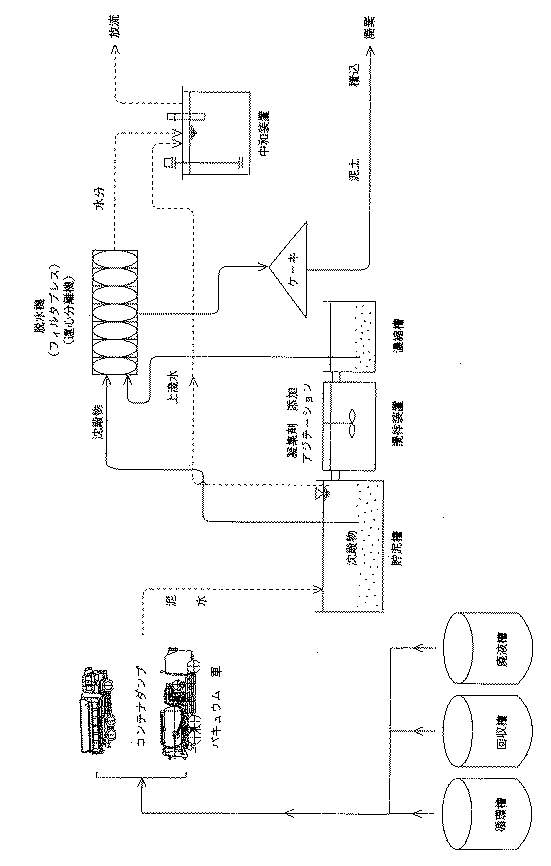
As shown in FIG. 1, the step of dewatering the precipitate after coagulation with the mixer and the step of collecting the supernatant water can be performed using a wastewater treatment facility of a concrete plant. Therefore, performing the muddy water treatment in the concrete plant where the concrete mixer is returned is to eliminate waste of the operation process by performing the aggregation of the muddy water in the operation process in which the concrete mixer is returning to the concrete plant, and There is an advantage that the processing time can be reduced.
Further, by performing such a process in a concrete plant, there is an advantage that the supernatant water obtained by the coagulation treatment can be efficiently reused.
[0018]
【The invention's effect】
According to the first aspect of the present invention, muddy water generated during construction can be efficiently treated by using the empty mixer or the operating time of the mixer.
According to the second aspect of the present invention, the cost of the flocculant can be reduced by using the cement eluate as the flocculant.
According to the third aspect of the present invention, by adding water to the cement component remaining in the mixer to form a cement eluate, it is possible to save the cost and labor of adding the coagulant.
According to the fourth aspect of the present invention, the muddy water that has been efficiently treated is further effectively used for the production of concrete, so that it is possible to reduce the cost of producing concrete and reduce adverse effects on the environment.
[0019]
【Example】
Hereinafter, an embodiment embodying the present invention will be described.
In the following examples, a muddy water treatment test was performed by reducing the capacity of the mixer truck.
[0020]
(Examples 1 to 5)
With respect to mud samples collected at a road construction site (Nagoya Expressway Yotsuya (No. 2) construction section), samples of various examples were prepared according to the composition shown in the following table and tested. In each of the examples, a predetermined amount of a polymer flocculant, MD-PLUS (trade name) (having a main component of PHPA (Partially Hiddenized Polyacrylate)), in a 300 ml mud sample, was 0.03 to 300 ml. 0.13% by volume (hereinafter simply referred to as%), stirred and mixed with a spoonful, and further prepared a cement eluate (20 ml of cement paste (W / C ratio = 50%) and water 40 6 ml (2% based on the muddy water sample) of the supernatant (in which calcium ions were eluted by adding ml) was added, and the mixture was stirred and mixed with a spoonful.
The cement eluate contains calcium ions in a saturated state (the saturation solubility of calcium in water is about 1650 ppm at room temperature).
[0021]
[Table 1]
(Examples 6 to 9) Also, for muddy water samples collected at other sites (JR Nagoya Station Twin Building Construction Site), samples of each example were prepared based on the formulation shown in Table 2 below and tested. Was. Note that Rehide Day 21 is a trade name of a polymer flocculant, and FAST AID is a trade name of a calcium salt flocculant. In these examples, as shown in Table 2, after adding Rehide 21 or MD-PLUS, and then FAST AID, the mixture was stirred and mixed to prepare a previously prepared cement paste (W / C ratio = 50). %) Was added and the mixture was further stirred.
[0023]
[Table 2]
[0024]
(Examples 1 to 5) Table 1 also shows the results of observing the state of the muddy water sample, which was left after stirring after adding MD-PLUS and the cement eluate. As is clear from this table, in Example 1 in which only the cement eluate was added, the clay component in the muddy water was agglomerated, but it was difficult to consolidate, so the sludge volume was large. However, even in the case of Example 1, since aggregation of muddy water was observed, the effect of mixing and stirring with the cement eluate could be confirmed.
On the other hand, in Examples 2 to 5 in which the polymer flocculant MD-PLUS was added, the amount of free water was large, and particularly in Examples 4 and 5, a large floc was formed, so that the sludge was easily compacted and excellent in dewaterability. I was
[0025]
Regarding the addition amount of MD-PLUS, even if the addition amount is 0.03% or 0.07%, there is an effect, but the addition amount of 0.1% or 0.13% improves the dehydration and floc forming ability. The effect was remarkable, and it was found that 0.1% or more was an effective addition amount. In general, there is a certain threshold value between the amount of the coagulant and the effect. In these examples, when the amount of the coagulant added is 0.13% or more, no noticeable improvement in the coagulation state is observed. It is considered that the addition amount of -PLUS is 0.1 to 0.13%, which is almost the optimum value.
[0026]
In Examples 2 to 5, PHPA in MD-PLUS to be added in a small amount first is adsorbed to the active site of clay in muddy water, and the fine particles of clay are crosslinked. Then, PHPA becomes insoluble and precipitates due to the reaction with calcium ions in the cement eluate added subsequently, and at the same time, sludge having excellent dehydration properties is formed due to the ion exchange reaction between clay and calcium ions.
[0027]
As described above, in Examples 1 to 5, it was possible to effectively coagulate only by adding the polymer coagulant without adding an inorganic coagulant other than calcium ions generated from the ready-mixed concrete residue.
From the results, it was clarified that the ready-mixed concrete residue in the mixer of the mixer truck can be used as a coagulant. That is, calcium ions contained in a large amount in cement are eluted into water by adding water in advance to a mixer after discharging ready-mixed concrete, and calcium ions necessary for agglomeration treatment of muddy water are generated in a mixer. I knew I could do it.
In addition, since the solubility of calcium ions is low, non-ionized calcium remains abundantly in the ready-mixed concrete residue. Therefore, regardless of the amount of the ready-mixed concrete residue in the mixer, the action as a coagulant can be exhibited by adding water to the mixer. Note that the ready-mixed concrete residue after the ready-mixed concrete is discharged from the mixer is about 1% in terms of the volume ratio of the mixer. For example, in a 5000 L mixer, about 50 L of the ready-mixed concrete remains in the mixer and about 100 L of the ready-mixed concrete remains. By adding and mixing water, a sufficient amount of calcium ions is eluted.
[0028]
(Examples 6 to 9) In Example 6 in which only the cement paste was added, the muddy water aggregated and free water was generated as in Example 1, but the sludge volume was large and it was difficult to consolidate. However, even in the case of Example 6, since the aggregation of the muddy water was observed, the effect of mixing and stirring with the cement eluate could be confirmed.
On the other hand, when various coagulants were added in addition to the cement paste (Examples 7 to 9), a large amount of free water was generated, the formed flocs were large, and sludge having excellent dewatering properties was formed. .
[0029]
From these results, it was confirmed that even when the ready-mixed concrete residue in the mixer was used as it was, it was possible to coagulate muddy water in the mixer vehicle by adding various treating agents.
Particularly, when a polymer flocculant is used in combination, a large floc can be effectively formed, and a state in which the sludge can be compacted easily can be obtained.
[0030]
It should be noted that these examples were performed in a beaker or the like instead of the mixer of the concrete mixer truck, but can be adapted to experiments in the mixer of the mixer truck. This is because, in a mixer wheel, the effect of mixing and stirring the contents is ensured by the rotation of the mixer, and the agglutination reaction occurs quickly.
[0031]
Further, in order to further promote the agglutination reaction in the mixer, after the agglomerated muddy water is discharged from the mixer, the agglutination reaction of the muddy water can be further generated in a reaction tank outside the mixer.
[Brief description of the drawings]
FIG. 1 is a diagram showing a muddy water treatment system according to the present invention.
FIG. 2 is a diagram showing a conventional muddy water treatment system.
Claims (4)
Priority Applications (1)
| Application Number | Priority Date | Filing Date | Title |
|---|---|---|---|
| JP08135195A JP3579110B2 (en) | 1995-04-06 | 1995-04-06 | Mud water treatment method |
Applications Claiming Priority (1)
| Application Number | Priority Date | Filing Date | Title |
|---|---|---|---|
| JP08135195A JP3579110B2 (en) | 1995-04-06 | 1995-04-06 | Mud water treatment method |
Publications (2)
| Publication Number | Publication Date |
|---|---|
| JPH08276200A JPH08276200A (en) | 1996-10-22 |
| JP3579110B2 true JP3579110B2 (en) | 2004-10-20 |
Family
ID=13743952
Family Applications (1)
| Application Number | Title | Priority Date | Filing Date |
|---|---|---|---|
| JP08135195A Expired - Fee Related JP3579110B2 (en) | 1995-04-06 | 1995-04-06 | Mud water treatment method |
Country Status (1)
| Country | Link |
|---|---|
| JP (1) | JP3579110B2 (en) |
-
1995
- 1995-04-06 JP JP08135195A patent/JP3579110B2/en not_active Expired - Fee Related
Also Published As
| Publication number | Publication date |
|---|---|
| JPH08276200A (en) | 1996-10-22 |
Similar Documents
| Publication | Publication Date | Title |
|---|---|---|
| JP2007061718A (en) | Composite flocculant | |
| Syafalni et al. | Raw water treatment using bentonite-chitosan as a coagulant | |
| JPH10272306A (en) | Wastewater dewatering method | |
| US5520819A (en) | Method of removing suspensions from wastewater | |
| JP4182011B2 (en) | Method for modifying and solidifying mud water and using modified solidified soil | |
| JPH08128068A (en) | Dredging mud treatment system | |
| JPH08276200A (en) | Muddy water treatment method | |
| JP4828378B2 (en) | Powdered muddy water treatment agent, muddy water dewatering method, and muddy water volume reducing treatment device | |
| JP2002205075A (en) | Turbid water treatment method and turbid water treatment device | |
| JPH0938414A (en) | Coagulating sedimentation agent | |
| CN106242240B (en) | One-step dehydration and phosphorus fixation method for ecological dredging sediment | |
| JP3005597B2 (en) | Treatment of acidic wastewater | |
| JP3398182B2 (en) | Sludge treatment method and treatment material used therefor | |
| JP2001121136A (en) | Soil washing equipment | |
| JPH09239207A (en) | Special solid fine powdery flocculant composition and water treatment method | |
| JP4816374B2 (en) | Coagulation method of high water content sludge | |
| JP2000334210A (en) | Flocculant and method for treating suspension using the same | |
| JPH06134500A (en) | Treatment of sludge | |
| Oh et al. | Optimization of phosphorus partitioning in dairy manure using chemical additives with a mechanical solids separator | |
| JP3387038B2 (en) | Water purification device | |
| JPH0732000A (en) | Low-concentration sludge slurry floc settling agent, inorganic flocculant, organic polymer flocculant, and sludge residual soil method | |
| JPH0947792A (en) | Waste mud treatment method | |
| JPH10128010A (en) | Dredging mud treatment method | |
| JP2007061749A (en) | Method for treating cement-containing waste liquid | |
| JPH10272498A (en) | Recycling system for mud and the like |
Legal Events
| Date | Code | Title | Description |
|---|---|---|---|
| A977 | Report on retrieval |
Free format text: JAPANESE INTERMEDIATE CODE: A971007 Effective date: 20040625 |
|
| TRDD | Decision of grant or rejection written | ||
| A01 | Written decision to grant a patent or to grant a registration (utility model) |
Free format text: JAPANESE INTERMEDIATE CODE: A01 Effective date: 20040629 |
|
| A61 | First payment of annual fees (during grant procedure) |
Free format text: JAPANESE INTERMEDIATE CODE: A61 Effective date: 20040715 |
|
| R150 | Certificate of patent or registration of utility model |
Free format text: JAPANESE INTERMEDIATE CODE: R150 |
|
| FPAY | Renewal fee payment (event date is renewal date of database) |
Free format text: PAYMENT UNTIL: 20080723 Year of fee payment: 4 |
|
| S111 | Request for change of ownership or part of ownership |
Free format text: JAPANESE INTERMEDIATE CODE: R313113 |
|
| FPAY | Renewal fee payment (event date is renewal date of database) |
Free format text: PAYMENT UNTIL: 20080723 Year of fee payment: 4 |
|
| R360 | Written notification for declining of transfer of rights |
Free format text: JAPANESE INTERMEDIATE CODE: R360 |
|
| FPAY | Renewal fee payment (event date is renewal date of database) |
Free format text: PAYMENT UNTIL: 20080723 Year of fee payment: 4 |
|
| R370 | Written measure of declining of transfer procedure |
Free format text: JAPANESE INTERMEDIATE CODE: R370 |
|
| S111 | Request for change of ownership or part of ownership |
Free format text: JAPANESE INTERMEDIATE CODE: R313113 |
|
| FPAY | Renewal fee payment (event date is renewal date of database) |
Free format text: PAYMENT UNTIL: 20080723 Year of fee payment: 4 |
|
| RD02 | Notification of acceptance of power of attorney |
Free format text: JAPANESE INTERMEDIATE CODE: R3D02 |
|
| FPAY | Renewal fee payment (event date is renewal date of database) |
Free format text: PAYMENT UNTIL: 20080723 Year of fee payment: 4 |
|
| R350 | Written notification of registration of transfer |
Free format text: JAPANESE INTERMEDIATE CODE: R350 |
|
| FPAY | Renewal fee payment (event date is renewal date of database) |
Free format text: PAYMENT UNTIL: 20090723 Year of fee payment: 5 |
|
| FPAY | Renewal fee payment (event date is renewal date of database) |
Free format text: PAYMENT UNTIL: 20090723 Year of fee payment: 5 |
|
| FPAY | Renewal fee payment (event date is renewal date of database) |
Free format text: PAYMENT UNTIL: 20120723 Year of fee payment: 8 |
|
| FPAY | Renewal fee payment (event date is renewal date of database) |
Free format text: PAYMENT UNTIL: 20120723 Year of fee payment: 8 |
|
| FPAY | Renewal fee payment (event date is renewal date of database) |
Free format text: PAYMENT UNTIL: 20130723 Year of fee payment: 9 |
|
| LAPS | Cancellation because of no payment of annual fees |