JP3600929B2 - Method and apparatus for measuring the degree of gelation of polyvinyl chloride - Google Patents
Method and apparatus for measuring the degree of gelation of polyvinyl chloride Download PDFInfo
- Publication number
- JP3600929B2 JP3600929B2 JP27471096A JP27471096A JP3600929B2 JP 3600929 B2 JP3600929 B2 JP 3600929B2 JP 27471096 A JP27471096 A JP 27471096A JP 27471096 A JP27471096 A JP 27471096A JP 3600929 B2 JP3600929 B2 JP 3600929B2
- Authority
- JP
- Japan
- Prior art keywords
- polyvinyl chloride
- gelation
- degree
- light
- scattered light
- Prior art date
- Legal status (The legal status is an assumption and is not a legal conclusion. Google has not performed a legal analysis and makes no representation as to the accuracy of the status listed.)
- Expired - Fee Related
Links
Images


Landscapes
- Investigating Or Analysing Materials By Optical Means (AREA)
- Processes Of Treating Macromolecular Substances (AREA)
- Treatments Of Macromolecular Shaped Articles (AREA)
Description
【0001】
【発明の属する技術分野】
本発明は、光散乱法を利用してポリ塩化ビニルからの散乱光強度の角度分布依存性より、簡便かつ迅速にポリ塩化ビニルのゲル化度を測定する方法及び測定装置に関するものである。
【0002】
【従来の技術】
ポリ塩化ビニルの中でも、特に懸濁重合法で調製されたポリ塩化ビニルは、その粒子がグレインと呼ばれる100μm〜300μmの最外郭の粒子から順次サブグレイン、アグロメレート、一次粒子、ドメイン、ミクロドメインまで階層的な粒子構造で構成されており、成形加工に供した場合、成形加工時の加工機による熱履歴と剪断力履歴により随時微細化していく。しかしながら、ポリ塩化ビニルの最終製品成形体中には成形加工時に崩壊微細化しきれなかった数μm〜0.05μm程度の粒子が残存し、このような残存粒子は構造欠陥として作用するため成形品の材料強度特性などの物性に悪影響をおよぼすおそれを有するものである。
【0003】
従来、ポリ塩化ビニル成形体のゲル化度を評価する方法としては、1)成形加工中のポリ塩化ビニルコンパウンドを手で触り、その弾力性の程度でゲル化度を経験的に評価する方法,2)成形体をアセトン等の溶剤に浸積しその成形体の形状の保持具合で判断する方法,3)DSC法により成形加工時に融解再結晶化したポリ塩化ビニルの微結晶の融解熱量と未融解微結晶の融解熱量の相対量比からゲル化度を算出する方法などが知られている。
【0004】
【発明が解決しようとする課題】
しかしながら、上記1)および2)のいずれの方法も、極めて抽象的な評価尺度であり、作業者によって評価順位が異なるといった問題のみならず具体的な数字として表すことができないため、再現性、信頼性に問題が生じていた。一方、3)の方法は、ゲル化があまり進行していないと融解再結晶化した微結晶量が少なすぎる。また、ゲル化が極端に進行していると未融解の微結晶量が少な過ぎて検出できないといった問題が生じていた。
【0005】
そこで、本発明の目的は、光散乱法を利用してこのような従来の方法にかわるポリ塩化ビニルのゲル化度を簡便かつ迅速に測定する測定方法及び測定装置を提供するものである。
【0006】
【課題を解決するための手段】
本発明者は、上記課題を解決するために鋭意検討した結果、光散乱法により求められる散乱光強度の角度分布依存性とゲル化度とが良く相関していることを見い出し本発明を完成するに至った。
【0007】
即ち、本発明は、ポリ塩化ビニル成形体に光を照射した後、ポリ塩化ビニル成形体より散乱される光の散乱光強度の角度分布依存性により、ゲル化度を求めることを特徴とするポリ塩化ビニルのゲル化度の測定方法、及び、一定波長の光を発する光源、光源からの入射光を一定波長の断続的な光としてポリ塩化ビニル成形体に照射するためのライトチョッパー、ポリ塩化ビニル成形体からの散乱光のうちライトチョッパーでカットされたものと同一の波長成分をロックインアンプで検出する光散乱測定装置及び散乱光の散乱光強度の角度分布依存性よりポリ塩化ビニルのゲル化度を求めるための演算処理装置よりなることを特徴とするポリ塩化ビニルのゲル化度の測定装置に関するものである。
【0008】
以下、本発明を詳細に説明する。
【0009】
本発明におけるポリ塩化ビニルのゲル化及びゲル化度とは、ポリ塩化ビニルを成形加工に供した際に、成形加工による混練によりポリ塩化ビニル中の未崩壊または未融解の残存粒子が小さく叉は少なくなっていく過程のことをゲル化と称し、その相対的な程度のことをゲル化度と称する。
【0010】
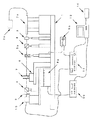
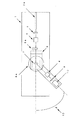
本発明のポリ塩化ビニルのゲル化度の測定方法及び測定装置を図1及び図2に示す光散乱測定装置図面を用いて詳細に説明するが、本発明は該図面に記載されているものに限定されるものではない。
【0011】
図1に記載の装置は、本発明のポリ塩化ビニルのゲル化度の測定装置の1例の側面図である。
【0012】
図2に記載の装置は、本発明のポリ塩化ビニルのゲル化度の測定装置の1例の上方図である。
【0013】
本発明においては、ポリ塩化ビニル成形体に照射する光は、一定波長の光であることが好ましく、その波長はポリ塩化ビニル中の残存粒子の大きさで使い分けることが好ましい。すなわち、ポリ塩化ビニル中の残存粒子が比較的大きいポリ塩化ビニル成形体の場合は波長の長い光の光源を、また比較的小さい残存粒子の場合には波長の短い光の光源を使用することが好ましい。
【0014】
例えば、ポリ塩化ビニル中の残存粒子がドメイン若しくは該ドメインが複数個集まって凝集した0.1μm〜1μmの範囲であるドメイン集合体、または、1次粒子若しくは該1次粒子が複数個集まって凝集した1μm〜10μmの範囲である1次粒子集合体のような0.1μm〜10μmの残存粒子の場合、波長が0.4μm〜0.8μmの範囲である可視光光源を用いることが好ましい。そして、このような可視光光源としては、例えば市販されているレーザー光源を使用することができ、ユニフェース(株)製ヘリウム−ネオンレーザー(波長0.633μm)を用いることができる。さらに、1次粒子または該1次粒子集合体ような1μm〜10μmの残存粒子の場合、波長が1μm以上の赤外線レーザー、YAGレーザー、波長が9〜11μmの炭酸ガスレーザーなどを光源として使用することもできる。ポリ塩化ビニル中の残存粒子がミクロドメインまたは該ミクロドメインが複数個集まって凝集した0.01μm〜0.1μmの範囲であるミクロドメイン集合体のような0.01μm〜0.1μmの残存粒子の場合、波長が0.4μm未満の短波長レーザー、エキシマレーザーなどを使用することができる。
【0015】
さらに本発明において、散乱光強度の角度分布依存性を求める際に各光学部材が外部からの迷光やノイズ光を遮断する暗箱のような容器に格納されていない装置を用いる場合、迷光叉はノイズ光の悪影響を抑えるためにライトチョッパー及びロックインアンプを併用することが好ましい。ライトチョッパー及びロックインアンプを併用することにより、ライトチョッパーで特定の周波数に入射光を分断し、断続的な光としてポリ塩化ビニル成形体に照射し、特定の周波数成分の光のみをロックインアンプで識別することにより、多重反射による迷光叉は外部からノイズ光などの悪影響を受けることなく、ノイズを除去することでポリ塩化ビニル成形体のみからの散乱光強度を高いS/N(シグナル/ノイズ)比で実測でき、測定精度を向上させることができる。
【0016】
ライトチョッパーは市販のものでも周波数が固定できる装置であれば差し支えない。また、ロックインアンプは市販のものでも本発明の目的を達成することができ、例えばエヌエフ回路設計ブロック(株)製のロックインアンプを用いることができる。
【0017】
また、ポリ塩化ビニル成形体からの散乱光の受光器には、例えばフォトダイオード、フォトマルと呼ばれる光電子増倍管、光カウンター等を用いることにより散乱光強度を測定することが可能である。そして、ポリ塩化ビニル中の残存粒子が大きく散乱光強度が強い場合はフォトダイオードが適しており、一方粒子構造が小さく散乱光強度が小さい場合はフォトマル叉は光カウンタが適している。
【0018】
受光器を載せる回転台としては、0゜〜180゜まで0.1゜毎に角度設定できるものが好ましく、手動式回転台またはパルスモーターで駆動できる自動式回転台を使用することができる。
【0019】
本発明において、散乱光強度の角度分布依存性を測定する範囲は、ポリ塩化ビニル成形体中の残存粒子がポリ塩化ビニルの1次粒子叉はその凝集体では、1゜〜20゜が好ましく、1次粒子より微細なポリ塩化ビニルのドメイン叉はその凝集体では、5゜〜50゜の角度範囲が好ましい。さらに、微細なポリ塩化ビニルのミクロドメイン叉はその凝集体のときは、30゜〜70゜が適している。
【0020】
本発明においては、ポリ塩化ビニル成形体に光を照射した後、ポリ塩化ビニル成形体より散乱される光の散乱光強度の角度分布依存性により、ポリ塩化ビニルのゲル化度を定量評価することができる。
【0021】
例えば、散乱光強度I、散乱角度θに関する角度変数qをq=(4π/λ)sin(θ/2)とした場合、1)散乱光強度Iを角度変数qに対してプロット (以下、プロット1と称する。;図3)し、成形加工時の熱履歴及び剪断力履歴の異なるポリ塩化ビニル成形体で得られたプロットの位置関係からゲル化度を評価する方法,2)角度変数qの2乗に対して散乱光強度Iの平方根の逆数をプロット(以下、プロット2と称する。;図4)し、その位置関係からゲル化度を評価する方法,3)プロット2では直線が得られ、その傾きや切片から統計的解析手法を利用して平均粒子径を算出し、その大小関係でゲル化度を評価する方法等が挙げられる。また、散乱光強度I及び角度変数qに関して適当な関数に変換することにより統計的に残存粒子の大きさを算出する事も可能である。
【0022】
上記1)のようなプロット1を用いたゲル化度の評価方法においては、ポリ塩化ビニル中の残存粒子の平均粒子径が大きい程、叉は、残存粒子が多いほど散乱光強度Iが強く、角度分布依存性すなわち散乱光強度Iの角度変数qへの依存性が大きい結果となってプロットに反映される。従って、ゲル化の進行していない成形体試料では散乱光強度Iが大きい値から急激に減少する様な散乱光強度スペクトルが得られる。
【0023】
上記2)及び3)のようなプロット2を用いたゲル化度の評価方法においては、プロット2は直線が得られ、その位置関係からゲル化度を評価できる。ポリ塩化ビニル中の残存粒子の大きさが大きい程、プロット2の傾きは大きくゲル化は進行しておらず低いゲル化度となる。また、ポリ塩化ビニル中の残存粒子の数が多い程プロット2の切片は小さくなりこの場合もゲル化は進行しておらず低いゲル化度となる。
【0024】
さらに、例えば「ポリマーアロイ」共立出版、に記載の方法に従い、プロット2の切片Aと傾きBおよび装置定数Cから下記(1)式によりポリ塩化ビニル中の残存粒子の大きさに対応する平均粒子径として求めることができる。
【0025】
平均粒子径=C×(B/A)1/2
本発明における百分率を用いたゲル化度の相対評価の方法は任意であり、例えば上記プロット1を用いた場合、スペクトルの位置の上限関係をゲル化度の尺度とできる。また、上記プロット2を用いた場合、測定された残存粒子径の上限と下限をそれぞれ0〜100%とすることによりその間を相対評価できる。さらに、測定された残存粒子径の絶対値の範囲の限定は任意であるが、例えば上記(1)式により算出した残存粒子の平均粒子径1μmをゲル化度=0%、平均粒子径0μmをゲル化度=100%とし、その間を線形に等間隔して百分率に直して相対評価を行えば、ゲル化度は例えば下記(2)式として評価することが可能である。
【0026】
ゲル化度(%)=(1−平均粒子径(μm))×100 (2)
また、ポリ塩化ビニルの残存粒子の絶対値を定量してゲル化度に直す場合は、予め粒子径が明かでありかつ粒径分布が単分散であるポリスチレンラテックスの様な標準試料を用いて測定装置の装置定数を決定しておくことが好ましい。
【0027】
そして、本発明であるポリ塩化ビニルのゲル化度の測定方法及び測定装置においては、散乱光の散乱光強度の角度分布依存性からポリ塩化ビニルのゲル化度を測定する際に、散乱光強度の角度分布依存性よりゲル化度を算出するためのプログラミングを行った演算処理装置を用いることが好ましい。
【0028】
本発明に用いることができるポリ塩化ビニルとしては、ポリ塩化ビニル、エチレン−塩化ビニル共重合体、酢酸ビニル−塩化ビニル共重合体等を挙げることができる。さらに、通常ポリ塩化ビニルに添加される安定剤、滑剤、可塑剤等の各種配合剤は散乱スペクトルに悪影響を及ぼさない範囲であれば添加しても差し支えない。
【0029】
【実施例】
以下に、本発明を実施例を用いてより具体的に説明するが、本発明はこれら実施例に限定されるものではない。
【0030】
実施例1
光源として波長0.633μmのヘリウム−ネオンレーザー2a(日本科学エンジニアリング(株)製、商品名HN−550P)、光源からの光を断続的な光とするためのライトチョッパー5a、散乱光強度測定用受光器10、ロックインアンプ11(エヌエフ回路設計ブロック(株)製、商品名シングルフェーズロックインアンプ5600)、検出器回転用ゴニオメーター8a(日本科学エンジニアリング(株)製)、ゴニオメータ駆動用パルスモーターコントローラー8b(日本科学エンジニアリング(株)製)、1/4波長板3、グラムトムソン型偏光素子4、試料保持用ステージ6、ピンホール9、測定制御並びに散乱光強度の角度分布依存性解析用パソコン12及び散乱光強度の角度分布依存性よりポリ塩化ビニル中の残存粒子径並びにポリ塩化ビニルのゲル化度を算出するための演算処理装置14よりなるポリ塩化ビニルのゲル化度の測定装置を作成した。ここで、演算処理装置14は、パソコン12により解析された散乱光強度の角度分布依存性のなかでも散乱光強度Iの平方根の逆数を角度変数qの2乗に対してプロット(プロット2)した時の切片及び傾きを読みとり、装置定数及び上記(1)から分散粒子の平均粒子径を算出し、更に該分散粒子の平均粒子径1μmをゲル化度=0%、平均粒子径0μmをゲル化度=100%とし、上記(2)式からゲル化度を算出するプログラミングを施した演算処理装置である。
【0031】
図1にポリ塩化ビニルのゲル化度を測定するための光散乱測定装置の側面図を示す。
【0032】
図2にポリ塩化ビニルのゲル化度を測定するための光散乱測定装置の上方図を示す。
【0033】
平均粒子径0.1μmのポリスチレンラテックスを標準試料として用いることにより求めた該測定装置の装置定数Cは225[nm−1]であった。
【0034】
実施例2
ポリ塩化ビニル樹脂(大洋塩ビ(株)製、商品名TH−1000)100重量部、安定剤(日東化成(株)製、商品名N2000E)4重量部を配合したポリ塩化ビニル樹脂組成物を140℃に設定された8インチテストロールで10分間混練し、厚さ1.1mmの半透明板状成形体を得た。この板状成形体を140℃に設定された加圧プレス成形機を用いて厚さ1.0mmの透明な板状成形体に成形した。
【0035】
この板状成形体を実施例1の測定装置を用いて、散乱角度10゜〜40゜の範囲で、角度ステップ間隔を0.5゜として、各散乱角度における10秒間の散乱光強度の平均値を求め、散乱光強度Iを求めた。
【0036】
散乱光強度Iを角度変数qに対して実測プロットしたプロット1を図3に示す。
【0037】
さらに、散乱光強度Iの平方根の逆数を角度変数qの2乗に対してデバイプロットの型に変換したプロット2を図4に示す。
【0038】
また、図4のデバイプロットの切片及び傾きを読みとり、装置定数C及び上記(1)式をプログラミングした演算処理装置を有する実施例1に記載のポリ塩化ビニルのゲル化度の測定装置から得られた残存粒子の平均粒子径は0.35μmであった。
【0039】
そして、更に実施例1に記載のポリ塩化ビニルのゲル化度の測定装置から得られたゲル化度は65%であった。
【0040】
実施例3
実施例2と同様の配合のポリ塩化ビニル樹脂組成物を185℃に設定された8インチテストロールで5分間混練し、厚さ1.1mmの半透明板状成形体として得た。この板状成形体を185℃に設定された加圧プレス成形機を用いて厚さ1.0mmの透明な板状成形体した。
【0041】
得られた板状成形体は実施例2と同様の測定を行った。
【0042】
散乱光強度Iを角度変数qに対して実測プロットしたプロット1を図3に示す。
【0043】
さらに、散乱光強度Iの平方根の逆数を角度変数qの2乗に対してデバイプロットの型に変換したプロット2を図4に示す。
【0044】
また、図4のデバイプロットの切片及び傾き読みとり、装置定数C及び上記 (1)式をプログラミングした演算処理装置を有する実施例1に記載のポリ塩化ビニルのゲル化度の測定装置から得られた残存粒子の平均粒子径は0.26μmであった。
【0045】
そして、更に実施例1に記載のポリ塩化ビニルのゲル化度の測定装置から得られたゲル化度は74%であった。
【0046】
【発明の効果】
本発明のポリ塩化ビニルのゲル化度の測定方法及び測定装置によれば、簡便かつ迅速でしかも精度良くポリ塩化ビニルのゲル化度を定量することができる。
【図面の簡単な説明】
【図1】本発明によるポリ塩化ビニルのゲル化度の測定装置の1例の側面図である。
【図2】本発明によるポリ塩化ビニルのゲル化度の測定装置の1例の上方図である。
【図3】実施例2および3で得られた散乱光強度Iを角度変数qに対して実測プロットしたプロット1。
【図4】実施例1および2で得られた散乱光強度Iの平方根の逆数を角度変数qの2乗に対してデバイプロットの型に変換したプロット2。
【符号の説明】
1 :光学ベンチ
2a:ヘリウム−ネオンレーザー
2b:レーザー出力用安定化電源
3 :1/4波長板
4 :グラムトムソン型偏光素子
5a:ライトチョッパー(周波数280Hz)
5b:ライトチョッパー周波数制御装置
6 :試料保持用ステージ
7 :試料
8a:受光器回転用ゴニオメーター
8b:ゴニオメータ駆動用パルスモーターコントローラー
9 :ピンホール
10 :散乱光強度測定用受光器
11 :ロックインアンプ
12 :測定制御およびデータ解析用パソコン
13 :散乱角度θ
14 :演算処理装置
15 :角度変数q
16 :散乱光強度I
17 :角度変数qの2乗
18 :散乱光強度Iの平方根の逆数[0001]
TECHNICAL FIELD OF THE INVENTION
The present invention relates to a method and an apparatus for easily and quickly measuring the gelation degree of polyvinyl chloride from the angular distribution dependence of the intensity of scattered light from polyvinyl chloride using a light scattering method.
[0002]
[Prior art]
Among the polyvinyl chlorides, in particular, the polyvinyl chloride prepared by the suspension polymerization method has a hierarchy of particles from the outermost particles of 100 μm to 300 μm called grains to sub-grains, agglomerates, primary particles, domains, micro domains. When it is subjected to molding processing, it is made finer as needed by the history of heat and the history of shearing force of the processing machine during molding. However, particles of several μm to 0.05 μm, which could not be collapsed and refined at the time of molding, remain in the final molded product of polyvinyl chloride, and such remaining particles act as structural defects. It has a risk of adversely affecting physical properties such as material strength characteristics.
[0003]
Conventionally, methods for evaluating the gelation degree of a polyvinyl chloride molded article include: 1) a method of empirically evaluating the degree of gelation based on the degree of elasticity by touching the polyvinyl chloride compound during molding with a hand, 2) A method of immersing the molded body in a solvent such as acetone and judging the degree of holding the shape of the molded body. 3) The heat of fusion of the polyvinyl chloride microcrystals melted and recrystallized at the time of molding by the DSC method. A method of calculating the degree of gelation from the relative ratio of the heats of fusion of the melted microcrystals and the like are known.
[0004]
[Problems to be solved by the invention]
However, both of the above methods 1) and 2) are extremely abstract evaluation scales, and cannot be expressed as specific numbers as well as the problem that the evaluation rank differs depending on the worker, so that reproducibility and reliability are high. There was a problem with sex. On the other hand, in the method 3), if the gelation has not progressed much, the amount of the melted and recrystallized microcrystals is too small. In addition, if gelation has progressed extremely, there has been a problem that the amount of unmelted microcrystals is too small to be detected.
[0005]
Accordingly, an object of the present invention is to provide a measuring method and a measuring apparatus for simply and quickly measuring the degree of gelation of polyvinyl chloride by using a light scattering method instead of such a conventional method.
[0006]
[Means for Solving the Problems]
The present inventors have conducted intensive studies to solve the above problems, and found that the angle distribution dependency of the scattered light intensity obtained by the light scattering method and the degree of gelation are well correlated, thereby completing the present invention. Reached.
[0007]
That is, the present invention is characterized in that after irradiating a polyvinyl chloride molded article with light, the degree of gelation is determined from the angular distribution dependence of the scattered light intensity of light scattered from the polyvinyl chloride molded article. A method for measuring the degree of gelation of polyvinyl chloride, a light source that emits light of a certain wavelength, a light chopper for irradiating incident light from the light source as intermittent light of a certain wavelength to a polyvinyl chloride molded article, polyvinyl chloride A light scattering measurement device that detects the same wavelength component of the scattered light from the molded body as that cut by the light chopper with a lock-in amplifier, and gelation of polyvinyl chloride due to the angular distribution dependence of the scattered light intensity of the scattered light The present invention relates to an apparatus for measuring the degree of gelation of polyvinyl chloride, comprising an arithmetic processing unit for determining the degree.
[0008]
Hereinafter, the present invention will be described in detail.
[0009]
The gelation and gelation degree of polyvinyl chloride in the present invention means that when polyvinyl chloride is subjected to molding processing, undisintegrated or unmelted residual particles in polyvinyl chloride are small due to kneading by molding processing. The process of decreasing is called gelation, and the relative degree is called the degree of gelation.
[0010]
The method and apparatus for measuring the degree of gelation of polyvinyl chloride of the present invention will be described in detail with reference to the drawings of the light scattering measuring apparatus shown in FIGS. 1 and 2. It is not limited.
[0011]
The apparatus shown in FIG. 1 is a side view of an example of the apparatus for measuring the degree of gelation of polyvinyl chloride of the present invention.
[0012]
The apparatus shown in FIG. 2 is an upper view of an example of the apparatus for measuring the degree of gelation of polyvinyl chloride of the present invention.
[0013]
In the present invention, the light applied to the polyvinyl chloride molded product is preferably light having a certain wavelength, and the wavelength is preferably used depending on the size of the residual particles in the polyvinyl chloride. In other words, in the case of a polyvinyl chloride molded article in which the residual particles in the polyvinyl chloride are relatively large, a long-wavelength light source is used, and in the case of relatively small residual particles, a short-wavelength light source is used. preferable.
[0014]
For example, domain aggregates in the range of 0.1 μm to 1 μm in which residual particles in polyvinyl chloride are aggregated by domains or a plurality of domains, or primary particles or aggregates of a plurality of primary particles are aggregated. In the case of the residual particles of 0.1 μm to 10 μm such as the primary particle aggregate having a range of 1 μm to 10 μm, it is preferable to use a visible light source having a wavelength of 0.4 μm to 0.8 μm. As such a visible light source, for example, a commercially available laser light source can be used, and a helium-neon laser (wavelength: 0.633 μm) manufactured by Uniface Co., Ltd. can be used. Further, in the case of primary particles or residual particles of 1 μm to 10 μm such as the primary particle aggregate, an infrared laser having a wavelength of 1 μm or more, a YAG laser, a carbon dioxide gas laser having a wavelength of 9 to 11 μm, or the like is used as a light source. You can also. Residual particles in polyvinyl chloride are microdomains or microparticles in which a plurality of the microdomains are aggregated and aggregated to form microdomain aggregates in the range of 0.01 μm to 0.1 μm. In this case, a short wavelength laser having a wavelength of less than 0.4 μm, an excimer laser, or the like can be used.
[0015]
Further, in the present invention, when using an apparatus in which each optical member is not stored in a container such as a dark box that blocks external stray light or noise light when obtaining the angle distribution dependence of the scattered light intensity, stray light or noise It is preferable to use a light chopper and a lock-in amplifier together in order to suppress the adverse effect of light. By using a light chopper and a lock-in amplifier together, the light chopper divides the incident light to a specific frequency, irradiates the polyvinyl chloride molded article as intermittent light, and locks only the light of a specific frequency component into the lock-in amplifier. , The intensity of the scattered light from the polyvinyl chloride molded article alone is increased by removing the noise without being affected by the stray beam due to the multiple reflections or the noise light from the outside. ) The ratio can be actually measured, and the measurement accuracy can be improved.
[0016]
A commercially available light chopper may be used as long as the device can fix the frequency. The lock-in amplifier can also achieve the object of the present invention by using a commercially available lock-in amplifier. For example, a lock-in amplifier manufactured by NF Circuit Design Block Co., Ltd. can be used.
[0017]
In addition, for example, a photodiode, a photomultiplier tube called a photomultiplier, a light counter, or the like can be used as a light receiver for the scattered light from the polyvinyl chloride molded body to measure the scattered light intensity. When the residual particles in the polyvinyl chloride are large and the scattered light intensity is high, a photodiode is suitable. On the other hand, when the particle structure is small and the scattered light intensity is low, a photomultiplier or a light counter is suitable.
[0018]
As the turntable on which the photodetector is mounted, it is preferable that the angle can be set every 0.1 ° from 0 ° to 180 °, and a manual turntable or an automatic turntable driven by a pulse motor can be used.
[0019]
In the present invention, the range for measuring the angle distribution dependency of the scattered light intensity is preferably 1 ° to 20 ° in the case of the primary particles of polyvinyl chloride or the aggregates of the remaining particles in the polyvinyl chloride molded product, For polyvinyl chloride domains or agglomerates thereof which are finer than the primary particles, an angle range of 5 ° to 50 ° is preferred. Further, in the case of fine polyvinyl chloride microdomains or aggregates thereof, 30 ° to 70 ° is suitable.
[0020]
In the present invention, after irradiating the polyvinyl chloride molded article with light, the degree of gelation of the polyvinyl chloride is quantitatively evaluated by the angular distribution dependence of the scattered light intensity of light scattered from the polyvinyl chloride molded article. Can be.
[0021]
For example, if the angle variable q relating to the scattered light intensity I and the scattering angle θ is q = (4π / λ) sin (θ / 2), 1) the scattered light intensity I is plotted against the angle variable q (hereinafter plot 1); a method for evaluating the degree of gelation from the positional relationship of plots obtained from polyvinyl chloride molded articles having different heat histories and shearing histories during molding, and 2) a method of determining the angle variable q. A method of plotting the reciprocal of the square root of the scattered light intensity I against the square (hereinafter, referred to as
[0022]
In the method for evaluating the degree of gelation using the
[0023]
In the evaluation method of the degree of gelation using the
[0024]
Further, according to the method described in, for example, "Polymer Alloy" Kyoritsu Shuppan, the average particle corresponding to the size of the residual particles in polyvinyl chloride is obtained from the intercept A and the slope B of
[0025]
Average particle diameter = C × (B / A) 1/2
The method of relative evaluation of the degree of gelation using the percentage in the present invention is arbitrary. For example, when the above-mentioned
[0026]
Gelation degree (%) = (1−average particle diameter (μm)) × 100 (2)
When the absolute value of the residual particles of polyvinyl chloride is quantified and converted to the gelation degree, measurement is performed using a standard sample such as polystyrene latex, which has a clear particle size and a monodispersed particle size distribution. It is preferable to determine the device constant of the device.
[0027]
In the method and apparatus for measuring the degree of gelation of polyvinyl chloride according to the present invention, when measuring the degree of gelation of polyvinyl chloride from the angular distribution dependence of the scattered light intensity of scattered light, It is preferable to use an arithmetic processing device that has been programmed to calculate the gelation degree from the angle distribution dependence of the above.
[0028]
Examples of the polyvinyl chloride that can be used in the present invention include polyvinyl chloride, an ethylene-vinyl chloride copolymer, and a vinyl acetate-vinyl chloride copolymer. Furthermore, various compounding agents such as stabilizers, lubricants and plasticizers which are usually added to polyvinyl chloride may be added as long as they do not adversely affect the scattering spectrum.
[0029]
【Example】
Hereinafter, the present invention will be described more specifically with reference to examples, but the present invention is not limited to these examples.
[0030]
Example 1
A helium-neon laser 2a having a wavelength of 0.633 μm (HN-550P, manufactured by Nippon Kagaku Engineering Co., Ltd.) as a light source, a light chopper 5a for converting light from the light source into intermittent light, for measuring scattered light
[0031]
FIG. 1 shows a side view of a light scattering measurement device for measuring the gelation degree of polyvinyl chloride.
[0032]
FIG. 2 shows an upper view of a light scattering measuring device for measuring the gelation degree of polyvinyl chloride.
[0033]
The device constant C of the measuring device determined by using polystyrene latex having an average particle size of 0.1 μm as a standard sample was 225 [nm −1 ].
[0034]
Example 2
140 parts by weight of a polyvinyl chloride resin (manufactured by Taiyo PVC Co., Ltd., trade name: TH-1000) and 4 parts by weight of a stabilizer (trade name: N2000E, manufactured by Nitto Kasei Co., Ltd.) The mixture was kneaded with an 8-inch test roll set at a temperature of 10 ° C. for 10 minutes to obtain a 1.1 mm-thick translucent plate-like molded product. This plate-like molded product was molded into a transparent plate-like molded product having a thickness of 1.0 mm using a press molding machine set at 140 ° C.
[0035]
The average value of the scattered light intensity for 10 seconds at each scattering angle at each scattering angle with the angle step interval set to 0.5 ° in the range of the scattering angle of 10 ° to 40 ° using the measurement device of Example 1 And the scattered light intensity I was obtained.
[0036]
FIG. 3 shows a
[0037]
Further, FIG. 4 shows a
[0038]
Further, the intercept and the slope of the Debye plot of FIG. 4 are read, and are obtained from the apparatus for measuring the degree of gelation of polyvinyl chloride described in Example 1 having the apparatus constant C and the arithmetic processing apparatus programmed with the above equation (1). The average particle diameter of the remaining particles was 0.35 μm.
[0039]
Further, the gelation degree obtained from the apparatus for measuring the degree of gelation of polyvinyl chloride described in Example 1 was 65%.
[0040]
Example 3
A polyvinyl chloride resin composition having the same composition as in Example 2 was kneaded with an 8-inch test roll set at 185 ° C. for 5 minutes to obtain a translucent plate-shaped molded article having a thickness of 1.1 mm. This plate-shaped molded product was formed into a transparent plate-shaped molded product having a thickness of 1.0 mm by using a pressure press molding machine set at 185 ° C.
[0041]
The same measurement as in Example 2 was performed on the obtained plate-like molded body.
[0042]
FIG. 3 shows a
[0043]
Further, FIG. 4 shows a
[0044]
In addition, the intercept and inclination of the Debye plot in FIG. 4 were read, and the apparatus constant C and the gelling degree of polyvinyl chloride described in Example 1 having an arithmetic processing unit programmed with the above equation (1) were obtained. The average particle size of the remaining particles was 0.26 μm.
[0045]
Further, the gelling degree obtained from the polyvinyl chloride gelling degree measuring apparatus described in Example 1 was 74%.
[0046]
【The invention's effect】
ADVANTAGE OF THE INVENTION According to the measuring method and measuring device of the gelation degree of polyvinyl chloride of this invention, the gelation degree of polyvinyl chloride can be determined simply, quickly and accurately.
[Brief description of the drawings]
FIG. 1 is a side view of an example of an apparatus for measuring the degree of gelation of polyvinyl chloride according to the present invention.
FIG. 2 is a top view of an example of the apparatus for measuring the degree of gelation of polyvinyl chloride according to the present invention.
FIG. 3 is a
FIG. 4 is a
[Explanation of symbols]
1: Optical bench 2a: Helium-neon laser 2b: Stabilized power supply for laser output 3: Quarter wave plate 4: Gram-Thompson-type polarizing element 5a: Light chopper (frequency 280 Hz)
5b: light chopper frequency control device 6: sample holding stage 7: sample 8a: goniometer 8b for rotating the light receiver 8b:
14: arithmetic processing unit 15: angle variable q
16: Scattered light intensity I
17: square of the angle variable q 18: reciprocal of the square root of the scattered light intensity I
Claims (4)
Priority Applications (1)
| Application Number | Priority Date | Filing Date | Title |
|---|---|---|---|
| JP27471096A JP3600929B2 (en) | 1996-10-17 | 1996-10-17 | Method and apparatus for measuring the degree of gelation of polyvinyl chloride |
Applications Claiming Priority (1)
| Application Number | Priority Date | Filing Date | Title |
|---|---|---|---|
| JP27471096A JP3600929B2 (en) | 1996-10-17 | 1996-10-17 | Method and apparatus for measuring the degree of gelation of polyvinyl chloride |
Publications (2)
| Publication Number | Publication Date |
|---|---|
| JPH10120795A JPH10120795A (en) | 1998-05-12 |
| JP3600929B2 true JP3600929B2 (en) | 2004-12-15 |
Family
ID=17545495
Family Applications (1)
| Application Number | Title | Priority Date | Filing Date |
|---|---|---|---|
| JP27471096A Expired - Fee Related JP3600929B2 (en) | 1996-10-17 | 1996-10-17 | Method and apparatus for measuring the degree of gelation of polyvinyl chloride |
Country Status (1)
| Country | Link |
|---|---|
| JP (1) | JP3600929B2 (en) |
Families Citing this family (4)
| Publication number | Priority date | Publication date | Assignee | Title |
|---|---|---|---|---|
| JP2003035669A (en) * | 2001-07-19 | 2003-02-07 | Japan Science & Technology Corp | Method and apparatus for determining non-destructive ripeness of fruit |
| KR100848988B1 (en) * | 2002-03-28 | 2008-07-30 | 타카이 토후 앤 소이 밀크 이큅먼트 컴퍼니 리미티드 | Evaluation method of gel state or sol-gel state change of food |
| JP5481402B2 (en) * | 2011-01-17 | 2014-04-23 | 株式会社日立ハイテクノロジーズ | Automatic analyzer |
| JP5883233B2 (en) * | 2011-03-16 | 2016-03-09 | 英光 古川 | Scanning microscopic light scattering measurement and analysis apparatus and light scattering analysis method |
-
1996
- 1996-10-17 JP JP27471096A patent/JP3600929B2/en not_active Expired - Fee Related
Also Published As
| Publication number | Publication date |
|---|---|
| JPH10120795A (en) | 1998-05-12 |
Similar Documents
| Publication | Publication Date | Title |
|---|---|---|
| EP3887803B1 (en) | Prediction of physical properties of superabsorbent polymers | |
| JP7369765B2 (en) | Methods and apparatus for processing and/or recycling materials | |
| JP3600929B2 (en) | Method and apparatus for measuring the degree of gelation of polyvinyl chloride | |
| EP0013594B1 (en) | Method and apparatus for measuring the rheological properties of an extrudable material | |
| Tarle et al. | Degree of conversion | |
| Barbas et al. | In-line near-infrared spectroscopy for the characterization of dispersion in polymer-clay nanocomposites | |
| JP6367758B2 (en) | Method for evaluating cross-link density of cross-linked rubber | |
| Steinhaus et al. | Dielectric analysis of depth dependent curing behavior of dental resin composites | |
| CN103175755B (en) | Method for detecting fusion degree of polyvinyl chloride or chlorinated polyvinyl chloride | |
| Sirisomboon et al. | Products Using Near-Infrared Spectroscopy | |
| Nakajima et al. | Swelling of PVC particles during gelation and fusion of plastisols as observed with small‐angle light scattering | |
| JPH10122827A (en) | Optical measuring method and optical measuring device | |
| Santi et al. | Torque viscometry of molten polymers and composites | |
| Shpotyuk et al. | Light-curing volumetric shrinkage in dimethacrylate-based dental composites by nanoindentation and PAL study | |
| Bergmann et al. | Investigation of the degree of cross-linking of polyethylene and thermosets using absolute optical spectroscopy and Raman microscopy | |
| DeGraff et al. | Quality control for electron beam processing of polymeric materials by end-point analysis | |
| Collins et al. | Poly (vinyl chloride) thermal stability. I. Evaluation by melt rheology | |
| Scierka et al. | Nanomechanical properties of UV degraded TiO2/epoxy nanocomposites | |
| Kwak | In situ, quantitative characterization of gelation and fusion mechanism in poly (vinyl chloride) plastisols by small angle light scattering (SALS) | |
| de Goede et al. | Degradation of unstabilised polypropylene and a propene-1-pentene copolymer | |
| JP5324099B2 (en) | How to apply anti-friction coating to wiper blade rubber profile and control its quality | |
| Becker et al. | Near infrared spectroscopy as a tool for in-line control of process and material properties of PLA biopolymer | |
| Katchy | Effects of blending and subsequent processing on morphology of PVC powder particles | |
| Wilson | LASCAUX® MEDIUM FOR CONSOLIDATION Material Properties Before & After Artificial Aging | |
| CN120121409A (en) | Online detection method of mechanical strength of vinyl ester resin coating based on handheld Raman |
Legal Events
| Date | Code | Title | Description |
|---|---|---|---|
| A977 | Report on retrieval |
Free format text: JAPANESE INTERMEDIATE CODE: A971007 Effective date: 20040531 |
|
| A131 | Notification of reasons for refusal |
Effective date: 20040608 Free format text: JAPANESE INTERMEDIATE CODE: A131 |
|
| A521 | Written amendment |
Effective date: 20040726 Free format text: JAPANESE INTERMEDIATE CODE: A523 |
|
| TRDD | Decision of grant or rejection written | ||
| A01 | Written decision to grant a patent or to grant a registration (utility model) |
Free format text: JAPANESE INTERMEDIATE CODE: A01 Effective date: 20040824 |
|
| A61 | First payment of annual fees (during grant procedure) |
Free format text: JAPANESE INTERMEDIATE CODE: A61 Effective date: 20040906 |
|
| FPAY | Renewal fee payment (prs date is renewal date of database) |
Free format text: PAYMENT UNTIL: 20081001 Year of fee payment: 4 |
|
| FPAY | Renewal fee payment (prs date is renewal date of database) |
Free format text: PAYMENT UNTIL: 20081001 Year of fee payment: 4 |
|
| FPAY | Renewal fee payment (prs date is renewal date of database) |
Free format text: PAYMENT UNTIL: 20091001 Year of fee payment: 5 |
|
| LAPS | Cancellation because of no payment of annual fees |