JP3636731B2 - Cu-Ni-Si alloy - Google Patents
Cu-Ni-Si alloy Download PDFInfo
- Publication number
- JP3636731B2 JP3636731B2 JP07637493A JP7637493A JP3636731B2 JP 3636731 B2 JP3636731 B2 JP 3636731B2 JP 07637493 A JP07637493 A JP 07637493A JP 7637493 A JP7637493 A JP 7637493A JP 3636731 B2 JP3636731 B2 JP 3636731B2
- Authority
- JP
- Japan
- Prior art keywords
- hardness
- alloy
- amount
- formula
- based alloy
- Prior art date
- Legal status (The legal status is an assumption and is not a legal conclusion. Google has not performed a legal analysis and makes no representation as to the accuracy of the status listed.)
- Expired - Fee Related
Links
- 239000000956 alloy Substances 0.000 title claims description 44
- 229910045601 alloy Inorganic materials 0.000 title claims description 43
- 229910017876 Cu—Ni—Si Inorganic materials 0.000 title claims description 22
- 229910052710 silicon Inorganic materials 0.000 claims description 25
- 229910052759 nickel Inorganic materials 0.000 claims description 21
- 229910052802 copper Inorganic materials 0.000 claims description 14
- 238000002156 mixing Methods 0.000 claims description 9
- 229910000765 intermetallic Inorganic materials 0.000 claims description 7
- 239000012535 impurity Substances 0.000 claims description 3
- 239000006185 dispersion Substances 0.000 claims 1
- 239000010949 copper Substances 0.000 description 47
- 230000000052 comparative effect Effects 0.000 description 10
- UREBDLICKHMUKA-CXSFZGCWSA-N dexamethasone Chemical compound C1CC2=CC(=O)C=C[C@]2(C)[C@]2(F)[C@@H]1[C@@H]1C[C@@H](C)[C@@](C(=O)CO)(O)[C@@]1(C)C[C@@H]2O UREBDLICKHMUKA-CXSFZGCWSA-N 0.000 description 10
- 239000000463 material Substances 0.000 description 8
- 238000013329 compounding Methods 0.000 description 5
- 230000000694 effects Effects 0.000 description 5
- 239000011159 matrix material Substances 0.000 description 5
- 238000003466 welding Methods 0.000 description 5
- 238000010587 phase diagram Methods 0.000 description 4
- RYGMFSIKBFXOCR-UHFFFAOYSA-N Copper Chemical compound [Cu] RYGMFSIKBFXOCR-UHFFFAOYSA-N 0.000 description 3
- 230000032683 aging Effects 0.000 description 3
- 150000001875 compounds Chemical class 0.000 description 3
- 239000000203 mixture Substances 0.000 description 3
- 238000002425 crystallisation Methods 0.000 description 2
- 230000008025 crystallization Effects 0.000 description 2
- 230000007547 defect Effects 0.000 description 2
- 238000007546 Brinell hardness test Methods 0.000 description 1
- 229910018098 Ni-Si Inorganic materials 0.000 description 1
- 229910018529 Ni—Si Inorganic materials 0.000 description 1
- 229910004298 SiO 2 Inorganic materials 0.000 description 1
- 238000005266 casting Methods 0.000 description 1
- 230000007797 corrosion Effects 0.000 description 1
- 238000005260 corrosion Methods 0.000 description 1
- 238000007542 hardness measurement Methods 0.000 description 1
- 230000001771 impaired effect Effects 0.000 description 1
- 239000002184 metal Substances 0.000 description 1
- 229910052751 metal Inorganic materials 0.000 description 1
- 238000000034 method Methods 0.000 description 1
- 238000001000 micrograph Methods 0.000 description 1
- 230000003287 optical effect Effects 0.000 description 1
- 239000002245 particle Substances 0.000 description 1
- 238000010791 quenching Methods 0.000 description 1
- 230000000171 quenching effect Effects 0.000 description 1
- 229910021484 silicon-nickel alloy Inorganic materials 0.000 description 1
- 238000005728 strengthening Methods 0.000 description 1
- 238000010998 test method Methods 0.000 description 1
- XLYOFNOQVPJJNP-UHFFFAOYSA-N water Substances O XLYOFNOQVPJJNP-UHFFFAOYSA-N 0.000 description 1
Images


Landscapes
- Conductive Materials (AREA)
Description
【0001】
【産業上の利用分野】
この発明はCu−Ni−Si系合金に係り、その目的は機械的強度、特に硬度が高く、耐磨耗性が良好で、レール等の溶着硬化材料など各種用途に幅広く適用することのできるCu−Ni−Si系合金の提供にある。
【0002】
【従来の技術】
Cu系合金は、非磁性であり、低温脆性がなく、Fe系の材料と較べると、電気伝導性や熱伝導性が良好で、しかも鋳造性や耐食性にも優れている。
しかし、Cu系合金には、反面、機械的強度、特に硬度が低く、耐磨耗性が著しく劣るという課題があった。
そこで従来より、Cu系合金の性質を生かしつつ、その機械的強度を改善しようと、鋭意検討が行なわれてきた。
機械的強度を改善したCu系合金の一つとして、Cu−Ni−Si系のコルソン合金が存在する。
このコルソン合金は、溶体化処理後、長時間の時効処理を行なうことによって、Cuマトリックス中にNi−Siの金属間化合物を晶出させた、Cu95、Ni4〜5、Si5%を含む晶出硬化型の合金で、導電性を低下させずに、引張り強さを向上させた優れたCu系合金で、従来から電気電子部品として使用されている。
【0003】
【発明が解決しようとする課題】
ところが、前記したコルソン合金においても、未だその硬度は不十分で、より強い機械的強度と硬度が要求される用途には適用できないという課題が存在した。
そこで、業界では、Cu系合金の持つ優れた性質を、各種工業分野において広く利用することのできる、機械的強度、特に硬度の優れたCu系合金の創出が望まれていた。
【0004】
【課題を解決するための手段】
この発明では、CuとNiとSi及び不可避的不純物とからなるCu−Ni−Si系合金であって、前記Niの配合量が重量%で21〜40%とされるとともに、前記CuとNiとSiとの配合量がそれぞれ式1(数1)及び式2(数2)にて示される関係にあり、鋳放しによりCu組織中にNiとSiの金属間化合物(Ni 2 Si)を帯状に分散して晶出させてなることを特徴とするCu−Ni−Si系合金を提供することにより上記従来の課題を悉く解消する。
【0005】
【作用】
CuとNiとSiとをそれぞれ特定の範囲で配合することにより、Cu組織中にNiとSiとの金属間化合物(Ni2Si)を帯状に均一に分散して晶出させることができ、従来のコルソン合金をはるかに上回る硬度を有するCu−Ni−Si系合金を得ることができる。従って、従来のコルソン合金では適用できなかったレール等の溶着硬化材料など、各種工業分野において広く好適に使用することができる。
【0006】
【発明の構成】
以下、この発明に係るCu−Ni−Si系合金の構成について詳述する。
この発明ではCu、Ni、Siが含有され、そのうちのNiの配合量が、重量%で21〜40%とされる。
Niは、Cuに固溶して、Cuマトリックスを強化し、高温での耐磨耗性を向上させるのに必要な元素である。
このNiの配合量が21%未満では、マトリックス強化の充分な効果が得られず、この発明の目的とする機械的強度に優れたCu系合金を得ることができない。また、40%を超えると、Cu母相中へ固溶するNiが多くなりすぎ、Cuの有する良好な導電性が阻害され、しかも加工性も悪化してくるため好ましくない。従って、この発明ではNiの配合量を21〜40%とした。
【0007】
この発明では、前記Ni以外にSi及びCuが配合される。
Siの配合量は、Niに対して式1(数1)に示される範囲とされる。
【0008】
具体的にSiは重量%で、5.1〜9.2%配合される。
Siは、硬質な分散粒子としての硅化物を生成するのに必要な元素であり、特に前述したNiと共存した状態で化合物(Ni2Si)を形成する。
この化合物(Ni2Si)の生成によって、Cuの有する導電性を極端に低下させることなく、機械的強度と硬度を向上させることができる。
さらに、Siは、材料の自溶性を高めて、溶着性を向上する作用をも有する。
Siの配合量が5.1%未満では、化合物(Ni2Si)の生成が不十分で、この発明の目的とする機械的強度と硬度に優れたCu系合金を得ることができない。また、9.2%を超えると、Cu母相中へ固溶するSiが多くなりすぎ、Cuの有する良好な導電性が阻害され、好ましくない。
従って、この発明では、Siの配合量を5.1〜9.2%とした。
【0009】
この発明では、Cuの配合量はNi、Siに対して式2(数2)に示される範囲とされる。
【0010】
具体的にCuは、重量%で、50.8〜73.9%配合される。
Cuは、非磁性で、電気、熱の伝導度が高く、電気電子部品として、或いは溶着硬化材料として優れた元素である。
Cuの配合量が50.8%未満では前記した優れたCuの特性を発現させることができない。また、73.9%を超えると、この発明の目的とする優れた硬度を発現させることができない。
従って、この発明ではCuの配合量を50.8〜73.9%とした。
【0011】
この発明では前記したように、CuとNiとSiとの配合量をそれぞれ式1(数1)及び式2(数2)に示す関係にあることを要件としている。
【0012】
このように、CuとNiとSiとの配合量をそれぞれ上記のように限定したのは、Cu−Ni−Si系合金において、NiとSiとを上記に示すような関係で配合させることにより、Cuの持つ良好な導電性を極端に低下させることなく、Cuの欠点である機械的強度の弱さを改善し、従来のコルソン合金では発現させることのできなかった優れた硬度を発現させることができるという、この発明者らの鋭意研究による知得に基づくからである。
さらに、上記したようにCuとNiとSiとを配合させることによって、Cu組織中にNiとSiとの金属間化合物(Ni2Si)を帯状で均一に分散して晶出させることができ、このような金属間化合物のCu組織中での晶出によって、優れた硬度を発現させることができるからである。
【0013】
上記のように配合量を限定することにより、Cu系合金の欠点であった硬度を飛躍的に向上させることが可能となり、レール等の溶着硬化材料として好適に使用することができる。
このような配合のCu系合金は、鋳放しで目的とする機械的強度と硬度を得るが、より更に靱性と導電性が必要な場合は、溶体化処理後、必要に応じて通常の時効処理を施して、この発明に係るCu−Ni−Si系合金とすることができる。時効処理をする際の条件としては、1173±10Kで水中焼入れ後、773±10Kで、厚さ25mmに対して1時間の割合の時間と。これに加えてさらに1時間の間保持した後、炉冷する。
【0014】
【実施例】
以下、この発明に係るCu−Ni−Si系合金の効果を、実施例を挙げることにより、一層明確に詳述する。尚、この発明は、以下に実施例により何ら限定されるものではない。
(実施例1〜4及び比較例1〜3)
Ni及びSiとをそれぞれ表1の配合に従って変化させて添加したCu系合金材料約40gを、高周波電気炉により溶解し(SiO2ルツボ)、純銅製鋳型により遠心鋳造し、実施例1〜4、及び比較例1〜3のCu−Ni−Si系合金を得た。
【表1】
【0015】
(試験例1)
光学顕微鏡観察
前記実施例3で得られたCu−Ni−Si系合金の金属組織について、それぞれ顕微鏡観察(倍率:100倍及び400倍)を行なった。この結果を図1〜図2に示す。
【0016】
(試験例2)
硬度測定
前記実施例1〜4及び比較例1〜3で得られたCu−Ni−Si系合金の硬度をそれぞれ測定した。硬度の指標としては、ブリネル硬さ(HB)を用い、「JISZ2243ブリネル硬さ試験法」に示される試験方法に準じて測定した。
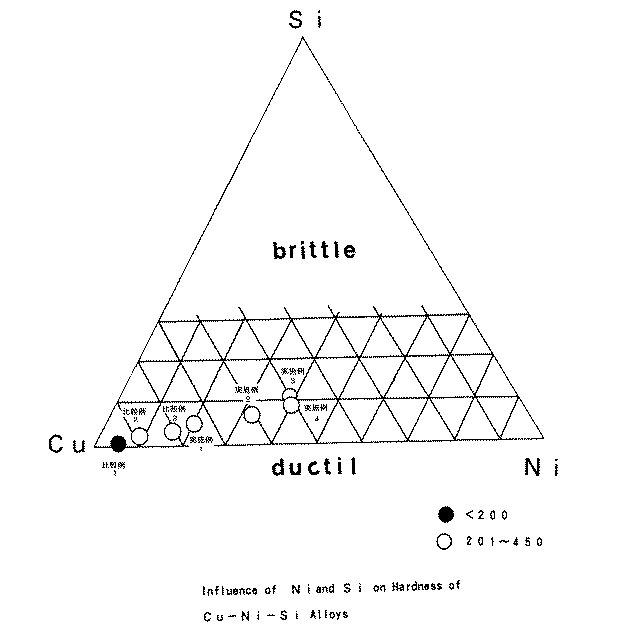
この結果を表2に、また得られた硬度(HB)の3元状態図を図3にて示した。すなわち、この3元状態図により、前記数式に示されるNi:Si比より、Siが多くなった場合は、Brittle(脆性)になり、この数式が臨界線(critical line)を示すことになる。
【表2】
図1〜2に示すように、実施例のCu−Ni−Si系合金では、組織中にNi2Siの帯状の晶出物が均一に分散されていることが判る。
【0018】
表2から明らかな如く、コルソン合金(比較例1)ではブリネル硬さHB97であったのに対し、実施例のCu−Ni−Si系合金ではいずれもHB353以上の硬度が得られており、純銅、従来のコルソン合金に比して、硬度が飛躍的に増大していることが判る。
また、図3に示す3元状態図において、95%Cu−4%Ni−1%Si(比較例1)ではHB97であるが、90%Cu−8%Ni−2%Si(比較例2)、80%Cu−16%Ni−4%Si(比較例3)、73.9%Cu−21.0%Ni−5.1%Si(実施例1)、60.6%Cu−31.8%Ni−7.6%Si(実施例2)、50.8%Cu−40.0%Ni−9.2%Si(実施例3)(〇印)では漸次硬度が増大しているとともに、色調は銅色で金属性を帯びていた。
これに対し、比較例1(●印)では、HB200未満であった。
【0019】
【発明の効果】
以上詳述した如く、この発明はCuとNiとSi及び不可避的不純物とからなるCu−Ni−Si系合金であって、前記Niの配合量が重量%で21〜40%とされるとともに、前記CuとNiとSiとの配合量がそれぞれ式1(数1)及び式2(数2)にて示される関係にあり、鋳放しによりCu組織中にNiとSiの金属間化合物(Ni 2 Si)を帯状に分散して晶出させてなることを特徴とするCu−Ni−Si系合金であるから、前記実施例からも明らかな如く、従来のコルソン合金に較べて硬度が極めて向上し、レール等の溶着硬化材料や他の各種用途において幅広く適用することのできるCu−Ni−Si系合金であるという優れた効果を奏する。
【図面の簡単な説明】
【図1】 実施例3で得られたCu−Ni−Si系合金の組織の100倍の顕微鏡写真である。
【図2】 実施例3で得られたCu−Ni−Si系合金の組織の400倍の顕微鏡写真である。
【図3】 実施例1〜4及び比較例1〜3で得られたCu−Ni−Si系合金の3元状態図である。[0001]
[Industrial application fields]
The present invention relates to a Cu-Ni-Si-based alloy, the purpose of which is Cu having high mechanical strength, particularly high hardness, good wear resistance, and can be widely applied to various uses such as welding hardened materials such as rails. -To provide a Ni-Si alloy.
[0002]
[Prior art]
Cu-based alloys are non-magnetic, do not have low-temperature brittleness, have better electrical and thermal conductivity than Fe-based materials, and are excellent in castability and corrosion resistance.
However, Cu-based alloys, on the other hand, have a problem that mechanical strength, particularly hardness, is low and wear resistance is remarkably inferior.
Therefore, heretofore, intensive studies have been made to improve the mechanical strength while utilizing the properties of Cu-based alloys.
One Cu-based alloy with improved mechanical strength is a Cu-Ni-Si-based Corson alloy.
This Corson alloy is a crystallization hardening containing Cu95, Ni4-5, and Si5%, in which an intermetallic compound of Ni-Si is crystallized in a Cu matrix by performing aging treatment for a long time after solution treatment. This is an excellent Cu-based alloy that has improved tensile strength without lowering conductivity, and has been conventionally used as an electric / electronic component.
[0003]
[Problems to be solved by the invention]
However, the above-mentioned Corson alloy still has a problem that its hardness is insufficient and cannot be applied to applications requiring higher mechanical strength and hardness.
Therefore, in the industry, there has been a demand for the creation of a Cu-based alloy having excellent mechanical strength, especially hardness, which can widely use the excellent properties of Cu-based alloys in various industrial fields.
[0004]
[Means for Solving the Problems]
In this invention, it is a Cu—Ni—Si based alloy composed of Cu, Ni, Si and inevitable impurities, and the blending amount of Ni is 21 to 40 % by weight, and the Cu and Ni expression amount of Si is respectively 1 (equation 1) and Ri near relation shown in the formula 2 (equation 2), cast intermetallic compound of Ni and Si in Cu tissue (Ni 2 Si) strip by release By providing a Cu—Ni—Si based alloy that is characterized by being dispersed and crystallized, the above-mentioned conventional problems are greatly solved.
[0005]
[Action]
By blending Cu, Ni and Si in a specific range, the intermetallic compound of Ni and Si (Ni 2 Si) can be uniformly dispersed in the Cu structure and crystallized. Cu-Ni-Si-based alloys having a hardness far exceeding that of Corson alloys can be obtained. Therefore, it can be used widely and suitably in various industrial fields, such as welding hardened materials such as rails, which could not be applied with conventional Corson alloys.
[0006]
[Structure of the invention]
Hereinafter, the configuration of the Cu—Ni—Si based alloy according to the present invention will be described in detail.
In this invention, Cu, Ni, and Si are contained, and the blending amount of Ni is 21 to 40 % by weight.
Ni is an element necessary to dissolve in Cu, strengthen the Cu matrix, and improve the wear resistance at high temperatures.
If the amount of Ni is less than 21%, a sufficient effect of matrix strengthening cannot be obtained, and a Cu-based alloy excellent in mechanical strength as an object of the present invention cannot be obtained. On the other hand, if it exceeds 40 %, the amount of Ni dissolved in the Cu matrix is excessively increased, the good conductivity of Cu is hindered, and the workability deteriorates, which is not preferable. Therefore, in this invention, the amount of Ni is set to 21 to 40 %.
[0007]
In this invention, Si and Cu are blended in addition to the Ni.
The blending amount of Si is in a range represented by Formula 1 ( Equation 1 ) with respect to Ni.
[0008]
Specifically, Si is blended in an amount of 5.1 to 9.2 % by weight.
Si is an element necessary for generating an oxide as hard dispersed particles, and particularly forms a compound (Ni 2 Si) in the state of coexisting with Ni described above.
By generating this compound (Ni 2 Si), the mechanical strength and hardness can be improved without extremely reducing the conductivity of Cu.
Furthermore, Si also has the effect | action which raises the self-solubility of material and improves weldability.
When the compounding amount of Si is less than 5.1 %, the compound (Ni 2 Si) is not sufficiently produced, and a Cu-based alloy excellent in mechanical strength and hardness as the object of the present invention cannot be obtained. On the other hand, if it exceeds 9.2 %, the amount of Si dissolved in the Cu matrix becomes too much, and the good conductivity of Cu is impaired, which is not preferable.
Therefore, in this invention, the compounding amount of Si is set to 5.1 to 9.2 %.
[0009]
In this invention, the compounding amount of Cu is set to a range represented by Formula 2 ( Formula 2 ) with respect to Ni and Si.
[0010]
Specifically, Cu is blended in an amount of 50.8 to 73.9 % by weight.
Cu is non-magnetic, has high electrical and thermal conductivity, and is an excellent element as an electric / electronic component or as a welding and hardening material.
If the compounding amount of Cu is less than 50.8 %, the above-described excellent Cu characteristics cannot be expressed. Moreover, when it exceeds 73.9 %, the outstanding hardness made into the objective of this invention cannot be expressed.
Therefore, in this invention, the compounding amount of Cu is set to 50.8 to 73.9 %.
[0011]
As described above, the present invention requires that the blending amounts of Cu, Ni, and Si are in the relationship shown in Formula 1 ( Formula 1 ) and Formula 2 ( Formula 2 ), respectively.
[0012]
As described above, the amount of Cu, Ni, and Si is limited as described above. In the Cu—Ni—Si based alloy, Ni and Si are blended in the relationship shown above. Without significantly reducing the good electrical conductivity of Cu, it can improve the weakness of mechanical strength, which is a defect of Cu, and develop excellent hardness that could not be expressed by conventional Corson alloys This is because it is based on the knowledge obtained by the inventors' diligent research.
Furthermore, by mixing Cu, Ni, and Si as described above, the intermetallic compound of Ni and Si (Ni 2 Si) can be uniformly dispersed in the Cu structure and crystallized. It is because excellent hardness can be expressed by crystallization of such an intermetallic compound in the Cu structure.
[0013]
By limiting the blending amount as described above, it is possible to dramatically improve the hardness that was a defect of the Cu-based alloy, and it can be suitably used as a welding and hardening material for rails and the like.
The Cu-based alloy with such a composition obtains the desired mechanical strength and hardness by as-casting, but if further toughness and conductivity are required, after solution treatment, normal aging treatment as necessary Thus, a Cu—Ni—Si based alloy according to the present invention can be obtained. The conditions for the aging treatment are 1773 ± 10K after quenching in water, 773 ± 10K, and a time of 1 hour for a thickness of 25 mm. In addition to this, after holding for an additional hour, the furnace is cooled.
[0014]
【Example】
Hereinafter, the effects of the Cu—Ni—Si based alloy according to the present invention will be described in more detail by giving examples. In addition, this invention is not limited at all by the Example below.
(Examples 1 to 4 and Comparative Examples 1 to 3 )
About 40 g of Cu-based alloy material added by changing Ni and Si in accordance with the composition shown in Table 1 was dissolved by a high-frequency electric furnace (SiO 2 crucible), and centrifugally cast by a pure copper mold, Examples 1 to 4 , And the Cu-Ni-Si-type alloy of Comparative Examples 1-3 was obtained.
[Table 1]
[0015]
(Test Example 1)
Observation with an optical microscope The metal structure of the Cu—Ni—Si alloy obtained in Example 3 was observed with a microscope (magnification: 100 times and 400 times). The results are shown in FIGS.
[0016]
(Test Example 2)
Hardness measurement The hardness of the Cu-Ni-Si-based alloys obtained in Examples 1 to 4 and Comparative Examples 1 to 3 was measured. As an index of hardness, Brinell hardness (HB) was used and measured according to the test method indicated in “JISZ2243 Brinell hardness test method”.
The results are shown in Table 2, and the obtained hardness (HB) ternary phase diagram is shown in FIG. That is, according to this ternary phase diagram, when Si becomes larger than the Ni: Si ratio shown in the above formula, it becomes brittle, and this formula shows a critical line.
[Table 2]
As shown in FIGS. 1 and 2, it can be seen that in the Cu—Ni—Si based alloy of the example, the Ni 2 Si band-like crystallized material is uniformly dispersed in the structure.
[0018]
As it is clear from Table 2, whereas the a Brinell hardness HB97 the Corson alloy (Comparative Example 1), both the Cu-Ni-Si alloy of Example and obtained HB 353 or more hardness, It can be seen that the hardness is dramatically increased as compared with pure copper and a conventional Corson alloy.
In the ternary phase diagram shown in FIG. 3, 95% Cu-4% Ni-1% Si (Comparative Example 1) is HB97, but 90% Cu-8% Ni-2% Si (Comparative Example 2). 80% Cu-16% Ni-4% Si (Comparative Example 3), 73.9% Cu-21.0% Ni-5.1% Si (Example 1), 60.6% Cu-31.8 % Ni-7.6% Si (Example 2), 50.8% Cu-40.0% Ni-9.2% Si (Example 3) (circles) have gradually increased hardness, The color tone was copper and metallic.
On the other hand, in comparative example 1 (● mark), it was less than HB200.
[0019]
【The invention's effect】
As described in detail above, the present invention is a Cu-Ni-Si based alloy composed of Cu, Ni, Si and unavoidable impurities, and the amount of Ni is 21 to 40 % by weight, the Cu and the amount each formula 1 of Ni and Si (equation 1) and Ri near relation shown in the formula 2 (equation 2), cast intermetallic compound of Ni and Si in Cu tissue by release (Ni 2 Si) is a Cu-Ni-Si alloy characterized by being dispersed and crystallized in a band shape. As is apparent from the above examples, the hardness is extremely improved compared to the conventional Corson alloy. In addition, there is an excellent effect that it is a Cu—Ni—Si alloy that can be widely applied in welding and hardening materials such as rails and other various uses.
[Brief description of the drawings]
1 is a 100 × photomicrograph of the structure of a Cu—Ni—Si based alloy obtained in Example 3. FIG.
2 is a 400.times. Micrograph of the structure of the Cu-Ni-Si alloy obtained in Example 3. FIG.
3 is a ternary phase diagram of Cu—Ni—Si based alloys obtained in Examples 1 to 4 and Comparative Examples 1 to 3. FIG.
Claims (1)
Priority Applications (1)
| Application Number | Priority Date | Filing Date | Title |
|---|---|---|---|
| JP07637493A JP3636731B2 (en) | 1993-03-09 | 1993-03-09 | Cu-Ni-Si alloy |
Applications Claiming Priority (1)
| Application Number | Priority Date | Filing Date | Title |
|---|---|---|---|
| JP07637493A JP3636731B2 (en) | 1993-03-09 | 1993-03-09 | Cu-Ni-Si alloy |
Publications (2)
| Publication Number | Publication Date |
|---|---|
| JPH07197151A JPH07197151A (en) | 1995-08-01 |
| JP3636731B2 true JP3636731B2 (en) | 2005-04-06 |
Family
ID=13603575
Family Applications (1)
| Application Number | Title | Priority Date | Filing Date |
|---|---|---|---|
| JP07637493A Expired - Fee Related JP3636731B2 (en) | 1993-03-09 | 1993-03-09 | Cu-Ni-Si alloy |
Country Status (1)
| Country | Link |
|---|---|
| JP (1) | JP3636731B2 (en) |
Families Citing this family (2)
| Publication number | Priority date | Publication date | Assignee | Title |
|---|---|---|---|---|
| JP3853100B2 (en) * | 1998-02-26 | 2006-12-06 | 三井金属鉱業株式会社 | Copper alloy with excellent wear resistance |
| CN102021359B (en) * | 2010-11-03 | 2013-01-02 | 西安理工大学 | Cu-Ni-Si alloy with high Ni and Si content and preparation method thereof |
-
1993
- 1993-03-09 JP JP07637493A patent/JP3636731B2/en not_active Expired - Fee Related
Also Published As
| Publication number | Publication date |
|---|---|
| JPH07197151A (en) | 1995-08-01 |
Similar Documents
| Publication | Publication Date | Title |
|---|---|---|
| TWI331633B (en) | Copper alloys for electronic materials | |
| US7618499B2 (en) | Fe-base in-situ composite alloys comprising amorphous phase | |
| CN112725678A (en) | Non-equal atomic ratio medium/high entropy alloy containing NiCoCr and preparation method thereof | |
| CN100564559C (en) | Cu-Ni-Si-Co-Cr system copper alloy for electronic material and manufacturing method thereof | |
| JP6126791B2 (en) | Cu-Ni-Si copper alloy | |
| CN102112639A (en) | Copper alloy material for electrical and electronic components, and manufacturing method therefof | |
| JPH0258340B2 (en) | ||
| JPS5853057B2 (en) | Highly conductive copper-based alloy | |
| CN101270423A (en) | Cu-Ni-Si Copper Alloys for Electronic Materials | |
| TW201348467A (en) | Cu-Zn-Sn-Ni-P-based alloy | |
| JP2004315940A (en) | Cu-Ni-Si ALLOY AND ITS PRODUCTION METHOD | |
| JP2004307905A (en) | Cu alloy and method for producing the same | |
| CN108602097A (en) | For automobile and the Cu alloy material and its production method of electric and electronic component | |
| JP2008248351A (en) | High-strength and high-electric conductivity copper alloy having excellent hot workability | |
| JPH03115538A (en) | Oxide dispersion strengthened special copper alloy | |
| TWI429767B (en) | Copper alloy | |
| JP3636731B2 (en) | Cu-Ni-Si alloy | |
| JPWO2009041194A1 (en) | High strength and high conductivity copper alloy with excellent hot workability | |
| JP2007126739A (en) | Copper alloy for electronic material | |
| JP5879464B1 (en) | Copper alloy plate and method for producing copper alloy plate | |
| TWI878235B (en) | Copper-nickel-silicon alloys with high strength and high electrical conductivity | |
| JPS6256937B2 (en) | ||
| JP2000129377A (en) | Copper base alloy for terminals | |
| JP4158337B2 (en) | Method for producing chromium-zirconium-based copper alloy for continuous casting mold | |
| JP2008248352A (en) | High-strength and high-electric conductivity copper alloy having excellent hot workability |
Legal Events
| Date | Code | Title | Description |
|---|---|---|---|
| A711 | Notification of change in applicant |
Free format text: JAPANESE INTERMEDIATE CODE: A712 Effective date: 20041007 |
|
| A521 | Written amendment |
Free format text: JAPANESE INTERMEDIATE CODE: A523 Effective date: 20041025 |
|
| A521 | Written amendment |
Free format text: JAPANESE INTERMEDIATE CODE: A821 Effective date: 20041007 |
|
| A61 | First payment of annual fees (during grant procedure) |
Free format text: JAPANESE INTERMEDIATE CODE: A61 Effective date: 20050106 |
|
| R150 | Certificate of patent or registration of utility model |
Free format text: JAPANESE INTERMEDIATE CODE: R150 |
|
| FPAY | Renewal fee payment (event date is renewal date of database) |
Free format text: PAYMENT UNTIL: 20090114 Year of fee payment: 4 |
|
| FPAY | Renewal fee payment (event date is renewal date of database) |
Free format text: PAYMENT UNTIL: 20100114 Year of fee payment: 5 |
|
| FPAY | Renewal fee payment (event date is renewal date of database) |
Free format text: PAYMENT UNTIL: 20110114 Year of fee payment: 6 |
|
| FPAY | Renewal fee payment (event date is renewal date of database) |
Free format text: PAYMENT UNTIL: 20110114 Year of fee payment: 6 |
|
| FPAY | Renewal fee payment (event date is renewal date of database) |
Free format text: PAYMENT UNTIL: 20120114 Year of fee payment: 7 |
|
| S531 | Written request for registration of change of domicile |
Free format text: JAPANESE INTERMEDIATE CODE: R313531 |
|
| FPAY | Renewal fee payment (event date is renewal date of database) |
Free format text: PAYMENT UNTIL: 20120114 Year of fee payment: 7 |
|
| R350 | Written notification of registration of transfer |
Free format text: JAPANESE INTERMEDIATE CODE: R350 |
|
| FPAY | Renewal fee payment (event date is renewal date of database) |
Free format text: PAYMENT UNTIL: 20130114 Year of fee payment: 8 |
|
| LAPS | Cancellation because of no payment of annual fees |