【0001】
【産業上の利用分野】
本発明は、簡便で特異的なD−ソルビトールの測定方法およびその測定用キットに関する。
【0002】
【従来の技術】
従来、D−ソルビトールの測定方法には、ソルビトール脱水素酵素(EC 1.1.1.14) を使用し、D−ソルビトールの脱水素反応によってD−フルクトースを生成させ、このD−フルクトースの6位をヘキソキナーゼ(EC 2.7.1.1)でリン酸化し、生成したD−フルクトース−6−リン酸をグルコース−6−リン酸イソメラーゼ(EC 5.3.1.9)でD−グルコース−6−リン酸に異性化し、このD−グルコース−6−リン酸のグルコース−6−リン酸脱水素酵素(EC 1.1.1.49) による脱水素反応によって生成した補酵素NADPの還元体であるNADPHの吸光度を測定する方法(ベーリンガー社のキット) が知られている。
【0003】
また、ソルビトール脱水素酵素(EC 1.1.1.14) を使用し、D−ソルビトールの脱水素反によって生成した補酵素NADの還元体であるNADHの蛍光強度を測定する方法(Clin. Chem.34 2327 (1988)、特開平6−109726) 、ソルビトール脱水素酵素(EC 1.1.1.14) を使用し、この酵素の補酵素であるNADHとチオ−NADの共存下にD−ソルビトールの脱水素反応と逆反応のD−フルクトースの還元反応を行い、この酵素サイクリング反応によって生成したチオ−NADの還元体であるチオ−NADHの吸光度を測定する方法(特開平4−349897)等が知られている。
【0004】
更に、ソルビトール脱水素酵素(特開昭56−29994)を使用し、電子伝達体の1−メトキシ−5−フェナゾリウムメチルサルフェイト(1−MPMS)と還元発色性色素のテトラゾリウム塩の存在下にD−ソルビトールの脱水素反応を行い、この反応によって生成したホルマザン色素の吸光度を測定する方法(特開平6−189790)が知られている。
【0005】
また、ソルビトール脱水素酵素(特開昭56−29994)を使用し、1−MPMSの存在下にD−ソルビトールの脱水素反応を行い、この反応によって生成した過酸化水素を、ペルオキシダーゼを使用する各種検出法で測定する方法(特開平6−209793)、ソルビトール酸化酵素(特開平6−169764)を使用し、酸素の存在下にD−ソルビトールを酸化し、この反応によって生成した過酸化水素を、ペルオキシダーゼを使用する各種検出法で、測定する方法(特開平6−169764)等が知られてる。
【0006】
しかしながら、D−ソルビトールの2位を酸化してD−フルクトースを生成させるソルビトール脱水素酵素(EC 1.1.1.14)やD−ソルビトールの1位を酸化してD−グルコースを生成させるソルビトール酸化酵素(特開平6−169764)を使用する何れの測定法においても、それぞれの酵素の基質特異性が悪いことから、D−ソルビトールの測定値の信頼性には疑問がある。従って、これらの測定法の対象とする検体としてはD−ソルビトールの含有量が多く且つ干渉する成分の含有量が少ない食品や赤血球などに限定されている。
【0007】
一方、酢酸菌の細胞膜由来であり、D−ソルビトールの5位を酸化してL−ソルボースを生成させるソルビトール脱水素酵素(特開昭56−29994)を使用するD−ソルビトールの測定法においては、D−ソルビトールに対する特異性が高いとは言え、熱安定性に問題があり、診断薬を開発する上で、実用的ではなかった。この様に、ソルビトールの含有量が少なく、測定に干渉する基質成分が相対的に多い血清や血漿について、酵素法で正確に測定できたとの報告は未だにない。
【0008】
【発明が解決しようとする課題】
本発明は、上記実情に鑑みなされたものであり、本発明の目的は、複雑な前処理操作を必要とせず、汎用型の自動生化学測定装置にも対応可能であり、簡便で特異性の高いD−ソルビトールの測定法の提供に存する。また、本発明の他の目的は、腎不全、糖尿病などの診断に利用できるD−ソルビトールの測定用キットの提供に存する。
【0009】
【課題を解決するための手段】
本発明者らは、前記の問題点を解決すべく鋭意研究を重ねた結果、D−ソルビトールを酸化してD−グルコースを生成する酸化酵素が、効率よくD−ソルビトールを酸化して定量的にD−グルコースを生成すること、この反応によって生成したD−グルコースをD−グルコースの検出系と組み合わせ、更に特定の前処理と組み合わせることにより、D−ソルビトールに対して極めて特異性の高い測定系になることを見いだし、本発明に至ったものである。
【0010】
すなわち、本発明の第1の要旨は、D−ソルビトールとD−グルコースを含有する検体に、D−グルコースを消去する前処理を施した後、D−ソルビトールを酸化してD−グルコースを生成させる酸化酵素を作用させ、該酵素反応によるD−ソルビトールの酸化で生成したD−グルコースを検出することにより、検体中のD−ソルビトールを特異的に測定する方法に関する。
【0011】
本発明の第2の要旨は、D−ソルビトールを酸化してD−グルコースを生成する酸化酵素がソルビトールオキシダーゼ、キシリトールオキシダーゼ又はマンニトールオキシダーゼであるD−ソルビトールの測定方法に関する。
【0012】
本発明の第3の要旨は、D−グルコースを消去する前処理の方法およびD−グルコースを検出する方法がグルコースオキシダーゼ、ピラノースオキシダーゼ、グルコースデヒドロゲナーゼ又はグルコース−6−ホスフェートデヒドロゲナーゼを使用するD−ソルビトールの測定方法に関する。
【0013】
本発明の第4の要旨は、D−グルコースを消去する前処理剤、D−ソルビトールを酸化してD−グルコースを生成させる酸化酵素およびD−グルコース検出試薬を含有するD−ソルビトール測定用キットに関する。
【0014】
更に、本発明の第5の要旨は、D−グルコース消去用前処理とD−ソルビトール検出試薬に同一酵素を使用するD−ソルビトール測定用キットに関にする。
【0015】
以下、本発明を詳細に説明する。本発明で、D−ソルビトール測定の対象となる検体とは、D−ソルビトールの測定を必要とするものであれば特に制限されない。例えば、D−ソルビトールとD−グルコースを含有する生体試料、食品、それらの抽出液や各種の処理液などが挙げられる。また、D−ソルビトールは、腎不全や糖尿病の診断指標として期待されており、生体試料としては、赤血球、血漿、血清、組織の抽出液、尿などが有用である。
【0016】
本発明で使用されるD−ソルビトールを酸化してD−グルコースを生成させる酸化酵素としては、D−ソルビトールの1位を酸化してD−グルコースを生成させる能力のある酵素であれば特に制限されない。
【0017】
アルコール基を酸化する酵素は、電子受容体の種類により、(1) ニコチンアミドアデニンジヌクレオチド(NAD+ )又はニコチンアミドアデニンジヌクレオチドホスフェート(NADP+ )を電子受容体とするもの、(2) シトクロムを電子受容体とするもの、(3) 酸素を電子受容体とするもの、(4) その他に分類(酵素ハンドブック:丸尾文治、田宮信雄監修;朝倉書店)されているが、D−ソルビトールからD−グルコースを生成させる能力があれば、何れのものであってもよい。
【0018】
例えば、酸素を電子受容体とする酸化酵素としては、キサントモナスに属する微生物由来のソルビトールオキシダーゼ(特開平6−169764)、ストレプトミセスに属する微生物由来のキシリトールオキシダーゼ(例えば、工業技術院生命工学工業技研究所寄託番号FERM P−14339由来のキシリトールオキシダーゼ)、蝸牛由来のマンニトールオキシダーゼ(Int. J. Biochem. 18 337-344(1986)) 等が挙げられる。
【0019】
下記に本発明で使用できるストレプトミセスに属する微生物由来のキシリトールオキシダーゼ(FERM P−14339由来のキシリトールオキシダーゼ)の一例を示す。
【0020】
【表1】
【0021】
本発明で使用されるD−グルコースを検出する方法としては、実質的にD−グルコースに特異性が高い検出方法であれば何れの方法であってもよく、公知の化学的な方法から生化学的な方法まで幅広く包含し、特に制限されるものではない。特に好ましくは、D−グルコースに対して特異性に優れ、汎用型の自動生化学測定装置に適用可能な、酵素を使用するD−グルコースの検出法がある。
【0022】
この酵素を使用するD−グルコースの検出法としては、血糖測定用試薬として販売されている既存の方法がそのまま利用できる。具体例としては、▲1▼グルコースオキシダーゼ(GOD:EC 1.1.3.4)を使用してD−グルコースを酸化し、その反応で生成した過酸化水素を比色法で検出する方法、▲2▼ピラノースオキシダーゼ(PROD:EC 1.1.3.10)を使用してD−グルコースを酸化し、その反応で生成した過酸化水素を比色法で検出する方法などが知られている。
【0023】
また、▲3▼グルコースデヒドロゲナーゼ(GDH:EC 1.1.1.47 )を使用し、補酵素NAD+ 又はNADP+ 〔NAD(P)と略す〕の存在下にD−グルコースを脱水素反応し、その反応で生成した補酵素の還元体であるNADH又はNADPH〔NAD(P)Hと略す〕の吸光度を比色法で検出する方法などが知られている。
【0024】
更に、▲4▼アデノシントリホスフェ−ト(ATP)の存在下、ヘキソキナーゼ(HK:EC 2.7.1.1)又はグルコキナーゼ(GK:EC 2.7.1.2)でD−グルコースをリン酸化し、生成したD−グルコース−6−リン酸を補酵素NADP+ の存在下にグルコース−6−ホスフェートデヒドロゲナーゼ(G6PDH:EC 1.1.1.49)を使用して脱水素反応し、その反応により生成した補酵素の還元体であるNADPHの吸光度を比色法で検出する方法などが知られている。
【0025】
さらに詳しくは、酵素を使用してD−グルコースを検出する方法においては、前記の酵素反応または酵素反応系を使用して、電子受容体をD−グルコースの存在量を検出し易い中間物質、例えば、過酸化水素や補酵素の還元体へ酵素的に変換し、最終的には、これらの中間物質を安定かつ高感度に検出することによって実施され得る。この中間物質が過酸化水素の場合は、過酸化水素の検出法として知られている比色法、蛍光法、化学発光法、電極法などが使用できる。
【0026】
比色法では、ペルオキシダーゼ等の触媒により、過酸化水素でペルオキシダーゼの基質を酸化発色させ、発色濃度を分光光度計で測定する。ペルオキシダーゼの基質としては、0−フェニレンジアミン、5−アミノサリチル酸、3,3’,5,5’−テトラメチルベンジジン等の芳香属アミン系の物質、トリンダー系試薬と称するフェノール、3−ヒドロキシ−2,4,6−トリヨード安息香酸などのフェノール系の物質やN−エチル−N−(2−ヒドロキシ−3−スルホプロピル)−m−トルイジン、N−エチル−N−(2−ヒドロキシ−3−スルホプロピル)−3,5−ジメトキシアニリン等のアニリン系の物質と4−アミノアンチピリンの組み合わせ等が利用できる。
【0027】
更に、2,2’−アジノビス(3−エチルベンゾチアゾリン−6−スルホン酸)、10(メチルアミノカルボニル)−3,7−ビス(ジメチルアミノ)−フェノチアジン、10(カルボキシメチルアミノカルボニル)−3,7−ビス(ジメチルアミノ)−フェノチアジン、ビス〔3−ビス(4−クロロフェニル)メチル−4−ジメチル−アミノフェニル〕アミン等の過酸化水素検出用の高感度基質とされる物質などが利用できる。
【0028】
蛍光法では、ペルオキシダーゼ等の触媒により、過酸化水素で基質を酸化して蛍光物質を生成させ、その蛍光強度を蛍光光度計で測定する。ペルオキシダーゼの基質としては、p−ヒドロキシフェニル酢酸、p−ヒドロキシフェニルプロピオン酸などが利用できる。化学発光法では、ペルオキシダーゼ等の触媒により、過酸化水素で基質を酸化して発光させ、その発光強度をルミノメーターで測定する。化学発光する基質としては、ルミノール化合物、ルシゲニン、アリルシュウ酸エステル類の化合物などが利用できる。
【0029】
中間物質が補酵素NAD+ 、NADP+ 、チオ−NAD+ 、チオ−NADP+ 等の還元体であるNADH、NADPH、チオ−NADH、チオ−NADPH等の場合は、これら補酵素の還元体の検出法として公知の方法が利用できる。例えば、▲1▼補酵素の還元体の吸光度や蛍光強度を、直接測定する方法、▲2▼酵素のジアホラーゼ又は電子伝達体の1−MPMS等を使用し、補酵素の還元体であるNADH、NADPH、チオ−NADH、チオ−NADPH等と還元発色性色素の各種テトラゾリウム塩類とを反応させ、この反応によって生成するホルマザン色素の吸光度を測定する方法がある。
【0030】
また、▲3▼脱水素酵素を使用し、補酵素としてNAD(P)Hとチオ−NAD(P)の共存下、この酵素のチオ−NAD(P)による脱水素反応とNAD(P)Hによるこの逆反応の還元反応をサイクルさせ、この酵素の基質を介する酵素サイクリング反応によって生成するチオ−NAD(P)の還元体であるチオ−NAD(P)Hの吸光度を測定する方法などがある。
【0031】
更に、▲4▼補酵素の還元体の酸化酵素または電子伝達体の1−MPMS等によって補酵素の還元体であるNADH、NADPH、チオ−NADH、チオ−NADPH等を酸化し、この時発生する過酸化水素を、前記の過酸化水素の検出法で検出する方法がある。
【0032】
本発明で使用されるD−グルコースを消去する前処理とは、D−ソルビトールの検出を妨害する内因性のD−グルコースを消去する方法である。D−グルコースの消去法としては、前記のD−ソルビトールの検出を妨害しない方法であれば何でもよく、D−グルコースを除去する方法と、D−グルコースを別物質に変換する方法がある。
【0033】
D−グルコースを除去する方法としては、物理的に樹脂に吸着させ除去する方法がある。すなわち、強塩基性樹脂が、アルドースやケトースを吸着する性質を利用するものであり、強塩基性樹脂を充填したカラムに検体を通し、D−グルコースを吸着し、吸着されずに溶出してきたD−ソルビトールを検出する方法(特開平3−47094)である。
【0034】
D−グルコースを別物質に変換する方法としては、化学的または生化学的な方法がある。汎用型の自動生化学測定装置で測定する場合、酵素を使用する生化学的な変換法が好ましい。生化学的な変換法としては、前記の酵素を使用するD−グルコースの検出法において述べたD−グルコースの変換法がそのまま利用できる。
【0035】
具体的には、▲1▼GOD(EC 1.1.3.4)を使用してD−グルコースを酸化する方法、▲2▼PROD(EC 1.1.3.10)を使用してD−グルコースを酸化する方法、▲3▼GDH(EC 1.1.1.47 )を使用して補酵素NAD(P)の存在下にD−グルコースを酸化する方法、▲4▼HK(EC 2.7.1.1)又はGK(EC 2.7.1.2)でD−グルコースをリン酸化し、生成したD−グルコース−6−リン酸を、G6PDH(EC 1.1.1.49)を使用して、補酵素NADP+ の存在下に酸化する方法などがある。
【0036】
なお、前処理用の酵素とD−グルコース検出用の酵素とを、必ずしも同じにする必要はないが、前処理法と共通にするほうが簡便であり好ましい。例えば、後記のA法に記載の様に、G6PDHを使用するD−グルコース測定系で前処理しておき、キシリトールオキシダーゼ添加後の吸光度増加を測定したり、または、後記のB法に記載の様に、GODを使用して前処理しておき、キシリトールオキシダーゼと合わせて過酸化水素の検出系を整え、キシリトールオキシダーゼ添加後の吸光度増加だけを測定するのが合理的である。
【0037】
本発明で使用される酵素、補酵素、試薬などは、臨床検査に使用できる程度に精製されたものが好ましい。また、反応は、公知の方法に準じて行うことが出来る。これらの酵素や試薬などの使用量は、反応温度、反応時間、反応 pH 、レート法またはエンドポイント法などの反応速度論上の設定、使用する酵素の性質や試薬の純度などにより左右されるが、一例を挙げると概ね以下に示す量である。
【0038】
キシリトールオキシダーゼは通常0.01〜50U/mL、好ましくは 0.1〜20U/mLである。G6PDHは通常 0.5〜500U/mL 、好ましくは 2〜100U/mL である。GODは通常 0.1〜10000U/mL 、好ましくは10〜5000U/mLである。その他の酵素、試薬などを使用する場合も、公知の方法に準じて適宜使用できる。反応温度は通常 5〜50℃、好ましくは20〜40℃であり、反応時間は通常 1〜60分、好ましくは 1〜10分である。
【0039】
反応 pH は使用する酵素によって異なり、各酵素の至適 pH の近辺が望ましいが、複数の酵素を同時に作用させるような場合には、必ずしも個々の酵素の至適 pH にこだわる必要はなく、酵素の反応率、基質親和性、特異性、安定性、経済性などの点で制約の大きい酵素に有利なように、各酵素の活性が消失しない pH 範囲から選択すればよい。
【0040】
酵素反応は、速度論上からはレート法とエンドポイント法の2つに分類されている。本質的にはこれらの何れであってもよいが、検体の種類、干渉成分の存在、測定対象とする基質の濃度、反応時間、要求される精度などの条件により、適宜選択される。
【0041】
D−ソルビトールの測定に必要な前記の各成分を含む試薬溶液を、常法にしたがって調製し、D−ソルビトールの測定用キットとして診断薬に組み立てることが出来る。各成分は、前記の使用量に応じた割合となるように組み合わせて、キットとすることが出来る。
【0042】
【実施例】
以下、本発明を実施例により具体的に説明するが、本発明はその要旨を超えない限り、以下の実施例に限定されるものではない。
【0043】
参考例1 A法(GKとG6PDHによる方法)
200mg/L 濃度のD−ソルビトール標準液を蒸留水で倍々希釈し、標準液の希釈系列を作製した。この標準液の希釈系列を検体とし、それぞれ 50 μL の各検体に、5U/mL のGK、10U/mLのG6PDH、10mmol/LのATP、10mmol/LのNADP+ 、20mmol/LのMgCl2 を含む 100mmol/Lトリス塩酸緩衝液(pH 7.5) 950μL を添加し、37℃で10分間インキュベートして恒温化した。
【0044】
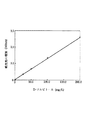
次に、2U/mL濃度のキシリトールオキシダーゼ(ストレプトミセス属の微生物由来)を 85 μL 添加して攪拌後、37℃で10分間反応し、キシリトールオキシダーゼ添加後の340 nm における吸光度の増加を分光光度計で測定した。検量線の測定結果を図1に示す。検量線は1から100mg/L まで直線となり、D−ソルビトールの測定が可能であることが示された。
【0045】
実施例1 (A法による血清検体の測定)
健常者の血清Mと、この血清MにD−ソルビトール 50mg/L を添加したものを検体として、A法(参考例1)に従って操作し、図1の検量線から検体中のD−ソルビトール濃度を求めた。その結果を表2に示す。D−ソルビトールは、健常者の血清には極わずかしか含まれていないことが知られている。また、腎不全患者を想定したD−ソルビトール添加血清での測定値は、ほぼ理論値に近い回収率であった。このことから、A法は信頼できるD−ソルビトールの測定法であることが示された。
【0046】
実施例2 (A法の汎用型生化学分析装置への適用)
D−ソルビトールの標準液と実施例1と同一の血清Mを検体とし、これら検体のそれぞれ10μL に、5U/mL のGK、10U/mLのG6PDH、10mmol/LのATP、10mmol/LのNADP+ 、20mmol/LのMgCl2 を含む 100mmol/Lトリス塩酸緩衝液(pH 7.5)からなる第1試薬(R−1)340 μL を添加して37℃で5分間インキュベートした。
【0047】
その後、4U/mL濃度のキシリトールオキシダーゼ(ストレプトミセス属の微生物由来)を含む 100mmol/Lトリス塩酸緩衝液(pH 7.5)からなる第2試薬(R−2)50μL を添加して37℃で5分間反応し、第2試薬添加後の主波長 340nm(副波長 405nm)における吸光度の増加を、日立7150形自動分析装置で測定した。測定結果を表2に示す。実施例1とほぼ同様な結果が得られた。
【0048】
【表2】
【0049】
参考例2 B法(GODを使用する方法)
40mg/L濃度のD−ソルビトール標準液を蒸留水で倍々希釈し、標準液の希釈系列を作製した。この標準液の希釈系列を検体とし、それぞれ 25 μL の各検体に、400U/mL のGOD、400U/mL のカタラーゼ、3U/mL のムタロターゼ、1.5mmol/L の4−アミノアンチピリン(4−AAP)を含む 100mmol/Lリン酸カリウム緩衝液(pH 7.5)475 μL を添加し、37℃で20分間反応した。
【0050】
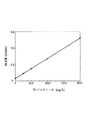
次に、10U/mL濃度のキシリトールオキシダーゼ(ストレプトミセス属の微生物由来)、25U/mL濃度のペルオキシダーゼ (西洋わさび由来) 、1mg/mLのNaN3 、7.5mmol/L の3−ヒドロキシ−2,4,6−トリヨード安息香酸(HTIB)を含む 100mmol/Lリン酸カリウム緩衝液(pH 7.5)100 μL を添加し、37℃で20分間発色反応を行い、発色反応における 515nmの吸光度の増加を分光光度計で測定した。検量線の測定結果を図2に示す。検量線は1から 40mg/L まで直線となり、D−ソルビトールの測定が可能であることが示された。
【0051】
実施例3 (B法による血清検体の測定)
健常者の血清K、S及びそれらの血清やD−グルコース溶液(100mg/L) にD−ソルビトールを添加したものを検体として、B法(参考例2)に従って操作し、図2の検量線から検体中のD−ソルビトール測定値を求めた。その結果を表3に示す。D−ソルビトールは、健常者の血清には僅かしか含まれていないことが知られている。また、腎不全患者を想定したD−ソルビトール添加血清での測定値は、ほぼ理論値に近い回収率であった。このことから、A法と同様に、B法は信頼できるD−ソルビトールの測定法であることが示された。
【0052】
実施例4 (B法の汎用型生化学分析装置への適用)
D−ソルビトールの標準液および実施例3と同一の血清を検体とし、これらの検体のそれぞれ 10 μL に、2000U/mLのGOD、400U/mL のカタラーゼ、10U/mLのムタロターゼ、1.5mmol/L の4−アミノアンチピリン(4−AAP)を含む 100mmol/Lリン酸カリウム緩衝液(pH 7.5)からなる第1試薬(R−1)300 μL を加えて37℃で5分間インキュベートした。
【0053】
その後、10U/mL濃度のキシリトールオキシダーゼ(ストレプトミセス属の微生物由来)、50U/mL濃度のペルオキシダーゼ (西洋わさび由来) 、1mg/mLのNaN3 、7.5mmol/L の3−ヒドロキシ−2,4,6−トリヨード安息香酸(HTIB)を含む 100mmol/Lリン酸カリウム緩衝液(pH 7.5)からなる第2試薬(R−2)50μL を添加し、37℃で5分間発色反応を行い、第2試薬添加後の主波長 546nm(副波長 660nm)における吸光度の増加を、日立7150形自動分析装置で測定した。結果を表3に示す。実施例3とほぼ同様な結果が得られた。
【0054】
【表3】
【0055】
【発明の効果】
以上説明した本発明によれば、腎不全、糖尿病などの診断に利用できる簡単で特異的なD−ソルビトールの測定方法およびD−ソルビトールの測定用キットが提供される。
【図面の簡単な説明】
【図1】本発明のA法によるD−ソルビトールの検量線である。
【図2】本発明のB法によるD−ソルビトールの検量線である。[0001]
[Industrial application fields]
The present invention relates to a simple and specific method for measuring D-sorbitol and a kit for the measurement.
[0002]
[Prior art]
Conventionally, sorbitol dehydrogenase (EC 1.1.1.14) is used as a method for measuring D-sorbitol, and D-fructose is generated by dehydrogenation of D-sorbitol. The resulting D-fructose-6-phosphate was phosphorylated with EC 2.7.1.1) and isomerized to D-glucose-6-phosphate with glucose-6-phosphate isomerase (EC 5.3.1.9). Method for measuring absorbance of NADPH which is a reduced form of coenzyme NADP produced by dehydrogenation of glucose-6-phosphate with glucose-6-phosphate dehydrogenase (EC 1.1.1.49) (Boehringer kit) It has been known.
[0003]
In addition, a method for measuring the fluorescence intensity of NADH, which is a reduced form of coenzyme NAD, produced by dehydrogenation reaction of D-sorbitol using sorbitol dehydrogenase (EC 1.1.1.14) (Clin. Chem. 34 2327 ( 1988), JP-A-6-109726), sorbitol dehydrogenase (EC 1.1.1.14), and the dehydrogenation reaction and reverse reaction of D-sorbitol in the presence of NADH and thio-NAD which are coenzymes of this enzyme. A method of measuring the absorbance of thio-NADH, which is a reduced form of thio-NAD produced by this enzyme cycling reaction (Japanese Patent Laid-Open No. 4-349897), is known.
[0004]
Further, sorbitol dehydrogenase (Japanese Patent Laid-Open No. 56-29994) was used, and in the presence of 1-methoxy-5-phenazolium methyl sulfate (1-MPMS) as an electron carrier and tetrazolium salt as a reducing chromogenic dye. There is known a method (Japanese Patent Laid-Open No. 6-189790) in which D-sorbitol is dehydrogenated and the absorbance of the formazan dye produced by this reaction is measured.
[0005]
Also, sorbitol dehydrogenase (Japanese Patent Laid-Open No. Sho 56-29994) is used, D-sorbitol is dehydrogenated in the presence of 1-MPMS, and hydrogen peroxide generated by this reaction is converted into various types using peroxidase. Using a method of measurement by a detection method (Japanese Patent Laid-Open No. 6-209793) and sorbitol oxidase (Japanese Patent Laid-Open No. 6-169964), D-sorbitol is oxidized in the presence of oxygen, and hydrogen peroxide produced by this reaction is converted into hydrogen peroxide. A method of measuring by various detection methods using peroxidase (Japanese Patent Laid-Open No. 6-169644) is known.
[0006]
However, sorbitol dehydrogenase (EC 1.1.1.14) that oxidizes the 2-position of D-sorbitol to produce D-fructose, and sorbitol oxidase that oxidizes the 1-position of D-sorbitol to produce D-glucose (special In any measurement method using Kaihei 6-169664), the reliability of the measured value of D-sorbitol is questionable because the substrate specificity of each enzyme is poor. Therefore, the samples to be subjected to these measurement methods are limited to foods, erythrocytes and the like having a high content of D-sorbitol and a low content of interfering components.
[0007]
On the other hand, in the method for measuring D-sorbitol, which is derived from the cell membrane of acetic acid bacteria and uses sorbitol dehydrogenase (Japanese Patent Laid-Open No. 56-29994) which oxidizes the 5-position of D-sorbitol to produce L-sorbose, Although it has a high specificity for D-sorbitol, it has a problem in thermal stability and is not practical in developing diagnostic agents. Thus, there has been no report that serum or plasma with a low content of sorbitol and a relatively large amount of substrate components that interfere with the measurement could be accurately measured by the enzyme method.
[0008]
[Problems to be solved by the invention]
The present invention has been made in view of the above circumstances, and the object of the present invention does not require a complicated pretreatment operation, and can be applied to a general-purpose automatic biochemical measurement apparatus, which is simple and specific. It is to provide a high D-sorbitol measurement method. Another object of the present invention is to provide a kit for measuring D-sorbitol which can be used for diagnosis of renal failure, diabetes and the like.
[0009]
[Means for Solving the Problems]
As a result of intensive studies to solve the above problems, the present inventors have quantified that an oxidase that oxidizes D-sorbitol to produce D-glucose efficiently oxidizes D-sorbitol. By producing D-glucose, combining D-glucose produced by this reaction with a D-glucose detection system, and further combining it with a specific pretreatment, the measurement system is highly specific to D-sorbitol. As a result, the present invention has been achieved.
[0010]
That is, the first gist of the present invention is that a specimen containing D-sorbitol and D-glucose is subjected to a pretreatment for eliminating D-glucose, and then D-sorbitol is oxidized to produce D-glucose. The present invention relates to a method for specifically measuring D-sorbitol in a sample by acting oxidase and detecting D-glucose produced by oxidation of D-sorbitol by the enzyme reaction.
[0011]
The second gist of the present invention relates to a method for measuring D-sorbitol, wherein the oxidase that oxidizes D-sorbitol to produce D-glucose is sorbitol oxidase, xylitol oxidase, or mannitol oxidase.
[0012]
The third aspect of the present invention is to provide a method for pretreatment of eliminating D-glucose and a method for detecting D-glucose using glucose oxidase, pyranose oxidase, glucose dehydrogenase or glucose-6-phosphate dehydrogenase. It relates to a measurement method.
[0013]
The fourth gist of the present invention relates to a D-sorbitol measurement kit containing a pretreatment agent for eliminating D-glucose, an oxidase that oxidizes D-sorbitol to produce D-glucose, and a D-glucose detection reagent. .
[0014]
Furthermore, the fifth aspect of the present invention relates to a D-sorbitol measurement kit using the same enzyme as the D-glucose elimination pretreatment and the D-sorbitol detection reagent.
[0015]
Hereinafter, the present invention will be described in detail. In the present invention, the sample to be measured for D-sorbitol is not particularly limited as long as it requires measurement of D-sorbitol. For example, biological samples containing D-sorbitol and D-glucose, foods, extracts thereof and various treatment liquids can be used. In addition, D-sorbitol is expected as a diagnostic index for renal failure and diabetes. As a biological sample, red blood cells, plasma, serum, tissue extract, urine, and the like are useful.
[0016]
The oxidase that oxidizes D-sorbitol to produce D-glucose used in the present invention is not particularly limited as long as it has the ability to oxidize 1-position of D-sorbitol to produce D-glucose. .
[0017]
Enzymes that oxidize alcohol groups are (1) nicotinamide adenine dinucleotide (NAD + ) or nicotinamide adenine dinucleotide phosphate (NADP + ) depending on the type of electron acceptor, (2) cytochrome (3) Oxygen as an electron acceptor, (4) Others (enzyme handbook: supervised by Maruo Bunji, Tamiya Nobuo; Asakura Shoten), but from D-sorbitol to D -Anything that has the ability to produce glucose may be used.
[0018]
For example, as an oxidase using oxygen as an electron acceptor, sorbitol oxidase derived from a microorganism belonging to Xanthomonas (Japanese Patent Laid-Open No. 6-169644), xylitol oxidase derived from a microorganism belonging to Streptomyces (for example, Biotechnology Industrial Technology Research Institute of Industrial Technology Institute) No. FERM P-14339-derived xylitol oxidase), cochlea-derived mannitol oxidase (Int. J. Biochem. 18 337-344 (1986)) and the like.
[0019]
An example of a xylitol oxidase derived from a microorganism belonging to Streptomyces that can be used in the present invention (FERM P-14339-derived xylitol oxidase) is shown below.
[0020]
[Table 1]
[0021]
The method for detecting D-glucose used in the present invention may be any method as long as it is a detection method having substantially high specificity for D-glucose. The method is widely included and is not particularly limited. Particularly preferred is a method for detecting D-glucose using an enzyme, which has excellent specificity for D-glucose and can be applied to a general-purpose automatic biochemical measuring apparatus.
[0022]
As a method for detecting D-glucose using this enzyme, an existing method sold as a reagent for measuring blood glucose can be used as it is. Specific examples include (1) a method of oxidizing D-glucose using glucose oxidase (GOD: EC 1.1.3.4) and detecting hydrogen peroxide produced by the reaction by a colorimetric method, and (2) pyranose. A method is known in which D-glucose is oxidized using oxidase (PROD: EC 1.1.3.10), and hydrogen peroxide generated by the reaction is detected by a colorimetric method.
[0023]
Also, using (3) glucose dehydrogenase (GDH: EC 1.1.1.47), D-glucose is dehydrogenated in the presence of coenzyme NAD + or NADP + [abbreviated as NAD (P)]. A method of detecting the absorbance of NADH or NADPH (abbreviated as NAD (P) H), which is a reduced form of the produced coenzyme, by a colorimetric method is known.
[0024]
Furthermore, (4) D-glucose produced by phosphorylating D-glucose with hexokinase (HK: EC 2.7.1.1) or glucokinase (GK: EC 2.7.1.2) in the presence of adenosine triphosphate (ATP) It is a reduced form of coenzyme produced by dehydrogenation of glucose-6-phosphate using glucose-6-phosphate dehydrogenase (G6PDH: EC 1.1.1.49) in the presence of the coenzyme NADP + A method for detecting the absorbance of NADPH by a colorimetric method is known.
[0025]
More specifically, in the method for detecting D-glucose using an enzyme, an intermediate substance that easily detects the abundance of D-glucose using the enzyme reaction or enzyme reaction system described above, for example, It can be carried out by enzymatic conversion to a reduced form of hydrogen peroxide or a coenzyme, and finally detecting these intermediate substances stably and with high sensitivity. When the intermediate substance is hydrogen peroxide, a colorimetric method, a fluorescence method, a chemiluminescence method, an electrode method, or the like known as a method for detecting hydrogen peroxide can be used.
[0026]
In the colorimetric method, a peroxidase substrate is oxidized and colored with hydrogen peroxide using a catalyst such as peroxidase, and the color density is measured with a spectrophotometer. As a substrate for peroxidase, aromatic amine-based substances such as 0-phenylenediamine, 5-aminosalicylic acid, 3,3 ′, 5,5′-tetramethylbenzidine, phenols called Trinder reagents, 3-hydroxy-2 Phenolic substances such as 1,4,6-triiodobenzoic acid, N-ethyl-N- (2-hydroxy-3-sulfopropyl) -m-toluidine, N-ethyl-N- (2-hydroxy-3-sulfo) A combination of an aniline-based substance such as propyl) -3,5-dimethoxyaniline and 4-aminoantipyrine can be used.
[0027]
Furthermore, 2,2′-azinobis (3-ethylbenzothiazoline-6-sulfonic acid), 10 (methylaminocarbonyl) -3,7-bis (dimethylamino) -phenothiazine, 10 (carboxymethylaminocarbonyl) -3, Substances that are highly sensitive substrates for hydrogen peroxide detection, such as 7-bis (dimethylamino) -phenothiazine, bis [3-bis (4-chlorophenyl) methyl-4-dimethyl-aminophenyl] amine, and the like can be used.
[0028]
In the fluorescence method, a substrate is oxidized with hydrogen peroxide using a catalyst such as peroxidase to generate a fluorescent substance, and the fluorescence intensity is measured with a fluorometer. As a substrate for peroxidase, p-hydroxyphenylacetic acid, p-hydroxyphenylpropionic acid and the like can be used. In the chemiluminescence method, a substrate such as peroxidase is used to oxidize a substrate with hydrogen peroxide to emit light, and the luminescence intensity is measured with a luminometer. As a chemiluminescent substrate, a luminol compound, lucigenin, an allyl oxalate compound, or the like can be used.
[0029]
Intermediate coenzyme NAD +, NADP +, thio-NAD +, NADH is reduced form of thio-NADP +, etc., NADPH, thio-NADH, in the case of such thio-NADPH, detection of the reduced form of these coenzymes As a method, a known method can be used. For example, (1) a method for directly measuring the absorbance and fluorescence intensity of the reduced form of the coenzyme, (2) NADH, which is a reduced form of the coenzyme, using diaphorase of the enzyme or 1-MPMS of the electron carrier, etc. There is a method in which NADPH, thio-NADH, thio-NADPH and the like are reacted with various tetrazolium salts of a reducing chromogenic dye and the absorbance of the formazan dye produced by this reaction is measured.
[0030]
In addition, (3) using a dehydrogenase, in the presence of NAD (P) H and thio-NAD (P) as coenzymes, the dehydrogenation reaction of this enzyme with thio-NAD (P) and NAD (P) H There is a method of measuring the absorbance of thio-NAD (P) H, which is a reduced form of thio-NAD (P), produced by cycling the reduction reaction of this reverse reaction by the enzyme and through the enzyme cycling reaction through the substrate of this enzyme .
[0031]
Furthermore, (4) the reductant of coenzyme, such as NADH, NADPH, thio-NADH, thio-NADPH, etc., which is a coenzyme reductant, is oxidized by 1-MPMS of the reductant of the coenzyme There is a method of detecting hydrogen peroxide by the hydrogen peroxide detection method described above.
[0032]
The pretreatment for eliminating D-glucose used in the present invention is a method for eliminating endogenous D-glucose that interferes with detection of D-sorbitol. As a method for eliminating D-glucose, any method can be used as long as it does not interfere with the detection of D-sorbitol, and there are a method for removing D-glucose and a method for converting D-glucose into another substance.
[0033]
As a method of removing D-glucose, there is a method of physically adsorbing it on a resin and removing it. That is, a strongly basic resin utilizes the property of adsorbing aldose and ketose, and the sample is passed through a column filled with the strongly basic resin to adsorb D-glucose and elute without being adsorbed. -Method for detecting sorbitol (JP-A-3-47094).
[0034]
As a method for converting D-glucose into another substance, there is a chemical or biochemical method. When measuring with a general-purpose automatic biochemical measuring apparatus, a biochemical conversion method using an enzyme is preferable. As a biochemical conversion method, the D-glucose conversion method described in the D-glucose detection method using the above enzyme can be used as it is.
[0035]
Specifically, (1) a method of oxidizing D-glucose using GOD (EC 1.1.3.4), (2) a method of oxidizing D-glucose using PROD (EC 1.1.3.10), 3) Method of oxidizing D-glucose in the presence of coenzyme NAD (P) using GDH (EC 1.1.1.47), 4) In HK (EC 2.7.1.1) or GK (EC 2.7.1.2) There is a method of phosphorylating D-glucose and oxidizing the produced D-glucose-6-phosphate in the presence of coenzyme NADP + using G6PDH (EC 1.1.1.49).
[0036]
The pretreatment enzyme and the D-glucose detection enzyme are not necessarily the same, but it is more convenient and preferable to use the same pretreatment method. For example, as described in method A below, pretreatment is performed with a D-glucose measurement system using G6PDH, and the increase in absorbance after addition of xylitol oxidase is measured, or as described in method B below. In addition, it is reasonable to pre-treat using GOD, prepare a hydrogen peroxide detection system together with xylitol oxidase, and measure only the absorbance increase after addition of xylitol oxidase.
[0037]
Enzymes, coenzymes, reagents and the like used in the present invention are preferably purified to such an extent that they can be used in clinical tests. Moreover, reaction can be performed according to a well-known method. The amount of these enzymes and reagents used depends on the reaction temperature, reaction time, reaction pH, reaction kinetic settings such as the rate method or endpoint method, the nature of the enzyme used and the purity of the reagent. To give an example, the amount is as shown below.
[0038]
Xylitol oxidase is usually 0.01 to 50 U / mL, preferably 0.1 to 20 U / mL. G6PDH is usually 0.5 to 500 U / mL, preferably 2 to 100 U / mL. GOD is usually 0.1 to 10000 U / mL, preferably 10 to 5000 U / mL. When other enzymes, reagents, and the like are used, they can be appropriately used according to known methods. The reaction temperature is usually 5 to 50 ° C., preferably 20 to 40 ° C., and the reaction time is usually 1 to 60 minutes, preferably 1 to 10 minutes.
[0039]
The reaction pH differs depending on the enzyme used, and it is desirable that the pH be close to the optimum pH of each enzyme.However, when multiple enzymes are allowed to act simultaneously, it is not always necessary to stick to the optimum pH of each enzyme. It may be selected from a pH range in which the activity of each enzyme is not lost, as it is advantageous for enzymes with great restrictions in terms of reaction rate, substrate affinity, specificity, stability, and economy.
[0040]
Enzymatic reactions are classified into two methods, the rate method and the endpoint method, from the viewpoint of kinetics. Essentially, any of these may be used, but it is appropriately selected depending on conditions such as the type of specimen, the presence of interference components, the concentration of the substrate to be measured, the reaction time, and the required accuracy.
[0041]
A reagent solution containing the above-described components necessary for the measurement of D-sorbitol can be prepared according to a conventional method and assembled into a diagnostic agent as a D-sorbitol measurement kit. Each component can be combined into a kit according to the ratio according to the amount used.
[0042]
【Example】
EXAMPLES Hereinafter, although an Example demonstrates this invention concretely, this invention is not limited to a following example, unless the summary is exceeded.
[0043]
Reference Example 1 Method A (method using GK and G6PDH)
A 200-mg / L D-sorbitol standard solution was diluted twice with distilled water to prepare a dilution series of the standard solution. Using the dilution series of this standard solution as samples, 50 μL of each sample contains 5 U / mL GK, 10 U / mL G6PDH, 10 mmol / L ATP, 10 mmol / L NADP + , and 20 mmol / L MgCl 2 . 950 μL of 100 mmol / L Tris-HCl buffer (pH 7.5) containing was added, and incubated at 37 ° C. for 10 minutes to incubate.
[0044]
Next, 85 μL of 2 U / mL concentration of xylitol oxidase (from Streptomyces microorganisms) was added and stirred, followed by reaction at 37 ° C. for 10 minutes. The increase in absorbance at 340 nm after addition of xylitol oxidase was measured by a spectrophotometer Measured with The measurement result of the calibration curve is shown in FIG. The calibration curve was linear from 1 to 100 mg / L, indicating that D-sorbitol can be measured.
[0045]
Example 1 (Measurement of serum sample by method A)
Using the serum M of a healthy person and a sample obtained by adding 50 mg / L of D-sorbitol to this serum M, operate according to Method A (Reference Example 1), and determine the D-sorbitol concentration in the sample from the calibration curve of FIG. Asked. The results are shown in Table 2. It is known that D-sorbitol is very little contained in the serum of healthy individuals. Moreover, the measured value in the serum added with D-sorbitol assuming a renal failure patient was a recovery rate almost close to the theoretical value. From this, it was shown that Method A is a reliable method for measuring D-sorbitol.
[0046]
Example 2 (Application of Method A to a general-purpose biochemical analyzer)
D-sorbitol standard solution and the same serum M as in Example 1 were used as samples, and 10 μL each of these samples was added to 5 U / mL GK, 10 U / mL G6PDH, 10 mmol / L ATP, 10 mmol / L NADP + 340 μL of the first reagent (R-1) consisting of 100 mmol / L Tris-HCl buffer (pH 7.5) containing 20 mmol / L MgCl 2 was added and incubated at 37 ° C. for 5 minutes.
[0047]
Thereafter, 50 μL of a second reagent (R-2) consisting of 100 mmol / L Tris-HCl buffer (pH 7.5) containing 4 U / mL concentration of xylitol oxidase (derived from a microorganism belonging to the genus Streptomyces) was added, and then at 37 ° C. for 5 minutes. After the reaction, the increase in absorbance at a main wavelength of 340 nm (subwavelength of 405 nm) after addition of the second reagent was measured with a Hitachi 7150 automatic analyzer. The measurement results are shown in Table 2. Almost the same result as in Example 1 was obtained.
[0048]
[Table 2]
[0049]
Reference Example 2 Method B (method using GOD)
A 40 mg / L concentration D-sorbitol standard solution was diluted twice with distilled water to prepare a dilution series of the standard solution. Using the dilution series of this standard solution as samples, each 25 μL sample contains 400 U / mL GOD, 400 U / mL catalase, 3 U / mL mutarotase, 1.5 mmol / L 4-aminoantipyrine (4-AAP). 475 μL of 100 mmol / L potassium phosphate buffer solution (pH 7.5) containing was added and reacted at 37 ° C. for 20 minutes.
[0050]
Next, 10 U / mL concentration of xylitol oxidase (from Streptomyces microorganisms), 25 U / mL concentration of peroxidase (from horseradish), 1 mg / mL NaN 3 , 7.5 mmol / L of 3-hydroxy-2,4 , 6-Triiodobenzoic acid (HTIB) -containing 100 mmol / L potassium phosphate buffer (pH 7.5) (100 μL) was added, and the color reaction was performed at 37 ° C. for 20 minutes. The increase in absorbance at 515 nm in the color reaction was measured spectrophotometrically. Measured with a meter. The measurement result of the calibration curve is shown in FIG. The calibration curve was linear from 1 to 40 mg / L, indicating that D-sorbitol can be measured.
[0051]
Example 3 (Measurement of serum sample by method B)
Serum K and S of healthy subjects and their serum and D-glucose solution (100 mg / L) added with D-sorbitol were used as specimens and operated according to Method B (Reference Example 2). From the calibration curve of FIG. The measured value of D-sorbitol in the specimen was determined. The results are shown in Table 3. It is known that D-sorbitol is only slightly contained in the serum of healthy individuals. Moreover, the measured value in the serum added with D-sorbitol assuming a renal failure patient was a recovery rate almost close to the theoretical value. From this, it was shown that the method B is a reliable method for measuring D-sorbitol, like the method A.
[0052]
Example 4 (Application of Method B to a general-purpose biochemical analyzer)
D-sorbitol standard solution and the same serum as in Example 3 were used as samples, and 10 μL each of these samples was added to 2000 U / mL GOD, 400 U / mL catalase, 10 U / mL mutarotase, 1.5 mmol / L 300 μL of the first reagent (R-1) consisting of 100 mmol / L potassium phosphate buffer (pH 7.5) containing 4-aminoantipyrine (4-AAP) was added and incubated at 37 ° C. for 5 minutes.
[0053]
Thereafter, 10 U / mL concentration of xylitol oxidase (from Streptomyces microorganisms), 50 U / mL concentration of peroxidase (from horseradish), 1 mg / mL NaN 3 , 7.5 mmol / L of 3-hydroxy-2,4, Add 50 μL of the second reagent (R-2) consisting of 100 mmol / L potassium phosphate buffer (pH 7.5) containing 6-triiodobenzoic acid (HTIB), and perform color reaction at 37 ° C. for 5 minutes. The increase in absorbance at the main wavelength of 546 nm (subwavelength of 660 nm) after the addition was measured with a Hitachi 7150 automatic analyzer. The results are shown in Table 3. Almost the same results as in Example 3 were obtained.
[0054]
[Table 3]
[0055]
【The invention's effect】
According to the present invention described above, a simple and specific method for measuring D-sorbitol and a kit for measuring D-sorbitol which can be used for diagnosis of renal failure, diabetes and the like are provided.
[Brief description of the drawings]
FIG. 1 is a calibration curve of D-sorbitol according to the method A of the present invention.
FIG. 2 is a calibration curve of D-sorbitol according to the method B of the present invention.