JP3746830B2 - Waterproof fabric and method for producing the same - Google Patents
Waterproof fabric and method for producing the same Download PDFInfo
- Publication number
- JP3746830B2 JP3746830B2 JP5083696A JP5083696A JP3746830B2 JP 3746830 B2 JP3746830 B2 JP 3746830B2 JP 5083696 A JP5083696 A JP 5083696A JP 5083696 A JP5083696 A JP 5083696A JP 3746830 B2 JP3746830 B2 JP 3746830B2
- Authority
- JP
- Japan
- Prior art keywords
- polyurethane resin
- hydrophilic polyurethane
- fabric
- waterproof fabric
- weight
- Prior art date
- Legal status (The legal status is an assumption and is not a legal conclusion. Google has not performed a legal analysis and makes no representation as to the accuracy of the status listed.)
- Expired - Lifetime
Links
Landscapes
- Chemical Or Physical Treatment Of Fibers (AREA)
- Treatments For Attaching Organic Compounds To Fibrous Goods (AREA)
Description
【0001】
【発明の属する技術分野】
本発明はスポーツ用衣類に好適に使用される高透湿性、低結露性、及び高耐水圧を併せ持つ防水加工布およびその製造方法に関する。
【0002】
【従来の技術】
従来の透湿防水加工布は、主としてポリウレタン樹脂を水に可溶な溶剤に溶解させてなるポリウレタン溶液を布帛にコーティングし、これを湿式ゲル化させて製造されており、溶剤が水によって置換されるときに布帛上に形成される多孔質のポリウレタン被膜が雨やその他の水は通さないが、湿気(水蒸気)を通すというものであった。かかる透湿防水加工布は、例えば特開昭60−47954号公報に記載されている。しかしながら、従来の多孔質のポリウレタン被膜では、膜表面及び多孔膜内に一度結露が発生し、物理的通路が封鎖されると水蒸気の移動は極端に低下し、より結露が促進されるので快適性が非常に低下する問題があった。
【0003】
また、透湿防水加工布を得るのにポリウレタン樹脂として透湿性ポリウレタン樹脂を使用する方法が特開平4−202857号公報で提案されている。この方法により得られた透湿防水加工布は汗の水滴を吸収することは出来るが、一旦水分を吸収すると容易に水分を放出しないため表面がべとつく欠点があった。そこで、特開平4−202857号公報に記載の発明では、この様な欠点を改良するために水に溶解せず水分を吸収しても異常に膨潤しないレーヨンや絹などの天然繊維の粉末を透湿性ポリウレタン樹脂に含有させることにより、適度な水分を吸収しても加工布の表面がべとつかないようにすることが提案されている。
【0004】
しかしながら、かかる透湿防水加工布は、天然繊維の粉末をいかに細かく粉砕して混合しても加工布の樹脂塗布面にいろいろな問題を生ぜしめ、結局高耐水圧を有する透湿防水加工布とはならない、という欠点を有している。
【0005】
【発明が解決しようとする課題】
本発明は、上記のごとき問題を解決し、高透湿性、高耐水圧に加えて低結露性を併せ持つ新規な透湿防水加工布およびその製造方法を提供しようとするものである。
【0006】
【課題を解決するための手段】
本発明者らの検討によれば、本発明の課題は下記により達成され得ることが判明した。
【0007】
[1]布帛の少なくとも片面に親水性ポリウレタン樹脂および非親水性ポリウレタン樹脂を含むポリウレタン樹脂組成物から主としてなる微多孔質膜層を有し、耐水圧が3000〜40000mmH2Oであり、透湿度 が6000〜12000g/m2・24時間であり、かつ結露量が10g/m2以下であることを特徴とする防水加工布帛。
【0008】
[2]結露量が4g/m2 以下であることを特徴とする上記[1]の防水加工布帛。
【0009】
[3]親水性ポリウレタン樹脂のポリオール成分の20〜60モル%がポリエチレングリコールおよびポリプロピレングリコールのうち少なくともいずれか一方であることを特徴とする上記[1]もしくは[2]の防水加工布帛。
【0010】
[4]微多孔質膜層の厚みが15〜150μmであることを特徴とする上記[1]〜[3]のいずれかに記載の防水加工布帛。
【0011】
[5」微多孔質膜層の空孔率が10〜75%であることを特徴とする上記[1]〜[4]のいずれかに記載の防水加工布帛。
【0013】
[6]親水性ポリウレタン樹脂と親水性ポリウレタン樹脂との混合比が1:3〜3:1であることを特徴とする上記[1]〜[5]のいずれかの防水加工布帛。
【0014】
[7]布帛の少なくとも片面に親水性ポリウレタン樹脂および非親水性ポリウレタン樹脂の混合溶液を付与せしめて微多孔質膜層を形成することを特徴とする防水加工布帛の製造方法。
【0015】
[8]親水性ポリウレタン樹脂および非親水性ポリウレタン樹脂の混合溶液中の親水性ポリウレタン樹脂と親水性ポリウレタン樹脂との混合比が1:3〜3:1であることを特徴とする上記[7]の防水加工布帛の製造方法。
【0016】
すなわち、本発明者らは、鋭意研究した結果、布帛の少なくとも片面に親水性ポリウレタン樹脂および非親水性ポリウレタン樹脂の混合溶液を付与せしめて微多孔質膜層を形成することを特徴とする防水加工布帛の製造方法により、布帛の少なくとも片面に親水性ポリウレタン樹脂を含むポリウレタン樹脂組成物から主としてなる微多孔質膜層を有し、耐水圧が3000〜40000mmH2 Oであり、透湿度が6000〜12000g/m2 ・24時間であり、かつ結露量が10g/m2 以下であることを特徴とする新規にして優れた防水加工布帛を取得したのである。
【0017】
すなわち、透湿性の優れた親水性ポリウレタン樹脂と非透湿性であり、したがって製膜性の優れた非親水性ポリウレタン樹脂とをブレンドすることにより、湿式ゲル化させたときに形成される多孔膜の壁自体に透湿性を持たせ、結露発生によって物理的通路が封鎖されても、透湿性の低下が小さく、低結露性の防水加工布が得られ、かつこのものは高い耐水圧を有し、表面のべとつきが少ないものであることを見出したのである。
【0018】
【発明の実施の形態】
以下、本発明をさらに詳しく説明する。
本発明において、防水加工布帛の耐水圧は、3000〜40000mmH2 Oであることが必要である。3000mmH2 O未満であると、防水性が不充分であり、40000mmH2 Oを超えると、耐水圧が勝ちすぎ、かんじんの透湿性が損なわれてしまう。また、本発明において、防水加工布帛の透湿度が6000〜12000g/m2 ・24時間であることが必要である。防水加工布帛の透湿度は、この範囲が衣料素材として、快適性に優れる。さらに、本発明において結露量が10g/m2 以下であることが必要である。この値を超えると、防水加工布帛の表面のべとつきが出てきて、好ましくないのである。本発明において結露量が4g/m2 以下であることが好ましい。
【0019】
本発明において、上記した高い耐水圧、透湿性および低結露性を達成するために、微多孔質膜層の厚みが15〜150μmであることが好ましく、また、微多孔質膜層の空孔率が10〜75%であることが好ましい。
【0020】
本発明において、耐水圧の測定は、JIS規格L−1092により、透湿度の測定は、JIS規格L−1099(A−1)による。また、結露量の測定は、次のとおりである。すなわち、500ccのビーカーに40℃の温湯を500cc入れ、試験布のコーティング面が下になるようにかぶせ、温度10℃、湿度60%RHの恒温槽に1時間放置したのち、コーティング部分に付着した、すなわち結露した水滴量を重量で測定した。
【0021】
本発明において使用される親水性ポリウレタン樹脂としては、厚み12μの乾式無孔質膜とした場合透湿度3,000〜6,000g/m2 ・24時間であるポリウレタン樹脂が好ましい。
この透湿度が3,000g/m2 ・24時間以上が好ましいのは、布帛に充分な透湿性を付与し、かつ低結露性を付与するからである。また、この透湿度が6,000g/m2 ・24時間以下が好ましいのは、これを超えると高い耐水圧が得られにくくなるからである。
【0022】
本発明において使用される非親水性ポリウレタン樹脂としては、厚み12μの乾式無孔質膜とした場合透湿度0〜1000g/m2 ・24時間であるポリウレタン樹脂が好ましい。この透湿度が1000g/m2 ・24時間を超えると所望の製膜性の改善が得られにくく、結局所望の透湿防水加工布を与え難くなるからである。
【0023】
本発明において、それらの親水性ポリウレタン樹脂とそれらの非親水性ポリウレタン樹脂との混合比が1:3〜3:1であることが好ましい。この混合比が1:3未満では、低結露性の達成効果が不足気味になり、3:1を超えると透湿防水加工布の表面にべとつきが生じる傾向が出てくるのである。
【0024】
本発明において、微多孔質膜層を布帛の少なくとも片面に形成させるには、親水性ポリウレタン樹脂と非親水性ポリウレタン樹脂の混合液を付与する方法が好ましい。
【0025】
かかる親水性ポリウレタン樹脂としては、ポリオール成分の20〜60モル%がポリエチレングリコール及び又はポリプロピレングリコールであるポリウレタン樹脂が、好ましく用いられる。特に好ましいのはポリオール成分の20〜60モル%がポリエチレングリコールであるポリウレタン樹脂である。この場合、他のポリオール成分としては特に制限はないが、例えばポリエステルグリコール、ポリカーボネートグリコール、および他のポリエーテルクリコールが使用される。 本発明の親水性ポリウレタン樹脂を構成するポリイソシアネート成分としては、公知の脂肪族ならびに芳香族ポリイソシアネートが使用でき、例えば、ヘキサメチレンジイソシアネート、トルエンジイソシアネート、キシレンジイソシアネート、イソホロンジイソシアネート、及び4,4´−ジフェニルメタンジイソシアネートが挙げられる。
【0026】
本発明において、非親水性ポリウレタン樹脂としては、ポリイソシアネート成分が4,4´−ジフェニルメタンジイソシアネート(以下MDIと省略する)であるポリウレタン樹脂が好ましく用いられる。
【0027】
本発明において、ポリウレタン樹脂を極性有機溶剤に溶解してポリウレタン樹脂溶液を調整し、これを布帛にコーティングする。かかる極性有機溶剤としては、例えば、ジメチルホルムアミド、ジメチルアセトアミド、ジメチルスルホキサイド、N−メチルピロリドン、およびヘキサメチレンホスホンアミド等が挙げられる。ポリウレタン樹脂溶液中に助剤、例えば、フッ素系撥水剤や架橋剤を添加しても良いことは勿論である。
【0028】
本発明において、布帛としては各種合成繊維の平織物(タフタ)、綾織物、又は編物、天然繊維や半合成繊維の各種生地、不織布などが使用できる。なお、この布帛に浸透防止のために、予め撥水剤による処理を施しておくことが望ましい。 ポリウレタン樹脂溶液の布帛へのコーティング量は、ウエットにて50〜500g/m2 の範囲が好ましく、50g/m2 未満ではポリウレタン多孔質皮膜が薄くなりすぎて耐水圧が得にくいし、一方、500g/m2 を超えると所定以上の効果の向上は望めないし、逆に透湿性に悪影響が出やすくなる。
【0029】
本発明において、コーティング方法としてはナイフコーティング、ナイフオーバーロールコーティング、リバースロールコーティングなど各種のコーティング方法が使用出来る。ポリウレタン樹脂溶液を布帛にコーティングした後、これを水を主体とする凝固液に浸漬し、極性有機溶剤を水中に除去することにより、ポリウレタン樹脂をゲル化させるのである。いわゆる湿式ゲル化を行うのである。この凝固液としては、水だけでも良いが、その凝固スピードを制御するためにポリウレタン樹脂溶液で使ったのと同じ極性有機溶剤を40%以下の範囲で予めこの水に溶解させておいても良い。湿式ゲル化が終了したら、常法に従い水洗・乾燥して防水加工布を得る。
【0030】
かくして得られる本発明にかかる防水加工布は耐水圧3,000mmH2 O以上の高耐水圧を有し、しかも透湿度6,000g/m2 ・24時間以上の高透湿性を持ち、かつ結露量10g/m2 以下の低結露性を併せ備えているのである。結露量は、4g/m2 以下が好ましい。
【0031】
【実施例】
次に、実施例により本発明をさらに詳しく説明するが本発明はこれらに限定されるものではない。
【0032】
[実施例1]
70デニールのナイロンフィラメントヤーンで構成されたナイロンタフタに、フッ素系撥水剤にて撥水処理を行った。すなわち、撥水剤アサヒガードAG710(明成化学(株)製)を3重量%含有した水分散液に上記タフタを浸漬し、絞り率40%にピックアップしヒートセッターにて130℃×30秒の乾熱熱処理を施した。
【0033】
親水性ポリウレタン樹脂溶液は次のようにして調整した。すなわち、ポリオールとして平均分子量2000のポリテトラメチレングリコール及び平均分子量2000のポリエチレングリコール、及び平均分子量2000のポリプロピレングリコールを50℃のジメチルホルムアミド(以下DMFという)中に攪拌溶解させ、ジイソシアネートとしてMDIをモル比で0.2/0.15/0.15/3.0で投入し、約1時間攪拌して、プレポリマーを得た。次に、鎖伸長剤としてエチレングリコールを上記モル比2.5を滴下してポリマー化反応を生じさせ、DMFにて適宜希釈し30重量%のポリウレタン樹脂溶液を得た。かくして得られたポリウレタン樹脂は、厚み12μの乾式無孔質膜が透湿度5,800g/m2・24時間であるポリウレタン樹脂であった。
【0034】
この親水性ポリウレタン樹脂70重量部に、厚み12μの乾式無孔質膜が透湿度500g/m2 ・24時間である非親水性ポリウレタン樹脂すなわちクリスボン8166(大日本インキ化学工業(株)製)5重量部、DMF50重量部、撥水剤アサヒガードAG650(明成化学(株)製)5重量部、ブロックイソシアネート系架橋剤バーノックD−500(大日本インキ化学工業(株)製)1重量部を加えて混合した。この樹脂溶液を、上記で得られたナイロンタフタに150g/m2 の割合でコーティングし、DMFを10重量%含有した水溶液を凝固液とする浴槽中に30℃にて3分間浸漬してポリウレタン塗布液を湿式ゲル化させ、ついで80℃温湯にて10分間水洗し、110℃にて熱風乾燥後、160℃にて3分間の熱処理を行なった。得られた布帛について、耐水圧、透湿度、及び結露量を測定した。結果を表1に示した。
【0035】
表1において各データの測定方法は下記の通りである。
【0036】
耐水圧:JIS規格 L−1092による
透湿度:JIS規格 L−1099(A−1)による
結露量:500ccのビーカーに40℃の温湯を500cc入れ、試験布のコーティング面が下になるようにかぶせ、温度10℃、湿度60%RHの恒温槽に1時間放置したのち、コーティング部分に付着し た、すなわち結露した水滴量を重量で測定した。
【0037】
べとつき感:結露量測定後、樹脂表面を手でさわり評価した。
【0038】
[実施例2]
実施例1で得られた親水性ポリウレタン樹脂50重量部に、実施例1と同じ非親水性ポリウレタン樹脂クリスボン8166 50重量部、DMF50重量部、撥水剤アサヒガードAG650(明成化学(株)製)5重量部、ブロックイソシアネート系架橋剤バーノックD−500(大日本インキ化学工業(株)製)1重量部を加えて混合した。この樹脂溶液を、実施例1で用いたナイロンタフタに150g/m2 の割合でコーティングし、DMFを10重量%含有した水溶液を凝固液とする浴槽中に30℃にて3分間浸漬してポリウレタン塗布液を湿式ゲル化させ、ついで80℃温湯にて10分間水洗し、110℃にて熱風乾燥後、160℃にて3分間の熱処理を行なった。得られた布帛について、耐水圧、透湿度、及び結露量を測定した。結果を表1に示した。
【0039】
[実施例3]
実施例1で得られた親水性ポリウレタン樹脂30重量部に、実施例1と同じ非親水性ポリウレタン樹脂クリスボン8166 70重量部、DMF50重量部、撥水剤アサヒガードAG650(明成化学(株)製)5重量部、ブロックイソシアネート系架橋剤バーノックD−500(大日本インキ化学工業(株)製)1重量部を加えて混合した。この樹脂溶液を、実施例1で用いたナイロンタフタに150g/m2 の割合でコーティングし、DMFを10重量%含有した水溶液を凝固液とする浴槽中に30℃にて3分間浸漬してポリウレタン塗布液を湿式ゲル化させ、ついで80℃温湯にて10分間水洗し、110℃にて熱風乾燥後、160℃にて3分間の熱処理を行なった。得られた布帛について、耐水圧、透湿度、及び結露量を測定した。結果を表1に示した。
【0040】
[比較例1]
従来品ポリウレタン樹脂クリスボン8166(大日本インキ化学工業(株)製)100重量部、DMF50重量部、撥水剤アサヒガードAG650(明成化学(株)製)5重量部、ブロックイソシアネート系架橋剤バーノックD−500(大日本インキ化学工業(株)製)1重量部を加えて混合した混合樹脂を実施例1で用いたナイロンタフタに150g/m2 の割合でコーティングし、DMFを10重量%含有した水溶液を凝固液とする浴槽中に30℃にて3分間浸漬してポリウレタン塗布液を湿式ゲル化させ、ついで80℃温湯にて10分間水洗し、140℃にて熱風乾燥後、160℃にて3分間の熱処理を行なった。得られた布帛について、耐水圧、透湿度、及び結露量を測定した。結果を表1に示した。
【0041】
[比較例2]
実施例1で得られた親水性ポリウレタン樹脂100重量部、DMF50重量部、撥水剤アサヒガードAG650(明成化学(株)製)5重量部、ブロックイソシアネート系架橋剤バーノックD−500(大日本インキ化学工業(株)製)1重量部を加えて混合した樹脂溶液を、実施例1で用いたナイロンタフタに150g/m2 の割合でコーティングし、DMFを10重量%含有した水溶液を凝固液とする浴槽中に30℃にて3分間浸漬してポリウレタン塗布液を湿式ゲル化させ、ついで80℃温湯にて10分間水洗し、110℃にて熱風乾燥後、160℃にて3分間の熱処理を行なった。得られた布帛について、耐水圧、透湿度、及び結露量を測定した。結果を表1に示した。
【0042】
【表1】
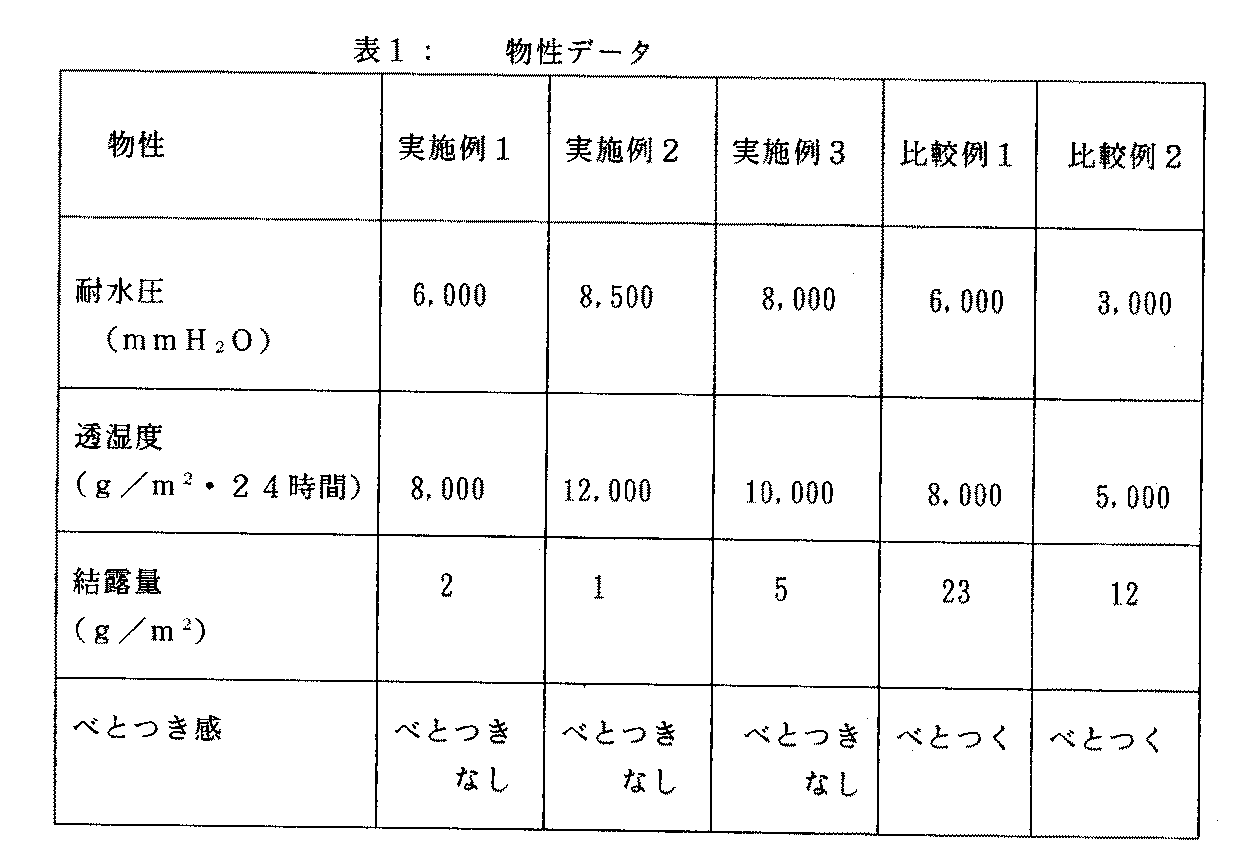
【0043】
また、上記の実施例および比較例からすると、使用するポリウレタン樹脂の混合比率が親水性樹脂70重量%の時(実施例1)耐水圧、透湿性が限界に近く、また、親水性樹脂30重量%の時(実施例3)では結露性が限界に近くなっていることが認められる。
【0044】
【発明の効果】
本発明は、雨や海水などを通さず、しかも蒸れず、結露によるべとつき感がないという非常に快適な衣料用素非材として優れた有用性を発揮する透湿防水加工布を提供できた。[0001]
BACKGROUND OF THE INVENTION
The present invention relates to a waterproof cloth having high moisture permeability, low dew condensation, and high water pressure, which is preferably used for sports clothing, and a method for producing the same.
[0002]
[Prior art]
Conventional moisture-permeable and waterproof fabrics are manufactured by coating a fabric with a polyurethane solution in which a polyurethane resin is dissolved in a water-soluble solvent, which is wet-gelled, and the solvent is replaced by water. The porous polyurethane film formed on the fabric does not allow rain or other water to pass through, but allows moisture (water vapor) to pass through. Such a moisture-permeable waterproof fabric is described in, for example, Japanese Patent Application Laid-Open No. 60-47954. However, with conventional porous polyurethane coatings, condensation once occurs on the membrane surface and inside the porous membrane, and when the physical passage is blocked, the movement of water vapor is extremely reduced, and the condensation is further promoted, so that comfort is increased. There was a problem of very low.
[0003]
Japanese Patent Application Laid-Open No. 4-202857 proposes a method of using a moisture-permeable polyurethane resin as a polyurethane resin for obtaining a moisture-permeable waterproof fabric. Although the moisture-permeable waterproof fabric obtained by this method can absorb sweat water droplets, once it absorbs moisture, it does not readily release moisture, and has a drawback that the surface is sticky. Therefore, in the invention described in JP-A-4-202857, a powder of natural fibers such as rayon or silk that does not dissolve in water and does not swell abnormally even if it absorbs moisture is used to improve such drawbacks. It has been proposed that the surface of the work cloth is not sticky even if it absorbs moderate moisture by being contained in the wet polyurethane resin.
[0004]
However, such a moisture-permeable waterproof fabric can cause various problems on the resin-coated surface of the processed fabric even if finely pulverized and mixed with natural fiber powder. It has the disadvantage that it must not.
[0005]
[Problems to be solved by the invention]
The present invention is intended to solve the above-described problems and to provide a novel moisture-permeable waterproof fabric and a method for producing the same that have both high moisture permeability and high water pressure resistance and low condensation.
[0006]
[Means for Solving the Problems]
According to the study by the present inventors, it has been found that the object of the present invention can be achieved by the following.
[0007]
[1] It has a microporous membrane layer mainly composed of a polyurethane resin composition containing a hydrophilic polyurethane resin and a non-hydrophilic polyurethane resin on at least one side of the fabric, has a water pressure resistance of 3000 to 40000 mmH 2 O, and has a moisture permeability. It is 6000-12000 g / m < 2 > * 24 hours, and the amount of dew condensation is 10 g / m < 2 > or less, The waterproofing fabric characterized by the above-mentioned.
[0008]
[2] The waterproof fabric according to [1], wherein the condensation amount is 4 g / m 2 or less.
[0009]
[3] waterproof fabric of the above-mentioned [1] or [2] for 20 to 60 mol% of the polyol component of the hydrophilic polyurethane resin is characterized in that at one or Re Sukunakutomoizu of polyethylene glycol and polypropylene glycol.
[0010]
[4] The waterproof fabric according to any one of [1] to [3], wherein the thickness of the microporous membrane layer is 15 to 150 μm.
[0011]
[5] The waterproof fabric according to any one of [1] to [4], wherein the porosity of the microporous membrane layer is 10 to 75%.
[0013]
[ 6 ] The waterproof fabric according to any one of [1] to [5] above, wherein the mixing ratio of the hydrophilic polyurethane resin to the hydrophilic polyurethane resin is 1: 3 to 3: 1.
[0014]
[ 7 ] A method for producing a waterproof fabric, comprising forming a microporous membrane layer by applying a mixed solution of a hydrophilic polyurethane resin and a non-hydrophilic polyurethane resin to at least one surface of the fabric.
[0015]
[ 8 ] The above [ 7 ], wherein the mixing ratio of the hydrophilic polyurethane resin and the hydrophilic polyurethane resin in the mixed solution of the hydrophilic polyurethane resin and the non-hydrophilic polyurethane resin is 1: 3 to 3: 1. Manufacturing method for waterproof fabrics.
[0016]
That is, as a result of earnest research, the present inventors have formed a microporous membrane layer by applying a mixed solution of a hydrophilic polyurethane resin and a non-hydrophilic polyurethane resin to at least one surface of a fabric to form a microporous membrane layer. The fabric production method has a microporous membrane layer mainly composed of a polyurethane resin composition containing a hydrophilic polyurethane resin on at least one surface of the fabric, the water pressure resistance is 3000 to 40000 mmH 2 O, and the moisture permeability is 6000 to 12000 g. / M 2 · 24 hours, and a new and excellent waterproof fabric characterized by having a condensation amount of 10 g / m 2 or less was obtained.
[0017]
That is, an excellent hydrophilic polyurethane resin and moisture impermeable moisture permeability, thus by blending a film excellent in non-hydrophilic polyurethane resin, a porous film formed when brought into a wet gel Even if the wall itself has moisture permeability, even if the physical passage is blocked by the occurrence of condensation, a decrease in moisture permeability is small and a waterproof fabric with low condensation is obtained, and this has a high water pressure resistance, They found that the surface was less sticky.
[0018]
DETAILED DESCRIPTION OF THE INVENTION
Hereinafter, the present invention will be described in more detail.
In the present invention, the waterproof pressure of the waterproof fabric needs to be 3000 to 40000 mmH 2 O. If it is less than 3000 mmH 2 O, the waterproof property is insufficient, and if it exceeds 40000 mmH 2 O, the water pressure resistance is too high, and the moisture permeability of the vinegar is impaired. In the present invention, the moisture permeability of the waterproof fabric is required to be 6000 to 12000 g / m 2 · 24 hours. In this range, the moisture permeability of the waterproof fabric is excellent as a clothing material. Furthermore, in the present invention, the amount of condensation needs to be 10 g / m 2 or less. If this value is exceeded, the waterproof fabric becomes sticky on the surface, which is not preferable. In the present invention, the amount of condensation is preferably 4 g / m 2 or less.
[0019]
In the present invention, in order to achieve the above-mentioned high water pressure resistance, moisture permeability and low dew condensation, the thickness of the microporous membrane layer is preferably 15 to 150 μm, and the porosity of the microporous membrane layer Is preferably 10 to 75%.
[0020]
In the present invention, the water pressure resistance is measured according to JIS standard L-1092, and the moisture permeability is measured according to JIS standard L-1099 (A-1). Moreover, the measurement of the amount of dew condensation is as follows. In other words, 500 cc of hot water at 40 ° C. was put in a 500 cc beaker, and the coating surface of the test cloth was placed on the bottom, and left in a constant temperature bath at a temperature of 10 ° C. and a humidity of 60% RH, and then adhered to the coating part. That is, the amount of condensed water droplets was measured by weight.
[0021]
The hydrophilic polyurethane resin used in the present invention is preferably a polyurethane resin having a moisture permeability of 3,000 to 6,000 g / m 2 · 24 hours when a dry nonporous film having a thickness of 12 μm is used.
The reason why the moisture permeability is preferably 3,000 g / m 2 · 24 hours or more is that it provides sufficient moisture permeability and low dew condensation to the fabric. Further, the reason why the moisture permeability is preferably 6,000 g / m 2 · 24 hours or less is that if it exceeds this, it becomes difficult to obtain a high water pressure resistance.
[0022]
The non-hydrophilic polyurethane resin used in the present invention is preferably a polyurethane resin having a moisture permeability of 0 to 1000 g / m 2 · 24 hours when a dry nonporous membrane having a thickness of 12 μm is used. The moisture permeability exceeds 1000g / m 2 · 24 hours hardly improves the desired film properties resulting et al is, because eventually becomes difficult to give the desired moisture-permeable waterproof cloth.
[0023]
In this invention, it is preferable that the mixing ratio of those hydrophilic polyurethane resins and those non- hydrophilic polyurethane resins is 1: 3 to 3: 1. If this mixing ratio is less than 1: 3, the effect of achieving low dew condensation tends to be insufficient, and if it exceeds 3: 1, there is a tendency that the surface of the moisture-permeable and waterproof cloth is sticky.
[0024]
In the present invention, in order to form the microporous membrane layer on at least one surface of the fabric, a method of applying a mixed liquid of a hydrophilic polyurethane resin and a non- hydrophilic polyurethane resin is preferable.
[0025]
As such a hydrophilic polyurethane resin, a polyurethane resin in which 20 to 60 mol% of the polyol component is polyethylene glycol and / or polypropylene glycol is preferably used. Particularly preferred is a polyurethane resin in which 20 to 60 mol% of the polyol component is polyethylene glycol. In this case, although there is no restriction | limiting in particular as another polyol component, For example, polyester glycol, polycarbonate glycol, and other polyether glycol are used. As the polyisocyanate component constituting the hydrophilic polyurethane resin of the present invention, known aliphatic and aromatic polyisocyanates can be used. For example, hexamethylene diisocyanate, toluene diisocyanate, xylene diisocyanate, isophorone diisocyanate, and 4,4′- Diphenylmethane diisocyanate is mentioned.
[0026]
In the present invention, as the non-hydrophilic polyurethane resin, a polyurethane resin whose polyisocyanate component is 4,4′-diphenylmethane diisocyanate (hereinafter abbreviated as MDI) is preferably used.
[0027]
In the present invention, a polyurethane resin is dissolved in a polar organic solvent to prepare a polyurethane resin solution, and this is coated on a fabric. Examples of such polar organic solvents include dimethylformamide, dimethylacetamide, dimethyl sulfoxide, N-methylpyrrolidone, and hexamethylenephosphonamide. Of course, an auxiliary agent such as a fluorine-based water repellent or a crosslinking agent may be added to the polyurethane resin solution.
[0028]
In the present invention, various synthetic fiber plain fabrics (taffeta), twill fabrics, knitted fabrics, various fabrics of natural fibers and semi-synthetic fibers, nonwoven fabrics, and the like can be used. In order to prevent permeation of the fabric, it is desirable to perform a treatment with a water repellent in advance. Coating amount of the fabric of the polyurethane resin solution is preferably in the range of 50 to 500 g / m 2 by a wet, to difficult to obtain a water pressure resistance too thin polyurethane porous film is less than 50 g / m 2, whereas, 500 g If it exceeds / m 2 , no more than a predetermined improvement can be expected, and the moisture permeability tends to be adversely affected.
[0029]
In the present invention, various coating methods such as knife coating, knife over roll coating, and reverse roll coating can be used as the coating method. After the polyurethane resin solution is coated on the cloth, the polyurethane resin is gelled by immersing it in a coagulation liquid mainly composed of water and removing the polar organic solvent in water. So-called wet gelation is performed. As the coagulation liquid, water alone may be used, but the same polar organic solvent used in the polyurethane resin solution may be dissolved in advance in 40% or less in order to control the coagulation speed. . When wet gelation is completed, the fabric is washed and dried according to a conventional method to obtain a waterproof fabric.
[0030]
The waterproof fabric according to the present invention thus obtained has a high water pressure resistance of 3,000 mmH 2 O or higher, a moisture permeability of 6,000 g / m 2 · 24 hours or more, and dew condensation. It has a low dew condensation amount of 10 g / m 2 or less. The condensation amount is preferably 4 g / m 2 or less.
[0031]
【Example】
EXAMPLES Next, although an Example demonstrates this invention further in detail, this invention is not limited to these.
[0032]
[Example 1]
A nylon taffeta composed of a 70 denier nylon filament yarn was subjected to a water repellent treatment with a fluorine-based water repellent. That is, the taffeta was immersed in an aqueous dispersion containing 3% by weight of the water repellent Asahi Guard AG710 (manufactured by Meisei Chemical Co., Ltd.), picked up to a drawing ratio of 40%, and dried at 130 ° C. for 30 seconds with a heat setter. Thermal heat treatment was applied.
[0033]
The hydrophilic polyurethane resin solution was prepared as follows. Mol words, Poritetoramechire glycol and mean polyethylene glycol of molecular weight 2000 with an average molecular weight of 2,000 as the polyol, and the average of polypropylene glycol having a molecular weight of 2000 dissolved under stirring in 50 ° C. in dimethylformamide (hereinafter DMF), an MDI as diisocyanate The ratio was 0.2 / 0.15 / 0.15 / 3.0, and the mixture was stirred for about 1 hour to obtain a prepolymer. Next, ethylene glycol was added dropwise as a chain extender at a molar ratio of 2.5 to cause a polymerization reaction, which was appropriately diluted with DMF to obtain a 30% by weight polyurethane resin solution. The polyurethane resin thus obtained was a polyurethane resin having a dry nonporous membrane having a thickness of 12 μm and a moisture permeability of 5,800 g / m 2 · 24 hours.
[0034]
In 70 parts by weight of this hydrophilic polyurethane resin, a non-hydrophilic polyurethane resin having a moisture permeability of 500 g / m 2 · 24 hours, that is, a 12 μm-thick dry non-porous film, that is, Crisbon 8166 (manufactured by Dainippon Ink & Chemicals, Inc.) 5 1 part by weight, 50 parts by weight of DMF, 5 parts by weight of a water repellent Asahi Guard AG650 (manufactured by Meisei Chemical Co., Ltd.), and 1 part by weight of a blocked isocyanate-based crosslinking agent Barnock D-500 (manufactured by Dainippon Ink & Chemicals, Inc.) And mixed. This resin solution was coated on the nylon taffeta obtained above at a rate of 150 g / m 2 and immersed in a bath containing an aqueous solution containing 10% by weight of DMF for 3 minutes at 30 ° C. to apply polyurethane. The liquid was wet-gelled, then washed with 80 ° C. hot water for 10 minutes, dried with hot air at 110 ° C., and then subjected to heat treatment at 160 ° C. for 3 minutes. About the obtained fabric, the water pressure resistance, the water vapor transmission rate, and the amount of dew condensation were measured. The results are shown in Table 1.
[0035]
In Table 1, each data measurement method is as follows.
[0036]
Water pressure resistance: Moisture permeability according to JIS standard L-1092: Condensation amount according to JIS standard L-1099 (A-1): Put 500 cc of hot water at 40 ° C. into a 500 cc beaker and cover the test cloth with the coating surface facing down. After being left in a constant temperature bath at a temperature of 10 ° C. and a humidity of 60% RH for 1 hour, the amount of water droplets adhering to the coating portion, that is, dew condensation was measured by weight.
[0037]
Stickiness: After measuring the amount of condensation, the resin surface was touched and evaluated.
[0038]
[Example 2]
50 parts by weight of the hydrophilic polyurethane resin obtained in Example 1, 50 parts by weight of the same non-hydrophilic polyurethane resin Crisbon 8166 as in Example 1, 50 parts by weight of DMF, Asahi Guard AG650 (manufactured by Meisei Chemical Co., Ltd.) 5 parts by weight and 1 part by weight of blocked isocyanate-based crosslinking agent Barnock D-500 (manufactured by Dainippon Ink & Chemicals, Inc.) were added and mixed. This resin solution was coated on the nylon taffeta used in Example 1 at a rate of 150 g / m 2 , and immersed in a bath containing an aqueous solution containing 10% by weight of DMF at 30 ° C. for 3 minutes at 30 ° C. as a polyurethane. The coating solution was wet-gelled, then washed with 80 ° C. hot water for 10 minutes, dried with hot air at 110 ° C., and then subjected to heat treatment at 160 ° C. for 3 minutes. About the obtained fabric, the water pressure resistance, the water vapor transmission rate, and the amount of dew condensation were measured. The results are shown in Table 1.
[0039]
[Example 3]
30 parts by weight of the hydrophilic polyurethane resin obtained in Example 1, 70 parts by weight of the same non-hydrophilic polyurethane resin Crisbon 8166 as in Example 1, 50 parts by weight of DMF, and water repellent Asahi Guard AG650 (manufactured by Meisei Chemical Co., Ltd.) 5 parts by weight and 1 part by weight of blocked isocyanate-based crosslinking agent Barnock D-500 (manufactured by Dainippon Ink & Chemicals, Inc.) were added and mixed. This resin solution was coated on the nylon taffeta used in Example 1 at a rate of 150 g / m 2 , and immersed in a bath containing an aqueous solution containing 10% by weight of DMF at 30 ° C. for 3 minutes at 30 ° C. as a polyurethane. The coating solution was wet-gelled, then washed with 80 ° C. hot water for 10 minutes, dried with hot air at 110 ° C., and then subjected to heat treatment at 160 ° C. for 3 minutes. About the obtained fabric, the water pressure resistance, the water vapor transmission rate, and the amount of dew condensation were measured. The results are shown in Table 1.
[0040]
[Comparative Example 1]
Conventional polyurethane resin Crisbon 8166 (Dainippon Ink Chemical Co., Ltd.) 100 parts by weight, DMF 50 parts by weight, water repellent Asahi Guard AG650 (manufactured by Meisei Chemical Co., Ltd.) 5 parts by weight, blocked isocyanate crosslinking agent Barnock D -500 (Dainippon Ink Chemical Co., Ltd.) 1 part by weight was mixed and mixed resin was coated on the nylon taffeta used in Example 1 at a rate of 150 g / m 2 and contained 10% by weight of DMF. A polyurethane coating solution is wet-gelled by immersing in an aqueous solution as a coagulating solution at 30 ° C. for 3 minutes, then washed with hot water at 80 ° C. for 10 minutes, dried with hot air at 140 ° C., and then at 160 ° C. Heat treatment was performed for 3 minutes. About the obtained fabric, the water pressure resistance, the water vapor transmission rate, and the amount of dew condensation were measured. The results are shown in Table 1.
[0041]
[Comparative Example 2]
100 parts by weight of the hydrophilic polyurethane resin obtained in Example 1, 50 parts by weight of DMF, 5 parts by weight of water repellent Asahi Guard AG650 (manufactured by Meisei Chemical Co., Ltd.), blocked isocyanate-based crosslinking agent Bernock D-500 (Dainippon Ink) The resin solution mixed by adding 1 part by weight of Chemical Industries Co., Ltd. was coated on the nylon taffeta used in Example 1 at a rate of 150 g / m 2 , and an aqueous solution containing 10% by weight of DMF was used as the coagulation liquid. Soak the polyurethane coating solution in wet bath at 30 ° C for 3 minutes, then wet-gelate with 80 ° C hot water for 10 minutes, dry with hot air at 110 ° C, and heat-treat at 160 ° C for 3 minutes. I did it. About the obtained fabric, the water pressure resistance, the water vapor transmission rate, and the amount of dew condensation were measured. The results are shown in Table 1.
[0042]
[Table 1]
[0043]
Further, according to the above examples and comparative examples, when the mixing ratio of the polyurethane resin used is 70% by weight of the hydrophilic resin (Example 1), the water pressure resistance and moisture permeability are close to the limit, and the hydrophilic resin is 30% by weight. % (Example 3), it is recognized that the dew condensation is close to the limit.
[0044]
【The invention's effect】
INDUSTRIAL APPLICABILITY The present invention has been able to provide a moisture-permeable waterproof fabric that exhibits excellent utility as a very comfortable non-material for clothing that does not pass rain, seawater, etc., does not stuffy, and does not feel sticky due to condensation.
Claims (8)
Priority Applications (1)
| Application Number | Priority Date | Filing Date | Title |
|---|---|---|---|
| JP5083696A JP3746830B2 (en) | 1996-02-14 | 1996-02-14 | Waterproof fabric and method for producing the same |
Applications Claiming Priority (1)
| Application Number | Priority Date | Filing Date | Title |
|---|---|---|---|
| JP5083696A JP3746830B2 (en) | 1996-02-14 | 1996-02-14 | Waterproof fabric and method for producing the same |
Publications (2)
| Publication Number | Publication Date |
|---|---|
| JPH09228253A JPH09228253A (en) | 1997-09-02 |
| JP3746830B2 true JP3746830B2 (en) | 2006-02-15 |
Family
ID=12869840
Family Applications (1)
| Application Number | Title | Priority Date | Filing Date |
|---|---|---|---|
| JP5083696A Expired - Lifetime JP3746830B2 (en) | 1996-02-14 | 1996-02-14 | Waterproof fabric and method for producing the same |
Country Status (1)
| Country | Link |
|---|---|
| JP (1) | JP3746830B2 (en) |
Cited By (1)
| Publication number | Priority date | Publication date | Assignee | Title |
|---|---|---|---|---|
| CN103710988A (en) * | 2013-12-23 | 2014-04-09 | 昆山华阳复合材料科技有限公司 | Marten-simulated thin film fabric with functions of wind resistance, heat preservation and ventilation |
Families Citing this family (3)
| Publication number | Priority date | Publication date | Assignee | Title |
|---|---|---|---|---|
| JP2002155472A (en) * | 2000-11-16 | 2002-05-31 | Toray Ind Inc | Moisture permeable waterproof insulation material |
| JP5797184B2 (en) * | 2012-09-13 | 2015-10-21 | テックワン株式会社 | Waterproof and moisture-permeable composite membrane and waterproof and moisture-permeable fabric having waterproof and moisture-permeable composite membrane |
| US20240076491A1 (en) * | 2022-08-16 | 2024-03-07 | Nano And Advanced Materials Institute Limited | Non-porous, breathable and waterproof transparent elastomer film and method for manufacturing the same |
-
1996
- 1996-02-14 JP JP5083696A patent/JP3746830B2/en not_active Expired - Lifetime
Cited By (1)
| Publication number | Priority date | Publication date | Assignee | Title |
|---|---|---|---|---|
| CN103710988A (en) * | 2013-12-23 | 2014-04-09 | 昆山华阳复合材料科技有限公司 | Marten-simulated thin film fabric with functions of wind resistance, heat preservation and ventilation |
Also Published As
| Publication number | Publication date |
|---|---|
| JPH09228253A (en) | 1997-09-02 |
Similar Documents
| Publication | Publication Date | Title |
|---|---|---|
| JP4022000B2 (en) | Moisture permeable waterproof fabric and method for producing the same | |
| US4560611A (en) | Moisture-permeable waterproof coated fabric | |
| JPWO2010140201A1 (en) | Moisture permeable waterproof fabric and method for producing the same | |
| JP4176259B2 (en) | Breathable waterproof fabric | |
| JPS6047954B2 (en) | Coating fabric and its manufacturing method | |
| TWI471346B (en) | Method for producing porous form, and laminated body and leather-like sheet | |
| WO2007086128A1 (en) | Polyurethane resin composition for durable moisture-permeable waterproof sheet, moisture-permeable waterproof sheet, and process for producing the same | |
| JPH11124774A (en) | Moisture-permeable waterproof fabric and method for producing the same | |
| JPH06136320A (en) | Production of moisture-permeable waterproof coated molding | |
| JPH09228253A (en) | Waterproof fabric and method for manufacturing the same | |
| JPH0754277A (en) | Production of moisture-permeable water-proofing coated cloth | |
| JP2615288B2 (en) | Moisture permeable waterproof coating fabric | |
| JP5350316B2 (en) | Durable polyurethane resin composition for moisture permeable waterproof sheet, moisture permeable waterproof sheet and method for producing the same | |
| KR100795386B1 (en) | Hydrophilic air-permeable waterproof gun | |
| JPS6317151B2 (en) | ||
| JPH06316871A (en) | Moisture-permeable water-proofing cloth and its production | |
| JPH06108365A (en) | Moisture-permeable water-proofing coating cloth and its production | |
| JPH0413469B2 (en) | ||
| JP2006160918A (en) | Polyurethane resin composition and moisture-permeable water-proof sheet | |
| KR960004914B1 (en) | Breathable waterproof fabric and manufacturing method thereof | |
| JPH06272168A (en) | Moisture-permeable and waterproof-coated fabric | |
| JP4328552B2 (en) | Anti-static moisture permeable waterproof fabric | |
| JP2002129479A (en) | Method for producing moisture-permeating waterproof coated cloth having soft feeling | |
| JPH07166479A (en) | Production of cloth having moisture-permeable water-proof coating | |
| JP4999367B2 (en) | Waterproof sheet and manufacturing method thereof |
Legal Events
| Date | Code | Title | Description |
|---|---|---|---|
| A977 | Report on retrieval |
Free format text: JAPANESE INTERMEDIATE CODE: A971007 Effective date: 20040116 |
|
| A131 | Notification of reasons for refusal |
Free format text: JAPANESE INTERMEDIATE CODE: A131 Effective date: 20040203 |
|
| A131 | Notification of reasons for refusal |
Free format text: JAPANESE INTERMEDIATE CODE: A131 Effective date: 20050517 |
|
| A521 | Written amendment |
Free format text: JAPANESE INTERMEDIATE CODE: A523 Effective date: 20050713 |
|
| TRDD | Decision of grant or rejection written | ||
| A01 | Written decision to grant a patent or to grant a registration (utility model) |
Free format text: JAPANESE INTERMEDIATE CODE: A01 Effective date: 20051122 |
|
| A61 | First payment of annual fees (during grant procedure) |
Free format text: JAPANESE INTERMEDIATE CODE: A61 Effective date: 20051125 |
|
| R150 | Certificate of patent (=grant) or registration of utility model |
Free format text: JAPANESE INTERMEDIATE CODE: R150 |
|
| FPAY | Renewal fee payment (prs date is renewal date of database) |
Free format text: PAYMENT UNTIL: 20091202 Year of fee payment: 4 |
|
| FPAY | Renewal fee payment (prs date is renewal date of database) |
Free format text: PAYMENT UNTIL: 20091202 Year of fee payment: 4 |
|
| FPAY | Renewal fee payment (prs date is renewal date of database) |
Free format text: PAYMENT UNTIL: 20101202 Year of fee payment: 5 |
|
| FPAY | Renewal fee payment (prs date is renewal date of database) |
Free format text: PAYMENT UNTIL: 20101202 Year of fee payment: 5 |
|
| FPAY | Renewal fee payment (prs date is renewal date of database) |
Free format text: PAYMENT UNTIL: 20111202 Year of fee payment: 6 |
|
| FPAY | Renewal fee payment (prs date is renewal date of database) |
Free format text: PAYMENT UNTIL: 20121202 Year of fee payment: 7 |
|
| FPAY | Renewal fee payment (prs date is renewal date of database) |
Free format text: PAYMENT UNTIL: 20131202 Year of fee payment: 8 |
|
| R250 | Receipt of annual fees |
Free format text: JAPANESE INTERMEDIATE CODE: R250 |
|
| R250 | Receipt of annual fees |
Free format text: JAPANESE INTERMEDIATE CODE: R250 |
|
| EXPY | Cancellation because of completion of term |