JP3774559B2 - Curable composition - Google Patents
Curable composition Download PDFInfo
- Publication number
- JP3774559B2 JP3774559B2 JP01868598A JP1868598A JP3774559B2 JP 3774559 B2 JP3774559 B2 JP 3774559B2 JP 01868598 A JP01868598 A JP 01868598A JP 1868598 A JP1868598 A JP 1868598A JP 3774559 B2 JP3774559 B2 JP 3774559B2
- Authority
- JP
- Japan
- Prior art keywords
- group
- polymer
- water
- curable composition
- component
- Prior art date
- Legal status (The legal status is an assumption and is not a legal conclusion. Google has not performed a legal analysis and makes no representation as to the accuracy of the status listed.)
- Expired - Fee Related
Links
Landscapes
- Compositions Of Macromolecular Compounds (AREA)
Description
【0001】
【発明の属する技術分野】
本発明は、ケイ素原子に結合した水酸基または加水分解性基を有し、シロキサン結合を形成することにより架橋しうるケイ素含有基(以下、「反応性ケイ素基」という。)を有する重合体を含有する2液あるいは3液以上の硬化性組成物、および、硬化剤成分の貯蔵安定性改善方法に関する。
【0002】
【従来の技術】
分子中に少なくとも1個の反応性ケイ素基を含有する重合体は、室温においても湿分等により反応性ケイ素基の加水分解反応等を伴うシロキサン結合の形成によって架橋し、ゴム状硬化物が得られるという興味深い性質を有することが知られている。この特性を活かして、反応性ケイ素基を有する重合体は、建築用シーリング材や複層ガラス用シーリング材、工業用シーリング材などのベースポリマーとして広く用いられている。シーリング材は壁材等の建築材料の隙間(目地)等に充填施工して、硬化させ隙間をふさいで水密、気密を保つために用いられるものである。
【0003】
ところが、この反応性ケイ素基を含有する重合体を含有するシーリング材を空気中の水分で硬化させる場合、表面では硬化が進行するものの内部まで硬化するのに長期間を要するという問題があった。このような重合体のなかでポリイソブチレン系重合体などの飽和炭化水素系重合体は優れた耐候性、耐熱性、および、耐久性を有する反面、湿気遮断性が大きいという特徴を有するため、空気中の水分で硬化する場合、深部の硬化が不十分であるという問題があった。
【0004】
この硬化性組成物が常温で内部まで速やかに硬化するように、この硬化性組成物に水分源をあらかじめ添加することが考えられる。
ところで、硬化性組成物は大きく1液型硬化性組成物と2液型硬化性組成物に分けることができる。1液型硬化性組成物は各種添加物をすべて配合した1成分の液状物からなり、2液型硬化性組成物は、反応性珪素基を有する重合体を含有する主剤と、シラノール縮合触媒を含有する硬化剤からなる2成分型である。
【0005】
前記課題を解決するために、この2液型硬化性組成物の主剤側に水分源を添加する方法が考えられるが、主剤側に水分源を添加すると該重合体の貯蔵安定性が悪化するという問題がある。また、硬化性組成物の主剤中には接着性付与剤としてシランカップリング剤が添加されることが多いが、シランカップリング剤は水分と反応しやすいため、主剤側に水分源を添加すると貯蔵後に接着性が悪化するという問題がある。そのため、硬化剤側に水分源を添加することが望ましい。
【0006】
しかしながら、チタン化合物やスズ化合物などのシラノール縮合触媒は水分があると分解するものが多いため、硬化剤側に水分源を添加すると貯蔵後に硬化性が悪化するという問題がある。
【0007】
【発明が解決しようとする課題】
本発明は、反応性ケイ素基を有する重合体を含有する主剤と、シラノール縮合触媒と水を含有する硬化剤からなる多液型硬化性組成物の深部硬化性を改善するとともに、該硬化剤の貯蔵安定性を改善することを目的とする。
【0008】
【課題を解決する為の手段】
本発明者等は、このような問題を解決するために鋭意検討した結果、この多液型の硬化性組成物の硬化剤側に特定の化合物を添加することによって、この組成物に硬化物物性・硬化性・深部硬化性・接着性の低下などの悪影響を及ぼさないで、該硬化剤の貯蔵安定性を改善することができることを見い出すことにより前記問題を解決し、本発明を完成させた。
【0009】
すなわち、本発明は、(A)液:反応性ケイ素基を少なくとも1個有する重合体を含有する主剤、(B)液:(a)シラノール縮合触媒,(b)水または金属塩の水和物,および(c)非水溶性の可塑剤を含有する硬化剤、の少なくとも2液からなる2液型あるいは多液型の硬化性組成物に関するものであり、とくに、(A)液:反応性ケイ素基を少なくとも1個有するイソブチレン系重合体を含有する主剤、(B)液:(a)4価の錫化合物,(b)水または金属塩の水和物,および(c)飽和炭化水素系オリゴマーを含有する硬化剤、の少なくとも2液からなる2液型あるいは多液型の硬化性組成物に関する。
【0010】
【発明の実施の形態】
以下、本発明について詳細に説明する。
本発明における反応性ケイ素基を有する重合体としては、ポリイソブチレン、水素添加ポリブタジエン、水素添加ポリイソプレンなどの飽和炭化水素系重合体から誘導される反応性ケイ素基含有飽和炭化水素系重合体があげられる。また、主鎖骨格としてポリエーテル、ポリエステルおよびポリカーボネートから選ばれる重合体から誘導される反応性ケイ素基含有有機重合体や、ブチル(メタ)アクリレートなどの(メタ)アクリレート系単量体、テトラフルオロエチレン,クロロトリフルオロエチレン,パーフルオロメチルビニルエーテルなどのフッ素含有ビニル系単量体、スチレンなどの芳香族炭化水素系ビニル単量体、(メタ)アクリル酸およびその塩、ビニルアルキルエーテル類、ブタジエン,クロロプレンなどのジエン類、エチレン,プロピレン,イソブチレンなどのその他ビニル系単量体などの重合性モノマーと反応性シリル基含有重合性モノマーを共重合して得られる反応性シリル基含有ビニル系重合体があげられる。さらに、下記一般式(2):
HO−[Si(R3)2O]n−H (2)
(式中、R3は、それぞれ独立に、炭素数1〜20の置換あるいは非置換の1価炭化水素基であり、nは正の整数である。)で表されるジオルガノポリシロキサンがあげられる。
【0011】
上記例示の重合体のうち、反応性ケイ素基を有する飽和炭化水素系重合体は、湿気遮断性が大きいという特徴を有するため、本発明の硬化剤の深部硬化性改善効果が特に顕著になるためより好ましい。
前記反応性ケイ素基を有する飽和炭化水素系重合体は、芳香環以外の炭素ー炭素不飽和結合を実質的に含有しない重合体であり、たとえば、ポリエチレン、ポリプロピレン、ポリイソブチレン、水素添加ポリブタジエン、水素添加ポリイソプレンなどがあげられる。
【0012】
反応性ケイ素基としては、一般式(1)、
【0013】
【化2】
(式中、R1およびR2は、それぞれ独立に、炭素数1〜20のアルキル基、炭素数6〜20のアリール基、炭素数7〜20のアラルキル基または(R’)3SiO−(R’、それぞれ独立に、は水素原子または炭素数1〜20の置換あるいは非置換の炭化水素基である)で示されるトリオルガノシロキシ基である。また、Xは、それぞれ独立に、水酸基または加水分解性基である。さらに、aは0、1、2、3のいずれかであり、bは0、1、2のいずれかであり、aとbとが同時に0になることはない。また、mは0または1〜19の整数である)で表される基があげられる。
【0015】
加水分解性基としては、たとえば、水素原子、アルコキシ基、アシルオキシ基、ケトキシメート基、アミノ基、アミド基、アミノオキシ基、メルカプト基、アルケニルオキシ基などの一般に使用されている基があげられる。
これらのうちでは、アルコキシ基、アミド基、アミノオキシ基が好ましいが、加水分解性がマイルドで取り扱い易いという点から、アルコキシ基がとくに好ましい。
【0016】
加水分解性基や水酸基は、1個のケイ素原子に1〜3個の範囲で結合することができ、(a+Σb)は1〜5個の範囲が好ましい。加水分解性基や水酸基が反応性ケイ素基中に2個以上結合する場合には、それらは同じであってもよいし、異なってもよい。
反応性ケイ素基を形成するケイ素原子は1個以上であるが、シロキサン結合などにより連結されたケイ素原子の場合には、20個以下であることが好ましい。
【0017】
とくに、一般式(3)
【0018】
【化3】
(式中、R2、X、aは前記と同じ)で表される反応性ケイ素基が、原料の入手が容易であるので好ましい。
飽和炭化水素系重合体1分子中の反応性ケイ素基は1個以上であり、1.1〜5個あることが好ましい。分子中に含まれる反応性ケイ素基の数が1個未満になると、硬化性が不充分になり、良好なゴム弾性が得られなくなることがある。
【0020】
反応性ケイ素基は、飽和炭化水素系重合体分子鎖の末端あるいは内部にあってもよいし、また、両方にあってもよい。とくに、反応性ケイ素基が分子末端にあるときは、最終的に形成される硬化物に含まれる飽和炭化水素系重合体成分の有効網目鎖量が多くなるため、高強度で高伸びのゴム状硬化物が得られやすくなるなどの点から好ましい。
【0021】
また、これら反応性ケイ素基を有する飽和炭化水素系重合体は単独あるいは2種以上併用することができる。
本発明に用いる反応性ケイ素基を有する飽和炭化水素系重合体の骨格をなす重合体は、(1)エチレン、プロピレン、1ーブテン、イソブチレンなどのような炭素数1〜6のオレフィン系化合物を主モノマーとして重合させるか、(2)ブタジエン、イソプレンなどのようなジエン系化合物を単独重合させ、あるいは、上記オレフィン系化合物とを共重合させた後、水素添加するなどの方法により得ることができるが、イソブチレン系重合体や水添ポリブタジエン系重合体は、末端に官能基を導入しやすく、分子量を制御しやすく、また、末端官能基の数を多くすることができるので好ましい。
【0022】
イソブチレン系重合体は、単量体単位のすべてがイソブチレン単位から形成されていてもよいし、イソブチレンと共重合体を有する単量体単位をイソブチレン系重合体中の好ましくは50%以下(重量%、以下同じ)、さらに好ましくは30%以下、とくに好ましくは10%以下の範囲で含有してもよい。
このような単量体成分としては、たとえば、炭素数4〜12のオレフィン、ビニルエーテル、芳香族ビニル化合物、ビニルシラン類、アリルシラン類などがあげられる。このような共重合体成分としては、たとえば1ーブテン、2ーブテン、2ーメチルー1ーブテン、3ーメチルー1ーブテン、ペンテン、4ーメチルー1ーペンテン、ヘキセン、ビニルシクロヘキセン、メチルビニルエーテル、エチルビニルエーテル、イソブチルビニルエーテル、スチレン、αーメチルスチレン、ジメチルスチレン、モノクロロスチレン、ジクロロスチレン、βーピネン、インデン、ビニルトリクロロシラン、ビニルメチルジクロロシラン、ビニルジメチルクロロシラン、ビニルジメチルメトキシシラン、ビニルトリメチルシラン、ジビニルジクロロシラン、ジビニルジメトキシシラン、ジビニルジメチルシラン、1,3−ジビニルー1,1,3,3−テトラメチルジシロキサン、トリビニルメチルシラン、テトラビニルシラン、アリルトリクロロシラン、アリルメチルジクロロシラン、アリルジメチルクロロシラン、アリルジメチルメトキシシラン、アリルトリメチルシラン、ジアリルジクロロシラン、ジアリルジメトキシシラン、ジアリルジメチルシラン、γーメタクリロイルオキシプロピルトリメトキシシラン、γーメタクリロイルオキシプロピルメチルジメトキシシランなどがあげられる。
【0023】
また、イソブチレンと共重合性を有する単量体として、ビニルシラン類やアリルシラン類を使用すると、ケイ素含有量が増加しシランカップリング剤として作用しうる基が多くなることがあり、得られる組成物の接着性が向上する。
水添ポリブタジエン系重合体や他の飽和炭化水素系重合体においても、上記イソブチレン系重合体のばあいと同様に、主成分となる単量体単位の他に他の単量体単位を含有させてもよい。
【0024】
また、本発明に用いる反応性ケイ素基を有する飽和炭化水素系重合体には、本発明の目的が達成される範囲で、ブタジエン、イソプレンなどのポリエン化合物のような重合後二重結合の残るような単量体単位を少量、好ましくは10%以下、さらには5%以下、とくには1%以下の範囲で含有させてもよい。
飽和炭化水素系重合体、好ましくはイソブチレン系重合体または水添ポリブタジエン系重合体の数平均分子量は500〜50,000程度であるのが好ましく、とくに1,000〜20,000程度の液状ないし流動性を有するものが取扱いやすいなどの点から好ましい。
【0025】
つぎに反応性ケイ素基を有する飽和炭化水素系重合体の製法について説明する。
反応性ケイ素基を有するイソブチレン系重合体のうち、分子鎖末端に反応性ケイ素基を有するイソブチレン系重合体は、イニファー法と呼ばれる重合法(イニファーと呼ばれる開始剤と連鎖移動剤を兼用する特定の化合物を用いるカチオン重合法)で得られた末端官能型、好ましくは、全末端官能型イソブチレン系重合体を用いて製造することができる。例えば、この重合体の脱ハロゲン化水素反応や特開昭63−105005号公報に記載されているような重合体への不飽和基導入反応等により末端に不飽和基を有するポリイソブチレンを得た後、一般式
【0026】
【化4】
(式中、R1、R2、X、aおよびbは前記と同じである。)
で表されるヒドロシラン化合物(この化合物は一般式(1)で表される基に水素原子が結合した化合物である。)、好ましくは、一般式
【0028】
【化5】
(式中、R2、Xおよびaは前記と同じである。)
で表されるヒドロシラン化合物を白金触媒を用いてヒドロシリル化反応と呼ばれる付加反応をさせることにより反応性ケイ素基を重合体に導入する方法があげられる。ヒドロシラン化合物としては、たとえば、トリクロロシラン、メチルジクロロシラン、ジメチルクロロシラン、フェニルジクロロシランのようなハロゲン化シラン類;トリメトキシシラン、トリエトキシシラン、メチルジエトキシシラン、メチルジメトキシシラン、フェニルジメトキシシランのようなアルコキシシラン類;メチルジアセトキシシラン、フェニルジアセトキシシランのようなアシロキシシラン類;ビス(ジメチルケトキシメート)メチルシラン、ビス(シクロヘキシルケトキシメート)メチルシランのようなケトキシメートシラン類などがあげられるが、これらに限定されるものではない。これらのうちではとくにハロゲン化シラン類、アルコキシシラン類が好ましい。
【0030】
このような製造法は、たとえば、特公平4−69659号、特公平7−108928号、特許公報第2512468号、特開昭64−22904号、特許公報第2539445号の各明細書などに記載されている。
また、分子鎖内部に反応性ケイ素基を有するイソブチレン系重合体は、イソブチレンを主体とするモノマー中に反応性ケイ素基を有するビニルシラン類やアリルシラン類を添加し、共重合せしめる等の方法により製造される。
【0031】
さらに、分子鎖末端に反応性ケイ素基を有するイソブチレン系重合体を製造するためには、例えば重合に際して、主成分であるイソブチレンモノマー以外に反応性ケイ素基を有するビニルシラン類やアリルシラン類などを共重合せしめたのち末端に反応性ケイ素基を導入することなどにより、末端および分子鎖内部に反応性ケイ素基を有するイソブチレン系重合体を製造することができる。
【0032】
反応性ケイ素基を有するビニルシラン類やアリルシラン類としては、たとえば、ビニルトリクロロシラン、ビニルメチルジクロロシラン、ビニルジメチルクロロシラン、ビニルジメチルメトキシシラン、ジビニルジクロロシラン、ジビニルジメトキシシラン、アリルトリクロロシラン、アリルメチルジクロロシラン、アリルジメチルクロロシラン、アリルジメチルメトキシシラン、ジアリルジクロロシラン、ジアリルジメトキシシラン、γーメタクリロイルオキシプロピルトリメトキシシラン、γーメタクリロイルオキシプロピルメチルジメトキシシランなどがあげられる。
【0033】
前記水添ポリブタジエン系重合体については、たとえば、まず、末端ヒドロキシ水添ポリブタジエン系重合体の水酸基を−ONaや−OKなどのオキシメタル基にした後、一般式(4):
CH2=CH−R3−Y (4)
(式中、Yは塩素原子、ヨウ素原子などのハロゲン原子、R3は−R4−、−R4−OCO−または−R4−CO−(R4は炭素数1〜20の2価の炭化水素基で、アルキレン基、シクロアルキレン基、アリーレン基、アラルキレン基が好ましい)で示される2価の有機基で、−CH2−、−R”−C6H5−CH2−(R”は炭素数1〜10の炭化水素基)より選ばれる2価の基がとくに好ましい)で示される有機ハロゲン化合物を反応させることにより、末端オレフィン基を有する水添ポリブタジエン系重合体(以下、末端オレフィン水添ポリブタジエン系重合体ともいう)を製造することができる。
【0034】
末端ヒドロキシ水添ポリブタジエン系重合体の末端水酸基をオキシメタル基にする方法としては、Na、Kのごときアルカリ金属;NaHのごとき金属水素化物;NaOCH3のごとき金属アルコキシド;NaOH、KOHなどのアルカリ水酸化物などと反応させる方法があげられる。
前記方法では、出発原料として使用した末端ヒドロキシ水添ポリブタジエン系重合体とほぼ同じ分子量をもつ末端オレフィン水添ポリブタジエン系重合体が得られるが、より高分子量の重合体を得たい場合には、一般式(4)の有機ハロゲン化合物を反応させる前に、塩化メチレン、ビス(クロロメチル)ベンゼン、ビス(クロロメチル)エーテルなどのごとき、1分子中にハロゲンを2個以上含む多価有機ハロゲン化合物と反応させれば分子量を増大させることができ、その後一般式(4)で示される有機ハロゲン化合物と反応させれば、より高分子量でかつ末端にオレフィン基を有する水添ポリブタジエン系重合体を得ることができる。
【0035】
前記一般式(4)で示される有機ハロゲン化合物の具体例としては、たとえばアリルクロライド、アリルブロマイド、ビニル(クロロメチル)ベンゼン、アリル(クロロメチル)ベンゼン、アリル(ブロモメチル)ベンゼン、アリル(クロロメチル)エーテル、アリル(クロロメトキシ)ベンゼン、1ーブテニル(クロロメチル)エーテル、1ーヘキセニル(クロロメトキシ)ベンゼン、アリルオキシ(クロロメチル)ベンゼンなどがあげられるが、それらに限定されるものではない。これらのうちではアリルクロライドが安価であり、しかも容易に反応するので好ましい。
【0036】
前記末端オレフィン水添ポリブタジエン系重合体への反応性ケイ素基の導入は、分子鎖末端に反応性ケイ素基を有するイソブチレン系重合体の場合と同様のヒドロシラン化合物を白金系触媒を用いて付加反応させることにより製造される。前記のように反応性ケイ素基を有する飽和炭化水素系重合体が、芳香環でない不飽和結合を分子中に実質的に含有しない場合には、不飽和結合を有する有機系重合体やオキシアルキレン系重合体のような従来のゴム系重合体よりなるシーリング剤などとくらべて、著しく耐候性がよくなる。また、該重合体は炭化水素系重合体であるので湿気遮断性や耐水性がよく、ガラス、アルミなどの各種無機質基材に対して優れた接着性能を有するとともに、湿気遮断性の高い硬化物を与える。
【0037】
本発明の硬化性組成物の主剤中の反応性ケイ素基を有する重合体の含有率は10%以上が好ましく、20%以上がより好ましく、30%以上がとくに好ましい。
本発明の硬化性組成物の硬化剤においては、(a)成分としては、後述する非水溶性の可塑剤〔(c)成分〕に可溶なシラノール縮合触媒を用いることができる。
【0038】
かかるシラノール縮合触媒としては、2価および4価のスズ系硬化触媒、チタン系硬化触媒、アルミニウム系硬化触媒、アミン系硬化触媒などが挙げられる。例えば、本発明において用いることが出来るチタン系触媒としては、以下のものを挙げることができる。
【0039】
【化6】
本発明で用いるシラノール縮合触媒としては、4価のスズ系硬化触媒が触媒活性が高いために好ましい。4価のスズ系硬化触媒の具体例としては、錫カルボン酸塩類、ジアルキル錫オキサイド類、および、一般式(5)、
QdSn(OZ)4-d、又は[Q2Sn(OZ)]2O (5)
(式中、Qは炭素数1〜20の1価の炭化水素基を、Zは炭素数1〜20の1価の炭化水素基又は自己内部にSnに対して配位結合を形成し得る官能性基を有する有機基を表す。さらに、dは0、1、2、3のいずれかである。)で示される化合物などが示される。また、ジアルキル錫オキサイドやジアルキル錫ジアセテート等の4価錫化合物と、テトラエトキシシランやメチルトリエトキシシランやジフェニルジメトキシシランやフェニルトリメトキシシランなどの加水分解性ケイ素基を有する低分子ケイ素化合物との反応物もまた、シラノール縮合反応を顕著に加速する硬化触媒として有効である。これらの中でも、一般式(5)で示される化合物、すなわち、ジブチル錫ビスアセチルアセトナートなどのキレート化合物や錫アルコラート類はシラノール縮合触媒としての活性が高く、硬化性組成物の硬化速度が速くなるのでより好ましい。
【0041】
前記錫カルボン酸塩類の具体例としては、例えば、ジブチル錫ジラウレート、ジブチル錫ジアセテート、ジブチル錫ジエチルヘキサノレート、ジブチル錫ジオクテート、ジブチル錫ジメチルマレート、ジブチル錫ジエチルマレート、ジブチル錫ジブチルマレート、ジブチル錫ジイソオクチルマレート、ジブチル錫ジトリデシルマレート、ジブチル錫ジベンジルマレート、ジブチル錫マレエート、ジオクチル錫ジアセテート、ジオクチル錫ジステアレート、ジオクチル錫ジラウレート、ジオクチル錫ジエチルマレート、ジオクチル錫ジイソオクチルマレート等が挙げられる。
【0042】
前記ジアルキル錫オキサイド類の具体例としては、ジブチル錫オキサイド、ジオクチル錫オキサイドや、ジブチル錫オキサイドとフタル酸エステルとの混合物等が挙げられる。
前記キレート化合物を具体的に例示すると、
【0043】
【化7】
等が挙げられるが、これらに限定されるものではない。これらの中では、ジブチル錫ビスアセチルアセトナートは、触媒活性が高く、低コストであり、入手が容易であるために最も好ましい。
前記錫アルコラート類を具体的に例示すると、
【0045】
【化8】
等が挙げられるが、これらに限定されるものではない。これらの中ではジアルキル錫ジアルコキサイドが好ましい。特に、ジブチル錫ジメトキサイドは、低コストであり、入手が容易であるためにより好ましい。
また、上記の4価のスズ系硬化触媒以外のシラノール縮合触媒を用いてもよい。具体的には、オクチル酸スズなどの2価のスズ系硬化触媒;テトラブチルチタネート、テトラプロピルチタネート等のチタン酸エステル類;アルミニウムトリスアセチルアセトナート、アルミニウムトリスエチルアセトアセテート、ジイソプロポキシアルミニウムエチルアセトアセテート等のアルミニウム系硬化触媒;ジルコニウムテトラアセチルアセトナート;オクチル酸鉛;ブチルアミン、オクチルアミン、ラウリルアミン、ジブチルアミン、モノエタノールアミン、ジエタノールアミン、トリエタノールアミン、ジエチレントリアミン、トリエチレンテトラミン、オレイルアミン、シクロヘキシルアミン、ベンジルアミン、ジエチルアミノプロピルアミン、キシリレンジアミン、トリエチレンジアミン、グアニジン、ジフェニルグアニジン、2,4,6−トリス(ジメチルアミノメチル)フェノール、モルホリン、N−メチルモルホリン、2−エチル−4−メチルイミダゾール、1,8−ジアザビシクロ(5,4,0)ウンデセン−7(DBU)等のアミン系硬化触媒;過剰のポリアミンと多塩基酸とから得られる低分子量ポリアミド樹脂;過剰のポリアミンとエポキシ化合物との反応生成物;γ−アミノプロピルトリメトキシシラン、N−(β−アミノエチル)アミノプロピルメチルジメトキシシラン等のアミノ基を有するシランカップリング剤;等の公知のシラノール縮合触媒等が例示できる。
【0047】
これらの触媒は、単独で使用してもよく、2種以上併用してもよい。
この(a)成分のシラノール縮合触媒の配合量は、反応性ケイ素基含有重合体100部(重量部、以下同じ)に対して0.1〜20部程度が好ましく、1〜10部が更に好ましい。シラノール硬化触媒の配合量がこの範囲を下回ると硬化速度が遅くなることがあり、また硬化反応が十分に形成し難くなる場合がある。一方、シラノール硬化触媒の配合量がこの範囲を上回ると可使時間が短くなり過ぎ、作業性の点から好ましくない。
【0048】
また、本発明の硬化性組成物の硬化剤中のシラノール硬化触媒の含有率は2重量%(以下、%という)以上が好ましく、5%以上がより好ましく、10%以上がとくに好ましい。
本発明の硬化性組成物の硬化剤においては、(b)成分として、水または金属塩の水和物を用いることができる。この成分は、主剤中の重合体の縮合硬化時に必要な水分の供給源として作用し、架橋構造の形成を促進するものである。金属塩の水和物は通常市販されているものを広く用いうることができ、例えばアルカリ土類金属塩の水和物、その他の金属塩の水和物等が挙げられる。具体的には、Al2O3・H2O,Al2O3・3H2O,Al2(SO4)3・18H2O,Al2(C2O4)3・4H2O,AlNa(SO4)2・12H2O,AlK(SO4)2・12H2O,BaCl2・2H2O,Ba(OH)2・8H2O,CaSO4・2H2O,CaS2O3・6H2O,Ca(NO3)2・4H2O,CaHPO4・2H2O,Ca(C2O4)・H2O,Co(NO3)2・6H2O,Co(CH3COO)2・4H2O,CuCl2・2H2O,CuSO4・5H2O,FeCl2・4H2O,FeCl3・6H2O,FeSO4・7H2O,Fe(NH4)(SO4)2・12H2O,K2CO3・1.5H2O,KNaCO3・6H2O,LiBr・2H2O,Li2SO4・H2O,MgSO4・H2O,MgSO4・7H2O,MgHPO4・7H2O,Mg3(PO4)2・8H2O,MgCO3・3H2O,Mg4(CO3)3(OH)2・3H2O,MoO3・2H2O,NaBr・2H2O,Na2SO3・7H2O,Na2SO4・10H2O,Na2S2O3・5H2O,Na2S2O6・2H2O,Na2B4O7・10H2O,NaHPHO3・2.5H2O,Na3PO4・12H2O,Na2CO3・H2O,Na2CO3・7H2O,Na2CO3・10H2O,NaCH3COO・3H2O,NaHC2O4・H2O,NiSO4・6H2O,NiC2O4・2H2O,SnO2・nH2O,NiC2O4・2H2O,Sn(SO4)2・2H2O,ZnSO3・2H2O,ZnSO4・7H2O,Zn3(PO4)2・4H2O,Zn(CH3COO)2・2H2O
等が挙げられるが、これらに限定されるものではない。
【0049】
これらの中でも、アルカリ金属塩の水和物及びアルカリ土類金属塩の水和物が好ましく、具体的には
MgSO4・7H2O,Na2CO3・10H2O,Na2SO4・10H2O,Na2S2O3・5H2O,Na3PO4・12H2O,Na2B4O7・10H2O,
等が挙げられる。
【0050】
この(b)成分の水または金属塩の水和物の配合量は、反応性ケイ素基含有重合体100部に対して0.1〜20部程度が好ましく、0.5〜10部が更に好ましい。水または金属塩の水和物の配合量がこの範囲を下回ると硬化速度が遅くなることがある。一方、水または金属塩の水和物の配合量がこの範囲を上回ると硬化物物性や接着性を低下させることがある。上記金属塩の水和物は1種類のみで使用しても良いし、2種類以上混合して使用しても良い。
【0051】
また、(b)成分の水または金属塩の水和物の配合量は、(a)成分のシラノール縮合触媒100部に対しては10〜500部程度が好ましく、20〜200部が更に好ましい。水または金属塩の水和物の配合量がこの範囲を下回ると硬化速度が遅くなることがあり、一方、配合量がこの範囲を上回るとシラノール縮合触媒の貯蔵安定性を低下させることがある。
【0052】
本発明の硬化性組成物の硬化剤においては、(c)成分として、非水溶性の可塑剤を用いることができる。前記(a)成分であるシラノール縮合触媒は非水溶性の可塑剤に可溶であり、逆に、前記(b)成分である水または金属塩の水和物は非水溶性の可塑剤に実質的に溶解不可能である。従って、(c)成分である非水溶性の可塑剤は、加水分解しやすいシラノール縮合触媒を溶解させることにより、シラノール縮合触媒と水分源とが接触し難くなるように作用して、硬化剤の貯蔵安定性を向上させる機能を有する。
【0053】
該可塑剤としては、水や金属塩の水和物の溶解度が低いほうが好ましいため、極性が低い可塑剤が好ましい。かかる特性を有する可塑剤の具体例としては、以下に示す飽和炭化水素系オリゴマーがあげられる。例えば、ポリブテン、水添ポリブテン、水添α−オレフィンオリゴマー、アタクチックポリプロピレンなどのポリビニル系オリゴマー;ビフェニル、トリフェニルなどのなどの芳香族系オリゴマー;水添液状ポリブタジエンなどの水添ポリエン系オリゴマー;パラフィン油、塩化パラフィン油などのパラフィン系オリゴマー;ナフテン油などのシクロパラフィン系オリゴマーなどがあげられる。
【0054】
また、以下に示す飽和炭化水素系オリゴマー以外の可塑剤も用いることができる。該可塑剤の例としては、ジブチルフタレート、ジヘプチルフタレート、ジ(2−エチルヘキシル)フタレート、ブチルベンジルフタレート、ジn−オクチルフタレート、ジイソノニルフタレート、ジイソデシルフタレート、ジウンデシルフタレートなどのフタル酸エステル類;ジ(2−エチルヘキシル)アジペート、ジn−オクチルアジペート、ジイソノニルアジペート、ジイソデシルアジペート、ジ(2−エチルヘキシル)セバシケート、テトラヒドロフタル酸ジ2−エチルヘキシルなどの非芳香族2塩基酸エステル類;トリメリット酸トリ2−エチルヘキシル、トリメリット酸トリイソデシルなどの芳香族系エステル類;オレイン酸ブチル、アセチルリシノール酸メチル、ペンタエリスリトールエステルなどの脂肪酸エステル類;ジエチレングリコールベンゾエート、トリエチレングリコールジベンゾエートなどのポリアルキレングリコールのエステル類;トリクレジルホスフェート、トリブチルホスフェートなどのリン酸エステル類;エポキシ化大豆油、エポキシ化アマニ油などのエポキシ可塑剤などがあげられる。これらは単独で用いてもよく、2種以上併用してもよい。
【0055】
本発明の硬化性組成物の硬化剤中、非水溶性の可塑剤の含有率は20%以上が好ましく、30%以上がより好ましく、40%以上がとくに好ましい。
また、(c)成分の非水溶性の可塑剤の配合量は、(a)成分のシラノール縮合触媒100部に対して50〜5000部程度が好ましく、200〜2000部が更に好ましい。非水溶性の可塑剤の配合量がこの範囲を下回るとシラノール縮合触媒の貯蔵安定性を低下させることがある。一方、配合量がこの範囲を上回ると硬化物物性や接着性を低下させることがある。
【0056】
また、これらの可塑剤は、反応性ケイ素基を有する重合体の粘度を下げて取扱いを改善することを目的に、本発明の硬化性組成物の主剤中にも添加することができる。
さらに、前記可塑剤は、重合体に反応性ケイ素基を導入する際に、反応温度の調節、反応系の粘度の調節などの目的で溶剤のかわりに用いてもよい。
【0057】
本発明の硬化性組成物においては、シラノール縮合触媒の活性をより高めるために、一般式(6)
R5 aSi(OR6)4-a (6)
(式中、R5およびR6は、それぞれ独立に、炭素数1〜20の置換あるいは非置換の炭化水素基である。さらに、aは0、1、2、3のいずれかである。)で示されるケイ素化合物が必要に応じて用いられる。
【0058】
前記ケイ素化合物を具体的に例示すると、
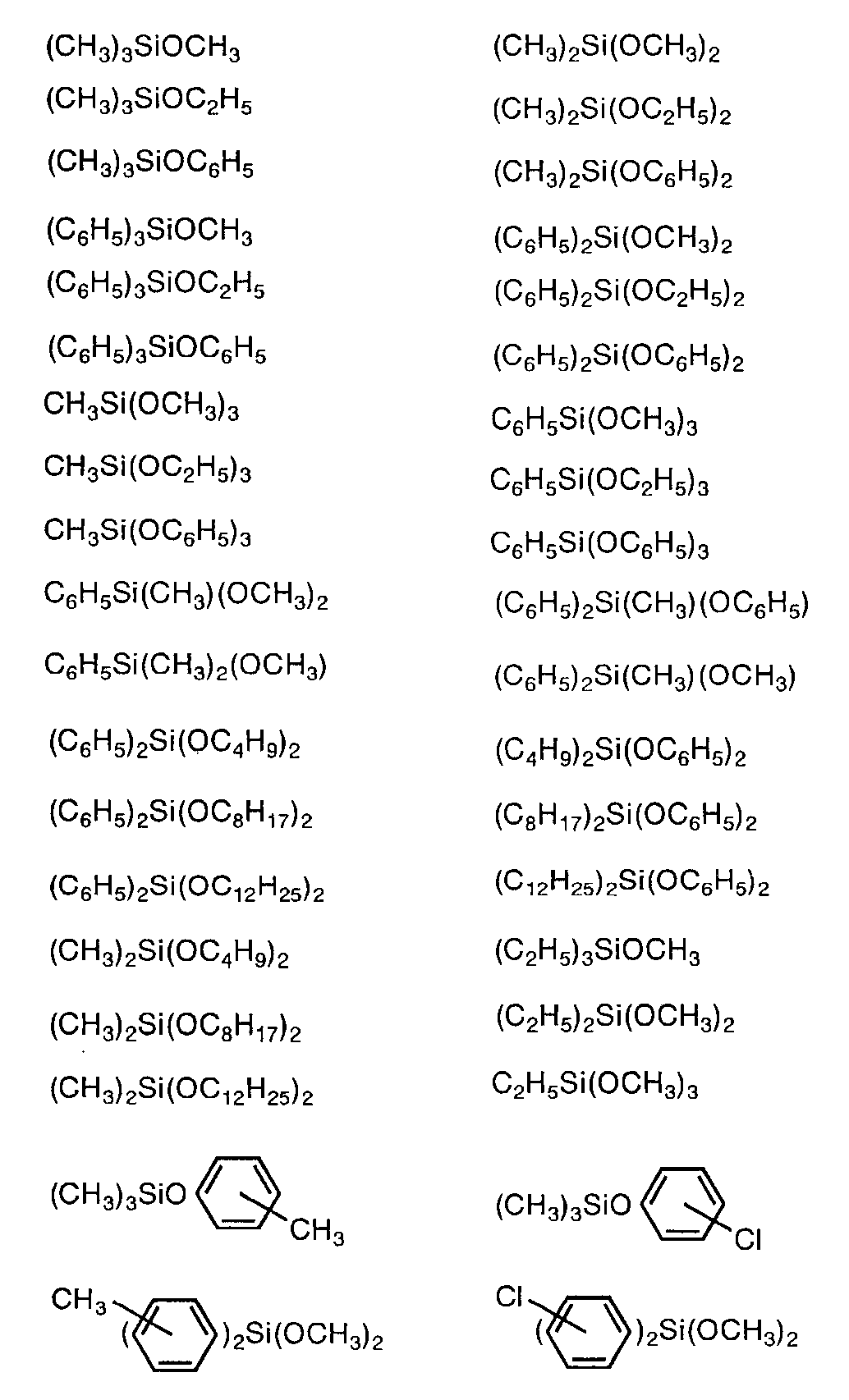
【0059】
【化9】
等が挙げられるが、これらに限定されるものではない。これらの中でも、フェニルトリメトキシシラン、フェニルメチルジメトキシシラン、フェニルジメチルメトキシシラン、ジフェニルジメトキシシラン、ジフェニルジエトキシシラン、トリフェニルメトキシシラン等の一般式(6)中のR5が、炭素数6〜20のアリール基であるものは、組成物の硬化反応を加速する効果が大きいために好ましい。特に、ジフェニルジメトキシシランやジフェニルジエトキシシランは、低コストであり、入手が容易であるために最も好ましい。
【0061】
本発明に用いる前記ケイ素化合物の配合量は、反応性ケイ素基含有重合体100部に対し、0.01〜20部程度が好ましく、0.1〜10部が更に好ましい。ケイ素化合物の配合量がこの範囲を下回ると硬化反応を加速する効果が小さくなる場合がある。一方、ケイ素化合物の配合量がこの範囲を上回ると、硬化物の硬度や引張強度が低下することがある。上記ケイ素化合物は1種類のみで使用しても良いし、2種類以上混合使用しても良い。
本発明の硬化性組成物には、各種シランカップリング剤が必要に応じて用いられる。シランカップリング剤の具体例としては、γ−アミノプロピルトリメトキシシラン、γ−アミノプロピルトリエトキシシラン、γ−アミノプロピルメチルジメトキシシラン、γ−アミノプロピルメチルジエトキシシラン、γ−(2−アミノエチル)アミノプロピルトリメトキシシラン、γ−(2−アミノエチル)アミノプロピルメチルジメトキシシラン、γ−(2−アミノエチル)アミノプロピルトリエトキシシラン、γ−(2−アミノエチル)アミノプロピルメチルジエトキシシラン、γ−ウレイドプロピルトリメトキシシラン、N−フェニル−γ−アミノプロピルトリメトキシシラン、N−ベンジル−γ−アミノプロピルトリメトキシシラン、N−ビニルベンジル−γ−アミノプロピルトリエトキシシラン等のアミノ基含有シラン類;γ−メルカプトプロピルトリメトキシシラン、γ−メルカプトプロピルトリエトキシシラン、γ−メルカプトプロピルメチルジメトキシシラン、γ−メルカプトプロピルメチルジエトキシシラン等のメルカプト基含有シラン類;γ−グリシドキシプロピルトリメトキシシラン、γ−グリシドキシプロピルトリエトキシシラン、γ−グリシドキシプロピルメチルジメトキシシラン、β−(3,4−エポキシシクロヘキシル)エチルトリメトキシシラン、β−(3,4−エポキシシクロヘキシル)エチルトリエトキシシラン等のエポキシ基含有シラン類;β−カルボキシエチルトリエトキシシラン、β−カルボキシエチルフェニルビス(2−メトキシエトキシ)シラン、N−β−(カルボキシメチル)アミノエチル−γ−アミノプロピルトリメトキシシラン等のカルボキシシラン類;ビニルトリメトキシシラン、ビニルトリエトキシシラン、γ−メタクリロイルオキシプロピルメチルジメトキシシラン、γ−アクロイルオキシプロピルメチルトリエトキシシラン等のビニル型不飽和基含有シラン類;γ−クロロプロピルトリメトキシシラン等のハロゲン含有シラン類;トリス(トリメトキシシリル)イソシアヌレート等のイソシアヌレートシラン類;γ−イソシアネートプロピルトリメトキシシラン、γ−イソシアネートプロピルトリエトキシシラン、γ−イソシアネートプロピルメチルジエトキシシラン、γ−イソシアネートプロピルメチルジメトキシシラン等のイソシアネート基含有シラン類等を挙げることができる。また、これらを変性した誘導体である、アミノ変性シリルポリマー、シリル化アミノポリマー、不飽和アミノシラン錯体、ブロックイソシアネートシラン、フェニルアミノ長鎖アルキルシラン、アミノシリル化シリコーン、シリル化ポリエステル等もシランカップリング剤として用いることができる。
【0062】
本発明に用いるシランカップリング剤は、反応性ケイ素基含有重合体100部に対し、0.1〜20部の範囲で使用される。特に、1〜10部の範囲で使用するのが好ましい。上記シランカップリング剤は1種類のみで使用しても良いし、2種類以上混合使用しても良い。
本発明の硬化性組成物にはシランカップリング剤以外の接着性付与剤も用いることができる。
【0063】
本発明の硬化性組成物には、各種老化防止剤が必要に応じて用いられる。 かかる老化防止剤としては、フェノール系酸化防止剤、芳香族アミン系酸化防止剤、硫黄系ヒドロペルオキシド分解剤、リン系ヒドロペルオキシド分解剤、ベンゾトリアゾール系紫外線吸収剤、サリシレート系紫外線吸収剤、ベンゾフェノン系紫外線吸収剤、ヒンダートアミン系光安定剤、ニッケル系光安定剤などが挙げられる。
【0064】
前記フェノール系酸化防止剤の具体例としては、2,6−ジ−t−ブチルフェノール、2,4−ジ−t−ブチルフェノール、2,6−ジ−t−ブチル−4−メチルフェノール、2,5−ジ−t−ブチルヒドロキノン、n−オクタデシル−3−(3,5−ジ−t−ブチル−4−ヒドロキシフェニル)プロピオネート、ペンタエリスリチル−テトラキス[3−(3,5−ジ−t−ブチル−4−ヒドロキシフェニル)プロピオネート]、2,2‘−メチレンビス(4−メチル−6−t−ブチルフェノール)、4,4‘−ブチリデンビス(3−メチル−6−t−ブチルフェノール)、4,4‘−チオビス(3−メチル−6−t−ブチルフェノール)等が例示できる。
【0065】
前記芳香族アミン系酸化防止剤の具体例としては、N,N‘−ジフェニル−1p0−フェニレンジアミン、6−エトキシ−2,2,4−トリメチル−1,2−ジヒドロキノリン等が例示できる。
前記硫黄系ヒドロペルオキシド分解剤の具体例としては、ジラウリル−3,3‘−チオジプロピオネート、ジトリデシル−3,3‘−チオジプロピオネート、ジステアリル−3,3‘−チオジプロピオネート等が例示できる。
【0066】
前記リン系ヒドロペルオキシド分解剤の具体例としては、ジフェニルイソオクチルホスファイト、トリフェニルホスファイト等が例示できる。
前記ベンゾトリアゾール系紫外線吸収剤の具体例としては、2−(3,5−ジ−t−ブチル−2−ヒドロキシフェニル)−5−クロロベンゾトリアゾール、2−(3−t−ブチル−5−メチル−2−ヒドロキシフェニル)−5−クロロベンゾトリアゾール、2−(3,5−ジ−t−ブチル−2−ヒドロキシフェニル)ベンゾトリアゾール、2−(5−メチル−2−ヒドロキシフェニル)ベンゾトリアゾール等が例示できる。
【0067】
前記サリシレート系紫外線吸収剤の具体例としては、4−t−ブチルフェニルサリシレート、2,4−ジ−t−ブチルフェニル−3,5‘−ジ−t−ブチル−4’−ヒドロキシベンゾエート等が例示できる。
前記ベンゾフェノン系紫外線吸収剤の具体例としては、2,4−ジヒドロキシベンゾフェノン、2−ヒドロキ−4−メトキシベンゾフェノン、2−ヒドロキ−4−n−オクトキシベンゾフェノン、2−ヒドロキ−4−n−ドデシルオキシベンゾフェノン、2−ヒドロキ−4−ベンジロキシベンゾフェノン等が例示できる。
【0068】
前記ヒンダートアミン系光安定剤の具体例としては、ビス(2,2,6,6,−テトラメチル−4−ピペリジル)セバケート、ビス(1,2,2,6,6,−ペンタメチル−4−ピペリジル)セバケート、1−{2−[3−(3,5−ジ−t−ブチル−4−ヒドロキシフェニル)プロピオニルオキシ]エチル}−4−[3−(3,5−ジ−t−ブチル−4−ヒドロキシフェニル)プロピオニルオキシ]−2,2,6,6,−テトラメチルピペリジン、4−ベンゾイルオキシ−2,2,6,6,−テトラメチルピペリジン等が例示できる。
【0069】
前記ニッケル系光安定剤の具体例としては、ニッケルジブチルジチオカルバメート、[2,2‘−チオビス(4−t−オクチルフェノレート)]−2−エチルヘキシルアミンニッケル(II)、[2,2‘−チオビス(4−t−オクチルフェノレート)]−n−ブチルアミンニッケル(II)等が例示できる。
これらの老化防止剤は、単独で使用してもよく、2種以上併用してもよい。単独で使用した場合と比較して、併用することによってより有効に機能することがある。
【0070】
老化防止剤の配合量は、反応性ケイ素基を含有する重合体100部に対して0.1〜20部程度が好ましく、1〜10部が更に好ましい。配合量が0.1部未満の場合には、耐候性の改善効果が十分でないことがあり、20部をこえると硬化性組成物のコストや接着性が悪くなる。
本発明の硬化性組成物には、各種充填材が必要に応じて用いられる。前記充填材の具体例としては、たとえば、木粉、パルブ、木綿チップ、アスベスト、ガラス繊維、炭素繊維、マイカ、クルミ殻粉、もみ殻粉、グラファイト、ケイソウ土、白土、ヒュームシリカ、沈降性シリカ、無水ケイ酸、カーボンブラック、炭酸カルシウム、クレー、タルク、酸化チタン、炭酸マグネシウム、石英、アルミニウム微粉末、フリント粉末、亜鉛末などがあげられる。これら充填材のうちでは沈降性シリカ、ヒュームシリカ、カーボンブラック、炭酸カルシウム、酸化チタン、タルクなどが好ましい。これらの充填材は単独で用いてもよく、2種以上併用してもよい。充填材を用いる場合の使用量は、反応性ケイ素基含有重合体100部に対して1〜500部が好ましく、50〜200部がさらに好ましい。
【0071】
本発明の硬化性組成物には、先に記載したシラノール縮合触媒、水分源、可塑剤、シランカップリング剤、老化防止剤および充填材の他に、必要に応じて各種添加剤が添加される。
このような添加物の例としては、たとえば、生成する硬化物の引張特性を調整する物性調整剤、金属不活性化剤、オゾン劣化防止剤、光硬化性樹脂、タレ防止剤、リン系過酸化物分解剤、溶剤、難燃性付与剤、滑剤、顔料、界面活性剤、発泡剤などがあげられる。
【0072】
このような添加物の具体例は、たとえば、特公平4−69659号、特公平7−108928号、特許公報第2512468号、特開昭64−22904号の各明細書などに記載されている。
本発明の組成物においては、2液組成物及び3液以上の組成物のいずれも可能である。2液組成物として使用する場合には、例えば、充填剤や可塑剤等が添加された本発明の(A)液である主剤と、充填剤や可塑剤等が添加された本発明の(B)液である硬化剤とにわけ、使用直前に両成分を混合して使用すると、長期間の保存後も初期の硬化物物性を安定して発現できる。
【0073】
本発明の組成物は主に弾性硬化性組成物として有用であり、電子電気、土木止水、建造物、船舶、自動車、道路等のシール用途や接着性組成物として使用することができる。
【0074】
【実施例】
つぎに実施例および比較例によって本発明を具体的に説明するが、本発明はこれに限定されるものではない。
製造例
2Lの耐圧ガラス製容器に、三方コックを取り付け、容器内を窒素置換した後、注射器を用いて容器内に、エチルシクロヘキサン(モレキュラーシーブス3Aとともに1夜間以上放置することにより乾燥したもの)205mlおよびトルエン(モレキュラーシーブス3Aとともに1夜間以上放置することにより乾燥したもの)819ml、p−DCC(下記化合物)5.78g(25.0mmol)を加えた。
【0075】
【化10】
次にイソブチレンモノマー332ml(3.91mol)が入っているニードルバルブ付耐圧ガラス製液化採取管を、三方コックに接続して、重合容器を−70℃のドライアイス/エタノールバス中につけて冷却した後、真空ポンプを用いて容器内を減圧にした。ニードルバルブを開け、イソブチレンモノマーを液化ガス採取管から重合容器内に導入した後、三方コック内の一方から窒素を導入することにより容器内を常圧に戻した。次に、2−メチルピリジン0.454g(4.88mmol)を加えた。次に、四塩化チタン6.69ml(61.0mmol)加えて重合を開始した。反応時間70分後に、アリルトリメチルシラン6.86g(60.0mmol)を加えてポリマー末端にアリル基の導入反応を行った。反応時間120分後に、反応溶液を水200mlで4回洗浄したあと、溶剤を留去することによりアリル末端イソブチレン系重合体を得た。
【0077】
次いで、こうして得られたアリル末端イソブチレンポリマ−200gと、炭化水素系可塑剤であるパラフィン基プロセスオイル(出光興産(株)製、商品名ダイアナプロセスPS−32)60gを混合し、約75℃まで昇温した後、メチルジメトキシシラン1.5[eq/ビニル基]、白金(ビニルシロキサン)錯体5x10-5[eq/ビニル基]を添加し、ヒドロシリル化反応を行った。FT−IRにより反応追跡を行い、約20時間で1640cm-1のオレフィン吸収が消失した。
【0078】
目的とする両末端に反応性ケイ素基を有するイソブチレンポリマ−(下記化合物)と可塑剤であるPS−32との混合物(10/3の重量比)が得られた。
【0079】
【化11】
こうして得られたポリマ−の収量より収率を算出するとともに、Mn及びMw/MnをGPC法により、また末端構造を300MHz1H−NMR分析により各構造に帰属するプロトン(開始剤由来のプロトン:6.5〜7.5ppm、ポリマ−末端由来のケイ素原子に結合したメチルプロトン:0.0〜0.1ppm及びメトキシプロトン:3.4〜3.5)の共鳴信号の強度を測定、比較することにより求めた。1H−NMRは、Varian Gemini300(300MHz for 1H)を用い、CDCl3中で測定した。
【0081】
なお、FT−IRは島津製作所製IR−408、GPCは送液システムとしてWaters LC Module1、カラムはShodex K−804を用いて行った。分子量はポリスチレンスタンダードに対する相対分子量で与えられる。ポリマーの分析値は、Mn=11445、Mw/Mn=1.23、Fn(シリル)=1.76であった。(数平均分子量はポリスチレン換算、末端シリル官能基数はイソブチレンポリマー1分子当たりの個数)。
実施例1〜3および比較例1〜2
製造例で得られた反応性ケイ素基を有する重合体(PIB)とパラフィン基プロセスオイル(出光興産(株)製、商品名ダイアナプロセスPS−32)の混合物130部(このうち(A)液中の反応性ケイ素基を有する重合体を100部含有する)に対し、さらにパラフィン基プロセスオイル(出光興産(株)製、商品名ダイアナプロセスPS−32)を60部数添加し、膠質炭酸カルシウム(白石工業(株)製、商品名EDS−D10A)50部、重質炭酸カルシウム(白石カルシウム(株)製、商品名PO320B10)180部、タルク(富士タルク工業(株)製、商品名タルクLMR)100部、光安定剤 ジメチルジチオカルバミン酸ニッケル(三新化学(株)製、商品名サンダントNBC)3部、垂れ防止剤(楠本化成(株)製、商品名ディスパロン#305)5部、ヒンダードフェノール系酸化防止剤(日本チバガイギー(株)製、商品名イルガノックス1010)1部、サリシレート系紫外線吸収剤(住友化学工業(株)製、商品名スミソーブ400)1部、ヒンダードアミン系光安定剤(三共(株)製、商品名サノールLS−765)1部、光硬化性樹脂(東亜合成(株)、商品名アロニックスM−400)3部、γ−グリシドキシプロピルトリメトキシシラン(日本ユニカー(株)製、商品名シランカップリング剤A−187)2部、γ−イシシアネートプロピルトリエトキシシラン(日本ユニカー(株)製、商品名シランカップリング剤A−1310)4部を加え、三本ペイントロールでよく混練して主剤とした。
【0082】
また、シラノール縮合触媒としてジブチルスズジメトキサイド(アルドリッチケミカル(株)製)と、水分源としてH2OまたはNa2SO4・10H2O(和光純薬工業(株))と、非水溶性の可塑剤としてパラフィン基プロセスオイル(出光興産(株)製、商品名ダイアナプロセスPS−32)と、重質炭酸カルシウム(丸尾カルシウム(株)製、商品名スノーライトSS)を表1に示す部数添加し、ディスポーザルカップ中で手混ぜ混練した後、日本精機製作所(株)製のエクセル・オート・ホモジナイザーを用いて、回転数10000rpmで10分間撹拌する操作を3回行うことにより硬化剤を調整した。(ただし、比較例1は混合する必要がないので、ホモジナイザーによる攪拌は行っていない。)
硬化性は、以下に示すタックフリータイムの測定により評価した。上記の主剤と硬化剤を十分混練したものをガラス上に厚さ3mmとなるように薄く塗布し、23℃の恒温室中で養生した。手で軽く触れても手が汚れない程度にまで、表面が硬化するのに要する時間(タックフリータイム)を測定した。
【0083】
一方、深部硬化性は以下のようにして評価した。上記の主剤と硬化剤を十分混練したものをガラス上に厚さ10mm以上となるように厚く塗布し、23℃×7日の養生を行った。養生後、カッターナイフで切ることにより、内部の硬化の程度を評価した。内部も十分硬化しているものを○、内部は未硬化であるものを×とした。
【0084】
硬化性と深部硬化性の評価結果を表1に示す。
【0085】
【表1】
表1に示す通り、本発明の(a)成分であるシラノール縮合触媒のみを含む比較例1の硬化剤は、タックフリータイムが短く良好な硬化性を示すが、深部硬化性が悪い。また、本発明の(a)成分であるシラノール縮合触媒と(b)成分であるH2Oを含む比較例2の硬化剤は24時間後もタックフリーにならないことから、シラノール縮合触媒が加水分解して触媒活性が著しく低下していると推測できる。一方、(c)成分である非水溶性の可塑剤のPS−32をさらに含有する実施例1〜3の硬化剤は、タックフリータイムが短く、深部硬化性も良好である。
【0087】
すなわち、本発明の(c)成分である非水溶性の可塑剤はシラノール縮合触媒の水分源に対する安定性を改善する効果が有る。また、実施例1と実施例2の比較から、水分源として水または金属塩の水和物のいずれの水分源を用いても同様な結果が得られており、(c)成分である非水溶性の可塑剤の効果は水分源に依存せず有効である。さらに、実施例1と実施例3との比較から、本発明の硬化剤に重質炭酸カルシウムなどの各種添加剤が添加された場合にも、(c)成分である非水溶性の可塑剤の効果は有効であることがわかる。
【0088】
【発明の効果】
本発明の硬化性組成物は、深部硬化性を改善するとともに、硬化剤の貯蔵安定性を改善することができる。[0001]
BACKGROUND OF THE INVENTION
The present invention contains a polymer having a silicon-containing group (hereinafter referred to as “reactive silicon group”) having a hydroxyl group or a hydrolyzable group bonded to a silicon atom and capable of crosslinking by forming a siloxane bond. The present invention relates to a curable composition of two or three or more liquids and a method for improving the storage stability of a curing agent component.
[0002]
[Prior art]
A polymer containing at least one reactive silicon group in the molecule is crosslinked by the formation of a siloxane bond accompanied by a hydrolysis reaction of the reactive silicon group due to moisture or the like even at room temperature to obtain a rubber-like cured product. It is known to have an interesting property. Taking advantage of this characteristic, polymers having reactive silicon groups are widely used as base polymers for architectural sealants, double-glazed sealants, industrial sealants and the like. The sealing material is used to fill and fill the gaps (joints) of building materials such as wall materials and harden them to close the gaps and maintain watertightness and airtightness.
[0003]
However, when the sealing material containing the polymer containing the reactive silicon group is cured with moisture in the air, there is a problem that it takes a long time to cure even though the surface is cured. Among such polymers, saturated hydrocarbon polymers such as polyisobutylene polymers have excellent weather resistance, heat resistance, and durability, but have a high moisture barrier property. When it hardens | cures with the inside water | moisture content, there existed a problem that hardening of a deep part was inadequate.
[0004]
It is conceivable to add a water source to the curable composition in advance so that the curable composition is rapidly cured to the inside at room temperature.
By the way, the curable composition can be roughly divided into a one-component curable composition and a two-component curable composition. The one-pack type curable composition is a one-component liquid material in which various additives are blended, and the two-pack type curable composition comprises a main agent containing a polymer having a reactive silicon group, and a silanol condensation catalyst. It is a two-component type consisting of a curing agent.
[0005]
In order to solve the above problems, a method of adding a water source to the main agent side of the two-component curable composition can be considered, but adding a water source to the main agent side deteriorates the storage stability of the polymer. There's a problem. In addition, a silane coupling agent is often added to the main component of the curable composition as an adhesion-imparting agent. However, since the silane coupling agent easily reacts with moisture, it is stored when a moisture source is added to the main component side. There is a problem that adhesiveness deteriorates later. Therefore, it is desirable to add a moisture source to the curing agent side.
[0006]
However, since many silanol condensation catalysts such as titanium compounds and tin compounds decompose when there is moisture, there is a problem that if a moisture source is added to the curing agent side, the curability deteriorates after storage.
[0007]
[Problems to be solved by the invention]
The present invention improves the deep curability of a multi-part curable composition comprising a main agent containing a polymer having a reactive silicon group, a silanol condensation catalyst and a curing agent containing water, and The purpose is to improve storage stability.
[0008]
[Means for solving the problems]
As a result of diligent studies to solve such problems, the present inventors have added a specific compound to the curing agent side of the multi-component curable composition, whereby the cured product physical properties are added to the composition. -The present invention was completed by finding that the storage stability of the curing agent can be improved without adversely affecting the curability, deep-curing property, adhesiveness, etc., and improving the storage stability of the curing agent.
[0009]
That is, the present invention comprises (A) liquid: a main agent containing a polymer having at least one reactive silicon group, (B) liquid: (a) silanol condensation catalyst, (b) hydrate of water or metal salt , And (c) a curing agent containing a water-insoluble plasticizer, and a two-component or multi-component curable composition comprising at least two components, in particular, (A) solution: reactive silicon A main agent containing an isobutylene polymer having at least one group, (B) liquid: (a) a tetravalent tin compound, (b) a hydrate of water or a metal salt, and (c) a saturated hydrocarbon oligomer The present invention relates to a two-component or multi-component curable composition comprising at least two components of a curing agent that contains
[0010]
DETAILED DESCRIPTION OF THE INVENTION
Hereinafter, the present invention will be described in detail.
Examples of the polymer having a reactive silicon group in the present invention include a reactive silicon group-containing saturated hydrocarbon polymer derived from a saturated hydrocarbon polymer such as polyisobutylene, hydrogenated polybutadiene, and hydrogenated polyisoprene. It is done. In addition, a reactive silicon group-containing organic polymer derived from a polymer selected from polyether, polyester and polycarbonate as the main chain skeleton, (meth) acrylate monomers such as butyl (meth) acrylate, tetrafluoroethylene , Fluorine-containing vinyl monomers such as chlorotrifluoroethylene and perfluoromethyl vinyl ether, aromatic hydrocarbon vinyl monomers such as styrene, (meth) acrylic acid and salts thereof, vinyl alkyl ethers, butadiene and chloroprene Reactive silyl group-containing vinyl polymers obtained by copolymerizing reactive monomers with polymerizable monomers such as dienes such as ethylene, propylene, isobutylene and other vinyl monomers It is done. Furthermore, the following general formula (2):
HO- [Si (RThree)2O]n-H (2)
(Wherein RThreeAre each independently a substituted or unsubstituted monovalent hydrocarbon group having 1 to 20 carbon atoms, and n is a positive integer. ) Diorganopolysiloxane represented by formula (1).
[0011]
Among the above exemplified polymers, the saturated hydrocarbon polymer having a reactive silicon group has a feature of having a high moisture barrier property, and thus the effect of improving the deep curability of the curing agent of the present invention is particularly remarkable. More preferred.
The saturated hydrocarbon polymer having a reactive silicon group is a polymer that does not substantially contain a carbon-carbon unsaturated bond other than an aromatic ring. For example, polyethylene, polypropylene, polyisobutylene, hydrogenated polybutadiene, hydrogen Examples thereof include added polyisoprene.
[0012]
As the reactive silicon group, the general formula (1),
[0013]
[Chemical formula 2]
(Wherein R1And R2Each independently represents an alkyl group having 1 to 20 carbon atoms, an aryl group having 6 to 20 carbon atoms, an aralkyl group having 7 to 20 carbon atoms, or (R ′).ThreeA triorganosiloxy group represented by SiO— (R ′, each independently represents a hydrogen atom or a substituted or unsubstituted hydrocarbon group having 1 to 20 carbon atoms). X is independently a hydroxyl group or a hydrolyzable group. Furthermore, a is 0, 1, 2, or 3, b is 0, 1, or 2, and a and b are not 0 simultaneously. M is an integer of 0 or 1 to 19).
[0015]
Examples of the hydrolyzable group include commonly used groups such as a hydrogen atom, an alkoxy group, an acyloxy group, a ketoximate group, an amino group, an amide group, an aminooxy group, a mercapto group, and an alkenyloxy group.
Among these, an alkoxy group, an amide group, and an aminooxy group are preferable, but an alkoxy group is particularly preferable in terms of mild hydrolyzability and easy handling.
[0016]
Hydrolyzable groups and hydroxyl groups can be bonded to one silicon atom in the range of 1 to 3, and (a + Σb) is preferably in the range of 1 to 5. When two or more hydrolyzable groups or hydroxyl groups are bonded to the reactive silicon group, they may be the same or different.
The number of silicon atoms forming the reactive silicon group is one or more, but in the case of silicon atoms linked by a siloxane bond or the like, it is preferably 20 or less.
[0017]
In particular, the general formula (3)
[0018]
[Chemical Formula 3]
(Wherein R2, X and a are the same as described above), and are preferable because the raw materials are easily available.
The number of reactive silicon groups in one molecule of the saturated hydrocarbon polymer is 1 or more, preferably 1.1-5. If the number of reactive silicon groups contained in the molecule is less than 1, the curability may be insufficient and good rubber elasticity may not be obtained.
[0020]
The reactive silicon group may be at the terminal or inside of the saturated hydrocarbon polymer molecular chain, or at both. In particular, when the reactive silicon group is at the molecular end, the effective network chain amount of the saturated hydrocarbon polymer component contained in the finally formed cured product is increased, so that the rubber-like shape having high strength and high elongation is obtained. This is preferable from the viewpoint of easily obtaining a cured product.
[0021]
These saturated hydrocarbon polymers having a reactive silicon group can be used alone or in combination of two or more.
The polymer constituting the skeleton of the saturated hydrocarbon polymer having a reactive silicon group used in the present invention is mainly composed of (1) an olefin compound having 1 to 6 carbon atoms such as ethylene, propylene, 1-butene, and isobutylene. It can be obtained by a method of polymerizing as a monomer, (2) homopolymerizing a diene compound such as butadiene or isoprene, or copolymerizing with the olefin compound and then hydrogenating. An isobutylene polymer or a hydrogenated polybutadiene polymer is preferable because it is easy to introduce a functional group at the terminal, easily control the molecular weight, and increase the number of terminal functional groups.
[0022]
In the isobutylene-based polymer, all of the monomer units may be formed from isobutylene units, or the monomer unit having a copolymer with isobutylene is preferably 50% or less (% by weight) in the isobutylene-based polymer. The same may apply hereinafter), more preferably 30% or less, and particularly preferably 10% or less.
Examples of such monomer components include olefins having 4 to 12 carbon atoms, vinyl ethers, aromatic vinyl compounds, vinyl silanes, and allyl silanes. Examples of such copolymer components include 1-butene, 2-butene, 2-methyl-1-butene, 3-methyl-1-butene, pentene, 4-methyl-1-pentene, hexene, vinylcyclohexene, methyl vinyl ether, ethyl vinyl ether, isobutyl vinyl ether, styrene, α-methylstyrene, dimethylstyrene, monochlorostyrene, dichlorostyrene, β-pinene, indene, vinyltrichlorosilane, vinylmethyldichlorosilane, vinyldimethylchlorosilane, vinyldimethylmethoxysilane, vinyltrimethylsilane, divinyldichlorosilane, divinyldimethoxysilane, divinyldimethylsilane 1,3-divinyl-1,1,3,3-tetramethyldisiloxane, trivinylmethylsilane, tetravinylsilane Allyltrichlorosilane, allylmethyldichlorosilane, allyldimethylchlorosilane, allyldimethylmethoxysilane, allyltrimethylsilane, diallyldichlorosilane, diallyldimethoxysilane, diallyldimethylsilane, γ-methacryloyloxypropyltrimethoxysilane, γ-methacryloyloxypropylmethyl Examples include dimethoxysilane.
[0023]
In addition, when vinylsilanes or allylsilanes are used as monomers copolymerizable with isobutylene, the silicon content increases and the number of groups that can act as a silane coupling agent may increase. Adhesion is improved.
In the hydrogenated polybutadiene polymer and other saturated hydrocarbon polymers, as in the case of the isobutylene polymer, other monomer units are contained in addition to the main monomer unit. May be.
[0024]
In addition, in the saturated hydrocarbon polymer having a reactive silicon group used in the present invention, a double bond after polymerization such as a polyene compound such as butadiene and isoprene remains in the range where the object of the present invention is achieved. Such monomer units may be contained in a small amount, preferably 10% or less, further 5% or less, and particularly 1% or less.
The number average molecular weight of the saturated hydrocarbon polymer, preferably isobutylene polymer or hydrogenated polybutadiene polymer, is preferably about 500 to 50,000, particularly about 1,000 to 20,000. It is preferable from the viewpoint of easy handling.
[0025]
Next, a method for producing a saturated hydrocarbon polymer having a reactive silicon group will be described.
Among isobutylene polymers having a reactive silicon group, an isobutylene polymer having a reactive silicon group at the molecular chain terminal is a polymerization method called an inifer method (a specific method using both an initiator called an inifer and a chain transfer agent). It can be produced using a terminal functional type, preferably an all terminal functional type isobutylene polymer obtained by a cationic polymerization method using a compound. For example, polyisobutylene having an unsaturated group at the terminal was obtained by dehydrohalogenation reaction of this polymer or unsaturated group introduction reaction to the polymer as described in JP-A-63-105005. After, general formula
[0026]
[Formula 4]
(Wherein R1, R2, X, a and b are the same as described above. )
(This compound is a compound in which a hydrogen atom is bonded to the group represented by the general formula (1)), preferably the general formula
[0028]
[Chemical formula 5]
(Wherein R2, X and a are the same as described above. )
And a method of introducing a reactive silicon group into the polymer by subjecting the hydrosilane compound represented by formula (1) to an addition reaction called hydrosilylation reaction using a platinum catalyst. Examples of the hydrosilane compound include halogenated silanes such as trichlorosilane, methyldichlorosilane, dimethylchlorosilane, and phenyldichlorosilane; trimethoxysilane, triethoxysilane, methyldiethoxysilane, methyldimethoxysilane, and phenyldimethoxysilane. Alkoxysilanes; acyloxysilanes such as methyldiacetoxysilane and phenyldiacetoxysilane; ketoximatesilanes such as bis (dimethylketoxymate) methylsilane and bis (cyclohexylketoxymate) methylsilane However, it is not limited to these. Of these, halogenated silanes and alkoxysilanes are particularly preferred.
[0030]
Such a production method is described in, for example, each specification of Japanese Patent Publication No. 4-69659, Japanese Patent Publication No. 7-108928, Japanese Patent Publication No. 2512468, Japanese Patent Application Laid-Open No. 64-22904, and Japanese Patent Publication No. 2539445. ing.
An isobutylene polymer having a reactive silicon group in the molecular chain is produced by a method such as adding vinylsilanes or allylsilanes having a reactive silicon group to a monomer mainly composed of isobutylene and copolymerizing them. The
[0031]
Furthermore, in order to produce an isobutylene polymer having a reactive silicon group at the end of the molecular chain, for example, during polymerization, in addition to the main component isobutylene monomer, vinylsilanes and allylsilanes having a reactive silicon group are copolymerized. After the caking, an isobutylene polymer having a reactive silicon group at the terminal and in the molecular chain can be produced by introducing a reactive silicon group at the terminal.
[0032]
Examples of vinylsilanes and allylsilanes having reactive silicon groups include vinyltrichlorosilane, vinylmethyldichlorosilane, vinyldimethylchlorosilane, vinyldimethylmethoxysilane, divinyldichlorosilane, divinyldimethoxysilane, allyltrichlorosilane, and allylmethyldichlorosilane. Allyldimethylchlorosilane, allyldimethylmethoxysilane, diallyldichlorosilane, diallyldimethoxysilane, γ-methacryloyloxypropyltrimethoxysilane, γ-methacryloyloxypropylmethyldimethoxysilane, and the like.
[0033]
With respect to the hydrogenated polybutadiene polymer, for example, first, the hydroxyl group of the terminal hydroxy hydrogenated polybutadiene polymer is changed to an oxymetal group such as -ONa or -OK, and then the general formula (4):
CH2= CH-RThree-Y (4)
(In the formula, Y is a halogen atom such as chlorine atom or iodine atom, RThreeIs -RFour-, -RFour-OCO- or -RFour-CO- (RFourIs a divalent hydrocarbon group having 1 to 20 carbon atoms, preferably an alkylene group, a cycloalkylene group, an arylene group or an aralkylene group.2-, -R "-C6HFive-CH2A hydrogenated polybutadiene-based polymer having a terminal olefin group by reacting with an organic halogen compound represented by-(R "is a divalent group selected from hydrocarbon groups having 1 to 10 carbon atoms). Hereinafter, it is also referred to as a terminal olefin hydrogenated polybutadiene polymer.
[0034]
As a method for converting the terminal hydroxyl group of the terminal hydroxy-hydrogenated polybutadiene polymer to an oxymetal group, alkali metal such as Na and K; metal hydride such as NaH; NaOCHThreeAnd a method of reacting with an alkali hydroxide such as NaOH and KOH.
In the above method, a terminal olefin hydrogenated polybutadiene polymer having almost the same molecular weight as that of the terminal hydroxy hydrogenated polybutadiene polymer used as a starting material is obtained. Before reacting the organic halogen compound of the formula (4), such as methylene chloride, bis (chloromethyl) benzene, bis (chloromethyl) ether, and the like, When reacted, the molecular weight can be increased, and then, by reacting with the organic halogen compound represented by the general formula (4), a hydrogenated polybutadiene polymer having a higher molecular weight and having an olefin group at the terminal can be obtained. Can do.
[0035]
Specific examples of the organic halogen compound represented by the general formula (4) include, for example, allyl chloride, allyl bromide, vinyl (chloromethyl) benzene, allyl (chloromethyl) benzene, allyl (bromomethyl) benzene, allyl (chloromethyl). Examples include ether, allyl (chloromethoxy) benzene, 1-butenyl (chloromethyl) ether, 1-hexenyl (chloromethoxy) benzene, and allyloxy (chloromethyl) benzene, but are not limited thereto. Of these, allyl chloride is preferable because it is inexpensive and easily reacts.
[0036]
The introduction of the reactive silicon group into the terminal olefin hydrogenated polybutadiene polymer is carried out by addition reaction of the same hydrosilane compound as in the case of the isobutylene polymer having a reactive silicon group at the molecular chain terminal using a platinum catalyst. It is manufactured by. When the saturated hydrocarbon polymer having a reactive silicon group as described above does not substantially contain an unsaturated bond that is not an aromatic ring in the molecule, an organic polymer or an oxyalkylene type having an unsaturated bond Compared with a sealing agent made of a conventional rubber polymer such as a polymer, the weather resistance is remarkably improved. In addition, since the polymer is a hydrocarbon polymer, it has good moisture barrier properties and water resistance, has excellent adhesion performance to various inorganic substrates such as glass and aluminum, and has a high moisture barrier property. give.
[0037]
The content of the polymer having a reactive silicon group in the main component of the curable composition of the present invention is preferably 10% or more, more preferably 20% or more, and particularly preferably 30% or more.
In the curing agent of the curable composition of the present invention, as the component (a), a silanol condensation catalyst soluble in a water-insoluble plasticizer (component (c)) described later can be used.
[0038]
Examples of such silanol condensation catalysts include divalent and tetravalent tin-based curing catalysts, titanium-based curing catalysts, aluminum-based curing catalysts, and amine-based curing catalysts. For example, examples of the titanium-based catalyst that can be used in the present invention include the following.
[0039]
[Chemical 6]
As the silanol condensation catalyst used in the present invention, a tetravalent tin-based curing catalyst is preferable because of its high catalytic activity. Specific examples of the tetravalent tin-based curing catalyst include tin carboxylates, dialkyltin oxides, and general formula (5),
QdSn (OZ)4-dOr [Q2Sn (OZ)]2O (5)
(In the formula, Q is a monovalent hydrocarbon group having 1 to 20 carbon atoms, Z is a monovalent hydrocarbon group having 1 to 20 carbon atoms, or a function capable of forming a coordination bond to Sn inside itself. An organic group having a functional group, and d is any one of 0, 1, 2, and 3). Further, a tetravalent tin compound such as dialkyltin oxide or dialkyltin diacetate and a low molecular silicon compound having a hydrolyzable silicon group such as tetraethoxysilane, methyltriethoxysilane, diphenyldimethoxysilane or phenyltrimethoxysilane. The reactants are also effective as curing catalysts that significantly accelerate the silanol condensation reaction. Among these, compounds represented by the general formula (5), that is, chelate compounds such as dibutyltin bisacetylacetonate and tin alcoholates have high activity as silanol condensation catalysts, and the curing rate of the curable composition is increased. It is more preferable.
[0041]
Specific examples of the tin carboxylates include, for example, dibutyltin dilaurate, dibutyltin diacetate, dibutyltin diethylhexanolate, dibutyltin dioctate, dibutyltin dimethylmalate, dibutyltin diethylmalate, dibutyltin dibutylmalate, Dibutyltin diisooctylmalate, dibutyltin ditridecylmalate, dibutyltin dibenzylmalate, dibutyltin maleate, dioctyltin diacetate, dioctyltin distearate, dioctyltin dilaurate, dioctyltin diethylmalate, dioctyltin diisooctyl Malate etc. are mentioned.
[0042]
Specific examples of the dialkyl tin oxides include dibutyl tin oxide, dioctyl tin oxide, a mixture of dibutyl tin oxide and phthalate ester, and the like.
Specific examples of the chelate compound include:
[0043]
[Chemical 7]
However, it is not limited to these. Of these, dibutyltin bisacetylacetonate is most preferred because of its high catalytic activity, low cost, and availability.
Specific examples of the tin alcoholates include:
[0045]
[Chemical 8]
However, it is not limited to these. Of these, dialkyltin dialkoxide is preferred. In particular, dibutyltin dimethoxide is more preferred because of its low cost and easy availability.
Further, a silanol condensation catalyst other than the above tetravalent tin-based curing catalyst may be used. Specifically, divalent tin-based curing catalysts such as tin octylate; titanates such as tetrabutyl titanate and tetrapropyl titanate; aluminum trisacetylacetonate, aluminum trisethylacetoacetate, diisopropoxyaluminum ethylacetate Aluminum-based curing catalyst such as acetate; zirconium tetraacetylacetonate; lead octylate; butylamine, octylamine, laurylamine, dibutylamine, monoethanolamine, diethanolamine, triethanolamine, diethylenetriamine, triethylenetetramine, oleylamine, cyclohexylamine, Benzylamine, diethylaminopropylamine, xylylenediamine, triethylenediamine, guanidine, diphenylguani 2,4,6-tris (dimethylaminomethyl) phenol, morpholine, N-methylmorpholine, 2-ethyl-4-methylimidazole, 1,8-diazabicyclo (5,4,0) undecene-7 (DBU) Low molecular weight polyamide resin obtained from excess polyamine and polybasic acid; reaction product of excess polyamine and epoxy compound; γ-aminopropyltrimethoxysilane, N- (β-aminoethyl) Examples thereof include known silanol condensation catalysts such as silane coupling agents having an amino group such as aminopropylmethyldimethoxysilane;
[0047]
These catalysts may be used alone or in combination of two or more.
The amount of the component (a) silanol condensation catalyst is preferably about 0.1 to 20 parts, more preferably 1 to 10 parts, relative to 100 parts (parts by weight, the same hereinafter) of the reactive silicon group-containing polymer. . If the blending amount of the silanol curing catalyst is below this range, the curing rate may be slow, and the curing reaction may not be sufficiently formed. On the other hand, if the amount of the silanol curing catalyst exceeds this range, the pot life is too short, which is not preferable from the viewpoint of workability.
[0048]
The content of the silanol curing catalyst in the curing agent of the curable composition of the present invention is preferably 2% by weight (hereinafter referred to as%), more preferably 5% or more, and particularly preferably 10% or more.
In the curing agent of the curable composition of the present invention, water or a hydrate of a metal salt can be used as the component (b). This component acts as a source of moisture necessary for condensation curing of the polymer in the main agent, and promotes the formation of a crosslinked structure. As the hydrates of metal salts, commercially available ones can be widely used. Examples thereof include hydrates of alkaline earth metal salts and hydrates of other metal salts. Specifically, Al2OThree・ H2O, Al2OThree・ 3H2O, Al2(SOFour)Three・ 18H2O, Al2(C2OFour)Three・ 4H2O, AlNa (SOFour)2・ 12H2O, AlK (SOFour)2・ 12H2O, BaCl2・ 2H2O, Ba (OH)2・ 8H2O, CaSOFour・ 2H2O, CaS2OThree・ 6H2O, Ca (NOThree)2・ 4H2O, CaHPOFour・ 2H2O, Ca (C2OFour) ・ H2O, Co (NOThree)2・ 6H2O, Co (CHThreeCOO)2・ 4H2O, CuCl2・ 2H2O, CuSOFour・ 5H2O, FeCl2・ 4H2O, FeClThree・ 6H2O, FeSOFour・ 7H2O, Fe (NHFour) (SOFour)2・ 12H2O, K2COThree・ 1.5H2O, KNaCOThree・ 6H2O, LiBr · 2H2O, Li2SOFour・ H2O, MgSOFour・ H2O, MgSOFour・ 7H2O, MgHPOFour・ 7H2O, MgThree(POFour)2・ 8H2O, MgCOThree・ 3H2O, MgFour(COThree)Three(OH)2・ 3H2O, MoOThree・ 2H2O, NaBr · 2H2O, Na2SOThree・ 7H2O, Na2SOFour・ 10H2O, Na2S2OThree・ 5H2O, Na2S2O6・ 2H2O, Na2BFourO7・ 10H2O, NaHPHOThree・ 2.5H2O, NaThreePOFour・ 12H2O, Na2COThree・ H2O, Na2COThree・ 7H2O, Na2COThree・ 10H2O, NaCHThreeCOO ・ 3H2O, NaHC2OFour・ H2O, NiSOFour・ 6H2O, NiC2OFour・ 2H2O, SnO2・ NH2O, NiC2OFour・ 2H2O, Sn (SOFour)2・ 2H2O, ZnSOThree・ 2H2O, ZnSOFour・ 7H2O, ZnThree(POFour)2・ 4H2O, Zn (CHThreeCOO)2・ 2H2O
However, it is not limited to these.
[0049]
Among these, alkali metal salt hydrates and alkaline earth metal salt hydrates are preferred, specifically
MgSOFour・ 7H2O, Na2COThree・ 10H2O, Na2SOFour・ 10H2O, Na2S2OThree・ 5H2O, NaThreePOFour・ 12H2O, Na2BFourO7・ 10H2O,
Etc.
[0050]
The amount of water or metal salt hydrate of component (b) is preferably about 0.1 to 20 parts, more preferably 0.5 to 10 parts, relative to 100 parts of the reactive silicon group-containing polymer. . If the amount of water or metal salt hydrate is less than this range, the curing rate may be slow. On the other hand, if the amount of water or metal salt hydrate exceeds this range, the physical properties and adhesiveness of the cured product may be lowered. The above metal salt hydrates may be used alone or in combination of two or more.
[0051]
The amount of water or metal salt hydrate of component (b) is preferably about 10 to 500 parts, more preferably 20 to 200 parts, per 100 parts of silanol condensation catalyst of component (a). If the blending amount of water or metal salt hydrate is below this range, the curing rate may be slow. On the other hand, if the blending amount is above this range, the storage stability of the silanol condensation catalyst may be reduced.
[0052]
In the curing agent of the curable composition of the present invention, a water-insoluble plasticizer can be used as the component (c). The silanol condensation catalyst which is the component (a) is soluble in a water-insoluble plasticizer, and conversely, the water or metal salt hydrate which is the component (b) is substantially dissolved in a water-insoluble plasticizer. Insoluble. Accordingly, the water-insoluble plasticizer as component (c) acts so that the silanol condensation catalyst and the water source are less likely to come into contact with each other by dissolving the hydrolyzable silanol condensation catalyst. Has a function of improving storage stability.
[0053]
As the plasticizer, it is preferable that the solubility of water or a hydrate of a metal salt is low, and therefore a plasticizer with low polarity is preferable. Specific examples of the plasticizer having such characteristics include the following saturated hydrocarbon oligomers. For example, polyvinyl oligomers such as polybutene, hydrogenated polybutene, hydrogenated α-olefin oligomer, and atactic polypropylene; aromatic oligomers such as biphenyl and triphenyl; hydrogenated polyene oligomers such as hydrogenated liquid polybutadiene; paraffin Examples thereof include paraffinic oligomers such as oil and chlorinated paraffin oil; and cycloparaffinic oligomers such as naphthenic oil.
[0054]
Moreover, plasticizers other than the saturated hydrocarbon oligomers shown below can also be used. Examples of the plasticizer include dibutyl phthalate, diheptyl phthalate, di (2-ethylhexyl) phthalate, butyl benzyl phthalate, di n-octyl phthalate, diisononyl phthalate, diisodecyl phthalate, diundecyl phthalate and the like phthalates; Non-aromatic dibasic acid esters such as (2-ethylhexyl) adipate, di-n-octyl adipate, diisononyl adipate, diisodecyl adipate, di (2-ethylhexyl) sebacate, and di-2-ethylhexyl tetrahydrophthalate; trimellitic acid tri-2 -Aromatic esters such as ethylhexyl and triisodecyl trimellitic acid; Fatty acid esters such as butyl oleate, methyl acetylricinoleate and pentaerythritol ester; Polyalkylene glycol esters such as N-glycol benzoate and triethylene glycol dibenzoate; Phosphate esters such as tricresyl phosphate and tributyl phosphate; Epoxy plasticizers such as epoxidized soybean oil and epoxidized linseed oil . These may be used alone or in combination of two or more.
[0055]
In the curing agent of the curable composition of the present invention, the content of the water-insoluble plasticizer is preferably 20% or more, more preferably 30% or more, and particularly preferably 40% or more.
Further, the blending amount of the water-insoluble plasticizer of the component (c) is preferably about 50 to 5000 parts, more preferably 200 to 2000 parts with respect to 100 parts of the silanol condensation catalyst of the component (a). If the blending amount of the water-insoluble plasticizer is below this range, the storage stability of the silanol condensation catalyst may be lowered. On the other hand, if the blending amount exceeds this range, the cured product properties and adhesiveness may be lowered.
[0056]
These plasticizers can also be added to the main component of the curable composition of the present invention for the purpose of reducing the viscosity of the polymer having a reactive silicon group and improving the handling.
Furthermore, the plasticizer may be used in place of a solvent for the purpose of adjusting the reaction temperature and the viscosity of the reaction system when a reactive silicon group is introduced into the polymer.
[0057]
In the curable composition of the present invention, in order to further increase the activity of the silanol condensation catalyst, the general formula (6)
RFive aSi (OR6)4-a(6)
(Wherein RFiveAnd R6Are each independently a substituted or unsubstituted hydrocarbon group having 1 to 20 carbon atoms. Further, a is 0, 1, 2, or 3. ) Is used as necessary.
[0058]
Specific examples of the silicon compound include:
[0059]
[Chemical 9]
However, it is not limited to these. Among these, R in the general formula (6) such as phenyltrimethoxysilane, phenylmethyldimethoxysilane, phenyldimethylmethoxysilane, diphenyldimethoxysilane, diphenyldiethoxysilane, triphenylmethoxysilane, etc.FiveHowever, the aryl group having 6 to 20 carbon atoms is preferable because it has a large effect of accelerating the curing reaction of the composition. In particular, diphenyldimethoxysilane and diphenyldiethoxysilane are most preferable because of low cost and easy availability.
[0061]
The amount of the silicon compound used in the present invention is preferably about 0.01 to 20 parts, more preferably 0.1 to 10 parts, relative to 100 parts of the reactive silicon group-containing polymer. When the compounding amount of the silicon compound is below this range, the effect of accelerating the curing reaction may be reduced. On the other hand, when the compounding amount of the silicon compound exceeds this range, the hardness and tensile strength of the cured product may decrease. The above silicon compounds may be used alone or in combination of two or more.
Various silane coupling agents are used in the curable composition of the present invention as necessary. Specific examples of the silane coupling agent include γ-aminopropyltrimethoxysilane, γ-aminopropyltriethoxysilane, γ-aminopropylmethyldimethoxysilane, γ-aminopropylmethyldiethoxysilane, γ- (2-aminoethyl). ) Aminopropyltrimethoxysilane, γ- (2-aminoethyl) aminopropylmethyldimethoxysilane, γ- (2-aminoethyl) aminopropyltriethoxysilane, γ- (2-aminoethyl) aminopropylmethyldiethoxysilane, Amino group-containing silanes such as γ-ureidopropyltrimethoxysilane, N-phenyl-γ-aminopropyltrimethoxysilane, N-benzyl-γ-aminopropyltrimethoxysilane, N-vinylbenzyl-γ-aminopropyltriethoxysilane Γ-Merka Mercapto group-containing silanes such as topropyltrimethoxysilane, γ-mercaptopropyltriethoxysilane, γ-mercaptopropylmethyldimethoxysilane, γ-mercaptopropylmethyldiethoxysilane; γ-glycidoxypropyltrimethoxysilane, γ- Epoxy such as glycidoxypropyltriethoxysilane, γ-glycidoxypropylmethyldimethoxysilane, β- (3,4-epoxycyclohexyl) ethyltrimethoxysilane, β- (3,4-epoxycyclohexyl) ethyltriethoxysilane Group-containing silanes; carbo such as β-carboxyethyltriethoxysilane, β-carboxyethylphenylbis (2-methoxyethoxy) silane, N-β- (carboxymethyl) aminoethyl-γ-aminopropyltrimethoxysilane Xysilanes; vinyl-type unsaturated group-containing silanes such as vinyltrimethoxysilane, vinyltriethoxysilane, γ-methacryloyloxypropylmethyldimethoxysilane, γ-acryloyloxypropylmethyltriethoxysilane; γ-chloropropyltrimethoxysilane Halogen-containing silanes such as tris (trimethoxysilyl) isocyanurate; isocyanurate silanes such as γ-isocyanatopropyltrimethoxysilane, γ-isocyanatopropyltriethoxysilane, γ-isocyanatopropylmethyldiethoxysilane, γ-isocyanate Isocyanate group-containing silanes such as propylmethyldimethoxysilane. In addition, amino-modified silyl polymers, silylated amino polymers, unsaturated aminosilane complexes, blocked isocyanate silanes, phenylamino long-chain alkylsilanes, aminosilylated silicones, silylated polyesters, etc., which are derivatives of these, are also used as silane coupling agents. Can be used.
[0062]
The silane coupling agent used for this invention is used in 0.1-20 parts with respect to 100 parts of reactive silicon group containing polymers. In particular, it is preferably used in the range of 1 to 10 parts. The silane coupling agent may be used alone or in combination of two or more.
An adhesiveness imparting agent other than a silane coupling agent can also be used in the curable composition of the present invention.
[0063]
Various anti-aging agents are used in the curable composition of the present invention as necessary. Such antioxidants include phenolic antioxidants, aromatic amine antioxidants, sulfur hydroperoxide decomposers, phosphorus hydroperoxide decomposers, benzotriazole ultraviolet absorbers, salicylate ultraviolet absorbers, and benzophenones. Examples thereof include an ultraviolet absorber, a hindered amine light stabilizer, and a nickel light stabilizer.
[0064]
Specific examples of the phenolic antioxidant include 2,6-di-t-butylphenol, 2,4-di-t-butylphenol, 2,6-di-t-butyl-4-methylphenol, 2,5 -Di-t-butylhydroquinone, n-octadecyl-3- (3,5-di-t-butyl-4-hydroxyphenyl) propionate, pentaerythrityl-tetrakis [3- (3,5-di-t-butyl -4-hydroxyphenyl) propionate], 2,2'-methylenebis (4-methyl-6-tert-butylphenol), 4,4'-butylidenebis (3-methyl-6-tert-butylphenol), 4,4'- Examples thereof include thiobis (3-methyl-6-tert-butylphenol).
[0065]
Specific examples of the aromatic amine antioxidant include N, N'-diphenyl-1p0-phenylenediamine, 6-ethoxy-2,2,4-trimethyl-1,2-dihydroquinoline and the like.
Specific examples of the sulfur hydroperoxide decomposer include dilauryl-3,3′-thiodipropionate, ditridecyl-3,3′-thiodipropionate, distearyl-3,3′-thiodipropionate, and the like. Can be illustrated.
[0066]
Specific examples of the phosphorus hydroperoxide decomposer include diphenylisooctyl phosphite and triphenyl phosphite.
Specific examples of the benzotriazole ultraviolet absorber include 2- (3,5-di-t-butyl-2-hydroxyphenyl) -5-chlorobenzotriazole and 2- (3-t-butyl-5-methyl). 2-hydroxyphenyl) -5-chlorobenzotriazole, 2- (3,5-di-t-butyl-2-hydroxyphenyl) benzotriazole, 2- (5-methyl-2-hydroxyphenyl) benzotriazole and the like. It can be illustrated.
[0067]
Specific examples of the salicylate ultraviolet absorber include 4-t-butylphenyl salicylate, 2,4-di-t-butylphenyl-3,5′-di-t-butyl-4′-hydroxybenzoate, and the like. it can.
Specific examples of the benzophenone-based ultraviolet absorber include 2,4-dihydroxybenzophenone, 2-hydroxy-4-methoxybenzophenone, 2-hydroxy-4-n-octoxybenzophenone, 2-hydroxy-4-n-dodecyloxy. Examples include benzophenone and 2-hydroxy-4-benzyloxybenzophenone.
[0068]
Specific examples of the hindered amine light stabilizer include bis (2,2,6,6, -tetramethyl-4-piperidyl) sebacate and bis (1,2,2,6,6, -pentamethyl-4). -Piperidyl) sebacate, 1- {2- [3- (3,5-di-t-butyl-4-hydroxyphenyl) propionyloxy] ethyl} -4- [3- (3,5-di-t-butyl) -4-hydroxyphenyl) propionyloxy] -2,2,6,6, -tetramethylpiperidine, 4-benzoyloxy-2,2,6,6, -tetramethylpiperidine and the like.
[0069]
Specific examples of the nickel-based light stabilizer include nickel dibutyldithiocarbamate, [2,2′-thiobis (4-t-octylphenolate)]-2-ethylhexylamine nickel (II), [2,2′- Examples thereof include thiobis (4-t-octylphenolate)]-n-butylamine nickel (II).
These anti-aging agents may be used alone or in combination of two or more. It may function more effectively when used in combination than when used alone.
[0070]
The blending amount of the antioxidant is preferably about 0.1 to 20 parts, more preferably 1 to 10 parts, relative to 100 parts of the polymer containing a reactive silicon group. When the amount is less than 0.1 part, the effect of improving the weather resistance may not be sufficient, and when it exceeds 20 parts, the cost and adhesiveness of the curable composition are deteriorated.
Various fillers are used in the curable composition of the present invention as needed. Specific examples of the filler include, for example, wood powder, parv, cotton chips, asbestos, glass fiber, carbon fiber, mica, walnut shell powder, rice husk powder, graphite, diatomaceous earth, white clay, fume silica, precipitated silica. Silicic anhydride, carbon black, calcium carbonate, clay, talc, titanium oxide, magnesium carbonate, quartz, aluminum fine powder, flint powder, zinc powder and the like. Of these fillers, precipitated silica, fume silica, carbon black, calcium carbonate, titanium oxide, talc and the like are preferable. These fillers may be used alone or in combination of two or more. The amount of the filler used is preferably 1 to 500 parts, more preferably 50 to 200 parts, per 100 parts of the reactive silicon group-containing polymer.
[0071]
In addition to the silanol condensation catalyst, water source, plasticizer, silane coupling agent, anti-aging agent and filler described above, various additives are added to the curable composition of the present invention as necessary. .
Examples of such additives include, for example, physical property modifiers that adjust the tensile properties of the resulting cured product, metal deactivators, ozone degradation inhibitors, photo-curing resins, sagging inhibitors, and phosphorus-based peroxides. Examples include a substance decomposing agent, a solvent, a flame retardant, a lubricant, a pigment, a surfactant, and a foaming agent.
[0072]
Specific examples of such additives are described in, for example, each specification of Japanese Patent Publication No. 4-69659, Japanese Patent Publication No. 7-108928, Japanese Patent Publication No. 2512468, and Japanese Patent Application Laid-Open No. 64-22904.
In the composition of the present invention, both a two-component composition and a composition of three or more components are possible. When used as a two-component composition, for example, the main component (A) of the present invention to which a filler, a plasticizer and the like are added, and the (B) of the present invention to which a filler, a plasticizer and the like are added. ) Liquid curing agent If both components are mixed and used immediately before use, the initial cured physical properties can be stably expressed even after long-term storage.
[0073]
The composition of the present invention is mainly useful as an elastic curable composition, and can be used as a sealing application or adhesive composition for electronic electricity, civil engineering still water, buildings, ships, automobiles, roads and the like.
[0074]
【Example】
Next, the present invention will be specifically described with reference to Examples and Comparative Examples, but the present invention is not limited thereto.
Production example
After attaching a three-way cock to a 2 L pressure-resistant glass container, and replacing the inside of the container with nitrogen, 205 ml of ethylcyclohexane (dried by leaving overnight with molecular sieves 3A for more than one night) in the container and toluene (Dried by leaving overnight with Molecular Sieves 3A for more than 1 night) 819 ml, 5.78 g (25.0 mmol) of p-DCC (the following compound) were added.
[0075]
Embedded image
Next, a pressure glass liquefied collection tube with needle valve containing 332 ml (3.91 mol) of isobutylene monomer was connected to a three-way cock, and the polymerization vessel was placed in a dry ice / ethanol bath at −70 ° C. and cooled. The inside of the container was depressurized using a vacuum pump. After opening the needle valve and introducing isobutylene monomer into the polymerization vessel from the liquefied gas sampling tube, nitrogen was introduced from one side of the three-way cock to return the inside of the vessel to normal pressure. Next, 0.454 g (4.88 mmol) of 2-methylpyridine was added. Next, 6.69 ml (61.0 mmol) of titanium tetrachloride was added to initiate polymerization. After 70 minutes of reaction time, 6.86 g (60.0 mmol) of allyltrimethylsilane was added to carry out an allyl group introduction reaction at the polymer end. After 120 minutes of reaction time, the reaction solution was washed 4 times with 200 ml of water, and then the solvent was distilled off to obtain an allyl-terminated isobutylene polymer.
[0077]
Next, 200 g of the allyl-terminated isobutylene polymer thus obtained and 60 g of a paraffin-based process oil (made by Idemitsu Kosan Co., Ltd., trade name Diana Process PS-32), which is a hydrocarbon plasticizer, are mixed up to about 75 ° C. After the temperature rise, methyldimethoxysilane 1.5 [eq / vinyl group], platinum (vinylsiloxane) complex 5 × 10-Five[Eq / vinyl group] was added to carry out a hydrosilylation reaction. Follow up the reaction by FT-IR, about 1640cm in about 20 hours-1Olefin absorption disappeared.
[0078]
A desired mixture (weight ratio of 10/3) of the target isobutylene polymer having reactive silicon groups at both ends (the following compound) and PS-32 as a plasticizer was obtained.
[0079]
Embedded image
The yield was calculated from the yield of the polymer thus obtained, Mn and Mw / Mn were determined by GPC method, and the terminal structure was 300 MHz.1Protons belonging to each structure by H-NMR analysis (proton derived from initiator: 6.5 to 7.5 ppm, methyl proton bonded to silicon atom derived from polymer terminal: 0.0 to 0.1 ppm and methoxy proton: It was determined by measuring and comparing the intensity of resonance signals of 3.4 to 3.5).1H-NMR was measured using Varian Gemini 300 (300 MHz for1H) and CDClThreeMeasured in.
[0081]
In addition, FT-IR was performed using Shimadzu IR-408, GPC using Waters LC Module 1 as a liquid feeding system, and a column using Shodex K-804. Molecular weight is given as a relative molecular weight relative to polystyrene standards. The analysis values of the polymer were Mn = 11455, Mw / Mn = 1.23, and Fn (silyl) = 1.76. (The number average molecular weight is in terms of polystyrene, and the number of terminal silyl functional groups is the number per molecule of isobutylene polymer).
Examples 1-3 and Comparative Examples 1-2
130 parts of a mixture of the polymer (PIB) having a reactive silicon group obtained in the production example and a paraffin group process oil (trade name Diana Process PS-32, manufactured by Idemitsu Kosan Co., Ltd.) 60 parts of paraffinic process oil (product name, Diana Process PS-32, manufactured by Idemitsu Kosan Co., Ltd.) is further added to 100 parts of the polymer having reactive silicon groups. Industrial Co., Ltd., trade name EDS-D10A 50 parts, heavy calcium carbonate (Shiraishi Calcium Co., trade name PO320B10) 180 parts, Talc (Fuji talc industry, trade name talc LMR) 100 Part, light stabilizer nickel dimethyldithiocarbamate (manufactured by Sanshin Chemical Co., Ltd., trade name Sandant NBC) 3 parts, anti-sagging agent (manufactured by Enomoto Kasei Co., Ltd.) Product name Dispalon # 305) 5 parts, hindered phenolic antioxidant (Ciba-Geigy Japan Co., Ltd., trade name Irganox 1010) 1 part, salicylate UV absorber (Sumitomo Chemical Co., Ltd., trade name Sumisorb) 400) 1 part, 1 part of a hindered amine light stabilizer (manufactured by Sankyo Co., Ltd., trade name Sanol LS-765), 3 parts of a photocurable resin (Toa Gosei Co., Ltd., trade name Aronix M-400), γ- 2 parts of glycidoxypropyltrimethoxysilane (Nihon Unicar Co., Ltd., trade name silane coupling agent A-187), γ-isocyanate propyltriethoxysilane (Nihon Unicar Co., Ltd., trade name silane coupling agent A-1310) 4 parts were added and well kneaded with three paint rolls to make the main agent.
[0082]
Dibutyltin dimethoxide (manufactured by Aldrich Chemical Co., Ltd.) as a silanol condensation catalyst and H as a moisture source2O or Na2SOFour・ 10H2O (Wako Pure Chemical Industries, Ltd.), paraffinic process oil (made by Idemitsu Kosan Co., Ltd., trade name Diana Process PS-32) as a water-insoluble plasticizer, and heavy calcium carbonate (Maruo Calcium Co., Ltd.) ) And trade name Snowlight SS) are added in the number of parts shown in Table 1, and are kneaded and mixed in a disposable cup. Then, using an Excel Auto Homogenizer manufactured by Nippon Seiki Seisakusho Co., Ltd. at a rotational speed of 10,000 rpm. The curing agent was adjusted by performing the operation of stirring for 10 minutes three times. (However, since Comparative Example 1 does not need to be mixed, stirring with a homogenizer is not performed.)
Curability was evaluated by measuring the tack free time shown below. A mixture obtained by sufficiently kneading the above main agent and curing agent was thinly applied on glass to a thickness of 3 mm and cured in a thermostatic chamber at 23 ° C. The time required for the surface to harden (tack free time) was measured to such an extent that the hand was not soiled even when touched lightly by hand.
[0083]
On the other hand, the deep curability was evaluated as follows. A mixture obtained by sufficiently kneading the main agent and the curing agent was applied on a glass so as to have a thickness of 10 mm or more, followed by curing at 23 ° C. for 7 days. After curing, the degree of internal curing was evaluated by cutting with a cutter knife. The case where the inside was sufficiently hardened was marked as ◯, and the case where the inside was uncured was marked as x.
[0084]
Table 1 shows the results of evaluation of curability and deep curability.
[0085]
[Table 1]
As shown in Table 1, the curing agent of Comparative Example 1 containing only the silanol condensation catalyst which is the component (a) of the present invention has a short tack-free time and shows good curability, but has poor deep curability. Moreover, the silanol condensation catalyst which is (a) component of this invention, and H which is (b) component2Since the curing agent of Comparative Example 2 containing O does not become tack-free even after 24 hours, it can be assumed that the silanol condensation catalyst is hydrolyzed and the catalytic activity is significantly reduced. On the other hand, the curing agents of Examples 1 to 3 further containing PS-32, which is a water-insoluble plasticizer as component (c), have a short tack-free time and good deep-part curability.
[0087]
That is, the water-insoluble plasticizer as the component (c) of the present invention has an effect of improving the stability of the silanol condensation catalyst with respect to the water source. In addition, from the comparison between Example 1 and Example 2, the same result was obtained using any water source of water or metal salt hydrate as the water source. The effect of the plasticizer is effective regardless of the moisture source. Further, from the comparison between Example 1 and Example 3, even when various additives such as heavy calcium carbonate were added to the curing agent of the present invention, the water-insoluble plasticizer as the component (c) It turns out that the effect is effective.
[0088]
【The invention's effect】
The curable composition of the present invention can improve the deep curability and improve the storage stability of the curing agent.
Claims (7)
Priority Applications (1)
| Application Number | Priority Date | Filing Date | Title |
|---|---|---|---|
| JP01868598A JP3774559B2 (en) | 1998-01-30 | 1998-01-30 | Curable composition |
Applications Claiming Priority (1)
| Application Number | Priority Date | Filing Date | Title |
|---|---|---|---|
| JP01868598A JP3774559B2 (en) | 1998-01-30 | 1998-01-30 | Curable composition |
Publications (2)
| Publication Number | Publication Date |
|---|---|
| JPH11209639A JPH11209639A (en) | 1999-08-03 |
| JP3774559B2 true JP3774559B2 (en) | 2006-05-17 |
Family
ID=11978477
Family Applications (1)
| Application Number | Title | Priority Date | Filing Date |
|---|---|---|---|
| JP01868598A Expired - Fee Related JP3774559B2 (en) | 1998-01-30 | 1998-01-30 | Curable composition |
Country Status (1)
| Country | Link |
|---|---|
| JP (1) | JP3774559B2 (en) |
Cited By (1)
| Publication number | Priority date | Publication date | Assignee | Title |
|---|---|---|---|---|
| US12617890B2 (en) | 2020-02-07 | 2026-05-05 | Lanxess Solutions Australia Pty. Ltd. | Polyurethane multi-part kit system |
Families Citing this family (8)
| Publication number | Priority date | Publication date | Assignee | Title |
|---|---|---|---|---|
| JP2000129133A (en) * | 1998-05-28 | 2000-05-09 | Kanegafuchi Chem Ind Co Ltd | Curable composition |
| JP4101632B2 (en) | 2002-11-01 | 2008-06-18 | 株式会社カネカ | CURABLE COMPOSITION AND METHOD OF IMPROVING RESTORE AND CREEP |
| WO2005023938A1 (en) * | 2003-09-02 | 2005-03-17 | Kaneka Corporation | Curable composition |
| JP2006063190A (en) * | 2004-08-26 | 2006-03-09 | Cemedine Co Ltd | Coating type damping material composition and architectural composite board |
| JP5395085B2 (en) * | 2007-09-28 | 2014-01-22 | ダウ グローバル テクノロジーズ エルエルシー | In situ generation of water by dehydration of metal salt hydrates for moisture cross-linking of polyolefins |
| US7781513B2 (en) * | 2007-11-14 | 2010-08-24 | Momentive Performance Materials Inc. | Two-part moisture-curable resin composition and adhesive, sealant and coating compositions based thereon |
| JP5569461B2 (en) * | 2011-04-28 | 2014-08-13 | 信越化学工業株式会社 | Articles bonded with room temperature curable organopolysiloxane compositions |
| JP2014001333A (en) * | 2012-06-20 | 2014-01-09 | Techno Brains:Kk | Curing accelerator for one-pack type moisture curable resin and curing acceleration method using the same |
-
1998
- 1998-01-30 JP JP01868598A patent/JP3774559B2/en not_active Expired - Fee Related
Cited By (1)
| Publication number | Priority date | Publication date | Assignee | Title |
|---|---|---|---|---|
| US12617890B2 (en) | 2020-02-07 | 2026-05-05 | Lanxess Solutions Australia Pty. Ltd. | Polyurethane multi-part kit system |
Also Published As
| Publication number | Publication date |
|---|---|
| JPH11209639A (en) | 1999-08-03 |
Similar Documents
| Publication | Publication Date | Title |
|---|---|---|
| JP5081673B2 (en) | Curable composition | |
| JP4150220B2 (en) | Curable composition | |
| EP1099728B1 (en) | Curable composition | |
| US6025445A (en) | Curable compound | |
| US6335412B1 (en) | Curable composition | |
| US20010047056A1 (en) | Primer composition and method of effecting adhesion for sealing compositions | |
| JP3844870B2 (en) | Primer composition and adhesion method | |
| JPH11209639A (en) | Curable composition | |
| JPH11343429A (en) | Primer composition and bonding method | |
| JPH10204303A (en) | Curable composition | |
| JPH11209702A (en) | Primer composition and bonding method | |
| JP2002105265A (en) | One-part curable composition | |
| JP3458020B2 (en) | Curable composition | |
| JP3636583B2 (en) | Sealant for double-glazed glass | |
| US20010053806A1 (en) | Curable composition | |
| JP2001262040A (en) | Primer composition and bonding method | |
| JP3640813B2 (en) | Curable composition | |
| JP2001288366A (en) | Hot melt composition | |
| JPH09286895A (en) | Curable composition | |
| JP3633752B2 (en) | Curable composition | |
| JPH10182992A (en) | Curable composition | |
| JPH11209538A (en) | Curable composition | |
| JP2002201369A (en) | Curable composition | |
| JP2002212451A (en) | Curable composition | |
| JPH10182991A (en) | Curable composition |
Legal Events
| Date | Code | Title | Description |
|---|---|---|---|
| A977 | Report on retrieval |
Free format text: JAPANESE INTERMEDIATE CODE: A971007 Effective date: 20041025 |
|
| A131 | Notification of reasons for refusal |
Free format text: JAPANESE INTERMEDIATE CODE: A131 Effective date: 20041102 |
|
| A521 | Written amendment |
Free format text: JAPANESE INTERMEDIATE CODE: A523 Effective date: 20041216 |
|
| TRDD | Decision of grant or rejection written | ||
| A01 | Written decision to grant a patent or to grant a registration (utility model) |
Free format text: JAPANESE INTERMEDIATE CODE: A01 Effective date: 20060207 |
|
| A61 | First payment of annual fees (during grant procedure) |
Free format text: JAPANESE INTERMEDIATE CODE: A61 Effective date: 20060220 |
|
| R150 | Certificate of patent or registration of utility model |
Free format text: JAPANESE INTERMEDIATE CODE: R150 |
|
| FPAY | Renewal fee payment (event date is renewal date of database) |
Free format text: PAYMENT UNTIL: 20090224 Year of fee payment: 3 |
|
| FPAY | Renewal fee payment (event date is renewal date of database) |
Free format text: PAYMENT UNTIL: 20100224 Year of fee payment: 4 |
|
| FPAY | Renewal fee payment (event date is renewal date of database) |
Free format text: PAYMENT UNTIL: 20100224 Year of fee payment: 4 |
|
| FPAY | Renewal fee payment (event date is renewal date of database) |
Free format text: PAYMENT UNTIL: 20110224 Year of fee payment: 5 |
|
| FPAY | Renewal fee payment (event date is renewal date of database) |
Free format text: PAYMENT UNTIL: 20120224 Year of fee payment: 6 |
|
| LAPS | Cancellation because of no payment of annual fees |