JP3781475B2 - Car radio receiver - Google Patents
Car radio receiver Download PDFInfo
- Publication number
- JP3781475B2 JP3781475B2 JP09093396A JP9093396A JP3781475B2 JP 3781475 B2 JP3781475 B2 JP 3781475B2 JP 09093396 A JP09093396 A JP 09093396A JP 9093396 A JP9093396 A JP 9093396A JP 3781475 B2 JP3781475 B2 JP 3781475B2
- Authority
- JP
- Japan
- Prior art keywords
- segment
- memory
- vocabulary
- code
- car radio
- Prior art date
- Legal status (The legal status is an assumption and is not a legal conclusion. Google has not performed a legal analysis and makes no representation as to the accuracy of the status listed.)
- Expired - Fee Related
Links
Images


Classifications
-
- H—ELECTRICITY
- H04—ELECTRIC COMMUNICATION TECHNIQUE
- H04B—TRANSMISSION
- H04B1/00—Details of transmission systems, not covered by a single one of groups H04B3/00 - H04B13/00; Details of transmission systems not characterised by the medium used for transmission
- H04B1/06—Receivers
-
- H—ELECTRICITY
- H04—ELECTRIC COMMUNICATION TECHNIQUE
- H04H—BROADCAST COMMUNICATION
- H04H20/00—Arrangements for broadcast or for distribution combined with broadcast
- H04H20/53—Arrangements specially adapted for specific applications, e.g. for traffic information or for mobile receivers
- H04H20/55—Arrangements specially adapted for specific applications, e.g. for traffic information or for mobile receivers for traffic information
Landscapes
- Engineering & Computer Science (AREA)
- Signal Processing (AREA)
- Computer Networks & Wireless Communication (AREA)
- Circuits Of Receivers In General (AREA)
- Mobile Radio Communication Systems (AREA)
- Information Retrieval, Db Structures And Fs Structures Therefor (AREA)
Abstract
Description
【0001】
【発明の属する技術分野】
本発明は、語彙要素の記述を包含している語彙メモリを備え、前記語彙要素の記述の各々が、前記メモリ内に各位置を有すると共に、或る番号によって形成されるコードにより識別され、或る所定のユーザにとって有効な語彙要素を指定する一組のコードが、セグメントと称する連続する番号のグループ間に切れ目をもつ一連の番号から成るようにしたカーラジオ受信機に関するものである。
【0002】
斯種のカーラジオ受信機は特に、所謂RDS/TMC信号を受信して役立たせるものである。この受信機は交通に関するか、又は車両を案内するための情報メッセージをスクリーン上に表示するか、及び/又はこれらのメッセージを音声合成により再生して取出すことができる。
【0003】
【従来の技術】
ディジタルの交通情報信号を処理し、ディジタル信号を理解し易い情報に変換するメモリを備えている無線放送受信機は欧州特許EP−A0263,332号から既知である。この欧州特許によれば、メモリを幾つかのサブアセンブリに分けて、これらの各サブアセンブリが或るルート(道)の一部分のデータ、つまりそのルートの前記一部分に沿って出くわす町に相当するデータを包含するようにしている。
【0004】
【発明が解決しようとする課題】
しかし、語彙要素のコードと定義の組が当今定義されているデータベースを構成しており、このデータベースの語彙要素は変更できない方法にてグループ分けされている。
【0005】
本発明の目的は受信機の語彙メモリの大きさを小さくし、且つ語彙要素をその語彙のコードによってできる限り速くアクセスできるようにすることにある。
【0006】
【課題を解決するための手段】
このための本発明によるカーラジオ受信機は、或る所定のユーザに対するコード組の様々なセグメント内に含まれるコードに対応する記述が前記語彙メモリ内に端と端をつないで配置され、且つ前記受信機が補助メモリを備え、該補助メモリが、前記コード組内の各コードに対して、前記語彙メモリ内における対応する記述の位置を割り出すことができるディジタルデータを包含するようにしたことを特徴とする。
【0007】
従って、本発明は語彙メモリ内の1つのグループにアクセスするのに間接的なアドレス指定を用いる必要性によって複雑となるにも拘らず、語彙メモリ内のそれぞれのグループをできるだけ密にパックする概念に基いて成したものである。
【0008】
語彙メモリを制御する第1の方法は、この語彙メモリ内の所定ユーザ用の各有効コードに対する対応する記述の位置データを包含している補助メモリを用いることにある。
【0009】
語彙メモリを制御する第2の方法は、或る所定のセグメントに対して、このセグメント内に包含される最小のコード値と、該セグメント内に包含される最大のコード値と、語彙メモリ内における前記セグメントの一方の境界に位置するコードに対応する記述の位置データとを包含する補助メモリを用いることにある。
【0010】
斯かる補助メモリの使用は、或る所定のコード値に対して、このコード値を補助メモリ内にて見つけられる連続セグメントの極限値と順次比較して、斯かるコードに対応する語彙要素の記述を包含しているセグメントを見つけ、従って語彙メモリ内における前記語彙要素記述の位置データを得るのに十分である。
【0011】
好ましくは、或る所定のセグメントに対して、所謂“トリー”メモリが、補助メモリ内における前記所定のセグメント以下のセグメント系列のほぼ真ん中に位置する他のセグメントのデータのアドレスと、補助メモリ内における前記所定のセグメント以上のセグメント系列のほぼ真ん中に位置する他のセグメントのデータのアドレスとを包含するようにする。
【0012】
このようにすることにより、或るセグメントを探索するのにトリープロセスを用いることができ、又探索操作を速くすることができる。
【0013】
所定セグメント以上又は以下に考慮すべきセグメントがない場合のために、トリー状のメモリがその旨を示す特殊な信号を含むようにする。
好ましくは、補助メモリとトリー状メモリが同一のメモリを構成するようにする。
【0014】
受信機にはカード読取器を設け、語彙メモリ及び補助メモリを取外し可能なカードに収容させる。従って、カードを取り換えることによって装置を様々な地域に簡単に適合させることができる。
【0015】
【発明の実施の形態】
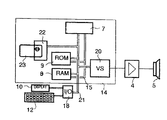
図1に示す本発明によるカーラジオ受信機はアンテナ1の後に、同調回路及び周波数制御回路を含むデバイス(チューナ)2と、これに後続する中間周波増幅器及び復調器を含むデバイス3とを備えている。
【0016】
所謂RDS(ラジオデータシステム)プロセスでは、同じ系列の様々な局の信号を受信するためにFM副搬送波をディジタルデータ信号によって変調する。受信機にはRDSメッセージ用の既知のデコーダ13も設ける。
【0017】
所謂TMC(交通メッセージチャネル)プロセスの場合には、RDS信号の所定のディジタルフィールド内に交通に関する情報メッセージ、例えば「パリの入口手前3キロメートル交通渋滞」のようなメッセージを入れる。
【0018】
TMCメッセージを処理するために、受信機はデコーダ13からのRDSデータを受取って分析し、且つ場合によっては記憶させるようにするモジュール14を備えている。メッセージを音声形態にて出力し得るようにするために、モジュール14は可聴周波増幅器4にも接続し、これにスピーカ5を後続させる。モジュール14は入/出力インタフェースデバイス18を介して制御キーボード12及び例えば液晶表示スクリーンのような表示スクリーン10にも接続する。
【0019】
図2に示すように、モジュール14は制御信号を発生すると共に様々なデバイスによって供給される信号を処理するマイクロコントローラ7を備えており、これはアドレスバス15及びデータバス21を介して様々なデバイスに接続する。マイクロコントローラは音声合成モジュール20用の音声要素を規定するディジタルデータの選択及び用立てもする。音声合成モジュール20は本来既知のものであり、これはスピーカ5が後続している可聴周波増幅器4に所望なアナログ信号を既知の方法にて供給する。モジュール14はさらに、所定瞬時にマイクロコントローラ7によって用いられるソフトウェア層を格納すると共に処理すべきTMCフィールドの内容を暫定的に格納するための揮発性メモリ8、所謂RAMと、一旦固定させる語彙の記述を格納するための固定メモリ9、所謂ROMと、メモリカード読取器22及び例えばPCMCAタイプの取外し可能なメモリカード23により形成されるメモリ(22,23)も備えており、メモリカード23には特に、所定のユーザ及び/又は所定の地域に対応する特定の語彙要素の記述を格納させる。
【0020】
標準のTMCメッセージは、RDSデータ中に受信されて、それぞれのコードによって語彙要素を指定する次のような幾つかのディジタルデータフィールドによって形成される。即ち、
− 或る事象を記述する語彙要素のコードを包含する11ビットから成る第1フ ィールド、
− 当該事象が関連する位置を規定する語彙要素のコードを包含する16ビット から成る第2フィールド、
− 関連する位置の拡がりを記述する語彙要素のコードを包含する3ビットから 成る第3フィールド、
− 関連するルートの方向を記述する1ビットから成る第4フィールド、
− メッセージの有効期間を与える3ビットから成る第5フィールド、
− 迂回路をとることを勧めるか、否かを示す1ビットから成る第6フィールド 。
【0021】
各フィールドの内容は何に関するものであるかを平文形式で表現するように処理する必要がある。このために、固定メモリを設けて、このメモリに各フィールドの種々の内容に対応するアドレスに情報を平文形式で(例えば、表示すべきメッセージの文字のASCIIコードとして)格納させて、その情報をフィールドの内容に基いて検索し得るようにする。
【0022】
例えば、11ビットから成る(或る事象を記述する)第1フィールドは、2048個の語彙要素(従って211個の語彙要素)を平文形式で包含することができて、各語彙がフィールドの内容によって規定されるアドレスに見つけられるメモリに関連させる。こうした語彙要素は、例えば「交通渋滞」、「この先道路工事中」、「事故」等のようなものとする。これらはメモリ9に格納させる。
【0023】
16ビットから成る(位置を記述する)第2フィールドは、位置点のメモリと称するメモリに関連させ、このメモリは、特に地名や、それらのタイプや、その場所が位置する地域や、次の地点や、前の地点等に関する完全なデータを含んでおり、各語彙要素が原則としてフィールドの内容によって指定されるアドレスにて見つけられる65,536個のような多数の語彙要素(従って、216個の語彙要素)を平文形式で包含することができる。これらの語彙要素は、例えば「パリ」、「リール」又は「出口21」等のようなものとする。これらの語彙はメモリ23に格納させる。
【0024】
第3フィールドでは様々なタイプの拡がりを規定する。なお、「拡がり」とは、例えば当面の事象が例えば次の場所にまで達すると言うようなことを意味する。
【0025】
第4フィールドにおける0ビットは、例えば「パリ→リール方向」を意味するのに対し、1ビットは「リール→パリ方向」を意味する(フィールド2の内容はパリとリールとの関連を明らかにするが、方向性については欠けている)。
【0026】
或る問題の本質はフィールド1に含まれるコードに対応する平文形式の形態の情報によって規定され、その問題が生じている位置はフィールド2のコードに対応する情報によって規定される。このフィールド2に含まれるコードを“PL”(位置点)(Point of Location) と称する。これらのコードを番号によって表わし、こうした番号の系列に切れ目を設けるようにする。例えば、ライン川流域の多数の位置点を規定するために、番号PLが258〜264まで続き、次に930から983まで続くようにする。
【0027】
各位置点(各地名)を記述するために170のデータバイトを設ける。ライン川流域の場合、最大番号のPLが50004となるため、或る位置点を記述するデータのアドレスをコードそのものとする位置点メモリは50004×170バイト、従って8500680バイトの容量を必要とすることになる。
【0028】
様々な位置点の記述を包含する語彙メモリの大きさを小さくすることが考えられている。このために、正規化したデータベースでは、所定の地域内で有効で、しかも番号PLが連続する位置点のみを考慮するようにしている。こうした連続番号は“セグメント”と称するグループを形成する。受信機の位置点メモリ内には、これらのセグメントを連結させ、即ちセグメントを切れ目なく端と端をつないで配置する。このような編制とすることにより、限られた大きさのメモリでも十分使用することができる。セグメントをこのように連結する場合には、或るコードと所定のセグメントとの関係を確立するのには、50004個の有り得る各コード(ライン川流域の場合)に対して、語彙メモリにおける各位置点を記述するデータの位置を直接示すデータを包含する補助メモリを使用するのが便利である。この場合、メモリ(それぞれの位置点の記述+補助メモリ)の総容量は、それぞれの位置点の記述に対するものと、補助メモリに対するものとで、1285×170バイト、従って218450バイトとなり:全範囲の番号PLの各番号PLに対しては2バイトとするため、50004×2バイト=100008バイトとなり、従って全部で8500680バイトの代りに僅か318458バイトとなる。
【0029】
コードとセグメントとの関係は、各セグメントの最小と最大の番号PLを包含し、且つそのセグメントに対応する記述の実際の位置が、語彙メモリにおけるこのセグメントに対応する一方の境界の位置データ、例えば“オフセット”と称するセグメントの低い方の限定値の位置データを与えることによって指定される補助メモリを用いることにより検索することもできる。
【0030】
従って、所定の番号PLが位置するセグメントを検索するためには、その所定の番号を包含しているセグメントが見つかるまで、この所定の番号PLを(補助メモリ内にて見つけられる)各セグメントの最小と最大の番号PLと比較する必要がる。この場合、語彙メモリにおける番号PLに対応する位置点の記述のアドレスを得るためには、前記オフセットに所定の番号PLとセグメント内に含まれる最小番号との差であるシフト量を加えるだけで済む。ライン川流域の上述した例は196個のセグメントを伴ない、従って196×6バイト(最小番号用に2バイト、最大番号用に2バイト、セグメントの位置用に2バイト)、即ち1176バイトを補助メモリに必要とし、さらに位置点メモリ用に218450バイトを必要とし、上述した318458バイトの代わりに全部で219626バイトを必要とする。しかし、アドレスを求めるには多少時間を要する。
【0031】
それにも拘らず、或る地点の記述をアクセスするのに必要な時間をかなり短くすることもできる。このためには、語彙メモリ内にセグメントを配置する順序を考えて、この順序をセグメント内に含まれる番号PLの値に基いて決定する。第2セグメントの最小番号が第1セグメントの最大番号よりも大きい場合には、第2セグメントの方が第1セグメントよりも高いものとする。
【0032】
従って、それぞれのセグメントをアクセスするトリーを表わすデータは“トリー状メモリ”と称するメモリ素子に格納させる。実際上、このことはノードと称するデータブロックが前記メモリ素子に格納されることを意味し、各ノードは1つのセグメントを規定すると共に同じトリー状メモリにおける2つの他のノードのアドレスを示す。例えば、ルートノード(レベル“0”を有するものとする)は中間のセグメント、即ちセグメント系列のほぼまん中に位置するセグメントを規定すると共に次のような他の2つのノードを示す。即ち
−第1ノード:これはレベル“−1”を有し、
−前記中間セグメントの下方に位置する複数のセグメントのほぼまん中に位 置するセグメントを規定し、
−且つレベル“−2”を有する他の2つのノードを示す。
−第2ノード:これもレベル“−1”を有し、
−前記中間セグメントの上方に位置する複数のセグメントのほぼまん中に位 置するセグメントを規定し、
−且つレベル“−2”を有する他の2つのノードを示す。
なお、“ほぼまん中”と云うのは、セグメントの番号が偶数の場合には、厳密にまん中に位置するセグメントはないからである。
【0033】
コードをその番号PLに基いて検索する場合には、その番号PLを含んでいるセグメントが見つかるまでトリーをたどりさえすもればよい。トリーの深度、即ち或る所定の番号PLを含んでいるセグメントを見つけるのに必要とされる探索ステップの最大数は、語彙メモリ内に含まれる総セグメント数の2を底とする自然対数に高々等しい。各セグメントの最小と最大の番号PL及びセグメントの実際の位置データを格納する補助メモリは常に2つの他のノードのアドレスを加えることによってトリー状メモリを形成するようにするのが好適である。
【0034】
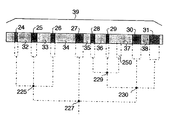
トリーの探索を編制するのに好適な方法を説明するために、番号PLの系列を図3に細長い長方形39の形態で記号的に示してある。これは考えられうる全ての位置点を正規化することによって得られる全部の番号系列に関するものである。従って、これは65536個の位置データを含んでいる。しかし、或る地方に関するデータベースでは、所定の位置点のみに限定される。こうした多数の位置点をセグメント24,25,26,27,28,29,30,31(ハッチを付して示してある)にグループ分けする。これらの各セグメントはそれぞれ定められた位置点を指定するコードを含んでおり、これらのセグメント間には切れ目32,33,34,35,36,37,38がある。参照番号227にて示す点に対応するトリーのルートノード(深度0)は特に、セグメント27の最小と最大の番号を含んでいる。所定の番号PLと、セグメント27のこれら2つの番号との比較は、次のような3通りのことを示す。即ち、番号PLがセグメント27内にあり、上述したような位置点の記述のアドレスを計算する必要があるだけか、その番号が図面の右側(大きな番号)に位置するか、或いは左側(小さい番号)に位置するかである。ルートノード227のレベルでは補助メモリ内における225以下及び230以上の中間ノードのアドレスも示されるため、比較結果に応じてこうしたアドレスの1つを選定することによりトリーをたどることができる。
【0035】
番号PLがセグメント27の最大番号よりも大きい場合には、深度−1を有する次のノードは参照番号230に対応するノードとなり、これはセグメント30の最小番号及び最大番号を含んでいる。番号PLがセグメント27の最小番号よりも小さい場合には、深度−1を有する次のノードは参照番号225に対応するノードとなり、これはセグメント25の最小番号及び最大番号を含んでいる。所定の番号とこれら2つの番号を比較すれば、再び次の3通りのことがわかる。即ち、この所定の番号がセグメント25内にあり、上述したような位置点の記述のアドレスを計算する必要があるだけか、その番号が図の右か、左側に位置するかである。例えば、ノード225がたどる中央ノードとして示されるアドレスはセグメント26の最小番号及び最大番号と、トリーの終点に達したことを示すコードとを包含する。これと同様なことが他のセグメント24,28,31についても云える。場合によっては、トリーを複数のブランチに分けると、少なくとも1つの末端ノードがセグメントに対応しなくなることがある。これはノード229の右側の「擬似セグメント」250に対する場合であり、この場合のコードは、斯かるレベル、或いは上流ノード(229)のレベルのセグメントは無効とする旨を示すようにする。
【0036】
図4はトリーの探索編制の他の例を示す。これはセグメントの代わりにセグメント間の切れ目に基づくものである。しかし、この方法は前述した例の場合よりも実施が困難である。参照番号135に対応するトリーのルートノード(深度0)は切れ目35の両側に位置するセグメント28の最小番号とセグメント27の最大番号とを包含する。所定の番号PLと、これら2つの番号との比較は、図面の右側にその所定の番号が位置するのか(大きな番号)、或いは左側(小さい番号)に位置するかを示す。ルートノード135のレベルでは、補助メモリにおける低い及び高い中間ノード133及び137のアドレスも示されるため、トリーの探索をすることができる。番号PLがセグメント27の最大番号よりも小さい場合には深度“−1” の参照番号133に対応すに次のノードがセグメント26の最小番号とセグメント25の最大番号を包含する。番号PLがセグメント28の最小番号よりも大きい場合には、深度−1の参照番号137に対応する次のノードがセグメント30の最小番号とセグメント29の最大番号とを包含する。ノード133での所定の番号PLと、セグメント26の最小番号及びセグメント25の最大番号との比較は、その所定の番号が図面の右にあるのか、左に位置するのかを示し、このようにして深度−1の参照番号132,134,136に対するノードについて各セグメントを調べて、最終的に1つのセグメントを探索する。
【0037】
セグメントの特徴(セグメントに含まれる最小及び最大コードと、オフセット)及び同じメモリ内にてトリーの次のノードを見つけられるようにするデータは同じメモリ内にスタックすることでき、このメモリはトリー状メモリ及び補助メモリと同じように形成する。補助メモリ内に各セグメントを規定するには10データバイト、即ちセグメントの最小番号PLを示す2バイトと、最大番号PLを示す2バイトと、オフセット用の2バイトと、トリーの次のセグメントの2つの各アドレス用のそれぞれ2バイトを必要とする。従って、196個のセグメントを伴なうライン川流域の上述した例の場合には補助メモリに196×10バイト=1960バイトを、位置点メモリ用に218450バイトを必要とし、全部で220410バイトを必要とする。トリーは8の深度を有する。斯かる220410バイトは、トリーを利用しない上述した219626バイトよりも僅かに多いが、トリープロセスの利用はアクセス速度を極めて速くする。
【図面の簡単な説明】
【図1】 本発明によるカーラジオ受信機の一例を示すブロック図である。
【図2】 本発明によるカーラジオ受信機の一部を詳細に示したブロック図である。
【図3】 語彙要素を指定する番号系列のセグメントを検索し得るようにするトリー探索編制の一例を示す説明図である。
【図4】 図3の変形例を示す図である。
【符号の説明】
1 アンテナ
2 チューナ
3 中間周波増幅器兼復調器
4 可聴周波増幅器
5 スピーカ
7 マイクロコントローラ
8 揮発性メモリ
9 固定メモリ
10 表示スクリーン
12 制御キーボード
14 モジュール
15 アドレスバス
18 入/出力インタフェース
20 音声合成モジュール
21 データバス
22 メモリカード読取器
23 メモリカード
24〜31 セグメント
32〜38 切れ目
225,227,229,230,250 ノード[0001]
BACKGROUND OF THE INVENTION
The present invention includes a vocabulary memory which encompasses the description of vocabulary elements, each of the description of the vocabulary elements, and has a respective location in the memory, it is identified by the code formed by some number, some a set of code that specifies the valid vocabulary elements for a given user that is, to a car radio receiver as a series of numbers with a break between groups of consecutive numbers called segments.
[0002]
Such car radio receivers are particularly useful for receiving so-called RDS / TMC signals. The receiver can be taken either about the traffic or information message for guiding the vehicle to display on the screen, and / or these messages reproduced by voice synthesis.
[0003]
[Prior art]
A radio broadcast receiver having a memory for processing digital traffic information signals and converting the digital signals into easily understandable information is known from EP-A 0263,332. According to this European patent, the memory is divided into a number of subassemblies, each of these subassemblies being part of a route, ie the data corresponding to the towns encountered along that part of the route. Is included.
[0004]
[Problems to be solved by the invention]
However, a set of vocabulary element codes and definitions constitutes a currently defined database, and the vocabulary elements of this database are grouped in a way that cannot be changed.
[0005]
The object of the present invention is to reduce the size of the vocabulary memory of the receiver and to make the vocabulary element accessible as quickly as possible by the code of that vocabulary.
[0006]
[Means for Solving the Problems]
For this purpose, the car radio receiver according to the present invention is arranged such that descriptions corresponding to codes included in various segments of a code set for a given user are arranged end-to-end in the vocabulary memory, and receiver includes an auxiliary memory, the auxiliary memory, for each code in the code set, that it has to encompass the digital data that can be determined the position of the corresponding description in the vocabulary memory Features.
[0007]
Thus, the present invention is based on the concept of packing each group in the vocabulary memory as closely as possible, albeit complicated by the need to use indirect addressing to access one group in the vocabulary memory. It is based on.
[0008]
The first method of controlling the vocabulary memory is to use an auxiliary memory containing the corresponding descriptive position data for each valid code for a given user in the vocabulary memory.
[0009]
A second method of controlling the vocabulary memory is for a given segment, the minimum code value contained within this segment, the maximum code value contained within the segment, and the vocabulary memory An auxiliary memory including position data of a description corresponding to a code located at one boundary of the segment is used.
[0010]
The use of such auxiliary memory is for the purpose of describing for a given code value a sequential description of the vocabulary elements corresponding to such code by sequentially comparing this code value with the limit value of successive segments found in the auxiliary memory. Is sufficient to find the segment containing the lexical element and thus obtain the position data of the lexical element description in the vocabulary memory.
[0011]
Preferably, for some predetermined segment, the so-called "tree" memory, and substantially address data of another segment located within N true predetermined segment following the segment sequence in the auxiliary memory, auxiliary memory so as to encompass and address data of another segment located in N substantially true of the given segment or more segments sequence in the inner.
[0012]
In this way, a tree process can be used to search for a certain segment, and the search operation can be speeded up.
[0013]
In the case where there is no segment to be considered above or below the predetermined segment, the tree-like memory includes a special signal indicating that.
Preferably, the auxiliary memory and the tree memory constitute the same memory.
[0014]
The receiver is provided with a card reader, and the vocabulary memory and auxiliary memory are accommodated in a removable card. Thus, the device can be easily adapted to various regions by replacing the card.
[0015]
DETAILED DESCRIPTION OF THE INVENTION
The car radio receiver according to the present invention shown in FIG. 1 includes, after an antenna 1, a device (tuner) 2 including a tuning circuit and a frequency control circuit, followed by a device 3 including an intermediate frequency amplifier and a demodulator. Yes.
[0016]
In the so-called RDS ( Radio Data System) process, the FM subcarrier is modulated with a digital data signal in order to receive signals from various stations of the same sequence . The receiver is also provided with a known
[0017]
In the case of so-called TMC (exchange Tsume Tsu message channel) process, information messages about transportation within a predetermined digital fields of the RDS signal, for example, put a message such as "entrance front 3 km traffic jam in Paris."
[0018]
To process the TMC message, the receiver comprises a
[0019]
As shown in FIG. 2, the
[0020]
Standard TMC message is received during RDS data, it is formed by several digital data fields, such as: specifying a vocabulary element by the respective code. That is,
A first 11-bit field containing a code of vocabulary elements describing an event,
-A 16-bit second field containing the code of the vocabulary element that defines the location to which the event relates,
A third field of 3 bits containing the code of the vocabulary element describing the expansion of the relevant position,
A fourth field of 1 bit describing the direction of the associated route;
A fifth field of 3 bits giving the validity period of the message;
A sixth field of 1 bit indicating whether or not to take a detour is recommended.
[0021]
It is necessary to process so that the contents of each field are expressed in plain text format . Therefore, by providing a fixed memory, the address corresponding to the various contents of each field in the memory information in clear text format (e.g., as a character ASCII code of the message to be displayed) by storing, the information Make search possible based on field contents.
[0022]
For example, a first field consisting of 11 bits (describes an event) can contain 2048 vocabulary elements (and thus 2 11 vocabulary elements) in plain text , each vocabulary containing the contents of the field. Related to the memory found at the address defined by. Such vocabulary elements are, for example, “traffic jam”, “during road construction”, “accident”, and the like. These are stored in the memory 9.
[0023]
The second field of 16 bits (describes the location) is associated with a memory called the location point memory, which is specifically the place name, their type, the region where the location is located, and the next location. Or a full number of vocabulary elements such as 65,536, each of which is found at the address specified by the field contents in principle (for example, 2 16 Vocabulary elements) in plain text form . These vocabulary elements are, for example, “Paris”, “Reel” or “
[0024]
The third field defines various types of spreads. Note that “expansion” means, for example, that the current event reaches, for example, the next place.
[0025]
The 0 bit in the fourth field means, for example, “Paris → Reel direction”, while the 1 bit means “Reel → Paris direction” (the contents of
[0026]
The nature of a problem is defined by plaintext form information corresponding to the code contained in field 1, and the location where the problem occurs is defined by information corresponding to the
[0027]
170 data bytes are provided to describe each position point (local name). For Rhine, since the PL maximum number is 50004, it is the position point memory of encoding itself the address of the data that describes a certain location points which require a capacity of 50004 × 170 bytes, therefore 8,500,680 bytes become.
[0028]
It has been considered to reduce the size of the vocabulary memory you include a description of the various location points. For this reason, in the normalized database, only position points that are valid within a predetermined area and that have consecutive numbers PL are considered. These sequence numbers form a group called “segment”. These segments are concatenated in the receiver location point memory, i.e., the segments are placed end-to-end seamlessly. By adopting such an organization, a memory with a limited size can be sufficiently used. When connecting the segments in this way, it is to be established a relation between one code and the given segment for 50004 pieces of likely each code (for Rhine), each in the vocabulary memory It is convenient to use an auxiliary memory that contains data that directly indicates the position of the data describing the position point. In this case, the total capacity of the memory (description of each position point + auxiliary memory) is 1285 × 170 bytes for the description of each position point and for the auxiliary memory, and is therefore 218450 bytes: Since each number PL of the number PL is 2 bytes, 50004 × 2 bytes = 100008 bytes, so the total is only 318458 bytes instead of 8500680 bytes.
[0029]
The relationship between the code and the segment, and encompasses a minimum and maximum number PL of each segment, and the actual position of the description corresponding to the segment, the position data of the one boundary corresponding to this segment in the vocabulary memory, e.g. It is also possible to search by using an auxiliary memory designated by giving the position data of the lower limit value of the segment called “offset”.
[0030]
Thus, in order to search for the segment where the predetermined number PL is located, this predetermined number PL (which can be found in the auxiliary memory) is the minimum of each segment until a segment containing the predetermined number is found. And the maximum number PL must be compared. In this case, in order to obtain the address of the description of the position point corresponding to the number PL in the vocabulary memory, it is only necessary to add a shift amount that is the difference between the predetermined number PL and the minimum number included in the segment to the offset. . The above example of the Rhine river basin is accompanied by 196 segments, thus supplementing 196x6 bytes (2 bytes for the minimum number, 2 bytes for the maximum number, 2 bytes for the segment location), ie 1176 bytes It requires 218450 bytes for the memory, plus 218450 bytes for the location point memory, and a total of 219626 bytes instead of the 318458 bytes described above. However, it takes some time to obtain the address.
[0031]
Nevertheless, the time required to access a point description can be significantly reduced. For this purpose, the order in which the segments are arranged in the vocabulary memory is considered, and this order is determined based on the value of the number PL included in the segment. When the minimum number of the second segment is larger than the maximum number of the first segment, the second segment is higher than the first segment.
[0032]
Therefore, data representing a tree accessing each segment is stored in a memory element called "tree memory". In practice, this means that a block of data called a node is stored in the memory element, each node defining one segment and indicating the address of two other nodes in the same tree-like memory. For example, the root node (assuming to have level “0”) defines an intermediate segment, ie a segment located approximately in the middle of the segment sequence, and indicates the other two nodes as follows. That is-first node: it has level "-1"
-Defining a segment located approximately in the middle of a plurality of segments located below the intermediate segment;
-And shows the other two nodes with level "-2".
Second node: this also has level “−1”
-Defining a segment located approximately in the middle of a plurality of segments located above the intermediate segment;
-And shows the other two nodes with level "-2".
Note that “substantially in the middle” is because there is no segment located exactly in the middle when the segment number is an even number.
[0033]
When searching for a code based on its number PL, it is only necessary to follow the tree until a segment containing the number PL is found. The depth of the tree, i.e., the maximum number of search steps required to find a segment containing a certain number PL, is at most a natural logarithm based on 2 of the total number of segments contained in the vocabulary memory. equal. The auxiliary memory storing the minimum and maximum number PL of each segment and the actual position data of the segment is preferably formed in a tree-like memory by always adding the addresses of two other nodes.
[0034]
In order to illustrate a preferred method for organizing the search for the tree, the sequence of numbers PL is shown symbolically in the form of an
[0035]
If the number PL is greater than the maximum number of
[0036]
FIG. 4 shows another example of tree search organization. This is based on the break between segments instead of segments. However, this method is more difficult to implement than in the example described above. The root node (depth 0) of the tree corresponding to reference
[0037]
Segment characteristics (minimum and maximum codes contained in the segment and offset) and data that allow the next node of the tree to be found in the same memory can be stacked in the same memory, which is a tree-like memory And the same as the auxiliary memory. To define each segment in auxiliary memory, 10 data bytes, 2 bytes indicating the minimum number PL of the segment, 2 bytes indicating the maximum number PL, 2 bytes for the offset, and 2 for the next segment in the tree Two bytes are required for each of the two addresses. Therefore, in the case of the above example of the Rhine river basin with 196 segments, 196 × 10 bytes = 1960 bytes are required for the auxiliary memory, 218450 bytes are required for the position point memory, and 220410 bytes are required in total. And The tree has a depth of 8. Such 220410 bytes are slightly more than the above mentioned 219626 bytes which do not use trees, but the use of the tree process makes the access speed very fast.
[Brief description of the drawings]
FIG. 1 is a block diagram showing an example of a car radio receiver according to the present invention.
FIG. 2 is a block diagram showing a part of a car radio receiver according to the present invention in detail.
FIG. 3 is an explanatory diagram showing an example of a tree search organization that enables a search for a number-sequence segment that specifies a vocabulary element;
FIG. 4 is a diagram showing a modification of FIG. 3;
[Explanation of symbols]
DESCRIPTION OF SYMBOLS 1
Claims (7)
Applications Claiming Priority (2)
| Application Number | Priority Date | Filing Date | Title |
|---|---|---|---|
| FR9504401 | 1995-04-12 | ||
| FR9504401A FR2733103A1 (en) | 1995-04-12 | 1995-04-12 | AUTORADIO RECEIVER WITH MEMORY FOR STORING PREDETERMINAL VOCABULAR ELEMENTS |
Publications (2)
| Publication Number | Publication Date |
|---|---|
| JPH08293811A JPH08293811A (en) | 1996-11-05 |
| JP3781475B2 true JP3781475B2 (en) | 2006-05-31 |
Family
ID=9478044
Family Applications (1)
| Application Number | Title | Priority Date | Filing Date |
|---|---|---|---|
| JP09093396A Expired - Fee Related JP3781475B2 (en) | 1995-04-12 | 1996-04-12 | Car radio receiver |
Country Status (9)
| Country | Link |
|---|---|
| US (1) | US5950117A (en) |
| EP (1) | EP0739104B1 (en) |
| JP (1) | JP3781475B2 (en) |
| KR (1) | KR960039672A (en) |
| CN (1) | CN1084971C (en) |
| AT (1) | ATE298950T1 (en) |
| DE (1) | DE69634885T2 (en) |
| FR (1) | FR2733103A1 (en) |
| TW (1) | TW302581B (en) |
Families Citing this family (1)
| Publication number | Priority date | Publication date | Assignee | Title |
|---|---|---|---|---|
| US7454273B2 (en) * | 2004-08-20 | 2008-11-18 | Harman International Industries, Incorporated | Informed memory access for vehicle electronic modules |
Family Cites Families (17)
| Publication number | Priority date | Publication date | Assignee | Title |
|---|---|---|---|---|
| EP0056046A1 (en) * | 1980-07-24 | 1982-07-21 | ALBES, Zita Magda | Speech synthesis aid for the vocally handicapped |
| US4400787A (en) * | 1980-12-12 | 1983-08-23 | Westinghouse Electric Corp. | Elevator system with speech synthesizer for repetition of messages |
| FR2591834B1 (en) * | 1985-12-13 | 1988-02-19 | Radiotechnique | METHOD FOR DECODING BROADCASTED DATA AND DEVICE FOR IMPLEMENTING IT |
| US4785420A (en) * | 1986-04-09 | 1988-11-15 | Joyce Communications Systems, Inc. | Audio/telephone communication system for verbally handicapped |
| DE3633881A1 (en) * | 1986-10-04 | 1988-04-07 | Bosch Gmbh Robert | RECEIVER FOR TRAFFIC RADIO BROADCASTING |
| US4857030A (en) * | 1987-02-06 | 1989-08-15 | Coleco Industries, Inc. | Conversing dolls |
| DE3820640C2 (en) * | 1988-06-18 | 1997-04-03 | Bosch Gmbh Robert | Evaluation procedure of digital traffic news |
| US5274560A (en) * | 1990-12-03 | 1993-12-28 | Audio Navigation Systems, Inc. | Sensor free vehicle navigation system utilizing a voice input/output interface for routing a driver from his source point to his destination point |
| DE4039673C1 (en) * | 1990-12-12 | 1992-05-14 | Institut Fuer Rundfunktechnik Gmbh, 8000 Muenchen, De | |
| DE4112828C2 (en) * | 1991-04-19 | 1999-01-28 | Bosch Gmbh Robert | Chip card for a radio receiver |
| DE4230912A1 (en) * | 1992-02-21 | 1993-08-26 | Bosch Gmbh Robert | METHOD FOR ENTERING ALPHANUMERIC INFORMATION |
| DE4208277A1 (en) * | 1992-03-13 | 1993-09-16 | Bosch Gmbh Robert | BROADCASTING RECEIVER |
| DE4233210C2 (en) * | 1992-10-02 | 1996-08-14 | Bosch Gmbh Robert | Radio receiver |
| US5406626A (en) * | 1993-03-15 | 1995-04-11 | Macrovision Corporation | Radio receiver for information dissemenation using subcarrier |
| US5491838A (en) * | 1993-04-08 | 1996-02-13 | Digital D.J. Inc. | Broadcast system with associated data capabilities |
| DE4344173A1 (en) * | 1993-12-23 | 1995-06-29 | Philips Patentverwaltung | Control unit for an RDS-TMC radio receiver |
| US5515372A (en) * | 1994-03-21 | 1996-05-07 | Modulation Sciences, Inc. | Method and apparatus for radio data control |
-
1995
- 1995-04-12 FR FR9504401A patent/FR2733103A1/en not_active Withdrawn
-
1996
- 1996-04-03 EP EP96200908A patent/EP0739104B1/en not_active Expired - Lifetime
- 1996-04-03 AT AT96200908T patent/ATE298950T1/en not_active IP Right Cessation
- 1996-04-03 DE DE69634885T patent/DE69634885T2/en not_active Expired - Fee Related
- 1996-04-10 KR KR1019960010693A patent/KR960039672A/en not_active Abandoned
- 1996-04-12 JP JP09093396A patent/JP3781475B2/en not_active Expired - Fee Related
- 1996-04-12 US US08/631,384 patent/US5950117A/en not_active Expired - Lifetime
- 1996-04-12 CN CN96104546A patent/CN1084971C/en not_active Expired - Fee Related
- 1996-05-20 TW TW085105929A patent/TW302581B/zh active
Also Published As
| Publication number | Publication date |
|---|---|
| FR2733103A1 (en) | 1996-10-18 |
| TW302581B (en) | 1997-04-11 |
| DE69634885D1 (en) | 2005-08-04 |
| CN1140936A (en) | 1997-01-22 |
| EP0739104A1 (en) | 1996-10-23 |
| ATE298950T1 (en) | 2005-07-15 |
| CN1084971C (en) | 2002-05-15 |
| KR960039672A (en) | 1996-11-25 |
| JPH08293811A (en) | 1996-11-05 |
| DE69634885T2 (en) | 2006-04-27 |
| US5950117A (en) | 1999-09-07 |
| EP0739104B1 (en) | 2005-06-29 |
Similar Documents
| Publication | Publication Date | Title |
|---|---|---|
| US5465088A (en) | Receiver for traffic messages | |
| US9698923B2 (en) | Traffic information client device | |
| KR100261932B1 (en) | Mobile radio receiver | |
| US5345606A (en) | RDS radio receiver with user-definable-region filtering | |
| US5712632A (en) | Navigation apparatus for land vehicle inputting road traffic information | |
| US5941933A (en) | Information transmitting apparatus and information receiving apparatus | |
| EP1589511B1 (en) | Apparatus and method for processing traffic information | |
| JPH08340599A (en) | Transportation information system containing multilingual message generator | |
| JPH01277028A (en) | Broadcast receiver | |
| JPH10503026A (en) | Information providing device for vehicle driver | |
| KR100450899B1 (en) | Method for guiding traffic information | |
| KR100429701B1 (en) | Device for managing digitally encoded traffic messages in a receiver | |
| US5991610A (en) | Memory structure for use in a broadcast receiver, particularly for providing traffic or geographic information | |
| JP3781475B2 (en) | Car radio receiver | |
| US5970456A (en) | Traffic information apparatus comprising a message memory and a speech synthesizer | |
| KR100514419B1 (en) | Output method of digitally coded incoming traffic message | |
| EP0752146B1 (en) | Method of and receiver for processing and reproducing a message | |
| US5806035A (en) | Traffic information apparatus synthesizing voice messages by interpreting spoken element code type identifiers and codes in message representation | |
| JPH10326099A (en) | RDS-TMC radio receiver including voice segment memory | |
| US6556918B2 (en) | Method for identifying a place, and terminal and central unit therefor | |
| US6594282B1 (en) | Method for linking digital descriptions of traffic route networks and location database | |
| JPH07320192A (en) | Traffic information display device | |
| JP3251290B6 (en) | How to input alphanumeric information | |
| JPH09159478A (en) | Navigation device and navigation method | |
| JP2000090394A (en) | Traffic information display device |
Legal Events
| Date | Code | Title | Description |
|---|---|---|---|
| A977 | Report on retrieval |
Free format text: JAPANESE INTERMEDIATE CODE: A971007 Effective date: 20050502 |
|
| A131 | Notification of reasons for refusal |
Free format text: JAPANESE INTERMEDIATE CODE: A131 Effective date: 20050628 |
|
| A601 | Written request for extension of time |
Free format text: JAPANESE INTERMEDIATE CODE: A601 Effective date: 20050928 |
|
| A602 | Written permission of extension of time |
Free format text: JAPANESE INTERMEDIATE CODE: A602 Effective date: 20051003 |
|
| A521 | Request for written amendment filed |
Free format text: JAPANESE INTERMEDIATE CODE: A523 Effective date: 20051228 |
|
| TRDD | Decision of grant or rejection written | ||
| A01 | Written decision to grant a patent or to grant a registration (utility model) |
Free format text: JAPANESE INTERMEDIATE CODE: A01 Effective date: 20060221 |
|
| A61 | First payment of annual fees (during grant procedure) |
Free format text: JAPANESE INTERMEDIATE CODE: A61 Effective date: 20060307 |
|
| R150 | Certificate of patent or registration of utility model |
Free format text: JAPANESE INTERMEDIATE CODE: R150 |
|
| FPAY | Renewal fee payment (event date is renewal date of database) |
Free format text: PAYMENT UNTIL: 20100317 Year of fee payment: 4 |
|
| FPAY | Renewal fee payment (event date is renewal date of database) |
Free format text: PAYMENT UNTIL: 20100317 Year of fee payment: 4 |
|
| FPAY | Renewal fee payment (event date is renewal date of database) |
Free format text: PAYMENT UNTIL: 20110317 Year of fee payment: 5 |
|
| LAPS | Cancellation because of no payment of annual fees |