JP3825112B2 - Acousto-optic tunable filter - Google Patents
Acousto-optic tunable filter Download PDFInfo
- Publication number
- JP3825112B2 JP3825112B2 JP34512096A JP34512096A JP3825112B2 JP 3825112 B2 JP3825112 B2 JP 3825112B2 JP 34512096 A JP34512096 A JP 34512096A JP 34512096 A JP34512096 A JP 34512096A JP 3825112 B2 JP3825112 B2 JP 3825112B2
- Authority
- JP
- Japan
- Prior art keywords
- crystal
- light
- angle
- light beam
- incident
- Prior art date
- Legal status (The legal status is an assumption and is not a legal conclusion. Google has not performed a legal analysis and makes no representation as to the accuracy of the status listed.)
- Expired - Fee Related
Links
- 239000013078 crystal Substances 0.000 claims description 261
- 230000008859 change Effects 0.000 claims description 21
- 230000003287 optical effect Effects 0.000 claims description 17
- 239000000463 material Substances 0.000 claims description 15
- LAJZODKXOMJMPK-UHFFFAOYSA-N tellurium dioxide Chemical compound O=[Te]=O LAJZODKXOMJMPK-UHFFFAOYSA-N 0.000 claims description 13
- 239000011248 coating agent Substances 0.000 claims description 3
- 238000000576 coating method Methods 0.000 claims description 3
- 230000001902 propagating effect Effects 0.000 claims description 3
- 238000002834 transmittance Methods 0.000 claims description 2
- 239000013598 vector Substances 0.000 description 51
- 238000010586 diagram Methods 0.000 description 16
- 238000005259 measurement Methods 0.000 description 12
- 238000004364 calculation method Methods 0.000 description 11
- 230000014509 gene expression Effects 0.000 description 10
- 238000000034 method Methods 0.000 description 10
- 230000003595 spectral effect Effects 0.000 description 7
- PCTMTFRHKVHKIS-BMFZQQSSSA-N (1s,3r,4e,6e,8e,10e,12e,14e,16e,18s,19r,20r,21s,25r,27r,30r,31r,33s,35r,37s,38r)-3-[(2r,3s,4s,5s,6r)-4-amino-3,5-dihydroxy-6-methyloxan-2-yl]oxy-19,25,27,30,31,33,35,37-octahydroxy-18,20,21-trimethyl-23-oxo-22,39-dioxabicyclo[33.3.1]nonatriaconta-4,6,8,10 Chemical compound C1C=C2C[C@@H](OS(O)(=O)=O)CC[C@]2(C)[C@@H]2[C@@H]1[C@@H]1CC[C@H]([C@H](C)CCCC(C)C)[C@@]1(C)CC2.O[C@H]1[C@@H](N)[C@H](O)[C@@H](C)O[C@H]1O[C@H]1/C=C/C=C/C=C/C=C/C=C/C=C/C=C/[C@H](C)[C@@H](O)[C@@H](C)[C@H](C)OC(=O)C[C@H](O)C[C@H](O)CC[C@@H](O)[C@H](O)C[C@H](O)C[C@](O)(C[C@H](O)[C@H]2C(O)=O)O[C@H]2C1 PCTMTFRHKVHKIS-BMFZQQSSSA-N 0.000 description 6
- 230000006399 behavior Effects 0.000 description 5
- 238000001228 spectrum Methods 0.000 description 5
- 238000004458 analytical method Methods 0.000 description 4
- 230000001419 dependent effect Effects 0.000 description 4
- 230000010287 polarization Effects 0.000 description 4
- 238000012545 processing Methods 0.000 description 4
- 230000002547 anomalous effect Effects 0.000 description 3
- 238000011161 development Methods 0.000 description 3
- 238000004611 spectroscopical analysis Methods 0.000 description 3
- 239000006096 absorbing agent Substances 0.000 description 2
- 230000003993 interaction Effects 0.000 description 2
- 239000002245 particle Substances 0.000 description 2
- 238000011160 research Methods 0.000 description 2
- 238000012827 research and development Methods 0.000 description 2
- 230000002159 abnormal effect Effects 0.000 description 1
- 238000010521 absorption reaction Methods 0.000 description 1
- 238000000862 absorption spectrum Methods 0.000 description 1
- 230000009471 action Effects 0.000 description 1
- 239000006185 dispersion Substances 0.000 description 1
- 238000004134 energy conservation Methods 0.000 description 1
- 238000002474 experimental method Methods 0.000 description 1
- 238000009472 formulation Methods 0.000 description 1
- 239000000203 mixture Substances 0.000 description 1
- 238000000465 moulding Methods 0.000 description 1
- 230000008569 process Effects 0.000 description 1
- 238000003672 processing method Methods 0.000 description 1
- 230000002250 progressing effect Effects 0.000 description 1
- 230000000644 propagated effect Effects 0.000 description 1
- 238000002310 reflectometry Methods 0.000 description 1
- 238000010183 spectrum analysis Methods 0.000 description 1
- 230000007480 spreading Effects 0.000 description 1
- 230000001960 triggered effect Effects 0.000 description 1
Images


Classifications
-
- G—PHYSICS
- G02—OPTICS
- G02F—OPTICAL DEVICES OR ARRANGEMENTS FOR THE CONTROL OF LIGHT BY MODIFICATION OF THE OPTICAL PROPERTIES OF THE MEDIA OF THE ELEMENTS INVOLVED THEREIN; NON-LINEAR OPTICS; FREQUENCY-CHANGING OF LIGHT; OPTICAL LOGIC ELEMENTS; OPTICAL ANALOGUE/DIGITAL CONVERTERS
- G02F1/00—Devices or arrangements for the control of the intensity, colour, phase, polarisation or direction of light arriving from an independent light source, e.g. switching, gating or modulating; Non-linear optics
- G02F1/01—Devices or arrangements for the control of the intensity, colour, phase, polarisation or direction of light arriving from an independent light source, e.g. switching, gating or modulating; Non-linear optics for the control of the intensity, phase, polarisation or colour
- G02F1/11—Devices or arrangements for the control of the intensity, colour, phase, polarisation or direction of light arriving from an independent light source, e.g. switching, gating or modulating; Non-linear optics for the control of the intensity, phase, polarisation or colour based on acousto-optical elements, e.g. using variable diffraction by sound or like mechanical waves
- G02F1/116—Devices or arrangements for the control of the intensity, colour, phase, polarisation or direction of light arriving from an independent light source, e.g. switching, gating or modulating; Non-linear optics for the control of the intensity, phase, polarisation or colour based on acousto-optical elements, e.g. using variable diffraction by sound or like mechanical waves using an optically anisotropic medium, wherein the incident and the diffracted light waves have different polarizations, e.g. acousto-optic tunable filter [AOTF]
Landscapes
- Physics & Mathematics (AREA)
- Nonlinear Science (AREA)
- General Physics & Mathematics (AREA)
- Optics & Photonics (AREA)
- Optical Modulation, Optical Deflection, Nonlinear Optics, Optical Demodulation, Optical Logic Elements (AREA)
- Spectrometry And Color Measurement (AREA)
Description
【0001】
【発明の属する技術分野】
本発明は、原光光線が所定の原光入射角でもって結晶体の表面に斜行入射されるようになっている音響光学可変調フィルタに関するものである。
【0002】
【従来の技術】
一般に、原光光線の光強度を波長域別に測定してスペクトルを得る分光測定には分光器ないしは分光光度計が用いられるが、かかる分光器としては、従来よりプリズム分光器あるいは回折格子分光器が広く用いられていた。しかしながら、近年、かかる分光器として、高速処理が可能でありかつ耐震性にも優れていることから、音響光学可変調フィルタ(Acousto-Optic Tunable Filter;略称AOTF)が普及しつつある。かかる音響光学可変調フィルタにおいては、二酸化テルル(TeO2)結晶等の単軸結晶材料からなる結晶体に音響波を印加する一方、該結晶体に原光光線を照射し、原光光線中の所定の波長成分のみを結晶体内で回折させて単色光である回折光線を得るようにしている。ここで、回折光線の波長は、結晶体に印加された音響波の周波数によって定まるので、該音響波の周波数を変化させつつ、光強度検出計を用いて回折光線の光強度を連続的に測定すれば、原光光線のスペクトルが得られることになる。
【0003】
このような音響光学可変調フィルタの近年における開発・進歩の経緯は、およそ次のとおりである。すなわち、1967年には、音響波の進行方向と光線の進行方向とが同一であるコリニア型(collinear type)の音響光学可変調フィルタが初めて実用化された。しかしながら、最も実用的ないしは有用な音響光学可変調フィルタは、I.C.チャング(I.C. Chang)によって、TeO2が音響光学可変調フィルタをつくる上においてほぼ理想的な結晶材料であるということが発見されるとともに、音響波の進行方向と光線の進行方向とが交差するノン・コリニア型(non-collinear type)の音響光学可変調フィルタが提案された後で実現された。この20年間に、新規な音響光学可変調フィルタの開発についての数百の特許と論文とが開示されているが、この期間におけるほとんどすべての研究開発は、運動量整合条件及び位相整合条件が一般的に受け入れられることができる、I.C.チャング並びにT.ヤノ及びA.ワタナベの初期の理論的な研究に基づいている。
【0004】
初期の理論的な研究開発においては、音響光学可変調フィルタの物理モデルは完全なものであったが、その数学的な処理は常に近似手法に頼っていた。1985年には、モ・フキン(Mo Fuqin)が平行接線条件に関する初めての正確な数学的処理手法を提案した。1987年には、エピキン(Epikhin)が、音響光学可変調フィルタの開発に対して最も大きく貢献したものの1つである、音響パラメータと光学パラメータとの間の正確な関係を表現する一般的な数式の組み合わせを提案した。1991年には、ガス(Gass)が格別の根拠なしに音波ベクトル方位角を−80.23°に設定して、該システムに対する最適パラメータを計算した。1992年には、レン・クアン(Ren Quan)らがガスの報文の解析手法をほぼ全面的に模倣して、格別の根拠なしに音波ベクトル方位角を105°に設定し、この特別な方位角に対する1組のパラメータを計算した。
【0005】
【発明が解決しようとする課題】
このように、近年、音響光学可変調フィルタは急速に普及しかつ進歩しつつあるが、従来の音響光学可変調フィルタにおいては、まだまだ改良するべき問題点が多く、その1つとして次のような問題がある。
すなわち、従来の音響光学可変調フィルタにおいては、原光光線の光強度が微弱な場合、あるいは原光光線中のある波長領域の光強度が微弱な場合には、分光測定の精度ないしは最終的に得られるスペクトルの精度が悪くなるといった問題がある。例えば、対象物の吸収スペクトルを測定する分光分析においては、対象物によって吸収される波長領域の光の強度を正確に測定する必要があるが、この波長領域では該吸収により光強度が微弱となっていることが多いので、音響光学可変調フィルタを用いた場合、該分光分析の精度が悪くなるといった問題が生じる。
【0006】
このように、音響光学可変調フィルタが微弱な入射光のスペクトル分析システムで用いられる場合においては、該音響光学可変調フィルタの受光開き角が、分光分析の精度を左右する重要なパラメータとなる。すなわち、受光開き角が大きくなればなるほど、多くの入射光を結晶体に集光することができ、これに伴ってより高いS/N比を得ることができることになる。ところで、前記のモ・フキン、エピキンあるいはガスらによっても提案されているように、近年における音響光学可変調フィルタの結晶体の位置決め手法ないしは成形手法においては、一般に完全な運動量整合条件ないしは平行接線条件が用いられている。そして、このように平行接線条件を用いて設計された音響光学可変調フィルタシステムにおいては、受光開き角が「最適値」となる。本願発明者らは、完全な運動量整合条件についての数学的研究により、受光開き角をほぼ「最大値」に到達させることができることを見いだした。また、同一音響波周波数に対する回折常光線の波長と回折異常光線の波長とがほぼ同一となる等価斜入射角を見いだした。しかしながら、受光開き角をこのような「最適値」ないしは「最大値」としても、なお原光光線の強度が微弱な場合には、受光開き角は十分に大きいとはいえないといった問題がある。
【0007】
また、従来の音響光学可変調フィルタにおいては、原光光線は結晶体表面に垂直入射(正入射)されるように設計されているが、かかる音響光学可変調フィルタにおいては、結晶体中に音響波の伝播には関与しない部分(以下、これを「非干渉領域」という)が生じ、かかる非干渉領域は、結晶体内の原光光線の軸線と結晶体光軸とがはさむ角で定義される入射光方位角を大きい値に設定すればするほど大きくなるといった問題がある。すなわち、原光光線を結晶体表面に垂直入射させられるような形状に結晶体を形成(カッティング)する場合、該形状は音響波が伝播する領域を完全に含み、かつ結晶体表面が原光光線の光軸に垂直となるようなものとしなければならないので、音響波が伝播する領域の形状よりも必然的に大きくなり、その結果該結晶体内に音響波の伝播に関与しない非干渉領域(遊休部分)が生じてしまうからである。
【0008】
かくして、受光開き角を「最大値」に到達させるために、入射光方位角を等価斜入射角に設定しようとすれば、該等価斜入射角はかなり大きい値(例えば、TeO2の場合はおよそ56°)であるので、結晶体中の非干渉領域の割合が非常に多くなる。この場合、従来と同量の単軸結晶材料しか用いないのであれば、音響波の伝播領域が小さくなり、したがって結晶体内における音響波と光波の干渉長が短くなり、スペクトル解像度が悪くなるといった問題が生じる。さりとて、音響波と光波の干渉長を十分に確保しようとすれば、単軸結晶材料の使用量が多くなるので、該音響光学可変調フィルタのコストアップを招くといった問題が生じる。
【0009】
本発明は、上記従来の問題を解決するためになされたものであって、原光光線の光強度あるいは原光光線中のある波長領域の光強度が微弱な場合でも、高精度な分光測定を行うことができ、さらには単軸結晶材料の使用量をいたずらに増加させることなく音響波と光波の干渉長を十分に確保することができる音響光学可変調フィルタを提供することを解決すべき課題とする。
【0010】
【課題を解決するための手段】
上記課題を解決するためになされた本発明は、光透過性の単軸結晶材料からなる結晶体と、該結晶体の音響波入力面に任意の周波数の音響波を印加することができる音響波印加手段とが設けられ、光源から上記結晶体の表面に照射されて該結晶体内に入射された原光光線が、上記結晶体内で該結晶体内を伝播している音響波と交差し、該結晶体内の原光光線中の入射常光線及び入射異常光線の音響波周波数に対応する波長成分が、それぞれ、上記結晶体内で回折されて単色光である回折異常光線及び回折常光線として上記原光光線から分離されるようになっているノン・コリニア型の音響光学可変調フィルタにおいて、上記結晶体に照射される所定の受光開き角の原光光線が、該原光光線の軸線と結晶体表面の法線とがはさむ角で定義される原光入射角が0°よりは大きく60°よりは小さい角度となり、かつ、上記結晶体内の原光光線の軸線と結晶体光軸とがはさむ角で定義される入射光方位角が同一音響波周波数に対して回折常光線の波長と回折異常光線の波長とがほぼ同一となる等価斜入射角となるように、上記結晶体表面に斜行入射させられるようになっていて、結晶体表面の法線と結晶体光軸とがはさむ角で定義される結晶体表面方位角が、等価斜入射角の回折光線波長変化に対する依存性が小さくなるように35〜53°の範囲内に設定されていることを特徴とするものである。
ここで、単軸結晶材料としては、例えば二酸化テルル(TeO2)結晶を用いるのが好ましい。
【0011】
この音響光学可変調フィルタにおいては、原光入射角が、60°よりは小さい所定の値に設定され、したがって原光光線が結晶体の表面に斜行入射される。ここにおいて、例えば横断面が円形である円錐状の原光光線が結晶体の表面に斜行入射された場合、すなわち原光光線が結晶体表面の法線に対して傾斜して入射された場合、結晶体内ではその横断面が所定の方向に短縮されて楕円形となるといった現象(以下、これを「光線狭まり現象」という)が生じる。この光線狭まり現象は、上記所定の方向における屈折特性と、これと垂直な方向における屈折特性とが異なることに起因して生じる。そして、かかる光線狭まり現象は、原光入射角が大きくなればなるほど著しくなる。なお、光線の狭まり度合いは、原光入射角のほか、偏光状態と、光の波長とにも依存する。そして、この光線狭まり現象を利用すれば、音響光学可変調フィルタの結晶体の受光開き角を大きくすることができ、したがって結晶体の集光量を多くすることができるので、原光光線の光強度あるいは原光光線中のある波長領域の光強度が微弱な場合でも、高精度な分光測定を行うことができる。
【0012】
また、この音響光学可変調フィルタにおいては、原光光線を結晶体の表面に斜行入射させるようにしているので、原光入射角を好ましく設定すれば、従来の音響光学可変調フィルタの場合のように原光光線を結晶体表面に垂直入射させるための非干渉領域を設ける必要はない。すなわち、結晶体の形状を音響波が伝播する領域(以下、これを「干渉領域」という)とほぼ同様の(若干大きい)形状とするだけでよいので、該結晶体には非干渉領域すなわち音響波の伝播に関与しない遊休部分がほとんど生じない。したがって、単軸結晶材料の使用量をいたずらに増加させることなく音響波と光波の干渉長を十分に確保することができる。つまり、結晶体の有効利用度が高められ、低コストでスペクトル解像度の高い音響光学可変調フィルタを得ることができる。
【0013】
本発明にかかる上記音響光学可変調フィルタにおいては、上記結晶体内の原光光線の軸線と結晶体光軸とがはさむ角で定義される入射光方位角が同一音響波周波数に対して回折常光線の波長と回折異常光線の波長とがほぼ同一となる等価斜入射角になるように、上記原光入射角が設定されている。このように、入射光方位角が等価斜入射角に設定された場合は、受光開き角をさらに大きくすることができるので、結晶体の集光量をさらに多くすることができ、分光測定の精度を一層高めることができる。
なお、本願発明者の実験ないしは解析によれば、TeO2結晶からなる結晶体を用いた音響光学可変調フィルタの等価斜入射角はおよそ56°であるが、この等価斜入射角は回折光線の波長に対する依存性が認められる。すなわち、回折光線の波長が0.5μm〜2.5μmの範囲内では、該波長が短いときほど等価斜入射角は大きくなる。
【0014】
また、この音響光学可変調フィルタにおいては、結晶体表面の法線と結晶体光軸とがはさむ角で定義される結晶体表面方位角が、等価斜入射角の回折光線波長変化に対する依存性が小さくなるように35〜53°の範囲内に設定されているが、この結晶体表面方位角は40°付近に設定されているのが好ましい。このように、入射光方位角を等価斜入射角に設定する場合においては、結晶体表面方位角が小さいときほど、原光入射角が大きくなり、光線狭まり現象及び結晶体有効利用度が高められる。しかしながら、その反面、結晶体表面方位角が小さいときほど、等価斜入射角の回折光線波長変化に対する依存性が大きくなり、このため広い波長領域にわたって回折常光線波長と回折異常光線波長とを同一にすることができなくなる。
【0015】
他方、結晶体表面方位角が大きいときには、等価斜入射角の回折光線波長変化に対する依存性は小さくなるものの、原光入射角が小さくなり光線狭まり現象及び結晶体有効利用度が低くなる。
つまり、結晶体表面方位角が小さすぎると等価斜入射角を得るのが困難になるといった不具合が生じ、他方結晶体表面方位角が大きすぎると光線狭まり現象及び結晶体有効利用度が低くなるといった不具合が生じることになる。そこで、このような二律背反的な問題を解決するために、結晶体表面方位角を、等価斜入射角の回折光線波長変化に対する依存性が比較的小さく、かつ原光入射角が比較的大きくなる好ましい角度範囲、例えば40°付近に設定するのが好ましい。
【0016】
また、この音響光学可変調フィルタにおいては、等価斜入射角の回折光線波長変化に対する依存性は、回折光線波長が長いときほど小さくなるので、上記原光光線としては波長の長い光、例えば近赤外線を用いるのが好ましい。
さらに、上記音響光学可変調フィルタにおいては、結晶体の表面が、音響波の音波エネルギの流れ方向と平行であるのが好ましい。この場合、結晶体の形状が音響波が伝播する領域(干渉領域)とほぼ同様の形状となるので、該結晶体には非干渉領域すなわち音響波の伝播に関与しない遊休部分がほとんど生じない。したがって、単軸結晶材料の使用量を低減しつつ音響波と光波の干渉長が十分に確保される。
なお、上記音響光学可変調フィルタにおいては、結晶体の表面に、結晶体外部から結晶体内部への光の透過率を高めるコーティングが施されているのがさらに好ましい。
【0017】
【発明の実施の形態】
以下、本発明の実施の形態を具体的に説明する。
図1に示すように、本発明にかかるノン・コリニア型の音響光学可変調フィルタ(AOTF)においては、二酸化テルル(TeO2)結晶からなる結晶体1(AOTFセル)の音響波入力面(下端面)に、該結晶体1内に音響波を印加(放射)するトランスデューサ2が取り付けられ(接合され)、上記音響波入力面と反対側に位置する結晶体端面(上端面)に、結晶体1内を矢印A1で示すように伝播した音響波を吸収するアブソーバ3が取り付けられている(接合されている)。なお、トランスデューサー2は、コントロールユニット5によって制御される可変調音響波ドライバ4によって駆動され、任意の周波数の音響波を発生させることができるようになっている。
【0018】
そして、結晶体1の表面(左側面)には、光源6から放射されたブロードバンドな白色光である原光光線L1(入射光線)が斜行入射され、この原光光線L1は、結晶体1内を透過する際に、0次光線L2と、回折常光線L3(1次光線)と、回折異常光線L4(−1次光線)とに分けられる。ここで、0次光L2は、原光光線L1とほぼ同様のスペクトルのブロードバンドな白色光であるが(原光光線L1から回折常光線L3と回折異常光線L4とが除去されたもの)、回折常光線L3と回折異常光線L4とは、それぞれ、原光光線L1の1次回折によって生じた、波長がλiとλi’の単色光である。
【0019】
ここで、結晶体1内での回折により、原光光線L1から音響波周波数に対応する波長の両回折光線L3及びL4が分離されるゆえんは一般によく知られているのでその詳しい説明は省略するが、該回折はおよそ次のようなプロセスで惹起される。すなわち、結晶体1内を音響波が矢印A1で示すように伝播しているときには、該音響波によってTeO2内に結晶格子の歪みが生じ、これがグレーティングのような働きをする。原光光線L1中の、音響波周波数に対応する波長成分が回折されて回折光線L3及びL4(単色光)が分離され、この回折光線L3及びL4が0次光L2とは異なる方向に進む。なお、この場合、原光光線L1中の入射異常光線からは回折常光線L3が惹起され、入射常光線から回折異常光線L4が惹起される。
【0020】
この回折現象は、量子論の見地からは、次のようにも説明される。すなわち、量子論によれば、音響波はその周波数に応じた運動量ないしはエネルギを有するフォノン(音量子)と称される粒子であると考えられ、入射異常光線及び入射常光線は、それぞれ、その周波数(ないしは波長)に応じた運動量ないしはエネルギを有するフォトン(光量子)と称される粒子であると考えられる。ここで、フォトンは、エネルギ保存の法則ないしは運動量保存の法則の範囲内で、フォノンと合体して新たなフォトンを形成することができ、あるいはフォノンを放出して別の新たなフォトンを形成することができる。かくして、結晶体1内では、入射常光線のフォトンはフォノンと衝突・合体してその進行方向が変化して新たなフォトンとなり、このフォトンが回折異常光線となる。他方、入射異常光線のフォトンはフォノンを放出してその進行方向が変化して新たなフォトンとなり、このフォトンが回折常光線となる。
【0021】
かくして、前記したとおり、従来の音響光学可変調フィルタにおいては、例えば、音響波周波数を変化させつつ、回折常光線の光強度を測定して原光光線の分光測定を行う(原光光線のスペクトルを得る)ようにしているが、かかる従来の音響光学可変調フィルタでは、原光光線の光強度あるいは原光光線中のある波長領域の光強度が微弱な場合には、高精度な分光測定を行うことができず、さらには音響波と光波の干渉長を十分に確保することができないか、あるいは該干渉長を確保しようとすれば単軸結晶材料の使用量をいたずらに増加させるなどといった問題があった。
【0022】
これに対して、本発明にかかる音響光学可変調フィルタでは、以下で説明するように、原光光線L1の光強度あるいは原光光線L1中のある波長領域の光強度が微弱な場合でも、高精度な分光測定を行うことができ、さらには単軸結晶材料の使用量をいたずらに増加させることなく音響波と光波の干渉長を十分に確保することができるようになっている。以下、この音響光学可変調フィルタの基本的な構造について説明する。
【0023】
すなわち、本発明にかかるこの音響光学可変調フィルタでは、基本的には、結晶体1に照射される原光光線L1を、該原光光線L1の軸線と結晶体表面の法線とがはさむ角で定義される原光入射角が0°よりは大きく90°よりは小さい範囲内の所定の角度となるようにして、原光光線L1を上記結晶体の表面に斜行入射させるようにしている。この場合、横断面が円形である円錐状の原光光線L1が結晶体1の結晶体の表面に斜行入射されるが、結晶体1内ではその横断面が所定の方向に短縮されて楕円形となるといった光線狭まり現象が生じる。
【0024】
図2は、断面が円形の円錐状の原光光線L1が結晶体1の表面に斜行入射されたときに、紙面に平行な方向の原光光線断面径と紙面に垂直な方向の原光光線断面径とが互いに異なる屈折特性でもって変化するのに起因して、結晶体内原光光線L1’の断面が楕円形になるという現象を模式的に示している。なお、図2において、θ1は原光入射角、すなわち原光光線L1の軸線と結晶体表面の法線Nとがはさむ角であり、θ2は結晶体内原光光線L1’の軸線と結晶体表面の法線Nとがはさむ角(以下、これを「原光屈折角」という)である。また、θd1及びθd2はそれぞれ原光光線L1及び結晶体内原光光線L1’の広がり角ないしは狭まり角であり、n1及びn2はそれぞれ空気及び結晶体1の屈折率である。
【0025】
図2に示すように、原光光線L1が空気中から結晶体1内に入射された場合においては、結晶体内原光光線L1’の実際の広がり角ないしは狭まり角は、結晶体1外における原光光線L1のそれよりも小さくなる。そして、このような結晶体内原光光線L1’の断面の開き角は、原光入射角θ1と、該光線の偏光状態(常光線それとも異常光線か)と、光の波長とに依存する(関数である)。ここで、かかる結晶体内原光光線の開き角は、原光入射角θ1が大きくなればなるほど小さくなり(図9参照)、また結晶体表面の法線と結晶光軸とがなす角度である結晶体表面方位角θs(図3参照)が大きくなるのに伴ってゆるやかに小さくなる(図10参照)。なお、結晶体内原光光線の狭まり度合いが大きくなればなるほど、換言すれば結晶体内原光光線が狭まれば狭まるほど、原光光線L1の実際の開き角が大きくなる。そして、この光線狭まり現象を利用すれば、音響光学可変調フィルタの結晶体の受光開き角を大きくすることができ、したがって結晶体の集光量を多くすることができるので、原光光線の光強度あるいは原光光線中のある波長領域の光強度が微弱な場合でも、高精度な分光測定を行うことができる。
【0026】
図3に、かかる光線狭まり現象等を数学的に表現するために、光線あるいは音響波のベクトル的な位置関係を示す。なお、以下で引用ないしは参照する式あるいは図において、太字のアルファベットKは、数学上の普通の表記例にしたがってベクトルをあらわしているが、本明細書の本文中においては、表記上の制限(太字は使用不可とされている)により、これらをvectorKと表記することにする。
図3において、vectorKiは原光光線L1の光波ベクトルであり、vectorKioは結晶体内原光光線L1’中の常光線の光波ベクトルであり、vectorKieは結晶体内原光光線L1’中の異常光線の光波ベクトルである。また、θio及びθieは、それぞれ、光波ベクトルvectorKio及び光波ベクトルvectorKieの結晶体光軸Zに対する方位角である。なお、θ1は原光入射角であり、θsは結晶体表面方位角である。
【0027】
また、この音響光学可変調フィルタにおいては、原光光線L1を結晶体1の表面に斜行入射させるようにしているので、原光入射角θ1を好ましく設定すれば、従来の音響光学可変調フィルタの場合のように原光光線L1を結晶体表面に垂直入射させるための非干渉領域を設ける必要はない。すなわち、結晶体1の形状を干渉領域すなわち音響波が伝播する領域より若干大きい形状とするだけでよいので、結晶体1には非干渉領域すなわち音響波の伝播に関与しない遊休部分がほとんど生じない。したがって、単軸結晶材料の使用量をいたずらに増加させることなく音響波と光波の干渉長を十分に確保することができる。つまり、結晶体1の有効利用度が高められ、低コストでスペクトル解像度の高い音響光学可変調フィルタを得ることができる。
【0028】
以下、かかる結晶体の有効利用度が向上するゆえんについて説明する。
図4は、原光光線L1が結晶体1の表面に垂直入射される従来の音響光学可変調フィルタの模式図であり、図5は原光光線L1が結晶体1の表面に斜行入射される本発明にかかる音響光学可変調フィルタの模式図である。
図4に示すように、一般に、結晶体1の音響波入力面に音響波が入力された場合、該音響波の位相が変化する方向すなわち位相速度方向Vpと音響波のエネルギが流れる方向すなわち群速度方向Vgとが生じるが、両者は異なる方向となる。ここで、結晶体1の音響波入力面は位相速度方向Vpと垂直でなければならない。したがって、該音響光学可変調フィルタにおいて、位相速度方向Vpが設定されると、これに伴って結晶体1の音響波入力面の方位角が定まるとともに、群速度方向Vgも定まる。
【0029】
図4において、四角形AECFは結晶体1の形状を示し、四角形ABCDは干渉領域すなわち音響波が伝播する領域を示している。そして、三角形BECは原光光線L1を結晶体1の表面に垂直入射させるために設けられた第1非干渉領域である。また、三角形ADFは結晶体1の表面と該表面と反対側の結晶体端面とを平行にするために設けられる第2非干渉領域である。
また、図4において、vectorKiとvectorKdとvectorKaとは、それぞれ、入射光波ベクトルと回折光波ベクトルと音波ベクトルとを示している。
【0030】
かかる結晶体1において、音響波のエネルギ流れが結晶体端面に衝突すると、すなわち四角形AECFの辺EC又は辺AFが四角形ABCDと交差すると、該音響波の反射波が生じ、該反射波によって音響光学可変調フィルタの分光性能が低下する。したがって、結晶体1においては、四角形ABCDは四角形AECFの内部に存在することが必要である。例えば、仮に辺ECが破線E’C’で示す位置にあった場合は、GC’間で音響波が反射し、分光性能が低下することになる。
【0031】
かくして、原光光線L1が結晶体表面に垂直入射される従来の音響光学可変調フィルタにおいて、結晶体1の形状はおよそ次のような手順で決定される。
(1)所望の回折条件を満足するような入射光波ベクトル方位角θi(結晶体光軸に対する方位角)と音波ベクトル方位角θa(結晶体光軸に対する方位角)とを計算により求める。
(2)θaに基づいて音響波入力面におけるAEの向きを求めるともに、θiに基づいて結晶体の表面におけるECの向きを求める。
(3)音響波の位相速度方向Vpと群速度方向Vgのなす角度を求める。
(4)音響波と光波の干渉長が所望の値となるような音響波の幅(ABの長さ)と結晶体表面の長さ(ECの長さ)とを計算するとともに、第1非干渉領域におけるBEの長さを求める。なお、第2非干渉領域におけるAFはECと平行となるように設定する。かくして、結晶体1の形状AECFが決定される。
【0032】
この図4に示す従来の結晶体1においては、音響波は、群速度方向VgにABの幅で伝播する。すなわち、音響波は四角形ABCD内を伝播する。したがって、四角形ABCDは音響波の伝播に関与する干渉領域であるが、三角形BEC及び三角形ADFで示される第1、第2非干渉領域は音響波の伝播の関与しない遊休部分である。つまり、従来の結晶体1においては、遊休部分の割合ががかなり大きくなっている。
【0033】
他方、図5に示すように、本発明にかかる音響光学可変調フィルタの結晶体1においては、原光光線L1が結晶体1の表面に斜行入射されるので、非干渉領域は必要とされない。この場合は、原光入射角θ1を任意に設定することができるので、該原光入射角θ1を、所望の入射光波ベクトル方位角が得られるように調整すればよい。具体的には、結晶体1の形状及び原光入射角θ1は、次のような手順で決定される。
(1)所望の回折条件を満足するような入射光波ベクトル方位角θiと音波ベクトル方位角θaとを計算により求める。
(2)θaに基づいて音響波入力面におけるABの向きを求める。
(3)音響波の位相速度方向Vpと群速度方向Vgのなす角度を求める。
(4)Vgに基づいて結晶体の表面におけるBCの向きを求める。
(5)音響波と光波の干渉長が所望の値となるような音響波の幅(ABの長さ)と結晶体の表面の長さ(BCの長さ)とを計算する。なお、結晶体の表面と反対側の結晶体端面におけるADはBCと平行となるように設定する。かくして、結晶体1の形状AECFが決定される。
(6)結晶体1の屈折率に基づいて、結晶体内原光光線L1’が入射光波ベクトル方位角θiになるような原光入射角θ1を計算する。
かくして、結晶体1の形状と原光入射角θ1とが決定される。
【0034】
この図5に示す本発明にかかる結晶体1においては、音響波は、結晶体1内(四角形ABCD内)のほぼ全領域を伝播し、非干渉領域すなわち遊休部分は実質的に生じない。このため、単軸結晶材料の使用量をいたずらに増加させることなく音響波と光波の干渉長を十分に確保することができる。つまり、結晶体1の有効利用度が高められ、低コストでスペクトル解像度の高い音響光学可変調フィルタを得ることができる。
【0035】
この本発明にかかる上記音響光学可変調フィルタにおいては、入射光波ベクトル方位角θi(入射光方位角)が,同一音響波周波数に対して回折常光線の波長と回折異常光線の波長とがほぼ同一となる等価斜入射角になるように、原光入射角θ1を設定するのが好ましい。このように、入射光波ベクトル方位角θiが等価斜入射角に設定された場合は、受光開き角をさらに大きくすることができるので、結晶体1の集光量をさらに多くすることができ、分光測定の精度を一層高めることができる。TeO2結晶からなる結晶体1においては、等価斜入射角はおよそ56°である。
【0036】
また、この場合、結晶体表面方位角θsが、等価斜入射角の回折光線波長変化に対する依存性が小さく、かつ等価斜入射角に対応する原光入射角が大きくなるような好ましい角度範囲、例えば40°付近に設定されるのが好ましい。すなわち、結晶体表面方位角θsが小さいときには、原光入射角θ1が大きくなって光線狭まり現象及び結晶体有効利用度が高められる反面、等価斜入射角の回折光線波長変化に対する依存性が大きくなって広い波長領域にわたって回折常光線波長と回折異常光線波長とを同一にすることができなくなる。他方、結晶体表面方位角θsが大きいときには、等価斜入射角の回折光線波長変化に対する依存性は小さくなるものの、原光入射角θ1が小さくなり光線狭まり現象及び結晶体有効利用度が低くなる。そこで、結晶体表面方位角θsを、等価斜入射角の回折光線波長変化に対する依存性が比較的小さくかつ原光入射角が比較的大きくなるような好ましい角度範囲、例えば40°付近に設定するわけである。
【0037】
また、この音響光学可変調フィルタにおいては、等価斜入射角の回折光線波長変化に対する依存性は、回折光線波長が長いときほど小さくなるので、上記原光光線としては波長の長い光、例えば近赤外線を用いるのが好ましい。
【0038】
なお、入射光波ベクトル方位角θiを等価斜入射角に設定した場合は、光源6から結晶体1に照射される原光光線L1から分離された回折常光線L3の波長λiと回折異常光線L4の波長λi’とが実質的に同一となる。したがって、波長が実質的に同一である回折常光線L3と回折異常光線L4とを重ね合わせて重複回折光線をつくり、この重複回折光線の光強度を検出するようにして上で、トランスデューサ2によって結晶体1に印加される音響波の周波数を所定の周波数領域で変化させつつ、重複回折光線の光強度を連続的ないしは離散的に測定して、原光光線L1の分光測定を行えば、原光光線L1の光強度が微弱な場合、あるいは原光光線L1中のある波長領域の光強度が微弱な場合でも、高精度な分光測定を行うことができる。
【0039】
以下、本発明にかかる音響光学可変調フィルタを設計する上における数学的な処理手法ないしは解析手法と、該手法を用いて実際に行った処理ないしは解析の結果とについて、さらに詳しく説明する。かかる手法によって原光入射角θ1が設定された音響光学可変調フィルタにおいては、結晶体内原光光線L1’の狭まり現象により、従来の受光開き角の「最適値」よりも数十パーセント大きい受光開き角が得られるものと考えられる。
【0040】
<音響光学可変調フィルタの状態又は挙動の数式化>
まず、図3と、図6〜図8とを参照しつつ、音響光学可変調フィルタの状態ないしは挙動を、複数のモデル式(数式)で表現する。なお、図6は原光光線が結晶体の表面に垂直入射される従来の結晶体を示し、図7及び図8は原光光線が結晶体の表面に斜行入射される本発明にかかる結晶体を示している。
これらの図中においては、常光線と異常光線とについての単軸結晶の光波ベクトル表面(断面)W1、W2が、それぞれ、おおむね円と楕円とで描かれている。そして、Z軸は、該単軸結晶の[001]結晶光軸をあらわしている。なお、両光波ベクトル表面間には、ギャップδが存在する。
【0041】
これらの図中において、vectorKiは原光入射角がθ1である原光入射光波ベクトルであり、vectorKie及びvectorKioは、それぞれ、光軸に対する方位角がθie及びθioである入射異常光波ベクトル及び入射常光波ベクトルである。vectorKde及びvectorKdoは、それぞれ、光軸に対する方位角がθde及びθdoである回折異常光波ベクトル及び回折常光波ベクトルである。vectorKaeo及びvectorKaoeは、それぞれ、光軸に対する方位角がθaeo及びθaoeである音波ベクトルである。ここで、音波ベクトルvectorKaeoでもってその特性があらわされる音響波と、入射異常光波ベクトルvectorKieでもってその特性があらわされる入射異常光線との相互作用によって、回折常光波ベクトルvectorKdoでもってその特性があらわされる回折常光線が惹起される。同様に、音波ベクトルvectorKaoeでもってその特性があらわされる音響波と、入射常光波ベクトルvectorKioでもってその特性があらわされる入射常光線との相互作用によって、回折異常光波ベクトルvectorKdeでもってその特性があらわされる回折異常光線が惹起される。
【0042】
<結晶の屈折率面>
異常光線に対する屈折率面は次の式1であらわされる。
【数1】

【数2】
【数3】
【数5】
<結晶体内における光線狭まり現象>
本願発明者は、サイン定理を用いて、結晶体1の表面が原光光線L1と垂直でない場合における結晶体内での光線狭まり現象について研究を行った。
図2は、前記したとおり、横断面が円形の原光光線L1が結晶体1の表面に斜行入射されたときに、紙面に平行な方向の光線横断面径と紙面に垂直な方向の光線横断面径とが互いに異なる屈折特性でもって変化することに起因して、結晶体1内における光線横断面が楕円形になるという現象を示している。
【0044】
そして、図3に示すような種々の角度を用いて、かかる光線狭まり現象を数学的に記述すれば、単色光線の各方位角についての関係は、紙面と平行な断面においては次の式6、式7のとおりであり、紙面と垂直な断面においては次の式8、式9のとおりである。
【数6】
式6〜式9に対する解析解はないが、図9〜図11にはその数値解が示されている。
【0045】
<計算結果>
図9及び図11に示すように、結晶体外における原光入射角が大きければ大きいほど、円錐形の結晶体内原光光線の開き角が小さくなる。ここにおいて、θd1は、空気中における原光光線L1の広がり角の1/2であり、θd2o及びθd2eは、それぞれ、結晶体1内における常光線及び異常光線の広がり角である。そして、図10に示すように、傾斜角がとくに大きい場合には、結晶体表面方位角は光線狭まり現象にさほど影響を与えない。図11から明らかなとおり、原光光線L1が結晶体1の表面に垂直入射されない場合は、常光線及び異常光線は離反する。
【0046】
(a)紙面と平行な方向に偏向している原光光線L1は、ブルースター角では反射率が0となり、したがって全部屈折光として結晶中に入るが、それより大きい角度で入射すると反射率が高くなる。他方、紙面と垂直な方向に偏向している原光光線L1については、ブルースター角の問題はないが、入射角が大きすぎると上記の場合と同様に反射率が高くなり、結晶体表面にコーティングを施しても反射損失が大きくなる。かくして、TeO2結晶に対するブルースター角はおよそ66°(arctan2.27)であるので、原光入射角を60°より小さい値に設定することは、反射損失と結晶体内の原光光線の狭まり度合いとをバランスさせる上において好ましいものである。
したがって、原光入射角θ1を比較的大きい値、例えば45°に設定することにより、垂直入射の場合に比べて75%までビームを狭めることができる。
【0047】
(b)もし、音響光学可変調フィルタの結晶体1の入射光波ベクトル方位角が完全な運動量整合条件を用いて計算されれば、音波ベクトル方位角は入射光波ベクトル方位角から一義的に求められる。例えば、入射光波ベクトル方位角θiが20°に設定された場合は音波ベクトル方位角θaはおよそ100°である。また、θi=35°に設定された場合はθaおよそ105°である。さらに、入射光波ベクトル方位角θiが、両回折光線の波長を同一にすることができる等価斜入射角に設定された場合、すなわちθi=56°の場合はθaはおよそ108°である。
結晶体1の表面が原光光線L1と垂直である場合は、計算によれば、上記の3つのケースにおける、結晶体表面と音響波入力面(トランスデューサ接合面)とがなす角は、それぞれ、100°、110°及び128°である。図6に示す従来の結晶体1のように、これらの2つの面のなす角が90°よりも大きい場合は、音響波と光の干渉長は短くなるか、又は必要な干渉長を確保するために大きな寸法の結晶体が必要とされる。なぜなら、干渉長が長ければ長いほど、高いスペクトル解像度が得られるからである。ここで、音響光学可変調フィルタが、原光光線L1を結晶体1の表面に斜行入射させるようになっていれば、受光開き角を大きくすることができるとともに、上記問題をも解決することができる。図7は、このように改良された本発明にかかる結晶体1(AOTFセル)を示している。
【0048】
<等価条件における斜行入射>
入射光波ベクトル方位角θiを等価斜入射角に設定する場合、すなわちθi=55.98°の場合は、等価斜入射角の等価特性を決定するために、さらに計算が必要とされる。
図8は、このように、入射光波ベクトル方位角θiを等価斜入射角に設定する場合におけるベクトル図を示している。この場合、空気中の原光光線L1は、原光入射角θ1でもって結晶体1の表面に入射され、結晶体1内で、該光線の偏光状態に応じて、常光及び異常光の2つのビームに分離される。図8から明らかなとおり、結晶体1内における常光と異常光とは、もはや垂直入射の場合のような同一方向を向く(コリニア)ものではなく、これらの光波ベクトルは図中にvectorKioとvectorKieとで示されている。ここで、vectorKdo+vectorKaeo=vectorKioと、vectorKio+vectorKaoe=Kdeであらわされる2つの閉じたベクトル三角形に対して、等価条件を見いだすための計算を行った。
【0049】
異常光入力・常光出力(eイン・oアウト)及び常光入力・異常光出力(oイン・eアウト)に対する平行接線条件により決定される音波ベクトル方位角θaeo及びθaoeと、音響波周波数faeo及びfaoeとは、次の式10〜式13であらわされる。
【数10】
ここにおいて、θiは、式6及び式7から得られるθio及びθieによって置換されるべきである。そして、θdo及びθdeは、次の式14及び式15であらわされる。
【数14】
かくして、式10=式12とおくとともに、式11=式13とおくことにより、等価斜入射角を計算することができる。
この数値計算にはかなりの時間を要するが、その計算結果によれば、音波ベクトル方位角に基づいて計算された等価斜入射角と、音響波周波数に基づいて計算された等価斜入射角の差が、θs=θi=55.9となる垂直入射の場合よりも若干大きくなることを除けば、等価斜入射角が存在することを示している。ここでは、かかる数値計算における概略的な傾向を知るために、選択された数点についてのみ数値計算が行われている。
かくして、図12及び図13は、前記の図9〜図11とともに、等価斜入射角が、結晶体表面方位角θsと光の波長とに応じて変化するといった傾向を示している。
【0052】
結果をまとめれば、
(a)数値計算結果は、θaoe=θaeoに基づいて計算された等価斜入射角と、faoe=faeoに基づいて計算された等価斜入射角との間の偏差が、非常に小さいことを示している。この場合、その偏差はおよそ0.025〜0.09°であり、垂直入射の場合は該偏差はおよそ0.048〜0.063°である。互いに異なる波長の光について計算された等価斜入射角の偏差の波長に対する依存性は、波長が短いときほど大きくなる。可視領域においては、該偏差は4.5°程度であり、それゆえ等価斜入射角はもはや存在しないといえる。近赤外領域においては、λ=2.5μmに対する等価斜入射角と、λ=1.0μmに対する等価斜入射角との間の偏差、およそ0.1〜0.9°である。つまり、実際の光ビームの円錐角は常に1°より大きいので、近赤外領域においては、等価斜入射角が得られる。
【0053】
(b)結晶体表面方位角が比較的小さい場合、例えばθs=35°の場合は、斜行入射角が大きくなり、垂直入射(θs=55.9°)の場合に比べて65%に狭められた結晶体内原光光線が得られるものの、等価斜入射角の波長依存性が可視領域内で大きくなるといったジレンマがある。また、結晶体表面方位角を小さくした場合、該結晶体表面方位角が小さければ小さいほど、ブルースター角θbに接近するといったもう1つの問題が生じる。
【0054】
(c)結晶体表面方位角が比較的大きい場合、例えばθs=53°の場合は、結晶体内原光光線の狭まり度合い、結晶体1の有効利用度ないしはトランスデューサ2の取り付けの容易さ等の利点はさほど顕著なものではない。
(d)したがって、結晶体表面方位角を中間的ないしは妥協的な値、例えばθsを40°あるいはその付近に設定するといった対応がなされるのが好ましい。この場合、原光入射角は、およそ次のような手順で概略的に推算されることができる。すなわち、等価斜入射角はおよそ55.9°であるので、図3又は図8によれば、結晶体内原光光線の原光屈折角は55.9−θsである。ここで、図11に示されたグラフを用いれば、該グラフの縦軸の値が55.9°−40°=15.9°となる点に対応する横軸の値が38°であることがわかる。したがって、原光入射角θ1がおよそ38°であることがわかる。このような原光入射角38°は、ブルースター角からうまくはずれており、反射損失を低減するために表面コーティングの実施を容易にする。
【図面の簡単な説明】
【図1】 本発明にかかる音響光学可変調フィルタのシステム構成を示す模式図である。
【図2】 断面が円形の円錐状の原光光線が結晶体の表面に斜行入射された場合において、結晶体内原光光線の断面が狭められて楕円形になった状態を示す図である。
【図3】 音響光学可変調フィルタの結晶体内における、入射光波ベクトルと、回折光波ベクトルと、音波ベクトルとの間の関係を、極座標で示した図である。
【図4】 原光光線が結晶体表面に垂直入射される従来の結晶体の形状と、光波及び音響波の挙動とを示す模式図である。
【図5】 原光光線が結晶体表面に斜行入射される本発明にかかる結晶体の形状と、光波及び音響波の挙動とを示す模式図である。
【図6】 結晶体表面と音響波入力面とがなす角が大きい従来の結晶体における、音響波と光の干渉状態を示す模式図であり、原光光線が結晶体表面に垂直入射された状態を示している。
【図7】 結晶体表面と音響波入力面とがなす角が小さい本発明にかかる結晶体における、音響波と光の干渉状態を示す模式図であり、原光光線が結晶体表面に斜行入射された状態を示している。
【図8】 等価斜入射角を用いる場合における、結晶体表面と音響波入力面とがなす角が小さい本発明にかかる結晶体内での、音響波と光の干渉状態を示す模式図であり、原光光線が結晶体表面に斜行入射された状態を示している。
【図9】 結晶体内原光光線の狭められた開き角の原光入射角に対する変化特性を、原光光線の開き角をパラメータとして示した図である。
【図10】 結晶体内原光光線の狭められた開き角の原光入射角に対する変化特性を、結晶体表面方位角をパラメータとして示した図である。
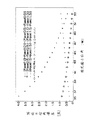
【図11】 原光屈折角の原光入射角に対する変化特性を、光線波長及び偏光状態をパラメータとして示した図である。
【図12】 等価斜入射角の、光線波長と結晶体表面方位角と原光入射角とに対する変化特性を示す図である。
【図13】 光線波長又は等価斜入射角の計算方法が互いに異なる場合における等価斜入射角の偏差の結晶体表面方位角に対する変化特性を示す図である。
【符号の説明】
1 結晶体、2 トランスデューサ、3 アブソーバ、4 可変調音響波ドライバ、5 コントロールユニット、6 光源。[0001]
BACKGROUND OF THE INVENTION
The present invention relates to an acousto-optic tunable filter in which an original light beam is obliquely incident on the surface of a crystal body with a predetermined original light incident angle.
[0002]
[Prior art]
In general, a spectroscope or a spectrophotometer is used for spectroscopic measurement to obtain a spectrum by measuring the light intensity of the original light beam for each wavelength region. Widely used. However, in recent years, as such a spectroscope, an acousto-optic tunable filter (abbreviated as AOTF) is becoming widespread because it can perform high-speed processing and has excellent earthquake resistance. In such acousto-optic tunable filters, tellurium dioxide (TeO) is used. 2 ) While applying an acoustic wave to a crystal made of a uniaxial crystal material such as a crystal, the crystal is irradiated with an original light beam, and only a predetermined wavelength component in the original light beam is diffracted in the crystal to produce monochromatic light. A diffracted light beam is obtained. Here, since the wavelength of the diffracted light is determined by the frequency of the acoustic wave applied to the crystal, the light intensity of the diffracted light is continuously measured using a light intensity detector while changing the frequency of the acoustic wave. Then, the spectrum of the original light beam can be obtained.
[0003]
The background of recent development and advancement of such an acousto-optic tunable filter is as follows. That is, in 1967, a collinear type acoustooptic tunable filter in which the traveling direction of acoustic waves and the traveling direction of light rays are the same was put into practical use for the first time. However, the most practical or useful acousto-optic tunable filter is the IC by Te Chang. 2 Is found to be a nearly ideal crystal material for making acousto-optic tunable filters, and the non-collinear type in which the traveling direction of the acoustic wave and the traveling direction of the light beam intersect This was implemented after the proposed acousto-optic tunable filter. Over the last 20 years, hundreds of patents and papers on the development of new acousto-optic tunable filters have been disclosed, but almost all research and development in this period is generally based on momentum and phase matching conditions. Based on the early theoretical studies of I. C. Chang and T. Yano and A. Watanabe,
[0004]
In early theoretical research and development, the physical model of the acousto-optic tunable filter was perfect, but its mathematical processing always relied on approximation methods. In 1985, Mo Fuqin proposed the first accurate mathematical processing technique for parallel tangent conditions. In 1987, Epikhin was one of the biggest contributions to the development of acousto-optic tunable filters, a general formula that expresses the exact relationship between acoustic and optical parameters Proposed combination. In 1991, Gas (Gass) calculated the optimal parameters for the system, setting the sonic vector azimuth to -80.23 ° without any particular reason. In 1992, Ren Quan et al. Almost completely imitated the analysis method of gas reports and set the acoustic vector azimuth angle to 105 ° without any special reason. A set of parameters for the corner was calculated.
[0005]
[Problems to be solved by the invention]
Thus, in recent years, acousto-optic tunable filters are rapidly spreading and progressing, but the conventional acousto-optic tunable filters still have many problems to be improved, and one of them is as follows. There's a problem.
That is, in the conventional acousto-optic tunable filter, when the light intensity of the original light beam is weak, or when the light intensity in a certain wavelength region in the original light beam is weak, the accuracy of the spectroscopic measurement or finally There is a problem that the accuracy of the obtained spectrum is deteriorated. For example, in spectroscopic analysis for measuring the absorption spectrum of an object, it is necessary to accurately measure the intensity of light in the wavelength region absorbed by the object. In this wavelength region, the light intensity becomes weak due to the absorption. Therefore, when an acousto-optic tunable filter is used, there arises a problem that the accuracy of the spectroscopic analysis is deteriorated.
[0006]
As described above, when the acoustooptic tunable filter is used in a spectrum analysis system for weak incident light, the light reception opening angle of the acoustooptic tunable filter is an important parameter that affects the accuracy of spectroscopic analysis. That is, the larger the light reception opening angle, the more incident light can be collected on the crystal body, and accordingly, a higher S / N ratio can be obtained. By the way, as proposed by the above-mentioned Mo-Fukin, Epikin, or Gas, the acousto-optic tunable filter crystal positioning method or molding method generally has a perfect momentum matching condition or a parallel tangential condition. Is used. In the acousto-optic tunable filter system designed using the parallel tangent condition as described above, the light reception opening angle becomes an “optimum value”. The inventors of the present application have found that the light reception opening angle can be made to reach almost the “maximum value” by mathematical research on perfect momentum matching conditions. In addition, an equivalent oblique incident angle was found in which the wavelength of the diffracted ordinary ray and the wavelength of the extraordinary diffracted ray for the same acoustic wave frequency were almost the same. However, even if the light reception opening angle is set to such “optimum value” or “maximum value”, there is a problem that the light reception opening angle cannot be sufficiently large when the intensity of the original light beam is weak.
[0007]
In addition, in the conventional acousto-optic tunable filter, the original light beam is designed to be perpendicularly incident (positive incidence) on the crystal surface. A portion that does not participate in wave propagation (hereinafter referred to as a “non-interference region”) occurs, and the non-interference region is defined by an angle between the axis of the original light beam in the crystal and the crystal optical axis. There is a problem that the larger the incident light azimuth is set, the larger the value becomes. That is, when forming (cutting) a crystal in a shape that allows the original light beam to be perpendicularly incident on the crystal surface, the shape completely includes the region where the acoustic wave propagates, and the crystal surface is the original light beam. Therefore, it is inevitably larger than the shape of the region in which the acoustic wave propagates, and as a result, a non-interference region (idle that does not participate in the acoustic wave propagation in the crystal body). This is because (part) occurs.
[0008]
Thus, if the incident light azimuth is set to an equivalent oblique incidence angle in order to reach the “maximum value”, the equivalent oblique incidence angle is a considerably large value (for example, TeO). 2 In this case, the ratio of non-interference regions in the crystal is very large. In this case, if only the same amount of uniaxial crystal material is used as in the prior art, the propagation area of the acoustic wave becomes small, and therefore the interference length between the acoustic wave and the light wave in the crystal body becomes short, and the spectral resolution deteriorates. Occurs. If an attempt is made to secure a sufficient interference length between the acoustic wave and the light wave, the amount of the uniaxial crystal material used increases, which causes a problem of increasing the cost of the acoustooptic tunable filter.
[0009]
The present invention has been made to solve the above-described conventional problems, and enables highly accurate spectroscopic measurement even when the light intensity of the original light beam or the light intensity in a certain wavelength region in the original light beam is weak. The problem to be solved is to provide an acousto-optic tunable filter that can be performed, and can sufficiently secure the interference length between an acoustic wave and a light wave without unnecessarily increasing the amount of uniaxial crystal material used. And
[0010]
[Means for Solving the Problems]
The present invention, which has been made to solve the above problems, includes a crystal body made of a light-transmitting uniaxial crystal material, and an acoustic wave capable of applying an acoustic wave of an arbitrary frequency to the acoustic wave input surface of the crystal body. An application means is provided, and an original light beam irradiated on the surface of the crystal body from a light source and incident on the crystal body intersects an acoustic wave propagating in the crystal body in the crystal body, and the crystal Wavelength components corresponding to the acoustic wave frequencies of the incident ordinary ray and the incident extraordinary ray in the original light ray in the body are diffracted in the crystal body and are diffracted extraordinary ray and diffracted ordinary ray as monochromatic light, respectively In the non-collinear acousto-optic tunable filter that is separated from the original light beam having a predetermined light-receiving opening angle that is irradiated onto the crystal body, the axis of the light beam and the surface of the crystal body Defined by the angle between the normal and Light incident angle is greater than 0 ° 60 ° Smaller than Corner Degree and And the incident light azimuth defined by the angle between the axis of the original light beam in the crystal and the crystal optical axis is equal to the wavelength of the diffraction ordinary ray and the wavelength of the diffraction extraordinary ray for the same acoustic wave frequency. So that the angle of incidence is almost the same, Obliquely incident on the crystal surface. The crystal surface azimuth angle defined by the angle between the crystal surface normal and the crystal optical axis is less dependent on the diffracted light wavelength change of the equivalent oblique incident angle. Set within the range of 35-53 ° It is characterized by that.
Here, as the uniaxial crystal material, for example, tellurium dioxide (TeO). 2 ) It is preferable to use crystals.
[0011]
In this acousto-optic tunable filter, the incident angle of the original light is 60 ° Therefore, the original light beam is obliquely incident on the surface of the crystal body. Here, for example, when a conical original light beam having a circular cross section is incident obliquely on the surface of the crystal body, that is, when the original light beam is incident with an inclination with respect to the normal line of the crystal surface In the crystal body, a phenomenon occurs in which the cross section is shortened in a predetermined direction to become an ellipse (hereinafter referred to as “light beam narrowing phenomenon”). This light beam narrowing phenomenon is caused by the difference between the refraction characteristics in the predetermined direction and the refraction characteristics in the direction perpendicular thereto. The light beam narrowing phenomenon becomes more prominent as the incident angle of the original light increases. The degree of narrowing of the light beam depends not only on the incident angle of the original light but also on the polarization state and the wavelength of the light. If this light beam narrowing phenomenon is used, the light reception opening angle of the acousto-optic tunable filter crystal can be increased, and the amount of light collected by the crystal can be increased. Alternatively, even when the light intensity in a certain wavelength region in the original light beam is weak, highly accurate spectroscopic measurement can be performed.
[0012]
Further, in this acousto-optic modulatable filter, the original light beam is obliquely incident on the surface of the crystal body. Therefore, if the incident angle of the original light is preferably set, the conventional acousto-optic modulatable filter is used. Thus, it is not necessary to provide a non-interference region for allowing the original light beam to enter the crystal surface perpendicularly. In other words, the crystal body only needs to have a shape that is almost the same (slightly larger) as the region where acoustic waves propagate (hereinafter referred to as the “interference region”). There are almost no idle parts not involved in wave propagation. Therefore, a sufficient interference length between the acoustic wave and the light wave can be ensured without unnecessarily increasing the amount of the uniaxial crystal material used. That is, the effective utilization of the crystal can be increased, and an acoustooptic tunable filter with high spectral resolution can be obtained at low cost.
[0013]
In the acoustooptic tunable filter according to the present invention, the incident light azimuth defined by the angle between the axis of the original light beam in the crystal and the crystal optical axis is a diffracted ordinary ray with respect to the same acoustic wave frequency. The angle of incidence of the original light is such that the equivalent oblique incidence angle at which the wavelength of the diffraction anomalous ray is substantially the same But Setting Has been . As described above, when the incident light azimuth is set to the equivalent oblique incidence angle, the light reception opening angle can be further increased, so that the amount of collected crystals can be further increased, and the accuracy of the spectroscopic measurement can be improved. It can be further enhanced.
According to the experiment or analysis of the present inventor, TeO 2 The equivalent oblique incident angle of an acoustooptic tunable filter using a crystal body is about 56 °, and this equivalent oblique incident angle is dependent on the wavelength of the diffracted light. That is, when the wavelength of the diffracted light beam is in the range of 0.5 μm to 2.5 μm, the equivalent oblique incident angle increases as the wavelength becomes shorter.
[0014]
Also this sound of In a reverberant optically tunable filter, the crystal surface azimuth defined by the angle between the crystal surface normal and the crystal optical axis is less dependent on the diffracted light wavelength change of the equivalent oblique incident angle. It is set within the range of 35 to 53 ° so that the crystal surface orientation angle is It is preferable that the angle is set around 40 °. As described above, when the incident light azimuth is set to the equivalent oblique incidence angle, the smaller the crystal surface azimuth, the larger the original light incident angle, and the light beam narrowing phenomenon and the effective utilization of the crystal are enhanced. . However, the smaller the crystal surface orientation angle is, the greater the dependency of the equivalent oblique incident angle on the diffracted light wavelength change is. Therefore, the diffracted ordinary ray wavelength and the diffracted extraordinary ray wavelength are made the same over a wide wavelength range. Can not do.
[0015]
On the other hand, when the crystal surface azimuth angle is large, the dependency of the equivalent oblique incident angle on the diffracted light wavelength change is small, but the original light incident angle is small and the light beam narrowing phenomenon and the crystal effective utilization are reduced.
In other words, if the crystal surface orientation angle is too small, it becomes difficult to obtain an equivalent oblique incidence angle. On the other hand, if the crystal surface orientation angle is too large, the light beam narrowing phenomenon and the effective utilization of the crystal are reduced. A failure will occur. Therefore, in order to solve such a trade-off problem, it is preferable that the crystal surface azimuth is relatively less dependent on the diffracted light wavelength change of the equivalent oblique incident angle and the original light incident angle is relatively large. It is preferable to set the angle range, for example, around 40 °.
[0016]
Further, in this acoustooptic tunable filter, the dependency of the equivalent oblique incident angle on the diffracted light wavelength change becomes smaller as the diffracted light wavelength is longer. Is preferably used.
Furthermore, in the acoustooptic tunable filter, it is preferable that the surface of the crystal body be parallel to the flow direction of the acoustic wave acoustic energy. In this case, since the shape of the crystal body is substantially the same as the region (interference region) in which the acoustic wave propagates, the crystal body has almost no idle region, that is, an idle portion that does not participate in the acoustic wave propagation. Therefore, the interference length between the acoustic wave and the light wave is sufficiently secured while reducing the amount of the uniaxial crystal material used.
In the acoustooptic tunable filter, it is more preferable that the surface of the crystal body is coated with a coating that increases the light transmittance from the outside of the crystal body to the inside of the crystal body.
[0017]
DETAILED DESCRIPTION OF THE INVENTION
Hereinafter, embodiments of the present invention will be specifically described.
As shown in FIG. 1, in the non-collinear acousto-optic tunable filter (AOTF) according to the present invention, tellurium dioxide (TeO) is used. 2 ) A
[0018]
Then, on the surface (left side) of the
[0019]
Here, due to diffraction in the
[0020]
This diffraction phenomenon can be explained as follows from the viewpoint of quantum theory. That is, according to quantum theory, an acoustic wave is considered to be a particle called a phonon (sound quantum) having a momentum or energy corresponding to its frequency, and an incident extraordinary ray and an incident ordinary ray are each of that frequency. It is considered to be a particle called photon (photon) having momentum or energy corresponding to (or wavelength). Here, photons can combine with phonons to form new photons within the range of energy conservation law or momentum conservation law, or emit phonons to form another new photon. Can do. Thus, in the
[0021]
Thus, as described above, in the conventional acousto-optic tunable filter, for example, the light intensity of the diffracted ordinary light is measured and the spectroscopic measurement of the original light beam is performed while changing the acoustic wave frequency (the spectrum of the original light beam). However, in such a conventional acousto-optic tunable filter, when the light intensity of the original light beam or the light intensity in a certain wavelength region in the original light beam is weak, high-accuracy spectroscopic measurement is performed. The problem that the interference length between the acoustic wave and the light wave cannot be sufficiently ensured, or the amount of uniaxial crystal material used is increased unnecessarily if the interference length is to be secured. was there.
[0022]
On the other hand, in the acousto-optic tunable filter according to the present invention, as described below, the original light beam L 1 Light intensity or original light beam L 1 Even if the light intensity in a certain wavelength region is weak, high-precision spectroscopic measurement can be performed, and the interference length between acoustic waves and light waves is sufficiently increased without unnecessarily increasing the amount of uniaxial crystal material used. Can be secured. Hereinafter, the basic structure of this acoustooptic tunable filter will be described.
[0023]
That is, in this acousto-optic tunable filter according to the present invention, basically, the original light beam L applied to the
[0024]
FIG. 2 shows a conical original light beam L having a circular cross section. 1 Is obliquely incident on the surface of the
[0025]
As shown in FIG. 1 Is incident on the
[0026]
FIG. 3 shows a vector-like positional relationship between light rays or acoustic waves in order to mathematically express such a light beam narrowing phenomenon. In the following expressions or figures cited or referred to, the bold alphabet K represents a vector in accordance with an ordinary mathematical notation example, but in the text of this specification, there is a limitation on the notation (bold Therefore, these will be expressed as vectorK.
In FIG. 3, vectorK i Is the original light beam L 1 The light wave vector, vectorK io Is the source light L in the crystal 1 'The light wave vector of ordinary rays in the inside, vectorK ie Is the source light L in the crystal 1 'Light wave vector of the extraordinary ray in. And θ io And θ ie Is a light wave vector vectorK io And light wave vector vectorK ie Is an azimuth angle with respect to the crystal optical axis Z. Θ 1 Is the incident angle of the original light and θ s Is the crystal surface orientation angle.
[0027]
In this acoustooptic modulation filter, the original light beam L 1 Is incident obliquely on the surface of the
[0028]
Hereinafter, the reason why the effective utilization of the crystal body is improved will be described.
FIG. 4 shows the original light beam L 1 FIG. 5 is a schematic diagram of a conventional acousto-optic tunable filter that is perpendicularly incident on the surface of the
As shown in FIG. 4, generally, when an acoustic wave is input to the acoustic wave input surface of the
[0029]
In FIG. 4, a quadrangle AECF indicates the shape of the
In FIG. 4, vectorK i And vectorK d And vectorK a Indicates an incident light wave vector, a diffracted light wave vector, and a sound wave vector, respectively.
[0030]
In such a
[0031]
Thus, the original light beam L 1 In the conventional acousto-optic tunable filter in which is perpendicularly incident on the crystal surface, the shape of the
(1) Incident light wave vector azimuth angle θ satisfying desired diffraction conditions i (Azimuth angle with respect to crystal optical axis) and sound wave vector azimuth angle θ a (Azimuth angle with respect to the optical axis of the crystal) is obtained by calculation.
(2) θ a AE direction on the acoustic wave input surface is obtained based on i Based on the above, the direction of EC on the surface of the crystal is obtained.
(3) The angle formed by the phase velocity direction Vp of the acoustic wave and the group velocity direction Vg is obtained.
(4) The acoustic wave width (AB length) and the crystal surface length (EC length) such that the interference length between the acoustic wave and the light wave is a desired value are calculated, The length of BE in the interference area is obtained. Note that AF in the second non-interference area is set to be parallel to EC. Thus, the shape AECF of the
[0032]
In the
[0033]
On the other hand, as shown in FIG. 5, in the
(1) Incident light wave vector azimuth angle θ satisfying desired diffraction conditions i And sonic vector azimuth θ a And are calculated.
(2) θ a Based on the above, the direction of AB on the acoustic wave input surface is obtained.
(3) The angle formed by the phase velocity direction Vp of the acoustic wave and the group velocity direction Vg is obtained.
(4) The direction of BC on the surface of the crystal is obtained based on Vg.
(5) Calculate the acoustic wave width (AB length) and the crystal surface length (BC length) such that the interference length between the acoustic wave and the light wave is a desired value. Note that the AD at the end face of the crystal opposite to the surface of the crystal is set to be parallel to BC. Thus, the shape AECF of the
(6) Based on the refractive index of the
Thus, the shape of the
[0034]
In the
[0035]
In the acoustooptic tunable filter according to the present invention, the incident light wave vector azimuth angle θ i The incident light incident angle θ is such that (incident light azimuth) is an equivalent oblique incident angle where the wavelength of the diffracted ordinary ray and the wavelength of the extraordinary diffracted ray are substantially the same for the same acoustic wave frequency 1 Is preferably set. Thus, the incident light wave vector azimuth angle θ i Is set to the equivalent oblique incident angle, the light receiving opening angle can be further increased, so that the amount of light collected by the
[0036]
In this case, the crystal surface orientation angle θ s However, it is preferable that the angle is set to a preferable angle range, for example, around 40 °, in which the dependency of the equivalent oblique incident angle on the diffracted light wavelength change is small and the original light incident angle corresponding to the equivalent oblique incident angle is large. That is, crystal surface orientation angle θ s Is small, the incident angle θ of the original light 1 While the light beam narrowing phenomenon and the effective utilization of crystals increase, the dependency of the equivalent oblique incident angle on the diffracted light wavelength change increases and the diffraction ordinary ray wavelength and diffraction extraordinary ray wavelength are the same over a wide wavelength range. Can not be. On the other hand, crystal surface orientation angle θ s Is large, the dependency of the equivalent oblique incident angle on the change in wavelength of the diffracted light beam is small, but the incident angle of the original light θ 1 Becomes smaller, and the light beam narrowing phenomenon and the effective utilization of crystals are reduced. Therefore, crystal surface orientation angle θ s Is set to a preferable angle range in which the dependence of the equivalent oblique incident angle on the diffracted light wavelength change is relatively small and the original light incident angle is relatively large, for example, around 40 °.
[0037]
Further, in this acoustooptic tunable filter, the dependency of the equivalent oblique incident angle on the diffracted light wavelength change becomes smaller as the diffracted light wavelength is longer. Is preferably used.
[0038]
Note that the incident light wave vector azimuth angle θ i Is set to an equivalent oblique incident angle, the original light beam L irradiated from the
[0039]
Hereinafter, a mathematical processing method or analysis method for designing an acoustooptic tunable filter according to the present invention and a result of processing or analysis actually performed using the method will be described in more detail. By this method, the incident light angle θ 1 In the acousto-optic tunable filter in which is set, 1 Due to the narrowing phenomenon, it is considered that a light receiving opening angle that is several tens of percent larger than the “optimum value” of the conventional light receiving opening angle is obtained.
[0040]
<Formulation of state or behavior of acousto-optic tunable filter>
First, with reference to FIG. 3 and FIGS. 6 to 8, the state or behavior of the acousto-optic tunable filter is expressed by a plurality of model formulas (formulas). 6 shows a conventional crystal body in which the original light beam is perpendicularly incident on the surface of the crystal body, and FIGS. 7 and 8 show the crystal according to the present invention in which the original light beam is obliquely incident on the surface of the crystal body. Showing the body.
In these figures, the light wave vector surface (cross section) W of a uniaxial crystal for ordinary and extraordinary rays. 1 , W 2 However, each is drawn with a circle and an ellipse. The Z axis represents the [001] crystal optical axis of the uniaxial crystal. There is a gap δ between the two light wave vector surfaces.
[0041]
In these figures, vectorK i Where the incident angle of the original light is θ 1 Is the original light incident light wave vector, vectorK ie And vectorK io Respectively, the azimuth angle with respect to the optical axis is θ ie And θ io Are the incident extraordinary light wave vector and the incident ordinary light wave vector. vectorK de And vectorK do Respectively, the azimuth angle with respect to the optical axis is θ de And θ do Are the diffraction extraordinary light wave vector and the diffraction ordinary light wave vector. vectorK aeo And vectorK aoe Respectively, the azimuth angle with respect to the optical axis is θ aeo And θ aoe Is a sound wave vector. Where sound wave vector vectorK aeo Therefore, the acoustic wave whose characteristics are expressed and the incident anomalous light wave vector vectorK ie Therefore, due to the interaction with the incident extraordinary ray whose characteristics are expressed, the diffraction ordinary wave vector vectorK do Thus, a diffracted ordinary ray that exhibits its characteristics is induced. Similarly, sound wave vector vectorK aoe Therefore, the acoustic wave whose characteristics are expressed and the incident ordinary wave vector vectorK io Thus, due to the interaction with the incident ordinary ray whose characteristics are expressed, the diffraction anomalous light wave vector vectorK de Therefore, a diffraction extraordinary ray whose characteristics are manifested is induced.
[0042]
<Refractive index surface of crystal>
The refractive index surface for extraordinary rays is expressed by the following equation (1).
[Expression 1]
[Expression 2]
[Equation 3]
[Equation 5]
<Light beam narrowing in the crystal>
The inventor of the present application uses the sine theorem to determine that the surface of the
FIG. 2 shows the original light beam L having a circular cross section as described above. 1 Is caused by the fact that the light beam cross-sectional diameter in the direction parallel to the paper surface and the light beam cross-sectional diameter in the direction perpendicular to the paper surface change with different refraction characteristics. Thus, the phenomenon that the cross section of the light beam in the
[0044]
Then, if the light beam narrowing phenomenon is mathematically described using various angles as shown in FIG. 3, the relationship with respect to each azimuth angle of the monochromatic light beam is expressed by the
[Formula 6]
Although there is no analytical solution for
[0045]
<Calculation result>
As shown in FIGS. 9 and 11, the larger the incident light incident angle outside the crystal body, the smaller the opening angle of the original light beam in the conical crystal body. Where θ d1 Is the original light beam L in the air. 1 Of the spread angle of d2o And θ d2e Are respectively the spread angles of ordinary rays and extraordinary rays in the
[0046]
(A) Original light beam L deflected in a direction parallel to the paper surface 1 At Brewster's angle, the reflectivity is 0, and therefore all enters the crystal as refracted light. On the other hand, the original light beam L deflected in a direction perpendicular to the paper surface 1 With respect to, there is no problem with the Brewster angle, but if the incident angle is too large, the reflectance increases as in the case described above, and the reflection loss increases even if the crystal surface is coated. Thus, TeO 2 Since the Brewster angle with respect to the crystal is approximately 66 ° (arctan 2.27), setting the original light incident angle to a value smaller than 60 ° balances the reflection loss with the degree of narrowing of the original light beam in the crystal. Preferred above.
Therefore, the incident light incident angle θ 1 Is set to a relatively large value, for example, 45 °, the beam can be narrowed to 75% compared to the case of normal incidence.
[0047]
(B) If the incident light wave vector azimuth of the
The surface of the
[0048]
<Inclined incidence under equivalent conditions>
Incident light wave vector azimuth angle θ i Is set to the equivalent oblique incidence angle, that is, θ i In the case of = 55.98 °, further calculation is required to determine the equivalent characteristic of the equivalent oblique incident angle.
FIG. 8 shows the incident light wave vector azimuth angle θ i Is a vector diagram in the case where is set to the equivalent oblique incidence angle. In this case, the original light beam L in the air 1 Is the angle of incidence of the original light θ 1 Accordingly, the light is incident on the surface of the
[0049]
Sound wave vector azimuth angle θ determined by parallel tangent conditions for extraordinary light input / normal light output (e-in / o-out) and normal light input / abnormal light output (o-in / e-out) aeo And θ aoe And the acoustic wave frequency f aeo And f aoe Is expressed by the following
[Expression 10]
Where θ i Is obtained from
[Expression 14]
Thus, by setting
This numerical calculation takes a considerable amount of time, but according to the calculation result, the difference between the equivalent oblique incident angle calculated based on the sound wave vector azimuth and the equivalent oblique incident angle calculated based on the acoustic wave frequency. Is θ s = Θ i This shows that there is an equivalent oblique incidence angle except that it is slightly larger than the case of normal incidence where = 55.9. Here, in order to know a general tendency in the numerical calculation, the numerical calculation is performed only for selected several points.
Thus, FIGS. 12 and 13 together with FIGS. 9 to 11 described above, the equivalent oblique incident angle is the crystal surface orientation angle θ. s It shows a tendency to change according to the wavelength of light.
[0052]
To summarize the results,
(A) The numerical calculation result is θ aoe = Θ aeo The equivalent oblique incidence angle calculated based on aoe = F aeo The deviation from the equivalent oblique incidence angle calculated based on the above is very small. In this case, the deviation is approximately 0.025 to 0.09 °, and in the case of normal incidence, the deviation is approximately 0.048 to 0.063 °. The dependence of the deviation of the equivalent oblique incident angle calculated for light of different wavelengths on the wavelength increases as the wavelength is shorter. In the visible region, the deviation is on the order of 4.5 °, so it can be said that there is no longer an equivalent oblique incidence angle. In the near-infrared region, the deviation between the equivalent oblique incident angle for λ = 2.5 μm and the equivalent oblique incident angle for λ = 1.0 μm is approximately 0.1 to 0.9 °. In other words, the cone angle of the actual light beam is always larger than 1 °, so that an equivalent oblique incident angle can be obtained in the near infrared region.
[0053]
(B) When the crystal surface orientation angle is relatively small, for example, θ s = 35 °, the oblique incidence angle increases and normal incidence (θ s = 55.9 °), a dilemma in which the wavelength dependence of the equivalent oblique incident angle becomes larger in the visible region is obtained, although an original light beam in the crystal narrowed to 65% is obtained. In addition, when the crystal surface orientation angle is reduced, the smaller the crystal surface orientation angle is, the smaller the Brewster angle θ b Another problem arises, such as approaching.
[0054]
(C) When the crystal surface orientation angle is relatively large, for example, θ s In the case of = 53 °, advantages such as the degree of narrowing of the original light beam in the crystal, the effective utilization of the
(D) Therefore, the crystal surface azimuth is set to an intermediate or compromise value such as θ. s It is preferable to take measures such that the angle is set to 40 ° or the vicinity thereof. In this case, the original light incident angle can be roughly estimated by the following procedure. That is, since the equivalent oblique incident angle is about 55.9 °, according to FIG. 3 or FIG. s It is. Here, if the graph shown in FIG. 11 is used, the value of the horizontal axis corresponding to the point where the value of the vertical axis of the graph is 55.9 ° -40 ° = 15.9 ° is 38 °. I understand. Therefore, the incident light incident angle θ 1 Is approximately 38 °. Such a source light incident angle of 38 ° is well off the Brewster angle and facilitates surface coating implementation to reduce reflection losses.
[Brief description of the drawings]
FIG. 1 is a schematic diagram showing a system configuration of an acoustooptic tunable filter according to the present invention.
FIG. 2 is a diagram showing a state in which a cross-section of a source light beam in a crystal is narrowed and becomes elliptical when a conical source beam having a circular cross section is incident obliquely on the surface of the crystal body; .
FIG. 3 is a diagram showing the relationship among an incident light wave vector, a diffracted light wave vector, and a sound wave vector in polar coordinates in a crystal body of an acousto-optic tunable filter.
FIG. 4 is a schematic diagram showing the shape of a conventional crystal body in which an original light beam is perpendicularly incident on the surface of the crystal body, and the behavior of light waves and acoustic waves.
FIG. 5 is a schematic diagram showing a shape of a crystal body according to the present invention in which an original light beam is obliquely incident on the surface of the crystal body, and behaviors of a light wave and an acoustic wave.
FIG. 6 is a schematic diagram showing an interference state between an acoustic wave and light in a conventional crystal having a large angle formed between the crystal surface and the acoustic wave input surface, and the original light beam is perpendicularly incident on the crystal surface. Indicates the state.
FIG. 7 is a schematic diagram showing an interference state between an acoustic wave and light in a crystal body according to the present invention having a small angle formed between the crystal surface and an acoustic wave input surface. The incident state is shown.
FIG. 8 is a schematic diagram showing an interference state between an acoustic wave and light in a crystal body according to the present invention in which an angle formed by the crystal surface and an acoustic wave input surface is small when an equivalent oblique incident angle is used; A state in which the original light beam is obliquely incident on the surface of the crystal body is shown.
FIG. 9 is a diagram showing a change characteristic of a narrowed opening angle of a source light beam in a crystal with respect to a source light incident angle, using the opening angle of the source light beam as a parameter.
FIG. 10 is a diagram showing a change characteristic of a narrowed opening angle of a source light beam in a crystal with respect to a source light incident angle, using a crystal surface azimuth as a parameter.
FIG. 11 is a diagram showing a change characteristic of an original light refraction angle with respect to an original light incident angle, using a light beam wavelength and a polarization state as parameters.
FIG. 12 is a diagram showing a change characteristic of an equivalent oblique incident angle with respect to a light beam wavelength, a crystal surface azimuth angle, and an original light incident angle.
FIG. 13 is a diagram showing a change characteristic of the deviation of the equivalent oblique incident angle with respect to the crystal surface azimuth when the calculation method of the light wavelength or the equivalent oblique incident angle is different from each other.
[Explanation of symbols]
1 Crystal, 2 Transducer, 3 Absorber, 4 Modulated acoustic wave driver, 5 Control unit, 6 Light source.
Claims (5)
光源から上記結晶体の表面に照射されて該結晶体内に入射された原光光線が、上記結晶体内で該結晶体内を伝播している音響波と交差し、該結晶体内の原光光線中の入射常光線及び入射異常光線の音響波周波数に対応する波長成分が、それぞれ、上記結晶体内で回折されて単色光である回折異常光線及び回折常光線として上記原光光線から分離されるようになっているノン・コリニア型の音響光学可変調フィルタにおいて、
上記結晶体に照射される所定の受光開き角の原光光線が、該原光光線の軸線と結晶体表面の法線とがはさむ角で定義される原光入射角が0°よりは大きく60°よりは小さい角度となり、かつ、上記結晶体内の原光光線の軸線と結晶体光軸とがはさむ角で定義される入射光方位角が同一音響波周波数に対して回折常光線の波長と回折異常光線の波長とがほぼ同一となる等価斜入射角となるように、上記結晶体表面に斜行入射させられるようになっていて、
結晶体表面の法線と結晶体光軸とがはさむ角で定義される結晶体表面方位角が、等価斜入射角の回折光線波長変化に対する依存性が小さくなるように35〜53°の範囲内に設定されていることを特徴とする音響光学可変調フィルタ。A crystal body made of a light-transmitting uniaxial crystal material, and an acoustic wave applying means capable of applying an acoustic wave of an arbitrary frequency to the acoustic wave input surface of the crystal body,
The original light beam irradiated on the surface of the crystal body from the light source intersects with the acoustic wave propagating in the crystal body in the crystal body, and in the source light beam in the crystal body The wavelength components corresponding to the acoustic wave frequencies of the incident ordinary ray and the incident extraordinary ray are respectively diffracted in the crystal and separated from the original ray as a diffracted extraordinary ray and a diffracted ordinary ray which are monochromatic lights. Non-collinear acousto-optic tunable filter
The original light incident angle defined by the angle between the axis of the original light beam and the normal of the surface of the crystal is larger than 0 ° and the original light beam having a predetermined light receiving opening angle irradiated on the crystal body is larger than 60 °. ° Ri Do and have angles smaller than, and diffracted ordinary ray incident light azimuth defined by corner axis of the original light ray and the crystal optical axis is sandwiched in the crystal body is for the same acoustic frequency as the wavelength of the wavelength of the diffracted extraordinary ray becomes equivalent oblique incident angle is substantially the same, it becomes so that is is oblique incident on the crystal body surface,
The crystal surface azimuth angle defined by the angle between the crystal surface normal and the crystal optical axis is within the range of 35 to 53 ° so that the dependence of the equivalent oblique incident angle on the diffracted light wavelength change is reduced. AOTF characterized that you have been set to.
Priority Applications (5)
| Application Number | Priority Date | Filing Date | Title |
|---|---|---|---|
| JP34512096A JP3825112B2 (en) | 1996-12-25 | 1996-12-25 | Acousto-optic tunable filter |
| EP97122589A EP0851267B1 (en) | 1996-12-25 | 1997-12-20 | Acousto-optic tunable filter |
| DE69736103T DE69736103T2 (en) | 1996-12-25 | 1997-12-20 | Acousto-optic tunable filter |
| US08/997,854 US6014245A (en) | 1996-12-25 | 1997-12-24 | Acousto-optic tunable filter system which radiates a source light beam incident on a surface of the crystal filter body at an oblique angle |
| CN97120859A CN1111951C (en) | 1996-12-25 | 1997-12-24 | Acousto-optic tunable filter and method of calculating its equivalence incident angle |
Applications Claiming Priority (1)
| Application Number | Priority Date | Filing Date | Title |
|---|---|---|---|
| JP34512096A JP3825112B2 (en) | 1996-12-25 | 1996-12-25 | Acousto-optic tunable filter |
Publications (2)
| Publication Number | Publication Date |
|---|---|
| JPH10186421A JPH10186421A (en) | 1998-07-14 |
| JP3825112B2 true JP3825112B2 (en) | 2006-09-20 |
Family
ID=18374425
Family Applications (1)
| Application Number | Title | Priority Date | Filing Date |
|---|---|---|---|
| JP34512096A Expired - Fee Related JP3825112B2 (en) | 1996-12-25 | 1996-12-25 | Acousto-optic tunable filter |
Country Status (5)
| Country | Link |
|---|---|
| US (1) | US6014245A (en) |
| EP (1) | EP0851267B1 (en) |
| JP (1) | JP3825112B2 (en) |
| CN (1) | CN1111951C (en) |
| DE (1) | DE69736103T2 (en) |
Families Citing this family (9)
| Publication number | Priority date | Publication date | Assignee | Title |
|---|---|---|---|---|
| US6992819B2 (en) | 2000-12-01 | 2006-01-31 | Auburn University | High-resolution optical microscope for quick detection of pathogens |
| AU2002248163A1 (en) * | 2000-12-01 | 2002-08-12 | Auburn University | High-resolution optical microscope |
| US6771043B2 (en) * | 2001-05-09 | 2004-08-03 | Makita Corporation | Power tools |
| US6490075B1 (en) * | 2001-08-16 | 2002-12-03 | The United States Of America As Represented By The Secretary Of The Navy | Acousto-optic tunable filter hyperspectral imaging system |
| CN1172210C (en) * | 2002-10-14 | 2004-10-20 | 天津市先石光学技术有限公司 | Method and device for improving signal-to-noise ratio of optical splitting system of acousto-optic tunable filter |
| CN100507640C (en) * | 2005-01-28 | 2009-07-01 | 斯欧普迪克尔股份有限公司 | Silcon-based electro-optic phase modulator with reduced residual amplitude modulation |
| JP5426470B2 (en) | 2010-05-11 | 2014-02-26 | 株式会社アドバンテスト | Connector and semiconductor test apparatus having the same |
| US10451953B2 (en) * | 2014-11-12 | 2019-10-22 | Orbotech Ltd. | Acousto-optic deflector with multiple output beams |
| US10471538B2 (en) | 2015-07-09 | 2019-11-12 | Orbotech Ltd. | Control of lift ejection angle |
Family Cites Families (2)
| Publication number | Priority date | Publication date | Assignee | Title |
|---|---|---|---|---|
| JP3151827B2 (en) * | 1990-11-06 | 2001-04-03 | 松下電器産業株式会社 | Acousto-optic filter |
| US5841577A (en) * | 1996-02-16 | 1998-11-24 | Carnegie Mellon University | Light microscope having acousto-optic tunable filters |
-
1996
- 1996-12-25 JP JP34512096A patent/JP3825112B2/en not_active Expired - Fee Related
-
1997
- 1997-12-20 EP EP97122589A patent/EP0851267B1/en not_active Expired - Lifetime
- 1997-12-20 DE DE69736103T patent/DE69736103T2/en not_active Expired - Lifetime
- 1997-12-24 CN CN97120859A patent/CN1111951C/en not_active Expired - Fee Related
- 1997-12-24 US US08/997,854 patent/US6014245A/en not_active Expired - Fee Related
Also Published As
| Publication number | Publication date |
|---|---|
| CN1189718A (en) | 1998-08-05 |
| US6014245A (en) | 2000-01-11 |
| CN1111951C (en) | 2003-06-18 |
| DE69736103D1 (en) | 2006-07-27 |
| EP0851267A2 (en) | 1998-07-01 |
| EP0851267B1 (en) | 2006-06-14 |
| DE69736103T2 (en) | 2007-01-11 |
| EP0851267A3 (en) | 1999-01-13 |
| JPH10186421A (en) | 1998-07-14 |
Similar Documents
| Publication | Publication Date | Title |
|---|---|---|
| US20170248807A1 (en) | Electro-optical phase modulation system | |
| US8735823B2 (en) | Terahertz-wave element, terahertz-wave detecting device, terahertz time-domain spectroscopy system, and tomography apparatus | |
| JP4609993B2 (en) | Terahertz wave generation method and apparatus | |
| JP5642405B2 (en) | Terahertz wave generator | |
| US7626756B2 (en) | Coating for optimising output coupling of em radiation | |
| US20170192242A1 (en) | Beamsplitter and frequency monitoring system | |
| US6219478B1 (en) | Light wave diffraction device | |
| CN109323661A (en) | High Sensitivity Angular Displacement Sensor Based on Beam Spatial Guss-Hansen Displacement | |
| JP2001526413A (en) | Double ray generator | |
| US7742222B2 (en) | Conversion device with multi-faceted output face and laser projection system incorporating the same | |
| WO2014007386A1 (en) | Terahertz wave generator, terahertz wave detector, and terahertz time domain spectroscopy device | |
| JPH10186421A (en) | Acousto-optic tunable filter | |
| WO2023082189A1 (en) | Terahertz on-chip integrated chip and control method therefor, and on-chip integrated system | |
| CN114199813B (en) | A terahertz on-chip integrated chip and its control method, and on-chip integrated system | |
| JP3825111B2 (en) | Determination method of equivalent incident light angle of acousto-optic tunable filter | |
| CN101266337A (en) | Two-dimensional photonic crystal self-collimating Mach-Zenter interferometer and its design method | |
| CN115638884B (en) | A nonlinear interferometer | |
| KR102723216B1 (en) | Autocorrelation measurement device | |
| CN210376753U (en) | One-way plasmon Bragg waveguide reflector | |
| WO2012035924A1 (en) | Electromagnetic radiation device | |
| JP3151827B2 (en) | Acousto-optic filter | |
| CN222232842U (en) | Two-dimensional photonic crystal self-collimating Fabry-Perot comb filter | |
| Varlamov et al. | Search for optimal conditions of saw excitation by lithium niobate integrated optical te-tm mode convertor | |
| JPH03100630A (en) | Wavelength converter | |
| Tchernyatin et al. | Acousto-optic diffraction in biaxial crystals possessing considerable optic dispersion |
Legal Events
| Date | Code | Title | Description |
|---|---|---|---|
| A977 | Report on retrieval |
Free format text: JAPANESE INTERMEDIATE CODE: A971007 Effective date: 20060112 |
|
| A131 | Notification of reasons for refusal |
Free format text: JAPANESE INTERMEDIATE CODE: A131 Effective date: 20060314 |
|
| A521 | Request for written amendment filed |
Free format text: JAPANESE INTERMEDIATE CODE: A523 Effective date: 20060512 |
|
| TRDD | Decision of grant or rejection written | ||
| A01 | Written decision to grant a patent or to grant a registration (utility model) |
Free format text: JAPANESE INTERMEDIATE CODE: A01 Effective date: 20060620 |
|
| A61 | First payment of annual fees (during grant procedure) |
Free format text: JAPANESE INTERMEDIATE CODE: A61 Effective date: 20060629 |
|
| R150 | Certificate of patent or registration of utility model |
Free format text: JAPANESE INTERMEDIATE CODE: R150 |
|
| FPAY | Renewal fee payment (event date is renewal date of database) |
Free format text: PAYMENT UNTIL: 20090707 Year of fee payment: 3 |
|
| FPAY | Renewal fee payment (event date is renewal date of database) |
Free format text: PAYMENT UNTIL: 20100707 Year of fee payment: 4 |
|
| FPAY | Renewal fee payment (event date is renewal date of database) |
Free format text: PAYMENT UNTIL: 20100707 Year of fee payment: 4 |
|
| FPAY | Renewal fee payment (event date is renewal date of database) |
Free format text: PAYMENT UNTIL: 20110707 Year of fee payment: 5 |
|
| LAPS | Cancellation because of no payment of annual fees |