JP3832544B2 - 樹脂部品の接合方法 - Google Patents
樹脂部品の接合方法 Download PDFInfo
- Publication number
- JP3832544B2 JP3832544B2 JP15411199A JP15411199A JP3832544B2 JP 3832544 B2 JP3832544 B2 JP 3832544B2 JP 15411199 A JP15411199 A JP 15411199A JP 15411199 A JP15411199 A JP 15411199A JP 3832544 B2 JP3832544 B2 JP 3832544B2
- Authority
- JP
- Japan
- Prior art keywords
- joining
- metal film
- heat
- mold
- joined
- Prior art date
- Legal status (The legal status is an assumption and is not a legal conclusion. Google has not performed a legal analysis and makes no representation as to the accuracy of the status listed.)
- Expired - Fee Related
Links
Images



Classifications
-
- B—PERFORMING OPERATIONS; TRANSPORTING
- B29—WORKING OF PLASTICS; WORKING OF SUBSTANCES IN A PLASTIC STATE IN GENERAL
- B29C—SHAPING OR JOINING OF PLASTICS; SHAPING OF MATERIAL IN A PLASTIC STATE, NOT OTHERWISE PROVIDED FOR; AFTER-TREATMENT OF THE SHAPED PRODUCTS, e.g. REPAIRING
- B29C66/00—General aspects of processes or apparatus for joining preformed parts
- B29C66/50—General aspects of joining tubular articles; General aspects of joining long products, i.e. bars or profiled elements; General aspects of joining single elements to tubular articles, hollow articles or bars; General aspects of joining several hollow-preforms to form hollow or tubular articles
- B29C66/51—Joining tubular articles, profiled elements or bars; Joining single elements to tubular articles, hollow articles or bars; Joining several hollow-preforms to form hollow or tubular articles
- B29C66/54—Joining several hollow-preforms, e.g. half-shells, to form hollow articles, e.g. for making balls, containers; Joining several hollow-preforms, e.g. half-cylinders, to form tubular articles
-
- B—PERFORMING OPERATIONS; TRANSPORTING
- B29—WORKING OF PLASTICS; WORKING OF SUBSTANCES IN A PLASTIC STATE IN GENERAL
- B29C—SHAPING OR JOINING OF PLASTICS; SHAPING OF MATERIAL IN A PLASTIC STATE, NOT OTHERWISE PROVIDED FOR; AFTER-TREATMENT OF THE SHAPED PRODUCTS, e.g. REPAIRING
- B29C65/00—Joining or sealing of preformed parts, e.g. welding of plastics materials; Apparatus therefor
- B29C65/02—Joining or sealing of preformed parts, e.g. welding of plastics materials; Apparatus therefor by heating, with or without pressure
- B29C65/18—Joining or sealing of preformed parts, e.g. welding of plastics materials; Apparatus therefor by heating, with or without pressure using heated tools
- B29C65/20—Joining or sealing of preformed parts, e.g. welding of plastics materials; Apparatus therefor by heating, with or without pressure using heated tools with direct contact, e.g. using "mirror"
-
- B—PERFORMING OPERATIONS; TRANSPORTING
- B29—WORKING OF PLASTICS; WORKING OF SUBSTANCES IN A PLASTIC STATE IN GENERAL
- B29C—SHAPING OR JOINING OF PLASTICS; SHAPING OF MATERIAL IN A PLASTIC STATE, NOT OTHERWISE PROVIDED FOR; AFTER-TREATMENT OF THE SHAPED PRODUCTS, e.g. REPAIRING
- B29C66/00—General aspects of processes or apparatus for joining preformed parts
- B29C66/01—General aspects dealing with the joint area or with the area to be joined
- B29C66/05—Particular design of joint configurations
- B29C66/10—Particular design of joint configurations particular design of the joint cross-sections
- B29C66/11—Joint cross-sections comprising a single joint-segment, i.e. one of the parts to be joined comprising a single joint-segment in the joint cross-section
- B29C66/114—Single butt joints
- B29C66/1142—Single butt to butt joints
-
- B—PERFORMING OPERATIONS; TRANSPORTING
- B29—WORKING OF PLASTICS; WORKING OF SUBSTANCES IN A PLASTIC STATE IN GENERAL
- B29C—SHAPING OR JOINING OF PLASTICS; SHAPING OF MATERIAL IN A PLASTIC STATE, NOT OTHERWISE PROVIDED FOR; AFTER-TREATMENT OF THE SHAPED PRODUCTS, e.g. REPAIRING
- B29C66/00—General aspects of processes or apparatus for joining preformed parts
- B29C66/01—General aspects dealing with the joint area or with the area to be joined
- B29C66/05—Particular design of joint configurations
- B29C66/10—Particular design of joint configurations particular design of the joint cross-sections
- B29C66/13—Single flanged joints; Fin-type joints; Single hem joints; Edge joints; Interpenetrating fingered joints; Other specific particular designs of joint cross-sections not provided for in groups B29C66/11 - B29C66/12
- B29C66/131—Single flanged joints, i.e. one of the parts to be joined being rigid and flanged in the joint area
-
- B—PERFORMING OPERATIONS; TRANSPORTING
- B29—WORKING OF PLASTICS; WORKING OF SUBSTANCES IN A PLASTIC STATE IN GENERAL
- B29C—SHAPING OR JOINING OF PLASTICS; SHAPING OF MATERIAL IN A PLASTIC STATE, NOT OTHERWISE PROVIDED FOR; AFTER-TREATMENT OF THE SHAPED PRODUCTS, e.g. REPAIRING
- B29C66/00—General aspects of processes or apparatus for joining preformed parts
- B29C66/01—General aspects dealing with the joint area or with the area to be joined
- B29C66/05—Particular design of joint configurations
- B29C66/301—Three-dimensional joints, i.e. the joined area being substantially non-flat
-
- B—PERFORMING OPERATIONS; TRANSPORTING
- B29—WORKING OF PLASTICS; WORKING OF SUBSTANCES IN A PLASTIC STATE IN GENERAL
- B29C—SHAPING OR JOINING OF PLASTICS; SHAPING OF MATERIAL IN A PLASTIC STATE, NOT OTHERWISE PROVIDED FOR; AFTER-TREATMENT OF THE SHAPED PRODUCTS, e.g. REPAIRING
- B29C66/00—General aspects of processes or apparatus for joining preformed parts
- B29C66/50—General aspects of joining tubular articles; General aspects of joining long products, i.e. bars or profiled elements; General aspects of joining single elements to tubular articles, hollow articles or bars; General aspects of joining several hollow-preforms to form hollow or tubular articles
- B29C66/51—Joining tubular articles, profiled elements or bars; Joining single elements to tubular articles, hollow articles or bars; Joining several hollow-preforms to form hollow or tubular articles
- B29C66/54—Joining several hollow-preforms, e.g. half-shells, to form hollow articles, e.g. for making balls, containers; Joining several hollow-preforms, e.g. half-cylinders, to form tubular articles
- B29C66/542—Joining several hollow-preforms, e.g. half-shells, to form hollow articles, e.g. for making balls, containers; Joining several hollow-preforms, e.g. half-cylinders, to form tubular articles joining hollow covers or hollow bottoms to open ends of container bodies
-
- B—PERFORMING OPERATIONS; TRANSPORTING
- B29—WORKING OF PLASTICS; WORKING OF SUBSTANCES IN A PLASTIC STATE IN GENERAL
- B29C—SHAPING OR JOINING OF PLASTICS; SHAPING OF MATERIAL IN A PLASTIC STATE, NOT OTHERWISE PROVIDED FOR; AFTER-TREATMENT OF THE SHAPED PRODUCTS, e.g. REPAIRING
- B29C66/00—General aspects of processes or apparatus for joining preformed parts
- B29C66/80—General aspects of machine operations or constructions and parts thereof
-
- B—PERFORMING OPERATIONS; TRANSPORTING
- B29—WORKING OF PLASTICS; WORKING OF SUBSTANCES IN A PLASTIC STATE IN GENERAL
- B29C—SHAPING OR JOINING OF PLASTICS; SHAPING OF MATERIAL IN A PLASTIC STATE, NOT OTHERWISE PROVIDED FOR; AFTER-TREATMENT OF THE SHAPED PRODUCTS, e.g. REPAIRING
- B29C66/00—General aspects of processes or apparatus for joining preformed parts
- B29C66/80—General aspects of machine operations or constructions and parts thereof
- B29C66/81—General aspects of the pressing elements, i.e. the elements applying pressure on the parts to be joined in the area to be joined, e.g. the welding jaws or clamps
- B29C66/814—General aspects of the pressing elements, i.e. the elements applying pressure on the parts to be joined in the area to be joined, e.g. the welding jaws or clamps characterised by the design of the pressing elements, e.g. of the welding jaws or clamps
- B29C66/8141—General aspects of the pressing elements, i.e. the elements applying pressure on the parts to be joined in the area to be joined, e.g. the welding jaws or clamps characterised by the design of the pressing elements, e.g. of the welding jaws or clamps characterised by the surface geometry of the part of the pressing elements, e.g. welding jaws or clamps, coming into contact with the parts to be joined
- B29C66/81411—General aspects of the pressing elements, i.e. the elements applying pressure on the parts to be joined in the area to be joined, e.g. the welding jaws or clamps characterised by the design of the pressing elements, e.g. of the welding jaws or clamps characterised by the surface geometry of the part of the pressing elements, e.g. welding jaws or clamps, coming into contact with the parts to be joined characterised by its cross-section, e.g. transversal or longitudinal, being non-flat
- B29C66/81421—General aspects of the pressing elements, i.e. the elements applying pressure on the parts to be joined in the area to be joined, e.g. the welding jaws or clamps characterised by the design of the pressing elements, e.g. of the welding jaws or clamps characterised by the surface geometry of the part of the pressing elements, e.g. welding jaws or clamps, coming into contact with the parts to be joined characterised by its cross-section, e.g. transversal or longitudinal, being non-flat being convex or concave
- B29C66/81422—General aspects of the pressing elements, i.e. the elements applying pressure on the parts to be joined in the area to be joined, e.g. the welding jaws or clamps characterised by the design of the pressing elements, e.g. of the welding jaws or clamps characterised by the surface geometry of the part of the pressing elements, e.g. welding jaws or clamps, coming into contact with the parts to be joined characterised by its cross-section, e.g. transversal or longitudinal, being non-flat being convex or concave being convex
-
- B—PERFORMING OPERATIONS; TRANSPORTING
- B29—WORKING OF PLASTICS; WORKING OF SUBSTANCES IN A PLASTIC STATE IN GENERAL
- B29C—SHAPING OR JOINING OF PLASTICS; SHAPING OF MATERIAL IN A PLASTIC STATE, NOT OTHERWISE PROVIDED FOR; AFTER-TREATMENT OF THE SHAPED PRODUCTS, e.g. REPAIRING
- B29C66/00—General aspects of processes or apparatus for joining preformed parts
- B29C66/80—General aspects of machine operations or constructions and parts thereof
- B29C66/81—General aspects of the pressing elements, i.e. the elements applying pressure on the parts to be joined in the area to be joined, e.g. the welding jaws or clamps
- B29C66/814—General aspects of the pressing elements, i.e. the elements applying pressure on the parts to be joined in the area to be joined, e.g. the welding jaws or clamps characterised by the design of the pressing elements, e.g. of the welding jaws or clamps
- B29C66/8141—General aspects of the pressing elements, i.e. the elements applying pressure on the parts to be joined in the area to be joined, e.g. the welding jaws or clamps characterised by the design of the pressing elements, e.g. of the welding jaws or clamps characterised by the surface geometry of the part of the pressing elements, e.g. welding jaws or clamps, coming into contact with the parts to be joined
- B29C66/81411—General aspects of the pressing elements, i.e. the elements applying pressure on the parts to be joined in the area to be joined, e.g. the welding jaws or clamps characterised by the design of the pressing elements, e.g. of the welding jaws or clamps characterised by the surface geometry of the part of the pressing elements, e.g. welding jaws or clamps, coming into contact with the parts to be joined characterised by its cross-section, e.g. transversal or longitudinal, being non-flat
- B29C66/81421—General aspects of the pressing elements, i.e. the elements applying pressure on the parts to be joined in the area to be joined, e.g. the welding jaws or clamps characterised by the design of the pressing elements, e.g. of the welding jaws or clamps characterised by the surface geometry of the part of the pressing elements, e.g. welding jaws or clamps, coming into contact with the parts to be joined characterised by its cross-section, e.g. transversal or longitudinal, being non-flat being convex or concave
- B29C66/81423—General aspects of the pressing elements, i.e. the elements applying pressure on the parts to be joined in the area to be joined, e.g. the welding jaws or clamps characterised by the design of the pressing elements, e.g. of the welding jaws or clamps characterised by the surface geometry of the part of the pressing elements, e.g. welding jaws or clamps, coming into contact with the parts to be joined characterised by its cross-section, e.g. transversal or longitudinal, being non-flat being convex or concave being concave
-
- B—PERFORMING OPERATIONS; TRANSPORTING
- B29—WORKING OF PLASTICS; WORKING OF SUBSTANCES IN A PLASTIC STATE IN GENERAL
- B29C—SHAPING OR JOINING OF PLASTICS; SHAPING OF MATERIAL IN A PLASTIC STATE, NOT OTHERWISE PROVIDED FOR; AFTER-TREATMENT OF THE SHAPED PRODUCTS, e.g. REPAIRING
- B29C66/00—General aspects of processes or apparatus for joining preformed parts
- B29C66/80—General aspects of machine operations or constructions and parts thereof
- B29C66/81—General aspects of the pressing elements, i.e. the elements applying pressure on the parts to be joined in the area to be joined, e.g. the welding jaws or clamps
- B29C66/812—General aspects of the pressing elements, i.e. the elements applying pressure on the parts to be joined in the area to be joined, e.g. the welding jaws or clamps characterised by the composition, by the structure, by the intensive physical properties or by the optical properties of the material constituting the pressing elements, e.g. constituting the welding jaws or clamps
- B29C66/8122—General aspects of the pressing elements, i.e. the elements applying pressure on the parts to be joined in the area to be joined, e.g. the welding jaws or clamps characterised by the composition, by the structure, by the intensive physical properties or by the optical properties of the material constituting the pressing elements, e.g. constituting the welding jaws or clamps characterised by the composition of the material constituting the pressing elements, e.g. constituting the welding jaws or clamps
-
- B—PERFORMING OPERATIONS; TRANSPORTING
- B29—WORKING OF PLASTICS; WORKING OF SUBSTANCES IN A PLASTIC STATE IN GENERAL
- B29C—SHAPING OR JOINING OF PLASTICS; SHAPING OF MATERIAL IN A PLASTIC STATE, NOT OTHERWISE PROVIDED FOR; AFTER-TREATMENT OF THE SHAPED PRODUCTS, e.g. REPAIRING
- B29C66/00—General aspects of processes or apparatus for joining preformed parts
- B29C66/80—General aspects of machine operations or constructions and parts thereof
- B29C66/83—General aspects of machine operations or constructions and parts thereof characterised by the movement of the joining or pressing tools
- B29C66/832—Reciprocating joining or pressing tools
- B29C66/8322—Joining or pressing tools reciprocating along one axis
- B29C66/83221—Joining or pressing tools reciprocating along one axis cooperating reciprocating tools, each tool reciprocating along one axis
Landscapes
- Engineering & Computer Science (AREA)
- Mechanical Engineering (AREA)
- Lining Or Joining Of Plastics Or The Like (AREA)
Description
【発明の属する技術分野】
本発明は、熱可塑性樹脂部品の熱を利用した接合方法およびその接合方法を用いた樹脂製品に関するものである。
【0002】
【従来技術】
従来、熱可塑性樹脂部品を熱溶着する方法としては接合面にどのような方法により熱を与えるかにより、即ち加熱手段の違いにより、次のような方法がある。高周波を利用した誘電加熱方式、振動を利用した超音波振動方式、レーザー光線を使う方式、或いはヒーターを使う方式等が実施されている。一般的にはヒーターを使う方式が使われているので、この従来例を図5〜図9を用いて説明する。
【0003】
図5は接合部品の斜視図で、接合部品及び被接合部品の形状を示している。図5において、1は熱可塑性樹脂からなる上側部品であり、2は熱可塑性樹脂からなる下側部品である。以下1を上側部品、2を下側部品という。上側部品1の接合面は3で示した下側の面であり、下側部品の接合面は4で示した上側面である。これら樹脂の接合面を熱で溶かして接合し一体化した樹脂製品を製造する。
【0004】
ヒーターを使う方式では上側部品1と下側部品2との間に金型を配置して、この金型を金型内部に埋め込まれているヒーターにより加熱して、温度を上げ、溶着するのに最適な所定温度に熱して、その熱を両接合部品の接合面に加えて、樹脂を溶かし接合する。
【0005】
図6は従来の金型加熱法の配置図で、上側部品1と下側部品2及び金型の断面図を示している。上側部品1および下側部品2については図5のAA断面を示している。図5と同じものは同じ番号で示す。上側部品1の接合面は図5では3で示したが、断面図では左側の接合面を3a、右側の接合面を3bで示す。
【0006】
同様に下側部品2についても左側接合面を4a、右側接合面を4bで示す。これら上側部品1と下側部品2の間には5で示される金型が配置されている。この金型は上側金型6と下側金型7とが結合部品8で一体化された構成をしている。
【0007】
そして、各金型の内部には9で示されるヒーターが配置されており、このヒーターに電流を流して発熱させ、金型の温度を上昇させるものである。ヒーターの数は図6では上側、下側ともに5本ずつ配置されているが、どの程度の時間でどの程度の温度上昇が必要かによりヒーターの大きさ、本数が決められるものである。
【0008】
上側金型6の形状は上側部品1の接合面3が金型に接触するように、上側部品の形状を反転するような形状になっている。また金型の材質としてはアルミまたは鉄が一般的に使われている。下側金型7についても同様な形状、材質となっている。
【0009】
交流電源からヒーターに電流が流れると、ヒーターが加熱され、その熱が金型に伝わり、金型が熱せられてゆく。接合に適した所定温度に達すると制御がかかり、電流を低下させ一定の温度に保たれるように制御される。この状態になると接合作業が可能になり、この作業については図7を用いて説明する。
【0010】
図7は従来の金型加熱法の説明図で、上側部品1及び下側部品2を高温度になっている金型側に所定の圧力をもって押し当てた状態を示している。接合面が金型に接触すると、樹脂が溶けはじめて、所定時間経過すると、上側部品1及び下側部品2の接合面が金型表面で溶けて、図7の10で示したように接合面が広がった形状になる。この状態は上側部品1及び下側部品2が接合できる状態であるので次の工程に進む。
【0011】
図8は従来の金型加熱法で加熱完了状態の説明図で、上側部品1を金型から上方向に移動させて、また下側部品2は金型から下方向に移動させる。そして金型を左右方向に移動させ、部品に接触しない間隔になった時点で、金型を左または右方向に移動させて、部品の接合に影響しない距離に離す。図では11で示すように左方向に移動させている。
【0012】
図9は接合状態の説明図で、上側部品1の左側接合面3aと下側部品2の左側接合面4aが接合し、同様に上側部品1の右側接合面3bと下側部品2の接合面4bが接合する。接合して所定時間経過すると接合面が硬化して完全に接合するようになる。尚、上側部品1の接合面及び下側部品2の接合面の温度は時間とともに低下するので、金型が離れてから速やかに、所定の圧力をかけながら接触させる必要がある。
【0013】
【発明が解決しようとする課題】
しかしながら、上記接合方法では製品の形状に合わせた金型がどうしても必要であり、この金型にはアルミまたは鉄のブロックが使われ、NC加工する必要があり、大きな製作コストがかかるとともに、製作期間も長くなっていた。管理面からも形状の違う製品毎に金型が必要なため、大きな保管スペースが必要であった。さらに大きな金型を常時所定温度に保つ必要があるため電力消費も膨大なものになっていた。
【0014】
本発明は、上記のような問題点に着目してなされたもので、製作コストが少なく、製作期間も短く、保管スペースも狭く、しかも電力の消費が少ない、新規な樹脂部品の接合方法を提供することを目的としている。
【0015】
【課題を解決するための手段】
本発明に係る樹脂部品の接合方法およびその接合方法を用いた樹脂製品は次のようにしたものである。
【0016】
(1)接合部品及び被接合部品を加熱溶着法により一体化するようにした熱可塑性樹脂製品の製造方法において、金属フィルムを上記接合部品及び被接合部品の接合面に挟み、その金属フィルムに電流を流し、金属フィルムを発熱させ、その熱を利用して上記接合面を溶着するようにした。
【0017】
(2)1項記載の樹脂製品の製造方法で金属フィルムの厚さを0.1〜0.5mmとした。
【0018】
(3)1ないし2項記載の樹脂製品の製造方法で、金属フィルムと部品の接合面との間に耐熱フィルムを挟むようにした。
【0019】
(4)1ないし2項記載の樹脂製品の製造方法で、金属フィルムに耐熱樹脂コーティイングした金属フィルムを使うようにした。
【0020】
(5)3項記載の樹脂製品の製造方法で耐熱フィルムにテフロンを使うようにした。
【0021】
(6)4項記載の樹脂製品の製造方法で耐熱樹脂コーティイングにフッソ系樹脂を使うようにした。
【0022】
(7)樹脂製品で1ないし6項記載の接合方法を実施した。
【0023】
【発明の実施形態】
本発明は接合部品及び被接合部品の接合面に熱を加えて、表面を溶かして接合する製造方法で接合面に熱を加える方法に特徴がある。即ち薄い金属フィルムをまず接合部品および被接合部品の接合面に挟み、両部品を押しあてる。そうすることでフィルムと接合面が接触する。接合面に凹凸があっても、薄い金属フィルムが変形して接合面全体に渡って接触する。
【0024】
この状態でフィルムに電流を流して、フィルムを加熱し、その熱を接合面に与え、接合面を溶かす。フィルムを外して接合面に力を加えながら冷却する。このようにして両部品が接合され樹脂製品が完成する。
【0025】
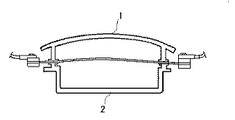
実施例を図を使って詳しく説明する。図1は両接合部品の接合面を加熱する時の各部品の配置を示している。金属フィルム12が従来例の金型と同じように、上側部品1、下側部品2の間に入るように配置されている。
【0026】
金属フィルムには電流を流して加熱するための電極13(13a,13b,13c、13d)が金属に圧接されている。そして電極13には端子14(14a、14b)が圧接されている。端子14には電線が接続されていて、電源装置(後述する)に接続されている。
【0027】
電源装置から金属フィルムに電流が供給されると金属フィルムは加熱される。金属フィルムの形状としては接合面全てを加熱するために接合部品より大きい形状にする必要がある。また、金属フィルムの厚さに関して発明者らが検討したところ、温度上昇時間及び温度降下時間が短いこと、製品形状の追従性が良いこと、耐久性があること、そして消費電力が少ないこと等から、0.1〜0.5mmが望ましいことが分かった。そして、金属の材質としては試作して検討したところ、一般に入手可能な材料であるステンレスで十分使えることを確認した。
【0028】
図2は両部品の接合面を加熱する工程を示している。図1の配置状態で上側部品1、下側部品2を金属フィルム12を介して押し当てる。この状態で前記したように金属フィルムに電流を流して、金属フィルムを加熱する。接合するために適当な温度である所定温度に達するまで大きな電流を流し、所定温度に達したら、電流を低下させ所定温度が保たれるように電流を制御する。
【0029】
上記では上側部品1、下側部品2を金属フィルム12を介して押し当てた後に、金属フィルムを加熱したが、反対に金属フィルムを加熱した後に、上側部品1、下側部品2を金属フィルム12を介して押し当てても同じ結果が得られる。
【0030】
図3は上側部品1の接合面及び下側部品2の接合面が所定温度に達し、接合できる状態になったので、金属フィルムを外す工程を示している。この工程は所定温度が低下しないように速やかに外す必要がある。
【0031】
上側部品1の接合面と下側部品2の接合面が溶けて接合できる状態になったので、両部品の接合面を押し当てる。この状態で冷却すると製品が完成する。この工程は従来の図9に示したものと同じである。
【0032】
以上のように、本発明の金属フィルムを使った熱可塑性樹脂部品の接合方法について説明してきたが、図3の金属フィルムを外す工程では金属フルムと樹脂の接合面が付着してなかなか外れないという問題があった。
【0033】
この問題を解決するために金属フィルムの両面に耐熱性の樹脂フィルム、例えばテフロンフィルムを貼ることで、金属フィルムがスムーズに外すことができるようになった。また、耐熱性の樹脂フィルムの代わりに金属の表面に最初から耐熱樹脂をコーティングしておく方法も同じ効果が得られ、耐熱樹脂としてはフッソ系樹脂が有効であることが分かった。
【0034】
図4は金属フィルムに電流を流すための電源装置である。15は交流電源、16は電流制御回路で、交流を開閉制御するとともに、電流の大きさを制御する制御回路である。17はトランスで交流電源からの出力電圧を変換して、金属フィルム12に最適な電流を流すようにしている。12は前記している金属フィルムである。金属フィルムに電流を流すための電極13、端子14及び電線は前記しているので省略する。
【0035】
【発明の効果】
以上説明したように、熱可塑性樹脂部品を接合する際に、従来は金型を使って接合面を加熱していたが、金型の代わりに金属フィルムを使うようにしたので、従来のように製品の形状が異なる毎に金型を製作する必要がない。また、製作コストが金型より安く、製作期間も金型より短く、保管スペースも金型より狭くてよい、更に消費電力についても金型ブロックのように大きな熱容量が必要ないので、少ない消費電力で済むという効果がある。
【図面の簡単な説明】
【図1】発明の金属フィルム加熱法の配置図
【図2】発明の金属フィルム加熱法の説明図
【図3】発明の金属フィルム加熱法で加熱完了状態の説明図
【図4】金属フィルムを駆動する電源装置
【図5】接合部品の斜視図
【図6】従来の金型加熱法の配置図
【図7】従来の金型加熱法の説明図
【図8】従来の金型加熱法で加熱完了状態の説明図
【図9】接合状態の説明図
【符号の説明】
1 上側部品
2 下側部品
3,3a,3b 上側部品の接合面
4,4a,4b 下側部品の接合面
5 金型
6 上側金型
7 下側金型
8 結合部品
9 ヒーター
10 接合面形状
11 金型移動方向
12 金属フィルム
13a〜13d 電極
14a,14b 端子
15 交流電源
16 電流制御部
17 トランス
Claims (5)
- 接合部品及び被接合部品を熱溶着法により一体化するようにした熱可塑性樹脂製品の製造方法において、厚さを0.1〜0.5mmとした金属フィルムを上記接合部品及び被接合部品の接合面に挟み、その金属フィルムに電流を流し、金属フィルムを発熱させて、その熱を利用して上記接合面を溶着するようにしたことを特徴とする樹脂製品の接合方法。
- 接合部品及び被接合部品を熱溶着法により一体化するようにした熱可塑性樹脂製品の製造方法において、金属フィルムを上記接合部品及び被接合部品の接合面に挟み、前記
金属フィルムと
前記接合部品及び被接合部品
の接合面との間に耐熱フィルムを挟み込
み、
その金属フィルムに電流を流し、金属フィルムを発熱させて、その熱を利用して上記接合面を溶着するようにしたことを特徴とする樹脂製品の接合方法。 - 接合部品及び被接合部品を熱溶着法により一体化するようにした熱可塑性樹脂製品の製造方法において、
耐熱樹脂コーティングした金属フィルムを
前記接合部品及び被接合部品の接合面に挟み、その金属フィルムに電流を流し、金属フィルムを発熱させて、その熱を利用して上記接合面を溶着するようにしたことを特徴とする樹脂製品の接合方法。 - 耐熱フィルムにポリテトラフルオロエチレンを使うようにした2項記載の樹脂製品の接合方法。
- 耐熱樹脂コーティングにフッソ系樹脂を使うようにした3項記載の樹脂製品の接合方法。
Priority Applications (1)
| Application Number | Priority Date | Filing Date | Title |
|---|---|---|---|
| JP15411199A JP3832544B2 (ja) | 1999-06-01 | 1999-06-01 | 樹脂部品の接合方法 |
Applications Claiming Priority (1)
| Application Number | Priority Date | Filing Date | Title |
|---|---|---|---|
| JP15411199A JP3832544B2 (ja) | 1999-06-01 | 1999-06-01 | 樹脂部品の接合方法 |
Publications (2)
| Publication Number | Publication Date |
|---|---|
| JP2000334842A JP2000334842A (ja) | 2000-12-05 |
| JP3832544B2 true JP3832544B2 (ja) | 2006-10-11 |
Family
ID=15577176
Family Applications (1)
| Application Number | Title | Priority Date | Filing Date |
|---|---|---|---|
| JP15411199A Expired - Fee Related JP3832544B2 (ja) | 1999-06-01 | 1999-06-01 | 樹脂部品の接合方法 |
Country Status (1)
| Country | Link |
|---|---|
| JP (1) | JP3832544B2 (ja) |
-
1999
- 1999-06-01 JP JP15411199A patent/JP3832544B2/ja not_active Expired - Fee Related
Also Published As
| Publication number | Publication date |
|---|---|
| JP2000334842A (ja) | 2000-12-05 |
Similar Documents
| Publication | Publication Date | Title |
|---|---|---|
| CN101379338A (zh) | 具有螺纹施压装置的电熔接管道材料 | |
| CN111659996B (zh) | 超声接合方法和装置 | |
| JP2019093714A (ja) | 熱可塑性要素の接合方法 | |
| WO2000075018A1 (en) | Heater wire for device such as impulse heat sealer | |
| JP6457287B2 (ja) | 熱溶着装置 | |
| JP5928949B2 (ja) | インサート成形装置及び方法 | |
| JPS6235868B2 (ja) | ||
| US20090250440A1 (en) | Out-of-phase electrical welder and process | |
| JPH036900B2 (ja) | ||
| JP2000334842A (ja) | 樹脂部品の接合方法およびその接合方法を用いた樹脂製品 | |
| CN116093736A (zh) | 芯片组件焊接方法及半导体激光器 | |
| JP6722931B1 (ja) | 熱溶着チップおよび熱溶着ユニット | |
| EP1926584A2 (en) | Method of hot wire welding of plastics | |
| JPS6240041A (ja) | 界磁コイルの製造方法 | |
| JP2023013122A (ja) | 接合方法及び接合装置 | |
| JPS6358695B2 (ja) | ||
| JP2003181937A (ja) | 熱可塑性樹脂成形品の熱溶着方法及びその装置 | |
| JPS6331934Y2 (ja) | ||
| JPH0419016B2 (ja) | ||
| JPH09109262A (ja) | 非接触熱板溶着方法およびその装置 | |
| JPS5859050A (ja) | 樹脂の溶着方法 | |
| CN223199570U (zh) | 塑料热成型设备 | |
| JP3014147U (ja) | シート状材料の突合せ型構造 | |
| JP2006123378A (ja) | 熱可塑性樹脂成形品の熱溶着方法 | |
| JP3053792B2 (ja) | 熱可塑性樹脂成形品の熱溶着装置 |
Legal Events
| Date | Code | Title | Description |
|---|---|---|---|
| A621 | Written request for application examination |
Free format text: JAPANESE INTERMEDIATE CODE: A621 Effective date: 20040819 |
|
| A977 | Report on retrieval |
Free format text: JAPANESE INTERMEDIATE CODE: A971007 Effective date: 20060202 |
|
| A131 | Notification of reasons for refusal |
Free format text: JAPANESE INTERMEDIATE CODE: A131 Effective date: 20060228 |
|
| A521 | Written amendment |
Free format text: JAPANESE INTERMEDIATE CODE: A523 Effective date: 20060428 |
|
| TRDD | Decision of grant or rejection written | ||
| A01 | Written decision to grant a patent or to grant a registration (utility model) |
Free format text: JAPANESE INTERMEDIATE CODE: A01 Effective date: 20060613 |
|
| A61 | First payment of annual fees (during grant procedure) |
Free format text: JAPANESE INTERMEDIATE CODE: A61 Effective date: 20060711 |
|
| R150 | Certificate of patent or registration of utility model |
Free format text: JAPANESE INTERMEDIATE CODE: R150 |
|
| FPAY | Renewal fee payment (event date is renewal date of database) |
Free format text: PAYMENT UNTIL: 20090728 Year of fee payment: 3 |
|
| FPAY | Renewal fee payment (event date is renewal date of database) |
Free format text: PAYMENT UNTIL: 20100728 Year of fee payment: 4 |
|
| FPAY | Renewal fee payment (event date is renewal date of database) |
Free format text: PAYMENT UNTIL: 20110728 Year of fee payment: 5 |
|
| FPAY | Renewal fee payment (event date is renewal date of database) |
Free format text: PAYMENT UNTIL: 20110728 Year of fee payment: 5 |
|
| FPAY | Renewal fee payment (event date is renewal date of database) |
Free format text: PAYMENT UNTIL: 20120728 Year of fee payment: 6 |
|
| FPAY | Renewal fee payment (event date is renewal date of database) |
Free format text: PAYMENT UNTIL: 20120728 Year of fee payment: 6 |
|
| FPAY | Renewal fee payment (event date is renewal date of database) |
Free format text: PAYMENT UNTIL: 20130728 Year of fee payment: 7 |
|
| LAPS | Cancellation because of no payment of annual fees |