JP3965538B2 - Agent device - Google Patents
Agent device Download PDFInfo
- Publication number
- JP3965538B2 JP3965538B2 JP6441498A JP6441498A JP3965538B2 JP 3965538 B2 JP3965538 B2 JP 3965538B2 JP 6441498 A JP6441498 A JP 6441498A JP 6441498 A JP6441498 A JP 6441498A JP 3965538 B2 JP3965538 B2 JP 3965538B2
- Authority
- JP
- Japan
- Prior art keywords
- agent
- program
- data
- driver
- situation
- Prior art date
- Legal status (The legal status is an assumption and is not a legal conclusion. Google has not performed a legal analysis and makes no representation as to the accuracy of the status listed.)
- Expired - Fee Related
Links
Images









Landscapes
- Traffic Control Systems (AREA)
- Navigation (AREA)
Description
【0001】
【発明の属する技術分野】
本発明は、車両内に出現し、経路案内や各種装置の作動等について運転者を補助するエージェント装置に係り、複数の情報を把握容易に提供するエージェント装置に関する。
【0002】
【従来の技術】
従来より、車両内において、車両の位置や状態等の状況、及びこれらの状況に対応する警告や経路誘導等の情報を、ディスプレイに人間の表情や動作として表示して運転者等に伝達する技術が知られている(特開平9−102098号公報)。
この従来技術は、情報が視覚的に表現されるため一見して把握しやすい利点がある。
【0003】
【発明が解決しようとする課題】
しかし、上述の従来技術では、伝達すべき情報の数が経時的に変化する場合や複数の情報がそれぞれ異なる期間で変化する場合に、それらの経時的変化が認識されにくい等の問題点があり、情報がより一層把握し易い技術が求められている。
【0004】
本発明は、車両等において、複数の情報を把握容易に提供するエージェント装置を提供することを目的とする。
【0005】
【課題を解決するための手段】
請求項1に記載した発明では、擬人化されたエージェントを車両内に出現させるエージェント出現手段と、車両の状況を判断する状況判断手段と、この状況判断手段により判断された状況から、前記エージェントの行為を決定するエージェント行為決定手段と、このエージェント行為決定手段で決定された行為を前記エージェント出現手段により出現されるエージェントに行わせるエージェント制御手段と、前記状況判断手段により判断された状況から、前記エージェントの出現下において擬人化されたサブエージェントの出現の要否を判断する要否判断手段と、前記要否判断手段の判断に基づいて前記サブエージェントを前記エージェントとは別個に認識可能に出現させるサブエージェント出現手段と、前記状況判断手段により判断された状況から、サブエージェントの行為を決定するサブエージェント行為決定手段と、前記サブエージェント行為決定手段で決定された行為を前記サブエージェント出現手段により出現されるサブエージェントに行わせるサブエージェント制御手段とをエージェント装置に具備させて前記目的を達成する。
請求項2に記載した発明では、請求項1に記載したエージェント装置において、前記サブエージェントは、前記エージェントの行為についての解説行為を行うエージェント装置を提供することにより前記目的を達成する。
請求項3に記載した発明では、請求項1に記載したエージェント装置において、前記サブエージェントは、一連の前記エージェントの行為についてその一部を短絡するエージェント装置を提供することにより前記目的を達成する。
請求項4に記載した発明では、請求項1から3のうちのいずれか1項に記載のエージェント装置において、前記状況判断手段は、運転者の指向を取得する指向取得手段を備え、前記要否判断手段は、前記運転者の指向を前記車両の状況として、サブエージェントの出現の要否を判断するエージェント装置を提供することにより前記目的を達成する。
請求項5に記載した発明では、請求項4に記載のエージェント装置において、前記指向取得手段が、運転者の指向として運転者のエージェントに対する習熟度を取得し、前記要否判断手段は、前記習熟度を前記車両の状況として、サブエージェントの要否を判断するエージェント装置を提供することにより前記目的を達成する。
請求項6に記載した発明では、請求項1から請求項5のうちのいずれか1項に記載のエージェント装置において、前記状況判断手段による所定状況を記憶することで学習する学習手段を具備し、前記要否判断手段は、前記学習手段による学習結果を前記車両の状況として、前記サブエージェントの要否を判断するエージェント装置を提供することにより前記目的を達成する。
請求項7に記載した発明では、請求項1から請求項6のうちのいずれか1項に記載のエージェント装置において、前記状況判断手段による所定状況を記憶することで学習する学習手段を具備し、前記エージェント行為決定手段及び前記サブエージェント行為決定手段のうち少なくとも1つは、前記学習結果を車両の前記状況として、エージェント又はサブエージェントの行為を決定するエージェント装置を提供することにより前記目的を達成する。
請求項8に記載した発明では、請求項1から請求項7のうちのいずれか1項に記載のエージェント装置において、画像表示手段を備え、前記エージェント出現手段が、前記画像表示手段に対し、エージェントを画像表示させるエージェント表示手段を含み、前記サブエージェント出現手段が、前記画像表示手段に対し、サブエージェントを、前記エージェントと視覚的に識別可能に画像表示させるサブエージェント表示手段を含むエージェント装置を提供することにより前記目的を達成する。
請求項9に記載した発明では、請求項1から請求項8のうちのいずれか1項に記載のエージェント装置において、音声出力装置を備え、前記エージェント出現手段が、前記音声出力装置に対し、エージェントの音声を出力させるエージェント音声出力手段を含み、前記サブエージェント出現手段が、前記音声出力装置に対し、前記エージェントと聴覚的に識別可能なサブエージェントの音声を出力させるサブエージェント音声出力手段を含むエージェント装置を提供することにより前記目的を達成する。
【0006】
【発明の実施の形態】
以下、本発明のエージェント装置における好適な実施の形態について、図1から図13を参照して詳細に説明する。
(1)第1の実施形態の概要
本実施形態のエージェント装置では、擬人化されたエージェントを画像(平面的画像、ホログラフィ等の立体的画像等)により車両内に出現させる。そして、車両自体、運転者、同乗者、対向車等を含む車両の状況(運転者の応答や反応等も含む)の判断を行い、各時点での車両状況に基づいて、エージェントが運転者や車両に対して様々なバリエーションをもった対応(行為=行動と音声)をする。
これにより運転者は、自分固有のエージェントを車両内でつき合う(コミュニケーションする)ことが可能になり、車両内での環境を快適にすることができる。
ここで、本実施形態において擬人化されたエージェントとは、特定の人間、生物、漫画のキャラクター等との同一性があり、その同一性のある生物が、同一性・連続性を保つようなある傾向の出力(動作、音声による応答)を行うものである。また、同一性・連続性は特有の個性をもつ人格としても表現可能で、電子機器内の一種の疑似生命体としても捉えることができる。車両内に出現させるエージェントは、人間と同様に判断する疑似人格化(仮想人格化)された主体である。ときには、車両の走行には関係ない範囲での判断ミスも有り、この判断ミスによる不要な(ドジな)応答をすることもある。
実施形態中において、車両自体や運転者を含む車両の状況を判断して経路案内や機器の作動等種々の動作を運転者に代わり行ったりその手助けを行うメインのエージェントは、更に車両の状況や運転者の応答等を学習し、この学習結果を含めた判断により各種行為を行うものとなっている。従って、同一の車両状況であっても過去の学習内容等に応じてエージェントのコミュニケーションの内容は異なる。ときには、車両の走行には関係ない範囲での判断ミスも有り、この判断ミスによる不要な(ドジな)応答をすることもある。そして運転者の応答により、判断ミスか否かを判定し、学習する。
また、本実施形態においては、メインのエージェントの出現時に、運転者の当該エージェントに対する習熟度に応じて、ヘルプエージェントをサブエージェントとして出現させる。ヘルプエージェントとは、メインのエージェントの提案に対する対応方法や応答により予定される結果の教示等の、メインのエージェント行為に対する解説を運転者に行うものである。これらの2つのエージェントは、それぞれ異なる容姿と音声で車内に出現させる。
この様に、状況に応じて2つのエージェントを出現可能とすることにより、1つのエージェントよりもきめ細かく、運転者の習熟度等の車両状況に即したエージェント行為を実現することができる。そして、出現時期や機能の異なる2つのエージェントの容姿及び音声を異ならせることにより、運転者は、これら2つのエージェントを容易に識別し、各エージェントの機能を明確に意識した上で正確に情報を把握し各エージェントに対応することが可能となる。
【0007】
(2)実施形態の詳細
図1は、本実施形態におけるエージェント装置の構成を示すブロック図である。
本実施形態では、コミュニケーション機能全体を制御する全体処理部1を備えている。この全体処理部1は、設定した目的地までの経路を探索して音声や画像表示により案内するナビゲーション処理部10、車両の状況や運転者による過去の応対等を学習して適切な会話や制御を行うエージェント処理部11、ナビゲーション処理部10とエージェント処理部11に対するI/F部12、エージェント画像や地図画像等の画像出力や入力画像を処理する画像処理部13、エージェント音声や経路案内音声等の音声出力や入力される音声を制御する音声制御部14、及び車両や運転者に関する各種状況の検出データを処理する状況情報処理部15を有している。
【0008】
ナビゲーション処理部10とエージェント処理部11は、データ処理及び各部の動作の制御を行うCPU(中央処理装置)と、このCPUにデータバスや制御バス等のバスラインで接続されたROM、RAM、タイマ等を備えている。両処理部10、11はネットワーク接続されており、互いの処理データを取得することができるようになっている。
ROMはCPUで制御を行うための各種データやプログラムが予め格納されたリードオンリーメモリであり、RAMはCPUがワーキングメモリとして使用するランダムアクセスメモリである。
【0009】
本実施形態のナビゲーション処理部10とエージェント処理部11は、CPUがROMに格納された各種プログラムを読み込んで各種処理を実行するようになっている。なお、CPUは、記録媒体駆動装置23にセットされた外部の記録媒体からコンピュータプログラムを読み込んで、エージェント記憶装置29やナビゲーションデータ記憶装置30、図示しないハードディスク等のその他の記憶装置に格納(インストール)し、この記憶装置から必要なプログラム等をRAMに読み込んで(ロードして)実行するようにしてもよい。また、必要なプログラム等を記録媒体駆動装置23からRAMに直接読み込んで実行するようにしてもよい。
【0010】
ナビゲーション処理部10には、現在位置検出装置21とナビゲーションデータ記憶装置30が接続され、エージェント処理部11にはエージェントデータ記憶装置29が接続され、I/F部12には入力装置22と記憶媒体駆動装置23と通信制御装置24が接続され、画像処理部13には表示装置27と撮像装置28が接続され、音声制御部14には音声出力装置25とマイク26が接続され、状況情報処理部15には状況センサ部40が接続されている。
【0011】
現在位置検出装置21は、車両の絶対位置(緯度、経度による)を検出するためのものであり、人工衛星を利用して車両の位置を測定するGPS(Global Positioning System)受信装置211と、方位センサ212と、舵角センサ213と、距離センサ214と、路上に配置されたビーコンからの位置情報を受信するビーコン受信装置215等が使用される。
GPS受信装置211とビーコン受信装置215は単独で位置測定が可能であるが、GPS受信装置211やビーコン受信装置215による受信が不可能な場所では、方位センサ212と距離センサ214の双方を用いた推測航法によって現在位置を検出するようになっている。
方位センサ212は、例えば、地磁気を検出して車両の方位を求める地磁気センサ、車両の回転角速度を検出しその角速度を積分して車両の方位を求めるガスレートジャイロや光ファイバジャイロ等のジャイロ、左右の車輪センサを配置しその出力パルス差(移動距離の差)により車両の旋回を検出することで方位の変位量を算出するようにした車輪センサ、等が使用される。
舵角センサ213は、ステアリングの回転部に取り付けた光学的な回転センサや回転抵抗ボリューム等を用いてステアリングの角度αを検出する。
距離センサ214は、例えば、車輪の回転数を検出して計数し、または加速度を検出して2回積分するもの等の各種の方法が使用される。
【0012】
入力装置22は、ナビゲーション処理における走行開始時の現在地(出発地点)や目的地(到達地点)、情報提供局へ渋滞情報等の情報の請求を発信したい車両の所定の走行環境(発信条件)、携帯電話6のタイプ(型式)などを入力するためのものである。また、入力装置22は、本実施形態によるエージェントの問い合わせ等に対して運転者が応答するための1つの手段でもある。
入力装置22には、タッチパネル(スイッチとして機能)、キーボード、マウス、ライトペン、ジョイスティック、赤外線等によるリモコン、音声認識装置などの各種の装置が使用可能である。また、赤外線等を利用したリモコンと、リモコンから送信される各種信号を受信する受信部を備えてもよい。リモコンには、画面上に表示されたカーソルの移動操作等を行うジョイスティックの他、メニュー指定キー(ボタン)、テンキー等の各種キーが配置される。
【0013】
記録媒体駆動装置23は、ナビゲーション処理部10やエージェント処理部11が各種処理を行うためのコンピュータプログラムを外部の記録媒体から読み込むのに使用される駆動装置である。記録媒体に記録されているコンピュータプログラムには、各種のプログラムやデータ等が含まれる。
ここで、記録媒体とは、コンピュータプログラムが記録される記録媒体をいい、具体的には、フロッピーディスク、ハードディスク、磁気テープ等の磁気記録媒体、メモリチップやICカード等の半導体記録媒体、CD−ROMやMO、PD(相変化書換型光ディスク)等の光学的に情報が読み取られる記録媒体、紙カードや紙テープ、文字認識装置を使用してプログラムを読み込むための印刷物等の用紙(および、紙に相当する機能を持った媒体)を用いた記録媒体、その他各種方法でコンピュータプログラムが記録される記録媒体が含まれる。
【0014】
記録媒体駆動装置23は、これらの各種記録媒体からコンピュータプログラムを読み込む他に、記録媒体がフロッピーディスクやICカード等のように書き込み可能な記録媒体である場合には、ナビゲーション処理部10やエージェント処理部11のRAMや記憶装置29、30のデータ等をその記録媒体に書き込むことが可能である。
例えば、ICカードにメインのエージェントの機能及びヘルプエージェントの機能に関する学習内容(学習項目データ、応答データ、習熟度データ等)を記憶させ、他の車両を運転する場合でもこの記憶させたICカードを使用することで、自分の好みに合わせて(過去の応対の状況に応じて)学習されたエージェントとコミュニケーションすることが可能になる。これにより、車両毎のエージェントではなく、運転者に固有のエージェントを車両内に出現させることが可能になる。
【0015】
通信制御装置24は、各種無線通信機器からなる携帯電話が接続されるようになっている。通信制御部24は、電話回線による通話の他、道路の混雑状況や交通規制等の交通情報に関するデータなどを提供する情報提供局との通信や、車内での通信カラオケのために使用するカラオケデータを提供する情報提供局との通信を行うことができるようになっている。
また、通信制御装置24を介して、各エージェントの機能に関する学習データ等を送受信することも可能である。
【0016】
音声出力装置25は、車内に配置された複数のスピーカで構成され、音声制御部14で制御された音声、例えば、音声による経路案内を行う場合の案内音声や、エージェントの行動にあわせた音声や音が出力されるようになっている。この音声出力装置25は、オーディオ用のスピーカと兼用するようにしてもよい。なお、音声制御装置14は、運転者のチューニング指示の入力に応じて、音声出力装置25から出力する音声の音色やアクセント等を制御することが可能である。マイク26は、音声制御部14における音声認識の対象となる音声、例えば、ナビゲーション処理における目的地等の入力音声や、エージェントとの運転者の会話(応答等)等を入出力する音声入力手段として機能する。このマイク26は、通信カラオケ等のカラオケを行う際のマイクと兼用するようにしてもよく、また、運転者の音声を的確に収集するために指向性のある専用のマイクを使用するようにしてもよい。
音声出力装置25とマイク26とでハンズフリーユニットを形成させて、携帯電話を介さずに、電話通信における通話を行えるようにしてもよい。
【0017】
表示装置27には、ナビゲーション処理部10の処理による経路案内用の道路地図や各種画像情報が表示されたり、エージェント処理部11によるメインのエージェント及びヘルプエージェントの各種行動(動画)が表示されたりするようになっている。また、撮像装置28で撮像された車両内外の画像も画像処理部13で処理された後に表示されるようになっている。
表示装置27は、液晶表示装置、CRT等の各種表示装置が使用される。
なお、この表示装置5は、例えばタッチパネル等の、前記入力装置2としての機能を兼ね備えたものとすることができる。
【0018】
撮像装置28は、画像を撮像するためのCCD(電荷結合素子)を備えたカメラで構成されており、運転者を撮像する車内カメラの他、車両前方、後方、右側方、左側方を撮像する各車外カメラが配置されている。撮像装置28の各カメラにより撮像された画像は、画像処理部13に供給され、画像認識等の処理が行われ、各認識結果をエージェント処理部11によるプログラム番号の決定に使用するようになっている。
【0019】
エージェントデータ記憶装置29は、本実施形態によるメインのエージェントの機能及びヘルプエージェントの機能を実現するために必要な各種データ(プログラムを含む)が格納される記憶装置である。このエージェントデータ記憶装置29には、例えば、フロッピーディスク、ハードディスク、CD−ROM、光ディスク、磁気テープ、ICカード、光カード等の各種記録媒体と、その駆動装置が使用される。
この場合、例えば、学習項目データ292と応答データ294、習熟度データ295を持ち運びが容易なICカードやフロッピーディスクで構成し、その他のデータをハードディスクで構成するというように、複数種類の異なる記録媒体と駆動装置で構成し、駆動装置としてそれらの駆動装置を用いるようにしてもよい。
【0020】
エージェントデータ記憶装置29には、エージェントプログラム290、プログラム選択テーブル291、学習項目データ292、応答データ293、図4及び図13に例示したエージェント及びヘルプエージェントの容姿や行動を画像表示するための画像データ294、ヘルプエージェントプログラム295、ヘルプエージェントプログラム対応テーブル296、習熟度データ297、その他のデータが格納されている。
学習項目データ292、応答データ293、及び習熟度データ297は、運転者の運転操作や応答によってエージェントが学習した結果を格納するデータである。従って、学習項目データ292、応答データ293、及び習熟度データ297は、各運転者毎にそのデータが格納・更新(学習)されるようになっている。画像データ294に格納される容姿としては、人間(男性、女性)的な容姿である必要はなく、例えば、ひよこや犬、猫、カエル、ネズミ等の動物自体の容姿や人間的に図案化(イラスト化)した動物の容姿であってもよく、更にロボット的な容姿や、特定のキャラクタの容姿等であってもよい。またエージェントの年齢としても一定である必要がなく、エージェントの学習機能として、最初は子供の容姿とし、時間の経過と共に成長していき容姿が変化していく(大人の容姿に変化し、更に老人の容姿に変化していく)ようにしてもよい。画像データ294には、これらの各種メインのエージェント及びヘルプエージェントの容姿の画像が格納されており、運転者の好みによって入力装置22等からメインのエージェント及びヘルプエージェントの容姿を個別に選択することとができるようになっている。選択されたメインのエージェント及びヘルプエージェントの容姿は、運転者に対応して記憶され、起動時に読み出されるようになっている。また、メインのエージェント及びヘルプエージェントの容姿は、入力装置22等から適宜変更可能となっている。
【0021】
エージェントプログラム290には、メインのエージェントの機能を実現するためのエージェント処理プログラムや、エージェントと運転者とがコミュニケーションする場合の細かな行動を表示装置27に画像表示すると共にその行動に対応した会話を音声出力装置25から出力するためのコミュニケーションプログラムがプログラム番号順に格納されている。
このエージェントプログラム290には、各プログラム番号の音声に対して複数種類の音声データが格納されており、運転者は前記メインのエージェントの容姿の選択と併せて音声を入力装置22等から選択することができるようになっている。メインのエージェントの音声としては、男性の音声、女性の音声、子供の音声、機械的な音声、動物的な音声、特定の声優や俳優の音声、特定のキャラクタの音声等があり、これらの中から適宜運転者が選択する。なお、この音声と前記容姿の選択は、適時変更することが可能である。
【0022】
プログラム選択テーブル291は、エージェントプログラム290に格納されているコミュニケーションプログラムを選択するためのテーブルである。
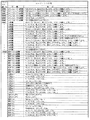
図2はプログラム選択テーブル291を表したものであり、図3はプログラム選択テーブル291で選択される各プログラム番号に対応した、エージェントの行為(行動と発声)内容を表したものである。
この図2、図3で示されているプログラム番号は、エージェントプログラム290に格納されている各コミュニケーションプログラムの番号と一致している。
【0023】
図4は、図2、図3のプログラム番号00001〜00002により表示装置27に表示されるメインのエージェントの「かしこまってお辞儀」行動についての数画面を表したものである。
この図4に示すように、メインのエージェントEは、口元を引き締めると共に手を膝に当てながら、お辞儀をすることでかしこまったお辞儀であることが表現されている。この行動と共にメインのエージェントEが話す言葉(発声)は、車両状況や学習状況等によって変えられる。
【0024】
エンジンの冷却水温度が低い場合には、エンジンの調子に合わせて行動「眠そうに…」が選択される。眠そうな表現として、瞼が下がった表情にしたり、あくびや伸びをした後に所定の行動(お辞儀等)をしたり、最初に目をこすったり、動きや発声を通常よりもゆっくりさせたりすることで表すことができる。これらの眠そうな表現は、常に同一にするのではなく、行動回数等を学習することで適宜表現を変更する。
例えば、3回に1回は目をこすり(A行動)、10回に1回はあくびをするようにし(B行動)、それ以外では瞼を下がった表情(C行動)にする。これらの変化は、行動Bや行動Cの付加プログラムを行動Aの基本プログラムに組み合わせることで実現される。そして、どの行動を組み合わせるかについては、基本となる行動Aのプログラム実行回数を学習項目として計数しておき、回数に応じて付加プログラムを組み合わせるようにする。
また、行動「元気よく」を表現する場合には、音声の抑揚を大きくしたり、メインのエージェントEを走りながら画面に登場させたりすることで表現する。
【0025】
図2に表示された各項目は、各プログラム番号を選択するための選択条件を表したもので、状態センサ40により検出される車両や運転者の各種状況から決定される項目(時間、起動場所、冷却水温等)と、学習項目データ292や応答データ293に格納されている学習内容から決定される項目(今日のIG ON回数、前回終了時からの経過時間、通算起動回数等)がある。
プログラム選択テーブル291中で、これら全項目を満足するプログラムは必ず一義的に決定するようになっている。なお、テーブル中で「○」印は、そのプログラム番号が選択されるために満たす必要がある項目を示し、「−」印はそのプログラムの選択には考慮されない項目を示している。
【0026】
図2、図3では、イグニッションをONにした場合のコミュニケーション(挨拶)に関連する行為と選択条件について記載しているが、その他各種行為(行動と発声)を規定するプログラムを選択するためのプログラム番号と選択条件も種々規定されている。
例えば、急ブレーキが踏まれたことを条件として、メインのエージェントが「しりもち」をついたり、「たたら」を踏んだりする行動とったり、驚き声をだすようなプログラムも規定されている。メインのエージェントによる各行動の選択は急ブレーキに対する学習によって変化するようにし、例えば、最初の急ブレーキから3回目までは「しりもち」をつき、4回目から10回目までは「たたら」を踏み、10回目以降は「片足を一歩前にだすだけで踏ん張る」行動を取るようにし、メインのエージェントが急ブレーキに対して段階的に慣れるようにする。そして、最後の急ブレーキから1週間の間隔があいた場合には、1段階後退するようにする。
【0027】
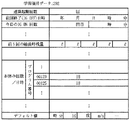
図1における、学習項目データ292、応答データ293は共にエージェントの学習により格納、更新されるデータであり、その内容がそれぞれ図5、図6に概念的に示されている。
学習項目データ292には、図5に示すように、プログラム選択テーブル291(図2)の選択条件を決定する通算起動回数、前回終了日時、今日のイグニッションON回数、前5回の給油時残量等が格納され、選択条件により選択されたプログラムを起動するか否か(お休みするか否か)を決定するためのお休み回数/日時、デフォルト値、その他のデータが格納される。
【0028】
通算起動回数には、イグニッションを起動した通算回数が格納され、イグニッションがONされる毎にカウントアップされる。
前回終了日時には、イグニッションをOFFにする毎にその日時が格納される。
今日のイグニッションON回数には、その日におけるイグニッションONの回数と、1日の終了時間が格納される。イグニッションがONされる毎にカウントアップされるが、1日が終了するとデータが”0”に初期化される。1日の終了時間はデフォルト値として24:00が格納されている。この時間はユーザ(運転者)の生活パターンによって変更することが可能である。時間が変更された場合には、変更後の時間が格納される。
【0029】
前5回の給油残量には、燃料(ガソリン)を給油する直前に検出された燃料の残量が格納され、新たに給油される毎に各データが左側にシフトされ(最も古い最左のデータが削除される)今回給油直前の残量が一番右側に格納される。
このデータは、後述する燃料検出センサ415の検出値G1が、全5回分の給油残量の平均値G2以下(G1≦G2)になった場合に、エージェントEが表示装置27に現れて給油を促す行動が表示装置27に表示され、「おなかが減ったなあ!ガソリンがほしいな!」等の音声が音声出力装置25から出力される。
【0030】
お休み回数/日時には、該当するコミュニケーションプログラムが選択されたとしても実行せずにお休みした回数等が各プログラム番号毎に格納される。このお休み回数/日時は、例えば後述するエアコンの停止を提案するエージェントの行為(プログラム番号00123)のように、学習項目としてお休み項目が設定されているエージェント行為について格納される。
エージェントの提案や会話に対する運転者の応答が、拒否(拒絶)であった場合や無視(又は無応答)であった場合、コミュニケーションプログラムに応じて選択的に「お休み」が設定される。
【0031】
デフォルト値には、時間、回数、温度、車速、日時等の各項目に対する初期設定値が格納されており、前記した1日の終了時間のように学習項目の中で変更された値を初期値に戻す場合に使用される。
学習項目データ292に格納されるその他のデータとしては、例えば、運転者やその関係者の誕生日(これはユーザ入力項目である)、祭日とその言われ、クリスマスイブ(12月24日)、バレンタインデー(2月14日)、ホワイトデー(3月14日)等のイベント日などが格納される。各イベント日に応じた特別メニューのコミュニケーションプログラムも用意されており、例えば、クリスマスイブにはサンタクロースに変装したエージェントが現れる。
【0032】
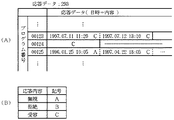
図6の応答データ293には、エージェントの行為に対するユーザの応答の履歴が、ユーザ応答を学習項目とする各コミュニケーションプログラム番号毎に格納される。ユーザ応答データ293は、図6(A)のコミュニケーションプログラム番号00123、00125のように最新の応答日時と応答内容が所定回分(プログラム番号00123は2回分)格納されるものと、プログラム番号00124のように最新の応答内容のみが1回分格納される(従って応答がある毎に更新される。)ものと、最新の応答内容のみが所定回分格納されるものと、最新の日時と応答内容が一回分格納されるものと、最新の日時だけが1回分または所定回分格納されるもの等がある。
図6(A)中に表示された記号A、B、Cは応答内容を表すもので、同図(B)に示すように、記号Aが無視された場合、記号Bが拒絶された場合、記号Cが受容された場合を表す。運転者の応答内容については、マイク26から入力される運転者の音声に対する音声認識の結果や、入力装置による入力結果から判断される。
なお、本実施形態では運転者の応答を無視、拒絶、受容の3パターンに分類しているが、「強く拒絶」、「怒られた」、「喜ばれた」を新たに加えるようにしてもよい。この場合、新たに加えた応答により、学習項目データ292(例えば、お休み回数等)や応答データ293を追加変更する。
【0033】
ヘルプエージェントプログラム295は、メインのエージェントのコミュニケーションプログラム実行時に、運転者にエージェントへの応答方法や応答により予定される結果の教示等の、エージェント行為に関する解説を行うヘルプエージェント機能を実現するためのヘルプエージェント処理プログラム、ヘルプエージェントが運転者に対して解説を行う場合の細かな行動を表示装置27に画像表示するとともにその行動に対応した会話を音声出力装置25から出力するためのヘルプコミュニケーションプログラムがプログラム番号順に格納されている。
【0034】
このヘルプエージェントプログラム295には、各プログラム番号の音声に対して複数種類の音声データが格納されており、運転者により入力装置22等から、メインのエージェントの音声と容易に聞き分けられる複数の音声のうちから選択されるようになっている。例えば、メインのエージェントの音声が女性の音声の場合には、ヘルプエージェントの音声は男性の音声等、メインのエージェントの音声とヘルプエージェントの音声が容易に聞き分けられるものが候補として挙げられ、このうちから選択される。このヘルプエージェントの音声と前記容姿は、適宜変更可能となっている。
また、前記メインのエージェントの容姿及び音声、ヘルプエージェントの容姿及び音声は、特に運転者からの選択が無い場合には、メインのエージェントとヘルプエージェントの間で互いに良好に識別可能なそれぞれの容姿及び音声が自動的に選択され設定されるようになっている。
【0035】
ヘルプエージェントプログラム対応テーブル296は、エージェントプログラム290に格納されているコミュニケーションプログラムのうちの応答プログラム(運転者等からの応答が予定されるプログラム)と、この応答プログラムについて実行されるヘルプエージェントプログラムの対応、及び、該ヘルプエージェントプログラムが実行されるための習熟度閾値を示すテーブルである。
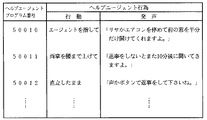
図7はヘルプエージェントプログラム対応テーブル296を表したものであり、図8はヘルプエージェントプログラム対応テーブル296で選択される各プログラム番号に対応した、ヘルプエージェントの行為(行動と発声)内容を表したものである。
この図7、図8で示されているプログラム番号は、ヘルプエージェントプログラム295に格納されている各コミュニケーションプログラムの番号と一致している。
【0036】
例えば、プログラム番号00123のエージェントプログラム(エアコンの停止を提案するプログラム)が起動される場合、このエージェントプログラムに対する運転者の習熟度が50以下だと、プログラム番号50010のヘルプエージェントプログラムが起動され、表示装置27にエージェントを指さしたヘルプエージェントが表示され、「リサがエアコンを停めて前の窓を半分開けてくれますよ。」との音声が音声出力装置25から出力される。また同じプログラム番号00123のエージェントプログラムが起動されても、運転者の習熟度が50よりも大きい場合には、ヘルプエージェントは出現しない。
本実施形態においては、エージェントのコミュニケーションプログラムのうちで、経路案内システムの目的地設定プログラム等、応答を求める応答コミュニケーションプログラムについて、それぞれヘルプエージェントによるコミュニケーションプログラムが対応して決められている。
【0037】
習熟度データ297には、各エージェントプログラムに対するヘルプエージェントプログラムを選択・起動させる場合に参照される習熟度を求めるためのデータと、これらのデータに基づいて求められた習熟度が格納されている。この習熟度データ297は、エージェントプログラムのうちの応答プログラムについて、運転者毎に、プログラム番号順に格納されており、学習により格納、更新される。
【0038】
図9は、習熟度データの内容を概念的に示す図である。
この図9に示すように、習熟度データ297には、各エージェントプログラムの起動フラグ、前5回の応答時間、応答平均時間、応答最短時間、応答取り消し回数、及びこれらの各値から求められる習熟度が、エージェントプログラムのプログラム番号毎に格納される。
起動フラグは、各エージェントプログラムが起動されたときにフラグ1をたて、習熟度を算出し習熟度データとして学習されるとフラグ0に設定される。前5回の応答時間は、起動したエージェントプログラムに対する前5回それぞれについての運転者の応答までの時間である。また、応答平均時間は、前5回の応答時間の平均値であり、応答最短時間は、前5回の応答時間のうちの最小値である。応答取り消し回数は、プログラム起動中の応答の取り消し回数である。
【0039】
習熟度は、それぞれ通算起動回数0の時(初期値)は、例えば30となっており、所定の式により、エージェントプログラムが起動された場合、応答平均時間が基準時間を下回った場合、操作最短時間が基準時間を下回った場合には各項目毎に規定されている所定値分加算されて高くなり、応答平均時間が基準時間よりも大きい場合、操作最短時間が基準時間よりも大きい場合、及び取り消し操作のあった場合には各項目毎に規定されている所定値分減算されて低くなるよう算出される。
【0040】
図10は、ナビゲーションデータ記憶装置30(図1)に格納されるデータファイルの内容を表したものである。
図10に示すように、ナビゲーションデータ記憶装置30には経路案内等で使用される各種データファイルとして、通信地域データファイル301、描画地図データファイル302、交差点データファイル303、ノードデータファイル304、道路データファイル305、探索データファイル306、写真データファイル307が格納されるようになっている。
このナビゲーションデータ記憶装置30は、例えば、フロッピーディスク、ハードディスク、CD−ROM、光ディスク、磁気テープ、ICカード、光カード等の各種記録媒体と、その駆動装置が使用される。
なお、ナビゲーションデータ記憶装置30は、複数種類の異なる記録媒体と駆動装置で構成するようにしてもよい。例えば、検索データファイル46を読み書き可能な記録媒体(例えば、フラッシュメモリ等)で、その他のファイルをCD−ROMで構成し、駆動装置としてそれらの駆動装置を用いるようにする。
【0041】
通信地域データファイル301には、通信制御装置24に接続され又は無接続で車内において使用される携帯電話が、車内から通信できる地域を表示装置5に表示したり、その通信できる地域を経路探索の際に使用するための通信地域データが、携帯電話のタイプ別に格納されている。この携帯電話のタイプ別の各通信地域データには、検索しやすいように番号が付されて管理され、その通信可能な地域は、閉曲線で囲まれる内側により表現できるので、その閉曲線を短い線分に分割してその屈曲点の位置データによって特定する。なお、通信地域データは、通信可能地を大小各種の四角形エリアに分割し、対角関係にある2点の座標データによりデータ化するようにしてもよい。
通信地域データファイル301に格納される内容は、携帯電話の使用可能な地域の拡大や縮小に伴って、更新できるのが望ましく、このために、携帯電話と通信制御装置24を使用することにより、情報提供局との間で通信を行なって、通信地域データファイル301の内容を最新のデータと更新できるように構成されている。なお、通信地域データファイル301をフロッピーディスク、ICカード等で構成し、最新のデータと書換えを行うようにしても良い。
描画地図データファイル302には、表示装置27に描画される描画地図データが格納されている。この描画地図データは、階層化された地図、例えば最上位層から日本、関東地方、東京、神田といった階層ごとの地図データが格納されている。各階層の地図データは、それぞれ地図コードが付されている。
【0042】
交差点データファイル303には、各交差点を特定する交差点番号、交差点名、交差点の座標(緯度と経度)、その交差点が始点や終点になっている道路の番号、および信号の有無などが交差点データとして格納されている。
ノードデータファイル304には、各道路における各地点の座標を指定する緯度、経度などの情報からなるノードデータが格納されている。すなわち、このノードデータは、道路上の一地点に関するデータであり、ノード間を接続するものをアークと呼ぶと、複数のノード列のそれぞれの間をアークで接続することによって表現される。
道路データファイル305には、各道路を特定する道路番号、始点や終点となる交差点番号、同じ始点や終点を持つ道路の番号、道路の太さ、進入禁止等の禁止情報、後述の写真データの写真番号などが格納されている。
交差点データファイル303、ノードデータファイル304、道路データファイル305にそれぞれ格納された交差点データ、ノードデータ、道路データからなる道路網データは、経路探索に使用される。
【0043】
探索データファイル306には、経路探索により生成された経路を構成する交差点列データ、ノード列データなどが格納されている。交差点列データは、交差点名、交差点番号、その交差点の特徴的風景を写した写真番号、曲がり角、距離等の情報からなる。また、ノード列データは、そのノードの位置を表す東経、北緯などの情報からなる。
写真データファイル307には、各交差点や直進中に見える特徴的な風景等を撮影した写真が、その写真番号と対応してディジタル、アナログ、またはネガフィルムの形式で格納されている。
【0044】
図11は、状況センサ部40を構成する各種センサを表したものである。
図11に示すように状況センサ部40は、イグニッションセンサ401、車速センサ402、アクセルセンサ403、ブレーキセンサ404、サイドブレーキ検出センサ405、シフト位置検出センサ406、ウィンカー検出センサ407、ワイパー検出センサ408、ライト検出センサ409、シートベルト検出センサ410、ドア開閉検出センサ411、同乗者検出センサ412、室内温度検出センサ413、室外温度検出センサ414、燃料検出センサ415、水温検出センサ416、ABS検出センサ417、エアコンセンサ418、体重センサ419、前車間距離センサ420、後車間距離センサ421、体温センサ422、心拍数センサ423、発汗センサ424、脳波センサ425、アイトレーサー426、赤外線センサ427、その他のセンサ(タイヤの空気圧低下検出センサ、ベルト類のゆるみ検出センサ、窓の開閉状態センサ、クラクションセンサ、室内湿度センサ、室外湿度センサ、油温検出センサ、油圧検出センサ等)428等の車両状況や運転者状況、車内状況等を検出する各種センサを備えている。
これら各種センサは、それぞれのセンシング目的に応じた所定の位置に配置されている。
なお、これらの各センサは独立したセンサとして存在しない場合には、他のセンサ検出信号から間接的にセンシングする場合を含む。例えば、タイヤの空気圧低下検出センサは、車輪速センサの信号の変動により間接的に空気圧の低下を検出する。
【0045】
イグニッションセンサ401は、イグニッションのONとOFFを検出する。車速センサ402は、例えば、スピードメータケーブルの回転角速度又は回転数を検出して車速を算出するもの等、従来より公知の車速センサを特に制限なく用いることができる。
アクセルセンサ403は、アクセルペダルの踏み込み量を検出する。
ブレーキセンサ404は、ブレーキの踏み込み量を検出したり、踏み込み力や踏む込む速度等から急ブレーキがかけられたか否かを検出する。
サイドブレーキ検出センサ405は、サイドブレーキがかけられているか否かを検出する。
シフト位置検出センサ406は、シフトレバー位置を検出する。
ウィンカー検出センサ407は、ウィンカの点滅させている方向を検出する。
ワイパー検出センサ408は、ワイパーの駆動状態(速度等)を検出する。
ライト検出センサ409は、ヘッドランプ、テールランプ、フォグランプ、ルームランプ等の各ランプの点灯状態を検出する。
シートベルト検出センサ410は、運転者、及び同乗者(補助席、後部座席)がシートベルトを着用しているか否かを検出する。着用していない場合には適宜(嫌われない程度に)エージェントが現れ、警告、注意、コメント等(学習により程度を変更する)を行う。
【0046】
ドア開閉検出センサ411は、ドアの開閉状態を検出し、いわゆる半ドアの場合には、エージェントがその旨を知らせる。ドア開閉検出センサ411は、運転席ドア、助手席ドア、後部運転席側ドア、後部助手席側ドア等の、車種に応じた各ドア毎の開閉を検出できるようになっている。
同乗者検出センサ412は、助手席や後部座席に同乗者が乗っているか否かを検出するセンサで、撮像装置28で撮像された車内の画像から検出し、または、補助席等に配置された圧力センサや、体重計により検出する。
室内温度検出センサ413は室内の気温を検出し、室外温度検出センサ414は車両外の気温を検出する。
燃料検出センサ415は、ガソリン、軽油等の燃料の残量を検出する。給油時直前における過去5回分の検出値が学習項目データ292に格納され、その平均値になった場合にエージェントが給油時期であることを知らせる。
【0047】
水温検出センサ416は、冷却水の温度を検出する。イグニッションON直後において、この検出温度が低い場合には、エージェントが眠そうな行為をする場合が多い。逆に水温が高すぎる場合にはオーバーヒートする前に、エージェントが「だるそう」な行動と共にその旨を知らせる。
ABS検出センサ417は、急ブレーキによるタイヤのロックを防止し操縦性と車両安定性を確保するABSが作動したか否かを検出する。
エアコンセンサ418は、エアコンの操作状態を検出する。例えば、エアコンのON・OFF、設定温度、風量等が検出される。
体重センサ419は、運転者の体重を検出するセンサである。この体重から、または、体重と撮像装置28の画像から運転者を特定し、その運転者との関係で学習したエージェントを出現させるようにする。すなわち、特定した運転者に対してエージェントが学習した、学習項目データ292と応答データ293を使用することで、その運転者専用のエージェントを出現させるようにする。尚、運転者の特定は、IDコードの取得や指紋、声紋等からするようにしてもよい。
前車間距離センサ420は車両前方の他車両や障害物との距離を検出し、後車間距離センサ421は後方の他車両や障害物との距離を検出する。
【0048】
体温センサ422、心拍数センサ423、発汗センサ424は、それぞれ運転者の体温、心拍数、発汗状態を検出するセンサで、例えば、ハンドル表面に各センサを配置し運転者の手の状態から検出する。または、体温センサ422として、赤外線検出素子を使用したサーモグラフィーにより運転者の各部の温度分布を検出するようにしても良い。
脳波センサ425は、運転者の脳波を検出するセンサで、例えばα波やβ波等を検出して運転者の覚醒状態等を調べる。
アイトレーサー426は、ユーザの視線の動きを検出し、通常運転中、車外の目的物を捜している、車内目的物をさがしている、覚醒状態等を判断する。
赤外線センサ427は、ユーザの手の動きや顔の動きを検出する。
【0049】
次に、以上のように構成された本実施形態の動作について説明する。
図12は本実施形態によるエージェント処理のメインの動作を表したフローチャートである。
エージェント処理部11は、イグニッションがONされたことがイグニッションセンサ401で検出されると、まず最初に初期設定を行う(ステップ11)。初期設定としては、RAMのクリア、各処理用のワークエリアをRAMに設定、プログラム選択テーブル291(図2)及びヘルプエージェントプログラム対応テーブル(図7)のRAMへのロード、フラグの0設定、等の処理が行われる。なお、本実施形態のエージェント処理では、その処理の開始をイグニッションONとしたが、例えばドア開閉検出センサ411によりいずれかのドアの開閉が検出された場合に処理を開始するようにしてもよい。
【0050】
次にエージェント処理部11は、状況情報処理部15に状況センサ部40の各センサから供給される検出値や、撮像装置28で撮像した画像の処理結果や、現在位置検出装置21で検出した車両の現在位置等のデータを取得して、RAMの所定エリアに格納し、格納したデータから、運転者の特定や車両の状態等の、現在状況の把握を行う(ステップ12)。例えば、水温検出センサ416で検出された冷却水の温度がt1である場合、エージェント処理部11は、この温度t1をRAMに格納すると共に、t1が所定の閾値t2以下であれば、車両の現在の状態として冷却水温(図2参照)は低い状態であると把握する。
現在の状況としては、他にマイク26からの入力に基づいて音声認識した運転者の要求、例えば、「○○○番に電話をしてくれ。」や「この辺のレストランを表示してくれ」や「CDをかけてくれ」等の要求も現在の状況として把握される。この場合、認識した音声に含まれるワード「CD」「かけて」等がプログラム選択テーブル291(図2)の選択条件(横軸項目)になる。
【0051】
さらにエージェント処理部11は、エージェントデータ記憶装置29の学習項目データ292と応答データ293をチェックすることで、エージェントがこれまでに学習してきた状態(学習データ)を把握する(ステップ13)。
【0052】
エージェント処理部11は、把握した現在の状況とチェックした学習データとから、図2に示したプログラム選択テーブル291によって、現在の状況で起動可能なコミュニケーションプログラム(の番号)があるか否かを判断し、該当プログラムが無ければ(ステップ14;N)、ステップ12に戻って新たな状態を把握する。
一方、起動可能なコミュニケーションプログラムがある場合(ステップ14;Y)、そのプログラム番号を決定する。そして、決定したプログラム番号に対する運転者の応答履歴を応答データ293から確認し、当該プログラム番号のコミュニケーションプログラムの起動を、お休みすべき状態か否かを確認する(ステップ15)。
【0053】
コミュニケーションプログラムがお休み状態の場合(ステップ15;Y)には、ステップ44に移行する。
【0054】
コミュニケーションプログラムがお休み状態ではない場合(ステップ15;N)、エージェント処理部11は決定したプログラム番号に対応するコミュニケーションプログラムを起動し、図4に示された各エージェントの行為(行動と音声)に従った画像を表示装置27に表示し音声を音声出力装置25から出力する。更に、エージェント処理部11は、エージェントデータ記憶装置29の習熟度データ297をチェックし、起動されたコミュニケーションプログラムに対する運転者の習熟度を把握する(ステップ17)。また、習熟度データ297の起動フラグをフラグ1に設定する。そして、ヘルプエージェントプログラム対応テーブル296を参照して、運転者の習熟度と、起動したコミュニケーションプログラムのプログラム番号とから、起動するヘルプエージェントプログラム(の番号)があるかどうかを判断する(ステップ18)。当該ヘルプエージェントプログラムがなければ(ステップ18;N)、そのまま、マイク26からの入力に基づく音声認識結果や入力装置22からの入力結果から、起動されたコミュニケーションプログラムによるエージェントの行為に対する運転者の応答と、エージェントの行為が出力されてから運転者の応答を取得するまでの時間とを、取得する(ステップ41)。
【0055】
ヘルプエージェントプログラムがある場合には(ステップ18;Y)、該当するプログラム番号のヘルプエージェントプログラムを起動し、図8に示されたヘルプエージェントの行為(行動と音声)に従った画像をエージェントとともに表示装置27に表示し音声を音声出力装置25から出力する(ステップ19)。これによって、エージェントプログラムに対して運転者の習熟度が低い場合にヘルプエージェントが出現し、ヘルプエージェントによってエージェントの機能に対する理解が深まり、エージェントへの応答等のコミュニケーションをスムーズにとることが可能になる。
そして、マイク26からの入力に基づく音声認識結果や入力装置22への入力結果から、起動されたコミュニケーションプログラムによるエージェントの行為に対する運転者の応答と、エージェントの行為が出力されてから運転者の応答を取得するまでの時間とを、取得する(ステップ41)。
【0056】
次にエージェント処理部11は、ステップ16で起動したコミュニケーションプログラムが制御対象プログラムか否かを判断する(ステップ42)。ここで制御対象プログラムか否かは各プログラム毎に規定されており、例として、「ラジオの電源を入れましょうか?」や、お昼時にお腹が鳴る音を検出した場合に「食堂の案内をしましょうか?」といったように、エージェントが処理可能な行為(電源ON、飲食店案内等)の提案をする場合のコミュニケーションプログラム等が制御対象プログラムとして規定されている。
【0057】
制御対象プログラムでない場合(ステップ42;N)にはステップ23に移行し、制御対象プログラムである場合(ステップ42;Y)、ステップ20で取得した運転者の応答に応じた制御を行う(ステップ43)。例えば、上記ラジオの電源を入れる提案コミュニケーションに対して、「入れて」「OK」「はい」等の提案を受容する応答が認識された場合であれば、エージェント処理部11は応答に応じた制御として、エージェントに返事をする行為(行為と音声)をさせると共にラジオの電源をONにする。
【0058】
そして、エージェント処理部11は、今回のコミュニケーションプログラムに関するデータを蓄積する(ステップ44)。
データの蓄積としては、例えば、コミュニケーションプログラムの起動がお休みである場合には(ステップ15;Y)、学習項目データ292の該当プログラム番号のお休み回数/日時欄をカウントアップさせる。ただし、学習項目データ292のお休み回数/日時欄に格納されている回数をKa回とし、当該プログラム番号に対する前回までの応答データ293の履歴から決まるお休み回数をKb回とした場合、Ka=Kb−1であれば、今回のお休みで規定回数休んだことになる。そこで、学習項目データ292及び応答データ293の当該プログラム番号欄の(該当する位置に格納されている)データをクリアする。
【0059】
その他の場合(ステップ42;Nの場合、ステップ43の後)のデータの蓄積としては、ステップ12で把握した現在状況の中に学習項目があれば学習項目データ292の値を更新し、エージェントプログラムのプログラム番号が応答内容を履歴として格納すべきプログラム番号であればステップ41で取得した応答内容を応答データ293(図6)に格納する。この応答の履歴も、各プログラム番号毎に規定された所定回数分のデータが既に格納されている場合には、最も古いデータを廃棄して新しいデータを格納する。
更に、その他の場合(ステップ42;Nの場合、ステップ43の後)には、起動フラグが1となっている習熟度データ297(図9)を書き換える。このとき、ステップ41で取得した応答時間をもとに、前5回の応答時間は最も古いデータを破棄して新しいデータを格納し、この前5回の応答時間から応答平均時間、応答最短時間を算出する。また、応答取り消し回数は、応答取り消しが無かった場合には0を格納する。そして、所定の式により習熟度を求め、この習熟度を格納し、起動フラグを0に設定する。
【0060】
以上のプログラム決定・コミュニケーション・学習の各処理が終了すると、エージェント処理部11は、ステップ11でRAMに初期設定したフラグ領域にフラグ1が立っているか否かを確認する(ステップ45)。
フラグが立っていない場合には(ステップ45;N)、イグニッションセンサ401によりイグニッションOFFが検出されたか否かを判断し(ステップ46)、検出されていない場合(ステップ46;N)にはステップ12に戻って新たな状態を把握する。
一方、イグニッションOFFが検出された場合(ステップ46;Y)、RAMのフラグ領域にフラグ1を立て(ステップ47)た後にステップ12に戻り、後処理を行う。すなわち、現在状況や学習データに応じたお別れの行為(行動と音声)をエージェントにさせると共に、消し忘れのライト類の消灯等の制御、及び当該後処理に対する学習(ステップ44)の後、フラグが1なので(ステップ45;Y)、エージェント処理を終了する。
【0061】
次に、以上説明したエージェント処理による、具体的な行為例について説明する。
図13は、車両走行中における具体的なエージェント処理の内容を概念的に表したものである。
この図13(A)に示すように、エージェント処理部11は、現在状況として、エアコンセンサ418で検出された状態が「ON」、室内温度検出センサ413と室外温度検出センサ414で検出された室温T1と室外温T2を取得する。また、各プログラム番号の応答データ293をチェックすることで、プログラム番号0123に対する前2回の運転者応答がC(受容)なので、閾値T3、T4の値としてデフォルト値(T3=2度、T4=24度)が学習項目データ292から読み出される。
この閾値T3とT4とから、室温と室外温の関係、(T1−T2)≦T3が「Yes」、室外温T2と閾値T4との関係T2≦T4が「Yes」、等の状況が最終的に把握される(図13(A))。
【0062】
以上の処理から、エージェント処理部11は、プログラム選択テーブル291からプログラム番号00123のコミュニケーションプログラムを最終的に選択し(ステップ14)、お休み対象で無いことを確認(ステップ15;N)したうえで、当該番号のコミュニケーションプログラムを起動する(ステップ16)。
【0063】
更に、エージェント処理部11は、エージェントデータ記憶装置29の習熟度データ297をチェックして起動されたコミュニケーションプログラムに対する運転者の習熟度を取得し(ステップ17)、ヘルプエージェントプログラム対応テーブル296から、起動すべきヘルプエージェントプログラムの有無を取得する(ステップ18)。図13(A)に示すように、運転者の習熟度は25なので、図7に示すヘルプエージェントプログラム対応テーブル296のコミュニケーションプログラム00123番の欄から、起動したコミュニケーションプログラムに対して起動すべきプログラム番号50010があることを取得し、該当するヘルプエージェントプログラムを起動させる(ステップ19)。
【0064】
そして、プログラム番号00123のコミュニケーションプログラム及びプログラム番号50010のヘルプエージェントプログラムの起動により、図13(B)に示すように、表示装置27にはエージェントとヘルプエージェントの画像が複数表示(または動画が表示)されると共に、音声出力装置25からはエージェントの「外は涼しくなりましたよ。外気を入れてみませんか?」といった音声が出力され、続いて、ヘルプエージェントの「リサが、エアコンを停めて前の窓を半分だけ開けてくれますよ。」といった音声が出力される。
【0065】
続いて、エージェント処理部11は、運転者の応答を取得する(ステップ41)。
そして、プログラム番号00123は制御対象プログラムなので(ステップ42;Y)、受容であれば応答に応じた制御としてエアコンの電源をOFFにすると共に、運転席側と助手席側の窓を1/2だけ開ける制御を行う(ステップ43)。
【0066】
応答に応じた制御の後、エージェント処理部11は、図13(C)に示すように、運転者の応答が無視であればA、拒絶であればB、受容であればCを、応答日時と共にプログラム番号0123に対応する応答データ293に格納する。この場合、前々回の応答データが削除され、前回の応答と今回の応答が応答データ293の格納内容になる。
格納した応答内容が無視Aであれば、次回の閾値T3、T4は1度づつ下げた値(T3−1=1度、T4−1=23度)が使用され、1回休むことになる。格納した応答内容が拒絶Bであれば、次回の閾値T3、T4は1度づつ下げた値(T3−1=1度、T4−1=23度)が使用され、5回休むことになる。なお、1回休む場合の閾値としては下げた後の温度T3=T3−1、T4=T4−1が使用される。
格納した応答内容が受容Cであれば、前回使用した閾値T3、T4と同一の値が使用される。
【0067】
また、エージェント処理部11は、プログラム番号00123に対応する習熟度データ297の、前5回の応答時間に格納されている最も古い応答時間データを廃棄し、今回の応答時間(表示装置27にエージェントが表示されてから運転者の応答を取得するまでにかかった時間)を格納する。更に、この前5回の応答時間のデータから、応答平均時間、応答最短時間、習熟度を算出し、それぞれ対応する場所に格納し直す。
【0068】
続いて、エージェント処理部11が取得した現在状況は上述と同様であり、運転者の習熟度が大きくなった場合(習熟度が習熟度閾値を越えた場合、ここでは習熟度=57とする)についてのエージェント処理を説明する。
この場合も、エージェント処理部11は、プログラム選択テーブル291からプログラム番号00123のコミュニケーションプログラムを最終的に選択し(ステップ14)、お休み対象で無いことを確認(ステップ15;N)したうえで、当該番号のコミュニケーションプログラムを起動する(ステップ16)。
【0069】
そして、エージェント処理部11は、エージェントデータ記憶装置29の習熟度データ297をチェックし、起動されたコミュニケーションプログラムに対する運転者の習熟度を取得し(ステップ17)、ヘルプエージェントプログラム対応テーブル296から、起動すべきヘルプエージェントプログラムの有無を取得する(ステップ18)。運転者の習熟度は57なので、図7に示すヘルプエージェントプログラム対応テーブル296から、起動したコミュニケーションプログラムに対して起動すべきプログラムが無いこととなる。
【0070】
従って、プログラム番号00123のコミュニケーションプログラムのみが起動され、表示装置27にはエージェントのみの画像が表示(または動画が表示)されると共に、その時の学習態度に応じて、音声出力装置25からはエージェントの「外の方が涼しいみたいよ。外気を入れましょうよ!」といった音声が出力される。
その後は、上述の場合と同様に運転者の応答を取得し(ステップ41)、応答に応じて制御を行い(ステップ43)、応答データ293及び習熟度データ297を書き換える。
【0071】
この様に、本実施形態では、エージェントプログラムが起動されると、運転者の習熟度が低い場合には、このエージェントの行為を解説するヘルプエージェントが出現し、運転者のエージェントへの応答等のコミュニケーションを容易にする。運転者の習熟度が高い場合には、ヘルプエージェントは出現せず、効率的なエージェントとのコミュニケーションを可能とする。
そして、本実施形態によると、機能や出現状況の異なるエージェントとヘルプエージェントとを個別に表示、音声出力するので、運転者にとって紛らわしくなく、容易にこれらのエージェントを識別し情報を把握することができる。
【0072】
次に、本発明のエージェント装置の第2の実施形態について説明する。
(3)第2実施形態の概要
第1の実施形態のエージェント装置では、運転者の習熟度に応じてサブエージェントとしてヘルプエージェントが出現するが、本実施形態のエージェント装置では、運転者の指向に応じて各種のサブエージェントが出現するようになっている。このサブエージェントとしては、運転者の習熟度が高いときに出現するショートカットエージェント等が挙げられる。このショートカットエージェントは、エージェントにより一定の手順を踏んで行われる操作について、運転者が習熟した場合に、エージェントの行為を一部短絡し手順をその先へ進めることができるようにするものである。
尚、上述の第1の実施形態と同様の構成については同一の符号を付し、説明は省略する。
【0073】
(4)第2実施形態の詳細
図14は、本実施形態のエージェント装置の構成を示すブロック図である。
この図14に示されるように、本実施形態のエージェント装置では、エージェントデータ記憶装置29には、ヘルプエージェントプログラム及びヘルプエージェントプログラム対応テーブルは格納されておらず、これらに代えて、指向エージェントプログラム395、指向エージェントプログラム対応テーブル396、指向データ397、及び最多選択プログラムデータ398が格納されている。また、画像データ294は、図23に例示したメインのエージェントE及びショートカットエージェントSの容姿や行動を画像表示するためのデータが格納されている。
【0074】
指向エージェントプログラム395は、運転者の指向に応じてメインのエージェントに加えて出現する指向エージェント機能を実現する指向エージェント処理プログラム、指向エージェントの細かな行動を表示装置27に画像表示するとともにその行動に対応した会話を音声出力装置25から出力するためのコミュニケーションプログラムがプログラム番号順に格納されている。
指向エージェント処理プログラムには、運転者の習熟度に応じてメインのエージェントの行為を短絡するショートカットエージェント機能を実現するためのショートカットエージェント処理プログラム等が含まれている。
【0075】
この指向エージェントプログラム395には、各プログラム番号の音声に対して複数種類の音声データが格納されており、メインのエージェントの音声と容易に聞き分けられる複数の音声のなかから運転者により入力装置22等で選択されるようになっている。例えば、メインのエージェントと指向エージェントの容姿がともに女性である場合、メインのエージェントの音声に比べて指向エージェントの音声は高い声等、容易に聞き分けられるものが候補として挙げられ、このうちから選択される。この指向エージェントの音声と前記容姿は、適宜変更可能となっている。
また、前記メインのエージェントの容姿及び音声、指向エージェントの容姿及び音声は、特に運転者からの選択が無い場合には、エージェントと指向エージェントの間で互いに良好に識別可能なそれぞれの容姿及び音声が自動的に選択され設定されるようになっている。
【0076】
指向エージェントプログラム対応テーブル396は、指向エージェントプログラム395に格納されているコミュニケーションプログラムを選択するためのテーブルである。
指向エージェントプログラム対応テーブル396には、エージェントプログラムのプログラム番号に対応して、このエージェントプログラムに対応する指向エージェントプログラムのプログラム番号と、この指向エージェントプログラムが起動されるための指向閾値その他の条件を示す各項目が、格納されている。
この図15、図16に示されているエージェントプログラム番号及びショートカットエージェントプログラム番号は、それぞれ、エージェントプログラム295及び指向エージェントプログラム395に格納されている各コミュニケーションプログラムの番号と一致している。
【0077】
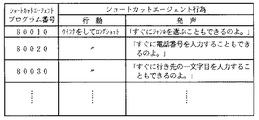
図15は指向エージェントプログラム対応テーブル396の一部であるショートカットエージェントプログラム対応テーブルを表したものであり、図16はショートカットエージェントプログラム対応テーブルで選択される各プログラム番号に対応した、ショートカットエージェントの行為(行動と発声)内容を表したものである。
【0078】
図15に示すショートカットエージェントプログラム対応テーブルには、エージェントプログラムに対応して、習熟度閾値、最多選択プログラム番号、ショートカットエージェント(指向エージェント)プログラム番号が格納される。習熟度閾値は、ユーザ指向としての各エージェントプログラムに対する習熟度の、閾値を表しており、運転者の習熟度がこの習熟度閾値以上となった場合に、ショートカットエージェントプログラムが起動される。最多選択プログラム番号は、最多選択プログラムデータ398から検出されるものであり、この最多選択プログラム番号によって、各エージェントプログラムに対応するショートカットエージェントのプログラムが決定される。
【0079】
例えば、経路案内システムにおいて目的地を設定する方法を選択するエージェントプログラム(プログラム番号00550)が起動されている場合、このエージェントプログラムに対する運転者の習熟度が70以上の時であって、最多選択プログラムのプログラム番号が00580(ジャンル選択画面を表示し、応答待機するプログラム)の場合には、プログラム番号80010のショートカットエージェントプログラムが起動される。
【0080】
尚、指向エージェントプログラム対応テーブル396には、ショートカットエージェントプログラム対応テーブルのみでなく、エージェントプログラムと、このエージェントプログラムに対応するショートカットエージェントプログラム以外の指向エージェントプログラムとの対応テーブルも格納されている。この対応テーブルにも、上記ショートカットエージェントプログラム対応テーブルと同様に、エージェントプログラム及び対応する指向エージェントプログラムのプログラム番号、この指向エージェントプログラムが起動されるための指向閾値その他の条件が格納されている。
【0081】
指向データ397には、運転者の指向を表す指向値と、この指向値を取得するもととなる各項目のデータが格納されている。
図17は、指向データ397に格納されるデータの各項目を、エージェントシステムやその他の関連システム等に関する項目であるシステム状況、現在時刻や記念日等に相当するかどうか等の時間状況、性別や年齢趣味等の運転者状況、車両状況、及び天気等の外部状況に大別して示す表である。この各項目のデータは、運転者自らの入力により取得したり、エージェントによりまとめて又は必要に応じて問いかけてその応答として取得したり、また、運転者の車両の操作や外部機器等から取得する。
【0082】
各運転者の指向値は、これらの各項目のデータのうちの1つ又は複数から取得される。
尚、この指向値としては、上記第1の実施形態と同様の習熟度が含まれており、指向データ397には上記第1の実施形態と同様の習熟度データ297が含まれている。習熟度データ297の応答時間には、同時に出現するショートカットエージェントへ応答した場合の応答時間も含めて格納される。
【0083】
図18は、最多選択プログラムデータ398の内容を概念的に示す図である。この最多選択プログラムデータ398は、習熟度が指向値として用いられる場合に使用される。
最多選択プログラムデータ398には、ショートカットエージェントが短絡する短絡先のエージェントプログラムを選択するためのデータが格納されている。本実施形態のショートカットエージェントは、複数層の階層構造の項目選択行為を行うエージェント(以下項目選択エージェント)において、第n階層において、第n+1階層での項目選択行為を可能に、エージェント行為を短絡するものである。
【0084】
この図18に示すように、最多選択プログラムデータ398には、各項目選択エージェントのプログラム番号毎に、ショートカットエージェントを起動させていない時に、項目選択エージェントについての応答により選択され起動されたその1つ下の階層のエージェントプログラム(選択エージェントプログラム)のプログラム番号が、前5回分格納される。また、この、前5回分の選択エージェントプログラムのうち最も多く選択・起動されたエージェントプログラム(最多選択エージェントプログラム)のプログラム番号が格納される。この最多選択プログラムデータ398は、学習により格納、更新され、ショートカットエージェントプログラムを起動させる場合に参照される。
【0085】
次に、以上のように構成された本実施形態の動作について説明する。
図19は、本実施形態によるエージェント処理のメイン動作を表したフローチャートである。
本実施形態においても、前記第1の実施形態と同様に、エージェント処理部11は、イグニッションがONされたことがイグニッションセンサ401で検出されると、上述の第1の実施形態と同様に、初期設定(ステップ11)、現在状況の把握(ステップ12)、学習項目データ、応答データのチェック(ステップ13)、コミュニケーションプログラムの有無検知(ステップ14)、コミュニケーションプログラムをお休みすべき状態か否かの確認(ステップ15)を行う。そしてコミュニケーションプログラムをお休みすべき状態の場合(ステップ15;Y)にはそのままステップ44に移行し、お休みすべき状態でない場合(ステップ15;N)には、コミュニケーションプログラムを起動する(ステップ16)。
【0086】
コミュニケーションプログラムの起動(ステップ16)に続いて、本実施形態のエージェント処理部11は、指向データ397から運転者の各項目の指向値を読み取り、指向エージェントプログラム対応テーブル396の指向閾値と比較する(ステップ27)。そして、運転者の指向値が指向閾値以上の場合(ステップ27;Y)には、指向エージェントプログラム対応テーブル396に基づいて、運転者の指向に応じた指向エージェント処理を行う(ステップ28)。
【0087】
指向閾値の比較(ステップ27)と指向エージェント処理(ステップ28)の例としては次のようなものがある。例えば、指向データ397のうちの「今日の日付」と「家族の生年月日」のデータから家族の誕生日までの日数Yを求め、(その年の年間日数−Y)の値を指向値として取得し、家族の誕生日の一週間前(指向閾値)になると(ステップ27;Y)、バースデーケーキを持った指向エージェントを表示し「○○ちゃんのお誕生日まであと一週間よ。お誕生日プレゼントの用意は済んだ?」との音声を出力する(ステップ28)。
また、運転者の生年月日及び渋滞状況のデータから取得した指向値に基づいて、渋滞時に運転者のその日の運勢を知らせる処理がある。
また、運転者のひいきのプロ野球チームのデータと、そのプロ野球チームのゲームのラジオ放送開始時による指向値に基づいて、その放送が開始される旨及び対戦相手を知らせるとともに、ラジオの電源を入れるか否かを問い合わせる処理を行う。この場合、ラジオ放送予定のデータ(放送開始時間と対戦チーム)は、運転者が入力装置22から入力し、又は、通信制御装置24から取得するようにする。
車両位置データと運転者が興味を持っている名所や旧跡のデータに基づいて指向値を取得し、車両の近辺にある名所や旧跡をガイドする処理、運転者の運転歴のデータと車両位置に基づく指向値を取得し、運転歴の短い運転者に対して「ここら辺は道が狭いから気を付けてね。」等のアドバイスをする処理が挙げられる。
また、指向エージェント処理としては、詳細を後述するように、カーナビゲーションシステムに対する習熟度を指向値として取得し、習熟度の大きい場合には目的地等の選択の階層メニューを短絡するショートカットエージェント処理も含まれる。
【0088】
上述のような指向エージェント処理後は、起動されたコミュニケーションプログラムに対する運転者からの応答を取得する(ステップ41)。運転者の指向値が指向閾値よりも小さい場合(ステップ27;N)には、指向エージェントプログラムを起動することなく、そのまま応答を取得する(ステップ41)。
【0089】
以降、前述の第1の実施形態と同様に、エージェントプログラムが制御対象プログラムかどうかの判断(ステップ42)からエンドまでの処理を行う。
【0090】
尚、データの蓄積に際して、ショートカットエージェントにより短絡され起動されなかったエージェントプログラムについては、エージェントプログラムの学習項目データ292のお休み回数/日時はカウントアップせず、応答データ293についても書き換えは行わず、習熟度データ297の前5回の応答時間、最多選択プログラムデータ398の前5回の次に選択されたエージェントプログラムについても書き換えは行わないものとする。
【0091】
次に、以上説明したエージェント処理による、具体的な行為例として、指向エージェントがショートカットエージェントである場合について説明する。
【0092】
図20は、カーナビゲーションを行う際に運転者からの入力によりメニューを設定する場合のメニュー設定の階層構造を表した説明図であり、図21は、図20の階層構造におけるショートカットエージェントの行為を表した説明図である。
この図20に示すように、このカーナビゲーションシステムにおいて、例えば、目的地を現在地近傍の飲食店地図又はリストから検索して設定する場合には、通常は、まず、目的地を設定するモードである目的地設定モードを選択し(第1階層)、目的地の選択をジャンルから選択するジャンル選択モードを選択し(第2階層)、ジャンル別リストから飲食店を選択して(第3階層)、現在地近傍の飲食店地図またはリストを表示させ、目的地となる飲食店を指定する。この後、ナビゲーション処理部10により飲食店への経路案内が行われる。
【0093】
そして、本実施形態においては、ショートカットエージェントにより、図21に示すように、目的地設定モード(第1階層)を選択した後は、直接飲食店を選択して現在地近傍の飲食店地図またはリスト(第3階層)を表示させることができ、続いて目的地となる飲食店を指定できる。
【0094】
まず、エージェントプログラムに対する運転者の習熟度が高い場合(ここでは、習熟度=75とする)について説明する。
本実施形態においては、マイクからの音声入力等によりカーナビゲーションシステムが起動されると、エージェント処理部11は、まず、目的地の設定とシステムに関する設定のいずれの設定を行うかのモード選択(第1階層)のための処理を行う。このとき、プログラム番号00540番のエージェントプログラムを起動する(ステップ16)。このプログラムにより、表示装置27には、メインのエージェントが徒歩で現れ、音声出力装置25からは、「すぐに道案内をしましょうか、それともシステム設定をしますか」との音声が出力される。
そして、このエージェントプログラムに対応するショートカットエージェントプログラムが無いため(ステップ27;N)、そのまま応答を待って待機する。
【0095】
そして、マイクから「道案内」との音声入力を取得する等、目的地設定モードが選択されると(ステップ41)、このエージェントプログラムは制御対象プログラムではないため(ステップ42;N)、エージェント処理部11は、データの蓄積(ステップ44)等の処理の後、プログラム番号00550番のエージェントプログラム(目的地を設定する方法を選択するプログラム)を起動する(ステップ16)。これにより、経路案内メニューの第2階層に移行し、表示装置27のメインのエージェントはアップショットの表示に変わり、音声出力装置25から「目的地の設定方法を選んでね。ジャンル別に探しますか、電話番号を入れますか、それとも地名を探しますか。」との音声が流れる。続いてエージェントは、目的地設定方法の入力に対して待機する。
【0096】
また、エージェント処理部11は、指向データ397から運転者の各項目の指向値を読み取り、指向エージェントプログラム対応テーブル396の指向閾値と比較する(ステップ27)。指向値のうち習熟度については、習熟度=75である。そして、ショートカットエージェントプログラム対応テーブル296(図15)を参照すると、習熟度が、起動されているエージェントプログラム550番の習熟度閾値よりも大きいので(ステップ27;Y)、エージェント処理部11は、指向エージェント処理としてのショートカットエージェント処理を行う(ステップ28)。
【0097】
図22は、指向エージェント処理(ステップ28)としてのショートカットエージェント処理の行程を表すフローチャートである。
この図22に示されるように、ショートカットエージェント処理においては、エージェント処理部11は、最多選択プログラムデータ398からプログラム番号00550番のエージェントプログラムに対する最多選択エージェントプログラムのプログラム番号00580(ジャンル選択画面を表示し、ジャンル選択を促すプログラムのプログラム番号)を取得する(ステップ281)。
最多選択プログラムデータ398において、プログラム番号00550番のエージェントプログラムに対する最多選択エージェントプログラムが00580番であるということは、この運転者は、前5回の操作においては、00550番のプログラムを起動させた第2階層において、ジャンル別選択、電話番号入力、及び地名入力の3つの中からジャンル別選択を選びその結果プログラム番号00580番のプログラム(ジャンル選択画面を表示し、ジャンル選択を促すプログラム)が起動された場合が最も多かったことになる。
【0098】
そして、エージェント処理部11は、ショートカットエージェントプログラム対応テーブル396において、起動したエージェントプログラムのプログラム番号00550と最多選択エージェントプログラムのプログラム番号00580とに対応するショートカットエージェントプログラムのプログラム番号80010とを取得する(ステップ282)。
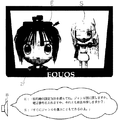
次に、エージェント処理部11は、このプログラム番号80010のショートカットエージェントプログラムを起動する(ステップ283)。このショートカットエージェントプログラムにより、図22に示すように、表示装置27には、メインのエージェントEのアップショットに並んで、ショートカットエージェントSのロングショットが表示され、音声出力装置25からは、前述したエージェントEの音声に続いて、「すぐにジャンルを入れることもできるのよ。」とのショートカットエージェントSの音声が流れる。
続いて、ショートカットエージェントは、ジャンルの入力に対して応答待機する。
【0099】
運転者から、例えば「飲食店」等と、ショートカットエージェントSに応答して直接ジャンルを指定した入力を取得すると、ショートカットエージェントがこの応答を認識する。そして、この情報をもとに、エージェント処理部11がプログラム番号00550番のエージェントプログラムは応答を取得しないまま終了させ、プログラム番号00600のエージェントプログラム(「飲食店」との応答を認識した後のエージェントプログラム)を起動し、以降このエージェントプログラムから順にエージェント行為が行われ、車両位置の検出、表示装置27への車両の現在位置近辺の飲食店地図の表示、この地図による運転者から目的地となる飲食店の指定を得る。
従って、運転者は、ショートカットエージェントに応答することにより、第2階層における操作(目的地設定方法の選択)を省略して第3階層へ移行することができる。
【0100】
一方、運転者から、「ジャンル選択」等のメインのエージェントに対する応答を取得した場合には、エージェントプログラムによりこれが認識されてから取得した応答に合わせた第3階層へ移行する。例えば、「ジャンル選択」との応答を取得した場合には、エージェント処理部11は、第3階層として表示装置27にジャンル別リストを表示し、「ジャンルを選択してね。」とのエージェント音声を出力する。そして、「飲食店」との入力を取得すると、プログラム番号00600番のエージェントプログラムを起動して車両の現在位置を検出し、現在位置近辺の飲食店地図を表示する。
運転者は、メインのエージェントに対して、例えば「電話番号」や「地名」等と応答することにより、ショートカットによるショートカット先とは異なるジャンル選択以外の目的地選択方法を選択することができる。
【0101】
運転者のエージェントプログラムに対する習熟度が習熟度閾値70よりも小さい場合(ステップ27;N)には、エージェント処理部11はショートカットエージェントプログラムを起動することなく、第2階層において、図23に示すように、メインのエージェントEの表示及び音声出力のみを行って目的地の設定方法を取得し、以降ジャンル選択、飲食店地図の表示等の下の階層へ移行する。
【0102】
そして、表示装置27に飲食店地図を表示した後は、メインのエージェント処理にリターンし、表示した地図により運転者から目的地となる飲食店の指定を応答として取得し(ステップ41)、以降、制御対象プログラムとして(ステップ42;Y)応答に応じた制御(経路案内)を行い(ステップ43)、最多選択プログラムデータ398を含むデータの蓄積(ステップ44)等、上述の第1の実施形態と同様の処理を行う。
【0103】
この様に、本実施形態では、エージェントプログラムが起動されると、運転者の習熟度が高い場合にはショートカットエージェントが出現してエージェントの行為を短絡可能とし、運転者のエージェントへの応答等のコミュニケーションを効率化し短時間での操作を可能とする。そして、運転者の習熟度が低い場合には、ショートカットエージェントは出現せず、操作の統一感を保持することにより運転者が体系だったシステムとしてのメニューの階層構造を把握し易いようになっている。
本実施形態によると、ショートカットエージェントは、メインのエージェントとともに出現するので、一旦習熟度の大きくなった運転者が長期間使用せずにいたために操作を忘れた場合であっても、メインのエージェントの案内に従ってメニュー階層通りに操作したり、日常的に使用しないメニュー(ショートカット先以外のメニュー)を選択することを、容易に行うことができる。
【0104】
本実施形態によると、機能及び出現状況の異なるエージェントとショートカットエージェントとを個別に表示、音声出力するので、運転者にとって紛らわしくなく、容易にこれらのエージェントを識別し情報を把握することができる。
本実施形態によると、最多選択プログラムデータ398に過去に選択され起動されたプログラムが使用履歴として記憶され、頻繁に使用する項目(最多選択プログラム)が取得され、これに基づいてショートカットエージェントによるショートカット先が決定されるので、運転者に合わせた効率的なショートカット機能が実現される。
【0105】
尚、本発明は上述の実施形態に限定されるものではなく、本発明の趣旨を逸脱しない限りにおいて適宜変更可能である。
上述の各実施形態においてはサブエージェントは、ヘルプエージェントやショートカットエージェント等、起動されているメインのエージェントとの関連を有するであるが、これに限られるものではなく、メインのエージェントとサブエージェントとは相互に関連のないものとすることもできる。例えば、エージェントとサブエージェントのうちの一方は経路案内を行い、他方は車両の状態を報知するようにしてもよい。例えば、一方が経路案内を行っている途中で他方が「お腹が空いたよ〜。ガソリンがほしいなあ。」と出現する。そして目的地に到着して、経路案内をしていたエージェントは終了しても、車両の状態を報知するエージェントは給油をしなければそのまま表示されて泣き顔になっていく等とすることができる。
【0106】
上述の各実施形態においてはヘルプエージェントやショートカットエージェント等のサブエージェントの出現は、各プログラム毎に判断されるが、これに限られるものではなく、カーナビゲーション、空調等のシステム毎や、または運転者毎に判断し、必要と判断された場合にはそのシステム起動中や運転者の操作中を通して出現するようにしてもよい。
サブエージェントは一度に複数出現してもよく、ヘルプエージェントとショートカットエージェントの両方を習熟度に応じて出現可能とすることもできる。
サブエージェントも運転者からの応答等を取得する行為を行うものとし、この応答等から学習することによりサブエージェントの行為が決定されるようにしてもよい。
【0107】
第1の実施形態においては、習熟度に応じてヘルプの出現・非出現が決定されているが、習熟度以外の指向からヘルプエージェントの行為(出現非出現を含む)を決定してもよい。例えば、ラジオのプロ野球放送をもとに運転者にプロ野球のゲーム経過を知らせるメインのエージェントに対して、野球に詳しくない人にはルールや用語の解説を行う等とすることができる。
上記第2の実施形態では、ショートカットエージェントは、第n階層において、第n+1階層での項目選択行為を可能に、エージェント行為を短絡するものであるが、ショートカットエージェントを、第n階層から第n+2以上の階層での操作を可能にエージェント行為を短絡するものとすることもできる。
上記第2の実施形態では、ショートカットエージェントは、メインのエージェントに対して短絡のみを行って以降のエージェント行為は再びメインのエージェントが行うようになっているが、ショートカットエージェントに対する応答を取得した以降は、メインのエージェントに戻らず、ショートカットエージェントがそのままエージェント行為を行うようにしてもよい。
【0108】
【発明の効果】
以上説明したように、本発明に係るエージェント装置によれば、機能や出現状況の異なるエージェントとサブエージェントとを個別に出現させるので、運転者にとって紛らわしくなく、これらのエージェントを明確に識別し容易に情報を把握することができる。
【図面の簡単な説明】
【図1】本発明の第1の実施形態のエージェント装置の構成を示すブロック図である。
【図2】図1の実施形態におるプログラム選択テーブルの内容を概念的にあらわした説明図である。
【図3】図1の実施形態において、各プログラム番号に対応するエージェントの行為(行動と音声)を表した説明図である。
【図4】図1の実施形態におけるプログラム番号00001〜00002の起動により表示装置に表示されるエージェントの「かしこまってお辞儀」行動についての数画面を表した説明図である。
【図5】図1の実施形態における学習項目データの内容を概念的に表した説明図である。
【図6】図1の実施形態における応答データの内容を概念的に表した説明図である。
【図7】図1の実施形態におけるナビゲーションデータ記憶装置に格納されるヘルプエージェントプログラム対応テーブルの内容を概念的に表した説明図である。
【図8】図1の実施形態において、各プログラム番号に対応するヘルプエージェント行為(行動及び音声)を表した説明図である。
【図9】図1の実施形態における習熟度データの内容を概念的に表した説明図である。
【図10】図1の実施形態におけるナビゲーションデータ記憶装置に格納されるデータファイルの内容を概念的に表した説明図である。
【図11】図1の実施形態における状況センサ部を構成する各種センサを表した説明図である。
【図12】図1の実施形態によるエージェント処理のメイン動作を表したフローチャートである。
【図13】図1の実施形態において、車両走行中における具体的なエージェント処理の内容を概念的に表したものである。
【図14】本発明の第2の実施形態のエージェント装置の構成を示すブロック図である。
【図15】図14の実施形態における指向エージェントプログラム対応テーブルの内容を概念的に表した説明図である。
【図16】図14の実施形態において、各プログラム番号に対応するショートカットエージェントの行為(行動と音声)を表した説明図である。
【図17】図14の実施形態において、指向データに格納されるデータの各項目を示す表である。
【図18】図14の実施形態における最多選択プログラムデータの内容を概念的に表した説明図である。
【図19】図14の実施形態によるエージェント処理のメイン動作を表したフローチャートである。
【図20】図14の実施形態において、カーナビゲーションを行う際に運転者からの入力によりメニューを設定する場合のメニュー設定の階層構造を表した説明図である。
【図21】図20の階層構造におけるショートカットエージェントの行為を表した説明図である。
【図22】図14の実施形態による指向エージェント処理の動作を表したフローチャートである。
【図23】図14の実施形態において、ショートカットエージェントが出現する場合の画面表示及び音声出力を表す説明図である。
【図24】図14の実施形態において、ショートカットエージェントが出現しない場合の画面表示及び音声出力を表す説明図である。
【符号の説明】
1 全体処理部
10 ナビゲーション処理部
11 エージェント処理部
12 I/F部
13 画像処理部
14 音声制御部
15 状況情報処理部
21 現在位置検出装置
22 入力装置
23 記憶媒体駆動装置
24 通信制御装置
25 音声出力装置
26 マイク
27 表示装置
28 撮像装置
29 エージェントデータ記憶装置
30 ナビゲーションデータ記憶装置
40 状況センサ部[0001]
BACKGROUND OF THE INVENTION
The present invention relates to an agent device that appears in a vehicle and assists a driver for route guidance, operation of various devices, and the like, and relates to an agent device that easily provides a plurality of information.
[0002]
[Prior art]
Conventionally, a technology for displaying information such as the position and state of a vehicle in a vehicle and information such as warnings and route guidance corresponding to these conditions on a display as human facial expressions and actions and transmitting them to a driver or the like Is known (Japanese Patent Laid-Open No. 9-102098).
This prior art has an advantage that information is visually expressed and is easy to grasp at a glance.
[0003]
[Problems to be solved by the invention]
However, the above-described prior art has a problem that when the number of pieces of information to be transmitted changes with time or when a plurality of pieces of information change in different periods, those changes over time are not easily recognized. Therefore, there is a need for a technology that makes information easier to understand.
[0004]
An object of the present invention is to provide an agent device that easily provides a plurality of information in a vehicle or the like.
[0005]
[Means for Solving the Problems]
According to the first aspect of the present invention, the agent appearance means for causing the anthropomorphic agent to appear in the vehicle, the situation judgment means for judging the situation of the vehicle, and the situation judged by the situation judgment means, From the agent action determining means for determining the action, the agent control means for causing the agent appearing by the agent appearance means to perform the action determined by the agent action determining means, and the situation judged by the situation judging means, Necessity determining means for determining whether or not an anthropomorphic subagent should appear in the presence of an agent, and making the subagent appear recognizable separately from the agent based on the determination of the necessity determining means Determined by the subagent appearance means and the situation determination means Subagent action determining means for determining the action of the subagent from the situation, and subagent control means for causing the subagent appearing by the subagent appearance means to perform the action determined by the subagent action determining means. An apparatus is provided to achieve the above object.
According to a second aspect of the present invention, in the agent device according to the first aspect, the sub-agent achieves the object by providing an agent device that performs an explanation of the agent's action.
According to a third aspect of the present invention, in the agent device according to the first aspect, the sub-agent achieves the object by providing an agent device that short-circuits a part of a series of actions of the agent.
According to a fourth aspect of the present invention, in the agent device according to any one of the first to third aspects, the situation determination unit includes a direction acquisition unit that acquires a driver's direction. The determination means achieves the object by providing an agent device that determines whether or not a subagent should appear, with the driver's orientation as the situation of the vehicle.
According to a fifth aspect of the present invention, in the agent device according to the fourth aspect, the orientation acquisition unit acquires a proficiency level of the driver as a driver's orientation, and the necessity determination unit includes the proficiency determination unit. The object is achieved by providing an agent device that determines whether or not a sub-agent is necessary based on the degree of the vehicle.
In the invention described in
In the invention described in claim 7, the agent device according to any one of
According to an eighth aspect of the present invention, in the agent device according to any one of the first to seventh aspects of the present invention, the agent device further includes an image display unit, and the agent appearance unit is connected to the image display unit. An agent display means for displaying an image of the agent, wherein the subagent appearance means includes a subagent display means for causing the image display means to display an image so that the subagent can be visually distinguished from the agent. This achieves the object.
According to a ninth aspect of the present invention, in the agent device according to any one of the first to eighth aspects of the present invention, the agent device further includes a voice output device, and the agent appearance unit sends an agent to the voice output device. An agent voice output means for outputting the voice of the subagent, and the subagent appearance means includes a subagent voice output means for causing the voice output device to output the voice of a subagent that is audibly distinguishable from the agent. The object is achieved by providing an apparatus.
[0006]
DETAILED DESCRIPTION OF THE INVENTION
Hereinafter, a preferred embodiment of the agent device of the present invention will be described in detail with reference to FIGS.
(1) Overview of the first embodiment
In the agent device according to the present embodiment, an anthropomorphized agent is caused to appear in the vehicle by an image (a planar image, a stereoscopic image such as holography). Then, the situation of the vehicle including the vehicle itself, the driver, the passenger, the oncoming vehicle, etc. (including the driver's response and reaction etc.) is determined, and based on the vehicle situation at each time point, the agent Respond to vehicles with various variations (action = action and voice).
As a result, the driver can interact (communicate) with his own agent in the vehicle, and the environment in the vehicle can be made comfortable.
Here, the anthropomorphic agent in the present embodiment has the same identity as a specific human being, a creature, a cartoon character, etc., and the creature with that identity maintains the identity and continuity. It outputs the trend (action, response by voice). In addition, identity and continuity can be expressed as a personality with a unique personality, and can also be regarded as a kind of pseudo-life form in electronic equipment. The agent that appears in the vehicle is a subject that has been pseudo-personalized (virtual personalized) that is judged in the same way as a human being. Sometimes, there is a determination error in a range not related to the traveling of the vehicle, and an unnecessary (due) response may be made due to this determination error.
In the embodiment, the main agent that judges the situation of the vehicle including the vehicle itself and the driver and performs various operations such as route guidance and device operation on behalf of the driver or assists the driver further The driver's response and the like are learned, and various actions are performed based on the judgment including the learning result. Therefore, even in the same vehicle situation, the content of the agent communication varies depending on the past learning content and the like. Sometimes, there is a determination error in a range not related to the traveling of the vehicle, and an unnecessary (due) response may be made due to this determination error. Based on the driver's response, it is determined whether or not there is a determination error, and learning is performed.
In the present embodiment, when the main agent appears, the help agent appears as a subagent according to the driver's proficiency with the agent. The help agent explains to the driver about the main agent action, such as a method of responding to the proposal of the main agent and teaching of a result planned by a response. These two agents appear in the car with different appearances and voices.
As described above, by allowing two agents to appear according to the situation, it is possible to realize an agent action that is finer than that of one agent and that is in accordance with the vehicle situation such as the driver's proficiency level. By making the appearances and voices of two agents with different appearance times and functions different, the driver can easily identify these two agents and provide accurate information with a clear awareness of each agent's function. It is possible to grasp and deal with each agent.
[0007]
(2) Details of the embodiment
FIG. 1 is a block diagram showing the configuration of the agent device in this embodiment.
In the present embodiment, an
[0008]
The
The ROM is a read-only memory in which various data and programs for controlling by the CPU are stored in advance, and the RAM is a random access memory used by the CPU as a working memory.
[0009]
In the
[0010]
The
[0011]
The current
The GPS receiver 211 and the
The
The
For the
[0012]
The input device 22 is a predetermined travel environment (transmission condition) of a vehicle that is desired to transmit a request for information such as traffic information to a current location (departure point) and destination (arrival point) at the start of travel in navigation processing, and an information providing station, This is for inputting the type (model) of the
As the input device 22, various devices such as a touch panel (functioning as a switch), a keyboard, a mouse, a light pen, a joystick, an infrared remote controller, and a voice recognition device can be used. Moreover, you may provide the receiving part which receives the remote control using infrared rays etc., and the various signals transmitted from a remote control. In addition to the joystick for moving the cursor displayed on the screen, various keys such as menu designation keys (buttons) and numeric keys are arranged on the remote control.
[0013]
The recording medium driving device 23 is a driving device used to read a computer program for the
Here, the recording medium refers to a recording medium on which a computer program is recorded. Specifically, a magnetic recording medium such as a floppy disk, a hard disk, or a magnetic tape, a semiconductor recording medium such as a memory chip or an IC card, a CD- Recording media such as ROM, MO, PD (phase change rewritable optical disc), etc., paper such as paper cards, paper tapes, printed materials for reading programs using character recognition devices (and paper) Recording medium using a medium having a corresponding function) and other recording media on which a computer program is recorded by various methods.
[0014]
In addition to reading the computer program from these various recording media, the recording medium driving device 23, when the recording medium is a writable recording medium such as a floppy disk or an IC card, performs
For example, learning contents (learning item data, response data, proficiency level data, etc.) regarding the function of the main agent and the function of the help agent are stored in the IC card, and this stored IC card is stored even when driving other vehicles. By using it, it becomes possible to communicate with the learned agent according to his / her preference (according to the past situation of reception). This makes it possible for an agent specific to the driver to appear in the vehicle instead of the agent for each vehicle.
[0015]
The
It is also possible to transmit / receive learning data regarding the function of each agent via the
[0016]
The
A hands-free unit may be formed by the
[0017]
On the
As the
The
[0018]
The
[0019]
The agent data storage device 29 is a storage device that stores various data (including programs) necessary for realizing the function of the main agent and the function of the help agent according to the present embodiment. As the agent data storage device 29, for example, various recording media such as a floppy disk, a hard disk, a CD-ROM, an optical disk, a magnetic tape, an IC card, an optical card, and a driving device thereof are used.
In this case, for example, the learning item data 292, the
[0020]
In the agent data storage device 29, an
The learning item data 292, the response data 293, and the
[0021]
In the
The
[0022]
The program selection table 291 is a table for selecting a communication program stored in the
FIG. 2 shows the program selection table 291. FIG. 3 shows the contents of the actions (actions and utterances) of the agent corresponding to each program number selected in the program selection table 291.
The program numbers shown in FIGS. 2 and 3 coincide with the numbers of the communication programs stored in the
[0023]
FIG. 4 shows several screens about the “slow bowing” behavior of the main agent displayed on the
As shown in FIG. 4, the main agent E is expressed as a bow bowed by bowing while tightening the mouth and placing the hand on the knee. The words (speech) spoken by the main agent E along with this action can be changed depending on the vehicle situation, the learning situation, and the like.
[0024]
When the coolant temperature of the engine is low, the action “Let me sleep ...” is selected according to the condition of the engine. As a sleepy expression, use a facial expression with a drop of wrinkles, yawning and stretching, performing prescribed actions (bowing, etc.), rubbing eyes first, and making movements and voices slower than usual Can be expressed as These sleepy expressions are not always the same, but are appropriately changed by learning the number of actions.
For example, rubbing eyes once every three times (A action), yawning once every ten times (B action), and other than that, a facial expression with a heel down (C action). These changes are realized by combining the additional program of action B or action C with the basic program of action A. As to which action is to be combined, the number of program executions of the basic action A is counted as a learning item, and the additional program is combined according to the number of times.
Also, when expressing the action “energeticly”, it is expressed by increasing the inflection of the voice or by making the main agent E appear on the screen while running.
[0025]
Each item displayed in FIG. 2 represents a selection condition for selecting each program number, and is determined from various conditions of the vehicle and the driver detected by the state sensor 40 (time, start location) , Cooling water temperature, etc.) and items determined from the learning contents stored in the learning item data 292 and the response data 293 (the number of today's IG ON, the elapsed time since the previous end, the total number of activations, etc.).
In the program selection table 291, a program that satisfies all these items is always determined uniquely. In the table, “◯” marks indicate items that need to be satisfied in order to select the program number, and “−” marks indicate items that are not considered in selecting the program.
[0026]
2 and 3 describe actions and selection conditions related to communication (greetings) when the ignition is turned on, but a program for selecting a program that prescribes various other actions (actions and utterances) Various numbers and selection conditions are also defined.
For example, on the condition that a sudden brake is stepped on, a program is also prescribed in which the main agent behaves as if he / she puts on “Shirimochi”, steps on “Tatara”, or makes a surprise voice. The selection of each action by the main agent is changed by learning for sudden braking. For example, “Sirimochi” is applied from the first sudden braking to the third, and “Tatara” is performed from the fourth to the tenth. From the 10th time onward, an action of “placing one foot just one step forward” is taken so that the main agent gets used to the sudden braking step by step. Then, when there is an interval of one week from the last sudden braking, the vehicle is moved backward by one step.
[0027]
The learning item data 292 and the response data 293 in FIG. 1 are both data that is stored and updated by learning of the agent, and the contents are conceptually shown in FIGS. 5 and 6, respectively.
As shown in FIG. 5, the learning item data 292 includes the total number of activations for determining the selection conditions of the program selection table 291 (FIG. 2), the previous end date and time, the number of times the ignition is turned on today, and the remaining five times during refueling. Etc. are stored, and the number of times of rest / date and time, a default value, and other data for determining whether or not to start the program selected according to the selection condition (whether or not to take a rest) are stored.
[0028]
The total number of activations stores the total number of times the ignition has been activated, and is counted up each time the ignition is turned on.
The previous end date and time is stored every time the ignition is turned off.
The number of times the ignition is turned on today stores the number of times the ignition is turned on that day and the end time of the day. The count is incremented every time the ignition is turned on, but the data is initialized to “0” when the day ends. The end time of 1 day is stored as 24:00 as a default value. This time can be changed according to the life pattern of the user (driver). When the time is changed, the changed time is stored.
[0029]
In the previous five refueling remaining amounts, the remaining amount of fuel detected immediately before refueling (gasoline) is stored, and each time data is newly refueled, each data is shifted to the left (the oldest leftmost (The data is deleted.) The remaining amount immediately before refueling is stored on the far right.
This data indicates that when a detection value G1 of a
[0030]
The number of times / date of rest stores, for each program number, the number of times of rest without executing even if the corresponding communication program is selected. The number of times / date of rest is stored for an agent action in which the rest item is set as a learning item, such as an agent act (program number 00123) that proposes to stop the air conditioner described later.
When the driver's response to the agent's proposal or conversation is rejection (rejection) or disregard (or no response), “rest” is selectively set according to the communication program.
[0031]
In the default value, initial setting values for each item such as time, number of times, temperature, vehicle speed, date and time are stored, and the value changed in the learning item, such as the end time of the day described above, is the initial value. Used to return to
Other data stored in the learning item data 292 include, for example, the birthday of the driver and the related person (this is a user input item), the national holiday, Christmas Eve (December 24th), Event days such as Valentine's Day (February 14) and White Day (March 14) are stored. There is also a special menu communication program for each event day. For example, an agent disguised as Santa Claus appears on Christmas Eve.
[0032]
In the response data 293 of FIG. 6, a history of user responses to agent actions is stored for each communication program number whose user response is a learning item. As for the user response data 293, the latest response date and time and the contents of the response are stored for a predetermined number of times (
Symbols A, B, and C displayed in FIG. 6 (A) represent response contents. As shown in FIG. 6 (B), when symbol A is ignored, when symbol B is rejected, This represents the case where the symbol C is received. The response content of the driver is determined from the result of voice recognition for the driver's voice input from the
In this embodiment, the driver's response is disregarded into three patterns of refusal, refusal and acceptance, but “strongly refusal”, “angry” and “happy” may be newly added. Good. In this case, the learning item data 292 (for example, the number of days off) and the response data 293 are additionally changed according to the newly added response.
[0033]
The help agent program 295 is a help agent for realizing a help agent function for explaining the agent action, such as teaching the driver how to respond to the agent and a result scheduled by the response when executing the communication program of the main agent. An agent processing program and a help communication program for displaying detailed actions when a help agent gives an explanation to the driver on the
[0034]
The help agent program 295 stores a plurality of types of audio data for the audio of each program number, and a plurality of audio that can be easily discriminated from the main agent's audio from the input device 22 or the like by the driver. It is designed to be selected from home. For example, if the main agent's voice is a female voice, the help agent's voice may be a male voice, etc., which can easily distinguish the main agent's voice from the help agent's voice. Selected from. The voice of the help agent and the appearance can be changed as appropriate.
Further, the appearance and voice of the main agent, and the appearance and voice of the help agent are particularly identifiable and mutually distinguishable between the main agent and the help agent, unless there is a selection from the driver. Audio is automatically selected and set.
[0035]
The help agent program correspondence table 296 is a correspondence between a response program (a program in which a response from a driver or the like is scheduled) among communication programs stored in the
FIG. 7 shows the help agent program correspondence table 296, and FIG. 8 shows the contents (action and utterance) of the help agent corresponding to each program number selected in the help agent program correspondence table 296. It is.
The program numbers shown in FIGS. 7 and 8 match the numbers of the communication programs stored in the help agent program 295.
[0036]
For example, when an agent program (program for proposing to stop the air conditioner) with
In the present embodiment, among the communication programs of the agents, the communication programs by the help agent are determined corresponding to the response communication programs for requesting responses, such as the destination setting program of the route guidance system.
[0037]
The
[0038]
FIG. 9 is a diagram conceptually showing the contents of the proficiency level data.
As shown in FIG. 9, in the
The activation flag is set to
[0039]
The proficiency level is, for example, 30 when the total number of activations is 0 (initial value). For example, when the agent program is activated according to a predetermined formula, when the average response time is less than the reference time, the shortest operation is performed. When the time is less than the reference time, a predetermined value specified for each item is added to increase, and when the response average time is larger than the reference time, the operation shortest time is larger than the reference time, and When there is a cancel operation, the value is calculated by being subtracted by a predetermined value defined for each item.
[0040]
FIG. 10 shows the contents of a data file stored in the navigation data storage device 30 (FIG. 1).
As shown in FIG. 10, the navigation
As the navigation
The navigation
[0041]
In the communication area data file 301, a mobile phone that is connected to the
The content stored in the communication area data file 301 is preferably updateable as the area in which the mobile phone can be used is expanded or reduced. For this purpose, by using the mobile phone and the
The drawing map data file 302 stores drawing map data to be drawn on the
[0042]
The intersection data file 303 includes intersection numbers, intersection names, intersection coordinates (latitude and longitude), road numbers starting and ending at the intersection, and presence / absence of signals as intersection data. Stored.
The node data file 304 stores node data consisting of information such as latitude and longitude that specifies the coordinates of each point on each road. That is, this node data is data relating to a single point on the road. When a node connecting nodes is called an arc, it is expressed by connecting each of a plurality of node rows with an arc.
The road data file 305 includes a road number that identifies each road, an intersection number that is a start point and an end point, a road number that has the same start point and end point, road thickness, prohibition information such as entry prohibition, Photo number etc. are stored.
Road network data composed of intersection data, node data, and road data stored in the intersection data file 303, node data file 304, and road data file 305, respectively, is used for route search.
[0043]
The search data file 306 stores intersection sequence data, node sequence data, and the like constituting the route generated by the route search. The intersection string data includes information such as an intersection name, an intersection number, a photo number showing a characteristic landscape of the intersection, a turning angle, and a distance. The node string data includes information such as east longitude and north latitude indicating the position of the node.
In the photo data file 307, photographs taken of characteristic scenery or the like that can be seen at each intersection or straight ahead are stored in a digital, analog, or negative film format corresponding to the photograph number.
[0044]
FIG. 11 shows various sensors constituting the situation sensor unit 40.
As shown in FIG. 11, the situation sensor unit 40 includes an ignition sensor 401, a
These various sensors are arranged at predetermined positions according to the respective sensing purposes.
In addition, when each of these sensors does not exist as an independent sensor, the case where it senses indirectly from another sensor detection signal is included. For example, a tire air pressure decrease detection sensor indirectly detects a decrease in air pressure by a change in a signal from a wheel speed sensor.
[0045]
The ignition sensor 401 detects ON and OFF of the ignition. As the
The
The brake sensor 404 detects the amount of depression of the brake, and detects whether or not a sudden brake is applied based on the depression force, the depression speed, and the like.
The side brake detection sensor 405 detects whether or not the side brake is applied.
The shift position detection sensor 406 detects the shift lever position.
The blinker detection sensor 407 detects the blinking direction of the blinker.
The wiper detection sensor 408 detects the driving state (speed, etc.) of the wiper.
The
The seat belt detection sensor 410 detects whether the driver and the passenger (auxiliary seat, rear seat) are wearing the seat belt. If it is not worn, the agent appears as appropriate (to the extent that it is not disliked), and performs warnings, cautions, comments, etc. (the degree is changed by learning).
[0046]
The door open /
The
The indoor
The
[0047]
The water temperature detection sensor 416 detects the temperature of the cooling water. Immediately after the ignition is turned on, if the detected temperature is low, the agent often acts to sleep. On the other hand, if the water temperature is too high, before overheating, the agent informs that effect along with the “dull” behavior.
The
The
The weight sensor 419 is a sensor that detects the weight of the driver. A driver is identified from this weight or from the weight and the image of the
The front
[0048]
The
The electroencephalogram sensor 425 is a sensor that detects a driver's brain wave, and detects, for example, an α wave, a β wave, or the like to check a driver's arousal state or the like.
The
The
[0049]
Next, the operation of the present embodiment configured as described above will be described.
FIG. 12 is a flowchart showing the main operation of the agent process according to this embodiment.
When the ignition sensor 401 detects that the ignition is turned on, the
[0050]
Next, the
Other current situations include driver requests that are voice-recognized based on input from the
[0051]
Furthermore, the
[0052]
The
On the other hand, if there is a communication program that can be activated (
[0053]
When the communication program is in a rest state (
[0054]
When the communication program is not in a rest state (
[0055]
If there is a help agent program (
Then, from the voice recognition result based on the input from the
[0056]
Next, the
[0057]
If it is not a control target program (step 42; N), the process proceeds to step 23. If it is a control target program (step 42; Y), control according to the driver's response acquired in
[0058]
Then, the
As the accumulation of data, for example, when the communication program is off (
[0059]
In other cases (step 42; in the case of N, after step 43), if there is a learning item in the current situation grasped in
Further, in other cases (step 42; in the case of N, after step 43), the proficiency level data 297 (FIG. 9) whose activation flag is 1 is rewritten. At this time, based on the response time acquired in
[0060]
When the above program determination / communication / learning processes are completed, the
When the flag is not set (
On the other hand, when the ignition OFF is detected (
[0061]
Next, a specific example of action by the agent process described above will be described.
FIG. 13 conceptually shows the details of specific agent processing during vehicle travel.
As shown in FIG. 13A, the
From the thresholds T3 and T4, the relationship between the room temperature and the outdoor temperature, (T1-T2) ≦ T3 is “Yes”, the relationship between the outdoor temperature T2 and the threshold T4, T2 ≦ T4 is “Yes”, and so on. (FIG. 13A).
[0062]
From the above processing, the
[0063]
Further, the
[0064]
Then, by starting the communication program with the
[0065]
Subsequently, the
Since the
[0066]
After the control according to the response, the
If the stored response content is ignore A, the next threshold values T3 and T4 are decreased by 1 degree (T3-1 = 1 degree, T4-1 = 23 degree) and rest once. If the stored response content is rejection B, the next threshold values T3 and T4 are decreased by 1 degree (T3-1 = 1 degree, T4-1 = 23 degree), and rest five times. In addition, the temperature T3 = T3-1 and T4 = T4-1 after lowering are used as a threshold value when resting once.
If the stored response content is acceptance C, the same values as the previously used threshold values T3 and T4 are used.
[0067]
In addition, the
[0068]
Subsequently, the current situation acquired by the
Also in this case, the
[0069]
Then, the
[0070]
Accordingly, only the communication program with the
Thereafter, the driver's response is acquired in the same manner as described above (step 41), control is performed according to the response (step 43), and the response data 293 and the
[0071]
As described above, in this embodiment, when the agent program is started, when the driver's proficiency level is low, a help agent explaining the agent's action appears, and the driver's response to the agent, etc. Make communication easier. When the driver's proficiency level is high, the help agent does not appear, and efficient communication with the agent is possible.
According to the present embodiment, the agent and the help agent having different functions and appearance situations are individually displayed and output by voice, so it is not confusing for the driver, and it is possible to easily identify these agents and grasp the information. .
[0072]
Next, a second embodiment of the agent device of the present invention will be described.
(3) Outline of the second embodiment
In the agent device of the first embodiment, a help agent appears as a subagent according to the driver's proficiency level, but in the agent device of this embodiment, various subagents appear according to the driver's orientation. It is like that. Examples of the subagent include a shortcut agent that appears when the driver's proficiency level is high. This shortcut agent is designed to allow a part of the agent's action to be short-circuited and the procedure to be advanced when the driver is familiar with the operation performed by the agent following a certain procedure.
In addition, the same code | symbol is attached | subjected about the structure similar to the above-mentioned 1st Embodiment, and description is abbreviate | omitted.
[0073]
(4) Details of the second embodiment
FIG. 14 is a block diagram showing the configuration of the agent device of this embodiment.
As shown in FIG. 14, in the agent device according to the present embodiment, the agent data storage device 29 does not store the help agent program and the help agent program correspondence table. Instead, the directional agent program 395 is used. A directional agent program correspondence table 396,
[0074]
The directional agent program 395 is a directional agent processing program that realizes a directional agent function that appears in addition to the main agent according to the driver's orientation, and displays the detailed behavior of the directional agent on the
The directional agent processing program includes a shortcut agent processing program for realizing a shortcut agent function for short-circuiting the action of the main agent according to the driver's proficiency level.
[0075]
The directional agent program 395 stores a plurality of types of audio data for the audio of each program number, and the driver inputs the input device 22 and the like from a plurality of audio that can be easily distinguished from the audio of the main agent. To be selected. For example, if the main agent and the directional agent are both female, the directional agent's voice is higher than the main agent's voice. The The voice of the directional agent and the appearance can be changed as appropriate.
Further, the appearance and sound of the main agent and the appearance and sound of the directional agent are not particularly selected from the driver, and the appearance and sound that can be distinguished from each other between the agent and the directional agent can be obtained. It is automatically selected and set.
[0076]
The directional agent program correspondence table 396 is a table for selecting a communication program stored in the directional agent program 395.
The directional agent program correspondence table 396 shows the program number of the directional agent program corresponding to this agent program, the directional threshold value for starting this directional agent program, and other conditions, corresponding to the program number of the agent program. Each item is stored.
The agent program number and the shortcut agent program number shown in FIGS. 15 and 16 match the numbers of the communication programs stored in the agent program 295 and the directional agent program 395, respectively.
[0077]
FIG. 15 shows a shortcut agent program correspondence table which is a part of the directional agent program correspondence table 396, and FIG. 16 shows a shortcut agent action (corresponding to each program number selected in the shortcut agent program correspondence table). Action and utterance).
[0078]
The shortcut agent program correspondence table shown in FIG. 15 stores a proficiency level threshold, the most frequently selected program number, and a shortcut agent (directional agent) program number corresponding to the agent program. The proficiency level threshold indicates the threshold level of proficiency level for each user-oriented agent program, and the shortcut agent program is activated when the proficiency level of the driver exceeds the proficiency level threshold. The most frequently selected program number is detected from the most frequently selected
[0079]
For example, when an agent program (program number 00550) for selecting a method for setting a destination is activated in the route guidance system, the driver's proficiency with respect to this agent program is 70 or more, and the most frequently selected program , The shortcut agent program with the program number 80010 is activated.
[0080]
The oriented agent program correspondence table 396 stores not only a shortcut agent program correspondence table but also a correspondence table between an agent program and a directional agent program other than the shortcut agent program corresponding to the agent program. Similarly to the shortcut agent program correspondence table, the correspondence table also stores the program number of the agent program and the corresponding directional agent program, the directional threshold for starting the directional agent program, and other conditions.
[0081]
The
FIG. 17 shows the items of data stored in the
[0082]
The directivity value of each driver is acquired from one or more of these items of data.
The directivity value includes a proficiency level similar to that of the first embodiment, and the
[0083]
FIG. 18 is a diagram conceptually showing the contents of the most frequently selected
The most frequently selected
[0084]
As shown in FIG. 18, the most frequently selected
[0085]
Next, the operation of the present embodiment configured as described above will be described.
FIG. 19 is a flowchart showing the main operation of the agent process according to this embodiment.
Also in the present embodiment, as in the first embodiment, when the ignition sensor 401 detects that the ignition is turned on, the
[0086]
Following the activation of the communication program (step 16), the
[0087]
Examples of comparison of the directivity threshold (step 27) and directivity agent processing (step 28) are as follows. For example, the number of days Y from the data of “today's date” and “birth date of family” in the
In addition, there is a process of notifying the driver of the day's fortune at the time of a traffic jam based on the directivity value acquired from the driver's date of birth and traffic jam status data.
Also, based on the data of the driver's favorite professional baseball team and the directivity value at the start of the radio broadcast of the game of the professional baseball team, the fact that the broadcast will start and the opponent will be notified, and the radio power will be turned on. Processing to inquire whether or not to enter. In this case, radio broadcast schedule data (broadcast start time and battle team) is input by the driver from the input device 22 or acquired from the
Directional values are obtained based on the vehicle location data and the sights and historical data that the driver is interested in, and processing to guide the sights and historical sites in the vicinity of the vehicle, the driver's driving history data and the vehicle location There is a process of obtaining a directivity value based on the advice and giving advice such as “Be careful here because the road is narrow here” to a driver with a short driving history.
In addition, as will be described in detail later, as the directional agent process, a shortcut agent process that acquires the proficiency level for the car navigation system as a directional value and, when the proficiency level is large, short-circuits the hierarchical menu for selecting a destination, etc. included.
[0088]
After the directional agent processing as described above, a response from the driver to the activated communication program is acquired (step 41). If the driver's directivity value is smaller than the directivity threshold value (
[0089]
Thereafter, similarly to the first embodiment described above, the processing from the determination whether the agent program is a control target program (step 42) to the end is performed.
[0090]
In addition, for the agent program that was short-circuited by the shortcut agent and not started when the data was accumulated, the number of times / date / time of the learning item data 292 of the agent program is not counted up, and the response data 293 is not rewritten. It is assumed that the agent program selected next to the response time five times before the
[0091]
Next, a case where the directional agent is a shortcut agent will be described as a specific example of action by the agent processing described above.
[0092]
FIG. 20 is an explanatory diagram showing a hierarchical structure of menu setting when a menu is set by an input from a driver when performing car navigation, and FIG. 21 shows an action of a shortcut agent in the hierarchical structure of FIG. It is explanatory drawing represented.
As shown in FIG. 20, in this car navigation system, for example, when a destination is searched and set from a restaurant map or a list near the current location, the destination is usually set first. Select the destination setting mode (first layer), select the genre selection mode for selecting the destination from the genre (second layer), select the restaurant from the list by genre (third layer), A restaurant map or list near the current location is displayed, and a restaurant serving as a destination is designated. Thereafter, route guidance to the restaurant is performed by the
[0093]
And in this embodiment, as shown in FIG. 21, after selecting destination setting mode (1st hierarchy) with a shortcut agent, a restaurant is selected directly and a restaurant map or list ( (Third hierarchy) can be displayed, and then the destination restaurant can be designated.
[0094]
First, the case where the driver's proficiency level with respect to the agent program is high (here, the proficiency level = 75) will be described.
In this embodiment, when the car navigation system is activated by voice input from a microphone or the like, the
Since there is no shortcut agent program corresponding to this agent program (
[0095]
Then, when the destination setting mode is selected (for example, acquisition of a voice input with “way guidance” from the microphone) (step 41), since this agent program is not a control target program (step 42; N), agent processing After processing such as data accumulation (step 44), the
[0096]
Further, the
[0097]
FIG. 22 is a flowchart showing the process of shortcut agent processing as the directional agent processing (step 28).
As shown in FIG. 22, in the shortcut agent process, the
In the most frequently selected
[0098]
Then, the
Next, the
Subsequently, the shortcut agent waits for a response to the genre input.
[0099]
When the driver obtains an input specifying a genre directly in response to the shortcut agent S, for example, “restaurant” or the like, the shortcut agent recognizes this response. Based on this information, the
Accordingly, by responding to the shortcut agent, the driver can skip the operation (selection of the destination setting method) in the second layer and move to the third layer.
[0100]
On the other hand, when a response to the main agent such as “genre selection” is acquired from the driver, the agent program recognizes this and moves to the third layer in accordance with the acquired response. For example, when a response “select genre” is acquired, the
The driver can select a destination selection method other than the genre selection different from the shortcut destination by the shortcut by responding, for example, “phone number” or “place name” to the main agent.
[0101]
When the proficiency level of the driver with respect to the agent program is smaller than the proficiency level threshold 70 (
[0102]
Then, after displaying the restaurant map on the
[0103]
As described above, in this embodiment, when the agent program is activated, when the driver's proficiency level is high, a shortcut agent appears, and the agent's action can be short-circuited, and the driver's response to the agent, etc. Streamline communication and enable quick operations. And when the driver's proficiency level is low, the shortcut agent does not appear, and it becomes easier to understand the hierarchical structure of the menu as a system that the driver has organized by maintaining a sense of unity of operation. Yes.
According to the present embodiment, since the shortcut agent appears together with the main agent, even if the driver who has become proficient once has not used it for a long time and forgot to operate it, the main agent It is possible to easily operate according to the menu hierarchy or select a menu that is not used on a daily basis (a menu other than the shortcut destination).
[0104]
According to the present embodiment, agents and shortcut agents having different functions and appearance situations are individually displayed and output by voice, so that it is not confusing for the driver, and these agents can be easily identified and grasped.
According to the present embodiment, a program that has been selected and started in the past is stored in the most frequently selected
[0105]
In addition, this invention is not limited to the above-mentioned embodiment, It can change suitably, unless it deviates from the meaning of this invention.
In each of the above-described embodiments, the subagent has a relationship with the activated main agent, such as a help agent or a shortcut agent, but is not limited thereto, and the main agent and the subagent are It can also be unrelated to each other. For example, one of the agent and the subagent may perform route guidance, and the other may notify the vehicle state. For example, while one is performing route guidance, the other appears “I'm hungry. I want gasoline.” Even if the agent who has arrived at the destination and provided route guidance is terminated, the agent that informs the state of the vehicle can be displayed as it is without refueling and become a crying face.
[0106]
In each of the embodiments described above, the appearance of a subagent such as a help agent or a shortcut agent is determined for each program. However, the present invention is not limited to this. For each system such as car navigation and air conditioning, or for a driver. It may be determined every time, and when it is determined to be necessary, it may appear while the system is being activated or the driver is operating.
A plurality of subagents may appear at a time, and both a help agent and a shortcut agent can appear according to the proficiency level.
The subagent may also perform an action of obtaining a response from the driver, and the action of the subagent may be determined by learning from the response.
[0107]
In the first embodiment, the appearance / non-appearance of help is determined according to the proficiency level, but the action of the help agent (including the appearance / non-appearance) may be determined from an orientation other than the proficiency level. For example, a main agent who informs the driver of the progress of a professional baseball game based on radio professional baseball broadcasts can explain rules and terms to those who are not familiar with baseball.
In the second embodiment, the shortcut agent short-circuits the agent action in the nth hierarchy so as to enable the item selection action in the (n + 1) th hierarchy. However, the shortcut agent is not less than n + 2 from the nth hierarchy. It is also possible to short-circuit the agent action to enable operation in the hierarchy.
In the second embodiment, the shortcut agent performs only a short circuit on the main agent, and the subsequent agent action is performed again by the main agent. However, after the response to the shortcut agent is acquired, Instead of returning to the main agent, the shortcut agent may perform the agent action as it is.
[0108]
【The invention's effect】
As described above, according to the agent device according to the present invention, agents and subagents having different functions and appearance situations appear separately, so it is not confusing for the driver, and these agents can be clearly identified and easily identified. Information can be grasped.
[Brief description of the drawings]
FIG. 1 is a block diagram illustrating a configuration of an agent device according to a first embodiment of this invention.
FIG. 2 is an explanatory diagram conceptually showing the contents of a program selection table in the embodiment of FIG.
FIG. 3 is an explanatory diagram showing an agent's action (action and voice) corresponding to each program number in the embodiment of FIG. 1;
4 is an explanatory diagram showing a number of screens about an agent's “slow bowing” behavior displayed on the display device upon activation of program numbers 00001 to 00002 in the embodiment of FIG. 1;
FIG. 5 is an explanatory diagram conceptually showing the contents of learning item data in the embodiment of FIG. 1;
6 is an explanatory diagram conceptually showing the contents of response data in the embodiment of FIG. 1. FIG.
7 is an explanatory diagram conceptually showing the contents of a help agent program correspondence table stored in the navigation data storage device in the embodiment of FIG. 1. FIG.
FIG. 8 is an explanatory diagram showing a help agent action (action and voice) corresponding to each program number in the embodiment of FIG. 1;
FIG. 9 is an explanatory diagram conceptually showing the contents of proficiency level data in the embodiment of FIG. 1;
10 is an explanatory diagram conceptually showing the contents of a data file stored in the navigation data storage device in the embodiment of FIG. 1. FIG.
FIG. 11 is an explanatory diagram showing various sensors constituting the situation sensor unit in the embodiment of FIG. 1;
12 is a flowchart showing a main operation of agent processing according to the embodiment of FIG.
FIG. 13 conceptually shows specific contents of agent processing during vehicle travel in the embodiment of FIG. 1;
FIG. 14 is a block diagram illustrating a configuration of an agent device according to the second embodiment of this invention.
FIG. 15 is an explanatory diagram conceptually showing the contents of a directional agent program correspondence table in the embodiment of FIG. 14;
16 is an explanatory diagram showing actions (actions and sounds) of a shortcut agent corresponding to each program number in the embodiment of FIG.
FIG. 17 is a table showing items of data stored in the directional data in the embodiment of FIG. 14;
18 is an explanatory diagram conceptually showing the contents of the most frequently selected program data in the embodiment of FIG.
FIG. 19 is a flowchart showing a main operation of agent processing according to the embodiment of FIG.
FIG. 20 is an explanatory diagram showing a hierarchical structure of menu setting when a menu is set by an input from a driver when performing car navigation in the embodiment of FIG.
FIG. 21 is an explanatory diagram showing an action of a shortcut agent in the hierarchical structure of FIG.
FIG. 22 is a flowchart showing the operation of the directional agent process according to the embodiment of FIG.
23 is an explanatory diagram showing screen display and audio output when a shortcut agent appears in the embodiment of FIG.
FIG. 24 is an explanatory diagram showing screen display and audio output when no shortcut agent appears in the embodiment of FIG. 14;
[Explanation of symbols]
1 Overall processing section
10 Navigation processor
11 Agent processing part
12 I / F section
13 Image processing unit
14 Voice control unit
15 Situation information processing department
21 Current position detection device
22 Input device
23 Storage medium drive
24 Communication control device
25 Audio output device
26 microphone
27 Display device
28 Imaging device
29 Agent Data Storage Device
30 Navigation data storage device
40 Situation sensor section
Claims (9)
車両の状況を判断する状況判断手段と、
この状況判断手段により判断された状況から、前記エージェントの行為を決定するエージェント行為決定手段と、
このエージェント行為決定手段で決定された行為を前記エージェント出現手段により出現されるエージェントに行わせるエージェント制御手段と、
前記状況判断手段により判断された状況から、前記エージェントの出現下において擬人化されたサブエージェントの出現の要否を判断する要否判断手段と、
前記要否判断手段の判断に基づいて前記サブエージェントを前記エージェントとは別個に認識可能に出現させるサブエージェント出現手段と、
前記状況判断手段により判断された状況から、サブエージェントの行為を決定するサブエージェント行為決定手段と、
前記サブエージェント行為決定手段で決定された行為を前記サブエージェント出現手段により出現されるサブエージェントに行わせるサブエージェント制御手段とを具備する
ことを特徴とするエージェント装置。Agent appearance means for causing anthropomorphized agent to appear in the vehicle;
A situation judging means for judging the situation of the vehicle;
Agent action determining means for determining an action of the agent from the situation determined by the situation determining means;
Agent control means for causing the agent appearing by the agent appearance means to perform the action determined by the agent action determining means;
From the situation determined by the situation determination means, necessity determination means for determining whether or not the appearance of the subagent personified under the appearance of the agent is necessary;
Subagent appearance means for causing the subagent to appear recognizable separately from the agent based on the determination of the necessity determination means;
Sub-agent action determining means for determining a sub-agent action from the situation determined by the situation determining means;
An agent device comprising: subagent control means for causing a subagent appearing by the subagent appearance means to perform an action determined by the subagent action determining means.
ことを特徴とする請求項1に記載のエージェント装置。The agent device according to claim 1, wherein the subagent performs a commentary action on the agent's action.
ことを特徴とする請求項1に記載のエージェント装置。The agent device according to claim 1, wherein the subagent short-circuits a part of a series of actions of the agent.
前記要否判断手段は、前記運転者の指向を前記車両の状況として、サブエージェントの出現の要否を判断する
ことを特徴とする請求項1から請求項3のうちのいずれか1項に記載のエージェント装置。The situation determination means includes orientation acquisition means for acquiring the driver's orientation,
4. The necessity determination unit according to claim 1, wherein the necessity determination unit determines whether it is necessary for a subagent to appear based on the driver's orientation as the situation of the vehicle. Agent device.
前記要否判断手段は、前記習熟度を前記車両の状況として、サブエージェントの要否を判断する
ことを特徴とする請求項4に記載のエージェント装置。The orientation acquisition means acquires the proficiency level for the driver's agent as the driver's orientation,
The agent device according to claim 4, wherein the necessity determination unit determines whether or not a subagent is necessary based on the proficiency level of the vehicle.
前記要否判断手段は、前記学習手段による学習結果を前記車両の状況として、前記サブエージェントの要否を判断する
ことを特徴とする請求項1から請求項5のうちのいずれか1項に記載のエージェント装置。Comprising learning means for learning by storing a predetermined situation by the situation judging means;
6. The necessity determination unit according to claim 1, wherein the necessity determination unit determines whether the subagent is necessary based on a learning result obtained by the learning unit as a situation of the vehicle. Agent device.
前記エージェント行為決定手段及び前記サブエージェント行為決定手段のうち少なくとも1つは、前記学習結果を車両の前記状況として、エージェント又はサブエージェントの行為を決定する
ことを特徴とする請求項1から請求項6のうちのいずれか1項に記載のエージェント装置。Comprising learning means for learning by storing a predetermined situation by the situation judging means;
The at least one of the agent action determining means and the subagent action determining means determines an action of an agent or a subagent using the learning result as the situation of the vehicle. The agent device according to any one of the above.
前記エージェント出現手段が、前記画像表示手段に対し、エージェントを画像表示させるエージェント表示手段を含み、
前記サブエージェント出現手段が、前記画像表示手段に対し、サブエージェントを、前記エージェントと視覚的に識別可能に画像表示させるサブエージェント表示手段を含む
ことを特徴とする請求項1から請求項7のうちのいずれか1項に記載のエージェント装置。Image display means,
The agent appearance means includes agent display means for causing the image display means to display an agent image,
The sub-agent appearance means includes sub-agent display means for causing the image display means to display an image so that the sub-agent is visually distinguishable from the agent. The agent device according to any one of the above.
前記エージェント出現手段が、前記音声出力装置に対し、エージェントの音声を出力させるエージェント音声出力手段を含み、
前記サブエージェント出現手段が、前記音声出力装置に対し、前記エージェントと聴覚的に識別可能なサブエージェントの音声を出力させるサブエージェント音声出力手段を含む
ことを特徴とする請求項1から請求項8のうちのいずれか1項に記載のエージェント装置。With audio output device,
The agent appearance means includes agent voice output means for causing the voice output device to output the voice of the agent,
9. The sub-agent voice output means for causing the voice output device to output a voice of a sub-agent that can be audibly discriminated from the agent. The agent device according to any one of the above.
Priority Applications (10)
| Application Number | Priority Date | Filing Date | Title |
|---|---|---|---|
| JP6441498A JP3965538B2 (en) | 1998-02-27 | 1998-02-27 | Agent device |
| US09/119,238 US6249720B1 (en) | 1997-07-22 | 1998-07-21 | Device mounted in vehicle |
| DE69836846T DE69836846T2 (en) | 1997-07-22 | 1998-07-22 | In the motor vehicle built-in device |
| EP98113679A EP0893308B1 (en) | 1997-07-22 | 1998-07-22 | Device mounted in vehicle |
| JP2005098225A JP3891202B2 (en) | 1997-07-22 | 2005-03-30 | Agent device |
| JP2005098226A JP2005293587A (en) | 1997-07-22 | 2005-03-30 | Agent device |
| JP2005098227A JP2005313886A (en) | 1997-07-22 | 2005-03-30 | Agent device |
| JP2005098224A JP3918850B2 (en) | 1997-07-22 | 2005-03-30 | Agent device |
| JP2005098223A JP2005313885A (en) | 1997-07-22 | 2005-03-30 | Agent device |
| JP2008156559A JP4353310B2 (en) | 1997-07-22 | 2008-06-16 | In-vehicle device |
Applications Claiming Priority (1)
| Application Number | Priority Date | Filing Date | Title |
|---|---|---|---|
| JP6441498A JP3965538B2 (en) | 1998-02-27 | 1998-02-27 | Agent device |
Publications (2)
| Publication Number | Publication Date |
|---|---|
| JPH11250395A JPH11250395A (en) | 1999-09-17 |
| JP3965538B2 true JP3965538B2 (en) | 2007-08-29 |
Family
ID=13257619
Family Applications (1)
| Application Number | Title | Priority Date | Filing Date |
|---|---|---|---|
| JP6441498A Expired - Fee Related JP3965538B2 (en) | 1997-07-22 | 1998-02-27 | Agent device |
Country Status (1)
| Country | Link |
|---|---|
| JP (1) | JP3965538B2 (en) |
Families Citing this family (31)
| Publication number | Priority date | Publication date | Assignee | Title |
|---|---|---|---|---|
| FR2788615B1 (en) * | 1999-01-18 | 2001-02-16 | Thomson Multimedia Sa | APPARATUS COMPRISING A VOICE OR MANUAL USER INTERFACE AND METHOD FOR ASSISTING IN LEARNING VOICE COMMANDS FROM SUCH AN APPARATUS |
| DE10004965C2 (en) * | 2000-02-04 | 2003-08-21 | Bosch Gmbh Robert | Device for the manual operation of devices in a vehicle |
| JP4163839B2 (en) | 2000-02-08 | 2008-10-08 | 本田技研工業株式会社 | Vehicle communication device |
| DE10008226C2 (en) * | 2000-02-22 | 2002-06-13 | Bosch Gmbh Robert | Voice control device and voice control method |
| JP2001273065A (en) | 2000-03-23 | 2001-10-05 | Honda Motor Co Ltd | Agent device |
| US6411898B2 (en) | 2000-04-24 | 2002-06-25 | Matsushita Electric Industrial Co., Ltd. | Navigation device |
| JP2002041276A (en) * | 2000-07-24 | 2002-02-08 | Sony Corp | Interactive operation support system, interactive operation support method, and storage medium |
| JP2009297892A (en) * | 2000-09-19 | 2009-12-24 | Toyota Motor Corp | Robot mounted on movable body and movable body mounted with the same |
| US20040225416A1 (en) * | 2001-11-13 | 2004-11-11 | Tomoki Kubota | Data creation apparatus |
| JP2003271892A (en) * | 2002-03-18 | 2003-09-26 | Nippon Telegraph & Telephone East Corp | Automatic scenario generation system, automatic scenario generation method, computer program, and recording medium recording the program |
| WO2003100760A1 (en) | 2002-05-29 | 2003-12-04 | Yamaha Hatsudoki Kabushiki Kaisha | Product state indicating system, program for product state indicating system, recording medium for product state indicating system |
| JP4523957B2 (en) * | 2002-05-29 | 2010-08-11 | ヤマハ発動機株式会社 | Product status display system, product status display system program, and product status display system recording medium |
| JP4059019B2 (en) * | 2002-06-24 | 2008-03-12 | 株式会社エクォス・リサーチ | In-vehicle device and data creation device |
| JP2004042793A (en) * | 2002-07-12 | 2004-02-12 | Nippon Seiki Co Ltd | Information providing device for vehicle |
| JP2005067317A (en) * | 2003-08-21 | 2005-03-17 | Nippon Seiki Co Ltd | Vehicle information providing device |
| JP2005156405A (en) | 2003-11-27 | 2005-06-16 | Pioneer Electronic Corp | Navigation system |
| JP2010002941A (en) * | 2006-10-13 | 2010-01-07 | Frepar Networks Inc | Information providing system |
| EP2140341B1 (en) | 2007-04-26 | 2012-04-25 | Ford Global Technologies, LLC | Emotive advisory system and method |
| JP5560958B2 (en) * | 2010-06-29 | 2014-07-30 | トヨタ自動車株式会社 | Control device |
| WO2013038440A1 (en) * | 2011-09-13 | 2013-03-21 | 三菱電機株式会社 | Navigation apparatus |
| JP6281202B2 (en) * | 2013-07-30 | 2018-02-21 | 株式会社デンソー | Response control system and center |
| JP6596771B2 (en) * | 2017-05-19 | 2019-10-30 | トヨタ自動車株式会社 | Information providing apparatus and information providing method |
| WO2018220774A1 (en) | 2017-05-31 | 2018-12-06 | 富士通株式会社 | Driving assistance device, driving assistance system, and driving assistance method |
| JP7435447B2 (en) * | 2018-07-27 | 2024-02-21 | ソニーグループ株式会社 | Information processing system, information processing method, and recording medium |
| JP7266418B2 (en) * | 2019-02-14 | 2023-04-28 | 本田技研工業株式会社 | AGENT DEVICE, CONTROL METHOD OF AGENT DEVICE, AND PROGRAM |
| JP7239359B2 (en) * | 2019-03-19 | 2023-03-14 | 本田技研工業株式会社 | AGENT DEVICE, CONTROL METHOD OF AGENT DEVICE, AND PROGRAM |
| JP6778964B2 (en) * | 2019-10-15 | 2020-11-04 | 株式会社ユピテル | Equipment and programs |
| JP7394674B2 (en) * | 2020-03-19 | 2023-12-08 | 本田技研工業株式会社 | Display control device, display control method, and program |
| JP7424880B2 (en) * | 2020-03-19 | 2024-01-30 | 本田技研工業株式会社 | Display control device, display control method, and program |
| JP2023127377A (en) * | 2022-03-01 | 2023-09-13 | パイオニア株式会社 | Information processing device, information processing method, and information processing program |
| DE102024002874A1 (en) | 2024-09-07 | 2026-03-12 | Mercedes-Benz Group AG | Computer-implemented method for determining the competence level of a user and vehicle |
-
1998
- 1998-02-27 JP JP6441498A patent/JP3965538B2/en not_active Expired - Fee Related
Also Published As
| Publication number | Publication date |
|---|---|
| JPH11250395A (en) | 1999-09-17 |
Similar Documents
| Publication | Publication Date | Title |
|---|---|---|
| JP3965538B2 (en) | Agent device | |
| JP3873386B2 (en) | Agent device | |
| JP3891202B2 (en) | Agent device | |
| JP4085500B2 (en) | Vehicle status grasping device, agent device, and vehicle control device | |
| JP4193300B2 (en) | Agent device | |
| JP5019145B2 (en) | Driver information collection device | |
| JPH11259446A (en) | Agent device | |
| JP4258585B2 (en) | Destination setting device | |
| JP4380541B2 (en) | Vehicle agent device | |
| JP4936094B2 (en) | Agent device | |
| JP4441939B2 (en) | Destination setting device | |
| JPH11259271A (en) | Agent device | |
| JP2000020888A (en) | Agent device | |
| JP4253918B2 (en) | Agent device | |
| JP2000181500A (en) | Speech recognition device and agent device | |
| JP4207350B2 (en) | Information output device | |
| JP4284733B2 (en) | Agent device | |
| JPH11272640A (en) | Agent device | |
| JP4032492B2 (en) | Agent device | |
| JP2000186942A (en) | Agent mental model creation device and agent device | |
| JP2004045616A (en) | In-vehicle device, data creation device, and data creation program | |
| JP2003106846A (en) | Agent device | |
| JP2000203465A (en) | Information recording device | |
| JP2004037953A (en) | In-vehicle device, data creation device, and data creation program | |
| JP2004050975A (en) | In-vehicle device, data creation device, and data creation program |
Legal Events
| Date | Code | Title | Description |
|---|---|---|---|
| A621 | Written request for application examination |
Free format text: JAPANESE INTERMEDIATE CODE: A621 Effective date: 20050217 |
|
| A977 | Report on retrieval |
Free format text: JAPANESE INTERMEDIATE CODE: A971007 Effective date: 20070403 |
|
| TRDD | Decision of grant or rejection written | ||
| A01 | Written decision to grant a patent or to grant a registration (utility model) |
Free format text: JAPANESE INTERMEDIATE CODE: A01 Effective date: 20070502 |
|
| A61 | First payment of annual fees (during grant procedure) |
Free format text: JAPANESE INTERMEDIATE CODE: A61 Effective date: 20070515 |
|
| R150 | Certificate of patent or registration of utility model |
Free format text: JAPANESE INTERMEDIATE CODE: R150 |
|
| FPAY | Renewal fee payment (event date is renewal date of database) |
Free format text: PAYMENT UNTIL: 20100608 Year of fee payment: 3 |
|
| FPAY | Renewal fee payment (event date is renewal date of database) |
Free format text: PAYMENT UNTIL: 20110608 Year of fee payment: 4 |
|
| FPAY | Renewal fee payment (event date is renewal date of database) |
Free format text: PAYMENT UNTIL: 20110608 Year of fee payment: 4 |
|
| FPAY | Renewal fee payment (event date is renewal date of database) |
Free format text: PAYMENT UNTIL: 20120608 Year of fee payment: 5 |
|
| FPAY | Renewal fee payment (event date is renewal date of database) |
Free format text: PAYMENT UNTIL: 20120608 Year of fee payment: 5 |
|
| FPAY | Renewal fee payment (event date is renewal date of database) |
Free format text: PAYMENT UNTIL: 20130608 Year of fee payment: 6 |
|
| FPAY | Renewal fee payment (event date is renewal date of database) |
Free format text: PAYMENT UNTIL: 20140608 Year of fee payment: 7 |
|
| R250 | Receipt of annual fees |
Free format text: JAPANESE INTERMEDIATE CODE: R250 |
|
| S531 | Written request for registration of change of domicile |
Free format text: JAPANESE INTERMEDIATE CODE: R313531 |
|
| R350 | Written notification of registration of transfer |
Free format text: JAPANESE INTERMEDIATE CODE: R350 |
|
| LAPS | Cancellation because of no payment of annual fees |