JP4099112B2 - Emulsified / solubilized skin external preparation - Google Patents
Emulsified / solubilized skin external preparation Download PDFInfo
- Publication number
- JP4099112B2 JP4099112B2 JP2003176692A JP2003176692A JP4099112B2 JP 4099112 B2 JP4099112 B2 JP 4099112B2 JP 2003176692 A JP2003176692 A JP 2003176692A JP 2003176692 A JP2003176692 A JP 2003176692A JP 4099112 B2 JP4099112 B2 JP 4099112B2
- Authority
- JP
- Japan
- Prior art keywords
- weight
- parts
- skin
- external preparation
- phenoxyethanol
- Prior art date
- Legal status (The legal status is an assumption and is not a legal conclusion. Google has not performed a legal analysis and makes no representation as to the accuracy of the status listed.)
- Expired - Lifetime
Links
Classifications
-
- Y—GENERAL TAGGING OF NEW TECHNOLOGICAL DEVELOPMENTS; GENERAL TAGGING OF CROSS-SECTIONAL TECHNOLOGIES SPANNING OVER SEVERAL SECTIONS OF THE IPC; TECHNICAL SUBJECTS COVERED BY FORMER USPC CROSS-REFERENCE ART COLLECTIONS [XRACs] AND DIGESTS
- Y02—TECHNOLOGIES OR APPLICATIONS FOR MITIGATION OR ADAPTATION AGAINST CLIMATE CHANGE
- Y02A—TECHNOLOGIES FOR ADAPTATION TO CLIMATE CHANGE
- Y02A50/00—TECHNOLOGIES FOR ADAPTATION TO CLIMATE CHANGE in human health protection, e.g. against extreme weather
- Y02A50/30—Against vector-borne diseases, e.g. mosquito-borne, fly-borne, tick-borne or waterborne diseases whose impact is exacerbated by climate change
Landscapes
- Medicinal Preparation (AREA)
- Cosmetics (AREA)
Description
【0001】
【発明の属する技術分野】
本発明は、皮膚外用剤に関し、更に詳細には、化粧料に好適な、乳化乃至は可溶化剤形の皮膚外用剤に関する。
【0002】
【背景技術】
化粧料などの皮膚外用剤で使用されている乳化剤形、乃至は、可溶化剤形は、非水溶性成分を界面活性剤などで小滴(ミセル)にし、水性担体中に一様に分散させた系である。この様な系を形成する為に使用される界面活性剤としては、ポリオキシエチレン基が付加した非イオン界面活性剤や、4級のアミノ基を有するホスファチジルコリンなどのリン脂質が使用されている。この様な成分を用いることにより、物理化学的に安定な系が得られる為である。この様な系に於いては、水溶性成分と油溶性成分を同時にキャリーできるという長所を有するが、その一方で、パラベン類などの防腐成分をミセル中に封じ込め、防腐力を損なうことが知られている(例えば、特許文献1を参照)。この為、この様な系に於いては、セージなどの抗菌性生薬エキスを使用することが行われていた(例えば、特許文献2、特許文献3を参照)。しかしながら、この様な成分のみで系の微生物安定性を保持することは困難であり、許容量限度の防腐剤を併用することが行われている。一方で、最も汎用されている防腐剤である、パラベンに於いては、近年スティギングを誘起する作用が存することが知られるようになってきている。この為、パラベン類を法的許容限度まで皮膚外用剤に含有せしめることは、使用性の面から大きなデメリットであると言わざるを得ない。即ち、ポリオキシエチレン基が付加した非イオン界面活性剤や、4級のアミノ基を有するホスファチジルコリンなどのリン脂質を使用した、乳化・可溶化剤形の皮膚外用剤に於いて、防腐力を向上せしめる手段の開発が望まれていた。
【0003】
一方、フェノキシエタノールは、化粧料などで使用できる防腐剤であるが、その防腐力はあまり高くなく、通常は、抗菌性の多価アルコールと併用したり、抗菌性の生薬エキスと併用したり、或いは、フェノキシエタノールが水相に配向しやすい系で用いたりされていた(例えば、特許文献4、特許文献5、特許文献6参照)。しかしながら、フェノキシエタノールが、ポリオキシエチレン基が付加した非イオン界面活性剤や、4級のアミノ基を有するホスファチジルコリンなどのリン脂質等の防腐剤不活性化成分の存在下でも、その防腐力を損なわないことは全く知られていなかったし、その様な系で使用されたこともなかった。言い換えれば、乳化或いは可溶化剤形の皮膚外用剤であって、1)リン脂質及び/又はポリオキシエチレン付加型の非イオン界面活性剤と2)フェノキシエタノールとを含有する皮膚外用剤は全く知られていなかった。
【0004】
【特許文献1】
WO2002/10440号公報
【特許文献2】
特開2003−113013号公報
【特許文献3】
特開2002−265327号公報
【特許文献4】
特開2003−81759号公報
【特許文献5】
特表平11−513366号公報
【特許文献6】
特開平10−203954号公報
【0005】
【発明が解決しようとする課題】
本発明は、この様な状況下為されたものであり、ポリオキシエチレン基が付加した非イオン界面活性剤や、4級のアミノ基を有するホスファチジルコリンなどのリン脂質を使用した、乳化・可溶化剤形の皮膚外用剤に於いて、防腐力を向上せしめる手段を提供することを課題とする。
【0006】
【課題を解決するための手段】
この様な状況に鑑みて、本発明者らは、ポリオキシエチレン基が付加した非イオン界面活性剤や、4級のアミノ基を有するホスファチジルコリンなどのリン脂質を使用した、乳化・可溶化剤形の皮膚外用剤に於いて、防腐力を向上せしめる手段を求めて、鋭意研究努力を重ねた結果、乳化或いは可溶化剤形の皮膚外用剤であって、1)リン脂質及び/又はポリオキシエチレン付加型の非イオン界面活性剤と2)フェノキシエタノールとを含有する皮膚外用剤がかかる特性を有していることを見出し、発明を完成させるに至った。即ち、本発明は、以下に示す技術に関するものである。
(1)可溶化剤形の皮膚外用剤であって、1)リン脂質及びジメチコンコポリオールと2)フェノキシエタノールとを含有することを特徴とする皮膚外用剤。
(2)前記リン脂質が、水酸化レシチンであることを特徴とする、(1)に記載の皮膚外用剤。
(3)前記リン脂質およびジメチコンコポリオールの含有量が0.01〜1質量%であることを特徴とする請求項1または2に記載の皮膚外用剤。
(4)更に、抗菌性乃至は静菌性を有する多価アルコールを含有することを特徴とする(1)〜(3)何れか1つに記載の皮膚外用剤。
(5)前記の抗菌性乃至は静菌性を有する多価アルコールが、1,3−ブタンジオール、イソプレングリコール、1,2−ペンタンジオールであることを特徴とする(1)〜(4)何れか1つに記載の皮膚外用剤。
(6)化粧料であることを特徴とする、(1)〜(5)何れか1つに記載の皮膚外用剤。
【0007】
【発明の属する技術分野】
(1)本発明の化粧料の必須成分であるポリオキシエチレン付加型の非イオン界面活性剤、リン脂質
本発明の化粧料はポリオキシエチレン付加型の非イオン界面活性剤、リン脂質を必須成分として含有することを特徴とする。ポリオキシエチレン付加型の非イオン界面活性剤としては、皮膚外用剤の分野で使用されているものであれば特段の限定無く適用することが出来、例えば、ポリオキシエチレン脂肪酸エステル、ポリオキシエチレンソルビタン脂肪酸エステル、ポリオキシエチレン(硬化)ヒマシ油、ポリオキシエチレンアルキル(アルケニル)エーテル、ポリオキシエチレン脂肪酸グリセルズ、ジメチコンコポリオール等が好適に例示でき、ポリオキシエチレンソルビタン脂肪酸エステル及びジメチコンコポリオールが特に好ましい。これは、ポリオキシエチレン付加非イオン界面活性剤の中では、ポリオキシエチレンソルビタン脂肪酸エステル及びジメチコンコポリオールが特に防腐剤不活性化作用が著しい為である。尚、これらの成分は何れも化粧料での汎用原料であり、その入手はたやすい。
【0008】
リン脂質としてしては、化粧料等の皮膚外用剤の分野で使用されているものであれば特段の限定無く使用することが出来、例えば、レシチン、水添レシチン、水酸化レシチン、ホスファチジルイノシトール、ホスファチジルエタノールアミン、ホスファチジルグリセロール、ホスファチジル酸、或いは、これらのリゾ体等が好適に例示できる。これらの成分は、大豆中或いは卵黄中などの高濃度で存在する為、大豆或いは卵黄を精製したものを使用することも出来る。これらの中で特に好ましいものは、その安定性と乳化性・可溶化性に優れる、大豆を基源とするレシチンを水酸化した、水酸化レシチンである。かかる水酸化レシチンには既に市販のものが存し、これを利用することが出来る。この様な市販品としては日光ケミカルズ株式会社より販売されているレシノールSH50が好ましく例示できる。このものは、大豆由来のレシチンの水酸化物とグリセリンとの等量混合物である。本発明の化粧料では、かかるリン脂質を唯一種使用することも出来るし、二種以上を組み合わせて含有させることも出来る。
【0009】
本発明の化粧料に於ける、前記ポリオキシエチレン付加非イオン界面活性剤及びリン脂質の好ましい含有量は、可溶化系であれば、0.01〜1重量%であり、より好ましくは0.02〜0.5重量%である。乳化或いは分散系であれば、0.02〜5重量%であり、0.04〜3重量%である。これは、この範囲において、安定な可溶化、乳化、分散系が得られるからである。
【0010】
(2)本発明の皮膚外用剤の必須成分であるフェノキシエタノール
本発明の皮膚外用剤は、フェノキシエタノールを必須成分として含有することを特徴とする。フェノキシエタノールは既に防腐剤として、化粧料などの皮膚外用剤で使用されており、市販も存する。従って、その入手は容易である。本発明の皮膚外用剤に於ける、フェノキシエタノールの好ましい含有量は、0.1〜5重量%であり、更に好ましくは、0.2〜2重量%である。これは、防腐力を発揮するには、この量を含有することが必要であるからである。
【0011】
(3)本発明の皮膚外用剤
本発明の皮膚外用剤は、乳化或いは可溶化剤形の皮膚外用剤であって、1)リン脂質及び/又はポリオキシエチレン付加型の非イオン界面活性剤と2)フェノキシエタノールとを含有することを特徴とする。乳化或いは可溶化剤形とは、互いには混じり合わない成分が少なくとも2種存することを意味する。乳化、可溶化の油相とは混じり合わない成分の相としては、水性担体は勿論のこと、多価アルコールなどの非水乳化系、非水可溶化系も適用可能であるが、水性担体であることが好ましい。これは、水性担体の存する系が防腐力について特に問題が大きいからである。本発明の皮膚外用剤に於いては、かかる必須成分以外に、通常化粧料等の皮膚外用剤で使用される任意成分を含有することが出来る。この様な任意成分としては、例えば、スクワラン、流動パラフィン、軽質流動イソパラフィン、重質流動イソパラフィン、マイクロクリスタリンワックス、固形パラフィンなどの炭化水素類、ジメチコン、フェメチコン、シクロメチコン、アモジメチコン、ポリエーテル変性シリコーンなどのシリコーン類、ホホバ油、カルナウバワックス、モクロウ、ミツロウ、ゲイロウ、オレイン酸オクチルドデシル、イソプロピルミリステート、ネオペンチルグリコールジイソステアレート、リンゴ酸ジイソステアレートなどのエステル類、ステアリン酸、ラウリン酸、ミリスチン酸、パルミチン酸、イソステアリン酸、イソパルミチン酸、ベヘン酸、オレイン酸などの脂肪酸類、ベヘニルアルコール、セタノール、オレイルアルコール、オクタデシルアルコールなどの高級アルコール類、ヒマシ油、椰子油、水添椰子油、椿油、小麦胚芽油、イソステアリン酸トリグリセライド、イソオクタン酸トリグリセライド、オリーブオイル等のトリグリセライド類、1,3−ブタンジオール、グリセリン、ジグリセリン、ジプロピレングリコール、ポリエチレングリコール、1,2−ペンタンジオール、1,2−ヘキシレングリコール、イソプレングリコールなどの多価アルコール、ソルビタンセスキオレート、ソルビタンモノオレート、ソルビタントリオレート、ソルビタンセスキステアレート、ソルビタンモノステアレート等の必須成分には分類されない非イオン界面活性剤、ソジウムラウリルステアレート、ポリオキシエチレンアルキル硫酸塩、スルホコハク酸エステル塩などのアニオン界面活性剤、4級アルキルアンモニウム塩等のカチオン界面活性剤類、アルキルベタイン等の両性界面活性剤類、結晶セルロースや架橋型メチルポリシロキサン、ポリエチレン粉末、アクリル樹脂粉体等の有機粉体類、タルク、マイカ、セリサイト、炭酸マグネシウム、炭酸カルシウム、二酸化チタン、酸化鉄、紺青、群青、チタンマイカ、チタンセリサイト、シリカ等の表面処理されていても良い粉体類、アクリル酸・メタクリル酸アルキルコポリマー及び/又はその塩、カルボキシビニルポリマー及び/又はその塩、キサンタンガムやヒドロキシプロピルセルロースなどの増粘剤、レチノール、レチノイン酸、トコフェロール、リボフラビン、ピリドキシン、アスコルビン酸、アスコルビン酸リン酸エステル塩などのビタミンやグリチルリチン酸塩、グリチルレチン、ウルソール酸、オレアノール酸などのテルペン類、エストラジオール、エチニルエストラジオール、エストリオールなどのステロイド類などの有効成分、パラベン類、ヒビテングルコネート、塩化ベンザルコニウム等のフェノキシエタノール以外の防腐剤、ジメチルアミノ安息香酸エステル類、桂皮酸エステル類、ベンゾフェノン類などの紫外線吸収剤などが好ましく例示できる。これらの内、特に好ましい成分は、フェノキシエタノールの防腐力を向上できる抗菌性を有する多価アルコール類である。抗菌性を有する多価アルコールとしては、例えば、プロピレングリコール、1,3−ブタンジオール、ジプロピレングリコール、イソプレングリコール、1,2−ペンタンジオール、1,2−ヘキサンジオールなどが例示でき、1,3−ブタンジオール、イソプレングリコール、1,2−ペンタンジオール、1,2−ヘキサンジオールがより好ましく例示できる。これらは唯一種を含有することも出来るし、二種以上を組み合わせて含有することも出来る。好ましい含有量は、皮膚外用剤全量に対して、総量で1〜10重量%である。これ以下であると防腐補助効果が得られない場合が存し、多すぎると系の安定性や使用性を損なうことがあるからである。本発明の皮膚外用剤は、かかる必須成分と任意成分とを常法に従って処理することにより製造することが出来る。この様な構成を取ることにより、本発明の皮膚外用剤は優れた防腐力を有する。本発明の皮膚外用剤としては、皮膚に外用で適用されるものであれば特段の限定はされず、例えば、化粧料、皮膚外用医薬、皮膚外用消毒剤等が例示できる。特に好ましいものは、化粧料である。
【0012】
【実施例】
以下に、実施例を挙げて、本発明について更に詳細に説明を加えるが、本発明が、かかる実施例にのみ限定されないことは言うまでもない。
【0013】
<実施例1>
以下に示す処方に従って、本発明の皮膚外用剤である化粧料(可溶化剤形の透明ローション)を作成した。即ち、処方成分を80℃に加熱し、攪拌可溶化し、攪拌冷却し、本発明の皮膚外用剤を化粧料として得た。又、このもののフェノキシエタノールをメチルパラベンに置換した比較例1、ブチルパラベンに置換した比較例2も作成した。比較例2は製造翌日に著しい結晶性の沈殿を生じていた。これらの皮膚外用剤を10%混合させた寒天平板培地に、バチルス・スベチリス、スタフィロコッカス・アウレウス、エッシェリヒア・コリを白金耳で移植し、その生育を観察して、コロニーの程度を5(全面)〜0(皆無)の評点で評価し、確かめた。結果を表1に示す。本発明の皮膚外用剤は優れた防腐効果を有することがわかる。
ツボクサの抽出物 0.1 重量部
水酸化レシチン(レシノールSH50) 0.1 重量部
ジメチコンコポリオール 0.4 重量部
ショ糖モノステアレート 0.6 重量部
グリセリン 7 重量部
1,3−ブタンジオール 8 重量部
エタノール 5 重量部
チョウジの抽出物* 0.3 重量部
ポリメタクリロイルオキシエトキシホスホリルコリン 0.05重量部
ポリ(グルコシルエチルメタクリレート) 0.02重量部
ポリメタクリロイルリジン 0.03重量部
フェノキシエタノール 0.4 重量部
水 78 重量部
(*)チョウジの抽出物:チョウジの乾燥実を20倍量のエタノールで2時間還流の条件で抽出し、濃縮した後、ブタノールと水で液液抽出を行い、ブタノール層を濃縮したもの。
【0014】
【表1】
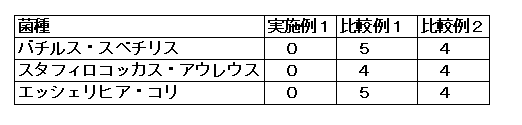
<実施例2>
実施例1と同様に、下記の処方に従って皮膚外用剤である化粧料(可溶化剤形の透明ローション)を作成した。実施例1と同様にバチルス・スベチリス、スタフィロコッカス・アウレウス、エッシェリヒア・コリに対する防腐力を調べたところ、何れもスコア0であった。
ツボクサの抽出物 0.1 重量部
水酸化レシチン(レシノールSH50) 0.1 重量部
ジメチコンコポリオール 0.4 重量部
ショ糖モノステアレート 0.6 重量部
グリセリン 7 重量部
1,2−ペンタンジオール 8 重量部
エタノール 5 重量部
チョウジの抽出物 0.3 重量部
ポリメタクリロイルオキシエトキシホスホリルコリン 0.05重量部
ポリ(グルコシルエチルメタクリレート) 0.02重量部
ポリメタクリロイルリジン 0.03重量部
フェノキシエタノール 0.4 重量部
水 78 重量部
【0016】
<実施例3>
実施例1と同様に、下記の処方に従って皮膚外用剤である化粧料(可溶化剤形の透明ローション)を作成した。実施例1と同様にバチルス・スベチリス、スタフィロコッカス・アウレウス、エッシェリヒア・コリに対する防腐力を調べたところ、何れもスコア0であった。
ツボクサの抽出物 0.1重量部
水酸化レシチン(レシノールSH50) 0.1 重量部
ジメチコンコポリオール 0.4 重量部
ショ糖モノステアレート 0.6 重量部
グリセリン 7 重量部
1,2−ヘキサンジオール 8 重量部
エタノール 5 重量部
チョウジの抽出物 0.3 重量部
ポリメタクリロイルオキシエトキシホスホリルコリン 0.05重量部
ポリ(グルコシルエチルメタクリレート) 0.02重量部
ポリメタクリロイルリジン 0.03重量部
フェノキシエタノール 0.4 重量部
水 78 重量部
【0017】
<実施例4>
実施例1と同様に、下記の処方に従って皮膚外用剤である化粧料(可溶化剤形の透明ローション)を作成した。実施例1と同様にバチルス・スベチリス、スタフィロコッカス・アウレウス、エッシェリヒア・コリに対する防腐力を調べたところ、何れもスコア0であった。
ツボクサの抽出物 0.1 重量部
水酸化レシチン(レシノールSH50) 0.1 重量部
ジメチコンコポリオール 0.4 重量部
ショ糖モノステアレート 0.6 重量部
グリセリン 7 重量部
イソプレングリコール 8 重量部
エタノール 5 重量部
チョウジの抽出物 0.3 重量部
ポリメタクリロイルオキシエトキシホスホリルコリン 0.05重量部
ポリ(グルコシルエチルメタクリレート) 0.02重量部
ポリメタクリロイルリジン 0.03重量部
フェノキシエタノール 0.4 重量部
水 78 重量部
【0018】
<実施例5>
実施例1と同様に、下記の処方に従って皮膚外用剤である化粧料(可溶化剤形の透明ローション)を作成した。実施例1と同様にバチルス・スベチリス、スタフィロコッカス・アウレウス、エッシェリヒア・コリに対する防腐力を調べたところ、何れもスコア0であった。
ツボクサの抽出物 0.1 重量部
水酸化レシチン(レシノールSH50) 0.1 重量部
ジメチコンコポリオール 0.4 重量部
ショ糖モノステアレート 0.6 重量部
グリセリン 7 重量部
ジプロピレングリコール 8 重量部
エタノール 5 重量部
チョウジの抽出物* 0.3 重量部
ポリメタクリロイルオキシエトキシホスホリルコリン 0.05重量部
ポリ(グルコシルエチルメタクリレート) 0.02重量部
ポリメタクリロイルリジン 0.03重量部
フェノキシエタノール 0.4 重量部
水 78 重量部
【0019】
<実施例6>
実施例1と同様に、下記の処方に従って皮膚外用剤である化粧料(可溶化剤形の透明ローション)を作成した。実施例1と同様にバチルス・スベチリス、スタフィロコッカス・アウレウス、エッシェリヒア・コリに対する防腐力を調べたところ、何れもスコア2であった。
ツボクサの抽出物 0.1 重量部
水酸化レシチン(レシノールSH50) 0.1 重量部
ジメチコンコポリオール 0.4 重量部
ショ糖モノステアレート 0.6 重量部
グリセリン 7 重量部
ジグリセリン 8 重量部
エタノール 5 重量部
チョウジの抽出物 0.3 重量部
ポリメタクリロイルオキシエトキシホスホリルコリン 0.05重量部
ポリ(グルコシルエチルメタクリレート) 0.02重量部
ポリメタクリロイルリジン 0.03重量部
フェノキシエタノール 0.4 重量部
水 78 重量部
【0020】
<参考例1>
下記に示す処方に従って、本発明の皮膚外用剤である、乳化型の化粧料を作成した。即ち、イ、ロ、ハの成分をそれぞれ80℃に加熱し、イに徐々にロを加え、乳化し、ハを徐々に加えて中和し、攪拌冷却して乳液を得た。実施例1と同様にバチルス・スベチリス、スタフィロコッカス・アウレウス、エッシェリヒア・コリに対する防腐力を調べたところ、何れもスコア0であった。
イ
ダイズレシチン 0.1重量部
流動パラフィン 10 重量部
セタノール 2 重量部
ポリオキシエチレン(20)セスキオレート 2 重量部
フェノキシエタノール 1 重量部
ロ
1,2−ヘキサンジオール 5 重量部
イソプレングリコール 3 重量部
カルボキシビニルポリマー 0.2重量部
水 60 重量部
ハ
10%水酸化カリウム水溶液 2 重量部
水 14.7重量部
【0021】
<参考例2>
下記に示す処方に従って、本発明の皮膚外用剤である、乳化型の皮膚外用医薬を作成した。即ち、イ、ロ、ハの成分をそれぞれ80℃に加熱し、イに徐々にロを加え、乳化し、ハを徐々に加えて中和し、攪拌冷却して乳液を得た。実施例1と同様にバチルス・スベチリス、スタフィロコッカス・アウレウス、エッシェリヒア・コリに対する防腐力を調べたところ、何れもスコア0であった。
イ
ダイズレシチン 0.1重量部
流動パラフィン 10 重量部
セタノール 2 重量部
ポリオキシエチレン(20)セスキオレート 2 重量部
フェノキシエタノール 1 重量部
インドメタシン 2 重量部
ロ
1,2−ヘキサンジオール 5 重量部
イソプレングリコール 3 重量部
カルボキシビニルポリマー 0.2重量部
水 60 重量部
ハ
10%水酸化カリウム水溶液 2 重量部
水 12.7重量部
【0022】
【発明の効果】
本発明によれば、ポリオキシエチレン基が付加した非イオン界面活性剤や、4級のアミノ基を有するホスファチジルコリンなどのリン脂質を使用した、乳化・可溶化剤形の皮膚外用剤に於いて、防腐力を向上せしめる手段を提供することができる。[0001]
BACKGROUND OF THE INVENTION
The present invention relates to an external preparation for skin, and more particularly to an external preparation for skin in an emulsifying or solubilizing agent form suitable for cosmetics.
[0002]
[Background]
In the emulsifier form or solubilizer form used in cosmetics and other external preparations for skin, water-insoluble components are made into small droplets (micelles) with a surfactant and dispersed uniformly in an aqueous carrier. It is a system. As the surfactant used to form such a system, a nonionic surfactant having a polyoxyethylene group added or a phospholipid such as phosphatidylcholine having a quaternary amino group is used. This is because a physicochemically stable system can be obtained by using such components. Such systems have the advantage of being able to carry water-soluble components and oil-soluble components at the same time, but on the other hand, it is known that preservatives such as parabens are contained in micelles and impair the preservative power. ( For example, refer to Patent Document 1 ). For this reason, in such a system, an antibacterial herbal extract such as sage has been used ( see, for example, Patent Document 2 and Patent Document 3 ). However, it is difficult to maintain the microbial stability of the system with such components alone, and an allowable limit of preservatives is used in combination. On the other hand, in recent years, it has been known that paraben, which is the most widely used preservative, has an effect of inducing stging. For this reason, it has to be said that it is a big demerit from the surface of usability to make parabens into a skin external preparation to a legally allowable limit. In other words, antiseptic power is improved in emulsifying and solubilizing skin external preparations using nonionic surfactants with polyoxyethylene groups and phospholipids such as phosphatidylcholines with quaternary amino groups. The development of the means to dampen was desired.
[0003]
On the other hand, phenoxyethanol is a preservative that can be used in cosmetics and the like, but its preservative power is not so high and is usually used in combination with antibacterial polyhydric alcohol, antibacterial crude drug extract, or Phenoxyethanol has been used in a system that is easily oriented in the aqueous phase ( see, for example, Patent Document 4, Patent Document 5, and Patent Document 6 ). However, phenoxyethanol does not impair its preservative power even in the presence of a preservative-inactivating component such as a nonionic surfactant having a polyoxyethylene group added or a phospholipid such as phosphatidylcholine having a quaternary amino group. It was not known at all, nor was it used in such a system. In other words, a skin external preparation in the form of an emulsifying or solubilizing agent, and a skin external preparation containing 1) a phospholipid and / or polyoxyethylene addition type nonionic surfactant and 2) phenoxyethanol is known at all. It wasn't.
[0004]
[Patent Document 1]
WO2002 / 10440 [Patent Document 2]
JP 2003-1113013 A [Patent Document 3]
JP 2002-265327 A [Patent Document 4]
JP 2003-81759 A [Patent Document 5]
Japanese National Patent Publication No. 11-513366 [Patent Document 6]
Japanese Patent Laid-Open No. 10-203594
[Problems to be solved by the invention]
The present invention has been made under such circumstances, and emulsification and solubilization using a nonionic surfactant having a polyoxyethylene group added and a phospholipid such as phosphatidylcholine having a quaternary amino group. It is an object of the present invention to provide means for improving the antiseptic power in a skin external preparation in dosage form.
[0006]
[Means for Solving the Problems]
In view of such a situation, the present inventors use a nonionic surfactant to which a polyoxyethylene group is added or a phospholipid such as phosphatidylcholine having a quaternary amino group, to form an emulsifying / solubilizing agent. As a result of intensive research efforts to find a means for improving the antiseptic power of skin external preparations of the above, it is a skin external preparation in the form of an emulsifying or solubilizing agent. 1) Phospholipid and / or polyoxyethylene The inventors have found that an external preparation for skin containing an addition-type nonionic surfactant and 2) phenoxyethanol has such characteristics, and have completed the invention. That is, this invention relates to the technique shown below.
(1) A skin external preparation in the form of a solubilizer , which contains 1) phospholipid and dimethicone copolyol and 2) phenoxyethanol.
(2) The external preparation for skin according to (1), wherein the phospholipid is hydroxylated lecithin.
(3) The skin external preparation according to claim 1 or 2, wherein the content of the phospholipid and dimethicone copolyol is 0.01 to 1% by mass.
(4) The external preparation for skin according to any one of (1) to (3), further comprising a polyhydric alcohol having antibacterial or bacteriostatic properties.
(5) The antibacterial or bacteriostatic polyhydric alcohol is 1,3-butanediol, isoprene glycol, or 1,2-pentanediol, any of (1) to (4) The skin external preparation as described in any one.
(6) The external preparation for skin according to any one of (1) to (5), which is a cosmetic.
[0007]
BACKGROUND OF THE INVENTION
(1) Polyoxyethylene addition type nonionic surfactant and phospholipid which are essential components of the cosmetic of the present invention The cosmetic of the present invention contains polyoxyethylene addition type nonionic surfactant and phospholipid as essential components It is characterized by containing as. As the polyoxyethylene addition type nonionic surfactant, any nonionic surfactant can be used without particular limitation as long as it is used in the field of topical skin preparations. For example, polyoxyethylene fatty acid ester, polyoxyethylene sorbitan Suitable examples include fatty acid esters, polyoxyethylene (cured) castor oil, polyoxyethylene alkyl (alkenyl) ethers, polyoxyethylene fatty acid glyceres, dimethicone copolyols, and the like, and polyoxyethylene sorbitan fatty acid esters and dimethicone copolyols are particularly preferred. . This is because, among the polyoxyethylene-added nonionic surfactants, polyoxyethylene sorbitan fatty acid ester and dimethicone copolyol have particularly remarkable preservative inactivating action. These components are all general-purpose raw materials for cosmetics and are easily available.
[0008]
As the phospholipid, any phospholipid can be used without particular limitation as long as it is used in the field of skin external preparations such as cosmetics. For example, lecithin, hydrogenated lecithin, hydroxylated lecithin, phosphatidylinositol, Preferred examples include phosphatidylethanolamine, phosphatidylglycerol, phosphatidylic acid, and lyso forms thereof. Since these components are present in a high concentration such as in soybean or egg yolk, purified soybean or egg yolk can also be used. Among these, particularly preferred is hydroxylated lecithin obtained by hydroxylating lecithin based on soybeans, which is excellent in stability, emulsifiability and solubilization. Such hydroxylated lecithin already exists on the market and can be used. A preferred example of such a commercial product is resinol SH50 sold by Nikko Chemicals Corporation. This is an equimolar mixture of soybean-derived lecithin hydroxide and glycerin. In the cosmetic of the present invention, such phospholipids can be used alone or in combination of two or more.
[0009]
In the cosmetic of the present invention, the preferable content of the polyoxyethylene-added nonionic surfactant and the phospholipid is 0.01 to 1% by weight in the solubilizing system, and more preferably 0. 02 to 0.5% by weight. In the case of an emulsified or dispersed system, it is 0.02 to 5% by weight, and 0.04 to 3% by weight. This is because a stable solubilization, emulsification, and dispersion system can be obtained within this range.
[0010]
(2) Phenoxyethanol as an essential component of the skin external preparation of the present invention The skin external preparation of the present invention is characterized by containing phenoxyethanol as an essential component. Phenoxyethanol has already been used as a preservative in skin preparations such as cosmetics and is commercially available. Therefore, the acquisition is easy. The content of phenoxyethanol in the external preparation for skin of the present invention is preferably 0.1 to 5% by weight, more preferably 0.2 to 2% by weight. This is because it is necessary to contain this amount in order to exhibit antiseptic power.
[0011]
(3) External preparation for skin of the present invention The external preparation for skin of the present invention is an external preparation for skin in the form of an emulsifying or solubilizing agent, and 1) a nonionic surfactant of phospholipid and / or polyoxyethylene addition type 2) It contains phenoxyethanol. The emulsifying or solubilizing agent form means that there are at least two components that do not mix with each other. As the phase of the component that is not mixed with the emulsified and solubilized oil phase, not only an aqueous carrier but also a non-aqueous emulsified system such as a polyhydric alcohol and a non-aqueous solubilized system can be applied. Preferably there is. This is because a system in which an aqueous carrier exists is particularly problematic with respect to antiseptic power. In the external preparation for skin of the present invention, in addition to the essential components, optional components that are usually used in external preparations for skin such as cosmetics can be contained. Examples of such optional components include hydrocarbons such as squalane, liquid paraffin, light liquid isoparaffin, heavy liquid isoparaffin, microcrystalline wax, and solid paraffin, dimethicone, femethicone, cyclomethicone, amodimethicone, and polyether-modified silicone. Silicones such as jojoba oil, carnauba wax, mole, beeswax, gallow, octyldodecyl oleate, isopropyl myristate, neopentyl glycol diisostearate, diisostearate malate, stearic acid, laurin Fatty acids such as acid, myristic acid, palmitic acid, isostearic acid, isopalmitic acid, behenic acid, oleic acid, behenyl alcohol, cetanol, oleyl alcohol, octadecyl Higher alcohols such as rucol, castor oil, coconut oil, hydrogenated coconut oil, coconut oil, wheat germ oil, triglycerides such as isostearic acid triglyceride, isooctanoic acid triglyceride, olive oil, 1,3-butanediol, glycerin, diglycerin , Dipropylene glycol, polyethylene glycol, 1,2-pentanediol, 1,2-hexylene glycol, isoprene glycol and other polyhydric alcohols, sorbitan sesquioleate, sorbitan monooleate, sorbitan trioleate, sorbitan sesquistearate, sorbitan mono Anionic interfaces such as nonionic surfactants, sodium lauryl stearate, polyoxyethylene alkyl sulfates, sulfosuccinates not classified as essential components such as stearates Cationic agents such as quaternary alkyl ammonium salts, amphoteric surfactants such as alkyl betaines, organic powders such as crystalline cellulose, cross-linked methylpolysiloxane, polyethylene powder, acrylic resin powder, talc , Mica, sericite, magnesium carbonate, calcium carbonate, titanium dioxide, iron oxide, bitumen, ultramarine, titanium mica, titanium sericite, silica and other surface-treated powders, acrylic acid / alkyl methacrylate copolymers And / or salts thereof, carboxyvinyl polymers and / or salts thereof, thickeners such as xanthan gum and hydroxypropylcellulose, vitamins such as retinol, retinoic acid, tocopherol, riboflavin, pyridoxine, ascorbic acid, ascorbic acid phosphate Glycyrrhizin Terpenes such as acid salts, glycyrrhetin, ursolic acid, oleanolic acid, active ingredients such as steroids such as estradiol, ethinylestradiol, estriol, preservatives other than phenoxyethanol such as parabens, hibitengluconate, benzalkonium chloride, Preferred examples include ultraviolet absorbers such as dimethylaminobenzoic acid esters, cinnamic acid esters, and benzophenones. Among these, particularly preferred components are polyhydric alcohols having antibacterial properties that can improve the preservative power of phenoxyethanol. Examples of the polyhydric alcohol having antibacterial properties include propylene glycol, 1,3-butanediol, dipropylene glycol, isoprene glycol, 1,2-pentanediol, 1,2-hexanediol, and the like. -Butanediol, isoprene glycol, 1,2-pentanediol and 1,2-hexanediol are more preferred. These can contain only the seed | species, and can also contain it in combination of 2 or more type. A preferable content is 1 to 10% by weight in total with respect to the total amount of the external preparation for skin. If it is less than this, there are cases where the antiseptic effect cannot be obtained, and if it is too much, the stability and usability of the system may be impaired. The external preparation for skin of the present invention can be produced by treating such essential components and optional components according to a conventional method. By taking such a structure, the skin external preparation of this invention has the outstanding antiseptic power. The external preparation for skin of the present invention is not particularly limited as long as it is applied externally to the skin, and examples thereof include cosmetics, external preparations for skin, and antiseptics for external use. Particularly preferred are cosmetics.
[0012]
【Example】
Hereinafter, the present invention will be described in more detail with reference to examples, but it goes without saying that the present invention is not limited to such examples.
[0013]
<Example 1>
In accordance with the formulation shown below, a cosmetic (translucent lotion in the form of a solubilizer), which is an external preparation for skin of the present invention, was prepared. That is, the prescription ingredients were heated to 80 ° C., solubilized by stirring, cooled by stirring, and the skin external preparation of the present invention was obtained as a cosmetic. Further, Comparative Example 1 in which phenoxyethanol was replaced with methylparaben and Comparative Example 2 in which butylparaben was substituted were also prepared. In Comparative Example 2, significant crystalline precipitation occurred on the next day of production. Bacillus subtilis, Staphylococcus aureus, Escherichia coli were transplanted with platinum ears on an agar plate medium containing 10% of these external preparations for skin, and their growth was observed. )-0 (nothing) was evaluated and confirmed. The results are shown in Table 1. It turns out that the skin external preparation of this invention has the outstanding antiseptic effect.
Extract of camellia 0.1 parts by weight lecithin hydroxide (resinol SH50) 0.1 parts by weight dimethicone copolyol 0.4 parts by weight sucrose monostearate 0.6 parts by weight glycerin 7 parts by weight 1,3-butanediol 8 extract * 0.3 part by weight polymethacryloylacetones oxy ethoxy phosphorylcholine 0.05 part by weight poly (glucosyl methacrylate) 0.02 part by weight polymethacryloylacetones Le lysine 0.03 parts by weight phenoxyethanol 0.4 weight parts ethanol 5 parts by weight of cloves 78 parts by weight of water (*) Extract of clove: Extract the dried fruit of clove with 20 times the amount of ethanol under reflux conditions for 2 hours, concentrate, perform liquid-liquid extraction with butanol and water, Concentrated.
[0014]
[Table 1]
<Example 2>
In the same manner as in Example 1, a cosmetic preparation (translucent lotion in the form of a solubilizer) was prepared according to the following formulation. When the antiseptic power against Bacillus subtilis, Staphylococcus aureus and Escherichia coli was examined in the same manner as in Example 1, all scored 0.
Extract of camellia 0.1 parts by weight lecithin hydroxide (resinol SH50) 0.1 parts by weight dimethicone copolyol 0.4 parts by weight sucrose monostearate 0.6 parts by weight glycerin 7 parts by weight 1,2-pentanediol 8 weight extract 0.3 part by weight of the parts of ethanol 5 parts by weight clove polymethacryloylacetones oxy ethoxy phosphorylcholine 0.05 part by weight poly (glucosyl methacrylate) 0.02 part by weight polymethacryloylacetones Le lysine 0.03 parts by weight phenoxyethanol 0.4 parts by weight 78 parts by weight of water [0016]
<Example 3>
In the same manner as in Example 1, a cosmetic preparation (translucent lotion in the form of a solubilizer) was prepared according to the following formulation. When the antiseptic power against Bacillus subtilis, Staphylococcus aureus and Escherichia coli was examined in the same manner as in Example 1, all scored 0.
Extract of camellia 0.1 parts by weight Lecithin hydroxide (Resinol SH50) 0.1 parts by weight Dimethicone copolyol 0.4 parts by weight Sucrose monostearate 0.6 parts by weight glycerin 7 parts by weight 1,2-hexanediol 8 weight extract 0.3 part by weight of the parts of ethanol 5 parts by weight clove polymethacryloylacetones oxy ethoxy phosphorylcholine 0.05 part by weight poly (glucosyl methacrylate) 0.02 part by weight polymethacryloylacetones Le lysine 0.03 parts by weight phenoxyethanol 0.4 parts by weight 78 parts by weight of water [0017]
<Example 4>
In the same manner as in Example 1, a cosmetic preparation (translucent lotion in the form of a solubilizer) was prepared according to the following formulation. When the antiseptic power against Bacillus subtilis, Staphylococcus aureus and Escherichia coli was examined in the same manner as in Example 1, all scored 0.
Extract of camellia 0.1 parts by weight lecithin hydroxide (resinol SH50) 0.1 parts by weight dimethicone copolyol 0.4 parts by weight sucrose monostearate 0.6 parts by weight glycerin 7 parts by weight isoprene glycol 8 parts by weight ethanol 5 extract 0.3 part by weight polymethacryloylacetones oxy ethoxy phosphorylcholine 0.05 part by weight poly (glucosyl methacrylate) 0.02 part by weight polymethacryloylacetones Le lysine 0.03 parts by weight phenoxyethanol 0.4 parts by weight of water 78 parts by weight of parts by weight clove [0018]
<Example 5>
In the same manner as in Example 1, a cosmetic preparation (translucent lotion in the form of a solubilizer) was prepared according to the following formulation. When the antiseptic power against Bacillus subtilis, Staphylococcus aureus and Escherichia coli was examined in the same manner as in Example 1, all scored 0.
Extract of camellia 0.1 parts by weight lecithin hydroxide (resinol SH50) 0.1 parts by weight dimethicone copolyol 0.4 parts by weight sucrose monostearate 0.6 parts by weight glycerin 7 parts by weight dipropylene glycol 8 parts by weight ethanol 5 parts by weight clove extract * 0.3 part by weight polymethacryloylacetones oxy ethoxy phosphorylcholine 0.05 part by weight poly (glucosyl methacrylate) 0.02 part by weight polymethacryloylacetones Le lysine 0.03 parts by weight phenoxyethanol 0.4 parts by weight of water 78 Weight part [0019]
<Example 6>
In the same manner as in Example 1, a cosmetic preparation (translucent lotion in the form of a solubilizer) was prepared according to the following formulation. When the antiseptic power against Bacillus subtilis, Staphylococcus aureus and Escherichia coli was examined in the same manner as in Example 1, all scored 2.
Extract of camellia 0.1 parts by weight lecithin hydroxide (resinol SH50) 0.1 parts by weight dimethicone copolyol 0.4 parts by weight sucrose monostearate 0.6 parts by weight glycerin 7 parts by weight diglycerin 8 parts by weight ethanol 5 extract 0.3 part by weight polymethacryloylacetones oxy ethoxy phosphorylcholine 0.05 part by weight poly (glucosyl methacrylate) 0.02 part by weight polymethacryloylacetones Le lysine 0.03 parts by weight phenoxyethanol 0.4 parts by weight of water 78 parts by weight of parts by weight clove [0020]
< Reference Example 1 >
In accordance with the formulation shown below, an emulsified cosmetic that is an external preparation for skin of the present invention was prepared. That is, each of the components (a), (b) and (c) was heated to 80 ° C., (b) was gradually added to emulsify, emulsified, (c) was gradually added to neutralize, and stirred to cool to obtain an emulsion. When the antiseptic power against Bacillus subtilis, Staphylococcus aureus and Escherichia coli was examined in the same manner as in Example 1, all scored 0.
Idol lecithin 0.1 parts by weight liquid paraffin 10 parts by weight cetanol 2 parts by weight polyoxyethylene (20) sesquiolate 2 parts by weight phenoxyethanol 1 part by weight 1,2-hexanediol 5 parts by weight isoprene glycol 3 parts by weight carboxyvinyl polymer 0 2 parts by weight water 60 parts by weight c 10% aqueous potassium hydroxide solution 2 parts by weight water 14.7 parts by weight
< Reference Example 2 >
In accordance with the formulation shown below, an emulsified skin external preparation, which is an external preparation for skin of the present invention, was prepared. That is, each of the components (a), (b) and (c) was heated to 80 ° C., (b) was gradually added to emulsify, emulsified, (c) was gradually added to neutralize, and stirred to cool to obtain an emulsion. When the antiseptic power against Bacillus subtilis, Staphylococcus aureus and Escherichia coli was examined in the same manner as in Example 1, all scored 0.
Isoybean lecithin 0.1 parts by weight liquid paraffin 10 parts by weight cetanol 2 parts by weight polyoxyethylene (20) sesquiolate 2 parts by weight phenoxyethanol 1 part by weight indomethacin 2 parts by weight ro 1,2-hexanediol 5 parts by weight isoprene glycol 3 parts by weight Carboxyvinyl polymer 0.2 parts by weight water 60 parts by weight c 10% aqueous potassium hydroxide solution 2 parts by weight water 12.7 parts by weight
【The invention's effect】
According to the present invention, in a skin external preparation in the form of an emulsifying / solubilizing agent using a nonionic surfactant having a polyoxyethylene group added or a phospholipid such as phosphatidylcholine having a quaternary amino group, A means for improving the antiseptic power can be provided.
Claims (6)
Priority Applications (1)
| Application Number | Priority Date | Filing Date | Title |
|---|---|---|---|
| JP2003176692A JP4099112B2 (en) | 2003-06-20 | 2003-06-20 | Emulsified / solubilized skin external preparation |
Applications Claiming Priority (1)
| Application Number | Priority Date | Filing Date | Title |
|---|---|---|---|
| JP2003176692A JP4099112B2 (en) | 2003-06-20 | 2003-06-20 | Emulsified / solubilized skin external preparation |
Publications (3)
| Publication Number | Publication Date |
|---|---|
| JP2005008591A JP2005008591A (en) | 2005-01-13 |
| JP2005008591A5 JP2005008591A5 (en) | 2006-06-01 |
| JP4099112B2 true JP4099112B2 (en) | 2008-06-11 |
Family
ID=34099508
Family Applications (1)
| Application Number | Title | Priority Date | Filing Date |
|---|---|---|---|
| JP2003176692A Expired - Lifetime JP4099112B2 (en) | 2003-06-20 | 2003-06-20 | Emulsified / solubilized skin external preparation |
Country Status (1)
| Country | Link |
|---|---|
| JP (1) | JP4099112B2 (en) |
Families Citing this family (8)
| Publication number | Priority date | Publication date | Assignee | Title |
|---|---|---|---|---|
| WO2008038496A1 (en) * | 2006-09-26 | 2008-04-03 | Lion Corporation | Shampoo composition |
| JP5208398B2 (en) * | 2006-10-12 | 2013-06-12 | ポーラ化成工業株式会社 | Antiseptic skin external preparation |
| JP2008115113A (en) * | 2006-11-06 | 2008-05-22 | Pola Chem Ind Inc | Skin care preparation in emulsion dosage form |
| JP5015620B2 (en) * | 2007-01-30 | 2012-08-29 | 株式会社クラレ | Topical skin preparation |
| JP5152911B2 (en) * | 2008-06-05 | 2013-02-27 | ポーラ化成工業株式会社 | Sheet-shaped pack cosmetics carrying aqueous cosmetics. |
| JP2014034549A (en) * | 2012-08-09 | 2014-02-24 | Noevir Co Ltd | External skin preparation |
| KR102565630B1 (en) * | 2016-04-14 | 2023-08-10 | 주식회사 엘지생활건강 | Cosmetic composition containing phenoxyethanol |
| WO2025182691A1 (en) * | 2024-02-29 | 2025-09-04 | 株式会社ユニファイジャパン | 5-deazaflavin compound-containing emulsion and method for producing same |
Family Cites Families (23)
| Publication number | Priority date | Publication date | Assignee | Title |
|---|---|---|---|---|
| JP2662865B2 (en) * | 1987-07-30 | 1997-10-15 | ぺんてる株式会社 | Eyeliner liquid |
| JPH07132222A (en) * | 1993-11-10 | 1995-05-23 | Lion Corp | Emulsion type composition |
| US5525588A (en) * | 1994-09-14 | 1996-06-11 | Elzabeth Arden Co. | Cosmetic composition |
| JPH09309814A (en) * | 1996-05-18 | 1997-12-02 | Shiseido Co Ltd | Preparation for external use for skin |
| JP3657395B2 (en) * | 1996-05-27 | 2005-06-08 | 株式会社資生堂 | Composition for external use |
| JP3539534B2 (en) * | 1997-04-01 | 2004-07-07 | 株式会社資生堂 | External preparation for skin |
| JP5062708B2 (en) * | 1998-02-24 | 2012-10-31 | 株式会社マンダム | Antiseptic disinfectant and human body composition |
| JP2000212020A (en) * | 1999-01-20 | 2000-08-02 | Kanebo Ltd | Skin cosmetic |
| JP2001181180A (en) * | 1999-12-24 | 2001-07-03 | Lion Corp | Water-in-oil emulsion composition |
| JP2001226248A (en) * | 2000-02-15 | 2001-08-21 | Shiseido Co Ltd | Preparation for external use for skin |
| JP2001340749A (en) * | 2000-06-02 | 2001-12-11 | Nippon Bee Kk | Emulsion composition |
| JP4597318B2 (en) * | 2000-06-21 | 2010-12-15 | ピジョン株式会社 | Aqueous composition with improved antiseptic and antibacterial properties |
| JP2002145734A (en) * | 2000-08-31 | 2002-05-22 | Shiseido Co Ltd | Whipped o/w type emulsion cosmetic and method for producing the same |
| JP2002121120A (en) * | 2000-10-16 | 2002-04-23 | Pola Chem Ind Inc | Cleaning agent |
| JP2002128687A (en) * | 2000-10-18 | 2002-05-09 | Esuto:Kk | External preparation for skin |
| JP2001220328A (en) * | 2001-03-29 | 2001-08-14 | Sanei Kagaku Kk | Composition for formulating hair treatment preparation and hair treatment preparation |
| JP5337333B2 (en) * | 2001-06-29 | 2013-11-06 | 東レ・ダウコーニング株式会社 | Aqueous suspension of crosslinked silicone particles and an aqueous emulsion of oil containing crosslinked silicone particles |
| JP3799002B2 (en) * | 2001-07-27 | 2006-07-19 | 東洋ビューティ株式会社 | Topical skin preparation |
| JP2003055185A (en) * | 2001-08-10 | 2003-02-26 | Pola Chem Ind Inc | Skin care preparation |
| JP4442792B2 (en) * | 2001-09-17 | 2010-03-31 | 株式会社資生堂 | Cleaning composition |
| JP4934254B2 (en) * | 2001-09-25 | 2012-05-16 | 株式会社バスクリン | Weakly acidic detergent composition |
| JP2003160428A (en) * | 2001-11-28 | 2003-06-03 | Japan Natural Laboratory Co Ltd | External preparation containing water-soluble vitamin C derivative, method for producing the same and method for using the same |
| JP2004051495A (en) * | 2002-07-17 | 2004-02-19 | Q P Corp | Water-based cosmetics |
-
2003
- 2003-06-20 JP JP2003176692A patent/JP4099112B2/en not_active Expired - Lifetime
Also Published As
| Publication number | Publication date |
|---|---|
| JP2005008591A (en) | 2005-01-13 |
Similar Documents
| Publication | Publication Date | Title |
|---|---|---|
| CN101686911B (en) | Vesicle composition and external preparation for skin | |
| JP7525250B2 (en) | Composition containing a bicellar structure | |
| JP2003527411A (en) | Method for preparing a high pressure / high shear dispersion containing a physiologically active ingredient | |
| JP2013199466A (en) | Lycopene-containing composition | |
| CN104755071A (en) | External preparation for skin | |
| CN105473184A (en) | Two-phase composition comprising magnesium acetate | |
| JP4049216B2 (en) | Formulation with liquid crystal structure | |
| JP2005008591A (en) | Emulsified or solubilized external preparation for skin | |
| WO2013125282A1 (en) | Lycopene-containing composition | |
| JP2004196666A (en) | Cosmetic with suppressed stinging | |
| US5567419A (en) | Stabilized cosmetic compositions containing monoacyl phosphatide and a saponin | |
| JP2005179241A (en) | Emulsifier composition for oil-in-water type use, and cosmetic containing the same | |
| JP2005008591A5 (en) | ||
| JP2004346039A (en) | Emulsified composition | |
| JP3659793B2 (en) | Skin condition improvement makeup cosmetics | |
| JP2003277220A (en) | External preparation for skin | |
| JPH07138125A (en) | Topical skin | |
| JP2003277250A (en) | Skin care preparation | |
| JP4024189B2 (en) | Moisturizing cosmetics | |
| JP2010030933A (en) | Skin care preparation for external use | |
| JP2004182641A (en) | Cosmetic with suppressed stigging | |
| JP4592347B2 (en) | External preparation composition | |
| JP2000001416A (en) | Polyol-containing liposome | |
| JP2003212751A (en) | Gel composition and oil-in-water (o/w) composition | |
| JP4036739B2 (en) | Cosmetics with reduced stinging |
Legal Events
| Date | Code | Title | Description |
|---|---|---|---|
| A521 | Request for written amendment filed |
Free format text: JAPANESE INTERMEDIATE CODE: A523 Effective date: 20060407 |
|
| A621 | Written request for application examination |
Free format text: JAPANESE INTERMEDIATE CODE: A621 Effective date: 20060407 |
|
| RD03 | Notification of appointment of power of attorney |
Free format text: JAPANESE INTERMEDIATE CODE: A7423 Effective date: 20060407 |
|
| A977 | Report on retrieval |
Free format text: JAPANESE INTERMEDIATE CODE: A971007 Effective date: 20070822 |
|
| A131 | Notification of reasons for refusal |
Free format text: JAPANESE INTERMEDIATE CODE: A131 Effective date: 20071127 |
|
| A521 | Request for written amendment filed |
Free format text: JAPANESE INTERMEDIATE CODE: A523 Effective date: 20080123 |
|
| TRDD | Decision of grant or rejection written | ||
| A01 | Written decision to grant a patent or to grant a registration (utility model) |
Free format text: JAPANESE INTERMEDIATE CODE: A01 Effective date: 20080226 |
|
| A61 | First payment of annual fees (during grant procedure) |
Free format text: JAPANESE INTERMEDIATE CODE: A61 Effective date: 20080314 |
|
| R150 | Certificate of patent or registration of utility model |
Ref document number: 4099112 Country of ref document: JP Free format text: JAPANESE INTERMEDIATE CODE: R150 Free format text: JAPANESE INTERMEDIATE CODE: R150 |
|
| FPAY | Renewal fee payment (event date is renewal date of database) |
Free format text: PAYMENT UNTIL: 20140321 Year of fee payment: 6 |
|
| R250 | Receipt of annual fees |
Free format text: JAPANESE INTERMEDIATE CODE: R250 |
|
| R250 | Receipt of annual fees |
Free format text: JAPANESE INTERMEDIATE CODE: R250 |
|
| R250 | Receipt of annual fees |
Free format text: JAPANESE INTERMEDIATE CODE: R250 |
|
| R250 | Receipt of annual fees |
Free format text: JAPANESE INTERMEDIATE CODE: R250 |
|
| EXPY | Cancellation because of completion of term |