JP4201624B2 - Content recording apparatus, content use apparatus, content recording method, content use method, content recording program, and content use program - Google Patents
Content recording apparatus, content use apparatus, content recording method, content use method, content recording program, and content use program Download PDFInfo
- Publication number
- JP4201624B2 JP4201624B2 JP2003068470A JP2003068470A JP4201624B2 JP 4201624 B2 JP4201624 B2 JP 4201624B2 JP 2003068470 A JP2003068470 A JP 2003068470A JP 2003068470 A JP2003068470 A JP 2003068470A JP 4201624 B2 JP4201624 B2 JP 4201624B2
- Authority
- JP
- Japan
- Prior art keywords
- content
- encrypted
- identifier
- key
- data
- Prior art date
- Legal status (The legal status is an assumption and is not a legal conclusion. Google has not performed a legal analysis and makes no representation as to the accuracy of the status listed.)
- Expired - Lifetime
Links
Images






Classifications
-
- G—PHYSICS
- G11—INFORMATION STORAGE
- G11B—INFORMATION STORAGE BASED ON RELATIVE MOVEMENT BETWEEN RECORD CARRIER AND TRANSDUCER
- G11B20/00—Signal processing not specific to the method of recording or reproducing; Circuits therefor
- G11B20/00086—Circuits for prevention of unauthorised reproduction or copying, e.g. piracy
-
- G—PHYSICS
- G06—COMPUTING OR CALCULATING; COUNTING
- G06F—ELECTRIC DIGITAL DATA PROCESSING
- G06F21/00—Security arrangements for protecting computers, components thereof, programs or data against unauthorised activity
- G06F21/10—Protecting distributed programs or content, e.g. vending or licensing of copyrighted material ; Digital rights management [DRM]
-
- H—ELECTRICITY
- H04—ELECTRIC COMMUNICATION TECHNIQUE
- H04L—TRANSMISSION OF DIGITAL INFORMATION, e.g. TELEGRAPHIC COMMUNICATION
- H04L9/00—Cryptographic mechanisms or cryptographic arrangements for secret or secure communications; Network security protocols
- H04L9/08—Key distribution or management, e.g. generation, sharing or updating, of cryptographic keys or passwords
- H04L9/0861—Generation of secret information including derivation or calculation of cryptographic keys or passwords
- H04L9/0866—Generation of secret information including derivation or calculation of cryptographic keys or passwords involving user or device identifiers, e.g. serial number, physical or biometrical information, DNA, hand-signature or measurable physical characteristics
-
- H—ELECTRICITY
- H04—ELECTRIC COMMUNICATION TECHNIQUE
- H04L—TRANSMISSION OF DIGITAL INFORMATION, e.g. TELEGRAPHIC COMMUNICATION
- H04L2209/00—Additional information or applications relating to cryptographic mechanisms or cryptographic arrangements for secret or secure communication H04L9/00
- H04L2209/60—Digital content management, e.g. content distribution
Landscapes
- Engineering & Computer Science (AREA)
- Computer Security & Cryptography (AREA)
- Theoretical Computer Science (AREA)
- Software Systems (AREA)
- Technology Law (AREA)
- Computer Hardware Design (AREA)
- Physics & Mathematics (AREA)
- General Engineering & Computer Science (AREA)
- General Physics & Mathematics (AREA)
- Multimedia (AREA)
- Signal Processing (AREA)
- Computer Networks & Wireless Communication (AREA)
- Storage Device Security (AREA)
- Signal Processing For Digital Recording And Reproducing (AREA)
- Management, Administration, Business Operations System, And Electronic Commerce (AREA)
Abstract
Description
【0001】
【発明の属する技術分野】
この発明はコンテンツ記録装置、コンテンツ利用装置、コンテンツ記録方法、コンテンツ利用方法、コンテンツ記録プログラム、およびコンテンツ利用プログラムに関し、特に、コンテンツの不正利用を防止することのできるコンテンツ記録装置、コンテンツ利用装置、コンテンツ記録方法、コンテンツ利用方法、コンテンツ記録プログラム、およびコンテンツ利用プログラムに関する。
【0002】
【従来の技術】
従来、音楽や画像、映像、電子書籍などのコンテンツデータをコンテンツが記録されたCD-ROM(Compact Disc-Read Only Memory)や、DVD(Digital Video Disc)などの記録媒体などを購入したり、駅などに設置された端末から記録媒体にダウンロードしたり、サーバからダウンロードしたりして取得し、再生するなどの利用を行なうことのできるコンテンツ利用装置がある。このようなコンテンツ利用装置としては、たとえば、携帯情報端末、携帯電話や携帯型プレーヤ、あるいは再生プログラムや再生デバイスを有するコンピュータなどがある。
【0003】
また、これらのコンテンツ利用装置は外部記憶装置を接続できるスロットやコネクタなどを備え、コンテンツ利用装置内の記憶装置に記録されたコンテンツデータを外部記憶装置に移動やコピーをしたり、あるいは逆に外部記憶装置中のコンテンツデータをコンテンツ利用装置内の記憶装置に移動やコピーをしたりすることができるものがある。
【0004】
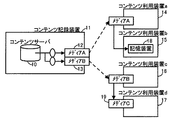
その場合、コピーされたコンテンツデータも自由にどのコンテンツ利用装置でも再生することができてしまう。このことは、当該コンテンツの著作権上の問題を含んでいる場合が多い。そのため、コンテンツが記録されている記憶装置から他の記憶装置へ移動やコピーを行なう場合、不正利用を防止するため、その記録媒体のIDなどを利用してコンテンツデータとこのIDとを予め関連付けておき、利用する時にその記録媒体のIDなどを利用してコンテンツデータとの関連をチェックすることがある。それにより、他の記憶装置へ移動やコピーを行なった場合、記憶装置のIDが変わるためIDに関連付けられたコンテンツは再生ができなくなる。このような方法の具体例を、図10を用いて説明する。
【0005】
すなわち、図10を参照して、コンテンツを格納しているコンテンツサーバ10を備えるコンテンツ記録装置11は、コンテンツサーバ10に格納されているコンテンツの配信の要求を受付ける。この要求は、コンテンツ配信者が決定する方法でなされてもよいし、利用者が所望する方法でなされてもよい。また、コンテンツサーバ10が、記録装置11の外部にあり、コンテンツ記録装置11と接続されていてもよい。要求を受付けたコンテンツ記録装置11は、コンテンツサーバ10から、要求された特定のコンテンツを取得し、外部記録装置であるメディアA(12)やメディアB(13)に記録する。
【0006】
さらに、メディアA(12)、メディアB(13)は、それぞれ固有の書換えることができないID(固有ID)を持っているとする。コンテンツ記録装置11は、コンテンツサーバ10から特定のコンテンツを取得し、これにそれぞれのメディア固有のIDを関連付けて、各々メディアA(12),メディアB(13)に保存する。本具体例では、関連付ける方法として、コンテンツをメディアA(12),メディアB(13)の固有IDで各々暗号化することにする。
【0007】
コンテンツ配信者は、これらのメディアA(12),メディアB(13)を利用者に配布する。利用者は、コンテンツ利用装置でメディアA(12),メディアB(13)に保存されているコンテンツを再生する。
【0008】
コンテンツ利用装置は専用の装置の場合もあるし、汎用コンピュータに組込まれたソフトウェアでその機能が実現されるものであってもよい。さらに、コンテンツ利用装置には、メディアからデータを取得するための入力装置が備わっている。この入力装置にメディアを挿入することで、メディアからデータを取得できるようになっている。
【0009】
今、図10に示されるように、コンテンツ利用装置a(14)の入力装置(図示せず)に、メディアA(12)を接続したとする。このときコンテンツ利用装置a(14)は、メディアA(12)を装着した状態で、メディアA(12)に保存されているコンテンツデータとメディアA(12)の固有IDとを読出し、コンテンツデータに対してメディアA(12)の固有IDを用いて復号処理し、当該コンテンツを再生することが可能である。また、同様に、コンテンツ利用装置c(16)でも、挿入したメディアB(13)からコンテンツデータとメディアB(13)の固有IDとを読出し、当該コンテンツを再生することが可能である。
【0010】
一方、図10に示されるコンテンツ利用装置b(15)は、メディアA(12)を入力装置に挿入し、一旦コンテンツ利用装置b(15)の内部記憶18にコンテンツデータを保存している。この時、記憶装置18に保存されているコンテンツデータは暗号化されたままである。そして、コンテンツ利用装置b(15)は、メディアA(12)を入力装置から抜いた後、記憶装置18に保存されたコンテンツデータを再生しようとすると、このコンテンツデータはメディアA(12)の固有IDを用いて暗号化されており、メディアA(12)の固有IDが得られないため暗号化されたコンテンツデータを復号することができない。
【0011】
また、図10に示されるコンテンツ利用装置d(17)は、メディアB(13)に保存されているコンテンツデータをメディアC(19)にコピーして、このメディアC(19)を入力装置に挿入して再生するものとする。この場合、メディアC(19)に保存されているコンテンツデータは、メディアB(13)の固有IDによって暗号化されているため、コンテンツ利用装置d17では、メディアB(13)の固有IDが得られないため復号することができず、再生を行なうことができない。
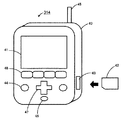
【0012】
以上のような構成をとることで、コンテンツのコピーを防止することが可能な方法が、例えば特許文献1などにより、従来より提案されている。
【0013】
上述のように、IDとコンテンツとを関連付ける方法の1つとして暗号化することが考えられる。たとえば、記録メディアなどの外部記憶媒体にIDを持たせ、この外部記憶媒体にコンテンツデータを書込む際は、この外部記憶媒体のIDを利用してコンテンツデータを暗号化し、外部記憶媒体からコンテンツデータを読込む際は、その外部記憶媒体のIDを利用してコンテンツデータを復号化するという方法がある。
【0014】
上述の暗号化処理および復号化処理は、外部記憶媒体の外部で行なわれる。通常は、専用の読込み装置や書込み装置が用いられ、たとえば携帯型プレーヤなどにこの復号化機能が内蔵されている。
【0015】
この場合、暗号化されたコンテンツが書込まれた外部記憶媒体を使えば、復号化機能を内蔵するどの再生装置でも、その外部記憶媒体書込まれたコンテンツデータを再生できることになる。しかし、この外部記憶媒体中の暗号化されたコンテンツデータを、他の外部記憶媒体にコピーしても、外部記憶媒体のIDが異なるので、コピー先の外部記憶媒体中のコンテンツデータを正しく復号して再生することはできない。
【0016】
【特許文献1】
特開2000−243026号公報
【0017】
【発明が解決しようとする課題】
しかしながら、上述のようなIDとコンテンツとを関連付ける従来技術には、以下のような第1の問題が存在する。すなわち、第1の問題について、図11を用いて説明する。
【0018】
図11は、コンテンツ記憶装置において、固有IDを用いてコンテンツの暗号化を行ない、コンテンツ利用装置でコンテンツを復号する場合の処理の流れを示した図である。図11において、矢印はデータの流れ、○印は暗号化または復号化処理を示している。
【0019】
図11を参照して、コンテンツ記憶装置は、コンテンツCoを、メディアの固有IDを用いて暗号化する。すなわち、メディア1(メディアID:M1)に保存する場合は、コンテンツ記憶装置は、メディアID(M1)を鍵としてコンテンツCoを暗号化し、暗号化コンテンツE1(Co,M1)を計算する。暗号化コンテンツE1(Co,M1)は、データ(コンテンツ)Coを対象としてデータ(メディアID)M1を暗号鍵として、暗号化方式E1で暗号化が行なわれたコンテンツデータであることを示している。
【0020】
一方、コンテンツ利用装置は、メディア1から読出した暗号化コンテンツE1(Co,M1)に対して、メディアID(M1)を復号鍵として復号し、コンテンツCoを得る。
【0021】
また、コンテンツCoを、メディア2(メディアID:M2)に保存する場合には、コンテンツ記憶装置は、メディア1(メディアID:M1)に保存する場合と同様に上述の暗号化処理を行ない、暗号化コンテンツE1(Co,M2)を計算する。以下同様に、コンテンツ記憶装置は、メディアに保存するごとに、コンテンツに対して当該メディアのメディアIDを用いた暗号処理を行なう。つまり、特許文献1に示されているような従来の方法でのコンテンツ記録装置は、記憶媒体にコンテンツを記録する際、記憶媒体ごとにコンテンツを暗号化しなけなければならないという問題がある。一般に、コンテンツはデータサイズが大きくため、大量のデータを配布する場合は、この処理時間を無視することができなくなる。
【0022】
このような第1の問題を解決するために、コンテンツを暗号化する鍵を共通化し、この暗号化の鍵をメディアの固有IDを用いて暗号化して配布するという方法が考えられる。図12および図13を用いてこの方法について説明する。
【0023】
すなわち、図12を参照して、コンテンツ(Co)は、予めコンテンツに対応したコンテンツ鍵(Kc)を用いて暗号化されて暗号化コンテンツE2(Co,Kc)が計算されている。そして、コンテンツサーバには、コンテンツ鍵Kcと暗号化コンテンツE2(Co,Kc)とが対応されて保存される。
【0024】
このときのコンテンツ鍵Kcは、コンテンツ作成者が任意に決めてよいが、通常コンテンツCoのデータサイズよりも非常に少ないデータサイズのデータを用いる。コンテンツ記録装置は、メディア1にコンテンツを記録する時、メディア1の固有ID(M1)を取得し、そのメディアの固有ID(M1)を用いてコンテンツ鍵Kcを暗号化する。さらに、コンテンツ記録装置は、コンテンツ鍵Kcを記録する場合は、暗号化コンテンツ鍵E3(Kc,M1)を計算する。また、コンテンツ記録装置は、メディア2(メディアID:M2)にコンテンツを記録する際は、メディア2の固有ID(M2)を用いてコンテンツ鍵Kcを暗号化し、さらに、暗号化コンテンツE3(Kc,M2)を求める。
【0025】
一方、メディア1をコンテンツ利用装置で再生する時の処理は、図13に示すようになる。すなわち、図13を参照して、コンテンツ利用装置は、メディア1からメディア1の固有ID(M1)と暗号化コンテンツ鍵E3(Kc,M1)とを取得し、メディア1の固有ID(M1)を用いて暗号化コンテンツ鍵E3(Kc,M1)を復号する。これによってコンテンツ鍵Kcが得ることができる。さらに、コンテンツ利用装置は、メディア1から暗号化コンテンツE2(Co,Kc)を取得し、このコンテンツ鍵Kcを用いて暗号化コンテンツE2(Co,Kc)を復号する。これによって、コンテンツCoを取得し、再生を行なうことが可能になる。
【0026】
上述の方法を用いると、コンテンツ記録装置において、暗号化処理を行なう対象は、データサイズの小さなコンテンツ鍵Kcのみとなり、データサイズの大きなコンテンツCoを暗号処理するための時間が必要なくなり、上述の第1の問題を解決することが可能である。
【0027】
しかしながら、この方式には以下のような第2の問題がある。
すなわち、第2の問題点について図14を用いて説明する。図14は、図12および、図13で説明した方法と同じ方法によって、コンテンツ記録装置においてメディアに複数のコンテンツを記録し、コンテンツ利用装置においてコンテンツを再生する従来例を示したものである。
【0028】
図14を参照して、この場合、前述と同様の方法により、コンテンツ1(Co1)は予めコンテンツ鍵1(Kc1)を用いて暗号化されコンテンツサーバに記録されている。コンテンツ記録装置は、コンテンツサーバに記録されている暗号化コンテンツ1E2(Co1,Kc1)をメディア1に記録する。さらに、コンテンツ記録装置は、メディア1の固有ID(M1)を取得し、コンテンツ鍵Kc1に対してメディア1の固有ID(M1)を用いて暗号化して計算された暗号化コンテンツ鍵1E3(Kc1,M1)をメディアに記録する。
【0029】
コンテンツ2をメディア1に記録する場合も同様に、コンテンツ鍵2(Kc2)を用いて暗号化された暗号化コンテンツ2E2(Co2,Kc2)と、コンテンツ鍵Kc2に対してメディア1の固有ID(M1)を用いて暗号化して計算された暗号化コンテンツ鍵2E3(Kc2,M1)とをメディア1に記録する。
【0030】
コンテンツ利用装置は、メディア1に記録されているコンテンツ1を再生しようとする場合、メディア1からメディア1の固有ID(M1)と暗号化コンテンツ鍵1E3(Kc1,M1)とを取得し、暗号化コンテンツ鍵1E3(Kc1,M1)をメディア1の固有ID(M1)を用いて復号し、コンテンツ鍵Kc1を取得する。さらに、コンテンツ利用装置は、メディア1から暗号化コンテンツE2(Co1,Kc1)を取得し、暗号化コンテンツE2(Co1,Kc1)をコンテンツ鍵Kc1を用いて復号し、コンテンツCo1を得て再生することができる。
【0031】
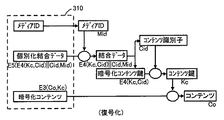
上述のように、メディアの固有IDでコンテンツ鍵を暗号化した場合、同じ記憶媒体であるメディア1に記録されている暗号化コンテンツ鍵は、全て同一の鍵であるメディアID(M1)を用いて暗号化されることになる。さらに、ここで用いられる暗号化方式E3は、必ずしも秘密の方式とは限らず、公知の方法を用いている場合がある。そのため、もし、メディアID(M1)が漏洩した場合、同じ記録媒体であるメディア1に記録されている他の暗号化コンテンツ鍵は全て復号できてしまう可能性があるという問題がある。また、メディアに固有のIDは、必ずしも安全に保護されている訳ではなく、解析することが可能である。つまり、暗号化方式E3が既知のものであれば、コンテンツ鍵を不正に取得できる可能性があるという問題がある。
【0032】
本発明はこのような問題に鑑みてなされたものであって、コンテンツの不正利用を有効に防止することが可能なコンテンツ記録装置、コンテンツ利用装置、コンテンツ記録方法、コンテンツ利用方法、コンテンツ記録プログラム、およびコンテンツ利用プログラムを提供することを目的とする。
【0033】
【課題を解決するための手段】
上記目的を達成するために、本発明のある局面に従うと、コンテンツ記録装置は、記憶媒体から、記憶媒体に固有の書換不能な識別子を取得する識別子取得手段と、取得した記憶媒体に固有の識別子と、コンテンツに固有のコンテンツ識別子とから、個別化鍵を生成する個別化鍵生成手段と、コンテンツを暗号化するために用いられたコンテンツ鍵を、生成した個別化鍵を用いて暗号化し、暗号化コンテンツ鍵を生成する暗号化コンテンツ鍵生成手段と、コンテンツ鍵を用いて少なくとも一部が暗号化されたコンテンツと、コンテンツ識別子と、生成した暗号化コンテンツ鍵とを、記憶媒体に記録するデータ記録手段とを備える。
【0034】
また、コンテンツ記録装置は、コンテンツ識別子を記憶する記憶手段をさらに備え、記憶手段は、コンテンツ内であって、コンテンツ鍵を用いて暗号化された領域以外の領域にあるコンテンツ識別子を記憶することが望ましい。
【0035】
本発明の他の局面に従うと、コンテンツ記録装置は、コンテンツを暗号化するために用いられたコンテンツ鍵を、コンテンツに固有のコンテンツ識別子を用いて暗号化し、暗号化コンテンツ鍵を生成する暗号化コンテンツ鍵生成手段と、生成した暗号化コンテンツ鍵とコンテンツ識別子とを結合し、結合データを作成するデータ結合手段と、記憶媒体から、記憶媒体に固有の書換不能な識別子を取得する識別子取得手段と、作成した結合データを、取得した記憶媒体に固有の識別子を用いて暗号化する暗号化結合データ生成手段とを備える。
【0036】
本発明のさらに他の局面に従うと、コンテンツ利用装置は、記憶媒体から、記憶媒体に記録された暗号化されたコンテンツと、コンテンツに固有のコンテンツ識別子と、コンテンツを暗号化するために用いられたコンテンツ鍵であって暗号化されたコンテンツ鍵とを取得するデータ取得手段と、記憶媒体から、記憶媒体に固有の書換不能な識別子を取得する識別子取得手段と、取得した記憶媒体に固有の識別子と、取得したコンテンツ識別子とから、個別化鍵を生成する個別化鍵生成手段と、取得した暗号化されたコンテンツ鍵を、生成された個別化鍵を用いて復号する暗号化コンテンツ鍵復号手段と、取得した暗号化されたコンテンツを、復号されたコンテンツ鍵を用いて復号するコンテンツ復号手段とを備える。
【0037】
また、上述のデータ取得手段は、記憶媒体に記録された暗号化されたコンテンツ内であって、コンテンツ鍵を用いて暗号化された領域以外の領域からコンテンツ識別子を取得することが望ましい。
【0038】
本発明のさらに他の局面に従うと、コンテンツ利用装置は、記憶媒体から、記憶媒体に記録された暗号化されたコンテンツと、暗号化されたコンテンツを暗号化するために用いられたコンテンツ鍵であって暗号化されたコンテンツ鍵と暗号化されたコンテンツに固有のコンテンツ識別子とが結合された暗号化された結合データとを取得するデータ取得手段と、記憶媒体から、記憶媒体に固有の書換不能な識別子を取得する識別子取得手段と、取得した記憶媒体に固有の識別子を用いて取得した暗号化された結合データを復号して、結合データを生成する結合データ取得手段と、生成した結合データから、暗号化されたコンテンツ鍵と、コンテンツ識別子とを取得するデータ分離手段と、取得した暗号化されたコンテンツ鍵を、取得したコンテンツ識別子を用いて復号する暗号化コンテンツ鍵復号手段と、復号されたコンテンツ鍵を用いて、取得した暗号化されたコンテンツを復号するコンテンツ復号手段とを備える。
【0039】
本発明のさらに他の局面に従うと、コンテンツ記録方法は、書換え不能な固有の識別子をもつ記憶媒体にコンテンツを記録するコンテンツ記録方法であって、記憶媒体から、固有の識別子を取得する識別子取得ステップと、取得した記憶媒体に固有の識別子と、コンテンツに固有のコンテンツ識別子とから、個別化鍵を生成する個別化鍵生成ステップと、コンテンツを暗号化するために用いられたコンテンツ鍵を、生成した個別化鍵を用いて暗号化し、暗号化コンテンツ鍵を生成する暗号化コンテンツ鍵生成ステップと、コンテンツ鍵を用いて少なくとも一部が暗号化されたコンテンツと、コンテンツ識別子と、生成した暗号化コンテンツ鍵とを、記憶媒体に記録するデータ記録ステップとを備える。
【0040】
本発明のさらに他の局面に従うと、コンテンツ利用方法は、書換え不能な固有の識別子をもつ記憶媒体に記録されたコンテンツを利用するコンテンツ利用方法であって、記憶媒体から、記憶媒体に記録された暗号化されたコンテンツと、コンテンツに固有のコンテンツ識別子と、コンテンツを暗号化するために用いられたコンテンツ鍵であって暗号化されたコンテンツ鍵とを取得するデータ取得ステップと、記憶媒体から、記憶媒体に固有の書換不能な識別子を取得する識別子取得ステップと、取得した記憶媒体に固有の識別子と、取得したコンテンツ識別子とから、個別化鍵を生成する個別化鍵生成ステップと、取得した暗号化されたコンテンツ鍵を、生成された個別化鍵を用いて復号する暗号化コンテンツ鍵復号ステップと、取得した暗号化されたコンテンツを、復号されたコンテンツ鍵を用いて復号するコンテンツ復号ステップとを備える。
【0041】
本発明のさらに他の局面に従うと、コンテンツ記録プログラムは、書換え不能な固有の識別子をもつ記憶媒体にコンテンツを記録するコンテンツ記録方法をコンピュータに実行させるプログラムであって、記憶媒体から、固有の識別子を取得する識別子取得ステップと、取得した記憶媒体に固有の識別子と、コンテンツに固有のコンテンツ識別子とから、個別化鍵を生成する個別化鍵生成ステップと、コンテンツを暗号化するために用いられたコンテンツ鍵を、生成した個別化鍵を用いて暗号化し、暗号化コンテンツ鍵を生成する暗号化コンテンツ鍵生成ステップと、コンテンツ鍵を用いて少なくとも一部が暗号化されたコンテンツと、コンテンツ識別子と、生成した暗号化コンテンツ鍵とを、記憶媒体に記録するデータ記録ステップとを実行させる。
【0042】
本発明のさらに他の局面に従うと、コンテンツ記録プログラムは、書換え不能な固有の識別子をもつ記憶媒体にコンテンツを記録するコンテンツ記録方法をコンピュータに実行させるプログラムであって、コンピュータは、暗号化されたコンテンツを記憶する記憶装置から情報を読取る第1の読取手段と、上記記憶媒体から情報を読取る第2の読取手段と、上記記憶媒体に対して情報を書込む書込手段と、処理手段とを含み、上記記憶装置から第1の読取手段でコンテンツを暗号化するために用いられたコンテンツ鍵を取得するステップと、上記記憶装置から第1の読取手段で暗号化されたコンテンツに固有のコンテンツ識別子を取得するステップと、処理手段で、コンテンツを暗号化するために用いられたコンテンツ鍵を、暗号化されたコンテンツに固有のコンテンツ識別子を用いて暗号化し、暗号化コンテンツ鍵を生成する暗号化コンテンツ鍵生成ステップと、処理手段で、生成した暗号化コンテンツ鍵とコンテンツ識別子とを結合し、結合データを作成するデータ結合ステップと、記憶媒体から第2の読取手段で、固有の識別子を取得する識別子取得ステップと、処理手段で、生成した結合データを、取得した記憶媒体に固有の識別子を用いて暗号化する暗号化結合データ生成ステップと、書込手段で、暗号化された結合データを記憶媒体に対して書込むステップとを実行させる。
【0043】
本発明のさらに他の局面に従うと、コンテンツ利用プログラムは、書換え不能な固有の識別子をもつ記憶媒体に記録されたコンテンツを利用するコンテンツ利用方法をコンピュータに実行させるプログラムであって、記憶媒体から、記録された暗号化されたコンテンツと、コンテンツに固有のコンテンツ識別子と、コンテンツを暗号化するために用いられたコンテンツ鍵であって暗号化されたコンテンツ鍵とを取得するデータ取得ステップと、記憶媒体から、固有の識別子を取得する識別子取得ステップと、取得した記憶媒体に固有の識別子と、取得したコンテンツ識別子とから、個別化鍵を生成する個別化鍵生成ステップと、取得した暗号化されたコンテンツ鍵を、生成された個別化鍵を用いて復号する暗号化コンテンツ鍵復号ステップと、取得した暗号化されたコンテンツを、復号されたコンテンツ鍵を用いて復号するコンテンツ復号ステップとを実行させる。
【0044】
本発明のさらに他の局面に従うと、コンテンツ利用プログラムは、書換え不能な固有の識別子をもつ記憶媒体に記録されたコンテンツを利用するコンテンツ利用方法をコンピュータに実行させるプログラムであって、コンピュータは、記憶媒体から情報を読取る読取手段と、復号処理手段とを含み、記憶媒体から読取手段で、記録された暗号化されたコンテンツと、暗号化されたコンテンツを暗号化するために用いられたコンテンツ鍵であって暗号化されたコンテンツ鍵と暗号化されたコンテンツに固有のコンテンツ識別子とが結合された暗号化された合成データとを取得するデータ取得ステップと、記憶媒体から読取手段で、固有の識別子を取得する識別子取得ステップと、復号処理手段で、取得した記憶媒体に固有の識別子を用いて取得した暗号化された結合データを復号して、結合データを生成する結合データ取得ステップと、復号処理手段で、生成した結合データから、暗号化されたコンテンツ鍵と、コンテンツ識別子とを取得するデータ分離ステップと、復号処理手段で、取得した暗号化されたコンテンツ鍵を、取得したコンテンツ識別子を用いて復号する暗号化コンテンツ鍵復号ステップと、復号処理手段で、復号されたコンテンツ鍵を用いて、取得した暗号化されたコンテンツを復号するコンテンツ復号ステップとを実行させる。
【0045】
【発明の実施の形態】
以下に、図面を参照しつつ、本発明の実施の形態について説明する。以下の説明では、同一の部品および構成要素には同一の符号を付してある。それらの名称および機能も同じである。したがってそれらについての詳細な説明は繰返さない。
【0046】
[第1の実施の形態]
図1は、本発明の第1の実施の形態にかかる、コンテンツの不正利用を防止するためのコンテンツ記録装置301とコンテンツ利用装置314との構成の具体例を示すブロック図である。本実施の形態におけるコンテンツ記録装置301は、記録装置302に保存されているコンテンツを着脱可能な記録媒体310に記録する装置であり、図1は、この記録媒体310に記録されたコンテンツを、コンテンツ利用装置314において利用することを示している。
【0047】
ここで、まず、前提として、「記録」は、データを記録媒体に書込む処理であり、たとえば、データをコンテンツ記録装置外部(たとえばネットワーク先や外部記憶装置など)へ移動したり、コピーしたりする処理などが含まれる。
【0048】
また、「利用」は、データの読書きを行なう処理であり、たとえば、データの参照、再生、実行や、データ利用装置外部(たとえばネットワーク先や外部記憶装置など)への移動、コピーする処理などが含まれる。
【0049】
また、「着脱可能」は、データ利用機器とID情報機器とが物理的に一体になったり、別々になったりすることができることを指すが、根源的には、ID情報を読取ることが可能か否かが「着脱」の基準となる。
【0050】
始めに、図1を用いて、第1の実施の形態におけるコンテンツ記録装置301の構成の詳細について説明する。図1を参照して、コンテンツ記録装置301は、記憶装置302と、メディア識別子読取部306と、個別化鍵生成部307と、コンテンツ鍵暗合化部308と、記録処理部309とを含んで構成される。
【0051】
コンテンツ記録装置301が管理するコンテンツは、予めコンテンツごとに決められたコンテンツ鍵304を用いて暗号化されており、記憶装置302には、コンテンツを識別するためのコンテンツ識別子303、コンテンツ鍵304、および暗号化されたコンテンツである暗号化コンテンツ305が1つの組として保存されている。
【0052】
なお、コンテンツ記録装置301が管理するコンテンツは、あらゆる種類のデータを対象とすることができる。対象となる主なデータとしては、不正利用を防ぎたいデータ、すなわち著作権などがあるデータ、課金されたデータなどである。たとえば、音楽や画像、動画、電子書籍などのデータ、あるいは、コンテンツ利用装置内で実行可能なプログラムなどが該当する。
【0053】
また、ここでの「暗号」とは、暗号化されていない通常のデータ(平文)を所定の規則に従って変換し、そのままでは第3者にとって何を意味しているかわからないデータ(暗号文)に変換する処理である。また、所定の規則(最初の規則と同一でなくてもよい)によって暗号文を元の平文に復元できる復号処理が存在する。また、同一の平文がいつも同じ暗号文にならないように、変換時に「鍵」を用いて暗号処理を行なうのが一般的である。また、復号処理に同じ「鍵」を用いて復号できる共通鍵暗号や、決められたペアの2つの鍵によって暗号処理および復号処理が可能である公開鍵暗号などがある。
【0054】
共通暗号化方式としては、DES(Data Encryption Standard)、AES(Advanced Encryption Standard)などの方式があり、公開鍵暗号化方式では、RSA暗号、Elgamal暗号などがある。本発明において鍵方式は限定されず、これらの方法のうちどのような方法を用いてもよいがここでは、共通鍵暗号を用いて説明する。
【0055】
上述のコンテンツ鍵304は、暗号化方式で利用可能な任意のデータであり、暗号化を行なうごとに1つ割当てられるデータである。たとえば、64ビット鍵のDES方式であれば、コンテンツ鍵304は64ビット長のデータとなる。ただし、コンテンツ鍵304は、ある決められた変換処理によって、暗号化方式で利用される鍵を算出できるようなデータであってもよいとする。暗号化コンテンツ305は、このコンテンツ鍵304を用いて生成されたコンテンツである。この暗号化コンテンツ305は、コンテンツ全体が必ずしも暗号化されていなくてもよく、コンテンツ鍵304なしでコンテンツ利用装置314において利用されることがない程度に暗号化されていればよい。すなわち、コンテンツの一部であって、当該コンテンツを利用する上で重要なデータ(たとえば当該コンテンツのタイプを示す情報を含むヘッダ部など)のみを暗号化することで、コンテンツ全体を暗号化するのと同じ効果が得られればよい。「暗号化」は、暗号化チップなどのハードウェアを使って実行されるものでもよいし、ソフトウェアで実行されてもよい。
【0056】
また、上述のコンテンツ識別子303は、コンテンツを識別するためのデータである。コンテンツ作成時にコンテンツ作成者が決定するデータであって、当該コンテンツを一意に決定できるデータである。コンテンツ識別子303のデータの種類としては、文字列や数字であったり、バイナリデータであってもよく、コンテンツを一意に決定できるデータであればその種類は限定されない。また、作成者が決めなくても、コンテンツ作成時の時刻などを用いて自動的に決定されるものであってもよい。さらに、図1においては、コンテンツ識別子303は暗号化コンテンツ305の中には含まれていないが、コンテンツ識別子303が暗号化コンテンツ305の暗号化されていない領域に埋込まれていてもよい。
【0057】
さらに、コンテンツ記録装置301は、外部記憶装置(以降、メディアと言う)310と接続してメディア310とデータの入出力を行なうインタフェースなどの装置(図示せず)を備える。
【0058】
上述のメディア310としては、任意の記憶媒体を用いることができる。たとえば、FD(Flexible Disk)やCD(Compact Disc)やCD−R(CD-Recordable)やDVD(Digital Video Disc)やMD(Mini Disc)や、コンパクトフラッシュ(R)、スマートメディア(R)、マルチメディアカード(R)等のメモリーカードや、着脱可能なハードディスクなどが該当する。
【0059】
また、メディア310とコンテンツ記録装置301との接続方法は、メディア310をコンテンツ記録装置301内部に挿込むなどして組込んだ形で物理的に接続する方法や、あるいは何らかの通信手段で通信を行なうことでコンテンツ記録装置301とは独立した形で通信接続する方法がある。なお、メディア310からデータが読取れ、着脱可能ならばメディア310とコンテンツ記録装置301との接続方法は上述の方法に限定されず、たとえばその他の方法として、端子やケーブルなどを使った接触型や、無線や電磁波などを使った非接触型などの接続方法であってもよい。
【0060】
さらに、メディア310は、予め、書換え不能であるメディア識別子311を記録する領域を含む。メディア310に記録されるメディア識別子311は、メディア310の同一性を示す情報であり、一般に固有の値や文字列などのデータを含む。このメディア識別子311は、製造時に作成され、同じ識別子を持つメディアは他に存在しないのが一般的である。なお、メディア識別子311が他のメディアのメディア識別子と絶対に同じにならないことは保障されないが、メディア識別子が同じになる確率が非常に小さく、実使用上、ほとんど問題とならない程度の場合は、他のメディアは当該メディア310と同じメディア識別子311を記録していないとみなしてもよい。具体的には、メディア識別子を集中的に管理せず、各メディア310上でメディア識別子311を個別に動的に生成する場合などに、上記のようにみなしてもよい場合がある。
【0061】
メディア識別子読取部306は、上述のメディア310に記録されているメディア識別子311を読取る。なお、メディア識別子311を読取る際、コンテンツ記録装置301とメディア310との間で、認証処理など、何らかの通信手順が必要な場合もある。また、メディア識別子311が暗号化されており、コンテンツ記録装置301上で復号化する必要がある場合もある。
【0062】
なお、コンテンツ記録装置301において、メディア310から得られるメディア識別子311をそのまま使わず、メディア310から得られるメディア識別子311を元に、別の識別子情報を生成し、生成した識別子を用いる場合も、メディア310中のメディア識別子311を用いる場合と同等とみなすものとする。メディア310から得られるメディア識別子311を元に別の識別子を生成する方法としては、たとえば、メディア310のメディア識別子311にハッシュ関数などの演算処理などを行なって生成する方法がある。また、識別子の生成は、コンテンツ記録装置301内部でなく、外部の機器などで行なわれてもよい。たとえば、コンテンツ記録装置301から外部サーバにメディア識別子311を送って、外部サーバ上で新たな識別子を生成させ、外部サーバから生成されたメディア識別子を取得してもよい。
【0063】
そして、メディア識別子読取部306は、読取ったメディア識別子311を個別化鍵生成部307に渡す。
【0064】
個別化鍵生成部307は、記憶装置302に記録されているコンテンツ識別子303と、メディア識別子読取部306から受取ったメディア識別子311とを用いて、個別化鍵を生成する。個別化鍵とは、コンテンツ識別子303とメディア識別子311とから所定の方法によって計算されるデータである。たとえば、コンテンツ識別子303に対して、メディア識別子311を鍵として暗号化を行なうことで得られるデータなどが考えられる。そして、個別化鍵生成部307は、生成した個別化鍵をコンテンツ鍵暗号化部308に渡す。
【0065】
コンテンツ鍵暗号化部308は、記憶装置302に記録されているコンテンツ鍵304に対して、個別化鍵生成部307で生成された個別化鍵を鍵として暗号化を行ない、個別化コンテンツ鍵312を生成する。そして、コンテンツ鍵暗号化部308は、生成した個別化コンテンツ鍵312を記録処理部309に渡す。
【0066】
記録処理部309は、記録装置302に保存されているコンテンツ識別子303、暗号化コンテンツ305、およびコンテンツ鍵暗号化部308から渡された個別化コンテンツ鍵312をメディア310に保存する。
【0067】
本実施の形態のコンテンツ記録装置301は、上述のように、作成された暗号化コンテンツ305を記憶装置302に記憶しており、メディア310へ記録する際は、暗号化コンテンツ305をそのまま記録する。一般に、データの暗号化処理は、暗号化の対象となるデータのサイズが大きくなると、暗号処理時間が長くなる。また、一般に、コンテンツは、コンテンツ識別子やコンテンツ鍵のデータサイズより多い。そのため、本実施の形態のコンテンツ記録装置301は、複数のメディアに同じコンテンツを記録する場合、上述の従来例のように何度もコンテンツを暗号化して記録することなく、時間がかからない。また、コンテンツ鍵304は、上述のように、メディア310に記録される度にコンテンツ鍵暗合化部308において暗号化処理がなされるが、コンテンツ鍵304のデータサイズはコンテンツなどのデータサイズに比べて非常に小さいので、暗号化を行なう処理時間を無視することができる。そのため、本実施の形態のコンテンツ記録装置301は、メディア310にコンテンツを記録する処理時間を非常に短くすることができる。
【0068】
なお、図1において、記憶装置302は、コンテンツ記録装置301内部に備えられているが、必ずしもコンテンツ記録装置301の内部に含まれるものでなくてもよい。たとえば、図2に示されるような構成でもよい。すなわち、ネットワークで接続された記憶装置302と複数のコンテンツ記録装置A(301a)〜C(301c)とを含んで構成されてもよい。この場合、記憶装置302は、ネットワークを介して、コンテンツ記録装置301のデータ入出部320でメディアから読取られたデータを取得することができる。また、記憶装置302に記憶されるコンテンツを、ネットワークを介して、複数のコンテンツ記録装置301のデータ入出部320で、複数のメディアに記録することができる。これによって、記憶装置302は1つあれば、複数のコンテンツ記録装置301においてコンテンツを記録することが可能となる。このような図2に示されるような形態である場合であっても、コンテンツ記録装置301と記憶装置302とを含めて「コンテンツ記録装置」と呼ぶものとする。
【0069】
次に、図1を用いて、第1の実施の形態におけるコンテンツ利用装置314の構成について説明する。
【0070】
図1を参照して、コンテンツ利用装置314は、メディア識別子読取部306と、個別化鍵生成部307と、コンテンツ鍵復号部315と、コンテンツ復号処理部316と、再生処理部317とを含んで構成される。さらに、コンテンツ利用装置314は、メディア310と接続してメディア310とデータの入出力を行なう、コンテンツ記録装置301が備える装置と同様のインタフェースなどの装置(図示せず)を備える。ただし、1つのメディア310からメディア識別子311を読取ることができるコンテンツ利用装置314は、同時には複数は存在できないとする。あるいは、原理的に複数存在できるとしても、着脱方法やデータ利用装置の形状、使用形態などから、実使用上、同時には複数は存在しないのならば、その場合も、同時には複数は存在できないとみなす。
【0071】
コンテンツ利用装置314に含まれるメディア識別子読取部306および個別化鍵生成部307は、コンテンツ記録装置301に含まれるそれらと同様の機能を備える。すなわち、メディア識別子読取部306はメディア310からメディア識別子310を読取り、個別化鍵生成部307に渡す。
【0072】
個別化鍵生成部307は、メディア識別子読取部306から渡されたメディア識別子310と、メディア310から読取ったコンテンツ識別子303とに基づいて、コンテンツ記録装置301において同じメディア310の同じコンテンツから生成された個別化鍵と同様の個別化鍵を生成することができる。そして、個別化鍵生成部307は、生成した個別化鍵をコンテンツ鍵復号部315に渡す。
【0073】
コンテンツ鍵復号部315は、メディア310に保存されている個別化コンテンツ鍵312に対して、個別化鍵生成部307から渡された個別化鍵を鍵として復号処理を行ない、コンテンツ鍵を生成する。
【0074】
なお、「復号」とは、暗号処理によって変換されたデータを、鍵を用いて元の変換前にデータに戻すための処理をいう。鍵を用いることなく、暗号処理されたデータを元のデータに復元することは非常に難しい変換方法である。しかしながら、暗号化の方式が決まれば、その暗号化方式に対応して復号方式は決定されるので、コンテンツ利用装置314は、コンテンツ記録装置301で用いている暗号化処理方法に対応する復号処理方法を用いて暗号化されたデータを復号する。このような復号処理は、復号化チップなどのハードウェアを使って実行されるものでもよいし、ソフトウェアで実行されてもよい。
【0075】
そして、コンテンツ鍵復号部315は、生成したコンテンツ鍵をコンテンツ復号処理部316に渡す。
【0076】
コンテンツ復号処理部316は、メディア310に保存されている暗号化された暗号化コンテンツ305を、コンテンツ鍵復号部315から渡されたコンテンツ鍵を用いて復号する。復号方法としては、コンテンツ記録装置301が当該コンテンツを記憶装置302に保存する際に行なった暗号方法に対応した復号方法を用いる。なお、その復号方法は、前述のコンテンツ鍵復号部315がコンテンツ鍵を復号する方法と同じであってもよいし、異なっていてもよい。そして、コンテンツ復号処理部316は、復号した暗号化コンテンツ305を、再生処理部317に渡す。
【0077】
再生処理部317は、コンテンツ復号処理部316から渡された復号されたコンテンツを、コンテンツで決められている処理方法で処理する。具体的には、コンテンツが音楽データである場合には、スピーカ23(図3参照)で音声を再生し、画像データである場合には、ディスプレイ21(図3参照)に画像を表示する。
【0078】
図3に、図1に示されるコンテンツ利用装置314の各部306〜317を機能させるためのハードウェア構成の具体例をブロック図で示す。
【0079】
図3を参照して、コンテンツ利用装置314は、バス29で接続されたCPU(Central Processing Unit)20、ディスプレイ21、キーボード22、スピーカ23、記憶装置24、外部記憶装置25、マウス26、ボタン28、および通信デバイス27を含んで構成され、COU20で装置全体の制御を行なう。
【0080】
CPU20で実行するプログラムは、記憶装置24、外部記憶装置25、あるいは通信デバイス27を介したネットワーク先などに記憶される。CPU20は、記憶装置24などに記憶されるプログラムを取得し、バス29を通じ相互に接続されたディスプレイ21、キーボード22、スピーカ23、記憶装置24、外部記憶装置25、マウス26、通信デバイス27、およびボタン28とデータのやりとりを行ないながら、それらを制御する。なお、CPU20と他の各部とのデータのやりとりは、バス29を介して行なう以外にも、通信ケーブルや無線通信装置などデータを送受信できるものを介して行なってもよい。
【0081】
ディスプレイ21は、通常はグラフィックチップやVRAM(Video Random Access Memory)などと組合わされて実現される。すなわち、VRAM上のデータが表示信号に変換され、ディスプレイ21に表示信号が画像として表示される。
【0082】
キーボード22、マウス26、ボタン28は、ユーザの指示を入力する手段である。すなわち、キーボード22は、押下されたキーを検出する機械的もしくは電子的なスイッチなどを含んで構成される。マウス26は、マウスボタンの押下状態を検出するメカニカルもしくは電子的なスイッチなどと、マウスの縦と横の相対移動距離を検出するメカニカルもしくは電子的なセンサとを含んで構成される。ボタン28は、機械的もしくは電子的なスイッチなどを含んで構成される。これらの入力手段から入力されたユーザの指示は、指示信号として、バス29を介してCPU20に渡される。なお、コンテンツ利用装置314に含まれる入力手段は、これらに限定されるものではなく、その他各種操作機器やマイクによる音声入力などであってもよい。
【0083】
記憶装置24は、通常はDRAM(Dynamic Random Access Memory)やフラッシュメモリなどのメモリデバイスを含んで構成される。なお、CPU20内部に含まれるメモリやレジスタなども記憶装置24に含まれるものとしてもよい。
【0084】
外部記憶装置25は、HDD(Hard Disk Drive)やPC(Personal Computer) カードなどの装脱着可能な記憶手段である。あるいはCPU20とネットワークを介して有線または無線で接続された他のネットワーク機器に取付けられた記憶装置や外部記憶装置を外部記憶装置25として用いることもできる。
【0085】
通信デバイス27は、ネットワークインタフェースカードなどにより実現され、無線や有線などにより接続された他のネットワーク機器とデータをやりとりする。
【0086】
スピーカ23は、バス29などを介して送られてくる音声データを音声信号として解釈し、音声として出力する。出力される音声は、単波長の単純な音の場合もあるし、音楽や人間の音声など複雑な場合もある。出力する音声が予め決まっている場合、送られてくるデータは音声信号ではなく、単なるオン/オフの動作制御信号だけであってもよい。
【0087】
さらに、上述のデータ利用装置314の外観の具体例を図4に示す。図4では、データ利用装置314が携帯端末である場合の外観の具体例を示しているが、データ利用装置314の形態は図4に示されるような形態に限定されず、データを利用することのできる装置ならば、コンピュータや専用の再生機やゲーム機や携帯電話やPDA(Personal Digital Assistants)などのその他の形態の装置であってもよい。
【0088】
図4を参照して、データ利用装置314は、本体40の正面に、表示部41と、スピーカ44と、およびマイク46と、各種操作を行なう複数のボタン47,48とが配備される。また、本体40の上部に、アンテナ45が配備される。さらに、本体40の側面には、メモリカード42が接続されるメモリカードスロット43が配備される。
【0089】
表示部41の機能は図1に示される再生処理部317などに相当し、ハードウェアは図3に示されるディスプレイ21などに相当する。表示部41上には、ユーザの操作に対応するユーザインタフェース画面や、あるいは、利用するコンテンツの利用画面(たとえば、映像や画像など)などが表示される。
【0090】
メモリカード42は図1に示されるメディア310などに相当し、ハードウェアは図3に示される外部記憶装置25などに相当する。
【0091】
スピーカ44の機能は、たとえば、音楽データなどを利用する場合などには、図1に示される再生処理部317などに相当し、ハードウェアは図3に示されるスピーカ23などに相当する。
【0092】
マイク46は、図1あるいは図3には示されないが、当該データ利用装置314が携帯電話である場合、当該データ利用装置314の電話機能を利用する場合に通常使われる機能である。また、場合によっては、操作の指示入力手段として、記録データ利用手段の一部となる場合もある。たとえば、データ利用装置314に音声認識手段が組込まれており、ゲームの指示などに使われる場合などである。
【0093】
アンテナ45のハードウェアは、図3に示される通信デバイス27などに相当する。図4においてはデータ利用装置314が無線通信を行なう場合の通信デバイスの一部としてアンテナを示しているが、データ利用装置314は有線通信などを行なってもよい。
【0094】
本体40正面の各種ボタン47,48のハードウェアは、図3に示されるマウス26やボタン28やキーボード22に相当する。表示部41に表示される内容に応じて、ボタン47などを操作することにより、様々な指示を入力できる。たとえば、メニュー画面を出して、ボタン47の4方向キーを使ってメニューを選択するなどの操作を行なうことができる。なお、ボタン47,48以外にも、指示を入力する手段として、ジョイスティックやジョグダイヤル、タブレットなど、様々な入力装置を備えても構わない。
【0095】
なお、データ利用装置314は、専用装置とは限らず、他の目的も兼ねた汎用的な装置であってもよい。たとえば、一般的なパーソナルコンピュータや携帯電話などの上で、コンテンツ利用方法のプログラムが動く、などといった場合が該当する。
【0096】
次に、第1の実施の形態におけるコンテンツ記録装置301およびコンテンツ利用装置314で、暗号処理および復号処理を行なう際のデータの流れについて、図5を用いて説明する。図5に示される矢印はデータの流れを示し、丸印はデータの処理を示している。
【0097】
始めに、コンテンツ配信者がコンテンツ記録装置301を用いて、メディア310に、暗号化したコンテンツを記録するときの処理の流れを説明する。この処理は、図5の左側に示される暗号化処理である。
【0098】
図5を参照して、まず、コンテンツ配信者は、配信したいコンテンツCoをコンテンツ記録装置301の記憶装置302に保存する。この時、コンテンツCoを保護するために、コンテンツCoをコンテンツ鍵Kcで暗号化し、暗号化コンテンツE1(Co,Kc)を生成する。暗号化コンテンツE1(Co,Kc)とは、コンテンツCoをコンテンツ鍵Kcを鍵として暗号化方式E1で暗号化した結果を表している。この、コンテンツCoを暗号化する処理は、コンテンツ記録装置301の図示しない暗号化処理部で行なわれてもよいし、他の暗号化装置で行なわれ、暗号化コンテンツE1(Co,Kc)がコンテンツ記録装置301に入力されてもよい。記憶装置302には、この暗号化コンテンツE1(Co,Kc)が保存されている。
【0099】
次に、コンテンツ記録装置301のメディア識別子読取部306は、暗号化コンテンツE1(Co,Kc)を記録しようとするメディア310の固有IDであるメディア識別子Midを取得する。
【0100】
また、コンテンツ記録装置301の個別化鍵生成部307は、記憶装置302に保存されているコンテンツ識別子Cidとメディア識別子読取部306がメディア310から取得したメディア識別子Midとに基づいて、個別化鍵Kmを計算する。個別化鍵生成部307における個別化鍵Kmの計算方法は、予め決められた方法であって、コンテンツ識別子Cidとメディア識別子Midとが決まれば、個別化鍵Kmが一意に決定される方法である。また、個別化鍵Kmの計算方法は、コンテンツ識別子Cidとメディア識別子Midとの値が変われば個別化鍵Kmの値も変化するような方法であり、個別化鍵Kmから容易にコンテンツ識別子Cidとメディア識別子Midとが予測することができないような計算方法とする。具体例として、コンテンツ識別子Cidに対してメディア識別子Midを鍵として暗号化する方法などが考えられる。
【0101】
次に、コンテンツ鍵暗号化部308は、暗号化コンテンツを作成する際に用いたコンテンツ鍵Kcに対して個別化鍵Kmを鍵として暗号化処理を行ない、個別化コンテンツ鍵E2(Kc,Km)を計算する。ここで用いる暗号化方式E2は、上述の暗号化方式E1と同じ方法であってもよいし、異なる方法であってもよい。
【0102】
そして、記録処理部309は、メディア310に、コンテンツ識別子Cid、暗号化コンテンツE1(Co,Kc)、および個別化コンテンツ鍵E2(Kc,Km)を保存する。
【0103】
次に、メディア310を購入したユーザがコンテンツ利用装置314にメディア310を接続し、記録されているコンテンツを再生しようとするときの処理の流れを説明する。この処理は、図5の右側に示される復号化処理である。
【0104】
始めに、コンテンツ利用装置314のメディア識別子取得部306は、接続したメディア310のメディア識別子Midを取得する。
【0105】
また、コンテンツ利用装置314の個別化鍵生成部307は、メディア310に保存されているコンテンツ識別子Cidを取得し、メディア識別子取得部306が取得したメディア識別子Midとコンテンツ識別子Cidとに基づいて、個別化鍵Kmを生成する。ここでの処理は、コンテンツ記録装置301の個別化鍵生成部307と同じ処理内容となっており、同じメディア識別子Midとコンテンツ識別子Cidとからは、同一の個別化鍵Kmが生成される。
【0106】
次に、コンテンツ鍵復号部315は、メディア310から個別化コンテンツ鍵E2(Kc,Km)を取得し、個別化鍵生成部307で生成された個別化鍵Kmを鍵として復号してコンテンツ鍵Kcを取得する。コンテンツ鍵復号部315における復号処理は、暗号化処理を元に戻す変換処理であり、暗号化処理に用いた鍵と同じ鍵を用いた場合は正しくコンテンツ鍵Kcを取得でき、暗号化処理に用いた鍵と異なる鍵を用いた場合には違った結果となりコンテンツ鍵Kcが取得できない処理である。
【0107】
次に、コンテンツ復号処理部316は、メディア310から暗号化コンテンツE1(Co,Kc)を取得し、コンテンツ鍵復号部315で復号して取得されたンテンツ鍵Kcを用いて復号化してコンテンツCoを取得する。コンテンツ復号処理部316において復号化されたコンテンツCoが取得されることで、再生処理部317は、コンテンツCoを処理して再生を行なうことができる。
【0108】
第1の実施の形態におけるコンテンツ記録装置301およびコンテンツ利用装置314で上述の暗号化処理および復号化処理が行なわれることで、メディア310に保存されているデータをコピーした他のメディア310bをコンテンツ利用装置314に接続して、メディア310bにコピーされたコンテンツを再生しようとする場合、メディア310bのメディア識別子はメディア310に固有のメディア識別子311とは異なるため、コンテンツ利用装置314の個別化鍵生成部307で生成される個別化鍵は、コンテンツ記録装置301で暗号化処理を行なった際に用いられた個別化鍵Kmとは異なる値Km2となる。さらに、メディア310bのメディア識別子から生成された個別化鍵Km2を用いてメディア310bにコピーされている個別化コンテンツ鍵312を復号処理しようとすると、コンテンツ記録装置301で暗号化処理を行なった際に用いられたコンテンツ鍵Kcが得られない。そのため、メディア310に保存されているデータをコピーした他のメディア310bをコンテンツ利用装置314に接続しても、コンテンツ利用装置314においてメディア310に保存されているコンテンツCoは取得することができない。
【0109】
このように、本実施の形態におけるコンテンツ記録装置301では、メディア固有の識別子を用いてコンテンツ鍵が暗号化されるため、本実施の形態におけるコンテンツ利用装置314では、当該メディアが接続されていなければ正しくコンテンツを復号できず、不正に他のメディアにコピーされたコンテンツの利用を禁止することができる。
【0110】
[第2の実施の形態]
次に、図6に、本発明の第2の実施形態にかかるコンテンツ記録装置500とコンテンツ利用装置506との構成の具体例をブロック図で示す。
【0111】
始めに、図6を用いて、第2の実施形態におけるコンテンツ記録装置500の構成の詳細について説明する。図6を参照して、コンテンツ記録装置500は、記憶装置302と、コンテンツ鍵暗号化部501と、結合データ生成部502と、メディア識別子読取部306と、結合データ暗号処理部503と、記録処理部309とを含んで構成される。
【0112】
上述の記憶装置302は、第1の実施の形態の図1において示されるものと同じものであり、コンテンツを識別するためのコンテンツ識別子303、コンテンツ鍵304、および暗号化コンテンツ305が1つの組として保存されている。また、記憶装置302は、第1の実施の形態と同様に、必ずしもコンテンツ記録装置500の内部に含まれるものでなく、コンテンツ記録装置500に接続された外部にあり、コンテンツ記録装置500はネットワークを介して外部の記憶装置302からデータを取得する形態であってもよい。
【0113】
また、図6に示される第2の実施の形態におけるコンテンツ記録装置500の構成要素のうち、図1に示される第1の実施の形態におけるコンテンツ記録装置301の構成要素と同じ記号が付されているメディア識別子読取部306、および記録処理部309は、先に述べたコンテンツ記録装置301に含まれる構成要素と同様であるため、ここでの説明は繰返さない。
【0114】
コンテンツ鍵暗号化部501は、コンテンツ鍵304に対して、コンテンツ識別子303から計算される値を鍵として暗号化処理を実行する。コンテンツ鍵暗号化部501における暗号化の方法は、第1の実施の形態で述べたような暗号化方法であれば、どのような方式であってもよい。すなわち、コンテンツ識別子303をそのまま鍵として用いる方法であってもよいし、コンテンツ識別子303から所定の方法で計算された結果を鍵として用いる方法であってもよい。そして、コンテンツ鍵暗号化部501は、暗号化したコンテンツ鍵304を、結合データ生成部502に渡す。
【0115】
結合データ生成部502は、コンテンツ鍵暗号化部501から渡された暗号化されたコンテンツ鍵と、記憶装置302に保存されるコンテンツ識別子303とに基づいて、結合データを計算して生成する。
【0116】
結合データ生成部502において生成される結合データとは、所定の演算方法によって2つのデータを1つのデータに変換したデータであり、さらに結合データから元の2つのデータに戻す変換方法が存在する。その具体例を図7を用いて説明する。
【0117】
図7において、データAおよびデータBは、結合前のデータであるとする。このデータAおよびデータBを所定の演算方法によって1つのデータに変換し、結合データとする。この結合データとしては、図7に示されるように、データの先頭にデータA,Bそれぞれのデータサイズを固定長のデータ長で付加し、その後にデータAおよびデータBを付加するというものが考えられる。
【0118】
結合データを図7に示されるようなデータであるものとすると、結合データからデータサイズを取出し、そのデータサイズに基づいて結合データをデータAとデータBとに分離することが可能である。なお、これは、一例であって、結合データは、元のデータに戻すことのできる可逆な変換がなされたデータであればどのような形態のデータであってもよい。
【0119】
そして、結合データ生成部502は、生成した結合データを、結合データ暗号処理部503に渡す。
【0120】
結合データ暗号処理部503は、結合データ生成部502から渡された結合データを、メディア識別子読取部306から渡されたメディア310のメディア識別子311を鍵として暗号化し、個別化結合データ505を計算する。すなわち、個別化結合データとは、結合データをメディア識別子311を鍵として暗号化したデータを指す。
【0121】
結合データ生成部502で生成される結合データは、コンテンツ鍵とコンテンツ識別子とから生成されるデータであるので、データサイズはコンテンツのデータサイズと比べて小さいサイズである。そのため、コンテンツを暗号化する処理に比べて、結合データを暗号化する処理にかかる時間は短い。そして、結合データ暗号処理部503は、計算された個別化結合データ505を、記録処理部309に渡す。
【0122】
記録処理部309は、結合データ暗号処理部503から渡された個別化結合データ505と、記憶装置302に保存されている暗号化コンテンツとを、メディア310に記録する。なお、ここでは、記録処理部309は、個別化結合データを暗号化コンテンツに付加して記録してもよい。
【0123】
次に、図6を用いて、第2の実施の形態におけるコンテンツ利用装置506の構成について説明する。
【0124】
図6を参照して、コンテンツ装置506は、メディア識別子読取部306と、結合データ復号処理部507と、コンテンツ鍵復号部508と、コンテンツ復号処理部316と、再生処理部317とを含んで構成される。なお、メディア識別子読取部306は第1の実施に形態の図1において示されるものと同じものであり、接続されているメディア310のメディア識別子311を取得する。また、図6に示される第2の実施の形態におけるコンテンツ利用装置506のうち、図1に示される第1の実施の形態におけるコンテンツ利用装置314の構成要素と同じ記号が付されているコンテンツ復号処理部316、および再生処理部317は、先に述べたコンテンツ利用装置314に含まれる構成要素と同様であるため、ここでの説明は繰返さない。
【0125】
結合データ復号処理部507は、メディア310から個別化結合データ505を取得し、メディア識別子読取部306がメディア310から取得したメディア識別子311を用いて復号し、結合データを生成する。結合データ復号処理部507における復号方法は、コンテンツ記録装置500の結合データ暗号化処理部503における暗号化処理の暗号化方式に対応した方法を用いる。そして、結合データ復号処理部507は、復号して生成した結合データを、コンテンツ鍵復号部508に渡す。
【0126】
コンテンツ鍵復号部508は、結合データ復号処理部507から渡された結合データより、暗号化コンテンツ鍵とコンテンツ識別子303とを分離し、暗号化コンテンツ鍵を、コンテンツ識別子303を鍵として復号してコンテンツ鍵304を取得する。そして、コンテンツ鍵復号部508は、取得したコンテンツ鍵304をコンテンツ復号処理部316に渡す。
【0127】
コンテンツ復号処理部316は、メディア310から暗号化コンテンツ305を読取り、コンテンツ鍵復号部508から渡されたコンテンツ鍵304を用いて暗号化コンテンツ305を復号する。そして、コンテンツ復号処理部316は、復号したコンテンツを再生処理部317に渡す。
【0128】
再生処理部317は、コンテンツ復号処理部316から渡された復号されたコンテンツを再生する。コンテンツ復号処理部316において正しくコンテンツを復号することができれば、再生処理部317では、コンテンツを正しく再生することが可能となる。
【0129】
次に、第2の実施の形態におけるコンテンツ記録装置500およびコンテンツ利用装置506で、暗号処理および復号処理を行なう際のデータの流れについて、図8および図9を用いて説明する。図8および図9に示される矢印はデータの流れを示し、丸印はデータの処理を示している。
【0130】
始めに、コンテンツ配信者がコンテンツ記録装置500を用いて、メディア310に、暗号化したコンテンツを記録するときの処理の流れを説明する。この処理は、図8に示される暗号化処理である。
【0131】
図8を参照して、まず、コンテンツ配信者は、配信したいコンテンツCoをコンテンツ記録装置500の記憶装置302に保存する。この時、コンテンツCoを保護するために、コンテンツCoをコンテンツ鍵Kcで暗号化し、暗号化コンテンツE3(Co,Kc)を生成する。記憶装置302には、この暗号化コンテンツE3(Co,Kc)が保存されている。この暗号化方式E3は、第1の実施の形態に記述の暗号化方式E1と同じであってもよい。
【0132】
コンテンツ鍵暗号化部501は、コンテンツ鍵Kcをコンテンツ識別子Cidで暗号化し、暗号化コンテンツ鍵E4(Kc,Cid)を生成する。
【0133】
次に、結合データ生成部502は、コンテンツ識別子Cidと暗号化コンテンツ鍵E4(Kc,Cid)とを結合し、結合データE4(Kc,Cid)||Cidを計算する。ただし、ここで、記号「||」は結合処理を表わす。
【0134】
次に、メディア識別子読取部306は、メディア310の固有IDであるメディア識別子Midを取得する。
【0135】
次に、結合データ暗号処理部503は、結合データE4(Kc,Cid)||Cidをメディア識別子Midで暗号化し、個別化結合データE5(E4(Kc,Cid)||Cid,Mid)を生成する。
【0136】
そして、記録処理部309は、メディア310に、この個別化結合データE5(E4(Kc,Cid)||Cid,Mid)、および暗号化コンテンツE3(Co,Kc)を保存する。
【0137】
次に、メディア310を購入したユーザがコンテンツ利用装置506にメディア310を接続し、記録されているコンテンツを再生しようとするときの処理の流れを説明する。この処理は、図9に示される復号化処理である。
【0138】
図9を参照して、始めに、コンテンツ利用装置506のメディア識別子取得部306は、接続したメディア310のメディア識別子Midを取得する。
【0139】
また、結合データ復号処理部507は、メディア310に保存されている個別化結合データE5(E4(Kc,Cid)||Cid,Mid)を取得し、メディア識別子取得部306が取得したメディア識別子Midを用いて復号して、結合データE4(Kc,Cid)||Cidを取得する。
【0140】
次に、コンテンツ鍵復号部508は、結合データE4(Kc,Cid)||Cidを各々のデータに分離処理し、暗号化コンテンツ鍵E4(Kc,Cid)とコンテンツ識別子Cidと取得する。そして、コンテンツ鍵復号部508は、暗号化コンテンツ鍵E4(Kc,Cid)をコンテンツ識別子Cidを鍵として復号処理し、コンテンツ鍵Kcを取得する。
【0141】
次に、コンテンツ復号処理部316は、メディア310から暗号化コンテンツE3(Co,Kc)を取得し、コンテンツ鍵復号部508で復号して取得されたコンテンツ鍵Kcを用いて復号化してコンテンツCoを取得する。コンテンツ復号処理部316において復号化されたコンテンツCoが取得されることで、再生処理部317は、コンテンツCoを処理して再生を行なうことができる。
【0142】
第2の実施の形態におけるコンテンツ記録装置500およびコンテンツ利用装置506で上述の暗号化処理および復号化処理が行なわれることで、メディア310に保存されているデータをコピーした他のメディア310bをコンテンツ利用装置506に接続して、メディア310bにコピーされたコンテンツを再生しようとする場合、メディア310bのメディア識別子はメディア310に固有のメディア識別子311とは異なるため、結合データ復号処理部507でメディア310bにコピーされている個別化結合データから生成される結合データは、コンテンツ記録装置500の結合データ生成部502で生成された結合データE4(Kc,Cid)||Cidとは異なるデータE4(Kc,Cid)||Cid2になる。さらに、メディア310bのメディア識別子から生成されたデータE4(Kc,Cid)||Cid2から暗号化コンテンツ鍵とコンテンツ識別子とを分離しても、コンテンツ記録装置301で暗号化処理を行なった際に用いられたコンテンツ鍵Kcから得られる暗号化コンテンツ鍵E4(Kc,Cid)、あるいは正しいコンテンツ識別子Cidが得られない。そのため、コンテンツ鍵復号部508でこれらを用いてコンテンツ鍵を生成しても、コンテンツ記録装置301で暗号化処理を行なった際に用いられたコンテンツ鍵Kcは生成されず、メディア310に保存されているデータをコピーした他のメディア310bをコンテンツ利用装置314に接続しても、コンテンツ利用装置314においてメディア310に保存されているコンテンツCoを取得することができない。
【0143】
以上のように、本発明にかかるコンテンツ記録装置は、メディアの識別子を用いてコンテンツを暗号化して当該メディアに記録する際に、その処理時間を少なくすることができる。さらに、本発明にかかるコンテンツ利用装置は、記録メディアに記録した暗号化されたコンテンツは、別の記憶装置等の別の記録メディアにコピーされると、コンテンツの暗号化に用いられた元のメディアの識別子を正しく取得できないため、コンテンツを再生することができない。このため、コンテンツを他のメディアに不正にコピーして利用するといった不正利用をすることができなくなる。同時に、正規のユーザは、メディアを持ち運びして複数の利用装置において当該メディアに記録されているコンテンツを再生することができるという利便性を失うことがない。
【0144】
さらに、本発明にかかるコンテンツ記録装置は、コンテンツごとに異なる鍵を用いて個別化を行なうため、同じメディア内に複数の異なるコンテンツを記録する場合に当該メディアのメディア識別子が漏洩されたとしても、記録されているコンテンツを保護することができる。そのため、コンテンツの信頼性を高めることが可能となる。
【0145】
なお、上述のコンテンツ記録装置およびコンテンツ利用装置が行なう暗号化方法および復号化方法を、プログラムとして提供することもできる。このようなプログラムは、コンピュータに付属するフレキシブルディスク、CD−ROM、ROM、RAM(Random Access Memory)およびメモリカードなどのコンピュータ読取り可能な記録媒体にて記録させて、プログラム製品として提供することもできる。あるいは、コンピュータに内蔵するハードディスクなどの記録媒体にて記録させて、プログラムを提供することもできる。また、ネットワークを介したダウンロードによって、プログラムを提供することもできる。
【0146】
提供されるプログラム製品は、ハードディスクなどのプログラム格納部にインストールされて実行される。なお、プログラム製品は、プログラム自体と、プログラムが記録された記録媒体とを含む。
【0147】
今回開示された実施の形態はすべての点で例示であって制限的なものではないと考えられるべきである。本発明の範囲は上記した説明ではなくて特許請求の範囲によって示され、特許請求の範囲と均等の意味および範囲内でのすべての変更が含まれることが意図される。
【図面の簡単な説明】
【図1】 本発明の第1の実施の形態にかかるコンテンツ記録装置301とコンテンツ利用装置314との構成の具体例を示すブロック図である。
【図2】 コンテンツ記録装置301の他の形態の具体例を示す図である。
【図3】 コンテンツ利用装置314のハードウェア構成の具体例を示すブロック図である。
【図4】 データ利用装置314の外観の具体例を示す図である。
【図5】 第1の実施の形態におけるコンテンツ記録装置301およびコンテンツ利用装置314で、暗号処理および復号処理を行なう際のデータの流れを示す図である。
【図6】 本発明の第2の実施形態にかかるコンテンツ記録装置500とコンテンツ利用装置506との構成の具体例を示すブロック図である。
【図7】 結合データの具体例を示す図である。
【図8】 第2の実施の形態におけるコンテンツ記録装置500で暗号処理を行なう際のデータの流れを示す図である。
【図9】 第2の実施の形態におけるコンテンツ利用装置506で復号処理を行なう際のデータの流れを示す図である。
【図10】 従来のコンテンツの不正利用を防止する方法の具体例を示す図である。
【図11】 従来のコンテンツ記録装置およびコンテンツ利用装置で、コンテンツの暗号化および復号化処理を行なう際のデータの流れを示す図である。
【図12】 従来のコンテンツ記録装置で暗号処理を行なう際のデータの流れを示す図である。
【図13】 従来のコンテンツ利用装置で復号処理を行なう際のデータの流れを示す図である。
【図14】 従来のコンテンツ記録装置およびコンテンツ利用装置で、コンテンツの暗号化および復号化処理を行なう際のデータの流れを示す図である。
【符号の説明】
10 コンテンツサーバ、11,301,500 コンテンツ記録装置、12,13,19,310 メディア、18,24,302 記憶装置、20 CPU、21 ディスプレイ、22 キーボード、23,44 スピーカ、25 外部記憶装置、26 マウス、27 通信デバイス、28 ボタン、29 バス、40 データ利用装置本体、41 表示部、42 メモリカード、43 メモリカードスロット、45 アンテナ、46 マイク、47,48 ボタン、303コンテンツ識別子、304 コンテンツ鍵、305 暗号化コンテンツ、306 メディア識別子読取部、307 個別化鍵生成部、308,501 コンテンツ鍵暗合化部、309 記録処理部、311 メディア識別子、312 個別化コンテンツ鍵、14〜17,314,506 コンテンツ利用装置、315,508 コンテンツ鍵復号部、316 コンテンツ復号処理部、317 再生処理部、320 データ入力部、502 結合データ生成部、503 結合データ暗号処理部、505 個別化結合データ、507 結合データ復号処理部。[0001]
BACKGROUND OF THE INVENTION
The present invention relates to a content recording device, a content use device, a content recording method, a content use method, a content recording program, and a content use program, and in particular, a content recording device, a content use device, and a content capable of preventing unauthorized use of content. The present invention relates to a recording method, a content usage method, a content recording program, and a content usage program.
[0002]
[Prior art]
Conventionally, a recording medium such as a CD-ROM (Compact Disc-Read Only Memory) or a DVD (Digital Video Disc) on which content data such as music, images, videos, and electronic books is recorded has been purchased. There is a content use device that can be used for downloading and recording from a terminal installed in a storage medium or by downloading from a server. Examples of such a content utilization apparatus include a portable information terminal, a mobile phone, a portable player, or a computer having a reproduction program and a reproduction device.
[0003]
In addition, these content use devices are provided with slots and connectors that can be connected to an external storage device, and the content data recorded in the storage device in the content use device can be moved or copied to the external storage device, or conversely external Some content data in the storage device can be moved or copied to a storage device in the content utilization device.
[0004]
In this case, the copied content data can be freely reproduced on any content utilization device. This often involves a copyright problem with the content. Therefore, when moving or copying from a storage device in which content is recorded to another storage device, in order to prevent unauthorized use, the content data and this ID are associated in advance using the ID of the recording medium. In some cases, the use of the recording medium ID or the like is used to check the relationship with the content data. Thereby, when moving or copying to another storage device, the ID associated with the ID cannot be reproduced because the ID of the storage device changes. A specific example of such a method will be described with reference to FIG.
[0005]
That is, referring to FIG. 10, content recording apparatus 11 including content server 10 storing content accepts a request for distribution of content stored in content server 10. This request may be made by a method determined by the content distributor or may be made by a method desired by the user. Further, the content server 10 may be outside the recording device 11 and connected to the content recording device 11. The content recording device 11 that has received the request acquires the requested specific content from the content server 10 and records it on the media A (12) and the media B (13), which are external recording devices.
[0006]
Furthermore, it is assumed that each of the media A (12) and the media B (13) has a unique ID (unique ID) that cannot be rewritten. The content recording device 11 acquires specific content from the content server 10, associates the specific content with the specific ID, and stores the specific content in the media A (12) and the media B (13), respectively. In this specific example, as a method of associating, contents are respectively encrypted with the unique IDs of media A (12) and media B (13).
[0007]
The content distributor distributes these media A (12) and B (13) to the users. The user reproduces the content stored in the media A (12) and the media B (13) by the content use device.
[0008]
The content utilization device may be a dedicated device, or may be a function realized by software incorporated in a general-purpose computer. Further, the content using device is provided with an input device for acquiring data from the media. Data can be acquired from the medium by inserting the medium into the input device.
[0009]
Now, as shown in FIG. 10, it is assumed that the medium A (12) is connected to the input device (not shown) of the content utilization device a (14). At this time, the content use device a (14) reads the content data stored in the media A (12) and the unique ID of the media A (12) in a state where the media A (12) is mounted, and converts the content data into the content data. On the other hand, it is possible to decrypt the content using the unique ID of the media A (12) and reproduce the content. Similarly, the content use device c (16) can read the content data and the unique ID of the media B (13) from the inserted media B (13) and reproduce the content.
[0010]
On the other hand, the content utilization device b (15) shown in FIG. 10 inserts the medium A (12) into the input device, and temporarily stores the content data in the internal storage 18 of the content utilization device b (15). At this time, the content data stored in the storage device 18 remains encrypted. Then, when the content use device b (15) tries to reproduce the content data stored in the storage device 18 after removing the media A (12) from the input device, the content data is unique to the media A (12). Since it is encrypted using the ID and the unique ID of the media A (12) cannot be obtained, the encrypted content data cannot be decrypted.
[0011]
Further, the content utilization device d (17) shown in FIG. 10 copies the content data stored in the media B (13) to the media C (19) and inserts the media C (19) into the input device. And play it. In this case, since the content data stored in the medium C (19) is encrypted with the unique ID of the medium B (13), the content using apparatus d17 can obtain the unique ID of the medium B (13). Therefore, it cannot be decoded and cannot be reproduced.
[0012]
A method that can prevent copying of content by adopting the above-described configuration has been conventionally proposed by, for example,
[0013]
As described above, encryption can be considered as one of the methods for associating the ID and the content. For example, when an external storage medium such as a recording medium has an ID and content data is written to the external storage medium, the content data is encrypted using the ID of the external storage medium and the content data is read from the external storage medium. Is read, the content data is decrypted using the ID of the external storage medium.
[0014]
The above encryption process and decryption process are performed outside the external storage medium. Usually, a dedicated reading device or writing device is used. For example, this decryption function is built in a portable player or the like.
[0015]
In this case, if an external storage medium in which the encrypted content is written is used, any playback device having a decryption function can play back the content data written in the external storage medium. However, even if the encrypted content data in the external storage medium is copied to another external storage medium, the ID of the external storage medium is different, so the content data in the copy destination external storage medium is correctly decrypted. Cannot be played.
[0016]
[Patent Document 1]
JP 2000-243026 A
[0017]
[Problems to be solved by the invention]
However, the conventional technique for associating the ID with the content as described above has the following first problem. That is, the first problem will be described with reference to FIG.
[0018]
FIG. 11 is a diagram showing the flow of processing when content is encrypted using a unique ID in the content storage device and the content is decrypted by the content using device. In FIG. 11, arrows indicate the flow of data, and circles indicate encryption or decryption processing.
[0019]
Referring to FIG. 11, the content storage device encrypts content Co using the unique ID of the medium. That is, when storing in the medium 1 (media ID: M1), the content storage device encrypts the content Co using the media ID (M1) as a key, and calculates the encrypted content E1 (Co, M1). The encrypted content E1 (Co, M1) indicates that the data (content) Co is content data encrypted by the encryption method E1 using the data (media ID) M1 as an encryption key. .
[0020]
On the other hand, the content using device decrypts the encrypted content E1 (Co, M1) read from the
[0021]
Further, when the content Co is stored in the medium 2 (media ID: M2), the content storage device performs the above-described encryption processing in the same manner as when the content Co is stored in the medium 1 (media ID: M1). Computed content E1 (Co, M2) is calculated. Similarly, each time the content storage device stores the content in the medium, the content storage device performs an encryption process using the media ID of the media. That is, there is a problem that a content recording apparatus according to a conventional method as disclosed in
[0022]
In order to solve such a first problem, a method is conceivable in which a key for encrypting content is made common, and this encryption key is encrypted using a unique ID of the medium and distributed. This method will be described with reference to FIGS.
[0023]
That is, referring to FIG. 12, content (Co) is encrypted in advance using a content key (Kc) corresponding to the content, and encrypted content E2 (Co, Kc) is calculated. The content server stores the content key Kc and the encrypted content E2 (Co, Kc) in association with each other.
[0024]
The content key Kc at this time may be arbitrarily determined by the content creator, but data having a data size much smaller than the data size of the normal content Co is used. When recording content on the
[0025]
On the other hand, the processing when the
[0026]
When the above method is used, in the content recording apparatus, only the content key Kc having a small data size is subjected to encryption processing, and time for encrypting the content Co having a large data size is not required. It is possible to solve one problem.
[0027]
However, this method has the following second problem.
That is, the second problem will be described with reference to FIG. FIG. 14 shows a conventional example in which a plurality of contents are recorded on a medium in the content recording apparatus and the contents are reproduced in the content using apparatus by the same method as described in FIG. 12 and FIG.
[0028]
Referring to FIG. 14, in this case, content 1 (Co1) is previously encrypted using content key 1 (Kc1) and recorded in the content server by the same method as described above. The content recording device records the encrypted content 1E2 (Co1, Kc1) recorded in the content server on the
[0029]
Similarly, when the
[0030]
When the content utilization apparatus intends to reproduce the
[0031]
As described above, when the content key is encrypted with the unique ID of the medium, the encrypted content key recorded in the medium 1 that is the same storage medium is all using the medium ID (M1) that is the same key. It will be encrypted. Furthermore, the encryption method E3 used here is not necessarily a secret method and may use a known method. Therefore, if the media ID (M1) is leaked, there is a problem that all other encrypted content keys recorded on the
[0032]
The present invention has been made in view of such problems, and a content recording device, a content usage device, a content recording method, a content usage method, a content recording program, which can effectively prevent unauthorized use of content, And to provide a content use program.
[0033]
[Means for Solving the Problems]
In order to achieve the above object, according to one aspect of the present invention, a content recording device includes an identifier acquisition unit that acquires an unrewritable identifier unique to a storage medium from the storage medium, and an identifier unique to the acquired storage medium. And an individualization key generating means for generating an individualization key from the content identifier unique to the content, and the content key used for encrypting the content is encrypted using the generated individualization key. Data recording unit that records an encrypted content key generation unit that generates an encrypted content key, content that is at least partially encrypted using the content key, a content identifier, and the generated encrypted content key on a storage medium Means.
[0034]
The content recording apparatus further includes storage means for storing the content identifier, and the storage means may store the content identifier in an area other than the area encrypted using the content key. desirable.
[0035]
According to another aspect of the present invention, the content recording apparatus encrypts a content key used for encrypting content using a content identifier unique to the content, and generates an encrypted content key. A key generation unit, a data combination unit that combines the generated encrypted content key and the content identifier to create combined data, an identifier acquisition unit that acquires a non-rewritable identifier unique to the storage medium from the storage medium, An encrypted combined data generating unit configured to encrypt the generated combined data using an identifier unique to the acquired storage medium;
[0036]
According to still another aspect of the present invention, the content using device is used to encrypt the encrypted content recorded in the storage medium, the content identifier unique to the content, and the content from the storage medium. Data acquisition means for acquiring an encrypted content key that is a content key, identifier acquisition means for acquiring an rewritable identifier unique to the storage medium from the storage medium, and an identifier unique to the acquired storage medium An individualized key generating unit that generates an individualized key from the acquired content identifier, an encrypted content key decrypting unit that decrypts the acquired encrypted content key using the generated individualized key, Content decrypting means for decrypting the acquired encrypted content using the decrypted content key.
[0037]
Further, it is desirable that the data acquisition means described above acquires a content identifier from an area other than the area encrypted using the content key in the encrypted content recorded on the storage medium.
[0038]
According to still another aspect of the present invention, a content using device includes an encrypted content recorded on a storage medium, a storage medium, Encrypted The content key used to encrypt the content and the encrypted content key Encrypted Data acquisition means for acquiring encrypted combined data combined with a content identifier unique to content, identifier acquisition means for acquiring an unrewritable identifier specific to the storage medium from the storage medium, and acquired storage Decrypting the encrypted combined data acquired using an identifier unique to the medium to generate combined data, a combined data acquisition unit that generates an encrypted content key and a content identifier from the generated combined data Data separating means to be acquired, encrypted content key decrypting means for decrypting the acquired encrypted content key using the acquired content identifier, and encrypted content acquired using the decrypted content key Content decrypting means for decrypting.
[0039]
According to still another aspect of the present invention, a content recording method is a content recording method for recording content in a storage medium having a unique identifier that cannot be rewritten, and an identifier acquisition step of acquiring a unique identifier from the storage medium And an individual key generation step for generating an individual key, and a content key used for encrypting the content are generated from the identifier unique to the acquired storage medium and the content identifier specific to the content. Encrypted content key generation step for generating an encrypted content key by encrypting with an individual key, content at least partially encrypted with the content key, a content identifier, and the generated encrypted content key And a data recording step of recording in a storage medium.
[0040]
According to still another aspect of the present invention, a content usage method is a content usage method that uses content recorded on a storage medium having a unique identifier that cannot be rewritten, and is recorded from the storage medium to the storage medium. A data acquisition step for acquiring an encrypted content, a content identifier unique to the content, and a content key that is an encrypted content key used for encrypting the content; An identifier acquisition step for acquiring a non-rewritable identifier unique to the medium, an individualization key generation step for generating an individualization key from the acquired identifier unique to the storage medium and the acquired content identifier, and the acquired encryption An encrypted content key decrypting step for decrypting the content key using the generated individualized key, and the obtained encryption key The reduction content, and a content decoding step of decoding using the decrypted content key.
[0041]
According to still another aspect of the present invention, a content recording program is a program for causing a computer to execute a content recording method for recording content in a storage medium having a unique identifier that cannot be rewritten, and the unique recording identifier is stored in the storage medium. Used for encrypting the content, the identifier acquisition step for acquiring the content, the identifier unique to the acquired storage medium, the content identifier specific to the content, and the individualization key generation step for generating the personalization key. An encrypted content key generating step for encrypting the content key using the generated personalization key and generating an encrypted content key, a content at least partially encrypted using the content key, a content identifier, A data recording step of recording the generated encrypted content key on a storage medium; Make.
[0042]
According to still another aspect of the present invention, a content recording program is a program for causing a computer to execute a content recording method for recording content in a storage medium having a unique identifier that cannot be rewritten, The computer includes a first reading unit that reads information from a storage device that stores the encrypted content, a second reading unit that reads information from the storage medium, and a writing that writes information to the storage medium. Means for obtaining a content key used for encrypting the content by the first reading means from the storage device, and encrypted by the first reading means from the storage device. In a step of acquiring a content identifier unique to the content and processing means, The content key used to encrypt the content is Encrypted An encrypted content key generation step of encrypting using a content identifier unique to the content and generating an encrypted content key; Processing means, A data combining step of combining the generated encrypted content key and the content identifier to create combined data; With the second reading means An identifier obtaining step for obtaining a unique identifier; Processing means, An encrypted combined data generation step for encrypting the generated combined data using an identifier unique to the acquired storage medium; Writing encrypted combined data to the storage medium by the writing means; Is executed.
[0043]
According to still another aspect of the present invention, a content use program is a program that causes a computer to execute a content use method that uses content recorded in a storage medium having a unique identifier that cannot be rewritten. A data acquisition step for acquiring a recorded encrypted content, a content identifier unique to the content, and a content key that is an encrypted content key used to encrypt the content, and a storage medium An identifier acquisition step for acquiring a unique identifier, an individual identifier for the acquired storage medium, an individualization key generation step for generating an individualization key from the acquired content identifier, and the acquired encrypted content An encrypted content key decrypting step for decrypting the key using the generated individualized key; It acquired the encrypted content, to execute the content decryption step of decrypting using the decrypted content key.
[0044]
According to still another aspect of the present invention, the content use program is a program that causes a computer to execute a content use method that uses content recorded in a storage medium having a unique identifier that cannot be rewritten, The computer includes reading means for reading information from the storage medium, and decoding processing means, From storage media By reading means Recorded encrypted content, Encrypted The content key used to encrypt the content and the encrypted content key Encrypted A data acquisition step for acquiring encrypted composite data combined with a content identifier unique to the content; By reading means An identifier obtaining step for obtaining a unique identifier; In the decryption processing means, A combined data acquisition step of decrypting encrypted combined data acquired using an identifier unique to the acquired storage medium and generating combined data; In the decryption processing means, A data separation step of obtaining an encrypted content key and a content identifier from the generated combined data; In the decryption processing means, An encrypted content key decrypting step for decrypting the acquired encrypted content key using the acquired content identifier; In the decryption processing means, A content decrypting step for decrypting the obtained encrypted content is executed using the decrypted content key.
[0045]
DETAILED DESCRIPTION OF THE INVENTION
Embodiments of the present invention will be described below with reference to the drawings. In the following description, the same parts and components are denoted by the same reference numerals. Their names and functions are also the same. Therefore, detailed description thereof will not be repeated.
[0046]
[First Embodiment]
FIG. 1 is a block diagram showing a specific example of the configuration of a
[0047]
Here, first, as a premise, “recording” is a process of writing data to a recording medium. For example, data is moved outside the content recording device (for example, a network destination or an external storage device) or copied. Processing to be included.
[0048]
“Use” is a process of reading and writing data. For example, referring to, reproducing, and executing data, moving to outside of a data using apparatus (for example, a network destination, an external storage device, etc.), copying, etc. Is included.
[0049]
“Removable” means that the data utilization device and the ID information device can be physically integrated or separated, but is it fundamentally possible to read the ID information? No is the standard for “detachment”.
[0050]
First, details of the configuration of the
[0051]
The content managed by the
[0052]
Note that the content managed by the
[0053]
“Cryptography” here means that normal data (plain text) that has not been encrypted is converted according to a predetermined rule, and converted into data (cipher text) that does not know what it means to the third party. It is processing to do. Further, there is a decryption process that can restore the ciphertext to the original plaintext according to a predetermined rule (which may not be the same as the first rule). Also, it is common to perform cryptographic processing using a “key” during conversion so that the same plaintext does not always become the same ciphertext. In addition, there are common key cryptography that can be decrypted using the same “key” for decryption processing, and public key cryptography that can perform encryption processing and decryption processing using two keys in a predetermined pair.
[0054]
Common encryption schemes include DES (Data Encryption Standard) and AES (Advanced Encryption Standard), and public key encryption schemes include RSA cryptography and Elgamal cryptography. In the present invention, the key system is not limited, and any of these methods may be used, but here, description will be made using common key cryptography.
[0055]
The above-described
[0056]
The
[0057]
Further, the
[0058]
As the medium 310 described above, any storage medium can be used. For example, FD (Flexible Disk), CD (Compact Disc), CD-R (CD-Recordable), DVD (Digital Video Disc), MD (Mini Disc), Compact Flash (R), SmartMedia (R), Multi A memory card such as a media card (R), a removable hard disk, and the like are applicable.
[0059]
As for the connection method between the
[0060]
Furthermore, the
[0061]
The media
[0062]
Note that the
[0063]
Then, the media
[0064]
The personalization
[0065]
The content key encryption unit 308 encrypts the
[0066]
The
[0067]
As described above, the
[0068]
In FIG. 1, the
[0069]
Next, the configuration of the
[0070]
Referring to FIG. 1,
[0071]
The media
[0072]
Based on the
[0073]
The content
[0074]
Note that “decryption” refers to processing for returning data converted by encryption processing to the data before conversion using the key. It is a very difficult conversion method to restore the encrypted data to the original data without using a key. However, if the encryption method is determined, the decryption method is determined corresponding to the encryption method, so that the
[0075]
Then, the content
[0076]
The content
[0077]
The
[0078]
FIG. 3 is a block diagram showing a specific example of a hardware configuration for causing the
[0079]
Referring to FIG. 3, the
[0080]
A program executed by the
[0081]
The
[0082]
The keyboard 22,
[0083]
The
[0084]
The
[0085]
The
[0086]
The
[0087]
Furthermore, FIG. 4 shows a specific example of the appearance of the
[0088]
Referring to FIG. 4, in
[0089]
The function of the
[0090]
The
[0091]
The function of the
[0092]
Although not shown in FIG. 1 or FIG. 3, the
[0093]
The hardware of the
[0094]
The hardware of the
[0095]
The
[0096]
Next, the flow of data when performing encryption processing and decryption processing in the
[0097]
First, the flow of processing when the content distributor records the encrypted content on the medium 310 using the
[0098]
Referring to FIG. 5, first, the content distributor stores content Co to be distributed in
[0099]
Next, the media
[0100]
In addition, the personalization
[0101]
Next, the content key encryption unit 308 performs an encryption process on the content key Kc used when creating the encrypted content using the personalization key Km as a key, and the individualized content key E2 (Kc, Km). Calculate The encryption method E2 used here may be the same method as the encryption method E1 described above, or may be a different method.
[0102]
Then, the
[0103]
Next, the flow of processing when a user who has purchased the
[0104]
First, the media
[0105]
In addition, the personalization
[0106]
Next, the content
[0107]
Next, the content
[0108]
The
[0109]
As described above, in the
[0110]
[Second Embodiment]
Next, FIG. 6 is a block diagram showing a specific example of the configuration of the
[0111]
First, the details of the configuration of the
[0112]
The
[0113]
Further, among the components of the
[0114]
The content key encryption unit 501 performs an encryption process on the
[0115]
The combined data generation unit 502 calculates and generates combined data based on the encrypted content key passed from the content key encryption unit 501 and the
[0116]
The combined data generated in the combined data generation unit 502 is data obtained by converting two data into one data by a predetermined calculation method, and there is a conversion method for returning the combined data to the original two data. A specific example will be described with reference to FIG.
[0117]
In FIG. 7, it is assumed that data A and data B are data before combining. The data A and data B are converted into one data by a predetermined calculation method to obtain combined data. As this combined data, as shown in FIG. 7, the data size of each of data A and B is added to the beginning of the data with a fixed data length, and then data A and data B are added. It is done.
[0118]
Assuming that the combined data is data as shown in FIG. 7, it is possible to extract the data size from the combined data and separate the combined data into data A and data B based on the data size. Note that this is an example, and the combined data may be any form of data as long as it has been subjected to reversible conversion that can be restored to the original data.
[0119]
Then, the combined data generation unit 502 passes the generated combined data to the combined data
[0120]
The combined data
[0121]
Since the combined data generated by the combined data generation unit 502 is data generated from the content key and the content identifier, the data size is smaller than the data size of the content. Therefore, the time required for the process for encrypting the combined data is shorter than the process for encrypting the content. Then, the combined data
[0122]
The
[0123]
Next, the configuration of the
[0124]
Referring to FIG. 6,
[0125]
The combined data
[0126]
The content
[0127]
The content
[0128]
The
[0129]
Next, the flow of data when performing encryption processing and decryption processing in
[0130]
First, the flow of processing when a content distributor records encrypted content on the medium 310 using the
[0131]
Referring to FIG. 8, first, the content distributor stores content Co to be distributed in
[0132]
The content key encryption unit 501 encrypts the content key Kc with the content identifier Cid, and generates an encrypted content key E4 (Kc, Cid).
[0133]
Next, the combined data generation unit 502 combines the content identifier Cid and the encrypted content key E4 (Kc, Cid), and calculates combined data E4 (Kc, Cid) || Cid. Here, the symbol “||” represents a combination process.
[0134]
Next, the media
[0135]
Next, the combined data
[0136]
Then, the
[0137]
Next, a flow of processing when a user who has purchased the
[0138]
With reference to FIG. 9, first, the media
[0139]
The combined data
[0140]
Next, the content
[0141]
Next, the content
[0142]
The
[0143]
As described above, the content recording apparatus according to the present invention can reduce the processing time when the content is encrypted and recorded on the medium using the identifier of the medium. Furthermore, the content use device according to the present invention is configured such that when the encrypted content recorded on the recording medium is copied to another recording medium such as another storage device, the original medium used for encrypting the content is used. Since the identifier cannot be acquired correctly, the content cannot be reproduced. For this reason, the content cannot be illegally used by illegally copying the content to other media. At the same time, a legitimate user does not lose the convenience that he / she can carry the media and reproduce the content recorded on the media in a plurality of utilization devices.
[0144]
Furthermore, since the content recording apparatus according to the present invention performs individualization using a different key for each content, even when a plurality of different content is recorded in the same media, even if the media identifier of the media is leaked, The recorded content can be protected. As a result, the reliability of the content can be improved.
[0145]
Note that the encryption method and the decryption method performed by the above-described content recording device and content utilization device can also be provided as programs. Such a program can be recorded on a computer-readable recording medium such as a flexible disk attached to the computer, a CD-ROM, a ROM, a RAM (Random Access Memory) and a memory card, and provided as a program product. . Alternatively, the program can be provided by being recorded on a recording medium such as a hard disk built in the computer. A program can also be provided by downloading via a network.
[0146]
The provided program product is installed in a program storage unit such as a hard disk and executed. The program product includes the program itself and a recording medium on which the program is recorded.
[0147]
The embodiment disclosed this time should be considered as illustrative in all points and not restrictive. The scope of the present invention is defined by the terms of the claims, rather than the description above, and is intended to include any modifications within the scope and meaning equivalent to the terms of the claims.
[Brief description of the drawings]
FIG. 1 is a block diagram showing a specific example of a configuration of a
FIG. 2 is a diagram showing a specific example of another form of the
FIG. 3 is a block diagram illustrating a specific example of a hardware configuration of a
FIG. 4 is a diagram showing a specific example of the appearance of the
FIG. 5 is a diagram showing a data flow when encryption processing and decryption processing are performed in the
FIG. 6 is a block diagram showing a specific example of a configuration of a
FIG. 7 is a diagram illustrating a specific example of combined data.
FIG. 8 is a diagram showing a data flow when encryption processing is performed in the
FIG. 9 is a diagram showing a data flow when a decryption process is performed by the
FIG. 10 is a diagram illustrating a specific example of a conventional method for preventing unauthorized use of content.
FIG. 11 is a diagram showing a data flow when performing content encryption and decryption processing in a conventional content recording device and content using device.
FIG. 12 is a diagram showing a data flow when encryption processing is performed by a conventional content recording apparatus.
FIG. 13 is a diagram showing a data flow when performing a decryption process in a conventional content use apparatus.
FIG. 14 is a diagram showing a data flow when performing content encryption and decryption processing in a conventional content recording device and content using device.
[Explanation of symbols]
10 content server, 11, 301, 500 content recording device, 12, 13, 19, 310 media, 18, 24, 302 storage device, 20 CPU, 21 display, 22 keyboard, 23, 44 speaker, 25 external storage device, 26 Mouse, 27 Communication device, 28 button, 29 bus, 40 Data utilization device main body, 41 Display unit, 42 Memory card, 43 Memory card slot, 45 Antenna, 46 Microphone, 47, 48 button, 303 Content identifier, 304 Content key, 305 encrypted content, 306 media identifier reading unit, 307 individualized key generation unit, 308, 501 content key encryption unit, 309 recording processing unit, 311 media identifier, 312 individualized content key, 14-17, 314, 506
Claims (4)
前記生成した暗号化コンテンツ鍵と前記コンテンツ識別子とを結合し、結合データを作成するデータ結合手段と、
記憶媒体から、前記記憶媒体に固有の書換不能な識別子を取得する識別子取得手段と、
前記作成した結合データを、前記取得した記憶媒体に固有の識別子を用いて暗号化する暗号化結合データ生成手段とを備える、コンテンツ記録装置。Encrypted content key generation means for encrypting a content key used for encrypting content using a content identifier unique to the content and generating an encrypted content key;
Data combining means for combining the generated encrypted content key and the content identifier to create combined data;
Identifier acquisition means for acquiring an rewritable identifier unique to the storage medium from the storage medium;
A content recording device comprising: encrypted combined data generation means for encrypting the created combined data using an identifier unique to the acquired storage medium.
前記記憶媒体から、前記記憶媒体に固有の書換不能な識別子を取得する識別子取得手段と、
前記取得した記憶媒体に固有の識別子を用いて前記取得した暗号化された結合データを復号して、結合データを生成する結合データ取得手段と、
前記生成した結合データから、前記暗号化されたコンテンツ鍵と、前記コンテンツ識別子とを取得するデータ分離手段と、
前記取得した暗号化されたコンテンツ鍵を、前記取得したコンテンツ識別子を用いて復号する暗号化コンテンツ鍵復号手段と、
前記復号されたコンテンツ鍵を用いて、前記取得した暗号化されたコンテンツを復号するコンテンツ復号手段とを備える、コンテンツ利用装置。From a storage medium, a content encrypted recorded on the storage medium, the encrypted content is the encrypted and encrypted content key a content key used to encrypt A data acquisition means for acquiring encrypted combined data combined with a content identifier unique to the content;
Identifier acquisition means for acquiring an unrewritable identifier unique to the storage medium from the storage medium;
Combined data acquisition means for decrypting the acquired encrypted combined data using an identifier unique to the acquired storage medium and generating combined data;
Data separating means for obtaining the encrypted content key and the content identifier from the generated combined data;
Encrypted content key decrypting means for decrypting the acquired encrypted content key using the acquired content identifier;
A content use apparatus comprising: a content decrypting unit configured to decrypt the acquired encrypted content using the decrypted content key.
前記コンピュータは、
暗号化された前記コンテンツを記憶する記憶装置から情報を読取る第1の読取手段と、
前記記憶媒体から情報を読取る第2の読取手段と、
前記記憶媒体に対して情報を書込む書込手段と、
処理手段とを含み、
前記記憶装置から前記第1の読取手段で前記コンテンツを暗号化するために用いられたコンテンツ鍵を取得するステップと、
前記記憶装置から前記第1の読取手段で前記暗号化されたコンテンツに固有のコンテンツ識別子を取得するステップと、
前記処理手段で、前記コンテンツを暗号化するために用いられたコンテンツ鍵を、前記暗号化されたコンテンツに固有のコンテンツ識別子を用いて暗号化し、暗号化コンテンツ鍵を生成する暗号化コンテンツ鍵生成ステップと、
前記処理手段で、前記生成した暗号化コンテンツ鍵と前記コンテンツ識別子とを結合し、結合データを作成するデータ結合ステップと、
前記記憶媒体から前記第2の読取手段で、前記固有の識別子を取得する識別子取得ステップと、
前記処理手段で、前記生成した結合データを、前記取得した記憶媒体に固有の識別子を用いて暗号化する暗号化結合データ生成ステップと、
前記書込手段で、前記暗号化された結合データを前記記憶媒体に対して書込むステップとを実行させる、コンテンツ記録プログラム。A program for causing a computer to execute a content recording method for recording content in a storage medium having a unique identifier that cannot be rewritten,
The computer
First reading means for reading information from a storage device for storing the encrypted content;
Second reading means for reading information from the storage medium;
Writing means for writing information to the storage medium;
Processing means,
Obtaining a content key used for encrypting the content by the first reading means from the storage device;
Obtaining a content identifier unique to the encrypted content by the first reading means from the storage device;
In the processing unit, the content key used to encrypt the content, encrypted using the unique content identifier to the encrypted content, the encrypted content key generating step of generating an encrypted content key When,
A data combining step of combining the generated encrypted content key and the content identifier in the processing means to create combined data;
An identifier acquisition step of acquiring the unique identifier from the storage medium by the second reading means ;
In the processing means, the binding data above product, and the encrypted combined data generating step of encrypting by using a unique identifier to the obtained storage medium,
A content recording program causing the writing unit to execute the step of writing the encrypted combined data into the storage medium .
前記コンピュータは、前記記憶媒体から情報を読取る読取手段と、復号処理手段とを含み、
前記記憶媒体から前記読取手段で、前記記録された暗号化されたコンテンツと、前記暗 号化されたコンテンツを暗号化するために用いられたコンテンツ鍵であって暗号化されたコンテンツ鍵と前記暗号化されたコンテンツに固有のコンテンツ識別子とが結合された暗号化された合成データとを取得するデータ取得ステップと、
前記記憶媒体から前記読取手段で、前記固有の識別子を取得する識別子取得ステップと、
前記復号処理手段で、前記取得した記憶媒体に固有の識別子を用いて前記取得した暗号化された結合データを復号して、結合データを生成する結合データ取得ステップと、
前記復号処理手段で、前記生成した結合データから、前記暗号化されたコンテンツ鍵と、前記コンテンツ識別子とを取得するデータ分離ステップと、
前記復号処理手段で、前記取得した暗号化されたコンテンツ鍵を、前記取得したコンテンツ識別子を用いて復号する暗号化コンテンツ鍵復号ステップと、
前記復号処理手段で、前記復号されたコンテンツ鍵を用いて、前記取得した暗号化されたコンテンツを復号するコンテンツ復号ステップとを実行させる、コンテンツ利用プログラム。A program for causing a computer to execute a content use method for using content recorded in a storage medium having a unique identifier that cannot be rewritten,
The computer includes reading means for reading information from the storage medium, and decryption processing means,
In the reading unit from the storage medium, the recorded encrypted content and the encrypted the content by a content key used to encrypt the encrypted content key to the encryption A data acquisition step of acquiring encrypted composite data in which a content identifier unique to the converted content is combined;
An identifier acquisition step of acquiring the unique identifier from the storage medium by the reading unit ;
In the decoding processing means decodes the combined data encrypted with the acquired using a unique identifier to the obtained storage medium, and the combined data obtaining step of generating a combined data,
A data separation step of obtaining the encrypted content key and the content identifier from the generated combined data by the decryption processing means ;
An encrypted content key decrypting step of decrypting the acquired encrypted content key using the acquired content identifier in the decryption processing means ;
A content use program that causes the decryption processing means to execute a content decrypting step of decrypting the acquired encrypted content using the decrypted content key.
Priority Applications (3)
| Application Number | Priority Date | Filing Date | Title |
|---|---|---|---|
| JP2003068470A JP4201624B2 (en) | 2003-03-13 | 2003-03-13 | Content recording apparatus, content use apparatus, content recording method, content use method, content recording program, and content use program |
| EP04717865A EP1612987A4 (en) | 2003-03-13 | 2004-03-05 | Content recording device capable of preventing unauthorized use of content |
| PCT/JP2004/002910 WO2004082202A1 (en) | 2003-03-13 | 2004-03-05 | Content recording device capable of preventing unauthorized use of content |
Applications Claiming Priority (1)
| Application Number | Priority Date | Filing Date | Title |
|---|---|---|---|
| JP2003068470A JP4201624B2 (en) | 2003-03-13 | 2003-03-13 | Content recording apparatus, content use apparatus, content recording method, content use method, content recording program, and content use program |
Publications (2)
| Publication Number | Publication Date |
|---|---|
| JP2004282238A JP2004282238A (en) | 2004-10-07 |
| JP4201624B2 true JP4201624B2 (en) | 2008-12-24 |
Family
ID=32984591
Family Applications (1)
| Application Number | Title | Priority Date | Filing Date |
|---|---|---|---|
| JP2003068470A Expired - Lifetime JP4201624B2 (en) | 2003-03-13 | 2003-03-13 | Content recording apparatus, content use apparatus, content recording method, content use method, content recording program, and content use program |
Country Status (3)
| Country | Link |
|---|---|
| EP (1) | EP1612987A4 (en) |
| JP (1) | JP4201624B2 (en) |
| WO (1) | WO2004082202A1 (en) |
Families Citing this family (9)
| Publication number | Priority date | Publication date | Assignee | Title |
|---|---|---|---|---|
| JP4383311B2 (en) | 2004-10-13 | 2009-12-16 | パナソニック株式会社 | Content recording apparatus, control method for content recording apparatus, and recording program for content recording apparatus |
| JP2008016095A (en) * | 2006-07-04 | 2008-01-24 | Sharp Corp | Communication system, decoding / reproducing apparatus, recording apparatus, communication program, and recording medium |
| KR20090052199A (en) * | 2007-11-20 | 2009-05-25 | 삼성전자주식회사 | Storage device, terminal device using the storage device and method thereof |
| JP2009211159A (en) * | 2008-02-29 | 2009-09-17 | Brother Ind Ltd | Terminal device |
| WO2010082271A1 (en) | 2009-01-13 | 2010-07-22 | パナソニック株式会社 | Information recording apparatus, information playback apparatus and information recording medium |
| JP4932047B1 (en) | 2011-06-30 | 2012-05-16 | 楽天株式会社 | Content or application providing system, content or application providing system control method, terminal device, terminal device control method, authentication device, authentication device control method, program, and information storage medium |
| JP5020399B1 (en) | 2011-06-30 | 2012-09-05 | 楽天株式会社 | Information processing apparatus, information processing apparatus control method, program, and information storage medium |
| JP7551547B2 (en) * | 2021-03-22 | 2024-09-17 | 株式会社 ミックウェア | Recording medium producing method, device, and computer program |
| WO2025105211A1 (en) * | 2023-11-17 | 2025-05-22 | ソニーグループ株式会社 | Information processing device, information processing method, and information processing program |
Family Cites Families (9)
| Publication number | Priority date | Publication date | Assignee | Title |
|---|---|---|---|---|
| JPH09326166A (en) * | 1996-06-06 | 1997-12-16 | Mitsubishi Electric Corp | Copyright protection method and copyright protection system |
| JPH1196675A (en) * | 1997-09-24 | 1999-04-09 | Matsushita Electric Ind Co Ltd | Digital recording medium, data encryption device for digital recording medium, data decryption device, data encryption / decryption device, method therefor, and recording medium recording the method |
| JP2000113586A (en) * | 1998-10-01 | 2000-04-21 | Victor Co Of Japan Ltd | Method for protecting information and information recording medium for protecting information |
| WO2000029928A1 (en) * | 1998-11-13 | 2000-05-25 | Iomega Corporation | System for keying protected electronic data to particular media using a compound key to prevent unauthorized copying |
| JP2000243026A (en) * | 1999-02-19 | 2000-09-08 | Nippon Telegr & Teleph Corp <Ntt> | Information recording method, usage method and delivery method |
| US6683954B1 (en) * | 1999-10-23 | 2004-01-27 | Lockstream Corporation | Key encryption using a client-unique additional key for fraud prevention |
| DE10000964A1 (en) * | 2000-01-12 | 2001-05-10 | Siemens Ag | Encrypting of software for software-controlled device such as telecommunications terminal, using unique identification code such as serial number of device |
| JP4314713B2 (en) * | 2000-02-03 | 2009-08-19 | ソニー株式会社 | Data recording method and apparatus, data reproducing method and apparatus, and data recording and reproducing system |
| JP3993384B2 (en) * | 2000-12-26 | 2007-10-17 | 株式会社東芝 | Information recording medium, recording / reproducing apparatus and method |
-
2003
- 2003-03-13 JP JP2003068470A patent/JP4201624B2/en not_active Expired - Lifetime
-
2004
- 2004-03-05 WO PCT/JP2004/002910 patent/WO2004082202A1/en not_active Ceased
- 2004-03-05 EP EP04717865A patent/EP1612987A4/en not_active Withdrawn
Also Published As
| Publication number | Publication date |
|---|---|
| WO2004082202A1 (en) | 2004-09-23 |
| EP1612987A1 (en) | 2006-01-04 |
| JP2004282238A (en) | 2004-10-07 |
| EP1612987A4 (en) | 2012-07-04 |
Similar Documents
| Publication | Publication Date | Title |
|---|---|---|
| JP4760101B2 (en) | Content providing system, content reproducing apparatus, program, and content reproducing method | |
| JP4060271B2 (en) | Content processing apparatus and content protection program | |
| KR100456496B1 (en) | Data authentication system | |
| US8301569B2 (en) | Content information providing system, content information providing server, content reproduction apparatus, content information providing method, content reproduction method and computer program | |
| JP5605146B2 (en) | Information processing apparatus, information processing method, and program | |
| KR100777906B1 (en) | Information processing system and method | |
| WO2010035449A1 (en) | Recording/reproducing system, recording medium device, and recording/reproducing device | |
| WO2001056224A1 (en) | Storage device authentication system | |
| JP4224262B2 (en) | Digital information protection system, recording medium device, transmission device, and playback device | |
| KR20010109323A (en) | Data recording/reproducing device and saved data processing method, and program providing medium | |
| WO2008059231A2 (en) | A data storage device and method | |
| JP2010267240A (en) | Recording device | |
| JP3869761B2 (en) | Content playback device | |
| JP4201624B2 (en) | Content recording apparatus, content use apparatus, content recording method, content use method, content recording program, and content use program | |
| JP4713745B2 (en) | Authentication communication apparatus and authentication communication system | |
| JP2004185782A (en) | Information processing device, information recording device, information recording medium, computer program and information processing method | |
| JP2000163882A (en) | Digital work recording medium and recording apparatus, reproducing apparatus, and deleting apparatus for accessing the recording medium | |
| WO2004093073A1 (en) | Digital data storage/reproduction method and device | |
| TW200428847A (en) | Method and apparatus for playing content | |
| JP2004140757A (en) | Content encryption method, decryption method for decrypting encrypted data, and apparatus therefor | |
| JP2001209580A (en) | Data storage element manufacturing method, data storage element, and data processing device | |
| EP1914750A1 (en) | Playback apparatus and key management method | |
| JP2003308653A (en) | Contents recorder | |
| JP2006303771A (en) | Apparatus and program for using digital content | |
| JP2008011219A (en) | Digital watermark embedding system, apparatus and program |
Legal Events
| Date | Code | Title | Description |
|---|---|---|---|
| A621 | Written request for application examination |
Free format text: JAPANESE INTERMEDIATE CODE: A621 Effective date: 20050711 |
|
| A131 | Notification of reasons for refusal |
Free format text: JAPANESE INTERMEDIATE CODE: A131 Effective date: 20080701 |
|
| A521 | Request for written amendment filed |
Free format text: JAPANESE INTERMEDIATE CODE: A523 Effective date: 20080821 |
|
| TRDD | Decision of grant or rejection written | ||
| A01 | Written decision to grant a patent or to grant a registration (utility model) |
Free format text: JAPANESE INTERMEDIATE CODE: A01 Effective date: 20080930 |
|
| A01 | Written decision to grant a patent or to grant a registration (utility model) |
Free format text: JAPANESE INTERMEDIATE CODE: A01 |
|
| A61 | First payment of annual fees (during grant procedure) |
Free format text: JAPANESE INTERMEDIATE CODE: A61 Effective date: 20081007 |
|
| R150 | Certificate of patent or registration of utility model |
Ref document number: 4201624 Country of ref document: JP Free format text: JAPANESE INTERMEDIATE CODE: R150 Free format text: JAPANESE INTERMEDIATE CODE: R150 |
|
| FPAY | Renewal fee payment (event date is renewal date of database) |
Free format text: PAYMENT UNTIL: 20111017 Year of fee payment: 3 |
|
| FPAY | Renewal fee payment (event date is renewal date of database) |
Free format text: PAYMENT UNTIL: 20121017 Year of fee payment: 4 |
|
| FPAY | Renewal fee payment (event date is renewal date of database) |
Free format text: PAYMENT UNTIL: 20131017 Year of fee payment: 5 |
|
| SG99 | Written request for registration of restore |
Free format text: JAPANESE INTERMEDIATE CODE: R316G99 |
|
| R350 | Written notification of registration of transfer |
Free format text: JAPANESE INTERMEDIATE CODE: R350 |
|
| EXPY | Cancellation because of completion of term |