JP4469934B2 - Electrolyte solutions for lithium batteries with improved safety - Google Patents
Electrolyte solutions for lithium batteries with improved safety Download PDFInfo
- Publication number
- JP4469934B2 JP4469934B2 JP12120297A JP12120297A JP4469934B2 JP 4469934 B2 JP4469934 B2 JP 4469934B2 JP 12120297 A JP12120297 A JP 12120297A JP 12120297 A JP12120297 A JP 12120297A JP 4469934 B2 JP4469934 B2 JP 4469934B2
- Authority
- JP
- Japan
- Prior art keywords
- electrolyte solution
- formula
- ether
- lithium
- fluorine
- Prior art date
- Legal status (The legal status is an assumption and is not a legal conclusion. Google has not performed a legal analysis and makes no representation as to the accuracy of the status listed.)
- Expired - Fee Related
Links
Images




Classifications
-
- H—ELECTRICITY
- H01—ELECTRIC ELEMENTS
- H01M—PROCESSES OR MEANS, e.g. BATTERIES, FOR THE DIRECT CONVERSION OF CHEMICAL ENERGY INTO ELECTRICAL ENERGY
- H01M4/00—Electrodes
- H01M4/02—Electrodes composed of, or comprising, active material
- H01M4/36—Selection of substances as active materials, active masses, active liquids
- H01M4/60—Selection of substances as active materials, active masses, active liquids of organic compounds
-
- H—ELECTRICITY
- H01—ELECTRIC ELEMENTS
- H01M—PROCESSES OR MEANS, e.g. BATTERIES, FOR THE DIRECT CONVERSION OF CHEMICAL ENERGY INTO ELECTRICAL ENERGY
- H01M6/00—Primary cells; Manufacture thereof
- H01M6/14—Cells with non-aqueous electrolyte
- H01M6/16—Cells with non-aqueous electrolyte with organic electrolyte
- H01M6/162—Cells with non-aqueous electrolyte with organic electrolyte characterised by the electrolyte
- H01M6/164—Cells with non-aqueous electrolyte with organic electrolyte characterised by the electrolyte by the solvent
-
- H—ELECTRICITY
- H01—ELECTRIC ELEMENTS
- H01M—PROCESSES OR MEANS, e.g. BATTERIES, FOR THE DIRECT CONVERSION OF CHEMICAL ENERGY INTO ELECTRICAL ENERGY
- H01M2300/00—Electrolytes
- H01M2300/0017—Non-aqueous electrolytes
- H01M2300/0025—Organic electrolyte
- H01M2300/0028—Organic electrolyte characterised by the solvent
- H01M2300/0034—Fluorinated solvents
-
- Y—GENERAL TAGGING OF NEW TECHNOLOGICAL DEVELOPMENTS; GENERAL TAGGING OF CROSS-SECTIONAL TECHNOLOGIES SPANNING OVER SEVERAL SECTIONS OF THE IPC; TECHNICAL SUBJECTS COVERED BY FORMER USPC CROSS-REFERENCE ART COLLECTIONS [XRACs] AND DIGESTS
- Y02—TECHNOLOGIES OR APPLICATIONS FOR MITIGATION OR ADAPTATION AGAINST CLIMATE CHANGE
- Y02E—REDUCTION OF GREENHOUSE GAS [GHG] EMISSIONS, RELATED TO ENERGY GENERATION, TRANSMISSION OR DISTRIBUTION
- Y02E60/00—Enabling technologies; Technologies with a potential or indirect contribution to GHG emissions mitigation
- Y02E60/10—Energy storage using batteries
Landscapes
- Chemical & Material Sciences (AREA)
- Chemical Kinetics & Catalysis (AREA)
- Electrochemistry (AREA)
- General Chemical & Material Sciences (AREA)
- Engineering & Computer Science (AREA)
- Manufacturing & Machinery (AREA)
- Secondary Cells (AREA)
Description
【0001】
【発明の産業上の利用分野】
本発明は安全性の向上したリチウム電池のための弗素含有溶媒およびそれを含む電解質に関する。
【0002】
【従来の技術】
環境保護および経済性の関係で、電池の分野では再充電可能な(二次)電池の開発が試みられている。移動及び携帯可能なエレクトロニクス製品の重要な分野〔高品質カムコーダー(camcorder)、ポータブルコンピューター、自動車電話およびこれらの同類品〕においては、リチウムイオン電池が金属水素化物電池のエネルギー密度のおよそ二倍でありそしてニッケル/カドミウム電池のエネルギー密度の約三倍であるので、非常に期待されている。他の興味の持たれる分野は電力駆動のための、例えば電導運転される都会用自動車のためにリチウムイオン二次電池を用いることである。
【0003】
現在の主な問題は、例えば過剰充電、過剰放電または漏電の結果として必ず生じる臨界的作動状態は従来はしばしば電子的観察によってしか防止することができないような、再充電可能なリチウム電池の安全基準である。
従来技術によると、リチウム二次電池では強い極性作用を示すヘテロ原子、例えば窒素原子、酸素原子または硫黄原子を含む有機溶媒が非プロトン性電解質溶液を製造するために使用されている〔例えばO.Popovych,R.P.T.Tomkins,Nonaqueous Solution Chemistry,John Wiley & Sons(1981)またはG.J.Janz,R.P.T.Tomkins,Nonaqueous Electrolytes Handbook,第1巻(1972)、第II巻(1973)、Academic Press,ニューヨーク〕。かゝる溶媒の代表例はエーテル類(例えば1,2−ジメトキシエタンまたはテトラヒドロフラン)、エステル類(例えばプロピレン−カーボネート)、ニトリル類(例えばアセトニトリル)およびラクトン類、スルホン類およびその他多くがある。
【0004】
低揮発性であるが残念ながら高粘度である若干の溶媒、例えばプロピレンカーボネート、エチレンカーボネートまたはスルホラン(テトラメチレンスルホン)は燃え難いかまたは爆発性混合物を生じる傾向が少ない。高粘度であるために、これらの溶媒を用いて製造された電解質溶液の導電性は低く、それは特に比較的低い温度で著しい。更に、かゝる溶液中ではイオンの移動が遅いだけでなく、他のあらゆる物質の移動も遅過ぎる。
【0005】
高い導電性を達成するために、その極性のために塩に強い解離作用を示す少なくとも1種類の強い極性成分を含有する溶媒混合物が工業的には一般に使用れている。解離力の大体の定量的目安は誘電率である。かゝる高い極性の溶媒、例えば誘電率が25℃で67または40℃で90であり、水のそれ(25℃で78)にほぼ等しいプロピレンカーボネートまたはエチレンカーボネートは必ずむしろ高い粘度であるので、一般に1種類以上の低粘度成分を“希釈剤”として添加して使用される。代表的な希釈剤は例えば1,2−ジメトキシエタンまたはジメチルカーボネートである。しかしながらこれらは誘電率が非常に低い(1,2−ジメトキシエタンは約7であり、ジメチルカーボネートは約3である)。
【0006】
“希釈剤”成分の一連の欠点はその揮発性および、空気が侵入した場合に該揮発性に関連した発火性および爆発性にある。電解質溶液の電気化学的用途は常に電流が流れる際の発熱および、故障(例えば電気化学的成分の内または外での漏電)が生じた場合に、発火の危険も常にあるので、この欠点は実地において非常に重大である。例えば1,2−ジメトキシエタンの引火点は−6℃であり、爆発限界は1.6〜10.4容量% である。
【0007】
再充電可能なリチウム電池は一般にカソードとしてリチウムと金属酸化物とより成る化合物(例えばLix MnO2 またはLix CoO2 )およびアノードとしてのリチウム金属を含有しており、リチウムはグラファイトとの層間化合物としてまたは炭素−またはグラファイト繊維と組合せて使用される。かゝる電池の開発に関する優れた報告書はK.Brandtによって作成されている〔Solid State Ionics 69(1994)、第173〜183頁、Elsevier Science B.V.〕。
【0008】
安全性を高めるためには、カソード空間とアノード空間とを、規定の制限温度を超えた場合に孔が溶融封止される結果として自動的に電流が流れなくなるように設計された微細孔多孔質の隔壁で分離することができる。この種類の適する隔壁には例えばヘキスト・セラニーズ・コーポレーション(Hoechst Celanese Corporation)の一連のCelgard(R) に含まれている。更にリチウム電池の安全性は、例えば過剰充電の間に発生するガスに反応する放圧スイッチ(pressure relief switches)によっておよび全く一般的には複雑な監視−および制御電子工学的手段によって向上し得る。また難燃性の燐−およびハロゲン含有添加物も適している。
【0009】
しかしながらこれらの全ての手段は、損傷が生じた場合に液状電解質溶液の低揮発性成分がやはり最終的に発火しそして続いて、例えば負の電極が発火する可能性を排除することができない。この場合には、例えば燃焼時にリチウムは水だけでなく慣用の消火剤に含まれる物質(例えば二酸化炭素)とも激しく反応するので、通常の手段では消火することができない火災が生じる。
【0010】
非常に最近の刊行物には、パーフルオロ化エーテルおよびパーフルオロアルカンがリチウム電池の電解質系のために提案されている(特開平7−249432号公報およびヨーロッパ特許出願公開第0,631,339号明細書)。これらは一般に熱的におよび化学的に非常に安定しているけれども、標準の電池用溶媒と混和し難い。更にこれらは一般に慣用のリチウム導電性塩を溶解する力が弱い。
【0011】
特開平7−249432号公報はリチウム二次電池のための電解質溶液において部分的に弗素化されたエーテルを使用することを開示している。しかしながら特に有利であると記載されているのは比較的に小さい分子量のエーテル類(例えば1,1,1,5,5,5−ヘキサフルオロ−3−オキサペンタン)であり、これは経験によると次の欠点を有している:蒸気圧が高い、沸点が低い、リチウム導電性塩を溶解する力が弱くそして一般に引火点が非常に低い。例えば式ROCF2 CF2 H(Rがメチルまたはエチル基である)で表される化合物の引火点は10℃以下であり、式HCF2 CF2 CH2 OCF2 CF2 Hで表される高弗素化エーテルでさえたった22℃の引火点しか有していない。ジメチルカーボネートまたはエチルカーボネートと3,3,4,4−テトラフルオロ−2,4−ジオキサヘキサンとの混合物を1モル濃度の種々のリチウム導電性塩とリチウム二次電池において三回のサイクルで試験しそして使用可能であることを判った(M.Winter,Thesis Document, Technical University of Graz,“Filmbildung auf Lithium/Kohlenstoff−Intercalationsanoden”1995年9月)。
【0012】
この従来技術によると、電解質溶液の燃焼性の低下は、特に電解質溶液の粘度をバインダーまたはフィラーによって増すかまたは室温で実質的に固体であるポリマー電解質を用いることによって達成される。米国特許第5,169,736号明細書には、液状の電解質溶液を固化するために例えば有機系−または無機系増粘剤(ポリエチレンオキシド、SiO2 、Al2 O3 およびその他)が開示されている。沢山の極性基を持つ巨大分子をベースとするポリマー電解質、例えばポリエチレンオキシド〔例えば著者B.Scrosati、2nd International Symposium on Polymer Electrolytes(第二回ポリマー電解質の国際シンポジウム)、Elsevier、ロンドンおよびニューヨーク(1990)参照〕は、揮発性が低いために燃焼性が非常に低い。米国特許第5,393,621号明細書には、極性巨大分子が特に低い燃焼性である有機燐化合物を重合することによって形成されるポリマー電解質が開示されている。
【0013】
これら全てのゲル状乃至固体状の電解質の共通点は、その高い粘度の結果としてその中に溶解された塩のイオンの移動が液状電解質溶液におけるのより非常に少ないので、特に比較的低い温度では少なくとも殆どの工業的用途で要求される導電性をもは達成できないという事実にある。この理由でポリマー電解質を含有するアルカリ金属電池は例えば数十年に及ぶ集中的な研究活動にもかかわらず未だ経済的意義を達成することができていない。
【0014】
【発明の解決しようとする課題】
それ故に本発明の課題は、上記の容易に燃焼しそして爆発する低粘度の“希釈剤”を含まず、結果として電解質含有装置の安定性を向上させ、それにもかかわらず低温ですら実地において使用することができる粘度挙動および導電性挙動を示す電解質溶液を提供することであった。
【0015】
従って以下の物性に特徴のあるリチウム電池用の安定な溶媒が緊急に必要とされている:
1.熱安定性が高い。
2.引火点が高い。
3.蒸気圧が低いかまたは沸点が高い。
4.粘度が低い。
5.標準電池溶媒、例えばエチレンカーボネート、プロピレンカーボネートまたはα,ω−ジアルキルグリコールエーテルとの混和性がある。
6.弗素含有リチウム導電性塩、例えばLiPF6 、LiN(SO2 CF3 )2 またはLiC(SO2 CF3 )3 を適切に溶解する。
7.金属リチウムに対して高い安定性である。
8.二酸化炭素に対しての溶解力が強い:CO2 はリチウム−またはLiCn −アノードに保護膜を形成するのを促進する。
【0016】
【課題を解決するための手段】
驚くべきことにこの課題は、特定のグループの部分的に弗素化された脂肪族エーテルが上記の1〜8に記載の要求を良好乃至卓越的に満足することを見出した。このものは原則として、弗素原子の他に水素原子、塩素原子およびエーテル酸素を含有していてもよい部分的に弗素化されたアルキル基にエーテル酸素を介して結合したアルキレン基を含有することに特徴のある化合物である。ここに規定する化合物は以下の式(I)および(II)のエーテルである:
RO−〔(CH2 )m O〕n −CF2 −CFH−X (I)
〔式中、Rは炭素原子数1〜10の直鎖状アルキル基または炭素原子数3〜10の枝分かれアルキル基であり、
Xは弗素原子、塩素原子または、エーテル酸素を含有していてもよい炭素原子数1〜6のパーフルオロアルキル基であり、
mは2〜6の整数でありそして
nは1〜8の整数である。〕
および式(II)
X−CFH−CF2 O−〔(CH2 )m O〕n −CF2 −CFH−X (II)
〔式中、X、mおよびnは上記の意味を有する。〕
本発明は式(I)および/または(II)の化合物、特にXが弗素原子またはトリフルオロメチルである化合物を含有するリチウム電池の安全性を向上させるための電解質系に関する。Rがメチル基であり、Xが弗素原子であり、mが2でありそしてnが1〜3である式(I)の弗素含有エーテルおよびXが弗素原子であり、mが2でありそしてnが1〜3である式(II)の弗素含有エーテルが特に有利である。
【0017】
mが2に等しい化合物は、容易に入手できかつ安価なエチレングリコール−モノアルキルエーテル類またはエチレングリコールから製造できるので一般に有利である。Xが塩素原子である化合物は、高温で塩素および弗素を放出しながら金属リチウムと反応して相応するリチウムハロゲン化物を形成し得るのであまり有利ではない。
【0018】
電解質系の本質的成分として式(I)および/または(II)の化合物を用いると、電解質系が驚くほど低い粘度となりこれによってリチウム二次電池の安全性の問題が本発明によって解決される。式(I)および(II)の物質は燃焼し難い高粘度の成分、例えばエチレンカーボネートおよびプロピレンカーボネートのための希釈剤として使用することができる。この様に、もはや実質的に燃焼しない非プロトン性電解質系が製造できる。式(I)および/または(II)のエーテルの含有量は、電解質系の全容量を基準として一般に5〜70容量% 、好ましくは20〜50容量% である。
【0019】
式(I)および/または(II)に従う部分的に弗素化されたエーテルは非極性のまたは低い極性のガス、特にCO2 、N2 、N2 O、SF6 、SO2 FClまたはSO2 F2 についての溶解力も改善する。これらのガスは、負の電極/電解質−界面で進行する反応にプラスの影響を及ぼすので、リチウム電池で保護ガスとして有利に使用できる〔例えばJ.O.Besenhard、M.W.Wagner、M.Winter;J.Power Sources、44(1993)、413参照〕。
【0020】
反応性不純物(例えば、水)がリチウム電池の運転に非常に低い濃度でも影響を及ぼすことは公知である。実地においては、かゝる不純物の総量は決して50ppmを超えるべきでない。上記の式(I)および(II)によって規定される化合物の大きな長所は、これらが水や他の反応性不純物を蒸留によって容易に完全に除くことができる程に高い沸点を一般に有している点である。
【0021】
式(I)および(II)に従うエーテルとプロピレンカーボネートとの混合物の粘度は、0℃以下の温度でも高い導電性を保証するために、ヒドロペルフルオロアルカン類またはヒドロペルフルオロエーテル類より成る群から選択される(少なくとも)1種類の、充分に弗素化された低粘度溶媒を添加することによって低減することができる。かゝる場合、部分的に容易に解離しそして大きな弗素含有アニオンを有する導電性塩、例えばLiN(SO2 CF3 )2 またはLiC(SO2 CF3 )3 を使用するのが有利である。本発明に従って部分的に弗素化されたエーテルは、添加される比較的高い弗素化度の溶媒に対して相媒介物(Phase Vermittler)として作用する。粘度を下げるための特に有利な剤は例えば1H−ペルフルオロヘキサン(20℃での動粘度:0.55mm2 /秒、引火点>100℃)および2,3−ジヒドロペルフルオロ−5−メチルペンタンである。これらの物質は空気と爆発性混合物を形成しない。このことは式
【0022】
【化1】
〔式中、nは1または2である。〕
で表される弗素化エーテル類についても当て嵌まる。
表3から明らかな通り、式(I)および(II)によって表される化合物は200℃以上で熱分解する傾向を有している。驚くべきことに、部分的に弗素化されたエーテルが非常に少量の脂肪族第三アミンによって非常に効果的に安定化できることを見出した。部分的に弗素化されたエーテルを基準として0.1〜1.0重量% の程度の少量のアミン添加量でも、エーテルが分解し始める温度を60〜100℃程高めるのに充分である。第三アミンは100℃以上の温度でも液相中に充分に残留する程に高沸点であるべきである。適する第三アミンは例えばトリ−n−ブチルアミン、トリ−n−オクチルアミンまたは1,6−ビス(ジメチルアミノ)ヘキサンである。芳香族アミン類はアノード酸化する傾向があるのであまり適していない。
【0024】
本発明は式(I)および(II)の化合物を脂肪族第三アミンで安定化する方法にも関する。
部分的に弗素化されたエーテル類の合成:
第一アルコールは、塩基触媒を用いる場合には、種々の弗素含有アルケン類と反応して部分的に弗素化したエーテルを形成する〔Houben−Weyl、Methoden der Organischen Chemie、第4版、第VI/3巻、(1965)、120/121、Georg Thime Verlag、シュトットガルトおよびそれに引用された文献〕:
ROH + F 2 C=CFX ──→ RO−CF2 ─CFHX
〔式中、Rは第一アルキル基でありそしてXは弗素原子、塩素原子またはパーフ ルオロアルキル、例えばCF3 である。〕
1H−テトラフルオロエチル基を含む表1に示したエーテル類は相応するアルコール類とテトラフルオロエチレンとから合成される(触媒:KOH、溶媒:N,N−ジメチルホルムアミド)。化合物CH3 O(CH2 )2 OCF2 CFClHはクロロトリフルオロエチレン〔沸点:146〜147℃、1013 hPa;GC−純度:99.4% 〕を用いて同様の方法で得られる。
【0025】
塩基性条件のもとでのアルコール類とヘキサフルオロプロペンとの反応では、一部のHFの放出が生じ、結果として式RO−CF=CF−CF3 (E/Z異性体)のエーテルが副生成物として生じる。この二次反応は反応を高圧のもとで実施することによって抑制できる〔H.KokelebergおよびR.Pollet、Tenside Detergents 22(1985)、1参照〕。化合物CF3 CFHCF2 −O(CH2 CH2 O)2 −CF2 CFHCF3 はこの方法で製造される(GC−純度:98.7% )。
【0026】
表1:グリコールモノアルキルエーテルとグルコール類とを原料とする1H- テトラフルオロエチルエーテル類の物性データ
【表1】
**)DIN 51758、精度±1℃
表2:部分的に弗素化されたエーテルの安全性試験
【表2】
頂部に加熱可能な滴加ロートを備えた20mlの石英ガラス製球状物より成 る装置を、高減圧状態で手持式高性能ドライヤーにて注意深く加熱する。冷 却しそしてアルゴンを充填した後に、この球状物に約1g のリチウムを充填 し、次いで滴下ロートからアルゴンで飽和された5mlの試験用化合物を充 填する。リチウムを加熱浴を用いて190℃で溶融しそして約100℃に予 備加熱したエーテルをゆっくり滴加する。塩素含有エーテルだけがリチウム と反応して、LiClおよびLiFを生じる。
【0027】
部分的に弗素化されたエーテルの安定性の熱分析的試験:
部分的に弗素化された代表的なエーテルの熱安定性をDSC(示差走査熱量測定装置)によって試験する。加熱速度は、20℃で加熱を開始し、10℃/分である。
1.表3に挙げた部分的に弗素化されたエーテルの熱分解は原則として発熱的に進行する。
2.これらの部分的に弗素化されたエーテルは少量の第三アミンによって有効に安定化され得る。
【0028】
本発明に従うエーテルを含有する電解質系の導電性の測定:
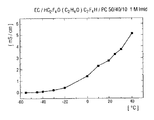
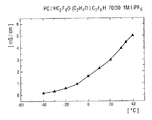
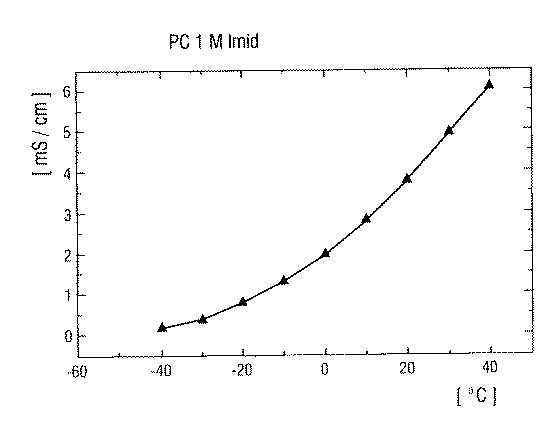
図1〜6は+40℃〜約−50℃の範囲内の温度の関数として導電性を示す。溶媒混合物、各成分の割合は容量% で示す。リチウム導電性塩はいずれの場合にも1M濃度で使用する。
略字:
EC: エチレンカーボネート
PC: プロピレンカーボネート
イミド: Li+ 〔N(SO2 CF3 )2 〕-
本発明を以下の実施例によって更に詳細に説明する。
【0029】
【実施例】
電解質を製造するために、使用される溶媒成分を最初に次の様に製造する:
エチレンカーボネート(>99% 、Merck社によって販売されている)を油圧式真空ポンプ中で蒸留し(沸点85〜95℃)、活性化した分子フルイ(Roth社製、孔の大きさ:4オングストローム)にて150℃で3日脱水しそして乾燥アルゴン雰囲気で60℃にて貯蔵する〔痕跡量の酸素を除くために、AGA社から市販される99.996% 純度のアルゴンを(95% のアルゴンと5% の水素との混合物であり、AGA社から市販される工業的純度の)アルゴンW5で還元された(BASF社市販の)酸化銅(I)に最初に通し、次いで活性化された分子フルイで乾燥する〕。
【0030】
プロピレンカーボネート(純粋、Aldrich社)を1.5mの鏡面加工された充填塔を通して油圧式真空ポンプ中で蒸留し(沸点64〜66℃)、乾燥したアルゴン雰囲気で室温にて活性化分子フルイの上に貯蔵する。精製および乾燥後に、この溶媒の残留水含有量はカール・フィッシャー法で測定する(例えば、三菱CA 05自動滴定装置を使用する)。水含有量は10ppm以下であるべきである。
【0031】
弗化溶媒成分を活性化分子フルイ上で乾燥アルゴン雰囲気で室温にて二三日の間に乾燥する。
電解質溶液はいわゆるSchlenk法によって乾燥アルゴン流中で製造し、保護ガス引込み手段を備えた使用されるガラス製装置を無色のブンゼンバーナーの炎の中で使用する前にアルゴンフラッシュ洗浄および油圧式真空ポンプでの減圧とを交互に繰り返しながら付着する湿気を除く。
【0032】
実施例1
リチウムイオン電池における造膜性成分としてエチレンカーボネートを基本成分とする安全な電池用電解質の製造:
40容量% のモノグリコール−ビス(テトラフルオロエチル)エーテル(HC2 F4 OCH2 CH2 OC2 F4 H)を50容量% のエチレンカーボネートおよび10容量% のプロピレンカーボネートに添加する。この溶媒混合物を攪拌下に287.1g (1mol)のリチウム−ビス(トリフルオロメタン−スルホン)イミド〔LiN(CF3 SO2 )2 、>99.5% 、3M Company市販、高減圧下に110℃で4日乾燥〕に添加して、1リットルとする。この様にして製造された電解質は50容量% のエチレンカーボネート、40容量% のモノグリコール−ビス(テトラフルオロエチル)エーテル(HC2 F4 OC2 H4 OC2 F4 H)および10容量% のプロピレンカーボネートより成り、LiN(CF3 SO2 )2 としては1モルである。この電解質はエチレンカーボネート成分を結晶析出することなしでも、良好な導電性と共に−50℃まで非常に有利な低温挙動を示し(図2)、広い“電気化学分野”において安定しており、リチウムが炭素中を進入する際に有利な挙動を示しそして引火を極めて困難にする。イミドをエチレンカーボネートに弗素化エーテルを添加せずに溶解した溶液は低温に対して不適当である(図1参照)。
【0033】
実施例2
導電性塩としてリチウム−ビス(トリフルオロメタンスルホン)イミド〔LiN(CF3 SO2 )2 を含有するプロピレンカーボネートを基本成分とする安全な電池用電解質の製造:
30容量% のモノグリコール−ビス(テトラフルオロエチル)エーテル(HC2 F4 OCH2 CH2 OC2 F4 H)を70容量% のプロピレンカーボネートに添加する。この溶媒混合物を攪拌下に287.1g (1mol)のリチウム−ビス(トリフルオロメタン−スルホン)イミド〔LiN(CF3 SO2 )2 、>99.5% 、3M Company市販、高減圧下に110℃で4日乾燥〕に添加して、1リットルとする。製造された電解質は70容量% のプロピレンカーボネートおよび30容量% のモノグリコール−ビス(テトラフルオロエチル)エーテル(HC2 F4 OC2 H4 OC2 F4 H)より成り、イミドLiN(CF3 SO2 )2 としては1モルである。この電解質は、良好な導電性と共に−50℃まで非常に有利な低温挙動を示し(図3)、広い“電気化学分野”において安定しており、リチウムが炭素中を進入する際に有利な挙動を示しそして引火を極めて困難にする。この溶媒は所望の割合で互いに混合することができ〔図4は30容量% のプロピレンカルボネートと70容量% のモノグルコール−ビス(テトラフルオロエチル)エーテル(HC2 F4 OCH2 CH2 OC2 F4 H)とより成る電解質の導電性と温度との関係を示しており、リチウム−ビス(トリフルオロメタン−スルホン)イミド〔LiN(CF3 SO2 )2 〕としては1モルである。
実施例3
導電性塩としてリチウム−ヘキサフルオロホスファート(LiPF6 )を含有するプロピレンカーボネートを基本成分とする安全な電池用電解質の製造:
30容量% のモノグリコール−ビス(テトラフルオロエチル)エーテル(HC2 F4 OCH2 CH2 OC2 F4 H)を70容量% のプロピレンカーボネートに添加する。この溶媒混合物を攪拌下に151.9g (1mol)のリチウム−ヘキサフルオロホスファート(LiPF6 、>99.9% 、MerkまたはHashimotoが市販、予め乾燥することなく使用可能〕に添加して、1リットルとする。製造された電解質は70容量% のプロピレンカーボネートおよび30容量% のモノグリコール−ビス(テトラフルオロエチル)エーテル(HC2 F4 OC2 H4 OC2 F4 H)より成り、リチウム−ヘキサフルオロホスファートとしては1モルである。この電解質は、良好な導電性と共に−50℃まで非常に有利な低温挙動を示し(図5)、広い“電気化学分野”において安定しており、リチウムが炭素中を進入する際に有利な挙動を示しそして引火を極めて困難にする。
【0034】
実施例4
1モル溶液を、30容量% のプロピレンカルボネートと70容量% のモノグルコール−ビス(テトラフルオロエチル)エーテル並びに既に記載したイミドから製造する。導電性の測定については図6参照。
【図面の簡単な説明】
【図1】図1はイミドをエチレンカーボネートに弗素化エーテルを添加せずに溶解した溶液の低温挙動を示すグラフである。
【図2】図2は実施例1の電解質の低温挙動を示すグラフである。
【図3】図3は実施例2の電解質PC/HC2 F4 (C2 H4 O)C2 F4 H70/30 1Mイミドの導電性と温度との関係図である。
【図4】図4は実施例2の電解質PC/HC2 F4 (C2 H4 O)C2 F4 H30/70 1Mイミドの導電性と温度との関係図である。
【図5】図5は実施例3の電解質PC/HC2 F4 (C2 H4 O)C2 F4 H70/30 1M LiPF6 の導電性と温度との関係図である。
【図6】図6は実施例4の電解質PC/HC2 F4 (C2 H4 O)C2 F4 H30/70 1Mイミドの導電性と温度との関係図である。[0001]
INDUSTRIAL APPLICATION FIELD OF THE INVENTION
The present invention relates to a fluorine-containing solvent for an improved safety lithium battery and an electrolyte containing the same.
[0002]
[Prior art]
Due to environmental protection and economics, the battery fieldRechargeableAttempts have been made to develop (secondary) batteries. In key areas of mobile and portable electronics products (high quality camcorders, portable computers, car phones and the like), lithium-ion batteries are approximately twice the energy density of metal hydride batteries. And since it is about three times the energy density of nickel / cadmium batteries, it is highly expected. Another area of interest is the use of lithium ion secondary batteries for power driving, for example for electrically operated urban vehicles.
[0003]
The current main problem is that safety standards for rechargeable lithium batteries, for example, critical operating conditions that always occur as a result of overcharging, overdischarging or leakage are often only prevented by electronic observation in the past. It is.
According to the prior art, in lithium secondary batteries, organic solvents containing heteroatoms, such as nitrogen, oxygen or sulfur atoms, which exhibit a strong polar action, are used to produce aprotic electrolyte solutions [eg O. Popovich, R.A. P. T.A. Tomkins, Nonaqueous Solution Chemistry, John Wiley & Sons (1981) or G.M. J. et al. Janz, R.A. P. T.A. Tomkins, Nonaqueous Electronics Handbook, Volume 1 (1972), Volume II (1973), Academic Press, New York. Representative examples of such solvents are ethers (eg, 1,2-dimethoxyethane or tetrahydrofuran), esters (eg, propylene-carbonate), nitrites (eg, acetonitrile) and lactones, sulfones and many others.
[0004]
Some solvents that are low volatility but unfortunately high viscosity, such as propylene carbonate, ethylene carbonate or sulfolane (tetramethylene sulfone) are less likely to burn or produce explosive mixtures. Due to the high viscosity, the electrolyte solutions made with these solvents have low conductivity, particularly at relatively low temperatures. Furthermore, not only are ions moving slowly in such solutions, but all other substances are moving too slowly.
[0005]
In order to achieve high electrical conductivity, solvent mixtures containing at least one strong polar component that exhibits a strong dissociation action on salts due to its polarity are commonly used industrially. An approximate quantitative measure of dissociation force is the dielectric constant. Since such highly polar solvents, such as propylene carbonate or ethylene carbonate with a dielectric constant of 67 at 25 ° C. or 90 at 40 ° C. and approximately equal to that of water (78 at 25 ° C.) always have a rather high viscosity, Generally, one or more kinds of low viscosity components are added and used as a “diluent”. Typical diluents are for example 1,2-dimethoxyethane or dimethyl carbonate. However, they have a very low dielectric constant (1,2-dimethoxyethane is about 7 and dimethyl carbonate is about 3).
[0006]
A series of drawbacks of the “diluent” component are its volatility and the ignitability and explosiveness associated with the volatility when air enters. This drawback is practical because the electrochemical application of the electrolyte solution always has the risk of ignition in the event of heat generation and faults (eg leakage in or out of the electrochemical components) when current flows. Is very serious. For example, the flash point of 1,2-dimethoxyethane is −6 ° C., and the explosion limit is 1.6 to 10.4% by volume.
[0007]
Rechargeable lithium batteries generally have a compound comprising lithium and a metal oxide (eg, LixMnO2Or LixCoO2) And lithium metal as the anode, lithium being used as an intercalation compound with graphite or in combination with carbon- or graphite fibers. An excellent report on the development of such batteries is K.K. [Solid State Ionics 69 (1994), pp. 173-183, Elsevier Science B. V. ].
[0008]
To enhance safety, the microporous material is designed so that current does not flow automatically as a result of the pores being melt sealed when the specified temperature limit is exceeded in the cathode and anode spaces. Can be separated by a partition wall. Suitable partitions of this type include, for example, a series of Celgards from Hoechst Celanese Corporation.(R)Included. Furthermore, the safety of lithium batteries can be improved, for example, by pressure relief switches that react to gas generated during overcharging and quite generally by complex monitoring and control electronics. Also suitable are flame retardant phosphorus and halogen containing additives.
[0009]
However, all these measures cannot rule out the possibility that the low volatile components of the liquid electrolyte solution will eventually ignite if damage occurs and subsequently, for example, the negative electrode may ignite. In this case, for example, during combustion, lithium reacts violently not only with water but also with a substance (for example, carbon dioxide) contained in a conventional extinguishing agent, so that a fire that cannot be extinguished by ordinary means occurs.
[0010]
In very recent publications, perfluorinated ethers and perfluoroalkanes have been proposed for lithium battery electrolyte systems (JP 7-249432 A and
[0011]
JP 7-249432 discloses the use of partially fluorinated ethers in an electrolyte solution for a lithium secondary battery. However, relatively small molecular weight ethers (eg, 1,1,1,5,5,5-hexafluoro-3-oxapentane) have been described as being particularly advantageous, which, according to experience, It has the following disadvantages: high vapor pressure, low boiling point, weak ability to dissolve lithium conductive salts and generally very low flash point. For example the formula ROCF2CF2The flash point of the compound represented by H (R is a methyl or ethyl group) is 10 ° C. or less, and has the formula HCF2CF2CH2OCF2CF2Even the highly fluorinated ether represented by H is only 22 ° C.Flash pointI have only. A mixture of dimethyl carbonate or ethyl carbonate and 3,3,4,4-tetrafluoro-2,4-dioxahexane was tested in three cycles in various lithium conductive salts and lithium secondary batteries at 1 molar concentration. And was found to be usable (M. Winter, Thesis Document, Technical University of Graz, “Filmbildung af Lithium / Kohlenstoff-Intersationanden”, September 1995).
[0012]
According to this prior art, a decrease in the flammability of the electrolyte solution is achieved, in particular, by increasing the viscosity of the electrolyte solution by means of a binder or filler or by using a polymer electrolyte that is substantially solid at room temperature. U.S. Pat. No. 5,169,736 describes, for example, organic- or inorganic thickeners (polyethylene oxide, SiO 2) for solidifying liquid electrolyte solutions.2, Al2OThreeAnd others). Polymer electrolytes based on macromolecules with many polar groups, such as polyethylene oxide [see eg author B. Scrosati, 2nd International Symposium on Polymer Electronics (see 2nd International Symposium on Polymer Electrolytes), Elsevier, London and New York (1990)] are very flammable due to their low volatility. US Pat. No. 5,393,621 discloses a polymer electrolyte formed by polymerizing an organophosphorus compound in which polar macromolecules are particularly low flammability.
[0013]
All these gel-to-solid electrolytes have in common that, as a result of their high viscosity, the migration of salt ions dissolved therein is much less than in liquid electrolyte solutions, especially at relatively low temperatures. The fact is that at least the electrical conductivity required for most industrial applications cannot be achieved. For this reason, alkali metal batteries containing polymer electrolytes have not yet achieved economic significance despite intensive research activities, for example several decades.
[0014]
[Problem to be Solved by the Invention]
The object of the present invention is therefore not to include the above-mentioned easily burning and exploding low-viscosity “diluents”, resulting in improved stability of the electrolyte-containing device and nevertheless being used in practice even at low temperatures. It was to provide an electrolyte solution exhibiting viscosity and conductivity behavior that can be achieved.
[0015]
Therefore, there is an urgent need for a stable solvent for lithium batteries characterized by the following physical properties:
1. High thermal stability.
2. High flash point.
3. Low vapor pressure or high boiling point.
4). Low viscosity.
5. Miscible with standard battery solvents such as ethylene carbonate, propylene carbonate or α, ω-dialkyl glycol ethers.
6). Fluorine-containing lithium conductive salt such as LiPF6, LiN (SO2CFThree)2Or LiC (SO2CFThree)ThreeDissolve properly.
7). High stability against metallic lithium.
8). Strong dissolving power for carbon dioxide: CO2Is lithium or LiCn-Promote the formation of a protective film on the anode.
[0016]
[Means for Solving the Problems]
Surprisingly, this problem has been found that a particular group of partially fluorinated aliphatic ethers satisfy the requirements described in 1-8 above well or excellently. In principle, it contains an alkylene group bonded via an ether oxygen to a partially fluorinated alkyl group which may contain a hydrogen atom, a chlorine atom and an ether oxygen in addition to the fluorine atom. It is a characteristic compound. The compounds defined here are ethers of the following formulas (I) and (II):
RO-[(CH2)mO]n-CF2-CFH-X (I)
[Wherein, R is a linear alkyl group having 1 to 10 carbon atoms or a branched alkyl group having 3 to 10 carbon atoms,
X is a fluorine atom, a chlorine atom, or a perfluoroalkyl group having 1 to 6 carbon atoms which may contain ether oxygen,
m is an integer from 2 to 6 and
n is an integer of 1-8. ]
And formula (II)
X-CFH-CF2O-[(CH2)mO]n-CF2-CFH-X (II)
[Wherein X, m and n have the above-mentioned meanings. ]
The present invention relates to an electrolyte system for improving the safety of lithium batteries containing a compound of formula (I) and / or (II), in particular a compound wherein X is a fluorine atom or trifluoromethyl. A fluorine-containing ether of formula (I) wherein R is a methyl group, X is a fluorine atom, m is 2 and n is 1 to 3 and X is a fluorine atom, m is 2 and n Particular preference is given to fluorine-containing ethers of the formula (II) in which is 1 to 3.
[0017]
Compounds with m equal to 2 are generally advantageous because they are readily available and can be prepared from inexpensive ethylene glycol-monoalkyl ethers or ethylene glycol. Compounds in which X is a chlorine atom are less advantageous because they can react with metallic lithium to form the corresponding lithium halide while releasing chlorine and fluorine at elevated temperatures.
[0018]
When the compounds of formula (I) and / or (II) are used as an essential component of the electrolyte system, the electrolyte system has a surprisingly low viscosity, thereby solving the problem of lithium secondary battery safety. The substances of the formulas (I) and (II) can be used as diluents for highly viscous components that are difficult to burn, such as ethylene carbonate and propylene carbonate. In this way, an aprotic electrolyte system that no longer substantially burns can be produced. The content of ether of formula (I) and / or (II) is generally from 5 to 70% by volume, preferably from 20 to 50% by volume, based on the total capacity of the electrolyte system.
[0019]
Partially fluorinated ethers according to formula (I) and / or (II) are nonpolar or less polar gases, especially CO2, N2, N2O, SF6, SO2FCl or SO2F2It also improves the dissolving power. Since these gases have a positive effect on the reaction proceeding at the negative electrode / electrolyte-interface, they can be advantageously used as protective gases in lithium batteries [see, for example, J. Pat. O. Besenhard, M.C. W. Wagner, M.M. Winter; Power Sources, 44 (1993), 413].
[0020]
It is well known that reactive impurities (eg, water) can affect the operation of lithium batteries even at very low concentrations. In practice, the total amount of such impurities should never exceed 50 ppm. The great advantage of the compounds defined by the above formulas (I) and (II) is that they generally have boiling points so high that they can be easily and completely removed by distillation of water and other reactive impurities. Is a point.
[0021]
The viscosity of the mixture of ether and propylene carbonate according to formulas (I) and (II) is selected from the group consisting of hydroperfluoroalkanes or hydroperfluoroethers in order to ensure high conductivity even at temperatures below 0 ° C. This can be reduced by adding (at least) one fully fluorinated low viscosity solvent. In such cases, a conductive salt, such as LiN (SO2CFThree)2Or LiC (SO2CFThree)ThreeIt is advantageous to use The partially fluorinated ethers according to the present invention act as phase mediators for the relatively high degree of fluorination solvent added. A particularly advantageous agent for reducing the viscosity is, for example, 1H-perfluorohexane (kinematic viscosity at 20 ° C .: 0.55 mm).2/ Sec, flash point> 100 ° C.) and 2,3-dihydroperfluoro-5-methylpentane. These substances do not form explosive mixtures with air. This is the formula
[0022]
[Chemical 1]
[Wherein n is 1 or 2. ]
The same applies to fluorinated ethers represented by
As is apparent from Table 3, the compounds represented by the formulas (I) and (II) have a tendency to thermally decompose at 200 ° C. or higher. Surprisingly, it has been found that partially fluorinated ethers can be stabilized very effectively with very small amounts of aliphatic tertiary amines. A small amount of amine addition, such as 0.1 to 1.0% by weight, based on partially fluorinated ether, is sufficient to raise the temperature at which the ether begins to decompose by as much as 60 to 100 ° C. The tertiary amine should have a boiling point high enough to remain in the liquid phase even at temperatures above 100 ° C. Suitable tertiary amines are for example tri-n-butylamine, tri-n-octylamine or 1,6-bis (dimethylamino) hexane. Aromatic amines are less suitable because they tend to anodize.
[0024]
The invention also relates to a process for stabilizing compounds of formulas (I) and (II) with aliphatic tertiary amines.
Synthesis of partially fluorinated ethers:
Primary alcohols contain various fluorines when using base catalystsAlkeneTo form partially fluorinated ethers [Houben-Weyl, Methoden der Organischen Chemie, 4th edition, Volume VI / 3, (1965), 120/121, Georg Time Verlag, Stuttgart And references cited in it]:
ROH+F 2 C = CFX ── → RO-CF2─CFHX
[Wherein R is a primary alkyl group and X is a fluorine atom, a chlorine atom or a perfluoroalkyl such as CFThreeIt is. ]
The ethers shown in Table 1 containing 1H-tetrafluoroethyl groups are synthesized from the corresponding alcohols and tetrafluoroethylene (catalyst: KOH, solvent: N, N-dimethylformamide). Compound CHThreeO (CH2)2OCF2CFClH is obtained in the same manner using chlorotrifluoroethylene (boiling point: 146 to 147 ° C., 1013 hPa; GC-purity: 99.4%).
[0025]
Reaction of alcohols with hexafluoropropene under basic conditions results in the release of some HF, resulting in the formula RO-CF = CF-CFThreeThe ether of (E / Z isomer) is formed as a by-product. This secondary reaction can be suppressed by carrying out the reaction under high pressure [H. Kokeberg and R.K. See Pollet, Tenside Detergents 22 (1985), 1]. Compound CFThreeCFHCF2-O (CH2CH2O)2-CF2CFHCFThreeIs produced in this way (GC-purity: 98.7%).
[0026]
Table 1: Physical property data of 1H-tetrafluoroethyl ethers based on glycol monoalkyl ether and glycols
[Table 1]
**) DIN 51758, accuracy ± 1 ° C
Table 2: Safety tests of partially fluorinated ethers
[Table 2]
An apparatus consisting of 20 ml quartz glass spheres with a heatable addition funnel on top is carefully heated in a hand-held high performance dryer under high vacuum conditions. After cooling and filling with argon, the spheres are filled with about 1 g of lithium and then filled with 5 ml of test compound saturated with argon from a dropping funnel. Lithium is melted at 190 ° C. using a heating bath and ether preheated to about 100 ° C. is slowly added dropwise. Only chlorine-containing ethers react with lithium to yield LiCl and LiF.
[0027]
Thermoanalytical test of the stability of partially fluorinated ethers:
The thermal stability of a representative partially fluorinated ether is tested by DSC (Differential Scanning Calorimetry). The heating rate starts at 20 ° C. and is 10 ° C./min.
1. The thermal decomposition of the partially fluorinated ethers listed in Table 3 proceeds in principle exothermically.
2. These partially fluorinated ethers can be effectively stabilized with small amounts of tertiary amines.
[0028]
Measurement of the conductivity of electrolyte systems containing ethers according to the invention:
Figures 1-6 show the conductivity as a function of temperature in the range of + 40 ° C to about -50 ° C. The solvent mixture and the ratio of each component are indicated by volume%. The lithium conductive salt is used at a concentration of 1M in any case.
Abbreviations:
EC: ethylene carbonate
PC: Propylene carbonate
Imide: Li+[N (SO2CFThree)2]-
The invention is illustrated in more detail by the following examples.
[0029]
【Example】
To make the electrolyte, the solvent components used are first made as follows:
Ethylene carbonate (> 99%, sold by Merck) was distilled in a hydraulic vacuum pump (boiling point 85-95 ° C.) and activated molecular sieve (Roth, pore size: 4 Å) Dehydrate at 150 ° C. for 3 days and store at 60 ° C. in a dry argon atmosphere [to remove trace amounts of oxygen, 99.996% purity argon (95% argon and A mixture of 5% hydrogen and first passed through copper (I) oxide (commercially available from AGA) reduced with argon W5 (commercially available from AGA) (commercially available from BASF) and then activated molecular fluid. To dry].
[0030]
Propylene carbonate (pure, Aldrich) is distilled through a 1.5 m mirror-finished packed tower in a hydraulic vacuum pump (boiling point 64-66 ° C.) and above the activated molecular sieve at room temperature in a dry argon atmosphere. Store in. After purification and drying, the residual water content of the solvent is measured by the Karl Fischer method (eg using a Mitsubishi CA 05 automatic titrator). The water content should be 10 ppm or less.
[0031]
The fluorinated solvent component is dried over activated molecular sieves in a dry argon atmosphere at room temperature for a few days.
The electrolyte solution is produced in a dry argon stream by the so-called Schlenk method, and the used glass apparatus with protective gas inlet means is flushed with argon before use in a colorless Bunsen burner flame and hydraulic vacuum pump Remove the adhering moisture by alternately repeating the pressure reduction in.
[0032]
Example 1
Production of safe battery electrolytes based on ethylene carbonate as a film-forming component in lithium-ion batteries:
40% by volume monoglycol-bis (tetrafluoroethyl) ether (HC)2FFourOCH2CH2OC2FFourH) is added to 50% by volume ethylene carbonate and 10% by volume propylene carbonate. Under stirring, this solvent mixture was 287.1 g (1 mol) of lithium-bis (trifluoromethane-sulfone) imide [LiN (CFThreeSO2)2,> 99.5%, commercially available at 3M Company, dried at 110 ° C. under high vacuum for 4 days] to make 1 liter. The electrolyte thus produced contains 50% by volume ethylene carbonate, 40% by volume monoglycol-bis (tetrafluoroethyl) ether (HC).2FFourOC2HFourOC2FFourH) and 10% by volume propylene carbonate, LiN (CFThreeSO2)2Is 1 mole. This electrolyte exhibits a very advantageous low temperature behavior up to −50 ° C. with good conductivity without crystallizing the ethylene carbonate component (FIG. 2), and is stable in a wide “electrochemical field”. It exhibits favorable behavior when entering into carbon and makes ignition very difficult. A solution in which imide is dissolved in ethylene carbonate without adding a fluorinated ether is unsuitable for low temperatures (see FIG. 1).
[0033]
Example 2
Lithium-bis (trifluoromethanesulfone) imide [LiN (CFThreeSO2)2Production of safe battery electrolytes based on propylene carbonate containing:
30% by volume monoglycol-bis (tetrafluoroethyl) ether (HC2FFourOCH2CH2OC2FFourH) is added to 70% by volume propylene carbonate. Under stirring, this solvent mixture was 287.1 g (1 mol) of lithium-bis (trifluoromethane-sulfone) imide [LiN (CFThreeSO2)2,> 99.5%, commercially available at 3M Company, dried at 110 ° C. under high vacuum for 4 days] to make 1 liter. The electrolyte produced was 70% by volume propylene carbonate and 30% by volume monoglycol-bis (tetrafluoroethyl) ether (HC).2FFourOC2HFourOC2FFourH) and imide LiN (CFThreeSO2)2Is 1 mole. This electrolyte exhibits a very favorable low temperature behavior down to -50 ° C. with good conductivity (FIG. 3), is stable in a broad “electrochemical field”, and has an advantageous behavior when lithium enters into carbon. And makes ignition extremely difficult. This solvent can be mixed with each other in any desired ratio [FIG. 4 shows 30% by volume propylene carbonate and 70% by volume monoglycol-bis (tetrafluoroethyl) ether (HC).2FFourOCH2CH2OC2FFourH) shows the relationship between the conductivity of the electrolyte and the temperature, and lithium-bis (trifluoromethane-sulfone) imide [LiN (CFThreeSO2)2] Is 1 mole.
Example 3
Lithium-hexafluorophosphate (LiPF) as the conductive salt6Production of safe battery electrolytes based on propylene carbonate containing
30% by volume monoglycol-bis (tetrafluoroethyl) ether (HC2FFourOCH2CH2OC2FFourH) is added to 70% by volume propylene carbonate. Under stirring, 151.9 g (1 mol) of lithium-hexafluorophosphate (LiPF)6,> 99.9%, Merk or Hashimoto is commercially available and can be used without prior drying] to make 1 liter. The electrolyte produced was 70% by volume propylene carbonate and 30% by volume monoglycol-bis (tetrafluoroethyl) ether (HC).2FFourOC2HFourOC2FFourH), and the molar amount of lithium-hexafluorophosphate is 1 mol. This electrolyte exhibits very favorable low temperature behavior down to -50 ° C. with good conductivity (FIG. 5), is stable in a broad “electrochemical field”, and has an advantageous behavior when lithium enters carbon. And makes ignition extremely difficult.
[0034]
Example 4
A 1 molar solution is prepared from 30% by volume propylene carbonate and 70% by volume monoglycol-bis (tetrafluoroethyl) ether and the imide already described. See Figure 6 for conductivity measurements.
[Brief description of the drawings]
FIG. 1 is a graph showing the low-temperature behavior of a solution in which imide is dissolved in ethylene carbonate without adding a fluorinated ether.
2 is a graph showing the low-temperature behavior of the electrolyte of Example 1. FIG.
FIG. 3 is an electrolyte PC / HC of Example 2.2FFour(C2HFourO) C2FFourIt is a related figure of the electroconductivity of H70 / 30 1M imide, and temperature.
4 is an electrolyte PC / HC of Example 2. FIG.2FFour(C2HFourO) C2FFourIt is a related figure of the electroconductivity of H30 / 70 1M imide, and temperature.
5 is an electrolyte PC / HC of Example 3. FIG.2FFour(C2HFourO) C2FFourH70 / 30 1M LiPF6FIG. 6 is a relationship diagram of conductivity and temperature.
6 is an electrolyte PC / HC of Example 4. FIG.2FFour(C2HFourO) C2FFourIt is a related figure of the electroconductivity of H30 / 70 1M imide, and temperature.
Claims (7)
RO−〔(CH2)mO〕n−CF2−CFH−X (I)
〔式中、Rは炭素原子数1〜10の直鎖状アルキル基または炭素原子数3〜10の枝分かれアルキル基であり、
Xは弗素、塩素または、エーテル酸素を含有していてもよい炭素原子数1〜6のパーフルオロアルキル基であり、
mは2〜6の整数であり、そして
nは1〜8の整数である。〕
で表される、部分的に弗素化されたエーテルの少なくとも1種類および/または式(II):
X−CFH−CF2O−〔(CH2)mO〕n−CF2−CFH−X (II)
〔式中、X、mおよびnは上記の意味を有する。〕
で表される、部分的に弗素化されたエーテルの少なくとも1種類を、電解質溶液の全容量の5〜70容量%のパーセンテージの有効量で含有することを特徴とする電解質溶液。An electrolyte solution for a lithium battery with improved safety comprising a fluorinated solvent, wherein the electrolyte solution has the formula (I):
RO - [(CH 2) m O] n -CF 2 -CFH-X (I )
[Wherein, R is a linear alkyl group having 1 to 10 carbon atoms or a branched alkyl group having 3 to 10 carbon atoms,
X is fluorine, chlorine or a perfluoroalkyl group having 1 to 6 carbon atoms which may contain ether oxygen,
m is an integer of 2-6, and n is an integer of 1-8. ]
And / or at least one partially fluorinated ether and / or formula (II):
X-CFH-CF 2 O - [(CH 2) m O] n -CF 2 -CFH-X (II )
[Wherein X, m and n have the above-mentioned meanings. ]
In represented, partially electrolytic solution, characterized in that at least one fluorinated ether contains at 5-70 effective amount of volume percent of the percentage of the total volume of the electrolyte solution.
Applications Claiming Priority (2)
| Application Number | Priority Date | Filing Date | Title |
|---|---|---|---|
| DE19619233:1 | 1996-05-13 | ||
| DE19619233A DE19619233A1 (en) | 1996-05-13 | 1996-05-13 | Fluorine-containing solvents for lithium batteries with increased security |
Publications (3)
| Publication Number | Publication Date |
|---|---|
| JPH1050343A JPH1050343A (en) | 1998-02-20 |
| JPH1050343A5 JPH1050343A5 (en) | 2005-04-07 |
| JP4469934B2 true JP4469934B2 (en) | 2010-06-02 |
Family
ID=7794179
Family Applications (1)
| Application Number | Title | Priority Date | Filing Date |
|---|---|---|---|
| JP12120297A Expired - Fee Related JP4469934B2 (en) | 1996-05-13 | 1997-05-12 | Electrolyte solutions for lithium batteries with improved safety |
Country Status (5)
| Country | Link |
|---|---|
| US (1) | US5916708A (en) |
| EP (1) | EP0807986B1 (en) |
| JP (1) | JP4469934B2 (en) |
| KR (1) | KR100454990B1 (en) |
| DE (2) | DE19619233A1 (en) |
Families Citing this family (49)
| Publication number | Priority date | Publication date | Assignee | Title |
|---|---|---|---|---|
| JP3492173B2 (en) * | 1997-12-09 | 2004-02-03 | シャープ株式会社 | Non-aqueous battery |
| TW434923B (en) | 1998-02-20 | 2001-05-16 | Hitachi Ltd | Lithium secondary battery and liquid electrolyte for the battery |
| TW447163B (en) * | 1998-09-11 | 2001-07-21 | Mitsui Chemicals Inc | Non-hydrolysis electrolytic liquid and secondary battery with non-hydrolysis electrolytic liquid |
| US6566015B1 (en) * | 1998-10-09 | 2003-05-20 | Denso Corporation | Non-aqueous electrolytic salt and non-aqueous electrolytic secondary battery in which it is used |
| DE19858924A1 (en) | 1998-12-19 | 2000-06-21 | Aventis Res & Tech Gmbh & Co | Improving the safety of lithium batteries for use in electronic devices by using an electrolyte containing a diol-derived partly-fluorinated compound |
| KR100625957B1 (en) * | 1999-09-10 | 2006-09-20 | 삼성에스디아이 주식회사 | Lithium ion battery |
| JP2001085058A (en) * | 1999-09-20 | 2001-03-30 | Hitachi Ltd | Non-aqueous electrolyte, lithium primary battery and lithium secondary battery using the same, electrochemical capacitor, polymer electrolyte, and polymer secondary battery using the same |
| US6905762B1 (en) | 2001-02-13 | 2005-06-14 | The United States Of America As Represented By The Secretary Of The Army | Non-aqueous electrolyte solutions comprising additives and non-aqueous electrolyte cells comprising the same |
| US6939647B1 (en) | 2001-02-13 | 2005-09-06 | The United States Of America As Represented By The Secretary Of The Army | Non-aqueous electrolyte solutions and non-aqueous electrolyte cells comprising the same |
| US6924061B1 (en) | 2001-02-13 | 2005-08-02 | The United States Of America As Represented By The Secretary Of Army | Nonflammable non-aqueous electrolyte and non-aqueous electrolyte cells comprising the same |
| US6797437B2 (en) | 2001-12-28 | 2004-09-28 | Quallion Llc | Electrolyte system and energy storage device using same |
| US20040009425A1 (en) * | 2002-03-06 | 2004-01-15 | French Roger Harquail | Radiation durable organic compounds with high transparency at 157 nm, and method for preparing |
| DE10247675A1 (en) * | 2002-10-12 | 2004-04-22 | Solvay Fluor Und Derivate Gmbh | The use of polyfluoropolyethers and their mixtures as fire resistant solvents for conductive salt mixtures in reusable battery electrolytes increases the safety of the batteries, e.g. decreases the explosion risk |
| US7186478B2 (en) * | 2003-01-23 | 2007-03-06 | Lithium Technology Corporation | Electrochemical device |
| US7128133B2 (en) * | 2003-12-16 | 2006-10-31 | 3M Innovative Properties Company | Hydrofluoroether as a heat-transfer fluid |
| JP2006049037A (en) * | 2004-08-03 | 2006-02-16 | Three M Innovative Properties Co | Nonaqueous electrolyte for electrochemical energy device |
| JP2006216361A (en) * | 2005-02-03 | 2006-08-17 | Three M Innovative Properties Co | Electrolytic solution for lithium battery |
| CN101156216B (en) * | 2005-03-31 | 2011-09-14 | 大金工业株式会社 | Electrolyte solution |
| EP1879252A4 (en) * | 2005-04-19 | 2010-06-23 | Panasonic Corp | NONAQUEOUS ELECTROLYTE SOLUTION, ELECTROCHEMICAL ENERGY STORAGE DEVICE USING THE SAME, AND NONAQUEOUS ELECTROLYTE AUXILIARY ACCUMULATOR |
| US7691282B2 (en) | 2005-09-08 | 2010-04-06 | 3M Innovative Properties Company | Hydrofluoroether compounds and processes for their preparation and use |
| US7790312B2 (en) * | 2005-09-08 | 2010-09-07 | 3M Innovative Properties Company | Electrolyte composition |
| JP2010514144A (en) | 2006-12-20 | 2010-04-30 | アール. ダーン,ジェフリー | Fluorinated compounds for use in lithium battery electrolytes |
| WO2008078626A1 (en) * | 2006-12-22 | 2008-07-03 | Daikin Industries, Ltd. | Nonaqueous electrolyte solution |
| TW201004012A (en) * | 2008-04-28 | 2010-01-16 | Asahi Glass Co Ltd | Secondary cell non-aqueous electrolyte and secondary cell |
| CN102089923B (en) * | 2008-07-09 | 2014-08-13 | 大金工业株式会社 | non-aqueous electrolyte |
| US20100028784A1 (en) * | 2008-07-29 | 2010-02-04 | 3M Innovative Properties Company | Electrolyte composition, lithium-containing electrochemical cell, battery pack, and device including the same |
| JP5545292B2 (en) * | 2009-03-27 | 2014-07-09 | 旭硝子株式会社 | Electrolytic solution for power storage device and power storage device |
| US20120214043A1 (en) | 2009-10-27 | 2012-08-23 | Solvay Fluor Gmbh | Lithium sulfur battery |
| CN102598390A (en) * | 2009-10-27 | 2012-07-18 | 旭硝子株式会社 | Nonaqueous electrolyte solution for secondary battery, and secondary battery |
| CN103250282A (en) * | 2010-12-13 | 2013-08-14 | 日本电气株式会社 | Positive electrode active material for secondary cells |
| CN103636052A (en) * | 2011-04-26 | 2014-03-12 | 索尔维公司 | Lithium air battery cell |
| EP2785703B1 (en) | 2011-11-30 | 2017-01-11 | Solvay SA | 5-Fluorinated derivatives of Meldrum's acid (5-fluoro-1,3-dioxane-4,6-dione derivatives), methods for their preparation and their use as solvent additives in lithium ion batteries. |
| EP2602241A1 (en) | 2011-12-07 | 2013-06-12 | Solvay Sa | Process for the manufacture of 1, 1'-difluorosubstituted dialkyl carbonates, isomers thereof and electrolyte compositions containing them |
| JP6123682B2 (en) * | 2012-02-03 | 2017-05-10 | 日本電気株式会社 | Lithium secondary battery |
| DE102012101670A1 (en) * | 2012-02-29 | 2013-08-29 | Jacobs University Bremen Ggmbh | Conducting salt for lithium-based energy storage |
| EP2667444A1 (en) | 2012-05-21 | 2013-11-27 | Solvay Sa | Use of fluorinated 2-methoxymalonic acid esters in electrolyte or solvent compositions |
| WO2014027003A1 (en) | 2012-08-14 | 2014-02-20 | Solvay Sa | Use of low concentrations of fluorinated organic compounds as solvent additives |
| US9040203B2 (en) * | 2013-01-16 | 2015-05-26 | Samsung Sdi Co., Ltd. | Lithium battery |
| JP6304876B2 (en) * | 2013-03-28 | 2018-04-04 | 本田技研工業株式会社 | Lithium air battery |
| WO2015078791A1 (en) | 2013-11-28 | 2015-06-04 | Solvay Specialty Polymers Italy S.P.A. | Electrolyte compositions for lithium batteries |
| WO2016160703A1 (en) | 2015-03-27 | 2016-10-06 | Harrup Mason K | All-inorganic solvents for electrolytes |
| WO2018019804A1 (en) * | 2016-07-25 | 2018-02-01 | Solvay Specialty Polymers Italy S.P.A. | Liquid electrolytes for lithium batteries |
| CN106252723B (en) * | 2016-08-29 | 2019-03-19 | 宁德市凯欣电池材料有限公司 | The method for producing lithium-ion battery electrolytes |
| US10347943B2 (en) * | 2016-09-14 | 2019-07-09 | Uchicago Argonne, Llc | Fluoro-substituted ethers and compositions |
| US10707531B1 (en) | 2016-09-27 | 2020-07-07 | New Dominion Enterprises Inc. | All-inorganic solvents for electrolytes |
| EP3544110B1 (en) * | 2016-12-20 | 2023-12-20 | Daikin Industries, Ltd. | Electrolyte solution, electrochemical device, lithium ion secondary battery, and module |
| US10868333B2 (en) | 2019-01-23 | 2020-12-15 | Uchicago Argonne, Llc | Electrolytes for lithium batteries |
| JP7537789B2 (en) * | 2020-11-13 | 2024-08-21 | TeraWatt Technology株式会社 | Lithium secondary battery |
| EP4071872A1 (en) * | 2021-04-08 | 2022-10-12 | Solvay SA | Liquid electrolyte for lithium secondary batteries |
Family Cites Families (10)
| Publication number | Priority date | Publication date | Assignee | Title |
|---|---|---|---|---|
| JP2555378B2 (en) * | 1987-10-30 | 1996-11-20 | 株式会社ネオス | Synthetic Fluoroalkoxyethanes |
| DE4025208A1 (en) * | 1990-08-09 | 1992-02-13 | Varta Batterie | ELECTROCHEMICAL SECONDARY ELEMENT |
| DE69309861T2 (en) * | 1992-11-18 | 1997-09-11 | Mitsui Petrochemical Ind | Carbonate compounds, non-aqueous electrolyte solutions and batteries containing non-aqueous electrolyte solutions |
| CA2119959C (en) * | 1993-03-30 | 2000-03-14 | Soichiro Kawakami | Secondary battery |
| US5393621A (en) * | 1993-10-20 | 1995-02-28 | Valence Technology, Inc. | Fire-resistant solid polymer electrolytes |
| JP3304187B2 (en) * | 1994-03-14 | 2002-07-22 | 日本電信電話株式会社 | Electrolyte for lithium secondary battery |
| US5529859A (en) * | 1994-04-15 | 1996-06-25 | National Research Council Of Canada | Elecrolyte for a secondary cell |
| JPH0897024A (en) * | 1994-09-29 | 1996-04-12 | Nippon Steel Corp | Oriented magnetic steel plate for laminated core with excellent transformer noise characteristics |
| US5714280A (en) * | 1994-11-09 | 1998-02-03 | Furukawa Denchi Kabushiki Kaisha | Lithium secondary battery |
| TW360987B (en) * | 1995-07-25 | 1999-06-11 | Sumitomo Chemical Co | Non-aqueous electrolyte and lithium secondary battery |
-
1996
- 1996-05-13 DE DE19619233A patent/DE19619233A1/en not_active Withdrawn
-
1997
- 1997-05-07 EP EP97107506A patent/EP0807986B1/en not_active Expired - Lifetime
- 1997-05-07 DE DE59712979T patent/DE59712979D1/en not_active Expired - Lifetime
- 1997-05-09 US US08/853,856 patent/US5916708A/en not_active Expired - Lifetime
- 1997-05-12 JP JP12120297A patent/JP4469934B2/en not_active Expired - Fee Related
- 1997-05-12 KR KR1019970018149A patent/KR100454990B1/en not_active Expired - Fee Related
Also Published As
| Publication number | Publication date |
|---|---|
| KR970077791A (en) | 1997-12-12 |
| KR100454990B1 (en) | 2005-01-13 |
| EP0807986B1 (en) | 2008-11-12 |
| EP0807986A1 (en) | 1997-11-19 |
| US5916708A (en) | 1999-06-29 |
| DE19619233A1 (en) | 1997-11-20 |
| DE59712979D1 (en) | 2008-12-24 |
| JPH1050343A (en) | 1998-02-20 |
Similar Documents
| Publication | Publication Date | Title |
|---|---|---|
| JP4469934B2 (en) | Electrolyte solutions for lithium batteries with improved safety | |
| US10308587B2 (en) | Functionalized fluoropolymers and electrolyte compositions | |
| JP3926864B2 (en) | Fluorine compound electrolyte salt, electrolyte composition containing the same, and battery comprising the same | |
| JP4383556B2 (en) | ELECTROLYTE SYSTEM FOR LITHIUM BATTERY, USAGE OF THE SYSTEM, AND METHOD FOR INCREASING SAFETY OF LITHIUM BATTERY | |
| TWI375344B (en) | Electrolyte composition | |
| JP7005587B2 (en) | Non-aqueous electrolyte composition | |
| Rollins et al. | Fluorinated phosphazene co-solvents for improved thermal and safety performance in lithium-ion battery electrolytes | |
| KR102428546B1 (en) | Heterocyclic ionic liquid | |
| JP4772963B2 (en) | ELECTROLYTE SYSTEM FOR LITHIUM BATTERY, ITS USE, AND METHOD FOR IMPROVING SAFETY OF LITHIUM BATTERY | |
| KR20130130775A (en) | Battery electrolyte solution containing certain ester-based solvents, and batteries containing such an elelctrolyte solution | |
| JP2003532619A (en) | Sulfonylimides and their use as conductive salts | |
| EP3719912A1 (en) | Electrolyte additive, lithium secondary battery electrolyte and lithium secondary battery | |
| CA2255780A1 (en) | Nonflammable/self-extinguishing electrolytes for batteries | |
| JP2020528200A (en) | Modified triazine functional compound | |
| WO2016126716A1 (en) | Functionalized phosphorus containing fluoropolymers and electrolyte compositions | |
| WO2007126262A1 (en) | Anion receptor, and electrolyte using the same | |
| KR100717161B1 (en) | Electrolyte composition for lithium battery and its use and method for improving safety of lithium battery | |
| CN112993289A (en) | Lithium/carbon fluoride battery, electrolyte thereof and use method thereof | |
| JP5134770B2 (en) | Non-aqueous electrolyte for secondary battery and non-aqueous electrolyte secondary battery including the same | |
| WO2015078791A1 (en) | Electrolyte compositions for lithium batteries | |
| JP4833552B2 (en) | Use of polyfluoropolyether | |
| WO2016161465A1 (en) | Fluorinated alkali ion electrolytes with urethane groups | |
| WO2007091817A1 (en) | Anion receptor, and electrolyte using the same | |
| JP7706596B2 (en) | Phosphazene-Based Derivatives, Compositions and Their Use in Electrochemical Devices - Patent application | |
| WO2016164097A1 (en) | Functionalized perfluoroalkanes and electrolyte compositions |
Legal Events
| Date | Code | Title | Description |
|---|---|---|---|
| A521 | Request for written amendment filed |
Free format text: JAPANESE INTERMEDIATE CODE: A523 Effective date: 20040507 |
|
| A621 | Written request for application examination |
Free format text: JAPANESE INTERMEDIATE CODE: A621 Effective date: 20040507 |
|
| A977 | Report on retrieval |
Free format text: JAPANESE INTERMEDIATE CODE: A971007 Effective date: 20070213 |
|
| A131 | Notification of reasons for refusal |
Free format text: JAPANESE INTERMEDIATE CODE: A131 Effective date: 20070313 |
|
| A601 | Written request for extension of time |
Free format text: JAPANESE INTERMEDIATE CODE: A601 Effective date: 20070612 |
|
| A602 | Written permission of extension of time |
Free format text: JAPANESE INTERMEDIATE CODE: A602 Effective date: 20070615 |
|
| A521 | Request for written amendment filed |
Free format text: JAPANESE INTERMEDIATE CODE: A523 Effective date: 20070910 |
|
| RD13 | Notification of appointment of power of sub attorney |
Free format text: JAPANESE INTERMEDIATE CODE: A7433 Effective date: 20090330 |
|
| A131 | Notification of reasons for refusal |
Free format text: JAPANESE INTERMEDIATE CODE: A131 Effective date: 20090421 |
|
| A521 | Request for written amendment filed |
Free format text: JAPANESE INTERMEDIATE CODE: A821 Effective date: 20090330 |
|
| A521 | Request for written amendment filed |
Free format text: JAPANESE INTERMEDIATE CODE: A523 Effective date: 20090428 |
|
| TRDD | Decision of grant or rejection written | ||
| A01 | Written decision to grant a patent or to grant a registration (utility model) |
Free format text: JAPANESE INTERMEDIATE CODE: A01 Effective date: 20091222 |
|
| A01 | Written decision to grant a patent or to grant a registration (utility model) |
Free format text: JAPANESE INTERMEDIATE CODE: A01 |
|
| RD15 | Notification of revocation of power of sub attorney |
Free format text: JAPANESE INTERMEDIATE CODE: A7435 Effective date: 20100108 |
|
| A61 | First payment of annual fees (during grant procedure) |
Free format text: JAPANESE INTERMEDIATE CODE: A61 Effective date: 20100114 |
|
| A521 | Request for written amendment filed |
Free format text: JAPANESE INTERMEDIATE CODE: A523 Effective date: 20100302 |
|
| FPAY | Renewal fee payment (event date is renewal date of database) |
Free format text: PAYMENT UNTIL: 20130312 Year of fee payment: 3 |
|
| R150 | Certificate of patent or registration of utility model |
Free format text: JAPANESE INTERMEDIATE CODE: R150 |
|
| FPAY | Renewal fee payment (event date is renewal date of database) |
Free format text: PAYMENT UNTIL: 20130312 Year of fee payment: 3 |
|
| FPAY | Renewal fee payment (event date is renewal date of database) |
Free format text: PAYMENT UNTIL: 20140312 Year of fee payment: 4 |
|
| R250 | Receipt of annual fees |
Free format text: JAPANESE INTERMEDIATE CODE: R250 |
|
| R250 | Receipt of annual fees |
Free format text: JAPANESE INTERMEDIATE CODE: R250 |
|
| R250 | Receipt of annual fees |
Free format text: JAPANESE INTERMEDIATE CODE: R250 |
|
| LAPS | Cancellation because of no payment of annual fees |