JP4657128B2 - High strength structural steel with excellent hydrogen embrittlement resistance and toughness and its manufacturing method - Google Patents
High strength structural steel with excellent hydrogen embrittlement resistance and toughness and its manufacturing method Download PDFInfo
- Publication number
- JP4657128B2 JP4657128B2 JP2006076942A JP2006076942A JP4657128B2 JP 4657128 B2 JP4657128 B2 JP 4657128B2 JP 2006076942 A JP2006076942 A JP 2006076942A JP 2006076942 A JP2006076942 A JP 2006076942A JP 4657128 B2 JP4657128 B2 JP 4657128B2
- Authority
- JP
- Japan
- Prior art keywords
- less
- toughness
- strength
- structural steel
- hydrogen embrittlement
- Prior art date
- Legal status (The legal status is an assumption and is not a legal conclusion. Google has not performed a legal analysis and makes no representation as to the accuracy of the status listed.)
- Expired - Fee Related
Links
Images


Landscapes
- Metal Rolling (AREA)
- Heat Treatment Of Steel (AREA)
Description
本発明は、1250MPa以上の引張強度が要求される高強度構造用鋼として汎用的に使用できる十分な耐水素脆化特性と靭延性とを有する高強度構造用鋼とこの高強度構造用鋼を比較的容易に製造することのできる製造方法に関する。 The present invention relates to a high-strength structural steel having sufficient hydrogen embrittlement resistance and toughness that can be used universally as a high-strength structural steel requiring a tensile strength of 1250 MPa or more, and the high-strength structural steel. The present invention relates to a manufacturing method that can be manufactured relatively easily.
近年、環境負荷の軽減を主目的として、輸送機器や建築構造物などの軽量化、大型化、長寿命化が検討されており、新型構造物に適用する材料に対して、高強度化、長寿命化などの材料特性の向上が求められている。 In recent years, lightening, increasing the size and extending the life of transportation equipment and building structures have been studied mainly for the purpose of reducing the environmental impact. There is a demand for improvement in material properties such as lifetime.
しかしながら、一般に、高強度化すると、靭延性、疲労特性は劣化する。また、ボルト、PC鋼棒、懸架ばねなどの高強度部材に使用される引張強度1200MPa以上の高強度鋼では、遅れ破壊に代表される水素起因の脆化が顕著となる。このため、靭延性および耐水素脆化特性を高度に保持して超高強度化することが課題となっている。 However, generally, as the strength increases, the toughness and fatigue characteristics deteriorate. Further, in high-strength steel having a tensile strength of 1200 MPa or more used for high-strength members such as bolts, PC steel bars, and suspension springs, hydrogen-induced embrittlement represented by delayed fracture becomes significant. For this reason, it has been a challenge to maintain high toughness and hydrogen embrittlement resistance and to achieve ultra-high strength.
そのための試みが従来各種なされている。 Various attempts have been made for this purpose.
たとえば、特許文献1には、V、Mo、Ti、Nb、Zrを添加し、それらの析出物による水素トラップサイトを導入することで耐水素疲労特性が良好な引張強度1700MPa以上のばね用鋼が開示されている。
For example,
特許文献2には、パーライト鋼を伸線加工することで引張強度1200MPa以上の高強度と優れた耐遅れ破壊特性が得られると記載されている。
特許文献3には、オーステナイト粒度をASTMNo.で8.5以上とした上、580℃以上で焼戻し処理することで耐遅れ破壊特性が優れた高強度鋼が得られると記載されている。高強度化を実現するためにオーステナイト粒径を制御する例はこの他にも数多くあり、特許文献4では、ばね用鋼線の炭化物形状を制御しつつ、旧オーステナイト平均結晶粒径を1.0〜18.0μmにすることで高い耐疲労性、耐腐食疲労性が得られると記載され、特許文献5では、Niを7〜12wt%含有させた鋼材に特殊な加工熱処理を行うことで旧オーステナイト平均結晶粒径を5μm以下の微細粒とし、引張強さ1400MPa以上の遅れ破壊特性に優れた高強度鋼が得られると記載されている。
以上のように、高強度化という課題に対してこれまで多くの技術開発がなされているが、たとえばボルトについて11T以上の高強度化は現在でも成し遂げられていない。その理由として、マイクロアロイやNiの積極添加にともなう高コスト化が障害となっていること、急速加熱などの特殊で汎用性の低い熱処理を駆使しているため、実製造が困難であることが挙げられる。また、これまでは限られた材料特性のみが着目され、その改善が検討されており、実用化を考慮すると、耐水素脆化特性、靭延性などの種々の材料特性をバランスよく改善することが必要である。 As described above, many technologies have been developed for the problem of increasing the strength. However, for example, an increase in strength of 11 T or more for bolts has not yet been achieved. The reasons for this are the high costs associated with the positive addition of microalloys and Ni, and the fact that it is difficult to actually manufacture because it makes use of special and less versatile heat treatments such as rapid heating. Can be mentioned. Until now, only limited material properties have been noticed and their improvement has been studied, and considering practical application, various material properties such as hydrogen embrittlement resistance and toughness can be improved in a balanced manner. is necessary.
本発明は、このような事情に鑑みてなされたものであり、1250MPa以上の引張強度が要求される高強度構造用鋼として汎用的に使用できる十分な耐水素脆化特性と靭延性を有する高強度構造用鋼と、この高強度構造用鋼を比較的容易に製造することができる製造方法を提供することを課題としている。 The present invention has been made in view of such circumstances, and has high hydrogen embrittlement resistance and tough ductility that can be used universally as a high-strength structural steel that requires a tensile strength of 1250 MPa or more. It is an object of the present invention to provide a high-strength structural steel and a manufacturing method capable of manufacturing the high-strength structural steel relatively easily.
本発明は、上記の課題を解決するものとして、第1に、Cを0.35〜0.65wt%、Siを3.0wt%以下、Mnを0.10〜0.70wt%、Niを0〜3.0wt%、Moを0.1〜1.9wt%、Crを0〜2.0wt%、Nbを0〜0.1wt%、Sを0.025wt%以下、Pを0.025wt%以下、Alを0.040wt%以下、Nを0.0035wt%以下、Oを0.0040wt%以下含有し、残部がFeおよび不可避的不純物からなり、旧オーステナイトの結晶粒径の平均値が5.5μm以下、非金属介在物の最大径が5μm以下で、引張強度が1250MPa以上、降伏比が0.95以上であることを特徴としている。 In order to solve the above-mentioned problems, the present invention is as follows. First, C is 0.35 to 0.65 wt%, Si is 3.0 wt% or less, Mn is 0.10 to 0.70 wt%, Ni is 0 ~ 3.0wt%, Mo 0.1-1.9wt%, Cr 0-2.0wt%, Nb 0-0.1wt%, S 0.025wt% or less, P 0.025wt% or less In addition, Al is contained in 0.040 wt% or less, N is contained in 0.0035 wt% or less, O is contained in 0.0040 wt% or less, the balance is Fe and inevitable impurities, and the average grain size of prior austenite is 5.5 μm. Hereinafter, the maximum diameter of the nonmetallic inclusion is 5 μm or less, the tensile strength is 1250 MPa or more, and the yield ratio is 0.95 or more.
本発明は、第2に、第1の特徴を有する耐水素脆化特性および靭延性に優れた高強度構造用鋼を製造する方法であって、1200℃以上に加熱する均質化処理を行う工程と、600〜1100℃の加熱および温間・熱間加工を含む工程と、700℃以下で減面率80%以上の加工を行う工程とを含む前加工処理、および加熱温度T1がT1<850℃の焼入れ工程と、加熱温度T2が200℃<T2の焼戻し工程とを含む後加工処理を含むことを特徴としている。 Secondly, the present invention is a method for producing a high-strength structural steel excellent in hydrogen embrittlement resistance and toughness having the first characteristic, and a step of performing a homogenization treatment by heating to 1200 ° C. or higher A pre-processing process including a process including heating at 600 to 1100 ° C. and a process of performing warming / hot working at a temperature of 700 ° C. or less and a reduction in area of 80% or more, and a heating temperature T 1 is T 1. It is characterized by including a post-processing treatment including a quenching step of <850 ° C. and a tempering step in which the heating temperature T 2 is 200 ° C. <T 2 .
本発明によれば、高強度かつ延性、靱性および耐遅れ破壊特性に優れた高品質な高強度構造用鋼を安価な化学成分と比較的安易な製造工程により製造することが可能となる。 According to the present invention, it is possible to manufacture a high-quality, high-strength structural steel having high strength and excellent ductility, toughness, and delayed fracture resistance by an inexpensive chemical component and a relatively easy manufacturing process.
本発明の耐水素脆化特性および靭延性に優れた高強度構造用鋼が含有する化学成分とその組成範囲は次の理由に基づく。
(1)C
鉄鋼材料の強度に深く関与する元素である。引張強度1250MPa以上を安定して得るためには0.35wt%以上の含有が必要である。好ましくは0.37wt%以上、さらに好ましくは0.38wt%以上である。一方、増量すると、残留オーステナイト量が増加し、特性に悪影響を及ぼす場合がある。また、加工性が劣化する。したがって、上限は0.65wt%とする。好ましくは0.62wt%、さらに好ましくは0.60wt%である。
(2)Si
製鋼時に脱酸のために添加される。積極的に添加すると低温焼戻しにおいて顕著な軟化抵抗が得られ、強度確保に有効な元素である。また、耐食性を向上させる効果もある。一方、比較的高温で焼戻す場合には粒界脆化を助長する。さらに、多量の添加は脱炭を促進させ、製造性の面で好ましくない。したがって、上限を3.0wt%とする。好ましくは2.5wt%、さらに好ましくは2.0wt%である。
(3)Mn
有害元素であるSとMnSを形成し、Sによる脆化を抑制する。また、比較的高温の焼戻しで軟化抵抗が得られ、有用である。一方、固溶MnはPの粒界偏析を助長して粒界脆化を引き起こし、靱性を劣化させる。したがって、上限を0.70wt%とする。好ましくは0.50wt%、さらに好ましくは0.30wt%である。下限は、Sを固定するために0.10wt%とした。好ましくは0.12wt%、さらに好ましくは0.15wt%である。
(4)Ni
耐食性を顕著に向上させる。また、変態点を下げるため、結晶粒の微細化に有効である。一方、過度の添加は残留オーステナイトを増やし、靭延性に悪影響を及ぼす可能性がある。また、コストが高いため、添加は極力控えるのが適当である。靭延性の向上は3.0wt%で飽和するため、3.0wt%を上限とする。コスト面から、好ましくは2.0wt%、さらに好ましくは1.0wt%である。下限は、積極的に添加しなくても必要な特性が得られるので、0wt%とし、耐食性の面からは0.2wt%、好ましくは0.3wt%、さらに好ましくは0.5wt%である。
(5)Mo
Pの粒界偏析による脆化を抑制する。また、旧オーステナイト粒界への炭化物の析出を抑制でき、粒界破壊を抑制する効果がある。さらに、焼入れ性を顕著に向上させるので、焼入れ性の低い微細組織でも焼入れ組織を得やすいという利点がある。さらにまた、炭窒化物は水素トラップ効果がある。下限は0.1wt%であり、好ましくは0.4wt%、さらに好ましくは0.6wt%である。特に0.9wt%以上であれば、確実な効果が得られる。一方、多量の添加は加工性を劣化させるため、上限は1.9wt%とする。好ましくは1.7wt%、さらに好ましくは1.5wt%である。
(6)Cr
耐食性を向上させる。また、焼戻し軟化抵抗が得られることから、目標強度が高い場合は有効である。一方、未固溶炭化物が残存しやすくなり、強度不足などの不具合が発生する。そこで、上限を2.0wt%とする。効果の飽和およびコストを考慮すると、好ましくは1.8wt%、さらに好ましくは1.5wt%である。下限は、積極的な添加は必要ではないため、0wt%とし、耐食性、高強度を特に要望する場合は適宜添加する。この場合、好ましくは0.5wt%、さらに好ましくは1.0wt%である。
(7)Nb
炭窒化物を形成し、結晶粒の微細化に有効である。ただし、過剰に添加すると粗大窒化物を形成して疲労特性、靭延性に悪影響を及ぼす。したがって、上限を0.1wt%とする。製造性、コスト面から、好ましくは0.07wt%、さらに好ましくは0.05wt%である。必須元素ではないため、下限は0wt%であるが、好ましくは0.02wt%、さらに好ましくは0.03wt%である。
(8)S
粒界脆化を助長し、靭延性を劣化させる有害元素であり、Mnなどを添加することにより硫化物として固定される。しかしながら、硫化物の量、サイズが増加した場合も破壊の起点となり、靭延性を害する。したがって、上限は0.025wt%とする。好ましくは0.010wt%、さらに好ましくは0.005wt%に制限するのがよい。
(9)P
粒界脆化を助長し、靭延性を劣化させる有害元素である。Mn、Cr、Si、Niなどの添加によって粒界脆化が助長される。そこで、上限は0.025wt%とし、好ましくは0.010wt%、さらに好ましくは0.005wt%とする。
(10)Al
脱酸元素として使用されるが、生成する酸化物は硬質であり、破壊の起点となりやすい。高強度用鋼ではAlによる脱酸は避け、Siなどで代替するのが適当である。一方、窒化物を形成し、組織の微細化に効果的に働くとともに、有害なNを固定する。そこで、上限は0.040wt%とし、好ましくは0.030wt%、さらに好ましくは0.005wt%とする。
(11)N
窒化物の形成は組織の微細化に寄与する。しかしながら、過剰のNは、固溶Nとして、また粗大窒化物を形成して機械的特性を劣化させる。そこで、上限は0.0035wt%とし、好ましくは0.0030wt%、さらに好ましくは0.0025wt%とする。
(12)O
酸化物は疲労破壊の起点になる。したがって、粗大酸化物の生成抑制のために酸素量を極力低減させる。上限は0.0040wt%とし、好ましくは0.0030wt%、さらに好ましくは0.0015wt%とする。
The chemical components contained in the high-strength structural steel excellent in hydrogen embrittlement resistance and toughness of the present invention and the composition range thereof are based on the following reasons.
(1) C
It is an element deeply involved in the strength of steel materials. In order to stably obtain a tensile strength of 1250 MPa or more, it is necessary to contain 0.35 wt% or more. Preferably it is 0.37 wt% or more, more preferably 0.38 wt% or more. On the other hand, when the amount is increased, the amount of retained austenite increases, which may adversely affect the characteristics. Moreover, workability deteriorates. Therefore, the upper limit is 0.65 wt%. Preferably it is 0.62 wt%, More preferably, it is 0.60 wt%.
(2) Si
It is added for deoxidation during steelmaking. When added positively, remarkable softening resistance is obtained in low temperature tempering, and it is an element effective for securing strength. It also has the effect of improving corrosion resistance. On the other hand, when tempering at a relatively high temperature, grain boundary embrittlement is promoted. Further, a large amount of addition promotes decarburization and is not preferable in terms of manufacturability. Therefore, the upper limit is 3.0 wt%. Preferably it is 2.5 wt%, More preferably, it is 2.0 wt%.
(3) Mn
It forms S and MnS, which are harmful elements, and suppresses embrittlement due to S. Further, softening resistance is obtained by tempering at a relatively high temperature, which is useful. On the other hand, solute Mn promotes grain boundary segregation of P, causes grain boundary embrittlement, and deteriorates toughness. Therefore, the upper limit is set to 0.70 wt%. Preferably it is 0.50 wt%, More preferably, it is 0.30 wt%. The lower limit was 0.10 wt% in order to fix S. Preferably it is 0.12 wt%, More preferably, it is 0.15 wt%.
(4) Ni
Significantly improves corrosion resistance. In addition, since the transformation point is lowered, it is effective for refining crystal grains. On the other hand, excessive addition increases residual austenite and may adversely affect toughness. In addition, since the cost is high, it is appropriate to refrain from adding as much as possible. Since the improvement of toughness is saturated at 3.0 wt%, the upper limit is 3.0 wt%. From the cost aspect, it is preferably 2.0 wt%, more preferably 1.0 wt%. The lower limit is 0 wt% because necessary characteristics can be obtained without positive addition, and is 0.2 wt%, preferably 0.3 wt%, more preferably 0.5 wt% from the viewpoint of corrosion resistance.
(5) Mo
Suppresses embrittlement due to P grain boundary segregation. Moreover, precipitation of the carbide | carbonized_material to a prior-austenite grain boundary can be suppressed and there exists an effect which suppresses a grain-boundary fracture. Furthermore, since the hardenability is remarkably improved, there is an advantage that a hardened structure can be easily obtained even with a fine structure having a low hardenability. Furthermore, carbonitride has a hydrogen trap effect. The lower limit is 0.1 wt%, preferably 0.4 wt%, more preferably 0.6 wt%. In particular, if it is 0.9 wt% or more, a certain effect can be obtained. On the other hand, since a large amount of addition deteriorates workability, the upper limit is set to 1.9 wt%. Preferably it is 1.7 wt%, More preferably, it is 1.5 wt%.
(6) Cr
Improve corrosion resistance. Further, since temper softening resistance is obtained, it is effective when the target strength is high. On the other hand, undissolved carbide tends to remain, causing problems such as insufficient strength. Therefore, the upper limit is set to 2.0 wt%. Considering the saturation of the effect and cost, it is preferably 1.8 wt%, more preferably 1.5 wt%. The lower limit is 0 wt% because aggressive addition is not necessary, and is added as appropriate when corrosion resistance and high strength are particularly desired. In this case, it is preferably 0.5 wt%, more preferably 1.0 wt%.
(7) Nb
It forms carbonitride and is effective for refining crystal grains. However, if added in excess, coarse nitrides are formed, which adversely affects fatigue properties and toughness. Therefore, the upper limit is 0.1 wt%. From the viewpoint of manufacturability and cost, it is preferably 0.07 wt%, more preferably 0.05 wt%. Since it is not an essential element, the lower limit is 0 wt%, preferably 0.02 wt%, more preferably 0.03 wt%.
(8) S
It is a harmful element that promotes grain boundary embrittlement and degrades toughness, and is fixed as a sulfide by adding Mn or the like. However, when the amount and size of the sulfide increase, it becomes a starting point of fracture, which impairs toughness. Therefore, the upper limit is 0.025 wt%. Preferably, it is limited to 0.010 wt%, more preferably 0.005 wt%.
(9) P
It is a harmful element that promotes grain boundary embrittlement and degrades toughness. Grain boundary embrittlement is promoted by the addition of Mn, Cr, Si, Ni and the like. Therefore, the upper limit is 0.025 wt%, preferably 0.010 wt%, more preferably 0.005 wt%.
(10) Al
Although used as a deoxidizing element, the generated oxide is hard and tends to be a starting point of destruction. For high-strength steel, it is appropriate to avoid deoxidation with Al and substitute with Si or the like. On the other hand, a nitride is formed, which effectively works to refine the structure and fixes harmful N. Therefore, the upper limit is 0.040 wt%, preferably 0.030 wt%, more preferably 0.005 wt%.
(11) N
The formation of nitride contributes to the refinement of the structure. However, excess N degrades mechanical properties as solute N and also forms coarse nitrides. Therefore, the upper limit is set to 0.0035 wt%, preferably 0.0030 wt%, and more preferably 0.0025 wt%.
(12) O
Oxides are the starting point for fatigue failure. Therefore, the amount of oxygen is reduced as much as possible to suppress the formation of coarse oxides. The upper limit is 0.0040 wt%, preferably 0.0030 wt%, and more preferably 0.0015 wt%.
以上の組成範囲の化学成分を含有する本発明の耐水素脆化特性および靭延性に優れた高強度構造用鋼は組織的には次のような特徴を有する。
(a)旧オーステナイトの結晶粒径の平均値が5.5μm以下である。
The high strength structural steel excellent in hydrogen embrittlement resistance and toughness of the present invention containing the chemical component in the above composition range has the following characteristics in terms of structure.
(A) The average value of the crystal grain size of prior austenite is 5.5 μm or less.
旧オーステナイトの平均結晶粒径が5.5μm以下であれば、引張延性、切欠き靱性が顕著に向上する。好ましくは4.5μm以下、さらに好ましくは3.0μm以下である。
(b)非金属介在物の最大径が5μm以下である。
If the average crystal grain size of prior austenite is 5.5 μm or less, the tensile ductility and the notch toughness are remarkably improved. Preferably it is 4.5 micrometers or less, More preferably, it is 3.0 micrometers or less.
(B) The maximum diameter of the nonmetallic inclusion is 5 μm or less.
粗大な介在物が存在すると靭延性が劣化する。鋼中の非金属介在物の最大径が5μm以下に制御されると、良好な靭延性が確保される。特に水素環境下において粗大介在物は水素の集積サイトとなり、脆化が生じやすい。 If coarse inclusions are present, the toughness deteriorates. When the maximum diameter of nonmetallic inclusions in the steel is controlled to 5 μm or less, good toughness is ensured. In particular, in a hydrogen environment, coarse inclusions become hydrogen accumulation sites and are likely to be embrittled.
また、特性では次のような特徴を有する。
(A)引張強度が1250MPa以上
本発明の耐水素脆化特性および靭延性に優れた高強度構造用鋼には、引張強度1250MPa以上が要求される。構造用鋼としては強度が高いほど構造物の軽量化や小型化などに貢献できる。好ましくは1300MPa以上、さらに好ましくは1350MPa以上である。
(B)降伏比0.95以上
高強度化すると耐水素脆化特性が劣化することが知られている。耐水素脆化特性を向上させるためには、降伏比(引張強度/0.2%耐力)を0.95以上にすることが有効であることを見出した。好ましくは0.97以上、さらに好ましくは0.98以上である。
Further, the characteristics have the following characteristics.
(A) Tensile strength of 1250 MPa or more The high strength structural steel excellent in hydrogen embrittlement resistance and toughness of the present invention is required to have a tensile strength of 1250 MPa or more. As structural steel, the higher the strength, the more lightweight the structure can contribute. Preferably it is 1300 MPa or more, More preferably, it is 1350 MPa or more.
(B) Yield ratio 0.95 or more It is known that the hydrogen embrittlement resistance deteriorates when the strength is increased. In order to improve the hydrogen embrittlement resistance, the inventors have found that it is effective to set the yield ratio (tensile strength / 0.2% proof stress) to 0.95 or more. Preferably it is 0.97 or more, More preferably, it is 0.98 or more.
本発明の耐水素脆化特性および靭延性に優れた高強度構造用鋼の製造方法は、1200℃以上に加熱する均質化処理を行う工程と、600〜1100℃の加熱および温間・熱間加工を含む工程と、700℃以下で減面率80%以上の加工を行う工程とを含む前加工処理、および加熱温度T1がT1<850℃の焼入れ工程と、加熱温度T2が200℃<T2の焼戻し工程とを含む後加工処理を含む。 The manufacturing method of the high strength structural steel excellent in hydrogen embrittlement resistance and toughness of the present invention includes a step of performing a homogenization treatment of heating to 1200 ° C. or higher, heating of 600 to 1100 ° C., and warm / hot. A pre-processing process including a process including a process and a process of performing processing with a surface reduction rate of 80% or more at 700 ° C. or less, a quenching process where the heating temperature T 1 is T 1 <850 ° C., and the heating temperature T 2 is 200 ° C. <including processing after including the tempering process of T 2.
安定な優れた特性を得るためには、金属組織や介在物を微細かつ均一化する必要がある。均一な組織を得るためには、鋳造偏析を極力低減することが重要になる。鋳造偏析が残っていると、後の熱処理で組織が不均一になる上、介在物、析出物も局所に集中することから特性がばらつきやすい。そこで、鋳造偏析の低減のために前加工処理において1200℃以上の高温に加熱する均質化処理を行う。均質化処理の温度は好ましくは1250℃以上、さらに好ましくは1300℃以上である。ただし、あまり高温で均質化処理を行うと、硫化物などの非金属介在物が固溶する場合があり、後の工程で粗大介在物となって再析出して靭延性を劣化させる可能性がある。このような靭延性の劣化は、600〜1100℃に加熱した後、温間または熱間で加工することで、均質化処理で固溶した非金属介在物を微細に再析出させることにより回避できる。この工程によって、介在物の粗大化を避けながら鋳造偏析を低減でき、鋼の均一化が図れる。 In order to obtain stable and excellent characteristics, it is necessary to make the metal structure and inclusions fine and uniform. In order to obtain a uniform structure, it is important to reduce casting segregation as much as possible. If casting segregation remains, the structure becomes non-uniform by subsequent heat treatment, and inclusions and precipitates are also concentrated locally, so the characteristics are likely to vary. Therefore, in order to reduce casting segregation, a homogenization process is performed in which preheating is performed at a high temperature of 1200 ° C. or higher. The temperature of the homogenization treatment is preferably 1250 ° C. or higher, more preferably 1300 ° C. or higher. However, if homogenization is performed at an excessively high temperature, non-metallic inclusions such as sulfides may be dissolved, resulting in coarse inclusions in the subsequent process, which may deteriorate toughness. is there. Such deterioration of toughness can be avoided by finely reprecipitating non-metallic inclusions that have been solid-solutioned by homogenization treatment by heating to 600 to 1100 ° C. and then processing warm or hot. . By this process, casting segregation can be reduced while avoiding coarsening of inclusions, and steel can be made uniform.
また、マルテンサイト組織を均一に微細化するためには、焼入れ加熱時に均一微細なオーステナイト粒を得る必要がある。前加工処理において鋼に700℃以下の比較的低温で減面率80%以上の加工を施すことで、焼入れ加熱時に均一微細な平均結晶粒径5.5μm以下の旧オーステナイト粒が得られる。加工温度は好ましくは650℃以下、さらに好ましくは600℃以下である。減面率は好ましくは85%以上、さらに好ましくは90%以上である。 In order to uniformly refine the martensite structure, it is necessary to obtain uniform and fine austenite grains during quenching heating. By subjecting the steel to a processing with a reduction in area of 80% or more at a relatively low temperature of 700 ° C. or less in the pre-processing treatment, uniform austenite grains having an average crystal grain size of 5.5 μm or less can be obtained during quenching heating. The processing temperature is preferably 650 ° C. or lower, more preferably 600 ° C. or lower. The area reduction rate is preferably 85% or more, more preferably 90% or more.
そして、後加工処理では、焼入れ工程における加熱温度T1を850℃未満とする。焼入れ工程において加熱温度が高くなるほど旧オーステナイト結晶粒の成長速度は大きくなり、特に850℃以上になるとピンニング粒子の分解および固溶が顕著となって旧オーステナイト結晶粒径が粗大化してしまうからである。 Then, in the post-processing is a heating temperature T 1 of the quenching process is less than 850 ° C.. This is because the growth rate of the prior austenite crystal grains increases as the heating temperature increases in the quenching process, and particularly when the temperature is 850 ° C. or higher, the decomposition and solid solution of the pinning particles become remarkable, and the prior austenite crystal grain size becomes coarse. .
また、焼戻し処理で析出する炭化物を均一に分散させるために、後加工処理における焼戻し温度T2を200℃<T2とする。焼戻し温度T2が200℃未満では十分に炭化物が析出しない。焼戻し温度T2の上限は、合金元素の組み合わせと焼戻しの手法により強度特性が種々変わるため、特に規定していない。ただし、炭窒化物による水素トラップを有効に使う目的では600℃付近での焼戻しが好ましく、また、高強度化も同時に図る目的では、Moなどに関連した合金炭化物の析出による2次硬化現象が起こる580℃未満での焼戻しがより好ましい。 Further, in order to uniformly disperse the carbides precipitated at tempering treatment, a tempering temperature T 2 in the post-processing to 200 ℃ <T 2. Tempering temperature T 2 is sufficiently carbide does not precipitate at less than 200 ° C.. The upper limit of the tempering temperature T 2, since the combination and strength characteristics by the method of tempering of the alloy elements is changed variously, not specifically defined. However, tempering near 600 ° C. is preferred for the purpose of effectively using a hydrogen trap by carbonitride, and for the purpose of simultaneously increasing the strength, secondary hardening phenomenon occurs due to precipitation of alloy carbides related to Mo and the like. Tempering at less than 580 ° C. is more preferred.
以上の一連の工程を経ることで、組織および特性が高品位に安定化し、本発明の耐水素脆化特性および靭延性に優れた高強度構造用鋼が製造される。 Through the above series of steps, the structure and characteristics are stabilized to high quality, and the high strength structural steel excellent in hydrogen embrittlement resistance and toughness of the present invention is manufactured.
表1に示す化学組成を有する鋼材を真空溶解炉で溶製した。 Steel materials having the chemical composition shown in Table 1 were melted in a vacuum melting furnace.
結晶組織から旧オーステナイトの結晶粒径の平均値を測定した。
焼入れもしくは焼入れ後焼戻しを施した試料を樹脂に埋め込み、湿式研磨して鏡面仕上げした。次にピクリン酸を主体とした腐食液を用いて旧オーステナイト粒界を現出させ、光学顕微鏡もしくは走査型電子顕微鏡によって観察を行った。少なくとも4視野以上の組織写真を撮影し、得られた写真からHeynの方法によって結晶粒径の平均値を算出した。この時、1視野において少なくとも2対以上の直交する線分を引き、少なくとも400以上の切片から結晶粒径の平均値を算出した。介在物については、鋼材の長手方向に垂直な面を観察面として試料調整(切断、埋め込み、研磨)し、光学顕微鏡で鋼中の非金属介在物を観察し、最大径5μm以上の介在物の有無を調査した。結果を表2に示す。
2.靭延性の評価
(1)平滑引張試験
焼戻し後、平滑丸棒試験片を作製して引張試験を行った。0.2%耐力(σ0.2)、引張強度(σUTS)、全伸び(et)、一様伸び(eu)、絞り(RA)を測定し、強度−延性バランスを評価した。引張試験ではクロスヘッド速度をすべて0.5mm/minとした。伸びは試験片に伸び計(GL=17.5mm)を取り付けて測定した。
A sample that had been quenched or tempered after quenching was embedded in a resin and wet-polished to give a mirror finish. Next, the prior austenite grain boundaries were revealed using a corrosive solution mainly composed of picric acid, and observed with an optical microscope or a scanning electron microscope. At least 4 visual fields of tissue photographs were taken, and the average value of the crystal grain size was calculated from the obtained photographs by the Heyn method. At this time, at least two pairs or more of perpendicular line segments were drawn in one field of view, and the average value of the crystal grain size was calculated from at least 400 sections. For inclusions, sample preparation (cutting, embedding, polishing) was performed with the plane perpendicular to the longitudinal direction of the steel material as the observation plane, and non-metallic inclusions in the steel were observed with an optical microscope. The presence or absence was investigated. The results are shown in Table 2.
2. Evaluation of toughness (1) Smooth tensile test After tempering, a smooth round bar specimen was prepared and subjected to a tensile test. 0.2% proof stress (σ0.2), tensile strength (σUTS), total elongation (et), uniform elongation (eu), and drawing (RA) were measured to evaluate the strength-ductility balance. In the tensile test, the crosshead speed was all 0.5 mm / min. The elongation was measured by attaching an extensometer (GL = 17.5 mm) to the test piece.
得られた0.2%耐力と引張強度から降伏比σ0.2/σUTSを算出した。 The yield ratio σ0.2 / σUTS was calculated from the obtained 0.2% yield strength and tensile strength.
結果を表2に示す。また、図2に引張強度σUTSと絞り値RAとの関係を示す。本発明の要件を満たすものは、強度レベルがTS1250MPa以上で、絞り値RAが50%以上を示し、強度−延性バランスに優れている。
(2)切欠き引張試験
焼戻し後、切欠き試験片を作製して引張試験を行い、切欠き引張強度(σnUTS)を測定した。加えて、切欠き引張試験後の破面観察を行い、脆性破面の発生の有無とあわせて切欠き感受性を評価した。切欠き引張試験ではクロスヘッド速度を0.5〜0.0005mm/minとした。
The results are shown in Table 2. FIG. 2 shows the relationship between the tensile strength σUTS and the aperture value RA. Those satisfying the requirements of the present invention have a strength level of TS1250 MPa or higher, an aperture value RA of 50% or higher, and an excellent strength-ductility balance.
(2) Notch tensile test After tempering, a notch specimen was prepared and subjected to a tensile test, and the notch tensile strength (σnUTS) was measured. In addition, the fracture surface was observed after the notch tensile test, and the notch sensitivity was evaluated along with the occurrence of brittle fracture surface. In the notch tensile test, the crosshead speed was 0.5 to 0.0005 mm / min.
結果を表2に示す。本発明の要件を満たすものは破面形態がすべてディンプルである。一方、要件を満たさないものは劈開破壊や旧オーステナイト粒界破壊という脆性破壊となった。
3.耐遅れ破壊特性の評価
焼戻し後、切欠き引張試験片を作製し、図3に示す手順にしたがって水素脆化感受性試験を行った。この試験より鋼中水素量と破壊特性の関係が得られる。遅れ破壊は環境から侵入した水素により引き起こされるため、遅れ破壊の評価には鋼材の水素吸蔵能が重要である。本実施例では、別途行った水素吸蔵能評価試験の結果から妥当と考えられる鋼中水素量条件における破断特性を比較した。すなわち、水素吸蔵能の低い焼戻し温度350〜500℃の場合は約0.2ppmの鋼中水素、水素吸蔵能の高い焼戻し温度250℃および550℃の場合は約0.8ppmの鋼中水素での破断強度を評価した。
The results are shown in Table 2. Those satisfying the requirements of the present invention are all dimples in the fracture surface form. On the other hand, those that did not satisfy the requirements were brittle fractures such as cleavage fractures and old austenite grain boundary fractures.
3. Evaluation of delayed fracture resistance After tempering, notched tensile specimens were prepared, and a hydrogen embrittlement susceptibility test was performed according to the procedure shown in FIG. From this test, the relationship between the amount of hydrogen in steel and the fracture characteristics is obtained. Since delayed fracture is caused by hydrogen entering from the environment, the hydrogen storage capacity of steel is important for evaluating delayed fracture. In this example, the fracture characteristics were compared under the hydrogen content condition in steel, which is considered to be appropriate from the results of the hydrogen storage capacity evaluation test that was conducted separately. That is, in the case of tempering temperature 350-500 ° C. with low hydrogen storage capacity, about 0.2 ppm of hydrogen in steel, and in the case of tempering temperatures 250 ° C. and 550 ° C. with high hydrogen storage capacity, about 0.8 ppm of hydrogen in steel. The breaking strength was evaluated.
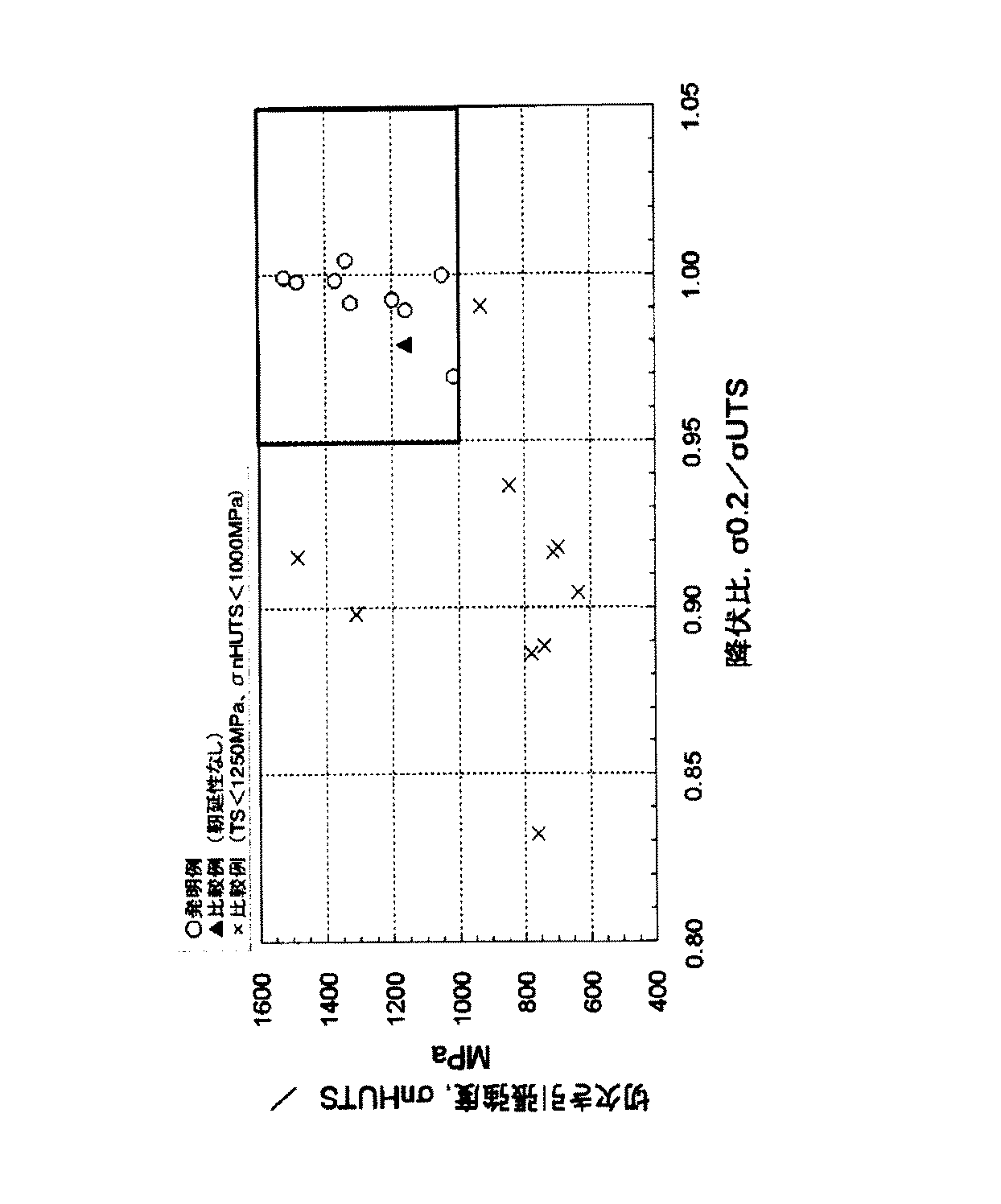
結果を表2および図4に示す。図4は、横軸に平滑引張試験で得られた降伏比をとり、縦軸に水素脆化感受性試験での破断強度をとってプロットしたものである。この図4に示す通り、降伏比が高いほど破断強度は高くなる傾向にあり、降伏比が0.95以上で破断強度は顕著に上昇する。本発明の要件を満たすものは破断強度が1000MPaを超えており、耐水素脆化感受性に優れている。一方、本発明の要件を満たさないものは、降伏比が低いため破断強度も低い、もしくは降伏比が0.95以上であっても1000MPa超の高い破断強度が得られない。たとえばR−11は、粗大な介在物が存在する以外は本発明の要件を満たしており、切欠き試験では延性破壊をしたが、遅れ破壊試験では、粗大な介在物が存在するがゆえに、介在物のところで応力集中が起こり、水素が集積したため、介在物を起点とした低応力破壊が起こった。R−11は特性にばらつきが生じた例である。 The results are shown in Table 2 and FIG. In FIG. 4, the horizontal axis represents the yield ratio obtained in the smooth tensile test, and the vertical axis represents the fracture strength in the hydrogen embrittlement susceptibility test. As shown in FIG. 4, the higher the yield ratio, the higher the breaking strength. When the yield ratio is 0.95 or more, the breaking strength increases remarkably. Those satisfying the requirements of the present invention have a breaking strength exceeding 1000 MPa and are excellent in resistance to hydrogen embrittlement. On the other hand, those that do not meet the requirements of the present invention have a low yield ratio and thus a low breaking strength, or even when the yield ratio is 0.95 or higher, a high breaking strength exceeding 1000 MPa cannot be obtained. For example, R-11 satisfies the requirements of the present invention except for the presence of coarse inclusions, and has undergone ductile fracture in the notch test. However, in the delayed fracture test, the inclusion is due to the presence of coarse inclusions. Stress concentration occurred at the object, and hydrogen accumulated, causing low stress fracture starting from inclusions. R-11 is an example in which variations occur in characteristics.
Claims (2)
Priority Applications (1)
| Application Number | Priority Date | Filing Date | Title |
|---|---|---|---|
| JP2006076942A JP4657128B2 (en) | 2006-03-20 | 2006-03-20 | High strength structural steel with excellent hydrogen embrittlement resistance and toughness and its manufacturing method |
Applications Claiming Priority (1)
| Application Number | Priority Date | Filing Date | Title |
|---|---|---|---|
| JP2006076942A JP4657128B2 (en) | 2006-03-20 | 2006-03-20 | High strength structural steel with excellent hydrogen embrittlement resistance and toughness and its manufacturing method |
Publications (2)
| Publication Number | Publication Date |
|---|---|
| JP2007254765A JP2007254765A (en) | 2007-10-04 |
| JP4657128B2 true JP4657128B2 (en) | 2011-03-23 |
Family
ID=38629293
Family Applications (1)
| Application Number | Title | Priority Date | Filing Date |
|---|---|---|---|
| JP2006076942A Expired - Fee Related JP4657128B2 (en) | 2006-03-20 | 2006-03-20 | High strength structural steel with excellent hydrogen embrittlement resistance and toughness and its manufacturing method |
Country Status (1)
| Country | Link |
|---|---|
| JP (1) | JP4657128B2 (en) |
Cited By (1)
| Publication number | Priority date | Publication date | Assignee | Title |
|---|---|---|---|---|
| CN108193134A (en) * | 2018-01-25 | 2018-06-22 | 内蒙金属材料研究所 | A kind of coal breaker tup novel low-alloy steel and its heat treatment method |
Families Citing this family (5)
| Publication number | Priority date | Publication date | Assignee | Title |
|---|---|---|---|---|
| CN103484780B (en) * | 2013-09-26 | 2015-06-24 | 江苏天舜金属材料集团有限公司 | High-strength hot-rolled reinforcement bar of 830 MPa level, and production technology thereof |
| CN105543654B (en) * | 2015-12-18 | 2018-07-03 | 马鞍山钢铁股份有限公司 | Containing 10.9 grades of rail traffic Mobile Equipment steel for fastener of niobium and its heat treatment process |
| CN105401072B (en) * | 2015-12-18 | 2018-01-02 | 马鞍山钢铁股份有限公司 | Containing 12.9 grades of track traffic Mobile Equipment steel for fastener of niobium and its Technology for Heating Processing |
| DE102019217369A1 (en) * | 2019-11-11 | 2021-05-12 | Robert Bosch Gmbh | Slow-transforming steel alloy, process for the production of the slow-transforming steel alloy and hydrogen storage with a component made from the slow-transforming steel alloy |
| WO2026042679A1 (en) * | 2024-08-22 | 2026-02-26 | 日本製鉄株式会社 | Bolt |
Family Cites Families (4)
| Publication number | Priority date | Publication date | Assignee | Title |
|---|---|---|---|---|
| JP2000336458A (en) * | 1999-05-27 | 2000-12-05 | Nippon Steel Corp | Manufacturing method of wire rod and steel wire excellent in wire drawing workability by high approach angle die |
| JP2003003241A (en) * | 2001-06-26 | 2003-01-08 | Nippon Steel Corp | High strength spring steel wire |
| JP2003105498A (en) * | 2001-09-28 | 2003-04-09 | Togo Seisakusho Corp | High strength spring and manufacturing method thereof |
| JP2005120479A (en) * | 2004-10-25 | 2005-05-12 | Togo Seisakusho Corp | High strength spring and manufacturing method thereof |
-
2006
- 2006-03-20 JP JP2006076942A patent/JP4657128B2/en not_active Expired - Fee Related
Cited By (1)
| Publication number | Priority date | Publication date | Assignee | Title |
|---|---|---|---|---|
| CN108193134A (en) * | 2018-01-25 | 2018-06-22 | 内蒙金属材料研究所 | A kind of coal breaker tup novel low-alloy steel and its heat treatment method |
Also Published As
| Publication number | Publication date |
|---|---|
| JP2007254765A (en) | 2007-10-04 |
Similar Documents
| Publication | Publication Date | Title |
|---|---|---|
| CN101365820B (en) | High-strength spring steel excellent in brittle fracture resistance and method for producing same | |
| JP5114665B2 (en) | Heat-treated steel for high-strength springs | |
| CN101321885B (en) | Heat-treatment steel for high-strength spring | |
| JP4555768B2 (en) | Steel wire for high strength spring | |
| KR101768785B1 (en) | High-strength spring steel wire with excellent hydrogen embrittlement resistance, manufacturing process therefor, and high-strength spring | |
| JP5779984B2 (en) | Oil well steel pipe excellent in sulfide stress cracking resistance and method for producing the same | |
| JP4542624B2 (en) | High strength thick steel plate and manufacturing method thereof | |
| KR102021216B1 (en) | Wire rods for bolts with excellent delayed fracture resistance after pickling and quenching tempering, and bolts | |
| JP6027302B2 (en) | High strength tempered spring steel | |
| JP6407436B2 (en) | Suspension spring steel and manufacturing method thereof | |
| US20170058376A1 (en) | Rolled material for high strength spring, and wire for high strength spring | |
| JPWO2018230717A1 (en) | Rolling wire for spring steel | |
| WO2011004913A1 (en) | Steel wire for high-strength spring | |
| WO2011111872A1 (en) | High-strength steel and high-strength bolt with excellent resistance to delayed fracture, and manufacturing method therefor | |
| JP6212473B2 (en) | Rolled material for high-strength spring and high-strength spring wire using the same | |
| JP5167616B2 (en) | Metal bolts with excellent delayed fracture resistance | |
| CN106560522A (en) | Part Obtained From Age Hardening Type Bainitic Microalloyed Steel And Process For Producing Same | |
| JP2012097297A (en) | High chromium cast iron | |
| JP2001288538A (en) | Steel for high-strength bolts having excellent delayed fracture resistance, bolts, and method of manufacturing the bolts | |
| JP4657128B2 (en) | High strength structural steel with excellent hydrogen embrittlement resistance and toughness and its manufacturing method | |
| US10745772B2 (en) | Age hardening non-heat treated bainitic steel | |
| JP6356309B1 (en) | High-strength spring, method for manufacturing the same, steel for high-strength spring, and method for manufacturing the same | |
| JP5233307B2 (en) | High-strength steel and metal bolts with excellent corrosion resistance and cold forgeability that prevent hydrogen from entering the environment | |
| JP2007284774A (en) | Wire rod superior in delayed fracture resistance and cold workability, and manufacturing method therefor | |
| JP4952708B2 (en) | Martensitic stainless steel and method for producing the same |
Legal Events
| Date | Code | Title | Description |
|---|---|---|---|
| A621 | Written request for application examination |
Free format text: JAPANESE INTERMEDIATE CODE: A621 Effective date: 20081008 |
|
| A521 | Request for written amendment filed |
Free format text: JAPANESE INTERMEDIATE CODE: A523 Effective date: 20081008 |
|
| A977 | Report on retrieval |
Free format text: JAPANESE INTERMEDIATE CODE: A971007 Effective date: 20101125 |
|
| TRDD | Decision of grant or rejection written | ||
| A01 | Written decision to grant a patent or to grant a registration (utility model) |
Free format text: JAPANESE INTERMEDIATE CODE: A01 Effective date: 20101130 |
|
| A01 | Written decision to grant a patent or to grant a registration (utility model) |
Free format text: JAPANESE INTERMEDIATE CODE: A01 |
|
| A61 | First payment of annual fees (during grant procedure) |
Free format text: JAPANESE INTERMEDIATE CODE: A61 Effective date: 20101221 |
|
| FPAY | Renewal fee payment (event date is renewal date of database) |
Free format text: PAYMENT UNTIL: 20140107 Year of fee payment: 3 |
|
| R150 | Certificate of patent or registration of utility model |
Ref document number: 4657128 Country of ref document: JP Free format text: JAPANESE INTERMEDIATE CODE: R150 Free format text: JAPANESE INTERMEDIATE CODE: R150 |
|
| R250 | Receipt of annual fees |
Free format text: JAPANESE INTERMEDIATE CODE: R250 |
|
| R250 | Receipt of annual fees |
Free format text: JAPANESE INTERMEDIATE CODE: R250 |
|
| S533 | Written request for registration of change of name |
Free format text: JAPANESE INTERMEDIATE CODE: R313533 |
|
| R350 | Written notification of registration of transfer |
Free format text: JAPANESE INTERMEDIATE CODE: R350 |
|
| R250 | Receipt of annual fees |
Free format text: JAPANESE INTERMEDIATE CODE: R250 |
|
| R250 | Receipt of annual fees |
Free format text: JAPANESE INTERMEDIATE CODE: R250 |
|
| R250 | Receipt of annual fees |
Free format text: JAPANESE INTERMEDIATE CODE: R250 |
|
| R250 | Receipt of annual fees |
Free format text: JAPANESE INTERMEDIATE CODE: R250 |
|
| R250 | Receipt of annual fees |
Free format text: JAPANESE INTERMEDIATE CODE: R250 |
|
| R250 | Receipt of annual fees |
Free format text: JAPANESE INTERMEDIATE CODE: R250 |
|
| R250 | Receipt of annual fees |
Free format text: JAPANESE INTERMEDIATE CODE: R250 |
|
| R250 | Receipt of annual fees |
Free format text: JAPANESE INTERMEDIATE CODE: R250 |
|
| LAPS | Cancellation because of no payment of annual fees |