JP4657449B2 - Disposable products that absorb and contain excreta - Google Patents
Disposable products that absorb and contain excreta Download PDFInfo
- Publication number
- JP4657449B2 JP4657449B2 JP2000556723A JP2000556723A JP4657449B2 JP 4657449 B2 JP4657449 B2 JP 4657449B2 JP 2000556723 A JP2000556723 A JP 2000556723A JP 2000556723 A JP2000556723 A JP 2000556723A JP 4657449 B2 JP4657449 B2 JP 4657449B2
- Authority
- JP
- Japan
- Prior art keywords
- wearer
- excrement
- product
- sensor
- absorbs
- Prior art date
- Legal status (The legal status is an assumption and is not a legal conclusion. Google has not performed a legal analysis and makes no representation as to the accuracy of the status listed.)
- Expired - Fee Related
Links
Images




Classifications
-
- G—PHYSICS
- G01—MEASURING; TESTING
- G01N—INVESTIGATING OR ANALYSING MATERIALS BY DETERMINING THEIR CHEMICAL OR PHYSICAL PROPERTIES
- G01N33/00—Investigating or analysing materials by specific methods not covered by groups G01N1/00 - G01N31/00
- G01N33/48—Biological material, e.g. blood, urine; Haemocytometers
- G01N33/50—Chemical analysis of biological material, e.g. blood, urine; Testing involving biospecific ligand binding methods; Immunological testing
- G01N33/53—Immunoassay; Biospecific binding assay; Materials therefor
- G01N33/5308—Immunoassay; Biospecific binding assay; Materials therefor for analytes not provided for elsewhere, e.g. nucleic acids, uric acid, worms, mites
-
- A—HUMAN NECESSITIES
- A61—MEDICAL OR VETERINARY SCIENCE; HYGIENE
- A61F—FILTERS IMPLANTABLE INTO BLOOD VESSELS; PROSTHESES; DEVICES PROVIDING PATENCY TO, OR PREVENTING COLLAPSING OF, TUBULAR STRUCTURES OF THE BODY, e.g. STENTS; ORTHOPAEDIC, NURSING OR CONTRACEPTIVE DEVICES; FOMENTATION; TREATMENT OR PROTECTION OF EYES OR EARS; BANDAGES, DRESSINGS OR ABSORBENT PADS; FIRST-AID KITS
- A61F13/00—Bandages or dressings; Absorbent pads
- A61F13/15—Absorbent pads, e.g. sanitary towels, swabs or tampons for external or internal application to the body; Supporting or fastening means therefor; Tampon applicators
- A61F13/42—Absorbent pads, e.g. sanitary towels, swabs or tampons for external or internal application to the body; Supporting or fastening means therefor; Tampon applicators with wetness indicator or alarm
-
- A—HUMAN NECESSITIES
- A61—MEDICAL OR VETERINARY SCIENCE; HYGIENE
- A61F—FILTERS IMPLANTABLE INTO BLOOD VESSELS; PROSTHESES; DEVICES PROVIDING PATENCY TO, OR PREVENTING COLLAPSING OF, TUBULAR STRUCTURES OF THE BODY, e.g. STENTS; ORTHOPAEDIC, NURSING OR CONTRACEPTIVE DEVICES; FOMENTATION; TREATMENT OR PROTECTION OF EYES OR EARS; BANDAGES, DRESSINGS OR ABSORBENT PADS; FIRST-AID KITS
- A61F13/00—Bandages or dressings; Absorbent pads
- A61F13/15—Absorbent pads, e.g. sanitary towels, swabs or tampons for external or internal application to the body; Supporting or fastening means therefor; Tampon applicators
- A61F13/45—Absorbent pads, e.g. sanitary towels, swabs or tampons for external or internal application to the body; Supporting or fastening means therefor; Tampon applicators characterised by the shape
- A61F13/49—Absorbent pads, e.g. sanitary towels, swabs or tampons for external or internal application to the body; Supporting or fastening means therefor; Tampon applicators characterised by the shape specially adapted to be worn around the waist, e.g. diapers, nappies
- A61F13/495—Absorbent pads, e.g. sanitary towels, swabs or tampons for external or internal application to the body; Supporting or fastening means therefor; Tampon applicators characterised by the shape specially adapted to be worn around the waist, e.g. diapers, nappies with faecal cavity
-
- A—HUMAN NECESSITIES
- A61—MEDICAL OR VETERINARY SCIENCE; HYGIENE
- A61F—FILTERS IMPLANTABLE INTO BLOOD VESSELS; PROSTHESES; DEVICES PROVIDING PATENCY TO, OR PREVENTING COLLAPSING OF, TUBULAR STRUCTURES OF THE BODY, e.g. STENTS; ORTHOPAEDIC, NURSING OR CONTRACEPTIVE DEVICES; FOMENTATION; TREATMENT OR PROTECTION OF EYES OR EARS; BANDAGES, DRESSINGS OR ABSORBENT PADS; FIRST-AID KITS
- A61F13/00—Bandages or dressings; Absorbent pads
- A61F13/15—Absorbent pads, e.g. sanitary towels, swabs or tampons for external or internal application to the body; Supporting or fastening means therefor; Tampon applicators
- A61F13/56—Supporting or fastening means
- A61F13/66—Garments, holders or supports not integral with absorbent pads
- A61F13/82—Garments, holders or supports not integral with absorbent pads with means for attaching to the body
-
- A—HUMAN NECESSITIES
- A61—MEDICAL OR VETERINARY SCIENCE; HYGIENE
- A61L—METHODS OR APPARATUS FOR STERILISING MATERIALS OR OBJECTS IN GENERAL; DISINFECTION, STERILISATION OR DEODORISATION OF AIR; CHEMICAL ASPECTS OF BANDAGES, DRESSINGS, ABSORBENT PADS OR SURGICAL ARTICLES; MATERIALS FOR BANDAGES, DRESSINGS, ABSORBENT PADS OR SURGICAL ARTICLES
- A61L15/00—Chemical aspects of, or use of materials for, bandages, dressings or absorbent pads
- A61L15/16—Bandages, dressings or absorbent pads for physiological fluids such as urine or blood, e.g. sanitary towels, tampons
- A61L15/18—Bandages, dressings or absorbent pads for physiological fluids such as urine or blood, e.g. sanitary towels, tampons containing inorganic materials
-
- A—HUMAN NECESSITIES
- A61—MEDICAL OR VETERINARY SCIENCE; HYGIENE
- A61L—METHODS OR APPARATUS FOR STERILISING MATERIALS OR OBJECTS IN GENERAL; DISINFECTION, STERILISATION OR DEODORISATION OF AIR; CHEMICAL ASPECTS OF BANDAGES, DRESSINGS, ABSORBENT PADS OR SURGICAL ARTICLES; MATERIALS FOR BANDAGES, DRESSINGS, ABSORBENT PADS OR SURGICAL ARTICLES
- A61L15/00—Chemical aspects of, or use of materials for, bandages, dressings or absorbent pads
- A61L15/16—Bandages, dressings or absorbent pads for physiological fluids such as urine or blood, e.g. sanitary towels, tampons
- A61L15/20—Bandages, dressings or absorbent pads for physiological fluids such as urine or blood, e.g. sanitary towels, tampons containing organic materials
-
- A—HUMAN NECESSITIES
- A61—MEDICAL OR VETERINARY SCIENCE; HYGIENE
- A61L—METHODS OR APPARATUS FOR STERILISING MATERIALS OR OBJECTS IN GENERAL; DISINFECTION, STERILISATION OR DEODORISATION OF AIR; CHEMICAL ASPECTS OF BANDAGES, DRESSINGS, ABSORBENT PADS OR SURGICAL ARTICLES; MATERIALS FOR BANDAGES, DRESSINGS, ABSORBENT PADS OR SURGICAL ARTICLES
- A61L15/00—Chemical aspects of, or use of materials for, bandages, dressings or absorbent pads
- A61L15/16—Bandages, dressings or absorbent pads for physiological fluids such as urine or blood, e.g. sanitary towels, tampons
- A61L15/22—Bandages, dressings or absorbent pads for physiological fluids such as urine or blood, e.g. sanitary towels, tampons containing macromolecular materials
- A61L15/24—Macromolecular compounds obtained by reactions only involving carbon-to-carbon unsaturated bonds; Derivatives thereof
-
- A—HUMAN NECESSITIES
- A61—MEDICAL OR VETERINARY SCIENCE; HYGIENE
- A61L—METHODS OR APPARATUS FOR STERILISING MATERIALS OR OBJECTS IN GENERAL; DISINFECTION, STERILISATION OR DEODORISATION OF AIR; CHEMICAL ASPECTS OF BANDAGES, DRESSINGS, ABSORBENT PADS OR SURGICAL ARTICLES; MATERIALS FOR BANDAGES, DRESSINGS, ABSORBENT PADS OR SURGICAL ARTICLES
- A61L15/00—Chemical aspects of, or use of materials for, bandages, dressings or absorbent pads
- A61L15/16—Bandages, dressings or absorbent pads for physiological fluids such as urine or blood, e.g. sanitary towels, tampons
- A61L15/22—Bandages, dressings or absorbent pads for physiological fluids such as urine or blood, e.g. sanitary towels, tampons containing macromolecular materials
- A61L15/26—Macromolecular compounds obtained otherwise than by reactions only involving carbon-to-carbon unsaturated bonds; Derivatives thereof
-
- A—HUMAN NECESSITIES
- A61—MEDICAL OR VETERINARY SCIENCE; HYGIENE
- A61L—METHODS OR APPARATUS FOR STERILISING MATERIALS OR OBJECTS IN GENERAL; DISINFECTION, STERILISATION OR DEODORISATION OF AIR; CHEMICAL ASPECTS OF BANDAGES, DRESSINGS, ABSORBENT PADS OR SURGICAL ARTICLES; MATERIALS FOR BANDAGES, DRESSINGS, ABSORBENT PADS OR SURGICAL ARTICLES
- A61L15/00—Chemical aspects of, or use of materials for, bandages, dressings or absorbent pads
- A61L15/16—Bandages, dressings or absorbent pads for physiological fluids such as urine or blood, e.g. sanitary towels, tampons
- A61L15/42—Use of materials characterised by their function or physical properties
- A61L15/56—Wetness-indicators or colourants
-
- A—HUMAN NECESSITIES
- A61—MEDICAL OR VETERINARY SCIENCE; HYGIENE
- A61F—FILTERS IMPLANTABLE INTO BLOOD VESSELS; PROSTHESES; DEVICES PROVIDING PATENCY TO, OR PREVENTING COLLAPSING OF, TUBULAR STRUCTURES OF THE BODY, e.g. STENTS; ORTHOPAEDIC, NURSING OR CONTRACEPTIVE DEVICES; FOMENTATION; TREATMENT OR PROTECTION OF EYES OR EARS; BANDAGES, DRESSINGS OR ABSORBENT PADS; FIRST-AID KITS
- A61F13/00—Bandages or dressings; Absorbent pads
- A61F13/15—Absorbent pads, e.g. sanitary towels, swabs or tampons for external or internal application to the body; Supporting or fastening means therefor; Tampon applicators
- A61F13/84—Accessories, not otherwise provided for, for absorbent pads
- A61F2013/8473—Accessories, not otherwise provided for, for absorbent pads for diagnostic purposes
-
- A—HUMAN NECESSITIES
- A61—MEDICAL OR VETERINARY SCIENCE; HYGIENE
- A61F—FILTERS IMPLANTABLE INTO BLOOD VESSELS; PROSTHESES; DEVICES PROVIDING PATENCY TO, OR PREVENTING COLLAPSING OF, TUBULAR STRUCTURES OF THE BODY, e.g. STENTS; ORTHOPAEDIC, NURSING OR CONTRACEPTIVE DEVICES; FOMENTATION; TREATMENT OR PROTECTION OF EYES OR EARS; BANDAGES, DRESSINGS OR ABSORBENT PADS; FIRST-AID KITS
- A61F13/00—Bandages or dressings; Absorbent pads
- A61F13/15—Absorbent pads, e.g. sanitary towels, swabs or tampons for external or internal application to the body; Supporting or fastening means therefor; Tampon applicators
- A61F13/84—Accessories, not otherwise provided for, for absorbent pads
- A61F2013/8476—Accessories, not otherwise provided for, for absorbent pads with various devices or method
- A61F2013/8479—Accessories, not otherwise provided for, for absorbent pads with various devices or method including electric or magnetic devices
Landscapes
- Health & Medical Sciences (AREA)
- Life Sciences & Earth Sciences (AREA)
- Engineering & Computer Science (AREA)
- Chemical & Material Sciences (AREA)
- General Health & Medical Sciences (AREA)
- Animal Behavior & Ethology (AREA)
- Epidemiology (AREA)
- Public Health (AREA)
- Veterinary Medicine (AREA)
- Hematology (AREA)
- Materials Engineering (AREA)
- Biomedical Technology (AREA)
- Molecular Biology (AREA)
- Vascular Medicine (AREA)
- Immunology (AREA)
- Heart & Thoracic Surgery (AREA)
- Urology & Nephrology (AREA)
- Chemical Kinetics & Catalysis (AREA)
- Biotechnology (AREA)
- Inorganic Chemistry (AREA)
- Food Science & Technology (AREA)
- Medicinal Chemistry (AREA)
- Physics & Mathematics (AREA)
- Analytical Chemistry (AREA)
- Biochemistry (AREA)
- General Physics & Mathematics (AREA)
- Pathology (AREA)
- Microbiology (AREA)
- Cell Biology (AREA)
- Tropical Medicine & Parasitology (AREA)
- Orthopedics, Nursing, And Contraception (AREA)
- Absorbent Articles And Supports Therefor (AREA)
- External Artificial Organs (AREA)
- Processing And Handling Of Plastics And Other Materials For Molding In General (AREA)
- Polysaccharides And Polysaccharide Derivatives (AREA)
Abstract
Description
【0001】
(発明の分野)
本発明は、反応システムを有するのに適合する使い捨て製品に関する。ある特定実施形態では、本発明は排泄物、装着者、製品またはそれらの1つもしくは複数の構成要素上で反応機能を実行するために適合する、複数の構成要素を含む圧縮真空密封弾力性材料を含む排泄物隔離装置を有する使い捨て製品に関する。
(発明の背景)
現在、おむつ、大人用尿失禁パンツ、生理用ナプキンおよびタンポンのような使い捨て製品は、乳幼児の世話および成人尿失禁者の介護において排泄物を含有、隔離および廃棄するための手段として広範囲に使用されている。これらの製品は一般に、それらの利便性および確実性のために、これらの用途にとっての好ましい手段として再使用可能かつ選択可能な布製衣料品に取って代わってきた。
【0002】
乳幼児および成人両方のための使い捨て製品の分野は数多くの進歩を遂げてきており、そのおかげで使い捨て製品は従来型の布製衣料品より広範囲に好まれるようになってきたが、それでもまだ多数の問題が存在する。これらの使い捨て製品が体験してきた問題の中でも特に重要なのは、排泄物(例、尿、糞便、月経)の漏れ、皮膚の発疹および刺激、糞便による装着者の皮膚の広い領域の汚染、糞便のような排泄物をきれいに取り除くことの困難さ、排泄物の臭気、個人個人に合わせて特別仕立て(例、フィット)できないこと等である。
【0003】
これらの問題に対処するために色々な試みがなされてきた。例えば、超吸収性ポリマー類が、吸収性製品が尿を吸収かつ保持する能力を増加させるために使用されてきた。バリヤーレッグカフも、フィットを改良して漏れを減らすために使用されてきた。例えば、1975年1月14日にKenneth B.Buellへ発行された「使い捨ておむつのための収縮性サイド部分(Contractible Side Portions For Disposable Diaper)」と題する米国特許第3,860,003号は、幅広く容認されて商業的成功を達成した弾性化レッグカフ付き使い捨ておむつを記載している。使い捨て製品はさらにまた、糞便を含有して製品から漏れるのを防止するためのポケット、バリヤー等を使用してきた。例えば、1987年9月22日にMichael I.Lawsonへ発行された「二重カフを有する吸収性製品(Absorbent Article Having dual Cuffs)」と題する米国特許第4,695,278号;1989年1月3日にJerry L.Dragooへ発行された「漏れ抵抗性二重カフを有する吸収性製品(Absorbent Article Having Leakage−Resistant Dual Cuffs)」と題する米国特許第4,795,454号;および1996年7月30日にDreierへ発行された「尖端を備えたポケットカフを有する吸収性製品(Absorbent Article Having A Pocket Cuff With An Apex)」と題する米国特許第5,540,671号を参照。使用時に、または糞便用ボイドスペースを提供するために例えば水もしくは尿のような活性化液またはフィットを改良するためにトップシートの置換に反応して活性化される選択的に拡張性もしくは膨張性構成要素を有する使い捨て製品もまた開示されてきた。例えば、1994年7月19日にGary D.LaVonらへ発行された「膨張性スペーサーを有する使い捨て吸収性製品(Disposable Absorbent Article Having an Inflatable Spacer)」と題する米国特許第5,330,459号および1996年5月28日にGary D.LaVonらへ発行された「密封拡張性構成要素を有する使い捨て吸収性製品(Disposable Absorbent Article Having an Sealed Expandable Component)」と題する米国特許第5,520,674号は、使用時点に拡張性である、または例えば水もしくは尿のような活性化液に反応して拡張する構成要素を有する使い捨て吸収性製品について記載している。しかし、これらの拡張性構成要素は、それらが構成要素を活性化させるもしくは継続的に作用させるためには介護者による行為を必要とするか、拡張が液体活性化剤の量に比例するために完全に拡張させるためには余りに多量の液体活性化剤を必要とするのどちらかであるという点に問題がある。さらにまた、水もしくは尿のような活性化液と反応する自己収縮性レッグギャザーも開示されてきた。例えば、1981年1月27日にFriedricH−Wilhelm Schroderへ発行された「水分反応性密封手段を含むおむつ(Diaper Including Moisture−Reponsive Seal Means)」と題する米国特許第4,246,900号を参照。同様に、これらの自己収縮性ギャザーもまた、それらが構成要素を活性化させるもしくは継続的に作用させるためには介護者による行為を必要とするか、収縮が液体活性化剤の量に比例するために完全に収縮させるためには余りに多量の液体活性化剤を必要とするという点に問題がある。
(発明の概要)
本発明は、機械的アクチュエーターを含み、排泄物(例、それを隔離するため)、排泄物の成分(例、排泄物の酵素活性を阻害するため)、または装着者の圧力、運動、その他の行為もしくは状態(例、皮膚を潤滑するため等)のような入力に反応して作用する反応システムを有する使い捨て製品に向けられる。本発明の反応システムは、不連続反応システムまたは連続反応システムのどちらかを備える可能性がある。しかし反応システムが連続反応システムを備える場合は、本発明のシステムはさらに閉ループシステムも含まなければならない。別の実施形態では、本発明はおむつ、尿失禁パンツ、おむつホルダーおよび/またはインサート、トレーニングパンツ、女性用生理用衣料品、タンポンその他のような使い捨て製品に向けられるが、このとき使い捨て製品は好ましくは排泄物隔離装置を含む。排泄物隔離装置は、好ましくは外側および少なくとも1つの内部チャンバーを有する圧力差別化装置を含むが、このとき圧力差別化装置は周囲圧力より低い圧力で内部チャンバーを維持することができる。排泄物隔離装置は、好ましくは圧力差別化装置の内部チャンバーに配置されて真空圧縮下で保持される少なくとも2つの弾力性要素を含む。
(発明の詳細な説明)
ここで使用する用語「吸収性製品」は、排泄物を吸収かつ含有する装置に関する、およびより詳細には、身体から排出された様々な排泄物を吸収かつ含有するために装着者の身体に接触させてもしくは近くに置かれる装置に関する。用語「使い捨て」は、ここでは吸収性製品として洗濯するまたはさもなければ復元もしくは再使用することが概して意図されていない(すなわち、それらは使用後に廃棄する、および好ましくはリサイクルする、堆肥にするまたはさもなければ環境に適合する方法で廃棄することが意図されている)吸収性製品を説明するために使用される。(ここで使用するように用語「配置された」は、おむつの要素がおむつの他の要素との一体型構造としてまたはおむつの別の要素に接合された個別要素として特定の場所もしくは位置に形成されている(接合および配置されている)ことを意味するために使用されている。ここで使用する用語「接合された」は、それにより1つの要素をもう1つの要素に直接に付着させることによってその要素が他の要素に直接的に固定されている形状、およびそれによりその要素を他の要素に順に付着させられる中間部材に付着させることによってその要素が他の要素に間接的に固定されている形状を包含する。)「一体型」吸収性製品は、個別のホルダーおよびライナーのような別個に操作可能なパーツを必要としない1つの調和した実体を形成するために一緒に結合された個別パーツから形成される吸収性製品を意味する。本発明の吸収性製品のある好ましい実施形態は、図1に示されている製品20である一体型使い捨て吸収性製品である。ここで使用するように「おむつ」は、乳幼児および尿失禁者によって概して胴部下方の周囲に装着される吸収性製品を意味する。本発明はまた、例えば尿失禁用パンツ、尿失禁用下着類、吸収性インサート、おむつホルダーおよびライナー、自然肛門または人工肛門のための人工肛門形成術型バッグ、女性用生理用衣料品、タンポン、拭き取り用ペーパー、使い捨てタオル、ティッシュー、吸水製品、吸油製品、食べこぼし浄化バッグ、乾燥剤バッグ、使い捨てモップ、包帯類その他のような他の吸収性および非吸収性製品にも適用可能である。
【0004】
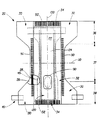
図1は、製品20の構成をより明確に示すために切り取られている構造の部分とともに平たく広げられた状態にある、この図ではおむつとして示されている本発明の製品20の平面図である。装着者に面する製品20の部分は図を見ている人に向けられている。図1に示されているように、製品20は好ましくは液体透過性トップシート24;液体不透過性バックシート26;好ましくはトップシート24およびバックシート26の少なくとも1部分の間に配置されている吸収性コア28;サイドパネル30;弾性化レッグカフ32;弾性ウエスト装備34;および全体を通して40と指定された留め具システムを備える。製品20は、第1ウエスト領域36、第1ウエスト領域36に対向する第2ウエスト領域および第1ウエスト領域と第2ウエスト領域の間に位置する股領域37を有するように示されている。製品20の周囲は、長手方向縁50が概して製品20の長手方向中心線100に平行に走っており、端縁52が製品20の側方中心線110に概して平行な長手方向縁50間を走っている製品20の外縁によって限定されている。
【0005】
製品20のシャシー22は製品20の本体を備える。シャシー22は、吸収性コア28の少なくとも1部分ならびに好ましくはトップシート24およびバックシート26を含む外側カバー層を備える。吸収性製品が個別のホルダーおよびライナーを備える場合は、シャシー22が概してホルダーおよびライナーを備える。(例えば、ホルダーは製品の外側カバーを形成するために1以上の材料層を備えることができ、ライナーはトップシート、バックシート、および吸収性コアを含む吸収性組立体を備えることができる。)そうした場合には、ホルダーおよび/またはライナーは使用時間を通して適所にライナーを保持するために使用される留付け要素を含むことができる。)一体型吸収性製品については、シャシー22は複合おむつ構造を形成するために追加された他の装備と一緒におむつの主要構造を備える。トップシート24、バックシート26、および吸収性コア28は様々のよく知られている形状で組み立てられてよいが、好ましいおむつ形状は概して1975年1月14日にKenneth B.Buellへ発行された「使い捨ておむつのための収縮性サイド部分(Contractible Side Portions For Disposable Diaper)」と題する米国特許第3,860,003号;1992年9月9日にBuellへ発行された米国特許第5,151,092号;および1993年6月22日にBuellへ発行された米国特許第5,221,274号;および1996年9月10日にRoeらへ発行された「複数区域構造的ゴム様フィルムウエブ製伸張性ウエスト装備を備えた吸収性製品(Absorbent Article With Multiple Zone Structural Elastic−Like Film Web Extensible Waist Feature)」と題する米国特許第5,554,145号;1996年10月29日にBuellらへ発行された「使い捨て引き上げ装着パンツ(Disposable Pull−On Pant)」と題する米国特許第5,569,234号;1996年12月3日にNeaseらへ発行された「吸収性製品のためのサイドパネルを製造するためのゼロスクラップ法(Zero Scrap Method For Manufacturing Side Panels For Absorbent Articles)」と題する米国特許第5,580,411号;および1997年8月20日にRoblesらの名前で出願された「他方向伸張性サイドパネルを備えた吸収性製品(Absorbent Article With Multi−Directional Extensible Side Panels)」と題する米国特許出願第08/915,471号に記載されており、それらは各々参照してここに組み込まれる。
【0006】
バックシート26は、概して吸収かつ含有された排泄物が例えばベッドシーツおよび下着類のような製品20に接触する可能性のある製品を汚すことを防止する、吸収性コア28の衣類に面する表面45に隣接して配置される製品20の部分である。ある実施形態では、バックシート26は液体(例、尿)不透過性であり、約0.012mm(0.5ミル)〜約0.051mm(2.0ミル)の厚さを有する熱可塑性フィルムのような薄いプラスチックフィルムを備える。適切なバックシートフィルムは、インディアナ州テレホートに所在のTredegar Industries Inc.によって製造され、商標名X15306、X10962およびX10964を付けて販売されているものを含む。その他の適切なバックシート材料は、製品20から蒸気が漏れ出るのを許容しながらバックシート26を排泄物が通過することを防止する通気性材料を含むことができる。代表的通気性材料は、織布ウェブ、不織布ウェブ、例えばフィルムコーティング不織布ウェブのような複合材料、および例えば日本のMitsui Toatsu Co.によって名称ESPOIR NOを付けておよびテキサス州ベイシティ所在のEXXON Chemical Co.によって名称EXXAIREをつけて製造されているような微孔フィルムのような材料を含むことができる。ポリマー混合物を備えている適切な通気性複合材料は、HYTRELブレンドP18−3097の名称でオハイオ州シンシナティに所在のClopay Corporationから入手可能である。そうした通気性複合材料は、E.I.DuPontの名前で1995年6月22日に公開されたPCT出願第WO95/16746号および1999年2月2日Curroへ発行された同時係属出願の米国特許第5,865,823号の中で極めて詳細に記載されている。不織布ウェブおよび開口成形フィルムを含むその他の通気性バックシートは、1996年11月5日にDobrinらへ発行された米国特許第5,571,096号に記載されている。これらの参考文献各々は、これにより参照して本明細書に組み込まれる。しかし、製品20のためのインサートのような一部の実施形態では、バックシートは液体透過性であってもよく、さらに例えば下記でトップシート24に関して説明されるのと同一材料を含んでいてもよい。
【0007】
バックシート26、またはそれのいずれかの部分は、1つ以上の方向において弾性的に伸張性であってよい。ある実施形態では、バックシート26は構造的ゴム様フィルム(「SELF」)ウェブを備えることができる。構造的ゴム様フィルムウェブは追加の弾性材料を使用せずに伸長方向にゴム様行動を示す伸張性材料である。本発明のために適合するSELFウェブは、参照してここに組み込まれる1996年5月21日にChappellらへ発行された「ゴム様行動を示すウェブ材料(Web Materials Exhibitihg Elastic−Like Behavior)」と題する米国特許第5,518,801号により完全に記載されている。また別の実施形態では、バックシート26はエラストマーフィルム、フォーム、ストランド、またはこれらもしくはその他の適切な材料と不織布もしくは合成フィルムとの組み合わせを備えることができる。
【0008】
トップシート24は、好ましくは吸収性コア28の体側表面47に隣接して配置され、好ましくはコンプライアントで、感触が柔らかで、さらに装着者の皮膚に非刺激性である。さらに、トップシート24の少なくとも1部分は液体透過性であり、液体がその全厚を通して容易に浸透するのを許容する。適切なトップシート24は、ポーラスフォーム:網状フォーム;開口プラスチックフィルム;または天然繊維(例、木材もしくは綿繊維)、合成繊維(例、ポリエステルもしくはポリプロピレン繊維)、または天然繊維と合成繊維の組み合わせのような広範囲の材料から製造することができる。トップシートが繊維を含む場合は、繊維はスパンボンド加工、カード加工、ウェットレイ加工、メルトブロウン加工、ハイドロエンタングル加工、またはこの分野で公知の、別の方法で処理加工されてよい。ステープルポリプロピレン繊維のウェブを備える1つの適切なトップシート24は、名称P−8を付けてマサチューセッツ州ウォルポールに所在のVeratec.Inc.のDivision of International Paper Companyによって製造されている。
【0009】
適切な成形フィルムトップシートは、1975年12月30日にThompsonへ発行された「先細毛管を有する吸収性構造(Absorptive Structures Having Tapered Capillaries)」と題する米国特許第3,929,135号;1982年4月13日にMullaneらへ発行された「汚れ抵抗性トップシートを有する使い捨て吸収性製品(Disposable Absorbent Article Having A Stain Resistant Topsheet)」と題する米国特許第4,324,246号;1982年8月3日にRadelらへ発行された「繊維様特性を示す弾力性プラスチックウェブ(Resilient Plastic Web Exhibiting Fiber−Like Properties)」と題する米国特許第4,342,314号;1984年7月31日にAhrらへ発行された「非光沢可視表面および布様触感を示す肉眼的に拡張させた三次元プラスチックウェブ(Macroscopically Expanded Three−Dimensional Plastic Web Exhibiting Non−Glossy Visible Surface and Cloth−Like Tactile Impression)」と題する米国特許第4,463,045号;および1991年4月9日にBairdへ発行された「多層ポリマーフィルム(Multilayer Polymeric Film)」と題する米国特許第5,006,394号に記載されている。その他の適切なトップシート30は、どちらも参照してここに組み込まれる各々1986年9月2日および1986年12月16日にCurroらへ発行された米国特許第4,609,518号および第4,629,643号に従って製造される。そうした成形フィルムは「ドリウィーブ(DRI−WEAVE)」としてオハイオ州シンシナティに所在のThe Procter & Gamble Companyから、および「CLIFF−T」としてインディアナ州テレホートに所在のTredegar Corporationから入手可能である。
【0010】
好ましくは、トップシート24は吸収性コア28に含まれた液体から装着者の皮膚を隔離するために疎水性材料から作られる、または疎水性にするために処理される。トップシート24が疎水性材料から作られている場合は、好ましくはトップシートの少なくとも上面は液体がトップシートを通ってより急速に移動するように親水性にするために処理されている。トップシート24は、それを界面活性剤処理することによって、またはトップシートに界面活性剤を組み込むことによって親水性にすることができる。トップシート24を界面活性剤処理するための適切な方法には、トップシート24材料に界面活性剤をスプレーするおよび材料を界面活性剤中に浸漬することが含まれる。そうした処理および親水性についてのより詳細な考察は、1991年1月29日Reisingらへ発行された「多層吸収性層を備えた吸収性製品(Absorbent Articles with Multiple Layer Absorbent Layers)」と題する米国特許第4,988,344号および1991年1月29日にReisingへ発行された「急速収集性吸収性コアを備えた吸収性製品(Absorbent Articles with Rapid Acquiring Absorbent Cores)」と題する米国特許第4,988,345号に含まれている。トップシートに界面活性剤を組み込むためのいくつかの適切な方法についてのより詳細な考察は、Azizらの名前で1997年7月1日に発行された米国法定発明登録第H1670号の中に見出すことができる。これらの参考文献各々はこれにより参照してここに組み込まれる。
【0011】
トップシート24のいずれかの部分は、技術において知られているようなローションでコーティングされてよい。適切なローションの例には、1997年3月4日Roeへ発行された「皮膚軟化剤および多価アルコール系ポリエステル固定剤を含有するローション含有トップシートを有する使い捨て吸収性製品(Disposable Absorbent Article Having A Lotioned Topsheet Containing an Emollient and Polyol Polyester Immobilizing Agent)」と題する米国特許第5,607,760号;1997年3月11日Roeへ発行された「液体多価アルコール系ポリエステル皮膚軟化剤および固定剤を備えるローショントップシートを有するおむつ(Diaper Having A Lotion Topsheet Comprising A Liquid Polyol Polyester Emollient And An Immobilizing Agent)」と題する米国特許第5,609,587号;1997年6月3日Roeらへ発行された「ポリシロキサン系皮膚軟化剤を含有するローション含有トップシートを有するおむつ(Diaper Having A Lotioned Topsheet Containing A Polysiloxane Emollient)」と題する米国特許第5,635,191号;および1997年7月1日Roeらへ発行された「ローション含有トップシートを有するおむつ(Diaper Having A Lotioned Topsheet)」と題する米国特許第5,643,588号に記載されているものが含まれる。ローションは上記の疎水性化処理として単独もしくは他の薬剤と結合して機能することができる。トップシートはさらにまた抗菌剤を含むことができる、または抗菌剤を用いて処理することができるが、それらの一部の例はTheresa Johnsonの名前で1995年9月14日に発行された「臭気制御のためにトップシート中に抗菌剤を含有する吸収性製品(Absorbent Articles Containing Antibacterial Agents in the Topsheet For Odor Control)」と題するPCT国際公開第WO95/24173号に開示されている。さらに、トップシート24、バックシート26またはトップシートもしくはバックシートのいずれかの部分はより布様外観を提供するためにエンボス加工および/またはマット仕上げ加工されてもよい。
【0012】
トップシート24およびバックシート26は、相互にまたは吸収性コア28もしくはおむつ20の他のいずれかの要素に技術において知られている取り付け手段によって接合されてよい。例えば、取り付け手段は接着剤の均一連続層、接着剤のパターン層、または接着剤の個別の線、らせんもしくは斑点の配列を含むことができる。あるいはまた、取り付け手段は熱接着法、圧力接着法、超音波接着法、動的機械的接着法、または他のいずれかの適切な取り付け手段もしくはこの分野で公知の、これらの取り付け手段の組み合わせを備えることもできる。
【0013】
吸収性コア28は、概して圧縮性で心地よく、装着者の皮膚に対して非刺激性であり、さらに尿やその他の一定排泄物のような液体を吸収かつ保持することのできるいずれかの吸収性材料を備えることができる。吸収性コア28は極めて様々なサイズおよび形状(例、長方形、砂時計形、「T」字形、非対称形等)で製造することができ、さらに使い捨ておむつやその他の吸収性製品で一般に使用される概してエアフェルトと呼ばれるび粉砕木材パルプのような極めて様々な液体吸収性材料を備えることができる。その他の適切な吸収性材料の例には、クレープセルロースワッディング;コフォームを含むメルトブロウンポリマー類;化学的剛性、変性もしくは架橋結合セルロース繊維;ティッシューラップおよびティッシューラミネートを含むティッシュー;吸収性フォーム;吸収性スポンジ;超吸収性ポリマー;吸収性ゲル化材料;またはその他の既知の吸収性材料または材料の組み合わせが含まれる。
【0014】
吸収性コア28の形状および構成はさらにまた様々であってよい(例えば、吸収性コアまたはその他の吸収性構造は様々な厚みの区域、親水性勾配、超吸収性勾配、または低平均密度および低平均坪量収集区域を有していてよい;または1つ以上の層もしくは構造を備えていてよい。
【0015】
吸収性コアとして使用するための代表的吸収性構造は、1986年9月9日にWesimanらへ発行された「高密度吸収性構造(High−Density Absorbent Structures)」と題する米国特許第4,610,678号;1987年6月16日にWesimanらへ発行された「2重層構造を備えた吸収性製品(Absorbent Articles With Dual−Layered Cores)」と題する米国特許第4,673,402号;1989年5月30日にAlemanyらへ発行された「低密度および低坪量収集性区域を有する高密度吸収性部材(High Density Absorbent Members Having Lower Density and Lower Basis Weight Acquisition Zones)」と題する米国特許第4,834,735号;1989年12月19日にAngstadtへ発行された「ダスティング層を有する吸収性コア(Absorbent Core Having A Dusting Layer)」と題する米国特許第4,888,231号;1992年8月11日にHerronらへ発行された「個別化されたポリカルボキシル酸架橋結合木材パルプセルロース繊維を含有する吸収性構造(Absorbent Structure Containing Individualized, Polycarboxylic Acid Crosslinked Wood Pulp Cellulose Fibers)」と題する米国特許第5,137,537号;1992年9月15日にYoungらへ発行された「尿失禁管理のための高効率吸収性製品(High Efficiency Absorbent Articles For Incontinence Management)」と題する米国特許第5,147,345号;1994年8月30日にRoeへ発行された「低粘度糞便のための使い捨て吸収性製品(Disposable Absorbent Article For Low−Viscosity Fecal Material)」と題する米国特許第5,342,338号;1993年11月9日にDesMaraisらへ発行された「水性排泄物のための吸収性フォーム材料およびそうした材料を含有する吸収性製品(Absorbent Foam Materials For Aqueous Body Fluids and Absorbent Articles Containing Such Materials)」と題する米国特許第5,260,345号;1995年2月7日にDyerらへ発行された「水性排泄物のための湿潤するまでは薄い吸収性フォーム材料およびこれを製造するためのプロセス(Thin−Until−Wet Absorbent Foam Materials For Aqueous Body Fluids And Process For Making Same)」と題する米国特許第5,387,207号;および1997年7月22日にDesMaraisらへ発行された「極めて高い水−油比を有する高内相エマルジョンから製造された水性液体のための吸収性フォーム材料(Absorbent Foam Materials For Aqueous Fluids Made From Hight Internal Phase Emulsions Having Very Hight Water−To−Oil Ratios)」と題する米国特許第5,625,222号に記載されている。これらの特許各々は参照して本明細書に組み込まれる。
【0016】
製品20はさらにまた、改良フィットおよび封じ込めを提供するのに役立つ少なくとも1つの弾性ウエスト装備34を備えることができる。弾性ウエスト装備34は、好ましくは吸収性コア28の少なくとも1つのウエスト縁62から少なくとも長手方向で外向きに伸長し、概して製品20の端縁52の少なくとも1部分を形成する。使い捨ておむつはしばしば、1つが第1ウエスト領域36に配置され、1つが第2ウエスト領域38に配置されている2つの弾性ウエスト装備を有するように構成される。さらに、弾性ウエスト装備34またはその構成要素のいずれかは製品20に付着させられた1つ以上の個別要素を備えることができるが、弾性ウエスト装備34はバックシート26、トップシート24、またはバックシート26およびトップシート24の両方のような製品20の他の要素の延長部として構成されてもよい。
【0017】
弾性ウエスト装備34は、1985年5月7日にKievitらへ発行された米国特許第4,515,595号;1987年12月1日にLashへ発行された米国特許第4,710,189号;1992年9月9日にBuellへ発行された米国特許第5,151,092号;および1993年6月22日にBuellへ発行された米国特許第5,221,274号に開示されているものを含む数多くの相違する形状で構成することができる。その他の適切なウエスト形状は、1991年6月25日にRobertsonへ発行された米国特許第5,026,364号および1989年3月28日にForemanへ発行された米国特許第4,816,025号に記載されているもののようなウエストキャップ装備を含むことができる。上記の参考文献は全て参照して本明細書に組み込まれる。
【0018】
製品20はさらにまた留め具システム40を含むことができる。一部の代表的留め具システムは、1974年11月19日にBuellへ発行された「使い捨ておむつのためのテープ留め具システム(Tape Fastening System for Disposable Diaper)」と題する米国特許第3,848,594号;1987年5月5日にHirotsuらへ発行された「吸収性製品(Absorbent Article)」と題する米国特許第B1 4,662,875号;1989年7月11日にScrippsへ発行された「改良留め具装置を有する使い捨ておむつ(Disposable Diaper Having An Improved Fastening Device)」と題する米国特許第4,846,815号;1990年1月16日にNestegardへ発行された「改良フック留め具を備えた使い捨ておむつ(Disposable Diaper With Improved Hook Fastener Portion)」と題する米国特許第4,894,060号;1990年8月7日にBattrellへ発行された「感圧接着剤留め具およびこれの製造方法(Pressure−Sensitive Adhesive Fastener And Method of Making Same)」と題する米国特許第4,946,527号;ならびにここで上記で参照した1992年9月9日にBuellへ発行された米国特許第5,151,092号;および1993年6月22日にBellへ発行された米国特許第5,221,274号において開示されている。留め具システムはさらに1990年10月16日にRobertsonらへ発行された米国特許第4,963,140号に開示されているような使い捨て形状で製品を保持するための手段を用意することもできる。これらの特許各々は参照して本明細書に組み込まれている。また別の実施形態では、パンツを形成するために衣料品の対向する側が継ぎ合わされても、溶接されてもよい。これによって製品はトレーニングパンツのような引き上げ装着おむつとして使用できるようになる。
【0019】
製品20は、さらにまたサイドパネル30を備えることができる。サイドパネル30は、最初に装着者に製品20を心地よくフィットさせ、その後製品に排泄物が負荷された時点をはるかに過ぎた装着時間を通してこのフィットを持続することによってより心地よくかつ身体の線に沿ったフィットを提供するために弾性または伸張性であってよいが、それは弾性化サイドパネル30が製品20のサイドが伸張かつ収縮することを可能にするからである。
【0020】
本発明の製品20は、好ましくは第2ウエスト領域38に配置されたサイドパネル30を有するが、製品20には第1ウエスト領域36または第1ウエスト領域36および第2ウエスト領域38の両方に配置されたサイドパネル30を用意することができる。弾性化サイドパネルを備えたおむつの例は、1989年8月15日にWoodらへ発行された「シャーリング付き耳を有する使い捨ておむつ(Disposable Diaper Having Shirred Ears)」と題する米国特許第4,857,067号;1983年5月3日にSciaraffaらへ発行された米国特許第4,381,781号;1990年7月3日にVan Gompelらへ発行された米国特許第4,938,753号;ならびにここで上記で参照した1992年9月9日にBuellへ発行された米国特許第5,151,092号;および1993年6月22日にBellへ発行された米国特許第5,221,274号;1997年9月23日にLaVonらへ発行された「持続性動的フィットを提供する吸収性製品(Absorbent Articles Providing Sustained Dynamic Fit)」と題する米国特許第5,669,897号;Roblesらの名前で1997年8月20日に出願された「他方向伸張性サイドパネルを備えた吸収性製品(Absorbent Article With Multi−Directional Extensible Side Panels)」と題する米国特許出願第08/915,471号において開示されており、これらは各々参照してここに組み込まれる。
【0021】
製品20は、好ましくはさらに液体およびその他の排泄物の改良封じ込めを提供するレッグカフ32を含む。レッグカフはさらにまたレッグバンド、サイドフラップ、バリヤーカフ、または弾性カフとも呼ばれることがある。米国特許第3,860,003号は、弾性化レッグカフ(ガスケッチングカフ)を提供するためにサイドフラップおよび1つ以上の弾性部材を有する収縮性レッグ(脚の付け根)開口部を提供する使い捨ておむつを記載している。1989年2月28日および1990年3月20日に各々Azizらへ発行された米国特許第4,808,178号および第4,909,803号は、レッグ領域の封じ込めを改良する「直立型(stand−up)」弾性化フラップ(バリヤーカフ)を有する使い捨ておむつを記載している。1987年9月22日にLawsonおよび1989年1月3日にDragooへ各々発行された米国特許第4,695,278号および第4,795,454号は、ガスケッチングカフおよびバリヤーカフを含む二重カフを有する使い捨ておむつを記載している。一部の実施形態では、レッグカフの全部または1部分を上記のようなローションを用いて処理することが望ましい場合がある。
【0022】
本発明の実施形態は、さらに排泄物を受け入れて含有するためのポケット、排泄物のためのボイドを提供するスペーサー、排泄物の移動を製品内に限定するためのバリヤー、おむつ内に配置された排泄物を受け入れて含有する区画もしくはボイド等またはそれらのいずれかの組み合わせを含むこともできる。吸収性製品において使用するためのポケットおよびスペーサーの例は、1996年5月7日にRoeらへ発行された「放出性スペーサーを有するおむつ(Diaper Having Expulsive Spacer)」と題する米国特許第5,514,121号;1992年12月15日にDreierらへ発行された「コアスペーサーを有する使い捨て吸収性製品(Disposable Absorbent Article Having Core Spacer)」と題する米国特許第5,171,236号;1995年3月14日にDreierへ発行された「ポケットカフを有する吸収性製品(Absorbent Article Having A Pocket Cuff)」と題する米国特許第5,397,318号;1996年7月30日にDreierへ発行された「尖端を備えたポケットカフを有する吸収性製品(Absorbent Article Having A Pocket Cuff With An Apex)」と題する米国特許第5,540,671号;および1993年12月3日に発行された「衛生吸収性製品において使用するためのスペーサーおよびそうしたスペーサーを有する使い捨て吸収性製品(Spacers For Use In Hygienic Absorbent Articles And Disposable Absorbent Articles Having Such Spacer)」と題するPCT国際出願第WO93/25172号;および1994年4月26日にFreelandへ発行された「使い捨て吸収性製品において使用するための柔軟性スペーサー(Flexible Spacers For Use In Disposable Absorbent Articles)」と題する米国特許第5,306,266号に記載されている。区画またはボイドの例は、1990年11月6日にKhanへ発行された「使い捨て糞便区画化おむつ(Disposable Fecal Compartmenting Diaper)」と題する米国特許第4,968,312号;1991年2月5日にFreelandへ発行された「排泄物隔離のための弾性ライナーを備えた吸収性製品(Absorbent Article With Elastic Liner For Waste Material Isolation)」と題する米国特許第4,990,147号;1991年11月5日にHoltらへ発行された「使い捨ておむつ(Disposable Diaper)」と題する米国特許第5,62,480号;1993年12月14日にFreelandらへ発行された「使い捨て吸収性製品のための三等分トップシート(Trisection Topsheets For Disposable Absorbent Articles)」と題する米国特許第5,269,755号に記載されている。適切な横断バリヤーの例は、Dreierらの名前で1996年9月10日に発行された「複数の実効高横断区分を有する吸収性製品(Absorbent Article Having Multiple Effective Height Transverse Partition)」と題する米国特許第5,554,142号;Freelandらの名前で1994年7月7日に発行された「直立横断区分を有する吸収性製品(Absorbent Article Having An Upstanding Transverse Partition)」と題するPCT国際特許第WO94/14395号;およびRoeらへ1997年8月5日に発行された「角直立横断区分を有する吸収性製品(Absorbent Article Having Angular Upstanding Transverse Partition)」と題する米国特許第5,653,703号に記載されている。上記に引用した参考文献は全てこれにより参照してここに組み込まれる。
【0023】
本発明の実施形態はさらにまた図12に示されているような排泄物管理装置110を含むことができる。排泄物管理装置110は、糞便、尿またはその両方を収集するための排泄物バッグ111を含むことができる。排泄物バッグ111は、装着者の肛門周囲領域に好ましくは粘着取り付けするための開口部121および開口部を取り囲むフランジ112を有することができる。さらに、排泄物管理装置110は、衣料品、またはおむつ、好ましくは使い捨ておむつと一緒に使用した場合に特に有用かつ有益であることが発見されている。排泄物バッグ111を含むおむつ120の1つの例は図13に示されている。おむつ120または他の衣料品と結び付けた場合は、排泄物バッグ111は製品上に配置または製品のいずれかの表面に接合することができる。バッグ111は、ここに記載される接合もしくは取り付け手段のいずれかおよび/または例えば接着剤、フックおよびループ留め付け具、磁気、ベルト、結び紐、ストラップ、スナップ等のような他のいずれかの接合手段を含むいずれかの既知の手段によって製品に接合することができる。ある実施形態では、排泄物バッグ111はおむつ120のトップシート124に接合することができる。
【0024】
排泄物バッグ111は、好ましくは排泄された糞便または尿の封じ込めのための柔軟性容器である。従って、排泄物バッグ111は好ましくは液体不透過性であるが、それでもなお通気性であってよい。さらに、排泄物バッグ111は座ったりするような典型的な装着状態に抵抗するために十分な強さを備えて設計されている。
【0025】
排泄物バッグ111は、1つまたは複数の層を備えることができる。ある実施形態では、排泄物バッグ111は、好ましくは1つはフィルム層で2つは不織布層である3つの層を備えることができる。バッグ材料の層は、好ましくはバッグが液体不透過性であるようにいずれかの材料を備えることができる。本発明の好ましい実施形態では、ラミネートは不織布層およびフィルムから形成することができる。
【0026】
いずれかのフィルム層のために適切なフィルム材料は、好ましくは熱可塑性材料を備える。熱可塑性材料は、蒸気透過性または不透過性であってよく、あらゆるタイプのホットメルト接着剤、特にポリエチレン、ポリプロピレン、無定形ポリオレフィンその他のようなポリオレフィン類;セルロース木材パルプ、綿、ジュート麻のような天然繊維:ガラスファイバー、レーヨン、ポリエステル、ポリオレフィン、アクリル、ポリアミド、アラミド、ポリテトラフルオロエチレン金属、ポリイミドのような合成繊維を含む繊維もしくはポリマー結合剤を備える溶融可能な成分を含有する材料;一部の成分材料が溶融できない混合物を備える材料である、二成分ハイメルト/ローメルトポリマー、コポリマーポリエステル、ポリ塩化ビニル、ポリ酢酸ビニル/ポリ塩化ビニルコポリマー、コポリマーポリアミドのような結合剤、;バックシートに関して上記で説明されたような微孔フィルムを含む空気および蒸気透過性材料およびDuPontから入手可能なHYTREL(商標)およびフランスのELF Atochemから入手可能なPebax(商標)のようなモノリシック通気性材料から選択することができる。
【0027】
排泄物バッグ111はいずれかの形状またはサイズを有することができる。好ましい形状は、フラットな環状形バッグ、コーン形バッグ、切頭コーン形バッグおよびピラミッド形もしくは切頭ピラミット形バッグおよびフラットなT字形バッグを含む。さらに、排泄物バッグ111は同一であっても相違していてもよく、それらの各々の周囲で密閉することのできる単一材料片または多数の個別材料片から用意することができる。
【0028】
排泄物バッグ111はさらにまた吸収性材料を含有することができる。吸収性材料は、液体を吸収かつ保持することのできるいずれかの吸収性材料を備えることができる。吸収性材料は使い捨ておむつおよびその他の吸収性製品に一般に使用される広範囲の液体吸収性材料を備えていてよい。一部の例は吸収性コアに関してここで記載されている。
【0029】
排泄物バッグ111には、それによってバッグ空洞内に貯蔵される前に糞便または尿が身体から受け入れられる開口部121が備えられる。開口部121は、好ましくはフランジ112によって取り囲まれており、例えば円形、長楕円形のようないずれかの形状またはサイズで用意され、対称性であっても非対称性であってもよいが、好ましくは開口部は長手方向または横断方向のいずれかに長楕円形の形状を有する。フランジは装着者の会陰、生殖器および/または尾骨領域に適合するように設計された張り出し部を備えることができる。
【0030】
フランジ112は、肛門周囲または泌尿生殖器領域にフランジ112を容易に配置できるように柔らかく柔軟性で適応性のある材料から作られなければならない。典型的な材料は、不織布材料、織布、開放気泡熱可塑性フォーム、独立気泡熱可塑性フォーム、開放気泡フォームと伸縮性不織布のコンポジット、およびフィルムを含む。
【0031】
排泄物バッグ111は、好ましくはさらに装置を装着者に固定するための接合もしくは取り付け手段を備える。そうした手段は、ここで記載されるいずれかの接合もしくは取り付け手段または例えばストラップ、ベルト、スナップ、結び紐、フックおよびループ留め付け具、ピン、および/または排泄物バッグ111もしくはフランジの装着者に面する部分に適用された身体的合成接着剤のようなこの分野で公知の他のいずれかの接合もしくは取り付け手段を備えることができる。装着者の肛門周囲または泌尿生殖器領域に装置を取り付けるためには、例えば親水コロイド接着剤およびヒドロゲル接着剤のようなあらゆる皮膚に優しい防水性感圧接着剤を使用することができる。相当に無痛の適用および取り外しを可能にしながらフランジを装着者の皮膚に敏感な肛門周囲領域で固定するために望ましい粘着特性を提供することに特に有効な接着剤は、三次元マトリックスを形成するためにポリマーと可塑剤を架橋結合させることから形成される。
【0032】
製品20は、好ましくはさらに少なくとも1つのセンサー60を含む。本特許出願で使用する用語「センサー」は、イベントまたはイベントに関連するパラメーターを検出するために使用される装置を意味する。イベントに関連するパラメーターは、システムの関係枠内でのイベントの発生と相関する測定可能な信号である(即ち、排泄物、装着者、またはそれらの構成要素によって惹起された信号)。センサーは、1つ以上の特定入力に反応するあらゆるものを含む。本発明のセンサーが検出することのできる入力の例は、排泄物の姿勢、圧力、運動、水分、酵素、細菌、pH、伝導性、抵抗、キャパシタンス、インダクタンス、またはその他の化学的、生化学的、生物学的、機械的もしくは電気的特性および/または構成要素が含まれるが、それらに限定されない。センサーは、好ましくは排泄物、装着者、またはそれらの構成要素によって惹起される入力をセンサーが検出するどころかかえってセンサーを誘発する環境状態の可能性を最小限に抑えることによって多数の偽反応を最小限に抑えるために非熱性または非相対湿度入力のような「非環境的」入力を検出する。例えば、電気的もしくは生物学的センサーは、排泄物の成分を感知することによって排便、排尿または月経排出のような排泄物イベントの放出を検出することができる。センサーは、1つ以上のイベントまたは1つのイベントに関連する1つ以上のパラメーターを検出して、アクチュエーターまたはコントローラーへ入力を提供することができる。さらに、本発明のセンサーは可逆性であっても非可逆性であってもよい。溶解性フィルムもしくはカプセルは非可逆性センサーの例であるが、他方装着者の筋内電気的活動を検出する電気的センサーは複数の連続入力信号を受け止めることができる(即ち、可逆性である)。
【0033】
上記で考察したように、本発明のセンサー60は特定入力に反応するあらゆるものを含むことができる。例えば、本発明のセンサー60は化学的、生物学的、機械的、電気的その他であってよい。化学的センサーは、例えば排泄物中に典型的に存在する酵素のような化学的および/または生化学的入力、pH、水、例えば細菌、血液のような生物学的入力または例えば糞便、尿、もしくは月経等のような排泄物のいずれか1つ以上の他の構成要素に反応することができる。化学的または生物学的センサーの例は、特定の化学的、生化学的もしくは生物学的入力または特定クラスの化学的、生化学的もしくは生物学的入力に反応して溶解もしくは破裂する溶解性もしくは破裂性フィルム、カプセル(例、図5のカプセル193)、セル、シール等を含む。機械的センサーはさらにまた運動、姿勢、圧力その他に反応することができる。機械的センサーの例は、赤ん坊がセンサー上に座ったときに体重がベローズを押し下げてセンサーの部分を拡張させるベローズ型である。機械的センサーはさらにまた規定適用圧力下で破断もしくは隔離されるセンサーもしくはセンサーの1部分を含むことができる。水分、尿、糞便、月経、圧力、抵抗、キャパシタンス、インダクタンス等に反応する電気的センサーもまた使用することができる。例えば、電気的センサー破尿もしくは糞便のような導電性入力が電気回路を完成させるセンサー;圧力もしくは張力のような入力が電気的接触を閉鎖して回路を完成させるセンサー;装着者または装着者の部分によって惹起される圧力を通しての信号を発生させる圧電センサー;それに対してセンサーが反応する入力の存在下では抵抗、キャパシタンスまたはインダクタンスが変化するセンサー;または例えば皮膚接触型センサーのような接点を通して装着者の身体から(例、皮下筋肉)からの電気的信号を受信するセンサーを含むことができる。
【0034】
また別の実施形態では、センサーは1987年1月13日にKenji Oguraらへ発行された「Toilet Apparatus(排泄装置)」と題する米国特許第4,636,474号に記載されているようにタンパク質、糖、胆汁成分等を検出するために適合していてよい。さらに、センサーはこの分野で公知のバイオセンサーであってよい(例、酵素センサー、オルガネラ(細胞小器官)センサー、組織センサー、微生物センサー、もしくは電気化学的センサー)。バイオセンサーは、生物認識系、典型的には酵素もしくは物理化学的トランスデューサーの表面上に固定された抗体のような結合タンパク質を備えることができる。バイオセンサーは、アンモニアおよびフェノールのような排泄物の構成要素を検出することができる(例、酵素電極を備えるバイオセンサーによって)。特定株の細菌はその細菌株に対して起こされた抗体を使用するバイオセンサーによって検出することができる。フェノール類(例、尿もしくは糞便)を検出するために使用できる代表的酵素電極には、1997年10月14日にJoseph Wangらへ発行された「Remote Electrochemical Sensor(遠隔電気化学的センサー)」と題する米国特許第5,676,820号および1992年2月25日にAnthony P.F.Turnerらへ発行された「An Enzyme Electrode For Use In Organic Solvents(有機溶媒中で使用するための酵素電極)」と題する米国特許第5,091,299号に記載されているチロシナーゼに基づく電極またはポリフェノールオキシダーゼ酵素電極が含まれる。
【0035】
センサー60は、装着者の身体中もしくは上、製品中または排泄物中における変化または信号、すなわち例えば排便、排尿もしくはその他の排泄物の排出のような差し迫ったイベントの発生に直接に関連する、または少なくとも相関する入力を検出することのできる「先行型センサー」であってよい。先行型センサーは、例えば排便、排尿もしくは排泄物の放出のような差し迫ったイベントまたはそうしたイベントに相関するパラメーターを検出することができる。差し迫ったイベントは、排泄物、装着者、製品、またはそれらの1つもしくは複数の構成要素に関連している可能性がある。イベントに相関するパラメーターは、システムの関係枠内でのイベントの発生と相関するあらゆる測定可能な入力信号である(すなわち、排泄物または装着者によって惹起された信号)。先行型センサーは、例えば排便、排尿もしくは排泄物の放出の発生を予測したり、または皮膚の発疹または刺激に先行する可能性のある信号を検出したりすることができる。製品中の先行型センサーは、イベントを予測するために数多くの様々な入力を測定することができる。例えば、先行型センサーは糞便および/または尿の放出に先行する肛門括約筋における弛緩について外肛門括約筋、臀部の分離、腹部における圧力変化、製品中の気体濃度、または例えば排便、排尿もしくは排泄物の放出のようなイベントの発生を予測または予想するために使用できるその他の徴候を監視することができる。あるいはまた、本発明の先行型センサーは皮膚刺激に先行する信号を検出することができる。例えば、センサーは時間の経過に伴って炎症を起こした皮膚を引き起こす可能性がある装着者の皮膚の残留糞便汚染(例、汚れたおむつをきれいにした後に残っている糞便酵素残留物)を検出することができる。結果として皮膚のコンダクタンスの測定可能な増加またはインピーダンスの低下を生じさせる皮膚水和上昇である高いpHの検出もまた可能性のある皮膚刺激を予測するために使用することができる。先行型センサーの別の実施形態は、これにより参照してここに組み込まれる1998年6月29日に出願された「先行型センサーを有する使い捨て製品(Disposable Article Having A Proactive Sensor)」(P&Gケース第7196号)と題する同時係属出願の米国特許出願第09/107,561号に記載されている。
【0036】
センサー60は、センサーが検出するように設計されている入力に暴露させられる使い捨て製品のいずれかの部分中に配置および/またはそれに操作可能に接続されてよい。本発明の目的では、用語「操作可能に接続された」は、センサー60が入力を検出したときに製品20のある部分にセンサー60が信号するような連絡手段に関する。センサー60は、センサー60の別の部分、別のセンサー60、アクチュエーター70、コントローラー80または製品20の他の部分もしくは構成要素から離れていて操作可能に接続されていてよい。「操作可能に接続された」は、例えば導電性ワイヤーもしくは部材による電気的接続または例えば高周波、赤外線もしくはその他の透過周波数連絡のような伝送信号による連絡の手段を含むことができる。あるいはまた、センサー60は空気もしくは水の連絡のような機械的接続により操作可能に接続することもできる。
【0037】
製品20においては、例えばセンサー60は製品20の前方ウエスト領域36、後方ウエスト領域38または股領域37に配置することができ、さらにシャシー22、トップシート24、バックシート26、吸収性コア28、サイドパネル30、レッグカフ32、ウエスト装備34、留め具システム40、長手方向縁50もしくは端縁52その他の1部分と統合されても、それに隣接して配置されても、接合されても、またはそれを備えていてもよい。センサー60は、製品20のような製品内に完全に含有されていても、またはそれが望ましい入力と接触するように製品内に配置された受け入れ部分と製品内もしくは製品外のいずれかに配置された例えば伝送部分のような別の部分とを有していてもよい。センサー60は、センサー60が製品20の外側での入力を検出して信号をコントローラー80および/またはアクチュエーター70に提供できるように、製品20の一部の部分に操作可能に接続されたまま製品20の外側にあってよい。一部の実施形態では、センサーは製品から離れていてもよいが、すなわち装着者のある部分に個別に適用されていてよい、および/または製品から離れた1つ以上の構成要素を有していてもよい。
【0038】
センサー60はさらに、その各々が同一もしくは相違する起源からの同一もしくは相違する信号を検出することのできる2つ以上のセンサーを含む感知「システム」を備えることができる。感知システムは、製品の内側に、外側に、および/または離れて配置される構成要素を含むことができる。例えば、感知システムは、装着者の外肛門括約筋における電気的信号を検出する製品内のセンサーおよび装着者の腹部における運動、緊張もしくは筋肉活動を検出する製品外のセンサーを含むことができる。感知システムはさらに、あるいはまた製品の内側に、外側に、および/または離れている感知要素以外の構成要素を含むことができる。感知システムは、例えば製品の外側にあり、製品20に接合もしくは中に配置された感知システムの別のパーツへ信号を送信するトランスミッターを含むことができる。
【0039】
製品20は、好ましくはさらに機械的アクチュエーター70を備える。本特許出願で使用する用語「アクチュエーター」は、「ポテンシャル」を備える装置および「反応機能」を実行もしくは作動させるためにそのポテンシャルを転換する手段に関する。アクチュエーター70のポテンシャルは、貯蔵もしくはポテンシャルエネルギーまたは貯蔵材料のどちらかを備えることができる。従ってアクチュエーター70は、ポテンシャルエネルギーを運動エネルギーへ転換することによって、または貯蔵材料を送達することによって反応機能を実行もしくは活性化させることができる。「反応機能」は、本特許出願の目的では排泄物、装着者、製品、またはそれらの構成要素上で実施される機能であると定義されている。しかし、イベントが発生したことを指示する信号を単に提供する装置は、本特許出願の目的で定義された「アクチュエーター」とは見なされない。排泄物の構成要素には、例えば水分、電解質、酵素、揮発性気体、細菌、血液その他が含まれる場合がある。装着者の構成要素には、皮膚、生殖器、肛門、肛門括約筋その他が含まれる場合がある。製品の構成要素には、レッグカフ、ウエストカフもしくはその他の排泄物バリヤーおよび/または封じ込め構成要素、サイドパネル、耳、シャシー、吸収性コア、収集構成要素、留め具システム、長手方向縁もしくは端縁その他が含まれる可能性がある。ポテンシャルエネルギーは、機械的、電気的、化学的もしくは熱エネルギーとして貯蔵することができる。本特許出願で使用される「運動エネルギー」は、上記のような反応機能を働かせるまたは実行するための能力に関する(例、圧縮された装置の拡張、捻れた装置の回転、相を変化させるにつれて移動するゲル、皮膚もしくは糞便の被覆もしくは処理等)。本発明の目的での「送達」は、固体要素を伸張もしくは移動させること、水力作用、気体圧較差、弁等のような機械的送達手段に関する。
【0040】
例えば排泄物を捕捉するために三次元構造の作製を誘発することには、製品の構成要素上、および最終的には排泄物上で実施される反応機能が含まれる。例えば排泄物を捕捉すること、装着者の皮膚を拭うことまたはスキンケア組成物を用いて皮膚を処置することは、排泄物および/または装着者上で実施される反応機能である。製品の形状(一次元、二次元もしくは三次元)または物理的特性(例、曲げ係数、形状その他)を調節することは、製品上で実行できる反応機能の例である。しかし介護者および/または装着者にイベントが発生したことを知らせることは、排泄物、装着者、製品またはそれらの構成要素上で機能を実行しないために、反応機能を実行することにはならない。信号を発する装置は、機能が実行されることを生じさせるためのアクチュエーターとして機能するシステム(例、ヒト等)の外部の物質を必要とする。使い捨て製品のアクチュエーターは、例えば消臭剤、酵素阻害剤、スキンケア組成物もしくはpH調節剤を送達することができる;排泄物を捕捉する、拭き取る、被覆する、吸着する、固定する、密封する、ポンプ機能で排出するまたは貯蔵する;または排泄物、装着者、製品またはそれらの構成要素上で1つ以上のこれらの機能または他のいずれかの反応機能を実行するように設計された構造または要素の解放もしくは作製を誘発することができる。
【0041】
本発明のアクチュエーター70は、排泄物、装着者、製品またはそれらの構成要素上で反応機能を実行または活性化するためにポテンシャルエネルギーを放出することができる。ポテンシャルエネルギーの放出は、機械的、電気的、化学的および/または熱的ポテンシャルエネルギーを、反応機能を実行するための機械的エネルギーに転換することができる。一部の好ましい実施形態では、電気的、化学的または熱的エネルギーは、機械的エネルギーを補助するまたは機械的エネルギーに動力を与えることができる。アクチュエーターは、閾値レベルの入力によって反応機能を実行するためのポテンシャルエネルギーの放出を誘発されてもよいし、または下記で説明するように入力に継続的に反応してもよい。例えば、圧縮フォームは圧縮機械的ポテンシャルエネルギーを貯蔵しており、それが解放されたときに機械的運動エネルギーを提供できる。ツイストフォームは、解放されると機械的運動エネルギー、すなわち回転を提供できるねじり機械的ポテンシャルエネルギーを貯蔵している。例えば使い捨て製品のアクチュエーターは、下記のうちの1つ以上を含むことができる:貯蔵ローション、糞便改質剤、酵素阻害剤、pH緩衝剤、染料、加圧ガス、圧縮フォーム、ツイストフォーム、ポンプ、閉システム液体輸送部材その他を含むことができる。ポテンシャルエネルギーは、必要になるまでは維持/抑制するために十分ないずれかの方法で貯蔵することができる。実施例には、物理的機能を実行できる材料の形でバッテリーおよび/またはコンデンサー、弾性的、ねじり的、圧縮的に張力がかけられた材料または構造が含まれる(例、吸収剤、圧縮ガス、その他)。
【0042】
あるいはまた、本発明のアクチュエーター70は、排泄物、装着者、製品またはそれらのいずれかの1つ以上の構成要素上で反応機能を実行または活性化するための能力を有する大量の貯蔵材料を備えることができる。ある実施形態では、例えばアクチュエーター70は反応機能を実行する貯蔵材料を積極的に送達することができる。この実施形態では、アクチュエーター70は、所定時間に貯蔵材料を不連続的に送達するように閾値レベルの入力によって誘発されてもよいし、または材料を連続的に放出もしくは送達してもよい。アクチュエーター70は、例えば貯蔵ローション、スキンケア組成物、糞便改質剤、酵素阻害剤、pH緩衝剤、染料等を含むことができ、それらは拡張性弾力性材料、放出された高圧ガス等のようなアクチュエーター70によって送達される。
【0043】
また別の実施形態では、センサーおよび/またはアクチュエーターは閉システム液体輸送部材を備えることができる。「閉システム液体輸送部材」または「輸送部材」は、流入ポートおよび流出ポートを有する液体充填部材であり、たとえ少量であっても流入ポートに液体を受け入れると実際的に即時にその液体を流出ポートから放出する。流出ポートから放出された液体はセンサーへの入力信号として役立つことができる。例えば、液体は水であってよく、水は輸送部材が流入ポートで尿を吸収したときに放出され、糞便用ボイドスペースを作製するために貯蔵機械的エネルギーを放出するためにシールを溶解するように作用する。そうした輸送部材を通しての液体輸送は、毛管現象ではなくむしろ直接的吸引に基づいている。液体は有意な量の空気(または他の気体)が進入しない領域を通って輸送される。液体がそうした部材を通って流れるための駆動力は、液体シンク(例、毛管または浸透圧性吸収性構造)またはその部材と液体連絡している源によって作り出すことができる。従って、液体輸送部材は相当に高い液体透過性を有していなければならない。
【0044】
輸送部材内には、好ましくは相違する孔径を備えた少なくとも2つの領域、つまり小さな孔径を有する1つ以上のポート領域およびはるかに大きな孔径を有する領域がある。輸送部材の内側領域は、内側/バルク領域を取り囲む外側/壁領域の一部であるポート領域の透過性に比較して相当に高い透過性を有する(高い液体透過性は低い流れ抵抗性を生じさせる)。内側領域材料として使用するために適合する高多孔質材料の非限定的実施例には、ポリオレフィン、PET、セルロースおよびセルロースをベースとする繊維を備える繊維構造、および網状フォームのような開放セルフォーム、セルローススポンジ、ポリウレタンフォーム、およびHIPEフォームが含まれる。ある実施形態では、内側領域のボイドには本質的かつ完全に本質的に圧縮不能な液体が充填されている。用語「本質的かつ完全に」は、流入ポートと流出ポートの間で連続流路を確立できるように内側領域の十分なボイド容積が液体で満たされている状態に関する。
【0045】
輸送部材のポート領域は、輸送液体によっていったん湿潤すると輸送気体に対しては透過性であるが周囲気体(空気等)に対しては透過性ではない材料を備える。しばしば、そうした材料は膜と記載され、液体、気体または液体もしくは気体中の粒子の懸濁液に対して透過性である領域と定義されている。膜は、例えば毛管を通る液体透過性を提供する微孔領域を備えることができる。また別の実施形態では、膜がそれを通って液体が拡散により輸送されるブロックコポリマーを備えるモノリシック領域を備えることができる。ポート領域のための代表的膜には、1992年4月28日にWhiteへ発行された「Membranes For Absorbent Article(吸収性製品のための膜)」と題する米国特許第5,108,383号にも開示されているような酢酸セルロース膜、欧州特許第A−0451797号に開示されているPETフィルム、ニトロセルロース膜、硝酸セルロース膜、PTFE膜、ポリアミド膜、およびポリエステルが含まれる。その他の適切な材料は、ドイツのゲルデルン−ヴァルトベックに所在のVerseidag社またはスイスのリュシュリコーンに所在のSEFAR社から入手可能なポリアミドまたはポリエチレンメッシュのような織布ポリマーメッシュである。
【0046】
アクチュエーター70は、あるいはまた電気感受性ゲルを備えていてもよい。電気感受性ゲルは、少なくとも部分的に水で膨潤したときに電流もしくは電界の適用下で容積および/または形状を変化させる(すなわち、機械的機能を実行する)ポリマーゲルネットワークである。例えば、一定の部分的にイオン化されたポリアクリルアミドゲルは、アセトンおよび水に浸漬させると弱い電界(例、0.5ボルト/cm)下で約50%の異方性収縮を受けるであろう。また別の電気感受性ゲルは、水および界面活性剤の存在下では電気誘発性屈曲を被ったり、あるいは振動電界に曝されると振動波動を被る可能性がある。局所的収縮は、電界において負に荷電したゲルポリマー上に正に荷電した界面活性剤分子を集中させることによって、ゲルの1部分、例えばゲル要素の片側において惹起される可能性があると考えられている。電界の強度および/または極性を変化させと、片側の長さが減少するのでゲルにおける運動が誘発される(例えば、ストリップに形成されたゲルがカールする可能性がある)。電気的感受性ゲルは、それらが容積および/または形状を変化させるに従って材料を解放する、排泄物がそれを通って流れることを許容する、排泄物がそこから流出することを防止する、排泄物を被包する等のために弁を提供するために長方形、円形、網状格子等のパターンのような様々な形状を備えることができる。代表的材料は、弱く架橋結合したPAMPsゲル(ポリ(アクリルアミド−2−メチルプロパン)スルホン酸)である。このタイプのゲルは糞便のためのボイドスペースの作製、皮膚の拭き取り、化学的糞便処理剤の適用もしくは送達、または材料を解放するための弁として機能することのような様々な機能を実行することができる。その他の代表的な電気的感受性ゲルは、1990年3月31日にTanakaへ発行された米国特許第5,100,933号およびWO9202005号に記載されている。あるいはまた、各々特定pHまたは塩濃度で容積および/または形状を変化させるpH感受性ゲルまたは塩濃度感受性ゲルを本発明のアクチュエーターとして使用することもできる。
【0047】
本発明の製品の実施形態は、1つ以上の先行型センサーおよび1つ以上のアクチュエーター70を含む場合がある。差し迫ったイベントに先行して入力信号を検出することにより、製品内の反応システムは差し迫ったイベントのために準備するように誘発される。これは、排泄物管理テクノロジーが最初は「隠れている」または閉鎖されているが、必要の時点または必要の直前に利用可能になる製品の構成を許容する。特定入力とは無関係に、これらの実施形態における先行型センサーはイベントの発生に対して準備するために、排泄物、装着者、製品、またはそれらの1つ以上の構成要素上で作用を実行するようにアクチュエーターを誘発することができる。例えば、差し迫った排便もしくは排尿が外肛門括約筋の電気的活動を通して検出される場合は、このシステムは好ましくは肛門括約筋の弛緩に関連する信号によって誘発される(すなわち、反応システムが活性化される)。アクチュエーターはその後、皮膚刺激を防止または最小限に抑えるために装着者の皮膚を処置する;糞便ボイドスペーサーを活性化するることによって排泄物管理装置を準備する;尿が貯蔵装置内に流入できるように弁を開放する;酵素阻害剤、スキンケア組成物、pH調節剤、または他の技術において知られている皮膚処置補助物質を放出することのような機能を実行することができる。
【0048】
アクチュエーター70は、アクチュエーターに排泄物、装着者、製品、またはそれらの構成要素上で反応機能を実行させるであろう使い捨て製品のいずれかの部分に配置および/または操作可能に接続することができる。例えば製品20においては、アクチュエーター70は製品の前方ウエスト領域36、後方ウエスト領域38または股領域37に置くことができ、さらにシャシー22、トップシート24、バックシート26、吸収性コア28、サイドパネル30、レッグカフ32、ウエスト装備34、留め具システム40、長手方向縁50もしくは端縁52等の構成要素と一緒に統合されても、隣接して配置されても接合されてもよい。アクチュエーター70はさらにまた、製品20のような製品内に完全に含有されても、製品内に配置された部分および製品外に配置された部分を有していても、または完全に製品20の外部にあってもよい。アクチュエーター70もしくはアクチュエーター70の部分は、1つ以上のセンサー60、1つ以上のコントローラー80、アクチュエーター70の別の部分または製品20の別の部分に操作可能に接続されていてもよい。さらに、アクチュエーター70は、製品20と統合されていても、または介護者もしくは装着者によって据え付けられてもよい。
【0049】
製品20は、さらにまたコントローラー80を含むことができる。「コントローラー」は、本特許出願の目的ではセンサーから入力を受け入れ、1つ以上の活動が取られるべきかどうかを決定する装置であると定義されている。コントローラーは、センサー60から信号を受け取り、排泄物、装着者、製品、またはそれらの構成要素上で反応機能を実行させるためにアクチュエーター70に信号を直接に差し向ける。あるいはまた、アクチュエーター70はセンサー60から直接に信号を受け取って排泄物、装着者、製品、またはそれらの構成要素上で反応機能を実行することもできる。コントローラーは化学的もしくは物理的変化を被る材料を含むことができ、センサーその他からの情報を処理する化学的、機械的または電気的装置であってよい。例えば、被包されて圧力差別化装置によって真空圧縮下で保持される例えば水溶性バッグのような弾力性圧縮プラスチックフォーム材料を有する製品においては、センサー60は水溶性バッグを備えることができる。ここで使用する用語「真空圧縮」は、材料が構造内の圧力を周囲温度より低く維持する構造によって少なくとも部分的に圧縮された形状に保持されている状態に関する。好ましい実施形態では、構造内の圧力は周囲圧力の約50%以下である。用語「周囲圧力」は、製品を直接に取り囲んでいる大気圧を意味する。
【0050】
フィルムの物理的および化学的特性(すなわち、フィルムが溶解する前にどの位の入力が存在しなければならないのかを決定するポリマーのタイプ、厚さ等)はコントローラー80として機能し、コントローラー80がアクチュエーター70に反応機能を実行するための貯蔵エネルギーを放出させる前に満たされなければならない入力の閾値レベルを決定する。アクチュエーター70は、圧縮フォームと圧縮フォームの貯蔵機械的エネルギーの放出を許容する真空消失との組み合わせである。この例では、コントローラー80は1回限りスイッチとして機能する。しかし、装着者の筋肉の電気的活動のようなセンサー60からの信号を受け取る電気的コントローラー80は複数の電気的信号を受け取りかつ監視し、反復してアクチュエーターを誘発することができる。コントローラーはセンサー構成要素と統合されていても、アクチュエーター構成要素と統合されていても、またはシステムの個別構成要素であってもよい。
【0051】
コントローラー80は、コントローラー80にセンサー60からの信号を受け取らせ、アクチュエーター70に信号を提供させる使い捨て製品のいずれかの部分に配置されても、および/または操作可能に接続されてもよい。例えば製品20においては、コントローラー80は製品の前方ウエスト領域36、後方ウエスト領域38または股領域37に置くことができ、さらにシャシー22、トップシート24、バックシート26、吸収性コア28、サイドパネル30、レッグカフ32、ウエスト装備34、留め具システム40、長手方向縁50もしくは端縁52等の構成要素と一緒に統合されていても、隣接して配置されていても、または接合されていてもよい。コントローラー80は、製品20と統合されていても、または介護者もしくは装着者によって据え付けられていてもよい。コントローラー80はさらにまた、製品20のような製品内に完全に含有されても、製品内に配置された部分および製品外に配置された部分を有していても、または完全に製品20の外側にあってもよい。コントローラー80もしくはコントローラー80の部分は、1つ以上のセンサー60、1つ以上のアクチュエーター70、コントローラー80の別の部分または製品20の別の部分に操作可能に接続されていてもよい。コントローラー80は、例えばセンサー60からの信号を受け取って信号を例えば高周波伝送によってアクチュエーター70へ提供することもできる。
【0052】
別個の構造要素がセンサー60、アクチュエーター70およびコントローラー80の機能を実行してもよいが、本発明のアクチュエーター70および/またはコントローラー80の機能は別個の構造要素によって実行される必要はない。例えばセンサー60およびコントローラー80の機能は、例えば排泄物の成分に接触すると溶解するフィルムのような同一構造要素によって実行されてもよい。この実施例では、フィルムはセンサーとして機能し、排泄物の入力成分に対して反応する。フィルムの物理的および化学的特性、すなわち、フィルムが溶解する前にどの位の入力が存在しなければならないのかを決定するポリマーのタイプ、厚さ等はコントローラー80として機能し、コントローラーがアクチュエーターに反応機能を実行するための貯蔵エネルギーを放出させるまたは貯蔵材料を送達させる前に満たされなければならない入力の閾値レベルを決定するであろう。別の実施形態では、反応システムはスキンケア組成物、pH調節剤または酵素阻害剤のような1つ以上の材料を含むセルまたはカプセルを備えることができる。セルまたはカプセルは、例えば閾値圧力レベル下で破裂し、貯蔵スキンケア組成物または酵素阻害剤を送達することができる。この実施形態では、セルまたはカプセルは例えば圧力レベルを検出するセンサーおよび貯蔵スキンケア組成物または酵素阻害剤を送達する前の閾値圧力レベルを定義するコントローラーの両方として機能する。さらにまた別の実施形態では、反応システムは流入ポートで尿のような入力を受け取り、輸送部材の流出ポートでスキンケア組成物、pH調節剤または酵素阻害剤のような物質を不連続的に送達することのできる閉システム液体輸送部材を備えることができる。この実施形態では、輸送部材はすなわち尿を受け取るセンサー、およびすなわち排泄物、装着者、製品またはそれらの構成要素へその物質を活動的に送達するアクチュエーターの両方として機能する。さらに、閉システム液体輸送部材は、その他に入力の必要な閾値レベルを決定するコントローラーとしても機能することができる。例えば閉システム液体輸送部材が流入ポートで尿を受け取り、水のような液体が流出ポートから出て圧縮弾力性材料を保持している可溶性フィルムを溶解させる実施形態では、閉システム液体輸送部材はセンサーおよびコントローラーの両方として機能することができる。この実施形態では、輸送部材は尿を受け取ることによりセンサーとして機能し、入口ポーとまたは流出ポートの透過性がコントローラーとして機能して、輸送部材が可溶性フィルムに液体を送達する前に必要とされる液体の閾値量を決定することができる。
【0053】
製品20は、フィードバック制御ループを備えたもしくは備えていない不連続反応システムを含んでいてよい。あるいはまた製品20は、フィードバック制御ループを有する連続反応システムを含んでいてもよい。「反応システム」は、本特許出願のためには、センサー60が適切な誘発入力を検出したときには排泄物、装着物、製品、またはそれらの構成要素上で機能するセンサー60およびアクチュエーター70を含むシステムであると定義されている。所定の入力パラメーターを感知すると、アクチュエーター70は反応機能を実行する、すなわち排泄物、装着物、製品、またはそれらの構成要素上で機能するために貯蔵エネルギーもしくは材料を送達する。
【0054】
本発明の反応システムは「連続」または「不連続」のどちらかの方法で反応することができる。本特許出願で使用するような「連続反応システム」は、出力が入力の量に量的に依存する、すなわち出力の連続的に増加する量に作用を及ぼすためには連続的に増加する量の入力が要求される、または反応システムの出力が貯蔵材料の受動的放出を備える反応システムを意味する。例えば製品の吸収性コアに配置された超吸収性ポリマーは、出力が入力の量に量的に依存する連続反応を提供する、すなわち、ポリマーの能力が使い果たされるまでは、ますます多くの液状排泄物の量が超吸収性ポリマーに接触するにつれてポリマーがますます多くの量の液体を含有する。別の連続反応システムの例には、フィルムが尿または月経のような液体に接触すると化学量論的化学反応において溶解したときに拡張状態で保持されていたレッグカフを解放することによって装着者のフィットを改良する1981年1月27日にSchroederらへ発行された「Diaper Including Moisture−responsive Seal Means(水分反応性シール手段を含むおむつ)」と題する米国特許第4,246,900号に記載されている製品が含まれる。しかし、受動的に貯蔵材料を放出する反応システムは、概してその材料自体がどのように放出されるのかとは無関係に連続反応を提供するが、それは排泄物、装着者、製品、またはそれらの構成要素上で実行される実際の反応機能が材料の放出によってではなく材料によって実行されるためである。従って、一定の入力に反応して材料が連続的に放出されるのであろうと、または一定入力の閾値が検出された単一時点に不連続的に放出されるのであろうと、放出された材料によって実行される反応機能は、放出された材料が使い果たされるまでは連続的に増加する出力の量に影響を及ぼすために連続的に増加する量の入力が必要とされるように実行される。
【0055】
しかし「不連続反応システム」は、本質的に閾値レベルを超える入力の量とは無関係である出力関数を有する反応システムを意味する。例えば、所定入力の1つ以上の閾値レベルが満たされると、反応システムは特定反応機能を実行するためにその貯蔵エネルギーの全部または前指定部分を放出する場合がある。本発明の理想的実施形態では、出力関数には図7の(A)に示されているような「ステップ」機能が含まれる。この実施形態では入力のレベル増加に伴う出力における変化率(d(出力)/d(入力))、すなわち出力関数f(x)の勾配もしくは一次導関数f’(x)は、入力の量が閾値レベルより上方もしくは下方のときには好ましくは本質的にゼロである。しかし、閾値レベルでは変化率(d(出力)/d(入力))は無限大に近づく。こうして、理想的不連続反応では、ε→0としての関数f(x−ε)の限界値はε→0としての関数f(x+ε)の限界値と等しくない、すなわちlim f(x−ε)≠lim f(x+ε)。
【0056】
ε→0 ε→0
しかし本発明は、物理世界では閾値レベルでの理想的な即時ステップ変化は必要ではなく、さらに多くの場合には起こり得ない可能性さえあると認識している。ある好ましい実施形態では、出力関数は入力の閾値レベルもしくはその周囲での入力における極めて小さな変化を伴う実質的ステップ変化を有することだけが必要である。従って、本発明は、出力関数が過渡領域において少なくとも最小相対急勾配度を有するように過渡領域において十分に不連続な方法で反応する出力関数を有する本発明の不連続反応システムを予想している。不連続システムを記載するもしくは形に表す特定方法に限定することは望んでいないが、所定の出力関数が本発明のために定義されたような十分に不連続な方法で実行するかどうかを決定するある好ましい方法では、変曲点での出力曲線の勾配が過渡領域の最初の点と最後の点との間の線の相対勾配と比較される。例えば、図8Aは代表的出力関数の一次導関数f’(x)、および二次導関数f’’(x)、および三次導関数f’’’(x)の整列したグラフに沿った代表的出力関数f(x)のグラフを示している。出力関数f(x)は入力(XもしくはI)が出力または反応(R(I))に及ぼす作用を説明する。本発明のためには、過渡領域は出力関数f(x)の二次導関数f’’(x)の相対最高値R(I1)と相対最小値R(I2)との間の領域であると定義されている。相対最高値R(I1)および相対最小値R(I2)は、三次導関数f’’’(x)がゼロに等しい点である。変曲点I0は、二次導関数f’’(x)がゼロに等しい、すなわち下記である過渡領域にある点であると定義されている。
【0057】
【0058】
【0059】
一定の実施形態では、連続反応システムの過渡領域における相対急勾配度はまた均等時間定数を備えた一次ラグである一連の整数nを有する伝達関数によっても形に表すことができる。反応システムの伝達関数は、本発明のためには出力(反応変量)から入力(妨害変量)へのラプラース(Laplace)変換比であると定義されている。例えば、Robert H.Perry & Don Green,Perry’s Chemical Engineers’ Handbook, Sixth Ed., Chap.22(化学エンジニア用ハンドブック、第6版、第22章)(McGrawHill, Inc.1984)を参照。図9に示されているように、出力関数の相対急勾配度は次の式によって近似させることができる:KG(s)=K/(Ts+1)n、このときKG(s)は伝達関数、Kは比例要素、Tはシステムの時間定数、およびnは一次タイムラグの整数である。このモデルでは、数nが増加するにつれて、過渡領域における出力関数の急勾配が増加し、さらにモデルは不連続反応システムに近似し始める。本発明の一定の不連続反応システムは、好ましくはnが約25以上になったとき、より好ましくはnが約50以上になったとき、さらに最も好ましくはnが約100以上になったときに上記の式によって形に表すことができる。
【0060】
図7の(A)に示されているように、本発明の反応システムは、システムが特定反応機能を実行するためにその貯蔵エネルギーの全部を放出できる単一閾値レベルを含むことができる、またはシステムが各閾値レベルで1以上の特定反応機能を実行するためにその貯蔵エネルギーの前指定部分を放出できる複数の閾値レベルを含むことができる。例えば単一閾値レベルを有する実施形態では、反応システムはその閾値レベルが満たされたときに全反応機能を実行するためにその貯蔵エネルギーの全部を放出することができる。この実施例におけるそうした単一閾値実施形態では、不連続反応システムはオンまたはオフのような2つの状態を有するシステムを含む。排泄物のような入力の閾値量が吸収性製品内に存在すると、反応システムは排泄物、装着者、製品またはそれらの構成要素上で、例えば使用者の皮膚から排泄物を覆い隠すことのような単一反応機能を実行することができる。従って、不連続反応システムは閾値レベルの入力の存在において1つの状態から別の状態へ変化する1回限りの「スイッチ様」機能を実行することができる。
【0061】
あるいはまた、図7の(B)に示されているように、反応システムは各閾値レベルが満たされたときにシステムが特定反応機能を実行するために所定「量」のエネルギーを放出できるまたは所定量の材料を送達できる複数の閾値レベルを有することができる。この実施形態では、各閾値レベルが満たされると、全反応機能の1部分が実行されたことおよび/または相違する閾値レベルが満たされたことに反応して相違する独立反応機能が実行される。例えば、反応システムは糞便酵素を監視することができ、各閾値酵素レベルが満たされたときには等しい量もしくは等しくない量の酵素阻害剤を送達できる、または第1閾値レベルで製品の貯蔵構成要素を拡張もしくは拡大させてまたはpH緩衝剤を送達して、第2閾値レベルで大量の酵素阻害剤を送達することのような別の反応機能を実行することができる。各過渡領域では、反応システムは上記の単一閾値実施形態における過渡領域と本質的に同様に反応する。
【0062】
さらに、反応システムは水分および/または1種以上の糞便酵素のような複数の入力を監視して、相違する入力の閾値レベルが満たされたときに1つ以上の反応機能を実行できる、または相違する入力の2種以上の閾値レベルが満たされたときにのみ1つの反応機能を実行することができる。したがって、コントローラーは複数の相違する入力を監視して相違する入力の閾値レベルが満たされたときに相違する反応機能を実行することができる。あるいはまた、コントローラーは複数の入力の1つ以上の閾値レベルが満たされたときに反応機能が実行されるように論理ORゲートタイプの機能を実行することができる。コントローラーはさらにまた、2種以上の相違する入力の各閾値レベルが満たされたときに1つの反応機能が実行されるように論理ANDゲートタイプの機能を実行することもできる。
【0063】
反応システムは、さらにまた「閉ループ」または「開ループ」システムを備えていてもよい。「フィードバック制御ループ」とも呼ばれる「閉ループ」システムは、別個のセンサー60およびアクチュエーター70を含み、入力上で実行される反応機能の少なくとも1つの誘引としての出力状態の要素もしくはパラメーターの検出もしくは測定を使用する。出力状態は、アクチュエーター70が入力状態上で反応機能を実行する機会を有した後の入力状態の状況であってよい。例えば、センサー60が製品20内のpHを監視していて尿がシステムのpH、すなわち反応システムの出力状態を変化させながら製品20内に排出される場合は、反応システムはシステムのpHを望ましい目標pHもしくはpH範囲へ回復させるために予定量のpH緩衝剤を送達することができる、またはpHが標的pHもしくはpH範囲へ戻るまで緩衝剤を放出することができる。液体が全部吸収されてしまうまで、またはポリマーの能力に到達するまで液体入力を継続的に吸収する超吸収性ポリマーのような吸収性材料は閉ループシステムを備えるとは見なされないが、それは吸収性材料は明確なセンサー60およびアクチュエーター70の構成要素を有していないためである。反応機能は、出力状態が閾値レベルに達したときに実行されてもよいし、または出力状態および1種以上の他の状態が満たされたときのみに実行されてもよい。入力上で作用することは、例えばpHを感知してpH上に作用することのような感知された要素上で作用することを含むことができる、または例えば糞便酵素もしくは糞便水分を感知して糞便に作用することのような感知される要素が統合構成要素である合成物上に作用することを含むことができる。上記のように、フィードバック制御ループシステムは、少なくとも2つの別個の構成要素を含む:センサー60およびアクチュエーター70。センサー60は、イベントまたはそのイベントに関連するパラメーターを検出する。アクチュエーター70は、信号を受け取り、センサー60によって検出された入力状態上で反応機能を実行する。フィードバック制御ループはさらにコントローラー80を含むことができる。この場合には、センサー60はコントローラー80に信号を提供し、さらにコントローラー80はアクチュエーター70に入力状態上で反応機能を実行するように指令する。コントローラー80は反応システムの個別構成要素であってもよい、またはコントローラーの機能はセンサー60および/またはアクチュエーター70によって実行されてもよい。
【0064】
フィードバック制御ループは、「非調節型」であっても「調節型」であってもよい。「非調節型」フィードバック制御ループ反応システムでは、反応システムは出力状態の閾値レベルが満たされたときにアクチュエーターが入力上で反応機能を実行する1回限りスイッチとして作用する。例えば、センサー60は特定糞便酵素を検出することができ、さらにアクチュエーター70は糞便を捕捉することに反応して圧縮フォームを解放する、または反応して糞便中で検出された酵素上に作用する酵素阻害剤を送達することができる。あるいはまた、センサー60は尿もしくは月経水分を検出して反応し、それが拡張するに従って材料内へ水分を引き出す圧縮フォームもしくは吸収性材料を解放することができる。センサー60はさらにまた不快な臭気を作り出す揮発性ガスを検出することができ、さらにアクチュエーター70は反応してその揮発性ガスの臭気を排除する消臭剤を放出することができる。これらの実施例各々において、アクチュエーター70はセンサー60によって検出された入力上に作用する。しかしセンサー60が尿を検出してアクチュエーターが糞便を含有するために十分な量の成形ボイドを作り出すために圧縮フォーム材料を解放する場合は、アクチュエーター70はセンサー60によって検出された入力以外の何かに作用する、すなわち尿の代わりに糞便上に作用するので、このためにフィードバック制御ループではない。しかし、「調節型」フィードバック制御ループは、センサー60、アクチュエーター70およびコントローラー80を含有する。フィードバック制御ループを調節するときには、出力状態は絶えずまたは反復して監視され、コントローラー80はアクチュエーターに所定設定点もしくは所定範囲内に出力状態を維持するために入力上に反応機能を実行するように指令する。調節型反応システムは排泄物中のpHを絶えずまたは反復して測定し、排泄物のpHが閾値pHレベルの上方で検出される度にフィードバック制御ループ反応システムを提供するように大量のpH調節剤(例えばpH緩衝剤もしくはpH低下剤)を送達することができる。
【0065】
しかし「開ループ」システムは、フィードバックを使用せずに反応機能を実行するために入力に反応するシステムである、すなわち出力はシステムに進入する感知された入力上に何の作用も及ぼさない。開ループシステムは、センサー60およびアクチュエーター70の両方の機能を実行する単一装置を有する反応システムを含むことができる、または別個のセンサー60とアクチュエーターが入力以外の何かに作用を及ぼすアクチュエーター70構成要素とを有することができる。例えば使い捨て吸収性製品の吸収性コア内に配置された超吸収性ポリマーは開ループ反応を提供するが、それはポリマーが機能を実行する単一装置しか含んでいないためである。あるいはまた、開ループ反応システムは、排泄物またはその排泄物の成分を検出するセンサー60、およびセンサー60によって検出された入力以外の何かの上に連続もしくは不連続方法で反応機能を実行するアクチュエーター70を含む場合がある。例えば、センサー60が尿を検出し、さらにアクチュエータ70が糞便を捕捉もしくは貯蔵する場合がある。尿のような液体が気体発生材料に接触したときの化学量論的化学反応によって膨張可能なスペーサーが糞便を貯蔵するためのボイド容積を提供するために膨張する連続開ループ反応システムの1つの例、すなわち連続反応システムは、参照して本明細書に組み込まれる1994年7月19日にGary D.Lavonらへ発行された「Disposable Absorbent Article Having An Inflatable Spacer(膨張性スペーサーを有する使い捨て吸収性製品)」と題する米国特許第5,330,459号に記載されている。このタイプの実施形態の別の実施例は、センサー60が尿もしくは月経のような液体を検出したときにアクチュエーターが拡張状態で維持されていたレッグカフを解放することによって装着者のフィットを改良する使い捨て製品である。化学量論的化学反応によって装着者のフィットを改良する連続開ループ反応システムの実施例は、参照してここに組み込まれる1981年1月27日にSchroederらへ発行された「水分反応性シール手段を含むおむつ(Diaper Including Moisture−responsive Seal Means)」と題する米国特許第4,246,900号に記載されている。あるいはまた、装着者上のフィットを改良する不連続開ループ反応システムは、抑制点の一方もしくは両方で抑制材料が溶解したときに、弾性材料が装着者の皮膚に接触して皮膚とのシールを形成することができるように可溶性抑制材料によって2つの別個の抑制点で拡張状態で保持されているレッグカフもしくはウエストカフのような弾性材料を含むことができる。
【0066】
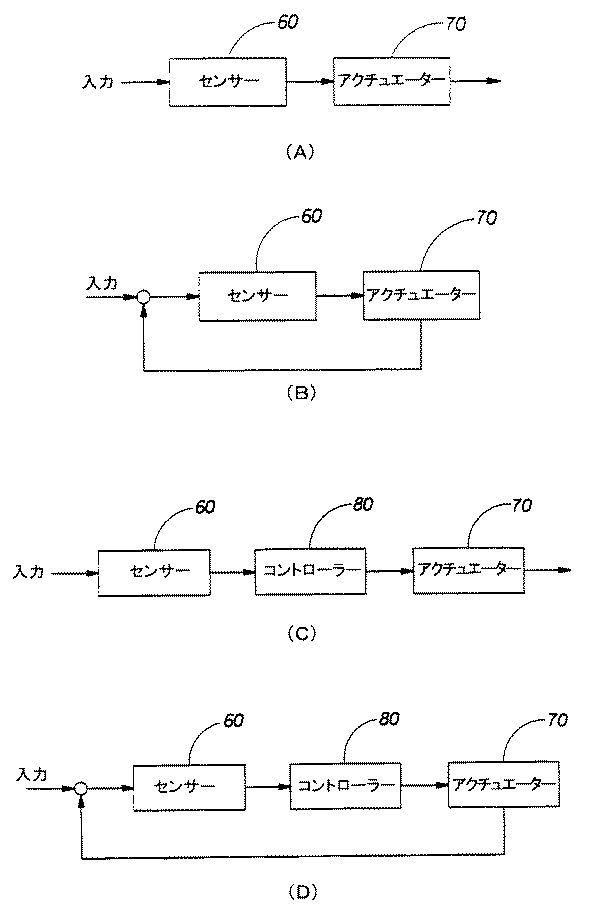
センサー60およびアクチュエーター70を有する代表的開ループ反応システムのブロック図は図6の(A)に示されている。センサー60、アクチュエーター70およびコントローラー80を含有する代替開ループ反応システムのブロック図は図6の(C)に示されている。センサー60およびアクチュエーター70を有する代表的閉ループ反応システムのブロック図は図6の(B)に示されている。センサー60、アクチュエーター70およびコントローラー80を含有する代替閉ループ反応システムのブロック図は図6の(D)に示されている。
【0067】
本発明は、開ループもしくは閉ループのいずれかを含む機械的アクチュエーターを有する不連続反応システムを含むことができる。さらに、本発明はまたフィードバック制御ループ(すなわち、閉ループシステム)を備える機械的アクチュエーターを有する連続反応システムを含むことができる。これらのタイプの反応システム各々は技術において知られている連続開ループ反応システムより優れた明確な長所を提供する。
【0068】
本発明の1つの実施形態は、圧力差別化装置91によって圧縮状態に保持されている弾力性材料94を備える排泄物隔離装置90を含む。ここで使用する圧力差別化装置は、弾力性材料を圧縮状態で維持できる(例えば、圧縮された弾力性材料94上に抑制圧力を提供することによってエネルギーを貯蔵できる)いずれかの装置もしくは構造である。「圧縮状態」は、材料が抑制されておらずゼロ適用圧力下で有するであろう容積より小さい容積で維持されている状態であると定義されている。弾力性材料に関しては、圧縮状態は一般に材料の表面に圧力を適用すること、または技術において知られている他のいずれかの手段によって概して達成できる。圧力差別化装置は、例えば真空密封バッグまたは弾性もしくは非弾性のバンドもしくはストランド、ストリップ、フィルム、不織布、スクリム、またはフォームのような弾力性材料を抑制する張力がかけられる材料を備えることができる。好ましくは、圧力差別化装置91によって維持される弾力性材料の圧縮は、トリガー機構によって少なくとも部分的に低下させることができる(すなわち、圧縮された弾力性材料94は少なくとも部分的に拡張することができる)。トリガー機構は、圧力差別化装置91における圧力の均等化が生じるように作用して圧縮された弾力性材料94を少なくとも部分的に拡張させるように入力に反応する例えばセンサー、アクチュエーター、もしくはそれらの組み合わせのような要素もしくは装置である。
【0069】
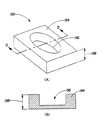
排泄物隔離装置90は、拡張させられたときに糞便のような排泄物を捕捉して装着者の皮膚から排泄物を取り除いて貯蔵できるように装着者の肛門に隣接させて製品20に配置することができる。この実施形態では、可溶性バッグが糞便水分に反応し、さらに排泄物隔離装置が糞便水分に反応して糞便を捕捉する場合は反応システムは不連続閉ループ反応システムを備えるが、それは閾値レベルの入力が存在するときにこのシステムが感知された入力上に不連続方法で作用するためである。しかし、可溶性バッグが尿に反応する場合は、反応システムは不連続開ループシステムを備えるが、それは反応システムが入力以外の何かの上に作用する、すなわちシステムが尿の代わりに糞便を捕捉するからである。そうした実施例は、尿が沈降すると思われる製品20の部分に可溶性シール99を置くことができる図11に示されている。あるいはまた、弾力性材料94は、それが拡張するにつれて本体内に液体を引き出すことによってポンプ機能を果たす吸収性材料であってもよい。例えば図10の(A)〜図10の(C)に示されているように、上記の高多孔質の大きなセルの弾力性フォーム394は、少なくとも可溶性部分392および不溶性基材393を有するフィルム、エンベロープ、バッグもしくはカプセルに圧縮して含有されている場合がある。図10の(A)は本発明の機械的ポンプの実施例を示している。図10の(B)は構造上の糞便を示しており、さらに図10の(C)は糞便が吸収された後の構造を示している。好ましくは圧縮フォームを備える各セルは個別に真空下で保持されている。尿、月経もしくは糞便水分のような液体が可溶性フィルムに接触すると、フィルムは溶解してセル内の圧縮フォームを糞便に接触させて拡張させ、拡張するにつれて液体をフォーム内に引き込む。ある実施形態では、吸収性材料は上に重なった排泄物についての吸引を維持するためにセル壁399によって個別に密封された真空である複数のセルを含むことができる。この実施形態では、反応システムが可溶性材料によって検出された液体をポンプ機能で吸引する場合は、反応システムは不連続閉ループ反応システムを備えるが、それはこのシステムがセンサーによって検出された入力上に作用するためである。
【0070】
図1〜3に示されている本発明の実施形態では、圧力差別化装置91は外側87および内部チャンバー88を含むバッグ92を備えている。バッグ92の少なくとも1部分は好ましくは水溶性であり、トリガー機構89として機能する。好ましくは、弾力性材料94は真空圧縮下で圧力差別化装置91の内部チャンバー88内に保持されている。すなわち、弾力性材料94の1部分は圧力差別化装置91によって少なくとも部分的圧縮状態で維持されている。好ましい実施形態では、内部チャンバー88内の圧力は周囲圧力より低く、それによって弾力性材料94を少なくとも部分的圧縮状態で維持するための手段を提供する。この実施形態では、周囲圧力は大気圧である。入力の閾値レベルが到達もしくは感知されると、トリガー機構89は内部チャンバー88内の圧力の増加を引き起こし、圧縮された弾力性材料の少なくとも1部分をその圧縮されていない厚さの少なくとも1部分へ拡張させる。例えば、閾値レベルの水分(すなわち、入力)が水溶性バッグ92もしくはシールの1部分を溶解させて内部チャンバーと周囲圧力との間の圧力差を均等化させると、弾力性材料94が拡張する。
【0071】
弾力性材料は、圧縮もしくは拡張したときにあらゆる適切な形状であってよい。例えば、弾力性材料は、拡張したときに糞便を捕捉するために十分な容積を有する成形ボイドを有する弾力性合成ポリマーもしくはプラスチックフォームであってよい。あるいはまた、弾力性材料94は微孔もしくはマクロポーラスフォーム、ループ構造、スプリング、弾力性ハイロフト不織布、コイル状構造、または低容量制約形状に弾性的に変形された様々な形状の弾力性材料を備えていてよい。さらに、弾力性材料94は同一もしくは相違する材料を備える2種以上の弾力性要素を備えることができる。例えば、弾力性材料94は微孔およびマクロポーラスフォームのような微孔およびマクロポーラス要素の両方を備えることができる。いずれの場合にも、弾力性材料の個別弾力性要素は少なくとも部分的に重複している、接しているもしくは接触していない、または完全に相互から離れていることを含むいずれかの適切な方法で構成されてよい。
【0072】
図2および3に示されている排泄物隔離装置90の実施形態では、弾力性材料94は圧縮されて圧力差別化装置91(例、バッグ92)内に保持されることが可能であり、さらに拘束力の解放後には好ましくは少なくとも約75%の最初の高さの実質的比率を回復することができるように適切な圧縮および復元特性を有するいずれかの弾性的に変形可能なフォームを備えることができる。バッグ92の少なくとも1部分は可溶性領域または可溶性シールを備えることができる。可溶性シールはバッグ92と統合されていても(例、バッグ92材料の1部分)、または個別要素(例、バッグ92における穴もしくは透過性領域の上方に付着させられた可溶性材料)であってもよい。可溶性領域またはシールは、水、尿、糞便酵素等に接触すると溶解することができる。バッグ92は、好ましくはバッグ92の可溶性領域の1部分が不連続的に真空およびそれによって圧縮された弾力性材料94における貯蔵エネルギーを放出するために十分な程度溶解する(すなわち、閾値レベルの水が検出される)まで真空圧縮下で弾力性材料94を保持する。フォームはまたいったん拡張すると、好ましくは例えばフォームが有意には、好ましくは約50%未満には圧縮しないように、さらに乳児が装置上に座った場合に捕捉された排泄物を放出しないように、乳児の体重に抵抗するために十分に剛性である。例えばSIF/210PP1と識別されるペンシルバニア州エディストーンに所在のFoamex CorporationまたはMC 1900 EVA 2 lb/ft3と識別されるマサチューセッツ州ハイアニスに所在のSentinel Products Corporationから入手可能なEVAフォーム、または1993年11月9日にDesMaraisらへ発行された「水性排泄物のための吸収性フォーム材料およびそうした材料を含有する吸収性製品(Absorbent Foam Materials For Aqueous Body fluids and Absorbent Articles Containing Such Materials)」と題する米国特許第5,260,345号;1995年2月7日にDyerらへ発行された「水性排泄物のための湿潤するまでは薄い吸収性フォーム材料およびこれを製造するためのプロセス(Thin−Until−Wet Absorbent Foam Materials For Aqueous Body Fluids And Process For Making Same)」と題する米国特許第5,387,207号;および1997年7月22日にDesMaraisらへ発行された「極めて高い水−油比を有する高内相エマルジョンから製造された水性液体のための吸収性フォーム材料(Absorbent Foam Materials For Aqueous Fluids Made From Hight Internal Phase Emulsions Having Very Hight Water−To−Oil Ratios)」と題する米国特許第5,625,222号に記載されているHIPEフォームは、糞便捕捉圧縮材料94として使用することができる。
【0073】
図2に示されているように、圧縮材料94は弾力性材料94が圧縮されているときには開いている開口部96を含む場合がある。弾力性材料94が拡張すると、開口部96は図3に示されているように弾力性材料94の周囲によって取り囲まれる。これによって弾力性材料の開口部の内側で捕捉もしくは被包された排泄物を装着者の皮膚から隔離することができる。あるいはまた、図4に示されているように、弾力性材料94はスペーサーとして作用して製品20内に沈降した排泄物を貯蔵するために十分な容量を有するボイドスペースを提供する開放開口部を有する可能性がある。これによって弾力性材料94は、弾力性材料94が拡張した後は複数回の排泄物噴出を受け入れることができる。
【0074】
上記のように、弾力性材料94は同一もしくは相違する材料を備える2つ以上の個別弾力性要素を備えることができる。例えば、弾力性材料は微孔およびマクロポーラスフォームのような微孔およびマクロポーラス弾力性要素両方を備えることができる。弾力性材料94は、好ましくは糞便貯蔵のための開口部96および尿負荷区域内への延長部を有する(例えば、オハイオ州ハミルトンに所在のPCF Foam Corporationからの1平方インチ当たり20個の孔を有するPG14848T20)マクロポーラス網状ポリウレタンフォームを備える第1弾力性要素を備えることができる。弾力性材料94は、さらに追加して第2弾力性要素(例、上記に引用した米国特許第5,260,345号および第5,625,222号に記載されているような微孔フォーム)を備えることができる。好ましくは、第2弾力性要素第1弾力性要素における開口部96と概して同延性である糞便のための開口部を有し、尿負荷区域以外は、第1弾力性要素の装着者に面する側上に配置されている(しかし、第1弾力性要素が第2弾力性要素の装着者に面する側に配置されている実施形態が予想されている)。第1弾力性要素は、可溶性バッグ92もしくはシールが溶解すると第2弾力性要素の少なくとも1部分への空気の流れを促進するために役立つ可能性がある。これは、好ましくは内側の圧力が周囲圧力と釣り合ってくるに従って少なくとも第2弾力性要素の迅速な拡張を生じさせる。好ましくは、第1弾力性要素(例、マクロポーラスフォーム)における大きな孔は部分的に溶解した残留バッグ材料によって閉塞されることはなく、バッグおよび/または弾力性材料94の残りにおける迅速な圧力平衡化のためのきれいな空気の経路を提供する。
【0075】
弾力性材料の様々な構成要素は、圧縮係数、曲げ係数、厚さ、口径分布、化学組成、多孔性および表面エネルギーを含むいずれかの特性において相互に相違していてもよい。ある非限定的実施例では、第1および第2弾力性要素は各々約50%と約80%の間および約5%と約50%の間の範囲内で約1.0psiの適用圧力下で圧縮することができる。好ましくは、複数構成要素システム中の少なくとも1つの構成要素は約1.0psiの適用圧力下で約25%以下に圧縮する。しかし、構造とは無関係に、弾力性材料の開口部96は、好ましくはその構造がいったん活性化される(例、被包しているフィルムを溶解させる水によって)と約0.1psiの適用圧力下で少なくとも約20立方cmの利用可能な容積を提供する。
【0076】
図14の(A)及び図14の(B)に示されているように、本発明は相互から離れていて直接には接触していない、もしくは相互に直接に接合されているがそれら各々の少なくとも1部分が一緒に真空圧縮下で保持されている2つ以上の弾力性要素294および296を含む排泄物隔離装置290を含むことができる。弾力性要素294および296は、好ましくは圧力差別化装置291内に真空圧縮下で保持される。圧力差別化装置291は、好ましくは外側および内部チャンバー288を含む。圧力差別化装置291の外側287は、好ましくは例えば排尿もしくは排便のような既定イベントが発生するまでは、製品を取り囲む空気の周囲圧より低い圧力で内部チャンバー288を保持する。さらに、排泄物隔離装置290は、好ましくは圧力差別化装置291の内部チャンバー288と周囲圧力との圧力差を解除するまたは少なくとも圧力差を減少させることのできるトリガー機構289を含む。トリガー機構289は、ここで説明されるいずれかのセンサーもしくはアクチュエーターまたはアクチュエーターもしくはセンサーのいずれかの構成要素を含むがそれらに限定されない、圧力差を解除もしくは減少させることのできる技術において知られているいずれかの手段を含むことができる。排泄物隔離装置290が尿によって誘発されるのに適合する実施形態では、トリガー機構289は、それが好ましくは排尿が発生すると思われる場所(すなわち、尿負荷区域)に置かれるように製品内に配置されるか、または装着者が排尿したときもしくはさもなければトリガーの作動を引き起こしたときにトリガー機構が真空を解放できるように尿負荷区域に置かれたセンサーもしくはアクチュエーターと操作可能に結び付けられている。
【0077】
図14の(A)及び図14の(B)に示されている実施形態では、第1弾力性要素296は、好ましくは圧力差別化装置291(例、バッグ292)が壊れて真空が消失すると、圧力平行のための低抵抗性気流経路を提供する材料を備える。ある好ましい実施形態では第1弾力性部材はマクロポーラスフォームを含むが、しかし例えば上記の弾力性材料のような他の弾力性材料も適切な可能性がある。弾力性要素294および296は要素間の領域において圧力差別化装置291における開放経路298を通して操作可能に接続されているので、第1弾力性要素296内へ通過する空気は第2弾力性要素294に向かって流れることができ、第2弾力性要素294およびそれの周囲のあらゆる間隙に空気を充填するための手段を提供する。従って、第2弾力性要素294は第1弾力性要素296の近くでバッグ292の少なくとも1部分が溶解すると拡張することができる。
【0078】
図15の(A)及び図15の(B)に示されているように別の実施形態では、本発明の製品は相互に接する、または少なくとも部分的に重複するように構成された第1弾力性要素296および第2弾力性要素294を含むことができる。第1および第2弾力性要素は、好ましくは上記のように圧力差別化装置291の内部チャンバー288において真空圧縮下で保持される。第1弾力性要素296の少なくとも1部分は、好ましくは第1および第2弾力性要素のいずれかの重複する部分から外向きに配置される。上記のように、排泄物隔離装置290は、好ましくは圧力差別化装置291の内部チャンバー288と周囲温度の圧力差を解除することのできる、または少なくとも圧力差を減少させることのできるトリガー機構289を含む。トリガー機構289は、好ましくは排尿が発生するであろう場所(すなわち、尿負荷区域)に配置されるように製品内に配置されるか、または装着者が排尿したときもしくはさもなければトリガーを活性化させたときにトリガー機構が真空を解放できるように尿負荷区域に配置されたセンサーもしくはアクチュエーターと操作可能に結び付けられている。圧力差が取り除かれると、弾力性要素294および296は容積を増加させることができる。第1もしくは第2弾力性要素の少なくとも1つが空気の通過を容易に許容する開口部を有していて、例えば圧力差装置291を備える可溶性バッグ292もしくはシールの材料によって閉塞されない材料を含有するようにさせることが有益であることが発見されている。好ましい実施形態では、例えば弾力性材料はマクロポーラスフォームを含むことができるが、しかし上記の弾力性材料を含む他の材料も適切な場合がある。
【0079】
図16に示されているようなさらに別の実施形態では、本発明の製品は上記のような排泄物隔離装置290へ操作可能に接続された閉システム液体輸送部材299を備えるトリガー289を含むことができる。閉システム液体輸送部材299は、好ましくは流入ポート281、流出ポート282および液体283を含む。流出ポートは、好ましくは可溶性バッグ292もしくは可溶性シールのような圧力差別化装置291の少なくとも1部分に隣接して配置されている。流入ポート281は、好ましくは流出ポート282とは相違する場所に配置されている。例えば、流入ポート292は、好ましくはそれがその中に排泄物隔離装置290が組み込まれている製品の尿もしくはその他の排出区域もしくはその近くの場所に位置するように配置される。従って、装着者が排尿もしくはさもなければ液体を排泄したときには、液体は流入ポート281内に受け入れられる。その結果として、閉システム液体輸送部材299は流出ポート282から幾らかの液体を放出し、これが可溶性バッグ292もしくはシールの少なくとも1部分の溶解を誘発する。いったん溶解すると、バッグ内の圧力差は減少もしくは排除され、弾力性材料295は拡張することができる。
【0080】
可溶性バッグを利用する本発明のいずれかの実施形態では、可溶性バッグは例えば水、尿、糞便酵素、pHレベルその他のような1種以上のタイプの入力が存在する場合に可溶性であり、さらにバッグを溶解させるために必要なその入力の閾値レベルを設定するように設計できる物理的および/または化学的特性(例、厚さ)を有することができる。可溶性バッグは、例えばMONOSOL M7030、M7031、M8630、M8534、またはE6030フィルムとしてイリノイ州サウスホランドに所在のChiris−Craft Industrial Products社によって、またはHL 1636もしくはHL 1669−Xとしてミネソタ州セントポールに所在のH.B.Fuller Companyによって供給されるPVAフィルムのような水に溶解性のプラスチックフィルムを備えることができる。例えば、フィルムの厚さはまた望ましい活性化を提供するために変更することができる。使用されるフィルムは、例えば約0.0005〜約0.0015インチの範囲内の厚さを有することができる。例えば約0.001インチの厚さを有するHL 1636フィルムは1平方インチ当たり約0.049gの含水量で活性化するであろう。
【0081】
本発明の一部の実施形態では、排泄物隔離装置は非調節型不連続反応システムとして作動する場合がある。例えば、可溶性バッグが使用される場合は、バッグの可溶性部分は特定入力に反応するセンサーとして機能する。センサーは、例えば尿中の水または糞便中の酵素に反応することができる。バッグのいずれかの可溶性部分が尿、糞便水分、または糞便酵素に接触すると、バッグの可溶性部分が溶解して圧縮材料を放出し、これが拡張して製品上に置かれた糞便を捕捉する、取り囲む、または包み込む。バッグを形成するために使用された材料の物理的および化学的特性が入力の閾値レベルを限定し、いつ圧縮材料が放出されるのかを決定するコントローラーとして作用する。バッグが溶解すると、真空の解放および圧縮材料の拡張が排泄物を捕捉するためのアクチュエーターとして機能する。従って、排泄物隔離装置は、所定入力の閾値レベルが検出されたときに圧縮材料の貯蔵機械的エネルギーを放出する1回限り不連続スイッチとして作用する。反応システムの有用なエネルギーには次が含まれる:(貯蔵エネルギー)−(ヒステリシス損失)。使用される圧縮材料は、好ましくは最小のヒステリシス損失および最高の復元力を有する。より好ましくは、圧縮性ヒステリシス損失は、放出後の復元が少なくとも約75%であるように約25%未満である。
【0082】
本発明はさらにまた開ループ反応システムまたはフィードバック制御ループ反応システムを備えることもできる。ある実施形態では、シールが尿と接触するであろう製品の1部分に配置されている可溶性シールを含む可溶性バッグを使用することができる。シールが尿中で溶解して装置が糞便を捕捉する場合は、例えば反応システムは開ループシステムを備えるが、それはシステムの出力、すなわち製品の表面上および/または装着者の皮膚に隣接して存在する糞便は入力、すなわち尿に影響を及ぼさないからである。しかしバッグが糞便水分もしくは糞便酵素に反応する場合は、反応システムはフィードバック制御ループを備えるが、それはこのシステムは出力の尺度、すなわち製品の表面上および/または装着者の皮膚に隣接して存在する糞便を、その糞便を捕捉するもしくは取り囲むための機能のトリガーとして使用するためである。この実施例では、フィードバック制御ループ反応システムは非調節型であるが、それはこれが1回限りスイッチとして作用し、出力に対する望ましい設定点レベルを維持するために入力を連続または反復的に変化させないからである。
【0083】
本発明の別の実施形態では、上記の実施例で記載されているようなフォームまたは別の弾力性材料は、ねじり機械的ポテンシャルエネルギーを作り出すために捻れさせ、上記の可溶性フィルムエンベロープ、バッグもしくはカプセルに封入することができる。好ましくはねじり弾力性材料は、圧力差別化装置のような可溶性フィルム、エンベロープ、バッグもしくはカプセル内においてねじれ位置で圧縮して保持される。この実施形態では、水分、pH等の閾値レベルが検出されたときに、圧力差別化装置が不連続的に真空を解放する、さらに従ってフォームを解放するように誘発される。貯蔵ねじり機械的ポテンシャルエネルギーはフォームが巻き戻ることを惹起し、糞便、尿もしくは月経のような排泄物を貯蔵すること、捕捉することもしくは封じ込めること、装着者の皮膚を拭き取ること、装着者の皮膚に皮膚処置剤を適用すること等のような反応機能を実行することができる。この実施形態では、反応システムは非調節型不連続反応を提供する。システムが入力以外のものに作用する、すなわちシステムが装着者の皮膚に作用する場合は、この反応システムは開ループシステムを備えている。しかし、システムが入力に作用する場合、例えばトリガーが糞便水分もしくは糞便酵素に反応してねじり弾性材料が糞便を「コルクスクリュー」作用によって輸送する場合は、このシステムは閉ループシステムを備えている。
【0084】
別の実施形態では、電気的センサーが差し迫った排尿および/または排便を予測するために装着者の外肛門括約筋の電気的活性における変化を検出することができる、すなわち先行型センサーである。筋肉の電気的活性における閾値信号低下を検出すると、センサーもしくはコントローラーは例えば差し迫った排尿および/または排便の排泄物を捕捉する準備として上記のような真空圧縮で圧縮フォームを保持しているバッグの水溶性部分もしくはシールを溶解させる目的で水を放出するために弁の開口を誘発することができる。あるいはまた、スイッチは糞便が皮膚に接触する前に皮膚表面を処置するためにスキンケア組成物の放出もしくは送達を実効することができる。この実施形態では、反応システムは電気的活性が閾値信号レベルに到達したときに装着者の外肛門括約筋の電気的活性に反応する不連続システムを備える。この反応システムもまた開ループシステムを備えるが、それはこのシステムが電気活性入力信号以外のものに作用する、すなわち糞便もしくは製品に作用するからである。
【0085】
さらにまた別の実施形態では、本発明の反応システムは上記のフォームのような弾力性材料内に含有されるpH調節剤を備えることができる。弾力性材料は、下方もしくは前定義されたpH(例えば約6.0未満のpH)では不溶性、すなわち固体であるが、そのpHレベルより上方では可溶性であるpH感受性フィルムを含む圧力差別化装置によって真空下に拘束することができる。閾値以上のpHレベルを検出すると、フィルムは溶解して弾力性材料の貯蔵圧縮ポテンシャルエネルギーを放出し、これがpH調節剤を送達する。あるいはまた、酵素阻害剤、スキンケア組成物等もまた圧縮弾力性材料内に含有することができる。フィルムは、あるいはまた1つ以上の糞便酵素、水等の存在下で可溶性である場合がある。代表的pH感受性材料は技術において知られており、ポリアクリルアミド類、フタレート誘導体類、定型化ゼラチン、セラック、ケラチン、例えば酸化セルロースのようなセルロース誘導体類、およびポリアクリル酸誘導体類を含む。好ましい材料には酢酸セルロースフタレート、酢酸ビニル、ポリ酢酸ビニルフタレート、ヒドロキシプロピルメチルセルロースフタレートならびにアクリル酸およびアクリルエステルコポリマーと混合されたポリメタクリレートが含まれる。その他の代表的材料は、参照してここに組み込まれる「pH誘発性浸透圧破裂送達装置(pH Triggered Osmotic Bursting Delivery Devices)」と題する欧州特許第612,520A2号に記載されている。
【0086】
上記のpH感受性送達実施形態では、反応システムは閾値pHレベルに到達した後にpHレベルに作用するフィードバック制御ループを有する不連続もしくは連続のどちらかの反応システムを備えることができる。これらの実施形態は調節型または非調節型のいずれであってもよい。例えば送達されるpH調節剤がpH上昇およびpH低下構成要素両方を含有する緩衝剤を備える場合は、このシステムは製品内のpHレベルを継続的に監視してpHが上昇しても低下してもpHレベルを望ましい設定点または緩衝剤の標的範囲内に維持するであろう調節型フィードバック制御ループシステムを備える。しかし、例えばこの反応システムが第1pH閾値レベルでpH上昇剤だけを送達する場合は、このシステムは非調節型フィードバック制御ループシステムを備えるが、それはその物質が消費し尽くされてシステムのpHを望ましいpHレベルまたは標的pH範囲内に維持しなくなるまではpH低下剤がシステムのpHを低下させるであろうからである。しかし、製品内に置かれる排泄物がpHレベルを上昇させることがわかっていて、システムが製品内のpHレベルが閾値pHレベルに達する度に予定量のpH低下剤を送達する場合は、このシステムは製品のpHがシステムの望ましい設定点の上方にある限り常にpH調節剤を反復して放出する場合には調節型フィードバック制御ループシステムを備える可能性がある。
【0087】
別の実施形態では、電解質水が回路を完成したとき、すなわちスイッチとして機械的アクチュエーターを始動させるために電池のような貯蔵エネルギー源からの電流を惹起したときに十分な量の水含有電解質(例、尿もしくは糞便から)が電気的センサーによって検出される可能性がある。例えば、電流が電気感受性ゲルに適用されてそれが形状を変化させて製品内に糞便のためのボイドスペースを作製することを惹起することがある。同様に、この実施形態は感知される入力が反応システムによって影響を受けるかどうかに依存して開ループもしくはフィードバック制御ループシステムである不連続反応システムを備えている。例えばセンサーが尿中の水分を検出する場合は、糞便を受け入れるためのボイドスペースを作製する反応システムは開ループシステムを備えている。しかしセンサーが糞便水分を検出する場合は、反応システムはフィードバック制御ループシステムを備えているが、それはこのシステムが感知される入力に作用するためである。この実施例では、フィードバック制御ループシステムはさらにボイドスペースが糞便と一緒に糞便水分を捕捉する場合は調節型システムを備える可能性があり、水分は蒸発する、またはセンサー要素から吸引され、それによって回路を開き、さらにコントローラーはセンサーが糞便水分を再び検出すると別のボイドスペースを活性化させる。
【0088】
本発明のまた別の実施形態では、液体を吸収したときに膨潤する吸収性材料を膨潤の閾値レベルが発生したときに電気回路を完成させるために1対の電気接点を機械的に閉鎖するセンサーとして使用することができる。この実施形態では、電気回路は不連続方法でアクチュエーターを誘発して排泄物、装着者、製品またはそれらのいずれか1つ以上の構成要素上で反応機能を実行させることができる。例えば、アクチュエーターは液体が製品の別の部分へ流れることができるように弁を開放し、液体を製品の別の部分へポンプで送り出し、電気的感受性に作られたボイドスペースにおける形状変化を開始させ、スキンケア組成物、pH調節剤もしくは消臭剤等を送達することができる。
【0089】
繊維、フィルム、不織布または他のセル構造のような材料もまた糞便のような排泄物、またはその排泄物の構成要素に反応する材料によって所定形状に拘束することができる。排泄物が拘束材料に接触すると、拘束材料は排泄物を捕捉するまたは装着者の皮膚から引き離すために繊維、フィルム、不織布または他のセル構造を解放することができる。例えば弾性バリヤーは製品内のボイドスペースから離れた2つの拘束点で尿、糞便水分もしくは糞便酵素に反応して溶解するもしくは弱化する等の材料によって拘束することができる。糞便がボイドスペース内に沈降させられ、さらに一方または両方の拘束点で拘束材料が溶解すると、弾性バリヤーは不連続方法で糞便に接触して装着者の皮膚から隔離するためにボイドスペースを被覆することができる。
【0090】
さらにまた別の実施形態では、皮膚を処置するための酵素阻害剤を送達するために1種以上の糞便酵素を例えば酵素変性フィルムもしくはカプセルのようなセンサー、または例えば電気的作動弁のような個別アクチュエーターを誘発するための上記のようなバイオセンサーによって検出することができる。代表的酵素阻害剤は、参照してここに組み込まれる1998年3月12日に出願された「酵素阻害剤を含有するスキンケア組成物を有する使い捨て吸収性製品(Disposable Absorbent Article Having A Skin Care Composition Containing An Enzyme Inhibitor)」と題する米国特許出願第09/041,266号に開示されている。さらにまた別の実施形態では、一定pH状態はpH感受性ゲルの使用によって検出することができ、これは皮膚を処置するためのpH調節剤を送達するために弁を開放することができる。別の実施形態では、事前定義圧力閾値が検出され、カプセルもしくは「バブル」の破裂を生じさせ、スキンケア処置剤もしくは組成物の送達を実行する。代表的スキンケア組成物(もしくはローション)は、1997年3月4日にDonald C.Roeへ発行された「皮膚軟化剤および多価アルコール系ポリエステル固定剤を含有するローション含有トップシートを有する使い捨て吸収性製品(Disposable Absorbent Article Having A Lotioned Topsheet Containing An Emollient And A Polyol Polyester Immobilizing Agent)」と題する米国特許第5,607,760号;1997年3月11日にDonald C.Roeへ発行された「液体多価アルコール系ポリエステル皮膚軟化剤および固定剤を含有するローション含有トップシートを有するおむつ(Diaper Having A Lotioned Topsheet Comprising A Liquid Polyol Polyester Emollient And An Immobilizing Agent)」と題する米国特許第5,609,587号;1997年6月3日にDonald C.Roeへ発行された「ポリシロキサン系皮膚軟化剤を含有するローション含有トップシートを有するおむつ(Diaper Having A Lotioned Topsheet Containing An Polysiloxane Emollient)」と題する米国特許第5,635,191号;および1997年7月1日にDonald C.Roeへ発行された「ローション含有トップシートを有するおむつ(Diaper Having A Lotioned Topsheet)」と題する米国特許第5,643,588号ならびに各々1997年9月10日に出願された米国特許出願第08/926,532号および第08/926,533号に開示されており、上記の特許および特許出願各々は参照してここに組み込まれる。
【0091】
本発明の特定の非限定的実施形態および実施例および/または個別の特徴が例示かつ説明されてきたが、当業者には本発明の精神および範囲から逸脱することなく他の様々な変更および修飾を加えることが可能であることは明白であろう。さらに、そうした実施形態および特徴の全ての組み合わせが可能であり、本発明の好ましい履行を生じさせ得ることは明白である。このため、添付のクレームは本発明の範囲内に含まれる全てのそうした変更および修飾を含むことが意図されている。同様に、本発明は主として使い捨ておむつに関して図示かつ説明されているが、本発明はこの実施形態には限定されていない。本発明はさらにまた、例えば使い捨ておむつの適用前に、または使い捨ておむつの代わりにプルオン(引っ張ってはく)型おむつ、おむつインサート、生理用ナプキン、タンポン等において装着者に直接に適用される製品に使用することもできる。このため、添付のクレームにおいては本発明の範囲内にある全てのそうした変更および修飾を含むことが意図されている。
【0092】
本明細書には本発明を特別に指摘し、かつ明確に請求している特許請求の範囲が記載されているが、本発明は添付の図面と結び付けられている上記の説明を読むことによってより明確に理解されるであろうと考えられる。
【図面の簡単な説明】
【図1】製品の構成をより明確に示すために切り取られている構造の部分とともに平たく広げられた状態にある本発明に従って製造された製品の平面図であり、このとき本製品はおむつである。
【図2】図2の(A)は、活性化前の圧縮状態にある本発明の排泄物隔離装置の斜視図であり;そして、
図2の(B)は、図2(A)の線B−Bに沿って切り取られた断面図である。
【図3】図3の(A)は、活性化後の図2の(A)の1つの実施形態の斜視図であり;そして、
図3の(B)は、図3(A)の線B−Bに沿って切り取られた図3の(A)の断面図である。
【図4】図4の(A)は、活性化後の図2の(A)の代替実施形態の斜視図であり;そして、
図4の(B)は、図4の(A)の線B−Bに沿って切り取られた図4の(A)の断面図である。
【図5】水溶性カプセルを含む本発明の実施形態の斜視図である。
【図6】図6の(A)は、代表的開ループ反応システムのブロック図であり;
図6の(B)は、代表的閉ループ反応システムのブロック図であり;
図6の(C)は、コントローラーを含む代表的開ループ反応システムのブロック図であり;そして、
図6の(D)は、コントローラーを含む代表的閉ループ反応システムのブロック図である。
【図7】図7の(A)は、単一閾値レベルを有する本発明の不連続反応システムの理想的出力関数を示しており;そして、
図7の(B)は、複数閾値レベルを有する本発明の不連続反応システムの理想的出力関数を示している。
【図8】図8は、出力関数の一次、二次および三次導関数と一緒に本発明の不連続反応システムの代表的出力関数を示している。
【図9】均等時間定数を有する一連の一次ラグを有する制御システムの伝達関数を示している。
【図10】図10の(A),(B),(C)は、本発明の機械的ポンプを含む反応システムの実施形態の断面図である。
【図11】本発明の排泄物隔離装置の代替実施形態の斜視図である。
【図12】本発明の排泄物バッグ実施形態の斜視図である。
【図13】排泄物バッグを含む吸収性製品の斜視図である。
【図14】図14の(A)は、代表的排泄物隔離装置の拡大平面図であり;そして、
図14の(B)は、区分線B−Bを通って切り取られた図14の(A)に示されている装置の断面図である。
【図15】図15の(A)は、代表的排泄物隔離装置の拡大平面図であり;そして、
図15の(B)は、区分線B−Bを通って切り取られた図15の(A)に示されている装置の断面図である。
【図16】本発明の排泄物隔離装置の代替実施形態の断面図である。[0001]
(Field of Invention)
The present invention relates to a disposable product adapted to have a reaction system. In certain embodiments, the present invention provides a compressed vacuum sealed resilient material comprising a plurality of components adapted to perform a reaction function on excrement, wearer, product or one or more components thereof. It is related with the disposable product which has the excrement isolation device containing.
(Background of the Invention)
Currently, disposable products such as diapers, adult urinary incontinence pants, sanitary napkins and tampons are widely used as a means to contain, isolate and dispose of excreta in the care of infants and the care of adult urinary incontinence. ing. These products have generally replaced reusable and selectable fabric apparel as a preferred means for these applications because of their convenience and certainty.
[0002]
Although the field of disposable products for both infants and adults has made many advances, it has become more popular than traditional fabric apparel, but there are still a number of problems. Exists. Among the problems that these disposable products have experienced are particularly important: leakage of excretions (eg, urine, feces, menstruation), skin rashes and irritation, contamination of a wide area of the wearer's skin by feces, feces It is difficult to remove the excrement neatly, the odor of the excrement, and the special tailoring (eg, fit) that cannot be tailored to the individual.
[0003]
Various attempts have been made to address these issues. For example, superabsorbent polymers have been used to increase the ability of absorbent products to absorb and retain urine. Barrier leg cuffs have also been used to improve fit and reduce leakage. For example, on January 14, 1975, Kenneth B.C. US Pat. No. 3,860,003 entitled “Contractible Side Portions for Disposable Diaper” issued to Buell is an elasticized leg cuff that has been widely accepted and achieved commercial success. Disposable diapers with stickers are listed. Disposable products have also used pockets, barriers, etc. to contain stool and prevent leakage from the product. For example, on September 22, 1987, Michael I. U.S. Pat. No. 4,695,278 issued to Lawson entitled “Absorptive Article Having dual Cuffs”; U.S. Pat. No. 4,795,454 issued to Dragoo entitled Absorbent Article Having Leakage-Resistant Dual Cuffs; and July 30, 1996 to Dreier See published US Pat. No. 5,540,671 entitled “Absorptive Article Having A Pocket Cuff With An Apex”. Selective expandability or expandability activated in use or in response to topsheet replacement to improve activating liquid or fit, such as water or urine, to provide fecal void space Disposable products having components have also been disclosed. For example, on July 19, 1994, Gary D.C. U.S. Pat. No. 5,330,459 issued to LaVon et al. Entitled "Disposable Absorbent Articulate Having an Inflatable Spacer" and May 28, 1996, Gary D. et al. U.S. Pat. No. 5,520,674 entitled “Disposable Absorbent Articulated Haven Expandable Component” issued to LaVon et al. Is scalable at the time of use. Or a disposable absorbent product is described having a component that expands in response to an activating liquid such as water or urine. However, these expandable components may require action by the caregiver to activate or continue to act on the component or because expansion is proportional to the amount of liquid activator. The problem is that either too much liquid activator is needed to fully expand. Furthermore, self-shrinking leg gathers that react with activating liquids such as water or urine have also been disclosed. See, for example, U.S. Pat. No. 4,246,900 entitled "Diaper Including Moisture-Reactive Seal Means" issued to Friedric H-Wilhelm Schroder on Jan. 27, 1981. Similarly, these self-shrinking gathers also require action by the caregiver to activate or continue to act on the component or the contraction is proportional to the amount of liquid activator Therefore, there is a problem in that it requires too much liquid activator in order to completely contract.
(Summary of Invention)
The present invention includes a mechanical actuator that includes excreta (eg, to isolate it), excretory components (eg, to inhibit enzyme activity of excrement), or wearer's pressure, movement, etc. It is directed to a disposable product having a reaction system that acts in response to an input such as an action or condition (eg, to lubricate the skin, etc.). The reaction system of the present invention may comprise either a discontinuous reaction system or a continuous reaction system. However, if the reaction system comprises a continuous reaction system, the system of the present invention must also include a closed loop system. In another embodiment, the present invention is directed to disposable products such as diapers, urinary incontinence pants, diaper holders and / or inserts, training pants, feminine sanitary garments, tampons and the like, where disposable products are preferred. Includes a waste isolation device. The waste sequestration device preferably includes a pressure differentiating device having an outer and at least one internal chamber, wherein the pressure differentiating device is capable of maintaining the internal chamber at a pressure lower than ambient pressure. The waste sequestration device preferably includes at least two resilient elements disposed in the internal chamber of the pressure differentiating device and held under vacuum compression.
(Detailed description of the invention)
As used herein, the term “absorbent product” relates to a device that absorbs and contains excreta, and more particularly, contacts the wearer's body to absorb and contain various excretions excreted from the body. It relates to a device that is placed in or near. The term “disposable” is generally not intended here to be laundered or otherwise reconstituted or reused (ie, they are discarded after use and preferably recycled, composted or Used to describe absorbent products (otherwise intended to be disposed of in an environmentally compatible manner). (As used herein, the term “arranged” means that the element of the diaper is formed in a specific location or position as an integral structure with other elements of the diaper or as individual elements joined to another element of the diaper. The term “joined” as used herein means that one element is directly attached to another element. The element is indirectly fixed to the other element by attaching the element to the shape in which the element is directly fixed to the other element, and thereby attaching the element to an intermediate member that is in turn attached to the other element. "Integrated" absorbent product forms a harmonized entity that does not require separately operable parts such as separate holders and liners Together mean an absorbent article formed from the combined individual parts to. One preferred embodiment of the absorbent product of the present invention is an integral disposable absorbent product which is the
[0004]
FIG. 1 is a plan view of a
[0005]
The
[0006]
The
[0007]
The
[0008]
The
[0009]
A suitable molded film topsheet is U.S. Pat. No. 3,929,135, issued to Thompson on Dec. 30, 1975, entitled “Absorptive Structures Having Tapered Capillaries”; 1982. U.S. Pat. No. 4,324,246 entitled “Disposable Absorbent Artistic Having A Stain Resistant Topsheet” issued to Mullane et al. “Resilient Plastic Web Exhibiting Fib” published on March 3 to Radel et al. US Pat. No. 4,342,314 entitled “r-Like Properties”; issued to Ahr et al. on July 31, 1984, “Massively expanded three-dimensional showing non-glossy visible surface and cloth-like feel” U.S. Pat. No. 4,463, issued on May 4, 1991, entitled "Macroscopically Expanded Three-Dimensional Plastic Web Exhibiting Non-Glossy Visible Surface and Close-Like Tile Impression"; US Pat. No. 5,006,394 entitled “Multilayer Polymeric Film”. Other
[0010]
Preferably, the
[0011]
Any portion of the
[0012]
Topsheet 24 and
[0013]
[0014]
The shape and configuration of the
[0015]
An exemplary absorbent structure for use as an absorbent core is U.S. Pat. No. 4,610, entitled “High-Density Absorbent Structures,” issued September 9, 1986 to Wesiman et al. No. 4,673,402, issued to Wesiman et al. On June 16, 1987, entitled “Absorbent Articles With Dual-Layered Cores”; "High Density Absorbent Members Higher Density and Lower Basis Weigness with Low Density and Low Basis Weight Collectable Areas" issued to Alamey et al. United States Patent No. 4,834,735 entitled “ht Acquisition Zones”; United States entitled “Absorbing Core Having A Dusting Layer” issued to Angstadt on December 19, 1989 Patent No. 4,888,231; issued to Herron et al. On Aug. 11, 1992, “Absorptive Structure Containing Structural Polycarbonate Acidic Acid Containing Absorbent Structure Crosslinked Wood Pulp Cellulose Fiber US Pat. No. 5,137,537 entitled “Crosslinked Wood Pull Cellulose Fibers”; 1992 U.S. Pat. No. 5,147,345 entitled “High Efficiency Absorbent Articles for Intention Management” issued to Young et al. On May 15; August 30, 1994 US Pat. No. 5,342,338 entitled “Disposable Absorbent Articulate for Low-Viscosity Fetal Material” issued to Roe on Dec. 9, 1993; DesMarais et al. "Absorbent Foam Materials For Aquao" and "absorbent foam materials for aquatic waste materials and absorbent products containing such materials" US Pat. No. 5,260,345 entitled “Body Fluids and Absorbent Articles Containing Stain Materials”; issued to Dyer et al. US Pat. No. 5,387,207, entitled “Foam Material and Process for Manufacturing the Same (Thin-Until-Wet Absorbent Foam Materials For Aqueous Body Fluids And Making For Making Same)” Issued to DesMarais et al. "Absorptive foam material for aqueous liquids (Abso) made from high internal phase emulsions with very high water-oil ratios" bent Foam Materials For Aqueous Fluids Made From Hight Internal Phase Emulsions Having Very Hight Water-To-Oil Ratios) "as being entitled described in U.S. Patent No. 5,625,222. Each of these patents is incorporated herein by reference.
[0016]
The
[0017]
[0018]
The
[0019]
The
[0020]
The
[0021]
[0022]
Embodiments of the present invention are further disposed in a diaper, a pocket for receiving and containing excrement, a spacer providing a void for excrement, a barrier for limiting excrement transfer within the product, It can also include compartments or voids that receive and contain excreta, or any combination thereof. Examples of pockets and spacers for use in absorbent products are disclosed in US Pat. No. 5,514, entitled “Diaper Having Explosive Spacer” issued May 7, 1996 to Roe et al. , 121; U.S. Pat. No. 5,171,236, issued December 15, 1992 to Dreier et al. Entitled “Disposable Absorbent Article Having Core Spacer”; US Pat. No. 5,397,318 entitled “Absorptive Article Having A Pocket Cuff” issued to Dreier on May 14; 1996 U.S. Pat. No. 5,540,671, issued July 30 to Dreamer entitled "Absorptive Article Having A Pocket Cuff With An Apex"; and 1993, 12 “Spacers For Use In Hygiene Absorbent Artis And Disposable Absent Abstracts Artificial Sachet”, published on March 3rd. WO 93/25172; and “Disposable Absorbent Products” issued to Freeland on April 26, 1994 Flexibility spacer for have been used are described in (Flexible Spacers For Use In Disposable Absorbent Articles) entitled "U.S. Patent No. 5,306,266. An example of a compartment or void is US Pat. No. 4,968,312 issued to Khan on November 6, 1990 entitled “Disposable Fecal Compartmenting Diaper”; February 5, 1991 U.S. Pat. No. 4,990,147 issued to Freeland, entitled “Absorptive Article With Elastic Liner For Waste Material Isolation”; November 5, 1991 U.S. Pat. No. 5,62,480 entitled “Disposable Diaper” issued to Holt et al. On the day; issued to Freeland et al. Trisection topsheet for have discarded absorbent products are described in (Trisection Topsheets For Disposable Absorbent Articles) entitled "U.S. Patent No. 5,269,755. An example of a suitable crossing barrier is a US patent entitled “Absorptive Active Heavy Multiple Transverse Partition” issued on September 10, 1996 in the name of Dreier et al. No. 5,554,142; PCT International Patent No. WO 94/94, entitled “Absorptive Articles Having Up Transversing Partition Partition”, issued July 7, 1994 in the name of Freeland et al 14395; and Roe et al., Issued August 5, 1997, “Absorptive Articles with Upright Cross Sections. Are described in aving Angular Upstanding Transverse Partition) entitled "U.S. Patent No. 5,653,703. All references cited above are hereby incorporated herein by reference.
[0023]
Embodiments of the present invention can also include a
[0024]
The waste bag 111 is preferably a flexible container for containment of excreted feces or urine. Thus, the waste bag 111 is preferably liquid impermeable but may still be breathable. Further, the waste bag 111 is designed with sufficient strength to resist a typical wearing condition such as sitting.
[0025]
The waste bag 111 may comprise one or more layers. In some embodiments, the waste bag 111 can comprise three layers, preferably one film layer and two nonwoven layers. The layer of bag material can preferably comprise any material so that the bag is liquid impermeable. In a preferred embodiment of the present invention, the laminate can be formed from a nonwoven layer and a film.
[0026]
Suitable film material for any film layer preferably comprises a thermoplastic material. The thermoplastic material may be vapor permeable or impermeable and any type of hot melt adhesive, especially polyolefins such as polyethylene, polypropylene, amorphous polyolefins, etc .; such as cellulose wood pulp, cotton, jute hemp Natural fiber: glass fiber, rayon, polyester, polyolefin, acrylic, polyamide, aramid, polytetrafluoroethylene metal, a material containing a synthetic fiber such as polyimide or a material containing a meltable component with a polymer binder; Binders such as two-component high melt / low melt polymers, copolymer polyesters, polyvinyl chloride, polyvinyl acetate / polyvinyl chloride copolymers, copolymer polyamides, which are materials comprising a mixture in which part of the component materials cannot be melted; Air and vapor permeable materials including microporous films as described above with reference to monoliths and monolithic breathables such as HYTREL ™ available from DuPont and Pebax ™ available from ELF Atochem in France You can choose from materials.
[0027]
The waste bag 111 can have any shape or size. Preferred shapes include flat annular bags, cone bags, truncated cone bags and pyramid or truncated pyramid bags and flat T-shaped bags. Further, the waste bag 111 may be the same or different and may be prepared from a single piece of material or multiple individual pieces of material that can be sealed around each of them.
[0028]
The excrement bag 111 may further contain an absorbent material. The absorbent material can comprise any absorbent material that can absorb and retain liquid. The absorbent material may comprise a wide range of liquid absorbent materials commonly used in disposable diapers and other absorbent products. Some examples are described herein with respect to the absorbent core.
[0029]
The waste bag 111 is provided with an opening 121 through which feces or urine can be received from the body before being stored in the bag cavity. The opening 121 is preferably surrounded by a flange 112 and is prepared in any shape or size, for example circular or oblong, and may be symmetric or asymmetric, The opening has an oblong shape in either the longitudinal direction or the transverse direction. The flange can include an overhang designed to fit the wearer's perineum, genitalia and / or coccyx region.
[0030]
The flange 112 must be made of a soft, flexible and adaptable material so that the flange 112 can be easily placed in the perianal or urogenital region. Typical materials include nonwoven materials, woven fabrics, open cell thermoplastic foams, closed cell thermoplastic foams, composites of open cell foam and stretch nonwovens, and films.
[0031]
The waste bag 111 preferably further comprises a joining or attaching means for securing the device to the wearer. Such means may face any wear or attachment means described herein or a wearer of, for example, straps, belts, snaps, ties, hook and loop fasteners, pins, and / or waste bag 111 or flange. Any other joining or attachment means known in the art may be provided, such as a physical synthetic adhesive applied to the part to be attached. Any skin-friendly waterproof pressure sensitive adhesive can be used to attach the device to the wearer's perianal or urogenital region, such as hydrocolloid adhesives and hydrogel adhesives. An adhesive that is particularly effective in providing desirable adhesive properties to secure the flange in the perianal area sensitive to the wearer's skin while allowing for fairly painless application and removal to form a three-dimensional matrix Formed by crosslinking a polymer and a plasticizer.
[0032]
[0033]
As discussed above, the
[0034]
In yet another embodiment, the sensor is a protein as described in US Pat. No. 4,636,474 entitled “Toile Apparatus” issued to Kenji Ogura et al. On January 13, 1987. May be adapted to detect sugars, bile components, etc. In addition, the sensor may be a biosensor known in the art (eg, an enzyme sensor, an organelle sensor, a tissue sensor, a microbial sensor, or an electrochemical sensor). A biosensor can comprise a binding protein such as an antibody immobilized on the surface of a biological recognition system, typically an enzyme or physicochemical transducer. The biosensor can detect excretory components such as ammonia and phenol (eg, by a biosensor with an enzyme electrode). A particular strain of bacteria can be detected by a biosensor that uses antibodies raised against that strain. Representative enzyme electrodes that can be used to detect phenols (eg, urine or feces) include “Remote Electrochemical Sensor” published by Joseph Wang et al. On October 14, 1997, and U.S. Pat. No. 5,676,820 and on February 25, 1992, Anthony P. F. Tyrosinase based electrode or polyphenol described in US Pat. No. 5,091,299 entitled “An Enzyme Electrode For Use In Organic Solvents” issued to Turner et al. An oxidase enzyme electrode is included.
[0035]
The
[0036]
The
[0037]
In the
[0038]
The
[0039]
The
[0040]
For example, triggering the creation of a three-dimensional structure to capture excreta includes a reaction function performed on the product components and ultimately on the excrement. For example, capturing excrement, wiping the wearer's skin or treating the skin with a skin care composition is a reactive function performed on excrement and / or the wearer. Adjusting the shape (one-dimensional, two-dimensional or three-dimensional) or physical properties (eg, bending factor, shape, etc.) of the product is an example of a reactive function that can be performed on the product. However, notifying a caregiver and / or wearer that an event has occurred does not perform a reactive function because it does not perform a function on the excrement, wearer, product, or components thereof. A device that emits a signal requires a material external to the system (eg, human, etc.) that acts as an actuator to cause the function to be performed. Disposable product actuators can deliver, for example, deodorants, enzyme inhibitors, skin care compositions or pH regulators; capture, wipe, coat, adsorb, immobilize, seal, pump excrement Discharge or store by function; or of a structure or element designed to perform one or more of these functions or any other reactive function on excrement, wearer, product or component thereof Release or creation can be triggered.
[0041]
The
[0042]
Alternatively, the
[0043]
In yet another embodiment, the sensor and / or actuator can comprise a closed system liquid transport member. A “closed system liquid transport member” or “transport member” is a liquid filling member having an inflow port and an outflow port, and even if a small amount is received, the liquid is practically immediately discharged into the outflow port. To release from. The liquid discharged from the outflow port can serve as an input signal to the sensor. For example, the liquid may be water, which is released when the transport member absorbs urine at the inlet port, so as to dissolve the seal to release stored mechanical energy to create a fecal void space. Act on. Liquid transport through such transport members is based on direct suction rather than capillary action. The liquid is transported through an area where a significant amount of air (or other gas) does not enter. The driving force for the liquid to flow through such a member can be created by a liquid sink (eg, capillary or osmotic absorbent structure) or a source in liquid communication with the member. Therefore, the liquid transport member must have a fairly high liquid permeability.
[0044]
Within the transport member there are preferably at least two regions with different pore sizes, namely one or more port regions with a small pore size and a region with a much larger pore size. The inner region of the transport member has a considerably higher permeability compared to the permeability of the port region that is part of the outer / wall region surrounding the inner / bulk region (high liquid permeability results in low flow resistance) ) Non-limiting examples of highly porous materials that are suitable for use as inner region materials include polyolefins, PET, fiber structures comprising cellulose and cellulose-based fibers, and open cell foams such as reticulated foams, Cellulose sponges, polyurethane foams, and HIPE foams are included. In some embodiments, the voids in the inner region are filled with an essentially and completely essentially incompressible liquid. The term “essentially and completely” relates to the situation where a sufficient void volume in the inner region is filled with liquid so that a continuous flow path can be established between the inflow port and the outflow port.
[0045]
The port region of the transport member comprises a material that is permeable to the transport gas but not permeable to the surrounding gas (such as air) once wetted by the transport liquid. Often, such materials are described as membranes and are defined as areas that are permeable to liquids, gases, or suspensions of particles in liquids or gases. The membrane can comprise a microporous region that provides, for example, liquid permeability through the capillary. In yet another embodiment, the membrane can comprise a monolithic region comprising a block copolymer through which liquid is transported by diffusion. Exemplary membranes for the port area are described in US Pat. No. 5,108,383, issued to White on 28 April 1992, entitled “Membranes For Absorbent Article”. Cellulose acetate membranes such as those disclosed in European Patent No. A-0451797, nitrocellulose membranes, cellulose nitrate membranes, PTFE membranes, polyamide membranes, and polyesters. Other suitable materials are woven polymer meshes such as polyamide or polyethylene mesh available from Verseidag in Geldern-Waldbeck, Germany or SEFAR in Rüschlikon, Switzerland.
[0046]
The
[0047]
Product embodiments of the present invention may include one or more advanced sensors and one or
[0048]
The
[0049]
The
[0050]
The physical and chemical properties of the film (ie, the type of polymer, thickness, etc. that determines how much input must be present before the film dissolves) acts as the
[0051]
The
[0052]
Although separate structural elements may perform the functions of
[0053]
[0054]
The reaction system of the present invention can react in either “continuous” or “discontinuous” manner. A “continuous reaction system” as used in this patent application is a continuously increasing amount of power in order to affect the amount of input that is quantitatively dependent on the amount of input, ie, continuously increasing amount of output. It means a reaction system where input is required or the output of the reaction system comprises a passive release of storage material. For example, superabsorbent polymers placed in the absorbent core of a product provide a continuous reaction whose output is quantitatively dependent on the amount of input, i.e. more and more liquids until the capacity of the polymer is exhausted As the amount of excreta comes in contact with the superabsorbent polymer, the polymer contains an increasing amount of liquid. Another example of a continuous reaction system is the fit of the wearer by releasing the leg cuff that was held in an expanded state when the film dissolved in a stoichiometric chemical reaction when contacted with a liquid such as urine or menstruation In US Pat. No. 4,246,900 entitled “Diaper Inclusion Moisture-responsible Seal Means” issued to Schroeder et al. On Jan. 27, 1981. Products that are included. However, reaction systems that passively release storage material generally provide a continuous reaction regardless of how the material itself is released, which may be excrement, wearer, product, or their configuration. This is because the actual reaction function performed on the element is performed by the material, not by the release of the material. Thus, whether the material is released continuously in response to a constant input or whether it is released discontinuously at a single point in time when a constant input threshold is detected, The reaction function performed is performed such that a continuously increasing amount of input is required to affect the continuously increasing amount of power until the discharged material is used up.
[0055]
However, a “discontinuous reaction system” means a reaction system having an output function that is essentially independent of the amount of input that exceeds a threshold level. For example, if one or more threshold levels of a given input are met, the reaction system may release all or a predesignated portion of its stored energy to perform a specific reaction function. In an ideal embodiment of the present invention, the output function includes a “step” function as shown in FIG. In this embodiment, the rate of change (d (output) / d (input)) in the output as the input level increases, that is, the slope of the output function f (x) or the first derivative f ′ (x) is the amount of input. It is preferably essentially zero when above or below the threshold level. However, at the threshold level, the rate of change (d (output) / d (input)) approaches infinity. Thus, in an ideal discontinuous reaction, the limit value of the function f (x−ε) as ε → 0 is not equal to the limit value of the function f (x + ε) as ε → 0, ie lim f (x−ε). ≠ lim f (x + ε).
[0056]
ε → 0 ε → 0
However, the present invention recognizes that an ideal immediate step change at the threshold level is not necessary in the physical world and may not even occur in many cases. In certain preferred embodiments, the output function need only have a substantial step change with a very small change in the input threshold level or input around it. Accordingly, the present invention contemplates a discontinuous reaction system of the present invention having an output function that reacts in a sufficiently discontinuous manner in the transient region such that the output function has at least a minimum relative steepness in the transient region. . We do not want to be limited to a specific way to describe or describe a discontinuous system, but determine whether a given output function performs in a sufficiently discontinuous manner as defined for the present invention In one preferred method, the slope of the output curve at the inflection point is compared to the relative slope of the line between the first and last points in the transient region. For example, FIG. 8A shows a representative along an ordered graph of the first derivative f ′ (x) of the representative output function, and the second derivative f ″ (x), and the third derivative f ′ ″ (x). The graph of the typical output function f (x) is shown. The output function f (x) describes the effect of the input (X or I) on the output or reaction (R (I)). For the purposes of the present invention, the transient region is the relative maximum value R (I) of the second derivative f ″ (x) of the output function f (x). 1 ) And relative minimum value R (I 2 )). Relative maximum value R (I 1 ) And relative minimum value R (I 2 ) Is the point where the third derivative f ′ ″ (x) is equal to zero. Inflection point I 0 Is defined as the point where the second derivative f '' (x) is equal to zero, i.e., in the transient region described below.
[0057]
[0058]
[0059]
In certain embodiments, the relative steepness in the transient region of a continuous reaction system can also be formally represented by a transfer function having a series of integers n that are first order lags with equal time constants. The transfer function of the reaction system is defined for the purposes of the present invention as the Laplace conversion ratio from output (reaction variable) to input (interference variable). For example, Robert H. et al. Perry & Don Green, Perry's Chemical Engineers' Handbook, Sixth Ed. , Chap. 22 (Chemical Engineer Handbook, 6th Edition, Chapter 22) (McGrawHill, Inc. 1984). As shown in FIG. 9, the relative steepness of the output function can be approximated by the following equation: KG (s) = K / (Ts + 1) n Where KG (s) is a transfer function, K is a proportional factor, T is a system time constant, and n is an integer of a first order time lag. In this model, as the number n increases, the steepness of the output function in the transient region increases and the model begins to approximate a discontinuous reaction system. Certain discontinuous reaction systems of the present invention are preferably used when n is about 25 or greater, more preferably when n is about 50 or greater, and most preferably when n is about 100 or greater. It can be expressed in shape by the above formula.
[0060]
As shown in FIG. 7A, the reaction system of the present invention can include a single threshold level at which the system can release all of its stored energy to perform a specific reaction function, or The system can include a plurality of threshold levels that can release a pre-designated portion of its stored energy to perform one or more specific reaction functions at each threshold level. For example, in embodiments having a single threshold level, the reaction system can release all of its stored energy to perform the entire reaction function when that threshold level is met. In such a single threshold embodiment in this example, the discontinuous reaction system includes a system having two states, such as on or off. If a threshold amount of input, such as waste, is present in the absorbent product, the reaction system may be on the waste, wearer, product, or component thereof, such as obscuring the waste from the user's skin. Single reaction function can be performed. Thus, a discontinuous reaction system can perform a one-time “switch-like” function that changes from one state to another in the presence of a threshold level input.
[0061]
Alternatively, as shown in FIG. 7B, the reaction system can release a predetermined “amount” of energy to perform a specific reaction function when each threshold level is met, or where It can have multiple threshold levels that can deliver a metered amount of material. In this embodiment, as each threshold level is met, a different independent reaction function is performed in response to a portion of the total reaction function being performed and / or a different threshold level being met. For example, the reaction system can monitor stool enzymes, deliver equal or unequal amounts of enzyme inhibitors when each threshold enzyme level is met, or extend the product storage component at the first threshold level Alternatively, another reaction function can be performed such as expanding or delivering a pH buffer to deliver large amounts of enzyme inhibitor at a second threshold level. In each transient region, the reaction system reacts essentially the same as the transient region in the single threshold embodiment described above.
[0062]
Furthermore, the reaction system can monitor multiple inputs such as moisture and / or one or more stool enzymes to perform one or more reaction functions when different input threshold levels are met, or different A reaction function can be performed only when two or more threshold levels of the input to be satisfied are satisfied. Thus, the controller can monitor a plurality of different inputs and perform different reaction functions when different input threshold levels are met. Alternatively, the controller can perform a logical OR gate type function such that the reaction function is performed when one or more threshold levels of multiple inputs are met. The controller can also perform a logical AND gate type function such that one reaction function is performed when each threshold level of two or more different inputs is met.
[0063]
The reaction system may also comprise a “closed loop” or “open loop” system. A “closed loop” system, also referred to as a “feedback control loop”, includes
[0064]
The feedback control loop may be “unregulated” or “regulated”. In an “unregulated” feedback control loop reaction system, the reaction system acts as a one-time switch that causes the actuator to perform a reaction function on the input when the threshold level of the output condition is met. For example, the
[0065]
However, an “open loop” system is a system that reacts to an input to perform a reaction function without using feedback, ie, the output has no effect on the sensed input entering the system. An open loop system may include a reaction system having a single device that performs the functions of both
[0066]
A block diagram of a typical open loop reaction system having a
[0067]
The present invention can include a discontinuous reaction system having a mechanical actuator that includes either an open loop or a closed loop. Further, the present invention can also include a continuous reaction system having a mechanical actuator with a feedback control loop (ie, a closed loop system). Each of these types of reaction systems offers distinct advantages over continuous open loop reaction systems known in the art.
[0068]
One embodiment of the present invention includes a
[0069]
The
[0070]
In the embodiment of the invention illustrated in FIGS. 1-3, the
[0071]
The resilient material may be any suitable shape when compressed or expanded. For example, the resilient material may be a resilient synthetic polymer or plastic foam with a molded void having a sufficient volume to capture feces when expanded. Alternatively, the
[0072]
In the embodiment of the
[0073]
As shown in FIG. 2, the
[0074]
As described above, the
[0075]
The various components of the resilient material may differ from one another in any property including compression modulus, bending modulus, thickness, aperture distribution, chemical composition, porosity and surface energy. In one non-limiting example, the first and second resilient elements are under an applied pressure of about 1.0 psi within a range of between about 50% and about 80% and between about 5% and about 50%, respectively. Can be compressed. Preferably, at least one component in the multiple component system compresses to about 25% or less under an applied pressure of about 1.0 psi. However, regardless of the structure, the
[0076]
As shown in FIGS. 14A and 14B, the present invention is separate from and not in direct contact with each other, or is directly joined to each other. A
[0077]
In the embodiment shown in FIGS. 14A and 14B, the first
[0078]
In another embodiment, as shown in FIGS. 15A and 15B, the products of the present invention are configured to have a first resilience configured to abut or at least partially overlap each other.
[0079]
In yet another embodiment as shown in FIG. 16, the product of the present invention includes a
[0080]
In any embodiment of the invention that utilizes a soluble bag, the soluble bag is soluble in the presence of one or more types of inputs, such as water, urine, fecal enzymes, pH levels, etc. Can have physical and / or chemical properties (eg, thickness) that can be designed to set the threshold level of that input required to dissolve the. Soluble bags are available, for example, as a MONOSOL M7030, M7031, M8630, M8534, or E6030 film by Chiris-Craft Industrial Products, Inc., South Holland, Illinois, or HL 1636 or HL 1669-X, St. Paul, Minn. . B. A water soluble plastic film can be provided, such as a PVA film supplied by Fuller Company. For example, the thickness of the film can also be varied to provide the desired activation. The film used can have a thickness in the range of about 0.0005 to about 0.0015 inches, for example. For example, an HL 1636 film having a thickness of about 0.001 inch will activate at a moisture content of about 0.049 g per square inch.
[0081]
In some embodiments of the invention, the waste sequestration device may operate as a non-regulated discontinuous reaction system. For example, if a soluble bag is used, the soluble portion of the bag functions as a sensor that responds to a specific input. The sensor can react to, for example, water in urine or enzymes in stool. When any soluble part of the bag comes into contact with urine, fecal moisture, or fecal enzymes, the soluble part of the bag dissolves and releases the compressed material, which expands and encloses the feces placed on the product Or envelop. The physical and chemical properties of the material used to form the bag limit the threshold level of input and act as a controller that determines when the compressed material is released. When the bag melts, the release of the vacuum and the expansion of the compressed material function as an actuator to capture the waste. Therefore, the waste sequestration device acts as a one-time discontinuous switch that releases the stored mechanical energy of the compressed material when a predetermined input threshold level is detected. Useful energies of the reaction system include: (storage energy)-(hysteresis loss). The compressed material used preferably has the least hysteresis loss and the highest restoring force. More preferably, the compressible hysteresis loss is less than about 25% such that the post-release recovery is at least about 75%.
[0082]
The present invention can also comprise an open loop reaction system or a feedback control loop reaction system. In certain embodiments, a soluble bag can be used that includes a soluble seal that is placed in a portion of the product where the seal will contact urine. If the seal dissolves in the urine and the device captures feces, for example, the reaction system comprises an open loop system that is present on the output of the system, i.e. on the surface of the product and / or adjacent to the wearer's skin This is because the stool that does not affect the input, ie the urine. However, if the bag reacts to fecal moisture or fecal enzymes, the reaction system includes a feedback control loop, which is a measure of output, ie on the surface of the product and / or adjacent to the wearer's skin. This is because the stool is used as a trigger for the function to capture or surround the stool. In this embodiment, the feedback control loop reaction system is non-regulated because it acts as a one-time switch and does not continuously or repetitively change the input to maintain the desired setpoint level for the output. is there.
[0083]
In another embodiment of the present invention, a foam or another resilient material as described in the above examples is twisted to create torsional mechanical potential energy and the soluble film envelope, bag or capsule described above. Can be encapsulated. Preferably the torsionally resilient material is compressed and held in a twisted position in a soluble film, envelope, bag or capsule such as a pressure differentiator. In this embodiment, when a threshold level such as moisture, pH, etc. is detected, the pressure differentiator is triggered to discontinuously release the vacuum and thus release the foam. Storage torsional mechanical potential energy causes foam to unwind and store, capture or contain excrement such as feces, urine or menstruation, wipe the wearer's skin, wearer's skin Reaction functions such as applying a skin treatment to the skin can be performed. In this embodiment, the reaction system provides an unregulated discontinuous reaction. If the system operates on something other than input, i.e. the system operates on the wearer's skin, the reaction system comprises an open loop system. However, if the system acts on the input, for example if the trigger reacts to stool moisture or stool enzyme and the torsional elastic material transports the stool by a “corkscrew” action, the system comprises a closed loop system.
[0084]
In another embodiment, the electrical sensor can detect a change in the electrical activity of the wearer's external anal sphincter to predict imminent urination and / or defecation, i.e., a proactive sensor. Upon detecting a threshold signal drop in muscle electrical activity, the sensor or controller may, for example, dissolve the water in the bag holding the compressed foam under vacuum compression as described above in preparation for capturing imminent urination and / or fecal excretion. The opening of the valve can be triggered to release water for the purpose of dissolving the sex part or seal. Alternatively, the switch can effect the release or delivery of the skin care composition to treat the skin surface before the stool contacts the skin. In this embodiment, the reaction system comprises a discontinuous system that reacts to the electrical activity of the wearer's external anal sphincter when the electrical activity reaches a threshold signal level. The reaction system also comprises an open loop system because it operates on something other than the electroactive input signal, i.e. it affects stool or product.
[0085]
In yet another embodiment, the reaction system of the present invention can comprise a pH adjusting agent contained within a resilient material such as the foam described above. The resilient material is insoluble at a lower or predefined pH (e.g., below about 6.0), i.e. solid, but by a pressure differentiator comprising a pH sensitive film that is soluble above that pH level. It can be restrained under vacuum. Upon detection of a pH level above the threshold, the film dissolves and releases the stored material's stored compressive potential energy, which delivers the pH modifier. Alternatively, enzyme inhibitors, skin care compositions, etc. can also be included in the compression resilient material. The film may alternatively be soluble in the presence of one or more fecal enzymes, water, and the like. Exemplary pH sensitive materials are known in the art and include polyacrylamides, phthalate derivatives, regularized gelatin, shellac, keratin, cellulose derivatives such as oxidized cellulose, and polyacrylic acid derivatives. Preferred materials include cellulose acetate phthalate, vinyl acetate, polyvinyl acetate phthalate, hydroxypropyl methylcellulose phthalate and polymethacrylate mixed with acrylic acid and acrylic ester copolymers. Other exemplary materials are described in European Patent No. 612,520A2, entitled “pH Triggered Osmotic Bursting Delivery Devices”, incorporated herein by reference.
[0086]
In the pH sensitive delivery embodiments described above, the reaction system can comprise either a discontinuous or continuous reaction system with a feedback control loop that acts on the pH level after reaching a threshold pH level. These embodiments may be either regulated or unregulated. For example, if the pH modifier to be delivered comprises a buffer containing both pH raising and pH lowering components, the system will continuously monitor the pH level in the product and will decrease as the pH increases. Also comprises an adjustable feedback control loop system that will maintain the pH level within the desired set point or buffer target range. However, if, for example, the reaction system delivers only a pH raising agent at the first pH threshold level, the system comprises an unregulated feedback control loop system, which is depleted of the material and is desirable for the pH of the system. This is because the pH lowering agent will lower the pH of the system until it does not maintain within the pH level or target pH range. However, if the excrement placed in the product is known to raise the pH level and the system delivers a predetermined amount of pH-lowering agent each time the pH level in the product reaches the threshold pH level, the system May have a regulated feedback control loop system where the pH modifier is repeatedly released as long as the product pH is above the desired set point of the system.
[0087]
In another embodiment, a sufficient amount of water-containing electrolyte (e.g., when the electrolyte water completes the circuit, i.e., initiates a current from a stored energy source such as a battery to activate a mechanical actuator as a switch) (e.g. , From urine or feces) may be detected by electrical sensors. For example, an electric current may be applied to the electrosensitive gel that causes it to change shape and create a void space for feces in the product. Similarly, this embodiment comprises a discontinuous reaction system that is an open loop or feedback control loop system depending on whether the sensed input is affected by the reaction system. For example, if the sensor detects water in urine, the reaction system that creates the void space for receiving feces has an open loop system. However, if the sensor detects fecal moisture, the reaction system is equipped with a feedback control loop system because it acts on the sensed input. In this embodiment, the feedback control loop system may further comprise an adjustable system if the void space captures fecal moisture along with feces, the moisture evaporates or is aspirated from the sensor element, thereby causing the circuit In addition, the controller activates another void space when the sensor detects stool moisture again.
[0088]
In yet another embodiment of the invention, a sensor that mechanically closes a pair of electrical contacts to complete an electrical circuit when a threshold level of swelling occurs for an absorbent material that swells upon absorbing liquid. Can be used as In this embodiment, the electrical circuit can trigger the actuator in a discontinuous manner to perform a reaction function on the waste, wearer, product, or any one or more components thereof. For example, an actuator opens a valve to allow liquid to flow to another part of the product, and pumps the liquid to another part of the product, initiating a shape change in the electrically sensitive void space. , Skin care compositions, pH adjusters or deodorants and the like can be delivered.
[0089]
Materials such as fibers, films, nonwovens or other cellular structures can also be constrained to a predetermined shape by a material that reacts with excrement such as feces, or components of the excrement. When the waste comes into contact with the restraining material, the restraining material can release fibers, films, nonwovens or other cellular structures to capture the waste or pull it away from the wearer's skin. For example, an elastic barrier can be constrained by materials that dissolve or weaken in response to urine, fecal moisture, or fecal enzymes at two restraining points away from the void space in the product. As feces are allowed to settle into the void space and the constraining material dissolves at one or both restraint points, the elastic barrier covers the void space to contact and isolate the feces from the wearer's skin in a discontinuous manner be able to.
[0090]
In yet another embodiment, one or more fecal enzymes are delivered to deliver an enzyme inhibitor for treating the skin, such as a sensor such as an enzyme-modified film or capsule, or an individual such as an electrically operated valve. It can be detected by a biosensor as described above to trigger the actuator. Representative enzyme inhibitors were filed on Mar. 12, 1998, which is incorporated herein by reference, “Disposable Absorbent Articulate Having A Skin Care Composition Containing. An Enzyme Inhibitor) is disclosed in US patent application Ser. No. 09 / 041,266. In yet another embodiment, a constant pH condition can be detected by the use of a pH sensitive gel, which can open a valve to deliver a pH adjusting agent for treating the skin. In another embodiment, a predefined pressure threshold is detected, causing a capsule or “bubble” rupture to effect delivery of a skin care treatment or composition. A representative skin care composition (or lotion) was developed on March 4, 1997 by Donald C. Published by Roe “Disposable Absorbent Articulated Having a Topping Contained An Emulsion Poly Apolly Polyol Amplifying Polyol Polypropylene Polyisol Fixatives” U.S. Pat. No. 5,607,760, entitled Donald C. “Diaper Having A Lotioned Topsheet Completing A Liquid Polypropylene Emollient and United States Patent” entitled “Diaper Having A Lotioned Toppedet Completing A Liquid Polyester Emollient US” No. 5,609,587; Donald C. U.S. Pat. No. 5,635,191 entitled “Diaper Having A Topped Containing An Polysiloxane Emolient” issued to Roe, entitled “Diaper Having A Topped Containing An Polysiloxane Emolient”; Donald C. U.S. Patent No. 5,643,588 entitled "Diaper Having A Lotioned Topsheet" issued to Roe and U.S. Patent Application No. 08/08, filed September 10, 1997 each 926,532 and 08 / 926,533, each of which is incorporated herein by reference.
[0091]
While specific non-limiting embodiments and examples and / or individual features of the present invention have been illustrated and described, various other changes and modifications will occur to those skilled in the art without departing from the spirit and scope of the invention. It will be apparent that can be added. Moreover, it will be apparent that all combinations of such embodiments and features are possible and may result in preferred implementations of the invention. Thus, the appended claims are intended to cover all such changes and modifications that fall within the scope of this invention. Similarly, although the invention is illustrated and described primarily with respect to disposable diapers, the invention is not limited to this embodiment. The present invention is further directed to products that are applied directly to the wearer, such as in pull-on diapers, diaper inserts, sanitary napkins, tampons, etc., prior to or in place of disposable diapers. It can also be used. Thus, the appended claims are intended to cover all such changes and modifications that are within the scope of this invention.
[0092]
While the specification concludes with claims that particularly point out and distinctly claim the invention, the present invention may be further clarified by reading the above description in conjunction with the accompanying drawings. It will be clearly understood.
[Brief description of the drawings]
FIG. 1 is a plan view of a product made in accordance with the present invention in a flattened state with a portion of the structure being cut away to more clearly show the configuration of the product, where the product is a diaper .
FIG. 2 (A) is a perspective view of the waste sequestration device of the present invention in a compressed state prior to activation; and
FIG. 2B is a cross-sectional view taken along line BB in FIG.
FIG. 3 (A) is a perspective view of one embodiment of FIG. 2 (A) after activation; and
3B is a cross-sectional view taken along line BB in FIG. 3A, taken along line BB in FIG.
4 (A) is a perspective view of the alternative embodiment of FIG. 2 (A) after activation; and
4B is a cross-sectional view taken along line BB in FIG. 4A taken along line BB in FIG.
FIG. 5 is a perspective view of an embodiment of the present invention including a water-soluble capsule.
FIG. 6 (A) is a block diagram of a representative open loop reaction system;
FIG. 6B is a block diagram of a typical closed loop reaction system;
FIG. 6C is a block diagram of an exemplary open loop reaction system including a controller; and
FIG. 6D is a block diagram of an exemplary closed loop reaction system including a controller.
FIG. 7 (A) shows the ideal output function of the discontinuous reaction system of the present invention with a single threshold level; and
FIG. 7B shows the ideal output function of the discontinuous reaction system of the present invention having multiple threshold levels.
FIG. 8 shows an exemplary output function of the discontinuous reaction system of the present invention along with the first, second and third derivatives of the output function.
FIG. 9 shows the transfer function of a control system having a series of first order lags with equal time constants.
10A, 10B, and 10C are cross-sectional views of an embodiment of a reaction system including a mechanical pump of the present invention.
FIG. 11 is a perspective view of an alternative embodiment of the feces isolation device of the present invention.
FIG. 12 is a perspective view of a waste bag embodiment of the present invention.
FIG. 13 is a perspective view of an absorbent product including a waste bag.
FIG. 14 (A) is an enlarged plan view of a representative waste isolation device; and
14B is a cross-sectional view of the apparatus shown in FIG. 14A, taken through section line BB.
FIG. 15 (A) is an enlarged plan view of a representative waste isolation device; and
FIG. 15B is a cross-sectional view of the apparatus shown in FIG. 15A, taken through section line BB.
FIG. 16 is a cross-sectional view of an alternative embodiment of the feces sequestration device of the present invention.
Claims (18)
(i)前記使い捨て製品に設けられ、排泄物又は排泄に伴い装着者によって惹起された信号を検出するセンサー、
(ii)前記使い捨て製品に設けられて前記センサーに接続され、前記信号に基づいて排泄物および/または装着者上で反応機能を実行するために適用されていて、前記反応機能は排泄物を捕捉すること、装着者の皮膚を拭うこと、又はスキンケア組成物を用いて皮膚を処置することを含む、アクチュエーター、および
(iii)前記センサーが前記信号を検出したときに前記アクチュエーターに前記信号の入力量に依存して前記反応機能を実行させるコントローラー、
を含んでいる反応システムを備えている、
ことを特徴とする、排泄物を吸収かつ含有する使い捨て製品。 A disposable product that is worn around the wearer's torso and absorbs and contains excreta from the wearer :
(I) the provided disposable products, Rousset Nsa to detect a signal caused by the wearer with the excrement or excretion,
(Ii) provided on the disposable product is connected to the sensor, it has been applied in order to perform the responsive function on waste and / or the wearer on the basis of the signal, the responsive function excrement An actuator comprising: capturing the skin, wiping the wearer's skin, or treating the skin with a skin care composition ; and (iii) the signal to the actuator when the sensor detects the signal. depending on the input amount by performing the reaction function Turkey controller over,
Having a reaction system containing,
A disposable product that absorbs and contains excreta .
(i)前記使い捨て製品に設けられ、排泄物又は排泄に伴い装着者によって惹起された信号を検出するセンサー、および
(ii)前記使い捨て製品に設けられて前記センサーが前記信号の所定の閾値レベルを検出したときに排泄物および/または装着者上で反応機能の所定部分を実行し、前記反応機能は排泄物を捕捉すること、装着者の皮膚を拭うこと、又はスキンケア組成物を用いて皮膚を処置することを含む、ステップ状不連続作用アクチュエーター、
を含んでいる反応システムを備えている、
ことを特徴とする、排泄物を吸収かつ含有する使い捨て製品。 A disposable product that is worn around the wearer's torso and absorbs and contains excreta from the wearer :
(I) the provided disposable products, the predetermined threshold of excrement or with the excretion to detect the signal elicited by the wearer Rousset Nsa, and (ii) the sensor provided on the disposable product the signal When a level is detected, a predetermined part of the reaction function is performed on the excrement and / or the wearer , the reaction function capturing the excrement, wiping the wearer's skin, or using a skin care composition A stepped discontinuous actuator comprising treating the skin ,
Having a reaction system containing,
A disposable product that absorbs and contains excreta .
内部チャンバーを周囲圧力より低い圧力に維持している圧力差別化装置;
圧力差別化装置の内部チャンバー中に圧縮下で保持されている少なくとも2つの弾力性要素;そして、
排泄物中の水分または糞便中の酵素により溶解し圧力差別化装置の内部チャンバーと周囲圧力との圧力差を減少させるトリガー装置;
を備えており、
トリガー装置は、装着者が排泄したときに作動して少なくとも2つの弾力性要素の容積を増加させて糞便を捕捉し取り囲むバックを形成する、
排泄物を吸収かつ含有する使い捨て製品。 A disposable product that is worn around the wearer's torso and absorbs and contains excreta from the wearer:
A pressure differentiator that maintains the internal chamber at a pressure below ambient pressure;
At least two elastic elements held under compression in the internal chamber of the pressure differentiator; and
A trigger device that dissolves with water in the excrement or enzymes in the stool to reduce the pressure difference between the internal chamber of the pressure differentiator and the ambient pressure;
With
The trigger device is activated when the wearer excretes, increasing the volume of at least two elastic elements to form a bag that captures and surrounds the stool,
A disposable product that absorbs and contains excreta .
トリガー装置は、前記使い捨て製品中の尿排出区域に配置された流入ポートと、可溶性バッグの一部に隣接して配置された流出ポートと、液体と、を含む閉システム液体輸送部材を備えていて、
装着者が排泄した液体を流入ポートが受け入れ流出ポートが液体を放出し、放出した液体により可溶性バッグの一部の溶解を誘発する、請求項10に記載の排泄物を吸収かつ含有する使い捨て製品。 The pressure differentiator has a soluble bag that dissolves in liquid,
The trigger device comprises a closed system liquid transport member including an inflow port disposed in a urine drainage area in the disposable product, an outflow port disposed adjacent to a portion of the soluble bag, and a liquid. ,
11. A disposable product that absorbs and contains excrement according to claim 10, wherein the inflow port receives the liquid excreted by the wearer, the outflow port releases the liquid, and the discharged liquid induces dissolution of a part of the soluble bag .
Applications Claiming Priority (5)
| Application Number | Priority Date | Filing Date | Title |
|---|---|---|---|
| US09/106,225 | 1998-06-29 | ||
| US09/106,225 US6186991B1 (en) | 1998-06-29 | 1998-06-29 | Disposable article having a responsive system including a mechanical actuator |
| US09/342,331 US6423044B1 (en) | 1998-06-29 | 1999-06-29 | Disposable article having bodily waste isolation device |
| US09/342,331 | 1999-06-29 | ||
| PCT/US1999/014635 WO2000000137A2 (en) | 1998-06-29 | 1999-06-29 | Disposable article having bodily waste isolation device |
Related Child Applications (1)
| Application Number | Title | Priority Date | Filing Date |
|---|---|---|---|
| JP2009093682A Division JP2009153994A (en) | 1998-06-29 | 2009-04-08 | Disposable products that absorb and contain excreta |
Publications (2)
| Publication Number | Publication Date |
|---|---|
| JP2002519105A JP2002519105A (en) | 2002-07-02 |
| JP4657449B2 true JP4657449B2 (en) | 2011-03-23 |
Family
ID=26803432
Family Applications (1)
| Application Number | Title | Priority Date | Filing Date |
|---|---|---|---|
| JP2000556723A Expired - Fee Related JP4657449B2 (en) | 1998-06-29 | 1999-06-29 | Disposable products that absorb and contain excreta |
Country Status (7)
| Country | Link |
|---|---|
| US (1) | US6423044B1 (en) |
| EP (1) | EP1093352B1 (en) |
| JP (1) | JP4657449B2 (en) |
| AT (1) | ATE261713T1 (en) |
| CA (1) | CA2334984A1 (en) |
| DE (1) | DE69915624T2 (en) |
| WO (1) | WO2000000137A2 (en) |
Families Citing this family (18)
| Publication number | Priority date | Publication date | Assignee | Title |
|---|---|---|---|---|
| JP2003532554A (en) * | 2000-05-09 | 2003-11-05 | ザ、プロクター、エンド、ギャンブル、カンパニー | Composite fabric panel for use in disposable absorbent articles |
| DE10116667A1 (en) * | 2001-04-04 | 2002-10-10 | H Kadzidroga | Sanitary napkin for separating the anal region from the urogenital tract |
| JP5088843B2 (en) * | 2001-09-14 | 2012-12-05 | 株式会社リブドゥコーポレーション | Disposable absorbent article |
| US20040126519A1 (en) * | 2002-12-31 | 2004-07-01 | Odorzynski Thomas W. | Solids-entrapping secondary article |
| US20040193130A1 (en) * | 2003-03-28 | 2004-09-30 | Fima Raoul G. | Disposable absorbent article having fecal collection portion |
| WO2005105006A2 (en) * | 2004-05-03 | 2005-11-10 | Coloplast A/S | An ostomy appliance |
| US7977529B2 (en) | 2004-11-03 | 2011-07-12 | Fred Bergman Healthcare Pty Ltd. | Incontinence management system and diaper |
| US8324445B2 (en) * | 2008-06-30 | 2012-12-04 | Kimberly-Clark Worldwide, Inc. | Collection pouches in absorbent articles |
| DE102011076219A1 (en) | 2011-05-20 | 2012-11-22 | TU Chemnitz | Arrangement for performing contactless detection of moisture in e.g. commercial diaper, has oscillating circuit directly stitched on or into incontinence material that is releasably arranged on or in support material |
| WO2013097791A1 (en) * | 2011-12-31 | 2013-07-04 | 北京东方潮汐科技发展有限公司 | Urine drainage device, drainage control device, drainage control system and voiding method |
| US10016318B2 (en) | 2012-06-13 | 2018-07-10 | Jane Speak | Absorbent article with a bacterial isolation pad and hygienic gripping tabs |
| US11229557B2 (en) * | 2016-06-17 | 2022-01-25 | Medline Industries, Lp | Sensor for absorbent article |
| CN109561980B (en) | 2016-08-12 | 2021-09-21 | 科洛普拉斯特公司 | Ostomy appliance |
| EP4470512A3 (en) * | 2018-03-15 | 2025-01-22 | Coloplast A/S | Methods for future operating state and related accessory devices of an ostomy system, and ostomy systems |
| IT201900007006A1 (en) * | 2019-05-20 | 2020-11-20 | Biodiapers S R L | ABSORBENT ARTICLE WITH FECA AGGREGATION AND ISOLATION SYSTEM |
| AU2020396872B2 (en) * | 2019-12-03 | 2026-04-16 | Medline Industries, Lp | Sensor for absorbent article |
| USD1092251S1 (en) | 2020-12-01 | 2025-09-09 | Medline Industries, Lp | Sensor for absorbent article |
| CN117129093B (en) * | 2023-10-26 | 2024-01-12 | 云南竹灵科技有限公司 | Hydraulic monitoring device for hydraulic engineering |
Family Cites Families (17)
| Publication number | Priority date | Publication date | Assignee | Title |
|---|---|---|---|---|
| US3860003B2 (en) | 1973-11-21 | 1990-06-19 | Contractable side portions for disposable diaper | |
| IE47368B1 (en) | 1977-09-27 | 1984-03-07 | Exterma Germ Prod | Impreganted substrate |
| US4335722A (en) * | 1981-02-17 | 1982-06-22 | Kimberly-Clark Corporation | Wrapped superabsorbent core tampon |
| US4695278A (en) | 1985-10-11 | 1987-09-22 | The Procter & Gamble Company | Absorbent article having dual cuffs |
| CA1290501C (en) | 1986-10-10 | 1991-10-15 | Jerry Layne Dragoo | Absorbent article having leakage resistant dual cuffs |
| WO1992002005A2 (en) * | 1990-07-26 | 1992-02-06 | Massachusetts Institute Of Technology | Gel phase transition controlled by interaction with a stimulus |
| US5678564A (en) | 1992-08-07 | 1997-10-21 | Bristol Myers Squibb | Liquid removal system |
| CA2095553A1 (en) * | 1993-02-12 | 1994-08-13 | Kimberly-Clark Worldwide, Inc. | Encapsulated catamenial tampon with and without an applicator |
| BR9301708A (en) | 1993-04-30 | 1994-11-08 | Johnson & Johnson Ind Com | Female sanitary pad |
| US5540671A (en) | 1993-06-10 | 1996-07-30 | The Procter & Gamble Company | Absorbent article having a pocket cuff with an apex |
| US5330459A (en) | 1993-06-23 | 1994-07-19 | The Procter & Gamble Company | Disposable absorbent article having an inflatable spacer |
| US5520674A (en) | 1994-05-31 | 1996-05-28 | The Procter & Gamble Company | Disposable absorbent article having a sealed expandable component |
| IL112226A (en) | 1995-01-03 | 1999-01-26 | Shuminov Asher | Moisture-detecting liner for a diaper |
| US5722931A (en) | 1996-03-05 | 1998-03-03 | Urohealth Systems, Inc. | Female incontinence device |
| US6346097B1 (en) * | 1997-08-08 | 2002-02-12 | Kimberly-Clark Worldwide, Inc. | Personal care product with expandable BM containment |
| JPH11277558A (en) | 1998-03-31 | 1999-10-12 | Teijin Ltd | Fiber aggregate molding method |
| US6093869A (en) * | 1998-06-29 | 2000-07-25 | The Procter & Gamble Company | Disposable article having a responsive system including a feedback control loop |
-
1999
- 1999-06-29 CA CA002334984A patent/CA2334984A1/en not_active Abandoned
- 1999-06-29 DE DE69915624T patent/DE69915624T2/en not_active Expired - Lifetime
- 1999-06-29 JP JP2000556723A patent/JP4657449B2/en not_active Expired - Fee Related
- 1999-06-29 WO PCT/US1999/014635 patent/WO2000000137A2/en not_active Ceased
- 1999-06-29 US US09/342,331 patent/US6423044B1/en not_active Expired - Lifetime
- 1999-06-29 AT AT99930800T patent/ATE261713T1/en not_active IP Right Cessation
- 1999-06-29 EP EP99930800A patent/EP1093352B1/en not_active Expired - Lifetime
Also Published As
| Publication number | Publication date |
|---|---|
| WO2000000137A8 (en) | 2000-05-18 |
| DE69915624D1 (en) | 2004-04-22 |
| DE69915624T2 (en) | 2005-02-03 |
| EP1093352A2 (en) | 2001-04-25 |
| WO2000000137A2 (en) | 2000-01-06 |
| WO2000000137A3 (en) | 2000-04-13 |
| EP1093352B1 (en) | 2004-03-17 |
| JP2002519105A (en) | 2002-07-02 |
| US6423044B1 (en) | 2002-07-23 |
| CA2334984A1 (en) | 2000-01-06 |
| ATE261713T1 (en) | 2004-04-15 |
Similar Documents
| Publication | Publication Date | Title |
|---|---|---|
| JP4727040B2 (en) | Disposable products | |
| JP4531256B2 (en) | Disposable product with discontinuous reaction system | |
| US6186991B1 (en) | Disposable article having a responsive system including a mechanical actuator | |
| US6093869A (en) | Disposable article having a responsive system including a feedback control loop | |
| US6570053B2 (en) | Disposable article having a proactive sensor | |
| JP4407868B2 (en) | Disposable product with forward sensor | |
| JP4657449B2 (en) | Disposable products that absorb and contain excreta | |
| CN1547458A (en) | Disposables with Discontinuous Response Systems | |
| MXPA00012982A (en) | Disposable article having bodily waste isolation device | |
| MXPA00012977A (en) | Disposable article having a discontinuous responsive system | |
| MXPA00012981A (en) | Disposable absorbent article having a responsive system including an electrical actuator | |
| MXPA00012984A (en) | Disposable absorbant article having a responsive system including a feedback control loop | |
| MXPA00012988A (en) | Disposable article having proactive sensor |
Legal Events
| Date | Code | Title | Description |
|---|---|---|---|
| A621 | Written request for application examination |
Free format text: JAPANESE INTERMEDIATE CODE: A621 Effective date: 20060524 |
|
| A131 | Notification of reasons for refusal |
Free format text: JAPANESE INTERMEDIATE CODE: A131 Effective date: 20080507 |
|
| A601 | Written request for extension of time |
Free format text: JAPANESE INTERMEDIATE CODE: A601 Effective date: 20080806 |
|
| A602 | Written permission of extension of time |
Free format text: JAPANESE INTERMEDIATE CODE: A602 Effective date: 20080813 |
|
| A601 | Written request for extension of time |
Free format text: JAPANESE INTERMEDIATE CODE: A601 Effective date: 20080905 |
|
| A602 | Written permission of extension of time |
Free format text: JAPANESE INTERMEDIATE CODE: A602 Effective date: 20080912 |
|
| A601 | Written request for extension of time |
Free format text: JAPANESE INTERMEDIATE CODE: A601 Effective date: 20081007 |
|
| A602 | Written permission of extension of time |
Free format text: JAPANESE INTERMEDIATE CODE: A602 Effective date: 20081015 |
|
| A521 | Request for written amendment filed |
Free format text: JAPANESE INTERMEDIATE CODE: A523 Effective date: 20081107 |
|
| A02 | Decision of refusal |
Free format text: JAPANESE INTERMEDIATE CODE: A02 Effective date: 20081209 |
|
| RD03 | Notification of appointment of power of attorney |
Free format text: JAPANESE INTERMEDIATE CODE: A7423 Effective date: 20091119 |
|
| RD04 | Notification of resignation of power of attorney |
Free format text: JAPANESE INTERMEDIATE CODE: A7424 Effective date: 20100126 |
|
| A01 | Written decision to grant a patent or to grant a registration (utility model) |
Free format text: JAPANESE INTERMEDIATE CODE: A01 |
|
| A61 | First payment of annual fees (during grant procedure) |
Free format text: JAPANESE INTERMEDIATE CODE: A61 Effective date: 20101222 |
|
| FPAY | Renewal fee payment (event date is renewal date of database) |
Free format text: PAYMENT UNTIL: 20140107 Year of fee payment: 3 |
|
| R150 | Certificate of patent or registration of utility model |
Free format text: JAPANESE INTERMEDIATE CODE: R150 |
|
| LAPS | Cancellation because of no payment of annual fees |