JP4792160B2 - Screen printing method and screen printing paste for producing gas diffusion electrode - Google Patents
Screen printing method and screen printing paste for producing gas diffusion electrode Download PDFInfo
- Publication number
- JP4792160B2 JP4792160B2 JP2000571098A JP2000571098A JP4792160B2 JP 4792160 B2 JP4792160 B2 JP 4792160B2 JP 2000571098 A JP2000571098 A JP 2000571098A JP 2000571098 A JP2000571098 A JP 2000571098A JP 4792160 B2 JP4792160 B2 JP 4792160B2
- Authority
- JP
- Japan
- Prior art keywords
- screen printing
- polymer
- screen
- electrode
- paste
- Prior art date
- Legal status (The legal status is an assumption and is not a legal conclusion. Google has not performed a legal analysis and makes no representation as to the accuracy of the status listed.)
- Expired - Fee Related
Links
- 238000007650 screen-printing Methods 0.000 title claims abstract description 39
- 238000009792 diffusion process Methods 0.000 title claims abstract description 12
- 238000000034 method Methods 0.000 title claims abstract description 12
- 239000002904 solvent Substances 0.000 claims abstract description 12
- 239000011230 binding agent Substances 0.000 claims abstract description 9
- 238000004519 manufacturing process Methods 0.000 claims abstract description 8
- 229920000193 polymethacrylate Polymers 0.000 claims abstract description 8
- 239000003054 catalyst Substances 0.000 claims description 34
- JHIVVAPYMSGYDF-UHFFFAOYSA-N cyclohexanone Chemical compound O=C1CCCCC1 JHIVVAPYMSGYDF-UHFFFAOYSA-N 0.000 claims description 12
- 229910052751 metal Inorganic materials 0.000 claims description 11
- 239000002184 metal Substances 0.000 claims description 11
- WUOACPNHFRMFPN-UHFFFAOYSA-N alpha-terpineol Chemical compound CC1=CCC(C(C)(C)O)CC1 WUOACPNHFRMFPN-UHFFFAOYSA-N 0.000 claims description 6
- SQIFACVGCPWBQZ-UHFFFAOYSA-N delta-terpineol Natural products CC(C)(O)C1CCC(=C)CC1 SQIFACVGCPWBQZ-UHFFFAOYSA-N 0.000 claims description 6
- 229940116411 terpineol Drugs 0.000 claims description 6
- VFGRALUHHHDIQI-UHFFFAOYSA-N butyl 2-hydroxyacetate Chemical compound CCCCOC(=O)CO VFGRALUHHHDIQI-UHFFFAOYSA-N 0.000 claims description 5
- 229920001577 copolymer Polymers 0.000 claims description 2
- 239000003795 chemical substances by application Substances 0.000 claims 1
- 229920001485 poly(butyl acrylate) polymer Polymers 0.000 claims 1
- 229920000642 polymer Polymers 0.000 abstract description 32
- 239000000446 fuel Substances 0.000 abstract description 7
- 238000009835 boiling Methods 0.000 abstract description 6
- -1 poly(butyl acrylate) Polymers 0.000 abstract description 6
- 229920003171 Poly (ethylene oxide) Polymers 0.000 abstract description 2
- 229920002451 polyvinyl alcohol Polymers 0.000 abstract description 2
- 239000003863 metallic catalyst Substances 0.000 abstract 2
- 239000007858 starting material Substances 0.000 abstract 1
- OKTJSMMVPCPJKN-UHFFFAOYSA-N Carbon Chemical compound [C] OKTJSMMVPCPJKN-UHFFFAOYSA-N 0.000 description 12
- BASFCYQUMIYNBI-UHFFFAOYSA-N platinum Chemical compound [Pt] BASFCYQUMIYNBI-UHFFFAOYSA-N 0.000 description 12
- 229910052799 carbon Inorganic materials 0.000 description 10
- 239000004809 Teflon Substances 0.000 description 9
- 229920006362 Teflon® Polymers 0.000 description 9
- 239000007789 gas Substances 0.000 description 8
- 239000000080 wetting agent Substances 0.000 description 8
- 239000010411 electrocatalyst Substances 0.000 description 7
- 239000006185 dispersion Substances 0.000 description 4
- 238000010438 heat treatment Methods 0.000 description 4
- 229910052697 platinum Inorganic materials 0.000 description 4
- 229920001343 polytetrafluoroethylene Polymers 0.000 description 4
- 239000004810 polytetrafluoroethylene Substances 0.000 description 4
- 239000011248 coating agent Substances 0.000 description 3
- 238000000576 coating method Methods 0.000 description 3
- 239000012528 membrane Substances 0.000 description 3
- 239000000203 mixture Substances 0.000 description 3
- 239000000843 powder Substances 0.000 description 3
- 239000007787 solid Substances 0.000 description 3
- AEMRFAOFKBGASW-UHFFFAOYSA-N Glycolic acid Chemical compound OCC(O)=O AEMRFAOFKBGASW-UHFFFAOYSA-N 0.000 description 2
- 229920004890 Triton X-100 Polymers 0.000 description 2
- 150000001298 alcohols Chemical class 0.000 description 2
- 230000000694 effects Effects 0.000 description 2
- 150000002148 esters Chemical class 0.000 description 2
- 239000004744 fabric Substances 0.000 description 2
- 150000002576 ketones Chemical class 0.000 description 2
- 238000005259 measurement Methods 0.000 description 2
- 239000000758 substrate Substances 0.000 description 2
- 229920002319 Poly(methyl acrylate) Polymers 0.000 description 1
- 239000004372 Polyvinyl alcohol Substances 0.000 description 1
- QVGXLLKOCUKJST-UHFFFAOYSA-N atomic oxygen Chemical compound [O] QVGXLLKOCUKJST-UHFFFAOYSA-N 0.000 description 1
- 239000003060 catalysis inhibitor Substances 0.000 description 1
- 238000010276 construction Methods 0.000 description 1
- 238000007796 conventional method Methods 0.000 description 1
- 238000001035 drying Methods 0.000 description 1
- 238000002848 electrochemical method Methods 0.000 description 1
- 229910002804 graphite Inorganic materials 0.000 description 1
- 239000010439 graphite Substances 0.000 description 1
- 235000021384 green leafy vegetables Nutrition 0.000 description 1
- 230000002209 hydrophobic effect Effects 0.000 description 1
- 230000003647 oxidation Effects 0.000 description 1
- 238000007254 oxidation reaction Methods 0.000 description 1
- 229910052760 oxygen Inorganic materials 0.000 description 1
- 239000001301 oxygen Substances 0.000 description 1
- 239000005518 polymer electrolyte Substances 0.000 description 1
- DCKVNWZUADLDEH-UHFFFAOYSA-N sec-butyl acetate Chemical compound CCC(C)OC(C)=O DCKVNWZUADLDEH-UHFFFAOYSA-N 0.000 description 1
- 230000006641 stabilisation Effects 0.000 description 1
- 238000011105 stabilization Methods 0.000 description 1
- 230000001629 suppression Effects 0.000 description 1
- 239000000725 suspension Substances 0.000 description 1
Images
Classifications
-
- H—ELECTRICITY
- H01—ELECTRIC ELEMENTS
- H01M—PROCESSES OR MEANS, e.g. BATTERIES, FOR THE DIRECT CONVERSION OF CHEMICAL ENERGY INTO ELECTRICAL ENERGY
- H01M4/00—Electrodes
- H01M4/86—Inert electrodes with catalytic activity, e.g. for fuel cells
- H01M4/88—Processes of manufacture
- H01M4/8878—Treatment steps after deposition of the catalytic active composition or after shaping of the electrode being free-standing body
- H01M4/8892—Impregnation or coating of the catalyst layer, e.g. by an ionomer
-
- H—ELECTRICITY
- H01—ELECTRIC ELEMENTS
- H01M—PROCESSES OR MEANS, e.g. BATTERIES, FOR THE DIRECT CONVERSION OF CHEMICAL ENERGY INTO ELECTRICAL ENERGY
- H01M4/00—Electrodes
- H01M4/86—Inert electrodes with catalytic activity, e.g. for fuel cells
- H01M4/88—Processes of manufacture
- H01M4/8803—Supports for the deposition of the catalytic active composition
- H01M4/8807—Gas diffusion layers
-
- H—ELECTRICITY
- H01—ELECTRIC ELEMENTS
- H01M—PROCESSES OR MEANS, e.g. BATTERIES, FOR THE DIRECT CONVERSION OF CHEMICAL ENERGY INTO ELECTRICAL ENERGY
- H01M4/00—Electrodes
- H01M4/86—Inert electrodes with catalytic activity, e.g. for fuel cells
- H01M4/88—Processes of manufacture
- H01M4/8817—Treatment of supports before application of the catalytic active composition
-
- H—ELECTRICITY
- H01—ELECTRIC ELEMENTS
- H01M—PROCESSES OR MEANS, e.g. BATTERIES, FOR THE DIRECT CONVERSION OF CHEMICAL ENERGY INTO ELECTRICAL ENERGY
- H01M4/00—Electrodes
- H01M4/86—Inert electrodes with catalytic activity, e.g. for fuel cells
- H01M4/88—Processes of manufacture
- H01M4/8825—Methods for deposition of the catalytic active composition
- H01M4/8828—Coating with slurry or ink
- H01M4/8835—Screen printing
-
- H—ELECTRICITY
- H01—ELECTRIC ELEMENTS
- H01M—PROCESSES OR MEANS, e.g. BATTERIES, FOR THE DIRECT CONVERSION OF CHEMICAL ENERGY INTO ELECTRICAL ENERGY
- H01M4/00—Electrodes
- H01M4/86—Inert electrodes with catalytic activity, e.g. for fuel cells
- H01M4/88—Processes of manufacture
- H01M4/8878—Treatment steps after deposition of the catalytic active composition or after shaping of the electrode being free-standing body
- H01M4/8882—Heat treatment, e.g. drying, baking
-
- H—ELECTRICITY
- H01—ELECTRIC ELEMENTS
- H01M—PROCESSES OR MEANS, e.g. BATTERIES, FOR THE DIRECT CONVERSION OF CHEMICAL ENERGY INTO ELECTRICAL ENERGY
- H01M4/00—Electrodes
- H01M4/86—Inert electrodes with catalytic activity, e.g. for fuel cells
- H01M4/90—Selection of catalytic material
- H01M4/92—Metals of platinum group
- H01M4/925—Metals of platinum group supported on carriers, e.g. powder carriers
- H01M4/926—Metals of platinum group supported on carriers, e.g. powder carriers on carbon or graphite
-
- H—ELECTRICITY
- H01—ELECTRIC ELEMENTS
- H01M—PROCESSES OR MEANS, e.g. BATTERIES, FOR THE DIRECT CONVERSION OF CHEMICAL ENERGY INTO ELECTRICAL ENERGY
- H01M4/00—Electrodes
- H01M4/86—Inert electrodes with catalytic activity, e.g. for fuel cells
- H01M4/90—Selection of catalytic material
- H01M4/92—Metals of platinum group
- H01M4/928—Unsupported catalytic particles; loose particulate catalytic materials, e.g. in fluidised state
-
- H—ELECTRICITY
- H01—ELECTRIC ELEMENTS
- H01M—PROCESSES OR MEANS, e.g. BATTERIES, FOR THE DIRECT CONVERSION OF CHEMICAL ENERGY INTO ELECTRICAL ENERGY
- H01M8/00—Fuel cells; Manufacture thereof
- H01M8/10—Fuel cells with solid electrolytes
- H01M8/1004—Fuel cells with solid electrolytes characterised by membrane-electrode assemblies [MEA]
-
- H—ELECTRICITY
- H01—ELECTRIC ELEMENTS
- H01M—PROCESSES OR MEANS, e.g. BATTERIES, FOR THE DIRECT CONVERSION OF CHEMICAL ENERGY INTO ELECTRICAL ENERGY
- H01M4/00—Electrodes
- H01M4/86—Inert electrodes with catalytic activity, e.g. for fuel cells
- H01M4/88—Processes of manufacture
- H01M4/8817—Treatment of supports before application of the catalytic active composition
- H01M4/8821—Wet proofing
-
- Y—GENERAL TAGGING OF NEW TECHNOLOGICAL DEVELOPMENTS; GENERAL TAGGING OF CROSS-SECTIONAL TECHNOLOGIES SPANNING OVER SEVERAL SECTIONS OF THE IPC; TECHNICAL SUBJECTS COVERED BY FORMER USPC CROSS-REFERENCE ART COLLECTIONS [XRACs] AND DIGESTS
- Y02—TECHNOLOGIES OR APPLICATIONS FOR MITIGATION OR ADAPTATION AGAINST CLIMATE CHANGE
- Y02E—REDUCTION OF GREENHOUSE GAS [GHG] EMISSIONS, RELATED TO ENERGY GENERATION, TRANSMISSION OR DISTRIBUTION
- Y02E60/00—Enabling technologies; Technologies with a potential or indirect contribution to GHG emissions mitigation
- Y02E60/30—Hydrogen technology
- Y02E60/50—Fuel cells
-
- Y—GENERAL TAGGING OF NEW TECHNOLOGICAL DEVELOPMENTS; GENERAL TAGGING OF CROSS-SECTIONAL TECHNOLOGIES SPANNING OVER SEVERAL SECTIONS OF THE IPC; TECHNICAL SUBJECTS COVERED BY FORMER USPC CROSS-REFERENCE ART COLLECTIONS [XRACs] AND DIGESTS
- Y02—TECHNOLOGIES OR APPLICATIONS FOR MITIGATION OR ADAPTATION AGAINST CLIMATE CHANGE
- Y02P—CLIMATE CHANGE MITIGATION TECHNOLOGIES IN THE PRODUCTION OR PROCESSING OF GOODS
- Y02P70/00—Climate change mitigation technologies in the production process for final industrial or consumer products
- Y02P70/50—Manufacturing or production processes characterised by the final manufactured product
Landscapes
- Chemical & Material Sciences (AREA)
- Engineering & Computer Science (AREA)
- Chemical Kinetics & Catalysis (AREA)
- Electrochemistry (AREA)
- General Chemical & Material Sciences (AREA)
- Manufacturing & Machinery (AREA)
- Materials Engineering (AREA)
- Sustainable Energy (AREA)
- Sustainable Development (AREA)
- Composite Materials (AREA)
- Life Sciences & Earth Sciences (AREA)
- Physics & Mathematics (AREA)
- Thermal Sciences (AREA)
- Inert Electrodes (AREA)
- Printing Methods (AREA)
- Fuel Cell (AREA)
- Superconductors And Manufacturing Methods Therefor (AREA)
- Inks, Pencil-Leads, Or Crayons (AREA)
Abstract
Description
【0001】
本発明はガス拡散電極を製造するためのスクリーン印刷法およびスクリーン印刷ペーストに関する。
【0002】
高分子電解質膜燃料電池は中心部品として、電極触媒層を含む電極を両側に備えた膜から構成されている膜−電極ユニットを有している。電極は特にガス透過性かつ導電性の固体の支持体(例えばカーボン布又はカーボンペーパー)を有し、これは特に通常はポリマー懸濁液(このポリマーは以下においてはポリマーAと称され、例えばPTFEすなわちポリテトラフルオルエチレン、テフロン(登録商標)のようなポリマーである)で疎水化されている。この支持体上に同様に疎水化されている電極触媒層が設けられている。ポリマーAはそれゆえ支持体内にもまた電極触媒層内にも含まれている。
【0003】
電極触媒層を疎水化するためのポリマーAの必要な含有量は従来では大抵20〜60重量%であり、例えばテフロンのようなポリマーAの高い含有量は白金触媒の活性を抑制し、接触抵抗を高め、電極の多孔性を減少させ(雑誌「J.Elektroanal.Chem.」、195(1985年発行)第81頁〜第83頁に掲載されたワタナベ氏の論文参照)、すなわちシステムに不利に作用する。電極触媒層を疎水化するためのポリマーAはそれゆえ"触媒抑制体"とも呼ぶことができる。
【0004】
従来知られている電極の場合、電極触媒層を疎水化するためのポリマーAの高い含有量(20〜60重量%、金属触媒の含有量に関して)の他に、電極触媒層の厚みの均一性が同様に問題である。乾燥した触媒粉末を用いて3〜40μmの僅かな層厚みで支持体の一様な被覆をコスト的に手頃でかつ大量生産に適するやり方で可能にする適切な製造方法を提供することが必要である。
【0005】
従来の方法(雑誌「J.Elektroanal.Chem.」、195(1985年発行)第81頁〜第83頁に掲載されたワタナベ氏の論文、雑誌「J.Elektrochem.Soc.」、142(1995年発行)第463頁〜第468頁に掲載されたM.ウチダ氏の論文参照)によれば、予めPTFEで疎水化されている触媒粉末から成る乾燥した粉末混合物が同様に疎水化されている支持体上に押付けられる。その混合物を製造するために、先ずカーボン粉末がPTFE分散体と強力に混合され、その後280℃以上の温度で乾燥される。その際、分散体に含まれている表面活性の湿潤剤(トリトンX100)が除去される。湿潤剤は、触媒ペーストにおけるポリマーAの高い含有量によって起る悪い加工特性を補償するために使用される。続いて、混合物が粉末化される。この方法は非常に労力が掛かり、電極触媒層を僅かな層厚みで一様な厚みに作成することは技術的に困難であり、僅かな個数でしか作成できない。さらに、この方法の欠点は、
−電極触媒層を疎水化するためのポリマーAの高い含有量が含まれていること、
−加工のために湿潤剤が添加され、この湿潤剤は特別に除去されねばならずしかも邪魔な残留物を残すこと、
である。
【0006】
スクリーン印刷は一様に薄い層を作成する公知の技術である。電気化学システムを構成するためにスクリーン印刷を使用することは既に知られている。米国特許第4229290号明細書によればこのためにテフロン分散体とグラファイトと白金黒とを含むスクリーン印刷ペーストに、安定化のために50重量%以上の湿潤剤又は分散助剤"トリトンX100"が添加されねばならない。スクリーン印刷ペーストにおいて疎水化のために使用されたテフロン成分、従って形成された電極触媒層に存在するテフロン成分は約25重量%である。ペーストは60重量%のテフロンを含んでいる固体の支持体(例えばカーボンペーパー)に押付けられる。その結果、テフロンの全含有量は約85重量%になる。この方法を用いて製造された電極の欠点は、電極触媒層を疎水化するためのポリマーA(ここではテフロン)の含有量が極端に高いことの他に、湿潤剤が(触媒ペーストの)50重量%以上に添加されることである。
【0007】
本発明の課題は、スクリーン印刷ペーストが湿潤剤を含まずかつポリマーAも含まないか又はポリマーAを僅かな量(10重量%以下、金属触媒の含有量に関し)しか含まないようなガス拡散電極を製造するためのスクリーン印刷法を提供することである。
【0008】
この課題は請求項に記載された構成要件によって解決される。即ち、「少なくとも1つの金属触媒と、グリコール酸ブチルエステル、シクロヘキサノン又はテルピネオールから選択される溶媒とを含むスクリーン印刷ペーストを用いたガス拡散電極を製造するためのスクリーン印刷法であって、前記スクリーン印刷ペーストに結合剤として、ポリブチルアクリレート−ポリメタクリレート共重合体が使用されるスクリーン印刷法。」および「ガス拡散電極の製造時に使用するスクリーン印刷ペーストであって、少なくとも1つの金属触媒と、グリコール酸ブチルエステル、シクロヘキサノン又はテルピネオールから選択される溶媒とを含み、結合剤としてポリブチルアクリレート−ポリメタクリレート共重合体が含まれているスクリーン印刷ペースト。」によって解決される。
【0009】
本発明の対象は、金属触媒の含有量に関して最大10重量%の量のポリマーAと、少なくとも1つの金属触媒と、高沸点の溶媒とを含んでいるスクリーン印刷ペーストを用いたガス拡散電極を製造するためのスクリーン印刷法である。
【0010】
金属触媒として白金黒又は白金担持カーボンが用いられると好ましい。
【0011】
高沸点の溶媒として、エステル及び/又はケトン及び/又はアルコール、特に好ましくはグリコール酸ブチルエステル、シクロヘキサノン及び/又はテルピネオールが使用されると好ましい。
【0012】
本発明の実施態様によれば、触媒ペーストは、金属触媒及び高沸点の溶媒の他に、さらにポリマーB、好ましくは焼失温度が400℃以下であるポリマー、特に好ましくは例えばポリブチルアクリレート−ポリメタクリレート共重合体(Polybutylacrylat-Poymethacrylat-Copolymerisat)が結合剤として添加される。
【0013】
本発明の実施態様によれば、スクリーン印刷ペーストはさらに少量のポリマーAを含んでいる。この重量成分は10重量%までである。
【0014】
電極触媒層とは、ここでは、電極の特にガス透過性かつ導電性の固体の支持体上に設けられ、触媒表面でプロトンに対する燃料の陽極酸化又は酸素の陰極還元が行われる層を言う。この電極触媒層は少なくとも1つの金属触媒を有しており、この金属触媒が白金黒として純粋な形で又は白金担持カーボンとして希薄化された形で触媒ペースト内で使用される白金を含有していると好ましい。好ましいことに、この電極触媒層は他の成分を含んでいない。何故ならば、この優れた本発明に係る実施例によれば、加工のために触媒ペーストに添加されたスクリーン印刷媒体は、完成したすなわち被覆された電極の乾燥及び加熱によって除去されているからである。
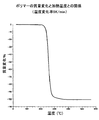
即ち、本発明の実施例によれば燃料電池に障害を及ぼす残留物が残らない効果がある。前記効果に関わり、この発明の実施例におけるポリマー(ポリブチルアクリレート−ポリメタクリレート共重合体)の質量変化(%)と加熱温度(℃)との関係を測定した結果の一例を図1に示す。図1によれば、前記ポリマーは、非常に良好な加熱特性を有することが分かる。約220℃までは殆ど質量変化が無く、それ以上の温度では解重合により約100%の質量減少が急速に生じる。約350℃ではこの結合剤は熱で除去され、残留物は殆どなくなる。電気化学的測定の結果、万が一、残留物が残っていても、これは燃料電池の運転の支障にはならず、また、連続運転時にもこの残留物による触媒の被毒も電極の疎水化も生じない。
【0015】
加工のために、スクリーン印刷ペースト(作業工程に応じて、カーボンペースト又は触媒ペーストとも称される)には、スクリーン印刷媒体としてさらに少なくとも1つの高沸点の溶媒(例えば、エステル、ケトン及び/又はアルコール、特にグリコール酸ブチルエステル、シクロヘキサノン及び/又はテルピネオール)が添加される。スクリーン印刷媒体として高沸点の溶媒だけが添加されるのではなく、さらに結合剤としてポリマーB(例えば、ポリブチルアクリレート−ポリメチルアクリレート共重合体、ポリビニルアルコール及び/又はポリエチレンオキシド)が添加されると好ましい。このポリマーBが特に焼失温度が400℃以下であるか、又は燃料電池運転を妨げない残留物のみを残すのならば好ましい。
【0016】
電極は、特に電極触媒層を備えた支持体を有する膜上に設けられたガス浸透性かつ導電性の層である。支持体又は基板としてカーボン布又はカーボンペーパー又は他の多孔性かつ導電性の基板が使用されると好ましい。
【0017】
計量により決められた白金被覆は、触媒として純白金黒が使用される場合には2〜3mg/cm2であり、触媒として白金担持カーボンが使用される場合にはカーボンの白金被覆に応じて0.15〜0.4mg/cm2である。
【0018】
スクリーン印刷法及び続いて行われる加工によりガス拡散電極を製造すると、完成した電極はポリマーA(例えばテフロン)で疎水化される。
【0019】
本発明によるガス拡散電極を備えた膜−電極ユニットの電流−電圧特性においては、高電流の場合でも電圧降下が異常に小さいことが観察された。このことは、とりわけ、ポリマーAの含有量が少なくかつ湿潤剤の残留物による疎水化の損害が少ないことによって、多孔性の電極触媒層内での拡散抑制を少なくする。
【0020】
上述したスクリーン印刷法の特別な利点は、電極触媒ペーストがポリマーAの添加を要することなく良好に加工されるので、層厚みの均一性が改善されることである。
【図面の簡単な説明】
【0021】
【図1】この発明の実施例に係るポリマーの質量変化と加熱温度との関係の測定結果を示す図 [0001]
The present invention relates to a screen printing method and a screen printing paste for producing a gas diffusion electrode.
[0002]
A polymer electrolyte membrane fuel cell has, as a central component, a membrane-electrode unit composed of a membrane having electrodes including an electrode catalyst layer on both sides. The electrode has in particular a gas-permeable and electrically conductive solid support (for example carbon cloth or carbon paper), which is usually usually a polymer suspension (this polymer is hereinafter referred to as polymer A, for example PTFE). That is, it is hydrophobized with a polymer such as polytetrafluoroethylene or Teflon (registered trademark) . An electrocatalyst layer that is similarly hydrophobized is provided on the support. Polymer A is therefore contained in the support as well as in the electrocatalyst layer.
[0003]
Conventionally, the necessary content of polymer A for hydrophobizing the electrode catalyst layer is usually 20 to 60% by weight. For example, a high content of polymer A such as Teflon suppresses the activity of the platinum catalyst, and the contact resistance. And decrease the porosity of the electrodes (see Watanabe's paper published in pages 81-83 of the magazine “J. Elektronal. Chem.”, 195 (1985)), that is, disadvantageous to the system Works. Polymer A for hydrophobing the electrode catalyst layer can therefore also be referred to as a “catalyst inhibitor”.
[0004]
In the case of conventionally known electrodes, in addition to the high content of polymer A for hydrophobizing the electrode catalyst layer (20 to 60% by weight, with respect to the metal catalyst content), the uniformity of the thickness of the electrode catalyst layer Is a problem as well. There is a need to provide a suitable manufacturing method that allows uniform coating of the support in a manner that is cost-effective and suitable for mass production with a small layer thickness of 3-40 μm using dried catalyst powder. is there.
[0005]
Conventional method (Magazine “J. Elektronal. Chem.”, 195 (published in 1985), pages 81-83, Mr. Watanabe's paper, Journal “J. Elektrochem. Soc.”, 142 (1995) Publication) according to M. Uchida's paper published on pages 463 to 468), a dry powder mixture consisting of a catalyst powder previously hydrophobized with PTFE is also hydrophobized. Pressed on the body. In order to produce the mixture, the carbon powder is first vigorously mixed with the PTFE dispersion and then dried at a temperature of 280 ° C. or higher. At that time, the surface-active wetting agent (Triton X100) contained in the dispersion is removed. Wetting agents are used to compensate for the bad processing characteristics caused by the high content of polymer A in the catalyst paste. Subsequently, the mixture is pulverized. This method is very labor intensive, and it is technically difficult to produce an electrode catalyst layer with a small thickness and uniform thickness, and it can be produced only with a small number. Furthermore, the disadvantage of this method is
-Containing a high content of polymer A for hydrophobizing the electrode catalyst layer,
A wetting agent is added for processing, this wetting agent must be specially removed and leave a disturbing residue,
It is.
[0006]
Screen printing is a known technique for producing uniformly thin layers. It is already known to use screen printing to construct an electrochemical system. According to U.S. Pat. No. 4,229,290, a screen printing paste comprising a Teflon dispersion, graphite and platinum black for this purpose contains 50% by weight or more of a wetting agent or dispersion aid "Triton X100" for stabilization. Must be added. The Teflon component used for hydrophobization in the screen printing paste, and therefore the Teflon component present in the formed electrocatalyst layer is about 25% by weight. The paste is pressed against a solid support (eg carbon paper) containing 60% by weight Teflon. As a result, the total content of Teflon is about 85% by weight. Disadvantages of the electrodes produced using this method are that, in addition to the extremely high content of polymer A (here Teflon) for hydrophobizing the electrocatalyst layer, wetting agents (of the catalyst paste) 50 It is to be added to the weight percent or more.
[0007]
The object of the present invention is to provide a gas diffusion electrode in which the screen printing paste does not contain a wetting agent and does not contain polymer A or contains only a small amount of polymer A (10% by weight or less, relating to the content of the metal catalyst). It is to provide a screen printing method for producing the above.
[0008]
This object is achieved by the construction requirements described in 請 Motomeko. That is, “a screen printing method for producing a gas diffusion electrode using a screen printing paste containing at least one metal catalyst and a solvent selected from glycolic acid butyl ester, cyclohexanone or terpineol, wherein the screen printing Screen printing method in which a polybutyl acrylate-polymethacrylate copolymer is used as a binder in the paste. ”And“ Screen printing paste used in the manufacture of gas diffusion electrodes, comprising at least one metal catalyst, glycolic acid And a solvent selected from butyl ester, cyclohexanone or terpineol, and a polybutyl acrylate-polymethacrylate copolymer as a binder.
[0009]
The object of the present invention is to produce a gas diffusion electrode using a screen printing paste comprising polymer A in an amount of up to 10% by weight with respect to the content of the metal catalyst, at least one metal catalyst and a high boiling point solvent. This is a screen printing method.
[0010]
It is preferable that platinum black or platinum-supported carbon is used as the metal catalyst.
[0011]
As high-boiling solvents, esters and / or ketones and / or alcohols, particularly preferably butyl glycolate, cyclohexanone and / or terpineol are preferably used.
[0012]
According to an embodiment of the invention, in addition to the metal catalyst and the high-boiling solvent, the catalyst paste further comprises polymer B, preferably a polymer with a burn-off temperature of 400 ° C. or less , particularly preferably for example polybutylacrylate-polymethacrylate. A copolymer (Polybutylacrylat-Poymethacrylat-Copolymerisat) is added as a binder.
[0013]
According to an embodiment of the present invention, the screen printing paste further comprises a small amount of polymer A. This weight component is up to 10% by weight.
[0014]
Here, the electrode catalyst layer refers to a layer that is provided on a particularly gas-permeable and electrically conductive solid support of the electrode and in which anodic oxidation of fuel against protons or cathodic reduction of oxygen is performed on the catalyst surface. The electrocatalyst layer has at least one metal catalyst, which contains platinum used in the catalyst paste in pure form as platinum black or diluted as platinum-supported carbon. It is preferable. Advantageously, the electrode catalyst layer have greens contain other components. Because, according to the embodiment according to this excellent present invention, a screen printing medium, which is added to the catalyst paste for processing, since Ru Tei is removed by drying and heating of the finished i.e. coated electrode is there.
That is, according to the embodiment of the present invention, there is an effect that no residue that causes a failure in the fuel cell remains. One example of the results of measuring the relationship between the mass change (%) of the polymer (polybutyl acrylate-polymethacrylate copolymer) and the heating temperature (° C.) in the examples of the present invention is shown in FIG. According to FIG. 1, it can be seen that the polymer has very good heating properties. There is almost no change in mass up to about 220 ° C., and at temperatures higher than that, a mass loss of about 100% rapidly occurs due to depolymerization. At about 350 ° C., the binder is removed with heat and there is almost no residue. As a result of electrochemical measurements, even if a residue remains, this does not hinder the operation of the fuel cell, and even during continuous operation, the catalyst is poisoned and the electrode becomes hydrophobic. Does not occur.
[0015]
For processing, screen printing pastes (also referred to as carbon pastes or catalyst pastes, depending on the working process) additionally contain at least one high-boiling solvent (for example esters, ketones and / or alcohols) as screen printing media. In particular glycolic acid butyl ester, cyclohexanone and / or terpineol). When not only a high boiling point solvent is added as a screen printing medium, but also a polymer B (for example, polybutyl acrylate-polymethyl acrylate copolymer, polyvinyl alcohol and / or polyethylene oxide) is added as a binder. preferable. It is preferable if this polymer B has a burning temperature of 400 ° C. or less , or leaves only residues that do not interfere with fuel cell operation.
[0016]
The electrode is a gas permeable and conductive layer provided on a membrane having a support provided with an electrode catalyst layer. Preferably, carbon cloth or carbon paper or other porous and conductive substrate is used as the support or substrate.
[0017]
The platinum coating determined by measurement is 2 to 3 mg / cm 2 when pure platinum black is used as the catalyst, and 0 depending on the platinum coating of carbon when platinum-supported carbon is used as the catalyst. .15 to 0.4 mg / cm 2 .
[0018]
When a gas diffusion electrode is produced by screen printing and subsequent processing, the completed electrode is hydrophobized with polymer A (eg, Teflon).
[0019]
In the current-voltage characteristics of the membrane-electrode unit provided with the gas diffusion electrode according to the invention, it was observed that the voltage drop was unusually small even at high currents. This reduces, among other things, the suppression of diffusion in the porous electrocatalyst layer by low polymer A content and less hydrophobization damage due to wetting agent residues.
[0020]
A special advantage of the screen printing method described above is that the layer thickness uniformity is improved because the electrocatalyst paste is processed well without the need for addition of polymer A.
[Brief description of the drawings]
[0021]
FIG. 1 is a graph showing a measurement result of a relationship between a change in mass of a polymer and a heating temperature according to an embodiment of the present invention.
Claims (2)
Applications Claiming Priority (3)
| Application Number | Priority Date | Filing Date | Title |
|---|---|---|---|
| DE19838786.5 | 1998-08-26 | ||
| DE19838786 | 1998-08-26 | ||
| PCT/DE1999/002620 WO2000013242A2 (en) | 1998-08-26 | 1999-08-20 | Screen printing method for producing a gas diffusion electrode |
Publications (3)
| Publication Number | Publication Date |
|---|---|
| JP2002525811A JP2002525811A (en) | 2002-08-13 |
| JP2002525811A5 JP2002525811A5 (en) | 2010-09-16 |
| JP4792160B2 true JP4792160B2 (en) | 2011-10-12 |
Family
ID=7878780
Family Applications (2)
| Application Number | Title | Priority Date | Filing Date |
|---|---|---|---|
| JP2000571098A Expired - Fee Related JP4792160B2 (en) | 1998-08-26 | 1999-08-20 | Screen printing method and screen printing paste for producing gas diffusion electrode |
| JP2000571099A Expired - Fee Related JP4707834B2 (en) | 1998-08-26 | 1999-08-20 | Improved gas diffusion electrode, method for producing the same, and method for hydrophobizing the gas diffusion electrode |
Family Applications After (1)
| Application Number | Title | Priority Date | Filing Date |
|---|---|---|---|
| JP2000571099A Expired - Fee Related JP4707834B2 (en) | 1998-08-26 | 1999-08-20 | Improved gas diffusion electrode, method for producing the same, and method for hydrophobizing the gas diffusion electrode |
Country Status (9)
| Country | Link |
|---|---|
| US (2) | US6645660B2 (en) |
| EP (2) | EP1118129B1 (en) |
| JP (2) | JP4792160B2 (en) |
| CN (2) | CN1173426C (en) |
| AT (2) | ATE257621T1 (en) |
| CA (2) | CA2341494C (en) |
| DE (2) | DE59908263D1 (en) |
| ES (2) | ES2315020T3 (en) |
| WO (2) | WO2000013243A2 (en) |
Families Citing this family (25)
| Publication number | Priority date | Publication date | Assignee | Title |
|---|---|---|---|---|
| JP2002313359A (en) * | 2001-04-17 | 2002-10-25 | Mitsubishi Heavy Ind Ltd | Polymer electrolyte fuel cell |
| DE10211177A1 (en) * | 2002-03-14 | 2003-10-02 | Daimler Chrysler Ag | Membrane-electrode assembly |
| WO2009069129A2 (en) * | 2007-11-27 | 2009-06-04 | 3Gsolar Ltd. | Large area dye cells, and methods of production thereof |
| US7041191B2 (en) * | 2004-05-27 | 2006-05-09 | Institute Of Nuclear Energy Research | Method for manufacturing membrane electrode assembly of fuel cell by printing processes |
| KR100717130B1 (en) | 2005-09-30 | 2007-05-11 | 한국과학기술연구원 | Paste for solid oxide fuel cell, anode supported solid oxide fuel cell using same and manufacturing method thereof |
| KR101233343B1 (en) * | 2005-11-25 | 2013-02-14 | 삼성에스디아이 주식회사 | Membrane-electrode assembly for fuel cell, method of producing same and fuel cell system comprising same |
| US20070141446A1 (en) * | 2005-12-15 | 2007-06-21 | Hollingsworth & Vose Company | Fuel cell gas diffusion articles |
| KR100668354B1 (en) * | 2006-02-07 | 2007-01-12 | 삼성에스디아이 주식회사 | Metal catalyst and manufacturing method of electrode including same |
| JP5298405B2 (en) | 2006-04-14 | 2013-09-25 | トヨタ自動車株式会社 | Manufacturing method of membrane electrode assembly for fuel cell |
| KR100957302B1 (en) * | 2007-09-07 | 2010-05-12 | 현대자동차주식회사 | Manufacturing method of membrane-electrode assembly for fuel cell |
| US20100028744A1 (en) * | 2008-08-04 | 2010-02-04 | Gm Global Technology Operations, Inc. | Gas diffusion layer with lower gas diffusivity |
| US20100028750A1 (en) * | 2008-08-04 | 2010-02-04 | Gm Global Technology Operations, Inc. | Gas diffusion layer with lower gas diffusivity |
| US7947410B2 (en) * | 2008-08-22 | 2011-05-24 | Toyota Motor Engineering & Manufacturing North America, Inc. | Fuel cell electrodes with triazole modified polymers and membrane electrode assemblies incorporating same |
| WO2011100602A1 (en) * | 2010-02-12 | 2011-08-18 | Revolt Technology Ltd. | Manufacturing methods for air electrode |
| JP6075743B2 (en) * | 2010-08-03 | 2017-02-08 | ソニー株式会社 | Signal processing apparatus and method, and program |
| JP5530954B2 (en) * | 2011-02-21 | 2014-06-25 | 株式会社日本自動車部品総合研究所 | Fuel cell |
| CN104527247B (en) * | 2014-01-03 | 2017-03-22 | 华东理工大学 | Microcircuit preparation method of microfluid fuel battery pack based on screen printing technique |
| CN107342423B (en) * | 2017-05-22 | 2020-09-01 | 深圳市航盛新材料技术有限公司 | Air electrode pole piece, preparation method thereof and air battery |
| US11539053B2 (en) | 2018-11-12 | 2022-12-27 | Utility Global, Inc. | Method of making copper electrode |
| US11761100B2 (en) | 2018-11-06 | 2023-09-19 | Utility Global, Inc. | Electrochemical device and method of making |
| US11575142B2 (en) | 2018-11-06 | 2023-02-07 | Utility Global, Inc. | Method and system for making a fuel cell |
| US11611097B2 (en) | 2018-11-06 | 2023-03-21 | Utility Global, Inc. | Method of making an electrochemical reactor via sintering inorganic dry particles |
| US11603324B2 (en) | 2018-11-06 | 2023-03-14 | Utility Global, Inc. | Channeled electrodes and method of making |
| CN110416558B (en) * | 2019-07-16 | 2020-10-16 | 成都新柯力化工科技有限公司 | Method for preparing fuel cell membrane electrode by roll-to-roll stable continuous printing |
| CN118248893B (en) * | 2024-02-06 | 2025-09-26 | 厦门金龙联合汽车工业有限公司 | A surface modification method for graphite plate |
Family Cites Families (16)
| Publication number | Priority date | Publication date | Assignee | Title |
|---|---|---|---|---|
| US3912538A (en) * | 1974-01-15 | 1975-10-14 | United Technologies Corp | Novel composite fuel cell electrode |
| US4229490A (en) * | 1978-09-01 | 1980-10-21 | Texas Instruments Incorporated | Novel method for catalyst application to a substrate for fuel cell electrodes |
| IL61410A0 (en) * | 1979-11-09 | 1980-12-31 | Yardney Electric Corp | Improved inexpensive electrode for metal-air cells and method of making the same |
| US4615954A (en) * | 1984-09-27 | 1986-10-07 | Eltech Systems Corporation | Fast response, high rate, gas diffusion electrode and method of making same |
| US4568442A (en) * | 1985-02-01 | 1986-02-04 | The Dow Chemical Company | Gas diffusion composite electrode having polymeric binder coated carbon layer |
| DE3722019A1 (en) * | 1987-07-03 | 1989-01-12 | Varta Batterie | METHOD FOR PRODUCING A PLASTIC-BONDED GAS DIFFUSION ELECTRODE USING A MANGANOXIDE CATALYST OF THE PRIMARY COMPOSITION MNO (DOWN ARROW) 2 (DOWN ARROW) (DOWN ARROW * DOWN ARROW) 8 (DOWN ARROW) INCLUDED |
| US4927514A (en) * | 1988-09-01 | 1990-05-22 | Eltech Systems Corporation | Platinum black air cathode, method of operating same, and layered gas diffusion electrode of improved inter-layer bonding |
| JP2948376B2 (en) * | 1991-10-15 | 1999-09-13 | 三菱重工業株式会社 | Method for producing reaction film and method for producing electrochemical cell |
| JP2842150B2 (en) * | 1992-06-02 | 1998-12-24 | 株式会社日立製作所 | Polymer electrolyte fuel cell |
| EP0641033B1 (en) * | 1993-08-31 | 1999-03-31 | Compur Monitors Sensor Technology GmbH | Method of making a catalytically active gas diffusion electrode for electrochemical cells |
| JPH07130376A (en) * | 1993-11-03 | 1995-05-19 | Tokyo Gas Co Ltd | Catalyst treatment method for polymer electrolyte fuel cell electrodes |
| JP2741574B2 (en) * | 1994-09-19 | 1998-04-22 | 株式会社日立製作所 | Solid polymer electrolyte fuel cell |
| EP0815606B1 (en) * | 1995-03-20 | 2000-06-07 | E.I. Du Pont De Nemours And Company | Membranes containing inorganic fillers for fuel cells |
| JPH09223503A (en) * | 1996-02-14 | 1997-08-26 | Tanaka Kikinzoku Kogyo Kk | Method for manufacturing polymer solid oxide fuel cell electrode |
| US6103077A (en) * | 1998-01-02 | 2000-08-15 | De Nora S.P.A. | Structures and methods of manufacture for gas diffusion electrodes and electrode components |
| GB9808524D0 (en) * | 1998-04-23 | 1998-06-17 | British Gas Plc | Fuel cell flow-field structure formed by layer deposition |
-
1999
- 1999-08-20 AT AT99953554T patent/ATE257621T1/en not_active IP Right Cessation
- 1999-08-20 WO PCT/DE1999/002622 patent/WO2000013243A2/en not_active Ceased
- 1999-08-20 CA CA2341494A patent/CA2341494C/en not_active Expired - Lifetime
- 1999-08-20 JP JP2000571098A patent/JP4792160B2/en not_active Expired - Fee Related
- 1999-08-20 EP EP99953556A patent/EP1118129B1/en not_active Expired - Lifetime
- 1999-08-20 DE DE59908263T patent/DE59908263D1/en not_active Expired - Lifetime
- 1999-08-20 EP EP99953554A patent/EP1118130B1/en not_active Expired - Lifetime
- 1999-08-20 JP JP2000571099A patent/JP4707834B2/en not_active Expired - Fee Related
- 1999-08-20 DE DE59914914T patent/DE59914914D1/en not_active Expired - Lifetime
- 1999-08-20 AT AT99953556T patent/ATE415713T1/en not_active IP Right Cessation
- 1999-08-20 WO PCT/DE1999/002620 patent/WO2000013242A2/en not_active Ceased
- 1999-08-20 ES ES99953556T patent/ES2315020T3/en not_active Expired - Lifetime
- 1999-08-20 CN CNB998125601A patent/CN1173426C/en not_active Expired - Fee Related
- 1999-08-20 ES ES99953554T patent/ES2214895T3/en not_active Expired - Lifetime
- 1999-08-20 CN CNB99812561XA patent/CN1195336C/en not_active Expired - Fee Related
- 1999-08-20 CA CA2341495A patent/CA2341495C/en not_active Expired - Lifetime
-
2001
- 2001-02-26 US US09/793,329 patent/US6645660B2/en not_active Expired - Lifetime
- 2001-02-26 US US09/793,411 patent/US20010018145A1/en not_active Abandoned
Also Published As
| Publication number | Publication date |
|---|---|
| WO2000013243A3 (en) | 2000-08-10 |
| ES2315020T3 (en) | 2009-03-16 |
| US20010018145A1 (en) | 2001-08-30 |
| DE59914914D1 (en) | 2009-01-08 |
| EP1118130A2 (en) | 2001-07-25 |
| CN1328707A (en) | 2001-12-26 |
| DE59908263D1 (en) | 2004-02-12 |
| JP2002525811A (en) | 2002-08-13 |
| CA2341495C (en) | 2010-07-06 |
| CN1195336C (en) | 2005-03-30 |
| JP4707834B2 (en) | 2011-06-22 |
| ATE415713T1 (en) | 2008-12-15 |
| EP1118130B1 (en) | 2004-01-07 |
| CA2341494C (en) | 2010-06-01 |
| CN1173426C (en) | 2004-10-27 |
| CA2341494A1 (en) | 2000-03-09 |
| WO2000013242A3 (en) | 2000-06-08 |
| CA2341495A1 (en) | 2000-03-09 |
| EP1118129B1 (en) | 2008-11-26 |
| EP1118129A2 (en) | 2001-07-25 |
| WO2000013242A2 (en) | 2000-03-09 |
| JP2002525812A (en) | 2002-08-13 |
| US6645660B2 (en) | 2003-11-11 |
| ES2214895T3 (en) | 2004-09-16 |
| US20020022083A1 (en) | 2002-02-21 |
| CN1324502A (en) | 2001-11-28 |
| ATE257621T1 (en) | 2004-01-15 |
| WO2000013243A2 (en) | 2000-03-09 |
Similar Documents
| Publication | Publication Date | Title |
|---|---|---|
| JP4792160B2 (en) | Screen printing method and screen printing paste for producing gas diffusion electrode | |
| TW398097B (en) | Gas diffusion electrodes based on poly (vinylidene fluoride) carbon blends | |
| KR100638498B1 (en) | The membrane electrode unit for a polymer electrolyte fuel cell, the manufacturing method of the said membrane electrode unit, and the ink for manufacturing the said membrane electrode unit | |
| JP6203286B2 (en) | Support carbon material and metal catalyst particle-supported carbon material for polymer electrolyte fuel cell, and production method | |
| JP3444530B2 (en) | Fuel cell | |
| JP6571655B2 (en) | Method of manufacturing a PBI-based membrane electrode assembly (MEA) with improved fuel cell performance and stability | |
| KR102756173B1 (en) | Fuel Cell Electrode Having High Durability, Method for Manufacturing The Same, and Membrane-Electrode Assembly Comprising The Same | |
| JPH09257687A (en) | Method for measuring reaction specific surface area and utilization rate of precious metal catalysts for polymer electrolyte fuel cells, and catalyst layer for electrodes for polymer electrolyte fuel cells | |
| EP3416221B1 (en) | Method for preparing membrane-electrode assembly | |
| US7682725B2 (en) | Gas diffusion electrode and method for its production | |
| US7910259B2 (en) | Anode for fuel cell, manufacturing method thereof, and fuel cell including the same | |
| US20030008195A1 (en) | Fluid diffusion layers for fuel cells | |
| JP2003528438A (en) | Manufacture of low-temperature fuel cell electrodes | |
| Yang et al. | Polymer electrolyte fuel cell with vertically aligned carbon nanotubes as the electrocatalyst support | |
| JP7825828B2 (en) | Novel catalyst composition and carbon material having nitrogen-containing groups | |
| JP2003086191A (en) | Polymer electrolyte fuel cell and method of manufacturing the same | |
| JP4011330B2 (en) | Electrocatalyst layer formation method | |
| JP7207023B2 (en) | Catalyst ink and catalyst layer | |
| JP7152049B2 (en) | Method for manufacturing catalyst layer, catalyst layer, membrane-electrode assembly including the same, and fuel cell | |
| JP2004319139A (en) | Membrane electrode assembly and manufacturing method thereof | |
| JP3533694B2 (en) | Porous conductive material powder, method for producing the same, and method for producing fuel cell | |
| JP2002270192A (en) | Polymer electrolyte fuel cell | |
| JP6593308B2 (en) | Fuel cell catalyst layer | |
| RU2355071C1 (en) | Fuel-cell electrode, method of making active layer of electrode and use of electrode | |
| JP2007048495A (en) | Gas diffusion layer for solid polymer fuel cell and solid polymer fuel cell using the same |
Legal Events
| Date | Code | Title | Description |
|---|---|---|---|
| A621 | Written request for application examination |
Free format text: JAPANESE INTERMEDIATE CODE: A621 Effective date: 20060725 |
|
| A131 | Notification of reasons for refusal |
Free format text: JAPANESE INTERMEDIATE CODE: A131 Effective date: 20100209 |
|
| A601 | Written request for extension of time |
Free format text: JAPANESE INTERMEDIATE CODE: A601 Effective date: 20100430 |
|
| RD03 | Notification of appointment of power of attorney |
Free format text: JAPANESE INTERMEDIATE CODE: A7423 Effective date: 20100430 |
|
| A602 | Written permission of extension of time |
Free format text: JAPANESE INTERMEDIATE CODE: A602 Effective date: 20100512 |
|
| A601 | Written request for extension of time |
Free format text: JAPANESE INTERMEDIATE CODE: A601 Effective date: 20100609 |
|
| A602 | Written permission of extension of time |
Free format text: JAPANESE INTERMEDIATE CODE: A602 Effective date: 20100616 |
|
| A601 | Written request for extension of time |
Free format text: JAPANESE INTERMEDIATE CODE: A601 Effective date: 20100708 |
|
| A602 | Written permission of extension of time |
Free format text: JAPANESE INTERMEDIATE CODE: A602 Effective date: 20100715 |
|
| A521 | Request for written amendment filed |
Free format text: JAPANESE INTERMEDIATE CODE: A523 Effective date: 20100728 |
|
| A524 | Written submission of copy of amendment under article 19 pct |
Free format text: JAPANESE INTERMEDIATE CODE: A524 Effective date: 20100728 |
|
| TRDD | Decision of grant or rejection written | ||
| A01 | Written decision to grant a patent or to grant a registration (utility model) |
Free format text: JAPANESE INTERMEDIATE CODE: A01 Effective date: 20110628 |
|
| A01 | Written decision to grant a patent or to grant a registration (utility model) |
Free format text: JAPANESE INTERMEDIATE CODE: A01 |
|
| A61 | First payment of annual fees (during grant procedure) |
Free format text: JAPANESE INTERMEDIATE CODE: A61 Effective date: 20110725 |
|
| FPAY | Renewal fee payment (event date is renewal date of database) |
Free format text: PAYMENT UNTIL: 20140729 Year of fee payment: 3 |
|
| R150 | Certificate of patent or registration of utility model |
Ref document number: 4792160 Country of ref document: JP Free format text: JAPANESE INTERMEDIATE CODE: R150 Free format text: JAPANESE INTERMEDIATE CODE: R150 |
|
| R250 | Receipt of annual fees |
Free format text: JAPANESE INTERMEDIATE CODE: R250 |
|
| R250 | Receipt of annual fees |
Free format text: JAPANESE INTERMEDIATE CODE: R250 |
|
| R250 | Receipt of annual fees |
Free format text: JAPANESE INTERMEDIATE CODE: R250 |
|
| R250 | Receipt of annual fees |
Free format text: JAPANESE INTERMEDIATE CODE: R250 |
|
| R250 | Receipt of annual fees |
Free format text: JAPANESE INTERMEDIATE CODE: R250 |
|
| LAPS | Cancellation because of no payment of annual fees |