JP4800535B2 - Dental material containing nano-sized silica particles - Google Patents
Dental material containing nano-sized silica particles Download PDFInfo
- Publication number
- JP4800535B2 JP4800535B2 JP2001532727A JP2001532727A JP4800535B2 JP 4800535 B2 JP4800535 B2 JP 4800535B2 JP 2001532727 A JP2001532727 A JP 2001532727A JP 2001532727 A JP2001532727 A JP 2001532727A JP 4800535 B2 JP4800535 B2 JP 4800535B2
- Authority
- JP
- Japan
- Prior art keywords
- dental
- oxide
- dental material
- resin
- silica particles
- Prior art date
- Legal status (The legal status is an assumption and is not a legal conclusion. Google has not performed a legal analysis and makes no representation as to the accuracy of the status listed.)
- Expired - Lifetime
Links
Images

Classifications
-
- B—PERFORMING OPERATIONS; TRANSPORTING
- B82—NANOTECHNOLOGY
- B82Y—SPECIFIC USES OR APPLICATIONS OF NANOSTRUCTURES; MEASUREMENT OR ANALYSIS OF NANOSTRUCTURES; MANUFACTURE OR TREATMENT OF NANOSTRUCTURES
- B82Y30/00—Nanotechnology for materials or surface science, e.g. nanocomposites
-
- A—HUMAN NECESSITIES
- A61—MEDICAL OR VETERINARY SCIENCE; HYGIENE
- A61K—PREPARATIONS FOR MEDICAL, DENTAL OR TOILETRY PURPOSES
- A61K6/00—Preparations for dentistry
- A61K6/20—Protective coatings for natural or artificial teeth, e.g. sealings, dye coatings or varnish
-
- A—HUMAN NECESSITIES
- A61—MEDICAL OR VETERINARY SCIENCE; HYGIENE
- A61K—PREPARATIONS FOR MEDICAL, DENTAL OR TOILETRY PURPOSES
- A61K6/00—Preparations for dentistry
- A61K6/30—Compositions for temporarily or permanently fixing teeth or palates, e.g. primers for dental adhesives
-
- A—HUMAN NECESSITIES
- A61—MEDICAL OR VETERINARY SCIENCE; HYGIENE
- A61K—PREPARATIONS FOR MEDICAL, DENTAL OR TOILETRY PURPOSES
- A61K6/00—Preparations for dentistry
- A61K6/70—Preparations for dentistry comprising inorganic additives
- A61K6/71—Fillers
- A61K6/76—Fillers comprising silicon-containing compounds
-
- A—HUMAN NECESSITIES
- A61—MEDICAL OR VETERINARY SCIENCE; HYGIENE
- A61K—PREPARATIONS FOR MEDICAL, DENTAL OR TOILETRY PURPOSES
- A61K6/00—Preparations for dentistry
- A61K6/80—Preparations for artificial teeth, for filling teeth or for capping teeth
- A61K6/884—Preparations for artificial teeth, for filling teeth or for capping teeth comprising natural or synthetic resins
- A61K6/887—Compounds obtained by reactions only involving carbon-to-carbon unsaturated bonds
-
- A—HUMAN NECESSITIES
- A61—MEDICAL OR VETERINARY SCIENCE; HYGIENE
- A61K—PREPARATIONS FOR MEDICAL, DENTAL OR TOILETRY PURPOSES
- A61K6/00—Preparations for dentistry
- A61K6/80—Preparations for artificial teeth, for filling teeth or for capping teeth
- A61K6/884—Preparations for artificial teeth, for filling teeth or for capping teeth comprising natural or synthetic resins
- A61K6/891—Compounds obtained otherwise than by reactions only involving carbon-to-carbon unsaturated bonds
-
- C—CHEMISTRY; METALLURGY
- C01—INORGANIC CHEMISTRY
- C01P—INDEXING SCHEME RELATING TO STRUCTURAL AND PHYSICAL ASPECTS OF SOLID INORGANIC COMPOUNDS
- C01P2004/00—Particle morphology
- C01P2004/60—Particles characterised by their size
- C01P2004/62—Submicrometer sized, i.e. from 0.1-1 micrometer
-
- C—CHEMISTRY; METALLURGY
- C01—INORGANIC CHEMISTRY
- C01P—INDEXING SCHEME RELATING TO STRUCTURAL AND PHYSICAL ASPECTS OF SOLID INORGANIC COMPOUNDS
- C01P2004/00—Particle morphology
- C01P2004/60—Particles characterised by their size
- C01P2004/64—Nanometer sized, i.e. from 1-100 nanometer
-
- Y—GENERAL TAGGING OF NEW TECHNOLOGICAL DEVELOPMENTS; GENERAL TAGGING OF CROSS-SECTIONAL TECHNOLOGIES SPANNING OVER SEVERAL SECTIONS OF THE IPC; TECHNICAL SUBJECTS COVERED BY FORMER USPC CROSS-REFERENCE ART COLLECTIONS [XRACs] AND DIGESTS
- Y10—TECHNICAL SUBJECTS COVERED BY FORMER USPC
- Y10T—TECHNICAL SUBJECTS COVERED BY FORMER US CLASSIFICATION
- Y10T428/00—Stock material or miscellaneous articles
- Y10T428/25—Web or sheet containing structurally defined element or component and including a second component containing structurally defined particles
- Y10T428/259—Silicic material
-
- Y—GENERAL TAGGING OF NEW TECHNOLOGICAL DEVELOPMENTS; GENERAL TAGGING OF CROSS-SECTIONAL TECHNOLOGIES SPANNING OVER SEVERAL SECTIONS OF THE IPC; TECHNICAL SUBJECTS COVERED BY FORMER USPC CROSS-REFERENCE ART COLLECTIONS [XRACs] AND DIGESTS
- Y10—TECHNICAL SUBJECTS COVERED BY FORMER USPC
- Y10T—TECHNICAL SUBJECTS COVERED BY FORMER US CLASSIFICATION
- Y10T428/00—Stock material or miscellaneous articles
- Y10T428/29—Coated or structually defined flake, particle, cell, strand, strand portion, rod, filament, macroscopic fiber or mass thereof
- Y10T428/2982—Particulate matter [e.g., sphere, flake, etc.]
- Y10T428/2991—Coated
- Y10T428/2993—Silicic or refractory material containing [e.g., tungsten oxide, glass, cement, etc.]
- Y10T428/2995—Silane, siloxane or silicone coating
-
- Y—GENERAL TAGGING OF NEW TECHNOLOGICAL DEVELOPMENTS; GENERAL TAGGING OF CROSS-SECTIONAL TECHNOLOGIES SPANNING OVER SEVERAL SECTIONS OF THE IPC; TECHNICAL SUBJECTS COVERED BY FORMER USPC CROSS-REFERENCE ART COLLECTIONS [XRACs] AND DIGESTS
- Y10—TECHNICAL SUBJECTS COVERED BY FORMER USPC
- Y10T—TECHNICAL SUBJECTS COVERED BY FORMER US CLASSIFICATION
- Y10T428/00—Stock material or miscellaneous articles
- Y10T428/29—Coated or structually defined flake, particle, cell, strand, strand portion, rod, filament, macroscopic fiber or mass thereof
- Y10T428/2982—Particulate matter [e.g., sphere, flake, etc.]
- Y10T428/2991—Coated
- Y10T428/2998—Coated including synthetic resin or polymer
Landscapes
- Health & Medical Sciences (AREA)
- Oral & Maxillofacial Surgery (AREA)
- Epidemiology (AREA)
- Life Sciences & Earth Sciences (AREA)
- Animal Behavior & Ethology (AREA)
- General Health & Medical Sciences (AREA)
- Public Health (AREA)
- Veterinary Medicine (AREA)
- Chemical & Material Sciences (AREA)
- Engineering & Computer Science (AREA)
- Plastic & Reconstructive Surgery (AREA)
- Nanotechnology (AREA)
- Physics & Mathematics (AREA)
- Inorganic Chemistry (AREA)
- Composite Materials (AREA)
- Condensed Matter Physics & Semiconductors (AREA)
- General Physics & Mathematics (AREA)
- Materials Engineering (AREA)
- Crystallography & Structural Chemistry (AREA)
- Dental Preparations (AREA)
Description
【0001】
発明の分野
概して本発明は、硬化性樹脂中に分散したナノサイズ粒子を含有する歯科材料に関する。これらの材料は、修復材、接着剤、セメント、矯正装置、ミルブランク(mill blank)、および補綴材料として使用することができる。より詳細には、本発明は、高強度および高い透光性を歯科材料に付与するばらばらのナノサイズシリカ粒子を含有する歯科材料に関する。
【0002】
背景
複合材料への要求が広範囲であるのに対し、歯科材料への要求は一般に独特のものである。健康上の理由から、歯科材料は口腔環境での使用に適しているべきである。ある場合では、歯科材料の強度および耐久性が十分な性能を得るために重要となる。例えば、一般には咀嚼力が大きい歯列位置で実施される歯科作業では、高強度で高耐久性であることが望ましい。別の場合では、審美的な特性または品質(例えば、光沢や透光性)が非常に望まれている。このようなことは、歯の修復または充填を比較的近距離で見ることができる位置で行われる歯科作業の場合に多い。
【0003】
通常、歯科材料の強度は充填剤を添加することによって得られる。一般に、機械的強度特性のより高い歯科材料には、より大きな寸法の粒子(すなわち直径が約0.4μmを超える)が充填または添加されている。これらの材料は、ハイブリッド複合材料と呼ばれることが多い。しかしながら、これらの複合材料の欠点の1つは、光沢および審美性に欠ける傾向があることである。大型粒子を有する複合材料のもう1つの欠点は、歯磨きを繰り返すと(口腔衛生に必要である)、硬化した樹脂が磨耗し、大きな充填剤粒子が露出し、表面に光沢がなく美観を損なうようになることである。これは後に歯垢の蓄積の原因となることもある。
【0004】
充填剤量を増加させることで、歯科材料の強度を増すこともできる。しかしながら、これによって視覚的な不透明性が増大し、そのため透光性および審美的品質が低下することがある。
【0005】
カナダ特許出願第2,202,732号は、液体の有機分散剤中の表面改質シリカ粒子ゾルを含む重合性歯科材料を教示している。このシリカ粒子は歯科材料の約35重量%を占める。
【0006】
未硬化歯科材料のレオロジー的性質が良好であれば、歯科開業医にとって好都合である。これによって開業医は、歯科材料を所望の位置で容易に操作し配置して、適切に接触させて解剖学的形態にしてから、硬質化または硬化させることができる。ヒュームドシリカの形態であることがほとんどであるナノメートルサイズ(「ナノサイズ」)シリカ粒子を重合性歯科樹脂中に分散させたものが存在する。DeGussaより商品名OX−50(DeGussa AG(Hanau、ドイツ))で入手可能なヒュームドシリカ材料が広く使用されてきた。しかしながら、樹脂中に高充填率で分散させたヒュームドシリカから製造した材料は、歯科用には実用的ではないダイラタント組成物となる。広く認識されている歯科参考図書であるCraigによる「Restorative Dental Materials(修復用歯科材料)」第8版(1989年)は、高充填ヒュームドシリカ材料レオロジー的性質の劣る材料が得られるのが一般的であると教示している(例えばCraigの256ページを参照されたい)。したがって、所望の強度が得られるように無機成分(粒子)含有率が調整された従来の材料は、望ましくないダイラタント材料となることが多い。
【0007】
ダイラタントレオロジーを克服するためにあらかじめ重合させた粒子を混入する方法も実施されている。しかしながら、これらの方法では得られる材料が低強度となる場合がある。
【0008】
歯科材料は、周囲の歯列と良く調和し本物そっくりに見えることが一般に望まれている。一般に歯科材料の審美性は、歯と類似した色彩/濃淡を有する材料を製造することで実現される。歯科材料の一種であるマイクロフィル(microfill)は、歯の外観をより良く再現するための優れた光沢を有する傾向にある。「マイクロフィル」の一例が、商品名SILUX PLUS(3M Co.(St.Paul、ミネソタ))で市販されている。しかしながらマイクロフィルは、ハイブリッド複合材料または「マクロフィル(macrofill)よりも機械的強度が劣るのが一般的である。
【0009】
したがって、高強度で高い審美性が望まれる用途で現在実施されている方法では、医師は高い物理的強度を有する材料の土台を最初形成した後にミクロフィル層を上に重ねる必要が生じることが多い。高強度で高い審美性を有する1種類の材料が提供されれば好都合である。
【0010】
発明の要約
本発明は、強度があり透光性の歯科材料を得るための、硬化性樹脂と、その樹脂中に分散したナノサイズシリカ粒子とを含む歯科材を提供する。シリカ粒子は平均直径が約200nm未満であり、歯科材料の全重量の約40重量%を超える量で存在する。
【0011】
「硬化性」とは、加熱による溶剤除去、加熱による重合、化学的架橋、放射線誘導重合または架橋などによって硬化または固化させることができる材料を意味する。
【0012】
「樹脂中に分散した」とは、シリカ粒子がばらばらで会合していない(すなわち非塊状化および非凝集)粒子として樹脂中に存在することを意味する。
【0013】
本発明の歯科材料は、歯科用接着剤、人工歯冠、前方または後方充填材、鋳造材料、キャビティライナー、セメント、コーティング組成物、ミルブランク、矯正装置、修復材、補綴材料、およびシーラントなどに使用することができる。
【0014】
本発明の態様の1つでは、硬化性樹脂はアクリレート、メタクリレート、またはエポキシ、あるいはそれらの組み合わせであってよい。
【0015】
本発明のさらに別の態様では、放射線不透過性を付与するために歯科材料に重金属を混入することができる。
【0016】
歯の表面付近または表面上に歯科材料を配置する工程と、材料の形状を変化させる工程と、材料を硬化させる工程とを含む歯科材料の使用方法も提供する。
【0017】
好ましい実施態様の詳細な説明
本発明は、硬化性樹脂と、その樹脂中に分散したナノサイズ(すなわち平均直径が200nm未満)シリカ充填剤とを含有する歯科材料を提供する。シリカ充填剤は、高強度と高い透光性との両方が得られる量で使用される。任意に、材料に放射線不透過性を付与するために重金属酸化物を材料に混入することができる。
【0018】
本発明の歯科材料は、例えば歯科用接着剤、人工歯冠、前方または後方充填材、鋳造材料、キャビティライナー、セメント、コーティング組成物、ミルブランク、矯正装置、修復材、補綴材料、およびシーラントとして使用することができる。好ましい態様では、本発明の歯科材料は歯科修復材である。本発明の修復材は、口腔内に直接配置してその場で硬化(硬質化)させることができるし、あるいは、口腔外で本発明の修復材から補綴装置を製造した後、これを口腔内に接着して固定することもできる。
【0019】
本発明の歯科材料は、化学硬化性、熱硬化性、または光硬化性の組成物であってよい。光硬化性材料は適切な開始剤系を有するべきである。化学硬化性材料は自己硬化が可能である(例えばレドックス開始剤を使用)。別の方法として本発明の材料は、自己硬化と光硬化の組み合わせによって硬化させることもできる。
【0020】
歯科材料にナノサイズシリカ粒子を充填することによって、高強度と高い透光性が得られることが分かった。本発明の規定量のナノサイズシリカ粒子を含有する歯科材料は、未硬化状態で特に望ましい取扱(レオロジー)特性を有し、硬化状態で非常に高い強度を有し、さらに審美性も備える。
【0021】
強度は、圧縮強さや直径引張強さなどの機械的測定によって特徴づけることができる。歯科材料の圧縮強さが大きいと、歯の補修、置換、および修復部分での咀嚼によってかかる力に対して好都合である。直径引張強さ(DTS)は、材料に引張応力を生じさせる圧縮力に耐える歯科材料の性能を意味する。各強度測定の試験は、後述の実施例において記載している。
【0022】
硬化した場合の本発明の歯科材料は、圧縮強さが少なくとも約35MPaであり、より好ましくは本発明の材料の圧縮強さは少なくとも約200MPaであり、最も好ましくは本発明の材料の圧縮強さは少なくとも約350MPaである。
【0023】
本発明の硬化歯科材料の直径引張強さは、好ましくは少なくとも約15MPaであり、より好ましくは少なくとも約40MPaであり、最も好ましくは少なくとも約60MPaである。
【0024】
態様の1つでは、幾分主観的な性質であるが(しかし歯科産業ではよく知られている)歯科材料の審美性は、視覚的不透明度測定によって定量化されることが好ましい。視覚的不透明度は歯科材料の透光性の程度の指標であり、視覚的不透明度が低いと硬化した歯科材料が本物のような光沢を有するため望ましい。本発明の歯科材料の視覚的不透明度は、好ましくは約0.05〜0.4であり、より好ましくは約0.05〜0.35であり、最も好ましくは約0.05〜0.25である。
【0025】
本発明の材料は比較的多量のナノサイズシリカ粒子が充填されているが、なお良好なレオロジー的性質を有することが分かった。これらの性質ならびに強度は、表面改質剤を使用して粒子表面を処理することによって向上させることができる。表面処理(表面改質)によって、粒子の分散性が向上し、マトリックスとの接合性も向上する。
【0026】
一般に、開業医は、時間の節約につながるので歯科材料の取扱性が良好であることを望んでいる。例えば、医師が材料を口腔内に配置し、材料のコンターリング(contouring)およびフェザーリング(feathering)を行った後に、材料が硬化するまで成形した形状が変化しないことを医師が望むばあいが多いので、歯の修復作業では歯科材料が急激に落下しないことが望ましい。修復作業に使用される材料が十分に高い降伏応力を有するのであれば一般に急激な落下は起らず、すなわち重力の応力下でこの材料は流動しない。材料の降伏応力とは、材料の流動が起こるために必要な最小応力のことであり、C.W.Macosko著「Rheology Principles,Measurements,and Applications(レオロジーの原理、測定、および応用)」(VCH Publishers,Inc.,New York,1994)の92ページに記載されている。If重力による応力が材料の降伏応力より小さければ、材料は流動しない。しかしながら、重力による応力は、配置される歯科材料の質量ならびに形状によって変動する。
【0027】
「コンターリング」は、自然な歯科解剖学的に似せるために構造材料を成形する工程(歯科用機器を使用)を意味する。コンターリングを容易にするためには、材料は、歯科用機器で操作した後で形状を維持するのに十分高粘度であるべきであるが、材料の成形が困難となるほど高粘度であるべきではない。「フェザーリング」は、本来の歯列と材料が調和するように歯科材料の厚さを減少させて薄膜にする工程を意味する。これは、操作する材料と本来の歯列の境界部分で歯科用機器を使用して実施される。形状または表面形状がさらに変化するのを防止するために配置した機器に歯科材料が固着しないことも望まれている。
【0028】
本発明の歯科材料が修復材である好ましい実施態様では、本発明の歯科材料は急激な落下がほとんどまたはまったくなく、窩洞形成などに容易に適合し、コンターリングおよびフェザーリングが容易であることが好ましい。好ましくは、本発明の歯科材料は配置した機器に固着せず、それによって歯の構造の修復などの歯科手技での使用が全体的に迅速かつ容易になるので好都合となる。
【0029】
驚くべきことに本発明の歯科材料は、改良された望ましいずり減粘挙動を有することが可能なことを発見した。すなわち、本発明の歯科材料は高応力下では低粘度となり、低応力下では高粘度となることができる。高応力下で低粘度となるために、開業医は歯の表面に材料をフェザーリングして歯科材料を削り取ることができる。好都合なことに、低応力下で高粘度であるために、歯の輪郭に一致するように医師が材料を成形した後で材料はその形状を維持することができる(すなわち急激に落下したりしない)。
【0030】
シリカは硬化性樹脂マトリックス内部に分散している。本発明の歯科材料に使用されるシリカ粒子は好ましくは平均直径が約200nm未満であり、より好ましくは粒子の平均直径が約100nm未満である。これらの測定はTEM(透過型電子顕微鏡検査)法に基づいて行われることが好ましく、この方法では、図1に示されるような粒子の集団を分析することによって平均粒径が求められる。粒径好ましい測定方法は後述の試験方法の項で記載する。図1は、硬化性樹脂中に分散した好ましいシリカ粒子を示している。シリカ粒子の平均表面積は、好ましくは約15m2/gを超え、より好ましくは約30m2/gを超える。
【0031】
樹脂中に分散した後では、シリカ粒子はばらばら(独立)で会合していない(すなわち、非塊状、非凝集)状態となる。本明細書で使用する場合「塊状」は、電荷または極性によって通常は粒子が互いに弱く結合していることを意味しており、より小さな部分に破壊することができる。本明細書で使用する場合「凝集」は残留化合物の処理などによって多くの場合粒子が互いに強く結合していることを意味しており、より小さな部分に凝集体を分解することは非常に困難である。
【0032】
本発明の歯科材料に使用されるシリカ粒子は、実質的に球状であり実質的に非多孔質であることが好ましい。シリカは実質的に純粋であることが好ましいが、アンモニウムイオンやアルカリ金属イオンなどの少量の安定化イオンを含有することができる。
【0033】
好ましいナノサイズシリカは、Nalco Chemical Co.(Naperville、イリノイ)より製品名NALCO COLLOIDAL SILICAで市販されている。例えば、好ましいシリカ粒子は、NALCO製品1040、1042、1050、1060、2327、および2329を使用して得ることができる。硬化性樹脂にカチオン開始系が使用される好ましい実施態様では、出発シリカは酸性(例えばNalco 1042)であることが好ましい。
【0034】
上述のナノサイズシリカ粒子以外に、任意にヒュームドシリカを本発明の材料に加えることができる。好適なヒュームドシリカとしては、例えば、DeGussa AG(Hanau、ドイツ)より商品名AEROSILシリーズOX−50、OX−130、OX−150、およびOX−200で販売される製品、およびCabot Corp(Tuscola、イリノイ)より商品名CAB−O−SIL M5で販売される製品が挙げられる。
【0035】
歯科材料中に充填する前にナノサイズシリカ粒子を表面処理することによって、樹脂中で安定な分散体が得られる。本明細書で使用される場合「安定な」は、標準的周囲条件(例えば、室温(約20〜22度)、大気圧で、極度の電磁力は存在しない条件)において約24時間などのある期間静置した後に塊状化しない歯科材料を意味する。好ましくは、表面処理によってナノサイズ粒子が安定化され、それによって粒子が硬化性樹脂中によく分散し、実質的に均一な組成物が得られる。さらに、シリカは表面の少なくとも一部が表面処理剤で改質され、それによって、硬化中の硬化性樹脂と安定化粒子との共重合等の反応が可能となることが好ましい。
【0036】
本発明のシリカ粒子は、樹脂相溶化表面処理剤で処理されることが好ましい。特に好ましい表面処理剤または表面改質剤としては、樹脂と重合可能なシラン処理剤が挙げられる。好ましいシラン処理剤としては、γ−メタクリルオキシルプロピルトリメトキシシラン(商品名A−174として市販され、Witco OSi Specialties(Danbury、コネティカット)より市販される)、およびγ−グリシドキシプロピルトリメトキシシラン(商品名G6720として入手可能な製品であり、United Chemical Technologies(Bristol、ペンシルバニア)より入手可能である)が挙げられる。
【0037】
あるいは、表面改質剤を組み合わせたものも有用となることもあり、この場合、表面改質剤の少なくとも1種類は硬化性樹脂と共重合可能な官能基を有する。例えば重合性基は、エチレン系不飽和基や、開環重合が起こりやすい環状基であってもよい。エチレン系不飽和重合性基は、例えばアクリレート基またはメタクリレート基、あるいはビニル基であってもよい。開環重合が起こりやすい環状官能基は一般に酸素、硫黄、または窒素などのヘテロ原子を含有し、好ましくはエポキシドなどの酸素含有3員環である。硬化性樹脂とは一般に反応しないその他の表面改質剤を、分散性またはレオロジー的性質を向上させるために使用することができる。この種のシランの例としては、例えば、アルキルまたはアリールポリエーテル、アルキル、ヒドロキシアルキル、ヒドロキシアリール、またはアミノアルキル官能基性のシランが挙げられる。
【0038】
シリカ粒子の表面処理後、これらを適当な硬化性樹脂と混合して、本発明の歯科材料を製造することができる。シリカ粒子は歯科材料の全重量の約40重量%(wt.%)を超える量で存在することが好ましい。より好ましくはシリカ粒子は約40重量%〜約90重量%の量で存在し、最も好ましくはシリカ粒子は約50重量%〜約75重量%の量で存在する。
【0039】
任意に、放射線不透過性歯科材料を得るために、本発明の歯科材料に重金属酸化物を加えることができる。放射線不透過性を付与するのに有効な量の重金属酸化物が存在するのが好ましい。本明細書で使用される場合、「放射線不透過性」は、従来方法で標準的歯科用X線装置を使用して歯の構造から硬化した歯科材料を区別できることを意味する。歯科材料が放射線不透過性であると、歯の状態の診断にX線が使用される場合に好都合である。例えば、放射線不透過性材料を使用すれば、充填材周辺の歯の組織に形成されうる二次性齲食の検出が可能となる。放射線不透過性の所望の程度は、個々の用途、およびX線フィルムを評価する医師の予想によって変動しうる。
【0040】
原子番号が約28を超える重金属の酸化物が好ましい。重金属酸化物は、これを分散させて硬化させた樹脂が望ましくない色彩または濃淡とならないように選択するべきである。例えば、鉄およびコバルトは、歯科材料の中間色の歯の色が暗くコントラストの強い色彩となるので好ましくない。最も好ましくは、重金属酸化物は原子番号が30を超える金属の酸化物である。好適な金属酸化物は、イットリウム、ストロンチウム、バリウム、ジルコニウム、ハフニウム、ニオブ、タンタル、タングステン、ビスマス、モリブデン、スズ、亜鉛、ランタニド元素(すなわち、原子番号が57〜71(両端の数を含む)である元素)、およびセリウムの酸化物、ならびにそれらの組み合わせである。最も好ましくは、原子番号が30を超え72未満である重金属の酸化物が、任意に本発明の材料に加えられる。特に好ましい放射線不透過性金属酸化物としては、酸化ランタン、酸化亜鉛、酸化スズ、酸化ジルコニウム、酸化イットリウム、酸化イッテルビウム、酸化バリウム、酸化ストロンチウム、酸化セリウム、およびそれらの組み合わせが挙げられる。
【0041】
重金属酸化物成分ならびにその他の添加剤は、シリカ表面上の粒子またはシリカ粒子と混合された粒子、あるいはシリカ粒子表面尾少なくとも一部のコーティング層などの種々の形態で本発明の歯科材料に混入することができる。好ましくは、重金属酸化物成分は、ゾルまたは個々の粒子として供給される。
【0042】
有効量のナノサイズ重金属酸化物粒子を本発明の歯科材料に混入することによって、透光性でありX線不透明度が高く項屈折率の材料を得ることができることを発見した。重金属酸化物粒子の平均直径は、好ましくは約100nm未満である。最も好ましくは、これらの粒子の平均直径は約70nm未満であり、より好ましくは約60nm未満である。重金属酸化物粒子は凝集していてもよい。そのような場合は、凝集粒子の平均直径は約200nm未満であることが好ましく、より好ましくは約90nm未満である。
【0043】
非凝集状態の重金属酸化物粒子の好ましい供給源は、溶液中に分散した粒子を有するゾルである。米国特許第5,037,579号(Matchett)に開示されるジルコニアゾルは、本発明の歯科材料に使用すると好適である好ましい重金属酸化物である。
【0044】
別の好ましいジルコニアゾルが、本発明と同じ日に出願され代理人整理番号第55200USA5A号を有するKolbによる米国特許出願、発明の名称「Zirconia Sol and Method of Making Same(ジルコニアゾルおよびその製造方法)」に開示されている。出願番号第55200USA5A号のジルコニアゾルは、平均一次粒子径が約20nm以下、より好ましくは平均一次粒子径が約7〜20nmの範囲の複数の単結晶ジルコニア粒子を含む。本明細書で使用される場合、用語「一次粒子径」は非凝集状態の単結晶ジルコニア粒子の粒径を意味する。一次粒子径は表題「クリスタリット粒径および結晶形含有率」の試験方法によって測定され、この手順は後述の「試験方法」の項に記載している。
【0045】
出願番号第55200USA5A号に開示されるように、このジルコニアゾルは結晶性の高いジルコニア粒子を含む。結晶ジルコニアは非晶質ジルコニアよりも屈折率が高くX線散乱能力も高いため、このことは重要である。ジルコニア粒子の結晶性は、結晶化度などを使用して定量化することができる。結晶化度は、試料材料のX線散乱強度を、カルシウム安定化酸化ジルコニウムなどの結晶性が既知の標準物質のX線散乱強度で割った値から計算される。ジルコニア粒子の結晶化度の具体的な試験手順は、表題「結晶化度手順」で、後述の「試験方法」の項に記載している。ジルコニアゾルの場合、ジルコニア粒子の結晶化度は約0.65以上である。最も好ましくは、ジルコニア粒子の結晶化度は約0.75以上であり、最も好ましくは約0.85以上である。
【0046】
ジルコニア粒子の結晶部分において、主な結晶格子形態は、立方晶系と正方晶系であり、少量の単斜晶相も存在する。X線回折を使用して立方晶系と正方晶系の結晶格子構造を別々の定量するのは困難なため、これら二つを合わせて考え、本明細書では立方晶および正方晶複合晶系と記載する。具体的には、ジルコニア粒子は、約70%以上の立方晶および正方晶複合晶系結晶格子構造を含む。最も好ましくは、ジルコニア粒子は約75%以上の立方晶および正方晶複合晶系結晶格子構造を含み、最も好ましくは約85%以上の立方晶および正方晶複合晶系結晶格子構造を含む。各場合で、結晶相の残りの部分は単斜晶系結晶格子構造である。
【0047】
非常に寸法が小さいために、ジルコニア粒子は主に立方晶系と正方晶系の結晶格子相として存在し、有効量の結晶相安定剤を使用する必要がない。本明細書で使用される場合、用語「結晶相安定剤」は、ジルコニアを立方晶系および/または正方晶系の結晶格子構造に安定化させるために加えることができる物質を意味する。具体的には、結晶相安定剤は、立方晶相および/または正方晶相が単斜晶相に転移するのを抑制する機能を果たす。結晶相安定剤としては、例えばMgOやCaOなどのアルカリ土類酸化物、希土類酸化物(すなわちランタニド類)、およびY2O3が挙げられる。「有効量」とは、立方晶相および/または正方晶相から単斜晶相にジルコニアが転移するのを抑制するのに必要な結晶相安定剤の量を意味する。好ましい実施態様では、ジルコニア粒子は約1重量%未満の結晶相安定剤を含み、より好ましくは約0.1重量%未満の結晶相安定剤を含む。
【0048】
出願番号第55200USA5A号のジルコニアゾルの場合、ジルコニアの一次粒子は実質的に非会合(すなわち、非凝集および非塊状)形態で存在する。ゾル中の一次粒子間の会合の程度の定量的測度は分散指数である。本明細書で使用される場合、「分散指数」は、流体力学的粒径を一次粒子径で割った値として定義される。一次粒子径は、後述の試験手順「クリスタリット粒径および結晶形含有率」に記載されるX線回折技術を使用して求められる。流体力学的粒径は、後出の「試験方法」の項に記載される「光子相関分光法」(PCS)で測定される水相中のジルコニア粒子の重量平均粒径を意味する。一次粒子が会合している場合は、PCSによってジルコニアゾル中の一次粒子の凝集体および/または塊状体の粒径の測定値が得られる。粒子が会合していない場合は、PCSによって一次粒子の粒径値が求められる。したがって、ゾル中の一次粒子間の会合が減少するにつれて分散指数の値は1に近づく。上記ジルコニアゾルでは、一次ジルコニア粒子は実質的に非会合形態で存在するため、ジルコニアゾルの分散指数は約1〜3の範囲であり、好ましくは約1〜2.5の範囲であり、最も好ましくは約1〜2の範囲である。
【0049】
出願番号第55200USA5A号にさらに教示されるように、ポリエーテル酸ジルコニウム塩の調製に好適な出発物質としては、ジルコニウムカルボン酸塩、およびカルボン酸で置換可能な対イオンを有する塩基性ジルコニウム塩などの塩基性ジルコニウム塩が挙げられる。カルボン酸で置換可能な対イオンを有する塩基性ジルコニウム塩の代表例としては、オキシ硝酸ジルコニウム、オキシ塩化ジルコニウム、および炭酸ジルコニウムが挙げられる。塩基性ジルコニウム塩は、ジルコニウム上の陽イオン電荷の少なくとも一部が水酸化物陰イオンまたはO2-陰イオンで相殺されるジルコニウム塩である。塩基性ジルコニウム塩中の酸素含有量が水酸化物イオンまたはO2-に由来するかどうかを実際に測定するのは困難であるため、この酸素含有量を単に酸素として表現するのが一般的である。例えば、後出の式(1)は簡略化のために結合水を除いて表したものであり、ポリエーテル酸ジルコニウム塩の調製の出発物質として好適となりうるジルコニウム化合物の一般式を表している。
ZrO(4-n/2)(X)n (1)
式中、Xはカルボン酸で置換可能な対イオンであり、
nは0.5〜4の範囲である。
【0050】
カルボン酸で置換可能な対イオンの代表例としては、酢酸イオン、ギ酸イオン、およびプロピオン酸イオンなどのカルボン酸イオン、ならびに硝酸イオン、塩化物イオン、炭酸イオンなどのその他の対イオン、またはそれらの組み合わせが挙げられる。ジルコニウムアルコキシドは正式にはジルコニウム塩ではないが、最初に好適な酸と反応させて塩基性ジルコニウム塩を生成した後でポリエーテル酸ジルコニウム生成の出発物質として使用することができる。
【0051】
好ましい出発物質は、一般式ZrO(4-n/2)(CH3COO)n(式中nは約1〜2の範囲である)を有する塩基性酢酸ジルコニウムの水溶液またはゾルである。水溶液の場合、おそらく酢酸ジルコニウムは多核ジルコニウム錯陽イオンとして存在する。酢酸ジルコニウムの調製方法は当技術分野で公知である(例えば、W.B.Blumenthalの「The Chemical Behavior of Zirconium(ジルコニウムの化学的挙動)」(D.Van Nostrand Company(Princeton、ニュージャージー))311〜338ページを参照されたい)。好適な酢酸ジルコニウム溶液は、約5〜40重量%をZrO2が占め、約5〜40重量%の範囲が酢酸塩である。好ましい酢酸ジルコニウムゾル出発物質は、20重量%のZrO2でZrO1.25(C2H3O2)1.5を含み、Nyacol Products Corp.(Ashland、マサチューセッツ)より商品名「Nyacol ZrO2(Ac)」で市販されている。
【0052】
出願番号第55200USA5A号の好ましい方法では、ポリエーテル酸ジルコニウム塩は、水溶液でジルコニウム塩をポリエーテルカルボン酸と反応させることによって調製される。現在の理解ではポリエーテルカルボン酸は、加水分解反応中に生成するジルオニア粒子の会合(すなわち塊状化および/または凝集)を防止する機能を果たすと考えられている。このため、この方法で生成するジルコニア粒子は実質的に会合しない。
【0053】
出願番号第55200USA5A号において改質剤としての使用に好適なポリエーテルカルボン酸は、ポリエーテル末端を有する水溶性モノカルボン酸(すなわち1分子当り1つのカルボン酸基を含有する)である。ポリエーテル末端は、一般式−O−R−を有する二官能性アルコキシ基の繰り返しを含む。好ましいR基は、一般式−CnH2n−を有し、例えばメチレン、エチレン、およびプロピレン(n−プロピレンおよびi−プロピレンを含む)、またはそれらの組み合わせが挙げられる。R基の組み合わせは、ランダムコポリマーまたはブロックコポリマーなどとして存在することもできる。
【0054】
好ましい種類の一価のポリエーテル基は一般に式(3):
CH3−[O−(CH2)y]x−X-COOH (3)
で表すことができ、式中、
Xは二価の有機架橋基であり、
xは約1〜10の範囲であり、
yは約1〜4の範囲である。
Xの代表例としては-X2-(CH2)n-が挙げられ、式中X2は−O−、−S−、−C(O)O−、−C(O)NH−であり、nは約1〜3の範囲である。
【0055】
好ましいポリエーテルカルボン酸の例としては、化学構造CH3O(CH2CH2O)2CH2COOHを有する2−[2−(2−メトキシエトキシ)エトキシ]酢酸(以下MEEAA)および化学構造CH3OCH2CH2OCH2COOHを有する2−(2−メトキシエトキシ)酢酸(以下MEAA)が挙げられる。MEAAとMEEAAはAldrich Chemical Co.(Milwaukee、ウィスコンシン)よりそれぞれカタログ番号40,701−1および40,700−3で市販されている。2種類以上のポリエーテルカルボン酸の混合物の使用も本発明の範囲内である。
【0056】
反応順序(1):
ZrO(4-n/2)(X)n+aR2−COOH→ZrO(4-n/2)(X)n-a(R2COO)a+aHX (1)
に従うポリエーテルカルボン酸とジルコニウム塩の反応によって、一般式ZrO(4-n/2)(X)n-a(R2COO)aを有するポリエーテル酸ジルコニウム塩が生成し、一般式HXを有するほぼ化学量論量の酸を遊離(すなわち放出)する。例えば、ジルコニウム塩が酢酸ジルコニウム(ZrO(4-n/2)(C2H3O2)n)を含む場合、ポリエーテル酸ジルコニウム塩生成の結果としてほぼ化学量論量の酢酸(C2H3O2H)が放出される(反応順序1a参照)。
ZrO(4-n/2)(C2H3O2)n+aR2−COOH→ZrO(4-n/2)(C2H3O2)n-a(R2COO)a+aC2H3O2H (1a)
【0057】
酸がジルコニウム原子と結合するので、ジルコニウムとカルボン酸の塩は水相中で解離しない。カルボン酸によって塩は水溶性となる。疎水性酸(例えばアルキル酸)とジルコニウムが結合すると、塩は水に不溶性となる。実際、プロピオン酸やアクリル酸などの少量の酸を加えるだけで水に不溶性となる。対照的に、出願番号第55200USA5A号で使用されているポリエーテル酸ではより高分子量の酸を使用しながら、ポリエーテル酸ジルコニウム塩の水溶性を維持することができる。このため、水相中に溶解するポリエーテル酸ジルコニウム塩を熱水処理することができる。
【0058】
通常、ジルコニウム塩出発物質を基準にすると、ポリエーテルカルボン酸はジルコニウム塩中に約2.5〜5.0ミリモル/ZrO2グラム当量の範囲の量が加えられる。好ましい酢酸ジルコニウム出発物質(すなわちNyacol ZrO2(Ac))の場合、この範囲では約20〜50%の酢酸基が置換される。好ましくは、添加されるポリエーテルカルボン酸の量は、得られるジルコニア粒子の会合を防止するのに必要な最小量に制限される。これによって、ポリエーテル酸ジルコニウム塩の生成中に放出される酸の量が最小限に維持される。添加されるポリエーテルカルボン酸量は、例えばポリエーテルカルボン酸の分子量、濃度、加水分解反応の時間、および温度などの要因に依存する。
【0059】
出願番号第55200USA5A号のさらなる教示によると、通常ポリエーテルカルボン酸はジルコニウム塩水溶液に添加され、得られる溶液は室温で約30〜60分間撹拌される。ポリエーテルカルボン酸分子はジルコニウム塩と反応して、酸基の少なくとも一部が置換してジルコニウム塩と結合する。置換した酸基は遊離酸として溶液中に放出される。通常はポリエーテル酸ジルコニウム塩の生成する酸の少なくとも一部を除去することが好ましく、より好ましくは実質的にすべての酸が除去される。酸の除去によって、ポリエーテル酸ジルコニウム塩の生成の方向への反応平衡のシフトが可能なことに注意すべきである。過剰の酸を除去するための好適な方法は当技術分野で公知であり、例えば乾燥または蒸留が挙げられる。遊離酸が低沸点(例えば<約175℃)である場合、水相が蒸発してポリエーテル酸ジルコニウム塩が残留するまで溶液を加熱することによって酸を除去することができる。次に、加水分解が起こる前にポリエーテル酸ジルコニウム塩を水に溶解させる必要がある。
【0060】
ポリエーテル酸ジルコニウム塩の生成後で、好ましくは遊離酸を除去した後、次の段階は、ポリエーテル酸ジルコニウム塩を結晶ジルコニア粒子に転化させるのに十分な条件下でポリエーテル酸ジルコニウム塩水溶液を加水分解することである。例えば、ポリエーテル酸ジルコニウム塩が酢酸塩から誘導される場合(反応順序1a参照)、加水分解段階は一般的な反応順序(2a):
ZrO(4-n/2)(C2H3O2)n-a(R2COO)a→酸改質ZrO2+
(n−a)C2H3O2H+aR2COOH (2a)
に従う。加水分解反応によって酸改質ジルコニア粒子が生成し、副産物として遊離カルボン酸(すなわちC2H3O2HおよびR2COOH)も生成する。従って、得られるジルコニアゾルは酸改質ジルコニア粒子と、2種類のカルボン酸の水中の混合物とを含む。酸改質ジルコニア粒子とは、酸成分の少なくとも一部がジルコニア粒子の表面に吸着していることを意味する。
【0061】
ポリエーテル酸ジルコニウム塩溶液の加水分解反応は任意の好適な反応容器中で実施することができる。通常この反応は高温高圧下で実施されるので、一般にオートクレーブが好ましい種類の反応容器である。好ましい反応容器の例は、Parr Instruments Co.(Moline、イリノイ)より市販されるPressure Reactor Series #4520である。
【0062】
出願番号第55200USA2A号の方法の操作では、ポリエーテル酸ジルコニウム塩水溶液が最初に反応容器に装入される。ポリエーテル酸ジルコニウム塩溶液の濃度は通常0.5〜3重量%のZrO2の範囲内であり、好ましくは1〜2重量%のZrO2の範囲内である。しかしながらこの濃度は、その他の反応条件に依存してより広範囲で変動しうる。次にポリエーテル酸ジルコニウム塩溶液を、ジルコニア粒子に転化させるのに十分な温度まで加熱する。好ましい加水分解温度は約140〜250℃の範囲であり、より好ましくは約150〜200℃の範囲である。通常、反応容器は所望の加水分解温度に数時間にわたって加熱される。その他考慮すべき点として、ポリエーテルカルボン酸の劣化および/または分解を最小限にするために好適な加水分解温度または温度範囲を選択することができる。反応容器内で維持される圧力は自己圧力(すなわち反応温度における水の蒸気圧)であってもよいし、好ましくは窒素などの不活性気体などで反応容器を加圧することもできる。好ましい圧力範囲は約1〜30bar(100〜3000kPa)である。反応容器の加圧によって、得られるジルコニアゾルの性質に悪影響を与えうる反応容器内でのポリエーテル酸ジルコニウム塩溶液の還流を減少させたりなくしたりすることができると思われる。通常、加水分解時間は加水分解温度と塩溶液の濃度とによって変動する。通常は、加水分解反応が実質的に終了するまで熱が加えられる。一般に、所要時間は約175℃の温度で約16〜24時間であるが、より長いまたは短い時間が好適となる場合もある。この反応は、X線回折を使用して得られるジルコニア粒子を調べるか、あるいはIR分光法またはHPLCを使用して水相中の遊離酸量を調べることによって監視することができる。加水分解の終了後、圧力容器を冷却し、得られたジルコニアゾルが反応容器から取り出される。上記手順はバッチ式方法であるが、連続的方法で加水分解を実施することも本発明の範囲内である。
【0063】
出願番号第55200USA5A号のジルコニアゾルは、蒸発や限外ろ過などの当技術分野で公知の方法を使用して液相の少なくとも一部を除去することによって濃縮することができる。好ましい方法では、ロータリーエバポレーターを使用して約10〜40重量%のZrO2までジルコニアゾルが濃縮される。
【0064】
出願番号第55200USA5A号の方法に従って調製したジルコニアゾルは、通常望まれる量よりも過剰の酸を含有することが多い(反応順序2a参照)。ジルコニアゾルと有機マトリックス材料(例えば有機モノマー)を混合することが望ましい場合、通常はゾル中に存在する遊離酸の少なくとも一部、より好ましくは実質的に全部を除去する必要がある。通常この酸は、乾燥、透析、沈殿、イオン交換、蒸留、またはダイアフィルトレーションなどの従来方法によって除去することができる。
【0065】
加水分解反応中に遊離酸が生成するため、ジルコニアゾルが調製されたときのpHは通常約1.8〜2.2の範囲である。透析を使用してゾルのpHを増加させることができる。透析量に依存するが、透析したゾルのpHは通常約1〜4.5またはそれ以上となる。ゾルのpHは酸(例えば濃HClおよび氷酢酸)および/または塩基(例えばアンモニア水溶液)を添加することによって調整することもできる。アンモニア水溶液を添加することで、透明なゾルのpHが少なくとも6〜7となる。
【0066】
ジルコニア粒子表面に吸着する酸の比率を実質的に変化させずに遊離酸を除去するために、透析法、イオン交換法、およびダイアフィルトレーション法を使用することができる。あるいは、過剰の酸の除去とゾルの濃縮は、最初に水と遊離酸をゾルから蒸発させて乾燥粉末を得ることによって実施することもできる。次にこの乾燥粉末を所望量の水に再分散させて、実質的に過剰の酸を含有しない濃縮ゾルを得ることができる。しかしながら、この方法は、ジルコニア粒子表面に吸着した酸の比率が、より高沸点の酸のより低沸点の酸に対する比率が増加する方向で変化する場合があるので注意が必要である。
【0067】
任意に、ジルコニアゾル生成後に、ゾルのジルコニア粒子からポリエーテルカルボン酸基を除去したり置換させたりすることができる。ポリエーテルカルボン酸基の除去は、ジルコニウムゾルを添加することが望まれる有機マトリックス材料とポリエーテル基が非相溶性である場合などに好都合となりうる。ポリエーテルカルボン酸基の置換は、ジルコニア粒子のポリエーテル酸を酢酸などのカルボン酸で置換する方法などによって実施することができる。ジルコニア粒子上のポリエーテルカルボン酸基がカルボン酸に置換される。置換後、遊離したポリエーテルカルボン酸は、透析やダイアフィルトレーションなどの当技術分野で公知の方法を使用してゾルから除去することができる。
【0068】
重金属酸化物粒子を表面処理することによって、安定化したナノサイズ重金属酸化物粒子の供給が容易になる。安定化によって重金属酸化物粒子が硬化性樹脂中によく分散するようになるので、所望の透光性が得られ、さらに所望の機械的性質(例えば強度)および放射線不透過性も得られる。表面処理剤は、所望の硬化性樹脂中への分散性、および/または所望の硬化性樹脂との表面改質重金属酸化物粒子の反応性が得られる官能基を含有するように選択されることが好ましい。好ましくは、金属酸化物粒子は酸性化合物で処理される。好適な表面処理酸としては、例えばカルボン酸類、ホスホン酸類、および、スルホン酸類が挙げられる。最も好ましくは、酸性化合物の混合物を使用して表面安定化が実施される。あるいは、1種類以上が重合性官能基を有する酸性化合物の混合物を使用することが好ましい場合もある。最も好ましくは、酸性基はホウ素、炭素、リン、および硫黄のオキシ酸から誘導される。例えば、カルボン酸はジルコニアおよびセリアの粒子の表面に特によく吸着することが分かった。
【0069】
酸の混合物を重金属酸化物粒子の表面処理(改質)に使用することが好ましい。好ましくは、酸は構造R−COOHを含み、式中のRはエチレン系不飽和を含有する有機基である。Rは分岐鎖でも直鎖でもよく、(例えばヘテロ原子で)置換されていてもよい。Rは通常約1〜50個の炭素原子を含有し、好ましくは約2〜20個の炭素原子を含有する。このような酸の特に好ましい基としては、末端エチレン系不飽和を有するR基が挙げられる。
【0070】
酸の組み合わせを粒子表面に吸着させることによって、強度、分散性、および安定性を付与する所望の表面改質を行うことができる。好ましい方法では、ジルコニア粒子を水に分散させ、酢酸を表面に吸着させる。表面改質は、吸着した酢酸を、最終材料に良好な分散性および高強度が付与されるように選択した酸の組み合わせで置換することを含む。
【0071】
表面処理(改質)に好適な親水性で非反応性の酸としては、2−[2−(2−メトキシ)エトキシ]エトキシ酢酸(MEEAA)、モノ(ポリエチレングリコール)スクシネート、モノ(ポリエチレングリコール)マレエートが挙げられる。これらの酸は、本発明の硬化歯科材料中の粒子の分散性を良好にする。
【0072】
表面改質基を硬化性樹脂と共重合させることによって、強度を大幅に向上する。好ましくは、これは反応性表面改質剤を使用して行われる。表面処理に好適な親水性で反応性の酸としては、2−ヒドロキシメチル−2−[(N−メタクリルオキシエチル)カルバモイルメチル]プロピオン酸(PAMA)、モノ(アクリルオキシポリエチレングリコール)スクシネート、およびモノ(アクリルオキシポリエチレングリコール)マレエートが挙げられる。その他の好適な反応性酸としては、2,2−ビス[(N−メタクリルオキシエチル)カルバモイルメチル]プロピオン酸(PDMA)、アクリル酸、メタクリル酸、β−カルボキシエチルアクリレート、コハク酸モノ−2−(メタクリルオキシ)エチル、およびマレイン酸モノ−2−(メタクリルオキシ)エチルが挙げられる。
【0073】
これらの酸の組み合わせは、有機相溶性および反応性が付与されることでも望ましい。重金属酸化物の表面処理に有用なその他の好適な酸混合物としては、オレイン酸、ステアリン酸、およびオクタン酸などの脂肪族カルボン酸、メトキシフェニル酢酸および3,4,5−トリエトキシ安息香酸などの芳香族非反応性酸、ならびにイタコン酸、トルエンスルホン酸、リン酸メタクリル酸エチレングリコール、これらの酸の塩、およびそれらの混合物を挙げることができる。
【0074】
本発明の歯科材料は硬化性樹脂を含む。これらの樹脂は好ましくは、硬化してポリマー網目構造を形成することができる熱硬化性樹脂が一般的であり、例としては、アクリル酸樹脂、メタクリル酸樹脂、エポキシ樹脂、ビニル樹脂、またはそれらの混合物が挙げられる。好ましくは硬化性樹脂は、1種類以上のマトリックス形成性のオリゴマー、モノマー、またはポリマー、あるいはそれらの混合物から調製される。
【0075】
本発明の歯科材料が歯科用コンポジット材料である好ましい実施態様では、使用に好適な重合性樹脂としては、口腔環境での使用に好適となるのに十分な強度、加水分解安定性、および非毒性を有する硬化性有機樹脂が挙げられる。このような樹脂の例としては、アクリル酸樹脂、メタクリル酸樹脂、ウレタン樹脂、カルバモイルイソシアヌレート樹脂、およびエポキシ樹脂、例えば米国特許第3,066,112号、第3,539,533号、第3,629,187号、第3,709,866号、第3,751,399号、第3,766,132号、第3,860,556号、第4,002,669号、第4,115,346号、第4,259,117号、第4,292,029号、第4,308,190号、第4,327,014号、第4,379,695号、第4,387,240号、および第4,404,150号に記載の樹脂、ならびにこれらの混合物および誘導体が挙げられる。
【0076】
好ましい硬化性樹脂の一種は、フリーラジカル活性官能基を有する材料であり、1つ以上のエチレン系不飽和基を有するモノマー、オリゴマー、およびポリマーが挙げられる。別の種類としては、硬化性樹脂は、カチオン活性官能基を含有する種類の樹脂から得られる材料であってもよい。さらに別の種類としては、カチオン硬化性樹脂とフリーラジカル重合性樹脂の両方を含む硬化性樹脂混合物が、本発明の歯科材料で使用される場合もある。
【0077】
フリーラジカル活性官能基を有する硬化性樹脂の種類では、本発明での使用に好適な材料は、少なくとも1つのエチレン系不飽和結合を含有し、付加重合を進行させることができる。このようなフリーラジカル重合性材料としては、モノ、ジ、またはポリアクリレートおよびメタクリレート、例えば、アクリル酸メチル、メタクリル酸メチル、アクリル酸エチル、メタクリル酸イソプロピル、アクリル酸n−ヘキシル、アクリル酸ステアリル、アクリル酸アリル、グリセロールジアクリレート、グリセロールトリアクリレート、エチレングリコールジアクリレート、ジエチレングリコールジアクリレート、トリエチレングリコールジメタクリレート、1,3−プロパンジオールジアクリレート、1,3−プロパンジオールジメタクリレート、トリメチロールプロパントリアクリレート、1,2,4−ブタントリオールトリメタクリレート、1,4−シクロヘキサンジオールジアクリレート、ペンタエリスリトールトリアクリレート、ペンタエリスリトールテトラアクリレート、ペンタエリスリトールテトラメタクリレート、ソルビトールヘキサアクリレート、ビスフェノールAのメタクリル酸ジグリシジルエステル(「Bis−GMA」)、ビス[1−(2−アクリルオキシ)]−p−エトキシフェニルジエチルメタン、ビス[1−(3−アクリルオキシ−2−ヒドロキシ)]−p−プロポキシフェニルジメチルメタン、およびトリヒドロキシエチル−イソシアヌレートトリメタクリレート;分子量200〜500のポリエチレングリコールのビスアクリレートおよびビスメタクリレート、米国特許第4,652,274号に記載されるようなアクリル化モノマーの共重合性混合物、ならびに米国特許第4,642,126号に記載されるようなあるリルかオリゴマー;ならびにスチレン、フタル酸ジアリル、コハク酸ジビニル、アジピン酸ジビニル、およびフタル酸ジビニルなどのビニル化合物が挙げられる。これらのフリーラジカル重合性材料の2種類以上の混合物も希望するのであれば使用することができる。
【0078】
フリーラジカル重合(硬化)の場合、放射線、熱、またはレドックス/自己硬化化学反応によって重合を開始する系から開始系を選択することができる。フリーラジカル活性官能基の重合を開始することができる開始剤の種類としては、フリーラジカル生成光開始剤が挙げられ、任意に光増感剤または促進剤と併用される。一般に、このような開始剤は、200〜800nmの間の波長を有する光エネルギーに曝露することによって付加重合のためのフリーラジカルを生成することができるものであってもよい。
【0079】
種々の可視または近赤外光開始剤系を、本発明で有用なフリーラジカル重合性材料の光重合に使用することができる。例えば、フリーラジカル重合(硬化)では、光開始系は、米国特許第4,071,424号に記載されるようなアミンとα−ジケトンの2成分系によって重合が開始する系から選択することができる。あるいは、米国特許第5,545,676号に記載されるような三成分すなわち三元光開始剤系と樹脂を組み合わせることもできる。
【0080】
三元光開始剤系では、第1の成分はヨードニウム塩、すなわちジアリールヨードニウム塩である。このヨードニウム塩は好ましくはモノマー中に溶解性であり、増感剤および供与体の存在下で溶解させた場合に貯蔵安定性である(すなわち自発的に重合を促進しない)。したがって、特定のヨードニウム塩の選択は、選択した特定のモノマー、ポリマー、またはオリゴマー、増感剤、および供与体によってある程度依存しうる。好適なヨードニウム塩は、米国特許第3,729,313号、第3,741,769号、第3,808,006号、第4,250,053号、および第4,394,403号に記載されている。ヨードニウム塩は、単塩(例えば、Cl-、Br-、I-、またはC4H5SO3 -などの陰イオンを含有する)であってもよいし、あるいは金属錯塩(例えば、SbF5OH-またはAsF6 -を含有する)であってもよい。希望するのであればヨードニウム塩の混合物を使用することもできる。好ましいヨードニウム塩としては、塩化ジフェニルヨードニウム、ヘキサフルオロリン酸ジフェニルヨードニウム、およびテトラフルオロホウ酸ジフェニルヨードニウムなどのジフェニルヨードニウム塩が挙げられる。
【0081】
三元光開始剤系の第2の成分は増感剤である。この増感剤はモノマーに対して溶解性であることが望ましく、400〜1200nm、より好ましくは400〜700nm、最も好ましくは400〜約600nmの波長範囲内付近の光を吸収することができる。増感剤は、米国特許第3,729,313号に記載の試験手順を使用して2−メチル−4,6−ビス(トリクロロメチル)−s−トリアジンを増感することもできる。好ましくは、この試験に合格すること以外に、増感剤はある程度貯蔵安定性を考慮することによって選択される。したがって、特定の増感剤の選択は、選択した特定のモノマー、オリゴマー、またはポリマー、ヨードニウム塩、および供与体によってある程度依存しうる。
【0082】
好適な増感剤としては、以下の分類の化合物を挙げることができる:ケトン類、クマリン染料(例えばケトクマリン類)、キサンテン染料、アクリジン染料、チアゾール染料、チアジン染料、オキサジン染料、アジン染料、アミノケトン染料、ポルフィリン類、芳香族多環式炭化水素、p−置換アミノスチリルケトン化合物、アミノトリアリールメタン類、メロシアニン類、スクアリリウム染料、およびピリジニウム染料。ケトン類(例えばモノケトン類またはα−ジケトン類)、ケトクマリン類、アミノアリールケトン類、およびp−置換アミノスチリルケトン化合物が好ましい増感剤である。高い感受性が要求される用途では、ジュロリジニル部分を含有する増感剤を使用することが好ましい。深部の硬化(例えば高充填コンポジット材料の硬化)が要求される用途では、光重合で照射される所望の波長における吸光係数が約1000未満、より好ましくは約100未満である増感剤を使用することが好ましい。あるいは、放射線照射によって励起波長の光の吸収によって還元される染料を使用することもできる。
【0083】
例えば、好ましい種類のケトン増感剤は、式:
ACO(X)bB
を有し、式中、XはCOまたはCR5R6であり、R5とR6は同種でも異種でもよく、水素、アルキル、アルカリール、またはアラルキルとなることができ、bは0または1であり、AとBは同種でも異種でもよく、置換(1つ以上の非干渉性置換基を有する)または未置換のアリール基、アルキル基、アルカリール基、またはアラルキル基となることができるか、あるいはAとBを合わせたものが、置換または未置換の脂環式、芳香環、複素環式芳香環、または縮合芳香環となりうる環状構造を形成することができる。
【0084】
上式の好適なケトンとしては、2,2−、4,4−、または2,4−ジヒドロキシベンゾフェノン、ジ−2−ピリジルケトン、ジ−2−フラニルケトン、ジ−2−チオフェニルケトン、ベンゾイン、フルオレノン、カルコン、ミヒラー(Michler)のケトン、2−フルオロ−9−フルオレノン、2−クロロチオキサントン、アセトフェノン、ベンゾフェノン、1−または2−アセトナフトン、9−アセチルアントラセン、2−、3−、または9−アセチルフェナントレン、4−アセチルビフェニル、プロピオフェノン、n−ブチロフェノン、バレロフェノン、2−、3−、または4−アセチルピリジン、3−アセチルクマリンなどのモノケトン(b=0)が挙げられる。好適なジケトンとしては、アントラキノン、フェナントレンキノン、o−、m−、およびp−ジアセチルベンゼン、1,3−、1,4−、1,5−、1,6−、1,7−、および1,8−ジアセチルナフタレン、1,5−、1,8−、および9,10−ジアセチルアントラセンなどのアラルキルジケトンが挙げられる。好適なα−ジケトン(b=1およびX=CO)としては、2,3−ブタンジオン、2,3−ペンタンジオン、2,3−ヘキサンジオン、3,4−ヘキサンジオン、2,3−ヘプタンジオン、3,4−ヘプタンジオン、2,3−オクタンジオン、4,5−オクタンジオン、ベンジル、2,2’−、3,3’−、および4,4’−ジヒドロキシベンジル、フリル、ジ−3,3’−インドリルエタンジオン、2,3−ボルナンジオン(カンファーキノン)、ビアセチル、1,2−シクロヘキサンジオン、1,2−ナフタキノン、アセナフタキノンなどが挙げられる。
【0085】
三元開始剤系の第3の成分は供与体である。好ましい供与体としては、例えばアミン類(アミノアルデヒドおよびアミノシランを含む)、アミド類(ホスホルアミドを含む)、エーテル類(チオエーテルを含む)、尿素類(チオ尿素を含む)、フェロセン、スルフィン酸類およびそれらの塩、フェロシアン化物塩、アスコルビン酸およびその塩、ジチオカルバミン酸およびその塩、キサントゲン酸塩、エチレンジアミン四酢酸の塩、およびテトラフェニルボロン酸の塩が挙げられる。供与体は、未置換であってもよいし、1つ以上の非干渉性置換基で置換されていてもよい。特に好ましい供与体は、窒素原子、酸素原子、リン原子、または硫黄原子などの電子供与原子と、電子供与原子に対してα位の炭素原子またはケイ素原子と結合した引抜き可能な水素原子とを含む。多種多様な供与体が米国特許第5,545,676号に開示されている。
【0086】
あるいは、本発明で有用なフリーラジカル開始剤としては、欧州特許出願第173567号、米国特許第4,737,593号、および英国特許第2,310,855号に記載されるようなアシルホスフィンホスフィド類が挙げられる。このようなアシルホスフィンホスフィド類は、一般式
(R9)2−P(=O)−C(=O)−R10
を有し、式中の各R9は個別に、アルキル、シクロアルキル、アリール、およびアラルキルなどのヒドロカルビル基であってよく、これらの任意のものはハロ基、アルキル基、またはアルコキシ基で置換されてもよく、あるいは2つのR9基が結合して、リン原子と共に環構造を形成することができ、式中のR10は、ヒドロカルビル基、S−、O−、またはN−含有5または6員複素環基、または−Z−C(=O)−P(=O)−(R9)2基であり、式中のZは、2〜6個の炭素原子を有するアルキレンまたはフェニレンなどの2価のヒドロカルビル基を表す。
【0087】
本発明で有用な好ましいアシルホスフィンオキシドは、R9基およびR10基がフェニル、あるいは低級アルキル置換フェニル、または低級アルコキシ置換フェニルであるアシルホスフィンオキシドである。「低級アルキル」および「低級アルコキシ」は、1〜4個の炭素原子を有するそのような基を意味する。最も好ましくは、アシルホスフィンオキシドはビス(2,4,6−トリメチルベンゾイル)フェニルホスフィンオキシド(IRGACURETM 819、Ciba Specialty Chemicals(Tarrytown、ニューヨーク))である。
【0088】
第3級アミン還元剤をアシルホスフィンオキシドと併用することができる。本発明で有用な代表的な第3級アミンとしては、4−(N,N−ジメチルアミノ)安息香酸エチルおよびメタクリル酸N,N−ジメチルアミノエチルが挙げられる。開始剤は、触媒的有効量で使用することができ、例えば、存在するエチレン系不飽和化合物の重量を基準にして約0.1〜約5重量%のアシルホスフィンオキシドと、存在するエチレン系不飽和化合物の重量を基準にして約0.1〜約5重量%の第3級アミンとを使用することができる。
【0089】
400nm〜1200nmの波長で放射線照射した場合にフリーラジカル反応を開始させることができる市販のホスフィンオキシド光開始剤としては、ビス(2,6−ジメトキシベンゾイル)−2,4,4−トリメチルペンチルホスフィンオキシドと2−ヒドロキシ−2−メチル−1−フェニルプロパン−1−オンの重量比25:75混合物(IRGACURETM 1700、Ciba Specialty Chemicals)、2−ベンジル−2−(N,N−ジメチルアミノ)−1−(4−モルホリノフェニル)−1−ブタノン(IRGACURETM 369、Ciba Specialty Chemicals)、ビス(η5−2,4−lシクロペンタジエン−1−イル)−ビス(2,6−ジフルオロ−3−(1H−ピロール−1−イル)フェニル)チタン(IRGACURETM 784 DC、Ciba Specialty Chemicals)、ビス(2,4,6−トリメチルベンゾイル)フェニルホスフィンオキシドと2−ヒドロキシ−2−メチル−1−フェニルプロパン−1−オンの重量比1:1混合物(DAROCURTM 4265、Ciba Specialty Chemicals)、およびホスフィン酸エチル−2,4,6−トリメチルベンジルフェニル(LUCIRINTM LR8893X、BASF Corp.(Charlotte、ノースカロライナ))が挙げられる。
【0090】
本発明の歯科材料に別の選択として使用することができる別種のフリーラジカル開始剤系としては、ホウ酸陰イオンと相補的な陽イオン染料とを含むイオン性染料−対イオン複合開始剤の種類が挙げられる。
【0091】
ホウ酸塩光開始剤は、例えば、米国特許第4,772,530号、第4,954,414号、第4,874,450号、第5,055,372号、および第5,057,393号に記載されており、これらの開示内容を本明細書に援用する。
【0092】
これらの光開始剤に有用なホウ酸陰イオンは一般に、式
R1R2R3R4B-
で表すことができ、式中、R1、R2、R3、およびR4は独立に、アルキル基、アリール基、アルカリール基、アリル基、アラルキル基、アルケニル基、アルキニル基、脂環式基、および飽和または不飽和複素環式基となることができる。好ましくはR2、R3、およびR4はアリール基であり、より好ましくはフェニル基であり、好ましくはR1はアルキル基であり、より好ましくは第2級アルキル基である。
【0093】
陽イオン対イオンとしては、陽イオン染料、第4級アンモニウム基、遷移金属配位錯体などを挙げることができる。対イオンとして有用な陽イオン染料としては、陽イオン性のメチン染料、ポリメチン染料、トリアリールメチン染料、インドリン染料、チアジン染料、キサンテン染料、オキサジン染料、またはアクリジン染料を挙げることができる。より具体的には、これらの染料として陽イオン性のシアニン染料、カルボシアニン染料、ヘミシアニン染料、ローダミン染料、およびアゾメチン染料を挙げることができる。有用な陽イオン染料の具体例としては、メチレンブルー、サフラニンO、およびマラカイトグリーンが挙げられる。対イオンとして有用な第4級アンモニウム基としては、トリメチルセチルアンモニウム、セチルピリジニウム、およびテトラメチルアンモニウムを挙げることができる。その他の親有機性陽イオンとしては、ピリジニウム、ホスホニウム、およびスルホニウムを挙げることができる。使用することができる感光性遷移金属配位錯体としては、コバルト、ルテニウム、オスミウム、亜鉛、鉄、およびイリジウムと、ピリジン、2,2’−ビピリジン、4,4’−ジメチル−2,2’−ビピリジン、1,10−フェナントロリン、3,4,7,8−テトラメチルフェナントロリン、2,4,6−トリ(2−ピリジル−s−トリアジン)、および関連配位子などの配位子との錯体が挙げられる。
【0094】
フリーラジカル活性官能基の重合を開始させることができるさらに別の種類の開始剤としては、酸化物とアミンの組み合わせなどの従来の化学開始剤系が挙げられる。熱酸化還元反応に依拠するこれらの開始剤は、「自己硬化触媒」と呼ばれることが多い。これらの開始剤は通常2成分系で供給され、これらの反応物質は互いに別々に保管され、使用直前に混合される。
【0095】
さらに別の方法では、フリーラジカル活性基の硬化または重合を開始させるために熱を使用することができる。本発明の歯科材料に好適な熱源の例としては、誘導、対流、および輻射が挙げられる。熱源は、通常条件または加圧条件において少なくとも40℃〜15℃の温度を発生可能であるべきである。この手順は、口腔環境の外部で材料の重合を開始する場合に好ましい。
【0096】
本発明の歯科材料に有用な、フリーラジカル活性官能基の重合開始が可能なさらに別の開始剤の種類は、フリーラジカルを生成する熱開始剤を含む種類である。例としては、過酸化ベンゾイルや過酸化ラウリルなどの過酸化物、ならびに2,2−アゾビス−イソブチロニトリル(AIBN)などのアゾ化合物が挙げられる。
【0097】
本発明の歯科材料に有用な硬化性樹脂の別の種類は、カチオン活性官能基を含むことができる。カチオン活性官能基を有する材料としては、カチオン重合性のエポキシ樹脂、ビニルエーテル類、オキセタン類、スピロ−オルトカーボネート類、スピロ−オルトエステル類などが挙げられる。
【0098】
カチオン活性官能基を有する好ましい材料はエポキシ樹脂である。このような材料は、開環によって重合可能なオキシラン環、すなわち式
【化1】
【0099】
これらのエポキシ含有材料は、低分子量モノマー材料から高分子量ポリマーまで多様であり、これらの主鎖および置換基の性質も一般に非常に多様となる。許容しうる置換基の例としては、ハロゲン、エステル基、エーテル、スルホン酸基、シロキサン基、ニトロ基、リン酸基などが挙げられる。エポキシ含有材料の分子量は約58〜約100,000またはそれを超える分子量まで変動しうる。
【0100】
有用なエポキシ含有材料としては、エポキシシクロヘキサンカルボキシレートなどのシクロヘキサンオキシド基を含有する材料が挙げられ、例えば、3,4−エポキシシクロヘキシルメチル−3,4−エポキシシクロヘキサンカルボキシレート、3,4−エポキシ−2−メチルシクロヘキシルメチル−3,4−エポキシ−2−メチルシクロヘキサンカルボキシレート、およびアジピン酸ビス(3,4−エポキシ−6−メチルシクロヘキシルメチル)が挙げられる。このような性質の有用なエポキシドのより詳細な一覧として米国特許第3,117,099号を参照することができ、この記載内容を本明細書に援用する。
【0101】
本発明の組成物に有用なさらにべつのエポキシ含有材料としては、式
【化2】
【0102】
さらに別の種類のエポキシ樹脂は、グリシジルアクリレートやグリシジルメタクリレートなどのアクリル酸エステルまたはグリシドールと、1種類以上の共重合性ビニル化合物とのコポリマーを含有する。このようなコポリマーの例は、1:1スチレン−グリシジルメタクリレート、1:1メチルメタクリレート−グリシジルアクリレート、および62.5:24:13.5メチルメタクリレート−アクリル酸エチル−グリシジルメタクリレートである。
【0103】
その他の有用なエポキシ樹脂は公知であり、エピクロロヒドリン類、プロピレンオキシド、スチレンオキシドなどのアルキレンオキシド、ブタジエンオキシドなどのアルケニルオキシド、グリシッド酸エチルなどのグリシジルエステルなどのエポキシドを含有する。
【0104】
種々のエポキシ含有材料の混合物も考慮される。このような混合物の例としては、低分子量(200未満)、中間分子量(約200〜10,000)、およびより高分子量(約10,000を超える)などの2つ以上の重量平均分子量分布のエポキシ含有化合物が挙げられる。これに加えてあるいはこれとは別に、エポキシ樹脂は、脂肪族と芳香族、あるいは極性と非極性などの官能性など異なる化学的性質を有するエポキシ含有材料の混合物を含有してもよい。
【0105】
本発明で使用可能な市販のエポキシ樹脂は多数存在する。特に、容易に入手可能なエポキシドとしては、オクタデシレンオキシド、エピクロロヒドリン、スチレンオキシド、ビニルシクロヘキセンオキシド、グリシドール、メタクリル酸グリシジル、ビスフェノールAのジグリシジルエーテル(例えば、Shell Chemical Co.より商品名「Epon 828」、「Epon 825」、「Epon 1004」、および「Epon 1010」で入手可能なもの、ならびにDow Chemical Co.より商品名「DER−331」、「DER−332」、および「DER−334」で入手可能なもの)、ビニルシクロヘキセンジオキシド(例えば、Union Carbide Corp.の「ERL−4206」)、3,4−エポキシシクロヘキシルメチル−3,4−エポキシシクロヘキセンカルボキシレート(例えば、Union Carbide Corp.の「ERL−4221」または「CYRACURE UVR 6110」または「UVR 6105」)、3,4−エポキシ−6−メチルシクロヘキシルメチル−3,4−エポキシ−6−メチル−シクロヘキセンカルボキシレート(例えばUnion Carbide Corp.の「ERL−4201」)、アジピン酸ビス(3,4−エポキシ−6−メチルシクロヘキシルメチル)(例えばUnion Carbide Corp.の「ERL−4289」)、ビス(2,3−エポキシシクロペンチル)エーテル(例えばUnion Carbide Corp.の「ERL−0400」)、ポリプロピレングリコールを修飾して得た脂肪族エポキシ(例えばUnion Carbide Corp.の「ERL−4050」および「ERL−4052」)、ジペンテンジオキシド(例えばUnion Carbide Corp.の「ERL−4269」)、エポキシ化ポリブタジエン(例えばFMC Corp.の「Oxiron 2001」)、エポキシ官能性を有するシリコーン樹脂、難燃性エポキシ樹脂(例えばDow Chemical Co.より入手可能である臭素化ビスフェノール型エポキシ樹脂の「DER−580」)、フェノールホルムアルデヒドノボラックの1,4−ブタンジオールジグリシジルエーテル(例えばDow Chemical Co.の「DEN−431」および「DEN−438」)、およびレゾルシノールジグリシジルエーテル(例えばKoppers Company,Inc.の「Kopoxite」)、ビス(3,4−エポキシシクロヘキシル)アジペート(例えばUnion Carbide Corp.の「ERL−4299」または「UVR−6128」)、2−(3,4−エポキシシクロヘキシル−5,5−スピロ−3,4−エポキシ)シクロヘキサン−メタジオキサン(例えばUnion Carbide Corp.の「ERL−4234」)、ビニルシクロヘキセンモノオキシド1,2−エポキシヘキサデカン(例えばUnion Carbide Corp.の「UVR−6216」)、アルキルグリシジルエーテル、例えば、アルキルC8〜C10グリシジルエーテル(例えばShell Chemical Co.の「HELOXY Modifier 7」)、アルキルC12〜C14グリシジルエーテル(例えばShell Chemical Co.の「HELOXY Modifier 8」)、ブチルグリシジルエーテル(例えばShell Chemical Co.の「HELOXY Modifier 61」)、クレシルグリシジルエーテル(例えばShell Chemical Co.の「HELOXY Modifier 62」)、p−terブチルフェニルグリシジルエーテル(例えばShell Chemical Co.の「HELOXY Modifier 65」)、多官能性グリシジルエーテル、例えば、1,4−ブタンジオールのジグリシジルエーテル(例えばShell Chemical Co.の「HELOXY Modifier 67」)、ネオペンチルグリコールのジグリシジルエーテル(例えばShell Chemical Co.の「HELOXY Modifier 68」)、シクロヘキサンジメタノールのジグリシジルエーテル(例えばShell Chemical Co.の「HELOXY Modifier 107」)、トリメチロールエタントリグリシジルエーテル(例えばShell Chemical Co.の「HELOXY Modifier 44」)、トリメチロールプロパントリグリシジルエーテル(例えばShell Chemical Co.の「HELOXY Modifier 48」)、脂肪族ポリオールのポリグリシジルエーテル(例えばShell Chemical Co.の「HELOXY Modifier 84」)、ポリグリコールジエポキシド(例えばShell Chemical Co.の「HELOXY Modifier 32」)、ビスフェノールFエポキシド(例えばCiba−Geigy Corp.の「EPN−1138」または「GY−281」)、9,9−ビス[4−(2,3−エポキシプロポキシ)フェニル]フルオレノン(例えばShell Chemical Co.の「Epon 1079」)が挙げられる。
【0106】
1種類以上のエポキシ樹脂を互いに混合して使用することも本発明の範囲内である。異なる種類の樹脂が任意の比率で存在することができる。
【0107】
任意に、一価アルコールおよび多価アルコールを、エポキシ樹脂の鎖延長剤として本発明の硬化性組成物に加えることができる。本発明で使用されるヒドロキシル含有材料は、少なくとも1つ、好ましくは少なくとも2つのヒドロキシル基を有する任意の有機材料であってよい。
【0108】
好ましくは、ヒドロキシル含有材料は、2つ以上の第1級または第2級脂肪族ヒドロキシル基(すなわち、ヒドロキシル基が非芳香族炭素原子と直接結合している)を含有する。ヒドロキシル基は末端に配置していてもよいし、あるいはポリマーまたはコポリマーのペンダント基であってもよい。ヒドロキシル含有有機材料の分子量は、非常に低分子量(例えば32)から非常に高分子量(例えば100万以上)までを変動しうる。好適なヒドロキシル含有材料は、低分子量(すなわち約32〜200)、中間分子量(すなわち約200〜10,000)、または高分子量(すなわち約10,000を超える)であってよい。本明細書で使用される場合、すべての分子量は重量平均分子量である。
【0109】
ヒドロキシル含有材料は、室温でのカチオン硬化に実質的に干渉しない別の官能基を任意に含有することができる。したがって、ヒドロキシル含有材料は非芳香族であってもよいし、芳香族官能基を含有することもできる。最終的なヒドロキシル含有材料が室温でのカチオン硬化に実質的に干渉しない限りは、ヒドロキシル含有材料は任意に窒素、酸素、硫黄などのヘテロ原子を分子主鎖中に含有することができる。例えば、ヒドロキシル含有材料は、天然または合成のセルロース系材料から選択することができる。当然ながら、ヒドロキシル含有材料は、熱的または光分解的に不安定となりうる基も実質的に含有せず、すなわち、約100℃より低温、または光共重合性組成物に望ましい硬化条件中に使用されうる化学線の存在下で、材料が分解したり揮発成分を放出したりしない。有用なヒドロキシル含有材料は、例えば米国特許第5,856,373号(この記載内容を本明細書に援用する)に記載されている。
【0110】
本発明の組成物に使用されるヒドロキシル含有有機材料の量は、ヒドロキシル含有材料のエポキシドに対する相溶性、ヒドロキシル含有材料の当量および官能基数、最終硬化組成物に望まれる物理的性質、光硬化に望まれる速度などの要因によって広範囲を変動しうる。
【0111】
種々のヒドロキシル含有材料の混合物が本発明の歯科材料に有用な場合もある。このような混合物の例としては、低分子量(200未満)、中間分子量(約200〜10,000)、およびより高分子量(約10,000を超える)などの2つ以上の分子量分布のヒドロキシル含有化合物が挙げられる。これに加えてあるいはこれとは別に、ヒドロキシル含有材料は、脂肪族と芳香族、あるいは極性と非極性などの官能性など異なる化学的性質を有するヒドロキシル含有材料混合物を含むことができる。さらに別の例として、2種類以上の多官能性ヒドロキシ材料の混合物、または1種類以上の1官能性ヒドロキシ材料と多官能性ヒドロキシ材料の混合物を使用することができる。
【0112】
カチオン活性官能基を含む硬化性樹脂の場合、放射線、熱、またはレドックス/自己硬化化学反応によって重合を開始する系から開始系を選択することができる。例えば、エポキシの重合は、酸無水物やアミン類などの熱硬化剤を使用することによって行われる。特に有用な酸無水物硬化剤の例はcis−1,2−シクロヘキサンジカルボン酸無水物である。
【0113】
別の方法で好ましいものとしては、カチオン活性官能基を含む樹脂の開始系は、光活性化される開始系である。触媒および光開始剤の産業で認識されている広範な種類のカチオン光活性化基を本発明の実施に使用することができる。光活性化カチオン核、光活性化カチオン部分、および光活性化カチオン有機化合物は当技術分野で公知の種類の材料であり、例えば米国特許第4,250,311号、第3,708,296号、第4,069,055号、第4,216,288号、第5,084,586号、第5,124,417号、第4,985,340号、第5,089,536号、および第5,856,373号に記載されている。
【0114】
カチオン硬化性材料は、前述の3成分すなわち三元光開始剤系と組み合わせることができる。3成分開始剤系は、米国特許出願第08/838,835号(現在は許可されている)および米国特許第5,998,495号にも記載されている。
【0115】
カチオン硬化性樹脂を硬化する場合、有用な芳香族ヨードニウム錯塩(すなわち三元光開始剤の第1の成分)の例としては、テトラフルオロホウ酸ジフェニルヨードニウム、テトラフルオロホウ酸ジ(4−メチルフェニル)ヨードニウム、テトラフルオロホウ酸フェニル−4−メチルフェニルヨードニウム、テトラフルオロホウ酸ジ(4−ヘプチルフェニル)ヨードニウム、ヘキサフルオロリン酸ジ(3−ニトロフェニル)ヨードニウム、ヘキサフルオロリン酸ジ(4−クロロフェニル)ヨードニウム、テトラフルオロホウ酸ジ(ナフチル)ヨードニウム、テトラフルオロホウ酸ジ(4−トリフルオロメチルフェニル)ヨードニウム、ヘキサフルオロリン酸ジフェニルヨードニウム、ヘキサフルオロリン酸ジ(4−メチルフェニル)ヨードニウム、ヘキサフルオロヒ酸ジフェニルヨードニウム、テトラフルオロホウ酸ジ(4−フェノキシフェニル)ヨードニウム、ヘキサフルオロリン酸フェニル−2−チエニルヨードニウム、ヘキサフルオロリン酸3,5−ジメチルピラゾリル−4−フェニルヨードニウム、ヘキサフルオロアンチモン酸ジフェニルヨードニウム、テトラフルオロ2,2’−ジフェニルヨードニウム、ヘキサフルオロリン酸ジ(2,4−ジクロロフェニル)ヨードニウム、ヘキサフルオロリン酸ジ(4−ブロモフェニル)ヨードニウム、ヘキサフルオロリン酸ジ(4−メトキシフェニル)ヨードニウム、ヘキサフルオロリン酸ジ(3−カルボキシフェニル)ヨードニウム、ヘキサフルオロリン酸ジ(3−メトキシカルボニルフェニル)ヨードニウム、ヘキサフルオロリン酸ジ(3−メトキシスルホニルフェニル)ヨードニウム、ヘキサフルオロリン酸ジ(4−アセトアミドフェニル)ヨードニウム、ヘキサフルオロリン酸ジ(2−ベンゾチエニル)ヨードニウム、およびヘキサフルオロアンチモン酸ジフェニルヨードニウム(DPISbF6)が挙げられる。
【0116】
本発明の組成物への使用に好適な芳香族ヨードニウム錯塩の中で、ヘキサフルオロリン酸ジアリールヨードニウムとヘキサフルオロアンチモン酸ジアリールヨードニウムが特に好ましい塩である。これらの塩は、一般により速く反応を促進し、他の錯イオンの有機ヨードニウム塩よりも不活性有機溶媒への溶解性が高いので好ましい。
【0117】
前述したように、三元光開始剤系の第2および第3の成分は、それぞれ増感剤と電子供与体である。本発明の歯科材料のカチオン重合に有用な増感剤は、フリーラジカル硬化材料に関して前述した増感剤である。同様に、本発明の材料のカチオン重合に有用な電子供与体としては、フリーラジカル硬化材料に関して前述した電子供与体が挙げられる。しかしながら、カチオン硬化材料の場合、電子供与体は、米国特許出願第08/838,835号(現在は許可されている)および米国特許第5,998,495号に記載の要求を満たし、重合性組成物に対して溶解性であることが好ましい。選択した重合性材料、ヨードニウム塩、および増感剤の貯蔵安定性および性質などの他の要因を考慮して、供与体を選択することもできる。本発明の系で有用となりうる供与体化合物の種類は、米国特許第5,545,676号に記載される供与体の一部から選択することができる。
【0118】
一般に供与体は、アルキル芳香族ポリエーテルまたはN−アルキルアリールアミノ化合物であり、この場合アリール基は1つ以上の電子吸引基で置換される。好適な電子吸引基の例としては、カルボン酸基、カルボン酸エステル基、ケトン基、アルデヒド基、スルホン酸基、スルホネート基、およびニトリル基が挙げられる。
【0119】
N−アルキルアリールアミノ供与体化合物の好ましい種類は、次の構造式:
【化3】
【0120】
アリールアルキルポリエーテルの好ましい種類は、次の構造式:
【化4】
【0121】
上述の各式において、アルキル基は直鎖または分岐であってよく、シクロアルキル基は好ましくは3〜6個の環炭素原子を有するが、指定数の炭素原子を上限としてさらにアルキル基で置換されてもよい。アリール基は炭素環式アリールまたは複素環式アリールであってよいが、好ましくは炭素環式であり、より好ましくはフェニル環である。
【0122】
好ましい供与体化合物としては、4−ジメチルアミノ安息香酸、4−ジメチルアミノ安息香酸エチル、3−ジメチルアミノ安息香酸、4−ジメチルアミノベンゾイン、4−ジメチルアミノベンズアルデヒド、4−ジメチルアミノベンゾニトリル、および1,2,4−トリメトキシベンゼンが挙げられる。
【0123】
カチオン重合のための別の光開始剤系としては、米国特許第4,985,340号(この記載内容を本明細書に引用する)に開示されるものから選択される金属水素化物または金属アルキル官能性を実質的に含有しない有機金属錯陽イオンの使用が含まれ、これは式:
[(L1)(L2)M]+q
を有し、式中、
Mは、Cr、Mo、W、Mn、Re、Fe、Ru、Os、Co、Rh、Ir、Pd、Pt、およびNi、好ましくはCr、Mo、W、Mn、Fe、Ru、Co、Pd、およびNi、最も好ましくはMnおよびFeからなる群より選択される金属を表し;
L1は、置換および未置換のシクロペンタジエニル、シクロヘキサジエニル、およびシクロヘプタトリエニル、シクロヘプタトリエン、シクロオクタテトラエン、置換または未置換アレーン化合物および2〜4個の縮合環を有する化合物から選択される複素環式化合物および芳香族化合物、ならびに、例えば、ポリスチレン、ポリ(スチレン−コ−ブタジエン)、ポリ(スチレン−コ−メタクリル酸メチル)、ポリ(α−メチルスチレン)などのフェニル基;ポリ(ビニルシクロペンタジエン)のシクロペンタジエン基;ポリ(ビニルピリジン)のピリジン基などのポリマー単位、からなる群より選択される同種または異種の配位子となりうる1または2個の環状多価不飽和配位子を表し、それぞれはMの原子価殻に3〜8個の電子を供与することができ;
L2は、一酸化炭素、ケトン、オレフィン、エーテル、ニトロソニウム、ホスフィン類、亜リン酸エステル、ならびにヒ素およびアンチモンの関連誘導体、有機ニトリル、アミン、アルキン、イソニトリル、二窒素の群より選択される同種または異種の配位子となりうる偶数の電子を供与する0個または1〜3個の非陰イオン性配位子を表し、但し、Mに供与される全電子電荷によって錯体の全残留正電荷がqとなり;
qは1または2の整数であり、錯体陽イオンの残留電荷である。
【0124】
有機金属塩は当技術分野において公知であり、欧州特許第094,914号、ならびに米国特許第5,089,536号、第4,868,288号、および第5,073,476号(これらの記載内容を本明細書に援用する)などに記載されるようにして調製することができる。
【0125】
好ましい陽イオンの例としては:
ジフェニルヨードニウム、ジトリルヨードニウム、ジドデシルフェニルヨードニウム、(4−オクチルオキシフェニル)フェニルヨードニウム、およびビス(メトキシフェニル)ヨードニウム;
トリフェニルスルホニウム、ジフェニル−4−チオフェノキシフェニルスルホニウム、および1,4−フェニレン−ビス(ジフェニルスルホニウム);
ビス(η5−シクロペンタジエニル)鉄(1+)、ビス(η5−メチルシクロペンタジエニル)鉄(1+)、
(η5−シクロペンタジエニル)(η5−メチルシクロペンタジエニル)鉄(1+)、およびビス(η5−トリメチルシリルシクロペンタジエニル)鉄(1+);
ビス(η6−キシレン)鉄(2+)、ビス(η6−メシチレン)鉄(2+)、ビス(η6−ズレン)鉄(2+)、ビス(η6−ペンタメチルベンゼン)鉄(2+)、およびビス(η6−ドデシルベンゼン)鉄(2+);
(η5−シクロペンタジエニル)(η6−キシレン)鉄(1+)(一般には(CpFeXy)(1+)と略記される)、
(η5−シクロペンタジエニル)(η6−トルエン)鉄(1+)、
(η5−シクロペンタジエニル)(η6−メシチレン)鉄(1+)、
(η5−シクロペンタジエニル)(η6−ピレン)鉄(1+)、
(η5−シクロペンタジエニル)(η6−ナフタレン)鉄(1+)、および
(η5−シクロペンタジエニル)(η6−ドデシルフェニル)鉄(1+)
が挙げられる。
【0126】
あるいは、本発明で有用な硬化性樹脂は、カチオン活性およびフリーラジカル活性官能基の両方を1つの分子内に含有することもできる。このような分子は、ジエポキシドまたはポリエポキシドを1当量以上のエチレン系不飽和カルボン酸と反応させることなどによって得ることができる。このような材料の例は、UVR−6105(Union Carbideより入手可能)と1当量のメタクリル酸の反応生成物である。エポキシとフリーラジカル活性官能基を有する市販の材料としては、Cyclomer M−100、M−101、またはA−200などのダイセル化学(日本)より入手可能な「Cyclomer(サイクロマー)」シリーズ、およびRadcure Specialtiesより入手可能なEbecryl−3605が挙げられる。
【0127】
光開始剤化合物は、樹脂系の硬質化または硬化を開始またはその速度増加に有効な量で本発明の歯科材料に加えられることが好ましい。本発明に有用な光重合性組成物は、前述したように安全光条件下で単に成分を混合することによって調製される。希望するならこの混合物を調製する場合に好適な不活性溶剤を使用することができる。本発明の組成物の成分とほとんど反応しない任意の溶剤を使用することができる。好適な溶剤の例としては、アセトン、ジクロロメタン、およびアセトニトリルが挙げられる。重合させる液体材料を、別の重合させる液体または固体材料の溶剤として使用することができる。無溶剤組成物は、単に芳香族ヨードニウム錯塩と増感剤を、エポキシ樹脂またはエポキシ樹脂−ポリオール混合物に、そのまま溶解させるかあるいは溶解促進のため穏やかに加熱して溶解させることによって調製することができる。
【0128】
ゾル(粒子)と硬化性樹脂とを混合するために種々の方法を使用することができる。この調製の目的は、粒子の表面改質を促進すること、ならびに水、過剰な溶剤および/または副産物の塩を除去することである。
【0129】
一般に、本発明の歯科材料の製造方法は、粒子の表面改質後に粒子を硬化性樹脂に混入することを含む。この表面改質工程は、無機ゾルを表面改質剤と混合することを含む。任意に、この時点でメトキシプロパノールなどの共溶剤を添加することもできる。共溶剤は、表面改質剤および表面改質粒子の溶解性を向上させることができる。続いて無機ゾルと表面改質剤とを含む混合物を室温または高温で、混合しながらまたは混合せずに反応させる。好ましい方法では、混合物を約85℃で約24時間反応させることができ、これによって表面改質ゾルが得られる。組成物の材料に重金属化合物が加えられる場合の好ましい方法では、任意の重金属酸化物の表面処理は、粒子表面への酸性分子の吸着を含むことが好ましい場合がある。重金属酸化物の表面改質は室温で実施することが好ましい。
【0130】
シリカ単独または重金属酸化物との混合物である表面改質粒子は、次に種々の方法によって硬化性樹脂に混入することができる。態様の1つでは、溶剤置換手順が使用され、この手順では、硬化性樹脂を表面改質ゾルに加えた後、蒸発によって水および共溶剤(使用した場合)を除去することによって、硬化性樹脂中に分散した粒子が得られる。蒸発工程は、蒸留、ロータリーエバポレーター、またはオーブン乾燥などによって行うことができる。
【0131】
別の態様では、表面改質粒子を水と非混和性の溶剤で抽出した後に、希望するなら溶媒置換することができる。
【0132】
あるいは、シリカと硬化性樹脂を混合するもう1つの方法は、改質した粒子を乾燥させて粉末にした後、樹脂材料を加えて粒子を分散させることを含む。この方法における乾燥工程は、例えばオーブン乾燥または噴霧乾燥などの系に好適な従来手段によって行うことができる。噴霧乾燥法が使用される場合、入口温度は好ましくは約200℃であり、出口温度は好ましくは約85℃〜100℃の間である。別の態様では、従来のオーブン乾燥を、約70℃〜90℃の間で約2〜4時間実施することができる。
【0133】
あるいは、さらに別の態様では、表面改質粒子をろ過して固形分を得ることができ、これを乾燥させて粉末にすることができる。この方法は、表面処理が水性媒体と非相溶性であるために表面改質水性ゾルの粒子が塊状化している場合に好ましい。次に、乾燥しろ過した粒子に硬化性樹脂を加えることによって本発明の歯科材料が得られる。
【0134】
本発明の歯科材料は、口腔環境での使用に好適な別の補助剤を任意に含むことができ、そのような補助剤としては例えば、着色剤、香味料、抗菌剤、芳香剤、安定剤、粘度調整剤、およびフッ化物放出材料が挙げられる。例えば、フッ化物放出ガラスを本発明の材料に加えることによって、口腔などで使用する場合にフッ化物を長期間にわたって放出させることができる。フルオロアルミノケイ酸ガラスが特に好ましい。米国特許第5,332,429号に記載されるシラノール処理フルオロアルミノケイ酸ガラス充填剤が特に好ましい。その他の好適な補助剤としては、蛍光および/または乳光を付与する物質が挙げられる。
【0135】
本発明の硬化性樹脂および充填剤を含む本発明の歯科材料を使用する好ましい方法では、本発明の材料を歯の表面付近または表面上に配置した後、開業医または作業所の操作によって材料の形状を変化させ、続いて樹脂を硬化させる。これらの工程は順次実施することができるし、あるいは異なる順序で実施することもできる。例えば、歯科材料がミルブランクまたは補綴材料である場合の好ましい実施態様では、材料の形状を変化させる前に硬化工程を終了させるのが一般的である。補綴材料およびミルブランクの場合には、材料の形状の変化は、手持ち式器具を使用するカービングまたは手動操作、あるいは機械またはCAD/CAM切削装置などのコンピューター援用装置の使用などの種々の方法によって実施することができる。任意に、仕上工程で、歯科材料の研磨、仕上、またはコーティングの適用を行うことができる。
【0136】
以下の実施例は説明のために構成されたものであって、本発明の範囲を限定するものではない。他に明記しない限りは、すべての部およびパーセンテージは重量を基準としている。
【0137】
試験方法
平均粒径測定
約80nmの厚さの試料を、炭素安定化ホルムバール基材を有する200メッシュ銅製グリッド(Structure Probe,Inc.の一部門のSPI Supplies(West Chester、ペンシルバニア))上に配置する。透過型電子顕微鏡写真(TEM)をJEOL 200CX(JEOL,Ltd.(昭島、日本)、販売はJEOL USA,Inc.)を200kVで使用して撮影する。約50〜100粒子の集団サイズを測定することができ、平均直径が求められる。
【0138】
直径引張強さ(DTS)および圧縮強さ(CS)試験
それぞれISO試験手順4049(1988)のADA(「American Dental Association(米国歯学会)」)規格第9番およびADA規格第27番に従ってすべてのDTS試験およびCS試験を行った。具体的には、圧縮強さ(「CS」)および直径引張強さ(「DTS」)の測定の場合、組成物を内径4mmのガラス管に詰込み、シリコンゴム栓でふたをして、約0.28MPaで15分間軸方向に圧縮した後、2つの対向して配置するVisilux 2TM(3M Co(St.Paul、ミネソタ)装置に80秒間曝露して光硬化させた。次に、Dentacolor XS装置(Kulzer,Inc.(ドイツ))を使用して各試料に90秒間放射線照射した。硬化した試料をダイヤモンドソーを使用して切断し、CS測定用の長さ8mmの円筒形プラグとDTS測定用の長さ2mmの円筒形プラグを製造した。これらのプラグを37℃の水中で24時間保管した。InstronTM(Instron 4505、Instron Corp.(Canton、マサチューセッツ))を使用して各組成物のCS値およびDTS値を測定した。
【0139】
これらの試料の圧縮強さ(CS)は、10kNロードセルを使用してInstronで測定した。長さ約8mmで直径4mmの硬化コンポジッドのシリンダー試料を全部で5個製造した。
【0140】
これらの試料の直径引張強さ(DTS)は、10kNロードセルを使用してInstronで測定した。長さ約2mmで直径4mmの硬化コンポジッドのシリンダー試料を全部で5個製造した。
【0141】
視覚的不透明度および放射線不透過性試験
厚さ1mmで直径20mmの円板状コンポジット試料に、円板から6mmの距離で両側に60秒間Visilux 2TM(3M Co(St.Paul、ミネソタ))硬化用ライトを照射して硬化させた。次に、以下のようにして硬化コンポジット試料の視覚的不透明度と放射線不透過性を評価した。
【0142】
可視光フィルターを取り付けたMacBeth透過濃度計Model TD−903(MacBethより入手可能(MacBeth、Newburgh、ニューヨーク)を使用して円板の厚さ方向を透過する光の透過率を測定することによって、硬化コンポジット試料の直接光透過率を測定した。
【0143】
放射線不透過性測定については、ISO試験手順4049(1988)に準拠した手順を使用した。具体的には、Gendex GX−770歯科用X線(Milwaukee、ウィスコンシン)装置を7mAおよびピーク電圧70kVで距離約400mmで使用して、硬化コンポジット試料を0.73秒間放射線に曝露した。X線ネガは、Air Techniques Peri−Pro自動フィルム現像機(Hicksville、ニューヨーク)を使用して現像した。
【0144】
クリスタリット粒径および結晶形含有率
米国特許出願第55200USA5A号による乾燥ジルコニア試料を、乳鉢と乳棒を使用して手で粉砕して粒径を小さくした。表面に両面テープを接着しておいた顕微鏡用スライドガラスに十分な量の試料をスパチュラで配置し、スパチュラの刃の部分でテープに試料を押し付けてテープ上の接着剤に押し込んだ。スパチュラの刃の端で試料領域をすくい取ることによって余分な試料を除去すると、接着剤に接着した粒子の薄層が残留した。すくい取った後に残留する弱く接着した材料は、顕微鏡用スライドガラスを硬質面に向けて強くたたくことで除去した。同様の手順で、コランダム(Linde 1.0μmアルミナ研磨粉、ロット番号C062、Union Carbide(Indianapolis、インディアナ))の試料も製造し、回折計の装置の広がりの較正に使用した。
【0145】
銅Kα放射線とInel CPS120(Inel Inc(Stratham、ニューハンプシャー))散乱放射線位置敏感型検出器とを備えた回折計を使用して、X線回折スキャンを得た。この検出装置は0.03°(2θ)の公称角分解能を有し、0〜115°(2θ)の散乱データが得られる。X線発生器は40kVおよび10mAに設定して作動させ、固定入射ビームスリットを使用した。6°の固定取出(入射)角で60分間データを集めた。数個のコランダム試料のそれぞれで3つの異なる領域について、コランダム標準試料のデータ収集を行った。薄層試料搭載スライドの3つの異なる領域でデータを集めた。
【0146】
ICDD粉末回折データベース(1〜47セット、International Center for Diffraction Data(Newton Square、ペンシルバニア))に含まれる基準回折パターンと得られた回折ピークを比較して同定し、ジルコニアの結晶形の立方晶系/正方晶系(C/T)または単斜晶系(M)のいずれに帰属した。各ジルコニア結晶形の量は相対的基準によって評価し、最も強い回折ピークを有するジルコニアの結晶形を相対強度値100とした。最高強度ラインを基準にして、残りのジルコニア結晶形のそれぞれの最も強いラインを評価して1〜100の間の値を付けた。
【0147】
コランダムで観察された回折極大値のピーク幅をプロファイルフィッティングによって求めた。これらのデータに多項式をフィッティングさせて、コランダム試験範囲内のすべてのピーク位置における装置の広がりを評価するのに使用する連続関数を得ることによって、平均コランダムピーク幅とコランダムピーク位置(2θ)の間の関係を求めた。ジルコニアで観察された回折極大値におけるピーク幅は、観察された回折ピークのプロファイルフィッティングによって求めた。後述のピーク幅は、存在することが分かったジルコニア相:
立方晶系/正方晶系(C/T):(111)
単斜晶系(M):(−111)および(111)
に基づいて評価した。
【0148】
Kα 1およびKα 2波長成分を考慮したPearson VIIピーク形状モデルと線形バックグラウンドモデルを使用して角度の単位を有する半値全幅(FWHM)としてピーク幅を求めた。プロファイルフィッティングは、JADE(バージョン3.1、Materials Data Inc.(Livermore、カリフォルニア))回折ソフトウェアセットを使用して行った。試料ピーク幅は、同じ薄層試料スライドで得られる3つの別々の収集データから求めた。
【0149】
コランダム装置較正による装置の広がりの値と、単位をラジアンに変換した較正ピーク幅とから補間することによって、試料ピークにおける装置の広がりの補正を行った。補正した試料ピーク幅(β)を使用し、シェラー(Scherrer)の式を適用することによって初晶(クリスタリット)サイズを求めた。立方晶/正方晶相(C/T)および単斜晶相(M)の相加平均を計算した。
β=[計算ピークFWHM−装置広がり](ラジアンに変換)
クリスタリットサイズ(D)=Kλ/β(cosθ)
式中:K=形状因子(この場合は0.9)、
λ=波長(1.540598Å)、
β=装置広がりを補正した後の計算ピーク幅(単位ラジアン)、および
θ=1/2ピーク位置(散乱角)。
立方晶/正方晶平均クリスタリットサイズ=
[D(111)area1+D(111)area2+D(111)area3]/3
単斜晶平均クリスタリットサイズ=
[D(−111)area1+D(−111)area2+D(−111)area3+
D(111)area1+D(111)area2+D(111)area3]/6
クリスタリットサイズは以下の形式で報告する:
[C/Tクリスタリットサイズ](C/Tの部数)+[Mクリスタリットサイズ]Mの部数)
加重平均=[(%C/T)(C/Tサイズ)+(%M)(Mサイズ)]/100
式中:%C/T=ZrO2ゾルの立方晶および正方晶クリスタリット含有量の寄与する%結晶化度;
C/Tサイズ=立方晶および正方晶クリスタリットサイズ;
%M=ZrO2ゾルの単斜晶系クリスタリット含有量の寄与する%結晶化度;
Mサイズ=単斜晶クリスタリットサイズ。
【0150】
結晶化度
ボールミルおよび/または炭化ホウ素製乳鉢と乳棒を使用した手による粉砕で相標準物質(酸化ジルコニウム、カルシウム安定化Z−1083、ロット番号173077−A−1、CERAC Inc(Milwaukee、ウィスコンシン))の粒径を減少させ、325メッシュふるいを通るようにした。0.400gの試料と、0.100gの質量標準物質(結晶化度を測定する試料に混入する物質であって、試料中に存在するこの物質量を基準にしてX線強度値の規格化を行う)からなる個々の混合物を調製した。タングステン金属粉末(<3μm)を質量標準物質として使用した。試料の混合物にエタノールを加えメノウ製乳鉢と乳棒で混合し、窒素気流下で乾燥させた。結晶化度の基準とするために、相標準物質で構成される同様の混合物を調製した。乾燥させた混合物をスパチュラと小さいはけを使用して乳鉢と乳棒から取り出し、個々の試料容器に移した。各試料の一部を、面一に搭載したガラスインサートを有する試料ホルダー上にエタノールスラリーとして調製した。銅Kα放射線、可変入射スリット、固定出口スリット、黒鉛製回折ビームモノクロメーター、および散乱放射線の比例計数管を備える垂直型Bragg−Bretano回折計(Philips Electronic Instruments(Mahwah、ニュージャージー)製造)を使用して、各試料および相標準物質の混合物について複数回のX線回折スキャン(試料と標準物質の両方で最小限または10スキャン)を得た。0.04°間隔で25〜55°(2θ)についてスキャンを実施した。カウント統計値を向上させるために、標準物質混合物では8秒間の停止時間を使用し、試料混合物では20秒間の停止時間を使用した。X線発生器(Spellman High Voltage Electronics Corporation(Hauppage、ニューヨーク))は40kVおよび20mAの設定で作動させた。ジルコニア相とタングステン相で観察された回折最大値のピーク面積を、25〜55°(2θ)の散乱角範囲内で観察された回折ピークのプロファイルフィッティングによって求めた。存在することが分かったジルコニア相:
立方晶系(C)(111)、(200)、および(220)
正方晶系(T)(101)、(002)/(110)、および(112)/(200)
単斜晶系(M)(−111)、(111)、(002)、(020)、および(200)
に基づいて後出のピーク面積を評価した。
【0151】
内部質量標準物質のX線散乱は、立方晶タングステン(110)のピーク面積測定から求めた。Pearson VIIピーク形状モデルと線形バックグラウンドモデルはすべての場合に使用した。プロファイルフィッティングはJADE(バージョン3.1、Materials Data Inc.(Livermore、カリフォルニア))回折ソフトウェアセットを使用して行った。先に略述したジルコニアピークのピーク面積を合計して、各試料の全ジルコニア散乱強度値[(ジルコニア面積)sample]ならびに標準試料の全ジルコニア散乱強度値[(ジルコニア面積)standard]を求めた。これらの全ジルコニア散乱強度値をそれぞれの立方晶タングステン(110)ピーク面積で割って、各試料の比[Rsample]と相標準物質の比[Rstandard]を求めた。試料と標準物質のそれぞれの複数回の測定から得られた個々の値を使用してRsampleとRstandardの相加平均を計算する。各試料の結晶化度[Xc]をRsample(mean)のRstandard(mean)に対する比として計算した。
Rsample(i)=[(全ジルコニア面積)sample]/[(タングステン面積)sample]
Rstandard(i)=[全ジルコニア面積)standard]/[(タングステン面積)standard]
Rsample(mean)=[ΣRsample(i)]/Nsample
式中、Nsample=試料のスキャン数
Rstandard(mean)=[ΣRstandard(i)]/Nstandard
式中、Nstandard=標準物質ののスキャン数
Xc=Rsample(mean)/Rstandard(mean)
【0152】
光子相関分光法
この試験は、ゾル中の好適な重金属酸化物の粒径を測定するために使用した。Coulter N4 Submicron Particle Sizer(Coulter Corporation(Miami、フロリダ)より入手可能)を使用して光子相関分光法によってジルコニア粒子の重量平均粒径を求めた。シリンジで圧力をかけて希薄ジルコニアゾル試料を0.45μmフィルターでろ過し、ろ液をガラスキュベットに移した。キュベットの残りの容積には水を満たし、ふたをし、繰返し上下をひっくり返して気泡を除去した。キュベットはよく拭いて指紋とほこりを除去してから測定を行った。適切な濃度のゾルをサンプリングするために光散乱強度を測定した。強度が高すぎる場合は、キュベット内容物の一部を取り出し、残った内容物を水で希釈した。強度が低すぎる場合は、ろ過したゾルをさらに数滴試料に加えて、キュベットを繰返しひっくり返して溶液を混合した。データ取得前に、試料室温度を5分間25℃で平衡化させた。供給されたソフトウェアを使用して角度90°におけるSDP分析(1.0nm〜1000nm)を実施した。この分析は25個ずつのデータで実施した。計算には以下の値を使用した:水の屈折率=1.333、水の粘度0.890cP、およびジルコニア粒子の屈折率=1.9。データ取得は3:20分間の間すぐに行った。記載のPCS数は、この手順の結果の重量分析に基づいた平均直径である。
【0153】
【表1】
実施例
予備的実施例
樹脂A
成分:重量%
bisGMA:48.58
TEGDMA:49.57
EDMAB:0.6
CPQ:0.25
Tinuvin−p:0.98
樹脂B
成分:重量%
bisGMA:24.18
UDMA:33.85
bisEMA6:33.85
TEGDMA:4.84
CPQ:0.2
DPIHFP:0.5
EDMAB:1.0
BHT:0.1
Norbloc 7966:1.5
【0155】
充填剤A:ヒュームドシリカ
以下のようにして処理ヒュームドシリカOX−50(DeGussa(Hanau、ドイツ))を製造した。3312gのMeOHと720g脱イオン水の溶液を1分間予備混合した。氷酢酸1024gをゆっくりと水に加え、続いて4968gのA−174食塩水を加えた。上記溶液を1時間混合した。加水分解段階の終了時には、溶液は透明となった。この溶液は加水分解後30分以内に使用した。上記溶液と20700gのOX−50粉末を約40分間混合し、得られた処理充填剤を直ちに乾燥したトレイに移し、67℃で3.75時間乾燥させた後、さらに100℃で1.25時間乾燥させた。乾燥した充填剤を、振動ふるい装置(Vortisiv V/S 10010(Salem、オハイオ))に取り付けた74μmナイロンふるいにかけた。
【0156】
充填剤B:ナノサイズジルコニア
14.95gのMEEAAを米国特許第5037579号のジルコニアゾル210gと互いに混合して充填剤Bを調製した。ジルコニアの平均粒径を、前述の光子相関分光法(PCS)を使用して測定すると約60nmであった。2分間十分に混合すると均一な混合物を得た。次に24.36gのPAMAを25gのエタノールに溶解した溶液をビーカーに加えた。電磁撹拌棒を使用して内容物を60分間十分に混合した後に、Buchi噴霧乾燥機(Buchi/Brinkmann Mini Spray Dryer Model 190、Brinkmann Instruments,Inc.(Westbury、ニューヨーク))を入口温度200℃および出口温度85〜100℃で使用して噴霧乾燥した。
【0157】
充填剤C:ナノサイズシリカ
250gのNalco 2329、281.0gのメトキシ−2−プロパノール、および3.72gのA174を完全に混合して充填剤Cを調製した。Nalco 2329は2Lビーカーに計り取った。アルコールとシランは1Lビーカーに計り取り、互いを混合した。かき混ぜながらゆっくりとアルコール溶液をシリカゾルに加えた(1〜2分間)。得られた混合物を80℃で16時間反応させて、改質シリカゾルを得た。水1kgを改質シリカゾルに加えた。入口温度200℃および出口温度85〜100℃でBuchi噴霧乾燥機を使用してこの混合物を噴霧乾燥した。
【0158】
実施例1
それぞれ67%の充填剤Aまたは充填剤Cを、33%の樹脂Aと完全に混合して、2種類の歯科材料1Aおよび1Bを製造した。制御ひずみレオメーター(モデルARES、Rheometric Scientific、ニュージャージー)を使用して材料の粘度を測定した。2つの平行板(直径25mm)の間に間隙1mmで材料試料を配置した。剪断速度を0.0125s-1で開始し0.0937s-1まで対数的に8段階の剪断速度段階で粘度測定を実施した。
【0159】
ヒュームドシリカの充填剤Aを歯科材料の充填剤として単独で使用した場合には、おおむねずり減粘挙動は見られなかった。対照的に、歯科材料が充填剤Cを含有する場合は、ずり減粘挙動が見られた。
【0160】
【表3】
実施例2
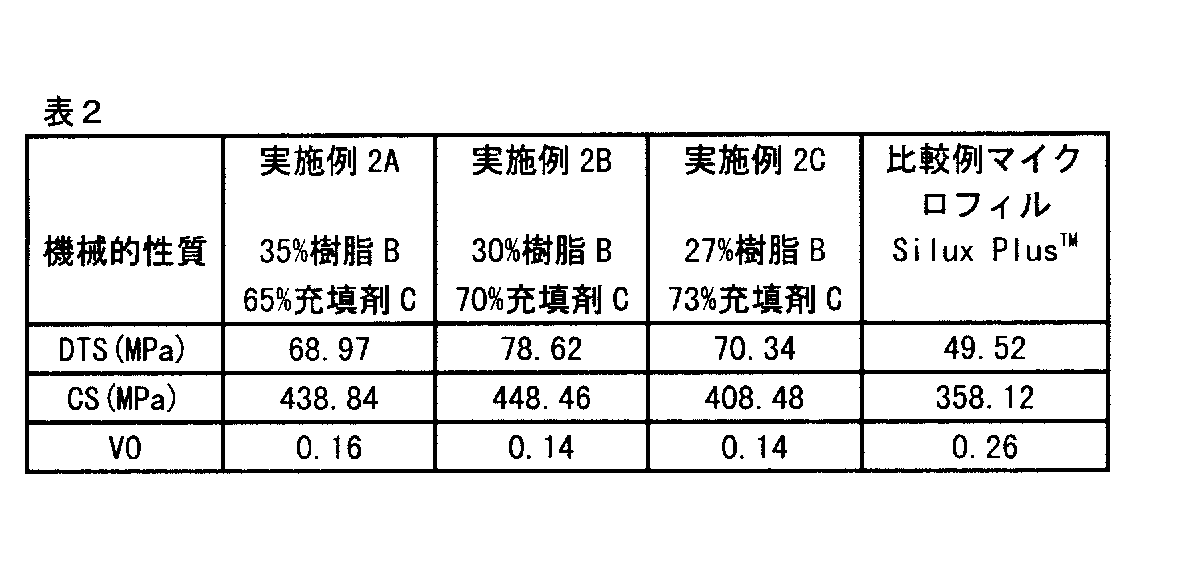
表7に示されるように充填剤Cの量を変動させて樹脂Bと混合し、3種類の材料を製造した。これらの材料を硬化させ、前述のDTS、VO、およびCS法に従って材料の機械的性質を評価した。
【0162】
【表4】
実施例3
実施例3A〜3Dの充填剤を製造するために、表3に記載されるように種々の量のA174(シラン)を、250gのNalco 2329ゾルと281gのメトキシプロパノールの混合物に加えた。Nalco 2329は2Lのビーカーに計り取った。アルコールとシランは1Lビーカーに計り取り、互いに混合した。かき混ぜながらゆっくりとアルコール溶液をシリカゾルに加え(1〜2分間)、約80℃の温度で約16時間維持した。各シラン処理シリカゾルを69gの樹脂Aと混合し、得られた改質有機ゾルを85〜90℃のオーブンで4時間加熱することによって、4種類のシラン処理シリカゾルの溶媒置換を行った。
【0164】
得られた4種類の改質有機ゾルと充填剤Bを完全に混合して、各材料の最終組成が31.5重量%の樹脂A、45.5重量%の紫蘭処理シリカ、および23重量%の充填剤Bとなる材料を製造した。これら4種類の材料を前述の視覚的不透明度およびDTS法に従って硬化させた。視覚的不透明度およびDTSのデータを表3に示す。
【0165】
【表5】
実施例4
ScotchbondTM接着剤(3M Co.,St.(Paul、ミネソタ)を充填剤Cと完全に混合して実施例4Aを製造した。同じ接着剤を充填剤BおよびCと混合して実施例4Bを製造した。表4に、各材料の成分の濃度を示している。
【0167】
これら2種類の接着剤の象牙質およびエナメル質に対する接着強さを、以下の手順によって評価した。接着剤組成物1種類当り、同様の年齢および外観の5つのウシ歯を環状アクリル円板に部分的に埋め込んだ。裏材料が紙のグレード120の炭化ケイ素研磨材を宝石用ホイールに取り付けたものを使用して、象牙質とエナメル質を露出させるために各歯の露出部分が平坦になりアクリル円板と平行となるように研削した。この工程中および後の研削および研磨工程中は、歯を連続的に水洗した。裏材料が紙のグレード600炭化ケイ素研磨材を宝石用ホイールに取り付けたものを使用して、歯の研削および研磨をさらに行った。
【0168】
研磨した歯は蒸留水中に保管し、研磨後2時間以内に試験に使用した。研磨した歯を水から取り出し、水をふき取って乾燥させた。ScotchbondTMキット7540S(3M Co.(St.Paul、ミネソタ))を使用し、ScotchbondTMエッチング液を研磨したそれぞれの歯の表面にはけで塗布し、15秒間静置し、蒸留水で洗浄し、続いて水をふき取って乾燥させた。ScotchbondTMプライマー1滴を研磨した各歯の表面にはけで塗布し、直後に圧縮空気を5秒間吹付けて乾燥させた。
【0169】
接着剤4A〜4Bを各歯の表面に塗布し、Visilux 2TM歯科用硬化光を10秒間照射して硬化させた。4mmの貫通する穴を有する厚さ2mmのTEFLON(E.I.Dupont Nemours(Wilmington、デラウェア))シートからあらかじめ製造した型を準備した各歯に押し付け、型の穴の中心軸が歯の表面と直交するようにした。各型の穴にZ100を充填し、Visilux 2TM歯科用硬化光を40秒間照射して硬化させた。
【0170】
歯と型は37Cの蒸留水中で約24時間保管した。次に型を注意深く歯から取り外すと、成形されたボタン状修復材が各歯に取り付けられた状態で残った。
【0171】
ホルダーに取り付けたアクリル円板をInstron装置のジョーに固定し、研磨した歯の表面が引張方向と平行に向かうように取り付けて、接着強さの評価を行った。矯正用ワイヤ(直径0.44mm)の輪を研磨した歯の表面に隣接する修復材ボタンのまわりに配置した。この矯正用ワイヤの末端をInstron装置の引張ジョーに固定し、接着剤に剪断応力がかかるようにした。クロスヘット速度を2mm/分として、接着剤(あるいは象牙質またはボタン)が破壊されるまで接着剤に応力をかけた。良好な接着性が観察された。
【0172】
【表6】
実施例5
表5に5A〜5Dで示されるゾル、メトキシプロパノール、およびシランを丸底フラスコに加え、ロータリーエバポレーターに取り付けた。5Aと5Bについては、混合物を45℃で約2時間混合した。5Cと5Dについては、混合物を90℃で約1時間混合した。5Eについては、混合物を45℃で約1時間撹拌した。
【0174】
5Aについては、試料を減圧し(約400mmHg)、約109gの混合物が残留するまで大部分の水を除去した。表5に記載のUVR−6105を、アルコールとシランとシリカの混合物に加え、エポキシが溶解するまでロータリーエバポレーターで回転させた。再び減圧し、温度を65℃まで上昇させた。減圧は約1時間続けると、この時点でロータリーエバポレーターの冷却コイル状に残留濃縮物は見られなかった。材料5Aは約40重量%のシリカを含有し、目視検査では透明であった。
【0175】
5Bについては、試料を減圧し(約400mmHg)、約67gの混合物が残留するまで大部分の水を除去した。表5に記載のUVR−6105を、アルコールとシランとシリカの混合物に加え、エポキシが溶解するまでロータリーエバポレーターで回転させた。再び減圧を行った。減圧を約1時間続けると、この時点でロータリーエバポレーターの冷却コイル状に残留濃縮物は見られなかった。この材料は約52重量%のシリカを含有し、目視検査では透明であった。
【0176】
5Cについては、試料を減圧し(約400mmHg)、約109gの混合物が残留するまで大部分の水を除去した。表5に記載のUVR−6105、Heloxy 48、およびGY281を、アルコールとシランとシリカの混合物に加え、エポキシが溶解するまでロータリーエバポレーターで回転させた。再び減圧を行った。減圧を約1時間続けると、この時点でロータリーエバポレーターの冷却コイル状に残留濃縮物は見られなかった。この材料は約50.8重量%のシリカを含有し、目視検査では透明であった。
【0177】
5Dについては、試料を減圧し(約400mmHg)、約120gの混合物が残留するまで大部分の水を除去した。表5に記載のUVR−6105およびGY281を、アルコールとシランとシリカの混合物に加え、エポキシが溶解するまでロータリーエバポレーターで回転させた。温度55℃において再び減圧を行った。減圧を約1時間続けた後、90℃まで5分間温度を上昇させた。この時点でロータリーエバポレーターの冷却コイル状に残留濃縮物は見られなかった。この材料は約40.0重量%のシリカを含有し、目視検査では透明であった。
【0178】
各材料について、エポキシ樹脂成分の重量を基準にして2重量%のCD1012、0.1重量%のEDMAB、および0.6重量%のカンファーキノンで構成される開始剤成分を材料と完全に混合した。材料5A〜5Dには3M Visilux 2TM歯科用硬化光を10〜20秒間照射した。材料5Eには3M Visilux 2TM歯科用硬化光を20秒間照射した。3M Visilux 2TMに曝露した後の、各材料の外観および硬化したかどうかの判断を表6に示す。
【0179】
【表7】
【表1】
実施形態1
a)硬化性樹脂と、
b)前記樹脂中に分散させたシリカ粒子と、
を含み、前記シリカ粒子は、平均直径が約200nm未満であり、前記歯科材料の重量を基準にして約40重量%を超える量で存在する歯科材料。
実施形態2
前記歯科材料の重量を基準にして、前記シリカ粒子が約40重量%を超え約90重量%未満の量で存在する実施形態1に記載の歯科材料。
実施形態3
前記歯科材料の重量を基準にして、前記シリカ粒子が約50重量%を超え約75重量%未満の量で存在する実施形態1に記載の歯科材料。
実施形態4
前記シリカ粒子の平均直径が約100nm未満である実施形態1に記載の歯科材料。
実施形態5
硬化後の前記材料の視覚的不透明度値が約0.4未満である実施形態1に記載の歯科材料。
実施形態6
硬化後の前記材料の視覚的不透明度値が約0.35未満である実施形態1に記載の歯科材料。
実施形態7
硬化後の前記材料の視覚的不透明度値が約0.25未満である実施形態1に記載の歯科材料。
実施形態8
硬化後の前記材料の直径引張強さが約15MPaを超える実施形態1に記載の歯科材料。
実施形態9
硬化後の前記材料の直径引張強さが約40MPaを超える実施形態1に記載の歯科材料。
実施形態10
硬化後の前記材料の直径引張強さが約60MPaを超える実施形態1に記載の歯科材料。
実施形態11
硬化後の前記材料の圧縮強さが約35MPaを超える実施形態1に記載の歯科材料。
実施形態12
硬化後の前記材料の圧縮強さが約200MPaを超える実施形態1に記載の歯科材料。
実施形態13
硬化後の前記材料の圧縮強さが約350MPaを超える実施形態1に記載の歯科材料。
実施形態14
前記硬化性樹脂が、アクリレート、メタクリレート、エポキシ、およびそれらの混合物からなる群より選択される実施形態1に記載の歯科材料。
実施形態15
前記樹脂を硬化させるための開始剤をさらに含む実施形態1に記載の歯科材料。
実施形態16
重金属酸化物をさらに含む実施形態1に記載の歯科材料。
実施形態17
前記重金属酸化物が、酸化ジルコニウム、酸化セリウム、酸化スズ、酸化イットリウム、酸化ストロンチウム、酸化バリウム、酸化ランタン、酸化亜鉛、酸化イッテルビウム、酸化ビスマス、およびそれらの混合物からなる群より選択される実施形態16に記載の歯科材料。
実施形態18
前記重金属酸化物が立方晶または正方晶酸化ジルコニウムである実施形態16に記載の歯科材料。
実施形態19
前記材料が、歯科修復材、歯科用接着剤、歯科用ミルブランク、歯科補綴材料、矯正装置、歯科鋳造材料、および歯科用コーティングからなる群より選択される実施形態1に記載の歯科材料。
実施形態20
ヒュームドシリカをさらに含む実施形態1に記載の歯科材料。
実施形態21
a)表面改質剤をシリカ粒子と混合する工程と、
b)前記表面改質シリカ粒子を硬化性樹脂と混合する工程と、
c)前記樹脂を硬化させる工程と、
を含み、前記シリカ粒子は、前記樹脂中に分散し、平均直径が約200nm未満であり、前記歯科材料の全重量の約40重量%を超える量で存在する、歯科材料の製造方法。
実施形態22
前記シリカ粒子が、前記歯科材料の全重量の約40重量%を超え約90重量%未満の量で存在する実施形態21に記載の方法。
実施形態23
前記シリカ粒子が、前記歯科材料の全重量の約50重量%を超え約75重量%未満の量で存在する実施形態21に記載の方法。
実施形態24
前記シリカ粒子の平均直径が約100nm未満である実施形態21に記載の方法。
実施形態25
前記硬化性樹脂が、アクリレート、メタクリレート、エポキシ、およびそれらの混合物からなる群より選択される実施形態21に記載の方法。
実施形態26
d)前記樹脂を硬化させるための開始剤を混合する中間工程をさらに含み、前記工程d)は前記樹脂を硬化させる前に実施される実施形態21に記載の方法。
実施形態27
e)前記硬化性樹脂中に重金属酸化物を混合する中間工程をさらに含み、前記工程e)は前記樹脂を硬化させる前に実施される実施形態21に記載の方法。
実施形態28
前記重金属酸化物が、酸化ジルコニウム、酸化セリウム、酸化スズ、酸化イットリウム、酸化ストロンチウム、酸化バリウム、酸化ランタン、酸化亜鉛、酸化イッテルビウム、酸化ビスマス、およびそれらの混合物からなる群より選択される実施形態27に記載の方法。
実施形態29
前記重金属酸化物が立方晶または正方晶酸化ジルコニウムである実施形態27に記載の方法。
実施形態30
前記材料が、歯科修復材、歯科用接着剤、歯科用ミルブランク、歯科補綴材料、矯正装置、歯科鋳造材料、および歯科用コーティングからなる群より選択される実施形態21に記載の方法。
実施形態31
前記材料がヒュームドシリカをさらに含む実施形態21に記載の方法。
実施形態32
a)実施形態1に記載の前記歯科材料を歯の表面付近または表面上に配置する工程と、
b)前記材料の形状を変化させる工程と、
c)前記材料を硬化させる工程と、
を含む実施形態1に記載の前記歯科材料の使用方法。
実施形態33
工程a)、b)、およびc)が順次実施される実施形態32に記載の方法。
実施形態34
前記硬化性樹脂の仕上を行う工程をさらに含む実施形態32に記載の方法。
実施形態35
前記歯科材料がミルブランクであり、形状を変化させる前記工程b)が前記材料のカービングによって実施される実施形態33に記載の方法。
実施形態36
a)硬化性樹脂と、
b)前記樹脂を硬化させるための開始剤と、
c)前記樹脂中に分散させたシリカ粒子と、
を含み、前記歯科材料の重量を基準にして前記シリカ粒子が約40重量%を超え約90重量%未満の量で存在する歯科材料。
実施形態37
前記硬化性樹脂が、アクリレート、メタクリレート、エポキシ、およびそれらの混合物からなる群より選択される実施形態36に記載の歯科材料。
実施形態38
酸化ジルコニウム、酸化セリウム、酸化スズ、酸化イットリウム、酸化ストロンチウム、酸化バリウム、酸化ランタン、酸化亜鉛、酸化イッテルビウム、酸化ビスマス、およびそれらの混合物からなる群より選択される重金属酸化物をさらに含む実施形態36に記載の歯科材料。
実施形態39
前記材料が、歯科修復材、歯科用接着剤、歯科用ミルブランク、歯科補綴材料、矯正装置、歯科鋳造材料、および歯科用コーティングからなる群より選択される実施形態36に記載の歯科材料。
【図面の簡単な説明】
【図1】 300,000倍の倍率で撮影した本発明の歯科材料の好ましい実施態様のTEM(透過型電子顕微鏡写真)のデジタル画像である。[0001]
Field of Invention
In general, the present invention relates to dental materials containing nano-sized particles dispersed in a curable resin. These materials can be used as restoratives, adhesives, cement, orthodontic devices, mill blanks, and prosthetic materials. More particularly, the present invention relates to a dental material containing discrete nano-sized silica particles that impart high strength and high translucency to the dental material.
[0002]
background
While the demand for composite materials is extensive, the demand for dental materials is generally unique. For health reasons, the dental material should be suitable for use in the oral environment. In some cases, the strength and durability of the dental material is important to obtain sufficient performance. For example, in a dental work generally performed at a dentition position having a large masticatory force, it is desirable to have high strength and high durability. In other cases, aesthetic properties or quality (eg, gloss or translucency) is highly desired. This is often the case with dental work performed at a location where tooth restoration or filling can be seen at a relatively close distance.
[0003]
Usually, the strength of a dental material is obtained by adding a filler. In general, dental materials with higher mechanical strength properties are filled or loaded with larger sized particles (ie, greater than about 0.4 μm in diameter). These materials are often referred to as hybrid composite materials. However, one of the disadvantages of these composite materials is that they tend to lack gloss and aesthetics. Another drawback of composites with large particles is that repeated brushing (necessary for oral hygiene) will cause the cured resin to wear out, exposing large filler particles, lacking gloss on the surface and detracting from aesthetics Is to become. This can later cause plaque buildup.
[0004]
Increasing the amount of filler can also increase the strength of the dental material. However, this increases visual opacity and thus may reduce translucency and aesthetic quality.
[0005]
Canadian Patent Application 2,202,732 teaches a polymerizable dental material comprising a surface-modified silica particle sol in a liquid organic dispersant. The silica particles comprise about 35% by weight of the dental material.
[0006]
If the rheological properties of the uncured dental material are good, it is advantageous for the dental practitioner. This allows the medical practitioner to easily manipulate and place the dental material at the desired location to properly contact it into an anatomical form before it is hardened or hardened. There are nanometer sized ("nano sized") silica particles dispersed in a polymerizable dental resin that are mostly in the form of fumed silica. Fumed silica materials available from DeGussa under the trade name OX-50 (DeGussa AG, Hanau, Germany) have been widely used. However, a material made from fumed silica dispersed in a resin at a high filling rate becomes a dilatant composition that is not practical for dental use. “Restorable Dental Materials” 8th edition (1989) by Craig, a well-recognized dental reference book, generally yields materials with poor rheological properties of highly filled fumed silica materials. (See, for example, Craig, page 256). Therefore, conventional materials in which the content of inorganic components (particles) is adjusted so as to obtain a desired strength are often undesirable dilatant materials.
[0007]
In order to overcome dilatant rheology, a method of incorporating prepolymerized particles has also been implemented. However, the materials obtained by these methods may have low strength.
[0008]
It is generally desirable for dental materials to look well in harmony with the surrounding dentition. In general, the aesthetics of dental materials are realized by producing a material having a color / shading similar to that of teeth. One type of dental material, microfill, tends to have an excellent gloss to better reproduce the appearance of teeth. An example of “microfill” is commercially available under the trade name SILUX PLUS (3M Co. (St. Paul, Minnesota)). However, microfills typically have less mechanical strength than hybrid composites or “macrofills”.
[0009]
Thus, currently practiced methods for applications where high strength and high aesthetics are desired, physicians often need to overlay a microfilament layer after first forming a base of material with high physical strength. . It would be advantageous if a single material with high strength and high aesthetics was provided.
[0010]
Summary of invention
The present invention provides a dental material comprising a curable resin and nano-sized silica particles dispersed in the resin for obtaining a strong and translucent dental material. The silica particles have an average diameter of less than about 200 nm and are present in an amount greater than about 40% by weight of the total weight of the dental material.
[0011]
“Curable” means a material that can be cured or solidified by solvent removal by heating, polymerization by heating, chemical crosslinking, radiation-induced polymerization or crosslinking, and the like.
[0012]
“Dispersed in the resin” means that the silica particles are present in the resin as discrete and unassociated (ie, non-agglomerated and non-agglomerated) particles.
[0013]
The dental material of the present invention can be used for dental adhesives, artificial crowns, anterior or posterior fillers, casting materials, cavity liners, cements, coating compositions, mill blanks, orthodontic appliances, restoratives, prosthetic materials, sealants, etc. Can be used.
[0014]
In one aspect of the invention, the curable resin may be an acrylate, methacrylate, or epoxy, or a combination thereof.
[0015]
In yet another aspect of the invention, heavy metals can be incorporated into the dental material to impart radiopacity.
[0016]
A method of using a dental material is also provided that includes placing a dental material near or on the surface of the tooth, changing the shape of the material, and curing the material.
[0017]
Detailed Description of the Preferred Embodiment
The present invention provides a dental material containing a curable resin and a nano-sized (ie, average diameter less than 200 nm) silica filler dispersed in the resin. Silica filler is used in an amount that provides both high strength and high translucency. Optionally, heavy metal oxides can be incorporated into the material to impart radiopacity to the material.
[0018]
The dental material of the present invention can be used, for example, as a dental adhesive, artificial crown, anterior or posterior filler, casting material, cavity liner, cement, coating composition, mill blank, orthodontic appliance, restorative material, prosthetic material, and sealant. Can be used. In a preferred embodiment, the dental material of the present invention is a dental restoration material. The restoration material of the present invention can be directly placed in the oral cavity and cured (hardened) in situ, or after the prosthetic device is manufactured from the restoration material of the present invention outside the oral cavity, It can also be bonded and fixed to.
[0019]
The dental material of the present invention may be a chemical curable, thermosetting, or photocurable composition. The photocurable material should have a suitable initiator system. Chemically curable materials can be self-curing (eg, using a redox initiator). Alternatively, the material of the present invention can be cured by a combination of self-curing and photocuring.
[0020]
It was found that high strength and high translucency can be obtained by filling the dental material with nano-sized silica particles. The dental material containing the defined amount of nano-sized silica particles of the present invention has particularly desirable handling (rheological) properties in the uncured state, has a very high strength in the cured state, and is also aesthetic.
[0021]
Strength can be characterized by mechanical measurements such as compressive strength and diametric tensile strength. The high compressive strength of the dental material favors the forces applied by tooth repair, replacement, and chewing at the restoration site. Diameter tensile strength (DTS) refers to the ability of a dental material to withstand compressive forces that cause tensile stress in the material. Each strength measurement test is described in the examples below.
[0022]
The dental material of the present invention when cured has a compressive strength of at least about 35 MPa, more preferably the compressive strength of the material of the present invention is at least about 200 MPa, and most preferably the compressive strength of the material of the present invention. Is at least about 350 MPa.
[0023]
The cured dental material of the present invention preferably has a diameter tensile strength of at least about 15 MPa, more preferably at least about 40 MPa, and most preferably at least about 60 MPa.
[0024]
In one aspect, the aesthetics of dental materials, which are somewhat subjective in nature (but well known in the dental industry), are preferably quantified by visual opacity measurements. Visual opacity is an indicator of the degree of translucency of a dental material, and a low visual opacity is desirable because the cured dental material has a real gloss. The visual opacity of the dental material of the present invention is preferably about 0.05 to 0.4, more preferably about 0.05 to 0.35, and most preferably about 0.05 to 0.25. It is.
[0025]
Although the material of the present invention is packed with a relatively large amount of nano-sized silica particles, it has been found to still have good rheological properties. These properties and strengths can be improved by treating the particle surface with a surface modifier. By the surface treatment (surface modification), the dispersibility of the particles is improved and the bondability with the matrix is also improved.
[0026]
In general, practitioners want good handling of dental materials because it saves time. For example, after a doctor places a material in the oral cavity and performs contouring and feathering of the material, the doctor often wants the molded shape to remain unchanged until the material is cured Therefore, it is desirable that the dental material does not fall abruptly during the tooth restoration work. If the material used for the repair operation has a sufficiently high yield stress, generally a sudden drop will not occur, i.e. the material will not flow under the stress of gravity. The yield stress of a material is the minimum stress required for material flow to occur. W. Page 92 of “Rheology Principles, Measurements, and Applications” (VCH Publishers, Inc., New York, 1994) by Macosko. If the stress due to If gravity is less than the yield stress of the material, the material will not flow. However, the stress due to gravity varies depending on the mass and shape of the placed dental material.
[0027]
“Contouring” means the process (using dental equipment) of shaping a structural material to resemble the natural dental anatomy. In order to facilitate contouring, the material should be sufficiently viscous to maintain its shape after operation with dental equipment, but should not be so viscous that it becomes difficult to form the material. Absent. “Feathering” means the process of reducing the thickness of a dental material into a thin film so that the original dentition and material are in harmony. This is done using dental equipment at the interface between the material to be manipulated and the original dentition. It is also desirable that the dental material not stick to the equipment it is placed on to prevent further changes in shape or surface shape.
[0028]
In a preferred embodiment in which the dental material of the present invention is a restorative material, the dental material of the present invention has little or no sudden fall, is easily adapted to cavity formation, etc., and is easy to contour and feather. preferable. Preferably, the dental material of the present invention does not stick to the placed equipment, which is advantageous because it is generally quick and easy to use in dental procedures such as restoration of the tooth structure.
[0029]
Surprisingly, it has been discovered that the dental materials of the present invention can have improved desirable shear thinning behavior. That is, the dental material of the present invention can have a low viscosity under high stress and can have a high viscosity under low stress. Due to the low viscosity under high stress, the practitioner can scrape the dental material by feathering the material onto the tooth surface. Conveniently, because of the high viscosity under low stress, the material can maintain its shape after the physician has shaped the material to match the tooth profile (i.e. it does not fall off abruptly) ).
[0030]
Silica is dispersed within the curable resin matrix. The silica particles used in the dental material of the present invention preferably have an average diameter of less than about 200 nm, more preferably the average diameter of the particles is less than about 100 nm. These measurements are preferably performed based on a TEM (Transmission Electron Microscopy) method, in which the average particle size is determined by analyzing a population of particles as shown in FIG. The preferred measurement method for the particle size is described in the section of the test method described later. FIG. 1 shows preferred silica particles dispersed in a curable resin. The average surface area of the silica particles is preferably about 15 m2/ G, more preferably about 30 m2/ G.
[0031]
After being dispersed in the resin, the silica particles are separated (independent) and not associated (that is, non-agglomerated, non-aggregated). “Agglomerate” as used herein means that the particles are usually weakly bound to each other by charge or polarity and can be broken into smaller parts. As used herein, “aggregation” means that the particles are often strongly bound to each other, such as by treatment of residual compounds, and it is very difficult to break up the aggregate into smaller parts. is there.
[0032]
The silica particles used in the dental material of the present invention are preferably substantially spherical and substantially non-porous. The silica is preferably substantially pure, but can contain small amounts of stabilizing ions such as ammonium ions or alkali metal ions.
[0033]
A preferred nanosize silica is Nalco Chemical Co. (Naperville, Illinois) under the product name NALCO COLLOIDAL SILICA. For example, preferred silica particles can be obtained using NALCO products 1040, 1042, 1050, 1060, 2327, and 2329. In a preferred embodiment in which a cationic initiation system is used for the curable resin, it is preferred that the starting silica is acidic (eg, Nalco 1042).
[0034]
In addition to the nano-sized silica particles described above, fumed silica can optionally be added to the material of the present invention. Suitable fumed silicas include, for example, products sold under the trade names AEROSIL series OX-50, OX-130, OX-150, and OX-200 from DeGussa AG (Hanau, Germany), and Cabot Corp (Tuscola, Products sold under the trade name CAB-O-SIL M5 from Illinois.
[0035]
By surface-treating the nanosized silica particles before filling into the dental material, a stable dispersion in the resin is obtained. “Stable” as used herein includes about 24 hours at standard ambient conditions (eg, room temperature (about 20-22 degrees), atmospheric pressure, no extreme electromagnetic force), etc. It means a dental material that does not agglomerate after standing for a period of time. Preferably, the nano-sized particles are stabilized by the surface treatment, whereby the particles are well dispersed in the curable resin and a substantially uniform composition is obtained. Further, it is preferable that at least a part of the surface of the silica is modified with a surface treatment agent, thereby enabling a reaction such as copolymerization between the curable resin being cured and the stabilizing particles.
[0036]
The silica particles of the present invention are preferably treated with a resin-compatible surface treatment agent. Particularly preferred surface treatment agents or surface modifiers include silane treatment agents that can be polymerized with a resin. Preferred silane treating agents include γ-methacryloxylpropyltrimethoxysilane (commercially available as trade name A-174, commercially available from Witco OSi Specialties (Danbury, Connecticut)), and γ-glycidoxypropyltrimethoxysilane ( A product available under the trade name G6720 and available from United Chemical Technologies (Bristol, PA).
[0037]
Alternatively, a combination of surface modifiers may be useful, in which case at least one of the surface modifiers has a functional group copolymerizable with the curable resin. For example, the polymerizable group may be an ethylenically unsaturated group or a cyclic group that easily undergoes ring-opening polymerization. The ethylenically unsaturated polymerizable group may be, for example, an acrylate group or a methacrylate group, or a vinyl group. Cyclic functional groups susceptible to ring-opening polymerization generally contain heteroatoms such as oxygen, sulfur, or nitrogen, and are preferably oxygen-containing three-membered rings such as epoxides. Other surface modifiers that generally do not react with curable resins can be used to improve dispersibility or rheological properties. Examples of this type of silane include, for example, alkyl or aryl polyethers, alkyl, hydroxyalkyl, hydroxyaryl, or aminoalkyl functional silanes.
[0038]
After the surface treatment of the silica particles, they can be mixed with a suitable curable resin to produce the dental material of the present invention. The silica particles are preferably present in an amount greater than about 40% by weight (wt.%) Of the total weight of the dental material. More preferably the silica particles are present in an amount from about 40% to about 90% by weight, and most preferably the silica particles are present in an amount from about 50% to about 75% by weight.
[0039]
Optionally, heavy metal oxides can be added to the dental material of the present invention to obtain a radiopaque dental material. An amount of heavy metal oxide effective to impart radiopacity is preferably present. As used herein, “radiopaque” means that a standard dental x-ray device can be used in a conventional manner to distinguish hardened dental material from tooth structure. A radiopaque dental material is advantageous when X-rays are used for diagnosing dental conditions. For example, if a radiopaque material is used, it is possible to detect secondary engulfment that can form in the tooth tissue around the filler. The desired degree of radiopacity can vary depending on the particular application and the physician's expectation of evaluating the x-ray film.
[0040]
Heavy metal oxides having an atomic number greater than about 28 are preferred. The heavy metal oxide should be selected so that the resin in which it is dispersed and cured does not have an undesirable color or tint. For example, iron and cobalt are not preferable because the color of the intermediate teeth of the dental material is dark and has a high contrast color. Most preferably, the heavy metal oxide is an oxide of a metal having an atomic number greater than 30. Suitable metal oxides are yttrium, strontium, barium, zirconium, hafnium, niobium, tantalum, tungsten, bismuth, molybdenum, tin, zinc, lanthanide elements (ie atomic numbers 57-71 (including numbers at both ends)) Certain elements), and oxides of cerium, and combinations thereof. Most preferably, heavy metal oxides having an atomic number greater than 30 and less than 72 are optionally added to the material of the present invention. Particularly preferred radiopaque metal oxides include lanthanum oxide, zinc oxide, tin oxide, zirconium oxide, yttrium oxide, ytterbium oxide, barium oxide, strontium oxide, cerium oxide, and combinations thereof.
[0041]
The heavy metal oxide component as well as other additives are incorporated into the dental material of the present invention in various forms such as particles on the silica surface, particles mixed with the silica particles, or at least part of the coating layer on the surface of the silica particles. be able to. Preferably, the heavy metal oxide component is supplied as a sol or individual particles.
[0042]
It has been discovered that by incorporating an effective amount of nano-sized heavy metal oxide particles into the dental material of the present invention, a translucent, high X-ray opacity and high refractive index material can be obtained. The average diameter of the heavy metal oxide particles is preferably less than about 100 nm. Most preferably, the average diameter of these particles is less than about 70 nm, more preferably less than about 60 nm. The heavy metal oxide particles may be aggregated. In such a case, the average diameter of the aggregated particles is preferably less than about 200 nm, more preferably less than about 90 nm.
[0043]
A preferred source of non-aggregated heavy metal oxide particles is a sol having particles dispersed in a solution. The zirconia sol disclosed in US Pat. No. 5,037,579 (Matchett) is a preferred heavy metal oxide that is suitable for use in the dental materials of the present invention.
[0044]
Another preferred zirconia sol is a US patent application by Kolb, filed on the same day as the present invention and having Attorney Docket No. 55200USA5A, entitled “Zirconia Sol and Method of Making Same”. Is disclosed. The zirconia sol of application number 55200USA5A includes a plurality of single crystal zirconia particles having an average primary particle size of about 20 nm or less, more preferably an average primary particle size in the range of about 7 to 20 nm. As used herein, the term “primary particle size” means the particle size of non-aggregated single crystal zirconia particles. The primary particle size is measured by the test method titled “Crystallite particle size and crystal form content”, and this procedure is described in the “Test Method” section below.
[0045]
As disclosed in application number 55200USA5A, the zirconia sol includes highly crystalline zirconia particles. This is important because crystalline zirconia has a higher refractive index and higher X-ray scattering capability than amorphous zirconia. The crystallinity of zirconia particles can be quantified using crystallinity and the like. The crystallinity is calculated from the value obtained by dividing the X-ray scattering intensity of the sample material by the X-ray scattering intensity of a standard substance having a known crystallinity such as calcium-stabilized zirconium oxide. The specific test procedure for the crystallinity of the zirconia particles is described in the section “Test Method” described later under the title “Crystallinity Procedure”. In the case of zirconia sol, the crystallinity of the zirconia particles is about 0.65 or more. Most preferably, the crystallinity of the zirconia particles is about 0.75 or more, and most preferably about 0.85 or more.
[0046]
In the crystal part of the zirconia particles, the main crystal lattice forms are cubic and tetragonal, and a small amount of monoclinic phase is also present. Since it is difficult to separately quantify the cubic and tetragonal crystal lattice structures using X-ray diffraction, these two are considered together. In this specification, cubic and tetragonal complex crystal systems Describe. Specifically, the zirconia particles contain about 70% or more of cubic and tetragonal complex crystal lattice structures. Most preferably, the zirconia particles comprise about 75% or more of cubic and tetragonal composite crystal lattice structures, and most preferably about 85% or more of cubic and tetragonal composite crystal lattice structures. In each case, the remainder of the crystal phase is a monoclinic crystal lattice structure.
[0047]
Due to the very small size, the zirconia particles exist mainly as cubic and tetragonal crystal lattice phases, and it is not necessary to use an effective amount of crystalline phase stabilizer. As used herein, the term “crystalline phase stabilizer” means a substance that can be added to stabilize zirconia into a cubic and / or tetragonal crystal lattice structure. Specifically, the crystalline phase stabilizer functions to suppress the transition of the cubic phase and / or the tetragonal phase to the monoclinic phase. Examples of crystalline phase stabilizers include alkaline earth oxides such as MgO and CaO, rare earth oxides (ie, lanthanides), and Y2OThreeIs mentioned. “Effective amount” means the amount of crystalline phase stabilizer necessary to inhibit the transition of zirconia from the cubic and / or tetragonal phase to the monoclinic phase. In preferred embodiments, the zirconia particles comprise less than about 1% by weight crystalline phase stabilizer, more preferably less than about 0.1% by weight crystalline phase stabilizer.
[0048]
In the case of the zirconia sol of Application No. 55200USA5A, the primary particles of zirconia are present in a substantially non-associated (ie, non-aggregated and non-agglomerated) form. A quantitative measure of the degree of association between primary particles in the sol is the dispersion index. As used herein, “dispersion index” is defined as the hydrodynamic particle size divided by the primary particle size. The primary particle diameter is determined by using an X-ray diffraction technique described in the test procedure “crystallite particle diameter and crystal form content” described later. The hydrodynamic particle size means the weight average particle size of zirconia particles in an aqueous phase measured by “photon correlation spectroscopy” (PCS) described in the “Test Method” section below. If the primary particles are associated, PCS provides a measurement of the particle size of the primary particle aggregates and / or agglomerates in the zirconia sol. If the particles are not associated, the particle size value of the primary particles is determined by PCS. Therefore, the dispersion index value approaches 1 as the association between primary particles in the sol decreases. In the zirconia sol, since the primary zirconia particles are present in a substantially non-associated form, the dispersion index of the zirconia sol is in the range of about 1 to 3, preferably in the range of about 1 to 2.5, most preferably. Is in the range of about 1-2.
[0049]
As further taught in Application No. 55200USA5A, suitable starting materials for the preparation of polyether acid zirconium salts include zirconium carboxylates and basic zirconium salts having counterions replaceable with carboxylic acids. A basic zirconium salt is mentioned. Representative examples of basic zirconium salts having counterions that can be substituted with carboxylic acids include zirconium oxynitrate, zirconium oxychloride, and zirconium carbonate. Basic zirconium salts are those in which at least a portion of the cationic charge on zirconium is hydroxide anions or O2-Zirconium salt that is offset by anions. The oxygen content in the basic zirconium salt is hydroxide ion or O2-Since it is difficult to actually measure whether or not it originates from this, this oxygen content is generally expressed simply as oxygen. For example, the following formula (1) is represented by removing bound water for the sake of simplicity, and represents a general formula of a zirconium compound that can be suitable as a starting material for the preparation of polyether acid zirconium salt.
ZrO(4-n / 2)(X)n (1)
In the formula, X is a counter ion displaceable by carboxylic acid,
n is in the range of 0.5-4.
[0050]
Representative examples of counter ions that can be substituted with carboxylic acid include carboxylate ions such as acetate ion, formate ion, and propionate ion, and other counter ions such as nitrate ion, chloride ion, carbonate ion, or the like. Combinations are listed. Zirconium alkoxides are not formally zirconium salts, but can be used as starting materials for the formation of zirconium polyether acid after first reacting with a suitable acid to form a basic zirconium salt.
[0051]
Preferred starting materials are those of the general formula ZrO(4-n / 2)(CHThreeCOO)nAn aqueous solution or sol of basic zirconium acetate having (where n is in the range of about 1-2). In the case of an aqueous solution, probably zirconium acetate exists as a polynuclear zirconium complex cation. Methods for preparing zirconium acetate are known in the art (eg, “The Chemical Behavior of Zirconium” by D. Van Nostrand Company, Princeton, NJ). (See page 338). A suitable zirconium acetate solution contains about 5-40% by weight of ZrO.2The range of about 5-40% by weight is acetate. A preferred zirconium acetate sol starting material is 20 wt% ZrO.2ZrO1.25(C2HThreeO2)1.5Nyacol Products Corp. (Nashol ZrO, trade name from Ashland, Massachusetts)2(Ac) ".
[0052]
In the preferred method of application number 55200USA5A, the polyether acid zirconium salt is prepared by reacting the zirconium salt with a polyether carboxylic acid in an aqueous solution. Current understanding is that the polyether carboxylic acid is believed to function to prevent the association (ie, agglomeration and / or aggregation) of the zirconia particles formed during the hydrolysis reaction. For this reason, the zirconia particle produced | generated by this method does not associate substantially.
[0053]
Suitable polyether carboxylic acids for use as modifiers in application number 55200USA5A are water-soluble monocarboxylic acids having a polyether end (ie containing one carboxylic acid group per molecule). The polyether end includes a repeat of a bifunctional alkoxy group having the general formula —O—R—. Preferred R groups have the general formula -CnH2n-, For example, methylene, ethylene, and propylene (including n-propylene and i-propylene), or combinations thereof. The combination of R groups can also be present as a random copolymer or a block copolymer.
[0054]
Preferred types of monovalent polyether groups are generally of formula (3):
CHThree-[O- (CH2)y]x-X-COOH (3)
In the formula,
X is a divalent organic bridging group,
x is in the range of about 1-10;
y is in the range of about 1-4.
-X as a representative example of X2-(CH2)n-In which X2Are —O—, —S—, —C (O) O—, —C (O) NH—, and n ranges from about 1 to 3.
[0055]
Examples of preferred polyether carboxylic acids include the chemical structure CHThreeO (CH2CH2O)2CH22- [2- (2-methoxyethoxy) ethoxy] acetic acid (hereinafter MEEAA) with COOH and chemical structure CHThreeOCH2CH2OCH22- (2-methoxyethoxy) acetic acid (hereinafter referred to as MEAA) having COOH. MEAA and MEEAA are from Aldrich Chemical Co. (Milwaukee, Wisconsin) with catalog numbers 40, 701-1 and 40, 700-3, respectively. The use of a mixture of two or more polyether carboxylic acids is also within the scope of the present invention.
[0056]
Reaction sequence (1):
ZrO(4-n / 2)(X)n+ AR2-COOH → ZrO(4-n / 2)(X)na(R2COO)a+ AHX (1)
By reaction of a polyether carboxylic acid with a zirconium salt according to formula ZrO(4-n / 2)(X)na(R2COO)aA polyether acid zirconium salt having the following formula is formed, releasing (ie releasing) an approximately stoichiometric amount of acid having the general formula HX. For example, the zirconium salt is zirconium acetate (ZrO(4-n / 2)(C2HThreeO2)n) As a result of the formation of the zirconium polyetherate salt, the stoichiometric amount of acetic acid (C2HThreeO2H) is released (see reaction sequence 1a).
ZrO(4-n / 2)(C2HThreeO2)n+ AR2-COOH → ZrO(4-n / 2)(C2HThreeO2)na(R2COO)a+ AC2HThreeO2H (1a)
[0057]
Since the acid binds to the zirconium atom, the salt of zirconium and carboxylic acid does not dissociate in the aqueous phase. Carboxylic acid makes the salt water soluble. When a hydrophobic acid (eg alkyl acid) and zirconium are combined, the salt becomes insoluble in water. In fact, it becomes insoluble in water just by adding a small amount of acid such as propionic acid or acrylic acid. In contrast, the polyether acid used in Application No. 55200USA5A can maintain the water solubility of the polyether acid zirconium salt while using higher molecular weight acids. For this reason, the polyether acid zirconium salt which melt | dissolves in an aqueous phase can be hydrothermally treated.
[0058]
Usually, based on the zirconium salt starting material, the polyether carboxylic acid is about 2.5-5.0 mmol / ZrO in the zirconium salt.2An amount in the range of gram equivalents is added. Preferred zirconium acetate starting material (ie Nyacol ZrO2In the case of (Ac)), about 20-50% of the acetic acid groups are substituted in this range. Preferably, the amount of polyether carboxylic acid added is limited to the minimum amount necessary to prevent association of the resulting zirconia particles. This keeps the amount of acid released during the formation of the polyether acid zirconium salt to a minimum. The amount of added polyether carboxylic acid depends on factors such as the molecular weight, concentration, hydrolysis reaction time, and temperature of the polyether carboxylic acid.
[0059]
According to the further teaching of application number 55200USA5A, usually the polyether carboxylic acid is added to the aqueous zirconium salt solution and the resulting solution is stirred at room temperature for about 30-60 minutes. The polyether carboxylic acid molecule reacts with the zirconium salt, and at least a part of the acid group is substituted to bind to the zirconium salt. The substituted acid group is released into the solution as the free acid. Usually, it is preferable to remove at least a part of the acid produced by the polyether acid zirconium salt, more preferably substantially all of the acid is removed. It should be noted that removal of the acid can shift the reaction equilibrium in the direction of formation of the polyether acid zirconium salt. Suitable methods for removing excess acid are known in the art and include, for example, drying or distillation. If the free acid has a low boiling point (eg, <about 175 ° C.), the acid can be removed by heating the solution until the aqueous phase evaporates to leave the polyether acid zirconium salt. Next, it is necessary to dissolve the polyether acid zirconium salt in water before hydrolysis occurs.
[0060]
After the formation of the polyether acid zirconium salt, preferably after removing the free acid, the next step is to prepare the aqueous polyether acid zirconium salt solution under conditions sufficient to convert the polyether acid zirconium salt into crystalline zirconia particles. It is to hydrolyze. For example, when the polyether acid zirconium salt is derived from acetate (see Reaction Sequence 1a), the hydrolysis step is the general reaction sequence (2a):
ZrO(4-n / 2)(C2HThreeO2)na(R2COO)a→ Acid-modified ZrO2+
(Na) C2HThreeO2H + aR2COOH (2a)
Follow. Acid-modified zirconia particles are produced by the hydrolysis reaction and free carboxylic acid (ie C2HThreeO2H and R2COOH) is also produced. Accordingly, the resulting zirconia sol contains acid-modified zirconia particles and a mixture of two carboxylic acids in water. The acid-modified zirconia particles mean that at least a part of the acid component is adsorbed on the surface of the zirconia particles.
[0061]
The hydrolysis reaction of the polyether acid zirconium salt solution can be carried out in any suitable reaction vessel. Since this reaction is usually carried out under high temperature and pressure, an autoclave is generally the preferred type of reaction vessel. An example of a preferred reaction vessel is Parr Instruments Co. (Pressure Reactor Series # 4520 available from Moline, Illinois).
[0062]
In the operation of the method of application number 55200USA2A, an aqueous polyether acid zirconium salt solution is initially charged to the reaction vessel. The concentration of the polyether acid zirconium salt solution is typically 0.5-3 wt% ZrO.2And preferably 1 to 2% by weight of ZrO2Is within the range. However, this concentration can vary over a wider range depending on other reaction conditions. The polyether acid zirconium salt solution is then heated to a temperature sufficient to convert it to zirconia particles. A preferred hydrolysis temperature is in the range of about 140-250 ° C, more preferably in the range of about 150-200 ° C. Usually, the reaction vessel is heated to the desired hydrolysis temperature over several hours. Another consideration is that a suitable hydrolysis temperature or temperature range can be selected to minimize degradation and / or degradation of the polyether carboxylic acid. The pressure maintained in the reaction vessel may be self-pressure (that is, the vapor pressure of water at the reaction temperature), or the reaction vessel may be pressurized with an inert gas such as nitrogen. A preferred pressure range is about 1 to 30 bar (100 to 3000 kPa). It appears that pressurization of the reaction vessel can reduce or eliminate reflux of the polyether acid zirconium salt solution in the reaction vessel, which can adversely affect the properties of the resulting zirconia sol. Usually, the hydrolysis time varies depending on the hydrolysis temperature and the concentration of the salt solution. Usually, heat is applied until the hydrolysis reaction is substantially complete. In general, the time required is about 16-24 hours at a temperature of about 175 ° C, although longer or shorter times may be preferred. This reaction can be monitored by examining the resulting zirconia particles using X-ray diffraction or by examining the amount of free acid in the aqueous phase using IR spectroscopy or HPLC. After completion of the hydrolysis, the pressure vessel is cooled, and the obtained zirconia sol is taken out from the reaction vessel. Although the above procedure is a batch process, it is within the scope of the present invention to carry out the hydrolysis in a continuous manner.
[0063]
The zirconia sol of Application No. 55200USA5A can be concentrated by removing at least a portion of the liquid phase using methods known in the art such as evaporation and ultrafiltration. In a preferred method, about 10-40% by weight ZrO using a rotary evaporator.2Until the zirconia sol is concentrated.
[0064]
Zirconia sols prepared according to the method of application number 55200USA5A often contain an excess of acid than is normally desired (see reaction sequence 2a). When it is desirable to mix a zirconia sol and an organic matrix material (eg, an organic monomer), it is usually necessary to remove at least a portion of the free acid present in the sol, more preferably substantially all. Usually, this acid can be removed by conventional methods such as drying, dialysis, precipitation, ion exchange, distillation, or diafiltration.
[0065]
Because free acid is generated during the hydrolysis reaction, the pH when the zirconia sol is prepared is usually in the range of about 1.8 to 2.2. Dialysis can be used to increase the pH of the sol. Depending on the amount of dialysis, the pH of the dialyzed sol will usually be about 1 to 4.5 or more. The pH of the sol can also be adjusted by adding acids (eg, concentrated HCl and glacial acetic acid) and / or bases (eg, aqueous ammonia). By adding the aqueous ammonia solution, the pH of the transparent sol becomes at least 6-7.
[0066]
Dialysis, ion exchange, and diafiltration methods can be used to remove free acid without substantially changing the proportion of acid adsorbed on the surface of the zirconia particles. Alternatively, excess acid removal and sol concentration can be performed by first evaporating water and free acid from the sol to obtain a dry powder. This dry powder can then be redispersed in the desired amount of water to obtain a concentrated sol that is substantially free of excess acid. However, this method requires caution because the ratio of the acid adsorbed on the surface of the zirconia particles may change in the direction in which the ratio of the higher boiling acid to the lower boiling acid increases.
[0067]
Optionally, after the zirconia sol is formed, the polyether carboxylic acid groups can be removed or replaced from the zirconia particles of the sol. Removal of the polyether carboxylic acid groups can be advantageous, such as when the polyether matrix groups are incompatible with the organic matrix material where it is desired to add the zirconium sol. The substitution of the polyether carboxylic acid group can be performed by a method of replacing the polyether acid of the zirconia particles with a carboxylic acid such as acetic acid. The polyether carboxylic acid group on the zirconia particles is substituted with carboxylic acid. After substitution, the liberated polyether carboxylic acid can be removed from the sol using methods known in the art such as dialysis and diafiltration.
[0068]
Surface treatment of the heavy metal oxide particles facilitates the supply of stabilized nano-sized heavy metal oxide particles. The stabilization allows the heavy metal oxide particles to be well dispersed in the curable resin, so that desired translucency can be obtained, and desired mechanical properties (for example, strength) and radiopacity can also be obtained. The surface treatment agent is selected so as to contain a functional group capable of obtaining dispersibility in the desired curable resin and / or reactivity of the surface-modified heavy metal oxide particles with the desired curable resin. Is preferred. Preferably, the metal oxide particles are treated with an acidic compound. Suitable surface treatment acids include, for example, carboxylic acids, phosphonic acids, and sulfonic acids. Most preferably, surface stabilization is performed using a mixture of acidic compounds. Alternatively, it may be preferred to use a mixture of acidic compounds, one or more of which has a polymerizable functional group. Most preferably, the acidic groups are derived from boron, carbon, phosphorus, and sulfur oxyacids. For example, carboxylic acids have been found to adsorb particularly well on the surface of zirconia and ceria particles.
[0069]
It is preferable to use a mixture of acids for the surface treatment (modification) of the heavy metal oxide particles. Preferably, the acid comprises the structure R—COOH, where R is an organic group containing ethylenic unsaturation. R may be branched or straight chain, and may be substituted (eg, with a heteroatom). R usually contains about 1 to 50 carbon atoms, preferably about 2 to 20 carbon atoms. Particularly preferred groups of such acids include R groups having terminal ethylenic unsaturation.
[0070]
By adsorbing the combination of acids to the particle surface, the desired surface modification imparting strength, dispersibility, and stability can be performed. In a preferred method, zirconia particles are dispersed in water and acetic acid is adsorbed on the surface. Surface modification involves replacing the adsorbed acetic acid with a combination of acids selected to impart good dispersibility and high strength to the final material.
[0071]
Hydrophilic and non-reactive acids suitable for surface treatment (modification) include 2- [2- (2-methoxy) ethoxy] ethoxyacetic acid (MEEAA), mono (polyethylene glycol) succinate, mono (polyethylene glycol) Maleate. These acids improve the dispersibility of the particles in the hardened dental material of the present invention.
[0072]
By copolymerizing the surface modifying group with the curable resin, the strength is greatly improved. Preferably this is done using a reactive surface modifier. Hydrophilic and reactive acids suitable for surface treatment include 2-hydroxymethyl-2-[(N-methacryloxyethyl) carbamoylmethyl] propionic acid (PAMA), mono (acryloxypolyethylene glycol) succinate, and mono (Acrylicoxypolyethylene glycol) maleate. Other suitable reactive acids include 2,2-bis [(N-methacryloxyethyl) carbamoylmethyl] propionic acid (PDMA), acrylic acid, methacrylic acid, β-carboxyethyl acrylate, mono-2-succinic acid And (methacryloxy) ethyl and mono-2- (methacryloxy) ethyl maleate.
[0073]
Combinations of these acids are also desirable because they impart organic compatibility and reactivity. Other suitable acid mixtures useful for the surface treatment of heavy metal oxides include aliphatic carboxylic acids such as oleic acid, stearic acid, and octanoic acid, aromatics such as methoxyphenylacetic acid and 3,4,5-triethoxybenzoic acid. Mention may be made of non-group reactive acids, as well as itaconic acid, toluenesulfonic acid, ethylene glycol phosphate, salts of these acids, and mixtures thereof.
[0074]
The dental material of the present invention contains a curable resin. These resins are preferably thermosetting resins that can be cured to form a polymer network, such as acrylic resins, methacrylic resins, epoxy resins, vinyl resins, or their A mixture is mentioned. Preferably, the curable resin is prepared from one or more matrix-forming oligomers, monomers, or polymers, or mixtures thereof.
[0075]
In a preferred embodiment where the dental material of the present invention is a dental composite material, the polymerizable resin suitable for use includes sufficient strength, hydrolytic stability, and non-toxicity to be suitable for use in the oral environment. A curable organic resin having Examples of such resins include acrylic resins, methacrylic resins, urethane resins, carbamoyl isocyanurate resins, and epoxy resins such as US Pat. Nos. 3,066,112, 3,539,533, and 3, , 629,187, 3,709,866, 3,751,399, 3,766,132, 3,860,556, 4,002,669, 4,115 No. 4,346, No. 4,259,117, No. 4,292,029, No. 4,308,190, No. 4,327,014, No. 4,379,695, No. 4,387,240 And resins described in US Pat. No. 4,404,150, and mixtures and derivatives thereof.
[0076]
One type of preferable curable resin is a material having a free radical active functional group, and examples thereof include monomers, oligomers, and polymers having one or more ethylenically unsaturated groups. As another type, the curable resin may be a material obtained from a type of resin containing a cationically active functional group. As yet another type, a curable resin mixture containing both a cationic curable resin and a free radical polymerizable resin may be used in the dental material of the present invention.
[0077]
For types of curable resins having free radical active functional groups, materials suitable for use in the present invention contain at least one ethylenically unsaturated bond and are capable of proceeding addition polymerization. Such free radical polymerizable materials include mono-, di-, or polyacrylates and methacrylates such as methyl acrylate, methyl methacrylate, ethyl acrylate, isopropyl methacrylate, n-hexyl acrylate, stearyl acrylate, acrylic Acid allyl, glycerol diacrylate, glycerol triacrylate, ethylene glycol diacrylate, diethylene glycol diacrylate, triethylene glycol dimethacrylate, 1,3-propanediol diacrylate, 1,3-propanediol dimethacrylate, trimethylolpropane triacrylate, 1,2,4-butanetriol trimethacrylate, 1,4-cyclohexanediol diacrylate, pentaerythritol triacrylate , Pentaerythritol tetraacrylate, pentaerythritol tetramethacrylate, sorbitol hexaacrylate, bisphenol A methacrylic acid diglycidyl ester ("Bis-GMA"), bis [1- (2-acryloxy)]-p-ethoxyphenyldiethyl Methane, bis [1- (3-acryloxy-2-hydroxy)]-p-propoxyphenyldimethylmethane, and trihydroxyethyl-isocyanurate trimethacrylate; bisacrylates and bismethacrylates of polyethylene glycol of molecular weight 200-500, USA Copolymerizable mixtures of acrylated monomers as described in US Pat. No. 4,652,274, as well as certain rils or oligos as described in US Pat. No. 4,642,126 Chromatography; and styrene, diallyl phthalate, divinyl succinate, vinyl compounds such as divinyl adipate and phthalate, divinyl and the like. A mixture of two or more of these free radical polymerizable materials can also be used if desired.
[0078]
In the case of free radical polymerization (curing), the initiation system can be selected from systems that initiate polymerization by radiation, heat, or redox / self-curing chemistry. The type of initiator capable of initiating polymerization of free radical active functional groups includes free radical generating photoinitiators, optionally in combination with photosensitizers or accelerators. In general, such initiators may be capable of generating free radicals for addition polymerization by exposure to light energy having a wavelength between 200 and 800 nm.
[0079]
A variety of visible or near infrared photoinitiator systems can be used for the photopolymerization of free radical polymerizable materials useful in the present invention. For example, in free radical polymerization (curing), the photoinitiating system can be selected from systems in which polymerization is initiated by a two component system of an amine and an α-diketone as described in US Pat. No. 4,071,424. it can. Alternatively, the resin can be combined with a three component or ternary photoinitiator system as described in US Pat. No. 5,545,676.
[0080]
In the ternary photoinitiator system, the first component is an iodonium salt, ie a diaryliodonium salt. The iodonium salt is preferably soluble in the monomer and is storage stable when dissolved in the presence of a sensitizer and a donor (ie, does not spontaneously promote polymerization). Thus, the selection of a particular iodonium salt may depend to some extent on the particular monomer, polymer or oligomer selected, sensitizer, and donor. Suitable iodonium salts are described in U.S. Patent Nos. 3,729,313, 3,741,769, 3,808,006, 4,250,053, and 4,394,403. Has been. An iodonium salt is a simple salt (eg, Cl-, Br-, I-Or CFourHFiveSOThree -Or a metal complex salt (for example, SbF).FiveOH-Or AsF6 -May be included). Mixtures of iodonium salts can be used if desired. Preferred iodonium salts include diphenyliodonium salts such as diphenyliodonium chloride, diphenyliodonium hexafluorophosphate, and diphenyliodonium tetrafluoroborate.
[0081]
The second component of the ternary photoinitiator system is a sensitizer. The sensitizer is desirably soluble in the monomer and can absorb light in the vicinity of the wavelength range of 400 to 1200 nm, more preferably 400 to 700 nm, and most preferably 400 to about 600 nm. The sensitizer can also sensitize 2-methyl-4,6-bis (trichloromethyl) -s-triazine using the test procedure described in US Pat. No. 3,729,313. Preferably, besides passing this test, the sensitizer is selected by taking into account some storage stability. Thus, the selection of a particular sensitizer may depend to some extent on the particular monomer, oligomer or polymer selected, iodonium salt, and donor.
[0082]
Suitable sensitizers include the following classes of compounds: ketones, coumarin dyes (eg, ketocoumarins), xanthene dyes, acridine dyes, thiazole dyes, thiazine dyes, oxazine dyes, azine dyes, amino ketone dyes. , Porphyrins, aromatic polycyclic hydrocarbons, p-substituted aminostyryl ketone compounds, aminotriarylmethanes, merocyanines, squarylium dyes, and pyridinium dyes. Ketones (eg monoketones or α-diketones), ketocoumarins, aminoaryl ketones, and p-substituted aminostyryl ketone compounds are preferred sensitizers. In applications where high sensitivity is required, it is preferable to use a sensitizer containing a julolidinyl moiety. In applications where deep curing (eg, curing highly filled composite materials) is required, a sensitizer is used that has an extinction coefficient of less than about 1000, more preferably less than about 100 at the desired wavelength irradiated by photopolymerization. It is preferable. Alternatively, it is possible to use a dye that is reduced by absorption of light having an excitation wavelength by irradiation.
[0083]
For example, a preferred type of ketone sensitizer is of the formula:
ACO (X)bB
Where X is CO or CRFiveR6And RFiveAnd R6Can be the same or different and can be hydrogen, alkyl, alkaryl, or aralkyl, b is 0 or 1, A and B can be the same or different, and can be substituted (one or more non-interfering substitutions). Group) or an unsubstituted aryl group, alkyl group, alkaryl group, or aralkyl group, or a combination of A and B is a substituted or unsubstituted alicyclic, aromatic ring, A cyclic structure that can be a heterocyclic aromatic ring or a condensed aromatic ring can be formed.
[0084]
Suitable ketones of the above formula include 2,2-, 4,4-, or 2,4-dihydroxybenzophenone, di-2-pyridyl ketone, di-2-furanyl ketone, di-2-thiophenyl ketone, benzoin, Fluorenone, chalcone, Michler's ketone, 2-fluoro-9-fluorenone, 2-chlorothioxanthone, acetophenone, benzophenone, 1- or 2-acetonaphthone, 9-acetylanthracene, 2-, 3-, or 9-acetyl And monoketones (b = 0) such as phenanthrene, 4-acetylbiphenyl, propiophenone, n-butyrophenone, valerophenone, 2-, 3-, or 4-acetylpyridine, 3-acetylcoumarin. Suitable diketones include anthraquinone, phenanthrenequinone, o-, m-, and p-diacetylbenzene, 1,3-, 1,4-, 1,5-, 1,6-, 1,7-, and 1 Aralkyl diketones such as 1,8-diacetylnaphthalene, 1,5-, 1,8-, and 9,10-diacetylanthracene. Suitable α-diketones (b = 1 and X═CO) include 2,3-butanedione, 2,3-pentanedione, 2,3-hexanedione, 3,4-hexanedione, 2,3-heptanedione 3,4-heptanedione, 2,3-octanedione, 4,5-octanedione, benzyl, 2,2'-, 3,3'-, and 4,4'-dihydroxybenzyl, furyl, di-3 , 3′-indolylethanedione, 2,3-bornanedione (camphorquinone), biacetyl, 1,2-cyclohexanedione, 1,2-naphthaquinone, acenaphthaquinone and the like.
[0085]
The third component of the ternary initiator system is a donor. Preferred donors include, for example, amines (including aminoaldehyde and aminosilane), amides (including phosphoramide), ethers (including thioether), ureas (including thiourea), ferrocene, sulfinic acids and their Salts, ferrocyanide salts, ascorbic acid and salts thereof, dithiocarbamic acid and salts thereof, xanthates, salts of ethylenediaminetetraacetic acid, and salts of tetraphenylboronic acid. The donor may be unsubstituted or substituted with one or more non-interfering substituents. Particularly preferred donors include an electron donating atom such as a nitrogen atom, oxygen atom, phosphorus atom, or sulfur atom, and an abstractable hydrogen atom bonded to a carbon atom or silicon atom that is alpha to the electron donating atom. . A wide variety of donors are disclosed in US Pat. No. 5,545,676.
[0086]
Alternatively, free radical initiators useful in the present invention include acylphosphine phosphines as described in European Patent Application No. 173567, US Pat. No. 4,737,593, and British Patent No. 2,310,855. Fidos. Such acylphosphine phosphides have the general formula
(R9)2-P (= O) -C (= O) -RTen
Each R in the formula9Individually may be hydrocarbyl groups such as alkyl, cycloalkyl, aryl, and aralkyl, any of which may be substituted with a halo group, an alkyl group, or an alkoxy group, or two R9Groups can combine to form a ring structure with the phosphorus atom, and R in the formulaTenIs a hydrocarbyl group, S-, O-, or an N-containing 5- or 6-membered heterocyclic group, or -Z-C (= O) -P (= O)-(R9)2Z in the formula represents a divalent hydrocarbyl group such as alkylene or phenylene having 2 to 6 carbon atoms.
[0087]
Preferred acyl phosphine oxides useful in the present invention are R9Group and RTenAcylphosphine oxide in which the group is phenyl, lower alkyl-substituted phenyl, or lower alkoxy-substituted phenyl. “Lower alkyl” and “lower alkoxy” refer to such groups having from 1 to 4 carbon atoms. Most preferably, the acylphosphine oxide is bis (2,4,6-trimethylbenzoyl) phenylphosphine oxide (IRGACURE).TM 819, Ciba Specialty Chemicals (Tarrytown, New York)).
[0088]
A tertiary amine reducing agent can be used in combination with the acylphosphine oxide. Representative tertiary amines useful in the present invention include ethyl 4- (N, N-dimethylamino) benzoate and N, N-dimethylaminoethyl methacrylate. The initiator can be used in a catalytically effective amount, for example, from about 0.1 to about 5 weight percent acylphosphine oxide, based on the weight of the ethylenically unsaturated compound present, and the ethylenically unsaturated present. From about 0.1 to about 5% by weight of tertiary amine, based on the weight of the saturated compound, can be used.
[0089]
Commercially available phosphine oxide photoinitiators that can initiate free radical reactions when irradiated at wavelengths of 400 nm to 1200 nm include bis (2,6-dimethoxybenzoyl) -2,4,4-trimethylpentylphosphine oxide. And a mixture of 2-hydroxy-2-methyl-1-phenylpropan-1-one in a weight ratio of 25:75 (IRGACURETM 1700, Ciba Specialty Chemicals), 2-benzyl-2- (N, N-dimethylamino) -1- (4-morpholinophenyl) -1-butanone (IRGACURE)TM 369, Ciba Specialty Chemicals), screw (ηFive-2,4-lcyclopentadien-1-yl) -bis (2,6-difluoro-3- (1H-pyrrol-1-yl) phenyl) titanium (IRGACURE)TM 784 DC, Ciba Specialty Chemicals, bis (2,4,6-trimethylbenzoyl) phenylphosphine oxide and 2-hydroxy-2-methyl-1-phenylpropan-1-one in a 1: 1 ratio by weight (DAROCURTM 4265, Ciba Specialty Chemicals), and ethyl-2,4,6-trimethylbenzylphenyl phosphinate (LUCIRIN)TM LR8883X, BASF Corp. (Charlotte, North Carolina)).
[0090]
Another type of free radical initiator system that can be used as another option for the dental material of the present invention is a class of ionic dye-counterion complex initiators comprising a borate anion and a complementary cationic dye. Is mentioned.
[0091]
Borate photoinitiators are described, for example, in U.S. Pat. Nos. 4,772,530, 4,954,414, 4,874,450, 5,055,372, and 5,057, No. 393, the disclosures of which are incorporated herein by reference.
[0092]
Borate anions useful for these photoinitiators are generally of the formula
R1R2RThreeRFourB-
Where R is1, R2, RThreeAnd RFourCan independently be an alkyl group, aryl group, alkaryl group, allyl group, aralkyl group, alkenyl group, alkynyl group, alicyclic group, and saturated or unsaturated heterocyclic group. Preferably R2, RThreeAnd RFourIs an aryl group, more preferably a phenyl group, preferably R1Is an alkyl group, more preferably a secondary alkyl group.
[0093]
Examples of the cation counter ion include a cationic dye, a quaternary ammonium group, and a transition metal coordination complex. Cationic dyes useful as counterions include cationic methine dyes, polymethine dyes, triarylmethine dyes, indoline dyes, thiazine dyes, xanthene dyes, oxazine dyes, or acridine dyes. More specifically, examples of these dyes include cationic cyanine dyes, carbocyanine dyes, hemicyanine dyes, rhodamine dyes, and azomethine dyes. Specific examples of useful cationic dyes include methylene blue, safranin O, and malachite green. Quaternary ammonium groups useful as counterions include trimethyl cetyl ammonium, cetyl pyridinium, and tetramethyl ammonium. Other organophilic cations can include pyridinium, phosphonium, and sulfonium. Photosensitive transition metal coordination complexes that can be used include cobalt, ruthenium, osmium, zinc, iron, and iridium, pyridine, 2,2'-bipyridine, 4,4'-dimethyl-2,2'- Complexes with ligands such as bipyridine, 1,10-phenanthroline, 3,4,7,8-tetramethylphenanthroline, 2,4,6-tri (2-pyridyl-s-triazine), and related ligands Is mentioned.
[0094]
Yet another type of initiator that can initiate the polymerization of free radical active functional groups includes conventional chemical initiator systems such as oxide and amine combinations. These initiators that rely on thermal redox reactions are often referred to as “self-curing catalysts”. These initiators are usually supplied in a two-component system, and these reactants are stored separately from each other and mixed immediately before use.
[0095]
In yet another method, heat can be used to initiate curing or polymerization of free radical active groups. Examples of heat sources suitable for the dental material of the present invention include induction, convection, and radiation. The heat source should be capable of generating a temperature of at least 40 ° C. to 15 ° C. under normal or pressurized conditions. This procedure is preferred when initiating polymerization of the material outside the oral environment.
[0096]
Yet another type of initiator that is capable of initiating polymerization of free radical active functional groups useful in the dental material of the present invention is a type that includes a thermal initiator that generates free radicals. Examples include peroxides such as benzoyl peroxide and lauryl peroxide, and azo compounds such as 2,2-azobis-isobutyronitrile (AIBN).
[0097]
Another type of curable resin useful in the dental materials of the present invention can include cationically active functional groups. Examples of the material having a cationically active functional group include cationically polymerizable epoxy resins, vinyl ethers, oxetanes, spiro-orthocarbonates, spiro-orthoesters, and the like.
[0098]
A preferred material having a cationically active functional group is an epoxy resin. Such materials are oxirane rings that are polymerizable by ring opening, i.e. the formula
[Chemical 1]
[0099]
These epoxy-containing materials vary from low molecular weight monomer materials to high molecular weight polymers, and the nature of their backbones and substituents generally vary greatly. Examples of acceptable substituents include halogens, ester groups, ethers, sulfonic acid groups, siloxane groups, nitro groups, phosphoric acid groups, and the like. The molecular weight of the epoxy-containing material can vary from about 58 to about 100,000 or more.
[0100]
Useful epoxy-containing materials include materials containing cyclohexane oxide groups such as epoxycyclohexanecarboxylate, such as 3,4-epoxycyclohexylmethyl-3,4-epoxycyclohexanecarboxylate, 3,4-epoxy- 2-methylcyclohexylmethyl-3,4-epoxy-2-methylcyclohexanecarboxylate, and bis (3,4-epoxy-6-methylcyclohexylmethyl) adipate. For a more detailed list of useful epoxides of such nature, reference may be made to US Pat. No. 3,117,099, which is incorporated herein by reference.
[0101]
Additional epoxy-containing materials useful in the compositions of the present invention include those of the formula
[Chemical 2]
[0102]
Yet another type of epoxy resin contains a copolymer of an acrylate ester or glycidol such as glycidyl acrylate or glycidyl methacrylate and one or more copolymerizable vinyl compounds. Examples of such copolymers are 1: 1 styrene-glycidyl methacrylate, 1: 1 methyl methacrylate-glycidyl acrylate, and 62.5: 24: 13.5 methyl methacrylate-ethyl acrylate-glycidyl methacrylate.
[0103]
Other useful epoxy resins are known and include epoxides such as epichlorohydrins, alkylene oxides such as propylene oxide and styrene oxide, alkenyl oxides such as butadiene oxide, and glycidyl esters such as ethyl glycidate.
[0104]
Mixtures of various epoxy-containing materials are also contemplated. Examples of such mixtures include two or more weight average molecular weight distributions such as low molecular weight (less than 200), intermediate molecular weight (about 200-10,000), and higher molecular weight (greater than about 10,000). An epoxy containing compound is mentioned. In addition or alternatively, the epoxy resin may contain a mixture of epoxy-containing materials having different chemical properties such as aliphatic and aromatic, or polar and nonpolar functionalities.
[0105]
There are many commercially available epoxy resins that can be used in the present invention. In particular, readily available epoxides include octadecylene oxide, epichlorohydrin, styrene oxide, vinylcyclohexene oxide, glycidol, glycidyl methacrylate, diglycidyl ether of bisphenol A (for example, trade name from Shell Chemical Co.). “Epon 828”, “Epon 825”, “Epon 1004”, and “Epon 1010”, as well as the trade names “DER-331”, “DER-332”, and “DER-” from Dow Chemical Co. 334 ", vinylcyclohexene dioxide (eg," ERL-4206 "from Union Carbide Corp.), 3,4-epoxycyclohexylmethyl-3,4-epoxy. Chlohexene carboxylate (for example, “ERL-4221” or “CYRACURE UVR 6110” or “UVR 6105” from Union Carbide Corp.), 3,4-epoxy-6-methylcyclohexylmethyl-3,4-epoxy-6-6 Methyl-cyclohexenecarboxylate (eg “ERL-4201” from Union Carbide Corp.), bis (3,4-epoxy-6-methylcyclohexylmethyl) adipate (eg “ERL-4289” from Union Carbide Corp.), bis (2,3-epoxycyclopentyl) ether (for example “ERL-0400” from Union Carbide Corp.), aliphatic epoxy obtained by modifying polypropylene glycol (for example U ion Carbide Corp. “ERL-4050” and “ERL-4052”), dipentene dioxide (eg, Union Carbide Corp. “ERL-4269”), epoxidized polybutadiene (eg, FMC Corp. “Oxiron 2001”), Silicone resin having epoxy functionality, flame retardant epoxy resin (eg, “DER-580” of brominated bisphenol type epoxy resin available from Dow Chemical Co.), 1,4-butanediol diglycidyl of phenol formaldehyde novolac Ethers (eg, “DEN-431” and “DEN-438” from Dow Chemical Co.) and resorcinol diglycidyl ethers (eg, Koppers Comp) ny, Inc. "Kopoxite"), bis (3,4-epoxycyclohexyl) adipate (for example "ERL-4299" or "UVR-6128" from Union Carbide Corp.), 2- (3,4-epoxycyclohexyl-5,5- Spiro-3,4-epoxy) cyclohexane-metadioxane (eg “ERL-4234” from Union Carbide Corp.), vinylcyclohexene monooxide 1,2-epoxyhexadecane (eg “UVR-6216” from Union Carbide Corp.), Alkyl glycidyl ethers such as alkyl C8~ CTenGlycidyl ether (for example, “HELOXY Modifier 7” from Shell Chemical Co.), alkyl C12~ C14Glycidyl ethers (eg, “HELLOXY Modifier 8” from Shell Chemical Co.), butyl glycidyl ethers (eg, “HELOXY Modifier 61” from Shell Chemical Co.), cresyl glycidyl ethers (eg, Shell Chemical Co. , P-terbutylphenyl glycidyl ether (eg “HELOX Modifier 65” from Shell Chemical Co.), polyfunctional glycidyl ethers, for example diglycidyl ether of 1,4-butanediol (eg “HELOX Modifier from Shell Chemical Co.) 67 "), diglycidylate of neopentyl glycol (E.g. Shell Chemical Co. "HELOXY Modifier 68"), diglycidyl ether of cyclohexanedimethanol (e.g. Shell Chemical Co. "HELOXY Modifier 107"), trimethylol ethane triglycidyl ether (e.g. Shell Chemical. HELOXY Modifier 44 "), trimethylolpropane triglycidyl ether (e.g. Shell Chemical Co." HELOXY Modifier 48 "), polyglycidyl ethers of aliphatic polyols (e.g. Shell Chemical Co.," HELOXY Modifier Polyglycol 84 "). Epoxides (eg Shell Che "HELOXY Modifier 32" from ical Co.), bisphenol F epoxide (eg "EPN-1138" or "GY-281" from Ciba-Geigy Corp.), 9,9-bis [4- (2,3-epoxypropoxy) ) Phenyl] fluorenone (e.g. "Epon 1079" from Shell Chemical Co.).
[0106]
It is also within the scope of the present invention to use one or more epoxy resins mixed together. Different types of resins can be present in any proportion.
[0107]
Optionally, monohydric alcohols and polyhydric alcohols can be added to the curable compositions of the present invention as chain extenders for epoxy resins. The hydroxyl-containing material used in the present invention may be any organic material having at least one, preferably at least two hydroxyl groups.
[0108]
Preferably, the hydroxyl-containing material contains two or more primary or secondary aliphatic hydroxyl groups (ie, the hydroxyl groups are directly bonded to non-aromatic carbon atoms). The hydroxyl group may be terminally located or may be a pendant group of a polymer or copolymer. The molecular weight of the hydroxyl-containing organic material can vary from a very low molecular weight (eg 32) to a very high molecular weight (eg 1 million or more). Suitable hydroxyl-containing materials may be low molecular weight (ie, about 32-200), intermediate molecular weight (ie, about 200-10,000), or high molecular weight (ie, greater than about 10,000). As used herein, all molecular weights are weight average molecular weights.
[0109]
The hydroxyl-containing material can optionally contain other functional groups that do not substantially interfere with cationic curing at room temperature. Thus, the hydroxyl-containing material may be non-aromatic and may contain aromatic functional groups. As long as the final hydroxyl-containing material does not substantially interfere with cationic curing at room temperature, the hydroxyl-containing material can optionally contain heteroatoms such as nitrogen, oxygen, sulfur, etc. in the molecular backbone. For example, the hydroxyl-containing material can be selected from natural or synthetic cellulosic materials. Of course, the hydroxyl-containing material is substantially free of groups that can become thermally or photolytically unstable, ie, below about 100 ° C., or used during curing conditions desirable for photocopolymerizable compositions. In the presence of possible actinic radiation, the material does not decompose or release volatile components. Useful hydroxyl-containing materials are described, for example, in US Pat. No. 5,856,373, the description of which is incorporated herein.
[0110]
The amount of hydroxyl-containing organic material used in the composition of the present invention depends on the compatibility of the hydroxyl-containing material with the epoxide, the equivalent weight and number of functional groups of the hydroxyl-containing material, the desired physical properties of the final cured composition, and the desired for photocuring. Can vary over a wide range depending on factors such as speed.
[0111]
Mixtures of various hydroxyl-containing materials may be useful for the dental materials of the present invention. Examples of such mixtures include hydroxyl content of two or more molecular weight distributions such as low molecular weight (less than 200), intermediate molecular weight (about 200-10,000), and higher molecular weight (greater than about 10,000). Compounds. In addition or alternatively, the hydroxyl-containing material can comprise a mixture of hydroxyl-containing materials having different chemical properties such as aliphatic and aromatic, or functionalities such as polar and non-polar. As yet another example, a mixture of two or more polyfunctional hydroxy materials, or a mixture of one or more monofunctional hydroxy materials and polyfunctional hydroxy materials can be used.
[0112]
For curable resins containing cationically active functional groups, the initiation system can be selected from systems that initiate polymerization by radiation, heat, or redox / self-curing chemical reactions. For example, the polymerization of epoxy is performed by using a thermosetting agent such as an acid anhydride or amines. An example of a particularly useful acid anhydride curing agent is cis-1,2-cyclohexanedicarboxylic acid anhydride.
[0113]
Another preferred method is that the initiator system of the resin containing cationically active functional groups is a photoactivated initiator system. A wide variety of cationic photoactivatable groups recognized in the catalyst and photoinitiator industry can be used in the practice of this invention. Photo-activated cation nuclei, photo-activated cation moieties, and photo-activated cation organic compounds are types of materials known in the art, such as US Pat. Nos. 4,250,311 and 3,708,296. 4,069,055, 4,216,288, 5,084,586, 5,124,417, 4,985,340, 5,089,536, and No. 5,856,373.
[0114]
The cationic curable material can be combined with the aforementioned three component or ternary photoinitiator system. Three-component initiator systems are also described in US patent application Ser. No. 08 / 838,835 (currently allowed) and US Pat. No. 5,998,495.
[0115]
When curing cationic curable resins, examples of useful aromatic iodonium complex salts (ie, the first component of a ternary photoinitiator) include diphenyliodonium tetrafluoroborate, di (4-methylphenyl) tetrafluoroborate. ) Iodonium, phenyl-4-methylphenyliodonium tetrafluoroborate, di (4-heptylphenyl) iodonium tetrafluoroborate, di (3-nitrophenyl) iodonium hexafluorophosphate, di (4-chlorophenyl) hexafluorophosphate ) Iodonium, di (naphthyl) iodonium tetrafluoroborate, di (4-trifluoromethylphenyl) iodonium tetrafluoroborate, diphenyliodonium hexafluorophosphate, di (4-methylphenyl) iodonium hexafluorophosphate Diphenyliodonium hexafluoroarsenate, di (4-phenoxyphenyl) iodonium tetrafluoroborate, phenyl-2-thienyliodonium hexafluorophosphate, 3,5-dimethylpyrazolyl-4-phenyliodonium hexafluorophosphate, hexa Diphenyliodonium fluoroantimonate, tetrafluoro2,2′-diphenyliodonium, di (2,4-dichlorophenyl) iodonium hexafluorophosphate, di (4-bromophenyl) iodonium hexafluorophosphate, di (4 -Methoxyphenyl) iodonium, di (3-carboxyphenyl) iodonium hexafluorophosphate, di (3-methoxycarbonylphenyl) iodonium hexafluorophosphate, hexafluoro Nsanji (3-methoxysulfonylphenyl) iodonium hexafluorophosphate di (4-acetamidophenyl) iodonium hexafluorophosphate di (2-benzothienyl) iodonium, and hexafluoroantimonate diphenyliodonium (DPISbF6).
[0116]
Of the aromatic iodonium complex salts suitable for use in the compositions of the present invention, diaryl iodonium hexafluorophosphate and diaryl iodonium hexafluoroantimonate are particularly preferred salts. These salts are preferred because they generally accelerate the reaction faster and are more soluble in inert organic solvents than organic iodonium salts of other complex ions.
[0117]
As described above, the second and third components of the ternary photoinitiator system are a sensitizer and an electron donor, respectively. Sensitizers useful for the cationic polymerization of the dental material of the present invention are the sensitizers described above for the free radical curable material. Similarly, electron donors useful for the cationic polymerization of the materials of the present invention include the electron donors described above for the free radical curable material. However, in the case of cationically curable materials, the electron donor meets the requirements described in US patent application Ser. No. 08 / 838,835 (currently allowed) and US Pat. No. 5,998,495 and is polymerizable. It is preferably soluble in the composition. The donor can also be selected in view of other factors such as the storage stability and properties of the selected polymerizable material, iodonium salt, and sensitizer. The types of donor compounds that can be useful in the system of the present invention can be selected from some of the donors described in US Pat. No. 5,545,676.
[0118]
Generally, the donor is an alkyl aromatic polyether or an N-alkylarylamino compound, in which case the aryl group is substituted with one or more electron withdrawing groups. Examples of suitable electron withdrawing groups include carboxylic acid groups, carboxylic ester groups, ketone groups, aldehyde groups, sulfonic acid groups, sulfonate groups, and nitrile groups.
[0119]
Preferred types of N-alkylarylamino donor compounds include the following structural formula:
[Chemical Formula 3]
[0120]
A preferred class of arylalkyl polyethers has the following structural formula:
[Formula 4]
[0121]
In each of the above formulas, the alkyl group may be linear or branched and the cycloalkyl group preferably has 3 to 6 ring carbon atoms, but is further substituted with an alkyl group up to the specified number of carbon atoms. May be. The aryl group may be carbocyclic aryl or heterocyclic aryl, but is preferably carbocyclic, more preferably a phenyl ring.
[0122]
Preferred donor compounds include 4-dimethylaminobenzoic acid, ethyl 4-dimethylaminobenzoate, 3-dimethylaminobenzoic acid, 4-dimethylaminobenzoin, 4-dimethylaminobenzaldehyde, 4-dimethylaminobenzonitrile, and 1 2,4-trimethoxybenzene.
[0123]
Alternative photoinitiator systems for cationic polymerization include metal hydrides or metal alkyls selected from those disclosed in US Pat. No. 4,985,340, the contents of which are incorporated herein by reference. This includes the use of organometallic complex cations that are substantially free of functionality, which has the formula:
[(L1) (L2) M]+ q
Where
M is Cr, Mo, W, Mn, Re, Fe, Ru, Os, Co, Rh, Ir, Pd, Pt, and Ni, preferably Cr, Mo, W, Mn, Fe, Ru, Co, Pd, And Ni, most preferably represents a metal selected from the group consisting of Mn and Fe;
L1Is selected from substituted and unsubstituted cyclopentadienyl, cyclohexadienyl, and cycloheptatrienyl, cycloheptatriene, cyclooctatetraene, substituted or unsubstituted arene compounds and compounds having 2 to 4 fused rings Heterocyclic and aromatic compounds, and phenyl groups such as, for example, polystyrene, poly (styrene-co-butadiene), poly (styrene-co-methyl methacrylate), poly (α-methylstyrene); 1 or 2 cyclic polyunsaturated ligands which can be the same or different ligands selected from the group consisting of cyclopentadiene groups of (vinylcyclopentadiene); polymer units such as pyridine groups of poly (vinylpyridine) Represents a ligand, each donating 3 to 8 electrons to the valence shell of M. It can be;
L2Are the same or selected from the group of carbon monoxide, ketones, olefins, ethers, nitrosonium, phosphines, phosphites, and related derivatives of arsenic and antimony, organic nitriles, amines, alkynes, isonitriles, dinitrogen Represents 0 or 1 to 3 non-anionic ligands that donate an even number of electrons that can be heterogeneous ligands, provided that the total residual positive charge of the complex is q by the total electronic charge donated to M. Become;
q is an integer of 1 or 2, and is the residual charge of the complex cation.
[0124]
Organometallic salts are known in the art and are described in European Patent Nos. 094,914 and US Pat. Nos. 5,089,536, 4,868,288, and 5,073,476 (these The description can be prepared as described in (incorporated herein).
[0125]
Examples of preferred cations are:
Diphenyliodonium, ditolyliodonium, didodecylphenyliodonium, (4-octyloxyphenyl) phenyliodonium, and bis (methoxyphenyl) iodonium;
Triphenylsulfonium, diphenyl-4-thiophenoxyphenylsulfonium, and 1,4-phenylene-bis (diphenylsulfonium);
Screw (ηFive-Cyclopentadienyl) iron (1+), bis (ηFive-Methylcyclopentadienyl) iron (1+),
(ΗFive-Cyclopentadienyl) (ηFive-Methylcyclopentadienyl) iron (1+) and bis (ηFive-Trimethylsilylcyclopentadienyl) iron (1+);
Screw (η6-Xylene) iron (2+), bis (η6-Mesitylene) iron (2+), bis (η6-Durene) iron (2+), bis (η6-Pentamethylbenzene) iron (2+) and bis (η6-Dodecylbenzene) iron (2+);
(ΗFive-Cyclopentadienyl) (η6-Xylene) iron (1+) (generally abbreviated as (CpFeXy) (1+)),
(ΗFive-Cyclopentadienyl) (η6-Toluene) iron (1+),
(ΗFive-Cyclopentadienyl) (η6-Mesitylene) iron (1+),
(ΗFive-Cyclopentadienyl) (η6-Pyrene) iron (1+),
(ΗFive-Cyclopentadienyl) (η6-Naphthalene) iron (1+), and
(ΗFive-Cyclopentadienyl) (η6-Dodecylphenyl) iron (1+)
Is mentioned.
[0126]
Alternatively, the curable resins useful in the present invention can contain both cationically active and free radically active functional groups in one molecule. Such molecules can be obtained, for example, by reacting a diepoxide or polyepoxide with one or more equivalents of an ethylenically unsaturated carboxylic acid. An example of such a material is the reaction product of UVR-6105 (available from Union Carbide) and 1 equivalent of methacrylic acid. Commercially available materials having epoxy and free radical active functional groups include “Cyclomer” series available from Daicel Chemical (Japan), such as Cyclomer M-100, M-101, or A-200, and Radcure. Ebecryl-3605 available from Specialties.
[0127]
The photoinitiator compound is preferably added to the dental material of the present invention in an amount effective to initiate or increase the rate of hardening or curing of the resin system. Photopolymerizable compositions useful in the present invention are prepared by simply mixing the components under safe light conditions as described above. If desired, an inert solvent suitable for preparing this mixture can be used. Any solvent that hardly reacts with the components of the composition of the present invention can be used. Examples of suitable solvents include acetone, dichloromethane, and acetonitrile. The liquid material to be polymerized can be used as a solvent for another polymerized liquid or solid material. The solventless composition can be prepared by simply dissolving the aromatic iodonium complex salt and the sensitizer in the epoxy resin or epoxy resin-polyol mixture as they are or by heating gently to promote dissolution. .
[0128]
Various methods can be used to mix the sol (particles) and the curable resin. The purpose of this preparation is to promote surface modification of the particles and to remove water, excess solvent and / or byproduct salts.
[0129]
Generally, the method for producing a dental material of the present invention includes mixing particles into a curable resin after surface modification of the particles. This surface modification step includes mixing the inorganic sol with a surface modifier. Optionally, a co-solvent such as methoxypropanol can be added at this point. The co-solvent can improve the solubility of the surface modifier and the surface modified particles. Subsequently, the mixture containing the inorganic sol and the surface modifier is reacted at room temperature or high temperature with or without mixing. In a preferred method, the mixture can be reacted at about 85 ° C. for about 24 hours, resulting in a surface modified sol. In a preferred method where a heavy metal compound is added to the composition material, it may be preferred that the surface treatment of any heavy metal oxide comprises adsorption of acidic molecules onto the particle surface. The surface modification of the heavy metal oxide is preferably performed at room temperature.
[0130]
The surface modified particles, which are silica alone or a mixture with heavy metal oxides, can then be incorporated into the curable resin by various methods. In one embodiment, a solvent displacement procedure is used, in which the curable resin is added to the surface modified sol and then removed by evaporation to remove water and co-solvent (if used). Particles dispersed therein are obtained. The evaporation step can be performed by distillation, rotary evaporator, oven drying or the like.
[0131]
In another embodiment, the surface modified particles can be extracted with a water immiscible solvent and then solvent substituted if desired.
[0132]
Alternatively, another method of mixing silica and curable resin involves drying the modified particles into a powder and then adding a resin material to disperse the particles. The drying step in this method can be performed by conventional means suitable for systems such as oven drying or spray drying. If spray drying is used, the inlet temperature is preferably about 200 ° C and the outlet temperature is preferably between about 85 ° C and 100 ° C. In another aspect, conventional oven drying can be performed between about 70 ° C. and 90 ° C. for about 2 to 4 hours.
[0133]
Alternatively, in yet another aspect, the surface modified particles can be filtered to obtain a solid, which can be dried to a powder. This method is preferred when the surface-modified aqueous sol particles are agglomerated because the surface treatment is incompatible with the aqueous medium. The dental material of the present invention is then obtained by adding a curable resin to the dried and filtered particles.
[0134]
The dental material of the present invention can optionally contain other adjuvants suitable for use in the oral environment, such as colorants, flavoring agents, antibacterial agents, fragrances, stabilizers. , Viscosity modifiers, and fluoride releasing materials. For example, by adding fluoride releasing glass to the material of the present invention, fluoride can be released over a long period of time when used in the oral cavity or the like. Fluoroaluminosilicate glass is particularly preferred. Silanol-treated fluoroaluminosilicate glass fillers described in US Pat. No. 5,332,429 are particularly preferred. Other suitable adjuvants include substances that impart fluorescence and / or opalescence.
[0135]
In a preferred method of using the dental material of the present invention comprising the curable resin and filler of the present invention, after the material of the present invention is placed near or on the surface of the tooth, the shape of the material is manipulated by a practitioner or workplace operation. Next, the resin is cured. These steps can be performed sequentially or in a different order. For example, in a preferred embodiment where the dental material is a mill blank or a prosthetic material, it is common to terminate the curing process before changing the shape of the material. In the case of prosthetic materials and mill blanks, material shape changes can be performed by various methods, such as carving or manual operation using a hand-held instrument, or the use of a machine or a computer-aided device such as a CAD / CAM cutting device. can do. Optionally, in the finishing process, the dental material can be polished, finished, or coated.
[0136]
The following examples are constructed for the purpose of illustration and are not intended to limit the scope of the invention. Unless otherwise noted, all parts and percentages are on a weight basis.
[0137]
Test method
Average particle size measurement
A sample approximately 80 nm thick is placed on a 200 mesh copper grid (Structure Probe, Inc., Division of SPI Products (West Chester, PA)) with a carbon-stabilized formvar substrate. Transmission electron micrographs (TEM) are taken using JEOL 200CX (JEOL, Ltd. (Akishima, Japan), JEOL USA, Inc.) at 200 kV. A population size of about 50-100 particles can be measured and an average diameter is determined.
[0138]
Diameter tensile strength (DTS) and compressive strength (CS) tests
All DTS tests and CS tests were performed according to ADA ("American Dental Association") Standard No. 9 and ADA Standard No. 27 of ISO Test Procedure 4049 (1988), respectively. Specifically, in the case of measurement of compressive strength (“CS”) and diameter tensile strength (“DTS”), the composition is packed in a glass tube having an inner diameter of 4 mm, covered with a silicone rubber stopper, and about Visilux 2 placed two oppositely after axial compression at 0.28 MPa for 15 minutesTM(3M Co (St. Paul, MN) was exposed to light for 80 seconds and then photocured. Each sample was then irradiated for 90 seconds using a Dencolor XS apparatus (Kulzer, Inc. (Germany)). The cured sample was cut using a diamond saw to produce a cylindrical plug with a length of 8 mm for CS measurement and a cylindrical plug with a length of 2 mm for DTS measurement. Stored for hours, InstronTM(Instron 4505, Instron Corp. (Canton, Mass.)) Was used to measure the CS and DTS values of each composition.
[0139]
The compressive strength (CS) of these samples was measured with Instron using a 10 kN load cell. A total of five cylinder samples of about 8 mm long and 4 mm diameter cured composite were produced.
[0140]
The diameter tensile strength (DTS) of these samples was measured with an Instron using a 10 kN load cell. A total of five cylinder samples of about 2 mm long and 4 mm diameter cured composite were produced.
[0141]
Visual opacity and radiopacity test
A disc-shaped composite sample with a thickness of 1 mm and a diameter of 20 mm was applied to both sides of the Visilux 2 for 6 seconds at a distance of 6 mm from the discTM(3M Co (St. Paul, MN)) Curing light was applied to cure. The cured composite samples were then evaluated for visual opacity and radiopacity as follows.
[0142]
Curing by measuring the transmittance of light transmitted through the thickness direction of the disk using a MacBeth transmission densitometer Model TD-903 (available from MacBeth (MacBeth, Newburgh, NY)) with a visible light filter The direct light transmittance of the composite sample was measured.
[0143]
For radiopacity measurement, a procedure based on ISO test procedure 4049 (1988) was used. Specifically, the cured composite sample was exposed to radiation for 0.73 seconds using a Gendex GX-770 dental X-ray (Milwaukee, Wisconsin) apparatus at a distance of about 400 mm at 7 mA and a peak voltage of 70 kV. X-ray negatives were developed using an Air Technologies Peri-Pro automatic film processor (Hicksville, NY).
[0144]
Crystallite grain size and crystal form content
A dried zirconia sample according to US Patent Application No. 55200USA5A was ground by hand using a mortar and pestle to reduce the particle size. A sufficient amount of sample was placed with a spatula on a microscope slide glass having a double-sided tape adhered to the surface, and the sample was pressed against the tape with the blade of the spatula and pressed into the adhesive on the tape. Removal of excess sample by scooping the sample area with the edge of a spatula blade left a thin layer of particles adhered to the adhesive. The weakly bonded material remaining after scooping was removed by tapping the microscope slide toward the hard surface. In a similar procedure, a sample of corundum (Linde 1.0 μm alumina polishing powder, lot number C062, Union Carbide (Indianapolis, Ind.)) Was also prepared and used to calibrate the instrument spread of the diffractometer.
[0145]
Copper KαX-ray diffraction scans were obtained using a diffractometer equipped with radiation and an Inel CPS120 (Inel Inc, Stratham, NH) scattered radiation position sensitive detector. This detector has a nominal angular resolution of 0.03 ° (2θ), and scatter data of 0-115 ° (2θ) is obtained. The X-ray generator was operated at 40 kV and 10 mA, and a fixed incident beam slit was used. Data were collected for 60 minutes at a fixed take-off (incident) angle of 6 °. Data collection of corundum standard samples was performed for three different regions in each of several corundum samples. Data were collected on three different areas of the slides loaded with thin layer samples.
[0146]
The reference diffraction pattern contained in the ICDD powder diffraction database (1 to 47 sets, International Center for Diffraction Data (Newton Square, Pennsylvania)) was identified by comparison with the obtained diffraction peak, and the cubic / It belonged to either tetragonal system (C / T) or monoclinic system (M). The amount of each zirconia crystal form was evaluated by relative criteria, and the crystal form of zirconia having the strongest diffraction peak was defined as a relative intensity value of 100. Based on the highest strength line, each strongest line of the remaining zirconia crystal form was evaluated and given a value between 1 and 100.
[0147]
The peak width of the diffraction maximum observed with corundum was determined by profile fitting. By fitting a polynomial to these data to obtain a continuous function used to evaluate the instrument spread at all peak positions within the corundum test range, between the average corundum peak width and the corundum peak position (2θ) Sought the relationship. The peak width at the diffraction maximum observed with zirconia was determined by profile fitting of the observed diffraction peak. A zirconia phase that was found to have the following peak width:
Cubic / tetragonal (C / T): (111)
Monoclinic (M): (−111) and (111)
Based on the evaluation.
[0148]
Kα 1And Kα 2Using the Pearson VII peak shape model taking into account the wavelength component and the linear background model, the peak width was determined as the full width at half maximum (FWHM) having a unit of angle. Profile fitting was performed using the JADE (version 3.1, Materials Data Inc. (Livermore, Calif.)) Diffraction software set. The sample peak width was determined from three separate collection data obtained on the same thin layer sample slide.
[0149]
The instrument spread at the sample peak was corrected by interpolating from the instrument spread value from corundum instrument calibration and the calibration peak width converted to radians. The corrected crystal peak width (β) was used to determine the primary crystal size by applying the Scherrer equation. The arithmetic mean of cubic / tetragonal phase (C / T) and monoclinic phase (M) was calculated.
β = [calculated peak FWHM-device spread] (converted to radians)
Crystallite size (D) = Kλ / β (cos θ)
Where: K = form factor (in this case 0.9)
λ = wavelength (1.540598Å),
β = calculated peak width after correcting for device spread (in radians), and
θ = 1/2 peak position (scattering angle).
Cubic / tetragonal average crystallite size =
[D (111)area1+ D (111)area2+ D (111)area3] / 3
Monoclinic average crystallite size =
[D (-111)area1+ D (−111)area2+ D (−111)area3+
D (111)area1+ D (111)area2+ D (111)area3] / 6
Report the crystallite size in the following format:
[C / T crystallite size] (C / T copies) + [M crystallite size] M copies)
Weighted average = [(% C / T) (C / T size) + (% M) (M size)] / 100
In the formula:% C / T = ZrO2% Crystallinity contributed by the cubic and tetragonal crystallite content of the sol;
C / T size = cubic and tetragonal crystallite size;
% M = ZrO2% Crystallinity contributed by the monoclinic crystallite content of the sol;
M size = monoclinic crystallite size.
[0150]
Crystallinity
Particle size of phase reference material (zirconium oxide, calcium stabilized Z-1083, lot number 173077-A-1, CERAC Inc (Milwaukee, Wisconsin)) by hand grinding using a ball mill and / or a boron carbide mortar and pestle And passed through a 325 mesh screen. 0.400 g sample and 0.100 g mass standard substance (a substance mixed in the sample whose degree of crystallinity is to be measured. Individual mixtures were prepared. Tungsten metal powder (<3 μm) was used as a mass standard. Ethanol was added to the sample mixture, mixed with an agate mortar and pestle, and dried under a nitrogen stream. A similar mixture composed of phase reference material was prepared to provide a measure of crystallinity. The dried mixture was removed from the mortar and pestle using a spatula and a small brush and transferred to individual sample containers. A portion of each sample was prepared as an ethanol slurry on a sample holder with a glass insert mounted flush. Copper KαUsing a vertical Bragg-Bretano diffractometer (manufactured by Philips Electronic Instruments (Mahwah, NJ)) with radiation, variable entrance slit, fixed exit slit, graphite diffracted beam monochromator, and proportional counter for scattered radiation, each Multiple X-ray diffraction scans (minimum or 10 scans for both sample and standard) were obtained for a mixture of sample and phase standard. Scans were performed at 25-55 ° (2θ) at 0.04 ° intervals. To improve the count statistic, an 8 second pause was used for the standard mixture and a 20 second pause was used for the sample mixture. An X-ray generator (Spelman High Voltage Electronics Corporation (Huppage, NY)) was operated at 40 kV and 20 mA settings. The peak areas of the diffraction maximum values observed in the zirconia phase and the tungsten phase were determined by profile fitting of diffraction peaks observed within a scattering angle range of 25 to 55 ° (2θ). Zirconia phase found to exist:
Cubic (C) (111), (200), and (220)
Tetragonal (T) (101), (002) / (110), and (112) / (200)
Monoclinic (M) (−111), (111), (002), (020), and (200)
Based on the above, the peak area described later was evaluated.
[0151]
X-ray scattering of the internal mass standard substance was determined from the peak area measurement of cubic tungsten (110). A Pearson VII peak shape model and a linear background model were used in all cases. Profile fitting was performed using the JADE (version 3.1, Materials Data Inc. (Livermore, Calif.)) Diffraction software set. Summing the peak areas of the zirconia peaks outlined above, the total zirconia scattering intensity value of each sample [(zirconia area)sample] And total zirconia scattering intensity values of standard samples [(zirconia area)standard] Was requested. These total zirconia scattering intensity values are divided by the respective cubic tungsten (110) peak areas to give the ratio of each sample [Rsample] And phase reference material ratio [Rstandard] Was requested. Using the individual values obtained from multiple measurements of each of the sample and standard, RsampleAnd RstandardCalculate the arithmetic mean of. Crystallinity of each sample [Xc] To Rsample (mean)Rstandard (mean)Calculated as the ratio to.
Rsample (i)= [(Total zirconia area)sample] / [(Tungsten area)sample]
Rstandard (i)= [Total zirconia area]standard] / [(Tungsten area)standard]
Rsample (mean)= [ΣRsample (i)] / Nsample
Where Nsample= Number of sample scans
Rstandard (mean)= [ΣRstandard (i)] / Nstandard
Where Nstandard= Number of scans of reference material
Xc= Rsample (mean)/ Rstandard (mean)
[0152]
Photon correlation spectroscopy
This test was used to determine the particle size of a suitable heavy metal oxide in the sol. The weight average particle size of the zirconia particles was determined by photon correlation spectroscopy using a Coulter N4 Submicron Particle Sizer (available from Coulter Corporation, Miami, Florida). The diluted zirconia sol sample was filtered with a 0.45 μm filter by applying pressure with a syringe, and the filtrate was transferred to a glass cuvette. The remaining volume of the cuvette was filled with water, capped, and repeatedly turned upside down to remove air bubbles. The cuvette was wiped well to remove fingerprints and dust before measurement. Light scattering intensity was measured to sample the appropriate concentration of sol. If the strength was too high, a portion of the cuvette contents was removed and the remaining contents were diluted with water. If the strength was too low, a few more drops of filtered sol were added to the sample and the cuvette was inverted repeatedly to mix the solution. Prior to data acquisition, the sample chamber temperature was equilibrated for 5 minutes at 25 ° C. SDP analysis (1.0 nm to 1000 nm) at an angle of 90 ° was performed using the supplied software. This analysis was performed on 25 pieces of data. The following values were used for the calculation: water refractive index = 1.333, water viscosity 0.890 cP, and zirconia particle refractive index = 1.9. Data acquisition was performed immediately for 3:20 minutes. The listed PCS numbers are average diameters based on gravimetric analysis of the results of this procedure.
[0153]
[Table 1]
Example
Preliminary example
Resin A
Ingredients: wt%
bisGMA: 48.58
TEGDMA: 49.57
EDMAB: 0.6
CPQ: 0.25
Tinuvin-p: 0.98
Resin B
Ingredients: wt%
bisGMA: 24.18
UDMA: 33.85
bisEMA6: 33.85
TEGDMA: 4.84
CPQ: 0.2
DPIHFP: 0.5
EDMAB: 1.0
BHT: 0.1
Norblock 7966: 1.5
[0155]
Filler A: Fumed silica
Treated fumed silica OX-50 (DeGussa, Hanau, Germany) was prepared as follows. A solution of 3312 g MeOH and 720 g deionized water was premixed for 1 minute. 1024 g of glacial acetic acid was slowly added to the water followed by 4968 g of A-174 saline. The solution was mixed for 1 hour. At the end of the hydrolysis stage, the solution became clear. This solution was used within 30 minutes after hydrolysis. The above solution and 20700 g of OX-50 powder are mixed for about 40 minutes, and the resulting treated filler is immediately transferred to a dry tray and dried at 67 ° C. for 3.75 hours, then at 100 ° C. for 1.25 hours. Dried. The dried filler was passed through a 74 μm nylon screen attached to a vibrating screen device (Vortisiv V / S 10010 (Salem, Ohio)).
[0156]
Filler B: Nano-sized zirconia
Filler B was prepared by mixing 14.95 g of MEEAA with 210 g of zirconia sol of US Pat. No. 5,037,579. The average particle size of zirconia was about 60 nm as measured using the photon correlation spectroscopy (PCS) described above. Mix well for 2 minutes to obtain a uniform mixture. Next, a solution of 24.36 g PAMA in 25 g ethanol was added to the beaker. After thoroughly mixing the contents for 60 minutes using a magnetic stir bar, a Buchi spray dryer (Buchi / Brinkmann Mini Spray Dryer Model 190, Brinkmann Instruments, Inc. (Westbury, NY)) was passed through an inlet temperature of 200 ° C. and an outlet Spray dried using a temperature of 85-100 ° C.
[0157]
Filler C: Nano-sized silica
Filler C was prepared by thoroughly mixing 250 g Nalco 2329, 281.0 g methoxy-2-propanol, and 3.72 g A174. Nalco 2329 weighed into a 2L beaker. Alcohol and silane were weighed into a 1 L beaker and mixed together. The alcohol solution was slowly added to the silica sol with stirring (1-2 minutes). The obtained mixture was reacted at 80 ° C. for 16 hours to obtain a modified silica sol. 1 kg of water was added to the modified silica sol. The mixture was spray dried using a Buchi spray dryer at an inlet temperature of 200 ° C and an outlet temperature of 85-100 ° C.
[0158]
Example 1
Two types of dental materials 1A and 1B were prepared by thoroughly mixing 67% of filler A or filler C, respectively, with 33% of resin A. The viscosity of the material was measured using a controlled strain rheometer (model ARES, Rheometric Scientific, NJ). A material sample was placed between two parallel plates (diameter 25 mm) with a gap of 1 mm. Shear rate 0.0125 s-1Start at 0.0937s-1Viscosity measurements were performed logarithmically at 8 shear rate steps.
[0159]
When Fumed Silica Filler A was used alone as a filler for dental materials, no general thinning behavior was observed. In contrast, when the dental material contained filler C, shear thinning behavior was observed.
[0160]
[Table 3]
Example 2
As shown in Table 7, the amount of filler C was varied and mixed with resin B to produce three types of materials. These materials were cured and the mechanical properties of the materials were evaluated according to the DTS, VO, and CS methods described above.
[0162]
[Table 4]
Example 3
To produce the fillers of Examples 3A-3D, various amounts of A174 (silane) as described in Table 3 were added to a mixture of 250 g Nalco 2329 sol and 281 g methoxypropanol. Nalco 2329 weighed into a 2L beaker. Alcohol and silane were weighed into a 1 L beaker and mixed together. The alcohol solution was slowly added to the silica sol with stirring (1-2 minutes) and maintained at a temperature of about 80 ° C. for about 16 hours. Each silane-treated silica sol was mixed with 69 g of the resin A, and the resulting modified organic sol was heated in an oven at 85 to 90 ° C. for 4 hours to perform solvent substitution of the four types of silane-treated silica sol.
[0164]
The resulting four types of modified organic sol and filler B were thoroughly mixed, and the final composition of each material was 31.5% by weight of resin A, 45.5% by weight of purple orchid-treated silica, and 23% by weight. The material used as the filler B was manufactured. These four materials were cured according to the visual opacity and DTS methods described above. Visual opacity and DTS data are shown in Table 3.
[0165]
[Table 5]
Example 4
ScotchbondTMAdhesive (3M Co., St. (Paul, MN) was mixed thoroughly with Filler C to make Example 4A. The same adhesive was mixed with Fillers B and C to make Example 4B. Table 4 shows the concentration of each material component.
[0167]
The adhesion strength of these two types of adhesives to dentin and enamel was evaluated by the following procedure. For each type of adhesive composition, five bovine teeth of similar age and appearance were partially embedded in a circular acrylic disc. Using a paper grade 120 silicon carbide abrasive backing on a jewel wheel, the exposed parts of each tooth are flat and parallel to the acrylic disc to expose dentin and enamel. It was ground to become. During this process and during the subsequent grinding and polishing processes, the teeth were continuously washed with water. The teeth were further ground and polished using a backing paper grade 600 silicon carbide abrasive attached to a jewel wheel.
[0168]
The polished teeth were stored in distilled water and used for testing within 2 hours after polishing. The polished teeth were removed from the water and wiped dry. ScotchbondTMKit 7540S (3M Co. (St. Paul, MN)) was used and ScotchbondTMThe etchant was applied to each polished tooth surface with a brush, allowed to stand for 15 seconds, washed with distilled water, and then wiped off and dried. ScotchbondTMOne drop of the primer was applied to the ground surface of each polished tooth, and immediately after that, compressed air was blown for 5 seconds to dry.
[0169]
Adhesives 4A-4B are applied to the surface of each tooth and Visilux 2TMIt was cured by irradiation with a dental curing light for 10 seconds. A 2 mm thick TEFLON (EI Dupont Nemours, Delaware) sheet with a 4 mm through hole was pressed against each prepared tooth and the center axis of the mold hole was the surface of the tooth. It was made to be orthogonal. Fill each type of hole with Z100, Visilux 2TMIt was cured by irradiation with a dental curing light for 40 seconds.
[0170]
The teeth and molds were stored in 37C distilled water for about 24 hours. The mold was then carefully removed from the teeth, leaving the molded button restorative attached to each tooth.
[0171]
The acrylic disk attached to the holder was fixed to the jaw of the Instron device, and the polished tooth surface was attached so as to be parallel to the tensile direction, and the adhesive strength was evaluated. A ring of orthodontic wire (0.44 mm diameter) was placed around the restorative button adjacent to the polished tooth surface. The end of the straightening wire was fixed to a tensile jaw of an Instron device so that a shear stress was applied to the adhesive. The adhesive was stressed at a cross-head speed of 2 mm / min until the adhesive (or dentin or button) was broken. Good adhesion was observed.
[0172]
[Table 6]
Example 5
The sol, methoxypropanol, and silane shown in Table 5 as 5A-5D were added to a round bottom flask and attached to a rotary evaporator. For 5A and 5B, the mixture was mixed at 45 ° C. for about 2 hours. For 5C and 5D, the mixture was mixed at 90 ° C. for about 1 hour. For 5E, the mixture was stirred at 45 ° C. for about 1 hour.
[0174]
For 5A, the sample was depressurized (about 400 mmHg) and most of the water was removed until about 109 g of the mixture remained. UVR-6105 listed in Table 5 was added to a mixture of alcohol, silane and silica and rotated on a rotary evaporator until the epoxy dissolved. The pressure was reduced again and the temperature was raised to 65 ° C. Depressurization continued for about 1 hour, at which point no residual concentrate was found in the cooling coil of the rotary evaporator. Material 5A contained about 40% silica by weight and was transparent by visual inspection.
[0175]
For 5B, the sample was depressurized (about 400 mmHg) and most of the water was removed until about 67 g of the mixture remained. UVR-6105 listed in Table 5 was added to a mixture of alcohol, silane and silica and rotated on a rotary evaporator until the epoxy dissolved. The pressure was reduced again. When depressurization was continued for about 1 hour, no residual concentrate was found in the cooling coil of the rotary evaporator at this point. This material contained about 52% silica by weight and was clear by visual inspection.
[0176]
For 5C, the sample was depressurized (about 400 mmHg) and most of the water was removed until about 109 g of the mixture remained. UVR-6105, Heloxy 48, and GY281 listed in Table 5 were added to a mixture of alcohol, silane, and silica and rotated on a rotary evaporator until the epoxy dissolved. The pressure was reduced again. When depressurization was continued for about 1 hour, no residual concentrate was found in the cooling coil of the rotary evaporator at this point. This material contained about 50.8% silica by weight and was clear by visual inspection.
[0177]
For 5D, the sample was depressurized (about 400 mmHg) and most of the water was removed until about 120 g of the mixture remained. UVR-6105 and GY281 listed in Table 5 were added to a mixture of alcohol, silane and silica and rotated on a rotary evaporator until the epoxy dissolved. The pressure was reduced again at a temperature of 55 ° C. The vacuum was continued for about 1 hour, and then the temperature was raised to 90 ° C. for 5 minutes. At this point, no residual concentrate was found in the cooling evaporator of the rotary evaporator. This material contained about 40.0% silica by weight and was clear by visual inspection.
[0178]
For each material, an initiator component composed of 2 wt% CD1012, 0.1 wt% EDMAB, and 0.6 wt% camphorquinone, based on the weight of the epoxy resin component, was thoroughly mixed with the material. . For materials 5A-5D, 3M Visirux 2TMDental curing light was irradiated for 10-20 seconds. Material 5E includes 3M Visilux 2TMDental curing light was irradiated for 20 seconds. 3M Visilux 2TMTable 6 shows the appearance of each material after it was exposed to and whether it was cured.
[0179]
[Table 7]
[Table 1]
Embodiment 1
a) a curable resin;
b) silica particles dispersed in the resin;
Wherein the silica particles have an average diameter of less than about 200 nm and are present in an amount greater than about 40% by weight based on the weight of the dental material.
Embodiment 2
The dental material of embodiment 1, wherein the silica particles are present in an amount greater than about 40% by weight and less than about 90% by weight, based on the weight of the dental material.
Embodiment 3
The dental material of embodiment 1, wherein the silica particles are present in an amount greater than about 50 wt% and less than about 75 wt%, based on the weight of the dental material.
Embodiment 4
The dental material of embodiment 1, wherein the average diameter of the silica particles is less than about 100 nm.
Embodiment 5
The dental material of embodiment 1, wherein the visual opacity value of the material after curing is less than about 0.4.
Embodiment 6
The dental material of embodiment 1, wherein the visual opacity value of the material after curing is less than about 0.35.
Embodiment 7
The dental material of embodiment 1, wherein the visual opacity value of the material after curing is less than about 0.25.
Embodiment 8
The dental material of embodiment 1, wherein the cured material has a diameter tensile strength of greater than about 15 MPa.
Embodiment 9
The dental material of embodiment 1, wherein the cured material has a diameter tensile strength of greater than about 40 MPa.
Embodiment 10
The dental material of embodiment 1, wherein the cured material has a diameter tensile strength of greater than about 60 MPa.
Embodiment 11
The dental material of embodiment 1, wherein the compressive strength of the material after curing is greater than about 35 MPa.
Embodiment 12
The dental material of embodiment 1, wherein the compressive strength of the material after curing is greater than about 200 MPa.
Embodiment 13
The dental material of embodiment 1, wherein the compressive strength of the material after curing is greater than about 350 MPa.
Embodiment 14
The dental material of embodiment 1, wherein the curable resin is selected from the group consisting of acrylates, methacrylates, epoxies, and mixtures thereof.
Embodiment 15
The dental material according to embodiment 1, further comprising an initiator for curing the resin.
Embodiment 16
The dental material of embodiment 1, further comprising a heavy metal oxide.
Embodiment 17
Embodiment 16 wherein the heavy metal oxide is selected from the group consisting of zirconium oxide, cerium oxide, tin oxide, yttrium oxide, strontium oxide, barium oxide, lanthanum oxide, zinc oxide, ytterbium oxide, bismuth oxide, and mixtures thereof. Dental material as described in.
Embodiment 18
Embodiment 17. The dental material of embodiment 16, wherein the heavy metal oxide is cubic or tetragonal zirconium oxide.
Embodiment 19
The dental material of embodiment 1, wherein the material is selected from the group consisting of a dental restorative material, a dental adhesive, a dental mill blank, a dental prosthetic material, an orthodontic device, a dental casting material, and a dental coating.
Embodiment 20.
The dental material of embodiment 1, further comprising fumed silica.
Embodiment 21.
a) mixing a surface modifier with silica particles;
b) mixing the surface-modified silica particles with a curable resin;
c) curing the resin;
And the silica particles are dispersed in the resin and have an average diameter of less than about 200 nm and are present in an amount greater than about 40% by weight of the total weight of the dental material.
Embodiment 22
The method of embodiment 21, wherein the silica particles are present in an amount greater than about 40% and less than about 90% by weight of the total weight of the dental material.
Embodiment 23
22. The method of embodiment 21, wherein the silica particles are present in an amount greater than about 50% and less than about 75% by weight of the total weight of the dental material.
Embodiment 24.
Embodiment 22. The method of embodiment 21 wherein the average diameter of the silica particles is less than about 100 nm.
Embodiment 25
Embodiment 22. The method of embodiment 21 wherein the curable resin is selected from the group consisting of acrylates, methacrylates, epoxies, and mixtures thereof.
Embodiment 26.
d) The method of embodiment 21, further comprising an intermediate step of mixing an initiator for curing the resin, wherein step d) is performed prior to curing the resin.
Embodiment 27.
e) The method of embodiment 21, further comprising an intermediate step of mixing a heavy metal oxide in the curable resin, wherein step e) is performed prior to curing the resin.
Embodiment 28.
Embodiment 27 wherein the heavy metal oxide is selected from the group consisting of zirconium oxide, cerium oxide, tin oxide, yttrium oxide, strontium oxide, barium oxide, lanthanum oxide, zinc oxide, ytterbium oxide, bismuth oxide, and mixtures thereof. The method described in 1.
Embodiment 29.
Embodiment 28. The method of embodiment 27, wherein the heavy metal oxide is cubic or tetragonal zirconium oxide.
Embodiment 30.
The method according to embodiment 21, wherein the material is selected from the group consisting of a dental restoration material, a dental adhesive, a dental mill blank, a dental prosthetic material, an orthodontic device, a dental casting material, and a dental coating.
Embodiment 31.
The method of embodiment 21, wherein the material further comprises fumed silica.
Embodiment 32.
a) placing the dental material of embodiment 1 near or on the surface of a tooth;
b) changing the shape of the material;
c) curing the material;
The use method of the said dental material of Embodiment 1 containing this.
Embodiment 33.
The method of embodiment 32, wherein steps a), b), and c) are performed sequentially.
Embodiment 34.
The method according to embodiment 32, further comprising the step of finishing the curable resin.
Embodiment 35.
Embodiment 34. The method of embodiment 33, wherein the dental material is a mill blank and the step b) of changing shape is performed by carving the material.
Embodiment 36.
a) a curable resin;
b) an initiator for curing the resin;
c) silica particles dispersed in the resin;
And wherein the silica particles are present in an amount greater than about 40 wt% and less than about 90 wt% based on the weight of the dental material.
Embodiment 37.
The dental material according to embodiment 36, wherein the curable resin is selected from the group consisting of acrylates, methacrylates, epoxies, and mixtures thereof.
Embodiment 38.
Embodiment 36, further comprising a heavy metal oxide selected from the group consisting of zirconium oxide, cerium oxide, tin oxide, yttrium oxide, strontium oxide, barium oxide, lanthanum oxide, zinc oxide, ytterbium oxide, bismuth oxide, and mixtures thereof. Dental material as described in.
Embodiment 39.
The dental material of embodiment 36, wherein the material is selected from the group consisting of a dental restoration material, a dental adhesive, a dental mill blank, a dental prosthetic material, an orthodontic device, a dental casting material, and a dental coating.
[Brief description of the drawings]
FIG. 1 is a TEM (transmission electron micrograph) digital image of a preferred embodiment of the dental material of the present invention taken at a magnification of 300,000.
Claims (13)
b)前記樹脂中に分散させたシリカ粒子と、
c)少なくとも一種の重金属酸化物
を含み、前記シリカ粒子は、平均直径が200nm未満であり、前記歯科材料の重量を基準にして40重量%を超える量で存在し、前記重金属酸化物の平均直径が100nm未満である歯科材料。a) a curable resin;
b) silica particles dispersed in the resin;
c) comprises at least one heavy metal oxide, wherein the silica particles have an average diameter is less than 2 nm, present in an amount greater than 40 weight percent based on the weight of the dental material, the average of the heavy metal oxide dental material diameter Ru der less than 100nm.
b)前記表面改質シリカ粒子を硬化性樹脂と混合する工程と、
c)前記硬化性樹脂中に重金属酸化物を混合する工程であって、前記樹脂を硬化させる前に実施される工程と、
d)前記樹脂を硬化させる工程と、
を含み、前記シリカ粒子は、前記樹脂中に分散し、平均直径が200nm未満であり、前記歯科材料の全重量の40重量%を超える量で存在し、前記重金属酸化物の平均直径が100nm未満である、歯科材料の製造方法。a) mixing a surface modifier with silica particles;
b) mixing the surface-modified silica particles with a curable resin;
c) a step of mixing a heavy metal oxide in the curable resin, which is performed before the resin is cured;
d) curing the resin;
The silica particles are dispersed in the resin and have an average diameter of less than 200 nm and are present in an amount of more than 40% by weight of the total weight of the dental material, and the heavy metal oxide has an average diameter of less than 100 nm der Ru, the production method of dental materials.
Applications Claiming Priority (3)
| Application Number | Priority Date | Filing Date | Title |
|---|---|---|---|
| US42893799A | 1999-10-28 | 1999-10-28 | |
| US09/428,937 | 1999-10-28 | ||
| PCT/US2000/005089 WO2001030307A1 (en) | 1999-10-28 | 2000-02-25 | Dental materials with nano-sized silica particles |
Related Child Applications (1)
| Application Number | Title | Priority Date | Filing Date |
|---|---|---|---|
| JP2011107644A Division JP5255092B2 (en) | 1999-10-28 | 2011-05-12 | Dental material containing nano-sized silica particles |
Publications (3)
| Publication Number | Publication Date |
|---|---|
| JP2003512407A JP2003512407A (en) | 2003-04-02 |
| JP2003512407A5 JP2003512407A5 (en) | 2007-03-29 |
| JP4800535B2 true JP4800535B2 (en) | 2011-10-26 |
Family
ID=23701047
Family Applications (2)
| Application Number | Title | Priority Date | Filing Date |
|---|---|---|---|
| JP2001532727A Expired - Lifetime JP4800535B2 (en) | 1999-10-28 | 2000-02-25 | Dental material containing nano-sized silica particles |
| JP2011107644A Expired - Lifetime JP5255092B2 (en) | 1999-10-28 | 2011-05-12 | Dental material containing nano-sized silica particles |
Family Applications After (1)
| Application Number | Title | Priority Date | Filing Date |
|---|---|---|---|
| JP2011107644A Expired - Lifetime JP5255092B2 (en) | 1999-10-28 | 2011-05-12 | Dental material containing nano-sized silica particles |
Country Status (7)
| Country | Link |
|---|---|
| US (1) | US6899948B2 (en) |
| EP (2) | EP1227781B9 (en) |
| JP (2) | JP4800535B2 (en) |
| AU (1) | AU3505400A (en) |
| CA (1) | CA2387215C (en) |
| DE (2) | DE60042038D1 (en) |
| WO (1) | WO2001030307A1 (en) |
Cited By (4)
| Publication number | Priority date | Publication date | Assignee | Title |
|---|---|---|---|---|
| US9202688B2 (en) | 2010-04-23 | 2015-12-01 | Pixelligent Technologies, Llc | Synthesis, capping and dispersion of nanocrystals |
| US9359689B2 (en) | 2011-10-26 | 2016-06-07 | Pixelligent Technologies, Llc | Synthesis, capping and dispersion of nanocrystals |
| US10753012B2 (en) | 2010-10-27 | 2020-08-25 | Pixelligent Technologies, Llc | Synthesis, capping and dispersion of nanocrystals |
| WO2023189009A1 (en) | 2022-03-31 | 2023-10-05 | 株式会社ジーシー | Method for producing treated-silica dispersed monomer composition |
Families Citing this family (236)
| Publication number | Priority date | Publication date | Assignee | Title |
|---|---|---|---|---|
| US20030134035A1 (en) * | 1997-03-20 | 2003-07-17 | Unisearch Limited, A.C.N. 000 263 025 | Hydrophobic films |
| JP4800535B2 (en) | 1999-10-28 | 2011-10-26 | スリーエム イノベイティブ プロパティズ カンパニー | Dental material containing nano-sized silica particles |
| US6730156B1 (en) * | 1999-10-28 | 2004-05-04 | 3M Innovative Properties Company | Clustered particle dental fillers |
| US6537563B2 (en) * | 2000-05-11 | 2003-03-25 | Jeneric/Pentron, Inc. | Dental acid etchant composition and method of use |
| US7709029B2 (en) * | 2001-01-24 | 2010-05-04 | Ada Foundation | Calcium-containing restoration materials |
| US6593395B2 (en) | 2001-05-16 | 2003-07-15 | Kerr Corporation | Dental composition containing discrete nanoparticles |
| US6890968B2 (en) | 2001-05-16 | 2005-05-10 | Kerr Corporation | Prepolymerized filler in dental restorative composite |
| WO2003015720A1 (en) | 2001-08-15 | 2003-02-27 | 3M Innovative Properties Company | Hardenable self-supporting structures and methods |
| EP1425352B1 (en) | 2001-09-11 | 2005-01-12 | 3M Innovative Properties Company | Smudge resistant nanocomposite hardcoats and methods for making same |
| FR2833484B1 (en) * | 2001-12-18 | 2004-12-10 | Rhodia Chimie Sa | DENTAL COMPOSITION BASED ON COLLOIDAL SILICA SOLUTION IN CONTINUOUS PHASE SILICONE |
| JP4748938B2 (en) * | 2002-01-31 | 2011-08-17 | スリーエム イノベイティブ プロパティズ カンパニー | Dental paste, dental article, and method |
| US7008229B2 (en) | 2002-04-12 | 2006-03-07 | 3M Innovative Properties Company | Stainless steel dental crowns with a polyester/epoxy coating |
| US7134875B2 (en) | 2002-06-28 | 2006-11-14 | 3M Innovative Properties Company | Processes for forming dental materials and device |
| US6773261B2 (en) | 2002-06-28 | 2004-08-10 | 3M Innovative Properties Company | Processes for forming dental materials |
| US7091259B2 (en) | 2002-07-03 | 2006-08-15 | 3M Innovative Properties Company | Dental fillers, pastes, and compositions prepared therefrom |
| US20040206932A1 (en) | 2002-12-30 | 2004-10-21 | Abuelyaman Ahmed S. | Compositions including polymerizable bisphosphonic acids and methods |
| US7396862B2 (en) * | 2003-02-06 | 2008-07-08 | Weimer Alan W | Dental composite filler particles |
| TWI236374B (en) * | 2003-02-13 | 2005-07-21 | Univ Nat Taiwan | Light curable epoxy nano composite for dental restorative material |
| US7084182B2 (en) * | 2003-03-13 | 2006-08-01 | Tokuyama Corporation | Photopolymerization initiator |
| US7282195B2 (en) * | 2003-04-10 | 2007-10-16 | Macdougald Ian T | Flavored sealants |
| KR100708882B1 (en) | 2003-04-15 | 2007-04-17 | (주) 보람케메탈 | Method for preparing nano silica crystal powder using fumed silica |
| US7235118B2 (en) * | 2003-04-16 | 2007-06-26 | National Research Council Of Canada | Process for agglomeration and densification of nanometer sized particles |
| US20040241609A1 (en) * | 2003-05-08 | 2004-12-02 | Weitao Jia | Method of manufacturing high strength dental restorations |
| US7998375B2 (en) * | 2003-05-08 | 2011-08-16 | Pentron Clinical Technologies, Llc | Method of manufacturing high strength dental restorations |
| US20040229973A1 (en) * | 2003-05-13 | 2004-11-18 | Junjie Sang | Dental adhesive compositions and methods |
| EP1498098B1 (en) | 2003-07-14 | 2006-05-03 | 3M Espe Ag | Adhesive composition with decreased polarity upon polymerization |
| EP1502570A1 (en) * | 2003-08-01 | 2005-02-02 | Nanosolutions GmbH | Radiopaque dental material with surface treated nanoparticles |
| US7449499B2 (en) | 2003-08-12 | 2008-11-11 | 3M Innovative Properties Company | Self-etching dental compositions and methods |
| US7064152B2 (en) | 2003-09-26 | 2006-06-20 | 3M Innovative Properties Company | Arylsulfinate salts in photoinitiator systems for polymerization reactions |
| US7250452B2 (en) | 2003-09-26 | 2007-07-31 | 3M Innovative Properties Company | Dental compositions and methods with arylsulfinate salts |
| US7030169B2 (en) | 2003-09-26 | 2006-04-18 | 3M Innovative Properties Company | Arylsulfinate salts in initiator systems for polymeric reactions |
| US7026367B2 (en) | 2003-09-26 | 2006-04-11 | 3M Innovative Properties Company | Photoiniators having triarylsulfonium and arylsulfinate ions |
| US7189768B2 (en) * | 2003-11-25 | 2007-03-13 | 3M Innovative Properties Company | Solution containing surface-modified nanoparticles |
| US20050132928A1 (en) * | 2003-12-22 | 2005-06-23 | Culp Terry L. | Dental composites placement techniques for direct restorations |
| DE102005002845A1 (en) * | 2004-02-18 | 2005-09-15 | Heraeus Kulzer Gmbh | Polymerizable dental material with dispersed non-agglomerated silicon dioxide nanoparticles optionally containing other oxides is highly transparent |
| US20060004121A1 (en) * | 2004-03-10 | 2006-01-05 | Xingzhe Ding | Polymer-brush modified fillers for composites |
| KR100858373B1 (en) * | 2004-04-15 | 2008-09-17 | 덴토피트 에이/에스 | Ultrasonic curing of dental filling materials |
| AU2005232365B2 (en) * | 2004-04-15 | 2008-10-09 | Aproxi Aps | Ultrasonic curing of dental filling materials |
| EA011375B1 (en) * | 2004-04-15 | 2009-02-27 | Дентофит А/С | Composite material, in particular, dental filing material, ultrasonic curing dental filing material and population zirconia particles |
| US7156911B2 (en) * | 2004-05-17 | 2007-01-02 | 3M Innovative Properties Company | Dental compositions containing nanofillers and related methods |
| US7649029B2 (en) * | 2004-05-17 | 2010-01-19 | 3M Innovative Properties Company | Dental compositions containing nanozirconia fillers |
| US7090721B2 (en) * | 2004-05-17 | 2006-08-15 | 3M Innovative Properties Company | Use of nanoparticles to adjust refractive index of dental compositions |
| US7090722B2 (en) | 2004-05-17 | 2006-08-15 | 3M Innovative Properties Company | Acid-reactive dental fillers, compositions, and methods |
| DE102004025030A1 (en) * | 2004-05-18 | 2005-12-15 | S&C Polymer Silicon- und Composite-Spezialitäten GmbH | Nano-apatite fillers containing curable restorative materials |
| US8465284B2 (en) | 2004-07-08 | 2013-06-18 | 3M Innovative Properties Company | Dental methods, compositions, and kits including acid-sensitive dyes |
| EP1765265B1 (en) | 2004-07-14 | 2010-10-06 | 3M Espe Ag | Dental composition containing an epoxy functional carbosilane compound |
| ATE424179T1 (en) | 2004-07-14 | 2009-03-15 | 3M Espe Ag | DENTAL COMPOSITION CONTAINING UNSATURATED HALOGENATED ARYLAKYL ETHER INGREDIENTS |
| ATE435883T1 (en) | 2004-07-14 | 2009-07-15 | 3M Innovative Properties Co | DENTAL COMPOSITIONS WITH CARBOSILANE POLYMERS |
| ATE483444T1 (en) * | 2004-07-14 | 2010-10-15 | 3M Espe Ag | DENTAL COMPOSITION WITH EPOXY FUNCTIONAL POLYMERIZABLE COMPOUNDS |
| CA2573716A1 (en) | 2004-07-14 | 2006-02-23 | 3M Innovative Properties Company | Dental compositions containing carbosilane monomers |
| US20060035997A1 (en) * | 2004-08-10 | 2006-02-16 | Orlowski Jan A | Curable acrylate polymer compositions featuring improved flexural characteristics |
| US8722760B2 (en) | 2004-08-11 | 2014-05-13 | 3M Innovative Properties Company | Self-adhesive compositions including a plurality of acidic compounds |
| FR2874498B1 (en) * | 2004-08-31 | 2006-11-24 | Coste Bruno Clunet | PREFABRICATED FITTING AND DENTAL ANCHOR ELEMENT IN OPAQUE AND TRANSLUCENT RADIO COMPOSITE MATERIAL |
| EP1799180B8 (en) * | 2004-10-14 | 2010-01-06 | Dentsply International, Inc. | One-component self-etching adhesive |
| DE602005023509D1 (en) | 2004-11-16 | 2010-10-21 | 3M Innovative Properties Co | DENTAL FILLERS, METHOD, COMPOSITIONS USING A CASEINATE |
| EP1811942B1 (en) | 2004-11-16 | 2011-10-05 | 3M Innovative Properties Company | Dental compositions with calcium phosphorus releasing glass |
| KR101366911B1 (en) | 2004-11-16 | 2014-02-24 | 쓰리엠 이노베이티브 프로퍼티즈 컴파니 | Dental fillers including a phosphorus-containing surface treatment, and compositions and methods thereof |
| DE602005025682D1 (en) | 2004-11-16 | 2011-02-10 | 3M Innovative Properties Co | DENTAL FILLERS AND COMPOSITIONS WITH PHOSPHATE SALTS |
| EP1879543B1 (en) | 2005-05-09 | 2012-11-21 | 3M Innovative Properties Company | Dental compositions containing hybrid monomers |
| US20070123604A1 (en) * | 2005-05-26 | 2007-05-31 | Ada Foundation | Dental releasing materials |
| US20060270752A1 (en) * | 2005-05-26 | 2006-11-30 | Ada Foundation | Dental releasing materials |
| ATE473723T1 (en) | 2005-08-05 | 2010-07-15 | 3M Espe Ag | DENTAL COMPOSITIONS CONTAINING A SURFACE-MODIFIED FILLER |
| DE102005041014A1 (en) * | 2005-08-29 | 2007-03-01 | Heraeus Kulzer Gmbh | Light-hardening, self-corrosive, single-component dental adhesive, useful for e.g. fixing laboratory filling material, comprises a (meth)acrylate monomer, an acid component, a photo-initiator, a solvent, water and a non-agglomerated silica |
| US7855242B2 (en) * | 2005-09-01 | 2010-12-21 | Pentron Clinical Technologies Llc | Dental resin composition, method of manufacture, and method of use thereof |
| WO2007028159A2 (en) * | 2005-09-02 | 2007-03-08 | Dentsply International Inc. | Dental sealant compositions containing nanometer- sized silica |
| US7495054B2 (en) | 2005-09-19 | 2009-02-24 | 3M Innovative Properties Company | Curable compositions containing dithiane monomers |
| US20090298966A1 (en) * | 2005-09-22 | 2009-12-03 | Gdf Gesellschaft Fur Dentale Forschung Und Innovationen Gmbh | Dental material |
| EP1787627A1 (en) | 2005-11-17 | 2007-05-23 | 3M Innovative Properties Company | Anti-microbial dental impression material |
| US7658870B2 (en) * | 2005-12-20 | 2010-02-09 | University Of Hawaii | Polymer matrix composites with nano-scale reinforcements |
| US7896650B2 (en) | 2005-12-20 | 2011-03-01 | 3M Innovative Properties Company | Dental compositions including radiation-to-heat converters, and the use thereof |
| US8026296B2 (en) | 2005-12-20 | 2011-09-27 | 3M Innovative Properties Company | Dental compositions including a thermally labile component, and the use thereof |
| US7776940B2 (en) | 2005-12-20 | 2010-08-17 | 3M Innovative Properties Company | Methods for reducing bond strengths, dental compositions, and the use thereof |
| DE102005061965A1 (en) * | 2005-12-23 | 2007-07-05 | Fraunhofer-Gesellschaft zur Förderung der angewandten Forschung e.V. | Oxidic agglomerate particles, useful e.g. in the production of lacquers, colors, ink, coating systems, flame protection systems and/or electrical rheologic liquids, comprises agglomerated oxidic nano-scale primary particles |
| US9993393B2 (en) | 2005-12-29 | 2018-06-12 | 3M Innovative Properties Company | Dental compositions and initiator systems with polycyclic aromatic component |
| CN101351183A (en) * | 2005-12-29 | 2009-01-21 | 3M创新有限公司 | Dental composition comprising a water scavenger |
| EP1968528B1 (en) * | 2005-12-29 | 2016-02-17 | 3M Innovative Properties Company | Dental compositions with surface-treated filler for shelf stability |
| US7556743B2 (en) * | 2006-03-06 | 2009-07-07 | Southwest Research Institute | Nanocomposites and methods for synthesis and use thereof |
| EP1849449A1 (en) * | 2006-04-26 | 2007-10-31 | 3M Innovative Properties Company | Filler containing composition and process for production and use thereof |
| JP2007314773A (en) * | 2006-04-28 | 2007-12-06 | Mitsubishi Chemicals Corp | High refractive index particle-containing resin composition |
| ATE532797T1 (en) | 2006-05-31 | 2011-11-15 | 3M Innovative Properties Co | POLYMERIZABLE COMPOSITIONS CONTAINING SALTS OF BARBITURIC ACID DERIVATIVES |
| US7498197B2 (en) * | 2006-09-13 | 2009-03-03 | Delphi Technologies, Inc. | Silica nanoparticles thermoset resin compositions |
| WO2008033911A2 (en) | 2006-09-13 | 2008-03-20 | 3M Innovative Properties Company | Dental compositions including organogelators, products, and methods |
| US8455165B2 (en) * | 2006-09-15 | 2013-06-04 | Cabot Corporation | Cyclic-treated metal oxide |
| US8202502B2 (en) * | 2006-09-15 | 2012-06-19 | Cabot Corporation | Method of preparing hydrophobic silica |
| US20080070146A1 (en) * | 2006-09-15 | 2008-03-20 | Cabot Corporation | Hydrophobic-treated metal oxide |
| US8435474B2 (en) * | 2006-09-15 | 2013-05-07 | Cabot Corporation | Surface-treated metal oxide particles |
| US9539065B2 (en) | 2006-10-23 | 2017-01-10 | 3M Innovative Properties Company | Assemblies, methods, and kits including a compressible material |
| US20080096150A1 (en) | 2006-10-23 | 2008-04-24 | 3M Innovative Properties Company | Dental articles, methods, and kits including a compressible material |
| DE102006054879B4 (en) * | 2006-11-20 | 2008-09-11 | Heraeus Kulzer Gmbh | Polymerizable dental material based on methyl methacrylates, suitable for the production of denture plastic |
| CN101557791B (en) | 2006-12-13 | 2013-05-22 | 3M创新有限公司 | Methods of using a dental composition having an acidic component and a photobleachable dye |
| CN101610749B (en) * | 2006-12-28 | 2013-01-02 | 3M创新有限公司 | Dental filler and methods |
| US8076389B2 (en) | 2006-12-28 | 2011-12-13 | 3M Innovative Properties Company | Adhesive composition for hard tissue |
| EP2114351B1 (en) * | 2006-12-28 | 2016-07-13 | 3M Innovative Properties Company | Dental compositions with natural tooth fluorescence |
| FR2911494B1 (en) * | 2007-01-19 | 2009-04-10 | Rech S Tech Dentaires R T D Sa | RADIO OPAQUE DENTAL PROTHETIC ELEMENT |
| WO2008096753A1 (en) * | 2007-02-08 | 2008-08-14 | Kuraray Medical Inc. | Dental composition |
| US20080214689A1 (en) * | 2007-03-02 | 2008-09-04 | Cheng-Chien Yang | Manufacturing method and foaming manufacturing method of polymethyl methacrylate/silica composite material |
| CA2687201C (en) | 2007-05-11 | 2016-11-08 | Dentsply International Inc. | Dental compositions for coating restorations and tooth surfaces |
| US20080286724A1 (en) * | 2007-05-18 | 2008-11-20 | Ormco Corporation | Orthodontic adhesives |
| US8735463B2 (en) | 2007-05-31 | 2014-05-27 | Creighton University | Self-healing dental composites and related methods |
| EP2008636A1 (en) * | 2007-06-29 | 2008-12-31 | 3M Innovative Properties Company | Dental composition containing a polyfunctional (meth)acrylate comprising urethane, urea or amide groups, method of production and use thereof |
| EP2025381A1 (en) * | 2007-07-30 | 2009-02-18 | Nanoresins AG | Method for removing alkaline or acid compounds from a metal oxide (silica) dispersion containing solvents |
| EP2042486A1 (en) * | 2007-09-26 | 2009-04-01 | 3M Innovative Properties Company | Methacrylate Based Monomers containing a Urethane Linkage, Process for Production and Use thereof |
| JP2011509921A (en) | 2007-10-01 | 2011-03-31 | スリーエム イノベイティブ プロパティズ カンパニー | Orthodontic composition with polymeric filler |
| JP5461415B2 (en) * | 2007-11-01 | 2014-04-02 | スリーエム イノベイティブ プロパティズ カンパニー | Dental composition and initiator system with color stable amine electron donor |
| ATE546107T1 (en) | 2007-12-13 | 2012-03-15 | 3M Innovative Properties Co | ORTHODONTIC ARTICLES HAVING A PARTIALLY HARDENED COMPOSITION AND METHODS OF USE AND MANUFACTURING |
| EP2072028A1 (en) * | 2007-12-21 | 2009-06-24 | Ernst Mühlbauer GmbH & Co.KG | Stump construction |
| EP2133063A1 (en) | 2008-06-10 | 2009-12-16 | 3M Innovative Properties Company | Initiator system with biphenylene derivates, method of production and use thereof |
| EP2133064A1 (en) | 2008-06-10 | 2009-12-16 | 3M Innovative Properties Company | Initiator system containing a diarylalkylamine derivate, hardenable composition and use thereof |
| PT2291414E (en) * | 2008-06-12 | 2015-10-29 | 3M Innovative Properties Co | Methods of compounding nanoparticles with a resin |
| EP2153812B1 (en) * | 2008-08-13 | 2014-11-26 | Mühlbauer Technology GmbH | X-ray opaque infiltrant |
| BRPI0913521A2 (en) * | 2008-09-04 | 2015-10-13 | 3M Innovative Properties Co | hardening dental composition and dental article |
| US20100068523A1 (en) * | 2008-09-16 | 2010-03-18 | Aveka, Incorporated | Surface modification of and dispersion of particles |
| EP2370362B1 (en) * | 2008-10-15 | 2013-11-27 | 3M Innovative Properties Company | Fillers and composite materials with zirconia and silica nanoparticles |
| EP2344107B1 (en) * | 2008-10-15 | 2017-02-08 | 3M Innovative Properties Company | Dental compositions with fluorescent pigment |
| WO2010048067A2 (en) * | 2008-10-22 | 2010-04-29 | 3M Innovative Properties Company | Dental composition comprising biphenyl di(meth)acrylate monomer comprising urethane moieties |
| PL2349489T3 (en) * | 2008-11-25 | 2016-05-31 | Procter & Gamble | Low ph oral care compositions with fused silica and a fluoride source |
| US8551457B2 (en) | 2008-11-25 | 2013-10-08 | The Procter & Gamble Company | Oral care compositions comprising spherical fused silica |
| BRPI0922480A2 (en) | 2008-12-19 | 2018-06-05 | 3M Innovative Properties Co | nanocalcite composites |
| US20100189663A1 (en) * | 2009-01-24 | 2010-07-29 | Gallis Karl W | Mouth rinse compositions including chemically modified silica or silicate materials for sustained delivery to tooth surfaces |
| DE102009006173A1 (en) * | 2009-01-26 | 2010-07-29 | Ernst Mühlbauer Gmbh & Co. Kg | Dental material |
| KR20180001595A (en) | 2009-07-30 | 2018-01-04 | 쓰리엠 이노베이티브 프로퍼티즈 컴파니 | Nozzle and method of making same |
| EP2470509A2 (en) | 2009-08-28 | 2012-07-04 | 3M Innovative Properties Company | Compositions and articles comprising polymerizable ionic liquid mixture, and methods of curing |
| WO2011031442A2 (en) | 2009-08-28 | 2011-03-17 | 3M Innovative Properties Company | Polymerizable ionic liquid comprising multifunctional cation and antistatic coatings |
| CN102574678B (en) | 2009-10-21 | 2014-09-10 | 3M创新有限公司 | Solventless functionalization, milling, and compounding process with reactive diluents |
| JP5823979B2 (en) | 2009-12-17 | 2015-11-25 | スリーエム イノベイティブ プロパティズ カンパニー | Nanocalcite and vinyl ester composites |
| JP5681205B2 (en) | 2009-12-17 | 2015-03-04 | スリーエム イノベイティブ プロパティズ カンパニー | Nano-calcite composite with high magnesium surface concentration |
| WO2011087621A2 (en) | 2009-12-22 | 2011-07-21 | 3M Innovative Properties Company | Curable dental compositions and articles comprising polymerizable ionic liquids |
| WO2011087832A1 (en) | 2009-12-22 | 2011-07-21 | 3M Innovative Properties Company | Dental compositions, mill blocks, and methods |
| US20110206749A1 (en) * | 2010-02-19 | 2011-08-25 | J.M. Huber Corporation | Silica materials for reducing oral malador |
| US20110236444A1 (en) * | 2010-03-25 | 2011-09-29 | Darsillo Michael S | Antimicrobial Silica Composites |
| WO2011126647A2 (en) | 2010-03-31 | 2011-10-13 | 3M Innovative Properties Company | Polymerizable isocyanurate monomers and dental compositions |
| KR20130058003A (en) | 2010-04-20 | 2013-06-03 | 쓰리엠 이노베이티브 프로퍼티즈 컴파니 | Pressure sensitive adhesives containing reactive surface-modified nanoparticles |
| RU2565414C2 (en) | 2010-05-25 | 2015-10-20 | 3М Инновейтив Пропертиз Компани | Method of processing surface of inorganic oxide particles, curable dental composites, particles with processed surface and compounds for surface processing |
| EP2401998A1 (en) | 2010-07-02 | 2012-01-04 | 3M Innovative Properties Company | Dental composition, kit of parts and use thereof |
| EP2412361A1 (en) | 2010-07-29 | 2012-02-01 | 3M Innovative Properties Company | Kit of parts, method of producing and use thereof |
| EP2603162B1 (en) | 2010-08-11 | 2018-05-02 | 3M Innovative Properties Company | Dental articles including a ceramic and microparticle coatings and method of making the same |
| EP2603161A1 (en) | 2010-08-11 | 2013-06-19 | 3M Innovative Properties Company | Coated dental crows and method of making the same |
| WO2012021438A1 (en) | 2010-08-11 | 2012-02-16 | 3M Innovative Properties Company | Aesthetic and abrasion resistant coated dental articles and methods of making the same |
| WO2012021434A2 (en) | 2010-08-11 | 2012-02-16 | 3M Innovative Properties Company | Polymer coated dental articles and method of making the same |
| BR112013005887B1 (en) | 2010-09-15 | 2018-05-22 | 3M Innovative Properties Company. | Substituted saccharide compounds and dental compositions |
| EP2436366B1 (en) | 2010-09-30 | 2015-07-29 | VOCO GmbH | Composite material comprising a monomer with a polyalicyclic structure as sealing material |
| EP2436364B1 (en) | 2010-09-30 | 2017-05-31 | VOCO GmbH | Varnish compound comprising a monomer with a polyalicyclic structure element |
| EP2632413B1 (en) * | 2010-10-27 | 2017-05-17 | 3M Innovative Properties Company | Dental compositions comprising semi-crystalline resin and nanocluster filler |
| US9480540B2 (en) | 2010-12-30 | 2016-11-01 | 3M Innovative Properties Company | Bondable dental assemblies and methods including a compressible material |
| EP2481390A1 (en) | 2011-01-31 | 2012-08-01 | 3M Innovative Properties Company | Dental composition, method of producing and use thereof |
| EP3467300A1 (en) | 2011-02-02 | 2019-04-10 | 3M Innovative Properties Co. | Nozzle |
| US9012531B2 (en) | 2011-02-15 | 2015-04-21 | 3M Innovative Properties Company | Dental compositions comprising mixture of isocyanurate monomer and tricyclodecane monomer |
| BR112013019702B1 (en) | 2011-02-15 | 2018-05-22 | 3M Innovatative Properties Company | DENTAL COMPOSITIONS UNDERSTANDING ETHENICALLY UNSATURATED ADD-FRAGMENT AGENT. |
| JP2014509907A (en) | 2011-03-24 | 2014-04-24 | スリーエム イノベイティブ プロパティズ カンパニー | Dental adhesive containing coated polymer component |
| US8431626B2 (en) | 2011-05-18 | 2013-04-30 | 3M Innovative Properties Company | Disulfide monomers comprising ethylenically unsaturated norbornyl groups suitable for dental compositions |
| US8455565B2 (en) | 2011-05-18 | 2013-06-04 | 3M Innovative Properties Company | Disulfide monomers comprising ethylenically unsaturated groups suitable for dental compositions |
| US9433563B2 (en) | 2011-06-29 | 2016-09-06 | Bradley D. Craig | Dental compositions comprising a fatty mono(meth)acrylate |
| US9173820B2 (en) | 2011-08-11 | 2015-11-03 | 3M Innovative Properties Company | Dental composition, method of producing and use thereof |
| RU2586743C2 (en) | 2011-08-23 | 2016-06-10 | Зм Инновейтив Пропертиз Компани | Dental compositions containing addition-fragmentation agents |
| EP2578200B1 (en) | 2011-10-04 | 2018-03-28 | VOCO GmbH | Compounds for infiltrating and/or sealing of dental hard substance and method |
| US10406537B2 (en) | 2011-11-02 | 2019-09-10 | 3M Innovative Properties Company | Method of making a nozzle |
| EP2785307B1 (en) | 2011-12-01 | 2019-06-26 | 3M Innovative Properties Company | One component self-adhesive dental composition, process of production and use thereof |
| EP2604247A1 (en) * | 2011-12-15 | 2013-06-19 | Dentsply DeTrey GmbH | Composite filler particles and process for the preparation thereof |
| US8999371B2 (en) | 2012-03-19 | 2015-04-07 | Arges Imaging, Inc. | Contrast pattern application for three-dimensional imaging |
| DE112013002309B4 (en) | 2012-08-31 | 2024-05-08 | Kettenbach Gmbh & Co. Kg | Radically polymerizable dental material, cured product and use |
| US8986003B2 (en) | 2012-09-13 | 2015-03-24 | Orthoaccel Technologies, Inc. | Pearlescent white aligners |
| EP2914236B1 (en) | 2012-11-05 | 2017-03-29 | The Procter & Gamble Company | Heat treated precipitated silica |
| US9414996B2 (en) | 2012-11-12 | 2016-08-16 | 3M Innovative Properties Company | Dental compositions comprising addition-fragmentation agents |
| EP2931756B1 (en) | 2012-12-17 | 2018-08-08 | 3M Innovative Properties Company | Addition-fragmentation oligomers |
| CN105051007B (en) | 2013-03-20 | 2020-03-13 | 3M创新有限公司 | High refractive index addition-fragmentation agents |
| EP2986269A1 (en) | 2013-04-15 | 2016-02-24 | 3M Innovative Properties Company | Dental composition containing high refractive index monomers |
| DE102013007894A1 (en) * | 2013-05-08 | 2014-11-13 | Heraeus Kulzer Gmbh | Durable dental material with improved transparent properties |
| CN105358119A (en) | 2013-07-08 | 2016-02-24 | 3M创新有限公司 | Hardenable dental composition containing a mixture of agglomerated and aggregated nano-particles, kit of parts and use thereof |
| WO2015041863A1 (en) | 2013-09-20 | 2015-03-26 | 3M Innovative Properties Company | Trithiocarbonate-containing addition-fragmentation agents |
| WO2015051095A1 (en) | 2013-10-04 | 2015-04-09 | 3M Innovative Properties Company | Dental mill blank |
| US9758478B2 (en) | 2013-10-16 | 2017-09-12 | 3M Innovative Properties Company | Allyl disulfide-containing addition-fragmentation oligomers |
| JP6599346B2 (en) | 2014-02-18 | 2019-10-30 | スリーエム イノベイティブ プロパティズ カンパニー | Dental composition and use thereof |
| CN106029802B (en) | 2014-02-18 | 2020-08-18 | 3M创新有限公司 | Addition-fragmentation oligomers with high refractive index groups |
| DE102014107518A1 (en) * | 2014-05-28 | 2015-12-03 | Heraeus Kulzer Gmbh | Reactive micro-applicator with metal-containing additives for use with dental adhesives |
| US9334419B2 (en) | 2014-06-27 | 2016-05-10 | Corning Incorporated | UV-curable coatings |
| EP3166570B1 (en) | 2014-07-10 | 2022-04-20 | 3M Innovative Properties Company | Two-component self-adhesive dental composition, process of production and use thereof |
| EP3174516B1 (en) * | 2014-07-31 | 2021-02-24 | 3M Innovative Properties Company | Kit of parts containing dental mill blank and colouring solution |
| DE102014013807A1 (en) * | 2014-09-23 | 2016-03-24 | Dph Dental Partner Holding Gmbh | Process for the preparation of dental workpieces with reflective surfaces |
| US10653501B2 (en) | 2014-10-14 | 2020-05-19 | 3M Innovative Properties Company | Dental articles and methods of using same |
| WO2016069290A1 (en) | 2014-10-31 | 2016-05-06 | 3M Innovative Properties Company | Dental materials and methods |
| US10350297B2 (en) | 2014-10-31 | 2019-07-16 | 3M Innovative Properties Company | Dental materials and methods |
| JP6644079B2 (en) | 2015-02-20 | 2020-02-12 | スリーエム イノベイティブ プロパティズ カンパニー | Addition-cleavage oligomer |
| WO2016140950A1 (en) | 2015-03-05 | 2016-09-09 | 3M Innovative Properties Company | Composite material having ceramic fibers |
| KR101746793B1 (en) | 2015-07-22 | 2017-06-14 | 주식회사 쿠보텍 | dental bond have metal oxide |
| DE102015012793A1 (en) * | 2015-10-05 | 2017-04-06 | Birgit Stührenberg Dentale Kompetenz GmbH & Co. KG | Veneering element for covering a tooth surface, method for producing the veneering element and layer structure with the veneering element |
| WO2017079189A1 (en) | 2015-11-06 | 2017-05-11 | 3M Innovative Properties Company | Redox polymerizable dental composition with photolabile transition metal complexes |
| WO2017078883A1 (en) | 2015-11-06 | 2017-05-11 | 3M Innovative Properties Company | Redox polymerizable composition with photolabile transition metal complexes |
| CN108368202B (en) | 2015-12-03 | 2020-10-16 | 3M创新有限公司 | Redox polymerizable compositions with photolabile reducing agents |
| CN118717533A (en) | 2015-12-08 | 2024-10-01 | 舒万诺知识产权公司 | Two-component self-adhesive dental composition, storage-stable initiator system and use thereof |
| US11246808B2 (en) | 2016-02-05 | 2022-02-15 | 3M Innovative Properties Company | Dental compositions comprising nanoparticles providing a refractive index differential between polymerizable resin and filler |
| CN108778229A (en) | 2016-03-07 | 2018-11-09 | 3M创新有限公司 | Preformed composite dental crown, method of production and use thereof |
| US11208562B2 (en) | 2016-03-25 | 2021-12-28 | Nippon Shokubai Co., Ltd. | Zirconium oxide nanoparticles |
| JP7153570B2 (en) | 2016-06-30 | 2022-10-14 | スリーエム イノベイティブ プロパティズ カンパニー | Printable composition containing high viscosity components and method of producing 3D articles therefrom |
| CN122035878A (en) * | 2016-09-02 | 2026-05-15 | 3M创新有限公司 | Molded gel article and sintered article made therefrom |
| WO2018048777A1 (en) | 2016-09-06 | 2018-03-15 | 3M Innovative Properties Company | Methods of improving dental restoration margins and articles |
| EP3529239B1 (en) | 2016-10-20 | 2023-02-15 | 3M Innovative Properties Company | Photoinitiators with protected carbonyl group |
| US20190388355A1 (en) | 2016-12-01 | 2019-12-26 | 3M Innovative Properties Company | Basic core material encapsulated in an inorganic shell suitable for use in biological carrier materials |
| JP6793241B2 (en) * | 2017-02-27 | 2020-12-02 | 株式会社ジーシー | Dental curable composition |
| EP3624753B1 (en) | 2017-05-15 | 2022-03-30 | 3M Innovative Properties Company | Dental adhesive composition, preparation and use thereof |
| US11304880B2 (en) | 2017-05-18 | 2022-04-19 | 3M Innovative Properties Company | Glass ionomer compositions and methods including water-miscible, silane-treated, nano-sized silica particles |
| KR102606720B1 (en) | 2017-06-14 | 2023-11-24 | 쓰리엠 이노베이티브 프로퍼티즈 컴파니 | Curable composition and manufacturing method for manufacturing dental composite crowns |
| JP7398364B2 (en) | 2017-09-11 | 2023-12-14 | スリーエム イノベイティブ プロパティズ カンパニー | Composite articles made using radiation-curable compositions and additive manufacturing processes |
| WO2019065777A1 (en) * | 2017-09-26 | 2019-04-04 | クラレノリタケデンタル株式会社 | Dental mill blank and method for producing same |
| US11612548B2 (en) | 2017-11-08 | 2023-03-28 | 3M Innovative Properties Company | Radiopaque dental composition |
| EP3706709B1 (en) | 2017-11-08 | 2022-04-06 | 3M Innovative Properties Company | Dental composition with high e-modulus |
| US11674030B2 (en) | 2017-11-29 | 2023-06-13 | Corning Incorporated | Highly loaded inorganic filled aqueous resin systems |
| WO2019123260A2 (en) | 2017-12-19 | 2019-06-27 | 3M Innovative Properties Company | Multi-part composition having staged viscosity prior to hardening |
| JP6865898B2 (en) | 2017-12-21 | 2021-04-28 | スリーエム イノベイティブ プロパティズ カンパニー | Dental inorganic filler with silane treated surface |
| US11912860B2 (en) | 2018-03-29 | 2024-02-27 | Corning Incorporated | Highly loaded inorganic filled organic resin systems |
| US12070514B2 (en) | 2018-05-02 | 2024-08-27 | Solventum Intellectual Properties Company | One-part dental adhesive composition for fixing dental composite materials |
| EP3801360A1 (en) | 2018-06-06 | 2021-04-14 | 3M Innovative Properties Company | Hardenable dental compositions comprising basic core material encapsulated in an inorganic shell and dispensing devices therewith |
| WO2019234633A1 (en) | 2018-06-06 | 2019-12-12 | 3M Innovative Properties Company | Two-part dental sealant, method of applying with a syringe device, and kit |
| US11446214B2 (en) | 2018-08-08 | 2022-09-20 | Gc Corporation | Curable dental composite |
| EP3850022B1 (en) | 2018-09-14 | 2026-05-13 | Solventum Intellectual Properties Company | Composite materials including ceramic fibers and nanoclusters, dental products, kits, and methods of making and using same |
| US11642199B2 (en) | 2018-09-24 | 2023-05-09 | 3M Innovative Properties Company | Dental appliance with cosmetic therapeutic aqueous solution |
| US20220033345A1 (en) | 2018-10-09 | 2022-02-03 | 3M Innovative Properties Company | Addition-fragmentation agent with pendent amine groups |
| US12577340B2 (en) | 2018-11-14 | 2026-03-17 | Solventum Intellectual Properties Company | Storage stable two-component dual cure dental composition |
| KR102198371B1 (en) * | 2019-10-18 | 2021-01-05 | 연세대학교 산학협력단 | Dental compostion and mehod for orthodontic device comprising same |
| US12590211B2 (en) | 2019-11-27 | 2026-03-31 | Corning Incorporated | Compositions and methods of making a green body or a printed article using the same |
| CN115380053A (en) | 2020-04-08 | 2022-11-22 | 3M创新有限公司 | Curable compositions and methods of using curable compositions |
| EP4132452B1 (en) | 2020-04-08 | 2024-05-29 | 3M Innovative Properties Company | Curable compositions and methods of using the same |
| US11404289B2 (en) * | 2020-08-31 | 2022-08-02 | Micron Technology, Inc. | Semiconductor device assembly with graded modulus underfill and associated methods and systems |
| EP4237159B1 (en) | 2020-10-28 | 2024-07-10 | Solventum Intellectual Properties Company | Methods and systems for processing photopolymerizable compositions |
| US12404419B2 (en) | 2020-11-05 | 2025-09-02 | 3M Innovative Properties Company | Imide addition-fragmentation agents |
| US11992539B2 (en) | 2020-11-25 | 2024-05-28 | Solventum Intellectual Properties Company | Curable dental compositions and uses thereof |
| US20240065809A1 (en) | 2020-12-30 | 2024-02-29 | 3M Innovative Properties Company | Bondable orthodontic assemblies and methods for bonding |
| WO2022195364A1 (en) | 2021-03-17 | 2022-09-22 | 3M Innovative Properties Company | Polymerizable 4,4'-spirobi[chromane]-2,2'-diones and curable compositions including the same |
| CN117157370B (en) | 2021-04-19 | 2025-03-18 | 3M创新有限公司 | Adhesive layer for flexographic printing plate mounting tape |
| WO2023105315A1 (en) | 2021-12-06 | 2023-06-15 | 3M Innovative Properties Company | Dental compositions |
| US12398301B2 (en) | 2021-12-06 | 2025-08-26 | 3M Innovative Properties Company | Adhesives comprising cyclic imide addition-fragmentation and adhesion agents |
| JP2025513276A (en) | 2022-04-26 | 2025-04-24 | ソルベンタム インテレクチュアル プロパティズ カンパニー | Dental compositions containing resorcinol or catechol moiety-containing components and uses thereof |
| DE102022116932A1 (en) * | 2022-07-07 | 2024-01-18 | Voco Gmbh | Production of dental milling blanks |
| US20260028440A1 (en) | 2022-07-21 | 2026-01-29 | Solventum Intellectual Properties Company | Curable Composition for Producing Transparent Orthodontic Attachments |
| CN120187382A (en) | 2022-11-25 | 2025-06-20 | 舒万诺知识产权公司 | Curable composition for use in a method of treating a dental condition in the oral cavity of a patient |
| EP4629958A1 (en) | 2022-12-06 | 2025-10-15 | Solventum Intellectual Properties Company | Surface-treated filler, dental composition containing such a filler, process of production and use thereof |
| WO2026078464A1 (en) | 2024-10-08 | 2026-04-16 | Solventum Intellectual Properties Company | Multi-part medical composition and use thereof |
Family Cites Families (184)
| Publication number | Priority date | Publication date | Assignee | Title |
|---|---|---|---|---|
| US2801185A (en) † | 1952-05-16 | 1957-07-30 | Du Pont | Silica hydrosol powder |
| US2948628A (en) * | 1955-08-02 | 1960-08-09 | Horizons Inc | Method of making ceramic dielectric |
| US2984628A (en) | 1956-11-29 | 1961-05-16 | Du Pont | Concentrated zirconia and hafnia aquasols and their preparation |
| US3018262A (en) | 1957-05-01 | 1962-01-23 | Shell Oil Co | Curing polyepoxides with certain metal salts of inorganic acids |
| US3066112A (en) | 1959-01-30 | 1962-11-27 | Rafael L Bowen | Dental filling material comprising vinyl silane treated fused silica and a binder consisting of the reaction product of bis phenol and glycidyl acrylate |
| US3179623A (en) | 1959-01-30 | 1965-04-20 | Rafael L Bowen | Method of preparing a monomer having phenoxy and methacrylate groups linked by hydroxy glyceryl groups |
| NL128404C (en) | 1959-12-24 | |||
| US3442817A (en) | 1966-04-15 | 1969-05-06 | Du Pont | Preparation of zirconia and hafnia sols |
| US3514252A (en) | 1967-07-07 | 1970-05-26 | Grace W R & Co | Process for the preparation of stabilized zirconia powders |
| US3860556A (en) | 1968-03-15 | 1975-01-14 | Minnesota Mining & Mfg | Low water absorption dental restorative |
| CA878004A (en) | 1968-06-14 | 1971-08-10 | Johnson And Johnson | Dental filling package |
| US3539533A (en) | 1968-06-14 | 1970-11-10 | Johnson & Johnson | Dental filling material |
| US3708296A (en) | 1968-08-20 | 1973-01-02 | American Can Co | Photopolymerization of epoxy monomers |
| US3709706A (en) | 1969-05-16 | 1973-01-09 | Minnesota Mining & Mfg | Refractory fibers and other articles of zirconia and silica mixtures |
| US3629187A (en) | 1969-06-25 | 1971-12-21 | Dentsply Int Inc | Dental compositions containing adduct of 2 2' - propane bis 3-(4-phenoxy)-1 2-hydroxy propane - 1 - methacrylate and isocyanate |
| US3709866A (en) | 1970-06-01 | 1973-01-09 | Dentsply Int Inc | Photopolymerizable dental products |
| US3766132A (en) | 1971-02-12 | 1973-10-16 | Lee Pharmaceuticals | Diacrylate esters of low viscosity and the use thereof as binders in dental restorative compositions |
| US3751399A (en) | 1971-05-24 | 1973-08-07 | Lee Pharmaceuticals | Polyacrylate resin compositions |
| GB1408265A (en) | 1971-10-18 | 1975-10-01 | Ici Ltd | Photopolymerisable composition |
| US3729313A (en) | 1971-12-06 | 1973-04-24 | Minnesota Mining & Mfg | Novel photosensitive systems comprising diaryliodonium compounds and their use |
| US3808006A (en) | 1971-12-06 | 1974-04-30 | Minnesota Mining & Mfg | Photosensitive material containing a diaryliodium compound, a sensitizer and a color former |
| US3741769A (en) | 1972-10-24 | 1973-06-26 | Minnesota Mining & Mfg | Novel photosensitive polymerizable systems and their use |
| DE2406557C3 (en) | 1974-02-12 | 1981-02-19 | Kulzer & Co Gmbh, 6380 Bad Homburg | Hydroxyl group-containing diesters of acrylic acids and dental filling material containing them |
| US4115346A (en) | 1974-02-12 | 1978-09-19 | Kulzer & Co. Gmbh | Hydroxy group containing diesters of acrylic acids and their use in dental material |
| AU497960B2 (en) | 1974-04-11 | 1979-01-25 | Minnesota Mining And Manufacturing Company | Photopolymerizable compositions |
| GB1512982A (en) | 1974-05-02 | 1978-06-01 | Gen Electric | Salts |
| US4250311A (en) | 1974-05-02 | 1981-02-10 | General Electric Company | P, As, and Sb hexafluoride onium salts as photoinitiators |
| US4027073A (en) * | 1974-06-25 | 1977-05-31 | Dow Corning Corporation | Pigment-free coating compositions |
| GB1569021A (en) | 1976-03-17 | 1980-06-11 | Kuraray Co | Adhesive cementing agents containing partial phosphonic orphosphonic acid esters |
| US4150012A (en) | 1977-01-21 | 1979-04-17 | Minnesota Mining And Manufacturing Company | Discernible dental sealant |
| JPS587561B2 (en) | 1977-06-17 | 1983-02-10 | 株式会社神戸製鋼所 | Method for supplying garbage, etc. to a transport pipeline in a pipeline transportation system for garbage, etc. |
| US4292029A (en) | 1978-05-15 | 1981-09-29 | University Of Michigan | Hydrophobic composite restorative materials and their use in tooth treatment |
| US4387240A (en) | 1978-06-02 | 1983-06-07 | Minnesota Mining And Manufacturing Company | Oligomeric methacryl substituted alkylsiloxanes |
| US4216288A (en) | 1978-09-08 | 1980-08-05 | General Electric Company | Heat curable cationically polymerizable compositions and method of curing same with onium salts and reducing agents |
| DE2850917A1 (en) | 1978-11-24 | 1980-06-04 | Bayer Ag | DENTAL MATERIALS BASED ON ORGANIC PLASTICS IN PASTOESE FORM |
| EP0013491B1 (en) | 1979-01-05 | 1982-10-20 | Imperial Chemical Industries Plc | Dispersions of siliceous solids in liquid organic media |
| US4327014A (en) | 1979-04-11 | 1982-04-27 | Kanebo Ltd. | Resin-forming material, implant material and compositions for restorative material suitable for medical or dental use |
| US4250053A (en) | 1979-05-21 | 1981-02-10 | Minnesota Mining And Manufacturing Company | Sensitized aromatic iodonium or aromatic sulfonium salt photoinitiator systems |
| WO1981001366A1 (en) * | 1979-11-22 | 1981-05-28 | Espe Pharm Praep | Use of silicic acid pellets as exipients for dental mass material |
| US4379695A (en) | 1980-06-02 | 1983-04-12 | Scientific Pharmaceuticals, Inc. | Dental material comprising dimethyacrylate adducts of glycidyl methacrylate with diesters of bis(hydroxymethyl) tricyclo[5.2.1.02,6 ]decane and dicarboxylic acids |
| US4348462A (en) † | 1980-07-11 | 1982-09-07 | General Electric Company | Abrasion resistant ultraviolet light curable hard coating compositions |
| JPS5828878B2 (en) | 1980-08-20 | 1983-06-18 | 三金工業株式会社 | Cyclic pyrophosphate derivative |
| JPS5774369A (en) | 1980-10-28 | 1982-05-10 | Mitsui Petrochem Ind Ltd | Coating composition |
| ATE13808T1 (en) | 1981-03-24 | 1985-07-15 | Blendax Werke Schneider Co | DENTAL FILLING MATERIAL. |
| US4491508A (en) | 1981-06-01 | 1985-01-01 | General Electric Company | Method of preparing curable coating composition from alcohol, colloidal silica, silylacrylate and multiacrylate monomer |
| JPS5879818A (en) | 1981-11-05 | 1983-05-13 | Etsuro Kato | Colloidal sol, fine powder of crystalline zirconia and preparation thereof |
| JPS58135131A (en) | 1982-02-02 | 1983-08-11 | Etsuro Kato | Preparation of fine powder of zirconia |
| US4512743A (en) | 1982-02-05 | 1985-04-23 | Johnson & Johnson Dental Products Company | Method for masking discoloration on teeth |
| DE3369398D1 (en) | 1982-05-19 | 1987-02-26 | Ciba Geigy Ag | Curable compositions containing metallocen complexes, activated primers obtained therefrom and their use |
| DE3366408D1 (en) | 1982-05-19 | 1986-10-30 | Ciba Geigy Ag | Photopolymerisation with organometal salts |
| US5089536A (en) | 1982-11-22 | 1992-02-18 | Minnesota Mining And Manufacturing Company | Energy polmerizable compositions containing organometallic initiators |
| JPS59107969A (en) | 1982-12-08 | 1984-06-22 | 加藤 悦朗 | Zirconia solid solution single crystal super fine particle-dispersed sol and manufacture |
| DE3316851A1 (en) | 1983-05-07 | 1984-11-08 | Bayer Ag, 5090 Leverkusen | POLYMERIZABLE DENTAL MEASURES AND DENTAL MOLDED BODIES MADE THEREOF |
| US5073476A (en) | 1983-05-18 | 1991-12-17 | Ciba-Geigy Corporation | Curable composition and the use thereof |
| US4545924A (en) | 1983-06-13 | 1985-10-08 | Owens-Corning Fiberglas Corporation | Production of a magnesium chloride gel system useful in ceramics and fiber production |
| US4442240A (en) | 1983-07-14 | 1984-04-10 | Bisco, Inc. | Dental filling materials |
| US4612138A (en) | 1983-08-04 | 1986-09-16 | Nalco Chemical Company | Stable acidic and alkaline metal oxide sols |
| JPS60103033A (en) | 1983-11-01 | 1985-06-07 | Chichibu Cement Co Ltd | Manufacture of zirconia-base hyperfine powder |
| DE3341888A1 (en) | 1983-11-19 | 1985-05-30 | Bayer Ag, 5090 Leverkusen | INORGANIC-ORGANIC FILLERS, METHOD FOR THE PRODUCTION THEREOF AND THEIR USE IN POLYMERIZABLE MEASURES |
| DE3342601C1 (en) | 1983-11-25 | 1985-03-14 | Blendax-Werke R. Schneider Gmbh & Co, 6500 Mainz | Use of brominated aromatic diacrylic acid or dimethacrylic acid esters in dental filling materials |
| JPS60137827A (en) | 1983-12-23 | 1985-07-22 | Shin Etsu Chem Co Ltd | Production of fine zirconia powder |
| US4544359A (en) | 1984-01-13 | 1985-10-01 | Pentron Corporation | Dental restorative material |
| DE3403040A1 (en) | 1984-01-30 | 1985-08-08 | Blendax-Werke R. Schneider Gmbh & Co, 6500 Mainz | DENTAL FILLING MATERIAL |
| JPS60176920A (en) | 1984-02-21 | 1985-09-11 | Etsuro Kato | Sol dispersed with ultra-fine particle of zirconia single crystal, and its production |
| US4503169A (en) | 1984-04-19 | 1985-03-05 | Minnesota Mining And Manufacturing Company | Radiopaque, low visual opacity dental composites containing non-vitreous microparticles |
| JPS60255622A (en) | 1984-05-30 | 1985-12-17 | Toyo Soda Mfg Co Ltd | Production of fine powder of zirconia having excellent sinterability |
| US5177120A (en) | 1984-07-31 | 1993-01-05 | Dentsply Research & Development Corp. | Chain extended urethane diacrylate and dental impression formation |
| US5137448A (en) | 1984-07-31 | 1992-08-11 | Dentsply Research & Development Corp. | Dental impression method with photocuring of impression material in light transmissive tray |
| US4547531A (en) | 1984-08-02 | 1985-10-15 | Pentron Corporation | Two component (paste-paste) self-curing dental restorative material |
| GR852068B (en) | 1984-08-30 | 1985-12-24 | Johnson & Johnson Dental Prod | |
| US4746685A (en) | 1984-08-31 | 1988-05-24 | Nippon Oil And Fats Co., Ltd. | Light curable dental composition |
| DE3443221A1 (en) | 1984-11-27 | 1986-06-05 | ESPE Fabrik pharmazeutischer Präparate GmbH, 8031 Seefeld | BISACYLPHOSPHINOXIDE, THEIR PRODUCTION AND USE |
| EP0184467A3 (en) | 1984-12-06 | 1988-06-08 | Berger, Jenson and Nicholson Limited | Water reducible coating compositions |
| US4661540A (en) | 1984-12-06 | 1987-04-28 | Berger, Jenson & Nicholson Limited | Water reducible coating compositions |
| DE3502594A1 (en) | 1985-01-26 | 1986-07-31 | Etablissement Dentaire Ivoclar, Schaan | X-RAY OPAQUE DENTAL MATERIAL |
| US4642126A (en) | 1985-02-11 | 1987-02-10 | Norton Company | Coated abrasives with rapidly curable adhesives and controllable curvature |
| US4619817A (en) | 1985-03-27 | 1986-10-28 | Battelle Memorial Institute | Hydrothermal method for producing stabilized zirconia |
| US5276068A (en) | 1985-03-29 | 1994-01-04 | Jeneric/Pentron, Inc. | Dental resin materials |
| JPS61227917A (en) | 1985-04-03 | 1986-10-11 | Nippon Shokubai Kagaku Kogyo Co Ltd | Production of zirconia series spherical fine granular powder |
| JPS61270217A (en) | 1985-05-23 | 1986-11-29 | Denki Kagaku Kogyo Kk | Production of crystalline zirconium oxide fine powder |
| US4652274A (en) | 1985-08-07 | 1987-03-24 | Minnesota Mining And Manufacturing Company | Coated abrasive product having radiation curable binder |
| JPS6265932A (en) | 1985-09-13 | 1987-03-25 | Nippon Mining Co Ltd | Production of pulverous zirconia powder having high strength |
| JPS6291421A (en) | 1985-10-18 | 1987-04-25 | Tokyo Inst Of Technol | Method for manufacturing zirconium oxide fine particles |
| US4772530A (en) | 1986-05-06 | 1988-09-20 | The Mead Corporation | Photosensitive materials containing ionic dye compounds as initiators |
| US4772511A (en) | 1985-11-22 | 1988-09-20 | Minnesota Mining And Manufacturing Company | Transparent non-vitreous zirconia microspheres |
| JPH0764563B2 (en) | 1985-11-27 | 1995-07-12 | 悦朗 加藤 | Fine powder of crystalline zirconia and method for producing the same |
| JPH0651568B2 (en) | 1985-11-29 | 1994-07-06 | 電気化学工業株式会社 | Method for producing fine zirconium oxide powder |
| JPH0729771B2 (en) | 1986-01-14 | 1995-04-05 | 悦朗 加藤 | Highly dispersed sol or gel of monoclinic zirconia ultrafine crystals and method for producing |
| JPS62212224A (en) | 1986-03-14 | 1987-09-18 | Taiyo Yuden Co Ltd | Production of zirconia solid solution crystal fine powder |
| JPS62226815A (en) | 1986-03-27 | 1987-10-05 | Nippon Shokubai Kagaku Kogyo Co Ltd | Production of zirconia base colloidal sol |
| JPS62260718A (en) | 1986-05-06 | 1987-11-13 | Shigeyuki Somiya | Production of ultrafine powder of high-purity zirconia-alumina by hydrothermal process |
| JPS632809A (en) | 1986-06-19 | 1988-01-07 | Nippon Shokubai Kagaku Kogyo Co Ltd | Production of high-purity zirconia sol |
| US4719091A (en) | 1986-07-01 | 1988-01-12 | Corning Glass Works | Preparation of mono-sized zirconia powders by forced hydrolysis |
| US4778671A (en) | 1986-07-14 | 1988-10-18 | Corning Glass Works | Preparation of unagglomerated metal oxide particles with uniform particle size |
| AU601491B2 (en) | 1986-09-27 | 1990-09-13 | Nissan Chemical Industries Ltd. | Process for manufacturing fine zirconium oxide powder |
| DE3642290C1 (en) | 1986-12-11 | 1987-07-02 | Dentaire Ivoclar Ets | Process for improving the adhesion of plastics to metals |
| US4874450A (en) | 1987-01-29 | 1989-10-17 | The Mead Corporation | Laminating transparent or translucent materials using ionic dye-counter ion complexes |
| US4927560A (en) | 1987-02-25 | 1990-05-22 | Nippon Shokubai Kagaku Kogyo Co., Ltd. | Method for production of inorganic minute globular particles |
| CA1323949C (en) | 1987-04-02 | 1993-11-02 | Michael C. Palazzotto | Ternary photoinitiator system for addition polymerization |
| US4781940A (en) * | 1987-06-26 | 1988-11-01 | Johnson & Johnson Consumer Products, Inc. | Method for producing filler for microfilled dental composite material |
| US4792577A (en) | 1987-07-16 | 1988-12-20 | Johnson & Johnson Consumer Products, Inc. | Stain-resistant no-mix orthodontic adhesive |
| US4886624A (en) | 1987-08-19 | 1989-12-12 | Rhone-Poulenc, Inc. | Colloidal alcohol-dispersible association complexes of ceric dioxide and a hydroxyphenyl carboxylic acid |
| US4859716A (en) | 1987-11-06 | 1989-08-22 | Den-Mat Corporation | Microfilled dental composite and method for making it |
| JPH0346407Y2 (en) | 1988-02-08 | 1991-10-01 | ||
| FR2629071B1 (en) | 1988-03-22 | 1991-03-15 | Produits Refractaires | REACTIVE ZIRCONIUM OXIDE AND ITS PREPARATION |
| US4885332A (en) | 1988-04-11 | 1989-12-05 | Minnesota Mining And Manufacturing Company | Photocurable abrasion resistant coatings comprising silicon dioxide dispersions |
| US4985340A (en) | 1988-06-01 | 1991-01-15 | Minnesota Mining And Manufacturing Company | Energy curable compositions: two component curing agents |
| US5234870A (en) | 1988-07-21 | 1993-08-10 | Nippon Shokubai Kagaku Kogyo Co., Ltd. | Zirconia sol and method for production thereof |
| US4954414A (en) | 1988-11-08 | 1990-09-04 | The Mead Corporation | Photosensitive composition containing a transition metal coordination complex cation and a borate anion and photosensitive materials employing the same |
| JPH0667816B2 (en) | 1988-11-11 | 1994-08-31 | 株式会社クラレ | Dental restorative |
| US5275759A (en) | 1989-02-10 | 1994-01-04 | Nippon Shokubai Kagaku Kogyo Co., Ltd. | Zirconia sol, method for production thereof, porous ceramic-producing slurry, and porous ceramic product obtained by use thereof |
| US5219899A (en) | 1989-04-22 | 1993-06-15 | Degussa Aktiengesellschaft | Pasty dental material which is an organopolysilane filler combined with a polymerizable bonding agent |
| US5248706A (en) | 1989-04-22 | 1993-09-28 | Degussa Aktiengesellschaft | Process for preparing a pasty dental material which is an organopolysiloxane filler combined with a polymerizable bonding agent |
| DE3913250A1 (en) | 1989-04-22 | 1990-10-25 | Degussa | DENTAL MATERIAL (II) |
| US5013585A (en) * | 1989-06-13 | 1991-05-07 | Shin-Etsu Chemical Co., Ltd. | Method for the preparation of surface-modified silica particles |
| US5057393A (en) | 1989-07-10 | 1991-10-15 | The Mead Corporation | Dye branched-alkyl borate photoinitiators |
| JPH0717820Y2 (en) | 1989-08-18 | 1995-04-26 | 国産電機株式会社 | Internal combustion engine safety device |
| US5126394A (en) | 1989-10-18 | 1992-06-30 | Dow Corning Corporation | Radiation curable abrasion resistant coatings from colloidal silica and acrylate monomer |
| US5190583A (en) | 1989-12-04 | 1993-03-02 | Transfer-Electric Gesellschaft Fur | Aqueous coating composition and the use thereof for coating to be protected from light, especially ultraviolet radiation |
| DE69006472T2 (en) * | 1989-12-21 | 1994-09-01 | Minnesota Mining & Mfg | Dental compositions, processes for the production of molded dental articles via "photo-inferred polymerization" of dental compositions and molded dental articles produced thereby. |
| US5037579A (en) | 1990-02-12 | 1991-08-06 | Nalco Chemical Company | Hydrothermal process for producing zirconia sol |
| US5124417A (en) | 1990-02-12 | 1992-06-23 | Minnesota Mining And Manufacturing Company | Initiators for cationic polymerization |
| US5084586A (en) | 1990-02-12 | 1992-01-28 | Minnesota Mining And Manufacturing Company | Novel initiators for cationic polymerization |
| US5055372A (en) | 1990-04-23 | 1991-10-08 | The Mead Corporation | Photohardenable composition containing borate salts and ketone initiators |
| US5332779A (en) | 1990-06-04 | 1994-07-26 | Kawasaki Steel Corporation | Polymerizable silica sol, adamantane derivative for use in the sol and cured resin prepared using the same |
| DE9103321U1 (en) | 1991-03-19 | 1992-08-27 | Thera Patent GmbH & Co KG Gesellschaft für industrielle Schutzrechte, 8031 Seefeld | Transparent sealed dental plastic body |
| US5332429A (en) | 1991-05-31 | 1994-07-26 | Minnesota Mining And Manufacturing Company | Method for treating fluoroaluminosilicate glass |
| DE4123946A1 (en) | 1991-07-19 | 1993-01-28 | Degussa | DENTAL MATERIAL WITH ALUMO ORGANOPOLYSILOXANE FUEL |
| JP2732968B2 (en) † | 1991-09-06 | 1998-03-30 | 鐘紡株式会社 | Dental filling composition |
| FR2681534B1 (en) | 1991-09-20 | 1995-01-27 | Rhone Poulenc Chimie | CONCENTRATED COLLOUIDAL SOLUTIONS OF NON-AGGREGATED MONOCRYSTALLINE PARTICLES OF METAL OXIDES, THEIR PREPARATION PROCESS AND THEIR APPLICATION FOR OBTAINING FILMS. |
| DE4133621A1 (en) | 1991-10-10 | 1993-04-22 | Inst Neue Mat Gemein Gmbh | COMPOSITE MATERIALS CONTAINING NANOSCALE PARTICLES, METHOD FOR THE PRODUCTION THEREOF AND THEIR USE FOR OPTICAL ELEMENTS |
| FR2689876B1 (en) | 1992-04-08 | 1994-09-02 | Hoechst France | Silico-acrylic dispersions, their production process, their application in stereophotolithography and process for the preparation of resin objects. |
| DE4212633A1 (en) | 1992-04-15 | 1993-10-21 | Inst Neue Mat Gemein Gmbh | Process for the production of surface-modified nanoscale ceramic powders |
| WO1993023333A1 (en) | 1992-05-20 | 1993-11-25 | E.I. Du Pont De Nemours And Company | Process for making inorganic gels |
| JPH06191827A (en) | 1992-09-04 | 1994-07-12 | Ohara Inc | Production of single dispersible spherical silica particles |
| US5502087A (en) | 1993-06-23 | 1996-03-26 | Dentsply Research & Development Corp. | Dental composition, prosthesis, and method for making dental prosthesis |
| US5460701A (en) | 1993-07-27 | 1995-10-24 | Nanophase Technologies Corporation | Method of making nanostructured materials |
| CN1082934C (en) * | 1994-04-11 | 2002-04-17 | 宇部日东化成株式会社 | Cross-linked resin-coated silica microparticles and manufacturing method thereof |
| JP3859737B2 (en) | 1994-04-25 | 2006-12-20 | 三菱レイヨン株式会社 | Dental composite material |
| JP3437881B2 (en) | 1994-05-12 | 2003-08-18 | 三菱レイヨン株式会社 | Curable composition, composite filler, and dental restoration material |
| TW343961B (en) | 1994-06-17 | 1998-11-01 | Nissan Chemical Ind Ltd | Aqueous zirconia sol and method of preparing same |
| DE4422118A1 (en) | 1994-06-24 | 1996-01-04 | Merck Patent Gmbh | Preparations of monodisperse spherical oxide particles |
| JP3214982B2 (en) * | 1994-07-04 | 2001-10-02 | 株式会社トクヤマ | Inorganic composition |
| US5856373A (en) | 1994-10-31 | 1999-01-05 | Minnesota Mining And Manufacturing Company | Dental visible light curable epoxy system with enhanced depth of cure |
| JP3542425B2 (en) | 1994-11-17 | 2004-07-14 | キヤノン株式会社 | Aqueous dispersion ink for inkjet recording, inkjet recording method using the same, ink cartridge, recording unit, and recording apparatus |
| DE19508586C2 (en) | 1995-03-13 | 1997-07-10 | Degussa | Polymerizable dental material |
| KR100413850B1 (en) | 1995-03-15 | 2004-05-27 | 호야 가부시키가이샤 | Manufacturing method of metal oxide precipitate |
| US5698483A (en) | 1995-03-17 | 1997-12-16 | Institute Of Gas Technology | Process for preparing nanosized powder |
| DE19515820A1 (en) | 1995-04-29 | 1996-10-31 | Inst Neue Mat Gemein Gmbh | Process for the production of weakly agglomerated nanoscale particles |
| US5648407A (en) | 1995-05-16 | 1997-07-15 | Minnesota Mining And Manufacturing Company | Curable resin sols and fiber-reinforced composites derived therefrom |
| WO1997015526A1 (en) | 1995-10-27 | 1997-05-01 | E.I. Du Pont De Nemours And Company | Hydrothermal process for making ultrafine metal oxide powders |
| DE19540623A1 (en) | 1995-10-31 | 1997-05-07 | Inst Neue Mat Gemein Gmbh | Process for the production of composite materials with a high proportion of interfaces and thus obtainable composite materials |
| US5820978A (en) * | 1995-11-09 | 1998-10-13 | Minnesota Mining And Manufacturing Company | Durability improved colloidal silica coating |
| US5886069A (en) | 1995-11-13 | 1999-03-23 | E. I. Du Pont De Nemours And Company | Titanium dioxide particles having substantially discrete inorganic particles dispersed on their surfaces |
| JP3495171B2 (en) * | 1996-01-25 | 2004-02-09 | サンメディカル株式会社 | Dental filling composition |
| SE520727C2 (en) | 1996-03-04 | 2003-08-19 | Ciba Sc Holding Ag | Alkylphenyl bisacylphosphine oxide and photoinitiator mixtures |
| ES2202511T3 (en) * | 1996-04-22 | 2004-04-01 | Merck Patent Gmbh | PARTICLES OF SIO2 COVERED. |
| DE19617931C5 (en) * | 1996-04-26 | 2010-07-22 | Ivoclar Vivadent Ag | Use of a filled and polymerizable material as dental material |
| US5942559A (en) * | 1996-08-26 | 1999-08-24 | Ivoclar Ag | Dental light-curing opaquer |
| EP0836845B1 (en) * | 1996-08-26 | 2004-05-26 | Ivoclar Vivadent AG | Light curable opaque dental material |
| WO1998013008A1 (en) | 1996-09-27 | 1998-04-02 | Southwest Research Institute | Metal oxide compositions and methods |
| US6030914A (en) | 1996-11-12 | 2000-02-29 | Tosoh Corporation | Zirconia fine powder and method for its production |
| JP4086338B2 (en) | 1996-12-06 | 2008-05-14 | 株式会社松風 | Dental elastic restoration material and method for producing dental prosthetic material using the same |
| US5760126A (en) | 1996-12-20 | 1998-06-02 | Minnesota Mining And Manufacturing Company | Aqueous fluorochemical compositions and abrasion-resistant coatings therefrom |
| US6025406A (en) | 1997-04-11 | 2000-02-15 | 3M Innovative Properties Company | Ternary photoinitiator system for curing of epoxy resins |
| PT981570E (en) * | 1997-05-23 | 2003-01-31 | Bayer Ag | ORGANOSILAN OLIGOMERS |
| US5879715A (en) | 1997-09-02 | 1999-03-09 | Ceramem Corporation | Process and system for production of inorganic nanoparticles |
| US5985168A (en) | 1997-09-29 | 1999-11-16 | University Of Pittsburgh Of The Commonwealth System Of Higher Education | Magnetorheological fluid |
| US6693143B2 (en) * | 1997-10-03 | 2004-02-17 | Dentsply Detrey Gmbh | Dental materials having a nanoscale filler |
| JP4451501B2 (en) | 1997-10-03 | 2010-04-14 | デンツプライ インターナショナル インコーポレーテッド | Dental materials containing nanoscale fillers |
| DE19806572B4 (en) | 1998-02-17 | 2007-01-25 | 3M Espe Ag | Adhesive attachment of dental filling materials |
| US6121344A (en) | 1998-06-19 | 2000-09-19 | Kerr Corporation | Optimum particle sized hybrid composite |
| US6030606A (en) | 1998-06-22 | 2000-02-29 | 3M Innovative Properties Company | Dental restoratives comprising Bis-EMA6 |
| US6210790B1 (en) * | 1998-07-15 | 2001-04-03 | Rensselaer Polytechnic Institute | Glass-like composites comprising a surface-modified colloidal silica and method of making thereof |
| DE69926048T2 (en) | 1998-07-20 | 2006-05-18 | Dentsply International Inc. | Translucent wear-resistant enamel material and method |
| US6051672A (en) * | 1998-08-24 | 2000-04-18 | Dow Corning Corporation | Method for making hydrophobic non-aggregated colloidal silica |
| US6306926B1 (en) * | 1998-10-07 | 2001-10-23 | 3M Innovative Properties Company | Radiopaque cationically polymerizable compositions comprising a radiopacifying filler, and method for polymerizing same |
| US6098906A (en) * | 1998-12-04 | 2000-08-08 | Kerr Corporation | Vibratory mill and method of use for low contamination grinding |
| US6417246B1 (en) | 1999-09-21 | 2002-07-09 | Jenerica/Pentron Incorporated | Dental composite materials |
| US6387981B1 (en) | 1999-10-28 | 2002-05-14 | 3M Innovative Properties Company | Radiopaque dental materials with nano-sized particles |
| US6572693B1 (en) * | 1999-10-28 | 2003-06-03 | 3M Innovative Properties Company | Aesthetic dental materials |
| US6376590B2 (en) | 1999-10-28 | 2002-04-23 | 3M Innovative Properties Company | Zirconia sol, process of making and composite material |
| JP4800535B2 (en) | 1999-10-28 | 2011-10-26 | スリーエム イノベイティブ プロパティズ カンパニー | Dental material containing nano-sized silica particles |
| US6586483B2 (en) * | 2001-01-08 | 2003-07-01 | 3M Innovative Properties Company | Foam including surface-modified nanoparticles |
-
2000
- 2000-02-25 JP JP2001532727A patent/JP4800535B2/en not_active Expired - Lifetime
- 2000-02-25 DE DE60042038T patent/DE60042038D1/en not_active Expired - Lifetime
- 2000-02-25 DE DE60022667T patent/DE60022667T2/en not_active Expired - Lifetime
- 2000-02-25 AU AU35054/00A patent/AU3505400A/en not_active Abandoned
- 2000-02-25 EP EP00913648A patent/EP1227781B9/en not_active Expired - Lifetime
- 2000-02-25 CA CA2387215A patent/CA2387215C/en not_active Expired - Lifetime
- 2000-02-25 WO PCT/US2000/005089 patent/WO2001030307A1/en not_active Ceased
- 2000-02-25 EP EP05014234.8A patent/EP1586294B2/en not_active Expired - Lifetime
-
2002
- 2002-04-15 US US10/122,767 patent/US6899948B2/en not_active Expired - Lifetime
-
2011
- 2011-05-12 JP JP2011107644A patent/JP5255092B2/en not_active Expired - Lifetime
Cited By (7)
| Publication number | Priority date | Publication date | Assignee | Title |
|---|---|---|---|---|
| US9202688B2 (en) | 2010-04-23 | 2015-12-01 | Pixelligent Technologies, Llc | Synthesis, capping and dispersion of nanocrystals |
| US9328432B2 (en) | 2010-04-23 | 2016-05-03 | Pixelligent Technologies, Llc | Synthesis, capping and dispersion of nanocrystals |
| US9617657B2 (en) | 2010-04-23 | 2017-04-11 | Pixelligent Technologies, Llc | Synthesis, capping and dispersion of nanocrystals |
| US9856581B2 (en) | 2010-04-23 | 2018-01-02 | Pixelligent Technologies, Llc | Synthesis, capping and dispersion of nanocrystals |
| US10753012B2 (en) | 2010-10-27 | 2020-08-25 | Pixelligent Technologies, Llc | Synthesis, capping and dispersion of nanocrystals |
| US9359689B2 (en) | 2011-10-26 | 2016-06-07 | Pixelligent Technologies, Llc | Synthesis, capping and dispersion of nanocrystals |
| WO2023189009A1 (en) | 2022-03-31 | 2023-10-05 | 株式会社ジーシー | Method for producing treated-silica dispersed monomer composition |
Also Published As
| Publication number | Publication date |
|---|---|
| US20020156152A1 (en) | 2002-10-24 |
| DE60022667T2 (en) | 2006-06-14 |
| EP1586294B1 (en) | 2009-04-15 |
| EP1586294A1 (en) | 2005-10-19 |
| EP1586294B2 (en) | 2016-02-17 |
| US6899948B2 (en) | 2005-05-31 |
| EP1227781B9 (en) | 2006-03-08 |
| DE60022667D1 (en) | 2005-10-20 |
| EP1227781B1 (en) | 2005-09-14 |
| WO2001030307A1 (en) | 2001-05-03 |
| DE60042038D1 (en) | 2009-05-28 |
| CA2387215C (en) | 2010-02-09 |
| JP2003512407A (en) | 2003-04-02 |
| AU3505400A (en) | 2001-05-08 |
| JP2011178807A (en) | 2011-09-15 |
| JP5255092B2 (en) | 2013-08-07 |
| EP1227781A1 (en) | 2002-08-07 |
| CA2387215A1 (en) | 2001-05-03 |
Similar Documents
| Publication | Publication Date | Title |
|---|---|---|
| JP5255092B2 (en) | Dental material containing nano-sized silica particles | |
| JP5563520B2 (en) | Radiopaque dental materials with nano-sized particles | |
| CA2387482C (en) | Clustered particle dental fillers | |
| JP5512280B2 (en) | Dental filler and method | |
| US6572693B1 (en) | Aesthetic dental materials | |
| US7393882B2 (en) | Dental pastes, dental articles, and methods | |
| KR20010006181A (en) | Ternary photoinitiator system for curing of epoxy resins | |
| CN102112095A (en) | Initiator system with biphenylene derivates, method of production and use thereof | |
| CN120456887A (en) | Surface-treated filler, dental composition containing such filler, method for producing the same and use thereof | |
| CN111315341B (en) | Dental compositions with high E-modulus |
Legal Events
| Date | Code | Title | Description |
|---|---|---|---|
| A521 | Request for written amendment filed |
Free format text: JAPANESE INTERMEDIATE CODE: A523 Effective date: 20070207 |
|
| A621 | Written request for application examination |
Free format text: JAPANESE INTERMEDIATE CODE: A621 Effective date: 20070207 |
|
| A131 | Notification of reasons for refusal |
Free format text: JAPANESE INTERMEDIATE CODE: A131 Effective date: 20100615 |
|
| A521 | Request for written amendment filed |
Free format text: JAPANESE INTERMEDIATE CODE: A523 Effective date: 20100913 |
|
| A131 | Notification of reasons for refusal |
Free format text: JAPANESE INTERMEDIATE CODE: A131 Effective date: 20101116 |
|
| A601 | Written request for extension of time |
Free format text: JAPANESE INTERMEDIATE CODE: A601 Effective date: 20110216 |
|
| A602 | Written permission of extension of time |
Free format text: JAPANESE INTERMEDIATE CODE: A602 Effective date: 20110223 |
|
| A521 | Request for written amendment filed |
Free format text: JAPANESE INTERMEDIATE CODE: A523 Effective date: 20110512 |
|
| TRDD | Decision of grant or rejection written | ||
| A01 | Written decision to grant a patent or to grant a registration (utility model) |
Free format text: JAPANESE INTERMEDIATE CODE: A01 Effective date: 20110705 |
|
| A01 | Written decision to grant a patent or to grant a registration (utility model) |
Free format text: JAPANESE INTERMEDIATE CODE: A01 |
|
| A61 | First payment of annual fees (during grant procedure) |
Free format text: JAPANESE INTERMEDIATE CODE: A61 Effective date: 20110804 |
|
| FPAY | Renewal fee payment (event date is renewal date of database) |
Free format text: PAYMENT UNTIL: 20140812 Year of fee payment: 3 |
|
| R150 | Certificate of patent or registration of utility model |
Free format text: JAPANESE INTERMEDIATE CODE: R150 Ref document number: 4800535 Country of ref document: JP Free format text: JAPANESE INTERMEDIATE CODE: R150 |
|
| R250 | Receipt of annual fees |
Free format text: JAPANESE INTERMEDIATE CODE: R250 |
|
| R250 | Receipt of annual fees |
Free format text: JAPANESE INTERMEDIATE CODE: R250 |
|
| R250 | Receipt of annual fees |
Free format text: JAPANESE INTERMEDIATE CODE: R250 |
|
| R250 | Receipt of annual fees |
Free format text: JAPANESE INTERMEDIATE CODE: R250 |
|
| R250 | Receipt of annual fees |
Free format text: JAPANESE INTERMEDIATE CODE: R250 |
|
| R250 | Receipt of annual fees |
Free format text: JAPANESE INTERMEDIATE CODE: R250 |
|
| EXPY | Cancellation because of completion of term |