JP5113045B2 - Isotactic specific catalysts for the direct production of high isotactic poly (propylene oxide) or high isotactic poly (butylene oxide) - Google Patents
Isotactic specific catalysts for the direct production of high isotactic poly (propylene oxide) or high isotactic poly (butylene oxide) Download PDFInfo
- Publication number
- JP5113045B2 JP5113045B2 JP2008518292A JP2008518292A JP5113045B2 JP 5113045 B2 JP5113045 B2 JP 5113045B2 JP 2008518292 A JP2008518292 A JP 2008518292A JP 2008518292 A JP2008518292 A JP 2008518292A JP 5113045 B2 JP5113045 B2 JP 5113045B2
- Authority
- JP
- Japan
- Prior art keywords
- salph
- isotactic
- poly
- oxide
- catalyst
- Prior art date
- Legal status (The legal status is an assumption and is not a legal conclusion. Google has not performed a legal analysis and makes no representation as to the accuracy of the status listed.)
- Expired - Fee Related
Links
Classifications
-
- C—CHEMISTRY; METALLURGY
- C08—ORGANIC MACROMOLECULAR COMPOUNDS; THEIR PREPARATION OR CHEMICAL WORKING-UP; COMPOSITIONS BASED THEREON
- C08G—MACROMOLECULAR COMPOUNDS OBTAINED OTHERWISE THAN BY REACTIONS ONLY INVOLVING UNSATURATED CARBON-TO-CARBON BONDS
- C08G65/00—Macromolecular compounds obtained by reactions forming an ether link in the main chain of the macromolecule
- C08G65/02—Macromolecular compounds obtained by reactions forming an ether link in the main chain of the macromolecule from cyclic ethers by opening of the heterocyclic ring
- C08G65/04—Macromolecular compounds obtained by reactions forming an ether link in the main chain of the macromolecule from cyclic ethers by opening of the heterocyclic ring from cyclic ethers only
- C08G65/06—Cyclic ethers having no atoms other than carbon and hydrogen outside the ring
- C08G65/08—Saturated oxiranes
- C08G65/10—Saturated oxiranes characterised by the catalysts used
-
- C—CHEMISTRY; METALLURGY
- C08—ORGANIC MACROMOLECULAR COMPOUNDS; THEIR PREPARATION OR CHEMICAL WORKING-UP; COMPOSITIONS BASED THEREON
- C08G—MACROMOLECULAR COMPOUNDS OBTAINED OTHERWISE THAN BY REACTIONS ONLY INVOLVING UNSATURATED CARBON-TO-CARBON BONDS
- C08G65/00—Macromolecular compounds obtained by reactions forming an ether link in the main chain of the macromolecule
- C08G65/02—Macromolecular compounds obtained by reactions forming an ether link in the main chain of the macromolecule from cyclic ethers by opening of the heterocyclic ring
- C08G65/04—Macromolecular compounds obtained by reactions forming an ether link in the main chain of the macromolecule from cyclic ethers by opening of the heterocyclic ring from cyclic ethers only
- C08G65/06—Cyclic ethers having no atoms other than carbon and hydrogen outside the ring
- C08G65/08—Saturated oxiranes
Landscapes
- Chemical & Material Sciences (AREA)
- Health & Medical Sciences (AREA)
- Chemical Kinetics & Catalysis (AREA)
- Medicinal Chemistry (AREA)
- Polymers & Plastics (AREA)
- Organic Chemistry (AREA)
- Catalysts (AREA)
- Organic Low-Molecular-Weight Compounds And Preparation Thereof (AREA)
- Transition And Organic Metals Composition Catalysts For Addition Polymerization (AREA)
- Polyethers (AREA)
Description
本発明は、米国科学財団許可番号DMR−0079992およびECS−9876771下の米国政府支援によって、少なくとも部分的に支援を受けたものである。
(関連出願の相互参照)
本出願は、仮特許出願番号第60/692,237号(出願日:2005年6月21日)の利益を享受し、ここに参照することによって、その全体が本出願の一部を構成するものとする。
This invention was at least partially supported by the US Government under grant numbers DMR-0079992 and ECS-9877671.
(Cross-reference of related applications)
This application enjoys the benefit of provisional patent application No. 60 / 692,237 (filing date: June 21, 2005), which is hereby incorporated by reference in its entirety. Shall.
高イソタクチックポリプロピレンは結晶質で構造官能性を与えるのに対して、アタクチックポリプロピレンは非晶質でゴム状であるため、ほとんど全ての市販ポリプロピレンはアタクチックよりむしろ高イソタクチックである。ある場合には、ポリ(プロピレンオキシド)は、例えば、接着が重要(骨格中の酸素により、ポリ(プロピレンオキシド)はポリプロピレンよりも接着が良好であるため)な場合には、ポリプロピレンに比べて有利である;しかし、全ての市販ポリ(プロピレンオキシド)はアタクチック(かつ非晶質)であって、構造官能性に適さず、溶解への耐性がない。その一方、イソタクチックポリ(プロピレンオキシド)は結晶質で構造官能性に適し、溶解への耐性がある。 Almost all commercially available polypropylene is highly isotactic rather than atactic because high isotactic polypropylene is crystalline and provides structural functionality, whereas atactic polypropylene is amorphous and rubbery. In some cases, poly (propylene oxide) is advantageous over polypropylene, for example, when adhesion is important (because oxygen in the backbone causes poly (propylene oxide) to adhere better than polypropylene). However, all commercially available poly (propylene oxides) are atactic (and amorphous) and are not suitable for structural functionality and are not resistant to dissolution. On the other hand, isotactic poly (propylene oxide) is crystalline, suitable for structural functionality, and resistant to dissolution.
市販ポリ(プロピレンオキシド)がアタクチックである理由は、光学活性プロピレンオキシドが高コストであるため、および、イソ特異的にrac−プロピレンオキシドを重合し得る触媒がなく、そのためイソタクチックポリ(プロピレンオキシド)を合成するほぼ全ての場合で、生成物がイソタクチックとアタクチックポリ(プロピレンオキシド)の混合物となるためである。イソタクチックポリ(プロピレンオキシド)を回収するためには、例えば、アタクチックポリ(プロピレンオキシド)は溶解するがイソタクチックポリ(プロピレンオキシド)は溶解しない0℃より低いアセトン中に混合物を浸漬することによって、混合物を分画しなくてはならず、分画には時間を要しかつ高価である。 Commercially available poly (propylene oxide) is atactic because optically active propylene oxide is expensive and there is no catalyst capable of isospecifically polymerizing rac-propylene oxide, so isotactic poly (propylene oxide) This is because in almost all cases of synthesizing), the product is a mixture of isotactic and atactic poly (propylene oxide). In order to recover the isotactic poly (propylene oxide), for example, the mixture is immersed in acetone below 0 ° C. where the atactic poly (propylene oxide) dissolves but the isotactic poly (propylene oxide) does not dissolve. As a result, the mixture has to be fractionated, which is time consuming and expensive.
イソタクチックポリ(プロピレンオキシド)を単一生成物として生成する触媒が開発された(Yoshino,N.ら、Macromol.Chem..189,1903−1913(1988)を参照)が、該製造は何日も要し、またm−dyad含量は81%より小さい。 Catalysts have been developed that produce isotactic poly (propylene oxide) as a single product (see Yoshino, N. et al., Macromol. Chem .. 189, 1903-1913 (1988)) It takes days, and the m-dyad content is less than 81%.
より高いdyad含量には、より高い融点の利点、したがって、より高い使用温度のための適性がある。 A higher dyad content has the advantage of a higher melting point and therefore suitability for higher use temperatures.
また、高いMnを達成する既知の触媒は高い多分散性指数(PDI)を与え、低いPDIを達成する触媒は低いMnを与える。 Also, known catalysts that achieve high M n give high polydispersity index (PDI), and catalysts that achieve low PDI give low M n .
本明細書中で使用するように、PPOはポリ(プロピレンオキシド)を意味し、POはプロピレンオキシドを意味する。
(発明の要旨)
本発明の目的は、rac−プロピレンオキシド由来の高イソタクチックPPOおよびrac−1−ブチレンオキシド由来の高イソタクチックポリ(ブチレンオキシド)を直接的に(即ち、分画なしに)与え、低PDIを有する高Mnを得ることを可能とする触媒を提供することにある。
(Summary of the Invention)
The object of the present invention is to provide directly (ie, without fractionation) high isotactic PPO derived from rac-propylene oxide and high isotactic poly (butylene oxide) derived from rac-1-butylene oxide, and to achieve low PDI. The object is to provide a catalyst that makes it possible to obtain a high M n .
本発明において、Mn、即ち、数平均分子量、およびPDIは、ポリスチレン標準によって1,2,4−トリクロロベンゼン中、140℃で較正したサイズ排除クロマトグラフィーを用いて決定される。 In the present invention, M n , ie number average molecular weight, and PDI are determined using size exclusion chromatography calibrated at 140 ° C. in 1,2,4-trichlorobenzene according to polystyrene standards.
第一の実施形態と表示される本発明のある実施形態では、rac−プロピレンオキシド重合およびrac−1−ブチレンオキシド重合にとって有用なイソタクチック特異的触媒、即ち(salphまたはメトキシsalph)Co(開始配位子)であって、ここでsalphはN,N’−ビス(3,5−ジ−C1〜C4−アルキルサリシリジン)−1,2−ベンゼンジアミンまたはN,N’−ビス(3−C1〜C4−アルキル−5−tert−ブチルサリシリジン)−1,2−ベンゼンジアミンであるもの、が提供される。好適な場合には、salphはN,N’−ビス(3,5−ジ−tert−ブチルサリシリジン)−1,2−ベンゼンジアミンであり、開始配位子はアセテート(−OCOR)またはアルコキシド(−OR)〔ここでR=CH3である〕である。 In one embodiment of the present invention designated as the first embodiment, an isotactic specific catalyst useful for rac-propylene oxide polymerization and rac-1-butylene oxide polymerization, ie (salph or methoxysalph) Co (initiated coordination). Where salph is N, N′-bis (3,5-di-C 1 -C 4 -alkylsalicyridin) -1,2-benzenediamine or N, N′-bis (3 -C 1 -C 4 - alkyl -5-tert-butyl salicylate lysine) as a 2-benzenediamine, is provided. In the preferred case, salph is N, N′-bis (3,5-di-tert-butylsalicyridin) -1,2-benzenediamine and the starting ligand is acetate (—OCOR) or alkoxide (-OR) is [where a R = CH 3].
第二の実施形態と表示される本発明の別の実施形態では、(salph)Coまたは(メトキシsalph)Coを塩化メチレン中に溶解し、H(開始配位子)を添加し、および溶液の塩化メチレンを大気中に蒸発させることによって、触媒を製造する。 In another embodiment of the invention denoted as the second embodiment, (salph) Co or (methoxysulph) Co is dissolved in methylene chloride, H (initiating ligand) is added, and the solution The catalyst is produced by evaporating methylene chloride into the atmosphere.
第三の実施形態と表示される本発明の別の実施形態では、本発明は、イソ特異的、即ち、イソタクチック特異的な触媒の存在下でrac−POを単独重合することを含んでなる、純粋な高イソタクチック(m−dyad含量>81%、例えば、>90%、例えば、少なくとも99%)の製造方法を対象とする。本発明では、m−dyad含量は、13C−NMR分光法(CDCl3、125MHz)によって決定される。本発明で使用するように、「m−dyad」はmeso−dyadを意味する。一般的に、該方法は、エポキシド、例えば、C1〜C10アルキレンオキシドを、コバルトを3+酸化状態で含有する金属錯体を含有するシッフ塩基の存在下で単独重合することを含む。 In another embodiment of the invention designated as the third embodiment, the invention comprises homopolymerizing rac-PO in the presence of an isospecific, i.e. isotactic specific catalyst, It is directed to a production method of pure high isotactic (m-dyad content> 81%, eg> 90%, eg at least 99%). In the present invention, the m-dyad content is determined by 13 C-NMR spectroscopy (CDCl 3 , 125 MHz). As used herein, “m-dyad” means meso-dyad. In general, the method involves homopolymerizing an epoxide, eg, a C 1 -C 10 alkylene oxide, in the presence of a Schiff base containing a metal complex containing cobalt in the 3+ oxidation state.
第四の実施形態と表示される本発明のさらに別の実施形態では、本発明は、rac−1−ブチレンオキシドをイソ特異的、即ち、イソタクチック特異的な触媒の存在下で重合する工程を含んでなるイソタクチックポリ(ブチレンオキシド)の製造方法を対象とする。 In yet another embodiment of the present invention designated as the fourth embodiment, the present invention comprises polymerizing rac-1-butylene oxide in the presence of an isospecific, i.e., isotactic specific catalyst. The method for producing isotactic poly (butylene oxide) comprising:
第五の実施形態と表示される本発明の別の実施形態では、本発明は、81%より大きい、例えば、90%より大きい、例えば、少なくとも99%のm−dyad含量を有し、かつ重合触媒残渣を含有するイソタクチックPPOを対象とする。 In another embodiment of the invention designated as the fifth embodiment, the invention has an m-dyad content of greater than 81%, such as greater than 90%, such as at least 99%, and polymerization. Intended for isotactic PPO containing catalyst residues.
第六の実施形態と表示される本発明のさらに別の実施形態では、本発明は、81%より大きい、例えば>90%、例えば、少なくとも99%のm−dyad含量を有し、かつアタクチックイソタクチックPPO混合物の分画、例えば、アタクチックイソタクチック混合物の分画中にアタクチックPPOを溶解するために用いられた0℃のアセトン、を示す残渣を含有しない、イソタクチックPPOを対象とする。 In yet another embodiment of the invention denoted as the sixth embodiment, the invention has an m-dyad content greater than 81%, such as> 90%, such as at least 99%, and atactic. Intended for isotactic PPO, which contains no residue indicating a fraction of an isotactic PPO mixture, eg, 0 ° C. acetone used to dissolve the atactic PPO in the fraction of the atactic isotactic mixture. .
第七の実施形態と表示される本発明の別の実施形態では、本発明は、81%より大きい、例えば、>90%、例えば、少なくとも99%のm−dyad含量、および150,000g/molより大きいMnを有するイソタクチックPPOを対象とする。 In another embodiment of the present invention designated as the seventh embodiment, the present invention provides an m-dyad content greater than 81%, such as> 90%, such as at least 99%, and 150,000 g / mol. Intended for isotactic PPO with higher M n .
第八の実施形態と表示される本発明の別の実施形態では、本発明は、81%より大きい、例えば、>90%、例えば、少なくとも99%のm−dyad含量、および2.0より小さいPDIを有するイソタクチックPPOを対象とする。 In another embodiment of the invention denoted as the eighth embodiment, the invention is greater than 81%, such as> 90%, such as at least 99% m-dyad content, and less than 2.0. Intended for isotactic PPO with PDI.
第九の実施形態と表示される本発明の別の実施形態では、本発明は、81%より大きい、例えば、>90%、例えば、少なくとも99%のm−dyad含量を有し、かつ、アタクチックPPOを含有しない、即ち、微量でさえ含有しない、イソタクチックPPOを対象とする。 In another embodiment of the invention denoted as the ninth embodiment, the invention has an m-dyad content greater than 81%, such as> 90%, such as at least 99%, and atactic. It is intended for isotactic PPO that does not contain PPO, ie, does not contain even trace amounts.
第十の実施形態と表示される本発明の別の実施形態では、本発明は、非イソタクチックPPOと未分画イソタクチックPPOとの混合物を与える工程を含んでなる、未分画イソタクチックPPOの性質を変性する方法を対象とする。 In another embodiment of the present invention designated as the tenth embodiment, the present invention provides the properties of unfractionated isotactic PPO comprising the step of providing a mixture of non-isotactic PPO and unfractionated isotactic PPO. The method of denaturation is targeted.
用語「開始配位子」は、本発明において、エポキシドを開環し得る任意の配位子を意味するために用いられる。 The term “initiating ligand” is used in the present invention to mean any ligand capable of opening an epoxide.
(詳細な説明)
次に、rac−プロピレンオキシド重合とrac−1−ブチレンオキシド重合に有用なイソタクチック特異的な触媒を対象とする、本発明の第一の実施形態に言及する。触媒もまた、C2〜C10アルキレンオキシドとCO2の共重合体であって環式アルキレンカーボネート副生成物が10%未満のものを、米国仮特許出願番号60/616,630または米国特許出願番号11/244,231(ここに参照することによって、その全体が本明細書の一部を構成するものとする)に記載された条件下で調製するのに有用である。
(Detailed explanation)
Reference will now be made to a first embodiment of the present invention directed to isotactic specific catalysts useful for rac-propylene oxide polymerization and rac-1-butylene oxide polymerization. The catalyst may also be a copolymer of C 2 -C 10 alkylene oxide and CO 2 with less than 10% cyclic alkylene carbonate by-product, US Provisional Patent Application No. 60 / 616,630 or US Patent Application. It is useful to prepare under the conditions described in No. 11 / 244,231 (which is hereby incorporated by reference in its entirety).
第一の実施形態の触媒は、(salphまたはメトキシsalph)Co(開始配位子)である。 The catalyst of the first embodiment is (salph or methoxysalph) Co (initiating ligand).
触媒は、好ましくは、(salphまたはメトキシsalph)Co(開始配位子)、
〔ここで開始配位子は、好ましくは、ハロゲン(例えば、Cl、Br、I)、C1〜C20アミド、シアノ、アジド、C1〜C20アルキルカルボキシレート、例えばモノ−、ジ−およびトリカルボキシレート、並びにヒドロキシル置換されたもの、C1〜C20アリールカルボキシレート、例えばアダマンチルカルボキシレート、C1〜C20アルコキシドおよびフェノキシドおよびOHからなる群から選択される〕
からなる群から選択される。
The catalyst is preferably (salph or methoxysalph) Co (initiating ligand),
[Wherein starting ligand is preferably a halogen (e.g., Cl, Br, I), C 1 ~C 20 amide, cyano, azido, C 1 -C 20 alkyl carboxylates, such as mono-, - di - and tricarboxylate, and those hydroxyl-substituted, C 1 -C 20 aryl carboxylates such as adamantyl carboxylate is selected from the group consisting of C 1 -C 20 alkoxide and phenoxide and OH]
Selected from the group consisting of
これらの触媒の例は、(salph)CoOAc〔Acはアセトイルである〕、(salph)CoBzOAc〔BzOAcはベンジルアセトイルである〕、(salph)CoNpOAc〔NpOAcはナフチルアセトイルである〕、(salph)CoOMe〔OMeはメトキシである〕、および(メトキシsalph)CoOAc〔OAcはアセトイルであって、ここでsalphはN,N’−ビス(3,5−ジ−tert−ブチルサリシリジン)−1,2−ベンゼンジアミンである〕である。 Examples of these catalysts are (salph) CoOAc [Ac is acetoyl], (salph) CoBzOAc [BzOAc is benzylacetoyl], (salph) CoNpOAc [NpOAc is naphthylacetoyl], (salph) CoOMe [OMe is methoxy], and (methoxysalph) CoOAc [OAc is acetoyl, where salph is N, N′-bis (3,5-di-tert-butylsalicylidin) -1, It is 2-benzenediamine].
いかなる理論によっても制約されないが、イソ特異性の起源は、溶媒を結晶性錯体へ添加する際、完全溶解に抵抗する凝集体に原因するものと考えられる。アキラルコバルト錯体は、錯体がC2-対称軸に関係するキラル様に結晶化する。溶媒および/またはエポキシドを添加すると、錯体は部分的に溶解するが、隣接コバルト中心からなるキラル活性部位を有さないものである。これらのコバルト中心は協力して作用して、イソ特異的にキラルエポキシドを重合する。錯体は、凝集またはインサイチュ配位子修飾によるキラル環境で存在する。 Without being bound by any theory, it is believed that the origin of isospecificity is attributed to aggregates that resist complete dissolution when the solvent is added to the crystalline complex. The achiral cobalt complex crystallizes in a chiral manner where the complex is related to the C2-symmetry axis. Upon addition of a solvent and / or epoxide, the complex partially dissolves but does not have a chiral active site consisting of adjacent cobalt centers. These cobalt centers work together to polymerize chiral epoxides isospecifically. The complex exists in a chiral environment due to aggregation or in situ ligand modification.
次に、イソタクチック特異的な触媒をいかに製造するかを対象とする、本発明の第二の実施形態に言及する。(salph)Coは、実施例Iに後述するようにして製造する。開始配位子は、(salph)Coを塩化メチレン中に溶解し、H(開始配位子)を添加し、および溶液の塩化メチレンを大気中に蒸発させることによって、導入される。 Reference will now be made to a second embodiment of the present invention directed to how to produce an isotactic specific catalyst. (Salph) Co is produced as described below in Example I. The initiating ligand is introduced by dissolving (salph) Co in methylene chloride, adding H (initiating ligand), and evaporating the solution of methylene chloride into the atmosphere.
(salph)Coから(salph)CoOAcの調製は、後述の実施例IIに詳説される。(salph)CoBzOAcを製造するためには、実施例IIの前記調製中の酢酸に代えてベンジル酢酸を使用する。(salph)CoNpOAcを製造するためには、実施例IIの前記調製中の酢酸に代えてナフチル酢酸を使用する。(salph)CoOMeを製造するためには、(salph)Coをメタノール中に溶解し、溶液のメタノールを大気中に蒸発させる。(メトキシsalph)CoOAcの調製は、実施例IIIに後述される。メトキシ(salph)Coは、実施例IIIの「3の調製」に記載されたように、3,5−ジ−tert−ブチル−2−ヒドロキシベンズアルデヒドを4−メトキシ−1,2−フェニレンジアミンに添加して実施例IIIに記載された生成物3を製造することによって調製した。該生成物3は、実施例IIIの「4の調製」に記載されたように、(メトキシsalph)Coに変換された。(メトキシsalph)CoOAcを製造するためには、実施例IIIに記載されたように、(メトキシsalph)Coを塩化メチレン中に溶解し、次いで、H(開始配位子)(この場合は酢酸)を添加し、その後、溶媒を大気中に蒸発させる。 The preparation of (salph) CoOAc from (salph) Co is detailed in Example II below. In order to produce (salph) CoBzOAc, benzylacetic acid is used instead of acetic acid during the preparation of Example II. In order to produce (salph) CoNpOAc, naphthylacetic acid is used instead of acetic acid during the preparation of Example II. To produce (salph) CoOMe, (salph) Co is dissolved in methanol and the methanol in the solution is evaporated to the atmosphere. The preparation of (methoxysulf) CoOAc is described below in Example III. Methoxy Co is added 3,5-di-tert-butyl-2-hydroxybenzaldehyde to 4-methoxy-1,2-phenylenediamine as described in “Preparation of 3” in Example III. Was prepared by making the product 3 described in Example III. The product 3 was converted to (methoxysulf) Co as described in “Preparation of 4” in Example III. To prepare (methoxysulph) CoOAc, (methoxysulph) Co is dissolved in methylene chloride and then H (starting ligand) (in this case acetic acid) as described in Example III. Is then added and the solvent is evaporated to the atmosphere.
次に、rac−プロピレンオキシドをイソ特異的、即ち、イソタクチック特異的な触媒の存在下で単独重合する工程を含んでなる、純粋な高イソタクチックPPOの製造方法を対象とする、本発明の第三の実施形態に言及する。イソ特異的触媒は、例えば、本発明の第一および第二の態様の触媒、即ち、(salphまたはメトキシsalph)Co(開始配位子)である。反応のための溶媒は、好ましくは、非環式エーテル(例えば、ジエチルエーテル)または芳香族炭化水素(例えば、トルエン)であり、或いは、反応を無溶媒(ニート)で行ってよい。トルエンおよびジエチルエーテルでは、反応条件は、好ましくは、0.75〜5mol/リットルPO/溶媒、[PO]/[触媒]=250:1〜750:1、および温度範囲0〜50℃であった。反応をニートで行った際には、[PO]/[触媒]は250:1〜750:1が好ましく、温度は0〜30℃が好ましかった。反応時間は0.5〜6時間およびTOF範囲50〜250hr−1が好ましかった。得られた分子量(Mn)は168,000g/mol〜423,000g/molであって、PDIの範囲は1.4〜2.5であった。メソ−dyad含量は>99%であった。重合と結果の詳細は、後述の実施例IVに示す。 Next, a third method of the present invention directed to a process for producing pure high isotactic PPO comprising the step of homopolymerizing rac-propylene oxide in the presence of an isospecific, ie isotactic specific catalyst. Reference is made to the embodiment. Isospecific catalysts are, for example, the catalysts of the first and second aspects of the invention, ie (salph or methoxysalph) Co (initiating ligand). The solvent for the reaction is preferably an acyclic ether (eg, diethyl ether) or an aromatic hydrocarbon (eg, toluene), or the reaction may be carried out without a solvent (neat). For toluene and diethyl ether, the reaction conditions were preferably 0.75-5 mol / liter PO / solvent, [PO] / [catalyst] = 250: 1-750: 1, and temperature range 0-50 ° C. . When the reaction was carried out neat, [PO] / [catalyst] was preferably 250: 1 to 750: 1, and the temperature was preferably 0 to 30 ° C. Reaction times of 0.5-6 hours and a TOF range of 50-250 hr −1 were preferred. The obtained molecular weight (M n ) was 168,000 g / mol to 423,000 g / mol, and the range of PDI was 1.4 to 2.5. The meso-dyad content was> 99%. Details of the polymerization and results are given in Example IV below.
次に、rac−1−ブチレンオキシド(BO)をイソ特異的(イソタクチック特異的)な触媒の存在下で重合する工程を含んでなるイソタクチックポリ(ブチレンオキシド)の製造方法である、第四の実施形態の方法に言及する。典型的な触媒は、上記に説明した触媒である。重合条件は、上記したrac−POの条件と同様である。重合は、25℃、[BO]=5Mおよび[BO]/[(salph)CoOAc]=500:1で、最適化される。m−Dyad含量は99%より大きかった。同様条件下で、rac−1−ヘキセンオキシド(HO)は、増加する反応時間で18時間、25℃、ニートで行って、3%の収率であった。これは、後述の実施例IXに記載されている。 Next, a fourth method for producing isotactic poly (butylene oxide) comprising a step of polymerizing rac-1-butylene oxide (BO) in the presence of an isospecific (isotactic specific) catalyst. Reference is made to the method of the embodiment. A typical catalyst is the catalyst described above. The polymerization conditions are the same as those for rac-PO described above. The polymerization is optimized at 25 ° C., [BO] = 5 M and [BO] / [(salph) CoOAc] = 500: 1. The m-Dyad content was greater than 99%. Under similar conditions, rac-1-hexene oxide (HO) was performed at 25 ° C. neat for 18 hours with increasing reaction time, yielding 3%. This is described in Example IX below.
次に、本発明の第五の実施形態に言及する。新規生成物は、81%より大きい、例えば、90%より大きい、例えば、少なくとも99%のm−dyad含量を有し、かつ重合触媒残渣を含有するイソタクチックPPOである。重合触媒残渣が存在するという事実は、通常はアタクチックPPOをアセトンで溶解することによる分画は重合触媒をも抽出することから、イソタクチックPPO生成物が分画によって得られなかったことを示している。重合触媒残渣は、1H−NMRスペクトルおよび13C{1H}NMRスペクトルにおけるイミンのシフトによって検出可能である。 Next, reference is made to a fifth embodiment of the present invention. The new product is an isotactic PPO having an m-dyad content greater than 81%, such as greater than 90%, such as at least 99%, and containing a polymerization catalyst residue. The fact that a polymerization catalyst residue is present indicates that the isotactic PPO product was not obtained by fractionation, since fractionation by dissolving atactic PPO with acetone usually also extracts the polymerization catalyst. . The polymerization catalyst residue can be detected by imine shift in the 1 H-NMR spectrum and 13 C { 1 H} NMR spectrum.
次に、本発明の第六の実施形態に言及する。別の新規生成物は、81%より大きい、例えば、90%より大きい、例えば、少なくとも99%のm−dyad含量を有し、アタクチックイソタクチックPPO混合物の分画を示す残渣、例えば、アセトン残渣またはメタノール、を含有しないイソタクチックPPOであって、即ち、生成物の除去は上述の分画によっては得られないことを示す。 Next, reference is made to a sixth embodiment of the present invention. Another novel product is a residue such as acetone having an m-dyad content of greater than 81%, for example greater than 90%, for example at least 99%, indicating a fraction of an atactic isotactic PPO mixture. An isotactic PPO containing no residue or methanol, i.e. indicating that removal of the product cannot be obtained by the fractionation described above.
次に、本発明の第七の実施形態に言及する。本発明の別の新規生成物は、81%より大きい、例えば、90%より大きい、例えば、少なくとも99%のm−dyad含量、および150,000g/molより大きい、例えば、200,000g/molより大きいMnを有するイソタクチックPPOである。これは、実施例IVの表1に例示されている。 Next, reference is made to a seventh embodiment of the present invention. Another novel product of the invention has an m-dyad content greater than 81%, such as greater than 90%, such as at least 99%, and greater than 150,000 g / mol, such as greater than 200,000 g / mol. An isotactic PPO with a large Mn . This is illustrated in Table 1 of Example IV.
次に、本発明の第八の実施形態に言及する。本発明の別の新規生成物は、81%より大きい、例えば、90%より大きい、例えば、少なくとも99%のm−dyad含量、および2.0より小さい、例えば、1.75より小さい、例えば、1.50より小さいPDIを有し、とりわけ150,000g/molまたは200,000g/molより大きいMnを有するイソタクチックPPOである。これは、実施例IVの表1に例示されている。 Reference is now made to an eighth embodiment of the present invention. Another novel product of the invention has an m-dyad content greater than 81%, such as greater than 90%, such as at least 99%, and less than 2.0, such as less than 1.75, such as An isotactic PPO having a PDI of less than 1.50, in particular having a M n of more than 150,000 g / mol or 200,000 g / mol. This is illustrated in Table 1 of Example IV.
次に、本発明の第九の実施形態に言及する。本発明の別の新規生成物は、81%より大きい、例えば、90%より大きい、例えば、少なくとも99%のm−dyad含量を有し、かつアタクチックPPOを全く含有しない(分画によって得られたイソタクチックPPOは少なくとも微量のアタクチックPPOを含有する)イソタクチックPPOである。微量以上のアタクチックPPOが存在しないことは、13C{1H}NMR分光法によって検出可能である。 Next, reference will be made to a ninth embodiment of the present invention. Another novel product of the present invention has an m-dyad content greater than 81%, such as greater than 90%, such as at least 99%, and does not contain any atactic PPO (obtained by fractionation). An isotactic PPO is an isotactic PPO that contains at least a trace amount of atactic PPO. The absence of a trace amount or more of atactic PPO can be detected by 13 C { 1 H} NMR spectroscopy.
次に、本発明の第十の実施形態、即ち、非イソタクチックPPO(例えば、シンジオタクチックPPOまたはアタクチックPPO)と未分画イソタクチックPPOとの混合物を与える工程を含んでなる、未分画イソタクチックPPOの特性を変性する方法に言及する。この方法は、99.9%〜0.1%、例えば、95%〜50%のイソタクチックPPOとの混合物における0.1重量%〜99.9重量%、例えば、5重量%〜50重量%の非イソタクチックPPOを与えるために行われる。この方法は、例えば、柔軟性を導入するために行われる。この方法は、本明細書の実施例XIに例示されている。 Next, a tenth embodiment of the present invention, i.e., providing a mixture of non-isotactic PPO (e.g., syndiotactic PPO or atactic PPO) and unfractionated isotactic PPO, comprises unfractionated isotactic PPO. Reference is made to a method of modifying the properties of This method can be used in a mixture with 99.9% to 0.1%, eg 95% to 50% isotactic PPO, 0.1% to 99.9%, eg 5% to 50% by weight. This is done to give non-isotactic PPO. This method is performed, for example, to introduce flexibility. This method is illustrated in Example XI herein.
用語「未分画イソタクチックPPO」は、本発明において、その処理前の状態から変化のないポリマーを意味するために用いられる。未分画イソタクチックPPOは、重合触媒残渣の存在の検出、アタクチックイソタクチック混合物からイソタクチックPPOを分画する溶媒の不検出、および少なくとも微量のアタクチックPPOの検出によって、示される。
本発明を、以下の実施例によって説明する。
The term “unfractionated isotactic PPO” is used in the present invention to mean a polymer that remains unchanged from its pre-treatment state. Unfractionated isotactic PPO is indicated by the detection of the presence of polymerization catalyst residues, the absence of a solvent that fractionates isotactic PPO from the atactic isotactic mixture, and the detection of at least trace amounts of atactic PPO.
The invention is illustrated by the following examples.
〔実施例I〕
(salph)Coの調製
N,N’−ビス−(3,5−ジ−tert−ブチルサリシリデン)−1,2−フェニレンジアミノコバルト(1)。
テフロンコートした撹拌バー、N,N’−ビス−(3,5−ジ−tert−ブチルサリシリデン)−1,2−フェニレンジアミン(3.0g、5.5mmol)およびコバルト(II)アセテート四水和物(0.98g、3.9mmol)が充填されたフラスコに、窒素下で、脱気エタノール(150mL)を添加した。フラスコを80℃に20分間加熱し、その後、22℃に冷却した。空気中で真空濾過によって溶媒を除去し、固体をメタノールで洗浄した。暗赤色粉末を、塩化メチレン(30mL)中に溶解し、ヘキサン(700mL)で層状とし、次いで0℃に冷却することによって、これを再結晶化した。24時間後、暗赤色結晶1が得られ、これを真空濾過によって単離した(2.3g、98%収率)。IR(KBr、cm−1):2960、2873、1575、1523、1465−1359、1260。結晶データ(固体状態構造、以下に示す):三斜晶系、a=9.2149(3)Å、b=12.9485(5)Å、c=14.3796(6)Å、α=107.645(2)°、β=93.624(2)°、γ=95.851(2)°、V=1618.5(1)Å3、空間群P−1;Z=2、(C36H46CoN2O2)についての式量597.68g/molおよび密度(計算値)=1.226mg/m3;R1=0.0326およびRw2=0.0945(I>2σ(I))。
Example I
(Salph) Preparation of Co N, N′-bis- (3,5-di-tert- butylsalicylidene) -1,2-phenylenediaminocobalt (1).
Teflon-coated stir bar, N, N′-bis- (3,5-di-tert-butylsalicylidene) -1,2-phenylenediamine (3.0 g, 5.5 mmol) and cobalt (II) acetate tetra To a flask charged with hydrate (0.98 g, 3.9 mmol) was added degassed ethanol (150 mL) under nitrogen. The flask was heated to 80 ° C. for 20 minutes and then cooled to 22 ° C. The solvent was removed by vacuum filtration in air and the solid was washed with methanol. This was recrystallized by dissolving the dark red powder in methylene chloride (30 mL), layering with hexane (700 mL), and then cooling to 0 ° C. After 24 hours, dark red crystals 1 were obtained, which were isolated by vacuum filtration (2.3 g, 98% yield). IR (KBr, cm < -1 >): 2960, 2873, 1575, 1523, 1465-1359, 1260. Crystal data (solid state structure, shown below): Triclinic system, a = 9.2149 (3) Å, b = 12.9485 (5) Å, c = 14.39796 (6) Å, α = 107 .645 (2) °, β = 93.624 (2) °, γ = 95.851 (2) °, V = 1618.5 (1) Å 3 , space group P-1; Z = 2, (C 36 H 46 CoN 2 O 2 ) formula weight 597.68 g / mol and density (calculated) = 1.226 mg / m 3 ; R1 = 0.0326 and Rw2 = 0.0945 (I> 2σ (I)) .
〔実施例II〕
(salph)CoOAcの調製
(N,N’−ビス−(3,5−ジ−tert−ブチルサリシリデン)−1,2−フェニレンジアミノコバルトアセテート(2)。
テフロン撹拌バーが充填された200mLのビーカーに、塩化メチレン(10mL)中に溶解した1(1.00g、1.67mmol)、および酢酸(0.100mL、1.75mmol)を添加し、溶媒を蒸発させながら溶液を空気中で撹拌し、鮮赤色粉末を産出した。粉末2をペンタンで洗浄し、真空で12時間乾燥した(1.1g、97%収率)。IR(KBr、cm−1):2967、2876、1613、1580、1524、1490−1361、1252。
(salph)CoBzOAcを製造するためには、等モル量のベンジル酢酸を酢酸に代えて使用する。
(salph)CoNpOAcを製造するためには、等モル量のナフチル(naphthl)酢酸を酢酸に代えて使用する。
(salph)CoOMeを製造するためには、過剰量のメタノールを酢酸に代えて使用し、メタノール中への溶解を塩化メチレン中への溶解に代えて実施する。
Example II
(Salph) Preparation of CoOAc (N, N′-bis- (3,5-di-tert- butylsalicylidene ) -1,2-phenylenediaminocobalt acetate (2).
To a 200 mL beaker charged with a Teflon stir bar was added 1 (1.00 g, 1.67 mmol) and acetic acid (0.100 mL, 1.75 mmol) dissolved in methylene chloride (10 mL) and the solvent was evaporated The solution was stirred in air while producing a bright red powder. Powder 2 was washed with pentane and dried in vacuo for 12 hours (1.1 g, 97% yield). IR (KBr, cm < -1 >): 2967, 2876, 1613, 1580, 1524, 1490-1361, 1252.
To produce (salph) CoBzOAc, an equimolar amount of benzylacetic acid is used in place of acetic acid.
To produce (salph) CoNpOAc, equimolar amounts of naphthyl acetic acid are used in place of acetic acid.
To produce (salph) CoOMe, an excess of methanol is used in place of acetic acid, and dissolution in methanol is replaced with dissolution in methylene chloride.
〔実施例III〕
(メトキシsalph)CoOAcの調製
化合物3を下記に表す。
3の調製:
テフロン撹拌バーが装備された100mLの丸底フラスコ中で、3,5−ジ−tert−ブチル−2−ヒドロキシベンズアルデヒド(1.47g、6.27mmol)を、THF(10mL)に溶解した4−メトキシ−1,2−フェニレンジアミン(0.433g、3.14mmol)に添加した。エタノール(40mL)を添加し、溶液を24°で撹拌した。その後、還流冷却器をフラスコに装着し、これを95℃へ18時間加熱した。反応物を24℃に冷却した。溶液を20mLに濃縮すると、固形物が沈殿した。固形物を濾過および冷エタノールで洗浄し、黄色/オレンジ色の固体を得た(0.424g、23.7%)。
Example III
Preparation compound 3 of (methoxysalph) CoOAc is shown below.
Preparation of 3:
In a 100 mL round bottom flask equipped with a Teflon stir bar, 3,5-di-tert-butyl-2-hydroxybenzaldehyde (1.47 g, 6.27 mmol) was dissolved in THF (10 mL) 4-methoxy. Added to -1,2-phenylenediamine (0.433 g, 3.14 mmol). Ethanol (40 mL) was added and the solution was stirred at 24 °. Thereafter, a reflux condenser was attached to the flask and heated to 95 ° C. for 18 hours. The reaction was cooled to 24 ° C. The solution was concentrated to 20 mL and a solid precipitated. The solid was filtered and washed with cold ethanol to give a yellow / orange solid (0.424 g, 23.7%).
以下のようにして、化合物3を(メトキシsalph)Co、化合物4に変換した:
4の調製:
3(0.400g、0.701mmol)およびコバルトアセテート四水和物(0.124g、0.498mmol)を、50mLの丸底フラスコ中で混ぜ合わせた。N2下で、脱気エタノールを添加し、24℃で2時間撹拌した。混合物をN2下で濾過し、H2O(15mL)、次いでMeOH(15mL)で洗浄した。固形物を回収し、真空下で数時間乾燥して、暗赤色/茶色粉末(0.289g、95.4%)を得た。
Compound 3 was converted to (methoxysulph) Co, compound 4, as follows:
Preparation of 4:
3 (0.400 g, 0.701 mmol) and cobalt acetate tetrahydrate (0.124 g, 0.498 mmol) were combined in a 50 mL round bottom flask. Degassed ethanol was added under N 2 and stirred at 24 ° C. for 2 hours. The mixture was filtered under N 2 and washed with H 2 O (15 mL) then MeOH (15 mL). The solid was collected and dried under vacuum for several hours to give a dark red / brown powder (0.289 g, 95.4%).
以下のようにして、化合物4を(メトキシsalph)CoOAc(化合物5)に変換した:
5の調製:
4(0.2g、0.4mmol)をN2下で乾式CH2Cl2(30mL)中に溶解し、5分間撹拌した後、酢酸(0.05mL、0.9mmol)を添加した。溶液をさらに5分間撹拌した後、フラスコを大気に開放した。溶媒を蒸発させながら溶液を18時間大気中で撹拌した。固形物を真空下で18時間乾燥した後、ペンタンで洗浄し、真空下で乾燥して、暗赤色粉末(0.2g、80%)を得た。
Compound 4 was converted to (methoxysulf) CoOAc (Compound 5) as follows:
Preparation of 5:
4 (0.2 g, 0.4 mmol) was dissolved in dry CH 2 Cl 2 (30 mL) under N 2 and stirred for 5 min before acetic acid (0.05 mL, 0.9 mmol) was added. The solution was stirred for an additional 5 minutes before the flask was opened to the atmosphere. The solution was stirred in air for 18 hours while evaporating the solvent. The solid was dried under vacuum for 18 hours, then washed with pentane and dried under vacuum to give a dark red powder (0.2 g, 80%).
〔実施例IV〕
イソタクチックPPOを製造するためのrac−POの重合
(salph)CoOAc(2)を用いてrac−POを重合するために、以下の手順を利用した。
rac−POの重合のための代表的な手順。ドライボックス内で、シュレンク管に2(9.4mg、0.014mmol)およびテフロン撹拌バーを充填した後、シールして、ドライボックスから取り出した。トルエン(6.6mL)をN2下で添加し、溶液を0℃とした。rac−PO(0.50mL、7.2mmol)を気密シリンジ経由で添加し、0℃で2時間撹拌した。NMR解析のため反応混合物からアリコートを取り出した後、1NのHCl(5.0mL)でクエンチした。未反応POを真空で除去し、沈降ポリマーを溶解するために塩化メチレン(20mL)を添加した。有機層を分離し、回転蒸発によって22℃で溶媒を除去した(370mg、89%)。この段階で、ポリマーは触媒残渣を含有する。熱アセトン(5.0mL)中で溶解することによってポリマーを精製した後、得られた溶液を25℃のアセトン(150mL)に滴加した。ポリマー溶液を0℃に3時間冷却した。白色沈殿物を濾過し、真空で恒量(360mg、86%)になるまで乾燥した。
Example IV
Polymerization of rac-PO to make isotactic PPO (salph) The following procedure was utilized to polymerize rac-PO using CoOAc (2).
Representative procedure for the polymerization of rac-PO. In the dry box, the Schlenk tube was filled with 2 (9.4 mg, 0.014 mmol) and a Teflon stir bar, then sealed and removed from the dry box. Toluene (6.6 mL) was added under N 2 to bring the solution to 0 ° C. rac-PO (0.50 mL, 7.2 mmol) was added via an airtight syringe and stirred at 0 ° C. for 2 hours. An aliquot was removed from the reaction mixture for NMR analysis and then quenched with 1N HCl (5.0 mL). Unreacted PO was removed in vacuo and methylene chloride (20 mL) was added to dissolve the precipitated polymer. The organic layer was separated and the solvent was removed by rotary evaporation at 22 ° C. (370 mg, 89%). At this stage, the polymer contains catalyst residues. After purifying the polymer by dissolving in hot acetone (5.0 mL), the resulting solution was added dropwise to acetone (150 mL) at 25 ° C. The polymer solution was cooled to 0 ° C. for 3 hours. The white precipitate was filtered and dried in vacuo to a constant weight (360 mg, 86%).
40℃でのrac−POの重合。ドライボックス内でシュレンク管を準備し、上記の代表手順に従って溶媒を添加した。rac−PO(0.50mL、7.2mmol)を気密シリンジ経由で添加した。シュレンク管をシールして直ぐに40℃に加熱した。重合混合物を2時間撹拌した後、シュレンク管を冷水中(100mg、32%)に浸漬することにより素早く冷却した。
結果および条件を下記表1に示す。
Polymerization of rac-PO at 40 ° C. A Schlenk tube was prepared in the dry box and the solvent was added according to the above representative procedure. rac-PO (0.50 mL, 7.2 mmol) was added via an airtight syringe. The Schlenk tube was sealed and immediately heated to 40 ° C. The polymerization mixture was stirred for 2 hours and then quickly cooled by immersing the Schlenk tube in cold water (100 mg, 32%).
The results and conditions are shown in Table 1 below.
a 0.5mLのrac−プロピレンオキシド(rac−PO)を用いた2時間の重合ラン(エントリー6を除くllエントリーに適用)。b 未処理ポリマー重量に基づく。C 遷移周波数=モルPO(モル2・h)。d ポリスチレン標準で1,2,4−トリクロロベンゼン中140℃にて較正されたサイズ排除クロマトグラフィーにより決定。e 13C{1H}NMR分光法(CDC13、125MHz)により決定。f 示差走査熱量法、操作−90〜90℃、1℃/分により決定。g 1.0mLのrac−PO。 a 2-hour polymerization run with 0.5 mL rac-propylene oxide (rac-PO) (applicable to ll entries except entry 6). b Based on untreated polymer weight. C transition frequency = mol PO (mol 2 · h). d Determined by size exclusion chromatography calibrated with polystyrene standards in 1,2,4-trichlorobenzene at 140 ° C. Determined by e 13 C { 1 H} NMR spectroscopy (CDC 1 3 , 125 MHz). f Differential scanning calorimetry, operation-determined by 90-90 ° C, 1 ° C / min. g 1.0 mL rac-PO.
(salph)CoOAc(下記表2の1a)、(salph)CoBzOAc(下記表2の1b)、(salph)CoNpOAc(下記表2の1a)、(salph)CoOMe(下記表2の1d)および(メトキシsalph)CoOAcを用いてrac−POのイソ特異的重合を行った。結果を表2に示す。 (Salph) CoOAc (1a in Table 2 below), (salph) CoBzOAc (1b in Table 2 below), (salph) CoNpOAc (1a in Table 2 below), (salph) CoOMe (1d in Table 2 below) and (methoxy) (salph) Isospecific polymerization of rac-PO was performed using CoOAc. The results are shown in Table 2.
表2Table 2
(salph)CoOAc、(salph)CoBzOAc、(salph)CoNpOAc、(salph)CoOMeおよび(メトキシsalph)CoOAcを用いたrac−POのイソ特異的重合Isospecific polymerization of rac-PO using (salph) CoOAc, (salph) CoBzOAc, (salph) CoNpOAc, (salph) CoOMe and (methoxysalph) CoOAc
これらの実験すべてにおいて、13C{1H}NMR分光分析法によって、イソタクチックPPO生成物中にアタクチックPPOの痕跡は全く検出されない。 In all these experiments, no traces of atactic PPO are detected in the isotactic PPO product by 13 C { 1 H} NMR spectroscopy.
〔実施例V〕
Salphがジ−tertブチルを含み、開始配位子を変化させた触媒によるrac−POの重合
使用した触媒は構造式:
下記表3に示す反応条件および収率結果で、実験ランを行った。重合はニートまたはトルエン中ランのいずれかであった。いかなる場合でも、mm−triadは99%より大きかった。
[Example V]
Polymerization of rac-PO with a catalyst where Salph contains di-tertbutyl and the starting ligand is changed.
An experimental run was performed with the reaction conditions and yield results shown in Table 3 below. The polymerization was either neat or run in toluene. In any case, mm-triad was greater than 99%.
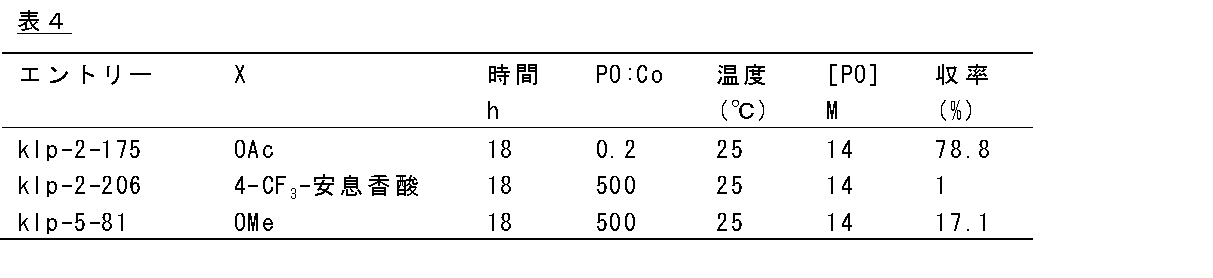
〔実施例VI〕
メトキシsalphがジ-tertブチルを含み、開始配位子を変化させた触媒によるrac−POの重合
触媒は構造式:
下記表4に示す反応条件および収率結果で、実験ランを行った。全ての反応をニートで行い、mm−triadは99%より大きかった。
Example VI
The catalyst for the polymerization of rac-PO by a catalyst in which methoxy salph contains di-tertbutyl and the starting ligand is changed has the structural formula:
An experimental run was performed with the reaction conditions and yield results shown in Table 4 below. All reactions were done neat and mm-triad was greater than 99%.
〔実施例VII〕
Salphが3−tert−ブチル−5−イソプロピルを含み、XがOMeである触媒によるrac−POの重合
触媒は構造式:
を有する。
[PO]:[Co]を500:1とし、[PO]をトルエン中で7Mとし、他の下記表5に示す条件および結果で、実験ランを行った。
Example VII
A catalyst for the polymerization of rac-PO with a catalyst where Salph comprises 3-tert-butyl-5-isopropyl and X is OMe has the structural formula:
Have
[PO]: [Co] was set to 500: 1, [PO] was set to 7 M in toluene, and other experimental runs were performed under the conditions and results shown in Table 5 below.
〔実施例VIII〕
サリシリジンのアルキル置換基を変化させ、XはOAcである、rac−POの重合
触媒は構造式:
重合条件および収率結果を下記表6に示す。
Example VIII
The salicylidine alkyl substituent is changed, X is OAc, and the polymerization catalyst for rac-PO is represented by the structural formula:
The polymerization conditions and yield results are shown in Table 6 below.
〔実施例IX〕
(salph)CoOAcである2を用いたrac−1−ブチレンオキシドの重合
rac−1−ブチレンオキシド(BO)の最適化重合。ドライボックス内で、バイアルに2(7.5mg、0.011mmol)、テフロン撹拌バーおよびトルエン(0.65mL)を充填した。混合物を撹拌しながら、rac−BO(0.50mL、5.8mmol)をバイアルに添加した。直ちにテフロンで裏打ちした蓋でバイアルをシールし、ドライボックスから取り出した。反応物を25℃で4時間撹拌した後、1NのHClでクエンチした。塩化メチレン(20mL)を溶液に添加し、有機層を分離した。回転蒸発によって22℃で溶媒を除去した。残存するコバルトを除去するため、ポリマーをトルエン(40mL)中に溶解し、活性化アルミナを用いて撹拌した後、真空濾過によって濾過を行った。回転蒸発によって22℃で溶媒を濾液から除去した後、真空で乾燥し、淡黄色ゲル(110mg、26%)を得た。1H−NMR(CDCl3、500MHz):δ0.94(ブロード、3H)、1.51−1.58(ブロード、2H)、3.33(ブロード、1H)、3.55(ブロード、2H)。13C{1H}NMR(CDCl3、125MHz):δ9.92、25.07、72.62、81.11。GPCデータ:Mn=185,000g/mol、Mw/Mn=2.08。
Example IX
(Salph) Polymerization of rac-1-butylene oxide with CoOAc 2 Optimized polymerization of rac-1-butylene oxide (BO). In a dry box, a vial was charged with 2 (7.5 mg, 0.011 mmol), a Teflon stir bar and toluene (0.65 mL). While the mixture was stirred, rac-BO (0.50 mL, 5.8 mmol) was added to the vial. The vial was immediately sealed with a Teflon lined lid and removed from the dry box. The reaction was stirred at 25 ° C. for 4 h before being quenched with 1N HCl. Methylene chloride (20 mL) was added to the solution and the organic layer was separated. The solvent was removed at 22 ° C. by rotary evaporation. In order to remove the remaining cobalt, the polymer was dissolved in toluene (40 mL), stirred with activated alumina, and then filtered by vacuum filtration. The solvent was removed from the filtrate at 22 ° C. by rotary evaporation and then dried in vacuo to give a pale yellow gel (110 mg, 26%). 1 H-NMR (CDCl 3 , 500 MHz): δ 0.94 (broad, 3H), 1.51-1.58 (broad, 2H), 3.33 (broad, 1H), 3.55 (broad, 2H) . 13 C { 1 H} NMR (CDCl 3 , 125 MHz): δ 9.92, 25.07, 72.62, 81.11. GPC data: Mn = 185,000 g / mol, Mw / Mn = 2.08.
〔実施例X〕
(salph)CoOAcを用いた1−ヘキセンオキシドの重合
1−ヘキセンオキシド(HO)の重合。ドライボックス中で、2(6.6mg、0.012mmol)をテフロン撹拌バーが充填されたバイアルに添加した。撹拌しながら、HO(0.50mL、4.1mmol)をバイアルに添加した。直ちにテフロンで裏打ちした蓋でバイアルをシールし、ドライボックスから取り出した。反応物を25℃で18時間撹拌し、次いで得られた重合混合物のアリコートを1H−NMR分析のためにバイアルから取り出した(3.0%)。
Example X
(Salph) Polymerization of 1-hexene oxide using CoOAc . Polymerization of 1-hexene oxide (HO). In a dry box, 2 (6.6 mg, 0.012 mmol) was added to a vial filled with a Teflon stir bar. While stirring, HO (0.50 mL, 4.1 mmol) was added to the vial. The vial was immediately sealed with a Teflon lined lid and removed from the dry box. The reaction was stirred at 25 ° C. for 18 hours, and then an aliquot of the resulting polymerization mixture was removed from the vial for 1 H-NMR analysis (3.0%).
〔実施例XI〕
未分画イソタクチックPPOと非イソタクチックPPOの混合物の製造
(N,N’−ビス−(5−tert−ブチル−3−イソプロピルサリシリデン)−1,2−フェニレンジアミノ)コバルトアセテート(6)の調製。ドライボックス内で、シュレンク管にAlCl3(1.5g、11.2mmol)およびテフロン被覆撹拌バーを充填した。N2下で、2−イソプロピルフェノール(15.1mL、112mmol)、次いで2−クロロ−2−メチルプロパン(14.5mL、134mmol)を添加した。得られた混合物を25℃で18時間撹拌した。氷水とジエチルエーテルを添加した。エーテル層をH2Oで2度、次いで塩水で1度洗浄した。有機層をMgSO4上で乾燥した。粗生成物をカラムクロマトグラフィ(20%EtOAc/ヘキサン)によって精製して、黄色油を得た(19g、87%)。精製フェノール(12g、62mmol)を、乾燥トルエンおよび2,6−ルチジン(12mL、100mmol)中に溶解した。溶液を0℃に冷却し、SnCl4をゆっくり添加した。反応物を15分間撹拌した後、パラホルムアルデヒドを添加した。乾燥管をシュレンク管に装着し、次いで、これを100℃に16時間加熱した。反応物を25℃に冷却した後、1NのHClを添加し、得られた懸濁液をセリット上で濾過した。有機層をH2Oで洗浄し、MgSO4上で乾燥した。濃度によって、粘性の黄色/茶色油(10g、74%)が生成した。油をMeOH(75mL)中に溶解し、1,2−ジアミノベンゼン(2.4g、23mmol)を添加した。溶液を4時間還流し、次いで、25℃に冷却した。黄色固形物を壊し、これを濾過、MeOHで洗浄して、真空下で乾燥した(4.0g、34%)。得られた配位子(1.5g、2.9mmol)をトルエン(15mL)中に溶解し、コバルトアセテート四水和物(.73g、2.9mmol)をMeOH中に溶解した。トルエン溶液をMeOH溶液に添加し、溶液を25℃で1時間撹拌した。赤色固形物を濾過、MeOHで洗浄、および真空下で乾燥した(1.4g、83%)。固形物をCH2Cl2中に溶解し、酢酸(0.10mL、2.4mmol)を添加した。全溶媒が蒸発するまで溶液を大気中で撹拌した。固形物をペンタンで洗浄し、真空下で乾燥した(1.4g、93%)。
Example XI
Production of a mixture of unfractionated isotactic PPO and non-isotactic PPO
Preparation of (N, N′-bis- (5-tert-butyl-3-isopropylsalicylidene) -1,2-phenylenediamino) cobalt acetate (6). In a dry box, a Schlenk tube was filled with AlCl 3 (1.5 g, 11.2 mmol) and a Teflon-coated stir bar. Under N 2, 2-isopropyl phenol (15.1 mL, 112 mmol), followed by 2-chloro-2-methylpropane (14.5 mL, 134 mmol) was added. The resulting mixture was stirred at 25 ° C. for 18 hours. Ice water and diethyl ether were added. The ether layer was washed twice with H 2 O and then once with brine. The organic layer was dried over MgSO 4. The crude product was purified by column chromatography (20% EtOAc / hexane) to give a yellow oil (19 g, 87%). Purified phenol (12 g, 62 mmol) was dissolved in dry toluene and 2,6-lutidine (12 mL, 100 mmol). The solution was cooled to 0 ° C. and SnCl 4 was added slowly. The reaction was stirred for 15 minutes before paraformaldehyde was added. A drying tube was attached to the Schlenk tube, which was then heated to 100 ° C. for 16 hours. After the reaction was cooled to 25 ° C., 1N HCl was added and the resulting suspension was filtered over celite. The organic layer was washed with H 2 O and dried over MgSO 4 . Concentration produced a viscous yellow / brown oil (10 g, 74%). The oil was dissolved in MeOH (75 mL) and 1,2-diaminobenzene (2.4 g, 23 mmol) was added. The solution was refluxed for 4 hours and then cooled to 25 ° C. The yellow solid was broken and filtered, washed with MeOH and dried under vacuum (4.0 g, 34%). The obtained ligand (1.5 g, 2.9 mmol) was dissolved in toluene (15 mL), and cobalt acetate tetrahydrate (0.73 g, 2.9 mmol) was dissolved in MeOH. The toluene solution was added to the MeOH solution and the solution was stirred at 25 ° C. for 1 hour. The red solid was filtered, washed with MeOH, and dried under vacuum (1.4 g, 83%). The solid was dissolved in CH 2 Cl 2 and acetic acid (0.10 mL, 2.4 mmol) was added. The solution was stirred in air until all the solvent had evaporated. The solid was washed with pentane and dried under vacuum (1.4 g, 93%).
6によるrac−POの代表的な重合:
ドライボックス内で、6(9.0mg、.014mmol)およびテフロン撹拌バーをバイアルに充填した。トルエン(0.50mL)を添加し、懸濁液を3分間撹拌した。次に、rac−PO(0.50mL、7.1mmol)を添加して、テフロンで裏打ちした蓋でバイアルを素早くシールした。重合物を25℃で20時間撹拌した。重合物を1NのHClでクエンチし、残存するPOを真空下で除去した。ポリマー残渣をCH2Cl2中に溶解し、HClを夜通し反応させた。溶液をH2Oで洗浄し、Na2SO4上で乾燥し、次いで、真空下で濃縮した(.063g、15%)。得られたポリマーは13C{1H}NMR分光法によれば84%のm−dyadを有し、したがって、およそ20%のアタクチックPPOと80%のイソタクチックPPOの混合物として作用する。
Representative polymerization of rac-PO by 6:
In a dry box, vials were filled with 6 (9.0 mg, 0.014 mmol) and a Teflon stir bar. Toluene (0.50 mL) was added and the suspension was stirred for 3 minutes. Rac-PO (0.50 mL, 7.1 mmol) was then added and the vial was quickly sealed with a Teflon-lined lid. The polymer was stirred at 25 ° C. for 20 hours. The polymer was quenched with 1N HCl and the remaining PO was removed under vacuum. The polymer residue was dissolved in CH 2 Cl 2 and reacted with HCl overnight. The solution was washed with H 2 O, dried over Na 2 SO 4 and then concentrated under vacuum (0.063 g, 15%). The resulting polymer has 84% m-dyad according to 13 C { 1 H} NMR spectroscopy and therefore acts as a mixture of approximately 20% atactic PPO and 80% isotactic PPO.
変形
本発明の上述記載は、特定の操作可能で好適な態様を述べるために提示したものである。本発明はそのように限定すべきことを意図するものではなく、その変形および変更は当業者にとって自明であって、その全ては本発明の精神および範囲に含まれる。
本明細書の当初の開示は、少なくとも下記の態様を包含する。
〔1〕(Salphまたはメトキシsalph)Co(開始配位子)。
〔2〕〔1〕に記載の化合物であって、開始配位子は、該化合物と溶媒および/またはエポキシドとを混合すると、化合物が部分的に溶解して隣接コバルト中心を含有する非溶解錯体を与えるものである、化合物。
〔3〕凝集またはインサイチュ配位子修飾によってキラル環境で存在する、〔1〕に記載の化合物。
〔4〕開始配位子は、ハロゲン、C 1 〜C 20 アミド、シアノ、アジド、C 1 〜C 20 カルボキシレート、C 1 〜C 20 アリールカルボキシレート、C 1 〜C 20 アルコキシド、フェノキシド、およびヒドロキシドからなる群から選択される、〔1〕に記載の化合物。
〔5〕salphは、N,N’−ビス(3,5−ジ−tert−ブチルサリシリジン)−ベンゼンジアミンである、〔4〕に記載の化合物。
〔6〕(salph)CoOAcである、〔5〕に記載の化合物。
〔7〕(salph)CoBzOAcである、〔5〕に記載の化合物。
〔8〕(salph)CoNpOAcである、〔5〕に記載の化合物。
〔9〕(salph)CoOMeである、〔5〕に記載の化合物。
〔10〕(メトキシsalph)CoOAcである、〔5〕に記載の化合物。
〔11〕(salph)Coまたは(メトキシsalph)Coを塩化メチレン中に溶解し、H(開始配位子)を添加し、および溶液の塩化メチレンを大気中に蒸発させることによって製造された、(Salphまたはメトキシsalph)Co(開始配位子)。
〔12〕rac−POをイソ特異的触媒の存在下で単独重合する工程を含んでなる、純粋イソタクチックPPOの製造方法。
〔13〕イソ特異的触媒は、(salphまたはメトキシsalph)Co(開始配位子)であって、ここで、salphはN,N’−ビス(3,5−ジ−tert−ブチルサリシリジン)−ベンゼンジアミンである、〔12〕に記載の方法。
〔14〕rac−1−ブチレンオキシドをイソ特異的触媒の存在下で重合する工程を含んでなる、イソタクチックポリ(ブチレンオキシド)の製造方法。
〔15〕イソ特異的触媒は、(salphまたはメトキシsalph)Co(開始配位子)であって、ここで、salphはN,N’−ビス(3,5−ジ−tert−ブチルサリシリジン)−ベンゼンジアミンである、〔14〕に記載の方法。
〔16〕81%より大きいm−dyad含量を有し、かつ、重合触媒残渣を含有し、および/またはアタクチックPPOの痕跡を含有せず、および/またはアタクチックイソタクチックPPO混合物の分画を示す残渣を含有しない、イソタクチックPPO。
〔17〕m−dyad含量は90%より大きい、〔16〕に記載のイソタクチックPPO。
〔18〕m−dyad含量は少なくとも99%である、〔16〕に記載のイソタクチックPPO。
〔19〕81%より大きいm−dyad含量および150,000g/molより大きいM n を有する、イソタクチックPPO。
〔20〕200,000g/molより大きいM n を有する、〔19〕に記載のイソタクチックPPO。
〔21〕81%より大きいm−dyad含量および2.0より小さいPDIを有する、イソタクチックPPO。
〔22〕PDIは1.75より小さい、〔21〕に記載のイソタクチックPPO。
〔23〕PDIは1.50より小さい、〔22〕に記載のイソタクチックPPO。
〔24〕非イソタクチックPPOと未分画イソタクチックPPOとの混合物を与える工程を含んでなる、未分画イソタクチックPPOの性質を変性する方法。
〔25〕コバルトを3+酸化状態で含有する金属錯体を含有するシッフ塩基である触媒の存在下でエポキシドを重合する工程を含んでなる、ポリエポキシドの製造方法。
Variations The foregoing description of the invention has been presented to describe certain operable and preferred embodiments. The present invention is not intended to be so limited, and variations and modifications thereof will be apparent to those skilled in the art, all of which are within the spirit and scope of the present invention.
The initial disclosure herein includes at least the following embodiments.
[1] (Salph or methoxy salph) Co (initiating ligand).
[2] The compound according to [1], wherein when the compound is mixed with a solvent and / or an epoxide, the compound is partially dissolved and contains an adjacent cobalt center A compound that gives.
[3] The compound according to [1], which exists in a chiral environment by aggregation or in situ ligand modification.
[4] starting ligands are halogen, C 1 -C 20 amide, cyano, azido, C 1 -C 20 carboxylate, C 1 -C 20 aryl carboxylates, C 1 -C 20 alkoxide, phenoxide, and hydroxy [1] The compound according to [1], which is selected from the group consisting of
[5] The compound according to [4], wherein salph is N, N′-bis (3,5-di-tert-butylsalicyridin) -benzenediamine.
[6] The compound according to [5], which is (salph) CoOAc.
[7] The compound according to [5], which is (salph) CoBzOAc.
[8] The compound according to [5], which is (salph) CoNpOAc.
[9] The compound according to [5], which is (salph) CoOMe.
[10] The compound according to [5], which is (methoxysulf) CoOAc.
[11] Prepared by dissolving (salph) Co or (methoxysalph) Co in methylene chloride, adding H (starting ligand), and evaporating the methylene chloride of the solution into the atmosphere, Salph or methoxy salph) Co (initiating ligand).
[12] A method for producing pure isotactic PPO, comprising the step of homopolymerizing rac-PO in the presence of an isospecific catalyst.
[13] The isospecific catalyst is (salph or methoxysalph) Co (initiating ligand), where salp is N, N′-bis (3,5-di-tert-butylsalicylidin ) -Benzenediamine. The method according to [12].
[14] A process for producing isotactic poly (butylene oxide), which comprises a step of polymerizing rac-1-butylene oxide in the presence of an isospecific catalyst.
[15] The isospecific catalyst is (salph or methoxysalph) Co (starting ligand), where salp is N, N′-bis (3,5-di-tert-butylsalicylidin ) -Benzenediamine. The method according to [14].
[16] A fraction of an atactic isotactic PPO mixture having an m-dyad content greater than 81% and containing a polymerization catalyst residue and / or no traces of atactic PPO and / or Isotactic PPO that does not contain the indicated residue.
[17] The isotactic PPO according to [16], wherein the m-dyad content is greater than 90%.
[18] The isotactic PPO according to [16], wherein the m-dyad content is at least 99%.
[19] Isotactic PPO with m-dyad content greater than 81% and M n greater than 150,000 g / mol .
[20] The isotactic PPO according to [19], having an Mn of greater than 200,000 g / mol .
[21] Isotactic PPO having an m-dyad content greater than 81% and a PDI less than 2.0.
[22] The isotactic PPO according to [21], wherein PDI is less than 1.75.
[23] The isotactic PPO according to [22], wherein PDI is less than 1.50.
[24] A method for modifying the properties of unfractionated isotactic PPO, comprising the step of providing a mixture of non-isotactic PPO and unfractionated isotactic PPO.
[25] A method for producing a polyepoxide, comprising a step of polymerizing an epoxide in the presence of a catalyst which is a Schiff base containing a metal complex containing cobalt in a 3+ oxidation state.
Claims (12)
該イソ特異的触媒は
a)salph−Co−(開始配位子);
b)メトキシsalph−Co−(開始配位子);および
c)(a)と(b)の組み合わせ
からなる群から選択され、
ここで、salphは、N,N’−ビス(3,5−ジ−C 1 〜C 4 −アルキルサリシリジン)−1,2−ベンゼンジアミンであり、
該開始配位子は、
a)ハロゲン化物;
b)シアノ;
c)アジド;
d)ヒドロキシド;
e)C 1 〜C 20 アミド;
f)C 1 〜C 20 カルボキシレート;
g)C 2 〜C 20 ジカルボキシレート;
h)C 4 〜C 20 トリカルボキシレート;
i)C 6 〜C 20 アリールカルボキシレート;
j)C 1 〜C 20 アルコキシド;
k)フェノキシド;および
l)(a)ないし(k)の任意の2以上の組み合わせ;
からなる群から選択され、開始配位子(f)〜(h)のいずれかが所望によりヒドロキシル基によって置換されていてよい、
製造方法。C 3 -C 6 ing include homopolymerization to step the alkyl epoxides in the presence of an isospecific catalyst, isotactic poly having a larger m-dyad content of 81% (C 3 -C 6 alkylene oxide) A manufacturing method comprising :
The isospecific catalyst is
a) salph-Co- (initiating ligand);
b) Methoxy sulph-Co- (initiating ligand); and
c) Combination of (a) and (b)
Selected from the group consisting of
Here, salph is N, N′-bis (3,5-di-C 1 -C 4 -alkylsalicyridin ) -1,2-benzenediamine,
The initiating ligand is
a) halides;
b) cyano;
c) azide;
d) hydroxide;
e) C 1 ~C 20 amide;
f) C 1 ~C 20 carboxylate;
g) C 2 ~C 20-dicarboxylate;
h) C 4 ~C 20 tricarboxylate;
i) C 6 ~C 20 aryl carboxylates;
j) C 1 ~C 20 alkoxide;
k) phenoxide; and
l) any two or more combinations of (a) to (k);
Any one of the starting ligands (f) to (h) may be optionally substituted by a hydroxyl group,
Manufacturing method .
該開始配位子は、
a)ハロゲン化物;
b)シアノ;
c)アジド;
d)ヒドロキシド;
e)C 1 〜C 20 アミド;
f)C 1 〜C 20 カルボキシレート;
g)C 2 〜C 20 ジカルボキシレート;
h)C 4 〜C 20 トリカルボキシレート;
i)C 6 〜C 20 アリールカルボキシレート;
j)C 1 〜C 20 アルコキシド;
k)フェノキシド;および
l)(a)ないし(k)の任意の2以上の組み合わせ;
からなる群から選択され、開始配位子(f)〜(h)のいずれかが所望によりヒドロキシル基によって置換されていてよい、
製造方法。comprising the step of homopolymerizing rac-PO in the presence of N, N′-bis (3,5-di-tert-butylsalicyridin) -benzenediamine-Co-initiating ligand, from 81% A process for producing isotactic polypropylene oxide having a large m-dyad content comprising:
The initiating ligand is
a) halides;
b) cyano;
c) azide;
d) hydroxide;
e) C 1 ~C 20 amide;
f) C 1 ~C 20 carboxylate;
g) C 2 ~C 20-dicarboxylate;
h) C 4 ~C 20 tricarboxylate;
i) C 6 ~C 20 aryl carboxylates;
j) C 1 ~C 20 alkoxide;
k) phenoxide; and
l) any two or more combinations of (a) to (k);
Any one of the starting ligands (f) to (h) may be optionally substituted by a hydroxyl group,
Manufacturing method .
a)メチル;
b)エチル;
c)イソプロピル;および
d)tert−ブチル
からなる群から選択される。〕
を有する、請求項1に記載の方法。salph has the formula:
b) ethyl;
c) isopropyl; and d) selected from the group consisting of tert-butyl. ]
The method of claim 1 , comprising:
a)メチル;
b)エチル;
c)イソプロピル;および
d)tert−ブチル
からなる群から選択される。〕
を有する、請求項1に記載の方法。Methoxy salph has the formula:
b) ethyl;
c) isopropyl; and d) selected from the group consisting of tert-butyl. ]
The method of claim 1 , comprising:
a)−Br;
b)−Cl;
c)−OH;
d)−OMe;
e)−OCOMe;
f)−OCOBn;
g)
a) -Br;
b) -Cl;
c) -OH;
d) -OMe;
e) -OCOMe;
f) -OCOBn;
g)
a)メチル;
b)エチル;
c)イソプロピル;および
d)tert−ブチル
からなる群から選択され、
R3は−Hまたは−OMeであり;および
Xは
a)ハロゲン化物;
b)シアノ;
c)アジド;
d)ヒドロキシド;
e)C 1 〜C20アミド;
f)C1〜C20カルボキシレート;
g)C2〜C20ジカルボキシレート;
h)C4〜C20トリカルボキシレート;
i)C6〜C20アリールカルボキシレート;
j)C1〜C20アルコキシド;
k)フェノキシド;および
l)(a)ないし(k)の任意の2以上の組み合わせ;
からなる群から選択され、開始配位子(f)〜(h)のいずれかが所望によりヒドロキシル基によって置換されていてよい。〕
を有する触媒と接触させる工程を含んでなる、イソタクチックポリアルキレンオキシドの製造方法。Monomers comprising C 3 -C 6 alkyl epoxides having the structure:
b) ethyl;
selected from the group consisting of c) isopropyl; and d) tert-butyl;
R 3 is —H or —OMe; and X is a) a halide;
b) cyano;
c) azide;
d) hydroxide;
e) C 1 ~C 20 amide;
f) C 1 ~C 20 carboxylate;
g) C 2 ~C 20-dicarboxylate;
h) C 4 ~C 20 tricarboxylate;
i) C 6 ~C 20 aryl carboxylates;
j) C 1 ~C 20 alkoxide;
k) phenoxide; and 1) any two or more combinations of (a) to (k);
And any of the starting ligands (f) to (h) may be optionally substituted by a hydroxyl group. ]
Comprising the step of contacting the catalyst with, Isotakuchi' Kupo real method for producing a sharp emission oxide.
Applications Claiming Priority (5)
| Application Number | Priority Date | Filing Date | Title |
|---|---|---|---|
| US69223705P | 2005-06-21 | 2005-06-21 | |
| US60/692,237 | 2005-06-21 | ||
| US11/454,945 US7399822B2 (en) | 2005-06-21 | 2006-06-19 | Isotactic specific catalyst for direct production of highly isotactic poly (propylene oxide) or highly isotactic poly (butylene oxide) |
| US11/454,945 | 2006-06-19 | ||
| PCT/US2006/023888 WO2007002023A2 (en) | 2005-06-21 | 2006-06-20 | Isotactic specific catalyst for direct production of highly isotactic poly (propylene oxide) or highly isotactic poly (butylene oxide) |
Publications (3)
| Publication Number | Publication Date |
|---|---|
| JP2008546785A JP2008546785A (en) | 2008-12-25 |
| JP2008546785A5 JP2008546785A5 (en) | 2009-08-06 |
| JP5113045B2 true JP5113045B2 (en) | 2013-01-09 |
Family
ID=37568467
Family Applications (1)
| Application Number | Title | Priority Date | Filing Date |
|---|---|---|---|
| JP2008518292A Expired - Fee Related JP5113045B2 (en) | 2005-06-21 | 2006-06-20 | Isotactic specific catalysts for the direct production of high isotactic poly (propylene oxide) or high isotactic poly (butylene oxide) |
Country Status (5)
| Country | Link |
|---|---|
| US (3) | US7399822B2 (en) |
| EP (1) | EP1901845A4 (en) |
| JP (1) | JP5113045B2 (en) |
| CA (1) | CA2612547C (en) |
| WO (1) | WO2007002023A2 (en) |
Families Citing this family (24)
| Publication number | Priority date | Publication date | Assignee | Title |
|---|---|---|---|---|
| US8093351B2 (en) * | 2006-08-24 | 2012-01-10 | Cornell Research Foundation, Inc. | Copolymerization of propylene oxide and carbon dioxide and homopolymerization of propylene oxide |
| JP5349806B2 (en) * | 2007-01-30 | 2013-11-20 | 三洋化成工業株式会社 | Urethane resin composition |
| EP2195305A2 (en) | 2007-08-17 | 2010-06-16 | Cornell Research Foundation, Inc. | Isoselective polymerization of epoxides |
| JP5334424B2 (en) * | 2008-02-15 | 2013-11-06 | 住友化学株式会社 | Method for producing stabilized poly (alkylene oxide) |
| US8633123B2 (en) | 2008-08-22 | 2014-01-21 | Novomer, Inc. | Catalysts and methods for polymer synthesis |
| CA2736482C (en) * | 2008-09-08 | 2018-01-02 | Novomer, Inc. | Polycarbonate polyol compositions and methods |
| CN101412809B (en) * | 2008-11-28 | 2011-04-27 | 大连理工大学 | Single site catalyst for synthesizing polycarbonate |
| WO2010075232A1 (en) | 2008-12-23 | 2010-07-01 | Novomer, Inc. | Tunable polymer compositions |
| US8389660B1 (en) | 2009-06-10 | 2013-03-05 | The Florida State University Research Foundation | Polyolefins having reduced crystallinity |
| JP2011057966A (en) * | 2009-08-12 | 2011-03-24 | Sumitomo Chemical Co Ltd | High molecular-weight isotactic poly(alkylene oxide) and method of producing the same |
| KR101805648B1 (en) | 2010-09-14 | 2017-12-14 | 사우디 아람코 테크놀로지스 컴퍼니 | Catalysts and methods for polymer synthesis |
| ES2947327T3 (en) * | 2010-11-23 | 2023-08-04 | Saudi Aramco Tech Co | Poly(carbonate polyol) compositions |
| WO2012166889A2 (en) | 2011-05-31 | 2012-12-06 | Cornell University | Polyethers, methods of making same, and uses thereof |
| JP6110379B2 (en) | 2011-07-18 | 2017-04-05 | ノボマー, インコーポレイテッド | Metal complex |
| CN112979938A (en) | 2011-07-25 | 2021-06-18 | 沙特阿美技术公司 | Aliphatic polycarbonates for polyurethanes |
| CN103842082B (en) | 2011-08-08 | 2017-07-18 | 诺沃梅尔公司 | The Catalyst And Method of Macroscopic single crystal |
| KR101945168B1 (en) | 2011-11-04 | 2019-02-07 | 사우디 아람코 테크놀로지스 컴퍼니 | Metal complexes for the copolymerization of carbon dioxide and epoxides |
| WO2014031811A1 (en) * | 2012-08-24 | 2014-02-27 | Novomer, Inc. | Metal complexes |
| WO2014074706A1 (en) | 2012-11-07 | 2014-05-15 | Novomer, Inc. | High strength polyurethane foam compositions and methods |
| US20140275433A1 (en) * | 2013-03-14 | 2014-09-18 | Exxonmobil Research And Engineering Company | Amination of polymers terminated with aldehyde group and their functionalized derivatives for fouling mitigation in hydrocarbon refining processes |
| CN109054011B (en) * | 2018-07-16 | 2021-01-08 | 中国科学院长春应用化学研究所 | Schiff base cobalt compound, preparation method thereof and preparation method of polycarbonate |
| WO2020028606A1 (en) | 2018-08-02 | 2020-02-06 | Saudi Aramco Technologies Company | Sustainable polymer compositions and methods |
| US12195576B2 (en) | 2021-06-23 | 2025-01-14 | Saudi Aramco Technologies Company | Polyol compositions and methods |
| EP4626445A1 (en) * | 2022-12-02 | 2025-10-08 | University of Maryland, Baltimore | Gallium-salophen antimicrobial compounds and methods of use thereof |
Family Cites Families (5)
| Publication number | Priority date | Publication date | Assignee | Title |
|---|---|---|---|---|
| US2706181A (en) | 1952-06-05 | 1955-04-12 | Dow Chemical Co | Catalysts for the polymerization of olefin oxides |
| US4962281A (en) * | 1985-12-13 | 1990-10-09 | The Dow Chemical Company | Synthesis of stereoregular poly(propylene oxide) |
| US6262278B1 (en) * | 1995-03-14 | 2001-07-17 | President And Fellows Of Harvard College | Stereoselective ring opening reactions |
| JP3962587B2 (en) * | 2000-05-24 | 2007-08-22 | アールエステック カンパニー リミテッド | Novel chiral salen catalyst and method for producing chiral compound from racemic epoxide using the same |
| JP2004315588A (en) * | 2003-04-11 | 2004-11-11 | Sanyo Chem Ind Ltd | Catalyst for ring-opening polymerization of heterocyclic compound |
-
2006
- 2006-06-19 US US11/454,945 patent/US7399822B2/en not_active Expired - Fee Related
- 2006-06-20 WO PCT/US2006/023888 patent/WO2007002023A2/en not_active Ceased
- 2006-06-20 EP EP06785143.6A patent/EP1901845A4/en not_active Withdrawn
- 2006-06-20 CA CA2612547A patent/CA2612547C/en not_active Expired - Fee Related
- 2006-06-20 JP JP2008518292A patent/JP5113045B2/en not_active Expired - Fee Related
-
2008
- 2008-06-12 US US12/155,962 patent/US8026317B2/en not_active Expired - Fee Related
-
2011
- 2011-08-30 US US13/221,631 patent/US20110313128A1/en not_active Abandoned
Also Published As
| Publication number | Publication date |
|---|---|
| WO2007002023A3 (en) | 2007-11-29 |
| US20110313128A1 (en) | 2011-12-22 |
| CA2612547C (en) | 2015-03-17 |
| JP2008546785A (en) | 2008-12-25 |
| US20060293501A1 (en) | 2006-12-28 |
| EP1901845A4 (en) | 2014-11-19 |
| WO2007002023A2 (en) | 2007-01-04 |
| US7399822B2 (en) | 2008-07-15 |
| EP1901845A2 (en) | 2008-03-26 |
| CA2612547A1 (en) | 2007-01-04 |
| US20080262164A1 (en) | 2008-10-23 |
| US8026317B2 (en) | 2011-09-27 |
Similar Documents
| Publication | Publication Date | Title |
|---|---|---|
| JP5113045B2 (en) | Isotactic specific catalysts for the direct production of high isotactic poly (propylene oxide) or high isotactic poly (butylene oxide) | |
| Cohen et al. | Copolymerization of cyclohexene oxide and carbon dioxide using (salen) Co (III) complexes: synthesis and characterization of syndiotactic poly (cyclohexene carbonate) | |
| CN106536045B (en) | Catalyst and process for preparing same | |
| CN111393630B (en) | Polymer polyol and preparation method thereof | |
| CN104903333B (en) | A kind of preparation method of liquid tin (II) alkoxide | |
| JP4590284B2 (en) | Method for producing polycarbonate | |
| JP3414029B2 (en) | Monodisperse polymers and methods for their production | |
| KR101217954B1 (en) | Group 3 post-metallocene complexes based on bis(naphthoxy)pyridine and bis(naphthoxy)thiophene ligands for the ring-opening polymerisation of polar cyclic monomers | |
| Tang et al. | Highly active catalysts for the ring-opening polymerization of ethylene oxide and propylene oxide based on products of alkylaluminum compounds with bulky tetraphenol ligands | |
| Liao et al. | Alcoholysis of Methyl Aluminium Biphenoxides: Excellent Initiators for the Ring Opening Polymerisation of ε‐Caprolactone | |
| CN114478635A (en) | Chromium compound, preparation method thereof and preparation method of multi-block polyester material | |
| CN113024787A (en) | Method for catalyzing ring-opening polymerization of epsilon-caprolactone by using [ OSSO ] type complex | |
| Magliozzi et al. | Enantioselective crystallization of diglycerol dicarbonate: impact of the microstructure on polyhydroxyurethane properties | |
| JPS6164721A (en) | Production of block copolymer | |
| JP4431790B2 (en) | Resorcinol novolac derivatives | |
| CN119930674B (en) | A vanadium bipyridine complex, its preparation method and application | |
| Kosolsumollamas | Synthesis and Properties of Fluorine-Containing poly alpha-esters | |
| JP5256498B2 (en) | Polymer ligand, aluminum complex and method for producing polylactide | |
| JP3043779B2 (en) | Ethylene polymer and method for producing the same | |
| Dunn | Synthesis Of Poly (Hydroxyalkanoates): Routes To Poly (3-Hydroxybutyrate) And Poly (3-Hydroxypropionate) From The Carbonylation And Ring-Opening Polymerization Of Epoxides | |
| JP2010174241A (en) | Method for producing polyether | |
| KR20240031388A (en) | Stereically modified Schiff base ligands for enhanced catalytic carbonylation activity | |
| JPH04288334A (en) | Production of polysilane | |
| JP2006283016A (en) | Polymerization method and polymer of oxetane derivative having substituent at 3-position | |
| US20200002472A1 (en) | Sustainable process for preparing polyesters having high glass transition temperature |
Legal Events
| Date | Code | Title | Description |
|---|---|---|---|
| A521 | Request for written amendment filed |
Free format text: JAPANESE INTERMEDIATE CODE: A523 Effective date: 20090617 |
|
| A621 | Written request for application examination |
Free format text: JAPANESE INTERMEDIATE CODE: A621 Effective date: 20090617 |
|
| A977 | Report on retrieval |
Free format text: JAPANESE INTERMEDIATE CODE: A971007 Effective date: 20120201 |
|
| A131 | Notification of reasons for refusal |
Free format text: JAPANESE INTERMEDIATE CODE: A131 Effective date: 20120228 |
|
| A601 | Written request for extension of time |
Free format text: JAPANESE INTERMEDIATE CODE: A601 Effective date: 20120525 |
|
| A602 | Written permission of extension of time |
Free format text: JAPANESE INTERMEDIATE CODE: A602 Effective date: 20120601 |
|
| A601 | Written request for extension of time |
Free format text: JAPANESE INTERMEDIATE CODE: A601 Effective date: 20120625 |
|
| A602 | Written permission of extension of time |
Free format text: JAPANESE INTERMEDIATE CODE: A602 Effective date: 20120702 |
|
| A521 | Request for written amendment filed |
Free format text: JAPANESE INTERMEDIATE CODE: A523 Effective date: 20120828 |
|
| TRDD | Decision of grant or rejection written | ||
| A01 | Written decision to grant a patent or to grant a registration (utility model) |
Free format text: JAPANESE INTERMEDIATE CODE: A01 Effective date: 20120918 |
|
| A01 | Written decision to grant a patent or to grant a registration (utility model) |
Free format text: JAPANESE INTERMEDIATE CODE: A01 |
|
| A61 | First payment of annual fees (during grant procedure) |
Free format text: JAPANESE INTERMEDIATE CODE: A61 Effective date: 20121011 |
|
| FPAY | Renewal fee payment (event date is renewal date of database) |
Free format text: PAYMENT UNTIL: 20151019 Year of fee payment: 3 |
|
| R150 | Certificate of patent or registration of utility model |
Free format text: JAPANESE INTERMEDIATE CODE: R150 |
|
| R250 | Receipt of annual fees |
Free format text: JAPANESE INTERMEDIATE CODE: R250 |
|
| LAPS | Cancellation because of no payment of annual fees |