JP5215532B2 - Rubber composition and pneumatic tire using the same - Google Patents
Rubber composition and pneumatic tire using the same Download PDFInfo
- Publication number
- JP5215532B2 JP5215532B2 JP2006091543A JP2006091543A JP5215532B2 JP 5215532 B2 JP5215532 B2 JP 5215532B2 JP 2006091543 A JP2006091543 A JP 2006091543A JP 2006091543 A JP2006091543 A JP 2006091543A JP 5215532 B2 JP5215532 B2 JP 5215532B2
- Authority
- JP
- Japan
- Prior art keywords
- weight
- rubber
- parts
- rubber composition
- carbon
- Prior art date
- Legal status (The legal status is an assumption and is not a legal conclusion. Google has not performed a legal analysis and makes no representation as to the accuracy of the status listed.)
- Expired - Fee Related
Links
Classifications
-
- B—PERFORMING OPERATIONS; TRANSPORTING
- B60—VEHICLES IN GENERAL
- B60C—VEHICLE TYRES; TYRE INFLATION; TYRE CHANGING; CONNECTING VALVES TO INFLATABLE ELASTIC BODIES IN GENERAL; DEVICES OR ARRANGEMENTS RELATED TO TYRES
- B60C1/00—Tyres characterised by the chemical composition or the physical arrangement or mixture of the composition
-
- C—CHEMISTRY; METALLURGY
- C08—ORGANIC MACROMOLECULAR COMPOUNDS; THEIR PREPARATION OR CHEMICAL WORKING-UP; COMPOSITIONS BASED THEREON
- C08K—Use of inorganic or non-macromolecular organic substances as compounding ingredients
- C08K9/00—Use of pretreated ingredients
- C08K9/02—Ingredients treated with inorganic substances
Landscapes
- Chemical & Material Sciences (AREA)
- Health & Medical Sciences (AREA)
- Chemical Kinetics & Catalysis (AREA)
- Medicinal Chemistry (AREA)
- Polymers & Plastics (AREA)
- Organic Chemistry (AREA)
- Engineering & Computer Science (AREA)
- Mechanical Engineering (AREA)
- Compositions Of Macromolecular Compounds (AREA)
- Tires In General (AREA)
Description
本発明は、ゴム組成物およびそれを用いた空気入りタイヤに関する。 The present invention relates to a rubber composition and a pneumatic tire using the same.
ゴム組成物の製造工程における加硫戻り(リバージョン)および早期加硫(スコーチ)を抑制させるために、フッ化黒鉛のようなフッ素化カーボンを、ゴム組成物の混練り工程において配合することがおこなわれてきた(特許文献1参照)。そして、該フッ素化カーボンは、約2μmの粒子径を有し、平均粒子径が約1〜2μmである石油コークスなどのカーボン系原材料をフッ素化する方法、または粒子径が約20μmと、より大きい粒子径の石油コークスなどのカーボン系原材料をフッ素化した後、ジェットミルなどの粉砕器により粉砕する方法により得たものである。 In order to suppress vulcanization reversion (reversion) and early vulcanization (scorch) in the production process of the rubber composition, fluorinated carbon such as fluorinated graphite may be blended in the kneading process of the rubber composition. Has been carried out (see Patent Document 1). Then, the fluorinated carbon has a particle size of about 2 [mu] m, the method of fluorinating a carbon-based raw materials such as petroleum coke having an average particle diameter of about 1~2μm or a particle size of about 20 [mu] m,, greater This is obtained by a method of fluorinating a carbon-based raw material such as petroleum coke having a particle size and then pulverizing with a pulverizer such as a jet mill.
しかし、そのようなフッ素化カーボンを含有するゴム組成物は、依然として熱により老化しやすく、熱老化を抑制するために、フッ素化カーボンを多量にゴム組成物に配合する必要があった。そのため、コストがかかり、得られたゴム組成物を実用化することは困難であった。 However, such a fluorinated carbon-containing rubber composition is still easily aged by heat, and in order to suppress heat aging, it is necessary to add a large amount of fluorinated carbon to the rubber composition. For this reason, it is costly and it is difficult to put the obtained rubber composition into practical use.
本発明は、熱老化の抑制されたゴム組成物およびそれを用いた空気入りタイヤを提供することを目的とする。 An object of this invention is to provide the rubber composition in which heat aging was suppressed, and a pneumatic tire using the same.
本発明は、ゴム成分100重量部に対して、平均一次粒子径が1μm以下であるフッ素化カーボンを0.1〜50重量部含有するゴム組成物に関する。 The present invention relates to a rubber composition containing 0.1 to 50 parts by weight of fluorinated carbon having an average primary particle size of 1 μm or less with respect to 100 parts by weight of a rubber component.
さらに、ゴム成分100重量部に対して、遅効性加硫促進剤を0.1〜10重量部配合することが好ましい。 Furthermore, 0.1 to 10 parts by weight of a slow-acting vulcanization accelerator is preferably blended with 100 parts by weight of the rubber component.
さらに、ゴム成分100重量部に対して、シリカを5〜150重量部配合することが好ましい。 Furthermore, it is preferable to mix | blend 5-150 weight part of silica with respect to 100 weight part of rubber components.
また、本発明は、前記ゴム組成物を用いた空気入りタイヤに関する。 The present invention also relates to a pneumatic tire using the rubber composition.
本発明によれば、平均一次粒子径の小さいフッ素化カーボンを配合することにより、熱老化の抑制されたゴム組成物およびそれを用いた空気入りタイヤを提供することができる。 According to the present invention, by blending fluorinated carbon having a small average primary particle size, a rubber composition in which heat aging is suppressed and a pneumatic tire using the rubber composition can be provided.
また、前記フッ素化カーボンとともにシリカを配合することにより、熱老化が抑制されるとともに、耐摩耗性および耐発熱性に優れたゴム組成物を提供することができる。 Further, by blending silica together with the fluorinated carbon, it is possible to provide a rubber composition which is suppressed in heat aging and excellent in wear resistance and heat generation resistance.
さらに、前記フッ素化カーボンとともに、遅効性加硫促進剤を配合することにより、熱老化が抑制されるとともに、早期加硫の抑制されたゴム組成物を提供することができる。 Further, by blending a slow-acting vulcanization accelerator together with the fluorinated carbon, it is possible to provide a rubber composition in which heat aging is suppressed and early vulcanization is suppressed.
本発明のゴム組成物は、ゴム成分およびフッ素化カーボンを含有する。 The rubber composition of the present invention contains a rubber component and fluorinated carbon.
ゴム成分としては、ジエン系ゴムおよび/または非ジエン系ゴムを用いる。 Diene rubber and / or non-diene rubber is used as the rubber component.
ジエン系ゴムとしては、任意のものが用いられ、例えば、天然ゴム(NR)、エポキシ化天然ゴム(ENR)、イソプレンゴム(IR)、各種ブタジエンゴム(BR)、各種スチレン−ブタジエンゴム(SBR)、アクリロニトリル−ブタジエンゴム(NBR)、ブチルゴム(IIR)、ハロゲン化ブチルゴム、クロロプレンゴム(CR)などがあげられる。 Any diene rubber may be used. For example, natural rubber (NR), epoxidized natural rubber (ENR), isoprene rubber (IR), various butadiene rubbers (BR), various styrene-butadiene rubbers (SBR). Acrylonitrile-butadiene rubber (NBR), butyl rubber (IIR), halogenated butyl rubber, chloroprene rubber (CR) and the like.
非ジエン系ゴムとしては、例えば、エチレン−プロピレン共重合ゴム(EPM、EMDM)、炭素数が4〜7のイソモノオレフィンとパラアルキルスチレンとの共重合体をハロゲン化したゴムなどがあげられる。 Examples of the non-diene rubber include ethylene-propylene copolymer rubber (EPM, EMDM), rubber obtained by halogenating a copolymer of an isomonoolefin having 4 to 7 carbon atoms and paraalkylstyrene.
フッ素化カーボンとは、カーボンをフッ素化したものをいう。 Fluorinated carbon refers to fluorinated carbon.
フッ素化する方法としては、とくに限定されるものではないが、カーボン材料をフッ素化する公知の方法を適用することができ、フッ素化剤を原料カーボンに接触させる方法を含む各種方法によってフッ素化することができる。 The method of fluorination is not particularly limited, but a known method of fluorinating a carbon material can be applied, and fluorination is performed by various methods including a method of bringing a fluorinating agent into contact with raw material carbon. be able to.
フッ素化剤としては、フッ素の他に、三フッ化窒素、四フッ化硫黄、一フッ化塩素、三フッ化塩素、三フッ化臭素、五フッ化臭素、七フッ化ヨウ素、五フッ化ヨウ素、五フッ化リン、フッ化銀、三フッ化コバルト、七フッ化ニッケル酸カリウムなどがあげられる。 As the fluorinating agent, in addition to fluorine, nitrogen trifluoride, sulfur tetrafluoride, chlorine monofluoride, chlorine trifluoride, bromine trifluoride, bromine pentafluoride, iodine heptafluoride, iodine pentafluoride , Phosphorus pentafluoride, silver fluoride, cobalt trifluoride, potassium heptafluoronickate, and the like.
フッ素化剤は、窒素、アルゴン、ヘリウム、空気、酸素、四フッ化炭素、フッ化水素からなる群から選ばれる少なくとも1種の気体により希釈して使用することができる。 The fluorinating agent can be used after being diluted with at least one gas selected from the group consisting of nitrogen, argon, helium, air, oxygen, carbon tetrafluoride, and hydrogen fluoride.
フッ素化反応は、ニッケルなどの耐蝕性を有する容器中にて、常圧下、減圧下、加圧下にかかわらず実施可能であるが、操作性がよいという理由から、常圧下でフッ素化反応を行うことが一般的である。 The fluorination reaction can be carried out in a corrosion-resistant container such as nickel under normal pressure, under reduced pressure, or under pressure, but for reasons of good operability, the fluorination reaction is performed under normal pressure. It is common.
フッ素化反応の反応温度は、とくに限定されるものではないが、−100〜600℃が好ましく、原料カーボンの種類にもよるが、0〜500℃がより好ましい。 The reaction temperature of the fluorination reaction is not particularly limited, but is preferably −100 to 600 ° C., and more preferably 0 to 500 ° C., although it depends on the type of raw material carbon.
フッ素化カーボンの原料となるカーボンとしては、具体的に、カーボンブラック、天然黒鉛、人造黒鉛、石油コークス、木炭、活性炭、炭素繊維、活性炭素繊維、メソカーボンマイクロビーズ、ダイヤモンド粉末、フラーレン、カーボンナノチューブ、カーボンナノホーンなどがあげられる。また、合成樹脂などの含炭素化合物の粉末のように、加熱やフッ素化などによって結果的にフッ素化カーボンを生ずるものであってもよい。これらの原料のうち、平均一次粒子径が1μm以上のものは、ジェットミルなどを用いて、公知の方法により粉砕し、平均一次粒子径を1μm以下としてからフッ素化することができる。また、平均一次粒子径が1μm以上のものをそのまま粉砕し、フッ素化カーボンとしてからジェットミルなどを用いて、公知の方法により粉砕し、平均一次粒子径を1μm以下として使用することもできる。 Specific examples of carbon used as a raw material for fluorinated carbon include carbon black, natural graphite, artificial graphite, petroleum coke, charcoal, activated carbon, carbon fiber, activated carbon fiber, mesocarbon microbeads, diamond powder, fullerene, and carbon nanotube. And carbon nanohorn. Further, as in the case of powders of carbon-containing compounds such as synthetic resins, fluorinated carbon may be produced as a result of heating or fluorination. Among these raw materials, those having an average primary particle diameter of 1 μm or more can be fluorinated after being pulverized by a known method using a jet mill or the like to reduce the average primary particle diameter to 1 μm or less. Alternatively, those having an average primary particle diameter of 1 μm or more can be pulverized as they are, and then pulverized by a known method using a jet mill or the like as a fluorinated carbon, and used with an average primary particle diameter of 1 μm or less.
フッ素化カーボンの原料となるカーボンのジブチルフタレート吸油量(DBP吸油量)は30cm3/100g以上であることが好ましく、50cm3/100g以上であることがより好ましい。また、DBP吸油量は700cm3/100g以下であることが好ましく、500cm3/100g以下であることがより好ましく、200cm3/100g以下であることがさらに好ましい。ジブチルフタレート吸油量が700cm3/100gをこえると、加工性が著しく悪化する傾向がある。 Dibutyl phthalate absorption of the carbon as a raw material of the fluorinated carbon (DBP oil absorption) is preferably 30 cm 3/100 g or more, more preferably 50 cm 3/100 g or more. Further, DBP oil absorption amount is preferably 700 cm 3/100 g or less, more preferably 500 cm 3/100 g or less, and more preferably not more than 200 cm 3/100 g. When dibutyl phthalate oil absorption exceeds 700 cm 3/100 g, processability tends to be remarkably deteriorated.
フッ素化カーボンの原料となるカーボンのチッ素吸着比表面積(N2SA)は400m2/g以下であることが好ましい。N2SAが400m2/gをこえると、加工性が悪い傾向がある。 The nitrogen adsorption specific surface area (N 2 SA) of carbon used as a raw material for fluorinated carbon is preferably 400 m 2 / g or less. When N 2 SA exceeds 400 m 2 / g, workability tends to be poor.
フッ素化カーボンのフッ素化率は1%以上が好ましく、10%以上がより好ましく、30%以上がさらに好ましく、50%以上が特に好ましい。フッ素化カーボンのフッ素化率が1%未満では、熱老化抑制効果が少ない傾向がある。また、フッ素化カーボンのフッ素化率は100%以下であることが好ましい。なお、フッ素化率とは、炭素原子に対するフッ素原子の比率をいい、炭素原子とフッ素原子のモル比が1対1をフッ素比率100%という。また、フッ素化率は、フッ素化カーボンを助燃剤である過酸化ナトリウム(Na 2 O 2 )とポリエチレンフィルムとともに酸素を充填したフラスコ内で燃焼させ、発生したフッ化水素(HF)を水に吸収させ、フッ化物イオンメータ(オリオン社製のイオンアナライザー901)を用いて、HF量を測定する。測定したHF量の値から、フッ化カーボンの残部をすべて炭素とみなすことにより、算出することができる。 The fluorination rate of the fluorinated carbon is preferably 1% or more, more preferably 10% or more, further preferably 30% or more, and particularly preferably 50% or more. When the fluorination rate of the fluorinated carbon is less than 1%, there is a tendency that the effect of suppressing heat aging is small. The fluorination rate of the fluorinated carbon is preferably 100% or less. The fluorination rate refers to the ratio of fluorine atoms to carbon atoms. The molar ratio of carbon atoms to fluorine atoms is 1: 1, and the fluorine ratio is 100%. The fluorination rate is determined by burning fluorinated carbon in a flask filled with oxygen together with sodium peroxide ( Na 2 O 2 ) and polyethylene film, and absorbing the generated hydrogen fluoride (HF) into water. The amount of HF is measured using a fluoride ion meter (Ion Analyzer 901 manufactured by Orion). From the value of the measured HF amount, it can be calculated by regarding the remainder of the carbon fluoride as carbon.
マイクロトラック粒度分布測定装置(日機装(株)製の9320HRA(X−100))を用いて測定したフッ素化カーボンの平均一次粒子径(体積平均粒子径)は1μm以下、好ましくは800nm以下、より好ましくは600nm以下である。フッ素化カーボンの平均一次粒子径が1μmをこえると、充分に分散をさせないと効果が少ないという問題が生じる。 The average primary particle diameter (volume average particle diameter) of the fluorinated carbon measured using a microtrack particle size distribution measuring apparatus (9320HRA (X-100) manufactured by Nikkiso Co., Ltd.) is 1 μm or less, preferably 800 nm or less, more preferably. Is 600 nm or less. When the average primary particle diameter of the fluorinated carbon exceeds 1 μm, there is a problem that the effect is small unless it is sufficiently dispersed.
フッ素化カーボンの含有量は、ゴム成分100重量部に対して0.1重量部以上、好ましくは0.3重量部以上であることがより好ましい。フッ素化カーボンの含有量が0.1重量部未満では、ゴム組成物の製造時において加硫が充分ではなく、製造されたゴム組成物が熱により老化するという問題が生じる。また、フッ素化カーボンの含有量は、ゴム成分100重量部に対して50重量部以下、好ましくは30重量部以下、より好ましくは10重量部以下、さらに好ましくは5重量部以下である。フッ素化カーボンの含有量が50重量部をこえると、加工性が悪くなる。 The content of fluorinated carbon is 0.1 parts by weight or more, preferably 0.3 parts by weight or more with respect to 100 parts by weight of the rubber component. If the content of the fluorinated carbon is less than 0.1 parts by weight, there is a problem that vulcanization is not sufficient during the production of the rubber composition and the produced rubber composition is aged by heat. The content of fluorinated carbon is 50 parts by weight or less, preferably 30 parts by weight or less, more preferably 10 parts by weight or less, and still more preferably 5 parts by weight or less with respect to 100 parts by weight of the rubber component. When the content of the fluorinated carbon exceeds 50 parts by weight, workability deteriorates.
本発明のゴム組成物は、ゴム成分、フッ素化カーボンとともに、シリカを含有することが好ましい。シリカをフッ素化カーボンと併用することにより、耐発熱性を維持しながら、耐摩耗性およびウェットグリップ性能を向上させ、さらに、熱老化性を向上させることができる。 The rubber composition of the present invention preferably contains silica together with a rubber component and fluorinated carbon. By using silica in combination with fluorinated carbon, it is possible to improve wear resistance and wet grip performance while maintaining heat resistance, and further improve heat aging.
シリカの含有量は、ゴム成分100重量部に対して5重量部以上であることが好ましく、10重量部以上であることがより好ましい。シリカの含有量が5重量部未満では、充分な効果が得られない傾向がある。また、シリカの含有量は、ゴム成分100重量部に対して150重量部以下であることが好ましく、100重量部以下であることがより好ましく、70重量部以下であることがさらに好ましい。シリカの含有量が150重量部をこえると、加工性が悪くなる傾向がある。 The content of silica is preferably 5 parts by weight or more and more preferably 10 parts by weight or more with respect to 100 parts by weight of the rubber component. When the content of silica is less than 5 parts by weight, sufficient effects tend not to be obtained. The silica content is preferably 150 parts by weight or less, more preferably 100 parts by weight or less, and still more preferably 70 parts by weight or less with respect to 100 parts by weight of the rubber component. When the content of silica exceeds 150 parts by weight, the workability tends to deteriorate.
本発明のゴム組成物は、シランカップリング剤をシリカと併用することができる。 In the rubber composition of the present invention, a silane coupling agent can be used in combination with silica.
本発明で好適に使用できるシランカップリング剤としては、従来からシリカと併用される任意のシランカップリング剤があげられる。具体的には、ビス(3−トリエトキシシリルプロピル)テトラスルフィド、ビス(2−トリエトキシシリルエチル)テトラスルフィド、ビス(4−トリエトキシシリルブチル)テトラスルフィド、ビス(3−トリメトキシシリルプロピル)テトラスルフィド、ビス(2−トリメトキシシリルエチル)テトラスルフィド、ビス(4−トリメトキシシリルブチル)テトラスルフィド、ビス(3−メチルジエトキシシリルプロピル)テトラスルフィド、ビス(2−メチルジエトキシシリルエチル)テトラスルフィド、ビス(4−メチルジエトキシシリルブチル)テトラスルフィド、ビス(3−メチルジメトキシシリルプロピル)テトラスルフィド、ビス(2−メチルジメトキシシリルエチル)テトラスルフィド、ビス(4−メチルジメトキシシリルブチル)テトラスルフィド、ビス(3−トリエトキシシリルプロピル)トリスルフィド、ビス(2−トリエトキシシリルエチル)トリスルフィド、ビス(4−トリエトキシシリルブチル)トリスルフィド、ビス(3−トリメトキシシリルプロピル)トリスルフィド、ビス(2−トリメトキシシリルエチル)トリスルフィド、ビス(4−トリメトキシシリルブチル)トリスルフィド、ビス(3−トリエトキシシリルプロピル)ジスルフィド、ビス(2−トリエトキシシリルエチル)ジスルフィド、ビス(4−トリエトキシシリルブチル)ジスルフィド、ビス(3−トリメトキシシリルプロピル)ジスルフィド、ビス(2−トリメトキシシリルエチル)ジスルフィド、ビス(4−トリメトキシシリルブチル)ジスルフィド、ビス(3−メチルジエトキシシリルプロピル)ジスルフィド、ビス(2−メチルジエトキシシリルプロピル)ジスルフィド、ビス(4−メチルジエトキシシリルプロピル)ジスルフィド、ビス(3−メチルジメトキシシリルプロピル)ジスルフィド、ビス(2−メチルジメトキシシリルブチル)ジスルフィド、ビス(4−メチルジメトキシシリルブチル)ジスルフィド、3−メルカプトプロピルトリメトキシシラン、3−メルカプトプロピルトリエトキシシラン、2−メルカプトエチルトリメトキシシラン、2−メルカプトエチルトリエトキシシラン、3−アミノプロピルトリエトキシシラン、3−アミノプロピルトリメトキシシラン、3−(2−アミノエチル)アミノプロピルトリエトキシシラン、3−(2−アミノエチル)アミノプロピルトリメトキシシラン、γ−グリシドキシプロピルトリエトキシシラン、γ−グリシドキシプロピルトリメトキシシラン、γ−グリシドキシプロピルメチルジエトキシシラン、γ−グリシドキシプロピルメチルジメトキシシランなどがあげられる。なかでも、優れた添加効果が得られ、コストがかからないことから、ビス(3−トリエトキシシリルプロピル)テトラスルフィド、ビス(3−トリエトキシシリルプロピル)ジスルフィドなどが好適に用いられる。これらシランカップリング剤は1種、または2種以上組み合わせて用いてもよい。 Examples of the silane coupling agent that can be suitably used in the present invention include any silane coupling agent conventionally used in combination with silica. Specifically, bis (3-triethoxysilylpropyl) tetrasulfide, bis (2-triethoxysilylethyl) tetrasulfide, bis (4-triethoxysilylbutyl) tetrasulfide, bis (3-trimethoxysilylpropyl) Tetrasulfide, bis (2-trimethoxysilylethyl) tetrasulfide, bis (4-trimethoxysilylbutyl) tetrasulfide, bis (3-methyldiethoxysilylpropyl) tetrasulfide, bis (2-methyldiethoxysilylethyl) Tetrasulfide, bis (4-methyldiethoxysilylbutyl) tetrasulfide, bis (3-methyldimethoxysilylpropyl) tetrasulfide, bis (2-methyldimethoxysilylethyl) tetrasulfide, bis (4-methyldimethoxysilyl) Til) tetrasulfide, bis (3-triethoxysilylpropyl) trisulfide, bis (2-triethoxysilylethyl) trisulfide, bis (4-triethoxysilylbutyl) trisulfide, bis (3-trimethoxysilylpropyl) Trisulfide, bis (2-trimethoxysilylethyl) trisulfide, bis (4-trimethoxysilylbutyl) trisulfide, bis (3-triethoxysilylpropyl) disulfide, bis (2-triethoxysilylethyl) disulfide, bis (4-triethoxysilylbutyl) disulfide, bis (3-trimethoxysilylpropyl) disulfide, bis (2-trimethoxysilylethyl) disulfide, bis (4-trimethoxysilylbutyl) disulfide, bis (3-methyldie Xylylpropyl) disulfide, bis (2-methyldiethoxysilylpropyl) disulfide, bis (4-methyldiethoxysilylpropyl) disulfide, bis (3-methyldimethoxysilylpropyl) disulfide, bis (2-methyldimethoxysilylbutyl) Disulfide, bis (4-methyldimethoxysilylbutyl) disulfide, 3-mercaptopropyltrimethoxysilane, 3-mercaptopropyltriethoxysilane, 2-mercaptoethyltrimethoxysilane, 2-mercaptoethyltriethoxysilane, 3-aminopropyltri Ethoxysilane, 3-aminopropyltrimethoxysilane, 3- (2-aminoethyl) aminopropyltriethoxysilane, 3- (2-aminoethyl) aminopropyltrimethoxysilane, Examples thereof include γ-glycidoxypropyltriethoxysilane, γ-glycidoxypropyltrimethoxysilane, γ-glycidoxypropylmethyldiethoxysilane, and γ-glycidoxypropylmethyldimethoxysilane. Of these, bis (3-triethoxysilylpropyl) tetrasulfide, bis (3-triethoxysilylpropyl) disulfide, and the like are preferably used because an excellent addition effect is obtained and the cost is low. These silane coupling agents may be used alone or in combination of two or more.
シランカップリング剤の配合量は、シリカ100重量部に対して1重量部以上であることが好ましく、2重量部以上であることがより好ましい。シランカップリング剤の配合量が1重量部未満では、シランカップリング剤を配合することで得られる効果が充分ではない傾向がある。また、シランカップリング剤の配合量は、シリカ100重量部に対して20重量部以下であることが好ましく、15重量部以下であることがより好ましい。シランカップリング剤の配合量が20重量部をこえると、コストがかかる割にカップリング効果が得られず、補強性および耐摩耗性が低下するため好ましくない。 The compounding amount of the silane coupling agent is preferably 1 part by weight or more, and more preferably 2 parts by weight or more with respect to 100 parts by weight of silica. When the amount of the silane coupling agent is less than 1 part by weight, the effect obtained by adding the silane coupling agent tends to be insufficient. Further, the blending amount of the silane coupling agent is preferably 20 parts by weight or less, more preferably 15 parts by weight or less with respect to 100 parts by weight of silica. When the compounding amount of the silane coupling agent exceeds 20 parts by weight, the coupling effect cannot be obtained although the cost is high, and the reinforcing property and wear resistance are deteriorated.
本発明のゴム組成物は、ゴム成分、フッ素化カーボン、シリカおよびシランカップリング剤のほかに、カーボンブラックを配合することができる。 The rubber composition of the present invention can contain carbon black in addition to the rubber component, fluorinated carbon, silica and silane coupling agent.
カーボンブラックとしては、一般的にタイヤ工業において使用しているものが好ましく、例えば、N220、N330、N110などがあげられる。 As carbon black, those generally used in the tire industry are preferable, and examples thereof include N220, N330, and N110.
カーボンブラックの配合量は、ゴム成分100重量部に対して250重量部以下であることが好ましい。カーボンブラックの配合量が250重量部をこえると、加工性が悪くなる傾向がある。シリカとともに配合する場合、カーボンブラックの配合量は、1重量部以上であることが好ましく、150重量部以下であることが好ましい。 The amount of carbon black is preferably not more than 250 parts by weight per 100 parts by weight of rubber component. When the blending amount of carbon black exceeds 250 parts by weight, processability tends to be deteriorated. When blended with silica, the blending amount of carbon black is preferably 1 part by weight or more, and preferably 150 parts by weight or less.
本発明のゴム組成物は、前記シリカおよびカーボンブラックのほかに、一般式mM・xSiOy・zH2O(Mは、アルミニウム、マグネシウム、チタン、カルシウムおよびジルコニウムからなる群から選ばれる金属、これら金属の酸化物および水酸化物およびそれらの水和物、およびこれらの金属の炭酸塩から選ばれる少なくとも1種であり、m、x、yおよびzは定数)で表される無機充填剤を配合することができる。 In addition to the silica and carbon black, the rubber composition of the present invention has the general formula mM · xSiOy · zH 2 O (M is a metal selected from the group consisting of aluminum, magnesium, titanium, calcium and zirconium, and An inorganic filler represented by at least one selected from oxides and hydroxides and hydrates thereof, and carbonates of these metals, wherein m, x, y, and z are constants) Can do.
本発明のゴム組成物は、さらに加硫促進剤を配合することが好ましい。加硫促進剤としては、遅効性加硫促進剤、超促進性加硫促進剤を用いることができるが、とくに遅効性加硫促進剤が好ましい。 The rubber composition of the present invention preferably further contains a vulcanization accelerator. As the vulcanization accelerator, a slow-acting vulcanization accelerator and a super-accelerated vulcanization accelerator can be used, and a slow-acting vulcanization accelerator is particularly preferable.
遅効性加硫促進剤としては、ジフェニルグアニジン(diphenyl guanidine)、ジオルト−トリルグアニジン(di-ortho-tolyl guanidine)などのグアニジン系、N,N’−ジシクロヘキシル−2−ベンゾチアジルスルフェンアミド(N,N'-dicyclohexyl-2-benzothiazyl sulfenamide)、N−N’−ジイソプロピル−2−ベンゾチアジルスルフェンアミド(N,N'-di-isopropyl-2-bonzothiazyl sulfenamide)、N−tert−ブチル−ジ(2−ベンゾチアゾール)スルフェンアミド(N-tert-butyl-di(2-benzothiazole)sulfenamide)などのスルフェンアミド系があげられる。 Examples of slow-acting vulcanization accelerators include guanidines such as diphenyl guanidine and di-ortho-tolyl guanidine, N, N′-dicyclohexyl-2-benzothiazylsulfenamide (N N'-dicyclohexyl-2-benzothiazyl sulfenamide), N-N'-diisopropyl-2-benzothiazyl sulfenamide, N-tert-butyl-di And sulfenamides such as (2- benzothiazole ) sulfenamide (N-tert-butyl-di (2- benzothiazole ) sulfenamide).
また、超促進・準超促進性加硫促進剤としては、テトラメチルチウラムジスルフィド、、テトラエチルチウラムジスルフィドなどのチウラム系や ジエチルジチオカルバメート亜鉛、ジメチルジチオカルバメート亜鉛、ジベンジジチオカルバメート亜鉛などのジチオカルバミン酸塩類系などがあげられる。 Super-accelerated / quasi-super-accelerated vulcanization accelerators include thiurams such as tetramethylthiuram disulfide and tetraethylthiuram disulfide, and dithiocarbamates such as diethyldithiocarbamate zinc, dimethyldithiocarbamate zinc and dibenzidithiocarbamate zinc. System.
加硫促進剤として遅効性加硫促進剤を用いる場合、遅効性加硫促進剤の配合量は、ゴム成分100重量部に対して0.1重量部以上であることが好ましい。遅効性加硫促進剤の配合量が0.1重量部未満では、充分な加硫促進効果が期待できない傾向がある。また、遅効性加硫促進剤の配合量は、ゴム成分100重量部に対して10重量部以下であることが好ましく、5重量部以下であることがより好ましい。遅効性加硫促進剤の配合量が10重量部をこえると、コストに対し十分な促進効果が期待できない傾向がある。 When a slow-acting vulcanization accelerator is used as the vulcanization accelerator, the compounding amount of the slow-acting vulcanization accelerator is preferably 0.1 parts by weight or more with respect to 100 parts by weight of the rubber component. When the compounding amount of the slow-acting vulcanization accelerator is less than 0.1 parts by weight, there is a tendency that a sufficient vulcanization acceleration effect cannot be expected. Further, the compounding amount of the slow-acting vulcanization accelerator is preferably 10 parts by weight or less, more preferably 5 parts by weight or less with respect to 100 parts by weight of the rubber component. When the compounding amount of the slow-acting vulcanization accelerator exceeds 10 parts by weight, a sufficient accelerating effect on the cost tends not to be expected.
本発明のゴム組成物は、加硫促進剤を配合する場合、早期加硫防止剤(スコーチ防止剤)とともに配合することが好ましい。 When the rubber composition of the present invention is blended with a vulcanization accelerator, it is preferably blended with an early vulcanization inhibitor (scorch inhibitor).
スコーチ防止剤としてはとくに限定はないが、CTP(東レ(株)製)、サントガードPVI(N−シクロヘキシルチオフタルイミド)、N,N’,N”−トリフェニル・フォスフォリックトリアミド、(スミタードXL)などがあげられる。これらは単独で用いてもよく、2種以上を混合して用いてもよい。なかでもスコーチを抑制し、ゴム物性の影響が少ない点で、PVIを用いることが好ましい。混練の段階において、加硫促進剤とともに早期加硫防止剤をあわせて投入することで、架橋反応を抑制して、スコーチを防止できる。 There are no particular restrictions on the scorch inhibitor, but CTP (manufactured by Toray Industries, Inc.), Suntogard PVI (N-cyclohexylthiophthalimide), N, N ′, N ″ -triphenylphosphoric triamide, (Smitard XL), etc. These may be used alone or in combination of two or more, and it is particularly preferable to use PVI from the viewpoint of suppressing scorch and having less influence on rubber physical properties. In the kneading stage, by adding a vulcanization accelerator and an early vulcanization inhibitor together, the crosslinking reaction can be suppressed and scorch can be prevented.
スコーチ防止剤の配合量は、ゴム成分100重量部に対して10重量部以下であることが好ましい。また、スコーチ防止剤の配合量が10重量部をこえると、ゴム表面にブルームしてしまう傾向がある。 The blending amount of the scorch inhibitor is preferably 10 parts by weight or less with respect to 100 parts by weight of the rubber component. Moreover, when the compounding amount of the scorch inhibitor exceeds 10 parts by weight, the rubber surface tends to bloom.
本発明のゴム組成物は、ほかに、タイヤ用または一般のゴム組成物用として配合される硫黄などの加硫剤、各種オイル、老化防止剤、軟化剤、可塑剤などの添加剤を配合することができ、配合量は一般的な量とすることができる。 In addition, the rubber composition of the present invention contains additives such as sulfur vulcanizing agents, various oils, anti-aging agents, softeners, plasticizers, etc., which are compounded for tires or general rubber compositions. The blending amount can be a general amount.
本発明の空気入りタイヤは、本発明のゴム組成物を用いて、通常の方法により製造される。すなわち、必要に応じて前記添加剤を配合した本発明のゴム組成物を、未加硫の段階でタイヤの各部材の形状にあわせて押し出し加工し、タイヤ成型機上にて通常の方法で成形することにより、未加硫タイヤを形成する。この未加硫タイヤを加硫機中で加熱加圧することにより空気入りタイヤを得る。 The pneumatic tire of the present invention is produced by a usual method using the rubber composition of the present invention. That is, if necessary, the rubber composition of the present invention blended with the additive is extruded in accordance with the shape of each member of the tire at an unvulcanized stage, and molded by a normal method on a tire molding machine. By doing so, an unvulcanized tire is formed. The unvulcanized tire is heated and pressurized in a vulcanizer to obtain a pneumatic tire.
実施例にもとづいて本発明を詳細に説明するが、本発明はこれらのみに限定されるものではない。 The present invention will be described in detail based on examples, but the present invention is not limited to these examples.
実施例において使用された各種薬品を以下に示す。
NR:テックビーハング社製のRSS#3
BR:宇部興産(株)製のUBEPOL−BR150B
SBR:JSR(株)製のSBR1502
フッ素化カーボンA:ダイキン工業(株)製のフッ素化カーボン(平均一次粒子径:約20μm、フッ素化率:約100%、チッ素吸着比表面積が約15m2/gのカーボンをフッ素化したもの)
フッ素化カーボンB:セントラル硝子(株)製のフッ素化カーボン(平均一次粒子径:約2μm、フッ素化率:約100%のカーボンをフッ素化したもの)
フッ素化カーボンC:ダイキン工業(株)製のフッ素化カーボン(平均一次粒子径:約35nm、フッ素化率:約100%、チッ素吸着比表面積が約68m2/gのカーボンをフッ素化したもの)
フッ素化カーボンD:ダイキン工業(株)製のフッ素化カーボン(平均一次粒子径:約35nm、フッ素化率:約50%、比表面積が約68m 2 /gのカーボンをフッ素化したもの)
カーボンブラック:昭和キャボット(株)製のショウブラックN220
シリカ:デグサジャパン(株)製のウルトラシルVN3
シランカップリング剤:デグサジャパン(株)製のSi69
オイル:(株)ジャパンエナジー製のJOMOプロセスX140
ワックス:大内新興化学工業(株)製のサンノックワックス
老化防止剤:大内新興化学工業(株)製のノクラック6C(N−1,3−ジメチルブチル−N’−フェニル−p−フェニレンジアミン)
ステアリン酸:日本油脂(株)製のステアリン酸
亜鉛華:三井金属鉱業(株)製の亜鉛華1号
イオウ:鶴見化学工業(株)製の粉末硫黄
加硫促進剤1:大内新興化学工業(株)製のノクセラーCZ(N−シクロヘキシル−2−ベンゾチアジルスルフェンアミド(N-cyclohexyl-2-benzothiazyl-sulfenamide))(遅効性加硫促進剤)
加硫促進剤2:大内新興化学工業(株)製のノクセラーNS(N−tert−ブチル−2−ベンゾチアゾリルスルフェンアミド(N-tert-buthyl-2-benzothiazolyl-sulfenamide))(遅効性加硫促進剤)
加硫促進剤3:大内新興化学工業(株)製のノクセラーDZ(N,N’−ジシクロヘキシル−2−ベンゾチアジルスルフェンアミド(N,N'-dicyclohexyl-2-benzothiazyl sulfenamide))(遅効性加硫促進剤)
加硫促進剤4:大内新興化学工業(株)製のノクセラーD(ジフェニルグアニジン(diphenylguanidine))(遅効性加硫促進剤)
スコーチ防止剤:モンサント(Monsanto)社製のサントガードPVI((N−シクロヘキシルチオ)フタルイミド((N-cyclohexylthio)phthalimide))
Various chemicals used in the examples are shown below.
NR: RSS # 3 manufactured by Tech Bee Hang
BR: UBEPOL-BR150B manufactured by Ube Industries, Ltd.
SBR: SBR1502 manufactured by JSR Corporation
Fluorinated carbon A: Fluorinated carbon manufactured by Daikin Industries, Ltd. (average primary particle size: about 20 μm, fluorination rate: about 100%, nitrogen adsorption specific surface area of about 15 m 2 / g of fluorinated carbon )
Fluorinated carbon B: Fluorinated carbon manufactured by Central Glass Co., Ltd. (average primary particle size: about 2 μm, fluorination rate: about 100% fluorinated carbon)
Fluorinated carbon C: Fluorinated carbon manufactured by Daikin Industries, Ltd. (average primary particle size: about 35 nm, fluorination rate: about 100%, fluorinated carbon with nitrogen adsorption specific surface area of about 68 m 2 / g) )
Fluorinated carbon D: Fluorinated carbon manufactured by Daikin Industries, Ltd. (average primary particle size: about 35 nm, fluorination rate: about 50%, fluorinated carbon with a specific surface area of about 68 m 2 / g )
Carbon Black: Show Black N220 from Showa Cabot Co., Ltd.
Silica: Ultrasil VN3 manufactured by Degussa Japan
Silane coupling agent: Si69 manufactured by Degussa Japan
Oil: JOMO process X140 manufactured by Japan Energy Co., Ltd.
Wax: Sunnock wax anti-aging agent manufactured by Ouchi Shinsei Chemical Industry Co., Ltd .: NOCRACK 6C (N-1,3-dimethylbutyl-N′-phenyl-p-phenylenediamine) manufactured by Ouchi Shin Chemical Co., Ltd. )
Stearic acid: Zinc stearate manufactured by Nippon Oil & Fats Co., Ltd .: Zinc flower No. 1 manufactured by Mitsui Mining & Smelting Co., Ltd. Sulfur: Powdered sulfur vulcanization accelerator manufactured by Tsurumi Chemical Industry Co., Ltd. Noxeller CZ (N-cyclohexyl-2-benzothiazyl-sulfenamide) (slow-acting vulcanization accelerator) manufactured by KK
Vulcanization accelerator 2: NOXELLER NS (N-tert-buthyl-2-benzothiazolyl-sulfenamide) manufactured by Ouchi Shinsei Chemical Co., Ltd. Vulcanization accelerator)
Vulcanization accelerator 3: Noxeller DZ (N, N'-dicyclohexyl-2-benzothiazyl sulfenamide) (slow effect) manufactured by Ouchi Shinsei Chemical Industry Co., Ltd. Vulcanization accelerator)
Vulcanization accelerator 4: Ouchi Shinko Chemical Industrial Co., Ltd. Nocceler D (diphenylguanidine (Diphenylguanidine)) (delayed action accelerators)
Scorch inhibitor: Santguard PVI ((N-cyclohexylthio) phthalimide) manufactured by Monsanto
(未加硫ゴムサンプルの作製)
イオウ、加硫促進剤を除く各種薬品を、表1〜3に示す配合内容にしたがって、1.7リットルの密閉型バンバリーミキサーにて3〜5分間混練りし、混練温度が150℃に達した時点で混練物を排出し、ベースゴムを作製した。そして、ベースゴムに、イオウおよび加硫促進剤を表1〜3に示す配合内容にしたがってオープンロールで混練りし、未加硫ゴムサンプルを作製した。
(Preparation of unvulcanized rubber sample)
Various chemicals excluding sulfur and vulcanization accelerator were kneaded for 3 to 5 minutes in a 1.7 liter closed Banbury mixer according to the contents shown in Tables 1 to 3, and the kneading temperature reached 150 ° C. At that time, the kneaded product was discharged to produce a base rubber. Then, sulfur and a vulcanization accelerator were kneaded with the base rubber by an open roll according to the blending contents shown in Tables 1 to 3, thereby preparing an unvulcanized rubber sample.
(ゴム試験片の作製)
前記未加硫ゴムサンプルを170℃にて10分間加硫することによりゴム試験片を作製した。
(Production of rubber test piece)
A rubber test piece was prepared by vulcanizing the unvulcanized rubber sample at 170 ° C. for 10 minutes.
作製した未加硫ゴムサンプルおよびゴム試験片を用いて、以下の測定試験をおこなった。 The following measurement test was performed using the prepared unvulcanized rubber sample and rubber test piece.
実施例1〜17および比較例1〜5
(熱老化性試験)
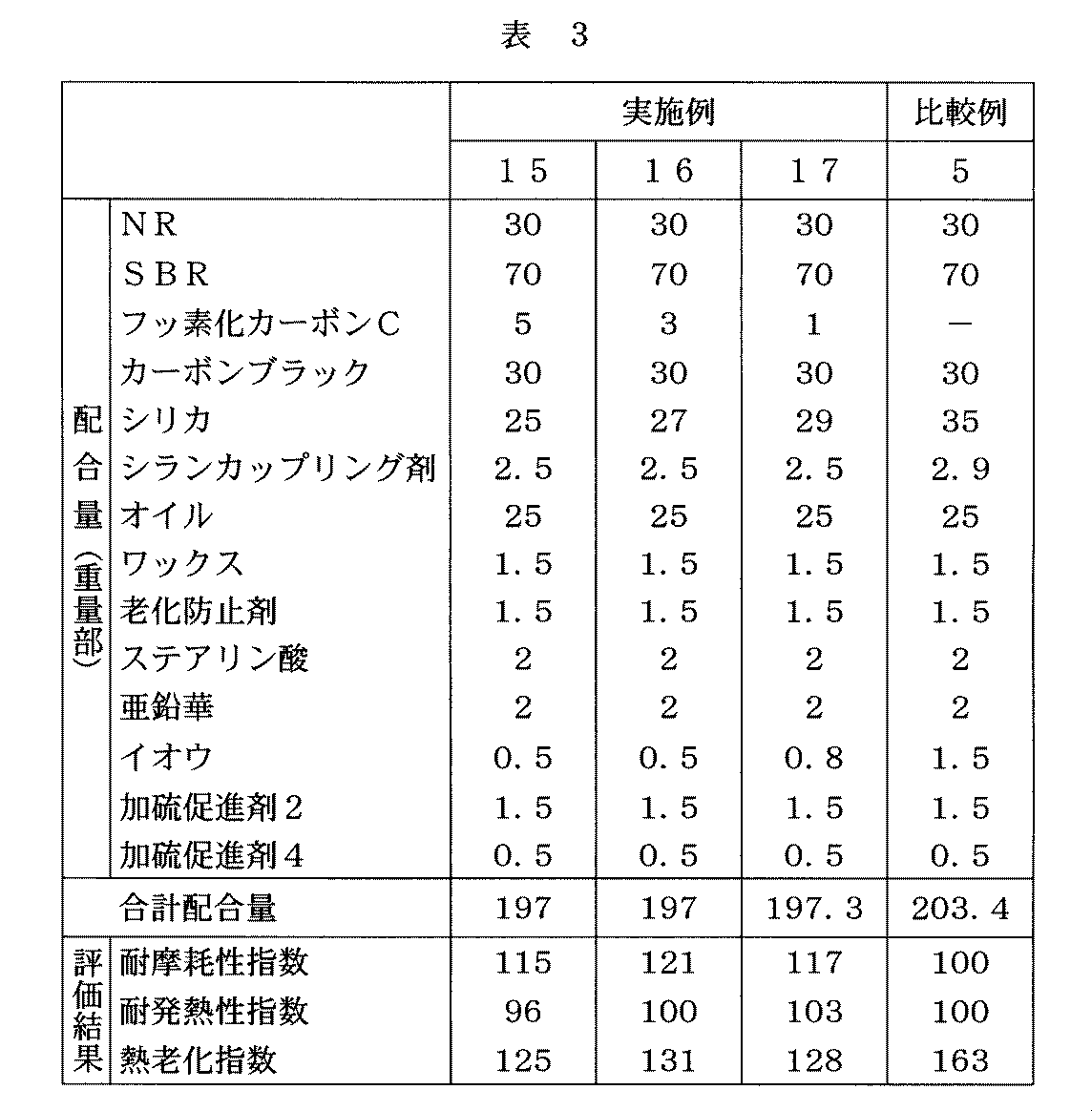
JIS K6251に準じ、実施例1〜17および比較例1〜5のゴム試験片を用いて引張り試験を実施し、熱老化前の100%伸び時のモジュラス(M100A)をそれぞれ測定した。また、温度80℃の恒温槽に200時間放置して、1日室温で放冷した実施例1〜17および比較例1〜5のゴム試験片を用いて、JIS K 6251に準じ、引張り試験を実施し、熱老化後の100%伸び時のモジュラス(M100B)をそれぞれ測定した。そして、下記式により熱老化特性を指数表示した(熱老化指数)。数値が小さいほど、熱による老化が抑制され、熱老化特性に優れることを示す。
(熱老化指数)=(M100B)/(M100A)×100
Examples 1-17 and Comparative Examples 1-5
(Heat aging test)
In accordance with JIS K6251, tensile tests were performed using the rubber test pieces of Examples 1 to 17 and Comparative Examples 1 to 5, and the modulus (M100A) at 100% elongation before heat aging was measured. In addition, using the rubber test pieces of Examples 1 to 17 and Comparative Examples 1 to 5 which were left in a thermostatic bath at a temperature of 80 ° C. for 200 hours and allowed to cool at room temperature for one day, a tensile test was performed according to JIS K 6251. The modulus (M100B) at 100% elongation after heat aging was measured. And the heat aging characteristic was shown as an index by the following formula (heat aging index). A smaller value indicates that heat aging is suppressed and heat aging characteristics are superior.
(Heat aging index) = (M100B) / (M100A) × 100
(トルク試験)
JIS K6300に基づき、実施例1〜6および比較例1〜3の未加硫ゴム組成物を180℃の温度条件にて、20分後のトルクを測定した。そして、下記式により、比較例1のトルクを100として、実施例1〜6および比較例2〜3のトルクを指数表示した(トルク指数)。指数が大きいほど、加硫特性に優れ、好ましいことを示す。
(トルク指数)=
(実施例1〜6および比較例2〜3のトルク)/(比較例1のトルク)×100
(Torque test)
Based on JIS K6300, the torque after 20 minutes was measured for the unvulcanized rubber compositions of Examples 1 to 6 and Comparative Examples 1 to 3 at a temperature condition of 180 ° C. Then, the torques of Examples 1 to 6 and Comparative Examples 2 to 3 were displayed as an index (torque index) using the following formula, where the torque of Comparative Example 1 was 100. The larger the index, the better the vulcanization characteristics and the better.
(Torque index) =
(Torques of Examples 1 to 6 and Comparative Examples 2 to 3) / (Torque of Comparative Example 1) × 100
(スコーチ試験)
JIS K6300に基づき、130℃にて、実施例7〜14および比較例4の未加硫ゴム組成物の粘度が10ポイント上昇する時間(スコーチ時間(分))を測定した。そして、下記式により、比較例4のスコーチ時間を100として、実施例7〜14のスコーチ時間を指数表示した(スコーチ指数)。指数が小さいほど、早期加硫が生じ、好ましくないことを示す。
(スコーチ指数)=
(実施例7〜14のスコーチ時間)/(比較例4のスコーチ時間)×100
(Scorch test)
Based on JIS K6300, the time (scorch time (minute)) for which the viscosity of the unvulcanized rubber compositions of Examples 7 to 14 and Comparative Example 4 rose by 10 points was measured at 130 ° C. Then, the scorch time of Examples 7 to 14 was displayed as an index (Scorch index) with the scorch time of Comparative Example 4 as 100 according to the following formula. A smaller index indicates that premature vulcanization occurs and is not preferable.
(Scorch index) =
(Scorch time of Examples 7 to 14) / (Scorch time of Comparative Example 4) × 100
(耐発熱性能試験)
(株)上島製作所製のスペクトロメーターを用いて、動的歪振幅±2%、周波数10Hz、温度70℃の条件で、実施例15〜17および比較例5のゴム試験片のtanδを測定した。得られたtanδ値について逆数をとり、比較例5のtanδ値の逆数を100として、実施例15〜17のtanδ値の逆数をそれぞれ指数表示した(耐発熱性指数)。耐発熱性指数が大きいほど、耐発熱性に優れることを示す。
(Heat resistance test)
Using a spectrometer manufactured by Ueshima Seisakusho, tan δ of rubber test pieces of Examples 15 to 17 and Comparative Example 5 was measured under the conditions of dynamic strain amplitude ± 2%, frequency 10 Hz, and temperature 70 ° C. The reciprocal number of the obtained tan δ value was taken, and the reciprocal number of the tan δ value of Comparative Example 5 was taken as 100, and the reciprocal numbers of the tan δ values of Examples 15 to 17 were each displayed as an index (heat resistance index). The larger the heat resistance index, the better the heat resistance.
(耐摩耗性)
ランボーン摩耗試験機を用い、室温において負荷荷重2.5kgでスリップ率20%において、実施例15〜17および比較例5の摩耗量を測定した。得られた摩耗量について逆数をとり、比較例5の摩耗量の逆数を100として、実施例15〜17の摩耗量の逆数を指数で表わした。指数が大きいほど、耐摩耗性に優れることを示す。
(Abrasion resistance)
Using a Lambourn abrasion tester, the wear amounts of Examples 15 to 17 and Comparative Example 5 were measured at room temperature at a load of 2.5 kg and a slip rate of 20%. The resulting wear amount taking the reciprocal for, as 100 the reciprocal of the worn amount of Comparative Example 5, representing the reciprocal of the friction耗量of Examples 15 to 17 the number of fingers. It shows that it is excellent in abrasion resistance, so that an index | exponent is large.
以上の測定結果を表1〜3に示す。 The above measurement results are shown in Tables 1-3.
Claims (4)
平均一次粒子径が1μm以下であるフッ素化カーボンを0.1〜50重量部含有する空気入りタイヤ用ゴム組成物。 For 100 parts by weight of the diene rubber component,
A rubber composition for a pneumatic tire comprising 0.1 to 50 parts by weight of fluorinated carbon having an average primary particle size of 1 µm or less.
Priority Applications (2)
| Application Number | Priority Date | Filing Date | Title |
|---|---|---|---|
| JP2006091543A JP5215532B2 (en) | 2006-03-29 | 2006-03-29 | Rubber composition and pneumatic tire using the same |
| PCT/JP2007/055222 WO2007111144A1 (en) | 2006-03-29 | 2007-03-15 | Rubber composition and pneumatic tire using same |
Applications Claiming Priority (1)
| Application Number | Priority Date | Filing Date | Title |
|---|---|---|---|
| JP2006091543A JP5215532B2 (en) | 2006-03-29 | 2006-03-29 | Rubber composition and pneumatic tire using the same |
Publications (2)
| Publication Number | Publication Date |
|---|---|
| JP2007262307A JP2007262307A (en) | 2007-10-11 |
| JP5215532B2 true JP5215532B2 (en) | 2013-06-19 |
Family
ID=38541065
Family Applications (1)
| Application Number | Title | Priority Date | Filing Date |
|---|---|---|---|
| JP2006091543A Expired - Fee Related JP5215532B2 (en) | 2006-03-29 | 2006-03-29 | Rubber composition and pneumatic tire using the same |
Country Status (2)
| Country | Link |
|---|---|
| JP (1) | JP5215532B2 (en) |
| WO (1) | WO2007111144A1 (en) |
Families Citing this family (4)
| Publication number | Priority date | Publication date | Assignee | Title |
|---|---|---|---|---|
| KR101633303B1 (en) * | 2012-08-30 | 2016-06-24 | 요코하마 고무 가부시키가이샤 | Rubber composition for tire treads |
| JP2015189798A (en) * | 2014-03-27 | 2015-11-02 | 横浜ゴム株式会社 | Rubber composition and pneumatic tire using the same |
| JP5949820B2 (en) * | 2014-03-27 | 2016-07-13 | 横浜ゴム株式会社 | Rubber composition and pneumatic tire using the same |
| JP7253897B2 (en) * | 2018-11-12 | 2023-04-07 | 住友ゴム工業株式会社 | Rubber composition and pneumatic tire |
Family Cites Families (8)
| Publication number | Priority date | Publication date | Assignee | Title |
|---|---|---|---|---|
| JP3119288B2 (en) * | 1993-10-05 | 2000-12-18 | ダイキン工業株式会社 | Composition capable of imparting conductivity and non-tackiness, paint and roller using the composition |
| JP3823371B2 (en) * | 1996-06-05 | 2006-09-20 | ダイキン工業株式会社 | Carbon fluoride composition, paint and image forming member, composite material and production method |
| WO2004063281A1 (en) * | 2003-01-10 | 2004-07-29 | Daikin Industries, Ltd. | Cross-linked elastomer composition and formed product composed of such cross-linked elastomer composition |
| JP4316978B2 (en) * | 2003-10-14 | 2009-08-19 | 住友ゴム工業株式会社 | Rubber composition and pneumatic tire using the same |
| JP4462862B2 (en) * | 2003-08-20 | 2010-05-12 | 住友ゴム工業株式会社 | Rubber composition |
| JP4344200B2 (en) * | 2003-08-27 | 2009-10-14 | 住友ゴム工業株式会社 | Tire rubber composition and pneumatic tire using the same for tire tread rubber |
| JP4485219B2 (en) * | 2004-02-10 | 2010-06-16 | 住友ゴム工業株式会社 | Rubber composition and pneumatic tire using the same |
| JP4523361B2 (en) * | 2004-08-20 | 2010-08-11 | 住友ゴム工業株式会社 | Method for producing rubber composition |
-
2006
- 2006-03-29 JP JP2006091543A patent/JP5215532B2/en not_active Expired - Fee Related
-
2007
- 2007-03-15 WO PCT/JP2007/055222 patent/WO2007111144A1/en not_active Ceased
Also Published As
| Publication number | Publication date |
|---|---|
| WO2007111144A1 (en) | 2007-10-04 |
| JP2007262307A (en) | 2007-10-11 |
Similar Documents
| Publication | Publication Date | Title |
|---|---|---|
| JP5194546B2 (en) | Rubber composition | |
| JP4113850B2 (en) | Rubber composition for tire and run flat tire obtained using the same | |
| EP1508590B1 (en) | Rubber composition and pneumatic tire using the same | |
| EP3372637A1 (en) | Rubber composition for tires and pneumatic tire | |
| JP4646523B2 (en) | Manufacturing method of rubber composition, rubber composition and pneumatic tire | |
| JP2014133843A (en) | Rubber composition for tread and pneumatic tire | |
| JP6397816B2 (en) | Rubber composition and tire using the same | |
| WO2007111144A1 (en) | Rubber composition and pneumatic tire using same | |
| JP2009073887A (en) | Rubber composition for cap tread and pneumatic tire having cap tread using the same | |
| JP5499466B2 (en) | Rubber composition for tire tread | |
| JP2008013704A (en) | Rubber composition | |
| WO2014189102A1 (en) | Rubber composition | |
| JP2013147561A (en) | Rubber composition for tire and pneumatic tire using the same | |
| JP4316978B2 (en) | Rubber composition and pneumatic tire using the same | |
| JP5616049B2 (en) | Rubber composition for tire and pneumatic tire | |
| JP4865363B2 (en) | Rubber composition for tire tread | |
| JP2007231177A (en) | Rubber composition for tire tread | |
| JP4472606B2 (en) | Rubber composition | |
| US7666937B2 (en) | Rubber composition for side reinforcement and run flat tire using the same | |
| JP5612243B2 (en) | Rubber composition for tire and pneumatic tire | |
| EP3385317B1 (en) | Method for preparing rubber composition and method for preparing tire | |
| JP4268946B2 (en) | Side reinforcing rubber composition and run-flat tire using the same | |
| JP4805603B2 (en) | High performance tire rubber composition | |
| JP5480699B2 (en) | Sidewall rubber composition and pneumatic tire | |
| JP2006052309A (en) | High performance tire rubber composition |
Legal Events
| Date | Code | Title | Description |
|---|---|---|---|
| A621 | Written request for application examination |
Free format text: JAPANESE INTERMEDIATE CODE: A621 Effective date: 20090206 |
|
| RD03 | Notification of appointment of power of attorney |
Free format text: JAPANESE INTERMEDIATE CODE: A7423 Effective date: 20100513 |
|
| A131 | Notification of reasons for refusal |
Free format text: JAPANESE INTERMEDIATE CODE: A131 Effective date: 20120424 |
|
| A521 | Written amendment |
Free format text: JAPANESE INTERMEDIATE CODE: A523 Effective date: 20120607 |
|
| RD02 | Notification of acceptance of power of attorney |
Free format text: JAPANESE INTERMEDIATE CODE: A7422 Effective date: 20120712 |
|
| RD05 | Notification of revocation of power of attorney |
Free format text: JAPANESE INTERMEDIATE CODE: A7425 Effective date: 20120712 |
|
| A521 | Written amendment |
Free format text: JAPANESE INTERMEDIATE CODE: A821 Effective date: 20120712 |
|
| A521 | Written amendment |
Free format text: JAPANESE INTERMEDIATE CODE: A523 Effective date: 20121025 |
|
| TRDD | Decision of grant or rejection written | ||
| A01 | Written decision to grant a patent or to grant a registration (utility model) |
Free format text: JAPANESE INTERMEDIATE CODE: A01 Effective date: 20130205 |
|
| A61 | First payment of annual fees (during grant procedure) |
Free format text: JAPANESE INTERMEDIATE CODE: A61 Effective date: 20130301 |
|
| R150 | Certificate of patent or registration of utility model |
Ref document number: 5215532 Country of ref document: JP Free format text: JAPANESE INTERMEDIATE CODE: R150 Free format text: JAPANESE INTERMEDIATE CODE: R150 |
|
| FPAY | Renewal fee payment (event date is renewal date of database) |
Free format text: PAYMENT UNTIL: 20160308 Year of fee payment: 3 |
|
| R250 | Receipt of annual fees |
Free format text: JAPANESE INTERMEDIATE CODE: R250 |
|
| R250 | Receipt of annual fees |
Free format text: JAPANESE INTERMEDIATE CODE: R250 |
|
| R250 | Receipt of annual fees |
Free format text: JAPANESE INTERMEDIATE CODE: R250 |
|
| R250 | Receipt of annual fees |
Free format text: JAPANESE INTERMEDIATE CODE: R250 |
|
| R250 | Receipt of annual fees |
Free format text: JAPANESE INTERMEDIATE CODE: R250 |
|
| LAPS | Cancellation because of no payment of annual fees |