JP5374576B2 - Trichlorosilane cooling tower and method for producing trichlorosilane using the same - Google Patents
Trichlorosilane cooling tower and method for producing trichlorosilane using the same Download PDFInfo
- Publication number
- JP5374576B2 JP5374576B2 JP2011502552A JP2011502552A JP5374576B2 JP 5374576 B2 JP5374576 B2 JP 5374576B2 JP 2011502552 A JP2011502552 A JP 2011502552A JP 2011502552 A JP2011502552 A JP 2011502552A JP 5374576 B2 JP5374576 B2 JP 5374576B2
- Authority
- JP
- Japan
- Prior art keywords
- cooling
- trichlorosilane
- reaction product
- product gas
- tetrachlorosilane
- Prior art date
- Legal status (The legal status is an assumption and is not a legal conclusion. Google has not performed a legal analysis and makes no representation as to the accuracy of the status listed.)
- Active
Links
Images

Classifications
-
- C—CHEMISTRY; METALLURGY
- C01—INORGANIC CHEMISTRY
- C01B—NON-METALLIC ELEMENTS; COMPOUNDS THEREOF; METALLOIDS OR COMPOUNDS THEREOF NOT COVERED BY SUBCLASS C01C
- C01B33/00—Silicon; Compounds thereof
- C01B33/08—Compounds containing halogen
- C01B33/107—Halogenated silanes
-
- C—CHEMISTRY; METALLURGY
- C01—INORGANIC CHEMISTRY
- C01B—NON-METALLIC ELEMENTS; COMPOUNDS THEREOF; METALLOIDS OR COMPOUNDS THEREOF NOT COVERED BY SUBCLASS C01C
- C01B33/00—Silicon; Compounds thereof
- C01B33/08—Compounds containing halogen
- C01B33/107—Halogenated silanes
- C01B33/1071—Tetrachloride, trichlorosilane or silicochloroform, dichlorosilane, monochlorosilane or mixtures thereof
-
- F—MECHANICAL ENGINEERING; LIGHTING; HEATING; WEAPONS; BLASTING
- F28—HEAT EXCHANGE IN GENERAL
- F28C—HEAT-EXCHANGE APPARATUS, NOT PROVIDED FOR IN ANOTHER SUBCLASS, IN WHICH THE HEAT-EXCHANGE MEDIA COME INTO DIRECT CONTACT WITHOUT CHEMICAL INTERACTION
- F28C3/00—Other direct-contact heat-exchange apparatus
- F28C3/06—Other direct-contact heat-exchange apparatus the heat-exchange media being a liquid and a gas or vapour
Landscapes
- Chemical & Material Sciences (AREA)
- Organic Chemistry (AREA)
- Inorganic Chemistry (AREA)
- Engineering & Computer Science (AREA)
- Mechanical Engineering (AREA)
- General Engineering & Computer Science (AREA)
- Silicon Compounds (AREA)
Abstract
Description
本発明は、テトラクロロシランおよび水素からトリクロロシランを生産する際に使用されるトリクロロシラン冷却塔並びに当該トリクロロシラン冷却塔を用いたトリクロロシラン製造方法に関する。 The present invention relates to a trichlorosilane cooling tower used when producing trichlorosilane from tetrachlorosilane and hydrogen, and a method for producing trichlorosilane using the trichlorosilane cooling tower.
トリクロロシラン(SiHCl3)は、半導体、液晶パネル、太陽電池等の製造に用いられる特殊材料ガスである。近年、需要は順調に拡大し、エレクトロニクス分野で広く使用されるCVD材料として、今後も伸びが期待されている。Trichlorosilane (SiHCl 3 ) is a special material gas used for manufacturing semiconductors, liquid crystal panels, solar cells, and the like. In recent years, demand has been steadily expanding, and growth is expected as a CVD material widely used in the electronics field.
トリクロロシランは、テトラクロロシラン(SiCl4)と水素(H2)とを接触させ、以下の熱平衡状態を達成することによって生成される。
SiCl4+H2⇔SiHCl3+HCl (1)
この反応は、ガス化したテトラクロロシランと水素からなる原料ガスを反応炉において700℃〜1400℃に加熱することによって行われる。Trichlorosilane is produced by contacting tetrachlorosilane (SiCl 4 ) and hydrogen (H 2 ) to achieve the following thermal equilibrium state.
SiCl 4 + H 2 ⇔SiHCl 3 + HCl (1)
This reaction is performed by heating a raw material gas composed of gasified tetrachlorosilane and hydrogen to 700 ° C. to 1400 ° C. in a reaction furnace.
反応炉から排出される高温の反応生成ガスには、生成されたトリクロロシランおよび塩化水素の他、多量の未反応テトラクロロシランおよび水素が含まれている。反応生成ガスからトリクロロシランを取り出すには、テトラクロロシランとトリクロロシランの沸点の相違を利用して蒸留塔で凝縮する方法が用いられる。具体的には、凝縮器で凝縮分であるクロロシランと、未凝縮分である塩化水素、水素、未凝縮クロロシランとに分け、さらに、凝縮分を深冷分離により−70℃程度まで冷却してトリクロロシランを分離する。 The high-temperature reaction product gas discharged from the reaction furnace contains a large amount of unreacted tetrachlorosilane and hydrogen in addition to the produced trichlorosilane and hydrogen chloride. In order to extract trichlorosilane from the reaction product gas, a method of condensing in a distillation column using the difference in boiling point between tetrachlorosilane and trichlorosilane is used. Specifically, it is divided into a chlorosilane that is a condensed component and hydrogen chloride, hydrogen, and non-condensed chlorosilane that are uncondensed by a condenser, and the condensed component is cooled to about -70 ° C. by cryogenic separation. Separate the chlorosilane.
反応生成ガスから目的とするトリクロロシランを分離するにあたり、反応炉から導出されたばかりの高温の反応生成ガスをいきなり蒸留塔に導入してしまうと蒸留塔に過度の負荷がかかるため、典型的には、反応生成ガスを蒸留塔に導入する前に冷却塔において予備的に冷却しておく必要がある。 When separating the target trichlorosilane from the reaction product gas, if the high-temperature reaction product gas just introduced from the reaction furnace is suddenly introduced into the distillation column, an excessive load is applied to the distillation column. Before introducing the reaction product gas into the distillation tower, it is necessary to preliminarily cool it in the cooling tower.
しかし、予備的冷却とはいっても、冷却力が不十分であると上記式(1)の平衡がテトラクロロシラン側に傾き、一旦は生成したトリクロロシランが再びテトラクロロシランへと戻ってしまう。そこで、トリクロロシランの回収効率の向上を図るために、平衡が十分にトリクロロシラン側に達した時点で反応生成ガスを可能な限り瞬時に所定温度まで冷却して平衡を凍結する必要がある。上記平衡状態を瞬時に凍結するには、典型的には、反応生成ガスを1秒未満のうちに600℃程度にまで急冷する必要がある。 However, even if it is preliminary cooling, if the cooling power is insufficient, the equilibrium of the above formula (1) is inclined to the tetrachlorosilane side, and once generated trichlorosilane returns to tetrachlorosilane again. Therefore, in order to improve the recovery efficiency of trichlorosilane, it is necessary to cool the reaction product gas to a predetermined temperature as quickly as possible when the equilibrium has sufficiently reached the trichlorosilane side and freeze the equilibrium. In order to instantly freeze the equilibrium state, it is typically necessary to rapidly cool the reaction product gas to about 600 ° C. in less than one second.
テトラクロロシランと水素とを反応させてトリクロロシランに転換し、さらに反応生成ガスを冷却する工程を備えたトリクロロシラン製造方法としては、例えば、特許文献1に記載されたものがある。この文献に記載される方法は、テトラクロロシランと水素とを反応室内に導入し、800℃以上の温度で反応させてトリクロロシランと塩化水素とを含む混合ガスを生成する工程と、上記反応室から上記混合ガスを導出する際に、該混合ガスに水素、テトラクロロシラン、または塩化水素の少なくとも一種を主体とする冷却ガスを導入して該混合ガスを冷却する工程を有する。
For example,
この文献によれば、反応生成ガスを1秒以内の冷却速度で650℃以下の温度にまで急冷するとSi2Cl6、Si3Cl8、Si2H2Cl4等の高沸点ポリマーを副生しやすいこと、冷却ガスとして塩化水素を用いれば高沸点ポリマーを分解してトリクロロシランを生成することからトリクロロシランの転換率を向上できることが記載されている。さらに、塩化水素を主体とする冷却ガスを用いればSiCl2の副生を抑えられることが記載されている。According to this document, when the reaction product gas is rapidly cooled to a temperature of 650 ° C. or less at a cooling rate within 1 second, high-boiling polymers such as Si 2 Cl 6 , Si 3 Cl 8 , and Si 2 H 2 Cl 4 are by-produced. It is described that, if hydrogen chloride is used as a cooling gas, the high boiling point polymer is decomposed to produce trichlorosilane, so that the conversion rate of trichlorosilane can be improved. Furthermore, it is described that by-product of SiCl 2 can be suppressed by using a cooling gas mainly composed of hydrogen chloride.
しかしながら、特許文献1に記載されている方法では、800℃以上に達している混合ガスの冷却が冷却ガスとの熱交換のみに委ねられているため、短時間で急激に冷却するには混合ガスに対して大量の冷却ガスを導入する必要があり、効率が悪く、冷却に要する負荷が高い。
However, in the method described in
また、テトラクロロシランおよび水素からトリクロロシランが生成する反応は吸熱反応であるため、ル・シャトリエの原理に従えば、単に冷却を行うだけでも、冷却による温度低下を相殺する方向、すなわちトリクロロシランと塩化水素からテトラクロロシランを生成する方向に平衡が傾いてしまう。それにも拘わらず、冷却ガスとして塩化水素を大量に導入してしまうと、反応系内のHCl濃度が上昇し、上記式(1)の平衡を一層左側へと推し戻してしまうことになる。従って、冷却ガスとして塩化水素を使用した場合には、高沸点ポリマーの副生は避けられるかもしれないが、結果的にトリクロロシランの回収効率が低下するおそれがある。 In addition, since the reaction of trichlorosilane generated from tetrachlorosilane and hydrogen is an endothermic reaction, according to Le Chatelier's principle, simply cooling can cancel out the temperature drop due to cooling, that is, trichlorosilane and chloride. The equilibrium is tilted in the direction of producing tetrachlorosilane from hydrogen. Nevertheless, if a large amount of hydrogen chloride is introduced as the cooling gas, the concentration of HCl in the reaction system increases, and the equilibrium of the above equation (1) is pushed back further to the left. Therefore, when hydrogen chloride is used as the cooling gas, by-product formation of a high boiling point polymer may be avoided, but as a result, the recovery efficiency of trichlorosilane may be reduced.
そこで、このようなガス冷却より強力かつ効率的に反応生成ガスを冷却する方法として、反応生成ガスを高温の反応炉から冷却塔へと導出し、そこで反応生成ガスに冷却液を直接噴霧し、冷却液が気化する際の蒸発潜熱を利用して反応生成ガスから熱を奪う方法が提案されている。 Therefore, as a method for cooling the reaction product gas more powerfully and efficiently than such gas cooling, the reaction product gas is led out from the high-temperature reactor to the cooling tower, and the coolant is directly sprayed on the reaction product gas, A method has been proposed in which heat is removed from a reaction product gas by using latent heat of vaporization when the coolant is vaporized.
例えば特許文献2には、テトラクロロシランと水素を反応室に導入して600℃〜1200℃の温度で転換反応させることによってトリクロロシランと塩化水素とを含む反応生成ガスを得た後、反応室から導出された反応生成ガスに室温に冷却されたクロロシラン混合物を噴霧し、1秒以内に300℃以下にまで急冷する冷却手段を備えた装置が提案されている。
For example,
ところで、特許文献2に記載の装置では、生成されたトリクロロシランは主に急冷室で凝縮されて、急冷室の下方に設けられた受容器に収集される。そのため、受容器にはトリクロロシランとともに、それよりも沸点の高い副生物、すなわちSi2Cl6、Si3Cl8、Si2H2Cl4等の高沸点ポリマーも回収されてしまい、回収したクロロシラン混合物から目的とするトリクロロシランのみを分溜する作業にかかる負荷が大きくなってしまう。
また、特許文献2には、反応によって得られた反応混合物(クロロシラン混合物)を室温に冷却し、これを冷却液として用いることが記載されているが、クロロシラン混合物からなる冷却液の噴霧条件について具体的な開示はない。By the way, in the apparatus described in
本発明は上記事情に鑑みてなされたものであり、既存設備の大幅な変更や冷却に要する負荷を増大することなく、トリクロロシランを含む反応生成ガスの冷却効率に優れ、しかも高沸点ポリマーの副生を問題としない、トリクロロシランの回収効率に優れたトリクロロシラン冷却塔およびそれを用いたトリクロロシラン製造方法を提供することを目的とする。 The present invention has been made in view of the above circumstances, and is excellent in the cooling efficiency of the reaction product gas containing trichlorosilane without greatly changing the existing equipment and increasing the load required for cooling. It is an object of the present invention to provide a trichlorosilane cooling tower excellent in the recovery efficiency of trichlorosilane that does not cause raw materials and a method for producing trichlorosilane using the same.
本発明は、前記課題を解決するために以下の構成を採用した。
すなわち、本発明のトリクロロシラン冷却塔は、
テトラクロロシランと水素とを含有する原料ガスを700〜1400℃の範囲の温度で反応させて得られるトリクロロシランを含有する反応生成ガスに平均液滴粒子径が2000μm以下の範囲の冷却液を噴霧して70〜600℃の温度範囲に急冷する一次冷却手段と、前記一次冷却手段の上方に設けられ、一次冷却後の反応生成ガスに冷却液をさらに噴霧して30〜60℃の温度範囲に冷却する二次冷却手段と、
を有する。The present invention employs the following configuration in order to solve the above problems.
That is, the trichlorosilane cooling tower of the present invention is
A coolant having an average droplet diameter of 2000 μm or less is sprayed on a reaction product gas containing trichlorosilane obtained by reacting a raw material gas containing tetrachlorosilane and hydrogen at a temperature in the range of 700 to 1400 ° C. A primary cooling means for rapidly cooling to a temperature range of 70 to 600 ° C., and a cooling liquid sprayed on the reaction product gas after the primary cooling provided above the primary cooling means to cool to a temperature range of 30 to 60 ° C. Secondary cooling means to
Have
また、本発明のトリクロロシラン製造方法は、
テトラクロロシランと水素とを含有する原料ガスを700〜1400℃の範囲の温度で反応させて得られるトリクロロシランを含有する反応生成ガスを生成する工程と、
前記反応生成ガスに平均液滴粒子径が2000μm以下の範囲の冷却液を噴霧して1秒以内に70〜600℃の範囲に急冷する一次冷却工程と、
前記一次冷却後の反応生成ガスに冷却液をさらに噴霧して30〜60℃の範囲に冷却する二次冷却工程と、
を有する。In addition, the method for producing trichlorosilane of the present invention includes:
Producing a reaction product gas containing trichlorosilane obtained by reacting a raw material gas containing tetrachlorosilane and hydrogen at a temperature in the range of 700 to 1400 ° C .;
A primary cooling step of spraying a cooling liquid having an average droplet particle size of 2000 μm or less onto the reaction product gas and rapidly cooling to 70 to 600 ° C. within 1 second;
A secondary cooling step in which a cooling liquid is further sprayed on the reaction product gas after the primary cooling to cool it to a range of 30 to 60 ° C .;
Have
<冷却効率の改善>
本発明者等は、鋭意研究の結果、噴霧する冷却液の平均液滴粒子径が、従来よりも遙かに小さい範囲、特に2000μm以下の範囲であれば、反応生成ガスの冷却効率を大幅に改善できることを見出した。<Improvement of cooling efficiency>
As a result of diligent research, the present inventors have greatly improved the cooling efficiency of the reaction product gas when the average droplet particle size of the sprayed coolant is much smaller than in the past, particularly 2000 μm or less. I found that it can be improved.
これは、平均液滴粒子径が2000μm以下であると、冷却液の液滴が急冷管またはトリクロロシラン冷却塔内部の空間に漂う滞留時間を長く確保することができ反応生成ガスと十分に接触できること、さらには、液滴が小さく蒸発しやすいため蒸発潜熱の利用効率が優れていることが考えられる。 This is because when the average droplet diameter is 2000 μm or less, it is possible to ensure a long residence time for the cooling liquid droplets to float in the space inside the quenching tube or the trichlorosilane cooling tower, and to sufficiently contact the reaction product gas. Furthermore, since the droplets are small and easily evaporated, it is considered that the utilization efficiency of latent heat of vaporization is excellent.
<高沸点ポリマーの除去>
また、急冷効率が高くなると一般に高沸点ポリマーが副生しやすくなるが、反応生成ガスをトリクロロシラン冷却塔において30〜60℃の範囲まで二次冷却し、二次冷却後もなおガス状である物質のみをトリクロロシラン冷却塔の塔頂部から取り出し、冷却によって凝縮された液状物質については噴霧後の冷却液と共にトリクロロシラン冷却塔の底部から回収することにより、前記温度帯域でガス状であるトリクロロシランと、当該温度帯域で凝縮してしまう高沸点ポリマーとを別個に取り出すことができる。そのため、高沸点ポリマーの副生を気にすることなく反応生成ガスを瞬時に冷却することができ、より確実に平衡を凍結することができる。これにより、一度生成したトリクロロシランの損失を抑えることができる。さらに、高沸点ポリマーとトリクロロシランとの分溜にかかっていた負荷を大幅に軽減することができる。<Removal of high boiling point polymer>
In addition, when the quenching efficiency is increased, a high boiling point polymer is generally easily produced as a by-product. However, the reaction product gas is secondarily cooled to a range of 30 to 60 ° C. in a trichlorosilane cooling tower and is still in a gaseous state after the second cooling. Only the substance is taken out from the top of the trichlorosilane cooling tower, and the liquid substance condensed by cooling is collected from the bottom of the trichlorosilane cooling tower together with the cooling liquid after spraying, so that the trichlorosilane that is gaseous in the temperature zone is collected. And a high-boiling point polymer that condenses in the temperature range can be taken out separately. Therefore, the reaction product gas can be cooled instantly without worrying about the by-product of the high boiling point polymer, and the equilibrium can be frozen more reliably. Thereby, the loss of the trichlorosilane produced | generated once can be suppressed. Furthermore, the load applied to the distillation of the high boiling point polymer and trichlorosilane can be greatly reduced.
<回収効率の向上>
また特に、反応生成ガスをあまりに冷却し過ぎると一部のトリクロロシランが凝縮に至るおそれがあるが、冷却手段を多段的に設け、一次冷却工程では平衡を凍結するのに十分な温度70〜600℃まで瞬時に急冷し、二次冷却工程では専ら高沸点ポリマーを凝縮させるべく30〜60℃の範囲まで穏やかに冷却することにより、トリクロロシランをガス状のまま効率よく回収することができる。<Improvement of collection efficiency>
In particular, if the reaction product gas is cooled too much, some of the trichlorosilane may be condensed. However, the cooling means is provided in multiple stages, and the temperature sufficient to freeze the equilibrium in the primary cooling step is 70 to 600. The trichlorosilane can be efficiently recovered in the gaseous state by rapidly cooling to 0 ° C. and by gently cooling to the range of 30 to 60 ° C. in order to condense the high boiling point polymer exclusively in the secondary cooling step.
本発明に係るトリクロロシラン冷却塔およびそれを用いたトリクロロシラン製造方法によれば、反応生成ガスの冷却効率が極めて優れているため、トリクロロシランに傾いた平衡状態を瞬時により確実に凍結することができる。また、トリクロロシランと高沸点ポリマーとを分離して取り出すことができるため、トリクロロシランの分溜負荷を低減することができる。さらに、冷却手段を多段的に設けることで、より多くのトリクロロシランをガス状のまま取り出すことができる。かくして、これらが相乗的に作用することにより、トリクロロシランの生産性を大幅に改善することができる。 According to the trichlorosilane cooling tower and the trichlorosilane production method using the same according to the present invention, since the cooling efficiency of the reaction product gas is extremely excellent, the equilibrium state tilted to trichlorosilane can be frozen instantly and reliably. it can. In addition, since trichlorosilane and the high-boiling point polymer can be separated and taken out, the trichlorosilane distillation load can be reduced. Furthermore, by providing the cooling means in multiple stages, more trichlorosilane can be taken out in a gaseous state. Thus, the synergistic action of these can greatly improve the productivity of trichlorosilane.
100 トリクロロシラン冷却塔
101 金属製容器
102 一次スプレーノズル
103 二次スプレーノズル
104 一次冷却液供給管
105 二次冷却液供給管
106 急冷管
107 充填部材
108 反応生成ガス導入開口部
109 冷却塔ガス成分抜出管
110 冷却塔液体成分抜出管
111 導入開口部
112 排出開口部
200 原料ガス供給管
201 反応炉
202 ヒータ
203 反応炉ガス抜出管
300 凝縮器
301 貯槽
400 貯槽
401 調製液供給管
402 ポンプ
403 熱交換器100 Trichlorosilane cooling tower 101 Metal container 102
以下、本発明の実施の形態について、図面を用いて説明する。
1.トリクロロシラン冷却塔
図1は、本実施形態のトリクロロシラン冷却塔とそれを用いたトリクロロシラン製造方法を実施するための装置を概略的に示したものである。
本実施形態のトリクロロシラン冷却塔100は、略円筒状の金属製容器101と、当該容器内に設置され容器内に冷却液を噴霧する一次スプレーノズル102および二次スプレーノズル103と、当該一次スプレーノズル102および二次スプレーノズル103にそれぞれ接続されこれらに冷却液を供給する一次冷却液供給管104および二次冷却液供給管105と、前記金属製容器101内部において前記一次スプレーノズル102と接続された急冷管106と、前記一次スプレーノズル102と二次スプレーノズル103との間に設置された充填部材107とを備える。Hereinafter, embodiments of the present invention will be described with reference to the drawings.
1. Trichlorosilane Cooling Tower FIG. 1 schematically shows an apparatus for carrying out a trichlorosilane cooling tower of this embodiment and a method for producing trichlorosilane using the same.
The
<金属製容器>
金属製容器101は反応生成ガスと反応しない材質であれば特に限定されず、典型的にはステンレス等の金属から構成することができる。金属製容器101の側壁には、反応生成ガスを取り込むための反応生成ガス導入開口部108が設けられている。金属製容器101の上部には、冷却された反応生成ガスのガス成分を取り出すための冷却塔ガス成分抜出管109が接続されており、金属製容器101の底部には、冷却に用いられた冷却液および冷却により生じた凝縮分を抜き取るための冷却塔液体成分抜出管110が接続されている。<Metal container>
The metal container 101 is not particularly limited as long as it is a material that does not react with the reaction product gas, and can typically be made of a metal such as stainless steel. A reaction product gas introduction opening 108 for taking in the reaction product gas is provided on the side wall of the metal container 101. A cooling tower gas
<急冷管>
急冷管106は反応生成ガスと反応しない材質であれば特に限定されず、典型的にはステンレス等の金属から構成することができる。
急冷管106には、前記金属製容器101の反応生成ガス導入開口部108と対応する位置に、反応生成ガスを取り込むための導入開口部111が設けられている。また、急冷管106の底部は全面開放されており、冷却された反応生成ガスを排出するための排出開口部112を形成している。<Quenching tube>
The quenching
The quench
<一次スプレーノズル>
一次スプレーノズル102は、前記急冷管106の天蓋部から急冷管106の内部に向けて設置され、一次冷却液供給管104と接続されている。一次スプレーノズル102は、急冷管106の導入開口部111から導入される反応生成ガスに向けて冷却液を噴霧することにより、上記式(1)の平衡が凍結する70〜600℃まで瞬間的に急冷する。
一次スプレーノズル102は、2000μm以下の範囲の平均液滴粒子径の液滴を噴霧できるものであれば特に限定されず、種々のタイプのノズルを用いることができる。特に、噴霧領域全体にわたって均等な流量分布を実現できる充円錐ノズルが好ましい。平均液滴粒子径はノズルの特性のみならず噴霧条件によっても左右されるが、本実施形態では、噴霧量が0.1〜0.3l/min、噴霧圧力が0.1〜0.2MPa、冷却液として後述する混合比のテトラクロロシランとトリクロロシランとからなる混合液を用いた場合に、上記平均液滴粒子径を実現できるものを用いる。<Primary spray nozzle>
The primary spray nozzle 102 is installed from the canopy portion of the quench
The primary spray nozzle 102 is not particularly limited as long as it can spray droplets having an average droplet particle diameter in a range of 2000 μm or less, and various types of nozzles can be used. In particular, a full-cone nozzle that can achieve a uniform flow distribution over the entire spray region is preferred. The average droplet particle size depends not only on the nozzle characteristics but also on the spraying conditions. In this embodiment, the spray amount is 0.1 to 0.3 l / min, the spray pressure is 0.1 to 0.2 MPa, When a mixed liquid composed of tetrachlorosilane and trichlorosilane having a mixing ratio described later is used as the cooling liquid, a liquid that can realize the above average droplet particle diameter is used.
<平均液滴粒子径>
ここで用いる平均液滴粒子径とは、液浸法又はレーザー法により、ni[個]の粒子径Di[μm]を測定し、次式のザウター平均粒子径により求められる値とする。
平均粒子径=Σni・Di3/Σni・Di2
(niは粒子径Diを有する冷却液の噴霧液滴の個数)<Average droplet particle size>
The average droplet particle diameter used here is a value obtained by measuring the ni [particle] particle diameter Di [μm] by a liquid immersion method or a laser method and calculating the Sauter average particle size of the following equation.
Average particle diameter = Σni · Di 3 / Σni · Di 2
(Ni is the number of spray droplets of coolant having particle diameter Di)
<充填部材>
充填部材107は、前記一次スプレーノズル102の上方に設置される。充填部材107は、急冷管106において一次冷却されて急冷管106の排出開口部112から押し出された反応生成ガスがトリクロロシラン冷却塔100の内部を上昇する際にその直進を乱すようにガス通路を形成するものであればどのような形態をとってもよい。例えばチップ状またはブロック状等の小塊状部材を不規則に詰め込んだ形態や、多数の孔を設けた複数の板状部材を間隔をあけて並べた形態とすることができる。
充填部材107は反応生成ガスと反応しない材質であれば特に限定されず、典型的にはステンレス等の金属から構成することができる。<Filling member>
The filling
The filling
<二次スプレーノズル>
二次スプレーノズル103は、前記一次スプレーノズル102および充填部材107のさらに上方に設置され、二次冷却液供給管105と接続されている。二次スプレーノズル103は、急冷管106の排出開口部112から押し出されトリクロロシラン冷却塔100の内部を上昇し充填部材107をすり抜けてくる反応生成ガスに向けて冷却液を噴霧することにより、高沸点ポリマーを凝縮させつつ、反応生成ガスの温度を30〜60℃の範囲まで穏やかに冷却する。また、二次スプレーノズル103から噴霧される冷却液は、トリクロロシラン冷却塔100内部全体の温度を下げ、冷却液が反応生成ガスと接触する前に気化してしまうことを抑制する働きも有する。
二次スプレーノズル103は、特に限定されず、種々のタイプのノズルを用いることができる。特に、噴霧領域全体にわたって均等な流量分布を実現できる充円錐ノズルが好ましい。二次スプレーノズル103から噴霧される冷却液の平均液滴粒子径は特に限定されないが、上記一次スプレーノズル102と同様に2000μm以下の範囲であれば冷却効率に優れるため好ましい。<Secondary spray nozzle>
The
The
<冷却液>
冷却液は、テトラクロロシランとトリクロロシランとからなる混合液を用いることが好ましく、混合液中のテトラクロロシランの含有量は好ましくは80〜100モル%、より好ましくは85〜95モル%である。かかる特定の組成の冷却液を用いることにより、上記式(1)の平衡が十分に右側に移動した状態を保ったまま反応を凍結でき、高い収率でトリクロロシランを回収することができる。
冷却液は、50℃以下に温度調整されていることが好ましい。冷却液が、50℃以下に温度調整されていれば、短時間で反応生成ガスの温度を急冷することができるため、上記の式(1)で十分に右側に移動した状態が保たれたまま平衡を凍結できる。<Cooling liquid>
As the cooling liquid, a mixed liquid composed of tetrachlorosilane and trichlorosilane is preferably used, and the content of tetrachlorosilane in the mixed liquid is preferably 80 to 100 mol%, more preferably 85 to 95 mol%. By using the cooling liquid having such a specific composition, the reaction can be frozen while the equilibrium of the above formula (1) is sufficiently moved to the right side, and trichlorosilane can be recovered with a high yield.
The temperature of the coolant is preferably adjusted to 50 ° C. or lower. If the temperature of the cooling liquid is adjusted to 50 ° C. or less, the temperature of the reaction product gas can be rapidly cooled in a short time, so that the state of being sufficiently moved to the right side in the above equation (1) is maintained. The equilibrium can be frozen.
2.トリクロロシラン製造方法
次に、上記トリクロロシラン冷却塔を用いてトリクロロシランを製造する方法について、図1を用いて説明する。
まず、ガス化したテトラクロロシランと水素とを混合した原料ガスを原料ガス供給管200を通じて反応炉201の底部に供給する。2. Next, a method for producing trichlorosilane using the above-described trichlorosilane cooling tower will be described with reference to FIG.
First, a raw material gas in which gasified tetrachlorosilane and hydrogen are mixed is supplied to the bottom of the
反応炉201は黒鉛製であり、周囲に設けられた最大出力500KWのヒータ202にて加熱することで、反応炉201の内部を700℃を超え1400℃以下の範囲内の状態に保つことができる。反応温度が700℃以上であれば上記式(1)の平衡が十分に右側に傾くため好ましく、1400℃以下であれば金属シリコンが析出して装置の閉塞に繋がる現象を抑制できるため好ましい。
The
反応炉201内で加熱され、上記式(1)に示す熱平衡状態に達した反応生成ガスは、反応炉201の上方へ移動し、700℃以上の温度を保った状態で反応炉ガス抜出管203を通じてトリクロロシラン冷却塔100に導入される。
The reaction product gas that has been heated in the
反応炉ガス抜出管203はトリクロロシラン冷却塔100の側壁および急冷管106の側壁を貫通して、急冷管106の内部に達している。急冷管106の内部に取り出された反応生成ガスに対し、一次冷却液供給管104に接続された一次スプレーノズル102から平均液滴粒子径が2000μm以下の範囲である冷却液を噴霧して、平衡が凍結する70〜600℃の範囲まで瞬間的に急冷する。このとき、狭い急冷管106内で反応生成ガスと微細液滴状の冷却液とが混合されることにより両者がより確実に接触し、冷却液が気化する際の蒸発潜熱を利用して反応生成ガスから瞬時に効率よく熱が奪われる。これによって反応生成ガス内の物質間平衡状態が凍結される。
The reactor
次いで、急冷管106内で急冷された反応生成ガスは、急冷管106の排出開口部112から押し出されてトリクロロシラン冷却塔100内部を上昇し、充填部材107をすり抜ける。ここで、二次冷却液供給管105に接続された二次スプレーノズル103から冷却液をさらに噴霧して、反応生成ガス中の高沸点ポリマーを凝縮させつつ、反応生成ガスの温度を30〜60℃の範囲まで穏やかに冷却する。ここで、上記一次冷却によって反応生成ガスの温度が70〜600℃に急冷された時点でほぼ熱平衡状態は凍結されるため、二次冷却によりそれ以下の温度に冷却しても、一次冷却後の反応生成ガスと組成においては殆ど変わらない。そのため、二次冷却は、短時間で急激に冷却する必要はなく、むしろトリクロロシランを凝縮させずに高沸点ポリマーのみを凝縮させるべく、より穏やかな条件で冷却することが好ましい。
Next, the reaction product gas rapidly cooled in the quenching
30〜60℃の範囲に冷却してもなお気体のままであるガス成分は、冷却塔ガス成分抜出管109より抜き出され、凝縮器300で冷却され、ここでガス中のクロロシランの大部分が凝縮されて貯槽301に捕集される。一方、30〜60℃の温度帯域で凝縮してしまう高沸点ポリマー等の凝縮分は、冷却液と共にトリクロロシラン冷却塔100の底部へと流下し、冷却塔液体成分抜出管110から抜き出される。
The gas component that is still in the gas state even when cooled to the range of 30 to 60 ° C. is extracted from the cooling tower gas
冷却に用いられた冷却液および冷却により凝縮した凝縮分は、冷却塔液体成分抜出管110を介して貯槽400に捕集される。さらに貯槽400には、冷却液のテトラクロロシランの濃度を一定に保つため、テトラクロロシラン及び/またはトリクロロシランからなる調製液が調製液供給管401を通じて供給される。
The coolant used for cooling and the condensate condensed by cooling are collected in the
貯槽400内で調製された冷却液はポンプ402により抜き取られ、熱交換器403により冷却され、一次冷却液供給管104並びに二次冷却液供給管105を通じて再びトリクロロシラン冷却塔100に供給される。なお、熱交換器403はジャケットに冷却水を通じて冷却できるようになっている。
The coolant prepared in the
なお、本発明の技術範囲は上記実施形態に限定されるものではなく、本発明の趣旨を逸脱しない範囲において種々の変更を加えることが可能である。 The technical scope of the present invention is not limited to the above embodiment, and various modifications can be made without departing from the spirit of the present invention.
例えば、上記実施態様では、反応生成ガスの冷却方式として二つの噴霧手段からなる2段階冷却方式を用いたが、一次冷却によって反応生成ガスの温度を500〜600℃に急冷してしまえば、その後の反応生成ガスの組成はほぼ変わらないため、二次冷却を複数の噴霧手段を用いてより多段階的に行うこともできる。 For example, in the above embodiment, a two-stage cooling method comprising two spraying means is used as the reaction product gas cooling method, but if the reaction product gas is rapidly cooled to 500 to 600 ° C. by primary cooling, Since the composition of the reaction product gas does not substantially change, the secondary cooling can be performed in multiple stages using a plurality of spraying means.
<実施例1〜3および比較例1>
実施例1〜3および比較例1のいずれも、図1に示す装置を用いて実験した。反応炉201は内径50mm、長さ800mmで、ヒータ202により加熱されるようになっており、反応炉201の中心部が温度1300℃となるように加熱した。金属製容器101は、内径140mm、長さ1300mmで、内側に内径35mm、長さ420mmで底部が開放された急冷管106を設置した。<Examples 1-3 and Comparative Example 1>
All of Examples 1 to 3 and Comparative Example 1 were tested using the apparatus shown in FIG. The
予め600℃に加熱したテトラクロロシランと水素とからなる原料ガスを27モル/時間の流量で原料ガス供給管200を通じて反応炉201に連続的に供給し、さらに反応炉201において反応したガスを反応炉ガス抜出管203を通じて金属製容器101内部に設置された急冷管106に供給した。原料のテトラクロロシランはテトラクロロシランと水素の合計に対して33モル%とした。
A raw material gas composed of tetrachlorosilane and hydrogen previously heated to 600 ° C. is continuously supplied to the
一方、予め貯槽400にトリクロロシランとテトラクロロシランの混合物(モル比=85:15)からなる冷却液を13モル充填しておき、熱交換器403を20℃の冷却水で冷却し、ポンプ402を駆動して、貯槽400の冷却液を一次スプレーノズル102および二次スプレーノズル103を介してそれぞれ急冷管106内と金属製容器101内に連続的に噴霧した。
On the other hand, the
ここで、実施例1〜3および比較例1のいずれの場合も、一次スプレーノズル102を介して供給される冷却液は、噴霧量が0.1l/min、噴霧圧力が0.15MPaとし、二次スプレーノズル103を介して供給される冷却液は、噴霧量が0.6l/min、噴霧圧力が0.15MPaの噴霧条件とした。
また、冷却液の温度は、熱交換器403を通過させることにより30℃に保った。金属製容器101の塔底より抜き出される冷却液は貯槽400に回収して、連続的に用いた。必要に応じて、冷却液に、調製液供給管401を通じて連続的にテトラクロロシランあるいはトリクロロシランを補充し、組成を一定に保った。Here, in any of Examples 1 to 3 and Comparative Example 1, the coolant supplied through the primary spray nozzle 102 has a spray amount of 0.1 l / min and a spray pressure of 0.15 MPa. The cooling liquid supplied through the
The temperature of the coolant was kept at 30 ° C. by passing through the
上記各実施例および比較例毎に、同一のタイプのスプレーノズルを一次スプレーノズル102および二次スプレーノズル103としてそれぞれ使用した。すなわち、各実施例および比較例毎に、 一次スプレーノズル102および二次スプレーノズル103から噴霧される冷却液は同一の粒径分布となるようにした。
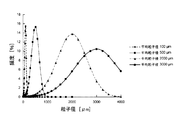
各実施例および比較例で使用したスプレーノズルから噴霧される冷却液の粒径分布を図2に示す。また、平均液滴粒子径を以下の表1に示す。The same type of spray nozzle was used as the primary spray nozzle 102 and the
The particle size distribution of the coolant sprayed from the spray nozzle used in each example and comparative example is shown in FIG. The average droplet diameter is shown in Table 1 below.
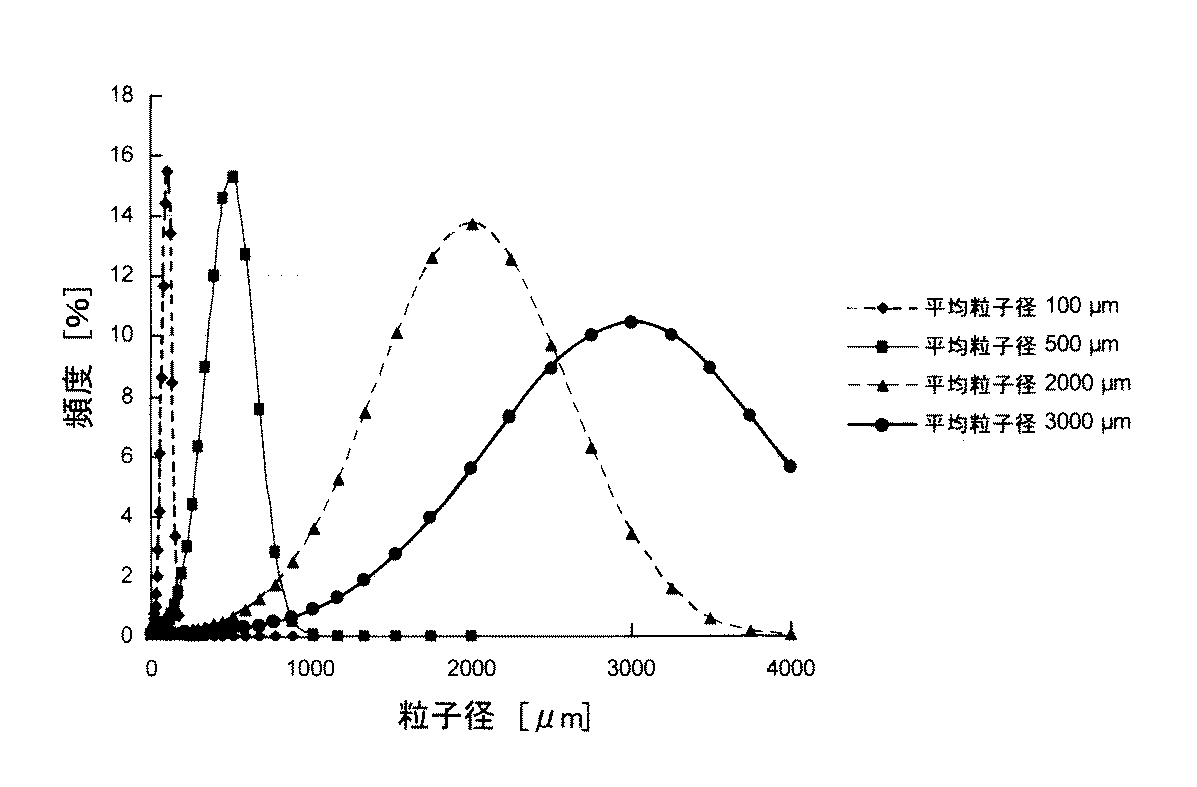
実施例1〜3および比較例1のそれぞれについて、急冷管106において一次冷却された直後の反応生成ガスの温度、トリクロロシラン冷却塔100の塔頂より抜き出されたガスの温度、ガス中に含まれる高沸点ポリマーの含有量、並びに、このガスから凝縮器300を介して回収されたトリクロロシランの回収量を調べた。結果を以下の表1に示す。
About each of Examples 1-3 and Comparative Example 1, the temperature of the reaction product gas immediately after the primary cooling in the quench
<結果の考察>
上記の実施例1〜3および比較例1の実験結果から、平均液滴粒子径が2000μm以下の範囲である冷却液を噴霧することにより、トリクロロシランの回収効率を著しく向上することができた。また、実施例1〜3のいずれの場合も、トリクロロシラン冷却塔から取り出される反応生成ガス中に高沸点ポリマーが殆ど含まれていないことが示された。<Consideration of results>
From the experimental results of Examples 1 to 3 and Comparative Example 1 described above, the recovery efficiency of trichlorosilane could be remarkably improved by spraying a coolant having an average droplet particle size in the range of 2000 μm or less. Moreover, in any case of Examples 1-3, it was shown that the high boiling point polymer is hardly contained in the reaction product gas taken out from the trichlorosilane cooling tower.
以上、本発明を実施例に基づいて説明した。この実施例はあくまで例示であり、種々の変形例が可能なこと、またそうした変形例も本発明の範囲にあることは当業者に理解されるところである。 In the above, this invention was demonstrated based on the Example. It is to be understood by those skilled in the art that this embodiment is merely an example, and that various modifications are possible and that such modifications are within the scope of the present invention.
Claims (6)
一次冷却手段の上方に設けられ、一次冷却後の反応生成ガスに冷却液をさらに噴霧して30〜60℃の温度範囲に冷却する二次冷却手段と、
を有するトリクロロシラン冷却塔。A coolant having an average droplet diameter of 2000 μm or less is sprayed on a reaction product gas containing trichlorosilane obtained by reacting a raw material gas containing tetrachlorosilane and hydrogen at a temperature in the range of 700 to 1400 ° C. Primary cooling means for rapidly cooling to a temperature range of 70 to 600 ° C,
A secondary cooling means provided above the primary cooling means and further spraying a cooling liquid onto the reaction product gas after the primary cooling to cool to a temperature range of 30 to 60 ° C .;
A trichlorosilane cooling tower.
反応生成ガスに平均液滴粒子径が2000μm以下の範囲の冷却液を噴霧して1秒以内に70〜600℃の範囲に急冷する一次冷却工程と、
一次冷却後の反応生成ガスに冷却液をさらに噴霧して30〜60℃の範囲に冷却する二次冷却工程と、
を有するトリクロロシラン製造方法。Producing a reaction product gas containing trichlorosilane obtained by reacting a raw material gas containing tetrachlorosilane and hydrogen at a temperature in the range of 700 to 1400 ° C .;
A primary cooling step in which a reaction liquid is sprayed with a cooling liquid having an average droplet particle size of 2000 μm or less and rapidly cooled to a range of 70 to 600 ° C. within 1 second;
A secondary cooling step in which a cooling liquid is further sprayed on the reaction product gas after the primary cooling to cool to a range of 30 to 60 ° C .;
A method for producing trichlorosilane.
Applications Claiming Priority (1)
| Application Number | Priority Date | Filing Date | Title |
|---|---|---|---|
| PCT/JP2009/054271 WO2010100750A1 (en) | 2009-03-06 | 2009-03-06 | Trichlorosilane cooling tower and process for producing trichlorosilane with the same |
Publications (2)
| Publication Number | Publication Date |
|---|---|
| JPWO2010100750A1 JPWO2010100750A1 (en) | 2012-09-06 |
| JP5374576B2 true JP5374576B2 (en) | 2013-12-25 |
Family
ID=42709328
Family Applications (1)
| Application Number | Title | Priority Date | Filing Date |
|---|---|---|---|
| JP2011502552A Active JP5374576B2 (en) | 2009-03-06 | 2009-03-06 | Trichlorosilane cooling tower and method for producing trichlorosilane using the same |
Country Status (3)
| Country | Link |
|---|---|
| JP (1) | JP5374576B2 (en) |
| TW (1) | TW201034957A (en) |
| WO (1) | WO2010100750A1 (en) |
Families Citing this family (3)
| Publication number | Priority date | Publication date | Assignee | Title |
|---|---|---|---|---|
| JP5633160B2 (en) * | 2009-03-11 | 2014-12-03 | 三菱マテリアル株式会社 | Trichlorosilane production equipment |
| JP6283482B2 (en) * | 2013-08-26 | 2018-02-21 | 三菱マテリアル株式会社 | Trichlorosilane production method |
| JP6391389B2 (en) * | 2014-09-25 | 2018-09-19 | デンカ株式会社 | Method for producing octachlorotrisilane and octachlorotrisilane produced by the method |
Citations (6)
| Publication number | Priority date | Publication date | Assignee | Title |
|---|---|---|---|---|
| JPS4895396A (en) * | 1972-02-26 | 1973-12-07 | ||
| JPS6081010A (en) * | 1983-10-13 | 1985-05-09 | Denki Kagaku Kogyo Kk | Manufacture of trichlorosilane |
| JPS6163519A (en) * | 1984-09-04 | 1986-04-01 | Denki Kagaku Kogyo Kk | Production of monosilane |
| JP2008137885A (en) * | 2006-11-07 | 2008-06-19 | Mitsubishi Materials Corp | Trichlorosilane production method and trichlorosilane production apparatus |
| JP2008143775A (en) * | 2006-11-14 | 2008-06-26 | Mitsubishi Materials Corp | Hydrogen separation and recovery method and hydrogen separation and recovery equipment |
| JP2009007240A (en) * | 2007-05-25 | 2009-01-15 | Mitsubishi Materials Corp | Method and apparatus for producing trichlorosilane and method for producing polycrystalline silicon |
-
2009
- 2009-03-06 WO PCT/JP2009/054271 patent/WO2010100750A1/en not_active Ceased
- 2009-03-06 JP JP2011502552A patent/JP5374576B2/en active Active
-
2010
- 2010-01-28 TW TW099102350A patent/TW201034957A/en unknown
Patent Citations (6)
| Publication number | Priority date | Publication date | Assignee | Title |
|---|---|---|---|---|
| JPS4895396A (en) * | 1972-02-26 | 1973-12-07 | ||
| JPS6081010A (en) * | 1983-10-13 | 1985-05-09 | Denki Kagaku Kogyo Kk | Manufacture of trichlorosilane |
| JPS6163519A (en) * | 1984-09-04 | 1986-04-01 | Denki Kagaku Kogyo Kk | Production of monosilane |
| JP2008137885A (en) * | 2006-11-07 | 2008-06-19 | Mitsubishi Materials Corp | Trichlorosilane production method and trichlorosilane production apparatus |
| JP2008143775A (en) * | 2006-11-14 | 2008-06-26 | Mitsubishi Materials Corp | Hydrogen separation and recovery method and hydrogen separation and recovery equipment |
| JP2009007240A (en) * | 2007-05-25 | 2009-01-15 | Mitsubishi Materials Corp | Method and apparatus for producing trichlorosilane and method for producing polycrystalline silicon |
Also Published As
| Publication number | Publication date |
|---|---|
| TW201034957A (en) | 2010-10-01 |
| JPWO2010100750A1 (en) | 2012-09-06 |
| WO2010100750A1 (en) | 2010-09-10 |
Similar Documents
| Publication | Publication Date | Title |
|---|---|---|
| KR101602006B1 (en) | Method for collection of hexachlorodisilane and plant for the method | |
| KR101292545B1 (en) | Apparatus for purifying trichlorosilane and method of purifying trichlorosilane | |
| JP4620694B2 (en) | Method for producing high purity trichlorosilane | |
| JP2009007240A (en) | Method and apparatus for producing trichlorosilane and method for producing polycrystalline silicon | |
| TW201030192A (en) | Process for producing polycrystalline silicon | |
| JP5633160B2 (en) | Trichlorosilane production equipment | |
| JP5329641B2 (en) | Chlorosilane recovery apparatus and chlorosilane recovery method using the same | |
| JPWO2010100750A1 (en) | Trichlorosilane cooling tower and method for producing trichlorosilane using the same | |
| CN116173536B (en) | Polysilicon rectifying system and rectifying method | |
| JP6391389B2 (en) | Method for producing octachlorotrisilane and octachlorotrisilane produced by the method | |
| WO2010116500A1 (en) | Trichlorosilane cooling tower and trichlorosilane manufacturing method using the same | |
| CN107074562B (en) | The manufacturing method of five silicon hexachlorides and five silicon hexachlorides manufactured using this method | |
| TW201210940A (en) | Process for separating monosilane from chlorosilanes-rich mixture | |
| CN113387978A (en) | Method for preparing diphenyl dimethoxysilane by continuous alcoholysis method | |
| JP6391390B2 (en) | Method for producing hexachlorodisilane | |
| CN116425202B (en) | Preparation method of tungsten hexafluoride gas | |
| JP6283482B2 (en) | Trichlorosilane production method | |
| CN117339486A (en) | Energy-saving device and method for preparing and purifying silane in fixed bed |
Legal Events
| Date | Code | Title | Description |
|---|---|---|---|
| TRDD | Decision of grant or rejection written | ||
| A01 | Written decision to grant a patent or to grant a registration (utility model) |
Free format text: JAPANESE INTERMEDIATE CODE: A01 Effective date: 20130910 |
|
| A61 | First payment of annual fees (during grant procedure) |
Free format text: JAPANESE INTERMEDIATE CODE: A61 Effective date: 20130920 |
|
| R150 | Certificate of patent or registration of utility model |
Ref document number: 5374576 Country of ref document: JP Free format text: JAPANESE INTERMEDIATE CODE: R150 Free format text: JAPANESE INTERMEDIATE CODE: R150 |
|
| R250 | Receipt of annual fees |
Free format text: JAPANESE INTERMEDIATE CODE: R250 |
|
| R250 | Receipt of annual fees |
Free format text: JAPANESE INTERMEDIATE CODE: R250 |
|
| R250 | Receipt of annual fees |
Free format text: JAPANESE INTERMEDIATE CODE: R250 |
|
| R250 | Receipt of annual fees |
Free format text: JAPANESE INTERMEDIATE CODE: R250 |
|
| R250 | Receipt of annual fees |
Free format text: JAPANESE INTERMEDIATE CODE: R250 |