JP5576112B2 - Chemical mechanical polishing composition containing iodate and chemical mechanical polishing method - Google Patents
Chemical mechanical polishing composition containing iodate and chemical mechanical polishing method Download PDFInfo
- Publication number
- JP5576112B2 JP5576112B2 JP2009501436A JP2009501436A JP5576112B2 JP 5576112 B2 JP5576112 B2 JP 5576112B2 JP 2009501436 A JP2009501436 A JP 2009501436A JP 2009501436 A JP2009501436 A JP 2009501436A JP 5576112 B2 JP5576112 B2 JP 5576112B2
- Authority
- JP
- Japan
- Prior art keywords
- polishing composition
- polishing
- substrate
- chemical mechanical
- tantalum
- Prior art date
- Legal status (The legal status is an assumption and is not a legal conclusion. Google has not performed a legal analysis and makes no representation as to the accuracy of the status listed.)
- Expired - Fee Related
Links
Images
Classifications
-
- C—CHEMISTRY; METALLURGY
- C09—DYES; PAINTS; POLISHES; NATURAL RESINS; ADHESIVES; COMPOSITIONS NOT OTHERWISE PROVIDED FOR; APPLICATIONS OF MATERIALS NOT OTHERWISE PROVIDED FOR
- C09K—MATERIALS FOR MISCELLANEOUS APPLICATIONS, NOT PROVIDED FOR ELSEWHERE
- C09K3/00—Materials not provided for elsewhere
- C09K3/14—Anti-slip materials; Abrasives
-
- C—CHEMISTRY; METALLURGY
- C09—DYES; PAINTS; POLISHES; NATURAL RESINS; ADHESIVES; COMPOSITIONS NOT OTHERWISE PROVIDED FOR; APPLICATIONS OF MATERIALS NOT OTHERWISE PROVIDED FOR
- C09G—POLISHING COMPOSITIONS; SKI WAXES
- C09G1/00—Polishing compositions
- C09G1/02—Polishing compositions containing abrasives or grinding agents
-
- H—ELECTRICITY
- H10—SEMICONDUCTOR DEVICES; ELECTRIC SOLID-STATE DEVICES NOT OTHERWISE PROVIDED FOR
- H10P—GENERIC PROCESSES OR APPARATUS FOR THE MANUFACTURE OR TREATMENT OF DEVICES COVERED BY CLASS H10
- H10P52/00—Grinding, lapping or polishing of wafers, substrates or parts of devices
- H10P52/40—Chemomechanical polishing [CMP]
- H10P52/403—Chemomechanical polishing [CMP] of conductive or resistive materials
Landscapes
- Chemical & Material Sciences (AREA)
- Organic Chemistry (AREA)
- Engineering & Computer Science (AREA)
- Materials Engineering (AREA)
- Mechanical Treatment Of Semiconductor (AREA)
- Finish Polishing, Edge Sharpening, And Grinding By Specific Grinding Devices (AREA)
Description
本発明は、化学機械研磨用組成物及びそれを用いた基材の研磨方法に関する。 The present invention relates to a chemical mechanical polishing composition and a method for polishing a substrate using the same.
次世代の半導体素子の開発は、素子上の導電層間のキャパシタンスを低減しかつ回路が作動できる周波数を増大させるために、前世代の金属よりも銅などのより低い抵抗値を有する金属の使用に重点を置いている。二酸化ケイ素基材上に平面の銅回路トレースを製作する1つの方法は、ダマシンプロセスと称される。このプロセスに従って、二酸化ケイ素の誘電体表面は、通常のドライエッチプロセスによってパターニングされ、垂直及び水平の相互接続のためのホール及びトレンチが形成される。パターンニングされた表面は、タンタル若しくはチタンなどの付着促進層及び/又は窒化タンタル若しくは窒化チタンなどの拡散バリア層で被覆される。付着促進層及び/又は拡散バリア層は、次いで銅層で上塗りされる。化学機械研磨により、二酸化ケイ素表面の隆起部分が露出した平面を得るまで、銅の上塗り層の厚さと任意の付着促進層及び/又は拡散バリア層の厚さを低減する。ビア及びトレンチは、回路の相互接続を形成する導電性の銅で満たされたままである。 The development of the next generation of semiconductor devices is to use metals with lower resistance values such as copper than previous generation metals to reduce the capacitance between the conductive layers on the device and increase the frequency at which the circuit can operate. Emphasis is placed. One method of fabricating planar copper circuit traces on a silicon dioxide substrate is referred to as a damascene process. In accordance with this process, the silicon dioxide dielectric surface is patterned by a conventional dry etch process to form holes and trenches for vertical and horizontal interconnects. The patterned surface is coated with an adhesion promoting layer such as tantalum or titanium and / or a diffusion barrier layer such as tantalum nitride or titanium nitride. The adhesion promoting layer and / or diffusion barrier layer is then overcoated with a copper layer. Chemical mechanical polishing reduces the thickness of the copper overcoat layer and the optional adhesion promoting layer and / or diffusion barrier layer until a planar surface with exposed raised portions of the silicon dioxide surface is obtained. The vias and trenches remain filled with conductive copper that forms the circuit interconnects.
タンタル及び窒化タンタルは、銅をベースとした素子のための付着促進層及び/又は拡散バリア層としてダマシンプロセスにおいて使用するのに特に好適な材料である。しかしながら、タンタル及び窒化タンタルの特性は銅の特性とは異なり、非常に化学的に不活性であるので、銅の研磨に有用な研磨用組成物が下地のタンタル及び窒化タンタルの除去に適していない場合が多い。典型的には、タンタル層の研磨では、有用な除去速度を達成するために、酸化剤、例えば、過酸化水素、並びに組成物の合計質量に基づいて高い固体含有量、即ち、5wt%超の研磨剤を含む組成物が必要とされる。しかしながら、過酸化水素は、研磨用組成物の他の成分と反応し得る強い酸化剤であり、研磨用組成物の安定性を制限し、それゆえ研磨用組成物の有用な可使時間を制限する。したがって、過酸化水素は、通常、エンドユーザーによって研磨用組成物に添加される。即ち、過酸化水素は、研磨操作で追加の混合工程を必要とする所謂「ツーポット(two-pot)」組成物において使用される。さらに、過酸化水素などの強い酸化剤は、化学エッチングによって基材表面上の銅線を侵食することがある。高い含有量の固体又は研磨剤もまた問題がある。例えば、固体の含有量が多いと基材表面に欠陥が生成する可能性があり、基材から製造される任意の集積回路層の性能に不利に影響を及ぼすとともに、二酸化ケイ素に対するタンタルの選択性を低下させ得る。さらに、固体含有量の高い研磨用組成物は製造するのに費用がかかる。 Tantalum and tantalum nitride are particularly suitable materials for use in damascene processes as adhesion promoting layers and / or diffusion barrier layers for copper based devices. However, since the properties of tantalum and tantalum nitride are very chemically inert, unlike the properties of copper, polishing compositions useful for copper polishing are not suitable for removal of the underlying tantalum and tantalum nitride. There are many cases. Typically, in polishing a tantalum layer, to achieve a useful removal rate, an oxidant, such as hydrogen peroxide, as well as a high solids content based on the total mass of the composition, i.e., greater than 5 wt%. A composition comprising an abrasive is needed. However, hydrogen peroxide is a strong oxidant that can react with other components of the polishing composition, limiting the stability of the polishing composition and thus limiting the useful pot life of the polishing composition. To do. Accordingly, hydrogen peroxide is usually added to the polishing composition by the end user. That is, hydrogen peroxide is used in so-called “two-pot” compositions that require an additional mixing step in the polishing operation. In addition, strong oxidants such as hydrogen peroxide can erode copper wires on the substrate surface by chemical etching. High content solids or abrasives are also problematic. For example, high solids content can cause defects on the substrate surface, adversely affecting the performance of any integrated circuit layer made from the substrate, and selectivity for tantalum over silicon dioxide Can be reduced. Furthermore, polishing compositions with a high solids content are expensive to produce.
したがって、コスト効率がよく、例えば、タンタルの除去速度を高めることによって全体の処理時間を低減するタンタル及び銅を含む基材のための改善された研磨用組成物及び研磨方法に関してニーズがある。 Accordingly, there is a need for improved polishing compositions and polishing methods for substrates comprising tantalum and copper that are cost effective and reduce overall processing time, for example, by increasing the removal rate of tantalum.
本発明は、基材を研磨するための化学機械研磨用組成物であって、(a)0.05wt%〜10wt%の研磨剤と、(b)0.05wt%〜4wt%のヨウ素酸アニオンと、(c)窒素含有C4-20複素環及びC1-20アルキルアミンからなる群より選択される0.01wt%〜1wt%の窒素含有化合物と、(d)水を含む液体キャリヤーとを含み、前記化学機械研磨用組成物のpHが1〜5である、基材を研磨するための化学機械研磨用組成物を提供する。 The present invention is a chemical mechanical polishing composition for polishing a substrate, comprising (a) 0.05 wt% to 10 wt% abrasive and (b) 0.05 wt% to 4 wt% iodate anion. And (c) 0.01 wt% to 1 wt% of a nitrogen-containing compound selected from the group consisting of a nitrogen-containing C 4-20 heterocycle and a C 1-20 alkylamine, and (d) a liquid carrier containing water. And a chemical mechanical polishing composition for polishing a substrate, wherein the chemical mechanical polishing composition has a pH of 1 to 5.
本発明は、(a)基材を用意する工程、(b)該基材を、研磨パッド及び化学機械研磨用組成物であって、(i)0.05wt%〜10wt%の研磨剤と、(ii)0.05wt%〜4wt%のヨウ素酸アニオンと、(iii)窒素含有C4-20複素環及びC1-20アルキルアミンからなる群より選択される0.01wt%〜1wt%の窒素含有化合物と、(iv)水を含む液体キャリヤーとを含み、前記化学機械研磨用組成物のpHが1〜5である化学機械研磨用組成物と接触させる工程、(c)前記基材に対して前記研磨パッドを該化学機械研磨用組成物をそれらの間に置いて動かす工程、及び(d)該基材の少なくとも一部を削って該基材を研磨する工程を含む、基材を化学機械研磨する方法をさらに提供する。 The present invention includes (a) a step of preparing a substrate, (b) the substrate as a polishing pad and a chemical mechanical polishing composition, (i) 0.05 wt% to 10 wt% of an abrasive, (Ii) 0.05 wt% to 4 wt% iodate anion, and (iii) 0.01 wt% to 1 wt% nitrogen selected from the group consisting of nitrogen-containing C 4-20 heterocycle and C 1-20 alkylamine And (iv) a step of contacting the chemical mechanical polishing composition having a pH of 1 to 5 with (iv) a liquid carrier containing water, and (c) the substrate. Moving the polishing pad with the chemical mechanical polishing composition placed between them, and (d) polishing at least a portion of the substrate to polish the substrate. Further provided is a method of mechanical polishing.
本発明は、基材を研磨するための化学機械研磨用組成物を提供する。この研磨用組成物は、(a)研磨剤と、(b)ヨウ素酸イオンと、(c)窒素含有化合物と、(d)水を含む液体キャリヤーとを含む。この研磨用組成物は、望ましくは比較的より低い研磨剤濃度でより高くかつ調整可能な金属除去速度を可能にする。 The present invention provides a chemical mechanical polishing composition for polishing a substrate. The polishing composition includes (a) an abrasive, (b) iodate ions, (c) a nitrogen-containing compound, and (d) a liquid carrier containing water. This polishing composition desirably enables higher and adjustable metal removal rates at relatively lower abrasive concentrations.
研磨用組成物は、ヨウ素酸イオン(IO3 -)を含む。ヨウ素酸イオンは酸化剤として作用する。ヨウ素酸イオンは、任意の好適な量で研磨用組成物中に存在することができる。ヨウ素酸イオンは、研磨用組成物の合計質量に基づいて、典型的には0.01wt%以上、好ましくは0.05wt%以上、より好ましくは0.1wt%以上の量で研磨用組成物中に存在する。ヨウ素酸イオンは、研磨用組成物の合計質量に基づいて、典型的には4wt%以下、好ましくは2wt%以下、より好ましくは1wt%以下、最も好ましくは0.4wt%以下の量で研磨用組成物中に存在する。 The polishing composition contains iodate ions (IO 3 − ). Iodate ion acts as an oxidizing agent. The iodate ion can be present in the polishing composition in any suitable amount. Iodate ions are typically present in the polishing composition in an amount of 0.01 wt% or more, preferably 0.05 wt% or more, more preferably 0.1 wt% or more, based on the total mass of the polishing composition. Exists. Iodate ions are typically used for polishing in an amount of 4 wt% or less, preferably 2 wt% or less, more preferably 1 wt% or less, and most preferably 0.4 wt% or less, based on the total mass of the polishing composition. Present in the composition.
ヨウ素酸イオンは、任意の好適な技術、典型的には任意の好適なヨウ素酸塩を水中に溶解することによって溶液中に得られる。ヨウ素酸塩の例としては、限定されないが、ヨウ素酸ナトリウム、ヨウ素酸カリウム、ヨウ素酸アンモニウム、ヨウ素酸カルシウム、ヨウ素酸セシウム、ヨウ素酸リチウム、及びヨウ素酸マグネシウムが挙げられる。あるいはまた、ヨウ素酸イオンは、ヨウ素酸を水中に溶解することによって得られる。 The iodate ion is obtained in solution by dissolving any suitable technique, typically any suitable iodate in water. Examples of iodates include, but are not limited to, sodium iodate, potassium iodate, ammonium iodate, calcium iodate, cesium iodate, lithium iodate, and magnesium iodate. Alternatively, iodate ions are obtained by dissolving iodic acid in water.
望ましくは、ヨウ素酸イオンは過酸化物の酸化剤よりも安定である。したがって、ヨウ素酸イオンを含む研磨用組成物は、1つのパッケージ系、即ち、所謂「ワンポット(one-pot)」組成物としてエンドユーザーに供給することができる。 Desirably, iodate ions are more stable than peroxide oxidants. Accordingly, polishing compositions containing iodate ions can be supplied to end users as a single package system, i.e., a so-called "one-pot" composition.
研磨用組成物は窒素含有化合物をさらに含む。窒素含有化合物は、任意の好適な窒素含有化合物であることができる。窒素含有化合物の選択は、研磨されるべき特定の基材に典型的に依存している。典型的には、窒素含有化合物は、窒素含有C4-20複素環又はC1-20アルキルアミンである。好ましくは、窒素含有化合物は、1H−1,2,3−ベンゾトリアゾール、1H−1,2,3−ベンゾトリアゾール−5−カルボン酸、1,2,4−トリアゾール、5−メチル−1H−ベンゾトリアゾール、4−アミノ−1,2,4−トリアゾール、1H−ベンゾトリアゾール−1−カルボキシアルデヒド、3−アミノ−1,2,4−トリアゾール−5−カルボン酸、ピラゾール、2−ピラジンカルボン酸、2,6−ピリジンカルボン酸、4−ピリジル酢酸、1H−1,2,3−トリアゾロ[4,5−b]ピリジン、メチルアミン、トリメチルアミン、エチルアミン、トリエチルアミン、それらの塩、及びそれらの組み合わせからなる群より選択される。好ましい実施態様では、窒素含有化合物は、1H−1,2,3−ベンゾトリアゾール、5−メチル−1H−ベンゾトリアゾール又はそれらの組み合わせである。 The polishing composition further contains a nitrogen-containing compound. The nitrogen-containing compound can be any suitable nitrogen-containing compound. The choice of nitrogen-containing compound typically depends on the particular substrate to be polished. Typically, the nitrogen-containing compound is a nitrogen-containing C 4-20 heterocycle or a C 1-20 alkylamine. Preferably, the nitrogen-containing compound is 1H-1,2,3-benzotriazole, 1H-1,2,3-benzotriazole-5-carboxylic acid, 1,2,4-triazole, 5-methyl-1H-benzo Triazole, 4-amino-1,2,4-triazole, 1H-benzotriazole-1-carboxaldehyde, 3-amino-1,2,4-triazole-5-carboxylic acid, pyrazole, 2-pyrazinecarboxylic acid, 2 , 6-pyridinecarboxylic acid, 4-pyridylacetic acid, 1H-1,2,3-triazolo [4,5-b] pyridine, methylamine, trimethylamine, ethylamine, triethylamine, salts thereof, and combinations thereof More selected. In a preferred embodiment, the nitrogen-containing compound is 1H-1,2,3-benzotriazole, 5-methyl-1H-benzotriazole or a combination thereof.
窒素含有化合物は任意の好適な量で存在することができる。窒素含有化合物は、研磨用組成物の合計質量に基づいて、典型的には0.01wt%以上、好ましくは0.05wt%以上、より好ましくは0.1wt%以上の量で研磨用組成物中に存在する。窒素含有化合物は、研磨用組成物の合計質量に基づいて、典型的には1wt%以下、好ましくは0.5wt%以下、より好ましくは0.25wt%以下の量で研磨用組成物中に存在する。 The nitrogen-containing compound can be present in any suitable amount. The nitrogen-containing compound is typically contained in the polishing composition in an amount of 0.01 wt% or more, preferably 0.05 wt% or more, more preferably 0.1 wt% or more, based on the total mass of the polishing composition. Exists. The nitrogen-containing compound is typically present in the polishing composition in an amount of 1 wt% or less, preferably 0.5 wt% or less, more preferably 0.25 wt% or less, based on the total mass of the polishing composition. To do.
窒素含有化合物とヨウ素酸イオンを含む本発明の組成物に関して、タンタルの除去速度が他の酸化剤と比較してより高いことを意外にも見出した。タンタルの研磨において除去速度が増すことで、全体の処理時間が低減されることが期待される。 It was surprisingly found that for the compositions of the present invention containing nitrogen-containing compounds and iodate ions, the removal rate of tantalum was higher compared to other oxidants. It is expected that the overall processing time will be reduced by increasing the removal rate in polishing tantalum.
研磨用組成物は研磨剤をさらに含む。有意には、高いタンタル除去速度は、ヨウ素酸塩の酸化剤とともに比較的低い固体含有量を含む化学機械研磨用組成物を用いて達成できることが見出された。研磨剤は、研磨用組成物の合計質量に基づいて、典型的には0.05wt%以上(例えば、0.1wt%以上又は0.25wt%以上)の量で研磨用組成物中に存在する。研磨剤は、研磨用組成物の合計質量に基づいて、典型的には10wt%以下(例えば、5wt%以下、2wt%以下、1wt%以下、0.75wt%以下又は0.5wt%以下)の量で研磨用組成物中に存在する。 The polishing composition further contains an abrasive. Significantly, it has been found that high tantalum removal rates can be achieved using chemical mechanical polishing compositions that include a relatively low solids content with an iodate oxidant. The abrasive is typically present in the polishing composition in an amount of 0.05 wt% or more (eg, 0.1 wt% or more or 0.25 wt% or more) based on the total mass of the polishing composition. . The abrasive is typically 10 wt% or less (eg, 5 wt% or less, 2 wt% or less, 1 wt% or less, 0.75 wt% or less, or 0.5 wt% or less) based on the total mass of the polishing composition. Present in the polishing composition in an amount.
研磨剤は任意の好適な研磨剤であることができ、その多くは当技術分野で周知である。研磨剤は望ましくは金属酸化物を含む。好適な金属酸化物としては、アルミナ、シリカ、チタニア、セリア、ジルコニア、ゲルマニア、マグネシア、それらの共形成製品、及びそれらの組み合わせからなる群より選択される金属酸化物が挙げられる。好ましくは、金属酸化物はシリカである。シリカは任意の好適な形態のシリカであることができる。有用な形態のシリカとしては、限定されないが、ヒュームドシリカ、沈降シリカ、及び縮重合シリカが挙げられる。最も好ましくは、シリカは縮重合シリカである。縮重合シリカの粒子は、典型的にはSi(OH)4を縮合させてコロイド粒子を形成することによって調製される。このような研磨剤粒子は、米国特許第5,230,833号明細書に従って調製することができるか、又は種々の商業的に入手可能な製品、例えば、Fuso PL−1及びPl−2製品、Akzo−Nobel Bindzil 50/80製品、並びにNalco 1050、2327及び2329製品、並びにDuPont、Bayer、Applied Research、Nissan Chemical及びClariantから入手可能な他の類似の製品のいずれかとして得ることができる。 The abrasive can be any suitable abrasive, many of which are well known in the art. The abrasive desirably includes a metal oxide. Suitable metal oxides include metal oxides selected from the group consisting of alumina, silica, titania, ceria, zirconia, germania, magnesia, co-formed products thereof, and combinations thereof. Preferably, the metal oxide is silica. The silica can be any suitable form of silica. Useful forms of silica include, but are not limited to, fumed silica, precipitated silica, and condensation-polymerized silica. Most preferably, the silica is condensation polymerized silica. Polycondensed silica particles are typically prepared by condensing Si (OH) 4 to form colloidal particles. Such abrasive particles can be prepared according to US Pat. No. 5,230,833 or various commercially available products such as the Fuso PL-1 and Pl-2 products, Akzo-Nobel Bindzil 50/80 products, and Nalco 1050, 2327 and 2329 products, as well as any other similar products available from DuPont, Bayer, Applied Research, Nissan Chemical and Clariant.
研磨剤粒子は任意の好適なサイズを有することができる。典型的には、研磨剤粒子は5nm〜250nmの平均粒子サイズ(例えば、平均粒子径)を有する。好ましくは、研磨剤粒子は10nm〜100nmの平均粒子サイズを有する。最も好ましくは、研磨剤粒子は25nm〜80nmの平均粒子サイズを有する。非球形粒子の粒子サイズは、粒子を取り囲む最も小さい球の直径である。 The abrasive particles can have any suitable size. Typically, the abrasive particles have an average particle size (eg, average particle size) of 5 nm to 250 nm. Preferably, the abrasive particles have an average particle size of 10 nm to 100 nm. Most preferably, the abrasive particles have an average particle size of 25 nm to 80 nm. The particle size of a non-spherical particle is the diameter of the smallest sphere that surrounds the particle.
液体キャリヤーは、それに溶解又は懸濁される研磨剤及び任意の成分を研磨(例えば、平坦化)されるべき好適な基材の表面に適用することを促進させるのに使用される。液体キャリヤーは典型的には水性キャリヤーであり、水のみであることができるか(即ち、水からなることができるか)、水から本質的になることができるか、水と好適な水混和性溶剤を含むことができるか、又はエマルジョンであることができる。好適な水混和性溶剤としては、アルコール、例えば、メタノール、エタノールなど、並びにエーテル、例えば、ジオキサン及びテトラヒドロフランが挙げられる。水性キャリヤーは、好ましくは水、より好ましくは脱イオン水を含むか、水から本質的になるか又は水からなる。 The liquid carrier is used to facilitate applying the abrasive and any components dissolved or suspended therein to the surface of a suitable substrate to be polished (eg, planarized). The liquid carrier is typically an aqueous carrier and can be water only (ie, can it consist of water), can consist essentially of water, or can be suitably miscible with water. It can contain a solvent or it can be an emulsion. Suitable water miscible solvents include alcohols such as methanol, ethanol and the like, and ethers such as dioxane and tetrahydrofuran. The aqueous carrier preferably comprises water, more preferably deionized water, consists essentially of water or consists of water.
研磨用組成物は任意の好適なpHを有することができる。例えば、研磨用組成物は1〜5のpHを有することができる。典型的には、研磨用組成物は2以上のpHを有する。研磨用組成物のpHは典型的には4以下である。 The polishing composition can have any suitable pH. For example, the polishing composition can have a pH of 1-5. Typically, the polishing composition has a pH of 2 or higher. The pH of the polishing composition is typically 4 or less.
研磨用組成物のpHは任意の好適な手段によって達成することができるか及び/又は維持することができる。より具体的には、研磨用組成物は、pH調整剤、pH緩衝剤又はそれらの組み合わせをさらに含むことができる。pH調整剤は任意の好適なpH調整用化合物であることができる。例えば、pH調整剤は、硝酸、水酸化カリウム又はそれらの組み合わせであることができる。pH緩衝剤は、任意の好適な緩衝剤、例えば、リン酸塩、硫酸塩、酢酸塩、ホウ酸塩、アンモニウム塩などであることができる。研磨用組成物は、任意の好適な量のpH調整剤及び/又はpH緩衝剤を含むことができる。但し、研磨用組成物のpHを本明細書に記載のpHの範囲内に達成及び/又は維持するのに好適な量が使用されなければならない。 The pH of the polishing composition can be achieved and / or maintained by any suitable means. More specifically, the polishing composition can further include a pH adjuster, a pH buffer, or a combination thereof. The pH adjuster can be any suitable pH adjusting compound. For example, the pH adjuster can be nitric acid, potassium hydroxide, or a combination thereof. The pH buffer can be any suitable buffer, such as phosphates, sulfates, acetates, borates, ammonium salts, and the like. The polishing composition can include any suitable amount of pH adjusting agent and / or pH buffering agent. However, a suitable amount must be used to achieve and / or maintain the pH of the polishing composition within the pH range described herein.
研磨用組成物は任意選択で腐食防止剤(即ち、膜形成剤)を含む。腐食防止剤は、基材の任意の1つ又は複数の成分のための任意の好適な腐食防止剤であることができる。好ましくは、腐食防止剤は銅腐食防止剤である。本発明の目的のために、腐食防止剤は、研磨される表面の少なくとも一部の上にパッシベーション層(passivation layer)(即ち、溶解防止層)を形成することを容易にする任意の化合物又は化合物の混合物である。本発明の研磨系は任意の好適な量の腐食防止剤を含むことができる。一般的に、研磨系の研磨用組成物は、0.005wt%〜1wt%(例えば、0.01〜0.5wt%又は0.02〜0.2wt%)の腐食防止剤を含む。 The polishing composition optionally includes a corrosion inhibitor (ie, a film forming agent). The corrosion inhibitor can be any suitable corrosion inhibitor for any one or more components of the substrate. Preferably, the corrosion inhibitor is a copper corrosion inhibitor. For the purposes of the present invention, the corrosion inhibitor is any compound or compound that facilitates the formation of a passivation layer (ie, an anti-dissolution layer) on at least a portion of the surface to be polished. It is a mixture of The polishing system of the present invention can include any suitable amount of a corrosion inhibitor. Generally, polishing compositions for polishing systems include 0.005 wt% to 1 wt% (eg, 0.01 to 0.5 wt% or 0.02 to 0.2 wt%) of a corrosion inhibitor.
研磨用組成物は、任意選択で1つ又は複数の他の添加剤をさらに含む。研磨用組成物は、界面活性剤及び/又はレオロジー制御剤、例えば、粘度増強剤及び凝固剤(例えば、高分子レオロジー制御剤、例えば、ウレタンポリマーなど)を含むことができる。好適な界面活性剤としては、例えば、カチオン性界面活性剤、アニオン性界面活性剤、非イオン性界面活性剤、両性界面活性剤、フッ素化界面活性剤、それらの混合物などが挙げられる。 The polishing composition optionally further comprises one or more other additives. The polishing composition can include surfactants and / or rheology control agents, such as viscosity enhancing agents and coagulants (eg, polymeric rheology control agents such as urethane polymers). Suitable surfactants include, for example, cationic surfactants, anionic surfactants, nonionic surfactants, amphoteric surfactants, fluorinated surfactants, and mixtures thereof.
研磨用組成物は、その多くが当業者に公知である任意の好適な技術によって調製することができる。研磨用組成物はバッチ又は連続プロセスで調製することができる。一般的には、研磨用組成物は、それらの成分を任意の順序で組み合わせることによって調製することができる。本明細書で用いられる「成分」という語は、個々の成分(例えば、窒素含有化合物、研磨剤など)並びに複数の成分(例えば、窒素含有化合物、ヨウ素酸イオン源、界面活性剤など)の任意の組み合わせを含む。 The polishing composition can be prepared by any suitable technique, many of which are known to those skilled in the art. The polishing composition can be prepared in a batch or continuous process. In general, the polishing composition can be prepared by combining the components in any order. As used herein, the term “component” refers to any individual component (eg, nitrogen-containing compound, abrasive, etc.) as well as any of a plurality of components (eg, nitrogen-containing compound, iodate ion source, surfactant, etc.) Including a combination of
例えば、研磨剤は好適な液体キャリヤー中に分散することができる。次いで、ヨウ素酸イオン源と窒素含有化合物を添加することができ、これらの成分を研磨用組成物に組み入れることができる任意の方法によって混合することができる。研磨用組成物は、使用の直前(例えば、使用前1分以内、使用前1時間以内又は使用前7日以内)に研磨用組成物に添加される1つ又は複数の成分、例えば、ヨウ素酸イオン源とともに、使用前に調製することができる。研磨用組成物はまた、研磨操作の間に基材の表面でこれらの成分を混合することによって調製することもできる。 For example, the abrasive can be dispersed in a suitable liquid carrier. The iodate ion source and nitrogen-containing compound can then be added and these components can be mixed by any method that can be incorporated into the polishing composition. The polishing composition comprises one or more components added to the polishing composition immediately before use (eg, within 1 minute before use, within 1 hour before use, or within 7 days before use), such as iodic acid Along with the ion source, it can be prepared before use. The polishing composition can also be prepared by mixing these components at the surface of the substrate during the polishing operation.
研磨用組成物は、ヨウ素酸イオン源、窒素含有化合物、研磨剤、及び液体キャリヤーを含む1つのパッケージ系として供給することができる。あるいはまた、研磨剤を液体キャリヤー中の分散体として第1の容器において供給することができ、ヨウ素酸イオン源を乾燥した形態であるか又は液体キャリヤー中の溶液若しくは分散体として第2の容器において供給することができる。窒素含有化合物を第1及び/又は第2の容器又は第3の容器に入れることができる。さらには、第1又は第2の容器中の成分は乾燥した形態であることができ、一方で、残りの1つ又は複数の容器中の成分は水性分散体の形態であることができる。さらには、第1又は第2の容器中の成分は異なるpH値を有するか、実質的に類似の又は等しいpH値を有することが適切である。ヨウ素酸塩の酸化剤は、研磨用組成物の他の成分とは別々に供給することができ、例えば、エンドユーザーにより使用の直前(例えば、使用前1週間以内、使用前1日以内、使用前1時間以内、使用前10分以内又は使用前1分以内)に、研磨用組成物の他の成分と組み合わせることができる。研磨用組成物の成分の他の2つの容器又は3つ以上の容器の組み合わせは当業者の知識の範囲内である。 The polishing composition can be supplied as a single package system that includes an iodate ion source, a nitrogen-containing compound, an abrasive, and a liquid carrier. Alternatively, the abrasive can be supplied in a first container as a dispersion in a liquid carrier and the iodate ion source is in a dried form or as a solution or dispersion in a liquid carrier in a second container. Can be supplied. The nitrogen-containing compound can be placed in the first and / or second container or the third container. Furthermore, the components in the first or second container can be in a dry form, while the components in the remaining one or more containers can be in the form of an aqueous dispersion. Furthermore, it is appropriate that the components in the first or second container have different pH values or have substantially similar or equal pH values. The iodate oxidant can be supplied separately from the other components of the polishing composition, for example, immediately before use (eg, within 1 week before use, within 1 day before use) by the end user. Within 1 hour before, within 10 minutes before use or within 1 minute before use) can be combined with other components of the polishing composition. Other two containers or combinations of three or more containers of the components of the polishing composition are within the knowledge of one of ordinary skill in the art.
好ましい実施態様では、研磨用組成物は1つのパッケージ系として供給される。 In a preferred embodiment, the polishing composition is supplied as a single package system.
本発明の研磨用組成物はまた、使用前に適切な量の液体キャリヤーで希釈されることを意図した濃縮物として提供することもできる。このような実施態様では、研磨用組成物の濃縮物は、濃縮物を適切な量の液体キャリヤーで希釈した時に、研磨用組成物の各成分が各成分について上に記載した適切な範囲内の量で研磨用組成物中に存在するような量において、研磨剤、ヨウ素酸イオン、窒素含有化合物及び液体キャリヤーを含むことができる。例えば、研磨剤、ヨウ素酸イオン及び窒素含有化合物は、各成分について上に記載した濃度の2倍(例えば、3倍、4倍又は5倍)の量で濃縮物中にそれぞれ存在して、濃縮物を等量の液体キャリヤー(例えば、それぞれ2倍等量の液体キャリヤー、3倍等量の液体キャリヤー又は4倍等量の液体キャリヤー)で希釈した時に、各成分が研磨用組成物中に各成分について上に記載した範囲内の量で存在するようにすることができる。さらに、当業者であれば理解するように、ヨウ素酸イオン、窒素含有化合物及び他の好適な添加剤が濃縮物中に少なくとも部分的に又は完全に溶解することを確実にするために、濃縮物は、最終的な研磨用組成物中に存在する適切な割合の液体キャリヤーを含有することができる。 The polishing composition of the present invention can also be provided as a concentrate intended to be diluted with an appropriate amount of liquid carrier prior to use. In such embodiments, the concentrate of the polishing composition is such that when the concentrate is diluted with an appropriate amount of liquid carrier, each component of the polishing composition is within the appropriate ranges described above for each component. Abrasives, iodate ions, nitrogen-containing compounds and liquid carriers can be included in such amounts as are present in the polishing composition. For example, abrasives, iodate ions and nitrogen-containing compounds are each present in the concentrate in an amount that is twice (eg, 3 times, 4 times, or 5 times) the concentration described above for each component, and concentrated. When the product is diluted with an equal amount of liquid carrier (for example, 2 times equivalent liquid carrier, 3 times equivalent liquid carrier or 4 times equivalent liquid carrier, respectively), each component is added to the polishing composition. The component can be present in an amount within the ranges described above. Further, as will be appreciated by those skilled in the art, the concentrate is used to ensure that iodate ions, nitrogen-containing compounds and other suitable additives are at least partially or completely dissolved in the concentrate. Can contain an appropriate proportion of the liquid carrier present in the final polishing composition.
本発明はまた、基材を本明細書に記載の研磨用組成物で研磨する方法を提供する。基材を研磨する方法は、(i)基材を上記の研磨用組成物と接触させる工程、及び(ii)該基材の少なくとも一部を削るか又は除去して該基材を研磨する工程を含む。 The present invention also provides a method of polishing a substrate with the polishing composition described herein. The method for polishing a substrate includes (i) a step of bringing the substrate into contact with the above-mentioned polishing composition, and (ii) a step of polishing or removing at least a part of the substrate. including.
特には、本発明は、(a)基材を用意する工程、(b)該基材を、研磨パッド及び化学機械研磨用組成物であって、(i)0.05wt%〜10wt%の研磨剤と、(ii)0.05wt%〜4wt%のヨウ素酸アニオンと、(iii)窒素含有C4-20複素環及びC1-20アルキルアミンからなる群より選択される0.01wt%〜1wt%の窒素含有化合物と、(iv)水を含む液体キャリヤーとを含み、前記化学機械研磨用組成物のpHが1〜5である化学機械研磨用組成物と接触させる工程、(c)前記基材に対して前記研磨パッドを該化学機械研磨用組成物をそれらの間に置いて動かす工程、及び(d)該基材の少なくとも一部を削って該基材を研磨する工程を含む、基材を化学機械研磨する方法をさらに提供する。 In particular, the present invention includes (a) a step of preparing a base material, (b) the base material comprising a polishing pad and a chemical mechanical polishing composition, (i) 0.05 wt% to 10 wt% polishing. agent, (ii) 0.05wt% and to 4 wt% of iodate anions, 0.01 wt% is selected from the group consisting of (iii) a nitrogen-containing C 4-20 heterocycle and C 1-20 alkylamine ~1wt And (iv) contacting the chemical mechanical polishing composition having a pH of 1 to 5 with (iv) a liquid carrier comprising water, and (c) the group Moving the polishing pad relative to a material with the chemical mechanical polishing composition in between, and (d) grinding at least a portion of the substrate to polish the substrate. Further provided is a method of chemical mechanical polishing a material.
本発明の研磨用組成物は任意の基材の研磨に有用であるが、この研磨用組成物はタンタルを含む少なくとも1つの金属層を含む基材の研磨に特に有用である。基材は任意の好適なタンタル含有基材(例えば、集積回路、金属、ILD層、半導体及び薄膜)であることができ、任意の好適な絶縁層及び/又は他の金属若しくは金属合金層(例えば、金属導電層)をさらに含むことができる。絶縁層は、金属酸化物、ガラス、有機ポリマー、フッ素化有機ポリマー又は他の任意の好適な高若しくは低k絶縁層であることができる。絶縁層はシリコン系金属酸化物であることが好ましい。追加の金属又は金属合金層は、任意の好適な金属又は金属合金層であることができる。タンタル含有基材は、銅を含む金属層をさらに含むことが好ましい。 While the polishing composition of the present invention is useful for polishing any substrate, the polishing composition is particularly useful for polishing a substrate comprising at least one metal layer comprising tantalum. The substrate can be any suitable tantalum-containing substrate (eg, integrated circuit, metal, ILD layer, semiconductor and thin film), and any suitable insulating layer and / or other metal or metal alloy layer (eg, , A metal conductive layer). The insulating layer can be a metal oxide, glass, organic polymer, fluorinated organic polymer, or any other suitable high or low k insulating layer. The insulating layer is preferably a silicon-based metal oxide. The additional metal or metal alloy layer can be any suitable metal or metal alloy layer. It is preferable that the tantalum-containing substrate further includes a metal layer containing copper.
本発明によれば、基材は、任意の好適な技術によって本明細書に記載の研磨用組成物で平坦化又は研磨することができる。本発明の研磨方法は、化学機械研磨(CMP)装置とともに使用するのに特に適している。典型的には、CMP装置は、使用の際に動き、軌道、直線又は円運動から生じる速度を有するプラテンと、このプラテンと接触し、プラテンが動くとそれとともに動く研磨パッドと、研磨パッドの表面に対して接触し動くことにより研磨すべき基材を保持するキャリヤーとを含む。基材の研磨は、基材を研磨パッド及び本発明の研磨用組成物と接触させることにより行われ、次いで研磨パッドを基材に対して動かして基材の少なくとも一部を削って基材を研磨するようにする。 In accordance with the present invention, the substrate can be planarized or polished with the polishing composition described herein by any suitable technique. The polishing method of the present invention is particularly suitable for use with chemical mechanical polishing (CMP) equipment. Typically, a CMP apparatus moves in use and has a platen that has a velocity resulting from trajectory, linear or circular motion, a polishing pad that contacts the platen and moves with the platen, and a surface of the polishing pad. And a carrier for holding the substrate to be polished by contacting and moving. Polishing of the substrate is performed by bringing the substrate into contact with the polishing pad and the polishing composition of the present invention, and then moving the polishing pad relative to the substrate to scrape at least a part of the substrate to remove the substrate. Try to polish.
基材は、任意の好適な研磨パッド(例えば、研磨表面)とともに研磨用組成物で平坦化又は研磨することができる。好適な研磨パッドとしては、例えば、織及び不織の研磨パッドが挙げられる。さらに、好適な研磨パッドは、種々の密度、硬度、厚さ、圧縮性、圧縮に対する反発力、及び圧縮弾性率の任意の好適なポリマーを含むことができる。好適なポリマーとしては、例えば、ポリ塩化ビニル、ポリフッ化ビニル、ナイロン、フッ化炭素、ポリカーボネート、ポリエステル、ポリアクリレート、ポリエーテル、ポリエチレン、ポリアミド、ポリウレタン、ポリスチレン、ポリプロピレン、それらの共形成製品、及びそれらの混合物が挙げられる。 The substrate can be planarized or polished with the polishing composition with any suitable polishing pad (eg, polishing surface). Suitable polishing pads include, for example, woven and non-woven polishing pads. Further, suitable polishing pads can include any suitable polymer of varying density, hardness, thickness, compressibility, repulsion to compression, and compression modulus. Suitable polymers include, for example, polyvinyl chloride, polyvinyl fluoride, nylon, fluorocarbon, polycarbonate, polyester, polyacrylate, polyether, polyethylene, polyamide, polyurethane, polystyrene, polypropylene, co-formed products thereof, and the like. Of the mixture.
望ましくは、CMP装置は、その多くが当技術分野で公知である現場(in situ)研磨終点検出システムをさらに含む。ワークピースの表面から反射される光又は他の放射線を分析することによって研磨プロセスを点検及び監視する技術は当技術分野で公知である。このような方法は、例えば、米国特許第5,196,353号明細書、同第5,433,651号明細書、同第5,609,511号明細書、同第5,643,046号明細書、同第5,658,183号明細書、同第5,730,642号明細書、同第5,838,447号明細書、同第5,872,633号明細書、同第5,893,796号明細書、同第5,949,927号明細書、及び同第5,964,643号明細書に記載されている。望ましくは、研磨されるワークピースに関する研磨プロセスの進行の点検又は監視は、研磨終点の決定、即ち、特定のワークピースに関する研磨プロセスを終了するタイミングの決定を可能にする。 Desirably, the CMP apparatus further includes an in situ polishing endpoint detection system, many of which are known in the art. Techniques for inspecting and monitoring the polishing process by analyzing light or other radiation reflected from the surface of the workpiece are known in the art. Such a method is described, for example, in US Pat. Nos. 5,196,353, 5,433,651, 5,609,511, and 5,643,046. Specification, US Pat. No. 5,658,183, US Pat. No. 5,730,642, US Pat. No. 5,838,447, US Pat. No. 5,872,633, US Pat. 893,796, 5,949,927, and 5,964,643. Desirably, inspection or monitoring of the progress of the polishing process for the workpiece being polished allows determination of the polishing endpoint, i.e., the timing to end the polishing process for a particular workpiece.
以下の例によって本発明をさらに説明するが、当然ながら、これらの例は、何ら本発明の範囲を限定するものとして解されるべきではない。 The invention is further illustrated by the following examples, which should, of course, not be construed as limiting the scope of the invention in any way.
以下の各例では、タンタル、銅及びTEOSのブランケットウェハを従来のCMP装置を用いて異なる研磨用組成物で研磨した。研磨装置は以下のとおりであった。プラテン上の研磨パッドに対するキャリヤー上の基材の下向き力が9.3kPa(1.35psi)、プラテン速度が110rpm、キャリヤー速度が102rpm、そして研磨用組成物の流量が150ml/分であった。研磨に続いて、ブランケットウェハからのタンタル、銅及び誘電酸化物の除去速度をÅ/分で測定した。 In each of the following examples, tantalum, copper and TEOS blanket wafers were polished with different polishing compositions using a conventional CMP apparatus. The polishing apparatus was as follows. The substrate down force on the carrier against the polishing pad on the platen was 9.3 kPa (1.35 psi), the platen speed was 110 rpm, the carrier speed was 102 rpm, and the flow rate of the polishing composition was 150 ml / min. Following polishing, the removal rate of tantalum, copper and dielectric oxide from the blanket wafer was measured in Å / min.
[例1]
本例は、本発明の研磨用組成物を用いてタンタル、銅及び誘電酸化物の除去速度に関するヨウ素酸塩濃度の効果を評価するものである。
[Example 1]
This example evaluates the effect of iodate concentration on the removal rate of tantalum, copper and dielectric oxide using the polishing composition of the present invention.
タンタル、銅及びTEOSのブランケット層を含む同様の基材を6個の異なる研磨用組成物(研磨用組成物1A、1B、1C、1D、1E及び1F)で研磨した。各研磨用組成物は、0.5wt%の縮重合シリカ(直径80nm)と0.1wt%のベンゾトリアゾールを水中にpH2.4で含んでいた。研磨用組成物1A〜1Fは、それぞれ0.01wt%、0.025wt%、0.05wt%、0.1wt%、0.2wt%及び0.25wt%のKIO3をさらに含んでいた。タンタル、銅及びTEOSの除去速度の結果を表1に示す。 A similar substrate containing tantalum, copper and TEOS blanket layers was polished with six different polishing compositions (Polishing Compositions 1A, 1B, 1C, 1D, 1E and 1F). Each polishing composition contained 0.5 wt% condensation-polymerized silica (80 nm in diameter) and 0.1 wt% benzotriazole in water at a pH of 2.4. Polishing compositions 1A to 1F further contained 0.01 wt%, 0.025 wt%, 0.05 wt%, 0.1 wt%, 0.2 wt%, and 0.25 wt% of KIO 3 , respectively. Table 1 shows the results of the removal rates of tantalum, copper and TEOS.

これらの結果は、誘電酸化物(TEOS)の除去速度が主としてヨウ素酸塩の濃度から独立していることを実証している。対照的に、タンタル及び銅の除去速度はヨウ素酸塩の濃度に強く依存している。銅の除去速度は、ヨウ素酸塩の濃度の増加とともに増加している。タンタルの除去速度は、0.1wt%付近の中間のヨウ素酸塩濃度で最大1000Å/分超まで達している。1000Å/分を超える高いタンタル除去速度は、同様に低い研磨剤含有量、例えば、0.5wt%における従来の酸化剤では達成されない。 These results demonstrate that the removal rate of dielectric oxide (TEOS) is largely independent of the iodate concentration. In contrast, the removal rate of tantalum and copper is strongly dependent on the iodate concentration. The removal rate of copper increases with increasing iodate concentration. The removal rate of tantalum reaches a maximum of over 1000 kg / min at an intermediate iodate concentration near 0.1 wt%. High tantalum removal rates in excess of 1000 kg / min are not achieved with conventional oxidants at similarly low abrasive content, eg 0.5 wt%.
[例2]
本例は、本発明の研磨用組成物を用いてタンタル、銅及び誘電酸化物の除去速度に関する研磨剤濃度の効果を評価するものである。
[Example 2]
This example evaluates the effect of the abrasive concentration on the removal rate of tantalum, copper and dielectric oxide using the polishing composition of the present invention.
タンタル、銅及びTEOSのブランケット層を含む同様の基材を5個の異なる研磨用組成物(研磨用組成物2A、2B、2C、2D及び2E)で研磨した。各研磨用組成物は、0.05wt%のKIO3と0.1wt%のベンゾトリアゾール(BTA)を水中にpH2.4で含んでいた。研磨用組成物2A〜2Eは、それぞれ0.25wt%、0.5wt%、1wt%、1.5wt%及び2wt%の縮重合シリカ(直径80nm)をさらに含んでいた。タンタル、銅及びTEOSの除去速度を表2に示す。 Similar substrates containing blanket layers of tantalum, copper and TEOS were polished with five different polishing compositions (Polishing Compositions 2A, 2B, 2C, 2D and 2E). Each polishing composition contained 0.05 wt% KIO 3 and 0.1 wt% benzotriazole (BTA) in water at a pH of 2.4. Polishing compositions 2A to 2E further contained 0.25 wt%, 0.5 wt%, 1 wt%, 1.5 wt% and 2 wt% of condensation-polymerized silica (80 nm in diameter), respectively. Table 2 shows the removal rates of tantalum, copper and TEOS.
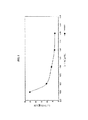
これらの結果は、誘電酸化物(TEOS)の除去速度が研磨剤の濃度に強く依存していることを実証している。対照的に、タンタル及び銅の除去速度は比較的研磨剤の濃度から独立している。図1のグラフは、Ta/TEOSの選択率を研磨剤濃度の関数として示している。このグラフは、より低い研磨剤濃度でTa/TEOSの選択率が高いことを実証している。 These results demonstrate that the removal rate of the dielectric oxide (TEOS) is strongly dependent on the abrasive concentration. In contrast, the removal rate of tantalum and copper is relatively independent of the abrasive concentration. The graph of FIG. 1 shows Ta / TEOS selectivity as a function of abrasive concentration. This graph demonstrates the high selectivity of Ta / TEOS at lower abrasive concentrations.
[例3]
本例は、pHに関する材料除去速度の依存性を評価するものである。
[Example 3]
This example evaluates the dependence of the material removal rate on pH.
タンタル、銅及びTEOSのブランケット層を含む同様の基材を6個の異なる研磨用組成物(研磨用組成物3A、3B、3C、3D、3E及び3F)で研磨した。各研磨用組成物は、0.1wt%のKIO3と、0.1wt%のBTAと、0.5wt%の縮重合シリカ(直径80nm)とを含んでいた。研磨用組成物3AのpHは2.19、研磨用組成物3BのpHは2.45、研磨用組成物3CのpHは2.6、研磨用組成物3DのpHは2.8、研磨用組成物3EのpHは3.12、研磨用組成物3FのpHは3.67であった。タンタル、銅及びTEOSの除去速度の結果を表3に示す。 A similar substrate containing tantalum, copper and TEOS blanket layers was polished with six different polishing compositions (Polishing Compositions 3A, 3B, 3C, 3D, 3E and 3F). Each polishing composition contained 0.1 wt% KIO 3 , 0.1 wt% BTA, and 0.5 wt% condensation-polymerized silica (80 nm in diameter). The polishing composition 3A has a pH of 2.19, the polishing composition 3B has a pH of 2.45, the polishing composition 3C has a pH of 2.6, and the polishing composition 3D has a pH of 2.8. The pH of the composition 3E was 3.12, and the pH of the polishing composition 3F was 3.67. Table 3 shows the results of the removal rates of tantalum, copper and TEOS.
これらの結果は、KIO3を含む研磨用組成物のpHに関するタンタル、銅及びTEOSの除去速度の強い依存性を実証している。 These results demonstrate a strong dependence of the removal rate of tantalum, copper and TEOS on the pH of the polishing composition containing KIO 3 .
[例4]
本例は、本発明の研磨用組成物を用いてタンタル及び銅の除去速度に関する窒素含有化合物の効果を評価するものである。
[Example 4]
This example evaluates the effect of a nitrogen-containing compound on the removal rate of tantalum and copper using the polishing composition of the present invention.
タンタル及び銅のブランケット層を含む同様の基材を5個の異なる研磨用組成物(研磨用組成物4A、4B、4C、4D及び4E)で研磨した。各研磨用組成物は、0.05wt%のKIO3と0.5wt%の縮重合シリカ(直径80nm)を水中にpH2.6で含んでいた。研磨用組成物4Aはベンゾトリアゾール(「BTA」)を含んでおらず、研磨用組成物4B〜4Eは、それぞれ0.025wt%、0.05wt%、0.1wt%及び0.2wt%のBTAをさらに含んでいた。タンタル及び銅の除去速度の結果を表4に示す。 A similar substrate containing tantalum and copper blanket layers was polished with five different polishing compositions (polishing compositions 4A, 4B, 4C, 4D and 4E). Each polishing composition contained 0.05 wt% KIO 3 and 0.5 wt% condensation-polymerized silica (80 nm in diameter) in water at a pH of 2.6. Polishing composition 4A does not contain benzotriazole ("BTA"), and polishing compositions 4B-4E contain 0.025 wt%, 0.05 wt%, 0.1 wt% and 0.2 wt% BTA, respectively. Further included. Table 4 shows the results of the removal rate of tantalum and copper.
BTAは銅除去の周知の防止剤である。しかしながら、表4に示す結果から明らかなように、BTAはヨウ素酸塩との組み合わせにおいてタンタルの除去速度を増加させた。タンタルの除去速度は、BTA濃度の増加とともに増加し、0.1wt%のBTA濃度で平坦域に達した。研磨用組成物4Dは、BTAなしの研磨用組成物、即ち、研磨用組成物4Aに関して観測されたものよりも約60%高いタンタル除去速度を示した。銅の除去速度は、BTAの濃度の増加とともにまず増加し、そして減少した。 BTA is a well-known inhibitor of copper removal. However, as is apparent from the results shown in Table 4, BTA increased the tantalum removal rate in combination with iodate. The removal rate of tantalum increased with an increase in BTA concentration and reached a plateau at a BTA concentration of 0.1 wt%. Polishing composition 4D exhibited a tantalum removal rate about 60% higher than that observed for polishing composition without BTA, ie, polishing composition 4A. The copper removal rate first increased and decreased with increasing BTA concentration.
[例5]
本例は、タンタルの除去速度を向上させるための、ヨウ素酸塩と窒素含有化合物、例えば、BTAとの間の相乗作用を評価するものである。
[Example 5]
This example evaluates the synergistic effect between an iodate and a nitrogen-containing compound, such as BTA, to improve the removal rate of tantalum.
タンタルのブランケット層を含む同様の基材を6個の異なる研磨用組成物(研磨用組成物5A、5B、5C、5D、5E及び5F)で研磨した。研磨用組成物5A(比較)は、0.5wt%の縮重合シリカ(直径80nm)と0.05wt%のKIO3を水中にpH2.4で含んでいた。研磨用組成物5B(本発明)は、0.1wt%のBTAと、0.5wt%の縮重合シリカ(直径80nm)と、0.05wt%のKIO3とを水中にpH2.4で含んでいた。研磨用組成物5C(比較)は、12wt%の縮重合シリカ(直径25nm)と、1wt%のH2O2と、40ppmの酢酸カルシウムとをpH9で含んでいた。研磨用組成物5D(比較)は、0.1wt%のBTAと、12wt%の縮重合シリカ(直径25nm)と、1wt%のH2O2と、40ppmの酢酸カルシウムとをpH9で含んでいた。タンタルの除去速度の結果を表5に示す。
A similar substrate containing a tantalum blanket layer was polished with six different polishing compositions (polishing compositions 5A, 5B, 5C, 5D, 5E and 5F). Polishing composition 5A (comparative) contained 0.5 wt% of condensation-polymerized silica (diameter 80 nm) and 0.05 wt% of KIO 3 at a pH of 2.4. Polishing composition 5B (invention) contains 0.1 wt% BTA, 0.5 wt% condensation-polymerized silica (diameter 80 nm), and 0.05 wt% KIO 3 at a pH of 2.4. It was. Polishing composition 5C (comparative) contained 12 wt% condensation-polymerized silica (
表5に示すタンタルの除去速度の結果から明らかなように、ヨウ素酸塩とBTAを含む研磨用組成物5Bは、同様の少量のヨウ素酸塩を含むがBTAを含まない研磨用組成物5Aと比べて高いタンタルの除去速度を示した。H2O2を単独で又はBTAとともに含むがヨウ素酸塩を含まない研磨用組成物、即ち、研磨用組成物5C及び5Dは、タンタルの除去速度の増加に関してBTAとの相乗作用を示さなかった。 As is clear from the results of the removal rate of tantalum shown in Table 5, polishing composition 5B containing iodate and BTA contains polishing composition 5A containing the same small amount of iodate but not containing BTA. The removal rate of tantalum was higher than that. Polishing compositions containing H 2 O 2 alone or with BTA but no iodate, ie, polishing compositions 5C and 5D, did not show synergy with BTA with respect to increased tantalum removal rates. .
[例6]
本例は、本発明の組成物中の様々な窒素含有化合物の有効性を評価するものである。
[Example 6]
This example evaluates the effectiveness of various nitrogen-containing compounds in the compositions of the present invention.
タンタル、銅及びTEOSのブランケット層を含む同様の基材を16個の異なる研磨用組成物(研磨用組成物6A、6B、6C、6D、6E、6F、6G、6H、6I、6J、6K、6L、6M、6N、6O及び6P)で研磨した。各研磨用組成物は、0.1wt%のKIO3と0.5wt%の縮重合シリカ(直径80nm)を水中にpH2.6で含んでいた。研磨用組成物6AはBTAを含んでおらず、研磨用組成物6Bは0.1wt%のBTAを含み、研磨用組成物6Cは0.01wt%の1H−1,2,3−ベンゾトリアゾール−5−カルボン酸を含み、研磨用組成物6Dは0.1wt%の1,2,4−トリアゾールを含み、研磨用組成物6Eは0.1wt%のピラゾールを含み、研磨用組成物6Fは0.1wt%の2−ピラジンカルボン酸を含み、研磨用組成物6Gは0.1wt%の4−ピリジル酢酸塩酸塩を含み、研磨用組成物6Hは0.1wt%の4−アミノ−1,2,4−トリアゾールを含み、研磨用組成物6Iは3,5−ジアミノ−1,2,4−トリアゾールを含み、研磨用組成物6Jは0.1wt%の2,6−ピリジンカルボン酸を含み、研磨用組成物6Kは0.1wt%の5−メチル−1H−ベンゾトリアゾールを含み、研磨用組成物6Lは0.002wt%の3−アミノ−1,2,4−トリアゾール−5−カルボン酸を含み、研磨用組成物6Mは0.02wt%の1H−1,2,3−ベンゾトリアゾール−5−カルボン酸を含み、研磨用組成物6Nは0.02wt%の1H−1,2,3−トリアゾロ[4,5b]ピリジンを含み、研磨用組成物6Oは0.1wt%のメチルアミンを含み、研磨用組成物6Pは0.1wt%のトリメチルアミンを含んでいた。タンタル、銅及びTEOSの除去速度の結果を表6に示す。 A similar substrate comprising a blanket layer of tantalum, copper and TEOS was prepared with 16 different polishing compositions (polishing compositions 6A, 6B, 6C, 6D, 6E, 6F, 6G, 6H, 6I, 6J, 6K, 6L, 6M, 6N, 60 and 6P). Each polishing composition contained 0.1 wt% KIO 3 and 0.5 wt% condensation-polymerized silica (80 nm in diameter) in water at pH 2.6. The polishing composition 6A does not contain BTA, the polishing composition 6B contains 0.1 wt% BTA, and the polishing composition 6C contains 0.01 wt% 1H-1,2,3-benzotriazole- Polishing composition 6D contains 0.1 wt% 1,2,4-triazole, Polishing composition 6E contains 0.1 wt% pyrazole, and polishing composition 6F contains 0 carboxylic acid. .1 wt% 2-pyrazinecarboxylic acid, polishing composition 6G contains 0.1 wt% 4-pyridylacetic acid hydrochloride, and polishing composition 6H contains 0.1 wt% 4-amino-1,2- , 4-triazole, the polishing composition 6I contains 3,5-diamino-1,2,4-triazole, the polishing composition 6J contains 0.1 wt% 2,6-pyridinecarboxylic acid, Polishing composition 6K is 0.1 wt% 5-medium. 1L-benzotriazole, polishing composition 6L contains 0.002 wt% 3-amino-1,2,4-triazole-5-carboxylic acid, and polishing composition 6M contains 0.02 wt% 1H-1,2,3-benzotriazole-5-carboxylic acid and polishing composition 6N contains 0.02 wt% of 1H-1,2,3-triazolo [4,5b] pyridine, and polishing composition The product 6O contained 0.1 wt% of methylamine, and the polishing composition 6P contained 0.1 wt% of trimethylamine. The results of removal rates of tantalum, copper and TEOS are shown in Table 6.
表6に示す結果から明らかなように、3,5−ジアミノ−1,2,4−トリアゾールを除く全ての窒素含有化合物が、ヨウ素酸塩とともに高いタンタルの除去速度を示した。 As is apparent from the results shown in Table 6, all nitrogen-containing compounds except 3,5-diamino-1,2,4-triazole showed high tantalum removal rates along with iodate.
[例7]
本例は、本発明の組成物中の様々な研磨剤の有効性を評価するものである。
[Example 7]
This example evaluates the effectiveness of various abrasives in the composition of the present invention.
タンタル、銅及びTEOSのブランケット層を含む同様の基材を6個の異なる研磨用組成物(研磨用組成物7A、7B、7C、7D、7E及び7F)で研磨した。各研磨用組成物7Aは、0.2wt%のKIO3と1wt%の縮重合シリカ(直径25nm)を水中にpH2.2で含んでいた。各研磨用組成物7Bは、0.05wt%のKIO3と0.5wt%の縮重合シリカ(直径80nm)を水中にpH2.4で含んでいた。各研磨用組成物7Cは、0.2wt%のKIO3と0.5wt%のヒュームドシリカを水中にpH2.2で含んでいた。各研磨用組成物7Dは、0.2wt%のKIO3と0.5wt%のヒュームドアルミナを水中にpH2.2で含んでいた。各研磨用組成物7Eは、0.2wt%のKIO3と0.5wt%のαアルミナを水中にpH2.2で含んでいた。各研磨用組成物7Fは、1wt%のKIO3と1wt%のセリアを水中にpH2.1で含んでいた。タンタル、銅及びTEOSの除去速度の結果を表7に示す。 Similar substrates containing blanket layers of tantalum, copper and TEOS were polished with six different polishing compositions (Polishing Compositions 7A, 7B, 7C, 7D, 7E and 7F). Each polishing composition 7A contained 0.2 wt% KIO 3 and 1 wt% condensation-polymerized silica (25 nm in diameter) in water at pH 2.2. Each polishing composition 7B contained 0.05 wt% KIO 3 and 0.5 wt% condensation-polymerized silica (80 nm in diameter) in water at a pH of 2.4. Each polishing composition 7C contained 0.2 wt% KIO 3 and 0.5 wt% fumed silica in water at pH 2.2. Each polishing composition 7D contained 0.2 wt% KIO 3 and 0.5 wt% fumed alumina in water at pH 2.2. Each polishing composition 7E contained 0.2 wt% KIO 3 and 0.5 wt% α-alumina in water at pH 2.2. Each polishing composition 7F contained 1 wt% KIO 3 and 1 wt% ceria in water at pH 2.1. Table 7 shows the results of the removal rates of tantalum, copper and TEOS.
表7に示すタンタルの除去速度から明らかなように、KIO3を含む研磨用組成物において縮重合シリカを使用することで高いタンタル除去速度を示した。 As apparent from the removal rate of tantalum shown in Table 7, a high tantalum removal rate was exhibited by using condensation-polymerized silica in the polishing composition containing KIO 3 .
Claims (6)
(a)25nm〜80nmの平均粒子サイズを有する0.25wt%〜0.75wt%のコロイドシリカの研磨剤と、
(b)0.05wt%〜0.1wt%のヨウ素酸イオンと、
(c)0.05wt%〜0.1wt%の1H−1,2,3−ベンゾトリアゾールと、
(d)水を含む液体キャリヤーと
を含み、前記化学機械研磨用組成物のpHが2.4〜2.8である、基材を研磨するための化学機械研磨用組成物。 A chemical mechanical polishing composition for polishing a substrate,
(A) 0.25 wt% to 0.75 wt% colloidal silica abrasive having an average particle size of 25 nm to 80 nm ;
(B) 0.05 wt% to 0.1 wt% of iodate ion,
(C) 0.05 wt% to 0.1 wt% of 1H-1,2,3-benzotriazole ;
(D) A chemical mechanical polishing composition for polishing a substrate, comprising a liquid carrier containing water, wherein the chemical mechanical polishing composition has a pH of 2.4 to 2.8 .
(b)該基材を、研磨パッド及び請求項1又は2に記載の化学機械研磨用組成物と接触させる工程、
(c)前記基材に対して前記研磨パッドを該化学機械研磨用組成物をそれらの間に置いて動かす工程、及び
(d)該基材の少なくとも一部を削って該基材を研磨する工程
を含む、基材を化学機械研磨する方法。 (A) preparing a substrate;
(B) contacting the substrate with a polishing pad and the chemical mechanical polishing composition according to claim 1 or 2 ;
(C) moving the polishing pad with the chemical mechanical polishing composition placed between them with respect to the substrate; and (d) polishing at least a portion of the substrate to polish the substrate. A method of chemically mechanically polishing a substrate, comprising a step.
Applications Claiming Priority (3)
| Application Number | Priority Date | Filing Date | Title |
|---|---|---|---|
| US11/387,558 | 2006-03-23 | ||
| US11/387,558 US8551202B2 (en) | 2006-03-23 | 2006-03-23 | Iodate-containing chemical-mechanical polishing compositions and methods |
| PCT/US2007/005722 WO2007111813A2 (en) | 2006-03-23 | 2007-03-06 | Iodate-containing chemical-mechanical polishing compositions and methods |
Publications (3)
| Publication Number | Publication Date |
|---|---|
| JP2009530849A JP2009530849A (en) | 2009-08-27 |
| JP2009530849A5 JP2009530849A5 (en) | 2010-04-22 |
| JP5576112B2 true JP5576112B2 (en) | 2014-08-20 |
Family
ID=38269104
Family Applications (1)
| Application Number | Title | Priority Date | Filing Date |
|---|---|---|---|
| JP2009501436A Expired - Fee Related JP5576112B2 (en) | 2006-03-23 | 2007-03-06 | Chemical mechanical polishing composition containing iodate and chemical mechanical polishing method |
Country Status (10)
| Country | Link |
|---|---|
| US (1) | US8551202B2 (en) |
| EP (1) | EP1996663A2 (en) |
| JP (1) | JP5576112B2 (en) |
| KR (1) | KR101372208B1 (en) |
| CN (1) | CN101389723B (en) |
| IL (1) | IL192551A (en) |
| MY (1) | MY150410A (en) |
| SG (1) | SG170755A1 (en) |
| TW (1) | TWI358449B (en) |
| WO (1) | WO2007111813A2 (en) |
Families Citing this family (11)
| Publication number | Priority date | Publication date | Assignee | Title |
|---|---|---|---|---|
| WO2005120775A1 (en) * | 2004-06-08 | 2005-12-22 | S.O.I. Tec Silicon On Insulator Technologies | Planarization of a heteroepitaxial layer |
| KR20100031730A (en) * | 2007-06-08 | 2010-03-24 | 니타 하스 인코포레이티드 | Polishing composition |
| US7922926B2 (en) * | 2008-01-08 | 2011-04-12 | Cabot Microelectronics Corporation | Composition and method for polishing nickel-phosphorous-coated aluminum hard disks |
| CN101906270A (en) * | 2009-06-08 | 2010-12-08 | 安集微电子科技(上海)有限公司 | Chemically-mechanical polishing solution |
| JP5141792B2 (en) | 2010-06-29 | 2013-02-13 | 日立化成工業株式会社 | CMP polishing liquid and polishing method |
| CN102268225B (en) * | 2011-05-30 | 2014-03-26 | 上海百兰朵电子科技有限公司 | Permanent-suspension diamond grinding liquid |
| US9039914B2 (en) | 2012-05-23 | 2015-05-26 | Cabot Microelectronics Corporation | Polishing composition for nickel-phosphorous-coated memory disks |
| CN103265893B (en) * | 2013-06-04 | 2015-12-09 | 复旦大学 | A kind of polishing fluid of the glossing based on metal M o, its preparation method and application |
| KR20160054466A (en) | 2013-09-10 | 2016-05-16 | 히타치가세이가부시끼가이샤 | Slurry, polishing-liquid set, polishing liquid, method for polishing substrate, and substrate |
| CN107491110B (en) * | 2017-09-20 | 2019-12-13 | 山东大学 | Alumina dispersion liquid with stable pH and acid-base buffering and preparation method thereof |
| TWI761921B (en) * | 2019-10-30 | 2022-04-21 | 南韓商Skc索密思股份有限公司 | Polishing pad, process for preparing the same, and process for preparing a semiconductor device using the same |
Family Cites Families (36)
| Publication number | Priority date | Publication date | Assignee | Title |
|---|---|---|---|---|
| US5230833A (en) | 1989-06-09 | 1993-07-27 | Nalco Chemical Company | Low sodium, low metals silica polishing slurries |
| US5196353A (en) | 1992-01-03 | 1993-03-23 | Micron Technology, Inc. | Method for controlling a semiconductor (CMP) process by measuring a surface temperature and developing a thermal image of the wafer |
| US6614529B1 (en) | 1992-12-28 | 2003-09-02 | Applied Materials, Inc. | In-situ real-time monitoring technique and apparatus for endpoint detection of thin films during chemical/mechanical polishing planarization |
| US5658183A (en) | 1993-08-25 | 1997-08-19 | Micron Technology, Inc. | System for real-time control of semiconductor wafer polishing including optical monitoring |
| US5433651A (en) | 1993-12-22 | 1995-07-18 | International Business Machines Corporation | In-situ endpoint detection and process monitoring method and apparatus for chemical-mechanical polishing |
| JP3270282B2 (en) | 1994-02-21 | 2002-04-02 | 株式会社東芝 | Semiconductor manufacturing apparatus and semiconductor device manufacturing method |
| JP3313505B2 (en) | 1994-04-14 | 2002-08-12 | 株式会社日立製作所 | Polishing method |
| US5893796A (en) | 1995-03-28 | 1999-04-13 | Applied Materials, Inc. | Forming a transparent window in a polishing pad for a chemical mechanical polishing apparatus |
| US5964643A (en) | 1995-03-28 | 1999-10-12 | Applied Materials, Inc. | Apparatus and method for in-situ monitoring of chemical mechanical polishing operations |
| US5838447A (en) | 1995-07-20 | 1998-11-17 | Ebara Corporation | Polishing apparatus including thickness or flatness detector |
| US5872633A (en) | 1996-07-26 | 1999-02-16 | Speedfam Corporation | Methods and apparatus for detecting removal of thin film layers during planarization |
| TW512170B (en) | 1998-07-24 | 2002-12-01 | Ibm | Aqueous slurry composition and method for polishing a surface using the same |
| US6375693B1 (en) | 1999-05-07 | 2002-04-23 | International Business Machines Corporation | Chemical-mechanical planarization of barriers or liners for copper metallurgy |
| JP2001139937A (en) * | 1999-11-11 | 2001-05-22 | Hitachi Chem Co Ltd | Liquid for polishing metal and method for polishing metal |
| US6355075B1 (en) | 2000-02-11 | 2002-03-12 | Fujimi Incorporated | Polishing composition |
| JP2001269859A (en) * | 2000-03-27 | 2001-10-02 | Jsr Corp | Aqueous dispersion for chemical mechanical polishing |
| US6364920B1 (en) | 2000-04-21 | 2002-04-02 | Saint-Gobain Ceramics & Plastics, Inc. | CMP formulations |
| US6409781B1 (en) | 2000-05-01 | 2002-06-25 | Advanced Technology Materials, Inc. | Polishing slurries for copper and associated materials |
| US6599173B1 (en) | 2000-06-30 | 2003-07-29 | International Business Machines Corporation | Method to prevent leaving residual metal in CMP process of metal interconnect |
| US6468137B1 (en) | 2000-09-07 | 2002-10-22 | Cabot Microelectronics Corporation | Method for polishing a memory or rigid disk with an oxidized halide-containing polishing system |
| US20020173243A1 (en) * | 2001-04-05 | 2002-11-21 | Costas Wesley D. | Polishing composition having organic polymer particles |
| US7279119B2 (en) | 2001-06-14 | 2007-10-09 | Ppg Industries Ohio, Inc. | Silica and silica-based slurry |
| US6589100B2 (en) * | 2001-09-24 | 2003-07-08 | Cabot Microelectronics Corporation | Rare earth salt/oxidizer-based CMP method |
| US6821897B2 (en) * | 2001-12-05 | 2004-11-23 | Cabot Microelectronics Corporation | Method for copper CMP using polymeric complexing agents |
| US7316603B2 (en) | 2002-01-22 | 2008-01-08 | Cabot Microelectronics Corporation | Compositions and methods for tantalum CMP |
| US20030139047A1 (en) | 2002-01-24 | 2003-07-24 | Thomas Terence M. | Metal polishing slurry having a static etch inhibitor and method of formulation |
| US6821309B2 (en) | 2002-02-22 | 2004-11-23 | University Of Florida | Chemical-mechanical polishing slurry for polishing of copper or silver films |
| US20040077295A1 (en) * | 2002-08-05 | 2004-04-22 | Hellring Stuart D. | Process for reducing dishing and erosion during chemical mechanical planarization |
| US6911393B2 (en) * | 2002-12-02 | 2005-06-28 | Arkema Inc. | Composition and method for copper chemical mechanical planarization |
| JP2004311565A (en) * | 2003-04-03 | 2004-11-04 | Hitachi Chem Co Ltd | Metal polishing solution and polishing method |
| US7736405B2 (en) * | 2003-05-12 | 2010-06-15 | Advanced Technology Materials, Inc. | Chemical mechanical polishing compositions for copper and associated materials and method of using same |
| US20050090104A1 (en) * | 2003-10-27 | 2005-04-28 | Kai Yang | Slurry compositions for chemical mechanical polishing of copper and barrier films |
| TWI244498B (en) * | 2003-11-20 | 2005-12-01 | Eternal Chemical Co Ltd | Chemical mechanical abrasive slurry and method of using the same |
| JP4644434B2 (en) * | 2004-03-24 | 2011-03-02 | 株式会社フジミインコーポレーテッド | Polishing composition |
| JP2008546214A (en) | 2005-06-06 | 2008-12-18 | アドバンスド テクノロジー マテリアルズ,インコーポレイテッド | Integrated chemical mechanical polishing composition and process for single platen processing |
| JP2007103485A (en) * | 2005-09-30 | 2007-04-19 | Fujifilm Corp | Polishing method and polishing liquid used therefor |
-
2006
- 2006-03-23 US US11/387,558 patent/US8551202B2/en not_active Expired - Fee Related
-
2007
- 2007-03-06 KR KR1020087025805A patent/KR101372208B1/en not_active Expired - Fee Related
- 2007-03-06 SG SG201102048-4A patent/SG170755A1/en unknown
- 2007-03-06 WO PCT/US2007/005722 patent/WO2007111813A2/en not_active Ceased
- 2007-03-06 JP JP2009501436A patent/JP5576112B2/en not_active Expired - Fee Related
- 2007-03-06 EP EP07752423A patent/EP1996663A2/en not_active Withdrawn
- 2007-03-06 CN CN2007800066859A patent/CN101389723B/en not_active Expired - Fee Related
- 2007-03-06 MY MYPI20083710 patent/MY150410A/en unknown
- 2007-03-13 TW TW096108584A patent/TWI358449B/en not_active IP Right Cessation
-
2008
- 2008-07-01 IL IL192551A patent/IL192551A/en not_active IP Right Cessation
Also Published As
| Publication number | Publication date |
|---|---|
| WO2007111813A3 (en) | 2008-03-13 |
| CN101389723A (en) | 2009-03-18 |
| IL192551A0 (en) | 2009-02-11 |
| TW200801166A (en) | 2008-01-01 |
| IL192551A (en) | 2013-03-24 |
| SG170755A1 (en) | 2011-05-30 |
| US8551202B2 (en) | 2013-10-08 |
| TWI358449B (en) | 2012-02-21 |
| WO2007111813A2 (en) | 2007-10-04 |
| KR20080108561A (en) | 2008-12-15 |
| MY150410A (en) | 2014-01-15 |
| EP1996663A2 (en) | 2008-12-03 |
| US20070224919A1 (en) | 2007-09-27 |
| JP2009530849A (en) | 2009-08-27 |
| KR101372208B1 (en) | 2014-03-07 |
| CN101389723B (en) | 2012-05-30 |
Similar Documents
| Publication | Publication Date | Title |
|---|---|---|
| JP5576112B2 (en) | Chemical mechanical polishing composition containing iodate and chemical mechanical polishing method | |
| EP2087061B1 (en) | Cmp of copper/ruthenium/tantalum substrates | |
| KR101224321B1 (en) | Compositions for polishing aluminum/copper and titanium in damascene structures | |
| TWI414573B (en) | CMP composition and method for semiconductor materials | |
| US8591763B2 (en) | Halide anions for metal removal rate control | |
| JP5596344B2 (en) | Silicon oxide polishing method using colloidal silica | |
| KR101472617B1 (en) | Polishing liquid for metal and method of polishing | |
| KR101364318B1 (en) | Halide anions for metal removal rate control | |
| JP5080261B2 (en) | Metal ion coating CMP composition and method of use thereof | |
| JP2000306873A (en) | Polishing method |
Legal Events
| Date | Code | Title | Description |
|---|---|---|---|
| A521 | Request for written amendment filed |
Free format text: JAPANESE INTERMEDIATE CODE: A523 Effective date: 20100305 |
|
| A621 | Written request for application examination |
Free format text: JAPANESE INTERMEDIATE CODE: A621 Effective date: 20100305 |
|
| A131 | Notification of reasons for refusal |
Free format text: JAPANESE INTERMEDIATE CODE: A131 Effective date: 20120529 |
|
| A977 | Report on retrieval |
Free format text: JAPANESE INTERMEDIATE CODE: A971007 Effective date: 20120530 |
|
| A601 | Written request for extension of time |
Free format text: JAPANESE INTERMEDIATE CODE: A601 Effective date: 20120828 |
|
| A602 | Written permission of extension of time |
Free format text: JAPANESE INTERMEDIATE CODE: A602 Effective date: 20120904 |
|
| A521 | Request for written amendment filed |
Free format text: JAPANESE INTERMEDIATE CODE: A523 Effective date: 20121126 |
|
| A02 | Decision of refusal |
Free format text: JAPANESE INTERMEDIATE CODE: A02 Effective date: 20130514 |
|
| A61 | First payment of annual fees (during grant procedure) |
Free format text: JAPANESE INTERMEDIATE CODE: A61 Effective date: 20140703 |
|
| R150 | Certificate of patent or registration of utility model |
Ref document number: 5576112 Country of ref document: JP Free format text: JAPANESE INTERMEDIATE CODE: R150 |
|
| LAPS | Cancellation because of no payment of annual fees |