JP5585529B2 - Terminal alkoxy-modified organopolysiloxane and method for producing the same - Google Patents
Terminal alkoxy-modified organopolysiloxane and method for producing the same Download PDFInfo
- Publication number
- JP5585529B2 JP5585529B2 JP2011103399A JP2011103399A JP5585529B2 JP 5585529 B2 JP5585529 B2 JP 5585529B2 JP 2011103399 A JP2011103399 A JP 2011103399A JP 2011103399 A JP2011103399 A JP 2011103399A JP 5585529 B2 JP5585529 B2 JP 5585529B2
- Authority
- JP
- Japan
- Prior art keywords
- group
- component
- carbon atoms
- butylamine
- general formula
- Prior art date
- Legal status (The legal status is an assumption and is not a legal conclusion. Google has not performed a legal analysis and makes no representation as to the accuracy of the status listed.)
- Active
Links
Landscapes
- Silicon Polymers (AREA)
Description
本発明は、主に無機質材料(塗料用無機顔料、プラスチック用無機充填剤、化粧料用無機粉体、ガラス、コンクリート等)の表面処理剤、撥水処理用コーティング剤、縮合硬化型シリコーンゴムの原料シロキサンとして有用である高純度末端アルコキシ変性オルガノポリシロキサン及びその製造方法に関する。詳細には、未反応物や副生成物等の不純物をほとんど含有しないため、それらの不純物に起因する臭気や着色がなく、また、末端アルコキシシリル変性率が高いため、粉体の表面処理効率も極めて良好となる末端アルコキシ変性オルガノポリシロキサン及びその製造方法に関する。 The present invention mainly includes surface treatment agents for inorganic materials (inorganic pigments for paints, inorganic fillers for plastics, inorganic powders for cosmetics, glass, concrete, etc.), coating agents for water repellent treatment, and condensation curable silicone rubbers. The present invention relates to a high purity terminal alkoxy-modified organopolysiloxane useful as a raw material siloxane and a method for producing the same. Specifically, since it contains almost no impurities such as unreacted substances and by-products, there is no odor or coloring caused by those impurities, and since the terminal alkoxysilyl modification rate is high, the surface treatment efficiency of the powder is also high. The present invention relates to a terminal alkoxy-modified organopolysiloxane that is extremely good and a method for producing the same.
酸化チタン、酸化亜鉛等の無機粉体はUV遮蔽効果に優れることから、基礎化粧品を始め、サンカット料、ファンデーション等の化粧料に広く用いられている。これらの粉体を化粧料に配合する際に、表面上の極性基をなくして水分の吸着等を防ぐと共に油性成分中への分散性を高めるために、オルガノポリシロキサンで表面処理することが知られている。 Inorganic powders such as titanium oxide and zinc oxide are widely used in cosmetics such as basic cosmetics, suncuts, and foundations because of their excellent UV shielding effect. It is known that when these powders are blended into cosmetics, surface treatment with organopolysiloxane is carried out in order to eliminate the polar groups on the surface to prevent moisture adsorption and improve dispersibility in oil components. It has been.
オルガノポリシロキサンとしては、例えば、特開2003−95655号公報、特開2003−95839号公報(特許文献1,2)に記載の下記式(4)で表されるようなメチルハイドロジェンポリシロキサン、ジメチルメチルハイドロジェンポリシロキサンがある。 Examples of the organopolysiloxane include methyl hydrogen polysiloxane represented by the following formula (4) described in JP-A No. 2003-95655 and JP-A No. 2003-95839 (Patent Documents 1 and 2). There is dimethylmethyl hydrogen polysiloxane.
該メチルハイドロジェンポリシロキサン、ジメチルメチルハイドロジェンポリシロキサンは、そのSiH基が粉体表面の活性基と反応し、表面処理が進行する。しかし、反応率は十分ではなく、粉体表面には未反応のSiH基が残留する。このため、該表面処理粉体を化粧料に配合した場合、他の原料を劣化させることがある。 In the methyl hydrogen polysiloxane and dimethyl methyl hydrogen polysiloxane, the SiH group reacts with the active group on the powder surface, and the surface treatment proceeds. However, the reaction rate is not sufficient, and unreacted SiH groups remain on the powder surface. For this reason, when this surface treatment powder is mix | blended with cosmetics, another raw material may be deteriorated.
一方、特開平7−196946号公報(特許文献3)に記載の直鎖状反応性アルキルポリシロキサンを用いた場合、上記の問題を解決し得るものである。例えば、下記式(5)で表される片末端アルコキシ変性ジメチルポリシロキサンがある。 On the other hand, when the linear reactive alkylpolysiloxane described in JP-A-7-196946 (Patent Document 3) is used, the above problem can be solved. For example, there is a one-terminal alkoxy-modified dimethylpolysiloxane represented by the following formula (5).
該化合物は、そのSi(OCH3)3基が粉体表面で反応することによって、粉体の表面と結合を形成する。また、該粉体を化粧料に配合した場合に、他の原料を劣化させてしまうこともない。しかし、該化合物は、従来からの製造方法によれば、触媒や副生成物等の不純物が残留するため、これらに起因する着色や臭気が発生する。化粧品用途での使用を可能とするには、これら不純物を除去し、着色や臭気を完全になくす必要がある。このため、実際の製造においては、該化合物を合成後、煩雑な精製・分離の工程が課されるが、完全なる無着色・無臭化は、極めて困難である。そこで、無着色・無臭で、かつ簡単な工程で容易に製造することができる高純度なアルコキシ変性オルガノポリシロキサン及びその製造方法が必要となる。 The compound forms a bond with the surface of the powder when the Si (OCH 3 ) 3 group reacts on the surface of the powder. Moreover, when this powder is mix | blended with cosmetics, another raw material will not be deteriorated. However, according to the conventional production method, impurities such as a catalyst and a by-product remain in the compound, so that coloring and odor due to these remain. In order to be able to be used in cosmetic applications, it is necessary to remove these impurities and completely eliminate coloring and odor. For this reason, in the actual production, a complicated purification / separation step is imposed after the synthesis of the compound, but complete non-coloration / non-bromination is extremely difficult. Therefore, there is a need for a high-purity alkoxy-modified organopolysiloxane that is non-colored and odorless and that can be easily manufactured by a simple process and a method for manufacturing the same.
他にもいくつか、アルコキシ変性オルガノポリシロキサンの製造方法に関する報告がある。例えば、特開2000−26609号公報(特許文献4)では、シラノール基末端ジメチルポリシロキサンにイソシアナト基含有シランを反応させて、イソシアナト基末端オルガノポリシロキサンを合成し、このイソシアナト基末端オルガノポリシロキサンにアルコールを反応させて両末端アルコキシ基変性オルガノポリシロキサンを製造する方法が開示されているが、目的物を得るための反応工程を2段階必要とする複雑な方法である。また、この反応ではカルバミン酸アルキルのような副生成物が発生し、反応生成物から減圧分離するためには厳しい減圧分離条件が必要である。 There are several other reports on methods for producing alkoxy-modified organopolysiloxanes. For example, in Japanese Unexamined Patent Publication No. 2000-26609 (Patent Document 4), an isocyanate group-containing silane is reacted with a silanol group-terminated dimethylpolysiloxane to synthesize an isocyanate group-terminated organopolysiloxane. A method for producing an alkoxypolysiloxane modified at both ends by reacting alcohol is disclosed, but it is a complicated method that requires two reaction steps to obtain the desired product. In this reaction, a by-product such as alkyl carbamate is generated, and severe vacuum separation conditions are required to separate the reaction product under reduced pressure.
また、特公平7−98864号公報(特許文献5)では、酸性アミン塩を触媒とし、シラノール基末端オルガノポリシロキサンとアルコキシシランとの反応により、目的物を得ている。しかし、酸性アミン塩は、沸点が高いため、反応生成物から減圧分離するためには厳しい減圧分離条件が必要となる。 In Japanese Patent Publication No. 7-98864 (Patent Document 5), an acidic amine salt is used as a catalyst, and a target product is obtained by a reaction between a silanol group-terminated organopolysiloxane and an alkoxysilane. However, since acidic amine salts have a high boiling point, severe vacuum separation conditions are required to separate them from the reaction product under reduced pressure.
特開2003−246860号公報(特許文献6)には、酸性触媒存在下で、シラノール基末端オルガノポリシロキサンとオルガノトリアルコキシシランから末端アルコキシ変性シロキサンを製造する方法が開示されている。しかし、酸性触媒は沸点が高いため、その分離には困難が予想される。 Japanese Patent Application Laid-Open No. 2003-246860 (Patent Document 6) discloses a method for producing a terminal alkoxy-modified siloxane from a silanol group-terminated organopolysiloxane and an organotrialkoxysilane in the presence of an acidic catalyst. However, since an acidic catalyst has a high boiling point, it is expected to be difficult to separate it.
特開2010−168431号公報(特許文献7)では、アンモニアあるいは沸点20℃以下のアミンを触媒とし、シラノール基末端オルガノポリシロキサンとオルガノトリアルコキシシランから末端アルコキシ変性シロキサンを製造する方法が開示されている。しかし、この方法は、室温で気体状のアミンを触媒としているため、取扱いが煩雑となる。気体状のアミンは、ガスのままで使用するか、アルコール等の溶剤に溶かして使用する。また、沸点20℃以下のアミンは、室温での反応においても、系外へ揮発して抜けていってしまう。これを防ぐためには、密閉型の反応装置が必要となる。更に、反応生成物中には、厳しい精製工程を経た後においても、僅かな不純物が残留し、これが原因で着色や臭気が発生するという問題を抱えている。 Japanese Patent Application Laid-Open No. 2010-168431 (Patent Document 7) discloses a method for producing terminal alkoxy-modified siloxane from silanol-terminated organopolysiloxane and organotrialkoxysilane using ammonia or amine having a boiling point of 20 ° C. or less as a catalyst. Yes. However, since this method uses a gaseous amine as a catalyst at room temperature, handling is complicated. The gaseous amine is used as a gas or dissolved in a solvent such as alcohol. In addition, amines having a boiling point of 20 ° C. or lower volatilize out of the system and escape even in a reaction at room temperature. In order to prevent this, a sealed reactor is required. Further, the reaction product has a problem that even after a rigorous purification process, a slight amount of impurities remain, which causes coloring and odor.
本発明は、上記事情に鑑みてなされたもので、無着色・無臭で、かつ簡単な工程で容易に製造することができる高純度末端アルコキシ変性オルガノポリシロキサン及びその製造方法を提供することを目的とする。 The present invention has been made in view of the above circumstances, and an object thereof is to provide a high-purity terminal alkoxy-modified organopolysiloxane that can be easily produced in a simple process without coloring and odor, and a method for producing the same. And
本発明者らは、上記課題を達成するために鋭意検討を行った結果、沸点30〜80℃の一級アミンを触媒とし、シラノール基末端オルガノポリシロキサンとアルコキシシランとを反応させることにより、オルガノポリシロキサンの末端を効率よくアルコキシシリル基で封鎖することができ、更に得られた生成物を減圧加熱することで、アミン触媒、未反応成分、副生成物等の不純物を含有しない極めて高純度な末端アルコキシ変性オルガノポリシロキサンが得られ、着色や臭気の問題もなく、化粧料用途の粉体表面処理等に好適に使用できることを見出し、本発明をなすに至った。 As a result of intensive studies to achieve the above-mentioned problems, the present inventors have made organopolysiloxane by reacting silanol group-terminated organopolysiloxane with alkoxysilane using a primary amine having a boiling point of 30 to 80 ° C. as a catalyst. The terminal of the siloxane can be efficiently blocked with an alkoxysilyl group, and the resulting product is heated under reduced pressure, so that it does not contain impurities such as amine catalyst, unreacted components, and by-products. An alkoxy-modified organopolysiloxane was obtained, and it was found that it can be suitably used for powder surface treatment for cosmetics, etc. without problems of coloring and odor, and has led to the present invention.
即ち、本発明は、下記の末端アルコキシ変性オルガノポリシロキサン及びその製造方法を提供する。
〔1〕
(A)下記一般式(1)で表される末端にシラノール基を有するオルガノポリシロキサンと、
(B)(A)成分のヒドロキシ基1モルに対して等モルを超える量の下記一般式(2)で表されるアルコキシシランとを、
(C)沸点が30〜80℃である一級アミンの存在下で縮合反応を行い、
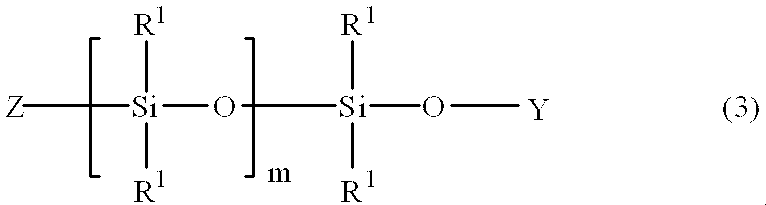
次に、得られた生成物を減圧加熱して、(B)成分の未反応分、(C)成分、及び副生成するアルコール成分を除去することを特徴とする下記一般式(3)で表される末端アルコキシ変性オルガノポリシロキサンの製造方法。
〔2〕
前記(C)成分の一級アミンが、n−プロピルアミン、イソプロピルアミン、n−ブチルアミン、イソブチルアミン、sec−ブチルアミン、tert−ブチルアミン、アリルアミンより選ばれる1種又は2種以上の組み合わせであることを特徴とする〔1〕記載の末端アルコキシ変性オルガノポリシロキサンの製造方法。
〔3〕
(A)下記一般式(1)で表される末端にシラノール基を有するオルガノポリシロキサンと、
(B)(A)成分のヒドロキシ基1モルに対して等モルを超える量の下記一般式(2)で表されるアルコキシシランとを、
(C)n−プロピルアミン、n−ブチルアミン、イソブチルアミン、sec−ブチルアミン、tert−ブチルアミン、アリルアミンより選ばれる1種又は2種以上の組み合わせである、沸点が30〜80℃である一級アミンの存在下で縮合反応を行い、
次に、得られた生成物を減圧加熱して、(B)成分の未反応分、(C)成分、及び副生成するアルコール成分を除去することを特徴とする下記一般式(3)で表される末端アルコキシ変性オルガノポリシロキサンの製造方法。
〔4〕
一般式(1)のXが炭素原子数1〜6のアルキル基であり、一般式(3)のZが炭素原子数1〜6のアルキル基である分子鎖の片末端にのみアルコキシシリル基を有するオルガノポリシロキサンを得る〔1〕、〔2〕又は〔3〕記載の末端アルコキシ変性オルガノポリシロキサンの製造方法。
That is, the present invention provides the following terminal alkoxy-modified organopolysiloxane and a method for producing the same.
[1]
(A) an organopolysiloxane having a silanol group at the end represented by the following general formula (1);
(B) an alkoxysilane represented by the following general formula (2) in an amount exceeding 1 mol with respect to 1 mol of the hydroxy group of the component (A),
(C) performing a condensation reaction in the presence of a primary amine having a boiling point of 30 to 80 ° C.,
Next, the obtained product is heated under reduced pressure to remove the unreacted component of the component (B), the component (C), and the alcohol component by-produced, which is represented by the following general formula (3). To produce terminal alkoxy-modified organopolysiloxane.
[2]
The primary amine of the component (C) is one or a combination of two or more selected from n-propylamine, isopropylamine, n-butylamine, isobutylamine, sec-butylamine, tert-butylamine, and allylamine. [1] The method for producing a terminal alkoxy-modified organopolysiloxane according to [1].
[3]
(A) an organopolysiloxane having a silanol group at the end represented by the following general formula (1);
(B) an alkoxysilane represented by the following general formula (2) in an amount exceeding 1 mol with respect to 1 mol of the hydroxy group of the component (A),
(C) Presence of a primary amine having a boiling point of 30 to 80 ° C., which is one or a combination of two or more selected from n-propylamine, n-butylamine, isobutylamine, sec-butylamine, tert-butylamine and allylamine Under the condensation reaction,
Next, the obtained product is heated under reduced pressure to remove the unreacted component of the component (B), the component (C), and the alcohol component by-produced, which is represented by the following general formula (3). To produce terminal alkoxy-modified organopolysiloxane.
[4]
In the general formula (1), X is an alkyl group having 1 to 6 carbon atoms, and Z in the general formula (3) is an alkyl group having 1 to 6 carbon atoms. The method for producing a terminal alkoxy-modified organopolysiloxane according to [1], [2] or [3], wherein an organopolysiloxane having the above is obtained.
本発明の方法により、触媒、その他不純物の含有量が極めて少ない高純度末端アルコキシ変性オルガノポリシロキサンを、簡単な工程で容易に製造することができる。このため、得られた末端アルコキシ変性オルガノポリシロキサンは、不純物に起因する臭気や着色がなく、化粧料用途の粉体表面処理等に好適に使用できる。 By the method of the present invention, a high-purity terminal alkoxy-modified organopolysiloxane having a very low content of catalyst and other impurities can be easily produced by a simple process. For this reason, the obtained terminal alkoxy-modified organopolysiloxane has no odor or coloring caused by impurities, and can be suitably used for powder surface treatment for cosmetics.
以下、本発明について詳しく説明する。 The present invention will be described in detail below.
[(A)成分]
(A)成分は、下記一般式(1)で表される末端にシラノール基を有するオルガノポリシロキサンである。
The component (A) is an organopolysiloxane having a silanol group at the end represented by the following general formula (1).
両末端アルコキシ変性オルガノポリシロキサンを得る場合は、Xがヒドロキシ基のものを用い、片末端アルコキシ変性オルガノポリシロキサンを得る場合はXがR1のものを用いる。 When obtaining a terminal alkoxy-modified organopolysiloxane, X is a hydroxy group, and when obtaining a terminal alkoxy-modified organopolysiloxane, X is R 1 .
上記R1の具体例としては、メチル基、エチル基、プロピル基、イソプロピル基、ブチル基、イソブチル基、tert−ブチル基、ペンチル基、ネオペンチル基、ヘキシル基、シクロヘキシル基、オクチル基、ノニル基、デシル基等のアルキル基;フェニル基、トリル基、キシリル基、ナフチル基等のアリール基;ベンジル基、フェニルエチル基、フェニルプロピル基等のアラルキル基;ビニル基、アリル基、プロペニル基、イソプロペニル基、ブテニル基、ヘキセニル基、シクロヘキセニル基、オクテニル基等のアルケニル基等が例示でき、またこれら一価炭化水素基の水素原子の一部が置換されたものとしては、クロロメチル基、トリフルオロメチル基、クロロプロピル基等、ハロゲン原子(フッ素原子、塩素原子、臭素原子、ヨウ素原子)で置換された一価炭化水素基等を例示することができる。R1は、好ましくはメチル基である。
上記mは3以上、好ましくは3〜500、特に好ましくは3〜50の整数である。
Specific examples of R 1 include methyl group, ethyl group, propyl group, isopropyl group, butyl group, isobutyl group, tert-butyl group, pentyl group, neopentyl group, hexyl group, cyclohexyl group, octyl group, nonyl group, Alkyl group such as decyl group; aryl group such as phenyl group, tolyl group, xylyl group and naphthyl group; aralkyl group such as benzyl group, phenylethyl group and phenylpropyl group; vinyl group, allyl group, propenyl group and isopropenyl group Alkenyl groups such as butenyl group, hexenyl group, cyclohexenyl group, octenyl group, etc., and those in which a part of hydrogen atoms of these monovalent hydrocarbon groups are substituted include chloromethyl group, trifluoromethyl group, etc. Group, chloropropyl group, halogen atom (fluorine atom, chlorine atom, bromine atom, iodine atom The are monovalent hydrocarbon radicals and substituted may be exemplified). R 1 is preferably a methyl group.
M is an integer of 3 or more, preferably 3 to 500, particularly preferably 3 to 50.
なお、(A)成分としては、25℃における粘度が、好ましくは1〜100,000mPa・s、特に2〜10,000mPa・sのものが好ましい。粘度が高すぎると反応効率が低下したり、反応後の不純物除去効率が低下するなどの不都合が生じることがある。なお、粘度はキャノンフェンスケ粘度計を用いて測定できる。 The component (A) preferably has a viscosity at 25 ° C. of 1 to 100,000 mPa · s, particularly 2 to 10,000 mPa · s. If the viscosity is too high, there may be inconveniences such as reduced reaction efficiency and reduced impurity removal efficiency after the reaction. The viscosity can be measured using a Canon Fenceke viscometer.
[(B)成分]
(B)成分は、下記一般式(2)で表されるアルコキシシランである。
The component (B) is an alkoxysilane represented by the following general formula (2).
(B)成分は、(A)成分の末端シラノール基と反応し、目的とする末端アルコキシ変性オルガノポリシロキサンを製造するためのアルコキシシリル化剤である。(B)成分は、1種単独で用いても2種以上を併用してもよい。 Component (B) is an alkoxysilylating agent that reacts with the terminal silanol group of component (A) to produce the desired terminal alkoxy-modified organopolysiloxane. (B) A component may be used individually by 1 type, or may use 2 or more types together.
上記R2の具体例としては、メチル基、エチル基、プロピル基、ブチル基等が挙げられる。R2は、好ましくはメチル基、エチル基である。また、R3としては、上述したR1の置換基を有してもよい炭素数1〜20の一価炭化水素基と同様のものが例示される。R3は、好ましくはメチル基、エチル基、プロピル基、フェニル基である。
aは2〜4の整数であり、3、4が好ましく、特に4が好ましい。
Specific examples of R 2 include a methyl group, an ethyl group, a propyl group, and a butyl group. R 2 is preferably a methyl group or an ethyl group. As the R 3, the same as the monovalent hydrocarbon group having 1 to 20 carbon atoms which may have a substituent R 1 as described above is illustrated. R 3 is preferably a methyl group, an ethyl group, a propyl group, or a phenyl group.
a is an integer of 2 to 4, 3 or 4 is preferable, and 4 is particularly preferable.
上記アルコキシシランとして、具体的には、テトラメトキシシラン、テトラエトキシシラン、メチルトリメトキシシラン、メチルトリエトキシシラン、ジメチルジメトキシシラン、ジメチルジエトキシシラン、ビニルトリメトキシシラン、ビニルトリエトキシシラン等が挙げられる。 Specific examples of the alkoxysilane include tetramethoxysilane, tetraethoxysilane, methyltrimethoxysilane, methyltriethoxysilane, dimethyldimethoxysilane, dimethyldiethoxysilane, vinyltrimethoxysilane, and vinyltriethoxysilane. .
[(C)成分]
(C)成分は、沸点が30〜80℃の一級アミンであり、下記アルコキシシリル化反応の触媒として用いられる成分である。(C)成分は、室温下において、液体状であるため、気体状のアミンと比較して取扱いが容易である。また、沸点が30℃以上であるため、室温下の反応においては、揮発して系外へ取り除かれてしまうこともない。なお、沸点が80℃以下であるため、反応終了後、減圧加熱により完全に除去されうる。また、該アミン触媒を用いた場合、アルコキシシリル化反応は効率良く進行し、(A)成分の末端シラノール基の90モル%以上が、アルコキシシリル基で封鎖される。
[Component (C)]
Component (C) is a primary amine having a boiling point of 30 to 80 ° C. and is used as a catalyst for the following alkoxysilylation reaction. Since the component (C) is liquid at room temperature, it is easier to handle than the gaseous amine. In addition, since the boiling point is 30 ° C. or higher, it is not volatilized and removed outside the system in the reaction at room temperature. Since the boiling point is 80 ° C. or lower, it can be completely removed by heating under reduced pressure after completion of the reaction. Further, when the amine catalyst is used, the alkoxysilylation reaction proceeds efficiently, and 90 mol% or more of the terminal silanol group of the component (A) is blocked with the alkoxysilyl group.
沸点が30〜80℃のアミンとしては、プロピルアミン、イソプロピルアミン、ブチルアミン、イソブチルアミン、sec−ブチルアミン、tert−ブチルアミン、アリルアミン等が挙げられる。好ましくは、分岐型アルキル鎖をもつイソプロピルアミン、イソブチルアミン、sec−ブチルアミン、tert−ブチルアミンであり、特に好ましくは、tert−ブチルアミンである。なお、これらは1種単独で用いても2種以上を併用してもよい。 Examples of the amine having a boiling point of 30 to 80 ° C. include propylamine, isopropylamine, butylamine, isobutylamine, sec-butylamine, tert-butylamine, and allylamine. Preferred are isopropylamine, isobutylamine, sec-butylamine and tert-butylamine having a branched alkyl chain, and particularly preferred is tert-butylamine. These may be used alone or in combination of two or more.
[アルコキシシリル化反応]
本発明の製造方法は、まず、(A)末端にシラノール基を有するオルガノポリシロキサンと、(A)成分のヒドロキシ基1モルに対して等モルを超える量の(B)アルコキシシランとを、(C)アミン触媒の存在下で反応させ、末端アルコキシ変性オルガノポリシロキサンを含む生成物を得る工程を有する。
[Alkoxysilylation reaction]
In the production method of the present invention, first, (A) an organopolysiloxane having a silanol group at the terminal, and (B) an alkoxysilane in an amount exceeding 1 mol with respect to 1 mol of the hydroxy group of the component (A), C) reacting in the presence of an amine catalyst to obtain a product containing a terminal alkoxy-modified organopolysiloxane.
(B)成分の仕込み量は、(A)成分中のシラノール基1molに対し、等モルを超える量であればよいが、(B)成分の量が、好ましくは1.5〜50モル、より好ましくは1.8〜30モル、特に好ましくは、2〜10molの範囲となる量である。(B)成分の量が(A)成分中のシラノール基1モルに対して等モル以下であると未反応の(A)成分が残存することがある。該(B)成分の量が多すぎると反応終了後において、(B)成分の未反応分が多量に残留するため、次の精製工程に大きな負荷がかかることがある。 The amount of component (B) to be charged may be an amount exceeding equimolar to 1 mol of silanol groups in component (A), but the amount of component (B) is preferably 1.5 to 50 mol. The amount is preferably 1.8 to 30 mol, particularly preferably 2 to 10 mol. When the amount of the component (B) is equal to or less than 1 mol of the silanol group in the component (A), the unreacted component (A) may remain. If the amount of component (B) is too large, a large amount of unreacted component (B) remains after completion of the reaction, which may impose a heavy load on the next purification step.
[末端アルコキシ変性オルガノポリシロキサンの精製]
本発明の製造方法は、上記アルコキシシリル化の後に、得られた生成物を減圧加熱して、(B)成分の未反応分、(C)成分、及び副生成するアルコール成分を除去し、高純度な末端アルコキシ変性オルガノポリシロキサンを得るための精製工程を有する。
[Purification of terminal alkoxy-modified organopolysiloxane]
In the production method of the present invention, after the alkoxysilylation, the resulting product is heated under reduced pressure to remove the unreacted component (B), the component (C), and the alcohol component by-produced, A purification step for obtaining a pure terminal alkoxy-modified organopolysiloxane.
減圧加熱時の圧力としては、例えば、500〜10,000Pa、好ましくは500〜5,000Paが挙げられる。また、減圧加熱時の温度としては、例えば、100〜150℃、好ましくは100〜120℃が挙げられる。なお、減圧加熱時に、N2ガスバブリングを併用すると、精製効率が向上する。 Examples of the pressure during reduced pressure heating include 500 to 10,000 Pa, preferably 500 to 5,000 Pa. Moreover, as temperature at the time of reduced pressure heating, 100-150 degreeC, for example, Preferably 100-120 degreeC is mentioned. When N 2 gas bubbling is used at the time of heating under reduced pressure, purification efficiency is improved.
[末端アルコキシ変性シロキサン]
本発明の製造方法により、最終目的物として、下記一般式(3)で表される末端アルコキシ変性オルガノポリシロキサンを得ることができる。
By the production method of the present invention, a terminal alkoxy-modified organopolysiloxane represented by the following general formula (3) can be obtained as the final target product.
この場合、式(1)のオルガノポリシロキサンとして、Xが炭素原子数1〜6のアルキル基を用いることにより、式(3)のZが炭素原子数1〜6のアルキル基である分子鎖の片末端にのみアルコキシシリル基を有するオルガノポリシロキサンが得られる。 In this case, as the organopolysiloxane of the formula (1), by using an alkyl group having 1 to 6 carbon atoms, X is a molecular chain in which Z of the formula (3) is an alkyl group having 1 to 6 carbon atoms. An organopolysiloxane having an alkoxysilyl group only at one end is obtained.
本発明の末端アルコキシ変性オルガノポリシロキサンは、極めて高純度で、含有する不純物の濃度は、下記に示す通り、極めて低いレベルである。
・アミン成分≦10ppm
・未反応物の一般式(2)で表されるアルコキシシラン≦100ppm
・副生成物のアルコール≦100ppm
The terminal alkoxy-modified organopolysiloxane of the present invention has extremely high purity, and the concentration of impurities contained is extremely low as shown below.
・ Amine component ≦ 10ppm
-Unreacted alkoxysilane represented by general formula (2) ≤ 100 ppm
・ By-product alcohol ≦ 100ppm
このため、下記に示す通り、不純物に起因する臭気や着色がなく、化粧料用途の粉体表面処理等に好適に使用できる。
・ハーゼン色数(APHA)≦30の無色透明液体
なお、ハーゼン色数はJIS K0071−1に準じて測定する。
・臭気官能試験で臭気が感じられない。
For this reason, as shown below, there is no odor and coloring resulting from impurities, and it can be suitably used for powder surface treatment for cosmetics.
-Hazen color number (APHA) ≤ 30 colorless transparent liquid The Hazen color number is measured according to JIS K0071-1.
・ Odor is not felt in the odor sensory test.
以下、実施例及び比較例を示し、本発明を具体的に説明するが、本発明は下記に制限されるものではない。 EXAMPLES Hereinafter, although an Example and a comparative example are shown and this invention is demonstrated concretely, this invention is not restrict | limited to the following.
[実施例1]
撹拌機、温度計、ジムロート冷却管を備えた1リットルの3つ口フラスコに、片末端にシラノール基を有するジメチルポリシロキサン100.0g[式(1)において、X=CH3、R1=CH3、m=27、分子量=2,088]、テトラメトキシシラン43g及びt−ブチルアミン(一級アミン;沸点43.6℃)0.50gを仕込み、200rpmの回転速度で、30℃にて5時間、混合撹拌した。その後、1.3kPaの減圧下、140℃にて2時間加熱を行い、揮発分を除去した。最後に、系内を室温まで冷却し、圧力を大気圧に戻して、105.0gの液体を得た。
[Example 1]
In a 1 liter three-necked flask equipped with a stirrer, thermometer, and Dimroth condenser, 100.0 g of dimethylpolysiloxane having a silanol group at one end [in formula (1), X = CH 3 , R 1 = CH 3 , m = 27, molecular weight = 2,088], 43 g of tetramethoxysilane and 0.50 g of t-butylamine (primary amine; boiling point 43.6 ° C.) were charged at a rotation speed of 200 rpm at 30 ° C. for 5 hours. The mixture was stirred. Thereafter, heating was performed at 140 ° C. for 2 hours under a reduced pressure of 1.3 kPa to remove volatile components. Finally, the system was cooled to room temperature, and the pressure was returned to atmospheric pressure to obtain 105.0 g of liquid.
このようにして得られた液体について、外観を目視で観察し、また臭気を官能試験により評価した。また、液体中に残留する不純物(未反応のテトラメトキシシラン、副生成するメタノール、残留t−ブチルアミン)について、定量分析を行った。まず、t−ブチルアミンの残留量に関しては、元素分析で窒素原子の含有量を測定することにより分析した。次に、テトラメトキシシラン及びメタノールに関しては、サンプル0.1gを20mLのバイアルビンに入れて密閉し、100℃で1時間加熱して、揮発成分をガスクロマトグラフィー分析装置へ圧送し、各成分の定量を行った。 The appearance of the liquid thus obtained was visually observed, and the odor was evaluated by a sensory test. Further, quantitative analysis was performed on impurities remaining in the liquid (unreacted tetramethoxysilane, by-product methanol, residual t-butylamine). First, the residual amount of t-butylamine was analyzed by measuring the content of nitrogen atoms by elemental analysis. Next, with respect to tetramethoxysilane and methanol, 0.1 g of a sample is put in a 20 mL vial and sealed, heated at 100 ° C. for 1 hour, and volatile components are pumped to a gas chromatography analyzer. Quantification was performed.
表1に、外観、臭気、不純物含有量測定結果を示す。得られた液体は、無色透明かつ無臭であった。また、アミンの残留量は検出下限(5ppm)以下であり、t−ブチルアミンの残留は確認されなかった。また、ガスクロマトグラフィー分析では、未反応のテトラメトキシシランは検出下限(5ppm)以下であり、メタノールは56ppmと極めて低いレベルであった。 Table 1 shows the appearance, odor, and impurity content measurement results. The resulting liquid was clear and colorless and odorless. Moreover, the residual amount of amine was below a detection minimum (5 ppm), and the residual of t-butylamine was not confirmed. In gas chromatography analysis, unreacted tetramethoxysilane was below the lower limit of detection (5 ppm), and methanol was at a very low level of 56 ppm.
次に、得られた液体の29Si−NMR測定を行い、構造解析を行った。
表2に、29Si−NMR測定結果を示す。反応前に存在していたジメチルポリシロキサン末端のシラノール基由来ピーク(−10ppm付近)が消滅し、これに替わって、トリメトキシシリル基の生成を示唆するピーク(−85ppm付近)が観測された。ジメチルポリシロキサンの末端シラノール基は、テトラメトキシシランと反応し、トリメトキシシリル基でほぼ完全に封鎖されたことが確認できた。
Next, 29 Si-NMR measurement of the obtained liquid was performed, and structural analysis was performed.
Table 2 shows the 29 Si-NMR measurement results. The peak derived from the silanol group at the end of dimethylpolysiloxane (nearly −10 ppm) that existed before the reaction disappeared, and instead of this, a peak suggesting the formation of a trimethoxysilyl group (near −85 ppm) was observed. It was confirmed that the terminal silanol groups of dimethylpolysiloxane reacted with tetramethoxysilane and were almost completely blocked with trimethoxysilyl groups.
次に、末端シラノール基のメトキシシリル化率について測定を行った。20mLのバイアルビンに、上記で得られた液体1.0gと1mol/LのKOHアミルアルコール溶液を5g加えて密閉し、80℃で1時間加熱して、メトキシ基の加水分解を行った。次に、ガスクロマトグラフィー分析装置を用いて、加水分解によって発生したメタノールの定量を行なった。その結果、メタノールの発生量は、12.8×10-4molであった。この値から、処理前のサンプル中にもともと存在していたトリメトキシシリル基の量を算出すると、4.27×10-4molとなる。サンプル1g中に、片末端がトリメトキシシリル化されたジメチルポリシロキサン(分子量=2,208)が、4.27×10-4mol存在する。一方、片末端に未反応のシラノール基を有するジメチルポリシロキサンは、2.74×10-5mol([1−2208×(4.27×10-4)]/2088=2.74×10-5)存在する。ここで、下記計算式に従い、本反応におけるジメチルポリシロキサン末端シラノール基のトリメトキシシリル化率を算出した。表3に評価結果を示す。 Next, the methoxysilylation rate of the terminal silanol group was measured. In a 20 mL vial, 1.0 g of the liquid obtained above and 5 g of a 1 mol / L KOH amyl alcohol solution were added and sealed, and heated at 80 ° C. for 1 hour to hydrolyze the methoxy group. Next, the methanol generated by hydrolysis was quantified using a gas chromatography analyzer. As a result, the amount of methanol generated was 12.8 × 10 −4 mol. From this value, the amount of trimethoxysilyl group originally present in the sample before treatment is calculated to be 4.27 × 10 −4 mol. In 1 g of sample, 4.27 × 10 −4 mol of dimethylpolysiloxane having one end trimethoxysilylated (molecular weight = 2,208) is present. On the other hand, dimethylpolysiloxane having an unreacted silanol group at one end is 2.74 × 10 −5 mol ([1-2208 × (4.27 × 10 −4 )] / 2088 = 2.74 × 10 −. 5 ) Exists. Here, according to the following formula, the trimethoxysilylation rate of the dimethylpolysiloxane-terminated silanol group in this reaction was calculated. Table 3 shows the evaluation results.
トリメトキシシリル化率は94%であり、高反応率で末端シラノール基のトリメトキシシリル化が進行したことが示された。 The trimethoxysilylation rate was 94%, indicating that the trimethoxysilylation of the terminal silanol group proceeded at a high reaction rate.
[実施例2]
実施例1において、触媒として添加するアミン成分をt−ブチルアミン(一級アミン;沸点43.6℃)0.50gからイソプロピルアミン(一級アミン;33.0℃)0.20gへ変更したこと以外は、同様の操作を行い、104.7gの液体を得た。
表1〜3に評価結果を示す。
実施例1と同様、無色透明、かつ無臭の液体が得られた。また、アミン及びテトラメトキシシランの残留量は検出下限以下で、またメタノールに関しても実施例1と同様、極めて低いレベルであった。なお、トリメトキシシリル化率は95%であり、高反応率で末端シラノール基のトリメトキシシリル化が進行したことが示された。
[Example 2]
In Example 1, except that the amine component added as a catalyst was changed from 0.50 g of t-butylamine (primary amine; boiling point 43.6 ° C) to 0.20 g of isopropylamine (primary amine; 33.0 ° C), The same operation was performed to obtain 104.7 g of liquid.
Tables 1 to 3 show the evaluation results.
As in Example 1, a colorless and transparent odorless liquid was obtained. Further, the residual amounts of amine and tetramethoxysilane were below the lower limit of detection, and methanol was at a very low level as in Example 1. The trimethoxysilylation rate was 95%, indicating that the trimethoxysilylation of the terminal silanol group proceeded at a high reaction rate.
[実施例3]
実施例1において、片末端にシラノール基を有するジメチルポリシロキサン100.0gを両末端にシラノール基を有するジメチルポリシロキサン100.0g[X=OH、R1=CH3、m=29、分子量=2,238]へ変更し、テトラメトキシシラン81.5gとt−ブチルアミン(一級アミン;沸点43.6℃)0.50gを仕込み、それ以外は、同様の操作を行い、109.2gの液体を得た。
表1〜3に評価結果を示す。
実施例1と同様、無色透明、かつ無臭の液体が得られた。また、アミン及びテトラメトキシシランの残留量は検出下限以下で、またメタノールに関しても実施例1と同様、極めて低いレベルであった。なお、トリメトキシシリル化率は94%であり、高反応率で、両末端シラノール基のトリメトキシシリル化が進行したことが示された。
[Example 3]
In Example 1, 100.0 g of dimethylpolysiloxane having a silanol group at one end and 100.0 g of dimethylpolysiloxane having a silanol group at both ends [X = OH, R1 = CH 3 , m = 29, molecular weight = 2, 238], 81.5 g of tetramethoxysilane and 0.50 g of t-butylamine (primary amine; boiling point 43.6 ° C.) were charged, and otherwise, the same operation was performed to obtain 109.2 g of a liquid. .
Tables 1 to 3 show the evaluation results.
As in Example 1, a colorless and transparent odorless liquid was obtained. Further, the residual amounts of amine and tetramethoxysilane were below the lower limit of detection, and methanol was at a very low level as in Example 1. The trimethoxysilylation rate was 94%, indicating that the trimethoxysilylation of both terminal silanol groups had progressed at a high reaction rate.
[実施例4]テトラエトキシシラン
撹拌機、温度計を備えた1リットルの密閉容器に、片末端にシラノール基を有するジメチルポリシロキサン100.0g[式(1)において、X=OH、R1=CH3、m=27、分子量=2,088]、テトラエトキシシラン59.0g及びt−ブチルアミン(一級アミン;沸点43.6℃)0.50gを仕込み、200rpmの回転速度で、100℃にて5時間、混合撹拌した。その後、1.3kPaの減圧下、140℃にて2時間加熱を行い、揮発分を除去した。最後に、系内を室温まで冷却し、圧力を大気圧に戻して、106.7gの液体を得た。
表1〜3に評価結果を示す。
実施例1と同様、無色透明、かつ無臭の液体が得られた。また、アミン及びテトラエトキシシランの残留量は検出下限(5ppm)以下であり、またメタノールに関しても実施例1と同様、極めて低いレベルであった。なお、トリエトキシシリル化率は93%であり、高反応率で、末端シラノール基のトリエトキシシリル化が進行したことが示された。
[Example 4] Tetraethoxysilane 100.0 g of dimethylpolysiloxane having a silanol group at one end in a 1 liter sealed container equipped with a stirrer and a thermometer [in formula (1), X = OH, R 1 = CH 3 , m = 27, molecular weight = 2,088], tetraethoxysilane 59.0 g and t-butylamine (primary amine; boiling point 43.6 ° C.) 0.50 g were charged at a rotation speed of 200 rpm at 100 ° C. The mixture was stirred for 5 hours. Thereafter, heating was performed at 140 ° C. for 2 hours under a reduced pressure of 1.3 kPa to remove volatile components. Finally, the system was cooled to room temperature and the pressure was returned to atmospheric pressure to obtain 106.7 g of liquid.
Tables 1 to 3 show the evaluation results.
As in Example 1, a colorless and transparent odorless liquid was obtained. Further, the residual amounts of amine and tetraethoxysilane were below the lower limit of detection (5 ppm), and methanol was at a very low level as in Example 1. The triethoxysilylation rate was 93%, indicating that triethoxysilylation of terminal silanol groups had progressed at a high reaction rate.
[比較例1]
実施例1において、触媒として添加するアミン成分をt−ブチルアミン(一級アミン;沸点43.6℃)0.50gからジメチルアミン(二級アミン;沸点7.4℃)0.20gへ変更したこと以外は、同様の操作を行い、104.9gの液体を得た。
表1〜3に評価結果を示す。
得られた液体の外観は、着色と濁りがあり、アミン臭があった。元素分析の結果、アミン成分の残留が確認された。一方、テトラメトキシシランの残留量は検出下限以下で、またメタノールに関しても、極めて低いレベルであった。なお、トリメトキシシリル化率は、およそ98%であった。
[Comparative Example 1]
In Example 1, except that the amine component added as a catalyst was changed from 0.50 g of t-butylamine (primary amine; boiling point 43.6 ° C) to 0.20 g of dimethylamine (secondary amine; boiling point 7.4 ° C). Performed the same operation to obtain 104.9 g of liquid.
Tables 1 to 3 show the evaluation results.
The appearance of the obtained liquid was colored and turbid and had an amine odor. As a result of elemental analysis, it was confirmed that the amine component remained. On the other hand, the residual amount of tetramethoxysilane was below the lower limit of detection, and methanol was at a very low level. The trimethoxysilylation rate was approximately 98%.
[比較例2]
実施例1において、触媒として添加するアミン成分をt−ブチルアミン(一級アミン;沸点43.6℃)0.50gからトリエチルアミン(三級アミン;沸点89.6℃)0.20gへ変更したこと以外は、同様の操作を行い、100.7gの液体を得た。
表1〜3に評価結果を示す。
実施例1と同様、無色透明、かつ無臭の液体が得られた。また、アミン及びテトラエトキシシランの残留量は検出下限(5ppm)以下であり、メタノールに関しても、極めて低いレベルであった。一方、トリメトキシシリル化率は、およそ35%であり、末端シラノール基のトリメトキシシリル化が十分に進行していなかった。
[Comparative Example 2]
In Example 1, the amine component added as a catalyst was changed from 0.50 g of t-butylamine (primary amine; boiling point 43.6 ° C) to 0.20 g of triethylamine (tertiary amine; boiling point 89.6 ° C) 0.20 g. The same operation was performed to obtain 100.7 g of a liquid.
Tables 1 to 3 show the evaluation results.
As in Example 1, a colorless and transparent odorless liquid was obtained. Further, the residual amounts of amine and tetraethoxysilane were below the detection limit (5 ppm), and methanol was also at a very low level. On the other hand, the trimethoxysilylation rate was about 35%, and the trimethoxysilylation of the terminal silanol group did not proceed sufficiently.
(注1)実施例1〜3、比較例1〜2:テトラメトキシシラン
実施例4:テトラエトキシシラン
(Note 1) Examples 1-3, Comparative Examples 1-2: Tetramethoxysilane
Example 4: Tetraethoxysilane
(注1)実施例1〜3、比較例1〜2:テトラメトキシシラン
実施例4:テトラエトキシシラン
(注2)実施例1〜3、比較例1〜2:トリメトキシシリル基
実施例4:トリエトキシシリル基
(Note 1) Examples 1-3, Comparative Examples 1-2: Tetramethoxysilane
Example 4: Tetraethoxysilane (Note 2) Examples 1-3, Comparative Examples 1-2: Trimethoxysilyl group
Example 4: Triethoxysilyl group
(注3)実施例1〜3、比較例1〜2:トリメトキシシリル化率
実施例4:トリエトキシシリル化率
(Note 3) Examples 1-3, Comparative Examples 1-2: Trimethoxysilylation rate
Example 4: Triethoxysilylation rate
Claims (4)
(B)(A)成分のヒドロキシ基1モルに対して等モルを超える量の下記一般式(2)で表されるアルコキシシランとを、
(C)沸点が30〜80℃である一級アミンの存在下で縮合反応を行い、
次に、得られた生成物を減圧加熱して、(B)成分の未反応分、(C)成分、及び副生成するアルコール成分を除去することを特徴とする下記一般式(3)で表される末端アルコキシ変性オルガノポリシロキサンの製造方法。
(B) an alkoxysilane represented by the following general formula (2) in an amount exceeding 1 mol with respect to 1 mol of the hydroxy group of the component (A),
(C) performing a condensation reaction in the presence of a primary amine having a boiling point of 30 to 80 ° C.,
Next, the obtained product is heated under reduced pressure to remove the unreacted component of the component (B), the component (C), and the alcohol component by-produced, which is represented by the following general formula (3). To produce terminal alkoxy-modified organopolysiloxane.
(B)(A)成分のヒドロキシ基1モルに対して等モルを超える量の下記一般式(2)で表されるアルコキシシランとを、
(C)n−プロピルアミン、n−ブチルアミン、イソブチルアミン、sec−ブチルアミン、tert−ブチルアミン、アリルアミンより選ばれる1種又は2種以上の組み合わせである、沸点が30〜80℃である一級アミンの存在下で縮合反応を行い、
次に、得られた生成物を減圧加熱して、(B)成分の未反応分、(C)成分、及び副生成するアルコール成分を除去することを特徴とする下記一般式(3)で表される末端アルコキシ変性オルガノポリシロキサンの製造方法。
(B) an alkoxysilane represented by the following general formula (2) in an amount exceeding 1 mol with respect to 1 mol of the hydroxy group of the component (A),
(C) Presence of a primary amine having a boiling point of 30 to 80 ° C., which is one or a combination of two or more selected from n-propylamine, n-butylamine, isobutylamine, sec-butylamine, tert-butylamine and allylamine Under the condensation reaction,
Next, the obtained product is heated under reduced pressure to remove the unreacted component of the component (B), the component (C), and the alcohol component by-produced, which is represented by the following general formula (3). To produce terminal alkoxy-modified organopolysiloxane.
Priority Applications (1)
| Application Number | Priority Date | Filing Date | Title |
|---|---|---|---|
| JP2011103399A JP5585529B2 (en) | 2011-05-06 | 2011-05-06 | Terminal alkoxy-modified organopolysiloxane and method for producing the same |
Applications Claiming Priority (1)
| Application Number | Priority Date | Filing Date | Title |
|---|---|---|---|
| JP2011103399A JP5585529B2 (en) | 2011-05-06 | 2011-05-06 | Terminal alkoxy-modified organopolysiloxane and method for producing the same |
Publications (2)
| Publication Number | Publication Date |
|---|---|
| JP2012233110A JP2012233110A (en) | 2012-11-29 |
| JP5585529B2 true JP5585529B2 (en) | 2014-09-10 |
Family
ID=47433753
Family Applications (1)
| Application Number | Title | Priority Date | Filing Date |
|---|---|---|---|
| JP2011103399A Active JP5585529B2 (en) | 2011-05-06 | 2011-05-06 | Terminal alkoxy-modified organopolysiloxane and method for producing the same |
Country Status (1)
| Country | Link |
|---|---|
| JP (1) | JP5585529B2 (en) |
Families Citing this family (25)
| Publication number | Priority date | Publication date | Assignee | Title |
|---|---|---|---|---|
| JP6597596B2 (en) | 2014-02-26 | 2019-10-30 | 日立化成株式会社 | Airgel |
| WO2016047740A1 (en) | 2014-09-25 | 2016-03-31 | 日立化成株式会社 | Aerogel composite, and supporting member and heat insulation material provided with aerogel composite |
| JP6508223B2 (en) | 2015-01-27 | 2019-05-08 | 日立化成株式会社 | Method of manufacturing airgel laminate and airgel lamination roll |
| CN107206736B (en) | 2015-01-27 | 2022-02-25 | 昭和电工材料株式会社 | Aerogel laminate and heat insulator |
| JP6288384B2 (en) | 2015-09-01 | 2018-03-07 | 日立化成株式会社 | Airgel |
| KR20180048570A (en) * | 2015-09-01 | 2018-05-10 | 히타치가세이가부시끼가이샤 | Sol compositions and aerogels |
| CN107921731B (en) | 2015-09-02 | 2020-10-09 | 日立化成株式会社 | Aerogel laminated composite and thermal insulation material |
| US10995184B2 (en) | 2016-03-25 | 2021-05-04 | Show A Denko Materials Co., Ltd. | Sol composition, aerogel composite, support member provided with aerogel composite, and heat insulator |
| KR102675444B1 (en) | 2016-03-29 | 2024-06-13 | 가부시끼가이샤 레조낙 | Method for producing an aerogel composite powder |
| WO2018142542A1 (en) | 2017-02-02 | 2018-08-09 | 日立化成株式会社 | Treatment agent for treating particles, water-repellent particles and production method therefor, water-repellent layer, and penetration preventing structure |
| WO2018142551A1 (en) * | 2017-02-02 | 2018-08-09 | 日立化成株式会社 | Water-repellent agent, water-repellent structure, and production method for said structure |
| WO2018142552A1 (en) | 2017-02-02 | 2018-08-09 | 日立化成株式会社 | Treatment agent for treating fibers, fibers and production method therefor, and fiber sheet production method |
| WO2019069412A1 (en) | 2017-10-04 | 2019-04-11 | 日立化成株式会社 | Coating solution, method for producing coating film, and coating film |
| CN111164049B (en) | 2017-10-04 | 2024-01-30 | 株式会社力森诺科 | Aerogel and method for producing same |
| WO2019069411A1 (en) | 2017-10-04 | 2019-04-11 | 日立化成株式会社 | Coating solution, method for producing coating film, and coating film |
| WO2019069404A1 (en) | 2017-10-04 | 2019-04-11 | 日立化成株式会社 | Coating liquid, coating film production method, and coating film |
| WO2019202635A1 (en) | 2018-04-16 | 2019-10-24 | 日立化成株式会社 | Method for suppressing corrosion under heat-insulating material, and paste for suppressing corrosion under heat-insulating material |
| EP3822326B1 (en) | 2018-07-10 | 2024-08-28 | Resonac Corporation | Method for producing coating liquid, coating liquid, and coating film |
| CN113906094B (en) | 2019-04-10 | 2023-03-21 | 昭和电工材料株式会社 | Composite material, sheet and heat insulating material |
| JP7322479B2 (en) | 2019-04-10 | 2023-08-08 | 株式会社レゾナック | Coating fluids, composites and coatings |
| WO2021152850A1 (en) | 2020-01-31 | 2021-08-05 | 昭和電工マテリアルズ株式会社 | Method for producing coating fluid and method for producing heat insulator |
| WO2021152853A1 (en) | 2020-01-31 | 2021-08-05 | 昭和電工マテリアルズ株式会社 | Method for producing heat insulator |
| JP7700440B2 (en) * | 2020-11-06 | 2025-07-01 | Jnc株式会社 | Silicone Dispersants and Filler Dispersions |
| EP4289911A4 (en) | 2021-03-09 | 2024-03-13 | Resonac Corporation | Method for producing coating liquid and method for producing thermal insulation material |
| JP2025113525A (en) * | 2024-01-23 | 2025-08-04 | 信越化学工業株式会社 | Organopolysiloxane, room temperature curable organopolysiloxane composition containing same, coating agent, and coated article |
Family Cites Families (4)
| Publication number | Priority date | Publication date | Assignee | Title |
|---|---|---|---|---|
| JP2001114896A (en) * | 1999-10-13 | 2001-04-24 | Shin Etsu Chem Co Ltd | Method for producing terminal hydrolyzable group-blocked organopolysiloxane |
| JP4590253B2 (en) * | 2004-12-16 | 2010-12-01 | 東レ・ダウコーニング株式会社 | Organopolysiloxane and silicone composition |
| WO2010026714A1 (en) * | 2008-09-03 | 2010-03-11 | 日本化薬株式会社 | Siloxane compound, curable resin composition, cured object obtained therefrom, and photosemiconductor element |
| JP5253197B2 (en) * | 2009-01-20 | 2013-07-31 | 信越化学工業株式会社 | Process for producing diorganopolysiloxane blocked with hydrocarbyloxy groups at both ends |
-
2011
- 2011-05-06 JP JP2011103399A patent/JP5585529B2/en active Active
Also Published As
| Publication number | Publication date |
|---|---|
| JP2012233110A (en) | 2012-11-29 |
Similar Documents
| Publication | Publication Date | Title |
|---|---|---|
| JP5585529B2 (en) | Terminal alkoxy-modified organopolysiloxane and method for producing the same | |
| JP6073213B2 (en) | Process for producing polyorganosiloxane and novel organopolysiloxane | |
| FI127433B (en) | Method of synthesizing siloxane monomers and use thereof | |
| KR100280586B1 (en) | An alkoxy-terminated polydiorganosiloxane, a process for producing the same, and a room temperature curable silicone elastomer | |
| CN102482422B (en) | Synthesis of fluorocarbofunctional silsesquioxanes | |
| JPWO2008081890A1 (en) | Catalyst for dealcoholization condensation reaction and process for producing organopolysiloxane using the same | |
| EP0687679B1 (en) | Method for decomposing polysiloxane | |
| JP2014214091A (en) | Method for producing organic functional group-containing organopolysiloxane | |
| CN1108268A (en) | Process for the preparation of orqanopolysiloxanes containing orqanyloxy qroups | |
| TWI434878B (en) | An organopolysiloxane containing an organofunctional group and a plurality of alkoxy groups having different carbon numbers | |
| US20240132726A1 (en) | Siloxane-functionalized silica | |
| US20100022705A1 (en) | Preparation of hydrolyzable group-containing organohydrogenpolysiloxane and organopolysiloxane derived therefrom | |
| JP2019521213A (en) | Process for producing oxamide functional siloxane | |
| JP2008013766A (en) | Method for producing amino-functional siloxane | |
| US8907039B2 (en) | Method for preparing (hydroxymethyl)polysiloxanes | |
| US12577351B2 (en) | Increasing the molecular weight of low molecular weight alpha,omega-polysiloxanediols | |
| US12378365B2 (en) | Organopolysiloxane modified with lactate silyl at both ends and method for producing same | |
| EP3861002B1 (en) | Organosilicon compound, method for producing thereof, and use thereof | |
| RU2751696C1 (en) | Method for production of aminosilanes | |
| GB2066832A (en) | Method of neutralizing a halogen silicone compound | |
| US20070197757A1 (en) | Continuous production of aminofunctional siloxanes | |
| KR102496141B1 (en) | Process for preparing oxamide-functional siloxanes | |
| JPS6220194B2 (en) | ||
| JP4399066B2 (en) | Process for producing amino group-containing organopolysiloxane | |
| KR101621576B1 (en) | Process for producing silicon compound having oxetanyl group |
Legal Events
| Date | Code | Title | Description |
|---|---|---|---|
| A621 | Written request for application examination |
Free format text: JAPANESE INTERMEDIATE CODE: A621 Effective date: 20130524 |
|
| A977 | Report on retrieval |
Free format text: JAPANESE INTERMEDIATE CODE: A971007 Effective date: 20140130 |
|
| A131 | Notification of reasons for refusal |
Free format text: JAPANESE INTERMEDIATE CODE: A131 Effective date: 20140204 |
|
| A521 | Request for written amendment filed |
Free format text: JAPANESE INTERMEDIATE CODE: A523 Effective date: 20140320 |
|
| A02 | Decision of refusal |
Free format text: JAPANESE INTERMEDIATE CODE: A02 Effective date: 20140408 |
|
| A521 | Request for written amendment filed |
Free format text: JAPANESE INTERMEDIATE CODE: A523 Effective date: 20140513 |
|
| A911 | Transfer to examiner for re-examination before appeal (zenchi) |
Free format text: JAPANESE INTERMEDIATE CODE: A911 Effective date: 20140609 |
|
| TRDD | Decision of grant or rejection written | ||
| A01 | Written decision to grant a patent or to grant a registration (utility model) |
Free format text: JAPANESE INTERMEDIATE CODE: A01 Effective date: 20140624 |
|
| A61 | First payment of annual fees (during grant procedure) |
Free format text: JAPANESE INTERMEDIATE CODE: A61 Effective date: 20140707 |
|
| R150 | Certificate of patent or registration of utility model |
Ref document number: 5585529 Country of ref document: JP Free format text: JAPANESE INTERMEDIATE CODE: R150 |