JP5964112B2 - How to store insect-proof plywood - Google Patents
How to store insect-proof plywood Download PDFInfo
- Publication number
- JP5964112B2 JP5964112B2 JP2012081670A JP2012081670A JP5964112B2 JP 5964112 B2 JP5964112 B2 JP 5964112B2 JP 2012081670 A JP2012081670 A JP 2012081670A JP 2012081670 A JP2012081670 A JP 2012081670A JP 5964112 B2 JP5964112 B2 JP 5964112B2
- Authority
- JP
- Japan
- Prior art keywords
- plywood
- insect
- moisture content
- storage
- less
- Prior art date
- Legal status (The legal status is an assumption and is not a legal conclusion. Google has not performed a legal analysis and makes no representation as to the accuracy of the status listed.)
- Active
Links
Images



Landscapes
- Chemical And Physical Treatments For Wood And The Like (AREA)
- Veneer Processing And Manufacture Of Plywood (AREA)
Description
本発明は、防虫薬剤を極力使わずに虫害を受けない防虫合板及びその保管方法に関する。 The present invention relates to an insect repellent plywood that does not suffer insect damage without using an insect repellent as much as possible, and a storage method thereof.
従来の合板や単板積層材の蟻などによる害虫対策に対し、様々な防虫処理が試みられており、接着剤にはホルムアルデヒドが含まれており、一定の防虫効果を持っていたが、近年シックハウスや揮発性有機化合物の問題から低ホルムアルデヒドの接着剤が用いられるようになったため、積層する単板同士を接着する接着剤層に防虫薬剤を混入する方法が採られている(例えば、特許文献1参照)。 Various anti-insect treatments have been tried against conventional pests and pest-controlling pests, and the adhesive contains formaldehyde and has a certain anti-insect effect. In view of the problem of volatile organic compounds, low formaldehyde adhesives have been used, and therefore, a method of incorporating an insect repellent into an adhesive layer for bonding laminated single plates to each other has been adopted (for example, Patent Document 1). reference).
しかしながら特許文献1に示されている低ホルムアルデヒドの接着剤を使用する方式にあっては、防虫薬剤を接着剤中に混入して用いるため、単板の中心部まで薬剤が達しにくく、確実な防虫効果が得られ無い問題があるばかりか、合板の成形後において露出した切断面からの害虫の侵入を防ぐことはできず、また低ホルムアルデヒドではあるが、防虫薬剤を使用していることには変わらず、人体への健康被害の低減が達成されたとは言い難いという問題がある。
However, in the method using the low formaldehyde adhesive disclosed in
本発明は、このような問題点に着目してなされたもので、防虫薬剤を極力使用せずに、充分な防虫処理状態が達成される防虫合板及びその保管方法を提供することを目的とする。 The present invention has been made paying attention to such problems, and an object thereof is to provide an insect repellent plywood that can achieve a sufficient insect repellent treatment state without using an insect repellent as much as possible and a storage method thereof. .
前記課題を解決するために、本発明の合板の保管方法は、
少なくとも原木加工工程と、接着工程と、保管工程とにより製造される合板の保管方法であって、
前記保管工程において、前記合板の含水率が7 % 未満の状態となるように少なくとも2週間保管することを特徴としている。
この特徴によれば、害虫(特にヒラタキクイムシ)は、約30%から7%までの含水率において生育可能であるため、出荷前の合板を7%未満の含水率の状態に少なくとも2週間維持することにより、その間の害虫の産卵及び発育ならびに生育を防ぐことができる。そのため保管時において防虫薬剤を極力使用しない充分な防虫処理状態が達成され、出荷時において内部にほぼ害虫の存在しない防虫合板を出荷できることになる。
In order to solve the above problems, the plywood storage method of the present invention is:
A method for storing plywood produced by at least a raw wood processing step, an adhesion step, and a storage step,
In the storage process is characterized in that the moisture content of the plywood is stored for at least 2 weeks so as to be in a state of less than 7%.
According to this feature, pest (especially Hirata beetles) are the viable in moisture content from about 30% to 7%, maintained for at least 2 weeks plywood before shipment to the state of the moisture content of less than 7% By doing so, it is possible to prevent egg laying and growth and growth of pests during that time. Therefore, a sufficient insect repellent treatment state in which an insect repellent agent is not used as much as possible at the time of storage is achieved, and an insect repellent plywood having almost no pests inside can be shipped at the time of shipment.
本発明の合板の保管方法は、
前記接着工程と、保管工程との間に、熱圧処理による害虫死滅処理工程を含んでいることを特徴としている。
この特徴によれば、害虫が接着工程後にほぼ死滅してしまうため、出荷前の合板を7%未満の含水率の状態に維持する期間を最小限の時間にできる。
The plywood storage method of the present invention is
It is characterized in that a pest annihilation treatment step by heat pressure treatment is included between the adhesion step and the storage step.
According to this feature, since the pests are almost killed after the bonding step, the period of maintaining the plywood before shipment in a state of moisture content of less than 7% can be minimized.
本発明に係る防虫合板及びその保管方法を実施するための形態を実施例に基づいて以下に説明する。 EMBODIMENT OF THE INVENTION The form for implementing the insect-proof plywood which concerns on this invention, and its storage method is demonstrated below based on an Example.
本発明における防虫合板は、害虫の中でも主にヒラタキクイムシに対する防虫処理を想定しており、ヒラタキクイムシは生育最適気温が26℃、かつ合板の含水率が約30%から7%までの間の環境において、産卵及び発育ならびに生育が可能であり、16%前後が最適とされている。 The insect-repellent plywood according to the present invention assumes an insect-repellent treatment mainly against the larvae among the pests. Can lay eggs, grow and grow, and about 16% is optimal.
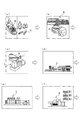
このヒラタキクイムシより虫害を受けない合板の保管方法及び防虫合板について以下に説明する。防虫処理に本発明における防虫合板は、図1から図3に示すように、原木Aの調達(a)ならびに貯木(b)の後、剥皮・玉切(c)、切削・分類(d)、乾燥処理(e)、調板(f)からなる原木加工工程と、接着剤塗布(g)、仮圧着(h)、熱圧着(i)からなる接着工程と、養生・寸法裁断(j)、研磨仕上げ(k)からなる製品仕上げ工程と、保管工程(l)とを経て製造される。 The plywood storage method and the insect-proof plywood that are not affected by insects from this larva will be described below. As shown in FIGS. 1 to 3, the insect-resistant plywood according to the present invention for insect-repelling treatment, after the procurement of raw wood A (a) and after storage (b), peeling, ball cutting (c), cutting / classification (d), Raw wood processing step consisting of drying treatment (e), control board (f), adhesive application (g), temporary pressure bonding (h), bonding step consisting of thermocompression bonding (i), curing / dimension cutting (j), It is manufactured through a product finishing process comprising a polishing finish (k) and a storage process (l).
はじめに、防虫合板の製造工程を図1から図3を用いて詳しく説明する。まず合板の材料であるヒバ材、スギ材、ヒノキ材、カラマツ材、アカマツ材などの原木Aは間伐もしくは輸入などにより調達(a)され、所定の保管場所にて2〜3ヶ月程度貯木(b)された後に製造工程に移るようになっている。このときの木材の含水率を、杉を例にとり説明すると、伐採直後の木材における辺材が148〜159%、心材で55〜113%程度であるが、原木の運搬中及び前述の貯木工程の際に原木Aが乾燥することにより、原木A中に害虫の生育に適した環境が生じ、ヒラタキクイムシの卵及び幼虫ならびに成虫が寄生するおそれがある。 First, the manufacturing process of the insect-proof plywood will be described in detail with reference to FIGS. First, raw wood A such as hiba wood, cedar wood, cypress wood, larch wood, red pine wood, etc., which is a material of plywood, is procured (a) by thinning or importing, etc. and stored in a predetermined storage place for about 2 to 3 months (b ) To move to the manufacturing process. The moisture content of timber at this time is explained by taking cedar as an example. Sapwood in the timber immediately after cutting is 148 to 159%, and heartwood is about 55 to 113%. When the log A is dried, an environment suitable for the growth of the pests is generated in the log A, and there is a possibility that eggs, larvae and adults of the larvae and parasites are infested.
続いて、原木加工工程では、貯木(b)されていた原木Aが皮を剥かれた後に所定の長さにチェーンソー1により玉切り(c)され、さらにロータリーレース2によりかつらむきされて薄い単板状となり、さらにこうして作られた単板は裁断され、表板、中板及び裏板に分類される(d)。なお、この剥皮・玉切(c)、切削・分類(d)の時点ではヒラタキクイムシの駆除はなされていない。
Subsequently, in the raw wood processing step, the raw wood A stored in the storage wood (b) is peeled off and then chopped (c) by the
続いて、単板は約190℃のドライヤー3により乾燥処理(e)される。なお、ヒラタキクイムシは50〜60℃で卵、幼虫及び成虫が死滅するため、この乾燥処理(e)の段階において、原木Aに寄生していた害虫を死滅させることができるとともに、乾燥処理(e)によって単板の含水率が7%未満まで下げられるため、単板中はヒラタキクイムシの生育に適さない環境にすることができる。そのため、仮に乾燥処理(e)中にヒラタキクイムシが飛来してきたとしても、産卵ならびに生育がなされることがない。 Subsequently, the veneer is dried (e) by the dryer 3 at about 190 ° C. In addition, eggs, larvae and adults die at 50-60 ° C., so that the pests parasitizing the log A can be killed at the stage of the drying treatment (e), and the drying treatment (e ) Reduces the moisture content of the veneer to less than 7%, so that the veneer can be made into an environment that is not suitable for the growth of the larvae. For this reason, even if a larva is flying during the drying process (e), egg laying and growth are not performed.
さらに、乾燥処理(e)を終えた単板は、コアビルダー4により選別や補修及び接ぎ合わせを経て、再度表板B1、中板B2及び裏板B3に分類され(f)、接着工程に移る。 Furthermore, the veneer which finished the drying process (e) is classified into the front plate B1, the middle plate B2 and the back plate B3 again after selection, repair and joining by the core builder 4 (f), and moves to the bonding step. .
接着工程では、まずグルーミキサー5で接着剤を調合・攪拌された接着剤が、偶数層に積載される中板B2の表裏両面にスプレッダー6により塗布されて積載されていく(g)。このとき塗布される接着剤には、たとえばシフェノトリンなどの防虫薬剤を混入するようにしてもよい。 In the bonding step, first, the adhesive prepared and stirred by the glue mixer 5 is applied and stacked by the spreader 6 on both the front and back surfaces of the middle plate B2 stacked on the even layer (g). The adhesive applied at this time may be mixed with an insect repellent such as cifenotrin.
接着剤が塗布された合板Cはコールドプレス7により常温で仮圧着(h)された後、熱圧着(i)に移る。熱圧着(i)においては、ホットプレス8により合板Cは約110〜135℃の温度をかけて8〜12kgf/cm2の圧力で圧締されることで接着剤が熱硬化し、合板が成形される。特に、この熱圧着(i)において合板Cが高温となるためにヒラタキクイムシをほぼ全て死滅させることが可能となる。
The plywood C coated with the adhesive is temporarily press-bonded (h) at room temperature by the
成形された合板Cは3〜7日間程度の養生を経てダブルソー9により所定の寸法に裁断・加工され(j)、サンダー10の研磨仕上げ(k)で表面を平滑に研磨された後、保管工程(l)に移る。
After the molded plywood C is cured for about 3 to 7 days, it is cut and processed into a predetermined size by the double saw 9 (j), and the surface is polished smoothly by the polishing finish (k) of the
保管工程(l)において合板Cは、外気と遮断された乾燥室11にて保管されるようになっている。乾燥室10では、ここでは図示しない計測器により合板Cの含水率が計測され、合板Cの含水率が7%未満の状態となるように管理・保管されており、この保管工程(l)は少なくとも2週間程度が望ましく、その後に適宜出荷(m)されるようになっている。
In the storage step (l), the plywood C is stored in the
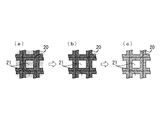
次に、前述した含水率7%以下という状態を図4を用いて説明する。含水率とは木材中の細胞レベルの水分状態を示しており、木材中の水分は(a)に示すように、細胞壁20内にある結合水と、細胞内腔21の中にある自由水とに分かれている。
Next, the state of the moisture content of 7% or less will be described with reference to FIG. The moisture content indicates the moisture state at the cellular level in the wood, and the moisture in the wood includes the bound water in the
(a)は、伐採直後の木材であり、結合水が飽和状態であるとともに、自由水もある程度存在する状態を示しており、含水率は約50%以上である。なお、原木の種類や環境により含水率が大きく異なるため約50%とは限らない。また、この含水率が約50%以上ある環境は、ヒラタキクイムシの生育に適さないため、虫害は起こりづらい。 (A) is wood immediately after cutting, showing that the combined water is saturated and free water is also present to some extent, and the water content is about 50% or more. In addition, since the moisture content varies greatly depending on the type and environment of the raw wood, it is not necessarily about 50%. In addition, an environment having a water content of about 50% or more is not suitable for the growth of the larvae, so that insect damage is unlikely to occur.
(b)は、乾燥処理(図1(e)参照)前の木材であり、伐採後の乾燥が進んだ状態を表している。木材は自由水から蒸発を始めるため、結合水が飽和状態でありながら自由水が完全に消失した状態となっている。これを繊維飽和点と呼び、含水率が約30%でヒラタキクイムシの生育可能な環境である。 (B) is wood before the drying process (see FIG. 1 (e)), and represents a state in which the drying after cutting has progressed. Since wood begins to evaporate from free water, the free water is completely lost while the bound water is saturated. This is called the fiber saturation point, and the water content is about 30%.
(c)は、乾燥処理を行った後の木材であり、乾燥処理では繊維飽和点よりさらに乾燥を進ませるため、含水率を7%未満まで減らした状態となっている。そして前述した保管工程(図3(l)参照)は、この含水率を7%未満まで減らした状態を維持するようになっている。 (C) is the wood after the drying treatment, and in the drying treatment, the moisture content is reduced to less than 7% because the drying proceeds further from the fiber saturation point. And the storage process (refer FIG.3 (l)) mentioned above maintains the state which reduced this moisture content to less than 7%.
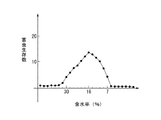
また、含水率の異なる合板をそれぞれ用意して、ヒラタキクイムシの産卵時期である5月下旬から約3ヶ月間にわたり一定期間内の害虫生存数を計測する試験を行った結果、図5に示すように、含水率7%未満の合板において、ヒラタキクイムシの生存率が極めて低いことが確認できた。この試験では、各種含有率を有する略10mm×10mmの試料である合板を用いて、2週間後のヒラタキクイムシの生存率を表した。図5のグラフで明らかなように、16%前後において生存率がピークとなり、含水率7%未満の合板においてはヒラタキクイムシの生存率はほとんど確かめられなかった。 Moreover, as a result of preparing a plywood with different moisture contents and measuring the number of living pests within a certain period from the end of May, which is the egg-laying season of the larvae, as shown in FIG. Furthermore, it was confirmed that the survival rate of the larvae was extremely low in a plywood having a water content of less than 7%. In this test, the survival rate of the larvae after 2 weeks was expressed using a plywood which is a sample of approximately 10 mm × 10 mm having various contents. As is apparent from the graph of FIG. 5, the survival rate peaked at around 16%, and the survival rate of the larvae was hardly confirmed in plywood having a moisture content of less than 7%.
このように本発明の合板Cの保管方法は、原木加工工程と、接着工程と、保管工程により製造される防虫合板において、保管工程(図3(l)参照)において、合板Cの含水率が7%未満の状態となるように保管するため、害虫(特にヒラタキクイムシ)は、約30%から7%までの含水率において生育可能であり、合板を7%未満の含水率の状態とすることにより、害虫の産卵及び発育ならびに生育を防ぎ、合板の保管工程における虫害を効果的に防止することができるのである。特に、害虫の卵期は10日から14日であり、その後幼虫は導管の中を食い進み食害するため、合板を7%未満の含水率の状態で少なくとも2週間継続することにより、保管時において防虫処理状態が達成され、出荷時において内部にほぼ害虫の存在しない防虫合板を出荷できることになる。 Thus, the storage method of the plywood C according to the present invention is that the moisture content of the plywood C is in the storage step (see FIG. 3 (l)) in the insect processing plywood manufactured by the raw wood processing step, the bonding step, and the storage step. In order to store the pests in a state of less than 7%, pests (especially oyster beetles) can grow at a moisture content of about 30% to 7%, and the plywood should have a moisture content of less than 7%. Thus, it is possible to prevent the insects from laying, growing and growing, and effectively preventing insect damage in the plywood storage process. In particular, the insect's egg season is 10 to 14 days, after which the larvae will eat through the conduit and cause damage, so that the plywood is kept at a moisture content of less than 7% for at least 2 weeks. The insect repellent treatment state is achieved, and the insect repellent plywood having almost no pests inside can be shipped at the time of shipment.
一般に、合板の購入者が合板を使用した造作作業を行う際、害虫(特にヒラタキクイムシ)の確認を行うため、通常2週間以上前に購入した合板を使用することが通例であるが、合板内部の平均含水率が7%未満の状態で出荷されるため、購入から使用までの期間中における虫害を無くすことができる。 In general, when a plywood purchaser performs a construction work using plywood, it is customary to use plywood purchased usually more than two weeks ago to check for pests (especially larvae). Since the product is shipped with an average moisture content of less than 7%, insect damage during the period from purchase to use can be eliminated.
また、本実施例によれば、出荷時において、前記合板における中心深部の含水率が7%未満の状態に保たれていることを保証して利用者に出荷するようになっている。合板における中心深部の含水率が7%未満の状態とは、合板が長期間含水率7%未満の乾燥状態にあったことの証拠であり、このため、利用者は図6に示すように、合板Cに含水率計測器22の含水率計測用の針23を挿入し、合板における中心深部の平均含水率を計測するのみで安心して合板を使用できることになる。
Further, according to the present embodiment, at the time of shipment, it is ensured that the moisture content in the center deep portion of the plywood is kept in a state of less than 7% and is shipped to the user. The state where the moisture content in the center deep part of the plywood is less than 7% is evidence that the plywood has been in a dry state with a moisture content of less than 7% for a long time. Therefore, as shown in FIG. By inserting the moisture
1 チェーンソー
2 ロータリーレース
3 ドライヤー
4 コアビルダー
5 グルーミキサー
6 スプレッダー
7 コールドプレス
8 ホットプレス
9 ダブルソー
10 サンダー
11 乾燥室
20 細胞壁
21 細胞内腔
22 含水率計測器
23 含水率計測用の針
A 原木
B1 表板
B2 中板
B3 裏板
C 合板
DESCRIPTION OF
Claims (2)
前記保管工程において、前記合板の含水率が7%未満の状態となるように少なくとも2週間保管することを特徴とする合板の保管方法。 A method for storing plywood produced by at least a raw wood processing step, an adhesion step, and a storage step,
In the storage process, storage process of plywood, characterized in that the moisture content of the plywood is stored for at least 2 weeks so as to be in a state of less than 7%.
Priority Applications (1)
| Application Number | Priority Date | Filing Date | Title |
|---|---|---|---|
| JP2012081670A JP5964112B2 (en) | 2012-03-30 | 2012-03-30 | How to store insect-proof plywood |
Applications Claiming Priority (1)
| Application Number | Priority Date | Filing Date | Title |
|---|---|---|---|
| JP2012081670A JP5964112B2 (en) | 2012-03-30 | 2012-03-30 | How to store insect-proof plywood |
Related Child Applications (1)
| Application Number | Title | Priority Date | Filing Date |
|---|---|---|---|
| JP2016127812A Division JP2016190494A (en) | 2016-06-28 | 2016-06-28 | Insect proof plywood |
Publications (2)
| Publication Number | Publication Date |
|---|---|
| JP2013208852A JP2013208852A (en) | 2013-10-10 |
| JP5964112B2 true JP5964112B2 (en) | 2016-08-03 |
Family
ID=49527197
Family Applications (1)
| Application Number | Title | Priority Date | Filing Date |
|---|---|---|---|
| JP2012081670A Active JP5964112B2 (en) | 2012-03-30 | 2012-03-30 | How to store insect-proof plywood |
Country Status (1)
| Country | Link |
|---|---|
| JP (1) | JP5964112B2 (en) |
Families Citing this family (1)
| Publication number | Priority date | Publication date | Assignee | Title |
|---|---|---|---|---|
| CN113400423A (en) * | 2021-06-11 | 2021-09-17 | 巢湖市友林林业有害生物防治有限公司 | Method for efficiently recovering and treating pine wood nematode disease wood |
Family Cites Families (3)
| Publication number | Priority date | Publication date | Assignee | Title |
|---|---|---|---|---|
| JPS61206410U (en) * | 1985-06-14 | 1986-12-26 | ||
| JP3992441B2 (en) * | 2001-02-02 | 2007-10-17 | 独立行政法人科学技術振興機構 | Method for producing compressed wood |
| JP2005199603A (en) * | 2004-01-16 | 2005-07-28 | Kazuo Komatsu | Method for suppressing egg laying of lyctus brunneus in para-wood material |
-
2012
- 2012-03-30 JP JP2012081670A patent/JP5964112B2/en active Active
Also Published As
| Publication number | Publication date |
|---|---|
| JP2013208852A (en) | 2013-10-10 |
Similar Documents
| Publication | Publication Date | Title |
|---|---|---|
| JP4805432B2 (en) | Chemicals for admixing adhesives used in manufacturing wood materials or wood composite materials | |
| CN101637927A (en) | Mothproof veneer board, mothproof faced veneer board and manufacturing method thereof | |
| JP2001279917A (en) | Woody floor board having mothproof performance | |
| JP2016190494A (en) | Insect proof plywood | |
| JP2013208852A (en) | Insect repellent plywood and storage method of the same | |
| CN201856279U (en) | Insect-preventing plywood and insect-preventing faced plywood | |
| KR101437815B1 (en) | Manufacturing method of chamaecyparis obtusa veneer and furniture attached chamaecyparis obtusa veneer | |
| JP3538411B2 (en) | Dimensional stabilization of wood | |
| CN107825535A (en) | A kind of eucalyptus perfume (or spice) aldehyde-free by wood manufacturing process | |
| CN110509375B (en) | A kind of recombinant wood with antibacterial and antifungal properties and its preparation method | |
| ATE535143T1 (en) | FUNGICIDE EFFECTIVE WOOD Preservative FOR USE IN WOOD FIBER BOARDS | |
| JP2005199603A (en) | Method for suppressing egg laying of lyctus brunneus in para-wood material | |
| JP2007118261A (en) | Insect-proof/termite-repelling wood fiberboard | |
| Muthukrishnan et al. | Degradation of wood and wooden products by insects and their management | |
| CN215660782U (en) | Insect-expelling density plate made of plant fiber particles | |
| KR100798575B1 (en) | Beehives Manufacturing Method | |
| JP5669303B2 (en) | Insect control method for wooden building materials | |
| JP2004249041A (en) | Method for producing bamboo dishes, and the bamboo dishes | |
| CN203198017U (en) | Plywood used for container base plate | |
| JP5688557B2 (en) | Insect control method for wooden building materials | |
| JPS6143501A (en) | Woody material | |
| JPH01101101A (en) | Manufacture of decorative thin veneer | |
| JP7227584B2 (en) | Method for producing wood with excellent moisture retention | |
| CN204682007U (en) | Antibacterial horticultural covering film | |
| Prashanth | DISCUSSION ABOUT THE CARPENTRY PROCESSES |
Legal Events
| Date | Code | Title | Description |
|---|---|---|---|
| A621 | Written request for application examination |
Free format text: JAPANESE INTERMEDIATE CODE: A621 Effective date: 20150324 |
|
| RD04 | Notification of resignation of power of attorney |
Free format text: JAPANESE INTERMEDIATE CODE: A7424 Effective date: 20150525 |
|
| A977 | Report on retrieval |
Free format text: JAPANESE INTERMEDIATE CODE: A971007 Effective date: 20151225 |
|
| A131 | Notification of reasons for refusal |
Free format text: JAPANESE INTERMEDIATE CODE: A131 Effective date: 20160126 |
|
| A521 | Request for written amendment filed |
Free format text: JAPANESE INTERMEDIATE CODE: A523 Effective date: 20160311 |
|
| TRDD | Decision of grant or rejection written | ||
| A01 | Written decision to grant a patent or to grant a registration (utility model) |
Free format text: JAPANESE INTERMEDIATE CODE: A01 Effective date: 20160621 |
|
| A61 | First payment of annual fees (during grant procedure) |
Free format text: JAPANESE INTERMEDIATE CODE: A61 Effective date: 20160629 |
|
| R150 | Certificate of patent or registration of utility model |
Ref document number: 5964112 Country of ref document: JP Free format text: JAPANESE INTERMEDIATE CODE: R150 |
|
| S533 | Written request for registration of change of name |
Free format text: JAPANESE INTERMEDIATE CODE: R313533 |
|
| R350 | Written notification of registration of transfer |
Free format text: JAPANESE INTERMEDIATE CODE: R350 |
|
| R250 | Receipt of annual fees |
Free format text: JAPANESE INTERMEDIATE CODE: R250 |
|
| R250 | Receipt of annual fees |
Free format text: JAPANESE INTERMEDIATE CODE: R250 |
|
| R250 | Receipt of annual fees |
Free format text: JAPANESE INTERMEDIATE CODE: R250 |
|
| R250 | Receipt of annual fees |
Free format text: JAPANESE INTERMEDIATE CODE: R250 |
|
| R250 | Receipt of annual fees |
Free format text: JAPANESE INTERMEDIATE CODE: R250 |
|
| R250 | Receipt of annual fees |
Free format text: JAPANESE INTERMEDIATE CODE: R250 |
|
| R250 | Receipt of annual fees |
Free format text: JAPANESE INTERMEDIATE CODE: R250 |