JP6190875B2 - Process for producing C3-C7 (hydro) fluoroalkene by dehydrohalogenation - Google Patents
Process for producing C3-C7 (hydro) fluoroalkene by dehydrohalogenation Download PDFInfo
- Publication number
- JP6190875B2 JP6190875B2 JP2015509495A JP2015509495A JP6190875B2 JP 6190875 B2 JP6190875 B2 JP 6190875B2 JP 2015509495 A JP2015509495 A JP 2015509495A JP 2015509495 A JP2015509495 A JP 2015509495A JP 6190875 B2 JP6190875 B2 JP 6190875B2
- Authority
- JP
- Japan
- Prior art keywords
- catalyst
- hydro
- alumina
- metal
- nitrogen
- Prior art date
- Legal status (The legal status is an assumption and is not a legal conclusion. Google has not performed a legal analysis and makes no representation as to the accuracy of the status listed.)
- Active
Links
Images


Classifications
-
- C—CHEMISTRY; METALLURGY
- C07—ORGANIC CHEMISTRY
- C07C—ACYCLIC OR CARBOCYCLIC COMPOUNDS
- C07C17/00—Preparation of halogenated hydrocarbons
- C07C17/25—Preparation of halogenated hydrocarbons by splitting-off hydrogen halides from halogenated hydrocarbons
-
- B—PERFORMING OPERATIONS; TRANSPORTING
- B01—PHYSICAL OR CHEMICAL PROCESSES OR APPARATUS IN GENERAL
- B01J—CHEMICAL OR PHYSICAL PROCESSES, e.g. CATALYSIS OR COLLOID CHEMISTRY; THEIR RELEVANT APPARATUS
- B01J21/00—Catalysts comprising the elements, oxides, or hydroxides of magnesium, boron, aluminium, carbon, silicon, titanium, zirconium, or hafnium
- B01J21/02—Boron or aluminium; Oxides or hydroxides thereof
- B01J21/04—Alumina
-
- B—PERFORMING OPERATIONS; TRANSPORTING
- B01—PHYSICAL OR CHEMICAL PROCESSES OR APPARATUS IN GENERAL
- B01J—CHEMICAL OR PHYSICAL PROCESSES, e.g. CATALYSIS OR COLLOID CHEMISTRY; THEIR RELEVANT APPARATUS
- B01J21/00—Catalysts comprising the elements, oxides, or hydroxides of magnesium, boron, aluminium, carbon, silicon, titanium, zirconium, or hafnium
- B01J21/06—Silicon, titanium, zirconium or hafnium; Oxides or hydroxides thereof
- B01J21/066—Zirconium or hafnium; Oxides or hydroxides thereof
-
- B—PERFORMING OPERATIONS; TRANSPORTING
- B01—PHYSICAL OR CHEMICAL PROCESSES OR APPARATUS IN GENERAL
- B01J—CHEMICAL OR PHYSICAL PROCESSES, e.g. CATALYSIS OR COLLOID CHEMISTRY; THEIR RELEVANT APPARATUS
- B01J23/00—Catalysts comprising metals or metal oxides or hydroxides, not provided for in group B01J21/00
- B01J23/02—Catalysts comprising metals or metal oxides or hydroxides, not provided for in group B01J21/00 of the alkali- or alkaline earth metals or beryllium
- B01J23/04—Alkali metals
-
- B—PERFORMING OPERATIONS; TRANSPORTING
- B01—PHYSICAL OR CHEMICAL PROCESSES OR APPARATUS IN GENERAL
- B01J—CHEMICAL OR PHYSICAL PROCESSES, e.g. CATALYSIS OR COLLOID CHEMISTRY; THEIR RELEVANT APPARATUS
- B01J23/00—Catalysts comprising metals or metal oxides or hydroxides, not provided for in group B01J21/00
- B01J23/16—Catalysts comprising metals or metal oxides or hydroxides, not provided for in group B01J21/00 of arsenic, antimony, bismuth, vanadium, niobium, tantalum, polonium, chromium, molybdenum, tungsten, manganese, technetium or rhenium
- B01J23/24—Chromium, molybdenum or tungsten
- B01J23/26—Chromium
-
- B—PERFORMING OPERATIONS; TRANSPORTING
- B01—PHYSICAL OR CHEMICAL PROCESSES OR APPARATUS IN GENERAL
- B01J—CHEMICAL OR PHYSICAL PROCESSES, e.g. CATALYSIS OR COLLOID CHEMISTRY; THEIR RELEVANT APPARATUS
- B01J35/00—Catalysts, in general, characterised by their form or physical properties
- B01J35/60—Catalysts, in general, characterised by their form or physical properties characterised by their surface properties or porosity
- B01J35/61—Surface area
- B01J35/615—100-500 m2/g
-
- B—PERFORMING OPERATIONS; TRANSPORTING
- B01—PHYSICAL OR CHEMICAL PROCESSES OR APPARATUS IN GENERAL
- B01J—CHEMICAL OR PHYSICAL PROCESSES, e.g. CATALYSIS OR COLLOID CHEMISTRY; THEIR RELEVANT APPARATUS
- B01J37/00—Processes, in general, for preparing catalysts; Processes, in general, for activation of catalysts
- B01J37/02—Impregnation, coating or precipitation
- B01J37/0201—Impregnation
-
- B—PERFORMING OPERATIONS; TRANSPORTING
- B01—PHYSICAL OR CHEMICAL PROCESSES OR APPARATUS IN GENERAL
- B01J—CHEMICAL OR PHYSICAL PROCESSES, e.g. CATALYSIS OR COLLOID CHEMISTRY; THEIR RELEVANT APPARATUS
- B01J37/00—Processes, in general, for preparing catalysts; Processes, in general, for activation of catalysts
- B01J37/08—Heat treatment
Landscapes
- Chemical & Material Sciences (AREA)
- Organic Chemistry (AREA)
- Engineering & Computer Science (AREA)
- Materials Engineering (AREA)
- Chemical Kinetics & Catalysis (AREA)
- Physics & Mathematics (AREA)
- Thermal Sciences (AREA)
- Organic Low-Molecular-Weight Compounds And Preparation Thereof (AREA)
- Catalysts (AREA)
- Low-Molecular Organic Synthesis Reactions Using Catalysts (AREA)
Description
本発明は、(ヒドロ)フルオロアルケンを製造する方法、特にC3−7ヒドロ(ハロ)フルオロアルカンの触媒的脱ハロゲン化水素によるC3−7(ヒドロ)フルオロアルケンを製造する方法に関する。 The present invention relates to a process for producing (hydro) fluoroalkenes, in particular to a process for producing C 3-7 (hydro) fluoroalkenes by catalytic dehydrohalogenation of C 3-7 hydro (halo) fluoroalkanes.
本明細書における情報又は既発表文献の掲載又は考察は、当該情報又は文献が技術水準の一部であるか、又は一般常識であることを認めるものとして必ずしも受け取るべきではない。 The publication or discussion of information or published literature in this specification should not necessarily be accepted as admission that the information or literature is part of the state of the art or is common general knowledge.
ヒドロフルオロプロペンなどのC3−7(ヒドロ)フルオロアルケンは、対応するヒドロ(ハロ)フルオロアルカンから脱ハロゲン化水素によって都合良く製造することができる。この変換は、熱的に、即ち熱分解により、触媒的に、即ち適切な条件下でヒドロ(ハロ)フルオロアルカンを触媒と接触させることにより、又は、化学的に、即ち典型的にはヒドロ(ハロ)フルオロアルカンをアルカリ金属水酸化物などの強塩基と接触させることによりもたらすことができる。商業的な操作には、触媒的脱ハロゲン化水素が好ましいと考えられており、下でより詳細に検討している。 C 3-7 (hydro) fluoroalkenes such as hydrofluoropropenes can be conveniently prepared by dehydrohalogenation from the corresponding hydro (halo) fluoroalkanes. This transformation can be done thermally, i.e. by pyrolysis, catalytically, i.e. by contacting the hydro (halo) fluoroalkane with the catalyst under suitable conditions, or chemically, i.e. typically hydro ( It can be provided by contacting the halo) fluoroalkane with a strong base such as an alkali metal hydroxide. For commercial operations, catalytic dehydrohalogenation is considered preferred and is discussed in more detail below.
ヒドロフルオロプロペンである1,1,1,2,3−ペンタフルオロプロペン(HFO−1225ye)は、例えば、気体状態の1,1,1,2,3,3−ヘキサフルオロプロパンを、所望により酸素の存在下で、三価の酸化クロム又は部分的にフッ素化した三価の酸化クロムと接触及び脱フッ素化水素させることにより製造することができる(US5,679,875を参照)。
The
EP−A−1900716は、1,3,3,3−テトラフルオロプロペン(HFO−1234ze)への1,1,3,3,3−ペンタフルオロプロパン(HFC−245fa)の脱フッ素化水素における、フッ素化クロミア、フッ素化アルミナ、金属フッ化物、金属フッ化物、及び炭素担持遷移金属を含む様々な触媒の使用を記載している。 EP-A-1900716 is in dehydrofluorination of 1,1,3,3,3-pentafluoropropane (HFC-245fa) to 1,3,3,3-tetrafluoropropene (HFO-1234ze), Describes the use of various catalysts including fluorinated chromia, fluorinated alumina, metal fluorides, metal fluorides, and carbon-supported transition metals.
WO2008/040969は、対応するヒドロ(ハロ)フルオロプロパンの脱ハロゲン化水素による、HFO−1225ye及び2,3,3,3−テトラフルオロプロペン(HFO−1234yf)を含む様々な(ヒドロ)フルオロプロペンの製造のための亜鉛/クロミア触媒の使用を記載している。 WO 2008/040969 describes various (hydro) fluoropropenes, including HFO-1225ye and 2,3,3,3-tetrafluoropropene (HFO-1234yf), by dehydrohalogenation of the corresponding hydro (halo) fluoropropane. Describes the use of zinc / chromia catalysts for production.
上記の方法にもかかわらず、触媒的脱ハロゲン化水素にはそれ自体の問題があり、問題の1つはその化学作用が本質的に触媒を汚損してしまうと考えられていることによるものである。触媒の汚損は、典型的には、(a)できるだけ穏やかな条件を使用すること、(b)フッ化水素の濃度を高めること、及び(c)分圧が高い不飽和化合物への触媒の暴露を制限すること、の1つ以上によって制御される。 Despite the above methods, catalytic dehydrohalogenation has its own problems, one of which is due to the fact that its chemical action is believed to essentially foul the catalyst. is there. Catalyst fouling typically involves (a) using as mild a condition as possible, (b) increasing the concentration of hydrogen fluoride, and (c) exposing the catalyst to unsaturated compounds with a high partial pressure. Controlled by one or more of the following:
上記の手段(b)及び(c)の使用は、C3−7ヒドロ(ハロ)フルオロアルカンの触媒的脱ハロゲン化水素(特に脱フッ化水素)によるC3−7(ヒドロ)フルオロアルケンの製造においては非常に限定的である。結果的に、操作サイクル及び触媒寿命が一般的に(ヒドロ)フッ素化の化学作用と比べて相対的に短いと考えられている。操作サイクル及び触媒寿命が短いと、より頻繁な触媒の再生又は単純により多くの触媒が必要となり、これらはいずれもコストに影響する。いくつかの触媒、とりわけ特定のアルミナ担持触媒及び/又はジルコニア系触媒は、再生し難い場合がある。これは、使用済み脱ハロゲン化水素触媒中のコークスが燃え難い場合があるためと考えられている。 Use of the above means (b) and (c) makes it possible to produce C 3-7 (hydro) fluoroalkenes by catalytic dehydrohalogenation (especially dehydrofluorination) of C 3-7 hydro (halo) fluoroalkanes. Is very limited. As a result, operational cycles and catalyst life are generally considered to be relatively short compared to (hydro) fluorination chemistries. Shorter operating cycles and catalyst lifetimes require more frequent catalyst regeneration or simply more catalyst, both of which affect cost. Some catalysts, particularly certain alumina-supported catalysts and / or zirconia-based catalysts, may be difficult to regenerate. This is considered because the coke in the used dehydrohalogenated catalyst may not easily burn.
そのため、活性、安定性、及び再生可能性が高い触媒を用いてC3−7(ヒドロ)フルオロアルケンを製造する経済的な方法が必要である。 Therefore, there is a need for an economical method for producing C 3-7 (hydro) fluoroalkene using a catalyst having high activity, stability and reproducibility.
本発明は、アルミナに担持された金属酸化物を含んでなる触媒の存在下でC3−7ヒドロ(ハロ)フルオロアルカンを脱ハロゲン化水素することを含んでなるC3−7(ヒドロ)フルオロアルケンを製造する方法であって、触媒のナトリウム含有量が約800ppm未満である方法を提供することにより前述の及び他の欠陥に対処するものである。 The present invention relates to C 3-7 (hydro) fluoro comprising dehydrohalogenating a C 3-7 hydro (halo) fluoroalkane in the presence of a catalyst comprising a metal oxide supported on alumina. The foregoing and other deficiencies are addressed by providing a method of producing an alkene, wherein the sodium content of the catalyst is less than about 800 ppm.
好ましくは、触媒のナトリウム含有量は500ppm未満であり、より好ましくは400ppm、300ppm、200ppm、又は150ppm未満である。触媒のナトリウム含有量は100、80、60、又は40ppm未満であることが特に好ましい。本発明の触媒において使用される触媒は、30、20、又は10ppm未満含有していてもよい。 Preferably, the sodium content of the catalyst is less than 500 ppm, more preferably less than 400 ppm, 300 ppm, 200 ppm, or 150 ppm. It is particularly preferred that the sodium content of the catalyst is less than 100, 80, 60 or 40 ppm. The catalyst used in the catalyst of the present invention may contain less than 30, 20, or 10 ppm.
ナトリウム含有量は、任意の適切で公知の方法によって測定することができる。特に有用な方法としては、原子吸光(AAS)、及び誘導結合プラズマ発光分光分析(ICP−OES)などの発光分光分析(OES)が挙げられる。本明細書における実施例で用いたナトリウム分析は、英国ヨークシャー州のLondon and Scandanavian Metallurgical CompanyによってICP−OESを用いて行われた。 The sodium content can be measured by any suitable and known method. Particularly useful methods include atomic absorption (AAS) and emission spectroscopy (OES) such as inductively coupled plasma emission spectroscopy (ICP-OES). Sodium analysis used in the examples herein was performed using ICP-OES by London and Scandanavian Metallurgy Company, Yorkshire, UK.
我々は上記で触媒のナトリウム含有量に言及している。一実施形態では、上記で言及したナトリウムの量は、アルミナ担体のナトリウム含有量にも対応する。これは、下でより詳細に検討するように、触媒中に存在するナトリウムは全て、触媒の担体を形成するアルミナの製造から典型的に生じるためである。換言すれば、金属酸化物(例えばジルコニア)は、ナトリウムをほとんど又は全く含んでいなくてもよい。 We mention above the sodium content of the catalyst. In one embodiment, the amount of sodium referred to above also corresponds to the sodium content of the alumina support. This is because, as discussed in more detail below, any sodium present in the catalyst typically arises from the production of alumina that forms the catalyst support. In other words, the metal oxide (eg, zirconia) may contain little or no sodium.
しかしながら、一実施形態では、触媒の金属酸化物には測定可能なナトリウム含有量があってもよい(アルミナ担体中の何らかのナトリウム含有量に代わって、又はより可能性があるのは、それに加えて)。一例としては、例えばクロミアがナトリウム塩から作製された場合には、クロミアは典型的には測定可能な量のナトリウムを含む。 However, in one embodiment, the metal oxide of the catalyst may have a measurable sodium content (in addition to or in lieu of any sodium content in the alumina support). ). As an example, for example, when chromia is made from a sodium salt, chromia typically contains a measurable amount of sodium.
理論によって拘束されるものではないが、本発明の触媒のナトリウム含有量が低いと、本発明に関しての脱ハロゲン化水素反応に必要とされる、触媒中の、例えばアルミナ担体中の、利用できるルイス酸部位が増加すると考えられる。 Without being bound by theory, the low sodium content of the catalyst of the present invention can be used in the catalyst, such as in an alumina support, which is required for the dehydrohalogenation reaction in connection with the present invention. The acid sites are thought to increase.
別の実施形態では、本発明で使用される触媒は、他のアルカリ金属を少量及び/又はアルカリ土類金属を少量含有する。「少量」により、我々はナトリウムに関して上で言及した量を含む。 In another embodiment, the catalyst used in the present invention contains small amounts of other alkali metals and / or small amounts of alkaline earth metals. By “small amount” we include the amount mentioned above for sodium.
典型的には、触媒は、触媒の全重量に対してアルミナ担体を少なくとも約50重量%含有する。一態様では、触媒は、アルミナ担体を少なくとも約60重量%、好ましくは少なくとも約70重量%、例えば少なくとも約80重量%含有する。 Typically, the catalyst contains at least about 50% by weight of alumina support relative to the total weight of the catalyst. In one aspect, the catalyst contains at least about 60% by weight alumina support, preferably at least about 70% by weight, such as at least about 80% by weight.
金属酸化物は、典型的には、触媒の全重量に対して触媒の約50重量%未満を占める。一実施形態では、触媒は、金属酸化物を約40重量%以下、好ましくは約30重量%以下、例えば約20重量%以下含有する。 The metal oxide typically comprises less than about 50% by weight of the catalyst relative to the total weight of the catalyst. In one embodiment, the catalyst contains no more than about 40 wt%, preferably no more than about 30 wt%, such as no more than about 20 wt% metal oxide.
典型的には、金属酸化物中の金属は、ルイス酸の特徴を有する金属(オキシ)フッ化物を形成する任意の金属である。例としては、Sc、Y、Ti、Zr、Hf、V、Nb、Ta、Cr、Mo、W、Mn、Re、Fe、Ru、Co、Rh、Ir、Ni、Pd、Pt、Cu、Ag、Au、Zn、La、及びCeから選択される金属である。好ましくは、金属は、Cr、Zr、Nb、Ta、V、Mo、Ni、又はCoなどの遷移金属である。好ましい実施形態では、金属はジルコニウム又はクロムである。 Typically, the metal in the metal oxide is any metal that forms a metal (oxy) fluoride having the characteristics of a Lewis acid. Examples include Sc, Y, Ti, Zr, Hf, V, Nb, Ta, Cr, Mo, W, Mn, Re, Fe, Ru, Co, Rh, Ir, Ni, Pd, Pt, Cu, Ag, A metal selected from Au, Zn, La, and Ce. Preferably, the metal is a transition metal such as Cr, Zr, Nb, Ta, V, Mo, Ni, or Co. In a preferred embodiment, the metal is zirconium or chromium.
本発明の方法で使用される触媒は、金属酸化物に加えて少なくとも1種の追加金属又はその化合物を含有してもよい。これは、金属促進剤ということもできる。一実施形態では、少なくとも1種の追加金属は、Sc、Y、Ti、Zr、Hf、V、Nb、Ta、Cr、Mo、W、Mn、Re、Fe、Ru、Co、Rh、Ir、Ni、Pd、Pt、Cu、Ag、Au、Zn、La、及びCeから選択される。好ましくは、少なくとも1種の追加金属は、Zn、Zr、Cr、In、Co、及びNiから選択される。 The catalyst used in the process of the present invention may contain at least one additional metal or compound thereof in addition to the metal oxide. This can also be called a metal promoter. In one embodiment, the at least one additional metal is Sc, Y, Ti, Zr, Hf, V, Nb, Ta, Cr, Mo, W, Mn, Re, Fe, Ru, Co, Rh, Ir, Ni. , Pd, Pt, Cu, Ag, Au, Zn, La, and Ce. Preferably, the at least one additional metal is selected from Zn, Zr, Cr, In, Co, and Ni.
誤解を避けるために記載すると、追加金属(又はその化合物)は、所与の触媒に関する金属酸化物の金属と同じであることはできない。例えば、触媒がアルミナ担体に担持されたクロムの酸化物を含んでなる場合、少なくとも1種の追加金属は、クロム以外の、先行する段落で列挙した金属を含む任意の適切な金属でありうる。 For the avoidance of doubt, the additional metal (or compound thereof) cannot be the same as the metal oxide metal for a given catalyst. For example, if the catalyst comprises an oxide of chromium supported on an alumina support, the at least one additional metal can be any suitable metal other than chromium, including the metals listed in the preceding paragraph.
好ましい態様では、追加金属の化合物は、追加金属の酸化物、フッ化物、又はオキシフッ化物である。 In a preferred embodiment, the additional metal compound is an oxide, fluoride, or oxyfluoride of the additional metal.
存在する場合は、本発明の触媒中に存在する追加金属又は追加金属の化合物の全量は、典型的には、触媒の全重量に対して約0.01%〜約25重量%である。追加金属又は追加金属の化合物の好ましい量は、約0.1%〜約20%であり、約0.1%〜約15%であるのが好都合である。いくつかの実施形態では、触媒は、追加金属又は追加金属の化合物を約0.5重量%〜約10重量%、例えば約1〜約8重量%、一例としては約1〜約5重量%含有する。 When present, the total amount of additional metal or compound of additional metal present in the catalyst of the present invention is typically from about 0.01% to about 25% by weight relative to the total weight of the catalyst. The preferred amount of additional metal or compound of additional metal is from about 0.1% to about 20%, conveniently from about 0.1% to about 15%. In some embodiments, the catalyst contains from about 0.5% to about 10%, such as from about 1 to about 8%, such as from about 1 to about 5% by weight of additional metal or compound of additional metal. To do.
本明細書に記載の追加金属又は追加金属の化合物の量は、元素金属として又は金属の化合物として存在しているかに関わらず、元素金属の量を意味すると理解すべきである。 The amount of additional metal or additional metal compound described herein should be understood to mean the amount of elemental metal, whether present as elemental metal or as a compound of metal.
本明細書において特定する少量のナトリウムを有する触媒が得られるのであれば、任意の適切なアルミナ担体が触媒に使用されてもよい。このようなアルミナは、例えば、BASF又はASM Catalysts LLCから市販されている。このアルミナは、例えば硝酸アルミニウムなどの適切なアルミニウム塩を有するアンモニア溶液から、沈殿によって製造してもよい。 Any suitable alumina support may be used for the catalyst provided that a catalyst having a small amount of sodium as specified herein is obtained. Such alumina is commercially available, for example, from BASF or ASM Catalysts LLC. The alumina may be produced by precipitation from an ammonia solution having a suitable aluminum salt such as aluminum nitrate.
本発明に使用される触媒は、市販の低ナトリウムアルミナに金属酸化物と所望により任意の追加金属又はその化合物とを含浸させることにより作製してもよい。これは、触媒製造の技術において公知である任意の適切な手段によって、例えば、金属酸化物(及び任意の追加金属又はその化合物)が適切な熱化学的処理で容易に生成されうる適切な前駆金属塩の1種以上をアルミナに含浸させることによって、達成されてもよい。 The catalyst used in the present invention may be prepared by impregnating commercially available low sodium alumina with a metal oxide and optionally any additional metal or a compound thereof. This is done by any suitable means known in the art of catalyst manufacture, for example, a suitable precursor metal from which a metal oxide (and any additional metal or compound thereof) can be readily produced by a suitable thermochemical treatment. It may be achieved by impregnating alumina with one or more of the salts.
一例として、クロミアはアルミナへは直接含浸させることはできない。したがって、典型的には、水又は他の適切な溶媒に可溶であるクロム塩が含浸に使用される。適切なクロム塩としては、硝酸クロム(III)、及びCr(H2O)6.Cl3などのヘキサアクアクロム錯体が挙げられる。適切な溶媒中でのクロム塩の含浸に続き、及び使用前に、触媒は、例えば150〜500℃の温度で、空気及び/又は窒素中でか焼される。このような触媒の製造の例は、本明細書の一部として援用するEP−A−366797に記載されている。 As an example, chromia cannot be impregnated directly into alumina. Thus, typically a chromium salt that is soluble in water or other suitable solvent is used for impregnation. Suitable chromium salts include chromium (III) nitrate and Cr (H 2 O) 6 . Hexa aqua chromium complexes, such as Cl 3, and the like. Following impregnation of the chromium salt in a suitable solvent and prior to use, the catalyst is calcined in air and / or nitrogen, for example at a temperature of 150-500 ° C. An example of the preparation of such a catalyst is described in EP-A-366797, which is incorporated as part of this specification.
或いは、本発明の方法で使用される触媒は、アンモニア又は水酸化アンモニウムを添加した時の、水などの溶媒における適切なアルミニウム前駆塩の1種以上と金属酸化物(及び任意の追加金属又はその化合物)の適切な前駆金属塩との共沈によって製造されてもよい。得られた析出物の熱化学的処理(例えばか焼)によって所望の触媒が生じる。 Alternatively, the catalyst used in the process of the present invention can be one or more suitable aluminum precursor salts and a metal oxide (and any additional metal or any of its additional metals in a solvent such as water when ammonia or ammonium hydroxide is added. Compound) may be prepared by coprecipitation with a suitable precursor metal salt. Thermochemical treatment (eg, calcination) of the resulting precipitate produces the desired catalyst.
本発明の触媒の他の製造方法は蒸着によるものである。これは、適切な揮発性を有する金属化合物の蒸気と担体を接触させることによって担体を含浸させることを伴う。この接触の際に担体を加熱して蒸気の分解をもたらし、これにより活性金属化合物を担体に含浸させることを可能にすることが望ましい場合がある。適切な揮発性を有する化合物としては、ジメチル亜鉛などのアルキル化合物又はヘキサカルボニルクロムなどのカルボニル錯体が挙げられる。例えば、本明細書の一部として援用する「The design and Preparation of Supported Catalysts」、G.J.K. Acresら、Catalysis、1981年(RSC)を参照されたい。 Another method for producing the catalyst of the present invention is by vapor deposition. This involves impregnating the support by contacting the support with a vapor of a metal compound of suitable volatility. It may be desirable to heat the support during this contact to cause vapor decomposition, thereby allowing the support to be impregnated with the active metal compound. Suitable compounds having volatility include alkyl compounds such as dimethylzinc or carbonyl complexes such as hexacarbonylchromium. See, for example, “The design and Preparation of Supported Catalysts”, GJK Acres et al., Catalysis, 1981 (RSC), which is incorporated herein by reference.
本発明で使用する低ナトリウム触媒は、アルミナに担持された金属酸化物を含有する。例としては、(低ナトリウム)アルミナに担持されたクロミア又はジルコニア、即ち(低ナトリウム)アルミナに担持された酸化クロム又は酸化ジルコニウムが挙げられる。C3−7ヒドロ(ハロ)フルオロアルカンと接触させて脱ハロゲン化水素をもたらす前に、本発明で使用する触媒は、典型的には、フッ素化によって前処理される。このような前処理は当技術分野において公知であり、一般的に、窒素ガス下で高温にて触媒を乾燥させ、続いて高温にてHF(所望により窒素で希釈されている)による前フッ素化を伴う。 The low sodium catalyst used in the present invention contains a metal oxide supported on alumina. Examples include chromia or zirconia supported on (low sodium) alumina, ie chromium oxide or zirconium oxide supported on (low sodium) alumina. Prior to contact with the C 3-7 hydro (halo) fluoroalkane to provide dehydrohalogenation, the catalyst used in the present invention is typically pretreated by fluorination. Such pretreatment is well known in the art and generally involves drying the catalyst at high temperature under nitrogen gas, followed by prefluorination with HF (optionally diluted with nitrogen) at high temperature. Accompanied by.
結果的に、元の触媒(前触媒とも呼ぶ)は(低ナトリウム)アルミナに担持された金属酸化物(例えば、クロミア又はジルコニア)であるが、脱ハロゲン化水素の開始時に使用される触媒は、典型的には、部分的に又は完全にフッ素化された低ナトリウムアルミナ(例えば、アルミナオキシフッ化物又はアルミナフッ化物)に担持された部分的に又は完全にフッ素化された金属酸化物(即ち、金属オキシフッ化物又は金属フッ化物)である。これは、前処理の際に触媒中の酸素原子のうちの少なくともいくつかがフッ素原子によって置き換えられるためである。さらに、C3−7(ヒドロ)フルオロアルケンの脱ハロゲン化水素反応の際の使用において、触媒のフッ素含有量は増加すると予想される。 As a result, the original catalyst (also called precatalyst) is a metal oxide (eg, chromia or zirconia) supported on (low sodium) alumina, but the catalyst used at the start of dehydrohalogenation is: Typically, partially or fully fluorinated metal oxides (ie, metals) supported on partially or fully fluorinated low sodium alumina (eg, alumina oxyfluoride or alumina fluoride) Oxyfluoride or metal fluoride). This is because at least some of the oxygen atoms in the catalyst are replaced by fluorine atoms during the pretreatment. Furthermore, the fluorine content of the catalyst is expected to increase in use during the dehydrohalogenation reaction of C 3-7 (hydro) fluoroalkene.
本発明で使用する触媒は非晶質であってもよい。これにより、我々は、例えばX線回折によって分析した場合に、触媒が実質的な結晶性の特徴を示さないことを意味する。或いは、触媒は、アルミナ担体及び/又は金属酸化物において、何らかの結晶性の特徴を示してもよい。 The catalyst used in the present invention may be amorphous. By this we mean that the catalyst does not show substantial crystalline character, for example when analyzed by X-ray diffraction. Alternatively, the catalyst may exhibit some crystalline character in the alumina support and / or metal oxide.
前処理に供される前には、本発明の触媒は、典型的には、表面積が少なくとも50m2/g、一例としては50〜約350又は400m2/g、好ましくは約70〜約250m2/g、例えば約100〜約200m2/gである。前フッ素化処理は、典型的には、触媒の表面積を低下させる効果がある。前フッ素化処理の後、本発明の触媒は、典型的には、表面積が約10〜約300m2/g、好ましくは約20〜約200m2/g、例えば約50〜150m2/gである。 Prior to being subjected to pretreatment, the catalyst of the present invention typically has a surface area of at least 50 m 2 / g, for example 50 to about 350 or 400 m 2 / g, preferably about 70 to about 250 m 2. / G, for example from about 100 to about 200 m 2 / g. The prefluorination treatment typically has the effect of reducing the surface area of the catalyst. After pre-fluorination treatment the catalysts of the present invention is typically from about 10 to about 300 meters 2 / g, the surface area is preferably from about 20 to about 200 meters 2 / g, for example from about 50 to 150 m 2 / g .
本発明の触媒は、当技術分野において公知である任意の適切な形状で提供されてもよい。例えば、触媒は、固定床又は流動床での使用に適した大きさのペレット又は顆粒の形状で提供されてもよい。 The catalyst of the present invention may be provided in any suitable form known in the art. For example, the catalyst may be provided in the form of pellets or granules of a size suitable for use in a fixed bed or fluidized bed.
使用時には、触媒は、約300℃〜約500℃の温度にて空気中で加熱することにより定期的に再生又は再活性化されてもよい。空気は、窒素などの不活性ガスとの又はフッ化水素との混合物として使用されてもよく、これは触媒処理工程から高温で出現し、再活性化された触媒を採用するフッ素化工程で直接使用されてもよい。本発明の方法からの使用済み触媒は、典型的には、公知のアルミナ触媒と比べて再生するのが予想外に容易であることが分かった。本発明のクロミアがアルミナに担持された低ナトリウム触媒は、再生するのが特に容易であると考えられる。 In use, the catalyst may be periodically regenerated or reactivated by heating in air at a temperature of about 300 ° C to about 500 ° C. Air may be used as a mixture with an inert gas such as nitrogen or with hydrogen fluoride, which emerges at high temperatures from the catalyst treatment process and directly in the fluorination process employing a reactivated catalyst. May be used. It has been found that the spent catalyst from the process of the present invention is typically unexpectedly easier to regenerate than known alumina catalysts. The low sodium catalyst in which the chromia of the present invention is supported on alumina is considered to be particularly easy to regenerate.
典型的には、本発明の方法は、添加したフッ化水素(HF)の有無にかかわらず、気相又は液相(好ましくは気相)でC3−7ヒドロ(ハロ)フルオロアルカンを接触させることを含んでなり、0〜400℃、例えば、50〜400℃の温度で行われてもよい。特定の好ましい実施形態では、方法は、HFを同時に供給しないで行われてもよい。方法は、大気圧、大気圧未満、又は大気圧より高い気圧、好ましくは約30bara以下、例えば約1〜約25baraで行われてもよい。 Typically, the method of the invention contacts a C 3-7 hydro (halo) fluoroalkane in the gas phase or liquid phase (preferably the gas phase) with or without added hydrogen fluoride (HF). May be performed at a temperature of 0 to 400 ° C., for example, 50 to 400 ° C. In certain preferred embodiments, the method may be performed without simultaneously supplying HF. The process may be carried out at atmospheric pressure, below atmospheric pressure or above atmospheric pressure, preferably below about 30 bara, for example from about 1 to about 25 bara.
好ましくは、ヒドロ(ハロ)フルオロアルカンは、200〜360℃、より好ましくは240〜320℃の温度にてHFを用いずに(例えば、HF供給物無しで)気相中で接触される。好ましくは、方法は1〜20baraの圧力で実施される。もちろん、当業者であれば、本発明の方法を実施するために好ましい条件(例えば、温度、圧力)は、ヒドロ(ハロ)フルオロアルカン及び(ヒドロ)フルオロアルケンの性質並びに採用されている触媒に応じて、異なりうる(上記の範囲外でさえある)ことを理解するであろう。 Preferably, the hydro (halo) fluoroalkane is contacted in the gas phase without HF (eg, without HF feed) at a temperature of 200-360 ° C, more preferably 240-320 ° C. Preferably, the process is carried out at a pressure of 1-20 bara. Of course, those skilled in the art will appreciate that the preferred conditions (eg, temperature, pressure) for carrying out the process of the present invention depend on the nature of the hydro (halo) fluoroalkane and (hydro) fluoroalkene and the catalyst employed. Will be understood (even outside the above range).
本発明の方法は、静的ミキサー、撹拌槽型反応器、又は撹拌型気液分離容器などの任意の適切な装置で行うことができる。方法は、バッチ式又は連続的に行われてもよい。バッチ式の方法又は連続的な方法のどちらも、「ワンポット」様式で、或いは2つ以上の別個の反応領域及び/又は反応容器を用いて行ってもよい。もちろん、「連続的な」方法であっても、当業者であれば、例えばメンテナンス及び/又は触媒再生のために、方法を定期的に休止させる必要があることを理解するであろう。 The method of the present invention can be carried out in any suitable apparatus such as a static mixer, a stirred tank reactor, or a stirred gas-liquid separation container. The method may be performed batchwise or continuously. Either a batch or continuous process may be performed in a “one-pot” fashion, or using two or more separate reaction zones and / or reaction vessels. Of course, even a “continuous” process will be understood by those skilled in the art that the process needs to be periodically paused, eg, for maintenance and / or catalyst regeneration.
脱フッ化水素は、HF供給物の非存在下で行うことができるが、有機供給物の過度の分解及び/又は触媒のコークス化を防止しかつ/又は遅延させるために、多少のHFを使用することが特定の実施形態では望ましい場合がある。典型的には、HF供給物が利用される場合、本発明の方法におけるHF:有機物の割合は、約0.01:1〜約1:1、好ましくは約0.1:1〜約1:1、さらに好ましくは約0.5:1〜約1:1の範囲に及ぶことになる。 Dehydrofluorination can be performed in the absence of HF feed, but some HF is used to prevent and / or retard excessive degradation of the organic feed and / or catalyst coking. This may be desirable in certain embodiments. Typically, when an HF feed is utilized, the HF: organic ratio in the process of the present invention is about 0.01: 1 to about 1: 1, preferably about 0.1: 1 to about 1 :. 1, more preferably in the range of about 0.5: 1 to about 1: 1.
別記されない限り、本明細書では、(ヒドロ)フルオロアルケンは、少なくとも1個の水素原子がフッ素と置き換えられたアルケンである。 Unless stated otherwise herein, (hydro) fluoroalkene is an alkene in which at least one hydrogen atom has been replaced with fluorine.
別記されない限り、本明細書では、ヒドロ(ハロ)フルオロアルカンは、全部ではないが少なくとも1個の水素原子がフッ素原子と置き換えられ、所望により少なくとも1個の水素原子が塩素、臭素、及びヨウ素から選択されるハロゲンと置き換えられたアルカンである。よって、ヒドロ(ハロ)フルオロアルカンは、水素を少なくとも1個、フッ素を少なくとも1個、所望により塩素、臭素、及びヨウ素から選択されるハロゲンを少なくとも1個含有する。換言すると、ヒドロ(ハロ)フルオロアルカンの定義には、ヒドロフルオロアルカン、即ち全部ではないが少なくとも1個の水素原子がフッ素と置き換えられたアルカン、が含まれる。 Unless stated otherwise, hydro (halo) fluoroalkanes as used herein, if not all, replace at least one hydrogen atom with a fluorine atom and optionally at least one hydrogen atom from chlorine, bromine, and iodine. Alkanes replaced with selected halogens. Thus, a hydro (halo) fluoroalkane contains at least one hydrogen, at least one fluorine, and optionally at least one halogen selected from chlorine, bromine, and iodine. In other words, the definition of hydro (halo) fluoroalkane includes hydrofluoroalkanes, ie alkanes in which at least one but not all of the hydrogen atoms are replaced by fluorine.
誤解を避けるために記載すると、本明細書では、C3−7(ヒドロ)フルオロアルケン、ヒドロフルオロアルカン、又はヒドロ(ハロ)フルオロアルカンに対する言及はすべて、炭素原子を3〜7個有する(ヒドロ)フルオロアルケン、ヒドロフルオロアルカン、又はヒドロ(ハロ)フルオロアルカン、即ちヒドロ(ハロ)フルオロ−プロパン、ブタン、ペンタン、ヘキサン又はヘプタン、或いは(ヒドロ)フルオロ−プロペン、ブテン、ペンテン、ヘキサン又はヘプテンを意味する。 For the avoidance of doubt, all references to C 3-7 (hydro) fluoroalkene, hydrofluoroalkane, or hydro (halo) fluoroalkane herein have 3 to 7 carbon atoms (hydro). Means fluoroalkene, hydrofluoroalkane or hydro (halo) fluoroalkane, ie hydro (halo) fluoro-propane, butane, pentane, hexane or heptane, or (hydro) fluoro-propene, butene, pentene, hexane or heptene .
本発明の方法により製造される(ヒドロ)フルオロアルケンは二重結合を含有し、よって各個別二重結合でE(entgegen)及びZ(zusammen)幾何異性体として存在しうる。すべてのこのような異性体及びその混合物が本発明の範囲内に含まれる。 The (hydro) fluoroalkene produced by the process of the present invention contains double bonds and can therefore exist as E (entgegen) and Z (zusammen) geometric isomers at each individual double bond. All such isomers and mixtures thereof are included within the scope of the present invention.
別記されない限り、本明細書では、「脱ハロゲン化水素」(又は脱ハロゲン化水素する)という用語によって、我々は、例えばヒドロ(ハロ)フルオロアルカンからの、ハロゲン化水素(例えば、HF、HCl、HBr、又はHI)の除去を意味する。よって、用語「脱ハロゲン化水素」は、ヒドロ(ハロ)フルオロアルカンの「脱フッ化水素」、「脱塩化水素」、「脱臭化水素」、及び「脱ヨウ化水素」を含む。 Unless otherwise stated herein, by the term “dehydrohalogenated” (or dehydrohalogenated) we use hydrogen halides (eg, HF, HCl, It means the removal of HBr or HI). Thus, the term “dehydrohalogenated” includes “dehydrofluorinated”, “dehydrochlorinated”, “dehydrobrominated”, and “dehydroiodinated” of hydro (halo) fluoroalkanes.
本発明の方法は、C3−7ヒドロ(ハロ)フルオロアルカンを脱ハロゲン化水素する(例えば、脱フッ化水素するか又は脱塩化水素する)ことによって任意のC3−7(ヒドロ)フルオロアルケンを製造するのに適している。所望により、C3−7ヒドロ(ハロ)フルオロアルカンはまず、C3−7ヒドロフルオロアルカンまでフッ素化されてもよく、次いでC3−7(ヒドロ)フルオロアルケンまで脱フッ化水素されてもよい。 The method of the present invention provides any C 3-7 (hydro) fluoroalkene by dehydrohalogenating (eg, dehydrofluorinating or dehydrochlorinating) a C 3-7 hydro (halo) fluoroalkane. Suitable for manufacturing. If desired, C 3-7 hydro (halo) fluoroalkane First, C 3-7 may be fluorinated to hydrofluoroalkanes, then C 3-7 (hydro) until fluoroalkene may be dehydrofluorinated .
好ましくは、C3−7(ヒドロ)フルオロアルケンは、ヒドロ(ハロ)フルオロプロパンの脱ハロゲン化水素によって製造された(ヒドロ)フルオロプロペンである。本発明は、(ヒドロ)フルオロプロペン及び(ヒドロ)フルオロブテン、特に(ヒドロ)フルオロプロペンの製造に特に適している。 Preferably, the C 3-7 (hydro) fluoroalkene is a (hydro) fluoropropene prepared by dehydrohalogenation of hydro (halo) fluoropropane. The invention is particularly suitable for the production of (hydro) fluoropropene and (hydro) fluorobutene, in particular (hydro) fluoropropene.
一例として及び簡素化のため、別記されない限り、明細書の残りの部分では(ヒドロ)フルオロプロペンの製造を参照して本発明の方法を記載する。当業者であれば、このような考察がC4−7(ヒドロ)フルオロアルケンの製造にも等しく適用可能であることを理解するであろう。 By way of example and for simplicity, unless otherwise stated, the remainder of the specification describes the method of the invention with reference to the preparation of (hydro) fluoropropene. One skilled in the art will appreciate that such considerations are equally applicable to the production of C 4-7 (hydro) fluoroalkenes.
本発明の方法によって製造された(ヒドロ)フルオロプロペンは、水素原子を0、1、2、3、4又は5個及びフッ素原子を1、2、3、4、5又は6個含有していてもよい。好ましい(ヒドロ)フルオロプロペンは、フッ素原子を3〜5個(よって水素原子を1〜3個)、特にフッ素原子を4又は5個(よって水素原子を1又は2個)有するものである。換言すれば、好ましい(ヒドロ)フルオロプロペンは、トリフルオロプロペン、テトラフルオロプロペン、及びペンタフルオロプロペン、特にテトラフルオロプロペン及びペンタフルオロプロペン、とりわけテトラフルオロプロペンである。 The (hydro) fluoropropene produced by the process of the present invention contains 0, 1, 2, 3, 4 or 5 hydrogen atoms and 1, 2, 3, 4, 5 or 6 fluorine atoms. Also good. Preferred (hydro) fluoropropenes are those having 3 to 5 fluorine atoms (and thus 1 to 3 hydrogen atoms), in particular 4 or 5 fluorine atoms (and thus 1 or 2 hydrogen atoms). In other words, preferred (hydro) fluoropropenes are trifluoropropene, tetrafluoropropene, and pentafluoropropene, especially tetrafluoropropene and pentafluoropropene, especially tetrafluoropropene.
本発明の方法によって製造される好ましいトリフルオロプロペンは、3,3,3−トリフルオロプロペン(HFO−1243zf)である。 A preferred trifluoropropene produced by the process of the present invention is 3,3,3-trifluoropropene (HFO-1243zf).
1,3,3,3−テトラフルオロプロペン(HFO−1234ze、シス及びトランス異性体の両方)及び2,3,3,3−テトラフルオロプロペン(HFO−1234yf)は、本発明の方法によって製造される好ましいテトラフルオロプロペンである。 1,3,3,3-tetrafluoropropene (HFO-1234ze, both cis and trans isomers) and 2,3,3,3-tetrafluoropropene (HFO-1234yf) are produced by the method of the present invention. Preferred tetrafluoropropene.
本発明の方法によって製造される好ましいペンタフルオロプロペンは、1,2,3,3,3−ペンタフルオロプロペン(HFO−1225ye、シス及びトランス異性体の両方)である。 The preferred pentafluoropropene produced by the process of the present invention is 1,2,3,3,3-pentafluoropropene (HFO-1225ye, both cis and trans isomers).
本発明の方法によって作製することができる(ヒドロ)フルオロプロペンは、多数のヒドロ(ハロ)フルオロプロパンのうちの1種以上から開始して製造されてもよい。 The (hydro) fluoropropenes that can be made by the method of the present invention may be prepared starting from one or more of a number of hydro (halo) fluoropropanes.
HFO−1243zfは、Xがハロゲン(F、Cl、Br、I)であるCF3CH2CH2Xというタイプの化合物の脱ハロゲン化水素によって好都合に製造することができる。XがF又はClであるこのタイプの化合物、つまりCF3CH2CH2F(HFC−254fb)又はCF3CH2CH2Cl(HFC−253fb)が特に好ましい。 HFO-1243zf can be conveniently prepared by dehydrohalogenation of compounds of the type CF 3 CH 2 CH 2 X where X is a halogen (F, Cl, Br, I). Especially preferred are compounds of this type where X is F or Cl, ie CF 3 CH 2 CH 2 F (HFC-254fb) or CF 3 CH 2 CH 2 Cl (HFC-253fb).
好ましい実施形態では、HFO−1234yfは、1,1,1,2,2−ペンタフルオロプロパン(HFC−245cb)又は1,1,1,2,3−ペンタフルオロプロパン(HFC−245ea)の脱フッ化水素によって製造される。 In a preferred embodiment, HFO-1234yf is defluorinated of 1,1,1,2,2-pentafluoropropane (HFC-245cb) or 1,1,1,2,3-pentafluoropropane (HFC-245ea). Produced by hydrogen fluoride.
好ましくは、HFO−1234zeは、1,1,1,3,3−ペンタフルオロプロパン(HFC−245fa)の脱フッ化水素によって製造される。 Preferably, HFO-1234ze is produced by dehydrofluorination of 1,1,1,3,3-pentafluoropropane (HFC-245fa).
好ましい態様では、HFO−1225yeは、1,1,1,2,3,3−ヘキサフルオロプロパン(HFC−236ea)の脱フッ化水素によって製造される。 In a preferred embodiment, HFO-1225ye is produced by dehydrofluorination of 1,1,1,2,3,3-hexafluoropropane (HFC-236ea).
本発明は以下の非制限例で実証されている。 The invention is demonstrated in the following non-limiting examples.
比較例1 − 1234zeへの245faの脱フッ化水素(高Na ZrO 2 /アルミナ)
この例は、高ナトリウムアルミナ担持ジルコニウム触媒を用いたHFO−1234zeへのHFC−245faの脱フッ化水素を記載する。
Comparative Example 1 245fa dehydrofluorination (high Na 2 ZrO 2 / alumina) to 1234ze
This example describes dehydrofluorination of HFC-245fa to HFO-1234ze using a high sodium alumina supported zirconium catalyst.
触媒の製造
オキシ塩化ジルコニウム(IV)八水和物(10.4467g)の無水エタノール(463g)溶液で50ml(39.2925g)のアルミナ球体(直径が5mm及び表面積が310m2/gでナトリウム含有量が2340ppmのものをAldrichから入手)を一晩含浸させた。次いでエタノールを真空下で留去し、最後に触媒を再び真空下150℃で乾燥させた。製造された状態では、触媒のZr充填量は名目上7.5%wt/wt(触媒の実際のZr充填量を測定すると1.81%wt/wtであることが分かった)であり、含浸した触媒の表面積は251.33m2/gであった。
Preparation of
触媒の試験
Zr/アルミナ触媒を、未希釈の245fa供給物を用いて大気圧で試験した。大気試験装置は反応管を2本備えており、それぞれ独立したHF、有機物、及び窒素供給物を有していた。この研究のため、各反応管に上に記載の触媒を充填した(反応器A5ml及び反応器B2ml)。両方の反応器の触媒をまず窒素下(60ml/分)200℃で72時間乾燥させた。次いで、これらを、窒素中で希釈したHF(30ml/分のHF及び20ml/分のN2)により200℃で1時間、前フッ素化した。この時点で窒素流を停止し、触媒を未希釈のHFで処理し、温度を200℃から450℃に40℃/時で上昇させた。これらの条件をさらに1時間維持した後、触媒を200℃に冷却した。次いでHF流を停止し、窒素流(60ml/分)と置き換え、反応器のオフガスにさらなるHFが検出されなくなった時点で触媒は使用できる状態となった。
Catalyst Testing Zr / alumina catalysts were tested at atmospheric pressure using an undiluted 245fa feed. The atmospheric test apparatus was equipped with two reaction tubes, each with independent HF, organics, and nitrogen supplies. For this study, each reaction tube was filled with the catalyst described above (5 ml reactor A and 2 ml reactor B). The catalyst in both reactors was first dried for 72 hours at 200 ° C. under nitrogen (60 ml / min). They were then prefluorinated with HF diluted in nitrogen (30 ml / min HF and 20 ml / min N 2 ) at 200 ° C. for 1 hour. At this point, the nitrogen flow was stopped, the catalyst was treated with undiluted HF, and the temperature was increased from 200 ° C. to 450 ° C. at 40 ° C./hour. After maintaining these conditions for an additional hour, the catalyst was cooled to 200 ° C. The HF flow was then stopped and replaced with a nitrogen flow (60 ml / min) and the catalyst was ready for use when no more HF was detected in the reactor off-gas.
次いで245fa(20ml/分)を反応器(A)に供給し、約40%の245fa変換率が達成されるまで反応器温度を調節した。これらの条件を維持し、反応器のオフガスを定期的にサンプリングした。必要な場合は、245fa変換率が40%前後の目標水準を維持するように340℃の任意限界まで反応器温度を上昇させた。245fa(10〜30ml/分)を反応器(B)にも供給し、変換率及び収率を温度及び接触時間に応じて決定した。 245fa (20 ml / min) was then fed into the reactor (A) and the reactor temperature was adjusted until a 245fa conversion of about 40% was achieved. These conditions were maintained and the reactor off-gas was sampled periodically. When necessary, the reactor temperature was raised to an arbitrary limit of 340 ° C. so that the 245fa conversion rate maintained a target level of around 40%. 245fa (10-30 ml / min) was also fed into the reactor (B) and the conversion and yield were determined according to temperature and contact time.
実験は、HFを同時に供給しないで大気圧で行った。結果を表1に示し、図1に図示する。 The experiment was conducted at atmospheric pressure without simultaneously supplying HF. The results are shown in Table 1 and illustrated in FIG.
反応は250℃で直ちに開始し、予想通りに未反応の245faと1234zeのE及びZ異性体との混合物が得られた。目標の245fa変換率は約300℃で達成された。この変換率は、温度を最終的にはこの実験の限界である340℃まで上昇させることによって約213時間維持された。通常の操作では、副産物はGC分析法の検出限界未満であったので検出されなかった。しかしながら、さらに濃縮された試料を定期的に採取し、これら試料においては副産物であるトリフルオロメチルアセチレン及び1234zc(F2C=CH2CHF2)を、定量はできなかったが、検出できた。データには相当な散乱があったが、これは、例えば供給物貯留部の補充又は週末などに起因する中断などの後に起こる供給物の乱れ(upsets)と一致する傾向があった。これら乱れに起因する凸部及び凹部を差し引くと、触媒の性能は213時間の実験にわたって徐々に低下したと考えられる。 The reaction started immediately at 250 ° C. and, as expected, a mixture of unreacted 245fa and 1234ze E and Z isomers was obtained. The target 245fa conversion was achieved at about 300 ° C. This conversion was maintained for about 213 hours by raising the temperature to 340 ° C., the limit of this experiment. In normal operation, no by-product was detected because it was below the detection limit of the GC analysis method. However, further concentrated samples were taken periodically, and in these samples, trifluoromethylacetylene and 1234zc (F 2 C═CH 2 CHF 2 ), which were byproducts, could not be quantified but could be detected. There was considerable scatter in the data, but this tended to be consistent with feed upsets that occurred after, for example, a supply reservoir refill or a break due to a weekend or the like. Subtracting the protrusions and recesses due to these disturbances, the catalyst performance is thought to have gradually declined over the 213 hour experiment.
表1中のデータを統合することにより、213時間の実験の間の平均245fa変換率は43.7%であったと示すことができる。E−1234zeへの平均選択率は81%であり、したがってE:Z異性体の平均割合は4.26:1であった。1m3規模(触媒の)では、平均E−1234ze生成率は0.47te/時に相当したことになる。213時間の最後には、触媒の表面積は27.8m2/gと測定され、TGAによって測定された触媒上のコークス量は2.1%wtであり、コークスは非常に難燃性であった。 By integrating the data in Table 1, it can be shown that the average 245fa conversion during the 213 hour experiment was 43.7%. The average selectivity to E-1234ze was 81%, so the average ratio of E: Z isomer was 4.26: 1. In 1 m 3 scale (catalyst), the average E-1234ze production rate will be corresponded during 0.47te /. At the end of 213 hours, the surface area of the catalyst was measured as 27.8 m 2 / g, the amount of coke on the catalyst as measured by TGA was 2.1% wt, and the coke was very flame retardant. .
窒素(60ml/分)中で希釈した空気(3ml/分)を用いて340、380、及び450℃にて反応器中で触媒のその場(in situ)再生を試みた。これら再生を組み合わせたものはコークスを除去するのには効果的であったが、触媒の活性をその初期の活性のようにまで回復させるのには効果的ではなかった。よって、このアルミナ担持触媒の寿命は、一回の運転サイクルに限られたものであった。 An in situ regeneration of the catalyst was attempted in the reactor at 340, 380 and 450 ° C. using air (3 ml / min) diluted in nitrogen (60 ml / min). The combination of these regenerations was effective in removing coke, but not in restoring the activity of the catalyst to its initial activity. Therefore, the lifetime of this alumina-supported catalyst was limited to one operation cycle.
温度及び接触時間の研究
この実験の目的は、温度及び接触時間の変化に対する反応の応答を測定し、根底にある反応の動力学及び熱力学を調査すべくデータを使用することであった。反応器を分化条件に近似させるため、比較的少量の触媒を投入し、接触時間を短くした。表2にデータをまとめる。
Temperature and Contact Time Studies The purpose of this experiment was to measure the response of the reaction to changes in temperature and contact time, and to use the data to investigate the underlying reaction kinetics and thermodynamics. In order to approximate the reactor to the differentiation conditions, a relatively small amount of catalyst was added to shorten the contact time. Table 2 summarizes the data.
すべてのデータセットに最も適合した速度式は、錯体平衡A=B+Cに関するものであることが分かった:
この速度則を用いて得られたデータに対するあてはめの精度(quality of the fits)は、図2を精査することによって理解することができる。この方程式に各データセットをあてはめることによって、正味の速度定数(net rate constants)並びに平衡245fa、1234ze、及びHF量を決定することが可能であった。速度定数を用いて反応のアレニウスパラメータを計算し、平衡データを用いて平衡定数を計算した。次いでこれらを用いて反応の自由エネルギー、続いて反応の熱及びエントロピーを決定した。結果的に、ファントホッフの式を用いることにより任意の温度における平衡定数を計算することが可能であった。重要なデータ及び計算したパラメータを表3に示し、図3に図示する。 The quality of the fits for the data obtained using this speed law can be understood by examining FIG. By fitting each data set to this equation, it was possible to determine net rate constants as well as equilibrium 245fa, 1234ze, and HF amounts. The Arrhenius parameters of the reaction were calculated using rate constants, and the equilibrium constants were calculated using equilibrium data. These were then used to determine the free energy of the reaction, followed by the heat and entropy of the reaction. As a result, it was possible to calculate the equilibrium constant at an arbitrary temperature by using the Vanthoff equation. The important data and calculated parameters are shown in Table 3 and illustrated in FIG.
図3に図示したアレニウスプロットから、以下のことを計算することができた:
・活性化エネルギー(Eact)=55.7kJ/mol
・Ln頻度因子(Ln A)=10.756
From the Arrhenius plot illustrated in FIG. 3, the following could be calculated:
Activation energy (E act ) = 55.7 kJ / mol
Ln frequency factor (Ln A) = 10.756
同様に、dGr対温度のプロットから、以下のことを計算することができた:
・反応熱(dHr)=+74.76kJ/mol
・反応のエントロピー(dSr)=+123.17J/mol.K
Similarly, from a plot of dG r vs. temperature, the following could be calculated:
Heat of reaction (dH r ) = + 74.76 kJ / mol
Reaction entropy (dS r ) = + 123.17 J / mol. K
したがって、任意の温度における平衡定数はファントホッフの式を用いて計算することができる:
例2 − 1234zeへの245faの脱フッ化水素(低Na Cr 2 O 3 /アルミナ)
この例に用いた触媒は、245faの脱フッ化水素用の、ナトリウムを111ppm含有し表面積が140.6m2/gであるアルミナ担持クロミア触媒(TR1787と表示する)であった。
Example 2 - dehydrofluorination 245fa to 1234ze (
The catalyst used in this example was an alumina-supported chromia catalyst (designated TR1787) containing 111 ppm sodium and having a surface area of 140.6 m 2 / g for 245fa dehydrofluorination.
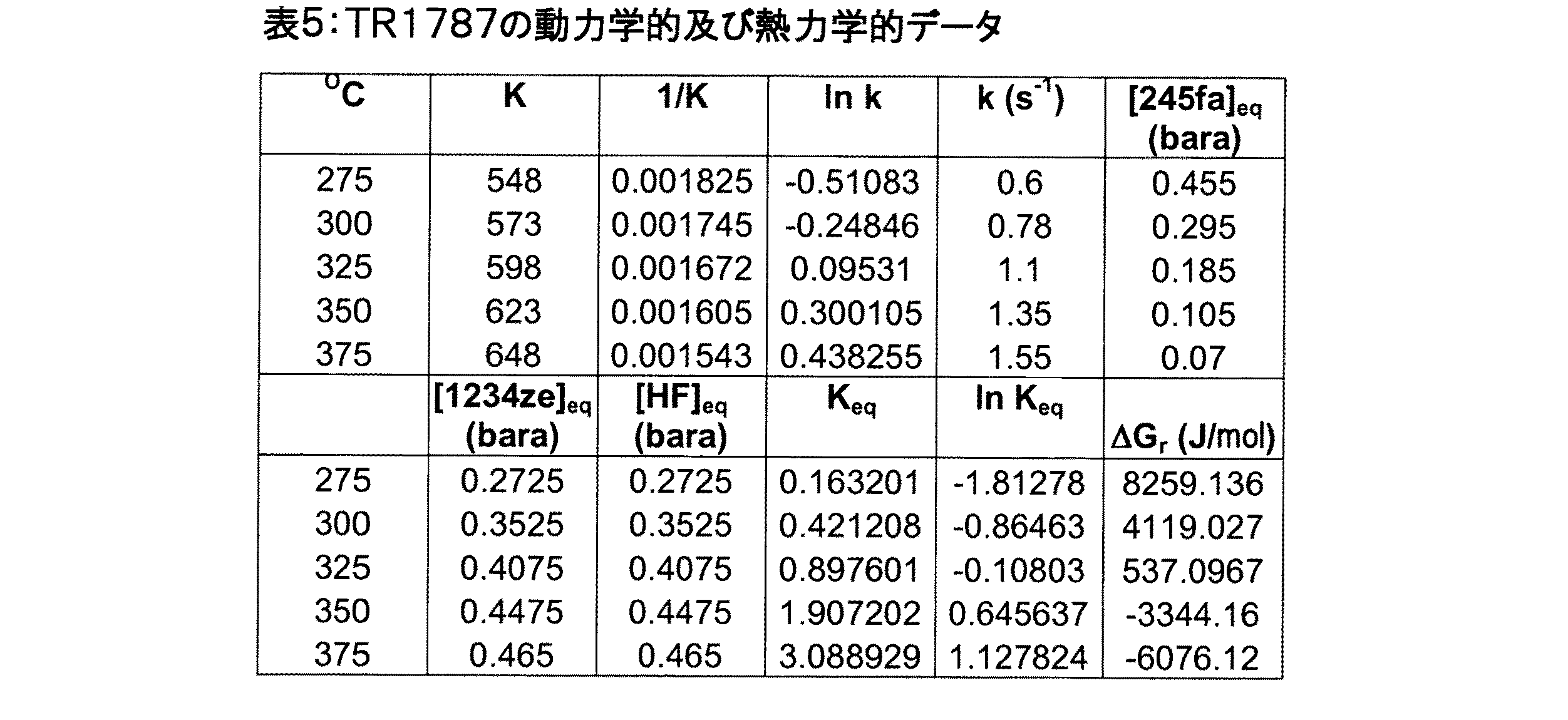
触媒は、未希釈の245fa供給物を用いて大気圧で試験した。触媒のスクリーニング及び動力学的研究のため、反応器に触媒を2ml充填し、これをまず窒素下(60ml/分)200℃で72時間乾燥させた。次いで窒素中で希釈したHF(30ml/分のHF及び20ml/分のN2)を用いて200℃で1時間、前フッ素化した。この時点で窒素流を停止し、触媒を未希釈のHFで処理し、温度を200℃から450℃まで40℃/時で上昇させた。これらの条件をさらに1時間維持した後、触媒を200℃まで冷却した。次いでHF流を停止し、窒素流(60ml/分)と置き換え、反応器のオフガスにさらなるHFが検出されなくなった時点で触媒は使用できる状態になった。得られたデータを表4及び5にまとめ、図4に図示する。 The catalyst was tested at atmospheric pressure using an undiluted 245fa feed. For catalyst screening and kinetic studies, the reactor was charged with 2 ml of catalyst, which was first dried for 72 hours at 200 ° C. under nitrogen (60 ml / min). It was then prefluorinated with HF diluted in nitrogen (30 ml / min HF and 20 ml / min N 2 ) at 200 ° C. for 1 hour. At this point, the nitrogen flow was stopped, the catalyst was treated with undiluted HF, and the temperature was increased from 200 ° C. to 450 ° C. at 40 ° C./hour. After maintaining these conditions for an additional hour, the catalyst was cooled to 200 ° C. The HF flow was then stopped and replaced with a nitrogen flow (60 ml / min) and the catalyst was ready for use when no more HF was detected in the reactor off-gas. The data obtained is summarized in Tables 4 and 5 and illustrated in FIG.
データに対する平衡速度則のあてはめの精度(quality of the fits)は優れたものであり、上に記載した245fa→1234ze反応の動力学を説明する際のその有効性がさらに確認された。研究で用いた各温度にて反応は平衡に達していたことが各事例において明らかであった。このデータを用いて、TR1787が触媒する反応に伴うアレニウスパラメータを計算し、反応のエンタルピー及びエントロピーを試算した。 The quality of the fits fit to the data was excellent, further confirming its effectiveness in explaining the kinetics of the 245fa → 1234ze reaction described above. It was clear in each case that the reaction had reached equilibrium at each temperature used in the study. Using this data, Arrhenius parameters associated with the reaction catalyzed by TR1787 were calculated, and the enthalpy and entropy of the reaction were estimated.
図5及び6は、関連するデータに対するアレニウス、ギブズ、及びファントホッフの式のあてはめ(fits)を図示し、これらあてはめから、反応の活性化エネルギー、頻度因子、エンタルピー、及びエントロピーを計算した。表6を参照されたい。 FIGS. 5 and 6 illustrate the fits of the Arrhenius, Gibbs, and Fanthof equations for the relevant data, from which the activation energy, frequency factor, enthalpy, and entropy of the reaction were calculated. See Table 6.
改善された平衡データを用いて、アルミナ担持ジルコニウム触媒に関して得られた速度データを再度あてはめ、さらにアルミナ担体自体の性能を評価した。この新規なデータを表7に示す。 Using the improved equilibrium data, the rate data obtained for the alumina-supported zirconium catalyst was reapplied to further evaluate the performance of the alumina support itself. This new data is shown in Table 7.
比較例3 − 1234zeへの245faの脱フッ化水素(高Na Cr 2 O 3 /アルミナ)
ナトリウム含有量が2170〜2410ppmであるアルミナ(ASM Catalysts LLC)にCr(H2O)6Cl3を含浸させてアルミナ担持クロミア触媒を製造した。よって、塩化クロム(III)6水和物24gにDI水を17ml加えた。この混合物を水浴中で80℃まで加熱し、次いで冷却した後にASMアルミナを50.2g加えた。アルミナを一晩含浸させたが、含浸は均一ではなく、水がすべて吸収されたので、DI水をさらに13ml加え、触媒を再び一晩放置した。触媒を真空下90℃で乾燥させた。製造された状態では触媒のクロムIII充填量は名目上9.36%wt/wtであった。TR1816と表示される得られた触媒を空気中でか焼するか又は窒素中でか焼した。
Comparative Example 3 - dehydrofluorination 245fa to 1234ze (
Alumina (ASM Catalysts LLC) having a sodium content of 2170 to 2410 ppm was impregnated with Cr (H 2 O) 6 Cl 3 to produce an alumina-supported chromia catalyst. Therefore, 17 ml of DI water was added to 24 g of chromium (III) chloride hexahydrate. The mixture was heated to 80 ° C. in a water bath, and after cooling, 50.2 g of ASM alumina was added. The alumina was impregnated overnight, but the impregnation was not uniform and all the water was absorbed, so an additional 13 ml of DI water was added and the catalyst was again left overnight. The catalyst was dried at 90 ° C. under vacuum. In the manufactured state, the chromium III loading of the catalyst was nominally 9.36% wt / wt. The resulting catalyst, labeled TR1816, was calcined in air or in nitrogen.
空気及び窒素か焼触媒を例2に記載のように前活性化し、次いで245fa(2.5〜60ml/分)を反応器に供給した。変換率及び収率を温度及び接触時間に応じて決定し、下記表8及び9に示す。 Air and nitrogen calcined catalyst were preactivated as described in Example 2 and then 245fa (2.5-60 ml / min) was fed to the reactor. Conversion and yield were determined according to temperature and contact time and are shown in Tables 8 and 9 below.
活性化エネルギー(kJ/mol)を例2に記載のように計算し、次のことが分かった:TR1816(空気か焼)=36.6及びTR1816(窒素か焼)=65.1。例2及び3におけるアルミナ担持クロミア触媒の活性化エネルギーを比較すると、例2における低ナトリウムアルミナ担持クロミア触媒は、245faの脱ハロゲン化水素に関してはるかに活性があることが示された。 The activation energy (kJ / mol) was calculated as described in Example 2 and found the following: TR1816 (air calcination) = 36.6 and TR1816 (nitrogen calcination) = 65.1. A comparison of the activation energies of the alumina-supported chromia catalysts in Examples 2 and 3 showed that the low sodium alumina-supported chromia catalyst in Example 2 was much more active with respect to 245fa dehydrohalogenation.
例4 − 1234zeへの245faの脱フッ化水素(高Na ZrO 2 /アルミナ)及びコーキング実験
名目上の触媒のZr充填量が7.5%wt/wtであるさらなるアルミナ担持ジルコニア触媒(TR1817と表示する)を製造した(触媒の実際のZr充填量を測定し、1.68%wt/wtであることが分かった)。使用したアルミナは、ASM Catalysts LLCから入手し、ナトリウム含有量が2170〜2410ppmであった。例2及び3に関して上に記載したのと同じ触媒試験条件を用いて、この触媒は、1234zeへの245faの脱フッ化水素に関する活性化エネルギーが51.1kJ/molであることが測定された。これは、例1に記載の異なる供給源から得られたアルミナ担持ジルコニア触媒とよく一致している。
Example 4-245fa dehydrofluorination (high Na ZrO 2 / alumina) to 1234ze and additional alumina supported zirconia catalyst (designated TR1817 ) with a nominal catalyst Zr loading of 7.5% wt / wt (Actual Zr loading of the catalyst was measured and found to be 1.68% wt / wt). The alumina used was obtained from ASM Catalysts LLC and had a sodium content of 2170-2410 ppm. Using the same catalyst test conditions described above for Examples 2 and 3, this catalyst was determined to have an activation energy for dehydrofluorination of 245fa to 1234ze of 51.1 kJ / mol. This is in good agreement with the alumina-supported zirconia catalyst obtained from the different sources described in Example 1.
ASMアルミナ担持ジルコニア触媒を、下記のコーキング実験において例2の低ナトリウムアルミナ担持クロミア触媒と比較した。 The ASM alumina supported zirconia catalyst was compared to the low sodium alumina supported chromia catalyst of Example 2 in the following caulking experiment.
各触媒を例2に記載のように前処理した。次いで20ml/分の未希釈245faを各触媒に供給した(別々の0.5”×30cmの反応器において)。約40%の変換が達成されるまで温度を上昇させた。次いで、約40%の変換を維持するように必要に応じて温度を調節してこれらの条件を維持した。この目標をもはや達成できない場合又は温度が約40℃上昇された場合に実験を停止した。この2種類の触媒の相対的な性能を図7に示す。TR1787は、必要な変換率をわずか270℃で達成しこれを約300時間維持することができ、TR1817より著しく優れていた。 Each catalyst was pretreated as described in Example 2. 20 ml / min of undiluted 245fa was then fed to each catalyst (in a separate 0.5 "x 30 cm reactor). The temperature was increased until about 40% conversion was achieved. Then about 40% These conditions were maintained by adjusting the temperature as necessary to maintain the conversion of the experiment, and the experiment was stopped when this goal could no longer be achieved or when the temperature was increased by about 40 ° C. The relative performance of the catalyst is shown in Figure 7. TR1787 was able to achieve the required conversion at only 270 ° C and maintain it for about 300 hours, which was significantly superior to TR1817.
熱重量分析(TGA)法を用いて各触媒の昇温酸化(TPO)プロファイルを作成した。使用済みの触媒試料に対するコークス測定のためのTGA法は以下のとおりであった: A temperature programmed oxidation (TPO) profile of each catalyst was created using a thermogravimetric analysis (TGA) method. The TGA method for coke measurement on the spent catalyst sample was as follows:
基本的な器具の設定:窒素を25ml/分に設定した器具パージ。粉砕又はペレットのままの試料を約30〜100mg含む30μlプラチナ皿。
1)30℃で試料を導入し、200ml/分の窒素で炉を5分間パージ
2)パージ流を100ml/分まで1分間減少
3)100ml/分の窒素下20℃/分で550℃まで試料を加熱
4)パージ流を50ml/分まで減少させ、試料を550℃で15分間保持
5)25ml/分の窒素下550から200℃まで30℃/分で試料を冷却
6)200℃及び25ml/分の窒素で5分間試料を安定化
7)気体流を10ml/分の空気に変更し、系を5分間安定化
8)試料温度を10ml/分の空気下550℃まで15℃/分で上昇
9)10ml/分の空気下550℃で18分間滞留
Basic instrument setup: Instrument purge with nitrogen set at 25 ml / min. 30 μl platinum dish containing about 30-100 mg of ground or pelleted sample.
1) Introduce sample at 30 ° C. and purge furnace with nitrogen at 200 ml / min for 5 min 2) Reduce purge flow to 100 ml / min for 1 min 3) Sample at 20 ° C./min under nitrogen at 100 ml / min to 550 ° C. 4) Reduce the purge flow to 50 ml / min and hold the sample at 550 ° C. for 15 minutes 5) Cool the sample from 550 to 200 ° C. under nitrogen of 25 ml / min at 30 ° C./min 6) 200 ° C. and 25 ml / min Stabilize the sample with 5 minutes of nitrogen 7) Change the gas flow to 10 ml / min air and stabilize the system for 5 minutes 8) Increase the sample temperature to 550 ° C. at 15 ° C./min under 10 ml / min air 9) Stay at 550 ° C for 18 minutes under air of 10ml / min
これらのプロファイルは、TR1787上に存在するコークスがTR1817上のものよりもはるかに容易に除去されることを示した。 These profiles indicated that coke present on TR1787 was removed much more easily than that on TR1817.
例5〜7 − 1234zeへの245faの脱フッ化水素(低及び高Na ZrO 2 /アルミナ)
本発明による低ナトリウム含有量のアルミナ担持ジルコニア触媒を2種類製造し、1234zeへの245faの脱フッ化水素を触媒するこれらの活性について、比較例1、例4、及びさらなる比較例7の高ナトリウム含有量のアルミナ担持ジルコニア触媒と比較した。
Examples 5-7 245fa dehydrofluorination (low and high Na 2 ZrO 2 / alumina) to 1234ze
The high sodium of Comparative Example 1, Example 4, and Additional Comparative Example 7 for the production of two low sodium content alumina-supported zirconia catalysts according to the present invention and catalyzing 245fa dehydrofluorination to 1234ze. The content was compared with the alumina-supported zirconia catalyst.
試験したジルコニア触媒はすべて、Zr充填量が1〜3%wt/wtの間と測定された。例5の触媒は、エタノール218gにZrOCl2.8H2Oを4.9g加え、塩が溶解できるように60℃まで加熱することにより製造した。アルミナを50g加え、一晩放置して含浸させた。得られた混合物を80℃のロータリーエバポレーターに供し、エタノールを除去した。次いで触媒を150℃の真空オーブン中で一晩乾燥させた。 All tested zirconia catalysts were measured with a Zr loading between 1-3% wt / wt. The catalyst of Example 5 was obtained by adding 218 g of ethanol to ZrOCl 2 . It was prepared by adding 4.9 g of 8H 2 O and heating to 60 ° C. so that the salt could be dissolved. 50 g of alumina was added and allowed to stand overnight for impregnation. The obtained mixture was subjected to a rotary evaporator at 80 ° C. to remove ethanol. The catalyst was then dried in a 150 ° C. vacuum oven overnight.
例6の触媒は、脱イオン水20mlにZrOCl2.8H2Oを20g加え、塩が溶解できるように60℃まで加熱することにより製造した。アルミナを50g加え、一晩放置して含浸させた。得られた混合物を80℃のロータリーエバポレーターに供し、水を除去した。次いで触媒を80℃の真空オーブン中で一晩乾燥させた。 The catalyst of Example 6 was made up of 20 ml of deionized water with ZrOCl 2 . It was prepared by adding 20 g of 8H 2 O and heating to 60 ° C. so that the salt could be dissolved. 50 g of alumina was added and allowed to stand overnight for impregnation. The obtained mixture was subjected to a rotary evaporator at 80 ° C. to remove water. The catalyst was then dried in an 80 ° C. vacuum oven overnight.
比較例7の触媒は、脱イオン水20mlにZrOCl2.8H2Oを20g加え、塩が溶解できるように60℃まで加熱することにより製造した。アルミナを50g加え、一晩放置して含浸させた。得られた混合物を80℃のロータリーエバポレーターに供し、水を除去した。次いで触媒を80℃の真空オーブン中で一晩乾燥させた。 The catalyst of Comparative Example 7 was prepared by adding ZrOCl 2 . It was prepared by adding 20 g of 8H 2 O and heating to 60 ° C. so that the salt could be dissolved. 50 g of alumina was added and allowed to stand overnight for impregnation. The obtained mixture was subjected to a rotary evaporator at 80 ° C. to remove water. The catalyst was then dried in an 80 ° C. vacuum oven overnight.
脱フッ化水素実験に先立ち、各触媒を60ml/分の窒素と共に200℃で一晩乾燥させた。60ml/分の窒素で希釈した30ml/分のHFを300℃で1時間触媒上に流した。窒素のスイッチをオフにし、30ml/分のHFを360℃で1時間流した。次いで窒素パージを一晩行って、微量のHFを除去した。 Prior to the dehydrofluorination experiment, each catalyst was dried overnight at 200 ° C. with 60 ml / min of nitrogen. 30 ml / min HF diluted with 60 ml / min nitrogen was flowed over the catalyst at 300 ° C. for 1 h. The nitrogen switch was turned off and 30 ml / min HF was passed at 360 ° C. for 1 hour. A nitrogen purge was then performed overnight to remove traces of HF.
下記表10に示す温度で245faを2.5、5、10、20、30、及び60ml/分の流速で触媒上に流した。脱フッ化水素実験の結果並びに例2にしたがって決定した関連する動力学的及び熱力学的パラメータを下記にまとめる。 245fa was flowed over the catalyst at flow rates of 2.5, 5, 10, 20, 30, and 60 ml / min at the temperatures shown in Table 10 below. The results of the dehydrofluorination experiment and the relevant kinetic and thermodynamic parameters determined according to Example 2 are summarized below.
示された正味の速度定数を達成するのに必要な温度を精査すると、エタノール中で製造された本発明の低ナトリウムアルミナ担持ZrO2触媒(例5を参照)は、対応する高ナトリウムアルミナ担持ZrO2触媒(例1及び4を参照)と遜色がないことが分かる。同様に、水中で製造された本発明の低ナトリウムアルミナ担持ZrO2触媒(例6を参照)は、対応する高ナトリウムアルミナ担持ZrO2触媒(例7を参照)と遜色がない。
Upon scrutinizing the temperatures required to achieve the indicated net rate constants, the low sodium alumina supported ZrO 2 catalyst of the present invention produced in ethanol (see Example 5) is the corresponding high sodium alumina supported
例8及び9 − 1234zeへの245faの脱フッ化水素(低及び高Na Cr 2 O 3 /アルミナ)
例2及び比較例3を参照して、アルミナ担持クロミア触媒をさらに2種類製造し、1234zeへの245faの脱フッ化水素を触媒するこれらの活性について比較した。
Examples 8 and 9 - dehydrofluorination 245fa to 1234ze (low and
Referring to Example 2 and Comparative Example 3, two more alumina-supported chromia catalysts were prepared and compared for their activity to catalyze 245fa dehydrofluorination to 1234ze.
比較例8の触媒は、脱イオン水20gにCrO3を10g溶解させることにより製造した。アルミナを50g加え、一晩放置して含浸させた。得られた混合物を80℃のロータリーエバポレーターに供し、水を除去した。次いで触媒を50℃の真空オーブン中で二日間乾燥させた。 The catalyst of Comparative Example 8 was produced by dissolving 10 g of CrO 3 in 20 g of deionized water. 50 g of alumina was added and allowed to stand overnight for impregnation. The obtained mixture was subjected to a rotary evaporator at 80 ° C. to remove water. The catalyst was then dried in a 50 ° C. vacuum oven for 2 days.
例9の触媒は、脱イオン水20gにCrO3を10g溶解させることにより製造した。アルミナを50g加え、一晩放置して含浸させた。得られた混合物を80℃のロータリーエバポレーターに供し、水を除去した。次いで触媒を50℃の真空オーブン中で二日間乾燥させた。 The catalyst of Example 9 was prepared by dissolving 10 g of CrO 3 in 20 g of deionized water. 50 g of alumina was added and allowed to stand overnight for impregnation. The obtained mixture was subjected to a rotary evaporator at 80 ° C. to remove water. The catalyst was then dried in a 50 ° C. vacuum oven for 2 days.
脱フッ化水素実験に先立ち、各触媒を60ml/分の窒素と共に200℃で一晩、続いて60ml/分の窒素と共に360℃で1時間乾燥させて、触媒をか焼した。60ml/分の窒素で希釈した30ml/分のHFを300℃で1時間触媒上に流した。窒素のスイッチをオフにし、30ml/分のHFを360℃で1時間流した。次いで窒素パージを一晩行って、微量のHFを除去した。 Prior to the dehydrofluorination experiment, each catalyst was dried overnight at 200 ° C. with 60 ml / min of nitrogen, followed by 1 hour at 360 ° C. with 60 ml / min of nitrogen to calcine the catalyst. 30 ml / min HF diluted with 60 ml / min nitrogen was flowed over the catalyst at 300 ° C. for 1 h. The nitrogen switch was turned off and 30 ml / min HF was passed at 360 ° C. for 1 hour. A nitrogen purge was then performed overnight to remove traces of HF.
下記表11に示す温度で245faを2.5、5、10、20、30、及び60ml/分の流速で触媒上に流した。脱フッ化水素実験の結果並びに例2にしたがって決定した関連する動力学的及び熱力学的パラメータを下記にまとめる。 245fa was flowed over the catalyst at flow rates of 2.5, 5, 10, 20, 30, and 60 ml / min at the temperatures shown in Table 11 below. The results of the dehydrofluorination experiment and the relevant kinetic and thermodynamic parameters determined according to Example 2 are summarized below.
この場合にも、示された正味の速度定数を達成するのに必要な温度を精査すると、本発明の低ナトリウムアルミナ担持クロミア触媒(例2及び9)は、対応する高ナトリウムアルミナ担持クロミア触媒(例8)と遜色がないことが分かる。 Again, upon reviewing the temperature required to achieve the indicated net rate constant, the low sodium alumina supported chromia catalysts of the present invention (Examples 2 and 9) were found to correspond to the corresponding high sodium alumina supported chromia catalyst ( It can be seen that there is no inferiority with Example 8).
例10及び11 − CF 3 CF=CH 2 (1234yf)へのCF 3 CF 2 CH 3 (245cb)の脱フッ化水素(低及び高Na Cr 2 O 3 /アルミナ)
例8及び9で使用したのと同じアルミナ担持クロミア触媒を、1234yfへの245cbの脱フッ化水素を触媒するこれらの活性について比較した。
Examples 10 and 11 - CF 3 CF = CF 3
The same alumina-supported chromia catalyst used in Examples 8 and 9 was compared for their activity to catalyze 245 cb dehydrofluorination to 1234yf.
脱フッ化水素実験に先立ち、各触媒を60ml/分の窒素と共に200℃で一晩、続いて60ml/分の窒素と共に360℃で1時間乾燥させて、触媒をか焼した。60ml/分の窒素で希釈した30ml/分のHFを300℃で1時間触媒上に流した。窒素のスイッチをオフにし、30ml/分のHFを360℃で1時間流した。次いで窒素パージを一晩行って、微量のHFを除去した。 Prior to the dehydrofluorination experiment, each catalyst was dried overnight at 200 ° C. with 60 ml / min of nitrogen, followed by 1 hour at 360 ° C. with 60 ml / min of nitrogen to calcine the catalyst. 30 ml / min HF diluted with 60 ml / min nitrogen was flowed over the catalyst at 300 ° C. for 1 h. The nitrogen switch was turned off and 30 ml / min HF was passed at 360 ° C. for 1 hour. A nitrogen purge was then performed overnight to remove traces of HF.
2.5ml/分の245cbを375℃で触媒上に流した。脱フッ化水素実験の結果を下記にまとめる。 245 cb of 2.5 ml / min was flowed over the catalyst at 375 ° C. The results of the dehydrofluorination experiment are summarized below.
同じ反応温度では、低ナトリウムアルミナ担持クロミア触媒(例11)の使用は、高ナトリウムアルミナ担持クロミア触媒(例10)よりも245cbの変換率が高い結果となった。 At the same reaction temperature, the use of the low sodium alumina supported chromia catalyst (Example 11) resulted in a higher conversion of 245 cb than the high sodium alumina supported chromia catalyst (Example 10).
例12及び13 − CF 3 CF=CH 2 (1234yf)へのCF 3 CHFCH 2 F(245eb)の脱フッ化水素(低及び高Na Cr 2 O 3 /アルミナ)
例8〜11で使用したのと同じアルミナ担持クロミア触媒を、1234yfへの245ebの脱フッ化水素を触媒するこれらの活性について比較した。触媒はいずれも60ml/分の窒素と共に200℃で1時間、続いて60ml/分の窒素と共に360℃で1時間乾燥させて、触媒をか焼した。60ml/分の窒素で希釈した30ml/分のHFを300℃で1時間触媒上に流した。窒素のスイッチをオフにし、30ml/分のHFを360℃で1時間流した。
Examples 12 and 13 - CF 3 CF = CF 3 CHFCH dehydrofluorination of 2 F (245eb) in
The same alumina-supported chromia catalyst used in Examples 8-11 was compared for their activity to catalyze 245 eb dehydrofluorination to 1234yf. All catalysts were dried at 200 ° C. for 1 hour with 60 ml / min of nitrogen followed by 1 hour at 360 ° C. with 60 ml / min of nitrogen to calcine the catalyst. 30 ml / min HF diluted with 60 ml / min nitrogen was flowed over the catalyst at 300 ° C. for 1 h. The nitrogen switch was turned off and 30 ml / min HF was passed at 360 ° C. for 1 hour.
下記表13に示す流速で245ebを300℃で触媒上に流した。脱フッ化水素実験の結果を下記にまとめる。 245eb was flowed over the catalyst at 300 ° C. at the flow rates shown in Table 13 below. The results of the dehydrofluorination experiment are summarized below.
同じ反応温度では、低ナトリウムアルミナ担持クロミア触媒(例13a〜b)の使用は、高ナトリウムアルミナ担持クロミア触媒(例12)よりも245ebの変換率が高い結果となった。 At the same reaction temperature, the use of the low sodium alumina supported chromia catalyst (Examples 13a-b) resulted in a higher conversion of 245eb than the high sodium alumina supported chromia catalyst (Example 12).
例14(比較)及び15 − CF 3 CH=CH 2 (1243zf)へのCF 3 CH 2 CH 2 F(254fb)の脱フッ化水素(低及び高Na Cr 2 O 3 /アルミナ)
例8〜13で使用したのと同じアルミナ担持クロミア触媒を、1243zfへの254fbの脱フッ化水素を触媒するこれらの活性について比較した。
Example 14 (Comparative) and 15 - CF 3 CH = CH 2 CF 3
The same alumina-supported chromia catalyst used in Examples 8-13 was compared for their activity to catalyze 254fb dehydrofluorination to 1243zf.
脱フッ化水素実験に先立ち、各触媒を60ml/分の窒素と共に200℃で一晩、続いて60ml/分の窒素と共に360℃で1時間乾燥させて、触媒をか焼した。60ml/分の窒素で希釈した30ml/分のHFを300℃で1時間触媒上に流した。窒素のスイッチをオフにし、30ml/分のHFを360℃で1時間流した。次いで窒素パージを一晩行って、微量のHFを除去した。 Prior to the dehydrofluorination experiment, each catalyst was dried overnight at 200 ° C. with 60 ml / min of nitrogen, followed by 1 hour at 360 ° C. with 60 ml / min of nitrogen to calcine the catalyst. 30 ml / min HF diluted with 60 ml / min nitrogen was flowed over the catalyst at 300 ° C. for 1 h. The nitrogen switch was turned off and 30 ml / min HF was passed at 360 ° C. for 1 hour. A nitrogen purge was then performed overnight to remove traces of HF.
5、10、及び20ml/分の245cbを225℃又は275℃で触媒上に流した。脱フッ化水素実験の結果を下記にまとめる。 245 cb of 5, 10, and 20 ml / min was run over the catalyst at 225 ° C or 275 ° C. The results of the dehydrofluorination experiment are summarized below.
254fbの流速及び反応温度が同じであると、1243zfへの254fbの変換率は、高ナトリウムアルミナ担持クロミア触媒(例14a〜c)と比べて低ナトリウムアルミナ担持クロミア触媒(例15a〜c)を使用したほうが高かった。 With the same flow rate and reaction temperature of 254fb, the conversion of 254fb to 1243zf uses a low sodium alumina supported chromia catalyst (Example 15a-c) compared to a high sodium alumina supported chromia catalyst (Example 14a-c). It was higher.
上記の例は、C3−7ヒドロ(ハロ)アルカンの脱ハロゲン化水素に関しては、低ナトリウム含有量のアルミナ担持金属酸化物触媒が、対応する高ナトリウム含有量の触媒と比較した場合に、驚くほど活性がありロバスト性を有することを実証している。これにより操作温度を最小限に抑えることができ、そうすることによって汚損が最小限に抑えられ、選択性が最大限に高められる。さらに、低ナトリウムアルミナ担持金属酸化物触媒のいくつかは、再生するのが容易であることが示された。触媒再生の容易さに加えて、脱ハロゲン化水素によるC3−7(ヒドロ)フルオロプロペンの製造に対する高い触媒活性及び選択性の組み合わせは、全く予想外のものである。 The above example is surprising for dehydrohalogenation of C 3-7 hydro (halo) alkanes when a low sodium content alumina supported metal oxide catalyst is compared to the corresponding high sodium content catalyst. It is proved to be so active and robust. This allows the operating temperature to be minimized, so that fouling is minimized and selectivity is maximized. Furthermore, some of the low sodium alumina supported metal oxide catalysts have been shown to be easy to regenerate. In addition to the ease of catalyst regeneration, the combination of high catalytic activity and selectivity for the production of C 3-7 (hydro) fluoropropene by dehydrohalogenation is completely unexpected.
本発明は下記請求項により規定されている。 The invention is defined by the following claims.
Claims (18)
Applications Claiming Priority (3)
| Application Number | Priority Date | Filing Date | Title |
|---|---|---|---|
| GB1207666.7 | 2012-05-02 | ||
| GB201207666A GB201207666D0 (en) | 2012-05-02 | 2012-05-02 | Process |
| PCT/GB2013/051129 WO2013164618A1 (en) | 2012-05-02 | 2013-05-01 | Process for preparing a c3-c7 (hydro) fluoroalkene by dehydrohalogenation |
Publications (2)
| Publication Number | Publication Date |
|---|---|
| JP2015515973A JP2015515973A (en) | 2015-06-04 |
| JP6190875B2 true JP6190875B2 (en) | 2017-08-30 |
Family
ID=46330672
Family Applications (1)
| Application Number | Title | Priority Date | Filing Date |
|---|---|---|---|
| JP2015509495A Active JP6190875B2 (en) | 2012-05-02 | 2013-05-01 | Process for producing C3-C7 (hydro) fluoroalkene by dehydrohalogenation |
Country Status (9)
| Country | Link |
|---|---|
| US (1) | US10167242B2 (en) |
| EP (1) | EP2846907B1 (en) |
| JP (1) | JP6190875B2 (en) |
| CN (2) | CN104271235A (en) |
| ES (1) | ES2725824T3 (en) |
| GB (1) | GB201207666D0 (en) |
| HK (1) | HK1204303A1 (en) |
| IN (1) | IN2014MN02182A (en) |
| WO (1) | WO2013164618A1 (en) |
Families Citing this family (11)
| Publication number | Priority date | Publication date | Assignee | Title |
|---|---|---|---|---|
| CN110845295A (en) | 2014-08-14 | 2020-02-28 | 科慕埃弗西有限公司 | Process for the preparation of E-1, 3,3, 3-tetrafluoropropene (HFC-1234ze) by dehydrofluorination |
| JP6328589B2 (en) | 2015-05-29 | 2018-05-23 | ダイキン工業株式会社 | Method for producing fluorine-containing olefin |
| CN104945221B (en) * | 2015-06-11 | 2017-07-18 | 浙江衢州巨新氟化工有限公司 | A kind of method of the tetrafluoropropene of coproduction 2,3,3,3 and 1,3,3,3 tetrafluoropropenes |
| GB2540427B (en) | 2015-07-17 | 2017-07-19 | Mexichem Fluor Sa De Cv | Process for the preparation of 2,3,3,3-tetrafluoropropene (1234yf) |
| CN106316777B (en) * | 2016-08-17 | 2019-01-08 | 巨化集团技术中心 | A kind of preparation method of 2,3,3,3- tetrafluoropropene |
| CN110013865A (en) * | 2019-05-23 | 2019-07-16 | 浙江师范大学 | A kind of catalyst for preparing HFO-1234ze by cracking HFC-245fa and preparation method thereof |
| CN111484391B (en) * | 2020-03-19 | 2023-04-21 | 山东东岳化工有限公司 | Process for preparing 1,2, 3-pentafluoropropene from hexafluoropropene |
| US11274069B2 (en) | 2020-08-13 | 2022-03-15 | L'Air Liquide, Société Anonyme pour l'Etude et l'Exploitation des Procédés Georges Claude | Mono-substituted cyclopentadienes and metal cyclopentadienyl complexes and synthesis methods thereof |
| US12083493B2 (en) | 2021-03-04 | 2024-09-10 | American Air Liquide, Inc. | Selective adsorption of halocarbon impurities containing cl, br and i in fluorocarbons or hydrofluorocarbons using adsorbent supported metal oxide |
| CN114634395B (en) * | 2022-03-25 | 2024-05-28 | 浙江工业大学 | A method for preparing 2,3,3,3-tetrafluoropropylene from tetrafluoroethylene |
| US20240376032A1 (en) * | 2023-05-12 | 2024-11-14 | Honeywell International Inc. | Method for reducing 1,1,1,2,2-pentafluoropropane (hfc-245cb) in a process for producing trans-1,3,3,3-tetrafluoropropene (hfo-1234ze(e)) |
Family Cites Families (55)
| Publication number | Priority date | Publication date | Assignee | Title |
|---|---|---|---|---|
| US1868869A (en) | 1928-11-28 | 1932-07-26 | Aluminum Co Of America | Adsorbent material and method of producing the same |
| US2015593A (en) | 1932-02-24 | 1935-09-24 | Aluminum Co Of America | Manufacture of adsorbents |
| US2499675A (en) | 1945-12-13 | 1950-03-07 | Phillips Petroleum Co | Preparation of pelleted alumina catalyst |
| US3201199A (en) | 1962-03-06 | 1965-08-17 | Aluminum Lab Ltd | Method of producing low soda content alumina |
| NL293754A (en) * | 1962-06-14 | |||
| SU507551A1 (en) | 1974-10-01 | 1976-03-25 | Ташкентский Государственный Университет Им.В.И.Ленина | The method of producing vinyl fluoride |
| JPS6140229A (en) * | 1984-07-19 | 1986-02-26 | イー・アイ・デユポン・デ・ニモアス・アンド・カンパニー | Manufacture of 2-chlorobutene from 2,3-dichlorobutane |
| WO1989010341A1 (en) | 1988-04-28 | 1989-11-02 | Showa Denko Kabushiki Kaisha | Process for producing organofluorine compound |
| US5036036A (en) * | 1989-06-13 | 1991-07-30 | E. I. Du Pont De Nemours And Company | Chromium oxide catalyst composition |
| CA2019913A1 (en) | 1990-06-08 | 1991-12-08 | Michael S. Bolmer | Production of vinylidene fluoride from 1,1-difluoroethane |
| FR2669022B1 (en) | 1990-11-13 | 1992-12-31 | Atochem | PROCESS FOR THE MANUFACTURE OF TETRAFLUORO-1,1,1,2-ETHANE. |
| US5679875A (en) | 1992-06-05 | 1997-10-21 | Daikin Industries, Ltd. | Method for manufacturing 1,1,1,2,3-pentafluoropropene 1,1,1,2,3-pentafluoropropane |
| US5986151A (en) | 1997-02-05 | 1999-11-16 | Alliedsignal Inc. | Fluorinated propenes from pentafluoropropane |
| JP3886229B2 (en) | 1997-11-11 | 2007-02-28 | セントラル硝子株式会社 | Method for producing 1,3,3,3-tetrafluoropropene |
| US6124510A (en) * | 1998-07-21 | 2000-09-26 | Elf Atochem North America, Inc. | 1234ze preparation |
| US7230146B2 (en) | 2003-10-27 | 2007-06-12 | Honeywell International Inc. | Process for producing fluoropropenes |
| US7592494B2 (en) * | 2003-07-25 | 2009-09-22 | Honeywell International Inc. | Process for the manufacture of 1,3,3,3-tetrafluoropropene |
| US7563936B2 (en) | 2006-10-27 | 2009-07-21 | Honeywell International Inc | Processes for geometric isomerization of halogenated olefins |
| US8530708B2 (en) | 2003-07-25 | 2013-09-10 | Honeywell International Inc. | Processes for selective dehydrohalogenation of halogenated alkanes |
| US9255046B2 (en) | 2003-07-25 | 2016-02-09 | Honeywell International Inc. | Manufacturing process for HFO-1234ze |
| WO2005037431A1 (en) | 2003-10-14 | 2005-04-28 | E.I. Dupont De Nemours And Company | Chromium oxide compositions containing zinc, their preparation, and their use as catalysts and catalyst precursors |
| US8318627B2 (en) | 2005-08-10 | 2012-11-27 | Sd Lizenzverwertungsgesellschaft Mbh & Co. Kg | Process for preparation of a catalyst carrier |
| ES3036520T3 (en) | 2006-01-03 | 2025-09-19 | Honeywell Int Inc | Method for producing fluorinated organic compounds |
| US8664455B2 (en) | 2008-08-08 | 2014-03-04 | Honeywell International Inc. | Process to manufacture 2-chloro-1,1,1,2-tetrafluoropropane (HCFC-244bb) |
| EP2028172B1 (en) | 2006-06-13 | 2014-11-05 | Central Glass Co., Ltd. | Method for producing 1,3,3,3-tetrafluoropropene |
| JP4693811B2 (en) * | 2006-06-13 | 2011-06-01 | セントラル硝子株式会社 | Method for producing 1,3,3,3-tetrafluoropropene |
| US7982073B2 (en) | 2006-07-13 | 2011-07-19 | E. I. Du Pont De Nemours And Company | Catalytic production processes for making tetrafluoropropenes and pentafluoropropenes |
| US8067650B2 (en) | 2006-08-24 | 2011-11-29 | Honeywell International Inc. | Process for the production of HFO trans-1234ze from HFC-245fa |
| US7485760B2 (en) | 2006-08-24 | 2009-02-03 | Honeywell International Inc. | Integrated HFC trans-1234ze manufacture process |
| US7420094B2 (en) | 2006-09-05 | 2008-09-02 | E.I. Du Pont De Nemours And Company | Catalytic isomerization processes of 1,3,3,3-tetrafluoropropene for making 2,3,3,3-tetrafluoropropene |
| EP2066605B1 (en) | 2006-09-05 | 2013-12-25 | E.I. Du Pont De Nemours And Company | Process to manufacture 2,3,3,3-tetrafluoropropene |
| JP5416587B2 (en) | 2006-10-03 | 2014-02-12 | メキシケム、アマンコ、ホールディング、ソシエダッド、アノニマ、デ、カピタル、バリアブレ | process |
| GB0706978D0 (en) | 2007-04-11 | 2007-05-16 | Ineos Fluor Holdings Ltd | Process |
| US8258355B2 (en) | 2007-07-25 | 2012-09-04 | Honeywell International Inc. | Processes for preparing 1,1,2,3-tetrachloropropene |
| WO2009026082A1 (en) | 2007-08-16 | 2009-02-26 | E. I. Du Pont De Nemours And Company | Catalytic isomerization between e and z isomers of 1,2,3,3,3 pentafluoropropene using aluminum catalyst |
| JP2009091301A (en) | 2007-10-10 | 2009-04-30 | Central Glass Co Ltd | Method for producing cis-1,2,3,3,3-pentafluoropropene |
| US8513473B2 (en) | 2007-10-10 | 2013-08-20 | Central Glass Company, Limited | Method for producing trans-1,3,3,3-tetrafluoropropene |
| JP2009097301A (en) | 2007-10-19 | 2009-05-07 | Daiwa House Ind Co Ltd | Rolling base isolation bearing device with damping function |
| US8070975B2 (en) | 2008-02-26 | 2011-12-06 | Honeywell International Inc. | Azeotrope-like composition of 2-chloro-1,1,1,2-tetrafluoropropane (HCFC-244bb) and hydrogen fluoride (HF) |
| FR2929272B1 (en) * | 2008-03-28 | 2010-04-09 | Arkema France | PROCESS FOR THE PREPARATION OF 2,3,3,3-TETRAFLUORO-1-PROPENE |
| FR2929273B1 (en) * | 2008-03-28 | 2017-05-26 | Arkema France | PROCESS FOR THE PREPARATION OF FLUORINATED COMPOUNDS |
| GB0808836D0 (en) * | 2008-05-15 | 2008-06-18 | Ineos Fluor Ltd | Process |
| US8053612B2 (en) | 2008-05-30 | 2011-11-08 | Honeywell International Inc. | Process for dehydrochlorinating 1,1,1,2-tetrafluoro-2-chloropropane to 2,3,3,3-tetrafluoropropene in the presence of an alkali metal-doped magnesium oxyfluoride catalyst and methods for making the catalyst |
| JP5348240B2 (en) * | 2008-07-30 | 2013-11-20 | ダイキン工業株式会社 | Method for producing 2,3,3,3-tetrafluoropropene |
| US8420873B2 (en) | 2008-08-22 | 2013-04-16 | Daikin Industries, Ltd. | Process for preparing 2,3,3,3-tetrafluoropropene |
| FR2935700B1 (en) | 2008-09-11 | 2013-05-10 | Arkema France | PROCESS FOR THE PREPARATION OF TRIFLUORO AND TETRAFLUORO COMPOUNDS |
| CN102448921B (en) * | 2009-06-03 | 2014-04-23 | 纳幕尔杜邦公司 | Catalyst and process for the preparation of 2,3,3,3-tetrafluoropropene |
| US8487145B2 (en) | 2009-06-03 | 2013-07-16 | E I De Pont De Nemours And Company | Catalysts and process to manufacture 2,3,3,3-tetrafluoropropene |
| WO2011099604A2 (en) * | 2010-02-12 | 2011-08-18 | Daikin Industries, Ltd. | Process for producing fluorine-containing alkene |
| US8263817B2 (en) | 2010-07-06 | 2012-09-11 | E I Du Pont De Nemours And Company | Synthesis of 1234YF by selective dehydrochlorination of 244BB |
| US9334207B2 (en) | 2010-09-03 | 2016-05-10 | Honeywell International Inc. | Integrated process to coproduce trans-1-chloro-3,3,3-trifluoropropene, trans-1,3,3,3-tetrafluoropropene, and 1,1,1,3,3-pentafluoropropane |
| JP5790438B2 (en) | 2011-11-21 | 2015-10-07 | セントラル硝子株式会社 | Process for producing trans-1-chloro-3,3,3-trifluoropropene |
| FR2989374A1 (en) | 2012-04-11 | 2013-10-18 | Arkema France | Preparing hydrofluoropropene/hydrofluorobutene in form of isomer E, involves subjecting mixture of isomer E and Z and hydrofluoropropene/hydrofluorobutene to thermal treatment or isomerizing the mixture at temperature of specified range |
| JP6251992B2 (en) | 2012-06-29 | 2017-12-27 | セントラル硝子株式会社 | Method for producing cis-1,3,3,3-tetrafluoropropene |
| WO2014134821A1 (en) | 2013-03-08 | 2014-09-12 | Honeywell International Inc. | Low gwp heat transfer compositions including co2 |
-
2012
- 2012-05-02 GB GB201207666A patent/GB201207666D0/en not_active Ceased
-
2013
- 2013-05-01 WO PCT/GB2013/051129 patent/WO2013164618A1/en not_active Ceased
- 2013-05-01 CN CN201380023119.4A patent/CN104271235A/en active Pending
- 2013-05-01 CN CN201910085349.2A patent/CN109942367A/en active Pending
- 2013-05-01 HK HK15104714.0A patent/HK1204303A1/en unknown
- 2013-05-01 JP JP2015509495A patent/JP6190875B2/en active Active
- 2013-05-01 EP EP13727313.2A patent/EP2846907B1/en active Active
- 2013-05-01 IN IN2182MUN2014 patent/IN2014MN02182A/en unknown
- 2013-05-01 ES ES13727313T patent/ES2725824T3/en active Active
- 2013-05-01 US US14/398,252 patent/US10167242B2/en active Active
Also Published As
| Publication number | Publication date |
|---|---|
| US20150126786A1 (en) | 2015-05-07 |
| JP2015515973A (en) | 2015-06-04 |
| WO2013164618A1 (en) | 2013-11-07 |
| HK1204303A1 (en) | 2015-11-13 |
| CN109942367A (en) | 2019-06-28 |
| CN104271235A (en) | 2015-01-07 |
| GB201207666D0 (en) | 2012-06-13 |
| ES2725824T3 (en) | 2019-09-27 |
| EP2846907B1 (en) | 2019-03-27 |
| US10167242B2 (en) | 2019-01-01 |
| EP2846907A1 (en) | 2015-03-18 |
| IN2014MN02182A (en) | 2015-09-04 |
Similar Documents
| Publication | Publication Date | Title |
|---|---|---|
| JP6190875B2 (en) | Process for producing C3-C7 (hydro) fluoroalkene by dehydrohalogenation | |
| JP5722623B2 (en) | Production of alkenes with halogens and hydrogen over metal fluoride catalysts | |
| CN101687737B (en) | Preparation of Fluorinated Olefins by Catalytic Dehydrohalogenation of Halogenated Hydrocarbons | |
| US9340473B2 (en) | Catalytic gas phase fluorination | |
| US10988423B2 (en) | Gas-phase catalytic fluorination with chromium catalysts | |
| JP5905967B2 (en) | Method for producing 2,3,3,3-tetrafluoropropene | |
| MX2013008409A (en) | Catalytic gas phase fluorination. | |
| JP6334741B2 (en) | Process for the preparation of halogenated alkenes by dehydrohalogenation of halogenated alkanes | |
| JP2009108049A (en) | Process for producing trans-1,3,3,3-tetrafluoropropene | |
| EP3060537B1 (en) | Process for the isomerisation of c3-7 (hydro)(halo)fluoroalkenes | |
| CN101980993B (en) | Process for preparing fluorine compounds | |
| CN107922295A (en) | A New Process for the Preparation of 2-Chloro-3,3,3-Trifluoropropene from 1,2-Dichloro-3,3,3-Trifluoropropene |
Legal Events
| Date | Code | Title | Description |
|---|---|---|---|
| A621 | Written request for application examination |
Free format text: JAPANESE INTERMEDIATE CODE: A621 Effective date: 20150910 |
|
| A977 | Report on retrieval |
Free format text: JAPANESE INTERMEDIATE CODE: A971007 Effective date: 20160225 |
|
| A131 | Notification of reasons for refusal |
Free format text: JAPANESE INTERMEDIATE CODE: A131 Effective date: 20160303 |
|
| A521 | Request for written amendment filed |
Free format text: JAPANESE INTERMEDIATE CODE: A523 Effective date: 20160603 |
|
| A131 | Notification of reasons for refusal |
Free format text: JAPANESE INTERMEDIATE CODE: A131 Effective date: 20161124 |
|
| A601 | Written request for extension of time |
Free format text: JAPANESE INTERMEDIATE CODE: A601 Effective date: 20170223 |
|
| A521 | Request for written amendment filed |
Free format text: JAPANESE INTERMEDIATE CODE: A523 Effective date: 20170227 |
|
| TRDD | Decision of grant or rejection written | ||
| A01 | Written decision to grant a patent or to grant a registration (utility model) |
Free format text: JAPANESE INTERMEDIATE CODE: A01 Effective date: 20170710 |
|
| A61 | First payment of annual fees (during grant procedure) |
Free format text: JAPANESE INTERMEDIATE CODE: A61 Effective date: 20170807 |
|
| R150 | Certificate of patent or registration of utility model |
Ref document number: 6190875 Country of ref document: JP Free format text: JAPANESE INTERMEDIATE CODE: R150 |
|
| R250 | Receipt of annual fees |
Free format text: JAPANESE INTERMEDIATE CODE: R250 |
|
| R250 | Receipt of annual fees |
Free format text: JAPANESE INTERMEDIATE CODE: R250 |
|
| R250 | Receipt of annual fees |
Free format text: JAPANESE INTERMEDIATE CODE: R250 |
|
| R250 | Receipt of annual fees |
Free format text: JAPANESE INTERMEDIATE CODE: R250 |
|
| R250 | Receipt of annual fees |
Free format text: JAPANESE INTERMEDIATE CODE: R250 |
|
| R250 | Receipt of annual fees |
Free format text: JAPANESE INTERMEDIATE CODE: R250 |