JP6231925B2 - A method for judging the age of young intestinal flora and a screening method for bacterial groups - Google Patents
A method for judging the age of young intestinal flora and a screening method for bacterial groups Download PDFInfo
- Publication number
- JP6231925B2 JP6231925B2 JP2014068360A JP2014068360A JP6231925B2 JP 6231925 B2 JP6231925 B2 JP 6231925B2 JP 2014068360 A JP2014068360 A JP 2014068360A JP 2014068360 A JP2014068360 A JP 2014068360A JP 6231925 B2 JP6231925 B2 JP 6231925B2
- Authority
- JP
- Japan
- Prior art keywords
- family
- age
- intestinal flora
- group
- young
- Prior art date
- Legal status (The legal status is an assumption and is not a legal conclusion. Google has not performed a legal analysis and makes no representation as to the accuracy of the status listed.)
- Active
Links
Images



Classifications
-
- Y—GENERAL TAGGING OF NEW TECHNOLOGICAL DEVELOPMENTS; GENERAL TAGGING OF CROSS-SECTIONAL TECHNOLOGIES SPANNING OVER SEVERAL SECTIONS OF THE IPC; TECHNICAL SUBJECTS COVERED BY FORMER USPC CROSS-REFERENCE ART COLLECTIONS [XRACs] AND DIGESTS
- Y02—TECHNOLOGIES OR APPLICATIONS FOR MITIGATION OR ADAPTATION AGAINST CLIMATE CHANGE
- Y02A—TECHNOLOGIES FOR ADAPTATION TO CLIMATE CHANGE
- Y02A50/00—TECHNOLOGIES FOR ADAPTATION TO CLIMATE CHANGE in human health protection, e.g. against extreme weather
- Y02A50/30—Against vector-borne diseases, e.g. mosquito-borne, fly-borne, tick-borne or waterborne diseases whose impact is exacerbated by climate change
Landscapes
- Measuring Or Testing Involving Enzymes Or Micro-Organisms (AREA)
Description
本開示は、腸内菌叢の老若判定方法及び老若判定マーカーとなる菌群のスクリーニング方法に関する。 The present disclosure relates to an intestinal microbiota age determination method and a method for screening a fungal group that serves as an age determination marker.
ヒトなど動物の腸内には、多種類の細菌が常在している。これらの常在細菌によって形成される腸内菌叢においては、乳児期にビフィズス菌が増加したり、老人でウェルシュ菌が増加し、ビフィズス菌が減少するなど、成長や加齢に伴い特定の菌群が増減することが知られている。また、宿主の健康状態や宿主が摂取する薬剤、食物等によって腸内菌叢を構成する菌群の種類やその数が変動することも知られている。 Many types of bacteria are resident in the intestines of animals such as humans. In the intestinal flora formed by these resident bacteria, certain bacteria are associated with growth and aging, such as an increase in bifidobacteria during infancy, an increase in Clostridium perfringens and a decrease in bifidobacteria in the elderly. It is known that groups increase and decrease. It is also known that the type and number of fungal groups that make up the intestinal flora vary depending on the health condition of the host and the drugs, food, etc. taken by the host.
このような腸内菌叢については、近年、そのバランスが崩れると腸内環境を悪化させ、便秘症状や下痢症状を発症したり、宿主の免疫機能が低下することなどが明らかとなってきている。これに対し、良好な腸内菌叢の維持や悪化した腸内菌叢を改善する薬剤や飲食物も開発されてきている。例えば、特許文献1には、「ラクトパーオキシダーゼを有効成分とする腸内フローラ改善剤」が開示されている。 In recent years, it has been clarified that such intestinal microbiota deteriorates the intestinal environment when the balance is lost, causes constipation and diarrhea, and decreases the immune function of the host. . On the other hand, drugs and foods and drinks for maintaining a good intestinal flora and improving a deteriorated intestinal flora have been developed. For example, Patent Document 1 discloses “an intestinal flora improving agent containing lactoperoxidase as an active ingredient”.
上記特許文献1に記載された腸内フローラ改善剤のような腸内菌叢に作用する成分の効能を評価するためには、腸内菌叢の状態が改善しているか否かを判定する必要がある。一方、腸内菌叢を構成する菌群は多様であり、個体差も大きいため、腸内菌叢に含まれる菌群については、未だに同定されていない種もある。このため、腸内菌叢の状態に関してより詳細に判定するために、腸内菌叢の状態と関連する菌群の同定や当該菌群の数の変動を調べることが求められている。特に、老化現象は、多様な症状を含む現象であり、個体差も大きいため、腸内菌叢の状態について「老齢の状態」にあるか又は前記老齢の状態より若い「若齢の状態」にあるかを判定するためには、適切な指標を用いることが求められている。そこで、本開示は、腸内菌叢について老齢タイプと若齢タイプのいずれであるかを判定する方法等を提供することを主な目的とする。 In order to evaluate the efficacy of components acting on the intestinal flora such as the intestinal flora improving agent described in Patent Document 1, it is necessary to determine whether or not the state of the intestinal flora has improved. There is. On the other hand, since the bacterial groups constituting the intestinal flora are diverse and have large individual differences, there are species that have not yet been identified for the bacterial groups contained in the intestinal flora. For this reason, in order to make a more detailed determination regarding the state of the intestinal flora, it is required to identify the bacterial group associated with the state of the intestinal flora and examine the variation in the number of the bacterial group. In particular, the aging phenomenon is a phenomenon including various symptoms, and the individual difference is large, so that the state of the intestinal flora is in the “old state” or younger than the old state. In order to determine whether there is, it is required to use an appropriate index. Therefore, the main object of the present disclosure is to provide a method for determining whether the intestinal flora is an old type or a young type.
本発明者は鋭意検討した結果、糞便検体から同定された複数種類の菌群のうち、Lachnospiraceae科に属する菌群の、菌叢全体の菌数に対する割合に基づいて、糞便検体を高齢タイプと若齢タイプに、精度高く分類できることを見出し、本発明を完成させるに至った。 As a result of intensive studies, the present inventor determined that stool samples were classified as aged and young, based on the ratio of the number of fungal groups belonging to the Lachnospiraceae family to the total number of bacteria in the plurality of fungal groups identified from the stool samples. The present invention has been completed by finding that it can be classified into age types with high accuracy.
すなわち本開示は、ヒトの腸内菌叢について加齢に伴い特定の菌群が増減している高齢集団に特徴的な腸内菌叢のタイプである老齢タイプと若齢集団に特徴的な腸内菌叢のタイプである若齢タイプのいずれであるかを判定する方法であって、ヒトの糞便検体に含まれる全て菌の数に対する(a)Lachnospiraceae科に属する菌群の割合、および下記(b)〜(j)の科に属する菌群のうち少なくともいずれか一つの菌群の、前記ヒトの糞便検体に含まれる全ての菌の数に対する割合に基づき前記腸内菌叢を判定する判定工程、を有し、
前記判定工程では、前記菌群ごとの前記割合を独立変数とし、前記糞便検体を得た個体の年齢又は月齢に関する回帰分析によって回帰式を算出して解を求め、前記回帰式の解と予め定められた基準値とを比較して、前記解が前記基準値を超える場合には前記腸内菌叢を老齢タイプと判定し、前記解が前記基準値以下である場合には前記腸内菌叢を若齢タイプと判定する腸内菌叢の老若判定方法を提供する。
(b)Bifidobacteriaceae科
(c)Peptococcaceae科
(d)Enterococcaceae科
(e)Verrucomicrobiaceae科
(f)Catabacteriaceae科
(g)Clostridiaceae科
(h)Caulobacteraceae科
(i)Propionibacteriaceae科
(j)Enterobacteriaceae科
本開示は、また、前記判定工程では、前記回帰式として下記式(1)を算出し、下記式(1)の解yが0を超える場合には、前記腸内菌叢を老齢タイプと判定する判定方法とすることもできる。
In other words, the present disclosure relates to the intestinal flora characteristic of the elderly and young populations, which are types of intestinal flora characteristic of the elderly population in which the specific fungal population is increasing or decreasing with age. It is a method for determining whether the type is a young type that is a type of internal flora, wherein (a) the proportion of fungi belonging to the family Lachnospiraceae relative to the number of all bacteria contained in human stool specimens , and the following ( Steps for determining the intestinal flora based on the ratio of at least any one of the bacterial groups belonging to the families of b) to (j) to the number of all the bacteria contained in the human stool specimen , have a,
In the determination step, the ratio for each fungus group is set as an independent variable, and a regression equation is calculated by regression analysis on the age or age of the individual from which the stool specimen is obtained to obtain a solution, and the solution of the regression equation is determined in advance. When the solution exceeds the reference value, the intestinal flora is determined as an old type, and when the solution is equal to or less than the reference value, the intestinal flora The present invention provides a method for determining the age of young intestinal microflora that is determined to be a young type .
( B) Bifidobacteriaceae family (c) Peptococcaceae family (d) Enterococcaceae family (e) Verrucomicrobiaceae family (f) Catabacteriaceae family (g) Clostridiaceae family (h) Caulobacteraceae family (i) Propionibacteriaceae family (j) Enterobacteriaceae family
In the present disclosure, in the determination step, the following equation (1) is calculated as the regression equation, and when the solution y of the following equation (1) exceeds 0, the intestinal flora is determined to be an aging type. It can also be set as the determination method to do.

(式中、nは前記独立変数の数であり、kは前記菌群が属する科のうち第k番目の科を意味し、αは前記回帰式の切片であり、βは前記回帰式の回帰係数であり、xは前記割合である。)
前記腸内菌叢の老若判定方法は、前記判定工程の前に前記割合を測定する測定工程を有していてもよい。
(Where n is the number of the independent variables, k is the k-th family of the family to which the fungal group belongs, α is the intercept of the regression equation, and β is the regression of the regression equation) Is a coefficient, and x is the ratio.)
The intestinal microbiota age determination method may have a measurement step of measuring the ratio before the determination step.
本開示はまた、上記腸内菌叢の老若判定方法の結果に基づいて糞便検体を複数の群に分ける選別工程と、選別された前記複数の群のうち少なくともいずれか一つの群の糞便検体に含まれる菌群を同定する菌群同定工程と、を有する、腸内菌叢の老若判定マーカーとなる菌群のスクリーニング方法を提供する。 The present disclosure also provides a sorting step of dividing a stool sample into a plurality of groups based on the results of the gut microbiota age determination method, and a stool sample of at least one of the plurality of selected groups. The present invention provides a method for screening a fungal group that serves as a marker for determining the age of young intestinal flora, comprising a step of identifying a fungal group to be included.
本開示により、腸内菌叢について老齢タイプと若齢タイプのいずれであるかを判定する方法等が提供される。 The present disclosure provides a method for determining whether the intestinal flora is an old type or a young type.
以下、本開示を実施するための好適な形態について説明する。なお、以下に説明する実施形態は、本開示の代表的な実施形態を示したものであり、これにより本開示の範囲が狭く解釈されることはない。 Hereinafter, preferred embodiments for carrying out the present disclosure will be described. In addition, embodiment described below shows typical embodiment of this indication, and, thereby, the range of this indication is not interpreted narrowly.
(1)腸内菌叢の老若判定方法
本開示に係る腸内菌叢の老若判定方法では、腸内菌叢について老齢タイプと若齢タイプのいずれであるかを判定する。図1は、本開示に係る腸内菌叢の老若判定方法の一例を示すフローチャートである。腸内菌叢の老若判定方法には、少なくとも判定工程S12が含まれる。また、本開示に係る腸内菌叢の老若判定方法では、判定工程S12の前に、後述する、糞便検体に含まれる全ての菌の数に対する特定の菌群の割合を測定する測定工程S11を有していてもよい。
以下、測定工程S11と判定工程S12について順に説明する。なお、本開示に係る腸内菌叢の老若判定方法において、腸内細菌叢を構成する菌群の「菌」とは、細菌(bacteria)及び古細菌(archaea)を含み、かつ、真菌(fungi)を含まないものである。また、これは、後述する菌群のスクリーニング方法においても同様である。
(1) Intestinal microbiota age determination method In the intestinal microflora age determination method according to the present disclosure, it is determined whether the intestinal microflora is an old type or a young type. FIG. 1 is a flowchart illustrating an example of an intestinal microbiota age determination method according to the present disclosure. The determination method of the intestinal flora for young and old includes at least a determination step S12. Further, in the gut microbiota age determination method according to the present disclosure, before the determination step S12, a measurement step S11 for measuring a ratio of a specific fungus group to the number of all the bacteria included in the stool specimen, which will be described later, is performed. You may have.
Hereinafter, the measurement step S11 and the determination step S12 will be described in order. In the gut microbiota age determination method according to the present disclosure, the “fungus” of the fungal group constituting the gut microbiota includes bacteria and archaea, and fungi. ) Is not included. This also applies to the screening method for bacterial groups described later.
本開示に係る腸内菌叢の老若判定方法では、糞便検体として動物から得られたものを用いることができる。動物としては、例えば、サル、チンパンジー、マウス、ラット、ハムスター、モルモット、ウシ、ブタ、ヒツジ、ヤギ、イヌ、ネコ等が挙げられる。ヒトから得られる糞便検体が好ましく、ヒトについては、20歳以上の成人から得られる糞便検体がより好ましい。乳幼児など、腸内菌叢に関して成人とは異なる特徴を有することが知られている年齢層を除外することによって、所定の年齢未満の若齢集団における腸内菌叢を構成する菌群の種類や菌数についてのばらつきが、より抑制される。 In the gut microbiota age determination method according to the present disclosure, a fecal sample obtained from an animal can be used. Examples of animals include monkeys, chimpanzees, mice, rats, hamsters, guinea pigs, cows, pigs, sheep, goats, dogs, cats and the like. Fecal specimens obtained from humans are preferred, and for humans, stool specimens obtained from adults over 20 years of age are more preferred. By excluding age groups that are known to have different characteristics from adults, such as infants, the types of bacterial groups that make up the intestinal flora in younger populations under a certain age Variation in the number of bacteria is further suppressed.
測定工程S11は、糞便検体に含まれる菌群のうち少なくとも(a)Lachnospiraceae科に属する菌群について、糞便検体に含まれる全ての菌の数に対する割合を測定する工程である。また、測定対象とする菌群は、(a)Lachnospiraceae科に加えて、(b)Bifidobacteriaceae科、(c)Peptococcaceae科、(d)Enterococcaceae科、(e)Verrucomicrobiaceae科、(f)Catabacteriaceae科、(g)Clostridiaceae科、(h)Caulobacteraceae科、(i)Propionibacteriaceae科、(j)Enterobacteriaceae科のうちいずれかの科に属する菌群も測定対象とすることができる。 The measurement step S11 is a step of measuring a ratio of at least (a) a group of bacteria belonging to the Lachnospiraceae family to a number of all the bacteria included in the stool specimen among the bacteria group included in the stool specimen. In addition to (a) Lachnospiraceae, (b) Bifidobacteriaceae, (c) Peptococcaceae, (d) Enterococcaceae, (e) Verrucomicrobiaceae, (f) Catabacteriaceae, g) Fungal groups belonging to any one of the family of Clostridiaceae, (h) family of Caulobacteraceae, (i) family of Propionibacteriaceae, and (j) family of Enterobacteriaceae can also be measured.
本工程S11では、糞便検体に含まれる全ての菌の数に対する、上記(a)〜(j)科に属する菌群のうち少なくとも(a)Lachnospiraceae科に属する菌群の割合を求める。全菌数及び上記割合は、例えば、下記の手法により求めることができる。 In this step S11, the ratio of at least (a) the fungal group belonging to the family Lachnospiraceae among the bacterial groups belonging to the family (a) to (j) is obtained with respect to the number of all the bacteria contained in the stool specimen. The total number of bacteria and the above ratio can be determined, for example, by the following method.
<(a)〜(j)の科に属する菌群の測定>
糞便検体に含まれる菌のうち、上記(a)〜(j)の科に属する菌群に分類される菌の数は、公知手法を用いて求めることができ、その手法は特に限定されない。例えば、菌の分類については、リボソームを構成する小型のサブユニット(16S)に存在するRNAをコードする遺伝子(16SrRNA遺伝子)の塩基配列に基づき、各々の菌を、上記(a)〜(j)の科に属する各々の菌群又は、その他の菌群に分けることができる。また、糞便検体に含まれる各々の菌群の菌数の算出についても、例えば、糞便検体中に含まれる、各々の菌に由来する16SrRNA遺伝子のDNA量やコピー数を定量することにより行うこともできる。菌数の算出について、以下に例を挙げる。
<Measurement of fungal group belonging to the family of (a) to (j)>
Among the bacteria contained in the stool specimen, the number of bacteria classified into the group of bacteria belonging to the families (a) to (j) can be determined using a known technique, and the technique is not particularly limited. For example, regarding the classification of bacteria, each of the bacteria (a) to (j) is classified based on the base sequence of a gene (16S rRNA gene) encoding RNA present in the small subunit (16S) constituting the ribosome. It can be divided into each fungal group belonging to the family, or other fungal group. In addition, the calculation of the number of bacteria in each microbial group included in the stool specimen may be performed, for example, by quantifying the amount of DNA and the number of copies of the 16S rRNA gene derived from each bacterium included in the stool specimen. it can. An example is given below for calculating the number of bacteria.
塩基配列に基づき菌数を算出するためには、先ず、糞便検体に含まれる菌群のDNAを糞便検体から抽出する。糞便検体からのDNAの抽出は、公知の手法を用いて行うことができ、その手法は特に制限されない。例えば、フェノール・クロロホルムを用いる抽出法により、糞便検体からDNAを抽出することができる。本開示に係る腸内菌叢の老若判定方法においては、フェノール・クロロホルムを用いる抽出方法によりDNAを抽出することが好ましい。 In order to calculate the number of bacteria based on the base sequence, first, the DNA of the bacterial group contained in the stool specimen is extracted from the stool specimen. Extraction of DNA from a stool specimen can be performed using a known technique, and the technique is not particularly limited. For example, DNA can be extracted from a stool specimen by an extraction method using phenol / chloroform. In the gut microbiota age determination method according to the present disclosure, it is preferable to extract DNA by an extraction method using phenol / chloroform.
また、フィルターを備えるスピンカラムなどを用いて、糞便検体からDNAを抽出してもよい。なお、本工程S11では、DNAの抽出は必須の工程ではなく、予め糞便検体から抽出されたDNA溶液を試料とすることもできる。 Alternatively, DNA may be extracted from the stool specimen using a spin column equipped with a filter. In this step S11, DNA extraction is not an essential step, and a DNA solution previously extracted from a stool specimen can be used as a sample.
糞便検体から得られるDNAについては、菌数の測定に必要なDNA量又はコピー数を得るために、核酸増幅反応を行うことが好ましい。DNAの増幅については、PCR(Polymerase Chain Reaction)等、公知の手法を用いて行うことができ、核酸増幅反応において用いるプライマーについても、公知の設計手法を用いて設計することができる。さらに、核酸増幅反応の際に、DNAの解析に必要な配列を増幅核酸鎖に組み込ませるように、プライマーを設計してもよい。 For DNA obtained from a stool specimen, it is preferable to perform a nucleic acid amplification reaction in order to obtain the amount of DNA or the number of copies necessary for the measurement of the number of bacteria. Amplification of DNA can be performed using a known method such as PCR (Polymerase Chain Reaction), and primers used in the nucleic acid amplification reaction can also be designed using a known design method. Furthermore, the primer may be designed so that a sequence necessary for DNA analysis is incorporated into the amplified nucleic acid chain during the nucleic acid amplification reaction.
上記(a)〜(j)の科に属する菌群に分類される菌の数は、例えば、上記DNA溶液に含まれるDNAを鋳型とする定量的PCR法やT−RFLP(Terminal−Restriction Fragment Length Polymorphism)法によって測定することができる。定量的PCR法では、各々の菌群の16SrRNA遺伝子のうち特異的な配列部分に結合するプライマーを用い、核酸増幅反応を行うことにより、所望の菌群の16SrRNA遺伝子のDNA量又はコピー数を測定することができる。またT−RFLP法では、末端に標識が付されたプライマーを用いて、16SrRNA遺伝子の各菌群に特異的な配列部分を含む増幅核酸鎖を生成し、得られた増幅核酸鎖を制限酵素で処理し断片化してサイズの異なるDNA断片とする。このDNA断片を電気泳動により分離し、泳動パターンにおける各々のピークの同定とピーク強度から、所望の菌群の16SrRNA遺伝子のDNA量又はコピー数を測定することができる。 The number of bacteria classified into the bacterial group belonging to the family (a) to (j) is, for example, a quantitative PCR method using DNA contained in the DNA solution as a template or T-RFLP (Terminal-Restriction Fragment Length). (Polymorphism) method. In the quantitative PCR method, the amount of DNA or the copy number of the 16S rRNA gene of the desired fungus group is measured by performing a nucleic acid amplification reaction using a primer that binds to a specific sequence portion of the 16S rRNA gene of each fungus group. can do. In the T-RFLP method, an amplified nucleic acid chain containing a sequence portion specific to each fungal group of 16S rRNA gene is generated using a primer labeled at the end, and the obtained amplified nucleic acid chain is obtained using a restriction enzyme. Treat and fragment into DNA fragments of different sizes. This DNA fragment is separated by electrophoresis, and the DNA amount or copy number of the 16S rRNA gene of the desired fungal group can be measured from the identification and peak intensity of each peak in the electrophoresis pattern.
また、上記DNA溶液に含まれるDNAについては、FISH(Fluorescence in situ hybridization)法により、所望の菌群の16SrRNA遺伝子のDNA量又はコピー数を算出してもよい。この他、DNAマイクロアレイを用いて16SrRNA遺伝子のDNA量又はコピー数を算出することもできる。 Moreover, about the DNA contained in the said DNA solution, you may calculate the DNA amount or copy number of 16S rRNA gene of a desired fungal group by FISH (Fluorescence in situ hybridization) method. In addition, the DNA amount or copy number of the 16S rRNA gene can be calculated using a DNA microarray.
16SrRNA遺伝子のDNA量又はコピー数は、上述した方法の他に、シーケンサーを用いて糞便検体から抽出されたDNAの塩基配列を決定し、特定の配列を解読した回数から求めることもできる。また、シーケンサーを用いる方法の場合、同じ操作によって、糞便検体に含まれる上記(a)〜(j)の科に属する菌群以外の菌の16SrRNA遺伝子についても解読することができる。このため、糞便検体に含まれる上記(a)〜(j)の科に属する菌群以外の菌の16SrRNA遺伝子のコピー数も併せて求めることができる。 In addition to the method described above, the DNA amount or copy number of the 16S rRNA gene can be determined from the number of times that a specific sequence is decoded by determining the base sequence of DNA extracted from a stool specimen using a sequencer. In the case of a method using a sequencer, 16S rRNA genes of fungi other than those belonging to the families (a) to (j) can be decoded by the same operation. For this reason, the copy number of 16S rRNA gene of fungi other than the fungal group belonging to the family (a) to (j) described above contained in the stool specimen can also be obtained.
シーケンサーを用いる方法としては、例えば、クローンライブラリー法、DGGE/TGGE(Denaturing/Temperature Gradient Gel Electrophoresis)法、メタゲノム解析等がある。クローンライブラリー法では、糞便検体から抽出されたDNAの16SrRNA遺伝子の、各々の菌群に特異的な配列部分を増幅して、得られた増幅核酸鎖をプラスミドに挿入して、増幅核酸鎖を含むプラスミドの塩基配列を解読する。DGGE/TGGE法では、クローンライブラリー法と同様にDNAを増幅し、得られた核酸鎖を電気泳動によって核酸鎖の配列に応じて分離し、バンドを切り出して、ゲル内のDNAを回収して当該DNAの塩基配列を決定する。メタゲノム解析では、糞便検体から得られたDNAを断片化して、必要に応じて核酸増幅反応等を行った後、各々のDNA断片又は増幅核酸鎖の塩基配列を決定する。 Examples of the method using a sequencer include a clone library method, a DGGE / TGGE (Determining / Temperature Gradient Gel Electrophoresis) method, and a metagenome analysis. In the clone library method, a sequence portion specific to each fungal group of 16S rRNA gene of DNA extracted from a stool specimen is amplified, and the obtained amplified nucleic acid chain is inserted into a plasmid. Decode the nucleotide sequence of the containing plasmid. In the DGGE / TGGE method, DNA is amplified in the same manner as the clone library method, and the obtained nucleic acid strands are separated according to the sequence of the nucleic acid strands by electrophoresis, the bands are cut out, and the DNA in the gel is recovered. The base sequence of the DNA is determined. In the metagenomic analysis, DNA obtained from a stool specimen is fragmented and subjected to a nucleic acid amplification reaction or the like as necessary, and then the base sequence of each DNA fragment or amplified nucleic acid chain is determined.
上述した塩基配列の決定は、サンガー法の原理を利用したシーケンサーで行うこともでき、また、次世代シーケンサーで行うこともできる。特にメタゲノム解析は、解読性能がより高い次世代シーケンサーで行うことが好ましい。 The above-described determination of the base sequence can be performed by a sequencer using the principle of the Sanger method, or can be performed by a next-generation sequencer. In particular, metagenomic analysis is preferably performed with a next-generation sequencer with higher decoding performance.
シーケンサーを用いて解読された塩基配列から菌群を同定する場合には、解析ソフトウェアやデータベース等を利用する公知の解析方法を利用することができる。データベースとしては、例えば、Genbank、ENA、DDBJ等が挙げられる。また、16SrRNA遺伝子に特化したデータベースであるGreengenes database 等も利用することができる。
糞便検体から得られるDNAの解析結果を、これらのデータベースに蓄積された菌群の塩基配列に対して相同性検索することにより、糞便検体に含まれる菌群を同定することができる。いずれかの菌群に同定された配列のうち、上記(a)〜(j)の科に属する菌群の16SrRNA遺伝子として同定された配列のコピー数を、上記(a)〜(j)の科に属する菌群の数とすることができる。
In order to identify a bacterial group from a base sequence decoded using a sequencer, a known analysis method using analysis software, a database, or the like can be used. Examples of databases include Genbank, ENA, DDBJ, and the like. In addition, Greengenes database, which is a database specialized for 16S rRNA genes, can also be used.
By analyzing the homology of the DNA analysis results obtained from the stool specimens with respect to the base sequences of the bacteria group accumulated in these databases, the bacteria group contained in the stool specimen can be identified. Among the sequences identified in any fungal group, the number of copies of the sequence identified as the 16S rRNA gene of the fungal group belonging to the above-mentioned family (a) to (j) is represented by the above-mentioned family (a) to (j). The number of fungal groups belonging to.
<糞便検体に含まれる全ての菌の数の測定>
糞便検体に含まれる全ての菌の数の測定は、公知の手法を用いて求めることができ、その手法は特に限定されない。例えば、上述したシークエンサーを用いる方法においては、16SrRNA遺伝子の配列中、糞便検体に含まれる菌で共通の塩基配列部分に結合するプライマーを用いて16SrRNA遺伝子の配列を解読することにより、上記(a)〜(j)の科に属する菌群以外の菌の16SrRNA遺伝子のコピー数も算出することができる。このため、糞便検体に含まれる全菌数は、例えば、糞便検体で測定される全ての菌の16SrRNA遺伝子のコピー数の和としてもよい。また、顕微鏡等を用いて、糞便検体に含まれる菌を数えることによって、糞便検体に含まれる全ての菌の数を求めることもできる。本開示に係る腸内菌叢の老若判定方法においては、測定工程S11に、16SrRNA遺伝子の塩基配列を解読する工程を有する方法が好ましい。なお、本工程S11に用いられる糞便検体は、採取後に培養操作が行われていない検体が望ましい。培養操作において、各々の菌の増殖率が異なることによって、採取時の糞便検体における各菌の割合が変化してしまうおそれがあるためである。
<Measurement of the number of all bacteria in stool samples>
The measurement of the number of all the bacteria contained in the stool specimen can be obtained using a known method, and the method is not particularly limited. For example, in the method using the sequencer described above, the sequence of the 16S rRNA gene is decoded by using a primer that binds to a common base sequence portion in the bacterium contained in the stool specimen in the sequence of the 16S rRNA gene, thereby the above (a) It is also possible to calculate the copy number of 16S rRNA gene of bacteria other than those belonging to the family (j). For this reason, the total number of bacteria contained in the stool specimen may be, for example, the sum of the copy numbers of 16S rRNA genes of all the bacteria measured in the stool specimen. In addition, the number of all the bacteria contained in the stool specimen can be obtained by counting the bacteria contained in the stool specimen using a microscope or the like. In the gut microbiota age determination method according to the present disclosure, a method having a step of decoding the base sequence of the 16S rRNA gene in the measurement step S11 is preferable. The stool specimen used in this step S11 is preferably a specimen that has not been subjected to a culture operation after collection. This is because the proportion of each bacterium in the stool specimen at the time of collection may change due to the difference in the growth rate of each bacterium in the culture operation.
<割合の算出>
糞便検体に含まれる全ての菌の数に対する上記(a)〜(j)の科に属する菌群の各々の割合とは、糞便検体に含まれる全菌数を「1」としたときの相対値である。従って、上記割合は、上記(a)〜(j)の科に属する菌群の各々に分類された菌の数と糞便検体に含まれる全菌数から求めることができる。また、上述したように、上記(a)〜(j)の科に属する菌群の16SrRNA遺伝子のコピー数と、糞便検体に含まれる全て菌の16SrRNA遺伝子のコピー数から上記割合を求めることもできる。なお、上記(a)〜(j)の科に属する菌群が検出されなかった場合には、その菌群の割合は0とする。
<Calculation of ratio>
The ratio of each fungus group belonging to the family (a) to (j) with respect to the number of all bacteria contained in the stool sample is a relative value when the total number of bacteria contained in the stool sample is “1”. It is. Therefore, the said ratio can be calculated | required from the number of the microbe classified into each of the microbe group which belongs to the family of said (a)-(j), and the total microbe number contained in a stool specimen. Further, as described above, the ratio can also be obtained from the copy number of the 16S rRNA gene of the fungal group belonging to the families (a) to (j) and the copy number of the 16S rRNA gene of all the fungi included in the stool specimen. . In addition, when the bacteria group which belongs to the above-mentioned (a)-(j) family is not detected, the ratio of the bacteria group is set to 0.
判定工程S12は、少なくとも、糞便検体に含まれる全て菌の数に対する(a)Lachnospiraceae科に属する菌群の割合に基づき、腸内菌叢を老齢タイプと若齢タイプのいずれかに判定する工程である。また、本開示に係る腸内菌叢の老若判定方法において、上述した菌群の割合は、測定工程S11によって求めることもできる。 The determination step S12 is a step of determining the intestinal flora as either an old type or a young type based on at least the ratio of the fungal group belonging to the Lachnospiraceae family with respect to the number of all bacteria contained in the stool specimen. is there. In the gut microbiota age determination method according to the present disclosure, the ratio of the above-described bacterial group can also be obtained by the measurement step S11.
「老齢タイプ」とは、任意の年齢以上のヒトを高齢集団とし、この高齢集団に特徴的な腸内菌叢のタイプを意味する。一方、「若齢タイプ」とは、任意の年齢未満のヒトを若齢集団とし、この若齢集団に特徴的な腸内菌叢のタイプを意味する。任意の年齢とは、例えば、65歳とすることができる。 “Old age type” refers to a type of intestinal flora characteristic of an elderly population of humans of any age or older. On the other hand, the “young type” refers to a type of intestinal flora characteristic of this young population, with humans under an arbitrary age as a young population. The arbitrary age can be, for example, 65 years old.
また、例えば、マウスの糞便検体について、本開示に係る腸内細菌叢の老若判定方法を用いる場合、任意の月齢以上のマウスを高齢集団とし、任意の月齢未満のマウスを若齢集団とすることができる。 In addition, for example, when using the gut microbiota age determination method according to the present disclosure for a stool specimen of a mouse, a mouse of any age or older should be an elderly population, and a mouse of any age should be a young population Can do.
また、本工程S12では、(a)Lachnospiraceae科に属する菌群の上記割合に加えて、下記(b)〜(j)の科に属する菌群のうち少なくともいずれか一つの菌群の、糞便検体に含まれる全ての菌の数に対する割合に基づき、腸内菌叢を判定することが好ましい。
(b)Bifidobacteriaceae科
(c)Peptococcaceae科
(d)Enterococcaceae科
(e)Verrucomicrobiaceae科
(f)Catabacteriaceae科
(g)Clostridiaceae科
(h)Caulobacteraceae科
(i)Propionibacteriaceae科
(j)Enterobacteriaceae科
Moreover, in this process S12, in addition to the said ratio of the fungal group which belongs to (a) Lachnospiraceae family, the stool sample of at least any one fungus group which belongs to the following (b)-(j) family groups: It is preferable to determine the intestinal flora based on the ratio to the number of all the bacteria contained in.
(B) Bifidobacteriaceae (c) Peptococcaceae (d) Enterococcaceae (e) Verrucomicrobiaceae (f) Catabacteriaceae (g) Clostridiaceae (h) Caulobacteraceae (i) Propionibacteriaceae (j) Enterobacteriaceae
本工程S12では、実施例に示すように、(a)Lachnospiraceae科に属する菌群の上記割合と、(b)Bifidobacteriaceae科属する菌群の上記割合と、に基づき判定することが好ましく、(a)Lachnospiraceae科に属する菌群の上記割合と、(b)Bifidobacteriaceae科に属する菌群の上記割合と、(c)Peptococcaceae科に属する菌群の上記割合と、に基づき判定することがより好ましい。 In this step S12, as shown in the examples, it is preferable to make a determination based on (a) the above-mentioned ratio of the bacterial group belonging to the Lachnospiraceae family and (b) the above-mentioned ratio of the bacterial group belonging to the Bifidobacteriaceae family, (a) More preferably, the determination is based on the above-mentioned ratio of the fungal group belonging to the family Lachnospiraceae, (b) the above-mentioned ratio of the bacterial group belonging to the Bifidobacteriaceae family, and (c) the above-mentioned ratio of the bacterial group belonging to the Peptococcaceae family.
さらに、(a)Lachnospiraceae科に属する菌群の上記割合と、(b)Bifidobacteriaceae科に属する菌群の上記割合と、(c)Peptococcaceae科に属する菌群の上記割合と、(d)Enterococcaceae科に属する菌群の上記割合と、(e)Verrucomicrobiaceae科に属する菌群の上記割合と、に基づき判定することがより好ましい。そして、本工程S12では、糞便検体に含まれる全ての菌の数に対する上記(a)〜(j)の科に属する菌群の各々の上記割合のうち、これらの割合全てに基づき判定することがより好ましい。 Furthermore, (a) the above-mentioned proportion of the fungal group belonging to the family Lachnospiraceae, (b) the above-mentioned proportion of the fungal group belonging to the family Bifidobacteriaceae, (c) the above-mentioned proportion of the fungal group belonging to the family Peptococcaceae, and (d) the Enterococcaceae family More preferably, the determination is based on the above-mentioned ratio of the bacterial group belonging to the above and (e) the above-mentioned ratio of the bacterial group belonging to the family Verrucomicrobiaceae. And in this process S12, it judges based on all these ratios among the above-mentioned ratios of each group of bacteria belonging to the above-mentioned (a)-(j) family to the number of all the bacteria contained in a stool specimen. More preferred.
上述した菌群の割合に基づく腸内菌叢の判定には、公知の統計的手法を利用して腸内菌叢を「老齢タイプ」と「若齢タイプ」のいずれかに判定することができる。統計的手法としては、例えば、多変量解析が挙げられる。 For the determination of the intestinal flora based on the above-mentioned ratio of the fungal group, the intestinal flora can be determined as either “old type” or “young type” using a known statistical method. . Examples of statistical methods include multivariate analysis.
また、多変量解析は、上述した菌群の割合を独立変数として、糞便検体を得た個体の年齢又は月齢を従属変数とする回帰分析とすることが好ましい。例えば、回帰分析によって、回帰式を算出して、当該回帰式の解を予め定められた基準値と比較することにより、簡便に判定を行うことができる。従って、本工程S12では、菌群ごとの上記割合を独立変数とし、糞便検体を得た個体の年齢又は月齢に関する回帰分析によって回帰式を算出して、当該回帰式に基づき腸内菌叢を判定することもできる。 In addition, the multivariate analysis is preferably a regression analysis in which the ratio of the above-mentioned fungal group is an independent variable, and the age or month of the individual from which the stool specimen is obtained is a dependent variable. For example, it is possible to easily make a determination by calculating a regression equation by regression analysis and comparing the solution of the regression equation with a predetermined reference value. Therefore, in this step S12, the above ratio for each fungal group is set as an independent variable, a regression equation is calculated by regression analysis on the age or age of the individual from which the stool specimen is obtained, and the intestinal flora is determined based on the regression equation. You can also
回帰分析については、公知の分析法の中から適宜選択することができる。回帰分析としては、例えば、単回帰分析、重回帰分析、ロジスティック回帰分析、判別分析等が挙げられる。また、上述した回帰式を判定に用いる場合には、回帰式の解と、予め定められた基準値と、を比較して判定を行ってもよい。さらに、解が基準値を超える場合には腸内菌叢を「老齢タイプ」と判定し、解が基準値以下である場合には腸内菌叢を「若齢タイプ」と判定してもよい。 About regression analysis, it can select suitably from well-known analysis methods. Examples of the regression analysis include single regression analysis, multiple regression analysis, logistic regression analysis, and discriminant analysis. Moreover, when using the regression equation mentioned above for determination, you may perform determination by comparing the solution of a regression equation with a predetermined reference value. Further, when the solution exceeds the reference value, the intestinal flora may be determined as “old type”, and when the solution is equal to or less than the reference value, the intestinal flora may be determined as “young type”. .
単回帰分析又は重回帰分析によって回帰式の算出した場合には、回帰式を用いて、上述した菌群の割合から各検体の年齢又は月齢の予測値を回帰式の解として得ることができる。そして、本工程S12では、この予測値と予め定められた基準とを比較して、腸内菌叢を「老齢タイプ」と「若齢タイプ」のいずれかに判定してもよい。また、単回帰式又は重回帰式については、例えば、最小二乗法等を用いて算出することができる。 When the regression equation is calculated by single regression analysis or multiple regression analysis, the predicted value of the age or the age of each specimen can be obtained as a solution of the regression equation from the above-mentioned ratio of the bacterial group using the regression equation. In this step S12, the predicted value may be compared with a predetermined standard, and the intestinal flora may be determined as either “old type” or “young type”. The single regression equation or the multiple regression equation can be calculated using, for example, the least square method.
判別分析を行う場合には、量的変数である「糞便検体を得た個体の年齢又は月齢」について、これを質的変数に置き換える。質的変数への置き換えとしては、例えば、所定の年齢又は月齢以上については、「1」とし、所定の年齢又は月齢未満については「−1」とすることができる。所定の年齢又は月齢とは、例えばヒトの場合には、65歳とすることができる。また、質的変数として用いる2値は、「1」と「−1」の他、「0」と「1」や、「1」と「100」などとすることもできる。 When discriminant analysis is performed, the quantitative variable “age or age of an individual who obtained a stool specimen” is replaced with a qualitative variable. As the substitution to the qualitative variable, for example, “1” can be set for a predetermined age or age, and “−1” can be set for a predetermined age or age. For example, in the case of a human, the predetermined age or month can be 65 years. Also, the binary values used as qualitative variables can be “0” and “1”, “1” and “100”, etc. in addition to “1” and “−1”.
判別分析において、腸内菌叢を「老齢タイプ」と「若齢タイプ」のいずれかに判定するための回帰式には、回帰式又は重回帰式のように、直線モデル又は平面モデルの線形関数を用いることもできる。そして、これらの回帰式によって、上述した菌群の割合に基づき各検体の年齢又は月齢の予測値を回帰式の解として得ることができる。さらに、本工程S12では、この予測値と予め定められた基準とを比較して、腸内菌叢を「老齢タイプ」と「若齢タイプ」のいずれかに判定してもよい。また、判別分析においては、マハラノビスの距離を用いて2次曲線を求めて、これを腸内菌叢の判定に用いることもできる。 In discriminant analysis, the regression equation for determining the gut microbiota as either “old type” or “young type” is a linear function of a linear model or a planar model, such as a regression equation or multiple regression equation. Can also be used. And by these regression equations, the predicted value of the age or the age of each specimen can be obtained as a solution of the regression equation based on the above-mentioned ratio of the fungal group. Further, in this step S12, the predicted value may be compared with a predetermined standard, and the intestinal flora may be determined as either “old type” or “young type”. In the discriminant analysis, a quadratic curve can be obtained using the Mahalanobis distance, and this can be used for the determination of the intestinal flora.
ロジスティック回帰分析を行う場合にも、量的変数である、糞便検体を得た個体の年齢について、これを質的変数に置き換えることができる。また、ロジスティック回帰式は、最小二乗法や最尤法によって求めることができる。上述した単回帰式又は重回帰式と同様に、ロジスティック回帰式によっても、上述した菌群の割合に基づき各検体の年齢又は月齢の予測値を得ることができる。そして、この予測値と予め定められた基準とを比較して、腸内菌叢を「老齢タイプ」と「若齢タイプ」のいずれかに判定することができる。 Also in the case of performing logistic regression analysis, it is possible to replace this with a qualitative variable for the age of an individual who obtained a stool specimen, which is a quantitative variable. The logistic regression equation can be obtained by the least square method or the maximum likelihood method. Similar to the single regression equation or multiple regression equation described above, the logistic regression equation can also provide a predicted value of the age or age of each specimen based on the proportion of the bacteria group described above. Then, by comparing this predicted value with a predetermined standard, the intestinal flora can be determined as either “old type” or “young type”.
なお、上述した各種回帰式の算出については、計算機等により、上述した菌群の割合と、糞便検体を得た個体の年齢又は月齢から、自動的に回帰式を算出させることもできる。 In addition, about calculation of the various regression equations mentioned above, a regression equation can also be automatically calculated from the ratio of the above-mentioned fungal group and the age or the age of the individual who obtained the stool specimen by a computer or the like.
下記に、本工程S12で用いることができる回帰式の一例を示す。下記式(1)中、nは独立変数の数であり、kは菌群が属する科のうち第k番目の科を意味し、αは回帰式の切片であり、βは回帰式の回帰係数であり、xは割合である。 Below, an example of the regression equation which can be used by this process S12 is shown. In the following formula (1), n is the number of independent variables, k means the k-th family among the families to which the fungal group belongs, α is an intercept of the regression equation, β is a regression coefficient of the regression equation And x is a ratio.
本工程S12において、(a)Lachnospiraceae科に属する菌群の上記割合のみに基づいて腸内菌叢を判定する場合には、上記式(1)は、単回帰式となり、nは「1」である。また、(a)Lachnospiraceae科に属する菌群の上記割合に加えて、上記(b)〜(j)の科に属する菌群のいずれかの上記割合をも用いる場合には、これらの科に属する菌群ごとの上記割合を、各々、独立変数とする。また、「k」の最大値は、独立変数の数と同じである。 In this step S12, (a) when determining the intestinal flora only based on the above-mentioned proportion of the bacterial group belonging to the family Lachnospiraceae, the above formula (1) is a single regression equation, and n is “1”. is there. In addition to (a) the above-mentioned proportion of the fungal group belonging to the family Lachnospiraceae, if any of the above-mentioned proportions of the bacterial group belonging to the above-mentioned family (b) to (j) is also used, it belongs to these families The above ratios for each fungal group are each set as independent variables. The maximum value of “k” is the same as the number of independent variables.
本工程S12では、「糞便検体を得た個体の年齢」について、これを質的変数に置き換えた後、上記式(1)を算出してもよい。例えば、ヒトから得られた糞便検体について判定する場合、糞便検体を得た個体の年齢について、65歳以上を「1」に、65歳未満を「−1」に、各々置き換えて、回帰式を求め、上記式(1)の解yが基準値「0」を超える場合には、その腸内菌叢を、65歳以上に特徴的な「老齢タイプ」と判定することもできる。 In this step S12, the above formula (1) may be calculated after substituting this with a qualitative variable for “the age of the individual who obtained the stool specimen”. For example, when determining a stool specimen obtained from a human, the regression equation is obtained by replacing the age of the individual who obtained the stool specimen with “1” for 65 years or older and “−1” for those under 65 years old. In addition, when the solution y of the above formula (1) exceeds the reference value “0”, the intestinal flora can be determined as “aged type” characteristic of 65 years old or older.
本開示に係る腸内菌叢の老若判定方法においては、上述したように、少なくとも、糞便検定に含まれる全ての菌群に対するLachnospiraceae科に属する菌群の割合に基づいて、腸内菌叢が老齢タイプと若齢タイプのいずれであるか、を判定することができる。腸内菌叢のタイプを判別することによって、例えば、腸内菌叢の状態の把握が容易となる。また、腸内菌叢のタイプを判別することは、後述する菌群のスクリーニング方法や物質のスクリーニング方法において、好適に用いられ得る。 In the gut microbiota age determination method according to the present disclosure, as described above, at least the gut microbiota is aged based on the ratio of the bacterial group belonging to the Lachnospiraceae family to all the bacterial groups included in the stool test. It can be determined whether the type is young or young. By discriminating the type of intestinal flora, for example, it is easy to grasp the state of the intestinal flora. In addition, discrimination of the type of intestinal flora can be suitably used in a screening method for bacterial groups and a screening method for substances described later.
(2)菌群のスクリーニング方法
本開示に係る菌群のスクリーニング方法では、腸内菌叢に含まれる菌群のうち、腸内菌叢を老齢タイプ又は若齢タイプに判定するための老若判定マーカーとなる菌群を探索する。
図2は、本開示に係る菌群のスクリーニング方法の工程を示すフローチャートである。
(2) Bacterial Group Screening Method In the bacterial group screening method according to the present disclosure, among the bacterial groups contained in the intestinal flora, an age determination marker for determining the intestinal flora as an old type or a young type. Search for the fungal group.
FIG. 2 is a flowchart showing the steps of the method for screening a fungus group according to the present disclosure.
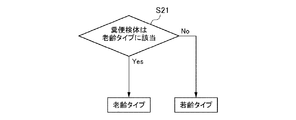
菌群のスクリーニング方法には、少なくとも選別工程S21及び菌群同定工程S22が含まれる。なお、老若判定マーカーとは、腸内菌叢が老齢タイプであるか否かを判定するためのマーカー、腸内菌叢が若齢タイプであるか否かを判定するためのマーカー、及び腸内菌叢が老齢タイプと若齢タイプのいずれであるかを判定するためのマーカーのうち、少なくともいずれかに該当するものである。 The bacterial group screening method includes at least a selection step S21 and a bacterial group identification step S22. It should be noted that the age determination marker is a marker for determining whether the intestinal flora is an old type, a marker for determining whether the intestinal flora is an young type, and the intestine This corresponds to at least one of the markers for determining whether the bacterial flora is an old type or a young type.
選別工程S21は、糞便検体について、上述した腸内菌叢の老若判定方法の結果に基づき糞便検体を複数の群に分ける工程である。腸内菌叢の判定については、上述した通りである。選別工程S21の一例を図3に示す。 The sorting step S21 is a step of dividing the stool samples into a plurality of groups based on the results of the above-described method for determining intestinal flora age and youngness. The determination of the intestinal flora is as described above. An example of the sorting step S21 is shown in FIG.
図3に示す選別工程S21では、上述した腸内菌叢の判定により、糞便検体を老齢タイプと若齢タイプのいずれかに分ける。また、本工程S21では、上述した(a)Lachnospiraceae科に属する菌群の上記割合のみに基づいて、糞便検体を選別してもよいが、Lachnospiraceae科に属する菌群の上記割合に加えて、上記(b)〜(j)のうち、いずれかの科に属する菌群の上記割合にも基づいて、糞便検体を選別してもよい。 In the selection step S21 shown in FIG. 3, the stool specimen is classified into an old-age type or a young-age type based on the determination of the intestinal flora described above. Further, in this step S21, stool specimens may be selected based only on the above-mentioned ratio of the bacterial group belonging to the (a) Lachnospiraceae family, but in addition to the above-mentioned ratio of the bacterial group belonging to the Lachnospiraceae family, Of (b) to (j), the stool specimen may be selected based on the ratio of the fungal group belonging to any one of the families.
菌群同定工程S22は、上述した選別工程S21によって選別された複数の群のうち、少なくともいずれか一つの群の糞便検体に含まれる菌群を同定する工程である。即ち、老齢タイプに分類された一つの群と、若齢タイプに分類された一つの群のうち、少なくともいずれか一つの群の糞便検体に含まれる菌群を同定する工程である。対象とする群は、菌群のスクリーニングの目的に応じて決めることができる。例えば、老齢タイプと判定するためのマーカー探索が目的であれば、老齢タイプに該当する糞便検体に含まれる菌群を同定することが好ましい。また、若齢タイプと判定するためのマーカー探索が目的であれば、若齢タイプに該当する糞便検体に含まれる菌群を同定することが好ましい。 The fungal group identification step S22 is a step of identifying a fungal group included in a stool specimen of at least one of the plurality of groups selected in the above-described selection step S21. That is, it is a step of identifying a fungal group included in a stool specimen of at least one of a group classified as an old age type and a group classified as a young age type. The target group can be determined according to the purpose of screening the fungal group. For example, if the purpose is to search for a marker for determining an old age type, it is preferable to identify a bacterial group contained in a stool specimen corresponding to the old age type. In addition, if the purpose is to search for a marker for determining a young type, it is preferable to identify a fungal group included in a stool specimen corresponding to the young type.
また、複数の群の各々について、それらの群に含まれる糞便検体を菌群の同定対象としてもよい。例えば老齢タイプに該当する糞便検体と、若齢タイプに該当する糞便検体の各々から菌群を同定することもできる。なお、本開示において「菌群を同定する」とは、少なくとも門レベルまで同定されていることを指し、さらに綱レベル、目レベル、科レベル、属レベル及び種レベルのうち、いずれかのレベルまで同定することも含まれる。 Moreover, about each of several groups, it is good also considering the stool specimen contained in those groups as the identification object of a fungal group. For example, the fungal group can be identified from each of the stool specimen corresponding to the old age type and the stool specimen corresponding to the young age type. In the present disclosure, “to identify a fungal group” means that at least the gate level is identified, and further to any level among a class level, an eye level, a family level, a genus level, and a species level. Identifying is also included.
本工程S22において、糞便検体に含まれる菌群の同定は、公知の手法を用いて行うことができ、その手法は限定されない。例えば、糞便検体に含まれる菌群のゲノムを解読して、塩基配列に基づいて行うこともできる。この場合、菌群の16SrRNA遺伝子の塩基配列を解析して、各々の菌群を同定することができる。以下に、本工程S22の一例を示す。 In this step S22, the identification of the bacteria group contained in the stool specimen can be performed using a known technique, and the technique is not limited. For example, it can be performed based on the base sequence by decoding the genome of the fungal group contained in the stool specimen. In this case, each bacterial group can be identified by analyzing the base sequence of the 16S rRNA gene of the bacterial group. Below, an example of this process S22 is shown.
先ず、糞便検体に含まれる菌群のDNAを抽出する。DNAの抽出については、上述した腸内菌叢の老若判定方法における測定工程S11と同様の方法で行うことができる。 First, the bacteria group DNA contained in the stool specimen is extracted. About extraction of DNA, it can carry out by the method similar to measurement process S11 in the age-related determination method of the intestinal microflora mentioned above.
次に、得られたDNAの塩基配列を解読する。塩基配列の解読は、公知の手法によって行うことができ、その手法は限定されない。塩基配列の決定については、上述した腸内菌叢の老若判定方法における測定工程S11と同様に、例えばシーケンサーを用いる方法等によって行うことができる。また、上述した腸内菌叢の老若判定方法における測定工程S11と同様の方法により、例えば、解読されたDNAの塩基配列をデータベースに照会することで、菌群を同定することができる。 Next, the base sequence of the obtained DNA is decoded. The base sequence can be decoded by a known method, and the method is not limited. The determination of the base sequence can be performed by, for example, a method using a sequencer or the like, as in the measurement step S11 in the method for determining the gut microbiota age. In addition, by the same method as the measurement step S11 in the above-described intestinal microbiota age determination method, for example, a bacterial group can be identified by referring to a database for the base sequence of the decoded DNA.
本開示に係る菌群のスクリーニング方法では、上述した腸内菌叢の老若判定方法を利用して、糞便検体を複数の群に分けて選別することができる。例えば、予め老齢タイプに該当すると判定された糞便検体は、該当しなかった他の糞便検体に比べて、加齢によって腸内菌叢がより大きく変化している可能性の高い検体である。従って、本開示に係る菌群のスクリーニング方法では、より効率的に老若判定マーカーを探索することができる。 In the method for screening a bacterial group according to the present disclosure, stool samples can be divided into a plurality of groups by using the above-described gut microbiota age determination method. For example, a stool specimen that has been determined to fall under the aged type in advance is a specimen that has a high possibility that the intestinal microflora has changed more greatly with aging than other stool specimens that did not fall under this category. Therefore, in the method for screening a bacterial group according to the present disclosure, it is possible to search for an age determination marker more efficiently.
また、例えば、若齢タイプに該当した糞便検体から同定された菌群やその菌数を、老齢タイプを判定するためのマーカー検索において、リファレンスとして用いることもできる。このリファレンスにより、若齢タイプであると判定された糞便検体においても同程度の割合で存在した菌群や菌種を、老齢タイプを判定するためのマーカー候補から除外することができる。
このため、より効率的に老齢タイプと判定するためのマーカーを探索することができる。この点については、老齢タイプに該当した糞便検体から同定された菌群やその菌数を、若齢タイプを判定するためのマーカー検索において、リファレンスとして用いる場合も同様である。
In addition, for example, the bacterial group identified from the stool specimen corresponding to the young type and the number of the bacteria can be used as a reference in the marker search for determining the old type. By this reference, it is possible to exclude bacterial groups and bacterial species that exist at a similar rate even in a stool specimen determined to be a young type from marker candidates for determining an old type.
For this reason, the marker for determining with an old age type more efficiently can be searched. The same applies to the case where the bacterial group identified from the stool specimen corresponding to the old type and the number of the bacteria are used as a reference in the marker search for determining the young type.
(3)物質のスクリーニング方法
本開示に係る物質のスクリーニング方法では、食餌や物質に含まれる腸内菌叢へ作用するものを探索する。図4は、本開示に係る物質のスクリーニング方法のフローチャートである。物質のスクリーニング方法には、少なくとも測定工程S31、相関算出工程S32及び物質同定工程S33が含まれる。なお、本開示に係る物質のスクリーニング方法において、腸内菌叢へ作用するものとは、例えば、腸内菌叢の老化を促進したり、あるいは抑制したりするなど、腸内菌叢のバランスを変化させるものである。
(3) Substance screening method In the substance screening method according to the present disclosure, a substance that acts on the intestinal flora contained in a diet or substance is searched. FIG. 4 is a flowchart of a screening method for a substance according to the present disclosure. The substance screening method includes at least a measurement step S31, a correlation calculation step S32, and a substance identification step S33. In the method for screening a substance according to the present disclosure, the substance acting on the intestinal flora means that the balance of the intestinal flora is, for example, promoting or suppressing aging of the intestinal flora. It is something to change.
測定工程S31は、上述した菌群のスクリーニング方法により、老若判定マーカーとして同定された菌群について、動物から得た糞便検体に含まれる全菌数に対する割合を測定する。菌群の割合の測定については、上述した通りである。 The measurement step S31 measures the ratio of the number of bacteria contained in the stool specimen obtained from the animal for the bacteria group identified as the age determination marker by the above-described bacteria group screening method. About the measurement of the ratio of a fungal group, it is as above-mentioned.
本開示に係る物質のスクリーニング方法において、食餌又は物質の動物への摂取は、経口摂取であっても、非経口摂取であってもよい。また、摂取回数は、1回でも複数回でもよい。複数回の場合、同じ食餌又は物質を複数回に渡って摂取してもよい。動物から得られる糞便検体は、食餌又は物質を摂取する前と摂取した後の各々の時点で採取されたものであってもよい。 In the screening method for substances according to the present disclosure, the intake of food or substances to animals may be oral or parenteral. In addition, the number of intakes may be once or multiple times. In the case of multiple doses, the same diet or substance may be taken multiple times. A stool specimen obtained from an animal may be collected at each time point before and after ingesting a food or substance.
相関算出工程S32は、測定工程S31で測定された菌群の割合について、その増減と、動物が摂取した食餌又は物質との相関を求める工程である。動物が食餌又は物質を摂取した後、上述した菌群のスクリーニングによって老若判定マーカーとされた菌群の数が糞便検体において変動すれば、その食餌又は物質は腸内菌叢へ作用するものである可能性が高い。また、動物が摂取した食餌又は物質の量に応じて、菌群の割合の変動の程度も変化すれば、その食餌又は物質は腸内菌叢へ作用するものである可能性が高い。本工程S32では、このような、動物が摂取した食餌又は物質と、糞便検体の全菌数に対する特定の菌群の割合における相関関係を解析する。 Correlation calculation process S32 is a process of calculating | requiring the correlation with the increase or decrease, and the food or substance which the animal ingested about the ratio of the fungal group measured by measurement process S31. After the animal ingests the food or substance, if the number of fungal groups determined by the above-mentioned screening of the fungal group varies in the fecal specimen, the food or substance acts on the intestinal flora. Probability is high. In addition, if the degree of change in the proportion of the fungal group changes according to the amount of food or substance ingested by the animal, the food or substance is likely to act on the intestinal flora. In this process S32, the correlation in the ratio of the specific fungus group with respect to the food or substance which the animal ingested and the total number of bacteria of a stool specimen is analyzed.
本工程S32では、例えば相関係数rを算出してもよい。また、例えば、カイ二乗検定やマンホイットニーU検定等の検定方法を用いて、食餌又は物質を摂取した群と摂取していない群との間の、老若判定マーカーとした菌群の上記割合の差異について、χ2値やU等を求めてもよい。相関について数値で表わすことができれば、その算出方法は特に限定されず、母集団の大きさや測定工程S31で測定する菌群の種類の数等に合わせて、公知の統計手法の中から適宜選択できる。 In this step S32, for example, a correlation coefficient r may be calculated. In addition, for example, by using a test method such as chi-square test or Mann-Whitney U test, the difference in the above-mentioned ratio of the fungal group as a marker for determining the age between the group that has taken food or substance and the group that has not taken it Χ 2 value, U, etc. may be obtained. As long as the correlation can be expressed by a numerical value, the calculation method is not particularly limited, and can be appropriately selected from known statistical methods according to the size of the population, the number of types of bacterial groups to be measured in the measurement step S31, and the like. .
また、相関算出工程S32では、任意の統計手法に基づき、老若判定マーカーとして用いた菌群の上記割合の増減と、動物が摂取した食餌又は物質との相関について、計算機等により自動的に相関関係を解析してもよい。 In addition, in the correlation calculation step S32, based on an arbitrary statistical method, the correlation between the increase / decrease of the above-mentioned proportion of the fungal group used as the age determination marker and the food or substance ingested by the animal is automatically correlated by a computer or the like. May be analyzed.
物質同定工程S33は、相関算出工程S32において算出された値が閾値を満たす場合に、その食餌又は物質を腸内菌叢へ作用するものとして同定する工程である。閾値は、相関算出工程S32において相関の算出に用いた方法に合わせて適宜設定できる。
例えば、相関算出工程S32において相関係数r、χ2値又はUを算出するのであれば、本工程S33では、これらの数値に対応するp値に対して閾値を設定できる。例えば、閾値をp<0.05とする場合、前記p値がこれに該当すれば、閾値を満たすものとする。また、前記p値がこれに該当しなければ、閾値を満たさないものとする。
The substance identification step S33 is a step of identifying the diet or substance as acting on the intestinal flora when the value calculated in the correlation calculation step S32 satisfies a threshold value. The threshold value can be appropriately set according to the method used for calculating the correlation in the correlation calculation step S32.
For example, if the correlation coefficient r, χ 2 value or U is calculated in the correlation calculation step S32, a threshold can be set for the p value corresponding to these numerical values in this step S33. For example, when the threshold value is p <0.05, the threshold value is satisfied if the p value corresponds to this. If the p value does not correspond to this, the threshold value is not satisfied.
上記閾値を満たした場合、その動物が摂取した食餌又は物質は、腸内菌叢へ作用するものとして同定される。例えば、食餌又は物質の摂取後に、老齢タイプと判定するためのマーカーとされる菌群の上記割合が老齢タイプの範囲外へ変動し、相関算出工程S32によって算出された値が閾値を満たす場合には、その食餌又は物質は、腸内菌叢の若齢タイプへの変化を促進するものとして同定される。
また、食餌又は物質の摂取後に、若齢タイプと判定するためのマーカーとされる菌群の上記割合が若齢タイプの範囲外へ変動し、その相関が閾値を満たす場合には、その食餌又は物質は、腸内菌叢の老齢タイプへの変化を促進するものとして同定される。
If the above threshold is met, the food or substance ingested by the animal is identified as acting on the gut flora. For example, when the above-mentioned ratio of the fungal group used as a marker for determining an old-age type after intake of a diet or substance varies outside the range of the old-age type, and the value calculated by the correlation calculation step S32 satisfies a threshold value The diet or substance is identified as promoting the change of intestinal flora to a younger type.
In addition, after ingestion of a diet or substance, if the above-mentioned ratio of the fungal group that is a marker for determining the young type varies outside the range of the young type, and the correlation satisfies the threshold, the diet or The substance is identified as promoting the change of the gut flora to an aging type.
本開示に係る物質のスクリーニング方法では、上述した菌群のスクリーニング方法によって老若判定マーカーとされる菌群の上記割合を指標とすることにより、簡便に腸内菌叢へ作用するものをスクリーニングすることができる。 In the screening method for substances according to the present disclosure, screening for those that act on the gut microbiota simply by using as an index the above-mentioned ratio of the bacterial group that is determined as an age-related determination marker by the bacterial group screening method described above. Can do.
本開示は、以下の構成を採用することもできる。
〔1〕腸内菌叢について老齢タイプと若齢タイプのいずれであるかを判定する方法であって、糞便検体に含まれる全て菌の数に対する(a)Lachnospiraceae科に属する菌群の割合に基づき前記腸内菌叢を判定する判定工程、を有する、腸内菌叢の老若判定方法。
〔2〕前記判定工程では、前記(a)Lachnospiraceae科に属する菌群の前記割合に加えて、下記(b)〜(j)の科に属する菌群のうち少なくともいずれか一つの菌群の、前記糞便検体に含まれる全ての菌の数に対する割合に基づき、前記腸内菌叢を判定する、上記〔1〕に記載の腸内菌叢の老若判定方法。
(b)Bifidobacteriaceae科
(c)Peptococcaceae科
(d)Enterococcaceae科
(e)Verrucomicrobiaceae科
(f)Catabacteriaceae科
(g)Clostridiaceae科
(h)Caulobacteraceae科
(i)Propionibacteriaceae科
(j)Enterobacteriaceae科
〔3〕前記判定工程では、前記菌群ごとの前記割合を独立変数とし、前記糞便検体を得た個体の年齢又は月齢に関する回帰分析によって回帰式を算出して、当該回帰式に基づき前記腸内菌叢を判定する、上記〔1〕又は〔2〕に記載の腸内菌叢の老若判定方法。
〔4〕前記判定工程では、前記回帰式の解と、予め定められた基準値と、を比較して、前記解が前記基準値を超える場合には前記腸内菌叢を老齢タイプと判定し、前記解が前記基準値以下である場合には前記腸内菌叢を若齢タイプと判定する、上記〔3〕に記載の腸内菌叢の老若判定方法。
〔5〕前記判定工程では、前記回帰式として下記式(1)を算出し、
下記式(1)の解yが0を超える場合には、前記腸内菌叢を老齢タイプと判定する、上記〔4〕に記載の腸内菌叢の老若判定方法。
The present disclosure can also employ the following configurations.
[1] A method for determining whether the intestinal flora is an old type or a young type, based on the ratio of the bacterial group belonging to the family (a) Lachnospiraceae relative to the number of all bacteria contained in the stool specimen A determination method for determining intestinal microflora, comprising the determination step of determining the intestinal flora.
[2] In the determination step, in addition to the ratio of the fungus group belonging to the (a) Lachnospiraceae family, at least one of the fungus group belonging to the following (b) to (j) family, The intestinal microflora age determination method according to the above [1], wherein the intestinal microflora is determined based on a ratio to the number of all bacteria contained in the stool specimen.
(B) Bifidobacteriaceae (c) Peptococcaceae (d) Enterococcaceae (e) Verrucomicrobiaceae (f) Catabacteriaceae (g) Clostridiaceae (h) Caulobacteraceae (i) Propionibacteriaceae (j) Enterobacteriaceae In the step, the ratio for each fungus group is set as an independent variable, a regression equation is calculated by regression analysis on the age or age of the individual who obtained the stool specimen, and the intestinal flora is determined based on the regression equation The method for determining the age of young intestinal flora according to [1] or [2] above.
[4] In the determination step, the solution of the regression equation is compared with a predetermined reference value, and when the solution exceeds the reference value, the intestinal flora is determined as an old-age type. The method for determining intestinal flora age or youngness according to [3] above, wherein when the solution is equal to or less than the reference value, the intestinal flora is determined as a young type.
[5] In the determination step, the following equation (1) is calculated as the regression equation,
When the solution y of the following formula (1) exceeds 0, the gut microbiota age determination method according to the above [4], wherein the gut microbiota is determined to be an old-age type.
(式中、nは前記独立変数の数であり、kは前記菌群が属する科のうち第k番目の科を意味し、αは前記回帰式の切片であり、βは前記回帰式の回帰係数であり、xは前記割合である。)
〔6〕前記判定工程の前に前記割合を測定する測定工程を有する、上記〔1〕〜〔5〕のいずれかに記載の判定方法。
(Where n is the number of the independent variables, k is the k-th family of the family to which the fungal group belongs, α is the intercept of the regression equation, and β is the regression of the regression equation) Is a coefficient, and x is the ratio.)
[6] The determination method according to any one of [1] to [5], further including a measurement step of measuring the ratio before the determination step.
〔7〕上記〔1〕〜〔6〕のいずれかに記載の腸内菌叢の老若判定方法の結果に基づいて糞便検体を複数の群に分ける選別工程と、選別された前記複数の群のうち、少なくともいずれか一つの群の糞便検体に含まれる菌群を同定する菌群同定工程と、を有する、腸内菌叢の老若判定マーカーとなる菌群のスクリーニング方法。 [7] A selection step of dividing a stool sample into a plurality of groups based on the result of the gut microbiota age determination method according to any one of [1] to [6] above; A fungus group identification step of identifying a fungus group contained in at least any one group of stool specimens, and a method for screening a fungus group that serves as an age-related determination marker for intestinal flora.
〔8〕上記〔7〕に記載の菌群のスクリーニング方法により同定された菌群について、動物から得た糞便検体に含まれる全て菌の数に対する割合を測定する測定工程と、前記菌群の前記割合の増減と、前記動物が摂取した食餌又は物質と、の相関を求める相関算出工程と、前記相関算出工程において算出された値が閾値を満たす場合に、前記食餌又は物質を腸内菌叢へ作用するものとして同定する物質同定工程と、を含む、物質のスクリーニング方法。 [8] For the fungal group identified by the method for screening a fungal group according to [7] above, a measuring step of measuring a ratio to the number of all the fungi contained in a stool specimen obtained from an animal; A correlation calculation step for obtaining a correlation between the increase / decrease of the ratio and the diet or substance ingested by the animal, and when the value calculated in the correlation calculation step satisfies a threshold value, the diet or substance is transferred to the intestinal flora. And a substance identification step for identifying the substance as acting.
1.実験例1
本実験例では、糞便検体に含まれる菌群について、老齢及び若齢の各々に特徴的な菌群の同定を試みた。
1. Experimental example 1
In the present experimental example, an attempt was made to identify a fungal group characteristic for each of the old and young age groups of the fungus group contained in the stool specimen.
<検体>
本実験例では、健常な174名(21〜104歳)の日本人から提供された糞便検体を用いた。この174名の内訳は、20歳代:9人、30歳代:45人、40歳代:21人、50歳代:13人、60歳代:5人、70歳代:10人、80歳代:46人、90歳代:19人、100歳以上:6人であり、平均年齢は61.7歳である。
<Sample>
In this experimental example, stool samples provided by 174 healthy Japanese (21 to 104 years old) Japanese were used. The breakdown of these 174 people is: 20s: 9 people, 30s: 45 people, 40s: 21 people, 50s: 13 people, 60s: 5 people, 70s: 10 people, 80 people Age: 46 people, 90's: 19 people, 100 years old and over: 6 people, the average age is 61.7 years old.
<DNAの抽出>
本実験例では、先ず、糞便検体からのDNAの抽出を行った。約20mgの糞便検体に対して、450μlの抽出用溶液(100mM Tris/HCl、4mM EDTA、pH9.0)を加えて懸濁し、さらに、10%SDS溶液50μl、0.1mm径のガラスビーズ300mg、500μlのTE飽和フェノール(和光純薬)を加えて混合した。得られた懸濁液に対しては、FastPrep FP 100A(フナコシ社製)を用いてパワーレベル5で30秒の破砕処理を実施した後、14,000×gで5分間遠心して400μlの上清を得た。得られた上清に250μlのフェノール・クロロホルム溶液(和光純薬)を加えて混合し、14,000×gで5分間遠心した後、250μlの上清を回収した。回収した上清に、2−プロパノールを250μl加え、DNAを沈殿させ、200μlのTris−EDTAバッファー(pH8.0)に再度溶解させて、これをDNA溶液とした。
<Extraction of DNA>
In this experimental example, first, DNA was extracted from a stool specimen. About 20 mg of a stool specimen, 450 μl of an extraction solution (100 mM Tris / HCl, 4 mM EDTA, pH 9.0) is added and suspended. Further, 50 μl of a 10% SDS solution, 300 mg of 0.1 mm diameter glass beads, 500 μl of TE saturated phenol (Wako Pure Chemical Industries) was added and mixed. The obtained suspension was subjected to a crushing treatment for 30 seconds at a power level of 5 using FastPrep FP 100A (manufactured by Funakoshi), and then centrifuged at 14,000 × g for 5 minutes to obtain 400 μl of supernatant. Got. To the obtained supernatant, 250 μl of a phenol / chloroform solution (Wako Pure Chemical Industries, Ltd.) was added and mixed. After centrifugation at 14,000 × g for 5 minutes, 250 μl of the supernatant was collected. 250 μl of 2-propanol was added to the collected supernatant to precipitate the DNA, which was dissolved again in 200 μl of Tris-EDTA buffer (pH 8.0) to obtain a DNA solution.
<DNAの増幅>
次に、上記DNA溶液に含まれる菌群のゲノムに対して核酸増幅反応を行った。下記表1〜表3に、本実験例で用いたプライマーの配列を示す。表1に示すプライマーセットは、16SrRNA遺伝子の第3〜4可変領域を増幅させるためのプライマーである。これらのプライマーについては、便宜的に第1プライマーセットとする。
<Amplification of DNA>
Next, a nucleic acid amplification reaction was performed on the genome of the fungus group contained in the DNA solution. Tables 1 to 3 below show the primer sequences used in this experimental example. The primer set shown in Table 1 is a primer for amplifying the 3rd to 4th variable regions of the 16S rRNA gene. These primers are referred to as the first primer set for convenience.
表1中、「R」は、グアニン又はアデニンを意味する。「W」は、アデニン又はチミン若しくはウラシルを意味する。「H」は、アデニン又はシトシン又はチミン若しくはウラシルを意味する。「V」は、アデニン又はグアニン又はシトシンを意味する。 In Table 1, “R” means guanine or adenine. “W” means adenine or thymine or uracil. “H” means adenine or cytosine or thymine or uracil. “V” means adenine or guanine or cytosine.
また、下記表2及び表3に示すプライマーセットは、次世代シーケンサー(Miseq(イルミナ社製))を用いて塩基配列を解析するために必要な配列(アダプター領域及びインデックス領域)を増幅核酸鎖に組み込むためのプライマーセットである。表2に示すプライマーはフォワードプライマーであり、表3に示すプライマーは、リバースプライマーである。これらのプライマーは、便宜的に第2プライマーセットとする。なお、表1〜表3に示すプライマーは、Life Technologies社のオリゴプライマー作成サービスにより得た。 In addition, the primer sets shown in Table 2 and Table 3 below are sequences (adapter region and index region) necessary for analyzing the base sequence using a next-generation sequencer (Miseq (manufactured by Illumina)) as an amplified nucleic acid chain. It is a primer set for incorporation. The primers shown in Table 2 are forward primers, and the primers shown in Table 3 are reverse primers. These primers are referred to as the second primer set for convenience. In addition, the primer shown in Table 1-Table 3 was obtained by Life Technologies' oligo primer preparation service.
上述したDNA溶液及び第1プライマーセットを含む総液量25μlの反応液を、TaKaRa ExTaq HS kit(タカラバイオ社製)を用いて調製した。核酸増幅反応は、サーマルサイクラー(Veriti 200(Life Technologies社製))を用いて行い、94℃−3分の後、94℃−30秒、50℃−30秒、72℃−30秒を1サイクルとし、これを20回繰り返し、その後72℃−10分として、PCR反応を行った。得られたPCR産物を1%アガロースゲルにて電気泳動し、バンドパターンにより、増幅核酸鎖を確認した。 A reaction solution having a total liquid volume of 25 μl containing the above-described DNA solution and the first primer set was prepared using TaKaRa ExTaq HS kit (manufactured by Takara Bio Inc.). The nucleic acid amplification reaction is performed using a thermal cycler (Veriti 200 (manufactured by Life Technologies)), 94 ° C. for 3 minutes, 94 ° C. for 30 seconds, 50 ° C. for 30 seconds, and 72 ° C. for 30 seconds for one cycle. This was repeated 20 times, and then the PCR reaction was carried out at 72 ° C. for 10 minutes. The obtained PCR product was electrophoresed on a 1% agarose gel, and the amplified nucleic acid chain was confirmed by the band pattern.
続いて、得られたPCR産物1μlを鋳型とし、第2プライマーセットを用いて上述した条件と同様にPCR反応を行った。但し、サイクル数は15回とした。得られたPCR産物を1%アガロースゲルにて電気泳動し、バンドパターンを確認した後、QIAquick 96 PCR Purification Kit(キアゲン社製)を用いてPCR産物を精製した。精製後のPCR産物については、Quant−iT PicoGreen dsDNA Assay kit(Life Technologies社製)によりDNA濃度を測定した。 Subsequently, 1 μl of the obtained PCR product was used as a template, and a PCR reaction was carried out using the second primer set in the same manner as described above. However, the number of cycles was 15 times. The obtained PCR product was electrophoresed on a 1% agarose gel, and after confirming the band pattern, the PCR product was purified using QIAquick 96 PCR Purification Kit (manufactured by Qiagen). For the purified PCR product, the DNA concentration was measured by Quant-iT PicoGreen dsDNA Assay kit (manufactured by Life Technologies).
<DNAのシークエンス>
複数の糞便検体に由来するPCR産物を同じ濃度で混合したものをMiseq v2 Reagent kit(イルミナ社製)に供し、Miseqにてシークエンス解析を実施した。
<DNA sequence>
A mixture of PCR products derived from a plurality of stool specimens at the same concentration was supplied to a Miseq v2 Reagent kit (manufactured by Illumina), and sequence analysis was performed with Miseq.
<菌群の同定及び菌数の算出>
上記シークエンス解析により得られたペアエンド配列をfastq-join (version.1.1.2-301)(http://code.google.com/p/ea-utils/wiki/FastqJoin)にて、QIIMEソフトウェア(version 1.6.0)(http://qiime.org/)にて97%の相同性を有する配列ごとをOUT(Operational Taxonomy Unit)とした。各OUTの代表配列を下記データベースに対してBLAST検索することにより、腸内菌叢の構成を解析した。
データベース:Greengenes database 12_10
(http://greengenes.secondgenome.com/downloads/database/12_10)
<Identification of bacteria group and calculation of the number of bacteria>
The paired end sequence obtained by the above sequence analysis is transferred to the QIIME software (version 1.1.2-301) (http://code.google.com/p/ea-utils/wiki/FastqJoin) 1.6.0) (http://qiime.org/), each sequence having 97% homology was defined as OUT (Operational Taxonomy Unit). The structure of the intestinal flora was analyzed by BLAST search of the representative sequence of each OUT against the following database.
Database: Greengenes database 12_10
(http://greengenes.secondgenome.com/downloads/database/12_10)
<結果>
上述した腸内菌叢の構成の解析の結果、個々の糞便検体について8295±2366の配列が得られた。本実験例では、この配列数を各糞便検体に含まれる全菌数とした。また、これらの配列のうち、個々の門又は科ごとの数を各々の門又は科に属する菌群の数とした。上記相同性検索の結果、表4及び表5に示す腸内菌叢構成が得られた。表4は、門レベルでの分類を示し、表5は、科レベルでの分類を示す。
<Result>
As a result of the analysis of the composition of the intestinal flora described above, 8295 ± 2366 sequences were obtained for each stool specimen. In the present experimental example, this number of sequences was the total number of bacteria contained in each stool specimen. Moreover, among these arrangement | sequences, the number for each individual gate or family was made into the number of the fungal group which belongs to each gate or family. As a result of the homology search, the gut microbiota composition shown in Tables 4 and 5 was obtained. Table 4 shows the classification at the portal level, and Table 5 shows the classification at the family level.
2.実験例2
本実験例では、上記実験例1で同定された各門又は各科に属する菌群について、糞便検体に含まれる全ての菌の数に対する各々の菌群の割合が、腸内菌叢を「老齢タイプ」と「若齢タイプ」のいずれかに判定する場合に有用であるか検討した。また、本実験例では、年齢が65歳以上の個体から得られた糞便検体を「老齢タイプ」とし、64歳以下の個体から得られた糞便検体を「若齢タイプ」とした。
2. Experimental example 2
In this experimental example, for the bacterial group belonging to each gate or each family identified in Experimental Example 1 above, the ratio of each bacterial group to the number of all bacteria contained in the stool specimen is the gut microbiota, It was examined whether it was useful when judging either “type” or “young type”. Further, in this experimental example, a stool specimen obtained from an individual 65 years of age or older was referred to as an “old age type”, and a stool specimen obtained from an individual under 64 years old was referred to as a “young age type”.
<回帰式の算出>
本実験例では、糞便検体の上記2種類のタイプへの分類に際して、回帰式を用いた。本実験例では、表4及び表5に示す門又は科に属する菌群の上記割合を、各々、独立変数とし、糞便検体を得た174の個体の年齢を従属変数とし、最小二乗法により、単回帰式を算出した。即ち、本実験例における回帰分析の独立変数及び従属変数は、各々、「1」である。
<Calculation of regression equation>
In this experimental example, a regression equation was used when classifying the stool specimen into the above two types. In this experimental example, the above-mentioned ratio of the fungal group belonging to the gate or family shown in Table 4 and Table 5, respectively, as an independent variable, the age of 174 individuals who obtained stool samples as a dependent variable, by the least square method, A single regression equation was calculated. That is, the independent variable and dependent variable of the regression analysis in this experimental example are each “1”.
さらに、従属変数については、回帰式を算出する前に、量的変数から質的変数に置き換えた。具体的には、174の糞便検体を得た各々の個体の年齢について、65歳以上を「1」、65歳未満を「−1」に置き換えた。 Furthermore, for dependent variables, quantitative variables were replaced with qualitative variables before calculating regression equations. Specifically, regarding the age of each individual who obtained 174 stool specimens, 65 years or older was replaced with “1” and less than 65 years with “−1”.
上記表6に、算出された各回帰式のうち、Lachnospiraceae科、Bifidobacteriaceae科、Clostridiaceae科、Bacteroidaceae科及びEnterococcaceae科の各々に属する菌群の上記割合に基づき算出された回帰式の切片(α)と回帰係数(β)を示す。 In Table 6 above, among the calculated regression equations, an intercept (α) of the regression equation calculated based on the above-mentioned proportion of the fungal group belonging to each of the Lachnospiraceae family, Bifidobacteriaceae family, Clostridiaceae family, Bacteroidaceae family, and Enterococcaceae family, and Regression coefficient (β) is shown.
また、下記式(2)は、本実験例の回帰式を示す。なお、下記式(2)において、αは切片であり、βは回帰係数であり、xは各科に属する菌群の上記割合である。 Moreover, following formula (2) shows the regression formula of this experiment example. In the following formula (2), α is an intercept, β is a regression coefficient, and x is the above-mentioned ratio of the fungal group belonging to each family.
本実験例では、算出された切片αと回帰係数βに基づき、上記式(2)の解yを求め、基準と比較した。本実験例では、基準値として「0」を設定し、基準値0を超えた場合に、その糞便検体を得た個体の腸内菌叢について、65歳以上の「老齢タイプ」に分類した。一方、回帰式の解yが0以下の場合には、その糞便検体を得た個体の腸内菌叢について、65歳未満の「若齢タイプ」に分類した。 In this experimental example, based on the calculated intercept α and regression coefficient β, a solution y of the above equation (2) was obtained and compared with a reference. In this experimental example, “0” was set as the reference value, and when the reference value 0 was exceeded, the intestinal flora of the individual from which the stool specimen was obtained was classified as an “aged type” 65 years or older. On the other hand, when the solution y of the regression equation was 0 or less, the intestinal flora of the individual from whom the stool specimen was obtained was classified as a “young type” under 65 years old.
<結果>
表7に本実験例の結果を示す。表7は、Lachnospiraceae科、Bifidobacteriaceae科、Clostridiaceae科、Bacteroidaceae科及びEnterococcaceae科の、各々に属する菌群について、回帰式の解yと基準値に基づく「老齢タイプ」又は「若齢タイプ」への分類と、糞便検体を得た個体の実際の年齢(実年齢)と、を比較した結果を示す。また、正答率(%)とは、検体の分類結果と検体を得た個体の実年齢とが一致した検体数の、検体数全体に占める割合(%)を示す。さらに、検出率は、174の糞便検体のうち、各々の科に属する菌群が検出された検体の割合を示す。なお、各々の科に属する菌群が検出されなかった糞便検体については、「判定結果と実年齢が一致しない検体数」にカウントした。
<Result>
Table 7 shows the results of this experimental example. Table 7 shows classification of Lactnospiraceae family, Bifidobacteriaceae family, Clostridiaceae family, Bacteroidaceae family and Enterococcaceae family into “old type” or “young type” based on the solution y of the regression equation and the standard value. And the actual age (actual age) of the individual from which the stool specimen was obtained is compared. The correct answer rate (%) indicates the ratio (%) of the total number of samples in the number of samples in which the classification result of the sample matches the actual age of the individual who obtained the sample. Furthermore, a detection rate shows the ratio of the sample from which the microbial group which belongs to each family was detected among 174 stool samples. Note that stool specimens for which no bacterial group belonging to each family was detected were counted as “number of specimens whose judgment results and actual age did not match”.
Bifidobacteriaceae科に属する菌群は、多くのヒトの腸内菌叢に存在し、また、加齢に伴い腸内で菌数が減少することが知られている菌群である。Bifidobacteriaceae科に属する菌群の上記割合に基づく糞便検体の分類において、正答率は67.2%であった。 The group of bacteria belonging to the family Bifidobacteriaceae is a group of bacteria that exist in many intestinal flora of humans and whose bacterial count is known to decrease in the intestines with aging. In the classification of stool specimens based on the above ratio of the fungal group belonging to the family Bifidobacteriaceae, the correct answer rate was 67.2%.
また、Clostridiaceae科、Bacteroidaceae科及びEnterococcaceae科の、各々に属する菌群の上記割合に基づく糞便検体の分類では、正答率は、各々、64.9%、62.1%、53.4%であった。一方、Lachnospiraceae科に属する菌群の上記割合に基づく糞便検体の分類では、正答率は、83.3%であった。 In the classification of fecal specimens based on the above-mentioned proportions of the fungal groups belonging to each of the Clostridiaceae family, Bacteroidaceae family, and Enterococcaceae family, the correct answer rates were 64.9%, 62.1%, and 53.4%, respectively. It was. On the other hand, in the classification of stool specimens based on the above ratio of the fungal group belonging to the family Lachnospiraceae, the correct answer rate was 83.3%.
本実験例の結果から、Lachnospiraceae科に属する菌群の上記割合に基づき、糞便検体を分類した場合、従来、加齢に伴い菌数が変動することが知られているBifidobacteriaceae科の上記割合に基づき分類した場合よりも高い正答率で、検体を分類できることが示された。また、174の全ての検体で、Lachnospiraceae科に属する菌群が検出された。 Based on the results of this experimental example, when stool specimens are classified based on the above-mentioned ratio of the fungal group belonging to the Lachnospiraceae family, based on the above-mentioned ratio of the Bifidobacteriaceae family, which is conventionally known to change the number of bacteria with aging It was shown that the specimens can be classified with a higher accuracy rate than the classification. In all 174 specimens, a bacterial group belonging to the family Lachnospiraceae was detected.
上述した結果から、糞便検体に含まれる全ての菌の数に対するLachnospiraceae科に属する菌群の割合は、糞便検体を「老齢タイプ」と「若齢タイプ」のいずれかに判定する判定方法において、有用な値であることが示された。従って、Lachnospiraceae科に属する菌群の上記割合に基づき糞便検体を判定することにより、精度高く糞便検体を判定できることが示された。 From the above results, the ratio of the group of bacteria belonging to the Lachnospiraceae family to the number of all bacteria contained in the stool specimen is useful in the determination method for determining the stool specimen as either “old type” or “young type” It was shown that it was a value. Therefore, it was shown that the fecal specimen can be determined with high accuracy by judging the fecal specimen based on the above-mentioned ratio of the bacterial group belonging to the family Lachnospiraceae.
さらに、Lachnospiraceae科に属する菌群の検出率は、174検体において100%であった。このことから、Lachnospiraceae科に属する菌群の上記割合を用いる腸内菌叢の老若判定方法は、複数の糞便検体において、検出される検体が限られる菌群の上記割合を用いる方法に比べて、汎用性の高い方法であることが示された。 Furthermore, the detection rate of the fungal group belonging to the Lachnospiraceae family was 100% in 174 samples. From this, the gut microbiome age determination method using the above-mentioned proportion of the fungal group belonging to the Lachnospiraceae family, compared to the method using the above-mentioned proportion of the bacterial group in which the detected samples are limited in a plurality of fecal samples, It was shown that this is a highly versatile method.
3.実験例3
上述した実験例2において、糞便検体に含まれる全ての菌の数に対するLachnospiraceae科に属する菌群の割合に基づいて判定することにより、糞便検体を得た個体の腸内菌叢を「老齢タイプ」と「若齢タイプ」のいずれかに精度高く判定できることが明らかとなった。そこで、本実験例では、Lachnospiraceae科に属する菌群の上記割合と、他の科に属する菌群の上記割合と、を組み合わせることにより、腸内菌叢の判定の精度がより高められるか検証した。
3. Experimental example 3
In the experimental example 2 described above, the gut microbiota of the individual from which the stool sample was obtained is determined as “aged type” by determining based on the ratio of the bacterial group belonging to the Lachnospiraceae family with respect to the number of all bacteria contained in the stool sample. It was clarified that it can be judged with high accuracy to either “young type” or “young type”. Therefore, in this experimental example, it was verified whether the accuracy of the determination of the intestinal flora can be further improved by combining the above-mentioned ratio of the bacterial group belonging to the family Lachnospiraceae and the above-mentioned ratio of the bacterial group belonging to the other family. .
本実験例では、上記実験例2で用いた(a)Lachnospiraceae科に属する菌群の上記割合に加えて、(b)Bifidobacteriaceae科、(c)Peptococcaceae科、(d)Enterococcaceae科、(e)Verrucomicrobiaceae科、(f)Catabacteriaceae科、(g)Clostridiaceae科、(h)Caulobacteraceae科、(i)Propionibacteriaceae科、(j)Enterobacteriaceae科、の各々に属する菌群の割合について、糞便検体に含まれる全ての細菌の数に対する各々の菌群の割合を用いた。具体的には、下記の4つの組み合わせについて、検討した。
パターンA:(a)Lachnospiraceae科、(b)Bifidobacteriaceae科
パターンB:(a)Lachnospiraceae科、(b)Bifidobacteriaceae科、(c)Peptococcaceae科
パターンC:(a)Lachnospiraceae科、(b)Bifidobacteriaceae科、(c)Peptococcaceae科、(d)Enterococcaceae科、(e)Verrucomicrobiaceae科
パターンD:(a)Lachnospiraceae科、(b)Bifidobacteriaceae科、(c)Peptococcaceae科、(d)Enterococcaceae科、(e)Verrucomicrobiaceae科、(f)Catabacteriaceae科、(g)Clostridiaceae科、(h)Caulobacteraceae科、(i)Propionibacteriaceae科、(j)Enterobacteriaceae科
In this experimental example, in addition to the above-mentioned ratio of the bacterial group belonging to (a) Lachnospiraceae family used in Experimental Example 2, (b) Bifidobacteriaceae family, (c) Peptococcaceae family, (d) Enterococcaceae family, (e) Verrucomicrobiaceae All the bacteria contained in stool specimens for the proportions of fungal groups belonging to each of the family, (f) Catabacteriaceae, (g) Clostridiaceae, (h) Caulobacteraceae, (i) Propionibacteriaceae, (j) Enterobacteriaceae The ratio of each fungal group to the number of Specifically, the following four combinations were examined.
Pattern A: (a) Lachnospiraceae family, (b) Bifidobacteriaceae family Pattern B: (a) Lachnospiraceae family, (b) Bifidobacteriaceae family, (c) Peptococcaceae family C: (a) Lachnospiraceae family, (b) Bifidobacteriaceae family, c) Peptococcaceae family, (d) Enterococcaceae family, (e) Verrucomicrobiaceae family pattern D: (a) Lachnospiraceae family, (b) Bifidobacteriaceae family, (c) Peptococcaceae family, (d) Enterococcaceae family, (e) Verrucomicrobiaceae family, f) Family of Catabacteriaceae, (g) Family of Clostridiaceae, (h) Family of Caulobacteraceae, (i) Family of Propionibacteriaceae, (j) Family of Enterobacteriaceae
<回帰式の算出>
本実験例では、糞便検体の分類に際して、実験例2と同様に、回帰式を用いた。回帰式については、各科に属する菌群の上記割合を独立変数とし、糞便検体を得た174の個体の年齢を従属変数として、最小二乗法により算出した。即ち、パターンAの独立変数は「2」であり、パターンBの独立変数は「3」であり、パターンCの独立変数は「5」であり、パターンDの独立変数は「10」である。
<Calculation of regression equation>
In this experimental example, a regression equation was used in the classification of stool specimens as in Experimental Example 2. The regression equation was calculated by the method of least squares using the above-mentioned proportion of the fungal group belonging to each family as an independent variable and the age of 174 individuals from which stool samples were obtained as a dependent variable. That is, the independent variable of pattern A is “2”, the independent variable of pattern B is “3”, the independent variable of pattern C is “5”, and the independent variable of pattern D is “10”.
さらに、従属変数については、実験例2と同様に、回帰式を算出する前に、174の糞便検体を得た各々の個体の年齢について、65歳以上を「1」、65歳未満を「−1」に置き換えた。各科に属する菌群の上記割合と、糞便検体を得た174の個体の年齢ついて、重回帰分析を行い、下記式(1)に示す回帰式を得た。 Further, as for the dependent variable, as in Experimental Example 2, before calculating the regression equation, the age of each individual who obtained 174 stool specimens was “1” for 65 years or older, and “−” for those under 65 years old. 1 ”. Multiple regression analysis was performed on the above-mentioned ratio of the fungal group belonging to each family and the age of 174 individuals from whom stool samples were obtained, and a regression equation represented by the following formula (1) was obtained.
上記式(1)において、nは独立変数の数であり、kは菌群が属する科のうち第k番目の科を意味し、αは回帰式の切片であり、βは回帰式の回帰係数であり、xは各科に属する菌群の上記割合である。 In the above formula (1), n is the number of independent variables, k means the k-th family among the families to which the fungal group belongs, α is the intercept of the regression equation, β is the regression coefficient of the regression equation And x is the above ratio of the fungal group belonging to each family.
また、下記表8に、各パターンの回帰式の切片と回帰係数(偏回帰係数)を示す。なお、菌群の括弧内のアルファベットは、上述した(a)〜(j)の各科に対応する。 Table 8 below shows the intercept and regression coefficient (partial regression coefficient) of the regression equation for each pattern. In addition, the alphabet in the parenthesis of a fungal group respond | corresponds to each department of (a)-(j) mentioned above.
本実験例では、算出された切片αと回帰係数(偏回帰係数)βに基づき、回帰式の解yを求め、基準と比較した。基準値は、実験例2と同様に、「0」を設定し、基準値0を超えた場合に、その糞便検体を得た個体の腸内菌叢について、65歳以上の「老齢タイプ」と判定した。 In this experimental example, based on the calculated intercept α and regression coefficient (partial regression coefficient) β, a solution y of the regression equation was obtained and compared with the reference. The reference value is set to “0” in the same manner as in Experimental Example 2, and when the reference value exceeds 0, the intestinal flora of the individual who obtained the stool sample is “old type” 65 years or older. Judged.
<結果>
表9に本実験例の結果を示す。表9は、回帰式の解yと基準値に基づく「老齢タイプ」又は「若齢タイプ」への分類と、糞便検体を得た個体の実際の年齢(実年齢)と、を比較した結果を示す。また、正答率(%)とは、検体の分類結果と検体を得た個体の実年齢とが一致した検体数の、検体数全体に占める割合(%)を示す。
<Result>
Table 9 shows the results of this experimental example. Table 9 shows the results of comparing the classification of the regression equation y into the “old type” or “young type” based on the reference value and the actual age (actual age) of the individual from which the stool specimen was obtained. Show. The correct answer rate (%) indicates the ratio (%) of the total number of samples in the number of samples in which the classification result of the sample matches the actual age of the individual who obtained the sample.
表9のパターンAに示すように、Lachnospiraceae科に属する菌群の上記割合に加えて、Bifidobacteriaceae科に属する菌群の上記割合に基づき糞便検体を分類すると、その正答率は、90%を超えた。また、パターンBに示すように、Lachnospiraceae科に属する菌群の上記割合及びBifidobacteriaceae科に属する菌群の上記割合に加えて、Peptococcaceae科に属する菌群の上記割合に基づき糞便検体を分類すると、その正答率は、92.5%であった。さらに、パターンCでは、正答率が93.7%であり、パターンDでは、正答率が94.8%であった。 As shown in pattern A of Table 9, in addition to the above-mentioned ratio of the fungal group belonging to the family Lachnospiraceae, in addition to classifying fecal specimens based on the above-mentioned ratio of the bacterial group belonging to the Bifidobacteriaceae family, the correct answer rate exceeded 90% . Further, as shown in Pattern B, in addition to the above-mentioned ratio of the fungal group belonging to the Lachnospiraceae family and the above-mentioned ratio of the bacterial group belonging to the Bifidobacteriaceae family, the stool specimen is classified based on the above-mentioned ratio of the fungal group belonging to the Peptococcaceae family, The correct answer rate was 92.5%. Furthermore, in pattern C, the correct answer rate was 93.7%, and in pattern D, the correct answer rate was 94.8%.
本実験例の結果から、Lachnospiraceae科に属する菌群の上記割合に加えて、Bifidobacteriaceae科、Peptococcaceae科、Enterococcaceae科、Verrucomicrobiaceae科、Catabacteriaceae科、Clostridiaceae科、Caulobacteraceae科、Propionibacteriaceae科又はEnterobacteriaceae科ののうち、少なくともいずれかの一つの科に属する菌群の上記割合に基づき糞便検体を分類した場合には、正答率をさらに高められることが示された。 From the results of this experimental example, in addition to the above-mentioned ratio of the fungal group belonging to the Lachnospiraceae family, the Bifidobacteriaceae family, Peptococcaceae family, Enterococcaceae family, Verrucomicrobiaceae family, Catabacteriaceae family, Clostridiaceae family, Caulobacteraceae family, Propionibacteriaceae family or Propionibacteriaceae family, It was shown that when the stool specimens were classified based on the above ratio of the fungal group belonging to at least one of the families, the correct answer rate could be further increased.
また、実験例2において示されたように、Bifidobacteriaceae科に属する菌群の上記割合、Clostridiaceae科に属する菌群の上記割合及びEnterococcaceae科に属する菌群の上記割合は、単独で腸内細菌叢の判定に用いた場合には、正答率が50〜60%程度であった。しかし、これらの菌群の上記割合については、Lachnospiraceae科に属する菌群の上記割合と組み合わせて判定に用いた場合には、腸内菌叢の老若の判定に有用であることが示された。 Moreover, as shown in Experimental Example 2, the above-mentioned ratio of the bacterial group belonging to the family Bifidobacteriaceae, the above-mentioned ratio of the bacterial group belonging to the Clostridiaceae family, and the above-mentioned ratio of the bacterial group belonging to the Enterococcaceae family are independent of the intestinal flora. When used for determination, the correct answer rate was about 50 to 60%. However, the above-mentioned proportions of these fungal groups were shown to be useful for determining the intestinal flora when used in combination with the above-mentioned proportions of the bacterial groups belonging to the family Lachnospiraceae.
Claims (4)
ヒトの糞便検体に含まれる全て菌の数に対する(a)Lachnospiraceae科に属する菌群の割合、および下記(b)〜(j)の科に属する菌群のうち少なくともいずれか一つの菌群の前記ヒトの糞便検体に含まれる全ての菌の数に対する割合に基づき前記腸内菌叢を判定する判定工程、を有し、
前記判定工程では、前記菌群ごとの前記割合を独立変数とし、前記糞便検体を得た個体の年齢又は月齢に関する回帰分析によって回帰式を算出して解を求め、前記回帰式の解と予め定められた基準値とを比較して、前記解が前記基準値を超える場合には前記腸内菌叢を老齢タイプと判定し、前記解が前記基準値以下である場合には前記腸内菌叢を若齢タイプと判定する、腸内菌叢の老若判定方法。
(b)Bifidobacteriaceae科
(c)Peptococcaceae科
(d)Enterococcaceae科
(e)Verrucomicrobiaceae科
(f)Catabacteriaceae科
(g)Clostridiaceae科
(h)Caulobacteraceae科
(i)Propionibacteriaceae科
(j)Enterobacteriaceae科 Intestinal flora of the intestinal flora characteristic of the elderly and young populations, which are characteristic of the intestinal flora that are characteristic of the elderly population in which a specific bacterial group is increasing or decreasing with age A method for determining which of the young type is,
The ratio of the fungal group belonging to the family (a) Lachnospiraceae relative to the total number of fungi contained in the human stool specimen , and the above-mentioned at least one of the bacterial groups belonging to the families (b) to (j) below: determination step of determining the intestinal flora based on a percentage of the number of all the bacteria contained in the feces sample of human, have a,
In the determination step, the ratio for each fungus group is set as an independent variable, and a regression equation is calculated by regression analysis on the age or age of the individual from which the stool specimen is obtained to obtain a solution, and the solution of the regression equation is determined in advance. When the solution exceeds the reference value, the intestinal flora is determined as an old type, and when the solution is equal to or less than the reference value, the intestinal flora A method for determining the age of young intestinal flora, in which the type is determined as a young type .
(B) Bifidobacteriaceae family
(C) Peptococcaceae family
(D) Enterococcaceae
(E) Verrucomicrobiaceae
(F) Catabacteriaceae family
(G) Clostridiaceae
(H) Caulobacteraceae
(I) Propionibacteriaceae
(J) Enterobacteriaceae
下記式(1)の解yが0を超える場合には、前記腸内菌叢を老齢タイプと判定する、
請求項1に記載の腸内菌叢の老若判定方法。
When the solution y of the following formula (1) exceeds 0, the intestinal flora is determined as an old-age type,
The method for determining the age of young intestinal flora according to claim 1 .
選別された前記複数の群のうち少なくともいずれか一つの群の糞便検体に含まれる菌群を同定する菌群同定工程と、を有する、腸内菌叢の老若判定マーカーとなる菌群のスクリーニング方法。 A screening step of dividing a stool specimen into a plurality of groups based on the result of the gut microbiota age determination method according to any one of claims 1 to 3 ,
A fungus group identification step for identifying a fungus group contained in a stool specimen of at least any one of the plurality of selected groups, and a method for screening a fungus group that serves as a marker for determining the gut microbiota .
Priority Applications (1)
| Application Number | Priority Date | Filing Date | Title |
|---|---|---|---|
| JP2014068360A JP6231925B2 (en) | 2014-03-28 | 2014-03-28 | A method for judging the age of young intestinal flora and a screening method for bacterial groups |
Applications Claiming Priority (1)
| Application Number | Priority Date | Filing Date | Title |
|---|---|---|---|
| JP2014068360A JP6231925B2 (en) | 2014-03-28 | 2014-03-28 | A method for judging the age of young intestinal flora and a screening method for bacterial groups |
Publications (2)
| Publication Number | Publication Date |
|---|---|
| JP2015188380A JP2015188380A (en) | 2015-11-02 |
| JP6231925B2 true JP6231925B2 (en) | 2017-11-15 |
Family
ID=54423458
Family Applications (1)
| Application Number | Title | Priority Date | Filing Date |
|---|---|---|---|
| JP2014068360A Active JP6231925B2 (en) | 2014-03-28 | 2014-03-28 | A method for judging the age of young intestinal flora and a screening method for bacterial groups |
Country Status (1)
| Country | Link |
|---|---|
| JP (1) | JP6231925B2 (en) |
Families Citing this family (3)
| Publication number | Priority date | Publication date | Assignee | Title |
|---|---|---|---|---|
| JP2015188379A (en) * | 2014-03-28 | 2015-11-02 | 森永乳業株式会社 | Methods for determining degree of aging of intestinal flora and screening methods for microbial populations |
| JP6751550B2 (en) * | 2015-05-15 | 2020-09-09 | 森永乳業株式会社 | Intestinal age estimation method and intestinal age estimation device |
| JP7668100B2 (en) * | 2020-10-09 | 2025-04-24 | 森永乳業株式会社 | Method for assessing intestinal condition |
Family Cites Families (1)
| Publication number | Priority date | Publication date | Assignee | Title |
|---|---|---|---|---|
| US20050118234A1 (en) * | 2003-12-01 | 2005-06-02 | The Iams Company | Methods and kits related to administration of a fructooligosaccharide |
-
2014
- 2014-03-28 JP JP2014068360A patent/JP6231925B2/en active Active
Also Published As
| Publication number | Publication date |
|---|---|
| JP2015188380A (en) | 2015-11-02 |
Similar Documents
| Publication | Publication Date | Title |
|---|---|---|
| Tito et al. | Phylotyping and functional analysis of two ancient human microbiomes | |
| Allali et al. | A comparison of sequencing platforms and bioinformatics pipelines for compositional analysis of the gut microbiome | |
| Links et al. | The chaperonin-60 universal target is a barcode for bacteria that enables de novo assembly of metagenomic sequence data | |
| Kommadath et al. | Gene co-expression network analysis identifies porcine genes associated with variation in Salmonella shedding | |
| Ong et al. | Species identification and profiling of complex microbial communities using shotgun Illumina sequencing of 16S rRNA amplicon sequences | |
| US20180137243A1 (en) | Therapeutic Methods Using Metagenomic Data From Microbial Communities | |
| CN107075446B (en) | Biomarkers for obesity related diseases | |
| Grond et al. | No evidence for phylosymbiosis in western chipmunk species | |
| JP2020513856A (en) | Leveraging Sequence-Based Fecal Microbial Survey Data to Identify Multiple Biomarkers for Colorectal Cancer | |
| Mehaffy et al. | Marked microevolution of a unique Mycobacterium tuberculosis strain in 17 years of ongoing transmission in a high risk population | |
| JP2018531044A6 (en) | Method for assessing normality of immune repertoire and use thereof | |
| JP2018531044A (en) | Method for assessing normality of immune repertoire and use thereof | |
| Koziel et al. | Campylobacter corcagiensis sp. nov., isolated from faeces of captive lion-tailed macaques (Macaca silenus) | |
| WO2020077095A1 (en) | tRNA-DERIVED FRAGMENTS AS BIOMARKERS FOR PARKINSON'S DISEASE | |
| Salamon et al. | Comparison of iSeq and MiSeq as the two platforms for 16S rRNA sequencing in the study of the gut of rat microbiome | |
| Biada et al. | Comparative analysis of Illumina, PacBio, and nanopore for 16S rRNA gene sequencing of rabbit’s gut microbiota | |
| Snyder et al. | Exploiting digital droplet PCR and next generation sequencing technologies to determine the relative abundance of individual Eimeria species in a DNA sample | |
| US20220084632A1 (en) | Clinical classfiers and genomic classifiers and uses thereof | |
| Shirzad-Aski et al. | Molecular characterization of Pasteurella multocida isolates obtained from poultry, ruminant, cats and dogs using RAPD and REP-PCR analysis | |
| Pankoke et al. | Evaluation of commercially available DNA extraction kits for the analysis of the broiler chicken cecal microbiota | |
| JP2015188380A (en) | A method for judging the age of young intestinal flora and a screening method for bacterial groups | |
| JP2025537698A (en) | Methods for determining the contribution of dog breed to a test dog genome | |
| JP2015188379A (en) | Methods for determining degree of aging of intestinal flora and screening methods for microbial populations | |
| Yuan et al. | Bacteriological and molecular identification of Bartonella species in cats from different regions of China | |
| Acharya et al. | Culture-independent identification of Mycobacterium avium subspecies paratuberculosis in ovine tissues: comparison with bacterial culture and histopathological lesions |
Legal Events
| Date | Code | Title | Description |
|---|---|---|---|
| A621 | Written request for application examination |
Free format text: JAPANESE INTERMEDIATE CODE: A621 Effective date: 20160519 |
|
| A131 | Notification of reasons for refusal |
Free format text: JAPANESE INTERMEDIATE CODE: A131 Effective date: 20170418 |
|
| A521 | Request for written amendment filed |
Free format text: JAPANESE INTERMEDIATE CODE: A523 Effective date: 20170615 |
|
| TRDD | Decision of grant or rejection written | ||
| A01 | Written decision to grant a patent or to grant a registration (utility model) |
Free format text: JAPANESE INTERMEDIATE CODE: A01 Effective date: 20171003 |
|
| A61 | First payment of annual fees (during grant procedure) |
Free format text: JAPANESE INTERMEDIATE CODE: A61 Effective date: 20171020 |
|
| R150 | Certificate of patent or registration of utility model |
Ref document number: 6231925 Country of ref document: JP Free format text: JAPANESE INTERMEDIATE CODE: R150 |
|
| R250 | Receipt of annual fees |
Free format text: JAPANESE INTERMEDIATE CODE: R250 |
|
| R250 | Receipt of annual fees |
Free format text: JAPANESE INTERMEDIATE CODE: R250 |
|
| R250 | Receipt of annual fees |
Free format text: JAPANESE INTERMEDIATE CODE: R250 |
|
| R250 | Receipt of annual fees |
Free format text: JAPANESE INTERMEDIATE CODE: R250 |
|
| S531 | Written request for registration of change of domicile |
Free format text: JAPANESE INTERMEDIATE CODE: R313531 |
|
| R350 | Written notification of registration of transfer |
Free format text: JAPANESE INTERMEDIATE CODE: R350 |
|
| R250 | Receipt of annual fees |
Free format text: JAPANESE INTERMEDIATE CODE: R250 |
|
| R250 | Receipt of annual fees |
Free format text: JAPANESE INTERMEDIATE CODE: R250 |